Shared posts

27 Aug 18:40

There’s Probably Nothing That Will Change Clinton Or Trump Supporters’ Minds

by Christie Aschwanden

What would it take for Donald Trump to lose his supporters’ votes? When the Jimmy Kimmel show ran a man on the street segment asking that very question, one Trump enthusiast replied, “Nothing. There’s nothing he could do to lose my vote.”

To his ardent supporters, Donald Trump is an exemplar of power and status. Donald Trump is going to make America great again. He’ll put America First. He refuses to be silenced by the thought police. He’s so rich, he can’t be bought. He speaks his mind. He’ll get the job done.

To those who oppose him, he’s a racist, misogynistic, narcissistic buffoon. Repeated lies, racist statements and attacks on women have led many people, including some prominent conservative donors, to conclude that Trump is unfit to be president, yet these missteps don’t seem to bother his supporters much. Trump told a campaign rally in January that, “I could stand in the middle of 5th Avenue and shoot somebody and I wouldn’t lose any voters, OK? It’s incredible.”

Trump’s claim might seem like an exaggeration, played up for drama, but research suggests that once people board the Trump train, there’s little that can prod them to jump off. (You could probably say something similar about Hillary Clinton supporters.) As much as we like to think that we use reason to evaluate evidence and come to conclusions, “It really goes back assward, a lot of times,” said Peter Ditto, a psychologist at University of California, Irvine. “People already have a firm opinion, and that shapes the way they process information.” We hold beliefs about how the world works and tend to force new information to fit within these pre-existing narratives. Psychologists call this motivated reasoning, and it means that once people have thrown their support behind Trump or Clinton, they will tend to downplay or ignore things that paint their candidate in a bad light.

In a study conducted in October, researchers presented 507 self-identified Republicans and 986 self-identified Democrats with actual things that Trump had said — some of which were true and some of which were false. The researchers might explain, for instance, that “Trump said that the MMR vaccine causes autism,” or they would simply present the assertion that “The MMR vaccine causes autism.” Then they asked people, “How much do you believe this statement?”

“If we told participants that it was Trump that said the misinformation, Republicans were much more likely to believe it and Democrats were much less likely to believe it,” said Briony Swire, a Ph.D. candidate in cognitive psychology at the University of Western Australia, who conducted the study with colleagues at MIT and the University of Bristol. On a 10-point scale, Republicans rated the misinformation 4.8 and Democrats 3.2 when it was attributed to Trump. A similar partisan split appeared with the true statements — Republicans were more likely than Democrats to believe factual statements when told that Trump had said them. “People relate to the world with their partisan lens,” Swire said.

Fact-checking Trump didn’t change his supporters minds about him in Swire’s study. After presenting participants with the various statements, the researchers debriefed the volunteers on which of these statements were true and which were false. Even when Trump supporters accepted that some of Trump’s statements were untrue (recognizing that a vaccine doesn’t cause autism, for instance) they did not change their voting preference. In other words, Trump supporters were willing to acknowledge that some of Trump’s statements were lies, but this didn’t alter their enthusiasm for him. “I guess it means that politicians like Trump can spread misinformation without losing support,” Swire said.

Detractors shake their heads over Trump’s habit of repeating lies that have already been publicly debunked. (PolitiFact has documented at least 17 times when Donald Trump said one thing and then denied it, and they’ve found that only five of the 182 Trump statements they evaluated were true, while 107 of them were false or “pants on fire” false.) But this strategy might not be as foolish as it seems. Work by political scientists Brendan Nyhan and Jason Reifler has shown that once an incorrect idea is lodged in someone’s mind, it can be hard to overturn and corrections can actually strengthen people’s belief in the misperception via the “backfire effect.” When presented with information that contradicts what they already believe about controversial issues or candidates, people have a tendency to counterargue. They draw on the available considerations, malign the source of unwelcome information and generate ways to buttress the position they are motivated to take. As a result, they can end up becoming surer of their misconceptions, Nyhan said.

If you think Trump will bring jobs back to the U.S. and he tells you that his “constant badgering at packed events” has convinced Ford to cancel plans to move a facility to Mexico, learning that Ford has made no such change of plans may just remind you that Trump is talking about creating jobs in the U.S. Instead of receiving the information as a reason to doubt Trump’s truthfulness, you view the correction as evidence that he’s serious about the jobs issue, and so the fact-check reinforces your pre-existing belief that Trump will put American jobs first. And if the correction comes from a news source that you perceive as biased against your candidate, you may simply dismiss it out of hand anyway.

Similarly, if you’re a Clinton supporter who thinks that Republicans are on a crusade to tear her down, then a recent FBI investigation concluding that her use of a private email server had been “extremely careless” but not worthy of criminal charges will probably only reinforce your belief that your candidate is being subjected to a witch hunt.

The current election is taking place in an atmosphere of mistrust, and “mistrust is the Swiss Army knife of motivated reasoning,” Ditto said. People have very intense feelings about Trump and Clinton — largely negative feelings. “These are the two most dislikable candidates ever to run — so the temperature is turned up,” Ditto said. “People on the left say that Trump is a moral abomination and he lies all the time, and you can take these things and imagine someone on the right saying the same thing about Clinton,” Ditto said.

People whose support for Trump arises from animosity toward Clinton or discontent with the status quo are unlikely to be swayed by facts or revelations about Trump’s truthfulness or policy, and the same goes for Clinton supporters who loathe Trump. To understand why someone might acknowledge that Trump has made outrageous comments and yet still support him, consider what an internet commenter calling himself Bryan wrote. He’s supporting Trump “because a vote for Trump is as close to a punch in the face to the ENTIRE establishment as you can get.” And then there’s this: “Is he a racist misogynistic asshole? Yes. Is he a big-time buffoon who makes a joke of himself? Yes. Is he a narcissistic snob who makes careless controversial statements? Yes,” wrote a Trump supporter at Quora. “But, he will have the independence to implement any legislation without having any external pressure. And that is good for the country.” Someone who has already acknowledged that Trump is a “racist misogynistic asshole” won’t be swayed to drop support for the candidate based on new examples of his being any of those things.

To riff on a line from another presidential candidate named Clinton, it’s not the facts stupid, it’s the story you weave around them. I live in western Colorado, where the local economy has been devastated by the closing of numerous coal mines. To the people in my area with “end the war on coal” yard signs and bumper stickers that say, “Coal keeps the lights on,” Donald Trump’s promise that “If I win we’re going to bring those miners back,” holds obvious appeal. Even more so when the alternative is Clinton’s far less appealing (but factually more correct) message — those coal jobs probably aren’t coming back so we need to develop new industries for regions that depend on mining. When the choice is an appealing fib versus an ugly truth, it’s human nature to prefer the answer we wish were true.

CORRECTION (July 20, 9:45 a.m.): An earlier version of this article misstated the government agency that investigated Hillary Clinton’s email server. It was the FBI, not the CIA.


VIDEO: Donald Trump’s upcoming challenges

22 Jul 04:35

I got arrested in Kazakhstan and represented myself in court

by drpp
21 Jul 01:45

When a crow dies, the other crows investigate the cause of death (2015)

by reimertz
20 Jul 23:04

Inflection

"Or maybe, because we're suddenly having so many conversations through written text, we'll start relying MORE on altered spelling to indicate meaning!" "Wat."
20 Jul 22:56

Here's How Many Cars This Car-Sharing Service Killed

by Laura Bliss

I sold my Prius when I moved to Washington, D.C.—I expected the city’s Metro system to be a reliable alternative. (It isn’t, but that’s another story.) Luckily, my feet, my bike, and several ride-hailing and car-sharing apps such as Zipcar and Turo have gotten me where I’ve needed to go.

These so-called “shared-mobility” alternatives have exploded over the past decade, and some of them are making a dent in urban car ownership. In a report published Tuesday, new research by UC Berkeley’s Transportation Sustainability Research Center quantifies the effects of car2go—a one-way car-sharing service powered by German automaker Daimler AG—in select North American cities. The report, co-sponsored by the U.S. Department of Transportation and car2go, among other funders, found that the service creates a net reduction on the number of vehicles on the road, which in turn seems to be reducing the number of vehicle-miles traveled and greenhouse-gas emissions.

Earlier work by the TSRC found that round-trip car-sharing services such as Zipcar also lower urban vehicle ownership. Car2go boasts a somewhat different model: The company operates a fleet of diminutive, two-seater Smart Fortwo cars available for one-way rentals. Members are charged by the minute and can begin and end trips at different locations within a certain zone. These point-to-point services have shown significant growth in recent years and are “quickly gaining ground on ‘traditional’ car-sharing” models, according to the Shared Use Mobility Center. By focusing on one such company, the Berkeley researchers were able to include fine-grained statistics on how members use car2go vehicles, says Susan Shaheen, the co-director of the TSRC and the lead researcher of the new report. That allowed for more nuanced conclusions about what these services can do for cities.

How car-sharing changes car owners

Shaheen and co-author Elliot Martin surveyed close to 10,000 car2go members in Calgary, San Diego, Seattle, Vancouver, and Washington, D.C. between 2014 and 2015. (These five cities were chosen for their diversity in population size and density.) The key questions assessed the respondents’ overall driving habits, whether or not they had gotten rid of a vehicle as a result of car2go, whether they’d put off or decided against buying a vehicle, and how their driving habits might change if car2go suddenly disappeared from their city. Crucially, Shaheen and Martin were also able to compare the survey responses—imperfect as they were, given the fallibility of human memory—to car2go activity data provided by the company.

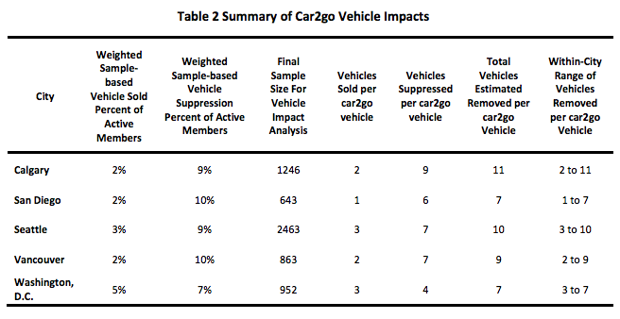
For the vast majority of respondents, car2go did not have any causal effect on their vehicle holdings. Just two to five percent of active members said that they’d sold a car as a result of car2go’s operations. Between 7 and 10 percent said they’d avoided buying a car. But those relatively small percentages translated to sizable impacts. For every car2go vehicle on the street, the researchers found, members sold somewhere between one and three personal vehicles and avoided buying between four and nine vehicles. Overall, each shared car2go vehicle removed as many as 11 personal cars from the road. (City-specific detail on this can be found in the table below.) Across the five study cities, that added up to 28,000 fewer cars.

(Transportation Sustainability Research Center)

By encouraging members to shed or avoid the purchase of personal cars, car2go is also having an effect on the number of vehicle miles traveled in these cities. Shaheen and Martin tried to estimate the number of miles driven by vehicles that were never acquired by using the number of miles that car2go members reported traveling in private vehicles they owned at the time of the survey. Analyzing these responses conservatively, they found car2go may be suppressing between 6 and 12 million miles driven in personal vehicles. Under a more liberal model, that mileage may be as much as 21 to 37 million miles. “We hypothesize that the number is somewhere in the middle,” says Shaheen. The savings added up to 5,300 to 10,000 metric tons of greenhouse gas emissions across the five cities—about 10 to 14 metric tons per year, per car2go vehicle. (How much is a ton of gas? Picture a round balloon with a 10-meter diameter.)

The future of car-sharing

On the other hand, the study also found that car2go poached some public transit ridership. A small minority of respondents reported that the service had changed their transit use, and most said that they used it less. But this really varied at the individual level: “Some members were increasing their use of buses, but not rail, while others were increasing both or decreasing both,” says Shaheen. For many people, she says, the choice to spring for car2go instead of the bus was often based on bad weather or on a one-off, time-sensitive need. And, based on her previous research, Shaheen believes that services like car2go could have a role to play in lower-density areas outside urban cores to act as a way to connect more people to transit. Now it might be up to policy-makers to figure out where and how to position car-sharing services to make them complement buses and trains.

Car2go CEO Paul DeLong says that Shaheen’s research validates the company’s mission to “improve the quality of life in the communities we serve.” He adds that, from the perspective of car2go’s car-manufacturing parent company, Daimler, car2go’s services are also a way of exposing potential future car-buyers to Daimler’s automotive products. “Our business fits well in urban centers, and as people move out to suburbs and their family life changes, they might make a purchase or a lease on a car that they’re familiar with,” he says.

Given Smart cars’ somewhat dismal U.S. sales records, it seems unlikely that legions of former car2go members will one day clamor to put Fortwos of their own in their garages. (They might upgrade to one of Daimler’s other automotive brands, Mercedes-Benz.) Even so, DeLong’s point hits on somewhat of a tension in car2go’s business model, and that of a number of other car-sharing companies operated by auto manufacturers. If the ultimate goal remains to sell cars to members as soon as they’ve got a driveway, then there may be a limit to how much these services—and their benefits—can grow within a particular city.

20 Jul 22:54

Tech Fix: What’s the Right Age for a Child to Get a Smartphone?

by BRIAN X. CHEN
As more children get phones at 10 and younger, parents face the question of when to allow unfettered access to the internet and all its benefits and perils.
12 Jul 18:48

A Medical Mystery of the Best Kind: Major Diseases Are in Decline

by suprgeek
09 Jul 13:21

Public Health: A Medical Mystery of the Best Kind: Major Diseases Are in Decline

by GINA KOLATA
The leading killers — cancer, heart disease and stroke – are coming later in life in wealthy countries as people in general live longer in good health.
06 Jul 23:19

Public Health: Confused About Quinoa and Nutrition? So Are Other Americans

by KEVIN QUEALY and MARGOT SANGER-KATZ
There are some foods that Americans can’t agree about, like steak. But there are also foods that people simply don’t know about.
05 Jul 22:24

Sketch Guy: New Rule: All Purchases Subject to a 7-Day Mental Quarantine

by CARL RICHARDS
When trying to declutter, throwing stuff away is only half the battle. You have to stop stuff from coming into the house in the first place.
03 Jul 10:20

PostgreSQL Exercises

by trymas
30 Jun 21:53

The Humiliating Practice of Sex-Testing Female Athletes

Feature Dutee Chand Credit... Sohrab Hura/Magnum, for The New York Times O ne day in June 2014, Dutee Chand was cooling down after a set of 200-meter sprints…
28 Jun 22:47

What ORMs have taught me: just learn SQL (2014)

by bsg75
25 Jun 08:48

Your Money: Five Illuminating Takeaways From Your Family Money Letters

by RON LIEBER
Readers had some hard-won insights that you may want to borrow when imparting wisdom to your children or relatives.
24 Jun 22:46

Adventures of a Table Top Tutor

by Jenn Choi
Kids keep playing long after the teacher has left. photo: Toys As Tools

Folks, this is Doug Mercier, an IT professional by trade and my go-to advisor for all things board games and video games.  He also helps me with questions like, "How do I set up a server for Minecraft for my kids so he can play with his friends- you know, people he actually knows? But I have to be able to turn it off whenever, okay? "

Today, as my article in Quartz about board games is published, I am simultaneously publishing his first person perspective on what it is like to teach Testers 1 and 2 on how to play the coolest games out there. Happy Reading. -Jenn


Adventures of a Table Top Tutor
by Doug Mercier

In a world saturated with games and entertainment for kids it can be hard for parents to turn the fun off, get them to settle down, and do their schoolwork. But what if the fun didn’t need to turn off? Video games and board games can seem like fruitless activities however, many of them can actually teach kids important lessons that can be used in real life.

For example, games like Catan teach the importance of resource management and planning ahead. Other games like Legends of Andor teach problem solving, teamwork, and critical thinking. So how is a parent to know when a game has real skill opportunities versus just fun?


Read more »
This is a content appetizer only. Visit the Toys are Tools website for the rest of the article. See you soon!
24 Jun 17:30

A Man in Washington, D.C., Is Hosting Refugees Through Airbnb

by Laura Bliss

Amr Arafa was just a kid in suburban Cairo when Schindler’s List came out, but he remembers the protective impulse he felt while watching it. “I wished that I lived in the era, so that I could help hide people,” the 34-year-old tells me, perched on a high-backed chair in his studio apartment in Washington, D.C., on a sweltering June afternoon.

The international refugee crisis—specifically, viral footage of a reporter tripping a father and child fleeing police at the Hungarian border—reignited those early sentiments. Arafa, who works with Fannie Mae as a business consultant, couldn’t draw political cartoons, as his brother does in Dubai. Nor could he donate huge sums to humanitarian organizations. But he could code and strategize for the web. So he built a website, EmergencyBNB, modeled after Airbnb but designed to connect refugees to people in their host country with a room or apartment to spare—for free. (It’s similar to a German effort launched in 2015, but according to Arafa, easier to use for both hosts and guests.)

A Banksy-style decal near Arafa’s door. (Laura Bliss)

The website didn’t gain much traction, so Arafa also made his own apartment available on Airbnb. He charges $10 per night, the website’s minimum. The listing specifies that his space, which is plastered with posters of Manhattan and Banksy-esque decals, is only open to refugees (as well as victims of domestic violence and… Bernie Sanders). Since last fall, he has received hundreds of requests, mostly from poor graduate students, according to Arafa. Airbnb, which declined to comment on Arafa’s arrangement, has apparently deactivated his listing multiple times because Arafa has rejected so many room-seekers. Arafa says that only three have been “legitimate” refugee applicants: a couple from Syria and one woman from Iran.

All three had traveled to D.C. to meet with their respective embassies, and none of them matched the image of destitution that Westerners see on television. Arafa says that his Iranian guest was well-to-do, working as a day-trader in Manhattan. The Syrian couple, though nearly penniless, were university-educated. But free lodging isn’t entirely the point, Arafa says: “It is the fact that it is offered by a stranger who cares.” After verifying his guests’ refugee documents, he says he approved their stay, refunded their payment upon arrival, and spent several nights on a friend’s couch. Arafa says he did the same for a woman attempting to escape her abusive husband. “As a refugee who came a long way, I appreciated Amr's offer and I think whoever can do anything for any refugee to make their life easier, should not hesitate,” wrote the woman from Iran, Minoo Mirsaidi, in her review.*

After emigrating to the U.S. for a master’s degree in computer science in 2005, Arafa lived on a series of stringent immigrant visas. One of them restricted him from returning home, even after his father passed away. The stress of reapplication was always just around the corner. Last year, Arafa received his green card. EmergencyBNB feels like a simple way of paying forward his newfound freedom and stability. His hope is that humanitarian-minded Americans who stumble on his listing will be inspired to put their own spaces on Airbnb, and eventually on a scaled-up EmergencyBNB—if he can garner a lot more interest.

Arafa’s apartment, with its single window. (Laura Bliss)

Which may be a big “if.” The U.S. accepted only 70,000 refugees in fiscal year 2015, due in part to an unwelcoming American public. On the campaign trail, anti-immigrant and anti-refugee sentiment is loud and caustic. "For the amount of money Hillary Clinton would like to spend on refugees, we could rebuild every inner city in America," Donald Trump, the presumptive Republican presidential nominee, said in a speech Wednesday. It is a flagrantly false statement, and one indication of how some Americans seem to feel about refugees. It seems unlikely that Arafa’s website will reach a critical mass in terms of hosts.

In that sense, EmergencyBNB appears to be as much of a political statement as a scaleable solution to an international crisis. But Arafa holds firm in his belief that his efforts are practical. “Everyone thinks this is extremely risky, opening up my home,” he says. “Even the Syrian refugees thought I was crazy, telling me about Trump this and Trump that. But I don’t see it as risky. I find it logical, and appropriate, given the current situation.”

*This post has been updated to include a quote from Minoo Mirsaidi.

24 Jun 17:05

The Getaway: How to Survive Being an Airbnb Host

by JEANNIE RALSTON
R.P. Aditya

getting a bit more sympathy for our airbnb host

As the writer learned in her stint as an Airbnb host, the hospitality business is one long, grinning, love-me-please tap dance, more easily disparaged than done.
18 Jun 06:14

Your Money: The Money Letter That Every Parent Should Write

by RON LIEBER
A good, soulful letter can become a family keepsake and should include a list of crucial habits and the tangible things that have helped the family.
04 Jun 06:42

Simple Set Game Proof Stuns Mathematicians

by retupmoc01
29 May 18:45

What Does It Mean to Be Poor in Germany?

by nkurz
29 May 18:19

Wealth Matters: Renovations That Add Value to a Home: Think Shingles, Not Marble

by PAUL SULLIVAN
Even when updates increase a home’s price, the increase may not line up with the costs of the changes. Certain changes may even lower a home’s value.
26 May 05:50

4 Women on 4 Different Incomes Talk About The Lives They Can Afford

by Pauline

There is a fascinating series on Esquire interviewing people at different income points. After interviewing men, they now turned to four women, making $1,000,000, $350,000, $80,000 per year, and $650 per week (just above poverty line). What I was most intrigued about was:   $1,000,000/year woman. 34 year old Is finally starting to budget “Only”... Read more

The post 4 Women on 4 Different Incomes Talk About The Lives They Can Afford appeared first on Reach Financial Independence.

24 May 21:56

The 10 Best Things to Eat at Sea-Tac

by Allecia Vermillion
Plus a food wish list for the airport's forthcoming concessions overhaul.
24 May 21:56

Is Tourism Spoiling Iceland?

by Feargus O'Sullivan
Image Daniel Knieper/Flickr
Eastern Iceland Borgarfjörður Eystri still receives few visitors, despite the tourism boom. (Daniel Knieper/Flickr)

Iceland may be beautiful, but it’s dangerously close to full. This is the message currently filtering out from the North Atlantic island as it struggles to absorb unprecedented numbers of visitors. Last year, the nation hosted 1.26 million tourists, a staggering number for a chilly island whose population barely scrapes past 330,000 citizens.

Those numbers are powered partly by a Game of Thrones Effect” that has seen fans of the TV series flock to its shooting locations. The 2010 eruption of the Eyjafjallajökull volcano, which has since become a tourist attraction, also helped to push up its profile as a vacation spot—perversely so, given that the eruption initially led to 107,000 flights across Europe being canceled. Given the rocky waters the country has been sailing through since the 2008 financial crisis, the revenue brought in by this spike in tourism is no doubt welcome. But the sheer volume of visitors to what was until recent decades a remote part of the world is still causing major stress. So how can Iceland keep welcoming people while making sure it isn’t trampled underfoot?


Related Story

Why Tourists Take in the Dizzying View From Stockholm's Rooftops

A Swedish tour company offers a thrilling reason to scale urban buildings.


For one thing, there isn’t always enough space to put everyone. By January of this year, the country’s Nordic Travel Agency was already worrying that Iceland’s accommodations would be fully booked all year. In a pattern repeated across Europe, this puts a strain on residents, as accommodations that could be available to locals are rented out to tourists.

The capital city of Reykjavik, whose metro area is home to the majority of the country’s population, is building many new hotels, but is facing a set of tourism-related problems familiar to many other cities. Tourist-oriented chains are pushing out long-standing local businesses such as food shops and music venues in the city center, eroding some of the charm that helped to attract visitors in the first place. The number of Airbnb rooms has increased 124 percent in a year, and the residential character of some streets is under threat as vacation rentals proliferate there. There are now 102 flats available on Reykjavik’s main street alone.

Problems outside the capital region are more distinctively Icelandic. This is raw-boned, hardscrabble country, both thinly populated and thinly served by public amenities. That’s much of its attraction, of course—the idea of having ancient lava fields, raging waterfalls, and mossy ravines more or less to yourself. You’re far less likely to be alone nowadays, though, and many of the easier-to-access areas are groaning under the pressure of not being as unfrequented as they once were. Land at some beautiful spots is being trampled by too many feet, while basic facilities such as parking and toilets are limited. This has led to unfortunate incidents that include desperate tourists turning the graves of Iceland’s greatest poets into an impromptu bathroom. Less gross but also less forgivable are tourists who drive off-road, damaging fragile landscapes and thus partly ruining the wildernesses that they have traveled so far to witness.

This puts Icelanders in a delicate position. They want to stop tourism’s golden goose pooping all over everything, but they don’t want to wring its neck. Already some new rules clamping down on tourist accommodations are in place in a few smaller towns that are struggling to cope. The country’s tourist board is also trying to lure visitors further afield. One of Iceland’s geographic quirks is that its heart is filled by a largely impassable spread of rock and glacier, which means that you need to take the long, coastal beltway to reach the north and east from Reykjavik. Encouraging visitors to travel a little further along this road to such magical spots at the East Fjords could relieve pressure on South Iceland, whose proximity to Reykjavik is putting it under particular strain as an easy, short trip from the capital.

Iceland’s Blue Lagoon. (Martin Lopatka/Flickr)

In addition to these little nudges, there are also tougher plans afoot. Iceland is calculating how many visitors key sites like Geysir and the geothermal spa at the Blue Lagoon can manage, and may then create caps limiting further access to the sites. The country is also considering a blanket tourist tax to be added on top of all fares to the country as a way of scraping back some money to put into better tourist infrastructure. This might deter a few budget travelers, but with Iceland’s tourist numbers expected to reach a peak of 1.3 million visitors this year, that’s arguably a price worth paying to keep the country they’re coming to see in good condition.

23 May 18:36

The New Health Care: Sorry, There’s Nothing Magical About Breakfast

by AARON E. CARROLL
Don’t feel bad if you’d rather skip it. Studies have not proved its importance.
23 May 03:28

Economic View: Are You Successful? If So, You’ve Already Won the Lottery

by ROBERT H. FRANK
People tend to underestimate the role sheer luck plays in guiding our career trajectories, and recognizing this can have implications for public policy.
23 May 03:08

Reverse Engineering a Mysterious UDP Stream in My Hotel

by gkbrk
10 May 22:58

Children of Spies

by schneier

Fascinating story of Tim and Alex Foley, the children of Russian spies Donald Heathfield and Tracey Foley.

09 May 20:12

Economist Detained for Doing Math on an Airplane

by schneier

An economics professor was detained when he was spotted doing math on an airplane:

On Thursday evening, a 40-year-old man ­-- with dark, curly hair, olive skin and an exotic foreign accent --­ boarded a plane. It was a regional jet making a short, uneventful hop from Philadelphia to nearby Syracuse.

Or so dozens of unsuspecting passengers thought.

The curly-haired man tried to keep to himself, intently if inscrutably scribbling on a notepad he'd brought aboard. His seatmate, a blond-haired, 30-something woman sporting flip-flops and a red tote bag, looked him over. He was wearing navy Diesel jeans and a red Lacoste sweater -- a look he would later describe as "simple elegance" -- but something about him didn't seem right to her.

She decided to try out some small talk.

Is Syracuse home? She asked.

No, he replied curtly.

He similarly deflected further questions. He appeared laser-focused ­-- perhaps too laser-focused ­-- on the task at hand, those strange scribblings.

Rebuffed, the woman began reading her book. Or pretending to read, anyway. Shortly after boarding had finished, she flagged down a flight attendant and handed that crew-member a note of her own.

This story ended better than some. Economics professor Guido Menzio (yes, he's Italian) was taken off the plane, questioned, cleared, and allowed to board with the rest of his passengers two hours later.

This is a result of our stupid "see something, say something" culture. As I repeatedly say: "If you ask amateurs to act as front-line security personnel, you shouldn't be surprised when you get amateur security."

On the other hand, "Algebra, of course, does have Arabic origins plus math is used to make bombs." Plus, this fine joke from 2003:

At Heathrow Airport today, an individual, later discovered to be a school teacher, was arrested trying to board a flight while in possession of a compass, a protractor, and a graphical calculator.

Authorities believe she is a member of the notorious al-Gebra movement. She is being charged with carrying weapons of math instruction.

AP story. Slashdot thread.

Seriously, though, I worry that this kind of thing will happen to me. I'm older, and I'm not very Semitic looking, but I am curt to my seatmates and intently focused on what I am doing -- which sometimes involves looking at web pages about, and writing about, security and terrorism. I'm sure I'm vaguely suspicious.

EDITED TO ADD: Last month a student was removed from an airplane for speaking Arabic.

03 May 19:08

America’s Great Housing Divide

by Barry Ritholtz

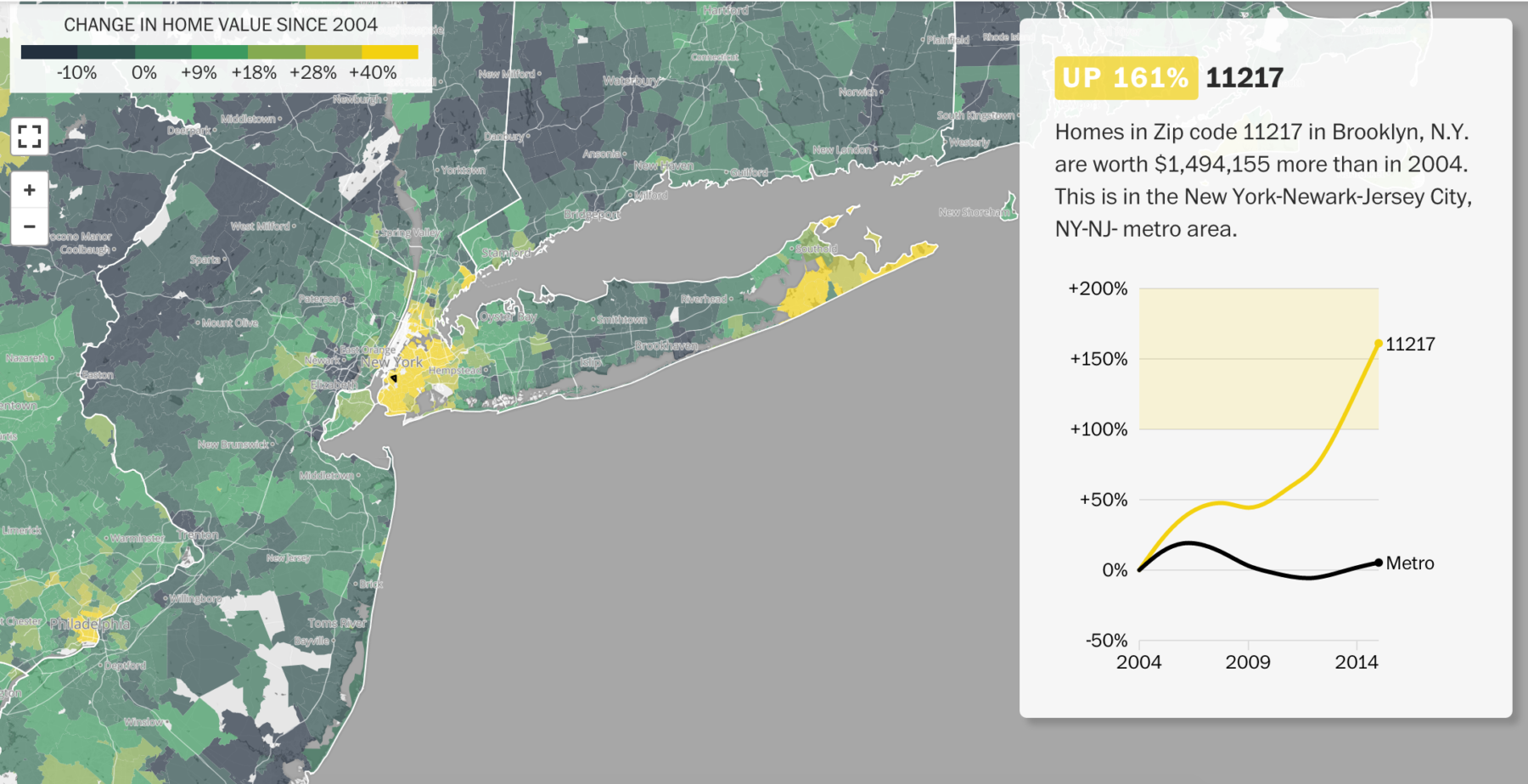
Fascinating analysis and interactive too from the Washington Post, looking at the post-crisis housing recovery. Not surprisingly, it is unevenly distributed. This seems to be be a common aspect of this recovery, or perhaps a broader, secular change in the United States.

Hard to tell of these are the laggards from the bubble doing well, or something else entirely.


The interactive version, where you can look at a neighborhood by zip code to see how its done is quite amazing — check out Brooklyn and the Hamptons (in Yellow):


Source: Washington Post


The post America’s Great Housing Divide appeared first on The Big Picture.