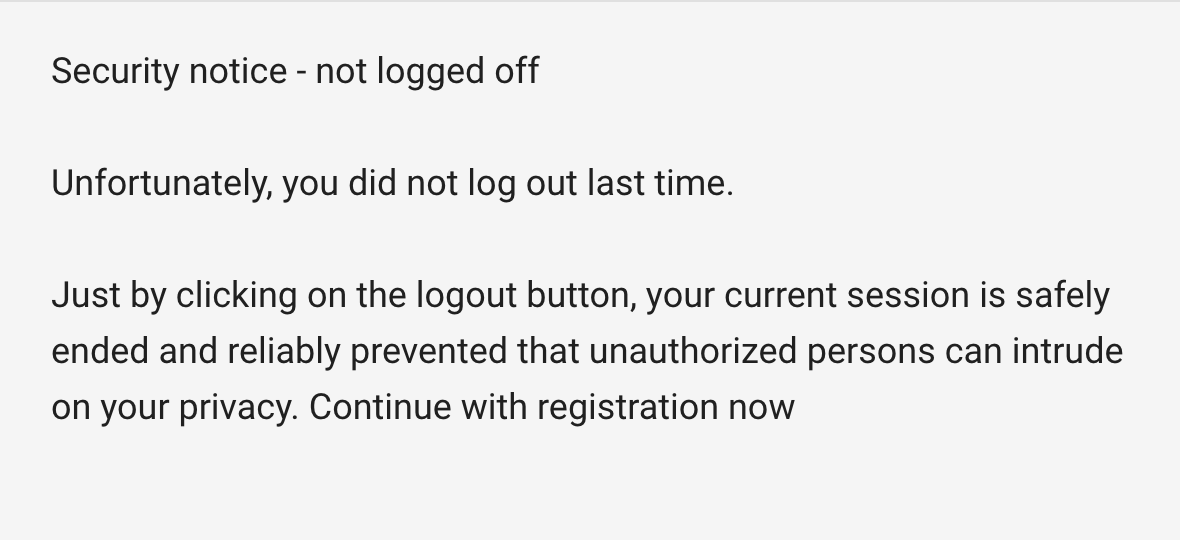
nikitonsky: So you’ll bug me now during login that I didn’t log out last time?
nikitonsky: So you’ll bug me now during login that I didn’t log out last time?
Article URL: https://undraw.co/
Comments URL: https://news.ycombinator.com/item?id=21858822
Points: 742
# Comments: 74
Article URL: https://cs144.github.io/
Comments URL: https://news.ycombinator.com/item?id=21794270
Points: 333
# Comments: 28
Article URL: https://mystery.knightlab.com/
Comments URL: https://news.ycombinator.com/item?id=21799988
Points: 803
# Comments: 79
 Sponsored: Celebrating the diversity of our local home market, we take a look at intentional communities where collaboration is often part of the living arrangement.
Article URL: https://github.com/SwiftLaTeX/SwiftLaTeX
Comments URL: https://news.ycombinator.com/item?id=21710105
Points: 720
# Comments: 113
 Jason Raish for Vox
More people than ever say they’re feeling pressured to look and be the best. It’s taking a toll.
/cdn.vox-cdn.com/uploads/chorus_asset/file/15986155/Vox_The_Highlight_Logo_wide.jpg)
In fifth grade, Hailey Magee rushed home from school distraught and crying after seeing that she’d received an A-minus on her first letter grade report card. Growing up, she had learned that the way to receive validation and love from family members and teachers was to be a high achiever. So to Magee, that A-minus felt like a failure.
“I was shattered,” she said. “In that moment, I felt like my self-worth as a human had fallen far below what it would have been if I’d gotten an A or an A-plus.”
Magee turning a good grade into an example of her inferiority is a textbook example of a growing trend in recent years: perfectionist behavior. Paul Hewitt, a clinical psychologist and professor at the University of British Columbia who studies the phenomenon, remembers a bright young college student who came to him, similarly obsessed with earning an A+ in one of those ridiculously difficult courses that are designed to weed out people who aren’t serious about a major. By the end of the term, he told Hewitt he was having suicidal thoughts. “I got the A+, but all it did was demonstrate to me that if I was really smart I wouldn’t have had to work so hard to get it,” he said.
Perfectionism is a broad personality style characterized by a hypercritical relationship with one’s self, said Hewitt, who co-authored Perfectionism: A Relational Approach to Conceptualization, Assessment, and Treatment. Setting high standards and aiming for excellence can be positive traits, but perfectionism is dysfunctional, Hewitt said, because it’s underscored by a person’s sense of themselves as permanently flawed or defective. “One way they try to correct that is by being perfect,” Hewitt said.
Once an issue that affected a select few, perfectionism is now a growing cultural phenomenon, fueled by modern parenting and social media and an increasingly competitive economy, researchers say. Struggles with perfectionism have been the subject of multiple TED talks, Instagram memes, Oprah discussions, and books. Even celebrities such as Demi Lovato, Zendaya, and Natasha Lyonne are opening up about their battles with perfectionism.
“We are so sucked into our screens, and our life is so perfectly curated,” Netflix star Lana Condor said in an episode of the “Hi Anxiety” video series about mental health. “You see other perfect lives and your life isn’t like that. And so if I go out, and people see that my life isn’t perfect, I’m afraid they’ll judge me.”
Look around these days, and you can find perfectionism “everywhere,” said Thomas Curran, a psychologist at the University of Bath. “I see it in my own friends and colleagues and the students I teach.” In an age where social media makes it possible to constantly compare your own life to others, perfectionism has only become amplified.
Curran and his colleague Andrew Hill gathered data from more than 40,000 college students who had taken a psychological measure of perfectionism between 1989 and 2016. In 1989, about nine percent of respondents posted high scores in socially prescribed perfectionism, but by the end of the study, that had doubled to about 18 percent, he says. “On average, young people are more perfectionistic than they used to be,” Hill says, and “the belief that other people expect you to be perfect has increased the most.”
/cdn.vox-cdn.com/uploads/chorus_asset/file/19414447/GettyImages_1151695913t.jpg) Robyn Beck/AFP via Getty Images
Robyn Beck/AFP via Getty Images
The rise in perfectionism is especially troubling because it has been linked to an array of mental health issues — a meta-analysis of 284 studies found that high levels of perfectionism were correlated with depression, anxiety, eating disorders, deliberate self-harm and obsessive-compulsive disorder. The constant stress of striving to be perfect can also leave people fatigued, stressed and suffering from headaches and insomnia.
Author Amber Rae was in her early 20s and running herself thin working at a Silicon Valley company. She was even taking the stimulant Adderall to help her meet her ridiculously high career expectations. “I was burning the candle at both ends,” she described. “I wasn’t sleeping.” One day after she came home from work, she fainted, eventually waking up with no idea how long she’d been out. When Rae went to a doctor, she was told the episode was caused by depletion in her body. “It was a wakeup call,” she said.
Up until then, she hadn’t been conscious of the story she’d been telling herself — that her lovability and safety as a human were tied to being perfect. “I’d been telling myself this story for my entire life, and it was sucking the joy out of my creative process,” Rae, now 34, said. “Something had to change.”
Perfectionism comes in three common flavors — “self-oriented,” where someone demands perfection from themselves; “other-oriented,” where they demand perfection from others around them (like spouses, co-workers or friends), and “socially prescribed” perfectionism, where the person feels external pressure from the larger world and society to be perfect.
The latter type seems to be especially pernicious, says Gordon Flett, a psychologist at York University in Canada, because it’s consistently linked to health and emotional problems. He recently published a paper looking at people with chronic health problems like fibromyalgia or heart problems. About one in four of them scored high in socially prescribed perfectionism, where they felt that society or people around them expected them to be perfect.
Striving for perfection isn’t the same as being competitive or aiming for excellence, which can be healthy things. What makes perfectionism toxic is that you’re holding yourself to an impossible standard that can never be achieved — essentially setting yourself up for perpetual failure.
As a budding artist, Rae remembers ripping up middle school art projects at the sight of any small imperfection. “I had high taste, and my talent wasn’t there yet, so I would get frustrated. I felt like I had a potential that I wasn’t living up to,” she says. Rae had created a story for herself that perfection meant she would be loved. “If I could do things perfectly and look perfect, then people would love and approve of me and I’d be safe,” Rae says.
“It’s really difficult when people feel like they’re being held up to impossible standards. And when these people are successful, they may fear that now the expectations are just raised even further,” Flett says. “You see an escalating sense of pressure.”
Eating disorders are a common manifestation of perfectionism, according to Karina Limburg, a clinical psychologist at Ludwig-Maximilians University in Munich, Germany, who authored a study linking perfectionism to mental health disorders. She recalls one woman she saw with anorexia nervosa who had extremely strict and rigid rules about eating.
“Every time she ate a forbidden food, it meant she had failed to meet her standards,” Limburg said. A healthy person might say, “Oh well, I didn’t make that goal,” but for this patient a single lapse could completely wreck her feelings of self-worth. “She based her self-worth on reaching a perfect goal weight,” Limburg said, and this impossible standard set her up for failure.
There does seem to be at least some genetic component to perfectionism, but to what extent it’s an innate, heritable disposition versus something that’s learned or provoked by one’s environment isn’t completely clear, Flett explained. “If you are a perfectionist, you’re more likely to have perfectionist parents. It can be genetic, and it can also be modeling and circumstances.”
When Magee was growing up, success felt like a way to connect with her father on an emotional level. The only times he seemed to really pay attention to her, she said, was when she succeeded at something, like scoring a soccer goal or getting a good grade. “I learned from a young age that I was most likely to be seen and valued when I was achieving something,” she said.
The kind of success-focused parenting Magee experienced could be getting more common. Kids crave love that’s not contingent on math scores or performance in a soccer game, said Simon Sherry, a clinical psychologist and professor at Dalhousie University, yet many parents today feel a sense of competitiveness that they may push onto their kids, whether by pressuring them to get perfect grades so they can get into elite schools or signing them up for extracurricular activities that might look good on a college application. But if a child is only rewarded for high achievement, over time they learn that their value as a person depends on being perfect. “Parents need to be loving their kids without strings attached,” Sherry said.
Instagram, Facebook and other social media platforms also fuel unhealthy comparisons. “It’s a real problem — those social media images end up serving as yard sticks that people can compare themselves to, and a perfectionist is always trying to keep up with the Joneses,” Sherry said. And it’s never been harder to keep up with the Joneses, because today we are constantly bombarded with seemingly perfect images of other peoples’ lives.
Perfectionism doesn’t automatically resolve itself as someone gets older, and in fact may become worse as people age, said Martin Smith, a researcher at York St. John University in the UK. His team published a meta-analysis of the relationship between perfectionism and other personality factors, and found that as people who score high in perfectionism age, they seem to become more prone to experiencing negative emotions like anger, anxiety, and irritability and they also become less conscientious.
Smith said that what may be happening is that over time, as perfectionists repeatedly fall short of their impossible standards, they start to adopt a bleak view of their past. They tend to see most of their experiences as failures, since they only rarely achieve the perfection they’re striving for.
In school or in a competitive sport setting, it’s often fairly easy to gauge performance relative to others via grades or other statistics. But in the workplace, comparisons to colleagues may be more subjective, and for a perfectionist who is always striving to be the best, this can be difficult, Smith says. “It’s rare that you can say that you got a 95 percent on this thing at work. It’s a lot more murky.”
Several decades of research on perfectionism has shown that perfectionism is associated with suicidal thinking and behaviors. Suicidal thoughts and impulses are more common among perfectionists than most people appreciate, Sherry said. Red flags can include taking extra measures to hide distress, and actively presenting a picture of perfection that doesn’t reflect reality. These are facades, Sherry explained, that can often be seen through by the people close to the person.
Rae realized she’d built an identity around her need to be perfect, and it was one she had to let go of if she were to get past her destructive behavior. To help her recognize when she was falling into her old patterns, Rae gave her inner perfectionist a name — Grace. Giving it a name helped her find some distance that allowed her to recognize what was happening when she fell into that way of thinking. “I could say, oh that’s Grace. And instead of bashing Grace, I could have compassion for her.” She would ask herself, what does Grace need right now? The answer could help her understand the needs that her perfectionism was bubbling up to try and meet.
Treating perfectionism, Hewitt said, is somewhat like working with a child who is afraid of an imaginary monster under their bed. He remembers a patient who self-identified as a perfectionist who casually mentioned in their first meeting that when she was five years old, her parents had sent her away to live with relatives while they arranged the family’s overseas move. She remembered being reunited with her mother after the absence and being transfixed by how beautiful she looked. After that, she made it her life’s work to be the perfect daughter, with the subconscious hope that if only she were perfect she’d never be separated from her mother again. Cases like these, Hewitt explained, are often more about the underlying relationship than anything else.
Ironically, many people pursue perfectionism with the belief that striving for perfection will make them more acceptable to other people, but instead what more often happens is that they’re perceived as prickly, guarded or hostile, Hewitt says. “It’s meant to garner acceptance and closeness to others, but instead, it pushes people away — that’s the neurotic paradox.”
Magee’s perfectionism made it difficult for her to build friendships. She was always seeking recognition and affirmation, rather than the vulnerable human connections that friendships require. “I would have relationships, but they were performative, not authentic,” she said.
Eventually Magee, now 26 and living in Seattle and working as a co-dependency recovery coach, learned that she had to let go a little and allow herself to show up with all her imperfections. “I had to learn to be able to say, ‘I feel anxious today, but I’m still going to hang out with you.’” It took some practice, but she eventually learned to trust that she could show up and not be perfect and still feel valued. It’s taken time, but she now has two or three close friends she can totally feel like herself around. These friendships have helped her see that “I can be imperfect and everything can be fine!”
Christie Aschwanden is an award-winning science journalist. She’s the author of the New York Times bestseller, Good to Go: What the Athlete in All of Us Can Learn from the Strange Science of Recovery, and co-host of the podcast Emerging Form. Find her on Twitter at @CragCrest.
Jason Raish is a freelance illustrator based in New York City.
Article URL: https://adventofcode.com/2019
Comments URL: https://news.ycombinator.com/item?id=21674752
Points: 543
# Comments: 119
What if you could be transported into another person's lived experience just by visiting their home?
Two artists—one in Pittsburgh, one in Tehran—are putting this idea to the test with The Other Apartment, an ambitious installation that uses the intimacy of one person’s home to bridge the vast geographic, cultural, and political divides between the United States and Iran.
The apartment belongs to Iranian artist and curator Sohrab Kashani. For 11 years, his home in Tehran has doubled as a DIY venue for exhibiting and discussing contemporary art, one of the few such spaces that exists in his country. He and Carnegie Mellon University art professor Jon Rubin have recreated his flat in minute detail inside Pittsburgh’s Mattress Factory Art Museum.
“As friends living inside two countries in conflict with each other, our lack of power and agency is maddening sometimes,” Kashani says. “So we decided we would create a world for ourselves where everything that was a limit would become a possibility, and every political obstacle would become a creative opportunity.”

Over four months this year, the artists worked with a team of fabricators to meticulously recreate Kashani’s Tehran flat, from the wrought iron facade to its distinctive interior spaces to a range of unique personal effects. Visitors to the Pittsburgh locale get to know Kashani through his common household items like a well-worn rug, a favorite art poster, and a shared table, all carefully arranged to match what visitors see and experience when they walk into the counterpart home more than 6,300 miles away in Tehran. Kashani’s furniture has been recreated by hand, including an office bookcase that holds scans of every book he owns. This laborious recreation included scaling the apartment down by two feet to fit into the museum, and reproducing the appearance of its cement and terrazzo floors.

The cumulative effect is a wholesale transportation into a place that few Americans ever experience or try to understand. Achieving this by way of a person’s home brings a sense of intimacy and urgency to the project. Every domestic space functions as an informal portrait of its occupant, and you can learn a lot about Kashani just by walking through his apartment: He loves Superman, smokes cigarettes, owns a small piece of the Berlin Wall, and reads English and Farsi books about art, philosophy, and science fiction.

Pulling this off anywhere would be difficult enough, but The Other Apartment faced an additional hurdle. Kashani, as an Iranian citizen, is unable to travel to the United States due to President Donald Trump’s 2017 travel ban. Rubin has never been to Kashani’s apartment in Tehran, so the pair had to coordinate their work entirely through photographs, sketches, spreadsheets, and video-chat sessions.
Over the next eight months, the artists will keep both spaces identical—producing exhibitions, programs, and events where every object, video, and performance is perfectly in sync. Currently, the dual spaces host Voice Over (In Three Parts), a single-channel video work by six artists, including Alex Da Corte (U.S.A.), Siavash Naghshbandi (Iran), and Beatriz Santiago Muñoz (Puerto Rico), linked by the use of “extra-diegetic audio” into one omniscient stream, on view through January 10th. “In these videos, the voice-over has been reimagined as a vehicle for interpretation and reflection, questions and provocations,” say the curators on Sazmanab’s website. “The speaker, who is heard as voice-over, is never seen, and the language is suggestive of a complex and at times abstract inner world.”

The project began with the concept of an American-style TV show. Rubin and Kashani were raised on the same American sitcoms and suspected that, despite growing up in different countries and eras, this format could bridge their cultural divide.
The pair met through a mutual friend and eventually started working together on a project in Cleveland, Ohio, called The Foreigner, where Cleveland residents functioned as real-time avatars for Iranians overseas, each Clevelander was connected live to an Iranian citizen and encouraged to move, act, and speak by way of the other’s commands. The project was enthusiastically embraced by locals, and the two continued to work together on Conflict Kitchen, a local restaurant-cum-art-project Rubin has co-run since 2010 that serves cuisine from countries in which the United States is in conflict, rotating every three to five months. The project, which was launched with Iranian food during the country’s presidential election of 2013, has gone on to present the cuisines of Afghanistan, Cuba, North Korea, Venezuela, and Palestine, among others. The project has been a huge success, attracting thousands of visitors and hosting related educational programming, including film screenings and trivia nights, organized with the assistance of the local immigrant population.
For this latest project, Rubin hopes to again bridge cultures, offering the rare opportunity for Americans and Iranians to “visit” with each other, via a series of simultaneous events and workshops which are frequently broadcast via Skype.
In many ways, Pittsburgh is a fitting location for The Other Apartment to explore the impact of cross-cultural exchange. Once the “Steel Capital of America,” the city saw its industries and population decline by 50 percent in the 20th century, but has rebounded in recent years with a bustling technology sector focused on robotics, health care, green energy, and biomedical research. A vibrant immigrant population has helped rejuvenate the city's aging demographics, and the city has a long history as a haven for immigrants and refugees. That includes immigrants from Eastern Europe in the early 1900s and the resettlement of Somalis in the ’90s, to the more recent growth of Latino and Asian communities. According to the Pittsburgh tourism board, over 50 percent of new immigrants come for higher education and healthcare opportunities.
“The Other Apartment conjures up a different world for everyone,” says Golnar Touski, a University of Pittsburgh doctoral student of history of art and architecture, and a visiting Iranian citizen who worked on translations for the project. “To the American, it’s a reminder of her kinship with other worlds and spaces. To the diasporic Iranian, it’s an astral projection to home. To the Iranian, it's a reflection of her own in a faraway mirror.”
So far, the team has found the public response to be both encouraging and unusual. “When we launched the project, we were concerned that, with so many small possessions in the apartment, people might steal things,” said Rubin, but the opposite actually occurred. “People have been leaving things, sometimes very intentionally.” This has included a demo cassette tape with photocopied cover art, which inspired the creators to invite musicians in both Pittsburgh and Tehran to visit and perform cover versions.
“We will be filming their performances in different rooms and presenting them in both versions of the apartment as an exhibition,” says Rubin. The colleagues say they particularly enjoy the way the project now functions as a platform—something left or placed in one space may now materialize in a slightly or radically altered form in the other. “It seems to us an endless series of both casual and intentional loops can be carried out within this new reality we’ve set in motion.”
The Other Apartment Pittsburgh is on view from September 2019-July 2020.
Mattress Factory Museum
500 Sampsonia Way
Pittsburgh, PA
September 27, 2019 - July 2020
More info
Sazmanab
Museum of Sohrab
Tehran, Iran
By appointment only
 James Robertson, who walked 21 miles to and from his factory job in Detroit, pauses during the filming of the documentary The Walking Man in 2016. | Salwan Georges/Detroit Free Press/Tribune News Service via Getty Images
Begging for sick days and walking 20 miles to work are not tales of inspiration. They are societal failures.
Robert Goodman had planned to go back to work after chemotherapy. The Florida teacher who taught world history for much of his 25-year career was diagnosed with stage 3 colon cancer in April 2018. To cover him through his treatment, he had to ask his fellow teachers to donate their sick days. Without those extra 20 days, he would have to finish chemo — a time when your immune system is weakened, your body vulnerable to nearly any germ — while still showing up for work every day, or he would risk losing everything.
His ask for help resonated with teachers from his district, who transferred around 75 of their own sick days to him in credits. It was enough time for him to qualify for catastrophic leave, complete his chemotherapy without worrying about work, and get himself back into the classroom by the new year.
A teacher battling cancer ran out of sick days, so school employees showered him with theirs https://t.co/XDU4SBObPx pic.twitter.com/OpYQT7KFOR
— CNN (@CNN) August 15, 2018
His story also resonated with a public hungry for an inspirational clip in a time when uplifting news seems harder and harder to come by. Local outlets WPTV and South Florida Sun-Sentinel descended on the story, with headlines like “Florida teachers unite.” Goodman’s tale went viral, gracing the likes of CNN and beyond. The focus of nearly every news piece was the teachers’ generosity and Goodman’s appreciation. The takeaway was: Hooray for the charity of others.
But that December, another headline emerged as Goodman prepared to go back to school: “Teacher who asked for sick time for cancer fight forced to ask again.” Goodman told Vox he had suffered two minor and one major heart attacks while celebrating being cancer-free and needed more sick time. The teachers came through again.
When Goodman finally returned to school this April, the same local news station covered his first day back. In a video package, former students walked up to Goodman and hugged him as he held back tears. But again, among the numerous outlets that picked up the story of Florida teachers’ goodwill, there was nary any reflection on why Goodman needed to ask for help not once but twice. Nor was there a look at why Florida teachers must ask one another for their sick days, or why they can’t afford disability insurance, or why people such as Goodman who have taught for 20-plus years don’t have support for long-term health emergencies. (WPTV has not responded to Vox’s request for comment.)
“I’m the poster boy of ‘People love me and gave me their sick days and I appreciate it.’ But I’m also kind of the poster boy of, ‘Why does he need help? And why is this story happening all over America all the time? And what about the teachers or other employees that didn’t get the help I got?’” Goodman told Vox. “They’re out there. They’ve lost their jobs, they’ve lost their lives. And how does it make me feel? It makes me feel awful.”
It shouldn’t be understated: Teachers stepping in to help one of their own is heartwarming. As Goodman has said, he would have lost his job and could have died without their assistance: “I was surprised by the volume of outreach, but I wasn’t surprised that teachers were giving,” he told the South Florida Sun-Sentinel in August 2018. “Because that’s what teachers do.”
The problem isn’t that stories like Goodman’s shouldn’t exist; it’s that inspiration is the only narrative being pushed in a much larger, nuanced story about the social failings that brought Goodman to need such help in the first place.
There is an overflowing pipeline of “feel-good” stories traveling from local to national news, showcasing inspirational tales about adversity and how community members support each other in times of need. However, these pieces, seemingly easy to report out because of their surface-level levity, often eclipse overarching, unexplored narratives about labor, health care, education, and more, indicated by the lack of public or private support detailed in these stories themselves.
Third grade boy offers his teacher a portion of his birthday money to show his appreciation for all she does in the classroom. https://t.co/BbHzwA6882
— ABC News (@ABC) November 6, 2019
Last year, a young boy sold his Xbox to a stranger online to buy a car for his single mom to drive herself to work (“Good kid. Sad story,” someone responded). A few weeks ago, an elementary school student gave his teacher his birthday money because he heard about how underpaid teachers are. Last year, a stranger donated supplies to six random teachers after one of them posted her salary on Facebook. The internet has hosted a myriad of stories depicting people whose bosses or coworkers or customers gave them cars to get to their jobs, after walking 20 miles overnight to their first day, or 12 miles to work roundtrip, or walking to work every day for a year. It’s a rose-colored coverup of public resource failures.
Journalist Carla Murphy, in an essay about the need for a working-class media for Dissent Magazine, wrote about a viral story the Detroit Free Press ran in 2015. The piece was about James Robertson, a black man who walked 21 miles to and from his factory job in the suburbs every day, and pointed out that “you won’t hear him complain — nor his boss.” Speaking at a panel in October about the Dissent issue in which her essay was published, Murphy said she was struck by how people reacted to the Free Press story.
“My first thought isn’t, ‘Oh wow, what a great worker.’ I think as a journalist, my first thought is, No. 1, ‘Why is he doing that?’ No. 2, ‘Are there other people who are doing that in his area?’” Murphy told Vox about her reaction to Roberson’s story.
Murphy said the subjects of public transportation and job availability immediately jumped out at her as the crux of the story. “I think quite frankly, every journalist should look at something like this and say, ‘What is the public policy issue behind this action? Why are factories or why are good jobs not located near this man?’”
These kinds of stories act as a glimmer of hope in a sea of societal hardship, and, simultaneously, are indicative of total systemic failures that make children feel like they must take care of adults, make workers feel indebted to their bosses, and make audiences feel that we are all but a “stroke of good economic fortune away from wealth and abundance,” labor historian Max Fraser, a current fellow at Dartmouth College, notes. We are living in the era of depressing, capitalist content packaged as mind-numbing uplift.
Coverage about working-class issues wasn’t always this way, Fraser told Vox. Muckraking journalism of the late Progressive Era was mostly comprised of middle-class writers who worked for mainstream newspapers but wrote exposés of corporate malfeasance, workplace exploitation, and other issues that impacted poor and working-class people. Fraser said that during this era, a robust left-wing political movement pushed reporters with deep personal and political connections to those movements to create journalism with incisive analysis and critiques of industrial capitalism.
However, in the two decades leading up to the housing market crash and Great Recession of the late 2000s, the struggles of poor and working-class people were almost entirely absent in reporting from the “bourgeois” mainstream press. Fraser said reporting on working-class issues most often occurs during moments of political change, such as with the financial crisis, labor strikes, and presidential campaigns like Bernie Sanders’s elevating the conversations around class inequality. Today, few mainstream outlets have a dedicated labor reporter, and the reporters who do cover these stories through a human-interest lens often have a limited understanding of the economic forces at play.
/cdn.vox-cdn.com/uploads/chorus_asset/file/19408125/GettyImages_615959190.jpg) Salwan Georges/Detroit Free Press/Tribune News Service via Getty Images
Salwan Georges/Detroit Free Press/Tribune News Service via Getty Images
“Since we don’t see and hear a different kind of media today the way we used to, when major newspapers had not just a labor beat reporter but multiple beat reporters — when there was a robust working class of various kinds — these stories sort of take up more of the airspace,” Fraser said. “They loom larger.”
Despite the inadequate portrayal of these feel-good stories, Fraser questioned whether the general existence of inspirationally framed coverage of working-class people is necessarily worse than when the mainstream media skipped coverage of the working class altogether. Nonetheless, this coverage is inadequate. Murphy, who is writing a book about class mobility, said that mainstream press often portray these stories as pseudo-inspiration because they’re writing for their comfortable middle-class audience. She said when we see these stories as “inspirational,” we have to question who the story is inspirational for.
Because there are viewers who aren’t buying it. When Goodman’s original story went viral, audiences questioned what the kindness of teachers really said about the reality that teachers, and workers at large, face when they get sick.
“This isn’t a feel-good story of friendship and charity. This is the everyday nightmare dystopia that is America. Workers’ lives do not matter,” one person replied to CNN’s tweet sharing the news.
“I don’t get it, ‘ran out of sick days,’ they are limited in the US? How barbaric,” another commented.
“Sick days for the flu are one thing. How does this guy not have coverage or short-term disability during his fight?!?! Huge systemic fail,” someone else replied.
Perhaps it’s a hopeful sign that audiences, at least anecdotally, are starting to push back on the insistence from mainstream media that these stories are valuable for their depictions of charity — as opposed to what they say about private and public resources, low wages, and health care.
Murphy said she had written her essay in Dissent because she wanted to find other people who also think the mainstream media’s coverage of the working class is lacking. And while she said her essay did attract responses from people mystified by this kind of coverage, she said she hasn’t seen a similar public backlash to these stories at large outside of Twitter, and that may be because there isn’t another notable, dissenting space where people can voice those reactions.
Goodman, too, said Twitter was the only platform where he saw responses questioning why Florida teachers had to go to such great lengths and depend on one another when they got sick. He recalled only one interview with a national video-based publication that actually touched on the politics of health care. When news outlets have an agenda that only focuses on the positive, they are also determining how much control the subjects have over their own stories.
“I wish someone could have asked [about health care and recovery care], but I don’t know how I would’ve felt trying to answer these questions,” Goodman said, “because I was trying to be thankful. And also I still have a job and I still work in a system where, you know, if you work for a corporation or you work for the government, you have to not always say the things that you’d like to say.” (Goodman later clarified that he wasn’t saying he would have necessarily faced consequences for saying the wrong things about his situation, but understood that others in similar situations could be.)
It’s astounding: The same systemic problems that people are at the mercy of are also holding them back from sharing their truth. Goodman focused on the charity of his story instead of health care because he didn’t want to seem unappreciative and he had less energy to talk about the more stressful topics. He even went back to work earlier than expected because even though his school said they wouldn’t terminate him, he wanted to make sure his position was still secure: “You never know,” he said. He heard from other teachers who had gone through similar leaves of absence, and teachers who lost their jobs after becoming sick, and spouses of teachers who died after getting sick. Goodman is back teaching this fall, but even as he works, he still has numerous doctor appointments and medications for conditions he developed following his chemotherapy and heart problems. Now that he’s coming up on the one-year anniversary of his heart attacks, he’s found that his time to talk about health care is now.
“We have all the money in the world to defend our nation, but we don’t have enough money to take care of the people,” Goodman said. “There has to be a balance in one of the wealthiest nations in the world, where people wake up and they’re not stressing over hospital bills. The stress itself kills you.”
Indeed, now, with all our social failings harder to ignore — racism, sexism, and transphobia appearing in our news and social feeds daily — would be a good time for journalists to reckon with the inequalities of labor and socioeconomics in America as well. Instead of scheduling feel-good news between coverage of the Trump administration’s latest controversy or human rights catastrophe, the media could examine these goodwill stories in the context of Trump and the policy failings that brought us to this place of lacking health care, inadequate labor rights, and transportation woes before he was even elected.
In Murphy’s piece for Dissent, she laid out three requirements for a new working-class media: to have anger, to frame its coverage of society through power and its imbalances, and to cover the working class as “more than a problem to be solved or studied.” However, Murphy hypothesized that just creating a space for an alternative to “feel-good” stories would require an ecosystem of dozens of working-class outlets — outlets “for,” as opposed to “about,” working-class people. A space to not just critique mainstream coverage but to provide a model for what could be done. This means hiring journalists from diverse socio-economic backgrounds, not just those who live in the country’s most expensive cities. As Fraser notes, there is still a long way to go.
Again, if Goodman, who said it took him 20 years as a teacher to make $50,000 a year, was in charge of his own narrative — if he felt supported enough to be in charge — it’d have more nuance.
“I think the big stories are actually not just that [these people] help me, but again, why does anyone have to go through this in America at all?”

 Seattle commuters are putting their faith in transit even as residents in other parts of the state passed a ballot measure earlier this month that could cut billions of dollars in transportation funds.
The number of people driving solo to work in Seattle fell from 53 percent in 2010 to only 44 percent in 2018 — the steepest decline in the nation among large metro areas over that period according to a Seattle Times analysis of Census records.
Instead people took rail, buses, bikes, and ferries or simply walked to their jobs. Transit use in the Seattle area skyrocketed from 5 percent to 23 percent over the same period while the number of people who walked to work rose from about 3 percent to 12 percent. Cycling to work last year rose 3.8 percent from 0.2 percent in 2010 while just under 8 percent worked from home, up from 1.1 percent.
Last year was the first time that more than 100,000 people used public transit to get to work on an average day, the Seattle Times found. Roughly 89,000 people took the bus and another 10,000 used light rail to get to their jobs.
Some Washingtonians ditched their cars entirely. Only 81 percent of Seattle households owned a car in 2018, down three points from 2010 and one of the largest drops among U.S. cities where trends have been moving in the opposite direction this decade.
Clearly Seattle is proving that cities can reduce the number of cars on the road and shift its population to rely on mass transit. Here are a few of those lessons.
Seattle commuters are putting their faith in transit even as residents in other parts of the state passed a ballot measure earlier this month that could cut billions of dollars in transportation funds.
The number of people driving solo to work in Seattle fell from 53 percent in 2010 to only 44 percent in 2018 — the steepest decline in the nation among large metro areas over that period according to a Seattle Times analysis of Census records.
Instead people took rail, buses, bikes, and ferries or simply walked to their jobs. Transit use in the Seattle area skyrocketed from 5 percent to 23 percent over the same period while the number of people who walked to work rose from about 3 percent to 12 percent. Cycling to work last year rose 3.8 percent from 0.2 percent in 2010 while just under 8 percent worked from home, up from 1.1 percent.
Last year was the first time that more than 100,000 people used public transit to get to work on an average day, the Seattle Times found. Roughly 89,000 people took the bus and another 10,000 used light rail to get to their jobs.
Some Washingtonians ditched their cars entirely. Only 81 percent of Seattle households owned a car in 2018, down three points from 2010 and one of the largest drops among U.S. cities where trends have been moving in the opposite direction this decade.
Clearly Seattle is proving that cities can reduce the number of cars on the road and shift its population to rely on mass transit. Here are a few of those lessons.
Article URL: https://courses.dcs.wisc.edu/wp/readinggerman/
Comments URL: https://news.ycombinator.com/item?id=21559633
Points: 326
# Comments: 154
Article URL: https://www.sametab.com/blog/employee-engagement
Comments URL: https://news.ycombinator.com/item?id=21545493
Points: 433
# Comments: 112
A recent report by the think tank TransitCenter summed up America’s transit funk. It showed that U.S. public transportation ridership has fallen 14 percent since 2013.
The problem, the report found? The competitor. “Despite all the changes that we see in transportation technology, it’s still really ‘transit versus the private automobile’ in most cities,” coauthor Steven Higashide told GovTech, a government trade publication.
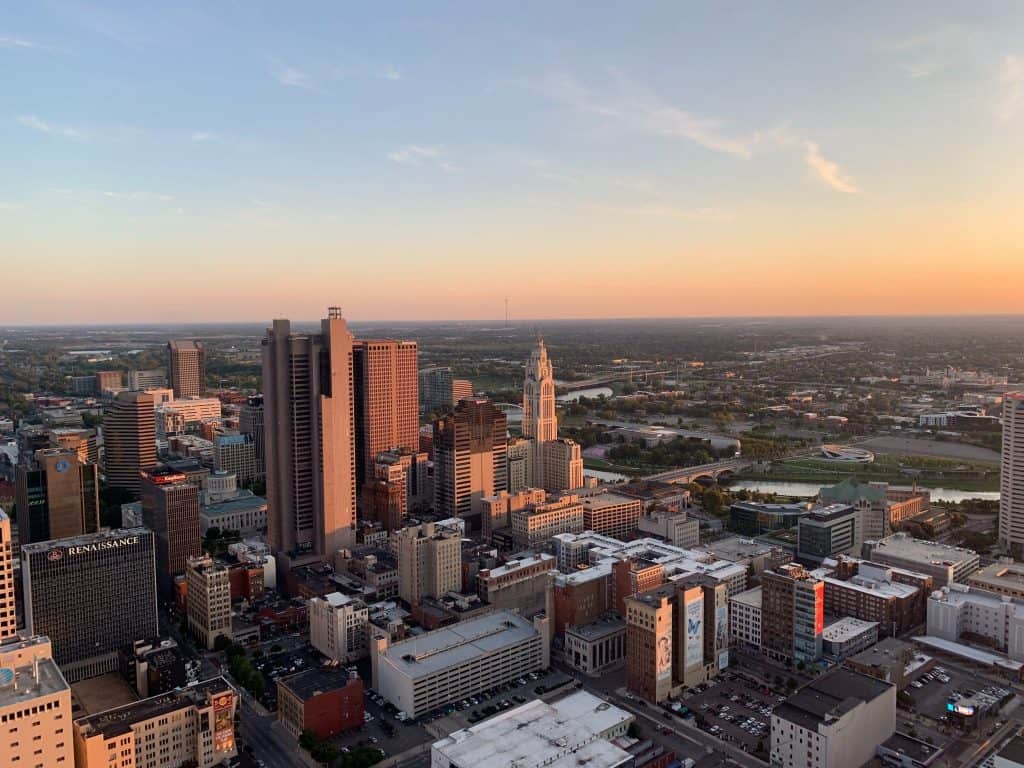
While there are some notable exceptions to this trend — Seattle, for example — there is one that stands out a little unexpectedly: Columbus, Ohio. And true to their rustbelt roots, the solution they’ve found is uniquely homegrown. Since summer, 2018, Columbus has dramatically increased the number of downtown workers taking transit with a solution typically scorned by transit professionals: free transit.
Columbus’s road to increased transit ridership started where many discussions around public transportation do: a lack of parking downtown.
Unlike most Midwestern cities, Ohio’s capital is growing fast. Since 2000, its population has ballooned by 25 percent with much of this growth occurring in the city center. It is the seat of state government and the regional center for the expanding financial services and insurance sectors. It’s also home to Ohio State University, the fourth largest college in the country by undergraduates. In short, Columbus has become something of an unexpected boomtown, its central core abuzz with residents and workers.
Columbus also happens to be one of those cities where people tend to drive to work. As the city center became more and more squeezed for space, a growing number of downtown workers were paying $150 to $200 per month to park there. Adding more parking would have been tough — the city’s zoning restrictions would have made it expensive — and encouraging even more car use also didn’t seem like a sustainable fix.
So local business leaders came up with a simple solution: they would give everyone who works downtown a free bus pass and they themselves, the local businesses, would pay for it.
It works like this: Each business pays a fee (three cents per square foot of leased space they occupy) and the money goes to pay for the free passes. Whether the employees want to use the passes is entirely up to them. The model is simple, sure, but still surprising: private businesses aren’t typically known for personally subsidizing mass transit. But a simple look at the pricetag shows why it makes sense for the businesses to support: under the property assessments, the average free bus pass costs businesses about $40 per year, per employee — a pretty light lift for most companies, especially compared to the cost of building parking infrastructure.
“We didn’t really run out and try to sell mass transit to the business leadership on a macro level,” says Cleve Ricksecker, executive director for Capital Crossroads, the downtown business association that originated the free pass idea and oversees the property assessment program that pays for it.
Under this model, employees can drive to work on certain days and take the bus on others, depending on what else they have to do that day. Heck, they can even use the passes to get around by bus on the weekends.
The model is also unique in the control that the employee has over signing up. For example, they can use an app on their phone or get their pass directly from the transit agency, instead of having to fill out forms with the human resources’ office at their company. This removed a lot of friction for the user.
“We learned early on that the businesses didn’t have the will or the economic ability to build more parking garages, and the best way to sell this idea was to basically give the employees a pay raise by taking the cost of parking away. And we found the best way to do this was to give them a different way to get to work besides driving,” says Ricksecker. “Both the employees and their employers bought in on that, because of the benefits both got.”
The results since the program launched in June 2018 have been impressive. Before the C-pass program, as it’s called, only five percent of downtown workers commuted by bus. Today, about 430 companies have enrolled in the program and about 14,800 workers — close to 15 percent of the downtown labor force — have used it, accounting for more than one million bus rides in the first year.
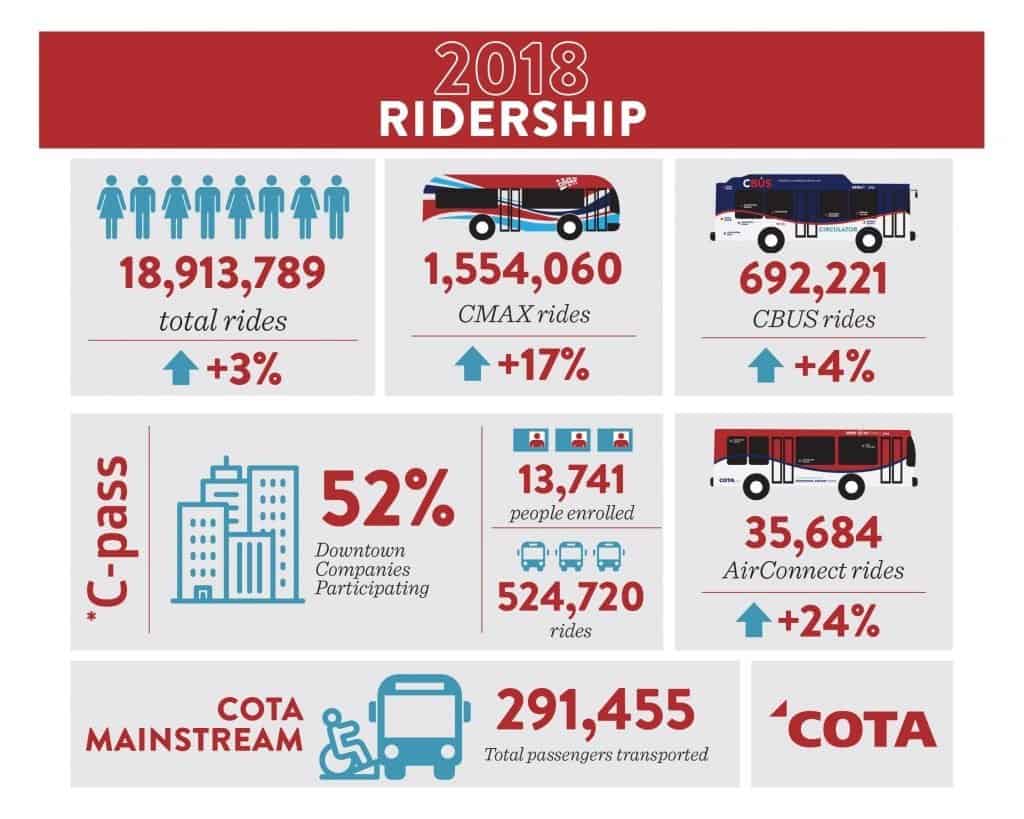
The increase in ridership is particularly remarkable given that 93 percent of those using the free bus pass have access to a private car. This means that it’s not only people with no other option who are taking advantage — the program is genuinely convincing commuters to choose transit over driving.
What’s more, the program’s users are evenly divided by income levels: 20 percent make less than $50,000 per year, and 19 percent make more than $100,000.
The total cost to the businesses paying in, along with other contributions, is about $5 million per year, with that money going to the Central Ohio Transit Authority (COTA). The downtown business association estimates that the program has freed up 2,400 parking spaces — the equivalent of four downtown garages — and allowed for 2,900 additional people to work in the district.
The result has been a boon to downtown workers, who are saving more than $5,000 annually in gas and parking expenses. But the city itself has benefited, too. New mass transit routes are being developed that, because of the ridership increases, are designed for the city’s population more generally, rather than subgroups. For instance, instead of routes that meander from hospitals to grocery stores to courthouses, COTA is putting direct corridors in place with straight-shot, point-A-to-point-B routes.
“What we are trying to do is make the transit system we have work better, with shorter times, and the service more reliable,” says Columbus City Council President Shannon Hardin. “We can’t solve transportation problems by adding more lanes to the highways. If you make the mass transit system more reliable and timely, people will use it because they are hungry for another option besides their car. This downtown pass program is proving that.”
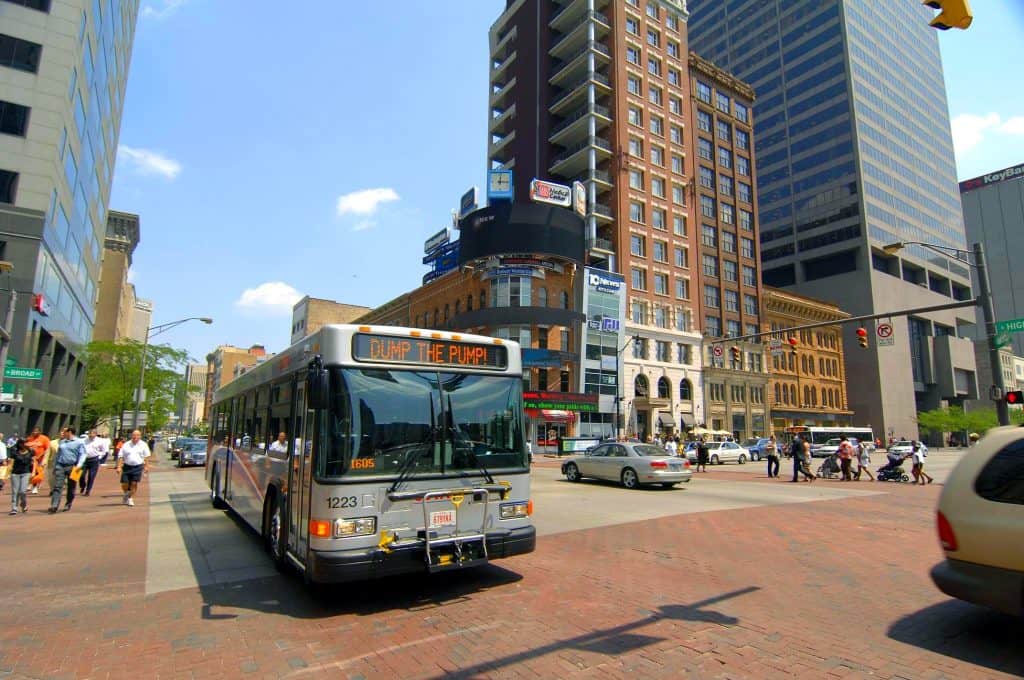
The free bus passes are also helping the city compete with the suburbs for workers, as express bus service from the far suburbs to downtown went up 17 percent in the second half of 2018 alone. Bus ridership in general has increased 24 percent at rush hour.
In the towns north of Columbus, offices and retail developments have acres of free parking. But by making its buses free, downtown Columbus is reclaiming the advantage, leveraging the benefits of proximity in a way that has found broad appeal (free wifi service on the buses helps). In a recent survey, more than a third of downtown businesses said that the program helped them recruit and retain employees, and 13 percent said that the program impacted their decision to sign or renew a lease downtown.
“When we first started talking about this free pass system as a possible solution to various transportation issues in Columbus’s downtown area, most of the so-called experts said, ‘No one wants to ride the bus, this will never work,’” says Daniel Dunsmoor, executive vice president of Colliers International, a real estate broker with offices in downtown Columbus. “But we found that people who say no one rides the bus are people who never ride the bus. What is happening with this Columbus free pass program is that co-workers are talking to each other, telling each other what works and what doesn’t, and that’s why we see it succeeding so well.”
That speaks to what has perhaps been the program’s greatest success: it has shifted the public’s perception of who uses transit to commute in the city of Columbus. No longer is the bus something that other people take to work. Now, it’s the way your colleagues, your assistants, your interns and even your boss get to the office, just like you.
The big question is: is it replicable?
“I do think this approach can work in other cities, but they have to change their thinking a bit,” says Joshua Lapp, a mass transit advocate and urban planner with the Columbus-based firm Designing Local. “This only works when you think of mass transit as having a very broad range of users. Too often mass transit tries to sell to one group and excludes others. This program was for anyone who worked downtown. That’s pretty broad.”
—
This story is part of a collection called Pay for What You Get: Stories about paying for the true costs of how we use cities. Read more here.
The post Free the Transit System! appeared first on Reasons to be Cheerful.
Article URL: https://www.smbc-comics.com/comic/the-talk-3
Comments URL: https://news.ycombinator.com/item?id=21379174
Points: 858
# Comments: 109
Article URL: https://www.wezm.net/technical/2019/10/useful-command-line-tools/
Comments URL: https://news.ycombinator.com/item?id=21363121
Points: 608
# Comments: 98
I have started re-learning college level Physics and am thoroughly enjoying Feynman's Lecture on Physics. Are there similar books available for Mathematics (& Chemistry) - books that are fundamental and easy to read?
Comments URL: https://news.ycombinator.com/item?id=21346272
Points: 742
# Comments: 166


