Shared posts

25 Apr 21:51

Survey: Over 50% of Parents Opt for Chore-Driven Allowance for Kids

by Mint

An allowance can be an amazing way to start teaching your children about money management. However, there’s debate when it comes to how much allowance to give, when to start giving an allowance, and whether the amount of allowance for kids should be tied to chores. Not to mention, some parents don’t believe in allowances at all.

So, we wanted to learn more about when and why parents start giving their kids allowances. So, we surveyed 1,000 Americans to find out what parents think about giving their children an allowance, how they determine allowance amounts, and whether allowance should be given just like their love—unconditionally—or earned based on behavior.

Key Findings:

  • 65 percent of parents think children should be given an allowance by the time they’re a teenager
  • More than half of parents believe allowances should be earned through chores
  • Around 1 in 4 parents believe in paying fixed allowance amounts each week
  • Nearly 1 in 7 people don’t believe in allowances

Before diving into these findings even further, a helpful baseline would be how much allowance do parents typically give by age. According to a 2018 Rooster Money survey, the average allowance by age is as follows:


Age Average Allowance for Kids Per Week
4 $4.18
5 $4.79
6 $5.82
7 $7.42
8 $8.01
9 $8.71
10 $9.49
11 $10.43
12 $11.91
13 $12.62
14 $13.87


Now, without further ado, our findings on parents’ impetus for giving allowance for kids.

Most Parents Start Giving Kids an Allowance by Age 12

We asked parents what age they started giving their child an allowance. We also gave the option for people to indicate if they don’t give their children allowances at all.

The majority of parents we surveyed were on board with allowances. More than 3 in 4 (78 percent) of the parents surveyed said they give or are planning to give their children an allowance. 

65 percent of parents think children should be given an allowance by the time they’re teenagers. We also found that most parents answered that ages 7–9 and 10–12 were the most popular age ranges for kids to start getting an allowance.

Despite studies showing that kids can start to learn the value of money around ages 5–6, only 9 percent of parents indicated that they believe in giving an allowance at ages 4–6.
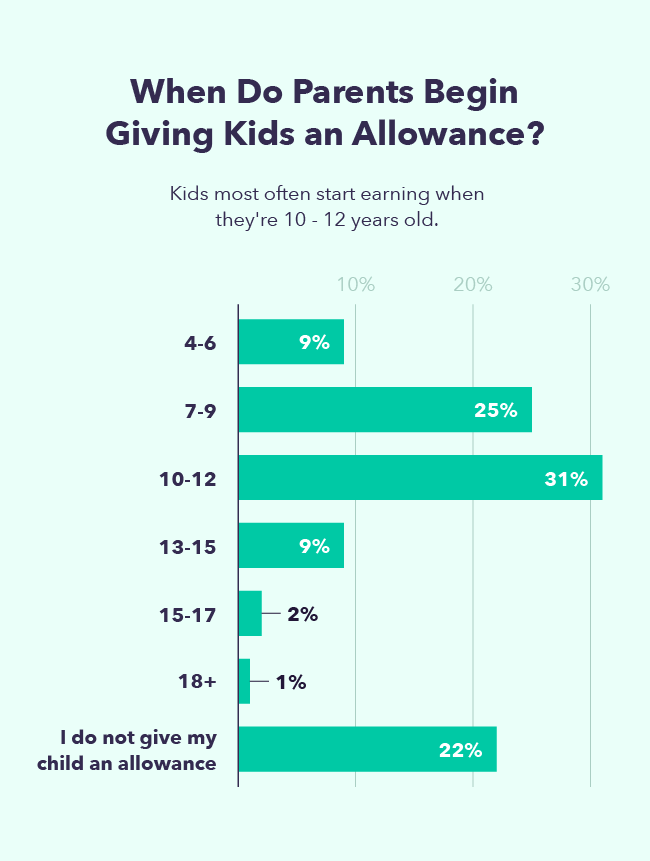
 

A bar graph provides when parents begin giving allowance for kids, with ages 10 -12 being the starting point for most.

More Than Half of Parents Believe Allowances for Kids Should Be Earned Through Chores

Next, we wanted to know the most important factors determining how much allowance parents give their children.

We asked parents to select the three factors that most affected how much allowance they give their kids.

The top factors that determine children’s allowance are:

  • Chores: 52 percent
  • Behavior: 43 percent
  • Age: 38 percent
  • Grades: 35 percent
  • Parent’s salary: 19 percent
  • Parent’s childhood allowance: 7 percent

Chores, behavior, and age were the top three factors. Grades came in fourth.

52 percent of parents selected chores as a determining factor in how much allowance they give their kids. While there are arguments against tying allowances to chores, it seems as though most parents are still on board with their kids earning money by taking out the trash, doing dishes, and other tasks around the house.


A bar graph provides how parents determine how much allowance for kids to give, with chores behind the main driving factor.

The Parent’s Financial Situation Was One of the Least Important Factors in Determining Allowances for Kids

Interestingly, parents indicated that their financial situations were not very important factors in determining allowances. In fact, less than 1 in 5 (19 percent) parents indicate that their salary is an important factor in how much allowance they give their children. 

Additionally, only 7 percent of parents said that the allowance they got as children was an important factor in how much they give their children today.

Less Than 1 in 4 People Believe in Paying Fixed Allowances Each Week

Finally, we wanted to know whether parents thought allowances should be given at a fixed rate each week or earned based on whether their child meets certain expectations.

Our respondents leaned toward the expectation-based approach. 61 percent of parents agreed that allowances should be paid if children meet certain criteria for chores, grades, and behavior. 

A little over a quarter of parents said they believe in children getting an unconditional fixed allowance each week.


A pie chart provides how parents approach giving an allowance, with the majority basing their payout on meeting expectations. 

Nearly 1 in 7 People Don’t Believe In Allowances for Kids

While most parents agree that allowances are important to teach kids financial literacy, a minority don’t think children should be paid allowances at all.

13 percent, or nearly 1 in 7 people, indicated that they do not think children should be paid an allowance.

Arguments against allowances often say that gifting your children money that they can freely spend can cause negative financial habits later in life.

However, when used as an educational tool, allowances can be great ways to open up conversations about money with your kids early on.

Tips for Teaching Kids Financial Responsibility [+ Free Printables]

In a 2019 survey by The Association of International Certified Professional Accountants (AICPA), 75 percent of Americans said that teaching children about financial responsibility is the most important reason to give an allowance.

However, only 3 percent of parents reported that their children primarily save their allowances. Most parents said their kids spent the majority of their allowance on friend outings, digital devices and downloads, and toys.

So, while allowances have great potential as money management tools, there are educational steps you can take to make sure your children use their allowance responsibly.

You can set your children up for financial success by using their allowance as an opportunity to teach your kids about money with the tips below.

1. Clearly Set Expectations

Before you start giving your child an allowance, discuss their expectations and responsibilities. If the allowance is tied to chores, good behavior, or grades, clearly let them know what you expect each week for them to earn the money.

Additionally, let your child know what you expect them to pay for. For example, while you might cover food and clothes, your child may be expected to pay for toys or video games. Lay out all expectations surrounding your child’s allowance beforehand so that everyone is on the same page.

2. Help Them Create a Budget

Sit down with your kids and help them create a monthly or weekly budget. Teaching children about simple budgeting early on will help encourage them to both track and be more responsible with their money, instead of spending their allowance as soon as they get it. If you have a teen, you can help them develop a more complex budgeting strategy to set goals and grow their money.

Talking about budgeting strategies early on will help set them up for success and develop ways to effectively balance life and budgeting as they get older.

For younger kids, you can help them start to understand the difference between needs vs. wants when creating their budget. Use the printable activity below for kids ages 5 to 10.
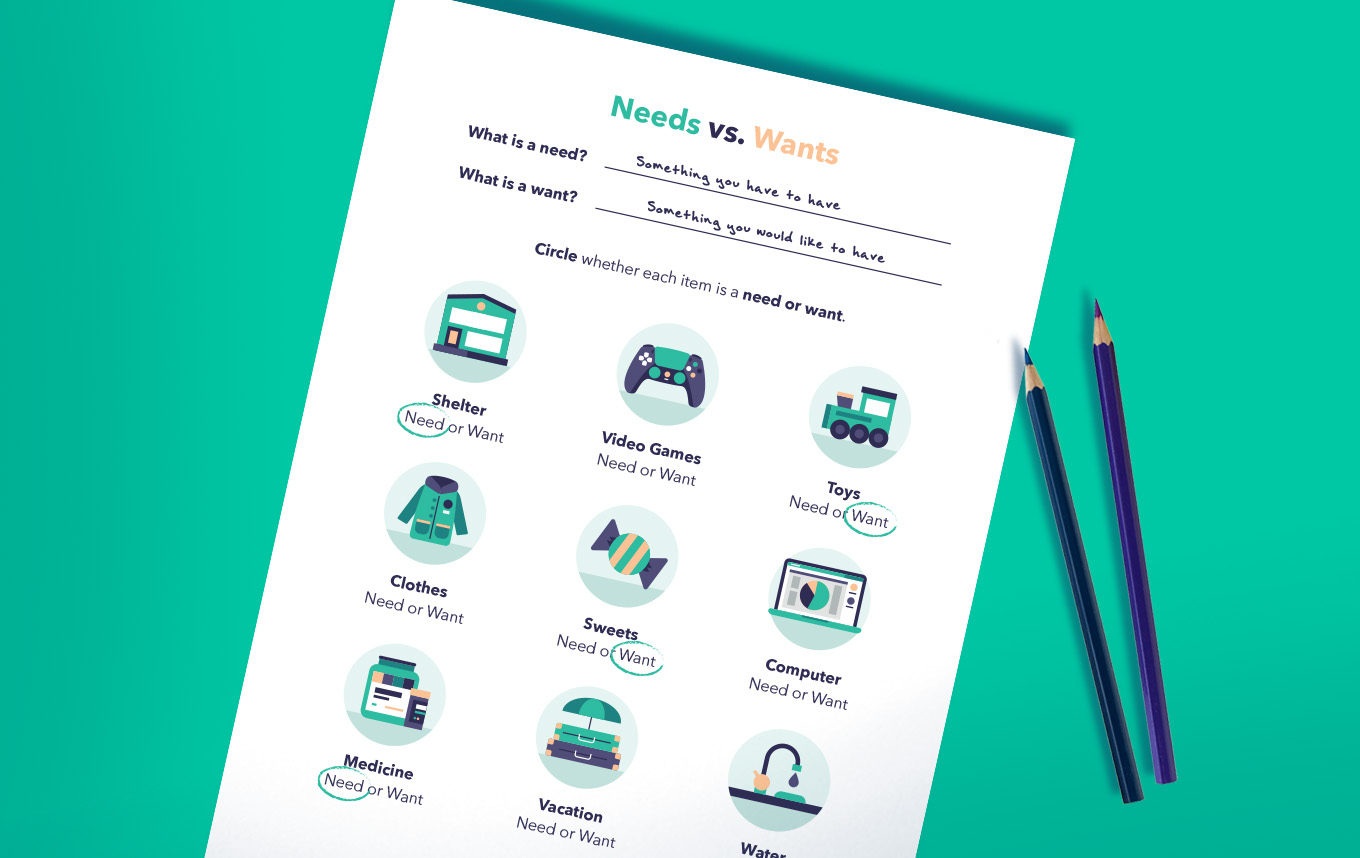

 

A mockup of an allowance for kids printable helps children ages 5 to 10 learn about needs vs wants. Click the download button for a free copy. 

Download button for free printable

3. Encourage Them to Set Aside Savings

To emphasize the importance of setting aside money for savings, have your kid set a savings goal for something they want. Then, help them determine how much to set aside each week to reach that goal.

You can also help your child open a savings account. Whatever your method, it’s a great idea to get your kids involved and excited about saving.

Use the printable allowance chart to help kids track their savings goals and celebrate their accomplishments
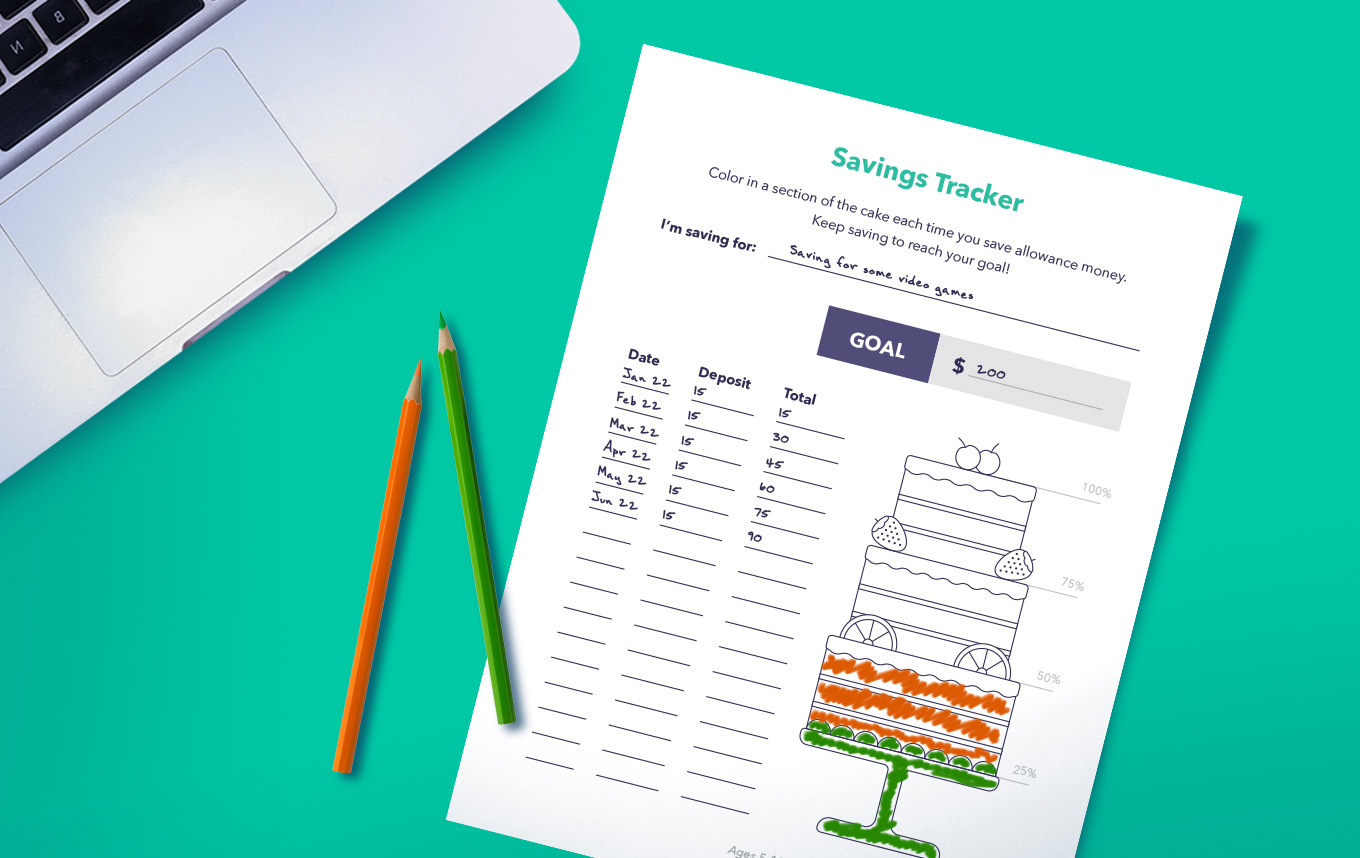
 

A mockup of an allowance for kids printable helps children ages 5 to 10 learn about how to save money. Click the download button for a free copy. 

Download button for free printable

4. Use a “Spend, Save, Give” Chart

Some parents like to teach the “spend, save, give” approach. Encourage your kids to save one-third of their allowance, give one-third of it to a charity of their choice, and keep the rest as spending money. Or, you can work with them to land on a different breakdown based on their goals.

To help children track how much they are spending, saving, and donating each month, use this printable chart below.
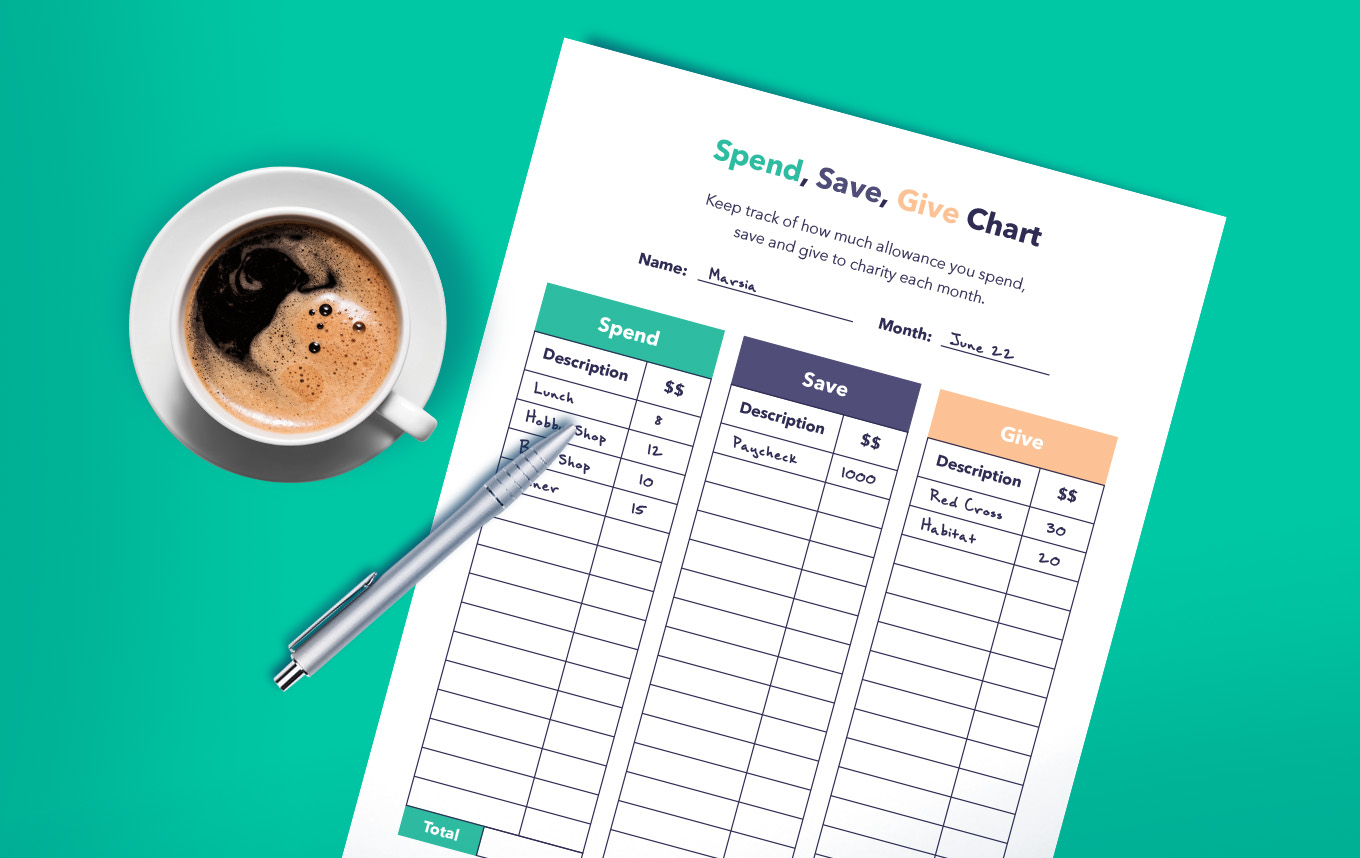
 

A mockup of an allowance for kids printable helps children of all ages budget for spending, saving, and giving their money. Click the download button for a free copy. 

Download button for free printable

Allowance for Kids FAQs

Here are answers to some more common questions about allowance for kids.

How Much Allowance Should a Child Get by Age?

One common rule of thumb is to pay a dollar per year of age per week. So, for example, an 8-year-old would receive $8 a week, and a 10-year-old would receive $10 a week. However, this is ultimately up to you and your family.

When Should I Start Giving My Child an Allowance?

Some children aged 5–6 are ready to start grasping the concept of money management, but you will know best when your child is ready to start receiving an allowance.

Should I Offer a Repeated Allowance?

There is debate around repeated allowances. Many parents tie allowances to chores, while others believe chores are expected family duties and shouldn’t be tied to money. A repeated allowance can be a good tool to help teach your children about saving money. You can also opt for a blended approach, where kids receive a base allowance each week but can earn more by helping out around the house.

Should Kids Get an Allowance?

An allowance is an excellent tool for teaching children about financial responsibility. But just giving the allowance on its own might not be enough to teach kids about money. It’s best to use your childrens’ allowance as a way to open up conversations about money and saving to help your kids develop good money habits throughout their lives.

Gauging people’s thoughts on allowances for kids gives us a glimpse into how families are starting financial education with their children. Ultimately, however, whatever allowance system works best for your family will be what’s right for you and your children.

Methodology

This survey was conducted on YouGov Direct for Mint.com. One thousand U.S. adults 18+ were interviewed from March 11, 2022 at 7:48 p.m. to March 12, 2022, at 5:08 a.m. Eastern time. Data is weighted on age, gender, education level, political affiliation, and ethnicity to be nationally representative of adults 18+ in the United States. The margin of error is approximately 3.1 percent for questions 1 and 3, and 3.7 percent for question 2.

Sources: Wiley Online Library | AICPA | Rooster Money

The post Survey: Over 50% of Parents Opt for Chore-Driven Allowance for Kids appeared first on MintLife Blog.
12 Apr 23:39

The endgames of bad faith communication

by Thersites
11 Apr 17:54

Can We Build Less Biased Medical Bots?

by Tolu Olasoji

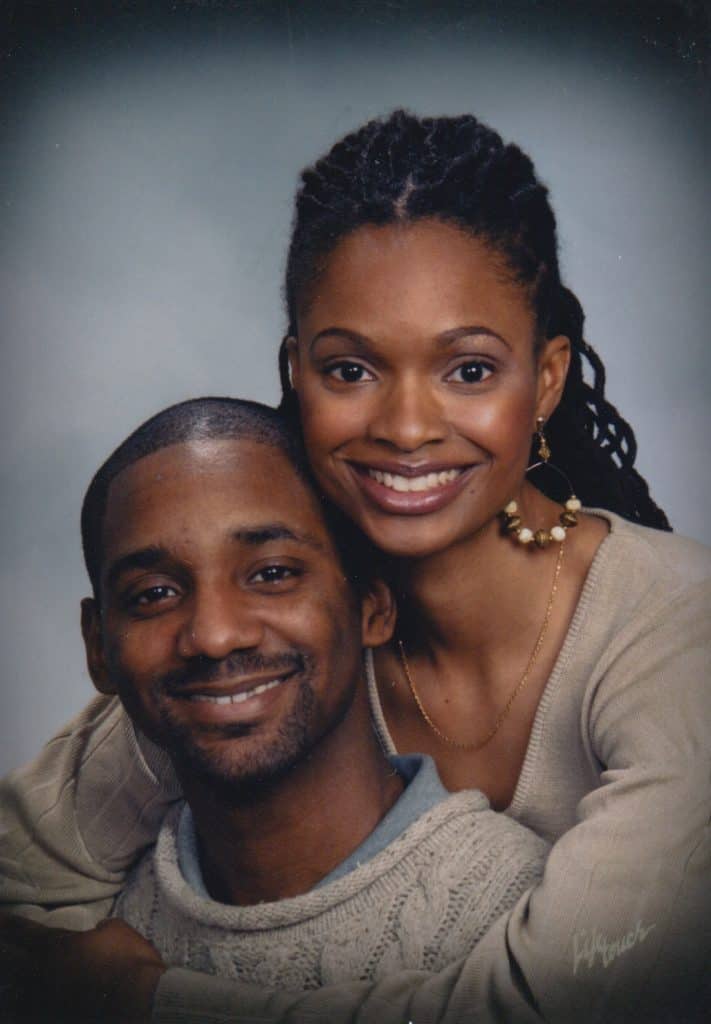
“She had very long locs that would go all the way down to her waist,” Avery Smith describes, his fingers making imaginary strokes from his head across the shoulders as he attempts to paint a vivid portrait of LaToya, his late wife.

The Baltimore-based software engineer and LaToya, a podiatrist, tied the knot in 2008. One day, around a year and a half into their marriage, “when she was doing her hair, she found a nodule — basically, a raised mole — that was at the base of one of her locs.” 

She got it biopsied the same day. Two weeks later, when results returned, she was diagnosed with Stage 2A Melanoma, a milder variation of the deadliest skin cancer. According to the Melanoma Research Alliance, a minor surgical procedure is usually enough to cure it. But the following 18 months were revealing for Smith; on December 9th, 2011, LaToya died. In addition to the heavy loss, he was left scarred by the experience: “I learned about going through illness while being Black,” he says.

Avery Smith and his wife, LaToya.

Today, over a decade later, Smith is putting his skills as a software developer to work in an effort to end the racial bias and inequity in skin care that contributed to his wife’s death. In 2021, he launched Melalogic, a Baltimore-based startup that provides skin health resources to people with dark skin, and is working with crowdsourced imaging data to tackle racial bias in diagnostic artificial intelligence (AI).

The bias Smith is tackling is staggering. The American Cancer Society reports that melanoma is over 20 times more common in white Americans than it is in Black Americans. According to the study, 1 in 38 white people stand a lifetime risk of getting melanoma. In comparison, that number is just 1 in 1,000 for Black people, because melanated skins produce melanocytes — color pigments resistant to sun damages, including those responsible for skin cancer. While this would ideally translate to a lower mortality rate, the opposite is true. A 2016 study shows that the five-year survival rate of Black people with skin cancer is 65 percent, compared to  92 percent for white people. 

The problem is rooted in racial inequities and biases in medical research and technology. In skin cancers, for instance, AI systems have been used to drastically improve diagnosis, inform decisions and facilitate treatment leading to positive health outcomes. However, these are mostly helpful to white people because diagnostic AI datasets are trained with images of white skin. 

The same issue persists in other areas of medicine. Medical illustrations for example, which medical professionals learn from and consult, are overwhelmingly portrayed with white skin. Dermatologists, of which only three percent are Black, often lack the capability or understanding to treat darker skin shades, and are likely to resort to medical myths. For instance, a 2016 study on pain perception found that half of the white medical trainees believe Black patients have thicker skin and are more resolute to pain than other races.

That’s why in 2018, Smith teamed up with dermatologist Dr. Adewole Adamson to conduct a research project, endorsed by the American Medical Association, on machine learning and health care disparities in dermatology. The findings proved what he already knew: that doctors see the issue of racial bias in medicine, specifically towards skin cancer, but that little had been done to act against it to prevent negative outcomes. 

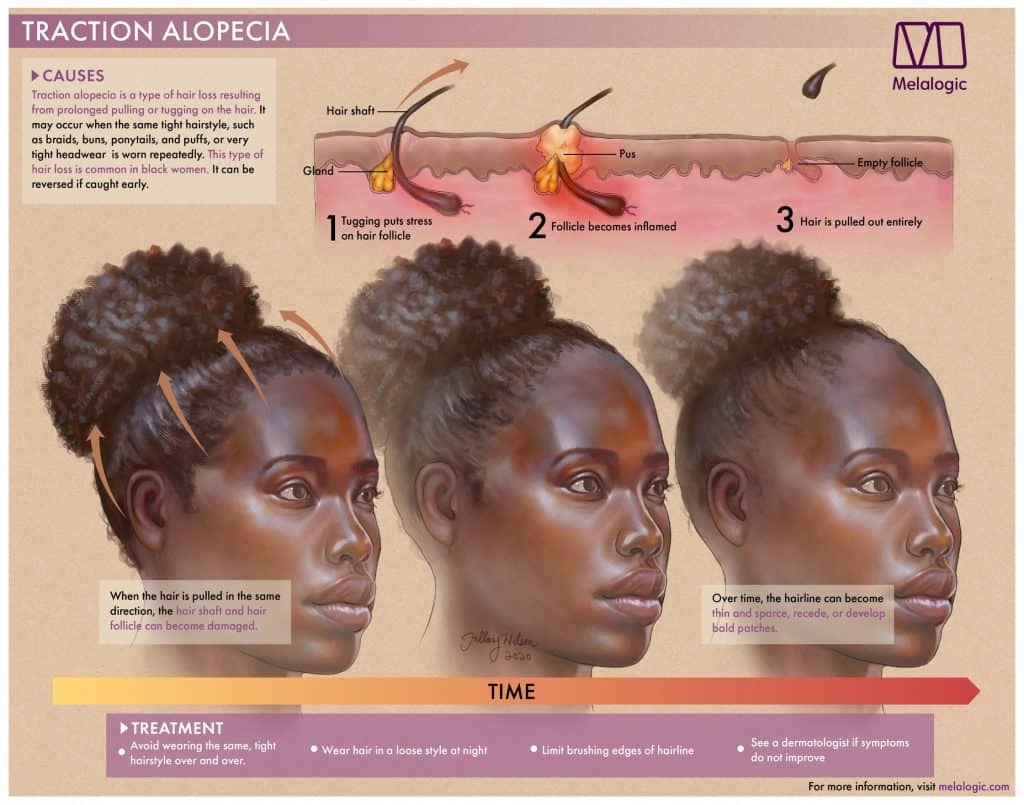
Illustration by Hillary D. Wilson for Melalogic

“Blind spots in ML (Machine Learning) that reflect the worst societal biases have been described before when the technology is applied to images: misreading Asian faces as blinking, mistaking images of black people for gorillas, or judging only white faces as attractive,” the report read. “Because ML is only as good as the data from which it learns, great care must be placed in building technology that reflects the diversity of skin types in our society.”

It was from the research’s findings that Smith conceived Melalogic, an app that he hopes will eventually become the single go-to resource for Black skin health. 

In its current form, Melalogic — funded in part by a grant program from Mozilla that supports Black artists addressing biases in AI, with the hope of securing venture capital in the future — is dedicated to providing Black people with skin health resources, with expert contributions from Dr. Chesahna Kindred, a black dermatologist and Hillary Wilson, a certified medical illustrator.

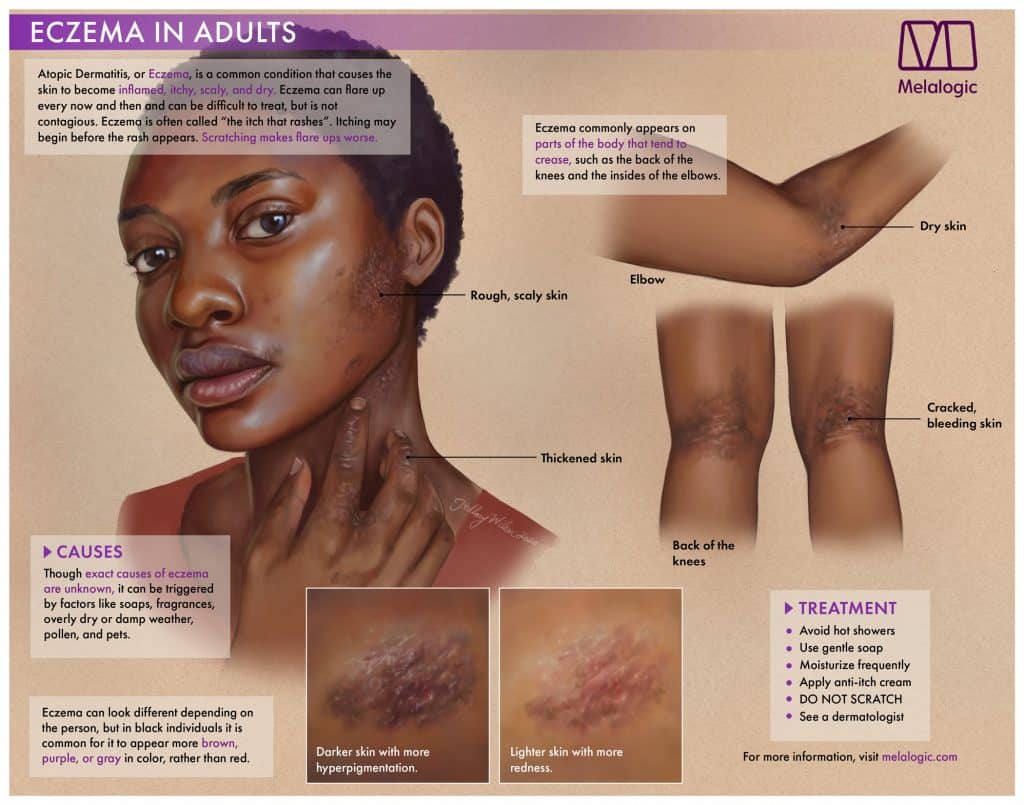
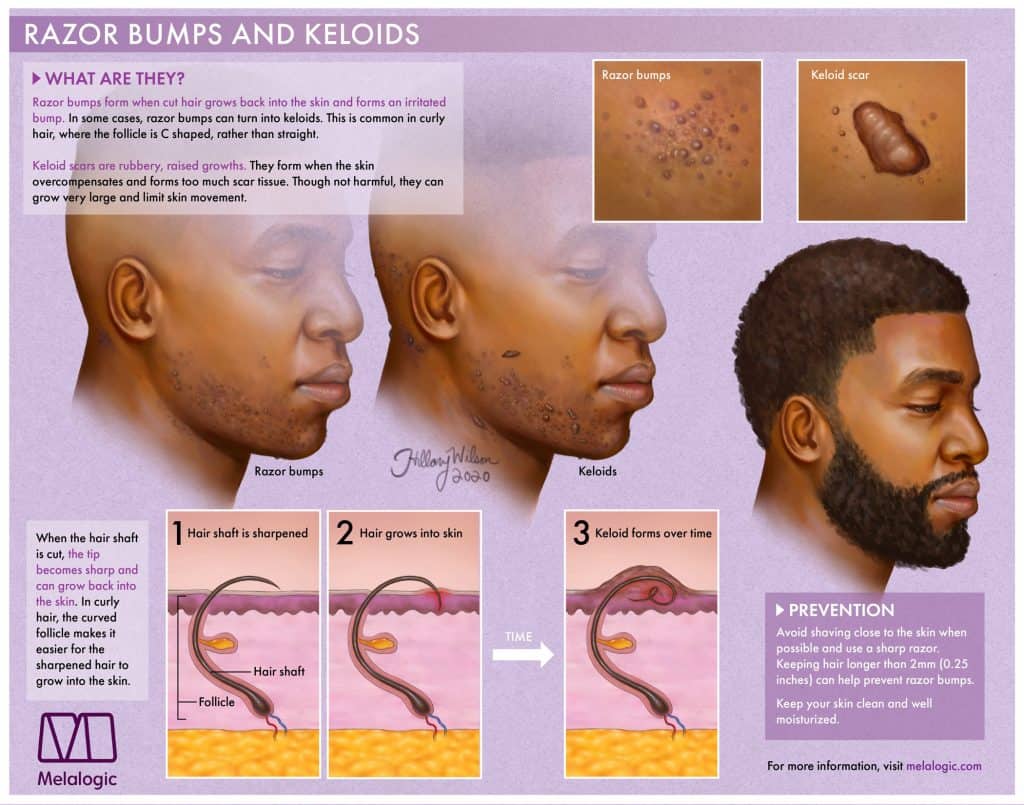
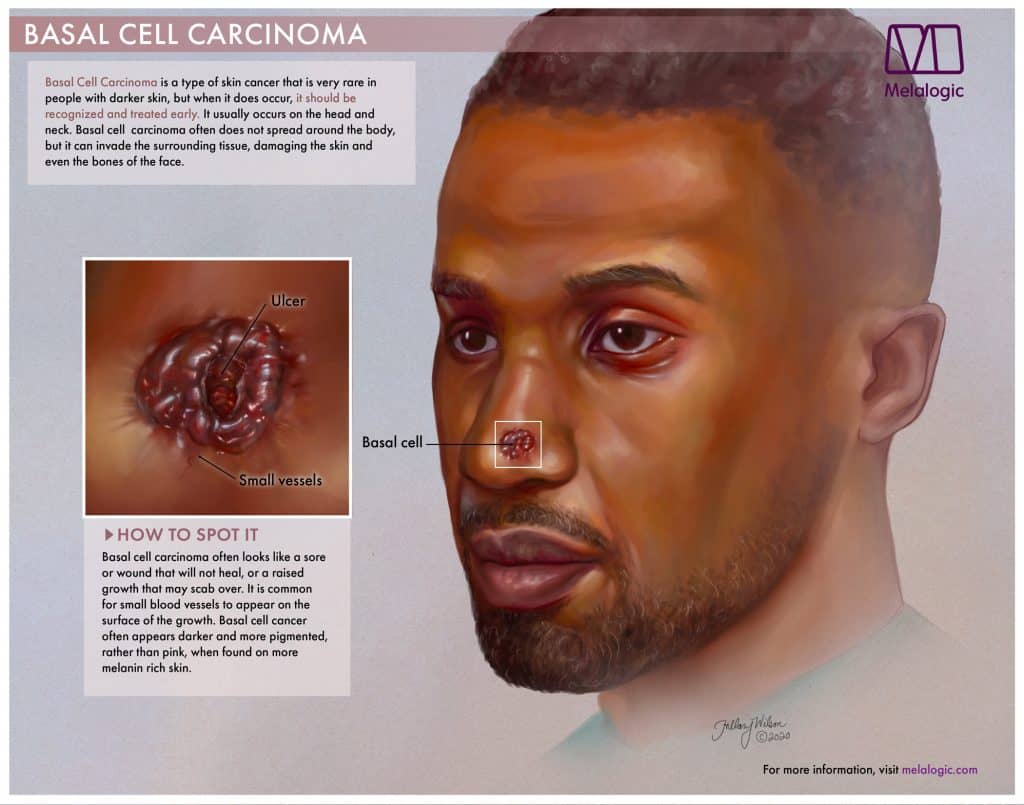
When logged on to the melanated-themed web app, users gain access to the Black Skin Resource Center, a repository with 14 different issues that affect skins in melanated tones, searchable by keywords. From mild issues like acne, eczema and razor bumps to more complex ones like keloids, alopecia and varying forms of melanoma, each has a digestible but medically accurate explainer accompanied with Wilson’s infographics, with overview provided by Kindred.

Illustration by Hillary D. Wilson for Melalogic

“Dermatology is a visual science, so we need to be able to just look at it and figure out the diagnosis or the most likely diagnosis. But when we don’t know what we are looking at, we are likely to miss a pretty deadly condition if it’s left unchecked, and that’s a huge problem considering the demographics of our country,” says Kindred, who also serves as the chair of National Medical Association Dermatology Section. 

Wilson details the many ways this plays out. “For example, hyperpigmentation is very common in melanated skin, and someone may erroneously believe that hyperpigmentation is the result of poor hygiene.” In contrast, erythema, a type of skin rash that can range from mild to indicative of a deadly infection, can be less obvious in melanin-rich skin. “Some conditions that may appear pink or red on lighter skin may appear more brown or purple on darker skin,” she says. The app is meant to curb these misconceptions that can lead to serious medical missteps. 

Aside from dermatologists and regular users, other health care providers benefit from more robust resources too. Memphis-based dietician and trichologist, Samaria Grandberry uses nutrition and products to treat hair and scalp issues to a clientele base with darker shades of skin. One challenge she faces is that medical illustrations are not representative of the skin she treats. Or, in cases where the ailments are exclusively related to darker shades of skin, there is a complete lack of visual aids. 

Illustration by Hillary D. Wilson for Melalogic

“I was really excited to come across Melalogic,” she says. “While searching on Google for medical posters, you see a lot of the same posters over and over but that was the only one that popped up and showed brown skin and even some of the physical features of brown skin and brown hair.”

The posters have helped improve understanding and trust with her patients. Now, alongside other nutritional posters, she has them hung in her office. 

“It’s been really helpful for my client to truly see what’s really happening,” she says. Her clients often take photographs of the illustrations and request personal copies on occasions. 

At the bottom of each webpage, Kindred shares dermatologic tips via video, such as how to recognise diseases like Acral Lentiginous Melanoma, the most common type of melanoma in people with darker skin; infamously the cause of reggae legend Bob Marley’s death. Melalogic also offers a Black Skin Health eCalendar, which sends users healthy skin tips and advice every month and can be synced with Apple or Google Calendar apps, and a directory to access 90 Black dermatologists across the United States, searchable by location. 

Illustration by Hillary D. Wilson for Melalogic

The app’s biggest-picture offering, though, is the option of contributing to the startup’s ultimate goal: its Black Skin Health AI Dataset, which has to be trained by crowdsourcing thousands of pictures of melanated skins. Users log on to the web app to snap and upload a photo of their skin condition, labeling the image with what they think the issue is. In the backend, dermatologists access the imagery employing the Five Safes model for user privacy, further diagnose the ailment and sort them accordingly into the dataset. 

Smith’s goal, Melalogic 2.0 which is set to launch within about a year, is an immersive telehealth experience. “Ultimately, you can get instantaneous feedback as to a particular skin condition when you take a photo,” he says. The Black dermatologists directory will be built out to include professionals outside of the United States as well as the ability to purchase products and services tailored to Black skins. It is, Smith says, about time. 

“Even in 2019, and before, a lot of people were very timid when using the term ‘Black’… That’s not helping things,” he says.

“People are starting to see that, wow, Black people really do have their own needs that need to get met… It’s just in a lot of areas, we are different. And that would require an entire class of products and services that is specifically designed for people with this particular quality and characteristics.”

The post Can We Build Less Biased Medical Bots? appeared first on Reasons to be Cheerful.

01 Apr 20:49

Why have female animals evolved such wild genitals?

by sohkamyung
31 Mar 18:06

For Decades, He Had Strange Episodes of Utter Exhaustion

by Lisa Sanders, M.D.
What was causing these spells, and why were they now more frequent?
30 Mar 22:59

How Your Sense of Direction Is Shaped by Where You Grew Up

by Benjamin Mueller
Childhood environments shape people’s navigational skills, researchers reported. The findings one day may lead to better tests for early dementia.
30 Mar 22:37

Can Moving the Body Heal the Mind?

by Gretchen Reynolds
In her new book, Jennifer Heisz blends personal experience and the latest science about how exercise can improve your mental well-being.
29 Mar 15:18

Transracial Adoption and the Limits of Love

by Christine Chalifoux
A person with their back to the camera looks at two large photos of Korean American adoptees against white backgrounds on a dark wall.
A photo installation by artist Glenn Morey explores how Korean adoptees in the U.S. grapple with questions related to belonging, identity, and family. Jung Yeon-Je/AFP/Getty Images

On a Saturday morning in downtown Kampala in 2020, I stood on a busy sidewalk in front of a store. As I waited for a friend who was inside shopping, I daydreamed about my son. My husband and I had celebrated his second birthday just a few days prior, and as we approached the 10-month mark of living in Uganda, I realized he had spent nearly half of his life in the field with me. Our life in Kampala was all he knew.

My reverie abruptly ended when I realized I was slowly being surrounded.

Nearby, a man was gathering a crowd and loudly admonishing President Yoweri Museveni for allowing “the Chinese” to stay in the country. He encouraged the crowd to take matters into their own hands when they saw a “Chinese” person. All eyes turned on me.

Thankfully, Sam, my motorbike driver turned trusted friend, was waiting nearby and acted quickly when he saw what was happening. He rushed over, pulled me onto his bike, and drove off as people chased after us screaming, “Coronavirus! China virus!”

It was March, and then-President Donald Trump had just declared a state of emergency in the U.S. over the COVID-19 pandemic. It was on the cover of every newspaper.

Since arriving in Uganda to conduct anthropological fieldwork the year before, my racial identity as an East Asian woman had elicited curious questions about my origins. But when Trump began his campaign of xenophobic verbal assaults blaming the pandemic on China, my identity was decided for me: I was “Chinese,” and I was COVID-19 incarnate.

Suddenly, I realized we had to leave the place my son considered home.

As a Korean adoptee who was raised by White parents alongside their biological son, this period in Kampala was hardly the first time I was marked as different.

Though my hometown is in Central Massachusetts, far north of the Mason-Dixon line, Confederate flags have been flying there since I can remember, signaling to outsiders who belongs and who doesn’t. Growing up in this politically conservative, semirural town that was 97.93 percent White (as of the 2000 census), my racial identity was a constant source of consternation. Yet the harmful effects of growing up in this racist environment were purposefully ignored by my well-intentioned parents.

When my parents adopted me in 1988, Korean adoptees had been entering the United States for more than three decades. The complex reasons why South Korean children came to be adopted widely by White parents have to do with broader forces of race relations and U.S. militarism and imperialism.

For one, the legalization of abortion in 1973 in the U.S. created a shortage of White children available for domestic adoption. This was coupled with heightened scrutiny of White parents who adopted Black children without recognizing or meeting their specific cultural and social needs. White U.S. couples looking to begin or expand their nuclear families through adoption, like my parents, found a solution to this problem in Asia—and particularly South Korea.

After the Korean War (1950–1953), the country had started sending unwanted “mixed children” born to Korean women and American soldiers abroad as an emergency measure. As anthropologist Eleana J. Kim has shown, this decision to export “illegitimate” and poor children continued long after the war’s end, largely as a way to absolve the government from creating social welfare nets to care for the most vulnerable in South Korean society.

A black-and-white scan of a U.S. citizenship certificate includes a photo and information about a young child born in Korea.

The author received this U.S. Certificate of Citizenship after being adopted from Korea. Courtesy of Christine Chalifoux

The mostly White U.S. social workers who facilitated the adoption of Korean children into White families like mine pushed a colorblind approach to raising children. Influenced by faulty ideas about biological race hierarchies, they believed the differences between White parents and Asian adoptees were not as great as with Black adoptees, and as such, they could simply be ignored. That meant White parents could go through the entire adoption process without learning the Korean language or the country’s cultural nuances. Agencies even arranged for Korean babies to be flown into the U.S. with chaperones so that adoptive parents never had to leave the country.

This colorblind approach had lasting consequences. In her ethnography on South Korean adoptees, Kim explores the refusal among White adoptive parents to recognize race. The adult adoptees in her book desire to return to Korea and find people who share their racial identity—despite their families’ dismissal of their differences. Many Korean adoptees, such as intercultural studies scholars Tobias Hübinette and Kimberly McKee, have written extensively about how growing up in all-White spaces and having their race ignored affected their sense of self and left them ill-prepared for racism they faced.

For some Korean adoptees, this racism begins even within the supposedly protected family space. My brother still jokes about pretending to be Rambo when we were children, tying me up and calling me Vietcong. A face like mine in an all-White space could stand in for multiple racist tropes for his amusement: a Southeast Asian terrorist, a generic Asian nerd who must be “naturally” good at mathematics, a Chinese communist spy.

My family, of course, vehemently denies this behavior was harmful. After all, since I was not recognized as being different, then how could such “teasing” possibly be racist?

After a childhood spent roleplaying Rambo, my brother grew up to become a soldier. The heightened militarism in post-9/11 America elevated his status to hero, and I juggled a great deal of guilt. Rather than loving my brother because of his military service, I found myself loving him despite it.

I never openly criticized his decision to enlist in 2006, but I forged a different path for my own life: I moved away from my small town to attend college in New York City. I wore my leftist politics on my sleeve. I found my voice and used it, unafraid of challenging my family’s conservative politics.

Yet, when my brother’s infantry regiment was deployed to Iraq, I worried about his safety every single day with a fervor that one reserves only for those dearest to one’s heart. Much to our whole family’s great relief, he returned from his tour in Iraq physically unscathed. But our ideological divide continued to grow as our lives returned to normal.

Soon after his return, I graduated from college and enrolled in a master’s program in anthropology. It was then that I began to read texts that challenged everything I had taken for granted about kinship, family, and adoption.

If we are to remain kin, love is not enough.I learned that others questioned the “benevolent” beginnings of transnational adoption, and that using children of color as a shield from accusations of racism was a common phenomenon among adoptive parents. Equally common was the mixture of guilt and anger adoptees felt at witnessing their families’ bigotry.

I also started to realize how, when Asian adoptees like myself got absorbed into White families, we became living examples of Asians’ proximity to Whiteness. In the process, transnational adoption from Asia to the U.S. helped perpetuate the model minority myth: a set of stereotypes that labels Asians the “good” minority group and pits them against Black Americans—while ignoring institutionalized racism and the history of xenophobic attacks faced by Asian Americans. This myth helps those in power maintain an order of white supremacy by making it more difficult for communities of color to form political solidarities.

As I was delving into anthropological texts, my brother’s unit was sent to Afghanistan. This time, he was seriously injured in a roadside bomb attack in 2010 and spent nine months recovering at Walter Reed Army Medical Center in Washington, D.C. After many surgeries, tears, and hours of rehabilitation, he returned to our hometown to a hero’s welcome—complete with a police escort, a parade, and yellow ribbons tied to every utility pole.

I always felt suffocated by my hometown, and when I returned to see him after his release from the hospital, it was no different. But this time, I watched the same people who had used terms like “chink food” in front of my face do remarkable acts of kindness for my brother.

As he continued to recover, I became increasingly angry when I thought about our relationship. My brother could continue to openly joke about my race, something over which I had no control, but I could not dare question U.S. empire or the so-called war on terror because of the choice he made to enlist in the military.

I was supposed to grin and bear it—because, after all, we were family.

Anthropologists have shown that there is not a universal definition of kinship. But with DNA testing and popular media like Who Do You Think You Are?, a genealogy documentary TV series, many people in the U.S. and Europe continue to think of family as a set of people who share biogenetic substance. Adoption challenges such a notion by creating families across racial, ethnic, and national boundaries.

For many adoptees, being integrated into a nuclear family offers the love and support that we often take for granted as part of kinship. But, as anthropologists Sharika Thiranagama and Tobias Kelly have shown, intimate relationships are especially subject to threats of betrayal. If families are supposed to provide unconditional support, not receiving such support cuts that much deeper.

A child of Korean descent wearing a blue dress smiles with their hands on the sides of the face of a White child who smiles back at them. A woman sits on a couch with a younger child of Korean descent on their lap.

White families in the U.S., Europe, and Australia began adopting children from Korea starting in the 1950s. This 2004 photo of an Australian family shows a mother with her natural born child (left) and two adopted Korean children. Peter Morris/Fairfax Media/Getty Images

On that surreal afternoon in Kampala, I arrived back home to my new nuclear family: the kin I chose when I got married and had a child. Grateful is not an adequate word to describe what I felt for my husband and son that day.

Later, friends in Kampala called us to report other incidents targeting Chinese and Chinese-looking people, confirming I was no longer safe in the city. My husband packed away as many of our belongings as would fit into our two large suitcases. Devastated, we left Kampala within 36 hours.

On the long journey home, I began to think about the family in which I was raised. I wondered if they could believe that my race made me a target in ways that they would never experience.

The anti-Asian hate unleashed by the COVID-19 pandemic over the past two years has been yet another reminder that I am not like my family, regardless of how much they insist that I am. It’s also brought home how their political beliefs as Trump supporters actively harm people who look like me.

I still love my family, my brother included. And I know that they love me. But, if we are to remain kin, love is not enough.

The post Transracial Adoption and the Limits of Love appeared first on SAPIENS.

14 Mar 16:46

Covid Restrictions Prevented Dengue in Hundreds of Thousands of People in 2020

by Stephanie Nolen
A study’s findings suggest that new approaches may be needed to combat dengue and other mosquito-borne viruses.
11 Mar 05:49

Citizen Seismologists Track Haiti’s Earthquakes

by Kenneth Chang
When conventional seismometers in Haiti failed before the 2010 quake, cheaper, less sophisticated devices helped seismic researchers fill in the blanks.
28 Feb 07:35

“If You Can’t Beat Them, Eat Them”

by Michaela Haas

A new kind of out-of-town visitor likes to check out the famous Brandenburg Tor in Berlin these days: Louisiana crawfish scuttles through the site when it rains. After business consultants Lukas and Juliane Bosch learned three years ago that they had become invasive in Berlin, the couple had an aha-moment. “We read that the invasive species has no natural enemies in the ecosystem,” Lukas says, which is why they’d come to run rampant. “That logic only works if you omit humans from the food chain.”

Why not simply eat the invaders? After all, the crawfish is a delicacy in Louisiana because it tastes almost like lobster. Together with Berlin gourmet chef Andreas Michelus, the couple started buying the crawfish from a licensed fisherman, developed recipes and bought a food truck. Their company, Holycrab!, was born. “Why fly exotic ingredients around the world when they live outside your front door?” the founders ask. “If you can’t beat them, eat them.” 

The main challenge was getting Germans interested in trying new foods, “so we put it in dishes people were already familiar with, such as crab rolls or ‘pasta di plague,’” Juliane says. When the crawfish season ended in the fall, they switched to wild boar and Nile goose, which are also invasive. 

Holycrab!’s Nile goose with green sauce. Credit: Nino Halm

The couple is now living with their child in Offenbach near Frankfurt, and because farmers complained that the geese are eating ingredients such as watercress and sorrel for the popular German “green sauce,” the Holycrabbers deliberately added a recipe for Nile goose with green sauce “as a conversation starter.” Later they added other invaders to the menu: carp sandwiches, bouillabaisse with Chinese crab, raccoon steak, and a stew made from the raccoon-sized rodent nutria, plus invasive plants and roots as salads and fries. Raccoons are the hardest to sell, according to Lukas Bosch, “because some people think they’re too cute to eat and others are afraid of catching a disease.” But the hunters shoot them anyway to fulfill their hunting quota, as Lukas Bosch explains. “If we don’t eat it, the meat gets thrown away or made into dog food.” 

It’s illegal in Germany (and most parts of Europe) to simply shoot or fish your own lunch. You need a permit, and to make sure no illnesses get transmitted, every piece of wild meat needs to be tested and certified before consumption. “Once a young, inexperienced hunter simply showed up at our front door with a 100-pound boar,” the couple recalls, laughing. “We had to send him away and explain he needed to get the meat tested first.”

Predictably, their startup has gained a lot of media attention. But it has also won numerous awards, and customers have nicknamed the crawfish “Berlin lobster.” “If you put it on my plate and I didn’t know what it was called, I’d think it was lobster, because it tastes just like it,” one customer said. 

“We deliberately started with the food truck to try out new recipes and get the opportunity to talk to people.” Lukas Bosch explains. “For instance, the Chinese mitten crab came from China to Germany about a 100 years ago on cargo ships. It’s grotesque how big they grow and thrive here. The Chinese pay gourmet prices for them because water pollution has made them a rarity in China.” A few Chinese restaurants were offering them in Germany, too, “but our food truck gave us the opportunity to explain the back story,” Juliane Bosch adds, “and this is what gets people interested.”


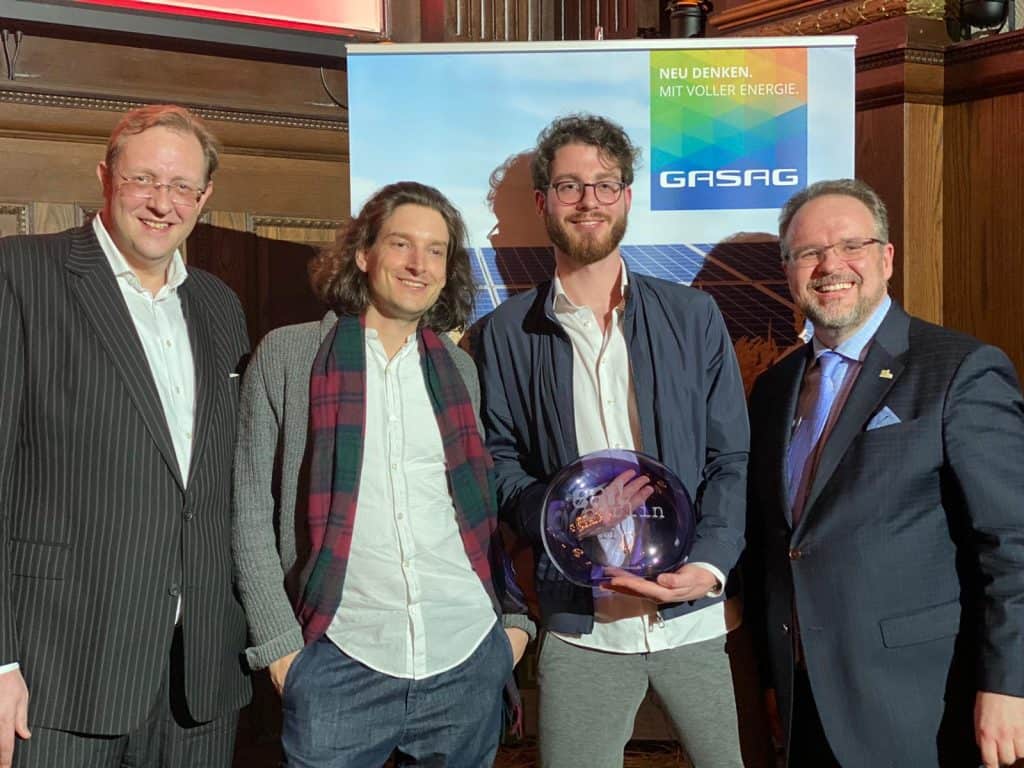
Lukas Bosch and Andreas Michelus receive a 2020 Eat! Berlin award. Credit: Eat! Berlin
Lukas and Juliane Bosch (left and center) with chef Andreas Michelus (right).

The eat-the-invaders movement actually started in the United States. Renowned conservation biologist Joe Roman from the University of Vermont kickstarted the “invasivorism” trend in 2011 after he completed his PhD on the damage invasive European green crabs inflict in the US. Websites such as Roman’s are dedicated to identifying edible aliens and publishing recipes for snails, snakes, iguanas, nutrias, and other invasive species. Many of them either hitched rides as blind passengers on a boat or were brought in deliberately only to have their numbers spiral out of control because they have no natural enemies in their new environment. 

Effective solutions are hard to find. Too often, the invaders are simply killed and discarded. Or authorities release predators, such as eels Scotland communities released to kill crawfish. The eels then became a problem. While introducing invasive species into a local diet is not a silver bullet to “beat them,” businesses like Holycrab! serve multiple important roles — not just making a small dent in the population, but educating people and helping normalize and build trust in dietary options that are more sustainable and contribute to solutions instead of problems with the food system.  

The damage invasive species are causing is immense: Experts estimate that the aliens are responsible for nearly a third of extinctions worldwide and have cost farmers and communities more than $1.3 trillion in damages. Out of the 50,000 nonnative species in the US, 4,300 have been labeled invasive. To name a few of the worst offenders, nutrias destroy Louisiana marshes; European green crabs devoured a billion dollars worth of mussels and clams in US waters; sea lampreys usurp trout in the Great Lakes; Burmese pythons strangle native deer in the Florida Everglades, and feral pigs, considered “super invaders,” are ripping up lawns, golf courses and vineyards in the Bay Area, even threatening the area’s drinking water supply. According to the Department of Agriculture, more than six million feral pigs live in the US, hybrid offspring of domesticated pigs and wild boar that was imported around the 1900s for sport hunting. California is currently debating a bill to make hunting them easier so more of them can be made into pork chops and sausages.

Holycrab!’s signature Louisianna crawfish roll. Credit: Nino Halm

Once an invasive species like crawfish has been introduced to a new region, it is nearly impossible to get rid of it entirely. But especially in countries with a high rate of malnutrition, such as Madagascar, scientists and activists have educated the population about the benefits of eating the protein-rich invaders with some success

Lukas Bosch was a vegetarian for ten years before he started Holycrab! with his wife in 2019. He was inspired by Jackson Landers’ book “Eating Aliens” and considers invasive species the only meat you can eat ethically. After all, the animals live in the wild, without the brutality of mass factory farming, and they would be killed anyway. “Mass husbandry is responsible for 30 percent of global greenhouse gasses if you count transport and production,” the Holycrabbers researched. While we humans have eaten some wild species such as tuna or Atlantic cod nearly to extinction, invasivorists point out there are plenty of edible animals that are tasty but people simply don’t know how to put them on the menu. “The hunters’ hearts are bleeding when their freezers are full but nobody eats the wild meat,” Lukas Bosch learned. Scientists have been trying to come up with guidelines and criteria for hunters and conservationists so that they actually target the right species for the environment.  

To help their clients stomach new recipes, the Bosches assure them that “nutria tastes like a crossbreed of rabbit and quail, and raccoon resembles deer and poultry.” The couple found out that nutria had actually been on the menu in the former Republic of East Germany as poor man’s meat, and older East Germans were familiar with the taste. 

In order to make this solution palatable to more people, gourmet chefs worldwide are experimenting with integrating invasive species in their menus. Among the unusual recipe options: Celebrity sushi chef Bun Lai roasts cicadas in his wok and even chops up cannonball jellyfish into sushi. Several jellyfish are rich in protein and surprisingly tasty as carpaccio, according to Antonella Leone, biotechnologist at the Institute of Science of Food Production (ISPA) in Italy. Chef Doug Paine in Burlington, Vermont, might sneak peppery wild mustard sprigs in his patrons’ salad, periwinkle snails in their appetizer, Green Crabs in their bisque, and Japanese knotweed in their dessert. 

Holycrab! boullabaisse. Credit: Nino Halm

Since the pandemic canceled most catering events, Holycrab! switched to producing bouillabaisse stock from the Chinese mitten crab that is now being sold and marketed in supermarkets. To actually make a dent, more supermarket chains and pet food companies need to jump on board. Wholefoods and a few other chains made a start in 2016 by offering lionfish, a tender tasting invader, and a few dog food producers are baking nutria into their high-end dog biscuits. The end goal of Holycrab! is different from any other startup: To eat so many invasive species that there are none left and the startup can go out of business. The invasive Lousiana crawfish in Berlin is already receding. Juliane Bosch is an innovation researcher and has worked for an innovation institute for years before starting Holycrab! “There, we did research about how companies can make the world a better place,” Juliana says. “In the end, it is about changing the future.”

But of course, not all aliens are fit for consumption. Sometimes the Holycrabbers get calls about invasive species that are plentiful and yet the couple cannot come to the rescue. “A woman from Bavaria called and complained about a crazy mosquito invasion,” Lukas Bosch remembers with a laugh. “Could we help?” Even the Holycrabbers have yet to cook up a recipe for tasty mosquito à la mode.

The post “If You Can’t Beat Them, Eat Them” appeared first on Reasons to be Cheerful.

27 Feb 17:24

King County passes Motion of Support for Marymoor Cricket Community Park

by /u/otastco
25 Feb 07:38

House Hunting in Spain: A Restored Two-Bedroom in Central Barcelona

by Roxana Popescu
New rent-control laws and the pandemic downturn have made the Catalonian capital a tougher sell for investors than in years past.
22 Feb 19:23

Top Performers Have a Superpower: Happiness

by pella
20 Feb 23:02

Your Kids Are So Berkeley: 3 tell how growing up here shaped their values

by Janis Mara
The children of the McDonalds, Santiagos, and de Leons each absorbed Berkeley values from their parents and expressed them in their own unique ways.
18 Feb 22:59

How A.D.H.D. Can Affect Your Relationships

by Christina Caron
The symptoms of attention deficit hyperactivity disorder can push couples to their breaking point, but there is hope for those willing to seek help.
16 Feb 00:21

That wild Ask a Manager story

by lamontcg
15 Feb 00:50

Is Berkeley Bowl the most romantic grocery store? These couples think so

by Alix Wall
They all found love at Berkeley Bowl — and have the photos to prove it.
07 Feb 21:45

A Photographer’s View of Jordan’s Many Splendors

by Daniel Rodrigues
For 10 days, a photojournalist drove across Jordan from north to south, visiting several of the country’s most treasured sites. Here’s what he saw.
25 Jan 23:24

Doing too much work on one's own before looping in others

by alokedesai
23 Jan 07:21

How Anxiety Can Benefit Us

by Christina Caron
There are several benefits to having an internal alarm system, experts say.
13 Jan 17:35

Ghost in the ethernet optic

by ben@benjojo.co.uk

Ghost in the ethernet optic

A Smart SFP

A few months ago I stumbled on a tweet pointing out a kind of [SFP optic](https://en.wikiped

13 Jan 00:04

He Used to Run Several Times a Week. Now He Could Barely Stand.

by Lisa Sanders, M.D.
Could an unusual drug habit account for such a rapid decline?
12 Jan 23:54

How Exercise May Tame Our Anxiety

by Gretchen Reynolds
Cross-country ski racers were less likely to develop anxiety disorders. The good news is less intense aerobic activities may provide similar benefits.
10 Jan 22:02

Things you’re doing but don’t want to be doing

by dynomight

Bedrooms

You learn a lot about people from their bedrooms. Some have TVs or books or laptops. Some have blackout curtains or stuffed animals or bottles of pills. But, vast as human experience is, one thing is consistent: Everyone has once-worn clothes strewn on the furniture.

Why? In one sense, it’s obvious. The clothes are clean enough to wear again, but it feels wrong to put them back with the freshly washed ones. Since there’s no designated place for worn-but-clean clothes, we improvise.

But in a deeper sense, it’s mystifying. Why is there no dedicated place? No one is happy with clothes everywhere. Why isn’t there a standard solution?

I don’t know. Many people think that you’re supposed to wash every garment every time you wear it and some (nutcases) actually do this. Otherwise people don’t think about it aside from feeling vaguely guilty.

Whatever the reason, there’s an easy solution. Behold:

coat rack

You can put a coat rack in your bedroom. Or put up some hooks. Or reserve an area of your closet. Whatever you do, put your once-worn clothes there without guilt and watch a tiny percentage of the stress in your life disappear.

Yes, the benefit of this is small, but the cost is very small, which makes this the kind of thing that’s worth doing.

Are there analogous solutions—“coat racks” for other problems in life? Sometimes, but not always. There is an analogy here, but it’s at the level of the problem, not the solution.

Paths

path-small

bosque path

rka path

den helder path

anu path

central park path

belem path

These are desire paths. Many colleges have a story that when they were first built, the designers left grass everywhere at first and just paved over the footpaths that were organically created.

As far as I can tell this never actually happened. (Would you open a brand-new campus and let people tramp around in the mud?) But whatever. Much the same thing happened gradually over time. Here’s what Michigan State University looks like from the air today.

MSU from the air

For our purposes, what matters is the analogy: A desire path is a sign that the way things are currently set up, the easiest thing to do isn’t the “right” or intended thing.

It’s worth giving this situation a name because it helps to think about solutions. When you’ve recognized a desire path, what should you do? In the previous example, we accepted that we were going to follow the desire path of leaving clothes out and we “paved the path” by getting a coat rack.

There’s a desire paths subreddit with a quarter of a million subscribers. The implication seems to be that desire paths should be paved. But sometimes things are like that and sometimes they aren’t.

Arguing

Many couples seem to have the same argument repeatedly with each person saying the same things that the other person doesn’t want to hear.

You can see this as a desire path: Both people are following a strategy that they think gives them the best (albeit bad) chance of the outcome they want.

How to get out of this situation? One solution is to agree on a set of fair fighting rules. There are many of these. Some are intuitive (though not necessarily easy) things like not yelling. Some are more advanced, like saying an argument should be limited to at most five rounds, each of which consists of presentation/response/reiteration/possible acceptance/acknowledgment phases.

If both people follow these rules in good faith, they often find that it’s more effective for getting what they want than what they were doing before. Since people like getting what they want, this creates an incentive to stick with it.


Lesson: Here again we accepted that it was hard to stay on the intended path (not arguing) and instead made the desire path better (made arguments more productive).

Vacuuming

For years, I thought I should vacuum. But since vacuuming wasn’t fun, I only rarely did it after making a desperate effort and mostly my vacuum served as a monument to what a failed and pathetic human being I was.

And then, on one beautiful day, I was borrowing the apartment of a friend who was out of town. I thought I should clean before I left and discovered she had a cordless, battery-powered vacuum. As I switched it on, clouds parted and trumpets sang from the sky. It wasn’t quite as powerful as a normal vacuum, but it was painless. After I bought one, I was suddenly able to vacuum whenever I wanted, like a real person, so easily that the entire issue lost salience when I was in the mood for self-loathing.


Lesson: Sometimes you want to make the intended path (vacuuming) better rather than changing anything about the desire path (not vacuuming).

War and Peace

It seems like half the people I know have a copy of War and Peace on their nightstand. They’re trapped in a cycle like this: They “need” to finish War and Peace. Except they don’t actually like reading War and Peace, so they don’t. But they’re “supposed” to be reading it, so they don’t start another book, and every night they just look at whatever the algorithms throw on their phones. Years pass without reading any books.

Here’s my advice: Stop trying to read War and Peace. If you were going to read it, you would have done it already. At the beginning of last year, I tried an experiment where I tried to read books but only what I truly felt like reading. The result was that I abandoned most books pretty quickly, but I also finished more books than I had in years. Some were pretty frivolous. (And really, is a post-apocalyptic young adult novel more broadening than TV?) But I also finished more “serious” books than when I had tried to be disciplined. If you want to read more, maybe you should stop fighting with yourself.


Lesson: Sometimes you want a hybrid path. Here, the intended path is reading Serious Books and the desire path is drooling into your phone. The solution is to create a compromise path of reading whatever books you want to read. This is similar to how you can run more by carefully avoiding pain.

Hacker News

Many of us are addicted to the siren call of social media and the promise that if we click our glowing rectangles in the right places they might light up so that our brains produce a little hit of dopamine. Sometimes I feel like my life is a cycle of failing to work and checking Hacker News or whatever until I eventually fall asleep in existential terror at how I spent my day. Most people seem to face this problem to some degree (perhaps minus the angst).

A couple of years ago, a friend had just taken a long flight and was amazed at how efficient he was without access to the internet. He asked, “why can’t I recreate that environment elsewhere?”

For me, this is the most effective productivity tip: Physically unplug your router and leave your phone in the basement. You aren’t allowed to get them back until you’ve finished a task or a fixed amount of time has expired.


Lesson: If you don’t want to go where the desire path is going, put up a wall.

Driving

Say you’re the mayor of an American city and you have decided that you want people to drive less. One thing you can do, of course, is create more and better alternatives like busses and trains and bike lanes.

But, assuming that you’re the mayor of a city that isn’t New York, there will be some destinations where driving is much more convenient, meaning that people who can afford it will get cars. But once you already have a car, it’s pretty cheap and convenient to drive it places, so people tend to do that.

What actually seems to get people to use public transit is is expensive parking. In places where parking is costly, people use public transit. This starts a cycle where more people use transit, cities are built more densely et cetera.


Lesson: It’s the relative appeal of the two paths that determines which one you take. You can equalize these by improving the intended path (making public transit better), obstructing the desire path (making driving worse), or a combination.

Lights

There’s one member of house Dynomight who is generally in excellent standing except for always always ALWAYS leaving lights on everywhere and all my attempts to counter this only seem to reinforce the behavior and know they’re reading this and laughing but I will have my revenge oh yes I will have it.

Erm, so in this case, the first thing I tried was asking that the lights not be left on. This worked about as well as putting up a sign asking people not to take a desire path usually works: Not at all.

A better solution is to make the desire path less attractive. So, with the consent of the offender, I tried a new policy: If I’ve already had to turn off a given light source once or twice in a day, I should instead unscrew the lightbulb.

This was annoying for me, of course, but it changed the incentives: Turning the switch off when leaving the room is much easier than screwing a bulb back in later.

I maintain that this theory was solid! But it didn’t work at all either: The response was to happily screw the lightbulbs back in whenever needed and never mention it or appear to be even slightly annoyed about it. I’ve considered motion sensors or timers but probably I should just give up?


Lesson: ???

Grad students

Most grad students go home over the holidays promising that they will do research. But research is hard, so they stare at their computers for a couple of hours every day without working and constantly feel guilty and eventually come back from the holidays not having accomplished anything and also not having relaxed and recharged.

My advice is: Stop trying! You’re only hurting yourself by trying to work. Enjoy the holiday and trust that the rest will help you in the future.


Lesson: If you’re going to take the desire path no matter what, blocking it is counterproductive.

White-knuckling

Colorectal cancer (CRC) is the 3rd leading cause of cancer deaths in the U.S., with around 53 thousand per year. If caught in the (early) localized stage, it’s highly curable, with 5-year survival rates of around 90%.

The best weapon to fight CRC seems to be colonoscopy screening. The logic is that CRC almost always develops from precancerous polyps which can be detected and removed before cancer has even formed. We don’t have randomized trials that prove that colonoscopies reduce CRC mortality, but Doubeni et al. used a fancy statistical technique (matched pairs) to try to estimate effectiveness from observational data, which suggests that colonoscopy screening reduces CRC mortality by around 70%.

Oddly, we do have randomized trials of less common screening tests.

Faecal occult blood tests reduce CRC mortality by maybe 18% and sigmoidoscopy reduces it by maybe 27%. A large-scale randomized trial for colonoscopies started in 2009 and should produce results soon.

Anyway, for the sake of discussion, let’s assume colonoscopies are effective and worth the risks. Let’s also assume that you don’t like drinking oral laxatives and having a doctor run a camera up your butt so, like 31% of Americans aged 50-75, you don’t get screenings. What’s the solution?

I don’t think there is one. You just have to force yourself to do it.


Lesson: Sometimes the paths can’t be changed. Colonoscopies are non-fun and can’t be made fun, but they are more effective than the alternatives and that’s that.

Thoughts

So, how can you react to a desire path?

An appealing option is to pave the path or accept that you won’t do things the “right” way and make what you’re already doing better. Similarly, you can improve the intended path or make it easier to do things the right way. Sometimes these are hard to distinguish.

A less attractive option is to block the path. It’s not necessary to put up a hard wall—all you need to do is make the “wrong” way of doing things nearly as annoying as the “right” way. You can think of this as an equation like

     (willpower) = (intended path) - (desire path).

And sometimes, sadly, you can’t change the paths. The wrong option will always be there calling to you and you just have to ignore it.


[Credit: I joined Team Coat Rack after reading this essay by Rob Wiblin. The desire path photos are from Gobierno CDMX, Qweasdqwe, Tdorante10, Lars van der Heide, Nick-D, and Metro Centric.]

03 Jan 18:56

The Benefits of Working Out for Strength

by Danielle Friedman
It’s high time for women to reclaim the real strength behind exercise.
02 Jan 19:13

We need to reclaim our attention

by jmfldn
29 Dec 22:02

Lessons from my PhD

by andrewnc
21 Dec 21:28

How Volunteering Can Help Ease Loneliness

by Christina Caron
Science tells us the solution may lie in what we do for others, not ourselves.
09 Dec 19:19

Pixel prevented me from calling 911

by sohkamyung