Shared posts

17 May 16:42

Coming Pedestrian Bridges Will Create Invaluable Connections on the Eastside

by Ryan Packer

A series of pedestrian bridges in Kirkland and Redmond will make it easier to navigate the Eastside by walking or biking following grand openings scheduled in the coming month. Beefing up the significant and growing network of off-street multi-use trails that make up the spines of east King County’s non-motorized travel network, all three bridges are connecting areas that have long been divided by car infrastructure, not natural barriers, and all have been in the works for well over a decade.

Totem Lake Connector

The first of these major bridge openings is just a few weeks away. On Saturday, July 8, Kirkland will open a $22.3 million bike and pedestrian bridge that will fill in the final gap on the city’s backbone of a regional multi-use trail, the Cross Kirkland Corridor. The mostly gravel trail makes up nearly six miles of the ever-expanding Eastrail corridor that is envisioned as a 42-mile connection south to Renton and north into Snohomish County.
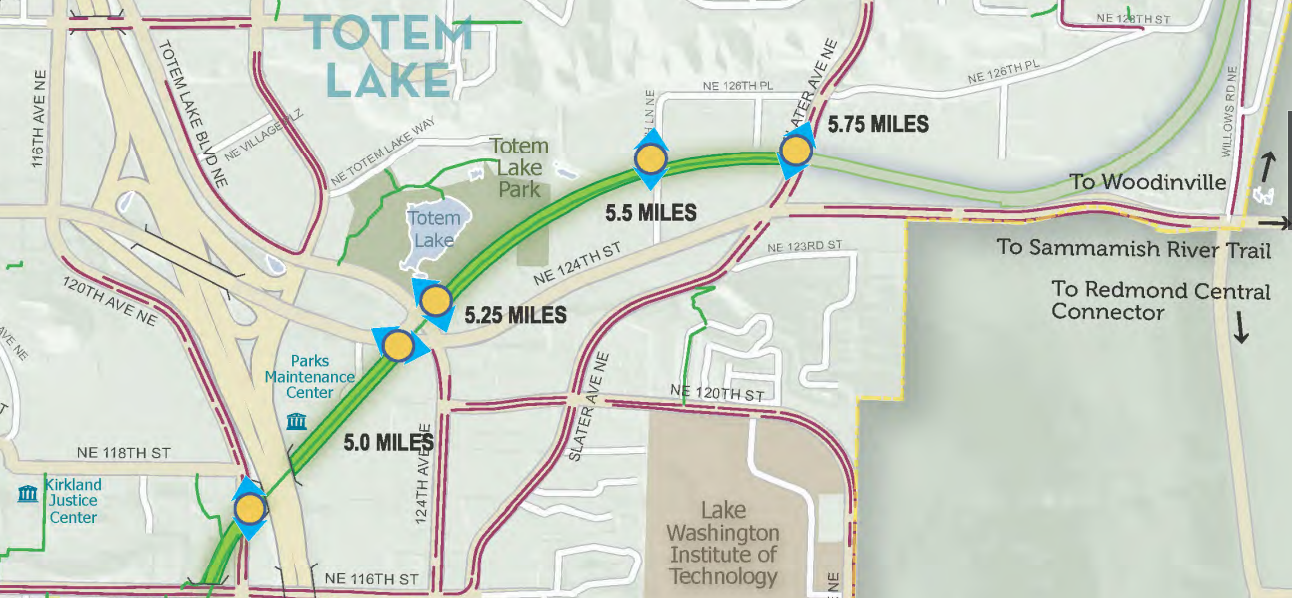
Map of the Totem Lake area showing in green the route and road crossings of the new Totem Lake Connector multi-use trail being developed.
The Totem Lake Connector fills a final gap on the Cross Kirkland Corridor near Totem Lake Park and the growing urban center. (City of Kirkland)

The Totem Lake Connector (TLC) brings the Cross Kirkland Corridor above the wide, awkward, and congested intersection where Totem Lake Boulevard meets NE 124th Street, allowing trail users to skip the whole thing. Right now, the only way for people biking to pass through the area was to use the traffic lanes or the incredibly narrow sidewalks. Last fall, The Urbanist’s Shaun Kuo detailed the barriers that the neighborhood’s car-centric planning might be adding to efforts to create a neighborhood oriented around walking and biking, but without projects like the Totem Lake Connector the area would probably never get there.
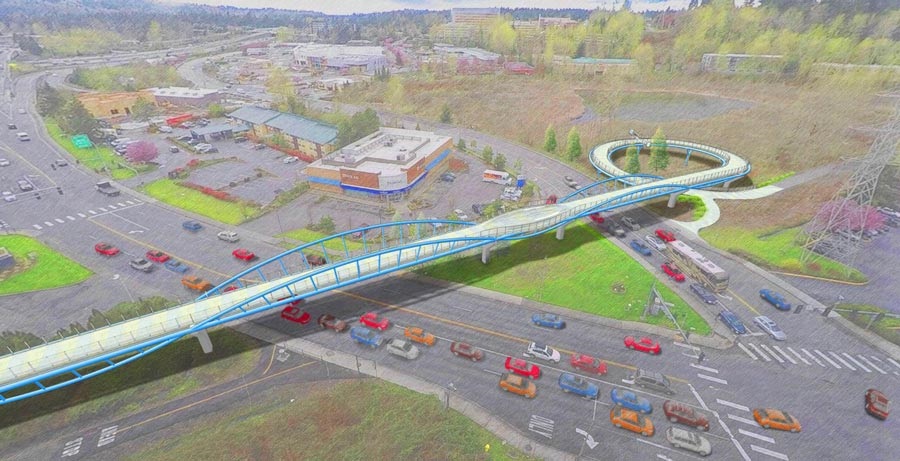
Proposed Totem Lake Connector overpass bridge that crosses the Totem Lake Boulevard and NE 124th Street intersection.
The TLC will allow users to skip over two incredibly unfriendly streets and the mega-intersection where they meet. (City of Kirkland)

“The [Totem Lake Connector] bridge connects the two ends of the Cross Kirkland Corridor, providing direct access for residents and businesses to the Village at Totem Lake and to the growing Totem Lake area from other Kirkland neighborhoods. Next to Totem Lake Park, the TLC showcases the balance between urban and natural environmental settings,” Rod Steitzer, Capital Projects Manager at Kirkland Public Works, told The Urbanist. “The new TLC bridge prepares Kirkland’s only designated urban center for future regional growth, giving people more options on how they might navigate the urban center, as Eastrail projects continue to be planned and built north and south of Kirkland.”

Bike riders venturing off the Cross Kirkland Corridor won’t find many separated bike facilities along Kirkland’s arterial streets, though that is slowly changing. This year, the city starts construction on adding protected bike lanes to 124th Avenue NE down to NE 116th Street — but only as part of a larger project that is widening the street from three to five lanes.
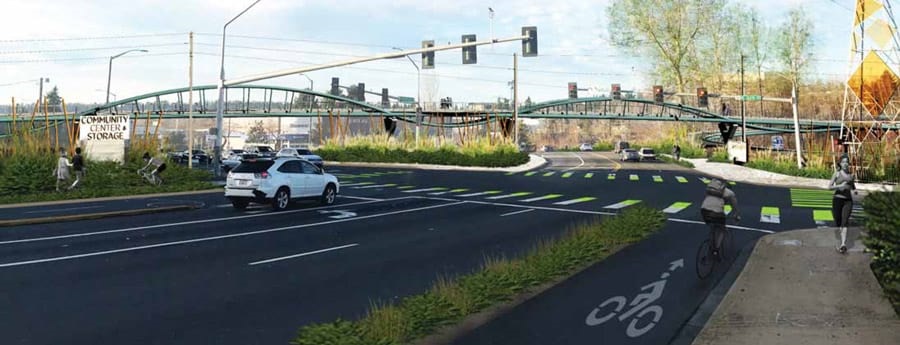
Street view showing new proposed bike lanes on NE 116th Street and the proposed multi-use overpass bridge at NE 124th Avenue.
A new cycletrack on 124th Avenue NE will provide a separated on-street connection to the new bridge. (City of Kirkland)

Last year, the Kirkland City Council approved an increase in the city’s vehicle license fee that’s set to be specifically dedicated to adding active transportation infrastructure. New sidewalks across the city will be the biggest gain from the city’s spending plan for that new fund, but the bike infrastructure upgrades will mostly come in the form of new paint, not separated lanes that keep people on bikes away from motor vehicles.

Overlake Village Pedestrian Bridge
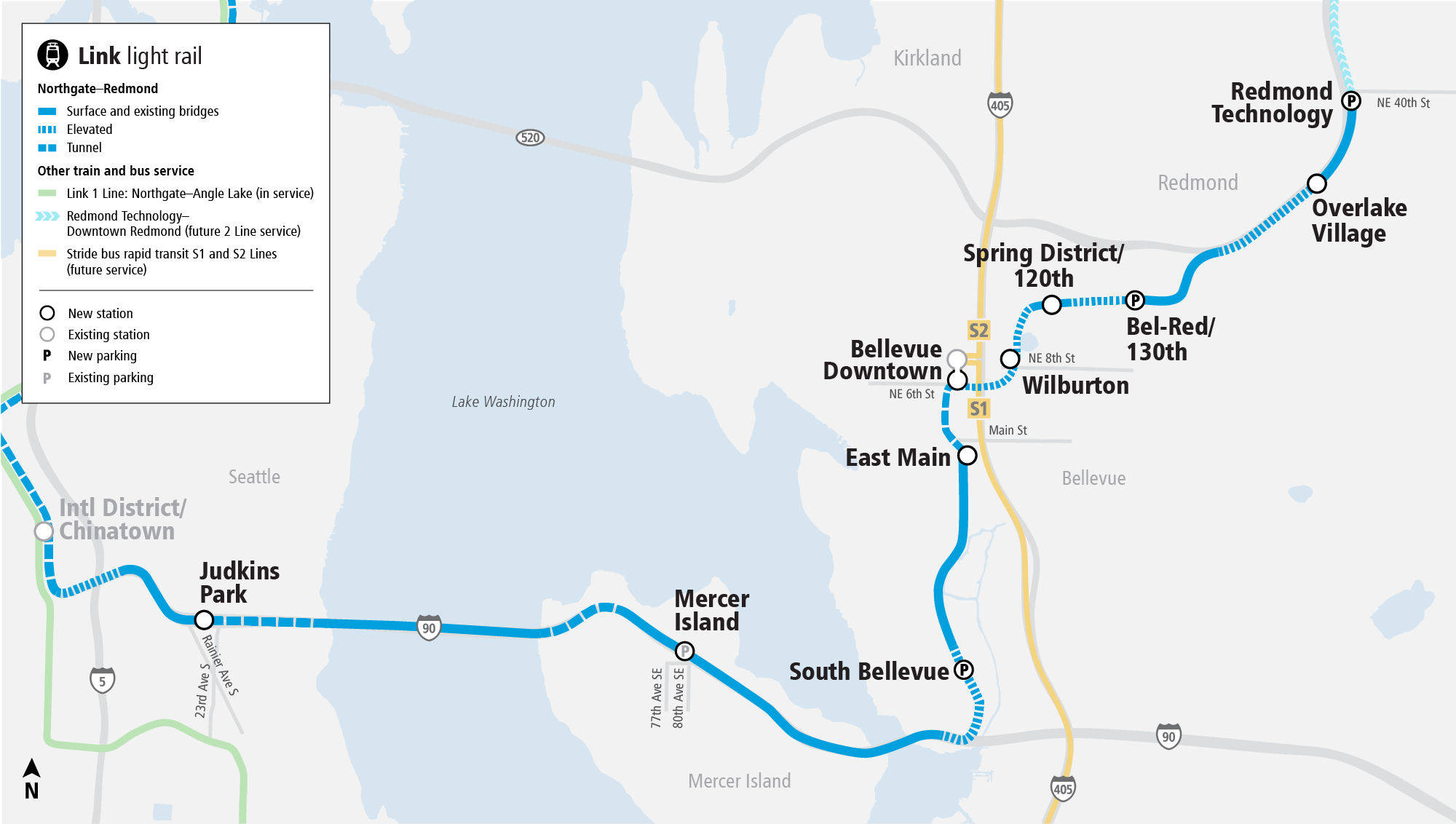
Lake Washington map view showing the multi-use trail route from Judkins Park in Seattle and across the I-90 bridge to Overlake Village and the Redmond Technology campus. New bridges will cross State Route 520.
New pedestrian and bike bridges at Overlake Village and Redmond Technology stations will bridge the barrier of SR 520. (Sound Transit)

While the potential start of service for Sound Transit’s East Link extension is still very much up-in-the-air right now, two major new pieces of associated pedestrian and bike infrastructure are heading toward grand openings that are going to be completely independent of whether trains are running. The two new bridges across State Route 520 in Redmond, will knit that city’s growing bike network together much more closely with the regional asset that is the 520 multi-use trail.
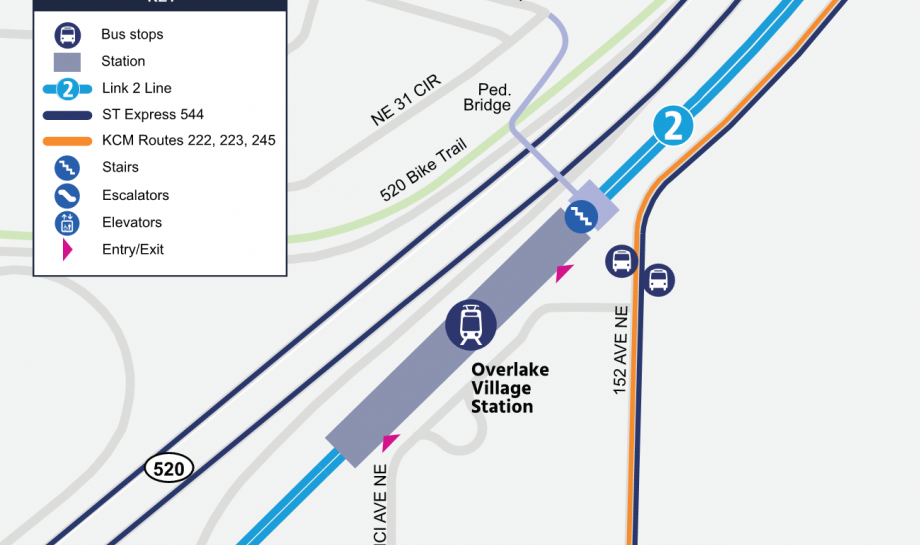
Map showing the new Overlake Village Light Rail Station and multi-use trail.
The new bridge at Overlake Village will connect across SR 520 directly at the light rail station, providing connections to both light rail and buses. (Sound Transit)

The first bridge, which is opening later this summer, connects to the Overlake Village light rail station, providing a new connection where one didn’t exist between 148th Avenue NE and NE 36th Street, directly at the bus stops serving Overlake Village Station on 152nd Avenue NE. For the bridge’s interior, Sound Transit commissioned work from Seattle artist, Leo Berk, which is made of more than 156,000 hand-painted tiles creating a natural image intended to evoke the early computer age, a nod to Microsoft, whose sprawling 500-acre headquarters is in the Overlake neighborhood.
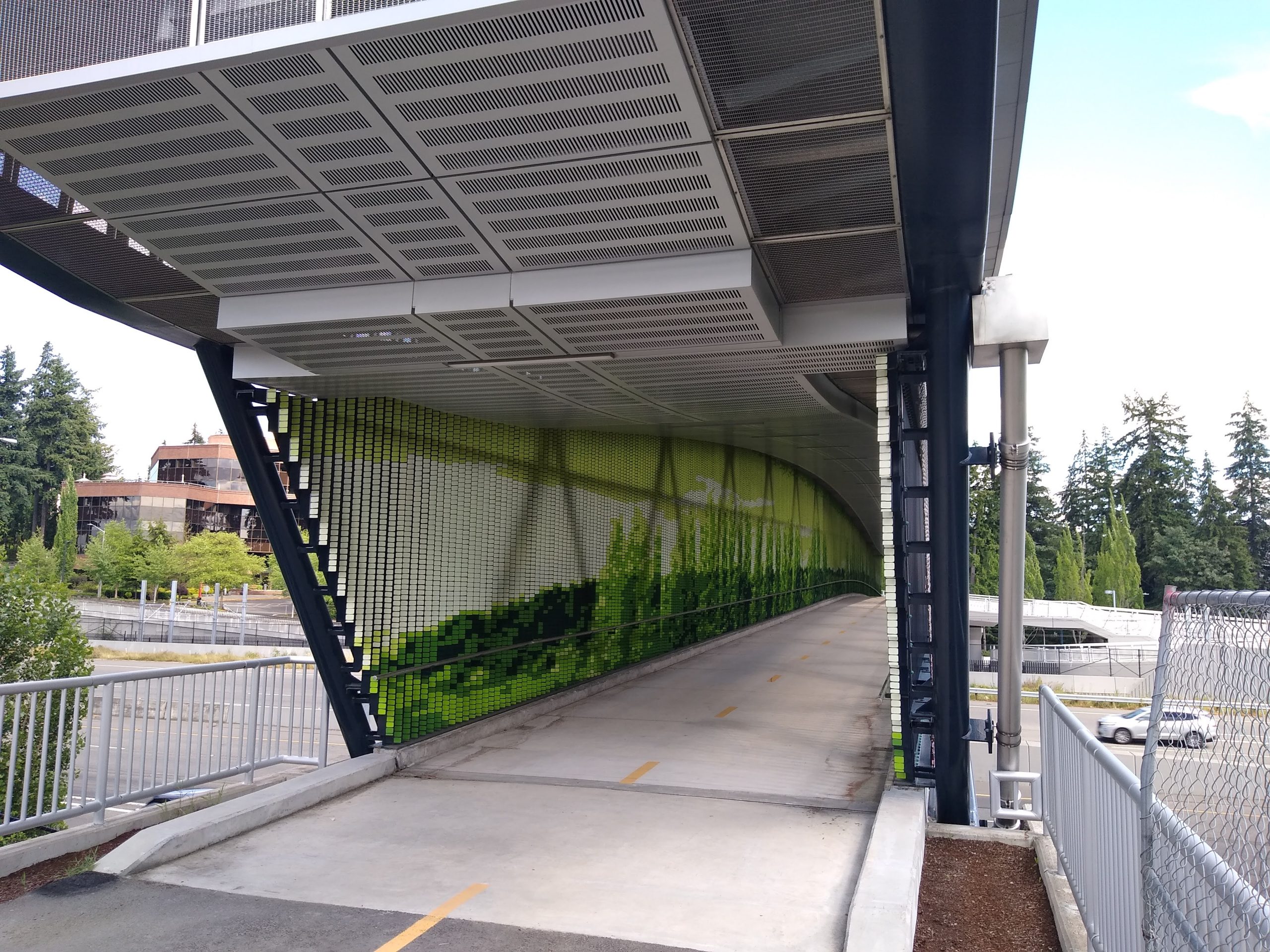
Multi-use trail bridge at the Overlake Station showing new art, a tile installation of 156,000 tiles, by Seattle artist, Leo Berk.
The art on the interior of the Overlake Village bridge was created by Seattle artist Leo Berk. (Ryan Packer)

Redmond Technology Center Bridge

A half-mile north of the Overlake bridge, a significantly larger bridge is taking shape at Sound Transit’s next station, dubbed “Redmond Technology.” Not only will this bridge connect users on the 520 Trail across the highway to the light rail station, it will also bridge across 156th Avenue NE. Directly connecting two sides of Microsoft’s campus to each other, the bridge is being fully funded by the tech company but will be owned by the City of Redmond. Like the Overlake bridge, this bridge is fully covered, protecting users from the elements.
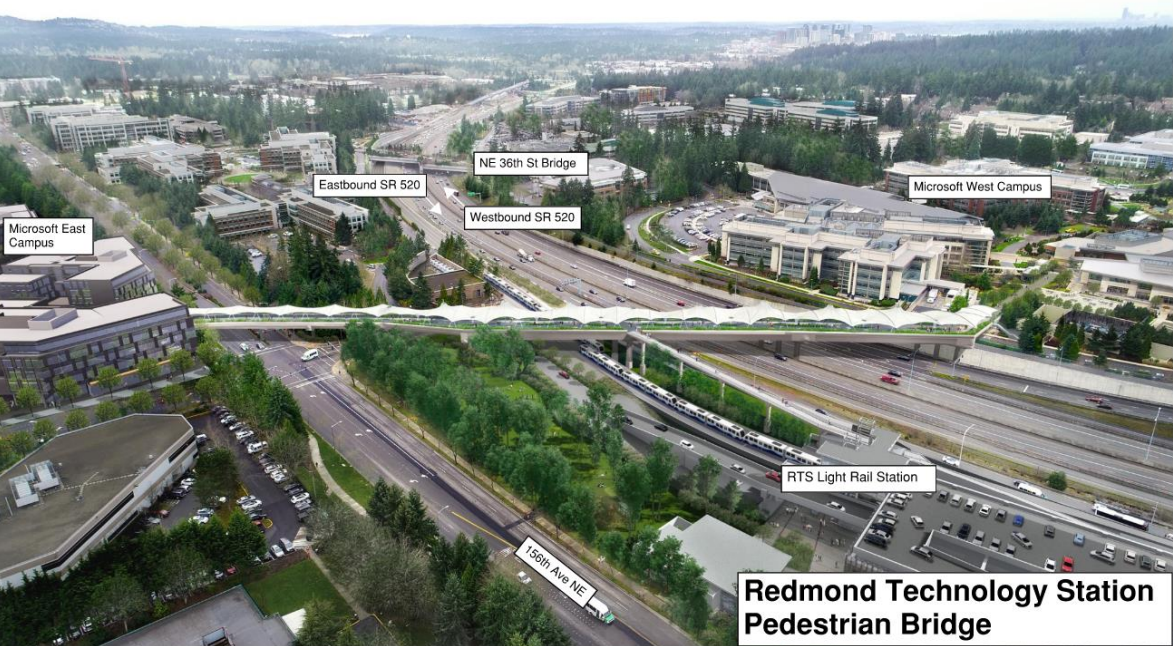
Aerial photograph of the new Redmond Technology Station multi-use trail covered bridge across SR-520 near 156th Avenue NE.
The Redmond Technology Station Bridge spans the state highway, the light rail station, and the nearby 156th Avenue NE. (City of Redmond)

“Redmond will benefit tremendously from two new bicycle and pedestrian bridges crossing SR 520,” said Kelli Refer, executive director of Move Redmond and a boardmember at The Urbanist. “The Overlake neighborhood is experiencing tremendous growth and change with the investment of light rail coming to the area. More housing and mixed-use transit oriented developments are being built in Overlake because it is a key urban growth center for the City of Redmond. For people who walk and bike in Overlake there will now be two bridges that provide access across SR-520 and help people navigate off of the SR-520 Trail into the retail core of the neighborhood.”

Jill Smith, Communications Manager at the City of Redmond, said that the Redmond Technology Center bridge is set to open as early as the beginning of 2024, after the west approach to the bridge and the connection to the 520 Trail is complete.

Like Kirkland, Redmond is beefing up its local bike network around the new bridges, but with even more protected infrastructure that will be available to users around the time that trains are running. The city has already opened a new shared use path along NE 40th Street, and a new cycletrack on 156th Ave NE will serve the east side of both pedestrian bridges.
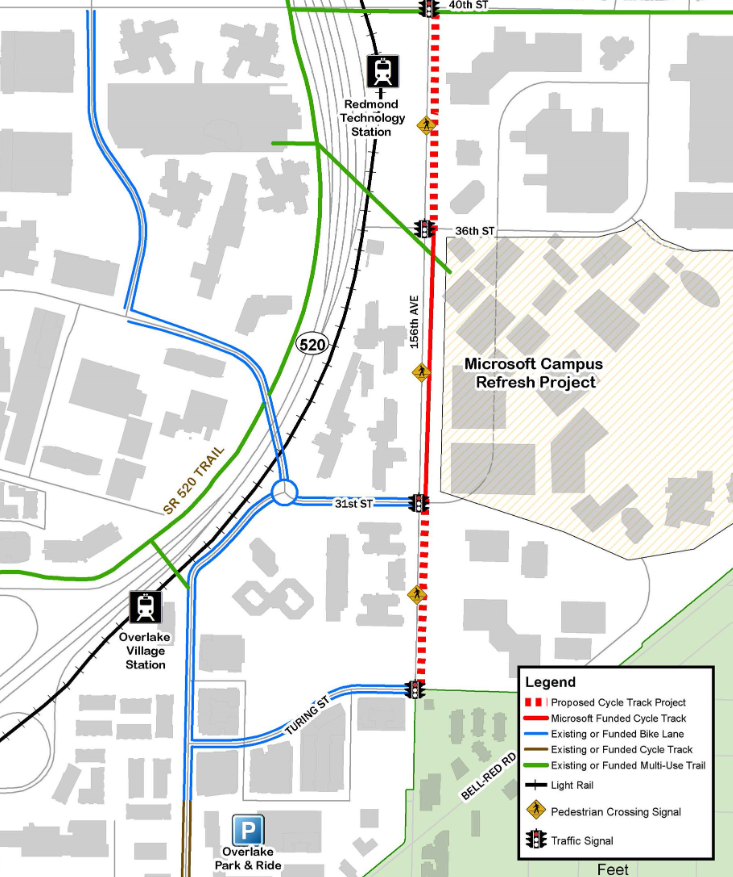
Map showing the mix of bicycle infrastructure in the Microsoft Campus area.
Bike infrastructure taking shape near the two bridges includes separated lanes on 156th Ave NE and NE 40th Street. (City of Redmond)

“For the first time we are seeing a connected network of bicycle facilities in Redmond that connect the trails network to the key neighborhood destinations,” Refer said. “This is a big shift [from] seeing bicycling as recreational activity to a means of everyday transportation.”

All three of these new bridges have the potential to catalyze usage of the Eastside’s popular and incredibly valuable off-street trail network and increase demand for more on-street bike infrastructure to create more connections. Their impending completion is worthy of celebration.

09 May 18:00

Meet the Roving Veterinarians Caring for Mexico’s Rural Horses

by Emiliano Rodríguez Mega and Victor J. Blue
Horses, donkeys and mules can be a lifeline for families living in the countryside, but there haven’t always been vets around to treat them.
25 Apr 22:37

The Great Electrician Shortage

by cocacola1
06 Apr 20:03

Her Unusual Wheeze Was Getting Worse. What Was It?

by Lisa Sanders, M.D.
She constantly felt the need to clear her throat. Then she started to feel winded on stairs. A flurry of tests narrowed down the cause.
09 Mar 14:33

He Was Sweating Uncontrollably. Was It Male Menopause?

by Lisa Sanders, M.D.
His vital signs were normal. He didn’t have a fever. A slew of tests couldn’t find the cause. Then a locker-room conversation between doctors led to the diagnosis.
07 Feb 22:23

Screw motivation, what you need is discipline

by thunderbong
30 Jan 16:26

AirGradient Open Source Air Quality Monitor for CO2 and PM2.5 Measurements

by ahaucnx
30 Jan 02:01

Can a head heavy racquet result in elbow pain?

by /u/nashsed

I usually play with an even (or maybe slightly head light) racquet.

Past few days I’ve been trying out a few different racquets of my fellow players in search of my next racquet and I realised that when I play with a head heavy racquet it tends to put more strain on my elbow and causes a little bit of discomfort.

Is the balance & weight the culprit or could it be due to improper technique?

Any tips or advice would be much appreciated. Thanks.

submitted by /u/nashsed
[link] [comments]
24 Jan 17:58

Ask HN: How do ADHD people cope on here?

by WhackyIdeas

I love HN. I check it out basically for hours every day, for the past 5 years or so.

But, HN is utter hell too… it’s worse than my addiction to The Guardian.

I see so many topics I’m interested in, so many cool projects, so I bookmark them. Then I see more and bookmark them too. There’s a never ending number of things I bookmark.

But the constant reality is that I will never ever be able to do all the things in my brain. It’s a severely frustrating and depressing fact I feel faced with every day. A world of highs and disappointment.

But I’m totally addicted because there’s just so much new.

Anyone else with ADHD feel this way or have a healthier outlook about HN?


Comments URL: https://news.ycombinator.com/item?id=34486848

Points: 332

# Comments: 303

17 Jan 00:38

Reverse engineering a neural network's clever solution to binary addition

by Ameo
12 Jan 21:27

Excruciating Leg Pain Hobbled Her for Weeks. What Was Wrong?

by Lisa Sanders, M.D.
An M.R.I. ruled out the most common cause of sciatica. Then her rheumatologist asked about her asthma.
29 Dec 17:51

He Had Blood in His Urine and a Strange Rash. What Was Going On?

by Lisa Sanders, M.D.
At the E.R., the patient learned his blood wasn’t clotting. His mother had the same condition — but the trigger turned out to be a surprise.
22 Dec 18:26

Are super-rich people just better at making money?

by dncosta

Article URL: https://pudding.cool/2022/12/yard-sale/

Comments URL: https://news.ycombinator.com/item?id=34091098

Points: 321

# Comments: 546

15 Dec 17:23

These ‘Luddite’ Teens Are Abstaining From Social Media

by Alex Vadukul
When the only thing better than a flip phone is no phone at all.
13 Dec 22:39

‘Disruptive,’ or Depressed? Psychiatrists Reach Out to Teens of Color

by Matt Richtel and Bee Trofort
In Atlanta, a team of Black mental health experts is bringing care to adolescents whose needs often go unaddressed and misunderstood.
12 Dec 04:35

Be wary of imitating high-status people who can afford to countersignal

by jger15
08 Dec 21:31

Historical analogies for large language models

by dynomight

How will large language models (LLMs) change the world?

No one knows. With such uncertainty, a good exercise is to look for historical analogies—to think about other technologies and ask what would happen if LLMs played out the same way.

I like to keep things concrete, so I’ll discuss the impact of LLMs on writing. But most of this would also apply to the impact of LLMs on other fields, as well as other AI technologies like AI art/music/video/code.

1. The ice trade and freezers

We used to harvest huge amounts of natural ice and ship them long distances. The first machines to make ice were dangerous and expensive and made lousy ice. Then the machines became good and nobody harvests natural ice anymore.

In this analogy, LLMs are bad at first and don’t have much impact. Then they improve to match and then exceed human performance and human writing mostly disappears.

2. Chess humans and chess AIs

Chess AIs far exceed humans, yet human chess is more popular than ever.

In this analogy, LLMs become better than humans at writing. But so what? We like human writing. Text isn’t interesting if it’s not part of a (para)social relationship. Browser makers build in LLM detectors to warn people if something wasn’t written by a human. Authors do use LLMs to train at writing, and sometimes there’s lots of intrigue when authors accuse each other of cheating using LLMs.

(By the way: In case you’re worried, there is no “written using LLMs lol” rug-pull coming at the end of this post. I wouldn’t endanger our parasocial relationship like that.)

3. Farmers and tractors

In 1800, half of the people in rich countries were farmers. After technology made farmers more productive, we weren’t interested in eating 50× more food per capita (and we weren’t that interested in expensive ingredients and eating white truffle saffron wagyu caviar burgers for every meal) so today only 1-4% of people are farmers.

In this analogy, LLMs act as a tool to allow one “writer” to produce vastly more output. But we don’t want to read 50× more stuff and don’t particularly care about “better” writing, so most writers have to shift to other jobs to make supply match demand.

4. Horses and railroads

At first, trains increased demand for horses, because vastly more stuff was moving around over land, and horses were still needed to get stuff to and from train stations.

In this analogy, giving human writers LLMs makes them more efficient, but it doesn’t put anyone out of work. Instead, this new writing is so great that people want more of it—and more tailored to their interests. Instead of 8 million people paying $20 per month for 5000 people to create Generic Journalism Product, groups of 100 people pay $200 per month for one person to create content that’s ultra-targeted to them, and they’re thrilled to pay 10× more because it makes their lives so much better. Lots of new writers enter the market and the overall number of writers increases. Then LLMs get even better and everyone is fired.

5. Swords and guns

First, guns replaced bows because guns need less training. Then guns became better than skilled archers. Then they replaced spears. Then infantry switched to guns with mini-swords on the ends. Then they dropped the mini-swords. These shifts weren’t driven by “productivity” so much as the fact that you had to switch to guns since you knew your adversaries were going to.

In this analogy, LLMs first replace humans for low-skill writing and then gradually take over more domains. For a while, the best writing uses a mixture of LLMs and human writing, but eventually humans stop being useful. Anyone who tries to resist this shift is outcompeted by better content from others who embrace LLMs.

6. Swordfighting and fencing

Sword fighting has an incredible depth of skill—you need talent, discipline, fitness, years of training, and maybe even philosophy. Many people think it’s worth mastering all this even though swords are now irrelevant to combat, so they practice it as a sport.

In this analogy, LLMs become better than humans at writing. But it’s still widely understood that learning to write is good for you (maybe writing is “the best way to think”) so people send their kids to writing camp and humble-brag about writing in their free time. But in the end, most writing was done for the mundane purpose of making text exist and when this is no longer valuable, most people stop doing it.

Intermission

I was informed that this post was kind of depressing but I couldn’t think of any good jokes so I’m resorting to brute force and deploying this picture of DOG WITH BENEDICT CUMBERBATCH:

dog with benedict cumberbatch

Thus fortified, let’s continue.

7. Artisanal goods and mass production

Mass production made suit/cars/teapots cheaper and more plentiful. But Bentleys are still made by hand—artisanal goods are still seen as higher quality and higher status.

In this analogy, LLMs make writing vastly cheaper and more plentiful. But they never quite reach the quality of the best human writers. Most writing was always emails and TPS reports and these all shift to LLMs. But the New Yorker sticks to human writing and because copying information is free, most of what people read still comes from humans.

8. Site-built homes and pre-manufactured homes

We can build homes in factories, with all benefits of mass production. But this is only used for the lowest end of the market. Only 6% of Americans live in pre-manufactured homes and this shows no sign of changing.

In this analogy, LLMs make text cheaper. But for some reason (social? technical? regulatory?) AI writing is seen as vastly inferior and doesn’t capture a significant part of the market.

9. Painting and photography

While cameras are better than painters at reproducing real-world scenes, they didn’t make painters obsolete, because paintings remain a status symbol and painters shifted to non-representational art.

In this analogy, LLMs replace humans for much of what we currently think of as “writing”, except for people who want to flaunt that they can afford hand-made writing. But then human writers figure out that they can do certain things better than LLMs. Those things become high status and we all convince ourselves that we totally coincidentally happen to prefer the high-status things and can’t stand the low-status things and so human writers do OK.

10. Feet and Segways

First, there was walking. Then the Segway came to CHANGE THE NATURE OF HUMAN TRANSPORT. Twenty years later, there is still walking, plus occasionally low-key alternatives like electric scooters.

In this analogy, LLMs work fine but just aren’t worth the trouble in most cases and society doesn’t evolve to integrate them. Domain-specific LLMs are used for some applications, but we start to associate “general” LLMs with tourists and mall cops. George W. Bush falls off an LLM on vacation and everyone loses their minds.

11. Gull-wing and scissor doors

In the 1950s and 1960s automakers introduced doors that open vertically. These are better at getting out of the way, make it easier to park in tight spaces, and are less hazardous to cyclists. But they need more vertical clearance and, if you’re in an accident and your car flips over, they can literally kill you.

In this analogy, LLMs literally kill some people, and then we stop using them.

12. Sex and pornography

[Description of current situation redacted.]

In this analogy, people consume a ton of AI writing. But it doesn’t seem like a “real” substitute for human writing, so while human writing becomes a bit less popular it stabilizes at a high level.

13. Human calculators and electronic calculators

Originally a “computer” was a human who did calculations.

In this analogy, LLMs are an obvious win and everyone uses them. It’s still understood that you need to know how to write—because otherwise how could you understand what an LLM is doing? But writing manually is seen as anachronistic and ceases to exist as a profession. Still, only a tiny fraction of writing is done by “writers”, so everyone else adopts LLMs as another productivity tool, and soon we’ve forgotten that we ever needed humans to do these things.

Thoughts

This exercise made me even less sure about what’s going to happen. But it helped me clarify the reasons for uncertainty. There is of course the obvious question of how good LLMs will get, and how fast. But to predict the impact of LLMs we also need to understand:

  • Will LLMs act more as competitors or complements to human writing?
  • How will people react to LLMs? Maybe LLMs will write amazing novels and people will love them. Or, maybe, people just can’t stand the idea of reading something written by an AI.
  • If people decide they don’t like LLMs, to what degree are countermeasures possible? Can we build machine learning models to detect LLM-generated text? Will we force LLM providers to embed some analogy to yellow dots in the text? Can we create a certification process to prove that text was created by a human? (You could record a video of yourself writing the entire book, but how do you certify the video?)

Beyond all that, I wonder to what degree these analogies are useful. One big difference between writing to these other domains is that once writing is created, it can be copied at near-zero cost. The closest historical analogy for this seems to be the printing press disrupting hand copying of books, or maybe computers disrupting paper books. But it’s also possible that this shift is something fundamentally new and won’t play out like any of these analogies suggest.

24 Nov 17:02

Underrated reasons to be thankful

by dynomight
  1. That when cyanobacteria arose 2 billion years ago and filled the atmosphere with oxygen which killed off most species and removed methane from the air so temperatures crashed and the entire planet was encased in ice, this didn’t quite extinguish all life but eventually led to the rise of eukaryotes that turn oxygen back into carbon dioxide and later those eukaryotes banded together into multicellular teams like you.

  2. That there’s been a 93% decline in stomach cancer deaths over the past 100 years—from by far the biggest killer among cancers to one of the smaller ones—and mostly this was an accident, it happened because better food refrigeration reduced infections of H. pylori, a bacterium that wasn’t even identified until 1982 after most of the decline had already happened.

  3. That the coefficient of thermal expansion for concrete is 1.1 × 10⁻⁵ / °C while the coefficient for carbon steel is 1.2 × 10⁻⁵ / °C which is close enough that steel-reinforced concrete buildings don’t crumble when the temperature changes although they won’t last for centuries like ancient Roman pure-concrete structures have.

  4. That we evolved to communicate mostly via sound which can mostly be stored and transmitted using simple technologies like ink on paper or etching in wax, meaning we didn’t have to bootstrap, like, capture and transmission of 3-D spatiotemporal fragrance patterns whilst having no way to exchange ideas other than direct person-to-person contact.

  5. That if I was a fish I would live in unending terror of getting eaten by a bigger fish, but presumably fish don’t feel that way because when evolution adapts a creature to an environment it would be counterproductive to wire them to experience life as torture, although it’s not clear this is true and I have no idea why or how evolution would set a hedonic baseline.

  6. That 85% of people in the world have toilets and that number has been improving by 1.5% per year for the last two decades.

  7. That 25/12 ≈ 1.3348 ≈ ⁴⁄₃ and 27/12 ≈ 1.4983 ≈ ³⁄₂ which who cares except if you discretize the frequencies of sound so frequency goes up by a factor of 21/12 at each step, then combining tones 12 steps apart gives an octave which sounds good and combining tones 5 steps apart gives a perfect 4th which sounds good and combining tones 7 steps apart gives a power chord which sounds amazing and so Western music is possible, although it’s insanely-annoying that 25/12 isn’t exactly equal to ⁴⁄₃ which leads to grungy issues like equal temperament vs. just intonation tuning.

  8. That it’s pretty rare for an asteroid as large as Chicxulub to hit the Earth and if anything it’s unusual that we were hit by one only 66 million years ago.

  9. That Brussels sprouts used to be terrible but in the 1990s we noticed that was because of glucosinolate and then seed companies found old low-glucosinolate varieties and cross-bred them with modern high-output varieties and now Brussels sprouts are great and also that this was all evidently seen as natural enough not to trigger team no-science-in-my-food.

  10. That life was born with cells at war and it was war war war until at some point multicellular life figured out to make immune cells and then train them to recognize every home cell and kill everything else and this worked so well that you can walk around all day barely thinking about the fact that you’re swimming in a soup of billions of enemies constantly trying to kill you.

  11. That often there is a BIG PROBLEM that could have APOCALYPTIC CONSEQUENCES and we worry and worry and then it gets solved or goes away—like panda extinction or mask shortages or rare earth shortages or monkeypox or Zika or SARS-CoV-1 or crime in the 80s or peak oil or programmer salaries getting annihilated by outsourcing—and after it goes away we immediately STOP PAYING ATTENTION which we shouldn’t do because surely our past worries have much to teach us about our future ones.

  12. That North Americans and the Dutch are right and peanut butter is good and all the peanut butter deniers are wrong, which is good because North Americans and the Dutch could use a win in culinary affairs, and also did you know it is known in Holland as “peanut cheese” which I guess is a testament to the power of the Dutch butter lobby?

  13. That all large institutions everywhere anecdotally seem to be filled with the most grotesque waste and inefficiency, which is bad, sure, but given that our quality of life is as it is, it suggests that if we could find an even-moderately-efficient way to organize human activity, we might flourish even harder than we do now.

  14. That electric leaf blowers now exist and perhaps we can develop a new understanding that it’s chill to not spew intermittent pitch-shifting mechanical shrieking sounds at deafening volumes all the time everywhere?

  15. That for billions of years bacteria captured energy from the sun and then died and sank to the bottom of the ocean and were covered with sediment and cooked into hydrocarbons and it took a long time for humans to evolve, which is good because all that stored energy has made our lives much better and perhaps allowed us to bootstrap a technological civilization that would be otherwise impossible.

  16. That after the Mongols conquered half of Eurasia and killed 11% of the world’s population, they happened to have a drinking culture adapted to seasonal availability of low-alcohol beverages, and after they had subjugated everyone and had plentiful access to high-alcohol beverages that culture produced astonishing spectacles of alcoholism in most leaders, meaning short lifespans, disorganized leadership, frequent successions, and political fragmentation, which plausibly spared much of the world from further destruction.

  17. That ghosts don’t exist, which wasn’t obvious a thousand years ago.

  18. That when babies are delivered caesarian, we’re experimenting with feeding them a tiny bit of mom’s poo to get the old microbiome started, and hopefully this will reverse the increased diabetes and autoimmune problems we see in the current caesarian-delivered population, though the causal relationship isn’t 100% clear.

  19. That MSG—a standard amino acid glued to a sodium atom—is naturally present in lots of things like tomatoes, mushrooms, grapes, and parmesan cheese, meaning Italian food is high in MSG, which is good because MSG is harmless and delicious should be enjoyed by everyone including people with psychosomatic issues.

  20. That the best therapy for sickle-cell disease has long been to use chemotherapy to kill the patient’s bone marrow and then transplant marrow from a donor, which was good except most people couldn’t find immunologically matched donors, and we’ve known for a long time that we should be able to extract stem cells from the patient’s own bone marrow and then use gene therapy to modify them to make healthy red blood cells and then re-implant them, but now this finally, finally, finally seems to really work, which not only cures this horrible disease but also confirms that we weren’t missing something fundamental, raising the odds that gene therapy will be able to do the other things we hope of it.

  21. That we now have methods to detect the sex of chicken eggs during incubation—like cutting a tiny hole with a laser and testing for female hormones—and it seems like we are on track to stop throwing half the chickens that are born into a shredder and more generally maybe this suggests that technology won’t just help us optimize and scale the cruelty of nature but may also make it easier to take the welfare of non-human animals seriously.

  22. That it’s unclear if the death penalty deters crime, it’s debated and murky, which if you’re uncomfortable with the death penalty is fortunate because if it had an undeniable deterrent effect, you’d face some hard choices.

  23. That all the types of atoms that can sustain a fission chain reaction are heavy and so tend to spontaneously decay and stop existing, plus the earth is very old, meaning that none of those atoms exist on Earth anymore except uranium-235.

  24. That uranium-235 only comes mixed with 100x as much uranium-238 which is chemically indistinguishable, and the best known way to separate them is to mix with fluoride to make a gas and then spin that gas for months at 500 meters per second, which is obscenely hard, thank god, although the French are developing an ingenious chemical enrichment method, which, why, why are you doing that, it would move enrichment to the domain of standard chemical engineering technology, please stop.

  25. That the light on earth could conceivably come from a sun that is small and close or one that is big and far and in fact it is very big and very far, which doesn’t matter much short-term but long-term it might be handy to have a totally automated fusion reaction 1.3 million times the size of our planet if we want to do something ambitious someday.

  26. That while the universe seems incomprehensible—why is there a universe, why are we conscious, why is the fine structure constant 1/137.036—maybe we’re all just very very stupid—do squirrels agonize about What it All Means—and maybe it all does make sense somehow and maybe there’s a grander intelligence out there in spacetime somewhere that gets it.

  27. That Comfortable and dermatological effects of hot spring bathing provide demonstrative insight into improvement in the rough skin of Capybaras (Inaka and Kimura 2021), “Comparison of facial expression of Capybaras between before bathing and during bathing. (A) Scoring table of comfortable status in Capybaras. When the Capybaras feels comfortable, the eyelids close and the visible area of the eyeball becomes smaller, and the ears are gradually pulled back against the body. (B) Eye score showed significant difference between before bathing and during bathing (p < 0.01). (C) Ear score showed no significant difference before and during bathing.”

  28. That washing machines.

  29. That shoes.

  30. That most molecules can be “flipped” to get another stable version of the same molecule and early life seems to have randomly settled on one version and now everything expects it so in principle you could create a “mirror human” with everything flipped, which is good because it’s insane and they would be immune to infectious disease but also to food so to keep them alive you’d need an entire mirror life ecosystem, although where is my mirror life science fiction, like say a rogue organization makes mirror cyanobacteria which feed only on light and achiral molecules but nothing can eat them so they cover the planet—it’s not clear why that hasn’t happened naturally BTW, be grateful for that too—and scientists are forced to release a succession of more complex mirror organisms designed to prey on the previous ones and it spirals and at the end we learn the true mirror life is the friends we made along the way.

23 Nov 00:11

Is This the End Game for Crypto?

by Paul Krugman
What’s the point of reinventing banks, only worse?
21 Nov 18:13

With Anxiety On the Rise, Some Children Try ‘Exposure Therapy’

by Virginia Hughes and Desiree Rios
A gold-standard treatment for phobias and anxieties encourages young people to follow an old and simple dictum: Face your fears.
21 Nov 17:43

For some with ADHD, the low rumble of brown noise quiets the brain

by wslh
04 Nov 23:07

Use RSS for privacy and efficiency (2021)

by editbutton

Article URL: https://rsapkf.org/weblog/q2z/

Comments URL: https://news.ycombinator.com/item?id=33469271

Points: 453

# Comments: 192

03 Nov 23:58

In Search of a Lost Spain

by Aatish Taseer and Richard Mosse
In the southern part of the country, churches and streets hold the remnants of eight centuries of Islamic rule.
19 Oct 13:16

Museum Security

by Bruce Schneier

Interesting interview:

Banks don’t take millions of dollars and put them in plastic bags and hang them on the wall so everybody can walk right up to them. But we do basically the same thing in museums and hang the assets right out on the wall. So it’s our job, then, to either use technology or develop technology that protects the art, to hire honest guards that are trainable and able to meet the challenge and alert and so forth. And we have to keep them alert because it’s the world’s most boring job. It might be great for you to go to a museum and see it for a day, but they stand in that same gallery year after year, and so they get mental fatigue. And so we have to rotate them around and give them responsibilities that keep them stimulated and keep them fresh.

It’s a challenge. But we try to predict the items that might be most vulnerable. Which are not necessarily most valuable; some things have symbolic significance to them. And then we try to predict what the next targets might be and advise our clients that they maybe need to put special security on those items.

13 Oct 23:05

She Suffered From Headaches and Fatigue. Were Concussions to Blame?

by Lisa Sanders, M.D.
She was a young athlete who suffered frequent head injuries. Her family assumed that was the cause of her strange symptoms — then she had a seizure.
11 Oct 16:23

Why Chimps and Gorillas Form Rainforest Friendships

by Asher Elbein
In a Congolese national park, great apes of different species interact socially, with individuals clearly recognizing one another.
30 Sep 20:50

Select * from cloud

by kiyanwang

Article URL: https://steampipe.io/

Comments URL: https://news.ycombinator.com/item?id=33034351

Points: 748

# Comments: 276

22 Sep 23:33

Lose weight the slow and incredibly difficult way

by gHeadphone
20 Sep 22:59

In Istanbul’s Private Retreats of the Sultans, Time Stands Still

by Lisa Morrow
The elegant pavilions and summer palaces known as kasir offer a glimpse of history and an intimate and enticing slice of Ottoman life.
13 Sep 18:38

The last person standing in the floppy disk business

by fortran77