Shared posts

02 Oct 21:57

Amazon’s HQ2 Isn’t a Headquarters. So What Is It?

by jbat

Crossposted from NewCo Shift.

Everyone’s favorite parlor game is “where will Amazon go?” Better to ask: Why does Amazon needs a second headquarters in the first place?

It’s the future! Rendering of Amazon’s new Seattle HQ. The first and original one. 

Why does Amazon want a new headquarters? Peruse the company’s RFP, and the company is frustratingly vague on the question. “Due to the successful growth of the Company,” Amazon says of itself in the royal third person, “it now requires a second corporate headquarters in North America.”

It requires”?

Is this a request for bulk discounts on toner ink? Did Jeff Bezos outsource this momentous and extremely public communication to his purchasing department? Is there really no more room in Seattle?

So…Why? Why is Amazon doing this? If I were one of the hundreds of Mayors and local civic boosters huddling in meeting rooms around North America, that would be my first — and pretty much my only question. After all, if you don’t know why Amazon is looking for a “second headquarters,” then your response to their RFP is going to end up pretty rudderless. If Amazon’s true reason for another HQ boils down to, say, Latin American expansion, then Chicago, Toronto, and Philly should pretty much pack in in, no?

While the RFP is comprehensive in requirements (transportation networks, nearby international airports, sustainable office space, etc.), it nevertheless demonstrates a stunning lack of vision — the very vision that once defined “startups” like Amazon. The current accepted mythology about our fabled tech companies, those lions of our present economic theatre, is that they are fonts of vision — driven not just by profit, but by outsized missions to change the world, and to make it better. So what mission, exactly, will this new headquarter actually be charged with? Can anyone answer that? Absent any serious data, the default becomes “to expand Amazon.” And what, exactly, might that mean?

Amazon’s lists of current and projected businesses include e-commerce (its core), entertainment, home automation, cloud services, white label products, logistics and delivery, and any number of adjacent businesses yet to be scaled. It also harbors serious international expansion plans (one would presume). Any and all of these businesses might inform the “why” of its Bachelor-like RFP. But nowhere in the RFP does the company deliver a clue as to whether these factors play into its decision.

I have a theory about why Amazon issued such a vision-free RFP — and why the world responded with a parlor game instead of a serious inquiry as to the motivations of “the most valuable company in the world.” And that theory comes down to this: Amazon needs a place to put workers that are secondary but necessary — back office service, lower level engineering talent, accounting, compliance, administrative support. It will move those support positions to the city that has the cheapest cost per seat, and consolidate its “high value” workers in Seattle, where such talent is already significantly concentrated.

Put another way, “HQ2” isn’t a headquarters at all. But calling it one insures a lot more attention, a lot more concessions, and a lot more positive PR. Maybe Amazon doesn’t have an answer to the question, and is hoping its call for proposals will deliver it a fresh new vision for the future. But I doubt it.

I’d love to be wrong, but absent any other vision the most likely reasoning behind this beauty pageant boils down to money. It may sound like the cynical logic of a rapacious capitalist — but more often than not, that’s what usually drives business in the first place.

02 Oct 21:56

Hand-drawn short trip

by Nathan Yau

Have you seen this yet? Illustrator Alexander Perrin experimented with bringing a hand-drawn quality to an interactive medium. It’s a breath of fresh air called Short Trip.

(And brb, I need to take a walk outside.)

Tags: game, illustration

02 Oct 21:56

The future of testing

by Bryan Mathers
the future of testing

I read this guardian article recently where a woman asked Tinder for all her personal information. They sent her 800 pages worth of data. Apply this to the world of testing, which is increasingly data rich, and it doesn’t take much to make a pessimistic prediction.

This thought was originally from a town hall discussion at the E-ATP conference, which I had the pleasure of participating in.

The post The future of testing appeared first on Visual Thinkery.

02 Oct 21:56

Stanford CS 007: Personal Finance for Engineers (Kickoff)

by Adam Nash

Update: For those looking for full course material, I’m posting it on a parallel site:
http://cs007.blog

Yesterday, I had the great pleasure of officially kicking off a new course at Stanford University, “Personal Finance for Engineers“.  The course is offered through the Computer Science department (CS 007), but is open to undergraduate & graduate students of any major.

Personal Finance for Engineers


It was a packed room, and I was delighted. In fact, I was delighted for three reasons.

First, I love teaching. In an unexpected coincidence, the room my course was assigned, 200-034, is the same room that I taught CS 198 for the CS 106 Section Leaders over 20 years ago as a graduate student. It was the home of CS 198 for many years. To see it filled with students again was wonderful.

Second, the level of student engagement has been outstanding. Originally set for a maximum of 50 students, I expanded the enrollment to 75, and with waitlist interest the total number of students easily went over 100. For a new course without a track record on campus, I was delighted to see so many students interested in the topic.

Third, the topic is incredibly important to me.  Those of you who have been following my efforts around personal finance education know that I care deeply about the topic. Over the past 7 years, I’ve given talks at dozens of companies like Facebook, LinkedIn, Twitter & Dropbox, hoping to better educate and inspire employees to learn more about personal finance and make better financial decisions.

I’m hoping this class can amplify those efforts even further.

Making Personal Finance Education Open

I feel grateful to Stanford University and the Computer Science Department for supporting this effort, and I hope that by making the material public, we can help get higher quality education about personal finance to as many students as possible.

My hope is that by circulating this material, more people will engage to give feedback on the content, make suggestions for improvement and continue to improve the material and the class.

After every class, I’ll be posting the slides for the session up on Slideshare. The materials from the first class, “Introduction,” are now available.

As the introductory session, I focused the seminar on three topics:

  1. Why the topic of Personal Finance is worth studying?
  2. Real data from a survey of students enrolled in the class.
  3. Full syllabus for the topics that will be covered during the course.

Student Survey Data

The second topic is based on 10 questions I asked every student in the class to complete before the start of the first session. It is hardly a scientifically representative student survey, but I wanted to ground some of the initial discussion of financial topics with data about their own experiences & expectations.

73 students completed the survey. It’s worth sharing the results of the 10 questions here:

A few data points worth sharing:

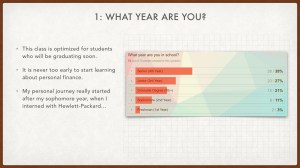
Question 1: A little over 50% of the class are either graduating seniors or graduate students. Only 14% are freshman or sophomores.

Question 2: Approximately 3/4 of the class (76%) had a “magic number” in mind when asked about how much wealth would define success for them. While the most common answer fell between $10M-$100M, the range spread from $20,000 to $15B. It was truly a blank field in the survey, so students typed in whatever number came to mind, and it started the process of open & honest discussion on why students picked the number they did.

Question 3: 92% of the students reported that they had either “some” or “quite a bit” of knowledge about the finances of their parents or guardians. Given the selection bias inherent in who signed up for this course (or even what type of students end up at Stanford), it’s hard to assign deep meaning to this result, but this was a class of students who clearly had received some meaningful exposure to financial decisions at home.

Question 6: 92% of students in the class do not expect to be responsible for any student loans after graduation. This was the most surprising result to me, based on both overall market data and my own personal experience .

I have two possible hypotheses to explain the result of Question 6. (1) The selection bias for enrollment in the class might explain part of the result. It is possible that the type of students who are most willing to sign up for a class on personal finance are not burdened by student loans.  (2) It is possible that the financial aid policies of the premier schools, like Stanford, have been highly effective in lowering the number of students requiring loans dramatically. For families with household income below $125,000, tuition is waived, and 71% of families with up to $245,000 receive scholarship assistance. (In fact, 34% of families making over $245,000 also get scholarship assistance.)

Since the syllabus was not shared in advance, Question 10 gave me a clear read of the expectations and hopes students had coming into the class. Not surprisingly, the students were, for the most part, very pragmatic. They are looking for information about compensation & job offers, the stock market, real estate and how to maximize their earning power during their careers.

Feedback

Throughout the next few months, I’ll be posting the course material in the hopes of receiving both corrections and ideas for improvement. If there are topics or material out there worth formalizing into the curriculum, I want to know about them.

Best way to reach me about the course will be through twitter @adamnash

Thank you in advance for your help.


02 Oct 21:46

New job and two deep dives into tech

by Mark Watson, author and consultant
I haven't written a public blog post in four months because I have been busy moving to another state and starting a new job at Capital One (Master Software Engineer, role is tech lead and manager of a small machine learning team). Life has been really good: excitement of new job challenges and Carol and I have been enjoying the university town of Urbana/Champaign Illinois.

I am also finishing up two course specializations at Coursera: Probabilistic Graph Models and Deep Learning. The deep learning class series is just a review for me, and in contrast I find the PGM class series very challenging (I am taking these PGM classes at a slow and relaxed pace - Coursera lets you split classes to multiple sessions).

I am reading two books that I can highly recommend: François Chollet's book "Deep Learning with Python" that serves as an idea book for advance use of deep learning using Keras. François is the creator of the Keras framework and his new book is a treasure store of new ideas and techniques.

I am also (slowly) reading "Deep Learning" by Goodfellow, Bengio, and Courville. This book aims to be a self-contained reference for deep learning, including a very good prelude containing all the math you need to understand the rest of the book.

I have been taking pictures in the area around Urbana/Champaign. Yes, it is flat here but still beautiful and a nice place to live. I will post some pictures soon.
02 Oct 21:46

Ghost in a Shell

by Reverend

I woke up this morning with an excited texts from Tim “the wonderful wizard of Reclaim” Owens pointing me to some work he did on our Cloudron test instance. Short version: it is awesome.

Now for the slightly longer version. First off, for more background on Cloudron and why we are even exploring it, check out these two posts. Tim has made good on his promise to make this as simple as possible, and below I will use a series of screenshots to narrate the process of spinning up a Docker image of the node.js blogging application Ghost using Cloudron. 

First up, decide your subdomain for the site:

Next, wait 10 12 seconds for Ghost to install:

Welcome screen:

Next, create your Ghost username and password:

Invite a group of people by simply adding their emails:

Ghost is now running, have fun!

Whole thing take a minute or so, depending how fast you type. What’s sick is that this is effectively a multisite option for a school that wants to provide Ghost instance. Right now we can map Ghost instances (and instances of the Discourse forum, a Minecreaft server, or what ever you need and has a Docker container) on a subdomain of an existing URL. So, if a school wants to use, for example’s sake, ouapps.org, Ghost instances can live at jimgroom.ouapps.org/ghost, and arguably jimgroom.ouapps.org/discourse, etc.

Something that I was immediately impressed by is that emails are taken care of. When installing Ghost on our previous setup (same with Discourse) admin emails needed to be managed through an SMTP email service like Mailgun or Sparkpost (to name a couple), which meant some manual configuration that would make this process hard to scale. So, if a school said to us we want to provide scores of people access to Ghost or Discourse (not to mention or applications) we have a seamless and simple solution.  You’re a genius Timmmmmmyboy!

I want to see if we can get an installer together for other apps like Manifold, Mastodon, and many more. Anyway, this is very exciting news, and next steps will be to see if dynamically creating and mapping these instances on domains in Reclaim Hosting’s shared environment will be possible. Once that is the case, we have a pretty slick solution for running apps across container apps integrated into Reclaim Hosting. A pretty huge step for us.

Many we can make this option Server of One’s Own, thanks for the name Keegan 🙂

02 Oct 21:46

Cloudron – Self-Hosted Docker / Containerised Apps (But Still Not a Personal Application Server?)

by Tony Hirst

Via Jim Groom (Ghost in a Shell) and Tim Owens (Beyond LAMP), I note Cloudron.io, a cPanel/Installatron-like application (as far as the user is concerned) for launching dockerised applications from a digital application shelf:

The experience is a bit like having a hosted version of Kitematic that lets you launch containers on that host, or a revamped version of Sandstorm (Personal Application Hosting, Dreams of a Docker AppStore, and an Incoming Sandstorm?).

The applications themselves look as if they’re defined from a git repo containing a Dockerfile plus some Cloudron config info (examples).

To a certain extent, this simplifies the rigmarole of launching containers on a remote host (if you use something like Docker Cloud, you need to go in to DockerCloud, launch a server, then get the container running on the server (old exampleTutum became Docker Cloud; the process remains much the same).

The Docker Cloud route also allows you to launch either a single container or a stack of containers, which is to set, a set of linked containers run via Docker Compose. (For the use cases I’m interested in, we might calling such configurations linked applications).

I can see how Jim is excited by the idea of Cloudron as a way of extending the hosting service opportunities offered by Reclaim Hosting: it opens up the possibility of allowing users to host applications defined via Dockerfiles, rather than just the applications configured for use via cPanel.

As well as offering a hosted service, it’s also a bit meta in that you can also host your own version of the Cloudron environment (e.g. on Digital Ocean or AWS).

But this is still exactly not what I am interested in.

Cloudron (and cPanel) provide UIs to allow “mortals” to start self hosting web based applications that they can start once, use thereafter. For example, you can use Cloudron to self-host your own version of WordPress. Every so often you go to your (self-hosted) WordPress blog and write a blog post, but the rest of the time it just sits there, running, and serving blog post web pages to your loyal readers or passing web search traffic.

But what I am interested in is are applications that I start when I want to use them, use them, then quit them (a start-use-quit model).

For example, consider something like Microsoft Word, as used to create or edit a text document. There are various ways of doing this:

  1. Using my desktop version of Word, I would probably: start the application, create the document, save the document, close the application.
  2. Using Office 365, a permanently running Word editor in the cloud, I would login to Office 365 via my browser, create the document, save it to my Office 365 online file area, and then close the browser tab (Office 365 is still running in the cloud).

But what if I wanted to have my own version of Word that I wanted to run in the cloud, much as I run my own copy of the Word application on my desktop?

If I was to run it permanently, as Office 365 runs permanently, as a self-hosted application like WordPress runs permanently, I would be paying for server costs permanently. I would also need to have some sort of authentication layer to stop other people using “my” version of Word online, and seeing my files stored there.

Instead, I want an environment that lets me start an application in the cloud, do whatever task I want in the application (create or edit a document), save the document, then close the application. I would only be hosting (in the sense of serving) the application as I used it, and then I would destroy it. Ideally, I would save the document I created somewhere persistent so that I could re-edit it using a newly started version of the editor at a later date.

In terms of resource usage, this is how I see the differences between the traditional self-hosted application, a personal desktop application, and what we might terms a personal (hosted) application (which might also be a personal self-hosted application):

In addition, I would expect to have privileged (authenticated access) to my personal applications. Unlike WordPress or Ghost, which run permanently and serve pages to the public as well as providing authenticated access to one or more (invited) users allowing them to edit posts, I would want to deny access to the site to anyone but me.

This means that either the personal hosted application should be visible to the user from their dashboard, or via an authenticated URL (with some ports perhaps open to the public). Something like this maybe?

virtualComputing_pptx4

Also, the public page might actually be an app specific authentication page (for example, a Jupyter notebook login page).

Unlike permanently running self-hosted apps, the personal apps are temporary, and only run when when the user wants to use them. The linked storage is, however, persistent.

The above architecture itself defines a generic self-hosted workbench environment, where the user can run applications on their workbench as personal applications as and when then need them (and hence only consume resources required to run them when they need them).

One possible way of gaining the insight as to why this is useful is to consider the following: a domain of one’s own gives you a presence you own (for some definition of “own”…) somewhere on the web; a server of one’s own provides a server that lets you easily run your own services (which can often be a b*****d for a novice to install), which may include permanently running services that populate your domain. A personal application server of your own (or maybe a workbench of your own?) lets you easily run software applications for personal use that can be a b*****d to install if you have to build and install them from scratch yourself (as is the case with a lot of scientific software applications; in addition, the workbench of your own makes it easy to launch linked applications (e.g. a stats analysis application linked to a database server) using things like pre-prepared docker compose scripts.


02 Oct 21:45

Webinar: Become Indispensable To Your Colleagues

by Richard Millington

In the past six months, I’ve interviewed dozens of engagement professionals.

Among them are an elite few who came into a new company and steadily gained the resources they needed to build the community they wanted.

Some now have a dozen-strong community team and a seven-figure budget.

All but one of them accomplished this by reversing how we typically approach building communities.

They didn’t get a lot of engagement and try to make people care about it, they found out what people cared about and then supported those goals. They made themselves indispensable to their colleagues.

On October 5th, I’d like you to join me in a Vanilla-sponsored webinar where I’ll explain the processes and tactics they used to achieve this. (Hint: this isn’t about presenting ROI numbers to your boss).

We’ve worked with and trained over a thousand community professionals through our courses today. I guarantee that learning how to get more resources is the easiest and most valuable thing you can change about how you work today.

The webinar is free, click the link below to sign up:

http://pages.vanillaforums.com/executive-support-for-community

02 Oct 21:44

How many cyclists are using the Bloor bike lanes?

by jnyyz

Screen Shot 2017-09-28 at 3.04.23 AMThe Bloor bike lane pilot project was installed last summer to some fanfare. This fall, City Council will consider whether or not to make them permanent. It has been stated from the beginning by the Mayor that the decision on whether to keep them will be data driven, and indeed there has been an unprecedented amount of study done on the bike lanes, including traffic counts, and various measures of economic impact. The first hurdle for the bike lanes is the Public Works and Infrastructure Committee (PWIC) meeting on October 18, and as that date approaches, both advocates and opponents of the bike lane are gearing up.

Yesterday’s CBC news had an article that mentioned some of the lobbying for and against. One of the issues that is always brought up is the question of how many cyclists are using the bike lane. Councillor Mammolitti was quoted as saying he wants a list of names of those riding in the lanes.

“I think that it’s the same people that just keep going in a circle just to be counted,” he said at the Sept. 19 public works meeting.

In addition, Denzil Minnan-Wong tweeted the following:

Screen Shot 2017-09-27 at 8.25.22 PM

in response to an article in the Toronto Star that said that the Bloor bike lanes are increasing the number of cyclists.  Unfortunately, both Minnan-Wong and Mammolitti are on PWIC. (Correction: D M-W is no longer on PWIC, but one can anticipate that Stephen Holiday will vote the same way that D M-W would.)

The city has cited a number of 4500 cyclists a day using the bike lanes, whereas various counts done by citizen groups such as Bells on Bloor and Cycle Toronto have come up with higher numbers.

Over the last week, 20 Bells on Bloor volunteers analyzed a video record of cyclists on Bloor at about Brunswick Ave, and for the first time, a full 24 hour count was done over five consecutive weekdays.

The results are in and the data show that over 6000 cyclists use the Bloor Bike Lanes on weekdays. A slightly deeper dive into the data shows some interesting trends. Here is a chart of the hourly variation, averaged over the five days.

chart

You can see that at the peak periods, there are over 600 cyclists an hour that pass by this point. Additionally during the entire daylight period, the minimum number of cyclists is over 200 an hour.

As one of the volunteers in the video analysis, I was assigned 6 am to 10 am on one of the days, and I was amused to see myself pass by during my commute. ( I was running a bit late that morning).

Screen Shot 2017-09-24 at 1.18.06 PM

The other things I noticed during the four hours:

  • I saw 12 total cargo bikes or bikes with trailers (including myself) (out of about 1400 bikes)
  • I only saw 5 sidewalk cyclists. I don’t have any data on whether this is a decrease from before the bike lanes were installed, but the number was lower than I expected.

The complete press release is here

BellsonBloor Bike Count Media Release FINAL Sept 28, 2017

and here is a sample video segment.

Metro News Coverage

Update: a great piece on iBikeTO by fellow blogger Herb.


02 Oct 21:34

The Last Full Day of Summer 2017

by Ms. Jen
The Last Full Day of Summer 2017

02 Oct 21:33

Social Media and the Training of Our Minds

files/images/social_media_love.png

Samir Chopra, 3 Quarks Daily, Oct 01, 2017


Icon

We are being trained by scial media, writes Samir Chopra. "The folks at Facebook and Twitter have achieved something remarkable: they have made their users regard the world as staging ground for inputs to their products. The world and its events and relations are, so to speak, so much raw material to be submitted to the formulation and framing of Facebook statuses and tweets. The world is not the world tout court, it is the provisioner of ‘content’ for our social media reports." They have created an incentive scheme: we write in the format they require, and they provide us with social approval when we publish the post. What's key here is that we actually begin to think that way; we internalize the construction of tweets and posts, check-ins and photo ops. Interesting article that says a lot about both the nature of social media and the nature of training.

[Link] [Comment]
02 Oct 21:33

Accessibility: Ensuring that Edtech Systems Work Together to Serve All Students

files/images/locked.jpg

Rick Johnson, EDUCAUSE Review, Oct 01, 2017


Icon

This article is mostly a recap for those familiar with accessibility issues, but offers a good overview for those learning how to address them. The twist is that it addresses accessibility in combinations of online systems. "The real-world test is not how each of the parts conform to a standard, but how all of the parts work together to provide a highly functional system for users." It's a good article, just don't fall for the sales pitch. The article is also marketing for Benetgech's global certified accessible program (EDUCAUSE Review should flag such posts as 'marketing' or 'Advertising Content').

[Link] [Comment]
02 Oct 21:21

Refresh Is Sacred

There are two kinds of client applications: The first kind has a “refresh” or “reload” button to make sure your app’s in sync with its server’s view of the world. The second kind is broken.

Refresh

Of late, I have to deal regularly with several apps, notably including an emailer and a car-sharing service, that lack such a button. I can imagine why — a customer-focused product manager said “Steve Jobs taught us that fewer controls are better and we should just take care of making sure we’re in sync with the cloud. So lose the button.”

Except for, it doesn’t work. Apparently nobody in the world is smart enough to arrange for flawlessly reliable hands-off client/cloud synchronization. There are times when you just know that what you’re seeing on the screen is wrong and if the stupid app would just take your word for it that its world-view is stale and ask for a brain transplant from its server, things would be OK.

The car-share app is particularly aggravating, showing me a map dotted with nearby vehicles when I know for sure that this time of day I’ll be lucky if there’s even one within walkable distance. Since it totally refuses to sync, I have to switch to the Android “recents” screen and kill it. When I re-open the app, it’s OK.

Why might this happen? Well, maybe switching from WiFi to cell data (or vice versa) left some layer confused about network truth. Possibly, because your app was written in a programming language with multiple threads and shared mutable state (silly, silly programmer), the cache is malfunctioning. Maybe that same thing happened on the server. Or in the CDN. Or maybe there’s an obscure hiccup in a distant node_modules dependency that you’re tickling.

Dear product managers: Show some humility. When a customer really thinks your app is wrong and they know how to fix it, don’t get in their way.

02 Oct 21:21

Data is the New Love

by Doc Searls

dat is the new love

Personal data, that is.

Because it’s good to give away—but only if you mean it.

And it’s bad to take it, even it seems to be there for the taking.

I bring this up because a quarter million pages (so far) on the Web say “data is the new oil.”

That’s because a massive personal data extraction industry has grown up around the simple fact that our data is there for the taking. Or so it seems. To them. And their apologists.

As a result, we’re at a stage of wanton data extraction that looks kind of like the oil industry did in 1920 or so:

It’s a good metaphor, but for a horrible business. It’s a business we need to reform, replace, or both. What we need most are new industries that grow around who and what we are as individual human beings—and as a society that values what makes us human.

Our data is us. Each of us. It is our life online. Yes, we shed some data in the course of our activities there, kind of like we shed dandruff and odors. But that’s no excuse for the extractors to frack our lives and take what they want, just because it’s there, and they can.

Now think about what love is, and how it works. How we give it freely, and how worthwhile it is when others accept it. How taking it without asking is simply wrong. How it’s better to earn it than to demand it. How it grows when it’s given. How we grow when we give it as well.

True, all metaphors are wrong, but that’s how metaphors work. Time is not money. Life is not travel. A country is not a family. But all those things are like those other things, so we think and talk about each of them in terms of those others. (By saving, wasting and investing time; by arriving, departing, and moving through life; by serving our motherlands, and honoring our founding fathers.)

Oil made sense as a metaphor when data was so easy to take, and the resistance wasn’t there.

But now the resistance is there. More than half a billion people block ads online, most of which are aimed by extracted personal data. Laws like the GDPR have appeared, with heavy fines for taking personal data without clear permission.

I could go on, but I also need to go to bed. I just wanted to get this down while it was in the front of my mind, where it arrived while discussing how shitty and awful “data is the new oil” was when it first showed up in 2006, and how sadly popular it has become since then:

It’s time for a new metaphor that expresses what our personal data really is to us, and how much more it’s worth to everybody else if we keep, give and accept it on the model of love.

You’re welcome.


02 Oct 21:19

RT @DegenRolf: American adolescents behave less like adults than they did in previous decades. onlinelibrary.wiley.com/doi/10.1111/cd… https://t.co/A6Qr79U…

by DegenRolf
mkalus shared this story from primalpoly on Twitter.

American adolescents behave less like adults than they did in previous decades. onlinelibrary.wiley.com/doi/10.1111/cd… pic.twitter.com/A6Qr79UemX


Posted by DegenRolf on Tuesday, September 26th, 2017 8:03am
Retweeted by primalpoly on Tuesday, September 26th, 2017 5:57pm


106 likes, 61 retweets
02 Oct 21:09

Birchbox Will Share Your Mailing Address With Anyone Who Sends You A Gift Subscription

by Ashlee Kieler
mkalus shared this story from Consumerist.

We live in a world where it’s becoming increasingly common for people to send gifts to others without ever knowing their mailing address. Many online retailers now let you at least purchase gift cards or gift subscriptions with only the recipient’s email address. But for some reason, Birchbox will also tell you the recipient’s full shipping address. 

Consumerist reader Mike recently purchased a three-month gift subscription to Birchbox for a friend, using only her email. He wasn’t surprised when he received a confirmation message from the website letting him know that the gift had been redeemed. What he was surprised to see was that Birchbox had provided him with the friend’s mailing address.

“Obviously, this has some privacy concerns and a potential to easily be exploited,” he says.

Just to make sure this wasn’t a fluke, Consumerist tested Birchbox’s system by purchasing a gift subscription. As you’ll see later in this story, we received the same type of revealing information that Mike did.

Giving The Gift

Mike tells Consumerist that the incident occurred shortly after he decided to gift a friend with a Birchbox subscription.

For those unfamiliar, Birchbox is a beauty subscription service that sends subscribers a box of four to five beauty or makeup samples for $10 each month. Birchbox hopes you like those products so much, you’ll buy full-sized — and full-priced — versions of those same products on its website.

The company offers a few ways to provide gifts:

1. Customers can purchase a gift card to the company that could then be redeemed either for boxes or full products.

2. A customer can purchase a three-, six-, or nine-month gift subscription to be sent to their friend.

Because you might not know your friend’s full mailing address when going with option two, Birchbox allows customers to simply send the gift via email.

In this case, the giftee will receive an email notifying them that someone has sent them a subscription gift. They can then redeem this gift for the boxes by providing their address and other personal information.

Redeeming The Gift

Once someone has redeemed the gift, the giver will receive a confirmation email. After all, it’s nice to know your gift was received and is being used.


But that’s not the end of your time with Birchbox, when the first gift — in this case a $10 Birchbox box — has been shipped, the sender receives a second email notification.

In addition to providing the sender with confirmation that the gift is on the way, the email also includes the entire address for the person receiving the gift.


That’s Concerning

Mike says he was immediately concerned about the way Birchbox handled his friend’s information. He quickly reached out to the company about the issue.

“This seems like a huge privacy issue – ostensibly you could ‘phish’ someone’s private address with only their email address and sending them a gift,” Mike told the company.

Instead of addressing his concerns, Birchbox replied with what appears to be a canned response.

“Thanks for thinking of Birchbox and for providing us with this feedback. Rest assured, I’ve passed your feedback along to our teams for further investigation,” the company’s customer service rep replied.

Consumerist reached out to Birchbox about the notification system and sharing of customer addresses.

A press rep for the company says it includes the gift recipient’s shipping information in the email “to let the gifter know that their recipient has successfully set up and claimed their new Birchbox Gift.”

Birchbox notes that by claiming the gift into their account, the recipient is confirming their gift and voluntarily providing their information for Birchbox and the gifter.

The system also appears to be a way for Birchbox to continue making sales.

For instance, the rep notes that “if the gifter would like to purchase the gift recipient a gift in the future, they will then be able to send the future Gift Subscription boxes or a Gift Subscription Gift Card directly to the gift recipient.”

When asked if the company allows customer to opt-out of sharing their address with someone sending them a gift, the rep said “not at this time.”

“However, I will be sure to pass this suggestion along to the teams that work with our gifting process,” the rep says.


02 Oct 21:09

Why It’s A Problem For Chipotle That No One Wants Its Queso

by Laura Northrup
mkalus shared this story from Consumerist.

Negative social media reactions don’t always hurt a product’s sales, but in the case of Chipotle’s new queso dip, it appears that no one is rushing out to try the menu addition — and those who do purchase the queso may be taking away from sales of other items on the Chipotle menu

Queso’s not catching on

According to Markets Insider, BMO Capital Markets sent analysts to 20 locations in New York City, and tallied up the orders that it observed — and the news is not great if Chipotle was hoping for queso to significantly boost its sales. Only 15% of the orders included the cheese sauce on the entrée or as a side dish, while 40% included guacamole.

Wait — it actually gets worse: BMO’s restaurant analyst assumes that queso sales are probably cannibalizing some guacamole sales. This, because two-thirds of the all the orders that included queso had it added on top of a entree. Adding it to an entree is cheaper than asking for a dollop of guacamole, but ordering queso as a side dish with chips is more expensive than ordering guac and chips.

For example, here in Albany, NY, queso costs $1.30 to add to a burrito or bowl. A bowl of queso by itself costs $2.15, while a small chips and queso serving costs $3.50. A large chips and queso costs $5.45.

Guacamole as an entrée add-on costs $2.05, but guac and chips are ten cents cheaper than queso and chips at $3.40.

If people who otherwise would have had guacamole on their burrito are mostly getting the cheaper queso, then the new product is actually losing Chipotle money. But if everyone starts ordering a side of queso with chips, well, that might be better for Chipotle’s bottom line.

Cheese haters are gonna hate

In an internal memo that Bloomberg News obtained, the company’s chief marketing officer assures employees that customers like the queso just fine, and that while the company has “made progress in making it smoother,” it will never be identical to a dip using processed cheese products.

(Informal Consumerist testing found queso to be quite tasty, but it draws your attention to the chain’s thicker tortilla chips more than the guacamole does.)


02 Oct 21:09

Apple Promises To Fix Weird Crackling Noise On iPhone 8 And 8 Plus

by Laura Northrup
mkalus shared this story from Consumerist.

A new smartphone fresh out of the box shouldn’t make crackling noises during your phone calls, but that’s what users of the new iPhone 8 and 8 Plus report, and they’re customers of different mobile carriers. Apple has acknowledged the problem, and promises that a fix for it is on the way.

One of the users experiencing the static-like problem is an editor at The Verge, which might have helped to make the problem more visible. However, users in all of the places where people typically discuss Apple device problems — Apple’s support forums, Macrumors, and Reddit — have showed up to discuss the issue.

Here’s what it sounds like, if you’re curious.

“We are aware of the issue which is affecting customers in a small number of cases,” a spokesperson for Apple told The Verge. “Our team is at work on a fix, which will be included in an upcoming software release.”

That implies that the problem is a software one, but specific to the iPhone 8.

iOS 11.0.1, a new version of Apple’s mobile and tablet operating system, reportedly contains “bug fixes” and has been rolling out to users over the last day. It does not include a fix for the crackling earpiece issue.


02 Oct 21:09

Dyson Working On Electric Car, Unclear If It Will Double As Street Sweeper

by Mary Beth Quirk
mkalus shared this story from Consumerist.

After years of pushing bright yellow pricey vacuum cleaners, Dyson says it’s now working on a new set of wheels — and these won’t fit in your hall closet.

Founder James Dyson sent an email to employees this week announcing a plan to clean up the air we breathe — instead of your dirty living room carpet — with a new electric vehicle slated to launch in 2020.

“We’ve started building an exceptional team that combines top Dyson engineers with talented individuals from the automotive industry,” he wrote, adding that the team is already over 400 strong, and that he’s committed to investing investing £2 billion on the endeavor.

As for details like who’s building the cars or whether or not the company is partnering with anyone, Dyson only says that project will “grow quickly” from this point, but that they’re not ready to release any specifics, citing fierce competition for new technology in the automotive industry.

Man on a mission

Preventing pollution from cars has been a longtime desire, Dyson writes in the letter, recounting how the company started work on a cyclonic filter that could be fitted on a vehicle’s exhaust system to trap particulates back in 1990. But after developing several prototypes, the company found to its chagrin that no one at the time was interested in the diesel exhaust capture project, so Dyson shut it down.

“The industry said that ‘disposing’ of collected soot was too much of a problem,” Dyson wrote. “Better to breathe it in?”

Despite that, it’s remained his ambition “to find a solution to the global problem of air pollution.” To that end, a few years ago, he committed the company to build new battery technologies, “with the belief that electrically-powered vehicles would solve the vehicle pollution problem.”

“At this moment, we finally have the opportunity to bring all our technologies together in a single product,” Dyson wrote. “Rather than filtering emissions at the exhaust pipe, today we have the ability to solve it at the source.”


02 Oct 21:08

Delta Now Lets Passengers Send (Some) Inflight Text Messages

by Mary Beth Quirk
mkalus shared this story from Consumerist.

The next time you’re on a Delta Air Lines flight and want to tell the pal picking you up at the airport that your flight is delayed (or ask your mom to please make sure there are cheese curds in the refrigerator upon your arrival), you’ll be able to send a text message from the air — for free.

Starting Oct. 1, Delta will allow passengers to send mobile messages for free using platforms like iMessage, WhatsApp, and Facebook messenger, by connecting to Delta’s WiFi portal on any Gogo-enabled flight, which includes all planes with two or more cabins.

You’ll only be able to send texts, however — the free messaging feature doesn’t support sending photos or videos.

The airline says this makes it the first of U.S. airline to offer free mobile messaging.

“We know many of Delta’s customers want or need to stay connected in the air and on the ground, which is why we’re investing in an easy, free way to send and receive messages inflight through some of the most popular global platforms,” said Tim Mapes, Delta’s Senior Vice President and Chief Marketing Officer.


02 Oct 21:08

My writing 'process' — Craig Alanson

mkalus shared this story from Blog - Craig Alanson.

Typical day of writing for Craig Alanson:

6-7AM Get up to walk dogs before it gets too hot. While walking, think of scenes to write today

7-9AM Breakfast, shower, edit previous day's writing

9AM Sit down to write, with notes and voice memos from this morning, last night and yesterday

9:07AM Finish writing all the scenes I had planned

9:08AM Try to think up ideas for scenes to write

9:32AM Browse Amazon to look for writers who are much, much better than me, which is all of them.

9:37AM Including the guy who published a book about clipping his toenails. Actually, it is a trilogy.

9:48AM Wonder why I ever thought I could write a book

10:05AM Self-pity

10:22AM Self-loathing

11AM Have incredibly clever idea for putting Merry Band of Pirates in impossible situation

11:12AM Finish writing scene that puts Merry Band of Pirates in impossible situation

11:23AM How the F&*% am I going to get the Merry Band of Pirates out of this mess? It's impossible!

11:58AM Brainstorm! Have idea to get the Merry Band of Pirates out of impossible situation.

12:11PM Make incredibly delicious Fluffernutter sandwich, eat it

12:29PM Realize "idea" is to have Gandalf from Lord of the Rings rescue the Merry Band of Pirates

12:30PM Consider other ideas

12:53PM Consider writing to JRR Tolkien's estate for permission to use Gandalf as an ExForce character

1:18PM Despair

1:24PM Utter, abject despair

1:45PM The Pit of Despair from 'Princess Bride' is looking like a nice place compared to where I am now

1:52PM Look to bourbon bottle for ideas

1:53PM Bourbon bottle says I am an idiot and should never, never try to write again

1:55PM Finally an idea! I will pour a shot of rum into the Fluff jar to make 'Flumm'.

1:56PM Need an idea related to the book I am writing

2:05PM Consider applying for a real job because I clearly can't write

2:06PM Reject idea of finding a real job because no one would hire such an idiot

2:24PM Take dog for another walk

2:41PM Get idea for scene to write

2:42PM Lose track of dog while attempting to write notes on phone

2:43PM Panic

2:44PM Drop phone, note gets erased

3:02PM Return home, dog is on front porch waiting for me

3:17PM Have new idea, since I already forgot the idea I had while walking the dog.

3:33PM Finally sit down to write something, anything.

4:08PM Goal wordcount for the day: 4,000. Actual wordcount: 4192. Yay!

4:09PM Celebrate that today was SO much better than yesterday

02 Oct 21:08

Given your income, most beneficial tax breaks

by Nathan Yau

With the release of the Republican proposed tax plan, Reuben Fischer-Baum and Kevin Schaul look at where deductions and tax credits are currently. Enter your adjusted gross income or click and drag a slider and the areas shift in the chart to show the most beneficial, given the income.

Naturally, I now await to see how this contrasts with the plan.

Tags: taxes, Washington Post

02 Oct 21:01

Beginners Guide to Bike Tours – and the Moselradweg

by Average Joe Cyclist

This post is a beginner’s guide to bike tours! It has the answers to the questions you might have when you start thinking about your first bike tour. Plus, it features a detailed account of a first time bike tour along the Moselradweg in Germany.

The post Beginners Guide to Bike Tours – and the Moselradweg appeared first on Average Joe Cyclist.

02 Oct 21:01

WPC second bite at “Windows”

by Stephen Rees

There was no reponse shown on the challenge page so I tweeted WordPress and they seem to have fixed the issue – but only posts that go up after the fix will show up there. So here are some more windows

1382981248566.jpg

These are the windows installed on what was once a balcony in our suite. It is north-west facing, so only gets sunshine late in the day. But the view of the trees is one I often use – and sunsets – the mountains are slowly being hidden as the canopy of tree tops rises.

Here is the previous effort


Filed under: photography Tagged: photo challenge, Windows, WordPress, WPC
02 Oct 21:01

Weekly Photo Challenge: Window

by Stephen Rees

IMG_5033

This window is in the Pantheon in Paris. The building is a deconsecrated church, whose architecture is inspired by St Paul’s cathedral in London and has a magnificent dome. If you have a head for heights, you can access both the interior and exterior of the dome, and views from both are impressive. I took the picture as we started our way up the many stairs to the top. The view from this window was a bit of a disappointment, and it did not get used in my record of the trip on either WordPress or Flickr. But it does seem to fit rather neatly into this week’s challenge “To get more creative, use the glass in a window to add texture to your photo.” It seems to me that the panes of this window have not been cleaned for a while. If you like flying buttresses, or colonnades, this is a view of the building not usually seen.

pingback reset


Filed under: photography Tagged: photo challenge, window, WordPress, WPC
02 Oct 21:01

Bye-Bye the ’70’s

by Ken Ohrn

Tyler Stiem writes in the Guardian about the impending rubbleization of the Empire Landmark Hotel on Robson in Vancouver.   And what this looks like from a heritage point of view.

On some level the demise of the hotel feels inevitable, part of the onward rush to a smarter, more glamorous future: one that includes greater density, more mixed-use and LEED-certified buildings, and a lot of glass and steel. Yet the news came as a surprise to many.

“Suddenly, tearing down a 42-storey high rise is economically viable? Even with the [real estate] market the way it is, no one saw that coming,” heritage expert Donald Luxton says.

Over the last two decades, thoughtful planning and a historic influx of global capital have turned the city into a contradiction: it is both famously liveable and famously unaffordable. The past two years have been feverish even by Vancouver standards. Ballooning land prices – commercial real estate values surged by 47% in 2016 alone – have made some of the city’s biggest, most imposing structures surprisingly vulnerable to redevelopment.

Seventies-era buildings like the Empire Landmark are at particular risk, thanks to their seismic vulnerability and the public’s indifferent relationship to the aesthetics of the decade. “We stand to wipe out a whole important era of Vancouver’s history if we don’t think carefully about what can go and what should be kept,” he says.


02 Oct 21:00

Equifax statement dumping its CEO is a mass of weaselly mush

by Josh Bernoff

Unsurprisingly, Equifax canned its CEO after the recent data breach. Er, not quite . . . actually he “retired.” The company is still caught between being responsible and avoiding blaming anyone. The language in the release — and the company’s own description of itself — reveal just how little the company stands for. Here’s the … Continued

The post Equifax statement dumping its CEO is a mass of weaselly mush appeared first on without bullshit.

02 Oct 20:58

Final Pixel 2 and Pixel 2 specs leak ahead of next week’s reveal

by Igor Bonifacic
Leaked render of Pixel 2 XL smartphone

With less than a week before Google’s Pixel 2 event and seemingly few surprises left to spoil, Android Authority has published what it claims are the final specs of Google’s two new smartphones.

The website says it compiled the information with the help of an “exclusive” source, which it then independently verified using an internal Google document.

Google’s 2017 flagship, the Pixel 2 XL will feature a curved QHD screen and Snapdragon 835 processor. It will be available in 64GB and 128GB internal stroage configurations.

Android Authority didn’t find out the exact size of the Pixel 2 XL’s display, but its source did say the phone will feature a screen-to-body ratio between 80 and 85 percent. To put those percentages in perspective, the Galaxy S8 features an 83.6 percent screen-to-body ratio, meaning the Pixel 2 XL should be quite slim-bezeled.

Moreover, the Pixel 2 XL’s display will support a wider colour gamut, though AA doesn’t mention the specific gamut. For what it’s worth, DCI-P3 has been popular among smartphone and computer manufacturers recently, and we could see Google follow suit.

The website is also corroborating earlier rumours that said the Pixel 2 XL will include stereo speakers but not a headphone jack. To make up for the absence of headphone jack, Android Authority‘s source told the website that in some markets the Pixel 2 XL will ship with USB-C headphones included in the box. The website wasn’t able to verify this information, nor did it find out the specific markets in which this will be true.

On the camera front, the Pixel 2 XL will feature two cameras, one on the front of the phone and another on back. For branding purposes, Google will refer to these cameras collectively as the “Pixel Cameras.”

At least one of the cameras, likely the rear-facing one, will include optical image stabilization (OIS), a feature that was missing in both of last year’s models. In addition, a custom-designed Google imaging chip will help with processing photos.

In an interesting twist, Android Authority reports the Pixel 2 XL will eschew a physical SIM slot in favour eSIM support, allowing Pixel 2 XL owners to more easily move between carriers. This is a move we’re likely to see more smartphome OEMs make in the future. It’s also a feature MobileSyrup contributor Peter Nowak argued could help reduce rate plan prices in Canada.

Rounding out the Pixel 2 XL’s spec sheet is a substantial 3,520mAh battery, a second generation Google fingerprint sensor, as well as IP67 certified water and dust resistance.

Last but not least, as we’ve heard before, the Pixel 2 XL will include an ‘Active Edge‘ pressure sensitive side frame. By squeezing the Pixel 2 XL, users will be able to launch Google Assistant, as well as mute incoming calls and alarms.

Moving onto the Pixel 2, AA says it will feature essentially the same design as its predecessor, large bezels and all.

Additionally, like the Pixel 2 XL, the Pixel 2 will not include a 3.5mm headphone jack. However, by the same token, it will feature front-facing stereo speakers.

Another feature it won’t have is a curved QHD screen with wide colour gamut support. Instead, the Pixel 2 will include a 1080p display tuned to SRGB. It will also feature a smaller 2,700mAh powercell.

That said, just like the Pixel 2 XL, the Pixel will include eSIM support, IP67 certified dust and water resistance and the company’s new Active Edge pressure-sensitive outer frame. Like the Pixel 2 XL, it will be available in either 64GB or 128GB options.

What do you think of the Pixel 2 and Pixel 2 XL’s specs? Did they make you more or less interested in one of Google’s upcoming smartphones? Tell us in the comment section.

Source: Android Authority

The post Final Pixel 2 and Pixel 2 specs leak ahead of next week’s reveal appeared first on MobileSyrup.

02 Oct 20:58

Just another day

by Emanuela

Because we only like to reinvent the wheel when we have to

Beta release

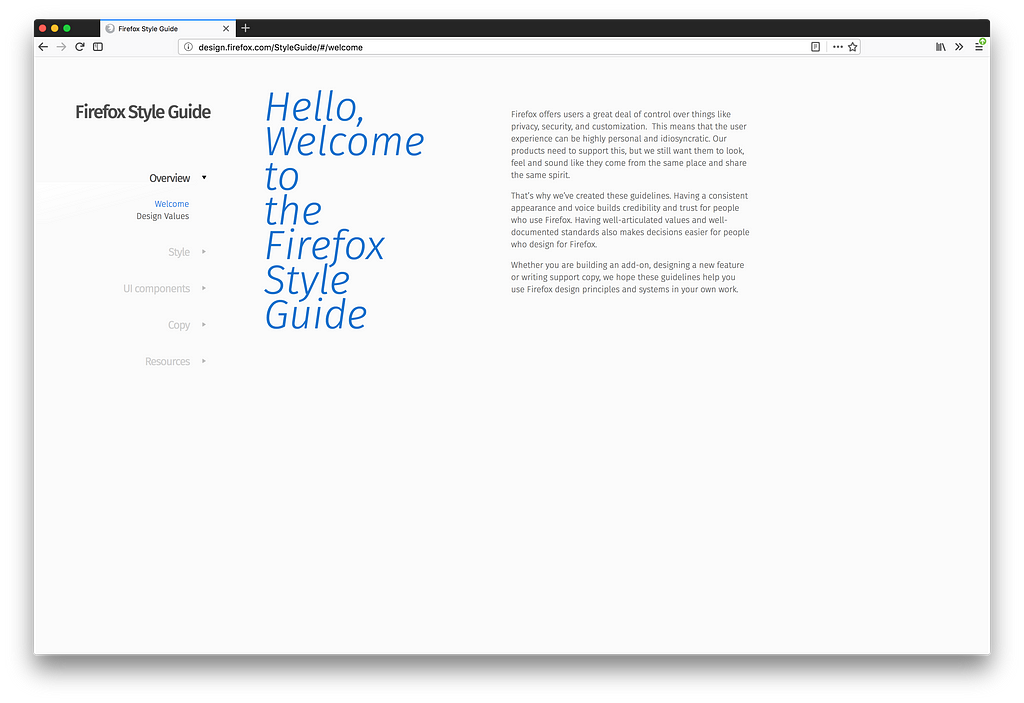
For many, today is just another day. Well, not for me, my team, and all the other people who spent the last six months on version 57 of the browser, the new Firefox Quantum. Today, we’re going into Beta release with the new UI which adheres to the new Photon visual language. If you feel your head spinning, you’re right. Let’s put one thing after another.

Style guide vs. design systems

My name is Emanuela Damiani, and in few days, it will be one year since I began working at Mozilla.

When I joined, I was asked to focus my attention on two products in particular: add-ons and the new design system.

Building a design system is not an easy job. First, what is a Design System? What is it not? What are the differences between a style guide and a pattern library? All those questions were buzzing in my mind like one hundred bees.

A design system is not a one-man job. When you I say ‘we’, I mean: Tina, Tori, Helen, Amin, Markus, Philip and myself.

Our team is not too big, or too small. It has six members, distributed from Vancouver to Taipei, passing through central Europe, and with just one person able to work 100% on the design system. Since the beginning, we have tried to use Slack as much as is possible to make it easy for anyone to give feedback and fill the gap of not being able to share time together.

When we all met together at the beginning of November last year, there was a zombie Firefox style guide in the wild.

We wanted to learn from that failure. We spent time interviewing anyone who worked on that project. What was the challenge? Why did the few things in the style guide feel so different from everything present in the product?

A design system success is not connected with the launch of style-guide or a UI-kit. The real success happens when your design system is adopted in your products.

One main point of failure of the previous style guide was in the process taken by the team. Without a complete inventory, the team was documenting and improving at the same time, ending up with some excellent and delightful insights for future development but nothing truly actionable for the present or representative of the product.

Plus, the style-guide had a strong focus only on the desktop, ignoring the complex ecosystem where Firefox products live.

Photon: from a visual refresh to a visual language

“We started from the existing style guide, we checked if the identified macro areas were still valid, and we analyzed (or looked at) other existing design systems that were around for a while.”
Amin

Meanwhile, somewhere else in the organization, a group of people decided it was time to give all the cool improvements on the backend (a.k.a. Quantum) a nice visual refresh. The code name for this project was Photon.

That was the perfect opportunity for us. We started from there. All of the visual changes are expected to be in the product, overruling previous decisions. We had to start somewhere, so we started there.

Our first job was to understand all of the design decisions and be ready to raise our hands if some choices contradicted each other or did not meet accessibility standards. We made them aware of the other projects, products, constraints, and needs of other teams so that the team in charge of the visual refresh would have a more broad understanding of the design and development requirements.

While we were documenting, we ended up actively co-designing what eventually became a real design language that supported multiple platforms and multiple products.

Design for Scale

“The higher the expected visibility on parts of your work, the more important it is to align to Photon. If very limited visibility is expected, full alignment is of lower priority. Use platform components until you have time to align better.”
Design for Scale, Photon Design System

We wanted to have documentation that combines theory and resources where theories are principles, visual guidelines, and patterns, and resources are everything from visual assets to tokens, from demos to templates, and from tools to code.

But how might we build a successful design language that also able to feel native in all the different platforms? Designing for scale is a challenging, delicate task. We wanted to support people going through this task and provide written content to help them understand this principle and apply it.

Feedback, feedback, feedback

“With every page, we added we learned, step by step — we learned how to structure pages, how to structure the whole system, and we learned how to align differences between individual design teams and how to get people to make decisions that can be structured and documented.”
Markus

While we’re building the design system, we never stop collecting feedback by everyone on the Firefox team. In the end, those people are our primary users.

We like to think of the design system as a tool, a tool which enables other people, designers and non-designers, to design. It saves time on digging into Sketch files, trying to find patterns from other designers, and fixing design issues like incoherency, accessibility across platforms, and localization.

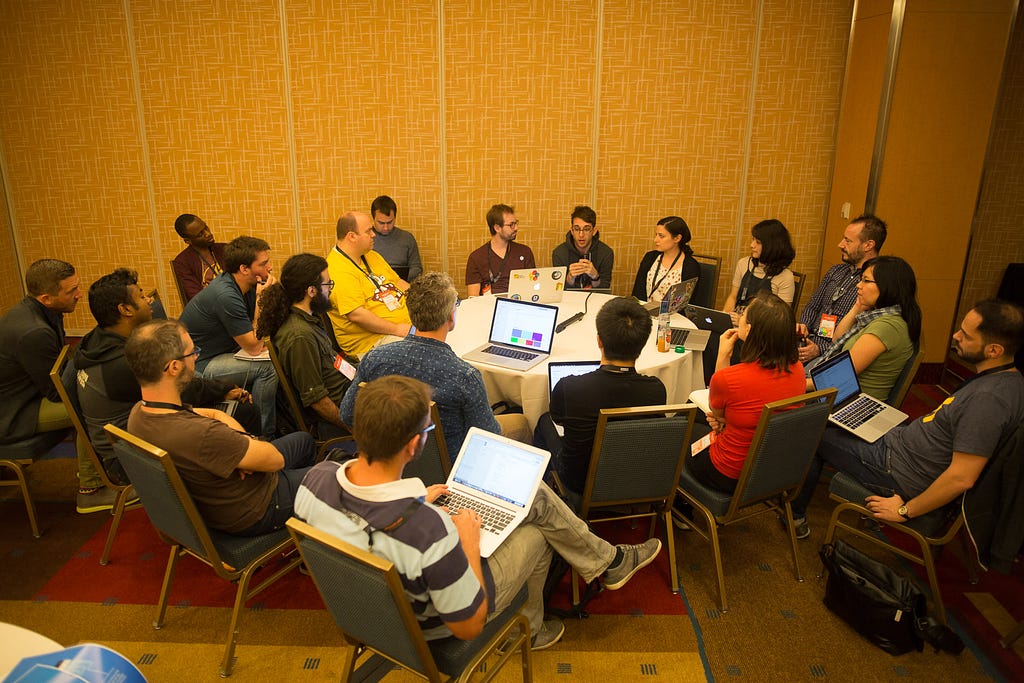
During Mozilla’s June 2017 All Hands in San Francisco, we spent hours just talking with different product teams, asking for feedback. How are they using the system? How is the system relevant for them?

When you ask “Can you bring somebody from your team?” and 15 people show up, you know you’re doing something right.

Photon Design System: today

First, we gave it a name: Photon — it just makes sense, right?

Three months ago, we had a lot of visual decisions documented on the website, and many of those decisions were already on the Nightly release, but the design of our site didn’t really seem to reflect any of it. So, we applied all the principles documented in the product. The Photon Design System website today reveals how we use it in the wild.

We are working on the components and patterns. Day to day, our job resembles a detective’s. We follow leads in all the products and identify the ones that can bring extra value to the Firefox team. Where we see complexity, we act to simplify.

We want everyone who builds for Firefox to use the design system in their everyday workflow. Using the design system should be not more than easy, it should feel natural. To accomplish that, we’re focusing not only on the content but also on building tools and resources.

Final thoughts

For many, today is just another day. For the Photon Design System team, it’s when we see the system’s value realized.

Photon Design System

A design system is not built overnight but shaped gradually through our daily practices. It evolves every day — or maybe every week — and most importantly, it’s never done.


Just another day was originally published in Firefox User Experience on Medium, where people are continuing the conversation by highlighting and responding to this story.

27 Sep 20:56

1Writer Update Includes Open in Place and Drag and Drop Support

by John Voorhees

Before I moved to Ulysses for most of my writing, I used 1Writer. At first, it was how I accessed my large collection of NVAlt notes when I wasn’t at my Mac because its search is exceptionally fast. Over time though, it became my primary text editor because it syncs with iCloud and Dropbox, works with Markdown files, has excellent export options, is highly customizable, and supports URL schemes and JavaScript actions. I don’t use 1Writer as often these days, but it remains one of my favorite text editors, so I was glad to see it has been updated to take advantage of new iOS 11 features.

The latest version of 1Writer supports Open in Place via iOS 11’s new document browser. Tap the omnipresent plus button in the lower right-hand corner of 1Writer and choose ‘Open Other…’ to launch iOS 11’s document browser. 1Writer has tinted the navigation elements of the document browser, which helps remind users that they are still in 1Writer, which is a nice touch that not all apps bother to support. With Open in Place, 1Writer can edit the Markdown or plain-text files of any file provider. For example, that allows me to grab a draft from one of our MacStories GitHub repos via the Working Copy file provider to make edits to the original document without creating a local 1Writer copy of the file.

1Writer supports Open in Place.

1Writer supports Open in Place.

1Writer also supports two-way drag and drop. I can drag any document from 1Writer’s document browser and drop it into another compatible app that accepts text like iA Writer, Byword, or Notes. I was also able to attach a 1Writer file to a message using Apple Mail.

Dragging into 1Writer works too. 1Writer can handle text and URLs, so it disregards images included in something like a note from the Notes app, but will set up Markdown syntax for an image if you drag in just a photo. If you drag into an existing 1Writer document, the text and links are appended to the end of the document.

1Writer has also added support for smart punctuation, which, for example, replaces straight quotes with the curly variety, and is iPhone X-ready.

1Writer is one of the most versatile text editors available. The addition of Open in Place means the app can be used with a wider variety of apps than ever before and drag and drop eliminates the number of steps needed to get text into and out of 1Writer. If you’re looking for a text editor that is at the forefront of iOS 11 technologies, 1Writer is an excellent choice.

1Writer is available on the App Store.


Support MacStories Directly

Club MacStories offers exclusive access to extra MacStories content, delivered every week; it's also a way to support us directly.

Club MacStories will help you discover the best apps for your devices and get the most out of your iPhone, iPad, and Mac. Plus, it's made in Italy.

Join Now