Shared posts

27 Sep 20:55

Essential’s U.S. carrier partner has only sold 5,000 phones, says analyst

by Rose Behar
Essential Phone in hand,,

The Essential Phone has sold only around 5,000 units through exclusive carrier partner Sprint in the U.S., according to market analysis from BayStreet Research.

The firm expects to publish a full report on its findings, including estimates about unlocked purchases, on October 5th, but for now it has released estimates about Sprint sales via an article with Fierce Wireless.

In a phone interview with MobileSyrup, Cliff Maldonado, founding partner and senior analyst at BayStreet Research, said 5,000 units sold might even be generous according to his firm’s estimations.

“I wouldn’t be surprised if it was even lower,” said Maldonado.

According to the analyst, the company uses a “mosaic” approach when gathering information for its estimates that includes calling official and dealer Sprint locations and using a “mystery shopper” approach. Maldonado says his six-person team communicates with other links in the production and sales chain, as well.

When it comes to securing information about purchases of the device outside of Sprint, Maldonado says information is sourced from data partners that include app developers — though, as previously mentioned, the firm is still compiling that data.

5,000 units through carrier sales, if accurate, is of course far below the averages of major players like Apple and Samsung, which sell tens of millions of units per quarter, in large part through carriers.

What’s more, the number sold by Telus, Essential’s exclusive partner in Canada, is likely much smaller, considering the size discrepancy between Canadian and U.S. mobile markets.

Maldonado says his firm’s estimates shouldn’t be shocking.

“It’s important to understand,” said the analyst, “This phone is coming into a really difficult market.”

Still, if the sales estimates are true, Essential may have a difficult time finding partners for its follow-up effort, and it’s time as a ‘unicorn’ valued at over a billion dollars may get cut short.

MobileSyrup has reached out to Essential for comment.

The post Essential’s U.S. carrier partner has only sold 5,000 phones, says analyst appeared first on MobileSyrup.

27 Sep 20:54

AndroidBeat Daily Brief (Sep 27, 2017): Essential Has Sold 5,000 Phones So Far, Pixel XL 2 To Feature Front-Facing Speakers

by Rajesh Pandey
In this edition of AndroidBeat’s Daily Briefing, we talk about Essential selling only 5,000 units of the PH-1, Pixel XL 2 leaks, and more. Continue reading →
27 Sep 20:54

The VCFB Vintage Computing Festival Berlin – 7.-8. October 2017

by Martin

VCFB

An event I’ve been looking forward to for a long time is this year’s Vintage Computing Festival Berlin (VCFB) which takes place in about one and a half weeks from now, Saturday and Sunday on the 7th and 8th October 2017 in the German Museum of Technology in Berlin. If you are even only remotely interested in the history of computing and you are anywhere near Berlin over that weekend, it is the event to attend! Unlike in previous years when the dates did not fit into my travel calendar it is a perfect match this year. And best of all for me, I did not only decide to go but I will also bring a small exhibit of my own!

The Exhibition

Over the past few months the list of exhibitors has grown impressively and there are now well over 50 exhibitors with topics ranging from the early mechanical days over self-built computers from hundreds of TTL chips, to single board learning computers of the 1970, large old and impressive dinosaurs like PDP-8s and -11s, home computing of the 1980s to re-live on Tandy, Apple, Atari, Sinclair and Commodore, East German Robotron and kit computers of the day, long forgotten PC operating systems like BeOS, Geoworks Esemble, OS/2, OpenStep, etc. etc.

My Exhibits

I’ve decided to bring an exhibit on 4-bit computing in the 1970s, 1980s and today: At the beginning of the 1980s there were a number of computer learning kits available to teach interested teenagers and grown-ups how a microcomputer works on the assembly code and hardware level. One of them was the Busch 2090 introduced in 1981 (about which I have written a lot on this blog already over the years). It is based on the 4-bit Texas Instruments TMS-1600 microcontroller. I’ll show the 2090 together with my Rasbperry-Pi based cassette tape emulator, a cross assembler and a 2090 emulator running in a virtual machine.

4-bit computers are also ideal to better understand the interworking between the different parts of a CPU such as the arithmetic-logic Unit (ALU), the control unit, registers and external components such as memory, IO-interfaces, etc. Thus, my second exhibit will be the 4-bit ‘Nibbler’ board I’ve had a lot of fun with over the past few years. The Nibbler is based on a 74181-ALU chip that was also used in bit-slicing mode in many legendary computers of the 1970s such as the Data General Nova, the Xerox Alto and the PDP-11.

Lectures, Participate Live or Later From Anywhere!

In addition to the exhibition there’s a lecture and workshop stream with lots of people giving talks. This year I am especially looking forward to, among many other lectures, Wolfgang Stief’s 3rd episode about the history of Control Data and Seymour Cray and the talk of Rolf-Dieter Klein about the history of his NDR-Kleincomputer. Most of the talks will be in German and for those who can’t attend (or are at their exhibition booths like me) they will be streamed in real time and archived. And for those interested in hands-on sessions: Ever wanted to know how to fix your broken PDP-11? No problem, there’s also a session on that!

Overall a great 2-day program I am very much looking forward to!

27 Sep 20:54

Google is allegedly working on a Home ‘Max’ smart speaker

by Sameer Chhabra
Google Home

Several future Google products have been leaked ahead of the company’s October 4th, 2017 press conference, but it seems that the American search giant still has some cards up its sleeve.

According to 9to5Google, Google is reportedly working on a larger variant of its Google Home smart speaker. Dubbed the Google Home ‘Max,’ two sources who spoke with 9to5Google said that the device will feature stereo speakers.

Unlike the Google Home Mini — which leaked on September 19th, 2017 — little is known about the device’s overall design. 9to5Google’s sources said that the Google Home Max is expected to take on larger, more premium products like the Sonos Play:3.

Potential pricing information hasn’t leaked, and it’s also not known if Google will unveil the device alongside its other October 4th products.

If the Home Max turns out to be a real device — and if Google does announce the Home Mini — that would mean that consumers would have the option of three specific tiers of smart speakers, all powered by the Google Assistant.

This rumour also comes at an interesting time, especially since Amazon has just formally announced its own collection of smartspeaker devices. Additionally, it’s difficult to ignore the looming arrival of Apple’s HomePod smartspeaker, expected to ship “later this year, according to the Cupertino computing giant.

Source: 9to5Google

The post Google is allegedly working on a Home ‘Max’ smart speaker appeared first on MobileSyrup.

27 Sep 18:03

iOS and macOS Text Replacement Gaining CloudKit Syncing Soon

by Ryan Christoffel

There’s been quite a stir over the last week regarding an area of the Apple cloud ecosystem where syncing has remained unreliable for years. Brian Stucki wrote a detailed post on the matter, which John Gruber linked to with echoing sentiments. Today, however, Gruber followed up on his post with an exciting update:

Good news related to yesterday’s item regarding the fact that text replacement shortcuts have never synced reliably between Macs or iOS devices: an Apple spokesperson emailed me to say they checked with the team, and an update that moves text replacement syncing to CloudKit should be rolling out to iOS 11 and MacOS 10.13 High Sierra users in the “next month or so”.

I use text replacement every day across my iOS devices, and haven’t dealt with syncing issues myself, but it’s great to hear that this long-standing problem should soon be put to rest for everyone else. Recent history shows that once a cloud product moves to CloudKit, syncing issues disappear almost entirely – hopefully that will be the case here as well.

→ Source: daringfireball.net

27 Sep 18:03

Apple Introduces Revamped Privacy Site Featuring Face ID Details and More

by Ryan Christoffel

Apple today launched a newly revised privacy page on its website that aims to help customers understand the company’s views on the subject. Besides the landing page, there are four main sections: Our Approach to Privacy, Manage Your Privacy, Transparency Report, and Our Privacy Policy. I found Our Approach to Privacy the most interesting, as it walks through, in plain and easy-to-understand language, how privacy is deeply built into an extensive number of Apple apps and features, from Apple Pay and iMessage, to Analytics, Safari, Siri, Health, and more.

The most timely update to the site is the inclusion of a Face ID security white paper. This 6-page PDF goes into impressive detail on how Face ID works, with an emphasis on privacy and several interesting details to be gleaned. One of the feature tidbits is a comprehensive listing of when your passcode will be needed in place of Face ID. Passcode input will be required under the following circumstances:

• The device has just been turned on or restarted.
• The device hasn’t been unlocked for more than 48 hours.
• The passcode hasn’t been used to unlock the device in the last 156 hours (six and a half days) and Face ID has not unlocked the device in the last 4 hours.
• The device has received a remote lock command.
• After five unsuccessful attempts to match a face.
• After initiating power off/Emergency SOS by pressing and holding either volume button and the side button simultaneously for 2 seconds.

Other sections of the document confirm that any third-party app currently supporting Touch ID will automatically support Face ID without any user or developer changes. Also, Face ID can be used for all the same things as Touch ID, such as purchases from the App Store, iTunes Store, and more.

→ Source: apple.com

27 Sep 18:03

7–3 is the new 9–5

by April Kilcrease

Many top executives have long touted the benefits of an early morning start. Apple CEO Tim Cook famously wakes up at 3:45 am. PepsiCo Chairman and CEO Indra Nooyi is up by 4:00 and in the office by 7:00. General Motors Chairman and CEO Mary Barra is at her desk at 6:00. And, perhaps with the help of a grande latte, former Starbucks CEO Howard Schultz arrived to work by 6:00, too.

Although 6:00 may be a tad too early for most people, if your employer allows for flexible schedules, you can reap similar benefits by shifting yours to 7–3. By coming into the office before everyone else, you can fit in two uninterrupted hours of work, allowing you to set the agenda for the day, rather than letting distractions grab the reins. Plus, you beat the rush hour in both directions and get home with plenty of time to enjoy the rest of your life. Need a little more convincing to get out the door before dawn? Below are five of the key advantages of getting an earlier start to your day.

Skip rush hour traffic

Commuters spent around 6.9 billion hours stuck in rush hour traffic in 2014, according to the Urban Mobility Scorecard. In other words, each commuter lost a full week of work to sitting in traffic. All that time spent navigating clogged freeways, crowded buses, and sidewalks crammed with people jostling to get to work is doing some not-so-good things to our health. As reported in The Washington Post, “Longer commutes are linked with increased rates of obesity, high cholesterol, high blood pressure, back and neck pain, divorce, depression and death.”

By beating the morning—and evening—traffic congestion, you can avoid these hits to your well-being and reclaim your time. A recent study on commutes by Britain’s Healthiest Workplace found that employees who had the flexibility to avoid rush hour were less stressed and made healthier lifestyle choices. They also gained five more productive days each year compared to their colleagues who battled the roads in rush hour.

Start your workday with quiet focus

According to behavioral scientist Dan Ariely, the two hours after we wake up are potentially our most productive, and should be used on work that require high cognitive capacity, rather than social media or other mindless tasks. Getting into the office at 7:00 can help you take advantage of that early window and avoid distractions.

Since you’re working outside usual office hours, colleagues are less likely to be emailing, texting, or calling yet. You’ll have two hours of uninterrupted time to focus on your most important agenda items and map out your to-do list for the rest of the day. You’ll also have the chance to prepare for any morning meetings, allowing you to feel confident and prepared, rather than groggy or harried. Kicking things off with a period of concentrated productivity can help set the tone for your entire day. Rather than reacting to others’ requests and rushing to catch up, you’ll feel more proactive, confident, and less stressed.

Boost your creativity

CEOs aren’t the only early risers. While researching his book, Daily Rituals: How Artists Work, author Mason Currey found that “a large number of novelists and poets… wake up early in the morning and try to get some words on the page before other obligations kick in.” Among those creative early risers are Frank Lloyd Wright, who sketched out his building designs between 4:00 and 7:00, pre-dawn riser Toni Morrison, and Haruki Murakami, who kicks off five to six hour writing sessions at 4:00 in the morning.

Although we’re not suggesting you arrive to work at 4:00 am, starting your workday a couple hours earlier can still lead to more creative mornings. You’re likely calmer and more open, and your mind is rested and refreshed. Just as you can only run so many miles before your legs get tuckered out, your mind has a limited supply of mental energy.

Impress your boss

Without making any other changes to your performance, you may be able to give your career a jump-start just by starting your day earlier. According to researchers at the University of Washington, managers tend to have an implicit bias toward early birds. Even after statistically controlling for total work hours, the researchers found that supervisors rated employees who began work earlier as more conscientious, and rewarded them with higher performance ratings.

The team also conducted a laboratory study where they asked participants to play the role of the supervisor and had them rate a fictional employee who worked 7–3 and one who worked from 11–7. Even though everything else about the fictional employees’ performance profiles were identical, participants gave the early birds higher conscientiousness and performance scores.

Enjoy a better work-life balance

And just as you skipped the tangle of traffic on the way in to the office, you’ll be able to beat the crowds on your way home as well. Along with a mellower commute, leaving at 3:00 opens up your afternoons and evenings to other pursuits. You can take that yoga class you’ve been meaning to try, go for a run while it’s still light out, or sneak in a matinee before dinner. If you have kids, you can easily pick them up from school, attend parent-teacher conferences without interrupting your workday, and enjoy more family time at home.

Given the substantial benefits of this small schedule change, it might be worth setting your alarm clock a couple hours earlier tonight. The adjustment might seem challenging when that buzzer first goes off in the morning. But after zipping along an open freeway or taking your pick of seats on the train, you’ll arrive to a peaceful office feeling calmer and better able to take on the day.

Dropbox Paper: A flexible workspace that brings people and ideas together | Try it free

27 Sep 18:02

Signs of Vancouver (Well, Actually Coquitlam)

by Ken Ohrn

Dropped in to Caffe Divano for coffee between a Millennium Line Evergreen Extension ride (smooth, fast & easy) and a meeting in Coquitlam.  And here’s a musical bad pun coffee-oriented sign.

Fleetwood.Macciato


27 Sep 18:01

Repatriation Of Overseas Cash Won’t Lead To Jobs, Folks

The lying has begun about the bounty that will flow to the American people if we sign into law a repatriation of overseas cash. Or more realistically, the lying has never stopped, despite the evidence from the last dance around the maypole, back in 2004:

Eduardo Porter | Will a Corporate Tax Holiday Give Workers Anything to Cheer?

It was the summer of 2004, and to the glee of multinational corporations across the United States, a bipartisan majority in Congress offered them a gift they had long sought: an opportunity to repatriate billions of dollars stashed overseas and pay just 5.25 percent in taxes, instead of the statutory corporate rate of 35 percent.

They had lobbied hard for this — dangling before members of Congress the promise that the repatriated money would add more than 500,000 jobs in the United States over the next two years, as companies paid down debt and engaged in more capital spending, acquisitions, and research and development.

The jobs, however, didn’t come. In an analysis a few years later, Kristin J. Forbes, an economist at the Massachusetts Institute of Technology who had been on President George W. Bush’s Council of Economic Advisers when the tax holiday came into effect, and two colleagues from Harvard and the University of Illinois at Urbana-Champaign found that though $299 billion in corporate earnings flowed back into the country during the holiday year of 2005 — almost five times the average of the preceding five years — companies found a better way to use the money. “Repatriations did not lead to an increase in domestic investment, domestic employment or R.&D.,” the authors wrote.

[…]

Back then, companies found their way around regulations forbidding this use of the money to simply benefit shareholders and corporate chiefs. A Senate commission reported that the top 15 repatriating corporations reduced their overall United States work force by 20,931 jobs, even as share buybacks increased and the annual compensation for their top five executives jumped 27 percent from 2004 to 2005 and another 30 percent the next year.

Pfizer, for instance, brought back $35.5 billion, the largest amount repatriated by a single company during the tax holiday, according to the Senate report. Then it turned around and spent over $20 billion in stock repurchases from 2005 to 2007. By 2007, the aggregate compensation of its top five executives was nearly $13 million higher than in 2004. Its United States payroll was 12,000 smaller.

The pattern was similar across most repatriating companies. Hewlett-Packard, which brought home $14.5 billion, bought back $22 billion worth of stock over the three years and cut its payroll by more than 8,500. The tobacco company Altria, which brought over $6 billion home during the holiday, spent $2.5 billion on share buybacks and bumped pay in the executive ranks by more than $50 million, but cut 6,000 jobs.

So, if Congress goes along with this nonsense, we can expect job cuts and huge stock buybacks, netting great rewards for shareholders and executives, and everyone else will be left holding the bag, or standing in the unemployment line.

Let’s see who in Congress stands up against this newest swindle, if anyone.

What we should do is invalidate the laws that allow this sequestering of profits offshore, and demand the cash. 

Porter also examines this maypole dance in light of the growing inequality in wages as these gigantic corporations have stockpiled trillions in profits:

Because the working class stands on the other end of a deal with the corporate class. I don’t think it is possible to fully address workers’ demands without understanding, and changing, corporate motivations.

Many forces have shaped this deal, including technology, which replaced workers performing routine tasks, and globalization, which squeezed the margins of many businesses and exposed their workers to competition from cheap labor markets. And yet it would be a mistake to ignore the impact of a corporate ethos that has come to focus on rewarding shareholders and executives at the expense of any other consideration — be it workers’ welfare or even the company’s long-term sustainability. Indeed, workers today amount to little more than a line on the cost side of businesses’ balance sheets, with little claim to its prosperity.

Yes, workers are generally only seen as a cost, and not as partners in the companies’ success.

We should be looking for ways to level the economy, so that working people don’t live in poverty, that those who put in the time and the years have a career, a home, and a decent pension, that their kids can get a real education, and that all have the opportunity to advance in the economic footrace, and to not face an unending series of obstacles and threats. 

Can’t we create a tax system that incents businesses to help that happen, instead of creating a pyramid scheme where one percent walk away with 99 percent of everything?

27 Sep 18:01

The possibilities of the Sense HAT

by Janina Ander

Did you realise the Sense HAT has been available for over two years now? Used by astronauts on the International Space Station, the exact same hardware is available to you on Earth. With a new Astro Pi challenge just launched, it’s time for a retrospective/roundup/inspiration post about this marvellous bit of kit.

Sense HAT attached to Pi and power cord

The Sense HAT on a Pi in full glory

The Sense HAT explained

We developed our scientific add-on board to be part of the Astro Pi computers we sent to the International Space Station with ESA astronaut Tim Peake. For a play-by-play of Astro Pi’s history, head to the blog archive.

Astro Pi logo with starry background

Just to remind you, this is all the cool stuff our engineers have managed to fit onto the HAT:

  • A gyroscope (sensing pitch, roll, and yaw)
  • An accelerometer
  • A magnetometer
  • Sensors for temperature, humidity, and barometric pressure
  • A joystick
  • An 8×8 LED matrix

You can find a roundup of the technical specs here on the blog.

How to Sense HAT

It’s easy to begin exploring this device: take a look at our free Getting started with the Sense HAT resource, or use one of our Code Club Sense HAT projects. You don’t even need to own one in order to dive in. Emulators are available offline on Raspbian and online on Trinket.

Sense HAT emulator on Trinket

The Sense HAT emulator on trinket.io

Fun and games with the Sense HAT

Use the LED matrix and joystick to recreate games such as Pong or Flappy Bird. Of course, you could also add sensor input to your game: code an egg drop game or a Magic 8 Ball that reacts to how the device moves.

Sense HAT Random Sparkles

Create random sparkles on the Sense HAT

Once December rolls around, you could brighten up your home with a voice-controlled Christmas tree or an advent calendar on your Sense HAT.

If you like the great outdoors, you could also use your Sense HAT to recreate this Hiking Companion by Marcus Johnson. Take it with you on your next hike!

Art with the Sense HAT

The LED matrix is perfect for getting creative. To draw something basic without having to squint at a Python list, use this app by our very own Richard Hayler. Feeling more ambitious? The MagPi will teach you how to create magnificent pixel art. Ben Nuttall has created this neat little Python script for displaying a photo taken by the Raspberry Pi Camera Module on the Sense HAT.

Brett Haines Mathematica on the Sense HAT

It’s also possible to incorporate Sense HAT data into your digital art! The Python Turtle module and the Processing language are both useful tools for creating beautiful animations based on real-world information.

A Sense HAT project that also uses this principle is Giorgio Sancristoforo’s Tableau, a ‘generative music album’. This device creates music according to the sensor data:

Tableau Generative Album

“There is no doubt that, as music is removed by the phonographrecord from the realm of live production and from the imperative of artistic activity and becomes petrified, it absorbs into itself, in this process of petrification, the very life that would otherwise vanish.”

Science with the Sense HAT

This free Essentials book from The MagPi team covers all the Sense HAT science basics. You can, for example, learn how to measure gravity.

Cropped cover of Experiment with the Sense HAT book

Our online resource shows you how to record the information your HAT picks up. Next you can analyse and graph your data using Mathematica, which is included for free on Raspbian. This resource walks you through how this software works.

If you’re seeking inspiration for experiments you can do on our Astro Pis Izzy and Ed on the ISS, check out the winning entries of previous rounds of the Astro Pi challenge.

Thomas Pesquet with Ed and Izzy

Thomas Pesquet with Ed and Izzy

But you can also stick to terrestrial scientific investigations. For example, why not build a weather station and share its data on your own web server or via Weather Underground?

Your code in space!

If you’re a student or an educator in one of the 22 ESA member states, you can get a team together to enter our 2017-18 Astro Pi challenge. There are two missions to choose from, including Mission Zero: follow a few guidelines, and your code is guaranteed to run in space!

The post The possibilities of the Sense HAT appeared first on Raspberry Pi.

27 Sep 18:00

State of Drupal presentation (September 2017)

by Dries
Group photo

Yesterday, I shared my State of Drupal presentation at DrupalCon Vienna. In addition to sharing my slides, I wanted to provide some more detail on how Drupal is evolving, who Drupal is for, and what I believe we should focus on.

Drupal is growing and changing

I started my keynote by explaining that Drupal is growing. Over the past year, we've witnessed a rise in community engagement, which has strengthened Drupal 8 adoption.

This is supported by the 2017 Drupal Business Survey; after surveying 239 executives from Drupal agencies, we can see that Drupal 8 has become the defacto release for them and that most of the Drupal businesses report to be growing.

Drupal agencies report that most Drupal projects are using Drupal 8 now
Most Drupal agencies have growing businesses

While the transition from Drupal 7 to Drupal 8 is not complete, Drupal 8's innovation continues to accelerate. We've seen the contributed modules ecosystem mature; in the past year, the number of stable modules has more than doubled. Additionally, there are over 4,000 modules in development.

We saw a 2x increase in stable contributed modules

In addition to growth, both the vendor and technology landscapes around Drupal are changing. In my keynote, I noted three primary shifts in the vendor landscape. Single blogs, portfolio sites and brochure sites, which represent the low end of the market, are best served by SaaS tools. On the other side of the spectrum, a majority of enterprise vendors are moving beyond content management into larger marketing suites. Finally, the headless CMS market segment is growing rapidly, with some vendors growing at a rate of 500% year over year.

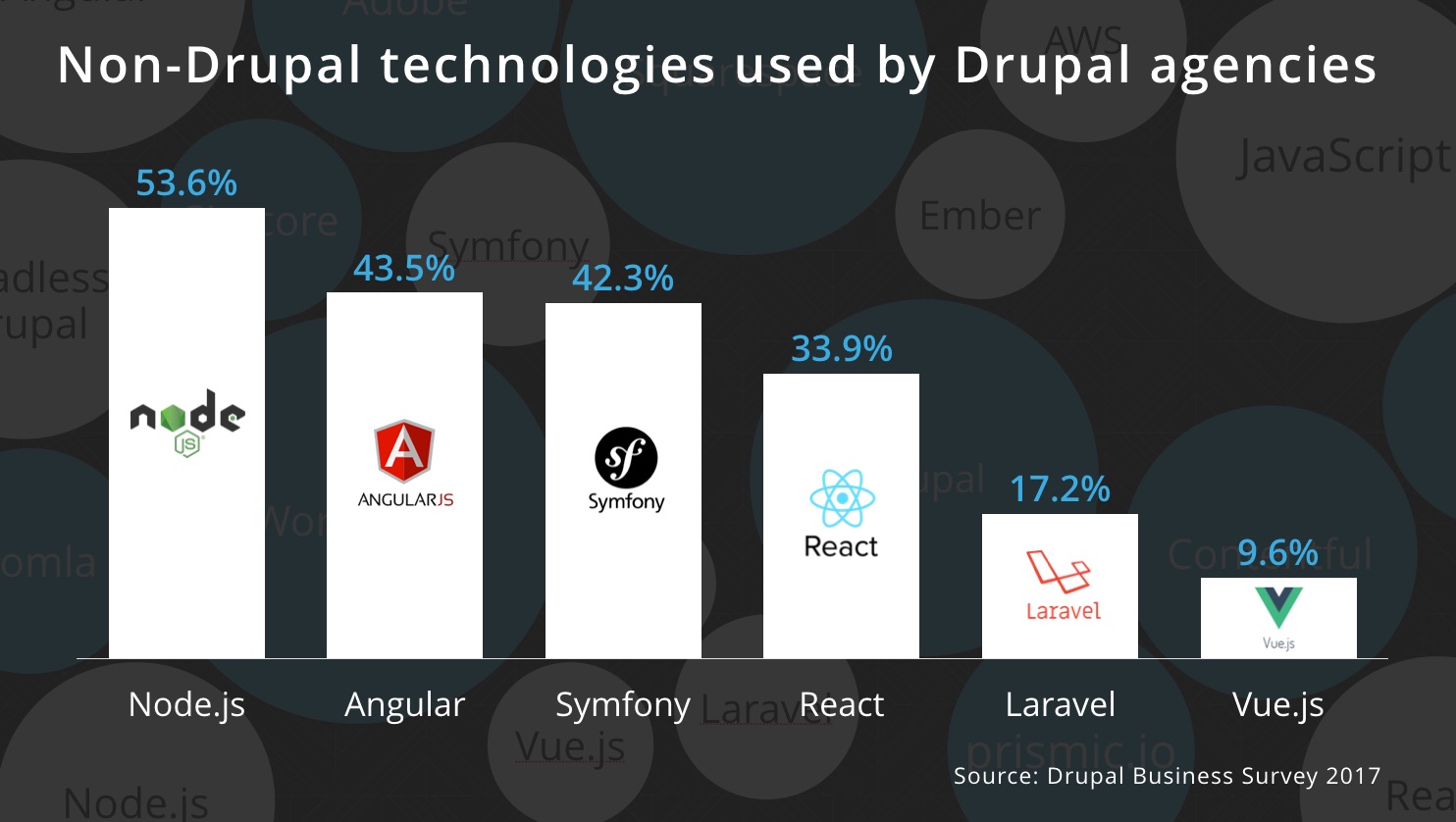
There are also significant changes in the technology landscape surrounding Drupal, as a rising number of Drupal agencies have also started using modern JavaScript technologies. For example, more than 50% of Drupal agencies are also using Node.js to support the needs of their customers.

What other technologies do Drupal agencies use?

While evolving vendor and technology landscapes present many opportunities for Drupal, it can also introduce uncertainty. After listening to many people in the Drupal community, it's clear that all these market and technology trends, combined with the long development and adoption cycle of Drupal 8, has left some wondering what this all means for Drupal, and by extension also for them.

Drupal is no longer for simple sites

Over the past year, I've explained why I believe Drupal is for ambitious digital experiences, in both my DrupalCon Baltimore keynote and on my blog. However, I think it would be valuable to provide more detail on what I mean by "ambitious digital experiences". It's important that we all understand who Drupal is for, because it drives our strategy, which in turn allows us to focus our efforts.

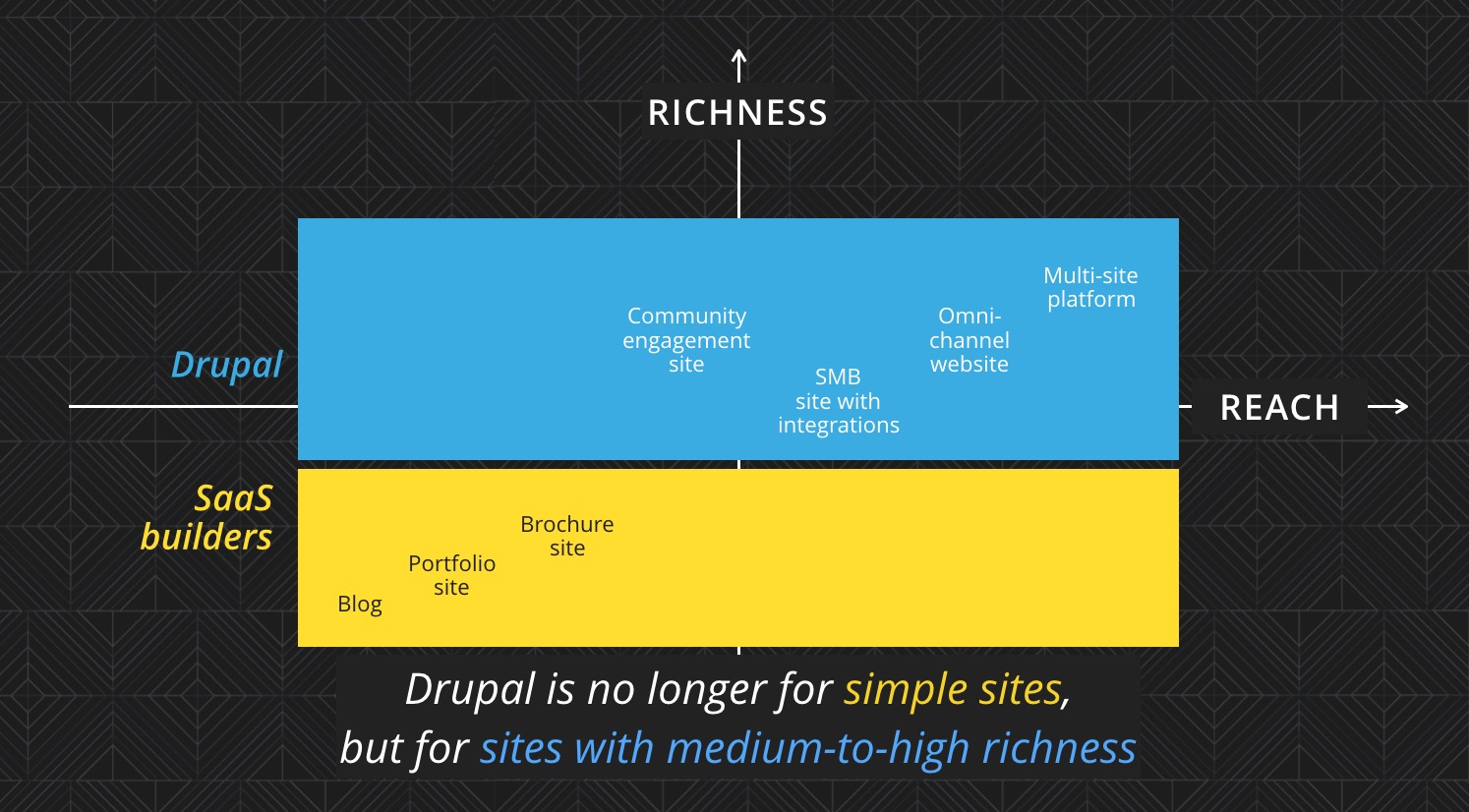
Today, I believe that Drupal is no longer for simple sites. Instead, Drupal's sweetspot is sites or digital experiences that require a certain level of customization or flexibility — something I refer to as "richness".

Drupal is no longer for simple sites, but for sites with medium-to-high richness

Ambitious is much more than just enterprise

This distinction is important because I often find that the term "ambitious" becomes conflated with "enterprise". While I agree that Drupal is a great fit for the enterprise, I personally never loved that categorization. It's not just large organizations that use Drupal. Individuals, small startups, universities, museums and nonprofits can be equally ambitious in what they'd like to accomplish and Drupal can be an incredible solution for them.

An example of this could be a small business that manages 50 rental properties. While they don't have a lot of traffic (reach), they require integrations with an e-commerce system, a booking system, and a customer support tool to support their business. Their allotted budget is $50,000 or less. This company would not be considered an enterprise business; however, Drupal would be a great fit for this use case. In many ways, the "non-enterprise ambitious digital experiences" represent the majority of the Drupal ecosystem. As I made clear in my presentation, we don't want to leave those behind.

Drupal is for digital ambitious experiences

Addressing the needs of smaller organizations

The Drupal ecosystem majority are organizations with sites that require medium-to-high richness, which SaaS builders cannot support. However, they also don't need to scale at the level of enterprise companies. As the Drupal community continues to consider how we can best support this majority, a lot of smaller Drupal agencies and end-users have pointed out that they would benefit from the following two things:

  1. Powerful site building tools. They want easy-to-use site building tools that are simple to learn, and don't require dozens of contributed modules to be installed and configured. They would also prefer to avoid writing a lot of custom code because their clients have smaller budgets. Great examples of tools that would improve site building are Drupal's upcoming layout builder, workspaces and media library. To make some of Drupal's own administrative UIs more powerful and easier to use, I proposed that we add a modern JavaScript to core.
  2. Easier updates and maintenance. While each Drupal 8 site benefits from continuous innovation, it also needs to be updated more often. The new Drupal 8 release cycle has monthly patch releases and 6-month minor releases. In addition, organizations have to juggle ad-hoc updates from contributed modules. In addition, site updates has often become more complex because our dependency on third-party libraries and because not everyone can use Composer. Many smaller users and agencies would benefit tremendously from auto-updates because maintaining and updating their Drupal 8 sites can be too manual, too complex and too expensive.

The good news is that we have made progress in both improving site builder tools and simplifying updates and maintenance. Keep an eye on future blog posts about these topics. In the meantime, you can watch a recording of my keynote (starting at 22:10), or you can download a copy of my slides (56 MB).

27 Sep 17:59

LEGO world map

by Nathan Yau

Check out this five-foot long LEGO world map.

[W]e wanted to have a big picture for our living room but couldn’t agree on a motive. At the end of 2015 my wife gave me some blue LEGO baseplates and said, I could build a big world map out of LEGO for the living room. So the idea was born and the starting point for countless evenings of planning was there.

Color represents depth and elevation for oceans and land, respectively. Just 6,090 pieces and 22 hours of building time.

Tags: LEGO

27 Sep 17:59

Porsche Design rolls out its first-ever laptop in China

by Timmy Shen

The world-renowned automobile manufacturer Porsche announced on Tuesday its plan to roll out the firm’s first-ever laptop, BOOK ONE, in China, after bringing it to 17 other countries.

Having partnered with Huawei to roll out a smartphone last year, Porsche Design—the design subsidiary of the automobile maker—this year teamed up with Microsoft, Intel, and Quanta Computer to launch a convertible laptop. The BOOK ONE is designed to be an alternative to Microsoft’s Surface Book.

Porsche Design BOOK ONE

Porsche Design BOOK ONE (Image credit: TechNode)

The BOOK ONE comes with a touchscreen and can serve as a tablet, a 2-in-1, and a detachable laptop. The silhouette of the laptop uses a milled aluminum surface and features subtle Porsche Design branding on the edge of the screen. TechNode’s partner TechCrunch published a review on the product and suggested that the convertible laptop needs some fixing in the speaker and its physical stability where the top end of the screen might tilt the laptop backward every now and then.

“In general, we are targeting people who value design and the efforts put into the design,” Tobias Hüttl, Head of Studio F. A. Porsche Asia, told TechNode at the launch event in Beijing. “I think the product itself is very versatile. It caters to all kinds of different professionals.”

“The Porsche Design BOOK ONE embodies the DNA of our brand down to the tiniest detail and, as our first 2-in-1 unit, has expanded our product portfolio by adding a new category: Porsche Design Computing. In Microsoft and Intel, we have two renowned partners who were a great help in implementing this strategically important project,” said Jan Becker, CEO Porsche Design Group, in the firm’s press release.

Porsche Design BOOK ONE (Image credit: TechNode)

Porsche Design BOOK ONE (Image credit: TechNode)

Porsche Design BOOK ONE is priced at RMB 18,888 (roughly $2,848) in China, whereas in the US it retails for $2,495. It’s worth noting that the company has partnered with JD.com for exclusive sales in China. The pre-order in China has started and the laptop will be available in mid-October.

27 Sep 17:59

Alibaba ups the ante in logistics, gaining a controlling stake in Cainiao

by Rita Liao

China’s biggest e-commerce site Alibaba just announced an additional $807 million investment in Cainiao Network, lifting its holding in the logistics affiliate from 47% to a controlling stake of 51%. The giant will, in turn, be able to beef up its capacity in shuttling parcels in China and overseas.

The news comes ahead of China’s “Singles’ Day,” an online shopping spree between November 11 and 16. China’s State Post Bureau forecasts demand for parcel delivery to hit a new record of one billion units (in Chinese).

Unlike its arch-rival JD.com, which prides itself on in-house logistics, Alibaba assumes a platform approach that relies on third-party courier services. This keeps Alibaba asset-light and highly profitable but leaves a hole in controlling the logistics flow. In 2013, Alibaba co-founded Cainiao alongside eight partners, including five top Chinese logistics companies, to make up for its weakness in the field.

Rather than running the actual courier services, Cainiao is a logistics “network” billed with the mission to bring together organizations in Chinese logistics. In practice, courier companies have to rely on Cainiao’s platform to receive business, the same way sellers have to go through Alibaba’s e-commerce platform Taobao to reach buyers.

JD’s founder Richard Liu once described Cainiao’s model during a CCTV show:

“Fundamentally, Cainiao is building a data system on top of several courier services. To put it mildly, it’s improving the efficiency of these courier services. To put it bluntly, Cainiao is going to suck up the profits of these courier services… And they are unable to separate from Cainiao already.”

Upping the ante in Cainiao, however, will mean consolidating around $2 billion losses onto Alibaba’s own balance sheet, the Financial Times is reporting. A major allure of Alibaba for investors is its lucrative model. Alibaba’s Adjusted EBITA margin for core commerce in the fiscal year of 2017 was 62%. In comparison, JD’s direct sales unit for 2016 had less than 1% non-GAAP operating margin.

The hefty Cainiao investment underscores a major shift for Alibaba. Founder Jack Ma recently told Bloomberg that Alibaba will need to move away from its asset-light approach if it wants to grab a bigger share of global trade.

27 Sep 17:59

Small Updates: Lighting our Space

by Alison Mazurek
 With the sun reflecting off our dishwasher here I really wish I could switch all our appliances to white! But this is about the new white track light above.

With the sun reflecting off our dishwasher here I really wish I could switch all our appliances to white! But this is about the new white track light above.

In some ways we can be a very fast moving family. As in we agree to plan a trip and a week later it's done and we are going on a big adventure. But in other ways we are sooo slow.  Sometimes we joke that the reason we live small is because we are too indecisive to move! 

This brings me to our lighting, where this past week our track lighting in our kitchen died. I have hated this spindly chrome light since the day we moved in 8 years ago. I even repaired it once against my better judgement. See this is the downside of a minimalist mentality. If something works and is not a priority to replace then you leave it. But I like to argue that in a small space, true minimalism means that all things in your space should bring you joy (I've never read Marie Kondo but I'm sure I would love it). When the transformer died again last week I decided to spend some money and upgrade the light. Now track lighting is nothing to get excited about and if we had the extra funds and time I would love to install directional pot lights instead.  But in this case lighting the entire kitchen as well as having the option of one light shining on our dining table... track wins. 

 I found this picture from our  apartment therapy house tour  a few years ago to show our old light fixture... I can't find any recent pics because I always crop it out, ha! photo by:  Elissa M Crowe .

I found this picture from our apartment therapy house tour a few years ago to show our old light fixture... I can't find any recent pics because I always crop it out, ha! photo by: Elissa M Crowe.

I found the cleanest most minimal matte white track I could (within budget) and Trevor spent the afternoon installing it. Now we just need a dimmer! Little updates making our space feel new again.  And just when I was excited to never look at that light again I remember it's twin is in my entry, ugh! Our entry hallway is tiny and doesn't need a track to provide adequate or directional light so I am on the hunt for a ceiling flushmount fixture. Here are some of my top picks. Let me know if you have seen any others you love. We are on our way to having every light fixture in our space be beautiful and functional, it only took 8+ years!

CedarandMossTerraSurfaceBone.s.jpg

Cedar and Moss Terra Surface in Bone

CedarandMossAltoSurface12BLOP.jpg

Cedar and Moss Alto Surface

bell-white-flush-mount-lamp.jpg

CB2 Bell White Flush Mount

114920_2510_sm_1024x1024.jpg

Schoolhouse Electric Beacon in Black

27 Sep 17:59

Twitter Favorites: [Lesley_NOPE] Hell is sitting on the Spadina streetcar half in the tunnel and half in the station

Sleeve Fierce @Lesley_NOPE
Hell is sitting on the Spadina streetcar half in the tunnel and half in the station
27 Sep 17:58

What's Going on With HEIF and Mac OS 10.13

This past summer at WWDC, Apple introduced a new (to iOS and Mac OS) compression format for images named HEIF. HEIF is pretty neat because it allows for better compression compared to JPEG, without sacrificing quality. It's got some other fun properties as well, but it's not relevant to this post.

If you have an iPhone with an A10 Fusion processor or later (iPhone 7 and 8), you can turn on support for taking pictures in this format via the Settings app. iOS 11 also obviously adds support for viewing these files and includes APIs for developers which can write new images in that format.

Mac OS 10.13 High Sierra includes support for decoding and viewing HEIF images. There are no OS supplied libraries for writing or converting images to the HEIF format.

And because of this, Acorn currently only allows reading for HEIF files, not writing.

If you look back at WWDC videos and remember looking at early SDK headers from the 10.13 seeds, you'll see that support for HEIF looked like it was coming to Mac OS. I don't know what happened, but the decision to ship it was pulled at some point. Hopefully support for HEIF encoding will be included in a future OS update. I'll be disappointed if it isn't at any rate, as it seems really strange to me that iOS would get it while the Mac wouldn't.

Radar: 33080091

27 Sep 17:58

Group On The Go With Flickr 4.4

by Zee Jenkins

Flickr Groups are joining the Flickr App so now you can group on the go! We’ve added the ability to browse, view, create and reply to group discussions just as you’d do on the web.

Here’s how:

  • Go to a group from search, your groups page, or the groups page of anybody you follow and tap “Discussions”.
  • From there, you can read, reply, and start discussions.

You can download the latest version of the Flickr app from the Apple App Store and the Google Play Store. If you love this addition, we’re just getting started! Stay tuned for more updates and let us know what you think about Mobile App Group Discussions in the comments or on the Help Forum.


27 Sep 17:58

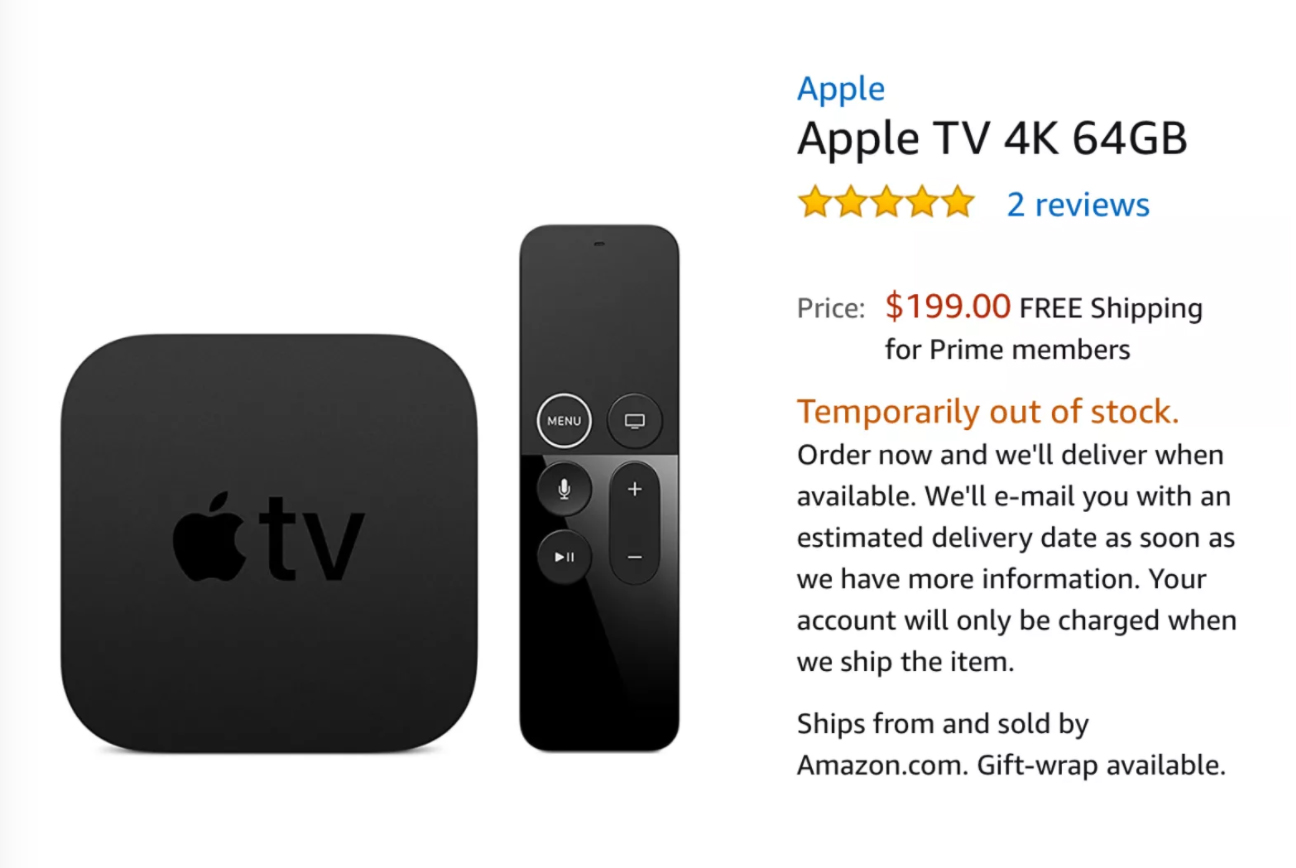
Pogue's Apple TV 4K live unboxing—just the best parts

Every couple of weeks, I take to Facebook Live to do a live unboxing/setup of a tech product. This time, it was the Apple (AAPL) TV 4K.

Apple’s fifth-generation version of the box offers 4K resolution streaming, which creates a sharper picture quality when used with a 4K TV.

The absurd aspect of this exercise, of course, is that you can’t see 4K when you’re watching a Facebook Live! You’re just watching your computer or phone’s screen. So you can’t see what I’m seeing.

You’ll have to just go with it, then, as Schuyler Stone and I walk through the features (and the very high price) of the Apple TV 4K!

I’ll post my full review in the coming days!

More from David Pogue:

iOS 11 review: 99 hits, 1 miss

iPhone 8 reviewed: Nice, but nothing to buzz about

How Apple envisions life without a Home button

The $999, eyebrow-raising iPhone X: David Pogue’s hands-on review

iOS11 is about to arrive — here’s what’s in it 

MacOS High Sierra comes this fall—and brings these 23 features

T-Mobile COO: Why we make investments like free Netflix that ‘seem crazy’

How Apple’s iPhone has improved since its 2007 debut

David Pogue, tech columnist for Yahoo Finance, is the author of “iPhone: The Missing Manual.” He welcomes nontoxic comments in the comments section below. On the web, he’s davidpogue.com. On Twitter, he’s @pogue. On email, he’s poguester@yahoo.com. You can read all his articles here, or you can sign up to get his columns by email

27 Sep 17:58

Daily Scot – That Supply Issue

by Scot Bathgate

Zoning, the missing middle and lack of supply are frequent topics in discussions regarding the housing crisis in the City of Vancouver.  One local group Abundant Housing Vancouver, aims to bring the conversion to the forefront by highlighting current zoning practices in the city.

“We think that building more housing is part of the solution to the housing crisis in our City. This is based on the common-sense idea that, if there is more housing for people, more people will have more housing.”

“Meanwhile, apartments are illegal on 76% of Vancouver’s residential land, severely restricting where relatively affordable, multi-family units can be built. We do not believe that supply is the whole answer, or the only answer. But we do believe that zoning for expensive, low-density housing is part of the problem.”

If you haven’t already, check out their website and Instagram page which provides helpful visuals of how current zoning shapes land use.  Some posts from Abundant Housing Vancouver’s Instagram page are located below:

Abundant-1

Abundant-2

What we let people build on a corner lot within walking distance of good transit, 1905 vs 2014. The 2014 lot is about 25% bigger too.

Abundant-3

Throwback to our Mount Pleasant tour – these pre-zoning 1912 apartments are nearly 3x denser than the 1968 apartments across the street

Abundant-4

9-story Mount Pleasant building, on a quieter side street. Townhouses at street level. 125 homes, many families with kids.

Some great starting points for discussing the supply side of the housing equation.  Of the many issues to consider regarding the examples of the older apartment buildings and their efficient land use are the tight setbacks and absence of mandatory minimum parking requirements back in the day, but those are topics for another post.

For more information on Abundant Housing Vancouver click on the links below:

Website

Instagram Page


27 Sep 17:57

These Weeks in Firefox: Issue 24

by mconley

Highlights

Friends of the Firefox team

(Give a shoutout/thanks to people for helping fix and test bugs. Introductions)

Project Updates

Add-ons

Activity Stream

Browser Architecture

  • Formed a team to do a design review on XBL removal plans
  • Sent out a front-end developer survey
  • See our most recent newsletter!

Electrolysis (e10s)

  • Improvements to memory usage means we might consider increasing the content process limit at some point in the future. Check out erahm’s blog post!

Firefox Core Engineering

  • Update agent work has begun, starting with the downloader, which plans to spin off the update download as a background process (so the update continues even if the user’s session ends). This is aiming for Firefox 58.
  • Optimized data in crash reports and crash ping processing have landed in Firefox 57 (even though they were targeted for 58).
  • JAWS client version has been added to the updater URL, just in time for Firefox 56.

Form Autofill

Mobile

  • First Firefox iOS 9.1 Beta is in QA and will ship soon with a modest list of small fixes
  • First Firefox iOS 10.0 Beta is currently being prepared. This is our Photon UI release. We expect to have it on TestFlight for our Beta testers very soon.
  • The Firefox iOS team’s focus for the upcoming release is on Photon, Telemetry and Stability

Photon

Performance
Structure
Visuals

Privacy/Security

  • Prathiksha finished up a few polish bugs on permission management, we consider it MVP-ready and it’s shipping in Firefox 57!
    • Showing the DOM permissions UI under about:preferences.

      Who’s in control? You are.

Search and Navigation

Sync / Firefox Accounts

  • Edouard is implementing native “toast” desktop notifications for Windows 8 and 10!
  • Kit is porting structured bookmark application to Desktop from iOS. Instead of applying downloaded bookmarks directly to Places, we’ll stage them in a separate buffer, run a tree merge, resolve conflicts, and then update Places in a single transaction.
    • This will fix a class of persistent bugs around random dupes, moves, reordering, incorrectly merged folders, interrupted syncs, and devices falling out of sync with the server.
  • Thom is removing more event loop spinning from Sync.
    • This should prevent Sync from spuriously appearing in performance profiles, unless it’s actually janking the browser.
  • Edouard landed a more responsive Sync animation if you click “Sync Now” at startup before Sync has loaded.

Web Payments

Here are the raw meeting notes that were used to derive this list.

Want to help us build Firefox? Get started here!

Here’s a tool to find some mentored, good first bugs to hack on.

27 Sep 17:57

Can Dara Khosrowshahi fix the problems that ended Uber’s license in London?

by Josh Bernoff

New Uber CEO Dara Khosrowshahi must now deal with Transport for London’s decision to yank Uber’s license to operate in the city. He’s straddling two worlds — praising the team but asking for change and self-reflection. You can read his email to the global team either way, and that is the problem. Lets look at the … Continued

The post Can Dara Khosrowshahi fix the problems that ended Uber’s license in London? appeared first on without bullshit.

27 Sep 17:56

Triple Tweet

by Ken Ohrn
mkalus shared this story from Price Tags.

Something old, something new, and a nifty picture too.

First, another round with sometime PT contributor and SFU City Program Director Andy Yan on the broad picture of the costs embedded in the decision to commute.  With thanks to Jonathan Brown at NEWS1130.  This message is getting serious focus.

“It’s the money of maintaining a vehicle, keeping it insured, there’s also going to be a social cost, the time away from family — you can also imagine the time of being away from a community that you can have ready access to, where you’re being stuck in a commute.”

Yan has been calculating housing and transportation costs and found, on average, people who commute spend around $230,000 more than people who live in Vancouver proper.

Second: a genuine found-in-the-wild tweet, from today’s UBCM2017 (Large Urban Communities Forum). It’s possible that previously free road usage may cease to be so.  This is called “user pay” when done in other spheres of life.

Charles Gauthier@DowntownCharles

Translink CEO Desmond: Mobility Pricing Independent Commission set to report to Mayors’ Council in spring 2018. #UBCM2017

And a nifty picture of endless choice-free sprawl.

Traffic.Origin


27 Sep 17:56

The Idaho Stop Ramps up for Delaware Cyclists

by Sandy James Planner
mkalus shared this story from Price Tags.

920x1240

In 1982 Idaho Traffic laws were revised with a new bicycle code that included a provision to allow bicyclists to do a “rolling stop” instead of a dead halt at stop signs~treating the “stop sign” like a “yield” sign.  Some cyclists and police officers advocated for an amendment to this law which was passed in 2006. The amendment stated that cyclists must stop on red lights, and must yield before proceeding straight or making a left turn at an intersection. The benefits of the Idaho Stop according to two studies is that safety is improved, and cyclists can move to see around obstacles, lessening car collisions. While this cyclist law has been enacted in Idaho, no other jurisdiction picked it up~until now.

The Governor of Delaware is expected to sign legislation allowing cyclists to treat stop signs as yields in  early October. Even though Idaho has a long safety record with cyclists treating stop signs as yields, and red lights as stop signs, Delaware’s legislation will apply only to two lane roads with  stop signs. Cyclists must still wait at red lights. Drivers will be required to change lanes when passing cyclists on the road, and  will be legally prohibited from honking at cyclists when passing. Municipalities in Delaware will be also be able to operate traffic signals that are bike specific.

Meanwhile back in Vancouver cyclists who do not do a full stop at a stop sign can be (and are) ticketed. Here’s a 20 second video produced by the City of Vancouver (and filmed right outside city hall at Tenth and Yukon Street outlining City Policy.


27 Sep 17:56

The Dying Art of Disagreement

mkalus shared this story .

So illustrious is the list that, on second thought, I’m beginning to regret that you didn’t disinvite me after all.

The title of my talk tonight is “The Dying Art of Disagreement.” This is a subject that is dear to me — literally dear — since disagreement is the way in which I have always earned a living. Disagreement is dear to me, too, because it is the most vital ingredient of any decent society.

To say the words, “I agree” — whether it’s agreeing to join an organization, or submit to a political authority, or subscribe to a religious faith — may be the basis of every community.

But to say, I disagree; I refuse; you’re wrong; etiam si omnes — ego non — these are the words that define our individuality, give us our freedom, enjoin our tolerance, enlarge our perspectives, seize our attention, energize our progress, make our democracies real, and give hope and courage to oppressed people everywhere. Galileo and Darwin; Mandela, Havel, and Liu Xiaobo; Rosa Parks and Natan Sharansky — such are the ranks of those who disagree.

And the problem, as I see it, is that we’re failing at the task.

This is a puzzle. At least as far as far as the United States is concerned, Americans have rarely disagreed more in recent decades.

We disagree about racial issues, bathroom policies, health care laws, and, of course, the 45th president. We express our disagreements in radio and cable TV rants in ways that are increasingly virulent; street and campus protests that are increasingly violent; and personal conversations that are increasingly embittering.

This is yet another age in which we judge one another morally depending on where we stand politically.

Nor is this just an impression of the moment. Extensive survey data show that Republicans are much more right-leaning than they were twenty years ago, Democrats much more left-leaning, and both sides much more likely to see the other as a mortal threat to the nation’s welfare.

The polarization is geographic, as more people live in states and communities where their neighbors are much likelier to share their politics.

The polarization is personal: Fully 50 percent of Republicans would not want their child to marry a Democrat, and nearly a third of Democrats return the sentiment. Interparty marriage has taken the place of interracial marriage as a family taboo.

Finally the polarization is electronic and digital, as Americans increasingly inhabit the filter bubbles of news and social media that correspond to their ideological affinities. We no longer just have our own opinions. We also have our separate “facts,” often the result of what different media outlets consider newsworthy. In the last election, fully 40 percent of Trump voters named Fox News as their chief source of news.

Thanks a bunch for that one, Australia.

It’s usually the case that the more we do something, the better we are at it. Instead, we’re like Casanovas in reverse: the more we do it, the worse we’re at it. Our disagreements may frequently hoarsen our voices, but they rarely sharpen our thinking, much less change our minds.

It behooves us to wonder why.

* * *

Thirty years ago, in 1987, a philosophy professor at the University of Chicago named Allan Bloom — at the time best known for his graceful translations of Plato’s “Republic” and Rousseau’s “Emile” — published a learned polemic about the state of higher education in the United States. It was called “The Closing of the American Mind.”

The book appeared when I was in high school, and I struggled to make my way through a text thick with references to Plato, Weber, Heidegger and Strauss. But I got the gist — and the gist was that I’d better enroll in the University of Chicago and read the great books. That is what I did.

What was it that one learned through a great books curriculum? Certainly not “conservatism” in any contemporary American sense of the term. We were not taught to become American patriots, or religious pietists, or to worship what Rudyard Kipling called “the Gods of the Market Place.” We were not instructed in the evils of Marxism, or the glories of capitalism, or even the superiority of Western civilization.

As I think about it, I’m not sure we were taught anything at all. What we did was read books that raised serious questions about the human condition, and which invited us to attempt to ask serious questions of our own. Education, in this sense, wasn’t a “teaching” with any fixed lesson. It was an exercise in interrogation.

To listen and understand; to question and disagree; to treat no proposition as sacred and no objection as impious; to be willing to entertain unpopular ideas and cultivate the habits of an open mind — this is what I was encouraged to do by my teachers at the University of Chicago.

It’s what used to be called a liberal education.

The University of Chicago showed us something else: that every great idea is really just a spectacular disagreement with some other great idea.

Socrates quarrels with Homer. Aristotle quarrels with Plato. Locke quarrels with Hobbes and Rousseau quarrels with them both. Nietzsche quarrels with everyone. Wittgenstein quarrels with himself.

These quarrels are never personal. Nor are they particularly political, at least in the ordinary sense of politics. Sometimes they take place over the distance of decades, even centuries.

Most importantly, they are never based on a misunderstanding. On the contrary, the disagreements arise from perfect comprehension; from having chewed over the ideas of your intellectual opponent so thoroughly that you can properly spit them out.

In other words, to disagree well you must first understand well. You have to read deeply, listen carefully, watch closely. You need to grant your adversary moral respect; give him the intellectual benefit of doubt; have sympathy for his motives and participate empathically with his line of reasoning. And you need to allow for the possibility that you might yet be persuaded of what he has to say.

“The Closing of the American Mind” took its place in the tradition of these quarrels. Since the 1960s it had been the vogue in American universities to treat the so-called “Dead White European Males” of the Western canon as agents of social and political oppression. Allan Bloom insisted that, to the contrary, they were the best possible instruments of spiritual liberation.

He also insisted that to sustain liberal democracy you needed liberally educated people. This, at least, should not have been controversial. For free societies to function, the idea of open-mindedness can’t simply be a catchphrase or a dogma. It needs to be a personal habit, most of all when it comes to preserving an open mind toward those with whom we disagree.

* * *

That habit was no longer being exercised much 30 years ago. And if you’ve followed the news from American campuses in recent years, things have become a lot worse.

According to a new survey from the Brookings Institution, a plurality of college students today — fully 44 percent — do not believe the First Amendment to the U.S. Constitution protects so-called “hate speech,” when of course it absolutely does. More shockingly, a narrow majority of students — 51 percent — think it is “acceptable” for a student group to shout down a speaker with whom they disagree. An astonishing 20 percent also agree that it’s acceptable to use violence to prevent a speaker from speaking.

These attitudes are being made plain nearly every week on one college campus or another.

There are speakers being shouted down by organized claques of hecklers — such was the experience of Israeli ambassador Michael Oren at the University of California, Irvine. Or speakers who require hundreds of thousands of dollars of security measures in order to appear on campus — such was the experience of conservative pundit Ben Shapiro earlier this month at Berkeley. Or speakers who are physically barred from reaching the auditorium — that’s what happened to Heather MacDonald at Claremont McKenna College in April. Or teachers who are humiliated by their students and hounded from their positions for allegedly hurting students’ feelings — that’s what happened to Erika and Nicholas Christakis of Yale.

And there is violence. Listen to a description from Middlebury College professor Allison Stanger of what happened when she moderated a conversation with the libertarian scholar Charles Murray in March:

The protesters succeeded in shutting down the lecture. We were forced to move to another site and broadcast our discussion via live stream, while activists who had figured out where we were banged on the windows and set off fire alarms. Afterward, as Dr. Murray and I left the building . . . a mob charged us.

Most of the hatred was focused on Dr. Murray, but when I took his right arm to shield him and to make sure we stayed together, the crowd turned on me. Someone pulled my hair, while others were shoving me. I feared for my life. Once we got into the car, protesters climbed on it, hitting the windows and rocking the vehicle whenever we stopped to avoid harming them. I am still wearing a neck brace, and spent a week in a dark room to recover from a concussion caused by the whiplash.

Middlebury is one of the most prestigious liberal-arts colleges in the United States, with an acceptance rate of just 16 percent and tuition fees of nearly $50,000 a year. How does an elite institution become a factory for junior totalitarians, so full of their own certitudes that they could indulge their taste for bullying and violence?

There’s no one answer. What’s clear is that the mis-education begins early. I was raised on the old-fashioned view that sticks and stones could break my bones but words would never hurt me. But today there’s a belief that since words can cause stress, and stress can have physiological effects, stressful words are tantamount to a form of violence. This is the age of protected feelings purchased at the cost of permanent infantilization.

The mis-education continues in grade school. As the Brookings findings indicate, younger Americans seem to have no grasp of what our First Amendment says, much less of the kind of speech it protects. This is a testimony to the collapse of civics education in the United States, creating the conditions that make young people uniquely susceptible to demagogy of the left- or right-wing varieties.

Then we get to college, where the dominant mode of politics is identity politics, and in which the primary test of an argument isn’t the quality of the thinking but the cultural, racial, or sexual standing of the person making it. As a woman of color I think X. As a gay man I think Y. As a person of privilege I apologize for Z. This is the baroque way Americans often speak these days. It is a way of replacing individual thought — with all the effort that actual thinking requires — with social identification — with all the attitude that attitudinizing requires.

In recent years, identity politics have become the moated castles from which we safeguard our feelings from hurt and our opinions from challenge. It is our “safe space.” But it is a safe space of a uniquely pernicious kind — a safe space from thought, rather than a safe space for thought, to borrow a line I recently heard from Salman Rushdie.

Another consequence of identity politics is that it has made the distance between making an argument and causing offense terrifyingly short. Any argument that can be cast as insensitive or offensive to a given group of people isn’t treated as being merely wrong. Instead it is seen as immoral, and therefore unworthy of discussion or rebuttal.

The result is that the disagreements we need to have — and to have vigorously — are banished from the public square before they’re settled. People who might otherwise join a conversation to see where it might lead them choose instead to shrink from it, lest they say the “wrong” thing and be accused of some kind of political -ism or -phobia. For fear of causing offense, they forego the opportunity to be persuaded.

Take the arguments over same-sex marriage, which you are now debating in Australia. My own views in favor of same-sex marriage are well known, and I hope the Yes’s wins by a convincing margin.

But if I had to guess, I suspect the No’s will exceed whatever they are currently polling. That’s because the case for same-sex marriage is too often advanced not by reason, but merely by branding every opponent of it as a “bigot” — just because they are sticking to an opinion that was shared across the entire political spectrum only a few years ago. Few people like outing themselves as someone’s idea of a bigot, so they keep their opinions to themselves even when speaking to pollsters. That’s just what happened last year in the Brexit vote and the U.S. presidential election, and look where we are now.

If you want to make a winning argument for same-sex marriage, particularly against conservative opponents, make it on a conservative foundation: As a matter of individual freedom, and as an avenue toward moral responsibility and social respectability. The No’s will have a hard time arguing with that. But if you call them morons and Neanderthals, all you’ll get in return is their middle finger or their clenched fist.

One final point about identity politics: It’s a game at which two can play. In the United States, the so-called “alt-right” justifies its white-identity politics in terms that are coyly borrowed from the progressive left. One of the more dismaying features of last year’s election was the extent to which “white working class” became a catchall identity for people whose travails we were supposed to pity but whose habits or beliefs we were not supposed to criticize. The result was to give the Trump base a moral pass it did little to earn.

* * *

So here’s where we stand: Intelligent disagreement is the lifeblood of any thriving society. Yet we in the United States are raising a younger generation who have never been taught either the how or the why of disagreement, and who seem to think that free speech is a one-way right: Namely, their right to disinvite, shout down or abuse anyone they dislike, lest they run the risk of listening to that person — or even allowing someone else to listen. The results are evident in the parlous state of our universities, and the frayed edges of our democracies.

Can we do better?

This is supposed to be a lecture on the media, and I’d like to conclude this talk with a word about the role that editors and especially publishers can play in ways that might improve the state of public discussion rather than just reflect and accelerate its decline.

I began this talk by noting that Americans have rarely disagreed so vehemently about so much. On second thought, this isn’t the whole truth.

Yes, we disagree constantly. But what makes our disagreements so toxic is that we refuse to make eye contact with our opponents, or try to see things as they might, or find some middle ground.

Instead, we fight each other from the safe distance of our separate islands of ideology and identity and listen intently to echoes of ourselves. We take exaggerated and histrionic offense to whatever is said about us. We banish entire lines of thought and attempt to excommunicate all manner of people — your humble speaker included — without giving them so much as a cursory hearing.

The crucial prerequisite of intelligent disagreement — namely: shut up; listen up; pause and reconsider; and only then speak — is absent.

Perhaps the reason for this is that we have few obvious models for disagreeing well, and those we do have — such as the Intelligence Squared debates in New York and London or Fareed Zakaria’s show on CNN — cater to a sliver of elite tastes, like classical music.

Fox News and other partisan networks have demonstrated that the quickest route to huge profitability is to serve up a steady diet of high-carb, low-protein populist pap. Reasoned disagreement of the kind that could serve democracy well fails the market test. Those of us who otherwise believe in the virtues of unfettered capitalism should bear that fact in mind.

I do not believe the answer, at least in the U.S., lies in heavier investment in publicly sponsored television along the lines of the BBC. It too, suffers, from its own form of ideological conformism and journalistic groupthink, immunized from criticism due to its indifference to competition.

Nor do I believe the answer lies in a return to what in America used to be called the “Fairness Doctrine,” mandating equal time for different points of view. Free speech must ultimately be free, whether or not it’s fair.

But I do think there’s such a thing as private ownership in the public interest, and of fiduciary duties not only to shareholders but also to citizens. Journalism is not just any other business, like trucking or food services. Nations can have lousy food and exemplary government, as Great Britain demonstrated for most of the last century. They can also have great food and lousy government, as France has always demonstrated.

But no country can have good government, or a healthy public square, without high-quality journalism — journalism that can distinguish a fact from a belief and again from an opinion; that understands that the purpose of opinion isn’t to depart from facts but to use them as a bridge to a larger idea called “truth”; and that appreciates that truth is a large enough destination that, like Manhattan, it can be reached by many bridges of radically different designs. In other words, journalism that is grounded in facts while abounding in disagreements.

I believe it is still possible — and all the more necessary — for journalism to perform these functions, especially as the other institutions that were meant to do so have fallen short. But that requires proprietors and publishers who understand that their role ought not to be to push a party line, or be a slave to Google hits and Facebook ads, or provide a titillating kind of news entertainment, or help out a president or prime minister who they favor or who’s in trouble.

Their role is to clarify the terms of debate by championing aggressive and objective news reporting, and improve the quality of debate with commentary that opens minds and challenges assumptions rather than merely confirming them.

This is journalism in defense of liberalism, not liberal in the left-wing American or right-wing Australian sense, but liberal in its belief that the individual is more than just an identity, and that free men and women do not need to be protected from discomfiting ideas and unpopular arguments. More than ever, they need to be exposed to them, so that we may revive the arts of disagreement that are the best foundation of intelligent democratic life.

The honor the Lowy Institute does tonight’s nominees is an important step in that direction. What they have uncovered, for the rest of you to debate, is the only way by which our democracies can remain rational, reasonable, and free.

Correction: September 26, 2017

An earlier version of this article misidentified Charles Murray’s host for his speech at Middlebury College. He was invited by the campus American Enterprise Institute Club and the political science department, not by Prof. Allison Stanger.

Continue reading the main story
27 Sep 17:56

Edgar Smith, Killer Who Duped William F. Buckley, Dies at 83

mkalus shared this story .

Mr. Smith once seemed destined for the electric chair for that killing, which New Jersey detectives described as one of the most horrible they had ever seen.

On the night of March 4 of that year, Victoria Zielinski, who was 15, did not return to her home in Ramsey, N.J., after studying at the house of a friend in neighboring Mahwah. The next morning, the police and Victoria’s parents found articles of the girl’s clothing and a bloody hank of hair on a road near a sand pit in Mahwah.

Just inside the sand pit, the searchers came upon Victoria’s body. She had been bludgeoned with a rock and a baseball bat, resulting in “a total crushing of the skull,” as an autopsy report put it. Her clothes were in disarray, though she had not been raped.

Mr. Smith, who had just turned 23 and lived in a trailer in Mahwah with his wife and infant daughter, came under suspicion. Blood was found in the car he had borrowed from a friend the night of the killing. The trousers and shoes he had worn that night, which were found later, were bloodstained.

Taken into custody and questioned for hours without a lawyer present, Mr. Smith confessed. This was nine years before the Supreme Court’s Miranda ruling requiring that the police warn suspects of their right to remain silent and to have a lawyer present during questioning.

At his trial, he testified that his confession had resulted from coercion and exhaustion. He said he had picked up the girl and driven her to the sand pit, where they began to argue, and that he struck her, drawing blood. But he insisted that he had left her alive, with a friend who had driven up a few minutes later.

Mr. Smith was convicted of first-degree murder and sentenced to death. While on death row, he took college courses and educated himself in the law, filing a string of appeals that resulted in numerous stays of execution.

Mr. Smith wrote a book, “Brief Against Death,” published in 1968, in which he again said he had been coerced into confessing. (He later wrote two more books, “Getting Out” and “A Reasonable Doubt,” a novel based loosely on his case.)

By the time “Brief Against Death” came out as an alternate selection of the Literary Guild, Mr. Smith’s plight had attracted the attention of Mr. Buckley, founder of the conservative magazine National Review, which Mr. Smith had begun reading in his cell. The two began a correspondence, and Mr. Buckley visited Mr. Smith at Trenton State Prison.

In 1965, Mr. Buckley wrote an article for Esquire magazine, citing what he thought were damning weaknesses in the prosecution’s case. He promoted a defense fund for Mr. Smith and helped enlist the prominent Washington lawyer Edward Bennett Williams in Mr. Smith’s cause.

In 1968, the United States Supreme Court ordered the United States Court of Appeals for the Third Circuit to reconsider its decision to deny Mr. Smith a hearing on the validity of his confession. Finally, on May 14, 1971, a Third Circuit judge ruled after a hearing that the confession had indeed been coerced, and that the prisoner must be freed if prosecutors did not retry him.

Bergen County prosecutors concluded that without the confession they had a weak case. On Dec. 6, 1971, Mr. Smith was allowed to plead no contest to a reduced charge of second-degree murder and was sentenced to the time he had already served. During the court proceeding he said he had killed Victoria Zielinski, but after leaving the courthouse he declared that he had uttered the words only to put his long ordeal behind him. (He had been on death row longer than any other United States prisoner up to that time.)

Mr. Smith immediately appeared on Mr. Buckley’s “Firing Line” program, holding forth about criminal justice and prison reform. The conversation was steered by Mr. Buckley, who said he believed “profoundly” that Mr. Smith was innocent. Mr. Buckley had described Mr. Smith in the 1965 Esquire article as an “an essentially phlegmatic young man of nonviolent habits.”

Edgar Herbert Smith Jr. was nothing like that. Born in Hasbrouck Heights, N.J., he was angry when his parents separated when he was a boy, and angry at being shuttled from an aunt to an orphanage to a grandmother, he recalled at a 2009 parole hearing.

When he was 12, he broke into a house, and when he was 14, he was charged with molesting a 9-year-old girl. Both cases were handled in juvenile court. He dropped out of high school, spent time in the Marine Corps, then drifted from job to job. On the day Victoria was killed, he was fired from his job at an auto-muffler shop.

After his 1971 appearance on “Firing Line,” Mr. Smith moved to California. He married and divorced a second time and drank heavily.

On Oct. 1, 1976, he abducted a 33-year-old San Diego woman and stabbed her as she struggled to escape his car. Bystanders noted the license plate number, leading the police to Mr. Smith’s apartment. By that time, he had fled to the East. But he decided to turn himself in and flew to Las Vegas, where he was arrested by F.B.I. agents. Mr. Buckley helped arrange the surrender and later expressed regret at having championed Mr. Smith’s cause.

In a nonjury trial, Mr. Smith was convicted of attempted murder and other crimes and sentenced to life in prison.

During the trial, he admitted that he had, in fact, killed Victoria Zielinski. He said he had struck her in the car after she resisted his advances, chased her when she ran away and hit her with the bat. Then, he said, “I picked up a very large rock and hit her on the head with it.”

Mr. Smith then acknowledged something like remorse, revealing that before turning himself in for the San Diego crime he had visited Victoria Zielinski’s grave in New Jersey. “For the first time in my life, I recognized that the devil I had been looking at in the mirror for 43 years was me,” he said in court.

On April 23, 2009, when he was 75, Edgar Smith limped into a parole hearing. He needed a cane and was hard of hearing. But frail or not, he was still “an exceptionally dangerous man” and should never go free, the Bergen County prosecutor, John Molinelli, had told California parole officials in a letter.

Parole officials remarked on Mr. Smith’s apparent inability to expresss true remorse. Stephen Anear, an assistant district attorney from San Diego County, cited what he called “a damning psychological assessment” of Mr. Smith.

“I’m reminded of the character in ‘The Silence of the Lambs,’ Hannibal Lecter, a very brilliant man,” the prosecutor said, recognizing “his ability to intelligently and articulately discuss things occurring in society.”

“But at his core, as with Mr. Lecter at his core, he is a sociopath,” the prosecutor said.

At one point, Mr. Smith was asked what would stop him from committing more violent crimes if he were freed.

“Old age,” he replied.

Continue reading the main story
27 Sep 17:56

5 Things Amazon Should Remember As It Becomes Sears Circa 1926

by Laura Northrup
mkalus shared this story from Consumerist.

As much as Amazon’s “Everything Store” approach might seem disruptive, particularly as the retailer branches out into supermarkets and physical stores, it’s not that different from what Sears did nearly a century ago as its wildly successful mail-order business transformed into a bricks-and-mortar mega-chain. The question is: Can Amazon keep from making the same mistakes that led to Sears’ fall from grace?

Here’s what we learned from an interesting recent piece in the Atlantic that compared Sears Roebuck as it began its store-building spree in the late 1920s with Amazon as it opens more bookstores and gets into the grocery business in 2017.

1. Sears was the original Everything Store.

You might think that Amazon sells everything, but it doesn’t sell firearms, cars, houses, or tombstones. Sears did, a century ago, alongside the merchandise you might expect, like clothing, tools, and toys.

2. Selling everything isn’t about making money from everything.

Offering a wide variety of products means that shoppers will turn to that store first when they need something. Sears expanded its range of merchandise (see above) and kept its prices low by selling huge volumes. Customers stayed loyal because of the wide variety and low prices, turning to Sears first for much of their shopping. Even today, it’s one of the few retailers where you can buy lingerie and lawn mowers.

Amazon has understood this for a long time, lowering its prices relentlessly to win business, not necessarily making a profit. In the last few years, it has turned to making its own private-label products to boost its profit margins after gaining shoppers’ trust.

3. Building physical stores doesn’t hurt catalog (or online) sales.

Sears learned that sales actually increased as it built its first physical stores. Yet its catalog business didn’t really die out until the country was thoroughly suburbanized in the 1980s. Amazon may find the same, as it nestles smart speakers in the produce sections of its Whole Foods stores, but also includes Amazon Lockers as a pickup point for orders. Amazon has also found that a physical retail presence boosts online sales.

4. Follow the customers.

Sears found success by reading census data and studying its own catalog mailing lists, then putting stores where its customers were, or following trends to put stores where its customers were going. In the 1920s, it noticed that customers were migrating to cities, and heading south and west. In the 1960s, the department store chain didn’t just follow its customers to the suburbs: It developed its own malls in areas that didn’t already have one.

Amazon has already taken this lesson seriously, building its bookstores in upscale malls, building pickup points on college campuses, and acquiring the Whole Foods chain, which already attracts an upper-income population of shoppers.

5. Adjacent businesses can be helpful, but don’t get distracted.

Sears grew a lot of related businesses along the way, like Allstate auto insurance (when it sold cars and auto parts) and the Discover card, both of which it later spun out as separate businesses.

Amazon doesn’t sell car insurance or run its own credit card, but it does experiment with side businesses like robotic fashion advice, handmade crafts, and food delivery. Even original TV programming is an odd side business, unless you think of it as something to attract people to Prime subscriptions, which lead them to buy more from Amazon.


27 Sep 17:44

Apple confirms iPhone 8 suffers from crackling earpiece problem, says fix is coming

by Patrick O'Rourke
iPhone 8 Plus mic

Some iPhone 8 users are experiencing issues related to the smartphone’s earpiece speaker.

When a call is made, the earpiece emits a crackling, static-like sound that disrupts the call’s audio. Reports of this issue can be found on Reddit and Apple’s official support forum. I have also encountered the issue on one occasion during my time with the iPhone 8 Plus, though initially passed it off as a one-time problem.

Apple has released a statement confirming that a “small number” of iPhone 8’s are affected by this issue, and that the company plans to release a software update that will fix the problem. The video below is an example of what the problem sounds like.

“We are aware of the issue which is affecting customers in a small number of cases,” said an Apple spokesperson. “Our team is at work on a fix, which will be included in an upcoming software release.”

It’s unclear what is causing the problem, but the issue seems to be impacting both the iPhone 8 and the iPhone 8 Plus. Interestingly, the crackling issue only occurs during some calls and doesn’t happen when using the device in speaker mode for a phone call, indicating that the problem is likely related to a software bug.

Apple has not revealed a timeline for when the problem will be fixed, but given the fast clip the company typically drops updates, it’s likely that a solution will be coming soon.

The LTE-enabled Series 3 Apple Watch also encountered issues just before its release, with some reviewers reporting that the device is unable to use its cellular connection when near an authenticated Wi-Fi network. Apple has said it’s working on a software fix for this issue, as well.

Apple also encountered a similar speaker crackling issue with the iPhone 7 back in 2016.

Source: Reddit, Apple support forum Via: The Verge

The post Apple confirms iPhone 8 suffers from crackling earpiece problem, says fix is coming appeared first on MobileSyrup.

27 Sep 17:44

Montreal-based Transit app raises $5 million with mission to make car ownership obsolete

by Jessica Galang
Export Screen V2

Montreal-based Transit has raised $5 million in a round led by Accel Partners. Accomplice, Real Ventures, and BDC also joined the round.

While the company plans to use the funding to invest in product development, Transit outlined its commitment to ushering in “the next urban revolution” in a Medium post.

Transit’s platform taps into many aspects of the transportation experience, including maps, trip planning, and a real-time GPS. Users can also book ride-hailing services, book carshare services, and buy bikeshare passes. The company is currently functional in over 130 cities, and says it has “millions” of active users and facilitates billions of riders.

“We’re not here to build you your own self-driving car. We’re building something better: a world where you don’t need one,” the post reads.

The company outlined its commitment to get people moving away from cars, and make public transporation more palatable. “When even small cities like Portland are projected to have 3.6 million people by 2050, any urban planning strategy that prioritizes low-occupant vehicles — robot-driven or not — will eventually be crippled by traffic,”

The company raised a $2.4 million seed round in September 2016 to improve the precision of its data.

“For decades we’ve let our cities become less neighbourly, less walkable, less healthy, and liveable. All for the sake of quick and convenient transportation,” the company says. “But today’s transportation is neither quick nor convenient. Cars have failed to deliver on their promise. Now, they’re getting kicked out of town.”

This story was originally published on BetaKit.

The post Montreal-based Transit app raises $5 million with mission to make car ownership obsolete appeared first on MobileSyrup.

27 Sep 17:44

Cold war thaws: Apple TV 4K listed on Amazon, then pulled

by Patrick O'Rourke
Apple TV 4K

In a sign that could indicate the thawing of the ongoing cold tech war between Amazon and Apple, the retail giant has listed Apple’s new 4K Apple TV on Amazon.com, though the set-top box was quickly pulled from the site.

While we weren’t able to check Amazon.ca before the link was removed, it’s likely that the 4K Apple TV is also set to be sold in the company’s Canadian digital storefront as well.

The 4K Apple TV went on sale last week and has been generally well-received, though some have criticized its $229 CAD price, and inability to switch between HD signals and 4K when jumping between apps.

Apple TV 4K listing on Amazon

Amazon removed both the Apple TV and Google’s Chromecast from its store back in 2015 because neither streaming device featured the company’s Prime Video streaming app. Amazon justified the removal by stating that the fact that neither device feature its Prime Video app caused confusion among the company’s customers, who expected to be able to view Prime content on a product purchased from the retailer.

Back at WWDC in June, however, Apple CEO Tim Cook announced that Amazon has plans to bring its Prime Video streaming app to the Apple TV. Following Apple’s recent iPhone X keynote, MobileSyrup confirmed that Prime Video will stream content in 4K on the Apple TV, and that the app is launching in Canada as well.

Rumours have been circulating that Amazon Prime Video may arrive on the Apple TV in the U.S. by Thursday this week — in time for the retailer to stream its first Thursday Night Football game.

For more information about the 4K Apple TV, check out our full review.

Souce: 9to5Mac Via: The Verge

The post Cold war thaws: Apple TV 4K listed on Amazon, then pulled appeared first on MobileSyrup.