Amazon's Kindle app for iOS received a major update today, bringing redesigned navigation tabs, a new light theme, and more. The change that excited me most, small as it may be, is the greatly improved app icon – it includes a beautiful new illustration, and the word Kindle has been removed.
The Kindle app now feels more at home on iOS, with a familiar navigation tab layout lining the bottom of the screen. The first tab, Library, is essentially what the main interface of the app was before – all your books are found there. The Library tab is cleaner and simpler now, as several options it formerly contained have been assigned to other areas of the app. The Goodreads and Discover pages, for example, now live in the main navigation bar as Community and Discover tabs, respectively. Extra items like settings and sync have been moved into the navigation bar's final tab, More. There's also now a search bar at the top of the screen that's accessible from nearly anywhere in the app. Overall, these layout changes make the app easier to navigate and less cluttered than before.
Joining the app's original dark theme, you can now turn on a light theme for the app; this navigation theme is separate from the reading theme, which has long had dark and light options. The light theme looks nice, and I plan to keep it turned on. Another change is that while reading, it's easier to get back to your library – the upper left corner contains a down-facing arrow that instantly closes your book.
I do nearly all of my book reading digitally, and I've long preferred reading in iBooks over Kindle due to it having the superior app in my mind. Today's update fixes several of the issues I've had with Kindle, but unfortunately there's one big problem outstanding: Kindle still doesn't support Split View on iPad. Once Amazon adds that to its app, I'll have less reason to always go with iBooks.
Support MacStories Directly
Club MacStories offers exclusive access to extra MacStories content, delivered every week; it's also a way to support us directly.
Club MacStories will help you discover the best apps for your devices and get the most out of your iPhone, iPad, and Mac. Plus, it's made in Italy.
The Samsung Galaxy S8 and Galaxy Note 8 are multimedia and imaging powerhouses. The 12MP f/1.7 shooter at the rear of both devices offers great performance in varying lighting conditions and also has a few tips up its sleeve for a richer experience. This includes being able to shoot videos in slow-motion which can be great to capture some high-intensity sports or action scenes.
Continue reading →
“My whole life has been disrupted. It’s a national nightmare,” the artist Carter Goodrich says, about his cover for this week’s issue: a painting of the President whom he calls a “dangerous clown.” “Most satire seems to lighten what feels to me like a dire situation. He’s already a cartoon villain, infantile and strange.”
The adoption of AVs should not be allowed to replace time-tested places with something that would probably make our lives worse.
.
.
1) Be afraid
New technologies that increase convenience are unstoppable, whatever their impact on our long-term quality of life.
It happened with cars. Enthusiastic adoption followed by some dubious outcomes.
2) Be realistic (or, What to expect, when you are expecting AVs)
… major change is unlikely to happen for several decades … because most of the benefits of AVs really only kick in when we have full autonomy—a swarming fleet of shared vehicles that operates as a public good.
Heaven is fleets of shared electric driverless cars powered by renewable energy, and a more socialist—my word—wealth distribution system to help all of the drivers put out of work by driverless cars. Hell, on the other hand, is privately owned AVs, that, since they have nowhere to park, spend much of the day circling, doubling the traffic load.
3) Decide how much traffic you want
This is probably the key rule …
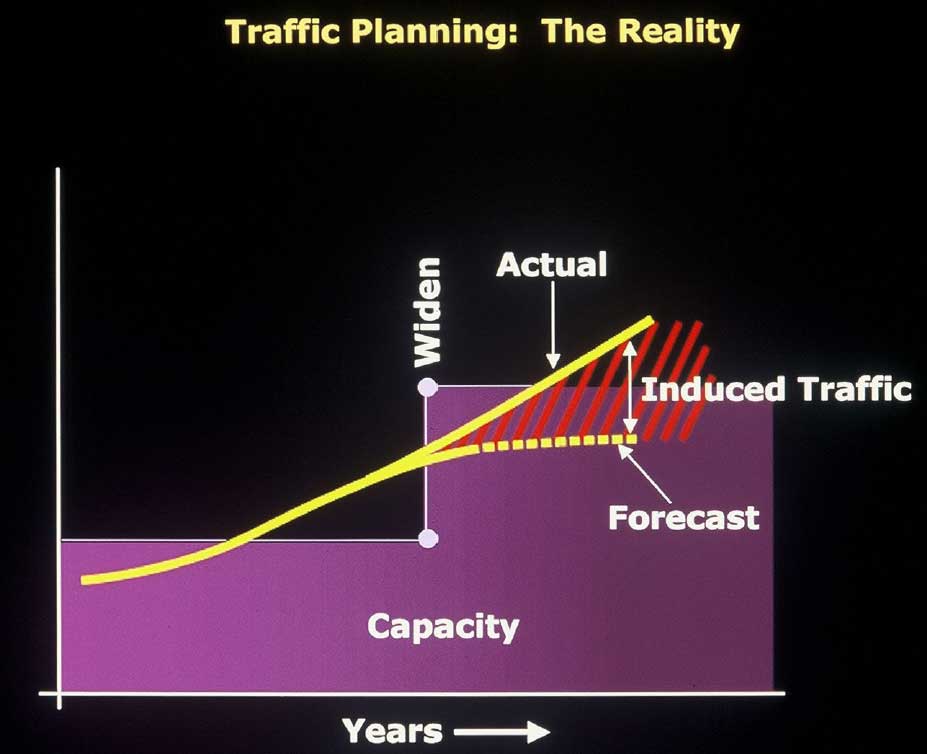
If (AVs) cut the cost of driving by 80 percent as anticipated, that’s supposed to add 60 percent of the traffic to city streets that are already at capacity. … But it’s actually worse …
If you ignore induced demand, 60 percent more trips are not a problem, as long as we have swarming. Elon Musk tells us that a driving lane full of swarming AVs can handle 3 times as many cars as it does today. So, problem solved, until you realize that, these days, traffic congestion is the principal constraint to driving.
Source: Walter Kulash
This becomes especially alarming when we realize that AVs will make driving cheaper in two ways: money and time. You will pay less per mile, and won’t mind sitting in gridlock as you work or watch cat videos.
The only answer, I believe, is to regulate it, not with laws, but with lanes. Without a commitment to limiting capacity, all our parking lanes, soon empty, will not become bike lanes and greenways as promised, but more driving lanes. And sidewalks will feel miserable.
The right solution, is to make the streets what you want them to be.
4) Plan for more sprawl pressure
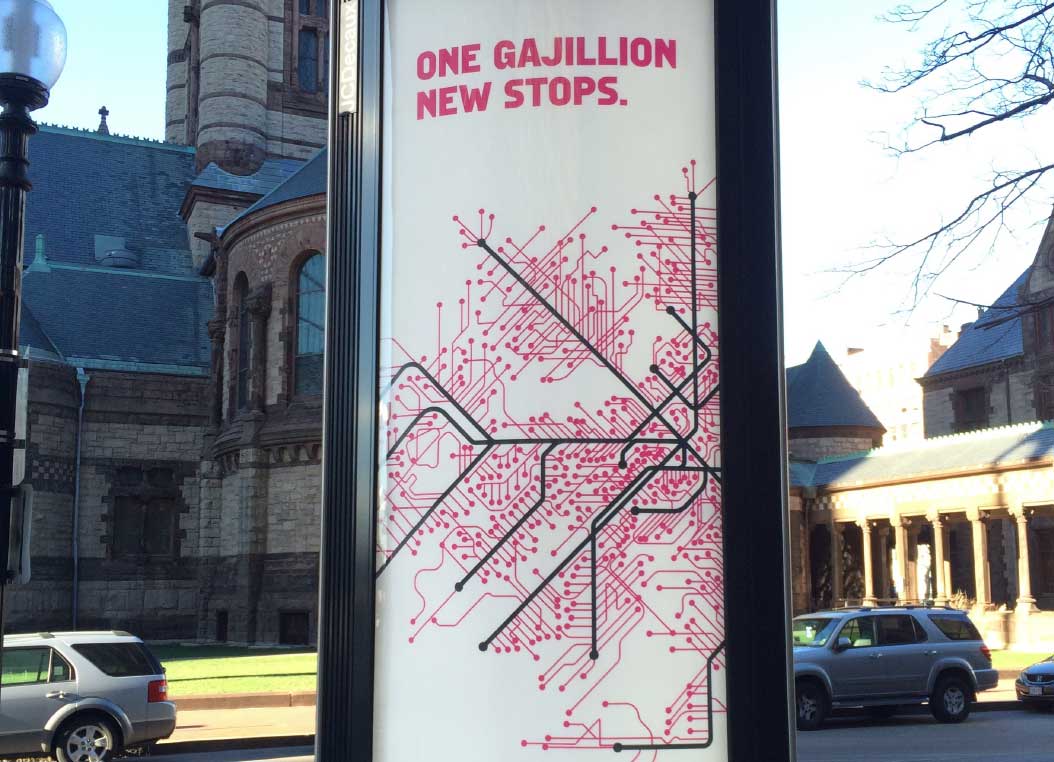
Here was a Lyft ad, ostensibly for last-mile service complementing our rail network, but I’ll be darned if it wasn’t an exact map of suburban sprawl.
Only with the car did the entire landscape take on wasteful, unwalkable, disconnected forms that now, more than anything else, characterize American life.
But there is recent good news, which is that cities and towns have begun to figure out that sprawl does not pay for itself.
5) Understand transit geometry
There is no getting around the fact that low-occupancy vehicles are a tremendous waste of street space. … Autonomous cars are a great supplement to transit, but, in congested places, they are not a solution to transit.
6) Don’t rob transit
This may be the greatest risk. In congested cities, replacing trains and buses with autonomous cars will cripple mobility. …
Unfortunately, just the prospect of future AVs is already threatening transit investment in certain American cities.
Meanwhile, Uber has set its sights on transit, and is offering UberPool monthly memberships at lower cost than a transit pass, some say to put the conventional transit out of business.
City leaders have the responsibility to teach their citizens about geometry—to teach them what even Elon Musk doesn’t seem to know—that a shift from transit to AV cars would reduce mobility.
7) Own the streets and own the data
It sounds implausible, but there is a very real worry that AV providers will ask to buy certain city streets, or certain segments of city streets, and cities will take the money.
Adam Gopnik: “Cities are their streets. Streets are not a city’s veins, but its neurology, its accumulated intelligence.” Never sell that.
Like Uber, AVs will represent a viable business model only by running on public streets. Sharing full data would seem a small price to pay for that privilege.
8) Don’t buy any urban vision that forgets urbanism
If you study modern urban history, you will see that every major transportation advance has brought with it whole new concepts of what the city is.
Ford’s vision of where people will enjoy walking with AVs.Where people actually like to walk. Photo by Lynn Richards.
Traditional urbanism was not an invention, but evolved naturally in response to human needs. The adoption of AVs should not be allowed to replace it with something different.
9) Unify around a set of policy demands
Individual cities have little sway here, but working together cities can’t be denied. Cities can all create a protocol that to present to AV providers as a collective requirement.
10) Invest in the current technological revolution
A transportation technology available now has outperformed AVs by almost every measure. … That technology is called a bicycle. … Protected bike lanes are what you need to give a sense of security to civilian bicyclists.
Autonomous vehicles are the right answer to the wrong question. Why do MIT’s Media Lab, and Google keep asking how we can make cars better?
A better question is how can we provide the most useful mobility to the most people with the most positive outcomes for society? The answer includes cars, but also trains, buses, bikes, and walking—especially biking and walking.
That worked a treat, and I use Skype for the discussion, here are the settings for that:
So all was good there, I even figured out how to record the system audio through Audio Hijack:
I recording the Channel 2 output to mp3 through Audio Hijack and it worked. I even tested it before we started. In fact, the test is all I have from the first episode I broadcast on ds106radio with Paul Bond discussing Giorgio De Maria’s The Twenty Days of Turin. That’s right, an hour long discussion about the book lost to the ether, so to speak. But it did happen:
London, UK – 24th October 2017: At noon on Wednesday, the doors to The Glass Room, London’s latest sleek pop-up store, will open, offering curious visitors a glimpse into the implications of our increasingly digital lifestyles.
The Glass Room, produced by Mozilla and curated by Tactical Tech, highlights the flipside of life in the digital age through an animated, creative space that combines artworks, interactive workshops, videos and guest speakers to visualise our data and explore how it is freely harvested, traded and sold on a daily basis. Running from 25th October to 12th November in London, The Glass Room aims to help people identify and reduce their digital footprints, having helped more than 10,000 New Yorkers do the same in 2016.
Jascha Kaykas-Wolff, Mozilla’s Chief Marketing Officer, said, “Having debuted to national acclaim when it arrived in New York last year, we look forward to the opening of The Glass Room in London. As a not-for-profit, Mozilla invests in creative ways to make sure people are informed and ready to protect themselves online. With fake news and misinformation, the normalisation of surveillance, and so-called “free” services from powerful tech companies, The Glass Room opens your eyes to the invisible imbalance of power and the irony of referring to our most intimate data as ‘personal’. ”
Stephanie Hankey, of Tactical Tech added, “The Glass Room is where big data is displayed in a tangible and less abstract way. On the one hand, it is a personal experience, where you can playfully challenge your own relationship with the devices, websites and apps you use everyday. On the other hand, it is a space to ask important questions about the issues we face as a society, such as right to privacy, disproportional power, and the data-driven economy. Everyone has a reason to care, but sometimes you just need to see something from a new perspective to do something about it.”
The Glass Room’s sleek, minimalist storefront located in London’s busy West End is no accident. Shoppers may enter with an expectation to browse and buy the latest technology, yet they leave with a greater understanding that for many companies, we have become the product and our personal data has become a commodity. An experience created by artists, activists and technologists, The Glass Room features over 40 individual artworks inspired by four principal themes:
We Know You: The Big Five (Amazon, Google, Facebook, Apple, Microsoft) are no longer the disruptive upstarts of their “Don’t Be Evil” origin stories and are today fully enmeshed in our daily lives. They are also the biggest companies in the world, with the power to influence everything, from the next hot consumer trend to shaping the global political stage, with the tweak of an algorithm. Pieces created by Tactical Tech and La Loma visualise this data and explore how much we know about these companies who know so much about us.
Something to Hide: We often hear the argument, “I have nothing to hide” but are we aware of how much we aren’t hiding in return for free or convenient services? These pieces explore the unbalanced and often invisible data exchange in a playful way and offers food for thought on how such data could be used and abused.
Big Mother: In this age of “Big Brother”, surveillance comes in many forms, with the State introducing a new brand of “care-veillance”. A new program designed to provide swifter access to in-home monitoring of elderly relatives is being welcomed as a safety net to allow safer independent living. But who holds that data and how is it protected? This installation investigates the risks and rewards of this new breed of surveillance society and explores if and how we can opt out.
Open the Box: Take a peek beneath the screen to the data patterns and traces we leave in our wake. This section visualises the data footprints that we leave behind for all to see, and examines how this data can be collected, analysed and used by others.
A series of guest speakers throughout the duration of the pop-up will host lectures, workshops and interactive sessions on many key issues raised by the proliferation of data and the exponential growth of our online lifestyles. Confirmed speakers include artists Adam Harvey and !Mediengruppe Bitnik, journalists Eliot Higgins and Carl Miller, and many others.
For those who wish to explore further, “Ingeniuses” at the Data Detox Bar will show you what the data brokers see, allow you to manipulate the online advertising that others see and even create fake news on real news websites – encouraging us all to think twice before taking anything online at face value. For those who wish to learn how to reduce their digital footprint and make more informed choices about their online activity moving forward, the Ingeniuses will be able to provide practical tips and everyone can try the ‘8-day Data Detox kit’, available from the event or online.
The Glass Room will be open to the public, free of charge, between 12pm and 8pm daily from Wednesday 25th October to Sunday 12th November 2017.
The Glass Room Experience will be touring the UK during the same period, offering visitors in towns and cities like Manchester, Birmingham, Leeds and Bristol an opportunity to gain insight into the implications of today’s digital life. More details can be found at https://theglassroom.org
At the same time as The Glass Room, MozFest, Mozilla’s week-long festival (23 October to 29 October) in London opens, focusing on Internet health issues like online privacy, web literacy, and misinformation.
Location:69 – 71 Charing Cross Road, WC2
A full list of the exhibits, workshops and guest speakers can be found online: theglassroom.org
About Mozilla
Mozilla Mozilla is the not-for-profit behind the popular web browser, Firefox. We believe the Internet is a global public resource, open and accessible to all. We work to ensure it stays open by building products, technologies and programs that put people in control of their online lives, and contribute to a healthier Internet.
About Tactical Tech
Tactical Tech is a Berlin-based organisation working at the intersection of technology, human rights and civil liberties. They provide trainings, conduct research, and create cultural interventions that contribute to the wider socio-political debate around digital security, privacy and the ethics of data.
Economists once warned employers about grave risks to office and shop efficiency and to personal efficiency, too. The danger? All that noise in the modern office, from the ambient sounds of passing automobiles to clattering typewriters. In 1927, The Science News-Letter reported on the smart executives who “look over their plants and offices to see whether excessive noise is making their employees inefficient, weary, and perhaps impairing their hearing.”
In 2017, workplace pundits are cautioning executives about an even bigger threat to efficiency: Slack. Drawing on a few high-profile “why we quit Slack” blog posts, a steady stream of media outlets (and a dedicated website) have proclaimed a “Slacklash” — a backlash against office organizational and chat platforms that’s driven by workers who complain they are drowning in notifications, dings, and message alerts, and are unable to focus amid all the digital nagging from co-workers and colleagues.
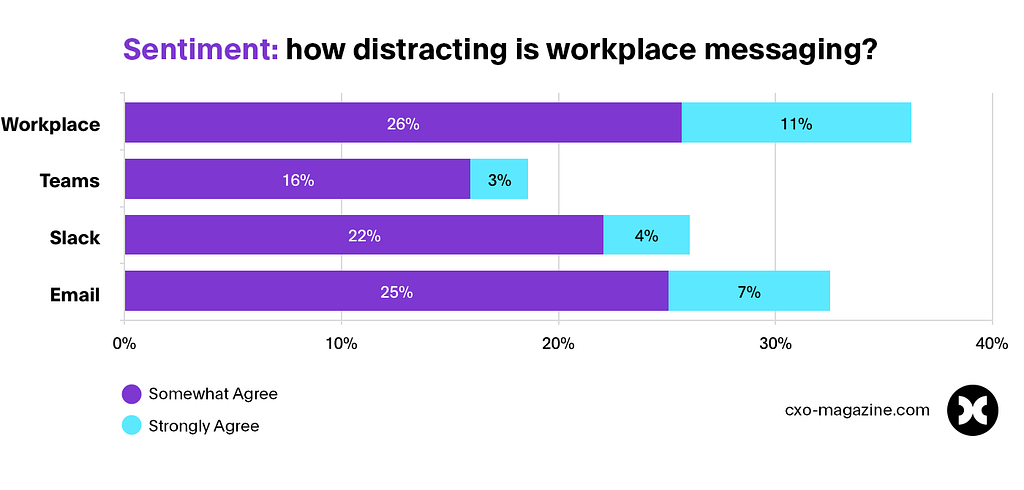
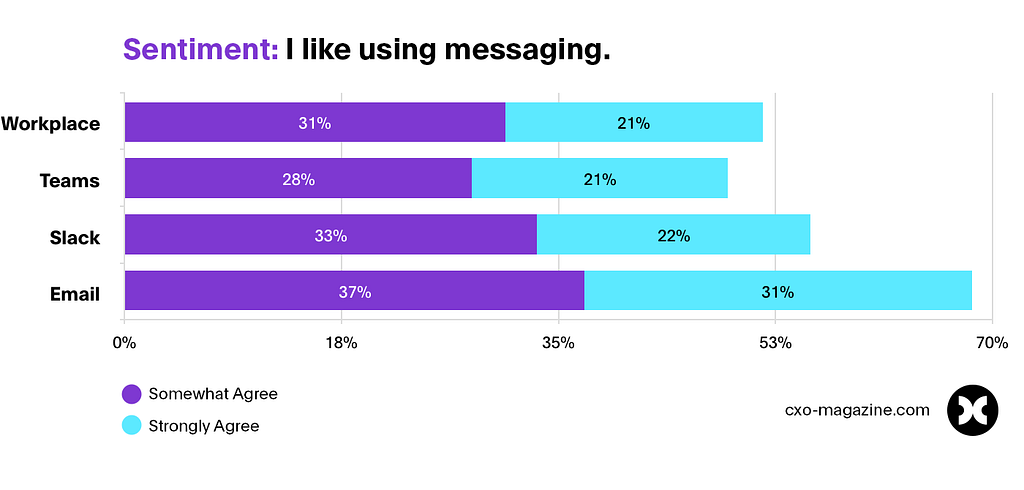
But those headlines don’t entirely mesh with what office workers think about Slack and similar office communication platforms. CXO Magazine conducted a survey of 788 workplace messaging users: people who’ve used Slack, Microsoft Teams, and/or Facebook Workplace within the past year. Contrary to the buzz, less than a third of messaging users said they find it distracting. That’s no more than the number of people who find email distracting.
Only 1 in 10 chat users actively dislike using it — a figure that remains the same no matter which of the three big platforms you look at. “I’m much happier now that I don’t use IM of any kind at work,” says Jamie Biggar, who is the communications and campaigns director at Toronto’s Centre for Social Innovation.
Suddenly, the so-called Slacklash looks wildly overblown. Sure, both messaging and email can be distracting — but that’s because people can be distracting.
And it seems that many managers agree. “We introduced Slack with a reminder on how and when to use email in the hopes that emails that say ‘yup’ and ‘got it’ would be eliminated,” Denise Taschereau said. As the owner of Fairware, a promotional products company, Taschereau must deal not just with internal email, but with current and prospective clients. “Slack reduced my number of emails and for that I’m grateful,” she said.
Plenty of workers also shared that sentiment. “Slack’s interruptions don’t drive me crazy, because each one is an email I don’t have to deal with,” said writer and communications consultant James Glave.
Roland Tanglao, a tech support professional, put it more bluntly: “Slack and IRC [internet relay chat] both suck. … But hey, they are both better than email.”
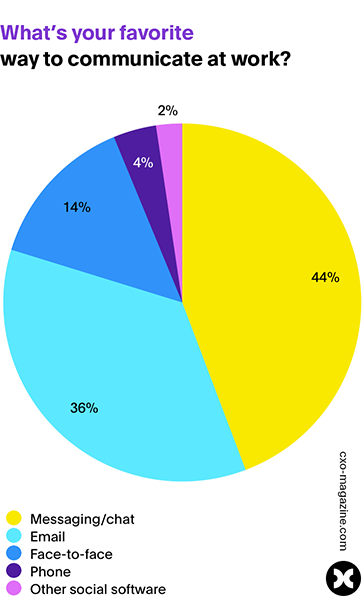
In the CXO Magazine survey, many respondents expressed a similar sentiment. When we asked people for their favorite way of communicating at work, chat systems — including Slack, Teams, Workplace, SMS, and a range of other tools — were in fact the most frequent answer: 44 percent of respondents named a chat tool (or chat/messaging in general); email took the number two spot at 36 percent.
Respondents said things like:
“It’s fast and easy, less formal than email, and the person can answer at their own convenience so you don’t disturb them if they are in the middle of something.”
“It saves me a walk over to someone’s desk to ask a question (I usually get distracted when I walk over and it makes me less productive).”
The email enthusiasts
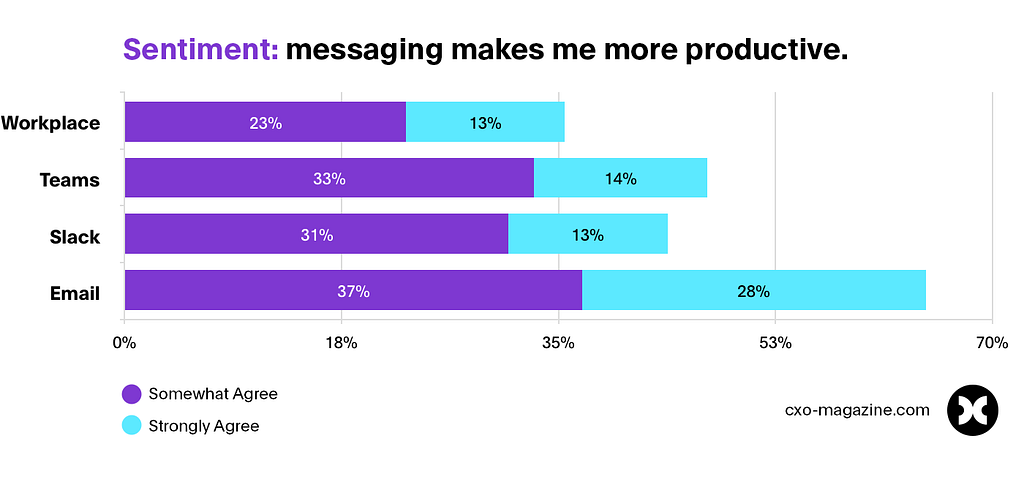
What was interesting about the survey results, though, was that while more respondents said they preferred chat tools over email, only 41 percent of messaging users said chat makes them more productive, while 66 percent of email users think email makes them more productive. As a result, some people choose to stick with good old-fashioned email.
Gene Sherman owns Vocademy, a small business that runs a makerspace in California. His team gave Slack a try for about a month, and was quickly overwhelmed. “My employees aren’t early adopters,” Sherman said. “Just learning to use Slack takes time. We probably could learn to use it, but as a startup, we have a lot of other stuff to learn.”
Nonetheless, there was a benefit to his company’s experiment: It forced his team to think about their ever-expanding communications toolkit, and decide which tools they really wanted to use. “We were also using Facebook, text, carrier pigeon — you name it,” Sherman joked. “After our Slack experiment, we made a company policy of no Facebook messaging and no text messaging. A group question can go one-to-one on Gmail chat, but if it’s a group chat, we email, because it gives us a nice history.”
Cristina Moon runs marketing for Search Inside Yourself, a corporate training program that teaches mindfulness and emotional intelligence. No surprise, then, that her team gave careful thought to whether group messaging could play a role in their work. “The computer engineer on staff was actually the one who told me that he tries to avoid chat and messaging apps,” said Moon. “They can definitely be distracting, and FOMO [fear of missing out] is real when you come back from time off and see weeks’ worth of unread chats.”
Tech transitions
New technologies have always met some office resistance. The anxiety about chat distractions greeted email in its early days. A 2001 study on the cost of email interruption found that 70 percent of emails that got dealt with were opened within 6 seconds — “quicker than letting the phone ring three times.” (The fact that the authors compared the time with a ringing phone attests to just how long ago 2001 was.) If only we could find the right approach to email, the authors argued, we could “enhance employee productivity by reducing the number of interrupts an employee receives.”
Fifteen years later, digital interruption is so ingrained in the texture of our workdays that it seems more relevant to think about which types of interruption to tolerate (and how to minimize their impact) than to somehow hope we can escape from interruption at all. Take, for example, a 2015 experiment measuring the effect of interruptions on task attention. Researchers found that keeping other applications open — even chat and email — had no impact on task completion times; what did have an impact were face-to-face interruptions.
What changed? We did. Synthesizing two decades of research, a 2017 paper presented at the 25th European Conference on Information Systems offered a grand theory of tech-mediated interruptions. The authors noted that the cognitive, emotional, and behavioral impact of interruptions can be mitigated by a wide range of tech tweaks or personal strategies, ranging from adjusting the frequency of notifications to organizing interruptions by relevance. And indeed, more than 20 years into the email revolution, many of us have developed some combination of technical, strategic, and habitual ways of managing email interruptions.
That’s exactly what people and organizations are just starting to do with messaging. One common adaptation is to turn off notifications, the relentless ping! ping! ping! that announces each incoming message.
“My colleagues know that I check Slack and my other messaging apps few times a day,” says Vida Morkunas, a project manager, who is among those who turn off notifications. “They know I will respond, but the constant notifications were driving me up the wall.”
Cristina Moon recommends thinking about how to signal your availability, too: “This can mean putting your avatar on red when you really don’t want to be disturbed, and having an emergency mode of communication in your profile, like your cell number,” she suggested. “And really being on red when you don’t want to be disturbed, not just all the time.”
These strategies must get adjusted on a person-by-person level; Eden Spodek, who runs a digital communications agency, relies on notification preferences to minimize disruptions to her workday, said “You have to play around with them a bit to find what works best for you.”
Strategies like these are likely to become even more effective as Slack and its competitors introduce features to address the distraction issue. While Slack’s leadership team has largely avoided engaging in the Slacklash debate, their product development timeline suggests that they’ve registered the concern: In addition to introducing a long-requested message threading option at the beginning of this year (so you can tune out digressions), the platform now features highlights, so you can skim just the most important posts, and status updates, so you can declare yourself unavailable for some period. Another hint that the distraction problem is on their minds? The company’s dedicated help page for reducing Slack-related noise.
Even with these distraction-beating features, however, group messaging apps like Slack are never going to win over everyone. “I don’t get Slack,” says Lesli Boldt, who heads a communications firm. “I’m kicking it old school and phoning people.”
What do you think? Are office chat platforms such as Slack and Microsoft Teams a distraction or have they made you more efficient? Email us here.
CXO Magazine is a new publication founded at Northeastern University to chart the ideas, events, and people shaping the future of work. Learn more.
There’s no perfect choice if you want a device that combines the portability of a tablet with the power, flexibility, and full-size keyboard of a laptop. But the Apple 11- and 12.9-inch iPad Pro models and Microsoft Surface Pro 6 are the best available options, albeit for different reasons. The iPad is a good tablet that’s not as flexible as a laptop, while the Surface is a good laptop that’s harder to use as a tablet.
First, read this account of the (non-)relation between expertise, think tank support and citations in the media of "education experts". As noted by John Warner in this article, "It is cited by Audrey Watters and Sara Goldrick-Rab of Kevin Carey’s The End of College: Creating the Future of Learning and the University of Everywhere, 'In this political economy, the experts on education are rarely experts in education, and that is just the way an increasing number of powerful people seem to like it.'" In the two years since the book was published, the criticisms have been borne out: "the MOOC revolution that was supposed to transform into the 'University of Everywhere' has fizzled into targeted corporate training and other very specific applications." Of course, history is not yet over, and Carey's predictions may yet come true, but the deeper question lingers: what made him an "education expert" in the first place?
Michael Caulfield points to a number of examples where Google search results lead to false and misleading information. We can blame the sites or Google, but "the truth is that higher education is at least partially to blame for this state of affairs," he writes. "But in walking away from this demand, we cede the field to corporations, hacks, and charlatans. How can we complain about our "post-fact moment" if we are unwilling to supply the public with facts in the places where the public is looking, be that Facebook, Wikipedia, or Google?" The idea of "info-environmentalism" is to contribute to improving the information environment by overwhelming the pollution with facts and data.
Voice systems are always listening, but it's expensive (and invasive) to analyse everything picked up by the microphone. Hence wake-up words, which keep the rest of the system switched off until heard, and are - in theory - cheap to detect.
The wake-up words run as a tiny brain. In the following, DNN stands for Deep Neural Network.
To avoid running the main processor all day just to listen for the trigger phrase, the iPhone's Always On Processor (AOP) (a small, low-power auxiliary processor, that is, the embedded Motion Coprocessor) has access to the microphone signal (on 6S and later). We use a small proportion of the AOP's limited processing power to run a detector with a small version of the acoustic model (DNN). When the score exceeds a threshold the motion coprocessor wakes up the main processor, which analyzes the signal using a larger DNN.
Compiled tiny brains. High accuracy, low power recognisers, super focused single feature fetishisers.
A.I. on dedicated silicon is getting cheeeeeap.
My hunch:
Give it a few years, and I reckon voice-on-a-chip and hand-gesture-sensitive-lensless-camera-on-a-chip and make-any-surface-touch-sensitive-on-a-chip and make-use-of-nearby-watches-and-headphones-on-a-chip will be so accurate, so power efficient, and so cheap that they will undercut the cost of physical interface components like buttons and screens -- and therefore be used instead. For everything from kitchen scales to door locks. Which will change how we interact with products and what they look like.
This finding represents the first convincing demonstration for the use of the starry sky for orientation in insects and provides the first documented use of the Milky Way for orientation in the animal kingdom.
3.
What factories looked like in the age of steam:
The mechanical power came from a single massive steam engine, which turned a central steel drive shaft that ran along the length of the factory. Sometimes it would run outside and into a second building.
Subsidiary shafts, connected via belts and gears, drove hammers, punches, presses and looms. The belts could even transfer power vertically through a hole in the ceiling to a second or even third floor.
And then electricity:
But electric motors could do much more. Electricity allowed power to be delivered exactly where and when it was needed.
Small steam engines were hopelessly inefficient but small electric motors worked just fine. So a factory could contain several smaller motors, each driving a small drive shaft.
Electricity changed factory architecture:
A factory powered by steam needed to be sturdy enough to carry huge steel drive shafts. One powered by electricity could be light and airy.
Steam-powered factories had to be arranged on the logic of the driveshaft. Electricity meant you could organise factories on the logic of a production line.
Old factories were dark and dense, packed around the shafts. New factories could spread out, with wings and windows allowing natural light and air.
Electrification began in cities around 1915 and with electrification so too came the potential market for washing machines, refrigerators, vacuum cleaners and a host of other commercial appliances. ... By 1920, over 500,000 fractional horse-power motors were powering washers and other appliances in America.
This approach to the history of music, in which non-European societies, particularly
those in Africa, are seen as essentially “broken down” on the path to the progress
exemplified by Europe, was just one manifestation of the broader ways in which
anthropological theory developed at the time. Johannes Fabian famously dubbed this
approach the “denial of coevalness”, a way of seeing the world in which various
contemporary societies are interpreted as literally living in a different historical
epoch. Its intepretive, moral, and political limitations – its misplaced confidence
in progress and its unfounded hubris – are by now clear to most scholars. But this
vision of the world still undergirds a surprising amount of work within the field
of music.
There are towns in Northern Afghanistan that had no electricity. Not just a
village. I mean, a town without electricity, so it was running with kerosene
lamps being lit by a lantern lighter at night and stuff. It was medieval in
that sense or, at least, pre-industrial.
And then, later in the interview:
The other thing, too, I realize about costumes and looking at historical stuff
is there was fashion even a thousand years ago, meaning that they changed,
the costumes changed over time, not centuries, but decades. People would be
wearing something, and then the next decade they wouldn’t be, and they would
be pointing to the people who were a decade behind, and so all these traditional
costumes, when we think of traditional customs, were in tremendous flux. They
aren’t static at all, and what is traditional is just really traditional for
some time period, whether it’s in the 1700s or the 1500s or the 1000. That was
another kind of a shock is that people had fashion even back then.
This idea, the denial of coevalness, struck me so deeply because I immediately
recognized the fault in my own thinking and also in common thinking. The flaw:
that we measure our own history by its technological milestones,
and then compare the timeline of others with those same guideposts. As if every civilization
needs to discover the same stone-metal-engine-electricity series to graduate.
Business cardINDUSTRIAL REVOLUTION10002017AB
Kelly slips into language that describes present-day cultures as asynchronous -
describing another culture as Medieval (the period
from the 5th to 15th century), but then describes how so-called traditional dress
in other cultures is only as statically traditional as dress anywhere. I, of course,
don’t mean to ‘call him out’ in the Internet fashion - if anything, he’s a paragon
of understanding the world and other people as people. Craig Mod, too, and Craig’s
other guests, like Jan Chipcase, are
more worldly and experienced than
I could ever hope to be. Avoiding language that reinforces the sense of
otherness is difficult or impossible to do all the time.
Uncontacted peoples we only
know from glimpses between trees, people aiming a bow and arrow at the helicopter -
these people aren’t living in prehistory: they’re living in 2017.
Which is common sense. Except that language, ethnocentrism, and
pattern matching lead us to deep-seated misconceptions about how history works.
Is the Medium model going to generate enough money for publishers?
Update 26 October 2017: This post has been bumped out of ‘Medium member’ status by the Medium folks. Apparently I forgot one of the guidelines is that posts that are principally about Medium cannot be made ‘Medium member’ posts.
Well, I guess that contravenes the logic that I laid out below, but they are calling the shots. And now anyone can read this post. No biggie.
I received word today that Medium has accepted the Work Futures publication into the Partner Program. As part of my exploration of that new approach to publishing, I am designating a number of older posts as members-only, and I am likely to make many of the new ones members-only, too.
I signed up as a member when the program was first announced, willingly paying $5 per month to get access to a broader array of writing, and to help support other authors.
There are a few tricky issues — for example, if any of my contributors would like to designate their Work Futures pieces as members-only I’ll have to direct their slice of the funds their way, manually. At present, there is no automated support for that use case. At present, I am not doing that, but I am open to trying it.
However, so far the amount of money has been very modest. While the $200 (more or less) I made last period was better than the average member of the partners program, it is not very much, really. I suppose that as I go forward and make more of my posts and those at Work Futures members-only it should continue to grow.
I have to wonder if the foundational model is a problem, though. I’d make more if 100 subscribers paid $5 to Work Futures, directly every month, instead of relying on the strange arithmetic of ‘claps’. Basically, perhaps a Patreon or Subchannel model might generate more cash flow.
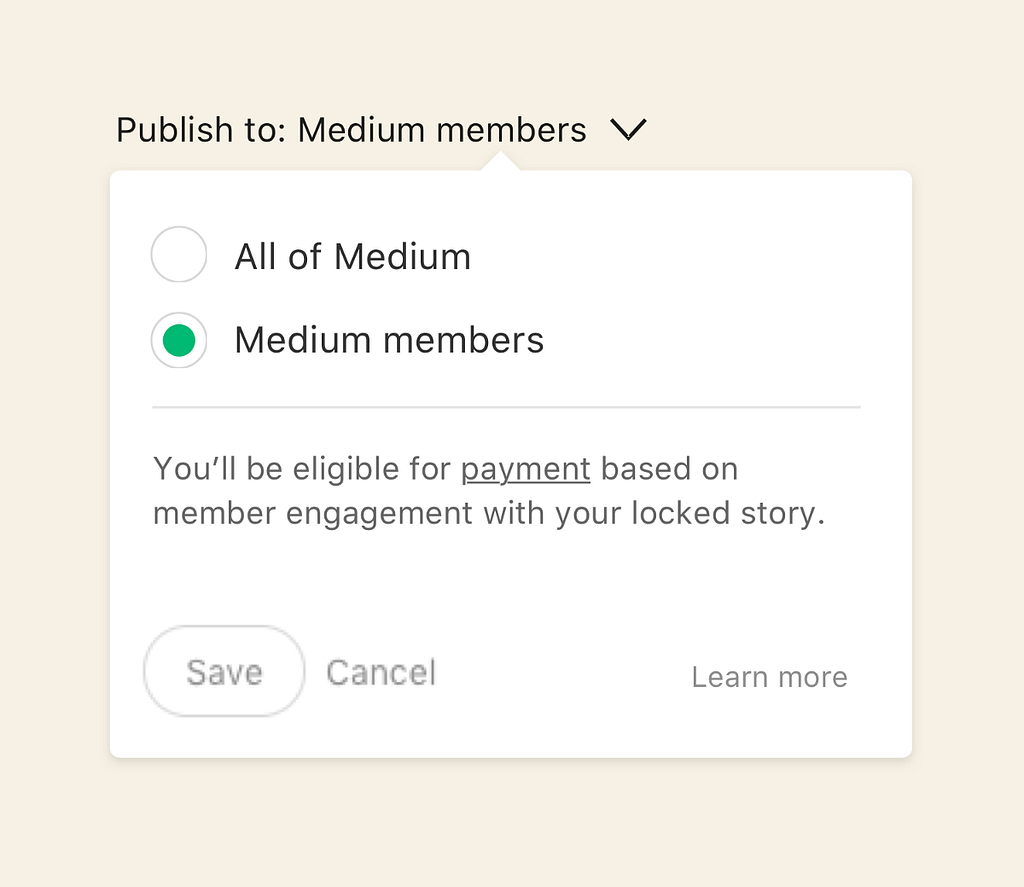
And then there is the question of what to publish to all Medium, or to just the paying members. Like this post, for example. Yes, I’d like as many as possible to see it, but I’d appreciate getting paid for it, too. In this case, I decided that only Medium members care enough about these issues to read something like this, so, I clicked the ‘Medium members’ option.
On a typical day at the Scarborough Cycles bike hubs, brakes get tightened, tires get pumped, chains get oiled and hands get a little bit dirty. Youth learn bike repair skills while volunteering their way to bike ownership through the Earn Your Bike program, and newcomers are mentored on safe places to ride in the city. The day often ends with a community bike ride exploring local neighbourhood streets.
At first glance, these activities may not appear to be closely linked to both community and residential health, however health is a key motivator and a strategic priority for Access Alliance Multicultural Health and Community Services, one of the bike hub host agencies (the other is Birchmount Bluffs Neighbourhood Centre).
Recent research has revealed significant health benefits of regular physical activity, and cycling in particular. A UK study of over 250,000 adults found that people who cycle to work have a 41% lower risk of death from any cause, including cardiovascular disease and cancer. The health benefits were higher than for people who walk to work because the activity is more prolonged. They were also higher than for people who go to the gym, because the exercise is built into daily life and requires less self-motivation.
In the U.S., studies have found that those who have an active commute are half as likely to be obese, whereas every additional hour spent in a car is associated with a 6% increase in obesity. Furthermore, a Canadian study calculated that physical inactivity alone is directly associated with $1.6 billion in annual health care costs.
We know already that health challenges are not evenly distributed across the city. For example, neighbourhoods in Toronto’s outer wards tend to have higher rates of diabetes. Not coincidentally, these neighbourhoods also have less cycling infrastructure. Of the 11 city wards without on-street bike lanes, five are located in Scarborough. Moreover, in all of Scarborough, there is only one bike shop where people can have their bikes serviced.
Scarborough Cycles’ two bike hubs are a step towards addressing these gaps. Led by TCAT and funded by the Metcalf Foundation, this project provides low-cost access to bike repair services, workshops, and other on/off-bike programming. These activities remove barriers and enable residents to ride their bikes for everyday local trips. By showing residents safe routes around the city, we are introducing a new form of transportation to them that is healthy, economical and reliable, and ultimately helps facilitate fair opportunities to access important community support services.
As we work to build bike culture beyond the downtown, we are also growing community health and well-being in quite frankly, a fun and practical way.
In celebration of Health and Wellness Week, Scarborough Cycles will be hosting a community bike ride to scenic Rosetta McClain Gardens on Saturday, Oct 21, 2017. Departure is at 11:15 am from 3079 Danforth Ave, at the AccessPoint on Danforth Bike Hub.
Yvonne Verlinden is the Scarborough Cycles Project Coordinator at the Toronto Centre for Active Transportation.
That’s how Don Luxton, the heritage consultant for the Burrard Bridge project, characterizes the results. And as both a heritage activist and professional consultant on over 30 years of projects, he has earned his perspective.
Don was brought in as part of the team with Associated Engineering, the lead consultants for the bridge project. But he emphasizes that everyone, from city engineers to civic leaders and advisers, were determined to bring back a deteriorating piece of infrastructure to its former glory.
“From day one,” says Don, “we looked at it as a heritage conservation project. Every intervention was assessed against heritage standards and guidelines for engineering works.”
Burrard Bridge wasn’t ‘value engineered’ to death. When resources were needed, money was found – and people have noticed. “Almost unanimously, Vancouverites tell me that it has turned out better than they expected, “says Don. “It feels more civilized, more European. Pedestrians in particular no longer feel shoved to one side of a highway bridge.”
“From an engineering, traffic safety, functionality, heritage, aesthetic and civic perspective, I’d give it an A plus. It has achieved everything and more than we expected.”
This week, we’ll explore the heritage aspects of the Burrard Bridge with Don – and how the project has raised the bar for every subsequent intervention.
A few weeks ago, Snap CEO Evan Spiegel bragged that the company had sold 150,000 pairs of its “spectacles,” sunglasses that are able to take 10-second video clips and post them online. Spiegel claimed to be satisfied with the first iteration’s sales of around 150,000 pairs. What he didn’t mention was that there are reportedly a lot more unsold Snap specs.
That news comes from The Information, which credits “two people close to the company” with the information that there are hundreds of thousands more pairs of the $130 sunglasses hanging out in warehouses, either fully assembled or ready to be. The unassembled glasses could maybe be partially re-used in a future product.
Spiegel compared the 150,000 sales figure with the first version of the iPod, which had relatively slow sales, but was an early version of a product that sold hundreds of thousands of units. He claimed that the sales goal was 100,000 units, so what’s with the extras that are purportedly stashed in warehouses?
Snap has stated plans to sell more products in the future, with hardware becoming a major part of its business in the next decade or so. Yet the company has laid off people working in the hardware division, and The Information reports that the company has been gently encouraging other engineers in the hardware department to start looking for other work.
Consumerist has asked Snap to comment on this report, and will update this post if we hear back.
It’s been less than a month since the Pixel 2 was announced, but already a rumour has emerged regarding potential code names for the Pixel 3.
Droidlife, which revealed several of Google’s products before the recent October 4th hardware event, states a ‘trusted source’ believes one of the 2018 Pixels is named ‘crosshatch’ — presumably after the crosshatch triggerfish — and that the company may also be working on devices nicknamed ‘albacore’ and ‘Blueline.’
The source also tells Droidlife that Google may end up referring to the purported trio of devices as ‘A,”B’ and ‘C,’ in order to attempt to further hide their identity, and that two of the devices will be ‘premium’ while the third will be ‘high end.’
Droidlife has no further explanation of what differentiates the devices, but it could be that Google plans to replicate Apple’s current generation of devices, which features two iPhone 8s and one iPhone X.
Additionally, it’s important to note that there were originally three code names floating around referencing the 2017 Pixels — ‘Muskie,’ ‘Walleye’ and ‘Taimen’ — but only Taimen and walleye made it to market.
Meanwhile, it hasn’t spotted ‘Blueline’ or ‘Albacore,’ but has spotted ‘Wahoo,’ another obscure fish, in the same comment — though sources tell Droidlife it may be a leftover from the 2017 devices group that won’t make it to market in 2018.
Update 24/10/17:XDA Developers has provided an answer to the ‘Wahoo’ mystery, stating that it is not, in fact, a reference to a Pixel device or a leftover from the 2017 devices group — it’s a “reference to the unified kernel for the Pixel 2 and Pixel 2 XL.”
Apple fans, tech enthusiasts and everyone in-between will be able to pre-order the new iPhone X on October 27th, 2017, at 12:01am PDT.
Customers can submit their orders through the Apple website or the Apple Store app.
The iPhone X launches on November 3rd, 2017. While analysts have anticipated that stock won’t be able to immediately meet demand, the company has clarified that stores will carry the new iPhone for walk-in customers.
Canada is the second largest country in the world and can take up to several days to travel across. Because of its considerable size, many Canadians will never have the opportunity to check out all of our expansive country.
With the help of Google Street View, Canadians, as well as anyone interested around the world, can now get glimpse of the most northern reaches of the country.
Google Street View has mapped out Quttinirpaaq National Park. With the coordinates 81.4672° N, 72.1091° W. Quittinirpaaq (pronounced ‘koo-tin-ir-pa-ak) which is Inuktitut for ‘top of the world,’ is the most northern point of Canada and is located at the tip of Ellesmere Island in Nunvaut. Quittinirpaaq National Park is also the second largest park in the country and is the furthest north anyone can use Google Street View.
Due to its location, Quttinirpaaq only sees about 50 guests a year.
With the help of Parks Canada, Google was able to map out the vast mountainous region of Quittinirpaaq. While in some areas, Google uses a vehicle to drive around with a 360-degree camera to get Street View, due to the lack of roads, Parks Canada staff hiked the park with what Google calls a ‘Trekker bagpack,’ which carries a 40 lbs 360-degree camera. The images taken are then sown together by Google’s Street View staff so that they can be used for online.
The trekkers took about the whole month of July in 2016 to capture enough images for Google Street View. Because of Quttinirpaaq’s location, visitors can only travel to the park from the end of May to late August — though polar explorers come to the view the park in April. The rest of the year Quttinirpaaq is in darkness and gets very cold; it’s already reaching a low of negative 22-degree Celsius and is expecting to get even colder in the coming weeks.
Also due to Quittinirpaaq’s positioning, the park lacks vegetation but features a wide range of mountains, some that appear round at their peaks, while others are rugged. The mountains can rise up to 500-600 feet in altitude above sea level, and can be various colours because of the variety of minerals present in the region.
There are also glaciers, like the Gull Glacier, and a diversification of animals, such as arctic hares, arctic foxes, arctic wolves and muskoxen, according to Emma Upton, Quttinirpaaq National Park manager. At the eastern shore of the park, visitors have also reported seeing narwhals, though Quttinirpaaq National Park isn’t typically known for whale watching.
Quttinirpaaq National Park is also home to archaeological sites that can be viewed with Google Street View. At the archaeological sites — which date back to 5,000 year ago — archaeologists have found rocks used to weigh down circular tent structures, which belong to nomadic Paleo-Eskimos, as well as mounds of rocks four to five feet tall used to hold down ancient food caches. The rocks were to keep the food cold and to keep other animals out.
Quttinirpaaq is also the closest anyone get to the North Pole by flight — planes will fly over but not land at the Pole. From the most northern tip of the Quttinirpaaq National Park, called Ward Hunt Island, the North Pole is only 800 km away. The distance is near enough that many have skied, dog sled and snowmobiled to the North Pole. Upton also recalls a time when a visitor attempted to travel to the North Pole via horse but, “failed miserably.”
“Google Street View is constantly trying to expand to reflect Canada in a digital area,” according to Google representative, Alexandra Klein. While Google Street View isn’t available at all of the National Parks in Canada, Klein says that a large portion of the maps have been collected, “we are really proud of what we have been able to do so far.”
While wild life at the Quttinirpaaq National Park hasn’t been viewed with Google Street View, Street View did catch a glimpse of Polar Bears in Churchill Manitoba.
As we've seen with the release of iOS 11, the emerging market of shelf apps for iPad has proven to be a fun playground for developers to figure out how to enhance the system's drag and drop experience. We've published two stories on our favorite shelf apps released so far (here and here), and I'm keeping an eye on new developments every week. One of the most recent updates is Workshelf 1.1, which has gained a new icon and refreshed interface (thankfully, the original blue background is gone) as well as welcome tweaks to in-app previews and shelf management.
Workshelf, developed by Ross Kimes, is one of the more power user-oriented shelf apps thanks to its support for multiple shelves and raw file representations. In version 1.1, Workshelf can import documents from the Files app, it comes with new sorting options, and it lets you open URLs from an item's detail page. This feature remains one of my favorite touches of Workshelf: in addition to viewing all the "flavors" of an item dropped in the app (such as a link and an image for a JPEG dragged from Safari), you can also tap & hold a specific file representation to drag it out of Workshelf.
I've been using Gladys on my iPad for the past few weeks (another shelf app that offers a variety of advanced features, plus a Files provider extension), but I'm going to give Workshelf another try.
Since we last posted about the Polyvalent, there have been a few tweaks to the frame and fork toolings - all of which allows for better geometry, handling, and clearances. Going forward, the hardest part is choosing the frame color.
The rear chainstays now have elegant S-bends to engulf big rubber and fenders. The dimpling allows the use of low-Q cranks like our 50.4 (149mm of tread) without the need for bottom bracket spacers. Though the frame is designed around a 650b tire, it clears a 26 x 2.3" tire with ease. 26 x 2.25 knobbies are no problem for those wanting to go the route untraveled.
Previous models had a 31.8mm top tube to provide extra support and stiffness for loads which made the ride a wee bit harsh. For this iteration, we've ovalized the top tube for stiffness and compliance in all the right places. Additionally, shouldering the bike up stairs or over obstacles is not uncomfortable. I don't bring a clipboard and stopwatch with me on rides but the ol' butt-dyno says it climbs nicely with a load in the front or rear, and equally well unburdened.
The fork is a completely custom, segmented design that allows us to create the ride characteristics we want without sacrificing the strength or durability the inclusion of disc brakes requires. The result is a comfortable ride, utility in droves, and an exceptional presentation from all angles.
The blades have a circular profile and are double-butted. There are triple braze-ons with diamond reinforcements with the lowest one doubling as a low-rider rack mount. There is also a forward facing hourglass eyelet to which the Randonneur or Campeur Racks mount. The dropouts have a single brazed-on eyelet underneath for fender mounting and an hourglass eyelet on top for a rack.
I can't think of a better way to blend traditional and contemporary design and styling than this 51cm Randonneur.
The paintjob has a light, red metallic flake clearcoat over a white pearlescent paint. From afar, the bike looks white, but upon close inspection the mingling of pearl and red flakes makes a lustrous depth to the paint.
I really like the design of these new decals. They have an outline of VeloORANGE, rather than our regular filled-in variant, so the paint shows through. What do you think?
We have also been teasing a drop handlebar with moderate flair, an ovalized top section, slight backsweep, and 31.8mm clamp diameter we're calling the Nouveau Rando Handlebar. It has instantly become a favorite of mine and will go into production soon.
This 54cm Polyvalent in Porteur mode has a Deep Metallic Emerald Green paintjob. It does a fantastic job of making all of the braze-ons and details pop while still keeping composure.
I really like the component combination on this one - Suntour Sprint rear derailleur, FSA circa 2007 front derailleur, Drillium Crankset, and Falcon Thumbies to make it all work.
This bike is also sporting a proto handlebar: the Curvy One Bar. It's a handlebar which looks right on just about any build. It's great for city and touring bikes, and it's mountain rated for offroad roughing.
We'll also have a Curvy Too bar that has a bit of rise and backsweep for a more upright position.
Both of these bikes will be on display at the upcoming Philly Bike Expo, so be sure to mark your calendars.
If you haven't, sign up for our Bulletin. We'll never spam - we simply send an email once every few weeks or so with general VO goings-on: http://eepurl.com/cRu4cD
I’d like to address some of the concerns from our Lightroom community after yesterday’s announcements. If you have any additional questions or concerns, please add them to the comments section below.
Regards,
Tom
How does this update affect my old Photography/Creative Cloud Plan?
TH: Within the Creative Cloud Photography plan we’ve updated the Lightroom you know and love to include performance and editing enhancements in a new version called Lightroom Classic. We added new Lightroom CC and a small amount of storage for you to experiment and try out the new cloud-based Lightroom offering. The Creative Cloud Photography plan – Lightroom Classic, Photoshop CC, and now the new Lightroom CC plus Adobe Spark – is still $9.99 per month. There is also a new Lightroom CC plan that is $9.99 per month that does not include Lightroom Classic or Photoshop CC but does include 1TB of cloud storage for your photography library.
Lightroom Classic
Is Lightroom Classic being phased out? How long will it be until Adobe kills Lightroom Classic?
TH: No, we’re not phasing out Lightroom Classic and remain committed to investing in Lightroom Classic in the future. We know that for many of you, Lightroom Classic, is a tool you know and love and so it has an exciting roadmap of improvements well into the future. But please hold us accountable as we make updates in the following months and years to let us know if we’re meeting your expectations.
Lightroom CC
Does everything have to be synced to Lightroom CC or can users pick and choose what content syncs with the cloud?
TH: For this 1.0 release, everything imported is intended to upload to Creative Cloud. We clearly understand that there are situations where a customer would not want all of their images uploaded to Creative Cloud so let’s talk about those situations and how we can address them. In the case where a customer doesn’t want any images in the Creative Cloud, Lightroom Classic is and will continue to be an excellent workflow choice.
Lightroom Tech Questions
Some users have about 8TB worth of photos. How do they fit that into 1TB of space?
TH: We have plans available for 1TB, 2TB, 5TB and 10TB right now at $9.99 per TB per month. Let us know if you want more.
What if you don’t have superfast, unlimited Internet to sync everything? Won’t it likely take days to upload a full shoot of raw files to a cloud server?
TH: Upload times depend on your bandwidth but you can still start working on your images immediately. If your bandwidth is not going to support your current volume of photography, Lightroom Classic is and will continue to be an excellent workflow choice.
Lightroom 6
Why did you abandon the Lightroom standalone version?
TH: Customers are overwhelmingly choosing the Creative Cloud Photography plan as the preferred way to get access to Lightroom. We’re aligning our investment with the direction our customers have signaled over the last several years.
The images were mislabeled as featuring the October patch, but those who flashed the update soon found that it contained only the September patch.
In fact, the build numbers published today are identical to those on non-updated Pixel 2 devices, so it seems the posting may have been a mistake on Google’s part.
Meanwhile, Google’s older Pixel and Nexus devices have already received the October update.
While there might not be a reason to flash the factory images yet, those looking for a guide on how to do so can check out our how-to here.
While Spectacles were once a hot commodity, new reports have emerged indicating the social media giant Snap has “hundreds of thousands” of Spectacles sitting and collecting dust in Chinese warehouses.
The report, which originally stemmed from the often-reliable The Information, comes following Snap CEO Evan Spiegel boasting about Spectacles sales topping 150,000 just a few weeks ago. Originally, Spectacles were initially set to be a limited-time item, with the smart glasses only being available at guerrilla marketing style pop-up shops in the United States.
Spectacles recently made their way to Canada through Snap’s online store, though the demand for the glasses has certainly curbed significantly in the last few months.
For example, I have a pair of Spectacles sitting in my closet that I haven’t touched in months. While they worked well the few times I tried them, I’m just not very active on Snapchat. Perhaps if Spectacles’ 360-videos were also compatible with Instagram — I know they sort of are — I would be more included to take them out occasionally.

 The Samsung Galaxy S8 and Galaxy Note 8 are multimedia and imaging powerhouses. The 12MP f/1.7 shooter at the rear of both devices offers great performance in varying lighting conditions and also has a few tips up its sleeve for a richer experience. This includes being able to shoot videos in slow-motion which can be great to capture some high-intensity sports or action scenes.


























 Price Tags.


 Consumerist.