Shared posts

23 Oct 23:28

Apollo: A Powerful, Modern Reddit Client for iOS

by Ryan Christoffel

Reddit is one of those spaces on the Internet that I’ve historically stayed mostly away from. Due to my role at MacStories, however, and a thriving Apple subreddit, I’ve been there more in the past year than all prior years combined. During that time I’ve tried all the best iOS Reddit clients in an attempt to find one that’s right for me. For one reason or another, none have stuck; today, however, that changes, with the release of Apollo.

Design

Apollo was created by a former Apple employee, Christian Selig, which explains why the app feels like it could have been an Apple invention. Design trends from iOS are found all over the app, from its clean, simple look highlighted by accent colors to its tab-based navigation bar, pervasive use of swipe gestures, and more. These iOS conventions pair with a browsing interface that looks and feels like a social app – if you’ve scrolled Instagram or Twitter before, you won’t have any trouble here. The thoughtful use of these tried and true designs makes Apollo instantly familiar, and thus accessible to any iOS user.

The app is divided into five main sections, with the primary being Posts, where all Reddit browsing is done. Posts contains all subreddits you’re subscribed to, with those you’ve marked as favorites near the top, alongside options to view posts from other parts of Reddit like the top trending posts. While scrolling through a subreddit, you can use buttons or swipe gestures to interact with posts with ease. 3D Touch enables peeking into posts; if you want to view more, you can pop the post into place, whereas releasing and going back to browsing will mark that post as read – a helpful touch.

Apollo is an extremely fast app, with animations, scrolling, media, and more feeling instantaneous. But besides its quick responsiveness, one way the app improves your browsing experience is with a feature called the Jump Bar. Tapping the title of your current subreddit in the title bar enables quickly typing the name of another subreddit to visit, or, my favorite approach, choosing from the list of subreddit favorites that automatically appear on-screen. It’s a small thing, but it’s one of those tiny features that makes a big difference in your overall experience.

Outside of Posts, Apollo’s four other main tabs are Inbox, which houses your private messages, then a tab housing your account’s activity – posts, comments, saved posts, upvotes, and more; you can also switch accounts from here. The final two tabs are Search and Settings.

Customization

Part of what makes Apollo feel like a complete package is its assortment of customization options, accessed from the Settings tab. Reddit power users will appreciate the depth of flexibility here. There are a variety of tweaks you can make to the app’s behavior in areas like posts and comments, plus extensive appearance options – there are beautiful light and dark themes, which can be switched between anywhere in the app by long-pressing the navigation bar; while I adore the standard app icon, Apollo also includes lots of excellent alternatives; subreddits can be viewed with large content previews or in a compact list; the developer also plans to add custom font options soon.

Two other areas of customization are particularly important: Filters and Gestures. The Filters screen lets you set filtered keywords so that any posts containing those words will be excluded from the app; you can also exclude certain subreddits from the All Posts feed, and block users. In the Gestures screen you can custom tailor swipe gestures in five different areas of the app: posts, comments, inbox, profile posts, and profile comments. Each of these sections can be assigned different actions for left and right short and long swipes, making a grand total of twenty different settings you can tweak.

Miscellany

Markdown: Markdown is Apollo’s chosen text flavor when composing replies, posts, or private messages. Even if you’re unfamiliar with the common syntax, shortcuts above the keyboard make it easy to bold, italicize, or add a link without any Markdown knowledge at all.

iPad: Apollo not only includes iPad support, but it looks great even on the 12.9” iPad Pro and offers support for Split View. The only drawback is that app-specific settings don’t appear to sync between devices currently, so you'll need to set them on each device you use.

GIFs: What would a Reddit client be without GIF support? Apollo offers a fun GIF scrubbing feature, so you can scrub back and forth through a GIF’s animation.


At the start of this review I mentioned my relative lack of history with Reddit because, on one hand, it may not make me Apollo’s target user. The app was built by and for Redditors, with all sorts of customization features meant to please that base. However, whether the app’s developer meant it or not, I believe Apollo is also the right app for someone like me: a casual Reddit user who’s interested in becoming more than that. Every detail of the app has been carefully designed and thought through, with countless special touches and an interface that feels right at home on iOS 11.

Apollo makes the wild world of Reddit more accessible than ever before, and it may just be the best designed social feed app I've ever used.

Apollo is available on the App Store as a free download, with an optional In-App Purchase to unlock all features.


Support MacStories Directly

Club MacStories offers exclusive access to extra MacStories content, delivered every week; it's also a way to support us directly.

Club MacStories will help you discover the best apps for your devices and get the most out of your iPhone, iPad, and Mac. Plus, it's made in Italy.

Join Now

23 Oct 23:28

How Money Became the Measure of Everything

files/images/lead_960.1.png

Eli Cook, The Atlantic, Oct 26, 2017


Icon

This story documents the conversion of the social order from one based on people to one based on money (and especially the accumulation of masses of money). It's not something that just happened; it is the result of years of media pressure. "Yale economist Irving Fisher... arguing for why people needed to be treated as 'money-making machines,' ... explained how 'newspapers showed a strong aversion to the harrowing side of the tuberculosis campaign but were always ready to ‘sit up and take notice’ when the cost of tuberculosis in dollars and cents was mentioned.'" The conversion happened around 1850, concordant with the rise of capitalism. Prior to this conversion society valued "a collection of social indicators known then as 'moral statistics,' which quantified such phenomena as prostitution, incarceration, literacy, crime, education, insanity, pauperism, life expectancy, and disease."

[Link] [Comment]
23 Oct 23:28

Gaming the system

files/images/SatanismForKids.JPG

Brian Koerber, Mashable, Oct 26, 2017


Icon

I love YouTube but what I don't love are advertisements on YouTibe. That's because they convert the platform from being about user-generated content to commercial publication scams designed to game the system - or worse. This time I'm afraid it's worse. The starting point is this article on Mashable and describes cases where "you press play and at first your screen fills with recognizable cartoon characters and cheesy music — but things take a drastic turn when Elsa and Spider-Man arm themselves with automatic weapons." It's actually a lot worse than that. I watched a number of the videos from this channel (which also appears on YouTube for Kids) and found numerous violent and disturbing images. This is not amateur content; it is commercially produced and makes liberal use of things like superhero icons and Disney princesses. This is what happens when social media is converted into mass consumption: the abuse soon follows.

[Link] [Comment]
23 Oct 23:28

Where the Streets Have No Numbers

by David A. Banks

In the 1990s, Richard Florida was just another professor. He taught classes at Carnegie Mellon University and edited management textbooks with titles like Locating Global Advantage and Industrializing Knowledge. He rose from that academic obscurity to international fame in the early 2000s through his book Rise of the Creative Class, which told mayors from Marseille to Memphis a beautiful lie: Your cities are one pork-pie-hat-wearing pickle vendor at an indie-music festival away from economic success. Florida proposed flipping economic development on its head by saying that employers follow their middle-income creative professionals, not the other way around. Make some nominal investments in cultural amenities instead of raising taxes, he argued, and you’ll eventually reap the rewards of an expanding tax base anchored by the “creative class” professionals that you lured in with your pickles.

Other scholars and theorists were not so sanguine. Economist Jamie Peck, in a 2005 International Journal of Urban and Regional Research article “Struggling With the Creative Class,” did not mince words: Florida’s prescriptions amounted to nothing more than “Biscotti and circuses” and was a framework for “crass celebrations of hipster embourgeoisement.” Conservative writers like Steven Malanga of the Manhattan Institute found it a bit too convenient that economic development was only possible through enticing progressive bohemian types into your city through “big government” spending programs on cultural amenities.

Richard Florida embodies a new sort of urban thinker who finally recognizes the basic problem — getting the most people to live in comfort and dignity — but is continually confounded by capitalist land markets

Florida himself has since backpedaled on many of these claims. His latest work, The New Urban Crisis, is a mea culpa of sorts, a career-spanning apologia similar in scope to Hillary Clinton’s What Happened, another work by a prominent liberal technocrat desperately trying to explain a world that their political failings helped create and that has largely cast them aside.

The parallels between Clinton’s and Florida’s books are striking: Each was overconfident in their computer models and ignored contrary evidence. They failed to understand the Rust Belt, seeing only rejuvenating progressive cities like Madison, Wisconsin or Hudson, New York and missing the deeply seated white resentment that also flourished alongside them. To Florida’s credit, he eschews finger pointing and contritely admits how sorely he had missed the mark. He had, in his own words, “been overly optimistic to believe that cities and the creative class could, by themselves, bring forth a better and more inclusive kind of urbanism.”

Buried in the acknowledgements of The New Urban Crisis is a surprisingly earnest account of the book’s origins. The scene is the Crosby Hotel lounge in New York City in the summer of 2013. Florida meets his publisher and, in midst of describing a book about the “re-urbanizing trend,” that looked to be spurring massive inequalities, the publisher tells him, “What you’re talking about is a new urban crisis. Write that book.”

Florida did, admitting that it required him to “retool” himself in order to sufficiently explain the emerging trends he was witnessing. Florida says that over the years since his popular breakthrough, he looked on in surprise and terror as his prescriptions quickly gave “rise to rampant gentrification and unaffordability, driving deep wedges between affluent newcomers and struggling longtime residents.” While he is humble enough to concede that he was too bullish on the trickle-down opportunities of the information economy, he is also adamant that he was the first to raise the alarm, going so far as to claim that “well before Occupy Wall Street … or Thomas Piketty’s Capital in the Twenty-First Century opened our eyes to global inequality, I warned that America’s leading creative cities were also the epicenters of economic inequality.”

His account of the “new urban crisis” reflects those warnings. The crisis has five dimensions in Florida’s view, but these can be boiled down to this: Wealth and the means of economic growth are owned by a small elite that have created fiefdoms in the world’s largest cities. Smaller cities face brain drain as creative types flock to these centralized cores of wealth. As large cities become playgrounds for the wealthy, everyone else is pushed to the suburban fringe, creating massive inequalities within large cities and increasing the percentage of poor people on the fringes. This trend is even worse in poorer nations, where cities seem to be losing their ability to give rural poor the opportunity to achieve a middle class urban life the way they did in decades past. This is perhaps where Florida gets the most radical which makes the only chapter that substantially discusses non-Western cities, feel that much more tacked-on. Essentially, “urbanization has ceased to be a reliable engine of progress” because free-trade markets have concentrated agriculture and manufacturing to such a degree that most cities do not offer those jobs as an option for recent immigrants.

But Florida’s “retooling” is hardly a groundbreaking innovation in the urban planning field. The profession has always been based on such warnings. Florida would not have a job if not for the dozens, if not hundreds of people before him who had made such warnings in the past. The field was founded by anarchists and socialists like Ebenezer Howard and Patrick Geddes looking for a means to sustain communities outside of mercantilist and capitalist systems of production and distribution. Florida embodies a new sort of urban thinker that finally recognizes the basic problem the profession sought to solve — getting the most amount of people to live in comfort and dignity — but is continually confounded by capitalist land markets that counter-afford these aspirations.

Such is the frustration of the prodigal son who returns to the critical tradition. In an interview with Jacobin’s Erin Schell, Florida wastes no time laying out his Marxist credentials by recounting his college years at Rutgers: “I read all of Marx, I read all of Schumpeter, I took classes in Hegel and Marx, and the Frankfurt School, and what I came to understand is that the biggest problem we confront intellectually is how capitalism changes.” Perhaps Florida’s transformation is less of a “retooling” as he says and more of a remembering. Or a rebranding. But you would be forgiven for not seeing Florida’s Marxist roots in his earlier books; rather than delineating the various contradictions of capital, he was busy touting a “bohemian index” and charting the ratio of gay couples to straight ones in an attempt to divine what sorts of subcultures are favored by entrepreneurs and capitalists.

And this tendency continues in his new book. Florida — like Clinton — refuses to break out of the overarching frames that put him (and the municipalities that adopted his prescriptions) on the track to the new crisis. The book devotes its charts to different flavors of segregation, inequality, and housing unaffordability, all of which culminate in a New Urban Crisis Index that is used to rank 359 metropolitan regions. This mirrors the all-encompassing indexes he always uses, like the “Global Creativity Index” or the “Innovation Index” of his previous books. His retooling evidently doesn’t encompass methodology any more than it does ideology.

The New Urban Crisis can be read two ways: It is a compendium of important and sobering facts about 21st century cities, but it is also a look at a would-be liberal-technocratic government in exile. Florida reveals in the conclusion that he had written most of the book envisioning “a new Democratic administration that would undertake the deep and sustained investments” in cities. He had “developed a detailed proposal for a new Council of Cities, comparable to the National Security Council,” and had crafted a political strategy that would foster “a new partnership between national government and the cities in which federal investments would flow.” In this alternate reality, rather than Ben Carson, we would have HUD Director Richard Florida, who would be arguing for “transforming and expanding the Department of Housing and Urban Development into a broader Department of Cities and Urban Development.” It is easy to imagine his book’s array of interlocking indexes of inequality and segregation acting as the centerpiece to this strategy of technocratic control.

Florida’s tactic to connect cities’ mayors directly to the federal government would have been a wise effort to entrench liberal power for the long term. The mayoralties of large cities are the last category of big-ticket political contests that progressives regularly win. There are currently 34 Republican state governors and 32 Republican-controlled state legislatures, many of which show no sign of flipping. Superseding state governments by working with and funding cities directly would have established a means of sidelining conservative power centers.

But though the tactics are politically sound, the policies are questionable. While Florida’s past prescriptions of turning downtowns into adult playgrounds were indeed partly to blame for cities’ present inequalities, his latest work perpetuates a much more fundamental error endemic to liberals’ approaches to solving social issues: the belief that measurements and rankings can be used to effectively administer means-tested redistribution programs. Though his faith in lattes and film festivals has been shaken, he still believes in the essential benefit of regulating a capitalist marketplace through a patchwork of conditional, means-tested programs like a universal right to housing or a campaign for collectively owned property through land banks or co-ops. Nowhere in The New Urban Crisis do we get a universal program that is up to the task of eliminating the problems he has so dutifully measured.


In Simulacra and Simulation, Jean Baudrillard warned that “Disneyland is presented as imaginary in order to make us believe that the rest is real.” Donald Trump’s presidency threatens to have a similar effect. The liberal commentariat constantly refer to “alternate realities” and departures from custom, implicitly casting a nostalgic glow over the political program that centrist Democrats wielded the last two times they held the presidency. That program was anchored in the idea that capitalist markets nestled in the protection of liberal democracies was the last, best political economy. Every new social problem could be solved with tinkering around the edges. It is this notion that governing is about fine tuning a working economic engine — a supplemental program here, a tax rebate there — rather than designing brand new programs, that is liberals’ fundamental error. Social programs are protected by constituencies, and those constituencies get divided up into less effectual subgroups whenever a program is divided into smaller pieces based on income or some other factor. A universal program, like Social Security, however, can draw on a broad base of support for its perpetuation.

Programs like CHIP introduce leverage points that can identify those in need but can also single people out for control. Florida’s approach too depends on subdividing populations

The Children’s Health Insurance Program (CHIP) is a sad but illustrative example of the failures of patchwork, means-tested programs. Created by the Clinton administration in 1997 to bridge the gap between families that make too much to qualify for Medicaid but are still unable to acquire private insurance, Congress recently let the funding for CHIP lapse. A universal health insurance program would of course obviate the need for such provisional funding, would result in less paperwork, and is even estimated to be cheaper to run. Experts in the field note that a public single-payer system would have a sixth the overhead of private insurance and achieve important economies of scale. The same is true for education. Jordan Weissmann at the Atlantic estimated that it would cost less to pay the tuition of every college student than to maintain the current tapestry of federal higher education grant and loan programs, 25 percent of which goes to private, for-profit universities.

According to Michel Foucault’s theory of “biopolitics,” Western governments began from the 18th century on to view human beings as subject to social control via the relatively new powers of scientific analysis. Such analysis “breaks down individuals, places, time, movements, actions and operations. It breaks them down into components such that they can be seen, on the one hand, and modified on the other.” Programs like CHIP are biopolitics in action, coupling the public service it provides with a means of redefining and modifying the populations it serves. They introduce leverage points that can identify those in need but can also single people out for control. CHIP divides populations into categories based on their distance from the poverty line, which means they can be “seen” and “modified” differently. Poor people can be required to go through expensive and time-consuming application processes to receive the same goods and services that the rich receive with the tap of a phone screen.

Florida’s approach too depends on subdividing populations with statistical categorization, making some more vulnerable than others to various means of oppressive social control. His favorite means of labeling places and people is the index, a way of boiling down complex changes for particular groups into a single number that can be given a standard. Hence, the whole middle of the book is really explaining why the information contained in the dozen or so indexes are important, but also very difficult to solve. His seven different segregation indexes and six composite indexes distill vastly different entities into a handful of universalizing data sets, making the issue appear that much easier to manage from atop a bureaucratic hierarchy.

Florida’s earlier incarnation as creative class soothsayer was largely devoted to creating indexes and rankings for cities to compete over and gloat about. A crucial part of Creative Class’s success was the “Creativity Index,” which ranked cities based on their ostensible coolness. San Francisco and Austin could boast that they were objectively cool — the index said so — while midsize cities could pay Florida five figures to tell them how they could inch their way up on his regularly updated charts. A few academics, including Jamie Peck, objected to the idea of the same person making a list and insisting on its importance also charging exorbitant fees to learn how to move up on it. But few civic leaders seemed to mind.

If Florida’s creativity index was able to drive some cities to look past fiscal solvency to coolness, it makes a kind of sense to believe that his new inequality indexes could similarly drive attention to reforms that could address them. After all, who would want to top the list of “Overall Occupational Segregation”? (The San Jose/Sunnyvale/Santa Clara metropolitan region holds that title, in case you were wondering.)

The problem is that for such a name-and-shame strategy to work, media producers and civic leaders need to care about inequality in the first place. “We’ve known for over 50 years,” Victor Stretcher, professor of Public Health at the University of Michigan, told New York magazine, “that providing information alone to people does not change their behavior.” But even if inequality could be made a scarlet letter, all major metropolitan regions would end up marked by it. This puts most civic leaders in a mutual-self-destruction scenario where no one has an incentive to talk about their rankings on indexes charting negative qualities. Ranked index values are only as useful as the attention they get. Florida masterfully used attention when he peddled his creative class thesis, but when it comes to hard truths, eyeballs may be harder to find. Few business improvement districts are clamoring to put together a media package to send to CNBC or Business Insider about their egregious housing segregation. Unlike the Creativity Index, which had built-in incentives for media attention, the New Urban Crisis Index is fated to be ignored by those who might use it to help fix things.

That’s not to say that measuring and reporting on poverty is inherently bad or that no one ever pays attention to discomfiting news. What recent history has taught us, though, is that attention is an angry dog, and if you can’t make it do your bidding, it will bite you. When it comes to tracking and reporting on poverty, framing can mean the difference between starting a progressive movement for ending poverty or inciting a racist reactionary backlash.

Unlike the Creativity Index, which had built-in incentives for media attention, the New Urban Crisis Index is fated to be ignored by those who might use it to help fix things

Framing inequality as a social problem that has a unique impact on diverse urban communities instantly fuels a well-worn story that pits rural conservative voters (and their entrenched electoral advantages) against more progressive urbanites. A national social project explicitly meant to help cities is a nonstarter, given the gerrymandering and electoral college system that has produced the current political situation in the U.S. “Nothing remotely like what I envisioned and hoped for is likely to happen now with Trump in office,” laments Florida. His proposed half-measure is to “help cities get the increased control they need to build their own economies and address the challenges of the New Urban Crisis.” Even if this weren’t so vague as to be meaningless, it would still abandon everyone in the suburbs and beyond. What is needed are more fundamental changes that eschew new managerial systems and instead builds political power through grassroots campaigning.

This is the essential, critical difference between talking about social programs as fundamental rights (e.g. the right to the city, the right to health care) that deserve mass movements versus an incremental, bureaucratic approach that expands a confusing patchwork of social services. Rather than ask, “what does every American need from their city and how can we get it to them?” Florida’s indexing approach affords prioritizing the places in most need of intervention. It comes from a mindset of allocating scarce resources rather than inspiring a massive redistribution of wealth. Still though, one cannot shake the feeling that Florida sees his approach — means-testing sharpened with a bit of the lefts’ critical edge — as just what the ailing liberal brand needs.


In the 1990s, when the so-called end of history felt closer, capitalism had the power of seeming inescapable. It was treated, by Florida and other liberal technocratic types, as a given reality in need of fine tuning but nothing more.

Today, we live in a new discursive era where even moderate liberals have downgraded capitalism from the inevitable end of history to the subject of a present crisis. When, during a televised town hall, a young audience member asked Nancy Pelosi about socialism, she felt the need to tell the audience that the Democratic Party was a party of capitalists. No such clarification would have seemed necessary 25 years ago.

Capitalism has become an option among many, and the prevailing political order that developed all its policy approaches with the supremacy of markets in mind suddenly seems to have nothing new to offer. For Florida, that means pivoting to the revelation that capitalism has contradictions. But the “central contradiction of contemporary capitalism” according to Florida is not the one Marx saw between collective production and private ownership. Instead it lies in the “clustering force” of cities — how, for example, the film industry and its workforce is clustered in Los Angeles. “Although clustering drives growth, it also increases the competition for limited urban space,” Florida explains. Hence, being the “it” place for an industry simultaneously attracts talent but also repels it with skyrocketing costs of living. It’s such a big problem Florida gave it a fancy name: the urban land nexus.

This isn’t so much a contradiction as it is an indictment of what constitutes “growth” in the first place. Growth, as it is used by urban planners and developers, is largely defined in terms of capitalist accumulation: that is, increases in property values and speculative interest by investors. This isn’t a bug, as Florida sees it, but a feature of capitalism that lets the ownership class amass more wealth while starving the public sector for needed infrastructure funds. Marxist urban sociologists have been making this critique since at least the late 1980s when John Logan and Harvey Molotch published their influential book Urban Fortunes. Florida’s latest book is crammed with neologisms like “urban land nexus” that muddy the water around such critiques. The “patchwork metropolis,” “winner-take-all urbanism,” “new urban Luddism,” and “superstar cities” are not just Florida’s rebranding of old ideas; they rename the problem to make it more amenable to incremental reforms, assessed through indexes and rankings based on his terminology.

The New Urban Crisis, What Happened, and so much of what the deposed centrists believe are really just fan fiction

For example, Florida defines “superstar cities” as regions that “form a league of their own, often sharing more in common with each other than they do with other cities across their own nations.” This resembles the thesis of Saskia Sassen’s 1991 book The Global City, in which she argues that cities like New York, London, and Tokyoconstitute a system rather than merely competing with each other. What contributes to growth in the network of global cities may well not contribute to growth in nations.” “Superstar cities” rebrands global cities as aspirational peers with troubling index ratings, masking the fact that these global cities’ financial interests are actually antagonistic to everyone else’s. Global cities thrive independently of, and sometimes even because of, their home nation’s economic stagnation.

This is part and parcel with another of Florida’s rhetorical strategies: He rarely identifies agents of the “new urban crisis.” There are no enemies, only amorphous and huge economic phenomena that must be wrangled and tamed. Instead of acknowledging that there are people who materially benefit from slums, we get bromides about how “inequality is an ironic and troubling attribute of urban success.” The desire to ignore the antagonism between classes is so strong that it creates weird moments where he cites International Monetary Fund research to back up the already obvious fact that “countries that redistribute more income have lower rates of inequality.” The IMF, in Florida’s world, is just another well-intentioned researcher, not the organization that contributes to global inequality in the first place through its managing of international debt.

There is a lot to learn from Florida’s new book, but they are lessons about the future of politics and discourse, not cities. The main one is about how liberals like Florida will try to crib materialist accounts of capitalist crisis in order to try to render it amenable to incremental reform rather than a more radical reorganization.

Florida owed his previous success, Jamie Peck observed, to “the profound policy vacuum that characterized the neoliberalized urban realm.” He promised economic improvement while circumventing politics. No pension-plan renegotiations, no expensive infrastructure investments, just happy creatives enjoying açai bowls.

Now that the political attention and energy are shifting, Florida has identified a new vacuum: one created by a defeated left-of-center politics. But rather than fill the vacuum with something new, like a uniquely American right to the city movement that would assert residents’ rights to democratic city management and access to basic services, he is counting on his branding prowess to revive the old wonkish tools of indexes and tables. Poor people don’t need to be filed into yet another index though; they need political power.

In The New Urban Crisis and at least three other places (in his Jacobin interview, in his essay “Revenge of the Squelchers,” and in his “Declaration of Urban Independence” published in Politico) by my count, Florida has approvingly said some version of the following: “I can hardly tell whether the mayors and local leaders I meet with are Republicans, Democrats, or independents: Their economic and community development agendas are driven by local needs rather than partisan ideology.” What is so wrong with a book that speaks to these sorts of people? Why should we be skeptical of a clarion call to technocrats? Isn’t it a net positive that someone as well-known as Richard Florida is casting a critical light on an important issue?

The answer to all of these questions lies in the well-known dangers of positivism — that view from nowhere — which claims to have no ideology, only answers. The idea that political problems are really just disagreements about how to solve the same management problem is the toxic fiction that lost to Trump in the first place. The New Urban Crisis, What Happened, and so much of what the deposed centrists believe are really just fan fiction. Love letters to an alternate universe where we slowly eliminated poverty and disease through stepwise changes to market-based policy solutions. It was an approach that inspired few and alienated many. We all operate under one kind of ideology or another, and ideology defines what is perceived as “needs” in the first place. If everyone Richard Florida is talking to thinks the same way, maybe it is time to toss the whole lot of them.

23 Oct 23:28

Why Facebook Shouldn’t Be Allowed to Buy tbh

by Ben Thompson

There was one line in TechCrunch’s report about Facebook’s purchase of social app tbh [sic] that made me raise my eyebrows (emphasis mine):

Facebook announced it’s acquiring positivity-focused polling startup tbh and will allow it to operate somewhat independently with its own brand.

tbh had scored 5 million downloads and 2.5 million daily active users in the past nine weeks with its app that lets people anonymously answer kind-hearted multiple-choice questions about friends who then receive the poll results as compliments. You see questions like “Best to bring to a party?,” “Their perseverance is admirable?” and “Could see becoming a poet?” with your uploaded contacts on the app as answer choices.

tbh has racked up more than 1 billion poll answers since officially launching in limited states in August, mostly from teens and high school students, and spent weeks topping the free app charts. When we profiled tbh last month in the company’s first big interview, co-creator Nikita Bier told us, “If we’re improving the mental health of millions of teens, that’s a success to us.”

Financial terms of the deal weren’t disclosed, but TechCrunch has heard the price paid was less than $100 million and won’t require any regulatory approval. As part of the deal, tbh’s four co-creators — Bier, Erik Hazzard, Kyle Zaragoza and Nicolas Ducdodon — will join Facebook’s Menlo Park headquarters while continuing to grow their app with Facebook’s cash, engineering, anti-spam, moderation and localization resources.

This isn’t quite right. I suspect TechCrunch, and whatever source they “heard” from, is referencing the Hart-Scott-Rodino Antitrust Improvements Act. In order to reduce the burden on the Fair Trade Commission and the Antitrust Division of the Department of Justice, an acquirer only needs to report acquisitions (and wait for a specified time period to give time for review) for which the total value is more than a specified threshold; for 2017, that threshold is $80.8 million. To that end, I wouldn’t be surprised if this deal is worth approximately $80.7 million; that would mean Facebook doesn’t have to submit this acquisition for review.

However, just because Facebook doesn’t have to submit this acquisition for review doesn’t mean it can’t be reviewed; indeed, in a closely-watched case from 2014, the FTC successfully sued to undo a $28 million acquisition that had already been consummated. That was only one of many acquisitions the FTC has investigated that didn’t cross the Hart-Scott-Rodino threshold; in most cases the FTC acted in response to complaints from customers or competitors.

Might an analyst complain as well? The FTC can, and should, investigate this acquisition.

The Social-Communications Map

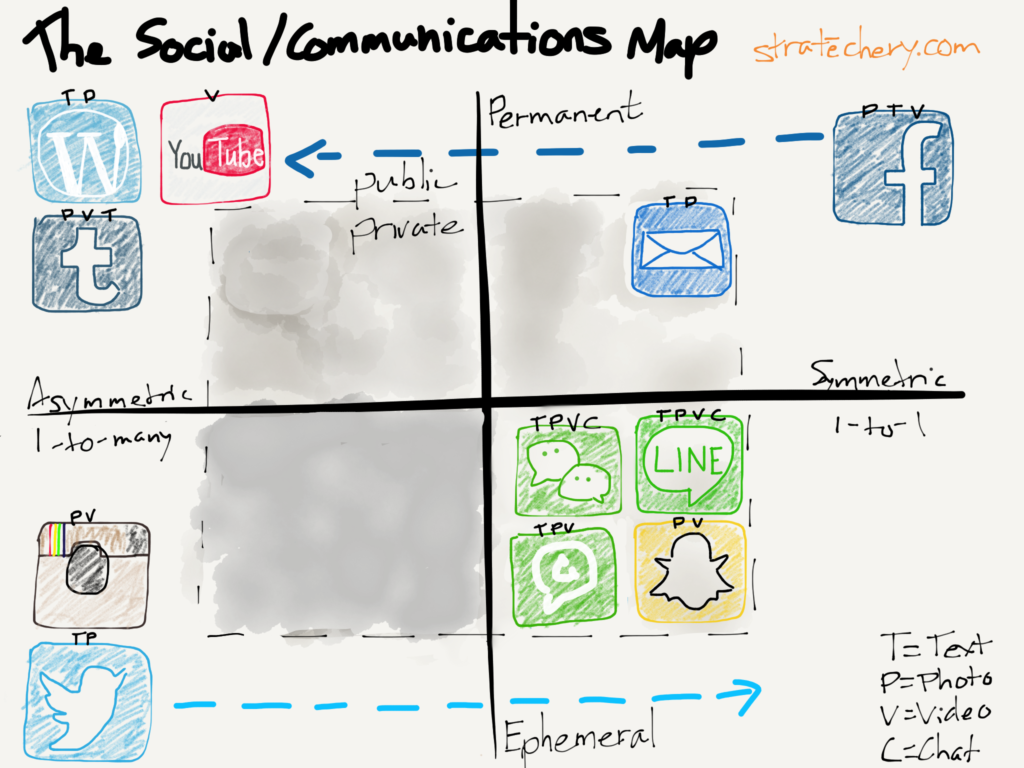
In late 2013, Facebook made their most concerted effort to buy Snapchat (for $3 billion); that was when I made the Social-Communications Map:

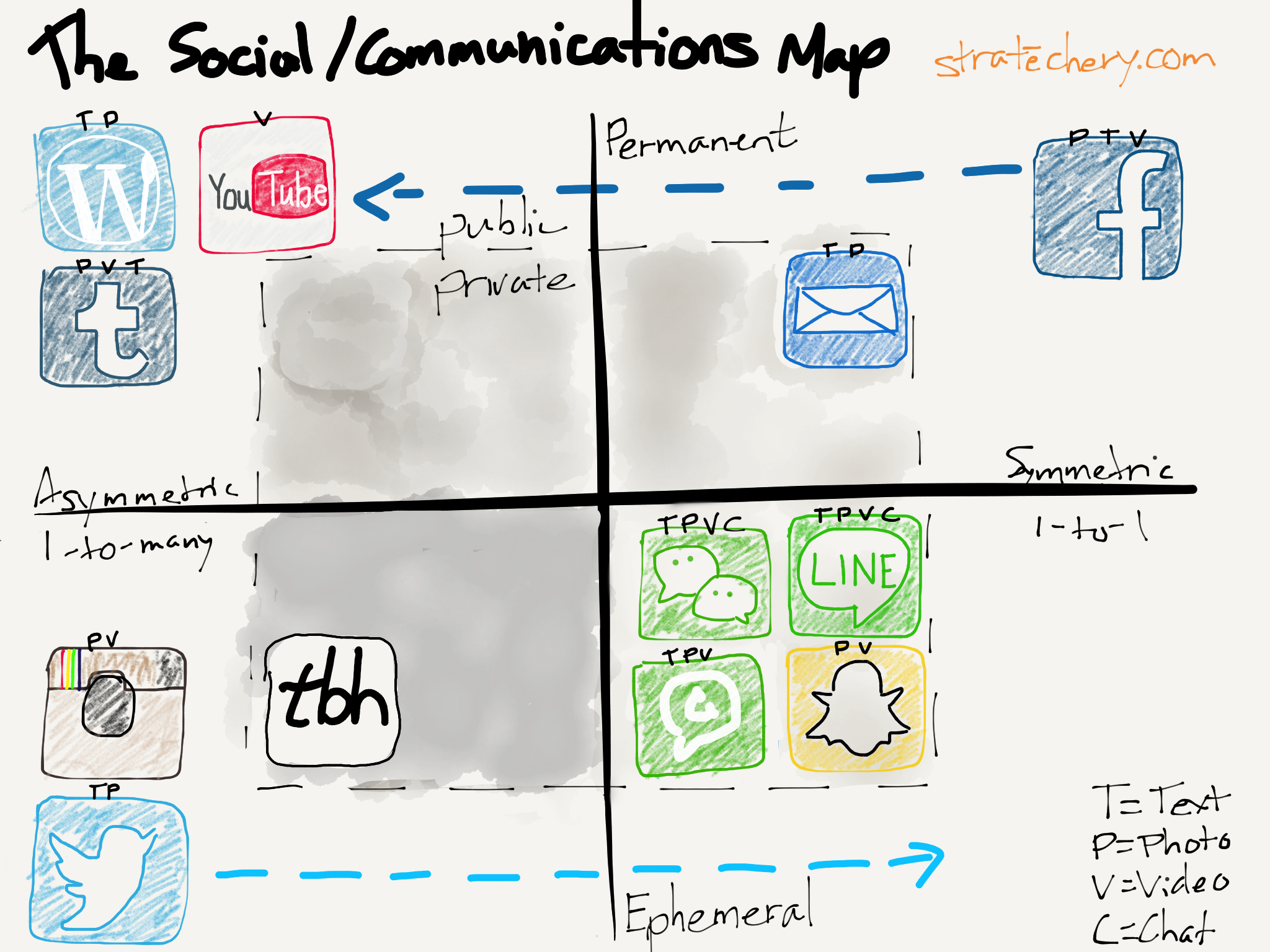
The goal of this map was to show that there was no single social app that covered all of humanity’s social needs: there were critical differences in how people perceived1 different social apps, and that no one app could fill every part of this map.

Facebook, for its part, had, for better or worse, transitioned to a public app that not only handled symmetric relationships, but, at least according to perception, asymmetric broadcast as well; that, though, left an opening for an app like Snapchat. Thus Facebook’s acquisition drive: the company had already secured Instagram, giving it a position in asymmetric ephemeral broadcast apps; Snapchat rebuffed advances, so the company soon moved on to WhatsApp.

The importance of these two acquisitions cannot be overstated: Facebook has always been secure in its dominance of permanent social relationships, a position that has given the company a dominant position in digital advertising. However, while everyone may need a permanent place on the Internet (all of those teenagers people say Facebook needs to reach have Facebook accounts), the ultimate currency is attention, and much like real life, it is ephemeral conversation that dominates. Facebook, by virtue of early decisions around privacy and significant bad press about the dangers of revealing too much, was locked out of this sphere, so it bought in.

The FTC’s Failure

Those acquisitions, by the way, were, per the Hart-Scott-Rodino Act, submitted to the FTC; in the case of Instagram the agency sent what sure seems like a form letter; I’ll quote it in full:

The Commission has been conducting an investigation to determine whether the proposed acquisition of Instagram, Inc. by Facebook, Inc. may violate Section 7 of the Clayton Act or Section 5 of the Federal Trade Commission Act.

Upon further review of this matter, it now appears that no further action is warranted by the Commission at this time. Accordingly, the investigation has been closed. This action is not to be construed as a determination that a violation may not have occurred, just as the pendency of an investigation should not be construed as a determination that a violation has occurred. The Commission reserves the right to take such further action as the public interest may require.

And so the single most injurious acquisition with regards to competition in not just social networking specifically but digital advertising broadly was approved. Section 7 of the Clayton Act (post its 1950 amendment), states:

No person shall acquire, directly or indirectly, the whole or any part of the stock or other share capital and no person subject to the jurisdiction of the Federal Trade Commission shall acquire the whole or any part of the assets of one or more persons engaged in commerce or in any activity affecting commerce, where in any line of commerce or in any activity affecting commerce in any section of the country, the effect of such acquisition, of such stocks or assets, or of the use of such stock by the voting or granting of proxies or otherwise, may be substantially to lessen competition, or to tend to create a monopoly.

“Lessen competition” is exactly what happened. Instagram, super-charged both with the Facebook social graph and the Facebook ad machine, is not only dominating its native ephemeral asymmetric broadcasting space but increasingly preventing Snapchat from expanding. WhatsApp, meanwhile, dominates the messaging space across most of the world,2 and is the most prominent arrow in Facebook’s “future growth” quiver.

The consolidation of attention has translated into dominance in digital advertising. Facebook accounted for 77% of revenue growth in digital advertising in the United States in 2016; add in Google and the duopoly’s share of growth was 99%. Even Snapchat, which after rightly rebuffing Facebook’s acquisition offers, IPO’d earlier this year for $24 billion,3 has seen revenue declines, all while Facebook ever more blatantly rips off the product.

The Privacy Red Herring

The FTC’s response to the WhatsApp acquisition is more interesting: there the agency’s focus was privacy, specifically insisting that Facebook not change WhatsApp’s more stringent promises around user data without affirmative consent from users. This followed a few years after Facebook’s consent decree with the FTC that demanded the company not share user data without their permission.

There’s just one problem: whatever limitations this consent decree may have placed upon Facebook, the reality is that the company is a self-contained ecosystem: prohibiting the permissionless sharing of personal information in fact entrenches Facebook’s position. Take, for example, Europe’s vaunted GDPR law: as I explained in the Daily Update, data portability that, for privacy reasons, excludes the social graph (because your friends didn’t give you permission to share their information with other services) makes it that much harder for competition to arise.

So it was with the FTC’s restrictions around the WhatsApp deal: the agency reiterated that Facebook couldn’t violate user’s privacy, and completely ignored that the easiest away around privacy restrictions is to simply own all of a user’s social interactions.

Understanding Social Networks

Perhaps the most fanciful regulatory document of all, though, is not from the FTC, but rather the United Kingdom’s Office of Fair Trading. Its review of the Instagram deal rested on its analysis of Facebook Camera, an app that no longer exists.

There are several relatively strong competitors to Instagram in the supply of camera and photo editing apps, and those competitors appear at present to be a stronger constraint on Instagram than Facebook’s new app. The majority of third parties did not believe that photo apps are attractive to advertisers on a stand-alone basis, but that they are complementary to social networks. The OFT therefore does not believe that the transaction gives rise to a realistic prospect of a substantial lessening of competition in the supply of photo apps.

“The supply of photo apps.” What a stunningly ignorant evaluation of what Instagram already was: not simply a photo filter app but a social network in its own right. The part about revenue generation, though, was even more amazing:

The parties’ revenue models are also very different. While Facebook generates revenue from advertising and users purchasing virtual and digital goods via Facebook, Instagram does not generate any revenue.

This bit, five year on, still leaves me speechless: Instagram didn’t generate advertising revenue because that’s not how social networks work. As Mark Zuckerberg frequently explains, there is a formula for monetization: first grow users, then increase engagement, next attract businesses, and finally sell ads. Just because Instagram, at the time of this acquisition, was still in Stage 1, did not preclude the possibility of Stage 4; the problem is that the Office of Fair Trading simply had no idea how this world worked.

The issue is straightforward: networks are the monopoly makers of the Internet era. To build one is extremely difficult, but, once built, nearly impregnable. The only possible antidote is another network that draws away the one scarce resource: attention. To that end, when it comes to the Internet, the single most effective tool in antitrust regulation is keeping social networks in separate competitive companies. That the FTC and Office of Fair Trading failed to do so in the case of Instagram and WhatsApp is to the detriment of everyone.

Facebook and tbh

This is the context for Facebook’s tbh acquisition. The app, new as it is, is attacking greenspace in the Social-Communication Map:

tbh is hardly the only contender: Secret and Yik Yak were others. Secret failed due to the lack of an organizational mechanic and negativity; Yik Yak fixed the former by utilizing location, but suffered from the same negativity problem. tbh has clearly learned lessons from both: the app leverages both location and your address book as an organizing mechanic, and is engineered from the ground-up to be focused on positivity.

Moreover, it’s easy to see how it could be super-charged by Facebook: the social graph is probably even more powerful than the address book in terms of building a network, and provides multiple outlets for connections established on tbh. Just as importantly, Facebook can in the short term fund tbh and, in the long run, simply graft the service onto its cross-app sales engine. It’s a great move for both parties.

What is much more questionable, though, is whether this is a great deal for society. tbh is, by definition, winning share in the zero sum competition for attention in the ultra-desirable teenage demographic in particular, and that’s good news for any would-be Facebook competitors. Why should it be ok for Facebook to simply swallow up another app, small thoughh it may currently be? Again, simply looking at narrowly-defined marketshare estimations or non-existent revenue streams is to fundamentally misunderstand how social networks work.

Indeed, I’ve already made my position clear — social networks should not be allowed to acquire other social networks:

Facebook should not be allowed to buy another network-based app; I would go further and make it prima facie anticompetitive for one social network to buy another. Network effects are just too powerful to allow them to be combined. For example, the current environment would look a lot different if Facebook didn’t own Instagram or WhatsApp (and, should Facebook ever lose an antitrust lawsuit, the remedy would almost certainly be spinning off Instagram and WhatsApp).

The FTC dropped the ball with Instagram and WhatsApp; absent a time machine, the best time to do the right thing is right now.

Or, perhaps, Facebook should be allowed to proceed — but with conditions. My second demand is about the social graph:

All social networks should be required to enable social graph portability — the ability to export your lists of friends from one network to another. Again Instagram is the perfect example: the one-time photo-filtering app launched its network off the back of Twitter by enabling the wholesale import of your Twitter social graph. And, after it was acquired by Facebook, Instagram has only accelerated its growth by continually importing your Facebook network. Today all social networks have long since made this impossible, making it that much more difficult for competitors to arise.

Requiring Facebook to offer its social graph to any would-be competitor as a condition of acquiring tbh would be a good outcome; unfortunately, it is perhaps the most unlikely, given the FTC’s commitment to unfettered privacy (without a consideration of the impact on competition).

What shouldn’t be allowed is what Facebook clearly hopes — and suggests — will happen: no regulatory review at all. The FTC has the power, and it’s time to use it.

  1. Perceived is a critical point: Twitter and Instagram, for example, are permanent, but are perceived by most as being ephemeral (arguably Twitter’s has shifted in the public conscious as being something that is more permanent)
  2. The most noteworthy exceptions being the United States (mixed), China (WeChat), South Korea (Kakao), Japan, Thailand, and Taiwan (LINE)
  3. As an aside, for all of Snapchat’s troubles to justify its $24 billion IPO, keep in mind that the vast majority of the commentariat insisted Spiegel was irrational to turn down $3 billion; it’s a reminder that few understand exponential growth curves
23 Oct 23:28

Amazing true facts about women at work

by Josh Bernoff

Based on the number of #MeToo posts in my social media feeds and the news I’m reading from Hollywood and Silicon Valley, some men have a problem. They seem to be grappling with a mystifying phenomenon: what are women doing in my workplace? Since this blog is all about helping you, the reader, I’ll do … Continued

The post Amazing true facts about women at work appeared first on without bullshit.

23 Oct 23:27

Steady Hands

by Rui Carmo
Visual inspection of some soldering I did on an ESP-01
Shunting XPD_DCDC and RST lets me put the ESP8266 into "deep sleep", lowering idle consumption to microamperes.
23 Oct 23:27

What made me go to the doctor?

by Volker Weber

071800da21f91b1c4dad16299af86817 abbe4bc1c69b8346896b29743ab6bb2a

I keep getting asked the same question: how could you possibly tolerate the pain for so long? This is a hard question to answer. It's a combination of many factors and I am not going to try answering it. The more interesting question is why I decided to no longer tolerate it. The answer is easy: I could see that my body was failing.

Look at the two graphs above, both taken from Apple Health. The data originates from the heart rate sensor of my Apple Watch. I have been wearing it for years, 23 hours a day. That means I have a lot of data to compare against.

The left graph shows how my resting heart rate went from 62 to 85 over the course of only a few weeks. There is no good explanation. Your resting heart rate goes down over time as you exercise and your heart becomes stronger. Mine isn't particularly strong. I walk a lot but I have little cardio fitness. 62 is pretty good for my fitness level and my age, but it should not suddenly go up, especially not continously. My heart was not allowed to rest, not even during sleep.

The right graph shows my heart rate variability. In simpler terms: how steady is the heart beat. I average about 25 ms. At 62 bpm that means I miss the heart beat by about 2.5 hundreds of a second. And this one freaked me out. It suddenly went to 250 ms. (Graph only shows median.) A thousand percent increase! My heart was clearly in distress. Time to seek immediate help.

0b7abf7ecd78ba1d4f7be3825cde5455 3075edc62bf280d895a3de9dcb479095

Now my resting heart rate is down at 62, the beat is steady at 9 ms and I can see myself getting rid of some of the other meds I still need in the not too distant future. I am very thankful to my doctors and I attribute my strength and ability to heal to my exercise regime and healthy diet over the last four years.

#dontbreakthechain

23 Oct 23:27

A Call to Tweets (& Blog Posts)!

by hrbrmstr

Way back in July of 2009, the first version of the twitteR package was published by Geoff Jentry in CRAN. Since then it has seen 28 updates, finally breaking the 0.x.y barrier into 1.x.y territory in March of 2013 and receiving it’s last update in July of 2015.

For a very long time, the twitteR package was the way to siphon precious nuggets of 140 character data from that platform and is the top hit when one searches for r twitter package. It even ha[sd] it’s own mailing list and is quite popular, judging by RStudio’s CRAN logs total downloads stats .

I blog today to suggest there is a better way to work with Twitter data from R, especially if your central use-case is searching Twitter and mining tweet data. This new way is rtweet by Michael Kearney. It popped up on the scene back in August of 2016 and receives quite a bit of 💙 from the developer, especially on GitHub.

This post is short and mostly designed to convince you to (a) try out the package and (b) blog and tweet about the package — if you do agree that it’s the best modern way to work with Twitter from R — to raise awareness about it. Because of that focus, I won’t be delving into all of rtweet‘s seekrits, but you can explore them yourself on it’s spiffy pkgdown site.

While both packages have nigh complete access to the Twitter API, I posit that the quintessential use-case for working with Twitter in R is searching through tweets/users and then performing various types of data mining on the retrieved results. To that end, I’m going to show one use-case (out of many potential ones) that will both save you API-time and post-API munging time in order to convince you to switch to rtweet and spread the word about it.

Data-mining 300 #rstats Tweets : A Play in Two Acts

We’ll search Twitter for #rstats-tagged tweets with both twitteR and rtweet, starting with the former:

library(twitteR)

# this relies on you setting up an app in apps.twitter.com
setup_twitter_oauth(
  consumer_key = Sys.getenv("TWITTER_CONSUMER_KEY"), 
  consumer_secret = Sys.getenv("TWITTER_CONSUMER_SECRET")
)

r_folks <- searchTwitter("#rstats", n=300)

str(r_folks, 1)
## List of 300
##  $ :Reference class 'status' [package "twitteR"] with 17 fields
##   ..and 53 methods, of which 39 are  possibly relevant
##  $ :Reference class 'status' [package "twitteR"] with 17 fields
##   ..and 53 methods, of which 39 are  possibly relevant
##  $ :Reference class 'status' [package "twitteR"] with 17 fields
##   ..and 53 methods, of which 39 are  possibly relevant

str(r_folks[1])
## List of 1
##  $ :Reference class 'status' [package "twitteR"] with 17 fields
##   ..$ text         : chr "RT @historying: Wow. This is an enormously helpful tutorial by @vivalosburros for anyone interested in mapping "| __truncated__
##   ..$ favorited    : logi FALSE
##   ..$ favoriteCount: num 0
##   ..$ replyToSN    : chr(0) 
##   ..$ created      : POSIXct[1:1], format: "2017-10-22 17:18:31"
##   ..$ truncated    : logi FALSE
##   ..$ replyToSID   : chr(0) 
##   ..$ id           : chr "922150185916157952"
##   ..$ replyToUID   : chr(0) 
##   ..$ statusSource : chr "<a href=\"http://twitter.com/download/android\" rel=\"nofollow\">Twitter for Android</a>"
##   ..$ screenName   : chr "jasonrhody"
##   ..$ retweetCount : num 3
##   ..$ isRetweet    : logi TRUE
##   ..$ retweeted    : logi FALSE
##   ..$ longitude    : chr(0) 
##   ..$ latitude     : chr(0) 
##   ..$ urls         :'data.frame': 0 obs. of  4 variables:
##   .. ..$ url         : chr(0) 
##   .. ..$ expanded_url: chr(0) 
##   .. ..$ dispaly_url : chr(0) 
##   .. ..$ indices     : num(0) 
##   ..and 53 methods, of which 39 are  possibly relevant:
##   ..  getCreated, getFavoriteCount, getFavorited, getId, getIsRetweet, getLatitude, getLongitude, getReplyToSID,
##   ..  getReplyToSN, getReplyToUID, getRetweetCount, getRetweeted, getRetweeters, getRetweets, getScreenName,
##   ..  getStatusSource, getText, getTruncated, getUrls, initialize, setCreated, setFavoriteCount, setFavorited, setId,
##   ..  setIsRetweet, setLatitude, setLongitude, setReplyToSID, setReplyToSN, setReplyToUID, setRetweetCount,
##   ..  setRetweeted, setScreenName, setStatusSource, setText, setTruncated, setUrls, toDataFrame, toDataFrame#twitterObj

Both packages follow the similar idioms and you need to have done some prep-work by creating a Twitter “app” (both packages have instructions for that).

That operation took about 3 seconds on a fast internet connection and wicked fast computer. What you get back is definitely usable data, but it’s in lists of custom objects. This is due to the way that package models the Twitter API on to custom R objects. It’s elegant, but also likely overkill for most operations. You can use something like purrr::map_df(r_folks, as.data.frame) to get that list into a data frame, there are some other “gotchas”, such as text encoding (on a later run of this code both dplyr::glimpse() and str() gave me “invalid multibyte string” errors but that same thing did not happen with rtweet.

Here’s the rtweet version:

library(rtweet)

# this relies on you setting up an app in apps.twitter.com
create_token(
  app = Sys.getenv("TWITTER_APP"),
  consumer_key = Sys.getenv("TWITTER_CONSUMER_KEY"), 
  consumer_secret = Sys.getenv("TWITTER_CONSUMER_SECRET")
) -> twitter_token

saveRDS(twitter_token, "~/.rtweet-oauth.rds")

# ideally put this in ~/.Renviron
Sys.setenv(TWITTER_PAT=path.expand("~/.rtweet-oauth.rds"))

rtweet_folks <- search_tweets("#rstats", n=300)

dplyr::glimpse(rtweet_folks)
## Observations: 300
## Variables: 35
## $ screen_name                    <chr> "AndySugs", "jsbreker", "__rahulgupta__", "AndySugs", "jasonrhody", "sibanjan...
## $ user_id                        <chr> "230403822", "703927710", "752359265394909184", "230403822", "14184263", "863...
## $ created_at                     <dttm> 2017-10-22 17:23:13, 2017-10-22 17:19:48, 2017-10-22 17:19:39, 2017-10-22 17...
## $ status_id                      <chr> "922151366767906819", "922150507745079297", "922150470382125057", "9221504090...
## $ text                           <chr> "RT:  (Rbloggers)Markets Performance after Election: Day 239  https://t.co/D1...
## $ retweet_count                  <int> 0, 0, 9, 0, 3, 1, 1, 57, 57, 103, 10, 10, 0, 0, 0, 34, 0, 0, 642, 34, 1, 1, 1...
## $ favorite_count                 <int> 0, 0, 0, 0, 0, 0, 0, 0, 0, 0, 0, 0, 0, 0, 2, 0, 0, 1, 0, 0, 0, 0, 0, 0, 0, 0,...
## $ is_quote_status                <lgl> FALSE, FALSE, FALSE, FALSE, FALSE, FALSE, FALSE, FALSE, FALSE, FALSE, FALSE, ...
## $ quote_status_id                <chr> NA, NA, NA, NA, NA, NA, NA, NA, NA, NA, NA, NA, NA, NA, NA, NA, NA, NA, NA, N...
## $ is_retweet                     <lgl> FALSE, FALSE, TRUE, FALSE, TRUE, TRUE, FALSE, TRUE, TRUE, TRUE, TRUE, TRUE, F...
## $ retweet_status_id              <chr> NA, NA, "922085241493360642", NA, "921782329936408576", "922149318550843393",...
## $ in_reply_to_status_status_id   <chr> NA, NA, NA, NA, NA, NA, NA, NA, NA, NA, NA, NA, NA, NA, NA, NA, NA, NA, NA, N...
## $ in_reply_to_status_user_id     <chr> NA, NA, NA, NA, NA, NA, NA, NA, NA, NA, NA, NA, NA, NA, NA, NA, NA, NA, NA, N...
## $ in_reply_to_status_screen_name <chr> NA, NA, NA, NA, NA, NA, NA, NA, NA, NA, NA, NA, NA, NA, NA, NA, NA, NA, NA, N...
## $ lang                           <chr> "en", "en", "en", "en", "en", "en", "en", "en", "en", "en", "en", "en", "ro",...
## $ source                         <chr> "IFTTT", "Twitter for iPhone", "GaggleAMP", "IFTTT", "Twitter for Android", "...
## $ media_id                       <chr> NA, "922150500237062144", NA, NA, NA, NA, NA, NA, NA, NA, NA, NA, NA, NA, "92...
## $ media_url                      <chr> NA, "http://pbs.twimg.com/media/DMwi_oQUMAAdx5A.jpg", NA, NA, NA, NA, NA, NA,...
## $ media_url_expanded             <chr> NA, "https://twitter.com/jsbreker/status/922150507745079297/photo/1", NA, NA,...
## $ urls                           <chr> NA, NA, NA, NA, NA, NA, NA, NA, NA, NA, NA, NA, NA, NA, NA, NA, NA, NA, NA, N...
## $ urls_display                   <chr> "ift.tt/2xe1xrR", NA, NA, "ift.tt/2xe1xrR", NA, "bit.ly/2yAAL0M", "bit.ly/2yA...
## $ urls_expanded                  <chr> "http://ift.tt/2xe1xrR", NA, NA, "http://ift.tt/2xe1xrR", NA, "http://bit.ly/...
## $ mentions_screen_name           <chr> NA, NA, "DataRobot", NA, "historying vivalosburros", "NoorDinTech ikashnitsky...
## $ mentions_user_id               <chr> NA, NA, "622519917", NA, "18521423 304837258", "2511247075 739773414316118017...
## $ symbols                        <lgl> NA, NA, NA, NA, NA, NA, NA, NA, NA, NA, NA, NA, NA, NA, NA, NA, NA, NA, NA, N...
## $ hashtags                       <chr> "rstats DataScience", "Rstats ACSmtg", "rstats", "rstats DataScience", "rstat...
## $ coordinates                    <lgl> NA, NA, NA, NA, NA, NA, NA, NA, NA, NA, NA, NA, NA, NA, NA, NA, NA, NA, NA, N...
## $ place_id                       <chr> NA, NA, NA, NA, NA, NA, NA, NA, NA, NA, NA, NA, NA, NA, NA, NA, NA, NA, NA, N...
## $ place_type                     <chr> NA, NA, NA, NA, NA, NA, NA, NA, NA, NA, NA, NA, NA, NA, NA, NA, NA, NA, NA, N...
## $ place_name                     <chr> NA, NA, NA, NA, NA, NA, NA, NA, NA, NA, NA, NA, NA, NA, NA, NA, NA, NA, NA, N...
## $ place_full_name                <chr> NA, NA, NA, NA, NA, NA, NA, NA, NA, NA, NA, NA, NA, NA, NA, NA, NA, NA, NA, N...
## $ country_code                   <chr> NA, NA, NA, NA, NA, NA, NA, NA, NA, NA, NA, NA, NA, NA, NA, NA, NA, NA, NA, N...
## $ country                        <chr> NA, NA, NA, NA, NA, NA, NA, NA, NA, NA, NA, NA, NA, NA, NA, NA, NA, NA, NA, N...
## $ bounding_box_coordinates       <chr> NA, NA, NA, NA, NA, NA, NA, NA, NA, NA, NA, NA, NA, NA, NA, NA, NA, NA, NA, N...
## $ bounding_box_type              <chr> NA, NA, NA, NA, NA, NA, NA, NA, NA, NA, NA, NA, NA, NA, NA, NA, NA, NA, NA, N...

That took about 1.5 seconds and provides a tidy, immediately usable data structure.

But, that’s not all!

Michael has support for accessing the Twitter streaming API and also has some handy plot functions for quickly exploring retrieved Twitter content, enabling you to make pretty spiffy plots like this with almost no effort (this was pirated from Michael’s package website):

Fin

If the legacy twitteR package is already in your workflows, there may be little to gain. But, I would suggest that R folks give rtweet a try and blog about your experiences. It’ll give others a chance to see usage in different contacts and will also help spread the word about this alternative package and help bump up it’s pagerank.

As I said on Twitter:

Make sure to try out the GitHub version as well since it has gained some new functionality not currently in CRAN and don’t hesitate to ping @kearneymw on Twitter (though he may regret me suggesting that :-).

23 Oct 23:27

Fujifilm Deals

You've asked me to post when there are strong deals going on mirrorless products, so here's one such post.

Fujifilm has posted discounts on quite a bit of their lineup, including the recent GFX 50S medium format camera and lenses.

23 Oct 23:27

Sony Deals

You've asked me to post when there are strong deals going on mirrorless products, so here's one such post.

Sony has a number of deals now going on with their mirrorless products, all expiring November 3rd [disclosure: these are affiliate links via B&H and many include additional items such as storage kits or cases]:

23 Oct 23:27

Bill Gates still doesn't get it.

files/images/Gates_logo_1200x1200.jpg

Stephen Krashen, SKrashen, Oct 25, 2017


Icon

The big story here is "the Bill & Melinda Gates Foundation will step back from its traditional education reform agenda to instead invest close to $1.7 billion over the next five years on new initiatives that include a focus on building networks of schools." But as Stephen Krashen says in this short riposte, "The main problem in American education is not poor curricula, or lack of data. The problem is poverty." He's right. "While we can always improve, " he writes, "there is nothing seriously wrong with our schools and our teachers. Our overall scores are unspectacular because our rate of child poverty is so high, the highest among economically advanced countries."  We know this. But poverty is exactly the problem the richest man in the world doesn't want to address.

[Link] [Comment]
23 Oct 23:27

Redefining "failure"

files/images/16726127717_e0531a0d42.jpg

Alastair Creelman, The corridor of uncertainty, Oct 25, 2017


Icon

I wisbh we could redefine 'success'. In the current world it has to do with mass - accumulating money, accumulating fame (or likes, or followers), accumulating possessions. This makes success scarce, and as Alastair Creelman says, "If success is so rare, then partial success or a lack of success are the norm." And it's often arbitrary. "Success often comes unexpectedly and cannot always be rationalised. Often it's simply about having the right idea at the right time and getting the right breaks." We need to rethink why we educate people this way. "Too much of our education system (and of course society in general) is based on competition and the inhuman belief in the survival of the fittest." 

[Link] [Comment]
23 Oct 23:27

I don’t wanna grow up to be a growth hacker

by Paul Jarvis
Knowledge is knowing that a tomato is a fruit. Wisdom is not putting it in a fruit salad.
23 Oct 23:26

A Monoid for All Seasons

by Julie Moronuki

In this keynote at Haskell Exchange 2017, I decided to tell people why I love monoids so much. Before I started learning Haskell, I’d never heard the word “monoid” and didn’t know what an algebra meant. But I recognized a pattern when I learned about the Monoid typeclass, a pattern of conjunction and disjunction, that pervades Haskell and all its monoids, including the type system.

I recognized the pattern from some common, well-known examples: arithmetic, Boolean arithmetic, and set theory. Understanding the pattern helped me see connections all through Haskell and mathematics.

Near the end of the talk, I go briefly into category theory, the way I was first introduced to category theory and try to explain that sums and products are deeply connected, which validates our intuitions about their connections that we’ve seen through concrete examples.

There is some Haskell code, and I don’t explain much about what typeclasses are for, so some basic Haskell knowledge is assumed.

Slides are available here.

Video is here. Perhaps someday we’ll get it embedded here.


23 Oct 23:26

React & Observables

by princiya

Over the weekend, I attempted to learn about Observables and I tried to combine React & Observables. Considering my growing obsession to create zines, here is my attempt at tech-cartoons inspired by this great article from Julia Evans.

observable debugging

The code can be found here.

23 Oct 23:25

Restart completed

by Volker Weber

Thank you all for your positive messages. They helped me pull through these difficult days. What should have been a routine surgery unveiled a much bigger monster. I had trusted my fate with skilled medical professionals and they saved me. After the first 24 hours it was on me to dig myself out of this hole and I had more strength and courage than I would have thought. Within 48 hours I was on safe ground and now I am completely restored.

The crisis is over. I am coming out much stronger than I went in.

23 Oct 23:25

The $50 Google Home Mini vs. the $50 Amazon Echo Dot—who wins?

Ever since Amazon (AMZN) created the Amazon Echo, the “Siri for the home” voice assistant, every company and its brother has rushed to come up with one almost exactly like it.

Take, for example, the Amazon Echo Dot. Like the full-size Echo, it responds to your commands and questions from across the room—but it’s a tiny, sawed-off one that costs $50. The only difference is that because you don’t have the big cylinder, the sound quality is tinny. It makes a fantastic second Echo—say, for the upstairs.

Well, now here’s Google (GOOG, GOOGL) with its own version of the Dot, called the Google Home Mini. Also puck-shaped, also $50. (Google will also be releasing the Google Home Max, a beefier version with better sound.)

The new Google Home Mini (right) has clearly been inspired by the Amazon Echo Dot (left).

The Dot and the Mini are 90% identical. They both work great. Each has a Microphone Off switch, so you can be sure that it’s not listening for its trigger word. Both can now distinguish who is making the request, so that it can respond to commands like “Play my party playlist” and “What’s next on my calendar?” with the right person’s music or info. Both now let you make free speakerphone calls to actual phone numbers (although the Google’s call quality is awful).

There are, however, a few differences to note.

In this corner: The Google Home Mini.

  • The sound is much better. Neither assistant pod will be mistaken for a concert hall. But there’s no question that Google’s built-in speaker is richer than Amazon’s.
  • It talks to Chromecasts and Android TVs. If you spring $35 for a Chromecast (a little receiver stick that plugs into a modern TV’s USB jack), or if you have a TV that runs Android TV, you can perform a nifty trick. You can say, “Ok Google, show me a video about how to remove contact lenses” or “Show me funny cat videos” or “Show me the trailer for the new Avengers movie,” and it appears on your TV instantly. As you can see in the video above, it’s quite magical.
  • It will someday have a tap-to-talk feature. The top of the Mini is supposed to be touch sensitive. As designed, you could tap it to issue a command (instead of saying “OK Google”), or tap it to pause music. But just as the Home Mini was shipping, a reviewer discovered a bug in which that button thought that it was being pressed all the time, transmitting everything anyone said in the room to Google’s servers. So Google responded by shutting off that top button’s features altogether.
Google will presumably restore the tap-the-top feature once they get their act together.

And now, in this corner: The Amazon Echo Dot.

  • Works with more home-automation products, like internet-controlled thermostats, lights, security cameras, and so on. It’s a huge list. Google’s improving on this front, but Amazon’s had a several-year head start.
  • It has an audio output jack. Lots of people love plugging in their nice speakers or sound systems to an Echo Dot, thanks to the standard miniplug on the side (the Google offers nothing similar). That makes it easy to control your music by voice—one of the most luxurious features ever.
  • The volume controls are much better. The Echo Dot has a smoothly turning volume ring on the top. On the Google Mini, you have to repeatedly tap one side to raise the volume, the opposite edge to lower it. There are only 4 LED light segments to tell you what the current volume level is (rather than the far more informative, full 360-degree light-up ring on the Echo). And it’s never clear which side you’re supposed to tap, since there’s no label.
It’s much easier and more reliable to adjust the Echo Dot’s volume (left) by turning its ring instead of tapping the sides.
  • You can see feedback across the room. The Dot’s LED ring glows in different colors and patterns to communicate different things—for example, it glows when it’s transmitting sound back to Amazon. You can see it from the side, and therefore from across the room. The Google’s four LEDs are visible only when you’re looking down on the device, which isn’t nearly as useful.
  • You can order stuff. Of course, this is exactly what Amazon hopes you’ll do, but it’s still cool. “Alexa—order more paper towels.”

If you’re a Google Play subscriber, maybe the convenience of speaking your desires for music tips the balance for you toward the Google Home Mini. (The argument about “Buy a Google Home if you keep your calendar in Google Calendar” doesn’t really hold water, since the Echo can consult or add events to the calendar systems of Google or Apple (AAPLor Microsoft (MSFT).

Otherwise, though, the Echo Dot is still the better micro-assistant. (Especially when it’s on sale for $40—for example, on the typical Black Friday, which is in a couple of weeks.)

There will be a lot of people unwrapping these little guys this holiday season.

Both of these devices are delicious enhancements to almost anyone’s home. Over time, you’ll find more and more ways that they’re useful—and for only 50 bucks!

More from David Pogue:

The Fitbit Ionic doesn’t quite deserve the term ‘smartwatch’

Augmented reality? Pogue checks out 7 of the first iPhone AR apps 

iOS11 is about to arrive — here’s what’s in it 

MacOS High Sierra comes this fall—and brings these 23 features

T-Mobile COO: Why we make investments like free Netflix that ‘seem crazy’

How Apple’s iPhone has improved since its 2007 debut

Gulliver’s Gate is a $40 million world of miniatures in Times Square

Samsung’s Bixby voice assistant is ambitious, powerful, and half-baked

Is through-the-air charging a hoax?

David Pogue, tech columnist for Yahoo Finance, is the author of “iPhone: The Missing Manual.” He welcomes nontoxic comments in the comments section below. On the web, he’s davidpogue.com. On Twitter, he’s @pogue. On email, he’s poguester@yahoo.com. You can read all his articles here, or you can sign up to get his columns by email


23 Oct 23:25

A Photo Tour of Apple’s New Flagship Chicago Store

by John Voorhees

For 14 years, Apple’s flagship retail store was a fixture at the north end of Chicago’s Michigan Avenue, the shopping district known as the Magnificent Mile. Built in 2003, Apple’s Michigan Avenue location was the company’s first flagship store, featuring a glass staircase that seemed to float to the second floor just beyond the store’s entrance. Yesterday though, after many months of construction, Apple opened a new flagship store to the public along the Chicago River that reflects the new direction in which Apple began taking its retail locations last year.

The move is part of the ongoing evolution of Apple’s retail strategy:

“When Apple opened on North Michigan Avenue in 2003, it was our first flagship store, and now we are back in Chicago opening the first in a new generation of Apple’s most significant worldwide retail locations,” said Angela Ahrendts, Apple’s senior vice president of Retail. “Apple Michigan Avenue exemplifies our new vision where everyone is welcome to experience all of our incredible products, services and inspiring educational programs in the heart of their city.”

The store has moved south along Michigan Avenue to just north of the river at Pioneer Court, an open plaza between the historic Chicago Tribune Tower and the Chicago River. It’s a space where the city’s hustle and bustle comes alive with a mix of Chicagoans and tourists, and you can take in some of Chicago’s finest architectural treasures like the Wrigley Building, the Tribune Tower, the DuSable Bridge, the 333 North Michigan Avenue building, and the London House hotel. Nestled in the center of it all is Apple’s new location, which was designed by Foster + Partners, the architects that designed Apple Park.

Apple's new store sits among some of Chicago's best-known architectural landmarks.

Apple's new store sits among some of Chicago's best-known architectural landmarks.

The structure, which reportedly cost $27 million to build, incorporates many of the design cues seen at Apple Park and recently constructed stores like the one in San Francisco’s Union Square. The walls are glass and curve at the corners in a way that reminds me of the entrance to the Steve Jobs Theater at Apple Park. The roof, which is constructed from carbon fiber to make it as thin as possible, resembles the top case of a MacBook.

Designed by Foster + Partners, the new Chicago Apple store features glass walls and a MacBook-like carbon fiber roof lined with wood.

Designed by Foster + Partners, the new Chicago Apple store features glass walls and a MacBook-like carbon fiber roof lined with wood.

Outside, the store is flanked on both sides by granite staircases that are a continuation of the indoor stairways making the Chicago River more accessible from Pioneer Court than ever before:

“Apple Michigan Avenue is about removing boundaries between inside and outside, reviving important urban connections within the city,” said Jony Ive, Apple’s chief design officer. “It unites a historic city plaza that had been cut off from the water, giving Chicago a dynamic new arena that flows effortlessly down to the river.”

Glass walls provide an unobstructed view of boats moving down the Chicago River.

Glass walls provide an unobstructed view of boats moving down the Chicago River.

The overall effect is that the building nearly disappears into its environment, accentuating the river and its surroundings. Except for the roof overhead, Apple Michigan Avenue provides an almost entirely uninterrupted view of the city as you walk around it inside or out.

It's not always easy to tell where the store ends and the city begins.

It's not always easy to tell where the store ends and the city begins.

It’s hard to appreciate just how completely the store disappears into its surroundings unless you see it for yourself. The illusion is enhanced by even the smallest touches like the grooves in the staircases that continue from the interior of the store to its exterior.

The alignment of the grooves in the stairs inside and outside the store help make the store disappear into its surroundings.

The alignment of the grooves in the stairs inside and outside the store help make the store disappear into its surroundings.

When you enter, there is a tier of seating, but the Genius Grove and main retail space are on the lower level, which is accessible from the stairs or an elevator. The center of the lower level is dominated by a huge high-resolution screen that was showing black and white scenes of Chicago during the grand opening.

The giant high-resolution screen on the lower level of the store commands your attention.

The giant high-resolution screen on the lower level of the store commands your attention.

The back of the giant screen is polished metal with an Apple logo in the center that reflects the city back into the store.

The city reflected on the back of the store's enormous display.

The city reflected on the back of the store's enormous display.

Tucked underneath the upper level are the familiar tables of iPhones, iPads, Macs, and other items for sale, which are so well hidden that you might not realize they are there until you get to the lower level and turn around.

Familiar tables of iOS devices and Macs extend under the stairs and top level of the store.

Familiar tables of iOS devices and Macs extend under the stairs and top level of the store.

On Monday, Apple will continue the celebration of the store’s opening with ‘The Chicago Series,’ a month-long series of activities and events with a focus on Chicago entrepreneurs and creatives that is part of the Today at Apple program.

I’ve had the opportunity to visit several of Apple’s flagship stores and what I like most about each is that they incorporate their surroundings and the unique culture of each city. Chicago’s new location is no exception, succeeding in bringing the outdoors inside and showcasing the Chicago River, one of the city’s most important landmarks.


Support MacStories Directly

Club MacStories offers exclusive access to extra MacStories content, delivered every week; it's also a way to support us directly.

Club MacStories will help you discover the best apps for your devices and get the most out of your iPhone, iPad, and Mac. Plus, it's made in Italy.

Join Now
23 Oct 23:25

Bringing Mixed Reality to the Web

by Andre Vrignaud

Today, Mozilla is announcing a new development program for Mixed Reality that will significantly expand its work in Virtual Reality (VR) and Augmented Reality (AR) for the web. Our initial focus will be on how to get devices, headsets, frameworks and toolsets to work together, so web developers can choose from a variety of tools and publishing methods to bring new immersive experiences online – and have them work together in a fully functional way.

In 2017, we saw an explosion of ways to create and experience Virtual Reality (VR) content on the web. Notable events included:

So the VR space is coalescing nicely, bringing VR models, games, and experiences online for anyone to enjoy and reuse. Unfortunately, the same is not yet true for AR. For instance, there is no way today to create a single web page that can be viewed by all these device types:

The Mixed Reality program aims to change that. We plan to work on the full continuum of specifications, browser implementations, and services required to create open VR and AR web experiences.

Proposing a WebXR API

We have created a draft WebXR API proposal for providing access to both augmented and virtual reality devices. The WebXR API formalizes the different ways these technologies expose views of reality around the user, and it exposes concepts common in AR platforms such as the Anchors found in Hololens, ARKit, and ARCore. You can take a look at an early implementation of this proposal, complete with examples that run on a range of AR- and VR-capable browsers.

WebXR is designed to make it easy for web developers to create web applications that adapt to the capabilities of each platform. These examples run in WebVR- and AR-enabled browsers, including desktop Firefox and experimental browsers such as one supporting ARCore on Android (although each small example is targeted at AR or VR for simplicity). We have developed an open-source WebXR Viewer iOS application that uses ARKit to implement AR support for these WebXR examples; it will be available in iTunes soon, but you can compile it yourself now if you have an iOS Developer account. We will be offering support for more browsers in the future, and welcome others to contribute to this effort and provide feedback on the proposal on GitHub.

Growing support for 3D Browsers

We are also expanding our browser support for Mixed Reality on the web. On desktop, we continue to evolve Firefox with broader 3D support, including recently announcing see-through AR support for Meta’s AR headset.

We are also developing a 3D mobile browser platform, based on our Servo project, that enables a new class of Mixed Reality headworn displays, expected to come to market in the near term. We will share more on this work soon, but some early teases include Servo DOM-to-Texture support and integrated support for Qualcomm’s Snapdragon 835 standalone VR hardware.

Ways to Contribute

We look forward to your feedback on WebXR, as well as engaging with hardware and software developers who might wish to collaborate with us in this space or Servo. Stay tuned for upcoming updates from us on more ways to produce WebVR content from popular authoring tools, experimental browser features for better access to the GPU, in-headset content discovery, and open, cross-platform social services.

We welcome Mixed Reality hardware and software developers who may wish to collaborate with us on Servo or other projects to drop us an email. Follow us on Twitter for updates.

The post Bringing Mixed Reality to the Web appeared first on The Mozilla Blog.

23 Oct 23:00

What makes a Town or City Walkable?

by Sandy James Planner

IMG_2151

From the Daily Durning comes this gem from governing.com  and Alan Ehrenhalt that once again reinforces the importance of sidewalks and street life for walkable places.  Jane Jacobs based her thesis of creating healthy happy communities on the vital necessity of face to face daily contact with residents on the sidewalk, with  every day meetings of neighbours on the sidewalk   as reinforcing social cohesion and safety. “Lowly, unpurposeful and random as they may appear,” Jacobs wrote, “sidewalk contacts are the small change from which a city’s wealth of public life may grow.”

Sociologist  Mark Granovetter later found the importance of  “weak ties” to a community, “informal contacts among casual acquaintances who stop on the street to share news, gossip or simple good wishes. A robust array of weak ties gives city dwellers access to jobs, child care and practical advice, and it enhances their overall sense of well-being.”

So you’d think that this would reinforce the importance of sidewalks as people places, places where news and views can be exchanged with residents. When talking about safe, comfortable and convenient sidewalks and connections, “walkability” can be explored. In Philip Langdon’s new book “Within Walking Distance” Langdon describes the town of Brattleboro Vermont which is full of walkers and has a busy commercial street. The key to this little town’s success is geography- Brattleboro” is an unusually narrow piece of territory nestled between the Connecticut River and a series of steep hills. There was never much room for it to spread out. Something like 90 percent of the residents live within two miles of downtown. The whole town is essentially within walking distance.” Everyone supports the downtown, and even when a Home Depot opened outside of the town it had to close after four years as people refused to change their town centred shopping habits.

Langdon cites layout, ethnicity and culture as other key determinants of walkability. Another prime example of layout and geography is Dunsmuir California named after the son of B.C. Coal Baron Robert Dunsmuir. This town is constrained between a mountain and the railway and the Sacramento River. With smaller commercial lot sizes no large commercial development can locate, and the smaller local business include book and antique shops and restaurants, all full of locals on any weekend.

As Ehrenhalt notes Walkability is a “nature/nurture argument. History and geography matter. The physical character of a neighbourhood is probably the most important factor…  But creativity matters as well. So does audacity. Existing regulation and bureaucratic inertia sometimes bend to neighborhood cohesion and determination. Most of the successes in Langdon’s book are testimony to that.”

IMG_2132


23 Oct 23:00

Vancouver’s Third Season

by Ken Ohrn

Ken:

Start with spring’s Cherry Blossom season; then Summer’s glorious long days; and now it seems, at least in Stanley Park, there’s a growing third season of autumn leaf appreciation.

All good reasons to get out and do stuff.  And what better way to travel around the park and find lots of leafy spots than on a bike, like me and these people the other day.

Gord:

It struck me yesterday when out for a run that the flaming red leaves of fall are like the cherry blossoms of spring – a flamboyant expression of nature to mark the change of seasons.  Both demand that we pull out our cameras and capture the moment.


23 Oct 23:00

Burrard Bridge: This is About Traffic Flow

by pricetags

A fascinating model (if you’re into this kind of thing) to demonstrate the impacts of intersection redesign at Pacific and Burrard.  (Thanks to Paul Storer, the Manager of Transportation Design at the City of Vancouver.)

The City aimed to maintain capacity of the bridge – but improve traffic flow to enhance safety while also accommodating other users, notably pedestrians and cyclists, with enhanced and separated rights-of-way.

When you focus your attention on particular movements at this particular time of day (for instance, the northbound traffic in the southeast lanes on the bridge), you can see right away how much less back-up there is.  On the other hand, there seems to be more in the southbound lanes on Burrard Street.

Another big difference is on Pacific, west of Burrard. Before the changes there was significant back-up for east-bound traffic wanting to get on to the bridge.  During construction, traffic often lined up for several blocks, sometimes to Jervis.  In the improved redesign, there’s very little congestion – again, at this time of day.

As real-wold results come in and drivers experience a much-improved traffic flow, it will be most interesting to hear from those who vociferously complained about the rebuild, especially because of that back-up on Pacific.  Negative comments were continuous, petitions were started.  ‘Take out the bike lanes!’

No doubt those with the loudest voices will acknowledge that perhaps they were mistaken.  No doubt.


23 Oct 23:00

Amazon HQ2 — Metro Vancouver’s Proposal

by Ken Ohrn
Gorilla.Suit

I’ll get back to you soon.

Kenneth Chan writes in Dailyhive.com:  The Vancouver Economic Commission (VEC) has delivered its proposal to Seattle, so our hat is firmly in the ring.  The decision is due in 2018.

The VEC does not plan to release its Metro proposal for public viewing, unlike several other proponents.  But their recent press release (according to Mr. Chan), has some useful info.


No new giveaways for Metro Vancouver:

Unlike other proponents (hello, New Jersey), the Metro bid doesn’t offer new money-related inducements, like land, cash or tax breaks, preferring the focus to be elsewhere. Smart thinking, it seems to me.

“Rather than engaging in a ‘race to the bottom’ with cash incentives, the Project Execution Team presented a cohesive, comprehensive and compelling narrative that focuses on the built-in incentives of operating in and around the Vancouver region,” reads the release.

“This value proposition includes a highly competitive business environment featuring significant cost savings related to office real estate, health care, tax rates and labour.”

The bid is regional:

Suitable sites for such a development in Burnaby, New Westminster, Richmond, and Surrey – in addition to the primary Vancouver options – were included in the bid.

…. Other stakeholders in the bid include the City of Richmond, City of New Westminster, District of North Vancouver, City of Port Moody, BCIT, SFU, UBC, UVIC, Research Universities Council of BC, TransLink, BC HYDRO, BC Tech Association, Air Canada, Vancouver International Airport, Harbour Air, TELUS, and Shaw Communications.

The focus is on people:

Likely this is a major focus behind Amazon’s proposal in the first place — put HQ2 where the people are. After all, an HQ is people, and good ones are hard to find.  Whether the quantity of suitable senior managers and hi-tech people will be available for both Amazon and Metro’s growing tech sector is quite another question, as highlighted by the BCTech Association in THIS 2016 report.

The bid emphasizes that Metro Vancouver’s post-secondary institutions are “world class in their capacity to deliver graduates required by our technology sector.”

…. “Vancouver’s robust talent pool is further bolstered by the highest rate of Provincial in-migration of any province in Canada. We further benefit from a progressive federal immigration framework, which includes the Global Skills Strategy, to assist top talent in making their move here,” the release adds.


23 Oct 22:58

Twitter Favorites: [camcavers] @rtanglao @sillygwailo Part of the reason we’re doing what we do is because you can’t currently skim podcasts and j… https://t.co/95m6JXIxdq

Cam Cavers @camcavers
@rtanglao @sillygwailo Part of the reason we’re doing what we do is because you can’t currently skim podcasts and j… twitter.com/i/web/status/9…
23 Oct 22:58

Twitter Favorites: [bmann] Columbus Meat Market has really upped their game. And yes, tonight is #polpettone night! https://t.co/KRTxD9s6rD

Boris Mann @bmann
Columbus Meat Market has really upped their game. And yes, tonight is #polpettone night! pic.twitter.com/KRTxD9s6rD
23 Oct 22:58

Twitter Favorites: [rtanglao] I hear about overproduced but awesome cbc quality podcasts all the time, i'd rather listen to my friends IRL ie sho… https://t.co/hFMOGkqfOk

Roland Tanglao 猪肉面 @rtanglao
I hear about overproduced but awesome cbc quality podcasts all the time, i'd rather listen to my friends IRL ie sho… twitter.com/i/web/status/9…
23 Oct 22:58

Twitter Favorites: [NYTStyles] For the first time, Susan Fowler speaks publicly about her “One Very, Very Strange Year at Uber” https://t.co/ShCEAdmjlz

NYT Styles @NYTStyles
For the first time, Susan Fowler speaks publicly about her “One Very, Very Strange Year at Uber” nyti.ms/2hT9Gvp
23 Oct 20:50

Google Pixel 2 Review: Compact and Concise, but Who’s It For?

by Steve Litchfield
And so to this year’s Google Pixels, now with ‘2’ in the name, still with the two sizes (regular and XL), with pumped up internals and stereo speakers but sadly missing a standard headphone jack. Google has put all its expertise in machine learning and image processing into these phones, making them a fascinating choice for the best in phone imaging, but arguably unremarkable otherwise. Continue reading →
23 Oct 20:49

Some Pixel 2 XL displays are showing signs of OLED burn-in after one week of use

by Igor Bonifacic

It may be time to add early burn-in to the long list of complaints against the Pixel 2 XL’s display

On Sunday, Android Central published an article in which the publication shared an image of its Pixel 2 XL review unit. In use for about a week, the unit’s display is already showing signs of OLED burn-in.

Multiple publications, including 9to5Google and The Verge, have since checked their review units to find that the displays on their phones have started to show signs of burn-in as well. For what it’s worth, MobileSyrup‘s Pixel 2 XL review unit appears unaffected for the time being.

Screen burn-in occurs when an OLED screen displays the same images for an extended period of time. On a smartphone, user interface elements — like the navigation buttons on Android — are typically the first to cause a ‘ghost’ image to appear even after the user switches their screen to display something else.

That some Pixel 2 XL displays are already showing signs of burn-in is worrisome. In most cases, it takes take months and sometimes even years before an OLED display shows burn-in symptoms, not mere days.

After Android Central‘s Alex Dobie tweeted out the image of his Pixel 2 XL’s display (seen above), a number of other new Pixel 2 XL users responded, saying that they’re seeing the same issue. Android Central points out the issue could be related to something called image retention, which, thankfully, is not permanent. However, by most accounts, it does appear the issue is related to burn-in.

In a statement issued to Android Central and several other publications, Google has acknowledged the issue and says it is investigating it.

“The Pixel 2 XL screen has been designed with an advanced POLED technology, including QHD+ resolution, wide color gamut and high contrast ratio for natural and beautiful colors and renderings. We put all our products through extensive quality testing before launch and in the manufacturing of every unit. We are actively investigating this report,” said a Google spokesperson.

We’ll keep track of this issue as it develops and publish follow-up articles as new information becomes available.

Source: Android Central

The post Some Pixel 2 XL displays are showing signs of OLED burn-in after one week of use appeared first on MobileSyrup.