Shared posts

04 Sep 17:03

What is federated learning?

Ben Dickson, TechTalks, Sept 01, 2021
Icon

"The main idea behind federated learning," writes Ben Dickson, "is to train a machine learning model on user data without the need to transfer that data to cloud servers." We can see immediately the advantage of this. It creates a scenario where it is possible to enjoy the benefits of AI without the cost of surrendering your privacy to an all-seeing central server. Now this isn't automatic. There's a need for a back-and-forth exchange of data to ensure that the machine learning taking place at the edge is consistent with the model at the center. But, "advances in edge AI have made it possible to avoid sending sensitive user data to application servers. Also known as TinyML, this is an active area of research."

Web: [Direct Link] [This Post]
04 Sep 16:52

Life update - September 2021

by Dries

Blogging sometimes feels like talking to an imaginary friend. It's an interesting comparison because it could help me write more regularly. For example: I can picture myself going to dinner with my imaginary friend. Once we sit down, what would we talk about? What would I share?

I'd share that I've been doing well the past year.

Work is going well. I'm fortunate to help lead at a growing software company. We continue to hit record sales quarter after quarter, and hired more than 250 new employees in 2021 alone. Keeping up with all the work can be challenging but I continue to have fun and learn a lot, which is the most important part.

Most days I work from home. Working from home consists of 8 hours of Zoom meetings, followed by email, presentation and planning work. I finish most work days energized and drained at the same time.

Over the course of two years, I've created a home office setup that is more comfortable, more ergonomic, and more productive than my desk at the office. I invested in an ergonomic chair, standing desk, camera setup, a second screen, and even a third screen. Possibly an interesting topic for a future blog post.

Despite having a great home office setup, I'd like to work more from interesting locations. I'm writing this blog post from an island on Lake Winnipesaukee in New Hampshire where we have a management offsite. Working from an island is as awesome as it sounds. The new hybrid work arrangement provides that extra flexibility.

A chair with a view of Lake Winnipesaukee
Overlooking Lake Winnipesaukee in New Hampshire. Coffee and laptop for morning blogging.

When not working, I've been enjoying the summer in Boston. We moved from the suburbs to the city this year, and have been busy exploring our new neighborhood. We love it!

I've been very happy with our decision to move to the city, except for one thing: tennis. I love playing tennis with a coach, and that has been nearly impossible in the city. As a result I haven't played tennis for months — the lack of workout routine has been really bothering me. Because I love racket sports the most, I started to explore if there are good squash, pickleball or table tennis options in downtown Boston. Recommendations welcome!

Last but not least, we spent some time at Cape Cod this summer, and traveled to Iceland for a weekend. I'll tie off this blog post with a few photos of those trips.

An American flag waving in the light of the moon
A red moon over the water in Cape Cod.
Eating dinner outside overlooking the ocean
Dinner at Cape Cod.
A aarshmallow over a camp fire
S'mores on the beach.

iceland-2021/gerlingadalur-volcano-2

04 Sep 16:51

How Much Range?

When someone wants to talk to me about my car, invariably the first question is some variation on “How far can you go on a charge?” The next is “How long does it take to charge?” Ladies, gentlemen, and other flavors, please take note. These questions are wrong. I’m here today to explain why, and suggest what the right ones are.

[This piece provoked by my recent Trans-Canada driving experiment.]

“How far can you go on a charge?”

For almost everyone, 95% of their driving is commuting and shopping and going to the gym or whatever. Every contemporary electric car you can buy has more than enough range. Most EV drivers I know charge less than once a week.

Therefore, the question is really only relevant if you need to drive long-haul. I’m going to define “long haul” as “more than 250km” (about 150 miles). That number 250 may be controversial but I think it’s reasonable, because as of mid-2021, it’s becoming easy to buy an EV with that kind of range, with the price creeping further into mass affordability every quarter.

Now, when you’re long-hauling, you’re never going to use all of your range. To start with, when you’re using one of the fast-chargers on the highway, the process slows down when your battery hits 80% full, by a factor of as much as three. So if you arrived at 20% full, it’d take you the same time to get from 20% to 80% as from 80% to 100%. Since you want to get back on the road, and you don’t want to hog the charger unduly, you usually take off when you hit 80%. So to answer the long-haul range query, start by subtracting 20%.

Not only do long-haulers not start out full, they don’t run the battery down to zero. These days, there’s always the danger that when you get to the charger, it’s broken or busy or you just can’t find it. So you need to leave some reserve. People who plan ahead generally look for a charger where there’s another nearby to serve as a Plan B. What do we mean by “nearby”? Well, if there’s a Plan B charger a couple of blocks from your target, you’ll be willing to run pretty far down. If the chargers are say 50km apart, you’re going to want more reserve.

So the correct arithmetic isn’t “max-range - 20%”, it’s “(max-range - 20%) - Plan-B-safety-margin”.

Of course, there’s a special case when you’re starting from home, or ending up there. Where by “home” I mean somewhere that there’s a reliable low-tech level-2 charger where you leave your car plugged in all night and it’s back at 100% in the morning. So when you’re starting from home you don’t need to compensate for that 20%, and when you’re ending up at home you don’t need the safety margin.

But it’s more complicated than that. Because your range depends on how fast you’re going, how often you’re stopping, whether you’re going up and down hills, how hot or cold it is, and how hard it’s raining. For example, the worst-case scenario I can think of is the eastbound BC Highway 5 (“The Coquihalla”) which is 500+ km long, mostly uphill, and has approximately 0km of flat sections. Also, it has a speed limit of 120km/h. Also, it’s in Canada, which means that the local climate includes rain, snow, and extreme temperatures.

Among all these variables, there’s one you can partly control: your speed. I’ve been told that the formula for air resistance includes at least one quantity containing the square of your speed. So when a long-hauler is calculating the next leg of their journey, they’ll need to take that into account.

So the correct question is something like: On the rare occasions I’m driving cross-country, how far can I go in one hop, after you take off 20% for charging efficiency (unless you’re starting at home), allow for Plan B at the destination (unless you’re ending at home), and compensate for speed, weather, temperature, and hills?”

So someone who asks me that question is apt to get a long answer. Or in the (unlikely) event that I don’t want to explain, or the (common) event that I don’t think they have the patience, I say “Max 400km best-case, but I can always get 300.”

The right question

I suggest “Can you go 250km between chargers on a cross-country trip?” I confess that I’m influenced by the design of Petro-Canada’s Electric Highway project, which aims to have chargers no more than 250km apart. I think that’s about right.

Depending on how the ecosystem of EVs grows, we might end up using either a larger or smaller number. Of course, the more charging networks are out there, the easier Plan B gets, so the minimum viable long-haul-leg range gets smaller.

“How long does it take to recharge?”

If you own an EV, your life will be much easier if you have reliable access to a “Level 2” charger. This can cost less than a thousand bucks if you’re lucky enough to have a garage that already has decent electrical service. But it’ll be more for most people. For those who park on the street or in their apartment’s basement, it can be a real problem.

With that Level 2, then for basically every electrical car on the market, if you adopt a discipline of “Plug it in overnight whenever it gets down below half charged”, you’ll never have to think about it.

So once again, this only matters when you’re long-hauling. But then it matters a lot, because it’ll have a major influence on how fast you get there.

Once again, the answer is complicated. This time I’ll cook the factors down into a list:

  1. How far do you have to go? If the next leg is much less than your range (after all the corrections and adjustments listed above) then just charge up that much, plus enough for Plan B.

  2. How fast can your car charge? Some of the older and cheaper electrics can barely soak up 50kW. Mainstream high-quality cars these days can use 100kW (up until 80% full, that is). The Porsche Taycan and Hyundai Ioniq 5, however, can both use more than 200kW and this is what I’d expect from the whole next generation of electrics.

  3. How fast can the charger pump electrons? In my recent Trans-Canada trip, I encountered “fast” chargers at 50, 100, 200, and 350kW.

The take-away

In areas of the world with a decent charging network, pretty well any reasonably recent EV will long-haul. Probably the most important quality-of-life factor is your charging speed.

The areas of the world without a decent network are shrinking and will shrink lots more, quickly.

04 Sep 16:51

Somehow I had this picture on my mind the past ...

by Ton Zijlstra

Somehow I had this picture on my mind the past days at home, thinking about the end of summer. The lady in the red suit with her white earphones attached to a device in the white bag, the yellow and blue of the bike, repeated on the passing train in the background, and the green grass with people hanging out and the clear blue sky. It’s a riot of color. Taken in September 2019 while visiting the Amsterdam photo fair ‘Unseen’.

04 Sep 16:50

Vibe Check №8

This last month lasted ten months. It started with some travel to Houston (Pasadena, actually) to visit my mom. I did some solo-parenting as my wife had some planned end-of-summer travel and an unplanned funeral. In these Delta times travel brings along some low-grade stress, as our doctor friends text us that hospital beds are filling up in Austin with young people, but we got through it.

I continued to pursue some hobbies and my health. I was playing pickleball… I was doing Apple fitness workouts… I was hitting a stride as the kids went back to school and my daughter started kindergarten…

Until…

On the third day of school we got a notice that the kid that sits next to my kid tested positive for COVID-19. Stress levels rise. At-home tests, family quarantine, both kids out of school until we knew we had a negative PCR test. Everything was okay. This won’t be our last quarantine (thanks, shitty Texas governor), but a day one COVID-19 exposure at school is a special kind of shock. Big “oh no, it’s not safe” vibes. Our school has had over a dozen exposures so far and that’s disconcerting. But we know a dozen kids in the “splash zone” of an exposure, and thankfully no one so far has tested positive. The mask mandate seems to be working. Confirmed to me by the fact that the unmasked neighboring school district has half the kids but triple the positive cases.

Dan Sinker wrote an article about parenting in the pandemic that I think sums up the situation a lot of us are experiencing. We’re tired. The way I explain it, my “risk credits” are all going into my kids’ public education.

Drawing vibes

Got into watching YouTubes about 30-day challenges. There’s something about watching someone dedicate themselves to learn a new skill in a single month. One of my favorites is Kize Bae’s channel and over a handful of months she’s learned guitar, tennis, the drums (‼️), and is consistently challenging herself to extend the limits of what she can do. That’s inspiring.

In that vein, I started drawing. I watched a lot of videos from Bobbo Andonova, Mark Brunet, and old web friend Brad Colbow. My experience so far has been a lot of repetitively drawing heads, but I hope to move on to bodies one day soon.

I have a fancy iPad with a fancy iPencil and while I like the forgiveness of digital art, learning the ins-and-outs of Procreate is turning into an extra step on my journey. I’ll stick to pencil and paper for now.

I also rediscovered my broken brain. Instead of enjoying the analog process of drawing, my brain jumps to “I should make an app for learning to draw heads!” instead of… y’know… drawing heads. Jokes on me tho, I already have a drawing app! I’m sure this is some subconscious psychological effect at play; I’m attempting something I’m unskilled at, so my brain tries to parlay that activity into something familiar that I’m skilled at. I told my brain “No.” and it replied with “And an app for drawing bodies!”

Work vibes

Work-wise I wrapped up a client contract where the last three-and-a-half months were heads down crunch time. And of those three-and-a-half months, the last two I was on an island by myself. I’m spent. Probably lots to postmortem about, but I got to work with pleasant people and for that I’m thankful.

Before I dive deep into coding again, I’m going to carve out some time for a mini-learning sabbatical. I plan on running through Mastering Nuxt and finishing out Testing JavaScript. I’ve worked on three or four Nuxt projects at this point, I like it but my knowledge feels pieced together and I like to formally round out that knowledge with a comprehensive course. I’ll also be attending Nuxt Nation in the middle of the month for more Nuxt vibes. As for testing JavaScript, it’s not my strong suit and I saw some blowouts where even basic tests in place would have helped the situation.

Up next, barring any major new client contracts, I get time to work on my startup. Oh yeah, I have a startup. Still needs more time baking in the oven, but I hope to be able to share it with you soon. I think you’ll like it.

Vibe summary

  • 📖 Reading: Finished one book this month.
    • Moonwalking with Einstein: A book about creating memory palaces so you can become a memory champion.
  • 📝 Blogging: Published 2 blogs, lots of drafts. Two posts that I thought would be bangers got nearly zero reach. The inverse law of blogging strikes again!
    • The Surprise Chain is a post I quite literally worked on for over six years, but it got under a thousand hits.
    • CSS Modules-in-CSS Module Scripts did a little better but I’m not cashing any blogging checks. I thought the formula was good: a cool new CSS feature, a cool CSS trick… but not cool enough I guess.
  • 💪 Fitness: Still enjoying pickleball. Did some Apple Fitness. Walking at least a mile every day taking the kids to school.
  • 🎙️ Podcasts: ShopTalk, Aside Quest… and something else on the horizon!?!??
  • ⌨️ Open Source: Built a <spicy-sections> version of my bookshelf for Open UI. Had some good discussions there.
  • ⚖️ Budgeting: Still not doing this.
  • 🎮 Gaming: Military Barbie and Mini Motorways.
04 Sep 16:49

Don’t Blunder Into A Community Persuasion Strategy

by Richard Millington

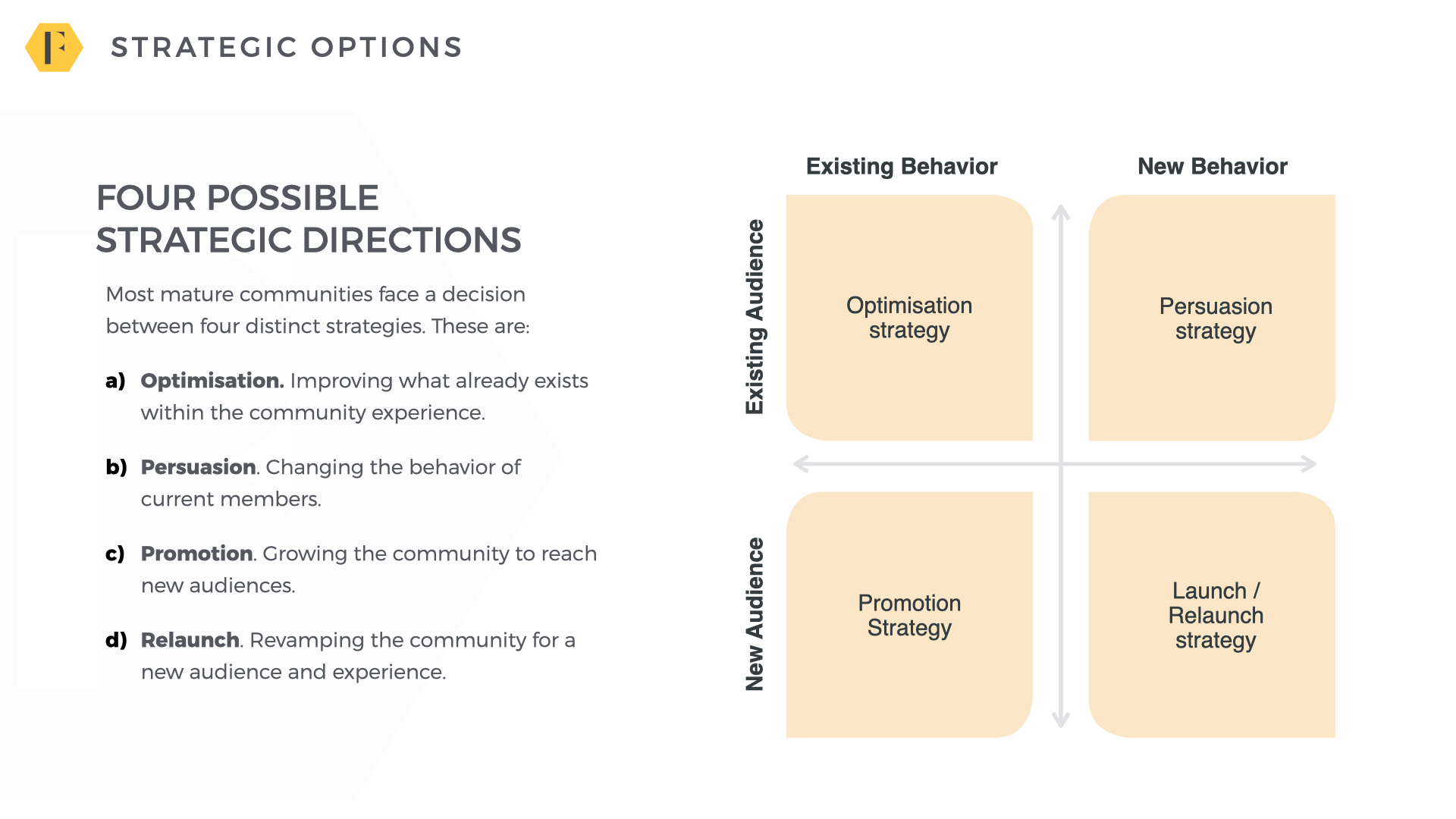
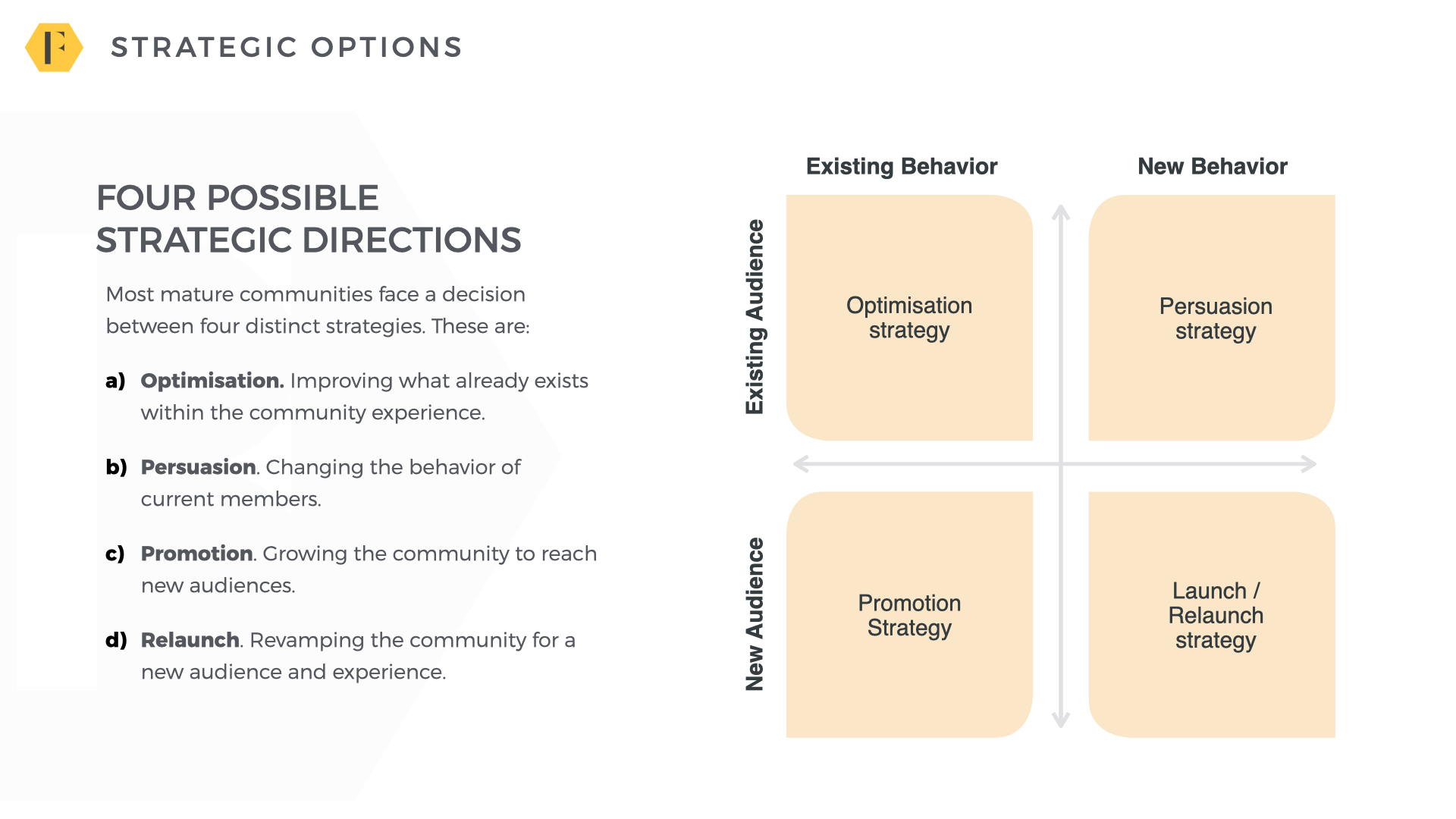
It’s ok to pursue a persuasion approach as long as you’re aware and prepared to do the work of persuading.

The problem begins if a) you’re not aware you’re pursuing a persuasion strategy and b) you’re not prepared to do the work of persuading.

As you can see in the matrix here, if you’re trying to get existing members to perform a new behavior, you’re pursuing a persuasion strategy (or if you’re launching any new community which isn’t based around an immediate need).


Launching a new feature and hoping members will use it? That’s a persuasion strategy.

Starting a group for people to discuss a topic they’re not talking much about today? That’s a persuasion strategy.

(Incidentally, almost all superuser programs are persuasion strategies).

There are nuances to persuasion, but the basic approach is pretty clear.

You need to deliver persuasive messages from credible people to a receptive audience.

Each needs a quick background.

1) Persuasive message. This typically takes the form of an emotive story that fits with the audience’s existing worldview and changes their attitudes. This should match your positioning and strategy. Common archetypes include: “people like you do things like this…”, “you are the best/future/important”, “there’s a small window to [make change happen]”, “help contribute to the greater good”.

2) Credible people. You’re not likely to trust a message delivered by a stranger (or someone sending low-status signals). They’re not one of your tribe. You will listen to people you know, trust, or are perceived as high credibility.

3) Receptive audience. Even the best-written email won’t do well if members are seeing it in the spam or ‘promotions’ folder. Context matters. Your members are more likely to be receptive to a message if they’ve opted into it or the context explicitly commands attention (like a meeting).

When we’ve done this work with clients, we begin by identifying possible stories.

Let’s imagine you want to improve retention by having veterans share their best tips for newcomers. Most people would send an email inviting members to share their best tips. But if we’re using the key principles of persuasion you might come up and test a few different emotive stories.

“Are you as passionate about helping others as we are? Can you share your top 3 tips?”

“Newcomers are struggling and only people with your expertise can help…”

“We’re inviting just our top 5 members to share their best tip for newcomers by this Friday, you’ve made the list. What is your best piece of advice?”

“Help make this the friendliest and most welcoming community for newcomers in the world..”

Notice each hits at a slightly different emotional appeal and tells a different story (but all lead to the same outcome).

Next we look at who the messages should come from. The best options are either:

a) Who does the audience know best within the community team?

b) Who does the audience look up to and recognise in the organisation?

Finally, we think about the best medium to deliver the message. You could send out a mass email. But that’s the quickest and least effective medium.

Other options might include:

  • Signing up to a private webinar to hear directly from the organisation.
  • Scheduling individual calls and meetings.
  • Sending personalised emails to each recipient.
  • Posting an announcement in the forum.
  • Recording a special video message and sharing it.
  • Etc…

It takes skill and experience, but each time you take a persuasion approach you get better at doing it. The key lesson is if you’re trying to get members to undertake a behavior they’re not doing today, you need to persuade them to do it. Persuasion is about emotive stories which change attitudes. The messages need to be sent from a credible person in a context to which the audience will be receptive to.

The post Don’t Blunder Into A Community Persuasion Strategy first appeared on FeverBee.

04 Sep 16:49

Blog Islands in the Stream

by Reverend

I’m not gonna lie, I have been spending the greater part of the last few days honing my karaoke game. Turns out I can spend endless hours on the web broadcasting to a radio/tv empire with no listeners or viewers and feel pretty damn good about myself all the while. Who knew?

But all for God and ds106!  -or is that the other way around? Regardless, this was not entirely me screaming into the void, there was a reason. Chahira and I got back in the Karaoke groove to put on a little event for the Summer Campus group she was helping to run at the University of Göttingen, and it was really a blast.

And it got me thinking we joke a lot about nobody listening on ds106radio, nobody watching on the TV, nobody reading the blogs, etc. But there is a subtle power in that idea, it removes some of the obstacles of entry, it ensures the community is fairly personable, and it keeps the relationships at a human scale. I think a lot of folks that play around with the radio are there because it is about the relationships you build as a result of sharing your story and all the music, images, comedy, sadness, and joy that comes with it. In fact, these karaoke sessions are a particular expression of that personal experience, and while I joke that I have done no work but practice for karaoke, understood another way the karaoke is the work. Sharing around these songs and the experience of opening up, as Rajiv Jhangiani said at OERxDomains21 in his utterly brilliant keynote, is crucial to creating a shared experience that forges a sense of connection.

I am always prepared for there to be just a few people at any event I’m part of, and in that regard I have come to refuse the idea that somehow less is a failure. Scale is the white whale we all seem to be chasing when it comes to online interaction, some abstract valuation (like capital) of followers and friends as a sign of worth that reproduces all the worst elements of the systems many of us thought we were trying to escape with this new media. I find it fitting that 10 people read this blog, and about right that 5 people might want to Karaoke on a Wednesday night. And these five people just happened to span the globe from Germany to Columbia to England to Canada, and maybe beyond even that. And if 3 people on any random Thursday morning happen to listen to me on the radio I consider myself rich as kings.

The chasing of influencer status within a network may be the death knell of generative relationships that provide a sense of meaning and purpose to our short and fragile existence. I don’t think the web is anathema to that reality, but I do think the sense that scale is the measure of success does. I’m not overstating things when I say ds106radio (and increasingly the TV) are proof that the web does not need to always scale to be valuable: seems we have forgotten the power of small spaces to commune and create a sense of purpose outside the maddening rush towards networked thought leader status.

I kind of like the idea of the web returning to islands in the stream apart from our corporate overlords that everywhere dictate how we interact with the culture they keep re-selling us. I want a space within the web but outside the virtual malls the social media landscape has become. I keep returning to the idea of more green spaces on the web and, at least for me, ds106 fits that bill quite nicely. No one really polices that space*, and that is why I love it. What’s more, getting back into the flow of student work from Paul Bond’s Joy of ds106 has reminded me of the deep creative impulse that working within a small, focused community makes possible—and the fact that comes in the form of blog posts in a feed reminds me that there were other streams, blog islands in the stream, that offered an alternative to the data meat market that is social media, and all the irreparable harm it causes us to dream at the scale of the corporation selling us our lunch.

_______________________________________________

*Although there is a #protocol

04 Sep 04:23

Sending lo-fi virtual realities to aliens and also to each other

Instead of sending flat messages into space, why not send an explorable environment?

This idea is in Extraterrestrial Languages, Daniel Oberhaus’ excellent history of attempts to talk to aliens (read last year).

e.g. there’s the famous Arecibo message, transmitted in the direction of Messier 13 in 1974 (the message will arrive in 22,000 years, by which time M13 may have moved out of the way). The message is a pixel grid, 73 by 23, which shows atomic numbers and a pictogram of a person.

Here’s a list of other interstellar messages, and they’re the same more-or-less: data with enough clues to say “hey try and decode me” with some fundamental information communicated as simply as possible. Who knows what alien intelligences might be like.

BUT:

Paul Fitzpatrick’s insight was that if you can send a message, you can send mathematical equations. And if you can send equations, you can send the rules of a programming language. And then you can send executable code. And then…

The idea behind Cosmic OS is that by beginning with simple math, it is possible to construct a programming language that can simulate an interactive virtual environment for an extraterrestrial intelligence. Such a rich environment would in principle allow the extraterrestrial to manipulate the program to get a better idea of the social and behavioral properties of the Earthlings who sent the message.

– Daniel Oberhaus, Extraterrestrial Languages

Here’s CosmicOS on GitHub. The code is open; it’s an ongoing project. (Cosmic OS hasn’t yet been sent into space.)

There’s a demo too. You can see the message, and run the code. There are a large number of statements, building up to abstract objects of “things” and “rooms” and “robos” (things that can move) and a few others.

Until eventually…

“New York” and “Boston” are connected, north and south, with an “autobus” that moves between them.

I mean, it’s basic.

But it shows the power of Fitzpatrick’s idea.

Instead of a description, which is what previous messages have been, an interactive environment - even a simple one - shows ontology, behaviour, and context. It allows the alien to build their own understanding of our world because they get to experience it, well, not exactly directly, but almost. It’s such a better way to transmit knowledge and understanding.


If we can transmit immersive environments to aliens, why not to each other?

Instead of sending a Powerpoint deck, why not a self-contained wiki? A packaged hypertext.

Instead of preparing a Google Doc, why not build a miniature explorable world? Not VR in photorealistic 3D, but a virtual reality of (mainly) text.

I would like to email a “file” which is a playable, navigable space of words, pictures, and embedded bots to have conversations with, at the end of which the recipient understands my ideas just as much as if I had used bulleted lists and diagrams. Their comments should come back to me as in-game questions that I can answer with environmental embellishments. This “world document” should be as easy to author, and as endlessly flexible, as a spreadsheet.

04 Sep 04:22

The Minister (Icelandic TV Series): A Short Review

by Richard

My review of The Minister, an Icelandic TV drama, appeared in the September 2021 newsletter of the Icelandic Canadian Club of Toronto (of which I am currently the secretary). I am reprinting it here with permission.


Poster for the Icelandic TV series The Minister

The newly elected prime minister of Iceland has a secret that could topple his carefully crafted coalition government. On the heels of promising to only take power if the electorate meets a high turnout threshold, Benedikt Ríkardsson takes his case to the people via Twitter to get ideas on how to fix the constitution. Add to the mix a scorned party loyalist and others angling for the top job, sexual tension, the conflict (and alignment) between politicians and the press, shadowy backroom figures and a mental illness that threatens to spin out of control. While the ultimate outcome seems inevitable, everything in between has the viewer on the edge of their seat wondering how the players will stay alive both politically and literally.

The TV show, broadcast on TVO twice in the last 12 months, makes reference to Icelandic history and current events and international relations, and spans 8 hour-long episodes. Starring Ólafur Darri Ólafsson (Trapped, True Detective) as the prime minister, Þuríður Blær Jóhannsdóttir (The Swan) as his aide, Anita Briem (The Swan, The Tudors) as his wife, and Thor Kristjansson (The Swan, Yes-People) as the speaker of the parliament and, of course, long sweeping shots of Icelandic landscapes. TVO has even made the show available on its website to Canadian residents.

04 Sep 03:59

Twitter Favorites: [lisa_curry] Can’t wait to see what the next thing we all become overnight experts on will be

A$AP CURRY @lisa_curry
Can’t wait to see what the next thing we all become overnight experts on will be
04 Sep 03:58

Twitter Favorites: [Planta] @sillygwailo No, I don’t want to be a guest anymore. I’d rather ask questions! (And I think the gimmick here is the… https://t.co/qfdvvV47w0

Joseph Planta @Planta
@sillygwailo No, I don’t want to be a guest anymore. I’d rather ask questions! (And I think the gimmick here is the… twitter.com/i/web/status/1…
04 Sep 03:58

Twitter Favorites: [nealjennings] I bought my e-bike 25 months ago. I've averaged 113km per month on it ever since. I would never ride anywhere near… https://t.co/NzrLlq94jt

Neal Jennings @nealjennings
I bought my e-bike 25 months ago. I've averaged 113km per month on it ever since. I would never ride anywhere near… twitter.com/i/web/status/1…
01 Sep 18:51

Mozilla VPN Security Audit

by Jonathan Claudius

To provide transparency into our ongoing efforts to protect your privacy and security on the Internet, we are releasing a security audit of Mozilla VPN that Cure53 conducted earlier this year.

The scope of this security audit included the following products:

  • Mozilla VPN Qt5 App for macOS
  • Mozilla VPN Qt5 App for Linux
  • Mozilla VPN Qt5 App for Windows
  • Mozilla VPN Qt5 App for iOS
  • Mozilla VPN Qt5 App for Android

Here’s a summary of the items discovered within this security audit that were medium or higher severity:

  • FVP-02-014: Cross-site WebSocket hijacking (High)
    • Mozilla VPN client, when put in debug mode, exposes a WebSocket interface to localhost to trigger events and retrieve logs (most of the functional tests are written on top of this interface). As the WebSocket interface was used only in pre-release test builds, no customers were affected.  Cure53 has verified that this item has been properly fixed and the security risk no longer exists.
  • FVP-02-001: VPN leak via captive portal detection (Medium)
    • Mozilla VPN client allows sending unencrypted HTTP requests outside of the tunnel to specific IP addresses, if the captive portal detection mechanism has been activated through settings.  However, the captive portal detection algorithm requires a plain-text HTTP trusted endpoint to operate. Firefox, Chrome, the network manager of MacOS and many applications have a similar solution enabled by default. Mozilla VPN utilizes the Firefox endpoint.  Ultimately, we have accepted this finding as the user benefits of captive portal detection outweigh the security risk.
  • FVP-02-016: Auth code could be leaked by injecting port (Medium)
    • When a user wants to log into Mozilla VPN, the VPN client will make a request to https://vpn.mozilla.org/api/v2/vpn/login/windows to obtain an authorization URL. The endpoint takes a port parameter that will be reflected in a <img> element after the user signs into the web page. It was found that the port parameter could be of an arbitrary value. Further, it was possible to inject the @ sign, so that the request will go to an arbitrary host instead of localhost (the site’s strict Content Security Policy prevented such requests from being sent). We fixed this issue by improving the port number parsing in the REST API component. The fix includes several tests to prevent similar errors in the future.

If you’d like to read the detailed report from Cure53, including all low and informational items, you can find it here.

More information on the issues identified in this report can be found in our MFSA2021-31 Security Advisory published on July 14th, 2021.

The post Mozilla VPN Security Audit appeared first on Mozilla Security Blog.

01 Sep 18:51

Using the Chrome DevTools console as a REPL for an Electron app

by Simon Willison

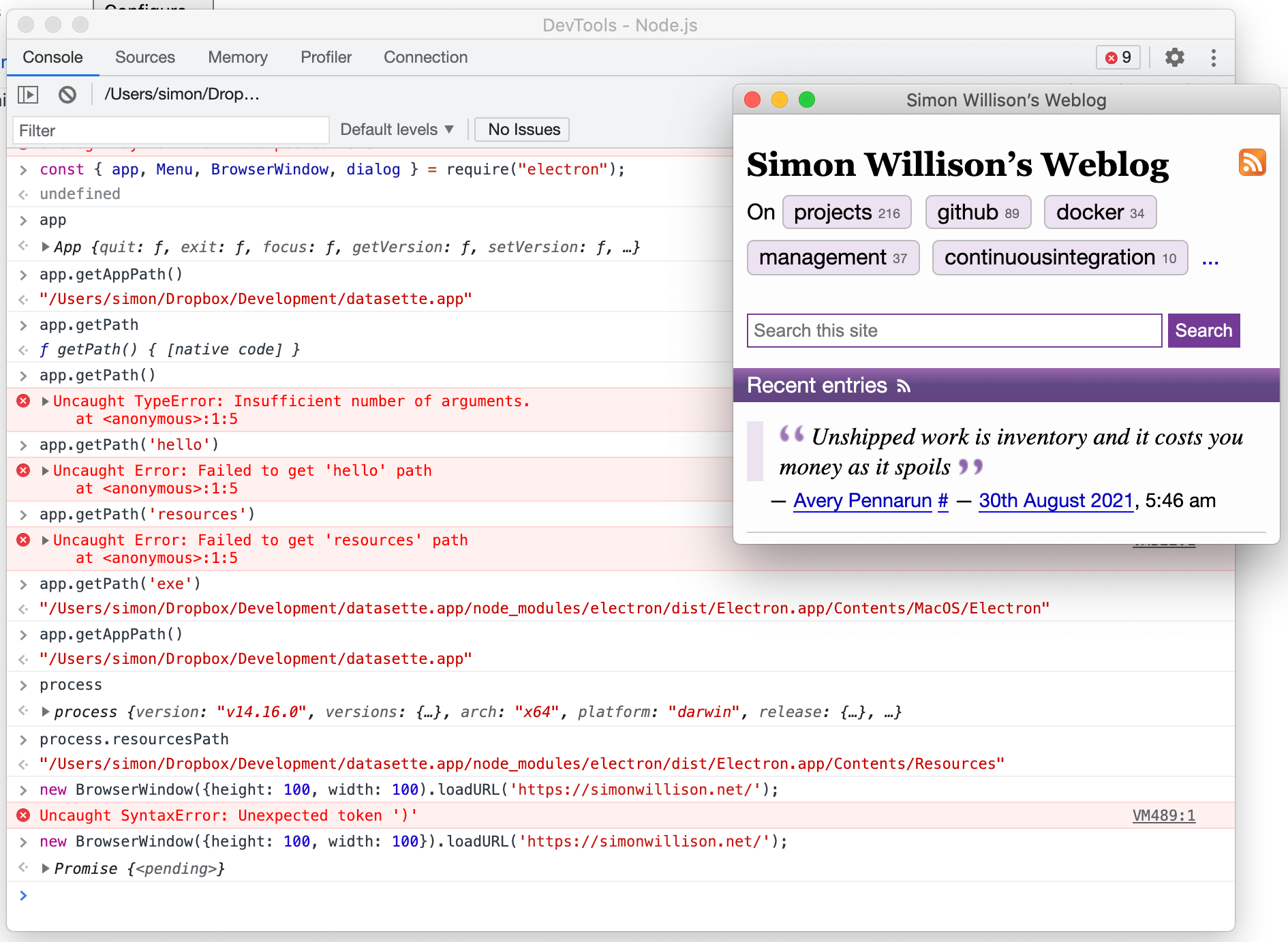
I figured out how to use the Chrome DevTools to execute JavaScript interactively inside the Electron main process. I always like having a REPL for exploring APIs, and this means I can explore the Electron and Node.js APIs interactively.

Simon_Willison’s_Weblog_and_DevTools_-_Node_js_and_Inspect_with_Chrome_Developer_Tools

https://www.electronjs.org/docs/tutorial/debugging-main-process#--inspectport says you need to run:

electron --inspect=5858 your/app

I start Electron by running npm start, so I modified my package.json to include this:

  "scripts": {
    "start": "electron --inspect=5858 ."

Then I ran npm start.

To connect the debugger, open Google Chrome and visit chrome://inspect/ - then click the "Open dedicated DevTools for Node" link.

In that window, select the "Connection" tab and add a connection to localhost:5858:

8_31_21__2_08_PM

Switch back to the "Console" tab and you can start interacting with the Electron environment.

I tried this and it worked:

const { app, Menu, BrowserWindow, dialog } = require("electron");
new BrowserWindow({height: 100, width: 100}).loadURL("https://simonwillison.net/");
01 Sep 18:43

I Can't Let Go ft. Tim Chaisson

by peter@rukavina.net (Peter Rukavina)

I Can’t Let Go ft. Tim Chaisson from The SIDH is a lovely song that heretofore escaped my attention.

01 Sep 18:43

What to call Prostituted Women & Children

by Caterina Fake

I’ve been working a long time to help protect women and children who have been forced into prostitution through their addictions, poverty, history of sexual abuse and vulnerability, and find that the language used to describe these typically abused and disempowered women is really problematic. I agree with this from Ruchira Gupta, the activist and documentary filmmaker widely recognized for her work as an advocate for prostituted women and children:

Gupta also realises how, over the years, sensitive subjects get glossed over with problematic vocabulary. “We do not use the term ‘sex worker’ anymore because we believe it’s so inherently exploitative that we do not want to define it as work under any circumstances. So, we use the term ‘prostituted child’, because there is no such thing as a child prostitute—someone did it to the child. And we use the term ‘prostituted woman’. We realise the patriarchy of the system that is exploiting the vulnerabilities of these girls and women.”

Vogue India

(As an aside, I was just talking with a friend about how we used to read Vogue “for the articles”; you don’t expect topics like this from Vogue, and yet I read so many like it. This is from Vogue India, and India is of course known as one of the worst places to be a woman–and is often ranked the worst–in multiple studies. It was often first, with Afghanistan coming in second, but they may now have switched spots.)

01 Sep 18:43

The ‘Person Workaround’ Usually Fails

by Richard Millington

A workaround is a temporary fix.

You might tape over a (small) windscreen crack until you can get the car serviced. But you probably don’t want to begin a road trip without figuring out who’s going to drive the car.

This seems to be happening too often in communities. Due to ‘headcount issues’, ‘recruitment delays’ or some other uncertainty, community projects are going full-steam ahead without any clarity on who’s going to run the project.

Trust me, ‘Mike from customer support’ isn’t going to cut it. It’s not his job, he’s not accountable for its success, and it will always be something he tries to get around to at the end of the day. You could outsource the community, at least for a while, but that problem is they’re juggling multiple communities.

I have no problem with temporary technology workarounds when needed. But when it comes to people, you need to push the stop button and figure out who’s going to be running the show before you launch.

The post The ‘Person Workaround’ Usually Fails first appeared on FeverBee.

01 Sep 18:42

2021-08-31 BC

by Ducky

Treatments

This article says that it’s not just Americans being stupid: some feed stores in BC are seeing a run on ivermectin (a dewormer which the fringe right has decided is a good treatment for COVID-19, all scientific evidence to the contrary).

Press Briefing

Most of the time spent at the briefing was going over slides, most of which are also in the Biweekly Data Summary.

Where is spread happening?

Multiple times, DrH said basically that most of the province was in pretty good shape, it was just isolated pockets, mostly in the Interior and Northern HAs. I didn’t entirely believe her, but this map does make it look like that. For example, case counts are really low in the Lower Mainland and the southern Island; the case counts are up Fraser Health, VCH, and Island Health, but look at where they are happening: in VCH it’s only Bella Coola, right downtown, and DTES. In Fraser, it’s only Hope. On the Island, it’s only Port Alberni.

How good is vaccination?

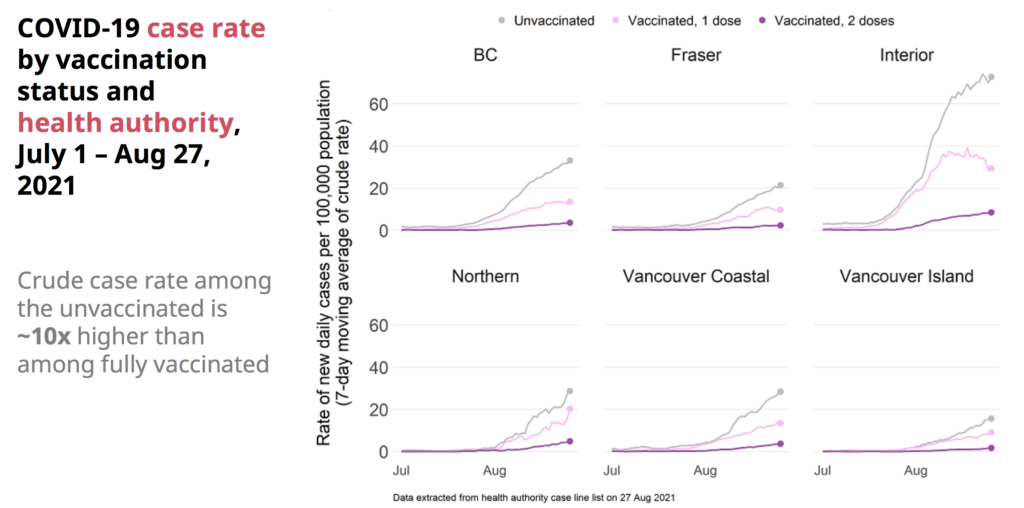
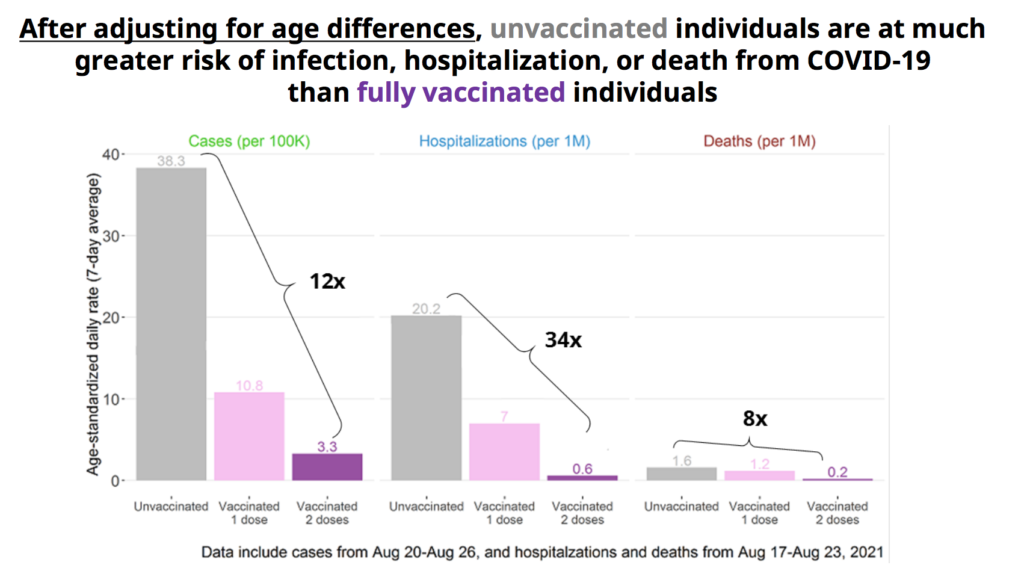
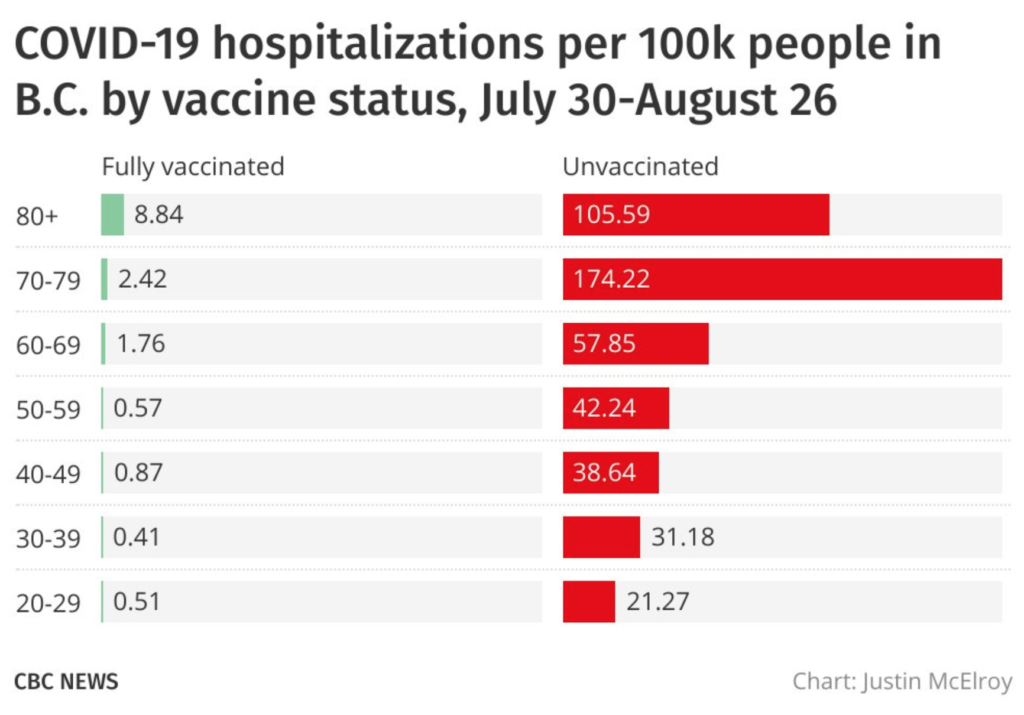
They showed a number of graphs which showed how different the pandemic is for vaccinated vs. unvaccinated people. The differences are stark:

Who is getting sick?

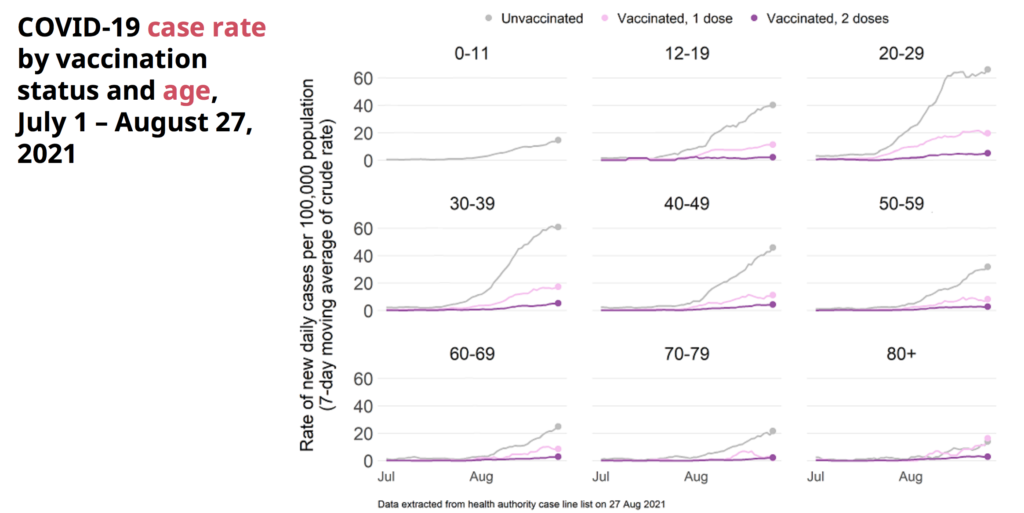
Case counts are highest in the 20-40 year-olds:

They emphasized that they are not seeing kids get hit harder by Delta. In other jurisdictions (cough USA cough), it appears that the apparent increase of kids with severe cases is just because there are more cases, period. Hospitalizations in kids are still really low, and they promise that they are watching really closely.

DrH also emphasized that while the over 70s are very well vaxxed, once a virus gets into a long-term care home, even fully-vaxxed people can get it.

Contact Tracing

They acknowledged that health care services are stretched thin in places. In the Q&A, someone asked if contact tracing was adequate. DrH replied that:

  • They are still committed to doing tracing and follow-up for every positive test.
  • They are doing less rigorous tracing and follow-up for people who are vaxxed.
  • They are moving some people back into contact tracing who had been working on the vaccine clinics.
  • Instead of seeing 20 or 30 people getting sick at a party, they are seeing more like 5 or 6 who get sick, that makes the contact tracing easier.

Dix made a comment in the context of contact tracing that the vax uptake was pretty consistent across the province for the older cohorts, that the difference in different areas was really in the under-50s.

Modelling

They said that Rt is falling, but it’s still slightly over 1 and needs to be less than 1 to get the pandemic to fade away. (BTW, Rt in the Interior HA is right at 1.00.)

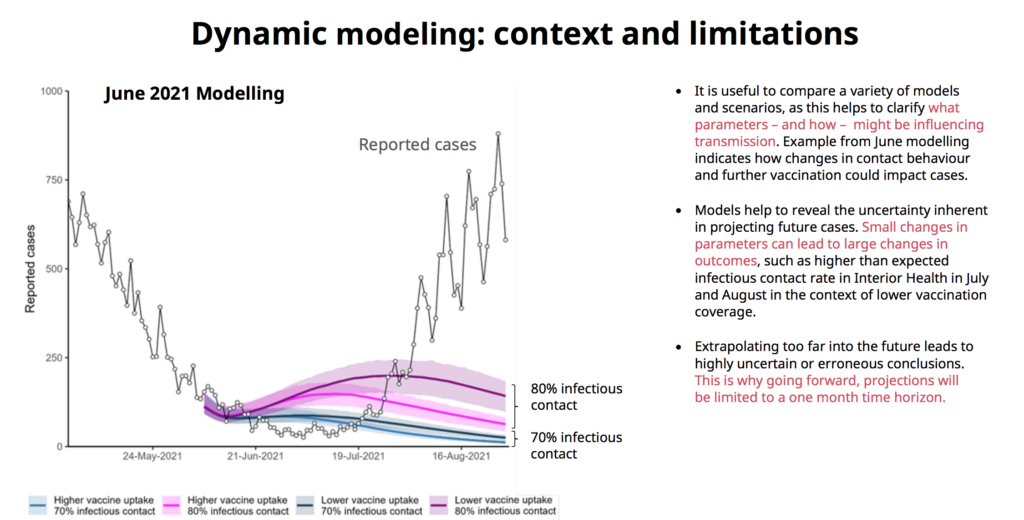
DrH showed what the models showed for the second and third wave and how, because we took measures, the reality was much lower case counts than expected. She then showed what the model showed for the fourth wave, and how reality was much worse than expected, which she blamed on there being higher contact rates in less vaccinated people in the interior than expected “which we couldn’t have predicted”. (And of course other people did.)

She also made a veiled compliment to what I presumed was the BC COVID-19 Modelling Group, saying that she really liked seeing the modelling that other people did, as different initial conditions could really change the outcomes. (Note: it is true that the province’s models were way over-optimistic in this wave and that the BC COVID-19 Modelling Group did a much better job, I’d like to remind people that the Modelling Group was overly pessimistic on waves 2 and 3. Sometimes ya win, sometimes ya lose.)

One slide showed their model with moderate contact rates, and while hospitalizations increased, they didn’t reach the previous max:

Vax Card

Dix and DrH said that the announcement of the vax card (which really means announcement that you gotta have one to go places) had led to a significant boost in vaccinations. (Meanwhile, yesterday the number of vaxxes was very very low!)

A reporter said that a lot of health care workers in long-term care homes were planning on quitting (because they didn’t want to get vaxxed) and getting a job in a health care setting (like a hospital) where they would not be required to get a vaccination, and asked if the province was going to put in vax mandates elsewhere. DrH said absolutely, Dix said that they were negotiating with the unions.

Schools

DrH took some questions about schools, basically HOW ARE YOU GOING TO KEEP THE KIDS SAFE?!?!? DrH said basically, “look, what we did last year worked and we’ve done ventilation upgrades plus adults are vaxxed so we’ll be fine, tho we will expect an increase in communities where there is high transmission”. She didn’t mention anything about how Delta is lots more contagious. I guess we’ll find out soon enough if the ventilation upgrades were adequate.

She also mentioned that there is extremely high vax rate among teachers. They said, but I didn’t write it down — I think it was like 95%.

She also said that they wouldn’t notify parents if there was just one kid. (She said they got feedback that the parental notices gave more anxiety than useful.) She said they would send notices if there was an outbreak, but didn’t define what “an outbreak” was.

A reporter asked why, if there were vax mandates for long-term care home workers, there weren’t vax mandates for teachers. DrH said that it was crucial in LTCH, that lots of people died. Schools are not as critical, so they didn’t feel they needed such a more proportional approach.

Boosters

There was a question about boosters. While they did not 100% definitively promise that they absolutely will, it’s pretty clear they are planning to give a third dose to certain classes of immunocompromised people, e.g. those with solid organ transplants and some blood cancers. (DrH noted that a third dose helps about 55% of them, so it’s not a panacea.) They are drawing up plans for how to give boosters to people in long-term care homes, but they are not seeing waning vaccine effectiveness, so will hold off until if/when they do.

They noted that most people in BC had longer interval between dose1 and dose2 (6-12 weeks), while in Israel and the US, they stuck pretty closely to a 3-4 week interval. The longer interval seems to give more durable protection. At some point, DrH speculated that the best interval between dose1 and dose2 is probably about six months.

They are also watching the vax manufacturers to see if they deliver boosters tailored to different strains.

Biweekly Data Summary

The Biweekly Data Summary is out, but doesn’t say a whole lot that wasn’t said in the briefing.

  • Positivity is high in Interior Health (16%) and Northern Health (20%).

Now, this positivity maps is strange: it covers 18-24 August, while the first map above in the Briefing section covers 15-21 August, and the map above shows 15-20 cases per 100K, while this shows a positivity rate of zero. Maybe this is a small absolute numbers problem?

Statistics

Today: +655 cases, +2 deaths, +4,729 first doses, +6,022 second doses.

Currently 187 in hospital / 103 in ICU, 6,045 active cases, 157,941 recovered.

first doses second doses
of adults 85.0% 77.6%
of over-12s 84.3% 76.5%
of all BCers 76.7% 69.6%

We have 319,142 doses in fridges; we’ll use it up in 19.9 days at last week’s rate.

We have 271,848 mRNA doses in fridges; we’ll use it up in 16.9 days at last week’s rate.

Charts

This tweet had this graph:


01 Sep 18:40

Confidence

by Bryan Mathers
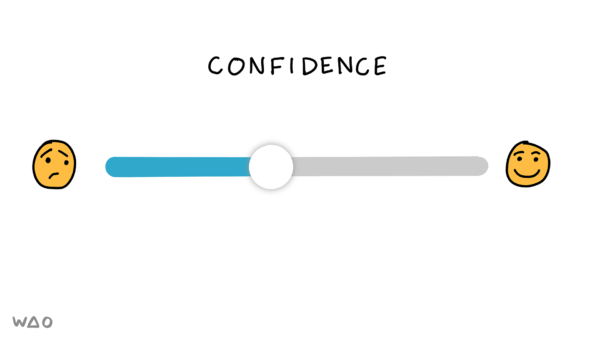
confidence

Where do you get your confidence from? Practice? An inbuilt sense? Reassurance from others? And what leaks your confidence? I watched the highlights of a tennis match yesterday, and saw a young upstart blow away their mature opponent, but still need 6 match points just to get over the line. Don’t overthink it – you’ve got this…

This Thinkery was captured live during a series of workshops by We Are Open, for Catalyst.

The post Confidence appeared first on Open Visual Thinkery.

01 Sep 18:40

Face Mute

by Bryan Mathers
face mute

“My bandwidth isn’t great today so I’m going to face mute…”

This Thinkery was captured live during a series of workshops by We Are Open, for Catalyst.

The post Face Mute appeared first on Open Visual Thinkery.

01 Sep 18:40

What’s MINE to care about and what’s NOT mine to care about?

snerson, Metafilter, Aug 31, 2021
Icon

I think there's a lot of nuance in this discussion (don't just read the top, read at least some of the comments) about how we can respond to the many crises around the world. As one person wrote, "I just do not think our psyches were developed to hold, feel and respond to everything coming at them right now; every tragedy, injustice, sorrow and natural disaster happening to every human across the entire planet, in real time every minute of every day." More, many of us are working within a system that resist change, even when supported and promoted by a collective majority. I think it's fair for each of us to select one or a few areas of focus, just as I have focused on media and education, to make our impact.

Web: [Direct Link] [This Post]
01 Sep 18:40

Why are hyperlinks blue?

Elise Blanchard, dist://ed, Aug 31, 2021
Icon

This post doesn't offer an answer to the question so much as it takes us through a fascinating look at the development of hypertext systems in the 80s and 90s. It's especially fun for me because I remember when most of these products were new and exciting. Imagine, I remember thinking, what we could do if we were able to distribute Cello to our students!

Web: [Direct Link] [This Post]
01 Sep 18:40

After the Hiatus

by Ton Zijlstra

It’s the first of September, and we’re starting the final third of the year. There are 122 more days in 2021, of which 82 working days. The summer hiatus is over. I feel lucky we were able to spend two weeks in Denmark, and another week in France. In the spring we assumed we would stay home as we did last year. Especially when the number of Covid cases surged just before the summer due to premature easing of restrictions, the likelihood of travel diminished.

The weeks away were needed and helpful. At the start of this year I couldn’t focus much on anything, and while that later improved, most things felt sluggish and uninspiring. Being out and about with the three of us gave me new energy and ideas.

In the coming 4 months I’ll keep doing a few things as I did them in the past months, to maintain balance. Like only allowing meetings and conversations in one half of the day. Like using the evenings mostly to read fiction (55 thus far this year). Like avoiding urgent things as much as possible, because those make me feel like being prescribed what to do. I also want to add a few regular things. A weekly lunch out with E, to have time for ‘normal’ conversations together, like we did today. Spend more time reading non-fiction books, something I’ve mostly failed at for years, but now feel more capable to, having relearned myself how to read non-linearly and having a note making routine to do something with the things I read (I even mention this on my /now page, showing the strength of the need I feel to address this).

I also restarted making ‘month maps’ which I skipped mostly in the spring as one month bled into another. ‘Month maps’ are overviews I make at the start of a month, exploring the things I want to finish in the coming weeks, the things I’m dreading or likely to procrastinate on for which I then define small actions to help overcome that, the things I want to avoid becoming urgent, and a general list of things to pay attention to.

Work wise I have the luxury of being able to focus on one project mostly, which happens to be on a topic, the new European digital and data legal frameworks, that is just becoming relevant to data holders and will stay that way for the coming few years. It’s the biggest legal change in data re-use since the first open data directive en the INSPIRE a dozen or so years ago. In my experience having one such ‘steady’ thing going, makes it easier to acquire other work for my company, as I don’t feel urgency to make it so.

Hiatus ex!

01 Sep 18:39

Playing with Community Edition of Ant Media Server

by Reverend

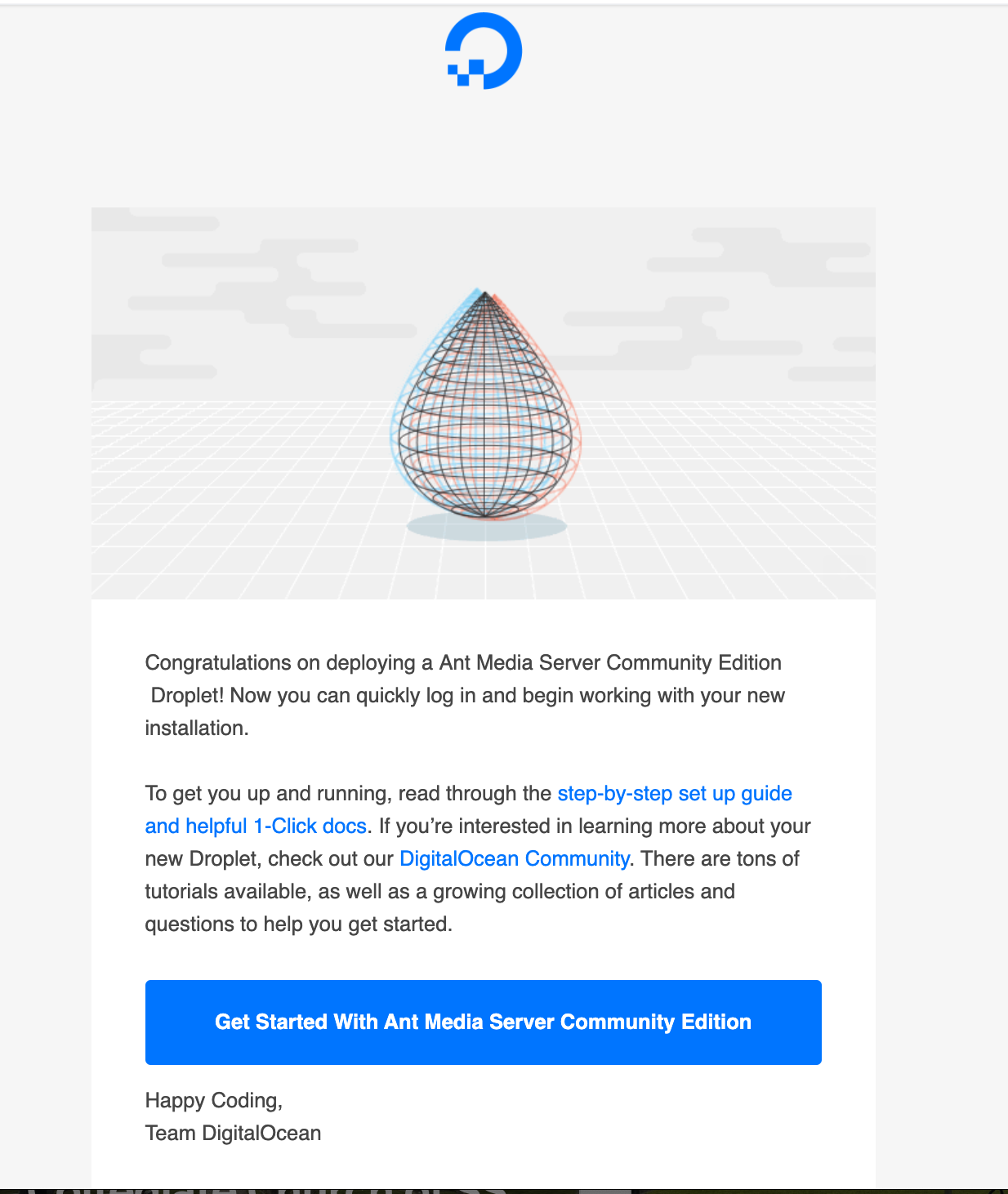
This morning I played with the Community Edition of the Ant Media using Digital Ocean’s Marketplace image for this media streaming software.

Digital Ocean’s success emails provide guide and advice to get folks up and running with their app of choice.

I ran it on an AMD 8 GB droplet with 250 GB block storage, but after some testing the stream was fairly latent. Not sure if this is because it’s a free version of the software or if I need a CPU-intensive Droplet, but going to move it to Reclaim Cloud shortly to see if I can increase resources to deal with latency issues.

One of the key things learned while playing around today was that I needed to setup SSL on the Ant Media server in order to get the iframe for the stream to work. I realized this as a result of the stream returning an invalid response from the iframe.

Enable SSL with Just 1 Command – Easy and Fast

Luckily, this Stackoverflow thread led me to the solution and after following the steps in this useful guide I was able to embed the iframe Ant Media without issue within a simple html page at stream.bava.tv.

I’ll be continuing to play with Ant Media, and create a proper guide for installing on Reclaim Cloud, as well as figure out a one-click installer. A Stream of Your Own is just a click away 🙂

01 Sep 18:39

Regulators and Reality

by Ben Thompson

The FTC's new Facebook case isn't any better than the old one, even as there are ever more questions about the potential harm of regulatory interference


It is coming up on two weeks since the FTC refiled its case against Facebook;1 from the Wall Street Journal:

The Federal Trade Commission filed a new version of its antitrust lawsuit against Facebook Inc. on Thursday, seeking to jump-start its case with bolstered allegations that the company is abusing a monopoly position in social media…The FTC’s amended complaint comes after a federal judge in June dismissed the agency’s original lawsuit, saying it didn’t make sufficient allegations to support claims that Facebook engaged in unlawful monopolization.

With its new, 80-page lawsuit, the FTC seeks to tell a longer, more detailed story about why it believes Facebook is a dominant force that uses its power to hobble any rival that might threaten its market position.

As a quick refresher, the original lawsuit was filed last December and, as I noted at the time, completely failed to characterize Facebook as a monopoly. U.S. District Judge James Boasberg agreed; from his opinion dismissing the case:

Although the Court does not agree with all of Facebook’s contentions here, it ultimately concurs that the agency’s Complaint is legally insufficient and must therefore be dismissed. The FTC has failed to plead enough facts to plausibly establish a necessary element of all of its Section 2 claims — namely, that Facebook has monopoly power in the market for Personal Social Networking (PSN) Services. The Complaint contains nothing on that score save the naked allegation that the company has had and still has a “dominant share of th[at] market (in excess of 60%).” Such an unsupported assertion might (barely) suffice in a Section 2 case involving a more traditional goods market, in which the Court could reasonably infer that market share was measured by revenue, units sold, or some other typical metric. But this case involves no ordinary or intuitive market. Rather, PSN services are free to use, and the exact metes and bounds of what even constitutes a PSN service — i.e., which features of a company’s mobile app or website are included in that definition and which are excluded — are hardly crystal clear. In this unusual context, the FTC’s inability to offer any indication of the metric(s) or method(s) it used to calculate Facebook’s market share renders its vague “60%-plus” assertion too speculative and conclusory to go forward. Because this defect could conceivably be overcome by re-pleading, however, the Court will dismiss only the Complaint, not the case, and will do so without prejudice to allow Plaintiff to file an amended Complaint.

As I noted in June, the FTC’s problem was not laziness, but that Facebook doesn’t have a monopoly; given that, you won’t be surprised to learn that I don’t find the FTC’s new case compelling.

The FTC’s Case

Here is the FTC’s new attempt to define Facebook’s market of “personal social networking services” (all quotes are from the amended complaint):

Personal social networking services consist of online services that enable and are used by people to maintain personal relationships and share experiences with friends, family, and other personal connections in a shared social space. Personal social networking services are a unique and distinct type of online service. Three key elements distinguish personal social networking services from other forms of online services provided to users.

First, personal social networking services are built on a social graph that maps the connections between users and their friends, family, and other personal connections…

Second, personal social networking services include features that many users regularly employ to interact with personal connections and share their personal experiences in a shared social space, including in a one-to-many “broadcast” format…

Third, personal social networking services include features that allow users to find and connect with other users, to make it easier for each user to build and expand their set of personal connections. The social graph also supports this feature by informing which connections are suggested or available to users. Within the United States, the most widely used personal social networking services are Facebook Blue, Instagram, and Snapchat.

The next several paragraphs attempt to explain why these are the only three apps in the space:

Personal social networking is distinct from, and not reasonably interchangeable with, mobile messaging services. Mobile messaging services do not feature a shared social space in which users can interact, and do not rely upon a social graph that supports users in making connections and sharing experiences with friends and family…

Personal social networking is distinct from, and not reasonably interchangeable with, specialized social networking services that are designed for, and are utilized by users primarily for, sharing a narrow and highly specialized category of content with a narrow and highly specialized set of users for a narrow and distinct set of purposes…

Personal social networking is distinct from, and not reasonably interchangeable with, online services that focus on the broadcast or discovery of content based on users’ interests rather than their personal connections. Prominent examples are Twitter, Reddit, and Pinterest…

Personal social networking is distinct from, and not reasonably interchangeable with, online services focused on video or audio consumption such as YouTube, Spotify, Netflix, and Hulu. Users employ such services primarily for the passive consumption of specific media content (e.g., videos or music) from and to a wide audience of typically unknown users…

TikTok is a prominent example of a content broadcasting and consumption service that is not an acceptable substitute for personal social networking services. TikTok users primarily view, create, and share video content to an audience that the poster does not personally know, rather than connect and personally engage with friends and family. The purpose for which users employ TikTok, and the predominant form of interaction on the platform, is not driven by users’ desire to interact with networks of friends and family.

There are two major problems with this argument: the FTC’s own definitions, reasonably understood, don’t reflect reality, and second, the definitions themselves have no relation to the actual market for online services.

Start with the parameters laid out by the FTC:

  • First, WhatsApp is a mobile messaging service. So how is Facebook acquiring it illegal? The FTC’s suit attempts to make the case that Facebook was worried that WhatsApp would evolve into a competitor had Facebook not purchased it, but then why doesn’t that concern apply to every other mobile messaging service? It is the height of motivated reasoning to spin the WhatsApp acquisition as anticompetitive while simultaneously excluding the entire category in which WhatsApp resides.
  • Second, arguing that Facebook is unique from every other social network other than Instagram and Snapchat completely ignores what the product actually does. Apparently the fact that LinkedIn lets you feature your resume (as does Facebook, by the way) means the fact that it is explicitly focused on maintaining and facilitating communications and connections doesn’t matter, despite the fact anything you can do on Facebook can be done on LinkedIn.
  • Third, while it is nice that the FTC bothered to include TikTok in their complaint — the December complaint didn’t mention the app once — any definition that says that Instagram is like Facebook but is not like TikTok is ridiculous. Both let you connect with people you know, but both are primarily focused on broadcast-follow dynamics, not interpersonal communication. This distinction, in conjunction with the previous one, are again motivated reasoning: Facebook is much more like LinkedIn, and Instagram is much more like TikTok, but that’s a problem for the FTC because it ruins their case.

The far bigger problem, though, is that everything I just wrote is meaningless, because everything listed above is a non-rivalrous digital service with zero marginal costs and zero transactional costs; users can and do use all of them at the same time. Indeed, the fact that all of these services can and do exist for the same users at the same time makes the case that Facebook’s market is in fact phenomenally competitive.

What, though, is Facebook competing for? Competition implies rivalry, that is, some asset that can only be consumed by one service to the exclusion of others, and the only rivalrous good in digital services is consumer time and attention. Users only have one set of eyes, and only 24 hours in a day, and every second spent with one service is a second not spent with another (although this isn’t technically true, since you could, say, listen to one while watching another while scrolling a third while responding to notifications from a fourth, fifth, and sixth). Note the percentages in this chart of platform usage:

Most American adults use multiple online services

The total is not 100, it is 372, because none of these services exclude usage of any of the others. And while Facebook is obviously doing well in terms of total users, TikTok in particular looms quite large when it comes to time, the only metric that matters:

Users spend more time on TikTok than other social media platforms

This, of course, is why all of these services, including Instagram, Snapchat, and YouTube are trying to mimic TikTok as quickly as possible, which, last time I checked, is a competitive response, not a monopolistic one. You can even grant the argument that Facebook tried to corner the social media market — whatever that is — a decade ago, but you have to also admit that here in 2021 it is clear that they failed. Competition is the surest sign that there was not actually any anticompetitive conduct, and I don’t think it the FTC’s job to hold Facebook management accountable for failing to achieve their alleged goals.

Prices and Politics

Judge Boasberg, in his opinion dismissing the original FTC case, hinted at what seemed to be the FTC’s political motivations:

The Court’s decision here does not rest on some pleading technicality or arcane feature of antitrust law. Rather, the existence of market power is at the heart of any monopolization claim. As the Supreme Court explained in Twombly, itself an antitrust case, “[A] district court must retain the power to insist upon some specificity in pleading before allowing a potentially massive factual controversy to proceed.” Here, this Court must exercise that power. The FTC’s Complaint says almost nothing concrete on the key question of how much power Facebook actually had, and still has, in a properly defined antitrust product market. It is almost as if the agency expects the Court to simply nod to the conventional wisdom that Facebook is a monopolist. After all, no one who hears the title of the 2010 film “The Social Network” wonders which company it is about. Yet, whatever it may mean to the public, “monopoly power” is a term of art under federal law with a precise economic meaning: the power to profitably raise prices or exclude competition in a properly defined market.

Facebook clearly can’t exclude competitors, and, it should be noted, doesn’t even have the means to raise prices; the FTC, frustratingly enough, doesn’t appear to understand how Facebook’s digital ad market works. Eric Seufert wrote in an article entitled Dear FTC, repeat after me: ad platforms don’t set prices:

Multiple times throughout the complaint, the FTC declares that Facebook’s monopoly control over the market for personal social networking resulted in unnaturally high “advertising prices.” This is simply incorrect, and it reveals a lack of understanding of the digital advertising ecosystem and how advertising inventory is priced…

Digital advertising inventory on large platforms like Facebook is sold through an auction: advertisers bid for impressions, the highest bidder wins, and, depending on the auction design used, either the second-highest (in some flavor of a second-price auction, such as the Vickrey-Clarke-Groves auction design that Facebook employs) or the highest (in a first-price auction) bid sets the price for the placement. Most modern, sophisticated ad platforms allow advertisers to bid against conversions — purchases, registrations, etc. — versus simply bidding for an impression, and the ad platforms use campaign performance to throttle delivery based on calculated click and conversion probabilities for any given user…

The price that an advertiser bids on inventory is wholly dependent on the value of conversions that are produced by that platform. And the degree to which advertisers win auctions is dependent on the competition for that inventory. There is no reason to believe that any advertiser would be paying less for advertising inventory on the Facebook Blue app (or website) today if Facebook had not acquired Instagram or WhatsApp, or if any number of competitive products (but not TikTok!) had entered the very-specifically-defined market in which the FTC believes Facebook operates.

This is why Judge Boasberg’s line that “it is almost as if the agency expects the Court to simply nod to the conventional wisdom that Facebook is a monopolist” stings: Facebook is obviously not particularly popular in Washington D.C., but that is a wholly distinct matter from it being a monopolist. If the powers that be decide that the company needs new kinds of regulation, the answer should be new laws, not redefining antitrust to be about the specific implementation of a non-rivalrous digital service, destroying the credibility of the FTC as a regulator along the way.

Government and Private Industry

That noted, I have to be honest: the prospect of new laws makes me increasingly nervous as well. I absolutely get the case that these platforms are powerful in a way that is deeply suspicious to Americans, and understand the impetus for new regulation, but for me the last two years have been an eye-opening experience about capacity and capability. We have witnessed the federal government, under two different administrations, fumble its way through a pandemic, while its supposedly most capable branch oversaw a disastrous withdrawl from a 20-year nation-building effort that collapsed in a matter of days. The tech industry, meanwhile, has kept the entire world economy running remote with hardly a hiccup, even as other private companies conceived of, tested, and distributed over a billion vaccines and counting. Are we sure we want the former dictating how the latter run their businesses?

China, meanwhile, is going in the opposite direction, taking seats on the board’s of the country’s most innovative companies, driving out founders and killing IPOs, and even limiting when kids can play video games. The most favorable reading of China’s actions is that at least its state has demonstrated the capacity for action — witness how China has brought COVID under control within its borders — but that comes with a level of interference with fundamental freedoms that Americans will never tolerate, and still unanswered questions about just where innovation will come from when pleasing the government is every company’s top priority.

The appropriate response to this challenge — and China is absolutely a challenge — is to reject a top-down approach conducted via regulators with less capacity and greater encumbrances than Beijing, and instead let the tech industry and private companies generally continue to do what they do best: compete. This administration’s antitrust crusaders, unfortunately, don’t really get how markets work. This snippet from The Ezra Klein Show with Tim Wu, a National Economic Council member in charge of technology and competition policy, has stuck with me ever since I heard it in 2016; this was Wu’s takeaway from working in Silicon Valley for a silicon valley startup guilty of accounting fraud:

It kind of changed my thinking about the market and private industry. This was the height of the 90s, government doesn’t have the answers, trust the market, the era of government is over, and I worked in government. The Supreme Court wasn’t perfect, it was relatively public-minded, I don’t think the justices were on the take or anything like that, then I went to private industry, and you know, this was maybe a bad sample — it was WorldCom/Enron era — but these guys didn’t seem to possess any particular wisdom or any special insight into their industry even, they just were all about convincing people to buy a stock, move it up, and then dump it. It really changed my thinking. I actually think I changed my politics, both at the Supreme Court and in Silicon Valley, to become much more suspicious of private actors.

That certainly is about as bad a sample as you can get — I can see why Wu was disillusioned — but here’s the thing: Riverstone Networks, the startup he worked for, ended up in bankruptcy and no longer exists. That is the beauty of the private market — not that everyone is somehow smarter than government, but that there is actual accountability for failure. It’s why Silicon Valley celebrates startups, even though most fail, or are acquired: the best way to innovate is not through top down dictates, but more roles of the dice.

Lessons Learned

This isn’t my first article about the FTC and tech; back in February 2020, when the FTC requested data from the big five tech companies and their history of acquisitions, I wrote First, Do No Harm; my argument then was that while it would have been better had Facebook not acquired Instagram, thanks to the company’s dominance, regulators risked over-reacting and upsetting a Silicon Valley ecosystem that was driving the U.S. economy.

Two years later, and I have to update my position: in a perfect world with perfect regulators I still think the Instagram acquisition shouldn’t have happened, but you can no longer plausibly argue that Facebook has any sort of monopoly power; look no further than recent tech earnings, where the prevailing story was how company after advertising-supported company was absolutely crushing it, in stark contrast to six years ago when Facebook really did look unstoppable. The market worked.

And, over that same post-February 2020 time period, we have been reminded regulators are not perfect, not even close, even as the tech industry has proven itself to be an even more important and capable asset than ever. Sure it may be a 90s cliché to argue “government doesn’t have the answers, trust the market”, but at some point the reality of the government we have, the competition we face, and the assets we can unleash, has to matter more than holding onto politics for politics’ sake.


  1. I was on vacation 🤷‍♂️ 


Subscription Information

Member: Roland Tanglao

Manage your account

01 Sep 18:38

Paris Goes 30 Km/h Everywhere: Here’s Why We Should Too

by Sandy James Planner
mkalus shared this story from Viewpoint Vancouver.

b'


\n

Paris is implementing what other European cities like Brussels Belgium, Grenoble and Lille France, and Bilbao Spain are already doing: lowering speed limits in the city to 30 km/h.\xc2\xa0 A majority of Paris was already posted for 30 km/h, excluding major artery routes like the Champs Elys\xc3\xa9es (50km/h) and the main ring road around Paris, the Boulevard P\xc3\xa9rif\xc3\xa9rique (70 km/h). That strategy has also been done in other cities like Edinburgh to huge success.

\n

\n


\n

This follows the United Nations’ Stockholm Declaration in 2020 that bluntly notes that reducing municipal and urban\xc2\xa0 driver speed limits in cities to 30 km/h would halve the number of road violence victims\xc2\xa0 by 2030. The World Health Organization estimates 1.3 million people a year die from vehicular driver accidents.

\n

Edinburgh in 2018 lowered driver road speeds around the city to 30 km/h to make the city safer, walkable and more sociable. I have previously written about\xc2\xa0 Edinburgh experiencing a 25 percent reduction of\xc2\xa0 cyclist and pedestrian injury rates in the first year of this new reduced road speed.

\n

In an extensive study published in the Urban Analytics and City Science Journal, researchers looked at the\xc2\xa0 impacts of reduced speeds in the City of Edinburgh.\xc2\xa0 Researchers at St. Andrew\xe2\x80\x99s University\xc2\xa0 found that the lowered driver speed limits of 20 mph reduced crashes by one-third in the two years since the lower road speeds were implemented.

\n

As reported by The BBC\xc2\xa0St. Andrews University\xe2\x80\x99s Dr. Valentin Popov of the School of Mathematics and Statistics says that the research indicates that the 30 km/h lower speed policy was effective.

\n

Data simply shows that 30 km/h speed limits\xc2\xa0 “reduce road traffic collisions and make roads safer for users.\xe2\x80\x9d In Britain cities like \xc2\xa0Bath, Bristol, Calderdale, Cheshire West and Chester have directly reduced casualties by implementing 30 km/h driver speed limits.

\n

Back in Paris, a survey done before the implementation of the 30 km/h driver speed limit showed that nearly 60 percent of citizens were in favour, with some businesses opposed due to fears of clients not being able to drive quickly to services. Work by Transport for London shows that better walking and cycling facilities increases time spent in shopping areas by 210 percent and that people coming by walking or cycling spent 40 percent more.

\n

In the United States, NACTO (National Association of City Transportation Officials) have \xc2\xa0recommended “setting lower urban speed limits based on safety, as well as local urban density and activity, rather than the traditional method of gauging how fast drivers are comfortable driving”.

\n

CBC’s Emily Chung notes that nitrogen oxides are generated at higher speeds and that’s the reason that the \xc2\xa0Netherlands recently cut its daytime highway speed limits from 130 km/h to 100 km/h. Of course lower speeds have physical and mental health benefits in neighbourhoods, by discouraging short cutting in neighbourhoods and making streets safer, more convenient and inviting for other users of any age.

\n

And Paris is already seeing a secondary benefit: tourists are flocking to the one hundred streets that have been completely closed to vehicular traffic, and these streets have become a major draw for tourist dollars.

\n

In British Columbia, Prince George has gone to 30 km/h\xc2\xa0 speeds within the city as part of their local climate mitigation plan.

\n

We need to encourage all municipalities and townships to do the right thing for safety, security, and comfort and convenience for all residents no matter what their way of using their neighbourhood and getting around it is.

\n

Lowering driver speed limits in city neighbourhoods\xc2\xa0 to 30 km/h is simply the right thing to do.

\n

Here’s a YouTube video outlining the changes in Paris, with the expected exclamations against\xc2\xa0 the 30 km/h driver speed limits\xc2\xa0 from a representative of the local automobile association.

\n

\n

Image:LucNobout

\n


\n
\n
\n

\n

\n
'
01 Sep 18:37

The New York Times says Accenture gets $500m for Facebook moderation. Why is this news?

by Josh Bernoff

Yesterday, the New York Times published a piece called “The Silent Partner Cleaning Up Facebook for $500 Million a Year.” Was it actually news, and should it change anything? What’s the news here? Here’s what’s in the article, most of which is far from shocking. Much of it repeats the revelations in an excellent exposé … Continued

The post The New York Times says Accenture gets $500m for Facebook moderation. Why is this news? appeared first on without bullshit.

01 Sep 18:37

Regulators and Reality

by Ben Thompson

It is coming up on two weeks since the FTC refiled its case against Facebook;1 from the Wall Street Journal:

The Federal Trade Commission filed a new version of its antitrust lawsuit against Facebook Inc. on Thursday, seeking to jump-start its case with bolstered allegations that the company is abusing a monopoly position in social media…The FTC’s amended complaint comes after a federal judge in June dismissed the agency’s original lawsuit, saying it didn’t make sufficient allegations to support claims that Facebook engaged in unlawful monopolization.

With its new, 80-page lawsuit, the FTC seeks to tell a longer, more detailed story about why it believes Facebook is a dominant force that uses its power to hobble any rival that might threaten its market position.

As a quick refresher, the original lawsuit was filed last December and, as I noted at the time, completely failed to characterize Facebook as a monopoly. U.S. District Judge James Boasberg agreed; from his opinion dismissing the case:

Although the Court does not agree with all of Facebook’s contentions here, it ultimately concurs that the agency’s Complaint is legally insufficient and must therefore be dismissed. The FTC has failed to plead enough facts to plausibly establish a necessary element of all of its Section 2 claims — namely, that Facebook has monopoly power in the market for Personal Social Networking (PSN) Services. The Complaint contains nothing on that score save the naked allegation that the company has had and still has a “dominant share of th[at] market (in excess of 60%).” Such an unsupported assertion might (barely) suffice in a Section 2 case involving a more traditional goods market, in which the Court could reasonably infer that market share was measured by revenue, units sold, or some other typical metric. But this case involves no ordinary or intuitive market. Rather, PSN services are free to use, and the exact metes and bounds of what even constitutes a PSN service — i.e., which features of a company’s mobile app or website are included in that definition and which are excluded — are hardly crystal clear. In this unusual context, the FTC’s inability to offer any indication of the metric(s) or method(s) it used to calculate Facebook’s market share renders its vague “60%-plus” assertion too speculative and conclusory to go forward. Because this defect could conceivably be overcome by re-pleading, however, the Court will dismiss only the Complaint, not the case, and will do so without prejudice to allow Plaintiff to file an amended Complaint.

As I noted in June, the FTC’s problem was not laziness, but that Facebook doesn’t have a monopoly; given that, you won’t be surprised to learn that I don’t find the FTC’s new case compelling.

The FTC’s Case

Here is the FTC’s new attempt to define Facebook’s market of “personal social networking services” (all quotes are from the amended complaint):

Personal social networking services consist of online services that enable and are used by people to maintain personal relationships and share experiences with friends, family, and other personal connections in a shared social space. Personal social networking services are a unique and distinct type of online service. Three key elements distinguish personal social networking services from other forms of online services provided to users.

First, personal social networking services are built on a social graph that maps the connections between users and their friends, family, and other personal connections…

Second, personal social networking services include features that many users regularly employ to interact with personal connections and share their personal experiences in a shared social space, including in a one-to-many “broadcast” format…

Third, personal social networking services include features that allow users to find and connect with other users, to make it easier for each user to build and expand their set of personal connections. The social graph also supports this feature by informing which connections are suggested or available to users. Within the United States, the most widely used personal social networking services are Facebook Blue, Instagram, and Snapchat.

The next several paragraphs attempt to explain why these are the only three apps in the space:

Personal social networking is distinct from, and not reasonably interchangeable with, mobile messaging services. Mobile messaging services do not feature a shared social space in which users can interact, and do not rely upon a social graph that supports users in making connections and sharing experiences with friends and family…

Personal social networking is distinct from, and not reasonably interchangeable with, specialized social networking services that are designed for, and are utilized by users primarily for, sharing a narrow and highly specialized category of content with a narrow and highly specialized set of users for a narrow and distinct set of purposes…

Personal social networking is distinct from, and not reasonably interchangeable with, online services that focus on the broadcast or discovery of content based on users’ interests rather than their personal connections. Prominent examples are Twitter, Reddit, and Pinterest…

Personal social networking is distinct from, and not reasonably interchangeable with, online services focused on video or audio consumption such as YouTube, Spotify, Netflix, and Hulu. Users employ such services primarily for the passive consumption of specific media content (e.g., videos or music) from and to a wide audience of typically unknown users…

TikTok is a prominent example of a content broadcasting and consumption service that is not an acceptable substitute for personal social networking services. TikTok users primarily view, create, and share video content to an audience that the poster does not personally know, rather than connect and personally engage with friends and family. The purpose for which users employ TikTok, and the predominant form of interaction on the platform, is not driven by users’ desire to interact with networks of friends and family.

There are two major problems with this argument: the FTC’s own definitions, reasonably understood, don’t reflect reality, and second, the definitions themselves have no relation to the actual market for online services.

Start with the parameters laid out by the FTC:

  • First, WhatsApp is a mobile messaging service. So how is Facebook acquiring it illegal? The FTC’s suit attempts to make the case that Facebook was worried that WhatsApp would evolve into a competitor had Facebook not purchased it, but then why doesn’t that concern apply to every other mobile messaging service? It is the height of motivated reasoning to spin the WhatsApp acquisition as anticompetitive while simultaneously excluding the entire category in which WhatsApp resides.
  • Second, arguing that Facebook is unique from every other social network other than Instagram and Snapchat completely ignores what the product actually does. Apparently the fact that LinkedIn lets you feature your resume (as does Facebook, by the way) means the fact that it is explicitly focused on maintaining and facilitating communications and connections doesn’t matter, despite the fact anything you can do on Facebook can be done on LinkedIn.
  • Third, while it is nice that the FTC bothered to include TikTok in their complaint — the December complaint didn’t mention the app once — any definition that says that Instagram is like Facebook but is not like TikTok is ridiculous. Both let you connect with people you know, but both are primarily focused on broadcast-follow dynamics, not interpersonal communication. This distinction, in conjunction with the previous one, is again motivated reasoning: Facebook is much more like LinkedIn, and Instagram is much more like TikTok, but that’s a problem for the FTC because it ruins their case.

The far bigger problem, though, is that everything I just wrote is meaningless, because everything listed above is a non-rivalrous digital service with zero marginal costs and zero transactional costs; users can and do use all of them at the same time. Indeed, the fact that all of these services can and do exist for the same users at the same time makes the case that Facebook’s market is in fact phenomenally competitive.

What, though, is Facebook competing for? Competition implies rivalry, that is, some asset that can only be consumed by one service to the exclusion of others, and the only rivalrous good in digital services is consumer time and attention. Users only have one set of eyes, and only 24 hours in a day, and every second spent with one service is a second not spent with another (although this isn’t technically true, since you could, say, listen to one while watching another while scrolling a third while responding to notifications from a fourth, fifth, and sixth). Note the percentages in this chart of platform usage:

Most American adults use multiple online services

The total is not 100, it is 372, because none of these services exclude usage of any of the others. And while Facebook is obviously doing well in terms of total users, TikTok in particular looms quite large when it comes to time, the only metric that matters:

Users spend more time on TikTok than other social media platforms

This, of course, is why all of these services, including Instagram, Snapchat, and YouTube are trying to mimic TikTok as quickly as possible, which, last time I checked, is a competitive response, not a monopolistic one. You can even grant the argument that Facebook tried to corner the social media market — whatever that is — a decade ago, but you have to also admit that here in 2021 it is clear that they failed. Competition is the surest sign that there was not actually any anticompetitive conduct, and I don’t think it the FTC’s job to hold Facebook management accountable for failing to achieve their alleged goals.

Prices and Politics

Judge Boasberg, in his opinion dismissing the original FTC case, hinted at what seemed to be the FTC’s political motivations:

The Court’s decision here does not rest on some pleading technicality or arcane feature of antitrust law. Rather, the existence of market power is at the heart of any monopolization claim. As the Supreme Court explained in Twombly, itself an antitrust case, “[A] district court must retain the power to insist upon some specificity in pleading before allowing a potentially massive factual controversy to proceed.” Here, this Court must exercise that power. The FTC’s Complaint says almost nothing concrete on the key question of how much power Facebook actually had, and still has, in a properly defined antitrust product market. It is almost as if the agency expects the Court to simply nod to the conventional wisdom that Facebook is a monopolist. After all, no one who hears the title of the 2010 film “The Social Network” wonders which company it is about. Yet, whatever it may mean to the public, “monopoly power” is a term of art under federal law with a precise economic meaning: the power to profitably raise prices or exclude competition in a properly defined market.

Facebook clearly can’t exclude competitors, and, it should be noted, doesn’t even have the means to raise prices; the FTC, frustratingly enough, doesn’t appear to understand how Facebook’s digital ad market works. Eric Seufert wrote in an article entitled Dear FTC, repeat after me: ad platforms don’t set prices:

Multiple times throughout the complaint, the FTC declares that Facebook’s monopoly control over the market for personal social networking resulted in unnaturally high “advertising prices.” This is simply incorrect, and it reveals a lack of understanding of the digital advertising ecosystem and how advertising inventory is priced…

Digital advertising inventory on large platforms like Facebook is sold through an auction: advertisers bid for impressions, the highest bidder wins, and, depending on the auction design used, either the second-highest (in some flavor of a second-price auction, such as the Vickrey-Clarke-Groves auction design that Facebook employs) or the highest (in a first-price auction) bid sets the price for the placement. Most modern, sophisticated ad platforms allow advertisers to bid against conversions — purchases, registrations, etc. — versus simply bidding for an impression, and the ad platforms use campaign performance to throttle delivery based on calculated click and conversion probabilities for any given user…

The price that an advertiser bids on inventory is wholly dependent on the value of conversions that are produced by that platform. And the degree to which advertisers win auctions is dependent on the competition for that inventory. There is no reason to believe that any advertiser would be paying less for advertising inventory on the Facebook Blue app (or website) today if Facebook had not acquired Instagram or WhatsApp, or if any number of competitive products (but not TikTok!) had entered the very-specifically-defined market in which the FTC believes Facebook operates.

This is why Judge Boasberg’s line that “it is almost as if the agency expects the Court to simply nod to the conventional wisdom that Facebook is a monopolist” stings: Facebook is obviously not particularly popular in Washington D.C., but that is a wholly distinct matter from it being a monopolist. If the powers that be decide that the company needs new kinds of regulation, the answer should be new laws, not redefining antitrust to be about the specific implementation of a non-rivalrous digital service, destroying the credibility of the FTC as a regulator along the way.

Government and Private Industry

That noted, I have to be honest: the prospect of new laws makes me increasingly nervous as well. I absolutely get the case that these platforms are powerful in a way that is deeply suspicious to Americans, and understand the impetus for new regulation, but for me the last two years have been an eye-opening experience about capacity and capability. We have witnessed the federal government, under two different administrations, fumble its way through a pandemic, while its supposedly most capable branch oversaw a disastrous withdrawl from a 20-year nation-building effort that collapsed in a matter of days. The tech industry, meanwhile, has kept the entire world economy running remote with hardly a hiccup, even as other private companies conceived of, tested, and distributed over a billion vaccines and counting. Are we sure we want the former dictating how the latter run their businesses?

China, meanwhile, is going in the opposite direction, taking seats on the board’s of the country’s most innovative companies, driving out founders and killing IPOs, and even limiting when kids can play video games. The most favorable reading of China’s actions is that at least its state has demonstrated the capacity for action — witness how China has brought COVID under control within its borders — but that comes with a level of interference with fundamental freedoms that Americans will never tolerate, and still unanswered questions about just where innovation will come from when pleasing the government is every company’s top priority.

The appropriate response to this challenge — and China is absolutely a challenge — is to reject a top-down approach conducted via regulators with less capacity and greater encumbrances than Beijing, and instead let the tech industry and private companies generally continue to do what they do best: compete. This administration’s antitrust crusaders, unfortunately, don’t really get how markets work. This snippet from The Ezra Klein Show with Tim Wu, a National Economic Council member in charge of technology and competition policy, has stuck with me ever since I heard it in 2016; this was Wu’s takeaway from working in Silicon Valley for a silicon valley startup guilty of accounting fraud:

It kind of changed my thinking about the market and private industry. This was the height of the 90s, government doesn’t have the answers, trust the market, the era of government is over, and I worked in government. The Supreme Court wasn’t perfect, it was relatively public-minded, I don’t think the justices were on the take or anything like that, then I went to private industry, and you know, this was maybe a bad sample — it was WorldCom/Enron era — but these guys didn’t seem to possess any particular wisdom or any special insight into their industry even, they just were all about convincing people to buy a stock, move it up, and then dump it. It really changed my thinking. I actually think I changed my politics, both at the Supreme Court and in Silicon Valley, to become much more suspicious of private actors.

That certainly is about as bad a sample as you can get — I can see why Wu was disillusioned — but here’s the thing: Riverstone Networks, the startup he worked for, ended up in bankruptcy and no longer exists. That is the beauty of the private market — not that everyone is somehow smarter than government, but that there is actual accountability for failure. It’s why Silicon Valley celebrates startups, even though most fail, or are acquired: the best way to innovate is not through top down dictates, but more rolls of the dice.

Lessons Learned

This isn’t my first article about the FTC and tech; back in February 2020, when the FTC requested data from the big five tech companies and their history of acquisitions, I wrote First, Do No Harm; my argument then was that while it would have been better had Facebook not acquired Instagram, thanks to the company’s dominance, regulators risked over-reacting and upsetting a Silicon Valley ecosystem that was driving the U.S. economy.

Two years later, and I have to update my position: in a perfect world with perfect regulators I still think the Instagram acquisition shouldn’t have happened, but you can no longer plausibly argue that Facebook has any sort of monopoly power; look no further than recent tech earnings, where the prevailing story was how company after advertising-supported company was absolutely crushing it, in stark contrast to six years ago when Facebook really did look unstoppable. The market worked.

And, over that same post-February 2020 time period, we have been reminded regulators are not perfect, not even close, even as the tech industry has proven itself to be an even more important and capable asset than ever. Sure it may be a 90s cliché to argue “government doesn’t have the answers, trust the market”, but at some point the reality of the government we have, the competition we face, and the assets we can unleash, has to matter more than holding onto politics for politics’ sake.


  1. I was on vacation 🤷‍♂️ 

01 Sep 18:36

The Old Log Cabin

For those of you who don’t know, I own an old high elevation cow camp in the Sierra Nevadas with my friend David. It’s home to a 99 year old hand-hewn log cabin, a chainsaw milled post & beam horse barn, and a few smaller bunk houses. It’s been a source of great joy and fulfillment over the years. We call it Leaping Daisy, or sometimes just The Ranch.

The Cabin in Winter

Now for the sad part: the rancher who grazes cattle around the ranch called yesterday, and let me know the old cabin and all the bunk houses burned down in the Caldor Fire.

The Cabin's Remains

Jessica and I have put a lot of work into the cabin the past couple of years — it was a particularly good escape from the beginning months of the coronavirus lockdown. We cleaned it up, fixed the plumbing, replaced the chinking, put a fresh coat of stain on the old logs, and very nearly removed the resident mice.

We may have owned the cabin, but it wasn’t really ours. It was a relic from the Old West, a place where the cowboys would come after a long day of rounding up cattle, start a fire in the wood stove, and fry up some chicken for dinner. It was a building that invited stories and encouraged the imagination. What did this place look like in 1922 when they cleared the land and built the cabin? What kinds of tools did they use? How did Bungie lift those roof rafters by himself when he replaced the roof at the age of 65?

Dog Spirals in Winter

It’s sad, but it isn’t tragic — this is what living in the mountains means. To choose to live in the mountains means you choose to live in the midst of powers far beyond your control. It means preparing for the weather, respecting the terrain, wrapping your arms around trees five feet in diameter, and climbing boulders bigger than houses. And it also means living with wildfire. There is no fire-free option for our forests. We burn them, or we watch them burn. This time we watched them burn.

Jess in the Hammock in front  of the bath house

I’m grateful for all the memories we made at the old cabin, and I’m glad so many of you were able to experience it while it was still around. Its story is finished. A hundred years ago someone cleared the forest to build a cabin, and yesterday the forest took it back.

This is hardly the end for Leaping Daisy. For now, the old barn still stands, the UTV sits safely in its shed, and the solar shed is still up and running and providing WiFi for the embers. The underbrush has burned away and many healthy trees remain standing. The forest is resilient.

The Barn amoungst embers

The joy of the ranch has never been in the having — it’s been in the doing. There’s a little less to have now, but there’s still plenty to do. We’ll have to buy some new chainsaws and dig a new outhouse. Then maybe we can get started on something to inspire stories for the years to come.

Wildflowers in the meadow


There is something else.

Fire is a big subject in California. We don’t have hurricanes, we don’t have tornadoes, but we do have fire. And fire season is getting worse. Extreme fire behavior is the new normal, and megafires like the Caldor are becoming more frequent.

And you know? A lot of people believe there is some kind of fire-free solution. Some people believe we live in a state where logging is illegal, even though our forests are logged constantly. Some believe there is some kind of forest management fairy that will fix all of this, despite the practice’s track record of failure. Some believe we need more prescribed burns, but that it needs to be 100% safe to happen. Some believe that CALFIRE purposefully sets wildfires to maintain job security. Some people should spend less time watching infowars and more time in meadows.

No one who says these things really lives in the mountains, despite where their address might lay on a map. They are stuck in a mindset of control — of getting what they want and forcing their will upon the world. This is a disastrous way of thinking, and it is incompatible with our future. It isn’t how the old timers approached the past, and it can’t be how we approach the future.

I spend a lot of time living in the mountains. Talking to the ranchers who have grazed the National Forest for hundreds of years. Meeting up with the rangers who clear the roads every spring. Kicking the drunk hunters off my roads. Wandering the meadow with foresters. I’ve snowshoed through five feet of fresh snow, dipped in ice cold streams, and used a chainsaw taller than me to take down a 200ft tall fir. The reality of the mountains is very different than talking points on TV and the memes posted by “retired loggers” on Facebook.

The forest around the ranch was logged heavily over the past three years. After the logging crews came the masticators and wood chippers. This was all in preparation for a series of prescribed burns, the first of which escaped its boundaries and became known as the Caples Fire. This fire received massive backlash from the community despite no structures being lost and the fire’s objectives being met in majority (burninng of underbrush, retention of large trees).

Even with the massive amount of logging, mastication, firefighters, dozers, airplanes, and helicopters, the Caldor Fire ripped through this forest without care. It leapt across hundreds of clear cut properties owned by Sierra Pacific Industries, jumped over firebreaks six blades wide, and created spot fires up to a mile away. The only place it did stop? At the burn scar for the Caples Fire, the one that so many believed to be reckless.
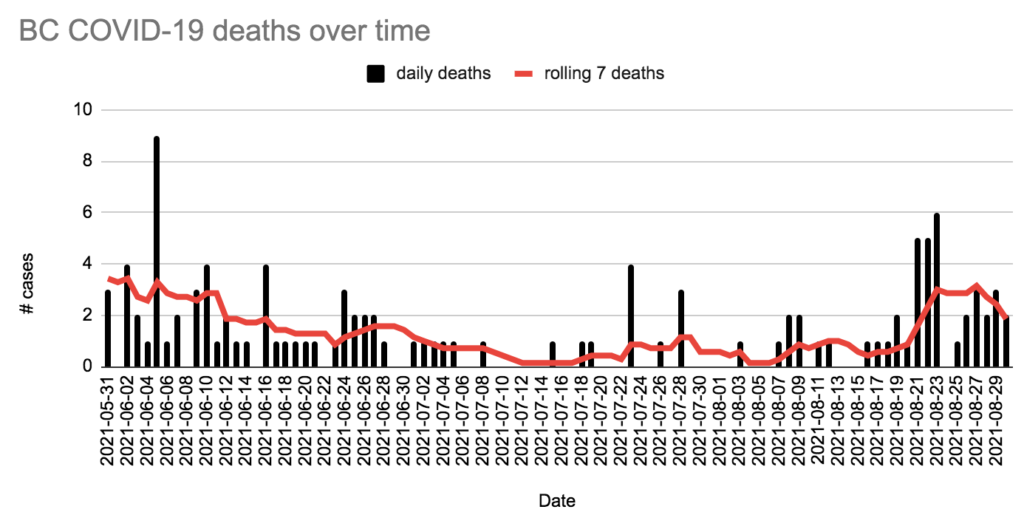
Decades of preventing fire, extended drought, and a changed climate have all converged to create conditions for extreme fire behavior. There is no easy fix, and there are no safe solutions. We are going to see a lot more fires in the West.

There is no fire-free option for our forests. We burn them, or we watch them burn.

01 Sep 18:36

Mozilla VPN Completes Independent Security Audit by Cure53

by Mozilla

Today, Mozilla published an independent security audit of its Mozilla VPN, which provides encryption and device-level protection of your connection and information when you are on the Web, from Cure53, an unbiased cybersecurity firm based in Berlin with more than 15 years of running software testing and code auditing. Mozilla periodically works with third-party organizations to complement our internal security programs and help improve the overall security of our products. During the independent audit, there were two medium and one high severity issues that were discovered. We have addressed these in this blog post and published the security audit report.

Since our launch last year, Mozilla VPN, our fast and easy-to-use Virtual Private Network service, has expanded to seven countries including Austria, Belgium, France, Germany, Italy, Spain and Switzerland adding to a total of 13 countries where Mozilla VPN is available. We also expanded our VPN service offerings and it’s now available on Windows, Mac, Linux, Android and iOS platforms. Lastly, our list of languages that we support continues to grow, and to date we support 28 languages. 

Developed by Mozilla, a mission-driven company with a 20-year track record of fighting for online privacy and a healthier internet, we are committed to innovate and bring new features to the Mozilla VPN through feedback from our community. This year, the team has been working on additional security and customization features which will soon be available to our users. 

We know that it’s more important than ever for you to feel safe, and for you to know that what you do online is your own business. Check out the Mozilla VPN and subscribe today from our website.

For more on Mozilla VPN:

Celebrating Mozilla VPN: How we’re keeping your data safe for you

Latest Mozilla VPN features keep your data safe

Mozilla Puts Its Trusted Stamp on VPN

The post Mozilla VPN Completes Independent Security Audit by Cure53 appeared first on The Mozilla Blog.