Shared posts

22 Sep 03:08

Slow Declines Are Far More Worrying Than Sudden Drops

by Richard Millington

Analysing the data from two new clients recently.

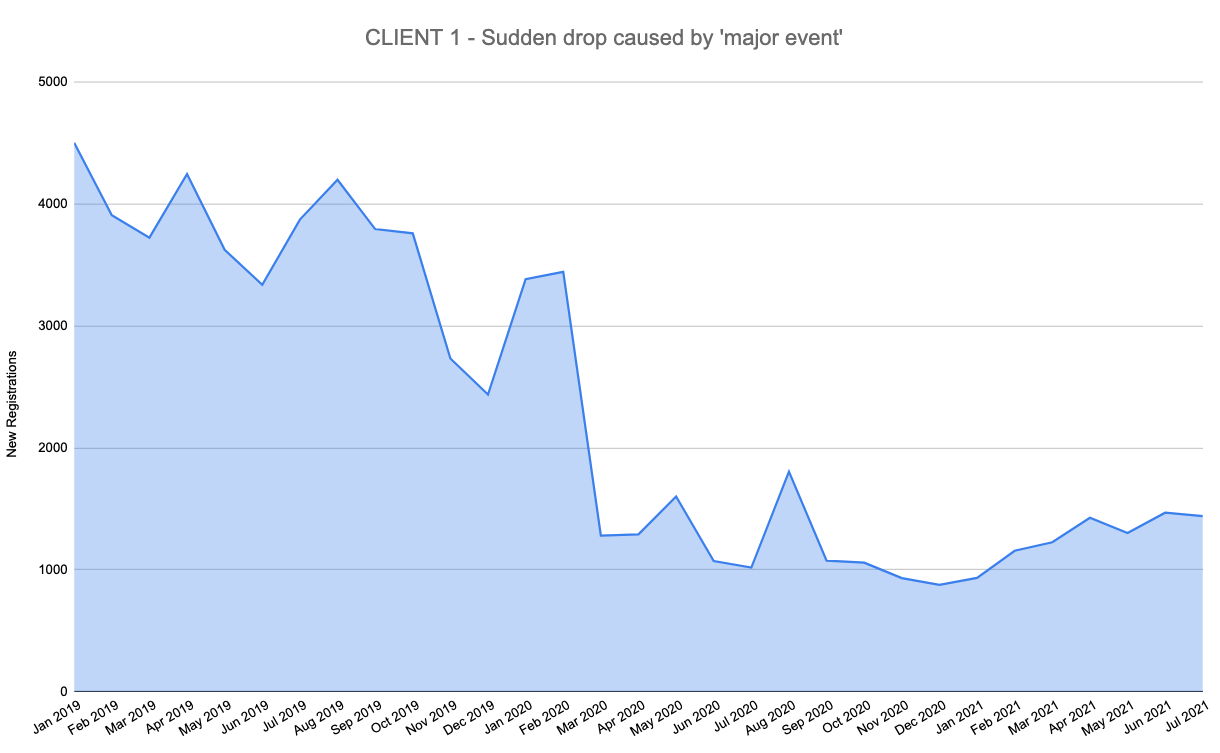
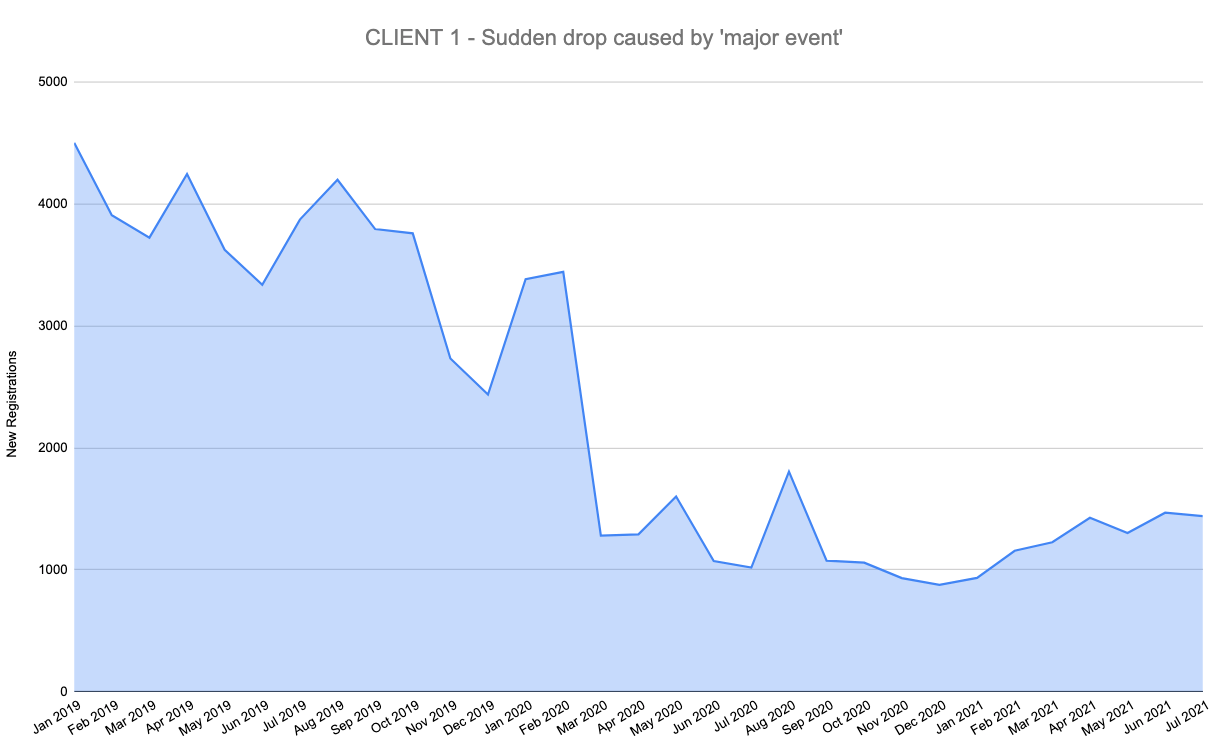
Let’s begin with this graph here.

When you see a sudden drop like this (or major drop compared with data from the year before), the cause is almost always a major external event. If you want to grow a community, you first need to determine what the major event was.

The most common examples (by order of frequency) include:

  • Changes to the registrations process (often a new SSO system)
  • Changes to the company homepage design.
  • Changes to the community design.
  • Changes to the Google algorithm.
  • A ‘black swan’ event (given the date of the drop, this might be our first hunch to explore).

Typically here, you can ask around and find what other changes occurred in each of the above until you find the source. You can play detective here and ask around each of the above to determine what’s happening.

A sudden drop is bad, but not disastrous. It can usually be reversed if you can identify the cause. The interests of members haven’t fundamentally shifted.

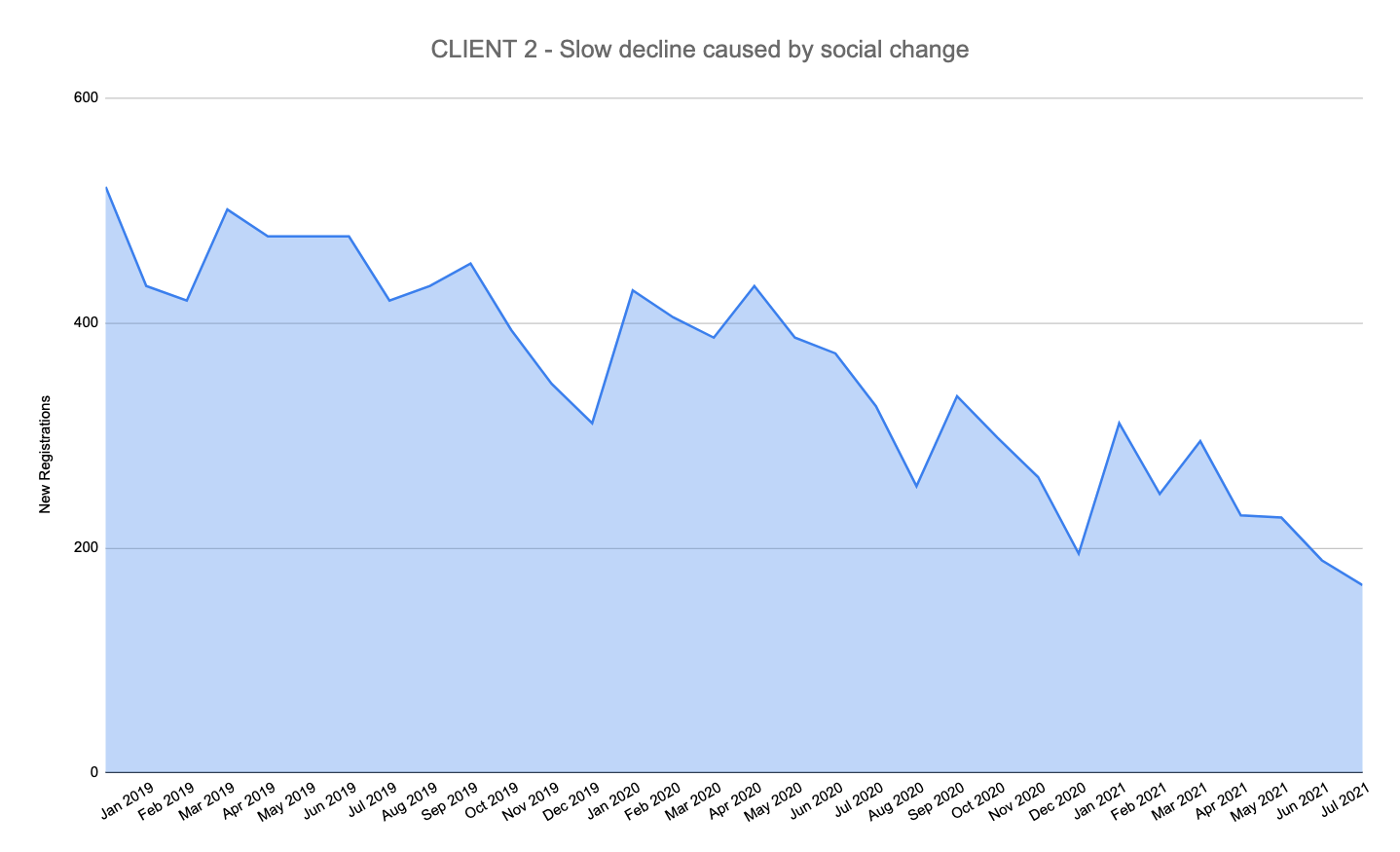
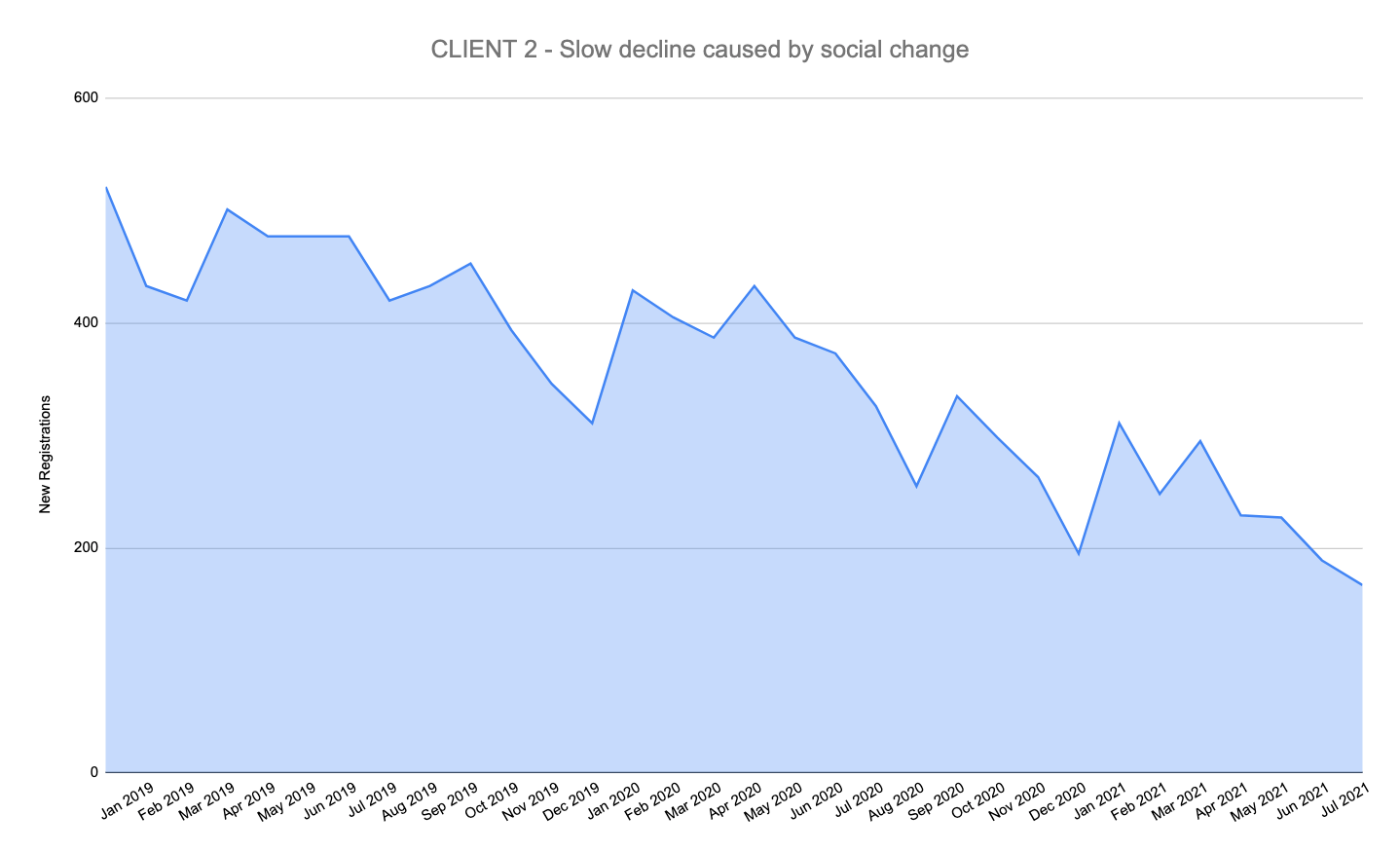
Now consider this graph:

When you see a more gradual drop like this, the cause is social in nature. A slow decline is far more likely to be fatal than a sudden drop. The needs and motivations of members are fundamentally changing and you need to change too.

The most common explanations here include:

  • You have fewer potential people to engage (fewer people interested in the topic / fewer new customers).
  • Members have fewer questions to ask.
  • Rising competition from other channels.
  • Declining community experience drives people away.

Before you can reverse the trend, you need to gather a few metrics to identify what the problem is. This usually includes comparing the trend against :

  • The number of visitors to the company website.
  • No. new customers the organisation has attracted.
  • Search traffic to the community.
  • No. of support tickets being filed from support teams.

If any of these are also declining, you have usually found your cause.

For example, if there has been a comparable decline in support tickets filed, you know the drop isn’t community-centric. It’s part of a broad shift of either attracting fewer customers or customers having fewer questions to ask.

Before trying to change any metric, you need to understand what’s driving it. Solve that and everything becomes a lot easier.

The post Slow Declines Are Far More Worrying Than Sudden Drops first appeared on FeverBee.

22 Sep 03:08

2020 06 08 Historians and AI

Thanks for coming, thanks for your contributions, and special thanks to Darrell and the AHA staff for organizing this and putting up with at least my repeated inability to hold a deadline during a pandemic.

My frame for thinking about this has been Lara Putnam’s article from 2016 about the “Transnational and the Text Searchable” which made a really interesting argument about the unacknowledged ways that full text search, if it didn’t cause the boom in transnational history in the 1990s and 2000s, at least made it much easier for it to take a particular form while leaving historians with an abbreviated investment in the countries, periods, and people they study.

So the perspective that I tried to advance is that the most important changes brought about by AI for the historical profession will be ones that we largely do not notice, except for the general sense of a conformation of historians superpowers of research. It will be ones where the underlying methods align so nicely with the tools that Google, Elsevier, and JStor are developing that we don’t even quite notice them.

But what we won’t notice is that we’ll increasing our powers, others are gaining them for the first time.

Representation Learning

But in order to understand that analogy, I think I’ll take it a little onto myself to try to explain just how these algorithms work. “Artificial Intelligence” is a philosophical term that I don’t really understand and that tends to conflate many only semi-related things together–Machine Learning, Data Science, Neueral Nets, Deep Learning, and so on.

But just in the period since I started doing digital history a decade or so ago, there is something new, and it’s something worth understanding. The best, most specific term is “representation learning,” and it is a shared strategy that has quickly transformed the information architecture of the contemporary age.

It relies heavily on vast troves of data to train on, and I’m sure we’ll get to talk more about the implications of what’s in those datasets. But it also has an actual underlying model.

RL is a general strategy for transforming any type of digital object, from a book, to your listening history on a streaming service, into a “vector” of numbers. These models often require a massive number of examples to get started, but once trained on they can quickly place any similar digital surrogate into the same “vector space.” These vectors are usually trained in order to predict some discrete outcome. (Whether you’ll skip a Bob Dylan song; what the next word in a sentence will be; if a photo is of a marmot, a hedgehog, or an aircraft carrier.) But the vector—the “representation” in RL—is more than the prediction it makes; it is a representation of the object in a mathematical space. Each poem, song, or picture floats among all the other objects the computer could see, situated in terms of their relationships to each other.

It’s a map without a territory.

This is not any particular representation; it’s just the words that appear, without any real deep learning. But it captures in a more useful way than the network diagrams the goals here.

Searches and retrieval happen in this space.

Effects of representation learning.

There are two important changes that this will bring about:

  1. It makes search operate both on new kinds of sources and on new kinds of terms. Images, handwriting, and foreign languages. (I’d wager that the effect of languages specifically isn’t sufficiently through yet.)
  2. It blurs the line between “search” and “recommendation systems” in interesting but also problematic ways. If you search not for a term but as a trajectory, you get different results; one of the things that makes Spotify, Google, and the rest work is that the reduce not just their songs to vectors but their users as well. Research that is tailored towards what the scholar wants to see–which they often dissemble means simply “easy to use.”

Shades of grey and the menagerie.

This is the first thing we need to worry about.

Intelligent people sometimes assume that since computers are binary, they have to see things in black and white; only the human mind can handle subtlety, ambiguity, and nuance. But really, the neural networks that build RL models can see only in shades of grey. This changes the questions they can help us think about. In my own research, I’m using a neural network to probe the design of the early 20th-century Library of Congress Classification by looking at the differences between machine predictions and actual decisions. But while I train the classifier to return a single prediction, the underlying model actually returns some tiny probability that every book could belong to any subject. Give it Moby Dick, and the model is fairly confident it’s reading a novel; but it nonetheless holds out a significant possibility that the book might be shelved as biology or travel literature, and even allocates a tiny chance that it might be a mathematical treatise or a musical score. In these uncertainties lies a space for escaping conventional orders.

[Melville]

Representation models are not binary–they are pathologically sophisticated smooth, incapable of seeing distinctions rather than gradations.

The menagerie

So what are the equivalents to keyword search from a machine that only sees shades of grey? In certain ways, it’s precisely the opposite of what we’ve come to expect from the ways we intentionally use digital archives.

Rather than enabling hyper-specific searches, it will promote engaging with broad concepts. One of the most interesting digital history papers I’ve read in the last few years was by a team of concepts who assembled a vector to represent “law and economics thought.”

If I can drop some pessimism at the end; I am not convinced this is a golden opportunity for historians at all, because to serious engage with this suggests a need to deal with methodology in a way that historians have been reluctant to. It will reward those who understand how to fit the engine together.

But what I’m maybe most worried about is that historians will overestimate their relevance. In one of the projects I’m working on, we find all the things that don’t fit into New discovery methods will make it easy to see the places that the classifiers fail. One of the issues that comes up again and again is that of bias. But one of the most curious biases of these new classification systems is that they provide enormous ammunition to those who are skeptical of classification itself. In a project with Peter Organisciak where I’m using deep learning to track duplicate volumes in various different books, we have a section of one notebook that’s called the “menagerie”; places where things have happened that don’t fit into the understanding of book publication that we bought to the project; books that

Preparing for today, I got into a too-long discussion with some literary scholars and Spotify employees about whether Spotify is killing genre. I don’t know. But I am confident that the representation learning strategy and certain things about higher dimensional spaces operate in a space that, because of their fuzziness, will tend to surface things not at the center of dense areas in a high dimensional space but things off at their margins. I’ve seen that again and again.

With the historical profession stuck in a sort of holding pattern for hiring, it seems to me that the prevailing evaluation of AI systems will be for historians to focus in a self-congratulatory way, on their shortcoming, biases, and errors, and leave serious engagement with digital methodology to fields that are able to focus more singularly on methodology like Economics, Computer Science, and even English. Historians will be able to come up with a continuing supply of strange examples that make for great lecture examples, that complicate the grand narratives of history offered by economists, or that confirm the strangeness of the past and the uniqueness of each individual artifact in it.

But this would itself be a capitulation to the machine, and isn’t necessarily the place that we want to be. Matt Jones wrote about the “Auxiliary Sciences of History” in his piece.

22 Sep 03:08

Increasingly Stealthy

Scott Enderle is one of the rare people whose Twitter pages I frequently visit, apropos of nothing, just to read in reverse. A few months ago, I realized he had at some point changed his profile to include the two words “increasingly stealthy.” He had told me he had cancer months earlier, warning that he might occasionally drop out of communication on a project we were working on. I didn’t then parse out all the other details of the page—that he had replaced his Twitter mugshot with a photo of a tree reaching to the sky, that the last retweet was my friend Johanna introducing a journal issue about “interpretive difficulty”—the problems literary scholars, for all their struggles to make sense, simply can’t solve. I only knew—and immediately stuffed down the knowledge—that things must have gotten worse.

There’s a terrifying grace in that preparation. We’ve all seen the digital desiderata of the dead. Usually they’re painful in how they present someone going through ordinary motions who is now stilled; sometimes they’re wrenching because they narrate a fight in process that we know the person—like everyone—is destined to lose. Scott found it in him to prepare a kind of reassurance. He still cared what we all were saying, but was in the process of pulling off a little magic trick. Someday, soon, he would disappear into full stealth. The man was a writer, and I wonder if he started off with some more conventional words the Internet uses to describe this action—“mostly lurking, nowadays”?—before editing it up to something a little more marvelous.

A number of the testimonials to Scott I’ve seen since he died last Saturday emphasize his kindness, his decency, and his generosity. I’ve been thinking about how his stealthiness buoyed all of those. In my life he would just pop up from time to time through one window of the Internet or another, always a reassuring and welcome presence. In most senses I barely knew Scott. We never even met in person—we talked about doing so a few times, but even barely a hundred miles apart, it was easier for us with little kids to push it off. And his thoughts were generally so rich that it was easier to digest them through flurries of e-mails, blog comments, github issue threads. Once there were so many e-mails in a short period that we had to switch to the telephone to talk about vector algebra, although we were quickly talking about something else entirely. As the rest of the world switched to video-conferencing the last few years, I at least got to see his face.

But I primarily knew Scott as this intensely helpful, mentally probing figure that made writing, reading, and coding online rewarding. I’d often be chomping against some interpretive difficulty of my own, looking for the answer to some obscure question and find that it was Scott who had answered it years before. He was, I only now thought to check, one of the most helpful answerers of all time on Stack Overflow, the question-answer site that makes modern coding possible. (To give the numbers: 128,633 reputation so far, number 681 out of 15,000,000 registered users. He was there only to help: 859 questions answered and only three questions ever asked). The first time I became aware of Scott online was when he asked a kind and incisive question on Twitter about the meaning and metaphors of the Fourier transform that immediately jolted me into a clearer understanding of a problem I had been wrestling with for weeks. In subsequent conversations this would happen again and again. This gift was real, and he spread it far more widely than most. I know that there are many for whom his loss is a deep, personal rift; maybe it helps to know how long the tail of that loss goes. Before there were radio waves, to ‘broadcast’ meant to throw seeds as widely as you could while planting, sowing the whole field. In a field where drilling down and holding ideas tight can be overprivileged, Scott was a broadcaster.

I wonder if one reason Scott afford to be so egoless in his professional interactions was because his intellect was so utterly distinctive. I quickly came to know which kinds of questions were those I craved his insight on, but I never had any idea which direction he would take a problem. One thing I found intensely admirable was how confidently he would hold to a metaphor or an idea that would have no place in the universe if not for Scott—treating word vectors through the theory of algebraic sets, rehabilitating Fourier transforms for document encoding, most recently interpreting language models thermodynamic partition functions. The ones that excited him most cut across mathematics, language and metaphor with striking new routes no one would think to take. Even as he solved other people’s problems, he always found ways to refresh the global reservoir with more interesting ones.

Although he wrote everywhere, one of the places our tracks most overlapped was in the last years of personal blogging—one of the reasons I feel compelled to set down something here. Scott’s blog, The Frame of Lagado (look up the reference if you don’t know it), wasn’t a long-term project, but like everything else, it helped people think how to think. The last entry is a wry, funny, self-deprecating farewell to the medium for characteristically independent reasons. Evidently Scott somehow figured out how to set up Wordpress using sqlite instead of MySQL, which is not something which would ever occur to most people. Evidently, also, this proved to be untenable. As he posted more and more blog got longer and longer, the whole thing slowed to a crawl under the weight of his words. I remembered this as a purely comical piece, but on returning to it after thinking about Scott for most of the last 24 hours, I noticed that he had ended it with a promise and a quick quotation to a part of First Corinthians I principally know from the German Requiem. That context is appropriate. “For we have here no continuing city, but we seek the future. Behold, I show you a mystery.”

At some point, I will create a much better blog and republish some or all of the old posts here. We shall not all sleep, but we shall all be changed.

In the meanwhile — thanks for reading.

Thanks, Scott.

22 Sep 03:06

The Sisyphean Labor of Link Love

by Reverend

I woke up this morning to a Twitter exchange between Alan Levine and Ken Bauer about creating a plugin that points dead links on a blog to the Internet Archive’s Wayback Machine:

I do believe my career as a plugin developer is under-rated, never built a bad one 🙂 That said, I did dabble with the plugin Amber, as Tim reminded me, for archiving links both on my site as well as on the Internet Archive, but it was a lot of database overhead and was seemingly inconsistent on WordPress Multisite—so it fell by the wayside.

I’m sure Alan will blog the wonders of how he is augmenting the WordPress Broken Link Checker plugin to point folks at the Internet Archive and I, for one, would immediately install any fork he created. Alan blogged an early example of this plugin modification on his Secret Revolution blog, which in turn linked to this blog post on the bava that then sent me down a rabbit hole of link rot maintenance—a task that will never end until I die, but is oddly comforting in the meantime.

Turns out the article Brian Lamb and I published with the Open University of Catalonia in 2009, “The un-education of a technologist,” was no longer available resulting in a dead link. No problem, I thought, we created a site for the article with all the content at http://unartist.wpmued.org, but when I went there this morning it was throwing a cPanel error. Oh noes!

My Advancing Web Years: Issues with Trading my WPMS Mansion for a Florida Condo

I immediately knew what the issue was, I had started dismantling my WordPress Multisite instance (http://wpmued.org) several years ago to pull out bavatuesdays, my personal site jimgroom.net, and a few others, but forgot this one. I still had the database and all the files, so I pulled it out of the multisite and stood it up again, and will probably site sucker it up into straight HTML for the most reliable long-term archive. And that, dear reader, is the Sisyphean labor of maintaining the integrity of your blog over the long haul. It’s work I deeply enjoy, but can understand it being overhead for many. So making it easier and better is important and I’m glad Alan is always mindful of the long history of the web we inhabit.

Digital Structures: Institutions Abandon / Individuals Preserve

The detour this morning also made me aware that one of my favorite ds106 videos from back in the day, “News on the March,” I’d linked to in that post from 2015 was now private. I had asked the student on several occasions to make it public again, and he always obliges but that can get annoying. So I finally uploaded my version to bava.tv, and embedded that across my blog so it is available apart from Youtube, which makes me very happy.

While searching for that video I noticed that many videos I had linked to for ds106 were no longer working because Youtube had changed their link/iframe structure, so I had a ton of dead links I needed to update, so I then started work on that, and will soon do a database find and replace. Which reminded me how happy I am to have my own little Youtube clone through Peertube that allows me to store and archive all the videos I watch and create. It’s been a game-changer for me, and I quickly archived those ds106 videos on my Peertube instance cause you can never have enough copies.

In fact, as much as I love the Internet Archive, and I do, I like even better the idea we each have some kind of spider tool for the links on our site, like the Amber plugin mentioned earlier, so that there are copies and backups beyond the Internet Archive. Depending too much on one site may prove problematic in the long run, or just unevenly distributed in terms of what you did or didn’t want as part of your personal archive.

21 Sep 19:32

"One must think like a hero to behave like a merely decent human being."

“One must think like a hero to behave like a merely decent human being.” - May Sarton...
21 Sep 19:32

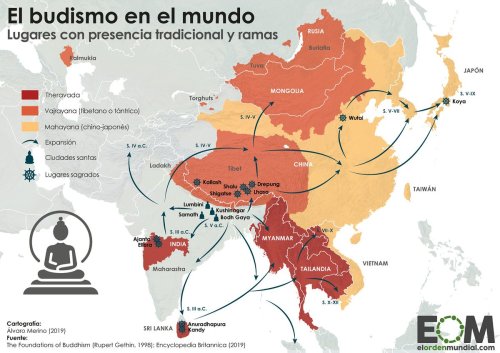
mapsontheweb: Two and a half millennia after its birth, Buddhism...


mapsontheweb:

Two and a half millennia after its birth, Buddhism is in clear decline. It has the oldest believers among the major beliefs. Thus, 7% of the world’s population is Buddhist, but they estimate that in 2060 it will drop to 5%.

by @elordenmundial

21 Sep 18:11

2021-09-15 BC

by Ducky

Mitigation Measures

This article says that when Dr. Gustafson today talked to family doctors, she said several things which indicate a more laissez-faire attitude towards the pandemic. Contact tracing has already been scaled back, children with a sniffle can go to classes if they test negative, exposed vaccinated people do not need to isolate, and they might not recommend vaccinating kids under 12 even after Health Canada permits it.


The province has issued guidance on what qualifies for a medical exemption from vaccination requirements: not a whole lot. If you have had an anaphylactic response to ingredients in both mRNA and AZ vaccines, then you can get an exemption. If you have been certain kinds of sick related to COVID-19 (like MISC, COVID-19, or myocarditis), then wait until you get better. If you’ve had some allergic reactions, then consult with an allergist and/or get the other type of vax. If you had a really bad reaction to dose1, wait for guidance from the province.

Statistics

+661 cases, +7 deaths, +6,801 first doses, +6,326 second doses.

Currently 288 in hospital / 137 in ICU, 5,791 active cases, 168,459 recovered.

first doses second doses
of adults 86.7% 79.5%
of over-12s 86.1% 78.6%
of all BCers 78.4% 71.5%

Charts

20 Sep 03:57

Being there - that feeling we can't achieve online

Alastair Creelman, The corridor of uncertainty, Sept 16, 2021
Icon

"Feelings are worth more than quality," writes Alastair Creelman, quite acurately. "Even if there are billions of photos and films from all angles of, say, the Taj Mahal, I would still take at least a hundred more just to show that I have also been there." I have been to the Taj Mahal, genuinely the world's most beautiful building, but my photos are to remind me of that experience, not to show that I've been there. So, yeah, we would like to be there. I would like to be there. But it's scarce - time and space are scarce. Yesterday I took part in events in Britain, Montreal and Ottawa. Just a typical day. And 'being here' would have been impossible for all three. People pay a lot of money to 'be there', but money is scarce, and for many people the money isn't there at all. The choice isn't - and never has been - between being there or being online. The choice has always been between being online and not being there at all.

Web: [Direct Link] [This Post]
20 Sep 02:44

Mozilla VPN adds advanced privacy features: Custom DNS servers and Multi-hop

by Mozilla

Your online privacy remains our top priority, and we know that one of the first things to secure your privacy when you go online is to get on a Virtual Private Network (VPN), an encrypted connection that serves as a tunnel between your computer and VPN server. Today, we’re launching the latest release of our Mozilla VPN, our fast and easy-to-use VPN service, with two new advanced privacy features that offer additional layers of privacy. This includes your choice of Domain Name System (DNS) servers whether it’s the default we’ve provided, our suggested ad blocking, tracker blocking or ad plus tracker blocking DNS server, or an alternative one, plus the multi-hop feature which allows you to add two different servers to give you twice the amount of encryption. Today’s Mozilla VPN release is available on Windows, Mac, Linux and Android platforms (it will soon be available on iOS later this week).

Here are today’s Mozilla VPN Features:

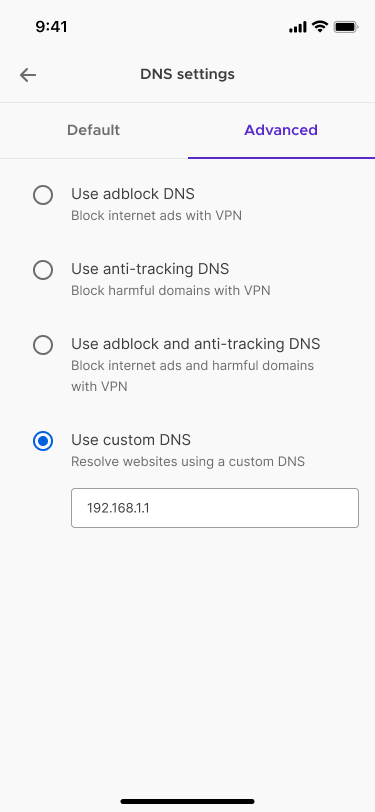
Uplevel your privacy with Mozilla VPN’s Custom DNS server feature

Traditionally when you go online your traffic is routed through your Internet Service Provider’s (ISP) DNS servers who may be keeping records of your online activities. DNS, which stands for Domain Name System, is like a phone book for domains, which are the websites that you visit. One of the advantages to using a VPN is shielding your online activity from your ISP by using your trusted VPN service provider’s DNS servers. There are a variety of DNS servers, from ones that offer additional features like tracker blocking, ad blocking or a combination of both tracker and ad blocking, or local DNS servers that have those benefits along with speed. 

Now, with today’s Custom DNS server, we put you in control of choosing your DNS server that fits your needs. You can find this feature in your Network Settings under Advanced DNS Settings. From there, you can choose from the default DNS server, enter your local DNS server, or choose from the recommended list of DNS servers available to you. 

Choose from the recommended list of DNS servers available to you

Double up your VPN service with Mozilla’s VPN Multi-hop feature

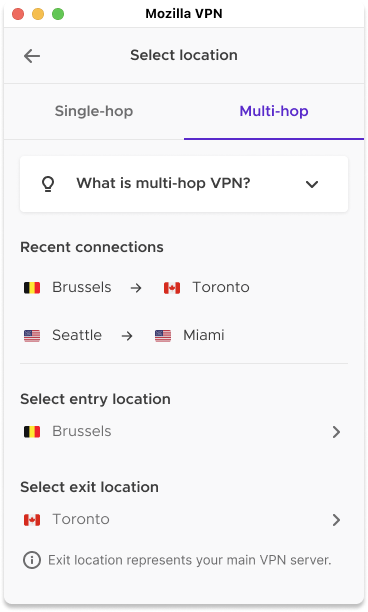
We’re introducing our Multi-hop feature which is also known as doubling up your VPN because instead of using one VPN server you can use two VPN servers. Here’s how it works, first your online activity is routed through one VPN server. Then, by selecting the Multi-Hop feature, your online activity will get routed a second time through an extra VPN server which is known as your exit server. Essentially, you will have two VPN servers which are known as the entry VPN server and exit VPN server. This new powerful privacy feature appeals to those who think twice about their privacy, like political activists, journalists writing sensitive topics, or anyone who’s using a public wi-fi and wants that added peace of mind by doubling-up their VPN servers.

To turn on this new feature, go to your Location, then choose Multi-hop. From there, you can choose your entry server location and your exit server location. The exit server location will be your main VPN server. We will also list your two recent Multi-hop connections so you can reuse them in the future. 

Choose your entry server location and your exit server location
Your two recent Multi-hop connections will also be listed and available to reuse in the future

How we innovate and build features for you with Mozilla VPN

Developed by Mozilla, a mission-driven company with a 20-year track record of fighting for online privacy and a healthier internet, we are committed to innovate and bring new features to the Mozilla VPN. Mozilla periodically works with third-party organizations to complement our internal security programs and help improve the overall security of our products. Mozilla recently published an independent security audit of its Mozilla VPN from Cure53, an unbiased cybersecurity firm based in Berlin with more than 15 years of running software testing and code auditing. Here is a link to the blog post and the security audit for more details. 

We know that it’s more important than ever for you to be safe, and for you to know that what you do online is your own business. By subscribing to Mozilla VPN, users support both Mozilla’s product development and our mission to build a better web for all. Check out the Mozilla VPN and subscribe today from our website.

For more on Mozilla VPN:

Mozilla VPN Completes Independent Security Audit by Cure53

Celebrating Mozilla VPN: How we’re keeping your data safe for you

Latest Mozilla VPN features keep your data safe

Mozilla Puts Its Trusted Stamp on VPN

The post Mozilla VPN adds advanced privacy features: Custom DNS servers and Multi-hop appeared first on The Mozilla Blog.

19 Sep 20:27

Sir Clive Sinclair dies aged 81

by Rui Carmo

My first computer was a ZX81 (which lasted me many years) and pretty much the entirety of my career stemmed from that, even though it took me years to fully appreciate the genius and thriftiness of its design (as well as the Spectrum’s, which I used until I got my first 286 PC for college), or the care that was put into the manuals it shipped with (which were arguably the best computing tutorials for regular people ever written).

It is a great thing that we have machines like the Raspberry Pi to approximate that sense of wonder and exploration for our kids, but sometimes I wish we placed the same emphasis on making computers understandable from basic principles.


19 Sep 20:25

The Great Resignation: New gig? Here are 7 tips to ensure success

by Sarah Vasquez

If recent surveys and polls ring true, over 46% of the global workforce is considering leaving their employer this year. Despite COVID-19 causing initial turnover due to the related economic downturn, the current phenomenon coined “The Great Resignation” is attributed to the many job seekers choosing to leave their current employment voluntarily. Mass vaccinations and mask mandates have allowed offices to re-open just as job seekers are reassessing work-life balance, making bold moves to take control of where they choose to live and work. 

The “New Normal”

Millions of workers have adjusted to remote-flexible work arrangements, finding success and a greater sense of work-life balance. The question is whether or not employers will permanently allow this benefit post-pandemic.

Jerry Lee, COO/Founder of the career development consultancy, Wonsulting, sees changes coming to the workplace power dynamic.

“In the future of work, employers will have to be much more employee-first beyond monetary compensation,” he said. “There is a shift of negotiating power moving from the employers to the employees, which calls for company benefits and work-life balance to improve.” 

Abbie Duckham, Talent Operations Program Manager at Mozilla, believes the days of companies choosing people are long over. 

“From a hiring lens, it’s no longer about companies choosing people, it’s about people choosing companies,” Duckham said. “People are choosing to work at companies that, yes, value productivity and revenue – but more-so companies that value mental health and understand that every single person on their staff has a different home life or work-life balance.”

Drop the mic and cue the job switch

So, how can recent job switchers or job seekers better prepare for their next big move? The following tips and advice from career and talent sourcing experts can help anyone perform their best while adapting to our current pandemic reality.

Take a vacation *seriously*

When starting a new role many are keen to jump into work right away; however, it’s always important to take a mental break between your different roles before you start another onboarding process,” advises Jonathan Javier, CEO/Founder at Wonsulting. “One way to do this is to plan your vacations ahead of your switch: that trip to Hawaii you always wanted? Plan it right after you end your job. That time you wanted to spend with your significant other? Enjoy that time off.” 

It also never hurts to negotiate a start date that prioritizes your mental preparedness and well-being.

Out with the old and in with that new-new

When Duckham started at Mozilla, she made it her mission to absorb every bit of the manifesto to better understand Mozilla’s culture. “From there I looked into what we actually do as a company. Setting up a Firefox account was pretty crucial since we are all about dog-fooding here (or as we call it, foxfooding), and then downloading Firefox Nightly, the latest beta-snapshot of the browser as our developers are actively working on it.”

Duckham also implores job-switchers to rebrand themselves. 

“You have a chance to take everything you wanted your last company to know about you and restart,” she said. “Take everything you had imposter syndrome about and flip the switch.”

Network early

“When you join a new company, it’s important to identify the subject matter experts for different functions of your company so you know who you can reach out to if you have any questions or need insights,” Javier said.

Javier also recommends networking with people who have also switched jobs. 

“You can search for and find people who switched from non-tech roles to an in-tech role by simply searching for ‘Past Company’ at a non-tech company and then putting ‘Current Company’ at a tech company on LinkedIn,” he said.

Brain-breaks 

Duckham went as far as giving her digital workspace a refreshing overhaul when she started at Mozilla. 

“I cleaned off my desktop, made folders for storing files, and essentially crafted a blank working space to start fresh from my previous company – effectively tabula rasa-ing my digital workspace did the same for my mental state as I prepared to absorb tons of new processes and practices.”

In that same vein, when you need a bit of a brain-break throughout the work day and that break leads you to social media, Duckham advises downloading Facebook Container, a browser extension that makes it harder for Facebook to track you on the web outside of Facebook.

“Speaking of brain-breaks, if socials aren’t your thing and you’d rather catch up on written curated content from around the web, Pocket is an excellent way to let your mind wander and breathe during the work day so you’re able return to work a little more refreshed,” Duckham added.

Making remote friends and drawing boundary lines

56% of Mozilla employees signed in to work from remote locations all over the world, even before the pandemic. Working asynchronously across so many time zones can be unusual for new teammates. Duckham’s biggest tip for new Mozillians? 

“Be open and a little vulnerable. Do you need to take your kid to school every day, does your dog require a mid-day walk? Chances are your schedule is just as unique as the person in the Zoom window next to you. Be open about the personal time you need to take throughout the day and then build your work schedule around it.” 

But what about building comradery and remote-friendships

“In a traditional work environment, you might run into your colleagues in the break room and have a quick chat. As roles continue to become more remote or hybrid-first, it is important to create opportunities for you to mingle with your colleagues,” Jerry Lee of Wonsulting said. “These small interactions are what builds long-lasting friendships, which in turn allows you to feel more comfortable and productive at work.”

How to leverage pay, flexibility and other benefits even if you aren’t job searching

“The best leverage you can find in this job market – is clearly defining what is important for you and making sure you have that option in your role,” Lee said. 

He’s not wrong. Make sure to consider your current growth opportunities, autonomy, location, work-life flexibility and compensation, of course. For example, if you are looking for a flexible-remote arrangement, Lee suggests clearly articulating what it is you want to your manager using the following talk-track as a guide:

Hey Manager!

I’m looking for ways to better incorporate my work into my personal life, and I’ve realized one important factor for me is location flexibility. I’m looking to move around a bit in the next few years but would love to continue the work I have here.

What can we do to make this happen?

Once you make your request, you’ll need to work with your manager to ensure your productivity and impact improves or at least remains the same.

Finally, it’s always helpful to remind yourself that every ‘big’ career move is the result of several smaller moves. If you’re looking to make a switch or simply reassessing your current work-life balance, Javier recommends practicing vision boarding. “I do this by drawing my current state and what I want my future state to look like,” said Javier. “Even if your drawings are subpar, you’ll be able to visualize what you want to accomplish in the future and make it into reality.”

As the Great Resignation continues, it is important to keep in mind that getting a new job is just the start of the journey. There are important steps that you can do, and Firefox and Pocket can help, to make sure that you feel ready for your next career adventure.

Firefox browser logo

Get Firefox

Get the browser that protects what’s important

About our experts

Jonathan Javier is the CEO/Founder of Wonsulting, whose mission is to “turn underdogs into winners”. He’s also worked in Operations at Snap, Google, and Cisco coming from a non-target school/non-traditional background. He works on many initiatives, providing advice and words of wisdom on LinkedIn and through speaking engagements. In total, he has led 210+ workshops in 9 different countries including the Mena ICT Forum in Jordan, Resume/Personal Branding at Cisco, LinkedIn Strategy & Operations Offsite, Great Place To Work, Talks at Google, TEDx, and more. He’s been featured on Forbes, Fox News, Business Insider, The Times, LinkedIn News, Yahoo! News, Jobscan, and Brainz Magazine as a top job search expert and amassed 1M+ followers on LinkedIn, Instagram, TikTok as well as 30+ million impressions monthly on his content.

Jerry Lee is the COO/Founder of Wonsulting and an ex-Senior Strategy & Operations Manager at Google & used to lead Product Strategy at Lucid. He is from Torrance, California and graduated summa cum laude from Babson College. After graduating, Jerry was hired as the youngest analyst in his organization by being promoted multiple times in 2 years to his current position. After he left Google, he was the youngest person to lead a strategy team at Lucid. Jerry partners with universities & organizations (220+ to date) to help others land into their dream careers. He has 250K+ followers across LinkedIn, TikTok & Instagram and has reached 40M+ professionals. In addition, his work is featured on Forbes, Newsweek, Business Insider, Yahoo! News, LinkedIn & elected as the 2020 LinkedIn Top Voice for Tech. 

Abbie Duckham is the current Talent Operations Program Manager at Mozilla. She has been with the company since 2016, working out of the San Francisco Office, and now her home office in Oakland.

The post The Great Resignation: New gig? Here are 7 tips to ensure success appeared first on The Mozilla Blog.
19 Sep 20:25

The Use and Misuse of Counterfactuals in Ethical Machine Learning

Atoosa Kasirzadeh, Andrew Smart, ACM Conference on Fairness, Accountability, and Transparency, Sept 17, 2021
Icon

This paper (9 page PDF) dives into the weeds a bit, but it's interesting and potentially very useful. When we use AI in learning, one of the criteria people ask for is for an explanation of decisions or recommendations. But for various reasons, which I mentioned here and will discuss in detail in the future, explanations will either be very difficult to get or not very useful. Instead, a lot of writers are recommending the use of counterfactuals; sometimes, what people need, rather than an explanation per se, is a statement of what could have been done instead to produce a different outcome. But counterfactuals introduce their own issues. How do you know that a counterfactual is true? This article looks at the semantics of counterfactuals and offers a table of the decisions we need to make in order to use them. And this gives us an interesting way to talk about the ethics of using AI in learning.

Web: [Direct Link] [This Post]
19 Sep 18:08

2021-09-16 BC

by Ducky

Statistics

+706 cases, +4 deaths, +7,135 first doses, +7,335 second doses.

Currently 291 in hospital / 134 in ICU, 5,844 active cases, 169,083 recovered.

first doses second doses
of adults 86.8% 79.7%
of over-12s 86.3% 78.8%
of all BCers 78.5% 71.6%

The province has now given 4,004,302 first doses, yay!

Charts

From this tweet thread:


19 Sep 18:08

2021-09-16 General

by Ducky

Vaccines

IF YOU ARE PREGNANT, GET A VACCINE. This article says that pregnant people are five times more likely to get admitted to hospital and ten times more likely to end up in the ICU.


According to this article, Health Canada has approved vaccine names:

  • Moderna -> Spikevax
  • Pfizer -> Comirnaty
  • AZ -> Vaxzevria

With that, I’m going to start referring to the vaccines by their trade names instead of by the company name. This is partly because there is going to come a time in the not-too-distant future when companies are going to have multiple COVID-19 vaccines. (Moderna and Pfizer already have different experimental vaccines for different variants.)

I will keep a list of manufacturers and brand names here.


Health Canada gave full approval to Spikevax today.


This preprint from Scotland found waning, but not much.

Brand Against Effectiveness
Vaxzevria infection 91%
mRNA infection 92%
Vaxzevria hospitalization 88%
mRNA hospitalization 91%

The preprint also says that their best model is of a virus with a time-invariant efficacy of 83% underneath a waning portion with a half-life of 17 days.

Recommended Reading

This article talks about immunity from vaccines vs. immunity from infection: which is better and why? (Spoiler: get the shot.)

19 Sep 18:07

When Your Audience Creates Their Own Community Without You

by Richard Millington

Two organisations I’m working with are dealing with the same intriguing challenge; customers have already launched successful communities for their brand!

On one hand, this is a great sign. It shows the audience cares and wants to engage with one another. They’re helping each other already and the organisation doesn’t have to do anything. It’s a free bonus.

On the other hand, it presents several problems. The information shared in member-hosted communities is often poor and outdated, it attracts troublemakers (self-promoters), and there’s no way for the organisation to build a process to support those who don’t get help (i.e. in a hosted community, unanswered questions can be automatically redirected to support teams after [x] hours).

This also raises another dilemma. Both clients need to launch communities on platforms that integrate with existing systems, have adequate security measures, and provide access to data. By nature, that means it will be less convenient for members to use than the platforms hosting existing communities (Facebook Groups, WhatsApp, Slack, Subreddits etc…). Why would members use your community when a more convenient option exists?

You have two broad options here.

The first option is to engage with existing hosts of member-created communities and try to develop a relationship that will enable you to respond, correct false information, and gather what information you can. This can work well, but it’s rarely a long-term solution by itself. You’re at the mercy of people whose primary objective may not align with yours.

The second option is to build your own community, but offer a value proposition so strong it overcomes the convenience problem. This usually means a combination of:

1) Access to staff. Members can engage in member-created communities or get trusted advice from staff and validated members in the brand-hosted community. This requires staff to be heavily engaged in the community.

2) Personalisation. Design the community to be integrated into accounts with members receiving the news, information, and updates that are relevant to them. Free social media tools can’t share the latest product updates, top five known issues, progress on reported issues, and a list of relevant discussions – but your community can. Likewise, members can’t vote on ideas or see unanswered questions immediately escalated in other tools.

3) Unique features. Zero in on the specific features members want and show these in the community. This might include searchable documentation and knowledge base articles, leaderboards and badges, or the ability to contribute to the community in a unique way.

Whatever you do, don’t select a similar platform and try to compete against existing, established, communities. That’s a loss for you, your new competitors, and your members.

The post When Your Audience Creates Their Own Community Without You first appeared on FeverBee.

19 Sep 17:57

Filtered for calibration

1.

Hello, World!

From the Jargon File: Traditionally, the first program a C coder is supposed to write in a new environment is one that just prints “hello, world” to standard output.

C is an ancient language. The first documented appearance of “Hello, World!” is in the 1972 training manual for C’s predecessor language B, written by Brian Kernighan (source).

I use it, whenever I’m writing a new program in any language. Perhaps you do too. It’s half habit, half being connected with the lineage, and half a proof that everything deeper in the stack is working as expected… the terminal is outputting text so I can see it; the language interpreter was compiled properly; the OS has enough memory; the electrons are still doing their electronic thing – all these things have to be tested once, they can’t be assumed.

2.

Ich bin ein Paradigm Shifter, Karlheinz Brandenburg, the inventor of the MP3 and his muse: Suzanne Vega.

MP3 is remarkable not just because it makes music into a very small digital file format, but because that file format was the lynchpin of an entire industry. Files can be played, bought, and sold. A multiplayer economy! The power of the file!

To create MP3, Brandenburg had to appreciate how the human ear perceives sound.

He heard Suzanne Vega’s wonderful acappella song Tom’s Diner playing down a corridor and adopted it.

Because the song depends on very subtle nuances of Vega’s inflection, the algorithm would have to be very, very good to select the most important parts of the sound file and discard the rest. So Brandenburg tested each refinement of his system with “Tom’s Diner.” He wound up listening to the song thousands of times, and the result was a code that was heard around the world. When an MP3 player compresses music by anyone from Courtney Love to Kenny G, it is replicating the way that Brandenburg heard Suzanne Vega.

3.

In 1974, Martin Newell made important contributions to the rendering of 3D graphics as part of his PhD at the University of Utah.

But he needed a sufficiently complex object for his demos.

One day over tea, Newell told his wife Sandra that he needed more interesting models. Sandra suggested that he digitize the shapes of the tea service they were using, a simple Melitta set from a local department store. It was an auspicious choice: The curves, handle, lid, and spout of the teapot all conspired to make it an ideal object for graphical experiment. Unlike other objects, the teapot could, for instance, cast a shadow on itself in several places. Newell grabbed some graph paper and a pencil, and sketched it.

– Nautilus, The Most Important Object In Computer Graphics History Is This Teapot (2016)

The Utah teapot.

These days, the Utah teapot has achieved legendary status. It’s a built-in shape in many 3D graphics software packages used for testing, benchmarking, and demonstration. Graphics geeks like to sneak it into scenes and games as an in-joke, an homage to their countless hours of rendering teapots; hence its appearances in Windows, Toy Story, and The Simpsons.

The traditional test that you run through the pipeline to check everything’s working. I guess every specialism has something like this – testing, testing, 1, 2, 1, 2. I wonder if they have a generic name. It would be fun to collect them.

4.

The Forgotten ‘China Girls’ Hidden at the Beginning of Old Films (Atlas Obscura): Used as quality control, these haunting images were never meant to be public.

Faces of people (typically women, almost always white) at the beginning of a film reel, to help the projectionist check that everything is functioning as expected.

The image carries bias with it. Colour film was terrible at depicting people of colour for years and years and years, with the issue being addressed only in the 1970s in response to advertisers: wood furniture and chocolate makers began complaining that Kodak film wasn’t capturing the difference in wood grains and chocolate types. Shocking.

TANGENTIALLY:

Beagle 2 was the ESA lander dispatched to the surface of Mars in 2003… and lost. Cameras on landers have calibration images for colour correction etc, checking against a known image, and Beagle 2 used a custom Damien Hirst spot painting.

Here it is: “Beagle 2 Calibration Target”, 2002, natural pigments on aluminium, .35 x 3 x 3 in.

When we get people to Mars, if we settle the surface, they should go to where the lander was eventually found (it was found by satellite in 2015) and build a gallery around it. Leave the art in situ.

19 Sep 17:56

Data visualization activities for kids

by Nathan Yau

Nightingale has a kid’s section with printable visualization activities. Get the kids started early while they absorb information like a sponge.

Tags: kids, Nightingale

19 Sep 17:56

Ladder

by Lilia

Ladder next to a freshly plastered wallYou never know when an opportunity to climb a ladder presents itself. At twilight, with a passing storm outside, the weight of plaster in your hand, base layer forgiving lack of experience and flowing strokes to make it even.

The post Ladder appeared first on Mathemagenic.

19 Sep 17:56

6 Deals for a Cozy Weekend Indoors

by Jordan Thomas
6 Deals for a Cozy Weekend Indoors

As summer gives way to fall, many folks are finding they’re busier than ever. Between school, work, and the general day-to-day, carving out some “me time” isn’t easy. But it’s important to take time to unwind and care for yourself when you can. This week we want to make it easier for you. Whether you’re looking to restock some daily essentials or invest in some new tech, we’ve found six deals to help you sit back and relax—all from the comfort of your home.

19 Sep 17:48

Emptied My LinkedIn Feed

by Ton Zijlstra

Since a year or so the deterioration of the LinkedIn timeline has been very visible to me. Next to an increasing number of people sharing things as if LinkedIn is Facebook, the timeline is not under the control of the user, and presents algorithmically determined items. Sometimes that results in seeing things days or weeks after they were posted when I would have liked to see them the day they were posted, but instead got the rants of someone else. The only way one can shape the LinkedIn timeline is by removing people from it. So I did, and removed all people from it. I came to the conclusion that I’d rather have no LinkedIn timeline, and use it as it was in the past, as a digitised contact list. Of course that brings my LinkedIn experience back to the place where it was when Jyri Engestrom predicted its demise if it didn’t introduce an object of sociality in April 2005. I’ve been using LinkedIn since June 2003 (user nr. 8730), and the barebones ‘digital rolodex’ actually serves me well, to see the background of someone I meet, and to allow others to see the same about me. From now on I can skip the timeline that LinkedIn serves me as a default, and engage with people in my network, and the things they share on my own terms and initiative, seeking them out when I want. Next to keeping my own notes.

To get to an empty timeline I had to unfollow everyone I’m connected to. Which is not a simple thing to do, as LinkedIn provides no easy option to unfollow large amounts of people, and requires you to unfollow everyone one by one. Of course there are work arounds and that is what I used, with a snippet of code in my browser console.


LinkedIn can be nice and quiet, with everyone unfollowed

19 Sep 17:48

The Best 32-Inch TV

by Chris Heinonen
A 32 inch TV with horses running on the screen displayed on top of a wooden surface.

“Bigger is better” may be the television industry’s motto, but not everyone is on the hunt for a massive TV. If a 32-inch screen size is your “just right,” we recommend the Samsung UN32F6000F for most people because it delivers the best performance under $200. But if you’re willing to pay more for a step up in all respects, consider the Samsung QN32Q8F instead.

19 Sep 17:48

17th September, 10:14 am

by nobody@domain.com (Cal Henderson)

Can you fit a whole game into a QR code? Some Windows assembly goodness in this video.

19 Sep 17:47

17th September, 10:43 am

by nobody@domain.com (Cal Henderson)

If you read and enjoyed Bad Blood, the Theranos book, then you will probably want to listen to the "Final Chapter" podcast that talks about what's happened between then and now. The trial is just kicking off and the podcast is tracking that as it happens too.

19 Sep 17:46

2021-09-17 BC

by Ducky

Schools

Parents entered a school in the Interior and caused a lockdown.


This tweet says that schools starting didn’t seem to cause a big spike in cases in children, but there is chatter on Twitter that parents are having trouble getting their kids tested. There’s also chatter that a rhinovirus is going around.

Projections

The BC COVID-19 Modelling group has made another set of projections. It says that Northern Health is in bad shape, but that things are getting better everywhere else, the recent mitigation measures are a good thing, and wow it sucks to be Alberta or Saskatchewan right now.

They also say that areas with 90% vax rates have 4.3x fewer COVID-19 cases.

I’m including this picture mostly because it’s pretty, but it also shows how vaccination has been progressing recently:


The amount of COVID-19 in wastewater can be seen for Metro Vancouver, and the trend is going downward. For example:

Even Langley, which has had a very high case rate recently, has had dropping levels:

Statistics

+768 cases, +11 deaths, +9,381 first doses, +7,470 second doses.

Currently 298 in hospital / 135 in ICU, 6,031 active cases, 169,653 recovered.

first doses second doses
of adults 87.0% 79.8%
of over-12s 86.5% 78.9%
of all BCers 78.7% 71.8%

Charts

From this tweet, it looks like the recent deaths might be in large part from long-term care home outbreaks:


Vax rates by age, first dose, from the Government of Canada vaccination web page:

and second dose:


Outcomes by vaccination status, from the most recent BC CDC Data Summary page:


19 Sep 17:19

Twitter Favorites: [rcousine] Nothing inspires confidence like a web form saying your transaction was declined, just as the notification from you… https://t.co/40kha9raAL

Ryan Cousineau @rcousine
Nothing inspires confidence like a web form saying your transaction was declined, just as the notification from you… twitter.com/i/web/status/1…
19 Sep 17:16

Twitter Favorites: [beanjammin] Late on a Friday I open a new terminal and it suddenly hits me, it's time for a beer! https://t.co/ROjho4SepB

🌎 Ben Holt @beanjammin
Late on a Friday I open a new terminal and it suddenly hits me, it's time for a beer! pic.twitter.com/ROjho4SepB
19 Sep 17:07

'Misinformation can kill people': Friends and family grieve loss of loved ones who refused COVID vaccines

mkalus shared this story .

b'

Phil Flett\'s friends describe him as "a mountain of a man" who loved entertaining people and cooking for them in the outdoor kitchen he built in his backyard.

"He was a hell of a guy \xe2\x80\x94larger than life," said Rob Dubuc whose friendship with Flett spanned more than two decades.

"[He was] a jack of all trades, a hard worker and Phil just loved doing the social thing.\xc2\xa0I was always over [at his house] for the barbecues and he made his own pizza oven."

Flett, 62, died last Saturday after catching COVID-19.

Now, his friends are speaking out to express their grief over the loss of the charismatic man, who wouldn\'t get vaccinated despite their pleas for him to listen to the advice of public health officials.

Flett\'s friends described how he\xc2\xa0often spent his\xc2\xa0summers in Kelowna, B.C., and his winters in Mexico and had big plans to retire there.

"Phil had it all planned out. He had his mortgage figured out.\xc2\xa0He would sell the house, would be travelling, he had\xc2\xa0a motor coach under redevelopment\xc2\xa0that he would live in. He had\xc2\xa0a 40-foot sailboat that he kept\xc2\xa0in Mexico where he spent\xc2\xa0his winters," said Uli Rudloph, another close friend.

Rudolph said he and Flett were very close, but differences in their thinking about the pandemic strained\xc2\xa0their relationship.

"Phil was one to listen to those who would preach in his right ear about conspiracies and vaccinations being poisonous, the New World Order, all of this," Rudolph said.

"And it was hard to listen to."

Flett\'s friends said he was firm in his belief that he could beat the disease if he caught it, despite their warnings of the aggressiveness of the delta variant that is sweeping through the Kelowna area.

Rudolph said he was heartbroken to learn last month Flett was in hospital and not doing well.

Flett died last Saturday, three weeks after catching COVID-19.\xc2\xa0

Rudolph said he believes misinformation played a big part in his death.

"It was a complete and utter colossal waste of a good life," he said.\xc2\xa0"He had everything going for him." \xc2\xa0

In Kamloops, B.C, Indigenous man\xc2\xa0Tyrone Joseph\'s life has also been touched by COVID.

His sister Anna Joseph has a severe case of the disease and is now in a medically induced coma in a Vancouver hospital.

"When I learned that she was not vaccinated, it didn\'t seem like her because she she is not necessarily like an anti-vaxxer," Joseph said.\xc2\xa0"I\'ve since learned that\xc2\xa0some members of her family are."

Joseph said while he has been vaccinated, many of his friends and relatives have chosen not to get their shots.

He\xc2\xa0attributes that to the\xc2\xa0deep mistrust he says many Indigenous people feel toward\xc2\xa0public health officials and governments because of the dark history of residential schools.

"The messaging from public public health and government officials it\'s meaningless," Joseph said.\xc2\xa0\xc2\xa0\xc2\xa0

"We are very distrustful and we need to hear from our own people\xc2\xa0or our own family members."\xc2\xa0

Mistrust in governments and misinformation online are major factors in people\'s decisions to not get vaccinated, according to Ahmen Al-Rawi,\xc2\xa0an assistant\xc2\xa0professor at Simon Fraser University\'s School of Communication\xc2\xa0in B.C. who specializes in disinformation.

"Misinformation can kill people. That\'s the bottom line here," Al-Rawi said.

Disinformation becomes a public health concern when it influences peoples\' health choices around vaccines, he said.

"A lot of people end up regretting not doing enough\xc2\xa0or not taking the vaccine and that is the sad thing about misinformation," he said.

According to Al-Rawi,\xc2\xa0public figures\xc2\xa0and influencers have a lot of power in swaying people\'s opinions on the pandemic and vaccines in both a positive and a negative direction.

He points\xc2\xa0to the recent example of\xc2\xa0Trinidadian-born rapper Nicki Minaj\'s\xc2\xa0erroneous viral tweet\xc2\xa0alleging the vaccine causes impotence as one that can cause harm.

Al-Rawi said people can influence their friends and family in positive ways by encouraging them to\xc2\xa0consider what public health officials are saying about vaccines and the pandemic.\xc2\xa0

"The impact of the word of mouth \xe2\x80\x94 you are more likely to be influenced by people you trust around you, like your circles or friends and family members," he said.

Meanwhile, Tyrone Joseph is using his influence to reach people in his community. He took to social media to share his sister\'s story, and is reaching out to family members to encourage them to get vaccinated.

"My own brother, who is also a bit of a conspiracy theorist, he told me this morning he went and got his shot," Joseph said.

"It is unfortunate it took such a drastic measure to really make this a personal message and mission, but at least we are now talking."

'
19 Sep 17:05

A few notes on Birmingham and Colborne Lodge

by jnyyz

Out for a ride this evening, and I took a few pictures of some updated bike infrastructure near the lakefront. Firstly, I heard that there was a new protected bike lane on Birmingham which parallels Lakeshore between 1st and Kipling. Here is Birmingham, headed west from Dwight. You can see that this is a construction zone with sewer work, but I imagine that they will install bike lanes along this stretch as per the 2021 Toronto Cycling Map.

Crossing Islington, you see a curb protected bike lane.

Unfortunately it ends just short of Kipling.

Granted that Birmingham becomes Elder past Kipling and it is much less busy, but it would be nice for it to at least continue as a signed bike route, especially since it connects with Thirtieth St, which is one of the few small streets that crosses the GO train tracks. Nevertheless, this new bike lane is a good alternative to biking along Lakeshore between 1st and Kipling.

On the way back, I took a few pictures of the latest updates to the intersection of Colborne Lodge and Lakeshore. I noted new paint back in July, and this has been followed up with bollards.

Here is a view of the northbound cycling crossing. You can see some bollards on the west side that protect southbound cyclists at the median. This bollards also ensure that eastbound cars making a U turn have to swing very wide.

The corners of the central median on the east side of the intersection have been effectively squared off. This provides two small areas that could provide some refuge for cyclists that don’t make it all the way across during the very short cyclist green light. This picture is crooked since I was in a rush to make it across.

Here is the north west corner, facing west. Here the corner is squared off to slow down right turning cars. We had asked for no right turn on red at this point, but that hasn’t happened. Note also that one of the bollards (marked with the red arrow) is already gone.

Here is the northwest corner, facing southbound. This would be the view of a cyclist coming down from High Park. The bollards define a large staging area where cyclists can remain separated from pedestrians.

Here is a closer view of the median, southbound.

It is good to see these improvements. I guess the city has finally decided that this intersection is a priority, after two separate fatalities at this spot (RIP Jonas and Nigel).

I appreciate the fact that these changes were made quickly, and more easily than actually having to put down curbs. Similar protections have shown up downtown at several intersections, such as Elm and University. We shall see how they hold up, particularly to snow plowing.

The light timing on the northbound cyclist light seemed really short today. I’m going to have to go back down there to time it again to check if they changed the duration again. It sure didn’t seem like 15 seconds.

Update:

Update: It is 15 seconds, but note that it can take a few seconds to react to the green light, and that this quite fit cyclist makes it across with seconds to spare. 15 seconds is not enough!

19 Sep 17:04

The iPhone 13 batteries on average 13 percent larger than iPhone 12 series

by Jonathan Lamont
19 Sep 16:55

Nothing ear (1): Was taugen die denn?

by Volker Weber

Es gab kaum ein Entrinnen vor dem Hype um das erste Produkt von Nothing. Carl Pei, Gründer von OnePlus, ist einfach ein Fuchs, was das Marketing neuer Produkte angeht, und dass Nothing sich ausgerechnet Earbuds als erstes Produkt ausgesucht hat, ist kein Wunder. Das Produkt vereint zwei Eigenschaften: eine hohe Marge und ein garantierter Absatz, da Earbuds verloren gehen oder unreparierbar werden und dann ersetzt werden.

Da alle Hersteller hier einsteigen, muss sich Nothing irgendwie abheben und das machen sie vor allem über das Design. Ich war bereit, die ear (1) als Hype abzutun, aber ich wollte sie wenigstens mal ausprobieren. Und zu meiner allergrößten Überraschung finde ich sie ziemlich gut.

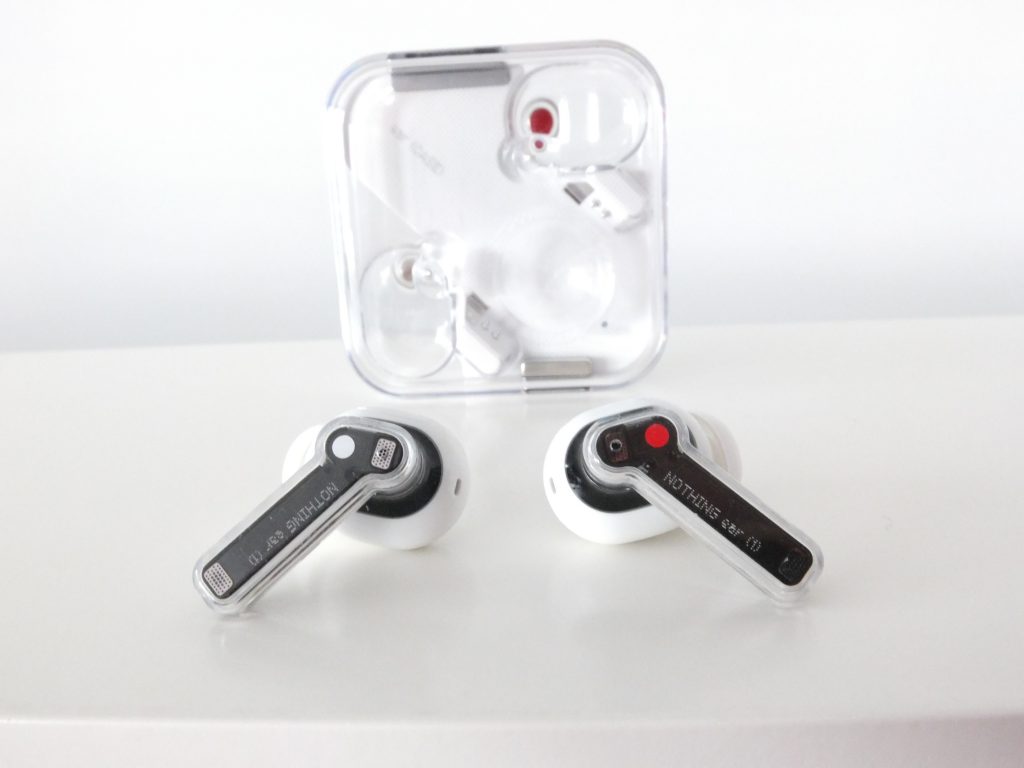
Nothing ear (1): Rot heißt rechts. Kann man sich merken.

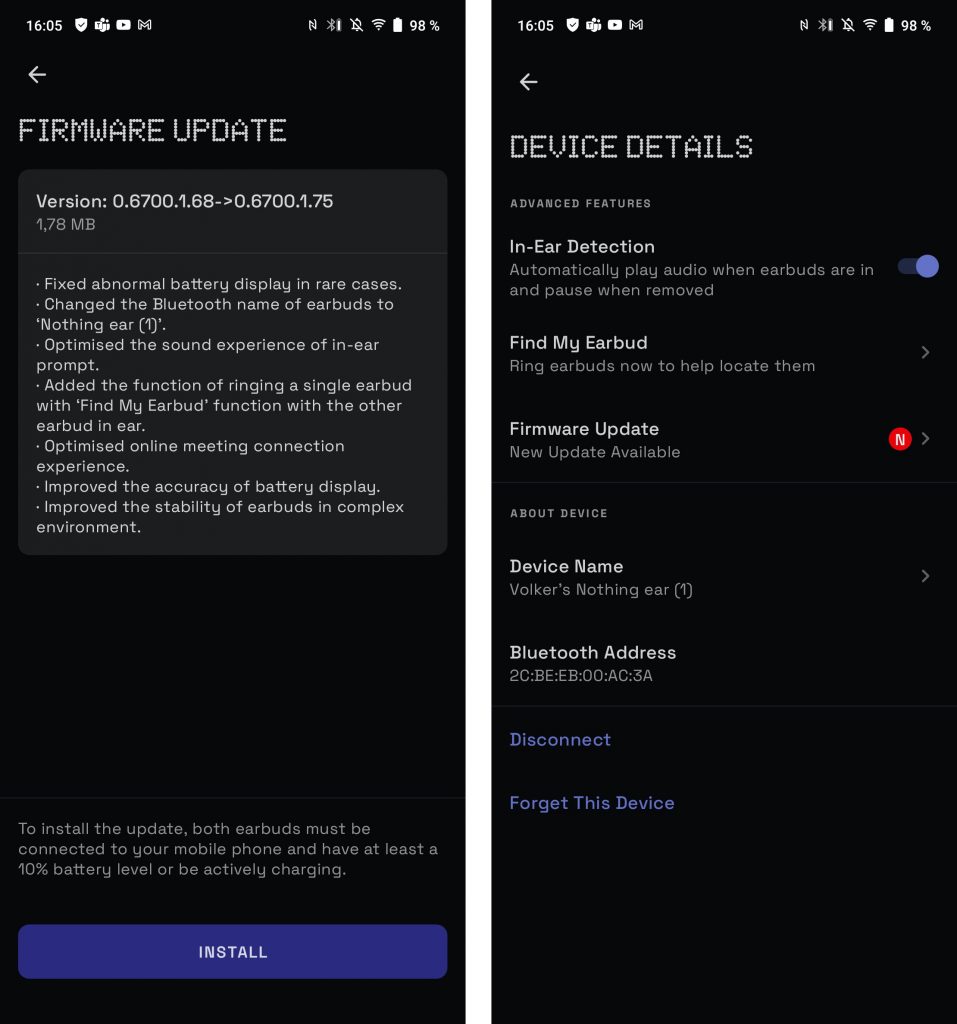
Earbuds klingen gut, wenn sie passen. Und als ich sie aus dem Case nehme, sind nicht nur Case und Earbuds zu 100% geladen, sondern sie flutschen einfach so in die Ohren, sind gleichzeitig saubequem und dicht. Glück gehabt. Oder sind es die ovalen Silikonstücke? Die mittleren passen sofort, ich probiere die kleinen und großen gar nicht erst aus. Das Android Phone lädt zum Pairen ein, bietet die Nothing-App zum Download an und schwupps ist das erste Software-Update installiert.

Einmal Anjunadeep Podcast anspielen. Holy Moly, das drückt aber kräftig. Tiefer fetter Bass, das zeigt, die passen wirklich perfekt in die Ohren. Die Höhen passen auch, in der Mitte ist mir alles etwas dünn. Sound Design kommt von Teenage Engineering und die haben einen guten Job gemacht. Nicht das Niveau von AirPods Pro, aber für den Preis von 100 Euro sehr ordentlich.

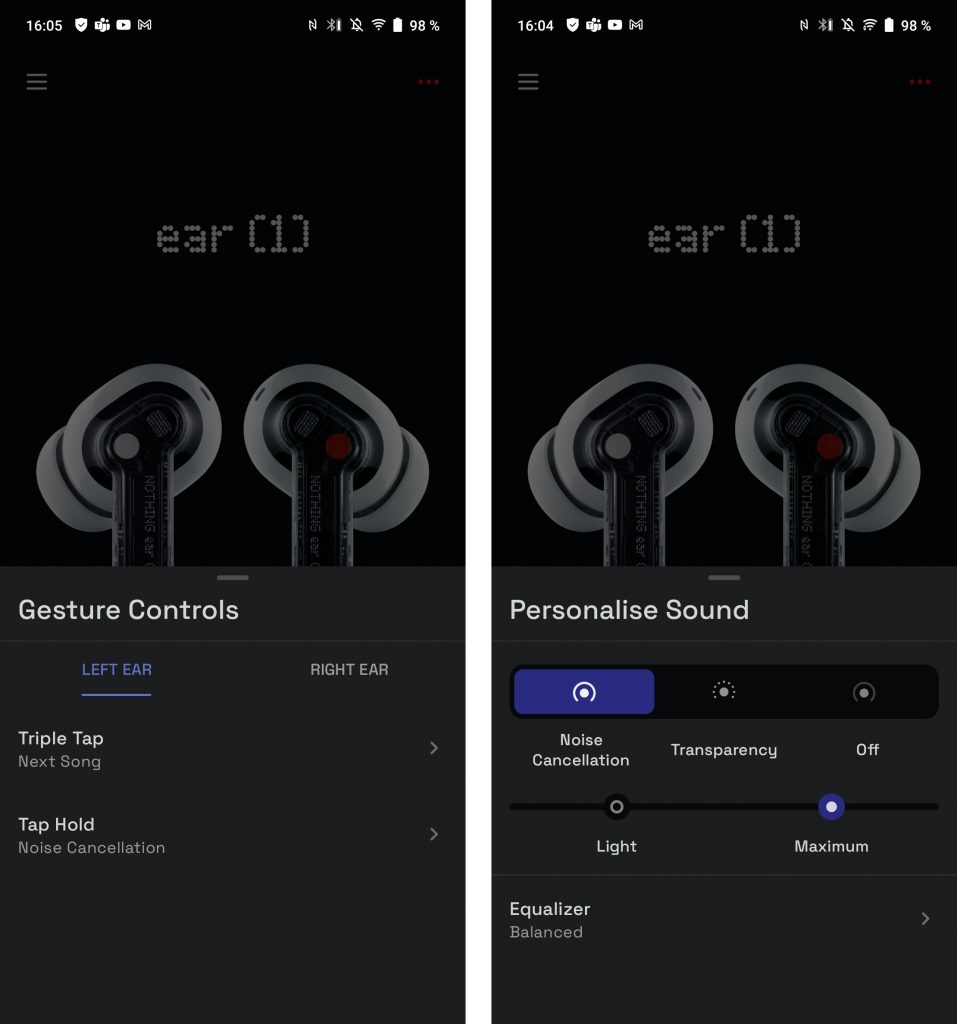
Die Bedienung gibt wenig Rätsel auf, Fehlbedienungen sind mir nicht passiert. Sensoren sorgen dafür, dass die Musik stoppt, wenn man sie rausnimmt. Doppeltippen heißt Start/Stop. Tippen und halten schaltet um zwischen Active Noise Cancelling, Transparency und einfachem passiven Ohrenzuhalten. ANC ist ordentlich, Transparency aber nicht so doll. Das kommt nicht an das Ohne-AirPods-Gefühl der AirPods Pro ran. Dreimal tippen lässt sich konfigurieren, bei mir links Previous Track und rechts Next Track. Mit Wischen macht man laut und leise. Was nicht geht: Assistenten aufrufen.

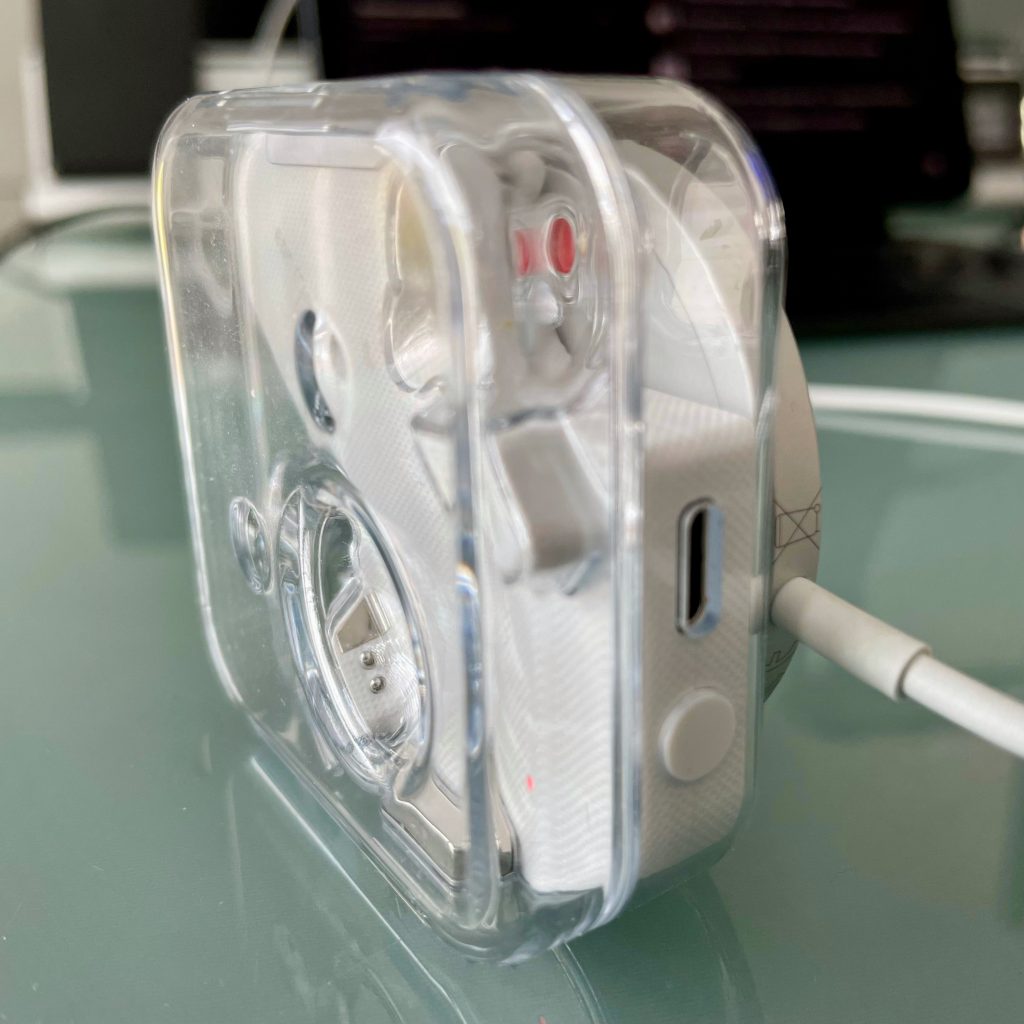
Das Case ist rechteckig und transparent, so wie die Stems der Earbuds. Es sieht sehr cool aus, fühlt sich gut an, aber es ich auch ziemlich riesig. Ich bin sehr gespannt, wie es aussieht, wenn es ein paar Monate in Taschen rumgeflogen ist. Man kann es nicht in die fünfte Tasche der Jeans stecken wie das Case der AirPods.

Das Case lädt per USB-C oder per Qi-Induktion. Der Magsafe-Lader zentriert das Case.

Nach dem vivo X60 Pro habe ich auch mein iPhone verbunden. Dazu drückt man den Knopf am Case und pairt es in den Bluetooth Settings. Ich weiß nicht, ob es auch zur Installation der App oder einem Quick Pairing aufruft, weil das Case ja bereits mit dem vivo verbunden war. Gleichzeitig verbinden lässt es sich nicht, aber es merkt sich die Pairings.

Ich finde die Integration in Android besser gelungen, aber technisch passen die Ear (1) besser zum iPhone, weil sie außer SBC auch den viel besseren Codec AAC verwendet, während Android-Geräte weitgehend auf Qualcomms aptX setzen.

Und was ist mit telefonieren? Nothing sagt, die seien super. Ich habe mal zwei Aufnahmen gemacht. Urteilt selbst:

Eine Aufnahme in einem ruhigen Raum
Eine Aufnahme mit Radio-Nachrichten als Störung

Ich finde das ist für ein gelegentliches Telefonat ordentlich, würde sie aber nicht für Meetings tragen.

Fazit: Ich mag die Ear (1), weil sie bequem sind, ordentlich Rumms haben und einfach anders aussehen. Das Case ist mir zu groß.