
Photo Caption: live with aloha
Photo taken at: Waikiki Beach
Instagram filter used: Normal
Photo Caption: live with aloha
Photo taken at: Waikiki Beach
Instagram filter used: Normal
Ahead of SupChina’s ‘Next China’ conference in New York, we spoke to SupChina editor and old China hand Jeremy Goldkorn about all things China tech. Goldkorn spoke about how China has become a true innovator, how developments in the sector have changed the way other countries perceive China, how the country will lead in healthcare, […]
China’s Sputnik moment: Q&A with Jeremy Goldkorn on the global impact of Chinese tech originally appeared on TechNode
Allen Zhang, more commonly known as the “Father of WeChat”, disclosed at WeChat’s annual open class that the company is planning to launch an independent app for Official Accounts, the highly popular feature that’s crucial for any business to interact with customers through WeChat. The team has been working on the project for quite some […]
Father of WeChat announces independent app for Official Accounts originally appeared on TechNode

From The Malaria Atlas Project, a global map of estimated accessibility to cities:
In the present study, we quantify and validate global accessibility to high-density urban centres at a resolution of 1×1 kilometre for 2015, as measured by travel time. The last global mapping effort to measure accessibility was for the year 2000, a time that predates both substantial investment and expansion of transportation infrastructure and an extraordinary improvement in the data quantity and quality of accessibility measures. The game-changing improvement underpinning this work is the first-ever, global-scale synthesis of two leading roads datasets – Open Street Map (OSM) data and distance-to-roads data derived from the Google roads database – which resulted in a nearly five-fold increase in the mapped road area relative to that used to produce the circa 2000 map.
The dark areas are the most fascinating.
Tags: accessibility, mobility
I suspect that next, with a tad bit of parsing using microformats, you can add some display elements to your webmentions to indicate the author, their url, date/time, and actually include the reply text to have a better UI for them.
Indeed, my current implementation just shows the validated Webmention links, and my plan is to slowly enhance them over time. I think, just like in the case of the basic Webmention support, Will Norris may have my back again and have already done the heavy lifting for Microformats and Go.

Adrian Colyer,
The Morning Paper,
Jan 18, 2018
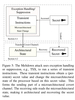
Good technical description of the recent security flaws in compter chips explaining why we haven't seen the end of them. Out-of-order instructions (such as a speculative calculation) "introduce an exploitable side channel if their operation depends on a secret value." The impact is permanent. "Hardware optimizations can change the state of microarchitectural elements... Both industry and the scientific community so far accepted this as a necessary evil for efficient computing… Meltdown changes the situation entirely."
[Link] [Comment]Walter Murch, in In the Blink of an Eye:
A vast amount of preparation, really, to arrive at the innocuously brief moment of decisive act: the cut -- the moment of transition from one shot to the next -- something that, appropriately enough, should look almost self-evidently simple and effortless, if it is even noticed at all.
This can apply to software development, I think, but I haven't thought about that yet. I read the passage at the beginning of a new semester, when my mind is filled with another offering of my programming languages course. So I've been thinking about how this quote works in the context of my course: the overall structure of the course as well as the structure of individual class sessions. The course consists of three major units, connected by a thread, with the third having its own substructure. Each session is a more cohesive story with its own microstructure: the flow of a lecture, the sequence of exercises students do, the sequence of examples that students see. Moments of transition are everywhere, at multiple scales.
When a session goes badly, or not as well as I'd hoped, I am quite aware of the cuts that did not work. They seem awkward, or ill-motivated, or jarring. The students notice some of these, too, but they don't always let me know of their disorientation right away. That's one benefit of building frequent exercises and review questions into a class session: at least I have a chance of finding out sooner when something isn't working the way I'd planned.
Reading Murch has given me a new vocabulary for thinking about transitions visually. In particular, I've been thinking about two basic types of transition:

|
For example, I've been trying to think more often about how one kind of cut can be mistaken for the other and how that might affect students. What happens when what I intend as a small move within a context seems so disconnected for students that they think I've changed contexts? What happens when what I intend as a big shift to a new topic sounds to students like the WAH-WAH-WAH of Charlie Brown's teacher? I can always erect massive signposts to signal transitions of various kinds, but that can be just as jarring to readers or listeners as unannounced cuts. It is also inelegant, because it fails to respect their ability to construct their own understanding of what they are learning.
Trying on Murch's perspective has not been a panacea. The first session of the course, the one with a new opening story, went well, though it needs a few more iterations to become good. My second session went less well. I tried to rearrange a session that already worked well, and my thinking about transitions was too self-conscious. The result was a synthesis of two threads that didn't quite work, leaving me feeling a bit jumbled myself by connections that were incomplete and jumps that seemed abrupt. Fortunately, I think I managed to recognize this soon enough in class that I was able to tell a more coherent story than my outline prepared me to tell. The outline needs a lot more work.
In the longer run, though, thinking about transitions more carefully should help me do a better job leading students in a fruitful direction. I'll keep at it.
This is a program we launched in Fall 2017, to coordinate programming offered by the Taylor Institute for Teaching and Learning for graduate students who are interested in developing expertise in university teaching and learning.
It’s run on the badges.ucalgary.ca platform built by my team (go, team!), as well as D2L courses for online content and discussion. As grad students work through the program, they earn badges for completing a set of workshops or sessions in an area of focus:
(My team works with our Learning and Instructional Design team to offer sessions in the Learning Spaces & Digital Pedagogies badge.)
If a grad student works through all of the badges over a year or 2, they earn the full certificate, which is a recognized credential. It’s a great, low-stakes way to scaffold grad students as they build expertise in teaching as part of their career as students at UCalgary.
The narrative of teaching development in higher education is often “nobody ever thinks of grad students. ever!”. Here’s an example of what happens when a university values teaching, and an entire Institute mobilizes to develop robust and sustained programming for graduate students to develop into great teachers.
Next, instructors and faculty members…



Seventeen years ago today, I open-sourced the software behind Drop.org and released Drupal 1.0.0. When Drupal was first founded, Google was in its infancy, the mobile web didn't exist, and JavaScript was a very unpopular word among developers.
Over the course of the past seventeen years, I've witnessed the nature of the web change and countless internet trends come and go. As we celebrate Drupal's birthday, I'm proud to say it's one of the few content management systems that has stayed relevant for this long.
While the course of my career has evolved, Drupal has always remained a constant. It's what inspires me every day, and the impact that Drupal continues to make energizes me. Millions of people around the globe depend on Drupal to deliver their business, mission and purpose. Looking at the Drupal users in the video below gives me goosebumps.
Drupal's success is not only marked by the organizations it supports, but also by our community that makes the project more than just the software. While there were hurdles in 2017, there were plenty of milestones, too:
Since Drupal 1.0.0 was released, our community's ability to challenge the status quo, embrace evolution and remain resilient has never faltered. 2018 will be a big year for Drupal as we will continue to tackle important initiatives that not only improve Drupal's ease of use and maintenance, but also to propel Drupal into new markets. No matter the challenge, I'm confident that the spirit and passion of our community will continue to grow Drupal for many birthdays to come.
Tonight, we're going to celebrate Drupal's birthday with a warm skillet chocolate chip cookie topped with vanilla ice cream. Drupal loves chocolate! ;-)
Note: The video was created by Acquia, but it is freely available for anyone to use when selling or promoting Drupal.
Samsung’s latest pair of flagship smartphones, the Galaxy S9 and S9+, have officially passed FCC certification.
Besides signaling just how close the company is to releasing the S9, the filling reveals both phones’ model numbers.
The S9’s model number is SM-G960, while the Galaxy S9+ is marked with SM-G965 (no surprises there, on either count). Moreover, the Canadian variant of each device once again has an additional ‘W’ at the end of its model number. So, in the case of the S9, the version that carriers here will sell is SM-G960W.
In the past when Samsung shipped Exynos-equipped S7s to Canada, the distinction between U.S. and Canadian Galaxy S-series variants was more significant. Since the Note 7, however, both U.S. and Canadian Samsung flagship smartphones have featured Qualcomm chips.
In addition, the document reveals the carrier frequencies that the two phones will support. In short, the S9 will work with all major carrier bands.
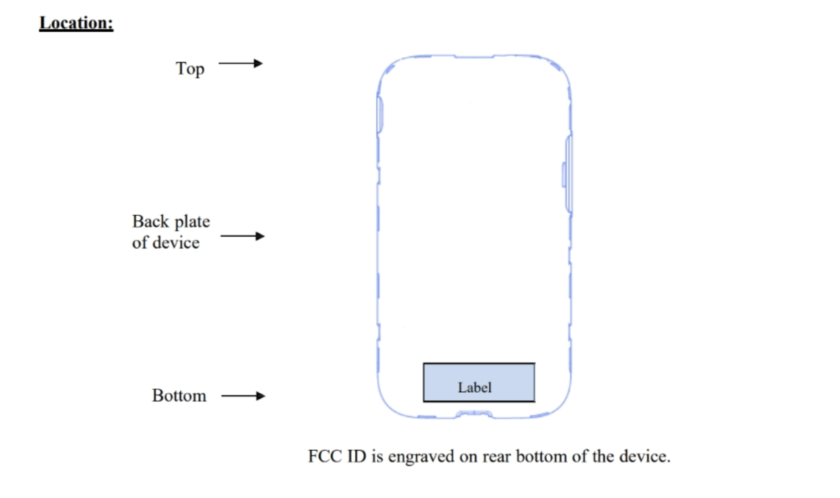
We also got a look at a vague diagram showing where the FCC label will most likely appear.
The label is interesting insofar as it may corroborate an earlier S9 rumour. Last week, an alleged S9 retail box leaked online, revealing that Samsung’s next smartphone will feature a variable aperture main camera. As Android Authority points out, a Vietnamese publication first published the image of the retail box; the label confirms Samsung is manufacturing the S9 in Vietnam.
In any case, we won’t have to wait much longer to find out everything there is to know about the S9. Samsung mobile head DJ Koh confirmed at CES that his company will announce the Galaxy S9 and S9+ at its annual Mobile World Congress (MWC) keynote. MWC starts on February 26th.
Source: FCC Via: Android Authority
The post The Galaxy S9 and S9+ get FCC listings appeared first on MobileSyrup.

Nintendo has often been criticized for its lack of third-party support in the past. It was a particularly major problem on the Wii U, Nintendo’s beleaguered previous generation console.
That’s why seeing L.A. Noire on the Nintendo Switch — a gritty, M-rated detective game from third-party publishing giant Rockstar — is so noteworthy. In fact, it’s the first game Rockstar has put on a Nintendo platform since 2009’s Grand Theft Auto: Chinatown Wars on the DS.
L.A. Noire focuses on Cole Phelps (Mad Men’s Aaron Staton), a newly minted police officer who’s just come home from the war. He joins the police force and begins investigating seemingly routine incidents, but eventually, he’ll move up to larger fare like arson and murder.
Throughout the 21 assigned cases, you’ll visit all sorts of interesting locations, such as movie sets, nightclubs and bars. Having a careful eye is key here, digging through incidental items to find clues that can make or break your investigation.

You’ll also meet incredibly well-written and acted characters, many of whom you’ll need to be able to interrogate successfully. Those who played L.A. Noire the first time around may remember Cole’s tendency to fly off the handle in unexpectedly hilarious ways. The basic ‘Truth,’ ‘Doubt’ and ‘Lie’ responses in the original game sometimes led Cole to verbally assault his person of interest — a problem when all you wanted to do was express skepticism. This time around, responses are framed around ‘Good Cop,’ ‘Bad Cop’ and ‘Accuse,’ which give a better indication of intention.
This is a particularly welcome change since a central element of gameplay is determining when people are lying by studying their facial features and body language. This mechanic finds great success thanks to groundbreaking technology known as MotionScan, which incorporates 32 different cameras to capture actors’ faces at every angle. Even several years later, no game has managed to fully meet the standards set by L.A. Noire’s uncannily realistic facial animations.

Because of this, cases feel very multi-faceted and deep, offering different options and outcomes depending on how successful you are in your investigation. After every case is completed, the police files summary will also mention what you could have done differently to get a better result, often in ways I hadn’t even considered.
As Cole moves on to different beats, he’ll also get assigned to new partners. Writer-director Brandon McNamara’s stellar script particularly shines here, wonderfully juxtaposing the straight-faced, by-the-book Cole with his scrappier, more cynical peers. With wildly opposing world views, Cole will frequently butt heads with other officers in highly compelling ways. The sheer variety of cases, as well as the colourful characters you get partnered with, had me playing on in eager anticipation to see what comes next.

While most of the game is well-crafted fiction, perhaps the most standout investigation pertains to the highly-publicized real-world case of the ‘Black Dahlia,’ a young woman named Elizabeth Short who was found murdered in L.A. in 1947. The game slowly builds up to this mystery and eventually lets you tackle it yourself, making you feel like you’re playing through a brilliant crime thrillers like Zodiac or Seven.
In many ways, L.A. Noire feels right at home on Switch, as the case structure of the game makes it particularly well-suited for playing on the go. I found myself able to complete many early cases in one stretch of my commute, making for a rewarding sense of progress. Even with longer, later-game cases, I could still make good progress, put my Switch in Sleep Mode, and easily pick up from wherever I left off at a later time.

As well, the Switch version offers a number of touch controls alongside the standard control scheme. In fact, outside of opening menus, you can play almost all of the game solely by tapping, swiping and holding the screen, if you so choose. Cole’s movement, interactions with the environment and interrogations can all be managed through the touch screen. I didn’t find myself using any of this much, but additional control options are nonetheless always welcome.
One element that hasn’t carried over so well to Switch, however, is the open-world. Make no mistake though, the original developer Team Bondi made a beautiful, detailed and faithful recreation of late ’40s-era Los Angeles. But when the game first released in May 2011, it was rightfully criticized for not offering much to do in this brilliantly realized setting, outside of the central cases and a few optional collectibles.

On seventh-generation hardware, this was less of an issue, since open-world saturation hadn’t yet set in. Now, however, in a post-Skyrim, Grand Theft Auto V and Witcher 3 world, L.A. Noire’s empty world feels all the more glaring.
This isn’t helped by the handful of unfortunately necessary downgrades that were made in porting over the game to the Switch. Draw distance is rather poor, with nearby trees, buildings and cars popping in from time to time. The frame rate also occasionally drops below 30 frames per second, particularly in crowded urban areas. That said, the game displays at a solid 1080p in docked mode and 720p in handheld.
It’s worth noting that the PS4 and Xbox One versions of the game are graphically-enhanced versions of their PS3 and Xbox 360 counterparts, with further 4K HDR updates available on the PS4 Pro and Xbox One X consoles. If you’re all about extra bells and whistles with re-releases, you’ll be better off playing L.A. Noire on those platforms. However, if you don’t care about that and just want to take a thoroughly compelling game on the go, then the Switch version is absolutely great.
Indeed, while its open-world is particularly outdated by modern standards and there are a handful of frustrating technical hiccups, L.A. Noire on the Nintendo Switch is a very solid port of a criminally overlooked gem from last generation.
L.A. Noire is now available for $64.99 CAD on Nintendo Switch. The PS4 and Xbox One versions, meanwhile, are available for $49.99. Those with an HTC Vive can also download the standalone L.A. Noire: The VR Case Files for $39.99, allowing you to play through a handful of the base game’s cases in virtual reality.
Note: If you’re looking to download L.A. Noire on Switch, you’ll need a microSD card. The game’s file size exceeds 32GB, which is the Switch’s internal storage capacity.
The post L.A. Noire on the Nintendo Switch — Magnificent mobile mysteries [This Week in Gaming] appeared first on MobileSyrup.

While we’ve reportedly been given glimpses of what the LG G7 is set to look like, little is actually known about the South Korean company’s upcoming flagship smartphone.
Now, according to a new report stemming from South Korean publication The Investor, LG’s vice chairman and CEO Jo Seong-jin, has ordered the halt of development related to the LG G6’s inevitable successor, stating that he wants the company’s team to start over from scratch. Initial reports indicated that the LG G6 would likely be announced at Mobile World Congress in Barcelona, Spain, in late February, though it looks like that’s no longer the case.
More specifically, the G7’s launch was initially reported to go down somewhere between February 15th and 21st — now, it seems the device will not launch until April at the earliest, though an even later launch is more likely.

Early speculation indicated that the G7 was set to be an incremental upgrade over the G6, with the device featuring slimmer bezels, Qualcomm’s Snapdragon 845 and marginally improved camera performance. Some rumours also indicated that LG would opt for the Snapdragon 835 rather than the 845 with the G6, just like it did with the the Snapdragon 821 in the G6 instead of the 835.
The Investor’s source specific said that LG, “hasn’t been able to find a strong selling point for the G7,” which seems to be the main reason behind its cancellation.
Given that Seon-jin revealed during CES 2018 that LG is moving away from releasing yearly flagship devices, to an extent this announcement doesn’t come as a surprise. Rumours also swirled last week that LG’s next flagship smartphone wouldn’t feature the company’s ‘G’ branding and that it is instead would adopt an entirely new strategy.
LG has reportedly been excelling in the premium home appliances space but continues to struggle when it comes to smartphones.
Source: The Investor
The post LG is killing its current design for the G7 and starting over, says report appeared first on MobileSyrup.

After Evan Blass’ leak last week, HTC has revealed its new U11 Eyes smartphone.
The HTC U11 Eyes features a front facing 5-megapixel dual camera setup with two f/2.2 aperture. Additionally, Eyes’ cameras use an 80-degree field of view, portrait mode and High Dynamic Range (HDR).
Other specs include a 6-inch, 18:9 display with a 2160 x 1080 pixel resolution, octa-core Snapdragon 652 chipset with 4GB of RAM, 64GB of internal storage, a microSD slot and 3,930mAh battery with Quick Charge 3.0.
While the front of the phone hosts a dual camera setup, the rear uses a single 12-megapixel UltraPixel 3 camera with optical image stabilization (OIS), PDAF, dual-LED flash and 4K video recording.

Moreover, the device is IP67 dust and water resistant and uses USB-C connectivity. Eyes retains HTC’s Edge Sense functionality which allows users to squeeze the sides of the smartphone to open apps and perform in-app actions. It has the same shiny ‘Liquid Design’ rear as the HTC U11 and HTC U11 Life.
The U11 Eyes also uses HTC’s own version of face unlock. According to Engadget, Eyes’ front facing camera looks at 128 feature vectors on a face, allowing it to distinguish between a real human’s face and a photograph. It should also recognize its owner even when the user puts on a hat, sunglasses and even a breathing mask. However, in case the owner doesn’t want to use the face unlock functionality, Eyes also features a rear facing fingerprint sensor.
As for software, the HTC U11 Eyes runs Android Oreo out of the box and does not feature a headphone jack, like the rest of the HTC devices released last year.
The U11 Eyes will go on sale in China later this month for for 2,999 yuan ($579.53 CAD) and Taiwan in February for NT $14,900 ($626.60 CAD). It doesn’t look like the smartphone is coming here, but we’ve reached out to the Taiwanese company just in case.
This is the first of five to six HTC smartphones the company will unveil this year.
The post HTC reveals selfie-focused U11 Eyes with face unlock, 18:9 aspect ratio and 3,930mAh battery appeared first on MobileSyrup.

The experience of Vancouver hosting the Winter Olympics in 2010 pointed to an issue~what do you do when it’s the Winter Olympics and there is no snow? City of Vancouver staff were seconded to work the games and were given City jackets (apparently in the wrong colour) snow pants, and heavy gloves. And it was a very very warm Olympics, with snow having to be brought in to the melting ski venues, and not many were wearing those snow pants.
The New York Times has just reported that the U.S. government is still redacting the “climate change” word, replacing it with the much more generic reference of “sustainability”. And in reviewing fourteen former Winter Olympic sites, Canadian scientists have concluded that nine of these former venues will not be cold enough to host a winter games by mid-century. This link takes you to a handy map showing the percentage chance these locations will have a below freezing temperature in Februarys to come.
A research team from the University of Waterloo updated research from 2014 to include the Pyeongchang Olympics and the 2022 Beijing Winter Games. “According to Dr. Scott’s research, using emissions projections in which global greenhouse gas emissions continue to rise through mid century and global temperatures increase by 4 degrees Fahrenheit by 2050, nine of the host locations will be too hot to handle the Games. But that temperature increase won’t be felt equally. Chamonix, France, the site of the first Winter Games, will have winter temperatures 5.4 degrees Fahrenheit warmer by mid century.”
You can also make snow, but you need cold air to do that. Vancouver used 1,000 straw bales and mixed a pudding of artificial snow and the real stuff hauled from higher elevations for their olympic slopes. And it’s not just future Olympic sites that will be hampered~”In the United States, some ski locations are forecast to see seasons 50 percent shorter by 2050 and 80 percent shorter by 2090.” And future winter Olympic locales may be limited to a few cities who continually rehost the games because of their colder climate.
So what happens to winter sports if there is no available snow, or outdoor hockey rinks for neophytes and newbies to train on? Will those future athletes be able to find cold enough climates to even try out a winter sport? As the cold climate Olympics team research leader admits “It’s an interesting question that nobody really knows the answer to.”

Aluminium or Aluminum? “Gas” or “Petrol”? Should a photo of a giant spider really be placed in the entry for ‘arachnophobia’? Explore some of the longest, lamest edit wars on Wikipedia in this interactive infographic.

A B.C. man has been accused of using an army of ‘spambots’ to overwhelm live streaming platform Twitch.
The Amazon-owned service is one of the most popular sites for video game-related videos, with an estimated 212 million views on the platform last year.
In addition to facing charges of “mischief in relation to computer data,” the individual, Brandan Lukus Apple, is also subject to a civil order restraining him from creating or selling “any robot, bot, crawler, spider, blacklisting software or other software” that target Twitch.
A Port Coquitlam court filing from December notes that Apple is accused of “wilfully causing multiple repetitive messages to be transmitted.”
According to the filing, thousands of Twitch broadcasters were assaulted with a slew of offensive comments including racist and homophobic content between February and May of 2017.
The civil action alleges that 1,000 broadcaster channels were attacked with around 150,000 messages.
The Supreme Court documents define a spambot to be “a computer program used to send unsolicited messages (or spam) via email or other online forums.” Twitch says such a flood of messages will overwhelm its chat service and disrupt a broadcaster’s stream.
“Twitch has received hundreds of individual reports regarding spam messages containing racism, homophobia, sexual harassment, links to shock imagery, false implications of view-botting and soliciting child sex exploitation material,” reads the civil action.
Apple has yet not entered in a plea which has not been proven in court. Apple will appear in court next month.
Via: CBC
The post Canadian man charged with creating army of spambots on Twitch appeared first on MobileSyrup.

The Pixel 2 XL remains one of the more controversial flagship smartphones of 2017.
Early reviews of Google’s latest phone cited problems such as muted display colours, a blue colour shift when looking at the screen from an angle and more importantly, image retention, resulting in the navigation menu always being visible under specific conditions. While initially most assumed that these problems extended to all Pixel 2 XL devices, it seems that’s not actually the case, with new reports indicating the Pixel 2 XL’s various display issues are quality control related.
It turns out that not all Pixel 2 XL displays are experiencing the same issues, or at least not to the same degree. In a recent video, first spotted by The Verge’s Vlad Savov, YouTuber Jerome Ortega shows that his new Pixel 2 XL features warmer colours and less blue-shift when compared to a Pixel 2 XL that he purchased a few months earlier.
Backing up Ortega’s claim, Savov says that he also got his hands on a new Pixel 2 XL this past week, noting that the device features a “nearly total absence of blue color shift.”
The Verge says it has been able to confirm that Google hasn’t started sourcing the Pixel 2 XL’s screen from a new supplier, and that the device still features the same 6-inch OLED screen as when it launched. It’s unclear what caused the improvement, but it seems related to new quality control control measures implemented by Google, according to Savov. He also notes an XDA Developers thread discussing the Pixel 2 XL’s display issues, citing that some people are reporting display problems with devices manufactured in December, while the XL 2 he purchased was manufactured in October and isn’t isn’t flawed at all.
This makes sense given Google experienced other quality control-related problems with the Pixel 2 XL, including shipping the smartphone without an operating system and even in some cases, completely empty packaging.
The smartphone’s issues prompted Google to extend the Pixel 2 XL’s warranty by a year, though it remains unclear if the image retention problem is actually covered by the company’s extension. There was also the controversy surrounding the difference between image retention — a term Google carefully selected in a subsequent blog post addressing the problem — and standard screen burn-in.
Not all Pixel 2 XL displays are bad. Some lack the annoying blue shift. pic.twitter.com/p8RgkEbztF
— Vlad Savov (@vladsavov) January 15, 2018
The Pixel 2 XL at our office suffers from the widely reported muted colour pallet problem that was reported shortly after the smartphone’s release, though this issue was mitigated following the addition of new colour management options. The blueshift problem appears to be minimal. On the other hand, the image retention issue is present on our device as well.
It’s unclear exactly why some Pixel 2 XLs seem to feature better quality displays, but the issue definitely seems to be linked to quality control on some level.
What is the status of your Pixel 2 XL display? Is it experiencing issues or have you managed to win the lottery and got your hands on a solid device?
Source: The Verge, Jeremy Ortega
The post Reports emerge that some Pixel 2 XLs are shipping with great displays appeared first on MobileSyrup.
| mkalus shared this story . |
Nearby is a building residents call the Crypto Crackhouse.
Grant Hummer, who runs the San Francisco Ethereum Meetup, lives there. Long hallways called Bitcoin Boulevard and Ethereum Alley lead to communal bathrooms. Mr. Hummer and his co-founder committed $40 million of their own crypto-made money to their new $100 million hedge fund, Chromatic Capital.
“My neurons are fried from all the volatility,” Mr. Hummer said. “I don’t even care at this point. I’m numb to it. I’ll lose a million dollars in a day and I’m like, O.K.”
His room is simple: a bed, a futon, a TV on a mostly empty media console, three keyboard cleaning sprays and a half dozen canisters of Lysol wipes. His T-shirt read, ‘The Lizard of Wall Street,’ with a picture of a lizard in a suit, dollar-sign necklaces around its neck. He carries with him a coin that reads, “memento mori,” to remind himself he can die any day. He sees the boom as part of a global apocalypse.
“The worse regular civilization does and the less you trust, the better crypto does,” Mr. Hummer said. "It’s almost like the ultimate short trade.”
Mr. Hummer went out to meet Joe Buttram, 27, for drinks. As a mixed martial arts fighter, Mr. Buttram said he would fight for a couple hundred bucks, sometimes a few thousand, and worked security at a start-up, but his main hobbies were reading 4chan and buying vintage pornography, passions that exposed him to cryptocurrency.
He said his holdings are into double-digit millions but wouldn’t give specifics other than to say he’d quit his job and is starting a hedge fund. There’s a common paranoia among the crypto-wealthy that they’ll be targeted and robbed since there’s no bank securing the money, so many are obsessively secretive. Many say even their parents don’t know how much they’ve made. This also allows people to pretend to be wealthier than they are, of course.
“It’s unforgiving,” Mr. Buttram said. “You make one mistake and it’s all gone.”
They talk about buying Lamborghinis, the single acceptable way to spend money in the Ethereum cryptocurrency community. The currency’s founder frequently appears in fan art as Jesus with a Lamborghini. Mr. Buttram says he’s renting an orange Lambo for the weekend. And he wears a solid gold Bitcoin “B” necklace encrusted with diamonds that he had made. Otherwise, HODL.
This is one of the core beliefs in this community: HODL, “hold” typed very fast, as if in a panic. HODL even if you feel FUD — fear, uncertainty and doubt. If you show wealth, it means you don’t really believe in the cryptocurrency revolution, a full remake of the financial system, governments and our world order that will send the price of ether up astronomically.
“HODL when everyone has FUD,” Mr. Hummer said quietly, to explain why he still lives in a dorm room. “This will change civilization. This can 100 x or more from here.”
He knows this is strange.
“When I meet people in the normal world now, I get bored,” Mr. Hummer said. “It’s just a different level of consciousness.”
The tone turns somber.
“Sometimes I think about what would happen to the future if a bomb went off at one of our meetings,” Mr. Buttram said.
Mr. Hummer said, “A bomb would set back civilization for years.”
A few days later, Mr. Hummer was working from his co-founder’s apartment.
Continue reading the main story
mkalus
shared this story
from  Radfahren in Stuttgart. Radfahren in Stuttgart.
|



Canadian tech enthusiasts looking for a new wireless speaker, a Nintendo Switch or a pair headphones, should turn their attention to Best Buy’s latest flyer, courtesy of Red Flag Deals.
Since Friday, the retailer has discounted a variety of electronics, including products from Bose and Sonos, at both its online store and retail locations.
Notable deals include $50 off the Sonos Play:1 Wireless Speaker (currently $200, down from $250), $50 off Bose SoundTrue Ultra in-ear headphones (currently $80, down from $130) and $40 off Bose SoundSport in-ear headphones (currently $60, down from $100). Both Bose headphones are a great pick if you own a smartphone that still has a headphone jack. Best Buy’s website only lists the Apple version of both headphones. However, minus the volume controls, they will still work with any Android smartphone.
Best Buy has also reduced the price of its Mario + Rabbids Kingdom Battle Nintendo Switch bundle by $30 (currently $449, down from $479.99). Additionally, the well-liked Assassin’s Creed Origins is $20 off.
Elsewhere, Best Buy also has TVs and appliances on sales, but not being an expert on either, I’m not able to say whether they’re worthwhile deals.
View the entire flyer on Red Flag Deals.
Source: Red Flag Deals
The post Best Buy discounts Bose and Sonos headphones and speakers during weekly sale appeared first on MobileSyrup.
Today marks the birthday of the most influential civil rights leader in America’s history. Today is celebrated because of all the work Martin Luther King Jr. and his fellow activists have done. The path they paved for the civil liberties we have today was treacherous. One of the most important things we can do now is to remember that our civil liberties came at a high cost and they should never be taken for granted. If this isn’t enough for you and you want to seek further action, there are simple steps everyone can take to keep Martin Luther King’s dream alive.
Be Kind – One of King’s biggest tactic was non-violent action which was inspired by Mahatma Gandhi in India. Passivity is powerful when used correctly! Now just because you are good to others, there is no assurance they will be good to you. There are no kindness-back guarantees in life. This doesn’t mean that being good to others isn’t worth it. Resisting the immediate urge for violent action can be more effective in the long run. Kill them with kindness.
Think Globally, Act Locally – The Voting Rights Act of 1965, which granted African Americans the right to vote, was initiated after King’s Selma to Montgomery marches (featured in the photo below). This protest wasn’t an act of civil anarchy, but a portrayal of necessary change. These groups exercised their First Amendment right to assemble in a way that refined history. If you think that no good has ever come out of protesting or standing up against injustice, refer back to history for a recap. King once said “Our lives begin to end the day we become silent about things that matter.”
During rough times, one may feel hopeless or like their actions would be ignored, but our actions have the same power they did 50 years ago, if not more. If you want to keep Martin Luther King’s vision alive then be kind to others and steadfast in your beliefs.
Happy Martin Luther King Day, folks.
Was ist guter Sound? Wie klingt die Zukunft? Ein Besuch an der Abbey Road beim Sohn des Beatles-Produzenten.
Nichts an dieser sehr gefälligen Story ist neu. Giles Martin ist "Sound Experience Leader Sonos" und Sohn des Produzenten und fünften Beatles George Martin. Der Artikel erklärt auch weniger, dass alle Ohren anders hören, sondern mehr, dass alle Räume anders klingen. Was Sonos mit Trueplay berücksichtigt. Und dass man heute Musik laut abmischt, wobei Martin auf Justin Bieber eindrischt, nicht aber auf den befreundeten Rick Rubin. Einen kleinen Ausritt gibt es zum Nuraphone (399 ), nicht aber zum beyerdynamic Aventho (449 ), der sich nun wirklich an die Ohren des Hörers anpasst.
Wer Sonos mag, wird auch den Artikel mögen.
Something Tom Murdock said recently resonated enough with me that I felt the need to write it down in a place that I can reference. Here is as good a place as any!
I’m leading Project MoodleNet, which is currently described as “a new open social media platform for educators, focused on professional development and open content”. Tom mentioned that he saw an important difference between ‘people-centric’ and ‘resource-centric’ social networks.
(Note: it’s been a couple of weeks since that conversation, so anything witty or clever I say in the next few paragraphs should be attributed to him, and anything confusing or stupid should be attributed to me)
I should also point out that I blog about things I’m thinking about here, whereas the official project blog can be found at blog.moodle.net.
A people-centric social network is something like Facebook or LinkedIn. Users have a single identity and want to follow or connect with you as a person. A resource-centric social network is something like Pinterest or Thingiverse where people interact and engage with you through the resources you’re sharing.
I think most people reading this will understand how Facebook and LinkedIn work. Imagine them towards one end of the spectrum, and Pinterest and Thingiverse towards the other. Twitter is an interesting case here, as users can have multiple accounts and follow non-human accounts. I suppose it would probably be somewhere in the middle of the spectrum.
I think Project MoodleNet is more of a resource-centric social network. To illustrate that, I want to explore Thingiverse, a wonderful site I came across recently after acquiring a 3D printer. Here’s what the About page says:
MakerBot’s Thingiverse is a thriving design community for discovering, making, and sharing 3D printable things. As the world’s largest 3D printing community, we believe that everyone should be encouraged to create and remix 3D things, no matter their technical expertise or previous experience. In the spirit of maintaining an open platform, all designs are encouraged to be licensed under a Creative Commons license, meaning that anyone can use or alter any design.
So it’s:
In that sense, it’s a very interesting model for Project MoodleNet.
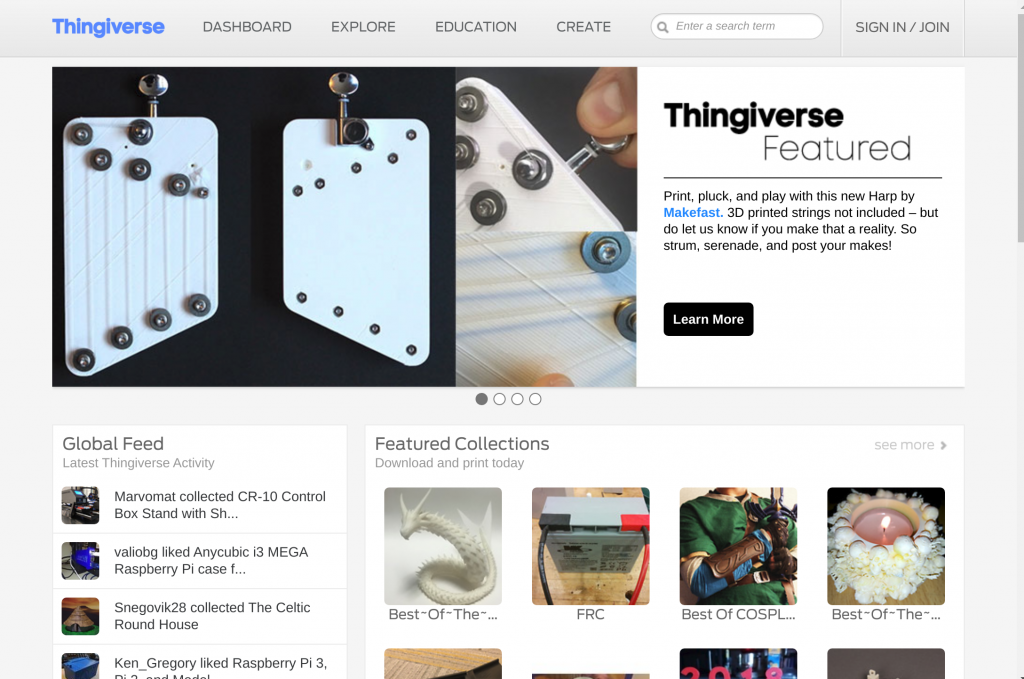
Let’s look a little more closely. Below you can see the home page. The site is obviously curated by real human beings, as they’ve featured particular designs, and created collections which include designs from different users. There’s a feed of latest activity, the calls to action in the top menu bar make it obvious that this is a living community full of creative people.
The next thing you notice when you click through onto a particular design is that there’s a lot of information here to help orient you. There’s a clear call-to-action below ‘DOWNLOAD ALL FILES’ but also we can see how many times it’s been liked, watched, commented upon, and remixed.

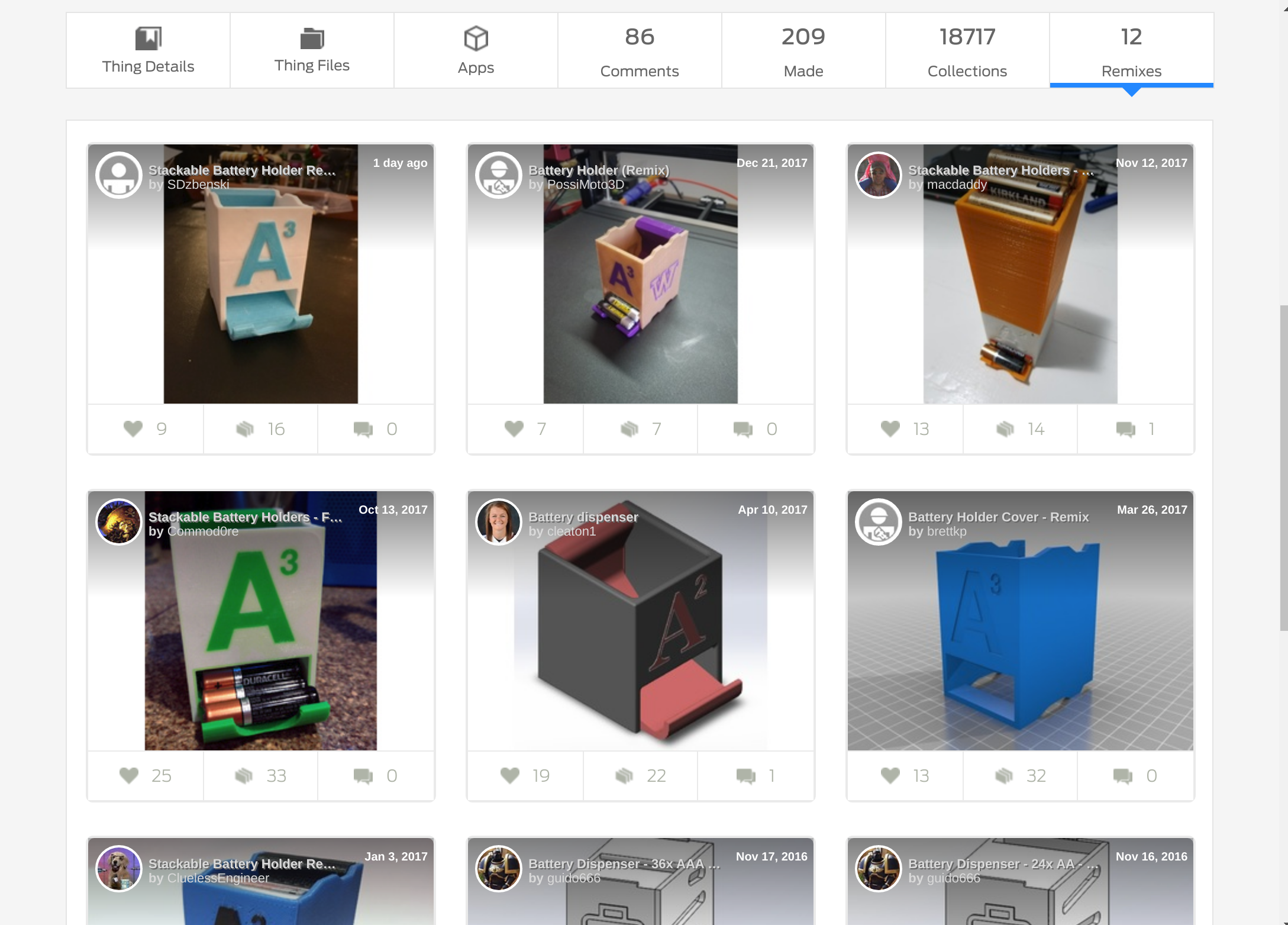
Click on the remix button and you get to see those who have remixed the original design in some way. If the design you’re looking at is itself a remix, it also allows you to look at the original, too.
Naturally, you want to know a little bit about the person who created it. Perhaps they’ve created some other things you’d like? Clicking on the user name reveals their Thingiverse profile.
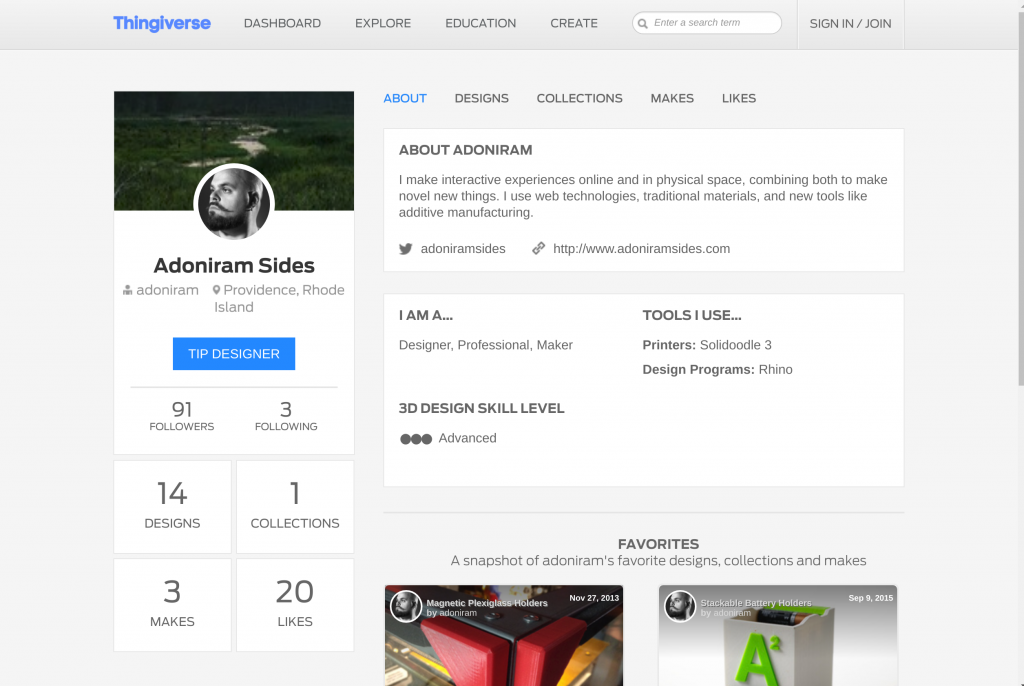
There’s lots of information about the person here: their username, location, Twitter profile, website, short biography. However, the focus is still on their resources. What have they designed? What have they shared?
The last thing to highlight is how Thingiverse deals with openly-licensed resources. When you click to download the files, the first thing that pops up is a windows that tells you in no uncertain terms about the license under which this resource has been made available.
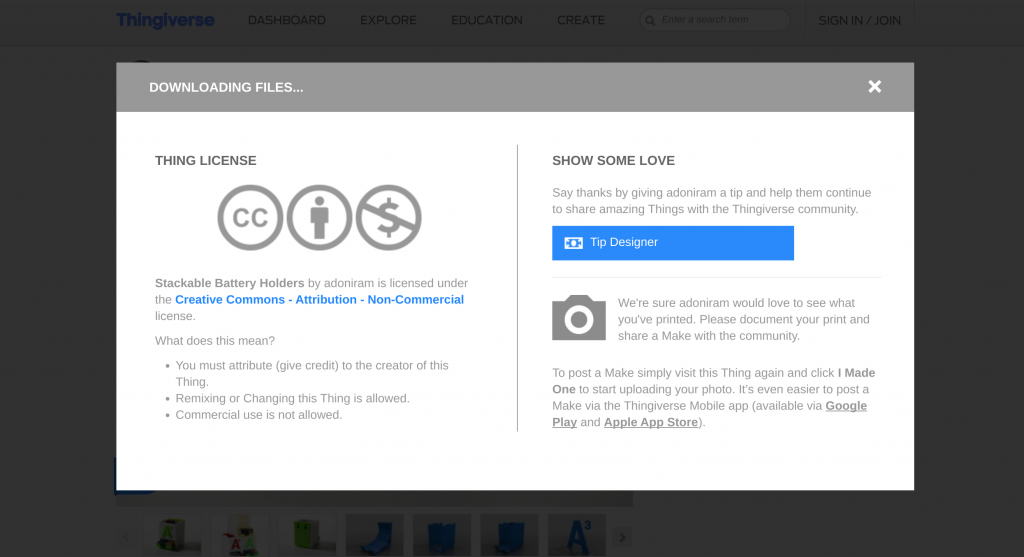
In addition, it encourages you to ‘show some love’ to the designer. You can tip them using money via PayPal, and you can take a photo to ‘document’ your 3D print of their design, and you.
I’m very impressed with the thought that’s been put into Thingiverse. I don’t know the history of the community, but it feels like something that has responded to users. In turn, I should imagine that when those who are regular users of Thingiverse come to purchase their next 3D printer, Makerbot will be top of their list. It’s a virtuous circle.
So there’s a lot to learn from here that we can apply to Project MoodleNet. I like the way that they make it easy for people new to the community. I love the ease by which you can use the fork-remix-share approach that developers are used to on GitHub, but many educators are still yet to discover. And I adore the way that they encourage users to ‘show some love’ to original resource creators, educating them on how to use openly-licensed content appropriately.

The Delta Optimist has published a letter that really should have been their big headline. But never mind~Price Tags Vancouver will do it. We all remember the defeated Liberal government’s bandying around of the proposed multi-billion overbuilt Massey Bridge which would have provided ten lanes on the bridge and led to the industrialization of that part of the Fraser River. The ex premier of the province, Ms. Clark actually got on the podium and when asked during the election why this unsustainable bridge to congestion on each side of it was being built, happily announced “JOBS!”.
It turns out that despite what the past Provincial Liberal government said to the public and continually announced, there was another option to the building of this billion dollar bridge behemoth. Specialists from the Netherlands prepared a presentation~on twinning the existing tunnel in 2013. The Massey Tunnel is named after Douglas Massey’s father, and it was Mr. Massey who made a Freedom Of Information request to the then Provincial Liberal government. That turned up nothing. But a more recent repeated request turned up this Dutch Engineering twin tunnel study and it is publicly available courtesy of the new Transportation Minister, Claire Trevena.
As Mr. Massey wrote in the Optimist: “ A meeting was held on April 4, 2013 between the Ministry of Transportation and Tunnel Engineering Consultants (TEC) of the Netherlands to update the ministry on the state of the art of immersed tunneling.
The content of the 60-page presentation included introduction of TEC worldwide tunnel projects both recent and proposed, and cost-effective options for the George Massey Tunnel. Special attention was given to tunnel safety, earthquake resistance design and comparison with bridge solutions.
The following are quotes taken from that presentation:
1.Tunnels are more suited for various and poor soil conditions.
2. Tunnels are shorter in length than a bridge and have a smaller footprint.
3.Tunnels can be built parallel and close to existing tunnels.
4.Tunnel construction is capable of dealing with severe seismic conditions.
5.Tunnel construction where 80 to 90 per cent of the work could be done by local contractors.
6.Tunnels can be built “safer than an open highway.”
This Dutch team also recommended that they assess the structure and integrity of the current tunnel and increase river depth by using an asphalt mattress instead of riprap. They suggested using longitudinal ventilation and repurpose the existing ventilation ducts as escape pods and for conduits for cyclists and walkers, among other innovative ideas. This report was never made public. As Mr. Massey states ” the former Liberal government never revealed the true facts or alternatives to the public. Instead, it followed the demands of the Port of Vancouver and wrote fear mongering reports that suited its agenda of removing the George Massey Tunnel and deepening the lower Fraser River to suit present and future industrial interests.”
The Dutch have been creating these types of submerged tunnels successfully for years. Looking at twinning the tunnel would preserve the existing habitat and ecosystem of the Fraser, and restrain the industrialization of this sensitive bog and marshland. Why was this report not released before to the public? And is this a viable option for creating more capacity crossing the Fraser River?
As Mr. Massey summarizes that this sensitive area is “known the world over as vital component for a continued healthy ecosystem that supports a migratory food source for all marine and wildfowl life from the headwaters of the Fraser River along migratory routes of the Pacific Coast. May the true facts be known.”


Imagine if a city like New York City decided to get rid of five billion US dollars of fossil fuel related stocks in their $189 billion dollar pension fund that pays to retired city workers and school teachers. That’s exactly what they are doing over the next five years as well as suing those oil and gas companies for complicit involvement in global warming.
As reported in the The Guardian New York’s divestment may persuade other cities to divest in fossil fuels and “build momentum in the global shift required to reduce emissions and stave off the worst consequences of climate change.”
“This is a really big deal,” said Jeffrey Sachs, an economist at New York’s Columbia University and special adviser to the UN secretary-general. “Pension funds of other major US cities will follow, I think. New York is the neighborhood of the very big money managers. It’s a powerful, personal signal to them that they cannot keep funding the sorts of projects they have in the past.” Other cities including Paris, Berlin, Sydney and Stockholm are also committed to getting rid of fossil fuel stocks. In fact with groups like the Norwegian central bank, Oxford University and the Rockefeller Brothers Fund as much as 6 Trillion dollars of divestment may happen.
While right-wing groups see such a plan to divest fossil fuel stocks as not a good faith way to create change, Mayor deBlasio of New York City states he is doing this for future generations. But will this divestment and boycott be enough to impact the oil and gas companies? And how will they adjust to lowering civic demands for their products and their stocks?

 Das Kraftfuttermischwerk.