If you're responsible for a brand and somewhere in
the mysterious tubes of adtech your money is finding
its way to Nazis, what is the right course of action?
One wrong answer is to write a "please help me" letter
to a company that will just ignore it. That's just
admitting to knowingly sending money to Nazis, which
is clearly wrong.
Here's another wrong idea, from
the upcoming IAB Annual Leadership
Meeting
session on "brand safety" (which is the nice, sanitary
professional-sounding term for "trying not to sponsor
Nazis, but not too hard.")
Threats to brand safety arise internally and externally, in your control and out of your control—and the stakes have never been higher. Learn how to minimize brand safety risks and maximize odds of survival when your brand takes a hit (spoiler alert: overreacting is as bad as underreacting). Best Buy and Starcom share best practices based on real-world encounters with brand safety issues.
Really, people? Overreacting is as bad as
underreacting? The IAB wants you to come to a
deluxe conference about how it's fine to send a few
bucks to Nazis here and there as long as it keeps
their whole adtech/adfraud gravy train running on time.
I disagree. If Best Buy is fine with (indirectly of
course) paying the occasional Nazi so that the IAB
companies can keep sending them valuable eyeballs
from the cheapest possible sites, then I can shop
elsewhere.
Any nationalist extremist movement has its obvious
supporters, who wear the outfits and get the tattoos
and go march in the streets and all that stuff,
and also the quiet supporters, who come up with
the money and make nice with the powers that be.
The supporters who can keep it deniable.
Can I, as a potential customer from the outside,
tell the difference between quiet Nazi supporters and
people who are just bad at online advertising and end
up supporting Nazis by mistake? Of course not. Do I
care? Of course not. If you're not willing to put the
basic "don't pay Nazis to do Nazi stuff" rule ahead
of a few ad clicks, I don't want your brand anyway.
And I'll make sure to install and use the tracking
protection tools that help keep my good data
away from bad sites.
Today's new word is "scalaring", not only new to the author's colleagues but to me as well. It is part of the process of analyzing a task to see what the person actually has to do. It's a term from military training design and injvolves the process of creating a scalar diagram while competing a task analysis, where a scalar diagram "clearly defines the overall structure of the course content by graphically illustrating the hierarchy of EOs and teaching points for each Performance Objective" (the term 'EO' is left undefined but I assume it means something like 'Educational Objective'). As Brett Christensen notes, "One of the great challenges in task analysis is getting the expert to fully explain all the required knowledge, skill and abilities involved in successful task completion."
Critics weigh in on Germany’s coalition talks ‘breakthrough’. “Germany’s prospective deal for Chancellor Angela Merkel to head another grand coalition has been slammed by industry leaders as “expensive.” Asylum advocates say it hands hard-liners a “triumph” over human rights.”
I've been fortunate enough to get to speak at a lot of events over the years, in front of an amazing variety of audiences around the world. But I can honestly say I've never been more impressed by the reaction of an audience member than in the panel I hosted earlier today.
We had an amazing discussion about the tactics and impacts of misinformation in social media, with Joan Donovan of Data & Society and Nabiha Syed of BuzzFeed speaking to the social responsibility of the major platforms.
But the standout moment was when Barack Obama quietly joined our room, and sat in for half an hour, even taking notes on the discussion. Most of the room didn't even notice he was there until he had to leave a bit before the end, and paused to share a few thoughts with us.
I encouraged him to look into the work published by experts like Joan and Nabiha, and to truly get a deep understanding of the dynamics in play, since so much of the political conversation around these serious issues devolves into glib and trite discussions of "fake news". Just knowing that a voice of such influence and power is willing to hear what these experts has to say gives me a little bit of hope that we might be able to make things a bit better.
In advance of the upcoming release of The Last Jedi, excitement is building for all things Star Wars, so I'm thrilled to share that I got to be a guest on the inestimable Star Wars Minute podcast. The show tackles the world's most popular franchise one movie at a time, one minute at a time, and I was lucky enough to get to comment on everybody's second-to-least-favorite Star Wars movie, Attack of the Clones.
It was really a joy to be on Star Wars Minute, and every one of these short conversations was amusing the whole way through — please do give them a listen!
Not heroin but blogging more rather than leaning on Facebook and Slack for all my casual writing, diary, and conversation online. Never mind maneuvers, blog straight at em. The other thing stopping me is a totally mundane task to twiddle the theme of this blog and restore all the images which were lost in a previous theme change early in 2017. Somehow, there is never time!
I started off the holiday break at the end of 2017 working over my vacation. Then spent a few days speed-publishing part of my book backlog to ebook formats, starting with very tiny poetry books from 2000 to about 2005, firing up my most recent press/imprint, Burn This Press. There are more coming – both more tiny books and bigger books and anthologies that didn’t have a wide distribution and never made it to a digital format.
Many other ambitions like traveling for a vacation, or visiting every museum in the San Francisco Bay Area, were shelved for when I feel more mobile and have less pressure at work. I still did some fun things in December though!
Among them, 2 christmases: Fakemas which we hold before the actual holiday, since both kids tend to go on trips to or with other family for Dec. 25. And then actual Christmas with my sister’s family.
Here’s a cute picture of Milo home from university and putting ornaments on our tiny, tiny tree — against a background of bookshelves! It’s on a small end table that’s a solid, heavy tree stump carved and painted to look like a pile of giant books.
See something interesting? Smell something delicious? Why not stop by and take a look? That's the beauty of commuting on electric bikes!
Try a new place every day! With an electric bike, the world is your oyster. Changing up your usual route when driving to work could add on anywhere between 10-60 minutes to your total trip time. That's why when you do find the fasts route you tend to stick to it. That's no fun though, not to mention it gets old quick!
Cycling gives you more freedom and more importantly more control over your journey. “If you’re waiting for a bus or stuck in traffic, you don’t have that same level of control,” said Dr. Oliver Smith, the author of the study, which was published in The Journal of Transport and Health. “For many bike commuters, it’s one of the few times of the workday when we have control over what we’re doing.”
Now add the Blix to your bike and you have even more control and endless capabilities. You won't have to wake up earlier to factor in a shower and change of clothes at the office. No need to pedal harder to make up for the time you spent investigating that new craft coffee house and lost track of time.
Whether your commute takes you through a beautiful up and coming art district like Wynwood Walls in Miami or a foodie hotspot like SOMA in San Francisco, get on your ebike and explore the city at your own pace. Test out a new route, stop for breakfast snack on the way to work and check out a new neighborhood on your way home. See your city in a whole new way, on two wheels!
Share your favorite Blix bike moments with us!
Tag us and use #blixbike so we can see how you roll!
Illustration by Kevin Zweerink for The New York Times
The past few years have seen the rise of “context-aware” systems: technologies that can predict your intentions based on information about your environment. If you ask Google’s intelligent personal assistant, “How tall is that building?” it will use your phone’s GPS to see what buildings are near you and guess which building you are asking about. Or, if you add “pick up milk” to the Reminders app on your iPhone, you can choose to have the app remind you the next time you are within a block of a grocery store.
This use of this technology is a response to one of the most challenging problems of human-computer interaction: humans are terrible at articulating what they want in ways that computers can process. We are used to communicating with other humans who largely exist in the same context as us — they are able to infer what we mean, even if what we say is ambiguous. Algorithms that interface between humans and computers must “guess” the human’s intention, which is the crux of information retrieval (i.e. search) problems.
Predicting search queries based on news events
I took a stab at this problem during my internship at The Times last summer. In formulating my approach, I made an important assumption: because The New York Times is a news platform, it’s likely that when readers search for things on the website, they are looking for articles that are the most topical.
This may not be a fair assumption for all use cases: a high-schooler writing a term paper may be looking for archived articles as primary sources, or a print reader may be looking for the digital version of a story to email to a friend. While these use cases do occur, they are much less frequent, so relevance to current news stories was a compelling objective.
How The New York Times handles search today
Currently, the search feature on nytimes.com uses Elasticsearch, which operates on a principle called “TF/IDF” (Term Frequency/Inverse Document Frequency). The basic idea is to determine the significance of each term in an article by looking at how many times the term is repeated, then dividing this by the number of times it appears in all of the documents in The New York Times archive. That way, common terms like “said” and “Mr.” are weighted less heavily than terms like “Amazon” or “Game of Thrones.” Articles are then ranked based on how significant the user’s query terms are to each story. So while the current approach may work well for scientific and encyclopedia articles, it’s not the best approach for news stories. This is because news stories don’t have a ton of repetition.
Why we need context
Let’s look at this article published on August 1, 2017 in The Times’ Travel section that details how a restaurant at The Mohonk Resort was able to scale farm-to-table dining to hundreds of guests every night. This idea is summarized in the opening paragraph:
Can you create a farm-to-table restaurant if you have 100 tables in an 8,750-square-foot main dining room, 80 more tables downstairs, nine in a cozy lounge, 50 outside overlooking an Arcadian lake and, on certain nights, eight in a capacious kitchen?
Now, let’s look at the seven most frequently used terms in the article.
Mr.
Mohonk
Palmeri
New
York
Dining
Restaurant
The top five terms don’t appear in the first paragraph at all. Based on just term frequencies, the article could just as easily be a restaurant review or a profile of the chef, Jim Palmeri. Word counts don’t tell the whole story so it’s very difficult to tell how relevant a story is to current events just from this information.
How topic clustering works
So how can an algorithm determine whether a story is topical or not? This is where we can use topic clustering. With this technique, an algorithm “learns” what the main dialogues are at the moment by looking at all of the articles published over a one or two week period. From this set of articles, it extracts the major topics, which are defined by a set of terms. Here are a few examples:
The above topic definitions are produced by using an unsupervised learning algorithm based on a Latent Dirichlet Allocation (LDA) model. I’m going to give a brief overview here, but if you’re interested in learning more, Edwin Chen has published an excellent explanation.
Before we begin, let’s define a few things.
Each article is distributed over a set of k topics. So if we let k = 4, this article may be 60% about the Republican Party, 20% about the 2020 election, 20% about President Trump and 0% about penguins.
Each topic is defined by a distribution over the entire English vocabulary. So if the 2020 election is a topic, 10% of it may consist of the term “2020,” 5% would be the term “Pence,” 5% would be the term “Cuomo,” and so on. (In reality, these numbers are much smaller, around < 0.5%.)
So, if 50% of an article is about the 2018 elections and 5% of the election topic consists of the term “Cuomo,” we would expect that 2.5% of the terms in this article are “Cuomo.”
We begin by assuming that all the articles were stochastically generated in this way, meaning each term is randomly chosen from a given probability distribution. For each article, we decide how long it will be according to a Poisson distribution and what the topic mixture will be according to the Dirichlet distribution. In Bayesian statistics, we call this the prior because it’s what we believe about the data prior to doing any analysis.
Our goal is now to backtrack to try to learn what the topic mixtures, P(T|D), and topic distributions, P(W|T), actually are.
To help illustrate this, here’s some pseudocode:
For each article a:
    For each term w:
        For each topic t:
             # the proportion of terms in a that are assigned to t
             Compute p(t | a)
# the proportion of assignments to t over all
             # assignments that came from w
             Compute p(w|t)
# This is the probability that t generated w
             Randomly reassign w to a new topic t with the
             probability p(t|a) * p(w|t)
We perform this process thousands of times until we reach a steady state. At this point, we have a pretty good idea of what the current major topics are.
How topic clustering improves search
I spent the second half of my internship developing a way to use these topic clusters to return more relevant search results. I’ll call the algorithm I built ClusterSearch.
ClusterSearch maps the user query to a topic if any of the terms were one of the top 15 terms in the topic definition. There are more sophisticated ways to do this — you could take into account the weight of each term in the definition — but this method worked well for my project.
Once ClusterSearch has determined which topics are relevant, it expands the user query with the top 15 terms from each topic’s definition. Finally it performs Elasticsearch on this expanded query, giving more weight to terms from the user’s original query.
Let’s look at an example. I did topic clustering on all the articles from the last two weeks of July over 100 topics.
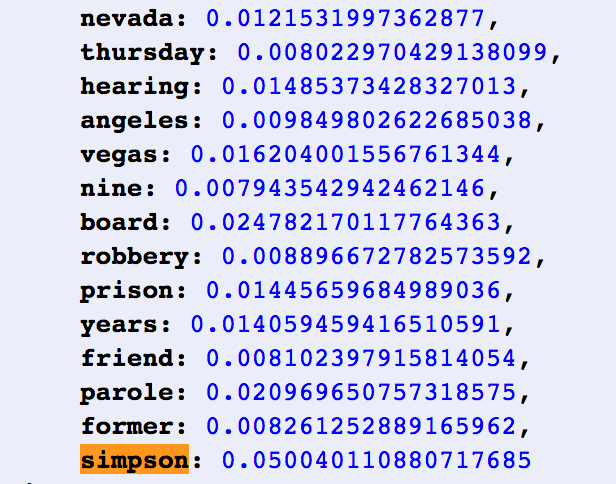
Let’s say the user searched for “Simpson,” which maps to one topic definition. Here are the top 15 terms:
O.J. Simpson receiving parole was a major story at the end of July. The numbers to the right are the term weights, so the term “simpson,” makes up about 5% of the topic definition. For now, ClusterSearch ignores those weights and just uses the top 15 terms.
We expand the user’s query with these terms. So the new query becomes, “simpson former parole friend years prison robbery board nine vegas angeles hearing thursday nevada.”
We boost terms from the user’s original query so “simpson” is weighted slightly heavier than the other terms. This way, even if different user queries map to the same topic, we may return slightly different results to emphasize what the user originally entered. Finally, we run good old Elasticsearch on this expanded query.
Here are the top three results produced by ClusterSearch:
Daniel Simpson and April Simpson are both reporters who left The Times over a decade ago; Simpson Manufacturing is an engineering firm that produces construction materials, but nothing has been published about them recently. In short, ClusterSearch gives us more “topical” results which are more likely to satisfy the user’s intention.
Feasibility
So how feasible is Topic Clustering? I ran 3000 iterations on 9853 articles over 100 topics. It took about 90 minutes on my CPU. However, we’re lucky because we only need to topic-cluster once to learn what the major news stories of the moment are so we can topic cluster offline. Running the algorithm once a week or even once a day is actually quite practical.
What’s next?
Search algorithms are really difficult to assess for two reasons.
You don’t know what the user was looking for There’s no “ground truth” to judge results against. A user searching for “New York” may be looking for travel guides or they could just as easily be looking for news about the upcoming gubernatorial elections. We can only guess.
Different users have different preferences Even if you know what users are searching for, deciding the best ranking of articles can still be tricky. Should more recent articles go first? Should more relevant articles go first? These aren’t trivial questions.
To really understand how well ClusterSearch performs, the next step would be to do some user testing.
In addition, there are a few other things we need to do before it’s deployed:
Determine how frequently we should run the topic clustering algorithm. This will take some experimenting
Integrate ClusterSearch into The Times’ search API.
Thank You
A huge thank you to everyone at The Times I had a chance to work with over the summer; every panel, coffee chat and event left me feeling inspired and excited. A special thank you to my managers John Daniels and Boerge Svingen; my team mentor, Jeremiah Via; my intern buddy, Will Dunning; and the Women in Technology Task Force. I was lucky to have such a wonderful set of mentors and friends to guide my internship.
Get in touch!
It was an incredible summer interning at The Times. If you have any questions, feedback or want to hear about the time Nicholas Kristof caught me pointing him out to friends in the cafeteria, feel free to get in touch with me at aanab@princeton.edu
I ended up buying a new AirPort Extreme after the last firmware update bricked my Express, but these look nice.
Meshed networking would never work in my case (I need to have Gigabit “backhaul” to link my base stations, since they have multiple armored concrete walls between them), but I hope these don’t require cloud-based functionality – I find it depressingly stupid (and incredibly risky) to have LAN equipment managed by (likely insecure) cloud services, and Cisco has been pushing out several variations on the managed AP theme for years.
I’ll be tracking in-depth reviews of the Velop range with interest.
Sometimes my car speaks to me. I don’t like these conversations. You see, my hypochondria extends to mechanical things. So, when I hear a new ping, snap, or crack, I figure the thing is about to explode.
After swapping the brakes on our minivan, it starts speaking to me in clunks. I pull into our parking spot—CLUNK. I back up to straighten the car—CLUNK. I pull forward again—CLUNK.
We bring the car back to the shop, and ask them to check into the sound. They investigate, and explain that a loose part is responsible. In the parking lot, I find the van—with all the doors unlocked. (Not good.) As I drive away, I realize they didn’t shut the hood. (Also not good.) And when I put it into reverse? CLUNK. (Oh, for fuck’s sake.)
In my work, I help companies present themselves. I also suggest how they might interact with customers. Often, people in these companies ask about ways to attract new business. They want to add live chat to their websites. They contemplate writing blog articles. Some wonder if they should produce a funny video—that could go viral.
Conversely, in my daily life, I witness companies making obvious blunders—like not doing what they were hired to do. Quite often these companies do have a live chat widget. They also write blog posts and create amusing videos. In all this effort to attract new customers, though, they sometimes forget to do what their customers most need.
Business can be simple: Do the thing you were asked to do.
Although some purchases are fun, many aren’t. A new trash disposal isn’t fun—but you pay for it. Life insurance isn’t fun—but you pay for it. Parking isn’t fun—but you pay for it. While this notion might sound simplistic, I urge you to remain mindful of it.
Your customers might not want your services so much as they need them. If you fail to deliver on what they need, all the marketing in the world won’t save your company. I go to the brake shop for new brakes—not free coffee. I go to the mobile repair shop for a screen that works—not a living wall. I go to the Thai restaurant for a good curry—not a punch card.
Free coffee, living walls, and punch cards are fine add-ons. So are complimentary iPads, special offers via email, and your nifty mobile app. But, that stuff is all bonus material. If you can’t do the one thing you were hired to do, none of the other stuff matters.
Possibly you haven’t encountered
Laurie Anderson, and possibly if you did you wouldn’t like her, because
she’s pretty far out there. Gravity’s Angel is at the near end of out-there, a simple-ish song with a lovely tune and a
cool arrangement; a good place to start.
What happened was, in the mid-Eighties I’d heard O Superman on campus radio and then Laurie was coming to town and a
couple of people whose judgment I respected said “You really have to go see her” so I did, never having bought a record, no
idea what I was getting into. It was easily one of the top two or three musical experiences of my life; I got giddy in the middle of
one of the songs because I’d been holding my breath, because you had to.
So I immediately ran out and bought all her music.
That tour centered on the music from Mister Heartbreak, which is great, but it was the middle
of a hot streak for her; I’d also recommend
Big Science and
Strange Angels and wow, poking around online I see she’s got a few newer releases I haven’t
heard. Must check them out. So, if you like Gravity’s Angel, there’s lot more where that came from.
Just the facts
Laurie Anderson started out as a promising classical violinist who got into electronic music and performance art, a good
player and singer and dancer with a high, beautiful voice, a striking face, and more style than any single human deserves to have.
She eventually became Lou Reed’s sweetie and nursed him through his decline and death.
Gravity’s Angel is said to be inspired by
Gravity’s Rainbow, a huge, sloppy, self-indulgent,
wonderful-in-places doorstop of a World-War-2-sort-of book by Pynchon, which I’ve read, and yeah, I suppose it has angels in it.
Fortunately you don’t have to have read the book.
Spotify,
iTunes,
Amazon. Now, as for live video, Laurie made a DVD more or less of the concert I saw, called
Home of the Brave; it’s
on YouTube and Gravity’s Angel starts at 48:19.
Go ahead and check it out, it’s maybe a little better than the recorded version, plus visual drama. But don’t stop there, go back to
the beginning and watch the whole thing, I’d call it on of the
great performances ever, and you may find yourself forgetting to breathe.
We are happy to see you reading these words at the beginning of 2018 – and curious to see what it brings… But before we dive deep into the intriguing future, let’s take a look back at 2017. It has been a year full of changes big and small, but we were all in it together and we could not have reached the end of the year as a team without you. There is quite a lot to talk about, so let’s get rolling with the numbers and details!
More on the platform side – Giorgos and Ben have been quietly moving things around to ensure a stable future for the site – the works are finishing only now, but the prep work happened all in 2017.
We proudly and loudly took part in the biggest event of 2017 for everyone at Mozilla – the release of Firefox Quantum! Remember – even if you never contributed a single line of code to Firefox, your contributions and participation in what Mozilla does is crucial to the future of an open web.
The “big one” aside, we also welcomed Firefox Rocket and Firefox for Fire TV to our family of “all the software for your burning browsing needs” ;-).
We also met in Berlin to talk about our community plans for 2018.
We were invited to join the kicking off of the Non-Coding Volunteers project and are really looking forward to more of it in 2018.
This humble blog took a dip in general activity and traffic (15 new posts vs 68 in 2016 and over 7,200 page views vs 9,200 in 2016). Still, some of the most read posts in its history appeared last year – and were written by you. We’re talking about community event reports, All Hands tales, and stories about bugs – quality over quantity!
SUMO 2017 in numbers – the highlights
Just like the year before, our activity and its results could be analysed from many perspectives, with dozens of data sources. Putting everything together, especially given our platform changes in 2018, is quite impossible – and the numbers have been affected by interruptions in tracking, as expected.
Capturing the potential, reach, and power of SUMO as a source of knowledge and help and as an example of community collaboration is something we definitely want to improve upon in 2018.
No amount of simple digits can tell the complete story of our joint voyage, but let’s try with the ones below.
General site stats
Number of total page views: 855,406,690 vs 806,225,837 (2016) – over 49 million more!
Number of users with at least one recorded session (= visit to the site): 296,322,215 vs 259,584,893 (2016) – over 36 million more!
Number of sessions (= periods of active user engagement on the site): 513,443,121 vs 446,537,566 (2016) – over 66 million more!
Percentage of people returning to the site: 44.1% vs 45% (2016)
Average time spent on site per session: 01:26 vs 01:39 (2016)
Average number of pages visited per session: 1.67 vs 1.81 (2016)
Percentage of single page visits: 39.7% vs 25% (2016)
89.65% of users saw the website on desktop or laptop computers (90.9% in 2016). The remaining 10.35% visited us from a mobile device (9.1% in 2016).
Percentage of people who visited SUMO using Firefox: 85% vs 84% (2016)
Percentage of people who visited SUMO using Chrome: 5.8% / Safari: 5.8% / Internet Explorer: 1.6% vs Chrome: 7% / Safari: 4% / Internet Explorer: 3% (2016)
Number of people who contributed for the first time: 1,174 vs 1,153 (2016)
Language & Knowledge Base stats
Top visitor 10 languages (by percentage of sessions):
English (no change)
German (no change)
Spanish (from 4th in 2016)
French (from 3rd)
Russian (from 6th)
Japanese (from 5th)
Portuguese (Brazil) (no change)
Chinese (simplified) (from 10th)
Polish (from 8th)
Italian (from 9th)
Top 10 visitor countries (by percentage of sessions):
United States
Germany
Japan
France
Brazil
Russia
India
United Kingdom
Poland
Indonesia
(No change for the top 10 visitor countries from last year)
Number of all submitted article revisions in 2017 (important note: the numbers include only data from Kitsune – we do not have data from Lithium):
for English only: 1,588 (over 4 a day on average)
for the top 20 locales: 12,087 (over 33 a day on average)
for all locales: 16,707 (over 45 a day on average)
Here’s an alphabetical list of the most active contributors to the Knowledge Base across all 12 months of 2017. If your username is below, you have gone above and beyond in making Mozilla and SUMO useful to users around the world – we can’t thank you enough for your participation!
With all the ups and downs in user sentiment and reactions after releasing Quantum you can imagine know how heated the forums got at times – but you managed to keep things civil, friendly, and informative – just look at the percentage of users who found what they were looking for (up by 15%).
We think a part of the secret sauce that made this happen includes a few bad jokes here and there… but we’ll know for sure only next year, when more data is available for scientific analysis.
The Support Forums were much more active this year and our numbers are growing. We had 97 core contributors coming back to help last year – and way more this year.
55 new contributors that contributed at least 10 times with answers!
All in all there were 2560 (!!!) active contributors (with at least one answer provided) in 2017.
Here are the top viewed forum threads for 2017, also considered to be the most “popular” in terms of issues raised by users across the board, in no particular order:
The Social Support kept going strong thanks to 20 core contributors and around 40 casual helpers.
We are still using Reply as the main tool and have added 4 new languages this year – we now support in Czech, Turkish, French, German, English, Portuguese, Spanish, Dutch, Bengali, and Nepali.
We are still looking for more help in German, French, Spanish, Italian and Japanese – so there’s a lot of opportunity to have your name listed below ;-)
Quantum was the highest participation we had in social all year, thank you everyone!
The Army of Awesome is still being sunsetted… We are just waiting for a few more pieces to fall into place.
Whew, now it’s finally time to meet the social superheroes! Each and every one of the great folks listed below is out there, making sure that no cry for help goes unanswered. Take a look here and also below:
3DIndian
74274265j
Aashish0506
Abbackar Diomande
adamclouder
Aditya113
Alex Mayorga
AlexOrdun
amitroy2779
Andrei Petcu
andresdeapia
Andrew Truong _feer56_
arunsathiya
ascasoft
asynchronous_javascriptor
awasthi_nayan
beffsstories
Benny Chandra
bilgicib98
canusupportme
Cynthia Pereira
Daniela Albarrán
danilovbarbosa
DGuarch
Dynisha Faust
emAditya_
Emailemail01
emeka_nwaoma
ethicaladitya
Fabio Beneditto
FxHelp
Gebruiker00
GuardianMajor
HarshSh05339652
herbertmoreno18
iamjayakumars
iamsooryanb
IvnRuvalcaba7
jdc20181
Jhonatas Rodrigues
joaoesteves10RS
jon20120
Josh Riley
João Paulo Polles
JPaulLucien
KL_Kunai
KonstantinMetz
Kumaresan C S
L3i1_
MajorMike
Michal Stanke
MikeMozmicky
MukeshPathak
Nayan_Awasthi
Nildëala Dorffer
Noah Y
otherCelo
ouesten
packetguardian
pavangudiwda
PavanKiran27
ptirth421
RafsanHashemi
Robert Sayles
Ronuad
ronuad
rtsayles
ryanolsonx
shaun6342
smorele
smorele
Sr3lliot
st3109ar
Stefan Costen
sumaiya_tasnim9
Swarnava Sengupta
syam
Valentin Angeli
ViniciusLifem11
Wim B
wizofe
Wolter_Miller
Zach Kingston
Zilmar de Souza Junior
SUMO 2017 in your words
We’ve shared our notes and insights from the last year with you… Now it’s time to hear from you! Please use the comment section to share your best and not so good SUMO (or Mozilla) moments from the last calendar year.
We look forward to hearing from you – both now and later in 2018!
Deutsche Welle: Largest Roman city gate north of the Alps finally dated. “Archaeologists have determined the exact date of construction of the Porta Nigra in Trier — it was built 1,848 years ago. It’s the oldest monument of its kind in Germany.”
Deutsche Welle: Trierer Porta Nigra ist exakt 1848 Jahre alt. “Nicht nur der Schmutz der Jahrhunderte hat das Stadttor Porta Nigra in Trier tiefschwarz werden lassen. Jetzt wurde anhand von Holzfunden das wahre Alter des von den Römern errichteten Monuments festgestellt.”
This article is part of a series of hands-on tutorials introducing FFA, or the Finite Field Arithmetic library. FFA differs from the typical “Open Sores” abomination, in that — rather than trusting the author blindly with their lives — prospective users are expected to read and fully understand every single line. In exactly the same manner that you would understand and pack your own parachute. The reader will assemble and test a working FFA with his own hands, and at the same time grasp the purpose of each moving part therein.
Add the above vpatch and seal to your V-set, and press to ffa_ch7_turbo_egyptians.vpatch.
You should end up with the same directory structure as previously.
Now compile ffacalc:
cd ffacalc
gprbuild
But do not run it quite yet.
No one submitted a solution to the “trivial optimizations” problem posed in Chapter 5, but reader Diana Coman did show symptoms of knowing the magic ingredient which happens to be the subject of this Chapter.
The attentive reader may already have begun to suspect that the “Egyptian” multiplication algorithm (FZ_Mul_Egyptian from Ch. 5) is not the final word on the subject of integer multiplication in FFA. But before we can explore subquadratic multiplication (and — much later — clever methods for speeding up modular reduction) it is necessary to set up the arena for a “fair fight”, by making reasonably well-optimized variants of both of the quadratic-runtime “Egyptian” algos, FZ_Mul_Egyptian and FZ_Mod.
Previously, the primary design objectives of the FFA algorithms were correctness and constant-spacetime operation; followed, secondarily, by simplicity (in the fits-in-head sense.) In this chapter, we add another objective: speed.
At no point will correctness or constant-spacetime (branch-free and offsetting-by-secrets-free) operation be sacrificed under any pretext whatsoever. However, in order to obtain, e.g., an RSAtron that is practically usable on commonplace machines, it will be necessary to sacrifice a certain amount of mechanical simplicity. This Chapter, along with the bulk of the remaining material, will be devoted to this painful — but not uninteresting! — task.
Let’s begin with a new, “turbo” FZ_Mul_Egyptian:
FZ_Mul.adb:
   -- 'Egyptological' multiplier. XY_Lo and XY_Hi hold result of X*Y.
   procedure FZ_Mul_Egyptian(X     : in  FZ;
                             Y     : in  FZ;
                             XY_Lo : out FZ;
                             XY_Hi : out FZ) is

      L : constant Indices := X'Length;

      -- Register holding running product
      XY : FZ(1 .. X'Length + Y'Length);

      -- X-Slide
      XS : FZ(1 .. X'Length + Y'Length);

   begin
      -- Product register begins empty
      FZ_Clear(XY);

      -- X-Slide initially equals X:
      XS(1            .. X'Length) := X;
      XS(X'Length + 1 .. XS'Last)  := (others => 0);

      -- For each word of Y:
      for i in Y'Range loop

         declare
            -- Current word of Y
            W : Word  := Y(i);

            -- Current cut of XY and XS. Stay ahead by a word to handle carry.
            Cut : constant Indices := L + i;

            XYc : FZ renames XY(1 .. Cut);
            XSc : FZ renames XS(1 .. Cut);

         begin
            for b in 1 .. Bitness loop

               -- If current Y bit is 1, X-Slide Cut is added into XY Cut
               FZ_Add_Gated(X    => XYc, Y => XSc, Sum => XYc,
                            Gate => W and 1);

               -- Crank the next bit of Y into the bottom position of W
               W := Shift_Right(W, 1);

               -- X-Slide := X-Slide * 2
               FZ_ShiftLeft(XSc, XSc, 1);

            end loop;
         end;

      end loop;

      -- Write out the Product's lower and upper FZs:
      XY_Lo := XY(1                .. XY_Lo'Length);
      XY_Hi := XY(XY_Lo'Length + 1 .. XY'Last);

   end FZ_Mul_Egyptian;
   pragma Inline_Always(FZ_Mul_Egyptian);
Observe that the Y-Slide from Chapter 5’s multiplier is gone. Instead, we now walk through the bits of the multiplicand Y without having to shift the entire thing FZ_Bitness(Y) times: each word of Y is loaded into W, starting with the first; and the “egyptology” is then performed Bitness times, once for each bit of W.
The other optimization is the introduction of the cut concept. Observe that an addition of two FZ integers of identical bitness, can produce a result with an intrinsic bitness that is larger than that of the greater parent’s by a maximum of one bit. The consequence of this is that the Chapter 5 FZ_Mul_Egyptian wastes roughly half of its CPU time shifting and adding words that never, at the particular times they are touched, depart from zero.
Thus, the first iteration of the loop is carried out on a cut of length X’Length + 1; the second, X’Length + 2; and forth; the last iteration is the only one which is performed on the entire XY product-accumulator and the entire XS X-Slide. We “run ahead” of the segment of XY which has been touched, by one word, so as to have a place to which to ripple the carry.
At the expense of a certain amount of “obviousness”, we win a 2x gain in multiplication speed.
And now we will apply exactly the same optimizations to the modulus routine:
FZ_Divis.adb:
   -- Modulus. Permits the asymmetric Dividend and Divisor in FZ_Mod_Exp.
   procedure FZ_Mod(Dividend  : in FZ;
                    Divisor   : in FZ;
                    Remainder : out FZ) is

      -- Length of Divisor and Remainder; < = Dividend'Length
      L : constant Indices := Divisor'Length;

      -- Remainder register, starts as zero
      R : FZ(1 .. L) := (others => 0);

      -- Indices into the words of Dividend
      subtype Dividend_Index is Word_Index range Dividend'Range;

      -- Permissible 'cuts' for the Slice operation
      subtype Divisor_Cuts   is Word_Index range 2 .. Divisor'Length;

      -- Performs Restoring Division on a given segment of Dividend:Divisor
      procedure Slice(Index : Dividend_Index;
                      Cut   : Divisor_Cuts) is
      begin

         declare

            -- Borrow, from comparator
            C   : WBool;

            -- Left-Shift Overflow
            LsO : WBool;

            -- Current cut of Remainder register
            Rs  : FZ renames R(1 .. Cut);

            -- Current cut of Divisor
            Ds  : FZ renames Divisor(1 .. Cut);

            -- Current word of Dividend, starting from the highest
            W   : Word  := Dividend(Dividend'Last + 1 - Index);

         begin

            -- For each bit in the current Dividend word:
            for b in 1 .. Bitness loop

               -- Send top bit of current Dividend word to the bottom of W
               W := Rotate_Left(W, 1);

               -- Advance Rs, shifting in the current Dividend bit
               FZ_ShiftLeft_O_I(N => Rs, ShiftedN => Rs, Count => 1,
                                OF_In => W and 1,
                                Overflow => LsO);

               -- Subtract Divisor-Cut from R-Cut; Underflow goes into C
               FZ_Sub(X => Rs, Y => Ds, Difference => Rs, Underflow => C);

               -- If C=1, subtraction underflowed, and we must undo it:
               FZ_Add_Gated(X => Rs, Y => Ds, Sum => Rs,
                            Gate => C and W_Not(LsO));

            end loop;

         end;

      end Slice;

   begin

      -- Process bottom half of dividend:
      for i in 1 .. L - 1 loop

         Slice(i, i + 1); -- stay ahead by a word to handle carry

      end loop;

      -- Process top half of dividend
      for i in L .. Dividend'Length loop

         Slice(i, L);

      end loop;

      -- Output the Remainder.
      Remainder := R;

   end FZ_Mod;
   pragma Inline_Always(FZ_Mod);
In addition to the two optimizations analogous to those we had applied to FZ_Mul_Egyptian, we also get the ability to apply FZ_Mod to a Dividend which exceeds the bitness of the Divisor. This will allow us to abolish the zero-padding of Modulus in Chapter 6’s FZ_Mod_Mul.
Correspondingly, we carefully alter the preconditions of FZ_Mod:
FZ_Divis.ads:
   -- Modulus. Permits the asymmetric Dividend and Divisor in FZ_Mod_Exp.
   procedure FZ_Mod(Dividend  : in FZ;
                    Divisor   : in FZ;
                    Remainder : out FZ);
   pragma Precondition(Dividend'Length >= Divisor'Length and
                         Divisor'Length = Remainder'Length);
The only place in FFA where the asymmetric invocation of FZ_Mod will be permitted, is FZ_Mod_Mul, the modular multiplier procedure, which will now look like this:
FZ_ModEx.adb:
   -- Modular Multiply: Product := X*Y mod Modulus
   procedure FZ_Mod_Mul(X        : in  FZ;
                        Y        : in  FZ;
                        Modulus  : in  FZ;
                        Product  : out FZ) is

      -- The wordness of all three operands is equal:
      L     : constant Indices := X'Length;

      -- Double-width register for multiplication and modulus operations
      XY    : FZ(1 .. L * 2);

      -- To refer to the lower and upper halves of the working register:
      XY_Lo : FZ renames XY(1     .. L);
      XY_Hi : FZ renames XY(L + 1 .. XY'Last);

   begin

      -- XY_Lo:XY_Hi := X * Y
      FZ_Mul_Egyptian(X, Y, XY_Lo, XY_Hi);

      -- Product := XY mod M
      FZ_Mod(XY, Modulus, Product);

   end FZ_Mod_Mul;
   pragma Inline_Always(FZ_Mod_Mul);
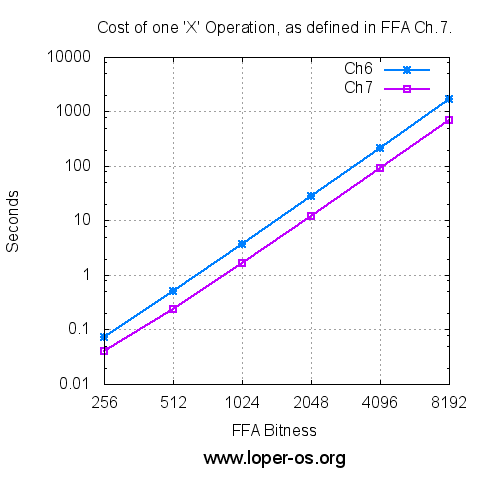
And now, on the same machine as in Ch.6 , timed and plotted logarithmically:
Or, for those who prefer the raw numbers,
FFA Bitness
Ch.6 ‘X’ (sec)
Ch.7 ‘X’ (sec)
256
0.072
0.040
512
0.505
0.240
1024
3.685
1.672
2048
27.975
12.024
4096
217.966
90.439
8192
1720.127
699.979
And finally, let’s turn this into a FFACalc tape, and verify the signature of the Chapter 7 material, using itself, just like we did in the previous chapter:
( the seal of ffa_ch7_turbo_egyptians.vpatch : )
.
88A0984C5438EFD811BA8505362EEA572B4057C52662DA8854DF66613C40332EB8F4E3
80932DBF9106F3536643BD2FF69DA90EA0402B4FDC21A9245C3EBCB10C86C1847C9CC9
9C2ECE4245735013D0E59EE905479445B625D76EECC1BDEEBF489DC512715324995D13
EAB27D286EFA86BF8D69C3D93CB65E2F4BA9B805AA392B29D9F6635E9C7D81C0CC4EAA
A2DA0F618D83F7DAB4854F24B3A900BFDF35E58E87745A6A8D11868C860334DD80A4A4
D0DCAC4E5EC34E9C16BBD174659008145F1E09556009557277A7DFE74FAA3018995746
8CB25E0B10B5AE8D114E4E89E4B940B1A21A5BB7EFDD75AB59A1D82AC08DBCC9A7B10F
5B708B2BC2453AB9BC6C80

( my public rsa exponent : )
.
10001

( my public rsa modulus : )
.
CDD49A674BAF76D3B73E25BC6DF66EF3ABEDDCA461D3CCB6416793E3437C7806562694
73C2212D5FD5EED17AA067FEC001D8E76EC901EDEDF960304F891BD3CAD7F9A335D1A2
EC37EABEFF3FBE6D3C726DC68E599EBFE5456EF19813398CD7D548D746A30AA47D4293
968BFBAFCBF65A90DFFC87816FEE2A01E1DC699F4DDABB84965514C0D909D54FDA7062
A2037B50B771C153D5429BA4BA335EAB840F9551E9CD9DF8BB4A6DC3ED1318FF3969F7
B99D9FB90CAB968813F8AD4F9A069C9639A74D70A659C69C29692567CE863B88E191CC
9535B91B417D0AF14BE09C78B53AF9C5F494BCF2C60349FFA93C81E817AC682F0055A6
07BB56D6A281C1A04CEFE1

( now modularly-exponentiate it : )
X

( ... and print the output .)
#
… and play the tape! :
$ time cat ch7_rsa_tape.txt | ./bin/ffa_calc 2048 32
… and unsurprisingly:
0001FFFFFFFFFFFFFFFFFFFFFFFFFFFFFFFFFFFFFFFFFFFFFFFFFFFFFFFFFFFFFFFFFF
FFFFFFFFFFFFFFFFFFFFFFFFFFFFFFFFFFFFFFFFFFFFFFFFFFFFFFFFFFFFFFFFFFFFFF
FFFFFFFFFFFFFFFFFFFFFFFFFFFFFFFFFFFFFFFFFFFFFFFFFFFFFFFFFFFFFFFFFFFFFF
FFFFFFFFFFFFFFFFFFFFFFFFFFFFFFFFFFFFFFFFFFFFFFFFFFFFFFFFFFFFFFFFFFFFFF
FFFFFFFFFFFFFFFFFFFFFFFFFFFFFFFFFFFFFFFFFFFFFFFFFFFFFFFFFFFFFFFF003051
300D060960864801650304020305000440FCFB42B5342D226261DF36158BB4EA5482F4
B45B8D4259F3873D8B77CD7572D55FBADCBCC1267BECE169F330154F7A9156C60A07FA
8C902BEE43FB27FC33B248

real    0m12.018s
user    0m12.004s
sys     0m0.002s
Guess what? The correct answer. (Use the patched GPG from Ch. 6, and compare.)
Homework:
1. Prove that the new FZ_Mod produces, for all valid inputs, the equivalent answer to the one in the previous chapter.
2. Formulate a hypothesis regarding why the observed speedup of ‘X’ was greater than two-fold.
I recently read two interesting takes on the ever-growing Alexa ecosystem as it relates to Apple that made me think about the future of Siri and HomeKit. Here's M.G. Siegler on Amazon's plan to put Alexa everywhere:
The Echo Dot was the number one selling device across all of Amazon during the holiday shopping season. (The Fire TV stick with the Alexa-enabled remote was the second-most popular product.) Again, no absolute sales numbers beyond “tens of millions of Alexa-enabled devices” — more than we usually get, by the way — but no matter: tens of millions is impressive enough.
I’ve been thinking about this recently not just in the context of putting Echoes in hotels, but also relative to Apple. As we’re all well aware, Apple had to delay their foray into the space, the HomePod, into 2018. But not only did they miss the all-important holiday shopping season, I’m increasingly thinking that they may have missed the boat.
Believe me, I know how dangerous this line of thinking is with regard to Apple. Apple is almost never the first-mover in a market. Instead, they prefer to sit back and let markets mature enough to then swoop in with their effort, which more often than not is the best effort (this is both subjective in terms of my own taste, and often objective in terms of sales). But again, I increasingly don’t believe that this will be the case with their smart speaker.
Amazon has entered the speaker and home automation market with Alexa-enabled devices in two ways: first with their own Echo products, then with a growing roster of third-party manufacturers that are baking Alexa into their devices and almost treating Amazon's assistant as a "standard" feature like WiFi or Bluetooth. There's a fascinating parallel between Amazon Web Services – a suite of components embedded in the majority of modern websites and web apps – and Alexa Voice Service – a suite of voice APIs now embedded in hundreds of automation devices, general-purpose accessories and appliances, and web services.
While many Apple defenders want to dismiss the momentum we are observing with the Amazon ecosystem on display here at CES, while Amazon is similarly not present just like Apple, I believe it is a mistake to do so.
It is easy to say that because Apple was never present at CES that the show didn’t mean something to them or their ecosystem. It is easy, and correct to say that CES was not, or never was, a measure of the health of Apple’s products. It is, however, incorrect and dangerous to miss that CES had been, for some time, a barometer for the health of Apple’s ecosystem.
As I mentioned, our ability to measure any platforms ecosystem from what we observe at CES, is the main reason so many are paying attention to what is happening with Amazon’s Alexa platform. Google Assistant is certainly more present than it was last year, however, when you look at how third parties are talking about-and marketing-their support of these assistants they are putting significantly more effort into talking about Alexa than Google Assistant. Which is a telling signal. Again, to reiterate this point, third parties used to market, and spend energy talking about their integration with iOS or support of iPhone/iPad with the same rigor they are now talking about Amazon’s Alexa. This can not be ignored.
You could argue that most Apple-compatible gadgets and accessories announced at CES used to appear in tech blogs only to be forgotten a few months later because they were fads, vaporware, or ultimately not essential to the growth of the iOS ecosystem, and that the same will happen with Alexa-enabled devices we've seen this year. The difference, I think, is that this new generation of home automation products is an ecosystem in itself with higher value than, say, the iPad keyboards or stylii we used to see at CES. Alexa hasn't "won", but it has momentum among third-party companies making products that are or will soon be in our homes, sharing the same space of our TVs, routers, consoles, and mobile devices.
Now, I tend to fall somewhere in the middle of this discussion. I don't think smart speakers with voice assistants are, as Neil Cybart described them, "a mirage" caused by "a massive mindshare bubble"; even with Siri living in the Apple Watch and AirPods, I see value in having a smart assistant that can hear me well thanks to far-field voice recognition and work with several third-party services. Even though Apple may have focused on the music capabilities of the HomePod at its unveiling last year, I believe they shouldn't dismiss what Amazon has been building as a "mirage"; it's useful to have an assistant that works with every smart home product you buy and every web service you use. Apple shouldn't think that the biggest accessory manufacturers have been somehow lured by "the media" into believing that smart speakers are suddenly cool; tens of millions of Alexa-enabled devices sold over the holidays is a number worth paying close attention to.
On the other hand, Amazon doesn't own the most important part of the ecosystem – the smartphone. Apple is ahead of Amazon in terms of international presence for Siri and HomeKit (both available in dozens of languages and regions, unlike Alexa and the Echo products) and their services are tightly integrated with each user's iCloud account, Siri preferences, Family Sharing setup, and native apps. With iOS 11, Apple also made it easier for third-party manufacturers to certify their accessories for HomeKit via software. And with the HomePod, they're not just going to offer a speaker that works with Apple Music and Siri, but a hub for other iOS frameworks such as HomeKit, AirPlay 2, and SiriKit as well. Amazon doesn't have the key to the most important ecosystem in our lives, which is why they're trying to create a new one from scratch. They're at a disadvantage, but to dismiss them would be shortsighted.
I wouldn't count Apple out of the smart speaker and integrated voice assistant race, but I also hope the company isn't underestimating Alexa and Alexa Voice Service either. Here's the insidious part of Amazon's Alexa Everywhere strategy for Apple: it's a two-pronged approach that involves hardware (by Amazon and third-parties) and a pervasive assistant layer that can live anywhere and adapt to multiple contexts because it's web-based. Currently, Apple can compete in hardware (assuming rollout of HomeKit accessories accelerates thanks to software certification), but I struggle to see how Siri's integration with third-party apps can reach the scale and ubiquity of Alexa Voice Service and Alexa skills as long as it requires apps to be installed on an iPhone to use their voice actions. I've long thought that, to better compete in a multifaceted ecosystem of wearables, smartphones, services, and smart home products, Siri should grow into an open, web-based, more flexible layer that others can plug into without requiring users to have an app installed on their phone.
There's no doubt that, going forward, more parts of our homes will be automated and connected to the Internet and our smartphones. This will be possible thanks to accessory makers and a digital assistant controlling a rich ecosystem of hardware and services. Amazon's bet is that Alexa will be flexible enough to control the home and expand beyond it thanks to web services and integration with different kinds of devices. I don't think Apple's assistant is there yet. 2018 should be an interesting year for Siri's next steps.
Support MacStories Directly
Club MacStories offers exclusive access to extra MacStories content, delivered every week; it's also a way to support us directly.
Club MacStories will help you discover the best apps for your devices and get the most out of your iPhone, iPad, and Mac. Plus, it's made in Italy.
Apple's iOS Security guide is one of the most fascinating technical documents I've read in recent years. While the topics are intricate, they're presented clearly in readable English. Earlier this week, the document was updated with new information on the latest additions to the iOS ecosystem – including Face ID, Apple Pay Cash, and Password AutoFill. There are some interesting details I didn't know in each section.
On Face ID:
Facial matching is performed within the Secure Enclave using neural networks trained specifically for that purpose. We developed the facial matching neural networks using over a billion images, including IR and depth images collected in studies conducted with the participants’ informed consent. Apple worked with participants from around the world to include a representative group of people accounting for gender, age, ethnicity, and other factors. The studies were augmented as needed to provide a high degree of accuracy for a diverse range of users. Face ID is designed to work with hats, scarves, glasses, contact lenses, and many sunglasses. Furthermore, it’s designed to work indoors, outdoors, and even in total darkness. An additional neural network that’s trained to spot and resist spoofing defends against attempts to unlock your iPhone X with photos or masks.
On Apple Pay Cash, which details the new 'Apple Payments Inc.' subsidiary:
When you set up Apple Pay Cash, the same information as when you add a credit or debit card may be shared with our partner bank Green Dot Bank and with Apple Payments Inc., a wholly owned subsidiary created to protect your privacy by storing and processing information separately from the rest of Apple and in a way that the rest of Apple doesn’t know. This information is only used for troubleshooting, fraud prevention, and regulatory purposes.
[...]
Apple Payments Inc. will store and may use your transaction data for troubleshooting, fraud prevention, and regulatory purposes once a transaction is completed. The rest of Apple doesn’t know who you sent money to, received money from, or where you made a purchase with your Apple Pay Cash card.
To read more, get the full PDF here and check out the document revision history for January 2018.
This was posted on the Racket mailing list recently:
"The Little Schemer" starts slow for people who have
programmed before, but seeing that I am only half-way
through and already gained some interesting knowledge
from it, one should not underestimate the acceleration
in this book.
The Little Schemer
is the only textbook I assign in my Programming Languages course.
These students usually have only a little experience: often three
semesters, two in Python and one in Java; sometimes just the two
in Python. A few of the students who work in the way the authors
intend have an A-ha! experience while reading it. Or maybe they
are just lucky... Other students have only a WTF? experience.
Still, I assign the book, with hope. It's relatively inexpensive
and so worth a chance that a few students can use it to grok
recursion, along with a way of thinking about writing functions
that they haven't seen in courses or textbooks before. The book
accelerates from the most basic ideas of programming to
"interesting" knowledge in a relatively short number of pages.
Students who buy in to the premise, hang on for the ride, and
practice the ideas in their own code soon find that they, too,
have accelerated as programmers.
Capitalism isn’t an immutable law, but simply something we collectively believe in. We collectively go to work, make money, and assume the more money generated, the better off we are—in both our businesses and our lives.
We are quite a bit into January 2018 already and I still haven’t come around to reflect which things from back in 2017 ‘moved’ me. But finally here we go this is my 2017 round up from cellular to history.
Let’s start with LTE
At some point in 2017, I don’t quite remember exactly when anymore, my wireless network operator of choice activated the use of the EVS (Evolved Voice Services) speech codec in its VoLTE network. I didn’t expect that it could really improve over WB-AMR much but I was very positively surprised that speech and especially music sounds even better. Since then a lot of devices support the EVS codec such as all the latest devices from Samsung, Apple, Sony and others. Really stunning and its a really disappointing feeling now to call someone in another network and being stuck with the old Narrowband Speech codec.
While VoLTE, which is based on the IMS (IP Multimedia Subsystem) is a relatively new service in mobile networks, IMS has been deployed in many fixed line networks for quite some years now. So far I always assumed that one could only use it with DSL or cable modems supplied by the network operator but in 2017 I found out that it can also be used with open source software running on the PC.
One thing that always helps when debugging things on devices or the network is real-time tracing with Wireshark. On mobile devices with root permission real-time Wireshark tracing is possible over USB as described in this post.
When it comes to speed, LTE networks go from record to record. I live in the center of Cologne and my wireless network operator of choice has LTE deployed there with a combined channel bandwidth of 65 MHz. With the right device I can get a sustained data rate of 170 Mbit/s and I was wondering at some point ‘how much air’ is still left for LTE until we run out of licensed spectrum. Not to much I’m afraid. Also I noticed Free using the still somewhat exotic LTE 700 MHz band (band 28) in Paris. To make data transfers even smother when running out of LTE coverage my mobile network operator of choice now uses LTE to UMTS handover instead of the slower release with redirect mechanism. I only wished that UMTS to LTE handover was also in the network already but that had to remain on my wish list for 2018. And my final LTE nugget of 2017 is that I learnt how to use the GSM timing advance to find out the location of a co-located LTE cell.
Still a bit of a phantom in the wireless industry is the eSIM, i.e. an embedded version of the SIM card that can be provisioned over the air. It is slowly gaining ground so it was time to cover the technology in a 7 parts series.
As I’m always quite interested in the number of devices that are currently using a cell or Wifi access point I noticed that professional access points have an information element in which they broadcast the number of connected devices.
Vacation is a nice thing but without Internet connectivity it can be hard for some people. This is why I experimented a bit with a ‘Freifunk’ Wifi setup and provided Internet connectivity for others while being at a castle in Germany for a week in summer and using the nearby LTE cell as backhaul.
Another really important issue for me on the mobile device side is that I have an open source operating system running there on which I have root. CyanogenMod is no more and LineageOS is the new black. At some point in 2017 I moved to LineageOS on my Samsung Galaxy S5 and it has been working well ever since I made the switch.
Oh yes, another important thing in 2017 was the launch of the latest edition of my book on wireless networks. Now in it’s third edition it’s fully up to data again with the current state of wireless networks in practice.
While 5G is still quite a bit away from being deployed, 2017 was the beginning of the 5G frenzy and I wrote quite a number of technical posts on the topic to demystify a bit what is going on. For details have a look here.
Like the eSIM, the cellular Internet of Things was still more of a mythical creature in 2017 than really deployed in real networks. But it is slowly coming and I wrote quite a number of articles about different technologies such as Sigfox (see here) and about NB-IoT and OneM2M (here and here).
International Roaming
I travel a lot so roaming fees and being able to connect to the Internet for a reasonable price is very important to me. At the beginning of the year I was in Korea for a week and thanks to good preparation I could pick up a local SIM card right at the airport and enjoy unlimited data over LTE for the week for a reasonable price. Good preparation is necessary as there are also offers which take several hours to activate.
In the EU, 2017 saw the introduction of ‘roam-like-home’ and with some restrictions and lots of legal text behind it there are no roaming charges for voice and data anymore in the EU. Well, almost. My current subscription also includes the US, Canada and a few other non-EU destinations in my 3 GB data and unlimited voice bundle and having been in the US several times I made good use of it. A bit shocking is the different prices for cellular Internet connectivity in different countries in the EU and I dug into the topic in this post.
Internet and Web Stuff
Coming to the web and the (non-wireless specific) Internet domain I figured out how to use Let’s Encrypt SSL certificates on a Raspberry Pi web server at home and I was recommended Volumio as a Raspberry Pi based audio server for home which I have been using with great delight since then. The multi-hop SSH functionality which I also discovered in 2017 makes it much easier for me now to connected to devices at home via SSH without having to expose all of them directly to the Internet. And the final Internet topic I have for this 2017 summary is a blog post on how I used a virtual desktop in a virtual machine to access my company email from far away.
My History Track
In 2017 I had a lot of fun again with my Busch 2090, a computer from the 1980s for which I built a cassette interface emulator and an assembler so I could program it on the PC in a much nicer way then typing in hex values on the small keypad. For all the details see here, here, here and here.
While on vacation I did some research of how computing evolved from teletypes to touchscreens and you can find my essay about it here. Also in 2017 I attended a vintage computer festival for the first time in Berlin and exhibited my Busch 2090 and the work I was talking about above. An amazing experience about which I should have written on this blog but never quite came around to do it. A real shame I’ll try harder next time. I’ve also been to the Computer History Museum in Silicon Valley for a day and learnt a lot about computers having to be ‘earthed’ in the Centre for Computing History in Cambridge.
If I actually had any serious musical talent, I would have chosen rock&roll over all other professions. I guess I
haven’t been running that many pure simple rock songs here, and that’s wrong. So let’s turn today’s space over to Annie Lennox, Dave
Stewart, and Joniece Jamison of the Eurythmics for some nice polished passionate BritRock.
Since there’s not really much to say about Missionary Man, let me pass on a little bit of Rock and Roll Theory,
which most of you will know, but for those who don’t: What is Rock&Roll anyhow? Three ingredients: 1)
Blues chord changes, 2) electric guitars, and 3) a
backbeat. And what, you wonder, is a backbeat? It’s
one-TWO-three-FOUR one-TWO-three-FOUR, it’s what makes rock sound urgent. I bring it up because Missionary Man has one
of the most thunderous backbeats ever recorded and boy, does it sound good.
Also, I guess you can’t leave dancing and sex out of the rock&roll stew recipe. And well, once again, Missionary
Man.
OK, all snark aside, I saw them play the song once and they were fantastic; fast and powerful and they didn’t leave anything
behind; I remember Annie down on her knees at the front, pounding the stage in rhythm, as hard as she could. It’s an essential
thing in a rock performance sing a little louder and dance a little harder than maybe you really can. Glad I saw it.
Joneice?
Yeah, on those Eighties Eurhythmics records, the guitars sounded great because Dave Stewart is great, and the background playing
was great because they always hired a great band, and the lead vocals were great because, well, Annie, but also
Joneice Jamison.
Annie Lennox has done some wonderful singing, but her range — in particular her rock&roll shriek
intensity — is limited, and they just wouldn’t have been anything close to the band they were without
Joniece bringing it from the back of the stage. I hope they paid her lots of money, because she earned it.
On my first day at Atlassian, when I was first got my macbook and was setting up my password I had one of my favourite ideas.
Having a good secure password is important. You can (and should) use password managers so that you can have lots of different very strong passwords.
But perhaps for one password you find yourself typing in very frequently you might try something different… I think of it kind of like a password mantra. I like mine so much that I sometimes choose to type in my password rather than use my fingerprint to get into my computer.
Here’s how you do it:
Think of a positive, affirming message that you’d like to tell yourself multiple times a day – it might be something about thinking more positively, living more healthily, swearing less often… whatever is your thing. Just make sure that you turn it into a positive message and not a personal rebuke.
Then make a little passphrase that would be a good reminder of your affirming message. Check to make sure it is nice and strong and add a capital letter or numeral or something if you need to (to make it stronger or to meet whatever annoying requirements the system you’ll be using it for requires).
Use this passphrase somewhere you need to sign in on a regular basis. (eg. your single sign on password for work).
Et voila – a password that is not only secure but also a micro-moment of positive affirmation when you’d least expect it.
Saturday morning as a light rain fell, I travelled to Vanier Park in Kits. It provides a beautiful view of English Bay, and on a clear day you can see the mountains. I sat in quiet reflection and watched rowers practicing their strokes, while joggers passed by.
I always enjoy spending time in nature. A perfect start to the day.
To recap: On Sunday, January 7th, I completed Cycle 38 Week 4. I have Multiple Myeloma and anemia, a rare cancer of the immune system. Multiple myeloma affects the plasma cells, a type of immune cell that produces antibodies to fight infection. These plasma cells are found in the bone marrow. As a blood cancer, it is incurable, but treatable. Since February 9th 2015, I have been on Pomalyst and dexamethasone chemo treatment (Pom/dex). On July 16th, my dexamethasone treatment ended, due to eye damage, reported by my Glaucoma Specialist, from long-term use.
Weekly chemo-inspired self-portraits can be viewed in my flickr album.
A new line of data within the Chrome code commit was discovered by Chrome Storywhich possibly indicates that the Chrome operating system (OS) –found on Chromebooks — may also be getting notification dots, though it’s not confirmed yet.
The line of dialogue reads: “ShelfView::OnShelfItemChanged handles update the icons indicator.” Further lines of dialogues include, “Add a notification for the app,” “Pin the app after the notification posts” and “Draws an indicator in the top right corner of the image to represent an active notification.”
Notification dots arrived with Android Oreo last year. The dots appear right near the top right of individuals apps, whenever the user has a notification. Dots appear on any app that can get a notification, like Facebook Messenger, Instagram, Snapchat, Twitter and any others imaginable.