Shared posts

30 Sep 18:54

My problem with your beautiful daughters

by Josh Bernoff

Apparently, yesterday was International Daughters’ Day. My social media feeds were filled with parents posting photos of their beautiful daughters. Why is “beautiful” the first the word that comes to mind when we talk about our daughters? The posts I viewed shared a lot of common characteristics. They included a photo of one or more … Continued

The post My problem with your beautiful daughters appeared first on without bullshit.

30 Sep 18:52

The emerging patchwork upgrade to the multiplayer web

One of the tech things I’m tracking is how the web is slowly going multiplayer.

Though in a specific patchwork way… Yes there are full web apps that are multiplayer, like Google Docs where you have collaborative editing and everyone sees everyone else selecting and editing text, or Figma which is design software with co-presence, so each document has a flurry of mouse cursors chasing round the canvas. And I think I’ll include in this list of apps the wonderful Sprout: a persistent space for small group video chats which you can decorate and arrange as you like (previously named MakeSpace, discussed in July 2020 in the context of social, spatial interfaces).

All brilliant.

But I am more interested, at this point, in the elemental building blocks of the web, and how these Lego bricks might become multiplayer and be used to upgrade the web bit by bit.

FOR EXAMPLE (these are both developer-facing projects):

  • Mapus (GitHub project with animation): A map tool with real-time collaboration. You embed this on a webpage wherever you would see a regular Google Maps embed, like on a community wiki or a blog, but it’s immediately multiplayer. You see the cursors of anyone else who is on the same page as you at the same time, and annotations made by you (and them) persist and are shared.
  • TipTap (project site with demo): Embedded text editor with Google Docs-style collaboration. This goes anywhere you’d see a text entry box, such as when you’re writing a blog post or writing up a feature request. Again it’s natively multiplayer: you think you’re just writing into a box but then you see the colourful cursors of other edits also there, with real-time updates of their additions and changes.
  • I’ll add my own social attention prototype which shares text highlights for everyone simultaneously looking at a single webpage.

If you know of more projects like this, please let me know!

What’s interesting here is that these don’t demand re-platforming of entire websites. They are piecemeal, backwards-compatible upgrades that change out single blocks of existing websites and, in doing so, bring them to life.

They focus on creating a social user interface, which I like, but there’s a lot that remains unsolved. Like: how do we know who a user is and where do the avatars come from – is there a role for an identity provider? How can a user choose who to show and who to hide – is there a role for a trust provider? Where is the data stored, and is it shared across sites, and who owns it? All of that.

(And, intriguingly, these unsolved technical layers are addressed by the Web3 world, an emerging technology stack which is inherently distributed and includes personal ownership of identity, data, assets, payments and so on.)

What’s common, in what I’m seeing, is that there is a nuanced approach to the social experience.

There is presence (the sensation of togetherness, which creates a sense of “place”). There is fine-grained, real-time editing, which means that collaboration can occur. And there is persistence of data, so it’s possible to build or accrete over time. So there’s a kind of gradient of social interaction which is being filled out.

Are the organisations looking after the web as a platform looking at this? I’m thinking of W3C and also Google Chrome and Mozilla. There’s an opportunity to catalyse this movement by knitting together existing standards projects.

The hard tech that originally powered collaboration tools like Google Docs is now available to all developers as JavaScript libraries, and in addition to seeing it power parallel apps (like Figma), it might be interesting to think about bootstrapping the whole ecosystem to the next level: a newly social, distributed, real-time multiplayer web.

30 Sep 18:49

The Power of Inclusion

alt_text

What if your developers were able to deliver a better design than you had envisioned?

Significant shifts in thinking need to take place in an organization that wants to become more agile. A big one is embracing the attitude that including people from all levels of the software organization earlier in the design process gives you more agility. If you have an idea for a new feature, you should want to hear the thoughts of those responsible for developing it, testing it, deploying it to prod, and supporting it in prod – as well as the users – as soon as possible.

In other words, you don’t want to spend a month talking about it with just a few people and fully form your proposal before having a meeting to show the developers what you have designed for them to build. The problem with that approach is that as soon as they’re introduced to it, they are under the gun to get it done quickly. Regardless of how valuable developer suggestions might be – even if they would prevent future problems or be more cost-efficient – there just isn’t time to consider them. Doing so at that point would cause you to have to start from scratch with the design when you’ve already spent a month (and considerable cost and effort) headed in a certain direction. That’s a lot of pressure to keep pressing forward, pressure that is hard for most teams to resist for the greater good.

But prioritizing inclusion over specialization has some pretty powerful side effects.

Psychological Safety Workshop

April 19 - May 26, 2022

Psychological safety is THE key ingredient for high-performance teams. We'll teach you how to bring these practices from ideas into action.

Recently, a team I was working with made a shift to start including the developers in the story-creation process before anyone else had done anything but discuss the name and general idea. We started experimenting with the idea of having a meeting where we used story mapping to talk about how to implement the feature, and what our goals were, and how to split it into small stories to utilize the power of small-batch sizes. It was only for a single new feature, and we waited to have the meeting until the pair of developers who would work on it was done with their previous story and were ready to pick up new work. That way, there would be no time to forget what was discussed between the story creation and the actual work being done. It worked, but nothing remarkable came of it.

Or so it seemed.

See, at the same time, the team had been working on moving from a “rush” culture to a “quality” culture. The managers had been regularly reiterating the importance of doing things well over doing things fast, which led to an increased sense of psychological safety.

As a result, when the time for the story demo came, a surprising thing happened. The developers diverged from the stated acceptance criteria in the story and developed a better solution than was thought possible at story creation. The change they made had been discussed in the story-mapping session as something that would be nice to have. But at the time, it looked to be too difficult, so a lesser solution was decided on.

What happened here? The developers, without even realizing it, had begun to feel the freedom and empowerment to improve things because they understood the goals better and had less fear around not doing exactly what they were told to do. They were all starting to experience the benefits of an atmosphere of psychological safety and inclusion. The business discovered a little more that they could trust the developers to make good decisions around the design, and the end users benefitted from an easier-to-use interface.

That is how the culture of an organization starts to shift to a high-trust environment with greater psychological safety, which has been linked directly to high producing, high performing companies.

30 Sep 18:48

Join the Flickr x LEGO® Build and Capture photo contest and win a LEGO Art kit!

by Carol Benovic-Bradley
LEGO minifigure holding a camera

Photo by Flickr member Andy Ziegler

Flickr has long been home to a large community of LEGO fans. Whether shooting minifigures in surprising scenes, or showing off large-scale builds, the many Flickr groups devoted to LEGO are a constant source of delight and inspiration.

So it only made sense that we’d team up with the creative minds at LEGO for a one-of-a-kind photo contest!

How to participate

Starting September 27, 2021, we encourage you to join the Flickr x LEGO Build and Capture photo contest group and show us your best photos featuring LEGO bricks, minifigures, or builds in a creative, fun, or fantastic way. Participants are entered to win one of six LEGO Art prize packages.

2x Andy Warhol’s Marilyn Monroe 4-panel set
2x Marvel Studios Iron Man 3-panel set
2x Star Wars™ The Sith™ 3-panel set

LEGO Art features a new way to build, with portraits of pop culture icons you can build and hang individually, or combine into a single show-stopping piece of art.

For this contest, the focus should be on the art of photography, and how you can incorporate LEGO elements into it.

To enter, join the Flickr x LEGO® Build and Capture photo contest group and add up to three Safe photos to the group’s photo pool. If choosing a photo from your library, keep in mind that only photos uploaded to Flickr since January 1st, 2020 are eligible for prizes. All entries are due by November 1, 2021 (9 p.m. PST). Once submissions come to a close, a panel of judges composed of Flickr and LEGO staff members will help select the six (6) winning entries.

Got questions about the submission process? Head over to this FAQ discussion thread to get all the answers and more details on the types of content that are acceptable. Be sure to read the group rules and contest rules before submitting.

Happy building!
The Flickr Team

Note: The above photo was taken by Flickr member Andy Ziegler.

30 Sep 18:48

The Evolution of JavaScript Code in the Wild

There's a lot of data behind Mitropoulos2019, which is part of what makes the paper such a fascinating read. The authors collected JavaScript from Alexa's Top 10000 websites every day for nine months in order to study how production JS evolves over time. That worked out to 7.5 GByte per day; among other things, they found that:

  • most sites change something every few days;
  • many of those changes added new functionality, but many others were related to configuration management (e.g., deciding what code to load or run based on what browser is being used);
  • websites rely on a lot of third-party libraries, many of which are loaded on the fly rather than bundled (which means that an attacker who manages to take hold of something like jQuery, even briefly, could do a lot of harm); and
  • almost all sites' JavaScript includes some easily-detected faults and smells throughout the study period.

All of the data used in this paper is available online. It's about 60 GByte compressed and 2 TByte (!) uncompressed, but if you have the space and want to do your own analyses, the authors have made that possible.

Mitropoulos2019 Dimitris Mitropoulos, Panos Louridas, Vitalis Salis, and Diomidis Spinellis: "Time Present and Time Past: Analyzing the Evolution of JavaScript Code in the Wild". 2019 IEEE/ACM 16th International Conference on Mining Software Repositories (MSR), 10.1109/msr.2019.00029.

JavaScript is one of the web's key building blocks. It is used by the majority of web sites and it is supported by all modern browsers. We present the first large-scale study of client-side JavaScript code over time. Specifically, we have collected and analyzed a dataset containing daily snapshots of JavaScript code coming from Alexa's Top 10000 web sites (~7.5 GB per day) for nine consecutive months, to study different temporal aspects of web client code. We found that scripts change often; typically every few days, indicating a rapid pace in web applications development. We also found that the lifetime of web sites themselves, measured as the time between JavaScript changes, is also short, in the same time scale. We then performed a qualitative analysis to investigate the nature of the changes that take place. We found that apart from standard changes such as the introduction of new functions, many changes are related to online configuration management. In addition, we examined JavaScript code reuse over time and especially the widespread reliance on third-party libraries. Furthermore, we observed how quality issues evolve by employing established static analysis tools to identify potential software bugs, whose evolution we tracked over time. Our results show that quality issues seem to persist over time, while vulnerable libraries tend to decrease.
30 Sep 18:48

Why Your Toaster Will Eventually Fail You

by Michael Sullivan
Why Your Toaster Will Eventually Fail You

We’re sorry to tell you that beautifully browned carbs catapulting out of a toaster and landing gracefully on a plate is something that exists only in TV commercials. Although good toasters (like the ones we recommend) might deliver perfectly golden results initially, over time they can start to serve up toast that’s pale, unevenly browned, or burned to an inedible crisp. It seems that modern toasters are the kitchen equivalent of printers—everything in the category is pretty crappy.

30 Sep 18:47

Programming Like a Student Again

by Eugene Wallingford

For the first time in many years, I got the urge this fall to implement the compiler project I set before my students.

I've written here about this course many times over the years. It serves students interested in programming languages and compilers as well as students looking for a big project course and students looking for a major elective. Students implement a compiler for a small language by hand in teams of 2-5, depending on the source language and the particular group of people in the course.

Having written small compilers like this many times, I don't always implement the entire project each offering. That would not be a wise use of my time most semesters. Instead, when something comes up in class, I will whip up a quick scanner or type checker or whatever so that we can explore an idea. In recent years, the bits I've written have tended to be on the backend, where I have more room to learn.

But this fall, I felt the tug to go all in.

I created a new source language for the class this summer, which I call Twine. Much of its concrete syntax was inspired by SISAL, a general-purpose, single-assignment functional language with implicit parallelism and efficient array handling. SISAL was designed in the mid-1980s to be a high-level language for large numerical programs, to be run on a variety of multiprocessors. With advances in multiprocessors and parallel processors, SISAL is well suited for modern computation. Of course, it contains many features beyond what we can implement in a one-semester compiler course where students implement all of their own machinery. Twine is essentially a subset of SISAL, with a few additions and modifications aimed at making the language more suitable for our undergraduate course.

the logo of the Twine programming language

(Whence the name "Twine"? The name of SISAL comes from the standard Unix word list. It was chosen because it contains the phrase "sal", which is an acronym for "single assignment language". The word "sisal" itself is the name of a flowering plant native to southern Mexico but widely cultivated around the world. Its leaves are crushed to extract a fiber that is used to create rope and twine. So, just as the sisal plant is used to create twine, the SISAL programming language was used to create the Twine programming language.)

With new surface elements, the idea of implementing a new front end appealed to me. Besides, the experience of implementing a complete system feels different than implementing a one-off component... That's one of the things we want our students to experience in our project courses! After eighteen months of weirdness and upheaval at school and in the world, I craved that sort of connection to some code. So here I am.

Knocking out a scanner in my free time over the last week and getting started on my parser has been fun. It has also reminded me how the choice of programming language affects how I think about the code I am writing.

I decided to implement in Python, the language most of my student teams are using this fall, so that I might have recent experience with specific issues they encounter. I'd forgotten just how list-y Python is. Whenever I look at Python code on the web, it seems that everything is a list or a dictionary. The path of least resistance flows that way... If I walk that path, I soon find myself with a list of lists of lists, and my brain is swimming in indices. Using dictionaries replaces integer indices with keys of other types, but the conceptual jumble remains.

It did not take me long to appreciate anew why I like to work with objects. They give me the linguistic layers I need to think about my code independent of languages primitives. I know, I know, I can achieve the same thing with algebraic types and layers of function definitions. However, my mind seems to work on a wavelength where data encapsulation and abstract messages go together. Blame Smalltalk for ruining me, or enlightening me, whichever your stance.

Python provides a little extra friction to classes and objects that seems to interrupt my flow occasionally. For a few minutes this week, I felt myself missing Java and wondering if I ought to have chosen it for the project instead of Python. I used to program in Java every day, and this was the first time in a long while that I felt the pull back. After programming so much in Racket the last decade, though, the wordiness of Java keeps me away. Alas, Python is not the answer. Maybe I'm ready to go deep on a new language, but which one? OOP doesn't seem to be in vogue these days. Maybe I need to return to Ruby or Smalltalk.

For now I will live with OOP in Python and see whether its other charms can compensate. Living with Python's constraints shows up as a feature of another choice I made for this project: to let pycodestyle tell me how to format my code. This is an obstacle for any programmer who is as idiosyncratic as I am. After a few rounds of reformatting my code, though, I am finding surrender easier to accept. This has freed me to pay attention to more important matters, which is one of the keys ideas behind coding and style standards in the first place. But I am a slow learner.

It's been fun so far. I look forward to running Twine programs translated by my compiler in a few weeks! As long as I've been programming, I have never gotten over the thrill of watching my compiler I've written -- or any big program I've written -- do its thing. Great joy.

30 Sep 18:46

Regeneration

by peter@rukavina.net (Peter Rukavina)

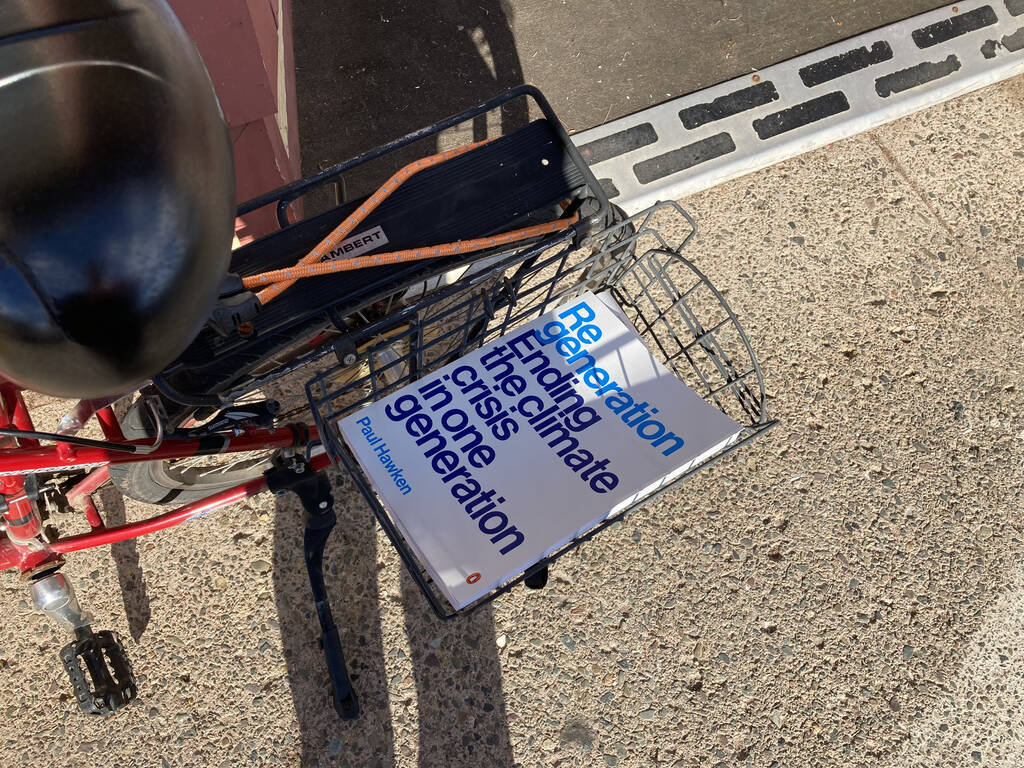
Paul Hawken’s new book Regeneration came out last week. I have been following Hawken since his Growing a Business was published in the mid-1980s. I’m skeptical of “all we need to do is X and the climate crisis will be solved” books, but at this point I’ll take any help I can get. I’ll report back on what I learn.

A copy of the paperback book by Paul Hawken, Regeneration, in my bicycle carrier.

30 Sep 18:46

The Dutch House

by Caterina Fake

by Ann Patchett.

Hardcover The Dutch House Book

The story is told from the viewpoint of the children, who were thrown out of their home by their stepmother, whose story is not told. A beloved older sister and a dutiful younger brother are left to fend for themselves. People loved this book. I only liked it. It was not Housekeeping, a book said to be the favorite of the sister and her mother, and a masterpiece. I often wonder about this: what is the difference between a good book and a great book? The Dutch House could have been a great book, but it wasn’t, and why not? I will return to this question when I have drawn some conclusions.

30 Sep 18:46

Weeknotes: CDC vaccination history fixes, developing in GitHub Codespaces

I spent the last week mostly surrounded by boxes: we're completing our move to the new place and life is mostly unpacking now. I did find some time to fix some issues with my CDC vaccination history Datasette instance though.

Fixing my CDC vaccination history site

I started tracking changes made to the CDC's COVID Data Tracker website back in Feburary. I created a git scraper repository for it as part of my five minute lightning talk on git scraping (notes and video) at this year's NICAR data journalism conference.

Since then it's been quietly ticking along, recording the latest data in a git repository that now has 335 commits.

In March I added a script to build the collected historic data into a SQLite database and publish it to Vercel using GitHub. That started breaking a few weeks ago, and it turnoud out that was because the database file had grown in size to the point where it was too large to deploy to Vercel (~100MB).

I got a bug report about this, so I took some time to move the deployment over to Google Cloud Run which doesn't have a documented size limit (though in my experience starts to creak once you go above about 2GB.)

I also started publishing the raw collected data directly as a CSV file, partly as an excuse to learn how to publish to Google Cloud Storage.

datasette-template-request

I released an extremely simple plugin this week called datasette-template-request - all it does is expose Datasette's request object in the context passed to custom templates, for people who want to update their custom page based on incoming request parameters.

More notable is how I built the plugin: this is the first plugin I've developed, tested and released entirely in my browser using the new GitHub Codespaces online development environment.

I created the new repo using my Datasette plugin template repository, opened it up in Codespaces, implemented the plugin and tests, tried it out using the port forwarding feature and then published it to PyPI using the publish.yml workflow.

Not having to even open a text editor on my laptop (let alone get a new Python development environment up and running) felt really good. I should turn this into a tutorial.

Releases this week

TIL this week

30 Sep 18:45

What Is A Good Member Satisfaction Score?

by Richard Millington

In surveys, we often questions like:

“On a scale of 1 to 5, with 5 being the highest, how satisfied or unsatisfied are you with your community experience?”

“On a scale of 1 to 5, with 5 being the highest, how relevant or irrelevant do you find the information shared within the community?”

This is a useful measure as it gives a simple score for the community you can improve over time.

When we worked on this project, this was the benchmark we were using.

You can use the following weighted averages to interpret the results:

  • Above 4.5 – Excellent
  • 4.2 to 4.5 – Very Good
  • 3.75 to 4.2 – Ok
  • 3.3 to 3.75 – Poor
  • Below 3.3 – Extremely poor

I’d recommend undertaking the survey every 6 to 12 months and tracking changes over time.

(p.s. This is also a good way to measure the impact of a major platform change).

The post What Is A Good Member Satisfaction Score? first appeared on FeverBee.

30 Sep 18:45

TIL: Barrier, a better Synergy

by Rui Carmo

After around a month using Synergy to drive one of my Surfaces alongside my Mac I was going nuts with the screensaver kicking in while I was on calls–my Mac would go idle and lock my Surface’s screen as well, blanking out the call.

It turned out that for some reason, Synergy doesn’t support disabling screensaver sync anymore (at least not in the license I have).

I initially tried editing the configuration file manually and the feature actually worked (despite not being surfaced in the GUI), but then the app would overwrite my settings upon quit.

Support couldn’t even figure out what I was talking about and asked me to “upgrade” to a version that wouldn’t even accept the setting anymore, So I replaced it with Barrier, which is a fork that, strangely enough, feels a lot more polished overall.

So if you’re still using Synergy 1.x, give it a try.


30 Sep 18:45

A Stop at Willoughby

by peter@rukavina.net (Peter Rukavina)

I happened upon a bootleg of this seminal episode of thirtysomething last night. I was reminded, yet again, how groundbreaking the series was, on so many levels.

This particular episode touches on war, American patriotism, free speech, advertising, and career burnout. It aired in May 1991, in the shadow of the Gulf War, and, in a way that would have been inconceivable in an earlier day—or, for that matter, since—it both called that war into question, and placed it inside the context of a military-industrial-advertising complex.

This all played out against the background of Michael Steadman (Ken Olin) having increasingly severe anxiety about his personal and political role in all this, playing against the unvarnished capitalist Miles Drentell (the brilliant David Clennon).

The part of the episode that hit me the deepest, though, is how Michael and his wife Hope (Mel Harris) touch each other: again, in a way that wasn’t seen on television before, and has seldom been seen since, it is the unhurried workaday touch of mutual affection.

It’s not surprising I was drawn to that, I suppose, because in my own life it is that touch I miss the most.

30 Sep 18:44

JavaScript Quality Assurance Tools and Usage Outcomes

I believe in tool-based development just as strongly as I believe that we should base our working practices on the best available evidence. I therefore enjoyed Kavaler2019, which looks at how the adoption of linters, dependency managers, and coverage checkers affect four aspects of a project: code churn, number of pull requests, number of contributors, and number of outstanding issues. The specific questions they set out to answer are:

  1. How often do projects change between tools within the same task class?
  2. Are there measurable changes, in terms of monthly churn, pull requests, number of contributors, and issues, associated with adopting a tool? Are different tools within an equivalence class associated with different outcomes?
  3. Are certain tool adoption sequences more associated with changes in our outcomes of interest than others?

After collecting data from GitHub and building some mixed-effects models, their conclusions are:

  1. "Most projects choose one tool within a task class and stick to it for their observed lifetime. However, when projects adopt additional tools within the same task class, they often move in the same direction as other projects, e.g., JSHint to ESLint."
  2. Their full analysis of impact fills a page and a half, but the short version is, "We find that there are measurable, but varied, associations between tool adoption and monthly churn, PRs, and unique authors for both immediate discontinuities and post-intervention slopes. We find that tools within a task class are associated with changes in outcomes in the same direction, with the exception of ESLint and coveralls for monthly churn. For issues, in all significant cases, tools are associated with a discontinuous increase in monthly issues; however, all significant post-intervention slopes are negative (decreasing issues over time). Regarding issue prevalence, standardJS, coveralls, and david stand out as tools with significant and negative post-intervention slopes."
  3. "Some sequences of tool adoptions are more associated with changes in our outcomes of interest than others. [Translation: sometimes order matters, sometimes it doesn't.] We find that some tool adoption sequences, compared to others consisting of the same tools but in a different order, are associated with changes in opposite directions. [Translation: sometimes adopting A then B moves a metric up but adopting B then A moves the same metric down.]"

Finally, the authors are frank about possible threats to the validity of their work:

The notion of goodness-of-fit in [mixed-effects models] is highly debated, with many available metrics for assessment. We note that our models for RQ2 have relatively low marginal R2 values. However, our conditional R2 are much higher (44.8% to 58.9%), suggesting appropriate fit when considering project-level differences. We also note relatively small effect size for tool interventions and post-intervention slopes. We believe this is expected, as we have controls for multiple covariates that have been shown to highly associate with our outcomes; thus, these controls likely absorb variance that would otherwise be attributed to tools, leading to smaller effect size for tool measures. Finally, as with any statistical model, we have the threat of missing confounds. We attempted to control for multiple aspects which could affect our outcomes and made a best-effort to gather data from as many projects as possible.

Disclaimers like this are part of why I believe that we cannot just present students with the results of empirical studies: we must teach them the data science used to get those results so that they can interpret and evaluate them.

Kavaler2019 David Kavaler, Asher Trockman, Bogdan Vasilescu, and Vladimir Filkov: "Tool Choice Matters: JavaScript Quality Assurance Tools and Usage Outcomes in GitHub Projects". 2019 IEEE/ACM 41st International Conference on Software Engineering (ICSE), 10.1109/icse.2019.00060.

Quality assurance automation is essential in modern software development. In practice, this automation is supported by a multitude of tools that fit different needs and require developers to make decisions about which tool to choose in a given context. Data and analytics of the pros and cons can inform these decisions. Yet, in most cases, there is a dearth of empirical evidence on the effectiveness of existing practices and tool choices. We propose a general methodology to model the time-dependent effect of automation tool choice on four outcomes of interest: prevalence of issues, code churn, number of pull requests, and number of contributors, all with a multitude of controls. On a large data set of npm JavaScript projects, we extract the adoption events for popular tools in three task classes: linters, dependency managers, and coverage reporters. Using mixed methods approaches, we study the reasons for the adoptions and compare the adoption effects within each class, and sequential tool adoptions across classes. We find that some tools within each group are associated with more beneficial outcomes than others, providing an empirical perspective for the benefits of each. We also find that the order in which some tools are implemented is associated with varying outcomes.
30 Sep 18:42

Under Pressure

by peter@rukavina.net (Peter Rukavina)

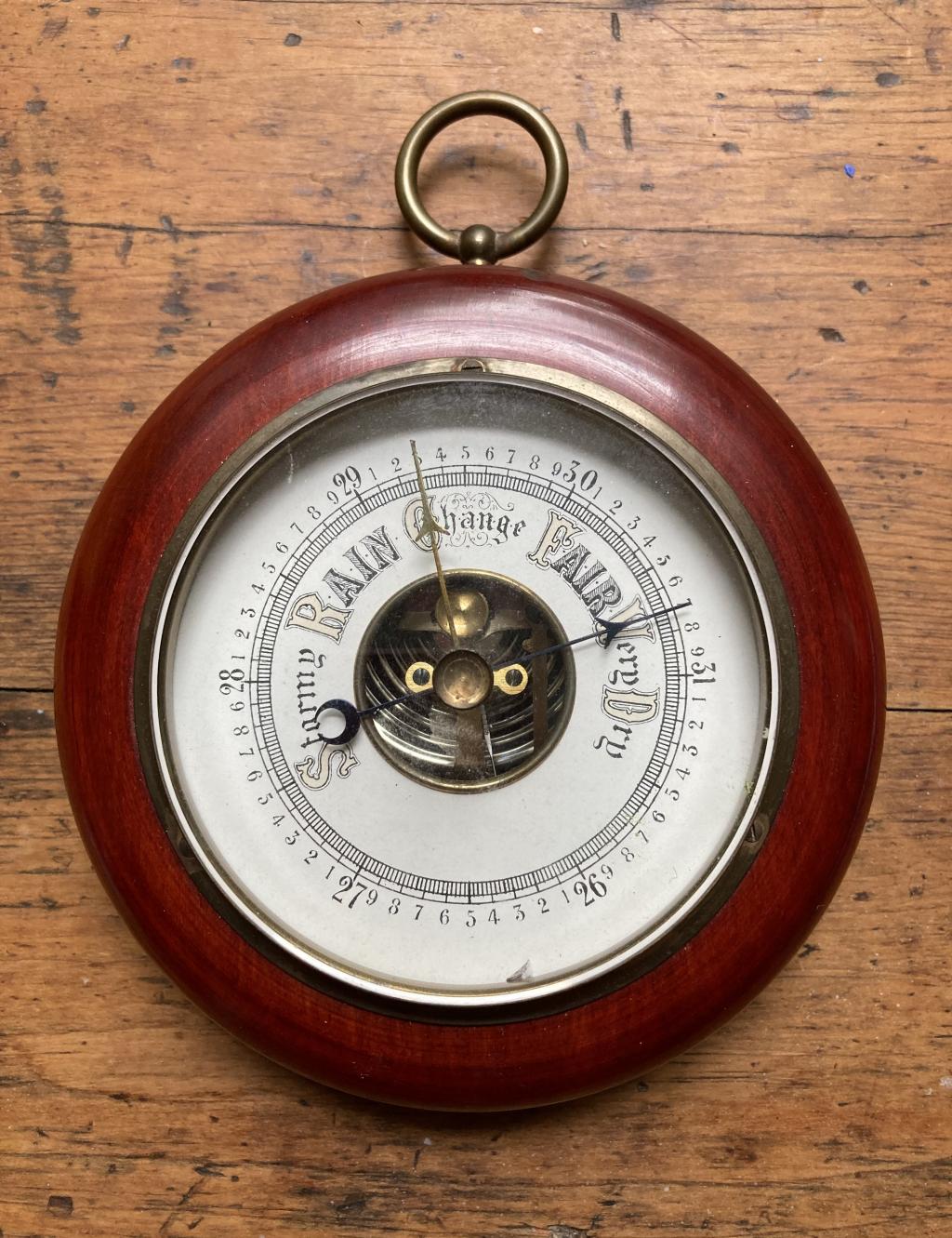
Thanks to the diligence and generosity of my mother, I am now the custodian of my great-grandfather’s barometer.

30 Sep 18:08

Why I disagree with Facebook’s defenders

by Josh Bernoff

Last week, I said we need to crush Facebook. A lot of you agreed. But a few found ways to explain that Facebook is just a normal part of the internet, magnifying stuff that we find engaging, and so crushing it is an overreaction. I respect these arguments and the people who make them. But … Continued

The post Why I disagree with Facebook’s defenders appeared first on without bullshit.

30 Sep 18:07

Facebook Gives You Quantity, Forums Give You Quality

by Richard Millington

A while back, this screenshot appeared on my Facebook feed.

MoneySavingExpert (a former client) is promoting a forum post (note: promoting forum posts via social media is a good idea).

It’s interesting that there are 77 comments on the Facebook post compared with just 53 on the forum post it’s promoting.

So why not simply post discussions on Facebook and do away with the forum?

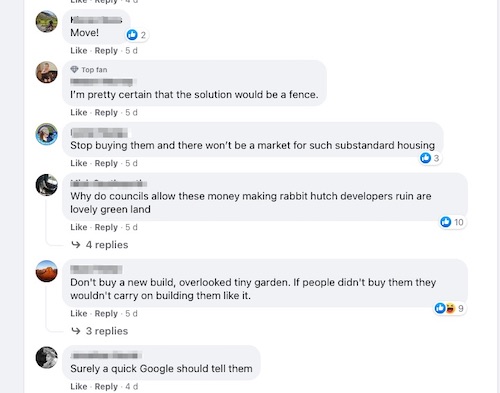
The answer is in the quality of comments. Most respondents on Facebook probably didn’t read the forum post (or they would reply in the forum instead of returning to Facebook?). This shows in the quality of discussions. They’re generally more emotive and antagonistic.

The posts in the forum however are more considered and helpful.

Compare the above with the posts below.

The extra friction that a forum demands (registering/logging in, clicking the title that interests you, and reading the post) creates a far greater exchange of quality information.

If engagement is all you want, Facebook might be a great tool for that.

But if you want an exchange of quality information, forums, and hosted community platforms are usually much, much, better.

The post Facebook Gives You Quantity, Forums Give You Quality first appeared on FeverBee.

30 Sep 18:06

A Succinct Intro to R

by Nathan Yau

Before you get into analysis and visualizing data with R, you need to know the basics. Steve Haroz wrote a guide on getting started:

This book is a short introduction to the R language. It covers the basics of R that are not covered by analysis and visualization guides like R for Data Science. Consider it a quick way to get up to speed on R before diving into the analysis and visualization aspects.

This example-focused guide assumes you are familiar with programming concepts but want to learn the R language. It offers more examples than an “R cheat sheet” without the verbosity of a language spec or an introduction to programming.

Tags: R, Steve Haroz

30 Sep 18:05

Effects of Adopting Code Review Bots on Pull Requests to OSS Projects

Several years ago, I grumbled that software tooling had basically stalled in the 1980s—that everything I used to write code today would have been familiar to my younger self. Prof. Peggy Storey corrected me, pointing out that social coding tools like Stack Overflow and Slack bots had changed programming every bit as much as linters and interactive debuggers.

Wessel2020 is a good look at what happens when a team adopts one of those tools: a bot that automatically runs code checks on pull requests and sends the results back to the PR's author. They found that adopting a code review bot:

  1. increases the number of monthly merged pull requests,
  2. decreases monthly non-merged pull requests, but
  3. decreases communication among developers.

Looking at the third result more closely, the authors find that the amount of communication as comments on the PR decreases. This seems to be because the number of comments depends on how long the PR is open; since adopting a code review bot leads to PRs being merged more quickly, it's not surprising that the number of comments would go down. In addition, the authors weren't able to look at out-of-band communication (e.g., via email or messaging), so the simple statement that communication decreases should be unpacked before it's shared.

Wessel2020 Mairieli Wessel, Alexander Serebrenik, Igor Wiese, Igor Steinmacher, and Marco A. Gerosa: "Effects of Adopting Code Review Bots on Pull Requests to OSS Projects". 2020 IEEE International Conference on Software Maintenance and Evolution (ICSME), 10.1109/icsme46990.2020.00011.

Software bots, which are widely adopted by Open Source Software (OSS) projects, support developers on several activities, including code review. However, as with any new technology adoption, bots may impact group dynamics. Since understanding and anticipating such effects is important for planning and management, we investigate how several activity indicators change after the adoption of a code review bot. We employed a regression discontinuity design on 1,194 software projects from GitHub. Our results indicate that the adoption of code review bots increases the number of monthly merged pull requests, decreases monthly non-merged pull requests, and decreases communication among developers. Practitioners and maintainers may leverage our results to understand, or even predict, bot effects on their projects' social interactions.
30 Sep 18:03

The future scenario story: why it works, and how to write one

by Josh Bernoff

If you’re writing a book about a change in the world, consider including an imagined future scenario. It will vividly bring to life your vision of the future. And it will be fun to write, too. What is a future scenario story? If you are writing a book about trends or shifts, you want us … Continued

The post The future scenario story: why it works, and how to write one appeared first on without bullshit.

30 Sep 18:01

iPhone 13 Pro :: Another camera perspective

by Volker Weber

I have shown you the difference in camera size between the iPhone 13 Pro and the iPhone 12 Pro. It does not bother me in the least, but it has consequences when you add a case. For the iPhone 12 Pro, a leather case would make the back of the phone flat, so that you lay it down on a table without rocking and the camera glass would still be protected. The iPhone 13 Pro is different. The leather case has an extra protrusion that protects the lenses.

Remember, the iPhone 13 Pro got thicker by a fraction of a millimeter and houses a larger battery. With the old camera I could have imagined an ever thicker body that negates the necessity of a protruding lens. But the new camera will never fit in a phone body. And that is true for all serious cameras. The lens always sticks out.

There you have it. It’s not an iPhone. It is the iCamera. All of these photos were not shot with an iPhone but with a vivo X60 Pro. The iPhone 13 is not the only camera that can shoot up close.

30 Sep 18:00

The GIL and its effects on Python multithreading

The GIL and its effects on Python multithreading

Victor Skvortsov presents the most in-depth explanation of the Python Global Interpreter Lock I've seen anywhere. I learned a ton from reading this.

Via Hacker News

30 Sep 17:59

ML Super Resolution gets an update

by admin

Our machine learning models practically live a life of their own. For most of our apps, features and improvements have to be worked on for each app separately. But when it comes to ML models, we can include improvements everywhere at once. And that’s what has just happened with ML Super Resolution – the algorithm has been refined to work much better with illustrations and graphics, especially those that include semitransparent areas – and those changes are available in both Pixelmator Pro and Pixelmator Photo as of their most recent updates.

Our ML Super Resolution algorithm is pretty unique because it supports transparent images and this adds an extra level of complexity to the algorithm. In images with transparency, upscaled edges weren’t quite as sharp as we’d like. So we made a few tweaks and have some pretty big improvements that we’re very proud of! Check them out below.

Old ML Super Resolution version

New ML Super Resolution version

And in other ML news, the sixth-generation iPad mini is now available. It sports the new A15 Bionic chip with a 16-core neural processor, which is around 40% faster than the previous generation. We ran a quick test that we’ve done previously and the iPad mini came in at 0.41s to upscale a 0.3 megapixel image. That’s faster than the 2017 iMac Pro!

Mac
Compute time*
MacBook Pro (13-inch, Mid 2012)
61.6s
MacBook Air (13-inch, 2018)
13.7s
iMac Pro (2017)
0.56s
M1 MacBook Air (2020)
0.51s
iPad mini (Sixth generation)
0.41s

* For this test, a 300,000 pixel image was upscaled to three times its original size. The iPad mini was tested on iOS 15, the M1 Mac on macOS 11, and other devices on macOS 10.15.

30 Sep 17:59

 CONFRONT THE CLIMATE EMERGENCY

by Stephen Rees

The following is the text of an open letter sent to to the Government of British Columbia

I read about it in the National Observer. They provided a link to the letter but did not publish its actual content. And the link led to a pdf file. I used their web page to send out a Tweet. I then decided that it was worth a bit of cut and paste to create a post here that will, I trust, reach a different audience than Twitter.

AN URGENT CALL TO THE BC GOVERNMENT

September 2021 

Dear Premier Horgan and the Government of BC,

We write on behalf of diverse environmental, Indigenous, labour, health, business, local government, academic, youth, and faith communities who collectively represent well over one million British Columbians.

We call on the BC government to recognize the urgency and alarm that people all over the province are feeling as the climate crisis directly impacts our communities and our health: deadly heat waves, wildfires, drought, floods, crop failure, fisheries collapse, and costly evacuations and infrastructure damage. These climate-related impacts are unprecedented and intensifying. Indigenous peoples stand to be disproportionately impacted by climate events despite successfully taking care of the land since time immemorial.

The latest report from the Intergovernmental Panel on Climate Change is a ‘code red’ for humanity. The International Energy Agency has called on world governments to immediately stop investments in and approvals of new oil and gas projects. 

The provincial government’s CleanBC climate action plan is insufficient to limit warming to 1.5°C and will not keep British Columbians safe from the worst impacts of climate change. 

We therefore urge the BC government to develop and implement a transformative climate emergency plan that recognizes the interconnected climate, ecological, and social crises; embeds equity, anti-racism, and social justice at its core; and upholds Indigenous Title and Rights, and Treaty Rights.

To implement the rapid systemic change that is required, we call on the provincial government to demonstrate the leadership necessary to confront the climate emergency, and immediately undertake the following ten actions:

1

Set binding climate targets based on science and justice

Reduce BC’s greenhouse gas emissions by ~7.5% per year below 2007 levels. Set binding reduction targets of 15% by 2023; 30% by 2025; 60% by 2030, and 100% by 2040 (below 2007 levels). Review and update targets regularly as climate science evolves.

2

Invest in a thriving, regenerative, zero emissions economyInvest 2% of BC’s GDP ($6 billion dollars per year) to advance the zero emissions economy and create tens of thousands of good jobs. Spend what it takes to immediately reduce greenhouse gas emissions and create new economic institutions to get the job done. Ensure that the economic component of Aboriginal Title is recognized through the sharing of benefits and revenues that result.

3

Rapidly wind down all fossil fuel production and use

Immediately stop all new fossil fuel infrastructure including fracking, oil and gas pipelines, liquefied natural gas (LNG), and fossil fuel-derived hydrogen. Rapidly phase out and decommission all existing fossil fuel production and exports.

4

End fossil fuel subsidies and make polluters pay

End all fossil fuel subsidies and financial incentives by 2022. Ensure that those industries that profit from fossil fuel pollution pay their fair share of the resulting climate damage.

5

Leave no-one behind 

Ensure a just transition for fossil fuel workers, resource-dependent communities, and Indigenous and remote communities impacted by fossil fuel production. It will be critical to collaborate in true partnership with Indigenous peoples in climate action. Prepare our communities for the impacts of the climate crisis to minimize human suffering and infrastructure damage. Support those most vulnerable to climate change impact.

6

Protect and restore nature 

Protect 30% of terrestrial and marine ecosystems by 2030; support and invest in Indigenous-led conservation initiatives; restore natural ecosystems to enhance ecosystem functions and services, preserve biodiversity, increase carbon sequestration, and improve human and ecosystem resilience to climate impacts. Impose an immediate moratorium on the industrial logging of all old growth forests which are critical carbon sinks. 

7

Invest in local, organic, regenerative agriculture and food systems 

Incentivize carbon storage in soil, restore biodiversity, and ensure food sovereignty and food security across the province. Increase consumption of plant-based foods, and reduce food waste. Support Indigenous communities that wish to maintain traditional food systems and enhance their food security. 

8

Accelerate the transition to zero emission transportation 

Invest in affordable, accessible, and convenient public transit within and between all communities. Reallocate infrastructure funds from highway expansion to transit and active transportation (cycling, rolling, and walking). Mandate zero emissions for all new light vehicles by 2027, and all medium and heavy duty vehicles by 2030. 

Accelerate the transition to zero emission buildings 

Ban new natural gas connections to all new and existing buildings by end of 2022. Create a Crown Corporation to mobilize the workforce to retrofit all existing buildings and eliminate fossil fuel heating by 2035, and to build new affordable zero emissions buildings. 

10 

Track and report progress on these actions every year 

Embed all of these actions in legislation to ensure accountability, transparency, and inclusion. Establish rolling 5-year carbon budgets that decline over time towards zero emissions by 2040 or sooner 

A VISION FOR OUR FUTURE

The climate emergency offers an unprecedented opportunity to generate new, vibrant economic and social wealth as we transform where our energy comes from and how it is used. It offers an opportunity to achieve energy security, ensure food security, develop more sustainable local economies and jobs, transform our buildings, redesign transportation, reduce pollution, improve human health and wellbeing, and enhance our quality of life. The transition from fossil fuels to a zero emissions economy has clear benefits for people and natural ecosystems, and is an opportunity to create a more prosperous, just, and equitable society.

Every person, every business, every industry, and every government has a role to play as we coordinate individual and collective actions to create a thriving, resilient, and regenerative society that respects its interdependence with healthy ecosystems and a safe climate.

British Columbia is positioned to become a visionary world leader and demonstrate that innovative and rapid change is possible as we transition to a zero emissions economy.

We urge you to seize these opportunities, and demonstrate to British Columbians that our government is indeed a true climate leader by implementing the 10 climate emergency actions set out in this letter.

We must act now.

SIGNATORIES

Indigenous

British Columbia Assembly of First Nations

First Nations Summit

Gidimt’en Checkpoint

RAVEN (Respecting Aboriginal Values & Environmental Needs)

Union of BC Indian Chiefs

Arts / Culture

Brackendale Art Gallery

Canadian Media Producers Association (BC Branch)

Claymates Ceramics Studio Inc.

Coalition of Museums for Climate Justice

Hummingbird Music Studio

Indian Summer Arts Society

Neworld Theatre

South Cariboo Arts and Culture Society

Spring Magazine

Women in Film and Television Vancouver

Business

1st Knowledge Bank Ltd

Audiopile Records

Barnacle Strategies Consulting

Bydand Wealth Management

Calmura Natural Walls Inc.

Climb On Equipment Ltd

Cool.World

Crowned Vitta LLC

Curio Research Ltd.

Drinkfill Beverages LTD

Earnest Ice Cream

Fresh Roots Urban Farm Society

Goldilocks Goods

Harvey McKinnon Associates

Hollyhock

KWENCH

Lush Cosmetics North America 

Nada

New/Mode

OMC Inc.

Patagonia 

Persephone Brewing Company

Rain or Shine Ice Cream

Redroof Enterprizes

Renewal Funds

Rethink2gether

Salish Soils Inc.

Sea To Sky Cable Cam Inc.

Squamish ReBuild Society

Sustainable Produce Urban Delivery (SPUD)

Tegan McMartin Photography

TREE WORLD Plant Care Products, Inc.

Vedalia Biological Inc.

Viridian Energy Coop

Visual Science

Community group

Alliance4Democracy (Sunshine Coast)

BC Hydro Ratepayers Association

Coalition of Child Care Advocates of B.C.

Council of Canadians (Campbell River Chapter)

Council of Canadians (Comox Valley Chapter )

Council of Canadians (Nelson Chapter)

Council of Canadians (Terrace Chapter)

Council of Canadians (Victoria Chapter)]

Courage Coalition

Food Stash Foundation

Friends of Tilbury Working Group

Global Peace Alliance BC Society

Kaslo Community Action Team

Language Partners BC

Out Here Ski & Board Club

Philosophers Anonymous

South Asian Network for Secularism and Democracy (SANSAD)

South Park Family School

Tree of Life Nature Playschool 

UNBC Outdoors Club

Health

Canadian Association of Physicians for the Environment

Canadian Health Association for Sustainability & Equity (CHASE)

Doctors for Planetary Health (West Coast)

Inner Light Healing Arts

Mental Health and Climate Change Alliance

Public Health Association of BC

Faith

Anglican Diocese of New Westminster

Canadian Unitarians for Social Justice

First Unitarian Church of Victoria

Holy Cross and Saint Patricks RC Parishes 

KAIROS (BC-Yukon Region)

Naramata Community Church 

North Shore Unitarian Church Environmental Action Team

Salt Spring Island Unitarian Fellowship

Squamish United Church

Vancouver Unitarians

Yasodhara Ashram Society

Labour

Douglas College Faculty Association

Federation of Post-Secondary Educators

North Island College Faculty Association 

Public Service Alliance of Canada (BC Region)

Worker Solidarity Network 

Seniors

Canadian Senior Cohousing Society

Pacific Park Place Housing Cooperative

Squamish Seniors Society

Suzuki Elders

Youth

Douglas Students’ Union

My Sea to Sky Youth Council

Quest Student Environmental Committee 

Reel Youth

Simon Fraser Public Interest Research Group (SFPIRG)

Students for Mining Justice

Sustainabiliteens

Take a Stand: Youth for Conservation

Environment / Climate action

350 Vancouver

Against Port Expansion in the Fraser Estuary

Alberni Climate Action

Alberni Valley Transition Town Society

Armstrong/Spallumcheen Climate Action

Association of Denman Island Marine Stewards

Association of Whistler Area Residents for the Environment 

Babies for Climate Action (New Westminster)

Babies for Climate Action (Vancouver)

BC Climate Alliance

BC Nature

BC Sea Wolves

Below2C

Better Transit Alliance of Greater Victoria

Bowen Island Conservancy

British Columbia Cycling Coalition

Burnaby Climate Hub 

Burnaby Residents Against Kinder MorganExpansion (BROKE)

Canadian Freshwater Alliance

Chase Environmental Action Group

Chemainus Climate Solutions

Citizen’s Climate Lobby (Okanagan Chapter)

Citizen’s Oil & Gas Council

Citizens’ Climate Lobby (Nelson-West Kootenay Chapter)

Climate Action Now!

Climate Caucus

Climate Emergency Unit

Climate Justice Victoria

Concerned Citizens Bowen

Cowichan Valley Naturalists

Creatively United for the Planet

David Suzuki Foundation

Denman Island Climate Action Network

Dogwood

First Things First Okanagan

For Our Kids (North Shore)

For Our Kids (Sunshine Coast)

For Our Kids (Vancouver)

Force of Nature (North Shore Community Action Team)

Georgia Strait Alliance

GOAL12 Sustainable Consumption and Production Society

Green Teams of Canada

HUB Cycling

Lawyers For Climate Justice

Leadnow

Living Forest Institute Society

Living Oceans Society

Mount Work Coalition

My Sea to Sky

Nanaimo Climate Action Hub

Net0world 

North Okanagan Naturalists’ Club

OneEarth

Parents 4 Climate

Planetary Resilience Council of BC

Protect Our Winters Canada

Roots on the Roof

Saanich Eco Advocates

Salish Sea Renewable Energy Cooperative

Salt Spring Island Stream and Salmon Enhancement Society

Sea Smart

Shuswap Climate Action

Sierra Club BC

Skeena Watershed Conservation Coalition

Squamish Climate Action Network (Squamish CAN)

Squamish Environment Society

Squamish Food Policy Council (SFPC)

Stand.earth

Sunshine Coast Conservation Association

Sunshine Coast Streamkeepers Society

Sustainability Action Group for the Environment

Synergia Institute

Transition Kamloops

Transition Salt Spring

Transition Sooke

Victoria Climate Hub

Victoria Transport Policy Institute

Watershed Watch Salmon Society

West Coast Climate Action Network (WE-CAN)

West Coast Environmental Law Association

West Kootenay EcoSociety

Wilderness Committee

Wildsight

Yellow Point Ecological Society

Zero Waste BC

30 Sep 17:59

Don’t Make Changes Until You Understand The Ecosystem

by Richard Millington

An incident recently reminded me of the Ron Johnson/JCPenny story.

In 2011, JCPenney hired Apple’s retail chief Ron Johnson as CEO.

Ron Johnson decided JCPenny should be more like Apple. Senior staff are replaced, advertising and PR agencies are changed, sales and promotions are cut etc…

A year later, JCPenny’s sales plummeted by 32% (“the worst in retail history”) and Ron was fired.

It’s common when you’re going from a very successful community to another community to make your new community like the old. This frequently means changing the platform, bringing in new rules, adopting similar processes in managing the community etc..

And it’s equally common for this approach to fail miserably – often disastrously (the worst case I can recall led to members abandoning the expensive brand-hosted community and creating their own, far more popular, community elsewhere).

Two considerations here:

1) Did your previous community succeed because of what you did or in spite of what you did? Building a community in a mature, fertile, environment (i.e. where you have lots of support, a large flow of incoming members, a high-risk tolerance) is very different from building a community in a more challenging environment (i.e. a smaller, private, community).

2) What benchmarks can you improve? What is the community doing well at the moment? What should be changed? Where are the incremental areas of growth?

Don’t make big changes until you really understand the full ecosystem.

The post Don’t Make Changes Until You Understand The Ecosystem first appeared on FeverBee.

30 Sep 17:58

The Climate Gap

If you’ve spent any time looking into climate change, you’ve heard a lot about emissions. Climate change is fueled by our emissions of greenhouse gasses and we must reduce our emissions to avoid disaster. Disaster is usually spelled out in some degrees of warming, usually 1.5˚C or 2.0˚C. In order to avoid this disaster, we are given two actionable items:

  1. As individuals, we must reduce our personal emissions. We need to put solar on our homes, buy electric cars, get rid of our gas appliances, etc.

  2. Collectively as the world, we must re-engineer our industry and means of production to reduce emissions by the gigaton.

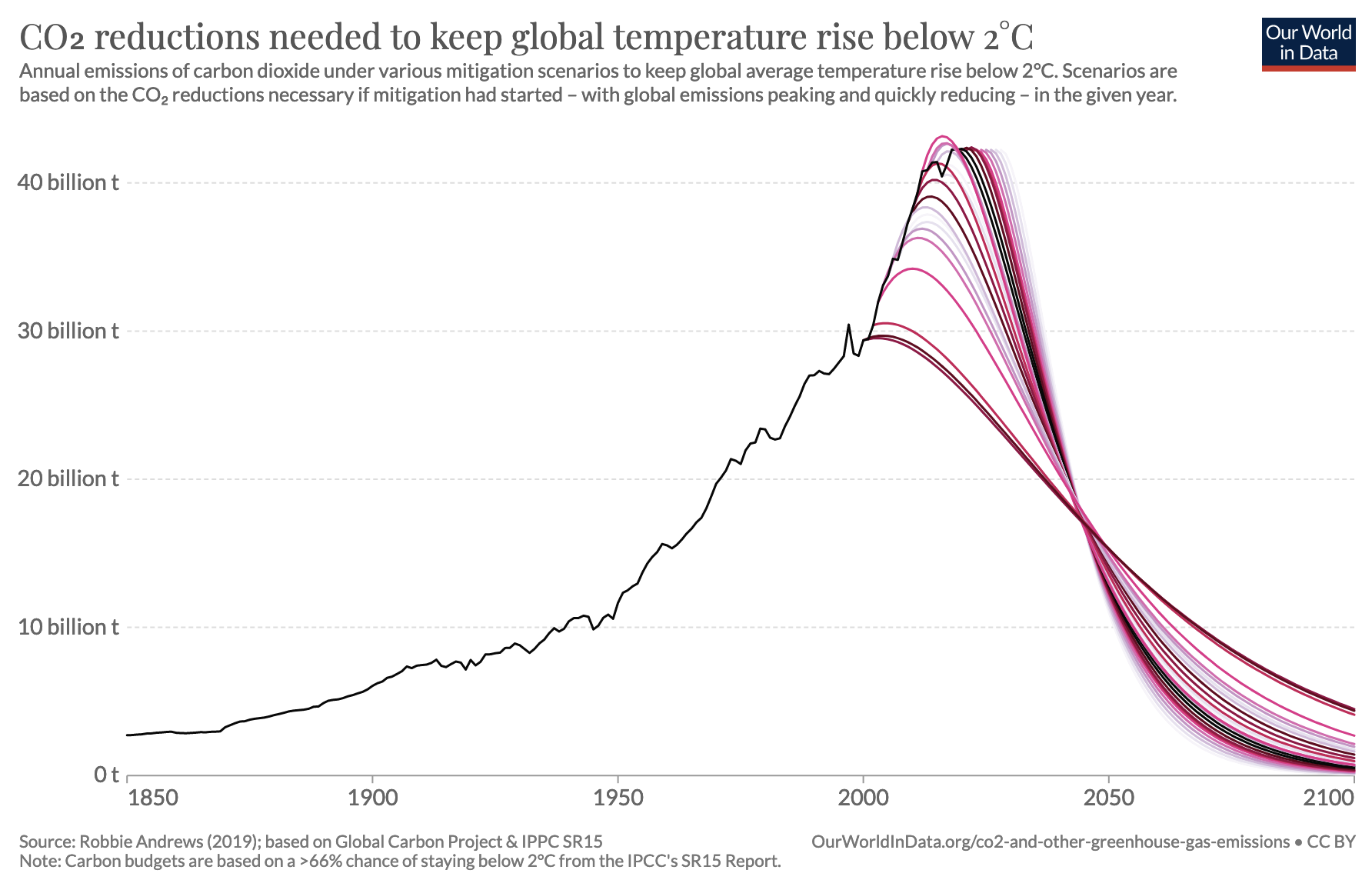
You might even be familiar with a graph that looks something like this:

Graph: CO2 reductions needed to keep global temperature rise below 2˚C

It doesn’t take much critical thinking to realize something pretty quickly: none of those projected curves are actually going to happen. We haven’t even started pointing the graph downwards yet. We will not decarbonize the entire world in a few decades.

So — okay. We aren’t going to limit warming to 2˚C by reducing emissions. What are our options? The next thing you’ll hear is carbon capture and carbon sequestration. Plant more trees, install CCS (Carbon Capture and Storage) devices on natural gas plants, build DAC (Direct Air Capture) machines to suck CO2 out of the air. We’ll create a negative component to the chart that adds a possibility for positive emissions to be balanced by the negative emissions of carbon removal — reaching something we call net-zero emissions.

Unfortunately, planting more trees and other natural sequestration solutions aren’t a path out of this. At best, that sequestration happens once. If we reforest a region and it sequesters a few gigatons of CO2, that forest doesn’t keep regrowing year after year — it is a one time offset. At worst… how much carbon does a forest sequester once it’s burned down? We need a way to capture and sequester emissions on an ongoing basis. That means CCS and DAC.

Across the globe in 2020, we captured and stored 0.000009 gigatons of C02 with DAC and 0.04 gigatons of C02 with CCS. In order to capture half of our current emissions, we’d need to be capturing around 20 gigatons per year, or 500 times our current CCS capacity and 22 million times our current DAC capacity. But this is only part of the story — the vast majority of that captured carbon was used for EOR (Enhanced Oil Recovery). In other words: the only realistic implementation of carbon removal so far is to extract fossil fuels that would have otherwise been unprofitable to extract. I wouldn’t call that negative emissions.

It’s pretty clear that carbon capture and sequestration on the scale required to limit warming to 2˚C isn’t going to happen.

The Cure is Also the Problem

Reducing our current emissions to zero is only half the struggle. We also need to find a way to compensate for the emissions needed to get to that decarbonized future.

We all agree that we need to replace our gas powered cars with electric cars, replace our coal energy plants with nuclear and renewables, and so on and so forth. But building electric cars, nuclear power plants, and solar panels emits CO2 in the process. Electric cars require batteries that use materials mined with diesel tractors. Nuclear power plants are made of an incomprehensible quantity of concrete. Solar panels require aluminum that must be smelted from ore. This list goes on and on. It’s going to require an incredible amount of emissions to build the infrastructure we need to reduce emissions.

At the same time, all around the world people are escaping poverty, moving into the middle class, and generally improving their standard of life. That means more apartment complexes, more iPhones, and more foam mattresses. All of which cost emissions to make.

We cannot ethically or reasonably deny these things to the developing world. Thanks for letting us burn fossil fuels to get where we are! Now you need to lift yourself up without creating any more emissions — that good? The idea is unconscionable and counter-productive. If we want to solve the emissions problem, we’re going to need the cooperation of the entire world. Subjugating the majority of the world’s population into poverty isn’t going to cut it.

Fuck

We aren’t going to limit warming to 2.0˚C through emissions reduction, and there isn’t a credible reason to believe we have a path to reduce emissions at all over the next few decades. The gap between what is necessary and what is feasible is so large as to be effectively meaningless.

Do you know how many footsteps it would take to walk from the Earth to the Moon? Would having that answer get you any closer to the moon? That’s the kind of gap we’re talking about. We are talking about an entire restructuring of the world’s governments, industry, financial systems, agriculture, transportation networks, and every single human’s way of life. Oh — and the complete dismantling of every country’s war machine. It’s not worth investigating because there is no way it will happen in time to prevent warming in the way our charts imagine, just as you will not be walking from the Earth to the Moon no matter how many footsteps it measures out to be.

Fuck. Fuck Fuck Fuck.

Paradigm Shift

The above conclusion can be pretty depressing. Doesn’t that mean the world is ending? No. It’s not. But our current paradigm surrounding climate change is in need of serious repair. I’m often reminded of something an old rancher once told me when I was trying to figure out how to fix the dirt road to my off grid property: sure you can fix the road, or you can just buy a bigger truck.

Reducing emissions is incredibly important. We have to find a way to decarbonize our way of life if we want to life comfortably on this planet. But we aren’t going to combat climate change in a meaningful and timely way focusing on emissions. We need a solution to the emissions problem, but it isn’t going to be our answer to climate change. Not in this century.

Once I freed myself from this obsession of solving an unsolvable problem, I realized that the emissions paradigm had been an immense burden. How can it not? The only effective way to reduce your emissions to zero is to cease being. The only way to reduce our world’s emissions to zero is through world wide revolution toward…. something else we only have faint ideas about? What’s worse — this obsession with emissions blinded me from possible solutions. If we take it as fact that emissions will continue to rise over the next hundred years, what are our options? What’s our bigger truck version of combating climate change?

We have to break out of our current paradigm.

Resilience and Mitigation

I believe our most viable tools in combating climate change revolve around resilience and mitigation.

Resilience is adapting our infrastructure to live in a world of changed climate. It means building houses that suffer floods and wildfire undamaged. It means neighborhoods built so that neighbors can support each other. It means levees seven stories high and tractors that work in deep mud. It means energy systems that continue to function even as the grid fails, purification systems for contaminated water sources, and air handling systems designed for toxic air.

Mitigation is a different thing. It means reducing warming even as emissions rise. It means solar geoengineering, cloud seeding, and a variety of other incredibly uncomfortable ideas. It’s scary and full of terrible outcomes. But I believe it’s a necessary and inevitable step to buy us time while we work on the emissions problem. Inevitable because solar geoengineering isn’t that expensive and most companies / countries have the means to start a project. Rogue geoengineering will absolutely be a thing. It’d be nice if it wasn’t rogue.

These are no small tasks. We’ll need to change the way we think about housing, transportation, land ownership, food, energy, and what “the environment” means just to live in the world that exists today. But these ideas are far more approachable than avoiding climate change with emissions. I can imagine a house built to survive a wildfire. I cannot imagine every single government, industry, and human on earth voluntarily changing their way of existence in order to to reduce emissions to zero, then negative.


I’ll say it again: reducing emissions is incredibly important. We have many viable paths to do this! We just don’t have any paths that work on our given timeline. So I look at emissions as a research project — probably the most important research project of our generation. We have to decarbonize our way of life. We have to build an industry of carbon removal. We have to remember that every pound of CO2 we fail to emit is one pound less to be removed in the future. Paving a path toward solving the emissions problem will be our gift to the children of 2150.

So I’ll keep my subscriptions to Climeworks and Tradewater to buy back the carbon I emit. I’ll invest in Regenerative Agriculture and novel uses of farmland. I’ll continue giving to Carbon 180, Clean Air Task Force, Cool Earth Action, Project Drawdown, Protect Our Winters, Sierra Club, Trees for the Future, and other emissions focused organizations. I’m not giving up on the most important research project of our lifetime.

But I’m not going to pretend this will have any effect on the challenges of my generation, or even the next. It means I’m going to tell you that the important part of my new house isn’t the electrified induction cooktop — it’s the HEPA filter and backup batteries. And I might even fly on an airplane or three and find joy in life without measuring every gram of carbon I emit.

Our way forward is through a changed climate. We can’t keep pretending there is some mythical singularity at 2˚C we can prevent with emissions control. We already live in a changed climate. It’s time we acted as though reality is real.

30 Sep 17:50

2021-09-29 General

by Ducky

Testing/Diagnostics

In this study, they put a wristwatch-like thing on the wrists of people who willingly allowed themselves to be infected with either rhinovirus, flu, or placebo. The wristwatch thingie was able to predict illness about a day before symptoms showed up. This could be really useful for diagnosing other respiratory infections (like ahem COVID-19).

Treatments

This preprint says that REGEN-COV, the Regeneron monoclonal antibody, drops death rates by about 70%.

Transmission

In this study, they simulated aerosol dispersion in an Boeing 777. My takeaways: don’t sit in the MID-AFT section, leave your mask on; and especially don’t take your mask off to eat (and yeah, that means “don’t eat”).

Recommended Reading

This article talks about the deep structural issues that led to the US blowing their COVID-19 response. Canada does not have all of them (yay socialized medicine), but it does have some of them.

30 Sep 17:50

2021-09-29 BC

by Ducky

Data Summary

A new BC CDC Data Summary was released yesterday.

Our death rates are surprisingly high, and I wondered who was dying. It’s vaccinated really old people:

Note that there aren’t very many unvaccinated old people.


Case counts in young children are going up:

They say that the cases started rising before school opened, and this chart does seem to validate that:

The case rate started going up before school started, but it’s gone up a lot afterwards. I am a hard time reconciling that. It went up the most post-schools opening in Northern Health, but has also gone up a little in Island Health and Fraser. In the other Health Authorities, it looks stable or falling.

You would expect that if schools were inherently dangerous, the rates would have gone up in all of the HAs. You’d expect that if they were inherently safe, there would be no difference after schools started. I think this means that it’s complicated.

Note that there is a lot more testing in kids right now, and I’m not sure why. You could say that this explains why the kids’ case rate went up, but you could also cynically say that means we must have been missing cases in kids when the case rate was lower.


They have results of a big study of vaccine effectiveness in BC using data from 30 May 2021 to 11 Sept 2021. (It looks like it hasn’t quite hit the prepress servers yet.) It shows that all of the vaccines are really really effective against hospitalization and death, and most combos are really effective against infection. AZ+AZ isn’t as good against infection as mRNA+mRNA or AZ+mRNA, but it’s still not awful.

I would like to say that I feel vindicated for my promotion of mixed vaccinations: AZ+mRNA is in fact better than two mRNAs!!! By, uh, a whopping 1%. <small voice> okay I will just go sit over in my corner over here </small voice>

While the effectiveness against infection decreases some over time, it’s still at 80% after 16 weeks, and against hospitalization is still over 90%:

The study also shows that longer dose1 to dose2 intervals are good. (This is not a surprise.) Fewer than six weeks, the effectiveness is in the mid-80s; more than six weeks it’s in the 90s.


The Weekly Summary says that the MetroVan wastewater COVID-19 levels were going down, which is great to see. Really, Langly is the only place where it is not obviously going down. The lines are cases and the circles are the COVID-19 wastewater levels:


Speaking of wastewater, NH’s positivity rate is in the shitter at a whopping 21%. That’s higher than it’s been anywhere at any time in the pandemic. On the other hand, Interior Health has made a very strong turnaround. Go Interior!

Mitigation Measures

According to this article, the Surrey school board has put in a mask mandate for all students, K-12. It also is going to try to get gargle COVID-19 tests into the schools.

Statistics

+813 cases, +11 deaths, +10,084 first doses (est), +8,917 second doses (est).

Currently 340 in hospital / 146 in ICU, 6,185 active cases, 177,729 recovered.

first doses second doses
of adults 88.4% 81.6%
of over-12s 87.9% 80.8%
of all BCers 80.1% 73.5%

Note that with the population of BC which I use (5.1M), more than 80% of all BCers have gotten a first dose! My records show that 98% of the people who had gotten a first dose by seven weeks ago have gotten a second dose. 🙂

Charts

The province did not updated the dashboard’s vaccine numbers either yesterday or today, I don’t know why. The press release has the cumulative total number of first doses, and I can guess at the number of second doses given in a day by subtracting the cumulative number of second doses given to eligible people for yesterday from today, but there are more second doses that have been given than have been given to eligible people. Therefore, some doses have been given to ineligible people. I am estimating that there are zero ineligible people getting vaccinated these days, but I don’t know.

Anyway, I can make the vax chart, and it will probably be close, but I don’t have any information about supply. Maybe no new doses have arrived, but maybe they have.

Meanwhile, a friend points out that we have enough vax, so the supply charts are not very interesting. Fair enough. So I think I’m going to stop making them.

30 Sep 17:22

Trudeau needs a COVID-19 Emergency Order. Here's how to do it.

mkalus shared this story from [Untitled].

b'

Amir Attaran is a biomedical scientist, a lawyer, and a professor in the Faculty of Law and the School of Epidemiology and Public Health at the University of Ottawa.

Prime Minister Trudeau pondered his options. His advisors told him that a national crisis was sweeping across Canada, consuming its economy and shattering lives. They told him it was spinning out of control; there was no denying it. Solemnly the advisors recommended the federal government impose strict, national restrictions, even overriding the provinces if necessary. The premiers would howl, of course, but the advisors said the prime minister had to face down the emergency. He would pay a price for doing the right thing.

It was not an easy decision, least of all for Trudeau, whose name was synonymous with\xe2\x80\x94some would say tainted by\xe2\x80\x94the War Measures Act and the October Crisis.

But the prime minister was resolute. He reached into the federal government\xe2\x80\x99s seldom used emergency powers, and pushed out a law to fight the crisis.

It was 1975, the prime minister was Pierre Trudeau, and the law was the Anti-Inflation Act.

Forty-five years ago, Trudeau the elder used the federal government\xe2\x80\x99s emergency powers to control prices, wages, and other branches of the economy to wrestle down an inflation rate topping 10 per cent. Unlike today, nobody was dying, and hospitals were not overflowing. The premiers did indeed howl, but Trudeau silenced them by asking the Supreme Court if his Anti-Inflation Act was constitutional. The judges agreed it was.\xc2\xa0\xc2\xa0

That was the last time the federal government\xe2\x80\x99s emergency powers were used\xe2\x80\x94several years after the October Crisis.\xc2\xa0\xc2\xa0

Today\xe2\x80\x99s lethal COVID-19 emergency, which has killed 11,000 Canadians with no end in sight, is a disaster far worse than inflation\xe2\x80\x94yet Pierre Trudeau\xe2\x80\x99s son appears paralyzed. Back in the spring Justin Trudeau floated using his emergency powers, but immediately backed off when Canada\xe2\x80\x99s premiers objected.\xc2\xa0\xc2\xa0

I blame that reaction on Canada\xe2\x80\x99s reflexive, often historically ignorant punditry on questions of the federation. The same talking heads that paint the War Measures Act and the October Crisis as a political bogeyman never mention that Pierre Trudeau subsequently used the Constitution\xe2\x80\x99s emergency powers for inflation\xe2\x80\x94and got away with it. They lack perspective that Canada used emergency powers throughout history, especially during or after war, not for the purpose of tearing the country apart, but for holding it together.

And so we come to the point that Justin Trudeau now says the Emergencies Act (which is the rebranded version of the War Measures Act) is unnecessary for a pandemic.

What a mistake. A prime minister cannot protect Canadians during an emergency by amputating his emergency powers, any more than the fire department can fight blazes by leaving its trucks parked in the garage.\xc2\xa0\xc2\xa0\xc2\xa0

I think if Pierre Trudeau were alive today, he would find this intolerable. Trudeau p\xc3\xa8re used emergency powers for mere inflation, so he certainly would do likewise for a killer pandemic.\xc2\xa0 But he would have found a way that left him exposed least to the lashes of Parliament and the premiers.\xc2\xa0\xc2\xa0

So let me explain, just possibly, how he might have done it.

Minimum national standards

Pierre Trudeau would have seen at once the heart of Canada\xe2\x80\x99s failure: the provinces\xe2\x80\x99 clumsy, on-again, off-again dance with COVID-19, which has triggered a second wave across most of the country, and shattered any pretence of national unity. Federal coordination, he would have reasoned, is essential to rein in the provinces\xe2\x80\x99 unstrategic, anything-goes response.

For example, look at Alberta, where there are 15,000 per cent more active COVID-19 cases than in Nova Scotia\xe2\x80\x94yet Edmonton lacks disease controls found in Halifax. Alberta\xe2\x80\x99s appalling government does not injure only Albertans, but seeds infection (and, eventually, death) upon Canadians elsewhere.\xc2\xa0

Since breeding disease and killing the neighbours is not a choice any provincial government is entitled to make, it demands a federal response.

There are limits. The federal government cannot fight COVID-19 directly. It has no doctors. It has no nurses. It has no hospitals. It has no care homes. Even if Ottawa wanted to usurp the provinces and nationalize the COVID-19 response\xe2\x80\x94which it should not\xe2\x80\x94it is impossible.

But the federal government can make national rules, specifically minimum national standards for COVID-19 control that the provinces must play by. That would be a breakthrough, because Alberta, British Columbia, Manitoba, Ontario, Saskatchewan and Quebec all failed by unwisely doing less than the minimum to curb a second wave.\xc2\xa0\xc2\xa0

Put a standard, legally binding \xe2\x80\x9cfloor\xe2\x80\x9d under the provinces\xe2\x80\x94a \xe2\x80\x9cbackstop\xe2\x80\x9d of disease control which kicks in only when they fail\xe2\x80\x94and Ottawa would save lives.

Ottawa is good at setting standards. Look at the Canada Health Act\xe2\x80\x94another Pierre Trudeau invention\xe2\x80\x94which sets minimum national standards for health care. Without that federal law, the free health care enjoyed by every Canadian, regardless of their province, would not exist. We have national medicare only because the federal government set that standard.

Why is this example important?\xc2\xa0 Because it shows that in our Constitution and federal system, health is a shared legal responsibility, no more provincial than federal.\xc2\xa0\xc2\xa0

This fact may surprise many Canadians, gaslit by politicians (especially in Quebec) swearing that \xe2\x80\x9chealth is provincial.\xe2\x80\x9d But that is unicorn-grade hooey\xe2\x80\x94a fiction. In the words of the Supreme Court, which knows a thing or two about the Constitution and federalism:

\xe2\x80\x9cHealth is subject to overlapping federal and provincial jurisdiction, and the provinces\xe2\x80\x99 power to legislate in this field does not exclude Parliament\xe2\x80\x99s authority to target conduct that constitutes a public health evil.\xe2\x80\x9d

An evil, one supposes, like COVID-19.

Fortunately Parliament has already exercised its authority to deal with pandemics. In 1996 it passed the Department of Health Act, which delegates the federal health minister (currently Patty Hajdu) to issue emergency orders whenever \xe2\x80\x9cimmediate action is required to deal with a significant risk, direct or indirect, to health.\xe2\x80\x9d\xc2\xa0\xc2\xa0

In other words, Parliament gave the health minister carte blanche to write minimum national standards against emergencies like COVID-19. But in doing so, it also gifted Justin Trudeau a new, pretty alternative to the Emergencies Act\xe2\x80\x94one without its historical baggage, and that does not require Trudeau to consult the premiers or Parliament.\xc2\xa0\xc2\xa0

All the government needs to do is pony up an emergency order using section 11.1 of the Department of Health Act.\xc2\xa0 To show decency to the provinces it ought to ask the Supreme Court if that order is constitutional, and it very likely would be, because of precedents dating back seven decades that say \xe2\x80\x9cpestilence, no doubt\xe2\x80\x9d counts as a federal emergency.\xc2\xa0\xc2\xa0

Now The Legal Stuff

To make this easy on the Prime Minister, I\xe2\x80\x99ve drafted an emergency order already\xe2\x80\x94a sample that is close enough to baked that the health minister could order it into law almost instantly, after tweaking it to her liking. You will find it below, and although it is legalese I promise it is simple enough for anyone to understand.\xc2\xa0\xc2\xa0

Several friends in epidemiology and law helped me put it together, though any mistakes or bad calls are my fault.\xc2\xa0 Hopefully others can take my work and improve on it, too.

Every law needs a purpose, which is stated up front:

The purpose of this Order is to set minimum standards of COVID-19 control for protecting Canadians against risks to health, to reduce Canada\xe2\x80\x99s contribution to the global COVID-19 pandemic, and to mitigate the social, cultural, and economic harm of the pandemic emergency for the Peace, Order, and good Government of Canada.

The \xe2\x80\x9cPeace, Order, and good Government\xe2\x80\x9d power in the Constitution is the bedrock of this order, and all federal emergency laws. One condition: the Supreme Court says emergencies must be temporary not to bleed all life out of the provinces. Fortunately, the Department of Health Act gives only 14 days of life to an order. Cabinet can extend that up to a year before the order automatically dies\xe2\x80\x94but happily a year is enough to battle COVID-19.

I said the emergency order should be a backstop: unnoticeable, inactive, but which becomes legally binding as soon as a province goes off the rails. The emergency order uses the term \xe2\x80\x9cdesignated province\xe2\x80\x9d\xe2\x80\x94one which is in such serious trouble that the emergency order\xe2\x80\x99s disease control rules kick in.\xc2\xa0 A province becomes designated if it crosses either of two danger thresholds: either more than 20 COVID-19 patients per 100,000 population, or over 5 per cent of patients testing positive, measured over a week to smooth out little bumps.\xc2\xa0\xc2\xa0

Why designate provinces using scientific thresholds? Because science, unlike politics, is a neutral referee: unable to punish an \xe2\x80\x9cenemy\xe2\x80\x9d province, or to cut slack to a \xe2\x80\x9cfriendly\xe2\x80\x9d province. By removing the decision from political hands, provinces are safe from the federal government abusing its emergency powers.\xc2\xa0

But if a province blows its COVID-19 control, crosses a danger threshold, and becomes designated, the emergency order goes from being unnoticeable to fierce. The goal is to crush the uncontrolled disease wave\xe2\x80\x94and instantly, because dithering and delay is what catapulted the province across the danger threshold to begin with. If the premiers dislike being commanded by a federal order to pivot on a dime, tough, because they had their chance at flattening that disease wave and blew it.

Here is what happens, and it is not pretty, but it works.

First, masks. Everyone must wear one in indoor public places, except the very young, or those who are medically unable. And the mask refuseniks? They can be arrested and prosecuted.

Second, gatherings. All private gatherings at residences stop totally: no dinner parties, no visiting the neighbours, nothing. Your company is your family or housemates. Public gatherings become severely restricted: no more than 10 people outdoors, or five people indoors, except for essential businesses which are not restricted. The numbers are tight to stanch new infections, though adequate for most small-but-not-essential businesses to do curbside deliveries or restaurants to do take-out. Naturally, everyone at a gathering must keep two metres distance, too.

Third, curfew. Nobody goes out between 9:00 p.m. and 5:00 a.m., unless it is for an essential purpose, or they do essential work. Of course this is annoying, but since prohibited gatherings often happen at night, this makes it harder to have them.

Fourth, the \xe2\x80\x9cessential\xe2\x80\x9d exceptions are pretty few. For example, health care, animal care, child care, homeless shelters, groceries, energy fuel, public utilities, infrastructure maintenance, agriculture, journalism, government, and other necessaries of life.\xc2\xa0 Most of the \xe2\x80\x9cnice\xe2\x80\x9d things in life get put on hold until the province is back below the danger thresholds.\xc2\xa0\xc2\xa0

Why is the emergency order so fierce? Because by hammering new infections down hard, the painful path to below the danger thresholds passes faster. Taking a slower path only inflicts longer harm to mental health and businesses, more of which would fail irrevocably. In life, as in epidemiology, it is a truth universally acknowledged: just tear off the damn Band-Aid and get it over with.

Ought the provincial governments to swallow this? Yes, not that they get a choice under the Constitution. But fairness still matters, so the emergency order lets provinces request an exemption from these minimum national standards if they \xe2\x80\x9cmaintain measures to control the spread of \xe2\x80\xa6 infection that are similarly stringent.\xe2\x80\x9d The federal health minister decides whether that stringency condition is met, and if the province disagrees with her, the emergency order gives the province access to a specially managed, fast-track lawsuit in the Federal Court.

That\xe2\x80\x99s the whole package: a tidy, quick legal way for Justin Trudeau to use the federal government\xe2\x80\x99s emergency powers\xe2\x80\x94but modestly\xe2\x80\x94only as a backstop when provinces cross the danger threshold\xe2\x80\x94and temporarily\xe2\x80\x94for as little as 14 days not to do violence to Canada\xe2\x80\x99s federation\xe2\x80\x94and justly\xe2\x80\x94because the invitation to judicial review is always available.\xc2\xa0

If the premiers baulk at so little federal intrusion, they would seem churlish, even selfish, for choosing their egotistical attachment to power over the national safety and the well-being of Canadians.

Whether the Prime Minister finds his courage, and the premiers find their equanimity, to agree that a once-in-a-century pandemic is a national emergency needing national standards, are matters for tomorrow\xe2\x80\x99s history books.\xc2\xa0 Let all Canadians\xe2\x80\x94all the fearful, locked down, unemployed, or just suffering\xe2\x80\x94watch closely what they do.

DEPARTMENT OF HEALTH ACT

COVID-19 Emergency Control Measures Order #1

The Minister of Health, pursuant to subsection 11.1(1) of the Department of Health Act, makes the annexed COVID-19 Emergency Control Measures Order #1.

* * *

COVID-19 Emergency Control Measures Order #1

Interpretation

Definitions

1 The following definitions apply in this Order.

designated province means a province where the presence of SARS-CoV-2 infection is detected in any consecutive 7 day period:

(a) at an incidence of\xc2\xa0over 20 cases per 100,000 persons; or

\n

(b) at an average rate of over 5 per cent of tests performed.

essential facility means a place, business, or undertaking that is designated by the Minister in Schedule 1;

household means a home, dwelling, rooming house, care home, shelter for socially vulnerable persons, or other accommodation used as a residence, and includes the property on which it is situate;

mask means a barrier of at least three layers of air-permeable material attached directly over the nose and mouth.

medically exempt means a person having a disability or medical condition that is diagnosed by a practitioner to be incompatible with wearing a mask;

minister means the Minister of Health.

practitioner means a physician or nurse practitioner registered or otherwise entitled under the laws of a province or territory to practise medicine.

public place means a place other than a household, and includes the property of premises of a business, or the common areas of a multi-unit residence.

public transit means a common carrier of passenger transit, including but not limited to a bus, subway, tram, ferry, train, or aircraft.

Purpose

2 The purpose of this Order is to set minimum standards of COVID-19 control for protecting Canadians against risks to health, to reduce Canada\xe2\x80\x99s contribution to the global COVID-19 pandemic, and to mitigate the social, cultural, and economic harm of the pandemic emergency for the Peace, Order, and good Government of Canada.

Wearing of Masks

3 (1) Every person over 2 years of age within Canada shall wear a mask in an indoor public place or on public transit, unless medically exempt.

Duty to Accommodate

(2) The owner or operator of an indoor public place or public transit shall accommodate the needs of any person who is medically exempt, unless it is shown that doing so would impose undue hardship on the owner or operator considering health, safety and cost;

Exception

(3) Despite subsection (1), a person required to wear a mask may remove it temporarily and for no longer than necessary to:

(a) consume food or drink;

\n

(b) attend or respond to a medical emergency; or

\n

(c) establish their identity.

Restrictions on Gatherings

4 (1) No person in a designated province shall arrange or participate in, or attempt to arrange or participate in a gathering:

(a) of over 10 persons in an outdoor public place, or over 5 persons in an indoor public place; or

\n

(b) a gathering in a household, other than a gathering of its residents.

(2) No owner or operator of a public place in a designated province shall provide the use of its business or facility for a prohibited gathering.

Exception

(3) Despite subsection (1), a gathering is permitted in:

(a) an essential facility;

\n

(b) a public place or household where necessary to attend to or respond to an emergency affecting persons, animals, or property for the duration of the emergency; or

\n

(c) a household to provide health care, personal care, or child care services.

Social Distancing

(4) No person at a gathering shall remain, for longer than an incidental period, closer than 2 metres to any other person who is not a resident of the same household, unless wearing a mask or medically exempt.

Restrictions on Mobility

5 (1) No resident of a designated province shall travel outside his or her residence between the hours of 9:00 pm and 5:00 am, except to travel to or from an essential facility, or to provide health care, personal care, or child care services.

Essential Facility

6 (1) The Minister may, by Order, amend the list of essential facilities in Schedule 1.

Non-Application

7 (1) The Minister may, upon the request of a designated province, exempt that province from the application of this Order by notice in the Canada Gazette, if that province maintains measures to control the spread of SARS-CoV-2 infection that are similarly stringent as those in sections 3 through 5.

(2) The Minister may, when exempting a province under subsection (1), impose conditions requiring the province to maintain any measure in the manner that she designates;

(3) An application for judicial review of a decision under this section may be brought by application pursuant to section 18.1 of the Federal Courts Act, and shall be a specially managed proceeding.

Her Majesty

8 This Order is binding on Her Majesty in right of Canada or a province.

SCHEDULE 1

ESSENTIAL FACILITIES

A facility maintained in a province for the provision of emergency services, including but not limited to fire, policing, paramedical services;
A hospital, clinic, laboratory, or pharmacy where health care services are provided;
A facility where dentistry, optometry, or extended health care services within the meaning of the Canada Health Act are provided;
A hospital, clinic, or laboratory where services are provided for animal health under the law of a province;
A facility that provides health or personal care services, shelter, or the necessaries of life to socially vulnerable persons;
A place of business carrying out the sale of necessaries of life, including but not limited to grocery stores, hardware stores, animal feed stores, clothing or shoe stores, and stores whose principal business is the repair of used goods;
A facility for the generation, processing, transmission, or sale of energy or fuel;
A facility for the provision of public utilities, including but not limited to water and sewerage, telecommunications, and garbage collection;
A facility that supplies, receives, or transacts goods in the food or agricultural supply chain;
A facility for the transportation of passengers or cargoes;
A facility for making, publishing, or broadcasting journalism;
A facility for the operations of government;
A facility for the maintenance or repair of infrastructure that is essential to the continued operation of any other essential facility;

[Note: other facilities may be added to this list, which ought not to be taken as complete.]

Amir Attaran would like to thank the following colleagues for their wisdom, advice, and help reviewing this draft: Raywat Deonandan, David Fisman, Joshua Ginsberg, Lorian Hardcastle, Adam Houston, and Ryan Imgrund.\xc2\xa0 All errors or bad decisions are not their fault, but mine.

'
30 Sep 17:16

Digital resources for National Day for Truth and Reconciliation

by Alyssa Tremblay
The 24-hour crisis line for residential school survivors and family is 1-866-925-4419. Hope for Wellness has a 24/7 toll-free helpline available for all Indigenous Peoples at 1-855-242-3310, and offers online chat-based counselling services. The federal government has declared Thursday, September 30th Canada’s inaugural National Day for Truth and Reconciliation, in honour of the lost children and survivors of Canada’s residential school system, their families and communities. As a statutory holiday, the purpose of this day is to pause and reflect on the history and ongoing effects of the country’s abusive residential school system, which operated from the 1870s until 1996 under the joint administration of the Canadian government and Christian churches. In the lead-up to the National Day for Truth and Reconciliation, here are some resources to learn more about Indigenous Peoples' calls for action and justice, charities to support, how to identify what Indigenous lands you (and your digital footprint) stand on, and the role of technology in reconciliation. Read the 94 calls to action published by the Truth and Reconciliation Commission of Canada. Read the 231 calls for justice published by the National Inquiry into Missing and Murdered Indigenous Women and Girls. Watch the Aboriginal Peoples Television Network’s (APTN) special programming for the National Day for Truth and Reconciliation. Donate to Indigenous charities in your area. Use Native Land Digital’s interactive map to identify what Indigenous territories, treaties, and languages exist on the land where you live. Add the 'Web Acknowledgement' Chrome browser extension by caleblstone to discover on which Indigenous lands the websites you visit are physically stored. Read Katłįà (Catherine) Lafferty’s report for IndigiNews about the experts and programs working to "lift barriers for Indigenous Peoples in B.C.’s booming tech industry." Read Jarret Leaman’s article in BetaKit explaining why "Canadian tech must embrace Indigenous reconciliation." Read Mélissa Godin’s feature in The Globe and Mail on how "poor internet connectivity has affected nearly every aspect of life" for residents of Nunavut. Read Aisha Malik’s story for MobileSyrup celebrating Indigenous TikTok creators who are "using the app to spread laughter and connect with others."