Shared posts

05 Mar 19:25

The futile comfort of working long hours

Working long hours as a programmer can be both comforting and comfortable. After all, you have an easy solution to every problem: a few more hours at your desk, a few more hours staring at a screen in the dark. And working long hours is a natural attitude to take, since at the root of it, working long hours comes from valuing work, your craft as a programmer, and your obligations as a professional.

There is a different approach you can take. Instead of valuing work, you can value outcomes: outcomes at your job, outcomes in your life, outcomes in the world. Valuing outcomes is not comfortable. It forces you to reconsider and doubt your every step, and if you fail—and we all fail occasionally—your hard work becomes worthless.

But while valuing outcomes is uncomfortable and difficult, if you do it long enough you will find yourself—every once in the while—with the ability to grasp the moment and change the world. Just a little, in whatever corner you live in, but change it nonetheless.

The most direct way to learn this attitude is to reduce your working hours. If you had to do your work in 32 hours a week, instead of 45, or 50, or 60—what would need to change?

The experience of working fewer hours

Testing and quality

If you work long hours, you can pick some level of quality and stick to it:

  • If you prioritize shipping features as quickly as possible, you can simply work longer to compensate for the buggy features you’re shipping.
  • If you believe in quality above all else, you can spend the extra time to reach 100% test coverage of every little piece of code.

But if you work fewer hours, you will need to make decisions and tradeoffs, because you won’t have those extra hours. Some code will need automated tests for stability and maintainability, some code will need manual tests every time you change it, some code will be used once and thrown away. And you will need to make that choice, every single time. Which is to say, you will be forced to think about why you’re writing this code, and what it will be used for.

Planning

If you work long hours, the direction you go in matters less: if it’s the wrong direction, you can just work a few more hours when you eventually find out after you finish your task.

But if you work fewer hours, you will find yourself constantly plagued by doubt: is this the right direction? Are you doing the right thing? You may end up changing direction half-way, abandoning your work—however much it pains you—when you realize there’s a better way to your destination. You will have to spend much more time thinking and planning up front, to make sure you arrive at the right place on time.

Speaking of time, deadlines cause less worry when you work long hours. If you hit your deadline, great. If you didn’t, well, you worked long and hard, and who can blame you if you failed?

If you work fewer hours, deadlines are a constant gnawing presence, always getting closer. You will need to plan for them well in advance, always asking questions, on the lookout for unstated requirements and forgotten deliverables. And sometimes you’ll be forced to find new solutions so you can hit those deadlines in time—and, of course, sometimes you will fail to find those solutions. And then you’ll look bad, because you didn’t work on the weekend, so whose fault is it the deadline was missed?

Your value

When you work long hours, it’s easier to demonstrate how valuable you are to your boss: you were there on the weekend, after all. If you work fewer hours, well, who can say you’re really getting much done? Did you deliver anything of value? How will you prove it?

Even worse than your boss is your own self-image. When you work long hours, your self-worth is about your work: you work hard, and that at least is something to be proud of, even if the project failed. If you work fewer hours you won’t be able to feel proud of all the hours you worked. You’ll be forced to consider the results, the outcomes: if you failed to deliver, you failed.

From comfort to effectiveness

Go through all this and— you’ll become effective.

  • You will think more, and find the simple solution that takes a day, where previously you would just start coding—and spend a week coding, at that.
  • You will learn to build what is needed, where previously you would build what you knew.
  • You will learn to prioritize, and prioritize well.

Valuing outcomes is not comfortable, but it is empowering. And good day or bad, you get to go home at a reasonable hour and do whatever you feel like. Which feels pretty damn good too.

You don’t have to take my word for it, either: it’s easy to try out. If you’re working long hours, try spending a month working 40 hours a week, no more. Once you can no longer rely on working longer hours to solve all your problems, you’ll soon find yourself approaching your work very differently.


13 Feb 18:44

Photo Antiphony

Mobile-phone cameras are better this year than last, and next year they’ll be better again. The notion of carrying around a heavy chunk of metal and glass called “a camera” is becoming difficult to defend and this makes me sad, because I like cameras. Using the big fat Samyang 135mm F2 is giving me strong opinions about what a camera has to be to become the anti-phone, the one you’ll take along even though there’s a good camera on your phone.

This piece contains 7½ pictures, 1½ of which could have been captured with a mobile camera, and one of which was. You might want to scroll down and see if the distinctions are obvious to your eye.

What happened was, entertaining visiting relations, we went to Steveston, BC; an excellent place for a walk. As has become a habit, I kept the Samyang on the Fuji, shooting only with it and with the phone. Recently I wrote that the intersection between the photos my phone is good at and the ones where the big Samyang shines is basically zilch.

And that’s the point; the big 135mm F2 is all the things that the builders of next year’s mobiles probably can’t build. It can shoot things that are really a long way away. It can isolate subject from background, absolutely and effortlessly. And it can resolve details maybe finer than your camera sensor can.

OK, here are the pix. First, Mount Baker looms over a distant — really a long way away — part of the Steveston docks.

Mount Baker behind the Steveston docks

Some of the old marine infrastructure, now picturesquely abandoned.

Old posts in the river

Here’s one of the old warehouses; a lot of them are used now for art projects of one kind or another. Resolving that row of gulls at that distance is a neat trick.

Old warehouse at Steveston

Here are a couple of bark closeups; every tree’s skin has stories to tell.

Amputated birch Sunlit winter tree

Here’s some marine infrastructure that’s still in use. It was way across this little inlet from me. Can you see where the ladder meets the water?

Pier reflections

Speaking of things that are long way away, my Kiwi relative who has shipping-industry connections tells me that this is a car freighter.

Car freighter

I don’t often do this sort of thing, but let’s have a closer look at that ship’s bridge; the half-picture I mentioned above. I think the lens has more resolution than the X-T1’s sensor. I could zoom in closer but I’m not sure the captain had put her pants entirely on before opening the cabin curtains.

Car freighter, close-up

Which is which?

The shot of the stumps in the water is the Pixel 2. The second shot of the bark could have been taken with the phone — the background more present than one would like — because for some reason I didn’t have the lens wide open.

What’s the experience like?

I’ll be honest, shooting with the Samyang is a lot of work. It’s heavier than the camera, and once it’s mounted, I can’t squeeze any other lenses into my (admittedly small) camera bag.

When you open it up wide (and why would you use a lens like this if you weren’t going to) it’s hideously difficult to focus; It took me a lot of tries to get these. It’s a manual, but I’ve never tried autofocus on a hair-trigger device like this, I have no idea how it’d work.

Finally, there are a lot of pictures it just can’t take. At 135mm (turns out to be 149 on the Fuji mount) it has to be pretty far away or pretty tiny. Which is OK, you can whip your phone out of your pocket for things that are big and nearby. I guess?

What does the camera of the future look like?

Where by “camera” I mean something that you’ll take the trouble to pack up and take along, and the time to unload and aim and compose and focus, even though you have a perfectly good cam on your mobile.

It needs to have a pretty long focal length and a pretty wide aperture, that’s what. Which means, barring significant new optical science, it needs to be big and probably heavy. Well, the lens part anyhow.

13 Feb 18:43

What Are Progressive Web Apps?

files/images/ximg_5a7b88705e548.jpg.pagespeed.gpjpjwpjwsjsrjrprwricpmd.ic.irsq-AnAq2.jpg

Chris Hoffman, How-To Geek, Feb 13, 2018


Icon

A progressive web app is an application that works well on a mobile device but also supports older-style browsers (hence, they're 'progressive'). As well, they live on the web, not on your device. "Like the traditional web apps we use today, they’re hosted entirely on the application’s servers. If a developer wants to update their progressive web app, they update it exactly like they would update the web app—on their servers." What's new is that the major developers are gradually working toward a progressive web app standard.

Web: [Direct Link] [This Post]
13 Feb 18:43

Parachuting Behind Enemy Lines

by noreply@blogger.com (BOB HOFFMAN)

This is gonna be fun.

I'm about to enter a contest called "The Q Award" sponsored by Ad Age and Quantcast (they do media hocus pocus with AI) that could win me a trip to Cannes and some kind of Grand Prize. I am compelled to enter this thing because it would allow me a once-in-a-lifetime opportunity to sip putrid rosé with everyone in the world I've ever insulted.

The contest goes like this...
"The Q Award Details
We are looking for people who challenge the status quo, question everything and strive to break conventional wisdom. The winning team will have discovered new insights and implemented a new strategy, campaign or product that ultimately resulted in increased brand awareness, growth and sales."
Am I crazy, or is BadMen a slam dunk to win this fucking thing?

Just one little hurdle: Somewhere along the line I've probably called everyone on the judging panel a dickhead or an imbecile.


13 Feb 18:43

Clone Wars

by Robert Minto

One January night last year, I disappeared into two protests of Donald Trump’s travel ban at once. My attention split between the jostling bodies around me — we chanted, “let them in!” — and the flux on Twitter. During the protest my tweets were like those of many other people who were there: quotations from the crowd, pictures of signs and of bemused travelers stepping into an airport terminal filled with shouting people. Some time into the protest, the physical jostling and chanting ceased to be a surrounding discomfort and felt more like a coming together. When my pictures or quotes from the protest were retweeted, I felt like it was only extending that feeling beyond the terminal. I pictured blue-lit faces elsewhere in dark space, solitary extensions of the crowd, even as the event itself continued to shake my bones and thunder in my ears.

But after I returned home, my fragments within the networked protest took on a life of their own. Overnight, my tweets accrued protesters and counter-protesters in numbers far beyond what I had seen in person, becoming a tireless cacophony as I slept, and by the morning I was looking at a protest almost unrecognizably transformed.

I had become the spectator to a thing I had made to reflect my autonomy as it became integrated into a different kind of affective machine

Elias Canetti, in Crowds and Power (1960), described the “discharge” of a crowd — before which the crowd doesn’t really exist — as the moment in which “distinctions are thrown off and all feel equal,” where “each man is as near the other as he is to himself; and an immense feeling of relief ensues.” This, of course, is an illusion; the members of a crowd are not, nor will they continue to feel, equal. “They return to their separate houses, they lie down on their own beds, they keep their possessions and their names,” Canetti writes. “ Caught in the amber of my Twitter feed was disquieting proof of a phenomenon I had appreciated the day before and now found threatening — that is, my part in the nationwide protest did not cease when I went home, but became crystallized and seemed to act on its own. In my absence, the slogans and images I had shared were inserted by others into new frames of reference, perforated by extraneous debates, borrowed, criticized, bundled alongside many voices offering nearly identical accounts. I had become a witness to my own words, just like the blue-lit faces of the audience I had imagined the night before, and from that perspective the words seemed like just another move in the ineffectual pistoning of American public discourse.

The same technology that had helped to call the protest into being made visible, by recording it, what it means to be swallowed by the crowd. At the protest, my feed had proved to me that I was both a participant and an observer, that my personality had not quite dissolved in the moment and the mass but remained outside it. Now I saw my “feed self” caught up in an even bigger crowd. Paradoxically, I had become the spectator to a thing I had made to reflect my autonomy as it became integrated into a different kind of affective machine.

I was frightened to see myself rendered no more than the periscope and megaphone of a machine. I was frightened to feel like a robot.


I’m not the first to be frightened by a convergence of the apparently robotic and the human. The human-passing robot is a theme for concern that shows up repeatedly in science fiction: Blade Runner, Terminator, Battlestar Galactica, Eve of Destruction. It’s also the subject of prolonged reflection in the academic world, where the Turing Test integrated the idea of human-passing robots into the effort to define intelligence. We test the power of our computing machines by seeing if they can pass for human, talk like us, beat us at chess. Now robot paranoia has emigrated from the realm of imagination and speculation to everyday life. Among the worries regularly encountered on op-ed pages are robots replacing us at work, robots passing as humans on social media to conduct political psyops, robot armies led by hackers of the insecure “internet of things,” and robots replacing us as objects of desire for each other.

But in a related development, the fear of robots has shifted to contempt, and increasingly, “robot” is being used as a human insult. At a memorable debate in the 2016 Republican Primary, Senator Marco Rubio awkwardly over-repeated a poorly phrased talking point and brought a mountain of derision down on his own head: He looked, people said, like a malfunctioning robot. Mark Zuckerberg receives similar comparisons for virtually everything he does. Repetition and predictability, and the appearance of acting out of premeditation rather than with human spontaneity, are scorned as robotic behavior.

Regardless of where one is on the political spectrum, one is vulnerable to some version of that insult. When the alt-right edgelords gleefully ask, “Are you triggered yet?” they are trying to project mastery of the presumed automatism of their target. On the left, Sanders supporters were accused of being “Bernie bots.” Trump’s army of social media warriors are sometimes treated to their own variant of the insult: “I get called a Russian bot 50 times a day,” one woman told Politico.

The all-purpose insult only works because of its all-purpose applicability. Every group accused of roboticism is perceived to be parroting party lines, choosing friends and enemies on the basis of blind team-allegiance. This means that having almost any identifiable political position makes you vulnerable to being called a robot. At the same time, the insult itself has become such a cliché that using it is robotic itself. The woman so offended to be called a robot in the Politico article earned the label by routinely participating in organized propaganda campaigns on Twitter, tweeting and retweeting a predetermined message hundreds of times a day — and ironically felt free to criticize what others said to her as rote and repetitive.

The robot is perhaps such a favored metaphor because real robots exist in the same space. From innocuous experiments in the generation of words — I recently made a bot that invents new story ideas, for example — to the deeply troubling astroturf botnets massed to manipulate public opinion, “bots” surround us online, resembling more and more how humans themselves communicate online, using the same small palette of pre-set responses that we do.

Every group accused of roboticism is perceived to be choosing friends and enemies on the basis of blind team-allegiance. Having almost any political position makes you vulnerable

But the chants of protesters massed to express themselves with one voice may be both as robotic as the retweets that help a viral marketing campaign land as well as a form of massively enhanced collective agency. Conceiving of a protest as robotic because protesters form a kind of team, share a message, and repeat a phrase smuggles a false implication into an apparently innocent descriptive metaphor. The robot acts on programming rather than thought: It is not free. This hidden premise of the insult explains why it is so tempting to project roboticism outward onto our enemies. After the protests against Trump’s travel ban, one of the right’s favorite ideas kept coming up: We protesters had all been paid by George Soros to be there. What other explanation could there be for such a massive, spontaneous, apparently well-coordinated demonstration? How else did we all know to chant “let them in?” The enemies of collective agency can’t afford to acknowledge the possibility of self-organization: It is so much more comforting to imagine your enemy as an an army of pre-programmed robots than a real human crowd.

When I looked at my Twitter feed the day after the protest, as if by osmosis I saw myself with those same cynical eyes. I knew I hadn’t been paid by Soros, of course, but I felt discomfort at an apparent roboticism all the same. Did my discomfort indicate that I had been infected by an atmosphere that cynically misconstrues all collective action as unfree, misapplying the robot insult with reckless abandon?


The jurist and philosopher Carl Schmitt bluntly articulated why human political interactions tend toward a kind of automatism. His ideas are dark and properly suspect, for reasons his ominous nickname — “the crown jurist of the Third Reich” — makes clear. But they also possess great explanatory power: In The Concept of the Political, Schmitt argued that political disagreements are not political because of where they take place, whether the halls of government or the most private dinner table; nor because of who disagrees, whether the most prominent politicians or the most tuned-out high school students; nor because of what the disagreements are intended to accomplish, whether legislating or winning an argument over the turkey and stuffing. Political disagreements, Schmitt wrote, are political because they divide us into friends and enemies: Friend/enemy is the political distinction. In politics, it comes before everything and contains everything. Arguing about principles is a rationalization of or distraction from the fundamental reality of struggle. The principles are almost arbitrary.

When some ordinary disagreement becomes political, in Schmitt’s view, the content of the disagreement becomes secondary to the fact of antagonism. Thus we often see alliances that appear hypocritical but make perfect sense from inside the political distinction. Religious groups embrace monstrously immoral figures; doves invite hawks into their resistance; rebels and the establishment lock arms — motivated to be friends because they share enemies. Likewise, from within the political distinction, enemies crop up in the strangest places. In The Concept of the Political, Schmitt writes:

The political enemy need not be morally evil or aesthetically ugly; he need not appear as an economic competitor, and it may even be advantageous to engage with him in business transactions. But he is, nevertheless, the other, the stranger; and it is sufficient for his nature that he is, in a specially intense way, existentially something different and alien, so that in the extreme case conflicts with him are possible.

Politicization, in Schmitt’s sense, is a kind of roboticization. The reasoning, dithering, discriminating processes of ordinary life are swept away, replaced by a brutal algorithm of antagonism. Conceiving of roboticism in this way highlights reaction rather than repetition. What makes the political distinction take on a life of its own is the way enemies bond us to friends, reactively. Taken as a prescription — as Schmitt took it — this insight leads down a very dark road to the idea that a nation should always keep a public enemy on hand to unite the citizenry. Taken as an explanation, however, the same idea can be spun in a hopeful direction: The travel ban protests formed a more or less spontaneous collectivity because a massively oppressive act of enmity had created a corresponding group of friends.


In the days after the January protests, the political eruption was discussed ad nauseam, footage aired on every channel. Each time I’d hear the familiar chant “let them in!” booming from a wall-mounted TV in a public building, I’d feel a peculiar mixture of the energy I remembered and the discomfort that had followed. My anger had vaulted me into a specific politicization and I had already expressed it, submerging my individuality in a crowd. Thanks to the technologies that allow us to broadcast, preserve, and review such moments, I had seen what that meant, from inside and outside.

Politicization, in Schmitt’s sense, is a kind of roboticization. The dithering processes of ordinary life are swept away, replaced by a brutal algorithm of antagonism

Gradually the self-consciousness faded, until, over a year later, I heard a surprising rumor that brought all my doubts raging back. In David Wolff’s Fire and Fury, he reports that the timing of Trump’s travel ban, just before a weekend when the maximum number of protesters could be expected to turn out, was urged by his cartoonishly evil then-advisor, Steve Bannon. He wanted, Wolff reports, the “snowflakes to show up at the airports and riot.” In other words, the executive order was an attempt to “trigger” his enemies from the largest possible platform. It’s no surprise that a former editor like Bannon, familiar with the world of media and social media, where provocation and revenue pursue a rigorous alliance, would come up with an idea like that. Ironically, while Bannon attempted to create a Schmitt-style robot-enemy, his people, and in fact his own magazine, trumpeted the idea that the protesters had all been paid by Soros and were not spontaneously responding to the ban. This might seem like a contradiction, but both the provocation and the rumor rely upon the belittling assumption that those who would attend such a protest must be in some way unthinking.

The idea that I had been part of an intentionally provoked protest resurrected my misgivings. But then I realized: The assumption that the normal politics of democracy are expressions of robotic mindlessness is more dangerous than either Bannon’s provocation or Breitbart’s rumor. Bannon could no more control the crowd he had provoked than readers of his magazine could cynically explain it away. But to fear the moral physics according to which an outrage raises an outcry, or to perceive collective action as a loss of agency, is an insidious and genuine danger. The renewal of politics requires us to disentangle the image of a team as a bunch of bots with a party line from the political unity of collective agency.


This essay is part of a collection on the theme of TEAMS. Also from this week, Vicky Osterweil on how YouTube has weaponized the pleasures of hanging out, and Tom Thor Buchanan on making an enemy of your body.

13 Feb 18:43

Like and Subscribe

by Vicky Osterweil

Logan Paul’s “We found a dead body in the Japanese Suicide Forest” vlog is exactly as advertised. He and his entourage enter the famous site, claiming they’re looking for ghosts, and they come across the body of a recent suicide, filming it and themselves around it, alternately looking somber and cracking awkward jokes. “This marks a moment in YouTube history,” Paul remarks, sounding proud. The body appeared in the video’s thumbnail.

In the aftermath, it did seem to mark a moment in YouTube history — the moment when the behavior of the platform’s stars sparked outrage beyond the confines of the YouTube fan community, the tens of millions of (mostly teenage) fans whose lack of crossover with traditional media makes them largely invisible to over-25s who aren’t parents. There have been repeated outcries against YouTube content creators for a variety of actions — like Sam Pepper’s “prank” in which he (graphically) faked a kidnapping and execution, or when the parents behind DaddyOFive were not so subtly abusing their youngest child on video as a form of funny “teasing” entertainment — but YouTube’s response has tended to be slow and tentative. It took them 10 days to respond to Paul’s video, and even then, though Paul lost his Google Preferred status and was removed from an original YouTube series called Foursome, the company did not take down his channel entirely or strip him of any of its 16 million subscribers. It didn’t even take down the video; Paul did that himself in the wake of the controversy.

YouTube stars did not invent the personality cult, but they stand to inherit what long-developing structures of politicized fandom, celebrity, and intimacy have crystallized

Normally, that would be the end of things, until the next mini-crisis erupts. But this incident has had broader repercussions. While condemnation was loud within the YouTube community — even PewDiePie, YouTube’s top star by subscriber count, who has generated controversy himself with numerous anti-Semitic and racist jokes and slurs, criticized Paul and the platform’s response — there was additional criticism from more mainstream outlets, who combined outrage at Paul specifically with a sense of appalled discovery more generally at what YouTube has become for its power users.

Paul’s fans, the “LoGang,” have largely stood by him, defending him to anyone who would listen. Paul himself took a brief hiatus after the scandal but returned in late January with a suicide-prevention video, including an interview with a survivor, and announced he would be donating a million dollars to suicide-prevention charities. Some critics have given his PR team the win, arguing that he has done the right thing with his notoriety. Through it all, he has gained about 400,000 subscribers. Only on February 9 did YouTube temporarily halt ad sales for his channel, citing a “pattern of behavior” in his posts after a new video had footage of him tasering dead rats.

That some people would subscribe to controversial YouTubers in the immediate aftermath of a scandal out of prurient interest is to be expected. But why do so few fans leave? Why does the public uproar and opprobrium seem to increase fans’ devotion, especially when the behavior of these often relentlessly narcissistic, racist performers appears indefensible?

The Logan Paul incident has brought a spotlight to YouTube’s negligence, but we should also be using it to shine a light on the fan armies YouTubers are amassing. While controversy occasionally leads YouTube to partially demonetize channels, YouTubers almost always continue to grow their subscriber base despite this, as this roundup of past YouTube violators shows. PewDiePie’s “BroArmy,” for instance, has gained 7 million new subscribers since his scandal, and a number of sponsors have quietly returned to supporting his content. Indeed, having a fan team that will stick by you through scandal is one of the commonalities among big YouTubers. Creating a branded fandom is a major part of a YouTuber’s staying power. Many have official names for the fandom, but unlike “trekkie” or “bronies,” which emerge spontaneously out of communities of interest, the hashtagged YouTube fandom names tend to be assigned by YouTuber celebrities themselves. Louise Petland (Sprinkleofglitter) has the Glitterinos, Dan and Phil have the Phandom, and so on. This conscious team-building project is common on the other side of the camera too, as with Logan Paul’s brother Jake and his vlogging crew, Team 10.

The demagogic celebrity personality is hardly new to the U.S. political scene. In the 1930s, Father Charles Coughlin, a fascist radio-broadcasting priest, created a movement of perhaps millions across the country through his anti-Semitic programs while the more recent careers of Rush Limbaugh, Glenn Beck, and Alex Jones reflect the same tendency. The seeming intimacy and warmth of radio — of a voice at a microphone transmitted directly from the speaker into your ear and your home — provides a shortcut to trust and affiliation that other broadcast mediums have lacked.

Until YouTube. YouTube’s format produces a symbiotic relationship between producer and fan community, more intensely than radio, grounded as it is in the immediacy and intimacy of social media. You follow your favorite celeb in all their personal spaces; you get their thoughts and feelings up to the minute. The YouTuber seems more like a friend, a real presence in your life.

YouTube stars did not invent the personality cult, but they stand to inherit what long-developing structures of politicized fandom, celebrity, and intimacy have crystallized. In the void left by the collapse of unifying (false) narratives of progress, science, god, and the spread of freedom, entertainments and devotees proliferate: Around every popular piece of cultural production fan sites, conventions, wikis and other infrastructure bloom, reflecting an attempt to wring as much happiness and meaning as possible from what limited sources of pleasure our planet-destroying, inequality-magnifying capitalist culture provides.

But of course, such desperate pleasures produce desperate fans. The hate that floods the inboxes of those who venture even mild criticisms of beloved video game or comic book franchises attests to that. And when the fandom is allied to an individual, as with the YouTuber, rather than, say, the expanded Star Wars universe, the promise of a more direct, politicized kind of fandom-team comes into focus.

This tendency is shaped by YouTube’s platform approach, which drives YouTubers to produce constant, differentiated content to see what gets recommended by the algorithms. Content producers are responsible for driving their own numbers: This means they must produce a lot of videos to see what clicks, and they must produce increasingly self-referential videos that strategically emphasize belonging and the merchandise that signifies it. They are incentivized to intensify the feelings of us vs. them, because embattled loyalty churns clicks and sells shirts.

If you like what you see, hit the subscribe button.


To understand how YouTube forms defensive, proto-politicized fandoms, we have to understand how its business model promotes overinvestment on behalf of both fans and content producers.

As with the platform economy more generally (Uber, Airbnb, Task Rabbit, etc.), the shift to a personalized digital-distribution system drawing on a decentralized labor force largely functions to drive down wages — in this case in the entertainment industry. Even a YouTube channel with apparently high production values requires far less budget and support staff than legacy TV productions. And most of the content is made not to pass muster with human producers or gatekeepers but through a mating dance with the platform’s algorithmic recommendation system. Where once there was a team of cast, crew, executive producers, studio heads and marketing execs standing between an idea for programming and its being distributed to millions, now there are just the Paul brothers and their ilk. Content providers supply videos on spec, on a trial and error basis and in bulk to find out what can entice the algorithms to feed the content to viewers and generate ad revenue, with YouTube profiting through brokering the deal.

YouTube’s format produces a symbiotic relationship between producer and fan community. The YouTuber seems more like a friend, a real presence in your life

The seeming haplessness of YouTube in the face of its own algorithms, then, is not accidental. It has become conventional wisdom that YouTube has lost control of its platform to its algorithms, which, for instance, automatically restrict any and all LGBTQ+ content but encourage people to watch Nazi and alt-right content and create child-traumatizing clickbait. But rather than a loss of control, these outcomes prove YouTube is functioning as intended. By design, YouTube has little direct control over what its platform shows to any particular viewer compared with, say, NBC. Despite making some shows, YouTube’s primary business is not producing or even curating content; it is brokering as many matches as possible between content, viewers, and advertisers.

The tendency of YouTube’s algorithms to push reactionary content shows the extent to which algorithms can reproduce the dominant oppressive dynamics — which are highly profitable — while allowing those writing and administrating those algorithms to disavow these results. As new books by Virginia Eubanks and Safiya Noble have argued, technological and algorithmic “fixes” for poverty, social services, racial problems, and criminal justice serve to wash the hands of civil servants, to displace responsibility for amoral, racist, and oppressive decisions. As part of the backlash against the social movement victories of the 1960s, repressive control moved increasingly into “apolitical” technological centers. As Eubanks notes in an interview, “technology became a way of smuggling politics into the system without having an actual political conversation.”

As with most social media platforms, YouTube’s algorithmic sorting structures a highly visible competition among content producers for attention, with foregrounded metrics providing a scoreboard. More attention from viewers fuels more attention from algorithms, generating an all-or-nothing stakes. Content is made not to inform or entertain but to win, and this encourages increasingly team-like differentiation among programs and their fan bases, and the instigation of drama between them (for which creators and not YouTube appears responsible). Conflict pumps up the intensity of viewership and gives meaning to the otherwise insignificant stylistic or taste differences between producers’ channels, and to the endless stream of largely interchangable videos.

YouTube has made commitments to hire more content moderators. Given that Logan Paul’s suicide forest video was approved by a human moderator, it’s not clear this would do much to remove problematic content — even if there was a consensus of what constitutes a problem. But ultimately, YouTube’s business model precludes it from ever hiring enough moderators, content managers, and community relations to make it a healthy place. The only way platforms like YouTube are profitable is by deregulating the content space and getting users to produce the majority of the value by providing the content, the moderation (through flagging mechanisms, which are often abused), and the promotion (through likes, subscribes, and shares). Users also bear the brunt of the risk, whether it be in the form of the production costs for videos, the fallout stemming from how they are received, or the mere exposure as viewers to material that can traumatize in any number of ways.

This is not to romanticize the culture industry’s old way of doing things. It’s hard to imagine the Paul brothers successfully producing anything as awful as Get Hard or The Interview or Cops: That’s the kind of ideological violence only big money and big teams can buy. The “from below” ideological production of the PewDiePies of the world will never be as slick or subtle, and it won’t come backed by broad cultural legitimacy or massive marketing campaigns. One horizon for YouTube is to follow Netflix and Amazon and move further in the direction of emulating the studios they “disrupted,” producing and distributing a limited amount of content in the conventional way, now that they have secured a share of the attention market.

But it is hard to imagine the platform would surrender the new form of stardom it has facilitated in the YouTuber, and the new sort of fandom that accompanies it. The shift to the YouTuber, and the devolution of ideological power from the television channel, movie studio, and record label to the stars themselves engenders a transformed relationship and meaning of fandom. Increasingly, it politicizes it.


Celebrity and intimacy are seemingly contradictory ideals. A celebrity is defined by their distance — they are a star, after all, not of the planet on which you live. And for the wealthy and famous, notoriety and intimacy are often seen as incompatible: Are new friends and lovers there because they like you, or because they like being someone who knows you, or because of your money? The whirlwind of attention, bad-faith hangers-on, demanding family members, self-doubt, paparazzi, and studio power has created a long history of addictions, mental breakdowns, bankruptcies, and suicides. As much as stars are loved and admired while they rise to the sky, the public equally enjoys consuming their suffering on the way down — especially if she’s a woman. From envy to schadenfreude, it’s a violent relation of consumption the whole way.

But if the hierarchical relation of star to fan is characterized by implicit antagonism behind the fascination, the lateral relation among fans in a community offers something more warm and unifying — the undeniable pleasure and intimacy of shared knowledge, the theories and languages of the fan community, the posters on your bedroom wall and fan-fic stories on your phone screen, not to mention the affective ecstasy of dissolving yourself into a pack of hundreds or thousands of fans, screaming in unison at a concert or public event. The experience of fandom combines these affects: It is all about an intensity of desire and knowledge overcoming boundaries and producing, somehow, a relationship, an intimacy — impossibly distant but very close.

New media forms have intensified the cult of celebrity’s pull in both those seemingly opposed directions at once. Stars can participate more openly and directly in their publicity, making a seamless blur of their life and their image, while deepening their aura with unfathomable follower counts and engagement metrics. Their relation to fans becomes at once more intimate and more mediated. At the same time, this infusion of celebrity publicity into social media provides a template for how to use these tools to produce new celebrities across all sorts of niches and subcultures, incubating the same sort of fervency through a multiplicity of channels.

Fandom is all about an intensity of desire and knowledge overcoming boundaries and producing, somehow, a relationship — impossibly distant but very close

The YouTube star exemplifies and accelerates the possibilities of contemporary celebrity’s “intimate distance.” Like the reality TV stars before them, many YouTubers don’t come to fame through conventional performing skills — through acting, music, or other modes of performance art — but directly, through an entrepreneurship of the self serialized as entertainment. For this, some unique combination of charm, humor, creativity, extreme narcissism, intense disinhibition, work ethic, and strategic cleverness is required. Although many YouTubers are entertaining, producing things that resemble ordinary TV shows or music videos, most of them typically intersperse this with intimate daily-life content, video-game “let’s plays” (where they appear in one corner of a game screen while they play and talk), vlogs, and video diaries. These videos reify the pleasures of simply hanging out with them. And many of the most popular YouTubers produce only this kind of content.

Unlike standouts in other forms of media, YouTubers produce constant streams of content, often posting multiple times a day — although frequently they will post a lot of their daily content output on other platforms, particularly Instagram stories and Snapchat. That content is made available exclusively in and through “their” spaces — their personalized accounts on massive tech-company platforms. As opposed to other teen idols of acting or music fame, vloggers are life loggers, an always-there fun friend, in your pocket or in your hands, constantly making new content around the clock.

Though it’s widely understood that the most famous and successful YouTubers have publicists, producers, and agents around them, they maintain an aesthetic of less professional production values — for example the trademark jump cutting, the kept-in bad takes and outtakes, the giggling and errors that often mark the genre’s humor.

The aesthetic amateurism of the YouTuber corresponds with the fact that everyone who likes YouTube stars could also be producing their own YouTube content. YouTubers are distinguished from reality TV stars in that their fans can, with just a phone and an internet connection, seemingly do the exact same activity they do, that they used to become stars. Of course, not everyone becomes a YouTube celebrity. It helps to be conventionally attractive, and being white, straight, and cis is a big boost; it also helps to already be wealthy or have connections in the conventional entertainment world.

Just as e-sports enable fans who play the exact same games as their heroes to realistically aspire to playing a few rounds with them, YouTube foments the fantasy that famous YouTubers started out just like you, and you can vlog your way into their firmament. This is part of the medium’s vicarious appeal, another aspect of its intimate distance. The spectacle of a few incredibly rich Paul brothers hides the hundreds of thousands of aspiring stars producing free content and data for Alphabet Inc. every day.


There is a certain arbitrariness to the YouTuber: They are just a person sitting in front of a camera, like anyone else, like any of their fans. This makes them much more like our friends and loved ones, who are on some level arbitrary, personal, sublimely subjective. In every partnership and friendship there is a commitment to another individual that we recognize, often through insecurity or jealousy, could just as easily be offered to someone else. This arbitrariness of the YouTuber means that to become a fan of this particular star involves a similarly arbitrary commitment — a friendship pledge.

YouTube foments the fantasy that famous YouTubers started out just like you, and you can vlog your way into their firmament

The YouTuber appears on your phone, on a glass surface that you stroke and touch constantly. They show up everyday, a few times a day, and they can appear everywhere you go, in your bed, at school with you, on the bus, and that the entirety of the product they are selling is the fun of hanging out with them. They are your friend: When people attack them, as “outsiders” and the media do during a scandal, those people become an enemy, it becomes a political conflict rather than an entertainment scandal. Although YouTube uses the word “subscriber,” Twitter and Instagram’s term “follower” is closer to the mark, to say nothing of Facebook’s “friend.” It’s no wonder so many YouTubers have a hashtag name for their fandoms.

For Nazi jurist Carl Schmitt, the defining character of the political as such (as opposed to the moral, cultural, social, scientific, etc.) is the distinction between friend and enemy. Wherever this distinction operates, politics are present, and only conflict, up to and including war, can solve a confrontation. The increased intimacy of the YouTuber — the collapsing of the distance to the star — creates the kind of political in-group: a community of Schmittian friendship. Watching the videos is an act of allegiance, a way of refining the us and them that makes the community meaningful.

But crucially, this politicized relationship to the YouTuber only works because the YouTuber cannot actually become your friend: The distance from them, their celebrity is what allows people to invest the energy, obsession, and community of the fandom experience. We can see this by distinguishing the YouTuber from the livestreamer. With livestreamers on Twitch, for example, the chat function means you can and often will interact with the streamer: They will read your best jokes out loud, respond to you, say hello and goodbye. Even on bigger streams, where the chat moves too fast for them to interact with everyone, they often have donations or subscription buttons that cause a pop-up to emerge on stream, often featuring an automated voice reading text the donator wrote, allowing for (paid) engagement. With a livestreamer, if you follow them enough and chat and interact enough, you might really become friends, or at least a mod. They maintain much less of the distance part of the equation.

The YouTuber, by contrast, posts completed videos, with live interaction largely restricted to social media. So the experience of fandom, friendship, and participation is more one-sided, more similar to traditional celebrities. It is sustained through sharing, reaction videos, and the like. This distance is required for the fandom relation: We can’t be fans of people we’re actually friends with, not really.

The devolution of power from the network to the individual star, then, combined with this collapsed intimate distance, increasingly creates the conditions for political micro-fiefdoms ruled by entertainment demagogues. It’s no surprise that we have one as president. But rather than an apotheosis, Trump is merely a preview of the political formations to come, as his personalized, idiosyncratic, and idiotic modes of representation, fandom, and meaning making become increasingly common.

In the immediate aftermath of the controversy surrounding his video, Logan Paul released a barely apologetic apology. Critics jumped on the fact that he even signed off on his mea culpa statement with his fandom hashtag: #Logang4Life. People discussed this as reflecting Paul’s failure to recognize the stakes of the moment, a furthering of his insensitivity. But they were wrong. That was the most canny and political part of the otherwise mealy-mouthed apology, because he is letting his friends, his fans, his followers know that nothing has changed, that this is a political conflict and if they stay by his side he won’t go anywhere. He’ll likely continue adding subscribers.

For now, there are no actively, consciously politicized major YouTubers, although the far-right recognizes YouTube as an important ground for spreading their ideas. Celebrity fandom was first feared as a mass hysteria of unleashed female desire — think Beatlemania-style tropes of teens tearing the clothes off their idols. While that fear lingers for some, fandom has proved itself an incredibly useful model for both the entertainment industry and representative government, where personality-driven “presidential-style” campaigning has become the go-to method for systems of “no-choice but the ruling classes” to hide their elitism.

While left-wing YouTubers exist, the platform is much less copacetic to the revolutionary ideals of critique, self-examination, questioning, and transformation. YouTube structures content around fandom and friendship, cult and follower, around defensive in-groups and hated enemies. Opportunists and relentless self-promoters like PewDiePie and the Paul brothers flourish in such an atmosphere. But it’s not hard to imagine there’s a more weaponized, politicized YouTuber waiting in the wings: a Father Coughlin for the 21st century.


This essay is part of a collection on the theme of TEAMS. Also from this week, Robert Minto on being swallowed by the crowd, and Tom Thor Buchanan on making an enemy of your body.

13 Feb 18:43

Loup Ventures’ HomePod Siri Tests

by Federico Viticci

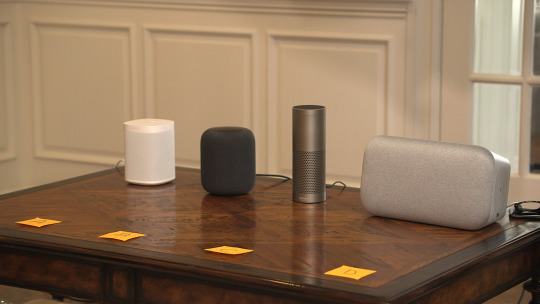
Loup Ventures, a US-based venture capital firm, ran a series of Siri tests on the HomePod to evaluate the assistant's capabilities on Apple's new speaker. After 782 queries, Siri understood 99% of questions but only answered 52% of them correctly – meaning, Siri on the HomePod failed to answer one out of two questions. I'd love to see a full data set of the questions asked by Loup Ventures, but, overall, it doesn't surprise me that the Google Assistant running on the Google Home speaker was the most accurate in every category.

While Apple has clearly a lot of work ahead for Siri on the HomePod (this was the consensus of all the reviews, too), it also appears that Siri simply performs worse than other assistants because it doesn't support certain domains. Here's Gene Munster (whom you may remember for his Apple TV set predictions), writing on the Loup Ventures blog:

Adding domains will quickly improve Siri’s score. Some domains like navigation, calendar, email, and calling are simply not supported. These questions were met with, “I can’t ___ on HomePod.” Also, in any case that iPhone-based Siri would bring up Google search results, HomePod would reply, “I can’t get the answer to that on HomePod,” which forces you to use your phone or give up on the question altogether. Removing navigation, calling, email, and calendar-related queries from our question set yields a 67% correct response, a jump from overall of 52.3% correct. This means added support for these domains would bring HomePod performance above that of Alexa (64%) and Cortana (57%), though still shy of Google Home (81%). We know Siri has the ability to correctly answer a whole range of queries that HomePod cannot, evidenced by our note here. Apple’s limiting of HomePod’s domains should change over time, at which point we expect the speaker to be vastly more useful and integrated with your other Apple devices.

Adding new supported domains would make Siri's intelligence comparable to Alexa (at least according to these tests), but Apple shouldn't strive for a honorable second place. Siri should be just as intelligent (if not more) than the Google Assistant on every platform. I wonder, though, if this can be achieved in the short term given Siri's fragmentation problems and limited third-party integrations.

→ Source: loupventures.com

13 Feb 18:42

Recommended on Medium: On-call doesn’t have to suck

I can’t quite imagine anyone enjoying being on-call. I’ve never particularly enjoyed it myself. I still remember the very first time I went on-call several years ago. I was on-call for an entire week and the overarching feeling throughout the week was one of… foreboding, even when things weren’t on fire.

At the end of the week, I felt pretty drained and had absolutely no intention to protract the process any longer. Thus at the end of my on-call shift, I felt happy to be back on familiar territory of writing code uninterrupted. It’s perhaps worth mentioning here that I probably felt that way in no small part because I’m a developer and have never in my career been an SRE or an Operations Engineer.

I’ve since then invariably shouldered on-call responsibilities at every company I’ve worked at. I don’t consider this to be a badge of honor; I’ve now grown accustomed to see it as something that’s simply part of my job.

I’ve worked at companies in the past where I’ve shared on-call responsibilities with an entire team of people as well as at companies where I was the sole person on-call for multiple services for years on end, without quite having a secondary to escalate pages to (definitely not recommended, even if I’m glad I learned a lot). None of these different flavors of on-call was fun or enjoyable. So far be it from me to be the person that romanticizes on-call.

That said, I also believe on-call doesn’t have to suck or be something people dread. And that if it does, it’s probably symptomatic of a team’s engineering prowess as well as priorities/culture.

This tweet definitely got enough people riled up, which I found incredibly surprising. To be honest, I didn’t set out with the intention to start this conversation about being on-call. It just so happened that yesterday, I read a blog post about how a startup functioned just fine without having a dedicated Operations team and where the developers were empowered to troubleshoot any and every production issue.

This approach is something I’m seeing gain increased adoption at smaller companies (primarily San Francisco based startups). Having worked at a startup where I’d been on-call for all of the services I authored, it made sense to me that this model was adequately sufficient for a small company or a small (fewer than 5) to mid sized (fewer than 12) team within a larger company.

Particularly, the recent strides in the cloud infrastructure space, the advent of extremely sophisticated tooling as well as broadly easy to use APIs vastly lower the bar for software engineers to shoulder all of the Operational responsibilities for their services.

SWE + “on-call” != SWE

The reason I started speaking about on-call was owing to some of the responses I’d been getting to the previous tweet. One especially stood out to me.

To which I’d responded:

As previously stated, my intention isn’t to romanticize being on-call. It’s not anyone’s idea of fun — be it SREs or software engineers(SWE).

To be fair, there are several things that aren’t certain type of engineers’ idea of fun. For some, writing documentation isn’t any fun. For others, refactoring isn’t fun. And to reiterate, being on-call is no one’s idea of fun.

However, being on-call is uniquely encroaching upon an engineer’s personal time in ways writing documentation or refactoring code or improving test coverage are not. While the latter can be done during work hours, on-call is something that is all-consuming, effectively handcuffing one to their laptop and phone for the entire duration of the on-call. While people working at startups or people used to working long hours might be slightly better prepared for embarking on an on-call shift, I can understand why it might seem especially horrendous to people who consider their evenings, nights and weekends off-limits for work related activities.

In other words, it becomes a different category of job, one not traditionally associated with what being a “software engineer” entails. There exist vast swathes of people to whom this, in and of itself, might be reason enough to consider on-call to “suck”.

It simply wasn’t the job they thought they were signing up for.

Being a software engineer is an extremely privileged position to be in and the world (or at least the Bay Area) is one’s oyster. I think it’s eminently reasonable to suggest that people who are so loath to the very idea of being on-call aren’t going to be served best by being on a team or company that has the expectation that developers be on-call for their own services, especially when there exist a large number of extremely interesting fields of software engineering that simply don’t require operating a highly available service and which are more in line with people’s traditional ideas of what a “software development job” looks like.

Folks who’re going to be turned off by the very idea of on-call per-se are going to be turned off by any position involving on-call anyway (no matter how sustainable or humane the on-call culture and practices are), so are those folks really the ones worth expending time on trying to recruit into a services team?

More importantly, it begs the question as to how the presence of these folks might affect the overall dynamics of the team in general?

Having worked at companies where a subset of engineers on a small team simply refused to concern themselves with anything Operations related about the very code they were authoring (including not so much as knowing how it was packaged or deployed or monitored or debugged), I can attest to the fact that this attitude runs the risk of turning into a source of latent resentment among team members only to fester to the surface when the going gets rough.

And that is one thing I can wholeheartedly confirm truly sucks.

On-call and diversity in tech

It’s very much true that diversity in tech leaves a lot to be desired. This is even more acutely felt in certain fields of software engineering — women, for instance, are very poorly represented in SRE/Operations roles and general systems programming roles as opposed to, say data science. A (fairly valid) concern was raised that if being on-call came with the territory of being a “software engineer”, then tech would become even less accessible to people who’re already dismally represented in the industry.

I believe this is a bit of a false dichotomy in addition to (inadvertently) reinforcing gender and ethnic stereotypes (like for instance the idea that women, minorities, folks with kids or folks of a certain age necessarily have more obligations outside of work, which can then in turn implicitly bias recruiting and hiring decisions). If on-call at a company were so bad that women were turned off by roles involving on-call, it’s odds-on that male engineers would be turned off it by it too (and indeed, this appears to be truly the case, if my Twitter mentions from men are anything to go by).

Simply put, building a humane on-call culture and long-term sustainable practices can, in fact, help attract more candidates to the company, as opposed to turning off folks. And the groundwork for this needs to come from companies, instead of renaming Systems Administrator to SRE and creating a silo that then becomes this bastion under represented minorities would be excluded from.

On-call is a direct reflection of engineering skills and priorities

Yes, this did prove to be rather unpopular indeed.

And looking back, it’s obvious to me that when I first tweeted this, I hadn’t spent enough time thinking about the people who find the very idea of being on-call abhorrent per se (I’ve covered this above). I’d been thinking about some of the people whom I know personally who’ve become bitter or plainly burnt out owing to terrible on-call scars that were the result of poor (or non-existent) management, culture and engineering “prowess” (a word that, again very surprisingly, elicited some brickbats).

These aren’t people who think on-call “sucks” because the very possibility that they might be very rarely paged at 3:00am in the morning and might be required to follow a runbook, fix the problem and go to bed back in five minutes sounds unpalatable to them. Au contraire, these are the folks who think on-call “sucks” because, on-call for them, well and truly sucked.

On-call can “suck” for a plethora of reasons (and when these repeatedly occur during multiple on-call rotations without being prioritized to be resolved, burn out is inevitable):

— noisy alerts
— alerts that aren’t actionable
— alerts missing crucial bits of information
— outages caused due to bad deploys owing to bad release engineering practices and risk management
— lack of visibility into the behavior of services during the time of an outage or alert that makes debugging difficult
— outages that could’ve been prevented with better monitoring
— high profile outages that are due to architectural flaws or single points of failure
— outdated runbooks or non-existent runbooks
— not having a culture of performing blameless postmortems
— lack of accountability
— not following up with the action items of the postmortem
— not being transparent enough internally or externally

On-call, like the operability of a service, isn’t a silo. It’s in many ways the microcosm of the engineering skills (resilience of the systems themselves, the quality of monitoring, alerting and automation) of an organization which in turn is a reflection of the quality of management and prioritization (engineering culture).

A healthy on-call culture involves building resilient systems in the first place, in addition to having a small set of hard failure modes that can be “monitored” (so there aren’t a bazillion spammy alerts), having good contingency measures (which enable good runbooks), good testing and release engineering practices (so deploys aren’t a frequent source of outages), iterative refactoring of the system design and architecture in lockstep with iteration of testing, monitoring and alerting as well (so as to avoid large scale re-architectures down the road) to name a few, all of which involves engineering, yes, “prowess”.

Which in turn is contingent on the “engineering culture” — which needs to be in alignment with prioritizing all of the aforementioned, in addition to acknowledging that checking all of the above boxes is still only ever a best effort attempt at building a healthy service which still isn’t immune to unexpected failures.

There’s no such thing as a “perfect on-call” inasmuch as there’s no such thing as a “perfect system”. Systems will fail. Full stop. The best we can do is build systems that are “good enough”, so that on-call doesn’t become chaotic and miserable.

Or to quote Liz, a Staff SRE at Google:

I’ve in the past argued that not everyone is an Operations engineer. I still believe this is true, even in a world where developers are on-call.

Service developers need to be responsible for not just writing code but also for managing the entire life-cycle of the service, ensuring its health, maintainability, observability, ease of debugging and its ultimate graceful demise. This includes being responsible for deployments, rollbacks, monitoring and debugging, in addition to bug fixes and new feature development.

The systems the service interacts with could be other services maintained by the same team, or applications maintained by other teams, or caches/databases/proxies/message brokers. Depending on how deeply the service in question integrates with each of these systems, it’d be ideal if the developer also had a baseline understanding of all the other systems so as to be able to escalate to the right team when the performance of one of these upstreams is adversely affecting the performance or reliability of the service in question.

We’re looking at a future where responsibilities are shared. Operations, per se, is not everyone’s job. What, however, is everyone’s job is ensuring holistic software lifecycle, achieved when SWEs and SREs work together. And the first step toward this future is to actually have a healthy respect for Operations and on-call (even if developers personally don’t find it “fun”), and statements along the lines of “I’m a brilliant developer but I hate on-call” aren’t doing the cause any favors.

Investment in skills

A healthy on-call rotation is only possible if the engineers developing the system are incentivized and encouraged to proactively think about its operability at the time of system design as well as development. It also requires the engineer who is going to be on-call to both have a deep understanding of the system’s design, architecture, trade-offs and shortcomings, in addition to possessing a baseline set of Operational know-how.

Healthy on-call rotations are a reflection of an engineering organization where the engineers developing the system and the engineers on-call (be it developers or Operations engineers) are set up for success, which in turn is only possible if an organization prioritizes and invests in the sort of skills required to enable developers to build the kind of services that would then be easy to operate and easy to debug.

I’ve never heard of on-call onboarding program for developers, but if the expectation is that developers must be on-call for their own services, then it needs to become mandatory that they receive a certain level of training before their very first on-call rotation (something I’ve lacked at every job where I’ve ever been on-call), in addition to continued training and support as they ramp up.

Putting developers on-call won’t automatically fix service reliability issues or improve the on-call experience any more than hiring an SRE team will prove to be the silver bullet. Like code, the on-call experience is something that needs to be subject to constant review, assessment and refactoring, else there isn’t a hope in hell of it being successful.

Toward a more sustainable and humane on-call

The best we can aim for when it comes to an on-call shift is to hope it is mostly uneventful.

The first step toward building a sustainable on-call is to commit to building a culture where on-call, by and large, isn’t life-impacting, while still acknowledging that by dint of its very nature, being on-call does have several ramifications on one’s personal life and is an encroachment into one’s personal time.

Being on-call means voluntarily trading a 40 hour week for a 168 hour week. Compensating people (be it SREs or SWEs) for being on-call isn’t something the industry has standardized on, but when you think about the additional hours and the level of anxiety or foreboding that comes with being on-call (even during an uneventful week), it does make sense for the incentive structure to be better formalized.

Furthermore, on-call becomes incredibly less stressful when working with supportive teams, ideally one where everyone on the team understands the system equally well, can debug any issue with ease armed with best-in-class tools and share a good enough rapport with each other so as to be able to pick up the slack for team members when required or swap on-call rotations if the need ever arises. Having certain members on such a team be actively hostile to the idea of on-call or sharing responsibilities kills any hope for such camaraderie.

The current state of on-call is far from healthy in most organizations. I doubt it will ever be “perfect”. The best we can aim for is to get to a point where on-call is something that’s sustainable and leaves the systems in a good enough state and the team in a state that’s not dysfunctional or adversarial.

We can all strive to aim higher.

13 Feb 18:33

Android P To Gain Support for iPhone X-like Notch Displays, Feature Tighter Google Assistant Integration

by Rajesh Pandey
With Android Oreo out of the gate, Google is now working on Android P, the next major release of the OS. Bloomberg has provided details about some new features that Google is working on for Android P, which is internally dubbed as Pistachio Ice Cream. Continue reading →
12 Feb 03:15

A Return to Nippon – Postcard #70

by gravellybeach@gmail.com (Dave Thorvald Olson)

Postcards from Gravelly Beach – Return to Nippon, onsen

Returning to Japan for the first time since working as a mushroom farmer in the Tottori-ken mountains decades previous, Dave rambles on about the circumstance – then and now – while wandering near his pal’s goat farm. Riffs include: arriving in the snow and getting settled, bailing on job, hitch-hiking around islands, falling in love(ish), eating okonomiyaki, soaking in hot springs and living simultaneously in the future and past. Also persimmons and goats, pigs, cows et al.

Take a soak in: A Return to Nippon – Postcard #70
(44MB, 29:31, mp3, stereo)

Postcards from Gravelly Beach – Return to Nippon, rotenburo

Subscribe

Auto-magically receive Postcard from Gravelly Beach podcast, via: 

Reviews rewarded with postal postcards #bribe

Follow along via Twitter @uncleweed & @DaveOstories & UncleWeed Storytime (FB)

12 Feb 03:15

The Center for Humane Technology Doesn’t Want Your Attention

by mayaganesh

There has been a steady stream of articles about and by “reformed techies” who are coming to terms with the Silicon Valley ‘Frankenstein‘ they’ve spawned. Regret is transformed into something more missionary with the recently launched Center for Humane Technology.

In this post I want to focus on how the Center has constructed what they perceive as a problem with the digital ecosystem: the attention economy and our addiction to it. I question how they’ve constructed the problem in terms of individual addictive behavior, and design, rather than structural failures and gaps; and the challenges in disconnection from the attention economy. However, I end my questioning with an invitation to them to engage with organisations and networks who are already working on addressing problems arising out of the attention economy.

Click here to view the embedded video.

Sean Parker and Chamath Palihapitiya, early Facebook investors and developers, are worried about the platform’s effects on society.

The Center for Humane Technology identifies social media – the drivers of the attention economy – and the dark arts of persuasion, or UX, as culprits in the weakening of democracy, children’s well-being, mental health and social relations. Led by Tristan Harris, aka “the conscience of silicon valley”, the Center wants to disrupt how we use tech, and get us off all the platforms and tools most of them worked to get us on in the first place. They define the problem as follows:

Snapchat turns conversations into streaks, redefining how our children measure friendship. Instagram glorifies the picture-perfect life, eroding our self worth. Facebook segregates us into echo chambers, fragmenting our communities. YouTube autoplays the next video within seconds, even if it eats into our sleep. These are not neutral products. They are part of a system designed to addict us.”

Pushing lies directly to specific zip codes, races, or religions. Finding people who are already prone to conspiracies or racism, and automatically reaching similar users with “Lookalike” targeting. Delivering messages timed to prey on us when we are most emotionally vulnerable (e.g., Facebook found depressed teens buy more makeup). Creating millions of fake accounts and bots impersonating real people with real-sounding names and photos, fooling millions with the false impression of consensus.”

The Center for Humane Technology has set itself a mighty challenge. How are people going to change digital practices in the face of UX that is weaponized with dark patterns that intend to keep us addicted? How are they going to take down the business model built on surveillance capitalism, which they refer to as the attention economy? If social media is addictive, what sort of twelve step program are they going to come up with? How do you sustain being clean? They might want to check out a program for how to detox from data.

What the Center identifies as the ‘monetization of attention’ is, actually, the extraction of personal data. (Curiously, they do not use the phrase ‘big data’, or ‘your personal data’ anywhere in their website text.) This attention (or, personal data) is extracted from our digital and analog behavior and then is used to profile and target us to sell us lies, misinformation, or worsen our depression by showing us advertising for make-up. And we are targeted even when we aren’t paying attention at all, like when we are walking down a street with mobile phones in our handbags. Information about us is being extracted to identify and profile us almost all the time because it is profitable.

How will the harmful effects of attention be arrested without a challenge to the monetization itself, and the values that sustain it? Your attention is valuable only because it is associated with an identity that exists in multiple geographies  – financial, cartographic, intimate, socio-cultural, linguistic, religious, gendered, racialised -at the same time. These identities, and the attention that animates them, pop up across different devices, platforms, services and networks making it identifiable and knowable, and thus easy to sell things to. Your identity is like cables and wires, and attention is the electricity that runs along the outside of, rather than in or through, these wires. For people who have already made fortunes by peddling the cables, wires, poles, and electricity, it sounds disingenuous to not confront the economic value underlying all of this.

The Center for Humane Technology constructs the problem in terms of addiction and therefore as one of individual attention. And while they acknowledge the importance of lobbying Congress and hardware companies (Apple and Microsoft will set us free as if they don’t lock us into digital ecosystems and vie for our attention?), they emphasize a focus on individual action be that of tech workers, or users. By invoking ‘addiction’ as a metaphor,  they see the problem as being about individual attention, and eventually, individual salvation. Naming the co-founder of the Center, Harris, as the ‘conscience’ of Silicon Valley evokes a similar emphasis on individual rather than community, political, or structural dimensions to the attention economy and its dismantling, or restructuring. The use of the addiction metaphor has been criticized for at least twenty years and most notably by Sherry Turkle; and mostly because it is neither apt, nor it there enough evidence of how it works as an addiction. ‘Diet’ metaphors and relationships-with-food metaphors may work better, perhaps, to characterize our relationships with technology.

However, it is also about design, they say: design has been weaponized to create addiction. By invoking both addiction and design there is  lack of a structural critique in addressing how complex social problems such as children’s well being, or democracy, come to be. According to the Center, if you resist UX by turning your attention away, you can start to make a change by hitting the tech business where it hurts. And if tech businesses cease to get our attention, then democracy, social relations, mental health and children’s well-being might be salvaged.  Frankly this accrues more power to UX and Design itself; and creates a sort of hallowed epistemology flowing from Design.

The assumption is that these social conditions and relationships somehow did not exist before social media, or have changed in the past ten years because of UX and its seductions. I believe this is both not-true, and also true. We do engage in politics and democracy through our devices and social media, and we do see the weakening of existing values and notions of governance; but there isn’t necessarily a directly causal relationship between them. This is not uniformly the case, nor evenly distributed around the world. There are muddied tracks around the bodies of these relationships.

Democracy as a design problem is not new. There has been considerable work over the past decade to enable citizens to use civic technology applications for transparency and accountability to hold governments to account and promote democratic values and practices. It might help the Center to look at some lessons from around the world where democracy has been considered to be failing and technology was applied as a solution. To cherry-pick one relevant lesson (because this is a vast area of expertise and research that I cannot do justice to in this post): building a tool or a platform to foster democratic values or behavior does not necessarily scale. The lesson is that it doesn’t flow in the direction tech —> democracy.

Applying this to the case of the Center, but in inverse, you cannot approach technology and social change from a deterministic perspective. Technology will amplify and accentuate some things: there will be more ‘voices’ but most likely the voices of those who are already powerful in society, will be heard the loudest. Networks of influence offline matter to how messages are amplified online; swarms of hate-filled hashtags, memes, and bots traverse the fluid connections between on and offline.

Fixing Facebook and Twitter is absolutely essential, but it is not the same as addressing the weakening of public institutions, xenophobia, poverty, the swing towards populism, the 2008 financial recession, or combinations of these. They need to happen in conjunction with each other. Democracy is actually about relationships among people, movements, and longstanding practices of activism and organising in communities.

Trying to change digital behaviour is difficult and complicated because of how our political and personal expression, relationships of care, work and intimacy, and maintenance of these relationships, are all bound up in a narrow set of platforms and devices. Disconnecting from the attention economy is more like a series of trade-offs and negotiations with yourself; like a constant algebra of maintenance, of digital choice-making, managing information flows across different activities and relationships; and some baseline basic digital hygiene.

It is hard to feel like you have arrived at a place of disconnection because of how perniciously deep these platforms and devices can go and how far they spread. There is something aspirational and athletic about trying to disconnect from the attention economy; it really is a bit like a practice of a religious kind, almost. I know this because I’ve consciously practiced this disconnection for some years because of where I worked and what I did there. (I practice less now because my work has also changed, but I am still conservative about what kinds of attention I give different platforms and services.)

Through this work I’ve been part of communities of technologists, security and privacy experts, activists, lawyers, policy advocates, human rights defenders, and artists, who construct their relationship with information and technologies in critical terms. These communities, highly creative and adept in our use of technology,  understand the politics of information systems as continuous with the politics of, governance, geopolitics, economics, history, gender, the law, and so on.

In these communities it is entirely normal to never know some of your friends on social media, to not  assume they are on social media in the first place, or to refer to people by their online handles rather than their actual given names.  Having a community of practice really is key to disconnection from the attention economy; and to supporting any other kind of personal de-addiction as well.

Many of us who practice disconnection from the big data attention economy use open source tools that are sometime ugly because they don’t try to grab your attention (there is little investment in UX) but deliver a service instead; and we compartmentalize digital practices across different devices, identities, services and platforms. We may use social media but selectively, and we don’t necessarily connect all of them with our actual identities and personal details. Many people I know actively try to get their immediate families to also disconnect from social media as a way to communicate; only a few succeed. The first thing to be hit is your personal relationships, as Palihapitiya notes in the video above.

It is entirely possible to live a Google-free life as some of my ex colleagues and friends do, but you make peace with the trade-offs, and adjust your life accordingly.  It’s like people who don’t drink Coca Cola, or are vegetarian but not on the weekends, or would rather cycle than take transatlantic flights. An interesting point about Coca Cola: in Berlin we have Afri-Cola, and Fritz Cola (caffeinated and not; with and without sugar) as tasty and refreshing alternatives to Coca Cola, which is also available in its many flavors. In some places there are structurally-afforded opportunities to be more flexible and make a wider range of choices. This is what we need from extractive technology industries  – more control and more choices.


Click here to view the embedded video.

I Quit (2017). An installation by Thierry Fournier of video testimonials of why people quit their social media accounts and what happened next.

Despite absence of a real structural critique to the attention problem, I believe the Center may be successful because they are well-placed in terms of money and influence. If the Center for Humane Technology actually worked to disarm UX, made it possible for us to move our personal networks to platforms of our choosing, baked ethics into how technology is made, enabled regulation of the data trade, and protections  for users, then they might actually be disruptive. Let’s hope they succeed. In the mean time, the Center may find useful resources and ground-up expertise among those who have already been building movements for users to take control of their digital lives such as:

Article 19; Bits of Freedom; Coding Rights; Committee to Protect Journalists; Cryptoparty; Data Detox Kit; Data Justice Lab; Derechos Digitales; Digital Rights Foundation; Electronic Frontier Foundation; Freedom of the Press Foundation; The Glass Room; Gobo.Social; Internet Freedom Festival; Mozilla Internet Health Project; Privacy International; Responsible Data Project; Security in a Box; Share Lab; Simply Secure; Surveillance Self Defence Kit; Tactical Technology Collective; Take Back The Tech.

Maya Indira Ganesh has been a feminist information-activist for the past decade, and most of that time was spent at Tactical Technology Collective. She lives in Berlin and is working on a PhD about the testing and standardization of machine intelligence. She does not drink Coca-Cola. She can be reached on Twitter @mayameme

12 Feb 03:14

Twitter Favorites: [ReneeStephen] @jonkay @eikonos @OISEUofT I'm so glad my public school education landed me in the top 10% of income-earners in Can… https://t.co/nU8gqtUC8p

Renée Stephen @ReneeStephen
@jonkay @eikonos @OISEUofT I'm so glad my public school education landed me in the top 10% of income-earners in Can… twitter.com/i/web/status/9…
12 Feb 03:11

Twitter Favorites: [brownpau] Instant Pot chicken adobo; 10 minutes at pressure* as opposed to the usual 45 minutes of simmering. (* 10 more min… https://t.co/DJ6ewMjtIA

how now @brownpau
Instant Pot chicken adobo; 10 minutes at pressure* as opposed to the usual 45 minutes of simmering. (* 10 more min… twitter.com/i/web/status/9…
12 Feb 03:10

Alternatives to vertical tabs

For the longest time I've used vertical tabs in Firefox and I still find it odd that people don't use it more. It's a simple fact that a horizontal tab strip doesn't scale too well when you get lots of tabs.

Of course, for most users this isn't a problem, most users do not have a lot of tabs open according to Firefox telemetry:

But if you have a few the title just gets squished and squished till it becomes a scroll bar. Vertical tabs look great for this giving you lots of title space on a wide monitor:

Firefox is way better at this than Chrome. I sat next to someone who had nothing but triangles as their tab bar in Chrome. How did they cope?

With the landing of the tab hiding API in WebExtensions in Firefox 59, I wanted to try and understand what the many people who were clamouring for this API wanted to do. So I wrote a quick extension that's pretty terrible. It provided a "Hide this tab" context menu item on the tab to hide the tab. I then added a quick management page to list all the hidden pages.

That was ok, but clicking that menu item was tedious. So then I set it to just perform some actions for me. I've now got it set up to hide a tab if it hasn't been looked it for an hour. Then five hours after that, if I haven't opened it again, the extension just closes the tab.

I tried that for a week and found it pretty useful. Tabs that are hidden still show up in the awesome bar and as soon as I click on them, they come back instantly. Eventually they'll get closed. They'll still appear in the awesome bar and I can bring them back, just in a slower manner.

If I find myself saying "where was that tab..." I just go to the management view and its likely there.

This extension isn't perfect, but its enabled me to stop using vertical tabs most of the time and now I'm torn which workflow is better. Maybe some combination.

12 Feb 03:09

Head to head, does the Apple HomePod really sound the best?

To convince journalists about the audio quality of its new HomePod smart speaker (here’s my review), Apple did something smart: Before we were given our review units, we were required to attend a listening session. Mine was held in Apple’s New York City public-relations loft, a mockup of an apartment.

Four speakers were on a counter against a wall: Sonos One ($200), Google Home Max ($400), the HomePod ($350), and the Amazon Echo Plus ($150).

The PR person could switch playback from one speaker to the other without missing a beat. They even had a halo light rigged to turn on behind whichever speaker was playing, so you’d know which was which.

There was not a shred of doubt: In this side-by-side comparison, the HomePod sounded better than its competitors.

Most of the reviews, including mine, said the same thing: that the HomePod isn’t as smart as the other smart speakers (among other problems, its voice control is limited to iTunes and Apple Music — no Spotify), but that it sounds amazing.

  • What Hi-Fi (a British audiophile site): “The HomePod is the best-sounding smart speaker available—and by quite a margin.”
  • Pocket-Lint (tech site): “The best sounding speaker of its type.”
  • The Verge: “It sounds far better than any other speaker in its price range.”
  • Tech Crunch: “HomePod is easily the best sounding mainstream smart speaker ever. It’s got better separation and bass response than anything else in its size.”

Still, when I tweeted about the test, a couple of people were suspicious of the setup, which of course was entirely controlled by Apple. What was the source material? What was the wireless setup?

An Apple rep told me that the test songs were streaming from a server in the next room (a Mac). But each speaker was connected to it differently: by Bluetooth (Amazon Echo), Ethernet (Sonos), input miniplug (Google Home), and AirPlay (HomePod), which is Apple’s Wi-Fi-based transmission system.

Since the setup wasn’t identical, I wondered if it was a perfectly fair test. (Bluetooth, for example, may degrade (compress) the music it’s transmitting, depending on the source and the equipment.)

So I decided to set up my own test at home.

The setup

I hid the four speakers behind a curtain — a sheet of thin, sheer fabric that wouldn’t affect the sound. It took me a Sunday to figure out how to get the A/B/C/D switching to work seamlessly, but I finally managed it: All four speakers would be streaming from Spotify, all four over Wi-Fi. I’d use the Spotify app’s device switcher to hop among speakers without missing a beat.

The speakers hidden.

I chose five songs, each with different styles, instrumentation, and sonic demands:

  • “Star Wars: Imperial March.” Full orchestra, full volume, full of brass.
  • “Havana” (Camila Cabello). Current pop hit. Distinct bass, drums, piano, and voice. Lots of rhythm.
  • Brandenburg Concerto No. 3 in G Major. All strings, full range of pitches and dynamics.
  • “Hallelujah” (Pentatonix). A cappella ballad, five voices, very exposed and close to the mikes.
  • “Helpless” (from “Hamilton”). Broadway pit band, pop sound, female harmonies.

In these kinds of tests, volume matching is incredibly important, for a couple of reasons. As Tom’s Hardware puts it: “First, if sources are at different levels, they’re easy to tell apart. From there, the test is no longer blind. Second, us humans tend to prefer (all other factors being equal) louder sources.”

For my dress rehearsal the night before, I volume matched them as best I could by ear.

The panelists at the dress rehearsal were my wife Nicki and my friend Mike, a professional guitarist who spent years as an audio technician for big-name touring bands.

I gave each panelist a score sheet, with room for notes, and asked them to rank the four speakers, 1 through 4, after each listening test. I sat at the laptop to control the tests; I played the same section of each song for about 20 seconds on each speaker. Panelists were free to ask for re-plays, or to hear any speaker again, or to hear two speakers in a different succession.

At the end of the rehearsal, I asked the listeners to choose a winner, based on how many first-place finishes they’d marked down. Both Nicki and Mike declared the HomePod to have the best sound, hands down.

The test

The next day, the Yahoo film crew arrived. Our sound recordist, Dave, used level meters to help me volume-match the speakers more precisely.

My five panelists included Darwin, a professional violinist who spends a lot of time listening to recordings on nice gear; Julie, an entrepreneur and homeowner who is precisely the target market for these speakers; Dana and Tori, high-schoolers who haven’t yet begun to lose their ability to hear high frequencies; and Rob, a sound technician for Yahoo.

I didn’t tell them which speakers would be involved. I said only that there were four of them behind the curtain, and I’d refer to them as speakers A through D.

I handed out their score sheets and began the test. Five songs, 20 seconds each, free replays when requested. For each song, I played the speakers in a different order (A to D sometimes, D to A sometimes).

The results

Of course, I knew what the results would be. I’d heard them myself in the Apple demo; I’d read the other reviews; and I’d done the dress rehearsal the night before. Every time, the HomePod won the match easily.

At the end of my own listening test, then, I handed out signs that said “A,” “B,” “C,” and “D,” and asked the panelists to hold up their winners’ signs on the count of three. I knew what they would say: “B,” “B,” “B,” “B,” and “B” (that was the HomePod’s letter).

That’s not what happened.

They held up their signs. Two of them ranked the Google Home Max (“D”) as the best. Three of them ranked the Sonos One (“A”) the best.

Nobody ranked the HomePod the best.

The speakers revealed.

The explanation

I actually have no great explanation for this outcome. Most of the panelists had ranked the HomePod (“B”) as first on some of the songs — just not most of the songs.

  • Rob: “For me, A, the Sonos, consistently had the most robust sound of all of them.”
  • Tori:  “The Sonos won two of them for me. ‘B’ [HomePod] won the ‘Star Wars.’”
  • Dana: “’B’ [HomePod] won one of mine. I felt like ‘A’ [Sonos], a lot of times, sounded a lot more sharp.”
  • Julie: “I picked between B and D [HomePod and Google Home Max] as being the two best. B and D were pretty clear. And C [the Amazon Echo] came in consistently last for me.”
  • Darwin: “I actually found A [the Sonos] to be the one that I hated the most. B [HomePod] did win one for me. It won ‘Havana,’ because it had a better low end. But I generally picked D [Google Home Max], because it had a clearer, nicer range. As a classical person, I definitely would go with D. But if I were listening to more pop stuff, I could see where ‘A’ [Sonos] could win.”

So what are we to make of this? Why did none of my panelists rank HomePod a solid  No. 1, when most critics all do (and so do I)?

Was something wrong with my setup? Well, no, because the night before, using the same setup, Nicki and Mike both ranked the HomePod No. 1.

Here are my theories:

  • Different music is different. My panelists all conceded that there was some variation depending on the material. “Honestly, they were pretty on par,” Rob said. “I don’t know that one stood out that much more than the other.” “It was much different with different music,” Darwin added. “It varied a lot for me, depending on the song,” Tori agreed.
  • Different people are different. I said that most professional critics ranked HomePod as No. 1, but not all of them. Buzzfeed’s young critic, for example, concluded: “Ultimately, none of this is a hard science, and audio preferences are highly subjective. Reactions to its audio quality from the four people who listened to it for this review.. were mixed. The HomePod outperformed other speakers in some situations and not others.” And the Wall Street Journal’s Joanna Stern wrote, “The HomePod’s bass is impressive for the size of the speaker, but in many songs, it’s far too front-and-center in the mix.”
  • Nobody else did blind tests. As far as I can tell, none of the other critics who declared HomePod No. 1 actually set up their own blind A/B/C/D tests. Maybe their conclusions wouldn’t have been so emphatic if they had.
  • Apple’s setup was different. Remember, Apple’s four speakers were each connected to the source material differently: Two wired, one over Wi-Fi, one over Bluetooth. Maybe that wasn’t an even playing field — and for sure, it wasn’t a real-world playing field. Most people, most of the time, just connect these speakers to their Wi-Fi networks and stream music from an online service.

What I can say for sure is this:

  • The Apple HomePod generally sounds better than any other smart speaker—but only somewhat, and only in direct A/B/C/D tests. If you listened to the HomePod, Sonos, and Google Home an hour apart, you’d never be able to declare one a clear winner. (Everyone agrees that the Amazon Echo Plus is the loser in this roundup, but then again, it’s $150 and the size of a Pringle’s can; it’s not a fair fight.)
  • You can get two Sonos Ones for the price of a single Apple HomePod. You can use them as a stereo pair, or put them in different rooms and control them by voice. And you can have your choice of 42 music services (Spotify, Pandora, TuneIn, etc.) — not just Apple Music. And you can use all of Amazon’s Alexa voice commands (and, soon, Google’s commands and even Siri’s commands!), meaning you can control a vastly larger range of smart-home devices than the HomePod can.
  • Everybody’s different.

Music gear (and listening tests) are famously contentious; they’re probably responsible for triggering more flame wars online than abortion and gun control put together. I’d love to hear your thoughts on Apple’s test and mine in the Comments!

David Pogue, tech columnist for Yahoo Finance, welcomes non-toxic comments in the Comments below. On the Web, he’s davidpogue.com. On Twitter, he’s @pogue. On email, he’s poguester@yahoo.com. You can sign up to get his stuff by email, here.  

Read related

Apple’s HomePod speaker: Either way late or way early

David Pogue’s sneak preview of the Apple HomePod

The $50 Google Home Mini vs. the $50 Amazon Echo Dot—who wins?

12 Feb 03:08

An Open Letter to Justice Srikrishna About Data Privacy and Aadhaar

by Mitchell Baker

Note: This open letter, penned by Mozilla executive chairwoman Mitchell Baker, appears as a full-page advertisement in the February 9 edition of The Hindustan Times. It is co-signed by 1,447 Mozilla India community members. To learn more about Mozilla work regarding India’s data protection law and Aadhaar, visit https://foundation.mozilla.org/campaigns/aadhaar/.


Dear Justice Srikrishna and the Honourable Members of the Ministry of Electronics and Information Technology Committee of Experts,

With the support of and in solidarity with members of Mozilla’s community in India, I write today to urge you to stand up for the privacy and security of all Indians. Your recent consultation on the form of India’s first comprehensive data protection law comes at an auspicious time. The Supreme Court of India has ruled unequivocally that privacy is a fundamental right guaranteed to all Indians by the Indian Constitution. We ask that you take that decision and ensure that right is made a reality in law.

Mozilla’s work on upholding privacy is guided by the Mozilla Manifesto, which states: “Individual security and privacy is fundamental and must not be treated as optional online” (Principle 4). Our commitment to the principle can be seen both in the open source code of our products as well as in our policies such as Mozilla’s Data Privacy Principles. The Mozilla India Community has run numerous campaigns to educate Indians on how to protect themselves online.

Data protection is a critical tool for guaranteeing fundamental rights of privacy. It is particular important today as Aadhaar is being driven deeper into all aspects of life. Digital identity can bring many benefits, but it can also become a surveillance and privacy disaster. A strong data protection law is key to avoiding disaster.

In the digital age, especially in regards to the Aadhaar, individual security and privacy is increasingly being put at risk. Recently, a private citizen was able to buy access to all of the demographic data in the Aadhaar database for just 500 rupees. There have been countless leaks, security incidents, and instances where private Aadhaar data has been published online. Private companies are increasingly requiring Aadhaar in order to use their services. In the vacuum created by India’s lack of a comprehensive data protection law, the Government of India continues its relentless push to make Aadhaar mandatory for ever more government programs and private sector services, in contravention of the directives of the Supreme Court.

We commend you for the strong recommendations and overall framework proposed in your report. While this represents important progress in developing a strong data protection framework, we remain concerned about several missing protections:

  • The current proposal exempts biometric info from the definition of sensitive personal information that must be especially protected. This is backwards, biometric info is some of the most personal info, and can’t be “reset’ like a password.
  • The design of Aadhaar fails to provide meaningful consent to users. This is seen, for example, by the ever increasing number of public and private services that are linked to Aadhaar without users being given a meaningful choice in the matter. This can and should be remedied by stronger consent, data minimization, collection limitation, and purpose limitation obligations.
  • Instead of crafting narrow exemptions for the legitimate needs of law enforcement, you propose to exempt entire agencies from accountability and legal restrictions on how user data may be accessed and processed.
  • Your report also casts doubt on whether individuals should be allowed a right to object over how their data is processed; this is a core pillar of data protection, without a right to object, consent is not meaningful and individual liberty is curtailed.

There is resounding support for privacy in India, and the Supreme Court has made clear that the protection of individual privacy and security is an imperative for the Government of India. We hope you and your colleagues in the Government of India will take this opportunity to develop a data protection law that strongly protects the rights of users and makes India’s framework a model for the world.

Sincerely,

Mitchell Baker, Executive Chairwoman, Mozilla


The Hindustan Times advertisement:


The post An Open Letter to Justice Srikrishna About Data Privacy and Aadhaar appeared first on The Mozilla Blog.

12 Feb 03:07

How does Tor *really* work?

files/images/tor.1.PNG

Brandon Skerritt, HackerNoon, Feb 13, 2018


Icon

Tor is an encrypted communications protocol. The Tor browser, for example, allows you to browse the internet without your service provider seeing what you're accessing. 'Tor' stands for 'The Onion Routing' protocol, and that gives you an idea of how it works. Each packet is wrapped in layers of encryption (like an onion) so that as one host passes it on to the next, the layers come off and on, so that the provider doesn't know where the message came from and doesn't know where it is ultimately going. This article is a summary of a much longer white paper describing the protocol.

Web: [Direct Link] [This Post]
12 Feb 03:07

Happy 14th Birthday, Flickr!

by Leticia Roncero

Flickr turned 14 today, and we couldn’t be prouder of the fantastic photo community we’ve built together over the years. Thank you, FlickrFam! We couldn’t have made it this far without you.

To celebrate this special occasion, each member of Flickr staff picked their all-time favorite Flickr photo for a gallery, but only fourteen made the cut. Check them out!

Cheers to many more years!

Celebrating Flickr's 14th Birthday
12 Feb 03:06

Personalized Learning Vs Personalization of Learning

files/images/Couros_Instagram.PNG

George Couros, The Principal of Change, Feb 13, 2018


Icon

This is, I think, another effort to grapple with the distinction between 'personalized learning' and what I have been calling 'personal learning' and is called 'personalization of learning' in this article. The difference is that it is focused on an in-class perspective: the idea of “personalization of learning” is about "how does the teacher understand the student, build on their interests, and create learning opportunities for the student." I like what Tristan Miller says in the comments: "I think the disservice is to expect all children to learn the same things at the same rate.... Don’t typecast personalized, or believe it has to exclude the individual."

Web: [Direct Link] [This Post]
12 Feb 03:04

The Case for Ultra-high-speed Rail Across Cascadia

by Stephen Rees

An article in the Georgia Strait summarizes a report to Washington State Department of Transportation which examines the case for a new very high speed rail link between Vancouver BC and Portland OR. The potential for hyperloop is also mentioned but quickly discarded as the technology is not yet ready for implementation.

Happily the Strait includes a link to the report itself – a 94 page pdf which includes some very general maps but no actual alignments. Instead it shows where the freeways are, and also suggests that a link between Seattle and Spokane needs to be assessed as well.

Screen Shot 2018-02-10 at 12.29.54 PM

This appears to be the favoured choice at present. Though I was struck by the apparently quite small advantage in terms of ridership between the MAGLEV and HSR model results

Screen Shot 2018-02-10 at 1.06.27 PM

Of course a lot more work needs to be done, and the report identifies these next steps. Not the least of these is the analysis of what needs to happen at the border. This is, of course, completely outside of the state jurisdiction and we can only hope that by the time any of this comes to pass, that a more sensible approach to border “security” between Canada and the US will have also come about. I won’t hold my breath on either account.

And here is a picture of a High Speed Train – which was not included in the original report

TGV 4409

My photo on Flickr

Technology Differentiation Results

7. In 2035, maglev seems to cover O&M costs in most alternatives; a small subsidy may be needed in the earlier period (2035) for HSR. By 2055, all corridor technological alternatives cover O&M and assist in capital carrying costs to various degrees.

8. While maglev and HSR have different capital and operating benefits over time, the CONNECT tool does not provide sufficient data to choose a specific technology at this time. More detailed technical analysis is required to select among the feasible technologies being examined.

Intercity Travel Mode Share Results

9. Both technologies have the potential to shift a significant share of the intercity travel market torail. For these technologies at 12 round trips, 12 to 17 percent of the travel market by 2035 could be diverted to UHSGT.

10. Conversely, the utilization of capacity is relatively low, indicating an immature market or a model input limitation. As noted in #1, a more detailed analysis of how the market economies are changing needs to be completed to adequately predict future ridership and revenue.

POSTSCRIPT

For context, the introduction of a direct high speed rail service between London and Amsterdam shows why trains can compete with air. In this case the flight time is around an hour and the new train will be closer to four. But add in the security line ups and this is actually competitive. Plus the train is actually comfortable, and the stations are usually much closer to where you are or want to be compared to the airport. But read through to the end to see how the British have managed to make getting in to Britain much harder – long before Brexit.

12 Feb 03:00

P.I.E.: 1940

by Dave
mkalus shared this story from Shorpy | #1 Old Photos - Framed Prints.

March 1940. "Rear of interstate truck. Elko, Nevada." Medium format negative by Arthur Rothstein for the Farm Security Administration. View full size.
12 Feb 02:59

The House That Spied on Me

by Rui Carmo

This is why I neutered the smart outlets I’m using by re-flashing them with Sonoff-Tasmota.

I haven’t yet set up a separate network for home automation (and will probably never be able to prevent everything from phoning home, since even our IPTV service collects usage metrics I can’t opt out of or block), but fully intend to get around to it.

12 Feb 02:58

A Must Have Tool for Taking Notes on Videos

files/images/reclipped.PNG

Educational Technology and Mobile Learning, Feb 13, 2018


Icon

Reclipped "allows you to collect relevant parts from videos, add your comments and notes to them and then share them with others. You can trim videos and choose specific timestamps for the start and end of your snippet." It's a nice idea. It really needs to be integrated into a workflow, though. There's a Chrome plugin, or you can clip the videos from inside the Reclipped website.

Web: [Direct Link] [This Post]
12 Feb 02:58

On the Shoulders of Giants

by Dave Pollard

This is the third and final story in a trilogy about a father and daughter. The first two were The Project, and Calling the Cage Freedom


Image: Stepping Stones, by Paul Stevenson, CC BY 2.0

“OK, so I’ve been reading that book Figments of Reality“, Sevi said to me, coming out onto the deck with lemonade for the two of us. “The biologist and the mathematician seem to be very smart, and they use this running story about creatures from Zarathustra to help the reader imagine how we humans might appear to an alien race and hence what we might actually be. I like the bit about us being emergent properties of the creatures that make us up, and about the brain being a feature-detection system that evolved for their benefit, not ‘ours’. But the ending makes no sense at all.”

“Quite a bit of it makes no sense, like their insistence that time is real, for example. They’re science fiction writers. They make up stories and posit that they might be true. You have to cherry-pick.”

“They talk about qualia — characteristics of things — and they write this”, she said, reading from her notebook:

On the ‘figment’ level our brains do not perceive the universe in a passive manner; instead, they project the inner world of figments [artificial but useful representations of reality] back on to (our conception of) the outer world of reality, so that our private inner world appears to us – but not to anybody else – to be ‘out there’. Our brains, in this sense, create their own realities – and this enables them to attach vivid labels to prosaic reality, labels that are vivid because they are inside our minds where our personal identities also [seem to] reside; but also labels that have evolved to be vivid because we survive much better if they are….

This leads to a delightful paradox. Perceived reality (as opposed to real reality) seems vivid to our perceptions, not because it is real, but because it is virtual. ‘Red’ is a vivid construct of our minds, which we plaster over our perceptions by projecting them back into the outside world. There is an objective sense in which the outside world is red too – it reflects light of an appropriate wavelength. But that is a different kind of ‘redness’ altogether, with none of the vividness that our minds use for ‘red’ decoration of London buses and blood… If you don’t like this line of thought, bear in mind that many animals – bees in particular – see light at ultra-violet wavelengths, and hence pick up vivid ‘colours’ that we do not see at all. The bee’s virtual world is different from our virtual world, and while they both are rooted in the same objective reality, they are [utterly] different interpretations of it… 

[We share Daniel Dennett’s] view of the mind as a conglomerate of loosely knit processes, each semi-independent of the others, which he refers to as ‘pandemonium’… Today’s computer operating systems involve large numbers of semi-autonomous subprograms known as ‘demons’, which wait until they are called on, do their thing, report their results, and shut up shop again… The apparently organised behaviour of the computer emerges from the interactions between demons… Dennett tells us that the human mind is somewhat like that. You – with your strong, overriding sense of ‘you-ness’, the feeling that what you experience is experienced by a single entity, and that this entity is very much in charge – may well feel that the idea that ‘you’ are an emergent feature of pandemonium is ludicrous. However, there is a great deal of evidence that the brain/mind is organised in just that manner.

Sevi looked up at me to make sure I was listening, and following her. She’s considerate that way, waiting for my slower mind to catch up with hers. She continued reading: “Then they relate some of this evidence to support this argument and go on to say:

We find Dennett’s story the most convincing among those currently on offer. However, we wish to add a final gloss, the idea that the brain’s independent units are brought together by a general feature-detecting system, which does not organise them, but instead rationalises their independent decisions. We call this unit the ‘ringmaster’, by analogy with circus usage… [The circus ringmaster’s] job is not to control the events: it is to give the impression that they are under control by interpreting them to the audience. If a clown accidentally falls off the shetland pony, the ringmaster’s job is to pretend that it was a deliberate part of the act. The clowns, indeed, are the bane of the ringmaster’s life, so he spends a lot of time looking as if he’s in control of them, when in fact they are largely in control of him. Like the ringmaster in a circus, the ringmaster in our heads gives the impression of being in charge when in fact it is not.

We emphasise that the ringmaster is not a homunculus sitting in a Cartesian Theatre, observing the play of sensory impressions on a screen… The ringmaster is just another demon in the pandemonium, and its role is to appear to the emergent phenomenon that is ‘me’ to be making sense of everything else that is going on…

Sevi raised her eyebrows and glanced at me again. She seemed annoyed at my smile — we had talked a lot about the failure of scientists to ‘find’ a “homunculus” (aka a soul, centre, self or controlling ‘entity’) somewhere in the brain-body fabric. I couldn’t believe she wasn’t fazed by the idea of ‘selves’ as ’emergent phenomena’, as processes rather than ‘things’. I’d thought about it a lot and still found it bewildering; I had to keep cycling back and clarifying for myself what that actually meant. She continued reading her notes from the book: “Then they explain why they believe this is true. Their conclusion is:

The ringmaster is a master-rationaliser. So what happens if (when!) it directs its rationalising propensities at itself? It becomes aware of an apparent ‘I’ inside. This is where self-awareness comes from: it is what you get when a generalised feature-detector makes a recursive attempt to detect itself.

In short: the problem of self-awareness is a special case of awareness – feature-detection – in general. As soon as such a system recognises some aspect of ‘self’ as a feature, hence the kind of thing that it can detect, the recursive loop is closed. We repeat, yet again: the ringmaster is not the ‘self’ itself. It is a mental demon involved in creating the illusion of there being a self… ‘Self’ is not a thing, but a process, which preserves an apparent sense of identity even as it changes complicitly with everything around it, both inside and outside the mind… Environment and culture maintain the [appearance of] continuity of the human sense of self, and that, repeated across many individuals, in turn maintains the [appearance of] continuity of environment and culture. That is what it is like to be a human,

Sevi looked at me. “So far, so good”, she said.

I laughed. “At your age I wouldn’t have even been able to fathom what you just read, let alone care to discuss or debate it. What have you done with my daughter?”

“I don’t actually have a problem with any of this”, she replied, ignoring my silly question. “It makes sense that the ‘self’, or at least ‘self-awareness’, awareness of the ‘self-process’, evolved, and it makes sense that it seems real — in fact to ‘us’ it can’t be seen as anything other than real, because ‘real’ to ‘us’ is whatever is detected as a feature. Even though it’s an illusion. And I even agree with you that, while its emergence was an evolutionary advantage for a while, it is no longer — it is the source of all enduring, vivid, negative feelings and suffering, and “a useless bit of software” as Tony puts it, and we’d be better without it. I wish my self was gone, but I know I can’t do anything about that.” She looked at me sadly, and somewhat sympathetically. The self, she knew as well as I, was the real ‘demon’, and I’d suffered with one much longer than she had.

“So then”, she went on, “they go on to talk about the issue of free will, and, like we were discussing the other day, conclude that it really doesn’t exist — it’s just a rationalization of the mind-process. The chapter is called, hilariously, ‘We Wanted to Have a Chapter on Free Will, but We Decided not to, so Here It Is.’ So they say ‘How on Earth can pandemonium make a choice’ and after discussing what that means they say [and here she continued reading]:

The argument seems to be heading inexorably towards the conclusion that free will is ‘just’ an illusion… If Dennett is right, consciousness is ‘just’ an illusion too, the upshot of mindless pandemonium. Consciousness and qualia are complicit, and it is qualia that give an animal an [evolutionary] edge; so the illusion of having a conscious mind is a figment of reality. The rules for the interaction of mental ‘demons’ have been refined over millions of years to produce the emergent phenomenon of [apparent] consciousness,… ‘Just’ an illusion? Oh no. A carefully crafted illusion, only one without a craftsman. An illusion that appears vividly real to the ‘I’ inside.

It is the same, we suspect, with free will… We get such a vivid feeling that we have free will, because that feeling is the quale [singular of qualia] of pandemonic decision-making – what it feels like, not what it ‘really’ is.

She gave me her are you following me? look, and went on: “They acknowledge that what seems to be free will is simply the result of our biological and enculturated nature — that what we do in the moment is not a matter of choice, but, given the apparent situation of the moment, and how we’ve been biologically and culturally entrained, the only thing we could possibly have done. If they left it at that, at least you’d have to say — I’d have to say — their argument is at least coherent and consistent. I wouldn’t especially like it — as you know I’m not persuaded that there is no free will. But then they totally destroy their credibility by arguing that the culture is ‘right’ to lock up misbehavers, despite their total lack of control over what they do, for the sake of their own and others’ safety! And then predict the future will see the emergence of a ‘multicultural extelligence’ of humans collectively and successfully stewarding the planet and the stars for everyone’s mutual benefit! Why would they ruin such a brilliant argument with such an illogical and preposterous happy-sci-fi-movie conclusion?”

“I don’t suppose they had any choice”, I replied, smiling.

Sevi threw a pillow at me.

“I’m serious”, I said. “It’s enculturated in us to give people hope, and to be hopeful ourselves. I’m guessing they knew they’d pushed their readers to their limits, and they wanted to hold on to what they’d conveyed, radical as it was 20 years ago when they wrote it. Others, including our friend Robert Sapolsky, have pushed this further by arguing that holding people responsible for their uncontrollable behaviour is unreasonable, and others have countered that we can’t (now that our culture is globalized) change the whole culture to prevent behaviours that most find intolerable, so we have to limit those behaviours any way we can. Messrs Stewart and Cohen, and Daniel Dennett, just sowed the seeds of doubt about what most people still consider incontrovertible truths. It’s up to people like you, and maybe me, if you think I can help, to carry the argument to its next steps, or its logical conclusion, and forgive them the faulty conclusions and starry-eyed prognostications that they had no alternative but to come to at that time. You, my dear, have to stand on the shoulders of giants.”

“What if I don’t want the responsibility?”, she said to me, with a sly smile.

“You have no choice in the matter”, I replied.

12 Feb 02:56

SotD: Mercy Street

Nobody could call this obscure; Peter Gabriel’s So sold a kazillion copies and was right in the center of the zeitgeist for months back in the late Eighties. The songs were good, the sound was good, and (especially) the videos were good, which really mattered in 1986. Mercy Street was not one of its big hits, which always astonished me; I thought it by far and away the album’s highlight.

So by Peter Gabriel

So isn’t innovative or groundbreaking or anything; the song structures are conventional and the melodies are unfussy. The production quite properly focuses on Gabriel’s vocals, which on this record are outstanding in their artistry and just the sound of his voice, a pleasantly-rough English tenor, mostly singing in the comfortable center of his range.

The words of Mercy Street flow smoothly and you don’t really need to know that they’re inspired by 45 Mercy Street, a poem of Anne Sexton, and if you drill too deep, are probably terribly sad. This grabs at me: Dreaming of the tenderness, the tremble in the hips/Of kissing Mary’s lips.

This is part of the Song of the Day series (background).

Links

Spotify playlist. This tune is on iTunes but not apparently on either Spotify or Amazon; Gabriel must have razor-sharp attorneys. There’s an official video; as for live, there’s loads, and Gabriel has always been a showman, sometimes sharp, sometimes overwrought. His Secret World Live DVD is one of the best concert captures ever (but Mercy Street isn’t on it).

12 Feb 02:56

Recommended on Medium: Spoiler: Movie Theaters Are Dying Because They Mostly Suck

Photo by Felix Mooneeram on Unsplash

Earlier tonight, I went to go see a film. In a theater. I do this a lot. I love watching movies this way. And I’m sad that I’m increasingly in the minority in this way. And then I remember why.

Well, to be fair, there are two (main) reasons why. First, Hollywood has way, way, way over-indexed on sequels/prequels/spin-offs. The reason for this is obvious: such films are a lot less risky than producing original content. But it’s a short-term gain for long-term pain. We’re starting to see the beginnings of decay with this model.¹ But Marvel and now Star Wars are still largely masking the fundamental flaws. They won’t forever. I know it seems impossible now, but even Disney will one day fall.²

Anyway, the second reason for why the theater model is failing is more interesting because it’s far more obvious and yet often overlooked, even though it’s right there in front of us: most movie theaters suck.

I was reminded of this tonight as I’m on the road, and as such, away from my usual go-to, great theater. So I was stuck to try to find one that was merely suitable for our cinema-going purposes. Spoiler: it was not.

Aside from the person sleeping (!) in the back row when I walked into the theater, the room itself was filthy. The seats were far too close together. The viewing angle was seemingly a joke (were we meant to watch an aerial show?). The ads before the movie — sorry, the fucking ads before the movie… Etc. Etc. Etc.

Look, it really is this simple: there are a handful of theaters, most of them indie, which offer great — in some cases, truly great — movie-going experiences. The rest are by and large, total shit.

In periods of scarcity, people will pay for shit. But thanks to Netflix, Amazon Prime Video, Hulu, and the like, we’re no longer living in a world of scarcity. This, mixed with bigger, cheaper and better screens in the home, and it’s all very obvious what’s happening. The only shock is that anyone is surprised that theater attendance continues to fall.

MoviePass can’t fix this because the problem isn’t actually the model, it’s the experience. People may be more willing to pay $1 for a shit experience in the age of paying $10 to $15, but at the end of the day, it’s still a shit experience. It’s already begging to be replaced and the convenience of viewing at home is right there. The night out at a movie palace has been replaced by going to an uncomfortable, largely empty room with a screen that is hopefully slightly larger than the one you have at home.

Movie theaters have at first thrived and now survived largely on false scarcity. The studios now conspire to ensure release windows are maintained. This is not sustainable. The windows will continue to shrink and one day will go away entirely. It’s inevitable. Then what are the theaters left with?

A lot of big empty rooms beyond a few people sleeping in the back rows.

Photo by Lloyd Dirks on Unsplash

¹ We’ve all been trained to go to theaters for these giant blockbusters and increasingly little else. As long as the blockbusters are great, this works (for the folks creating the blockbusters). But when they’re not great, the model fails very quickly. As do the studios who had to pay the massive budgets to make such movies. And, of course, the theaters.

² Though I expect them to continue to hoover up IP until there is no more they can attain. And with such IP, they’ll continue to build massive universes of content that will all tie into each other eventually. It’s a genius strategy that extends both viability and money-making ability for years, if not decades — though you need very deft hands to pull it off.


Spoiler: Movie Theaters Are Dying Because They Mostly Suck was originally published in 500ish Words on Medium, where people are continuing the conversation by highlighting and responding to this story.

12 Feb 02:55

What is an abstraction?

by Eric Normand

Summary: We explore some of the background behind the meaning of the word abstraction and why we do it.

For a term we use so much in our field, there are very few definitions of abstraction. And when I gave my talk called Building Composable Abstractions, that was a persistent question: what did I mean by abstraction? I’m going to be talking about abstractions a lot, both on this site, and in verbal discussions. I’d like to know what I’m talking about. Instead of searching for a precise definition, I’d like to expand on the background ideas that make it so difficult to define.

There are two uses of abstraction that I think will serve well to begin this discussion. The first is from one of my favorite programming books, Structure and Interpretation of Computer Programs by Abelson and Sussman (Section 1.1).

means of abstraction, by which compound elements can be named and manipulated as units.

In their "definition", abstraction is about naming. Naming is a funny thing. It’s used for identity–as in the name of a person–and also to impart a meaning–as in to name an idea. We have a tendency as humans to come up with new terms. They are new names for perhaps new meanings. It is part of our natural linguistic abilities. When we program, we do this all the time. Whenever we create a variable or name a function, we’re inventing a new term and assigning it a meaning.

Its meaning, in our program, is its behavior. What does this thing do? When should I use it? How do I use it? A function calculates a return value based on its arguments. You use the function by calling it or passing it as an argument to something that will call it. In Clojure, you call a function by putting its name in the first position in parens. In Clojure, functions can also have effects.

Programming language theorists call enumerating all of this meaning the semantics of the language. But it’s just another word for meaning. Giving a descriptive name to a thing is all about giving it a clear meaning.

How are Clojure functions implemented by the compiler? We mostly don’t care. We write functions and call them without much regard for the things they compile to. Insofar as we can ignore those implementation details, we call the abstraction robust. When that implementation becomes important and we can’t trust the abstraction to work as it is intended, we call the abstraction leaky. A robust abstraction is able to hide the details from us and give us a new basis on which to base other abstractions.

That brings me to the second "definition", this one by Edsger Dijkstra.

The purpose of abstraction is not to be vague, but to create a new semantic level in which one can be absolutely precise.

Dijkstra’s quote goes right to the matter of its purpose, which we have yet to go into. We want to create a new semantic level (meaning again) where we can be precise. My reading of the word precise is that we need to be able to say exactly what we mean and no more. We want our compound elements to be exactly suited to their purpose.

I believe this is the hard part of programming that we always talk about. We are simultaneously inventing a new purpose and the thing which is supposed to be suited to it. Then we have to name it to make that purpose clear. Three things we’re doing simultaneously. That’s a lot of degrees of freedom that can lead us to an imprecise abstraction.

There is a lot of distrust of abstraction in our industry, and I think rightly so. We have been burned time and again by abstraction for abstraction’s sake and abstractions that hide problems. These are abstractions that don’t fulfill their purpose and should be distrusted. But we should not distrust all abstractions. Part of our job is to learn what constitutes a good one.

Here’s a great example of the distrust of abstractions. Joel Spolsky, internet entrepreneur, coined an aphorism he called "The Law of Leaky Abstractions":

All non-trivial abstractions, to some degree, are leaky.

He gives the example of TCP: the abstraction is "make a TCP connection and send data reliably, despite lost packets and other vagaries of networks". It’s a great abstraction except it has a leak: what if you pull the network cable? Nothing will get through! According to the law, the mechanism will always "leak" through eventually. It reminds me that metaphors can only be stretched so far and that there will be some true things we cannot prove.

I think the law has a lot of truth in it, but his examples are a bit of a strawman. Why? Well, sockets handle a lot for you, and they also have well-defined errors. If the connection is severed, your socket will raise an error. So the socket abstraction is not actually hiding that network cable problem from you. On the contrary, it’s building it into its fabric. Perhaps the real problem is that errors can so easily be ignored in our programming language. So I like to think about what I call an "Inverse Spolksy’s Law":

All too-trivial abstractions, to some degree, are leaky.

The idea is that the abstractions that are leaky are the ones that are not precise in the way Dijkstra specified. They’re hiding something they really can’t hide. To make it more precise, you need to hoist more into the higher abstraction level than you would ideally want to. And this is the number one sin I find in abstractions: they hide too much.

Abstraction is something we also see in Algebra. We give a value a name, though we don’t know what that value might be. We call these variables in Algebra. We can manipulate these names like values and arrive at sensible answers. This shows a very beautiful relationship between mechanical symbolic manipulation, meaning representation, and mechanical calculation. Abstractions have laws in themselves. Hence I can manipulate a program algebraically and talk about its properties, all without running it. The abstraction becomes a thing to talk about.

Something in there points to the roots of intelligence, and many books have been written about this. The reason it is so hard to talk about is that we don’t have very good introspection into how we think. We’re still understanding it after trying for thousands of years. We’re better at doing it than knowing what we’re doing.

The thing I love about programming is that we deal so directly in meaning, like an artist or a philosopher does. We know that, in the end, we are building a mechanism to control electron flow in our computers. Yet we work in the world of ideas. My brain wants nothing more than to escape from the mundanity of logic gates and build sculptures of thought.

Conclusions

We deal in abstractions every day as programmers. We’re either using them, creating them, or debugging them. Abstractions are a natural extension of our linguistic abilities. They let us name concepts so that we can use them to form bigger ideas. Much of language design and industry programming books are about how exactly to make these abstractions. How do we go about making these things? Are there better and worse ways? These are some of the things we must understand better as software takes over more and more of our lives.

The post What is an abstraction? appeared first on LispCast.

12 Feb 00:34

Microsoft Store Family Day sale discounts Xbox One, Surface Pro, PCs

by Bradly Shankar
Microsoft Surface Pro in use

Every February, the provinces of Alberta, British Columbia, Manitoba, New Brunswick, Ontario and Saskatchewan celebrate Family Day. This year, Family Day falls on Monday, February 12th in B.C. and Monday, February 19th in the other provinces.

To mark the occasion, the Microsoft Store has launched a series of Family Day deals on products like the Xbox One, PCs and Surface Pro laptops.

Here are some highlights from the promotion, listed in Canadian dollars:

Outside of Family Day, Microsoft is also offering 50 percent off select Surface bags and sleeves for Valentine’s Day.

It’s worth noting that some deals, like the PC-related ones, are only valid until February 14th, while others, such as the Xbox One promotions, are valid until March 31st. The full list of Microsoft Store deals can be viewed here.

The post Microsoft Store Family Day sale discounts Xbox One, Surface Pro, PCs appeared first on MobileSyrup.

12 Feb 00:33

Aurga makes DSLR cameras point-and-shoot through AI smarts [Sticky or Not]

by Rose Behar

For dedicated photographers, the joy of the art is in the small, manually-configured details.

But the rest of us would rather just take nice photos without working very hard. Luckily for the lazy majority, a new tool is hitting the market that promises to do most of the work for us.

Aurga, a smart DSLR assistant that slots into a camera’s hotshoe mount, uses an algorithm that tells the DSLR the best configuration settings under any given light, calculates optimal number of exposures, takes them at different focus positions and merges them into one image.

This foolproof method of photography is already at use in premium smartphones — but importing it to the world of DSLRs gives users the opportunity have their cake and eat it too. They can enjoy both extremely high quality and ease of use.

The team behind Aurga says the tool was trained on a database of hundreds of thousands of professional photos and divides them into specific settings — for instance, landscape or light trails — which users can select from to apply to their own shots.

Aurga also helps capturing scenes with High Dynamic Range (HDR) — meaning a wide range of light and dark — by taking three photos at different exposures and combining them into a single image that provides consistent detail throughout.

But the device isn’t just for beginners, the Aurga team assures. Seasoned photographers can do things like change the exposure by the hour or minute for time-lapse projects.

This is aided by the fact that Aurga users can control their camera from up to 100 feet (30 meters) through the accompanying app. Users can also share photos to social media directly from the app.

Further, the device features its own storage management system and supports up to a 256GB memory card. It can even act as an external charger for a phone, featuring a 2,600mAh battery.

Aurga works with over 60 Canon and Nikon DSLR cameras, listed on their Kickstarter page. The device costs $89 USD (about $112 CAD) with an estimated delivery date of May 2018.

Verdict: Sticky.

I remember when I first picked up a DSLR and thought, “how hard can this be?”

The answer was, and remains, “very hard.”

Smartphones have helped a great deal in this respect, but they undeniably produce less quality results. A tool like this could be of immeasurable help to me and all the others out there who are struggling to produce decent photos as easily as humanly possible.

The post Aurga makes DSLR cameras point-and-shoot through AI smarts [Sticky or Not] appeared first on MobileSyrup.

12 Feb 00:33

Salesforce will invest $2 billion over five years to grow its Canadian operations

by Jessica Galang
salesforce

Salesforce has announced that it’s investing $2 billion over five years towards growing its business in Canada.

The San Francisco-based company made the announcement at a roundtable meeting with CEO Marc Benioff, Canadian prime minister Justin Trudeau, and other business leaders to talk about the importance of diversity and equality, according to a statement.

Trudeau was also reportedly meeting with Amazon CEO Jeff Bezos in San Francisco, indicating that he’s ramping up efforts to get the company’s second headquarters in Toronto, the only shortlisted Canadian company on Amazon’s radar.

Salesforce plans to put the money towards increasing its headcount, real estate footprint, and data centre capacity to support its growing customer base Canada.

Salesforce said that the company — along with its ecosystem of customers and partners in Canada — will create more than 28,000 new direct jobs and $17 billion USD in new business revenue in Canada by 2022. Salesforce said that its employees in Canada are also committing to volunteer 45,000 hours in their local communities in 2018.

Salesforce made a point to highlight its social good efforts: in 2017, Salesforce employees volunteered more than 34,000 hours in 2017 with local non-profits. Salesforce said that it has donated more than $1 million to local communities, and over 800 Canadian nonprofits—including Canadian National Institute for the Blind, Heart and Stroke Foundation of Ontario, MS Society of Canada, Furniture Bank and Npower Canada — use Salesforce for free or at a discount.

“Canada is one of the most exciting investment opportunities for Salesforce and we are thrilled to commit $2 billion over the next five years to fuel future growth,” said Benioff. “As the world’s fastest growing top five software company, we look forward to a great partnership and to expanding our employees, customers and innovation in Canada.”

The post Salesforce will invest $2 billion over five years to grow its Canadian operations appeared first on MobileSyrup.