Shared posts

17 Feb 06:47

(Almost) A week in hashtags #1lib, #DigitalGuardiansEg

by admin
(Photo by Jon Tyson on Unsplash)

This week I have had to contrasting but equally inspiring (in different ways) experiences which I just want to share a  quick reflection on.

On Monday I crossed off something from, which if I had one, might well be on my bucket list. It’s something  had a negative experience a long time ago that tainted me, but over time I have come back to and seen the real value of both personally and professionally. What could that be I hear you ask, dear reader? Well, on Monday (along with colleagues from our library) I helped to create a new Wikipedia article as part of a #1lib event organised by my colleague Marion Kelt.

Sara Thomas, currently a Wikimedian in residence at SLIC, facilitated an really excellent workshop on using wikimedia for education.   I have watched with great interest how a growing number of institutions are working with the wikimedia foundation. Ewan McAndrew, the current Wikimedian in residence at the University of Edinburgh spent some time with Marion and myself last year sharing some of the fabulous work he is supporting there. Ewan has also kindly extended invitations to a number of editathons, but for one reason or another I have never quite got there, or got there too late  to actually do anything.

So it was great to actually go through the process of setting up, researching and starting to create a page and also get a really useful overview of the validity, reporting and general overview of wikipedia processes and growing number of support resources for education. I also found out a lot about Orkney Library and hope that others will contribute to the page.

Hopefully over the coming year, we can get some more Wikipedia activity going in the University.

In the meantime here are some useful resources.

On Thursday morning I had a different, more virtual, international experience through #DigitalGuardiansEg.  This was a twitter scavenger hunt, designed by Maha Bali as part of a digital identities and literacies and intercultural learning course.  You can read an overview of the design of the activity here.  This post is just such a great example of open educational practice. I really love and admire the way Maha shares her learning designs and the resources she recommends.

It was great fun, way to start the day connecting with the class in Egypt, and with many others from around the world on twitter,  join in the mystery object photo challenge.

Another part of the activity for the class was to create an “alternative CV” and publish it (again see Maha’s post for more details). This activity was so interesting to interact with on so many levels.  I was really moved by the way a number of the students engaged with the activity and the empathy and reflections they shared.  Breaking out of the traditional CV format is really powerful.  If you have time I would encourage you to explore #digitalguardianseg.

Like the majority of people living and working in a  predominately white, middle class, privileged, global North bubble, I   don’t spend enough time reflecting on post colonalism, and intercultural issues.  I was again moved by the  generosity of Maha’s poem, I’m Not Angry at You  I really hope you aren’t angry at me Maha! But it made me angry at them, and myself for my own complacency.

Like others in the sector, we are increasingly using digital storytelling as a method for students to develop self reflection and digital capabilities.  I’m am going to share the video below  a lot now.  We need to hear/see/ read so many more stories.

It was an absolute privilege and pleasure to be able to interact with Maha’s students this week and experience some of their stories.


13 Feb 18:49

Offline *Only* Viewing

files/images/the_disconnect.PNG

Chris Coyier, CSS-Tricks, Feb 11, 2018


Icon

I'm sure someone will find an application of this sort of technology for online learning. "The Disconnect is an offline-only, digital magazine of commentary, fiction, and poetry. Each issue forces you to disconnect from the internet, giving you a break from constant distractions and relentless advertisements." Don't worry - I'll never do that for OLDaily.

Web: [Direct Link] [This Post]
13 Feb 18:49

RIP John Barlow

by Tristan Louis

This week, the internet and the world got a little darker as one of the most optimistic and loving advocates of the potentials of the Internet passed away.

John Perry Barlow was many things and many contradictions.

His declaration of the independence of cyberspace (followed by The Economy of Ideas) became the rallying cry for those who looked to build a better future rooted in the power of the Internet and is still as relevant today as it was 22 years ago when he wrote it. It was the organizing document of much of the optimism we, as a young generation of dot-commoners, embraced. It was a document that was all about the hopes and promises of a world WE could build. It was a repudiation of the traditional order… and it was presented at Davos, ground-zero for the powers-that-be.

A Republican and hardcore Libertarian, John was the man who could get a crowd together to dance in the New York City streets during a Republican convention, using the most natural of efforts as a peaceful mean of protest against war and oppression.

A man with a full agenda, John could always spend time with anyone who had a new idea of how to make the world a better place, help them refine their efforts by challenging their assumptions and trying to open their eyes to the potentials of love and connectivity. And yet, John forced those of us who saw technology as the force that would change the world to rethink our assumption and look at the internet as a social movement, something that went beyond the bits and bytes and sites and apps we were building.

In many ways, John could be seen as part of a small elite group of people we could call “the conscience of the internet”. It’s a small group that, unfortunately, seems to get smaller day by day as a  dystopian view of what this network could be slowly replaces the vision of unlimited connection and communication potential John first heralded.

40 years ago, he drew up a list of what he called Principles of Adult Behavior and, as Jason Kottke found out, this is what they meant to him.

I don’t expect the perfect attainment of these principles. However, I post them as a standard for my conduct as an adult. Should any of my friends or colleagues catch me violating one of them, bust me.

John saw the future and believed, until the end, that we could build a better world with the new technologies we had… and he tried to will that world into reality. Now that he’s left us, it is up to every single ones of us to pick up the torch of optimism and youthfulness that John always carried and bring it forward until we do reach the Utopia he once envisioned.

13 Feb 18:49

The Laity

by Matt

In the last analysis, every profession is a conspiracy against the laity.

The Sir Patrick Cullen character in George Bernard Shaw’s play The Doctor’s Dilemma
13 Feb 18:49

Meeting Blur

by rands

Wednesday afternoon. 3:30. Tanya and I walking through a complex political scenario involving Product and Engineering. Nothing devious. Just complex. Many moving parts. I’ve had some version of this conversation five times today.

The whiteboard is my savior. I’m using it to draw a picture that anchors the core points of the situation. Those core points change from conversation to conversation, and I update the picture to capture this emerging reality.

The problem is, the picture captures my reality and not theirs. When it comes to complex political scenarios, you need to keep track of who knows what. Again, nothing nefarious. No ill intent. Just an honest attempt to shape the narrative productively.

Tanya says something important. Really important. It’s high on the Richter scale of thought, and I need to update my entire thinking in a moment. Problem is, I’ve had this conversation five times today, and suddenly I can not remember what was said by whom, when, and where.

Welcome to Meeting Blur.

Too Much

As a leader, you have disproportionate access to developments in your team and company. Nothing surprising here. You are the representative of your team, so you get invited to a lot of meetings for representatives. These meetings contain synthesized information about what is going down in the company right now.1

Because of your access to all this information and your disposition as a person who gets shit done, you sign up for things. Often you will sign up for too many things. Because your job is to get shit done, you often will be in denial about having too much to do. I want to talk about how I know I’m in this state and the unexpectedly dire consequences.

Meeting Blur. When the number of meetings exceeds your ability to remember what was said by whom, when, and where. Let’s forget for a moment why there are so many meetings2 and focus on your mental state. You’re a bright emotionally intelligent human. You walk into a meeting and have a credible mental profile of each human at the table. Why are they here? What do they want? How do they feel about the topic at hand? All of this information is front of mind and readily accessible.

This is what leaders do. We compile every single moment into a vast internal story about the state of the company. We use this informative narrative for good, not evil.

For me, Meeting Blur occurs when I can no longer compile these moments. The amount of incoming data exceeds my ability to compile the story. Wait? Does Tanya know this? No, Stuart said it this morning, and no one knows that thing, yet. Right? Maybe…

Blurred.

But I get shit done, I got this. This is a blur blip.

No, it’s not.

If I fail to recognize my overloaded mental state at the moment, I will undoubtedly recognize it later… in the middle of the night. My eyes pop open at 3:13 am like I’m in the middle of meeting with Tanya. I’m compiling, I’m working the problem, and my brain is fully engaged. In fact, it’s clear that my brain has been working the issue for some time, but it was 3:13 am when the compilation was complex enough to wake me.

For years, I diagnosed the 3:13 am wake-up call as stress. It is stress, but the root cause is bad leadership.

On the Topic of Operational Excellence

Let’s forget about the deleterious effects of not getting enough sleep and talk about why this is a leadership failure. You are about to violate leadership rule #8: “You sign-up for things and get them done. Every single time.”

When you achieve Meeting Blur, something has gotta go. Your plate needs at least one less big rock, and that means failing on a commitment. Sure, you can give the work to someone else or perhaps delay another project to give yourself breathing room. There are any number of time-saving moves you can pull, but remains a leadership failure because you do not have a good internal measure for what you can and can not do.

Leaders set the bar for what is and is not acceptable on their team. They define this bar both overtly with the words they say, but more subtly with their actions. There are two scenarios when you’ve achieved Meeting Blur and need to act. You can not change anything and do all of your work poorly, or you can drop some of that work which equates to a missed commitment. While I believe you agree the optics on both scenarios are bad, what is worse is that by choosing either course you signal your team that these obvious bad outcomes are acceptable.

Seem harsh? Yeah, I’m a bit fired up because I think leaders often vastly underestimate the impact of actions we consider inconsequential. Let’s play it out once more: Thinking I am responsible and helpful. I sign up for things. I do this repeatedly and sign up for too many things. Over time, I realize I’m in overloaded, so I miss commitments. Where’s the flaw? Because I could not initially correctly assess how much work I could do, I’m signaling to my team it’s ok to miss commitments. What?

Yes, I am glossing over the complexity of situations that are obviously more complex. There is always situational nuance. There is always complexity that is discovered only by doing the work. Given all of these guaranteed unknowns, a credible leader needs to work to be clear about one key variable: their own capabilities.


  1. This is why when you go to these meetings, you must report back to the team. What happened? What’d we learn? What’s happening next? Everyone on your team knows this meeting happens, but only you know what happened. Share the knowledge. Free leadership points. 
  2. Actually, let’s not. How many meetings are you having a day? How many people are in these meetings? Do they all need to be there or have meetings become the means by which forward progress occurs.? Shit, you have a problem. 
13 Feb 18:48

Twitter Favorites: [jeffjedras] Thank you @TBLightning for singing the new, gender inclusive #OhCanada before tonight's game vs #Canucks… https://t.co/vcA5hqzO6L

Jeff Jedras @jeffjedras
Thank you @TBLightning for singing the new, gender inclusive #OhCanada before tonight's game vs #Canuckstwitter.com/i/web/status/9…
13 Feb 18:48

Let’s see what you’ve got, Asia! Who will stake a claim to fame at the Winter Olympics?

by Tim Noonan
LeBron James may not be the greatest basketball player of all time, but he is certainly close. Roger Federer, however, is the greatest tennis player of all time. Both these seminal athletes have it all. Still, do we really need a medal around their neck to properly cement their legacy because their omnipresent greatness now also includes Olympic glory? Thankfully, there is something called the Winter Olympics. Welcome to the “no-name games”, where the only “Dream Team”...
13 Feb 18:48

My Affordable City: Toronto Architect Budgets for City Life and a Dream Home

image

My Affordable City is a series profiling people in cities to learn more about their housing situation, how they budget for urban life, and what cost-saving tips they can share. Email me if you, or someone you know, wants to participate!

Craig Race is an architect, who specializes in laneway housing. He and his young family recently moved into their dream home, a 3-bedroom, 2-bath home that they had built in the Toronto’s Leslieville neighbourhood. In our interview, Craig shares his budgeting strategies for city life and thoughts on what Toronto needs to do to address its affordable housing challenges (hint: more laneway housing).

How much of your monthly income goes toward housing?

A lot of it! We are lucky to have supplemental income from our basement apartment, but we still made some decisions during the design and construction process that increased the cost of our home to a point where we knew we would be house-poor. We thought it was worth it, since we just welcomed our first child, and I can tour clients to the house to generate business.

Are you satisfied with your current housing situation?

We are extremely satisfied with our home. We love our neighbourhood, which is particularly important for my wife who is currently at home with the baby and needs shops and restaurants within walking distance. Plus, we got the chance to build our dream home, so seeing that realized is very satisfying. We are extremely proud of our work.

Is unaffordability affecting your quality of life?

Certainly. We made the choice to invest in our home at the expense of vacations, date-nights, and other social expenditures we now have to be careful about. Given Toronto’s increasingly expensive real estate market, it was a necessary evil, otherwise we would be living in a condo, or in a neighbourhood that is less suitable for our family.

image
image

Describe any lifestyle changes you’ve made to afford city living.

We have had to reduce our large-scale expenditures - most notably vacations and having a second car. But we also find we have to pay attention to the small stuff like dinners and lunches out and curbing our Starbucks addiction.

What are your favourite low budget activities in the city?

We love taking the dog and baby for walks in Toronto’s amazing ravines, parks, and beaches. The city has some very interesting and well-preserved natural features that make for a great escape. It is a good way to get quality family time and stay active. We also love wandering festivals and markets at the Brickworks and Distillery District.

What are your money saving tips for living in the city?

Car-share programs are an easy way to avoid owning a second car - or having a car at all. We actually find a mixture of transit and car-share programs to be significantly less expensive and more convenient than owning a car. Particularly because I work downtown where parking is expensive and very limited.

Will you stay there long term?

We are rolling stones when it comes to homeownership. Mostly because I enjoy renovating and building houses as an investment and as a way to be creative with my architectural work. So I doubt we will be in our home for more than a few years. I plan on continuing to own the house for as long as I possibly can, though, and renting it out. The income would be nice, and I feel personally attached to it. My family poured a lot of heart and soul into the construction of our house. It feels like another member of our family.

What do you think needs to be done to make city living more affordable?

Laneway houses. Toronto has a severe lack of diversity when it comes to housing options. Right now, you can live in a high-rise condo downtown or a house in the outlying neighbourhoods. There is very little in between. We have started to curb this by allowing for mid-rise development on our avenues, which is awesome, but options for low-rise living near parks and schools are very limited.

Secondary suites, like basement apartments, have become very popular, and I believe laneway houses are a key to unlocking access to low-rise neighbourhoods in a sensitive and productive way. I co-founded a business, Lanescape Inc., that is working with the City of Toronto to allow laneway housing. Hopefully, young families will have civilized rental options in Toronto’s low-rise neighbourhoods soon!

Thanks, Craig!

image
13 Feb 18:47

SotD: Broken English

This the title track from Broken English, an album by Marianne Faithfull, on which every song is good and some are terrifying (not this one).

I was sufficiently impressed by the album that I wrote a whole blog piece on it a few years back. Like I said there, Ms Faithfull has a lot of history and a lot of baggage; all worth reading about, and there are lots of places to do that that aren’t this blog.

Marianne Faithfull

In 2009. No longer a goddess nor a burnout, just a grown-up.

What’s interesting about Broken English is that it’s from well into her career, with a lot of glory and wreckage in the rear-view. The songs are informed by a life lived hard, and are way more than just pleasing ditties.

I picked the title tune because it’s pretty and well-sung, and because there’s a good live capture on the Internet. I think Witches’ Song is actually the album’s most beautiful; its most memorable is obviously Why D’Ya Do It, which is probably the most obscene song ever recorded in English, and a great rocker besides. But someone might absent-mindedly put on my playlist sometime and I wouldn’t want it peeling the paint off their office walls and getting a complaint lodged with HR.

Broken English is a sad song, about war. There will always be sad songs about war, because some of them are good enough to last forever, even if (let’s hope) us having wars doesn’t.

This is part of the Song of the Day series (background).

Links

Spotify playlist. This tune on Spotify, iTunes; live video from 2007.

13 Feb 18:45

Olympian mechanics

by Nathan Yau

Well this is awesome. The New York Times highlighted four olympians with a mix of video and graphics: figure skater Nathan Chen, alpine ski racer Mikaela Shiffrin, snowboarder Chloe Kim, and snowboarder Anna Gasser. These are fun to watch, and it’s so fascinating to hear from the individuals who strive to be the best.

Also, I am glad that graphics editors (and us) can take a break from other matters for a bit.

Tags: New York Times, Olympics

12 Feb 03:18

“I’m gobsmacked by this sticky wicket full of codswallop”

by Andrea

BBC Culture: How Americans preserved British English. “Americans today pronounce some words more like Shakespeare than Brits do… but it’s in 18th-Century England where they’d really feel at home.”

How Americanisms are killing the English language. “A book released this year claims that Americanisms will have completely absorbed the English language by 2120. Hephzibah Anderson takes a look.”

Why British English is full of silly-sounding words. “From ‘gazump’ to ‘gobsmack’, ‘squiffy’ to ‘snog’, British English is full of words that sound like barmy balderdash. Christine Ro explains why.”

12 Feb 03:18

Are Sidewalks a Remnant of Old School Cities?

by Sandy James Planner

alg-bicycle-driggs-street-jpg

Sidewalks are the mark of universal accessibility for walkers, people in wheelchairs, and people with babies in strollers. There is an emerging voice that with motordom, “Prioritizing the mobility needs for one mode while being silent on all other modes, it’s messed up.” And motordom is  being championed in Los Angeles,not walking.

Urbanist and writer Alissa Walker in Curbed.com has written a compelling article about sidewalks~and lack of them. While groups of sidewalk “advocates” do inventories and champion city councils to build/mend sidewalks, plant trees, and make walking easier, it’s just not been a priority for municipal government. Many citizens in metro Vancouver cities struggle with the same issue. “Someone in City Hall told me there’s no constituency for sidewalks and that’s why it wasn’t a priority for them,” says Investing in Place’s director, Jessica Meany… “They said no one is knocking on their door asking to fix sidewalks.” Even though Los Angeles has the largest sidewalk network in the United States, Los Angeles County has “invested less than 1 percent of all its transportation funds for sidewalks, including crosswalks and signals, although a ballot measure passed in 2016 bumped that up to 8 percent for the next 50 years. Investing in Place estimates that half of the city’s 11,000 sidewalk miles are insufficient for basic navigation. In 2016, after almost a half-century of deferred maintenance, LA put up a billion-dollar plan to fix just the pavement, but now it can’t keep up with the repairs—the city receives more requests in a week than it can address in a month.”

While  one hundred years ago sidewalks were perceived as “the centers of American cities—public places for business transactions and social interactions. ” Ms. Walker suggests that maybe sidewalks are not so great. Before sidewalks all uses were pushed in the street. Why did pedestrians end up with a “sliver of space” and accept the invention of “jaywalking” which shamed and blamed pedestrians who dared to leave their alloted sidewalk? What is curious is that the interest in maintenance of municipal walking infrastructure coincides with the surge of education of the health benefits of walking and the wearing of fitness trackers.

But despite guerilla gardening, people plazas, parklets out of parking spaces and “complete streets “the dramatic shift in mode share—people swapping car trips for walking trips in large numbers—didn’t happen. Americans are driving more than they were before the supposed walking revolution. In 2016, Americans drove more miles than they have in any other year in history. (Compare that to Paris, where a combination of pedestrianization projects and vehicular regulations has meant 45 percent fewer car trips since 1990.) In U.S. cities, most of the talk about walking remains just talk.”

New York City and San Francisco have effectively redesigned some streets for pedestrians and had traffic deaths fall, to the “lowest number of traffic deaths last year since the introduction of the automobile”. The rest of the country? Not so much. Street safety is also an ” an environmental justice and racial justice issue,” says Emilia Crotty, executive director of the pedestrian advocacy group Los Angeles Walks. Across the country, she notes, African Americans and Latino Americans are 60 percent and 43 percent more likely to be killed while walking than white Americans.” Ms. Walker also notes that one-third of Americans don’t drive, and that Americans are getting older, with 20 per cent of the population 65 or older by 2030.Those old Americans are “outliving our ability to drive safely and comfortably yet seniors keep driving because their independence relies on it. “If you stop driving, you cease to exist as a viable human being.” 

A coalition of transit tech companies have announced a unified vision which includes car-sharing, bike-sharing and ride-hailing, as well as profit making.They are “vowing to work together toward streets of the future that are “shared, multimodal, and zero-emission.” Ms. Walker suggests that supplying new transportation options means that there can be a major transformation of how we use space. Since walking is “the connective tissue” that allows us to move between options, it is now time to get out of sidewalk repair that “perpetuates a driver-first mentality” and “shift to one surface that serves all the mobility needs of its citizens”…”One hundred years from now, we’ll find fragments of sidewalks in our cities as a reminder of the time we ceded our cities to cars and pushed people onto narrow slabs of cracked cement. And we’ll wonder how we had it so backwards.”

Is she right? You can read the whole context of this discussion here.

badsidewalk


12 Feb 03:18

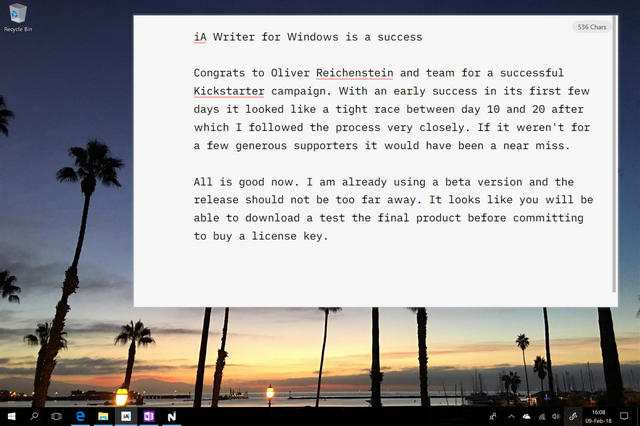
iA Writer for Windows is a success

by Volker Weber

Sketch2

Congrats to Oliver Reichenstein and team for a successful Kickstarter campaign. With an early success in its first few days it looked like a tight race between day 10 and 20 after which I followed the process very closely. If it weren't for a few generous supporters it would have been a near miss.

All is good now. I am already using a beta version and the release should not be too far away. It looks like you will be able to download a test the final product before committing to buy a license key.

Sketch

More >

12 Feb 00:35

The PocketSprite is a keychain-sized device that lets you play Game Boy games

by Bradly Shankar
Pocket Sprite Game Boy

Sometimes, you just want a physical replica of older classic hardware. That’s surely part of the reason why the NES Classic and SNES Classic systems are so popular.

But there aren’t really similar options available for Nintendo’s classic handheld, the Game Boy. While the Nintendo 3DS is a great way to play select emulated Game Boy titles, the system doesn’t support all of them.

With that in mind, developer TeamPocket has created the PocketSprite, a miniature gaming device that emulates titles from the Game Boy, Game Boy Color, Master System, Gamegear, and more.

The open source PocketSprite boasts a 60fps-capable OLED screen, a built-in speaker and USB-rechargeable battery that lasts several hours on a single charge.

Moreover, the PocketSprite is powered by a dual-core, 240 MHz ESP32 chip and 520 KB of RAM, making it significantly more powerful than the original Game Boy, which had 4.19 MHz processor and 16 KB of memory.

In terms of games, the PocketSprite creates a local Wi-Fi network to connect to a computer and allow for ROMs to be uploaded to the device.

The PocketSprite is offered in a fully-assembled model, as well as a ‘DIY’ kit that consumers can put together themselves.

As of the time of this writing, over $12,000 dollars have been pledged to the project, which has a funding goal of $20,000.

The company says it will begin shipping early-bird orders on April 15th, with prices beginning at $45 USD (approximately $56.70 CAD), depending on the funding tier.

The PocketSprite’s crowdfunding campaign will last for another 41 days on CrowdSupply.

Via: The Verge

The post The PocketSprite is a keychain-sized device that lets you play Game Boy games appeared first on MobileSyrup.

12 Feb 00:35

Chrome will start marking all HTTP websites as ‘not secure’ later this year

by Igor Bonifacic
Google Chrome on Android

Starting later this year, Chrome will change how it flags unsecured websites to users, Google announced in a blog post on Thursday.

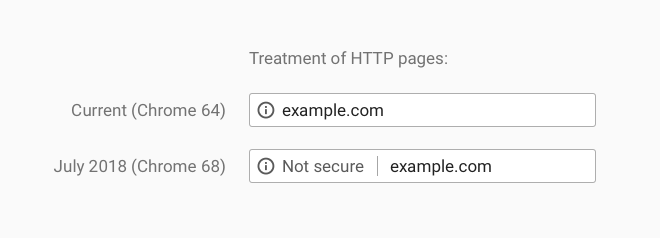
With the release of Chrome 68 in July, Google will mark all HTTP websites as ‘not secure’ using a newly designed address bar (seen below).

Chrome currently indicates HTTPS-encrypted sites with a green lock icon located next to the address bar. Additionally, the word ‘secure’ appears next to the icon.

This is not the first time Google has gone out of its way to steer web users away from unencrypted websites.

In 2015, the company changed its Search algorithm to downrank unencrypted sites. Around the same time, Chrome added a notification that would warn users against entering their login credentials into any website without encryption.

The decision comes following a year of “incredible” progress, says Emily Schechter, a product manager with the Chrome Security.

According to the Schechter, over 68 percent of Chrome traffic on both Android and Windows is currently HTTPS encrypted. Similarly, more than 78 percent of Chrome traffic on Chrome OS and macOS is now protected.

HTTPS helps protect web users by preventing man-in-the-middle attacks. Without the protection of HTTPS or something similar, a malicious hacker can capture data while it’s in transit between the user and a web server.

Source: Google Via: The Verge

The post Chrome will start marking all HTTP websites as ‘not secure’ later this year appeared first on MobileSyrup.

08 Feb 22:40

Activist in residency (in motherhood)

by thornet

What is it?

This is a self-directed residency taking place during my parental leave. Over the next few months, between nap times and playing with my infant son, I’d like to investigate:

Small utopias. What does “a better world” mean to me? What intellectual and historical predecessors does my understanding of utopia build upon? What contributions should I make towards this utopia? Which actions will most positively impact my family, my neighborhood and the communities I’m a part of?

I will conduct this inquiry through reading, reflective writing, conversing with mentors and peers, as well as open sourcing relevant assets and outputs. The residency doesn’t cost anything and isn’t hosted by anybody. It is simply intended to give my wandering mind a structure and a space to refresh my activism and renew my sense of personal and professional purpose while caring for a tiny human being.

Inspiration for this residency comes from Lenka Clayton’s amazingly open-sourced artist in residency in motherhood that was thoughtfully shared to me by Chris Lawrence.

Motivation

For the last ten years, I have been driven by the ideals of open culture and the open internet. I worked for organizations who fought for those ideals and built projects that tried to embody them. I contributed to open design and maker communities. I wrote about how open practices benefit learning, making and community organizing. I researched how openness could lead to better connected devices and how open event formats make communities more inclusive and impactful. I championed making all of human knowledge as free and open as possible, in all of the world’s languages, because this seemed to me one of the most peaceful ways to cultivate understanding and cooperation among people everywhere.

Openness used to be my utopia. Now I’m not sure.

There have been horrific political developments in the last few years. In combination with the perils of climate change, economic inequality, and the erosion of privacy, we seem to be in an general global hangover. Openness is not enough.

Becoming a mother has given me the gift of perspective. It is a chance to pause and question anew what world do I want to live in and what am I doing to get there.

Code and Other Laws of Cyberspace was published in 1999. Wikipedia and Creative Commons both began in 2001. Firefox was released in 2004. They use open practices and the internet as a foundation for creating a better world. I see them with deep respect and as great achievements proving that new forms of creation and organization are possible. But they are also incomplete.

In the years since the Free Culture movement began, many other social movements have bloomed: the Arab Spring, Occupy, Black Lives Matter, #MeToo to name a few. They bring other political dimensions and social issues to the fore. In parallel, there’s a growing need for more sustainable ways of producing goods under fairer conditions. The modern craft movement and new social enterprises are modeling these alternatives.

In my residency, I’d like to find who’s out there making the world “better”, engage critically to understand what that means and how they got there, and come out the other side with a sharper sense of purpose. All in the company of a little boy who will probably teach me even more than I can fathom.

Syllabus

Equality and struggle.

Empire

Digital colonialism

Local activism.

Human development and alternative education.

Craft.

Narratives.

Cities and urban living.

Thank you to @rebamex, @alper and @ameellio for their reading recs! Think there’s something I should add? Ping me @thornet. Check out my Github repository as well.

08 Feb 22:40

Counterintuition: Automation, cars and jobs

by pricetags

Two items that add nuance to some of the current perceptions about the impact of automation on vehicles, and hence jobs.  


From the New York Times: The Big Tech Trends to Follow 

 Smarter Cars

Self-driving-car enthusiasts like Elon Musk, the chief executive of Tesla, dream of a future where driverless cars eliminate traffic accidents while letting people do work on their commutes.

They can keep dreaming: Autonomous vehicles still have a long way to go before they become safe and properly regulated.

“Your car doesn’t drive itself, at least not reliably for a long period of time,” said Ms. Milanesi of Creative Strategies.

… carmakers like Ford, Hyundai, BMW and Audi are expected to show off the latest improvements to self-driving tech, like smarter parking assistance and less error-prone collision avoidance. These are baby steps toward truly driverless vehicles, but some features may appear in cars in the coming years.

Likely coming sooner is the so-called connected car. Tech and car companies will demonstrate new features for internet-equipped cars, like the ability to pay for parking and gas through a dashboard or cameras that enhance a driver’s side and rear vision. At the trade show, Gentex Corporation, a company that develops car technology, will demonstrate in-vehicle biometrics that scan a driver’s iris to verify his or her identity before turning on the car.


From the Washington Post, by Robert Samuelson:

… truck drivers are often cited as an example of impending job destruction wrought by automation. But the reality is more complicated. A new study by Uber argues that millions of driver jobs will survive well into the future and that the spread of driverless trucks may actually stimulate the need for more — not fewer — drivers.

The explanation lies in the plausible limits of driverless technologies. Here’s what the Uber study says:

“The biggest technical hurdles for self-driving trucks are driving on tight and crowded city streets, backing into complex loading docks and navigating through busy facilities. . . . These maneuvers require skills that will be hard for self-driving trucks to match for a long time.”

Based on this view, Uber argues that the trucking industry will split into two parts. Long-haul transportation over major highways will be performed increasingly by driverless tractor-trailers that will deliver freight to “transfer hubs” on the edges of major cities. There, local workers and drivers will reload the cargoes and make delivery to final customers.

This system, Uber argues, will be more efficient for shippers and more attractive to drivers. The study assumes that “each self-driving truck could do the work of two of today’s trucks because they can operate at all hours of day and night.” Now, trucks spend only about a third of their time on the road. By doubling this, self-driving trucks would cut costs. Lower costs in turn would stimulate more shipping. Combined with normal growth, this would require more drivers, despite the increase in driverless trucks. …

Economist Timothy Taylor, who posted the Uber study on his useful blog (“Conversable Economist”), puts it this way: “A simple ‘technology replaces jobs’ story . . . is always more complex and sometimes even counterintuitive to how it may appear at first.”

.

Two more implications: autonomous trucks will first be seen, if anywhere, on intercity highways.  So there will be a need for augmented technology on at least one lane – a lane that will likely have to be separated in some way from general traffic (not really an option in dense cities).  

If highways are going to be widened (as Hwy 99 is currently and more of Hwy 1 is proposed), it doesn’t make sense to do it for general-purpose traffic.  Instead, automated vehicles, including transit, only.

And the technology used for ‘connected cars’ can also be used for mobility pricing.  The current proposals coming from the Mobility Pricing Commission assume data will have to be collected externally from the vehicles, not from the vehicles themselves.  Wrong assumption.


08 Feb 22:39

A Tale of Two Cities in one newspaper

by michaelkluckner
mkalus shared this story from Price Tags.

a2

This excellent piece of journalism by Mike Howell in The Courier, which can be read here, is paid for by the sale of advertising, including this on the inside front page of its print edition …

a

… a highlight of which is: “Elites from all over the world are gathered here, but only a handful of them can take a place on this hottest street.”

I’m not trying to incite class warfare, and I really am pleased that we have “one of the most famous streets in the world.” Honest!


08 Feb 19:17

It exists

by russell davies

It exists

08 Feb 19:07

The Problem of Many Siris

by Ryan Christoffel

Bryan Irace writes about one of the biggest challenges Apple faces with Siri:

It’s no easy task for a voice assistant to win over new users in 2018, despite having improved quite a great deal in recent years. These assistants can be delightful and freeing when they work well, but when they don’t, they have a tendency to make users feel embarrassed and frustrated in a way that GUI software rarely does. If one of your first voice experiences doesn’t go the way you expected it to – especially in front of other people – who could blame you for reverting back to more comfortable methods of interaction? Already facing this fundamental challenge, Apple is not doing themselves any favors by layering on the additional cognitive overhead of a heavily fragmented Siri experience.

I think Irace is right on in this observation – Siri's fragmentation is a real problem.

On the more optimistic side, it could be taken as good news that the fix appears fairly obvious: create a single Siri that's consistent across all platforms. This seems like it would be a clear net positive, even though such a change could reduce Siri's accuracy in some cases; for example, I'm guessing Siri on the Apple TV is currently tuned to expect TV and movie queries more than anything else, so it can more effectively produce the right kind of results – tweak that tuning, and Apple will have to work even harder at helping Siri understand context.

One thing that's concerning about the apparent simplicity of this fix is that Apple hasn't made it yet, meaning, perhaps, that the company thinks there's nothing wrong with Siri's current fragmentation. This conversation would be different entirely if Apple had begun showing an increased effort to unify Siri across its platforms, but recently, the opposite has been true instead. The latest major Apple product, HomePod, includes a stripped-down Siri that can't even handle calendar requests. And SiriKit, which launched less than two years ago, was designed in a way that fundamentally increases fragmentation. Irace remarks:

If the Lyft app is installed on your iPhone, you can ask Phone Siri to order you a car. But you can’t ask Mac Siri to do the same, because she doesn’t know what Lyft is. Compare and contrast this with the SDKs for Alexa and the Google Assistant – they each run third-party software server-side, such that installing the Lyft Alexa “skill” once gives Alexa the ability to summon a ride regardless of if you’re talking to her on an Echo in your bedroom, a different Echo in your living room, or via the Alexa app on your phone.

The only recent occasion that comes to mind when Siri has moved in the right direction – gaining knowledge on one platform that previously existed only on another – was when iOS 10.2 brought the full wealth of Apple TV Siri's movie and TV expertise to iOS. This only happened, though, because iOS 10.2 introduced the TV app.

Until Siri can answer the same requests regardless of what platform you're on, most people simply won't learn to trust it. Users shouldn't have to remember which device's Siri can answer which questions – all they should have to remember is those two key words: "Hey Siri."

→ Source: irace.me

08 Feb 18:35

[video] Foggy (rain-free) fun times cross-country skiing last night @cypressmtn down lower powerline #lucky #thanks #luxury 20180207_195035 added as a favorite.

by sillygwailo
sillygwailo added this as a favorite.

[video] Foggy (rain-free) fun times cross-country skiing last night @cypressmtn down lower powerline #lucky #thanks #luxury 20180207_195035

08 Feb 18:35

Comment about One of the most dangerous intersections in the city: grandview and woodland. Please put a light in and speed bumps and stop drivers from using it as a dangerously fast rush hour 'shortcut'! 20180207_075622

by knitgirl

knitgirl has posted a comment:

Not to mention the school. Agreed. Ride aafe!!

One of the most dangerous intersections in the city: grandview and woodland. Please put a light in and speed bumps and stop drivers from using it as a dangerously fast rush hour 'shortcut'! 20180207_075622

08 Feb 18:35

Twitter Favorites: [DenimAndSteel] Killer interview on original comedy and its incompatibility with algorithmic editors, mostly Facebook. Our guidan… https://t.co/MK4t68YURu

Denim & Steel @DenimAndSteel
Killer interview on original comedy and its incompatibility with algorithmic editors, mostly Facebook. Our guidan… twitter.com/i/web/status/9…
08 Feb 18:34

Yaletown Retail Businesses To Lose On~Street Parking with Axing of City Metered Cash Cow

by Sandy James Planner

yaletown-parking

Various media sources including the Vancouver Sun have reported on the City of Vancouver Engineering’s plan to reduce 80 to 90  city metered parking spaces in Yaletown’s five blocks around the rather funky Mainland and Hamilton Street retail area. The area to be impacted is the metered angle parking that serves the commercial businesses. One, a flower shop, needs the space for commercial deliveries that occur several times a day. The Yaletown Business Improvement Area’s executive director, Annette O’Shea calls this parking reduction “absolutely devastating”  and stated “There’s been no consultation whatsoever. The residents don’t know what’s going on, businesses don’t know what’s going on. We know we’re going to lose some parking. We totally accept that we’re going to lose some parking,” she said.But to have this slash-and-burn mentality of we’re going to lose all the parking, it’s totally unacceptable.”

The metered parking spaces to be chopped  are among the top cash cow performers in the City of Vancouver parking meter stable, which brings in $50 million dollars a year, or over $4 million dollars a month.

The rationale for the stripping of metered parking is “safety” according to the City of Vancouver Fire Department. Unlike the rest of  the downtown, these  Yaletown streets uniquely have a street on the front and back of each building instead of a skinny back lane. This  means that any fires can be accessed and fought from both sides of the building.

Street space been an ongoing issue for the last thirty years where the Fire Department has consistently asked the Engineering Department for less parking and even street widening for their vehicles in the West End.  Traffic circles were considered bad for fire trucks until computer programs proved that they could easily negotiate around them, or use their edges. Speed bumps were also considered bad for fire trucks, not because of elapsed emergency time, but because firemen hit their heads on the truck roofs with the bumps.

Price Tags Vancouver has already reported about the City of San Francisco obtaining eight new fire trucks that are ten inches shorter and can make a u-turn in  twenty-five feet. These trucks are being commissioned for the less wide and more curving street network in the downtown area. The new trucks also have cameras that give a 360 degree view around the engine for pedestrian and cyclist safety according to Vision Zero principles.

The City of Vancouver is holding a public meeting on February 22  at the Roundhouse Community Center between 2:00 and 8:00 p.m to discuss proposed changes.

cvqe_8sviaaqzwq


08 Feb 18:34

Running Red Lights in Richmond!

by Sandy James Planner

11079693

Since September 23, four pedestrians have died on Richmond Streets. The Richmond News has now posted a very troubling YouTube video of drivers in  Richmond going through intersections when the lights were clearly red.

Of course no one who is a motorist or a vulnerable road user wants to think that this is actually happening. As one person commented on the video said “The 3 cars running the light are likely the RCMP’s Special O unit located in Richmond. It’s an elite undercover police unit that are involved in surveillance. Look how all three cars approach the intersection, angle to the right, then proceed after crossing at a very high speed. They are clearly in control of their vehicles, not some bad driver who isn’t paying attention. It’s clear these people were trying to get somewhere very quickly, whoever they were.”

The video shows four vehicles going through red lights in the east Cambie neighbourhood on January 31 at 9:30 in the morning. This activity happened within a ten minute time span. As the Richmond News asks, “Were the vehicles’ drivers together and in a coordinated hurry to get somewhere or evade someone? Or were the last two drivers simply, obliviously following the lead of the Toyota?”

Update from a commenter: The Vancouver Sun has a story that some of the drivers were police officers.

Unfortunately that  still does not address the crash rate or the number of  pedestrian fatalities in Richmond, which is approaching one death a month since September 2017.


08 Feb 18:23

Unaffordable Townhouses

by michaelkluckner

More evidence, if any is still needed, that the move to replace detached houses with townhouses is a development play that has nothing to do with providing affordable housing. This is from Jak King, a blogger in Grandview.

I live on Adanac hill in the same block as the WISE Hall.  The north side of the street running up to Victoria used to have several crumbling old Edwardian houses that were full of very cheap rental units. They have all been  demolished over the last few years and replaced with townhouses.

You may recall that townhouses are supposed to be one of the cheap alternative to single family houses, and the Planning department are pushing them more and more into Grandview (see the recent Open House) as a solution to the housing affordability problem.

The townhouse development right next door to my building has just been completed and I happened to see one of the townhouses advertised in a real estate office this morning:

a

Let’s step back a moment and remember that the median family income in Vancouver is roughly $75,000 a year.  Therefore, a normal family in Vancouver can never possibly afford this townhouse which, with a 30% down payment, requires an income double what most earn.

The minimum down payment is $265,600. No family can possibly save that much in 20 years on a median income in Vancouver. But let’s assume — as the build-at-any-cost crowd do — that the purchasers have boomer parents able and willing to assist with the down payment. It still doesn’t work.

The annual mortgage payment is $56,652 which is more than the entirety of their take home pay after tax and deductions.


08 Feb 18:22

Tim Davis and Portland’s Spring

by Sandy James Planner

27655020_10156032193764882_305853446691238886_n

Urbanist and Portland resident Tim Davis photographed this extraordinary setting of bikes and crocuses in Ladd’s Addition Portland.  Says Tim “Another beautiful early February day, where abundant flowers 🌸 and cyclists 🚴🏻‍♀️ enjoy the company of Portland’s majestic trees .”

08 Feb 18:20

Rail to Where? Abbotsford!

by Sandy James Planner


vta_light_rail_san_jose_penitencia_creek_station

When Henry Braun, the Mayor of Abbotsford was 14 years old the Highway 1 freeway was built.  As he states  in this article from Global News he is now 67 years of age, and that freeway is still pretty much the same. The difference now is that Highway 1 carries so much traffic that it is often congested between Surrey and the Fraser Valley.  In fact, Mayor Braun says that with heavy traffic many access the two areas on side roads much more efficiently.

And that is why the Mayor says that  light rail transit (LRT) in the median of Highway 1 should be built, saying it can take up to two hours in traffic to reach Vancouver from Abbotsford.  He also says the idea of rail transit is not far-fetched, and cites similar conversations from ten years ago.  With a proposed line between the east and west lanes, Mayor Braun says that “the median should be an LRT surface-based transit system like Calgary and Edmonton.”

Braun is not the first person to float the idea of a light rail service to the Fraser Valley. Transit advocates have previously floated the idea of reviving the old BC Electric Railway Interurban line, which ran from New Westminster to Chilliwack until the 1950s.”While the federal government’s transit objectives are concentrated in major urban centres, Abbotsford thinks its time to discuss this potential connection. Funding for the project, or who should administer the service has not yet been proposed.

bb828c82-cbb5-45a0-b8d9-765d08245ec2-a08257


08 Feb 18:20

The Huawei P20 May Feature Three Rear Cameras

by Evan Selleck
Dual rear camera systems are basically the standard these days, with only a few companies holding out with single camera systems in their flagship smartphones. Continue reading →
08 Feb 18:20

Bell says CraveTV now has over 1.3 million subscribers

by Patrick O'Rourke
CraveTV

Along with posting what Bell CEO George Cope called “outstanding” Q4 earnings, with revenue hitting $2.070 billion, Bell also revealed updated CraveTV subscriber numbers.

According to the Canadian telecom giant, CraveTV now has over 1.3 million subscribers across the country, amounting to what the company called a 22 percent year-over-year increase. The last time Bell released CraveTV subscriber numbers was during its Q3 2016 earnings report released back in November of 2016, with the carrier announcing that the service had passed the 1 million subscriber threshold.

Netflix, CraveTV’s main competitor in the Canadian streaming space, has not released specific regional subscriber stats for a number of years. Shomi, Rogers and Shaw’s now dead streaming platform ceased operations on November 30th, 2016, a little over a year since the platform first launched. At the time, many expected CraveTV’s demise to be imminent as well, though the platform seems, at this point, to be going strong.

Over the last few years, Bell has made a number of major deals related to CraveTV, including signing a deal with Showtime in order to add the premium station’s back catalog of content, as well as select new television shows.

The platform’s original content offerings remain slim though, especially in comparison to Netflix. So far Bell has only launched Letterkenny, though it recently confirmed that a new television program called ‘What Would Sal Do?‘ — from the same producers as Letterkenny — is on the way.

Bell also recently announced that past seasons of Game of Thrones and Silicon Valley are headed to the platform.

CraveTV is priced at $7.99 per month month and is available on a number of platforms, including iOS, Android and Apple TV — though the platform’s Apple TV app is horrible.

The post Bell says CraveTV now has over 1.3 million subscribers appeared first on MobileSyrup.