Shared posts

10 Apr 02:34

Animated Population Pyramids in R

by Kieran Healy

Amateur demography week continues around here. Today we are looking at the population of England and Wales since 1961, courtesy of some data from the UK Office of National Statistics. We have data on population counts by age (in nice, detailed, yearly increments) broken down by sex. We’re going to tidy the data, make a pyramid for a year, and then make an animated gif that shows the changing age distribution of the population over more than fifty years. The code and data to reproduce the figures is available on Github.

Once we’ve set up our data, we’ll have a long table that looks like this:


> ages_lon
# A tibble: 9,828 x 7
   group   age year       count     total   pct    yr
   <chr> <int> <chr>      <dbl>     <dbl> <dbl> <int>
 1 Males     0 Mid-1961 402400. 22347000.  1.80  1961
 2 Males     1 Mid-1961 382800. 22347000.  1.71  1961
 3 Males     2 Mid-1961 374500. 22347000.  1.68  1961
 4 Males     3 Mid-1961 366100. 22347000.  1.64  1961
 5 Males     4 Mid-1961 352100. 22347000.  1.58  1961
 6 Males     5 Mid-1961 339500. 22347000.  1.52  1961
 7 Males     6 Mid-1961 331600. 22347000.  1.48  1961
 8 Males     7 Mid-1961 336600. 22347000.  1.51  1961
 9 Males     8 Mid-1961 333100. 22347000.  1.49  1961
10 Males     9 Mid-1961 331600. 22347000.  1.48  1961
# ... with 9,818 more rows


Let’s begin by making a pyramid for one year only—1968, say. Ggplot doesn’t have a native geom_pyramid() so to do this we’ll need to mess around with the data a little bit to make the output symmetrical. We’re going to use geom_ribbon() to draw and fill the lines. We could use geom_bar(stat = "identity"), too. As an aside, there’s a geom_area() that is a special case of geom_ribbon() with the baseline fixed at zero, which is just what we need, but I found it didn’t work properly. So we’ll just use geom_ribbon() and set the baseline manually instead.

First we add a dummy base measure that’s zero for every row. We’ll make a new object to do the subsequent recoding.


ages_lon$base <-  0
ages_pyr <- ages_lon

Next we’ll take all the rows coded as “Males” and flip their percent score to be negative.


ages_pyr$pct[ages_pyr$group == "Males"] <- -ages_lon$pct[ages_lon$group == "Males"]

Now we can draw a plot. First we set up a basic object.


p <- ggplot(data = subset(ages_pyr, yr == 1968),
            mapping = aes(x = age, ymin = base,
                          ymax = pct, fill = group))

Then we add the bells and whistles:


p_pyr <- p + geom_ribbon(alpha = 0.5) +
    scale_y_continuous(labels = abs, limits = max(ages_lon$pct, na.rm = TRUE) * c(-1,1)) +
    scale_x_continuous(breaks = seq(10, 80, 10)) +
    scale_fill_manual(values = bly_palette) +
    guides(fill = guide_legend(reverse = TRUE)) +
    labs(x = "Age", y = "Percent of Population",
         title = "Age Distribution of the Population of England and Wales: 1968",
         subtitle = "Age is top-coded at 85.",
         caption = "Kieran Healy / kieranhealy.org / Data: UK ONS.",
         fill = "Group") +
    theme_minimal() +
    theme(legend.position = "bottom",
          plot.title = element_text(size = rel(0.8), face = "bold"),
          plot.subtitle = element_text(size = rel(0.8)),
          plot.caption = element_text(size = rel(0.8)),
          axis.text.y = element_text(size = rel(0.9)),
          axis.text.x = element_text(size = rel(0.9))) +
    coord_flip()

The key line is the scale_y_continuous() call, which sets the axis labels to their absolute values (so they aren’t printed as negative numbers), and fixes the limits on both sides in one quick step. We also reverse the legend guide for the fill variable so that it appears in the same order as drawn on the plot. We flip the coordinates at the end to put age on the y-axis. Everything else is just formatting for the plot — the labels in labs(), the colors in scale_fill_manual() and the size adjustments in theme().

Population Distribution by Age for England and Wales, 1968.

Population Distribution by Age for England and Wales, 1968.

Not bad. Look at the people who are fifty in 1968—they were born in 1918, and there aren’t that many of them. By contrast look at the people who were 23 then. They were born in 1945.

In the original data, age is top-coded at 85 for this year, so we get an odd-looking spike at the top of the graph. The ONS top-codes age at 85 until 1971, when it switches to a top-code of 90.

Next, let’s do the animation. The gganimate() function makes this quite convenient. Underneath, the animate() function is at work drawing a few hundred frames and stitching them together into a gif. The only additional information that gganimate() needs is that the time variable, or “frame” variable, is yr. So we add that as an aesthetic mapping. Apart from that everything is exactly the same, except we adjust the title of the figure to account for the fact that the year will be changing. Then we call gganimate() to draw the gif.


p <- ggplot(data = ages_pyr,
            mapping = aes(x = age, ymin = base,
                          ymax = pct, fill = group,
                          frame = yr))

p_pyr_ani <- p + geom_ribbon(alpha = 0.5) +
    scale_y_continuous(labels = abs, limits = max(ages_lon$pct, na.rm = TRUE) * c(-1,1)) +
    scale_x_continuous(breaks = seq(10, 80, 10)) +
    scale_fill_manual(values = bly_palette) +
    guides(fill = guide_legend(reverse = TRUE)) +
    labs(x = "Age", y = "Percent of Population",
         title = "Age Distribution of the Population of England and Wales:",
         subtitle = "Age is top-coded at 85 before 1971 and 90 thereafter.",
         caption = "Kieran Healy / kieranhealy.org / Data: UK ONS.",
         fill = "Group") +
    theme_minimal() +
    theme(legend.position = "bottom",
          plot.title = element_text(size = rel(0.8), face = "bold"),
          plot.subtitle = element_text(size = rel(0.8)),
          plot.caption = element_text(size = rel(0.8)),
          axis.text.y = element_text(size = rel(0.9)),
          axis.text.x = element_text(size = rel(0.9))) +
    coord_flip()

## This will take a while to run.
## ani.res option needs a relatively recent version of the animate library
gganimate(p_pyr_ani, filename = "figures/eng-wa-pop-pyr.gif",
          ani.width = 1000, ani.height = 1600, ani.res = 200)

Population Distribution by Age for England and Wales, 1961-2014.

Population Distribution by Age for England and Wales, 1961-2014.

Now you can sit back, relax, and watch time perform its terrible dance.

Finally, following a suggestion from Hadley Wickham, we can add labels to some birth years of interest, and thus follow the cohort as it moves through time. We’ll make a series of little data frames that keep the label reasonably close to the peak of the cohort’s relative size (which of course changes as time passes).


### Marching labels

ww1m_labs <- data.frame(yr = 1961:2008, age = 43:90,
                        lab = "Born 1918", base = 0,
                        group = "Males", gen = "ww1m")

ww1m_labs <- left_join(ww1m_labs, ages_pyr)

ww1m_labs <- ww1m_labs %>% rename(y = pct) %>%
    mutate(y = y - 0.05,
           yend = y - 0.025)


ww2m_labs <- data.frame(yr = 1961:2014, age = 14:67,
                       lab = "Born 1947",
                       base = 0, group = "Males", gen = "ww2m")
ww2m_labs <- left_join(ww2m_labs, ages_pyr)


ww2m_labs <- ww2m_labs %>% rename(y = pct) %>%
    mutate(y = y - 0.05,
           yend = y - 0.025)


xm_labs <- data.frame(yr = 1977:2014, age = 0:37,
                       lab = "Born 1977",
                       base = 0, group = "Males", gen = "x70m")

xm_labs <- left_join(xm_labs, ages_pyr)


xm_labs <- xm_labs %>% rename(y = pct) %>%
    mutate(y = y - 0.05,
           yend = y - 0.025)

ww1f_labs <- data.frame(yr = 1961:2008, age = 41:88,
                       lab = "Born 1920",
                       base = 0, group = "Females", gen = "ww1f")


ww1f_labs <- left_join(ww1f_labs, ages_pyr)

ww1f_labs <- ww1f_labs %>% rename(y = pct) %>%
    mutate(y = y + 0.3,
           yend = y + 0.3)


x64f_labs <- data.frame(yr = 1964:2014, age = 0:50,
                       lab = "Born 1964",
                       base = 0, group = "Females", gen = "ww2")


x64f_labs <- left_join(x64f_labs, ages_pyr)

x64f_labs <- x64f_labs %>% rename(y = pct) %>%
    mutate(y = y + 0.3,
           yend = y + 0.3)


gen_labs <- rbind(ww1m_labs, ww2m_labs, xm_labs, ww1f_labs, x64f_labs)


p <- ggplot(data = ages_pyr,
            mapping = aes(x = age,
                          frame = yr))

p_pyr_ani <- p + geom_ribbon(alpha = 0.5, mapping = aes(ymin = base, ymax = pct, fill = group)) +
    geom_text(data = gen_labs,
              mapping = aes(x = age, y = y, label = lab),
              size = rel(1.8), hjust = 1) +
    scale_y_continuous(labels = abs, limits = max(ages_lon$pct + 0.1, na.rm = TRUE) * c(-1,1)) +
    scale_x_continuous(breaks = seq(10, 80, 10)) +
    scale_fill_manual(values = bly_palette) +
    guides(fill = guide_legend(reverse = TRUE)) +
    labs(x = "Age", y = "Percent of Population",
         title = "Age Distribution of the Population of England and Wales:",
         subtitle = "Age is top-coded at 85 before 1971 and 90 thereafter.",
         caption = "Kieran Healy / kieranhealy.org / Data: UK ONS.",
         fill = "Group") +
    theme_minimal() +
    theme(legend.position = "bottom",
          plot.title = element_text(size = rel(0.8), face = "bold"),
          plot.subtitle = element_text(size = rel(0.8)),
          plot.caption = element_text(size = rel(0.8)),
          axis.text.y = element_text(size = rel(0.9)),
          axis.text.x = element_text(size = rel(0.9))) +
    coord_flip()

## This will take a while to run.
## ani.res option needs a relatively recent version of the animate library
gganimate(p_pyr_ani, filename = "figures/eng-wa-pop-pyr-labs.gif",
          ani.width = 1000, ani.height = 1600, ani.res = 200)

Population Distribution by Age for England and Wales, 1961-2014, with some birth years of interest labeled.

Population Distribution by Age for England and Wales, 1961-2014, with some birth years of interest labeled.

10 Apr 02:34

Dig, If U Will...

by Anil Dash
Dig, If U Will...

I was delighted to get to talk to Ben Greenman for an episode of “Dig If You Will The Podcast,” his series in honor of his book “Dig If You Will The Picture”. We go deep into Prince’s influence on transforming the music industry, and if you like it, you should check out Ben’s book, too.

Oh, and of course, we talk about my favorite floppy of all time — the disc Prince sent out with a custom font when he changed his name to his famous unpronounceable symbol.

10 Apr 02:33

12 Things Everyone Should Understand About Tech

by Anil Dash
12 Things Everyone Should Understand About Tech

Tech is more important than ever, deeply affecting culture, politics and society. Given all the time we spend with our gadgets and apps, it’s essential to understand the principles that determine how tech affects our lives.

Understanding technology today

Technology isn’t an industry, it’s a method of transforming the culture and economics of existing systems and institutions. That can be a little bit hard to understand if we only judge tech as a set of consumer products that we purchase. But tech goes a lot deeper than the phones in our hands, and we must understand some fundamental shifts in society if we’re going to make good decisions about the way tech companies shape our lives—and especially if we want to influence the people who actually make technology.

Even those of us who have been deeply immersed in the tech world for a long time can miss the driving forces that shape its impact. So here, we’ll identify some key principles that can help us understand technology’s place in culture.

What you need to know:

1. Tech is not neutral.

One of the most important things everybody should know about the apps and services they use is that the values of technology creators are deeply ingrained in every button, every link, and every glowing icon that we see. Choices that software developers make about design, technical architecture or business model can have profound impacts on our privacy, security and even civil rights as users. When software encourages us to take photos that are square instead of rectangular, or to put an always-on microphone in our living rooms, or to be reachable by our bosses at any moment, it changes our behaviors, and it changes our lives.

All of the changes in our lives that happen when we use new technologies do so according to the priorities and preferences of those who create those technologies.

2. Tech is not inevitable.

Popular culture presents consumer technology as a never-ending upward progression that continuously makes things better for everybody. In reality, new tech products usually involve a set of tradeoffs where improvements in areas like usability or design come along with weaknesses in areas like privacy & security. Sometimes new tech is better for one community while making things worse for others. Most importantly, just because a particular technology is “better” in some way doesn’t guarantee it will be widely adopted, or that it will cause other, more popular technologies to improve.
In reality, technological advances are a lot like evolution in the biological world: there are all kinds of dead-ends or regressions or uneven tradeoffs along the way, even if we see broad progress over time.

3. Most people in tech sincerely want to do good.

We can be thoughtfully skeptical and critical of modern tech products and companies without having to believe that most people who create tech are “bad”. Having met tens of thousands of people around the world who create hardware and software, I can attest that the cliché that they want to change the world for the better is a sincere one. Tech creators are very earnest about wanting to have a positive impact. At the same time, it’s important for those who make tech to understand that good intentions don’t absolve them from being responsible for the negative consequences of their work, no matter how well-intentioned.

It’s useful to acknowledge the good intentions of most people in tech because it lets us follow through on those intentions and reduce the influence of those who don’t have good intentions, and to make sure the stereotype of the thoughtless tech bro doesn’t overshadow the impact that the majority of thoughtful, conscientious people can have. It’s also essential to believe that there is good intention underlying most tech efforts if we’re going to effectively hold everyone accountable for the tech they create.

12 Things Everyone Should Understand About Tech

4. Tech history is poorly documented and poorly understood.

People who learn to create tech can usually find out every intimate detail of how their favorite programming language or device was created, but it’s often near impossible to know why certain technologies flourished, or what happened to the ones that didn’t. While we’re still early enough in the computing revolution that many of its pioneers are still alive and working to create technology today, it’s common to find that tech history as recent as a few years ago has already been erased. Why did your favorite app succeed when others didn’t? What failed attempts were made to create such apps before? What problems did those apps encounter — or what problems did they cause? Which creators or innovators got erased from the stories when we created the myths around today’s biggest tech titans?

All of those questions get glossed over, silenced, or sometimes deliberately answered incorrectly, in favor of building a story of sleek, seamless, inevitable progress in the tech world. Now, that’s hardly unique to technology — nearly every industry can point to similar issues. But that ahistorical view of the tech world can have serious consequences when today’s tech creators are unable to learn from those who came before them, even if they want to.

5. Most tech education doesn’t include ethical training.

In mature disciplines like law or medicine, we often see centuries of learning incorporated into the professional curriculum, with explicit requirements for ethical education. Now, that hardly stops ethical transgressions from happening—we can see deeply unethical people in positions of power today who went to top business schools that proudly tout their vaunted ethics programs. But that basic level of familiarity with ethical concerns gives those fields a broad fluency in the concepts of ethics so they can have informed conversations. And more importantly, it ensures that those who want to do the right thing and do their jobs in an ethical way have a firm foundation to build on.

But until the very recent backlash against some of the worst excesses of the tech world, there had been little progress in increasing the expectation of ethical education being incorporated into technical training. There are still very few programs aimed at upgrading the ethical knowledge of those who are already in the workforce; continuing education is largely focused on acquiring new technical skills rather than social ones. There’s no silver-bullet solution to this issue; it’s overly simplistic to think that simply bringing computer scientists into closer collaboration with liberal arts majors will significantly address these ethics concerns. But it is clear that technologists will have to rapidly become fluent in ethical concerns if they want to continue to have the widespread public support that they currently enjoy.

6. Tech is often built with surprising ignorance about its users.

Over the last few decades, society has greatly increased in its respect for the tech industry, but this has often resulted in treating the people who create tech as infallible. Tech creators now regularly get treated as authorities in a wide range of fields like media, labor, transportation, infrastructure and political policy — even if they have no background in those areas. But knowing how to make an iPhone app doesn’t mean you understand an industry you’ve never worked in!

The best, most thoughtful tech creators engage deeply and sincerely with the communities that they want to help, to ensure they address actual needs rather than indiscriminately “disrupting” the way established systems work. But sometimes, new technologies run roughshod over these communities, and the people making those technologies have enough financial and social resources that the shortcomings of their approaches don’t keep them from disrupting the balance of an ecosystem. Often times, tech creators have enough money funding them that they don’t even notice the negative effects of the flaws in their designs, especially if they’re isolated from the people affected by those flaws. Making all of this worse are the problems with inclusion in the tech industry, which mean that many of the most vulnerable communities will have little or no representation amongst the teams that create new tech, preventing those teams from being aware of concerns that might be of particular importance to those on the margins.

12 Things Everyone Should Understand About Tech

7. There is never just one single genius creator of technology.

One of the most popular representations of technology innovation in popular culture is the genius in a dorm room or garage, coming up with a breakthrough innovation as a “Eureka!” moment. It feeds the common myth-making around people like Steve Jobs, where one individual gets credit for “inventing the iPhone” when it was the work of thousands of people. In reality, tech is always informed by the insights and values of the community where its creators are based, and nearly every breakthrough moment is preceded by years or decades of others trying to create similar products.

The “lone creator” myth is particularly destructive because it exacerbates the exclusion problems which plague the tech industry overall; those lone geniuses that are portrayed in media are seldom from backgrounds as diverse as people in real communities. While media outlets may benefit from being able to give awards or recognition to individuals, or educational institutions may be motivated to build up the mythology of individuals in order to bask in their reflected glory, the real creation stories are complicated and involve many people. We should be powerfully skeptical of any narratives that indicate otherwise.

8. Most tech isn’t from startups or by startups.

Only about 15% of programmers work at startups, and in many big tech companies, most of the staff aren’t even programmers anyway. So the focus on defining tech by the habits or culture of programmers that work at big-name startups deeply distorts the way that tech is seen in society. Instead, we should consider that the majority of people who create technology work in organizations or institutions that we don’t think of as “tech” at all.
What’s more, there are lots of independent tech companies — little indie shops or mom-and-pop businesses that make websites, apps, or custom software, and a lot of the most talented programmers prefer the culture or challenges of those organizations over the more famous tech titans. We shouldn’t erase the fact that startups are only a tiny part of tech, and we shouldn’t let the extreme culture of many startups distort the way we think about technology overall.

9. Most big tech companies make money in just one of three ways.

It’s important to understand how tech companies make money if you want to understand why tech works the way that it does.

  • Advertising: Google and Facebook make nearly all of their money from selling information about you to advertisers. Almost every product they create is designed to extract as much information from you as possible, so that it can be used to create a more detailed profile of your behaviors and preferences, and the search results and social feeds made by advertising companies are strongly incentivized to push you toward sites or apps that show you more ads from these platforms. It’s a business model built around surveillance, which is particularly striking since it’s the one that most consumer internet businesses rely upon.
  • Big Business: Some of the larger (generally more boring) tech companies like Microsoft and Oracle and Salesforce exist to get money from other big companies that need business software but will pay a premium if it’s easy to manage and easy to lock down the ways that employees use it. Very little of this technology is a delight to use, especially because the customers for it are obsessed with controlling and monitoring their workers, but these are some of the most profitable companies in tech.
  • Individuals: Companies like Apple and Amazon want you to pay them directly for their products, or for the products that others sell in their store. (Although Amazon’s Web Services exist to serve that Big Business market, above.) This is one of the most straightforward business models—you know exactly what you’re getting when you buy an iPhone or a Kindle, or when you subscribe to Spotify, and because it doesn’t rely on advertising or cede purchasing control to your employer, companies with this model tend to be the ones where individual people have the most power.

That’s it. Pretty much every company in tech is trying to do one of those three things, and you can understand why they make their choices by seeing how it connects to these three business models

12 Things Everyone Should Understand About Tech

10. The economic model of big companies skews all of tech.

Today’s biggest tech companies follow a simple formula:

  • Make an interesting or useful product that transforms a big market
  • Get lots of money from venture capital investors
  • Try to quickly grow a huge audience of users even if that means losing a lot of money for a while
  • Figure out how to turn that huge audience into a business worth enough to give investors an enormous return
  • Start ferociously fighting (or buying off) other competitive companies in the market

This model looks very different than how we think of traditional growth companies, which start off as small businesses and primarily grow through attracting customers who directly pay for goods or services. Companies that follow this new model can grow much larger, much more quickly, than older companies that had to rely on revenue growth from paying customers. But these new companies also have much lower accountability to the markets they’re entering because they’re serving their investors’ short-term interests ahead of their users’ or community’s long-term interests.

The pervasiveness of this kind of business plan can make competition almost impossible for companies without venture capital investment. Regular companies that grow based on earning money from customers can’t afford to lose that much money for that long a time. It’s not a level playing field, which often means that companies are stuck being either little indie efforts or giant monstrous behemoths, with very little in between. The end result looks a lot like the movie industry, where there are tiny indie arthouse films and big superhero blockbusters, and not very much else.

And the biggest cost for these big new tech companies? Hiring coders. They pump the vast majority of their investment money into hiring and retaining the programmers who’ll build their new tech platforms. Precious little of these enormous piles of money are put into things that will serve a community or build equity for anyone other than the founders or investors in the company. There is no aspiration that making a hugely valuable company should also imply creating lots of jobs for lots of different kinds of people.

11. Tech is as much about fashion as function.

To outsiders, creating apps or devices is presented as a hyper-rational process where engineers choose technologies based on which are the most advanced and appropriate to the task. In reality, the choice of things like programming languages or toolkits can be subject to the whims of particular coders or managers, or to whatever’s simply in fashion. Just as often, the process or methodology by which tech is created can follow fads or trends that are in fashion, affecting everything from how meetings are run to how products are developed.

Sometimes the people creating technology seek novelty, sometimes they want to go back to the staples of their technological wardrobe, but these choices are swayed by social factors in addition to an objective assessment of technical merit. And a more complex technology doesn’t always equal a more valuable end product, so while many companies like to tout how ambitious or cutting-edge their new technologies are, that’s no guarantee that they provide more value for regular users, especially when new technologies inevitably come with new bugs and unexpected side-effects.

12. No institution has the power to rein in tech’s abuses.

In most industries, if companies start doing something wrong or exploiting consumers, they’ll be reined in by journalists who will investigate and criticize their actions. Then, if the abuses continue and become serious enough, the companies can be sanctioned by lawmakers at the local, state, governmental or international level.

Today, though, much of the tech trade press focuses on covering the launch of new products or new versions of existing products, and the tech reporters who do cover the important social impacts of tech are often relegated to being published alongside reviews of new phones, instead of being prominently featured in business or culture coverage. Though this has started to change as tech companies have become absurdly wealthy and powerful, coverage is also still constrained by the culture within media companies. Traditional business reporters often have seniority in major media outlets, but are commonly illiterate in basic tech concepts in a way that would be unthinkable for journalists who cover finance or law. Meanwhile, dedicated tech reporters who may have a better understanding of tech’s impact on culture are often assigned to (or inclined to) cover product announcements instead of broader civic or social concerns.

The problem is far more serious when we consider regulators and elected officials, who often brag about their illiteracy about tech. Having political leaders who can’t even install an app on their smartphones makes it impossible to understand technology well enough to regulate it appropriately, or to assign legal accountability when tech‘s creators violate the law. Even as technology opens up new challenges for society, lawmakers lag tremendously behind the state of the art when creating appropriate laws.

Without the corrective force of journalistic and legislative accountability, tech companies often run as if they’re completely unregulated, and the consequences of that reality usually fall on those outside of tech. Worse, traditional activists who rely on conventional methods such as boycotts or protests often find themselves ineffective due to the indirect business model of giant tech companies, which can rely on advertising or surveillance (“gathering user data”) or venture capital investment to continue operations even if activists are effective in identifying problems.

This lack of systems of accountability is one of the biggest challenges facing tech today.


If we understand these things, we can change tech for the better.

If everything is so complicated, and so many important points about tech aren’t obvious, should we just give up hope? No.

Once we know the forces that shape technology, we can start to drive change. If we know that the biggest cost for the tech giants is attracting and hiring programmers, we can encourage programmers to collectively advocate for ethical and social advances from their employers. If we know that the investors who power big companies respond to potential risks in the market, we can emphasize that their investment risk increases if they bet on companies that act in ways that are bad for society.

If we understand that most in tech mean well, but lack the historic or cultural context to ensure that their impact is as good as their intentions, we can ensure that they get the knowledge they need to prevent harm before it happens.

So many of us who create technology, or who love the ways it empowers us and improves our lives, are struggling with the many negative effects that some of these same technologies are having on society. But perhaps if we start from a set of common principles that help us understand how tech truly works, we can start to tackle technology’s biggest problems.

12 Things Everyone Should Understand About Tech

10 Apr 02:33

Programming as natural ability, and the bandaid of long work hours

Your project deadline is getting closer and closer, and you’re stuck: you don’t know what to do. Your manager won’t help, they just push you to work evenings and weekends–and when it looks like you’re going to fail, they hand the project over to another programmer.

You’ve failed your manager, and there’s a little voice in the back of your head telling you that maybe you’re missing what it takes to be a programmer, maybe you just don’t have the requisite natural ability.

That little voice is lying to you.

It’s the other way around: your manager has failed you, and is compounding the failure by conveying a destructive mindset, what’s known as a fixed mindset. To understand what I’m talking about, let’s take a quick detour into the psychology of education, and then return to those long hours you’ve been working.

Growth mindset vs fixed mindset

Carol Dweck, a professor of psychology at Stanford University, contrasts two mindsets when learning:

  • If you have a growth mindset you assume your abilities can change over time, and that your skills can improve by learning and practice.
  • If you have a fixed mindset you assume your abilities are fixed: some people are naturally more talented than others, and there is no way to change your level of abilities.

According to Dweck’s research, students with a growth mindset do better than students with a fixed mindset. A fixed mindset is self-defeating: it keeps you from learning, and it keeps you from even trying to learn.

In the context of programming this suggests that starting with the attitude that programming is a set of skills, skills that you can learn, will result in a much better learning experience.

But what does this have to do with long working hours?

You can’t work smarter, so you gotta work longer

In an article that was one of the inspirations for this post, Carol Dweck points out that a common failure mode among educators is to praise effort, working harder, instead of praising learning. While they may claim to be encouraging a growth mindset, they are simply perpetuating a fixed mindset.

This failure mode appears in the software world as well. Let’s assume for the moment that programming is a natural ability: just before we’re born, the Angel of Software injects between 0 and 100 milliliters of Programming Juice into our soul. If you’re really lucky, you might even get 110ml!

Now, given that each and every one of us only has a limited amount of Programming Juice, how can you maximize our output? You can’t learn more, so there’s no way to do things more efficiently. You can’t improve your skills, so there’s no way to become more productive.

So what’s left?

All together now: WORK LONGER HOURS!

Working longer ain’t smart

The truth, of course, is that there is no Angel of Software, there is no Programming Juice. Programming is just a bunch of skills. You can learn those skills, and so can most anyone else, given motivation, time, support, and some good teachers. And you can become more and more productive by continuing to learn.

If you believe in fixed talent, if you believe you can’t improve, you won’t try to learn. Long hours will be the only tool left to you.

When faced with a problem: just work longer hours.

When faced with another problem: work even longer.

You’ll work and work and work, and you’ll produce far less than you would have if you’d spent all that time improving your skills. And eventually you’ll hit a problem you can’t solve, and that you will never solve by working longer hours.

A growth mindset will serve you far better. You need to believe that skills can grow, and then you need to actually do the work to learn more and grow your skills.

And when you fail–and you will fail, because we all fail on occasion–take this as another opportunity to learn: look for the patterns and cues you should have have spotted. Having learned your lesson, next time you’ll do better.


10 Apr 02:32

SotD: Middle of the Road

In case nobody noticed, I have a thing for loud-voiced women singing in front of heavy electric-guitar noise. Any list of those has to have Chrissie Hynde near the top. She wrote and sings this, provides some of the guitar noise herself, and throws in a triumphant harmonica break.

Chrissie Hynde

Her voice is unique. She’s from Akron, Ohio and her intonation is pure Middle American White Girl, none of the traditional Southern or Black or British rock-vocal angles. There’s considerable songwriting and arranging skill in setting things up so her not-terribly-high not-terribly-sharp not-terribly-scratchy voice cuts through all the guitar chording. Anyhow, I love the way she sounds

Learning to Crawl is probably the Pretenders’ best album, and you could have a long argument about the best tune on it, because it’s got Chain Gang and My City Was Gone. But Middle of the Road burns brightest, rocks hardest, and then a lot of us can relate to Don't harass me, can't you tell / I'm going home, I'm tired as hell / I'm not the cat I used to be / I got a kid, I'm thirty-three.

I caught the tour that went with the album and it was good but not brilliant. They made a big mistake by having Iggy Pop open — never do that — and maybe it was just an off night, but while they gave strong performances of the big songs, it didn’t feel like they were really bringing it. Except for, during Middle of the Road they lit up, Chrissie went into full howl and then launched her harmonica. Anyhow, in recent years she plays it way better than back when she was only thirty-three; check the video linked below.

This is part of the Song of the Day series (background).

Links

Spotify playlist. This tune on iTunes, Amazon, Spotify. As for live video, brace yourself for this one; Chrissie is several decades past thirty-three and absolutely blows out the fucking walls; she’s assembled a really sharp version of the band, too; mind you, some members are younger than the song. Wow.

10 Apr 02:31

Elsevier launches Mendeley Data to manage entire lifecycle of research data

files/images/Mendeley_Data.PNG

Apr 12, 2018


Icon

While this appears to be a good announcement, my fear of course is that Elsevier will somehow clamp down on access as it tries to monetize this offering. In any case: " With Mendeley Data, researchers can safely record and share research data while improving its reuse via publication, while universities can showcase institutional outputs and improve their collaboration rate.

Web: [Direct Link] [This Post]
10 Apr 02:31

Design of a Personalized Massive Open Online Course Platform

files/images/adaptive_learning_UML.PNG

Junfu Xi, Yehua Chen, Gang Wang, International Journal of Emerging Technologies in Learning, Apr 12, 2018


Icon

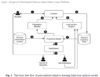
You might think (as I did) that this has to do with personalized access to MOOCs, but the article is in fact about building an analytics engine into a MOOC platform. It's still an interesting article. "Through the analysis of learning behaviours on the MOOC platform, the model digs deep into the pattern of learning behaviours, and lays the basis for personalized intervention in the learning process."

Web: [Direct Link] [This Post]
10 Apr 02:31

Car-Free Superblocks for Melbourne?

by pricetags

From The Age:

Melbourne’s CBD could become largely ‘car-free’ under a proposal to counter a growing pedestrian crush, and planning experts and advocates say change needs to happen soon.

Melbourne City Council is flagging the idea of having ‘superblocks’, which would remove cars from the Hoddle Grid and Docklands and prioritise pedestrians.

The idea comes from Barcelona, where superblocks have already been introduced and span nine city blocks, with speed limits reduced to 10km/h and footpaths decluttered.

The proposals are in two council discussion papers on Walking and City Space, which will inform the City of Melbourne Transport Strategy to 2050 and take examples from Dublin, Auckland and Oslo.

With 57 per cent of space in the city taken up by roads and 2016 data showing roads serve only one-third of all trips in the city, the council wants the city space to be used more effectively. …

However … cities like Melbourne are small (really, only the CBD) and relatively powerless when it comes to transportation.  The power resides with the state government, and the Premier is not persuaded:

Premier Daniel Andrews said he was “unconvinced” a pedestrian-only “superblock” would improve traffic flows or safety.

“This is a Melbourne City Council idea, I don’t want anyone getting confused that this has come from our government,” he said.

“I’m not convinced that this will improve traffic flow, I’m not convinced this would improve safety. Those two things are important.”

He said a better rail and public transport system, including the Melbourne Metro Tunnel project, was the best way to solve any traffic or pedestrian issues.

10 Apr 02:31

@PENamerican

@PENamerican: The @DHSgov’s plan to create a searchable database of #journalists, “media...
10 Apr 02:31

Datasets for teaching data science

by Nathan Yau

Rafael Irizarry introduces the dslabs package for real-life datasets to teach data science:

[I] try to avoid using widely used toy examples, such as the mtcars dataset, when I teach data science. However, my experience has been that finding examples that are both realistic, interesting, and appropriate for beginners is not easy. After a few years of teaching I have collected a few datasets that I think fit this criteria. To facilitate their use in introductory classes, I include them in the dslabs package.

Tags: R, teaching

10 Apr 02:31

When virtual reality feels real, so does the sexual harassment

files/images/vs_harassment.PNG

Jessica Buchleitner, Reveal, Apr 12, 2018


Icon

We may have new technology but we have the same old problems: “unbridled misogyny that spawns from gaming anonymity.” As this article notes, this type of poor behaviour has a long history: "Julian Dibbell’s 1993 Village Voice article A Rape in Cyberspace; A decade later, reports of avatar rapes began surfacing after Linden Lab’s virtual world Second Life launched in 2003," and misogynist comments "while then-17-year-old Gittins was playing World of Warcraft". Then there's gamergate, which erupted in the 2010s.The problem, in my view, is that the perpetrators don't think the behaviour is wrong. There need to be consequences, so that they learn that it is.

Web: [Direct Link] [This Post]
10 Apr 02:23

Rising

by Michael Kalus
mkalus shared this story from Uploads from Michael Kalus.

Michael Kalus posted a photo:

Rising

Processed with VSCO with nc preset


09 Apr 20:08

Here are the Google Pixel 3, LG G7 ThinQ and Moto G6 leaks from last week

by Dean Daley

From LG to OnePlus, a variety of smartphone leaks surfaced last week.

Here’s a breakdown of everything you need to know, including patents and a number of smartphone leaks and rumours. These leaks encompass news ranging from March 31st to April 6th.

LG

LG may call its next smartphone the LG G7 ThinQ. The ThinQ branding goes together with LG’s new camera AI.

For more about the LG G7 ThinQ name click here.


The LG G7 is also rumoured to feature a dedicated AI button. The AI button is going to be placed below the volume rocker and it could launch Google Assistant, Alexa or possibly even LG’s Q voice assistant.

For more on the AI button click here.


Another LG G7 ThinQ leak shows off the display and the specs of the phone. It features a notched screen with a Snapdragon 845, 4GB of RAM and 64GB of internal storage.

For more on the LG G7 ThinQ leak click here.


Google

Google may launch a mid-range Pixel device. The rumour points to the search giant releasing a midrange device for emerging markets.

For more on the midrange Pixel device click here.


Google’s Android Open Source Project name-dropped the Google Pixel 3. This is the first official mention of the Pixel 3.

For more about the Google Pixel 3 name drop click here.


Motorola

Moto is expected to reveal the Moto G6 on April 19th. An invite was sent to Android Pit revealing a Sao Paulo event for April 19th.

For more on the Moto invite click here.


The Moto G6’s, G6 Play’s and G6 Plus’ marketing materials surfaced online this week. The promo images show off a dual rear camera and a large bottom bezel.

For more on the Moto G6 lineup’s marketing images, click here.


OnePlus

The OnePlus 6 will feature a Snapdragon 845, 8GB of RAM and 256GB of storage.

This information was revealed by OnePlus co-founder Carl Pei. A lot more information was revealed this week about the OnePlus so we put together a page to share everything we know so far about the OnePlus 6.

The post Here are the Google Pixel 3, LG G7 ThinQ and Moto G6 leaks from last week appeared first on MobileSyrup.

09 Apr 20:08

Apple announces Product Red iPhone 8 and 8 Plus

by Patrick O'Rourke
iPhone 8

Just like the tech giant did last year with the iPhone 7, Apple has revealed a Product Red iPhone 8 and 8 Plus.
Product Red is an organization that campaigns to fight HIV and Aids in Ghana, Kenya, Lesotho, Rwanda, South Africa, Swaziland, Tanzania and Zambia, with an unspecified portion of proceeds from specific Red branded device sales going to the charity.

Last year’s Product Red iPhone featured a not very well-received white-bezel. This year though, Apple has taken a different route and the iPhone 8 now features a black front panel.

The Product Red version of the iPhone 8 and 8 Plus join the ‘Space Gray,’ ‘Silver,’ and ‘Gold,’ iPhone 8 models. Apple is launching pre-orders for the Project Red iPhone 8 on April 10th, with an estimated shipping date of April 13th.

The 64GB iPhone 8 Plus is priced at $1,059 CAD, while the 256GB iteration is priced at $1,269. The iPhone 8 is priced at $929 for the 64GB version and $1,139 for the 256GB.

Along with the new Product Red iPhone 8, Apple is also releasing a new Product Red Folio case for the iPhone X. It’s unclear how much the Folio case is set to cost in Canada, but we’ve reached out to Apple for clarification.

Source: Apple 

The post Apple announces Product Red iPhone 8 and 8 Plus appeared first on MobileSyrup.

09 Apr 20:08

Tesla hoping to deliver more Model 3 variants by July 2018

by Brad Bennett
Tesla Model 3

Electric vehicle manufacturer Tesla may be closer to providing different trims and options for the Model 3, according to a Tweet from co-founder and CEO Elon Musk.

Musk tweeted that more Model 3 options will “probably” arrive in July.

Musk’s tweet comes in response to a customer who asked when the dual-motor Model 3 will start production. Other customers also asked about interior trim options like white seats.

Musk replied that Tesla would need to start producing 5,000 Model 3s every week before the company could start making more complex variants.

While it’s difficult to tell what is stopping Tesla from making this all-wheel drive version of the car, Musk said on Twitter that Tesla has been working towards this 5,000-Model 3s-a-week target since the end of 2017, and the company doesn’t want to do anything that could slow down its production ramp.

According to an Engadget report, Tesla has been producing around 2,000 Model 3 vehicles every week since March 2018. The company is hoping to keep ramping up production on the cheapest Tesla car.

The Model 3 starts at $45,600 CAD before incentives and customers can expect delivery in the next 12 to 18 months.

Source: Twitter Via: Engadget

The post Tesla hoping to deliver more Model 3 variants by July 2018 appeared first on MobileSyrup.

09 Apr 20:08

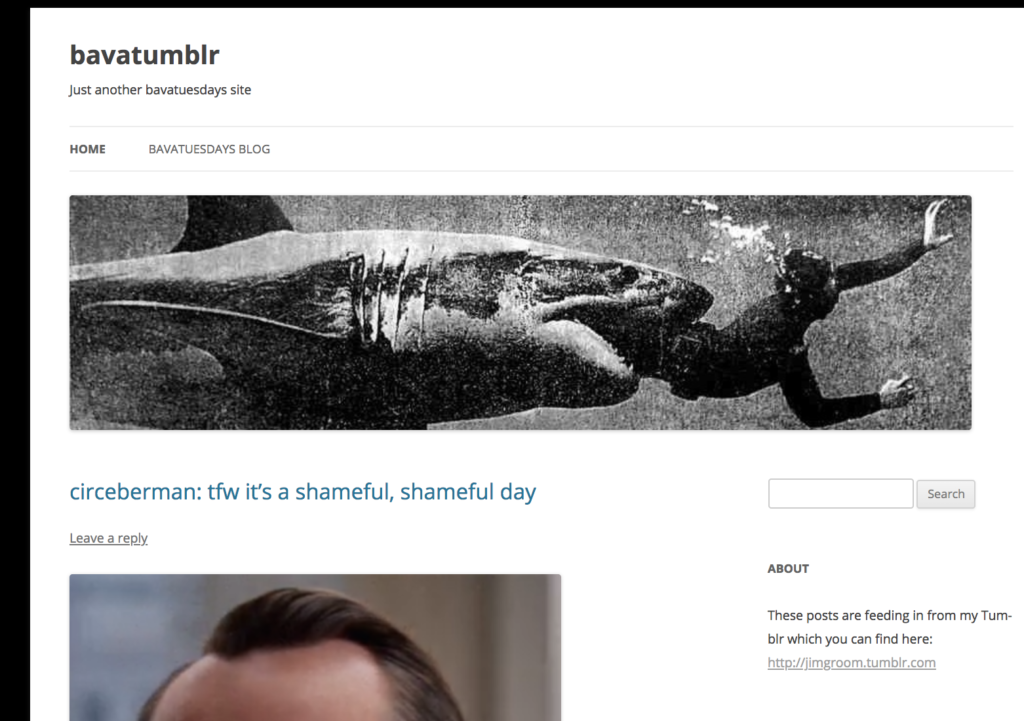
Bavatumblr Archived and Retired

by Reverend

I had a 3 year run on Tumblr. It lasted between July 2012 and August 2015. I loved Tumblr for the GIFs, the film screenshots, and the digital art more generally. I could and did spend hours just scrolling through certain sites, and the attention to old school aesthetics was impeccable by many of the folks I followed there.  The IWDRM site had a lot to do with my Tumblr affair, but I remained pretty much a dilettante—just dipping in and out and grabbing other peoples stuff. But when Tumblr was good—it was the best of the graphic web. 

But time goes on, and nothing gold can stay. My abandoning of Tumblr was a slow process, and given I never had any strong network ties there is was relatively painless, but I would miss all the images, videos and web art I collected there, so I started an archive site for my Tumblr blog back in 2013, knowing early on the day would come. Well, the day came a while ago, and I am just finalizing things now. I ran Site Sucker on the site that I recently migrated, and have saved both the local links and the Tumblr links for posterity, so almost every post on my Tumblr has two on the archive. I am keeping the WP files and database in the rare case I just to revive it, but for now I can create my own living Tumblr with Reclaim Video 🙂

09 Apr 20:07

I, too, grew up in Germany in the 1980s

by Andrea

Catapult: Children of ‘The Cloud’ and Major Tom: Growing Up in the ’80s Under the German Sky. “In the sky you could watch history happen as though on the world’s most massive TV, and history’s wreckage could rain down on you at the park with your friends.”

Even though I’m about five years older than the author, many of his descriptions reminded me of my childhood experiences.

Link via MetaFilter.

09 Apr 20:06

Leap Motion shows off prototype budget AR headset

by Brad Bennett

Leap Motion, known for its state-of-the-art hand tracking technology, has today revealed a proof of concept budget augmented reality headset called Project North Star.

Since Leap Motion isn’t a massive manufacturer, it will be making this design and the related software open source within the next week so that anyone can manufacture and use the technology.

The headset consists of two ultra-bright, 1600x1440p displays that can push up to 120 frames per second and project images that are 100 degrees in diameter within the users field of vision.

The company claims that this design can be manufactured for around $100 USD per headset if it’s at a large enough production scale.

Leap Motion’s chief technology officer David Holtz states in an April 9th release that the company is hoping that these designs “will inspire a new generation of experimental AR systems that will shift the conversation from what an AR system should look like, to what an AR experience should feel like.”

The company is going to start being more open with its finding around Project North Star by promising to release more blog posts and videos documenting its “discoveries and reflections” with the new headset.

Source: Leap Motion Via: The Verge

The post Leap Motion shows off prototype budget AR headset appeared first on MobileSyrup.

09 Apr 20:06

Living with Kids in Higher Density~Five Kids, One Condo

by Sandy James Planner

Three bedroom challenge (P/V)

Kirsten Dirksen is a television producer who has become an on-line video blogger.  Her company Faircompanies.com has a media site that looks at the aspect of less complicated, simpler living styles. As a vlogger she came to Vancouver to interview Adrian Crook who lives in the Yaletown area of downtown with five children in a two bedroom condo. Adrian likes living downtown for the health and psychological aspects of walking everywhere and notes that while “Vancouverism” includes a taller housing form in the downtown peninsula, that has not been embraced in the largely single family areas away from the downtown.

Price Tags Vancouver has chronicled  Adrian Crook’s quest to have his children using transit to school and Price Tags has also examined a program in Calgary with Bus Buddies where children are allowed to take transit to school. Adrian does have a blog about living in the downtown with his five children, and he is also running for City Council.

The  twenty minute video on YouTube features Adrian’s kids and shows the simple adaptations that have been made in the condo to maximize usable space. There’s a home office that turns into a murphy bed at night, a bunk bed that can morph into a table and desk, and a triple stacked bunk bed.  Parents everywhere will see in the video that  children’s socks still disappear -even in smaller footprint spaces.


bedroomchallenge-2

09 Apr 20:06

Inko: A Collaborative Whiteboard for iPad, iPhone, and Apple TV [Sponsor]

by John Voorhees

Inko is a collaborative whiteboard that lets several people draw together using multiple iPads or iPhones, and even interact on Apple TV. Ideal for teams of coworkers in a brainstorming session, for a creative classroom project, or for an interactive meeting between a graphic designer and their client.

Creating a group and starting to drawing together is easy. There's no complex network setup, or even any network at all, thanks to nearby connectivity. With peer-to-peer connections, you can work wherever you are, be it in a bar or on the beach. Your drawings can also be displayed on the big screen, thanks to the free companion app for Apple TV. The app instantly connects and interacts with all devices in the room, making it a great alternative to those bulky and expensive interactive boards.

Even though Inko is both simple and intuitive, it's also backed with sophisticated, advanced features like vibrant colors and beautiful pixel-free drawing display that stays sharp when zooming in. Inko also offers precise Apple Pencil support for an amazing lag-free, undo-capable, real-time drawing experience, as well as hi-res PDF exports to share with your group when you’re finished.

Inko’s Collaboration Pack is 20% OFF ($15.99 instead of $19.99) this week only. Hint: the discounted Collaboration Pack also entitles you to the introductory subscription price.

Our thanks to Inko for sponsoring MacStories this week.


Support MacStories Directly

Club MacStories offers exclusive access to extra MacStories content, delivered every week; it's also a way to support us directly.

Club MacStories will help you discover the best apps for your devices and get the most out of your iPhone, iPad, and Mac. Plus, it's made in Italy.

Join Now
09 Apr 20:05

Selling Motordom: Safe and Sexy & Get Out of the Way

by Sandy James Planner

2kougubxnu24zlqjq1dd6q_0_0

If you picked up Friday’s Vancouver Sun, you were treated to a front page advertisement from Hyundai in bold letters proclaiming that the 2018 Sonata was “Safe and Sexy”.

So what exactly does that mean? In the very tiny print, this vehicle is a “top safety pick” IF equipped with autonomous emergency braking AND LED headlights. It has been suggested that up to 80 per cent of low beam headlights might not provide adequate stopping distances at speeds above 40 miles per hour according to the American Automobile Association.  Pedestrian deaths were up nearly 10 per cent in the United States in 2015, but that was largely due to distracted drivers, not dim headlights. As many pedestrians in low light situations will attest, the light bounce of the new LED headlights make visibility extremely difficult when using crosswalks on streets.


IMG_4757

The  pedestrian beware message is echoed by Mercedes in this 2017  commercial spot below that shows a group of muscle cars ponying up at a pedestrian crosswalk and forcing an unfortunate pedestrian to run fast or risk getting mowed down. It is all part of a campaign to sell vehicles as dominant users of the street and also reminds active transportation users that vehicles still have the last word in any interaction. And it is also a reminder that as autonomous vehicles roll out that it is not just the safety of the vehicle’s occupant that must be paramount, but the safety of the most vulnerable street user that must count too.


09 Apr 20:05

Here are the changes to Canadian carrier rate plans this week [April 9 – April 15]

by Ian Hardy
myrogers

There are over 30 million wireless subscribers in Canada and if you’re in the market to switch carriers, then you’ll want to know about the latest promotions and cell phone rate plan changes. You can find all those changes and additions below in a simple, easy to read chart.

Every week MobileSyrup will post the latest weekly rate plan deals. You can also check out our MobileSyrup’s rate plan calculator for details on plans, as well as to find the right plan for you.

Keep in mind that rate plans are always subject to change and that we’ll do our best to keep this list updated as accurately as possible.

Canadian carrier rate plan changes this week

7-Eleven Speakout

Ongoing

  • Free SIM Card + $25 Bonus Airtime with $100 Top-up
  • $20 off any phone with $50+ voucher purchase

Bell

New

  • Ended Free Samsung Galaxy Tab E with Samsung Galaxy Note8 / S8 / S8+

Ongoing

  • Main Regions:
    • 1GB Bonus data with 4GB data option
    • 2GB Bonus data with 6GB / 10GB data option
  • 2GB Bonus on 10GB data option in Saskatchewan
  • 2GB Bonus on 6GB data options in Manitoba
  • Up to 3GB on data option in Quebec
  • $100 Trade-in Credit with selected phone
  • Save $10/month with every additional line on a Share plan (all regions)

Chatr

Ongoing

  • $10 monthly credit for 8 months if you sign up for an auto-pay plan

Cityfone

Ongoing

  • Double your minutes, texts and data

Eastlink

Ongoing

  • 1 GB of bonus data for every family member you add to your plan
  • 3GB data for $60/month

Fido

New

  • New $75 Fido Pulse Data, Talk & Text plan with Extra Large tab (MB/SK only)

Freedom Mobile

Ongoing

  • $5/month off in credits on the $25 and $30 Home basic plans
  • $10/month off for 12 months on Big Gig or Big Gig + Everywhere Canada plans for customers who BYO phone (in-store only)
  • $10/month off for 6 months on Home 40 plan for customers who BYO phone (in-store only) 

Koodo Mobile

Ongoing

  • $5 off $40 prepaid plan
  • 1GB Bonus data with the $55 prepaid plan
  • Up to $100 Bonus Gift on selected phones
  • Prepaid Offers: $20 Activation Bonus with Prepaid phones + Free 100 Minutes Talk booster add-on + 10% off with automatic top-ups

Bell MTS

Ongoing

  • 2GB bonus on 6GB data options
  • $30 Airtime credit on Prepaid phones

PC Mobile

Ongoing

  • Bonus points with smartphone purchase on a 2-year contract

Petro-Canada

Ongoing

  • Promotional plan: Spring Forward Plan with 300 mins for $25

Public Mobile

Ongoing

  • Bonus data on select plans
  • Save $2 with AutoPay Rewards

Rogers

Ongoing

  • 2GB Bonus Data on 10GB plan (main regions)
  • 2GB Bonus Data offer on 6GB Share Everything plans (MB)
  • 7GB limited-time Share Everything plan (QC)
  • 2GB Bonus Data on 10GB and 14GB Share Everything plans (QC)
  • $10 monthly discount on additional lines with 2-year or No Tab
  • $200 off for customers switching from SaskTel
  • $100 off for customers switching from another carrier (MB only)

SaskTel

New

  • Ended Promotion plan available with eligible smartphone on a 2 year contract: “Unlimited data for $70”. It includes unlimited Canada-wide calling, text & data (up to 10GB)

Ongoing

  • $20 Prepaid bonus

Telus

New

  • 3GB Bonus with 4GB data option

Ongoing

  • 1GB Bonus with the 15GB plan (MB)
  • 2GB bonus with the 10GB plan (SK)
  • 2GB Bonus Data on all Your Choice plan (QC)
  • Save $10/month (QC and SK) or $5/month (other regions) when adding a family member to a Shareable plan

Videotron

Ongoing

  • 2GB Bonus with 7 & 8 GB Premium Plus plans & 4GB/ 5GB / 6GB Premium plans
  • BOGOF offer with Samsung Galaxy S8 / S8+ / S9 / S9+ & Note 8
  • Up to $26 off plans with BYO phone

Virgin Mobile

New

  • Get 3GB + Unlimited minutes for $60/month (BYOD)

The post Here are the changes to Canadian carrier rate plans this week [April 9 – April 15] appeared first on MobileSyrup.

09 Apr 20:05

Essential promises to improve the camera in its next smartphone

by Ian Hardy
Essential Phone

Part of the allure of the Essential Phone is its stunning design and the device’s modular 360-degree camera. While many praised the company for the phone’s almost non-existent bezels, others were disappointed the device’s camera performance.

However, Essential is now making promises that its next smartphone — probably the named the Essential PH-2 — will feature an improved camera set-up.

During an interview with Business Insider, Linda Jiangm Essential’s head of industrial design, stated the company listened to customer feedback regarding its first phone and plans to ‘do it better.’

“In general, one thing that we got hit hard with was the quality of our camera, and we’re really looking forward to improving that with our next-gen, making sure that we’re listening to our customers and their pain points… We can say, we heard you and we’re going to do it better on the second-gen for sure,” said Jiang.

Apart from the camera improvements, no other details were revealed as to if the second-generation device will follow the same design line of its first flagship.

A recent patent filing created by Andy Rubin, CEO of Essential and the ‘father of Android,’ revealed the company could be playing around with the idea of a pop-up camera, which would “maximize the display the display area of a mobile device.”

In Canada, the Essential Phone is available at Telus, Koodo and also through Amazon Canada.

Source: Business Insider

The post Essential promises to improve the camera in its next smartphone appeared first on MobileSyrup.

09 Apr 20:05

Seattle considers congestion charging

by pricetags

From the Seattle Times, via Daily Durning:

Seattle will develop a plan to toll city roadways as part of its efforts to reduce traffic congestion and greenhouse-gas emissions, Mayor Jenny Durkan said Tuesday.

Details of what such a plan might look like are sparse, and will hinge on a tolling study focused on downtown neighborhoods that should have initial results later this year. …

Durkan said she was hopeful a congestion-pricing system could be in place by the end of her first term, in 2021. …

Seattle could implement tolling within the city without the permission of the state Legislature, but it would almost certainly require the approval of city voters.

In 2015, 56 percent of Puget Sound-area voters said systemwide tolling was a bad or very bad idea, according to a poll from the Puget Sound Regional Council. …

Revenues from congestion pricing would be used to increase transit service throughout the city and to support more electric transportation infrastructure, Durkan said. …

Limited tolling is already coming to downtown Seattle, with the opening of the Highway 99 tunnel, scheduled for later this year. But the state Transportation Commission continues to struggle deciding how much to toll and when to start tolling.


09 Apr 20:05

‘Your app isn’t verified’ error message and what it means for your app

by Context.IO

How to verify your application for use with OAuth 2

Due to recent changes with how Gmail handles authentication via OAuth2, applications requesting access to a gmail account must be verified.

Applications only need to be verified if they’re using certain scopes, such as the scope Context.IO requires in order to access IMAP, which is the highest level of scope available.

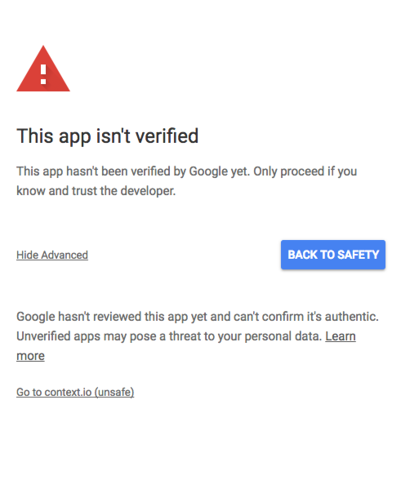
The error an end-user may see when attempting to grant access to your application via OAuth2 is “This app hasn’t been verified by Google yet. Only proceed if you know and trust the developer.”

Google verification error message

This does NOT mean context.io is unsafe.

The error is a bit misleading.

When you see the link “Go to context.io”, the UI is guessing the name of the application based on the Redirect URL detected when making the OAuth2 request, not based on the name of your actual application.

If you are handling your own oauth, then the redirect URL will be on your own domain, and the name of the application appears correctly as the name of your app.

If you are using our connect tokens, the redirect URL will be “api.context.io”, and therefore, “context.io” appears as the name of the app making the request, when in fact it is your application.

We blogged about this previously here.

This means you have a couple of options:

  1. If you are handling your own oauth and seeing this error, you will need to follow the instructions here in order to get your application verified with Google.
  2. If you are using our connect tokens, you can follow the instructions to get verified by Google here, or delete your custom Gmail API key and secret from your Context.IO developer account. Subsequent OAuth requests will use Context.IO’s Gmail API key and secret, which is already verified.

We have a handy Verification process Q&A below, so you can understand the questions asked of you during the verification process as they relate to Context.IO.

  • Why do you require the full scope? Per Google documentation, the necessary scope for working with IMAP is https://mail.google.com . Context.IO cannot work with a lesser scope, as it needs to connect via IMAP.
  • What is Context.IO? Context.IO is an abstraction on top of IMAP that helps developer interface with email in a faster and more streamlined way. Context.IO supports any IMAP enabled account, which makes it easy to integrate only one API and be able to support a variety of end-users.
  • Why do you use Context.IO? We use Context.IO to safely handle the OAuth 2 flow for our application.
  • Why is the redirect URL different than your domain? The redirect URL must be api.context.io, as Context.IO is handling the OAuth process for us. We understand this will display a different application name in the UI authorization screens.
  • Is Context.IO safe? Yes, Context.IO is a safe API. Owned by parent company, Return Path, Context.IO has years of knowledge working with IMAP safely, and adheres to the strictest levels of security.

‘Your app isn’t verified’ error message and what it means for your app was originally published in Context.IO on Medium, where people are continuing the conversation by highlighting and responding to this story.

09 Apr 20:05

Google testing new UI to setup Assistant with ‘Forget Me’ privacy option

by Dean Daley
Google Assistant on OnePlus 3T

Google is testing a new user interface (UI) for its Assistant setup process in version 7.25 of the Google app.

9to5Google spotted the change, following the publication’s earlier discovery of a more conversational user-interface back in September. This new setup, however, abandons the conversational aspect.

According to 9to5Google when a user first sets up Google Assistant there will be a series of animations that show off the capabilities of the voice AI. The process also informs users that ‘Assistant can work with Google partners to help you get things done.’

Furthermore, within the setup, the ‘Services and your privacy,’ section also includes a ‘Forget me’ option that isn’t currently in the live build.

Google currently sends the services you use a unique code so that it can remember your preferences during conversations. However, this ‘Forgot me’ option in Assistant can reset the code for each service.

Currently, Google Assistant will let you select ‘reset app,’ which changes the unique code that performs the same action. It looks like Google is trying to be more clear on what its privacy options can do.

According to 9to5Google, this is active in the current 7.25 Google build as well as the beta version (7.26) of the app. However, on my Pixel 2 XL with version 7.25, the setup process is still more conversational.

Source: 9to5Google 

The post Google testing new UI to setup Assistant with ‘Forget Me’ privacy option appeared first on MobileSyrup.

09 Apr 20:05

One of the things I love about Omni is how seri...

One of the things I love about Omni is how seriously the company takes its privacy policy.

09 Apr 20:04

Dwayne ‘The Rock’ Johnson hosting $300,000 game of HQ Trivia this Wednesday

by Patrick O'Rourke
HQ Trivia

It looks like HQ Trivia’s monetization strategy has finally arrived.

Dwayne Johnson, also known as The Rock, is set to host a game of HQ trivia on Wendesday with a prize pot amounting to $300,000 USD. This is the largest sum of money the live 12-question smartphone trivia game has offered in a single match.

The Rock is handling hosting duties in partnership for the actor’s upcoming movie Rampage, which is set to release on April 20th.

Johnson will host the 3pm ET afternoon game and is set to be backed up by regular host Scott Rogowsky, according to a report from People. What kind of questions will The Rock ask when the game makes it to round 12? Who knows, but I’ll probably be out by question number 3 anyway, given my track record.

The Rampage film is based on the 1980s Midway arcade game that had absolutely no plot — why a studio opted to make a movie based on the property remains a mystery.

HQ is now available on Android, iPhone and iPad.

The post Dwayne ‘The Rock’ Johnson hosting $300,000 game of HQ Trivia this Wednesday appeared first on MobileSyrup.

09 Apr 20:04

Facebook to start notifying users if Cambridge Analytica used their data

by Brad Bennett
Facebook app

Facebook is adding a section to its service that will soon allow users to see if their data was scraped as part of the Cambridge Analytica data breach.

The social networking company claims that 622,161 Canadians had their Facebook data shared without their knowledge as part of Cambridge Analytica’s data harvesting.

All users will soon begin to see a section at the top of their news feed that advises them how to better protect their Facebook data, as well as a list that indicates which users were affected by the scandal.

“We have banned the website ‘This is Your Digital Life,’ which one of your friends used Facebook to log into. We did this because the website may have misused some of your Facebook information by sharing it with a company called Cambridge Analytica,” reads the excerpt on Facebook, as reported by CNBC.

On April 4th, Facebook began asking users for feedback on some of the social network’s new terms of service and in response will make privacy settings easier to access and understand.

On that same day, Facebook CEO Mark Zuckerberg explained to media during a conference call that Facebook plans to start taking a broader approach to the larger social responsibilities that come with running such a large social network.

Source: CNBC

The post Facebook to start notifying users if Cambridge Analytica used their data appeared first on MobileSyrup.

09 Apr 20:04

Here are the rumoured specs for the HTC U12+

by Dean Daley
HTC

Chinese publication CNBeta is reporting HTC U12 specs.

According to GSMArena, however, these are the leaks for the HTC U12+ the company’s next flagship. It’s possible the Taiwanese phone maker will launch the phone under the plus branding in North America and keep it true to the U12 in Asian countries.

While the following spec sheet could possibly be real, take this leak with a grain of salt.

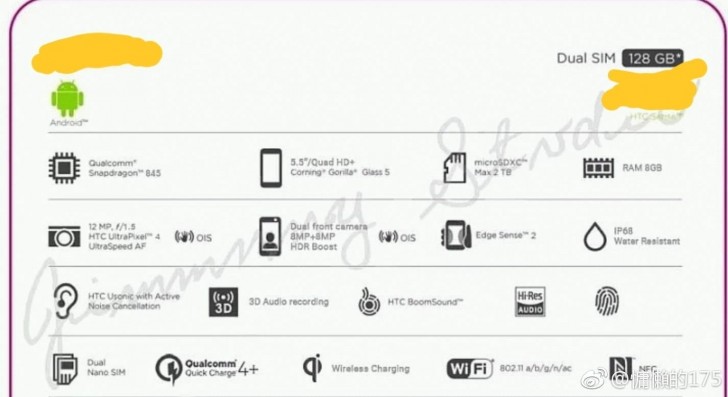
According to the spec sheet, the HTC U12 will feature a Snapdragon 845 chipset, a 5.5-inch Quad HD+ display with 8GB of RAM and 128GB of storage.

Further, the leak points to the phone featuring a 12-megapixel rear-facing shooter with a f/1.5 aperture and OIS. While the front will includes a dual setup with two 8-megapixel sensors. The rumour also claims the U12+ will have wireless charging, Edge Sense 2.0 — a new version of HTC’s squeeze UI — as well as IP68 water and dust resistance, HTC BoomSound and Quick Charge 4+.

What’s odd about this spec sheet is a rear-facing camera. Previous leaks point to the phone featuring a dual rear camera setup with 12 and 16-megapixel sensors. Additionally, previous rumours claim that the HTC U12+ will feature a 6-inch display with 6GB of RAM instead of 8GB of RAM.

It’ll be interesting to see what HTC actually comes up with when they release its HTC U12+.

According to Blass, the phone will launch in early May.

Source: CNBetaVia: GSMArena 

The post Here are the rumoured specs for the HTC U12+ appeared first on MobileSyrup.