Rolandt
Shared posts
How to Be Pro-Market and Pro-Government - Evonomics | David Colander, Roland Kupers
The Power of Standards and Consistency
I’m going to (eventually) write a full post on the package I’m mentioning in this one : osqueryr . The TLDR on
 osqueryr is that it is an R DBI wrapper (that has just enough glue to also be plugged into dbplyr) for osquery. The TLDR on osquery is that it “exposes an operating system as a high-performance relational database. This design allows you to write SQL-based queries efficiently and easily to explore operating systems.”
In short, osquery turns the metadata and state information of your local system (or remote system(s)) into a SQL-compliant database. It also works on Windows, Linux, BSD and macOS. This means you can query a fleet of systems with a (mostly) normalized set of tables and get aggregated results. Operations and information security staff use this to manage systems and perform incident response tasks, but you can use it to get just about anything and there are even more powerful modes of operation for osquery. But, more on all the features of osquery[r] in another post.
If you are skeptical, here’s some proof (which I need to show regardless of your skepticism state). First, a local “connection”:
library(DBI)
library(osqueryr)

con
then, a remote "connection":
con2 "You're talking an awful lot about the package when you said this was a post on 'standards' and 'consistency'."
True, but we needed that bit above for context. To explain what this post has to do with "standards" and "consistency" I also need to tell you a bit more about how both osquery and the osqueryr package are implemented.
You can read about osquery in-depth starting at the link at the top of this post, but the authors of the tool really wanted a consistent idiom for accessing system metadata with usable, normalized output. They chose (to use a word they didn't but one that works for an R audience) a "data frame" as the output format and picked the universal language of "data frames" -- SQL -- as the inquiry interface. So, right there are examples of both standards and consistency: using SQL vs coming up with yet-another-query-language and avoiding the chaos of the myriad of outputs from various system commands by making all results conform to a rectangular data structure.
Let's take this one-step further with a specific example. All modern operating systems have the concept of a "process" and said processes have (mostly) similar attributes. However, the commands used to get a detailed listing of those processes differ (sometimes wildly) from OS to OS. The authors of osquery came up with a set of schemas to ensure a common, rectangular output and naming conventions (note that some schemas are unique to a particular OS since some elements of operating systems have no useful counterparts on other operating systems).
The osquery authors also took consistency and standards to yet-another-level by taking advantage of a feature of SQLite called virtual tables. That enables them to have C/C++/Objective-C "glue" that gets called when a query is made so they can dispatch the intent to the proper functions or shell commands and then send all the results back -- or -- use the SQLite engine capabilities to do joining, filtering, UDF-calling, etc to produce rich, targeted rectangular output back.
By not reinventing the wheel and relying on well-accepted features like data frames, SQL and SQLite the authors could direct all their focus on solving the problem they posited.
"Um, you're talking alot about everything but R now."
We're getting to the good (i.e. "R") part now.
Because the authors didn't try to become SQL parser writer experts and relied on the standard SQL offerings of SQLite, the queries made are "real" SQL (if you've worked with more than one database engine, you know how they all implement different flavours of SQL).
Because these queries are "real" SQL, we can write an R DBI driver for it. The DBI package aims "[to define] a common interface between R and database management systems (DBMS). The interface defines a small set of classes and methods similar in spirit to Perl's DBI, Java's JDBC, Python's DB-API, and Microsoft's ODBC. It defines a set of classes and methods defines what operations are possible and how they are performed."
If you look at the osqueryr package source, you'll see a bunch of DBI boilerplate code (which is in the r-dbi organization example code) and only a handful of "touch points" for the actual calls to osqueryi (the command that processes SQL). No handling of anything but passing on SQL to the osqueryi engine and getting rectangular results back. By abstracting the system call details, R users can work with a familiar, consistent, standard interface and have full access to the power of osquery without firing up a terminal.
But it gets even better.
As noted above, one design aspect of osquery was to enable remote usage. Rather than come up with yet-another-daemon-and-custom-protocol, the osquery authors suggest ssh as one way of invoking the command on remote systems and getting the rectangular results back.
Because the osqueryr package used the sys package for making local system calls, there was only a tiny bit of extra effort required to switch from sys::exec_internal() to a sibling call in the ssh package -- ssh::ssh_exec_internal() when remote connections were specified. (Said effort could have been zero if I chose a slightly different function in sys, too.)
Relying on well-accepted standards made both osqueryi and the R DBI-driver work seamlessly without much code at all and definitely without a rats nest of nested if/else statements and custom httr functions.
But it gets even more better-er
Some folks like & grok SQL, others don't. (Humans have preferences, go figure.)
A few years ago, Hadley (do I even need to use his last name at this point in time?) came up with the idea to have a more expressive and consistent way to work with data frames. We now know this as the tidyverse but one core element of the tidyverse is dplyr, which can really level-up your data frame game (no comments about data.table, or the beauty of base R, please). Not too long after the birth of dplyr came the ability to work with remote, rectangular, SQL-based data sources with (mostly) the same idioms.
And, not too long after that, the remote dplyr interface (now, dbplyr) got up close and personal with DBI. Which ultimately means that if you make a near-fully-compliant DBI interface to a SQL back-end you can now do something like this:
library(DBI)
library(dplyr)
library(osqueryr)

con %
  filter(port != "", protocol == "17") %>% # 17 == TCP
  distinct(name, port, address, pid)
## # Source:   lazy query [?? x 4]
## # Database: OsqueryConnection
##    address name              pid   port
##  1 0.0.0.0 BetterTouchTool   46317 57183
##  2 0.0.0.0 Dropbox           1214  17500
##  3 0.0.0.0 SystemUIServer    429   0
##  4 0.0.0.0 SystemUIServer    429   62240
##  5 0.0.0.0 UserEventAgent    336   0
##  6 0.0.0.0 WiFiAgent         493   0
##  7 0.0.0.0 WiFiProxy         725   0
##  8 0.0.0.0 com.docker.vpnkit 732   0
##  9 0.0.0.0 identityservicesd 354   0
## 10 0.0.0.0 loginwindow       111   0
## # ... with more rows
The src_dbi() call wires up everything for us because d[b]plyr can rely on DBI doing it's standard & consistent job and DBI can rely on the SQLite processing crunchy goodness of osqueryi to ultimately get us a list of really dangerous (if not firewalled off) processes that are listening on all network interfaces. (Note to self: find out why the BetterTouchTool and Dropbox authors feel the need to bind to 0.0.0.0…)
FIN
What did standards and consistency get us?
- The
osqueryauthors spent time solving a hard problem vs creating new data formats and protocols - Rectangular data (i.e. "data frame") provides consistency and structure which ends up causing more freedom
- "Standard" SQL enables a consistent means to work with rectangular data
-
sshnormalizes (secure) access across systems with a consistent protocol - A robust, well-defined standard mechanism for working with SQL databases enabled nigh instantaneous wiring up of a whole new back-end to R
-
sshandsyscommon idioms made working with the new back-end on remote systems as easy as is on a local system - Another robust, well-defined modern mechanism for working with rectangular data got wired up to this new back-end with (pretty much) one line of code because of the defined standard and expectation of consistency (and works for local and remote)
Standards and consistency are pretty darned cool.
Hospital Letters and Flames – Postcard #77

In hospital with sedated Grandpa, Dave reads complete “Letters from Russia” epistolary literature project with frequent interruptions from visitors, nurses and medical apparatus. The letters address issues of class, revolutions, monarchy, war, trade, and love in the context of Napoleon’s foray into Russia in 1812 through letters from a cobbler to his fiancé in Paris. Then finishes with Walt Whitman heading on the open road (which ole Gramps was so fond of doing himself).
Featured music: Mark Olson (music, guitar, vocals) and Dave Olson (lyrics, drums) “Little Flame” – recorded to 4 track cassette, circa 1996.
Breathe easy for: Hospital Letters and Flames – Postcard #76
(82MB, 1:00:05, 192k .mp3, stereo)

Read the “Letters from Russia” project in whole – including illustrations plus dossier of background notes, lectures, interviews etc.
Subscribe
Auto-magically receive Postcard from Gravelly Beach podcast, via:
Reviews rewarded with postal postcards #bribe
Follow along via Twitter @uncleweed & @DaveOstories & UncleWeed Storytime (FB)
“I think of myself not as an astronaut who paints, but as an artist who was once an astronaut.”
The New York Times: Alan Bean, 4th Person to Walk on the Moon, Dies at 86.
“Alan Bean, who became the fourth man to walk on the moon and turned to painting years later to tell the story of NASA’s Apollo missions as they began receding into history, died on Saturday at Houston Methodist Hospital. He was 86.
His death was announced by his family in a statement released by NASA.
Mr. Bean stepped onto the lunar surface preceded by Pete Conrad, the mission commander of their Apollo 12 flight, in November 1969, four months after Neil Armstrong and Buzz Aldrin became the first lunar explorers.
The flight of Apollo 12, while thrilling in its own right, was not nearly as dramatic as the pioneering mission of Apollo 11, but it resulted in a more extensive exploration of the moon.
Mr. Bean returned to space in July 1973, when he commanded a three-man flight to the orbiting space research station Skylab, the forerunner of the International Space Station. The astronauts on that mission spent 59 days in space, a record at the time.”
ars technica: Alan Bean, the fourth human to walk on the Moon, has died. “Bean loved being an astronaut. He may have loved being an artist more.”
I’m just now watching an interview with Alan Bean in two parts from 2011. (YouTube, ca. 40min altogether)
See also MeFi obit thread.
Tapas Forever
Hey everyone,
I’ve started a new website called TapasForever detailing my goal for living for a year in Spain. If you’re interested in the journey, or perhaps want to move to Europe for a year or longer in the future, head on over and check it out.

I recommend visiting the Start Here page for information on the various resources that will be available. I’m looking forward to getting my visa and checking off a lot of boxes in terms of things I would to accomplish in life (Spanish language, I’m looking at you!).
Cheers,
Duane
SotD: Colours
Today we have an adorable little girl/boy-duet pop song called Colours off a very pleasing album of the same name by Devon Sproule and Mike O’Neill. You can tell she’s Canadian by the accent and the “u” in “Colours”. The song has a memorable tune and evey moment of it is full of smiles.

This is yet another I-heard-it-on-the-radio discovery; I don’t know much about Ms Sproule except what Wikipedia says. You may have noticed a lot of Canadian talent showing up in this space. I’m not particularly nationalist, especially around the arts; it’s just that the scene here is sustained by legislation that requires radio stations to play a certain proportion of Canadian stuff, so you can’t help but hear it, and while Sturgeon’s Law applies, there are still plenty of gems to be found.
Back to the song, which is great fun. It tiptoes into a tricky gender-issues area and maybe missteps a bit — just because you’re baffled by someone close of another gender doesn’t mean they’re trying to be opaque. But still, the experience it describes is absolutely widely shared.
Also it’s got this instrumental break that is so self-consciously weird as to be hilarious, as in I laughed on the train to work when it came up on the shuffle. I’ve never heard anything quite like it.
This is part of the Song of the Day series (background).
Links
Spotify playlist. This tune on Amazon, iTunes, Spotify. There’s no good live video.
AI's Biggest Challenges Are Still To Come
|
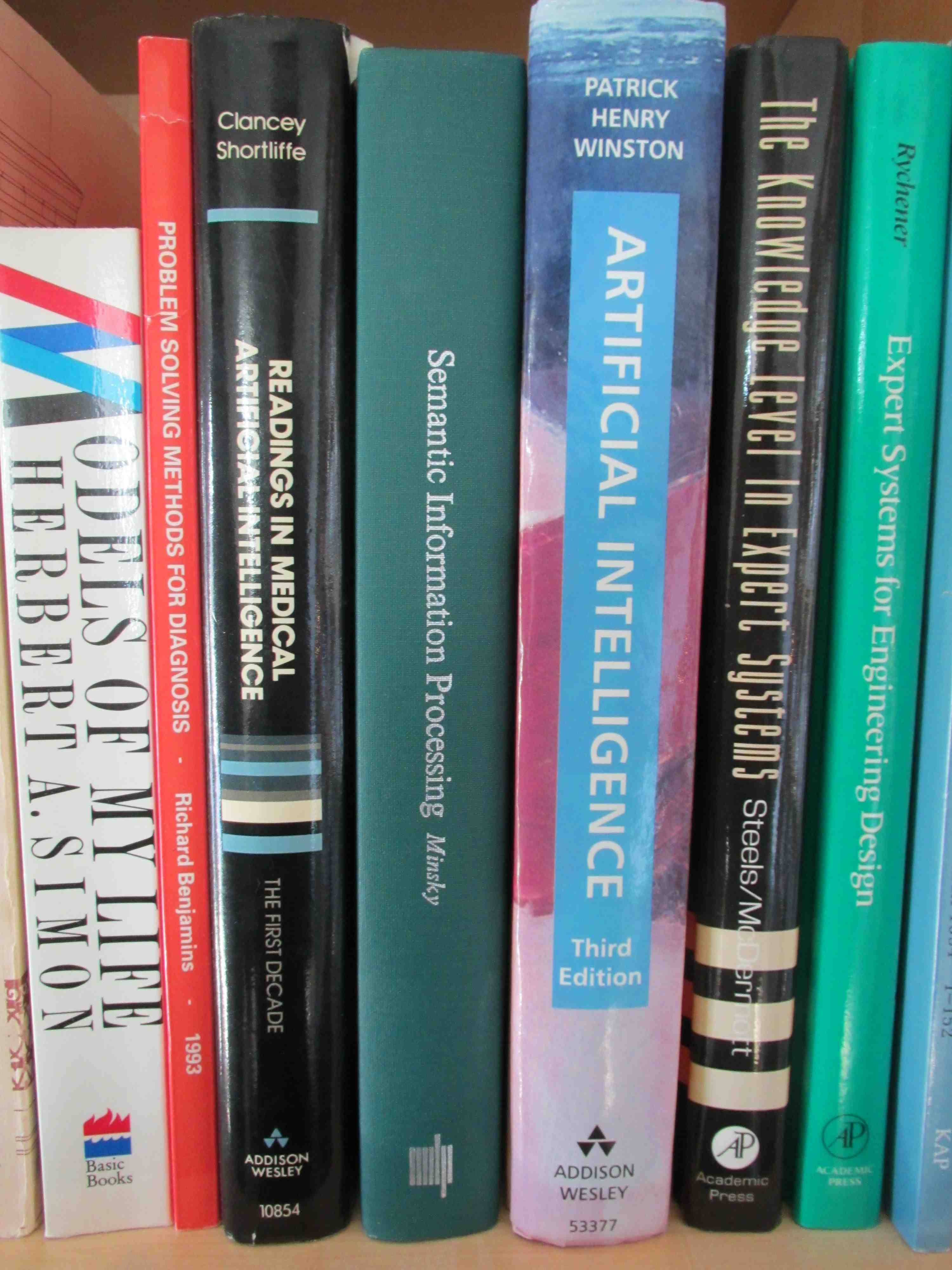
A lot of people I know have been discussing last week's NY Times op-ed about recent advances in neural networks and what they mean for AI. The article even sparked conversation among colleagues from my grad school research lab and among my PhD advisor's colleagues from when he was in grad school. It seems that many of us are frequently asked by non-CS folks what we think about recent advances in AI, from AlphaGo to voice recognition to self-driving cars. My answers sound similar to what some of my old friends say. Are we now afraid of AI being able to take over the world? Um, no. Do you think that the goals of AI are finally within reach? No. Much remains to be done.
I rate my personal interest in recent deep learning advances as meh. I'm not as down on the current work as the authors of the Times piece seem to be; I'm just not all that interested. It's wonderful as an exercise in engineering: building focused systems that solve a single problem. But, as the article points out, that's the key. These systems work in limited domains, to solve limited problems. When I want one of these problems to be solved, I am thankful that people have figured out how to solve and make it commercially available for us to use. Self-driving cars, for instance, have the potential to make the world safer and to improve the quality of my own life.
My interest in AI, though, has always been at a higher level: understanding how intelligence works. Are there general principles that govern intelligent behavior, independent of hardware or implementation? One of the first things to attract me to AI was the idea of writing a program that could play chess. That's an engineering problem in a very narrow domain. But I soon found myself drawn to cognitive issues: problem-solving strategies, reflection, explanation, conversation, symbolic reasoning. Cognitive psychology was one of my favorite courses in grad school in large part because it tried to connect low-level behaviors in the human brain connected to the symbolic level. AlphaGo is exceedingly cool as a game player, but it can't talk to me about Go, and for me that's a lot of the fun of playing.
In an email message earlier this week, my quick take on all this work was: We've forgotten the knowledge level. And for me, the knowledge level is what's most interesting about AI.
That one-liner oversimplifies things, as most one-liners do. The AI world hasn't forgotten the knowledge level so much as moved away from it for a while in order to capitalize on advances in math and processing power. The results have been some impressive computer systems. I do hope that the pendulum swings back soon as AI researchers step back from these achievements and builds some theories at the knowledge level. I understand that this may not be possible, but I'm not ready to give up on the dream yet.
What sidewalks are for
In Vancouver’s West End, on Chilco Street near Alberni:

What streets are for too:

It helps to know that before what was probably the first traffic-calming plan in North America, Chilco would have been one of the busier streets in the West End, providing a shortcut between Georgia Street and Beach Avenue.
Ultimate Vim Config
I have spent the last few years tweaking and refining my VIM configuration until I had the Ultimate Vim Config. It is well organized and documented taking full advantage of Tpope’s pathogen for a excellent clean and modular configuration. The Ultimate vim config contains the perfect .vimrc file combined with an excellent set of plugins all easily managed thanks to pathogen and git. It is on GitHub so you can always grab the latest.
Why Projects Fail
The 5G Core – Part 6 – Connection-, Registration- And Session Management
Today lets have a look at how the 5G Core (5GC) does Connection-, Registration- and Session-Management for 5G devices. As in the previous posts, the procedures are described in 3GPP TS 23.501 which is the 5G analog to the 4G LTE core network description in 3GPP TS 23.401. I guess the similar number is no coincidence.
Connection Management (CM)
While there are a few surprises, the 3 different types of management tasks are similar to what already exists today in the 4G EPC (Evolved Packet Core). When the device wants to communicate with the core network, be it because it has just been switched-on, or because it has been idle for some time and the network has temporarily removed the resources to transfer data (while IP addresses remain in place), it needs to establish a connection to the Access Management Function (AMF). This is referred to as connection management.
While an LTE device in the EPC can either be in CM-Connected or in CM-Idle state, a 5G UE can also be in ‘CM Connected + RRC Inactive state’ when connected to the 5G Core. This state is between CM-Idle and CM-Connected. I think this has been a lesson from LTE, where devices are quite often put into RRC idle state on the radio interface and thus to CM-Idle state towards to core network to conserve power. It doesn’t take long, however, before data needs to be transferred again which then requires a new connection to the core network. This is quite a bit of overhead. In 5G, this will be reduced by the AMF and gNB agreeing that the connection to the core network can remain in place while radio connectivity is removed for a while.
Registration Management (RM)
Being connected to the core network is great but, for example right after power on, the network does not know the mobile device as mutual authentication has yet to be performed and encryption parameters have to first be exchanged as well. This is part of Registration Management. So in most cases, a device that is in CM-Connected state is also in RM-Registered state, except for initial connection attempts. Again, the AMF node takes care of this.
Session Management (SM)
As discussed in part 5 of this 5G core network series, being registered doesn’t necessarily mean that a device also has an IP address. Requesting one, to be a bit superficial for a moment, is part of Session Management (SM), which is handled by the Session Management Function (SMF). The device reaches the SMF via the AMF, i.e. all session management traffic is run through the AMF, which then forwards it along. So perhaps there are a few things during session management that are also interesting for the AMF but I haven’t yet gone down deep enough to see what those would be. Once a session is established, the device usually has an IP address or an IPv6 prefix (or both) and can communicate with the Internet.
MAC Layer Sessions
While in the 4G EPC, devices are only assigned IPv4 addresses and/or IPv6 prefixes, the 5G core network also has a session type that does NOT use IP addresses for routing. These non-IP sessions are based on layer 2 MAC addresses and devices are free to run their own IP addressing scheme on top. The 5G core is only looking at the MAC layer for such sessions. Sounds weird at first but I can imagine such sessions might be useful should 5G radio networks be used in locations such as factories where lots of devices communicate with each other and layer 3 connectivity is managed outside of the 5G core.
MICO
So much for the 3 different types of management tasks in the 5G core. Before I close for today, let me jump back to connection management again for a second, because there is a new concept that does not exist in 4G which is referred to as Mobile Initiated Connection Only (MICO). A device can request the AMF to enable MICO mode which means that once the connection goes to idle, it’s not possible to inform the device of incoming (IP) packets from the Internet. This is probably quite useful for devices that run services which always connect to the server to deliver their data without being asked for it in the first place. As part of this, the server can then send its commands or data. If the server doesn’t, it has to wait until the device contacts it again. A typical smartphone or tablet wouldn’t request MICO to be activated but a lot of machine type applications will definitely benefit from this.
And that’s it for today, more details on Session Management coming up in the next post.
Vancouver files claim against owners of vessel that leaked fuel in 2015 | CBC News
| mkalus shared this story . |
Mayor Gregor Robertson says city hasn't been paid back for about $550,000 it spent on response efforts

Vancouver Mayor Gregor Robertson says the city has filed a claim in federal court against the owner of a vessel that spilled fuel off the city's coast in 2015.
Robertson says three years after the MV Marathassa spilled 2,700 litres of bunker fuel into English Bay, the city still hasn't been paid back for about $550,000 it spent on response efforts.
The claim, filed last month and announced today, is the latest step in the city's efforts to get compensation for its role in the response.
Robertson says the city has sought repayment through the federal government's Ship-source Oil Pollution Fund, but has only been promised compensation for 27 per cent of its costs.
"It's ridiculous that it has taken over three years fighting for our costs to be covered for an oil spill in our harbour," Robertson said.
He says the city doesn't have faith it will be protected in the case of a more devastating spill from tankers carrying diluted bitumen from Kinder Morgan's Trans Mountain pipeline.
"With oil spills around the world, these ship owners are very difficult to go after and the costs are never quite covered by taxpayers or government," he said.
The federal claim against the ship owners is for damages, interest and court costs related to the spill.
It’s a spherical video in a mathematically triplified space with symmetry in space-time
Vihart: Peace for Triple Piano. (YouTube 3D video, 4:15min)
This has got to be one of the most amazing things done with a 3D camera I’ve ever seen. Pro tip: Watch this in fullscreen mode on your phone so you can look around by moving the entire phone, and use headphones to get the full 3D sound effect as well.
Make sure to also watch
Henry Segerman: The Making of “Peace for Triple Piano”. (YouTube video, 13:52min including a “flat” version of the above 3D video).
In this video Vi Hart and Henry Sergerman explain how the video works: how they made one grand piano and one Vi look like three, but one Henry look like only two at the same time.
Vi writes a little more about this project on her weblog: Vihart.com: Peace for Triple Piano.
(This was published back in February, but I only now realized that the RSS feed of this YouTube channel stopped working.)
Exponent Podcast: Black Holes
On Exponent, the weekly podcast I host with James Allworth, we discuss The Bill Gates Line.
Listen to it here.
SotD: Built For Comfort
I saw most of the old blues guys perform, but Willie Dixon was the only one I ever had a conversation with; in maybe 1974 as a teenager, when I was a writer for the student paper at my college, and Willie was playing a show and I asked him what he thought about all these white kids liking the blues. He looked at me like I was an idiot — too polite to point out that you play for whoever’s gonna pay — and said something like “Blues is for everyone, man.” Anyhow, he wrote like 500 songs, and I’ve always thought Built for Comfort was right up there.

I’d make some crack about Willie not being built for speed, but he wasn’t actually fat by American standards, and anyhow it’d just be wrong; he loved to drive a fast blues with his stand-up bass, boppita-boppita-boppita at quadruple speed, sometimes you’d see his bandmates kind of hanging on for dear life.
That concert, it was outside on the lawn, and it changed my life. I’d never seen actual live blues before that wasn’t played by a long-haired white drug hippie. Some of whom could play it pretty well, but these old Chicago guys were really on a different level entirely.
This is collected on his debut album Willie’s Blues, with Memphis Slim on piano. It’s from 1959, this series seems to be spending a lot of time in the Fifties recently. Anyhow, all the songs are good, Willie and Slim are razor-sharp, and the sound quality is fabulous. The producers used the now-abandoned technique of letting the musicians set up, then pointing a couple of high-quality stereo microphones at them hooked up to a high-quality tape recorder, and getting out of the fucking way.
This is part of the Song of the Day series (background).
Links
Spotify playlist. This tune on Amazon, iTunes, Spotify. Here’s a live performance guesting with a white band for a college crowd. Still, it’s fun. But go listen to that album.
Windows Notebooks No Longer Fit For Their Purpose In Meetings
A quick observation today about people coming to meetings with their tablets rather than their Windows based notebooks. So far my crude analysis was that those are the people in companies that mostly need a screen to access and consume information. To them, a keyboard for typing in longer texts quickly and efficiently is a rather optional thing, especially in meetings. But there is one more thing Windows notebooks like to do, especially if they are centrally administered: Not do what you want, especially when you use them to present something during a meeting.
I can’t count the times when I’ve seen people hooking up their notebooks to projectors in a meeting and a few minutes later the daily virus scan brings the notebook and the presentation to its knees. Or those automatic upgrades that require an immediate reboot just when you come to the central point of your presentation. Or the informative pop-ups whenever a new email comes in to humor the audience. Now fast forward to tablets and you have none of these problem!
More and more, projectors in meeting rooms are replaced by large TV screens and wireless connectivity. From a security point of view I find this rather concerning but people love it, it’s fast, it’s convenient. The big advantage here is that tablets often connect to those systems pretty easily without additional hardware.
Yes, with so much software bloat, I can understand why many people no longer bother to bring their notebooks to meetings.
Rewired interview
Here’s a brief interview I did with a new publication called Rewired. As you can see, I’m not always super-comfortable with the way the questions are framed, but hopefully manage to bring my answers in for a landing nevertheless.
Is there (or will there be) a possibility to be 100% tech-free in our society?
No society of human beings has ever been “tech-free,” since well before the moment we first emerged as a distinct species. Like other species on Earth, we have always used technical extensions of our being to enact the satisfaction of need and the fulfillment of desire — always, from before the beginning. Stripped of our technologies, we would not merely no longer be capable of constituting a society, we would no longer be human.
You write in the first chapter of Radical Technologies that phonebooths, Walkmans, etc., disappeared. Do you think that people become less attached to objects? But at the same time, why is there this revival of “old school” objects, like vinyl records for example?
Part of it, for the older generation of consumers, is no doubt nostalgia. Those of us who were born before 1980 or so have lived through quite an impressive lacuna: we experienced a trough of time during which a great many of the objects that had between them constituted much of the material substrate of social existence in the developed economies simply disappeared from the world. For these objects to reappear in a slight return — dusted off and perhaps upgraded — is a warm bath in the reaffirmation of a baseline psychic normality we thought had fled from the scene forever. As I write to you now I am within arm’s reach of an Olivetti Lettera 33 typewriter and a Western Electric Model 500 rotary telephone, neither of which I actually use for their intended purpose, both of which I keep around as exemplars of the modernism, dynamism and sophistication I remember from my early childhood.
And beyond that, there are real pleasures associated with these objects: pleasures that their contemporary near-equivalents simply do not afford, that have value independent of whatever nostalgia they may invoke, and that remain available even to those for whom they constitute entirely novel experiences and not reflections of something remembered. Though I don’t do so myself, I understand that playing a vinyl record isn’t simply a sterile act of media consumption. It’s an auditory and tactile and even olfactory experience, material in nature, sharply bounded in space and time, and in fact subject to physics in a way listening to Spotify just isn’t. That sure seems sufficient to explain why some of us might find the experience desirable.
How do you explain the fact that in democratic countries, people are consciously subjected to the dictatorship of tech?
I don’t think I know exactly what you mean by “the dictatorship of tech,” but if I understand you correctly, you’re concerned to know why people voluntarily choose the circumstances of their own oppression? All I can say by way of answering is that the dynamic has been recognized for well over a century, and has been addressed by everyone from Engels and the Frankfurt School to Michel Foucault, Martha Nussbaum and Noam Chomsky. I don’t myself believe that there’s anything particularly new about the information-technical turn in this regard.
Beyond that, I always feel a little hesitant, even a little shabby in ascribing false consciousness to someone else, as if I and I alone am possessed of an analysis of such Olympian clarity as to lay bare all the ways in which we pull the wool over our own eyes. Nobody you’ll ever meet is quite so smug as the undergraduate who’s just read Marcuse for the first time, or the barstool philosopher who’s seen Manufacturing Consent, and thinks that getting their news from Reddit somehow constitutes a brave, heroic end run around the process of discourse management. Don’t be that guy.
You talk in your book about low-waged labor forces in Shenzhen for example, to satisfy our consumption. Do you think that we became numb to other people’s situation? Are we in what Albert Camus would call the “murderous consent”?
We were always already numb to the suffering of the other — if, indeed, we weren’t actively indifferent to it. It is our present circumstances, by contrast, that begin to extend the remotest hope of learning from the confrontation with the consequences of our desires.
You write that apps like OpenDesk are revolutionizing the way we conceive things. With 3D printers, we can print chairs, tables, etc. You say that with a printer, a laser cutter and feedstock we can make anything at home. Do you find this worrying, as it is easy to imagine someone creating a 3D gun for example?
I do not say that with a printer, a laser cutter and feedstock we can make anything at home. I say no such thing.
What I do say is that the range of useful things that the untrained, ordinary person can now fabricate, equipped with nothing more than a printer or laser cutter costing a few hundred dollars, has grown considerably. And furthermore, that the range of such things not long ago expanded to include, yes, crude, rudimentary firearms, devised by ideologues and fanatics to prove precisely this point, as a kind of propaganda of the deed.
I don’t believe this is cause for any particular concern at the moment, as such weapons clearly tend to pose a greater threat to their own would-be users than they do to anyone else. But, you know, we can see what’s coming. It’s in the mail. And what that suggests to me is that polities or societies that wish to discountenance the spread of such weapons (or other notionally or actually harmful objects that might be fabricated in this way) would be best advised to adopt a layered defense in depth composed of multiple kinds of frictions, retardations and disincentives — in essence, a harm-reduction strategy rather than one of prohibition.
You explain that data has political involvements and that “the data is never just the data.” Do you think that governments are blatantly lying to satisfy data?
All governments lie, and always have — all human institutions, for that matter, not merely those of state. All human institutions will attempt to create an epistemic environment that’s favorable to their own continuation, by any means at their disposal, at both the micro and macro levels — even when this is not always in their own longer-term interest, as Goodhart’s Law suggests. The manipulation or selective release of statistics was an important component of this sort of effort in the twentieth century, and it is now augmented by the selective collection, manipulation of or differential analysis applied to machine-readable data, sure.
Yesterday, Elon Musk said he would make a platform to rate and track a credibility score for journalists. Do you think that more and more actions of the sort will start to take shape?
That’s funny. What might actually be more useful is a platform to rate and track Elon Musk’s credibility.
Piling higher and deeper
Today I am deeeeeeeeeeelighted to share with you the news that my application to study toward a PhD in the Cities Programme of the Sociology Department at the London School of Economics has been accepted. Good god! I’m going back to school!
This is quite the fiftieth birthday present, and will require above all that I get over the little chip on my shoulder I’ve carried around for years about being uncredentialed, unaffiliated and unbound. This has been an enduring source of pride and strength for me, but I’ve come to feel like it’s outlived its utility, and has for the past little while actually functioned as a pretty sharp constraint on some of the things I’d like to achieve. Time to leave it behind.
Unending thanks to David Madden and Suzi Hall for your guidance and encouragement, to Saskia Sassen and Richard Sennett for your active support of my candidacy, and to Nurri Kim for your insight and counsel. I am so, so stoked — in fact, I cannot quite believe I’ve been offered the opportunity to learn and grow from this particular community of passionately engaged scholars. Let’s kick the tires and light the fires, I am ready to go.
my view of waikiki today from the water

Photo Caption: my view of waikiki today from the water
Photo taken at: Canoes Surf break, Waikiki Beach
Instagram filter used: Clarendon
Wyze Cam v2
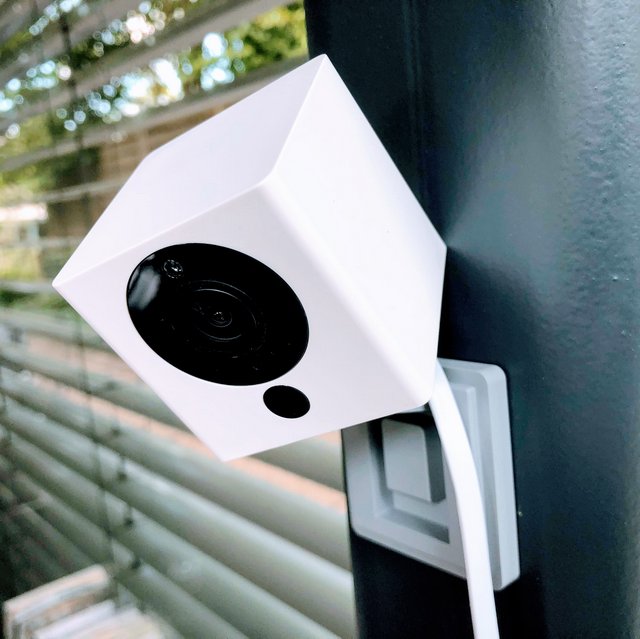
Let's start with a bombshell: this 1080p camera costs only 20 US-$. And you can't buy it here. No CE certification.
There is a very long list of features and use cases, that I will go through, but let me start by saying this might be the offer you cannot refuse. It is very inexpensive and powerful at the same time. How did I get it? Johannes bought a few in the US and gave one of them to me. Usually I won't accept a product not from the vendor. I don't want you to spend money on samples. But I will make an exception here.
1080p video gets recorded, end-to-end encrypted and you can watch it live on your iPhone or Android. You can set a variety of triggers (motion, sound, beeps from smoke or CO detectors) and it will record 15 seconds of footage and store them in the AWS cloud for 14 days. You can set it to continously record to microSD storage (not included) and it will overwrite the oldest video as the card fills up. The app will allow you to watch the continuous recording without removing the storage card. Wyze has added IFTTT support so you can trigger other actions. Vice versa you can let IFTTT trigger the camera to record or change its alert settings. IFTTT also gives Wyze Cam geofencing support. Switch on alerts when you are not at home, for instance.
The camera is powered through a microUSB-port and it has a USB-A port to daisychain up to three Wyze Cams from a single power source. The app will let you control multiple cams. Like many other webcams it has night vision through a infrared LED that illuminates the scene in the dark.
Beyond that, it has some pretty advanced features. The camera does motion sensing and tagging. It will put a frame around moving objects in the footage and you can set a motion detection zone, so a cat won't trigger an alert but a human will. If you want to watch your pets, you can also set the camera to record time lapse videos to local storage.
The camera itself feels really cheap. It's just a small white box with a tilt and swivel grey stand. The stand contains a magnet so you can attach it to metal surfaces. It comes with a metal base and an adhesive so you can attach it to a wall. It's indoors only. No battery, no water resistance.
Pretty impressive for $20, right?

"Work without love is slavery."
Trust, Verify, and Triangulate
 “Trust but verify” is no longer an effective strategy in an information saturated world. When Ronald Reagan quoted the Russian proverb in 1985, it seemed clever enough; today it sounds hopelessly naive. If we are reasonably diligent executives or citizens, we understand and seek to avoid confirmation bias when important decisions are at hand. What can we do to compensate for the forces working against us?
It’s a cliché that we live in a world of information abundance. That cliché, however, has not led to the changes in information behaviors that it implies. We still operate as though information were a scarce commodity, believing that anyone who holds relevant data is automatically in a position of power and that information seekers depend on the holder’s munificence.
As data becomes abundantly and seemingly easily available, the problem for the information seeker changes. (It changes for the information holder as well, but that is a topic for another time.) The problem transforms from “Can I get the data?” to “What data exists? How quickly can I get it? How do I know I can trust it? How do I evaluate conflicting reports?” It is no longer simply a question of getting an answer but of getting an answer whose strengths and limits you understand and can account for.
The temptation is to fall into a trust trap, abdicating responsibility to someone else. “4 out of 5 dentists recommend…” “According to the Wall Street Journal…” “The pipeline predicts we’ll close $100 million…”
There was a time when we could at least pretend to seek out and rely on trustworthy sources. We counted on the staffs at the New York Times or Wall Street Journal to do fact checking for us. Today we argue that the fact checkers are biased and no one is to be trusted.
Information is never neutral.
Whatever source is collecting, packaging, and disseminating information is doing so with its own interests in mind. Those interests must be factored into any analysis. For example, even data as seemingly impartial as flight schedules must be viewed with a skeptical eye. In recent years, airlines improved their on-time performance as much by adjusting schedules as by any operational changes. You can interpret new flight schedules as an acknowledgment of operational realities or as padding to enable to reporting of better on-time performance.
If we are a bit more sophisticated, we invest time in understanding how those trusted sources gather and process their information, verifying that their processes are sound, and accept their reports as reliable inputs. Unfortunately, “trust but verify” is no longer a sufficient strategy. The indicators we once used to assess trust have become too easy to imitate. Our sources of information are too numerous and too distributed to contemplate meaningful verification.
Are we doomed? Is our only response to abandon belief in objective truth and cling to whatever source best caters to our own bias. Fortunately, triangulation is a strategy well matched to the characteristics of today’s information environment.
In navigation, you determine your location in relation to known locations. You need at least three locations to fix your current position. Moreover, you need to account for the limits of your measurement tools to understand the precision of your fix. In today’s world of GPS navigation, that precision might well be very high but still imperfect.
In organizational (and other) settings where you are attempting to make sense of—or draw useful inferences from—a multitude of noisy and conflicting sources, the principles of triangulation offer a workable strategy for developing useful insights in a finite and manageable amount of time.
In navigation, the more widely and evenly dispersed your sightings, the more precisely you can fix your position. Focus your data collection on identifying and targeting multiple sources of input that represent divergent, and possibly conflicting, perspectives. Within an organization, for example, work with supporters and opponents, both active and passive, of a proposed reorganization or systems deployment to develop an implementation strategy. When evaluating and selecting a new application, seek out a wider assortment of potential references, vendors, and analysts.
Triangulation also helps counteract the simplistic notion of balance that undermines too many narratives. Triangulation is based on living in a three-dimensional world; it cannot tell you where you are with only two fixes. We should be at least as diligent when mapping more complex phenomena.
A data collection effort organized around seeking multiple perspectives and guidance risks spinning out of control. Analyzing data in parallel with collection manages that risk. Process and integrate data as it is collected. Look for emerging themes and issues and work toward creating a coherent picture of the current state. Such parallel analysis/collection efforts will identify new sources of relevant input and insight to be added to the collection process.
Monitoring the emergence of themes, issues, and insights will signal when to close out the collection process. In the early stages of analysis, the learning curve will be steep, but it will begin to flatten out over time. As the analysis begins to converge and the rate of new information and insight begins to drop sharply, the end of the data collection effort will be near.
The goal of fact finding and research is to make better decisions. You can’t set a course until you know where you are. How carefully you need to fix your position or assess the context for your decision depends on where you hope to go. Thinking in terms of triangulation—how widely you distribute your input base and what level of precision you need—offers a data collection and analysis strategy that in more effective and efficient than approaches we have grown accustomed to in simpler times.
The post Trust, Verify, and Triangulate appeared first on McGee's Musings.
“Forever Bikes”
Metro Vancouver’s Bike to Work Week, starting Monday, may only run for seven days, but artist Ai Weiwei thinks bicycles are forever:

Forever Bikes — Ai Weiwei
Currently showing at The Contemporary Austin (TX)
Public Mobile flash sale offers second month of service for $0

Telus-owned prepaid carrier Public Mobile is currently offering a 30-day plan for $0 — but just for this weekend.
The offer is effective May 26th until May 27th at 11:59pm ET, and is available to new customers only. Additionally, because of the short time frame, it’s targeted at customers who can activate in-store through Walmart, K-Mobile and WOW! Mobile Boutique, rather than online (since SIM shipping will take too long).
To get the deal, those interested can activate on a 30-day rate plan and will be credited the amount within 72 hours, which will then apply to the next plan renewal. This effectively makes the second month free, unless any add-ons or upgrades are purchased.
Public Mobile SIM cards are available at Walmart, K-Mobile and WOW! Mobile Boutique and are free as long as they are activated in-store. If purchased and activated later, or if purchased online, the SIM cards are $10.
Public Mobile notes the offer is not stackable with the offer to get a free SIM and $20 account credit when activating at talk and text plan at Walmart.
Source: Public Mobile
The post Public Mobile flash sale offers second month of service for $0 appeared first on MobileSyrup.
Happy Sally Ride Day!
You may not be familiar with this holiday, but today we celebrate the first American woman astronaut: Sally Ride. Sally’s favorite subject in school was always math, but she had a keen interest in astronomy and physical science. She was quoted saying “For a long time, society put obstacles in the way of women who wanted to enter the sciences.” Despite these hindrances, she joined NASA in 1978 and became the first American female in space in 1983.
![[Sally Ride] America's first woman astronaut communitcates with ground controllers from the flight deck during the six day mission of the Challenger. National Aeronautics and Space Administration., 06/18/1983 - 06/24/1983](https://farm4.staticflickr.com/3285/5829345024_cca7242186_z.jpg)
“My background is in physics, so I was the mission specialist, who is sort of like the flight engineer on an airplane.”
Her job once she was in space during the STS-7 space shuttle mission, her first mission, was to work the robotic arm of the shuttle. The arm was used to help launch satellites into space.
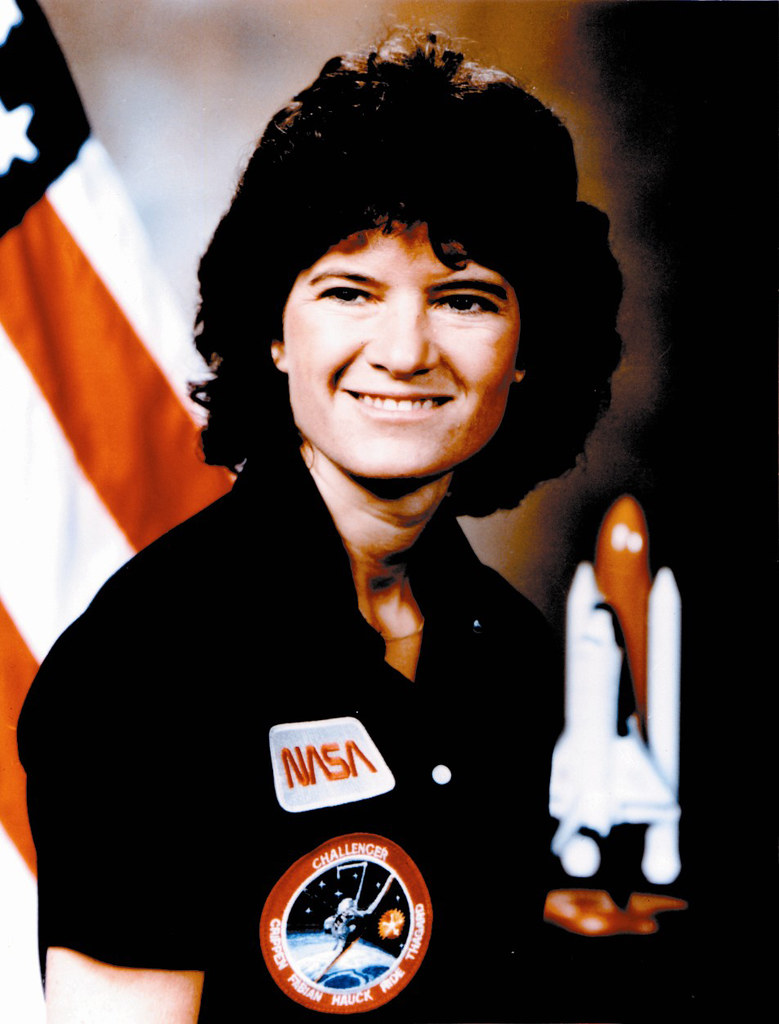
Sally Ride retired from Nasa in 1987. She left as the first woman and youngest American in space at just 32 years old. Sally went on to become a physics professor at the University of California, San Diego. She also founded an educational company called Sally Ride Science to help inspire women and minorities to enter and stick with STEM (science, technology, engineering, and math).

Sally was the CEO of Sally Ride Science until she passed on July 23, 2012, after a long struggle with pancreatic cancer. Her passion for the work is not forgotten. Sally said: “Studying whether there’s life on Mars or studying how the universe began, there’s something magical about pushing back the frontiers of knowledge. That’s something that is almost part of being human, and I’m certain that will continue.”

If you think that this whole astronaut thing sounds pretty sweet, here are a few quotes from Sally herself.
For whatever reason, I didn’t succumb to the stereotype that science wasn’t for girls. I got encouragement from my parents. I never ran into a teacher or a counselor who told me that science was for boys. A lot of my friends did.
The world and our perceptions have changed a lot, even since the ’70s, but there are lingering stereotypes. If you ask an 11-year-old to draw a scientist, she’s likely to draw a geeky guy with a pocket protector. That’s just not an image an 11-year-old girl aspires to.
When you’re getting ready to launch into space, you’re sitting on a big explosion just waiting to happen.
On the view from space:
The stars don’t look bigger, but they do look brighter.

Phil Schiller Explains Steam Link App Rejection

Valve announced on May 9th that it would release a video game streaming app called Steam Link. According to Valve, that announcement was made after the app was approved by Apple’s App Review team. As we reported Friday, Valve says that App Review reversed its decision the next day, rejecting the app for what Valve describe as ‘business conflicts with app guidelines.’
Steam Link is an app designed to allow users to stream Steam games from a Mac or PC to an iOS device or Apple TV over fast WiFi or Ethernet. Valve appealed the rejection on the basis that it was similar to other LAN-based remote desktop apps available on the App Store, but the appeal was denied. That led some people to question whether Apple’s rejection was motivated by a desire to protect gaming on iOS devices and the Apple TV.
We now have a better idea of the reasons behind the Steam Link rejection thanks to an email message from Phil Schiller, Apple’s Senior Vice President of Worldwide Marketing, to a MacStories reader, the authenticity of which we have verified.
The reader, who asked to remain anonymous, wrote to Schiller asking that Apple reconsider the rejection. In response Schiller said:
We care deeply about bringing great games to all of our users on the App Store. We would love for Valve’s games and services to be on iOS and AppleTV.
Unfortunately, the review team found that Valve’s Steam iOS app, as currently submitted, violates a number of guidelines around user generated content, in-app purchases, content codes, etc. We’ve discussed these issues with Valve and will continue to work with them to help bring the Steam experience to iOS and AppleTV in a way that complies with the store’s guidelines.
Without having tried the app, it’s impossible to know precisely what aspect of the App Review Guidelines Apple concluded Steam Link violated, but Guideline 1.2, requires apps with user-generated content to have a way to filter objectionable content and remove offensive material, for example. In-App Purchases are another area with specific guidelines, many of which apply to games, in-game currencies, loot boxes, level unlocking, and more. Guideline 3.1.4 also forbids apps from using their own mechanisms to unlock content or functionality.
Although it’s disappointing that Steam Link was rejected, it appears from Schiller’s message to our reader that there was more going on in the app than just streaming games from a PC or Mac. The guidelines that Schiller says were violated are not new, but with only the Steam Mobile app on the App Store, Valve probably hasn’t had to address user-generated content or game-specific guidelines in the past. Hopefully, the two companies can find a way to resolve the issues that satisfies the guidelines and allows Valve to provide its users with a way to enjoy their Steam games on iOS and tvOS.
Support MacStories Directly
Club MacStories offers exclusive access to extra MacStories content, delivered every week; it's also a way to support us directly.
Club MacStories will help you discover the best apps for your devices and get the most out of your iPhone, iPad, and Mac. Plus, it's made in Italy.
Join Now“Forever Bikes”
mkalus
shared this story
from  Price Tags. Price Tags.
|
Matro Vancouver’s Bike to Work Week, starting Monday, may only run for seven days, but artist Ai Weiwei thinks bicycles are forever:
Forever Bikes — Ai Weiwei
Currently showing at The Contemporary Austin (TX)


This is 40: Dunsmuir Viaduct North
|
mkalus
shared this story
from Price Tags.
|
The second in a short series of panoramic retrospectives from Vancouver’s youth, courtesy of ‘Changing Vancouver’ blog co-author Andy Coupland.
As he noted, there likely won’t be a fourth photo for this retrospective, although perhaps the perspective from the new bike/ped bridge will work…

1978 photographer Trish French.


Amazfit Bip fills the simple smartwatch void left by Pebble

There’s been a hole in the smartwatch market ever since Fitbit acquired Pebble in 2016.
My first smartwatch was a black first-generation Pebble. I loved that little watch and all it could do.
The Pebble Technology Corporation formed when its founder, Eric Migicovsky, launched the company’s first smartwatch in the spring of 2012 through a record-breaking Kickstarter campaign.
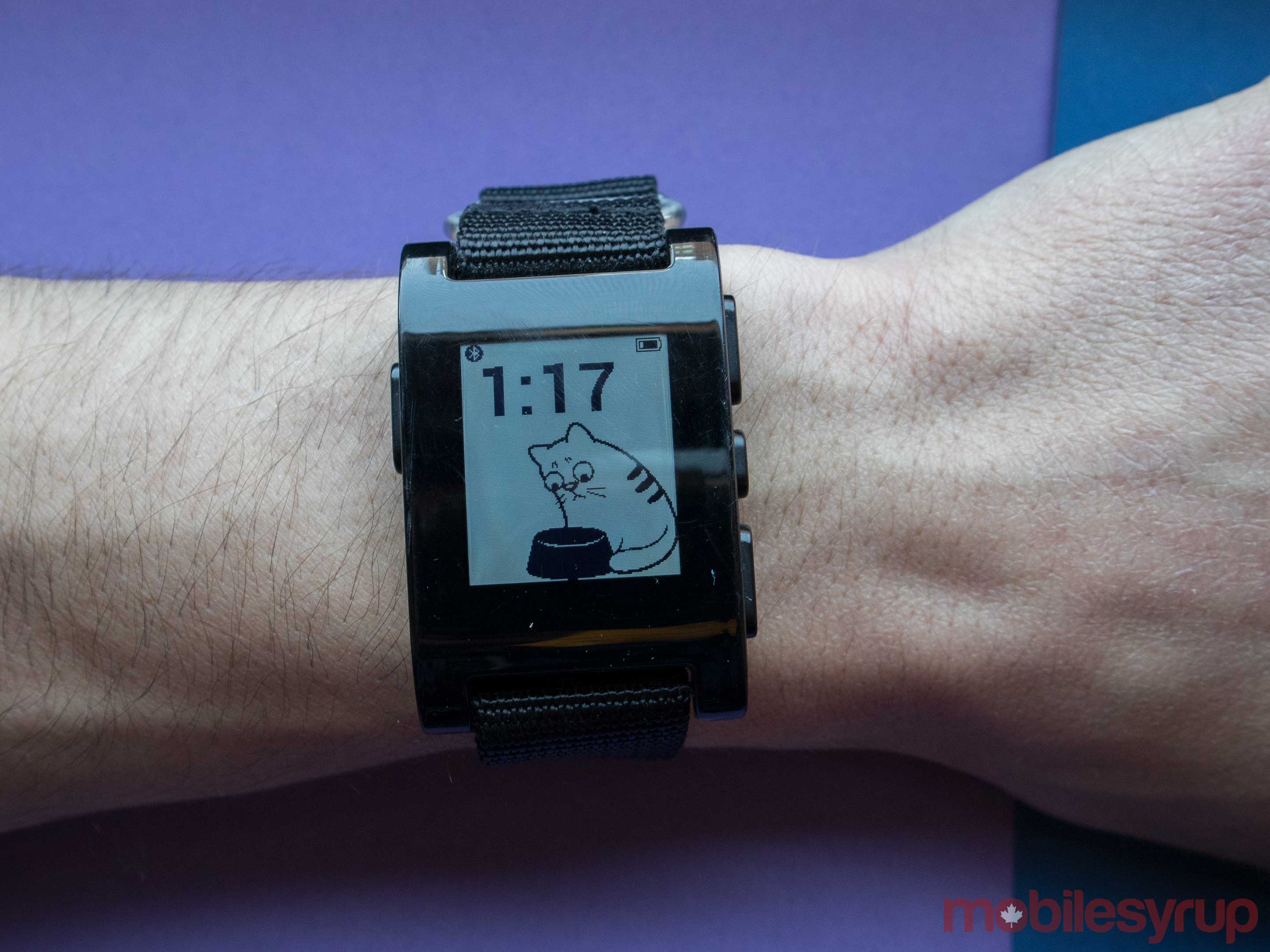
Flash forward four years and seven watch variants later to 2016, and Pebble sold itself to Fitbit. Fitbit then shut down Pebble and stopped selling the company’s products.
Pebble’s line of watches all featured some variation of an e-ink display, a type of screen that’s both legible in direct sunlight and doesn’t use as much battery life as a LCD or AMOLED display.
Since the fall of Pebble, there haven’t been many watches on the market that feature an e-ink screen, and even fewer that have been truly noteworthy.
That’s where the Amazfit Bip comes in, a device that breathes a new life into e-ink smartwatches.
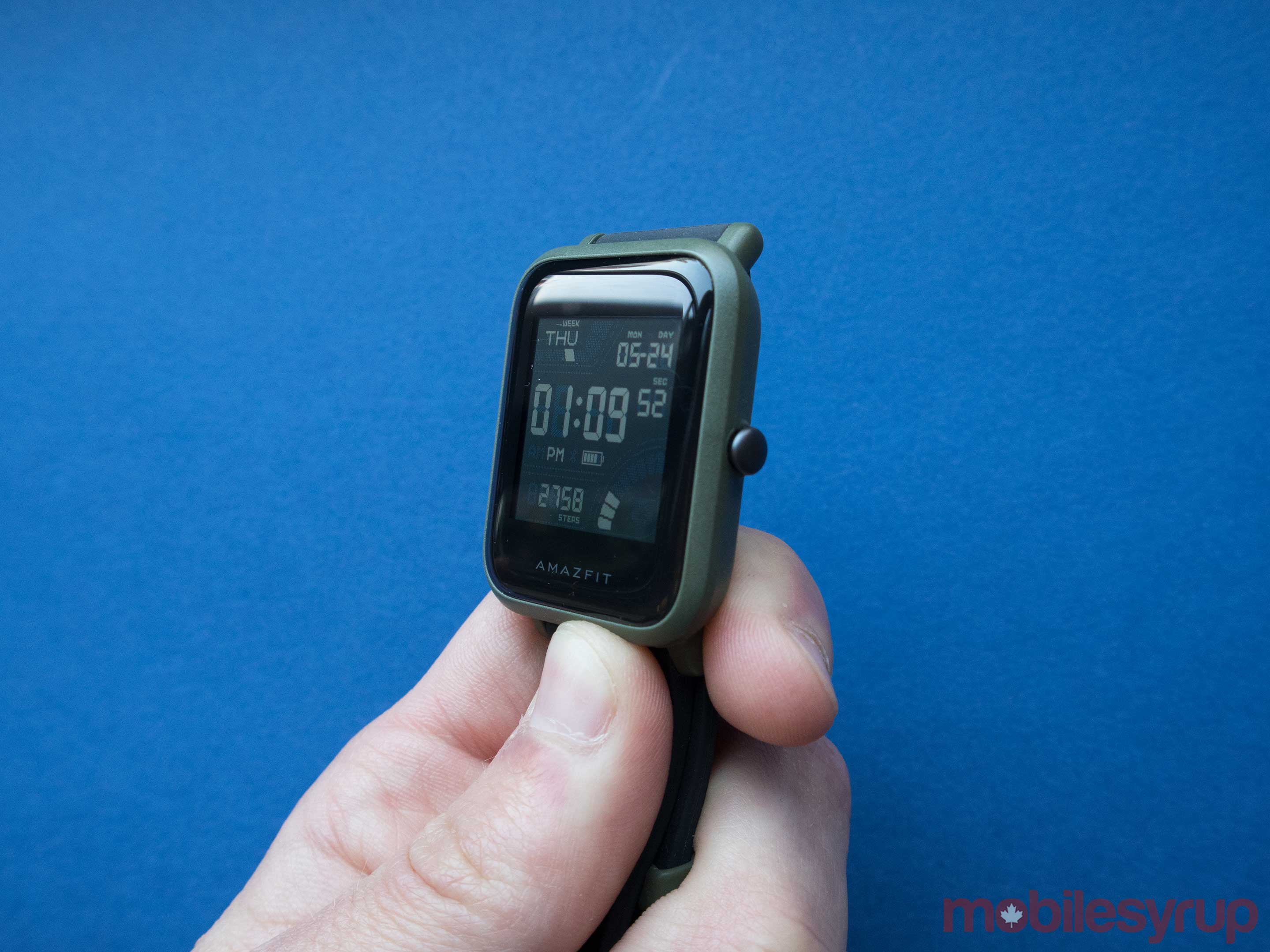
Amazfit is an arm of Chinese electronics brand Xiaomi. The company has been making wearables since 2016, but until recently it hasn’t sold watches in North America.
Like Pebble, Amazfit’s Bip has an e-ink display. Its small size and modest goals take me back to the days before smartwatches were as feature-filled as they are now. Since the screen is e-ink, I never had any problems viewing it outside, and the backlight is bright enough to be seen in the dark, too. 
This watch’s 200mAh battery can last for a month on a single charge, giving it the best smartwatch battery life I’ve ever used. I got the watch on April 9th and I’ve only charged it once since then. It can not be understated how long this little device lasts. I never had to worry if it would be charged for another day of use in the morning.
The Bip also has some simple smartwatch functionality. It offers smartphone notifications and some activity tracking, such as a step counter and GPS. Along with this, there are weather and clock apps.
Where the Bip differs from Pebble is in its addition of a touch screen. While the touch screen isn’t as responsive as Pebble’s three button design, it is a bit easier to use while the watch is on your wrist. The touch screen controls are fairly simple but they just take a few tries to learn. Users can swipe left to go through the app pages and then a tap will open the app. Usually, once inside an app, users have to swipe up and down instead of left to right like on the main screen.
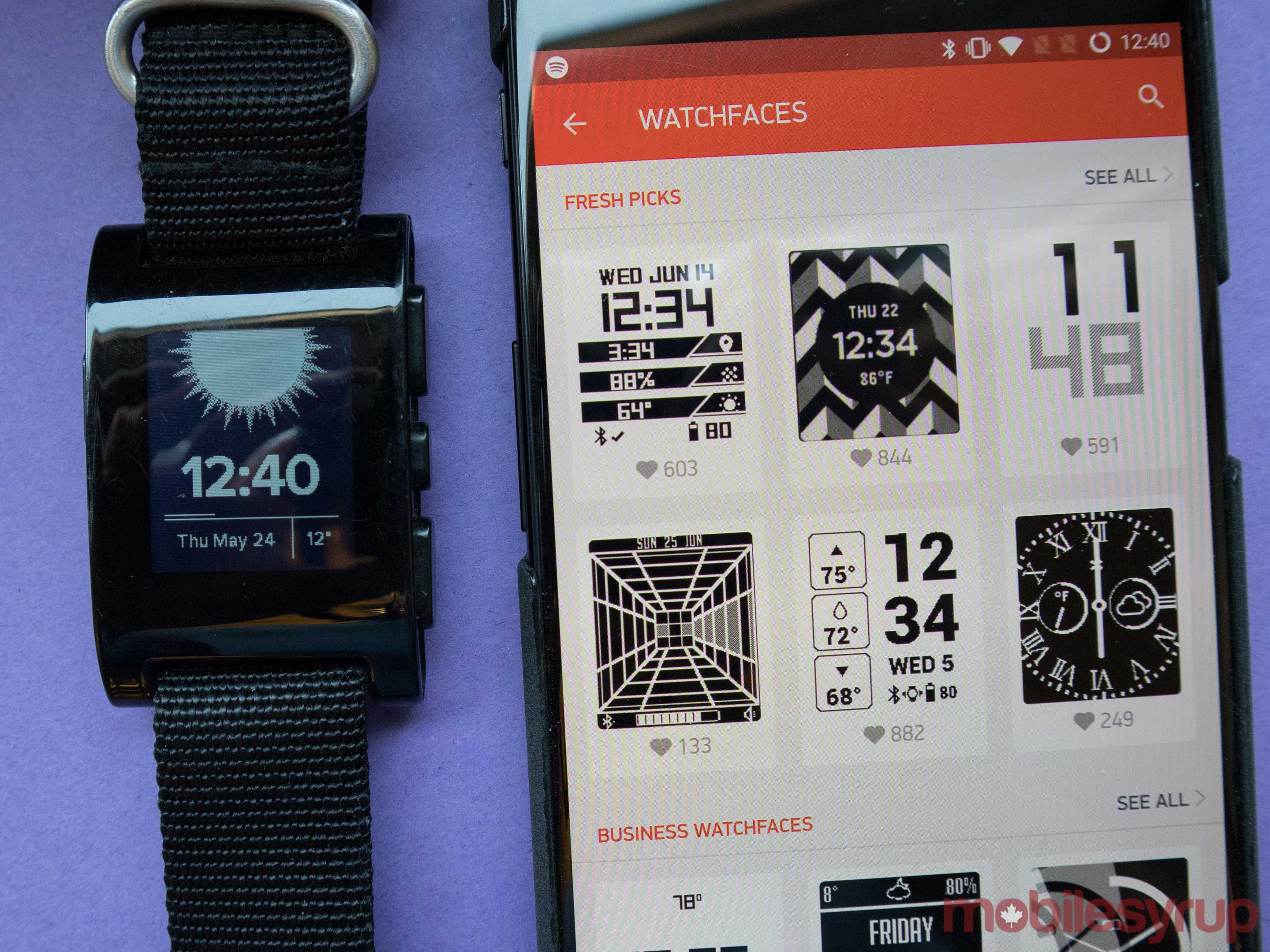
It’s in this section that the Bip falls a little behind the Pebble. While the Bip does have better activity tracking than the first generation Pebble — step counting didn’t work in the background — it doesn’t give users the ability to control music playback or add any other apps like Pebble did. Yet, even without these features I still use the Bip almost every day since I love its compact design and simple premise.
But the Bip doesn’t fill the shoes of Pebble completely. There was something to be said about being able to browse website after website of custom-made watch faces that people had created for the Pebble. The Pebble smartwatch community offered something special that always made browsing new apps or watch faces really fun.
Being able to see what crazy apps people were making that almost always added interesting and new functionality to the watches made it an experience that hasn’t really been replicated on any other watches since.
Altogether the Bip is a great yet simple watch that does what I need it to do and reminds me enough of my first Pebble to make me happy.
The Amazfit Bip comes in four colours and costs $99 USD, which comes in at $129.79 CAD
The post Amazfit Bip fills the simple smartwatch void left by Pebble appeared first on MobileSyrup.