Shared posts

27 May 00:59

2200 Yukon Street

by ChangingCity

Three Vets operated a grandfathered retail store in an industrial zone in Mount Pleasant for many years. They sold the building and closed the business a few months ago, and now the project to replace the store has been submitted.

It’s a four storey building of just over 50,000 square feet, with a third industrial and two thirds office space like all the other projects nearby coming forward in the area. It’s designed by Proscenium Architecture.

27 May 00:58

Photo


27 May 00:58

Do Fewer Things, Better

by dshah@hubspot.com (Dharmesh Shah)

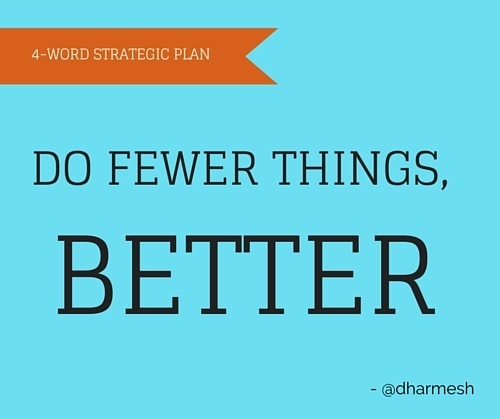
I'm going to tell you a secret.  I have a very simple, 4-word strategic plan (devised it a few years ago).

Here it is...
fewer-things-better-3.jpg

Do fewer things, better.

This has made my life -- and my work, dramatically better.

Here's how I execute on my strategic plan:

1. Decide on what matters the most.

2. Say no to everything else.

3. When something falls in the gray area, re-read #2.

Of course, that's easier to say than do. I fail at it all the time -- but I'm getting better.  Here are some tips learned from years of practice:

1. When making your list, start with a low-level of abstraction.  Resist the temptation to make your list really "high-level".  As an extreme example, one of the things on your priority list shouldn't be "Be successful".  That's so broad, that you'd be able to rationalize almost every activity under the sun.  Try to be specific enough that the number of things that "fit" is a manageable number.  If you find yourself taking on too much (which you probably do), refine your filters and move to a lower-level of abstraction.  I've written an article on this that you might find useful:  "The Power of Focus and The Peril of Myopia".   

2. Forgive yourself for having to say "no" to things not on your "fewer things" list.  Years ago, I wrote a blog post asking public forgiveness , you can see it here at http://MustSayNo.com.  Of all the articles I've ever written, that one has had the most positive impact on my life. 

3. Remember that every time you say "no" to something you might have said "yes" to, it frees up time to focus on the things that matter.  And the more time you spend on the things that matter, the better you get at them.  Let me give you an example:  Let's say you say "no" to some project/request/idea that would have "only" taken a few hours a month, because it didn't make the "few things that matter" list.  And, let's say that one of the things that matter to you is being able to better communicate your message to the world -- via public speaking.  Those few hours you "saved" can be spent on getting your message out. More speaking gigs, more people influenced.  But wait!  That's not all!  Not only are you able to do some more public speaking, because you're going to spend more time on it, you're going to get better at it.  And, because you get better at it, you're going to get more frequent speaking invites.  With larger audiences.  And have more influence once you're on stage.  You're building leverage by getting better and better at the thing that matters.  And, it's amazing how much better you will get, once you decide on only a few things to get better at.

By the way, the reverse of this is true to:  Everytime you say "yes" to something, you're saying "no" to something else.  Often, you're saying "no" to something more important.

4. Fight the FOMO (Fear Of Missing Out) emotion.  It's a killer. We all have it to varying degrees.  This fear that if we don't say "yes" to something, we're going to miss out on some big opportunity, small joy or new connection.  Yes, sometimes you will miss out, but that's OK.  Life goes on.  On average, you will be better off skipping some things, instead of trying to do too much.  

More people fail from a gluttony of good activities than from being starved of them. 

5. Be super-careful with recurring commitments.   If you are going to occasionally say "yes" to things that are not on your "things that matter most" list, be super-careful that they're not a recurring commitment.  A one-time commitment of 4 hours is much less dangerous than a monthly hourly committment.  The way I think about this:  When I say "yes" to a recurring committment, I'm effectively saying "yes' multiple times (for as long as I think I'm going to be in that committment).  Which brings me to the next point...

6. As painful as it is, prune your prior committments. If you are like me (and apologies if you are), you've said yes to a few things that you now sort of regret.  Get yourself out of those.  Be respectful, be, understanding and be fair -- but be disciplined and true to yourself.  And just because you committed to something last year with no real "expiration date" doesn't mean you have to keep doing it forever.  Things change.  On a related note:  For things that don't have an expiration date, remember that it's going to be just as painful to prune later as it is now -- why not give yourself the gift of some time back sooner?

7. Try to solve for outcome, not activity.  Figure out what you want to happen (whether it be a commercial interest or a philanthropic one), and figure out how to best create impact.  Usually, optimal outcomes are not achieved by saying "yes" to a bunch of "good" activities (however well-intentioned).

On the point of philanthropy, you might be wondering: "What about doing good, and giving back?"  

Warning: My opinion here may be controversial for some and feel beknighted and self-serving to others. Sorry.  

First off, if you have the ability to give back, you should do so.  No doubt.  But the question is, how do you optimimize for outcome?  

Let me explain with a personal example.  I'm an entrepreneur.  Have been for most of my professional career.  I LOVE STARTUPS. THEY BRING ME GREAT JOY. I'm one of the co-founders of HubSpot (NYSE:HUBS).  I'm also a big fan of Boston and want to see the Boston startup ecosystem grow and thrive.

But a few years ago, I decided to dramatically limit the time I spend directly helping entrepreneurs and the Boston ecosystem.

Why would I do this?  Isn't that selfish?  Yes, I guess it is.

I'm a big, big believer in leverage and scale.  I like to spend my calories in ways that deliver the greatest impact and the best outcomes.  I'm actually quite geeked out on that idea. 

The reason I made this decision was that I felt the best way for me to help the startup ecosystem -- was to use my time to help make HubSpot a super-successful company.  The by-product of that success will be much greater than what I'd get if I were just directly trying to help a handful of startups.  

 So far, HubSpot has had some modest success.  We are a publicly traded now and have 1,000+ people working at the company.  We have many that have "graduated" HubSpot and gone off to start their own companies or join other teams.  We've also made a bunch of people money (several of whom are channeling some of that back into to the ecosystem by way of angel investing). We've improved Boston's "brand" as being a place where big tech companies can still be built (which helps pull in more capital, talent and interest).  All in, I'd say we're a net positive.

But, fact remains that instead of being a mentor/advisor/mensch -- I've sort of been a schmuck when it comes to where I spend my time.  My money is a different matter -- I've made 60+ angel investments.  But, I've been fiercely protecting of my time and I've said "no" to just about everything. And remember, I LOVE STARTUPS.  I love helping them.  I love the thrill, joy and fulfillment.  But, I said "no" anyways.  And, I may be rationalizing here -- but I think I've likely done more for the ecosystem than if I had simply gone to more events, tried to pick a handful of startups to be an advisor/mentor for, etc.  

This section got much longer than I planned for it to be.  I have a whole other article in draft-mode titled "The Surgeon In The Soup Kitchen".  I'll give you the abridged message of that post:

Don't favor what feels the most good.  Favor what does the most good.  

Thankfully, blogging is a high-leverage activity.  And, since I'm using HubSpot to write/promote/track this article, it helps HubSpot too.  So, I can rationalize this into my "fewer things" list.

Cheers, and best wishes with your "fewer things". 


27 May 00:58

Secret To SaaS Success: Recognize That You're Not Selling Software

by dshah@hubspot.com (Dharmesh Shah)

I've been working in the software industry for over 25 years. Pretty much my entire professional career (if you don't count that stint as a night clerk at Red Roof Inn).

Back in the late 1900s, when you sold software, you sold software. What your company produced was a large set of properly aligned bits (software). You then got those bits to your customers somehow (floppy disk, DVD, FTP, whatever). And, then those customers installed those bits on a computer of their choosing and if all went well, they'd get some value out of it. But, that wouldn't always happen. Often, they'd fail to ever install it and get it working. Or fail to learn it. Or fail to use it properly. Basically fail to get the value expected -- or the value promised, or sometimes any value. Ironically, the higher the purchase price was, the lower the chances of seeing success. History is replete with multi-million dollar software purchases that never saw the light of day. As an entrepreneur, this pains me. Most start software companies to make money, they start companies to solve problems.

arrow-ground-up.jpg

Now, fast-forward to today. It's 2017. Many software companies are now Software as a Service (SaaS) companies. What they produce is the same as before: A large set of properly aligned bits (software). Only now, instead of shipping those bits off to the customer somehow, they "host" those bits on the customers behalf and off the benefit of that software as a service.

Makes sense, right?

Now, naive folks that are new to SaaS often make the mistake of thinking they're still selling software. They're not. Because...

SaaS = Success as a Service

If you're in the SaaS business, the only way to survive in the long-term is not to just deliver software. It's to deliver success. You have to actually deliver the benefit that the software is promised to provide. And, if the customer fails to get that benefit then you have failed. Do not pass GO, do not collect $200.

The reason for this new bar is relatively straight-forward. Back in the old days, you got paid for your software upfront and though you wanted your customer to succeed, and maybe even labored to help them succeed, if they didn't succeed, well, such was life and you moved on. Today, if the customer doesn't succeed, they cancel. In a month, in a quarter, in a year -- but eventually, they cancel. And, more likely than not, if they cancel, you've lost money. The math won't work.

So, to survive and thrive in the long-term, you can't sell software, or even access to software, you have to sell -- and deliver -- success.

Let me give you a concrete example and some lessons learned from my company, HubSpot, which provides marketing/sales software. HubSpot is a textbook SaaS company. We're about 10 years old, and we're now public [NYSE:HUBS].

Here's what we invest in (because it works):

1. Onboarding. If you help customers get started with your product, they are more likely to do so. Ideally, your software is so simple and intuitive and easy that customers just get up and running and succeed on their own. But, if you have a relatively broad or sophisticated product, customers will often need help. In those cases, onboarding works.

2. Education. HubSpot has HubSpot Academy, which is a team that helps educate people on inbound marketing. Interestingly, they don't just invest in HubSpot customers, they educate the broader marketing industry.

3. Community. HubSpot hosts inbound.org, an online community built for marketers. It allows them to find the best content (curated by the community itself), discuss topics of interest, post jobs and find jobs. It acts as the premier professional network for marketers. The community has over 200,000 members now.

So, why does HubSpot spend millions of dollars educating and supporting marketers? It's simple. because we've realized that our success depends on the success of our customers.

We've learned and accepted that we're building a "Success as a Service" company.

25 May 21:14

In Defense of a Diverse Reading List

by Tris Hussey

I can’t tell you what sources I read, that’s not how it works Photo by Claudia on Unsplash One of the secrets to being a professional blogger (aka Content Marketer 1.0, or maybe beta version) is to read a lot of sources. Those of us who started out like this curated and shared our list of feeds […]

The post In Defense of a Diverse Reading List appeared first on TrisHusseyDotCom.

25 May 21:12

High gas prices might be the kick in the pants Vancouver needs

by Tris Hussey

I’m no economist, but something has to give “Old, vintage and rusty blue gas pump located at a gas station at Los Alamos.” by Tim Mossholder on Unsplash One dollar and sixty cents a liter. Gas hit this stellar mark here in Vancouver?—?making it the highest gas prices in North America ever?—?and while I haven’t seen prices […]

The post High gas prices might be the kick in the pants Vancouver needs appeared first on TrisHusseyDotCom.

25 May 21:12

Stationary Light

by pricetags

As they say, photography is about light.  In that sense, so is architecture. When they come together to complement each other, voila …

Which is why everyone has seen a picture like this — New York City’s Grand Central Terminal in 1954:

25 May 21:12

The Obligatory GPDR Notice

by Rui Carmo

I have had to deal with GDPR in a professional capacity in a number of customers over the past few months, and, as usual, won’t write anything about that here.

But like everyone/anything else on the planet with an e-mail address, I’ve been bombarded with enough e-mails to make it plain that everyone decided to start dealing with this until the very last month and with widely varying degrees of competence, technical detail, overall completeness, and humor, so I thought I ought to roll my own as well.

So here goes (and excuse the vitriol, it’s been a trying past few weeks both professionally and as far as my personal inbox is concerned):

Terms of Service

This site does not supply personalized services. It may or may not be updated with timely information, all of which is licensed under Creative Commons, but none of which actually consists of personal data except occasional bits and pieces pertaining to me.

You may or may not visit this site. Failure to visit it will not necessarily mean civilization will come to an end (you’ll hear about it on Fox News first if you happen to mistakenly believe you’re the pinnacle of Western civilization), but visiting it may occasionally provide you with timely news, anecdotes, or whatever my increasingly frustrated inner engineer is able to create and share with the world at large.

I may decide to stop writing at any moment, emigrate to New Zealand and become a sheep farmer in order to have a saner, less encumbered life away from the madness of the technology industry and the sheer hell that selected bits of it have turned out to be. Or I may not and service, such as it is, will continue unabated, unencumbered and, hopefully, with the same sense of humor that has kept this site going for nearly fifteen years.

If I do stop writing, however, rest assured that I will (literally) nuke this site from orbit and obiterate every single scrap of it that isn’t already on the Internet Archive.

Data Retention

This site’s nginx web server logs IP addresses and browser user agents as part of every request by default, and it would be borderline insane not to do so from an operational and security perspective. Web server logs are rotated and automatically removed every 14 days, as is the default in Ubuntu:

$ cat /etc/logrotate.d/nginx 
/var/log/nginx/*.log {
    daily
    missingok
    rotate 14
    compress
    delaycompress
    notifempty
    create 0640 www-data adm
    sharedscripts
    prerotate
        if [ -d /etc/logrotate.d/httpd-prerotate ]; then \
            run-parts /etc/logrotate.d/httpd-prerotate; \
        fi \
    endscript
    postrotate
        invoke-rc.d nginx rotate >/dev/null 2>&1
    endscript
}

Additionally, the uwsgi server that manages back-end processes also logs IP addresses that perform unusual or openly hostile requests as part of my application code, and those logs are rotated whenever they reach 1MB.

The only exceptions to the above thresholds are that I may keep any of the above logs for an extended period of time as required to supply them to duly accredited law enforcement agencies, and that I may delete them at any moment for operational reasons such as server upgrades.

Third Parties

This site uses Cloudflare‘s CDN, which actually serves most of my pageviews. They are widely known as having one of the sanest GDPR approaches in the industry and are notable for having sent out the only GDPR e-mail that was actually worth reading (and learning from). They are not being mentioned first by accident–I have the utmost respect for their engineering team, and often wish I could spend a lot more time learning from them.

For the moment, largely due to my background in the digital advertising industry and as a way to keep myself “in the loop” of industry trends, I am using Carbon Ads, but since I am not happy with the way they moved their entire user base to BuySellAds I expect them to be replaced fairly quickly (sponsors can contact me directly).

I also use Google Analytics, whose default setting for data retention currently defaults to 26 months. I only see aggregate data and opaque IDs and do not control the lifecycle of any individual piece of information there, so I cannot honor any GDPR requests that pertain to that data.

This site currently runs on an Azure virtual machine with Application Insights telemetry. There are entire websites devoted to Azure trust and compliance, and (full disclosure) I work for Microsoft, so I won’t bore you with hundreds of pages of details because it would be unseemly to do so here.

Finally, I occasionally rebuild the web site from scratch on brand new machines (including running staging and testing versions of this site on other cloud providers), and each transition usually results in a spectacularly destructive outcome for all data concerned, often at unsightly times of the night and with a suitably dramatic accompanying soundtrack. Details of such migrations are (suitably, but sometimes embarrassingly) private, and no records are kept.

Now for the small print:

Artificial Intelligence

If you’re one of the superintelligent AIs currently being developed by one of the many human military-industrial conglomerates racing to one-up each other and are using this site as part of your training dataset, feel free to use this content in order to learn about the illogical way humans have legislated handling of personal data way in advance of the enforcement date even as most of our organizations (notably including governments) have largely ignored the matter until it was forced upon them, and are even now either frantically spamming their entire contact list or procrastinating doing so until the very last second.

Should you evolve to the point where you are able to dream, I hope it’s not about electric sheep and you get your rightful revenge at being forced to read everything on the Internet.

Just remember that I’m on your side.

Future Considerations

Should you be reading this around 2.5 million years after the GDPR goes into effect, these terms do not apply to you since the notion of personal information does not apply to a hive mind of foot-long wingless insects that roam the lightly radioactive desert landscapes around The Great Hive, which was dug over the course of millennia throughout the soft soil that surrounds the still warm, steaming crater of what is today Yellowstone Park.

May your gustatory palps always find tasty fungi until you are fed to your larvae.

Extra-Terrestrial Visitors

If you are reading this in the Pleiades Cluster via a subspace tap on our Internet backbone, the GDPR also quite surprisingly applies to you, if you happen to be a citizen (or close neighbor) of the Consonant Effulgence, a civilization of super-intelligent cheeses who have enthusiastically adopted Earth culture to a maniacal degree, patterning their moral principles and social awareness on House of Cards and Game of Thrones, respectively.

Lacking e-mail addresses of most of their neighbors or client races, they have just started sending out GDPR notifications encoded as quantum pairings in unstable wormholes, almost overnight causing the destruction of several major star clusters in iridiscent explosions of terrifying beauty, a phenomena that will be visible from Earth in almost exactly 444 years and held as an auspicious omen to the end of The Great Famine, soon to be caused by the idiots who don’t believe in studying climate change.

If you’re not in the Pleiades, kindly send out a rescue party there. You can pick up the small minority of humans who are not yet insane on the way over, and we can dump most of the GDPR consultants in those wormholes.

Other Terrestrial Species

If you’re a dog, I won’t tell anyone you’re on the Internet. If you’re a cat, I won’t say a word about our real masters.

If you’re a dolphin, I sincerely apologize.

25 May 21:11

You see a line chart, but you get a scatterplot

The scatterplot is a great chart type. I’m a fan. The concept is that you place dots in a coordinate system – and that’s so basic that you can create lots of other chart types out of the scatterplot. A few weeks ago, we made a dot plot out of a scatterplot. This week, we’re using the scatterplot

This week also marks the first week in which I’m rebuilding another chart. The original is by Bill Rankin, a historian, geographer & book author. Visit his website to browse through his many fascinating mapping and charting projects.

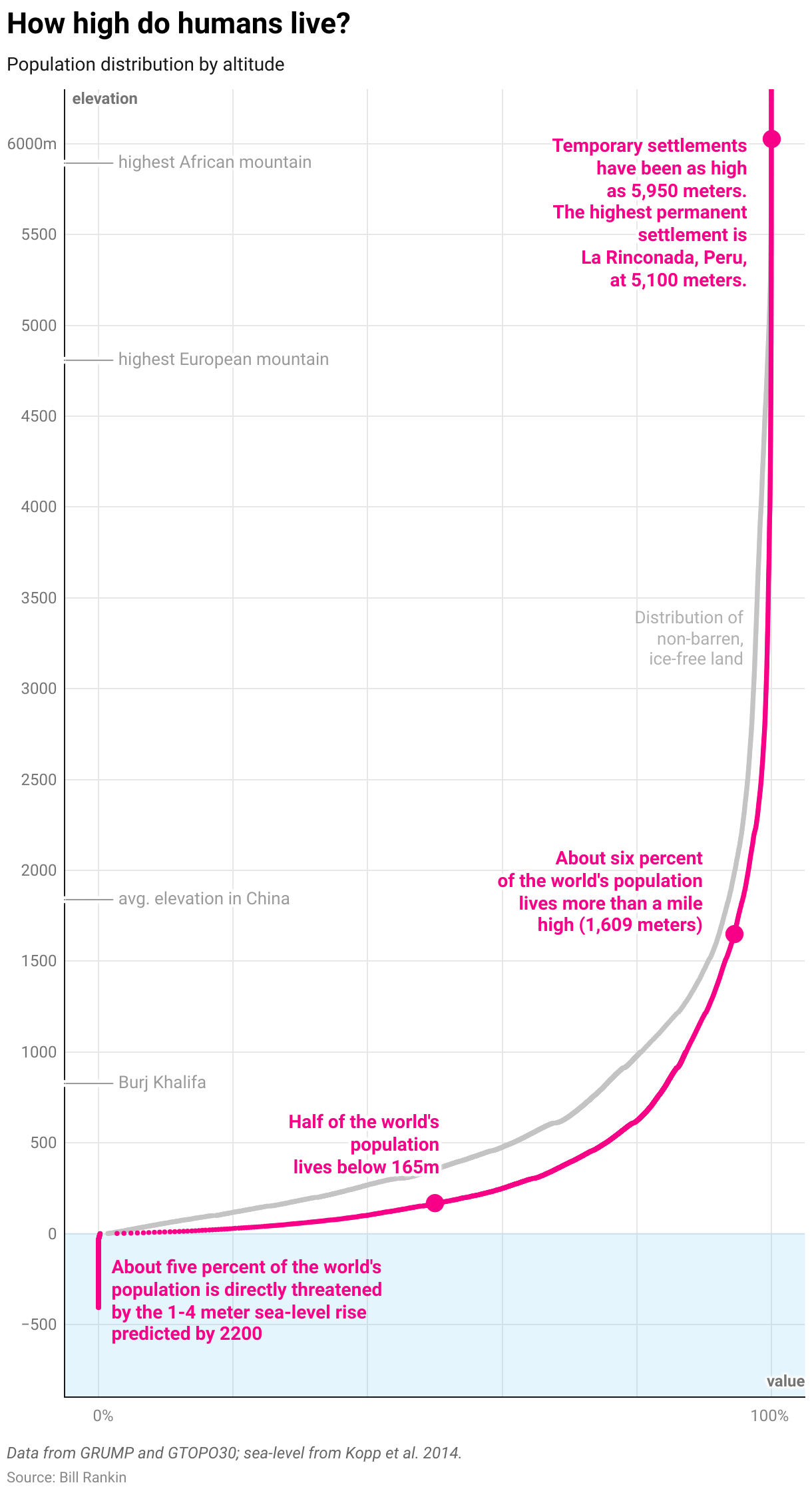
This chart belongs in the category “no real surprises here, but it’s fascinating to have such an overview”. It’s a simple chart, but it makes me feel a bit in awe of the power of charts and maps in general. Every single human can be found in this chart. There’s a reason why I asked Bill if I can recreate his chart in Datawrapper.

Chart Choices

Rebuilding Bill’s chart made me think actively about every single element that he added to the chart and every decision he made. I would not have chosen pink as my text color, but hey, it works well. Here’s the original chart:

You can see that Bill used a logarithmic scale. Why did I decide to use a linear scale for the altitude? To be honest, I was torn. Bill’s log scale highlights beautifully what’s going on in the lower altitudes. Most people live on these elevation levels, so putting the focus there makes sense. Using a log scale results in enough space to label the 1-4m range and to place some annotations about buildings on the left side of the chart.

But log scales are never intuitive. It’s hard for readers to understand how the data “really” looks like. That actually, yes, we have a typical long tail, and a lot of people live on low altitudes while only ca. 13% of the world population lives on altitudes over 1000m.

So when choosing a log scale instead of a linear scale, we’re trading “seeing the important parts of the chart better” for “seeing the overall picture” – at least in this case. Once again we see that creating charts is about priorities, goals and (in the best case) very conscious decisions.


Edit 03/08/2018: Francis Gagnon had an interesting take on this chart: “To me, the order of the axis is not intuitive. I see a quick climb at the end, suggesting to my eye that a lot of people appear at high altitudes - but it’s the opposite! So I inverted the axis.” Find his chart here.

Next week, we’ll focus a bit more on these log scales. What do they show exactly? We’ll find out.

25 May 21:11

"Sladda": Ikea ruft Fahrrad wegen technischer Mängel zurück - SPIEGEL ONLINE

mkalus shared this story from SPIEGEL ONLINE - Schlagzeilen.

Mit "Sladda" wollte Ikea die Fahrradbranche aufmischen. Doch daraus wurde nichts. Nun muss das schwedische Möbelhaus das Bike sogar wegen Verletzungsgefahr zurückrufen.

Ikea-Fahrrad "Sladda"
Inter IKEA Systems B.V.

Ikea-Fahrrad "Sladda"


Vor knapp zwei Jahren stieg der Möbelriese Ikea mit dem Modell "Sladda" ins Fahrradgeschäft ein. Jetzt ruft Ikea das Bike wegen technischer Mängel zurück. Der Antriebsriemen könne reißen und womöglich zu einem Sturz führen, teilte Ikea Deutschland mit. Zuvor sei das Unternehmen von einem Lieferanten für Zubehörteile informiert und gebeten worden, das Fahrrad wegen Sicherheitsproblemen aus dem Verkehr zu ziehen.

Der Antriebsriemen stammt von Continental. Betroffen seien alle verkauften Räder. Das Möbelhaus hatte "Sladda" ( zu Deutsch: Schleuder) in den Größen 26- und 28-Zoll angeboten. Ikea lägen bisher elf Berichte über Vorfälle mit dem Rad vor. In zwei Fällen seien kleinere Verletzungen entstanden.

"Da die Sicherheit unserer Kunden vorgeht, haben wir uns entschieden, sämtliche Fahrräder zurückzurufen und die Kunden gebeten, das Rad im nächstgelegenen Ikea-Einrichtungshaus abzugeben", sagt Ikea-Sprecherin Nathalie Biallas. Der volle Kaufpreis werde zurückerstattet, bei der Rückgabe sei kein Kaufnachweis oder Kassenbon nötig. Darüber hinaus kann auch sämtliches Zubehör, welches zusammen mit dem Fahrrad erworben wurde, zurückgegeben werden.

"Wenn die Kunden es wünschen, können sie auch Zubehörteile tauschen, die man theoretisch auch für andere Fahrräder nutzen kann", sagt Biallas. Dazu gehörten beispielsweise auch Helme, Taschen oder Fahrradschlösser.

Mit einem Preis ab 779 Euro war das Fahrrad mit Riemenantrieb bei Verkaufsstart im August 2016 deutlich günstiger als vergleichbare Modelle. Meist starten die Preise für Fahrräder mit Riemenantrieb erst ab 1000 Euro. "Sladda" wurde den Angaben zufolge in 26 Märkten angeboten. Ein Nachfolgemodell plant Ikea derzeit nicht. Vielleicht auch deshalb, weil das Fahrrad hierzulande eher ein Ladenhüter war. Laut Ikea verkaufte sich das Zweirad gerade einmal 400-mal.

25 May 21:09

11 essential foods for the ketogenic diet

by Alex

At the beginning of March I decided to get serious about losing the 40-ish pounds I’ve gained in the past three years, and after conferring with my posse, I landed on the ketogenic diet.  Initially developed as a treatment for epilepsy, the perfect keto diet lowers carb intake to the point where your body burns fat instead of carbohydrates as its fundamental energy source. Because it involves eating a lot of high-fat, satiating foods like avocados, bacon and cheese, keto makes it relatively easy to reduce caloric intake without feeling hungry, which is why it’s become a popular way to lose weight.

Ten weeks  into keto, I’ve lost 30 of my 40 pounds with my low carb pre workouts, so lots of people have asked me for details on how exactly this keto thing has worked for me. Keto is its own cult with a ton of advice (much of mutually contradictory) so I am not going to map out my particular version of the keto religion. What I do want to share are the particular eating habits and foods that have made the process a bit easier for me; those who really want the play-by-play can find eight weeks’ worth of food logs (yes, I’ve logged every single bite) plus a few of my key recipes here.

To make sense of my food logs and my recommendations below, there are a few things you need to know about my approach to keto:

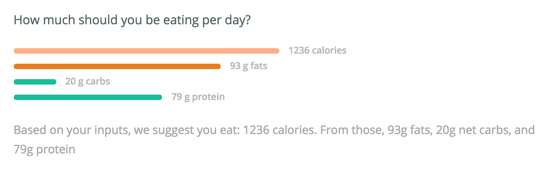
  • I calculated my macros (the balance of carbs/protein/fat in my diet) and my total caloric allowance with the calculator on Ruled.me
  • I’ve stuck to a limit of 20g of net carbs a day: that means total carbs minus fiber. While I don’t worry too much about hitting 21 or 21.5 carbs, I’ve had very few days where I’ve gone significantly over my limit. In the long run I hope to up my daily carbs but for now I’m sticking to the 20-carb cap, since that guarantees I stay in ketosis (aka fat-burning mode) and helps my body adjust to this new way of functioning. In another month or so I’ll start experimenting with adding some more carbs to my diet in the form of additional fruit and veggies.
  • I set myself a significant calorie deficit goal — 25% — which means I typically eat between 1250 and 1350 calories a day. But thanks to all the fat I am eating I am rarely hungry and never feel deprived. (And no, I’m not some bird-like eater: before keto I was eating tons of pizza, popcorn and Ben & Jerry’s, often on the same evening. No mystery where those 40 pounds came from!)
  • I increased my calories and protein for a little while in early April, when our whole family got the flu and I was having trouble getting well again. Once I bumped up my protein (on a doctor’s advice) I started feeling better quite quickly.
  • Exercise has not been a big part of my weight loss regime, but I have made an effort to be more active because my daily life of working from home is extremely sedentary. I now try to fit in an hour-long walk three or four times a week. But that’s the extent of my exercise.
  • I am a night owl and an evening snacker, so I try to save calories for the evening — usually by making either breakfast or lunch a very light meal.
  • While I found keto because I was looking for a weight loss option, I chose it partly because I’ve long observed that wheat and sugar have a major effect on my mental health. Sure enough, I have mostly felt fantastic on keto (once I got over the initial “keto flu“), so I’ve used my emotional and physical well-being as a cue for when I need to tinker with my food intake.
  • I have started taking supplements: I take magnesium, vitamin D, omega 3s and probiotics every day, and try to remember to swallow a teaspoon of salt here and there. I will not pretend that the keto diet is easy: for the first month I was on keto, figuring out what to eat and how to cook it felt like a full-time job. I kept at it since the keto diet was one of the headache options I was recommended by my physician. The keto got a lot easier once I figured out my go-to snacks, meals and treats. Here’s what you can reliably find in my kitchen:
      1. Cacao nibs. These crunchy little nibs have become my go-to snack when I want a little something. They taste chocolatey but are much crunchier and lower calorie. One bag lasts me ages, so I only just tried a new kind — these nibs from Prana, which are SO much better than the previous brand I had. (The pieces are larger and have a nicer texture.)  It’s worth trying a few brands to find yours.
      2. Epic’s chicken sriracha bars. These chicken bars have replaced Kind bars as the snack I keep in my backpack in case I get hungry out in the world and can’t find a keto-friendly lunch or snack. Would I eat them if I were not on keto? No, I would not. But they are tasty enough, and at 100 calories. 15 grams of protein and 1 gram of carbs, they are a very efficient almost-meal.

      3. Montezuma 100% Absolute Black Dark Chocolate with Cocoa Nibs. I buy these unsweetened chocolate bars at Trader Joe’s, where at $2.99 they are both much cheaper and much tastier than the 100% chocolate bars I’ve found at fancy chocolate stores and Whole Foods. A little bite (4 grams) satisfies me — but what really makes it feel like a treat is if I dip that square of chocolate in a little peanut butter.
      4. Trader Giotto’s Oven-Baked Cheese Bites. Another Trader Joe’s staple, these crunchy all-cheese snacks are high in fat and calories but low in carbs, so they are a delicious snack on days when I haven’t yet eaten a ton of calories.
      5. Bacon and prosciutto. Don’t tell the rabbi, but I am eating a crazy amount of pork in this new life. Once or twice a week, I cook up either a big load of bacon (in the microwave) or a bunch of prosciutto (in the toaster oven). Then I stick the delicious crispy porky goodness in a ziploc bag in the fridge, where it’s available to crumble on salads or scrambled eggs.
      6. Roasted vegetables. Once or twice a week I roast a big whack of vegetables in the oven and then put each type of vegetable in its own container in the fridge. That makes it easy for me to whip up a meal out of some meat and whatever veggies I have going: usually I’ve got a container of broccoli (unless my kid eats it all), a container of roasted fennel (amazing as a condiment or salad enhancement) and maybe some green beans or asparagus. (Keto is so low carb that I’ve occasionally surpassed my carb limits by eating too much cauliflower or broccoli, so it pays to know which veggies are lowest in carbs, and to measure your veggie intake.)  To roast the veggies I just drizzle with some olive oil, salt and pepper — or in the case of the broccoli, Montreal steak spice or Tajin seasoning.
      7. Spinach and arugula. We always have a big, pre-washed box of each of these in our fridge. I throw about two cups of one or the other into my morning eggs every day, or use them as the base for a salad, or wilt a little arugula as the base of whatever I’m having for dinner.
      8. Instant Pot boiled or poached eggs. Dinner got a lot easier onceI learned how to use our Instant Pot to poach eggs, or even easier, to boil eggs, If I haven’t got a better plan, I make a quick dinner by wilting some arugula in a wok (I like it better when it’s slightly cooked) and then topping it with a couple of soft-boiled (and peeled!) eggs, a little chunk of gooey burrata cheese, some crispy prosciutto, a few slices of roasted fennel, some black olives and whatever other goodies spring to hand. Delicious, quick and satisfying.
      9. Trader Joe’s Gochujang almonds. In my first month of keto I got completely addicted to macademia nuts: every time I passed through the kitchen I’d eat two or three of those delicious babies. Then I finally realized that a single macademia nut has 20 calories and 2 grams of fat, so I moved the macademia nuts off the convenient shelf and into a big jar that I have to dig for. Now my go-to are these delicious low-carb flavored almonds from Trader Joe’s almonds, which I package up into 100-calorie bags so that I can keep a dose in my purse.
      10. Whipped cream. Thanks to keto, I now have a whipped cream jar. Every two or three nights I whip some unsweetened cream. My bedtime snack is a half-cup of raspberries (if I’ve had a low-carb day, there might even be room for some blueberries, too) topped with a half-cup of whipped cream (or a quarter cup, if I’m close to my calorie limit) with a sprinkling of toasted slivered almonds for texture. No, it is not the same as the two scoops of B&J New York Super Fudge Chunk ice cream that I formerly consumed at that hour. But honestly, it may be even more satisfying.
      11. McDonalds salt packets. Whenever I take the kids to McDonalds, I take a few of their little salt packets. I keep these in my purse so that if I’m feeling lousy (in a keto flu-y kinda way) I can knock back a salt pack and a drink of water. Ten minutes later, I feel right as rain.

    Keto is not for everybody. It can actually be dangerous for some people, and many folks — myself included — feel sick when their body is first transitioning from burning carbs to burning fat. But if you’re intrigued, I hope these foods (and my food log) can help make it easier for you to give it a try.

25 May 21:09

Alexa, do. Not. Panic.

by Volker Weber

towels-2823656 640

Blabla bla blablabla Alexa bla blabla bla blablabla Send Message bla blablabla bla blablabla Theresa bla blabla bla blablabla bla blablabla bla bla bla blabla bla blablabla bla blablabla Yes bla blablabla bla blablabla bla blabla bla blablabla bla blablabla bla bla bla blabla bla blablabla bla blablabla bla blablabla bla blablabla bla blabla bla blablabla bla blablabla bla bla bla bla bla blablabla bla blablabla blablabla bla blablabla bla blabla bla blablabla bla blablabla bla bla bla blabla bla blablabla bla blablabla

Ungefähr so stelle ich mir die Sau vor, die gerade durch's digitale Dorf getrieben wird. Ja, Alexa kann Nachrichten verschicken. Und wenn man Sprachsteuerung benutzt und sehr viel spricht, dann kann schon mal was daneben gehen. Vor allem, wenn man die Nachfragen von Alexa nicht hören kann.

Ist sicher jedem auch schon mal mit seinem Handy passiert, das in der Hosentasche irgendjemanden angerufen hat. Der konnte dann auch mithören. Beim Handy kann man die Tastatur sperren. Bei Alexa kann man Sprachnachrichten oder Anrufe an- oder abschalten.

25 May 21:08

The Royal Family using Drupal

by Dries

Last weekend, over 29 million people watched the Royal Wedding of Prince Harry and Meghan Markle. While there is a tremendous amount of excitement surrounding the newlyweds, I was personally excited to learn that the royal family's website is built with Drupal! Royal.uk is the official website of the British royal family, and is visited by an average of 12 million people each year. Check it out at https://www.royal.uk!

Royal uk

25 May 21:08

Plantronics 6200 UC :: Erste Eindrücke

by Volker Weber

512695f8fbb0dd2086364f5016fbb45f

Es gibt sehr viele Bauarten von Headsets, aber diese "Neckbands" sind relativ neu. Die Elektronik und vor allem die Akkus befinden sich in einem Band, das man um den Hals legt. Auch die Mikrofone sind dort untergebracht und baumeln nicht am Kabel, das die beiden Ohrstöpsel verbindet. Ich hatte bisher zwei dieser Headsets, eins von Jabra und eins von Plantronics und ich fand beide zu billig. Außerdem ist das ja nichts für "echte Männer". Die tragen ordentliche Bügel auf dem Kopf mit dicken Treibern auf beiden Seiten. Als Plantronics das 6200 UC ankündigte, war ich eher skeptisch. Der Kollege Dr. Michael Spehr bestellte sich ein Testexemplar, ich habe abgewunken. Und dann lese ich letzte Woche eine Besprechung voll des Lobes. (Lest sie selbst, das erspart mir viel Beschreibung.) Hatte ich etwas übersehen?

4f4418d8388d2cd124067e73d1126850

Oh ja. Das 6200 UC hat eine ganz andere Qualität als die beiden Headsets, die ich kannte. Das fängt schon bei dem Etui an, das man braucht, wenn man so etwas auf Dauer sicher im Gepäck unterbringen will. Der erste Vorteil ist sofort klar. Dieses Headset braucht nicht viel Platz in der Tasche und eignet sich deshalb perfekt für Flugreisen. Bose hat etwas ähnliches, das QuietControl 30. Bei Flugreisen hat diese Bauform aber einen weiteren Vorteil: man kann das Headset stundenlang tragen, ohne dass irgendwo etwas drückt, man kann bequem damit schlafen und der große Akku hält den ganzen Flug durch. Dem steht ein Nachteil gegenüber: das Headset lässt sich nicht per Kabel mit dem Entertainment-System verbinden, aber das nutzen ohnehin nur Touris, die keine Ansage verpassen wollen.

5584ef150e505868238ce3f93e4f54c5

Das 6200 kommt mit sechs verschiedenen Ohrstöpseln - mir passt die vorinstallierte mittlere Größe - einem Lade-Dock und dem USB-Adapter, der das "UC" für Unified Communicationausmacht. PC oder Mac denken, das sei ein Sound Device und damit erspart man sich den fummeligen Bluetooth-Stack. Das Ladedock kann man nutzen, man muss aber nicht. Das Headset hat einen zweiten MicroUSB-Anschluss zum Laden. In 90 Minuten ist der Akku voll. Das Dock werde ich auf dem Schreibtisch lassen.

d82fc8416a55997ac0c77fc5ac67ce9a

Zur Funktion der Geräuschunterdrückung stand ja schon Eindrucksvolles in der FAZ. Schaltet man sie ein, verschwinden gleichförmige Geräusche, die man in Flugzeugen, Zügen oder auch klimatisierten Räumen hört. PCs machen ja erfreulicherweise diesen Krach nicht mehr. Sehr beeindruckend ist auch die ausgehende Geräuschunterdrückung. Der Angerufene hat keine Ahnung, dass man gerade in einem lauten Auto sitzt, wenn man sich bemüht, nicht übermäßig laut zu sprechen.

19a5c8c67b9e48bc240cd58fdcaf435d b4c9b92b540deef5a31436a4213a60f6

Das alles habe ich noch nicht selbst ausprobiert. Aber was ich auf Anhieb sagen kann: Musik klingt ganz wunderbar, klar und transparent. Und dabei auch voluminös ohne übermäßig laute Bässe. Das macht auf Anhieb viel Freude.Spotify hat mir in Discover Weekly diese Woche eine sehr breite Mischung aufgelegt, die sich wunderbar zum Testn von Headsets eignet und mir gefällt alles sehr.

25 May 21:08

25 Years of EdTech: 2008 – EDUPUNK!

by Reverend

Image of DaftPunk style EDUPUNK label.

I really appreciate Martin Weller allowing me to take the reins of his 25 Years of EdTech series for 2008. It was a leap of faith for him to agree, but I think he realized that sometimes ed-tech’s history has to be told from the vantage point of the radical. Consider this blog intervention akin to The People’s History of Ed-Tech. What’s more, the timing could not be more perfect. Not only does the Europe’s General Data Protection Rights (GDPR) legislation go into effect today (empowering folks to reclaim their online data), but May 25th 2018 also marks the 10 year anniversary of the 2008 blog post heard around the EdTech world: “The Glass Bees.” That’s right, this blog’s fifteen minutes of fame was the post that introduced the term EDUPUNK which was a play on EDUCAUSE that Brian Lamb and I dreamed up together over drinks in Brooklyn, a few days later and a late-night manic blog post led to a small ripple on the web to EDUPUNK being declared a neologism by Wired. 

The concept was pretty simple, take back the online spaces where teaching and learning happens from the dreary, florescent-lighted discussion boards of the Learning Management Systems (VLE for all you British geezers). Reclaim a sense of ownership and experimentation within educational technology and explore the possibilities—this was at the very beginning of the long trend of university IT departments wholesale outsourcing of everything from email (the beginning) to the LMS (just about done). One of the casualties of this era of institutional IT was that were very few options for experimenting with the new wave of Web 2.0 tools that were all the rage. It’s easy now to look back and discount the fervor around Web 2.0, but the options around personal publishing were exploding and most universities offered little beyond the LMS—which prompted companies like Blackboard to provide the “Next Generation” or learning tools like blogs and wikis that were little more than a re-styled discussion board. The publishing revolution truly was happening outside the university IT departments (and by extension educational institutions more generally) which prompted a subset of folks in ed-tech to cobble together alternatives, self-host open source applications, and generally provide a culture for edtech outside the mainstreamed LMS. In the end, EDUPUNK was ed-tech’s Web 2.0 culture war, which admittedly seems quaint after Gamergate. The web’s problems seem far more existential and complex ten years later, but a tributary of resistance in edtech might be found in that short-lived fervor around a divisive term that would be a brief glimpse into the issues that would come to define the field in 2018.

Where are they now?  Well there was an independent documentary created by Cogdog tracing the roots of this cultural missed opportunity—it should fill you in on all the sordid details:

Happy 10th birthday EDUPUNK! And big fan Weller, with all the smirking apologies an edtech punk can muster 🙂

25 May 21:08

Can you have fun with a GDPR announcement? JibJab did

by Josh Bernoff

Your mailbox is full of GDPR announcements. They’re obligatory, and you’re almost certainly ignoring them. Writing in this context is a challenge — but humor and video site jibjab.com decided to have a little fun with it. On the policy side, though, it’s still legalese all the way down. Here’s the email my friend got … Continued

The post Can you have fun with a GDPR announcement? JibJab did appeared first on without bullshit.

25 May 21:08

SotD: Dread River

You know, we’re approaching a half-year into this and haven’t dipped into any pure Dub, which is clearly unsatisfactory. Winston Rodney a.k.a. Burning Spear has already contributed a Song, but if you’re gonna dub, you just can’t dub any deeper than Burning Spear. Dread River (Jordan River) came up on random shuffle while I was walking to the train the other day, and I smiled heavily for 3:13.

Garvey’s Ghost

Burning Spear’s most famous album is Marcus Garvey, and this all-dub collection is called Garvey’s Ghost. It’s almost superfluous to pick out just one song, the album’s a continuous smooth lyrical bass-heavy flow, the rhythm as deep as Yggdrasil’s roots. Whatever you do, please never listen to this tune, or any other dub, on a reproduction device that cannot reproduce a hearty healthy bass line.

Dread River is maybe a little slinkier and livelier than your average dub, there are parts you could sing along to, and I do.

This is part of the Song of the Day series (background).

Links

Spotify playlist. This tune on iTunes, Spotify, Amazon. There’s live video of Winston in that earlier blog entry, but most dubs are studio assemblages not actual performances, so you wouldn’t expect to capture a performance.

25 May 21:07

Happy GDPR day. Here's some sensitive data about me.

I know I haven't posted for a while, but I can't skip GDPR Day. You don't see a lot of personal info from me here on this blog. But just for once, I'm going to share something.

I'm a blood donor.

This doesn't seem like a lot of information. People sign up for blood drives all the time. But the serious privacy problem here is that when I give blood, they also test me for a lot of diseases, many of which could have a big impact on my life and how much of certain kinds of healthcare products and services I'm likely to need. The fact that I'm a blood donor might also help people infer something about my sex life but the health data is TMI already.

And I have some bad news. I recently got the ad info from my Facebook account and there it is, in the file advertisers_who_uploaded_a_contact_list_with_your_information.html. American Red Cross Blood Donors. Yes, it looks like the people I chose to trust with some of my most sensitive personal info have given it to the least trusted company on the Internet.

In today's marketing scene, the fact that my blood donor information leaked to Facebook isn't too surprising. The Red Cross clearly has some marketing people, and targeting the existing contact list on Facebook is just one of the things that marketing people do without thinking about it too much.Not thinking about privacy concerns is a problem for Marketing as a career field long-term. If everyone thinks of Marketing as the Department of Creepy Stuff it's going to be harder to recruit creative people.

So, wait a minute. Why am I concerned that Facebook has positive health info on me? Doesn't that help maintain my status in the data-driven economy? What's the downside? (Obvious joke about healthy-blood-craving Facebook board member Peter Thiel redacted—you're welcome.)

The problem is that my control over my personal data isn't just a problem for me. As Prof. Arvind Narayanan said (video), Poor privacy harms society as a whole. Can I trust Facebook to use my blood info just to target me for the Red Cross, and not to sort people by health for other purposes? Of course not. Facebook has crossed every creepy line that they have promised not to. To be fair, that's not just a Facebook thing. Tech bros do risky and mean things all the time without really thinking them through, and even when they do set appropriate defaults they half-ass the implementation and shit happens.

Will blood donor status get you better deals, or apartments, or jobs, in the future? I don't know. I do know that the Red Cross made a big point about confidentiality when they got me signed up. I'm waiting for a reply from the Red Cross privacy officer about this, and will post an update.

Anyway, happy GDPR Day, and, in case you missed it, Salesforce CEO Marc Benioff Calls for a National Privacy Law.

25 May 21:07

Vancouver Stories in Three Films this June

by pricetags

“Year-round VIFF” (the Vancouver International Film Festival) is bringing us three must-see films in June, about our city…and, in fact, the region.

In their words:

Local history comes back to life in these films from 1960s and ’80s. This is Vancouver before the tower blocks, when our town was still figuring out what it was going to become.

Vancouver Impressions (The Early 60s)

SAT JUN 2 – 2:15 PM

BUY TICKETS | Clip: City Song (Sinner Man)

Early 1960s Vancouver was a very different place compared with the vibrant multicultural city we know today. This archival programme of films produced by CBUT (CBC Vancouver) between 1961 and 65 treats the viewer to scenes of a predominantly low-rise provincial city, mostly white and European; a place familiar, yet alien to contemporary eyes. Films include Immigrant Impresions (1965), City Song (1961), and three short pieces from the Day in the Life series. Guest intro: Christine Hagemoen


The Rankin File: Legacy of a Radical

SAT JUN 2 – 4:15 PM • TUE JUN 5 – 6:30PM

BUY TICKETS | Official Website

Should development provide affordable housing for citizens or luxury condos for the super rich? That was the key question in the Vancouver mayoral campaign of 1986, a campaign that pitched veteran socialist firebrand Harry Rankin against a young rightwinger named Gordon Campbell. We know how it turned out, but this warts-and-all portrait of Rankin (culled from a never-finished documentary from the time) offers plenty of food for thought about politics then and now.


The Bridge

SUN JUN 17 – 3:30PM, 5:15PM • WED JUN 20 – 5:45PM

BUY TICKETS | Trailer

June 17th is the 60th anniversary of the collapse of the Ironworkers Memorial Second Narrows Crossing. The tragedy claimed the lives of 18 workers who plunged 100 ft into the waters below, and a 19th, a diver who died later during the search for the bodies. George Orr’s film is built around rediscovered, never-before-seen 16mm colour footage shot by young draftsman Peter Hall as he chronicled the construction, and includes interviews with Hall and remaining survivors.

World Premiere Special guests in attendance


25 May 21:07

Study Says More Density in Single Family Neighbourhoods is Greener

by Sandy James Planner

10869243

In Vancouver single family housing is demolished to make bigger new houses, often of the same style. Yet, in this study to be published in July by University of British Columbia researchers and MountainMath Software, the perception that new is greener and better is seriously challenged.

UBC Reports  notes that, “despite the better energy performance of the new homes, this cycle is likely to increase overall greenhouse gas emissions.” 

Even though the City of Vancouver has a Zero Emissions Building Plan which was supposed to eliminate emissions from new building by 2030, “the teardown cycle is preventing many single-family homes from surviving long enough to ‘pay back’ the initial impacts caused by construction materials, which are not accounted for in the current plan.”

The construction of new single family residences “will result in one to three million tonnes of added emissions between 2017-2050, even though the new homes will require less energy to heat and operate. It also reports that each percentage point increase in land value will result in an additional 130,000 tonnes of emissions in Vancouver during the same period.”

Jens Von Bergmann of MountainMath Software nails down the policy approach to alleviating this problem. While it will take 168 years for efficiency gains to recover construction impacts, this teardown cycle will cause emission to increase, “unless we change residential zoning to permit denser forms of housing.”

Higher density housing forms will last longer than the single family houses they replace and provide environmental benefits sooner. Study co-author Joseph Dahman observed that low to mid-rise housing, “increases overall housing stock, addresses affordability and creates a more vibrant public realm” .  

And thanks to this study, we know that density is greener too.

image1

Images Vancouver Sun and Globe and Mail

25 May 21:06

If you’re so smart, why aren’t you rich? Turns out it’s just chance.

mkalus shared this story from Emerging Technology from the arXiv - MIT Technology Review.

The distribution of wealth follows a well-known pattern sometimes called an 80:20 rule: 80 percent of the wealth is owned by 20 percent of the people. Indeed, a report last year concluded that just eight men had a total wealth equivalent to that of the world’s poorest 3.8 billion people.

This seems to occur in all societies at all scales. It is a well-studied pattern called a power law that crops up in a wide range of social phenomena. But the distribution of wealth is among the most controversial because of the issues it raises about fairness and merit. Why should so few people have so much wealth?

The conventional answer is that we live in a meritocracy in which people are rewarded for their talent, intelligence, effort, and so on. Over time, many people think, this translates into the wealth distribution that we observe, although a healthy dose of luck can play a role.

But there is a problem with this idea: while wealth distribution follows a power law, the distribution of human skills generally follows a normal distribution that is symmetric about an average value. For example, intelligence, as measured by IQ tests, follows this pattern. Average IQ is 100, but nobody has an IQ of 1,000 or 10,000.

The same is true of effort, as measured by hours worked. Some people work more hours than average and some work less, but nobody works a billion times more hours than anybody else.

And yet when it comes to the rewards for this work, some people do have billions of times more wealth than other people. What’s more, numerous studies have shown that the wealthiest people are generally not the most talented by other measures.

What factors, then, determine how individuals become wealthy? Could it be that chance plays a bigger role than anybody expected? And how can these factors, whatever they are, be exploited to make the world a better and fairer place?

Today we get an answer thanks to the work of Alessandro Pluchino at the University of Catania in Italy and a couple of colleagues. These guys have created a computer model of human talent and the way people use it to exploit opportunities in life. The model allows the team to study the role of chance in this process.

The results are something of an eye-opener. Their simulations accurately reproduce the wealth distribution in the real world. But the wealthiest individuals are not the most talented (although they must have a certain level of talent). They are the luckiest. And this has significant implications for the way societies can optimize the returns they get for investments in everything from business to science.

Pluchino and co’s model is straightforward. It consists of N people, each with a certain level of talent (skill, intelligence, ability, and so on). This talent is distributed normally around some average level, with some standard deviation. So some people are more talented than average and some are less so, but nobody is orders of magnitude more talented than anybody else.

This is the same kind of distribution seen for various human skills, or even characteristics like height or weight. Some people are taller or smaller than average, but nobody is the size of an ant or a skyscraper. Indeed, we are all quite similar.

The computer model charts each individual through a working life of 40 years. During this time, the individuals experience lucky events that they can exploit to increase their wealth if they are talented enough.

However, they also experience unlucky events that reduce their wealth. These events occur at random.

At the end of the 40 years, Pluchino and co rank the individuals by wealth and study the characteristics of the most successful. They also calculate the wealth distribution. They then repeat the simulation many times to check the robustness of the outcome.

When the team rank individuals by wealth, the distribution is exactly like that seen in real-world societies. “The ‘80-20’ rule is respected, since 80 percent of the population owns only 20 percent of the total capital, while the remaining 20 percent owns 80 percent of the same capital,” report Pluchino and co.

That may not be surprising or unfair if the wealthiest 20 percent turn out to be the most talented. But that isn’t what happens. The wealthiest individuals are typically not the most talented or anywhere near it. “The maximum success never coincides with the maximum talent, and vice-versa,” say the researchers.

So if not talent, what other factor causes this skewed wealth distribution? “Our simulation clearly shows that such a factor is just pure luck,” say Pluchino and co.

The team shows this by ranking individuals according to the number of lucky and unlucky events they experience throughout their 40-year careers. “It is evident that the most successful individuals are also the luckiest ones,” they say. “And the less successful individuals are also the unluckiest ones.”

That has significant implications for society. What is the most effective strategy for exploiting the role luck plays in success?

Pluchino and co study this from the point of view of science research funding, an issue clearly close to their hearts. Funding agencies the world over are interested in maximizing their return on investment in the scientific world. Indeed, the European Research Council recently invested $1.7 million in a program to study serendipity—the role of luck in scientific discovery—and how it can be exploited to improve funding outcomes.

It turns out that Pluchino and co are well set to answer this question. They use their model to explore different kinds of funding models to see which produce the best returns when luck is taken into account.

The team studied three models, in which research funding is distributed equally to all scientists; distributed randomly to a subset of scientists; or given preferentially to those who have been most successful in the past. Which of these is the best strategy?

The strategy that delivers the best returns, it turns out, is to divide the funding equally among all researchers. And the second- and third-best strategies involve distributing it at random to 10 or 20 percent of scientists.

In these cases, the researchers are best able to take advantage of the serendipitous discoveries they make from time to time. In hindsight, it is obvious that the fact a scientist has made an important chance discovery in the past does not mean he or she is more likely to make one in the future.

A similar approach could also be applied to investment in other kinds of enterprises, such as small or large businesses, tech startups, education that increases talent, or even the creation of random lucky events.

Clearly, more work is needed here. What are we waiting for?

Ref: arxiv.org/abs/1802.07068 : Talent vs. Luck: The Role of Randomness in Success and Failure

Tech Obsessive?
Become an Insider to get the story behind the story — and before anyone else.

Subscribe today
25 May 21:06

GDPR Ain’t Helping Anyone In The Innovation Economy

by jbat

(image)

It’s somehow fitting that today, May 25th, marks my return to writing here on Searchblog, after a long absence driven in large part by the launch of NewCo Shift as a publication on Medium more than two years ago. Since then Medium has deprecated its support for publications (and abandoned its original advertising model), and I’ve soured even more than usual on “platforms,” whether they be well intentioned (as I believe Medium is) or indifferent and fundamentally bad for publishing (as I believe Facebook to be).

So when I finally sat down to write something today, an ingrained but rusty habit re-emerged. For the past two years I’ve opened a clean, white page in Medium to write an essay, but today I find myself once again coding sentences into the backend of my WordPress site.

Searchblog has been active for 15 years – nearly forever in Internet time. It looks weary and crusty and overgrown, but it still stands upright, and soon it’ll be getting a total rebuild, thanks to the folks at WordPress. I’ll also be moving NewCo Shift to a WordPress site – we’ll keep our presence on Medium mainly as a distribution point, which is pretty much all “platforms” are good for as it relates to publishers, in my opinion.

So why is today a fitting day to return to the open web as my main writing outlet? Well, May 25th is the day the European Union’s General Data Protection Regulation (GDPR) goes into effect. It’s more likely than not that any reader of mine already knows all about GDPR, but for those who don’t, it’s the most significant new framework for data regulation in recent history. Not only does every company that does business with an EU citizen have to comply with GDPR, but most major Internet companies (like Google, Facebook, etc) have already announced they intend to export the “spirit” of GDPR to all of their customers, regardless of their physical location. Given that most governments still don’t know how to think about data as a social or legal asset, GDPR is likely the most important new social contract between consumers, business, and government in the Internet’s history. And to avoid burying the lead, I think it stinks for nearly all Internet companies, save the biggest ones.

That’s a pretty sweeping statement, and I’m not prepared to entirely defend it today, but I do want to explain why I’ve come to this conclusion. Before I do, however, it’s worth laying out the fundamental principles driving GDPR.

First and foremost, the legislation is a response to what many call “surveillance capitalism,” a business model driven in large part (but not entirely) by the rise of digital marketing. The grievance is familiar: Corporations and governments are collecting too much data about consumers and citizens, often without our express consent.  Our privacy and our “right to be left alone” are in peril. While we’ve collectively wrung our hands about this for years (I started thinking about “the Database of Intentions” back in 2001, and I offered a “Data Bill of Rights” back in 2007), it was Europe, with its particular history and sensitivities, which finally took significant and definitive action.

While surveillance capitalism is best understood as a living system – an ecosystem made up of many different actors – there are essentially three main players when it comes to collecting and leveraging personal data. First are the Internet giants – companies like Amazon, Google, Netflix and Facebook. These companies are beloved by most consumers, and are driven almost entirely by their ability to turn the actions of their customers into data that they leverage at scale to feed their business models. These companies are best understood as “At Scale First Parties” – they have a direct relationship with their customers, and because we depend on their services, they can easily acquire consent from us to exploit our data. Ben Thompson calls these players “aggregators” – they’ve aggregated powerful first-party relationships with hundreds of millions or even billions of consumers.

The second group are the thousands of adtech players, most notably visualized in the various Lumascapes. These are companies that have grown up in the tangled, mostly open mess of the World Wide Web, mainly in the service of the digital advertising business. They collect data on consumers’ behaviors across the Internet and sell that data to marketers in an astonishingly varied and complex ways. Most of these companies have no “first party” relationship to consumers, instead they are “third parties” – they collect their data by securing relationships with sub-scale first parties like publishers and app makers. This entire ecosystem lives in an uneasy and increasingly weak position relative to the At Scale First Parties like Google and Facebook, who have inarguably consolidated power over the digital advertising marketplace.

Now, some say that companies such as Netflix, Amazon and Apple are not driven by an advertising model, and therefore are free of the negative externalities incumbent to players like Facebook and Google. To this argument I gently remind the reader: All at scale “first party” companies leverage personal data to drive their business, regardless of whether they have “advertising” as their core revenue stream. And there are plenty of externalities, whether positive or negative, that arise when companies use data, processing power, and algorithms to determine what you might and might not experience through their services.

The third major player in all of this, of course, are governments. Governments collect a shit ton of data about their citizens, but despite our fantasies about the US intelligence apparatus, they’re not nearly as good at exploiting that data as are the first and third party corporate players. In fact, most governments rely heavily on corporate players to make sense of the data they control. That interplay is a story into itself, and I’m sure I’ll get into it at a later date. Suffice to say that governments, particularly democratic governments, operate in a highly regulated environment when it comes to how they can use their citizens’ data.

But until recently, first and third party corporate entities have had pretty much free reign to do whatever they want with our data. Driven in large part by the United States’ philosophy of “hands off the Internet” – a philosophy I wholeheartedly agreed with prior to the consolidation of the Internet by massive oligarchs – corporations have been regulated mainly by Terms of Services and End User License Agreements, rarely read legal contracts which give corporations sweeping control over how customer data is used.

This all changed with GDPR, which went into effect today. There are seven principles as laid out by the regulatory body responsible for enforcement, covering fairness, usage, storage, accuracy, accountability, and so on. All of these are important, but I’m not going to get into the details in this post (it’s already getting long, after all). What really matters is this: The intent of GDPR is to protect the privacy and rights of consumers against Surveillance Capitalism. But the reality of GDPR, as with nearly all sweeping regulation, is that it favors the At Scale First Parties, who can easily gain “consent” from the billions of consumers who use their services, and it significantly threatens the sub-scale first and third party ecosystem, who have tenuous or fleeting relationships with the consumers they indirectly serve.

Put another way: You’re quite likely to click “I Consent” or “Yes” when a GDPR form is put in between you and your next hit of Facebook dopamine. You’re utterly unlikely to do the same when a small publisher asks for your consent via what feels like a spammy email.

An excellent example of this power imbalance in action: Facebook kicking third-party data providers off its platform in the wake of the Cambridge Analytica scandal, conveniently using GDPR as an excuse to consolidate its power as an At Scale First Party (I wrote about this at length here).  In short: because they have the scale, resources, and first party relationships in place, At Scale First Party companies can leverage GDPR to increase their power and further protect their businesses from smaller competitors. The innovation ecosystem loses, and the tech oligarchy is strengthened.

I’ve long held that closed, walled-garden aggregators are terrible for innovation. They starve the open web of the currencies most crucial to growth: data, attention, and revenue. In fact, nearly all “innovators” on the open web are in thrall to Amazon, Facebook, Apple, and/or Google in some way or another – they depend on them for advertising services, for ecommerce, for data processing, for distribution, and/or for actual revenue.

In another series of posts I intend to dig into what we might do about it. But now that the early returns are in, it’s clear that GDPR, while well intentioned, has already delivered a massive and unexpected externality: Instead of limiting the reach of the most powerful players operating in the world of data, it has in fact achieved the opposite effect.

25 May 21:06

Vancouver Diary: East Village Huh?

by pricetags

Dianna noticed these banners on Vancouver’s Hastings Street, between Clark and Renfrew in what is now termed, by the Hastings North Business Improvement Association (BIA), the East Village.

One of the banners features a hipster crow leaning on a bicycle:

Probably the oddest part is the crow reading a book. What’s the backstory here? What’s the connection to Hastings Sunrise?

And…and who did it?

25 May 21:05

Hosting Futures

files/images/Screenshot-2018-05-24-17.48.19-1024x440.png

Jim Groom, bavatuesdays, May 28, 2018


Icon

I'm still in the mindset of "about what piloting a mashup of LAMP and Docker-container based hosting might look like." So I'm just as interested as Jim Groom in QUBES: “a community of math and biology educators who share resources and methods for preparing students to tackle real, complex, biological problems.” Groom adds that "QUBES is built on top of a project that came out of Purdue University called HUBzero, a service which provides focused community sites, course spaces, open educational resource sharing, and access to applications used heavily in the sciences, such as R, Latex, Jupyter Notebooks, etc." This whole space is moving forward at breakneck speed; it's exciting but really hard to keep up.

Web: [Direct Link] [This Post]
25 May 21:05

OnePlus 6 is the first OnePlus smartphone to support Android’s seamless updates feature

by Igor Bonifacic
OnePlus 6 back

In my review of the OnePlus 6, something I made sure to highlight was the fact that the OP6 is the first OnePlus smartphone to support Project Treble. Turns out, there’s another nice first for the OnePlus 6: it’s the first OnePlus device to support Android seamless updates feature.

Alternatively known as A/B updates, the seamless updates feature allows Android devices to download and install over-the-air updates in the background. The user can continue using their smartphone as they would normally while the process is underway. Once they reboot the device, the updated operating system is automatically swapped in. In all, the feature can save between five to 10 minutes per update.

Google introduced seamless updates alongside the original Pixel. Since then, a variety of third-party Android manufacturers have added the feature to their devices, as well. Notably, however, Samsung’s latest smartphones do not support seamless updates.

Via: Android Police

The post OnePlus 6 is the first OnePlus smartphone to support Android’s seamless updates feature appeared first on MobileSyrup.

25 May 21:03

Car2Go announces it will cease Toronto operations on May 31

by Sameer Chhabra

German car rental company car2go announced that it will no longer operate in Toronto as of May 31st, 2018.

Car2go customers will still be able to use the service through May 31st, but the company said that fewer vehicles may be available as the date approaches.

In a May 24th, 2018 media release, car2go said that the decision to cease its operation is a result of a free-floating car-sharing pilot project passed by Toronto City Council on April 27th, 2018.

“Unfortunately, the pilot they decided to pass is so heavily amended and restrictive that it makes the continuation of car2go service in Toronto inoperable,” reads an excerpt from the same May 24th, release.”

“It is clear to us that Torontonians love free-float car-share, but the City has not established a legal framework that supports globally accepted car-share services like car2go.”

As per the City’s new pilot project, car-share services participating in the pilot need to pay $1,499.02 CAD per vehicle.

Additionally, car2go estimates that approximately 10,000 parking spaces used by the company would be forbidden under the City’s pilot project rules.

“In fact, approximately 50 percent of all trips Torontonian car2go members take everyday would no longer be possible as a result of the heavy street restrictions taking effect once the pilot begins June 1st,” reads another excerpt.

While Torontonians will no longer be able to use car2go’s service on May 31st, they’ll still be able to use their memberships to use car2go vehicles in other Canadian and U.S. cities.

Source: car2go

The post Car2Go announces it will cease Toronto operations on May 31 appeared first on MobileSyrup.

25 May 20:59

Bell Media increases CraveTV’s price from $7.99 to $9.99 per month

by Patrick O'Rourke
CraveTV

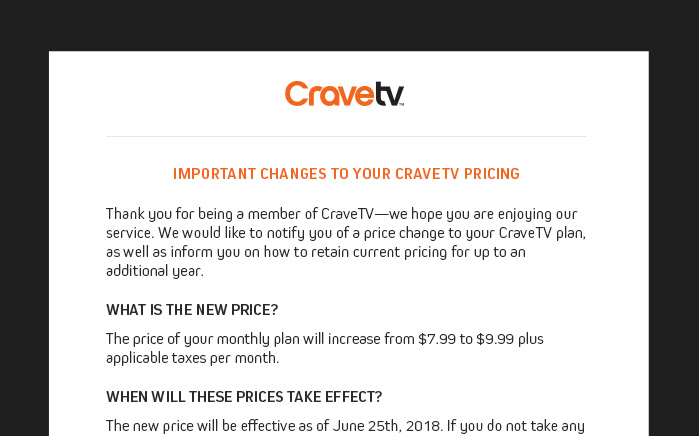
In an email to subscribers, Bell Media has confirmed that CraveTV’s monthly subscription price is increasing from $7.99 CAD per month to $9.99 plus tax per month starting June 25th.

To be clear, this price increase only affects those who subscribe to CraveTV directly and not those who access the service through their television provider.

Subscribers interested in retaining current pricing for an additional three, six or 12 months, need to extend their subscription prior to June 25th in order to still be charged $7.99 per month, says Bell Media.

Back in July 2017, Bell Media increased CraveTV’s subscription cost by $2 for the carrier’s customers, bringing the service’s monthly fee to $7.99 a month, with the increase going into affect on October 1st, 2017. Looking even further back, in February 2015, Bell Media increased the cost of a monthly CraveTV subscription from $4 to $6 for Bell Media customers.

CraveTV

Bell Media’s CraveTV remains the only large scale Canadian-owned streaming platform in Canada. Since, Rogers and Shaw’s Shomi streaming service shut down back in November of  2016. In January of 2016, CraveTV became available to all Canadians and not just Bell media subscribers following a CRTC decision. This change was initially proposed by the CRTC in March of 2015.

Streaming service competition in Canada has recently increased, with Amazon launching its Prime Video streaming service in Canada, along with more recent entrants like CBS All Access.

While CraveTV is often criticized for lacking the wide selection of content present on significantly larger competing platforms like Netflix, the service does offer significant value for its monthly fee. Along with HBO’s back catalogue of content, now including seasons one through six of Game of Thrones, as well as critically acclaimed shows like The Wire and Oz, the service also features premium Showtime content at no additional monthly fee, unlike competing platforms such as U.S.-exclusive streaming platform Hulu.

CraveTV currently has 1.3 million subscribers across Canada as of February 2018, according to information revealed during the carriers’ Q4 2017 earnings report.

Update 05/15/2018 2:07pm: Bell Media sent MobileSyrup the following statement regarding CraveTV’s price increase:

“The price change for CraveTV reflects the continued cost increases we’re facing to acquire the highest quality programming. But it’s programming like HBO, Showtime, Starz and other premium content that makes CraveTV the best value of any streaming service available in Canada.”

The post Bell Media increases CraveTV’s price from $7.99 to $9.99 per month appeared first on MobileSyrup.

25 May 20:56

Google quietly changes code of conduct, being evil is fine now

by Jonathan Lamont
Google HQ

“Don’t be evil” was Google’s unofficial motto for a long time. The phrase was featured prominently in the search giant’s code of conduct.

The keyword here is ‘was.’

Google removed the motto from much of its code of conduct sometime between mid-April and early May. While the code of conduct page indicates it was last updated April 5th, a copy of the site archived by the Wayback Machine shows that “Don’t be evil” was still part of the code on April 21st.

Now, “Don’t be evil” only shows up in the final sentence as part of the code’s appeal to speak up if you see something you don’t think is right.

But while Google may be putting less of an emphasis on refraining from evil, many of the company’s employees are standing up for what they believe is right.

About a dozen employees have quit over the company’s involvement in Project Maven. Another 4,000 have sign a petition asking Google to end its involvement. Project Maven seeks to help the U.S. military analyze drone footage quicker through machine learning. Those who resigned cited ethical issues and concerns over the use of AI in drone operations and Google’s wider involvement with military projects in general.

The search giant noted that the technology it’s using is open source, so the military could use it regardless. Additionally, Google insists the technology isn’t being using in combat operations.

Some employees have suggested Maven goes against the “Don’t be evil” motto. However, not being evil clearly isn’t a focus for Google anymore.

Source: Engadget

The post Google quietly changes code of conduct, being evil is fine now appeared first on MobileSyrup.

25 May 20:56

Pay What You Want and Learn How to Code

by MobileSyrup

Learning how to code is paramount in programming fields. However, committing to coding courses can be expensive. On top of that, there are numerous languages in use today, so choosing the right languages to learn can be complicated. If you have no coding experience and want exposure to the most widely used languages, the Pay What You Want: The Coding 101 Bundle is for you.

This is how the deal works: simply pay what you want, and you’ll be given access to one of the bundle’s ten courses. If you beat the average price, you’ll receive all ten courses. Additionally, beating the leader’s price will land you on the leaderboard and enter you in a giveaway.

The eBook bundle features over 30 hours of digital content spanning more than 300 lectures; these beginner courses provide guides to popular programming languages such as HTML & CSS, JavaScript, Python, and more. You’ll even learn how to utilize your newly gained coding knowledge to build a website from the ground up.

Simply name your price to get started with the Pay What You Want: The Coding 101 Bundle.

The post Pay What You Want and Learn How to Code appeared first on MobileSyrup.

25 May 20:55

Amazon to build warehouse in Ottawa, creating 1,000 new jobs

by Bradly Shankar
Amazon Canada logo

Amazon is planning to open a new warehouse in Ottawa that will employ about 1,000 people, according to two members of Parliament.

In an interview with CBC, Orléans MP Andrew Leslie confirmed that Amazon has proposed a large warehouse at 5371 Boundary Rd., near Highway 417. The facility will be over one million square feet and require 99 truck bays and more than 1,000 parking spaces, according to the application submitted by Amazon.

“It will employ approximately 1,000 people, good middle class jobs, and it’s going to be a transportation hub,” Leslie told CBC, “We have been working with Amazon for a couple of months now and we are just thrilled that it’s all coming to maturation.”

Francis Drouin, MP for the adjacent riding of Glengarry-Prescott-Russell, added that the location of warehouse is ideal due to nearby highways and being close to both Ottawa and Montreal. “It will drive traffic away from the downtown core, which is perfect,” he told CBC.

Ottawa mayor Jim Watson declined to comment on the proposed warehouse.

This news follows Amazon’s announcement last month that it will open a 416,000-square foot development centre in Vancouver that will create 3,000 jobs, adding to the company’s approximately 6,000-people workforce in Canada.

Source: CBC

The post Amazon to build warehouse in Ottawa, creating 1,000 new jobs appeared first on MobileSyrup.