Rolandt
Shared posts
A Vision for Engineering Workflow at Mozilla (Part Two)
Apple HomePod :: Erste Eindrücke

Darauf habe ich gewartet: HomePods in vowe's magic flying circus. Wie immer bei Apple, eine wunderbare Verpackung. Das ist nur der Verkaufskarton. Geliefert wird er in einem stoßgesicherten Versandkarton, der so massiv ausfällt, dass nicht die kleinste Beschädigung innen ankommt. Ich erspare Euch das Unboxing-Video.
Heraus kommt ein weißer HomePod mit angestricktem Kabel. Überraschend schwer und überraschend klein. Ich wohne in einem weiß-schwarzen Haus, aber das Weiß der HomePods sticht noch mal als sehr kalt heraus. Das Kabel hat ein flachen zweipoligen Euro-Stecker, eine stoffartige Ummantelung und ist geräteseitig fest verbunden. Apple sagt, man kann es selbst nicht wechseln, aber ich habe Videos gesehen, dass man es tatsächlich raus (und wieder) bekommt, wenn man nur kräftig genug zieht. Man könnte auf diesem Weg ein ausländisches Gerät auf deutsche Stecker umrüsten. Da hilft der freundliche Mensch hinter der Apple-Servicetheke. Leider gibt es nur eine Länge und die ist bei mir sowohl zu kurz als auch zu lang. Zu kurz, um das HomePod oben auf ein Besta-Regal zu stellen und zu lang im Bad. Kein Unterschied zum Sonos One, für den es aber auch Kabel anderer Länge zu kaufen gibt.
Die Einrichtung ist erwartungsgemäß supereinfach, wenn man ein iPhone hat. Wer kein iPhone oder iPad hat, wird das Gerät nicht kaufen. Das iPhone sagt, hey, da ist ein HomePod, einrichten? Dann überträgt man die Einstellungen vom iPhone auf den HomePod und Sekunden später hat man ein neues Gerät in der Apple Home App. Im Airplay-Menü kann man jegliche Musik einfach hinschicken.
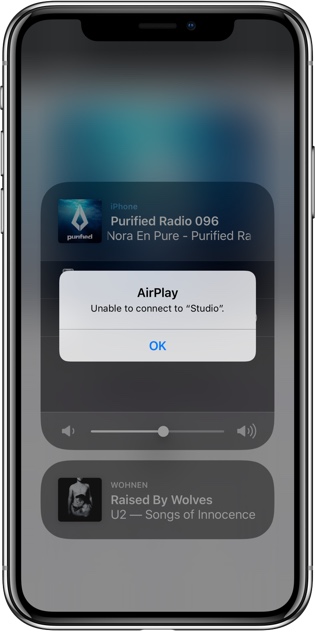
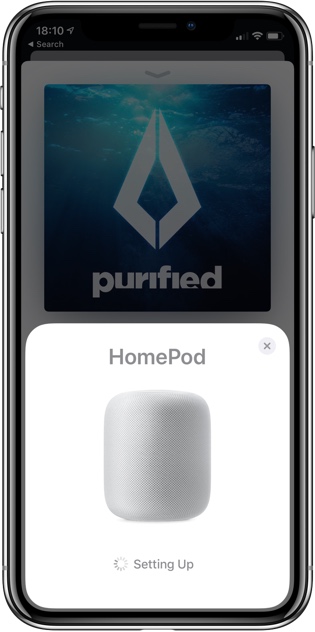
Das ging beim ersten Versuch schief. Einfach noch mal eingerichtet und alles lief. Kleiner Schluckauf. Hupps. Und jetzt die entscheidenden Frage: Und wie klingt er? Das hängt davon ab, was man erwartet. Gemessen an der Größe klingt er riesig. Gemessen am Hype eher winzig. Also flugs den zweiten HomePod ausgepackt. Sobald der auftacht, sagt das iPhone, hey, ein HomePod, sollen wir ein Stereopaar machen? Welcher ist denn der linke? Alles wie gewohnt einfach.
In der Home App kann man auf einen HomePod zeigen und wenn er wackelt, seine Einstellungen ändern. Stereopaar aufheben, in einen anderen Raum im Home umziehen, das geht alles kinderleicht, wenn man HomeKit kennt. Und wie Ihr später lesen werdet, habe ich das auch gebraucht. Ein Schnack noch zu HomeKit. Das funktioniert besser, wenn es einen sogenannten Hub hat. Dann lässt sich das Heim auch von unterwegs steuern. Bisher konnte ein iPad, der zu Hause am Strom hängt ein Hub sein, dann ein Apple TV 4, nun auch der HomePod. Für die kleine Butze ist das super. Wer keinen Fernseher hat aber ein iPhone, der gewinnt jetzt eine Steuerungszentrale für zu Hause, die auch kräftig Musik macht. Ich habe das Stereopaar auch mal aufgelöst und mit AirPlay zwei verschiedene Räume angespielt. Funktioniert einfach so.
Klingt nach einem Gewinner. Aber jetzt muss Apple tapfer sein:
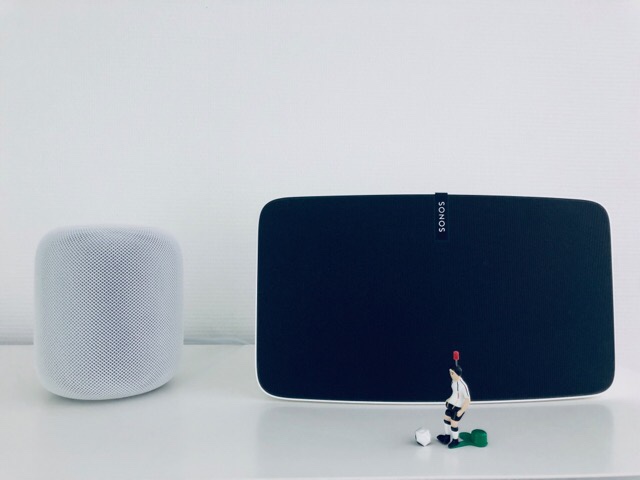
Das ist ein HomePod, ein Sonos Play:5 und ein Tipp Kick auf dem Elfmeter-Punkt. Und der HomePod hat nicht den Hauch einer Chance. Nicht alleine gegen einen Play:5 und auch nicht zu zweit. Jeder Schuß ein Treffer. Schiere Kraft? Rumms. Bass? Rumms. Transparenz? Rumms. Soundstage? Rumms. Der Größenvergleich gibt es ganz gut wieder. Und es kommt noch schlimmer. Ich höre Musik vor allem in zwei Räumen mit jeweils 50 Quadratmetern, die drei bis vier Sonos-Player haben:
- Zwei Play:5 und ein Sub
- Eine PlayBase, zwei Play:3 und ein Sub
Da reden wir aber auch über einen ganz anderen Preis in der Größenordnung von 2000 Euro. Im ersten Raum habe ich angefangen und dort erst den Sub und dann das Trueplay Tuning abgeschaltet, aber schnell war klar, dass die Play:5 einfach zu überwältigend sind. Dann habe ich die HomePods in den Raum 2 umgezogen und sukzessive alles abgeschatet. Erst den Sub, dann die Play:3, und dann noch das Trueplay Tuning. Aber selbst eine völlig auf Grundeinstellungen reduzierte Playbase ist den HomePods überlegen. Und die ist im Preis mit den beiden HomePods vergleichbar.
So komme ich also nicht weiter. Die HomePods müssen sich nun wieder als Einzelgeräte beweisen. Der eine ersetzt einen Sonos One im Bad, der andere konkurriert nun mit einem Echo Show. Das ist ein fairer Kampf, weil der HomePod mehr Kraft als ein Echo Show hat und einem Sonos One ins Auge blicken kann. Das Bad ist akustisch sehr anspruchsvoll, weil sehr hallig. Da bin ich mal gespannt. Siri wird es allerdings gegen Alexa sehr schwer haben.
Ich finde Siri etwas geschwätzig, während Alexa kurz und präzise ist.
Why Freedom is Essential to Security and Privacy
This post is based off of “Freedom, Security and Privacy” a keynote I gave at OpenWest 2018. You can see the full video of the talk here.
Freedom, security and privacy are interrelated. The relationship between these three concepts is more obvious in some cases than others, though. For instance, most people would recognize that privacy is an important part of freedom. In fact, studies have shown that being under surveillance changes your behavior such as one study that demonstrates that knowing you are under surveillance silences dissenting views. The link between privacy and security is also pretty strong, since often you rely on security (encryption, locked doors) to protect your privacy.
The link between freedom and security may be less obvious than the others. This is because security often relies on secrecy. You wouldn’t publish your password, safe combination or debit card PIN for the world to see, after all. Some people take the idea that security sometimes relies on secrecy to mean that secrecy automatically makes things more secure. They then extend that logic to hardware and software: if secret things are more secure, and proprietary hardware and software are secret, therefore proprietary hardware and software must be more secure than a free alternative.
The reality is that freedom, security and privacy are not just interrelated, they are interdependent. In this post I will analyze the link between these three concepts and in particular how freedom strengthens security and privacy with real world examples.
Do Many Eyes Make Security Bugs Shallow?
A core tenet of the Free Software movement is “many eyes make bugs shallow.” This statement refers to the fact that with proprietary software you have a limited amount of developers who are able to inspect the code. With Free Software, everyone is free to inspect the code and as a result you end up with more people (and more diverse people) looking at the code. These diverse eyes are more likely to find bugs than if the code were proprietary.
Some people extend this idea to say that many eyes also make security bugs shallow. To that I offer the following counterpoint: OpenSSL, Bash and Imagemagick. All three of these projects are examples where the code was available for everyone to inspect, but each project had critical security bugs hiding inside of the code for years before it was found. In particular in the case of Imagemagick, I’m all but certain that security researchers were motivated by the recent bugs in OpenSSL and Bash to look for bugs in other Free Software projects that were included in many embedded devices. Now before anyone in the proprietary software world gets too smug, I’d also like to offer a counter-counterpoint: Flash, Acrobat Reader and Internet Explorer. All three of these are from a similar vintage as the Free Software examples and all three are great examples of proprietary software projects that have a horrible security track record.
So what does this mean? For security bugs, it’s not sufficient for many eyes to look at code–security bugs need the right eyes looking at the code. Whether the researcher is fuzzing a black box, reverse engineering a binary, or looking directly at the source code, security researchers will find bugs if they look.
When Security Reduces Freedom
At Purism we not only develop hardware, we also develop the PureOS operating system that runs on our hardware. PureOS doesn’t have to run on Purism hardware, however, and we’ve heard from customers who use PureOS on other laptops and desktops. Because of this, we sometimes will test out PureOS on other hardware to see how it performs. One day, we decided to test out PureOS on a low-end lightweight notebook, yet when we went to launch the installer, we discovered that the notebook refused to boot it! It turns out that Secure Boot was preventing the PureOS installer from running.
What is Secure Boot and why is it problematic?
Secure Boot is a security feature added to UEFI systems that aims to protect systems from malware that might attack the boot loader and attempt to hide from the operating system (by infecting it while it boots). Secure Boot works by requiring that any code it runs at boot time be signed by a certificate from Microsoft or from vendors that Microsoft has certified. The assumption here is that an attacker would not be able to access the private keys from Microsoft or one of its approved vendors to be able to sign its own malicious code. Because of that, Secure Boot can prevent the attacker from running code at boot.
When Secure Boot was first announced, the Linux community got in quite an uproar over the idea that Microsoft would be able to block Linux distributions from booting on hardware. The counter-argument was that a user could also opt to disable Secure Boot in the UEFI settings at boot time and boot whatever they want. Some distributions like Red Hat and Ubuntu have taken the additional step of getting their boot code signed so you can install either of those distributions even with Secure Boot enabled.
Debian has not yet gotten their boot code signed for Secure Boot and since PureOS is based off of Debian, this also means it cannot boot when UEFI’s Secure Boot is enabled. You might ask what the big deal was since all we had to do is disable Secure Boot and install PureOS. Unfortunately, some low-cost hardware saves costs by loading a very limited UEFI configuration that doesn’t give you the full range of UEFI options such as changing Secure Boot. That particular laptop fell into this category so we couldn’t disable Secure Boot and as a result we couldn’t install our OS–we were limited to operating systems that partnered with Microsoft and its approved vendors.
Secure Booting: Now with Extra Freedom
It’s clear that protecting your boot code from tampering is a nice security feature, but is that possible without restricting your freedom to install any OS you want? Isn’t the only viable solution having a centralized vendor sign approved programs? It turns out that Free Software has provided a solution in the form of Heads, a program that runs within a Free Software BIOS to detect the same kind of tampering Secure Boot protects you from, only with keys that are fully under your control!
The way that Heads works is that it uses a special independent chip on your motherboard called the TPM to store measurements from the BIOS. When the system boots up, the BIOS sends measurements of itself to the TPM. If those measurements match the valid measurements you set up previously, it unlocks a secret that Heads uses to prove to you it hasn’t been tampered with. Once you feel confident that Heads is safe, you can tell it to boot your OS and Heads will then check all of the files in the /boot directory (the OS kernel and supporting boot files) to make sure they haven’t been tampered with. Heads uses your own GPG key signatures to validate these files and if it detects anything has been tampered with, it sends you a warning so you know not to trust the machine and not to type in any disk decryption keys or other secrets.
With Heads, you get the same kind of protection from tampering as Secure Boot, but you can choose to change both the TPM secrets and the GPG keys Heads uses at any time–everything is under your control. Plus since Heads is Free Software, you can customize and extend it to behave exactly as you want, which means an IT department could customize it to tell the user to turn the computer over to IT if Heads detects tampering.
When Security without Freedom Reduces Privacy
Security is often used to protect privacy, but without freedom, an attacker can more easily subvert security to exploit privacy. Since the end-user can’t easily inspect proprietary firmware, an attacker who can exploit that firmware can implant a backdoor that can go unseen for years. Here are two specific examples where the NSA took advantage of this so they could snoop on targets without their knowing.
- NSA Backdoors in Cisco Products: Glenn Greenwald was one of the reporters who initially broke the Edward Snowden NSA story. In his memoir of those events, No Place to Hide, Greenwald describes a new NSA program where the NSA would intercept Cisco products that were shipping overseas, plant back doors in them, then repackage them with the factory seals. The goal was to use those back doors to snoop on otherwise protected network traffic going over that hardware. Update: Five new backdoors have been discovered in Cisco routers during the beginning of 2018, although whether they were intentional or accidental has not been determined.
- NSA Backdoors in Juniper Products: Just in case you are on Team Juniper instead of Team Cisco, it turns out you weren’t excluded. The NSA is suspected in a back door found in Juniper firewall products within its ScreenOS that had been there since mid-2012. The backdoor allowed admin access to Juniper firewalls over SSH and also enabled the decryption of VPN sessions within the firewall–both very handy if you want to defeat the privacy of people using those products.
While I picked on network hardware in my examples, there are plenty of other examples outside of Cisco, Juniper, and the NSA where because of a disgruntled admin, a developer bug, or paid spyware, a backdoor or default credentials showed up inside proprietary firmware in a security product. The fact is, this is a difficult if not impossible problem to solve with proprietary software because there’s no way for an end user to verify that the software they get from their vendor matches the source code that was used to build it, much less actually audit that source code for back doors.
When Freedom Protects Security and Privacy
The Free Software movement is blazing the trail for secure and trustworthy software via the reproducible builds initiative. For the most part, people don’t install software directly from the source code but instead a vendor takes code from an upstream project, compiles it, and creates a binary file for you to use. In addition to a number of other benefits, using pre-compiled software saves the end user both the time and the space it would take to build software themselves. The problem is, an attacker could inject their own malicious code at the software vendor and even though the source code itself is Free Software, their malicious code could still hide inside the binary.
Reproducible builds attempt to answer the question: “does the binary I get from my vendor match the upstream source code that was used to build it?” This process uses the freely-available source code from a project to test for any tampering that could have happened between the source code repository, the vendor, and you making sure that a particular version of source code will generate the same exact output each time it is built, regardless of the system that builds it. That way, if you want to verify that a particular piece of software is safe, you can download the source code directly from the upstream developer, build it yourself, and once you have the binary you can compare your binary with the binary you got from your vendor. If both binaries match, the code is safe, if not, it could have been tampered with.
Debian is working to make all of its packages reproducible and software projects such as Arch, Fedora, Qubes, Heads, Tails, coreboot and many others are also working on their own implementations. This gives the end user an ability to detect tampering that would be impossible to detect with proprietary software since by definition there’s no way for you to download the source code and validate it yourself.
Freedom, Security and Privacy in Your Pocket
Another great example of the interplay between freedom, security and privacy can be found by comparing the two operating systems just about everyone carries around with them in their pockets: iOS and Android. Let’s rate the freedom, security and privacy of both of these products on a scale of 1 to 10.
In the case of iOS, it’s pretty safe to say that the general consensus puts iOS security near the top of the scale as it often stands up to government-level attacks. When it comes to privacy, we only really have Apple’s marketing and other public statements to go by, however because they don’t seem to directly profit off of user data (although apps still could), we can cut them a bit of a break. When it comes to freedom, however, clearly their walled garden approach to app development and their tight secrecy around their own code gives them a low rating so the end result is:
- Security: 9
- Privacy: 6
- Freedom: 1
Now let’s look at Android. While I’m sure some Android fans might disagree, the general consensus among the security community seems to be that Android is not as secure as iOS so let’s put their security a bit lower. When it comes to freedom, if you dig far enough into Android you will find a gooey Linux center along with a number of other base components that Google is using from the Free Software community such that outside parties have been able to build their own stripped-down versions of Android from the source code. While you have the option to load applications outside of Google’s Play Store, most of the apps you will find there along with almost all of Google’s own apps are proprietary, so their freedom rating is a mixed-bag. When it comes to privacy though, I think it’s pretty safe to rate it very low, given the fundamental business model behind Android is to collect and sell user data.
- Security: 7
- Freedom: 5
- Privacy: 1
Over the long run, the Librem line of products aims to address these concerns.
Why Not All Three?
To protect your own security and privacy, you need freedom and control. Without freedom, security and privacy require the full trust of vendors. However, vendors don’t always have your best interests at heart; in fact, in many cases vendors have a financial incentive to violate your interests, especially when it comes to privacy. The problem is, with proprietary software it can be difficult to prove a vendor is untrustworthy and if you do prove it, it’s even harder to revoke that trust.
With Free Software products, you have control of your trust. You also have the ability to verify that your Free Software vendors are trustworthy. With reproducible builds, you can download the source code and verify it all yourself.
In the end, freedom results in stronger security and privacy. These three concepts aren’t just interrelated, but they are interdependent. As you increase freedom, you increase security and privacy and when you decrease freedom, you put security and privacy at risk. This is why we design all of our products with freedom, security and privacy as strict requirements and continue to work toward increasing all three in everything we do.
The post Why Freedom is Essential to Security and Privacy appeared first on Purism.
OPML Blogroll Automated With TinyTinyRSS
A few months ago I added an OPML export of all my feeds manually to the sidebar as Blogroll. This week I installed an instance of TinyTinyRSS, to see if I can take it closer to my ideal feedreader. TinyTinyRSS provides a public URL of all the feeds as OPML. So now that link is my automatically updated OPML blogroll in the sidebar. (As long as I keep my TinyTinyRSS reader in sync with my offline reader)
The chronological order of people Trump has fired/people who have resigned since January 20, 2017...
I’ve been waiting for this realignment, the shift from...

I’ve been waiting for this realignment, the shift from left-versus-right to up-versus-down, as in If you go Left far enough, it becomes Down..
I’m no longer a leftist: I’m a downist, like Ocasio-Cortez.

SnapScan
If you have a SnapScan S1300 (very excellent document scanner) and can't get it to work under Windows 10, try following these instructions
World Bicycle Relief Launches Campaign to Provide Life-Changing Bicycles for Students in Malawi
 Today, World Bicycle Relief is launching its July campaign to fund bicycles for girl students in Malawi. Buffalo Bicycles provided by donations raised in July will help girl students in Malawi complete their education and break the cycle of poverty and HIV. Access to a high-quality bicycle can reduce a child’s commute time to school by up to 75% and dramatically changes educational, health and economic outcomes. Find out how YOU can help!
The post World Bicycle Relief Launches Campaign to Provide Life-Changing Bicycles for Students in Malawi appeared first on Average Joe Cyclist.
Goals + Habits
TL;DR: Goals often fall flat. Choosing good habits—and practicing them—can change that.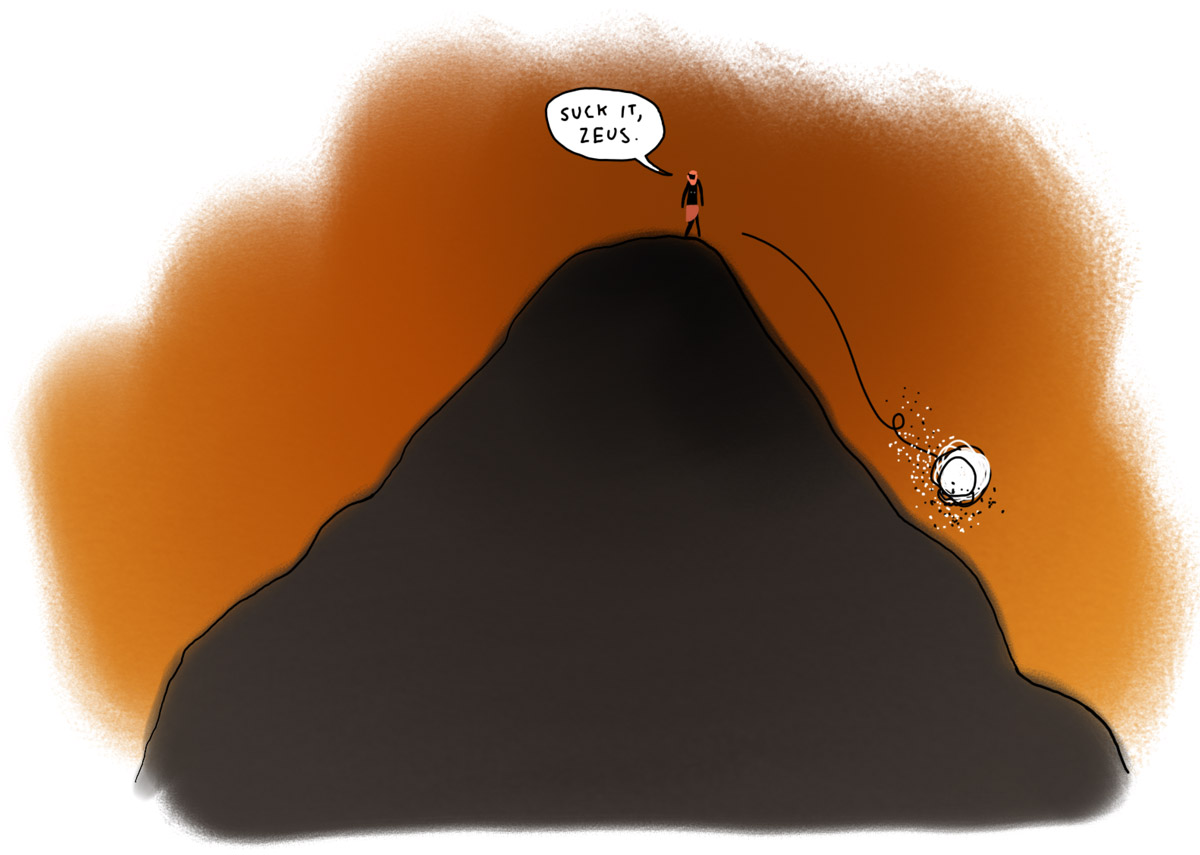
I like to know where I’m going. So, I document my goals, and reassess them weekly. Like you, I don’t achieve most of them. For a while, this led me to believe that goals were pointless. Since then, I’ve worked on this more. I’ve also helped others do the same. Here’s what I’ve noticed.
Goals are difficult
There’s little wrong with goals. It’s useful to have a destination in mind. That said, goals often fail. Some fail because they’re not yours. You might have read a famous business owner’s biography, and “borrowed” their goals. Most times, this doesn’t work out very well.
Other goals fail because they’re unsupported. This is like saying you’d like to be a comedian, and then not make the time to write any jokes. Without a plan for how you might achieve your goals, they remain a fantasy. (This “how” part is what I most often see as the missing piece, when people set goals.)
Without determining why and how you intend to achieve something, it won’t happen. You’ll start strong, wane within a few days, and soon find yourself dealing with other matters.
Know your why
Most of us seek out examples to follow. This doesn’t work with goals, though. Nope. You’ll soon tire of living like someone else. Your goals—and reasons for them—should be yours alone.
I wish I could help you choose from all the possible goals. It doesn’t work like that, though. The only bit of advice I can share on choosing between goals, is to reflect on what fulfills you now. Odds are, that same act will fulfill you later, too. Conversely, something you haven’t experienced (like being rich) might not turn out to be what it seems.
Your ego can work against you, when setting a goal. It seeks external reinforcement, instead of internal fulfillment. In my experience, this always turns out to be a dead end. Make your goal personal and simple—otherwise, you’ll lose sight of it.
Determine what’s essential
Choosing a destination, and mapping a course to it are two different tasks. Some select a destination, and hope they’ll magically arrive at it.1 These people leap from one set of goals, to the next, wondering why they are so unlucky.
The question you need to ask, is: What’s essential to making my goal happen? The answer should be pretty simple. For example, if you want to be a comedian, you probably need to write jokes. If you want to be a designer, you probably need to design things. If you want to be rich, you probably need to build something that produces revenue.
This seems obvious—and it is. This doesn’t make it any easier, though. I’ve met countless “aspiring entrepreneurs” who read business books, go to networking events, and follow all the new startups. But, these same people never seem to ship.
For this reason, you might want to create a list of tasks that don’t matter, or things you don’t do. Identifying low-yield tasks can help you avoid them.
Practice habits
Now, you have a destination, and a plan for getting there. The next part requires you to get in the car and drive. This part, too, can be difficult.
Some days you won’t feel like driving. Or, you’ll wonder whether you’re getting anywhere. “This’ll never work.” “I should have done something else.” “There must be a faster way.” Give these thoughts your ear, and they’ll paralyze you. Use habits to silence nagging doubts.
Let’s use that aspiring comedian as an example. When in doubt, all she needs to do, is keep writing jokes. She can use this as a mantra. When doubt says, “you should quit”, she blocks with: “keep writing jokes”.
Habits are challenging to form, but get stronger with practice. In time, autopilot takes over. You don’t need to think about practicing them, you just do what you did the day before.
Big ones
One last consideration. Big goals are fine. That said, you should recognize them for what they are. The bigger the goal, the harder it’ll be to achieve. For these, you can either choose smaller ones, or give yourself more time.
Whatever your goals, don’t be too hard on yourself. Goals sometimes change. Habits aren’t easily formed. If you find yourself gone astray, pause for a moment. Remind yourself what you want to achieve, and why. Return to that habit, and start where you left off. Pay your slip no further attention. Everyone has those.
Homework
Fill in the blanks: I want to _____________, because _____________. I’ll make this happen by _____________, every day.
—
- Consider the phrase, “If you can dream it, you can do it.” While the sentiment is inspiring, I suspect it’s often misread as, “If you imagine it, it will happen on its own.” Remember: the doing part is as important as the dreaming part.
The post Goals + Habits appeared first on Eric Karjaluoto.
What Should be Done When Data Have Creators?
I was listening to the podcast The West Wing Weekly recently and Episode 4.17 (“Red Haven’s on Fire”) featured former staff writer Lauren Schmidt Hissrich. In introducing her, the podcast co-hosts mentioned that Hissrich was a writer for the Netflix series Daredevil, based on the Marvel Comics character. She is also the showrunner for a new Netflix series called The Witcher, which is based on a book by Andrzej Sapkowski.
All this got me thinking about how screenwriters are often limited in what they can write by the fact that the material they are writing was originated by someone else. The characters in their stories have “creators” and there is an extent to which writers have to remain true to their creators’ intent for the characters. From a business perspective, it can be seen as a safer bet if a writer creates some story based on existing intellectual property, since that IP may already be popular. But, writers also have to be careful that they don’t go too far in a different direction or those same people who loved the original will dislike the new material.
Lessons from Screenwriters
Screenwriters often write their own original material, particularly when they are at the top of their profession and have the artistic freedom to do more of what they want. They have earned this freedom and the studios/producers trust them to produce original material that is good and financially successful. In these cases, screenwriters can create their characters and their stories and take them where they want to go, subject to the many constraints inherent in producing TV or movies.
In many other situations, screenwriters are writing other people’s material. A writer working on a TV show likely did not create the TV show and did not create any of its main characters or storylines. They have to enter the show midstream, adapt to its characters, and write material that would be appropriate for the show and the individual characters. While a writer still needs to be creative in this role, there are quite a few more constraints in that they have to conform to what has come before. In particular, the show’s creators may have very strong opinions about how characters and storylines should work and a staff writer will have to go along with it in order to work out.
The Data Creator
In data science, data have “creators” and a big part of being a good data analyst is respecting the role of the data creator and collaborating with them effectively. We might also call the data creator the “subject matter expert”, depending on the context. The data creator typically originated the reason for collecting the data, asked the originating question that led to data collection, and maybe oversaw the process of collecting the data itself. They know the ins and outs of how the data were collected, the strengths and weaknesses of the process, and all of the unwritten context about the data. This unwritten context, unfortunately, is by definition not documented, and over time is typically lost or forgotten.
The data creator can answer questions like
- Why are there missing data? How might data come to be missing?
- Why is this observation so low/high? Did anything funny happen there?
- What types of error might be introduced in collecting or measuring the data?
- Why did you collect this variable or feature instead of that variable or feature?
A data analyst must understand how to “fit themselves into the data” so that they know when appropriate questions are being asked of the data and when questions are being asked that cannot be answered by the data. The data were likely there before the analyst was, and so the analysts does not have absolute freedom to do whatever they want with the data. The data have a context and an original reason for being, and a data analyst should understand and respect that context.
I recently worked on a study where people were being evaluated in a clinic every 3 months. On one of the visits, many of the outcome values were abnormally high. My first reaction was to go through the individual numbers and see if there was anything amiss. Not seeing anything, we checked the paper forms on which the data were originally collected to see if there was a transcription error–nothing unusual there either. Finally, we talked to the study staff who actually saw the patients in the clinic to see if they had seen anything unusual. Still nothing. Ultimately, the data are what they are, but it was reassuring to be able to goto the people on the ground to get their impressions. This kind of information is difficult to code and quantify, so it’s important to be able to talk with the “data creators” to get the full story.
Found Data, Surrogate Creators, and off-label usage
Some data do not have identifiable creators or their creators are long gone and cannot be contacted. Such “found data” are everywhere and the original reason that they were collected is largely unknown. It’s tempting to run off with such data if they appear to serve a given purpose, but some effort should be made to identify the data’s original purpose for being. In these cases the analyst must serve as a “surrogate creator” and put themselves in the position of understanding all of the aspects of the data that a creator would normally know.
Just because data were collected for a specific purpose does not mean they cannot be used to ask a different question. Such “off-label” uses of data can be very fruitful and creative use of data off-label can lead to breakthroughs in unrelated areas. However, one must still have a good understanding of the data’s creation because of all the context that comes attached to the data. That said, it is often the case that aspects of the data that were highly relevant to the original question are less relevant for the off label usage.
Example: Air pollution monitoring
Ambient air pollution data in the United States is collected primarily for regulatory purposes. The question that the data are attempting to answer is essentially “Are air pollution levels in this county higher than the national ambient air quality standard?” In order to answer this question, it’s important to have a rigorous standard for collecting the data so that the measurements are highly accurate and precise. It is incredibly important to all parties that the numbers are reliable. The methodology for measuring air pollution at federal monitors is known as the “federal reference method” and is documented as a Federal Information Processing Standard (FIPS). People who work in monitoring and who develop new monitors are highly aware of the need to reduce error and to maximize reliability.
However, when using monitoring data for epidemiological studies of air pollution and population health, the error in the data introduced at the monitoring level, while real, is often negligible in comparison to the the exposure measurement error that is introduced by assigning monitor values to members of the population. Epidemiological studies use the regulatory monitor data off-label because the data are numerous and freely available, and furthermore the errors in the monitor data are less relevant in the epidemiological setting than they are in the regulatory setting.
That said, I’ve been in numerous debates with engineers who are familiar with the way the monitors are built about how the errors in the monitoring might affect my epidemiological studies. They often insist (politely) that my results are not valid because the monitors are too variable. Now, I realize it doesn’t sound good when my argument is essentially, “I know my study is valid because the errors that I introduced by using your data and merging it with health data are way bigger than the measurement errors that your monitor produces!” But this is indeed the case. And the engineers were rightfully worried about their data being used in a different context.
While the engineers might sweat over the deviations produced by a given monitor, even in the worst case scenario, it’s unlikely that the scale of variation that they are worried about would have any impact on the health risk models that we were fitting to the data. I’m better off spending more time looking at the sensitivity of the models to the exposure measurement error rather than worry about individual monitor variability. Nevertheless, it’s through conversations with these engineers that I can get a sense of all the [sources of variation in the data](). Being aware of these sources of variability and communicating any uncertainties that may or may not result is a big part of building trust in my data analyses.
Reply about Garmin Fenix 5x Plus
Michael Kalus has posted a comment:
Roland Tanglao compared to an Apple Watch. But only about 20 hours of GPS tracking. The X is rated at 32 hours and so far I’d say that’s pretty accurate.

First Class R Support in Binder / Binderhub – Shiny Apps As Well as R-Kernels and RStudio
I notice from the binder-examples/r repo that Binderhub now appears to offer all sorts of R goodness out of the can, if you specify a particular R build.
From the same repo root, you can get:
- Jupyter notebook+R: http://beta.mybinder.org/v2/gh/binder-examples/r/master?filepath=index.ipynb
- RStudio: http://beta.mybinder.org/v2/gh/binder-examples/r/master?urlpath=rstudio
- A Shiny app: http://beta.mybinder.org/v2/gh/binder-examples/r/master?urlpath=shiny/bus-dashboard/


And from previously, here’s a workaround for displaying R/HTMLwidgets in a Jupyter notebook.
OpenRefine is also available from a simple URL – https://mybinder.org/v2/gh/betatim/openrefineder/master?urlpath=openrefine – courtesy of betatim/openrefineder:

Perhaps it’s time for me to try to get my head round what the Jupyter notebook proxy handlers are doing…
PS see also Scripted Forms for a simple markdown script way of building interactive Jupyter widget powered UIs.
Huawei says roadblocks to US market are being constructed by its rivals
Immigration in the United States visualized as rings of tree trunk

Pedro M. Cruz, John Wihbey, Avni Ghael and Felipe Shibuya from Northeastern University used a tree metaphor to represent a couple centuries of immigration in the United States:
Like countries, trees can be hundreds, even thousands, of years old. Cells grow slowly, and the pattern of growth influences the shape of the trunk. Just as these cells leave an informational mark in the tree, so too do incoming immigrants contribute to the country’s shape.
Feels real.
Tags: immigration, metaphor
Social media personality among 3 hikers who died at B.C.'s Shannon Falls, family says
| mkalus shared this story : | |
| "Squamish Mayor Patricia Heintzman said in an interview she hoped the increasing numbers of people visiting the backcountry would come prepared." Right, You basically roll them a red carpet right into the back country and then you wonder when people show up who have no idea what to do or that it isn't a walk in the park. |
One of the three hikers who died Tuesday in the waters of B.C.'s Shannon Falls has been identified as a social media personality known for often-daring travel videos.
Rob Mangelsdorf told CBC News that his cousin, 30-year-old Ryker Gamble, was among those who died in an incident at a provincial park 60 kilometres north of Vancouver.
An RCMP spokesperson said the families of the other two deceased requested they not be publicly identified at this time.

High-octane travel videos
Gamble, born in Richmond and living in Vancouver, was one of several people in a popular YouTube travel vlog called High On Life.
The videos saw him and others perform high-octane stunts in exotic locations in B.C. and around the world.
The videos earned the High On Life crew hundreds of thousands of subscribers, and tributes poured in to Gamble's Instagram account Wednesday.
Charged for 2016 incident
Gamble was among a group of young men who earned international headlines in 2016 after being charged by authorities in Wyoming with misdemeanours for walking off a boardwalk in Yellowstone National Park to get closer to the landmark's iconic Grand Prismatic Spring.
Gamble and another man were sentenced to seven days each in prison after returning to Wyoming to face justice.

"We acted in a way that doesn't reflect our respect for the environment we were trying to capture," Gamble told CBC News at the time. "It was the wrong decision to make."
In recent years, he also worked as an instructor in a business that aims to teach people how to build a popular account on Instagram.
Bodies recovered Wednesday
Crews recovered the bodies of Gamble and two other hikers from Shannon Falls Wednesday afternoon.
Teams spent the afternoon looking for them before their bodies were discovered Tuesday night in a steep section that is very challenging to access.
"At around 8:30 p.m. last night, teams were able to confirm the location of the three people in one of the lower pools," said a statement released by the RCMP on Wednesday morning.
RCMP said they were able to confirm the location using cameras and a crew member who managed to reach the pool.
'Extremely dangerous spot'
The bodies were in the third of a series of pools at the top of the falls that can only be accessed by ropes.

RCMP called in a swift water rescue team and an underwater recovery team, the RCMP said.
"The terrain is extremely difficult, very dangerous, and the water flow will be heavy with the warm temperatures today increasing the risk to those in the recovery effort," Cpl. Sascha Banks said before the bodies were recovered.
Woman slipped into water
Accounts of what happened to the three people vary slightly.
Squamish RCMP said they received a call from BC Ambulance just before noon Tuesday regarding three people who were swimming in one of the pools at the top of the falls.
The individuals, who were part of a group of seven friends, were walking along the edge of the falls when they slipped and fell into a pool 30 metres below, paramedics told Banks.

On Tuesday John Willcox, a manager with Squamish Search and Rescue, said witnesses reported one woman was standing at the edge of the water at the top of the falls when she slipped and fell into the strong current.
Her boyfriend and another hiker jumped in to try to save her but they were all swept over the edge, Willcox said.
"The other friends said that they saw the three people go over, out of view from the one pool they were at," he said.
The three victims have been identified and RCMP have confirmed they are all from B.C. and in their late 20s and early 30s.
Gondola increases tourism
According to the provincial parks service, the falls are 335 metres at their highest point. They are located in Shannon Falls Provincial Park, which is a popular hiking spot near Squamish on the Sea-to-Sky Highway.
The area is accessible from the Sea-to-Sky Gondola and by hiking trails in the provincial park, but Sascha said the area can be dangerous.
"Unless you have knowledge and the right equipment you should not be up there," she said.
Willcox said he's never heard of someone being swept over the falls, but there have been previous incidents where people and dogs had to be rescued after falling on the slippery rocks.
"The Sea to Sky Gondola has certainly brought a lot of tourism to Squamish ... but along with that comes some pretty serious terrain," said Willcox.
Squamish Mayor Patricia Heintzman said in an interview she hoped the increasing numbers of people visiting the backcountry would come prepared.
"I don't want to get the impression that this is a disaster waiting to happen every time someone hikes up there," she told On The Coast host Gloria Macarenko.
"Obviously as you invite more people into the backcountry just by nature of numbers you're going to have more situations where this type of thing may happen."
Officials have closed the trails around the top of the waterfall until further notice.
Rescue crews search for three missing people at Shannon Falls on Tuesday:


CBC News BC
Search and rescue teams scour Shannon Falls
    Playback Status: ready

Assigned test group: None

Identifier: mediaId 1269794371994

Asset: Undetermined

Bitrate: Undetermined

Streaming URL:

Events Log:

Itty bitty sites

Nicholas Jitkoff,
Itty bitty sites,
Jul 23, 2018
As the itty bitty website says, "Itty bitty sites are contained entirely within their own link. (Including this one!) This means they're: portable - you don't need a server to host them; private - nothing is sent to–or stored on–this server; easy to share as a link or QR code." It's not really an exaggeration. There's some code - available at GitHub - and some samples set up in CodePen. The idea of a web site in a link is appealing.
Web: [Direct Link] [This Post]You don’t have to live in public

Austin Kleon,
Jul 23, 2018
Austin Kleon discusses the topic of his recent book Show Your Work! and emphasizes that " It isn’t a book about living in public, it’s a book about working in public. It is, I think, about sharing your work with intention, and using the technology available to you to connect directly with the audience you seek." He's responding to recent criticism about the use (and overuse) of social media, and especially Jaron Lanier's recent book 10 Reasons for Deleting Your Social Media Accounts Right Now. Kleon says, "It’s not a particularly well-written book (Franklin Foer’s review is worth reading — he calls it '“less polished' than Lanier’s other books and, even, 'hokey') but it has an important message." Readers will recall that I quit Facebook almost two years ago, though I can still be found on Twitter and Mastodon, as well as on a quiet Google+ account.
Web: [Direct Link] [This Post]India tells WhatsApp to stop the deadly rumor mill, somehow

Mathew Ingram,
Columbia Journalism Review,
Jul 24, 2018
India is dealing with "beatings and killings that appear to be related to conspiracy theories circulating on WhatsApp." It's easy to blame the technology, but as argued here, "The fact that such misinformation not only fuels citizens’ paranoia, but also causes them to take matters into their own hands in droves, is indicative of a lack of faith in the machinery meant to maintain law and order." Meanwhile, WhatsApp has responded by saying that it believes misinformation is a challenge “that requires government, civil society and technology companies to work together”.
Web: [Direct Link] [This Post]How International Corporations Can Help Educate the World

Sarah Brown,
Stanford Social Innovation Review,
Jul 24, 2018
According to this Stanford article, "The private sector offers more than just deep pockets to the quest for global education; companies have talent, resources, and new ideas to share." All true, but overall I'd rather see more from the deep pockets (after all, they got it all from the techpayers in the first place) and fewer new ideas (after all, they don't have a good track records, and they have an unfortunate tendency to change the objective from 'teach needy children' to 'make more money'). This of course is not the perspective offered in this article, to which I refer you now.
Web: [Direct Link] [This Post]Twenty Years of Edtech

Martin Weller,
EDUCAUSE Review,
Jul 24, 2018
I've been following the series of articles of the same name on Martin Weller's blog. 20 years ago, it was 1998, I wrote the Future of Online Learning, and we were looking forward to LMSs and learning objects. A lot has changed since then (but a lot has rolled out exactly as we expected to, proving to to a large degree you can predict the future). While I would order and date them a bit differently, I played a role in each of the technologies described in the 20 parts of this article, and it is with no small sense of accomplishment that I look at what we as a community has done over that time. We have indeed transformed education.
Web: [Direct Link] [This Post]#4343
Condor on the Things We Left in the Old Web, and our current endless pages and silos of grey on white with a bit of blue (this blog too…). And a webmention to let him know, as asked, that I’m out here, from across the web.
Sketchbook Pace
The labels on my sketchbooks show considerable variation in sketching activity over the past year: the book I finished up today was one I started in February, 5 months ago.
My pace has picked up recently, now that summer has come and I’ve more to sketch than my kitchen table.

What Second Beach says about Vancouver
This is one of my favourite places in Vancouver.

It’s the changing room across from the outdoor pool at Second Beach, where, after a satisfying swim, I can switch modes for running and cycling — an informal triathlon in the City-as-Gym.
It’s free, and it’s safe, and it’s not quite as amenity-free as it looks; there’s a hair dryer. But like the pool itself, it’s utilitarian and proud of it.

We should be too. Because I heard two conversations that suggest it should be otherwise.
One was from a swimmer — looked like a businessman — who, after noticing how few people were in the pool on a summer afternoon, wondered why the city should be paying so much for an expensive, under-utilized amenity. I have no doubt this operation fails to pencil out.
Another swimmer, on the other hand, bemoaned the decaying facilities that served as our change room, not to mention the downscale appeal of the concession stand itself. Surely a rich city can so much better. No doubt it could, at a price.
But the bare-bones quality of Second Beach (and the menu at the concession) is in a way a statement of our democracy: rich and poor, long-time resident and recent immigrant, the athletic and the overweight, they all get naked together in a plain room without dividers.
Detailed Samsung Galaxy Note 9 Specs Leak
 Samsung is set to unveil the Galaxy Note 9 officially on August 9, but the company’s surprise has already been ruined by a detailed hands-on of the handset. Today, more details regarding the Galaxy Note 9 have surfaced leaving little to imagination.
Continue reading →
Samsung is set to unveil the Galaxy Note 9 officially on August 9, but the company’s surprise has already been ruined by a detailed hands-on of the handset. Today, more details regarding the Galaxy Note 9 have surfaced leaving little to imagination.
Continue reading →
Canadians use less than half the cellular data Americans do: Tutela report

Canadians use 56 percent less mobile data per month than the average American, according to a study published by Victoria-based mobile data company Tutela.
The study collected data from over 48 million mobile data users across 10 countries during May 2018, including over 100,000 users in Canada.
Among 10 other countries, Tutela’s data shows that Canada is tied with Brazil in last place with respect to the average amount of monthly mobile data consumed per user at 2.7GB. Comparatively, the average mobile user in the U.S. uses 6.1GB of cellular data per month, and users in India topped the charts with a 6.8GB monthly average.
Notably, Canadians use a monthly average of 8.4GB of Wi-Fi on their mobile devices, roughly the same as Americans (8.3GB) — indicating high overall use of internet on mobile devices.
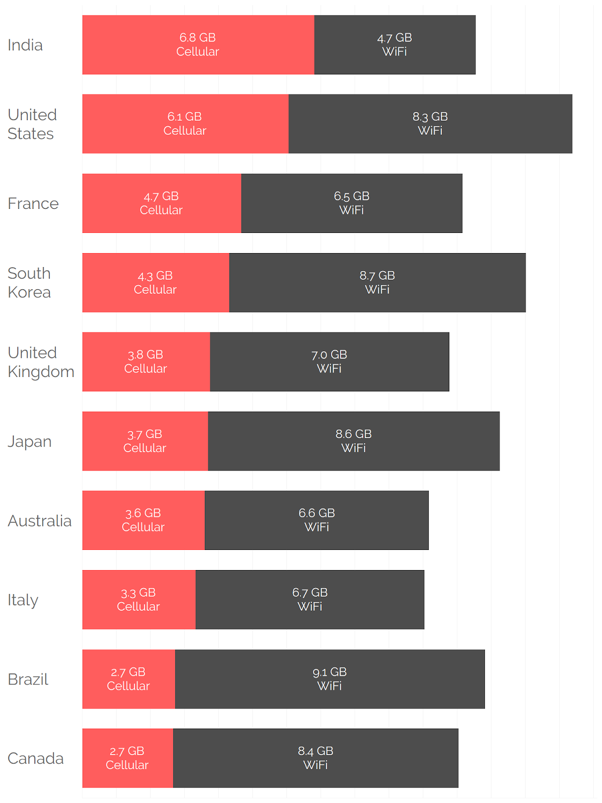
The issue, Tutela suggested, rests on price.
Tom Luke, vice president of sales and partnerships at Tutela, cited a report from mobile analytics firm Rewheel, which assessed how many LTE gigabytes could be purchased at different pricing levels in countries across the world. The report indicated that while €30 (roughly $50 CAD) purchases a monthly plan with approximately 100GB in the U.K. — or 10GB in the U.S. — it only provides Canadians with approximately 2GB.
A study on international wireless pricing released in December 2017 by Nordicity, and commissioned by Canada’s federal government, also confirmed high wireless prices for Canadians in comparison with global averages. The study revealed that Canadians pay some of the highest rates among a group of countries containing the U.S., Italy, Japan, Germany, U.K., France and Australia.
“It is possible that price could be a key factor in Canada’s low cellular data consumption, particularly when you consider that they use the same amount of data on Wi-Fi as their American counterparts,” said Luke in a press statement.
Tutela also broke down cellular usage by Canadian carrier.
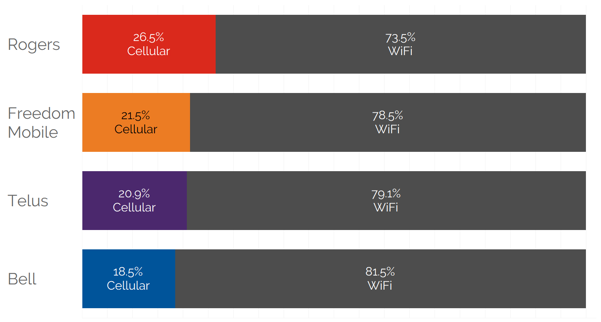
Between the Big Three and Freedom Mobile, Rogers customers consume the most data on average — 26.5 percent cellular (the rest, 73.5 percent, on Wi-Fi). Bell customers use the least, with 18.5 percent.
“In our recent report looking at Canadian mobile network quality, our results showed Bell achieving the fastest network speeds, with Rogers the slowest, which could suggest network congestion is impacting on Rogers network performance,” Luke suggested in the press statement.
Response from telecom industry group
MobileSyrup requested comment from Rogers, Bell, Telus and Freedom Mobile regarding the results of the study. While Bell, Telus and Freedom did not provide comment in time for publication, Rogers directed MobileSyrup to the Canadian Wireless Telecommunications Association (CWTA), a telecom industry group.
A CWTA spokesperson said in an email to MobileSyrup that the study provides a “simplistic view of the methods by which people access content and the internet, and why.”
“As the release states, there can be many reasons for varying data consumption patterns from jurisdiction to jurisdiction, including penetration rates for different forms of connectivity and TV supply, regulatory environment, etc.” continued the spokesperson.
“Suggesting that the reason for higher data consumption in the U.S. is due primarily to differences in wireless pricing flies in the face of oft-cited reports (such as OECD and Nordicity), which rank Canadian wireless prices as comparable to and [in] some cases lower than those in the U.S.”
More on Tutela
Tutela gathers its information from tests conducted in the background of over 3,000 popular Android and iOS apps and games, which it pays to host the software. Tutela told MobileSyrup that users of those apps get a pop-up asking if they want to allow the company access to perform tests.
Tutela then sells its data, in the form of reports and tools for improving network performance, to customers, a significant portion of which are wireless operators. The company confirmed that at least one Canadian operator is a customer.
Unlike other speed testing companies, Tutela stated that it downloads a smaller, generally 2MB, file to gather its data.
Luke told MobileSyrup that this file measure real-world usage better than speed apps like Speedtest by Ookla or OpenSignal, since it measures lots of small downloads, rather than doing one extended speed test of a much larger data packet, as is the case with the aforementioned platforms. This puts more emphasis on the quick acceleration required for short downloads than top download speeds (which can be ramped up to slowly).
He added that this is the reason the speeds from Tutela’s tests aren’t as impressive as those seen with the other major speed testing platforms.
In addition to this study on average cellular data amounts used per month, Tutela recently released a March 1st to May 31st Canadian speed test report and study on visitor versus resident data speeds in Canada.
The post Canadians use less than half the cellular data Americans do: Tutela report appeared first on MobileSyrup.
Apple has reportedly decided against using Intel’s 5G chips for 2020 iPhones

Apple has decided against using Intel as its 5G modem manufacturer for 2020 iPhones, according to a report from CTech.
The publication, which said it reviewed internal company communications from Intel, reported that after being dealt the blow, the chipmaker halted development of the modem — codenamed ‘Sunny Peak’ — and disbanded the team.
Apple has not publicly responded to the report, while Intel refused to comment on the subject to CTech.
In the internal communications, Intel speculated that Apple’s decision was the result of “many factors,” including the introduction of WiGig, a new multi-gigabit Wi-Fi standard.
In a June Bloomberg report, an analyst suggested Apple could replace Intel with chips from MediaTek. Additionally, a previous report stated that Apple is working to ccreate its own chips for Mac computers, phasing out Intel’s chips.
None of this is very good news for Intel, however, the company intends to further improve its 5G modem in an effort to get the modem into Apple’s 2022 mobile devices. On its side is Apple’s quarrelsome relationship with Qualcomm, which has traditionally been a supplier of modems for Apple and has announced several 5G development milestones already.
Reports suggested Apple was ready to cut Qualcomm’s modems out of iPhones altogether this year, but a recently published article from Nikkei suggested Intel fell short of Apple’s needs, necessitating the use of Qualcomm chips.
5G, the next major wireless generation, is expected to begin arriving in wide-scale deployments in 2020, bringing with it multi-gigabit speeds and ultra-low latencies.
Source: CTech
The post Apple has reportedly decided against using Intel’s 5G chips for 2020 iPhones appeared first on MobileSyrup.
Samsung to reveal Galaxy X at CES and S10 at MWC: report

Ice Universe a leaker who often tweets about Samsung devices, just revealed the release dates for two of Samsung’s most anticipated handsets, the Samsung Galaxy X and S10.
In four words, Ice Universe has answered two of the most anticipated questions for Samsung lovers. Expect Samsung to reveal Galaxy X at Consumer Electronics Show 2019 in January and to reveal the S10 at Mobile World Congress a month later.
CES2019:Galaxy X
MWC2019:Galaxy S10— Ice universe (@UniverseIce) July 4, 2018
And while this news is interesting, reading it now it feels a tad obvious.
While Samsung doesn’t always reveal its S series in February, it did this year. A later release date is definitely plausible, however, the S10 is supposed to be a significant upgrade in comparison to the Galaxy S9. This means that it would make sense for Samsung to want to steal the show.
As for the South Korean tech giant revealing the Galaxy X at CES, the show happens to be the place where manufacturers show off prototype smartphones or other, sometimes odd tech gadgets.
The Samsung Galaxy S10 is rumoured to feature an under display fingerprint sensor and to get rid of its iris scanner in favour of 3D sensing technology. Meanwhile, the Galaxy X is tipped to sport a flexible battery that’ll range from 3,000mAh to 6,000mAh and may bend in the middle, similar to a flip phone.
While the leak seems likely very accurate, take it with a grain of salt until Samsung officially reveals either device.
Source: Ice Universe
The post Samsung to reveal Galaxy X at CES and S10 at MWC: report appeared first on MobileSyrup.
Bell increases data overage charges from 7¢/MB to 10¢/MB

National carrier Bell has increased its data overage fees from $0.07 per 1MB to $0.10 per 1MB.
According to the carrier’s rate plans website, current as of February 18th, 2018, “additional data usage charges are $0.10/MB.”
The new overage fee roughly translates into $100/GB.
Bell also warns that the maximum data usage per user may be capped at 10GB per billing period, meaning that the carrier’s overage fees could translate into a $1,000 bill. Of course, the Wireless Code explicitly states that service providers must suspend data overage charges once they reach $50 within a single monthly billing cycle — unless the account holder consents to paying extra fees.
The carrier’s overage fee as of July 7th, 2017 was $0.07/MB.
A Bell spokesperson told MobileSyrup via email that the new overages only apply to new plans introduced today.
“The increase does not affect existing customers that remain on the previous plans,” said Bell, in an email to MobileSyrup.
Interestingly enough, Bell flanker brand Virgin Mobile has not increased its data overage fees.
Virgin Mobile currently charges $0.07/MB, as it did last year.
Additionally, it appears that neither Rogers nor Telus — Bell’s primary competitors — have yet to raise their fees.
For what it’s worth, steadily increasing data overage fees could be one of the reasons why Canadians consume less mobile data than their American counterparts.
MobileSyrup has reached out to Bell for comment, and this story will be updated with a response.
Update 05/07/2018 1:03pm ET: Story updated with additional reporting.
The post Bell increases data overage charges from 7¢/MB to 10¢/MB appeared first on MobileSyrup.