Rolandt
Shared posts
Millennials Really Are an Urban Generation | Richard Florida
I Switched to Public Mobile
After my wireless provider, Eastlink Wireless, decided that it would only support phones purchased from it, I went looking for a new wireless provider.
My first quandary was that Eastlink’s pricing–$40 per line per month, including 3GB of shared data–was hard to beat; indeed, none of the major providers (Bell, Telus, Rogers) nor their discount brands (Virgin, Koodo, Fido) could come close.
Then I happened upon another Telus discount brand, Public Mobile, that I’d never heard of before. It’s an interesting concept: completely self-service, no contracts, no call centre support, and 100% “bring your own device.”
As I reckoned I could do without a call centre, and bringing my own device was the point of the switch, I dug deeper and found that Public Mobile has a $40 per line per month plan which includes 4.5GB of 3G data (you can pay more for LTE data, but I never do anything bandwidth-intensive while not connected to wifi, so I didn’t need that).
Convinced this was a viable way forward, I ordered up a couple of SIM cards, one for me and one for Catherine, and they arrived in the mail four days later.
Today I finally got around to activating the service on my phone, which turned out to be relatively simple: from the Public Mobile self-service site I entered the SIM card number, the phone number I wanted to port, my name and address, and my credit card information (I set up “auto-pay,” which is a pre-paid service that bills automatically every month). The self-service site is a little bit 2005 in its usability and aesthetics, but it all appeared to work as intended.
The only confused part of the switch-over was that although the SIM card got activated immediately (I just needed to reboot my phone to do the switch), there was a delay in porting my number, meaning that I could make outbound calls but not immediately receive inbound ones. I worked around this by sticking my Eastlink SIM back in the phone until the port happened. In the end the delay was only about 30 minutes.
For those of you keeping track, Public Mobile will be my fifth wireless provider: I started out with Island Tel Mobility back in the day, then moved to Rogers, then Virgin Mobile, then Eastlink.
I report back on how things go.

Twitter Favorites: [MrSteveTweedale] John Rawls was the greatest political philosopher of the 20th century. What might he say about electoral reform if… https://t.co/ohNBAMoU4B

John Rawls was the greatest political philosopher of the 20th century. What might he say about electoral reform if… twitter.com/i/web/status/1…
Twitter Favorites: [brownpau] Also happy 4th of July from these shorts that I found in, of all places, Landmark Mall, Makati, Philippines https://t.co/GDCT0zzXDp

Also happy 4th of July from these shorts that I found in, of all places, Landmark Mall, Makati, Philippines pic.twitter.com/GDCT0zzXDp

 xkcd.com.

The #3 most important idea in Computer Science
Well, this one is probably the most controversial. But I think the #3 most important idea has something to do with the problem of exponential growth of the number of possible states we can represent as we add bits to our system.
Transcript
Eric Normand: What is the third most important idea in Computer Science? My name is Eric Normand and these are my thoughts on Functional Programming. Now this, again, is not directly Functional Programming related, but it’s something that I think we use a lot in Functional Programming, and so I’m going to talk about it.
What is the third most important idea? To me, it is the idea of the trie, the T-R-I-E, pronounced trie, stands for retrieval. Let me frame the problem here. Our machines have millions and millions of bytes, billions of bits. Each bit doubles the number of possible states that our software can be in, the computer can be in. Doubles.
 Eric Normand@ericnormand
Our machines have billions of bits. Each bit doubles the number of possible states the computer can be in. It's ludicrous to imagine keeping it coherent without serious help. We need to counteract the doubling with an equivalent halving. Tries can do that.
ed.gr/vyfySun Dec 16 16:02:15 +0000 20180
2


This is so many doublings, it’s ludicrous to imagine keeping all of that maintained in some kind of coherent state without some help. We need serious help. Every bit that we add doubles the number of representable states.
One thing that we do with this exponential growth, is we manage it by saying, “Well, this little piece right here, these 64 bits are going to represent a number.” We chop up our possible states into different states. But it doesn’t change the game, it just helps us organize it better and talk about the transitions between them a little better.
We still have this immensely complex system that we’re trying to manage. Even if you chop it up, you still got all these little pieces that you’ve chopped it up into that you have to manage. We need some way of counteracting that exponential increase in complexity, that doubling and doubling and doubling.
I believe that we have something to counteract the exponential increase and it’s the trie. It’s an organized tree structure. Trie, the first time I said it, the trie is T-R-I-E, but an organized tree structure, meaning T-R-E-E, branching that gives us logarithmic growth.
Meaning the more stuff you add, the more efficient the system becomes because you’ve got overhead. You’ve got some overhead for storing stuff in a tree but the more stuff in there, the more the overhead is amortized logarithmically. You need less and less overhead per each new thing added to the tree.
That lets us organize this mountain of data of possible states that we have into something coherent that we have very good properties about. It’s got logarithmic access to any node in there in the tree, to any piece of information in the tree. It lets us build indexes. In Clojure, we use them to represent entities as well.
Eric Normand@ericnormandTries lets us organize this mountain of possible states that we have into something coherent that we have very good properties about. It's got logarithmic access to any piece of information in the trie. In Clojure, we use them to represent entities as well.lispcast.com/the-3-most-imp…
Mon Jul 23 15:00:54 +0000 2018
This is my vote for the third most important idea in Computer Science. I’d love to hear what you think because I don’t know if I’ve shared that with many people. I’m not quite sure what other people’s opinions are on this. Whether you even have thought about what the most important ideas are in Computer Science.
To me, Computer Science is one of those interesting things that is informing us about how we can think about the world, how it’s helping us build new understanding of the world. I’m talking about the world outside of computers.
Obviously, it helps us learn about computers, but this idea that information can be organized into structures that give us logarithmic access to them, and they grow logarithmically, is a thing that we might not have thought of before we had so much information and a study of information architectures.
All right. Again, my name is Eric Normand. This has been a thought on Functional Programming and I will see you later.
The post The #3 most important idea in Computer Science appeared first on LispCast.
Back on the blog:red carpets and alienation – some thoughts from graduation season
It’s been a while since I’ve blogged so I thought I better get back on the wagon as they say. The past couple of weeks have been consumed with finishing the book I am writing with Keith Smyth and Bill Johnson but our manuscript is submitted now and I can escape from academese back to the much more comfortable territory of blogging.
The title of our book is “The digital university, the intersection of policy, pedagogy and practice”. I don’t want to create a #spoileralert but a large part of the book is concerned with developing more approaches based on critical pedagogy and open education to counter the current neoliberal narrative of managerialism that is all too prevalent in HE today.
Writing the book has been challenging, cathartic, at times inspirational, at times depressing. However this week there has been a bit more cheer in the air as it is graduation week here at my university. The week began with some real excitement as Annie Lennox (yes, the Annie Lennox) was installed as our new Chancellor, and our first female Chancellor. The installation ceremony was actually pretty fantastic in terms of gender representation. Our new Chancellor, Nicola Sturgeon (our first female Scottish First Minister), Jackie Kay (our national makar) and Rachel Simpson (the current President of our Students Association) all spoke very eloquently.
It has been lovely to see all our new graduates with their families filling up the campus everyday. It’s been sunny here too which makes it even nicer for everyone. Seeing the crowds in their gowns and glad rags makes me glad to be working in HE, despite some of the depressing trends I’ve been writing about – particularly around the student as consumer and the overall worth, measurements and value of a degree. This combined with the even more depressing trends I see in our world today where right wing extremism around immigration, race, gender, human rights are becoming normalised by the leader of the so called free world. This is not the kind of leadership and world I (and I’m sure you, dear reader) want any graduates or young person to be part of.
As part of our research for the book we revisited a very fine (some may even argue one of the finest) speech from Jimmy Reid when he was installed as Rector of Glasgow University in 1972. You can read the full text here. It’s called Alienation and almost 50 years on from when it was written it is still very relevant. Back then we were in an economic crisis, there was a huge debate about joining the European Union, the Tories clinging onto power. The economics may have skewed slightly, but the debates about Europe are much the same. Crucially in the present day we know many more young people wanted (and still want) to remain in the EU. Their opportunities are being alienated by a group of egotistically politicians who have no plans, just bland bog roll rhetoric. How many unwritten blog posts in my head over the past year do I wish had this as their opening.
Alienation is the precise and correctly applied word for describing the major social problem in Britain today. People feel alienated from society . . .what I believe to be true is that is is more widespread today more pervasive than ever before.
This passage is also still apt not just for new graduates but for us, particularly in terms of the politics of the moment coming from our Westminster overlords.
To the students I address this appeal. Reject these attitudes. Reject the values and false morality that underlie these attitudes. A rat race is for rats. We’re not rats. We’re human beings. Reject the insidious pressures in society that would blunt your critical faculties to all that is happening around you, that would caution silence in the face of injustice lest you jeopardise your chances of promotion and self-advancement.
Still on a sunny day we can instagram it all away. But I’d like to think that Jimmy would agree with me that if we can install a red carpet for our new Chancellor we should keep it on campus for the rest of the week for all our graduates too.

The future of global payments
Samsung could be adding Bluetooth connectivity to the Note 9’s S Pen

The Samsung Galaxy Note 9’s S Pen might be getting a significant upgrade.
The new S Pen has hit the Federal Communications Commission (FCC), revealing that the accessory now features Bluetooth connectivity.

While the FCC filing doesn’t specifically state that it refers to the Note 9’s S Pen, the matching ‘960’ model number is a clear indication that this is likely the case.
The FCC tests consumer electronics in order to verify that they don’t interfere with wireless communication. Now that the stylus includes 2.4GHz Bluetooth LE (low energy) connectivity, it needs its own FCC certification.
Previous iterations of the Galaxy Note series produce an electromagnetic field that provides power to and connects with the S Pen. The FCC filing indicates the new S Pen connects via Bluetooth, though it’s not clear if Samsung will forego the old method in favour of Bluetooth connectivity.
If so, Samsung will require another way to power and charge the S Pen. Android Police suggests that Samsung may add charging functionality via pins or a wireless technology that activates when a user docks the stylus.
What’s more interesting is what Samsung plans on doing with the Bluetooth connectivity. Some suggest play/pause functionality, while others point to the possibility of a shutter button for the Note 9 camera, or even another way to control Bixby.
Further, Samsung could even put a mic in the stylus, allowing users to answer calls without the need for the actual handset in-hand.
Samsung’s Unpacked Event invitation highlighted only the S Pen, giving an indication that a huge overhaul might be on the way for the stylus.
Source: FCC, Via: Android Police
The post Samsung could be adding Bluetooth connectivity to the Note 9’s S Pen appeared first on MobileSyrup.
Google says no one at company reads private Gmail ‘except in very specific cases’

Mountain View search giant Google is reassuring users that no one at the company combs through private Gmail accounts, unless users have given explicit permission.
According to a July 3rd, 2018 Google blog post written by Google Cloud’s director of security, trust and privacy Suzanne Frey, “no one at Google reads your Gmail, except in very specific cases where you ask us to and give consent, or where we need to for security purposes, such as investigating a bug or abuse.”
In the case of third-party app developers who build software intended to be used with Google’s proprietary email client, Frey clarified that the company goes to great lengths to vet developers before allowing them access to private Gmail content.
Frey explained that all non-Google apps are required to meet two specific criteria.
First, apps mustn’t misrepresent their identity and must be clear about the specific manner in which they use data. Second, apps must only request the specific data necessary to provide users with the requisite functions.
“We review non-Google applications to make sure they continue to meet our policies, and suspend them when we are aware they do not,” said Frey.
Frey also clarified that Google shows users a permission screen before non-Google apps are able to access any data.
Google has previously stated that it doesn’t comb through Gmail content in order to target users with ads.
Recent concerns about Gmail data privacy
Google’s latest statement about privacy comes in the wake of a Wall Street Journal story alleging that third-party app developers have access to private Gmail accounts.
According to the Wall Street Journal, third-party software developers can scan Gmail inboxes of users “who signed up for email-based services offering shopping price comparisons, automated travel-itinerary planners or other tools.”
The Wall Street Journal went on to suggest that Google does little to enforce restrictions on these apps and developers, and that employees for companies like U.S.-based email marketing firm Return Path Inc. and Edison Software, “train their computers — and, in some cases, employees — to read their users’ emails.”
The Wall Street Journal reportedly spoke with more than two dozen current and former employees of email app makers and data companies.
Memories of Facebook
Google is only the latest Silicon Valley company to come under scrutiny for handling of user data.
Menlo Park-based social networking giant Facebook came under fire in March 2018 over allegations that approximately 50 million users — including roughly 622,000 Canadians — had their private Facebook data scraped by data brokerage firm Cambridge Analytica.
Cambridge Analytica was able to gain access to these Facebook profiles through a quiz application designed by Cambridge University researcher Aleksandr Kogan, built back when Facebook’s platform allowed developers greater access to users’ friends data.
Facebook CEO and co-founder Mark Zuckerberg later issued an apology to Facebook users, and appeared before U.S. Senate and Congressional committees.
Source: Google, Wall Street Journal
The post Google says no one at company reads private Gmail ‘except in very specific cases’ appeared first on MobileSyrup.
This Nintendo Switch-compatible headset creates a 120-inch display

Though Nintendo hasn’t spoken much about the company’s virtual reality plans for the Switch lately, it looks like one third-party manufacturer is taking matters into its own hands.
Sanko, a Japanese accessory manufacturer, recently showed off the ‘Eye Theater.‘ While not a virtual reality headset in the traditional sense, the wearable’s built-in display is the equivalent of looking at a 120-inch screen, according to Sanko.
The display features a resolution of 1200 x 800 pixels — a non-standard HD resolution that falls between 1080p (1920 x 1080 pixels) and 720p (1280 x 720 pixels). Since the Switch outputs content at 1080p when docked and 720p in handheld mode, this resolution is more than enough for Nintendo’s home console-portable hybrid device.

While Sanko’s Eye Theater doesn’t have a North American release date, the accessory is set to launch in Japan this September for 22,780 yen (which comes to about $271 CAD). While nothing has been confirmed yet, it’s likely that it will probably be available on Amazon at some point, given some of Sanko’s other smartphone accessories are sold through the platform.
Though a device like the Eye Theater likely won’t be useful in most situations given the Switch’s portability, part of me still wants to give the head-mounted screen a try. How could I resist a massive 120-inch display? Imagine how great it would be to block out your surroundings on a plane, or in a busy, crowded area, in order to focus solely on the game in front of you.
Along with the Switch, it looks like the Eye Theater is also compatible with a number of USB-C Android smartphones.
And before you ask, yes, today is a slow news day.
Source: Game.watch.impress Via: Nintendo Everything
The post This Nintendo Switch-compatible headset creates a 120-inch display appeared first on MobileSyrup.
TransLink Funding: Where the Waste Was


Another sign (literally underfoot) of improved responsiveness and service from TransLink.
With approved plans and assured funding, TransLink has been fulfilling some of the promises made as far back as the ill-fated referendum. And that may be contributing to a more receptive response to the decisions made, as recently as last Thursday, to fill the funding gap required for Phase 2 of the $7.3 billion Ten-Year Plan.
It would have been unthinkable a year or so ago that regional politicians, months before an election, would approve the prospect of a gas-tax increase. And yet, most did, and (so far) the coverage has been balanced and blowback moderate.

 Even the usual negative voices (hey there, Jordan Bateman) don’t seem to be resonating the way they did so effectively when they toasted the referendum.
And perhaps that’s the reason: the referendum was such a pointless, dispiriting, wasteful exercise, almost no one wants to repeat that screw-up or delay the process any further.
Come to think of it, since the gas tax is meant to raise on the order of $30 million annually, it would be helpful to know just how much the referendum and, more significantly, the additional increase in costs to the large capital projects as a result of the delay actually add up to.
Bateman argues that savings could come from increased efficiencies. Is he prepared to acknowledge that the referendum itself was likely the biggest inefficiency this region has seen in a generation and the additional costs the largest waste?
And while we’re at it, isn’t it about time the BC Liberals apologized for imposing the referendum on us, and then having no Plan B when it failed? How about it, Andrew Wilkinson? Or are you distracted by other issues you’d rather not take responsibility for?
Twitter Favorites: [NoahBrand1] The great thing about superheroes is that there are so many incarnations and interpretations of the characters, the… https://t.co/JK9tGYLvrx

The great thing about superheroes is that there are so many incarnations and interpretations of the characters, the… twitter.com/i/web/status/1…
Happy Fourth of July

We hope everyone enjoys their Fourth and has a fantastic and safe day out there!

Happy riding!
Jobs Jar: 26 @ YVR Airport Authority
A great place to work, plus some serious plans for spending serious money on big new stuff. Maybe there’s a place for you. And there’s Canada Line.
Vancouver International Airport is looking for 26 (at the moment of writing) new people in openings ranging from entry-level (or nearly so) up to senior level (Directors).
Plus, there’s this: 75 projects, worth $9.1 B.
YVR is expanding into a world class, connecting hub airport. There are currently 75 projects underway totaling $9.1 billion over the next 20 years to meet significant passenger growth and help YVR continue to be an economic driver for BC. pic.twitter.com/VKCbIlw3sm
— Vancouver Airport (@yvrairport) July 3, 2018
Without enforcement, the GDPR is a fail
And the same goes for California’s AB-375 privacy bill.
The GDPR has been in force since May 25th, and it has done almost nothing to stop websites that make money from tracking-based-advertising stop participating in the tracking of readers. Instead almost all we’ve seen so far are requests for from websites to keep doing what they’re doing.
Only worse. Because now when you click “Accept” under an interruptive banner saying the site’s “cookies and other technologies collect data to enhance your experience and personalize the content and advertising you see,” you’ve just consented to being spied on. And they’re covered. They can carry on with surveillance-as-usual.
Score: Adtech 1, privacy 0.
Or so it seems. So far.
Are there any examples of publications that aren’t participating in #adtech’s spy game? Besides Linux Journal?
When a thunderstorm appears right on top of an airport
This is the situation at Newark Airport right now:

Those blobs are thunderstorms. The little racetrack in upstate New York is an inbound flight from Lisbon in a holding pattern.
Follow the link under that screen shot. Interesting to see, in close to real time, how flights on approach and departure dodge heavy weather.
I’ll be flying out of there in a few hours myself, to India, for the firs time. Should be fun.
#4324
Chris Aldrich started accepting Refbacks after reading Why refbacks still matter by Gokberk Yaltirakli. Referer spam is however still very much alive. When I read Gokberk’s post, I looked at my server logs: the referrer log is still all about pills etc. Thousands of spammy Gravatar profiles jump out.
IndieWeb, IndieTech, IndieMethods
When I talk about Networked Agency, I talk about reducing the barrier to entry for all kinds of technology as well as working methods, that we know work well in a fully networked situation. Reducing those barriers allows others to adopt these tools more easily and find power in refound ability to act. Networked agency needs tech and methods that can be easily deployed by groups, and that work even better when federated across groups and the globe-spanning digital human network.
The IndieWeb’s principles (own your own data, use tools that work well on their own, and better when federated, avoid silos as the primary place of where you post content) fit well with that notion.
Recently I said that I was coming back to a lot of my material on information strategies and metablogging from 2003-2006, but now with more urgency and a change in scope. Frank asked what I meant, and I answered
“that the principles of the open web (free to use, alter, tinker, control, trust by you/your group) also apply to other techs (for instance energy production, blockchain, biohacking, open source hardware, cheap computing hardware, algorithms, IoT sensors and actuators) and methods (p2p, community building, social media usage/production, group facilitation etc.). Only then are they truly empowering, otherwise you’re just the person it is ‘done to’.”
Blockchain isn’t empowering you to run your own local currency if you can only run it on de-facto centralised infrastructure, where you’re exposed to propagating negative externalities. Whether it is sudden Ethereum forks, or the majority of BTC transactions being run on opaque Chinese computing clusters. It is empowering only if it is yours to deploy for a specific use. Until you can e.g. run a block chain based LETS easily for your neighbourhood or home town on nodes that are Raspberry Pi’s attached to the LETS-members’ routers, there is no reliable agency in blockchain.
IoT is not empowering if it means Amazon is listening into all your conversations, or your fire alarm sensors run through centralised infrastructure run by a telco. It is empowering if you can easily deploy your own sensors and have them communicate to an open infrastructure for which you can run your own gateway or trust your neighbour’s gateway. And on top of which your group does their own data crunching.
Community building methods are not empowering if it is only used to purposefully draw you closer to a clothing brand or football club so they can sell your more of their stuff. Where tribalism is used to drive sales. It is empowering if you can, with your own direct environment, use those methods to strengthen local community relationships, learn how to collectively accommodate differences in opinions, needs, strengths and weaknesses, and timely reorient yourself as a group to keep momentum. Dave Winer spoke about working together at State of the Net, and 3 years ago wrote about working together in the context of the open web. To work together there are all kinds of methods, but like community building, those methods aren’t widely known or adopted.
So, what applies to the open web, IndieWeb, I see applies to any technology and method we think help increase the agency of groups in our networked world. More so as technologies and methods often need to be used in tandem. All these tools need to be ‘smaller’ than us, be ours. This is a key element of Networked Agency, next to seeing the group, you and a set of meaningful relationships, as the unit of agency.
Not just IndieWeb. More IndieTech. More IndieMethods.
How would the ‘Generations‘ model of the IndieWeb look if transposed to IndieTech and IndieMethods? What is Selfdogfooding when it comes to methods?
More on this in the coming months I think, and in the runup to ‘Smart Stuff That Matters‘ late August.
New software to get you started with high-altitude ballooning
Right now, we’re working on an online project pathway to support you with all your high-altitude balloon (HAB) flight activities, whether you run them with students or as a hobby. We’ll release the resources later in the year, but in the meantime we have some exciting new HAB software to share with you!

Skycademy and early HAB software
Over the past few years, I’ve been lucky enough to conduct several high-altitude balloon (HAB) flights and to help educators who wanted to do HAB projects with learners. In the Foundation’s Skycademy programme, supported by UKHAS members, in particular Dave Akerman, we’ve trained more than 50 teachers to successfully launch near-space missions with their students.



Whenever I advise people who are planning a HAB mission, I tell them that the separate elements actually aren’t that complicated. The difficulty lies in juggling them all at the same time to successfully launch, track, and recover your balloon.
Over the years, some excellent tools and software packages have been developed to help with HAB launches. Dave Akerman’s Pi In The Sky (PITS) software gave beginners the chance to control their first payloads: you enter your own specs into a configuration file, and the software, written in C, handles the rest. Dave’s Long Range (LoRa) gateway software then tracks the payload, receiving balloon data and plotting the flight’s trajectory on a real-time map.

Dave at a Skycademy event
These tools, while useful, present two challenges to the novice HAB enthusiast:
- Exposing and adapting the workings of the software is challenging for novice learners, given that it is written in C
- The existing tracking software and tools are fragmented: one application received LoRa signals; another received radioteletype (RTTY) data; photos were received and had to be manually opened elsewhere; and so on
Introducing Pytrack and SkyGate
Making ballooning as accessible as possible is something we’ve been keen to do since we first got involved in 2015. So I’m delighted to reveal that over the past year, we’ve worked with Dave to produce two new applications to support HAB activities!
Pytrack
Pytrack is a Python implementation of Dave’s original PITS software, and it offers several advantages:
- Learners can create their own tracker in a simpler programming language, rather than simply configuring the existing software
- The core mechanics of the tracker are exposed for the learner to understand, but complex details are abstracted away
- Learners can integrate the technology with standard Python libraries and existing projects
- Pytrack is modular, allowing learners to experiment with underlying radio components
SkyGate
After our last Skycademy event, I started to look for a way to make tracking a payload in flight easier. For Skycademy, we made a hacky tracking box using a Pi, a 7” screen, and a very rough GUI app that I wrote in a hurry lovingly toiled over.
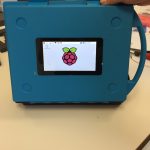
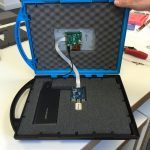
Since then, we have gone on to develop SkyGate, a complete tracking application which runs on a Pi and fits nicely on a 7” screen. It brings together all the tracking functionalities into one intuitive application:
- Live tunable LoRa reception and decoding
- Live tunable RTTY reception and decoding (with compatible USB SDR)
- Image reception and previewing
- GPS tracking to report your location (when using compatible GPS USB dongle)
- Data, images, and GPS upload functionality to HabHub tracking site
- An Overview tab presenting a high-level summary and bearing to payload
- Full customisation via the Settings tab
You can get involved!
We would love HAB enthusiasts to test and experiment with both Pytrack and SkyGate, and to give us feedback. Your input will really help us to write the full guide that we’ll release later this year.
To get started, install both programmes using your command prompt/terminal.
For your payload, run:
sudo apt update
sudo apt install python3-pytrack
And your receiver, run:
sudo apt update
sudo apt install python3-skygate
Follow this guide to start using Pytrack, and read this overview on SkyGate and what you’ll need for a tracking box. To give us your feedback, please raise issues on the respective GitHub repos: for Pytrack here, and for SkyGate here.
We’ve developed these software packages to make launching and tracking a HAB payload easier and more flexible, and we hope you’ll think we’ve succeeded.
Happy ballooning!
Disclaimer: each country has its own laws regarding HAB launches and radio transmissions in their airspace. Before you attempt to carry out your own HAB flight, you need to ensure you have permission and are complying with all local laws.
The post New software to get you started with high-altitude ballooning appeared first on Raspberry Pi.

Throwing Some Curves: Design Evolution at Concord Pacific
Here’s Concord’s latest under construction: The Arc, as seen from under the Cambie Bridge.


In a mega-project going back to the late 1980s, Concord Pacific is at last getting more adventuresome in its architecture.
I wonder if it’s the impact of residential design in cities like Singapore or even Dubai, where design is used more provocatively than our culture typically thinks appropriate (and why, I think, our colour palette is so constrained, running all the way from ‘cloudy day’ to ‘seafoam’).
15 Years of Ulysses: Max’ Story
mkalus
shared this story
from  Ulysses Blog. Ulysses Blog.
|

2003 was the year of Finding Nemo, Kill Bill, and Pirates of the Caribbean. The shipping release of Mac OS X was 10.2, and click-wheel iPods were the hottest thing around. Also in 2003, version 1.0 of Ulysses was released, the predecessor of today’s Ulysses.
In computer terms, 15 years is an eternity. And for our co-founder Max, now 31 years old, these 15 years equal his whole adult life. On Medium, he shares a personal look back on how it all began and how he got where he is today, with Ulysses.
Nineteen Years of Magic Every Day
mkalus
shared this story
from  The Omni Group. The Omni Group.
|
After 19 years, Terry Stearns, our Executive Chef, is moving on.
We all eat lunch together every day, and many of us eat dinner here too, or pack up a dinner and take it home. You may have heard Omni employees — in person or on The Omni Show — mention how great the food here is. It’s because it is. And it’s an important part of life here.
Even on a tough day, or a busy day, there will be pancakes or tacos or curry or hamburgers, and it’s always so good.
Jane Hall, who is now filling his enormous shoes in the kitchen, writes:
Terry’s gift in the kitchen is evident from the eater’s prospective, but working alongside him in the kitchen brings awareness of a whole ‘nother level in preparing meals. Terry’s knowledge in culinary preparations is vast to the point of disbelief. Along with this comes his persistent improvisation with flavor and ingredients. I have seen him use recipes rarely, if only for bit of reference.
Working alongside Terry has been a real education, one that he gives freely.
Favorite meals? The Grilled cheese with the Scandinavian brown, sticky cheese on Rosemary sourdough! Red Thai Curry! And all the veggie taco fillings — I LOVE those!
He will be missed in the Omni Kitchen!
Terry took his mission — to keep us fed and healthy, to take care of his people — beyond the job description. For instance, when Molly Reed was grieving after a sudden, unexpected loss in her family, he, in her words…
…made me special soup every day for lunch and dinner as it was pretty much the only thing I could get down and keep down. Chicken noodle (obviously), pho, miso… you name it. There was always a bowl on my desk at lunch and dinner. He literally kept me going and prevented me from wasting away to nothing.
We thank him for 5,000 lunches, as many dinners, and even more conversations. We thank him for helping make this a place we love going to every day — for 19 years! And we’ll miss him, and we wish him all the best in the future.
Multi-device support for Google Duo is now rolling out

Google’s Duo app, the company’s answer to FaceTime, is now beginning to rollout multi-device support via a server-side update.
When the update finally hits your device, opening the app displays a pop-up window that explains that Duo is now available on other devices if you sign into the same Google account. After agreeing to the pop up, pick up another device and download Duo. If you have already signed into that same account, Duo will skip the sign up page and allow you to confirm that you’re using the app on two separate devices.
That’s right, there’s no longer a need to download Duo via APK for tablets — Chromebooks, however, are still left out of the picture.
Even though multi-device support uses Gmail accounts, users are still required to sign up with their phone number. Email accounts are only there for multiple account purposes, while phone numbers seem to be the way Google identifies each user.
This means whoever you want to call with Duo, you’ll still need their phone number, similar to WhatsApp.
This server-side update will be hitting tablets and smartphones with version 36.1 of the app, which is available on the Play Store. Two devices in the MobileSyrup office received the update.
Similar to Messages for Web, it won’t hit everyone at the same time, so patience is key.
Since it’s a server side update, it should launch for all users, however, we’ve reached out to Google Canada for verification.
Source: Android Police
The post Multi-device support for Google Duo is now rolling out appeared first on MobileSyrup.
Netflix is testing a new, more expensive ‘Ultra’ subscription tier

Slowly, but steadily, Netflix has added new subscription tiers to its streaming service over the last few years.
Now it looks like the popular streaming video platform could have plans to introduce a new higher priced ‘Ultra’ subscription tier. The new subscription level, which is currently showing up for some users in Europe — as reported by TuttoAndroid — is priced in the €16.99 to €19.99 Euros range (which comes to $26 CAD to $30).
This is considerably higher than the current $13.99 CAD ‘Premium’ tier currently offered by Netflix. Netflix confirmed the new subscription level’s existence in a statement to a variety of publications.
“In this case, we are testing slightly different price points and features to better understand how consumers value Netflix,” said Netflix in the statement.
According to CordCutting.com, the Ultra tier seems to be very similar to what Premium offers, though high dynamic range (HDR) is exclusive to ‘Ultra.’
Currently HDR is only available in Netflix’s ‘Premium’ $13.99 subscription level, along with 4K resolution streaming. It’s likely if Netflix does opt to introduce a new pricing level, that it will only affect new subscribers or those looking to upgrade their subscription.
It’s unclear if Netflix plans to release this premium pricing tier in additional regions around the world.
Source: TuttoAndroid, CordCutting.com
The post Netflix is testing a new, more expensive ‘Ultra’ subscription tier appeared first on MobileSyrup.
Microsoft’s ‘Surface Lite’ variants to use three Intel chips, support LTE: report

Microsoft is reportedly working on low-cost variants of its Surface line.
Dubbed Surface ‘Lite,’ according to WinFuture, Microsoft will price the device to compete with Apple’s cheaper iPads and Google’s Chromebooks.
Additionally, the device will maintain the Surface Pro’s 3:2 screen ratio. However the Surface Lite will allegedly sport a 10-inch screen, smaller than the Surface’s 10.8-inch and the Pro’s 12.3-inch.
Part of the pricing model also means a low-cost stylus and Surface Type cover too. These accessories are key to the Surface model and as such budget options to match a low-cost Surface makes sense.
Possible Processors
WinFuture also reports that the device will have two models sporting one of three Intel processors.
The base tier model will likely utilize the Intel Pentium Silver N5000. That system-on-a-chip features four cores at 1.1 GHz base clock. The N5000 also features a burst clock — the maximum single-core speed a processor can run at — of 2.7 GHz. The processor is from the Gemini Lake family.
More expensive models of the Surface Lite may feature either the Intel Pentium Gold 4410Y or 4415Y. Both of these are Kaby Lake processors.
The 4410Y has two cores and operates at 1.5 GHz. Despite having less cores, the 4410Y is more powerful than the N5000 due to the Kaby Lake architecture.
Furthermore, the 4415Y is a slightly faster version of the 4410Y, running at 1.6 GHz.
Beyond that, the two chips are fairly similar. Both sport a thermal design power (TDP) of 6 watts. TDP is a measure of how much heat is dissipated by the cooling system when the processor is at base clock with all cores active. To put that in perspective, desktop class CPUs often have much higher TDPs.
For example, a computer I built recently utilizes a CPU with a 65 watt TDP. Granted the CPU’s clock is a little more than double the 4415Y, but those gains come at ten times the TDP.
Ultimately these chips are quite powerful for the amount of energy they use.
Beyond just high speed for low-energy, the chips reportedly incorporate LTE. According to WinFuture, this Geekbench report for a device labeled OEMTV EV1 is likely a test of the Surface Lite. However, the Geekbench listing is from January.
Recebtky an FCC filing revealed that a 10-inch Surface device passed certification in the U.S. This could mean Microsoft plans to announce the device soon, potentially as a back-to-school option for students.
Source: WinFuture
The post Microsoft’s ‘Surface Lite’ variants to use three Intel chips, support LTE: report appeared first on MobileSyrup.
Samsung smartphone sales expected to drop two percent in Q2 2018

Analysts believe that South Korean electronics giant Samsung is set to announce that smartphone sales have dropped in its second quarter for 2018.
According to a report from Reuters, analysts are expecting that Samsung’s smartphone sales have dropped approximately two percent during the company’s April to June 2018 quarter.
Part of that may have to do with the fact that the company’s 2018 Samsung Galaxy S9/S9+ devices haven’t been perceived as enough of a meaningful upgrade over the company’s 2017 Galaxy S8/S8+ devices.
“Functions [that] Samsung’s mobile phones have are not attractive enough for customers to spend more money on,” said Song Myung-sup, an analyst at South Korean HI Investment & Securities, in an interview with Reuters.
Reuters reported that analysts expect an overall profit of 14.9 trillion won (roughly 17.5 billion CAD). That figure represents a 5.7 percent increase when compared to last year, but a 4.7 percent decrease when compared to Q1 2018.
Shobhit Srivastra, an analyst for Hong Kong-based research firm Counterpoint, told Reuters that part of Samsung’s troubles stem from the fact that competitors have been able to rely on online sales to reduce overall smartphone costs.
In contrast, Samsung relies on traditional smartphone distribution methods — like telecom carriers — to sell its devices.
Reuters also spoke with Park Jung-hoon, an analyst for South Korean HDC Asset Management, who said that a lack of smartphone innovation has also contributed to Samsung’s lower device sales.
“Samsung has to show something that will change the paradigm,” said Park, in an interview with Reuters.
“Market watchers don’t have high expectations for its smartphone business at the moment, when Chinese players have already caught up in technology and ideas.”
Samsung is currently the world’s leading smartphone device manufacturer, having sold approximately 74 million units in Q4 2017, according to U.S.-based market research firm Gartner.
Cupertino computing giant Apple is the world’s second-ranked smartphone-seller, having sold 73.2 million units in Q4 2017.
However, in markets like China and India, Samsung’s hold on the smartphone sales market isn’t as notable as in other parts of the world.
Reuters reported that Samsung’s Chinese market share was approximately 1.3 percent in Q1 2018, while Chinese device manufacturer Xiaomi dethroned Samsung in India last year.
Of course, no one should feel sorry for Samsung quite yet. Reuters reported that the company’s chip manufacturing business is expected to grow by approximately 50 percent in Q2 2018, compared to Q1 2017.
At the time of writing, Samsung’s stock sits at 46,520 won (roughly 54.44 CAD).
Source: Reuters
The post Samsung smartphone sales expected to drop two percent in Q2 2018 appeared first on MobileSyrup.
Google experiments with home button in Chrome on Android

Google is testing new designs for the home button in Google Chrome on Android.
The tests are showing up in Chrome Canary and Chrome Dev builds for some users. It takes the typical minimalist house icon and transforms it into either a small white Chrome icon or a newspaper icon.
This comes as a part of Google’s experimentation with the home button in Chrome.
While Chrome has always had a home button built in, it only shows up on some devices. In the past, the button was implemented through a special APK file called ‘ChromeCustomizations.’
Device manufacturers could include the APK, which allowed them to customize the Chrome experience. However, if you used a device that didn’t have that APK file, you couldn’t enable the home button at all.

However in April, Google began experimenting with a Chrome flag — a weird pseudo setting accessed through a website instead of the app’s settings. The Chrome flag allows users to enable the home button in Chrome.
Since then, these flags have moved up the ranks. They started in Chrome Canary, went to Chrome Dev, then Chrome Beta and finally landed on stable Chrome.
How to enable the home button on your device
If you’re itching for a home button — or the nice Material Design look in those photos — it’s fairly easy to do. Open a new tab in Chrome on Android and type “chrome://flags” in the address bar (minus the quotes). The page greets you with a long list of items that you can enable or disable.
Most of these items you don’t want to touch unless you’re a developer and you know what you’re doing. For the home button, use the search bar and type “enable home button.” An option titled “Force Enable Home Page Button” should pop up. Set it to enabled. The browser will prompt you to restart for the changes to take affect.
For the Material Design look, search “Modern Design” and enable the flag labeled “Chrome Modern Design.” Again, you’ll be prompted to restart for changes to take effect.
For myself, I found I also had to fully close the app for changes to take effect.
These flags are not present on the iOS version of stable Chrome.
However, since Google is testing the look of the home button, you may not have that lovely little house much longer.
Source: Android Police
The post Google experiments with home button in Chrome on Android appeared first on MobileSyrup.
State of Mozilla Support: 2018 Mid-year Update – Part 2
Hello, present and future Mozillians!
Last time we had a closer look at a metrics-based report analysis from the Analysen & Tal agency that took a deep dive into support.mozilla.org’s historical data.
Today, we are going to continue sharing external insights into our community and support model with a summary of the comparative study conducted for us by a team of the Copenhagen Institute of Interaction Design from Denmark. While we were not exactly looking for the essence of hygge, we found quite a few interesting nuggets of wisdom and inspiration that we’d like to share with you below. You can find the presentation here.
(Please note: this content has already been shared with the Support contributors on our forums, but now we are making it more public through this post).
The study’s goals were to help the Support team and community understand how Mozilla’s approach to helping users compares to other similar organizations, and what possible future approaches could help meeting the increasing demand for high quality help.
The methodology for the study was a mix of a series of interviews, case studies, and design explorations. The people interviewed came from external organizations and groups, as well as from Mozilla’s support community. The three entities chosen for the comparative study were the user communities around WordPress.org, Arduino, and Kaggle.
WordPress.org
In general, when compared to our Support community, WordPress.org’s is more centralized and controlled, even if on average among the three case studies it resembles our own structures the most.
The contribution forums and Slack channels are used to discuss and escalate important issues. Similarly to /r/firefox, there is also an active subreddit for WordPress that’s self-moderated and open to non-support content, if necessary. Slack seems to be a place for fruitful conversations, so we may be exploring this idea in the near future for more engaged contributors.
Another interesting aspect is that the support site, apart from community-owned-and-driven support, offers full time employees of Automattic/Wordpress.com a chance to do rotations in the open source community. This, while tried by us in the past, has not been something we have considered as a long-standing project, but it could drive more engagement and knowledge share on all levels.
The primary incentives for contribution seem to be status and connecting with others, which we understand to be also present in our own community. However, we still need to get better at identifying the incentives for joining and staying as a long-term Support contributors to continue delivering community-driven support at scale.
Arduino
Arduino’s support community, focusing on a plethora of open source software and hardware uses “in the wild”, is definitely way more decentralized and ad hoc in its practices than Mozilla’s Support.
The nature of the environment in which the community operates makes a concentrated and concerted support effort much harder, but the main activity happens across the official community forum, a StackExchange Q&A forum, and Arduino’s main Project Hub.
At the time of the study, the community forum show little conscious effort in organization from Arduino’s staff, serving a more social function with its open nature. On the other hand, the StackExchange based support forum has a well developed peer-driven reputation system, with the community moderators being voted in and gaining access and privileges based on their long-standing contributions. The StackExchange model is by far more successful and useful for support in Arduino’s case.
Finally, the Project Hub is a content creation and maintenance space that centers support-related content (for example documentation and instructables) around specific projects. Quality content is encouraged by official contests and rewards for contributors. Additionally, language and interactions presented on the site encourage a positive and inclusive community approach. As a result and thanks to the self-learning and guided aspect of using Arduino products, quality content is easier to find and produce.
Kaggle
Kaggle’s community model is an unusual hybrid of competitiveness and collaboration, fueled by commercially supported projects. With the community being the core and the product of Kaggle’s business model, the platform it lives on is highly sophisticated and the interactions within it appear to be meticulously engineered.
To this end, gamification of competing and collaborating is one of the main driving forces behind, encouraging high quality contributions and teamwork. The design of the community environment shows sharp focus on its key functions. The community is not directed to activities not considered core. That said, a large part of community engagement and motivation is happening outside of official forums, within self-created and user-governing communities. What’s interesting, many returning contributors consider their voluntary involvement a stepping stone towards their own professional careers.
Insights and Observations
The CIID researchers, based on their study of external support models listed above and .interviews with various members of different communities, gathered a set of recommendations or paths to explore for our community’s consideration.
Structured communities always leak
Simple explanation: Whatever we define as “Mozilla Support” will always see activity or interest outside of what we think is the “main” place where it happens.
Regardless of the community setup at the core of the experience, there will always be engagement and involvement taking place outside of centrally defined features or tasks. There is an opportunity in allowing bottom-up organization of people, while keeping the support tasks clear and accessible for everyone willing to participate. The Support site should still be the main place where supporting Mozilla’s users happens, but it should not be rigorously the only one out there.
The main challenge here is distributing our knowledge and expertise in an accessible way to other places on the web where users look for support.
Gamed incentives are valves, not pipes
Simple explanation: Gamification is a tool to improve or guide working contribution mechanisms, not to create new contribution mechanisms.
Any attempts at gamification should be modelled to embrace and enhance existing behaviours and interactions – not to create completely new ones. It is also better when it focuses on quality rather than quantity. Rewarding expertise over volume drives engagement from or creates opportunities for subject matter experts.
Here, the main challenge is to encourage positive behaviours and interactions at scale and in real time, as much as possible. This may mean looking into “high touch automation” (like bots or scripts) or rolling out a focused education/certification offering to increase quality contributions.
Contributors have ownership without agency
Simple explanation: Support contributors have great impact on how users perceive Firefox (as a browser and brand), but this is not clearly shown in the way Firefox is improved or marketed to users.
While our community is at the front line in receiving feedback from the users (and acting upon it), we do not have comparable impact on what is going on in the product world, mostly through lack of a strong enough feedback loop into the product organization, but also a lack of connection and understanding of what it is that we do from the creators and promoters of Firefox.
It would be hard to prove the impact of continuous support efforts without transparent and meaningful metrics at hand, so finding a way to collate and present such data is key for this concept to work. With our community’s work validated and acknowledged, it should be much easier to incorporate our feedback into the development and marketing process of Firefox.
Contributors aren’t born – they’re made
Simple explanation: New contributors can be found in more places than just among Mozillians not already contributing to Support
Many people decide to contribute to Mozilla’s mission based on their own strong beliefs in the future of the web – but many others get on board because they have received support from our community and would like to give back to Mozilla and its other users through activities that they can easily participate in. Supporting others very often proves to be just that (when compared to coding or web development, for example).
Encouraging casual users or those looking for help to give a try to helping others (or get involved with Mozilla’s mission in other ways) could be key to growing our community over all upcoming releases and finding new core contributors among the many people who already chose to use Firefox on a daily basis.
Support the supporters
Simple explanation: Community members should have access to knowledge and tools that allow them to work together and support each other regardless of administrator presence and support.
As the admin team for Support is quite small and each of its members specializes in a different aspect of the site, sometimes contributor questions or emergency escalations may go unnoticed for a while. This increases community fragility and pressure on single points of failure.
In order to address that, our community could consider developing a simple (but complete) escalation and reaction system that is transparent for everyone involved in supporting users. This could increase the resilience and cohesiveness of the Support community, regardless of personal experience or community roles held by various community members involved in escalating or responding to support requests.
Leverage the properties of each channel
Simple explanation: Each tool or resource should have a clear and defined role and purpose. The community needs useful tools, rather than access to all tools used by everyone else for other reasons.
With several places that our community uses for communication and support purposes, it is important to keep the roles and methods of using these separate tools clear and focused. We sometimes tend to “hop on the bandwagon” and try to be everywhere and use everything to be more in line with other teams at Mozilla.
This may not be the best use of everyone’s energy and time, so reviewing the tools we have and the ways they are used is an important step towards empowering contributors and streamlining processes that at this moment may not be working as optimal as possible.
Workshop Outcomes
As part of the working session, we sat all together and invested a few hours into a collaborative synthesis workshop, based on the data and research presented by our external partners. The output of the workshop was a series of project ideas that could influence the future Support strategy. The goal of these ideas is to improve what’s out there already and make Support ready for Mozilla’s future needs.
After a ton of small team work, three projects emerged:
Support Propaganda
General goal: increase awareness and impact of Support across Mozilla.
Methods:
- Opening up participation in Support to all Mozillians (especially new hires for any position at Mozilla)
- Creating a deeper connection between Support, Product, and Marketing through highlighting what Support does to help Product and Marketing deliver quality to users (data driven insights)
Switchboard Operator
General goal: High-touch targetted support for Mozilla’s software users across the web
Methods:
- Gathering information and insights about all major locations where conversations are happening about Firefox (within the context of support)
- Reaching the users with the right support information wherever they are
Alchemist’s Journey
General goal: Quality self-directed learning resources and trainings for future generations of casual or core contributors
Methods:
- First wave trial resources developed in collaboration with existing core contributors
- Second wave researched resources developed based on experiences from the first wave and input from external online education experts
Next Steps
There are more updates to come that should show you how the above work is influencing what direction we think the future of Support at Mozilla should look like.
We will keep working together with Open Innovation (closely and directly) and CIID (for future research projects) and informing you of what is up with Support at Mozilla.
We will also keep you informed (and engaged) in the future of Support at Mozilla.
Thank you for being a vital part of Mozilla’s mission for an open and helpful web!