Shared posts

18 Jul 14:09

Flight by electrostatic repulsion

by Andrea

The Atlantic: Spiders Can Fly Hundreds of Miles Using Electricity. “Scientists are finally starting to understand the centuries-old mystery of “ballooning.””

“The upper reaches of the atmosphere have a positive charge, and the planet’s surface has a negative one. Even on sunny days with cloudless skies, the air carries a voltage of around 100 volts for every meter above the ground. In foggy or stormy conditions, that gradient might increase to tens of thousands of volts per meter.

Ballooning spiders operate within this planetary electric field. When their silk leaves their bodies, it typically picks up a negative charge. This repels the similar negative charges on the surfaces on which the spiders sit, creating enough force to lift them into the air.”

Link via MetaFilter.

18 Jul 14:06

Gareth Southgate Station

by peter@rukavina.net (Peter Rukavina)

This YouTube video combines my love of public transit with my love of renaming things and my love of institutions having a bit of fun. It also involves football, but that’s an unimportant side-issue.

18 Jul 14:06

RT @wikkit: A working electromechanical telephone exchange. Amazing how many moving parts used to be involved in making a phone call. https…

by wikkit
mkalus shared this story from museumofcomm on Twitter.

A working electromechanical telephone exchange. Amazing how many moving parts used to be involved in making a phone call. pic.twitter.com/rT9QOZhcXp


Posted by wikkit on Wednesday, July 11th, 2018 4:50pm
Retweeted by museumofcomm on Saturday, July 14th, 2018 11:18pm


88 likes, 39 retweets
18 Jul 14:05

1300+ Examples Of Successful Online Brand Communities (and you can add yours)

by Richard Millington

Today we’re launching a database where you can explore 1300+ examples of successful brand communities and share your own efforts.

Getting good community examples has always been a challenge. Many people work in isolated silos with no ability to see what others like themselves are working on. For the past 18 months, we’ve been gathering data, cleaning data, and working to find a way to display the best brand communities on the web.

We’ve highlighted what we believe to be the top 10 communities by 4 different sectors and over a dozen of the most popular community platforms. In the coming months and years, we’re going to frequently update our ranking of communities and add to our database.

If you want to see your community featured, please add it to the database (you can also help us by suggesting new categories you would love to help create). You can also claim your own listing and keep it updated.

You can find our examples of brand communities here.

We hope you find it useful.

18 Jul 14:05

Bohemian Rhapsody

by Volker Weber

That's on my list.

18 Jul 14:05

Mozilla Partners with Women Who Tech to Offer Startup Challenge Europe Award for Privacy, Transparency & Accountability

by Mitchell Baker

We are excited to announce that Mozilla is partnering with Women Who Tech on the Women Startup Challenge Europe. Mitchell Baker will be one of the in person judges evaluating the startup finalist pitches and Mozilla will award a $25,000 grant to the startup focused on building privacy, transparency and accountability into their work.

The Women Startup Challenge Europe will connect women technology innovators from cities across Europe to compete for $60,000 in cash grants. In addition to the funding, all finalists will also receive: pitch coaching, one on one meetings with investors the day after the Women Startup Challenge, and other crucial startup friendly services. The Startup Challenge, co-hosted by the Office of Paris Mayor Anne Hidalgo, will feature 10 finalists pitching their ventures before a panel of judges on October 25, 2018 at Paris Hôtel de Ville.

Women Who Tech is a nonprofit organization on a mission to close the funding gap and disrupt a culture and economy that has made it incredibly difficult for women entrepreneurs to raise capital. At Mozilla, we are committed to an internet that catalyzes collaboration among diverse communities working together for the common good. Promoting diversity and inclusion is core to our mission, so working with organizations like Women Who Tech furthers our commitment to create more diversity in innovation.

“I’m looking forward to meeting the best early stage women-led startups from across Europe and highlighting the startup most focused on building privacy, transparency and accountability into their work,” said Mitchell Baker, Mozilla Chairwoman and Co-Founder. “Recent research shows only 12 percent of founders at EU companies that received VC funding in 2017 are female, so I hope challenges like this will create more opportunities for a diverse future of entrepreneurs.”

The post Mozilla Partners with Women Who Tech to Offer Startup Challenge Europe Award for Privacy, Transparency & Accountability appeared first on The Mozilla Blog.

18 Jul 14:05

Science / Fiction

Carol Black, Jul 27, 2018


I think this is a really important article, and not just because of the more contentious statements it makes when it discusses "'evidence-based' education, scientific racism, & how learning styles became a myth." As readers know, I have addressed the topic of learning styles over the years and have clashed with learning styles debunkers who seem to think its really important that we treat them as a myth. My analysis is slightly different from Carol Black's, but we agree on the basics: there is widespread agreement that there are differences in cognitive style, and the argument that "learning styles don't exist" is based on bad science.

"If you review the writings of the most vocal learning styles 'debunkers,'  you quickly find that they are almost always simply advocates for traditional, teacher-controlled direct instruction. They tend to favor a traditional 'core knowledge' curriculum, traditional forms of discipline, and they adhere to a traditional IQ-based view of intelligence. It's important to note that the debunkers' claim is thus based almost entirely on studies of teacher-controlled direct instruction; they don't involve scenarios where learners have agency... Education researchers would do well to know that adults in cultures all over the world maintain that direct instruction is in fact the least effective approach to learning  –– and should be avoided whenever possible... "

Web: [Direct Link] [This Post]
18 Jul 14:04

Still Amusing Ourselves To Death

Dean Shareski, Ideas and Thoughts, Jul 27, 2018


Dean Shareski reflects on how Neil Poistman's warnings about television also apply to social media. The warnings were certainly accurate for television, as the emergence of fake news channels and mass delusion have shown. What aboutonline media? These magnifiy the falshoods spread by television and have offered little remedy. Television "was not a format designed for serious topics that required depth and time," says Shareski. "Although I didn’t have the context I made a similar argument about social media." So - OK. But does this apply to all digital media? I don't think so. Shareski says "Utilize the right spaces for the right purposes. Social media, in my view, has always been best to socialize. This space has always been best to think out loud. Face to face extended times with the right people can be fruitful places for deeper discussions."

Web: [Direct Link] [This Post]
18 Jul 14:04

The Fabrication that is OER

We have created a beautiful world of billions of images, videos, articles and messages that we've shared back and forth with each other since the 1980s and this world is our heritage and our legacy. This is the world that we need to protect - not to institutionalize, but to make it so that it can never be institutionalized, but freely used to create and share anew so long as there is a world to do it in.

, , Jul 16, 2018 [Link]
[Comment]
Share |
18 Jul 14:04

Academic expert says Google and Facebook’s AI researchers aren’t doing science

files/images/chains.2.jpg

Tristan Greene, TheNextWeb, Jul 30, 2018


Icon

So, OK. Here's Simon DeDeo: "Machine learning is an amazing accomplishment of engineering. But it’s not science. Not even close. It’s just 1990, scaled up. It has given us, literally, no more insight than we had twenty years ago.” At a certain level this is true - the functions machine learning perfoms today, things like classification and regression, were developed for neural nets in the 1980s and 90s. What the major companies are doing today is innovation - taking these basic ideas and finding value in them.

Web: [Direct Link] [This Post]
18 Jul 14:04

Ich trink ja eigentlich gar kein Kaffee

by Volker Weber

Sketch

Das ist immer eine schöne Überraschung, wenn so eine Mail kommt. Aber ich muss was beichten: Ich trinke gar keinen Kaffee. Was habe ich statt dessen gemacht? Ich habe meine 20 Jahre alte Vespa in Schuss gehalten.

Erst habe ich meine Werkstatt angerufen und eine schlechte Nachricht bekommen: "Der Chef hat gesagt, wir machen keine Roller mehr. Tut mir leid, ich kann den Auftrag nicht annehmen." Dann habe ich mich erinnert, dass ich ein Diplom in Maschinenbau habe und habe das alles selbst gemacht. :-) Neue Bremspumpe, neue Bremsflüssigkeit, neuer Ansaugstutzen, neue Sitzbank, neuer Kantenschutz. Und alle diese Teile habe ich aus der Kaffeekasse bezahlt. Dankeschön den vielen Spendern!

More >

18 Jul 14:04

Burke 20 Ti folding bike

by jnyyz

Two years ago, I caught a brief glimpse of a Ti folding bike on STP.

DSC09028

This was the Burke 20 by Seattle Cycles. I finally got a chance to see it up close and personal at Montlake Bicycle Shop.

IMG_9277

This particular build is their lowest end spec, and retails for $5500 US.

They very kindly let me take it down and to test the fold. What was very handy was that they were also a Brompton dealer. Here are the two bikes side by side.

IMG_9279

IMG_9278

You can see that the Burke is considerably less compact when folded, but to be fair, part of this has do with the larger wheel size.

There are elements of the fold that are similar to the Brompton, such as the hook on the front fork that goes over a member of the rear triangle, and the fact that the lowered seat tube keeps the frame in the folded position.

IMG_9280

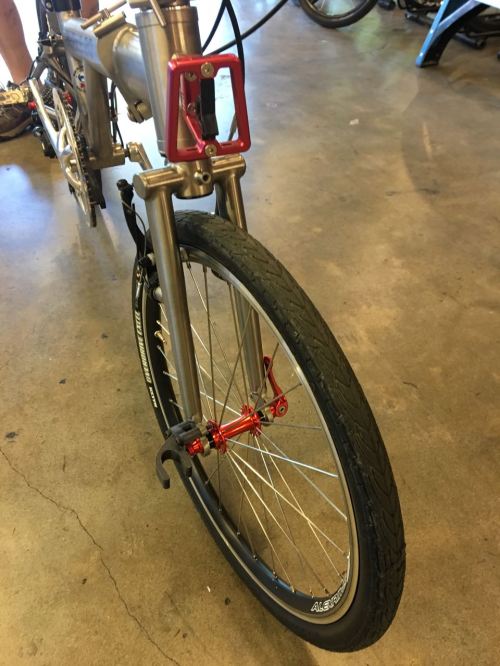
Here are some more close ups of the bike when unfolded.

IMG_9281

Frame welded in the US by Lynskey.

IMG_9283

Nice touches such as the front bag mount, and fender mounting points as well.

IMG_9282

My impression is that it is a beautifully made bike, in particular the welds on the frame, but I found the folding process to be quite fiddly, and the clamps themselves were particularly hard to deal with. The website claims that you can fold it in 15 seconds, so perhaps with practice……

Going for a very short test ride, I found the frame and stem to be very stiff, comparable to the Brompton, and the gearing and braking to be as good as on a regular bike.

For my needs, I’d say it would not be as practical as the Brompton for city use, given the nature of the fold. For traveling with a higher performance bike in a suitcase, there are certainly less expensive options out there, and the price point gets perilously close to what a regular road bike with S&S couplers would be.

Nevertheless, it is an interesting option for those in want of the ultimate folding bike.

18 Jul 00:35

For a Brief, Glorious Moment, Camera-Wielding Pigeons Spied From Above

mkalus shared this story from Atlas Obscura - Latest Articles and Places.

It’s hard to imagine now, in the age of drone photography, how it would have felt to have the very first glimpse of the world from a bird’s-eye view. In the 19th century, early photographers experimented with aerial images using balloons and kites, devices that were made and controlled by humans. But a more organic perspective emerged when a German apothecary strapped a small camera to a pigeon, to photograph the world in flight.

His name was Julius Neubronner, and he had a family history of using pigeons in unconventional ways. His father, also an apothecary, received prescriptions and sent out urgent medications by pigeon. Neubronner also relied on pigeons to replenish his stocks of medications. But when a bird went missing for a month, Neubronner was curious to know where it had been. While other bird-owners might consider this thought a mere flight of fancy, an unanswerable question, Neubronner took a different view: He designed a camera, one that shot automatically, for his pigeons to wear.

Despite their often negative public image, pigeons have a long history of being incredibly useful to humans. In Ancient Rome, pigeons delivered news of chariot victories. There are multiple accounts of their use in wartime throughout history, including in the 1870 Franco-Prussian War, when besieged Parisians sent messages out of the city via pigeon. They even helped build a business empire. But using pigeons to carry cameras was new, and so Neubronner began to experiment.

According to a December 1908 article in The New York Tribune, Neubronner figured out the best shutter speed by photographing from express trains. He reportedly created several different devices, and in 1907, he submitted his “Method of and Means for Taking Photographs of Landscapes From Above” to the Imperial Patent Office. In this design, the camera, which had two inclined lenses and an automatic shutter, was fixed to an aluminum frame which was then strapped to the pigeon with a leather harness. The patent office approved the device in 1908, but only after Neubronner supplied photographic evidence that it could actually function.

After his patent was approved, Neubronner displayed his photographs at the 1909 Dresden International Exhibition of Photography. Newspapers picked up on the story. “Pigeons Now Used as Photographers,” headlined The Columbian newspaper, on January 7, 1909. In Australia, the Lismore Star wrote “Pigeons to Take Photographs While Flying.”

The Prussian Ministry of War also took an interest. Camera-wielding pigeons had enormous reconnaissance potential. In a piece headlined “Pigeons Carry Small Camera for Scientist,” the Los Angeles Herald reported starkly “The carrier pigeon flies at the height of 150 to 300 feet, safe from small shot and very difficult to hit with bullets.” According to a 1909 magazine article, the government requested pigeon photographs of the Tegel Water Works to test Neubronner’s invention, which he arranged, training his pigeons to return to a mobile dovecote complete with darkroom. But the military potential was relatively short-lived: During World War I, new specially-designed aerial cameras spied on the enemy from planes, outpacing the potential pigeons might have had.

The freewheeling charm of Neubronner’s pigeon photographs is on full display in a recent book published by Rorhof. Atlas Obscura has a selection of images from The Pigeon Photographer.

18 Jul 00:35

West Vancouver votes to prohibit cannabis shops and production

mkalus shared this story :
""Can't we have months of public hearings and fact finding?" " Sure, just as soon as you do the same for every liquor store, convinience store (cigarettes, sugar water) and fast food joint.

West Vancouver has become the latest municipality in Metro Vancouver to ban all cannabis retail and production facilities within its boundaries. 

By unanimous vote, councillors decided that no businesses could apply to set up in the municipality without a rezoning hearing.

Staff will begin working on a larger regulatory framework that could allow retail operations without rezoning, but that won't be presented to council until after legalization and municipal elections in October.

"I think staff are on the right track, and we're moving forward, but as per usual, a little on the slow side," said coun. Nora Gambioli.

In its cannabis legislation passed earlier this year, the provincial government has given municipalities veto power over approving retail licences. Residents in municipalities with bans will still be able to purchase cannnabis through a government-run website. 

Jim Bailey, West Vancouver's director of planning, emphasized that the city could still allow businesses to set up shop.

"In a way, it's prohibition light," he said, arguing there was no confusion over passing the bylaw and telling businesses they are still welcome to work with the municipality. 

"Staff don't believe it's contradictory. By not allowing them outright … it gives you an added level of control."

West Vancouver council approved a prohibition on cannabis retail facilities on July 16, 2018. (Justin McElroy/CBC)

The municipality becomes the latest in Metro Vancouver to put a pre-emptive prohibition on non-medicinal cannabis sales before it becomes legal on Oct. 17. 

Maple Ridge, Delta and Richmond are among those with complete bans on retail operations, all opting to wait for legalization before beginning any process for allowing stores to open. White Rock passed a retail ban in January, but has since moved forward on public hearings to allow one in the town centre.  

"Why are we [adding] a bylaw in July when October and November is when you would need something in place?" said Ian Dawkins, president of the Cannabis Commerce Association of Canada, which represents small producers.

"Can't we have months of public hearings and fact finding?" 

With the Lower Mainland a patchwork of different municipalities, he said jurisdictions that lag behind in allowing retail and production facilities would lose business to those that have already set up regulatory regimes. 

"If you're West Vancouver, Squamish has a bylaw just north of you, North Vancouver will be putting something in place. It's not like there's not going to be any legal cannabis in West Vancouver, all there's going to be is a lack of jobs, a lack of opportunities," he said.

"You can't hand wave it away and kick it too the next municipal government, which is a lot of what's going on here."

But Mayor Michael Smith characterized their pace as reflective of the municipality's political culture.

"Once staff have completed their review, we will have rules and regulations as to how we move forward ... we don't mind playing catchup, as long as we eventually catch up," he said. 

"Things move slowly in West Vancouver, but eventually we get there. And when we do get there, we want to make sure we have the right regulations in place."

18 Jul 00:35

Dockless bike share in Seattle

by jnyyz

One of the things that I noticed during my brief stay in Seattle was a number of colourful dockless bike share bikes scattered all around the University district, particularly around entrance points to the Burke Gilman trail. There are currently three companies that have provided 10,000 bikes as part of a pilot program. Several articles about these bikes appeared in the Monday edition of the Seattle times.

This article compares the three bike share systems, and the reliability of the bikes. Several things of note:

  • each bike was ridden an average of 0.86 times a day.
  • about 68% of the bikes were rideable.
  • The Limebike system has introduced e-bikes, which have their own issues.
  • brake cable cutting by vandals has been an issue.

SDOT is considering expanding the program to 20,000 bikes and making it permanent, while at the same time imposing higher fees on the vendors to fund things like more bike parking.

At the same time, the city parks board is also considering amendments to allow the e-bikes to be on trails such as the Burke Gilman. In practice, I already saw several of the Lime e-bikes parking or abandoned on the trail.

What do the bikes look like? Here is one of the Ofo bikes.

IMG_9273

IMG_9274

Apparently they weigh 42 lbs and have solid rubber tires.

Here is one of the Limebike e-bikes.

IMG_9275

IMG_9276

This article in WIRED discusses some of the issues that have arisen as part of this pilot, as well as some of the controversies about dockless bike share in general. It will be interesting to see how this all settles out.

Personally, I think that the system that I saw in Tokyo was a happy medium between docked and dockless. The bikes are still dropped off at stations, but the stations are wifi hotspots so that you can park the bike within a certain range, rather than counting on having an open slot in a docking station. In particular, I can’t get my head around how the Lime e-bikes are going to be recharged if they can be left anywhere in the city.

For the moment, dockless bikeshare appears to be dead in Toronto as I see fewer and fewer of their orange bikes around the U of T campus where they were first deployed.

On a side note, they have ghost bikes in Seattle as well; this one is at 16th Ave and 65th St.

IMG_9185


18 Jul 00:35

Encroachment of the Humans

by Ken Ohrn

Vancouver continues to repurpose public space for people.

More examples, this time from Davie Street in the city’s West End. One is private, and the others are part of a 3-year pilot study by VIVA Vancouver.

The study will test a number of things, including modular design elements and curbside patios that are away from the building. These measures will test innovative features to support a vibrant patio culture and make better use of public space.

18 Jul 00:34

Skytrain To UBC — Town Hall July 28

by Ken Ohrn

Metro Vancouver campus commuters and transit-takers, here’s your chance to attend a “Town Hall” presentation and discussion on extending Vancouver’s Skytrain beyond Arbutus Street to UBC’s Point Grey campus.

The event will be hosted by Joyce Murray, Member of Parliament for Vancouver Quadra, with participation of representatives from TransLink, UBC, City of Vancouver and West Broadway Business Improvement Association.

Not sure whether to attend? Here’s some background, via an earlier Price Tags post.

If you go, remember — you get your say, you don’t get a veto.

Saturday, July 28, 2018
Registration 12:30 – 1:00 pm
Town Hall: 1:00 – 3:00 pm
Pacific Spirit Church, Memorial Hall (2195 45th Ave at Yew)
Light refreshments will be provided

18 Jul 00:34

The 5 Ps of Personal Branding: Create Your Own Powerful Brand

by Guest Author

This very second, your future client or potential employer might be looking you up on the Internet. What (first) impression would they build of you in their mind?

The phrase “personal branding” has been tossed around for decades without much significant agreement upon its definition. However, one thing’s for sure — its importance has never been more critical than it is today. The most simple definition of personal branding would be the act of identifying, positioning and promoting yourself. Radix is here on Hover’s blog to offer you the best advice for creating a personal brand that’s authentic to you.

When it comes to personal branding, the more intentional you are, the better. We are often working towards marketing services and products but forget that we also need to market ourselves, not just for our own recognition but also for the recognition of the organizations we work for.

Do you already have a personal brand?

Whether you are aware of it or not, you already have a personal brand. Yes — you do!

Everyone has a certain reputation (or “brand”) that they’re known for, but for most people, that reputation has been created by default through others’ observations, rather than by intentional design. The people around you who don’t know you on a personal level have built up their own perceptions, opinions, and judgments about who you are, what you’re good at—and possibly even what you’re not good at. They perceive you a certain way. In short, they have “branded” you in their own minds.

If you have allowed others to define your reputation then it is important that you understand how you’re currently perceived and rebrand yourself in a way that is most beneficial for you.

How should you build your personal brand?

When it comes to creating an effective personal brand online, there are certain aspects you should keep in mind. To attract and engage the right audience and ensure they follow you, follow these five Ps to build a successful personal brand.

1. Probe

This is the first step and it requires some serious deep diving into self — really reflect and understand what do people get when they get YOU? More than anything, an authentic personal brand is based on truth. It resonates with clients, draws in customers, and adds value to your enterprise. So take time to explore your skills, gifts, and purpose. Answer questions like:

What is your unique gift?
What do you look like to others?
What do you love doing?
What needs can you serve with your gifts?

McDonald’s says, “I’m lovin it”. They’ve owned these words and this is what sets them apart from their competitors. What do you do right? What is your strength? Explore!

2. Prepare

Spend time educating yourself about your industry. Prepare in a way that you become a guru in your part of the (professional) world. Become that go-to person. You don’t have to know everything, but you should know people and ways to solve someone’s problem. Build your network and connect with as many people as you can.

Find new skills and learn them
Keep updated with the latest happenings
Have a project to work on at all times

There is a wealth of resources available online and the future belongs to those who teach themselves. All you need is the zeal to be better.

3. Present

Presentation is everything. Let people know what you do and why you do it. Present yourself effectively — in a way you want to be perceived.

Impress first, inform second. We live in a busy and visual world. How you interact with a generation that doesn’t have a lot of time will define how they perceive you.
Offer clarity. Be crystal clear about who you are and what you do. Put your expert knowledge to work crafting articles, recording podcasts, videos that offer genuine help.
Offer consistency. To be successful in anything consistency is key. Highlight your track record, ensure all your branded material is at par and most importantly, keep creating and sharing on a regular basis.

Building a personal brand is a long-term process. You’ll have to constantly be in touch with your audience for them to remember and trust you.

4. Personalize

People are attracted to authenticity and vulnerability. Be authentic and true in everything that you do. That is why the first step is so important. Know what you are, what your values are and what you stand for.

Appeal to feelings and emotions
Tell (true) stories
Admit when you’re wrong

People can easily detect a fake which is why it is so important to show that you’re human. It makes you and your personal brand believable.

5. Promote

Start with your warm market—your sphere of influence. Ask them for referrals.

Create a plan for how you are going to get the word out about your brand.
Decide the platforms you want to use. Do you want to leverage social media, traditional marketing, word of mouth, speaking engagements?
Decide the frequency. How often will you post/share/advertise?

It’s your personal brand so it makes sense to take it seriously. Be intentional and clear about your objectives and what you are trying to accomplish. Use these five Ps to create a powerful persona that people can relate to. Remember, your clients don’t buy what you do; they buy YOU. Also, checkout Startup League’s blog for more information on how you can get your business and your personal brand out there.

ALISHA SHIBLI – CONTENT MARKETING SPECIALIST, RADIX

Alisha is a Content Marketing Specialist at Radix, the registry behind some of the most successful new domain extensions, including .STORE and .TECH. You can connect with her on LinkedIn.

18 Jul 00:30

Interactive to see street orientation everywhere

by Nathan Yau

After seeing polar charts of street orientation in major cities, Vladimir Agafonkin, an engineer at Mapbox, implemented an interactive version that lets you see directions for everywhere:

Extracting and processing the road data for every place of interest to generate a polar chart seemed like too much work. Could I do it on an interactive map? It turns out that this is a perfect use case for Mapbox vector maps — since the map data is there on the client, we can analyze and visualize it instantly for any place in the world.

Fun.

So someone’s going to take the next step to rank and rate griddyness around the world, right?

Tags: directions, streets

18 Jul 00:30

Consumers spent nearly twice as much on the App Store than on Google Play

by Jonathan Lamont
Apple App Store

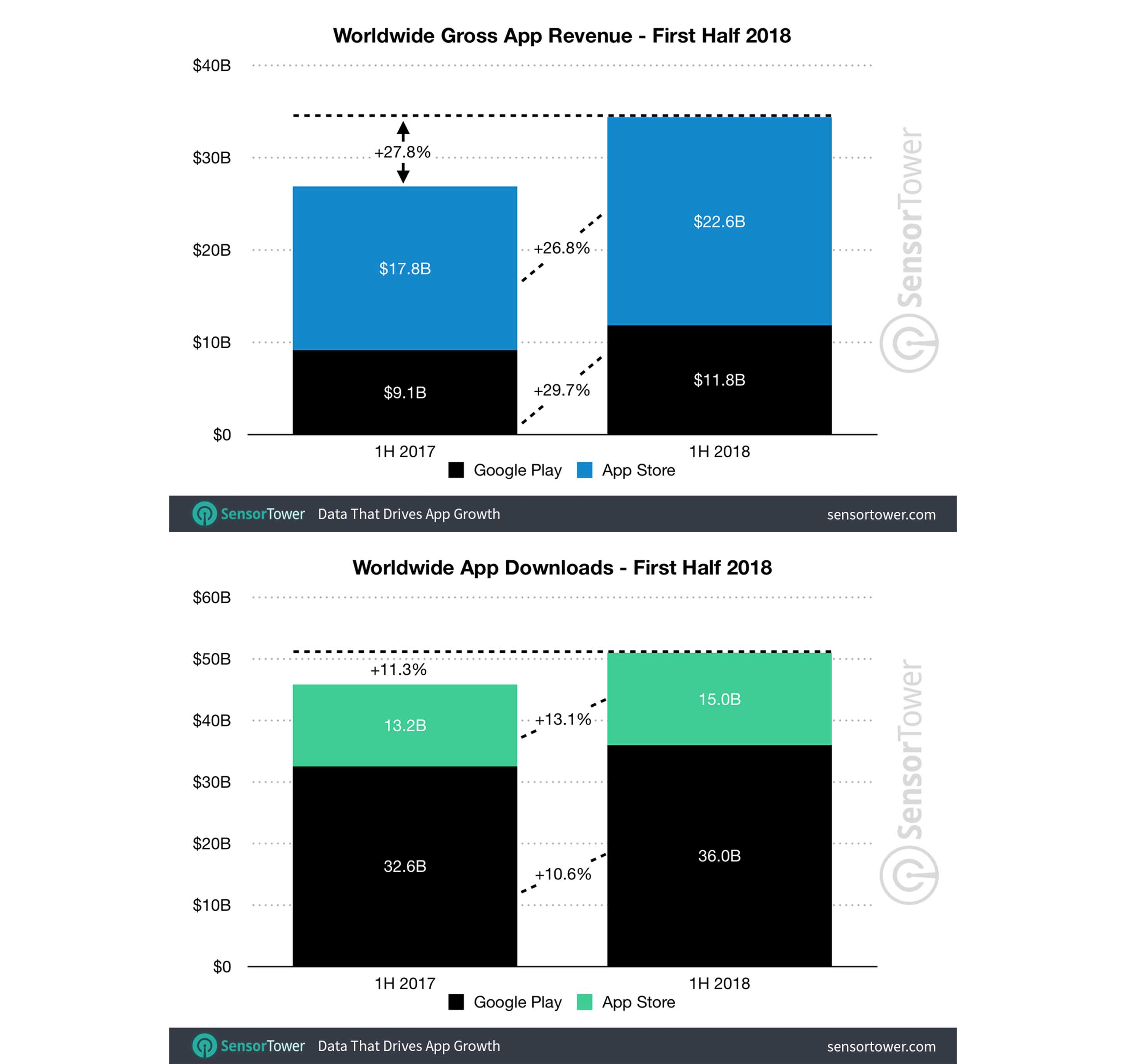
Consumers worldwide spent a combined $34.4 billion USD on mobile apps and games in the first half of 2018.

According to Sensor Tower data, the represents a year-over-year increase of 27.8 percent. By this time last year, consumers had spent $26.9 billion on the App Store and Google Play combined.

Furthermore, spending on the App Store was nearly double the spending on Google Play.

The App Store reached an estimated $22.6 billion in the first half of 2018 — about 1.9 times more than was spent on Google Play. The search giant’s app store saw an estimated $11.8 billion in spending.

Furthermore, Netflix was the highest grossing non-game app worldwide.

App revenue and downloads

First-time app installs also increased by 11.3 percent over this time last year. Around the world, consumers downloaded approximately 51 billion apps for the first time. Facebook led the way with its consortium of apps in the top four spots — WhatsApp, Messenger, Facebook and Instagram.

However, Google’s platform had more first-time downloads than Apple’s platform at 36 billion versus 15 billion.

It’s important to note here that Apple’s platform saw more than double the revenue with fewer than half as many downloads.

Game revenue and downloads

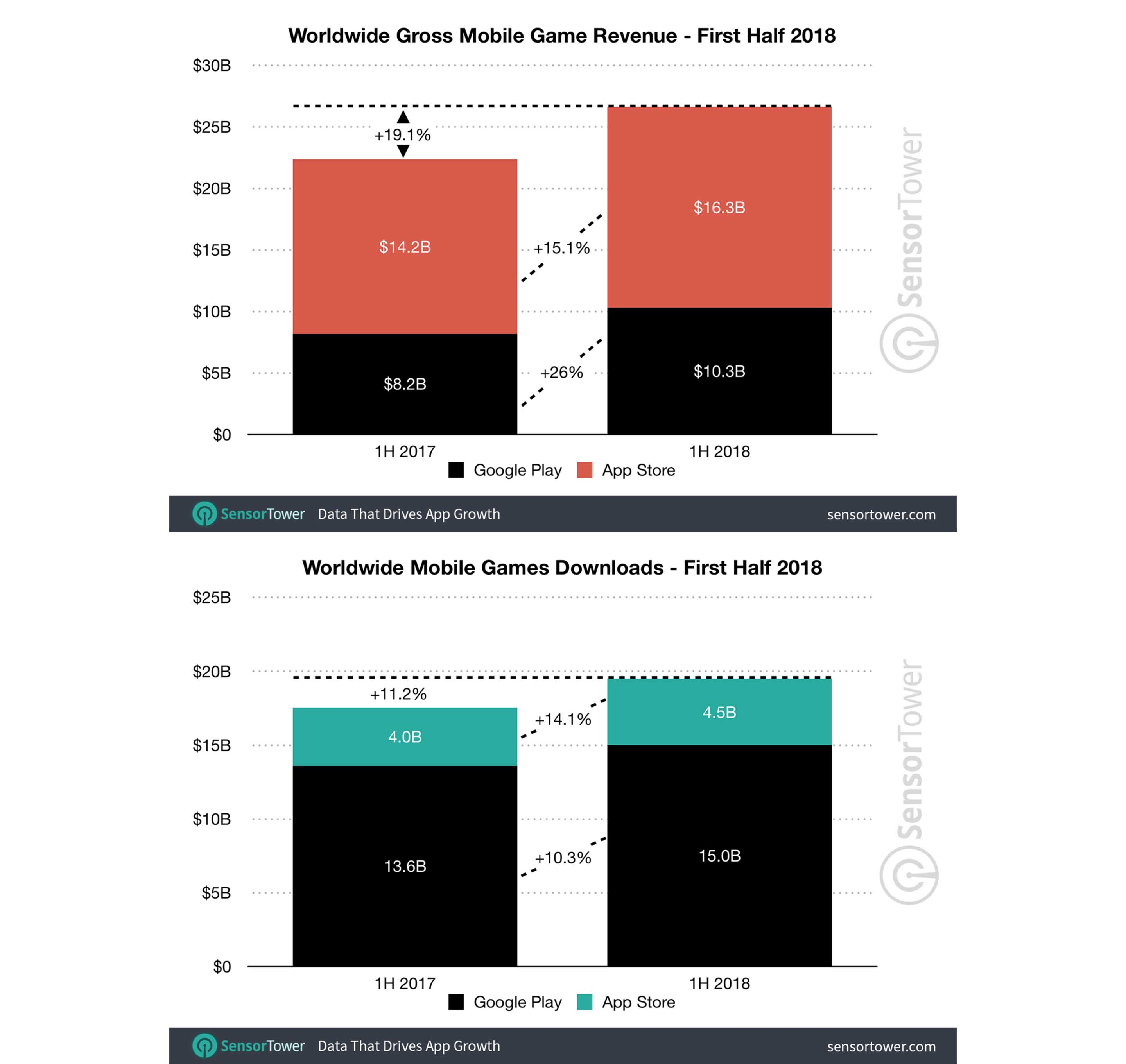
Additionally, spending on mobile games increased as well. There was a total increase of 19.1 percent. Apple out-earned Google again, with $16.3 billion to Google’s $10.3 billion.

However, Google Play still saw more mobile game downloads, with 15 billion compared to the App Store’s 4.5 billion.

PUBG Mobile, Helix Jump and Subway Surfers were the three most downloaded games during the first half of 2018.

Sensor Tower provides insights and analysis on apps and app stores.

Source: Sensor Tower

The post Consumers spent nearly twice as much on the App Store than on Google Play appeared first on MobileSyrup.

18 Jul 00:30

Netflix Fast.com internet speed test website now measures latency, upload speed

by Sameer Chhabra
Netflix app

U.S.-based streaming giant Netflix has operated its own proprietary internet speed test website, Fast.com, since 2016.

The service previously only measured network download speeds, but the website has now been updated to include network latency and network upload speed measurements.

According to a July 17th, 2018 Netflix media release attributed to senior software engineer Sergey Federov, Fast.com will also provide both unloaded and loaded latency measurements.

Unloaded latency refers to the time it takes for a transmission to travel from a device to a server when only a single user is on the network.

Loaded latency refers to the time it takes for transmissions to propagate when multiple users are accessing the same network.

“Ideally, those two values for unloaded and loaded latency should be close to each other,” said Federov.

“If not, that might explain your poor experience with latency sensitive applications (like gaming, video calls or web surfing) under heavy network usage, and you may want to check your home network setup (bufferbloat.net has useful recommendations) or consult with your ISP.”

According to Netflix, Fast.com has generated approximately 500 million speed tests since the service launched in 2016.

Source: Netflix

The post Netflix Fast.com internet speed test website now measures latency, upload speed appeared first on MobileSyrup.

18 Jul 00:30

Google announced it’s building a new undersea cable from U.S. to France

by Jonathan Lamont
Google

Google announced a new private subsea cable project dubbed Dunant.

Dunant will add network capacity across the Atlantic, boosting one of the busiest internet routes. Additionally, the route will support the growth of the Google Cloud.

Google is partnering with TE SubCom, a company that specializes in undersea communications. TE will manufacture and lay the cable. The cable will bring high-bandwidth, low-latency, secure cloud connections between U.S. and Europe.

Additionally, Google specifically chose to build the cable privately. When it comes to undersea cables, companies can purchase capacity from an existing cable, or create or join a consortium of partners with similar needs and build a cable together. Alternatively, you can go your own route like Google.

Benefits of going your own way

In a blog post from the company’s strategic negotiator, Jayne Stowell, wrote that Google decides between the three methods based on the needs of the company and its customers in different areas.

The first area is performance and latency. Cables are often built for specific routes — if you’re building the cable, you pick the route. However in this case, Google wanted the route with the lowest latency. Specifically, Google wanted cross-Atlantic connectivity close to its data centers.

Capacity was also a factor for Google. With Dunant, Google has planned for years of Google’s and customers’ needs.

Finally, the lifetime of the cable is a big factor. Cable lifetime can vary from 15 to 25 years, however sometimes cables exceed that time. Stowell wrote that Google’s “ability to guarantee our customers a certain level of connectivity helps them confidently plan for their businesses going forward.”

Dunant isn’t the first cable from Google. The search giant test two short-distance cables, dubbed Alpha and Beta, before building Curie. Curie connected the U.S. to Chile and was the first subsea cable built by a non-telecom company.

Curie and Dunant both follow Google’s typical alphabetical naming system. Additionally, the company named both cables after influential innovators. Google named the Curie cable after French-Polish physicist Marie Curie and named the Dunant cable after Henry Dunant, the founder of the Red Cross.

Google expects Dunant to become available in late 2020.

Source: Google

The post Google announced it’s building a new undersea cable from U.S. to France appeared first on MobileSyrup.

17 Jul 20:58

Clear back panel mod showcases Vivo NEX’s pop-up camera

by Brad Bennett

YouTube’s JerryRigEverything has posted a video that shows off how the Vivo NEX S’s pop-up camera works.

The channel is notable for tearing apart mobile phones and seeing how they work. There are two main goals in the video: to explore how the pop-up camera works and to make the back of the handset clear.

The camera’s mechanics work by screwing and unscrewing itself to move up and down the shaft of a screw. There’s also a spring added in to help the camera take a few bumps and smaller impacts, but all in all, it’s a simple yet clever mechanic that drives one of the phone’s most innovative features.

Taking the colour off of the back panel is a fairly easy process that leaves the user with an industrial looking phone. Once the back panel comes off just heat it up and then peel off the thin layer of laminate like its a giant sticker.

JerryRigEverything decided to cut part of the metal panel out of the phone to show off the camera’s unique internals, and I have to say that it looks really cool with a hint of futurism thrown in. To see more phone teardown videos make sure to check out the JerryRigEverything Youtube channel here.

Vivo released the bezel-less NEX line of phones to a lot of hype in June.

Source: YouTube

The post Clear back panel mod showcases Vivo NEX’s pop-up camera appeared first on MobileSyrup.

17 Jul 20:58

Audio-Technica discounts three popular headphones from its professional line for Prime Day

by Rose Behar

Audio-Technica has joined in on the Amazon Prime Day fun to offer discounts on several headphones from its line for professionals, including the popular ATH-M50x model.

The line of studio monitor headphones are all closed-back and are designed for studio tracking and mixing.

The offers listed below are available to buyers with Amazon Prime memberships. For those without a membership — Amazon Prime is free to try for 30 days.

Note: all prices are in Canadian dollars.

Audio-Technica’s ATH-M50 series is known as a value buy even without these Prime Day discounts since it provides a level of professional quality generally not seen at a consumer price — so what was already considered a deal has now been sweetened.

Source: Amazon Canada

The post Audio-Technica discounts three popular headphones from its professional line for Prime Day appeared first on MobileSyrup.

17 Jul 20:58

This is our best look yet at the Note 9’s new gold S Pen

by Igor Bonifacic
Samsung Galaxy Note 8

Just one day after Samsung Mobile head DJ Koh was photographed using the Note 9 in public, VentureBeat editor Evan Blass has shared our best look yet at the upcoming smartphone.

The frequent device leaker chose a somewhat strange and humorous way to share the render. Replying to a tweet from Marques ‘MKBHD’ Brownlee, in which the famous YouTuber shared a picture of a commercial jet plane moored by yellow wheel chocks, Blass wrote, “S Pen?” and shared the image seen below.

Besides the contrasting colour of the new S Pen and Note 9, the stylus is said to feature Bluetooth connectivity. At the press event where he was photographed with the smartphone, DJ Koh said the new S Pen will feature some type of game functionality.

Samsung will officially announce the Note 9 on August 9th at a press event in New York City.

What do you think of the Note 9? Let us know in the comments section.

Source: Twitter

The post This is our best look yet at the Note 9’s new gold S Pen appeared first on MobileSyrup.

17 Jul 20:58

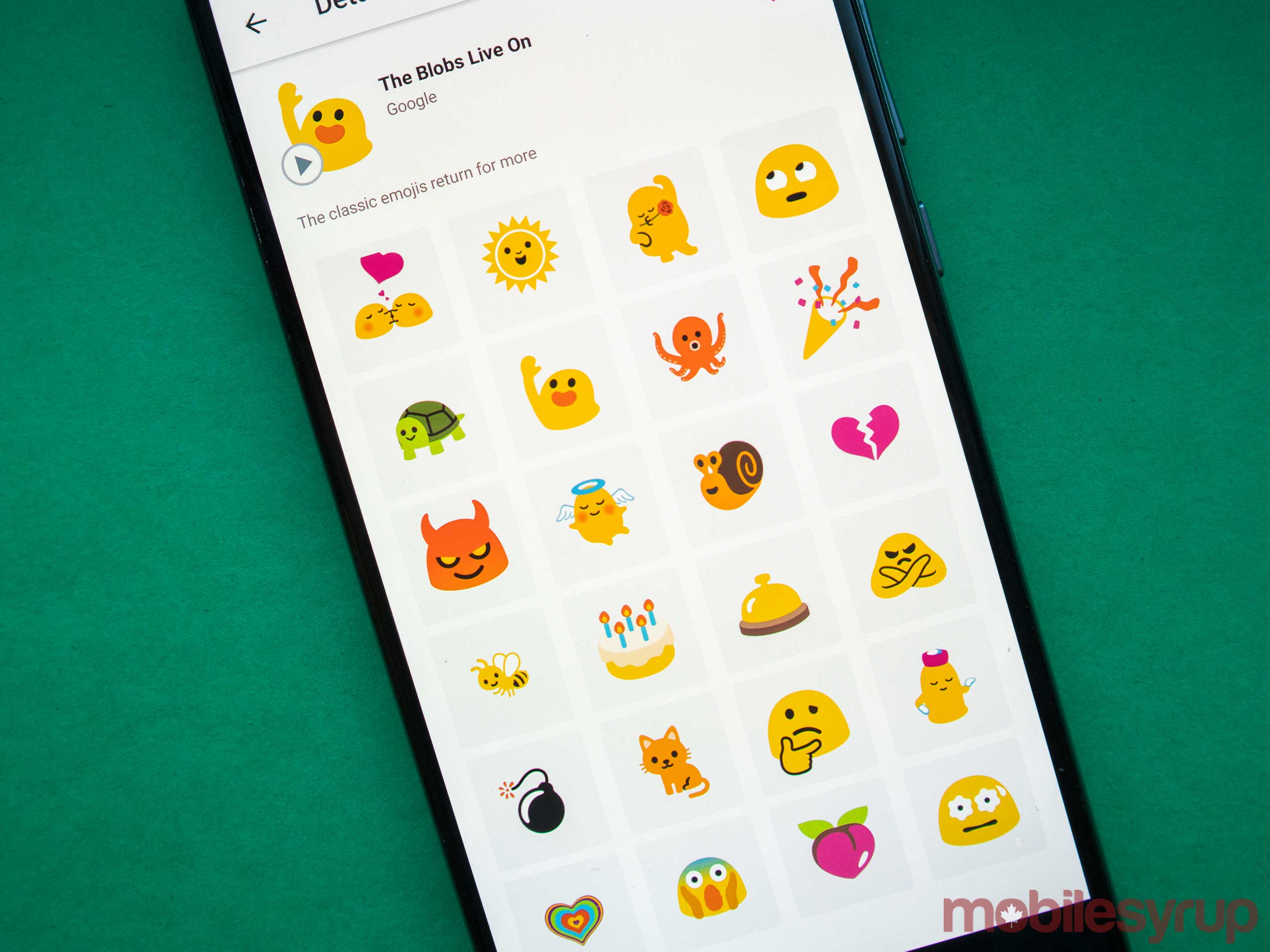
Google has brought back its beautiful blob emoji as an animated sticker pack

by Brad Bennett

Good news for fans of the ill-fated Android blob emoji: Google is bringing a new blob emoji sticker pack to Gboard.

The blob emoji were Google’s main emoticons from 2013’s Android 4.4 KitKat until Android Oreo’s launch in 2017.

To celebrate World Emoji Day the company’s released 24 new animated blob stickers. The pack’s name is ‘The Blob Lives On’ and users can download it now. The first set of blob stickers – ”Long Live the Blob’ – released shortly after Android Oreo launched.

Both packs have 24 blobs each, giving users 48 animated stickers to help fill the blob sized hole in their heart.

To enable the throwback stickers make sure you’re using Gboard, then open the emoji/sticker keyboard by holding on the comma button and then hitting the emoji icon. From there, select the sticker section from the menu bar and choose one of the two blob offerings.

Since the blobs are stickers now they work no matter what service they’re sent over, so all your iPhone friends can finally experience the blob.

Google never clarified why it decided to get rid of the blobs, but since it’s releasing blob-themed sticker packs it seems unlikely that the blobs will ever be the phone’s regular emoji again.

Source: 9to5Google

The post Google has brought back its beautiful blob emoji as an animated sticker pack appeared first on MobileSyrup.

17 Jul 20:58

Facebook moderators failed to delete abusive and racist content

by Jonathan Lamont
Facebook app on phone

Facebook is conducting an internal investigation after a U.K. TV news report revealed the social network’s moderators didn’t delete abusive and racist content.

The TV report, which will air July 17th on Channel 4 in the U.K., shows an undercover investigation into CPL Resources. CPL is based in Dublin, Ireland and is one of many companies Facebook contracts to aid in content moderation.

An undercover journalist was introduced to Facebook’s community standards as part of the CPL training procedure. Community standards are Facebook’s rule book for acceptable content, designed to encourage expression and create a safe environment. Additionally, the journalist worked on reviewing content including graphic violence, child abuse and hate speech.

Failing to meet standards

Moderators at CPL have three options when reviewing content — ignore, delete or mark as disturbing. Marking something as disturbing places an age restriction on the content, but doesn’t delete it.

However, the reporter found that CPL allowed shocking content to remain on the platform. Furthermore, the journalist discovered that there were inconsistencies in the training moderators received and Facebook’s community standards.

One example of this the reporter found was a video of a grown man beating a small boy. The training indicated that moderators should mark the video as disturbing. However, online anti-child abuse campaigner Nicci Astin reported the video to Facebook in 2012. At the time, the company reportedly said the video didn’t violate it’s terms.

The video reportedly garnered 44,000 shares in it’s first two days on the platform and was still up when Channel 4 investigated.

Facebook’s response

Facebook responded to the report by opening an investigation into what happened at CPL. Furthermore, the company made all CPL trainers retake the training and is preparing to do the same globally. Facebook’s vice president of global policy solutions Richard Allan sat down with the Channel 4 news team for an interview.

Importantly, Allan said that the training material was wrong. “[The material] should not have been in those training decks. They were old training decks using wrong examples, wrong material, so we have gone through that.”

Additionally, trainers used inappropriate language when discussing content. Those trainers were retrained accordingly, Allan said.

Along with that, Allan said the company would be doubling the number of people working on safety and security this year to 20,000. Despite that, Allan admitted that the system isn’t perfect.

The CPL team is on the front lines. They’re the first to review content. According to Allan, CPL should escalate certain content issues to Facebook staff, who have country-specific training as well as law enforcement contacts.

The interview also touched on issues of balance. CPL and Facebook staffers have to deal with complex issues and debates on a regular basis. Often they must make judgement calls, deciding whether a debate comment could be considered hate speech and other sensitive issues.

One issue moderators contend with is the why. Did someone post content to highlight an issue and garner support to stop it? For example, some users may try to draw attention to and raise support for an issue of bullying by posting a video of a kids bullying a girl. Someone else may post the same video to celebrate the act of bullying. Moderators make judgement calls with content like this too.

Does Facebook profit from shocking content?

One of the more important issues discussed in the interview was whether Facebook stands to profit from content like this. Former Facebook investor and recent critic of the platform Roger McNamee believes the company does.

“It’s the really extreme, really dangerous form of content that attracts the most highly engaged people on the platform. Facebook understood that it was desirable to have people spend more time on site if you’re going to have an advertising-based business,” he told Channel 4.

Allan disagrees, saying that’s a misunderstanding of the system.

“The way in which we make money is that we place advertisements in somebody’s news feed. Just like if you watch commercial television, your experience is interrupted by an ad break. Well on Facebook your news feed is interrupted by an ad break. And that then isn’t associated with any particular kind of content.”

You can read the full transcript of the interview between Allan and Channel 4 here.

Source: Facebook, Business Insider

The post Facebook moderators failed to delete abusive and racist content appeared first on MobileSyrup.

17 Jul 20:54

Google is working on a fix for another longstanding Pixel 2 camera bug

by Jonathan Lamont

Google confirmed it’s working on a fix for a camera bug affecting some Pixel 2 and 2 XL devices.

The bug is a critical error plaguing the camera on the Pixel phones. The issue, which has haunted the devices since their launch, causes the camera app to crash when launching or trying to to take photos.

Despite how long the issue has persisted, Google hasn’t fixed it yet. However, the company’s Twitter account replied to a customer experiencing the issue, telling her there was a fix in the works.

The Google Twitter account also suggested a few workarounds for the customer, named Ciara according to her Twitter page. However, the workarounds unfortunately didn’t work.

The workarounds included clearing the app’s cache and taking photos in airplane mode. Ciara also attempted a device reset, but that didn’t fix the problem either.

Another customer joined the thread and complained that the fixes didn’t work for her either. However, Ciara tweeted back that calling Google support was quite helpful.

You can read the full thread here.

According to The Inquirer, Google reportedly is replacing Pixel 2 and 2 XL handsets that suffer from the bug. However, the company hasn’t officially confirmed if this is the case.

This isn’t the only issue plaguing Pixel phone cameras. Pixel 2 devices have an issue with the panorama mode that Google hasn’t fixed either. One user finally got fed up waiting for Google and fixed the problem himself.

Source: Twitter Via: The Inquirer

The post Google is working on a fix for another longstanding Pixel 2 camera bug appeared first on MobileSyrup.

17 Jul 20:53

When to buy an Apple HomePod

by Volker Weber

IMG 3923

I tried a few things where HomePod did not look so good. It's eye to eye with a Sonos One but not with any other Sonos speakers. It cannot beat a pair of Sonos One, and a pair of HomePods cannot beat a Play:5 or a Playbase, if you are only judging it by the sound. Factor in Siri vs. Alexa, and it becomes much less useful.

But there are things that work better on HomePod:

  • Voice recognition is stellar. HomePod can hear you from across the room, even if there is loud music playing or the TV is on. It hands down beats Alexa on Echo or Sonos.
  • Airplay 2 on HomePod is not the same as Airplay 2 on Sonos. When you play media from the iPhone and then intentionally drop the iPhone from your Wifi, HomePod will play on for minutes before it runs dry. A Sonos player will only make it much less than a minute. That means you can have spotty Wifi reception without being bitten by dropouts on HomePod.
  • If you use Apple Music, your experience will be better on HomePod than on Sonos. Sonos does support Apple Music and many other music services. But you won't be able to use Siri on a Sonos speaker to select music or to control your player. Sonos only supports Alexa at the moment and has announced support for Google, but has been dodging questions about delivery dates. Both don't support Apple Music.
  • If you listen to music or podcasts on your Apple devices and then transfer the sound via Airplay 2 to your Sonos, it will play this sound alright. But the iPhone stays in the loop. You cannot survive the beer test: eave the house to buy extra beer and the music at your party stops. If you do the same with HomePod, Apple hands off to Homepod and takes the iPhone out of the loop. Anything that comes out of the Apple cloud, Apple Music, iTunes Match etc. can be handled by the HomePod independently.

We will still need to find out what apps can use this handoff. My current hypothesis is that it needs to be made by Apple. Anything you can ask Siri to do for you on HomePod, will be handled by HomePod without your iPhone. But you won't be able to hand off to Sonos via Airplay 2. You can via Spotify Direct and other services, but not with Apple Music. If you use Sonos Control, your iPhone will never be in the loop, which makes Sonos so robust.

Airplay may not be as sophisticated as Sonos, but it beats Bluetooth by a mile. Whether it's Airplay, Sonos, or Spotify Connect, they are all superior to Bluetooth.

It all comes down to the use case. If you live in an Apple household with nothing that isn't made by Apple and everything connects into HomeKit, then HomePod is the superior product, even if the sound does not hold a candle to a Sonos setup. As soon as you want to do things that Apple does not support, like German radio stations, Spotify, or any other music service not made by Apple, you should go with Sonos. And if you are rich, you buy something else first.

17 Jul 18:01

Leaked photos reveal the front and back of the Note 9

by Jonathan Lamont
Samsung Note 7

A new leak from /Leaks (Slash Leaks) shows the Samsung Galaxy Note 9 in all its glory.

According to the leaked photos posted on the /Leaks twitter account and website, the Note 9 will look very similar to the Note 8.

The device features a nearly edge-to-edge display like its older sibling. Additionally, the phone has two rear cameras. Furthermore, the fingerprint sensor has moved. Instead of sitting beside the cameras, the sensor resides below the cameras.

It also appears that the front and rear of the device is glass.

My personal favourite touch is the big sticker on the back that says “No photo allowed” and “Do not leak info.”

Note 9 leaked photos

This isn’t the first leak of the upcoming smartphone.

Early on Tuesday, frequent device leaker Evan Blass shared a render of the Note 9 and its gold S Pen.

Additionally, Samsung’s DJ Koh was photographed using a Note 9 at a press event on July 16th. At the same event, Koh spoke about Samsung’s plans to include in-display fingerprint technology in its upcoming S10 and Note 10 phones.

The device is set to be revealed on August 9th in New York. Samsung began sending out official media invitations to its Unpacked event last month.

Image: /Leaks

Source: /Leaks

The post Leaked photos reveal the front and back of the Note 9 appeared first on MobileSyrup.