Shared posts

14 Aug 20:37

Welcome Amy Keating, our incoming General Counsel

by Denelle Dixon

I’m excited to announce that Amy Keating will be joining us in September as Mozilla’s new General Counsel.

Amy will work closely with me to help scale and reinforce our legal capabilities. She will be responsible for all aspects of Mozilla’s legal work including product counseling, commercial contracts, licensing, privacy issues and legal support to the Mozilla Foundation.

“Mozilla’s commitment to innovation and an internet that is open and accessible to all speaks to me at a personal level, and I’ve been drawn to serving this kind of mission throughout my career,” said Amy Keating, Mozilla incoming General Counsel. “I’m grateful for the opportunity to learn from Mozilla’s incredible employees and community and to help promote the principles that make Mozilla a trusted and unique voice in the world.”

Amy joins Mozilla from Twitter, Inc. where she has been Vice President, Legal and Deputy General Counsel. When she joined Twitter in 2012, she was the first lawyer focused on litigation, building out the functions and supporting the company as both the platform and the employee base grew in the U.S. and internationally. Her role expanded over time to include oversight of Twitter’s product counseling, regulatory, privacy, employment legal, global litigation, and law enforcement legal response functions. Prior to Twitter, Amy was part of Google, Inc.’s legal team and began her legal career as an associate at Bingham McCutchen LLP.

From her time at Twitter and prior, Amy brings a wealth of experience and a deep understanding of the product, litigation, regulatory, international, intellectual property and employment legal areas.

Join me in welcoming Amy to Mozilla!

Denelle

The post Welcome Amy Keating, our incoming General Counsel appeared first on The Mozilla Blog.

14 Aug 18:54

Connect your Android phone to Windows 10

by Volker Weber

Sketch

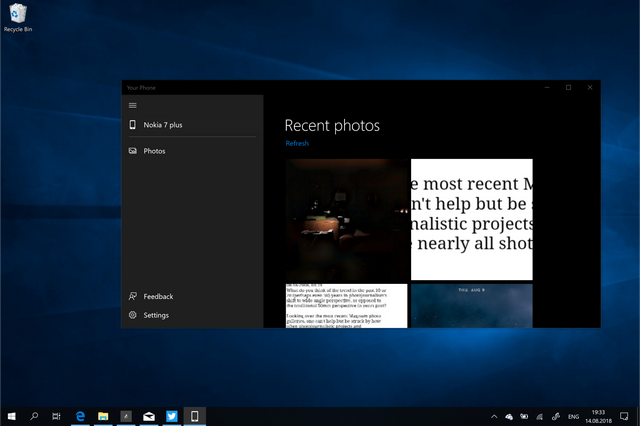
You no longer need to be on an Insider build to connect your Android phone to your Windows 10 computer to download photos for instance. Start with the Your Phone app. It will text you a link to this Android app where you need to login. You will connect Android phone and Windows PC through your Microsoft account.

This currently does not do more than transfer recent photos to Windows, but eventually you will be able to do much more.

14 Aug 18:27

Week 182 of chemo complete: Absence of rain, the new normal?

by tyfn

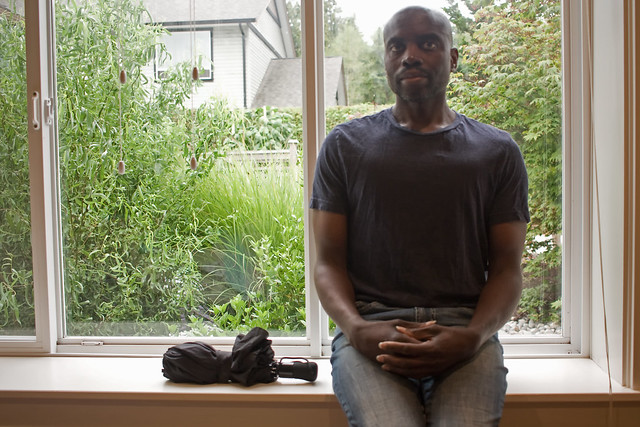
I like to be prepared in case of rain when I leave the house. I will check the weather report and if there is a possibility of rain, I’ll throw my umbrella in my backpack. As I walk and transit everywhere, I don’t want to get caught up in a rainstorm and end up with a cold. I always need to be cautious with my health, due to my cancer of the immune system.

This morning, I was reflecting on how I couldn’t remember the last time I packed my umbrella or actually felt raindrops on my face. The heatwave experienced here in British Columbia and mirrored elsewhere has been called ‘the new normal’. I hope that isn’t true.

Listening to the pitter-patter of rain is such a tranquil experience.

Week 182 of chemo complete: Absence of rain, the new normal?

On Sunday, August 5th, I completed Cycle 46 Week 2. I have multiple myeloma and anemia, a rare cancer of the immune system. Multiple myeloma affects the plasma cells, a type of immune cell that produces antibodies to fight infection. These plasma cells are found in the bone marrow. As a blood cancer, it is incurable, but treatable. Since February 9th 2015, I have been on Pomalyst and Dexamethasone chemo treatment (Pom/Dex). On July 16th 2017, my Dexamethasone treatment ended, due to right eye damage, reported by my Glaucoma Specialist, from long-term use. On January 9th, 2018 I began Ninlaro chemo to combat steadily rising cancer levels. On July 23rd, dexamethasone (40mg) was added to my Ninlaro and Pomalyst chemo treatment, due to excessively high cancer levels.

Weekly chemo-inspired self-portraits can be viewed in my flickr album.

StevestonMay 2014 – Steveston, BC

The post Week 182 of chemo complete: Absence of rain, the new normal? appeared first on Fade to Play.

14 Aug 18:23

TLS 1.3 Published: in Firefox Today

by Eric Rescorla

On friday the IETF published TLS 1.3 as RFC 8446. It’s already shipping in Firefox and you can use it today. This version of TLS incorporates significant improvements in both security and speed.

Transport Layer Security (TLS) is the protocol that powers every secure transaction on the Web. The version of TLS in widest use, TLS 1.2, is ten years old this month and hasn’t really changed that much from its roots in the Secure Sockets Layer (SSL) protocol, designed back in the mid-1990s. Despite the minor number version bump, this isn’t the minor revision it appears to be. TLS 1.3 is a major revision that represents more than 20 years of experience with communication security protocols, and four years of careful work from the standards, security, implementation, and research communities (see Nick Sullivan’s great post for the cool details).

Security

TLS 1.3 incorporates a number of important security improvements.

First, it improves user privacy. In previous versions of TLS, the entire handshake was in the clear which leaked a lot of information, including both the client and server’s identities. In addition, many network middleboxes used this information to enforce network policies and failed if the information wasn’t where they expected it.  This can lead to breakage when new protocol features are introduced. TLS 1.3 encrypts most of the handshake, which provides better privacy and also gives us more freedom to evolve the protocol in the future.

Second, TLS 1.3 removes a lot of outdated cryptography. TLS 1.2 included a pretty wide variety of cryptographic algorithms (RSA key exchange, 3DES, static Diffie-Hellman) and this was the cause of real attacks such as FREAK, Logjam, and Sweet32. TLS 1.3 instead focuses on a small number of well understood primitives (Elliptic Curve Diffie-Hellman key establishment, AEAD ciphers, HKDF).

Finally, TLS 1.3 is designed in cooperation with the academic security community and has benefitted from an extraordinary level of review and analysis.  This included formal verification of the security properties by multiple independent groups; the TLS 1.3 RFC cites 14 separate papers analyzing the security of various aspects of the protocol.

Speed

While computers have gotten much faster, the time data takes to get between two network endpoints is limited by the speed of light and so round-trip time is a limiting factor on protocol performance. TLS 1.3’s basic handshake takes one round-trip (down from two in TLS 1.2) and TLS 1.3 incorporates a “zero round-trip” mode in which the client can send data to the server in its first set of network packets. Put together, this means faster web page loading.

What Now?

TLS 1.3 is already widely deployed: both Firefox and Chrome have fielded “draft” versions. Firefox 61 is already shipping draft-28, which is essentially the same as the final published version (just with a different version number). We expect to ship the final version in Firefox 63, scheduled for October 2018. Cloudflare, Google, and Facebook are running it on their servers today. Our telemetry shows that around 5% of Firefox connections are TLS 1.3. Cloudflare reports similar numbers, and Facebook reports that an astounding 50+% of their traffic is already TLS 1.3!

TLS 1.3 was a big effort with a huge number of contributors., and it’s great to see it finalized. With the publication of the TLS 1.3 RFC we expect to see further deployments from other browsers, servers and toolkits, all of which makes the Internet more secure for everyone.


The post TLS 1.3 Published: in Firefox Today appeared first on Mozilla Security Blog.

14 Aug 18:23

Designing A Community Strategy – FeverBee’s Project Plan Template

by Richard Millington

We use a similar project plan we use for most of the clients we work with.

We don’t go through every step with every client, but the process is relatively the same for each.

A typical community strategy usually takes us between 10 to 12 weeks to complete and goes through five stages. These stages are:

  • Getting started. Admin, gathering basic information, and tracking progress.
  • Setting up the research. Getting access to people, data, resources, and gaining permissions to do the research.
  • Undertaking the research. Interviews, surveys, data analysis, competitors, macro-trends and participating in the community.
  • Developing the strategic plan. Developing, testing, and refining the short and long-term strategic plans (sometimes presented as options).
  • Building the measurement framework. Developing custom dashboards for our clients.

You can see a small sample below:

project plan template

You won’t need to progress through every step, but it should give you a clear framework to build your community strategy.

I’ve found the major benefit of this framework is it ensures mutual accountability, lets you plan to avoid the major time-sinks (getting access to data, setting up interviews etc…) and ensures the entire strategy is built upon good data.

Every major success we’ve had has been achieved by following the research.

You can access the project plan for free (click file > download as to save in Google Docs).

As part of our Strategic Community Management course, we’ll teach you how to go through this process gather great data, and think strategically to achieve the best results with your resources.

If you find the project plan useful, you should click here to learn more about the course.

The course begins on Sept 17 and costs $675 USD.

14 Aug 18:18

Stuff that works :: Bite Away

by Volker Weber

27313473

Eigentlich ein ganz einfacher Zauberstab. Wird man von einem Mücke oder einem anderen fliegenden Monster gestochen, setzt man die Kontaktfläche dieses Stifts auf die Wunde und drückt ab. Die Stelle wird duch eine Keramikfläche auf 51 Grad Celsius erhitzt, bei Kindern für 3 Sekunden, bei Erwachsenen für 6 Sekunden. Keine Chemie, keine Salbe. Die lokale Wärmeeinwirkung reicht. Nur zwei AA-Batterien, die für 300 lange Applikationen halten sollen.

25 Euro sind für so ein einfaches Gerät ein stolzer Preis, den ich gerne bezahle, damit die Einstichstelle nicht juckt oder anschwillt. Von Mamas empfohlen. Jetzt auch von mir.

More >

14 Aug 18:18

Getting started with your Raspberry Pi

by Alex Bate

Here on the Raspberry Pi blog, we often share impressive builds made by community members who have advanced making and coding skills. But what about those of you who are just getting started?

Getting started with Raspberry Pi

For you, we’ve been working hard to update and polish our Getting started resources, including a brand-new video to help you get to grips with your new Pi.

Getting started with Raspberry Pi

Whether you’re new to electronics and the Raspberry Pi, or a seasoned pro looking to share your knowledge and skills with others, sit back and watch us walk you through the basics of setting up our powerful little computer.

How to set up your Raspberry Pi || Getting started with #RaspberryPi

Learn how to set up your Raspberry Pi for the first time, from plugging in peripherals to loading Raspbian.

We’ve tried to make this video as easy to follow as possible, with only the essential explanations and steps.

getting started with raspberry pi

As with everything we produce, we want this video to be accessible to the entire world, so if you can translate its text into another language, please follow this link to submit your translation directly through YouTube. You can also add translations to our other YouTube videos here! As a thank you, we’ll display your username in the video descriptions to acknowledge your contributions.

New setup guides and resources

Alongside our shiny new homepage, we’ve also updated our Help section to reflect our newest tech and demonstrate the easiest way for beginners to start their Raspberry Pi journey. We’re now providing a first-time setup guide, and also a walk-through for using your Raspberry Pi that shows you all sort of things you can do with it. And with guides to our official add-on devices and a troubleshooting section, our updated Help page is your one-stop shop for getting the most out of your Pi.

getting started with raspberry pi

For parents and teachers, we offer guides on introducing Raspberry Pi and digital making to your children and students. And for those of you who are visual learners, we’ve curated a collection of our videos to help you get making.

As with our videos, we’re looking for people whose first language isn’t English to help us translate our resources. If you’re able to donate some of your time to support this cause, please sign up here.

The forums

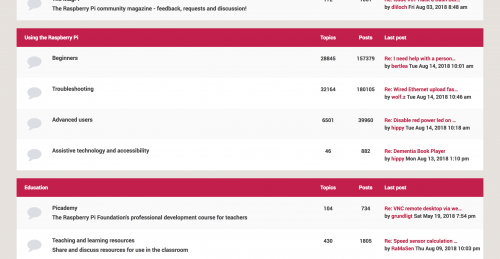
We’re very proud of our forum community. Since the birth of the Raspberry Pi, our forums have been the place to go for additional support, conversation, and project bragging.

Raspberry Pi forums

If your question isn’t answered on our Help page, there’s no better place to go than the forums. Nine times out of ten, your question will already have been asked and answered there! And if not, then our friendly forum community will be happy to share their wealth of knowledge and help you out.

Events and clubs

Raspberry Pi and digital making enthusiasts come together across the world at various events and clubs, including Raspberry Jams, Code Club and CoderDojo, and Coolest Projects. These events are perfect for learning more about how people use Raspberry Pi and other technologies for digital making — as a hobby and as a tool for education.

getting started with raspberry pi

Keep up to date

To keep track of all the goings-on of the Raspberry Pi Foundation, be sure to follow us on Twitter, Facebook, and Instagram, and sign up to our Raspberry Pi Weekly newsletter and the monthly Raspberry Pi LEARN education newsletter.

The post Getting started with your Raspberry Pi appeared first on Raspberry Pi.

14 Aug 18:18

Vancouver’s New Oakridge — Pedestrian Thoroughfare

by Ken Ohrn

Thanks to several commenters on THIS Price Tags post who are concerned about the pedestrian realm planned for Vancouver’s new, improved Oakridge Centre.

I’ve found some recent (2018) design material that seems to address at least one concern.  There does appear to be a diagonal pedestrian route from the Transit Plaza (41st and Cambie) through the new Oakridge Centre to the affluent residential area to the west and south.  Today, at old Oakridge, there is no diagonal route.  There is a meandering route through the mall and parking lots — closed after hours.

In addition, the nice words in THIS 2018 document refer repeatedly to mobility concerns for the site, elevators and escalators for access to the upper level parks and plazas.

Presumably, with thousands of people living in various buildings around the site, there will not be locked gates at the entrances, and much of the site will be accessible to the public and residents.  People, especially residents, will want to come and go at all hours of the day and night.  A lock-off would likely be a big turnoff, and might hurt condo sales.

It also seems to me that the pedestrian experience on 41st Avenue and Cambie Street will be much improved.  Today, it’s nothing more than a succession of parking lots and their entrances.

14 Aug 18:18

Be Like The Swiss~Time for Camera Speed Enforcement

by Sandy James Planner

IMG_5925

IMG_5925

One of the Price Tags editors has just returned from a week in Switzerland driving across the country. There is a major difference in driving in Switzerland~speed cameras are everywhere~on local streets, at the entrances to small towns, and on every major highway. The fines for speeding are steep~drive 6 to 10 km/h over the speed limit and you are looking at a fine of 100 Swiss Francs, roughly equivalent to $135 Canadian dollars. Increase that to driving 16 to 20 km/h over the posted speed limit and you are looking at a whopping 250 Swiss Francs, in the $330 Canadian dollar range. You can take a look at the speeding fine structure and how easy it is to lose your licence by speeding here.

Between 2001 and 2006 Switzerland enforced speed limits resulted in a fatality decrease of 15%  per year, bringing road deaths down from 71 to 31. Enforced slower speeds (the maximum travel speed is 120 km/h and that is rigidly enforced) has made Swiss motorways the safest according to the European Transport Safety Council. The roads are also easier to drive on, with consistent motorist behaviour and plenty of reaction time due to the speed conformity on the motorways.

A new poll conducted by Mario Canseco shows that 70 people in British Columbia are now supportive of the use of a camera system similar to the Swiss to enforce road speed limits in this province.

In the online survey of a representative sample of British Columbians, seven-in-ten residents (70%) approve of the use of speed-on-green cameras, or red light cameras that also capture vehicles that are speeding through intersections. Automated speed enforcement works by using cameras or sensors to pick up a vehicle speeding. A ticket is then issued to the owner of the vehicle. Driver’s license points are not issued as the driver of the vehicle cannot be identified.

The provincial government announced last fall that red light cameras located at 140 intersections would record 24 hours a day. In the fall, the provincial government is expected to announce the number and locations of cameras that would be used to identify speeding vehicles.

The use of fixed speed cameras, mobile speed cameras (that could be moved from place to place) and “point to point” speed enforcement were also favoured by the majority of survey respondents.

“There is high support for all four types of automated speed enforcement across the province,” says Mario Canseco, President of Research Co. “Point-to-point enforcement is the most contentious of all four, with more than a third of residents disapproving of its use.”

Studies clearly show that enforcing speed saves lives. It is time to think of driving  to a destination based upon travelling at uniform and consistent speeds and emphasizing the safety of the journey  over the speed by which the journey is made. The Canseco survey illustrates that the majority of British Columbians agree with this premise, which only makes sense with a provincially run vehicle  insurance program and with universal health care covering the huge costs of road injuries.  You can view Research Co’s data findings here.

fixed-speed-cameras

fixed-speed-cameras
14 Aug 18:18

Civic Savvy: What’s going on with the local elections?

by Gordon Price


Not much is going on.  It’s August; no one seems to care about an election in October.  Not at least until after Labour Day.

I’m calling up people whose job it is to care – the campaign managers and supporters around the candidates, the savvy ones – and asking them for their take on what’s happening.

The first one I contacted affirms that, yup, it’s too quiet – and too confusing.  The fear: so many parties, too many candidates, so that a lot of people may decide early on that it’s too much work to keep track.  They aren’t going to pay attention even as the election approaches, and in the end they simply won’t vote.

It’s therefore possible, goes the concern, that a very few percent of voters – 33 percent or less – will end up choosing a mayor and council that, if other places are a precedent, will result in a dysfunctional council.  Example elsewhere: Nanaimo.

It also means that some mayoral candidate with a simple message, aiming to rile up a  base, can run on an outlandish, divisive platform and end up in power.  Example elsewhere: well, you know who.

Wai Young, for instance, might be that outsider in Vancouver with a simple message (damn bike lanes), especially with an attraction to Cantonese speakers.  But she likely wouldn’t have a supportive council.  Hence, dysfunction.

My contact just raised that theory.  Doesn’t yet have an answer as to how to respond.  The question is whether a credible candidate, aiming for a broad base, can get enough profile and support to prevail on a fractured ballot with a low turnout.


14 Aug 18:17

James O'Brien Demolition Of Boris Johnson Is Electric

mkalus shared this story :
This is brilliant.

Signed in as mkalus

Share this story on NewsBlur

Share this story

Subscribe to this site

Shared stories are on their way...

14 Aug 18:05

Jupyter Notebooks, Cognitive Tools and Philosophical Instruments

by Tony Hirst

A placeholder post, as much as anything, to mark the AJET Call for Papers for a Special Issue on Re-Examining Cognitive Tools: New Developments, New Perspectives, and New Opportunities for Educational Technology Research as a foil for thinking about what Jupyter notebooks might be good for.

According the the EduTech Wiki, “[c]ognitive tools refer to learning with technology (as opposed to learning through technology)” which doesn’t really makes sense as as sentence and puts me off the idea of ed-tech academe straight away.

In the sense that cognitive tools support a learning process, I think they can do so in several ways. For example, in Programming in Jupyter Notebooks, via the Heavy Metal Umlaut I remarked on several different ways in which the same programme could be constructed within a notebook, each offering a different history and each representing a differently active approach to code creation and programming problem solving.

One of the things I try to do is reflect on my own practice, as I have been doing recently whilst trying to rework fragments of some OpenLearn materials as reproducible educational resources (which is to say, materials that generate their own resources and as such support reuse with modification more generally than many educational resources).

For example, consider the notebook at https://notebooks.azure.com/OUsefulInfo/libraries/gettingstarted/html/3.6.0%20Electronics.ipynb

You can also run the notebook interactively; sign in to Azure notebooks (if you’re OU staff, you can use your staff OUCU/OU password credentials) and clone my Getting Started library into your workspace. If notebooks are new to you, check out the 1.0 Using Jupyter Notebooks in Teaching and Learning - READ ME FIRST.ipynb notebook.

In creating the electronics notebook, I had to learn a chunk of stuff (the lcapy package is new to me and I had to get my head round circuitikz) but I found trying to figure out how to make examples related to the course materials provide a really useful context for giving me things to try to do with the package. In that the sense, the notebook was a cognitive tool (I guess) that supported my learning about lcapy.

For the https://notebooks.azure.com/OUsefulInfo/libraries/gettingstarted/html/1.05%20Simple%20Maths%20Equations%20and%20Notation.ipynb notebook, I had to start getting my head round sympy and on the way cobble together bits and pieces of code that might be useful when trying to produce maths related materials in a reproducible way. (For example, creating equations in sympy that can then be rendered, manipulated and solved throughout the materials in a way that’s appropriate for a set of educational (that is, teaching and/or learning) resources.

Something else that came to mind is that the notebook medium as both an authoring medium and a delivery medium (we can use it just to create assets; or we can also use it deliver content to students) changes the sorts of things you might want to do in the teaching. For example, I had the opportunity to create self test functions, and there is the potential for interactives that let students explore the effect of changing component values in a circuit. (We could also plot responses over a range of variable values, but I haven’t demoed that yet.) In a sense, the interactive affordances of the medium encouraged me to think of opportunities to create philosophical instruments that allow authors – as well as students – to explore the phenomena being described by the materials. Although not a chemistry educator, putting together a reworking of some OpenLearn chemistry materials – https://notebooks.azure.com/OUsefulInfo/libraries/gettingstarted/html/3.1.2%20OpenLearn%20Chemistry%20Demos.ipynb – gave me some ideas about the different ways in which the materials could be worked up to support interactive / self-checking /constructive learning use. (That is, ways in which we could present the notebooks as interactive cognitive tools to support the learning process on the one hand, or as philosophical instruments that would allow the learner explore the subject matter in an investigative and experimental way.)

I like to think the way I’m using the Jupyter notebooks as part of an informal “reproducible-OER” exploration is in keeping with some of the promise of live authoring using the OU’s much vaiunted, though still to be released, OpenCreate authoring environment (at least, as I understand the sorts of thing it is supposed to be able to support) with the advantage of being available now.

It’s important to recognise that Jupyter notebooks can be thought of as a medium that behaves in several ways. In the first case, it’s a rich authoring medium to work with – you can create things in it and for it, for example in the form of interactive widgets or reusable components such as IPython magics (for example, this interactive mapping magic: https://github.com/psychemedia/ipython_magic_folium ). Secondly, it’s a medium qua environment that can itself be extended and customised through the enabling and disabling of notebook extensions, such as ones that support WYSIWYG markdown editing, or hidden, frozen and read-only executable cells, which can be used to constrain the ways in which learners use some of the materials, perhaps as a counterpoint to getting them to engage more actively in editing other cells. Thirdly, it acts as a delivery medium, presenting content to readers who can engage with the content in an interactive way.

I’m not sure if there are any good checklists of what makes a “cognitive tool” or a “philosophical instrument”, but if there are it’d be interesting to try to check Jupyter notebooks off against them…

14 Aug 17:53

The Identity Challenge: On the Internet, Nobody Knows You're a Dog

Irving Wladawsky-Berger, Aug 28, 2018


Icon

This article summarizes, Better Identity in America  (48 page PDF), "a policy agenda for improving the privacy and security of digital systems and help combat identity fraud." It's a response to the increasingly difficult problem of establishing and verifying identity online. Governments should modernize "legacy paper-based identity systems around a privacy-protecting, consumer-centric digital model." As well, they should stop using social security numbers as a form of authentication. And they should look at projects like the Fast Identity Online (FIDO) Alliance, the GSMA’s Mobile Connect, and the World Wide Web Consortium’s Web Authn, - whose strong authentication technologies are being embedded in devices, operating systems and browsers.

Web: [Direct Link] [This Post]
14 Aug 17:53

Platforms, Speech And Truth: Policy, Policing And Impossible Choices

Mike Masnick, TechDirt, Aug 28, 2018


Icon

This post takes a while to get to its central point, and in the process says a bunch of things I don't agree with. But the core statement is correct, in my view. It is this: "we need to move to a world of protocols instead of platforms, in which transparency rules and (importantly) control is passed down away from the centralized service to the end users." Facebook has the problems it has because it wants to be the internet, run centrally. This is what's wrong with it, and this is what should be fixed. "Facebook should open itself up so that end users can decide what content they can see for themselves, rather than making all the decisions in Menlo Park "

Web: [Direct Link] [This Post]
14 Aug 17:49

Building an IndieWeb Reader

Aaron Parecki, Aug 28, 2018


Icon

There's a lot to like in this description (I haven't tried out the actual product) of a reader that in many ways resembles what I'm trying to do with gRSShopper. This is a hard project: "there are a whole bunch of different parts to building a reader, many of which have no overlap in skillset: managing the subscription list, polling and fetching feeds, parsing feeds, data storage, rendering posts in a UI, providing inline action buttons to be able to reply and favorite posts, etc." There are some nice bits, especially the interoperability with Twitter and Github.

Web: [Direct Link] [This Post]
14 Aug 17:49

I feel for the satirists

by Josh Bernoff

Satire is the art of exaggerating reality to make a point about its absurdity. So, this just happened: Omarosa Manigault Newman, the former game show contestant hired at the White House and fired less than a year later, claims that the reason President Trump is senile is that he drinks eight Diet Cokes a day. President … Continued

The post I feel for the satirists appeared first on without bullshit.

14 Aug 17:49

Symantec Distrust in Firefox Nightly 63

by Pascal Chevrel

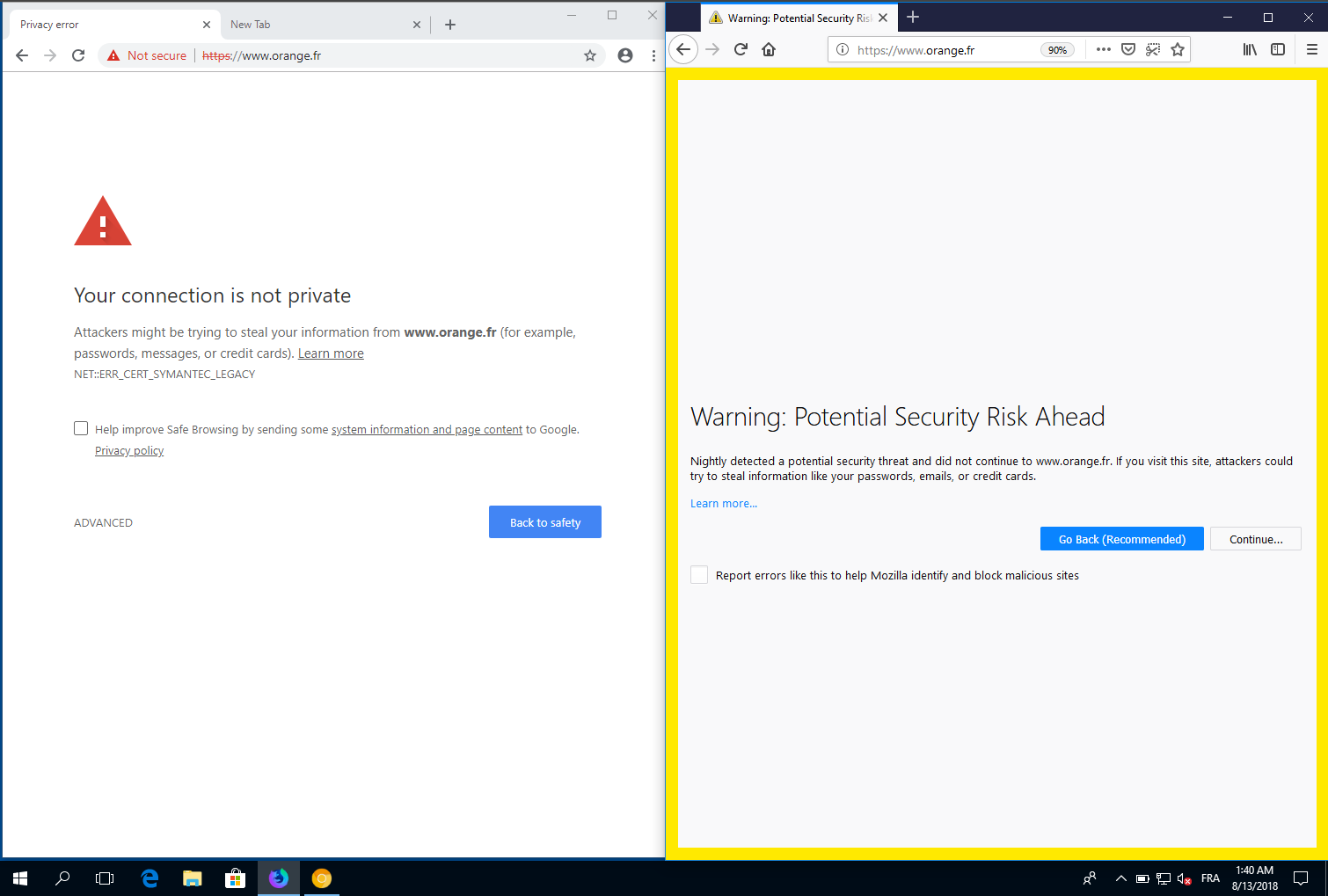
As of today, TLS certificates issued by Symantec are distrusted in Firefox Nightly.

You can learn more about what this change means for websites and our release schedule for that change in our Update on the Distrust of Symantec TLS Certificates post published last July by the Mozilla security team.

The Symantec distrust is already effective in Chrome Canary which means that visitors to a web site with a Symantec certificate which was not replaced now get a warning page:

(left is Chrome Canary, right is Firefox Nightly)

We strongly encourage website operators to replace their distrusted Symantec certificate as soon as possible before this change hits the Firefox 63 release planned for October 23.

If you are a Firefox Nightly user, you can also get involved and help this transition by contacting the support channels of these websites to warn them about this change!

14 Aug 17:49

Facebook’s Story Problem — and Opportunity

by Ben Thompson

This is hardly the first Stratechery article about Facebook to start with Snapchat. The “camera company” née social network reported earnings that were, as they say, mixed. Revenue beat expectations by 5%, but user growth, after slowing considerably for two years, went in the opposite direction: Snap’s Daily Active Users were still up 9% year-over-year, but for the first time declined sequentially (by 2%):

Snapchat's Daily Active Users

So what happened?

Snap’s Growth Excuses

Snap’s stated rationale for its slowing growth has shifted over those two years:

  • In its S-1, filed in February 2017, the company blamed “technical issues”:

    In mid-2016, we launched several products and released multiple updates, which resulted in a number of technical issues that diminished the performance of our application. We believe these performance issues resulted in a reduction in growth of Daily Active Users in the latter part of the quarter ended September 30, 2016.

  • During the pre-IPO roadshow, CEO Evan Spiegel blamed Snapchat’s performance on Android:

    I think broadly speaking if you look at rest of world growth as a proxy for Android, you can start getting an understanding for the performance issues we face on Android in the last two quarters.

  • On the company’s first earnings call, Spiegel pointed to the company’s restraint:

    I’d love to speak a little bit to the DAU question, because it’s a question that we get all the time. And I think one of the reasons why it’s such a popular question is because there’s a lot of this thing in our industry called growth hacking, where you send a lot of push notifications to users or you try to get them to do things that might be unnatural or something like that. And I think while that’s the easy way to grow daily actives quickly, we don’t think that those sorts of techniques are very sustainable over the long term. And I think that can ultimately impact our relationship with the customer.

  • A year ago, on the company’s third conference call, Spiegel blamed a shift in measurement:

    This quarter, we grew our Daily active users at a lower rate than we would have liked, adding 4.5 million new users. This can be partially attributed to our decision to report our daily active users as an average over the entire quarter, where a strong September was offset by the more modest months of July and August. Ultimately though, we want to drive more user growth in 2018.

  • In March the blame was put on Snapchat’s re-design, along with that old bugaboo Android:

    As we have mentioned on our past two earnings calls, a change this big to existing behavior comes with some disruption, especially given the high frequency of daily engagement of our community. While we had an average of 191 million daily active users in Q1, our March average was lower, but still above our Q4 average. We are already starting to see early signs of stabilization among our iOS users as people get used to the changes, but still have a lot of work to do to optimize the new design, especially for our Android users.

  • Last quarter the re-design again took center stage:

    While our monthly active users continue to grow this quarter, we saw 2% decline in our daily active users. This was primarily driven by a slightly lower frequency of use among our user base due to the disruption caused by our redesign. It has been approximately six months since we broadly rolled out the redesign of our application and we have been working hard to iterate and improve Snapchat based on the feedback from our community.

Note that this last explanation is a bit different than the others: Snap was admitting that its core users were using the product less. The problem is that while social networks making blunders in the user experience is hardly a new phenomenon, the difference between Snapchat and, well, Facebook, is the lack of growth — going on for two years now — to make up for it.

And, of course, there is the reason for slowing growth that Snap’s executives can’t bring themselves to acknowledge: Instagram Stories.

Copying Audacity Redux

In August 2016, when Instagram launched what its own executives admitted was a rip-off of Snapchat’s Stories feature, I wrote in The Audacity of Copying Well that the effect would not be to steal Snapchat’s users, at least not yet; rather, Instagram Stories looked poised to kill Snapchat’s growth:

Facebook is leveraging one of their most valuable assets: Instagram’s 500 million users. The results, at least anecdotally, speak for themselves: I’ve seen more Instagram stories in the last 24 hours than I have Snapchat ones. Of course a big part of this is the novelty aspect, which will fade, and I follow a lot more people on Instagram than I do on Snapchat. That last point, though, is, well, the point: I and my friends are not exactly Snapchat’s target demographic today, but for the service to reach its potential we will be eventually. Unless, of course, Instagram Stories ends up being good enough…

Instagram and Facebook are smart enough to know that Instagram Stories are not going to displace Snapchat’s place in its users lives. What Instagram Stories can do, though, is remove the motivation for the hundreds of millions of users on Instagram to even give Snapchat a shot.

Unfortunately for Snap, Instagram Stories were more than good enough: they were soon significantly better, particularly once you take performance into account (not just on Android, but on iOS too). In fact, they were so good that Instagram’s user growth actually accelerated after their introduction, despite starting from a base of over 500 million users:1
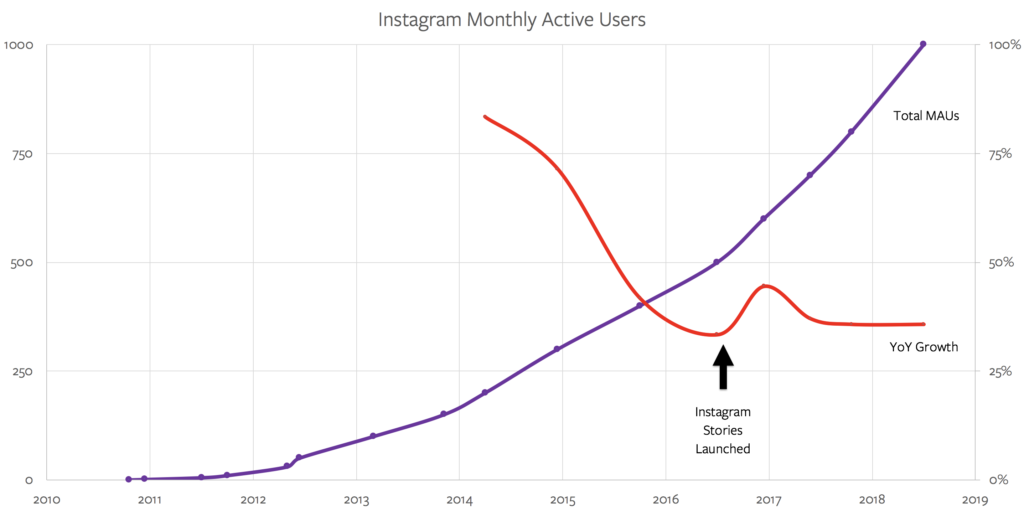
Instagram's Monthly Active Users

In short, Instagram Stories not only prevented users from defecting to Snapchat, it also took all of Snapchat’s growth, and now, after Snapchat’s re-design snafu, is likely taking users away.

Long-term Versus Short-term

Two weeks ago, after Facebook experienced the largest single day market-cap decline in U.S. corporate history, I argued that, if you looked at the company through any lens but a financial one, the company was stronger than ever.

For all of the company’s travails and controversies over the past few years, its moats are deeper than ever, its money-making potential not only huge but growing both internally and secularly; to that end, what is perhaps most distressing of all to would-be competitors is in fact this quarter’s results: at the end of the day Facebook took a massive hit by choice; the company is not maximizing the short-term, it is spending the money and suppressing its revenue potential in favor of becoming more impenetrable than ever.

That reference to “taking a hit by choice” was primarily about the reduced margins Facebook is projecting thanks to its dramatically increased spending on security; it certainly hurts in the short-term, but keeping people on the platform and regulators away has massive long-term value.

It should be noted, though, that Instagram Stories in particular (along with Stories on Facebook’s app) are in a similar vein: their strategic impact, particularly in terms of Facebook’s competitive position relative to Snapchat, will be felt for years. There is a financial impact in the short-to-medium term, though, and it may be significant.

The News Feed Ad Unit

The foundation of Facebook’s advertising business is the News Feed ad, which I described five years ago as the best display advertising unit ever:

It’s better for an advertising business to not be a platform. There are certain roles and responsibilities a platform must bear with regards to the user experience, and many of these work against effective advertising. That’s why, for example, you don’t see any advertising in Android, despite the fact it’s built by the top advertising company in the world.

So a Facebook app owns the entire screen, and can use all of that screen for what benefits Facebook, and Facebook alone.

Something like this:

The News Feed Ad

You can’t help but see the advertising, which makes it particularly attractive to advertisers. Brand advertising, especially, is all about visuals and video (launching soon!), but no one has been able to make brand advertising work as well on the web as it does on TV or print. There is simply too much to see on the screen at any given time.

This is the exact opposite experience of a mobile app. Brand advertising on Facebook’s app shares the screen with no one. Thanks to the constraints of mobile, Facebook may be cracking the display and brand advertising nut that has frustrated online advertisers for years.

To be sure, the fact that News Feed ads take over the screen isn’t the only reason Facebook’s stock is, even with the recent drop, up 148% since that article: in the intervening years the company has doubled its userbase, increased ad load in the News Feed, and managed to increase its price-per-ad thanks to Facebook’s superior targeting capabilities.

Still, the ad unit itself matters:
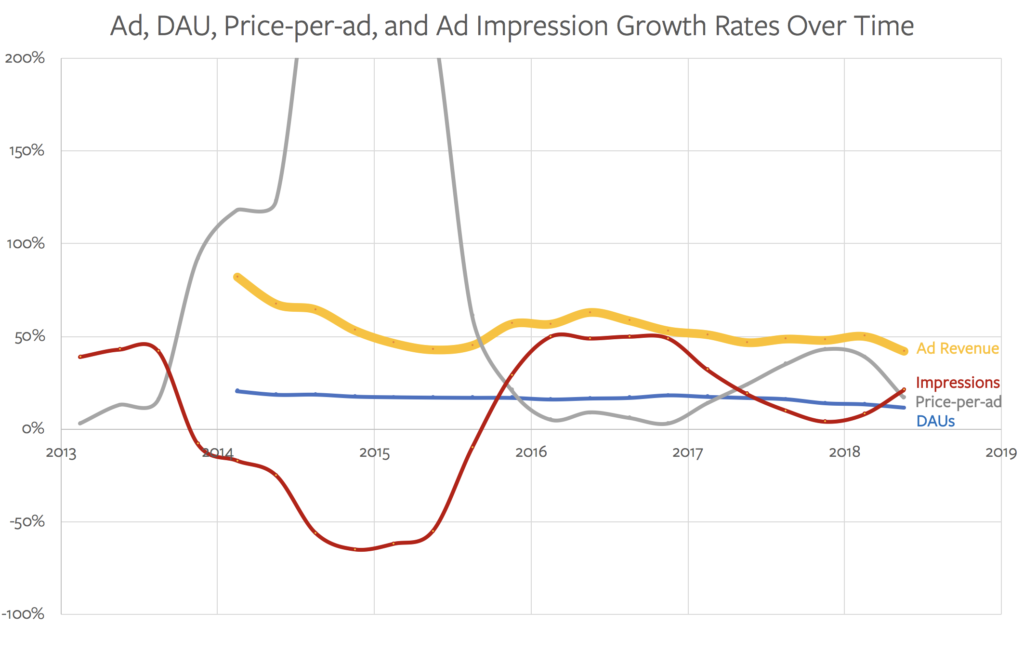
Facebook Advertising Growth Metrics

That huge anomaly between 2014 and 2016 marked the dramatic reduction in Facebook’s side-bar ads, which had been the company’s chief money-maker for years; that reduced the number of impressions, but the resultant shift in ad inventory mix to News Feed ads led to an even more dramatic increase in Facebook’s reported price-per-ad.2

The years after the mix shift have only reinforced just how good the News Feed ad unit is: by 2016 the shift was complete and Facebook just grew and grew, quarter after quarter (remember, that chart is growth rates; a chart of absolute numbers would be up-and-to-the-right3). 2017 was even more interesting: the company said it would stop increasing ad load in the News Feed, which is why impressions fell, but the price-per-ad increased in response. This demonstration of pricing power is as clear an indication as you can get that Facebook’s News Feed ad was highly differentiated.

The Stories Challenge

That’s the thing about Stories, though: while more people may use Instagram because of Stories, some significant number of people view Stories instead of the Instagram News Feed, or both in place of the Facebook News Feed. In the long run that is fine by Facebook — better to have users on your properties than not — but the very same user not viewing the News Feed, particularly the Facebook News Feed, may simply not be as valuable, at least for now.

Facebook CFO David Wehner said as much multiple times on Facebook’s recent earnings call (all emphasis mine):

  • In his prepared remarks:

    There are several factors contributing to [revenue growth] deceleration. For example, we expect currency to be a slight headwind in the second half versus the tailwinds we have experienced over the last several quarters. We plan to grow and promote certain engaging experiences like Stories that currently have lower levels of monetization, and we are also giving people who use our services more choices around data privacy, which may have an impact on our revenue growth.

  • In response to a question about monetizing Instagram:

    Instagram has more heavy usage of Stories, so that’s an area of continued growth opportunity because the effective levels of monetization in Stories are lower. On the demand side, we see a good traction across both platforms, and we’re rolling out more ability for advertisers to leverage ads in Stories with more formats and the like. So that’s, again, an important opportunity for growth is just continuing to build out more products on the demand side for Stories.

  • In response to a question about declining revenue growth:

    We’re going to be focusing on growing engaging new experiences like Stories and promoting those. And that’s going to have a negative impact on revenue growth.

COO Sheryl Sandberg summarized the fundamental question with regard to Stories:

We’ve seen great progress with Stories as a format for people to share on our platforms. We have 400 million people sharing with Instagram Stories, 450 million with WhatsApp Status. Facebook is newer, but we’re seeing good progress there. The question is will this monetize at the same rate as News Feed? And we honestly don’t know.

Nor do investors.

The Downside of Stories

In fact, there are two good reasons to be pessimistic: one from a user perspective and one from an advertiser perspective.

From a user perspective Story ads are far easier to skip: simply tap the screen, much as the user has probably already been doing for the last several minutes feverishly trying to catch up on their Story backlog. Part of what makes Stories such fantastic drivers of engagement is the combination of their disappearing nature — better check frequently to not miss anything! — combined with the simple mechanic of viewing them: tap tap tap. An absence of friction, though, is always a challenge when it comes to monetization.

Moreover, effective Story ads are more difficult to make: still photos can be used, but the most engaging ads will be video, which increases the production difficulty significantly — particularly when you remember the importance of grabbing the user’s attention immediately! This is a particular problem for Facebook because so much of its advertising comes from small- and medium-sized businesses. Sheryl Sandberg said on an earnings call a year-and-a-half ago:

We’re really excited to announce today that 65 million businesses are using our free Pages product and 5 million are using Instagram Business profiles. More and more of these businesses are becoming advertisers with over 4 million advertising on Facebook and over 500,000 on Instagram. As a result, our revenue base is becoming more diverse. In Q4, our top 100 advertisers represented less than a quarter of our ad revenue, which is a decline from Q4 last year.

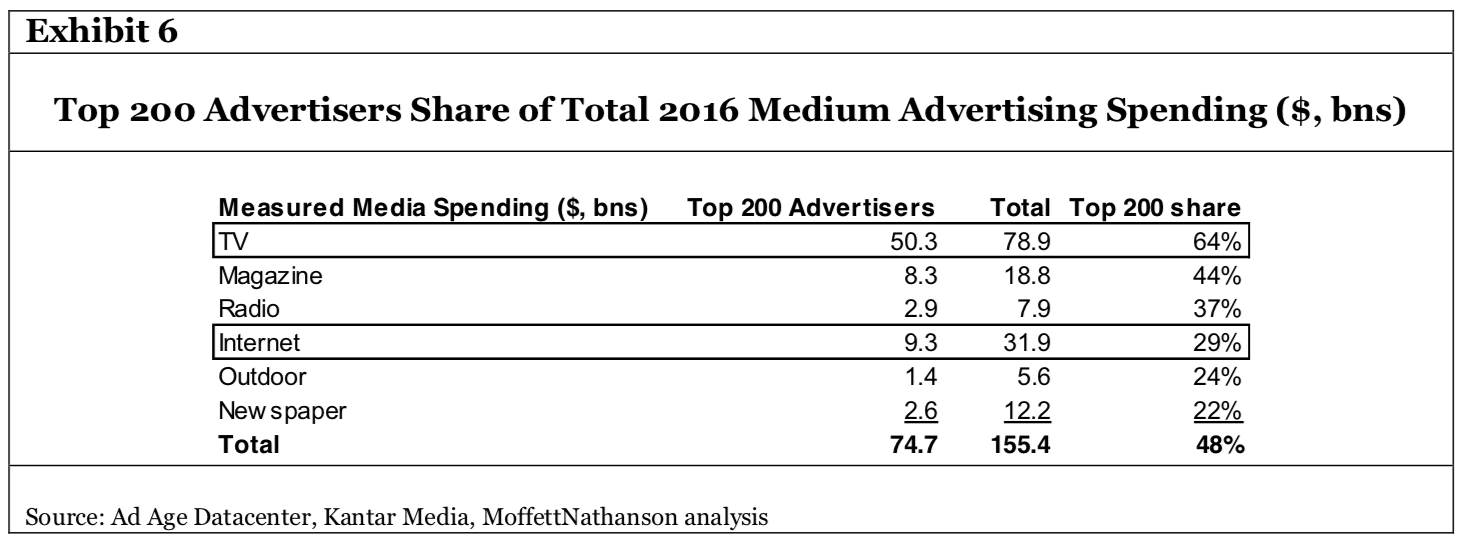
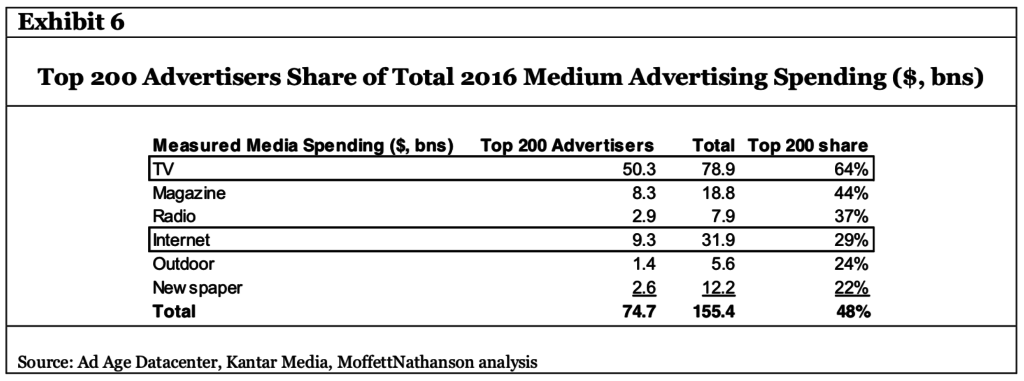
This is tremendous diversification, particularly in comparison to traditional advertising, as this chart from MoffettNathanson shows:
https://stratechery.com/2013/mobile-makes-facebook-just-an-app-thats-great-news/

This is another reason why News Feed ads are so effective: advertising is measured on ROI — return on investment — and the “I” is just as important as the “R”; the investment necessary to achieve a favorable return is so much lower for News Feed ads than nearly any other medium, and experimentation is cheap-and-easy. Small wonder small- and medium-sized businesses flock to Facebook (and a reminder that Facebook’s advertising platform is a critical piece of building the economy of the future); to that end, though, it is fair to wonder just how much of Facebook’s advertiser base will flock to Instagram Stories, even as its users do exactly that.

Stories’ Potential Upside

That noted, Stories potentially have significant value for Facebook beyond strategic positioning. First and foremost, the fact that users find Stories even more engaging than the News Feed suggests there is at least the possibility to create even more engaging advertising as well.

That is particularly compelling because attentive readers may have realized my 2013 excerpt above about the effectiveness of News Feed ads got one thing wrong: I was convinced that taking over the screen would be valuable because of the potential for brand advertising; in fact, most of Facebook’s business is in direct response ads, where the goal is driving user action (app install, product purchase, newsletter signup, etc.) as opposed to simply building brand affinity. The latter remains very television-centric even as young people desert the medium, and every tech company is working feverishly to capture their share of that television money that will be going digital any day now!

Might Stories be an ad unit that works for brand advertising? Sandberg tried to make the case:

With 1 billion active people on the platform, I think Instagram is definitely both a direct response opportunity and an opportunity for discovery. Part of it’s the format. The format is so visually appealing and people are telling stories with pictures, so we see both anecdotally and in the data that this is a great place for people to become aware of a product in the first place.

This is in fact another way to look at that chart about the top 200 advertisers: the biggest spenders are brand advertisers, and while it is to Facebook’s credit that they serve the long tail, there remains a significant opportunity the company has mostly not tapped into, and oh-by-the-way, those are the advertisers best equipped to spend the money to make an effective Stories ad; after all, they’re already spending the money on TV.

That noted, it is possible the pot of brand advertising gold that tech companies are chasing may end up being at the end of the proverbial rainbow, always pursued and never obtained. Do big brands stick with TV because the medium is that much better for advertising, or because they were built for a mass market that on the Internet increasingly doesn’t exist? Indeed, one can make the case — as I have — that the fortunes of traditional television and its advertisers are completely intertwined; unsurprisingly, the disruptors of the latter use Facebook.


There was one small bit of good news for Snap in this analysis: a significant challenge for the company was the de facto requirement that advertisers devote outsized resources to the platform, killing any long-term ROI proposition. The issue is formatting: Snapchat ads are vertical, ideally video, and it was so much easier to simply buy a News Feed ad on Facebook and run it on Instagram. Now, though, an advertiser’s investment in vertical video ads can, at least in theory, be used on both Instagram and Snapchat (and all of Facebook’s other properties after its attempt to put Stories everywhere).

This is small solace to be sure: Instagram has a larger audience — including most of Snapchat’s — the entire Facebook advertising apparatus behind it, and all of the trends are in its favor. That is the sort of long-term gain for which Facebook is rightfully willing to bear the short-term pain; the question now is just how substantial that long-term gain may be, and relatedly, how long the short-term pain will persist.

  1. Facebook has only ever released Instagram MAUs at certain milestones; the growth rate was calculated based on the time in months between those milestones. Also note that Snap, to their credit, releases daily active users, which depresses their numbers relative to Instagram’s monthly active users
  2. The year-over-year increase in price-per-ad growth peaks at 335% in Q4 2014
  3. Also, such a chart is impossible: Facebook doesn’t actually release the absolute number of impressions or price-per-ad
14 Aug 17:49

Which cities are liveable without air conditioning? | Cities

mkalus shared this story from The Guardian.

Last summer I mapped the cities of the world where the residents can live comfortably without heating or air conditioning.

Working with Guardian Cities to scale up the original survey using data from the US National Oceanic and Atmospheric Administration, we broke the world’s cities into four categories.

First, cities where you probably don't need either heating or air conditioning: average summer temperatures are shy of 26.5C (80F) and the hottest days are less than 28C (82F), while the winter average is no colder than 13C (55F) and the coldest days no less than 7C (45F). Second, cities that are warmer in the summer, meaning you probably want air conditioning but can still get by without heating. Third, the opposite: cold in winter, not too warm in summer. Lastly, cities with hot summers and cold winters, where you probably want both air conditioning and heating.

The good news is that, if you want to go air conditioning-free, you have options on every single continent. The bad news is that this may not be the case forever.

Using data from the Impact Climate Lab, we have modelled how climate change might affect temperatures globally, making more people dependent on air conditioning in cities where it is currently strictly a luxury.

The two maps show how average summer temperatures are predicted to rapidly increase in both hemispheres over the next 40 years. In the northern hemisphere, hotter temperatures will creep towards the Arctic circle, while much of northern Africa and the Middle East will see average temperatures climb above 35C (95F) between June and August.

In the southern hemisphere the hottest temperatures occur between December and February. In the next 20 years South American countries such as Argentina and Bolivia are forecast to have average summer temperatures above 35C for the first time since records began.

Whether we face the challenge through international efforts, designing for cooler cities, or by moving to those cities that are naturally temperate, it’s clear we will all need to think more about heat in the coming century.

Sources: US National Oceanic and Atmospheric Administration (NOAA), Climate Impact Lab

14 Aug 17:48

‘Unlock 1Password’ Is the Latest Training Course from The Sweet Setup

by Ryan Christoffel

The Sweet Setup has been on a roll lately with developing video training courses for some of the best iOS and Mac apps the App Store has to offer. Following similar deep dives into Things, Day One, and Ulysses, today they're launching a new course called 'Unlock 1Password.'

1Password has long been considered the premier password management solution on Apple platforms, but many users may only scratch the surface of what it can do, or they're simply hesitant to trust it with their most secure data. 'Unlock 1Password' takes users of varying experience levels into account, covering key features of the app, an overview of the product's security levels, ways it can be used alongside iCloud's own Keychain feature, and more.

In total, the course includes a whopping 14 videos, all of which can be downloaded for offline viewing if you'd like.

  1. Overview of 1Password for Mac
  2. Overview of 1Password for iOS
  3. Why You Can Trust 1Password
  4. Which Version is Right for You?
  5. Installation and Setup
  6. All the Things You Can Store in 1Password
  7. Working with Vaults
  8. Using the Browser Extension
  9. How to Perform a Security Audit
  10. Using 2-Factor Authentication
  11. 1Password for Families and/or Teams
  12. Using 1Password Alongside iCloud Keychain
  13. How to Sync 1Password Across All Your Devices
  14. Understanding Backups

I've relied on 1Password for years, but there were still things I learned from the course, such as how family and team plans work, and the process for setting up 1Password as a two-factor authentication tool. This is one of the things I especially appreciate about The Sweet Setup's courses: even when they cover apps that already have an important place in my life, I benefit from finding even more ways to put those apps to use.

As with the recent video courses from The Sweet Setup, 'Unlock 1Password' is launching at a special introductory price of $23, which will increase to $29 after a week. You can purchase the course here.


Support MacStories Directly

Club MacStories offers exclusive access to extra MacStories content, delivered every week; it's also a way to support us directly.

Club MacStories will help you discover the best apps for your devices and get the most out of your iPhone, iPad, and Mac. Plus, it's made in Italy.

Join Now
14 Aug 17:48

Monster der Großstadt

by noreply@blogger.com (Christine Lehmann)
mkalus shared this story from Radfahren in Stuttgart.

Radfahrende sind das am wenigsten verstandene Element im Straßenverkehr. 

Letzten Sommer habe ich zugeschaut, wie ein Vater sein Kind fotografieren wolle, das auf der anderen Seite eines recht viel von Radlern befahrenen Wegs stand. Ein Radler kam heran, die Augen auf das Kind gerichtet, die Hand an der Bremse. Der Vater pfiff seinem Jungen, um dessen Aufmerksamkeit zu erregen, und der Junge rannte augenblicklich los, genau vor das Rad. Der Radler bremste und hielt. Dem Kind ist nichts geschehen. Ich habe mich gefragt, was sich der Vater eigentlich dabei gedacht hat. Und ich habe mich gefragt, was ein Unbeteiligter dachte, als er die Notbremsung des Radlers und das Kind sah: Ist doch gemeingefährlich, was der Radfahrer da macht.


Fußgänger und Autofahrer sind zwei Parteien im Straßenverkehr, die sich schon lange kennen und geeinigt haben. Fußgänger haben nur an wenigen Stellen Vorrang und akzeptieren das. Sie akzeptieren auch, dass man für sie den Verkehr immer nur ein paar Sekunden lang anhält, damit sie über die Straße gehen können. Und da jeder Autofahrer spätestens in der Fußgängerzone einer Stadt auch Fußgänger ist, akzeptiert er oder sie solche Einrichtungen als sinnvoll. Fußgänger verstehen aber nun gar nicht, warum Radfahrende an Zebrastreifen nicht anhalten. Sie müssen es nicht, wenn der Fußgänger einfach rüber geht, dann radeln sie nämlich hinter ihm vorbei. Aber so mancher Fußgänger zelebriert die Angst, umgefahren zu werden, indem er stehen bleibt und den Radler zwingt, zum Stillstand abzubremsen, bevor er dann losgeht. Oder er schimpft, wenn der Radler halt weiterfährt, weil der Fußgänger nicht geht.

Stuttgart leitet Radler sehr sehr sehr oft durch Fußgängerbereiche und über Gehwege. Das ist billig uns stresst nur die Fußgänger. Radfahrende werden zwischen den Bereichen hin und her geschubst und als regellose Gesellen beschimpft. Am besten wäre es, es gäbe sie gar nicht diese Radler. Stattdessen aber werden es immer mehr. Und die Bundes-Politik, aber auch die Hälfte des Gemeinderats in Stuttgart ignoriert nach besten Kräften den Radboom, statt den Radverkehr zu gestalten. Denn nur dann kann man regeln, wo Radfahrende fahren. Wenn Radfahrende keine  Radwege haben, dann fahren sie eben überall, auf Fahrbahnen, auf Gehwegen, in Fußgängerzonen ...

Die meisten Menschen in Stuttgart (auch die, die selber Fahrrad fahren) wissen fast nichts darüber, wie man sich mit dem Fahrrad in einer Stadt fortbewegt, was riskant ist und was nicht, was ein Radler darf und was nicht, wo er fahren darf oder muss und wo nicht. Oder gar, welche Regeln überhaupt für Radfahrer gelten. Sie wissen übrigens auch nicht, welche Regeln sie selbst als Fußgänger oder Autofahrer den Radfahrern gegenüber beachten müssen. Und dann fordern sie Führerscheine für Radfahrer und Kennzeichen. Sie denken, sie selber würden sich noch an alle Regeln erinnern, die sie vor zwanzig bis dreißig Jahren mal für die Fahrprüfung gelernt haben. Und sie glauben, sie könnten sich Nummern und Buchstaben merken, die sie auf dem Schutzblech eines Fahrrads sehen, dessen Fahrer sie gerne anzeigen würden. Das klappt schon bei Autokennzeichen nicht. Regeln werden in unserer Gesellschaft von allen Verkehrsteilnehmern gebrochen. Wenn Fußgänger und Radfahrer das tun, gefährden sie meist nur sich selbst. Autofahrer aber sitzen in Panzern und können andere verletzen und töten, ohne selbst auch nur verletzt zu werden. Deshalb müssen für Autofahrer strengere Regeln gelten. Sie fahren ein tödliches Geschoss.

Nicht-Radler halten es oft für riskant, wenn ein Radfahrer eine rote Ampel missachtet und weiterfährt. Das ist nicht erlaubt und ich finde es nicht gut, aber tatsächlich hält sich das Risiko sehr in Grenzen, wenn ein Radfahrer an einer roten Autoampel weiterfährt und rechts abbiegt. Radfahrer sind schmal und kommen dabei kaum je einem Auto in die Quere. Bei Rot über eine Ampel fahren bedeutet nämlich oft auch geringeres Risiko, als den Massenstart der Fahrzeuge abzuwarten, die den Radler unbedingt beim Start noch überholen wollen. Und das liegt nicht an Radfahrern, sondern an Autofahrern, die Radfahrende in Bedrängnis bringen.

Und wenn Radfahrer sich durch Fußgänger schlängeln, ist das nur für den Fußgänger ein Schrecken, der den Radler nicht gesehen hat. Der Radler aber sieht die Fußgänger (etwa im Schlossgarten) wie bewegte Pfosten vor sich und kann die Schlangenlinien, die er fahren muss, und seine Geschwindigkeit genau planen. Riskant wird für den Radler nur eine plötzliche Querbewegung des Fußgängers, etwa ein erschrecktes Ausweichen. Und ein Fußgänger, der panisch sein Kind an sich reißt, wenn er einen Radler kommen sieht (der ihn und das Kind ja auch sieht), hat nicht verstanden, dass der Radler kein Interesse daran hat, jemanden zu überfahren. Er oder sie scheint den Radfahrer für ein Krokodil zu halten.

Und wenn Sie jetzt einwenden wollen, aber kürzlich hat doch ein Radfahrer ein Kind, einen Hund oder eine alte Frau angefahren, dann sind wir wieder bei dem Punkt. Ein Autofahrer will auch keine Menschen überfahren. Trotzdem sagen Sie jetzt nicht sofort, aber kürzlich hat ein Autofahrer ein Kind, einen Hund oder eine alte Frau angefahren. Sie und ich, wir wissen ja, dass Unfälle passieren. Mit Autos übrigens mehr als mit Fahrrädern. Und sie gehen für Fußgänger/innen auch schlimmer aus als die mit Radfahrenden.

Menschen, die nicht selbst routinemäßig im Straßenverkehr Rad fahren, können das Verhalten von Radlern oft genauso wenig vorhersehen wie das von Braunbären oder Hühnern. (Radler hingegen können das Verhalten von Menschen sehr genau vorhersehen.) Und weil sie selbst erschrecken, glauben sie, sie seien in Gefahr gewesen.

Vielleicht sollten sich Autofahrernde und Fußgänger/innen durch Radler mal etwas weniger kritisiert fühlen, sondern bedenken, dass Radler ganz erheblich den Stadtverkehr vom Autostau entlasten. Und zwar freiwillig. Jeder Radfahrer ist ein Auto weniger, dass sich durch die Innenstadt schiebt oder im Stau steht.


14 Aug 17:48

Winner, Name that Ware July 2018

by bunnie

The Ware for July 2018 is an I/O board for the x86-based Sega Nu arcade platform. Congrats to megabytephreak for nailing the ware, email me for your prize! Also props to Vegard for pointing out the JVS connector (the thing that looks like USB but isn’t).

I was curious how certain readers were able to identify this as an arcade-related ware, and the answer I received is that the I/O breakout board is the key — the DIP switches and push-buttons are typical of how arcade machines are configured and serviced, and the JVS connector, if you can recognize it, is a dead give-away. The coin cell for retaining configs & high scores even if the power is pulled is also a potential tell. You learn something new every day!

14 Aug 17:48

Name that Ware, August 2018

by bunnie

The Ware for August 2018 is shown below.

Thanks to Patricio Worthalter for contributing this ware!

14 Aug 17:45

2019 Toyota Camry and Sienna to feature Apple CarPlay

by Igor Bonifacic

Toyota plans to bring Apple CarPlay to two more of its 2019 models.

According to order guides spotted by CarsDirect, both the 2019 Camry sedan and 2019 Sienna minivan will ship with support for Apple’s infotainment platform, as well as Amazon’s Alexa voice-activated assistant.

Toyota first announced support for CarPlay at the 2018 North American International Auto Show in Detroit, Michigan, when it unveiled the 2019 Avalon.

At the time, the automaker said, in a statement to MacRumors, that future cars with its Entune 3.0 infotainment platform would ship with CarPlay included. When Toyota made the announcement, both the 2018 Camry and 2018 already had Entune 3.0, so it seemed a lock that the 2019 models of those vehicles would include CarPlay.

Like the Avalon, the Camry and Sienna won’t include Android Auto. Additionally, it’s unclear if the Canadian versions of the Camry and Sienna will include CarPlay; with the Avalon, only the U.S. model includes CarPlay.

We’ve reached out to Toyota for further information. We’ll update this article with comment.

Source: CarsDirect

The post 2019 Toyota Camry and Sienna to feature Apple CarPlay appeared first on MobileSyrup.

14 Aug 17:44

Elon Musk was allegedly on acid while tweeting about taking Tesla private

by Brad Bennett
Elon Musk with Tesla

It seems like we can’t go a week without Elon Musk popping up in some sort of controversy. This week’s episode might be the best yet.

Rapper Azealia Banks recently held nothing back in her online rant aimed at Musk and his Canadian pop-star girlfriend, Grimes. Banks said that Musk was on acid while he tweeted out his intentions to take Tesla private. 

Banks stated on Instagram that Grimes invited her to Musk’s L.A. Mansion to record a song together, but instead of laying down a track, Grimes spent the weekend “coddling her boyfriend for being too stupid to know not to go on twitter while on acid.”

Many of Banks’ subsequent posts insinuate more personal reasons for why she was invited to Musk’s home, though it’s important to point out that all of these allegations are unproven. She mentions that Musk and Grimes may have just wanted her to come out to L.A. without her boyfriend so that they could do “weird threesome sex shit.”

Banks talked to Business Insider after the weekend and said that Musk spent the entire weekend “scrounging for investors” after he went on his August 7th tweetstorm.

Musk’s spokesperson told Business Insider that Banks’ claims were nonsense.

Even if everything in Banks’ story is false except for the fact that Musk tweeted “funding secured” without actually having any funding, that information may be enough for the SEC to hold Musk accountable for stock manipulation.

Source: Engadget, Business Insider

The post Elon Musk was allegedly on acid while tweeting about taking Tesla private appeared first on MobileSyrup.

14 Aug 17:44

Apple could be looking to finally bring multi-user support to Siri

by Patrick O'Rourke
Siri

While both Amazon’s Alexa and Google Assistant have featured multi-user support for months, Apple’s Siri, a voice-activated assistant released years before its key competitors, still doesn’t include the functionality.

However, it looks like that could soon change if a recently granted patent is an indication of what Apple is working on. The patent, entitled ‘User profiling for voice input,’ details technology that allows a device to identify multiple users though username and password or a biometric voice print.

This device would then be able to respond to that specific user’s commands based on past content preferences, resulting in Siri being much more accurate than the voice-activated assistant is currently when it comes to multi-users.

Shared devices like Apple’s HomePod, which currently doesn’t feature multi-user support, would be a good candidate for this technology. Currently, Apple’s HomePod will read the owner’s text messages and calendar entries out loud regardless of who is asking.

To be clear, this patent is broad and could just be referring to Apple’s current “Hey Siri,” support, which allows the voice-activated assistant to only respond to a specific user’s voice.

Still, given Apple’s HomePod lags behind its major competitors in a variety of ways — particularly when it comes to multi-user support — it makes sense that Apple is working on ways to improve the smart speaker.

Source: United States Patent and Trademark Office Via: Apple Insider 

The post Apple could be looking to finally bring multi-user support to Siri appeared first on MobileSyrup.

14 Aug 17:44

Galaxy Note 9 display is ‘visually indistinguishable from perfect’ says DisplayMate

by Jonathan Lamont
Note 9 display

Samsung’s recently announced Galaxy Note 9 is already receiving high praise for its display.

DisplayMate, a leader in display evaluation, tested the device, which hasn’t even hit store shelves yet. The firm awarded the Note 9 an A+ grade, saying it’s “the most innovative and high performance smartphone display that we have ever lab tested.”

The Note 9 features a 6.4-inch 2960 x 1440 pixel Quad HD+ Super AMOLED display. According to DisplayMate, that display is record breaking. It’s brighter, more colour accurate and power efficient.

For one, the Note 9’s screen is incredibly bright. Not only is the Note 9 27 percent brighter than last year’s Note 8, it also has 32 percent higher contrast under high ambient light.

DisplayMate completed this test by having the phone display an all-white screen. This is a fairly challenging test image for an OLED display as it requires all the pixels to shine at full power.

Very colour accurate

Furthermore, the Note 9 is “the most colour accurate display” that DisplayMate has ever measured. DisplayMate measured each of the Note 9’s screen modes in units of Just Noticeable Colour Differences (JNCD).

JNCDs measure the minimum colour difference perceptible by the human eye. The Note 9 display achieved an impressive 0.5 JNCD rating — about 85 percent better than the Note 8. Additionally, DisplayMate said that rating is “visually indistinguishable from perfect.”

One important note to make here is that DisplayMate based this test on the various screen modes. The Note 9 comes with a number of screen modes, such as Cinema mode and Photo mode. According to DisplayMate, to achieve such high colour accuracy, the phone must be in the appropriate display mode for the content on the display.

Furthermore, DisplayMate calls out reviewers who complain about colour accuracy but haven’t set the appropriate screen mode for the content they’re viewing.

However, if you’re like me and tend to set it and forget it, you may not benefit from that high accuracy.

Not so power hungry

Finally, the Note 9 display features improved power efficiency. According to DisplayMate, the display consumes just 1.10 watts of power, making it eight percent more efficient than the Note 8.

If you’re interested in the minutiae of the tests, you can read the full DisplayMate document here. Furthermore, DisplayMate reviewed the S9 display as well, giving it equally high praise.

The Note 9 is available for pre-order now. The device will launch in Canada on August 24th starting at $1,299. Alternatively, you can get the phone on a two-year plan starting at $549.99 with most carriers.

Source: DisplayMate Via: Samsung

The post Galaxy Note 9 display is ‘visually indistinguishable from perfect’ says DisplayMate appeared first on MobileSyrup.

14 Aug 17:44

Moto P30 has one unnecessarily large notch and a P20 Pro-like purple-blue variant

by Dean Daley
Huawei Mate P30

It looks like Lenovo’s Moto brand will finally join the the smartphone notch bandwagon.

While there have been rumours about the Motorola One Power circulating for the past few months, it appears the Moto P30 will be the company’s first notched handset.

Moto China will unveil the Moto P30 on August 15th, however, Motorola has accidentally leaked press images of the phone on its website. While the company moved fast to take down the images, it wasn’t quick enough. Now images circulating the web reveal the P30 and its rather large notch.

The phone looks similar to the Lenovo Z5 and the rumoured Moto One Power. The images reveal a glass back, an aluminum frame, thin bezels with a 19:9 aspect ratio and a 6.2-inch display. Further, the pone features a 12-megapixel selfie camera with a f/1.8 aperture with AI and AR support. The rear sports a dual-camera setup with a 16-megapixel sensor and another 5-megapixel sensor with a fingerprint scanner.

The handset also features a 3,000mAh battery with support for 18W fast charging, as well as a Dolby Atmos surround sound.

A screenshot of the shop listing reveals that the base model comes with 6GB of RAM and 64GB of storage, while the more expensive variants features 6GB of RAM and 6GB of storage. The base model retails at ¥1,999 ($380 CAD).

The phone will come in a black, white and purple/blue variant that looks very similar to the Huawei P20 Pro as well as a variant with a clear rear back.

The handset will come out in China, however, it’s unclear if it’ll reach anywhere else.

Source: GSMArena

The post Moto P30 has one unnecessarily large notch and a P20 Pro-like purple-blue variant appeared first on MobileSyrup.

14 Aug 17:44

Missing Umbrella

by Ton Zijlstra

Macon

Umbrellas mimicking a missing man formation, over the streets of Macon, summer 2018.

14 Aug 17:44

A Canadian journalist was physically attacked for doing his job. That should be huge news: Robyn Urback

mkalus shared this story .

A member of the news media was assaulted by a protester in Toronto this past weekend.

The altercation happened on camera, in front of police, with dozens of people standing by. The incident in which a journalist was struck by an activist — ironically, at an anti-hate rally — seemed entirely unprovoked: a pathetic attack on someone who was just there to do his job.

Every Canadian who respects the role of the news media (and knows that grown-ups aren't supposed to hit each other) ought to be outraged. Though, at a guess, at least a few readers are only learning about this incident now.

The encounter happened Saturday, when a number of anti-fascism groups assembled to counter a planned protest by the Calgary-based Worldwide Coalition Against Islam (WCAI) organization at Nathan Phillips Square, outside Toronto City Hall. The WCAI protest was actually cancelled ahead of time, but the counter-protest was held anyway, and it was there that a Toronto Sun photographer was attacked by a still-unidentified protester.

Forgive me for employing a lazy rhetorical technique here, but it's perhaps still the best way to emphasize the point: if that protester were an alt-right fanatic, and the journalist worked for a more centrist news organization, this column  — written days after the incident — would be old news.

In that scenario, there would have likely already been coverage across digital, print and broadcast news, with pundits debating whether the anti-media rhetoric oozing from U.S. President Donald Trump is partly to blame.

The perpetrator would be doxed. Most of us would learn the journalist's name. And the altercation would spawn handfuls of little think pieces, which would spawn little think pieces of their own. That was the editorial process that followed when journalist Shauna Hunt rightfully called out a couple of greasy Toronto FC fans who yelled "F--k her right in the p—y," for example.

But that process didn't — or hasn't yet — happened here. And though I'd like to think of a more charitable explanation, the fact that the targeted journalist works for the unabashedly conservative Toronto Sun — and his alleged attacker was ostensibly from the other end of the political spectrum — probably has something to do with it.

The Sun's critics will insist this scenario is different in that the Toronto Sun stokes political division. But for the record: the victim here was Sun photographer Stan Behal, who is a veteran in the news business with a stellar reputation for professionalism. But even if that were not the case: you use your words, not your hands, children.

The relative deafness here is striking in that journalists are particularly, and understandably, sensitive to attacks on the news media at the moment, what with the president of the United States adopting Bolshevik language to describe his country's own journalists. Over the last couple of weeks, CNN's Jim Acosta has become the de facto spokesperson about the dangers of such inflammatory language, noting that its evolution into violence is pretty much inevitable.

Well, in Toronto this past weekend, that evolution actually happened. Except the violence came from the side of the guys who loathe Trump, not the ones who support him. And yet, at the time of writing, news of the incident hasn't transcended much beyond Twitter and the Toronto Sun.  

To many, this will be evidence of the "biased left-wing media" only caring about their own. And there probably is some bias at play here. But part of the issue might also be that journalists tend to look for bigger-picture stories, ones that connect to issues and movements beyond a single encounter. For this scenario, the bigger-picture issue is more difficult to find; while the rise of the alt-right is a verifiable phenomenon, there is not the same degree of organized uprising on the left.

That said, distrust of the news media is not unique to one side: the far-left tends to loathe the media just as much as the far-right, if for different reasons. Indeed, an Antifa member and an alt-right activist locked in a room together would eventually bond over their mutual disdain for the mainstream media, as well as their contempt for establishment figures and their fear about the overall demise of Western society: Isn't our country a hellhole? Why, yes, yes it is! It could be a beautiful, deranged love story.  

This is all to say that assaults on journalists — usually verbal, but occasionally physical — can come from all directions. We should care just as much about the ones that appear unco-ordinated as the ones delivered with the practical blessing of the president of the United States. A Canadian journalist was assaulted doing his job this past weekend. That should be huge news.

This column is part of CBC's Opinion section. For more information about this section, please read this editor's blog and our FAQ.