Shared posts

14 Aug 18:30

First You Get The Engagement, Then You Get…

by Richard Millington

…a big headache.

One retort to Friday’s post is you need a highly engaged community before you can get them to do the behaviors that matter.

This works better in theory than in practice.

It’s extremely hard to get members to start making contributions which require more vulnerability, time, effort, motivation, skill, and knowledge if they’ve gotten used to posting short, simple, comments on latest updates.

It’s hard to change the expectations from your boss/colleagues about what’s worth measuring once they’ve gotten used to seeing engagement metrics going up each month.

Worse yet, you might find there aren’t enough able (or willing) members to make the kinds of contributions you need. By now it’s too late to make a major course correction.

You need to bake the behaviors you want from members into the community from day one (and if it’s already too late, do it from today). Anyone can get people to be engaged almost any place, but it takes a lot more skill to build a community concept designed to help members make their best possible contributions.

14 Aug 18:29

What is callback hell?

by Eric Normand

JavaScript programmers talk a lot about callback hell. In this episode, we look at the phenomenon from a functional programming perspective.

Transcript

Eric Normand: What exactly is Callback Hell? Hi, my name is Eric Normand. These are my thoughts on functional programming.

It’s common in the JavaScript world to talk about Callback Hell. Casually people will talk about how, when you have all these callbacks, you have to start indenting and indenting and indenting. It becomes hard to keep track of where you’re at…

You’re going further and further to the right in your editor, and your lines are getting long, and if you’ve got a line length limit, you now have to make your line shorter and shorter. All of those are a pain.

When people refer to that as Callback Hell, they’re actually missing the point. One of the things that has been proposed as a solution to Callback Hell is Promises, and with Promises it basically lets you chain. Instead of nest, it lets you chain.

When you chain, you can go straight down at the same indentation level. That is nice, because you don’t have this major problem of ever increasing indentation. However, it doesn’t solve the deeper hell of callbacks. It’s the same hell.

Eric Normand profile image
Eric Normand
@ericnormand
twitter logo

One of the things that has been proposed as a solution to Callback Hell is Promises. Instead of nesting, Promises let you chain. You can go down without indenting. However, it doesn't solve the deeper hell of callbacks. It's the same hell.

ed.gr/x55u

Fri Oct 05 15:02:02 +0000 2018
Twitter reply actionTwitter retweet action1Twitter like action4

The deeper hell of callbacks is that you have totally given up control of when your callback is going to be called. Every time you call something that has a callback that could be called anytime later, it’s like you’re creating a different timeline. It’s like you’re creating different threads.

JavaScript doesn’t have threads, and that was probably a good choice. In fact, JavaScript has a pretty cool concurrency model, meaning if you have the thread it’s yours. You can just run with it as much as you want, but as soon as you call something that is asynchronous, you give up that control.

That works great for a lot of things, because you know that while I’m modifying this variable, nothing else is going to have the thread, and I’m going to be fine. When they’re reading it, nothing else has the thread, so they know nobody’s modifying it. That is really nice.

The problem is as soon as you need to do something with a callback, you’ve actually introduced a new timeline. The current thread is going to keep going, and then this callback is going to happen at a different time, sometime later, but you can’t say when.

That callback might have a nested callback in it, and that callback might have a nested callback, and all of those are going to happen in order, so they’re in the same timeline, in order. Now, if you have multiple of those going on at the same time, and very likely you do…

If you’re in a JavaScript environment where a button click is a callback and an AJAX request has a callback, you maybe have four AJAX requests going at the same time. You’re going to have all these timelines. All of those could interleave so that actions in each of those timelines could interleave.

Now, you don’t have the possibility of that, “I got the thread. I’m gonna hold on to it.” You still have that while you’ve got the thread, but anytime you do a call…You still have this…I’m going to read this value.

I’m going to read the value from a variable. Let’s say it’s a global variable. I’m going to read the value. I’m going to make an AJAX request to the server based on that value. The server’s going to give me an answer, and I’m going to write that into the variable.

However, in the meantime, since I’ve done that request, while the request was in-flight, another thread read that variable, made a decision, and wrote back to it. This is entirely possible, and it’s the exact same concurrency problem that we had before, before we had threads.

Even though [laughs] JavaScript has one thread, we still have this multiple timeline sharing problem, sharing a common resource. That’s one aspect to Callback Hell. It’s that it reintroduces threading.

Eric Normand profile image
Eric Normand
@ericnormand
twitter logo

Even though JavaScript has one thread, we still have this multiple timeline sharing problem, sharing a common resource. That's one aspect to Callback Hell, which is that async callbacks reintroduce threading.

ed.gr/x55y

Wed Jan 09 20:01:38 +0000 2019
Twitter reply actionTwitter retweet action0Twitter like action1

The other one is if you have to do multiple AJAX requests and then reassemble the answer into something coherent, the best thing to do in a callback world is do them one at a time. However, that’s not the most efficient.

You know you need to do all three, to send them all out at the same time, that the server handle all three and respond. The problem is they each have their own independent callback. Promises can help with this very simplistic scenario where you want to get all. There’s a Promise.all() method, and so it’ll just wait for all of them to come through.

Then there’s another thing called Promise.race(), which is where you have two callbacks. It’s a simple case. You have two callbacks, and you want the first one that comes back. You do a Promise.race() on the two of them, and it will return a new Promise that is the first one that comes back.

However, what about that second callback? What if you want both? You just want them in the order that they come back in but in the same thread. You’ve seriously limited what you can do.

There’s all these little scenarios where you’ve got Promises within Promises, where you’re still in hell. It just pushes the hell off a little bit longer. That’s Callback Hell.

My name is Eric Normand. You can reach me on Twitter @ericnormand. I’m also available over email, eric@lispcast.com. Please subscribe to this, however you subscribe, whether that’s on YouTube or on a podcast catcher. Thank you so much for listening. I’ll see you next time.

The post What is callback hell? appeared first on LispCast.

14 Aug 18:29

My queer root

by Tara Robertson

photo of me in a turquoise polka dot bathing suit, with a rainbow mermaid tail, and a unicorn mask on, posing on a rock with a water and blue sky in the backgroundAmber Dawn invited me to share the story of my queer “root” as part of the Vancouver Queer Film Festival‘s program. It was an honour to be on stage with poet and marketing pro, David Ly;  filmmaker and artist in residence Thirza Cuthand, wizard, goldsmith and creative consultant, Tien Neo Eamas.

Here’s my story.

I was born in Vancouver, but my family moved to Prince George when I was 4. As a young kid I was so scared of water that getting my face wet in the shower would make me shriek. So, my extremely pragmatic parents put me in swim lessons. I quickly moved past my fear and became a competitive swimmer. This is something that defined who I was for most of my life. As a teenager I was swimming 9 times a week, plus dryland training and weights. I remember when I squatted 350 pounds the boys on my team called me quadzilla. Now, I think I’d be proud of this nickname but as a teenage girl I was mortified. Teenagers can be such assholes sometimes. At school in gym class my sweat would smell like chlorine. My body was like a giant scratch and sniff sticker and sometimes I would secretly lick my forearm and smell the pool. I was, and still am, a little weird.

I’ve spent tens of thousands of hours swimming–waking up early and swimming back and forth staring at the black line on the bottom of the pool while our coaches yelled feedback and encouragement. I didn’t realize or appreciate how much work this was for my parents until much later. If I had early morning swim practice, it also meant that either my dad or another swim parent in the neighbourhood had to also get up at 5:30am and drive us kids to the pool.

So, fast forward a few years. It was 1997 and I was 20 and in Washington DC for an internship. I saw that there was a queer swim club called District of Columbia Aquatics Club, or DC/AC. I was so nervous showing up at my first workout. It was same level of nervousness that I felt the first time going into Little Sisters. I was 15 and down from PG visiting my Gran during summer vacation. I’d taken the bus downtown and made my first pilgrimage to the gay and lesbian book store. I nervously looked around and quickly ducked in the front door, my heart pounding. This is how I felt when I showed up at the pool, looked around to see if anyone was watching me and ducked through the doors.

The folks at DC/AC were super welcoming and a swim workout is familiar to me. Outside of a club or party I hadn’t been around so many people who were out and comfortable with themselves. DC/AC became my community in Washington and I swam with them 4 times a week. A month later was the International Gay and Lesbian Aquatics championship in San Diego. I was a student and didn’t have much money, but one of my teammates was a flight attendant and he flew me out with him on a buddy pass.

The International Gay and Lesbian Aquatics championships, or IGLA, was similar to the swim meets of my youth, but with a couple of differences. First, it was my first Masters meet, which means swimmers are 19 years and older. Each age category spanned 5 years and there were a few other younger swimmers like me, lots of swimmers in their 30s, 40s and 50s, and even some in their 60s and 70s. There were several former Olympians.

IGLA meets also have a special event called the Pink Flamingo, which is what you would get if a drag show and synchronized swimming had a baby. Most of the entries were high camp, mostly men in drag, lip syncing to bad pop music and gay anthems. London’s Out to Swim’s entry was completely different from the rest. They slowly unfurled a long piece of black cloth to make a black ribbon as audio of Princess Diana talking with empathy and compassion about People with AIDS played. She had died a few months before this competition.

This was when I started to understand the AIDS crisis. Of course I’d read articles in the newspaper but I didn’t really know anyone who was positive. I heard when the queer swim club in Vancouver started in the late 80s, they had difficulty booking pool space as there was a fear of people getting HIV. At the IGLA meets they used to have a minute of silence and read the names of swimmers who had died from AIDS in the last year. San Diego was the first time that this didn’t happen because the list of names was too long.

My eyes had been opened to this amazing queer community which became an important chosen family that played as significant a role as my biological parents in raising me.

From Washington DC I was going to Scotland for an exchange. I couldn’t afford to travel back to the west coast. My aunt in Toronto let me stay with her over Christmas. I trained with the queer swim club in Toronto. I remember calling my parents from my aunt’s living room and telling them that I was going to swim in the Amsterdam Gay Games. Looking back it was the perfect way to come out to them–a bit indirect and related to swimming. I won 13 medals at the Amsterdam Gay Games. When I told my parents they were so proud of me.

I realize now how supportive my parents were of swimming—they paid my swim fees, got up early to carpool kids to the pool, volunteered a lot of their time to organize, chaperone and officiate at swim meets. It’s a huge amount of work that I didn’t see until I was in my 30s. After I finished age group swimming my dad continued to volunteer as an official, including at the Commonwealth Games. Swimming was something that was a good thing. I’m not sure many parents hope that their kids will grow up to be queer, so having swimming to temper my news was useful.

While I was a student in Scotland I swam on my university’s swim team and on London’s Out to Swim. I was broke and either took the night bus down to London or cheated the train. I joined Out to Swim for a swim meet in Paris. There were a few culture shock moments, including men and women showering and changing on the deck together. I saw some interesting genital piercings I hadn’t seen before. Queer swim clubs have a lot of interesting tattoos and piercings.

One of the things that made going to competitions financially accessible for me was hosted housing. In Paris we were put up by ex-Londoner who had been living in Paris for a long time. I stayed in a little private room beside his flat that had the toilet in the shower. I’d never seen anything like this before. We stayed up late one night talking and realized we had similar politics. He had been a member of the Gay Liberation Front in London and pulled out purple mimeographed newsletters and we talked about socialism, feminism and queer sex. Connecting with older queer people around politics and history made me feel a sense of rootedness.

I’ve been very lucky and had many opportunities to travel and live in other countries. Swimming has been my constant and where I’ve found community. I swam on a master’s swim team when I lived in Japan, and then I moved to Sydney to compete in Gay Games and figure out what I was going to do with my life.

Swimming has been a key ingredient to my mental health. Hard swim workouts allow me to easily access the introverted, intuitive, problem solving parts of my brain. I found an unexpected benefit of swim workouts was that it enabled me to figure out database queries that stumped me while I was sitting at my computer. Now it’s where I have conversations with my inner Captain and listen to her wisdom in setting boundaries at work

Swimming has been central to having a positive relationship with my body. My body is fat, strong, and beautiful. In a culture that hates fat people, especially fat women, swimming has been my best defense against self hatred, fatphobia and misogyny. As I get older my relationship to my body is shifting. It’s a lot more work to just maintain fitness, strength and flexibility. I haven’t competed for 5 years and my goals have changed from achieving best times to just making time to practice and be really present in my body

Swimming is my queer root. Of course there wasn’t something in the water that made me queer, but through swimming I found an easier path to come out to my parents and found my chosen family and community. My queer swimming community connected me to a queer histories, taught me to speak truth to power, and taught me that smelling like chlorine is weird and beautiful.

14 Aug 18:29

Do it for yourself, not for recognition

Srinivas Rao explores the downsides of rewards over process:

If an author is thinking about reviews and bestseller lists while writing, the quality of their books declines. It places their focus on elements of creative work that are completely out of their control. What makes a great piece of writing great is an unwavering commitment to the craft, not the prize.

Re-attaching to the joy of the work can be hard once you’ve had the taste of success, but it’s essential to continuing to succeed.

⚓︎
14 Aug 18:29

The affordable Raspberry Pi night vision goggles of your dreams

by Alex Bate

I just searched online for night vision goggles, and the prices seem to vary between £600 and £27000. That’s a little bit higher than my budget of ‘as cheap as humanly possible’, but lucky for me (and you!), Redditor Mtnbikerdunn has created a set of Raspberry Pi Zero–powered night vision goggles that come in at around $100. Nice. Finally my Silence of the Lambs cosplay is complete!

Silence of the Lambs night vision GIF

Dreamspiration

“They came to be in a dream.” begins Redditor mtnbikerdunn in his r/raspberrry_pi post. “I woke up to my idea whiteboard full of notes and diagrams drawn by a half-asleep version of myself”

night vision goggles raspberry pi zero

A view through the night vision goggles

A Raspberry Pi Zero and…

mtnbikerdunn goes on to explain how the few pieces of tech required to build the goggles came in at less than $100/£78. The results are impressive!

It’s basically a first-person viewdrone headset with a Raspberry Pi Zero mounted within, some infrared LED lights, an infrared camera, and a few 18650 Lithium-ion batteries to power it all. Charges with a standard micro USB cable and doesn’t require anything to get it running except an on/off switch.

The headset in this project is the Yuneec SkyView FPV HDMI, used by drone pilots to gain a first-person view while flying. And since the headset has HDMI connectivity, mtnbikerdunn was able to hook it up directly to the Pi Zero. The camera is a third-party Raspberry Pi fisheye camera, while the rest of the tech consists of the standard gubbins any maker should have lying around, such as a micro SD card, a $5 Raspberry Pi Zero, and a button.

night vision goggles Raspberry Pi Zero

The power pack contains two 18650 Lithium-ion batteries, providing the goggles with roughly three hours of runtime. To make the charge last longer, mtnbikerdunn stripped down Raspbian Stretch Lite, removing any unnecessary programs that could run in the background and eat up juice.

night vision goggles Raspberry Pi Zero

Dream big

All that’s left is for me to sit and hope that mtnbikerdunn has a dream about how to make a working TARDIS using a Pi Zero, and then I’ll be the talk of the town at next year’s London Film and Comic Con!

The post The affordable Raspberry Pi night vision goggles of your dreams appeared first on Raspberry Pi.

14 Aug 18:29

Why product warnings backfire

by Josh Bernoff

This weekend I bought a Black & Decker cordless screwdriver for $18.99. It’s an underpowered little gadget that runs on batteries, but it’s just right for the job I had, driving some brass screws into pilot holes without stripping them. And it came with a little something extra: 700 square inches of instructions and warnings. … Continued

The post Why product warnings backfire appeared first on without bullshit.

14 Aug 18:29

War of Words

by Adam Clair

Each day, Facebook’s 1.45 billion daily active users share 2.5 billion pieces of content, including 300 million photos. On Twitter, 100 million daily active users send 500 million tweets per day. On Instagram, 500 million daily active users upload 52 million photos per day. YouTube’s users were uploading 300 hours of video every minute as of 2015, a number that has surely risen as its user base has risen to 1.8 billion, a 20 percent increase since just last year. Growth — in total active users as well as how active those users are — is the business plan for every major social media company. When these companies decide how to moderate their platforms, it is with these unfathomably large numbers in mind.

All the large-scale platforms are built on the premise of letting users post whatever they want without prior review, with moderation deployed to quell concerns after the fact. But that doesn’t mean content moderation should be seen as an afterthought. In Custodians of the Internet: Platforms, Content Moderation, and the Hidden Decisions That Shape Social Media, researcher Tarleton Gillespie argues that moderation is central to what social media platforms offer and how they differentiate themselves. “Social media platforms emerged out of the exquisite chaos of the web,” he writes, and they offer to tame it with legible templates, orderly protocols, and content curated based on who and what they deem most relevant to users. How they bring order to chaos — the rules they develop for content as well as the means, efficacy, and consistency with which they enforce them — goes a long way to establishing what it feels like to “be” on a platform. “Moderation is, in many ways,” Gillespie asserts, “the commodity that platforms offer.” That is, content moderation is a large part of what makes a platform feel like a specific sort of place, even as it suggests this place is less a “where” than a “how.”

But the spirit of the rules is often in conflict with the platforms’ broader ambitions to sustain user growth and participation. As much as platforms may want to maintain quality control, leveraging network effects has been a more important priority, which suggests that scale rather than moderation is mainly how a platform offers value. If a platform achieves enough scale, there will be no meaningful alternative to it, and it can then use its leverage to reshape users’ expectations. As technology reporter John Hermann writes in a recent New York Times Magazine column, “As with Facebook, and to some extent now Amazon, there is no overarching pitch to [Google’s] users beyond: Where else could you possibly go?” Gillespie makes a similar point: “The longer a user stays on a platform and the larger it gets, the more she is compelled to stick with it, and the higher the cost to leave.” You can’t take your friends with you.

By design, then, the amount of content to be moderated is vast, and moderation is spotty. “Platforms are filters only in the way that trawler fishing boats ‘filter’ the ocean,” Gillespie writes. “They do not monitor what goes into the ocean, they can only sift through small parts at a time, and they cannot guarantee that they are catching everything, or that they aren’t filtering out what should stay.” While every platform posts a version of its content-moderation rules, “there are real differences between the rules these companies post and the decisions they end up making, case by case, in practice.” Regardless of how logical or comprehensive the written rules may seem, they end up being enforced inconsistently at best and inscrutably at worst. This suggests that content moderation, like airport security, is more a gesture of “security theater,” as Bruce Schneier has called it, than a failsafe system. It’s not so different from enforcement of the legal code: the laws that are enforced — and against whom — tell us more about the state’s priorities than the code as written. So too with content moderation.

Discourse on platforms is refracted through a hidden lens, and the rules can only be inferred from what’s projected into one’s own feed, which will of course differ for every user. But that doesn’t mean that what a user sees on a social media platform is random. There are no accidents — only a platform’s priorities. Suppressing or amplifying any particular type of content — be it political dissent, hate speech, breastfeeding photos, violent threats, sex-work logistics, misleading news, or anything else — is a matter of will, not capacity. It is not a technical problem: no sophisticated code or technology is required to simply remove content. It just requires resources, usually human ones.

The cracks and blemishes of dissent may be acceptable on the small scale of a niche forum, but they become structurally unsound on a larger one

But platforms tend to balk at making these decisions. Alex Jones’s InfoWars, a media platform that specializes in far right conspiracies and hoaxes, was launched in 1999, and it garnered more than 2 million followers on YouTube, plus nearly a million each on Facebook and Twitter despite regularly publishing items plainly in violation of their terms of use. The platforms hosted this content nonetheless, until recently, when outrage over (among other things) InfoWars’ claims that the families of victims in the Sandy Hook shooting were “crisis actors” who never had children in the first place began to mount. After some waffling, Facebook eventually banned InfoWars, with YouTube following suit quickly thereafter. It’s doesn’t seem a coincidence that these bans happened on the same day — nobody wanted to go first. Other platforms were less consistent: Though Apple took down a half dozen InfoWars podcasts, the InfoWars IOS app is still available in the App Store. Twitter defended its decision not to ban InfoWars on the grounds that it had not violated any of its policies. When CNN demonstrated how that wasn’t true, Twitter removed just a few posts.

Platforms have generally wanted to appear neutral, as though that weren’t a political position in its own right. As Gillespie notes, platforms like to brag about the galaxies of content they make available, but they keep relatively quiet about what and how much they remove, “in part to maintain the illusion of an open platform and in part to avoid legal and cultural responsibility.” They would like to avoid perceptions of bias, as these could curtail user growth. Gillespie cites Steve Jobs’s justification of banning an iPhone app that simply counted down the days left in George W. Bush’s presidency: “Even though my personal political leanings are Democratic, I think this app will be offensive to roughly half our customers. What’s the point?”

Such a stance is very easy to manipulate in bad faith, though. The opacity around content moderation shrouds the logic for decisions; anyone can claim bias, as no one can be sure whether or not they are being moderated. On Twitter, conservatives complain of “shadow banning” — that is, letting a user post but hiding their posts from followers — and received favorable coverage despite the fact their complaints seem to be unfounded. Conservative commentators like the Gateway Pundit and Diamond & Silk have accused Facebook of suppressing and censoring their content with flimsy supporting evidence at best (and much more substantial evidence to the contrary). But the platforms have tended to appease this community, rather than the many users who would like the platforms to do more to address hate speech and harassment.

Summarizing work by information studies scholar Sarah Roberts, Gillespie says that companies are cagey about how they moderate in part “to downplay the fact that what is available is the result of an active selection process, chosen for economic reasons.” What makes sense economically for these companies, which profit mostly by selling ads and targeting data, is content that yields trackable “engagement,” regardless of what kinds of behavior or beliefs users are engaging in. The incentives for fomenting conflict are obvious and plenty. Hate watches, ironic shares, baited clicks, and angry comments all demonstrate more engagement than a smile, a nod, or a verbal recommendation. “All these companies began with a gauzy credo to change the world,” longtime tech reporter Kara Swisher wrote in a recent New York Times op-ed. “But they have done that in ways they did not imagine — by weaponizing pretty much everything that could be weaponized. They have mutated human communication, so that connecting people has too often become about pitting them against one another, and turbocharged that discord to an unprecedented and damaging volume.”

The platform has become a battleground, and the larger it becomes, the higher the stakes for the disparate tribes fighting over it

The platform has become a battleground, and the larger it becomes, the higher the stakes for the disparate tribes fighting over it. For evidence of this tribalism, look at the replies to any political tweet. Below any @RealDonaldTrump tweet, for example, whether it has any political content or not, will be a series of responses of users from across the political spectrum arguing not with but past one another, aiming instead for the presumed infantry of adversaries behind their interlocutors (and the assumption that supporters of their own viewpoint will come to their aid if need be). The perceived connections with other like-minded users are inseparable from the camaraderie-building attacks on the “enemy.”

Platforms start off, Gillespie notes, with “users who are more homogenous, who share the goal of protecting and nurturing the platform, and who may be able to solve some tensions through informal means.” On a small message board, a few hundred or even a few thousand users may come together to discuss a given topic (knitting, junior hockey, brutalist architecture, plastic surgery, etc., you name it), with some degree of homogeneity among them, as with any interest group. Harmony was fostered not just by the niche topic but also by community standards that one could engage with directly via accessible human moderators. There were still arguments and harassment, but problem users could be reprimanded directly by a moderator and talk things out until they either fell in line with the community standards or left entirely.

But as the user bases on all-purpose social media platforms grow, they also diversify, and what was once a monolithic bloc becomes made up of “whole communities with very different value systems … who look to the platform to police content and resolve disputes.” Sometimes that’s just flagging or reporting a post, but it can also mean directing a mob on the user who posted it. Users can now unite into a front and battle with other subcommunities on the platform. At a certain point, a platform becomes too pluralistic to be governed holistically. The cracks and blemishes of dissent may be acceptable on the small scale of a niche forum, but they become structurally unsound on a larger one. A coffee mug with a chip in it is idiosyncratic; a coffee shop with a chip in it is unfit for occupancy.

Social media platforms often assume that their users are not generally bad actors, posting on the site in good faith, despite the incentives for mobbing, conflict, or other attention-seeking practices built into the interfaces and business models. Though their massive networks are their great strength, platforms tend to see only the nodes when dealing with abuses, rather than the myriad connections between them. Moderators typically determine the permissibility of posts without knowing the identity of the poster, much less the relevant context for what they have posted. In their supposedly neutral attempt to recuse themselves from arbitrating intent, platforms ensure misinterpretation. It’s like deciding sarcasm doesn’t exist and trying to follow an episode of Seinfeld.

The compulsion to view infractions as perpetrated by individual actors in a vacuum is drawn from a law enforcement paradigm, but a more apposite one, as Swisher’s rhetoric of “weaponization” suggests, is that of warfare. That’s not to hyperbolize the discourse on social media into the equivalent of munitions. Rather, the warfare paradigm recognizes that the essential tensions on social media are between communities, not individuals. No algorithm nor well-trained army of moderators can conform to contradictory standards of different communities that are in direct conflict with one another. The rules they enforce then are not reflective of any community’s standards but reflect the platform’s desire to serve itself.

“For large-scale platforms,” Gillespie notes, “moderation is industrial, not artisanal.” The people and programs moderating are no longer from the communities they moderate. They work through thousands of flagged posts a day, each divorced from context. Aside from the volume — which is unrelenting — moderators are “compelled to look at the most gruesome, the most cruel, the most hateful that platforms users have to offer … child porn, beheadings, animal abuse.” Desensitization to this content becomes necessary for psychological survival. To not be destroyed by the work, moderators must learn to compartmentalize it in a way that separates them further from the communities whose behavior they’re monitoring, making any reflection of those communities’ standards impossible.

There are no accidents — only a platform’s priorities

Gillespie suggests that platforms should moderate more aggressively and offers five broad recommendations: design for transparency, distribute the agency of moderation among users, protect users as they move across platforms, reject popularity metrics, and diversify the engineers and entrepreneurs who make decisions. But what incentives do platforms have to improve moderation? Without data showing the commercial value of improved moderation, no platform will invest in those changes, and with the misguided belief that any form of moderation can serve “neutrality,” no platform will ever summon such data. But communication is never neutral, and there is a constituency for virtually any content or ideology imaginable. A given community wants moderation only insofar as it can weaponized against adversarial communities.

Platforms would prefer not to foreground their interventions and settle into the background as “social infrastructure.” Technology “is most consequential precisely when it fades from notice and assumes a taken-for-granted status,” L.M. Sacasas writes in the New Atlantis. “Accidents and malicious use, in fact, often have the effect of foregrounding technologies and systems that have become invisible to us precisely because of their smoothly functioning ubiquity. We may be momentarily discomfited by the newly perceived fragility or vulnerability of the technologies upon which we depend; rarely, however, do we reconsider the nature and extent of our dependence.”

It’s also possible that tech companies are blinded less by profit incentives than by their certainty that they know what’s best for us. In Anti-Social Media, Siva Vaidhyanathan argues that “if Zuckerberg were more committed to naked growth and profit, and less blinded by hubris, he might have thought differently about building out an ungovernable global system that is so easily hijacked. Facebook’s leaders, and Silicon Valley leaders in general, have invited this untenable condition by believing too firmly in their own omnipotence and benevolence.” These leaders claim to have constructed their visions on the foundational axiom that connecting people is necessarily good in and of itself. Tech execs see themselves as benevolent gods of their platforms, with subjects made in the image of their aspirations. They assume users who are open not only toward their immediate communities but in general, with an eagerness to encounter difference and novel experiences. This worldview obfuscates the companies’ role in furbishing communication battlegrounds.

It may be that sheer scale endangers the high ideals of having open platforms, and that a historically unprecedented inundation of speech warps the overall experience of communication in ways that we are not suited to handle. “When the human condition was marked by hunger and famine, it made perfect sense to crave condensed calories and salt,” Zeynep Tufekci writes in Wired. “Now we live in a food glut environment, and we have few genetic, cultural, or psychological defenses against this novel threat to our health. Similarly, we have few defenses against these novel and potent threats to the ideals of democratic speech, even as we drown in more speech than ever.”

A platform is worthless without users posting on it. Facebook, Twitter and others have recently taken significant hits to their stock price on revelations of slowed user growth. Users create the value on which these platforms’ stock prices are based, and users bear the costs of the toxicity on those platforms.

The crisis social media users contend with stems from an outdated fantasy about how people want to use these platforms, and how people behave more generally: solipsistically self-interested, infinitely rational, and divorced from any larger movement or context. Recognizing the sociality of the conflict is the first step toward making these spaces healthier for good faith discourse. Such a shift would require platforms to surrender their neutral pose. With billions of users at stake, social media companies are loath to make major changes to their foundations, but if they don’t, they risk watching whole structures crumble under their own weight.

14 Aug 18:28

Ohrn Image — No Parking Anytime

by Ken Ohrn
West of Main Street
14 Aug 18:28

Vancouver Development – the Really Big and Spiffy New Oakridge

by Ken Ohrn
Facing Cambie, near 45th Ave., it looks like a motorboat to me. Thanks to Henriquez Partners Architects.

A bold-looking mixed-use Oakridge Centre is rising in the city, on 28 acres, at the site of a Canada Line transit station. Henriquez Partners Architects have designed something that is billed as the largest development in Vancouver’s history. Completion date looks to be 2025, costs somewhere around $5B, with 2,548 new residential units, and two 40+ storey towers among 12 other buildings. And it’s right in the middle of a predominantly single-family residential area, with rising density nearby.

Part of the design rationale is, however, specifically to generate density at an important transit hub.  Mission accomplished, it seems to me.

Of the 1,965 market housing units, 84% will be 2 or 3 bedrooms. Of the 580 rental and social units, 249 (43%) will be 2 or 3 bedrooms.

It’s a good example of transit-oriented, mixed retail, residential and commercial development, including 9 acres of park space, and a reminder of something similar underway at Richmond’s venerable Lansdowne Centre Mall.

Oakridge, like Lansdowne, is yet another role model for the much bigger but still mysterious Jericho development (90+ acres), which has land, a terrific location, but no rapid transit yet.

See previous Price Tags coverage HERE, HERE, and project data HERE.  And more renderings HERE (with thanks to Peter Meiszner at UrbanYVR).

From Development Permit Project Data PDF (link above).

To quote the Architects:

Working with QuadReal and developer Westbank, Henriquez Partners is acting as the Project Master Plan and Residential Design lead, working with Interior Designers WonderWall, Retail Architect Gensler, and Executive Architects Adamson Associates.

The redeveloped Oakridge Centre includes varied residential housing that will cater to families and seniors. The development includes 290 rental units, 290 affordable housing units plus traditional market housing options. Residential use amounts to nearly 2.76 million square feet, 20% of which will be affordable units.

Alongside residential use, the new development will also include retail (double the current size), office space, and 100,000 square feet of civic amenities including a library, a community centre and a daycare. A 9-acre community park is also part of the vision, plus a network of pedestrian pathways across the development (over 5 acres) that will link these components—promoting walkability while creating opportunities for meaningful community interaction. The Oakridge Centre development aims to set new precedents for social, cultural, economic, and environmental sustainability.

Building on the success of the adjacent Canada Line SkyTrain, Oakridge will explore alternative transportation solutions such as car co-ops, bike and car valets, bike and car shares, and reduced parking ratios.

Parking is always an interesting topic, since it uses up a whole lot of space, and is an enabler of behaviour. The shiny new Oakridge will have 4,783 personal motor vehicle spaces, with 1,550 for the 2,548 residential units (0.6 per unit) and 2,381 for retail customers and presumably, employees. Offices & civic centre — 852.

Bicycles? Glad you asked: 3,185 spaces for residential bike parking (1.25 per unit).

Clearly, the new Oakridge is anticipating walking, cycling, transit and car-sharing for it’s population of residents, shoppers and workers. Multi-modal people in a multi-modal city, in other words, with many choices of ways and means when it comes to travel.

The new development replaces a squat, ancient, car-oriented shopping mall that dates from around 1956. Old Oakridge is mostly one-story with a parking lot on top, surrounded by a giant parking lot, two small towers, and at least two levels of parking beneath. Ya know, cars, cars, cars. They’re what space is for. And they’re the one and only travel mode.

Meanwhile, this sort of 6-decade-old thinking, being repudiated via teardowns and redevelopments, seems to have fled to the land that time forgot, where has risen that dusty old clone-of-ye-olde-Oakridge, Tsawassen Mills.  It’s a sprawling mall in a sea of asphalt (6,000 parking places), and it has earned LEED Core Shell status, leaving me baffled as to how that is possible, unless of course your vision is narrowed, blinkered and myopic to a truly remarkable extent.

14 Aug 18:28

Frequent Vectoring Resyncs Make Me Activate Plan B

by Martin

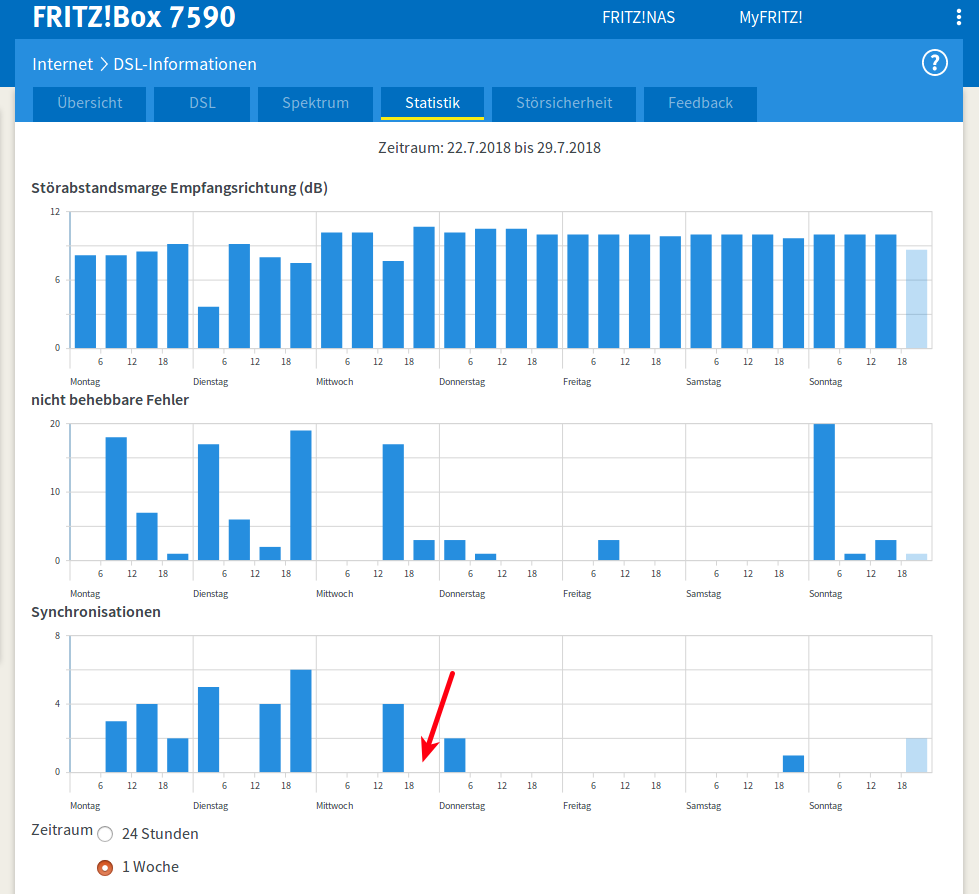
DSL line resets before and afterSometimes, progress comes at a price. Back in June, my DSL line got ‘vectorized’ and based on what I could see in my DSL router, there was hope to get a significant speed boost in uplink and downlink from the 50 Mbit/s and 10 Mbit/s I had subscribed to so far. After vectoring was activated I noticed, however, that the line was not as stable anymore as it used to be. Unlike before, when the connection was stable over many weeks, the router now re-synchronized with the DSLAM once every few days. Despite this, I decided after about a month to upgrade my subscription to 100 Mbit/s downlink and 40 Mbit/s uplink speed, as I was really keen to get the higher uplink speed. Unfortunately, things started to go seriously wrong after the upgrade.

Making Matters Worse

After changing my subscription, it took about a week before my line was ‘software upgraded’. After activation, I could see that the increased signal to noise ratio I got after vectoring was activated compared to the previous non-vectored connection was used to increase the line speed. I now got the advertised 100 Mbit/s speed in the downlink direction and around 36 Mbit/s in the uplink direction. That was really great! The SNR level is now where it was before vectoring was activated. Unfortunately, at the same time, the re-synchronization issue got worse and worse and I soon had several re-syncs per day.

Obviously this is far from ideal under any circumstances, especially because I run quite a number of servers at home which started to become unreachable several times a day for several minutes. Especially for large file transfers and long-living VPN connections, that’s an absolute disaster.

Switching to LTE

As things were not getting better, I decided to activate plan B and switch my cloud to my LTE backup connectivity. At 40 Mbit/s downlink and 40 Mbit/s uplink speed (measured during busy hour), this connectivity is more than adequate to support my services for some time. You can imagine how glad I was to have a plan B and to be able to just activate it and get some breathing space to debug the DSL line.

Analyzing the Issue

To make sure things were not broken on my end, I bought another DSL router, since I needed one for extra redundancy anyway. It didn’t do any good, however, as the issue persisted. Next, I changed the telephone cable, connected my cloud to another power socket, changed Ethernet cables and disabled all non-essential services. Unfortunately, all was to no avail and the resyncs continued to happen frequently.

The Thing With The Neighbor

Time to call customer support. After a line reset at their end that didn’t help, a technician was scheduled to come over two days later. In the meantime, a neighbor told me that she also had issues with her DSL line since she upgraded. After taking a look at her DSL router logs, I could see that she had the same problem but even worse. 20 re-syncs a day on her line was not an exception and she also opened a ticket in the meantime to get help.

Fixing Things – One Step At A Time

I have to say I was a bit afraid that this would be a difficult issue to fix. In general, the line looked absolutely perfect to me. The SNR level was o.k., no errors on the line and then, suddenly, out of the blue, a DSL re-sync. The technician also couldn’t find anything on our lines despite bringing measurement equipment and running many tests over the course of an hour. In the end, he did what is usually done when the line checks out fine, he changed the port in the DSLAM. In a first instance, he only rewired the port of my neighbor to a different port. This immediately made a big difference as the number of resyncs went down to around one every two days. Still not perfect but we were getting somewhere. In a next step my line was also changed to another port and since then my line resets were further reduced to about one per week. The picture at the beginning of the post shows how things looked like before and after with the red arrow indicating when my neighbors port was rewired.

A Word On LTE Stability

In the meantime, my cloud services ran over my LTE backhaul for a good 10 days without a line glitch and I’m mightily impressed with the stability of the LTE network. At the same time, my DSL line issues have shown how sensitive copper lines have become when it comes to cross talk and other RF issues. How I wished we could finally get fiber into the house…

14 Aug 18:28

Serial Reader Adapts Books for the Smartphone Age

by Ryan Christoffel

Our Internet-driven society has seen a decline in book reading, though not necessarily a decline in reading altogether. Despite book readers being less common than in past decades, we all do a fair amount of reading each day on our smartphones – reading messages from friends, or tweets, emails, Facebook posts, notifications, articles, and so on.

Personally, I've always enjoyed reading books, and I continue to read them regularly – though not as much as I'd like. However, I also read an abundance of emails, tweets, messages, and articles every day. A day may pass with me not reading a book, but that never happens with the likes of email and messages. Part of the reason my Internet-driven reading habits are more consistent than my book reading habits is that I have to read those things to do my job. But there's another reason too: email and Slack demand my attention each day via push notifications, while books do not. Add to that, emails and messages come in bite-sized quantities, whereas books are much longer, and thus more intimidating.

Serial Reader aims to fix that.

No stranger to the App Store, Serial Reader has been around for several years, but I recently gave it a try for the first time. The premise of the app is simple: it contains a collection of over 550 classic books that can be delivered to you in bite-size chunks. At a time of your choosing, Serial Reader will send a daily notification informing you that your latest issue of, say, War and Peace, is available to read. Each issue is compiled with an estimated reading time under 20 minutes, though most I've seen are around 10 minutes – very easy to digest. We all receive regular interruptions from Internet services that take 10 minutes out of our day at a time, and with Serial Reader you can plan those interruptions in a way that helps you read more books.

By offering up small helpings of a book each day, and delivering that book's latest "issue" through a notification, Serial Reader fixes key barriers to book reading. While I wish I could use it with my own collection of books, the public domain classics included in the app offer a wealth of quality options.

If you want to read more books, Serial Reader offers a clever, convenient way to do that. And there's no better time than the present to give the app a try – it just received a big update to version 3.5, with a new multi-column reading mode for iPad, curated book collections, alternate app icons, and a design refresh.

Serial Reader is available on the App Store.


Support MacStories Directly

Club MacStories offers exclusive access to extra MacStories content, delivered every week; it's also a way to support us directly.

Club MacStories will help you discover the best apps for your devices and get the most out of your iPhone, iPad, and Mac. Plus, it's made in Italy.

Join Now
14 Aug 18:27

Symmetrical names policy

by russell davies

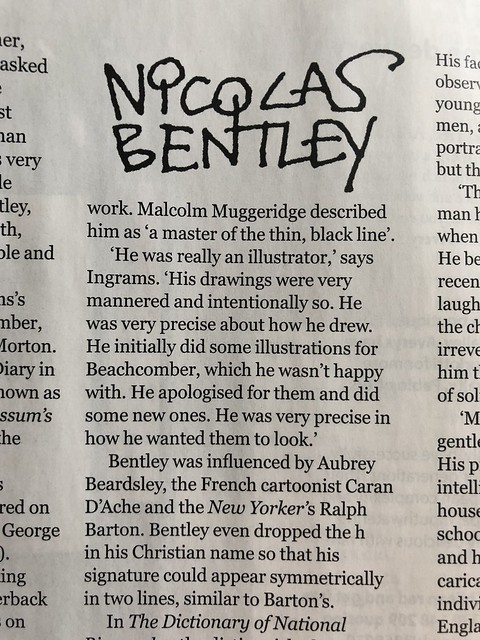
Bentley

I like this little detail about Nicolas Bentley. He changed the spelling of his name so it would look better.

14 Aug 18:27

The R Shirt

by rands

Awhile ago. I picked a font for a reason I’ve since forgotten.

The typeface, Cyan, is unremarkable.

Not a great body font and not a great headline font. I probably used it in a presentation once or twice, found it to be poorly kerned, and then moved on. However, the R, the lowercase R somehow caught my attention.

During another forgotten moment, I decided to use the R as my avatar for Twitter. White on black.

There was no pomp and circumstance. I don’t recall what I was replacing; I just wanted an R that I respected on Twitter. The R was unchanged for years until a never finished weblog redesign attempt forced me to ask friends, “What do you think about the R?”

John Gruber, “It’s you. It reminds me of a slightly untucked dress shirt.”

Done. It’s my R.

Many more years past and the Cyan R showed up on different websites and services, it was adorned with leaves on the newest design of the weblog, and began to show up in my avatar in various Slacks. Given its prevalence, I felt guilt how little I invested in it, so I hired a former design co-worker to nip and tuck the R.

He came up with three versions: Super Cyan, Slant, and Rook.

Returning to friends with opinions, I shared all three new Rs, and there was universal support for Super Cyan which is the R you are looking at right now.

Until now you probably hadn’t given the R a single thought. That white splash in the orange square somewhere near the top, right? It stands for Rands. I get it. In my head, it doesn’t stand for Rands. It stands for the words within the blog. Some of those words have turned into thoughts. Maybe those thoughts have turned into lessons and inspiration. It stands a self-organized community of leaders over 7,000 strong that continues to grow daily. It stands for the results of caring deeply about a thing… for decades.

Many of the past charity shirts hid an R somewhere in the design. Kyle has a Rands coffee cup. There’s a whispy R rising from the coffee cup the Zone shirt. This charity shirt is all about the R.

As with all prior shirts, all profits for this shirt go to First Book which gets books in the hands of the disadvantaged.

Thanks for being a part of the community.

14 Aug 18:26

Apple Removes iOS 12 Beta 7 Over-the-Air Update

by John Voorhees

Close on the heels of reports that Apple had pulled Group FaceTime from iOS 12 beta 7, complaints about the beta’s sluggish performance began to surface. One of the first was from Guilherme Rambo who posted a short video on Twitter demonstrating how slowly the App Store app launched under the beta:

Rambo also predicted Apple might remove the beta, which it did a short time later:

The latest iOS 12 beta is no longer available as an over-the-air update via the Software Update section of the iOS Settings app. However, IPSW files for the beta, which can be installed via iTunes on a Mac, are still available from Apple’s developer portal. In light of the issues reported with the beta 7, if you haven't already installed beta 7, it’s probably best to not download and install the IPSW files, until a more reliable version is released.


Support MacStories Directly

Club MacStories offers exclusive access to extra MacStories content, delivered every week; it's also a way to support us directly.

Club MacStories will help you discover the best apps for your devices and get the most out of your iPhone, iPad, and Mac. Plus, it's made in Italy.

Join Now
14 Aug 18:23

NewsBlur Blurblog: More flooding, more questions for Toronto politicians

sillygwailo shared this story from CBC | Toronto News.

WEA Toronto Rain 20180808

Hard rain returned to Toronto this past week, and with the floodwaters came serious questions about how to handle the city's increasingly weird and wild weather.

14 Aug 18:23

NewsBlur Blurblog: Toronto Public Library is writing a book on Twitter — and residents can contribute

sillygwailo shared this story from CBC | Toronto News.

PHOTO: Toronto Writes

Using the hashtag #TorontoWritesABook, people can collaborate on a story, tweet-by-tweet.

14 Aug 18:22

Analysis of fake YouTube views

by Nathan Yau

Wherever more attention or the appearance of it equates to more money, there are those who try to game the system. Michael H. Keller for The New York Times examines the business of fake YouTube views:

YouTube’s engineers, statisticians and data scientists are constantly improving in their ability to fight what Ms. O’Connor calls a “very hard problem,” but the attacks have “continually gotten stronger and more sophisticated,” she said.

After the Times reporter presented YouTube with the videos for which he had bought views, the company said sellers had exploited two vulnerabilities that had already been fixed. Later that day, the reporter bought more views from six of the same vendors. The view count rose again, though more slowly. A week later, all but two of the vendors had delivered the full amount.

Tags: fake, New York Times, YouTube

14 Aug 18:20

Surface Go oder Surface Pro?

by Volker Weber

Nach Dutzenden von Reviews, Unboxings und tieferen Analysen habe ich mir eine Meinung zu Surface Go gebildet, die auch einem echten Test standhalten sollte.

Tl;dr: Surface Go ist ein sehr viel kleineres Surface Pro mit einem Core m3, also die Einstiegskonfiguration der größeren Maschine. Kleiner heißt leichter, besser tragbar, handlicher, aber auch kleinerer Bildschirm, engere Tastatur, kleinerer Akku mit weniger Laufzeit. Dieser Kompromiss ist leicht zu verstehen.

Surface-Go-5

Aber noch mal von vorne mit den Gemeinsamkeiten. Ein Surface Go oder Surface Pro ist ein Windows-Computer in Form eines Tablets mit Aufsteller, dem sogenannten Kickstand. Die extra zu erwerbende Tastatur ist Pflicht. Windows funktioniert nicht gut ohne physische Tastatur und Trackpad. Die Type Cover von Microsoft sind mittlerweile sehr brauchbar, inklusive des Trackpads. Eine Maus braucht man nicht. Entfernt man die magnetisch gedockte und mit Pogo-Pins verbundene Tastatur, dann hat man ein recht eckiges Tablet, für das es nur ein relativ kleines App-Angebot gibt. Gut versorgt ist man mit allem, was Medienkonsum angeht, etwa die Mediatheken oder Netflix. Die eigentliche Stärke ist aber die Kompatibilität mit PC-Anwendungen. Diesen Text etwa habe ich in Microsoft Word geschrieben und er sollte viel weniger Schreibfehler haben als meine normalen Postings.

Surface Pro gibt es in verschiedenen Leistungsstufen von Core m3 bis Core i7 und unterschiedlichen Speicher-Ausstattungen. Ich habe ein Gerät am oberen Ende des Leistungsspektrums: Core i7 mit 16 GB RAM und 512 GB SSD. Der Sweet Spot ist meiner Ansicht nach ein i5 mit 8 GB RAM und 256 GB SSD. Zu wenig SSD-Speicher ist in der Praxis problemlos, so lange Windows und Apps auf die SSD passen. Medien wie Filme oder große Foto-Sammlungen kann man auf SDXC-Karten speichern, die ihren Platz in einem kleinen Reader hinter dem Kickstand finden.

Surface-Go-3

Surface Go wird mit einem niedrigen Einstiegspreis und einer Konfiguration mit Pentium Gold, 4 GB RAM und 64 GB eMMC beworben. Der Listenpreis für diesen Rechner beträgt 449 Euro. Um diese Maschine würde ich einen Bogen machen, weil die 64 GB zu knapp sind und die Speichertechnologie zu langsam. Interessant ist dagegen die Konfiguration mit 8 GB RAM und 128 GB SSD für 599 Euro. Dazu kommen noch mal 100 Euro für ein Typecover oder 110 Euro für die luxuriösere Alcantara-Version. Erfahrungsgemäß sind diese Listenpreise nicht stabil. Man kann damit rechnen, auch erheblich bessere Angebote zu bekommen.

Aber was im Himmel ist ein Pentium Gold? Vor allem eine Marketing-Nummer. Intel sucht einen Weg, Prozessoren in jedem Preissegment anzubieten. Die Atom-Linie wurde aufgegeben, weil sie als zu lahm bekannt ist. Jetzt gräbt Intel die alten Markennamen Celeron und Pentium wieder aus. Dabei ist der in Surface Go verbaute Pentium Gold 4415Y tatsächlich ein Core m3 mit Pentium-Branding. Ich bin mir nicht sicher, was Intel da reitet, aber das scheint mir ein Sonderangebot für Microsoft zu sein.

Wozu taugt ein Core m3 respektive ein Pentium Gold? Vor allem zum Einsatz mit Microsoft Office, Edge oder Medien-Apps. In der 8GB-Version sollte man bei dieser Software niemals Leistungshunger verspüren, egal wie viele Tabs man offen hat. Hier liegt Go sogar vorne, weil es Pro mit m3 und 8 GB gar nicht zu kaufen gibt.

Surface-Go-11

Go hat wegen der geringen Baugröße einen kleineren Akku, ein kleineres Display, eine engere Tastatur und ein deutlich geringeres Gewicht. Statt des sehr viel weiter verbreiteten USB-A Ports hat Go das neuere USB-C. Über diesen Anschluss kann man das Go auch laden. Das Netzteil aber verwendet den magnetischen Surface-Connector, bei dem das Gerät nicht vom Tisch fliegt, wenn jemand über das Kabel stolpert.

Faustformel für den Akkuvergleich: Zwei Drittel der Microsoft-Angaben sind realistisch. Aus 13,5 Stunden für Pro werden dann 9, aus 9 Stunden für Go nur noch 6. Je nach Anwendung sicher auch weniger.

Für mich persönlich ist Go keine Alternative, weil mein Pro so viel kräftiger ist. Für jemand der zwischen m3 Surface Go und Surface Pro entscheiden muss, hilft nicht mal der Preis. Theoretisch ist ein Pro sehr viel teurer, aber aktuell gibt es Go nur zum Listenpreis und Pro bereits mit deutlichen Angebotspreisen.

14 Aug 18:20

Flache Workstation :: ThinkPad P1

by Volker Weber

04 Thinkpad P1 Hero Front forward facing

Laptops sind für mich stets flache 15W Ultrabooks. Dumherum gibt es billigere dicke Laptops und teurere dicke Workstation-Laptops, etwa aus der ThinkPad P-Serie. Jetzt hat Lenovon den P1 angekündigt, der einen 15.6"-Bildschirm mit XEON-Prozessoren vereint, ohne dick aufzutragen. Zertifiziert sind diese Maschinen von Herstellern wie ArcGIS, AutoCAD, CATIA, Creo, Inventor, Microstation, NX, PDMS, Revit, Solid Edge, SolidWorks oder Vectorworks.

14 Aug 17:53

Dijkstra's in Disguise

Eric Jang, Aug 21, 2018


Icon

This post wanders very far from the subject of online learning, but I just found it too interesting to pass. It's also astonishing (to me) that it's characterized as "such a humble technique taught in introductory computer science courses." Times have changed since I was taking those courses! Basically, the author explores 'relaxation' mechanisms for finding the lowest-cost path between two nodes in a graph. This technique can be found in a variety of disciplines - "We have 3 very well-known algorithms (currency arbitrage, Q-learning, path tracing) that independently discovered the principle of relaxation used in shortest-path algorithms."

Web: [Direct Link] [This Post]
14 Aug 17:45

Google discounts Pixel 2 XL and Pixel Buds during back-to-school sale

by Igor Bonifacic

With the start of a new school year rapidly approaching, Google has launched a new online sale aimed at students — though anyone in need of a new phone can take advantage.

Until September 1st, the search giant has discounted its flagship smartphone, the Pixel 2 XL, by $200 CAD. After the discount, the 64GB base model costs $959 CAD, while the 128GB model is priced at $1,089 CAD. The two variants normally cost $1,159 CAD and $1,289 CAD, respectively.

Google has also temporarily reduced the price of the Pixel Buds. They’re currently $159 CAD, down from $219 CAD.

Word of warning: the company will announce its new 2018 lineup of devices, including the Pixel 3 and Pixel 3 XL, in about a month-and-a-half, according to most reports.

Source: Google

The post Google discounts Pixel 2 XL and Pixel Buds during back-to-school sale appeared first on MobileSyrup.

14 Aug 17:45

Rogers, Fido subscribers reportedly experiencing network outages [Update]

by Sameer Chhabra

Update 13/08/2018 11:42am ET: According to an 11:35am ET Rogers tweet, the network outage issue has been resolved.

A Rogers spokesperson confirmed to MobileSyrup that the issue was resolved at 10:20am ET.


Canadian national carrier Rogers is reportedly experiencing a network outage affecting its wireless data services.

According to users on Twitter sending messages to the Rogers customer care and technical support account, the network maintained by Canada’s largest carrier by subscriber share is unable to connect to wireless data services.

Some users, like blkdiamond1 have even said that they’re unable to connect to mobile telephony services.

It’s important to note that the outages aren’t affecting all Rogers subscribers.

Twitter user @PeterFromToronto sent a tweet at 8:56am ET stating that LTE connectivity in Toronto seems to be working.

MobileSyrup Android phone was unable to connect to the Rogers network earlier this morning.

Additionally, Canadianoutages.com shows that 161 outage reports were submitted at approximately 8am ET, while the website currently shows 66 reports at the timing of writing.

As of Q2 2018, Rogers now has 8,921,000 postpaid subscribers and 1,705,000 prepaid subscribers, for a total of of approximately 10,626,000 subscribers.

MobileSyrup has reached out to Rogers for comment. This story will be updated with a response.

Are you a Rogers subscriber unable to connect to the carrier’s network? Let us know in the comments below.

The post Rogers, Fido subscribers reportedly experiencing network outages [Update] appeared first on MobileSyrup.

14 Aug 17:45

Android 9 Pie breaks fast charging for 2016 Pixel XL users

by Jonathan Lamont
Google Pixel XL smartphone

Some 2016 Pixel XL users are reporting that Android Pie has broken fast charging with their devices. After the update, plugging into a compatible charger only charges the device normally.

The issues with fast charging were first noted during the Android P beta. Users initially thought Google would sort out the issue before a final release. Unfortunately that hasn’t been the case.

The cause isn’t entirely clear and it’s hard to pinpoint because the issue affects users in different ways.

Quick charging on Pixel devices uses USB Power Delivery (USB-PD). Any certified USB-PD plug, cable, computer or battery should charge a Pixel phone quickly.

The minimum rate of charging is 5 volts at 3 amps and, when it works, Android displays a ‘Charging rapidly’ message on the lock screen.

However, Pixel XL users report that either no chargers trigger the rapid charging message or that only the Pixel charger does.

A developer closed the Google Issue Tracker post for the issue on August 9th, 2018. They marked the issue “Won’t Fix (Infeasible).”

It’s important to note how the Android Open Source Project (AOSP) defines ‘Infeasible.’

That definition states:

“The changes that are needed to address the issue are not reasonably possible. This status is also used for issues reported that cannot be handled in AOSP, typically because it is related to a customized device or to an external application, or the reporter mistook this tracker as a help forum.”

Unfortunately it’s possible that the fast charging issue is out of the scope of the Google Issue Tracker.

However, some users opened another Tracker report for the bug, this one with more detail and information regarding the issue.

One user even listed all the chargers he has used with the Pixel XL. According to that user, the only charger that worked was the original one that came in the box.

Google is hopefully working on a solution to the problem. It’s certainly a weird one, especially considering the smaller 2016 Pixel appears unaffected by the issue.

MobileSyrup has reached out to Google for comment. This story will be updated with a response.

Source: Google Issue Tracker Via: Android Police

The post Android 9 Pie breaks fast charging for 2016 Pixel XL users appeared first on MobileSyrup.

14 Aug 17:45

Job posting suggests Apple is developing ‘new’ iCloud products

by Igor Bonifacic
iOS's iCloud settings page

A recent job posting could suggest Apple is working towards making major improvements to iCloud.

In the aforementioned job post, which was first spotted by a Reddit user, the Cupertino, California tech giant says its “iCloud Human Interface team is seeking a senior product designer to work on new products and initiatives, and enhance existing experiences, for iCloud and Apple ID.”

Apple published the posting on July 9th. It does not appear the company has filled the position yet.

The iPhone maker says it’s looking for someone with five plus years of experience. The company also notes its ideal candidate will “advocate for the user while simultaneously understanding the interests of privacy, security, anti-fraud, marketing, and engineering groups, and be an effective diplomat and negotiation in working closely with these groups and others around the company.”

As AppleInsider notes, Apple has a major economic incentive to improve the quality and breadth of its iCloud services. During its most recent June quarter, services revenue increased by 31 percent year-over-year to $9.5 billion. With iPhone sales topping out, the company needs to further diversify its revenue sources.

Source: Apple  Via: RedditAppleInsider

The post Job posting suggests Apple is developing ‘new’ iCloud products appeared first on MobileSyrup.

14 Aug 17:45

Bell acquires 11 AWS-1, three PCS spectrum licenses from Shaw

by Sameer Chhabra
ISED

National carrier Bell has acquired 11 AWS-1 and three Personal Communications Services (PCS) spectrum licenses from regional carrier Shaw.

According to an Innovation, Science and Economic Development Canada (ISED) webpage last updated on August 9th, 2018, four of the 11 AWS-1 licenses are for Yukon, Northwest Territories and Nunavut; two are for Newfoundland and Labrador; and Prince Edward Island, mainland Nova Scotia, New Brunswick, Cape Breton, and Northern Quebec each account for one additional license.

The three PCS licenses govern Northern Ontario, Sault. Ste. Marie and Thunder Bay.

ISED received the transfer application on March 23rd, 2018.

“ISED has determined that the requested Licence Transfers will not significantly impact the ability of existing or future competitors to provide services given that other national and regional licensees currently hold spectrum and the upcoming auctions will provide further opportunities to access spectrum,” reads an excerpt from the ISED webpage.

“The requested Licence Transfer involves spectrum that is not currently being used to provide services and will offer Bell an opportunity to put such spectrum to use for the benefit of Canadians in these areas.”

All 11 AWS-1 licenses and one PCS license are set to expire on March 12th, 2019, while the final two PCS licenses will expire on September 1st, 2019.

AWS-1 spectrum exists in the 1,710 to 1,755MHz band for uplink and in the 2,110 to 2,155MHz band for downlink.

In contrast, PCS exists in the 1,850 to 1,990MHz band.

Band 4 LTE is often referred to as AWS-1, while band 2 LTE falls under the PCS range in Canada.

Source: ISED

Correction 13/08/2018 2:08pm ET: Story previously reported that Bell will acquire the licences in 2019. This is inaccurate, as the license transfer has already been approved.

The post Bell acquires 11 AWS-1, three PCS spectrum licenses from Shaw appeared first on MobileSyrup.

14 Aug 17:45

Galaxy S10 won’t be Samsung’s first 5G phone according to DJ Koh

by Jonathan Lamont

Samsung’s next big flagship, the Galaxy S10, won’t be the first phone in the high-end series of devices to feature 5G connectivity, says Samsung’s head of mobile, DJ Koh.

According to ZDNet, Koh told Korean journalists this at Samsung’s Unpacked event. Furthermore, he reaffirmed that Samsung still aims to make the world’s first foldable smartphone.

While one could argue that BlackBerry released a foldable smartphone first with the Pearl Flip 8220, Samsung isn’t the only company gunning for a folding smartphone.

Huawei wants to beat Samsung and launch its folding smartphone in 2019. LG is also working on folding phone tech.

According to ZDNet, Koh also told reporters that the company isn’t far from unveiling it’s foldable phone.

As for 5G, Koh said Samsung is working with South Korean carriers to roll out the first 5G phone.

South Korean telecoms plan to launch 5G in March 2019, which means a Samsung manufactured 5G smartphone will likely be released at around the same time.

Koh wasn’t clear if the first 5G phone from the company would be the foldable phone. Regardless, Samsung’s 5G phone will likely only be available in South Korea.

Source: ZDNet Via: CNET, Pocketnow

The post Galaxy S10 won’t be Samsung’s first 5G phone according to DJ Koh appeared first on MobileSyrup.

14 Aug 17:45

Apple removes Group FaceTime from iOS 12 and macOS Mojave betas

by Bradly Shankar
Group FaceTime

Apple has removed the Group FaceTime feature from the latest versions of the iOS 12 and macOS Mojave betas.

In the release notes for the betas, Apple wrote that Group FaceTime will instead “ship in a future software update later this fall.”

Announced at the Worldwide Developers Conference in June, Group FaceTime will allow up to 32 people to take part in one FaceTime video chat.

Group FaceTime is set to come to iPhone, iPad and Mac as part of iOS 12. Audio-only support for Group FaceTime will also be offered on the Apple Watch.

Via: MacRumors

The post Apple removes Group FaceTime from iOS 12 and macOS Mojave betas appeared first on MobileSyrup.

14 Aug 17:45

Nexus Players are dying rapidly and no one knows why

by Jonathan Lamont

Remember the venerable Nexus Player, the first device running the Android TV platform? Something is killing the Players and loyal owners are searching for solutions.

Over the last few weeks, Nexus Player owners have reported their devices stopped working. The devices become unresponsive, hanging at the Google logo or displaying an error message.

That error message reads “Can’t load Android system. Your data may be corrupt. If you continue to get this message, perform a factory data reset and erase all user data stored on this device.”

However, many reports insist that the suggested factory reset doesn’t work.

Some users report that flashing a new system image saved their Nexus Players, but other users weren’t so lucky.

Users across XDA Forums and Reddit are flocking to posts wondering what to do to save their Players. Considering the Player came out in 2014, it is getting on it years. While not unusual for old devices to die out, the number of reports in such a small window of time is concerning.

Furthermore, some users claimed that several Players in their house died within days of each other.

Unfortunately for owners, Google ended support for the Player in March. While the search giant may step in because of the vast number of issues, it’s unlikely a solution will come from it.

Instead, we’ll likely see a solution from an enterprising Redditor or XDA Forum member.

Source: XDA Forums, 2, 3 Reddit, 2, 3 Via: Android Police

The post Nexus Players are dying rapidly and no one knows why appeared first on MobileSyrup.

14 Aug 17:45

Security researchers found a way to turn Amazon Echo speakers into a spy

by Jonathan Lamont
Amazon speaker

Security researchers at the 26th Def Con hackers conference revealed a new Amazon Alexa hack that enables attackers to take control of the speaker, turning it into a spy.

Researchers Wu HuiYu and Qian Wenxiang are part of the Blade security team with Chinese company Tencent. In their presentation at Def Con, they explained how their hack turned an Amazon Echo into an audio monitoring device.

To kick things off, HuiYu and Wenxiang had to modify an Echo speaker of their own. This involves taking apart an Echo speaker and removing its flash chip. The researchers then wrote their own firmware to it. Finally, they soldered the flash chip back to the Echo’s motherboard after installing the firmware.

This forms the base the researchers used to launch an attack.

Network access required

With a doctored Echo device, an attacker would have to get the device onto the same Wi-Fi network as the target Echo speaker. Although likely the hardest part of the attack, it isn’t impossible.

Most Wi-Fi networks are secured, but as always there are ways around that. The researchers mentioned a few examples, such as having the Echo device brute force the password or trick a victim into installing their altered Echo and linking it to their Wi-Fi.

Alternatively, attackers could target a hotel or school or similar network with a widely shared password.

Once the modified Echo is on the network, the researchers took advantage of a software component, Whole Home Audio Daemon. The daemon allows Echo devices to communicate with other devices on the network.

Taking control

The researchers were able to use a vulnerability in the daemon to gain full control over a target speaker. This included the ability to play sounds the researchers chose and silently record and transmit audio.

Before you go unplug you Echo speaker, Amazon has already patched the vulnerability. The patch came as part of an automatic security update in July and requires no action on the part of customers. The researchers informed Amazon about the vulnerability prior to their presentation at Def Con.

Furthermore, in a statement to Wired, Amazon said the “issue would have required a malicious actor to have physical access to a device and the ability to modify the device hardware.”

To clarify, the malicious actor only needs access to the network and physical access to their own Amazon Echo device.

Regardless, the vulnerability was patched. Additionally, the vulnerability was rather difficult to take advantage of, especially considering the need to bypass the Wi-Fi network. Ultimately, the average user probably doesn’t need to worry about a potential attack using this method.

Source: Wired Via: TechCrunch

The post Security researchers found a way to turn Amazon Echo speakers into a spy appeared first on MobileSyrup.

14 Aug 17:45

Vancouver-based EV startup Electra Meccanica closes public offering

by Bradly Shankar
Solo electric car

Vancouver-based EV startup Electra Meccanica has announced that it has closed its public offering of 2,353,000 shares.

The company went public last week to raise $10 million to fund two upcoming vehicles — the SOLO all-electric three-wheeler and the Tofino electric roadster.

In a press release, Electra Meccanica confirmed that net proceeds from the sale of these shares — which were priced at $4.25 each — amounted to $9.1 million.

These funds will go towards a manufacturing plant and equipment, production molds, sales and marketing and inventory associated its vehicles. Initial deliveries of the SOLO, which is priced at $15,500, are expected to take place in the fall of 2018.

Source: Electra Meccanica

The post Vancouver-based EV startup Electra Meccanica closes public offering appeared first on MobileSyrup.