Shared posts

10 Oct 21:59

Useful thoughts on attention and information overload from 1971 (via Simon, Deutsch, Shubik)

by mikecaulfield

Back in 2015, I was blogging less and using a homegrown personal wiki more. And I was thinking about this problem of collaboration and attention.

Going through my notes on the wiki from that time, I realized a bunch of my thinking had been formed by a book chapter from 1971 that I read in 2015, a transcription of a presentation and panel by Herbert Simon, Karl Deutsch, and Martin Shubik. Re-reading it I’m struck that for all its faults it provides insights that are even more relevant in 2018 than 2015. Here’s some ported notes and highlights:

Simon: a wealth of information = a scarcity of attention

Simon’s key contribution in the talk is to push the conversation from the idea of information overload (supply) to the problem of attention. And his key point is that as information increases, attention decreases:

[I]n an information-rich world, the wealth of information means a dearth of something else: a scarcity of whatever it is that information consumes. What information consumes is rather obvious: it consumes the attention of its recipients. Hence a wealth of information creates a poverty of attention.

Simon: the cost of information is borne more by the consumer (in time) than the producer

Simon uses a news metaphor to make his point — the cost of information is mostly in the time to process it (when aggregated over many people) rather than produce it:

In an information-rich world, most of the cost of information is the cost incurred by the recipient. It is not enough to know how much it costs to produce and transmit information; we must also know how much it costs, in terms of scarce attention, to receive it. I have tried bringing this argument home to my friends by suggesting that they recalculate how much the New York Times (or Washington Post) costs them, including the cost of reading it. Making the calculation usually causes them some alarm, but not enough for them to cancel their subscriptions. Perhaps the benefits still outweigh the costs.

Simon: scarcity of attention must be a design principle for organizations and technology, but it is usually overlooked

The design principle that attention is scarce and must be preserved is very different from a principle of “the more information the better.” The aforementioned Foreign Office thought it had a communications crisis a few years ago. When events in the world were lively, the teletypes carrying incoming dispatches frequently fell behind. The solution: replace the teletypes with line printers of much greater capacity. No one apparently asked whether the IPS’s (including the Foreign Minister) that received and processed messages from the teletypes would be ready, willing, and able to process the much larger volume of messages from the line printers.

We overlook these things because we have a mythology of information poverty:

Our attitudes toward information reflect the culture of poverty. We were brought up on Abe Lincoln walking miles to borrow (and return!) a book and reading it by firelight.

Deutsch on the operations of attention

Deutsch makes some welcome corrections to Simon, who in many remarks not detailed above is far too trusting of technology. (The DDT example Simon uses is particularly painful).

Part of his point is attention is really a series of operations much bigger than just a spotlight of focus. A person that gives their attention has to (according to Deustch):

  • recognize loosely what it is one should pay attention to (the target), such as things unfamiliar, strangers, or things that do not fit
  • track the object of attention, and keep attention on it
  • interpret the object and ask what it resembles
  • decide which response to the object is most appropriate, and what should be done about it
  • carry out the response
  • accept feedback, and learn from the results of the response whether it was the rightone and how future responses should be corrected.

Deutsch argues that when you look at the whole cycle it involves not just attention but memory, and further, that the problem of filters is going to be solved partially by accepting some amount of redundancy. The reasoning is a bit complex, but familiar to people nowadays I think. Because institutional memory in organizations is expensive and a bit zero-sum you need redundancy in organizations and a networked, less hierarchical approach to information. This is turn prevents relevant information from being eliminated due to single bottlenecks.

Shubik on optimum information systems

I have become a fan of Simon over the past few years, so the insights in his observations are not surprising to me (more surprised by some of his oversights, actually). Shubik, on the other hand, hasn’t even been on my radar. But he’s good! Here he is on optimum information systems:

An optimum information system is not necessarily the one which processes the most data. An optimum system for protecting the average stock- holder does not supply him with full, detailed financial accounts. In fact, one can easily swindle the unwary by supplying them with financial details and footnotes they do not understand. It is now possible to bombard a generally uncomprehending public with myriad details on pollution, the pros and cons of insecticides, the value and dangers of irrigation schemes, on-the-spot reports of rioting and looting, televised moon landings, suicides, murders, and historical prices of thousands of stocks and commodities.

Shubik on the coming of computer network-based mobs, and, maybe, Gamergate

So for people not hip to what 1971 was about, you had “time-sharing” computers — which were multi-user mainframes mostly — and monitors, and a lot of thought was put into what happened when TV gets hooked into systems that allowed instant two-way communication, feedback, and interactivity. Shubik wonders in particular what mobs look like when the virtual is felt as real and demagogic leaders pair the instant feedback of communications systems with the viscerality of the a TV based medium. It’s of course a weird version, based on tech of the time, but still an amazing quote:

Consider some of the possible dangers. What is the first great TV, time-sharing demagogue going to look like? How will he put to use such extra features of modern communications as virtually instantaneous feedback? When will a TV screen with the appropriate sensory feelings be able to portray the boss behind his mahogany desk (two thousand miles away) who fires or chastises his employee, and makes him feel just as small, and his palms just as clammy with sweat, as if he were in the room with him? When will the first time-shared riot occur? Orson Welles came close in the thirties with a fairly good radio panic. Current techniques for mob control require physical proximity. In the Brave New World, will we still regard a mob as a great number of closely packed people, or will isolated mobs interacting via TV consoles and operating over large areas be more efficient?

Oettinger summarizes Simon’s contribution

Anthony Oettinger summarizes Simon’s contribution nicely:

Simon has offered three very deep, important, fundamental principles that shed light on things I had not perceived clearly:

  1. attention is a scarce commodity
  2. information technology allows effort to be displaced from possession, storage, and accumulation of information to its processing, even if the information is located in the world itself rather than in the file
  3. filtering and organizing the environment for persons whose attention is scarce are critical.

It remains for others to apply these general principles to particular organizations and explore their political and economic implications.

Deustch’s criticism of Simon

I have reservations about Simon’s enthusiasm, in the name of simplification and economy of thought, for throwing out vast amounts of what universities now teach. Much of what we learn in social science used to be interpreted against our knowledge of history. If we throw out too much historical data, many of our abstractions may lose meaning. A critical design problem for education is to determine the amount of memories from the past needed for producing and interpreting new information.

In general, Simon makes a very good case for the design aims of technology and education, but is not particularly good on technological prediction, whereas Shubik — even in asides — is incredibly prescient about technology and its risks. Deustch, in turn, serves as a good corrective on Simon’s penchant for an absolute leanness of process and storage — believing that memory plays more of a role in effective processing than Simon will admit, and pushing the idea that a more conservative approach to change in the face of human systems may be warranted — slow down taking action when information is inconclusive. (Even here, the results are fascinating, with Deustch using the example of how population is a more pressing issue than climate change, since the effects of overpopulation were well established but climate science murky).

The three parts, taken together make interesting reading, even today — or, perhaps, especially today. You can check out the whole thing here.


10 Oct 21:59

I Own a SodaStream

by Richard

For years (really, years and years), I was and still am a loyal Coca-Cola drinker. At every job, it would take about a week for colleagues to realize just how often I drank it. There haven't been many days that have gone by where I haven't had a Coke, which I alternate between thinking of as a mark of shame and shrugging off as an aspect of my personality. I'm not saying I can tell the difference in a blind taste test, but Pepsi cola lacks the zing that Coca-Cola has. I've come to believe that it depends on the location of the bottling plant, and for some reason, Vancouver has the best Coke I've tried.

As a Coke drinker, I always order that at restaurants, and more than half the time, the server says they don't serve Coke, and they inevitably follow that up with "Is Pepsi OK?" One day, someone will say "No, it's not OK" and make a big stink about it. I never will. It's why this reaction to the sale of SodaStream to Pepsi is so funny:

I do not have an obvious place in my apartment to put it, so it sometimes sits on the coffee table or dinner table. One day my little flat in downtown Toronto is going to burst with the amount of stuff that's crammed into it.

After deciding not to buy the syrups, mainly because I care more about the fizz than the taste of soda, buying a SodaStream should dramatically cut down on the amount of my sugar intake. Other SodaStream owners I've talked to play up how much money they're saving, though it's rare to hear them say they've bought the syrup. I'm under no illusions that it will save me much money, or, more importantly, that I'll notice either way.

I can tell you what day it was that I finally surrendered and bought one: It was the day Pepsi bought the company, August 20th, 2018. I considered buying it online, though for a reason I can't remember, I wanted to buy it from a store. The website I could find it at The Bay. North America's oldest company, it's a department store with a location near my office. I would find SodaStream units in the lower level of the Eaton Centre location, and while I hummed and hawed about the price (it was $10 more than an online price), the salesman said he could honour the "special" they had recently. I bought it that day mostly to be able to say I bought it the day Pepsi purchased the company, in the belief that they're going to screw it up somehow.

And I left it in its packaging for a month. I did eventually take it out of the box, and that first day, it sprayed all over my counter. The next bottles came out better as I got the hang of it. I did go almost a full day without a Coke, and since the whole had felt a bit off, despite drinking coffee for caffeine and SodaStream water for the fizziness. So I won't totally cut Coke out of my diet, but I do see myself cutting out a large chunk of it.

10 Oct 21:58

A philosopher explains how our addiction to stories keeps us from understanding history

Angela Chen, The Verge, Oct 23, 2018


Icon

I hear a lot of educators talk about how stories are essential to learning, but I'm not sure I agree, and it's not clear they help. Indeed, according to this article, our preference for stories might be misleading us. "These historical narratives seduce you into thinking you really understand what’s going on and why things happened, but most of it is guessing people’s motives and their inner thoughts. It allays your curiosity, and you’re satisfied psychologically by the narrative, and it connects the dots so you feel you’re in the shoes of the person whose narrative is being recorded. It has seduced you into a false account, and now you think you understand." Real explanations "involve models and hypotheses that are familiar in structure to the kind that convey explanation in the natural sciences."

Web: [Direct Link] [This Post]
10 Oct 21:58

iFixit confirms you can still repair your own iMac Pro or MacBook Pro

Richard Lawler, Engadget, Oct 23, 2018


Icon

This is an update on a story cited here last week. The website iFixit looked at the story saying you can't repair your MacBook, tried it for themselves, and found that you atually can repair your computer. " While it's possible that a future software update could change things and make it require specialized software that only official Apple Stores and authorized service centers have access to, we're not there yet." It's always best to check things out for yourself rather than just taking someone's word for it.

Web: [Direct Link] [This Post]
10 Oct 21:57

This proposed treaty on copyright exceptions should matter to the Open Education community

Creative Commons, Oct 23, 2018


Creative Commons has thrown its support behind a Civil Society proposed treaty on copyright exceptions for educational and research activities. They argue, " Having clear international norms for exceptions to copyright for education allow OER authors and users to more confidently incorporate third-party materials for reference and illustration of OER content." The danger of such exceptions is that "educational uses" have historically been defined in terms of educational institutions, and not personal learning. The proposed treaty (Article 5) would exempt uses related to teaching, learning, creating educational materials, and research. The protections under 'learning activities' might be sufficient. But the danger is that this section would simply be dropped from the treaty, essentially cementing the exception as a commercial right and not a personal imperative.

Web: [Direct Link] [This Post]
10 Oct 21:57

Twitter Favorites: [jen_keesmaat] Today, I'm announcing my proposal to transform the massive parcels of public land currently occupied by three under… https://t.co/JCHN9PUc9y

Jennifer Keesmaat @jen_keesmaat
Today, I'm announcing my proposal to transform the massive parcels of public land currently occupied by three under… twitter.com/i/web/status/1…
10 Oct 21:57

Twitter Favorites: [tanjatiziana] Challah, por favor. // One #lunchcounter gem that fueled the old Coney series was B&H Dairy, so it only made sense… https://t.co/Tm3dbWcbVw

Tanja-Tiziana @tanjatiziana
Challah, por favor. // One #lunchcounter gem that fueled the old Coney series was B&H Dairy, so it only made sense… twitter.com/i/web/status/1…
10 Oct 21:57

Twitter Favorites: [counti8] Love this. Vancouver, let’s start planning an opera for the viaducts. https://t.co/kbqGZ16t1q

Karen Quinn Fung | 馮皓珍 @counti8
Love this. Vancouver, let’s start planning an opera for the viaducts. twitter.com/urbanistorg/st…
10 Oct 21:57

NewsBlur Blurblog: Email to Vancity CU

sillygwailo shared this story from stay true to your nomad skies.

I just wrote this to the board of the Vancity Credit Union and realised it might be appropriate to share. We deserve better from our credit union than the problems we’ve dealt with today.

Hello,

I’m writing to the board because I’m extremely concerned that the board and management have not, on behalf of the members, empowered staff to engage in appropriate communications when there are problems.
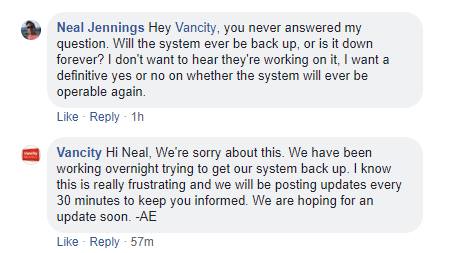
As I’m sure you are all aware, the online banking system went down sometime this morning and has still not returned to service. All day, the social media staff have been diligently updating members, but they have not been provided with any information whatsoever on a) what the problem is or b) an expected return to service time. In fact, they were forced to post half-hourly updates saying that they didn’t know when it would be back and would update us again half an hour later. I had the following exchange with them, myself:
2018-10-04 22_16_36-(7) Vancity - Home.png
There are many similar comments within the Facebook thread on this topic, all of which make it clear to me that the social media team is doing their best, but that they are not being provided with the necessary information and tools required to communicate effectively to us, the members, about a very severe and sudden system outage.
This is completely unacceptable. I don’t know enough about the internal structures of the Vancity organisation, but whether this is an IT team refusing to communicate with the external comms team, or a management decision that members should be left in the dark (and treated like airline passengers on a flight that will probably eventually be cancelled but where the airline doesn’t want to have to reticket them), this is not the Vancity I’ve come to know and love, nor is it in the spirit of transparency and customer service I’ve come to expect from Vancity and from the credit union movement in general.
System outages happen, I think we all get that. Though they seem to happen all too often with Vancity, most of us are willing to accept them if we have some sense as to what happened, how it’s being fixed, and most importantly when it will be fixed. Being unable to complete necessary online banking is anxiety-inducing enough as is, but having an intense amount of uncertainty (at this stage, for all anyone knows we may never see online banking again) can causes serious distress among members, especially members who are low-income or whose work schedules do not allow them to visit branches.
I’m fortunate enough that the only impact to me is a couple days (I hope no more) of lost interest on a large e-transfer deposit that I’ve been unable to make. There are, however, numerous stories on Vancity’s social media right now about people who are going to miss bill payments and who are unable to make electronic deposits in order to make necessary purchases. We’re supposed to be doing good with our credit union, not destroying people’s lives. If our staff were empowered to communicate appropriately (and if we had the proper IT systems in the first place), we would at least be able to ease a small portion of the concerns caused by this outage.
I’m calling on you, the board of directors, to thoroughly investigate not only the problem that caused the outage, but also the internal channels of communication that are actively preventing members from having access to critical information about our credit union. I sincerely hope that this system outage is solved by the morning, and that a well-crafted apology that thoroughly explains all of the communication problems and how they will be solved will be quickly forthcoming.
Sincerely,
Neal Jennings


10 Oct 21:53

NewsBlur Blurblog: Follow-up on the Vancity crisis

sillygwailo shared this story from stay true to your nomad skies.

 

After I wrote this email to the Vancity board on Thursday, we endured two more days of a system outage. As a brief summary of what ensued:

Late in the afternoon on Friday (40 or so hours after the outage started), the CEO released a hastily-recorded video repeating the talking points that the social media team had been using, and still refusing to give any further information on what was going on. That video has since been deleted from their YouTube account.

Friday evening I got the following email in response to my earlier email, addressed to me from a staff member – still no word from the board itself at this point. Note the word “inconvenience,” which will continue to be used throughout this process. This appears to be the beginning of management and the board gaslighting us into believing that this is a mere triviality, rather than a failure of the entire banking system at our credit union.

Dear Neal,

On behalf of the Board of Directors, thank you for taking the time to write. We understand your frustration and apologize for the inconvenience and stress that our online banking system outage and its impacts are causing you. Please know that we are doing our utmost to resolve what has been a difficult few days for all Vancity members and employees.

Your points are well taken. As an organization, we want nothing more than to explain what has caused the technical problems we have experienced these past few days, to resolve those problems, and to communicate to our members precisely what steps we are taking to address their concerns.

Unfortunately, we just aren’t there yet.

You can be assured that all of us–everyone across the organization–are working on a solution. Our first priority is to have the system returned to its proper functioning capacity. As we do that, we are also working closely with our members to make sure their needs are being met.

Part of the effort means standing up and taking accountability. Our president and CEO, Tamara Vrooman, and the rest of our senior executive team have this top of mind. They have been working with our technical team and partners in an effort to repair the system and return it to its normal operating condition.

Tamara has also been responding to media inquiries, getting important messages and updates to the membership and the public at large. She wants everyone to know that we have ruled out a privacy or security breach and that we understand what this outage means for our members. She has also participated in a video message, which you can find here: https://www.vancity.com/AboutVancity/ServiceDisruption/

All of our branches will be open each day this weekend, including Thanksgiving Monday, from 9:30AM to 3:00PM. Our Member Services Centre will be open to serve you from 8:00AM to 8:00PM each day.

Again, we thank you for your letter, and we hope that we can continue this dialogue, and to serve you in the manner you deserve.

Regards,

Lara

Lara Hamburg
Board Liaison
Office of the CEO
183 Terminal Ave
Vancouver, BC V6A 4G2

I responded with the following:

Lara, and Board, with a copy now to the Financial Institutions Commission,

This communication (this email and the video from the CEO) all came too late – and is thoroughly incomplete. “We don’t know what’s going on” 40 hours into an outage is not a good enough answer. And suggesting that the fact that the CEO has been talking to media is evidence of proper communication ignores the fact that members trying to get information – from our website, from our social media platforms, and so on – have been told less than the media has. The public relations campaign thrown together in a rush this afternoon is not a substitute for effective communication with members.

I sincerely hope that, as the board liaison, you are not filtering messages to the board. Board members need to know that Vancity members are not happy with them or the management they are supervising, and they need to hear our specific concerns. The technical outage has so far been an unmitigated disaster, but the response from the board (which is nonexistent – I do not consider a form email from staff to be even close to a communication from the board) and from management is nothing less than offensive. I sincerely hope that there are severe repercussions for the staff and board members responsible for this fiasco.

I, personally, have gone from “I am upset at the outage and lack of communication” to “I have lost all trust in this institution and fear for whether I will ever be able to access my money again.” The fact that almost two full days later we have not been provided with even an estimate of when we will be able to access our funds again is shocking, and if we ever do get access again, I will be very quickly moving most of my own funds to a safer financial institution. I look forward to the next AGM where we can vote to replace the board of directors, too.

Members deserve better than this.

Sincerely,

Neal

I have yet to hear back on this email specifically.

Saturday morning I got frustrated and posed the following question to Vancity on the poorly-managed Facebook thread they had created:43275580_2127865803931657_6539386504739815424_n.jpg

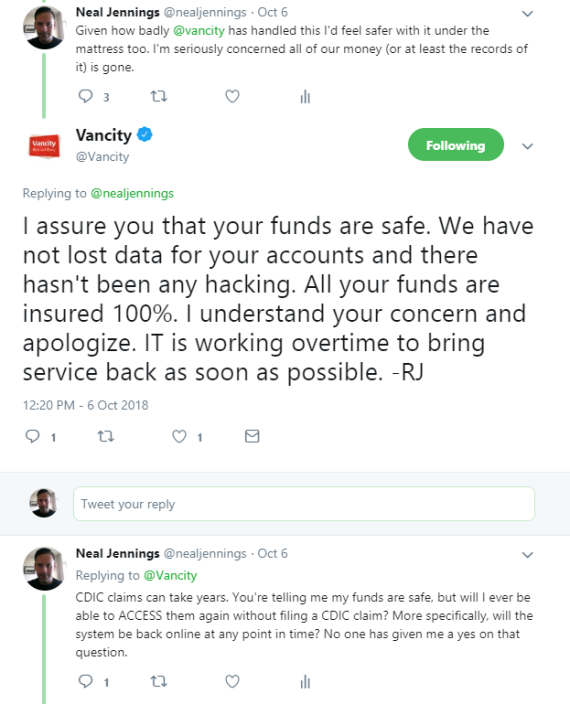
The fact that they could not answer yes was, to say the least, terrifying. I posed a similar question on Twitter and was met with silence (though they did reply to other tweets). The eventual response (that’s cut off in the screen cap below) was notifying me that the system had been restored and came much later that day.

2018-10-08 13_08_22-Vancity on Twitter_ _I assure you that your funds are safe. We have not lost dat.png

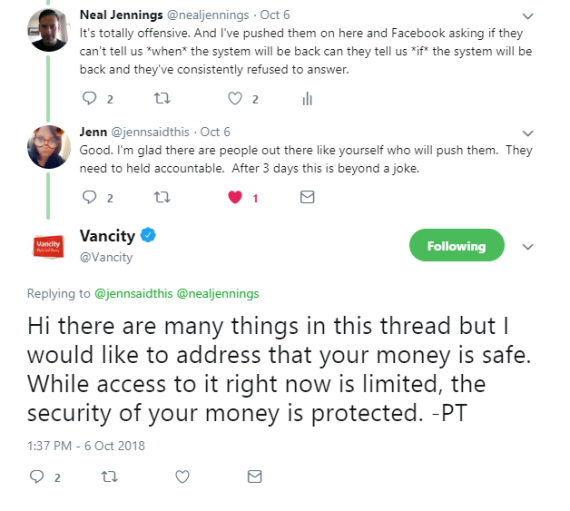
They also responded to this thread with more vague platitudes.

2018-10-08 13_09_55-Vancity on Twitter_ _Hi there are many things in this thread but I would like to.png

Around this time, I also followed up on my email back to Lara, but this time I copied the board chair directly – her email address is publicly listed on her website.

This follow-up is to the board, and the board only. We are now in day three, and staff are still not only unable to answer the question of when the system will be online, but they won’t even answer the question of IF the system will ever be back online (despite my repeated requests). This outage, and the uncertainty around it, puts our entire credit union at risk, and indeed the economy of our entire province if Vancity’s billions of dollars of assets have indeed vanished.

The board has remained completely silent on this matter for the last three days. It took until late yesterday for the CEO to say anything, and even then she said nothing of substance – this morning, it was more vague platitudes and we still do not know even what has gone wrong, let alone what is being done to fix it or whether it can be fixed at all. As a member, my only recourse is through the board, and I personally hold the board responsible. If the board is unwilling to at least communicate with members, let alone act, each member of the board should rethink their commitment to this credit union.

If there is not a satisfactory action from the board today, I will personally be petitioning my fellow members for a special general meeting to bring forward a motion to remove the board of directors and replace it with one that is actually willing to participate in the governance of this credit union. This goes well beyond the inconvenience of online banking – trust in the very foundation of our credit union has been eroded, and trust is the only thing that financial institutions truly deal in.

Sincerely,

Neal Jennings

So, long story short, we all spent three days wondering not just when, but if, we would ever be able to access our funds again, or whether this was simply the end of our credit union.

The CEO posted another message on Saturday which looked slightly more polished and was slightly more apologetic, but still provided absolutely no information about what was going on. By Saturday morning, the story was all over every single news outlet, which certainly doesn’t inspire confidence in me in the future of the credit union.

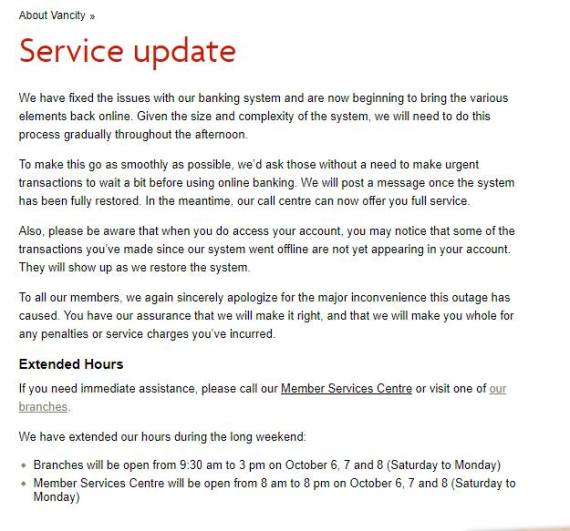
Around 4pm Saturday afternoon, the system was restored. With no warning, no “hey we found the problem and it’ll be back shortly,” just a new message:

43462847_2128392413878996_6272643734005874688_n.jpg

This was soon followed by another video from the CEO, which is still available on Vancity’s channel:

Note the continuation of the “inconvenience” language.

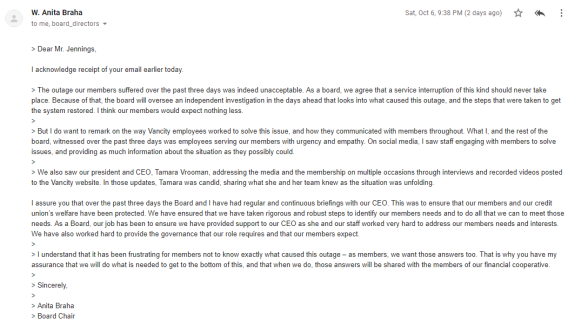
Later that evening I got this bit of copypasta from the board chair:

2018-10-08 13_43_12-Response to your email - neal.jennings@gmail.com - Gmail.png

The thing I found most remarkable about this email, besides the fact that it was clearly and poorly forwarded, was that there was neither an apology nor any acknowledgement of the complete failure of communications. Indeed, she commended the communications in this email, along with the CEO addressing media, which I find shocking. I have no disagreement that staff did an amazing job with the very few resources they were provided with – they did, and I’m certain that all the front-line staff have done heroic work to hold things together as much as possible despite complete lack of any support from management or the board.

I responded with an admittedly too off-the-cuff response:

I’m sorry, but apparently we experienced very different communications. In particular, your copypasta says: “In those updates, Tamara was candid, sharing what she and her team knew as the situation was unfolding.” That is not the case. The updates, which came at least a day too late, contained little of substance. Communications staff (who I do not blame for this problem) were unable to tell us what was wrong or even whether the system could ever be restored – I asked this question point blank several times and was met with meaningless jargon and/or silence. The statements from the CEO (who must share at least some of the blame for this problem) said little other than “we know this sucks but we don’t know what’s wrong and we’re working on it, don’t worry your information hasn’t been compromised.” These communications were insufficient at the very least.

The fact that you seem to think the communications were a-okay deeply offends me as a member. The fact that we still have not even been given a hint of why the system was offline for three days (even though you must know if you were able to fix it) is even more offensive. The board must be held responsible for this, and defending the actions of management and of the board rather than issuing a sincere apology says to me that you are not yet willing to accept responsibility. Let me be perfectly clear, this is not about the outage – this is about the lack of trust I and many other members now have that Vancity will be able to protect our money and make it available to us. The board has let us down.

Sunday mostly consisted of things settling down, and the poor social media team following up on every single comment and tweet to tell everyone that everything is working again and don’t worry our money is safe, and so on. I also got a call from my branch manager, who said “I was told you wanted to speak to a manager; I assume this is about the outage we’ve had”. I never made such a request, so I’m not sure who sent her to me or why, specifically. We had a good conversation, where I reiterated that this is not her fault and there’s nothing she can do about this, and where I once again made my points about this being a governance crisis and corporate head office problem, not a customer-service one. She repeated the same talking points I’ve seen in all the other communications, and asked if I incurred any specific costs (I hadn’t, thankfully, other than a few days of lost interest on deposits I couldn’t make, but I’m not petty enough to pursue that). I notified her that I’m still considering my options – I was, and still am, torn between trying to save Vancity by pushing for a complete replacement of the board (this can be done in accordance with provincial credit union laws) and simply leaving Vancity altogether.

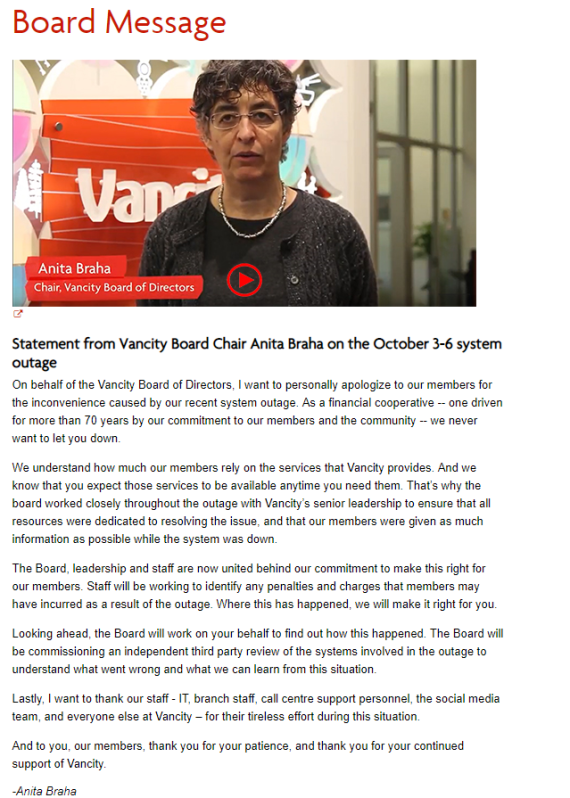
And then, today, this:

2018-10-08 13_33_37-Board Message - Vancity.png

The post is accompanied by a scripted YouTube video from the board chair:

My response was as follows (I reply-alled to my earlier off-the-cuff response from Saturday), and sums up my position at this stage:

Anita,

I want to follow up to this message. I received a phone call from my branch manager yesterday – I’m not sure if it was at your direction or someone else’s, but whoever sent her my way seems to have the misguided impression that this is a problem that can be handled through talking points and branch staff. I lay absolutely none of the blame at the hands of the staff or the branch managers – this problem goes all the way to the top. Forcing them to deal with the problem created by the corporate office is unfair to the staff that have already put in countless hours of overtime to clean up management’s mess.

I have read and watched the update you posted on our website tonight, and I think you’re failing to understand the seriousness of this problem. You, and all staff who are communicating with the public, continually refer to this outage as an “inconvenience.” This was not simply an inconvenience. There were three major things that happened here that completely undermine the trust I and many others have in the ability of Vancity to protect our assets:

  • The system went down in the first place, as has happened many times over the last several years. This is an indication to me of major flaws in our IT systems development and planning, and I have yet to hear a clearly articulated plan from the board for how we plan to address this, despite the fact that it has been ongoing for years. This makes me believe that we are relying on a faulty system that may never work properly.
  • There was no Plan B. Or, if there was a Plan B, it involved taking the entire system offline for three days with no warning. This is again a failure in planning at the corporate and board level – any organisation, but especially a financial institution, needs a disaster recovery plan to address problems like this. Failing to have one, again, makes me believe we are incapable of managing such a large amount of member money.
  • Communications to members were of limited use. We were given vague platitudes for three days, and no one could tell us anything other than that there was no breach of data and that staff were working on fixing the problem, with no clear deadline for success. I asked on both Twitter and Facebook, point blank, whether we even knew for sure that the system would ever be back – that is, if it would be back, not when it would be back – and no one would give me an answer that wasn’t a repetition of the standard talking points. What this tells me, as a member, is that no one actually knew. I never want to be in a position where we simply don’t know whether or not our financial records and financial assets will ever be accessible again. Whether this was a failure in communications – you seem to think communications were fine – or such a significant failure in the system that truly no one knew whether or not the system would ever be revived, this completely undermines any trust I had in the organisation.

The entire banking system, and indeed the economy, relies on trust. Money is only good when we can trust that it has value. If it can be erased in the blink of an eye – as appears to have been the case this week – it is worthless. The fact that I, and many other members, cannot trust Vancity to protect our funds and make them accessible undermines the entire institution.

Finally, while I absolutely agree that members who were hit with any financial penalties as a result of this failure should be compensated, the use of the term “we” to mean the institution that is Vancity and the use of the term “you” to mean members (“we will make it right for you”) implies an us-and-them relationship, which is not how credit unions work. It’s not like all these costs will come out of the profits and dividends of third-party shareholders – we, the members of the credit union, will pay for these costs. They’ll be distributed in a fair an even way to ensure that those most negatively affected will be reimbursed and those who were not will share only our proportionate share of the costs, but ultimately it is the members who will pay for these things. The way the board and management are treating members as customers first and members second says a lot to me about the culture of this credit union.

I had initially resolved to petition to have the board removed, and replaced with one willing to accept the severity of the problem and take action to fix it, but frankly I don’t know if I have the energy for this. I may, ultimately, decide to withdraw as a member of Vancity altogether. Let me be very clear that this isn’t about incurring a late-payment penalty or not being able to bank at midnight on Friday. It’s about the fact that I cannot trust that this credit union is capable of maintaining basic financial services.

Sincerely,

Neal Jennings


10 Oct 21:52

oldschoolsciencefiction:Happy birthday to both Sigourney Weaver...


oldschoolsciencefiction:

Happy birthday to both Sigourney Weaver from the Alien, Ghostbusters, and Avatar franchises and to the late, great Frank Herbert, author of Dune and of five sequels to the Hugo and Nebula Award-winning novel.

10 Oct 21:52

GNU Social Can Be Made To Work

by Ton Zijlstra

Previously I had tried to get GNU Social running on my own hosted domain as a way to interact with Mastodon. I did not get it to work, for reasons unclear to me, I could follow people on Mastodon but would not receive messages, nor would they see mine.

This morning I saw the message below in my Mastodon timeline.

It originates from Peter Rukavina’s own GNU Social install. So at least he got the ‘sending mentions’ part working. He is also able to receive my replies, as my responses show up underneath his original message. Including ones I limited the visibility of it seems.

Now I am curious to compare notes. Which version of GNU Social? Any tweaks? Does Peter receive my timeline? How do permissions propagate (I only let people follow me after I approve them)? And more. I notice that his URL structures are different from those in my GNU Social install for instance.

10 Oct 21:52

StackOverflow At 10

by Richard Millington

This is StackOverflow in 2008:

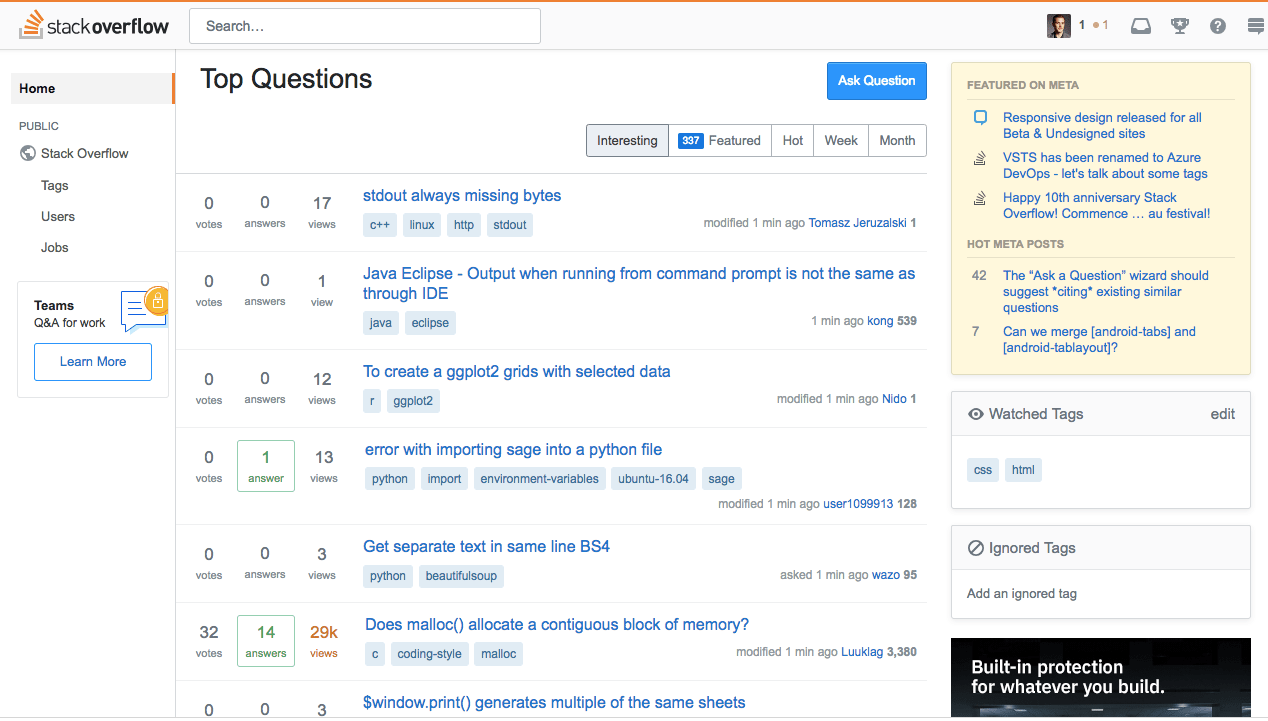
This is StackOverflow today (10 years later):

The homepage has had a few tweaks over the years but otherwise hasn’t changed much.

They constantly tweaked and improved their way to success. No major platform changes.

Whatever platform you’re using, it’s easy to identify things your current platform doesn’t offer and convince yourself it’s essential. Try to resist this.

I’d estimate only around 50% of people who migrate platforms truly believed it improved the community. Far too often, they trade one set of issues for another. They break things which were working, members get lost and frustrated, search traffic declines, integrations fail, and other features don’t work quite as well.

Migrating to a new platform should usually be the last resort to solve a problem, not the first option. It takes months, costs a fortune, and has a mixed record of success. You’re playing Russian roulette with a year of work and up to $500k+ in costs.

This happens often when a new head of community joins and compares their new community to their last one. Resist this temptation. The benefits rarely match the costs.

p.s. After 10 years, StackOverflow remains the best functioning community on the web.

10 Oct 21:52

With just under 2 weeks to go before IndieWebCa...

by Ton Zijlstra

With just under 2 weeks to go before IndieWebCamp Nuremburg, I am thinking what project to take/present/create there. First step is making a list I guess, and then strike items until I have something that looks somewhat doable. Luckily I have a 6 hour train ride to Nuremburg, together with Frank Meeuwsen, to prepare as well.

10 Oct 21:52

Bullet Messenger removed from iOS App Store

by Nicole Jao
The messenging app claimed they were removed due to copyright violations of a partner.
10 Oct 21:52

Zwolle: The Dutch city which changed its roundabouts from one unsafe design to another unsafe design

by David Hembrow
I've written three times before (1, 2, 3) about how the roundabouts in Zwolle cause danger for cyclists. Each time, I've pointed out that the use of the "priority" roundabout design in that city results in those roundabouts always featuring as the most dangerous sites for cyclists in the entire city. The top ten list of most dangerous locations for cyclists in Zwolle according to the
10 Oct 21:51

mini me at sandy beach

by Emily Chang

mini me at sandy beach

Photo Caption: mini me at sandy beach

Photo taken at: Sandy Beach Park

Instagram filter used: Lark

View in Instagram ⇒

10 Oct 21:51

City Day on the Farm

by peter@rukavina.net (Peter Rukavina)

In the shadow of last week’s Farm Day in the City, I had this idea that we should organize City Day on the Farm. Avocado toast and Boosted Boards go to Central Queens.

I set out to try to illustrate the idea last night, but only got as far as sketching a barn.

10 Oct 21:51

Twitter Favorites: [Planta] The delightful thing about political pin and button collecting has been getting to talk to a number of long-time co… https://t.co/XEb7N5eduy

Joseph Planta @Planta
The delightful thing about political pin and button collecting has been getting to talk to a number of long-time co… twitter.com/i/web/status/1…
10 Oct 21:51

Google’s arrogance on display: burying the lede about its Google+ vulnerability and shutdown

by Josh Bernoff

Google announced it would shut down its social network Google+ yesterday after revealing that it had given outside developers access to private data. At least that’s how the media is describing it. Google’s own statement just buries the news amid a whole bunch of other announcements, like a radioactive pellet in a big bag of … Continued

The post Google’s arrogance on display: burying the lede about its Google+ vulnerability and shutdown appeared first on without bullshit.

10 Oct 14:29

How to download all of your Flickr photos (and metadata)

by peter@rukavina.net (Peter Rukavina)

If you search for help downloading all of your Flickr photos, along with the metadata, you will, no doubt, get trapped in a jungle of old advice about how you must do this page by page from your “camera roll.” Or use arcane scripts that probably use an out of date Flickr API.

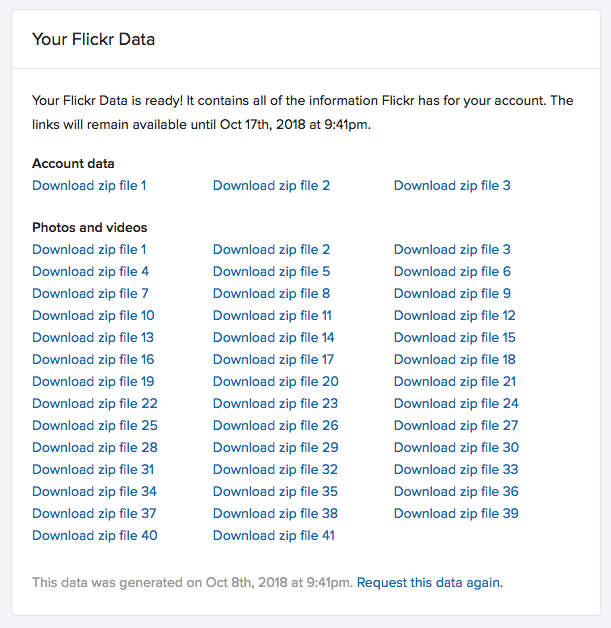
The modern answer, it turns out, is much simpler: on your Flickr account page, in the lower right, you’ll find a tool called “Your Flickr Data” that allows you to submit a “data takeout” request. It took about 18 hours to process mine, and when it was done I got an email directing me back to this page, where the section was now populated with links to ZIP files of the photos and metadata:

Your Flickr Data screen shot

Very helpful.

10 Oct 14:29

The importance of less than 100% reliability

by peter@rukavina.net (Peter Rukavina)

From How to Build a Low-tech Website:

In contrast, this website runs on an off-the-grid solar power system with its own energy storage, and will go off-line during longer periods of cloudy weather. Less than 100% reliability is essential for the sustainability of an off-the-grid solar system, because above a certain threshold the fossil fuel energy used for producing and replacing the batteries is higher than the fossil fuel energy saved by the solar panels.

The “less than 100% reliable” design pattern is a powerful one.

I get pinged on my mobile phone, for example, if this website goes down. But only between 7:00 a.m. and 11:00 p.m.

I could hire a antipodean doppelganger to keep the watch in small hours, but the risk-reward of that wouldn’t be worth it. If MySQL crashes at 3:00 a.m., y’all are on your own until I wake up.

10 Oct 07:07

Measuring the varied sentiments of good and bad words

by Nathan Yau

There was a survey a while back that asked people to provide a 0 to 100 percent value to probabilistic words like “usually” and “likely”. YouGov did something similar for words describing good and bad sentiments.

Tags: sentiment, words

10 Oct 07:05

Google announces ‘Pixel Slate’ Chrome OS 2-in-1 tablet

by Sameer Chhabra

Mountain View search giant Google used its October 9th, 2018 Made by Google event to formally announce and unveil the ‘Pixel Slate,’ a Chrome OS-powered tablet that’s a sort of spiritual successor to 2015’s Pixel C Android tablet.

While the Pixel Slate looks like an Android tablet at first glance, it’s actually a convertible 2-in-1 Chrome OS device.

The device runs Android 9 Pie, comes with a Google Pen stylus and features a keyboard cover with round keys that also serves as a stand. The keyboard connects automatically features and features fully backlit keys.

Additionally, users can position the keyboard cover in almost any configuration.

The Pixel Slate’s display features 293 pixels-per-inch (ppi), with a total of six million pixels overall.

The device features a single 8-megapixel front-facing camera with a wide-angle lens, a single 8-megapixel rear-facing camera, a power button that doubles as a fingerprint sensor, as well as dual front-facing stereo speakers.

Trond Wuellner, director of product management at Google, took to the stage to state that the Pixel Slate’s speakers deliver “surprisingly big sound.”

Google is offering Pixel Slate owners three free months of YouTube TV — the company’s paid over-the-top streaming service currently only available in the U.S.

In terms of software, users can run full-powered Linux apps, as well as apps from the Google Play Store and Chrome Apps.

Wuellner added that Google is working with Adobe, and a full version of Adobe Acrobat will be available for use with the Pixel Slate. Wuellner didn’t make mention of Adobe apps like Photoshop, Lightroom or Audition, however.

Google also brought split-screen support — a feature missing from last year’s Pixelbook — to the Pixel Slate.

Since the tablet runs Chrome OS, virus protection is built-in to the device, updates are pushes automatically, and Google’s Titan Security is built-in as well.

The Pixel Slate will be coming to Canada — for sale on the online Google Store, as well as at “major retailers” — later this year.

The Pixel Slate will start at $599 USD (roughly $776.36 CAD), while the keyboard will cost $199 USD (roughly $257.92 CAD) and the Google Pixelbook Pen will cost $99 USD (roughly $128.31 CAD).

More to come…

The post Google announces ‘Pixel Slate’ Chrome OS 2-in-1 tablet appeared first on MobileSyrup.

10 Oct 07:05

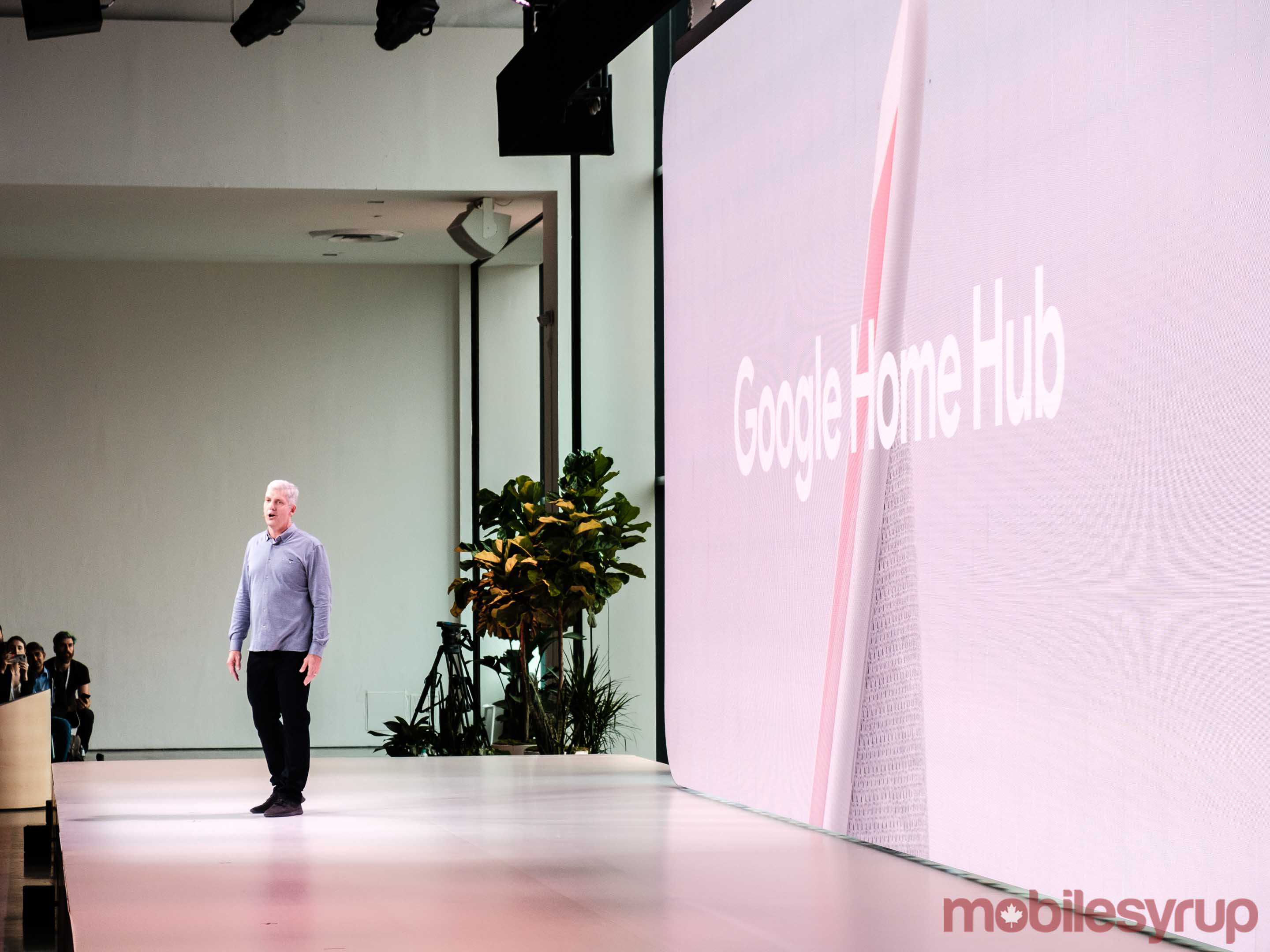
Google announces new Assistant-powered Echo Show competitor, the Home Hub

by Patrick O'Rourke
Home Hub

At the company’s launch event today in New York, Google announced its smart home assistant Amazon Echo Show competitor, the display-clad Home Hub.

Google says that the Home Hub aims to create “a more helpful, thoughtful home” by giving users the ability to view responses from Assistant, rather than just hear them like with they do with the Mini or standard Home.

Specific Google services like Search, YouTube, Maps, Calendar and Photos have all been adapted with the Home Hub’s display in mind.

Google Home Hub

Further, Google says that the smart home device will feature “deep integration” into Nest devices and accessories. Google also says that Hub’s display is capable of adjusting to the ambient light present in a room thanks to a dedicated sensor that shifts the screen’s colour in real time.

Unlike the Echo Show, which is finally coming to Canada, as well as Facebook’s recently announced Portal smart home assistant, there isn’t a camera featured on Google’s Home Hub.

Google Home Hub

During Google’s keynote, the company showed off a new recipe feature, suggesting that the Home Hub would work well in a kitchen, as well as emphasizing the device’s ability to play YouTube videos. The Home Hub is also capable of supporting Google Voice Match feature, allowing it to recognize specific users’ voices in order to pull up specific information like calendars, reminders and commute times.

The sleek-looking smart home device sticks closely to the standard Google Home device design language, though there are new colours available this time around, including ‘Mint,’ ‘Pink,’ ‘Charcoal,’ and ‘Chalk’

The Home Hub is launching in the U.S., U.K. and Australia for $149 USD (approximately $193 CAD) on October 22nd. Given that past Google Home devices didn’t launch in Canada first, it’s unclear if the Home Hub will drop in the Canadian market immediately.

We’ve reached out to Google for more information and will update this story when we hear back.

More to come…

The post Google announces new Assistant-powered Echo Show competitor, the Home Hub appeared first on MobileSyrup.

10 Oct 07:04

Google builds Lens directly into Pixel 3 and 3 XL camera

by Jonathan Lamont
Google Lens

Google has built Google Lens into the Pixel 3 and the Pixel 3 XL camera.

The company announced the new integration at its Pixel 3 event in New York. Pixel 3 users can easily access Google Lens through the camera app.

Thanks to Google’s Pixel Visual Core, Lens works instantly in the camera app and doesn’t require a data connection for most things.

You can use Lens to translate menus or to look things up online.

For example, Google showed someone using Lens to look up sunglasses. Lens was able to show where to buy the glasses online and similar styles he could buy.

Overall, it seems Google is working to make Lens smarter and faster than ever. Building Lens directly into the camera is a great way to make Lens quick and easy to access.

The post Google builds Lens directly into Pixel 3 and 3 XL camera appeared first on MobileSyrup.

10 Oct 07:04

Google reveals revamped entry-level Chromecast

by Brad Bennett

At Google’s fall hardware event, the search giant revealed its next-generation hardware, and in terms of Google’s video streaming devices, the Google Chromecast has received a slight design refresh.

The new version of the Chromecast replaces the glossy plastic disc with a more soft-touch looking circle that reminds me of the rear of the Nexus 5.

The device’s spec sheets states that the Chromecast comes in ‘Charcoal’ and ‘Chalk’ colours to match Google’s Home line of devices. That said, so far Google has only given users the option to buy the new Chromecast in Charcoal. MobileSyrup has reached out to Google to see if the Chalk variant is coming to Canada.

Besides the new colour and material, the new device is more or less the same as the existing Chromecast, with the only change being that it’s now capable of playing 1080p content at 60FPS instead of capping at the frame rate at 30FPS.

It appears that Google is not updating its more expensive 4K Chromecast Ultra or the Chromecast Audio.

The new Chrome cast is priced at $45 CAD and is available to order now.

The post Google reveals revamped entry-level Chromecast appeared first on MobileSyrup.

10 Oct 07:04

Freedom Mobile begins deploying 700MHz spectrum in Calgary

by Sameer Chhabra

Shaw Communications-owned regional carrier Freedom Mobile has officially begun rolling out its Band 13 700MHz spectrum to subscribers in Calgary.

According to an October 9th, 2018 media release, subscribers in Calgary will be able to use Freedom’s 700MHz spectrum for better network coverage and better indoor LTE coverage.

“Freedom Mobile’s Extended Range LTE leverages Band 13 700 MHz spectrum to provide customers with farther-reaching coverage and stronger indoor wireless reception than anything we’ve been able to offer to date,” said Paul McAleese, president of wireless at Shaw Communications, in the same October 9th, 2018 media release.

“The deployment of additional spectrum is our latest step in creating an improved wireless experience that includes seamless connectivity, the latest handsets, and the high-speed LTE data plans that our customers are looking for.”

Freedom Mobile is also currently rolling out Voice over LTE (VoLTE) services to select Samsung, Sony, Motorola and Alcatel devices.

Quebec-based regional telecom service provider Quebecor sold to Freedom Mobile three 700MHz spectrum licenses in June 2017 for use in southern Ontario, British Columbia and Alberta. Quebecor also sold four 2,500MHz licenses to Freedom.

Freedom closed the sale of all seven licenses in July 2017.

Shaw’s October 9th media release didn’t specify when subscribers in Southern Ontario and British Columbia will be able to connect to Freedom’s 700MHz network.

Source: Shaw

The post Freedom Mobile begins deploying 700MHz spectrum in Calgary appeared first on MobileSyrup.

10 Oct 07:01

Google’s New Pixel Slate is a ChromeOS Tablet Built for Work and Play

by Evan Selleck
While Android may not have taken off in the tablet market, Google’s other effort, ChromeOS, seems to be what the company needed to get things going. Continue reading →
10 Oct 07:01

Google Pixel 3 and Pixel 3 XL Unveiled with Dual Front-Facing Camera, AI-Assisted Rear Camera, Wireless Charging, More

by Rajesh Pandey
Google today unveiled the Pixel 3 and Pixel 3 XL. Despite trying its best to suggest that it had something else up its sleeve through its social media profiles, the Pixel 3 and Pixel 3 XL have turned out to be exactly what we saw in numerous leaks. Continue reading →