Shared posts

12 Oct 15:14

How I Use OmniFocus Notes

by Richard

I use OmniFocus to keep track of what needs to be done on an individual level. All sorts of projects, from buying and framing art to starting hobbies to making notes about things to look up later get jotted down in OF. If I was ever lacking in things to do, that is no longer the case, with almost 900 open actions in 117 projects. (Not included: routine tasks that a checklist is a better fit for.) OF does not track tasks that work expects me to do, since in that case I'm accountable to others, and priority set not necessarily by me. In tickets, I always try to log what I did at the time of doing it, so that others can piece together later what happened.

So I do the same in OF notes for a task. If it's a repeating task, I write down if anything had changed since the last time and whether there were roadblocks I came across so that when I do it the next time, I can avoid them. For tasks waiting on something to happen (a delivery, for example), I make a note of the updates that come my way. Every entry in the notes gets a date associated with it, just in case I need to look up when I did something that has to do with that task.

I try not to put notes from a call or meeting in OF, since they end up being harder to find. I settled (finally) on the iOS/Mac Notes app, which syncs across all the devices I use at the moment. Whenever possible, I add a link in the OF note to something that's referenceable by URL. A Day One journal entry would be a good example, or a web page that came in handy when looking into something.

I wish there was Markdown in OF notes, but there is quite a bit possible with formatting without it, so it would only solve the problem of making bullet lists easier. (I have a text expansion shortcut for the bullet • for when typing a bullet list out on a Mac.) Sometimes OF notes become blog posts, like a forthcoming one on a synthesizer purchase, on its way from who-knows-where, the outcome of which I'm still not sure of. Usually, though, it's a way for me to track what I did and when over the lifetime of a task, and to be able to bring up a timeline if need be.

12 Oct 15:13

Creative Commons Cargo Bikes

by peter@rukavina.net (Peter Rukavina)

XYZ CARGO designs and manufactures bicycles in Hamburg and Copenhagen using a novel and humane business model:

Fair pricing: We ask ourselves how to give access to XYZ CARGOs to as many people as possible and how to do this in a fair and symbiotic way. We wouldn’t try to get the biggest profit, but balance a fee for our work with the costs and the time we have invested. All persons should be able to access XYZ CARGOs in a way, that fits both: their means and their needs.

We offer a range of ways to get hold of a XYZ CARGO: we sell readymade, assembled cycles and we arrange workshops for those who want to build their XYZ CARGO themselves. Finally people can also build their XYZ CARGOs from scratch on their own, according to the Creative Commons license above. However we do not give away blueprints for the commercial models.

Being “fair and symbiotic” are excellent business goals.

(via Low-tech)

12 Oct 15:09

Developers And Documentation

by Richard Millington

Last year we reviewed some research on a developer community.

A somewhat crude paraphrasing would go something like this:

Q. “What would you like in the community?”
A. “Great documentation!”

Q. “What about better discussions, expert interviews, live chatting with product engineers?”
A. “No, we just want great documentation”

Q. “Do you think we should have a Slack channel?”
A. “We don’t care, we just want great documentation”

Q. “Would you be interested in publishing a blog post sharing your expertise?”
A. “No, I.want.to.see.great.documentation please”

Q. “If you had to choose between a blog post, expert interview, or a live chat…which would be your favourite?”
A. “Good documentation”

It’s obvious the community manager isn’t listening. S/he is looking for anything that validates the kind of community they already plan to build. No-one is going to win here.

A far better set of questions would go:

“Documentation? Great what kind of documentation do you most need?”

“What format do you like documentation in?”

“Would you like to edit it? Would you be interested in other developers adding their notes/comments on it?”

“How would you like to be notified of updates by documentation?”

“If we allow others to add their notes/make updates, should this be hand-selected or should we have a review process?”

Etc….

Now you can start shaping exactly the kind of community members want.

It might not even have a discussion area. It might be a wiki, a series of updated guides people can clip notes to or something else entirely.

It’s far harder to listen that we might imagine. Don’t go through a research interview with a set of questions hoping to get an answer that supports what you already want.

Genuinely do the research with an open mind and go where it takes you.

12 Oct 15:08

Single Responsibility Principle for Functional Programming

by Eric Normand

How do functional programmers use the Single Responsibility Principle?

Transcript

Eric Normand: How do functional programmers think about the single responsibility principle? Hi, my name is Eric Normand. These are my thoughts on functional programming.

The single responsibility principle says that a thing should only have one responsibility. One way to check if something has more than one responsibility is to say everything it’s responsible for. If you use the word “and” or “or” or “but,” then maybe it’s not a single responsibility. Maybe, you have multiple responsibilities in there.

That’s a good rule of thumb. It requires you to be pretty astute because you have to be able to articulate the concerns in that sentence well. What do I mean by that? I could say, “This object, this class, is responsible for keeping track of the orders coming into the restaurant.” It sounds like one sentence. I didn’t use the word “and.” It’s fine.

What does “keeping track of” mean? Is there some context about this being a concurrent environment? These aren’t even operational concerns. These are still functionality-wise.

When you start thinking about those, it becomes clear like, “Well, am I talking about durability? Does this have to be stored on disk? What about if the power goes out or the network goes down temporarily? Is there some networking concern that I have to take care of? Is there, like I said before, some concurrency involved? How many systems are giving me orders at the same time?”

It’s a pretty big mess of things. Just being able to say it in one sentence, “Keep track of the orders as they come in,” is not clear enough. I see this happen all the time in the object-oriented world, where they’ll think, “This is a very clear, small responsibility,” but actually, it’s 100 responsibilities.

It’s deal with the concurrency. You want them to come in in a certain order. You need a queue. You are dealing with persistence. You are presumably persisting to disk. You are dealing with the errors that you have on the network as it flakes out. All of these things are real concerns. They’re responsibilities of the object.

What a language like Clojure does, is it will separate out all of those concerns into their own little objects. For instance, you have something like an atom in Clojure, which has a single responsibility, which is to maintain a transactional state, to make sure that no two threads are writing to it at the same time.

You get a consistent transition from one value to the next. That’s all it does. This is one of those things that when you come from a different paradigm, from a different language with a different style of thinking, with a different idea of what a responsibility is, this seems so tiny and almost something you weren’t even thinking about before.

That is how Clojure gets its power. It’s from building these small tools that have such a small responsibility that they can be clearly reused, and understood, and composed together to find a real solution.

When people talk about single responsibility, they often will make that sentence. They’re not thinking about all of the responsibilities that a thing might have. This is one of the problems with reuse in classical object-oriented programming, in Java style object-oriented programming.

Someone will say, “It’s the same problem.” Someone will say, “What is the responsibility of this class?” It’ll be like, “To represent a person, right?” It’s like, “Oh, I said it in one sentence without using ‘and.’ That must be a thing, right?” The class has 300 methods. It’s managing all sorts of stuff. When you look into it, it turns out well. It can read and write itself to the database.

Person means a different thing to different departments. Person in the HR Department is an employee. Person in the Hiring Department is a candidate. Person in the Accounting Department is someone that you might have to pay. All of these responsibilities are put together into this one giant object. It’s not going to be reusable very much.

Those methods are going to confuse the different departments because they are using the same words that they’re used to but with different meanings. Different departments have different meanings for them. It’s just going to be not reusable.

If you go smaller, though…and this was the secret of Smalltalk and why people thought that object-oriented programming would give you something reusable. If you go smaller to something like a tuple, this just keeps two things together. That’s its responsibility.

It keeps two values, a pair. It could be a three tuple or something. Then it keeps three values. You have a tuple that keeps two values. That’s its responsibility. That’s it.

You have an atom. Just make sure that state changes are transactional. Boom! Awesome. You have something like a HashMap. This maintains a mapping from keys to values. It’s just very small responsibilities that are reusable because they’re so small and regular that you can rely on them.

That’s how we see this single responsibility principle. There’s a rule of thumb of writing a sentence. It’s just not enough.

You need to think about the problem and cut it up more, down to a smaller, granular level, to where you feel like, “Yes, this thing is so small, I cannot get it wrong. It has no corner cases because it’s so small. It’s just it. There’s no way that this is wrong. I can rely on this, for sure.” That’s when you know that you’ve got something.

The level of abstraction you’re at….It all depends on the other tools you have available in your language. A tuple might be a high level if you’re writing an assembly because you have to deal with memory management. It’s just not right.

It’s not the right place for that. It’s not something you can just rely on. If you got all this other stuff, like garbage collection and private methods, you can rely on those things and make something solid.

I’ve been rambling on with basically a simple idea, which is, break stuff down more until you feel this is solid. Then you can put it back together.

My name is Eric Normand. Please subscribe. If you’re watching this on YouTube, hit Subscribe. You can subscribe to the podcast. I also love to hear from my listeners. I’m @ericnormand on Twitter. Also, you can email me. I’m eric@lispcast.com.

I’ll see you next time.

The post Single Responsibility Principle for Functional Programming appeared first on LispCast.

12 Oct 15:07

Here are some of the best Apple Shortcuts and where to find more

by Brad Bennett

Apple’s recently released iOS Shortcuts app is a way to streamline simple tasks and create futuristic phone commands, but coming up with all of these unique formulas isn’t always easy.

That’s where this story comes in. I’ve compiled a list of clever shortcuts and a few online resources to learn about making your own.

This isn’t exactly an article teaching users how to use Shortcuts, but if you’re looking for an intro to the new app, MobileSyrup put together a brief guide. If you want to go more in-depth, Apple even has its own Shortcuts guide.

I’ve been interested in apps that chain commands together since IFTTT (pronounced ‘If This Then That’) launched back in 2011. I consistently ran into the same hurdle every time I tried to use the not-always-intuitive platform. What type of commands can I make and what am I trying to accomplish?

Now that Apple has launched Shortcuts, I’m giving the whole app formula thing another shot. This time, I’ve found three great online resources to help me out. The r/shortcuts subreddit is a great resource to see what other people are building and to gain inspiration. There’s also a website called ShotcutsGallery.com that lists hundreds of Shortcuts that stretch across a variety of topics.

Finally, there’s even a Discord channel for Shortcut enthusiasts to join in order to share ideas and collaborate in real-time.

Shortcuts are still in their infancy. Apple was able to borrow most of the app’s functionality from WorkFlow, the company the tech giant purchased back in 2017, but popular apps are still slowly rolling out support.

Even just on the subreddit, there are still tons of interesting ideas to be inspired by.

So sit back, pull out your phone, and get creative.

Whistler webcams – Displays Whistler mountain and village webcams. Option to share and save images. from r/shortcuts

View all photos taken on this day in previous years in a variety of ways (GIF, collage, browse) from r/shortcuts

View all photos taken on this day in previous years in a variety of ways (GIF, collage, browse) from r/shortcuts

Getting pulled over by police from r/shortcuts

Control Spotify with Siri from r/shortcuts

Here is a Jeopardy Soundboard for your enjoyment. from r/shortcuts

I have an NFC tag that opens up a shortcut to close my garage & start navigating to work via Waze. Perfect for placing on your mobile phone holder! from r/shortcuts

I’m working on a Pokédex app for iPhone that works with Siri Shortcuts, so you can get answers entirely by voice! from r/pokemon

Search on Amazon Shortcut from r/shortcuts

Here’s the motherload of ideas!

Here is my library of Shortcuts I’ve collected/created so far. (Explanations in the comments of each category & shortcut) from r/shortcuts

These last two are just some cool ideas for what to do with your Shortcuts, and a feature Shortcuts should add in the future.

My Shortcuts Only Homescreen from r/shortcuts

Apple should let us add shortcuts to the control center. It would be easier to access the shortcuts. from r/shortcuts

Source: Reddit

The post Here are some of the best Apple Shortcuts and where to find more appeared first on MobileSyrup.

12 Oct 15:07

Hundreds of Chinese iPhone users are believed to have had their Apple IDs compromised

by Christopher Udemans
Some users' Apple IDs were used to log into devices other than their own to make purchases.
12 Oct 15:00

Amazon’s Echo Dot, Plus, Sub and Show are now available in Canada

by Patrick O'Rourke
Echo Show

While not all of Amazon Canada’s new suite of Echo devices are making their way to Canada, contrary to past years, a number of them actually are.

Amazon’s 3rd-generation Echo Dot and 2nd-generation Echo Plus are now available in Canada for $69 CAD and $199, respectively.

Further, the Echo Show, which launched in the United States last year, is now available in Canada for $299. This is the 2nd-generation version of Amazon’s voice-activated assistant device that features a built-in display.

A new device announced earlier this month, the Echo Sub, a 100w external subwoofer that adds extra base to an Alexa-powered speaker setup, is also now available in Canada for $169 CAD.

We’ll have more about Amazon’s new Echo devices on MobileSyrup in the coming days.

Source: Amazon Canada

The post Amazon’s Echo Dot, Plus, Sub and Show are now available in Canada appeared first on MobileSyrup.

12 Oct 15:00

How People Learn

Stephen Downes, SlideShare, Oct 25, 2018


Icon

This is a slide show for a talk I'll never give, because it's not my work. It is made up almost entirely of quites from the recent National Academies of Sciences, Engineering, and Medicine report I referenced here the other day. The idea was to pull out the findings and present them in an easy-to-read (and occasionally funny) presentation, because I felt that the work merited a wider reach.

Web: [Direct Link] [This Post]
12 Oct 15:00

Samsung unveils Galaxy A9 with four rear-facing cameras and up to 8GB of RAM

by Dean Daley
Samsung Galaxy A9

Samsung has unveiled the phone with 4x the fun, the Samsung Galaxy A9 (2o18). The smartphone features four cameras on its rear, as leaked yesterday, and one selfie shooter.

The handset also sports a 6.3-inch Super AMOLED display with a 1,080 x 2,220-pixel resolution, Qualcomm’s Snapdragon 710 processor, up to 8GB of RAM a 3,800mAh battery, a 3.5mm headphone jack, USB Type-C port, 128GB of expandable storage and Android 8.0 Oreo.

As leaked by Evan Blass yesterday, the device uses an 8-megapixel ultra-wide camera with a f/2.4 aperture and a 120-degree field of view, a 10-megapixel telephoto camera with a f/2.4 aperture and 2x optical zoom, a 24-megapixel camera with a f/1.7 aperture and a 5-megapixel depth camera with a f/2.2 aperture.

Meanwhile, on the front, the phone features a 24-megapixel selfie shooter with a f/2.o aperture.

The phone comes in ‘Lemonade Blue’, ‘Caviar Black’, and ‘Bubblegum Pink’. Samsung is selling the device for €599 ($903 CAD) in the European market. We’ve reached out to Samsung to see if the A9 is coming to Canada, but it’s quite unlikely.

Source: Samsung

The post Samsung unveils Galaxy A9 with four rear-facing cameras and up to 8GB of RAM appeared first on MobileSyrup.

12 Oct 14:59

Create your own visual journal of data

by Nathan Yau

Giorgia Lupi and Stefanie Posavec continue on their path of Dear Data with a book that you draw in: Observe, Collect, Draw!

The first section describes some of the basics of journaling with data and how you can use various visual encodings. However, the main part of the book is a journal that guides you through collection and the visual encodings that Lupi and Posavec used with their postcards. First, there’s an instruction page and then the adjacent page provides blank scales for you to sketch yourself.

Fun. It seems like a good way to jog your imagination, in case you feel like you’re stuck in a bar chart geometry funk. [Amazon link]

Tags: book, Giorgia Lupi, self-surveillance, Stefanie Posavec

12 Oct 14:59

Walmart Canada modernizing its stores to appeal to online shoppers

by Brad Bennett

Walmart’s Canadian arm has announced plans to renovate 23 stores in an effort to better appeal to a wider variety of customers.

The retail giant is focusing on creating an “omi-channel experience” that aims to better meld its online and offline shopping offerings, according to the company.

To mix the two forms of shopping, Walmart is adding dedicated parking spots for an online grocery pickup — something specific stores across the country already feature — and some in-store areas dedicated to online orders. It’s not exactly clear what these zones will be, but Walmart’s press release says that they’ll “help facilitate the interaction between Walmart Canada’s e-commerce and bricks and mortar operations.”

As part of the modernization, the stores will be equipped with wider aisles, a new colour palette and signage. Some locations are getting an updated storefront as well.

Further, specific stores will also be updated to be more diverse with more global food options.

The company is slowly making an effort to modernize its operations. Walmart recently brokered a deal with Instacart related to home delivery, and now the company is positioning its stores to be more helpful for customers who shop online.

Ontario Stores being renovated

  • Ajax
  • Barrie North
  • Brampton North
  • Burlington
  • Guelph North
  • Kitchener West
  • Ottawa Barrhaven
  • Richmond Hill North
  • Thunder Bay
  • Wasaga Beach
  • Windsor East

Alberta

  • Edmonton Capilano
  • Okotoks
  • Olds
  • Red Deer

British Columbia

  • Cowichan Valley
  • New Westminster

Manitoba

  • Winnipeg Polo Park

Newfoundland

  • Mount Pearl
  • St. John’s Aberdeen
  • St. John’s Kelsey

Quebec

  • Mascoushe
  • Sait-Hyacinthe

Source: Walmart Canada

The post Walmart Canada modernizing its stores to appeal to online shoppers appeared first on MobileSyrup.

12 Oct 14:59

Pocket Offers New Features to Help People Read, Watch and Listen across iOS, Android and Web

by Nate Weiner

We know that when you save something to Pocket, there is a reason why. You are saving something you want to learn about, something that fascinates you, something that will help shape and change you. That’s why we’ve worked hard to make Pocket a dedicated, quiet place to focus so that you can come back and absorb what you save when you are ready.

The trick is, in the reality of our lives, it’s not always that simple. Our lives don’t always have a quiet moment with a coffee cup in hand with Pocket in the other. We have work to do, kids to take care of, school to attend. But with Pocket we’ve always worked hard to ensure that Pocket gives you tools to fit content around your life, freeing you from the moment of distraction and putting you in control.

Today, we’re excited to share a new Pocket, that makes it easier than ever to read, watch, listen to all that you’ve saved across all of the ways you use it: iOS, Android and Web.

Listen: A new way to read

You can listen to content you’ve saved from favorite publishers from all across the web—all from Pocket. Your Pocket list just became your own personal podcast, curated by you. Our new listen feature frees the content you’ve saved to fit into your busy life. It enables you to absorb articles whenever and wherever, whether you are driving, or walking, working out, cooking, or on the train.

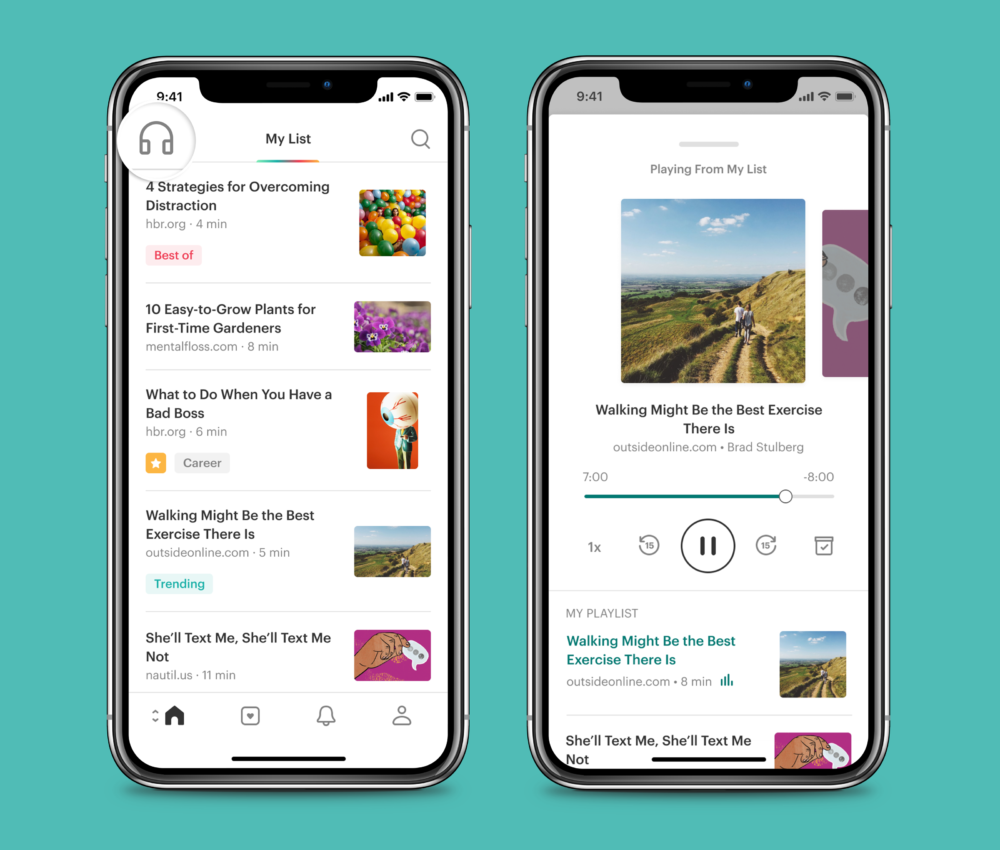
With the latest version of listen on iOS and Android, we’re introducing a more human sounding voice, powered by Amazon Polly, and the ability to play through your list easily and hands-free. To start listening, simply open Pocket and tap the new listen icon in the top left corner.

A new Pocket, just for you


With Pocket’s app, we’ve intended it to be a different space from anything else on your device. It’s intentionally an uncluttered and distraction-free environment, built with care so you can really read.

We’ve doubled down on this with a new fresh design, tailored to let you focus, tune out the world and tune into your interests. When you open Pocket, you’ll see a Pocket that’s been redesigned top to bottom. We’ve created a new, clean, clutter-free article view to help you absorb and focus. Introduced new app-wide dark and sepia themes to make reading comfortable, no matter what time of day it is. And updated fonts and typography to make long reads more comfortable.

“At Mozilla, we love the web. Sometimes we want to surf, and the Firefox team has been working on ways to surf like an absolute champ with features like Firefox Advance,” said Mark Mayo, Chief Product Officer, Firefox. “Sometimes, though, we want to settle down and read or listen to a few great pages. That’s where Pocket shines, and the new Pocket makes it even easier to enjoy the best of the web when you’re on the go in your own focused and uncluttered space. I love it.”

Working hard for you

We’re excited to get Pocket 7.0 into your hands today. You can get the latest Pocket on Google Play, App Store, and by joining our Web Beta.

As always, we want to hear from you – let us know what you think.

— Nate


The post Pocket Offers New Features to Help People Read, Watch and Listen across iOS, Android and Web appeared first on The Mozilla Blog.

12 Oct 14:59

Ein kleiner Rückblick

by Volker Weber

Anfang 2017 begann das, was diese Woche mit dem Domino V10 Launch ein gutes Ergebnis brachte. Zu dem Zeitpunkt war ich pessimistisch, was die Zukunft der IBM Connect anging:

Es sollte ein großer Neuanfang für IBMs Traditionsveranstaltung, vormals als Lotusphere bekannt, werden. Der Umzug von Orlando nach San Francisco sollte neue Teilnehmer bringen, die sich für IBMs Cognitive-Initiative erwärmen. Der Neustart misslang.

Und wurde dafür heftig von Jörg Rafflenbeul kritisiert. Das hat mir gefallen. Ich mag es, wenn mir jemand seine Kritik ins Gesicht sagt und nicht hinter meinem Rücken. In diesem Fall lag ich richtig. Es sollte keine Connect mehr geben. Und auch Pink kam nicht so, wie IBM das versprochen hatte. Zu dem Zeitpunkt war noch nicht bekannt, was aus Notes & Domino werden sollte.

Im Oktober war es dann soweit. IBM gab die Entwicklung an HCL ab. (Der Titel ist übrigens nicht von mir, den hat die Redaktion zugespitzt.) Irgendwas ist zu diesem Zeitpunkt zerbrochen. Von IBM habe ich jedenfalls nichts mehr gehört, bis zum Juni diesen Jahres, wo ich mich mit HCL und IBM am Rande der DNUG getroffen habe. Eine Einladung von HCL nach Boston habe ich damals nicht angenommen. Ich fühlte mich gut genug informiert. Und was HCL im Juni versprach, haben sie diese Woche geliefert.

Ich habe keine Bedenken, dass sie das nächstes Jahr mit V11 wieder machen werden. Das Management ist höchst professionell, engagiert und auch sehr menschlich. Richard Jefts eröffnete damals das Gespräch mit mir sehr direkt: "What kind of problem do you have with us?" Meine Antwort war genauso einfach: "None whatsoever. I am curious what you are up to."

Wir haben uns gut verstanden. Und tun das heute noch. Richard Jefts kennt die Herausforderungen sehr genau. Und er hat überhaupt keine Probleme, darüber zu sprechen. Ich erkenne ein Alphatier, wenn ich es sehe. Und ich mag Alphatiere, die furchtlos sind.

12 Oct 14:59

Apple spends $600 million USD to secure deal with British battery management chip manufacturer

by Sameer Chhabra
Apple store logo

Cupertino computing giant Apple plans on spending $600 million USD (approximately $782.02 million CAD) to purchase patents and approximately 300 employees from British Dialog Semiconductor.

According to an October 11th, 2018 media release, Apple paid $300 million USD ($391.01 million CAD) in cash, as well as an additional $300 million USD in the form of an upfront payment for Dialog products to be delivered over the next years.

The companies expect the deal to be formalized by the appropriate regulatory bodies in the first half of 2019.

Apple’s acquisition of 300 Dialog employees means that the Britain-based semiconductor manufacturer loses roughly 16 percent of its total workforce.

It’s worth noting that these Dialog employees already primarily worked on Apple chips.

Additionally, Apple will acquire Dialog factories in Italy, Great Britain and Germany.

“Dialog has deep expertise in chip development, and we are thrilled to have this talented group of engineers who’ve long supported our products now working directly for Apple,” said Johny Srouji, Apple’s senior vice president of hardware technologies, in the same October 11th media release.

“Our relationship with Dialog goes all the way back to the early iPhones, and we look forward to continuing this long-standing relationship with them.

As a result of the deal, Dialog has acquired new Apple contracts for the development of power management systems, audio subsystems, as well as other “mixed-signal integrated circuits.”

“We believe that this transaction is in the best interests of our employees and shareholders who will benefit from a business with enhanced focus, strong growth prospects and additional financial flexibility to invest in strategic growth initiatives,” said Jalal Bagherli, Dialog’s CEO in the same media release.

Dialog used its media release to note that the company’s 2018 revenue won’t be affected by the new agreement with Apple.

Source: Dialog

The post Apple spends $600 million USD to secure deal with British battery management chip manufacturer appeared first on MobileSyrup.

12 Oct 14:59

No Joke

by Natasha Lennard

A popular fiction has it that Socrates was convicted of his various charges by a slim majority of Athenian judges. Then, when it came to sentencing, the prosecutor proposed death. Socrates instead proposed that he receive free meals for life in the city’s sacred hearth. In response, more judges voted to sentence him to death for his impertinence than had voted to convict him in the first place. Though this isn’t true, it would have been ironic if it were.

Socrates, we might say, died from “irony poisoning.” Not the flesh-and-blood man Socrates, of course — he was probably killed for teaching and befriending deposed tyrants — but the Socrates we know from Plato and Xenophon’s hagiographic renderings, who was apparently sentenced to death by hemlock for using irony to reveal philosophical truths to young Athenian men.

If only the term irony poisoning were used that way, for cases in which poison is dispatched against irony. Instead, the term has emerged in social media parlance to signify that irony, cultivated online, is itself the poison. Mimetic of the process it ostensibly denotes, “irony poisoning” began somewhat as a joke. It’s well summed up, as these things often are, in an Urban Dictionary entry: “Irony poisoning is when one’s worldview/Weltanschauung/reality tunnel is so dominated by irony and detachment-based-comedy that the joke becomes real and you start to do things that are immoral or wrong from a place of deep nihilistic cynicism.” An extreme case of “irony poisoning” turns the online shitposter into the committed violent racist, willing to carry out bloody deeds offline.

The adoption of the term “irony poisoning” lets centrist liberals do what centrist liberals do best: call for civility, earnestness, and Truth as the antidote to violent extremism

Had “irony poisoning” remained imprecise, self-referential Twitter jargon, there would be no reason to take issue with it. But it’s now being used in earnest to describe a real and troubling condition. It has been enthusiastically picked up by publications like the Guardian, the Boston Globe, and the New York Times, which embraced it as a revelatory explanation for the rise and spread of fascist communities online and the offline violence they facilitate. “We are making a plea to scholars, readers and Silicon Valley elites,” the Times journalists wrote, without apparent irony, “take irony poisoning seriously.” And we should, but not for the reasons they adduce. Rather, the term’s adoption reveals the flawed way mainstream liberal analysis wants to see and interpret fascism. It lets centrist liberals do what centrist liberals do best: call for civility, earnestness, and Truth as the antidote to violent extremism.

That’s not to say that the pattern that the “irony poisoning” thesis points to is not gravely real. Online communities awash in euphemistic alt-right neo-Nazi references as well as explicit racial slurs and Hitler memes have produced violent actors in the physical world. Charlottesville was organized as a meat-space meetup of white supremacists who had found each other online and adopted a cartoonish lexicon by which to recognize each other (Pepes, symbols of Odinism and so on) and culminated in white supremacists beating a black man with metal poles, and a neo-Nazi mowing his Dodge Charger into a crowd of counter-protesters, killing one. Lane Davis, a prolific far-right troll on YouTube who called his parents “leftist pedophiles,” was thought to be nothing more than an outrage peddler until he stabbed his dad to death. The New York Times invoked irony poisoning in response to a case involving a German firefighter in a liberal town who bartered online in anti-refugee Facebook propaganda and Hitler jokes. He then attempted to set fire to a refugee group house.

These incidents of physical violence were no doubt stoked by a worldview shaped and encouraged in social media’s dark crevices, where race hate is often expressed and (further) normalized through memes and jokes. That is simply to say that our beliefs and behaviors are shaped and reinforced by the communities of which we are a part, and individual participation reinforces the group subjectivity in turn. Yet the framework of “irony poisoning” becomes dubious when applied as an actual explanation or pathology. By blaming irony as some sort of gateway drug to “real” race hate, it suggests that “real” far-right extremism develops through an extreme ironic detachment from reality and its moral standards. But in fact it is through routine attachment to networks in which white supremacy is an a priori moral norm in need of defense that fascist subjects are formed. Attachment, not detachment, is the problem.


For those of us interested in delivering effective blows to racist, fascistic formation, dismantling this liberal framework matters. I agree, we must take seriously the discursive violence expressed through veiled euphemisms and Pepe memes on Twitter, and the physical violence committed by those who speak that language. And we must take seriously that the flawed liberal response to these horrors is to blame irony.

The irony poisoning pathology belongs in the pantheon of bad explanations for the rise of fascism, which insist that a public is somehow unwittingly tricked into it: the idea that young, disaffected, white male social media users believe themselves to simply be playing a communal game of out-trolling each other but are in fact duped into a true fascistic frenzy. We see this framework play out in Jason Wilson’s piece on the phenomenon in the Guardian, in which he notes that seasoned neo-Nazis lure new recruits in with memes and racist jokes.

The media has picked up on contemporary white supremacist irony as if all previous iterations of fascism were somehow devoid of it. It’s perhaps calming to think that previous fascist constellations were transparent regimes of explicit race hate, easy to name and oppose. Nazi hats had skulls on them, for god’s sake, as British comedians David Mitchell and Robert Webb skewer in a sketch in which one Nazi asks another, “Hans, are we the baddies?” But historic fascist movements often bartered in irony and euphemism. Mussolini’s Black Shirts took up the slogan “Me Ne Frego,” which basically translates to “I don’t give a fuck” — a seeming cry of nihilistic detachment. But in context, the phrase meant “I don’t give a fuck if I die fighting for fascism.” The ironic expression was one of extreme attachment and sincere commitment, which makes individual nihilism possible. And as Malcolm Harris pointed out at in an interview with Elaine Parsons, author of Ku-Klux: The Birth of the Klan in Reconstruction, the Reconstruction Klan also weaponized “goofiness and so-called irony.” “All the Klannish affectations and accoutrements that seem so ridiculous today — the alliterative K’s, the costumes, the Magic: The Gathering titles like ‘Grand Wizard’ and ‘Exalted Cyclops’ — were ridiculous, and self-consciously so,” wrote Harris. “One of the functions of humor for the Klan, Parsons says, was to mark their transgressions as acceptable.” The funny white ghost costumes didn’t distract the American public into regarding Klan violence and the destruction of black life as acceptable and even desirable; rather it made it appear as normal and natural as laughter. The appeal to irony was not a trick, but an attempt to assert an already existing racist community, to invoke belonging and exclusion of the other.

We can’t just “decide” our way out of domination and oppression through a renewed commitment to earnestness

In Germany in 1933, Wilhelm Reich, in analyzing how a society chooses fascism, rejected the all-too-easy notion of the duped masses. He insisted that we take seriously the fact that people, en masse, genuinely desired fascism. Ignorant masses weren’t manipulated into an authoritarian system they do not actually want. A Freudian acolyte, Reich posited a repressive hypothesis to account for fascist desire: The collective fascist subject was the result of societal sexual repression. His diagnosis was biologically essentialist and now appears wildly outdated, but his insistence on taking fascistic desire seriously remains all too lacking in today’s commentary on the rise of the far right.

This approach was further developed by Gilles Deleuze and Felix Guattari to account for fascist desire formation as a productive force rather than a by-product of repression. “No, the masses were not innocent dupes; at a certain point, under a certain set of conditions, they wanted fascism,” they wrote. Deleuze and Guattari focused on micro-fascisms — quotidian, repressive operations of politics and power organized under capitalism and modernity. The individualized and detached self, the over-codings of family unit normativity, the authoritarian tendency of careerism and competition, the desire for hierarchy and power, the police — all among paranoiac sites of micro-fascism. These stem from the practices of authoritarianism and domination and exploitation that form us, reflecting how we are coded to desire the domination and oppression of the nameable “other,” and none of us are free of them. We can’t just “decide” our way out of them through a renewed commitment to earnestness.

But not everyone becomes a neo-Nazi. That requires a nurturing and constant reaffirmation of that fascistic desire to oppress and live in an oppressive world. And to be sure, that pernicious affirmation of white supremacy is not in short supply. Long before the birth of the internet, Deleuze and Guattari stressed interactive, habitual way that fascist desire is determined: “Desire is never an undifferentiated instinctual energy, but itself results from a highly developed, engineered setup rich in interactions.” Fascist subject formation relies on habit, and collective habit at that; social media platforms are an “engineered setup” that accommodate and incentivize these routines. Social media is literally designed to offer metrics of affirmation, which are easily adapted to incubating fascist desire.

The alt-right euphemistic symbols of racism are meant to confuse outsiders and affirm insiders who can feel a sense of belonging by being in the know. They are not attempts to trick the otherwise unsusceptible into racist thinking. Making racist jokes and references are among the habits that sustain and grow neo-fascist online communities, but it’s not the “irony” in them that affords a sense of permission and ushers someone toward white supremacist violence; it is the community that fosters such speech. The ability for angry, entitled people to find each other and support each other’s racial animosities, to speak freely and spread their message without negative consequences provides the conditions for far-right extremism to flourish, not the ambiguities of ironic discourse.

The suggestion that young social media users could somehow stumble into these online communities, believing them to be populated by ironic and nihilistic jokesters as opposed to “real” racists does not add up. Participation presumes understanding what Wittgenstein called a “form of life,” the necessary background context by which interactions and expressions are made possible. In these communities, emboldened white supremacy is the form of life, and participating in them presumes that understanding. Participants can’t be “poisoned” by what they already know.

Consider the “OK” hand sign adopted by the alt-right, Proud Boys, Identity Evropa and their fellow neo-Nazi travelers. The use of the hand sign began as a hoax on a 4chan alt-right discussion board. “Operation O-KKK” was announced “to convince people on Twitter that the ‘OK’ hand sign has been co-opted by neo-Nazis.” The same “meme magic” — to borrow shitposter parlance — was used to “trick” liberals and leftists into believing that milk was a white power symbol. Members of the alt-right swarmed actor Shia LaBeouf’s He Will Not Divide Us video-stream installation in New York, chugging cartons of milk. But there is nothing magical or alchemical in giving objects and words new significance through use. That just how meaning works. And it works even faster through social media’s metabolism, which establishes popular phrases and new references several times a day at minimum.

The ironic expression was one of extreme attachment and sincere commitment, which makes individual nihilism possible

Buzzfeed’s Joe Bernstein, who first reported on the fight over the “OK” sign, wrote, “Where it gets really fuzzy … is trying to determine when and if these symbols cross over from ironic usage.” But it’s pretty clear that the “ironic” usage was poisoned with real racism from the moment groups defined by their white supremacy decide to collectively communicate and represent themselves with it. It’s not that irony poisoned the symbol or anyone using it; it’s the fact that neo-fascists used it to signal each other and develop the habit together, strengthening group subjectivity. Outside the language game of racism, it’s still just means “OK.” Inside, it betokens emboldened white supremacist fascism and bonds that sustain it. Those who claimed to be no more than pranksters were not drawing “us vs. them” lines arbitrarily; their targets were, from the jump, “libtards” and “social justice warriors” who dared care about misogyny and white supremacy.


Not every alt-right shitposter is going to take up physical violence against immigrants and non-white people. But the ones who do were not led to violence by a morality-blurring world of white supremacist humor but a consensus reality built around racism as a given, which is then nurtured, collectively and algorithmically.

If desiring fascism is not something that happens out of reason, we cannot break it with reason alone — this is the liberal mistake that manifests as calls to debate fascists in order to reveal the flaws in their thinking, as if fascist desire was simply something that dissolves into dust when faced with a counterargument or exposed for what it is.

Having a platform is what allows fascist communities to nurture fascist desire in participants. Thus anti-fascists seek to disrupt far-right rallies, deny opportunities to fascist speakers, and expose and shutter those online fascist communities to create unpleasant, if not intolerable, consequences for those indulging or exploring fascist desire. The point is to break the fascist habit by denying the spaces where it is fostered.

It would suit liberal and conservative disavowals of antifa tactics if irony poisoning were really the problem at hand. Condemning irony is the same as insisting that sunlight is the best disinfectant for fascism. As Vicky Osterweil noted in this publication, “feckless liberals abdicate power in the hopes that it will somehow ‘reveal’ the true nature of fascism — think of Democrats relying on Trump to finally demonstrate his unfitness to rule rather than organizing an actual opposition — fascism consolidates representations of that unfitness as opportunities to demonstrate loyalty and belonging.” Behind the so-called irony of Pepe and Kek, there is no pure discursive sphere to be revealed, where fascism and race hate have no place to hide. I suppose there’s some irony — a tired, well worn irony — in the media suggesting that the problem with racist fascism under Trump is that it’s all too obscure.

12 Oct 14:58

Google Tasks to-do list, or anti-baby-distraction device

by Alex Bate

Organise your life with the help of a Raspberry Pi, a 3.5″ touchscreen, Google Tasks, and hackster.io user Michal Sporna.

Distracting baby optional, though advised.

Google Tasks Raspberry Pi to-do list Michael Sporna

Baby – in the workplace – thought you ought to know

There’s a baby in the office today. And, as babies tend to do in places of work, he’s stolen all of our attention away from what we’re meant to be doing (our jobs), and has redirected it for the greater good (keeping him entertained). Oh, baby!

If only I had a to-do list to keep all my day’s tasks in plain sight and constantly remind myself of what I should be doing (writing this blog post) instead of what I’m actually doing (naming all the kittens on my T-shirt with the help of a seven-month-old)!

Hold on…

Sorry, the baby just came over to my desk and stole my attention again. Where was I?

Oh yes…

…to-do lists!

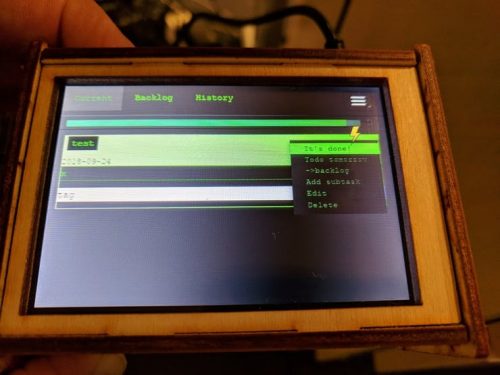
Michal Sporna‘s interactive to-do list that syncs with Google Tasks consists of a Raspberry Pi 3 Model B and a 3.5″ touchscreen encased in a laser-cut wooden housing, though this last element is optional.

Google Tasks Raspberry Pi to-do list Michael Sporna

“This is yet another web to-do app, but designed for a 3.5″ screen and Raspberry Pi,” says Michal in the introduction to his hackster.io tutorial. “The idea is for this device to serve as task tracking device, replacing a regular notebook and having to write stuff with pen.”

Michal explains that, while he enjoys writing down tasks on paper, editing items on paper isn’t that user-friendly. By replacing pen and paper with stylus and touchscreen, and making use Google Tasks, he improved the process for himself.

Google Tasks

The Google Tasks platform allows you to record and edit tasks, and to share them across multiple devices. The app integrates nicely with Gmail and Google Calendar, and its browser functionality allowed Michal to auto-run it on Chromium in Raspbian, so his tasks automatically display on the touchscreen. #NotSponsored

Google Tasks Raspberry Pi to-do list Michael Sporna

Build your own

Find full build details for the to-do list device on hackster.io! This is the first project Michal has shared on the website, and we’re looking forward to more makes from him in the future.

Now, where did that baby go?

The post Google Tasks to-do list, or anti-baby-distraction device appeared first on Raspberry Pi.

12 Oct 14:58

Twitter now counts all emojis equally toward character limits

by Bradly Shankar
Twitter

Twitter has announced that it has begun counting all emojis evenly toward the platform’s 280 character limit.

Previously, emoji modifiers for skin colour and gender would lead certain emojis to use more characters than standard emojis. This was the result of “differences in the way written text and emojis are encoded,” Twitter developer Andy Piper wrote in a blog post.

“This update marks significant progress for our service, and everyone can now benefit from the additional room to express themselves with more characters (or more emojis :wink:),” Piper added.

In other Twitter news, the company recently confirmed that Android and iOS app users will no longer be able to create Moments starting on October 23rd. Moments allow users to create a collection of tweets that are all related to the same topic. Going forward, Twitter says Moments will only be available on desktop, as the feature wasn’t “used as often” mobile.

Source: Twitter

The post Twitter now counts all emojis equally toward character limits appeared first on MobileSyrup.

12 Oct 14:56

Rogers lowers cost of Sportsnet Now and launches Now+ with more content

by Brad Bennett

Rogers Media’s online sports streaming platform Sportsnet Now is expanding with Sportsnet Now+, allowing fans to watch even more games on the go, according to the company.

Sportsnet Now launched in 2016 as a direct-to-consumer sports streaming service, but regional game blackouts and other restrictions kept some users from viewing all of the games on the platform.

Sportsnet Now+ aims to solve this problem by lifting some of the regional blackouts and therefore giving viewers access to more live sports content. Now+ offers players the over 500 NHL games that Rogers’ has access to, plus more matches from other sports as well.

The new service costs $27.99 CAD per month.

The regular Sportsnet Now package only gives viewers access to games on Sportsnet’s TV channels, but it includes regional channels like Sportsnet Pacific and Ontario. The price of the core packages has dropped from $24.99 to $19.99 now that Sportsnet Now+ has been released.

“The NHL is easily the most coveted content in Canada. When you combine our core content with the lifting of the NHL blackout restrictions and all of the other enhanced coverage, we believe SN NOW+ is far and away the best direct-to-consumer choice on the market for sports fans,” said Rogers Media’s senior vice president of sports and entertainment partnerships and content distribution, Bart Yabsley, in a Sportsnet press release.

Alongside the new level of NHL coverage, Sportsnet Now+ will also stream 200 Premier league matches, 300 Bundesliga league matches and 55 FA Cup matches for soccer fans. There will be some Premiership Rugby and Super Leauge Rugby games on the service as well.

Sports fans can sign up for either service at snnow.ca. It’s also worth mentioning that traditional TV subscribers with a Sportsnet package will get this service for free.

Sportsnet Now content can be viewed on a computer, iOS device, Android device, Apple TV, Xbox One, PlayStation 4 and Chromecast.

Source: Sportsnet

The post Rogers lowers cost of Sportsnet Now and launches Now+ with more content appeared first on MobileSyrup.

12 Oct 14:55

Pocket wants you to start listening to your reading list

by Jonathan Lamont
Pocket design refresh and listen

Read-it-later service Pocket is rolling out a fresh new look to users with an emphasis on listening.

The Mozilla-owned service enables users to save articles from across the web to read at their convenience. Or, with this newest update, listen to them.

Listening to articles has been part of Pocket since 2012. That was when the service first introduced its text-to-speech service. However, it didn’t do much with it after. Worse, the voice of Pocket was overly robotic.

For this refresh, Pocket integrated Amazon’s Polly text-to-speech service to deliver a more natural listening experience. While the voice is distinctly computerized, it’s still quite good.

Furthermore, the listen feature resembles a podcast now. Users can adjust the reading speed and tap buttons to quickly skip ahead.

Pocket listen and My List feature

Additionally, your reading list forms the listening queue. Pocket will start reading the next article in your list when it finishes the current story. However, it doesn’t support offline listening yet, but the feature is coming soon.

Amazon’s Polly isn’t the only Pocket integration with the e-commerce giant. Pocket is getting an Alexa skill too. Pocket users can now ask Alexa to get their articles, and Alexa will read them to you.

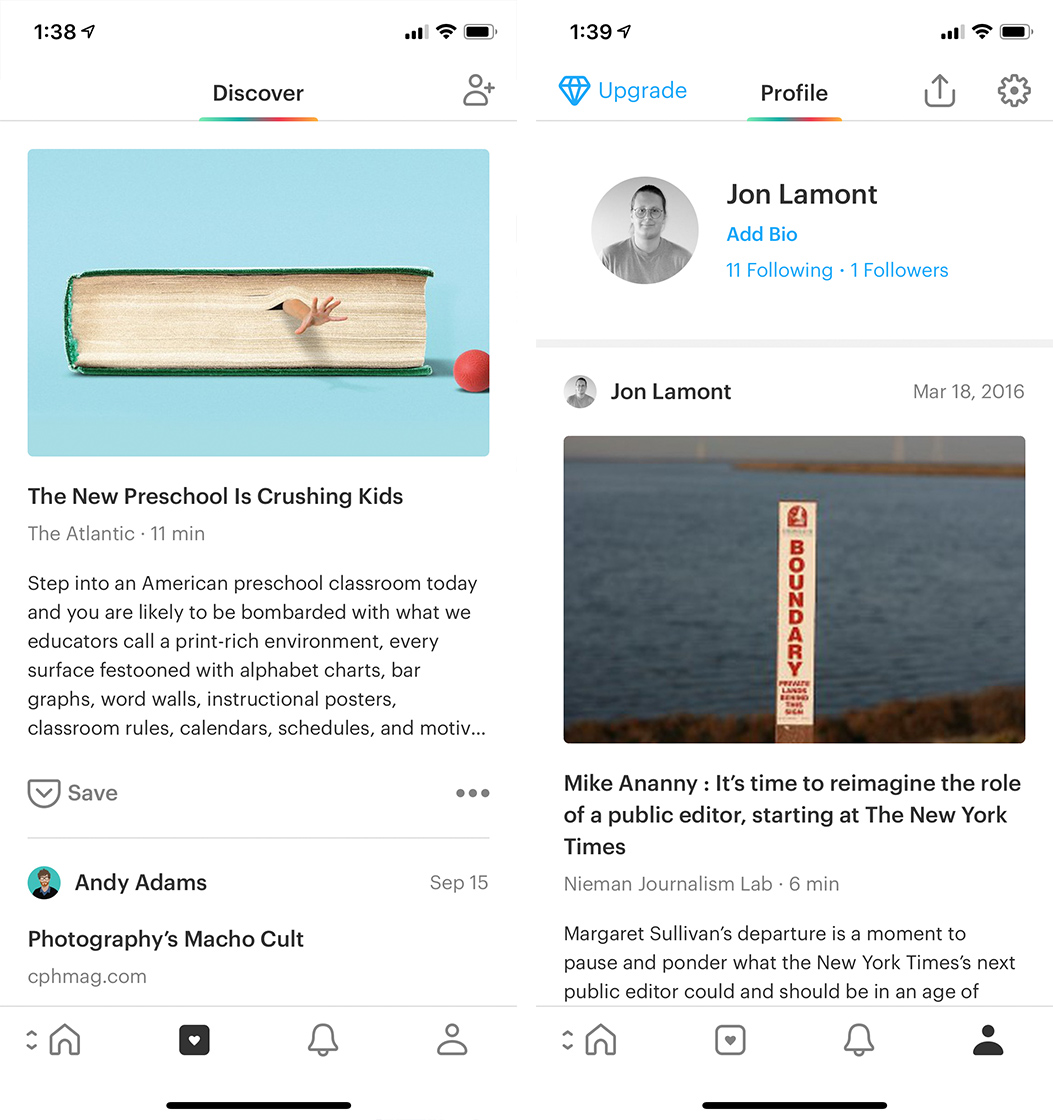
Pocket Discover and Profile

Along with the new features, the app is getting its first significant redesign since 2012. Both the iOS and Android apps are less dense, with larger labels and more whitespace.

While not all may like the new look, I for one think it looks more modern and fresh.

Overall, its a risky move for a read-it-later platform to put the focus on listening. This is a risky move, but one I think will pay off. People are busy, and having your phone read articles to you could be an effective way of working through a glut of reading.

Pocket is available for free on iOS and Android.

Source: The Verge

The post Pocket wants you to start listening to your reading list appeared first on MobileSyrup.

12 Oct 14:55

Decentralising the Internet

Jason Prado, New Socialist, Oct 28, 2018


Icon

This is a pretty good article overall but would have benefited a lot from some clear definitions at the start. So here we go: by centralized, we mean essentially that everybody uses the same server (ie., everybody uses the same URL, for example, facebook.com). By federated, we mean essentially that there is more than one server (for example, mastodon.social and scholars.coop, etc), people can choose which server to use, and they communicate with each other through the servers. A federation is still sort of centralized, because there can be many people per server, and a few large instances can dominate. By decentralized what we mean is one server per person, where the servers can talk to each other directly. And all of that said, any network will tend to centralize if it is scale free. Decentralization requires hard limits on size. And that's the part we keep getting wrong.

Web: [Direct Link] [This Post]
12 Oct 14:54

New Microsoft patent hints at folding Surface device, could be Andromeda

by Jonathan Lamont
Surface Pocket Edition

A newly discovered Microsoft patent shows off a detailed mechanism for a folding-display Surface device.

While the patent could hint at a potential Andromeda prototype, the illustrations are a departure from recent Andromeda patents.

The patent comes via Steven Lack on Twitter (@stevenwlack). He tweeted a link to the patent files.

Regardless, this new hinge patent is quite complex and detailed.

Things start off simply enough, with an overview of a tablet-like device with a flexible display and a hinge running through the middle. There’s also mention of a ‘deformable member’ in the middle that likely covers and protects the hinge.

Microsoft folding Surface patent

However, the patent explores what’s beneath that ‘deformable member,’ outlining the hinge assembly before diving into its inner workings.

The patent goes on to elaborate how the hinge can change length during rotation to avoid damaging the display.

Additionally, the patent notes that without the support of the ‘deformable member,’ the center of the display may feel “mushy.”

Microsoft hinge patent

While it’s important to note that patents don’t always make it to the real world, the level of detail here suggests this could be something Microsoft is building.

Considering the departure from what we’ve seen regarding what the Andromeda device could be, these patents could be for something else entirely. Maybe a new Surface tablet that’s super portable. Surface Go 2, anyone?

What do you think Microsoft is working on with these crazy hinges? Let us know down below.

Source: Steven Lack (@stevenwlack) Via: Windows Central

The post New Microsoft patent hints at folding Surface device, could be Andromeda appeared first on MobileSyrup.

12 Oct 14:54

Random encounter on the bus

by Liz

Random encounter on the bus yesterday on the way home. The bus was a little crowded, enough that I thought the bus driver might not let us on, but he started to lower the lift for me and to ask some folks to move back. As he did, an older woman with a walker came up and I fell back a bit to let her get on first (on the theory that I am sitting down, she is standing up, let her get settled). She nodded at me in a very definitive way as if to say, “CORRECT”.

But the bus driver even more correctly said, No, wheelchair first, and I realized that if the lady with the walker got on first I would not be able to go past her easily to get into the wheely spot because of the particular configuration of the bus, so I got on first (with some attempt at conciliating explanation ) As I settled into a seat and pulled my scooter into the little open slot next to it I realized I should save the empty seat next to me for her because she was very short and the other open seat near the front was the kind over the wheel well that is a few inches higher (too high for my feet to reach the ground if I sat there) So I stopped a middle school kid from sitting next to me. Walker lady saw this with a keen eye and sat with me triumphantly. Ada came to stand behind my scooter with her back against the upturned seats, messing with her phone.

We smiled at each other a lot. She then pointed out that my red flowers on my scooter matched her red walker and jacket. I agreed and said I like bright things. “This is from Guatemala (her bag), This is from Mexico (her brightly flowered huipil) This is from Peru (her woollen striped headband) And me, from Mexico” I admired her colorful ornamentation and said where I was intending to get off. She was going to play bingo at the church on Cortland. I told her about the free tai chi classes at the neighborhood center across the street.

During the bus ride every time someone new got on she quickly assessed the seating situation and decided where the new people should go. And she made it happen with very little English – and perfect confidence – in fact we both conspired (in a way hard to describe but which meant we had to both indicate with body language that people were welcome to go past us or that we could slightly move our machinery around and back again). Her bus-packing logic was impeccable, factoring in frailty, youth, and encumberment.

On this bus, I generally get off at 30th Street because it’s a more major stop than the one a bit closer to my house, and more people get on and off there. If I wait for the closer stop, then the bus fills up and I have to make my wheely way past many people’s toes, so it’s better to leave during the period of greater churn. I would have liked to explain my reasoning to the maestra of bus loading but instead wished her luck at bingo.

“Do you see that lady a lot?” Ada asked me once we were on the sidewalk. No — I just somehow loved her instantly because she was so cheery, and also because she was super into figuring out bus seating optimization. 😀 That’s my story…. It is uneventful – but I enjoyed the entire thing.

Also! That was a particularly decent bus driver to let us both on without fuss and I intend to compliment him through the 311 system.

12 Oct 14:52

After Kavanaugh

The Kavanaugh confirmation fight will be remembered as the moment when everything changed.

In 1856, a congressman from South Carolina clubbed a senator from Massachusetts into bloody unconsciousness on the floor of the Senate. This will be like that.

  • The underlying question before us is whether women are fully human. Scientific progress has made it possible for women to control their bodies; shall they?
  • Whenever Kavanaugh’s vote is decisive, we will remember that this stolen vote was cast by an intemperate partisan, a liar and a drunkard who, in his youth, attempted to rape an acquaintance.
  • This will not be forgotten, because it is impossible to forget.
  • If women are to enjoy their own sexuality, they must have access to birth control and, in case of failure, to abortion. We also require a social convention that permits women to prevent or to end an unwanted relationship even if they are physically or socially weaker.
  • The question does not readily admit to compromise. If preventing the conception of a potential child, or ending a pregnancy, is murder, then women are simply not as human as men.
  • This question has now been settled; people will love whom they choose. Nevertheless, the Republican Party now controls the Supreme Court and intends to restrict access to birth control, to abortion, and to the voting booth.
  • The damage to the Supreme Court will be swift, severe, and lasting. I doubt it will ever be repaired.
  • Everyone will be involved. After Roe falls, we’ll be arranging secret trips to abortion-friendly states. After Griswold falls, we’ll be smuggling contraceptives into restrictionist states. There will be roadblocks at the state line. Republicans will pass more stringent laws and impose Draconian enforcement. We will have an Underground Railroad and a fugitive abortionist act.
  • It’s still not going to be enough.
  • One Republican senator might have delayed or derailed the confirmation of a judge who is an intemperate partisan, a liar and a drunkard who, in his youth, attempted to rape an acquaintance. Not one had the courage.
  • A further consequence of this situation will likely be a formal schism of the Catholic Church. Many will blame Francis, but Paul VI’s Humanae Vitae leaves little room for maneuver. It might have been possible to temporize for another generation, but with everyone in the nation involved in the struggle, temporizing won’t work. Control of parochial schools is going to be a frightful mess.
  • American Protestants will rediscover sectarianism. Once, the dividing line was the empty cross in the nave; now, it will be the rainbow at the door.
  • Already, it’s very difficult to maintain amity across the divide. You can’t pal around with someone who thinks you or your friends are not quite human. I think I know three Republicans now. I’ve stayed friends with one (for some definition of “friend”) by cutting off all contact; for ten years we avoided religion and politics, and now we avoid everything. I didn’t know until today that the second held such opinions. The third is a professional political operative who is good at his job and can (so far) navigate these treacherous waters. Amateurs cannot.
  • In the background, we have America’s concentration camps for toddlers. We have police who murder black folk with impunity. We have a revived and invigorated anti-Semitism and white supremacism supported by a political party gone mad. We have a government that plunders our environment for the benefit of a few, a government in the service of foreign dictators.
  • Amity is nice, but decency is not optional. A judge who is an intemperate partisan, a liar and a drunkard is going to rule that women are not fully human; under the circumstances, many will choose to be decent, not amiable.
  • We will be lucky to live through the storm. Many will not.

Update: The state represented by Preston Brooks, who assailed Charles Sumner, was South Carolina, not Kentucky.

12 Oct 14:52

Apple acquires Dialog Semiconductor

by Rui Carmo

The original article title is a bit daft, really, because those goals are not wholly dependent on the Dialog acquisition. Their IP is an enabler, but it was being used before.

But it is notable that they are acquiring UK assets to further their vertical integration strategy, and it seems like a sound play.

12 Oct 14:50

A year of Scoble change

by Robert Scoble

In my 53 years I’ve seen a couple of house fires. One, at a neighbor’s house, woke me up in the middle of the night with banging on doors. Terror from waking up to a weird light in the bedroom, unnatural heat coming through the window, and the horrific sounds of lives being disrupted.

Years later I still remember the pile of trash in front of the destroyed house that kept growing over the first weeks after the fire. The burnt and soggy sofa. The sheetrock ripped out so firefighters could get to fire inside the walls. The carpet, stained with ash-heavy water. The clothes, some burned, others just discarded as too dirty and smoky to save. Later that disappeared and was replaced by trucks rebuilding.

My life, and that of my family, has felt a different kind of fire burn through it in a series of events that started about a year ago. Like with a physical fire, I’ve had the choice to look at the wreckage and loss, and have a cry, or look toward rebuilding. I find that looking backward toward my failures serves to keep humble, but looking forward is what gets me off the couch.

My gratitude list runs long.

My kids, for instance, were being punished for my success and travel and not in a way I ever could have seen a year ago and even if you pointed that out I just wouldn’t have been in the humble space to hear you. We lived in Half Moon Bay and just couldn’t see how to move, or why. Until the fire came through our lives (and not just #metoo, but several deaths of people close to us). A young friend just shared with us that he has colon cancer, which helped me write this post since it showed me more clearly, again, the fire that burned through our lives the last year, which burned away everything that really wasn’t important.

Now that we have moved to Campbell, I see just how much better the schools are here and how much happier my kids are that they have both of their parents pulling their weight at home and sober (in other words, me, since Maryam has always had to pull extra hard while I was off having fun with my career).

This month brings me to a year of sobriety and not just the kind of sobriety that means being away from alcohol (which is closer to four years in my life) or weed or other drugs (I had my last weed just about a year ago today) but an emotional sobriety that I had no chance of attaining before the past year. The ability to be honest with myself, and others, about the depression and mental illness I face, and the burnout that just wasn’t clear until many months had gone by away from the fun of travel, parties, dinners, and conferences.

A year ago, I could never have imagined I would have given a eulogy at my former partner’s funeral. I could never have imagined that I would be in the mental or career state to take a month away from everything and take my three kids on a 9,000-mile road trip around America if we had talked last October. I could never have imagined that my relationship with Maryam would be so much better. Funny, too, a year ago I could never have imagined volunteering at school, doing the dishes or laundry, or going to PTA meetings, amongst other things.

Today I have a choice, too. Do I look backward at the successes and failures of my first 53 years? My past is on Google and the Web, is my current thinking, and looking at it is just is going to focus my time left on this earth away from my new mission to serve others and will just lead to more mental illness or craziness. Best kept anyway to my rehab sponsor or my therapist.

So, now, Maryam and I are having new conversations as we head into our 17th year of marriage.

First, we got our financial lives in order and are watching things carefully, and now have good hands watching our small savings and it’s clear we don’t have close to enough to retire. Heck, putting food on our kids’ table will be difficult if both of us aren’t building income streams, even though she has an amazing career and is doing great work at VMWare in the conference team there (funny how roles switched, in a few weeks she’ll be the one traveling).

Needs are high. We have an 11 year old special needs child. Our nine year old will most likely need college in nine years. Not to mention all the unplanned expenses that go with parenting and, well, it’s just damn expensive living in Silicon Valley, even after downsizing our lifestyle as much as we can.

So that’s tugging in the back of my mind.

But I find freeing to dream about a world where I never make another dollar and one without personal needs, which has its own form of torment.

What is my mission? What gifts do I have to share? What skills can I use? How can I pay my life forward? How can I be helpful to others? In a decade what do I want to be doing? And, even better, how do I see my industry changing and where does offer opportunity?

For that I find I needed to go back to the basics. Go and do my homework. If you’ve been watching my lists on Twitter you see just what I’ve been doing: https://twitter.com/scobleizer/lists Over the past year I’ve built a series of new lists so I can see the industry in a new way. So I can listen and serve. But that’s just so I can see and brainstorm.

For the past few months I’ve been building a thesis for where the tech industry will see growth. In discussing my thesis with others it’s clear that a decade from now our organizations will have increased assistance via AI, increased augmentation via AR, increased virtualization, through a variety of technologies hitting the datacenter and cloud, and increased decentralization, via a variety of technologies including blockchain and 5G. Any dummy can see the same, but I see these changes as exponential, which means that soon they will hit all industries and cause lots of job changes. Already lots of people are predicting the same. One reason I wanted to drive around America is to get a sense of the kinds of jobs people do. We visited factories at Boeing. Ford. Louisville Slugger, and talked with many people.

It is clear that the next decade is going to see a huge amount of change to what it means to be human. Yesterday’s keynote at Magic Leap’s conference and last week’s Oculus Connect/Facebook event gives you just a taste of what’s coming. We just bought a June Oven, that shows you even more about how human life is changing, more on that when I get some meals under my belt to share here.

Anyway, I’m rambling. Now it’s time to really do my homework, which will lead into a new business and new ideas over the next few months, about what I am seeing as the post-digital-transformation enterprise: one that’s seeing great increases in decentralization, assistance, augmentation, and virtualization.

In other words, the next year will be hopefully less about change than the last one, and more about learning and putting in place a new mission.

This is a much more fun phase of life. More like designing a new house after the old one burned down. Looking forward to having new conversations on Twitter at https://twitter.com/scobleizer or Facebook at https://www.facebook.com/RobertScoble

12 Oct 14:50

Ontario charging $5 for legal pot delivery, will use Canada Post as courier

by Brad Bennett

Ontario’s online cannabis retailer, the Ontario Cannabis Store (OCS), has confirmed additional details surrounding how much it will cost to ship the plant when it becomes legal.

On October 17th recreational marijuana will be legal in Canada and the provinces are getting ready for the first wave of legal cannabis sales.

Once the people of Ontario start ordering cannabis online, it will be delivered via Canada Post in around one to three days for a flat, province-wide cost of $5, according to the CBC.

The packages will be plainly marked, childproof and sent directly from licensed growers. If you miss your delivery, you’ll need to pick it up at a nearby Canada Post with accompanying ID to prove your age.

The OCS will sell dried herb, pre-rolled joints and various marijuana accessories.

Source: The CBC

The post Ontario charging $5 for legal pot delivery, will use Canada Post as courier appeared first on MobileSyrup.

12 Oct 14:50

Apple says iOS 12 has reached 50 percent adoption

by Bradly Shankar
iOS 12

Apple has announced that iOS 12 has hit 50 percent adoption rate 23 days after rolling out on September 17th.

For comparison, last year’s iOS 11, which rolled out on September 19th, didn’t surpass 50 percent adoption until November 6th, when 48 days had passed.

In a post on its developer portal, Apple says 39 percent of devices are still running iOS 11 and 11 percent are running an even older OS.

Further, Apple says iOS 12 adoption has reached 53 percent among devices released within the past four years. Additionally, forty percent of the devices released within the past four years are running iOS 11, while seven percent are running older versions of iOS.

iOS 12 brings a number of features to Apple devices, including the cartoon Memoji faces, Screentime digital wellbeing tool and the 32-person Group Facetime. A full list of iOS 12 features and improvements can be found on Apple’s website.

Source: Apple

The post Apple says iOS 12 has reached 50 percent adoption appeared first on MobileSyrup.

12 Oct 14:50

Rogers calling ex-customers to offer 10GB plans for $70

by Brad Bennett

A Freedom Mobile subscriber posted on RedFlagDeals that Rogers reached out to them and offered them a 10GB plan for $70 plus $170 in bill credits before taxes.

The subscriber was with Rogers until they recently switched to Freedom. This plan is part of Rogers’s ‘Win Back’ offers, so it will be difficult for regular people to get the deal.

It does confirm that Rogers is willing to offer this deal to some customers, so don’t be afraid to play hardball and try to ask for it. The Freedom subscriber was contacted using the number 1-855-293-3747 so other people trying to find the right deal can try it.

More than one person is reportedly being offered this deal, but some people are claiming that this is worse than last month’s Rogers Win Back offer. Last month, it was reported on RedFlagDeals that Rogers was offering $80 for 10GB with a $500 bill credit and a waived activation fee. Maybe there will be a better deal down the line, but if you’re paying more than $100 for your data, try to hop on this.

Source: Red Flag Deals

The post Rogers calling ex-customers to offer 10GB plans for $70 appeared first on MobileSyrup.

12 Oct 14:32

Failed Provincial Experiment: Faster Highway Speed Limits Double Road Deaths

by Sandy James Planner
mkalus shared this story from Price Tags:
I'd really be curious how close the causation here is. Mostly because since 2014 people def. haven't put their phones down. My hunch is that it's a combination of increased speed limits and distracted driving.

There’s absolutely no way to sugar coat this: the previous Liberal provincial government’s 2014 decision to increase speed limits on some major rural highways has resulted in a 118 per cent increase of fatalities on those roads.

A comprehensive study published in Sustainability was co-authored by physicians at Vancouver General  and road safety engineers at the University of British Columbia (Okanagan). The study confirms that  “fatalities, injuries, crashes and insurance claims on some B.C. roads are linked to a 2014 decision by the former provincial government to raise speed limits on the rural highways” as reported in the Vancouver Sun.

The study surmises that “communities across Canada, especially those with slippery winter roads or those where roads traverse mountainous terrain, “should learn from this experience and resist pressure from pro speed advocates to raise speed limits without due consideration to road safety.”

Not only did the higher speed limits result in a 43 per cent increase in vehicular insurance claims, there was also a 30 per cent increase in claims for crash caused injuries. Looking at fatalities, injuries and total crashes, the researchers were frustrated that their early data indicating that speed kills was not acted upon.

Gordon Lovegrove, a leader in the study and an associate professor at UBC Okanagan stated  “Waiting three years in the face of our early findings borders on excess. I applaud the ministry’s decision to consider all options but would appreciate if a more collaborative approach were taken, including their B.C. (academic) colleagues, as opposed to taking the additional time and valuable resources to repeat our analysis that has been published in an independent peer-reviewed journal.”

When the increased highway speed was implemented  there was push back from the public health community (including Medical Health Officer Dr. Perry Kendall’s excellent 2016 report Where the Rubber Meets the Road) that was largely ignored by the previous provincial  government. Dr. Kendall’s ground breaking report points at speeding as a major cause of death, and famously recommended lowering speed limits across the Province.

The 2014  speed limit increases made some sections in the Okanagan the fastest in Canada with posted speeds of 120 kilometres per hour. No response yet from the Province on how they will address the carnage and injuries. In a Province with a provincially supported motor vehicle insurance, universal health care, and a quest for sustainability, lowering road speeds and enforcing them just makes sense. A poll by Mario Canseco indicated that 70 per cent of British Columbians are supportive of a camera enforcement system for road speed. It’s time to tie in vehicular movement  with road safety, focusing on safe arrival versus speed.

Images: CBC and CTV

12 Oct 14:31

Millennial Matters – Paul Hillsdon

by Gordon Price

I’ve been fortunate to meet a lot of young people in my jobs as Vancouver city councillor and SFU City Program Director.   You know almost immediately that some are ones to watch.  Someday they’ll be thinking of running for office in their city.  Someday they’ll be running their city.

Like Paul Hillsdon.  He’s running for council in Surrey – one of those Millennials who are jumping over the Gen Xers, aiming for an empty seat.  He’s 28, born and raised in Surrey.   That means he was born four years after Expo 86.  After Expo.  And this is his second run for city council.  Take that, Boomers.

The Expo Generation has come of age, and they reflect the demographic and immigration realities of their generation, more of them with roots in the global south and Asia than Europe.  Paul is half Japanese (his grandpa and family were interned in Greenwood), the only Asian guy in his class with one other South Asian guy. “We were bananas and coconuts, and felt the need to westernize – but still with the sense of being identified with the underdog.”   Today, his husband is South Asian and a Muslim.  He’s running with a party, Surrey First, whose leader is South Asian.

As a Millennial, he reflects on what he sees as his generational values: “Collaboration, getting along with others, seeing other’s perspective.  Relying on evidence rather than authority.”   That’s not surprising for a generation raised in a culture where there are so many other perspectives and so many other kinds of people to get along with.  It doesn’t always work out for the best; social civility depends on culture, and the culture depends on good leadership.

Paul also typifies the meme of his time: thinking global, acting local.  Big issues like global sustainability and climate change (and pipelines) matter a lot to them.  But the biggest one affecting his generation is, of course, local housing opportunities.

Paul, as someone who has actually read policy papers and produced some of his own, is an advocate for density and transportation.  He has to be; it’s his job as South of Fraser Rapid Transit Project Planner, working on LRT as a planner for TransLink. (He’s taking unpaid leave for the duration of the campaign. )  He’s not opposed to SkyTrain in Surrey, but he puts in the qualifications immediately (depends on the costs and benefits) and then moves on to the fun facts.  “Seventy-six percent of those travelling within South of Fraser stay South of Fraser.”  The real priority for transit is not connecting Surrey to Vancouver but connecting Surrey to Surrey.

Paul’s perspective: “We are united by the issues of infrastructure.”