Shared posts

19 Nov 01:35

Second-gen Google Glass Enterprise Edition gains FCC certification

by Dean Daley

Google looks to be working on another Google Glass wearable.

The U.S. Federal Communications Commission (FCC) recently approved a rough sketch of an upcoming smart glasses, spotted by 9to5Google

The FCC documents don’t reveal very much about the ‘Glass Enterprise Edition 2’ device, though it’s clear that this will be a new Google Glass Enterprise Edition, as it indicates on the document.

The image shows that the second generation Google Glass will feature a power button on the back and the same hinge mechanism that allows the wearable to fold. Additionally, Google will also put the Glass logo on the side.

9to5 reported  that a source told the publication that the glasses will feature improved battery life and performance, alongside new unannounced functionalities.

The source reportedly told 9to5Google that Google wants to launch the second generation enterprise edition sometime in 2019.

Source: FCC Via: 9to5Google

The post Second-gen Google Glass Enterprise Edition gains FCC certification appeared first on MobileSyrup.

19 Nov 01:34

OmniOutliner 5.4 Adds Dark Mode Support

by Brent Simmons
mkalus shared this story from The Omni Group.

The latest version of OmniOutliner for Mac fixes a couple of bugs and adds Mojave Dark Mode support. Read the release notes for the full scoop.

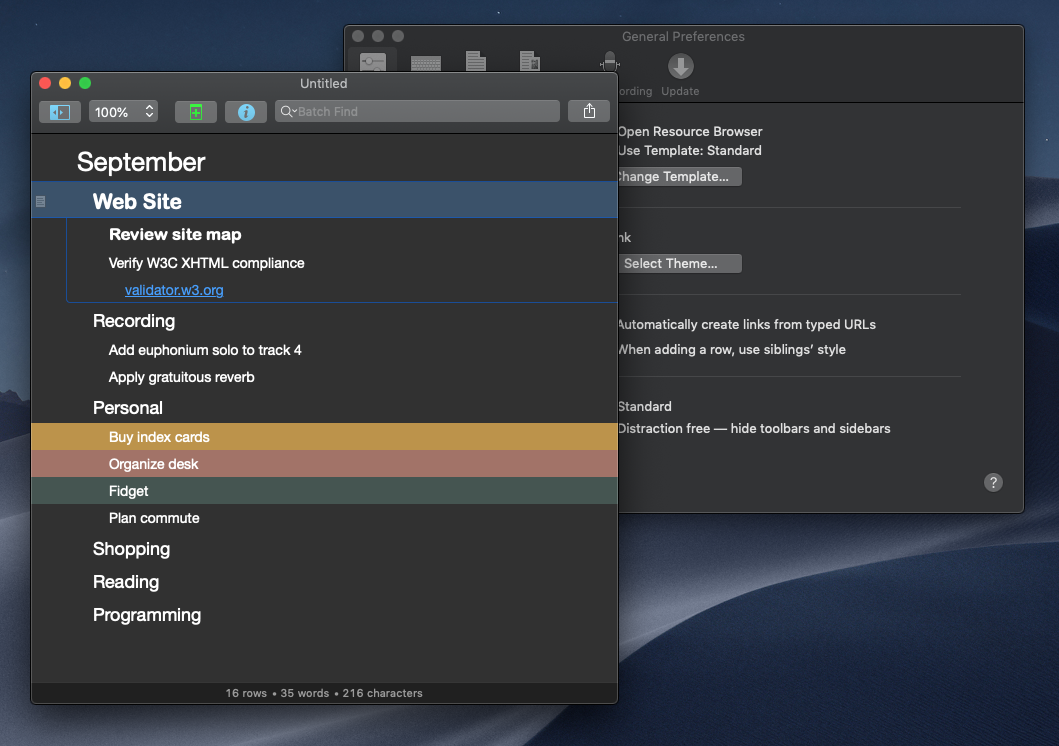
We love Dark Mode, and like to show it off in our apps, so we can’t resist a delicious screenshot!

Screenshot of OmniOutline running in Dark Mode, showing a dark document window and a dark preferences window

19 Nov 01:34

Pocket Casts 7: A Host of Improvements Make the App Feel Brand New

by Ryan Christoffel

It's been over two years since the last major version of Pocket Casts debuted. A lot has happened in the podcasting world since then, including Pocket Casts itself being acquired by a consortium of radio stations and podcast companies. The app has also faced strong competition from alternatives like Overcast and Castro. Pocket Casts remains one of the best third-party podcast clients on iOS, but it has started to show its age of late. Updates to the app over the last year have been fairly minor and unimpressive. In hindsight though, it's easy to understand why: the app's development team has been plugging away on a major new update that's officially launched today.

Pocket Casts 7 makes the podcast client feel modern again. It introduces a new design alongside important features like Siri shortcuts and AirPlay 2 support, Up Next syncing, episode search, Listening History, and a lot more. If you haven't given the app a try in a while, now is definitely the time to do so.

Design

The changes in Pocket Casts 7 start with a new design, which I'm happy to say introduces a tab bar. I've always found that Pocket Casts felt too foreign on iOS for my preferences, which is understandable since the app is cross-platform and exists on Android, Mac, and even Windows. The addition of a tab bar in version 7 though, combined with some changes to the Now Playing screen, make the app feel more iOS-friendly than it's been in a long time.

Podcasts and Discover now have their own dedicated tabs, with Filters and Profile rounding out the four navigation options. While much of the content found in these tabs remains the same as before, some visual tweaks make the whole app feel fresh and modern. Controls are easier to find, too, having been relocated to make them more prominent to users.

The Now Playing screen is one of my favorite design improvements, as it's been simplified to a single page. Buttons for show notes, playback effects, AirPlay, and more are readily available, and as you scroll down the page you'll see chapters if they're available, as well as your Up Next queue. The design resembles that of Apple Podcasts, and just like Apple's client you can choose to hide or display chapters and Up Next as you'd like. I understand some users struggle discovering additional content that lies further down on a screen, but for my personal tastes, I find Pocket Casts' new approach a lot more desirable than its old paginated design.

Pocket Casts' light and dark themes have been updated and refined, and they look great. One exciting addition in the theme department is a new Extra Dark option that looks amazing on OLED iPhones. I think it's one of the best true black themes available on the App Store.

New Features

The design improvements in Pocket Casts 7 are great, but the app certainly brings a lot of weighty substance to accompany its style flair.

Siri shortcuts. Pocket Casts has added shortcuts for practically anything you could want in your podcast app. You can have shortcuts to play your Up Next queue, or play a specific filter, or an individual podcast; there are also options for next and previous chapter, resume and pause, setting a sleep timer, and even playing a random suggested show.

AirPlay 2. HomePod owners and anyone else who uses AirPlay a lot will be glad to hear that Pocket Casts 7 brings full support for AirPlay 2, meaning the old, annoying two-second delays are a thing of the past.

Up Next syncing. One of Pocket Casts' greatest strengths is that it lives on virtually every platform – the web, iPhone, iPad, Mac, Android, and Windows. Now your Up Next queue in the app syncs so that no matter what device you're listening on, you'll have the exact right lineup of shows waiting for you.

Episode search. Every show now features its own search option so you can filter down to just the exact episode(s) you're looking for. Based on my testing, episode search extends not just to episode titles, but show notes as well. I'm not sure how accurate it is, but this looks about right for ATP.

Play without subscribing. No longer do you have to subscribe to a show before you can start playing it. Pocket Casts 7 adds play buttons to every episode of every show in its database, so after a quick search to find what you're looking for, all you need to do is tap play to start listening.

Listening History. I may be the only person who appreciates it, but I really like how Apple Podcasts stores a running log of episodes you've listened to recently at the bottom of the screen. For me it's a helpful way to go back and easily visit links found in show notes after an episode's been completed. Pocket Casts now offers a similar feature in the form of Listening History, which can be accessed from the new Profile tab.

Streaming playback effects. Previously, playback effects like Trim Silence and Volume Boost could only be used with episodes that had been fully downloaded beforehand. As of today, however, you can use those effects when streaming a podcast too.

Improved Discovery. The Discovery screen has gotten a big overhaul, and it looks great. Its design reminds me a lot of the App Store and other Apple media apps, featuring curated collections, trending shows, categories, and more.

Apple Watch app improvements. The already-solid Pocket Casts Watch app has been improved to offer volume control using the Digital Crown, and you can also adjust playback effects from your wrist now.


If there was any concern about Pocket Casts' future following its acquisition earlier this year, that fear can be put to rest for a while. Pocket Casts 7 is a fantastic update, bringing a modern design that's both beautiful and functional, along with a huge number of valuable features that make the app more formidable than ever before. Though I'm not crazy about how quiet the app's update cycle has been lately, today's release easily makes up for that and sets Pocket Casts on a strong trajectory for the future.

Pocket Casts 7 is a free update for all existing customers. For those new to the app, it's a one-time $3.99 payment.


Support MacStories Directly

Club MacStories offers exclusive access to extra MacStories content, delivered every week; it's also a way to support us directly.

Club MacStories will help you discover the best apps for your devices and get the most out of your iPhone, iPad, and Mac. Plus, it's made in Italy.

Join Now
19 Nov 01:31

Apple Outgrew Unit Sales

by Neil Cybart

In 2014, Apple management surprised many by announcing they were not going to disclose Apple Watch unit sales once the product went on sale the following year. The decision was interpreted by many outsiders as Apple not thinking too highly of Watch’s prospects. As it turned out, nothing could have been further from the truth. Apple’s Watch disclosure decision ended up foreshadowing management’s recent announcement that it will no longer disclose iPhone, iPad, or Mac unit sales. While a number of factors are behind Apple’s decision, the simplest explanation for the disclosure change is that Apple outgrew unit sales.

Disclosure Changes

Apple announced four financial disclosure changes for the new fiscal year (2019):

  1. Unit sales data for iPhone, iPad, and Mac will no longer be provided.

  2. Gross margin data will begin to be broken out by services and products (i.e. hardware).

  3. Revenue corresponding to the amortization of the deferred value of bundle services (Maps, Siri, and free iCloud) will shift from products to services. The same reclassification will apply to costs associated with delivering the bundled services. The impact from these changes will amount to less than 1% of Apple’s overall revenue.

  4. The “Other Products” category will be renamed “Wearables, home, and accessories” to reflect the category’s primary revenue drivers (Apple Watch, AirPods, Apple TV, and HomePod).

Not surprisingly, most of the attention flowed to the first item. The thought of Apple no longer disclosing unit sales surprised most people and some went so far as to say Apple wants to hide something really bad in the coming quarters. Others acknowledged Apple made the right decision to move beyond unit sales, although it wasn’t a great development in terms of public company disclosure.

The Unit Sales Problem

Apple management’s decision to no longer disclose unit sales makes plenty of sense. In recent years, it was becoming increasingly clear that unit sales weren’t as useful of a metric for analyzing Apple’s business now as it had been in the past. The primary problem found with unit sales was how the data provided a limited look inside the Apple machine.

Consider the following items:

Unit sales became a crutch for financial analysts. The quarterly numbers were telling us less about Apple’s business and were instead providing a false sense of security to outsiders. As it turned out, unit sales were painting a less attractive picture of Apple’s business fundamentals.

The primary reason unit sales data lost much of its value is Apple’s significant growth over the years. With an iPhone installed base of more than 750M people, quarterly iPhone unit sales were providing less information about the iPhone business. Unit sales went from a measure of the market’s reception to iPhone to a financial data point more likely to be misinterpreted than anything else. The same can be said about the iPad and its installed base of 240M people. Years of unit sales declines gave many the impression that iPad was a dead-end. In reality, iPad fundamentals have been improving for years. Unit sales data was masking the improvement.

The one item that for which unit sales continued to prove valuable was deriving average selling prices. However, given the growing impact the gray market is having on Apple’s various product categories, and wider product price ranges, even ASP data has started to lose value in analyzing business fundamentals.

Revenue and Gross Margin

Analysts are making a big mistake in claiming Apple’s decision to move away from unit sales means management wants to be more like a services company. Claiming Apple is a services company in 2018 is no different than claiming Apple was a hardware company ten years ago. Both are incorrect.

Apple is a design company focused on developing tools for people. These tools allow people to get more out of technology without having technology take over their lives. This mission leads to a simple, but important, realization: Apple has to continuously develop new tools that people want. A question raised by such a mission is how best to measure Apple success and failure.

Management is painting a new long-term blueprint for how it wants Wall Street to judge Apple: revenue and margins. By having attention flow not just to revenue but also to gross margins, Apple ends up adding an interesting twist to the financial disclosure debate.

Revenue has been one of the most consistent metrics for determining how Apple is doing in the marketplace. Exhibit 1 depicts Apple revenue over the past eight years. Despite years of unit sales volatility, Apple’s revenue trends have been much smoother. The only hiccup in Apple revenue followed a surge in iPhone revenue in 2014 associated with the iPhone launching at China Mobile.

Exhibit 1: Apple Revenue (TTM)

Screen Shot 2018-11-14 at 2.46.26 PM.png

Management will continue to disclose iPhone, iPad, and Mac revenue going forward. It’s difficult to see Apple not eventually disclosing Apple Watch revenue, or at least wearables revenue, as sales continue to grow.

However, revenue data by itself is unable to tell the full story. Management could juice near-term revenue by running with lower prices and margins in an attempt to grab market share. Such a move may boost near-term revenue at the expense of problems down the road. Vice-versa, Apple could be generating additional revenue by milking existing customers with excessively high prices and margins. The strategy contains various long-term risks when thinking about the health of the Apple ecosystem.

This is where gross margins enter the picture.

Gross margin data allows outsiders to dive deeper into Apple revenue. Strong revenue growth combined with steady margins tell us that Apple isn’t chasing market share with unsustainable pricing. Steady gross margins, despite higher-priced products, tell us that Apple isn’t milking existing users of profit, but is instead running with higher prices to reflect additional technology. Gross margins add much-needed context to Apple revenue.

Historically, Apple has disclosed one overall gross margin figure for the entire business. Given the lack of disclosure detail, we were only able to reach a few general takeaways about Apple’s gross margins.

  1. Given how Apple’s overall gross margins trend between 37% and 39% and iPhone represents such a large portion of the revenue, it’s fair to assume iPhone margins are somewhere around 40%.

  2. Based on management commentary, Apple’s Services business has gross margins that exceed the company’s overall margins. This tells us that Services gross margin exceeds 40%. My estimate pegs Services gross margin in the mid-50s.

  3. Based on management commentary, Apple Watch gross margins were lower than the company’s overall margins. This tells us Watch margins are somewhere around 25% to 35%. It is a fair assumption that iPad and Mac have a similar margin profile.

As shown in Exhibit 2, for the past four years, gross margins have trended within a narrow 200 basis point range. This hasn’t exactly told us a whole lot about the different variables driving gross margins. Based on Apple’s new margin disclosure, management will break out gross margins by hardware and services. Accordingly, we will be able to see whether or not Apple has been running with higher product margins to boost profits or merely to reflect higher component costs. (My suspicion is it’s the latter.) We will also get our first look at Apple’s Services margins which will help decode the various Services revenue growth drivers. In summary, providing more granular gross margin data is a big step forward from a financial disclosure perspective. While it may seem like an exaggeration, trading unit sales data for more granular gross margin data could prove to be more beneficial for analyzing Apple’s business fundamentals.

Exhibit 2: Apple Gross Margin (TTM)

Screen Shot 2018-11-14 at 2.55.09 PM.png

What About User Growth?

One school of thought regarding Apple’s unit sales disclosure change is that management is gradually moving towards providing completely new metrics such as the number of users in the Apple ecosystem. Apple’s success would then be measured by tracking the total number of users and management’s ability to monetize those users. One way of doing this would be to take Apple revenue and divide the total by the number of users.

Presumably, rising revenue per user would be viewed as a good thing, while a declining revenue per user metric would be viewed negatively. However, there are a few issues to consider.

  1. It’s not sustainable. Unless Apple changes its pricing philosophy, the company will eventually begin to hit a ceiling when it comes to new user growth. Accordingly, why would Apple management elevate an unsustainable metric, especially since the company is moving away from unit sales given its unsustainable nature.

  2. Questions around usefulness. It’s not entirely clear how useful revenue per user actually would prove to be for analyzing Apple. Unless Apple breaks down revenue per user by hardware and services, the overall average won’t tell us much about the various moving parts.

  3. Bias towards services over hardware. By focusing on revenue per user, there is an inherent bias to elevate Services revenue given its more predictable and steady nature.

It’s All About Narratives

The decision to elevate revenue and margins while moving past unit sales is Apple management’s latest attempt to cement a new long-term narrative for the company on Wall Street.

People love great stories, and Wall Street is all about narratives. A strong narrative allows a management team to navigate rough waters while a weak narrative may result in depressed valuation multiples. Accordingly, Apple’s inability to find a sustainable narrative has been a thorn in management’s side for years.

Apple’s narrative problem was relatively straightforward: The key variables management focused on in earnings releases and conference calls weren’t sustainable. By placing an emphasis on unit sales, the inevitable slowdown in unit sales growth for its largest product categories posed a problem for Apple.

Forcing Wall Street to move beyond unit sales and focus on revenue and gross margins isn’t about driving home a Services narrative for AAPL shares. Instead, it’s a big step in elevating a capital allocation narrative. Compelling tools will lead to strong revenue trends and margins, which support attractive free cash flow and consequently more cash for buyback and cash dividends. The opposite is true as well with weaker product sales leading to a reduction in cash flow and less cash for share repurchases and cash dividends.

At the heart of this narrative is management's unique philosophy regarding how shareholder capital is used to generate future cash flows. Apple doesn't develop products to drive revenue. Instead, many ideas are passed over to focus on a few really great ideas. A narrative involving Apple's capital strategy rather than any one story based on a particular product like iPhone or Apple Watch will end up doing a better job of describing the company's design story. More importantly, a capital allocation narrative will be able to grow with Apple as the company evolves over time.

Receive my analysis and perspective on Apple throughout the week via exclusive daily updates (2-3 stories per day, 10-12 stories per week). Available to Above Avalon members. To sign up and for more information on membership, visit the membership page.

19 Nov 01:31

Sure, Third Party Service, I Will Give You Permission to Delete My Calendar (?)

Alan Levine, CogDogBlog, Nov 14, 2018
Icon

Alan Levine was not happy with my selection of a calendar service for E-Learning 3.0. "I will also be vigilant and asking you, as well, to give some thought about the permissions you just give. It’s not that I think they are doing anything evil; I want transparency about their needs for these permissions." Makes sense. And also, as he says: "You can say 'no'." (As to: why did I use it? It was free, and I couldn't find any other service that did the same thing, and I wanted that thing.)

Web: [Direct Link] [This Post]
19 Nov 01:30

Vancouver council approves launching city-wide plan

mkalus shared this story .

The City of Vancouver looks set to embark on its first city-wide plan in nearly a century, which could result in the mass rezoning of large parts of the municipality, following extensive public consultation.

City council unanimously passed a motion Wednesday to begin "scoping ... an expedited work plan and timeline" ... to "determine what kind of city they want Vancouver to become and how best to tackle key city-wide challenges like housing affordability, densification to accommodate growth and demographic changes."

"This is an opportunity to look quite broadly and quite deeply into the city's future," said Gil Kelley, the city's chief planner, as he took questions from councillors.

"I think this exercise is honestly more than a review of existing bylaws and plans — it's an opportunity for Vancouver to think bigger than generations, perhaps." 

The motion was put forward by Adriane Carr, who at the end of the multi-hour debate was effusive in her praise.

"This new council is making our mark. This is going to be a new era that is very different in terms of engagement. People are yearning for that. I think this is a wonderful way for us to start our term in office," she said.

Staff will report back to council on a timeline for a city-wide plan before the end of March 2019, along with several details for the process, including how it will impact rezoning applications currently underway.  

The city's zoning plan as of mid-2016. The majority of Vancouver was reserved exclusively for single-family homes.

Neighbourhood vs. city-wide

Several political parties advocated a city-wide plan during October's municipal elections, arguing it was necessary given the city's affordability crisis.

While most municipalities in Metro Vancouver have an official community plan, updated every decade or so, Vancouver has opted to conduct plans for individual neighbourhoods, one at a time, to determine rules around zoning and transportation.

But Kennedy Stewart said a city-wide plan could unite people from throughout the municipality, instead of creating intense focus on — and potential division of — individual neighbourhoods.

"This is an opportunity to have people perhaps alienated a bit from what's happening in the city to be drawn into thinking about the future, and it's a great initiative," he said.

"This is big thing we're voting for. What we're voting for is a plan that will set the course for Vancouver in the coming decades."

The motion asks staff to prepare for a "robust and collaborative public engagement process that could include neighbourhood planning bodies" as part of the process, something all councillors agreed was key.

"This should be a Vancouver for everyone, and we'll achieve that, if we achieve the greater goal of listening to people," said Coun. Melissa De Genova.  

Duplex decision reversed?

Council could also re-examine the decision, made by the outgoing Vision Vancouver government a month before the election, to allow duplexes throughout the city.

NPA Coun. Colleen Hardwick, who brought the motion, argued the blanket rezoning wasn't done with proper consultation and predicted many single-family neighbourhoods would embrace density — within the context of a city-wide plan.

"Throughout the campaign, I went out and I spoke to communities, neighbourhoods, residents' associations across the city and nowhere did I meet any kind of pushback where people said, 'no, not in my backyard,' despite the representations out there," she said.

"Everyone understands that we need to build density, and I firmly believe that we can encourage density, again, that's going to be in keeping with the individual characteristics of neighbourhoods."

Council is expected to vote on that motion either Wednesday evening or Thursday. 

19 Nov 01:30

Brexit deal: key points from the draft withdrawal agreement | Politics

mkalus shared this story from The Guardian.

The 585-page draft withdrawal agreement negotiated between the European Union and the United Kingdom contains several highly contentious points that supporters of Brexit in particular will find hard to stomach. Here are some of the points that may cause problems for the prime minister, Theresa May, in parliament:

Irish border backstop

The draft Brexit agreement says both parties will “use their best endeavours” to have a future trade agreement concluded six months before the end of the transition period in December 2020, but that if this is not the case the EU and the UK could “jointly extend the transition period” for an unspecified period.

Otherwise the backstop solution for Ireland and Northern Ireland aimed at preventing a hard border would come into force. The backstop, consisting of “a single customs territory between the Union and the United Kingdom”, will apply from the end of the transition period “unless and until ... a subsequent agreement becomes applicable”.

The single customs territory would cover all goods except fishery products, the agreement says, and will “include the corresponding level playing field commitments and appropriate enforcement mechanisms to ensure fair competition between the EU27 and the UK”.

There would necessarily be extra non-customs checks on some types of goods passing between Northern Ireland and the rest of the UK, which will not please the Democratic Unionist party who have consistently opposed any kind of differential treatment for Northern Ireland.

On exiting the backstop, the agreement says that if “either side considers the the backstop is no longer necessary, it can notify the other” setting out its reasons. A joint committee must then meet within six months, and both sides must agree jointly to end the backstop.

This part of the agreement would be difficult for Brexiters to swallow. They have consistently argued that Britain must be able to exit any all-UK customs union as and when it wants to be able to pursue free-trade deals around the world.

Level playing field

The agreement says that under the backstop arrangement the UK must observe “level playing field” commitments on competition and state aid, as well as employment and environment standards and tax. These measures are intended to ensure that UK businesses are not able to undercut EU industry.

Brussels has demanded “dynamic alignment”, which would oblige the UK parliament to simply cut and paste EU regulations as they are issued after Brexit. Britain must also transfer three EU tax directives into law – on the exchange of tax information, reporting on investment firms and the EU’s code of conduct on taxation.

“Non-regression clauses” will also prevent the UK from bringing in lower standards on social, environmental and labour regulations such as working hours.

Many of these requirements would also be anathema to Conservative Brexiters, for whom leaving the EU represented an opportunity to head towards a low-tax, light-regulation economy such as that seen in Singapore.

Future trade agreement

This issue may be even more depressing for Brexiters. The future UK-EU relationship, which both sides have said requires much more work but aims to achieve a close relationship on services (including financial services) and investment as well as sectoral cooperation in, for example, transport, would “build on the single customs territory provided for in the withdrawal agreement”.

Fisheries

The EU has repeatedly said that it would only allow British seafood exporters tariff- and quota-free access to EU markets in exchange for a reciprocal agreement that EU fishing fleets can continue to operate in British waters.

This potentially explosive issue appears to have been kicked down the road: the withdrawal agreement essentially says only that the EU would apply tariffs on fish until a separate agreement was struck on access to EU fishing in UK waters.

Governance

After the transition period ends, the final withdrawal agreement would be policed by a structure based on a joint committee taking decisions by mutual consent and whose verdicts would be binding.

A five-member arbitration panel would be convened to manage disputes. Any issue relating to EU law, however, cannot be decided by the arbitration panel but must go before the European court of justice. That, too, would annoy Brexiters wanting to “take back control of our laws”.

Financial Markets

In another potentially controversial clause, the draft agreement gives London’s financial centre only a basic level of access to the EU’s markets similar to that enjoyed by US and Japanese firms. It would be based on the EU’s existing system of financial market access known as equivalence – a watered-down relationship that Brussels has said all along was the best arrangement that Britain can expect.

19 Nov 01:29

Western lifestyle may cause blood pressure to rise with age | Society

mkalus shared this story from The Guardian.

A western lifestyle might be the reason blood pressure tends to rise with age, according to a study of remote tribal communities.

Hypertension is a key risk factor for cardiovascular disease, and in many developed countries, including the UK, the likelihood of developing increases with age. More than a quarter of adults in England have high blood pressure, with recent figures showing the proportion rises to 58% among those aged 65-74.

A study of remote communities in the Venezuelan rainforest has backed the idea that hypertension is not an inherent part of ageing, but a result of longer exposure to risks arising from lifestyle, such as high levels of salt in the diet, lack of exercise and heavy drinking.

Dr Noel Mueller, an assistant professor at Johns Hopkins University, who led the research, said: “The idea that blood pressure rises with age as part of a natural phenomenon is increasingly being dispelled through evidence, including our findings here, which show that in a population that is largely free of exposure to western influences, there is no age-related rise in blood pressure.”

Writing in the Jama Cardiology journal, Mueller and his colleagues report how they contacted two rainforest communities. One, the Yanomami, has had very little contact with the western world. The group has a hunter-gatherer-gardener lifestyle and does not eat much salt.

The other is the nearby Yekwana community, which has experienced some aspects of western life through trade facilitated by an airstrip, including commodities such as processed food and salt, as well as the presence of visitors – including missionaries, medical professionals and miners.

The team took the blood pressure of 72 Yanomami people and 83 from the Yekwana community aged between one to 60. While previous research has highlighted the low blood pressure of the Yanomami, this is the first time children were included in such work.

Yekwana participants showed an increase in blood pressure with age – albeit at a far lower level than seen in the US, for example. However, in the Yanomami community, blood pressure stayed approximately the same.

While infants in both communities had similarly low measurements, the team noted that by the age of 10, Yekwana and Yanomami children showed significant differences in blood pressure, with the divergence increasing with age.

“[That] to us indicates that interventions to prevent the rise in blood pressure and high blood pressure need to start early in life, where we can still have the opportunity to modify some of the exposures that might lead to high blood pressure,” Mueller said.

However, the study is very small – only 11 Yekwana individuals over the age of 40 took part in the research – and the research did not unpick exactly which lifestyle and diet differences might be behind the trends for age and blood pressure.

“It is unclear whether these factors fully explain the results, which may also be partly due to genetic factors,” said Dr James Sheppard, an expert in hypertension at Oxford University who was not involved in the study. He added that another problem was that the research did not measure the participants’ blood pressure as they aged, and participants were relatively young.

Prof Bryan Williams, a specialist in hypertension at University College Hospital in London, said: “[The study] gives us a glimpse at what a normal blood pressure trajectory would be like without the impact of westernisation – many more people would have a normal blood pressure throughout life.”

The hypertension seen older people in western countries such as the UK, he added, was caused by a stiffening of the large arteries. “This most likely represents some genetic predisposition but is powerfully influenced by lifestyle, as suggested by this study. It points once again to the importance of a healthy lifestyle to delay ageing of the arteries and delay the rise in blood pressure with age.”

19 Nov 01:29

Firefox Monitor Launches in 26 Languages and Adds New Desktop Browser Feature

by Nick Nguyen

Since the launch of Firefox Monitor, a free service that notifies you when your email has been part of a breach, hundreds of thousands of people have signed up.

In response to the excitement from our global audience, Firefox Monitor is now being made available in more than 26 languages. We’re excited to bring Firefox Monitor to users in their native languages and make it easier for people to learn about data breaches and take action to protect themselves.

When your personal information is possibly at risk in a data breach, reading news and information in the language you understand best helps you to feel more in control. Now, Firefox Monitor will be available in Albanian, Traditional and Simplified Chinese, Czech, Dutch, English (Canadian), French, Frisian, German, Hungarian, Indonesian, Italian, Japanese, Malay, Portuguese (Brazil), Portuguese (Portugal), Russian, Slovak, Slovenian, Spanish (Argentina, Mexico, and Spain), Swedish, Turkish, Ukranian and Welsh.

We couldn’t have accomplished this feat without our awesome Mozilla community of volunteers who worked together to make this happen. We’re so grateful for their support in making Firefox Monitor available to more than 2.5 billion non-English speakers.

Introducing Firefox Monitor Notifications

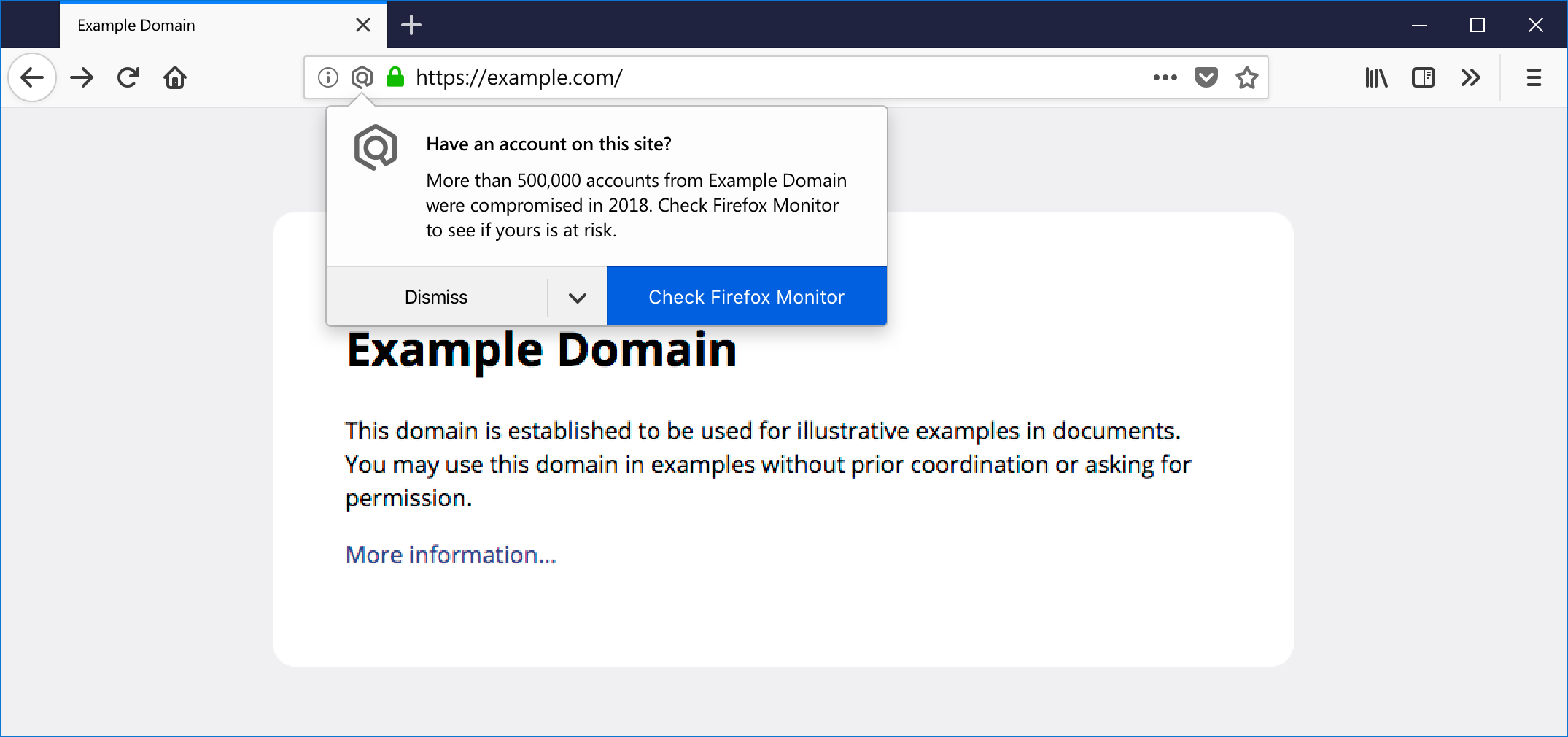
Along with making Monitor available in multiple languages, today we’re also releasing a new feature exclusively for Firefox users. Specifically, we are adding a notification to our Firefox Quantum browser that alerts desktop users when they visit a site that has had a recently reported data breach. We’re bringing this functionality to Firefox users in recognition of the growing interest in these types of privacy- and security-centric features. This new functionality will gradually roll out to Firefox users over the coming weeks.

While using the Firefox Quantum browser, when you land on a site that’s been breached, you’ll get a notification. You can click on the alert to visit Firefox Monitor and scan your email to see whether or not you were involved in that data breach. This alert will appear at most once per site and only for data breaches reported in the previous twelve months. Website owners can learn about our data breach disclosure policy here. If you do not wish to see these alerts on any site, you can simply choose to “never show Firefox Monitor alerts” by clicking the dropdown arrow on the notification.


You’ll be notified of a data breach when you visit a site in Firefox


For those new to Firefox Monitor, here’s a brief step-by-step guide on how Firefox Monitor works:

Step 1 – Visit monitor.firefox.com to see if your email has been part of a known data breach

Simply type in your email address, and it will be scanned against a database that serves as a library of known data breaches.

Step 2 – Learn about future data breaches

Sign up for Firefox Monitor using your email address and we will notify you about data breaches when we learn about them.

Step 3 – Use Firefox to learn about the sites you visit that have been breached

While using the Firefox browser, when you land on a site that’s been breached, you’ll get a notification to scan with Firefox Monitor whether or not you’ve been involved in that data breach.

Being part of a data breach is not fun, and we have tips and remedies in our project, Data Leeks. Through recipes and personal stories of those who’ve been affected by a data breach, we’re raising awareness about online privacy.

We invite you to take a look at Firefox Monitor to see if you’ve been part of a data breach, and sign up to be prepared for the next data breach that happens.


The post Firefox Monitor Launches in 26 Languages and Adds New Desktop Browser Feature appeared first on The Mozilla Blog.

19 Nov 01:28

When does Firefox alert for breached sites?

by Luke Crouch

Mozilla’s Position on Data Breaches

Data breaches are common for online services. Humans make mistakes, and humans make the Internet. Some online services discover, mitigate, and disclose breaches quickly. Others go undetected for years. Recent breaches include “fresh” data, which means victims have less time to change their credentials before they are in the hands of attackers. While old breaches have had more time to make their way into scripted credential stuffing attacks. All breaches are dangerous to users.

As stated in the Mozilla Manifesto: “Individuals’ security and privacy on the internet are fundamental and must not be treated as optional.” Most people simply don’t know that a data breach has affected them. Which makes it difficult to take the first step to secure their online accounts because they don’t know they’re insecure in the first place. This is why we launched Firefox Monitor.

Informing Firefox Users

Today we are continuing to improve our Firefox Monitor service. To help users who might have otherwise missed breach news or email alerts, we are integrating alerts into Firefox that will notify users when they visit a site that has been breached in the past. This feature integrates notifications into the user’s browsing experience.

To power this feature, we use a list of breached sites provided by our partner, Have I Been Pwned (HIBP). Neither HIBP nor Mozilla can confirm that a user has changed their password after a breach, or whether they have reused a breached password elsewhere. So we do not know whether an individual user is still at risk, and cannot trigger user-specific alerts.

For our initial launch we’ve developed a simple, straightforward methodology:

  • If the user has never seen a breach alert before, Firefox shows an alert when they visit any breached site added to HIBP within the last 12 months.
  • After the user has seen their first alert, Firefox only shows an alert when they visit a breached site added to HIBP within the last 2 months.

We believe this 12-month and 2-month policy are reasonable timeframes to alert users to both the password-reuse and unchanged-password risks.  A longer alert timeframe would help us ensure we make even more users aware of the password-reuse risk. However, we don’t want to alarm users or to create noise by triggering alerts for sites that have long since taken significant steps to protect their users. That noise could decrease the value and usability of an important security feature.

Towards a more Sophisticated Approach

This is an interim approach to bring attention, awareness, and information to our users now, and to start getting their feedback. When we launched our Monitor service, we received tremendous feedback from our early users that we’re using to improve our efforts to directly address users’ top concerns for their online service accounts. For service operators, our partner, Troy Hunt, already has some great articles on how to prevent data breaches from happening, and how to quickly and effectively disclose and recover from them. Over the longer term, we want to work with our users, partners, and all service operators to develop a more sophisticated alert policy. We will base such a policy on stronger signals of individual user risk, and website mitigations.

The post When does Firefox alert for breached sites? appeared first on Mozilla Security Blog.

19 Nov 01:28

Facebook reportedly discredited critics by linking them to George Soros | Technology

mkalus shared this story from The Guardian.

Facebook hired a PR firm that attempted to discredit the company’s critics by claiming they were agents of billionaire George Soros, the New York Times reported Tuesday.

Soros is a Jewish philanthropist who is the frequent subject of antisemitic conspiracy theories. At the same time, the social media company urged the Anti-Defamation League to object to a cartoon used by anti-Facebook protesters over its resemblance to antisemitic tropes.

News of Facebook’s aggressive attempts to undermine critics came in a damning report by the Times, detailing how Facebook executives have struggled to manage the numerous and severe challenges confronting the company, all while lashing out at critics and perceived enemies.

Rashad Robinson, the executive director of one of the groups targeted by the PR campaign, Color of Change, called the antisemitic smear “outrageous and concerning”.

Amid growing pressure from lawmakers over its role in Russian interference in the 2016 presidential election, Facebook increasingly turned to Definers Public Affairs, a Washington DC based political consultancy founded by Republican operatives and specializing in opposition research, according to the report.

One of Definers’ tactics was to publish dozens of negative articles about other tech companies, including Google and Apple, in order to try to distract attention from Facebook’s public relations woes. Definers published the content on <a href="http://NTKNetwork.com" rel="nofollow">NTKNetwork.com</a>, a website that looks like a news site but is actually run by the PR firm. The narratives pushed on NTK Network were often picked up by conservative sites such as Breitbart.

Another tactic was to cast Soros as the driving force behind groups critical of Facebook. The firm circulated a research document connecting Soros to “a broad anti-Facebook movement”, the Times reported, and pressed reporters to look into financial links between Soros and groups such as Freedom from Facebook and Color of Change.

Soros, who was born in Hungary in 1930 and made a vast fortune as an investor, is a major funder of liberal and pro-democratic causes. He has long been the target of antisemitic attacks from the rightwing fringes, but such conspiracy mongering has been increasingly adopted by mainstream Republicans.

The anti-Soros drumbeat reached something of a fever pitch in the weeks before the midterm elections, as conservative politicians and news outlets advanced baseless allegations that he was behind a caravan of Central American migrants travelling through Mexico. Soros was one of the targets of a rash of mail bombs that were sent to Democratic politicians in October.

Joe Gabriel Simonson, a reporter for the rightwing news site the Daily Caller, tweeted Wednesday that he had been urged to include “bring up Soros/‘Soros tactics’” in an article about Facebook earlier this year.

“The PR guy did keep bringing up Soros,” Simonson wrote. “This was like 6 months ago too so it was even odder.”

Robinson, whose organization has run online campaigns criticizing Facebook over racial discrimination in housing ads, privacy and surveillance, racist hate speech, and other issues, said he was deeply troubled by the report.

“This narrative has really dangerous antisemitic undertones about Jewish people controlling the world,” Robinson told the Guardian by phone. “It’s also deeply anti-black – the idea that our strategies, our ideas, our vision are somehow built off some puppet master … That Facebook would employ a rightwing firm to say that is deeply troubling.”

Color of Change is a not-for-profit civil rights organization. It receives some money from Soros, Robinson said, in addition to many other funders, including Facebook co-founder Dustin Moskovitz’s foundation, the Open Philanthropy Project. Robinson also said that over the past year, he has been asked numerous times by journalists about funding from Soros.

“No one at the end of a call says, ‘Are you funded by the Ford Foundation?’,” Robinson said.

Facebook did not respond to a request for comment.

Soros has been openly critical of Facebook and Google. “The internet monopolies have neither the will nor the inclination to protect society against the consequences of their actions,” he said in a speech at the World Economic Forum in Davos in January. “That turns them into a menace and it falls to the regulatory authorities to protect society against them.”

13 Nov 01:23

Believing without evidence is always morally wrong

Francisco Mejia Uribe, Aeon, Nov 12, 2018

In ‘The Ethics of Belief’ (1877)  William Kingdon Clifford gives three reasons for believeing that belief without evidence is morally wrong (quoted from the article):

  • every single belief has the capacity to be truly consequential
  • poor practices of belief-formation turn us into careless, credulous believers
  • we have the moral responsibility not to pollute the well of collective knowledge

I am always wary of arguments that conclude that we have a 'duty' or 'responsibility' because these are easily abused by others and almost always require that we act against our own self-interest, sometimes in devastating ways. But each of these can be seen in a way that aligns the collective interest with perosnal interest, and that's what gives them force.

Web: [Direct Link] [This Post]
13 Nov 01:14

Cloudflare’s 1.1.1.1 DNS service is now on Android and iOS

by Jonathan Lamont
1.1.1.1 app on iOS

Cloudflare’s fast 1.1.1.1 DNS service is making its way to mobile.

Launched in April 2018 as a free to use public DNS resolver for PCs and Macs, 1.1.1.1 is now available on Android and iOS via a new app from Cloudflare.

Typically, your internet service provider (ISP) supplies your DNS service, which turns a domain name like Google.ca into an IP address routers can understand.

However, carrier’s DNS services are often slow and unreliable, and Cloudflare promises to speed things up with 1.1.1.1. The company also argues that its DNS offering is faster than other public DNS services like Cisco OpenDNS and Google Public DNS.

Further, Cloudflare touts how easy it is to set up its DNS service, and this holds on mobile. After downloading the app, users merely tap a switch and grant permission for the 1.1.1.1 app to create a VPN. Then its up and running and you’re on your way.

However, it’s important to note that while 1.1.1.1 uses a VPN to route your internet traffic to its DNS, it doesn’t proxy your internet use as a VPN does. That said, there are still security benefits to 1.1.1.1.

Cloudflare says 1.1.1.1 will prevent your carrier from tracking your browsing history and potentially selling it as well. Further, the company says it won’t track users and will have KPMG perform annual audits and publish public reports to back that up.

Ultimately, it’s a service worth using. While not everyone will notice a speed increase — and any gains may be negligible — the security benefits are welcome.

You can download the 1.1.1.1 app for Android and iOS, and visit Cloudflare’s website for instructions on how to set it up on your computer.

Via: The Verge

The post Cloudflare’s 1.1.1.1 DNS service is now on Android and iOS appeared first on MobileSyrup.

13 Nov 01:14

Enthusiasts vs. Pragmatists: two types of programmers and how they fail

Do you love programming for its own sake, or do you do for the outcomes it allows? Depending on which describes you best you will face different problems in your career as a software developer.

Enthusiasts code out of love. If you’re an enthusiast you’d write software just for fun, but one day you discovered your hobby could also be your career, and now you get paid to do what you love.

Pragmatists may enjoy coding, but they do it for the outcomes. If you’re a pragmatist, you write software because it’s a good career, or for what it enables you to do and build.

There’s nothing inherently good or bad about either, and this is just a simplification. But understanding your own starting point can help you understand and avoid some of the problems you might encounter in your career.

In this post I will cover:

  1. Why many companies prefer to hire enthusiasts.
  2. The career problems facing enthusiasts, and how they can solve them.
  3. The career problems facing pragmatists, and how they can solve them.

Why companies prefer hiring enthusiasts

Before we move on to specific career problems you might face, it’s worth looking at the bigger picture: the hiring and work environment.

Many companies prefer to hire enthusiast programmers: from the way they screen candidates to the way they advertise jobs, they try to hire people who care about the technology for its own sake. From an employer’s point of view, enthusiasts have a number of advantages:

  1. In a rapidly changing environment, they’re more likely to keep up with the latest technologies. Even better, they’re more likely to do so in their free time, which means the company can spend less on training.
  2. Since they’d write software for free, it’s easier to pay enthusiasts less money.
  3. It’s also easier to get enthusiasts to work long hours.
  4. Finally, since enthusiasts care more about the technical challenge than the goals of the product, they’re less likely to choose their work based on ethical or moral judgments.

But while many companies prefer enthusiasts, this isn’t always in the best interest of either side, as we’ll see next.

The career problems facing enthusiasts

So let’s say you’re an enthusiast. Here are some of the career problems you might face; not everyone will have all these problems, but it’s worth paying attention to see if you’re suffering from one or more of them.

1. Exploitation

As I alluded to above, companies like enthusiasts because they’re worse negotiators.

If you love what you do you’ll accept less money, you’ll work long hours, and you’ll ask less questions. This can cause you problems in the long run:

So even if you code for fun, you should still learn how to negotiate, if only out of self-defense.

2. Being less effective as an employee

Matt Dupree has an excellent writeup about why being an enthusiast can make you a worse worker; I don’t want to repeat his well-stated points here. Here are some additional ways in which enthusiasm can make you worse at your job:

  • Shiny Object Syndrome: As an enthusiast it’s easy to choose a trendy technology or technique for your work because you want to play with it, not because it’s actually necessary in your situation. The most egregious example I’ve seen in recent years is microservices, where an organizational pattern designed for products with hundreds of programmers is being applied by teams with just a handful of developers.
  • Writing code instead of solving problems: If you enjoy writing code for its own sake, it’s tempting to write more code just because it’s fun. Productivity as a programmer, however, comes from solving problems with as little work as needed.

3. Work vs. art

Finally, as an enthusiast you might face a constant sense of frustration. As an enthusiast, you want to write software for fun: solve interesting problems, write quality code, fine-tune your work until it’s beautiful.

But a work environment is all about outcomes, not about craft. And that means a constant pressure to compromise your artistic standards, a constant need to work on things that aren’t fun, and a constant need to finish things on time, rather than when you’re ready.

So unless you want to become a pragmatist, you might want to get back more time for yourself, time where you can write code however you like. You could, for example, negotiate a 3-day weekend.

The career problems facing pragmatists

Pragmatists face the opposite set of problems; again, not all pragmatists will have all of these problems, but you should keep your eye out to see if they’re affecting you.

1. It’s harder to find a job

Since many companies actively seek out enthusiasts, finding a job as a pragmatist can be somewhat harder. Here are some things you can do to work around this:

  • Actively seek out companies that talk about work/life balance.
  • When interviewing, amplify your enthusiasm for technology beyond what it actually is. After all, you will learn what you need to to get the results you want, right?
  • Demonstrate the ways in which pragmatism actually makes you a more valuable employee.

2. You need to actively keep your skills up

Since you don’t care about technology for technology’s sake, it can be easy to let your skills get out of date, especially if you work for a company that doesn’t invest in training. To avoid this:

3. Pressure to work long hours

Finally, you will often encounter pressure both from management and—indirectly—from enthusiast peers to work long hours. Just remember that working long hours is bad for you and your boss (even if they don’t realize it).

Programmer, know thyself

So are you an enthusiast or a pragmatist?

These are not exclusive categories, nor will they stay frozen with time—these days I’m more of a pragmatist, but I used to be more of an enthusiast—but there is a difference in attitudes. And that difference will lead to different choices, and different problems.

Once you know who you are, you can figure out what you want—and avoid the inevitable obstacles along the way.


By the time you get home from work and finish your chores you’re too tired to do anything but watch TV and then collapse into bed. And weekends are just as bad.

But you could have a 3-day weekend not just on holidays, but every single week: learn how you can do it.

13 Nov 01:13

Firefox releases new price tracker function as a test feature

by Brad Bennett

Firefox often tries out ideas for features in its Test Pilot section and currently, the browser is testing out a new price tracking tool.

The feature is called ‘Price Wise,’ but it isn’t available through the Canadian versions of popular e-commerce sites like Amazon or Walmart, though it does work with Amazon.com.

If you’re looking to track the price of an item over time and you use Firefox, you can now load it with an Amazon.com listing and hope that when it goes on sale in that location, it’s also on sale in the Canadian store.

Alternatively, you could use a third-party price tracking site like ‘Camelcamelcamel’ to accomplish basically the same thing.

MobileSyrup has reached out to Mozilla to confirm if the feature is also coming to Canada.

source: Firefox

The post Firefox releases new price tracker function as a test feature appeared first on MobileSyrup.

13 Nov 01:13

When Tech Loves Its Fiercest Critics, Buyer Beware

by John Battelle

Detail from the cover of Harari’s lastest work, 21 Lessons for the 21st Century.

A year and a half ago I reviewed Yuval Noah Harari’s Homo Deus, recommending it to the entire industry with this subhead: “No one in tech is talking about Homo Deus. We most certainly should be.”

Eighteen months later, Harari is finally having his technology industry moment. The author of a trio of increasingly disturbing books – Sapiens, for which made his name as a popular historian philosopher, the aforementioned Homo Deus, which introduced a dark strain of tech futurism to his work, and the recent 21 Lessons for the 21st Century – Harari has cemented his place in the Valley as tech’s favorite self-flagellant. So it’s only fitting that this weekend Harari was the subject of New York Times profile featuring this provocative title: Tech C.E.O.s Are in Love With Their Principal Doomsayer. The subhead continues: “The futurist philosopher Yuval Noah Harari thinks Silicon Valley is an engine of dystopian ruin. So why do the digital elite adore him so?”

Well, I’m not sure if I qualify as one of those elites, but I have a theory, one that wasn’t quite raised in the Times’ otherwise compelling profile. I’ve been a student of Harari’s work, and if there’s one clear message, it’s this: We’re running headlong into a world controlled by a tiny elite of superhumans, masters of new technologies that the “useless class” will never understand. “Homo sapiens is an obsolete algorithm,” Harari writes in Homo Deus. A new religion of Dataism will transcend our current obsession with ourselves, and we will “dissolve within the data torrent like a clump of earth within a gushing river.” In other words, we humans are f*cked, save for a few of the lucky ones who manage to transcend their fate and become masters of the machines. “Silicon Valley is creating a tiny ruling class,” the Times writes, paraphrasing Harari’s work, “and a teeming, furious “useless class.””

So here’s why I think the Valley loves Harari: We all believe we’ll be members of that tiny ruling class. It’s an indefensible, mathematically impossible belief, but as Harari reminds us in 21 Lessons, “never underestimate human stupidity.” Put another way, we are  fooling ourselves, content to imagine we’ll somehow all earn a ticket into (or onto) whatever apocalypse-dodging exit plan Musk, Page or Bezos might dream up (they’re all obsessed with leaving the planet, after all). Believing that impossible fiction is certainly a lot easier than doing the quotidian work of actually fixing the problems which lay before us. Better to be one of the winners than to risk losing along with the rest of the useless class, no?

But we can’t all be winners in the future Harari lays out, and he seems to understand this fact. “If you make people start thinking far more deeply and seriously about these issues,” he said to the Times, “some of the things they will think about might not be what you want them to think about.”

Exactly, Professor. Now that I’ve departed the Valley, where I spent nearly three decades of my life, I’m starting to gain a bit of perspective on my own complicated relationship with the power structure of the place. I grew up with the (mostly) men who lead companies like Amazon, Google, Facebook and Apple, and early in the industry’s rise, it was heady to share the same stage with legends like Bezos, Jobs, or Page. But as the technology industry becomes the driving force of social rupture, I’m far more skeptical of its leaders’ abilities to, well, lead.

Witness this nearly idea-free interview with Google CEO Sundar Pichai, also in the Times, where the meticulously media-prepped executive opines on whether his industry has a role to play in society’s ills: “Every generation is worried about the new technology, and feels like this time it’s different. Our parents worried about Elvis Presley’s influence on kids. So, I’m always asking the question, “Why would it be any different this time?” Having said that, I do realize the change that’s happening now is much faster than ever before. My son still doesn’t have a phone.”

Pichai’s son not have a phone, but he is earning money mining Ethereum (really, you can’t make this shit up). I’m not sure the son of a centi-millionaire needs to earn money – but it certainly is useful to master the algorithms that will soon control nearly every aspect of human life. So – no, son, no addictive phone for you (even though my company makes them, and makes their operating systems, and makes the apps which ensure their addictive qualities).

But mining crypto currency? Absolutely!

Should Harari be proven right and humanity becomes irrelevant, I’m pretty sure Pichai’s son will have a first class ticket out of whatever mess is left behind. But the rest of us? We should probably focus on making sure that kid never needs to use it.

Cross posted from NewCo Shift. 


By the way, the other current obsession of Valley folks is author Anand Giridharadas’ Winners Take All – The Elite Charade of Changing the World. Read them together for a one-two punch, if you dare…

13 Nov 00:16

The Art of Distraction draws attention to distracted driving

by dandy

Story and photos by Jun Nogami

The Art of Distraction is a multi media campaign launched by the City of Toronto to remind drivers of the potentially fatal consequences of not paying attention while behind the wheel. Among the more visible parts of the campaign are five striking advertisements on bus shelters, with four downtown and one in East York. Each of these shows smashed items along with a back story. What makes some of them particularly powerful is that they use some of the actual items involved in a fatality. This campaign is co-sponsored by Friends and Families for Safe Streets (FFSS), an organization that was founded by the relatives and friends of several road victims.

Here are some of the stories behind each of these five.

King and Spadina: Edouard Le Blanc.


Edouard Le Blanc was killed at the age of 63 in October 2014. He was biking on the Gatineau corridor multi-use trail and was crossing Warden Ave at the signalized intersection when a car ran the red light and hit him.

The driver was convicted of careless driving and fined $700. The display shows Edouard's helmet.

McCaul and College: Erica Stark

Erica Stark was walking a dog when a minivan jumped the curb and hit her, killing her.

The driver was convicted of careless driving and fined $1,000, with one month driving suspension and five months of further driving restrictions.

Blue Jays Way and Front: Violet Liang

14-year-old Violet Liang was killed by a dump truck while heading to the first day of school.

The driver was charged with careless driving and failing to yield to a pedestrian.

Queen and Augusta: Cyclist Fatalities


This exhibit draws attention to the high number of cyclists killed or injured by motorists in the past five years.

Victoria Park and Eglinton:


This exhibit draws attention to the very large number of pedestrians killed or injured by motorists in the past five years.

The city’s website for the campaign features six more specific cases, such as Gary Sim who died last July, Tom Samson who was killed six years ago, and Jessica Spieker who was severely injured and lives with the effects of those injuries to this day.

The campaign also includes TV ads on CP24, as well as social media and radio. Print ads including all of the cases on the city’s website will be posted on an additional 300 bus shelters.

This campaign is co-sponsored by Friends and Families for Safe Streets (FFSS), an organization that was founded by the relatives and friends of several road victims.

Through their lobbying there have been some changes in how the fatalities of pedestrians and cyclists are reported. The media is now careful to avoid the use of the word “accident” which in this context absolves the driver of responsibility for a fatality. There is still more to be done since media stories inevitably report that a cyclist killed was not wearing a helmet, or that a pedestrian was wearing dark clothing. This reinforcements a public tendency towards victim blaming, even though a city safety study shows that the driver is to blame about two thirds of the time.

According to Patrick Brown, principal partner at law firm McLeish Orlando, this culture of victim blaming also appears in the courtroom, with drivers often able to plead down to minimum sentences. In the case of Edouard Le Blanc, court filings show that the defense tried to argue that Mr. Le Blanc was not wearing a bike helmet when he was hit, even though that was untrue and the driver was completely at fault.

It is his actual yellow bike helmet that is displayed at King and Spadina.

Patrick and others have been working to promote Vulnerable Road User (VRU) legislation at the provincial level. This VRU does not argue for increased penalties in the form of fines or jail time. What it does aim to do is to impose meaningful penalties for a driver convicted in a case resulting in death or severe injury to any vulnerable road user, such as a pedestrian, cyclist, construction worker, emergency responder, etc.

These penalties would include:

  • Mandatory minimum license suspension
  • A driver’s safety course before the suspension is lifted
  • Community service in the area of road safety
  • A requirement that the defendant appear in court to hear victim impact statements (At the present time, drivers are allowed to send an agent such as a paralegal to hear these statements.)

I asked Patrick for one sentence on this issue and he said: “Contact your local MPP and urge them to support meaningful and comprehensive Vulnerable Road User legislation.”

Road deaths and injuries will only stop when safer infrastructure for all road users is built.

This takes political will, and will also require a fundamental culture shift away from an auto-centric view of transportation. According to Kasia Briegmann-Samson, one of the co-founders of FFSS, the Art of Distraction campaign is part of an education program to bring about that shift.

"I'll never forget the moment I was handed that paper bag containing Tom's personal items. It was cruel and unceremonious, although I realize it must have also been extremely difficult for the police officers whose job it was to return these items to families,” says Briegmann-Samson. “ The Art of Distraction attempts to show this excruciating reality of road violence. "

Listen to her on Metro Morning.

Friends and Families of Safe Streets is holding their second annual candlelight vigil for victims of road violence on Sunday, November 18 at 4 p.m. We will meet at David Pecault Square and walk down to the waterfront at the Music Garden.

Fines for distracted driving in Ontario will go up in the new year.


13 Nov 00:15

Reminder and GoodTask: Third-Party Upgrades to Apple’s Reminders

by Ryan Christoffel
Rolandt

jk

Reminder (left) and GoodTask (right)

Reminder (left) and GoodTask (right)

Apple has long prided itself on being a company that carefully weaves hardware, software, and services together to offer a holistic user experience. Because of this, every purchaser of Apple products benefits from the built-in apps and services that accompany those products. And on the two most popular sellers, the iPhone and iPad, one of those bundled apps is Reminders.

At its core, Reminders is a simple list and to-do app that can be surprisingly powerful thanks to features like repeating tasks, location-based reminders, collaborative lists, and note support. Many times over the years Reminders has been my primary task manager and served me fairly well. It may not be as capable as alternatives like Things, but the app remains an appealing tool for those whose needs are light, and who value the ease afforded by Apple’s built-in ecosystem.

Unlike most of Apple’s other iOS apps, Reminders is built on a framework that’s accessible to third-party developers. Though developers can’t build apps that hook in directly with your Messages or Notes databases, Reminders is a different story. The underlying system powering Reminders is calendar-based, meaning it’s not tied to a single first-party app. Just as Fantastical and Timepage offer access to your existing iCloud calendars, developers can similarly build entire replacements for the Reminders app utilizing your existing collection of lists and to-dos. Two such apps, Reminder and GoodTask, serve as perhaps the best third-party Reminders clients on the App Store.

Each app takes a different approach to enhancing Reminders, with one focusing on modern design while the other offers power user features and flexibility; both, however, retain some of the benefits of staying in the Apple ecosystem while improving upon the first-party Reminders app.

Reminder

Developer Mark DiFranco has built a Reminders client that appears far more native to iOS than Apple’s actual native option does. Whereas Reminders’ design looks increasingly outdated after sitting unchanged for years, Reminder takes a page from one of Apple’s most recent design styles by modeling itself after the Home app. Like in Home, the interface is composed of a grid of different tiles, which in Reminder’s case represent your various to-dos.1 This tile structure is accompanied by the use of iOS 11’s big, bold headings, and there’s even a ‘For You’ section like in many modern Apple apps. Overall, the design is a drastic departure from Reminders in every way, but not so from iOS itself.

Reminder’s tab bar offers three main ways to view your to-dos. The Lists tab is the place for editing, creating, or viewing individual lists. It’s also where you’ll find one of Reminder’s hidden power features: under the Details screen for a list, you’ll see options to set default time and location alerts for all future tasks added to this list. So, for example, you can cause all future tasks to automatically receive ‘This Evening’ due times, or to always alert you when you reach a certain location. Chances are low that you’ll want every to-do in a list to have the same alerts, but if the majority of your tasks do receive the same configurations, default alerts can be a helpful time-saving measure. Personally, most new tasks I create receive due dates of 6:00pm today, meaning I want to get to them by the end of the work day. Reminder allows me to save time setting that alert individually, so even when I need to delay the alert until later, I’m still configuring due times far less often than before.

For You and Reminders tabs join Lists as alternate ways to view your tasks. The former is like the Scheduled list in Apple’s Reminders, providing an overview of all tasks that currently have due dates. Unlike Reminders, however, where you can’t distinguish tasks from different lists inside the Scheduled view, Reminder’s For You retains the color markers that identify each list, which provides both visual flavor and practical benefit. Finally, the Reminders tab contains all your tasks, whether they have due times or not, and also offers a quick way to add new tasks to existing lists.

There are three other Reminder features I want to highlight briefly.

First, the app includes a dark mode that looks especially great on OLED displays. It’s rare to find a dark mode option in a task manager, not to mention one that takes advantage of an OLED’s ability to display true black, but both Reminder and GoodTask include one.

Next, notifications are especially powerful in Reminder due to the way they can be customized to include the actions you value most. You can include a variety of snooze options, ranging from 5 minutes to 4 hours, or even push a task to tomorrow, the weekend, or next week. Snooze actions join those for completing or editing a task, making for a healthy assortment of options to utilize in your custom notifications.

Finally, one of my favorite smaller features is how easy Reminder makes it to add due dates, location alerts, and notes to your tasks. Whether you’re creating a new task or modifying an existing one, Reminder loads what resembles an extended keyboard row where you’ll see buttons to quickly edit those three types of metadata. The app doesn’t boot you to a separate screen to modify metadata, like Reminders does, and as a result the action feels much quicker and less cumbersome in Reminder.

GoodTask

Where Reminder is a design-focused modernization of Reminders, GoodTask prioritizes task management power features that help the app stand up with heavyweight alternatives like OmniFocus and Todoist.

It starts with Smart Lists, a feature that enables customizing your view based on factors like a task’s assigned list, date status, text contained in it, and much more. Smart Lists not only let you customize which tasks you see, they also enable specifying how those tasks are presented. Each Smart List can have its own sort options, view type, inclusion of calendars or not, and also a custom icon and color. If you have a lot of tasks to manage and need fine-grained controls for organizing those tasks, Smart Lists can be an essential aid.

GoodTask also includes not one, but two of my favorite methods for creating new tasks. First, it accepts natural language input to set metadata like due date, assigned list, and priority. The syntax requirements can be viewed from Settings ⇾ New Task ⇾ Text Snippets, where you can even create custom snippets that best suit you. As great as natural language input is though, the task creation feature I love even more is called Quick Actions. These are buttons you can customize to quickly, effortlessly set task metadata without needing to bother with menus or even typing special syntax. Once set up, Quick Actions live in a grid on the task editing screen, offering one-tap access to date, list, and other modification types. I have Quick Actions that alter a task’s due date by anywhere from 1 to 7 days, another that removes the due date, and also those which instantly assign tasks to specific lists. Date and list are the two parameters I most often adjust with my to-dos, and GoodTask’s Quick Actions offer the most effective way to do that, whether I’m creating a task or editing one.

As I mentioned in passing, GoodTask supports integrating your calendars to stay well informed regarding what your agenda for the day looks like, and the app also lets you add tags to tasks for even greater flexibility. Features like Smart Lists and Quick Actions are just the tip of the iceberg in customization, too, as nearly every aspect of the app can be set up to match your exact preferences, including the notifications, which are even more powerful than those found in Reminder. A small, recently added feature I’m fond of is something called List Memos, which essentially just allows you to set a message that will be displayed at the top of a list at all times. Most people will probably never use it, but I’ve found it a great addition for storing important reference materials or even just inspirational quotes you want close at hand.

Lastly, I must mention that GoodTask is a tremendously good iOS citizen. It’s always one of the first apps to adopt new APIs and technologies provided by Apple, such as Siri shortcuts and drag and drop. Following the recent introduction of the Apple Watch Series 4, GoodTask’s watchOS app was promptly updated with support for the new Infograph complications, and users who picked up a third-generation iPad Pro recently will have found that GoodTask had day one support for the new displays. First-party apps typically hold the advantage of implementing new OS features quickest, but GoodTask keeps right in step with Apple in that way.


It’s been over five years since Apple’s Reminders last saw meaningful change, and back then it was only thanks to iOS 7 introducing a system-wide redesign. The app desperately needs a Notes-style rethinking, but each June’s WWDC comes and goes with no indication that such a modernization is ever coming.

If Reminders’ stagnation is weighing on you, but you don’t want to go through the hassle of moving tasks to a whole new database, or you’d simply like to dip your toes into an app alternative without fully committing yet, Reminder and GoodTask are great options for doing that. They’re hallmark examples of what can be done to improve and revitalize Reminders, bringing Apple’s aging list and to-do app into modern times, each in their own way.


  1. If you prefer a traditional list layout, that’s an option in settings. ↩︎

Support MacStories Directly

Club MacStories offers exclusive access to extra MacStories content, delivered every week; it's also a way to support us directly.

Club MacStories will help you discover the best apps for your devices and get the most out of your iPhone, iPad, and Mac. Plus, it's made in Italy.

Join Now
13 Nov 00:15

The Signal Network

by rands

I spend a lot of time listening. A non-trivial act for me because my mind… it wanders. However, I’ve got a system. Feet flat on the ground, slightly clenched jaw, staring you straight in the eyes. I am full body listening. You have my complete attention. I am not missing a word.

We humans are experts at instinctively knowing where attention is focused. In a 1:1 situation, it’s clear from a sub-second glance at my watch to indicate to the other party that my focus is elsewhere. I am not listening. In that second, the quality of discourse plummets because the listening contract is broken.

My educated guess is that 50% of my job as a manager is information acquisition, assessment, and redistribution. It is my primary job and the efficiency with which I do this is a direct contribution to the velocity of the team.

Critical Freshness

In thinking about all the listening I’ve done and information I’ve acquired, I discovered I have a mental model for classifying information. It looks like this:

This grid has two axes. The vertical axis measures the criticality of a given piece of information. Critical information might look like:

  • Jake is about to quit.
  • The arrival rate of critical bugs is rapidly increasing.
  • A meeting just finished between Engineering and Sales where at each other’s throats. Nothing was resolved. Everyone left the meeting mad.

The horizontal axis is where this graph gets interesting. It measures freshness which is a synthetic measure of how long a given piece of information takes to get to the human who gets the most value from its arrival. Confused? Keep reading.

The interpretation of this graph is a very personal thing. You need to consider this graph as a thought experiment through a couple of different lenses. First, what is critical information to one human is irrelevant to another. Jake’s desire to quit is hugely important to his manager but less relevant to someone outside of the organization. Second, and worse, if the Jake information takes two weeks to get to Jake’s manager the information is not fresh and Jake’s manager has less time to take proper action.

Every single human in the organization has their version of this graph, and my thesis is the interpretation of this graph describes the health of your signal network.

Your Signal Network

Your signal network is the combination of all the information sources and all the information generated (or relayed) via those sources. The complete network is a combination of humans and robots, but for the sake of this article, let’s focus on human information sources. Back to the graph.

If you think about your average workday, you are continually discovering pieces of informational. Intentionally and accidentally. In meetings, in hallways, and in the cafe. Your working life is chock full of rapidly arriving information, and your brain must quickly digest, parse, pattern match, and make a judgment regarding each piece of information. What is it? How critical is it? What am I going to do with it? Should I pass it along? And to whom?

Each quadrant of this graph describes a different assessment of a piece of information. Let’s walk through each:

  • Stale & Slow The lower left quadrant is the most boring quadrant. The information here is not relevant and isn’t fresh, but who cares? It’s low signal information, and it’s stale, so there is no need to act.
  • Voluminous Spam The lower right quadrant is less annoying. You’re still dealing with less critical information, but the more you move to the right, the fresher the information. I’m sure learning lots of useless things quickly. At an extreme, it’s spam. An organization spends energy moving information hither and fro. If you’re seeing a lot of information falling into this quadrant I am concerned about the overall efficiency of your team. If you’re seeing a lot of useless information on a day to day basis, what about the rest of your team? How much time is the team wading through the noise to find signal? How much time are they wasting looking for nuggets of relevancy?1
  • Critically Fresh The upper right quadrant is your informational sweet spot. Critical information is getting to you in a timely fashion. Yes, it’d be super if all the information was further up and to the right, but the fact the information is in this quadrant is a win. The vibe here is a distinct lack of surprises. When a piece of information lands on your plate, it’s fresh. It’s clear someone just made this horrible decision, and you have ample time to coach them in the correct direction.
  • Important, But Slow The final quadrant, the upper left, is the danger zone. Critical information arriving slowly to the humans who need it the most is the source of much of your organizational consternation, and I need a whole section to explain why.

No Surprises

Members Only was the code name of one of my managers from The Start-up You’ve Never Head Of, and he exhibited many classic management tropes. We didn’t know what he did all day, he never scheduled 1:1s and when they were scheduled they were often rescheduled into non-existence without notice, and when you finally got him pinned down in a meeting room, when you cornered him with the vital issue, he leaped to the first conclusion that crossed his mind and stated it as a fact.2

Members Only was fond of simple, pithy management proclamations which made a lasting impression on me. He told me one the first week he joined, “No surprises.”

My interpretation of these two words from Members Only was not generous. What I heard was, “Make sure I know what’s up, so I don’t look bad.” What he might have meant (but I’ll never know) was, “Make sure our team of humans has the best information as quickly as possible so they can make the best decisions as quickly as possible.”

Information consistently falling into Important, but Slow means there are surprises. You’re discovering unexpected developments occurring on the team long after they happened. You’re unable to react because the time to act has passed. The conclusion is already history.

You can spend a lot of time and money investing in processes, tools, and architects that you believe are necessary to critical and timely information flowing, but where I consistently invest is in the team. I demonstrate to the humans the value of effectively detecting, assessing, routing, and retransmitting information across the organization.

High Signal Humans

I have an internal measure which grades the following on any given day: how much critical information did I discover? And how fresh is it? In a rapidly growing organization of humans, the volume of new information created daily increases daily.

If you buy that the healthy flow of information is an essential practice as a leader, then you understand why I religiously hold 1:1s. It’s a regular meeting where I make it clear what critical information I care about and where I consistently share the critical information my team needs. It’s never a perfect transaction. I often incorrectly flag essential information that is spam, you will, too. Over time, we will calibrate. In time, we won’t wait until the 1:1 to relay information because we’ll intuitively understand that for this given piece of information, the faster it lands in the right hands, the higher the value.

Your ability to effectively lead is a function of the collective quality of the decisions you make on a daily basis. You can take your time on many decisions. You can wait days or weeks until you’ve gathered all the relevant signal necessary. Other decisions must be made right now. At that moment, the health of your signal network, the amount of critical information that has arrived in a timely fashion makes the difference between an informed decision and the flipping of a coin.

The health of your signal network is one lens into the health of your team. Critical information freely moving around the organization decreases surprises, improves the quality of decisions, and builds trust. They are your signal network. And you theirs.


    1. Gossip. Briefly. Some information that shows up is gossip. Its half-informed opinion relayed as fact. Gossip is a trigger for me because it’s often a precursor to the worst kind of politics, but gossip is signal. Rather than becoming angry, rather than wasting time on figuring out “Who would say that?”, I choose the dissect the gossip: What perfectly reasonable question is being asked with the inflammatory chunk of gossip? What observation is being made? This approach does not always work. ↩
  1. Much of the initial material for Managing Humans was created during this period. ↩
13 Nov 00:13

Should Vancouver apply a ‘congestion charge’ when Uber arrives?

by Gordon Price

Now is the time for the new council to consider a ‘congestion charge’ when (if?) it licences Uber and other ride-hailing companies to operate on city streets.*

From the Seattle Times:

The two ride-hailing giants provided more than 91,000 rides on an average day in the second quarter of this year, according to ridership reports the companies filed with the city, recently made publicly available for the first time.

While that’s just a fraction of daily travel in the Seattle region, Uber and Lyft trips are heavily concentrated in the city’s densest neighborhoods, where nearly 40,000 rides a day start in ZIP codes covering downtown, Belltown, South Lake Union and Capitol Hill. They are almost certainly contributing to worsening congestion. …

.
The data show that ridesharing is most popular in the neighborhoods ringing Lake Union (Capitol Hill, Queen Anne, Ballard, Fremont, Wallingford), many of which also have higher rates of car ownership.
… this is an area where the Durkan administration has the right idea. Decongestion pricing – which Uber already supports! – will put a thumb on the scale in favor of other modes of transportation, allow traffic to move more freely, and generate revenue that can support more and better public transit.
* Price Tags would be pleased to post the statement from the first councillor that articulates a position with respect to ride-hailing companies, not only on congestion pricing but also on whether the companies will have to release ridership data – an issue on which they are prepared to fight.  Again, the Seattle Times:

Back in 2015, the city prepared a report for the City Council on what initial ridership numbers looked like and how the city and county should handle the growing number of Ubers and Lyfts.

Uber and Lyft filed suit to keep their data secret and the report was never made public. The report is marked “do not distribute” and “attorney eyes only,” and the data is marked “confidential.” The companies only relented in September, following a Supreme Court ruling this year that went against them. …

… in a court filing before (Lyft) dropped its legal challenges, Todd Kelsay, the company’s Pacific Northwest general manager, said that releasing ridership data could drive Lyft out of Seattle. Releasing the ridership data, Kelsay argued, could “lead to fewer jobs, less economic development and reduced investment in the local community.”

The data was released in September. Lyft has not, to date, left the Seattle market.


13 Nov 00:13

Minnesota Nice

Minnesota Nice

This summer, on a porch in a small town in Minnesota, I was ringing another doorbell for the Congressional candidate for the Democratic-Farmer-Labor (DFL) party, Angie Craig. It seemed that no one was home and I was ready to give up, when a startled, elderly woman struggled up from the recliner in which she had been enjoying a late-afternoon nap.

I wasn't there to talk to her: my walk sheet told me to speak to her husband, and only to her husband. That meant, I knew, that she was a confirmed Republican, though the campaign considered her husband to be persuadable. My instructions were to ask for her husband and, barring that, to move on.

Having disturbed her rest, I couldn't just walk away, so I introduced myself and started my pitch about our candidate, centered on health care and the Trump administration’s gradual demolition of Obama’s Affordable Care Act. I expected the door to slam; instead, I received a stern lecture on the horrors of Trump’s healthcare regime and her enthusiastic support for the DFL candidate. Her husband — the man I’d been sent to canvass — had recently died, and his surviving wife was convinced his death had been hastened by insurance prevarications and delays that the Trump administration was worsening. Republican health care had killed her husband; not only was she supporting our candidate, she doubted she could ever return to the Republican party.

Minnesotans are famously nice: cheerful, sympathetic and kind. Minnesota is the home of Prairie Home Companion, the place where all children are above average. The big Midwestern state has strongly progressive roots — many of its early settlers were refugees from Scandinavian famine — but Minnesotans are often conservative by nature, inclined to cooperation and compromise and averse to conflict. The Wonderful Wizard of Oz is, in part, an allegory of Midwestern politics: the very name of the DFL commemorates the old Progressive alliance between farmers (who only need a brain) and labour unions (staunch and good with axes but sometimes heartless).

Increasingly, however, the issues that divide Minnesota cannot be bargained, and this fact underlies the intensity of US politics today, a polarization that recalls the decade preceding the American Civil War. That war came because, in the end, no compromise was possible: either people could be property, or they could not. The elderly lady I canvassed was not amenable to compromise, either: her husband had died when he might have been saved, and after that there’s nothing much to left to say.

A significant portion of Republican voters believe that abortion is murder, that homosexuality is perverse, and that ready availability of birth control has led to widespread moral degeneracy. These beliefs do not admit compromise or delay. The recent appointment of Brett Kavanaugh to the Supreme Court, notwithstanding allegations of sexual assault and dishonest testimony, suggests that delay may soon end.

Opponents of this view, however, argue that the underlying question is whether women are fully human. Scientific progress has made is possible for women to control their bodies; shall they be forbidden to do so? If women are to enjoy their own sexuality, they must have access to birth control and, in case of failure, to abortion. The intensity of this controversy has led American Catholics into political alliance with evangelical Protestants, but their opposition rests on different and irreconcilable theological grounds — grounds which many other Americans bitterly dispute, and which American tradition considers unsuitable for discussion outside one’s intimate circle. Sizable protests for and against Planned Parenthood, a foundation that offers women’s health services including abortion, have been frequent in Minnesota’s capitol since the 2016 election.

Similarly, the question of whether gay marriage is a blessing or a travesty is not suited to negotiation: either one loves whom one chooses, or yours may be a love that cannot (or should not) speak its name. Angie Craig, the Minnesota candidate for whom I was canvassing, has a wife and four sons. Her Republican opponent was a Republican talk-show host who once lamented it was no longer fashionable to describe certain women as “sluts.”

In Minnesota’s north, up against Lake Superior and the Canadian border, another bitter Congressional race was dominated by the issue of mining. Conventionally, Democrats favor conservation while Republicans promise jobs, and voters may choose one now and the other next year. Here, though, the issue was understood to involve a permanent choice between different jobs, between extensive mining of sulfide ores or the preservation of the Boundary Waters wilderness. Miners fear their jobs will vanish forever; foresters and wilderness outfitters fear the permanent loss of their livelihood. Once gone, either the mining infrastructure or the wilderness will be lost forever.In principle, questions of global warming and climate change might lend themselves to discussion, but Republican adherence to denial again takes compromise off the table.

That age-old question of whether Jews and persons of colour are fully people has once again been placed on the American political agenda. At the University of Minnesota last March, posters asked “Why Are Jews After Our Guns?” Pro-gun flyers were illustrated with caricatures of scheming, long-nosed Jews. One student at a St. Paul, MN university recently awoke to find “Nigger Go Home!” scrawled on his dormitory door. Presidential tweets and speeches frequently allude to immigrant-driven crime waves and that do not, in fact, exist.

The political divisions of a former generation were suited to compromise. One might favor higher taxes but be willing to try lowering them, just as one might favor pulling troops out of Afghanistan or Vietnam but be willing to contemplate one final effort. In the wake of the 1954 desegregation of public schools and the 1964 passage of the Civil Rights Act, a racially-segregated America could still dither for years over how much integration it wanted and how soon that integration was required. Americans today cannot find such intermediate points; they no longer exist.

When insiders urge greater understanding and civility, they mistake the situation. Just as America could not forever endure half-slave and half-free, those who believe that health care is a right will no longer abide deaths caused by unregulated insurers and uncaring bureaucracies. Those who kneel because Black Lives Matter cannot bargain away the memories of their lost children or the lives of children yet to fall to police bullets. The old ladies who knitted pussy hats for the first Women’s March were marching for their granddaughters’ right to love whom they would: they will not sacrifice their granddaughters for someone else’s religious sensibilities.

November’s midterms won’t end the fight, and calls for civility are pointless and pernicious. These differences cannot be adjusted by half measures, and the old vineyard where they grow the grapes of wrath is not far off.

13 Nov 00:12

Universities Team Up on Completion

Paul Fain, Inside Higher Ed, Nov 12, 2018
Icon

The original headline for this article (preserved thanks to RSS) was "APLU enlists 130 universities in collaboration on completion and equity gaps," but this new headline completgely changes the emphasis, which makes me worder what I'm reading. Anyhow, the story is that the Association of Public and Land-grant Universities  (APLU) "released details on an ambitious project involving 130 universities and systems that have pledged to work together in 16 “clusters” to boost their student access and completion rates while also curbing equity gaps." Now my first thought on reading this was that the universities are finally realizing that the gap between educated and uneducated creates an existential threat to universities, but if it's really only about completion rates, then maybe not.

Web: [Direct Link] [This Post]
13 Nov 00:12

One in Three Cyclists Experience Reduced Stress Levels

by Average Joe Cyclist

Study shows stress busting impact of cyclingWhile there are many reasons why you might want to start cycling, such as improving your health and boosting your general fitness, don’t overlook the mental health benefits. Research shows that one in three cyclists find that cycling reduces their stress levels.

The post One in Three Cyclists Experience Reduced Stress Levels appeared first on Average Joe Cyclist.

12 Nov 23:56

Microsoft is releasing the LTE Surface Go in Canada

by Brad Bennett

Microsoft’s entry-level Surface Go tablet is getting even more portable now that the company is selling the version of the device that features LTE in Canada.

The tablet/laptop hybrid is scheduled to release on November 20th, and currently, Microsoft’s website says the LTE configuration is out of stock.

The only model that comes with LTE is the high-end version with 8GB of RAM, which comes to $879 CAD.

This new version of the Surface Go works exactly like other configurations of the tablet with the only new feature being LTE functionality, which means it may be underpowered for some users.

Source: Microsoft

The post Microsoft is releasing the LTE Surface Go in Canada appeared first on MobileSyrup.

12 Nov 23:56

Project Treble might allow more users to test Android Q before release

by Jonathan Lamont
Android Q

Aside from potentially speeding up Android updates, a Google developer reveal Project Treble could allow users to test Android Q before its AOSP release.

Every device that launches with Android 8.0 is required to support Project Treble, which splits the Android OS from the low-level software drivers that controlled a phone’s hardware. This allows manufacturers to update Android without updating all those software drivers.

A crucial part of how this works is Generic System Images (GSIs). Google mandates that Treble-compliant devices be able to boot into a GSI. This also happens to be how Project Treble could allow users earlier access to new Android builds.

At the Android Dev Summit, Google engineer Hung-ying Tyan said that the company was “exploring ways to make future GSIs available earlier than the release of the next Android version.”

While this could be good for enthusiasts, it’s excellent for app developers. Instead of updating their hardware, running an emulator, or using ‘semi-GSIs’ hacked from Pixel devices, app developers can install an official Google GSI on their existing Treble-compatible device. In the case of a new Android update, this would make it easy for developers to test their apps for the new software.

Finally, the search giant also recognized that flashing a GSI can be tricky. Tyan says the company is working on a way for users to test a GSI without flashing it onto a device.

Ultimately, you’re not likely to see a benefit from this right now. However, when Android Q comes out, we could see faster app updates to support new features. Further, we could also see more devices supporting the Q beta through GSIs.

Source: XDA Developers Via: Android Authority

The post Project Treble might allow more users to test Android Q before release appeared first on MobileSyrup.

12 Nov 23:55

Apple considered a 2018 MacBook Air with Intel Core i7 processor: report

by Patrick O'Rourke

While the 2018 MacBook Air is generally a worthy upgrade to Apple’s iconic laptop, it has one glaring issue — it’s underpowered when you take its high price tag into consideration.

Along with a new, sleeker design that features minimized bezels and a retina display, the new MacBook Air includes a 1.6Ghz dual-core 8th-generation Intel Core i5-8510Y processor rather than the more powerful i5-8250U silicon featured in comparable devices like Microsoft’s Surface Pro 6.

If a new report is accurate, it looks like Apple at least considered featuring a more powerful processor in the new MacBook Air at some point, specifically the Intel Core i7-8510Y. A benchmark result for the more powerful version of the Air appeared on Geekbench last week, according to a recent post on Slashleaks.

The laptop in question, which appeared on Geekbench with the codename ‘AAPJ140K1,1,’ featured a dual-core 8th-generation Core i7 processor with a base clock speed of 1.8GHz. MacRumors states that while the specific model of the laptop isn’t listed on Geekbench, its logic board model number matches that of the current 2018 MacBook Air.

The benchmark also lists 16GB of 2133 MHz LPDDR3 RAM, the highest configuration of RAM available in Apple’s new MacBook Air.

The i7 MacBook Air’s single-core Geekbench score comes to 4,249, while its multi-core score measures in at 8,555, according to a screenshot posted on Slashleaks. MacRumors says that Geebench founder John Poole told the publication that “nothing about the benchmark looks fake to him,” though it’s still possible someone could have put together a false benchmark.

It’s unclear why Apple opted to ditch this i7 version of the 2018 MacBook Air, though it’s likely the tech giant felt the laptop ran too hot. On the other hand, maybe Apple still plans to release this slightly more powerful version of the laptop at some point in the future.

MobileSyrup will have more on the 2018 MacBook Pro later this week, including a full review of Apple’s new laptop.

Image credit: Slashleaks 

Source: MacRumors, Slashleaks 

The post Apple considered a 2018 MacBook Air with Intel Core i7 processor: report appeared first on MobileSyrup.

12 Nov 23:55

Volkswagen coming for Tesla with cheaper EV fleet by 2020: report

by Brad Bennett

German automaker Volkswagen has made some bold claims about its electric vehicle (EV) lineup and how much cheaper its EVs will cost than those manufactured by U.S.-based electric automotive manufacturer Tesla.

The company’s CEO Herbert Diess claims that VW is booking future production space in 2020 to accommodate approximately 50 million electric cars.

“Now we’re coming into an age where electric cars will play a major role,” said Diess, during an interview with Automotive News Europe.

“We will be very big in electric cars worldwide because we are very strong in China. We have huge economies of scale, and we will bring those cars here [to the U.S.].”

Diess reportedly claimed that his company’s upcoming electric vehicle will be priced much lower than current Tesla models, since Volkswagen has a massive economy of scale to back up its sales practices.

The German company has started working on self-driving technology with Microsoft and Apple, so it seems to have a hand in both EVs and autonomous vehicles.

While this is all good news, the announcement is a little Tesla-esque in the way it promises a substantial game-changing move, with real plan to get there.

Source: Automotive News Europe

The post Volkswagen coming for Tesla with cheaper EV fleet by 2020: report appeared first on MobileSyrup.

12 Nov 23:54

Google to improve split-screen in Android Q, let apps run simultaneously

by Jonathan Lamont
Split-screen on Android Pie

Google plans to make Android’s ‘multi-window’ functionality more useful in Android Q.

The current iteration of split-screen on Android has a severe limitation: only one of the two apps is ‘active.’

In other words, the app a user interacts with will be active, and the other app on the screen is ‘paused.’

Despite Google’s recommendations on how to properly support the multi-window feature, many app developers didn’t, causing some apps to function incorrectly in split-screen. Issues like videos pausing, messages not coming through and more were present.

To fix it, the search giant is working on a feature called ‘multi-resume.’ It would allow for all apps in multi-window to run simultaneously. While some manufacturers, like Samsung, already do this, this will be the first instance of native support for the feature.

Further, Google expects the feature will be mandatory behaviour in Android Q.

Manufacturers and developers can test it now on Android Pie devices. However, to do so, both the manufacturer and the app have to opt-in.

Part of the motivation behind the change comes from Google’s work on supporting foldable devices, which will likely utilize split-screen a lot.

Source: Google Via: XDA Developers

The post Google to improve split-screen in Android Q, let apps run simultaneously appeared first on MobileSyrup.

12 Nov 23:50

RT @JimMFelton: Tories: Consistently voting to plunge families into poverty then giving up a seat on the train once and thinking they have…

by JimMFelton
mkalus shared this story from mrjamesob on Twitter.

Tories: Consistently voting to plunge families into poverty then giving up a seat on the train once and thinking they have the moral high ground pic.twitter.com/QjyUVOoFoy


Posted by JimMFelton on Monday, November 12th, 2018 9:27am
Retweeted by mrjamesob on Monday, November 12th, 2018 2:55pm


1834 likes, 638 retweets
12 Nov 23:49

Sorry, Lexiters - there is no such thing as a pro-immigration Brexit

mkalus shared this story .

By Jonathan Lis
Brexit fantasies are going through a long public implosion, but Leavers at least won themselves a rare moment of schadenfreude last week. It turned out that the Remain movement’s latest hero, the woman who performed an impressive double eye-roll behind Nigel Farage on Channel 4, had in fact voted out.
The woman in question, Harriet Ellis, explained to the i newspaper that she shared none of Farage's racism or xenophobia. According to the article, "she voted to leave the EU as she is pro-immigration and does not want a system that discriminates against people from around the world by prioritising Europeans over others".

And like that, we had a new standard-bearer. Not for Remain, or Leave, but the soul-crushing self-destruction of the pro-immigration Lexit movement - the minority of left-wingers who endorsed Brexit on left-wing grounds.

It is likely that hundreds of thousands of people voted on this reasoning and it is wrong to single Ellis out. She is, of course, entitled to her views. But it is time that we blasted the myth once and for all. There is no pro-immigration case for Brexit in either theory or practice. There never was. There never could be.

This particular Lexit theory is simple and in many ways seductive. The government, through our membership of the EU, currently allows any number of mostly white Europeans to enter Britain freely, where they may exercise the right (with limited conditions) to live and work. Conversely, people from the rest of the world - in mostly white and mostly non-white countries alike - have no such rights. They have no free movement. British people who marry them must earn a minimum salary if they want to live together. Citizens from some of these countries even need visas to visit. And these include Commonwealth countries from whom millions of British people derive their heritage.

Are non-EU citizens treated unfairly? You bet. Is the unfairness helped or resolved in any way with Brexit? Not by any conceivable measure.

When it comes to free movement, we need two basic facts: it doesn't discriminate against the rest of the world, and even if it did, Brexit wouldn't change a single thing.

First, the issue of discrimination. The EU is a club, which includes the rule that you grant its members free movement. Does joining that club constitute discrimination against all other clubs? The idea seems to be that because the whole world does not enjoy certain rights, nobody can. If you want to join one club, you have to join them all. And so if the world cannot be perfect, we must all be equally miserable and participate in no clubs of any kind.

There may be sound or unsound reasons to grant only some countries free movement. The EU's is based on geographic proximity and connects explicitly to trade links and various forms of political integration. Others may wish to grant such rights only to prosperous countries, regardless of their geography. Certain Brexiters, meanwhile, would grant them exclusively to an imagined 'white Commonwealth' of Canada, Australia and New Zealand, in a delirious stupor of post-colonial nativism and nostalgia. Many others want to grant free movement to nobody at all. The important point is, if you value immigration, the question is irrelevant to this debate. That is because it is nothing to do with the EU and everything to do with our own government.

The government has, right now, total freedom over non-EU migration. Outside Schengen, it could block entry to any non-EU citizen, or open up free movement to the entire world. If it does discriminate, that is entirely its choice. For the avoidance of doubt, our current government is led by a prime minister who despises immigrants and immigration and it chooses inveterate racism.

It's not only about free movement either. The EU didn't force the Tories to introduce a minimum income threshold for British spouses of non-EU nationals. Brussels does not require the UK to impose restrictions on Indian or Nigerian citizens. Indeed, it's quite the reverse: a few years ago India demanded more visas as part of its EU trade deal, and when the UK government refused, the deal fell through.

Brexiters know the appeal of ostensible pro-immigration arguments, particularly in minority communities. During the referendum, the 'Save Our Curry' movement, in particular, exploited people's sense of injustice by promising relaxed immigration rules for Bangladeshi curry chefs, presumably at the expense of Polish plumbers. Priti Patel, the movement's figurehead, complained that free movement for EU citizens was literally shutting down Indian restaurants. What she was in fact doing, of course, was blaming the EU for her own government's xenophobic policy-making. The Brexiters' hypocrisy was uniquely cynical.

Pakistanis, Jamaicans and Australians are justified in resenting the UK’s hostile immigration system. It shames us all. But it is a system devised entirely in London. Britain is not full. There is no finite number of possible migrants and migration is not a zero sum game. Fewer EU citizens do not equate to more non-EU citizens. Polish people are not taking up anyone else's space and the government will not permit Indian people to replace them. All Brexit does is take rights away from people, not grant them to anyone else.

Free movement is a beacon of progressive thinking. It preserves the nation state while dismantling its most regressive and arbitrary barriers. It provides a concrete symbol of liberation to people who suffered for decades under fascism, communism and colonialism. It is one of the singular achievements of the European movement. We should fight to expand it to more people, not restrict it to fewer.

If you believe in the intrinsic benefit of migration, you need to vote to guarantee EU free movement, then vote for a pro-immigration party in a general election. The answer is not to arbitrarily devastate our economy or play immigrants off against one another.

Too many left-wing people are prepared to throw Europeans under the bus in the hope that it might somehow benefit non-Europeans. It will not. What we need is solidarity for immigrants everywhere, while singing the benefits of immigration as an unalloyed social, cultural and economic good. People should have the right to travel and change their lives and seek new opportunities in places where they were not born. We must champion it for its own sake.

Brexit stands for none of this. It was and remains a fundamentally anti-immigration movement.
Jonathan Lis is deputy director of the think-tank British Influence and a pro-EU political writer and commentator. You can follow him on Twitter here.

The opinions in politics.co.uk's Comment and Analysis section are those of the author and are no reflection of the views of the website or its owners.