Shared posts

29 Nov 22:58

Your Best Shot is back (and this time, we’ve got prizes)!

by Leticia Roncero

The holidays have officially arrived, and so has the most wonderful celebration of the year: Your Best Shot 2018. Last year, the Flickr community submitted more than 6,000 photos to Your Best Shot 2017. This year, we’re back for more—except this time, we’ve got sweet prizes. Five winners will each be gifted a Peak Design Everyday Backpack and a SmugMug Pro account. Starting December 1, we invite you to add your best shot of the year.

Your Best Shot is back (and this time, we’ve got prizes)!

You in? Join the group now and submit your single best shot between December 1, 2018, and January 7, 2019 (for extra time to edit those fabulous New Year photos). The only rule for your submission is that had to be uploaded in 2018—it doesn’t matter when it was taken. We know it’s like picking your favorite child, but you may only submit one photo. Choose wisely!

Throughout December, Flickr staff will curate submissions and share themed galleries. You can count on these photos getting awesome exposure: our favorites from each gallery will be featured on the Flickr blog and social-media channels through early 2019.

Get a head start browsing through your portfolio before submissions open on Dec.1. We’re stoked to celebrate Your Best Shot 2018 with the Flickr community and can’t wait to see your photos!

Have more questions about the contest? Check out Your Best Shot 2018 FAQs.

Thanks,
The Flickr Team

P.S. Be sure to read the group rules. By submitting your photos to the group, you are granting us permission to use your images to celebrate the group on our social-media channels. We won’t use your images to make money or for commercial purposes, but we include the legalese so you’re aware of the rights you grant us for this event.

29 Nov 22:56

SubEthaEdit is back

by Volker Weber
The new version 5 of SubEthaEdit, the Apple Design Award winning text editor for macOS, is now available free of charge in the App Store and as direct download. The complete source code with history going back 15 years is also available under the MIT License.

SubEthaEdit - when it was still called Hydra - was my first text editor on the Mac, way back when it won the Apple Design Award in the student category. Up until now I still had version 3.4.1 installed on my Macs and would use it every single day.

Now I have upgraded to 5. Read the whole journey >

29 Nov 22:56

Reimagining the Morning Briefing

by The Times Open Team

A cross-functional team figured out how to push a prized and popular product forward — and discovered a new way for The Times to reinvent itself

Illustration by Igor Bastidas

By Andrea Kannapell, Jeanie Kay, Melissa Loder, Shannon Smith and Albert Sun

Most of us are trying to catch up from the minute we wake up.

We roll over and check our phones. Our smart speakers orate the latest news flash as we brush our teeth. Our faces are glued to little glowing mobile screens in the subway or we deftly execute voice commands in the car on the way to work.

This urgency for the latest may explain why so many people subscribe to The New York Times Morning Briefing: 1.7 million (and counting).

Readers say they value the succinct overview of the day’s most important news and the additional stories that help them feel connected to what’s going on in the world.

But four years into the Morning Briefing’s run, the competition was growing. The editors realized they’d made a lot of ad hoc adjustments, but that it was time for a deeper reconsideration.

The Times decided to try a truly comprehensive effort involving newsroom, product, design, research, data insights and technology.

And the voices addressing you now are that team.

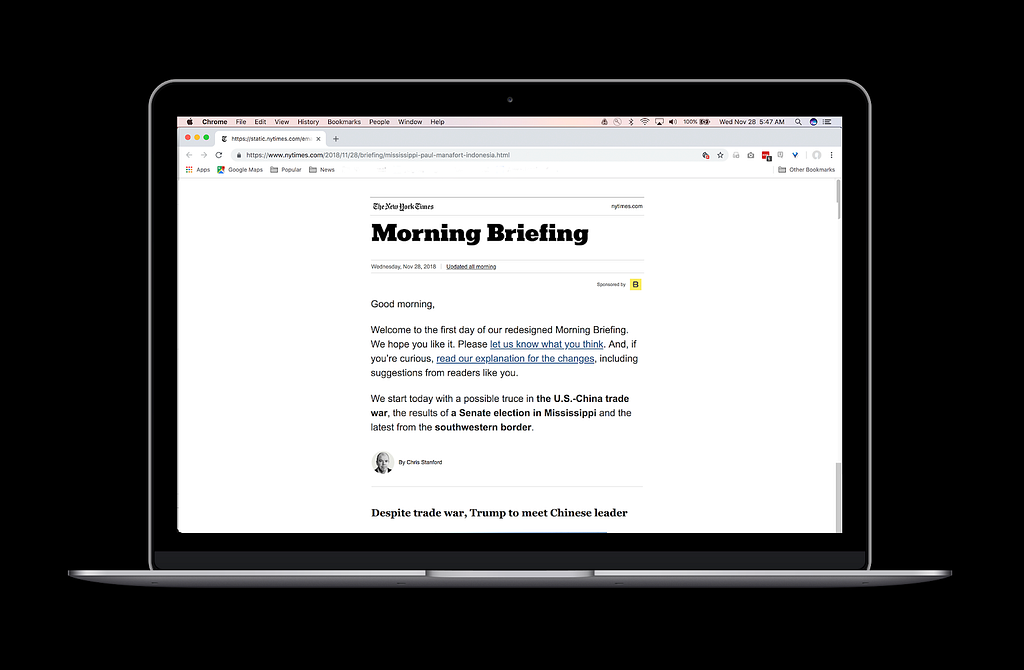
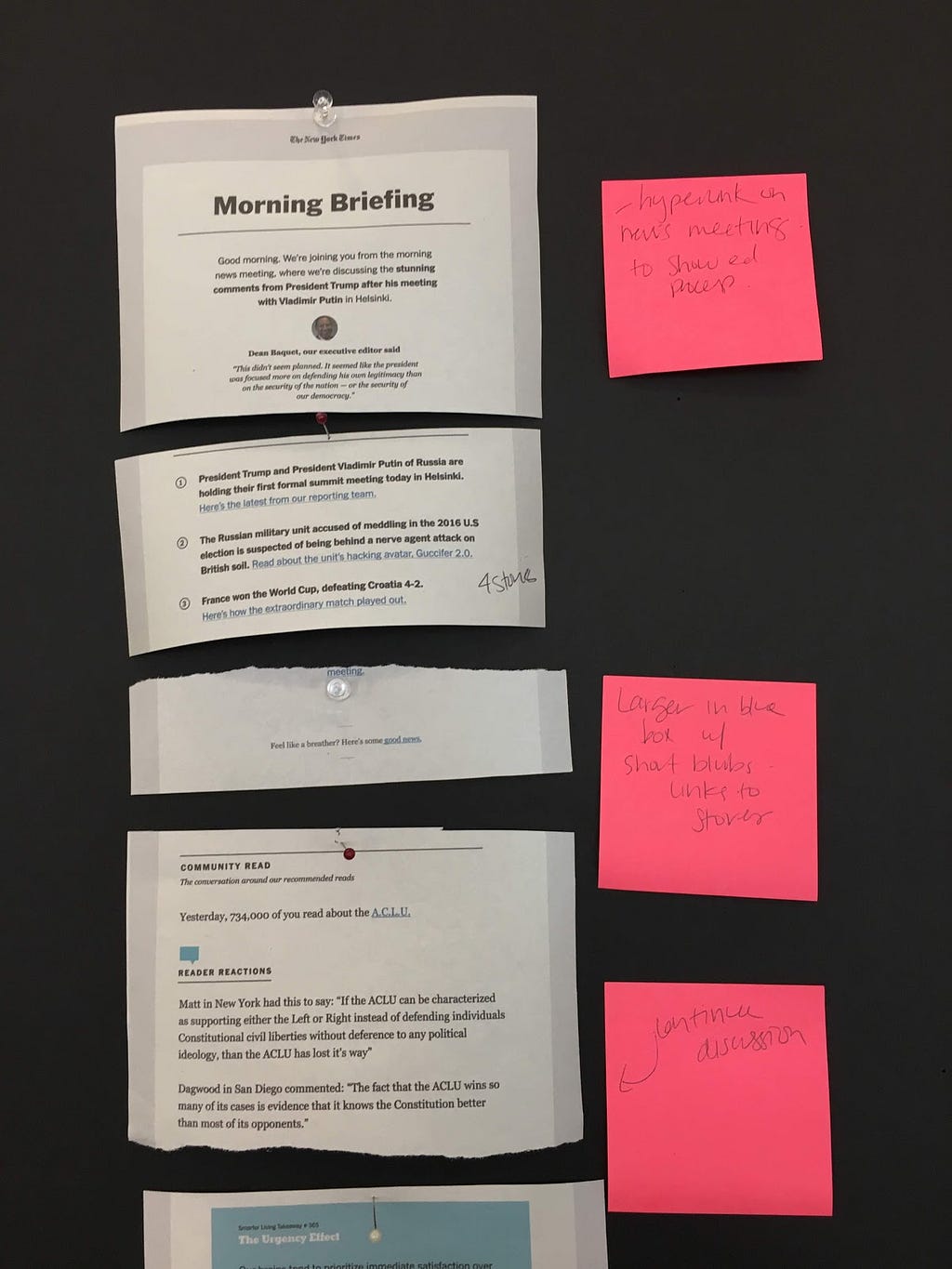
The redesigned Morning Briefing.

We started by trying to understand more about what the briefing meant to our readers. When we sent out a survey, the difficulty of our task became clear: Of the 13,000 readers who responded, over 97 percent said they were somewhat or very satisfied. How could we make such a successful editorial product “better”?

Understanding the challenge

Get to know the reader: We followed the morning routine of 30 for a week, which helped us understand their reading behaviors. We found that many readers fall into one of two distinct groups: those who read every word, top to bottom, and those who skip and scan for things that interest them. Depending on the day, readers might move between these two modes based on how much time they have. We also have readers who only read hard news, readers who live for our lifestyle coverage and readers who want a moment of historical intrigue — the “back story enthusiasts.”

Trial and error: Rapid testing helped us both 1) observe how readers reacted to changes and new features, and 2) understand how they navigate the current briefing. For instance, we repeatedly observed how the original briefing required many readers to read every word to grasp critical points. It signified importance with bolding, but it often did so inconsistently and without deliberate cues. The original briefing also followed a loose structure that ordered content from urgent to less urgent — but heavier news was often scattered throughout, requiring readers to shift their frame of mind quickly and frequently. Section headers like ‘Business’ and ‘Smarter Living’ invited readers to skip chunks of the briefing, sometimes missing articles they might have found interesting.

Making a faster, friendlier briefing

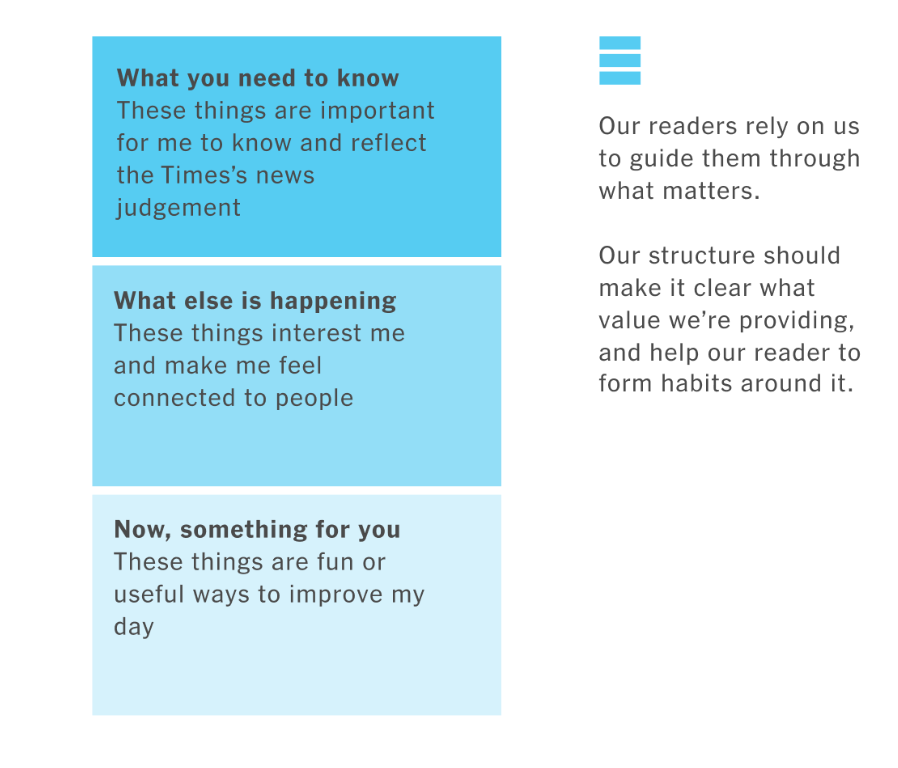
A clear structure: We wanted to emphasize the sequence of information to first-time readers, as well as aiding existing readers who want to skip and scan. The new briefing starts with the top stories of the day and then moves on to stories to connect the reader to what’s going on in the rest of the world and across the internet. The briefing ends with rewards: recommendations for nice things to cook, watch and listen to.

A defined structure based on what reader needs the briefing solved.

Friendly guidance: We use a conversational voice to escort the reader through the new briefing. Lines like, “If you have time, this is worth it” and “Now, a break from the news” give readers a sense of what value they’ll receive from a particular section while respecting their possibly-limited stock of time and effort. In the same way, a welcome note eases the reader into the news each morning and a goodbye note sends them on their way.

Different font treatments help distinguish between guidance and content. This helps onboard new readers and allows veteran readers to skip as they choose.

Enable scanning:

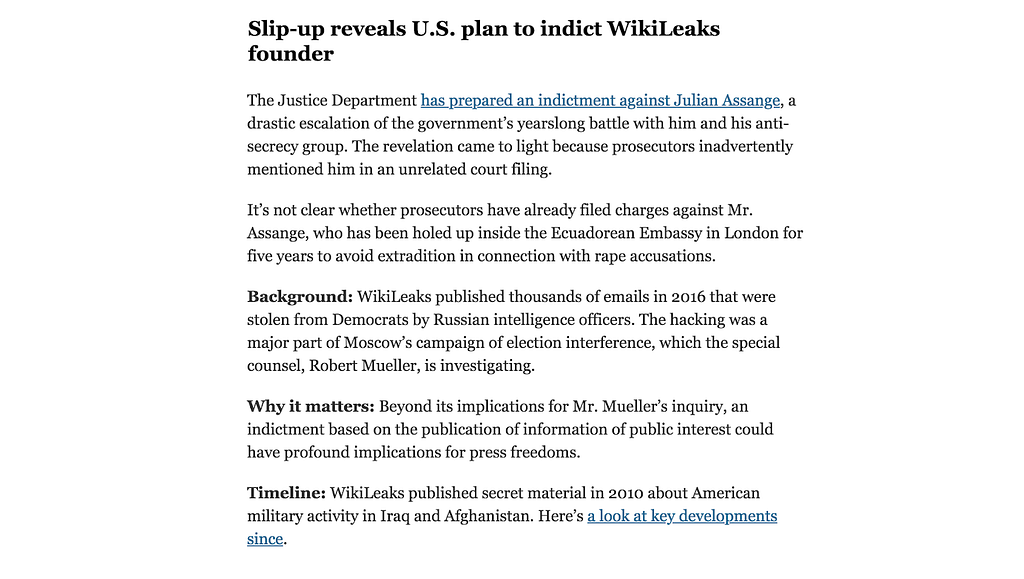
By improving signaling in top stories in the new briefing, we allow readers to get the gist of events quickly and choose what to engage with. We use bold lead-ins as labels, to help the reader know what kind information they are being offered. “How we know” allows us to give a behind-the-scenes look into The Times and reveal a little bit about the reporting process — like how many months our journalists spent reading through secret documents for a particular story. Other lead-ins: “Why it matters,” “Background” and “Another angle.”

“Here’s what else is happening” is a section that follows top stories and the featured read. Here, the bold lead-ins are more specific and clue the reader in on what kind of current news is available in the briefing, for instance “U.S military constraints” or “California wildfires.”

A top story with bold lead-ins is easier to comprehend.

A cross functional process

Empowering newsroom with insights: The briefing writer, Chris Stanford, and editors have long engaged with readers, responding daily to questions, feedback, fury and praise via email. With testing, we now could physically watch how readers interact with the briefing, which allowed for a new level of insight into reader needs. This helped us to develop a set of design principles that reflect both our editorial and user experience goals.

Editing as a group: This could have been a nightmare, but — writers, brace yourselves — it wasn’t. From the initial prototypes to the final pilot test, the entire team edited together in a discussion with the writer that honed the “mission statement” of every passage. (Editor’s note: That all who participated said the experience was positive is possibly the most surprising phenomenon of the entire project.)

Redesigning the workflow: Our structure allowed for advance work, allowing the briefing writer more time to focus on major news, fine tuning and grace notes.

Testing the new process: All of these elements showed their value as we tested the new briefing in London alongside Stanford. He could practice and refine everything we developed together, while readers gave us qualitative feedback. The initial test (sent to around 3,000 readers) and a follow up test (sent to over 130,000 readers) helped us assess the risk of making the intended changes.

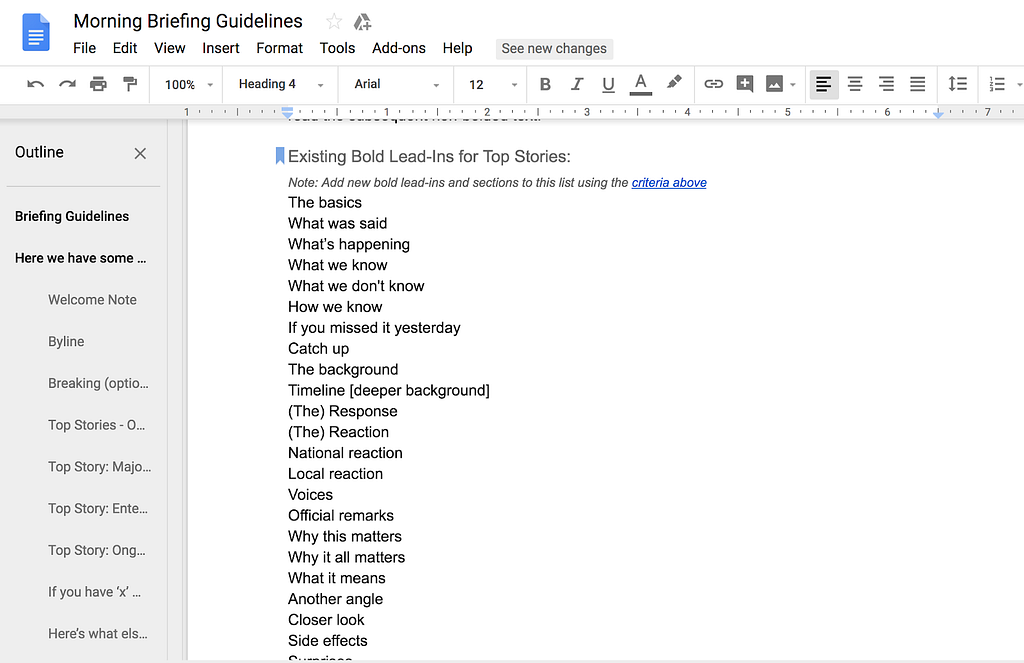
A list of “bold lead-ins” developed by briefing writers and editors during the testing phases of the Morning Briefing project.
The D.I.Y briefing created by a reader during in-house testing.

A repeatable process for newsletters, and editorial products

Future Newsletters: Our process for evolving the briefing has laid a foundation for refreshing other Times experiences. Specific to newsletters, technical limitations have informed everything, including how we design, produce, perform VQA and measure data around a newsletter.

A way of working: This project aligned how the newsroom and product work together towards our user needs and delivered a product experience that enhanced our successful journalism efforts. Not only did we redefine the Morning Briefing experience, but we strengthened trust and understanding with the newsroom, showing the value of a user-centered development process. With this process in place, we will continue to look at the valuable editorial offerings we have and find ways to elevate that value to our new and existing readers.

If you don’t already receive the Morning Briefing, you can sign up here to get it by email.

Briefing Team

Albert Sun and Andrea Kannapell from the newsroom
Melissa Loder on product
Jeanie Kay and Thea Lorentzen from design
Shannon Smith from research
Calli Higgins from technology
Sandra Stevenson from the Photo Desk
Chris Stanford who writes the briefing each day, and Anne-Sophie Bolon who edits it


Reimagining the Morning Briefing was originally published in Times Open on Medium, where people are continuing the conversation by highlighting and responding to this story.

29 Nov 22:54

The Best Laptops

by Wirecutter Staff
The Best Laptops
The late 2017 Dell XPS 13 (non-touch) is the best Windows ultrabook for most people because it has great battery life, a large, beautiful screen for its size, a good keyboard and trackpad, and a wide array of ports.

Smartphones and tablets may have taken over much of people’s screen time, but there’s still a need for a “real” computer sometimes—and for most people, that means a laptop. For school and office work and things like spreadsheets and video editing, there’s no good substitute for a decent keyboard and a big screen. But which laptop you should get depends on how often you’ll use it, what you’ll use it for, and (of course) how much money you can afford to spend on it.

We’ve tested all of the most promising laptops over the past few years, from sleek ultrabooks to cheap Chromebooks to massive gaming laptops and beyond. Here are the best models you can buy in every category, along with advice on how to choose which type of laptop is right for you.

29 Nov 22:54

Joswiak Says the XR is Apple’s Most Popular New iPhone and Details the Company’s World AIDS Day Efforts

by John Voorhees

In an interview with CNET, Apple Vice President Greg Joswiak revealed that the iPhone XR has been the best selling of the latest iPhone models every day since it was launched, a statement that is no doubt aimed at recent reports that XR parts orders have been reduced due to weak demand. Joswiak declined to provide specific sales figures to CNET.

Joswiak also said that Apple would again be marking World AIDS Day by making a donation to support Red, a nonprofit founded by U2 band member Bono. Apple is a long-term supporter of Red and has participated in World AIDS Day in a variety of ways over the years, raising $160 million since the group was founded in 2006.

In the past, the company has made donations based on Black Friday and Cyber Monday sales, donated based on Apple Pay purchases, turned store logos red, and worked with music artists and app developers to release special Red-themed content. According to CNET, this year:

The company will donate $1 for every Apple Pay purchase at an Apple Store, Apple.com or through the Apple Store app from Dec. 1 to Dec. 7, and it plans to turn 125 Apple Store logos red in honor of the day.

That’s similar to last year, except that this year the donation does not include in-app transactions, and Joswiak told CNET the App Store is not participating with any special promotions this year. That’s a shame because past Red-themed promotions raised awareness of Red’s efforts to combat AIDS as well as funds to support the group’s work.


Support MacStories Directly

Club MacStories offers exclusive access to extra MacStories content, delivered every week; it's also a way to support us directly.

Club MacStories will help you discover the best apps for your devices and get the most out of your iPhone, iPad, and Mac. Plus, it's made in Italy.

Join Now
29 Nov 22:54

If it matters enough to be careful, it matters enough to build a system.

by Eugene Wallingford

In Quality and Effort, Seth Godin reminds us that being careful can take us only so far toward the quality we seek. Humans make mistakes, so we need processes and systems in place to help us avoid them. Near the end of the post, he writes:

In school, we harangue kids to be more careful, and spend approximately zero time teaching them to build better systems instead. We ignore checklists and processes because we've been taught that they're beneath us.

This paragraph isolates one of the great powers we can teach our students, but also a glaring weakness in how most of us actually teach. I've been a professor for many years now, and before that I was a student for many years. I've seen a lot of students succeed and a few not do as well as they or I had hoped. Students who are methodical, patient, and disciplined in how they read, study, and program are much more likely to be in the successful group.

Rules and discipline sometimes get a bad rap these days. Creativity and passion are our catchwords. But dull, boring systems are often the keys that unlock the doors to getting things done and moving on to learn and do cooler things.

Students occasionally ask me why I slavishly follow the processes I teach them, whether it's a system as big as test-first development and refactoring or a process as simple as the technique for creating NFAs and converting them to DFAs. I tell them that I don't always trust myself but that I do trust the system: it almost always leads me to a working solution. Sure, in this moment or that I might be fine going off script, but... Good habits generate positive returns, while freewheeling it too often lets an error sneak in. (When I go off script in class, they too often get to see just that!)

We do our students a great favor when when we help them learn systems that work. Following a design recipe or something like it may be boring, but students who learn to follow it develop stronger programming skills, enjoy the success of getting projects done successfully, and graduate on to more interesting problems. As the system becomes ingrained as habit, they usually begin to appreciate it as an enabler of their success.

I agree with Godin: If it matters enough to be careful, then it matters enough to build (or learn) a system.

29 Nov 22:54

The Environmental Cost of 2 Day Shipping

by Caterina Fake

101500536-453085847.530x298

Worth emphasizing the environmental cost of 2 Day shipping, which comes with Amazon Prime, is huge, when compared with 3-5 day shipping, per this article on Grist. When I realized this, I started checking the box that says “No-Rush Shipping”.

Free two-day shipping — the hallmark of Amazon’s plan to squeeze out traditional retailers — burns through significantly more emissions than standard shipping or traditional in-store shopping.

When you wait three to five days for shipment, Jaller explains, Amazon has time to find the most efficient (and cheapest) way to deliver goods. Aviation is by far the most carbon-intensive transit option, and with more time the company can route your package by land, instead of by air…and group your package with other, similar deliveries.

“The concept of Amazon Prime pushes us towards more emissions…and makes the marginal cost of purchases very small, so you have motivation to buy more. And of course, that’s what Amazon wants.”

And the more shipments, the more packaging. The more packaging, the more waste. Go “No Rush”!

29 Nov 22:54

A Statement About Facebook and Color of Change

by Ashley Boyd

Color of Change is one of the leading civil rights organizations of our time, and we at Mozilla have been immensely privileged to collaborate with them on the Ford-Mozilla Open Web Fellows initiative and on a number of areas around internet health.

Their work is pioneering, inspiring, and has been crucial for representing the voices of a key community in debates about the internet. As a technology community, we need more and diverse voices in the work to make the internet open, accessible, and safe for all.

Recently, some concerning allegations regarding practices by Facebook have been raised in high-profile media coverage, including a New York Times article. We are pleased that Facebook is meeting with Color of Change to discuss these issues. We hope Facebook and Color of Change can identify ways that we, as a tech community, can work together to address the biggest challenges facing the internet.

The post A Statement About Facebook and Color of Change appeared first on The Mozilla Blog.

29 Nov 22:54

Mozilla Funds Research Grants in Four Areas

by Jofish Kaye

We’re happy to announce the recipients for the 2018 H2 round of Mozilla Research Grants. In this tightly focused round, we awarded grants to support research in four areas: Web of the Things, Core Web Technologies, Voice/Language/Speech, and Mixed Reality. These projects support Mozilla’s mission to ensure the Internet is a global public resource, open and accessible to all.

Web of Things

We are funding University of Washington to support Assistant Professor of Interaction Design Audrey Desjardins in the School of Art + Art History + Design. Her project, titled (In)Visible Data: How home dwellers engage with domestic Web of Things data, will provide a detailed qualitative description of current practices of data engagement with the Web of Things in the home, and offer an exploration of novel areas of interest that are diverse, personal, and meaningful for future WoT data in the home.

Core Web Technologies

Mozilla has been deeply involved in creating and releasing AV1: an open and royalty-free video encoding format. We are funding the Department of Control and Computer Engineering at Politecnico di Torino. This grant will support the research of Assistant Professor Luca Ardito and his project Algorithms clarity in Rust: advanced rate control and multi-thread support in rav1e. This project aims to understand how the Rust programming language improves the maintainability of code while implementing complex algorithms.

Voice, language and speech

We are funding Indiana University Bloomington to support Suraj Chiplunkar’s project Uncovering Effective Auditory Feedback Methods to Promote Relevance Scanning and Acoustic Interactivity for Users with Visual Impairments. This project explores better ways to allow people to listen to the web. Suraj Chiplunkar is a graduate student in the Human-Computer Interaction Design program as part of the School of Informatics, Computing, and Engineering, and is working with Professor Jeffrey Bardzell.

Mixed Reality

Mozilla has a strong commitment to open standards in virtual and augmented reality, as evidenced by our browser, Firefox Reality. We’re happy to support the work of Assistant Professor Michael Nebeling at the University of Michigan’s School of Information and his project Rethinking the Web Browser as an Augmented Reality Application Delivery Platform. This project explores the possibilities for displaying elements from multiple augmented reality apps at once, pointing the way to a vibrant, open mixed reality ecosystem.

The Mozilla Research Grants program is part of Mozilla’s Emerging Technologies commitment to being a world-class example of inclusive innovation and impact culture, and reflects Mozilla’s commitment to open innovation, continuously exploring new possibilities with and for diverse communities. We plan to open the 2019H1 round in Spring 2019: see our Research Grant webpage for more details and to sign up to be notified when applications open.

Congratulations to all of our applicants!

Thumbnail image by Audrey Dejardins

The post Mozilla Funds Research Grants in Four Areas appeared first on The Mozilla Blog.

29 Nov 22:48

Whenever people make a point of how much they hate popular movies, books, beer, music, or food, check to make sure they don't just hate "things enjoyed by people of a lower class than me."

by existentialcoms
mkalus shared this story from existentialcoms on Twitter.

Whenever people make a point of how much they hate popular movies, books, beer, music, or food, check to make sure they don't just hate "things enjoyed by people of a lower class than me."


Posted by existentialcoms on Wednesday, November 28th, 2018 10:19pm


818 likes, 234 retweets
29 Nov 22:48

James O'Brien: May's Rubbish Deal Shows Up Brexiteers' Claims On The UK

by Original Jedi Watching
mkalus shared this story from Original Jedi Watching's YouTube Videos.

From: Original Jedi Watching
Duration: 02:58

James O'Brien: May's Rubbish Deal Shows Up Brexiteers' Claims On The UK. The people who told us to hate the EU because it didn’t defend its members’ interests are now telling us to hate the EU because it’s rather good at defending its members’ interests, says James O'Brien. James labelled Theresa May's Brexit deal "terrible" and leaves the UK in the state that Leave voters have been insisting the country has been in for years. Speaking on his radio show, he said: "Nobody is happy with what's been negotiated. "What has been negotiated became more or less inevitable since when the Good Friday Agreement met the ludicrously early triggering of Article 50 and even more relevantly the red lines that Theresa May laid down in that speech. "As soon as they started pretending that the vote to leave the European Union had involved a conscious and deliberate decision to leave the Single Market and the Customs Union, we were placed upon a path that led inevitably to where we are now. Uk Politics World News GE2018 Brexit G20 OJW Donations Welcome. https://www.paypal.com/cgi-bin/webscr?cmd=_s-xclick&hosted_button_id=DPK4PYVL8ZSZN

29 Nov 22:44

DJI bringt Mini-Kamera mit Gimbal

by Ronny
mkalus shared this story from Das Kraftfuttermischwerk.

Der Drohnenhersteller DJI bringt mit Osmo Pocket eine Kamera auf den Markt, die in jede Hosentasche passt und mit einem einem 3-Achsen-Gimbal geliefert wird. Sollte die Kamera überzeugen, kann man sich im Hause GoPro warm anziehen. Das Dingen kommt pünktlich zum Fest am 15. Dezember für 350,00 Dollar – und vielleicht habe ich jetzt einen Weihnachtswunsch.


(Direktlink, via Klonblog)

29 Nov 22:44

"How To eBike" Takes the Vika+ for a Wild Seattle Ride!

by Blix PR

Zade from "How to eBike", an electric bike enthusiast, tested our Vika+ foldable model in Seattle, Washington. After meeting with our Local Blix Dealer Electric and Folding Bikes Northwest and learning about the bike from DJ, Zade headed out on a Blix adventure.

According to Zade, the Vika+ "reflects a modern style and a laid-back feel" with a comfortable riding position and great handlebars. Moreover, Zade is over 6' tall and he didn't find the compact size of the foldable model to be an issue. As he says, "if you're around my height or smaller, you'll have no problem at all on this bike." 

One of his favorite parts of the bike was his ability to "easily outpace cars when accelerating off from the green lights." By using the throttle, in addition to the four levels of pedal assist, Zade found the Vika+ to be powerful and provide varying levels of assist depending on the type of ride he wanted.  

When analyzing the ride of the Vika+, Zade found the motor to be "very quiet" and stated that "you'll barely notice it's there at all." With the smaller size and frame style, the Vika+ also had a "much tighter and responsive feeling handling." Zade found the process of folding and unfolding the Blix to be super easy and instruction was not entirely necessary! 

Overall, Zade rates this bike as "very sturdy" as well as "stylish, practical and budget friendly" that will make sure to provide you with "fun for years to come."  

We would like to thank Zade for this awesome review and taking the time to support Blix Bikes!


Check out the full review here

Check out the Vika+ for yourself here

29 Nov 22:44

The 1970s and ’80s are Coming Down – 1

by Gordon Price

Perhaps there’s a fifty-year cycle in Vancouver: buildings approaching the half-century, having passed their best-before date, are targeted for replacement.  At least I’ve begun to notice that, in this economic cycle, a fair number of buildings from the late ’60s, ’70s and early ’80s seem to be coming down, or soon will be, especially in the CBD/West End.  Because most are non-descript spec buildings, there hasn’t been much notice; few seem to care that this particular era in our history is disappearing.

Ar least it’s worth noticing their departure.  Here’s one:

1133-55 Melville is currently being demolished.  It was a 10-storey mixed-used experiment: retail at grade, parking on floors two through five, and 14 live/work units above.   Completed in 1982, it was one of several (most are in the Howe/Davie area) that tried to mix commercial and residential – not particularly successfully.  The trend ended soon thereafter.

The proposed 36-storey replacement – “The Stack” – will be, it’s said, the tallest office building in the city, permissible under the ‘General Policy for Higher Buildings,’ outside the view corridors and requiring special architectural merit, in this case from James Cheng’s office.

The Stack office tower, viewed from Melville street, rises 36-storeys and features an intricate stacked box design. (CNW Group/Oxford Properties Group Inc.)
29 Nov 22:43

Is React functional programming?

by Eric Normand

Even though React modifies the DOM, it is considered functional programming. It’s not strictly functional, but it is easy to reason about because the DOM is its only output. FP concepts can help us understand React.

In this episode, we explore the FP concepts that React employs and how reactive programming relates to functional programming.

Transcript

Eric Normand: Is React and that whole style of UI framework, is that really functional programming? Hi my name is Eric Normand and these are my thoughts on functional programming.

A curious listener to the show asked me about Re-frame. Re-frame is a ClojureScript framework built on top of React where there is a global immutable database.

The various components that you write can access that database, the global database, and then it access it through subscriptions. Whenever that subscription changes, whenever the data that comes through that subscription changes, the component is re-rendered.

The question was, is that really functional programming? Shouldn’t you use pure functions, like take the whole database, render out the entire UI from that as a pure function, as opposed to whatever this re-frame thing is doing?

It’s not just a pure function, it’s got these subscriptions that are a new input besides the arguments and they have an output which is that they’re rendering at basically random times. Is this really functional programming?

It’s a good question. To me, what this question indicates is that the person has not developed UIs before. UIs are notoriously stateful. You have stuff like whether a drop down is open or while you are typing, there’s different values changing inside of the text box.

You could have each of those strings that are in there as a new value and it’s constantly changing. You press a button and it does something, then it’s now has a loading spinner after you press it. It’s got a lot of state.

Functional programming has this big challenge of how do you deal with the state? One approach is to just say we’re going to render the whole thing as a pure function.

We’re going to get all the state. We’re going to gather it all up. We’re going to put it in one place, one big value and we’re going to pass it to one function. It’s going to call other functions.

It’s going to take the pieces of data, pass it to the next thing, pass it to the next thing, until you get to the trees where a lot of the HTML gets generated or the React-DOM nodes, whatever you want to call it.

Now it gets generated. You have to thread all the data that it needs through. That’s certainly possible, you could do that. The big issue with that — from a practical point of view — this is not from some framework chauvinism or anything like that. From a practical point of view, what happens is your UI, it has very little to do with any rational data model, any kind of rational semantic meaning model.

For instance, you could have a design, wherever it came from, maybe a designer drew it up that has a big content pane on the left and then a sidebar on the right. Somewhere in your big function, you have to split because there’s a div on the left and there’s a div on the right and they have to split.

There’s no way to have half, the top half and bottom. No, it’s left and right. The contours of the HTML has to match the contours of the functions.

Then you say while we’re going to have…The username is going to be somewhere in the right sidebar. You need to thread the name of the user into the right sidebar which will then put it in a label with their username inside of it.

You got this data thread. You’d imagine it’s going through onto the right sidebar side. Somewhere deep inside the right sidebar, there’s a div that has the name of the user.

There’s a change. They do some testing where the user can’t find their name on the panel. We need to move it to the main content page and make it really big, something like that. Now what you need to do is thread that username into the left side, which is the content pane.

All that work of threading it through and say I’ll pass the username in, pass the username in, pass the username in, OK now you can display it. You have to do that again on the left-hand side and pass the username through, pass it. About every component knows the username now. It’s essentially global information.

You’ve had to do all this work where the left content pane, the semantics of it as a UI layout component, are very agnostic to what is displayed inside of it. Notice that that meaning has not changed even though you moved something from the right to the left. It’s a container.

You’ve had to change the arguments. In theory you could have, but in this situation, you couldn’t just copy-paste that component, cut it out of the right-hand side and put it into the left-hand. You can’t just do that because you also had to do all the threading. All that threading. This happens a lot in UI.

It’s not just because your designer got it wrong at first, it’s you don’t know what the good design is going to look like until you do it, and you test it, and you show a user.

There’s no rational model of this belongs here because that’s what it means. You’ve got one, then the rational model will have to change because it’s just wrong. You did an experiment, you made a prototype, you showed it to the users, and it wasn’t good enough. It wasn’t getting the users’ user experience, the user’s behavior. It wasn’t given the right behavior from the user.

The solution to this problem is that you want the components to be able to get that essentially global information on their own without having to thread it through. That way, you could just copy-paste it over.

You don’t have to worry about threading. You don’t have to worry about, “This parent component has to know everything inside of it.” No, you don’t like that. That’s not good. That’s coupling.

You couple the whole UI to the structure of the HTML. All of the components, they care about the HTML, you do not want that. This is something that I have come to believe after years of working in UI, that that is just not good. You want the component to be relatively independent.

You give those components access to this global information. You store all the data outside in one spot. It’s got to be mutable because the state does change. You store it all. When I say all, there’s caveats to that. You store all of it outside, let’s be simple for a second.

Then, you give them selective access. You could say, “OK. This is a username component and wherever I put this username component, the contents of that component could be made the current user’s name.” How does it get the current user’s name? It subscribes to that value in the database.

Now you’ve decoupled the location of that element from its function. The CSS could mess things up, there’s complications here. In theory, you could take this component and just move it around your UI. None of the components that it is inside of have to care. There’s no dataflow issues anymore.

The thing is, because you’re getting it from this global place, it could change. That’s where you’re storing all your state, and state changes. Now, the UI needs to change based on what’s in that big global store, the database.

This is another problem because you don’t want to re-render the whole thing. If you only need to change one or two divs, you just want to change those one or two divs. You want some kind of locality of the change.

What React gives you, what Re-frame gives you, is this idea not of functional programming but of reactive programming. You should think of it like this component is reacting to changes to the database and always staying current. Always showing the most recent value.

It’s not functional programming in the sense of everything is a pure function on data. That’s a non-starter with UIs, for all the reasons I’ve explained. It gives you something else which is that you don’t have to worry about what is being displayed anymore.

It’s always the current value. I change data in one spot, and my UI is up to date. That’s a big promise and Re-frame delivers on that.

React should deliver on that too, but there’s problems with that in the way people actually practice their React. We can go into that in another episode.

This is reactive programming and it borrows a lot of ideas from functional programming. The extra idea is that in addition to the arguments to the function — in a pure function, you just have the only inputs to that function. The only thing that can affect the output value of that function are the arguments.

You change the arguments, you can change the output. If you have the same arguments, you’re going to get the same output. This adds inputs. It adds those subscriptions. It adds this thing that it can react to, so this is changing data.

It’s not just arguments. You should think of it as like static. These are things that can change. Because the components, if you do it the right way in this reactive programming way, reactive UI way, the only output of those functions is UI.

It’s not like sending Ajax requests. It’s not doing an alert. It’s not changing something somewhere else, because you don’t know when it’s going to render. Anytime the database changes, it could re-render. The only thing it should do is render.

That’s what something like Re-frame gives you in at its best. If you do React in this way, it gives you this really nice way of doing UIs. It’s not strictly functional programming, but it gives you good promises anyway. Promises that you’d want as a UI designer.

I don’t think I could do complex UIs in the way that I used to anymore because I got really tired of it. I used to do it with JQuery back in the day and it would just get really complicated. A lot of the times I would just wind up re-rendering a big tree because it’s too complicated. I know that there’s going to be some weird corner cases and I just let me re-render the whole thing.

I don’t want to base on the history. I know what it needs to be now, let me just make it that now. React delivers on that. It does it much better than you can do in JQuery because of the virtual DOM and everything.

Then, because you’ve got these components that can re-render independently, you also got that locality that if you need it, you could make a table that had 10 million rows in it. You can’t really render a page that big, it would be too slow, but you only have to render what’s visible, right?

It gives you this ability to only update the stuff that’s visible and ignore all the stuff that you got the data for but you don’t want to make a DOM for it.

Anyway, I’m digressing. I like React. The new Angular view, they’re pretty much the same. The issue is how you program in it.

Are you programming that you do only have…It’s not functional programming. It’s not just arguments and a return value. It’s not pure functions. It’s arguments and changing input. Like a subscription, you redux. If you’re doing reactive redux, it could be redux updates. The only output is the rendering.

It’s different, but it’s got a lot of the same ideas. You can borrow the same terminologies, stuff like that.

All right. I am Eric Normand. This has been one of my thoughts. Please find me on Twitter @EricNormand. Or on LinkedIn, search for my name in Clojure if I don’t show up first. I’d love to get in discussion with you.

All right. See you later. Goodbye.

The post Is React functional programming? appeared first on LispCast.

29 Nov 22:43

Oligopoly collusion

by Joe Gregorio

Don’t you just love it when oligopolies collude?

Alaska Airlines giving preferential treatment to Facebook and Apple.

Imagine you were a small startup with a new idea for a chat application. How could you ever compete with this? Is there any wonder there’s a startup slump?

29 Nov 22:43

The Persistent Myth of Five Year Plans

by Jim

five year plan posterI marvel that the myth of the 5-year plan persists. Without the invention of the spreadsheet it might have already passed away. You would think that the “success” of 5-year plans in the former Soviet Union would have been a better clue. Regardless, managers continue to stress over their ability to predict the future and manage to those predictions.

There are only two ways to make plans that can survive a 5-year test. One is to operate in a stable/stagnant enough environment that the future can be seen in today’s reality. The second is to take so few risks that you convert your local environment into something that can pass for stable.

Smart organizations and smart managers approach planning differently. When we started Diamond in 1994 we talked about our 23 and 1/2 year plan. This “plan” was a simple picture that showed 3 1/2 years of high growth followed by a 20-year line of sustained, steady, growth. The point of that simple picture was to set a shared direction. The first task was to establish an organization and a culture. The second was to manage that organization for the long term.

There was no way and no point to make or believe predictions about what we would be doing in 5 years. But our aspirations gave us insights into the organizational capabilities we needed to build. Without the sense of direction, we would have no way to make choices about what to work on and what to ignore.

We were indeed trying to build a business but there were also insights to take over into building a body of work perspective. Chief among them was to focus on the skills and capabilities we needed to develop. Planning was about understanding the skills we had and the skills we hoped to develop next. If you have choices about what projects to take on, then one filter is what new paths does each project open up.

The post The Persistent Myth of Five Year Plans appeared first on McGee's Musings.

29 Nov 21:27

Work from home looks

by Liz

I really enjoyed these cartoons today:

There are 4 pages of work from home outfits of uncanny accuracy to how I normally dress at least, until noon or so. Some details vary, but I totally put my hair (short as it is) into a top of the head ponytail and I tuck my tattered pajamas into my (too big, mens’) socks. The t-shirt boob tuck is also just TOO REAL. I did wear actual pants today. My t-shirt is one that I got in 1988 at the Guinness factory in Dublin which has miraculously survived all this time with no holes and amazing softness.

The artist has an adorable etsy shop!

29 Nov 21:26

Browser apps scramble to fix permissions after Shanghai authority shows privacy concerns

by Bailey Hu
Cheetah Mobile's CM browser came under fire for lax privacy protection.
29 Nov 21:25

B.C.'s only supervised-inhalation site for drug users pressured to move out of its home in the Downtown Eastside

mkalus shared this story .

  • Overdose Prevention Society executive director Sarah Blyth is fighting to save Vancouver’s only sanctioned drug-inhalation site.

    Travis Lupick

More than 4,800 people in B.C. have died of an illicit-drug overdose since 2013, the year that the dangerous synthetic-opioid fentanyl arrived.

In the epicentre of the crisis, Vancouver’s Downtown Eastside, residents have responded with community-led harm-reduction programs. Activists like Sarah Blyth established pop-up injection sites, where people could use drugs under the supervision of staff trained in overdose response.

After Blyth opened the first of these sites in September 2016, the province established several more and nonprofit housing providers integrated supervised-consumption rooms into buildings around the Downtown Eastside. But only one location in B.C.—and only two in all of North America—permits clients to smoke drugs in a supervised setting. That’s because, although supervised-injection facilities like Insite can get around Canada’s Controlled Drugs and Substances Act with a federal exemption from the law, they cannot avoid a provincial law that forbids smoking inside a workplace.

And so Vancouver’s only supervised-inhalation site exists outdoors, under a tent, at the back of a vacant lot at 62 East Hastings Street. (The other is in Lethbridge, Alberta.)

“We decided, ‘Whatever kind of drug you’re using, that’s fine, and we’ll figure out how to monitor you using.’ Because you can overdose by smoking, snorting, or anything,” Blyth, executive director of the independent Overdose Prevention Society, told the Georgia Straight.

According to preliminary data supplied to the Straight, the society’s facilities (both the injection room and supervised-inhalation tent) saw more than 94,500 visits between April 2017 and April 2018. Staff responded to 36 overdoses among people smoking drugs and 172 overdoses where someone was injecting. Every intervention was successful. No one has died at a supervised-consumption site in B.C.

Although there is evidently a need, Vancouver’s only supervised-inhalation program is receiving pressure to relocate or shut down.

The tent was pitched upon, and remains on, property that the City of Vancouver has designated for sanctioned street vending. The Downtown Eastside Street Market has patiently shared its space for two years, and the relationship has become strained, street-market staff told the Straight.

<img src="//d2ciprw05cjhos.cloudfront.net/files/v3/styles/gs_standard/public/images/18/11/barnesmarket_181126_1s.jpg?itok=epyFFWfE" alt=""> Travis Lupick

“It was supposed to be temporary,” Linda Lennie, a vendor and assistant to the market’s executive director, told the Straight. “Everything was supposed to move inside. But that never happened.”

In December 2017, the Overdose Prevention Society’s supervised-injection services did move indoors, into a building at 58 East Hastings, two doors down from the market. But due to smoking laws, the supervised-inhalation component remained on the market’s property.

The market’s executive director, Constance Barnes, stressed that its members do not want the inhalation site to close. “We absolutely support what she [Blyth] does,” Barnes told the Straight. “But where should it go?”

Lennie noted that many vendors who sell goods at 62 East Hastings—herself included—are recovering addicts who are trying to get away from drugs.

“I’m an ex-addict, and smells trigger me,” she explained. “There are a lot of people who have smells that trigger them. And there is a lot of smoke [at the supervised-inhalation site].”

Both Blyth and Barnes said a solution would be for the regional health authority, Vancouver Coastal Health (VCH), to work with the Overdose Prevention Society to move supervised-inhalation services indoors.

“We don’t want people dying in the street,” Barnes said.

<img src="//d2ciprw05cjhos.cloudfront.net/files/v3/styles/gs_standard/public/images/18/11/opsinhalation1_181124_1s.jpg?itok=9xdx98M3" alt=""> Travis Lupick

Blyth revealed that an architect has already sketched rough plans for a powerful ventilation system that could allow drugs to be smoked indoors safely. But even with such a system, the bylaws would remain in the way.

“We are trying,” Blyth emphasized. “But it [a move indoors] could take years to figure out.”

Dr. Mark Lysyshyn is VCH’s lead on harm reduction and substance use. While declining to comment on specific complaints about the site, he expressed support for the inhalation facility as it exists now.

“Here’s a solution that works, is not bumping up against bylaws, and it’s acceptable from an occupational-health-and-safety point of view,” he said. “They are supervising inhalations, have supervised tens of thousands of them; they are reversing overdoses, and nobody is dying.”

Lysyshyn acknowledged that inhalation services could move indoors, but cautioned that would come with significant costs—money that, five years into a health crisis, he noted is already stretched thin.

“You can create indoor spaces that work, and they have done that in Lethbridge. But it’s about where we invest our money,” Lysyshyn said. “This is why we love the overdose-prevention sites, because the people in the community are so innovative. They found a solution that works.”

<img src="//d2ciprw05cjhos.cloudfront.net/files/v3/styles/gs_standard/public/images/18/11/smokingblueprints_181128_1.jpg?itok=qXFEPeGo" alt=""> Sean McEwen

Blyth argued that the Downtown Eastside Street Market should retain its character as a space for harm reduction. She noted that High Hopes, a small dispensary that previously offered cannabis as an alternative to harder drugs, was forced out of the market last month. Now Blyth said the community is at risk of losing its supervised-smoking site.

Barnes and Lennie did not dispute that is the direction they hope the market is taking. “The market was never about harm reduction,” Lennie said.

Blyth maintained the tent that faces the alley at the back of 62 East Hastings is unique and therefore needs to be protected. “In B.C., where four people are dying every day, it lets people come and have a safe space, to use, and to have a connection,” she said.

29 Nov 21:22

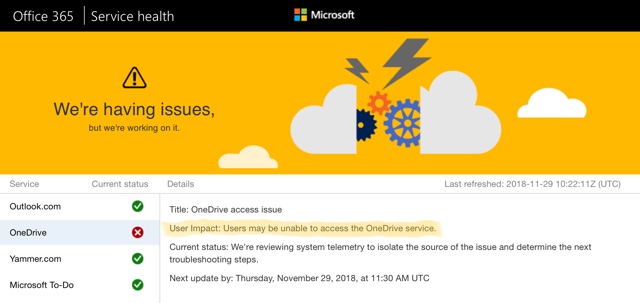
OneDrive is taking a bath

by Volker Weber

d518f425285334130c5eb75422b7c431

Update 12:00 CET: Back to normal for me.

More >

29 Nov 21:22

From my inbox

by Volker Weber

77ef2daf4a4896ade45531dccb94a369

Feinste Grundnahrungsmittel aus Bayern. Die reichen für ein ganzes Jahr. Danke, Hubert!

29 Nov 21:21

Twitter Favorites: [shawnmicallef] #EveryCorporateOverSalting begins with @TTChelps at Exhibition Loop. Holy no snow salt. #SaltIsDeath https://t.co/8QFr66NjT5

Shawn Micallef @shawnmicallef
#EveryCorporateOverSalting begins with @TTChelps at Exhibition Loop. Holy no snow salt. #SaltIsDeath pic.twitter.com/8QFr66NjT5
29 Nov 19:28

SubEthaEdit 5 is now open source

by Rui Carmo

This takes me back to the days where we didn’t need web services for networking things together in a meaningful way. I like it that they’re making it available in the App Store, too, and hope it gets regularly updated.


Support this site
29 Nov 19:27

Teaching kids data visualization

by Nathan Yau

Jonathan Schwabish gave his fourth-grade son’s class a lesson on data visualization. He wrote about his experience:

I’d love to see a way to make data visualization education a broader part of the curriculum, both on its own and linked with their math and other classes. Imagine adding different shapes to maps in their Social Studies classes to encode data or using waterfall charts in their math classes to visually demonstrate a simple mathematical equation or developing simple network diagrams in science class. The combination of the scientific approach to data visualization and the creativity it sparks could serve as a great way to help students learn.

Maybe I should introduce Schwabish’s Match It Game to the Yau household. My five-year-old has been asking why I keep “doing data.”

Tags: kids, teaching

29 Nov 19:27

@MargaretAtwood

@MargaretAtwood:
29 Nov 18:44

Dunsmuir and Howe – ne corner (2)

by ChangingCity

We looked at the Hambro Building that was built here in 1920s. Like much of Downtown, today’s commercial district started life as a residential neighbourhood, and in this 1899 picture the Japanese Consulate was on the corner. Previously the consulate had been at 730 Burrard Street, With Tsugoro Nosse as Consul. (He moved on to run the Consulate in Chicago). From 1898 it was Hon. S Shimizu, and this new location had been the Consulate for a little before the change of consul, probably starting in 1897 A year earlier the Consulate had placed a wanted ad in the Daily world “WANTED – NEW LARGE HOUSE, suitable for office and residence, near Hotel Vancouver or Vancouver Club.” We think the Consul when the image was taken was called Seizaburō Shimizu, who had been Consul in Hawaii, and moved on to be Japanese Consul in Ottawa in the 1920s.

At the time the image was taken, the consul was kept busy writing to the Federal Government, objecting to the discrimination against the Japanese in British Columbia shown in Provincial legislation like the Alien Labour Bill to which assent has been given in 1898. In turn he was consulted by the government over a number of years about the Japanese voluntarily restricting migrants from moving to British Columbia, where hostility to Asiatic employees was building as the economy faltered. He had moved on by 1902, some years before the Japanese response to the anti-Asiatic riot that broke out in 1907, causing significant damage in Japantown (centred on Powell Street). At the time about 8% of the population of the city were Chinese, and several thousand Japanese from a population of around 100,000. The riots served their purpose: Japan agreed to restrict the number of passports issued to make labourers and domestic servants to an annual maximum of 400 under a ‘gentlemen’s agreement’ enacted in Canada in early 1908, the year the consulate moved to the newly constructed ‘Imperial Block’ on West Pender.

Once the Japanese had moved, the new occupant of the former consulate was D’Auria Francesco D’Auria ‘vocal teacher’. He was, as his name suggests, an Italian, born in Naples, and a successful composer and orchestral conductor. He had founded the first, shortlived, Toronto Symphony Orchestra in 1890, moving on to Winnipeg in 1895, and then Minneapolis before arriving in Vancouver in 1904.

Today the final 1990 phase of the Pacific Centre Mall is here, with an office building designed by the Zeidler Roberts Partnership.

Image source: City of Vancouver Archives CVA Bu N429

29 Nov 18:44

You can now import areas & lines to locator maps (plus other improvements)

Since we launched our locator maps almost two months ago, you have built a lot of great-looking maps. We want to enable you to build even better ones. That’s why we implemented some changes that we’re sure you’ll appreciate:

Add not just points, but lines & areas to your map

You can now import GeoJSONs with lines & areas to your locator map – to show marathon routes, historical districts, the extent of events like natural disasters and anything else you can think of. Try to copy & paste these 2016 Shanghai metro lines, for example. It’s as easy as that:

gif of geojson import

So now you can create maps like the following one. Hover over the map and click on “Edit this chart” to go directly into the map creation process and find out how we did it:

If you’ve never dealt with GeoJSONs before, don’t worry. We explain more about this new feature in the following Academy articles:

👉 “How to import area & line markers”: Often, you can get GeoJSONs directly from open data portals. Or you can draw them yourselves with tools like geojson.io. In this article, you’ll learn where to get GeoJSONs from and which ones are accepted (the file size can be up to 2MB, for example).

👉 “How to import point markers”: You can add point markers with the big blue “+ Add marker” button at the top, as you’re used to. But now you can also import up to 100 point markers with a CSV or GeoJSON.

👉 “How to style your markers before importing them to Datawrapper”: If you deal with lots of markers, you might want to style them before you import them to a locator map. In this article, you’ll learn how to do that (and which property names are accepted) for both GeoJSONs and CSVs and for point, line & area markers.

Style multiple markers at once

Before today, you could already copy & paste the style of one marker to another one – but only to one other one. Starting today, you can first select and then apply styles to as many markers as you want:

gif of geojson import

This feature applies to point, line & area markers. Learn more about how it works in our Academy article: 👉 “How to copy & paste marker styles”

Customize what your map looks like

If you’re a user with a Custom plan that allows unlimited locator maps, you can now customize the font for marker text and label text (these toned-down place names) in the style of your company or newsroom.

But there’s more to a map than the text on it. We already offer everyone four different map styles in “Step 2: Design map”. With a Custom plan, you can now add an own map style for your theme, to decide the appearance of parks, streets, buildings and all other elements on your map. Write to support@datawrapper.de to get started.

Place marker text within symbols

You can now place marker text in point markers themselves. Just click on the center dot in the “Alignment” options that you find under “more options” when selecting a point marker. That way, you can create maps like this:

Norway looks pretty now (and not just Norway)

When launching the locator maps, our ocean layer was far more simplified than the country layers. As a consequence, roads sometimes led into the ocean, especially in very rugged coastline areas like in Norway. So we made some tweaks to resolve this problem. If you still find some errors in our map material, please let us know!


Let us know what you think about these changes. Write to us at support@datawrapper.de with questions, inquiries, feature requests, criticism, praise, etc. We’re looking forward to seeing what you’ll build with these new features!

29 Nov 18:44

The Lifetime Wage Gap Between Men and Women

How Big Is the Male-Female Wage Gap, Really? | There’s many ways to measure the wage gap between men and women, Annie Lowrey tells us:

Do women earn 80 cents on the dollar compared with men, as is commonly cited? Or is the pay gap just pennies, as one recent survey found? Or do women earn a shocking 49 cents on the dollar, as calculated by the social scientists Stephen Rose and Heidi Hartmann in a new analysis published by the Institute for Women’s Policy Research?

The answer is all of the above. Each number highlights a different aspect of a complicated and nuanced situation—one reflecting not only sexism and bias but the choices made more or less freely by millions of women in hundreds of thousands of workplaces. Rose and Hartmann’s number is lowest because it is in some ways most holistic.

By holistic, Rose and Hartman looked at the lifetime earnings of women, who are likely to take long stretches out of work when raising children or caring for aging parents.

Rose and Hartmann’s study found that women’s penalties for leaving the workforce have increased: Women who took a year off from work in the 15-year period starting in 2000 had annual earnings 39 percent lower than women who worked continuously over that time period, a gap that was just 12 percent for women working in the 15-year period starting in 1968. “Women’s earnings losses for time out are almost always greater than men’s,” they find.

According to Rose, these facts suggest that the most accurate way to compare women’s and men’s earnings is to take the career-long view. “When you look at all women versus all men over time, the gap is 51 cents,” he said, referring to the 15-year figure.

That’s a big gap to fill, and we will need to create across the board paid family leave and child-care subsidies if we want to close it. There is no way to lean in to eliminate this wage gap.

29 Nov 18:43

Unsuccessful Council Candidate on Mayor’s Slate Gets Six Figure Job in Delta

by Sandy James Planner

EMPLOYEE-HIRING-PROCESS-1050x688

EMPLOYEE-HIRING-PROCESS-1050x688

It’s been a strange couple of weeks south of the Fraser River in Delta, where new Mayor (and old city manager) George Harvie got right down to business on his motordom agenda, insisting with the new Metro Mayors’ Council that he still wants the Massey Bridge. The new chair of the Mayors’ Council Jonathan Cote told Mayor Harvie that deciding whether there was going to be a multi-billion dollar ten lane bridge replacing the Massey Tunnel was not in Metro Vancouver’s  jurisdiction.

But Mayor Harvie is gathering like-minded pro-bridge people around him, and took the eyebrow raising step of appointing one of the unsuccessful candidates running for council under Harvie’s slate to a position in the mayor’s office. It’s the “director of public engagement and intergovernmental affairs” given to Param Grewal, a $125,000 position.  Mr. Grewal is an older vintage as is the mayor, and of course is advocating for the Massey Bridge.

While the Delta Optimist reported on the social media storm about this appointment, Mayor Harvie stated “The mayor needs that and it’s not just the mayor of Delta, they generally hire their own staff. .. I had that position and wanted to get more utility from that position and wanted to hire somebody with the experience Param has. I was very fortunate he decided to take that job. That job is autonomous and is a four-year contract. I had the HR (human resources) staff draw up the contract to make sure it was done properly and within the city’s guidelines, but he does not direct staff and he reports directly to me.”

Previous Mayor Lois Jackson has come back as a Delta city councillor and as a support to Mayor Harvie, who was her hire as Delta city manager. Ms. Jackson spilled the beans when she alluded “In North Delta the demographics are very different than South Delta. We do need to have a conduit between ourselves and the Indo-Canadian community. There’s a lot that goes on that, I think, we can miss. There’s a lot of barriers, in particular, with the senior people.”

What Councillor Jackson is saying is that the support for Mayor Harvie’s election came from North Delta where residents are bullish on big infrastructure projects like the Massey Bridge, and good accessible highways, so it made sense to appoint someone to excluded staff that represented that area. The other two Delta areas, Tsawwassen and Ladner have already experienced a lack of civic public consultation and follow-up with major issues like the continual stench of the Enviro-Smart Organics operation somehow approved on supposedly protected Agricultural Land Reserve. Documentation from Metro Vancouver appears to show that Mayor Harvie “strenuously objected” to a public process and air quality permits  for this use as previously documented in Price Tags.

And surprise! According to the Delta Optimist, when returning Councillor Bruce McDonald (who was NOT on Mr. Harvie’s council  election slate) was asked about Mayor Harvie’s political hire, he knew nothing about it. That information had not been given to Councillors outside Mr. Harvie’s circle.

I haven’t got a clue. I haven’t had any communication from the (municipal) hall what it’s all about and we were not told he was being hired. I have no idea what his job description is and I have no idea what he’s being paid.”

10479394_web_180208-NDR-FinancialPlan2018_110479394_web_180208-NDR-FinancialPlan2018_1