Shared posts

21 Dec 04:55

Don’t Be Defensive

by Richard Millington

The moment you get defensive, take insults personally or react badly to criticism you’ve lost the chance of building a positive relationship with that member (and other members who see your response).

Every interaction is a great opportunity to build a stronger relationship, deepen mutual understanding, and find better solutions to community problems.

You shut down those possibilities when you try to defend your own reputation instead of making the other member feel great.

Defensive responses are selfish responses.

The great irony is the best way to improve your reputation is to ignore the personal insults against you and focus on helping other members solve their problems, feel understood, and more appreciated.

21 Dec 04:54

Latest Firefox Release Available Today

by Nick Nguyen

It’s the season for spending time with family and friends over a nice meal and exchanging gifts. Whether it’s a monogrammed bag or a nicely curated 2019 calendar of family photos, it’s the practical gifts that get the most use.

For Firefox, we’re always looking for ways to simplify and personalize your online experience. For today’s version of Firefox for desktop, we have a couple new features that do just that. They include:

Contextual Feature Recommender (CFR)

Aimed at people who are looking to get more out of their online experience or ways to level up. CFR is a system that proactively recommends Firefox features and add-ons based on how you use the web. For example, if you open multiple tabs and repeatedly use these tabs, we may offer a feature called “Pinned Tabs” and explain how it works. Firefox curates the suggested features and notifies you. With today’s release, we will start to rollout with three recommended extensions which include: Facebook Container, Enhancer for YouTube and To Google Translate. This feature is available for US users in regular browsing mode only. They will not appear in Private Browsing mode. Also, Mozilla does NOT receive a copy of your browser history. The entire process happens locally in your copy of Firefox.

Multiple Tab Organization

When you go online, it’s not uncommon to have several tabs open on a variety of topics whether it’s dinner recipes or gift ideas for your family, it can add up to a lot of tabs. How does anyone ever organize all those tabs? In today’s release, you can now shift or ctrl-click multiple tabs from the tab bar, and organize them the way you want. You can mute, move, bookmark or pin them quickly and easily.

Here’s a link to our release notes for a complete list of what’s included in today’s release.

Check out and download the latest version of Firefox Quantum available here. For the latest version of Firefox for iOS, visit the App Store.

Download Firefox

The post Latest Firefox Release Available Today appeared first on The Mozilla Blog.

21 Dec 04:54

Julia Roberts’ holes — a musing on the cost of early carelessness and late edits

by Josh Bernoff

The local paper of Jamestown, New York, The Post-Journal, has now revealed that 51-year-old actress Julia Roberts’ aging holes are doing well. Up close and personal is fine for a profile, but this closeup seems a bit extreme. Even so, it made me think about how many more mistakes we see these days, and why. Here’s what … Continued

The post Julia Roberts’ holes — a musing on the cost of early carelessness and late edits appeared first on without bullshit.

21 Dec 04:54

Making Bloor safe for cyclists is not as easy as you might think

by dandy

Photo by Martin Reis from Pride and Privilege on Bloor a dandyhorse story.

Making Bloor safe for cyclists is not as easy as you might think

by Albert Koehl

For all the simplicity and joy of riding a bicycle, making roads safe for cyclists is a very complex matter once it reaches City Hall. It’s hard to imagine that building colossal projects like the Don Valley, Gardiner, and Allen expressways could have been as difficult. By contrast, it’s worth remembering that our national railway was planned, financed, and built in about 15 years. The story of the Bloor bike lane already stretches back at least 50 years. When a 2.4- kilometre bike lane pilot on Bloor St. (between Shaw St. and Avenue Rd.) was made permanent in November 2017, it was only after the city completed what its transportation manager described as the most comprehensively studied road project in North America. Some folks might then have expected the extension of the Bloor bike lane to become easy. No such luck, as it turns out.

So, what’s going on in the latest chapter of this saga?

You may recall that a few months prior to the installation of the pilot Bloor bike lane in August 2016, city council also approved a ten-year bike plan. The new plan set out 335 kilometres of bike lanes to be installed over ten years, subject to the pre-requisite of a “corridor study” for lanes proposed for busy roads. Council indefinitely deferred all corridor studies, with the exception of the Yonge and Bloor St. studies, both of which were described as “currently underway.” (The corridor study includes Bloor from Sherbourne St. to High Park.)

Beginning early this year we prodded City Hall about the status of the Bloor corridor study, particularly after finding out that the study was stalled --  in fact we discovered it hadn’t been started. This was particularly surprising given that that study was to be informed by the Bloor pilot study. City Hall then diligently ignored us until several weeks ago when staff revealed that the corridor study was in a “queue” behind an environmental assessment (EA) for a bike lane on Bloor East in the 450-metre gap between Sherbourne and Church Streets. No date was offered for the start of the corridor study once it reaches the front of the queue.

We had believed that the words “bike lane” and “EA” would never again be uttered in the same sentence after the province announced, in October 2015, that the law was being updated to clarify that EAs are not needed for bike lanes. “Bike lanes and trails easier to build under new provincial rules,” read the Toronto Star headline. Indeed, we had always asserted that assessing the environmental impacts of a bike lane was rather absurd, even comic. It turns out that the matter is still open to interpretation, according to the City.

The bigger issue is why the 450-metre bike lane gap on Bloor East will delay the bike lane corridor study for the broader stretch of Bloor. In fact, filling the gap in the bike lane on Bloor East is only part of a much larger streetscaping project that has been discussed for several years. The streetscaping initiative runs from Church to Parliament Streets, and includes features like better accessibility for disabled people, lower speed, and better pedestrian crossings. We’re excited about these improvements, although it’s curious that a similar project along Bloor in Yorkville wasn’t subjected to an EA, the result of a city decision that was upheld in court (and reported on these pages).

The City routinely hires consultants to prepare major studies instead of doing the work itself. What’s also curious is that city staff are suggesting that the EA and the corridor study can’t be undertaken at the same time even though both studies would be informed by the completed pilot.

The new delay for bike lanes on Bloor might be understandable if the city was otherwise racing to install bike lanes across the city -- but the opposite is true. Sadly, when staff in the new year gives its progress report on the ten-year bike plan to councillors, it will be brief. Since the approval of the bike plan in June 2016, new bike lanes are few and far between (as previously documented).

Where does all of this leave us, aside from continuing to ride in the gutter or in fear of car doors opened into our paths?

First, we need answers. Barbara Gray, the city’s transportation manager was hired, in part for her expertise in making streets safe for pedestrians and cyclists. Send her an email to ask what’s happening with the corridor study for Bloor, and why there’s been so little progress on the ten-year bike plan.

Second, get ready for the City’s “progress” report on the bike plan. Consider telling City Hall’s infrastructure committee what you think once the date for the meeting is set.

Third, call councillors along Bloor St. and ask why our safety continues to have such a low priority, and why the Bloor corridor study is stalled. Email Bloor Councillors Gord Perks (High Park to West Rail Path), Ana Bailao (West Rail Path to Ossington), and Mike Layton (Ossington to Sherbourne), as well as Mayor John Tory.

Making our city safe for cyclists is not a problem of complexity but of political will.

Albert Koehl is an environmental lawyer, road safety advocate, and founder of Bells on Bloor.

Related on dandyhorsemagazine.com

Pre-election bike plan update

Taking a look at the slow pace of the bike plan implementation

Does City Council like bike plans more than it likes bike lanes? (from 2016)


21 Dec 04:54

What do I need to understand before I act?

by Chris Corrigan

Things change in different ways.  

A couple of weeks ago, I took a deep dive into Glenda Eoyang’s Human Systems Dynamics, learning about her theory of complexity and getting my hands on the tools and methods that HSD uses to work in complex adaptive systems. (The tools are very good by the way, and highly recommended as ways to both get a good introductory grasp on complex problems, and work within those contexts to make decisions and lead).

One of the useful ways of looking at things concerns the kinds of change that happen, and if you’ve been reading my blog lately, you’ll know that accurately describing your theory of change is a key discipline for me.

In HSD we talk about three kinds of change: static, dynamic and dynamical. I’m not 100% sold on the terminology, but I invite you to think of these are ways of describing the start and end points of an intervention.

Static change begins and ends with a fairly stable system.  An example is nailing drywall to a frame.  You start with a frame, a sheet of drywall and some nails.  The act of change is a predictable and controllable action that fastens the drywall to the framing and creates a wall. The system is stable to begin with and stable after the intervention. 

Dynamic change is change that is full of motion and movement but that motion follow a predictable trajectory and also begins with a fairly stable beginning and end point.  To extend our metaphor, this is about building a house, or using a crane to raise and lower materials on the building site.  There are dynamics at play but the beginning is knowable and the end state is predictable.  The interventions are dynamic, requiring little adjustments as you go, applied with expertise.  Hire a crane operator if you want to avoid accidents.

Dynamical change comes from the world of physics, where small perturbations in a system result in massive changes and emergent outcomes.  The beginning state is in motion and has a history that matters.  The end state is also in motion and has a trajectory that matters.  The intervention will alter the the future state in unpredictable ways. This is what happens in most complex systems.  Small changes make big and unpredictable differences.  Extending our house building metaphor even further, this is what happens when you build a variety of structures in a neighbourhood and fill them with people.  The neighbourhood changes, sometimes for the better, sometimes for the worse.  

We can try to reduce the amount of unpredictability in our work but there are limits to that. Externalizing the results of our decisions is not without peril, and in fact I would say that there is a moral imperative to taking responsibility for the kinds of interventions that we make in a system.  While we can’t know everything that is going to happen, we need to bear some responsibility for our actions.  In highly ordered systems where causality is attributable, we can do this with solid accountability mechanisms.  In highly unordered, complex and emergent systems, we can’t attribute causality and accountability, but we can take care to use the right tools and views. This sometimes paralyzes people into not acting – the well known “analysis paralysis” situation. Sometimes not acting, or simply ignoring consequences, comes with some moral peril.  The problem is that, despite the nature of the problem, we still need to act.

I find in general that it helps to know that complexity is fundamentally unknowable in its totality. in this kind of system, no amount of data and research will give us definitive answers before making decisions about what to do. This is why adaptive action is so important. It shortens the feedback loop between planning, acting and evaluating so that you can start small and being to watch for the effects of your decisions right away. Of course with large scale system work, the process of understanding the system is important, but it’s a never-ending process. One studies it but one shouldn’t treat a large complex system as if it is always subject to static change: moving between one state and another. We need to learn to see that and operate within a dynamic and changing environment, finding “just enough” information to initiate changes and then watching for what happens, adjusting as we go.

21 Dec 04:53

Towards A New Leadership Operating Model

by Ashwin Misra
21 Dec 04:53

Firefox 64 (and friends)

by Rui Carmo

As a sort of follow-up to last week’s news, I upgraded to Firefox 64 today across my machines, and found it interesting to notice that besides Pocket, they’re now promoting note sync and a password manager that is also available on iOS.

It’s not a full-featured password manager, but it’s interesting to note (and something to add to my list of alternatives).


21 Dec 04:52

Dark Mode for iOS

by Mick

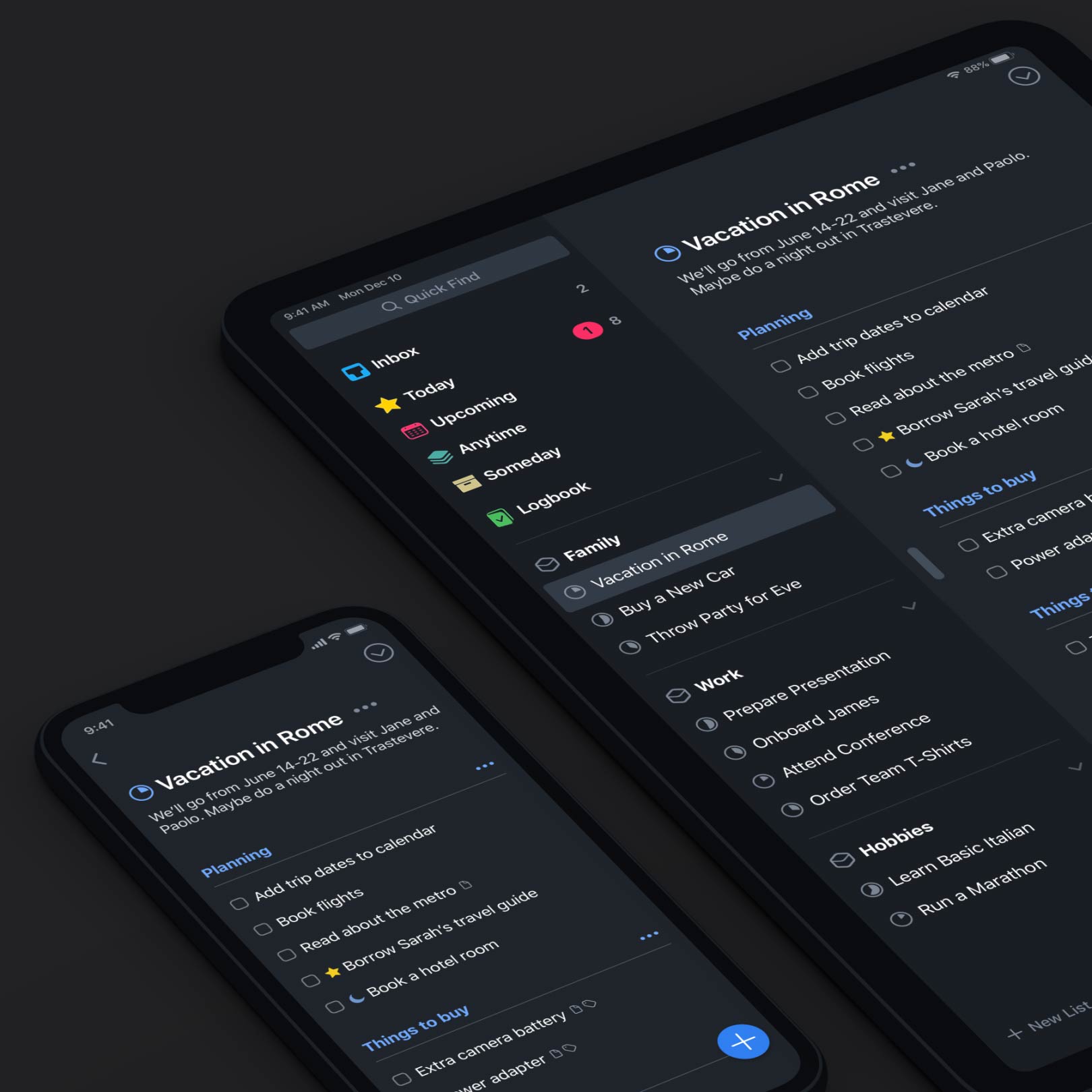
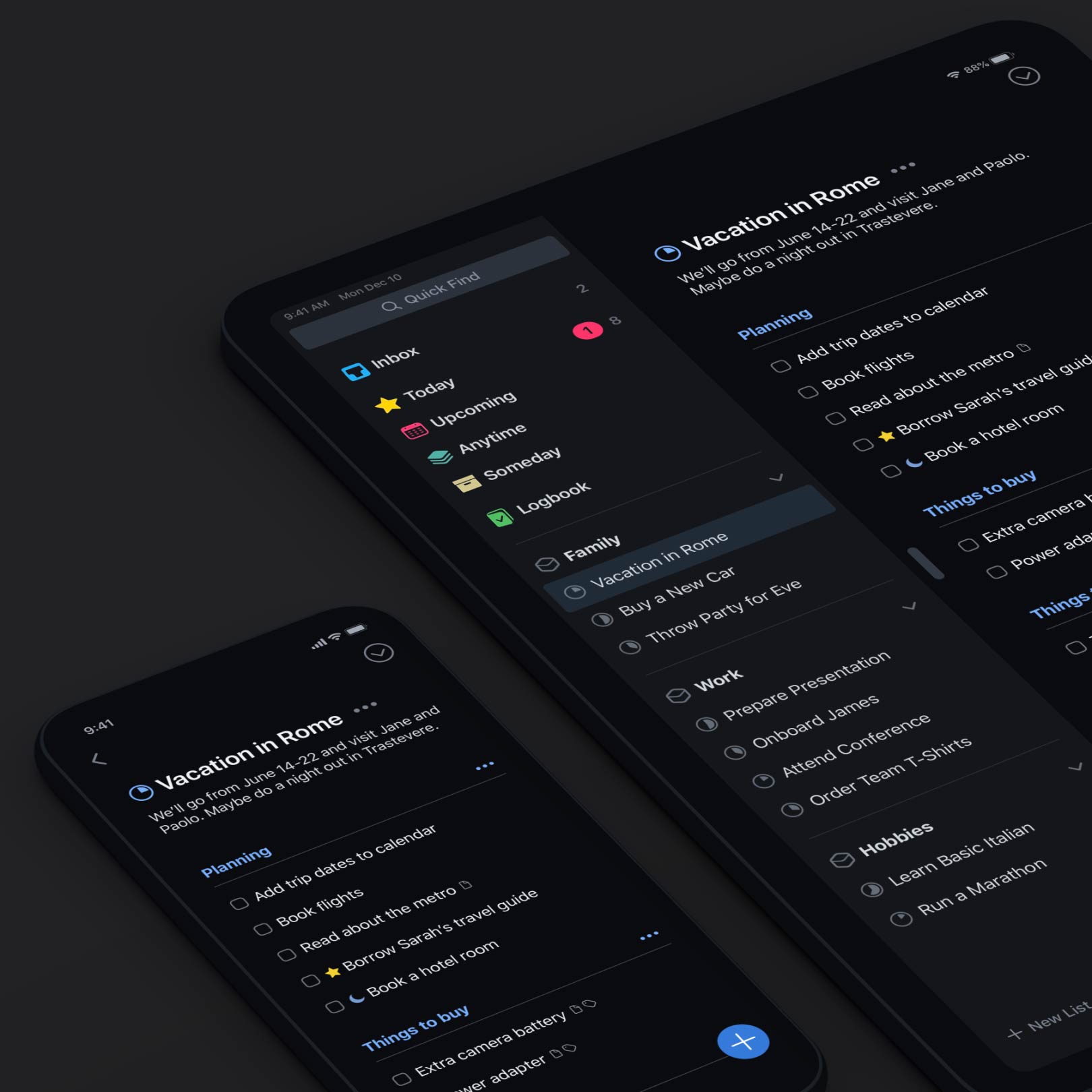
We’ve got a special gift for you today – a perfect feature for the darker months of winter: Dark Mode for iOS! Available now in Things 3.8.

Things for iOS: Dark Appearance
Things for iOS: Black Appearance
Things for iOS: Light Appearance
Dark
Black
Light

The beautiful Dark appearance that came to Mac in September is now available for iPhone and iPad. Our journey to the dark side is complete. 🌒

However, for iOS we went a step further, adding a third beautiful appearance: Black. Black is particularly stunning on the OLED display of the iPhone X and XS, where the boundary between your device and the app almost seems to vanish.

You can set your preferred appearance permanently, or have it switch based on your display’s brightness. When the brightness drops below the threshold – which happens naturally in the evening – Things will automatically go dark. Just go to Settings > Appearance to try it out.

Things 3.8 is available now for iPhone and iPad as a free update for all our customers. We hope you love it as much as we do!

From all of us here at Things, Happy Holidays! Thanks for a fantastic year and see you in 2019.

21 Dec 04:52

Breaking with the Green Party

by Stephen Rees

At today’s meeting of Vancouver City Council, all three Green Party councillors voted with the NPA.

Vancouver city council has decided to oppose the additional school tax by the province on homes valued at least $3 million.

Council voted 7-3 to ask the B.C. NDP government to withdraw the tax that will take effect in 2019.

Casting the affirmative votes were Councillors Rebecca Bligh, Melissa De Genova, Sarah Kirby-Yung, and Colleen Hardwick of the Non-Partisan Association; and Adrianne Carr, Pete Fry, and Michael Wiebe of the Green Party of Vancouver.

This is the last straw for me. I will no longer send any money to the Vancouver Greens, nor will I count myself a supporter. I will allow my membership to lapse.

Provincially the Green Party is working with the NDP – and I, like many others, have had to concede that the working arrangement is clearly better than continuing to have a BC Liberal government. But that means not saying what needs to be said about LNG – which earns the province little in the way of revenue, and employs very few people, but depends on fracking which produces far more fugitive methane than the industry admits. Worse than that it also is built on the case of liquefying the gas using hydro power – which is supposed to cut its carbon footprint, but seems to ignore the damage that  building a large scale earth dam on dodgy foundations will do, and the abysmal track record of major hydro projects both environmentally and economically.

Moreover, I have had to put up with the Leader of the Green Party promoting Uber!

Enough.

Elizabeth May, federally, seems to be the best of a bad bunch but even she has been pushing for more oil refineries in Alberta.

We have a very short time to turn the world around in its present track – which has seen ghg increases this year. The IPCC and the US federal government have made it clear. We cannot go on like this.

Since the Green Party at local, provincial and federal levels seems not to understand that human caused climate change is our biggest problem, I can no longer call myself a Green Party member. We have to stop producing oil, gas and coal altogether, and we need to be working hard to replace those energy sources by renewables and by the reductions in consumption that will be possible if we embrace energy efficiency and well understood Transportation Demand Management techniques such as promoting transit expansion over highways!  It is actually easier now to do this as both solar and wind power are cheaper than fossils. We have plenty of capacity in our highway and urban road systems, as long as everybody understands they cannot drive a big SUV or pick up truck for each trip by one person over quite short distances. Cut the parking requirements, build walkable cities, spend money on LRT not freeways. This is not rocket science and we do not need any of Elon Musk’s crazy “innovations”. We know how to do this because we used to do this not so long ago. It is not about more tunnels or atmospheric railways – it is streetcars, buses and bicycles.

Next week the NDP is going to reveal its strategy for the Massey Tunnel “replacement”. If it isn’t a rail based additional tunnel then I will not be cheering for that either!

21 Dec 04:52

Seeing The Emotion Behind The Behavior

by Richard Millington

I’m not much of an artist, but from what I’ve (over)heard the skill isn’t so much how you move the pencil, but whether you are able to see the world as it really is.

Much of community work is similar.

It’s about dropping much of our preconceived ideas and personal experiences and being able to see who our members really are.

It’s about understanding their desires, their fears, their frustrations and finding ways to help each of them in the most effective way possible.

I’m often surprised just how few people seem to truly grasp this. Much of what drives a members’ behavior probably isn’t what you imagine.

It’s far less about earning points, getting answers to questions, and being a ‘top member of the community’ and far more about their own emotions (‘I’m frustrated and no-one seems to care’), insecurities (‘I’m worried other people don’t really see me as part of this group’) and ambitions (‘I want my peers to think I’m really good at this’).

Product complaints aren’t just about getting the answer. Any customer support rep can offer that. They are about someone in the community acknowledging and validating the emotional state of frustration the member has been going through.

User tips aren’t just about a member helping others, but about how they are seen by others and whether this makes them seem more part of the group.

Conflicts are less about the issue at hand than fear of losing standing in the eyes of other members of the group (p.s. notice how quickly a conflict fizzles out when you take it private?).

In my experience, some people intuitively understand this. They have an intuitive knack for seeing what members really want, their true desires, and picking up on their insecurities and adjusting their behaviors accordingly.

These are the people who know the real reason you shared that photo on Instagram today wasn’t to capture the moment for posterity but to remind your tribe that you’re still there, to feel connected to them, to have people you care about see you positively.

However, the rest of us need to work on it. We need to drop our rational ideas of how people behave (and preconceived ideas of what motivates them) and work hard to spot the specific underlying emotions members feel. Hint, people rarely act to maximize their own economic potential and instead respond to the emotion they’re feeling in the moment.

Almost anything you want to achieve in a community (changing of behavior, increasing participation, specific contributions) is related to being able to truly understand what really motivates members to do the things they do.

21 Dec 04:52

Daddy, what did you do in the climate war ?

by David Hembrow
100 years old and subtly updated for the war that we're facing now. Do you remember the 8th of October 2018 ? That was the day when the world's newspapers carried stories about the IPCC's latest report on climate change. We were told that we faced catastrophe if we do not take serious action, starting right now, to tackle climate change within 12 years. We were informed about the most serious
21 Dec 04:29

Apple Pay gestartet

by Volker Weber

d13ed97d5cb1b5e97953a783877bf480

‪Wer kein Konto bei einer dieser Banken hat, will sich vielleicht schnell ein Zweitkonto mit diesem Code einrichten.

21 Dec 04:28

Apple HomeKit :: Eve Light Strip geht an den Start

by Volker Weber

Ich bin ein ganz großer Fan der HUE Light Strips. Indirektes Licht in jedem Farbton. Jetzt kommt ein formidabler Konkurrent. Eve Systems bringt einen Light Strip mit 1800 Lumen je zwei Meter an der Start, kontrollierbar per Apple HomeKit. Fünf Stück kann man miteinander verbinden, das macht dann bis zu zehn Metern. Ich habe noch keine Samples, werde aber welche anfordern.

Die HUE Strips gibt es für Innen und Außen

21 Dec 04:20

When cycling is faster than driving

by Nathan Yau

Deliveroo is a service that picks up and delivers food. Data from their delivery riders showed that it was faster to ride a bike than other modes of transportation in cities. Carlton Reid for Forbes:

Smartphone data from riders and drivers schlepping meals for restaurant-to-home courier service Deliveroo shows that bicycles are faster than cars. In towns and cities, bicyclists are also often faster than motorized two-wheelers. Deliveroo works with 30,000 riders and drivers in 13 countries.

That bicyclists are faster in cities will come as no surprise to bicycle advocates who have staged so-called “commuter races” for many years. However, these races – organized to highlight the swiftness of urban cycling – are usually staged in locations and at hours skewed towards bicycle riders. The Deliveroo stats are significant because they have been extracted from millions of actual journeys.

I used to play this game in graduate school often. The bus would get stuck in traffic. I would get off and walk home instead in the most thrilling races the world has ever seen. So for cities, these results make a lot of sense. Maybe not so much for the burbs though.

Tags: commute, cycling, Deliveroo, driving

21 Dec 04:20

Single-Income Occupations

by Nathan Yau

About 18 percent of couple households are single-income. I wanted to know what the earner in these homes usually do. Read More

21 Dec 04:19

Sticking With WP 4.x For Now

by Ton Zijlstra

With WordPress 5.0 Gutenberg now launched, I think I will wait until the dust settles a little bit. I’m not encouraged by Matt’s State of the Word talk, in which he said ‘get deeper into Javascript’. I’d rather not actually. Most of the few plugins I use haven’t been updated to WP5 yet, and some of its authors write how Gutenberg breaks them. Also there’s still some bugs being ironed out. For now I’ll stick with WP4, until I see more confident reviews. Currently, searches for WP alternatives, calling WP’s new course Dreamweaver, quirks, and bugs, do not inspire that confidence. And already earlier this year there was the discussion of the total lack of accessibility efforts.

21 Dec 04:19

I just deleted my previous account on Mastodon....

by Ton Zijlstra

I just deleted my previous account on Mastodon.cloud, which completes the move to ton@m.tzyl.nl, my personal Mastodon instance.

21 Dec 04:19

Voyager Boldly Goes….

by Ton Zijlstra

Some news to put our earthly issues and political navel gazing in a wider perspective. A much wider perspective: NASA has announced this week that recently Voyager 2 has left the Heliosphere, and is now in interstellar space.

It’s the second human made object that has reached this far outside our home. Launched in 1977 Voyager finished its primary mission in 1989. In its 42nd year of duty, it will now start measuring interstellar space as long as the connection isn’t lost.

Voyager 1, launched 2 weeks after Voyager 2 in 1977, was first to leave the heliosphere in 2012. It is still sending back data, and even accepted a remote controlled course correction last year.

Below is the graph NASA published that shows the moment of leaving the protective bubble around our solar system.

I was 7 years old when it was launched, it has been flying through space for most of my life. Currently at a distance of 119 AU, 119 times the distance between Earth and the Sun, or 119 times 150 or 17.850 million kilometers, it’s an awe inspiring journey.

21 Dec 04:03

Things 3.8 Brings Dark Modes to the iOS Task Manager

by Ryan Christoffel

This fall when macOS Mojave introduced a systemwide dark mode feature, Things added support for the new mode in version 3.7. The iPhone and iPad versions of the app, however, were left out. A lack of feature parity across platforms is always unfortunate, but that was especially true this time around because our John Voorhees  highlighted Things as having his single favorite dark mode implementation.

There's good news though: we didn't have to wait long for Things’ dark mode to make its way to iOS. Launching today in version 3.8, Things has added two different dark modes on both iPhone and iPad, one of which is suited particularly well to OLED iPhones.

Accessible via a new Appearance screen in Things’ Settings, there are now options for Light, Dark, and Black modes for the task manager. The former is the default appearance of the app we’re all well acquainted with, while the latter two are brand new. Both alternate appearances employ blue as the app’s accent color, with the main difference being the background color. Dark mode uses a nice shade of gray, while Black mode employs an OLED-optimized true black.

Each of Things’ appearance options can be set manually, or there's an option to have the app switch modes automatically depending on your display's brightness. Once you activate this toggle, you'll see an option to choose between Dark and Black options for automatic switching, as well as a brightness threshold at which Things will change its appearance. The app’s use of display brightness to change modes should work well for users who have iOS’ Auto-Brightness feature activated, but I wish there was an automatic switching function for those who, like me, have that turned off.

Things 3.8 doesn't introduce any other new features, but adding two beautiful dark modes is enough to make this a noteworthy release. Cultured Code has a strong reputation for thoughtful design, and its dark modes are a standout example on iOS.

Things 3.8 is available on iPhone and iPad.


Support MacStories Directly

Club MacStories offers exclusive access to extra MacStories content, delivered every week; it's also a way to support us directly.

Club MacStories will help you discover the best apps for your devices and get the most out of your iPhone, iPad, and Mac. Plus, it's made in Italy.

Join Now
11 Dec 05:14

History of a foot

by Liz

The gradual releasing of something in my right foot, from a solid mass of clenched up muscle spasms that I couldn’t straighten out, stretched, massaged, rolled, smeared with Voltaren, ketamine cream, and marijuana salve, dragged and limped on since the early 90s, coddled with orthotics for its inward roll which destroys my shoes, folded over in a tremendous crunch in a surfing wipe-out at Corona del Mar while I was 5 months pregnant, walked on the edge of, stuck with torture needles by heartless neurologists, handshaking oddly with sciatica, blended into a shiver of allodynia with the outside of my calf and the superficial peroneal nerve, and the cruel roots of achilles tendinopathy, stuffed into a moon boot for a year propped up on wedges, I feel guilty for calling you my “bad leg” or “bad foot” as if I’m a parent playing favorites among children. It is not always “bad” but it’s always with me like an imaginary friend that I’m aware of as a separate entity with feelings and behavior of its own that I can’t predict or control. Embodied pain is a familiar companion. You get to know its personality.

Years of putting my foot in my partners’ lap to beg for them to try and work out a cramp. Electric shock zaps, buzzing, numb, a million needles, deep ache. Icy cold, suddenly burning like fire ants. The touch of even just air, though an actual breeze is so much worse, feeling like icy fire. When the touch of clothes or weight of a blanket is horrible but has to be borne. I want to protect this leg, don’t bump into it, don’t touch it, not even gently — I could hunch over it fiercely, snarling like a mother wildcat.

In some ways I think of how it felt to be pregnant. I didn’t realize it until my son was born, but while I was pregnant, I was not alone in my body. I was always thinking of him and aware of him as a presence doing things independently from within, next to me and separately animated and motivated, but still contained. A roller coaster you can’t get off, disturbing, rocking your sense of self and power over your body. It was a comforting companionship, even if that sometimes meant having someone hiccuping inside your abdomen at 4am. Then he was born and I was like, “Oh! You’re not there now! You’re somewhere else! I didn’t even hardly realize how much I knew you were there with me, in me!”

My awareness of my leg has some echoes of that experience. I am almost always aware of it (of the pain or odd sensations). I can block it out for a while, but the wall, or the box, to contain it takes effort to maintain. I am in an unwilling, more or less constant, dialogue with the pain. When I’m tired over the course of day it can be very distracting. Hard to focus, or listen to people, or engage socially even though I’m wildly outgoing, because I’m listening to my demanding embodied companion. I have to get kind of like Ninshubar and her little minions the kurgarra and the galatur are to Erishkegal. “Oh! my insides!” “Oh! Your insides!” Honestly, it isn’t even that bad, but it means I have to make space for it to happen. You can’t not listen to it indefinitely. That doesn’t turn out well. You have to have some empathy and be decent to it. A little acknowledgement.

Like having a magnetic sense, or knowing where north is at all times by wearing a little buzzer and compass combination, or another kind of sense or orientation inexplicable by the most commonly understood senses, I have this paranormal awareness, some region of my brain has overdeveloped to handle the signals and try to separate them from the noise, like SETI or a Very Large Array scattered around the nerve cells of my calf. It’s there, and sometimes I have to just stuff it all inside its box, or the underworld, until there’s space to listen properly.

A sweet massage therapist who has been willing to come to my house and just work on that leg, foot, ankle, for 3 hours at a time even, with subtle movements of the joint, loosening it strand by strand over the last few years. She wants to cure it, to find the magic button, to be a healer, to fix me, to re-route the channels. I want a little space, a little relief, gentleness and movement that isn’t a struggle. She doesn’t know the power of her healing, thinking it lies in another direction. It is ongoing, like those lumpy rubber rolling pins underfoot, ice packs, hot pillows, soft braces even in the swimming pool to save it from the sway of the water, the comforting hug of the night splint keeping something like an 85 degree angle, compression socks.

In the last year the solid feeling mass of pain eased up. It differentiated. I could feel specific muscles to work on. The part of my foot that was folded over in the surfing sprain “wants” to be folded “up” in a particular, non intuitive way. Standing on the steps, backwards, hanging my heels off the edge, rising and lowering. Braced against the door to try a painful hamstring stretch. Curled against the pool wall doing the same. Lying on the floor or in bed, my hips up on a pillow, legs going along the wall, feet in the air, trying to get them to calm down. Trying to be mindful as I step. What muscles in the foot are hitting the ground, which are working, am I pushing off? What is happening with my gait? In an odd way, I can feel new, different things, trying to name them and address them one at a time. There is more subtlety.

It isn’t that there are no good sensations. Like the good moments of being in the really, truly warm sun, with no wind, and my leg luxuriating in no pain, in a no-motion warmth, or buried in warm sand on a beach, with so many sensations that aren’t pain — it is extra wonderful and exceptional. Or what I try to do, and I’m sure Erishkegal would have been into, slathering my leg with several kinds of lotion, because why not, it’s something different to feel and a way to connect and it passes the time — capsaicin cream, that hopeful but ethereal Voltaren, maybe some lemon balm or something nice smelling, the funky hippie-couch stank of weed salve lightly disguised with menthol. Or, when I sink into a soft bed with feather light, warm alpaca comforters, leg encased in half of one quilt, protected, safe, away from the air or any roughness, with the promise of rest.

Last week I had gotten some groceries and then a flowerpot and some cat litter at the top of the hill. I didn’t have enough grocery bags. The cat litter and flowerpot were on my powerchair footplate and my feet resting on top to keep them from falling off, a bit awkward but I could do it for a few blocks to get home. I hit a plastic bag on the sidewalk just in front of the house, skidded sideways by just a little, and came up against the tree planter, bending my Bad Foot backwards in a hideous parody of the surfing fold and reverse massage move – The right outside half of my foot, the bones leading to my smallest toes, folded UP. A warm feeling flooded my ankle and foot.

I got back into the house heavily leaning on my cane not wanting to put weight on the foot. It felt almost good! How strange! It didn’t hurt! How was that possible? I put ice on it and stayed off it. Then realized the reason it didn’t hurt was because it was numb.

Of course, I have imagined the foot being gone. What if it… it just wasn’t there? What if I was in an accident and it happened to be that this foot had to go its own way? I would miss it, or would I? Would I have phantom pain, worse than the pain now? Surely, it would just be a whole different dialogue, a dialogue with a ghost. It would be even more omnipresent yet invisible to others like the guy who got chased around town by his own nose. It becomes a nonsensical thought, like having a sinus infection and wishing you could remove your sinuses, which of course you can’t since they are holes in your head and you can’t make a hole be any less than it is. There is no getting away from our embodiments.

At some point in the evening the numbness thawed and became needles jabbing. After the needles subsided a day later, it was like something had torn in many places, but a good tear. My working theory is that maybe some scar tissue was loosened up, even maybe some scar tissue around a nerve sheath? It’s not like I know anything. The shape of my leg awareness is different now. It isn’t fixed. But it’s wildly different. I’m playing with it, with stretches and tai chi and in how I think about weight distribution when I take a step.

That strange experience last week (still ongoing) made me think about my complex relationship with my leg, and its weird fluctuations of pain and functionality. Apparently the Queen of the Underworld will continue to strike hard bargains with me, and there really is no moral to the story and i’m not going to literally name my leg, it’s just that I had this lyrical feeling about my leg and wanted to honor it beyond its badness, and to respect how we coexist, like a witch with her familiar.

11 Dec 05:14

Five-word movie review: “The Death of Stalin”

by sheppy

Buscemi as Kruschev. Enough said.

11 Dec 02:21

Teaching and Learning with Jupyter

et.al., Lorena A. Barba, GitHub, Dec 10, 2018
Icon

This is a comprehensive text that covers pretty much everything important about the use of Jupyter Notebooks in learning. As noted in these pages before, a Jupyter Notebook allows you to have not only the usual text and images, but also computer programs, such that you can view and edit the listing and see the output right on the notebook page. I have only one complaint about this textbook - it's written and published through GitHub (which allows for writing sprints and multiple authors) and is not itself a Jupyter notebook. It's so easy to read online - I wish the Jupyter Notebook functionality had been embedded and demonstrated right there and then.

Web: [Direct Link] [This Post]
11 Dec 02:20

New Bose AR Glasses give you audio Augmented Reality

Emory Craig, Digital Bodies, Dec 10, 2018
Icon

I can't imagine trying to read an AR screen on my glasses (my eyes have enough trouble with the real world) but augmentation-by-audio is something that could work for me. It's still pretty basic; " the glasses will use GPS and a 9-axis motion sensor to recognize where the wearer is and what they are looking at, and then connecting that location with informative audio." The content comes from Alexa or Siri or some such. What would help a lot is image recognition or RFID that would let it do things like read lables for me. One thing at a time, I guess.

Web: [Direct Link] [This Post]
11 Dec 02:19

The 'knight on an infinite chessboard' puzzle: efficient simulation in R

by David Robinson

Previously in this series:

I’ve recently been enjoying The Riddler: Fantastic Puzzles from FiveThirtyEight, a wonderful book from 538’s Oliver Roeder. Many of the probability puzzles can be productively solved through Monte Carlo simulations in R.

Here’s one that caught my attention:

Suppose that a knight makes a “random walk” on an infinite chessboard. Specifically, every turn the knight follows standard chess rules and moves to one of its eight accessible squares, each with probability 1/8.

What is the probability that after the twentieth move the knight is back on its starting square?

In this post I’ll show how I’d answer this question through simulation in R, with an eye on keeping the simulation fast and interpretable. As in many of my posts, we’ll take a “tidy approach” that focuses on the dplyr, tidyr, and ggplot2 packages.

Simulating a knight’s moves

The first question is how we can simulate a knight’s move randomly. There are eight positions that a knight can move to, following the rule of “two spaces in one direction, one in the other”.

center

It helps to break each possible move into its X and Y components:

  • X = 2, Y = 1
  • X = 2, Y = -1
  • X = 1, Y = 2
  • X = 1, Y = -2
  • X = -1, Y = 2
  • X = -1, Y = -2
  • X = -2, Y = 1
  • X = -2, Y = -1

Notice that the moves are always made up of one 2 and one 1, and that either, both, or neither can be negative.

The first step of the simulation (getting a 1 and a 2) can be done as follows for a single simulation:

# Random number between 1 and 2
move_x <- sample(2, 1)

# If x is 2, y is 1, and vice versa
move_y <- 3 - move_x

c(move_x, move_y)
## [1] 1 2

How about letting either number be negative? Well, sample(c(1, -1)) can get us a value that’s either 1 or -1, so we can multiply that by each.

move_x <- sample(2, 1) * sample(c(1, -1), 1)
move_y <- (3 - abs(move_x)) * sample(c(1, -1), 1)

c(move_x, move_y)
## [1]  2 -1

Now that we can sample a single move, we can try sampling many moves (say, 20) by adding 20, replace = TRUE to each.

move_x <- sample(2, 20, replace = TRUE) * sample(c(1, -1), 20, replace = TRUE)
move_y <- (3 - abs(move_x)) * sample(c(1, -1), 20, replace = TRUE)

move_x
##  [1]  2  1  1  1 -2  2 -2  1  2 -2 -1  1 -2 -2  2 -2  1 -2 -2 -2
move_y
##  [1]  1 -2 -2 -2  1  1  1 -2 -1 -1  2 -2 -1 -1 -1 -1 -2 -1  1 -1

Now that we’ve figured out how to simulate chess moves, we can go ahead with our simulation of positions.

Tidy simulation

The crossing() function from tidyr is wonderful for setting up Monte Carlo simulations. It creates a tbl_df with every combination of the inputs (it’s similar to the built-in expand.grid).

In this simulation we’ll want some number of trials and some number of turns. If we wanted to generate 3 trials that each included 3 chess turns, we could do:

crossing(trial = 1:3,
         turn = 1:3)
## # A tibble: 9 x 2
##   trial  turn
##   <int> <int>
## 1     1     1
## 2     1     2
## 3     1     3
## 4     2     1
## 5     2     2
## 6     2     3
## 7     3     1
## 8     3     2
## 9     3     3

In this experiment, we’ll simulate 100,000 trials (and, as the riddle specifies, 20 moves), and then bring in our vectorized approach to simulating chess moves. Notice we use n() (a special dplyr function) for the number of items.

# Use n() and replace = TRUE to vectorize the sampling above
crossing(trial = 1:100000,
         turn = 1:20) %>%
  mutate(move_x = sample(2, n(), replace = TRUE) *
           sample(c(1, -1), n(), replace = TRUE),
         move_y = (3 - abs(move_x)) *
           sample(c(1, -1), n(), replace = TRUE))
## # A tibble: 2,000,000 x 4
##    trial  turn move_x move_y
##    <int> <int>  <dbl>  <dbl>
##  1     1     1      1     -2
##  2     1     2      2     -1
##  3     1     3      1     -2
##  4     1     4     -1     -2
##  5     1     5     -2     -1
##  6     1     6     -1     -2
##  7     1     7      1     -2
##  8     1     8     -2      1
##  9     1     9      1     -2
## 10     1    10      2     -1
## # ... with 1,999,990 more rows

Now, because the knights both start at (0, 0), we can calculate the position based on the cumulative sum of moves the X direction and in the Y direction. We do this by adding a group_by() (since movement happens separately within each trial) and mutate() to the sequence.

turns <- crossing(trial = 1:100000,
                  turn = 1:20) %>%
  mutate(move_x = sample(2, n(), replace = TRUE) *
           sample(c(1, -1), n(), replace = TRUE),
         move_y = (3 - abs(move_x)) *
           sample(c(1, -1), n(), replace = TRUE)) %>%
  group_by(trial) %>%
  mutate(position_x = cumsum(move_x),
         position_y = cumsum(move_y)) %>%
  ungroup()

turns
## # A tibble: 2,000,000 x 6
##    trial  turn move_x move_y position_x position_y
##    <int> <int>  <dbl>  <dbl>      <dbl>      <dbl>
##  1     1     1      1      2          1          2
##  2     1     2      2      1          3          3
##  3     1     3      1      2          4          5
##  4     1     4     -2     -1          2          4
##  5     1     5     -1      2          1          6
##  6     1     6      2     -1          3          5
##  7     1     7      1     -2          4          3
##  8     1     8      2      1          6          4
##  9     1     9      2     -1          8          3
## 10     1    10      1     -2          9          1
## # ... with 1,999,990 more rows

Just like that, we’ve performed 100,000 trials of 20 sequential chess moves. Not bad!

Answering the questions

First, let’s answer the riddle’s question. How often is the knight back at its home space (0, 0) by the twentieth move?

turns %>%
  filter(turn == 20) %>%
  summarize(mean(position_x == 0 & position_y == 0))
## # A tibble: 1 x 1
##   `mean(position_x == 0 & position_y == 0)`
##                                       <dbl>
## 1                                   0.00627

The probability of being back on the home space is about .6%.

How does this compare to other turns?

library(ggplot2)
theme_set(theme_light())

by_turn <- turns %>%
  group_by(turn) %>%
  summarize(home = mean(position_x == 0 & position_y == 0))

by_turn %>%
  ggplot(aes(turn, home)) +
  geom_line() +
  scale_y_continuous(labels = scales::percent_format()) +
  labs(y = "% home")

center

It looks like it’s impossible for the knight to be back home on an odd numbered turn (if you have a chessboard you can try it!). At an even numbered turn, the probability is 1/8 for the second turn (the probability the first move was immediately followed by the opposite move). It then goes down from there to the .006 we see above.

Where might the chess piece be by turn 20? A geom_tile is a nice visualization for this.

turns %>%
  filter(turn == 20) %>%
  count(position_x, position_y, sort = TRUE) %>%
  ggplot(aes(position_x, position_y, fill = n)) +
  geom_tile()

center

Finally, any time we look at change over time (especially in several dimensions like a chess board), we can use Thomas Pedersen’s gganimate package to give a more dynamic view.

library(gganimate)

turns %>%
  count(turn, position_x, position_y) %>%
  ggplot(aes(position_x, position_y, fill = n)) +
  geom_tile() +
  transition_manual(turn)

center

Besides showing how the knight “spreads” across the board, the animation communicates an insight that might not be noticeable otherwise (but which is relevant in chess): any given space on the chessboard is either an “odd # of moves” space or an “even # of moves” one. As we saw earlier, the home is an even space, so it can be reached on turn 20 but not on turns 19 or 21.

Conclusions

What have we learned about efficient simulation in R?

  • Think vectorizably: Notice that we generated all of our 2 million moves in a couple of calls to sample(). This helps keeps our simulation fast because functions like sample() have some computational overhead. If we’d simulated each individual move in a loop, this simulation would have taken a lot longer.
  • Some functions show up a lot in simulations. The crossing() and cumsum() functions are very different, but they’re both wildly useful for simulations. Make sure you learn and understand them!
  • Tidy simulation is useful for visualization This puzzle could have been solved a bit more computationally efficiently by creating matrices for move_x, move_y, position_x, and position_y, and operating on them instead. In my opinion it would have made the code a bit less readable. But more importantly, by working in a tidy format we were able to immediately pipe the results into ggplot2 and gganimate and create visualizations. These helped check our results and improve our intuition around the answer.

Until next time, happy simulating!

11 Dec 02:13

NewsBlur Blurblog: Announcement: Build Your OmniFocus Workflow

sillygwailo shared this story from Rosemary Orchard.

Build Your OmniFocus Workflow Cover Today I'm very excited to announce a book: Build Your OmniFocus Workflow. I've been hard at work on this for the last 3 months - but not alone. My fabulous co-author, Ryan Dotson, has been hard at work right along side me (admittedly with a timezone difference) - and we have 150 pages ready for you!

This book is designed, as the name implies, to help you build a workflow which works for you with OmniFocus - whether you've never used the app before, or if you've used it for years and just want to improve your setup. It is comprised of five sections:

  • First Steps: Getting OmnIFocus set up with a basic setup.
  • Fundamentals: Walking you through the default perspectives, and expanding on your current setup - plus diving into settings.
  • Advancing: Diving much deeper, including custom perspectives, creative uses for tags, review and onwards.
  • Final Horizons: Honing your workflow to get the most out of your system.
  • Our Workflows: Ryan and I get personal and tell you about how our setups work.

Throughout the book there are tips, notes, personal comments, and most important of all: activities for you to complete in order for you to create a set up which allows you to be productive and which willl hopefully also allow you to feel like you're fully in control of your life.

OmniFocus is a remarkably flexible app and can adapt to practically any workflow. As such, everyone must go through the process of building their own workflow with it, whether from scratch or based upon someone else’s. Build Your OmniFocus Workflow, written with the insight of two long-time OmniFocus users, offers practical advice on top of solid technical information. Ryan and Rose guide you through the basic concepts and perspectives of OmniFocus and into the more complex world of custom perspectives and automation. All throughout they give their own interpretations of how they use features in their workflows and finish the book with more details about how their systems work for them.

Build Your OmniFocus Workflow is available for a short time at launch for $25. The price will increase in the new year to $30.

This book is not static, we intend to update it when new features are added to any of the OmniFocus platforms. That is not to say the book is incomplete, we have about 40,000 words and are very happy to release it today!

Now, to the nerdier side of things. You may be thinking "I've never heard of Ryan" - and until I started beta testing OmniFocus 3 for iOS I hadn't either! In fact, Ryan and I have never actually met in person - the internet put us together (with some help from The Omni Group), and we ended up writing a book. If that's not a testament to how wonderful the world can be I don't know what is! I'm going to go through a little of how we wrote the book, just to give you a taste.

We started by mapping ideas out in iThoughts. We thought we'd write Markdown files and check them into a private GitHub repo - but for a variety of reasons realised this wasn't going to work how we had originally envisioned so quickly moved over to Scrivener where the project has been ever since. Scrivener has excellent Dropbox sync support so we worked through that, back and forth - with differing timezones coming in handy as you can only have one copy of a Scrivener file open at once. Once we had a large chunk of the book written then came the hard part: formatting.

I have a confession, I had very little input on the formatting. By which I mean the styling formatting rather than the organisation of the book. Ryan had a hidden talent for this from which I have learnt a great deal! If you think the book looks pretty that's down to him. From the font choices, to the indentation, and the whimsy of the hands for the notes and tips, Ryan did all the hard work. Just don't ask him about list formatting, he's still recovering from that.

The cover design was done by the extremely talented Josh Hughes. Josh has also designed a series of icons for OmniFocus custom perspectives.

Get the book here! If you're not sure (understandable), then you can also get a free sample.

11 Dec 02:11

Canada Line: Why We Got It Wrong

by Gordon Price
mkalus shared this story from Price Tags.

Bob Ransford posted this:

When the Canada Line was being planned more than 15 years ago, the public was shown ridership models that said 70%\ percent of the ridership would be in the portion of the corridor between Waterfront Station and Oakridge Station.

Reality today is crush loads during rush hour from Richmond Brighouse all the way to Waterfront with lines at many Vancouver stations where crush-filled trains can’t accept more riders and near full loads at all hours just within Richmond alone. They got it wrong.

Transit drives housing development. So much for empty condos. Empty condos don’t drive this kind of heavy ridership.

Apparently we didn’t expect this.


11 Dec 02:10

Google officially ends support for Android 4.0 Ice Cream Sandwich

by Jonathan Lamont
Android 4.0 Ice Cream Sandwich

Seven years after the release of Android 4.0 Ice Cream Sandwich (ICS), Google says it’s ending support for the operating system.

Announced at an event in Hong Kong on October 19th, 2011, ICS was the first iteration of Android where head of design Matias Duarte had extensive input.

Further, the 4.0 update was incredibly important as it brought the smartphone and tablet forks of Android back together.

Ice Cream Sandwich also introduced several features that are commonplace on phones today. This includes things like the navigation bar, face unlock, screenshot capture and the ability to dismiss individual notifications with a swipe.

Additionally, ICS brought a design revamp that significantly changed the look and feel of Android and ushered in the Holo era.

According to Google, the end of support for ICS won’t affect many people. The OS has had less than one percent of the usage share for some time now. Further, several apps no longer support ICS.

However, that doesn’t mean devices running ICS will suddenly stop working or work less than they already do. Instead, it’ll be a slow, drawn-out death. For one, Google won’t allow developers to publish apps support API levels 14 and 15 — the ones for ICS.

In other words, the oldest support version of Android on the Play Store is now 4.1 Jelly Bean.

Additionally, Google won’t update the Play Services on devices running ICS. Over time, this means many critical features and functions will break as Play Services gets updated, but those updates don’t come to ICS.

Ultimately, this is the end of Ice Cream Sandwich. Without Google’s support, there’s little that will work with it. If you’re still using a device with ICS, it may be time to update to something newer.

Source: Extreme Tech

The post Google officially ends support for Android 4.0 Ice Cream Sandwich appeared first on MobileSyrup.

11 Dec 02:10

Google+ is shutting down early following additional data leak

by Brad Bennett

It looks like Google’s social network Google+ is shutting down in April of 2019 instead of August due to a second data leak.

The second data leak occurred as part of an update to the platform. Nevertheless, it exposed the personal data of 52.2 million users, including profile information such as email addresses, jobs, age and more.

The data that was leaked to developers who worked on Google+, though Google claims that the information hasn’t been used in a malicious way.

The data leaked due to a bug in the Google+ API. This means that any apps or services that requested permission to view a user’s profile information were granted access, even if the account was set to private.

That said, the leak didn’t share any fraud related information like passwords, identification numbers or financial data.

This has resulted in the search giant opting to shutter the consumer-facing part of the service a few months early in April 2019.

Source: Google

The post Google+ is shutting down early following additional data leak appeared first on MobileSyrup.

11 Dec 02:10

Experts split on Ontario’s Bill 66’s aim to repeal Wireless Services Agreement Act

by Shruti Shekar
Experts split on repealing Wireless Services Agreement Act

Consumer protection experts have split reactions to Premier Doug Ford’s Conservative government’s Bill 66, which aims to repeal the Wireless Services Agreement Act of 2013.

The bill, ‘Restoring Ontario’s Competitiveness Act’ by amending or repealing certain Acts, was introduced by Conservative Member of Provincial Parliament (MPP) Todd Smith, Ontario’s minister of economic development, job creation and trade on December 6th, 2018.

“The Schedule repeals the Wireless Services Agreement Act, 2013 and revokes the two regulations made under it,” the 35-page bill reads.

David Woolley, press secretary for Progressive Conservative MPP Bill Walker, who is also Ontario’s minister of government and consumer services, said in an email to MobileSyrup on December 7, 2018, that the Wireless Services Agreement Act “has been superseded by federal regulations which provide nearly identical protections for all Canadians.”

“By repealing it, we are harmonizing with federal regulations, which have made the original provincial Act redundant,” Woolley said. “Repealing the provincial Wireless Services Agreements Act frees businesses from burdensome duplicate regulations and provides consumers with clarity on their wireless service rights. Ontarians are also protected through the Consumer Protection Act.”

“By repealing it, we are harmonizing with federal regulations, which have made the original provincial Act redundant.”

Because the bill still has to be debated by MPPs in the Ontario Legislature and will probably be studied in committee, before it heads off to Royal Assent, Monica Auer, executive director of the Forum for Research and Policy, said it was a bit hard to give a full reaction.

Auer noted that the question she’s asking right now is “whether or not [repealing the Act] will…make people in Ontario better off, the same, or worse off?… Does the Wireless Code itself have protections people need across the board?”

“Presumably one would like to think in a way [repealing the Act] reduces complications because instead of having a possibility of two avenues to deal with concerns about a wireless contract, now you’re back to one,” Auer said referring to users having to rely on the Canadian Radio-television and Telecommunications’ (CRTC) Wireless Code.

The CRTC created the mandatory code in 2013 that applies to all service providers and all retail mobile wireless voice and data services.

To simplify, the code says consumers who feel that their service provider is not “adhering to the code” must first try and resolve the issue with their service provider, and if the conflict continues then consumers should take their complaints to the Commissioner for Complaints for Telecommunications Services (CCTS).

As per the code, service providers have to make it easy for people to get and understand wireless service agreements, they have to establish “consumer-friendly” business practices, and they have to “contribute to a more dynamic wireless market.”

Simultaneously, in 2013, the Liberal Ontario government at the time opted to enact its Wireless Services Agreements Act, which added the ability to launch a class action lawsuit.

At the time the Toronto Star reported that then-minister of consumer services Tracy MacCharles said the rules would “complement” the Wireless Code.

The act resulted in service contracts for smartphones needing to be written in plain language so customers would be able to easily understand them.

The act also capped the cancellation fee for a fixed-term agreement to $50 CAD and required consent from customers for changes to be made to service terms.

Further, it allowed users to cancel a contract after two years without having to pay for any charges other than remaining payments for their handset.

It was designed to protect cellphone users and applied to new cellphone service contracts as well as existing contracts. If carriers did not comply with the rules, then they would have to give a full refund for up to a year of service to their customers.

Auer said that the government, if it plans to repeal the Act, has to believe the CRTC has the right approach to dealing with wireless contracts and consumer concerns, and in turn, if the CCTS has the ability to effectively deal with Ontario consumer complaints.

It is important to note that the CCTS is an association of companies that are required to be members of it and there are penalties for not being a member, but it does not have authority to reprimand telecom companies as a governmental body could.

PIAC’s perspective: “if it’s gone, it’s actually easier”

John Lawford, executive director of the Public Interest Advocacy Centre (PIAC), said it was a long-standing problem between the federal government and provincial government fighting over whether their jurisdiction deals with wireless incumbents.

“PIAC has always taken the position that the provinces have zero jurisdiction,” Lawford said. “So strangely, we are on the same side [as various companies]. To us, the risk of having provincial interference in the telecom sphere greatly outweighs any small advantage to consumers to have the belt and suspenders approach to consumer protection on this one issue.”

Lawford said that the Act didn’t really do anything for people, it didn’t really have any beneficial effect on consumers, and it gave companies headaches.

“PIAC has always taken the position that the provinces have zero jurisdiction,”

“It did have a couple of provisions, which sure, I would love to have in the Wireless Code,” Lawford said. “It sounds anti-consumer but it’s absolutely true, these things don’t matter and I mean if it’s gone it’s actually easier.”

When asked if the CCTS would be able to handle the requests, Lawford responded with the question: “how many complaints did the provincial ministry get?”

“I’m guessing a couple hundred max? And of those, I bet 150 of them went to the CCTS as well, it just overlaps. It’s one of these few areas in Canada that I work in where it’s clear it should be federal and the provinces [are], frankly, overreaching.”

Lawford made it clear though that if the repeal is meant to affect consumers and “this is viewed as taking the first of many swipes at the consumer protection efforts,” then PIAC “will be all over them.”

Open Media: “We need the intervention from the government”

Laura Tribe, executive director at Open Media, said that with only one paragraph relating to wireless in the bill, it’s hard to determine exactly what will happen.

“But when you look at the intentions of the bill and how it’s framed…it largely focuses on deregulation and on opening up corporate powers and taking away government interference,” Tribe said.

“Whatever your political and economic beliefs on that pipe are, when it comes to issues of telecom, we have strongly seen in Canada that we need that intervention from the government until at least we have more competition to help mitigate that.”

Tribe’s initial thoughts said the government is largely coming from trying to remove any regulation and requirements on companies and said this is a problem that Canada should not be dealing with right now.

“So the threat of class action is much more intimidating to those companies than something like a mitigated process through the CCTS.”

“We need that judicial process, we need that legislative and legal process that these provide,” she said.

Tribe explained that the CCTS processes complaints individually and that the difference with having the courts involved is that they don’t have to start from scratch every single time every individual comes through to process a complaint.

“You can show a pattern and that is the real threat to companies. I don’t think individual complaints are a threat because there are so many people who don’t know they can complain, they don’t know the recourse, and the penalties are so low.

“So the threat of class action is much more intimidating to those companies than something like a mitigated process through the CCTS. I think that these rules are important to protect consumers. That’s not to say we need one or the other, but we need both.”

Tribe raised similar concerns regarding whether the Wireless Code has enough protections that people need and whether it can stand alone.

The post Experts split on Ontario’s Bill 66’s aim to repeal Wireless Services Agreement Act appeared first on MobileSyrup.

11 Dec 02:09

Apple Watch Series 4 ECG feature is hardware-locked to the U.S.

by Patrick O'Rourke
Apple Watch Series 4

Though earlier reports indicated that it would be possible for those in other countries, including Canada, to access the Apple Watch Series 4’s ECG feature by changing the wearable’s region, it seems that isn’t the case.

Many assumed that similar to Apple News and other apps not available north of the American border, users would be able to change the Series 4’s region to access the Series 4’s new, currently U.S.-exclusive ECG functionality.

According to Apple developer Guilherme Rambo (@_inside), the Series 4’s ECG functionality is region-locked to the U.S. version of the smartwatch and is based only on the serial number.

This means that using VPN or DNS region-switching trickery won’t work as Apple limits ECG functionality per device identifier.

As a result, if you were hoping to get ECG up and running in Canada by switching the smartwatch’s region, that isn’t possible.

To get the ECG app for the Apple Watch Series 4, you need to be running iOS 12.1.1 on your smartphone, have watchOS 5.1.2 on the wearable and also purchase the smartwatch in the United States.

It’s unclear when the Apple Watch Series 4’s ECG feature is making its way to Canada given that Apple hasn’t submitted a medical device application.

Electrocardiography or ECG is the process of recording the heart’s electrical activity over a period of time using electrodes placed over the skin.

Via: iPhone in Canada 

The post Apple Watch Series 4 ECG feature is hardware-locked to the U.S. appeared first on MobileSyrup.