Shared posts

21 Dec 04:52

A bar chart made of dots

Last week we had a look at two great line charts that Datawrapper users published this year – but of course, no review of the innovative charts of 2018 can be complete without at least one variation of a scatterplot. I’ve often weekly-charted about them before. Scatterplots are the best.

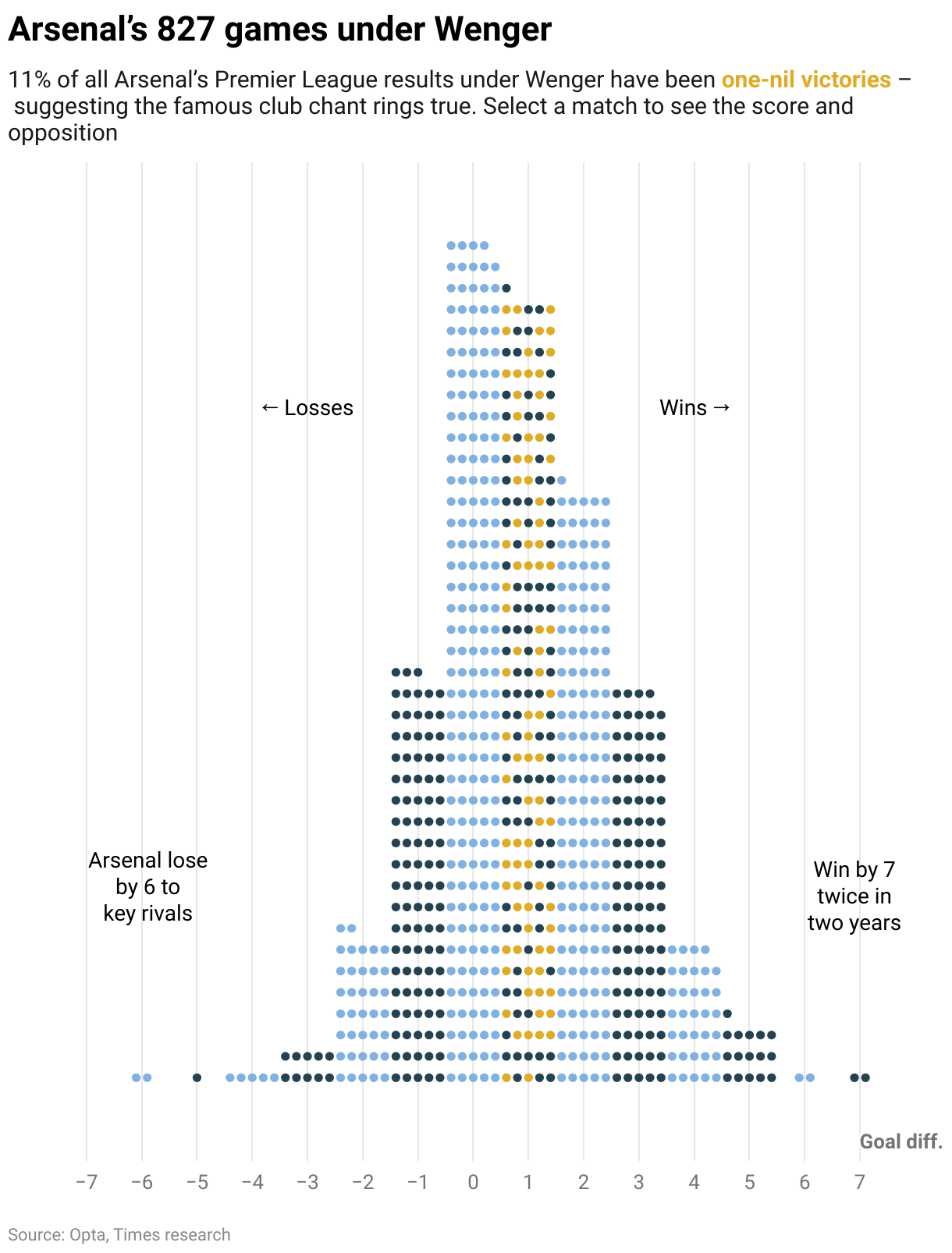
The same thinks Ryan Watts, apparently, an Interactive Journalist at the London-based The Times. You can learn more about the work of his team on the Times Digital medium page. He published the following chart in this Times article about Arsène Wenger, the manager of the British Arsenal football club:

I find this chart a fascinating use of a scatterplot. Ryan was so kind to email me a thorough explanation of why he used this chart type, so I’ll hand the mic over to him:

We have quite a few go-to methods for building interactives and will often turn to produce static graphics with Illustrator or building something a little more complex in D3 if we have the time and if the data suits. When we need to build a chart quickly, Datawrapper is usually our best bet: our styles are already there, the newsroom is familiar with the process of subbing them and we still get plenty of visualisation options. These charts, however, were borne out of ideas that we didn’t originally think we could create in Datawrapper.

It was good to discover that you can push the boat out a little with Datawrapper. The customisation options on the scatterplot are very thorough so, if in doubt, I’ll try an idea there – even if we don’t end up building an actual scatterplot.

He also talked about color choices…

For the Arsenal results chart we did deliberate over how best to use the colours. We wouldn’t usually use a different colour for each bar in a column chart but using the same colour here meant you couldn’t differentiate between the ‘bars’, so we alternated.

…and annotations:

As these improvised scatter-type charts are a little different, we try to make sure we guide the reader through it as best we can: offering instruction to hover or select in the standfirst, where appropriate, and using annotations to explain how the axes work. I usually add an invisible character to the existing axis labels field and then make my own elsewhere on the chart.

Everything we build has to pass numerous tests inside and outside of the team before actually being published, so I was very pleased when our Arsenal results “hack” ticked all of these boxes and appeared on the site (and in print).


We will look at one of Ryan’s other scatterplot adventures in the new year. See you next week!

21 Dec 04:52

The Homeostatic Fallacy and Misinformation Literacy

by mikecaulfield

I wrote a thing for Neiman’s year-end journalism predictions yesterday that I’m quite excited about. Hopefully will be out soon. (Update: it’s here.)

In the article I finally publish this term I’ve been throwing around in some private conversations — the “homeostatic fallacy”. 

Homeostasis is a fundamental concept of biology. The typical example is human temperature. For humans the temperature 98.6 tends to be a very desirable temperature. And so what you find is no matter where you put a human body — in the arctic or the tropics — the human body finds ways to keep that temperature constant. In hot environments you sweat, and the condensation helps cool you. Your blood vessels dilate, to bring more heat to the skin where it can be dispensed with. In cold environments your blood vessels constrict. 

There are a lot of people out there that think that misinformation is sort of like hot and cold environments are towards the body. In other words, both misinformation (let’s think of it as cold) and information literacy (let’s think of it as heat) have relatively little effect, because the mind has certain homeostatic mechanisms that protect against identity threat and provide resistance to new ideas. And there’s a certain truth to this. Knowing the facts about nuclear power won’t suddenly make you a supporter, and learning the history of Reconstruction won’t turn you woke. 

And as such, we hear a lot of critiques about media literacy of the sort that you can’t change people’s minds by giving them better information. Homeostatic arguments sometimes go even further, claiming bad information is likely not leading to bad decisions anyway.

Often this is posed as a counter to a naive Cartesian view of beliefs, that treats our decision-making processes as scientific. But weirdly, both the homeostatic view of misinformation and the Cartesian one suffer from the same transactional blindspot. On a case by case basis — show a person a fact, check if it changes them — homeostatic mechanisms often prevail. Your mind has certain psychological set-points and will often fight to keep them constant, even in the face of disinformation or massive scientific evidence. 

But the fallacy is that the set-point itself will not change.

People often use temperature as an example of a homeostatic set-point, but I think another example is far more educational. Consider weight.

Your body has a natural weight it gravitates towards, and the power of that set-point can’t be underestimated. Think about this astonishing fact — one pound of weight is about 3,500 excess calories. To maintain weight over a year, your average intake would have to stay within about 10 calories a day of maintenance levels. Few people account for calories at this level of precision, and yet many retain a stable weight year after year. That’s the power of homeostasis.

How do we gain weight, then? There’s quite a lot of debate on this, actually. But, more or less, temporary behavior and adverse events, in sufficient quantities, not only increase our weight, but change our set-points. And now the homeostatic mechanisms that kept us trim work against us, to keep the pounds on.

In short time frames, a sort of psychological homeostasis is protective. We see bad info or good info and nothing changes. We share a corrosive meme and we’re still the same person. Just as a single cookie at the Christmas party will have a net zero effect on your weight through the magic of homeostasis, a single bit of disinfo isn’t going to change you.

But the goal of disinformation isn’t really around these individual transactions. The goal of disinformation is to, over time, change our psychological set-points. To the researcher looking at individuals at specific points in time, the homeostasis looks protective — fire up Mechanical Turk, see what people believe, give them information or disinformation, see what changes. What you’ll find is nothing changes — set-points are remarkably resilient.

But underneath that, from year to year, is drift. And its the drift that matters.

21 Dec 04:52

Stars and Strikes

by David Turner

Since the early 20th century, the music industry has remained in a near-constant state of technological change comparable to that facing the overall labor market today: a gig economy in which the very nature of work shifts radically on a regular basis, and with it opportunities to make a living.

Before the advent of radio, many musicians were hobbyists, with the exception of those who lived and could perform in large major metropolitan orchestras. After World War I, however, and the rise of commercial radio, many musicians took up jobs at radio stations and silent movie theaters that needed their labor.

The increased production of commercial records in the 1930s and 1940s created new opportunities, while foreclosing other ones: they allowed for radio stations to bypass in-studio talent, while recorded soundtracks removed the need for a theater pit performance. This created a tension, where musicians arriving for recording gigs were helping to eliminate their own potential value to radio stations and theaters across the country. This is when the American Federation of Musicians stepped in.

A workforce doesn’t need to be, and shouldn’t be, divided against the issues facing it

The AFM was started in the late 19th century, evolving out of social clubs that favored “highly skilled” musicians. By the 20th-century start, the union supported a broader range of musicians, although a bias toward “higher-skilled” workers would permeate for decades to come, primarily targeting musicians who couldn’t read music. In the first half of the 20th century, this included many black blues musicians and white country performers. The divide along race and class lines only grew over the years, and would have existential consequences for the union itself. But in the first half of the 20th century, for those artists accepted into the union, it was a constant battle between preserving the jobs that did exist and embracing technological advancements.

In the late 1930s, James Petrillo, a former trumpeter, climbed to the top of the AFM’s Chicago local. His aggressive leadership style — he led successful musicians strikes in the city — diverged from the union’s national leadership: Union president Joseph Weber was seen as being too close to Franklin Roosevelt, and criticized for not having fought hard enough during the introduction of recorded music. Petrillo replaced him in June 1940, ready to plot a new strategy on a national stage.

Petrillo set about strengthening the union’s power, unionizing the Boston Symphony (one of the country’s last holdouts of non-unionized musicians), and strong-arming members of a rival union, the American Guild of Musical Artists, into joining the AFM. On August 1, 1942, with his organization at critical mass, Petrillo led the union in a strike in the middle of World War II — not only for better wages, but to challenge the idea that a worker had to contribute to the obsolescence of their job.

To strike during the war was highly unpopular. Although the AFM holds a history of rather strong nationalism — in the mid-1960s the union fought to keep out British Invasion bands like the Beatles and the Kinks — even President Roosevelt, without his pal Weber in power, wasn’t able to get Petrillo to cede ground. The year-long strike was successful, resulting in an agreement with various major record labels called The Recording and Transcription Fund, which recycled the money made from overall record sales into public concerts for unemployed and underemployed union workers. When the government passed the Taft-Hartley law in 1947, which undercut the ability of unions to administer their own welfare funds, Petrillo organized a follow-up strike that created the similar Music Performance Trust Fund.

In Tell Tchaikovsky the News: Rock ‘n’ Roll, the Labor Question, and the Musicians’ Union, 1942-1968, Michael James Roberts remarks on just how major a shift this particular victory was for the American labor movement: “Arrangements like pension plans, workmen’s compensation insurance, and unemployment benefits are all based on the premise that the social costs of technological advances (especially by labor-saving technologies) have to be carried by capital … not labor.”

He notes that this model of what is called “welfare capitalism” would spread across unionized industries like “mining, automotive, steel, and printing” as a way to properly check and redistribute corporate gains. But where automation in a way birthed those industries, to recorded music it was a new and sudden development after centuries of professional performance; the union’s aggressive tactics were an appropriate response to such massive labor shifts. Its victory didn’t dismantle capitalism, but it showed the kind of gains that could be achieved through collective action. Technology, instead of threatening the lives of workers, could instead be a force that allowed all workers to gain while they found new ways to pursue their craft.

The myth of the solitary genius — chart-topper or tech entrepreneur — further entrenches a punishing economic system

The AFM’s efforts in the early 1940s were a first step toward properly breaking down an exploitative system: The more money the industry made, the more would be given back to the workers. But this arrangement was short lived. Despite Petrillo’s efforts, the passage of the Taft-Hartley act managed to undercut the power of unions after WWII. Then the AFM faced its own self-inflicted problem, as the record industries started to lose interest in classical and jazz performers in favor of non-professionally trained R&B and country performers. The AFM fought against including these musicians in the union (though Detroit band MC5 were a member of their city’s local), and lost a cultural and political battle in the process. The AFM remains the world’s largest musicians’ union, but its power within the broader industry and labor movement has vastly diminished.


Today, headline after headline tells a pat narrative of how music streaming is providing the music industry with increased revenues not seen in over a decade. Still, the average musician struggles to find a way to make money within this new system. Much like CDs and vinyl, streaming really only benefits c-suite executives and the record industry’s upper tier. The anxiety for artists isn’t simply not getting paid money for their work, but the fact that being a musician means devoting hours and resources to a billion-dollar industry that often provides almost nothing to those at the bottom. Artists may sign million-dollar advances, but it’s the record industry’s one percent that pulls in similar sized checks without the strings of an onerous contract.

The AFM’s strike posed an alternative to what would become the all-powerful rockstar or pop singer trope, which valorizes individual talent and success over community and collective building. The “rockstar” model reflects a value system wherein solidarity is irrelevant; instead, everyone, professional and amateur, is fighting to get to the top spot. The myth of the solitary genius — chart-topper or tech entrepreneur — further entrenches a punishing economic system, wherein a special outlier finds improbable success in a harsh industry on the strength of their extraordinary talent. Record executives love this narrative, which justifies the idea that musicians aren’t workers at all, but rather starry-eyed hopefuls submitting themselves to an industry that offers great rewards to the select few at the expense of everyone else.

The same individualistic narrative drives many of the technology companies that have pitted themselves against working musicians over the past few decades. Sean Parker, founder of Napster, has been mythologized as the teenager who took down an entire industry, despite the fact that music CEOs today are doing just fine, while artists continue to struggle. Steve Jobs is credited for leading the shift into legal digital music consumption despite the fact that artists and record labels were experimenting with online music distribution for years before Apple entered the picture. The same godlike respect is increasingly given to Spotify CEO Daniel Ek, even though the music subscription model dates back to Napster’s original final days in the early 2000s. In each case, an individual is touted as the savior or disruptor of an entire industry, and their impact is measured in bottom lines, without reference to the lives of working musicians.

A half-decade ago, several top-tier artists including Thom Yorke and Taylor Swift butted heads with Spotify, threatening to pull their catalogs over disagreements with the company’s business model. These actions presented a rare moment when artists among the industry’s top one percent took up on behalf of less remunerated artists against a corrupt system. While musicians are often hesitant to speak publicly against Spotify, most — although often with a push from their label — continue to work with these companies and ultimately reaffirm their collective power.

In 2018, the Screen Actors Guild-American Federation of Television and Radio Artists (SAG-AFTRA) reached a deal with the major record labels to increase the amount of money provided to the guild’s health care and retirement plan through contributions from music streaming. The deal was a rare bit of good news that challenged defeatist attitudes around artist compensation in the streaming era and showed how if music streaming is benefitting the record industry’s bottom line it should be to the benefit of all, not just some, artists.

The deal barely received any attention, compared to more telegenic actions by the likes of Swift and Yorke. This is partly because, even when there is a contract in place to help artists, it exists in the background and doesn’t obviously affect the upper tiers of the industry. Within mainstream sectors of the record industry, there is rarely a sense of radicalism or drive to collectively push for fairer conditions. Instead, the industry privileges executives, while smaller acts and artists who don’t score massive hits are left to fend for themselves and those at the top sit back and enjoy their exclusive success. 


What the American Federation of Musicians and other industries accomplished over a half century ago wasn’t radical. The ultimate goal wasn’t to topple the music industry but rather to improve the lives of those in the field so they could continue to perform their chosen work. Today, the redistributive model of the AFM still provides stable benefits for professional artists, feeding excess wealth at the top back down the ladder. The century-long struggle between musicians and music technology offers a much more complicated view than what is currently propagated by contemporary tech giants.

The anxiety for artists isn’t simply not getting paid for their work, but devoting resources to a billion-dollar industry that often provides nothing to those at the bottom

In Silicon Valley, technology companies design jobs with endless free perks to make work seem like not-work, as a tactic to stave off unionization. Their products threaten not only the livelihoods of those who built them, but workers already disadvantaged under capitalism: Drivers and security staff, who try to unionize at companies like Facebook; Uber drivers, who have striked in the United Kingdom; or taxi drivers in New York City standing against Uber and Lyft’s reshaping of their workplace. The Tech Workers Coalition, a group of increasingly vocal members of the tech workers community, found its start not by protesting their own labor conditions but through building solidarity with the less advantaged groups in their workplaces. Recent actions from Google workers included a 20,000-staff walkout over issues of company transparency, treatment of non-white male workers, and the Google-mandated hierarchy among non-staff workers. It showed that a workforce doesn’t need to be, and shouldn’t be, divided against the issues facing it.

A central question this decade is what is the future of work — how will humans make a living when our jobs are increasingly automated? The question is often posed flippantly, despite, or maybe because of its seriousness. Kara Swisher, a veteran tech journalist at Recode, frames it not as a broader concern of capitalism, but a specific issue for tech companies, which are entrusted as the only solution for the problem they’ve caused. This worldview bleakly sees government and workers as too inefficient to solve their own existential challenges. Other commentators have argued that as jobs are lost, others will be created, but this line of optimism rarely includes the hope that workers themselves will organize for their own futures.

One of the industry’s proposed solutions to labor uncertainty and unrest is the Universal Basic Income, supported by tech leaders like Mark Zuckerberg and Stockton, California mayor Michael Tubbs: a monthly stipend that might cover food, but probably not rent, especially in the cities where tech companies are headquartered. More likely it would simply subsidize the entertainment and lifestyle packages sold by the very companies promoting the policy. The UBI could accord with a more socialistic view of a world sans capitalism, or at least something close to the collective fund that AFM members fought for back in the 1940s. Instead, this potentially radical way of reorganizing society is promoted by tech elites as a supplement to, or worse, replacement of social safety net programs.

A unionized workforce can’t only ask for higher wages, but must attempt to seize control of how technology affects their lives. This fall there’s been a wave of strikes by hotel workers across the country addressing issues from low wages to sexual harassment and displacement by technology. Speaking to City Labs, Boram Shin, a Sheraton Hotel worker, said the strikers didn’t want to stop technology, but to better integrate it into the working lives of employees: “The workers are the ones in the field, doing the jobs. They know what’s needed and know maybe what doesn’t need to be there.”

This recontextualizes labor’s relationship with technology from antagonistic to cooperative. Hotel workers aren’t fighting an army of robots that want to take their jobs, which is often how automation is framed within the tech press, but rather fighting a capitalist system that would sooner replace humans than help them. Their vision cleaves closer to what Nick Srnicek and Alex William imagined in their book Inventing the Future: “We argue that the tendencies towards automation and the replacement of human labour should be enthusiastically accelerated and targeted as a political project of the left.” Slowly automating menial tasks should not only increase wages with rising profits, but also allow workers the freedom to pursue more fulfilling goals. Without worker power, technology is positioned as a blunt instrument to keep workers down, instead of as a force that could offer liberation.

The music industry has dealt with constant technological upheavals throughout its history, and its own gig economy predates the current gig economy fomented by Silicon Valley. The “freedom” that is sold by companies like Uber and Airbnb is what musicians have known for decades: inconsistent work, low wages, an expectation to always be ready for new work, all with few of the benefits afforded to full-time staff. But what if technology didn’t just form new jobs out of small market gaps — what if it also subsidized the existing workforce? The AFM, along with a much broader unionized American workforce, were ready to fight against the cold will of capitalism last century. In 2018, we can see that the future utopia being sold by industry is just a remastered version of the past.
21 Dec 04:52

We’re Making Changes to Our Front-End Engineering Process

by The Times Open Team

We’re Making Changes to Our Front-End Engineering Application Process

Hiring is iterative

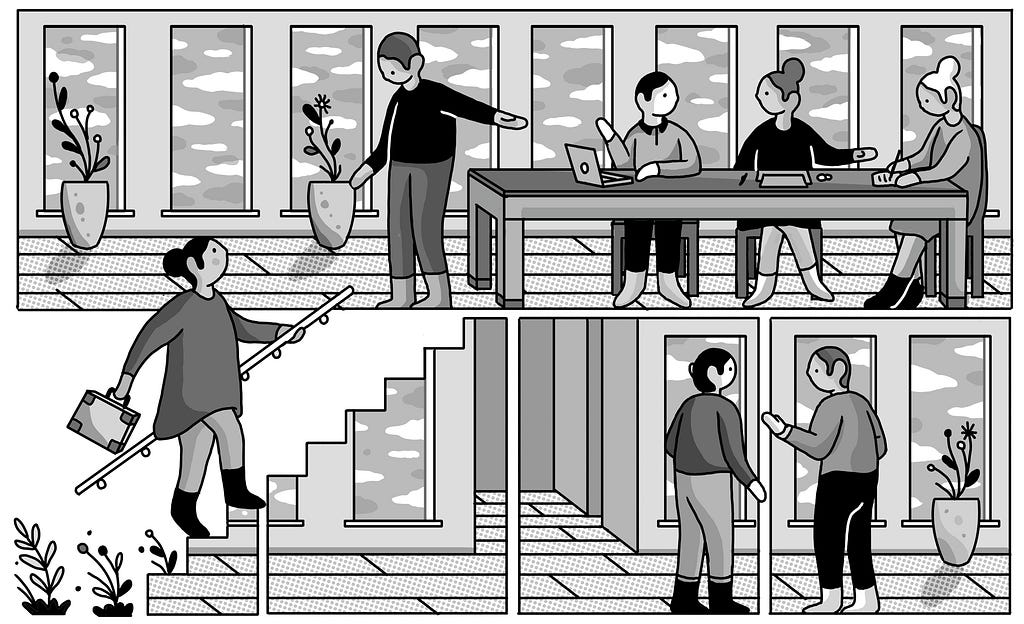
Illustration by Evan Cohen

By THE TECH HIRING TEAM

A few months ago, Brian Hamman, Vice President of Engineering at The New York Times, wrote about our new process for hiring front-end web engineers. We replaced nearly a dozen different applications to similar positions with a single process to apply to all teams. Now that we’re a couple months into that process and have reviewed over 1,000 applications, we figured it would be a good time to update how we’ve fared so far and talk about some of the changes we’re making.

We realized that requiring a code test before the interview was asking a lot of our applicants. They had to invest a lot of time before they even had the chance to meet our teams and determine whether The Times was a good fit for their career. This is especially true for experienced candidates who often look for more specific roles.

So we’re streamlining the process. From now on, we’ll advance some candidates from phone interview to on-site interview without first requiring a code test, provided their professional experience is comparable to our work at The Times.

For on-site interviews, candidates get a chance to visit the office and meet with several engineering and cross-functional members of our teams. The interviews are structured to give candidates time to ask questions during each interview slot, so they should get a better sense of our teams and culture by the end of the day. After the interview, we’ll check in and see if there’s mutual interest in moving forward.

We’re still asking some candidates to complete a code test before coming to the office. We recognize that not everyone is comfortable live coding during an interview, so we want to make sure candidates have a fair opportunity to showcase their skills.

We think these changes reflect our mission to provide rewarding, instructive, efficient and fair experiences for engineering candidates — while ensuring that we hold those candidates to the high technical and collaborative standards that we hold ourselves to every day. This is the first of many iterations to our process and we’ll continue to make announcements as we make changes.

If that sounds interesting to you, apply to work with us!

The Tech Hiring Team

Allison McHenry, Director of Engineering, Games
Austen Lein, Associate Manager, Recruitment
Bennett Yates, Director of Engineering, Content Management Systems
Brian Hamman, Vice President, Engineering
David Yee, Senior Director of Engineering, Parenting
Jerry B., Director of Engineering, Subscription Growth


We’re Making Changes to Our Front-End Engineering Process was originally published in Times Open on Medium, where people are continuing the conversation by highlighting and responding to this story.

21 Dec 04:51

Regional Transportation Strategy

by Stephen Rees

This graphic came to me via Twitter. I think it needs to be seen in a larger format

Mayors Council strategy

21 Dec 04:51

‘Human-Computer Insurrection’ accepted to CHI!

I am both excited and bemused to announce that a paper I’ve worked on with Joey Hoy and Meg Drouhard has been accepted to CHI 2019 - and oh is it a weird one:

The HCI community has increasingly examined the societal implications of our work and our corresponding responsibilities. Despite HCI’s increasing engagement with the political, it continues to lack an explicitly articulated politic, which we argue re-inscribes and amplifies systemic oppression. In this paper, we set out an explicit political vision of an HCI grounded in emancipatory autonomy—an anarchist HCI, aimed at dismantling all oppressive systems by mandating suspicion of and a reckoning with imbalanced distributions of power. We outline some of the principles and accountability mechanisms that constitute an anarchist HCI. We offer a potential framework for radically reorienting the field towards creating prefigurative counterpower—systems and spaces that exemplify the world we wish to see, as we go about building the revolution in increment.

It’s titled Human-Computer Insurrection: Notes on an Anarchist HCI. I have no idea how we’re going to present it in 20 minutes, but I am very excited to find out.

21 Dec 04:51

What Do You Want Top Members To Feel? (being part of the group)

by Richard Millington

We tried a small experiment two months ago among 23 members of two superuser programs.

One group of members received private, personal, rewards (notes of gratitude, swag, introductions to engineers).

Another received the same but it was in public, i.e. members received @mentions, thanks in the private group channel, swag they were encouraged to photograph themselves with and share with the group, and group introductions to engineers.

The rewards weren’t exactly equal, but the results weren’t even close. The public rewards were far more effective at driving more contributions, increasing positivity of contributions, and anecdotally helping members get along a lot better.

The purpose of the reward in a superuser/MVP program is to make members feel something. It’s so rarely about the reward itself.

The reward is a tactic, the feeling you’re trying to provoke is the strategy.

The most powerful emotions are those which make members feel a part of a unique, exclusive, group. This is a group whose status a member compares favorably with another group (typically normal, regular, members).

This doesn’t mean they see the other group negatively, they just see their own group more favorably.

How you give the reward is more important than the reward itself.

21 Dec 04:51

SF-2: Why Serverless?

Well obviously: Frugality, security, and elasticity. But I want more, I want better software.

[This is part of the Serverlessness series.]

Frugality

The core idea is that when your workload goes to zero, so does your bill. You might save big; Financial Engines is the first case study that Google popped up for me, but I’ve heard muttered stories in the hallways about way bigger savings than that. And then there’s my co-worker who took his school-photographer wife’s Website billings from $10/month down to a few cents.

And we’re not just talking about Lambda. When there are no messages flowing through your SQS queue, you’re not paying anything. When your Step Functions workflow is waiting, it’s just a row in a database. And so on and so on.

From Werner Vogels’ 2017 re:invent keynote

Disclosure: I lobbied to get that soundbite into that keynote.

Security

When you can’t see the servers, that means we’re taking care of them. And since servers fail, our services have to be designed to survive restarts. Which means that we can (and do) bounce them whenever they need patching. So whatever hosts your DynamoDB table or your SNS topic is running on, they’re likely freshly-enough patched to cut the number of known vulnerabilities to just about the minimum possible. [Urgh, upon typing this, it occurred to me to check the uptime on the Linux box hosting this blog, and it’s like a year. The box generating the bits you are now reading is probably a soft target for all the bad guys out there. Ahem.]

Anyhow, there’s no perfect security in this bad old world, but freshly-patched instances really do help a lot.

Elasticity

When we deliver serverless services, what we’re really trying to do is get you out of the business of capacity forecasting. That business sucks. It’s hard, and easy to get wrong; the penalty for estimating low is lousy performance for your customers, and estimating high is throwing away money. So go serverless and let us take care of that for you.

(By the way, I’m not claiming that we’re any smarter about capacity management than you are. When you aggregate all the AWS customers’ traffic, the lumpy local variations even out. So it’s a much easier problem if you’re a public-cloud provider. Of course you have to not mind billions in capex.)

What about software quality?

As I’ve blogged before, that “Frugality, Security, Elasticity” pitch operates at a more or less pure business level. But I’m a technologist and engineer, so I have to ask, are serverless application designs better designs? I think the only honest answer is “We don’t know yet.”

Having said that, my gut is saying “yes”. It helps that I’m an old functional-programming bigot, and the notion of stateless functions in the cloud responding to events gives me a warm glow. There are things we do know: microservices that are connected asynchronously with messaging systems (e.g. SQS, 100% serverless) are more robust and flexible than those that aren’t. But… Can I say we have a basis of experience sufficiently strong to say “Serverless software is better”? Nope.

But I’m pretty sure that going serverless isn’t going to give you a worse design. So you should bloody well go ahead and do it, because: Frugality, Security, and Elasticity.

But wait…

Look at that picture above from Werner Vogels’ keynote at the 2017 re:Invent.

Then consider the fact that you have a finite time budget for software design. If you go serverless, then you you don’t have to design Kubernetes flows or Auto Scaling policies or fleet-health metrics or any of that other stuff. All your design time can be dedicated to, like Werner’s slide says, software that directly addresses business issues. So, given more design time, you’re probably gonna get a better design with serverless.

My feeling is, the why of serverless is pretty obvious. It’s the how that’s interesting.

21 Dec 04:51

SF-1: What Is Serverless?

I don’t think it’s that complicated: If you can’t see the servers in the service, then it’s serverless. Yeah, they’re still there, but the whole point is that you can mostly not worry about them.

[This is part of the Serverlessness series.]

That doesn’t work just for functions: Lots of services, for example RDS (in certain flavors), ElasticSearch, and Amazon MQ, require that you pick an instance that the service runs on before you start. Let’s extend the nomenclature a bit; if anything requires that you pre-provision IOPS (or other unit of capacity), then that’s not so serverless.

Launching an Amazon MQ broker

It’s a great service, but it’s not serverless.

Etymology

Several people, starting with Werner Vogels, have griped about the name “serverless”, finding it ill-conceived and pointed in the wrong direction, preferring positive rather than negative names. Fair enough, but too bad, English is not just a living language but a hasty, impulsive, pigheaded one, and it’s settled on “Serverless” now, so just deal.

By the way, any fool can plainly see that the opposite of Serverless is Serverful, with just one trailing “l”, just like faithful, sinful, and skillful.

It’s not binary

I heartily recommend Ben Kehoe’s The Serverless Spectrum in support of this point. Let me illustrate by example: Your basic enterprise Oracle deployment is the most serverful thing imaginable; with the primary, fallback, and standby instances, it’s triply serverful! RDS Aurora Serverless is more serverless, and while DynamoDB has always been even more serverless, with the advent of On-Demand mode, it’s really serverless.

Another example: An EC2 instance is hardly serverless, a Docker container launched in Fargate is really pretty serverless, while a Lambda function is the epitome of serverlessness.

I think we are past the time to argue about what “serverless” means.

21 Dec 04:51

SF-3: Serverless Everything?

Sometimes we fans get a little over-excited and declaim that everything should be serverless. After all, we’re pretty convinced that owning data centers and computers is becoming a thing of the past. Well then, how could configuring your own hosts and paying for them even when they’re not working ever be a good idea? Let’s try to be moderate and pragmatic: Serverless, where possible.

[This is part of the Serverlessness series.]

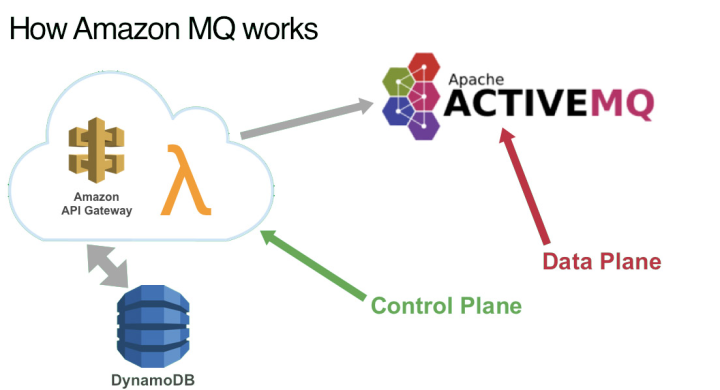
But what does “Where possible” mean? Here’s a nice concrete example from inside AWS: the Amazon MQ service, which is a managed version of the excellent Apache ActiveMQ open-source message broker.

How Amazon MQ works

To make this usable by AWS customers, we had to write a bunch of software to create, deploy, configure, start, stop, and delete message brokers. In this sort of scenario, ActiveMQ itself is called the “data plane” and the management software we wrote is called the “control plane”. The control plane’s APIs are RESTful and, in Amazon MQ, its implementation is entirely serverless, based on Lambda, API Gateway, and DynamoDB.

I’m pretty convinced, and pretty sure this belief is shared widely inside AWS, that for this sort of control-plane stuff, serverless is the right way to go, and any other way is probably a wrong way. Amazon MQ is a popular service, but how often do you need to wind up a new broker, or reconfigure one? It’d be just nuts to have old-school servers sitting there humming away all the time just waiting for someone to do that. Environmentally nuts and economically nuts. So, don’t do that.

The data plane, ActiveMQ, is a big Java program that you run on an EC2 instance the control plane sets up for you. Client programs connect to it by nailing up TCP/IP connections and shooting bytes back and forth. MQ and its clients take care of the message framing with a variety of protocols: STOMP, MQTT, AMQP, and JMS/OpenWire. This is obviously not RESTful.

Because of the permanent connection (unlike an HTTP API that sets them up and tears them down for each request) the messaging latency can be really, really low. Of course, the downside of that that the scaling is limited to whatever a single broker instance can handle.

Anyhow, the data plane is absolutely not serverless. Is this OK? I’m going to say that it’s just fine. Among other things, at the moment we don’t have a good serverless way to simultaneously use nailed-up TCP/IP connections and dispatch serverless functions; you can imagine such a thing, but we don’t have it now.

Because it’s not serverless its scalability is limited, and you’re going to be paying for it to turn electricity into heat 24/7/365 whether you’re doing any messaging or not. But for a lot of customers who just want somebody else to manage their MQ instances, or who have to integrate with legacy apps that talk JMS or AMQP or whatever, it’s still super useful.

Global weather

Let me give you another example. I was recently talking to a large public-sector weather service that maintains a model of the global weather picture. This needs to be updated all the time, and the update needs to complete in 43 minutes. The actual software is a vast, sprawling thing built up over decades and substantially in FORTRAN. To get acceptable performance, they have to buy insanely expensive supercomputers and run them flat out.

Would serverless be a good idea? Well maybe, but they don’t know to decompose the model into small enough pieces to fit into serverless functions. “Are you looking at that?” I asked. “We’d love to,” was the answer “but anyone who can figure it out will probably get a Nobel Prize. Want to try?”

I think that, since weather forecasting is pretty important to civic well-being, we can all agree that this is another scenario where being serverful is OK. (Well, until someone wins that Nobel Prize.)

Back to the mainstream

Now, let’s stipulate that most customers are writing neither real-time message brokers nor models of the global atmosphere. Most are running something with a Web front end and a database back-end and straightforward application logic in between. These days, it’d be unsurprising if there were events streaming in from dumb machines or user clickstreams or whatever. Why shouldn’t all of this be serverless? I think it usually should be, but there are things that reasonable people worry about and deserve consideration. That’s next.

21 Dec 04:50

Our deliciously new pies & donuts – also as small multiples

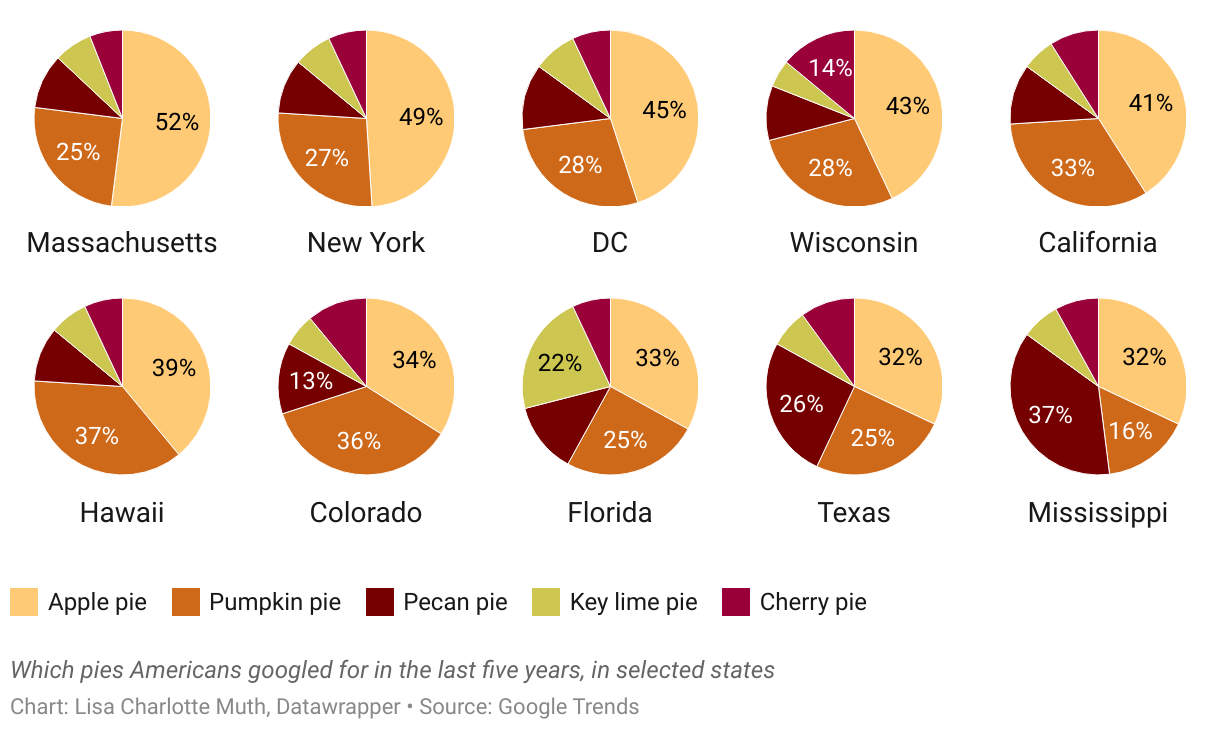
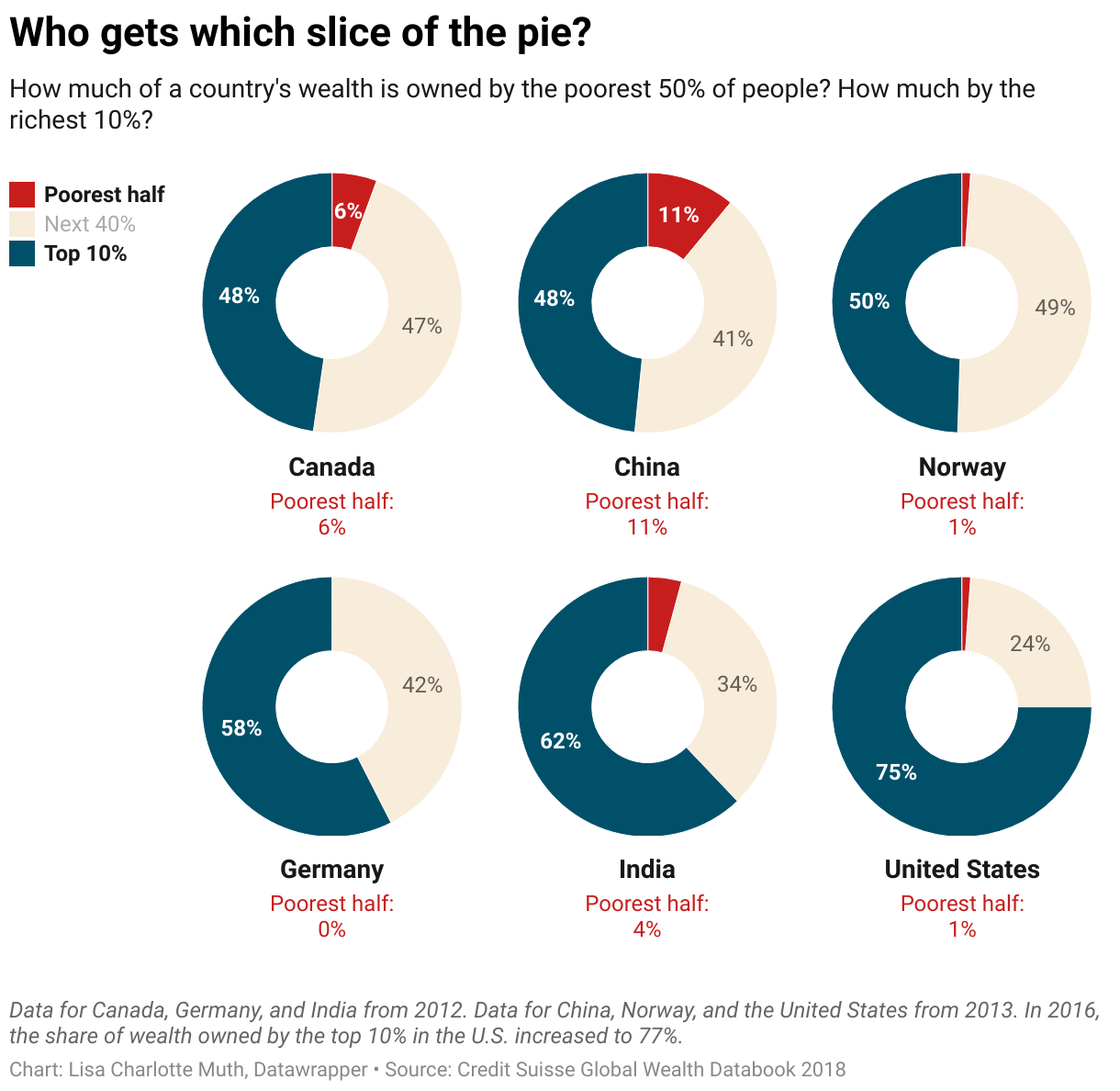
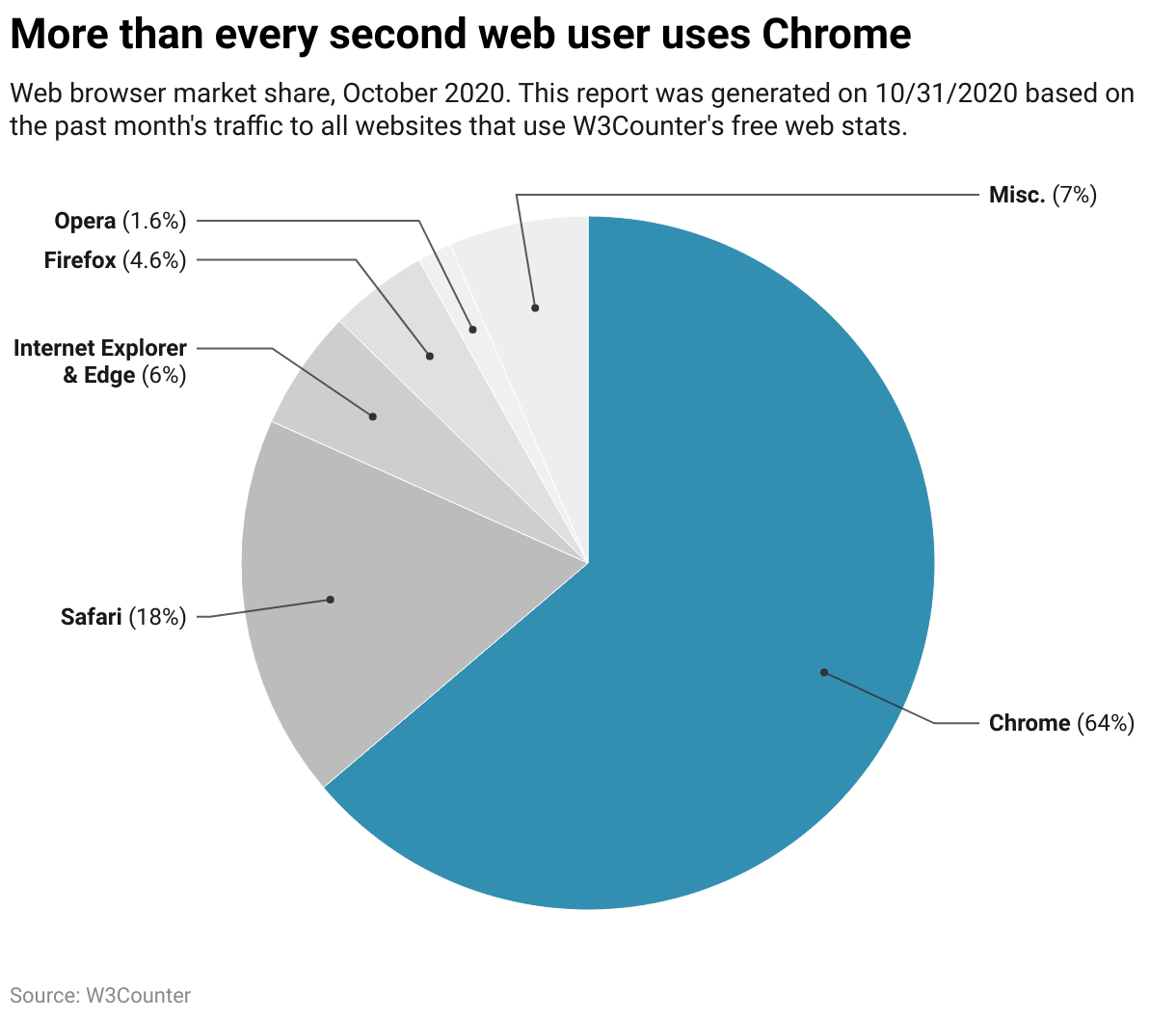
Pie charts – some hate them, some love them. We think they make sense in some cases. But since our pie charts have been available from the earliest Datawrapper version, they’ve looked a bit outdated for a while and didn’t come with many options. So our Ivan got to it. By now, he’s a bit fed up with pies and donuts. But I’m sure you’ll appreciate the improvements we’re proudly introducing today:

Small Multiples

“Small multiples” are a way to show the same chart type, multiple times next to each other. They’re a great way to compare if your uncle ate as big of a slice from the apple pie as he ate from the pumpkin pie. Since they’re almost a chart type on their own, we added them as such to our chart selector: You can now create small multipies and multi…um…donuts with our new chart types “Multiple Pies” & “Multiple Donuts”.

Multiple pies and donuts share most of the options with their single variants. For example, you can display certain values or the total below pie charts, or below and inside donut charts. There’s just one setting that’s not available in small multiples because of space issues: outside labels. “Outside labels”, you ask? Yes! Let us serve you some more pie to explain another improvement:

Outside labels

To make sure your visitors know what’s in a pie slice, we offer three different ways of labeling them: By default, you’ll see a color key, plus labels & values shown directly in a slice. But for those times when the extended family comes over and you want your pies & donuts a bit fancier, we now also offer outside labeling, with lines leading from the labels to the slices:

Try ending the lines at the edge of the slices as a variation. And to add some sprinkles of color (and better readability!), we suggest you use the slice color for the labels.

Color key (it didn’t exist in our previous pie charts!)

We couldn’t believe it ourselves, but so far, our pies and donuts didn’t have color keys. You know, these colored boxes with labels next to them. But now we have them. And they can be everywhere! At the top! At the bottom! To the left! To the right! Whatever you feel like. Here we felt like placing them to the right:

What’s more, you can decide to display the values next to the labels in the color key. So that your small slices get some attention, too.


Let us know if you have any questions or feedback for our new pie & donut charts. We’re always happy to hear from you. Find us on Twitter at @datawrapper or email us to support@datawrapper.de.

21 Dec 04:50

It's the most 'Wonderfund' time of year

by Dries
Gift drive

Every December, Acquia organizes a gift drive on behalf of the Wonderfund. The gift drive supports children that otherwise wouldn't be receiving gifts this holiday season. This year, more than 120 Acquians collected presents for 205 children in Massachusetts.

Acquia's annual gift drive always stands out as a heart warming and meaningful effort. It's a wonderful example of how Acquia is committed to "Give back more". Thank you to every Acquian who participated and for Wonderfund's continued partnership. Happy Holidays!

21 Dec 04:50

Firefox 65 Beta 6 Testday, December 21th

by Bogdan Maris

Hello Mozillians,

We are happy to let you know that Friday, December 21th, we are organizing Firefox 65 Beta 6 Testday. We’ll be focusing our testing on:  <notificationbox> and <notification> changes and UpdateDirectory.

Check out the detailed instructions via this etherpad.

No previous testing experience is required, so feel free to join us on #qa IRC channel where our moderators will offer you guidance and answer your questions.

Join us and help us make Firefox better!

See you on Friday!

21 Dec 04:48

Ra

Fiction » Magic is real. Discovered in the 1970s, magic is now a bona fide field of engineering. There's magic in heavy industry and magic in your home. It's what's next after electricity. Student mage Laura Ferno has designs on the future: her mother died trying to reach space using magic, and Laura wants to succeed where she failed. But first, she has to work out what went wrong. And who her mother really was. And whether, indeed, she's dead at all... New! Ebooks! Paid You can buy Ra as an ebook from these places: Google Play (EPUB) Amazon (Kindle edition): US UK DE FR ES IT NL JP BR CA MX AU IN It should be about three dollars. Free Alternatively, try one of these free, unofficial editions created by readers: Ra (EPUB) transcribed by Bela Lubkin. Old ending only, plus appendices Ra (EPUB) transcribed by raylu. Old ending only Ra (EPUB) transcribed by Ivan Krylov. Also contains the old ending and all appendices Or just read it here for free! Read from top to bottom. Ra ...
21 Dec 04:48

How a Hong Kong craft brewer got on the bag of European Tour event winner and earned a shot at a fortune in the Middle East

by David Price
Only a dedicated follower of professional golf, probably living in the English Midlands, would have recognised the name of the Honma Hong Kong Open winner in November. Aaron Rai lifted the trophy and pocketed the US$333,330 cheque on a rainy Sunday at Fanling. The first-day video highlights showed the big names, Sergio Garcia, Patrick Reed and Tommy Fleetwood, with their insouciant swing, their precision on approach, their unerring putting. The last part of the clip was of some golfer I didn…
21 Dec 04:48

Living in interesting times

by admin

Photo by Jon Tyson on Unsplash

As the end of 2018 approaches, the old adage of living in interesting times seems more apt than ever.  Nothing in UK politics seems to make sense any more. So when I was looking for the origins of the phrase “we live in interesting times” ,  I had that sad, ironic, I should be laughing but I’m actually dying feeling when I saw from wikipedia that there are claims that it originates from an ancient  Chinese curse “may you live in interesting times”.  I wonder if our current PM knows this. 

Politicians, particularly those in our current UK Government, and particularly our current Prime Minister Theresa May, keep banging on about delivering a Brexit that “the people” voted for.  But no-one voted for what is happening just now. During the referendum  no-one had sight of a draft deal,  so no-one really actually had any idea of what a deal would actually entail.  That hasn’t really changed in the past two years until the last couple of weeks.  

There were of course some vacuous, totally inaccurate slogans on buses and proclamations that the Brexit negotiation  would be the easiest trade deal in history ever.   There was never any plan to leave, just some vague, jingoist nonsense about reclaiming – laws and sovereignty – neither of which we had actually lost.  

“We, the people” are now caught up in a type of circular hell that even Dante couldn’t have imagined. 

What history will make of this, I have no idea. However what is clear to me is that to enact a plan you first need to have a plan. That plan should be critiqued, debated in a democratic way.  The complexities and implications of trade negotiations should be transparent and not swept under the carpet by very rich (mainly white) people who can afford to carry on living the way the live whilst “we, the people” have to live in chaos and economic uncertainty for the next decade or more.  Historic  international peace treaties such as the Good Friday Agreement can’t be ignored, 

All I know just now is that I feel even more invisible than normal. Democracy is failing me and I don’t know what to do.   But maybe one day some historian in the future will discover this little post will maybe get a sense of my hopelessness and despair. 

I’ve been struggling to write this blog post today,  and now I have just seen this article in The Guardian. Thank  you Ivan Rodgers for putting into words some of what I have been feeling.  

21 Dec 04:48

The Best Security Cameras for Your Home

by Rachel Cericola
The Best Security Cameras for Your Home

Wi-Fi security cameras let you keep tabs on your home from anywhere in the world. We’ve done hundreds of hours of research and testing on indoor, outdoor, hardwired, wireless, and doorbell Wi-Fi cameras, searching for the best ones to fit a variety of homes, budgets, and security needs. If you want to know what’s going on when you’re away, one of our camera recommendations will do the job.

21 Dec 04:48

Fiction about kids who write poetry

by Liz

Found this in my old drafts folder from …. well, more than 10 years ago! I clearly meant to expand on these thoughts with examples from the books but never got it together. Fun anyway though!

>>>>>

I re-read The Boyhood of Grace Jones the other day and loved it for its mid 20th century genderqueer “tomboy” protagonist, but most of all for her surety that she could choose and make herself. All the kids and adults around her were clueless, insisting that there was a binary choice between heredity and environment – every aspect of a person was controlled by those factors. Grace Jones insisted there was another thing everyone had inside that let them create themselves how they wanted to be! I loved that.

I owe several posts on ETech and SXSWi and SexTech, but I’m going to write about this first!

Grace Jones goes through a lot, but her most intense realization comes when she writes a couple of poems and then doesn’t know what to do next. She is stunned by the realization that these big ideas were in her and she was able to put them out. Then what! Children don’t have much outlet for big ideas or poetry. I found myself contrasting Grace’s, and Anastasia Krupnik’s, fictional-character poems with the ones from girls’ books from earlier generations, like Rebecca of Sunnybrook Farm’s poem she gives to Mr. Ladd (Spoiler: she grows up and marries him.) It is very twee and is sort of about God, and she breathlessly awaits his judgment of whether she could be a “real writer” someday. That happens a lot in girls’ books, doesn’t it?

Note from 2018: Not sure I was remembering this correctly – Rebecca shows her poem to Miss Maxwell first –

This ingenuous remark confirmed Miss Maxwell’s opinion of Rebecca as a girl who could hear the truth and profit by it.

“Well, my child,” she said smilingly, “your friends were wrong and you were right; judged by the proper tests, they are pretty bad.”

“Then I must give up all hope of ever being a writer!” sighed Rebecca, who was tasting the bitterness of hemlock and wondering if she could keep the tears back until the interview was over.

“Don’t go so fast,” interrupted Miss Maxwell. “Though they don’t amount to anything as poetry, they show a good deal of promise in certain directions. You almost never make a mistake in rhyme or metre, and this shows you have a natural sense of what is right; a ‘sense of form,’ poets would call it. When you grow older, have a little more experience,—in fact, when you have something to say, I think you may write very good verses. Poetry needs knowledge and vision, experience and imagination, Rebecca. You have not the first three yet, but I rather think you have a touch of the last.”

“Must I never try any more poetry, not even to amuse myself?”

“Certainly you may; it will only help you to write better prose.

I could only find this bit of Rebecca’s poem:

Then come what will of weal or woe
(Since all gold hath alloy),
Thou ‘lt bloom unwithered in this heart,
My Rose of Joy!

Maybe the scene with Mr. Ladd is in the sequel, which I also remember being mostly about Rebecca agonizing about whether she could ever be a “real writer”.

Laura Ingalls’ poem, on a more frivolous note, but one that shows Laura’s realization of the dangers of verse composition for a popular audience:

Going to school is lots of fun,
From laughing we have gained a ton,
We laugh until we have a pain,
At Lazy, Lousy, Lizy Jane.

I don’t have Grace Jones’s poems handy but remember her reciting Kubla Khan to herself.

Remembering Louise Fitzhugh’s wonderful character, Harriet the Spy’s poem experience as she goes through every letter of the alphabet trying to find words to rhyme with “pain”. Her thought process during this poem was just amazing to me (when I was a kid who thought similarly) and I love her.

And finally, Anastasia Krupnik’s poem. (Which I also don’t have handy but which I recall being in all lower case and about undersea creatures and just a little embarrassing, but good)

Anastasia notably falls off the top of the rope climbing thing in gym class & breaks her arm while triumphantly reciting a poem by Edna St. Vincent Millay. (O world! I could not hold thee close enough!) Her dad is a poet and professor and a kind of cool, dorky dude. We get an updated version of the old scene of a nervous girl clutching sheaf of poems to her chest as she hands them to the newspaper editor. Anastasia explains to him in outrage how she practiced her poem and read it very fancily to her class and teacher, who didn’t get it. He’s supportive and proud! But the best thing about the scene is that Anastasia is already sure that she did something amazing.

I think it is interesting to consider poetics, and writing, as an important point of resistance to patriarchy, especially for young girls and women. There are just a zillion other examples of women writing about young girls and young women who are trying out being a writer, and what other people tell them, and how they react…. Surely there are also a ton of academic papers about this!

21 Dec 04:48

Upcoming talks

I’ve got a series of upcoming talks including Google (10 January), the University of Cambridge (20 February) and the American Statistical Association (1 June). Correspondingly I’ve finally set up a talks section of the website!

21 Dec 04:46

How to Keep Your Feet Warm for Winter Cycling

by Average Joe Cyclist

How to keep your feet warm for winter cyclingThis post provides tips for keeping your feet warm and dry for winter cycling. It's not easy, but it can be done with proper planning and the right gear. Post includes tips on some cheap gear that helps to keep your feet warm - and also recommends FREE items that will help keep your feet dry - you already have these, but you might not have thought of wearing them on your feet!

The post How to Keep Your Feet Warm for Winter Cycling appeared first on Average Joe Cyclist.

21 Dec 04:30

The Art of the Personal Project: Dax Ward

by Suzanne Sease

The Art of the Personal Project is a crucial element to let potential buyers see how you think creatively on your own.  I am drawn to personal projects that have an interesting vision or that show something I have never seen before.  In this thread, I’ll include a link to each personal project with the artist statement so you can see more of the project. Please note: This thread is not affiliated with any company; I’m just featuring projects that I find.  Please DO NOT send me your work.  I do not take submissions.

Today’s featured artist:  Dax Ward

Concept of my work

Every derelict location has its own individual history, but each one is connected in the sense that they are reminders of what once was, what might’ve been, and what happens when we forget.  They are no longer freshly painted, not shiny and new anymore.  Windows are broken.  Doors, furniture, light fixtures, and most metal has been either stolen or scrapped.  They are not as they once were, nor will they ever again be.  Nonetheless, despite the decay and rust that many see as unsightly blots on the landscape, the allure for urban explorers and photographers lies in identifying and capturing the remaining beauty in these forgotten locations.  If we look closely, it isn’t hard to find.

at the abandoned New World Mall, Bangkok, Thailand

at the Bhirasri Institute of Modern Art, Sathorn Soi 1, Bangkok

at the Sathorn Unique ‘Ghost Tower’, Yan Nawa, Bangkok, Thailand

To see more of this project, click here.

To see a book he would love to have published, click here.

APE contributor Suzanne Sease currently works as a consultant for photographers and illustrators around the world. She has been involved in the photography and illustration industry since the mid 80s.  After establishing the art buying department at The Martin Agency, then working for Kaplan-Thaler, Capital One, Best Buy and numerous smaller agencies and companies, she decided to be a consultant in 1999. She has a new Twitter feed with helpful marketing information because she believes that marketing should be driven by brand and not by specialty.  Follow her at @SuzanneSeaseInstagram


------------------------

Visit our sponsor Photo Folio, providing websites to professional photographers for over 10 years. Featuring the only customizable template in the world.

------------------------

21 Dec 04:28

Android Updates :: Nokia macht weiter alles richtig

by Volker Weber

ZZ0AEBAC94

Nokia macht weiter alles richtig. Neueste Android-Version, aktueller Patch. Und alle anderen enttäuschen. Samsung ist nicht mehr dabei, das habe ich zurückgegeben.

21 Dec 04:28

An fremdem USB-Port sicher laden

by Volker Weber

ZZ37A0BEDC

Es ist so ein simpler Trick, auf den bei Hacker-Konferenzen immer wieder Neulinge reinfallen. Man bietet den Teilnehmern eine kostenlose Ladestation an, um die hungrigen Smartphones aufzuladen. Aber hinter dem freundlichen USB-Port hängt kein Trafo, sondern ein neugieriger Computer. Und der saugt dann ruckizucki spannende Daten an. USB spendet nicht nur Strom, sondern kommuniziert auch. Das vergessen viele in dieser Situation.

Die Abhilfe ist einfach: Ein kleiner Zwischenstecker saugt Strom aus dem dem USB-Port und spendet ihn auf der anderen Seite. Nur Daten transportiert er nicht. Wie Abdelkader schreibt, bekommt man damit auch unwillige USB-Ports von Hotelzimmer-TVs dazu, die eigenen Geräte zu laden. Man kann ja nie genug USB-Ports haben.

More >

21 Dec 04:28

Last-Minute-Geschenk :: udoq-Qi-Lader

by Volker Weber

379f41a114cc992a5196f9faa5f51cdf
Foto Joerg Richter, Bearbeitung Volker Weber

udoq kann seit letzter Woche einen Qi-Charger für die udoq-Schiene liefern. Das ist das Schöne an dieser Lösung: Einzelteile lassen sich leicht ersetzen oder ergänzen. Ein abgebrochener Stecker macht nicht die ganze Station kaputt.

Auf dem Bild seht Ihr die Hülle eines iPhone 8 auf dem Qi-Lader (das Handy wurde für das Bild gebraucht) und einen Adapter zum Laden einer Apple Watch. Dort kommt der Ladepuck der Watch hinein. Bei mir hat sich auch die Kabelbox bewährt, das von udoq verkaufte Ladegerät passt mit hinein.

Nächste Woche bekomme ich auch einen Qi-Lader. Geht Montag in München raus. Die Truppe wird noch die ganze Woche bis Weihnachten arbeiten, um zu sehen, dass sie rauskriegen, was geht.

More >

21 Dec 04:28

Drawing on the iPad Pro 12.9

by Volker Weber

cba7f084284c1361e35357a93c3c99d5

It takes a moment until you realize there is a way to prop up the iPad Pro in the ideal drawing angle. You just flip it around with the keyboard attached. Not as elegant as the Surface Pro kickstand, but quite workable.

I love this machine.

21 Dec 04:20

Apps gather your location and then sell the data

by Nathan Yau

The New York Times takes a closer look at the data that apps collect and what they know about you:

At least 75 companies receive anonymous, precise location data from apps whose users enable location services to get local news and weather or other information, The Times found. Several of those businesses claim to track up to 200 million mobile devices in the United States — about half those in use last year. The database reviewed by The Times — a sample of information gathered in 2017 and held by one company — reveals people’s travels in startling detail, accurate to within a few yards and in some cases updated more than 14,000 times a day.

The animated visuals in this piece are nice, strengthening the big numbers with small anecdotes. Because the only way to make people care about data privacy is to be as creepy (but responsible) as possible.

Tags: location, New York Times, privacy

21 Dec 04:20

✚ Google Fusion Tables Shutdown, Lack of Preservation, and Finding Alternatives

by Nathan Yau

Google announced that Fusion Tables will be laid to rest, which highlights a need for preservation of visualization for the long-term. Read More

21 Dec 04:20

Ages in Congress, from the 1st to the 115th

by Nathan Yau

As I watched Google’s CEO Sundar Pichai field questions from the House Judiciary Committee it was hard not to feel like there was a big gap in how the internet works and how members of Congress think it works. Many suggested the gap was related to age, so I couldn’t help but wonder how the age distribution has changed over the years.

You can see the median age shifting older, but I’m not totally sure what to make of it. After all, the population as a whole is getting older too. On the other hand, the internet changed a lot of things in our lives, and the hope is that those forming the policies understand the ins and outs.

Tags: age, Congress

21 Dec 04:19

Replied to Checking in on my social media fast ...

by Ton Zijlstra
Replied to Checking in on my social media fast by Ben WerdmüllerBen Werdmüller
Three weeks ago, I decided to go dark on social media. ... It's one of the best things I've ever done. I thought I'd check in with a quick breakdown: what worked, and what didn't. Here we go.   Wh...

I recognise what Ben Werdmüller says. About the withdrawal creating space to both read more long form, and to write more myself. Also the replacement dopamine cravings, by looking up your blog’s statistics when the Facebook likes fall away, I had. Indeed as Ben suggests, I also removed the statistics from my website (by disabling JetPack, I never used Google Analytics anyway). Different from him, I never stopped using Twitter or LinkedIn, just cut back Facebook which I felt was the real time sink (also as Twitter nor LinkedIn were on my phone to begin with, and because I use Twitter very differently from how I used Facebook.) Going completely ‘dark’ on social media is also about privilege I feel, so the crux is how conscious are we of our information strategies? How the tools we use support those information strategies or not, and most importantly in the case of social media as a time sink: in how much it’s the tools that shape our info diet, instead of the other way around.

21 Dec 04:19

Liked Company of One – Why staying small is the...

by Ton Zijlstra
Liked Company of One – Why staying small is the next big thing in business. by Frank Meeuwsen
"The real key to richer and more fulfilling work could be to not create and scale something into a massive corporation, but rather, to work for yourself, determine your own hours, and become a (highly profitable) and sustainable company of one."

Pre-ordered for next month. This is something that I’ve been engaging with for 10 years. At one hand I’d like colleagues/staff to speed things up, but it also always increases your needs. Having employees is a relentless responsibility. Networked working prevents those additional needs, but usually also has less effect in increasing speed and versatility, as the connections create more overhead than in the case of employees. I’ve seen peers find themselves with dozens of staff, and no longer doing the stuff they love. I’ve seen individuals struggle to keep moving for lack of impulses that a ‘normal’ company would provide. Now, the blurb and preface of this book reads as someone able to ditch a lot of hassle because of privilege, and trying to turn an individual experience into a theory and ascribe outcomes to one’s own individual ability to act. (And then there’s the awful, red flag like, up-sell to ‘take my course’ after you order the book) Whereas context and your starting position matter a lot. Not all of us can afford a move to beautiful Vancouver Island. But the trajectory is very familiar. My friend Robert Paterson left the banking world for PEI and working from home, and found that it greatly also reduced the cost of living as many expected behaviours or symbols of status in a city and in the banking world no longer applied to him. Reducing the level that is ‘enough’ to somewhere much more manageable. There are many more like that in my peer network as well. So I am at least curious.