Shared posts

21 Dec 23:19

Three Types of Community Work

by Richard Millington

We’re usually invited to work on one of three types of community projects:

1) “We have a success and want to make it better”. This is usually when someone wants to overcome a specific challenge, develop a longer-term roadmap, or improve a particular area.

2) “We’re about to launch a community and want to get it right”. This is self-explanatory. Someone needs help to launch the community.

3) “We’ve screwed it up and need help”. Engagement is plummeting, people aren’t participating, and the community is heading towards life support.

I suspect most of you (even if it’s not explicit) are working on one of these three types of communities too.

Each requires an entirely different approach.

1) Successes that can be more successful. These are the most exciting to work on. This is where systematic improvements, training staff, benchmarking (and appropriating good ideas), 1 to 5 year roadmaps, creating better operations structure, building stronger internal relationships, testing ideas and measurement is critical to success. You have some good roadmaps to follow here. The big challenge is narrowing all the options to focus on the ones that matter.

2) Getting started projects. These require a tremendous force of will to take off. You have to define a powerful community concept, get support for it, build close relationships with founding members, start and test early interactions, grow steadily and then decide the requirements for a bigger community platform. Within this, there’s a huge difference between say, launching a support community for a huge existing community and starting an interest community for a brand which can’t drive thousands of people to the community tomorrow. Managing expectations is critical in these projects.

3) Turning around failures. This is by far the hardest work. You can see how we helped Colleen at Mayo Clinic here. This requires diagnosing the problem(s) using the right metrics, undertaking a lot of research of members and deciding if it’s a series of small tweaks or a profound overhaul (usually the latter). A profound overhaul usually means a) a change in staff b) a change in platform or c) a change in concept. The hard part is gaining support for this overhaul and doing it right.

Be clear about what kind of work you’re doing.

21 Dec 23:19

vowe baut einen Computer

by Volker Weber

0899e9f608febe572940e4eb1dc8b1c5

Vorgestern kam ein neuer Lenovo Yoga C930 und den baue ich gerade auf. Was bei einem MacBook der Migrationsassistent macht, ist bei Windows ein längeres Unterfangen. Die modernen Windows-Store-Apps sind easy, aber ich habe halt noch eine Menge kleinerer Programme, die Filme umkodieren, PDFs bearbeiten, SFTP Clients, Blog-Software, Calibre etc. Das macht viel Arbeit, die einem Windows nicht abnimmt.

Und dann ist da noch OneDrive. Ca 60 GB an Daten will ich offline haben. Also in OneDrive markieren und sagen "die bitte". Aber da OneDrive diese Daten alle aus der Cloud holt und nicht von dem Surface neben dran, dauert das. Und jede einzelne der ca 20.000 Dateien wird dann vom Suchindex bearbeitet und das Yoga steht da und keucht und pustet. Stun-den-lang.

Ich sitze derweil mit dem iPad Pro daneben, das nicht nur gar keinen Lüfter hat, sondern binnen 30 Minuten einsatzbereit war. Ich will nicht ungerecht sein. Word Mobile ist ein Witz verglichen mit dem richtigen Word auf dem Yoga. Aber trotzdem. Eins fühlt sich wie die Zukunft an, das andere nicht.

Und ich komme demnächst dann noch genauer auf das Yoga zu sprechen. So viel vorneweg: Es ist ziemlich super.

21 Dec 23:18

RT @ChrissyPerry99: Friend's son punched in the face for speaking Spanish with his girlfriend. This is what your #racist bloody brexiteers…

by ChrissyPerry99
mkalus shared this story from mrjamesob on Twitter.

Friend's son punched in the face for speaking Spanish with his girlfriend. This is what your #racist bloody brexiteers have done to Britain. A plague on both your houses @theresa_may @jeremycorbyn YOU have let this happen.
FFS #StopBrexitSaveBritain pic.twitter.com/rri5fFh739


Posted by ChrissyPerry99 on Friday, December 21st, 2018 4:14am
Retweeted by mrjamesob on Friday, December 21st, 2018 1:54pm


825 likes, 515 retweets
21 Dec 18:48

Extraordinary image. Physics types, does this kind of stuff mean it's very likely that alien species would rely on water like we do? twitter.com/esa/status/107…

by IanDunt
mkalus shared this story from iandunt on Twitter.

Extraordinary image. Physics types, does this kind of stuff mean it's very likely that alien species would rely on water like we do? twitter.com/esa/status/107…

A beautiful #winter wonderland... on #Mars! This ice-filled crater was imaged by our Mars Express spacecraft. Korolev crater is 82 kilometres across and found in the northern lowlands of Mars.
More images: esa.int/Our_Activities… pic.twitter.com/5KDQ1PJ0jt


Posted by esa on Thursday, December 20th, 2018 12:05pm


24935 likes, 9122 retweets

Posted by IanDunt on Friday, December 21st, 2018 2:36pm


60 likes, 10 retweets
21 Dec 18:47

Jim Mattis’ resignation letter: clear, but not straightforward

by Josh Bernoff

Very soon after Donald Trump announced he would withdraw the US troops now in Syria and many of those in Afghanistan, Secretary of Defense Jim “Mad Dog” Mattis resigned. Let’s read between the lines in his resignation letter. Resignation letters in the Trump administration tend to be short and uncontroversial. If you’re not leaving because … Continued

The post Jim Mattis’ resignation letter: clear, but not straightforward appeared first on without bullshit.

21 Dec 18:45

Huawei P30 to feature 5x lossless zoom and triple rear-facing camera: report

by Dean Daley
Canada suffers snowball effect post-Huawei arrest

The Huawei P30 promises to be an “imaging powerhouse,” according to the prolific leaker Evan Blass. Blass sources this information from someone who has reportedly seen a P30.

Blass’ tweet indicates the standard P30 handset features a triple rear-camera with a resolution up to 40-megapixel, similar to the P20 Pro. 

The phone will also feature a 5x lossless zoom, which works similar to digital zoom. However, lossless zoom comes from the amount of native pixels shot. This means lossless zoom will capture more pixels than what’s necessary for the picture. That said, there should be no loss in quality when scaling images up.

The handset should also have a 24-megapixel selfie shooter, which Huawei’s regular P20 also sports.

Huawei will likely unveil its P30 in March, similar to its P20 series from this past year.

Source: Evan Blass

The post Huawei P30 to feature 5x lossless zoom and triple rear-facing camera: report appeared first on MobileSyrup.

21 Dec 18:45

Firefox Focus gets improved tracking protection, deceptive site warnings

by Jonathan Lamont
Firefox Focus splash screen

Mozilla is bringing new privacy features to Firefox Focus in its continued quest to improve internet security.

Focus is the organization’s privacy-centred mobile browser. Mozilla designed it from the ground up to provide users with a tracking-free experience on the web.

Now, Mozilla is handing more controls to Focus users on Android as part of its Enhanced Tracking Protection initiative. This means users will be able to choose between blocking all cookies and trackers, all third-party cookies, or only third-party cookies with trackers.

While that latter option is available on desktop Firefox, the default in Focus was no cookies at all — which can often break some websites.

Ultimately, this allows users to accept cookies that benefit their browsing experience and block cookies that track them across the web.

Additionally, Firefox Focus will allow users to turn these tracking options on and off on a per-website basis. So if you come across a website that doesn’t work correctly, you can shut off the tracking protection for only that site.

Further, Mozilla has continued to improve Focus’ underlying engine: GeckoView. GeckoView is the organization’s custom mobile browser rendering engine that’s chock full of the improvements Mozilla added to desktops with Firefox Quantum.

Along with the new tracking protection features, Focus users on Android will get under-the-hood improvements for GeckoView. Additionally, Focus will now warn users in-browser about potentially deceptive websites.

Focus users on iOS are getting some love too. Mozilla is adding the option to enable search suggestions to Focus. Previously, when you typed in the search bar, Focus kept your input and didn’t send it to the search engine you used.

iOS users can now turn on search suggestions, making the browser send your input to the search engine, like Google, to retrieve suggestions. This feature came to Focus on Android in October.

Overall, this update for Firefox Focus is full of great new features. If you haven’t tried Mozilla’s privacy-focused mobile browser, you can download it for free for iOS and Android.

Source: Mozilla

The post Firefox Focus gets improved tracking protection, deceptive site warnings appeared first on MobileSyrup.

21 Dec 04:54

“Dictate your own success, baby!”

by Gabi Schaffzin

I’ve been unfortunate enough to be exposed to a great deal of live (read: non-streaming, non-DVR) television lately, a disappointing situation to occur right around the holidays, when every single advertisement is filled with smiling families, lavishing each other with piles of bow-covered gifts. From puppies to cars, headphones to televisions, the ads usually feature a young, suburbanite, heterosexual couple or family, where one member is smugly watching their spouse or children as the other(s) go into near epileptic shock on Christmas morning. Snow covers the ground outside, wrapping paper covers the floor inside, and credit card debt covers the rest of the year’s (years’?) budget.

This season, there’s one ad that dares buck the trend and, somehow, ends up being even worse. Titled “His & Hers”, this 30-second spot features a husband (presumably, our Him) waking up at the crack of dawn to sneak out into the snow-surrounded garage and ride a stationary bike. Not just any stationary bike, though: it’s Her bike. We know this, because Him has already placed a bow and a tag with her name on it. And that’s not all. This bike—Her bike—comes with a large touchscreen on which Him can watch a live studio feed of extremely fit trainers yelling encouraging platitudes at him. This, of course, is a Peloton bike.

Peloton have been selling their $2,000 stationary bicycle since 2014 and released a $4,000 treadmill, The Tread, back in January. As of July 2018, the New York City based company claims nearly 1 million subscribers to their $39/month personal training service, noting that the hardware is actually a loss-leader (something I find remarkable, given that you could buy 200 “Your Workout Is My Warmup” t-shirts instead of the treadmill). Wall Street doesn’t seem to mind: Peloton recently received a cash influx valuing it at over $4 billion and plans to go public soon. If you’d rather not pony up for the Tread, there are competitors: at $3,000, the Nordictrack X22i offers a partnership with iFit, an independent start-up whose subscription is between $8 and $15 per month (there is a Peloton Bike copycat, Flywheel, but it is priced identically to their competitor’s offering—Peloton is actually suing them for patent infringement).

Visiting the Peloton, iFit, and Nordictrack websites feels familiar if you’ve ever shopped for a quantified-self product. I don’t just mean in terms of the structure of the page or the design elements—these are pretty consistent, no matter the industry. The rhetoric, however, could probably be interchanged without anyone noticing: “Your fitness essentials, your personal coach”, “Transform your lifestyle into a fitness tool”, “Live total body fitness has a new home: yours”. Compare these with the heds, “Find Your Fit” and “Be Unique. Be Equal” from two previous subjects of my blogposts, FitBit and the ZOZO Measurement System, respectively. The fitness companies are selling convenience and performance, but also customization. When profitability, longevity, and investor cycles are of utmost concern, how do you customize for a million people?


First, eye contact. Watching examples of these videos (I did not sign up for the services, the reason for which I will partly explain below), the trainers are, for the most part, looking right at the camera. There are mainly two exceptions: when angles change to show you how the trainers’ or in-studio extras’ muscles flex and glisten and, in the case of iFit’s primary offering, when the trainer is looking out for tourists. Because while iFit does not feature Peloton-like live classes,  you can find over 1,400 training videos set in six continents in the site’s library. As one reviewer describes it:

These are often unintentionally hilarious. Many of the most scenic places in the world are not workout-friendly. A trainer gets death stares from tourists strolling along the Cinque Terre; another dodges backpackers hiking on narrow cliffside trails to Macchu Picchu. One trainer fell into an elephant wallow. On a causeway to Antelope Island, the trainer admitted that she was doing a series of fartleks in 90-degree heat, through bugs that were so dense that I could see them splattering on the camera lens.

Let’s add, then, a second method of making the customer feel, literally, one-in-a-million: an aspirational neocolonialism. Is there a better way to explore the world out there than by running on your treadmill in your basement?

And then there are the trainers themselves: fit, muscular, larger-than-life personalities, and all working for you. In one promo video for Nordictrack, multiple customers give a shout-out to Johnny Gel—“Johnny on the Spot!” Search Etsy for one of Peloton’s celeb trainers, “Cody Rigsby” and find more than a dozen items, many emblazoned with some of Cody’s trademark aphorisms: “Do whatever you need to do to get your life together!” and “When we’re uncomfortable, we change!” The New York Times published a piece on this cult of personality last year, noting that ”perhaps no brand is trying harder to make the connection between working out and glossy entertainment more explicit than Peloton.” And one skeptic-turned-fanatic blogger writes, “the screen on my bike turns [Cody] into this untouchable celebrity to me.” After her first 100-mile ride (out on the open road), she tweeted a  message of thanks to Cody. He responded, “congrats boo!”

Perusing TV spots and example classes on YouTube, one can find a range of sentiments expressed by the trainers. At the end of a run along the narrow paths of Santorini, iFit trainer John Peel lets you know that, “I’m very, very proud of you.” Peloton personality Ally Love, as she ramps up her class, reminds you to “Give yourself permission to show up for yourself” (whatever that means). On the other hand, Robin Arzon, who features prominently in the New York Times piece, tells you to “Put the babies away, put the headphones on, because I am not holding back today” while her in-studio DJ (also wearing biking gloves?) spins her class playlist. And Alex Toussaint, as the workout hits a peak moment declares, “One more to go, I ain’t done wit’ you yet!” (The previous three examples can be found in the following video)

Certainly, the cultish fitness personality is nothing new: from Jack LaLanne to Richard Simmons, Tony Little to Jillian Michaels. But the connected nature of these devices adds a new dimension. Both Peloton and iFit feature leaderboards—the former updates live during classes, while the latter lets you know how you performed relative to other users after you finish the workout. Instructors can make adjustments to your settings remotely. During live classes, Peloton trainers are known to call out participants by their username or leaderboard position.

We might, then, understand the bike, the screen, the statistics, and the trainer all together as a single interconnected system or machine with which the user “becomes one”. This is much in the same way that a gambler and a slot machine, per Natascha Schüll in her 2012 Addiction by Design, “are harmonically synchronized to a common beat.” She goes on:

Although the decisive act of a gambler starts the reels spinning or the cards flipping, the immediacy of the machine’s response joins human and machine in a hermetically closed circuit of action such that the locus of control—and thus, of agency—becomes indiscernible. What begins as an autonomous act thus “becomes part of the automatic actions and reaction of the doer,” as the game scholar Gordon Calleja writes in his study of online digital games, resulting in “a loss of the sense of self.”

Seeing the ads on TV, watching user videos on YouTube, and reading first-hand accounts of Peloton and iFit users, there is an uncanny-valley type meditation to the way that a user relates to the device.


I completely recognize that there are much worse addictions than exercise—gambling chiefly among them. But I want to use the rest of my space here to consider what’s at stake. As I briefly noted earlier, in August of this year, Peloton locked down over half a million dollars in venture funding, resulting in an overall valuation of $4 billion. At a million subscribers, that means that each customer is worth around $4,000. As they add more customers, the company’s valuation will go up, but there’s a point at which that caps out and the value of each user begins to decline with each new customer acquired. Peloton really needs, then, its current riders and runners to stay addicted and to feel like the service being provided is largely customized.

But as I already demonstrated, the effort here is not to customize perfectly, as doing so for 1 million people would be a futile endeavor. Instead, it’s to make the users feel like the system has been designed for them. The company can make customers feel as though it has each one of their best interests in mind because it can group those customers into generalized categories, while still espousing the “individualized” rhetoric. As Peloton personality Alex Toussaint instructs, “This is your dream, this is your ride…dictate your own success, baby!” In turn, users fall in line with what they are told is best for their category, not their selves. A rider might over-exert to meet the demands of the trainer or get to the top of the leaderboard. Without trained staff to oversee the rider’s condition in person, this could be extremely dangerous to one’s health. Further, companies can leech customers for more cash through absurd up-selling, like the iFit Nourish. This $80/mo subscription-based shake service (you read that right) promises 15 servings of a “unique formulation,” made just for the customer and delivered each billing cycle.

Enough, however, about the current subscribers. What about those who are left out? Usually, when I critique a system like the ones I am looking at here, I want to use it. I’ve sent my spit to 23andMe, worn a Fitbit for weeks at a time, and even put on that stupid spandex suit only to discover my legs are different lengths. But even if I had two grand to drop on a bike (which does not include the $125 shoes or $59 floor mat, lest I scuff my composite flooring), and the $39/mo to hear Cody encourage me on a daily basis, there’s simply no way I could use any of these products without serious damage to my body.

In 2009, I was diagnosed with Ehlers-Danlos Syndrome, a degenerative collagen disorder which is often accompanied by immunodeficiencies, gastro-intestinal conditions, and other debilitating ailments. I won’t get into the nitty gritty of what this all means, but if I were to do more than 15–20 minutes on the bike at an easy pace, I would be in a great deal of pain and discomfort for days after (I can’t even think about running anymore). I of course recognize that my inability to jump on a Peloton bike does not, by itself, mean that the entire company’s offering is inherently bad or dangerous. Instead, I want to pause and ask you to consider what happens when the fit body—the ones that look like the trainers or studio-riders on the Peloton screen—is valued over all else. Nordictrack rhetoric is, at times, dominated by declarations of how much weight can be lost when the iFit system is used. But by valuing the fit body, the body that is unable to become fit is devalued and jettisoned. The fit body, in Peloton’s case, is worth $4,000. The disabled one is worth nothing. And while I’m not asking Wall Street to start figuring out how to extract value from me because I am not worthy of being “fit”, there is an obvious bleeding over of what investment bankers see as valuable into what is considered socially advantageous in late capitalism.


At the end of “His & Hers,” Her finds the bike next to the tree on Christmas morning, bow and tag attached and intact. “How did you know!?” Her asks as His smiles proudly in the background. What drove the smug His to use this generous gift before handing it over? Was it the large, seductive touch screen and carbon steel construction? Did His find a trainer that he liked so much, he couldn’t resist sneaking around his partner to take commands from a stranger in a TV studio in New York? Or maybe His just wanted to rack up some high leaderboard points before Her could even place her backside on the seat. Whatever the reason, this beautiful, white, affluent couple with one daughter (she makes an appearance in the final shot), a large house in the suburbs, and detached garage is worth a lot of money to Peloton. So whatever it takes to keep that seat filled, they will do.


Gabi Schaffzin is a PhD candidate in Art History, Theory, and Criticism, with a concentration in Art Practice, at UC San Diego. For the holidays, he bought his wife a stuffed animal designed to look like their dog. It creeps him out every day.

21 Dec 04:48

Car Tracking

This week I recieved and email from the Clean Energy Vehicle program. They'd like us to install a device in our Tesla that tracks us:

"By understanding when and where EVs charge to how much energy is consumed, you can help pave the way for future drivers by ensuring that the power system is ready for a plug-in future."

The program details are here.

"GPS information is collected, but not shared at the individual level. The data is collected and stored but no one outside of FleetCarma will see an individual’s location data."

Alright so who's FleetCarma? Let's look into the terms:

"Data Collected by the C2 Device and Privacy... drive start date and time, duration of trip, trip distance... GPS coordinates of the drive,"

"With the specific exclusion of GPS coordinates when driving, an anonymized subset of the data outlined above may be shared with the Province and BC Hydro and other third party suppliers"

"GPS coordinates during driving will not be shared with any Program partners or third party suppliers except in both anonymous and aggregate form to inhibit extraction of any individual driving behaviour."

Not sure who those Program partners or third party suppliers are but GeoTab uses some sub-processors.

FletCarma will share your information:

"To affiliated entities of CrossChasm Technologies Inc., including wholly owned subsidiaries" (Whomever that is)

"When we’re legally required to provide data, such as in response to a subpoena in a civil lawsuit."

It's nice to note.

"You may also request that your Personal Information be deleted. FleetCarma will promptly respond to your request within 30 days"

At this point I can surmise that:

  • FleetCarma will know all the trips I make in the car.

  • FleetCarma be subpoenad to give up that information.

  • FleetCarma can be hacked to give up all that information.

Normally this would be a simple, hell no. But I care greatly about electric cars and the infrastructure and this has put me in a bind. The privacy problem here is one that I simply can't get around.

21 Dec 04:48

Messing with Inform7 today

by Liz
Rolandt

jj

Thinking about this because I started showing Inform7 to my son. Inform7 is very elegant game programming language and interactive development environment. I recommend it! I think he will be teaching me some Unity in return…

Years ago I did a lot of coding for a MUD, a text based multiplayer interactive fiction game. After playing lots of MUDs, MUSHes and MOOs through the 90s I am not quite sure when I started coding but seems like late 90s, mostly for a MUD called Arcane Nites. It was fun being an “immortal”, helping new players and acting as a game moderator to resolve disputes and stop abusive or spammy behavior, often along with another immortal, an enormous macho giant named Stomp, who I only later realized was a woman older than me, old enough to be a grandma. Also later I heard from players who were like, 12 year olds at the time (which explains the frequent need for moderation). (Hi, y’all!)
In fact, I wrote a lot of code while pregnant or while actually wearing my son in a front carrier. Gaming is truly in his blood!
I remember working on some kind of in-game messaging or bulletin board system; little projects like expanding the “socials”, actions you could take in game, and having great time writing them to look properly grammatical depending on whether you were doing the action, seeing the action, or experiencing the action on yourself. I wrote code to made liquid containers behave properly with different liquids, and I think I got obsessed for a while with adding other physical properties to objects but don’t remember much of that.
But, the main fun of MUDs for me was writing new areas of the game. I’ve talked about this before but I wrote one based on the Chinese classic, Hong Lou Meng, translated a few different ways, “Story of the Stone” or “Dream of the Red Chamber” or “Dream of Red Mansions”. I had three different translations of it, drawing up elaborate character lists, geneologies, and so on to keep track of the different names of characters across the translations. In my version, you could walk around a small part of the town and the two houses of the Jia (or Chia) clan and the extensive gardens behind the houses. There were supernatural elements – you could end up in realm of the Stone itself, and there was also a dreamlike, kind of racy cave sequence where you traveled in time, or something, and ended up finding Hsi-men Ching and Golden Lotus from Jin Ping Mei.

Anyway, today I went looking for these files and started converting my version of the Battle of Kurukshetra from the Mahabharata into Inform7. I don’t have a good key to the old game data files so I am having to figure out a lot of weird data! It’s fun. If I can do this successfully then I’ll put the areas up as standalone playable interactive fiction. Since in the MUDs they were written for, the “point” was not just to explore, but to kill everything and loot its corpse, taking equipment and wearing it, and so on, I will have to either figure out some different experience (perhaps a more wholesome one of puzzle or mystery solving) or write a battle system for Inform7. Or, I may just release them as areas to wander and explore. Most of the point was absorbing the atmosphere, really.

21 Dec 04:44

文喫

by peter@rukavina.net (Peter Rukavina)

In 2013, on our last night in Tokyo, Oliver and I went out for conveyor-belt-sushi to Pintokona in the Roppongi district.

Photo of Pintokona sushi restaurant in Tokyo, 2013.

After supper we wandered up the street to the Aoyama Book Center Roppongi, where we spotted a copy of Tsuyoshi Takashiro’s book Life Packing, a delightful rumination that, among other things, is an unintentional recapitulation of George Carlin’s place for your stuff routine.

I’d seen the book earlier on our trip, neglected to purchase it, and regretted the decision. Finding it again gave me a second chance, and I purchased it immediately, which also gave me a chance to experience the lovely Japanese style for wrapping books in a bookstore in paper upon purchase.

I learned today that the Aoyama Book Center closed earlier this year and that its space is now occupied by the newly-opened 文喫 (Bunkitsu), a bookstore with a cover charge:

Once you’ve checked in, take your free cup of coffee or tea and wander endlessly through books on humanities, nature, art and design, all of which have been thoughtfully curated by the book lovers of Yours Book Store. Every book is for sale, but you can also spend an hour, 5 hours or the whole day and not buy a thing. And if you get hungry, they even have a small café that will sell you lunch or a light snack.

I’m inclined to jump on a plane right now; barring that, here’s a walkthru video from YouTube.

21 Dec 04:44

Huawei Canada executive says banning company wouldn’t address 5G security concerns

by Shruti Shekar
Huawei

After weeks of turmoil in which Huawei has been positioned as a threat to Canada’s national security, one of the company’s top Canadian executives says the easiest course of action for the federal government is to ban the company outright, but argues that would throw away 10 years of work and a relationship that hasn’t experienced problems.

On December 18th, 2018, Scott Bradley, vice president of corporate affairs at Huawei Canada, discussed Huawei’s relationship with carriers and Canadian regulatory agencies for the first time since Meng Wanzhou, the company’s global chief financial officer, was arrested in Vancouver, making headlines not only in Canada but across the globe.

Bradley candidly spoke with MobileSyrup about the relationship Huawei Canada has had with the country over the past 10 years, emphasizing years of work would be thrown away if the government decides to ban the Shenzhen, China-based telecommunications and smartphone giant from involvement in the network infrastructure plans of Canada’s carriers. He added that a ban would ultimately hinder Canada’s technological advancement in the space, resulting in it falling behind other countries.

“There hasn’t been a problem with Huawei for 10 years … but it goes back to the broader and legitimate issues that are raised on how do we protect Canada from a data perspective, from a disruption perspective. How do we have those protections in place?” said Bradley.

Huawei 5G chip

“By banning Huawei are you worried about China’s emerging technology leadership? That’s a legitimate issue — perhaps you are. So how do you deal with that? Are you worried about how China will use technology for other purposes or around the world? … That’s again a legitimate issue regarding why you should be understanding what China is up to. But by banning Huawei do you address those issues?”

The recent controversy involving Huawei Canada erupted after Meng was arrested for allegedly violating U.S. trade sanctions against Iran. Meng was arrested in Vancouver on December 1st, 2018 and was granted bail, but currently faces extradition at the request of U.S. law enforcement.

The arrest came after New Zealand announced the ban of carriers in its jurisdiction from using Huawei equipment to build out the country’s 5G infrastructure. This move followed similar decisions from fellow Five Eyes members Australia and the U.S.

The Five Eyes intelligence-sharing alliance is a group of nations that share information and intelligence with regards to terrorism, security and espionage. It consists of the United States, the United Kingdom, Canada, Australia and New Zealand.

5G is considered the next iteration of mobile connectivity and the successor to 4G Long-Term Evolution (LTE). Although the technology’s exact purpose remains a constantly evolving question, it has a variety of theoretical objectives, including significantly faster smartphone data connectivity, autonomous vehicles, smart home devices and, particularly in a Canadian context, improved rural fixed internet connections.

The three countries banned the telecommunications giant from supplying 5G networking equipment out of fear of a national security breach. According to a draft of China’s national intelligence law that was recently released, all Chinese companies “shall support, cooperate with and collaborate in national intelligence work, and maintain the secrecy of national intelligence work they are aware of.”

Huawei Mate 20 Pro

Bradley said Canada doesn’t build its security systems based on Chinese laws or the laws of any other country.

“That’s not how Canada builds its networks. These issues are all being considered but it’s not just about China or Russia or any individual state. It’s about how do you ensure Canadian data can’t be collected in a mass way — that Canada’s networks can be shut down or compromised,” Bradley said.

“Fundamental to this is understanding that the basic principles of why you have the CSE [Communications Security Establishment], and why you have operators and why they build networks to protect Canadian interests …”

Huawei Canada has constant ‘formal and informal’ talks with CSE

The CSE is Canada’s national cryptologic agency. It is administered through the national defence minister. The agency is responsible for foreign signals intelligence and protecting the Canadian government’s electronic information and communications networks.

The agency’s IT security program, the Centre for Cyber Security, helps protect sensitive information and is currently headed by Scott Jones.

In September, the CSE publicly announced it was testing Huawei’s equipment in Canada. According to the CSE’s website, a government review of 5G technology is currently underway.

Public Safety Minister Ralph Goodale has also said to the media that any reports of banning Huawei technology are purely speculation.

MobileSyrup reached out to CSE for an interview but was declined the request.

Bradley said he was “not in a position to discuss” if CSE had been in communication with Huawei Canada about security concerns but said that the company and agency are “always in touch.”

Huawei 5G infrastructure

It is important to note that on December 20th, 2018, the CSE announced that it sided with Canada’s allies and identified China as being responsible for compromising the country’s cyber-security.

A notice on its website stated that it found Managed Service Providers’ security was compromised as early as 2016 and that it is “almost certain that actors” involved are from China. It did not specify any Chinese companies engaged in compromising Canada’s cyber-security.

Bradley declined to provide details regarding the specifics of Huawei’s relationship with the CSE but stated it was high-level.

“How it works is they work with an independent third-party and provide access to our equipment that they have access to. They are able to do tests and checks. There is nothing that goes into the Canadian network that they don’t test,” Bradley said, adding that there are “a lot of talks” with the CSE.

He said conversations are both formal and informal, but the ultimate goal is to be 100 percent transparent.

“The goal is to have no surprises. We know that other agencies are out here talking to people and our goal is to make sure that we never ever [have a moment] where they talk to someone and find out something about us that we are doing in Canada before we haven’t told [CSE],” Bradley said.

Bradley says presence in Canada is open and transparent

A common misconception surrounding Huawei is that the company only entered the Canadian market within the last two to three years. The fact that Huawei has operated in the country with a relatively low profile until it began selling consumer smartphones in Canada, most recently the Mate 20, has likely added fuel to this perception.

The first major phone the company released in Canada was the Nova Plus in 2016, followed by the P10 in 2017 and the P20 in 2018.

Huawei advertisements can now be found on highway billboards, plastered on the walls of malls and even prominently on display during Hockey Night in Canada, of which the company is a title sponsor.

In reality, Huawei has had a presence in Canada since 2008, following the company winning a UMTS network infrastructure contract with Telus and Bell.

Huawei Logo

Since then, Bradley said that the company has a 10-year track record in Canada and as a result, an open dialogue with the CSE.

Bradley added that throughout this period, the Canadian government has been aware of what the company is working on.

“I think it’s important to recognize that we have worked openly and transparently with the government for a decade. As part of this we share all our information, much that is even commercially sensitive,” said Bradley. 

Bradley went on to state that Huawei operates in 170 countries around the world and emphasized that there has never been a documented incident related to espionage.

He also emphasized that given Huawei’s open relationship with the CSE, there is no margin for error in this regard.

In 2016, the Canadian visa applications of two former Huawei employees were rejected on the basis of their association with the company and fears of espionage.

Further, Bradley said that through Huawei’s research partnerships with 13 Canadian universities, the tech giant has worked with over 1,000 students and 100 professors.

The company specifically forged 5G-related research partnerships with several notable Canadian universities, including Carleton University, the University of Waterloo and the University of British Columbia.

However, the Globe and Mail recently reported that the Canadian Security Intelligence Service (CSIS), Canada’s spy agency, has warned universities about their partnerships with the Chinese company.

During these meetings, CSIS reportedly “did not reveal classified information nor provide specific direction to universities.”

These meetings were reportedly set long before Meng’s arrest, according to the publication.

Bell, Telus work closely with Huawei Canada

Huawei is also heavily invested in helping Bell and Telus build out their 5G infrastructure, though it remains unclear exactly how far along these efforts are.

Last February, Huawei and Telus announced that they were jointly running 5G wireless-to-the-home trials, with Bell conducting 5G 28GHz mmWave and 3.5GHz tests with the company. Bell has previously worked with Nokia when it comes to 5G testing.

Rogers, on the other hand, is working with Ericsson on its multi-year 5G plan. Ericsson is a telecommunications equipment manufacturer based out of Sweden.

As recently as December 5th, 2018, CSIS director David Vigneault warned Canadians of state-sponsored espionage through 5G mobile networks, emphasizing Huawei’s infrastructure partnerships with Canadian carriers

The Globe and Mail also recently reported that removing equipment from next-generation 5G networks could cost Bell and Telus an estimated $1 billion CAD. One anonymous executive suggested banning Huawei could cost $500 million to $1 billion for Telus alone.

These costs would stem from the carrier being forced to remove and replace tens of thousands of Huawei manufactured antennas.

MobileSyrup reached out to Bell and Telus to inquire on their 5G infrastructure relationship with Huawei. Both carriers did not respond to interview requests.

The post Huawei Canada executive says banning company wouldn’t address 5G security concerns appeared first on MobileSyrup.

21 Dec 04:19

Elmine is currently making videos on a daily ba...

by Ton Zijlstra

Elmine is currently making videos on a daily basis, and the traces of it can be found around the house. This is our attic having been transformed into a green-screen movie set.

20181216_221026

21 Dec 04:09

Create, test, innovate, repeat.

by Sean White

Let’s imagine a not-too-distant future:

Imagine you are somewhere that is familiar to you such as your home, or your favorite park.

Imagine that everything around you is connected and it has a link.

Imagine you have the internet in your ears and you can speak directly to it.

Imagine that instead of 2D screens around you, the air is alive with knowledge and wonder.

Imagine that you are playing your favorite game with your friend while they are virtually sitting next to you.


Now, imagine what that looks like covered in ads. Malware is everywhere, and you have no control over what you see or hear.


Technology will continue to shape our lives and our future, but what that future looks like is up to us. We are excited about the internet growing and evolving, but new possibilities bring new challenges. We don’t need to give up control of our personal lives in exchange for great products that rely on personal data for ads. Here at Mozilla, we are working hard to make sure that new technologies evolve in a way that champion privacy and choice.

We do this by engaging with engineers, teachers, researchers, developers, creators, artists, and thinkers around the globe to ensure that every voice is heard. We are constantly building new prototypes and experimental products for platforms that have the potential to build a different kind of web experience.

Today, Mozilla is launching a new Mozilla Labs. This is our online space where anyone can find our latest creations, innovations, and cutting-edge technologies.

What will you find at Mozilla Labs?

Download our WebXR Viewer for iOS, where you can get a sneak peek of experiencing augmented reality inside web browser.

Create new virtual environments with Spoke, and then experience them with friends using Hubs by Mozilla.

Contribute to Common Voice, where we help voice systems understand people from diverse backgrounds and put expensive voice data at the hands of independent creators

Get started with Project Things, where we are building a decentralized ‘Internet of Things’ that is focused on security, privacy, and interoperability.

Install Firefox Reality and browse the immersive web completely in virtual reality.

Those are just a few of the future technologies we worked on in 2018, and we are just getting started. As we ramp up for 2019, we will continue to innovate across platforms such as Virtual Reality, Augmented Reality, Internet of Things, Speech/Voice, Artificial Intelligence, Open Web Technologies, and so much more.

You can check out our cutting-edge projects on Mozilla Labs, or you can roll up your sleeves and contribute to one of our many open source projects. Together we can collectively build the future we want to see.

The post Create, test, innovate, repeat. appeared first on The Mozilla Blog.

21 Dec 04:09

Latest Firefox Focus provides more user control

by Barbara Bermes

The Internet is a huge playground, but also has a few dark corners. In order to ensure that users still feel secure and protected while browsing, we’ve implemented features that offer privacy and control in all of our products, including Firefox Focus.

Today’s release truly reflects this philosophy: Android users can now individually decide which publishers they want to share data with and are warned when they access risky content. We also have an update for iOS users with Search Suggestions.

Enhanced privacy settings in Firefox Focus

We initially created Firefox Focus to provide smartphone users with a tracking-free browsing experience that allows them to feel safe when navigating the web, and do it faster, too. However, cookies and trackers can create snail-paced experiences, and are also used to follow users across the Internet – often times without their knowledge. At Firefox, we are committed to giving users control and letting them decide what information is collected about them, which is why we recently introduced our Enhanced Tracking Protection approach and added corresponding improvements to Firefox for desktop. Today we are pleased to announce that Firefox Focus is following this lead.

Now you have more choices. You can choose to block all cookies on a website, no cookies at all – the default so far –, third party cookies or only 3rd party tracking cookies as defined by Disconnect’s Tracking Protection list. If you go with the latter option, which is new to Firefox Focus and also the new default, cross-site tracking will be prevented. This enables you to allow cookies if they contribute to the user experience for a website while still preventing trackers from being able to track you across multiple sites, offering you the same products over and over again and recording your online behavior.

Firefox Focus now allows users to choose individually which cookies to accept.

When you block cookies, you might find that some pages may no longer work properly. But no worries, we’re here to offer a solution: With just 2 clicks you can now add websites to the new Firefox Focus “allowlist”, which unblocks cookies and trackers for the current page visit. As soon as you navigate to another website, the setting resets so you don’t have to worry about a forgotten setting that could weaken your privacy.

The new Firefox Focus allowlist unblocks cookies and trackers for the current page visit.

An update on GeckoView

In October we were happy to announce that Firefox Focus was going to be powered by Mozilla’s own mobile engine GeckoView. It allows us to implement many amazing new features. We are currently working on a good deal of under-the-hood improvements to enhance the performance of GeckoView. Occasionally some minor bugs may still occur and we’re looking forward to gathering your feedback, learning from your experiences with GeckoView and improving the engine accordingly.

In order to provide our users with another GeckoView sneak peek and something to test, we’re proud to also provide a new feature today: Thanks to in-browser security warnings, your mobile web browsing will now be a lot less risky. Firefox Focus will check URLs against Google’s constantly updated lists of unsafe web resources, which includes phishing and other fraudulent sites, and will provide an alert if you reach an unsafe site. You may then either follow to safety, or ignore to continue navigating to the requested site. After all, we value users’ right to choose how to browse, and want to make sure they’re able to make informed choices.

Firefox Focus now warns against phishing and other fraudulent sites.
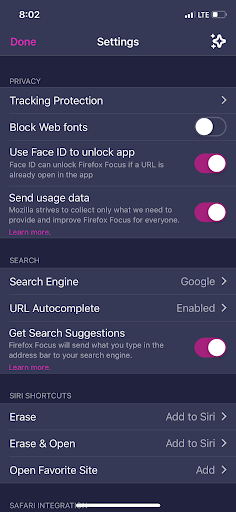
Firefox Focus for iOS now supports search suggestions

Search suggestions are an important component of searching the web and can make it so much more convenient. That’s why we’re making this feature available to iOS users today, after introducing it to Firefox Focus for Android in October. You can easily activate the feature by opening the app settings > click on “Search” > and select “Get search suggestions”.

New for iOS users: get search suggestions and find what you’re looking for even faster!


Get Firefox Focus now

The latest version of Firefox Focus for Android and iOS is now available for download on Google Play and in the App Store.

The post Latest Firefox Focus provides more user control appeared first on The Mozilla Blog.

21 Dec 04:06

Does AI make strong tech companies stronger?

by Benedict Evans

Machine learning is probably the most important fundamental trend in technology today. Since the foundation of machine learning is data - lots and lots of data - it’s quite common to hear that the concern that companies that already have lots of data will get even stronger. There is some truth to this, but in fairly narrow ways, and meanwhile ML is also seeing much diffusion of capability - there may be as much decentralization as centralization. 

First, what does it mean to say that machine learning is about data? Due to the academic culture that ML comes from, pretty much all of the primary science is published as soon as it’s created - almost everything new is a paper that you can read and build with. But what do you build? Well, in the past, if a software engineer wanted to create a system to recognise something, they would write logical steps (‘rules’). To recognise a cat in a picture, you would write rules to find edges, fur, legs, eyes, pointed ears and so on, and bolt them all together and hope it worked. The trouble was that though this works in theory, in practice it’s rather like trying to make a mechanical horse - it’s theoretically possible, but the decree of complexity required is impractical. We can’t actually describe all of the logical steps we use to walk, or to recognise a cat. With machine learning, instead of writing rules, you give examples (lots of examples) to a statistical engine, and that engine generates a model that can tell the difference. You give it 100,000 pictures labelled ‘cat’ and 100,000 labelled ‘no cat’ and the machine works out the difference. ML replaces hand-written logical steps with automatically determined patterns in data, and works much better for a very broad class of question - the easy demos are in computer vision, language and speech, but the use cases are much broader. Quite how much data you need is a moving target: there are research paths to allow ML to work with much smaller data sets, but for now, (much) more data is almost always better.  

Hence the question: if ML lets you do new and important things and ML is better the more data you have, then how far does that mean that companies that are already big and have lots of data get stronger? How far are there winner-takes-all effects? It is easy to imagine virtuous circles strengthening a winner: ‘more data = more accurate model = better product = more users = more data’. From here it’s an easy step to statements like ‘Google / Facebook / Amazon have all the data‘ or indeed ‘China has all the data’ - the fear that the strongest tech companies will get stronger, as will countries with large populations and ‘permissive’ attitudes to centralised use of data.   

Well, sort of.

First, though you need a lot of data for machine learning, the data you use is very specific to the problem that you’re trying to solve. GE has lots of telemetry data from gas turbines, Google has lots of search data, and Amex has lots of credit card fraud data. You can’t use the turbine data as examples to spot fraudulent transactions, and you can’t use web searches to spot gas turbines that are about to fail. That is, ML is a generalizable technology - you can use it for fraud detection or face recognition - but applications that you build with it are not generalized. Each thing you build can only do one thing. This is much the same as all previous waves of automation: just as a washing machine can only wash clothes and not wash dishes or cook a meal, and a chess program cannot do your taxes, a machine learning translation system cannot recognise cats. Both the applications you build and the data sets you need are very specific to the task that you’re trying to solve (though again, this is a moving target and there is research to try to make learning more transferable across different data sets).

This means that the implementation of machine learning will be very widely distributed. Google will not ‘have all of the data’ - Google will have all of the Google data. Google will have more relevant search results, GE will have better engine telemetry and Vodafone will have better analysis of call patterns and network planning, and those are all different things built by different companies. Google gets better at being Google, but this does not mean it somehow gets good at anything else. 

Next, one could argue that this just means the larger companies in each industry get stronger - Vodafone, GE and Amex each have ‘all the data’ for whatever it is that they do and so that forms a moat against their competition. But here again, it’s more complex: there are all sorts of interesting questions about who exactly owns the data, how unique it is and at what levels it’s unique, and where the right point of aggregation and analysis might be.

So: as an industrial company, do you keep your own data and build the ML systems to analyse it (or pay a contractor do do this for you)? Do you buy a finished product from a vendor that’s already trained on other people’s data? Do you co-mingle your data into that, or into the training derived from it? Does the vendor even need your data or do they already have enough? The answer will be different in different parts of your business, in different industries and for different use cases.

To come at this from the other end, if you’re creating a company to deploy ML to solve a real-world problem, there are two basic data questions: how do you get your first data to train your models to get your first customer, and how much data do you actually need? Of course, the second question breaks down into lots of questions: is the problem solved with a relatively small amount of data that you can get fairly easily (but many competitors can get), or do you need far more, hard-to-get data, and if so is there a network effect to benefit from, and so a winner takes all dynamic? Does the product get better with more data indefinitely, or is there an S curve?

It depends. 

  • Some data is unique to the business or product or gives a strong proprietary advantage. GE engine telemetry might not be much use for analyzing Rolls Royce engines, but if it is they won’t share it. This might be an opportunity for company creation, but is also a place where lots of internal big company IT and contractor projects happen

  • Some data will apply to a use case that is found in many companies or even many industries. ‘There is something odd about this call’ might be a common analysis across all credit card companies - ‘the customer sounds angry’ might apply to anyone with a call centre. This is the ‘co-mingling’ question. Lots of companies are being created here to solve problems across many companies or indeed across different industries, and there are network effects in data here.

  • But there will also be cases at which after a certain point the vendor doesn’t really even need each incremental customer’s data - the product is already working.

In practice, as machine learning diffuses into almost everything, one startup might see several of these. Our portfolio company Everlaw produces legal discovery software: if you sue someone and they send you a truck full of paper, this helps. Machine learning means they will be able to do sentiment analysis on a million emails (‘show me anxious emails’), without needing to train that model on the data from your case, because the examples of sentiment to train that model don’t need to come from this particular lawsuit (or any lawsuit). Conversely, they can also do cluster analysis (‘show me emails that are about the same thing as this’) on your data without that going anywhere else. Drishti, another portfolio company, uses computer vision to instrument and analyse production lines - some of those capabilities are trained on your data and some are not specific to your business at all and work across industries.

At the extreme, I recently spoke to a manufacturer of very large vehicles that’s using machine learning to get a more accurate flat tyre detector. This is trained on data (lots and lots of examples of signal from flat and not-flat tires), obviously, but it’s not hard to get that data. This is a feature, not a moat.

Hence, I said earlier that there are two questions for an ML startup: how do you get the data and how much do you need? But those are just the technical questions: you also ask how you go to market, what your addressable market is, how valuable the problem you’re solving is to your customers, and so on and so on. That is, pretty soon there won’t be any ‘AI’ startups - they will be industrial process analysis companies, or legal platform companies, or sales optimization companies. Indeed, the diffusion of machine learning means not so much that Google gets stronger, but that all sorts of startups can build things with this cutting edge science much quicker than before.

This takes me to a metaphor I’ve used elsewhere - we should compare machine learning to SQL. It’s an important building block that allowed new and important things, and will be part of everything. If you don’t use it and your competitors do, you will fall behind. Some people will create entirely new companies with this - part of Wal-Mart’s success came from using databases to manage inventory and logistics more efficiently. But today, if you started a retailer and said “…and we’re going to use databases”, that would not make you different or interesting - SQL became part of everything and then disappeared. The same will happen with machine learning.

21 Dec 04:06

In which I rant about a minorly negative random encounter

by Liz

Don’t be this weird hostile bus stop lady….

I was going to the bus stop yesterday, on a wide sidewalk on Mission, and I passed a couple who were standing by the bus stop bench about to sit down. I was hugging the wall by the pizza place and nail shop and about to turn to wait for the bus just a little ways down from the bus bench. So, I was something like 8-10 feet away from the couple.

The woman looked up as I passed and said “OH!!! Sorry!!!! I didn’t see you!” and kind of mimed as if she were getting out of my way. This was weird, since she wasn’t in my way, I wasn’t in her way, and there was nothing indicating that I was about to be anywhere near them.

“Uh…” I said, super coherently. “Well, I saw you, so, ok.”

Then I waited for the bus without anything further happening but I could see her weird discomfort. She was still bothered. She kept looking at me and kind of acting agitated. Her “Sorry!” was actually not a sorry but was more like a hostile accusation as if I had done something wrong and actually I was supposed to apologize.

This happens all the time (basically a microaggression). Like what happens when someone exaggeratedly holds a door open for me, and I don’t want them to, and I have to ask them to move out of the way because they think they’re holding the door open but they are literally blocking my path through the doorway and I don’t want to run them over. Or even if i can get by, I don’t want to put my face in their armpit.

People doing this kind of thing aren’t helping — they get angry if you don’t respond “correctly”, and then it becomes clear that they started out angry with their bogus offer of help. They are full of resentment and are uncomfortable with my presence and they want me to behave in a way that is apologizing for my presence.

Once you’ve experienced this multiple times a day every day, as you are just minding your own business, you will know what I mean.

And, actually, I’m not always so proud, I often act in a placating manner to make other people comfortable, especially in a crowd, while waiting in line, on the bus, and so on, because honestly it just makes thing easier. For example I normally feel like I am “supposed to” thank the bus driver at least 6 times while getting on and off the damn bus, once at every stage of the interaction like, they see me and start to lower the ramp or lift, they then offer help of various kinds or do stuff, or they give me unneeded (bad) advice or warnings, and I have to acknowledge it and I try to be polite. Probably, y’all get on and off a bus with maybe one “thanks” if you exit at the front but that is not my experience.

So, back to our story.

Time passes. I sit at the front of the bus playing Pokémon, and everything is remarkably peaceful for a middle of the day ride on the 49 bus. The driver remembers I’m there and also, I remembered to push the “ramp please” button well ahead of time and there is only one guy in front of me who is kind of trapped and has to get off the bus to let me off by the ramp, but the driver still yelled at the top of her lungs, “WHEELCHAIR COMING OFF WATCH YOUR FEET I SAID WHEEEEEEEEELCHAIR COMING OFF” I thanked the driver and said have a nice day. While the yelling is often unnecessary and unpleasant it does get the job done. The thing is I can say “excuse me” or “con permiso” myself to the people who I need to get by who are usually looking right at me anyway and can tell I am intending to get off the bus and can see perfectly well what needs to happen.

OK so, now I’m off the bus and it’s an even wider sidewalk than on Mission where I started. The sidewalk is at least 15 feet across. I suddenly realize that same couple who were at the bus stop with me had gotten off at the back of the bus and were on the sidewalk, again near the curb while I was on the far right side of the sidewalk by the buildings. The woman fidgeted around (not sure how to describe this – but it’s like someone doing a lot of “pay attention to me!” body language like they are about to speak to you – as if awkwardly trying to get the attention of a waiter including being frustrated at not already having that attention). And she did a little laugh and said “Oh!!!! I’ll TRY not to get in your WAY this time!!” and mimed “getting out of my way” again even though I was nowhere near her and not aimed anywhere near her.

It was so irritating!

I said “You weren’t in my way before and you’re not in my way now” and stared at her with what was probably the rudest face possible of incredulousness as if a cartoon though balloon that said “You’re an idiot” was floating over my head.

“Gaaaaah! I was JUST JOKING!” she said huffily…. making a little scoffing noise. Her husband stood there looking awkward and probably wishing he could sink into the ground with embarrassment.

I did not behave with the proper level of humility for this beeyatch to accept my presence on the public sidewalk!

I beetled uphill at a goodly clip, my maximum 5 miles per hour, wishing I were a goddamn rocketship to get away from this rude person even faster!

Lady… Let me just be clear…. Madam Fussypants, stick-up-your-butt, REI-clothing-wearing-probably-a-unitarian-white-lady-who-loves-calling-the-cops lady from my neighborhood…..I can snap judge you too! (Thusly.) I dunno what your deal is but you want me to perform some sort of role here for you that I am unwilling to perform!

I am notorious for chatting in a friendly way with total strangers on the street but she was such a jerkface that instead she got my “fuck off” attitude and nearly got me to stop dead in my tracks and pop off in an enormous harangue that would not have helped her obvious feeling of discomfort with my MERE PRESENCE IN THE PUBLIC WORLD.

Whatever demon she is wrestling with, whatever fear of disability…. I wish she would go deal with it in therapy and stop letting it hang out all over the sidewalk. I can’t be the only wheelchair user she ever sees in this town especially if she takes the goddamn 49 bus! What is her problem!

As my mom would say… Some people just need a good slap!

OK, so, all of y’all, don’t do this shit, it’s ridiculous!

Thanks for coming to my TED talk.

21 Dec 04:06

The Vika+ Steals the Show: Bicycling.com Review

by Blix PR

Dan Roe from Bicycling.com is well versed in the world of electric and regular bikes. Recently, he decided to test the Blix Vika+ because of his interest in how such a small foldable bike could hold so much power! Dan offers an honest, detailed, and helpful review about the benefits of owning a Vika+. His review offers information on both the technical aspects as well as the ride experience of the Blix bike. In the end, he praises Blix for succeeding in "building a not too expensive, not too heavy e-bike that enriches your life." 

During the week that Dan tested the Vika+ he found that adding a folding electric bike meant "less spending on gas, more convenient errand-running and, best of all, more time in the saddle." Part of the reason for his newfound enjoyment was the comfort and ease associated with using a Blix electric bike. With an easy-to-read display and cadence sensors, the Vika+ makes commuting and errand running efficient. Dan found that the cadence sensors allowed him to "get more motor help by shifting down and spinning the pedals with minimal effort." This also correlated with increased battery life per charge as the "system adjusts to the amount of e-assist you're using and shows how much battery you'll have if you maintain your current motor usage." Thus, on the Vika+ Dan was able to ride for miles and easily monitor his pedal assist usage!

Folded black Vika+

In addition to the efficient mechanical features of the Vika+, Dan found the folding mechanisms simple as well as sturdy. He took only about a minute to collapse the Vika+ and be on his way with the bike in tow. Dan states that "as a day-to-day commuter, the Vika+ is generously equipped"  making it "a comfortable and convenient bike to ride between stops."  If it were up to Dan he would "keep using it for everyday errands!" 


Thank you Dan for taking the time to review the Blix Vika+!
Check out Dan's full review here
For more information on the Blix Vika+ check it out here
Check out how the Vika+ fits into a "tiny lifestyle" here


21 Dec 04:05

The Best Travel Plug Adapter

by Geoffrey Morrison
The Best Travel Plug Adapter

After spending more than 30 hours researching and testing 12 travel plug adapters, we found the Epicka Universal Travel Adapter to be the best of the options. It fits four types of outlets, and it has more USB ports than any of its competitors, so it can can charge more devices at higher speeds. If you prefer the small size and weight of a plug adapter, we recommend the Ceptics International Worldwide 5 Piece Set.

21 Dec 04:04

Open APIs and the Facebook Trash Fire

Ben Werdmuller, Dec 20, 2018
Icon

I was thinking earlier today that Facebook was letting everyone use my data but me. It wasn't for lack of an API - Facebook had them aplenty. But Facebook also had control. "All of us wanted open access to APIs so that users could move their data around," writes Ben Werdmuller, "and so that startups wouldn't have as a high a barrier to entry into the market. But such systems - whether centralized or decentralized - need to center around giving control to the user. Even at the Data Sharing Summit, we quickly realized that data control was a more meaningful notion than data ownership." Facebook violated that. "I'm done assuming good faith; I'm done assuming incompetence; I'm done assuming ignorance. I hope you are too."

Web: [Direct Link] [This Post]
21 Dec 04:04

What problem are we trying to solve?

by Jim

Lever“Give me a lever long enough and a place to stand and I will move the Earth” doesn’t work if you are standing in the wrong place.

It’s tempting to focus on the lever—to make it longer or stronger or out of some new  material. What you aren’t likely to do is take the lever you’ve got and look for a new place to stand. Nor are you likely to ask whether a lever is the relevant tool.

One of the courses I teach is on Requirements Analysis and Communications. The goal is to equip students with the tools to articulate a problem with  enough detail and precision that a effective solution can be designed and implemented. That phrasing is awkward because all too common practice is to define problems in terms of known solutions.

It’s the inverse of children with hammers pounding everything as if it were a nail. It’s claiming you have a nail to be pounded because someone with a hammer has come along.

None of this is any easier in a world rife with voices clamoring that they have the magic hammer for X.

Everybody has an answer. Everybody is selling a solution. Everybody has a hammer.

How do you learn

  • to take the time
  • to ask the questions
  • that will define the problem first?

The root question is always “what problem are we trying to solve?” The first several rounds of answers to that direct question are always statements of a solution, which is not a statement of a problem.

Asking effective questions is a learnable skill. I can give you a list of useful questions and I can lay out a process for asking them. But, what you really need is an opportunity to observe effective questioning in action, to practice in a safe environment, and to get feedback.

What I’m describing, of course, is the case method—either law school of business school flavor—or problem-based learning. What’s less emphasized is that these are inquiry processes; they are about questions, not answers. That makes them frustrating when you’re accustomed to being rewarded for answers, whether in school or in life.

The way out of that frustration is to understand the goal is building a skill not parroting an answer.

The post What problem are we trying to solve? appeared first on McGee's Musings.

21 Dec 04:04

RT @mikegalsworthy: And I’ll say it again... Free Movement is *not* discriminatory. It sets no rules about how we treat non-EU citizens.…

by mikegalsworthy
mkalus shared this story from iandunt on Twitter.

And I’ll say it again...

Free Movement is *not* discriminatory.

It sets no rules about how we treat non-EU citizens.

It’s perfectly legal under FoM to give non-EU citizens more rights than EU citizens.

The discrimination we see is *all* by the UK government.


Posted by mikegalsworthy on Thursday, December 20th, 2018 12:15am
Retweeted by IanDunt on Thursday, December 20th, 2018 2:14pm


2730 likes, 1092 retweets
21 Dec 04:03

Our childish outburst has put us at their mercy

mkalus shared this story .

The children threw a tantrum and the adults have had to come into the room to start sorting out the mess. While we all spent yesterday debating whether Jeremy Corbyn did or did not say 'stupid woman', the EU quietly released its preparation for no-deal.

It did two things. Firstly, it stopped the worst possible outcomes of a cliff-edge in March. And secondly, it put the UK on a string. We would be saved from a total disaster by EU action. But that action is not intended to help us. It is to limit the damage to its own operations. And it shows. No matter what the talk of a 'managed no-deal' at home, the reality is that the structure of no-deal will be decided, just as the talks have been, by what the EU wants. This is what happens when you put yourself at a negotiating disadvantage and then get lost in your own delusions.

This is what they've done.

Aviation gets a rescue package. International flights have no WTO-style back-up system, so without something in place we'd simply not be able to fly to or from Europe. The EU are offering a point-to-point system allowing us to continue doing so. But there are conditions. It only lasts for one year. We can no longer fly within Europe. We can only fly there and back.

Haulage also gets a rescue package, along similar lines. At the moment our lorries go wherever they want in Europe, whenever they want. For decades we've relied on this frictionless system because of a just-in-time operating structure which ensures a continuous flow of material into and out of production plants. Factories aren't stopping points anymore. They're a central hub in a goods pipeline.

Outside of the EU, you need a European Conference of Ministers Transport (ECMT) permit to get your lorry in. There are roughly 2,000 of these available and we have 40,000 lorries so we were facing the detonation our haulage network. The shock to the supply chain would have been instantaneous and severe.

Instead, the EU is offering a continuation of the existing terms. But only for nine months. It lasts until New Year's Eve 2019. And it's bare bones. The agreement would only allow UK operators to go to and from European destinations. They would lose the right to operate within or between European countries.

The agreement is also dependant on UK operators following EU rules, for instance on drivers' hours. If at any point the Commission decides they are not, they can unilaterally revoke it. This will be an EU regulation - not a deal. So they do not need to even consult with Westminster. They can just end it overnight.

There is also an emergency provision for food exports. Food produced outside the EU is subject to a strict enforcement regime to make sure it's safe. That means the exporting country needs an approved national body whose facilities have been certified by the EU, documenting the standards of products.

But the UK has not been certified as a third-country supplier, because until now it was an EU member state. Six thousand UK meat processing plants now face individual audits by British authorities, which will then be checked by EU officials and put to a standard veterinary committee for approval. The same goes for companies supplying food and drink to the EU.

The EU no-deal document allows for certification to be front-dated so that the UK is given authorisation status on March 30th and then all the necessary inspections happen afterwards. This was vital to prevent a six month break in which no agricultural exports to Europe would have been possible at all. It's a liferaft for agriculture.

They've also unclogged the inspection regime. Products of animal origin have to enter the EU through special border posts manned by a vet, but these barely exist. There are none at Dover-Calais, the main route into the continent, and very low capacity at Dunkirk. The EU allowed them to be set up ahead of time to meet demand. 

While the Brexiters were bleating about no-deal, Brussels did the dirty work. But let's be clear: it really is dirty. They did it according to their interests, not ours. 

There was no help, for instance, with the customs process. That means we are still facing a system-wide bureaucratic nightmare.

Every shipment on the back of a lorry needs an import and export customs declaration and a safety and security declaration. For some lorries, which are just carrying one shipment - say a few hundred crates of oranges going to Tesco - that's not too much of a problem. But if a lorry is carrying multiple shipments - a book for me, a bottle of wine for you, a present for your uncle - they have to fill out these documents countless times for one journey.  And they're not short either, they have about 30 fields on them.

Plenty of firms run around 300 lorries a week between the UK and EU, with up to 8,000 shipments on each one. They estimate that it would take 150 people working eight hours a day to fill in the customs declarations for a lorry like that. It's an administrative apocalypse.

Companies haven't been trained to do this. They simply haven't had to do so for decades. Customs officials haven't either. The government needs to hire tens of thousands of them to complete this work. And no matter what it said in its little am-dram Children of Men performance this week, it cannot level-up capacity that quickly.

Traffic modelling studies expect 20 hour tailbacks on the first day for every additional two minutes added to checks at Dover-Calais. The increase in check time is likely to be more substantial than that.

Once a blockage starts, it will balloon in both directions. The ferries going between the UK and France only leave once they're full. If they're not full, they don't start the return journey. There is no such thing as a one-way solution to this problem.

The bottleneck wouldn't just keep out goods. It'll keep out medicines.

Take radioactive isotopes. The most common one for healthcare is Technetium-99m. It is used for screening about 700,000 patients a year for conditions like prostate cancer, or heart, thyroid, bone or liver disease.

We are heavily reliant on Europe for our supply of this material. It comes predominantly from the Netherlands, where the parent element molybdenum-99 is produced. This has a half life of 66 hours. It is shipped across the Channel Tunnel at night, when it's quiet, goes to a UK distribution centre, and is sent out to hospitals. It is then used as Technetium-99m for medical purposes. At this stage it has a half life of just six hours. Time, in other words, is of the essence.

This material cannot be stockpiled, because of its short half life. It is uniquely vulnerable to transport disruption. Any blockage caused at Dover-Calais would essentially close down the tunnel for the transportation of nuclear material. It would then sit there decaying and become unusable. Half life is exponential, meaning that the best activity is right at the start. Each minute this stuff sits without reaching its point of intended use is a waste.

Even if we do manage to get it to the UK, it may be pointless. Once it has decayed too far it is illegal to use on a patient, because you are simply inundating them with the side effects of radiation therapy but not providing a high enough dose for the intended medicinal use.

This does not just apply to Technetium-99m. There are dozens of other isotopes - some with longer half-lifes, some with shorter - which will be affected, many of which are used for treatment as well as screening.

And even this disasterous outcome is a best-case no-deal scenario. This propoal is just that: a proposal. It's possible MEPs in the European Parliament or one of the 27 member states will amend it, or even reject it outright. Iain Duncan Smith may enjoy touring TV studies blathering on about how terrified the Europeans are of us, but he is merely reflecting his own pitiful emotional inadequacy. The bleak reality is that we are at their mercy.

Even if it does pass, it's a horrible emergency situation to be in. Sure, the very worst outcomes, the real end-of-days stuff, is quarantined. But this provision is time-limited, it is contingent on continued EU approval, and it is completely one-way. It amounts to forcing investment out of Britain at the end of a spike.

Imagine you are a business looking at this situation. There is no stability here. Companies doing transport contracts focus on multi-year periods. Emergency nine-month provisions, which can be revoked at any time by one party, are simply not tolerable, even if they were somehow put on a rolling basis. And then there would be the tariffs and customs and regulatory checks on the UK-EU border. Put simply: Why would you stay?

This isn't a warning about the future. It's already happening, with airlines opening up new headquarters in Europe to be able to continue operating their flights. And this is just the start. If this situation pertains, we're going to bleed out.

We are destabilising our own country. But instead of dealing with it, our political class - the ERG, the opposition and the government - have decided that the best thing to do is to spend a day talking about a man saying 'stupid woman', then go home for the holidays and maybe have a vote in mid-January. It's a criminal act of patriotic irresponsibility.

Ian Dunt is editor of Politics.co.uk and the author of Brexit: What The Hell Happens Now?

The opinions in politics.co.uk's Comment and Analysis section are those of the author and are no reflection of the views of the website or its owners.

21 Dec 04:02

Apple Adds AI Head, John Giannandrea, to Executive Team

by Ryan Christoffel

Today Apple announced that one of its most recent high profile hires, John Giannandrea, has been added as the twelfth member of the company's executive team. His title is now Senior Vice President of Machine Learning and AI Strategy. From the press release:

“John hit the ground running at Apple and we are thrilled to have him as part of our executive team,” said Tim Cook, Apple’s CEO. “Machine learning and AI are important to Apple’s future as they are fundamentally changing the way people interact with technology, and already helping our customers live better lives. We’re fortunate to have John, a leader in the AI industry, driving our efforts in this critical area.” 

News of Giannandrea's hiring at Apple first broke in April at The New York Times. Apple didn't formally announce the hire, however, until July. And here we are just a few short months later, with another press release from Apple announcing his promotion.

Giannandrea's role involves leadership of Siri, machine learning, and other artificial intelligence projects, all of which are right up his wheelhouse due to his former role as Google's chief of search and artificial intelligence. While it's hard to say from the outside what kind of difference his influence is making at Apple, this move is a good sign that the company's pleased with his early months of work. Perhaps we'll get to see the fruits of his labors at WWDC 2019.

→ Source: apple.com

21 Dec 04:01

Recommended on Medium: The new frontier of UX is sound

Read more about it here

I just spent three years writing a new book explaining how sound design is critical to the success of products, environments, and experiences. When we devote so much attention to a product’s look and feel, we can easily miss the importance that audio — good and bad — can have on its overall experience. Designing with Sound brings insight from over 40 engineers, designers and scientists to an emerging landscape of sensory opportunities.

I worked with sound designer Aaron Day on the book, an engineer with two decades of experience in designing some of the most iconic sounds, from car engines to ringtones. We both agree that the opportunities of sound are just beginning. Almost everything makes a sound, and those sounds can be designed.

I wrote Designing with Sound for anyone who wants to improve on the auditory experience of a new or existing product, and for anyone who needs to determine when, where, or how sounds should be used. We also intended it as an introduction to sound design concepts that non–sound engineers can put to use. Our hope it will help encourage a better sonic experience for us all.

  • Sound is a new frontier: We’re seeing a rapid rise in voice-activated interfaces, podcasts, and acoustic awareness. From sonification in hospitals, to sorting through big data and the rise of podcasts, sound is poised to be on par with the visual experience in design.
  • Quiet is the new differentiator: Dyson engineers share how they created breakthrough products like the quiet hair dryer, and how subtractive design for vehicles can be added to new products like blenders, but there’s so much more room for quiet things, especially leafblowers, semi trucks and “smart” technologies.
  • Good sound design changes our reality: Most spaces are approved of visually, but they don’t feel good to be in. Simple audio elements can improve office spaces, hospitals and airports.

We’ll explore the book in greater depth in January with a full release, articles and excerpts, but for now, I just wanted to let you know that the book is on shelves soon, and to look for more on it in the new year!

21 Dec 04:01

文喫

by peter@rukavina.net (Peter Rukavina)

In 2013, on our last night in Tokyo, Oliver and I went out for conveyor-belt-sushi to Pintokona in the Roppongi district.

After supper we wandered up the street to the Aoyama Book Center Roppongi, where we spotted a copy of Tsuyoshi Takashiro’s book Life Packing, a delightful rumination that, among other things, is an accurate recapitulation of George Carlin’s place for your stuff routine. I’d seen the book earlier on our trip, neglected to purchase it, and regretted the decision. Finding it again gave me a second chance, and I purchased it immediately, which also gave me a chance to experience the lovely Japanese style for wrapping books in a bookstore in paper upon purchase.

I learned today that the Aoyama Book Center closed earlier this year and that its space is now occupied by the newly-opened 文喫 (Bunkitsu), a [bookstore with a cover charge]:

Once you’ve checked in, take your free cup of coffee or tea and wander endlessly through books on humanities, nature, art and design, all of which have been thoughtfully curated by the book lovers of Yours Book Store. Every book is for sale, but you can also spend an hour, 5 hours or the whole day and not buy a thing. And if you get hungry, they even have a small café that will sell you lunch or a light snack.

I’m inclined to jump on a plane right now.

21 Dec 04:00

A meteor miss

by Doc Searls

So yesterday evening, not long after sundown, we drove out to our usual spot in the countryside west of Santa Barbara to watch a big launch of a big rocket — NROL-71 — from Vandenberg Air Force Base. The launch had been scrubbed three times already, the last one only seven seconds from ignition. Just before we arrived, there was a bright light in the western sky, exactly above the launch site. A trail was visible, and I thought maybe they had already launched the rocket… or rocket, perhaps to test winds at high altitudes or something.

So I shot the trail. That’s the photo above. And here’s my 3-shot photo album of the event.

Turns out it was a meteor. This tweeted video, shot in San Francisco, makes that clear. Cool, huh?

21 Dec 04:00

Apple’s John Giannandrea named to executive team to build out AI, machine learning strategy

by Shruti Shekar

Apple has named John Giannandrea to its executive team as senior vice-president of machine learning and artificial intelligence (AI) strategy.

A December 20, 2018 press release from the tech giant said Giannandrea’s role will be to oversee the company’s AI and machine learning strategy across all Apple products and services.

The strategy will include the development of Core ML and Siri technologies, the release said. It noted that his team will also focus on “advancing and tightly integrating machine learning into Apple products” so they deliver more personal, intelligent and natural interactions for customers, while at the same time protecting user privacy.

Giannandrea’s team will also look into enhancing Core ML and Create ML “making it easier and faster to integrate machine learning into apps,” the press release said.

“Machine learning and AI are important to Apple’s future as they are fundamentally changing the way people interact with technology, and already helping our customers live better lives. We’re fortunate to have John, a leader in the AI industry, driving our efforts in this critical area,” Apple’s CEO Tim Cook said in the release.

Giannandrea had actually left Google in April to join Apple’s machine learning and AI strategy department. He had joined Google in 2010 and lead the push to integrate AI into search, Gmail and Google Assistant.

Before Google, he worked at a startup called Metaweb, which was bought by Google so the search giant could integrate its database of facts into Google products.

It’s important to note that Apple hired Carnegie Mellon professor Russ Salakhutdinov over a year ago to expand its AI and machine learning developments and it looks like this isn’t going to stop anytime soon.

Image: Flickr

The post Apple’s John Giannandrea named to executive team to build out AI, machine learning strategy appeared first on MobileSyrup.

21 Dec 04:00

Netflix teases ‘Black Mirror’ movie release next week

by Bradly Shankar
Black Mirror San Junipero

Back in March, Netflix renewed its tech-focused drama series Black Mirror for a fifth season, although little else has been revealed in the months since.

However, a recent tweet from Netflix’s sci-fi and fantasy-focused Twitter account points to new Black Mirror content coming sooner than you might think.

In a tweet that has since been deleted, the ‘NXonNetflix’ account posted a photo that shows the streaming service’s film lineup for December. While most of these movies had already been confirmed, including Netflix Original film Bird Box and Marvel Studios’ Avengers: Infinity War, there was also mention of a previously-unannounced “Black Mirror: Bandersnatch” set to premiere on December 28th.

Netflix Black Mirror Bandersnatch

Not content to stop there, internet users did some further digging by searching that title in Netflix’s library and found that Black Mirror: Bandersnatch is listed as a “Netflix film.”

The accompanying images are taken from previous episodes of the series. What’s most interesting about this is that there has previously been no word on Black Mirror ever being made into a film.

Netflix Black Mirror Bandersnatch

It’s worth noting, though, that some episodes of the show have been nearly feature-length, such as season three’s Hated in the Nation (clocking in at 89 minutes) and season four’s USS Callister (featuring a runtime of 74 minutes).

As for what Bandersnatch may be about, there have also been some clues floating around online for the past month. As noted in recently re-surfaced late November tweets from Twitter user @jeeveswilliams, Netflix appears to have filmed scenes in a 1980s-decorated set for a ‘Black Mirror: Bandersnatch’ in April.

Williams also noted that Bandersnatch was an ill-fated video game from 1984 supposedly about a group of ever-working “computer wizards” struggling to maintain their sanity. That certainly sounds like a plausible premise for a Black Mirror episode, although it remains to be seen if this is what the film will end up drawing from.

It’s also unclear if Bandersnatch is connected to season five (either in terms of release or narrative) or if it’s a separate film intended to tide fans over until the actual fifth season episodes roll out at a later date. Where Netflix’s reported ‘choose-your-own-adventure’ episode of Black Mirror fits in also remains a mystery.

Via: Engadget

The post Netflix teases ‘Black Mirror’ movie release next week appeared first on MobileSyrup.

21 Dec 03:59

Waze attributes its success to Apple Maps’ launch failures

by Brad Bennett

In an interview with Business Insider, Waze CEO Noam Bardin said that Apple Maps’ launch failures were pivotal in the early success of Waze.

Waze is a mobile navigation app that utilizes real-time user input and data to deliver results that take construction, traffic and more into account. Google acquired the app in 2013 for $1.3 billion USD.

Bardin sat down for an interview the day before Apple Maps launched in 2012, according to his chat with Business Insider. During the interview, he let it slip that he thought Apple Maps was going to be rough. It turns out he was right.

As more and more issues came up with Maps, Tim Cook stepped up to apologize on behalf of Apple. In his apology, Cook wrote iPhone users should use alternatives from Microsoft, Google and Waze while Apple addressed the issues with Maps.

Bardin told Business Insider that was Waze’s “coming out moment”. The company still celebrates an annual Tim Cook day since he helped put them on the map.

According to Google Trends, interest in Waze was already on the upswing before Cook penned his apology. Notably, the more substantial spike came in June 2013 when Google announced that it was acquiring the company.

Waze almost ended up on BlackBerry devices first, Bardin told Business Insider. However, the team decided to switch to iOS early in the development. Bardin said he doesn’t think Waze would be here today if the company didn’t make that switch.

Source: Business Insider

The post Waze attributes its success to Apple Maps’ launch failures appeared first on MobileSyrup.