Shared posts

09 Jan 19:09

Gender in HCI

From “Gender HCI” to “Feminist HCI”, Human-Computer Interaction does not lack for research that discusses gender’s role in computing systems. But what does “gender” mean, exactly, and how does HCI use it?

In this research seminar we will read a mix of HCI and Gender Studies papers, seeking to understand the various lenses through which gender is understood within wider academia, ask how HCI has operationalised the term, and explore the ways in which the field could directly use gender theorists’ work in understanding the way our designs fit into the world. The course takes an expansive and inclusive view of gender, and examines the way it is informed by disability, trans* status, and/or race.

Week 1: Doing Gender

Readings

  1. Candace West and Don H Zimmerman. 1987. Doing Gender. Gender & Society 1, 2: 125–151. http://doi.org/10.2307/189945?refreqid=search-gateway:0e160352d2f46cde0631f08bb64b11c5
  2. Kristen Schilt and Laurel Westbrook. 2009. Doing Gender, Doing Heteronormativity. Gender & Society 23, 4: 440–464. http://doi.org/10.1177/0891243209340034

Further Reading

  1. Chris Brickell. 2003. Performativity or Performance? Clarifications in the Sociology of Gender. New Zealand Sociology 18, 2: 158–178.
  2. Garfinkel, Harold. “Passing and the managed achievement of sex status in an “intersexed” person.” The Transgender Studies Reader (2006): 58-93.
  3. Kristen Schilt. 2016. The Importance of Being Agnes. Symbolic Interaction 39, 2: 287–294. http://doi.org/10.1002/symb.231
  4. Jodi O’Brien. 2016. Seeing Agnes: Notes on a Transgender Biocultural Ethnomethodology. Symbolic Interaction 39, 2: 306–329. http://doi.org/10.1002/symb.229

Week 2: Trans*

Readings

  1. Lain A B Mathers. 2017. Bathrooms, Boundaries, and Emotional Burdens: Cisgendering Interactions Through the Interpretation of Transgender Experience. Symbolic Interaction 40, 3: 295–316.
  2. Helana Darwin. 2017. Doing Gender Beyond the Binary: A Virtual Ethnography. Symbolic Interaction 40, 3: 317–334.
  3. Spencer Garrison. 2018. On the Limits of “Trans Enough”: Authenticating Trans Identity Narratives. Gender & Society 32, 5: 613–637. http://doi.org/10.1177/0891243218780299

Further Reading

  1. Jocelyn A Hollander. 2012. “I Demand More of People.” Gender & Society 27, 1: 5–29. http://doi.org/10.1177/0891243212464301
  2. Valerie Jenness and Sarah Fenstermaker. 2013. Agnes Goes to Prison. Gender & Society 28, 1: 5–31. http://doi.org/10.1177/0891243213499446
  3. Elizabeth P Rahilly. 2015. The Gender Binary Meets the Gender-Variant Child. Gender & Society 29, 3: 338–361. http://doi.org/10.1177/0891243214563069
  4. Kylan Mattias Vries. 2012. Intersectional Identities and Conceptions of the Self: The Experience of Transgender People. Symbolic Interaction 35, 1: 49–67. http://doi.org/10.1002/symb.2

Week 3: Race and Gender

Readings

  1. Chavez, Koji, and Adia Harvey Wingfield. “Racializing gendered interactions.” Handbook of the Sociology of Gender. Springer, Cham, 2018. 185-197.
  2. Karen D Pyke and Denise L Johnson. 2016. Asian American Women And Racialized Femininities. Gender & Society 17, 1: 33–53. http://doi.org/10.1177/0891243202238977

Further Reading

  1. J E Sumerau and Eric Anthony Grollman. 2017. Obscuring Oppression: Racism, Cissexism, and the Persistence of Social Inequality. Sociology of Race and Ethnicity 4, 3: 322–337. http://doi.org/10.1177/2332649218755179
  2. Vrushali Patil. 2018. The Heterosexual Matrix as Imperial Effect. Sociological Theory 36, 1: 1–26. http://doi.org/10.1177/0735275118759382
  3. Jessie Daniels. 2009. Rethinking Cyberfeminism(s): Race, Gender, and Embodiment. Women’s Studies Quarterly 37, 1/2: 101–124. http://doi.org/10.2307/27655141?refreqid=search-gateway:67c658e0df1774f77e699fbc8176b803
  4. María Lugones. 2007. Heterosexualism and the Colonial / Modern Gender System. Hypatia 22, 1: 186–209. http://doi.org/10.2307/4640051?refreqid=search-gateway:73be84305c8ed56e853737398981c412

Week 4: Intersectionality

Readings

  1. Kimberle Crenshaw. 1989. Demarginalizing the Intersection of Race and Sex: A Black Feminist Critique of Antidiscrimination Doctrine, Feminist Theory and Antiracist Politics. University of Chicago Law Forum: 1–31.
  2. Kimberle Crenshaw. 1991. Mapping the Margins: Intersectionality, Identity Politics, and Violence against Women of Color. Stanford Law Review 43, 6: 1241. http://doi.org/10.2307/1229039

Further Reading

  1. Elzbieta H Oleksy. 2011. Intersectionality at the cross-roads. Women’s Studies International Forum 34, 4: 263–270. http://doi.org/10.1016/j.wsif.2011.02.002
  2. Ari Schlesinger, W Keith Edwards, and Rebecca E Grinter. 2017. Intersectional HCI. ACM Press, 5412–5427. http://doi.org/10.1145/3025453.3025766
  3. Sylvanna M Falcón and Jennifer C Nash. 2015. Shifting analytics and linking theories: A conversation about the “meaning-making” of intersectionality and transnational feminism. Women’s Studies International Forum 50: 1–10. http://doi.org/10.1016/j.wsif.2015.02.010

Week 5: Disability and Gender

Readings

  1. Thomas J Gerschick. 2000. Toward a theory of disability and gender. Signs 25, 4: 1262–1268.
  2. Nanna Mik-Meyer. 2015. Gender and Disability: Feminizing Male Employees with Visible Impairments in Danish Work Organizations. Gender, Work & Organization 22, 6: 579–595. http://doi.org/10.1111/gwao.12107

Further Reading

  1. Russell Shuttleworth, Nikki Wedgwood, and Nathan J Wilson. 2011. The Dilemma of Disabled Masculinity. Men and Masculinities 15, 2: 174–194. http://doi.org/10.1177/1097184X12439879
  2. Sónia F Bernardes and Maria Luísa Lima. 2010. Being less of a man or less of a woman: Perceptions of chronic pain patients’; gender identities. European Journal of Pain 14, 2: 194–199. http://doi.org/10.1016/j.ejpain.2009.04.009
  3. Barbara E Gibson, Bhavnita Mistry, Brett Smith, et al. 2013. Becoming men: Gender, disability, and transitioning to adulthood. Health: An Interdisciplinary Journal for the Social Study of Health, Illness and Medicine 18, 1: 95–114. http://doi.org/10.1177/1363459313476967

Week 6: Critical Views on Gender in HCI

Readings

  1. Rena Bivens and Anna Shah Hoque. 2018. Programming sex, gender, and sexuality: Infrastructural failures in the “feminist” dating app Bumble. Canadian Journal of Communication 43, 3: 441–459. http://doi.org/10.22230/cjc.2018v43n3a3375
  2. Os Keyes. 2018. The Misgendering Machines: Trans/HCI Implications of Automatic Gender Recognition. 1–22. http://doi.org/10.1145/3274357 (yes I’m a narcissist)

Further Reading

  1. Teresa Almeida, Rob Comber, Gavin Wood, Dean Saraf, and Madeline Balaam. 2016. On Looking at the Vagina through Labella. ACM Press, 1810–1821. http://doi.org/10.1145/2858036.2858119
  2. Rena Bivens and Oliver L Haimson. 2016. Baking Gender Into Social Media Design: How Platforms Shape Categories for Users and Advertisers. Social Media + Society 2, 4: 205630511667248. http://doi.org/10.1177/2056305116672486
  3. Oliver L Haimson, Gillian R Hayes, Jed R Brubaker, and Lynn Dombrowski. 2015. Disclosure, Stress, and Support During Gender Transition on Facebook. ACM Press, 1176–1190. http://doi.org/10.1145/2675133.2675152

Week 7: Inclusive Methods

Readings

  1. Alex A Ahmed. 2017. Trans Competent Interaction Design: A Qualitative Study on Voice, Identity, and Technology. Interacting with Computers 30, 1: 53–71. http://doi.org/10.1093/iwc/iwx018
  2. Elena Ariel Windsong. 2017. Incorporating intersectionality into research design: an example using qualitative interviews. International Journal of Social Research Methodology 21, 2: 135–147. http://doi.org/10.1080/13645579.2016.1268361

Further Reading

  1. Jessie Daniels. 2013. Race and racism in Internet Studies: A review and critique. New Media & Society 15, 5: 695–719. http://doi.org/10.1177/1461444812462849
  2. Brian N Larson. 2017. Gender as a Variable in Natural-Language Processing: Ethical Considerations. EthNLP, 3: 30–40. Retrieved from http://www.ethicsinnlp.org/workshop/pdf/EthNLP04.pdf
  3. Munmun De Choudhury, Sanket S Sharma, Tomaz Logar, Wouter Eekhout, and René Clausen Nielsen. 2017. Gender and Cross-Cultural Differences in Social Media Disclosures of Mental Illness. ACM Press, 353–369. http://doi.org/10.1145/2998181.2998220
09 Jan 19:08

Blown Out Curves

I was working on a bug in Acorn yesterday with the Curves filter, and I noticed that when pushing the green channel to extremes that it became pretty blown out. While first looking at the filtered image I thought the results might be right… but maybe it wasn't? So I threw a mental note in the back of my head to compare what Curves in Acorn is doing versus Photos and Photoshop.

And then when was I knee deep in actually fixing the original bug, I realized there was a better way of creating the LUT (lookup table) from the curves data and that idea just kind of stuck in my head as well.

So after fixing some last minute sandboxing issues for Acorn 6.3 today (it's always the sandbox!) and submitting it to Apple, I decided to look into these two curves things.

Turns out that my idea for creating the LUT also fixed the blown out colors bug.

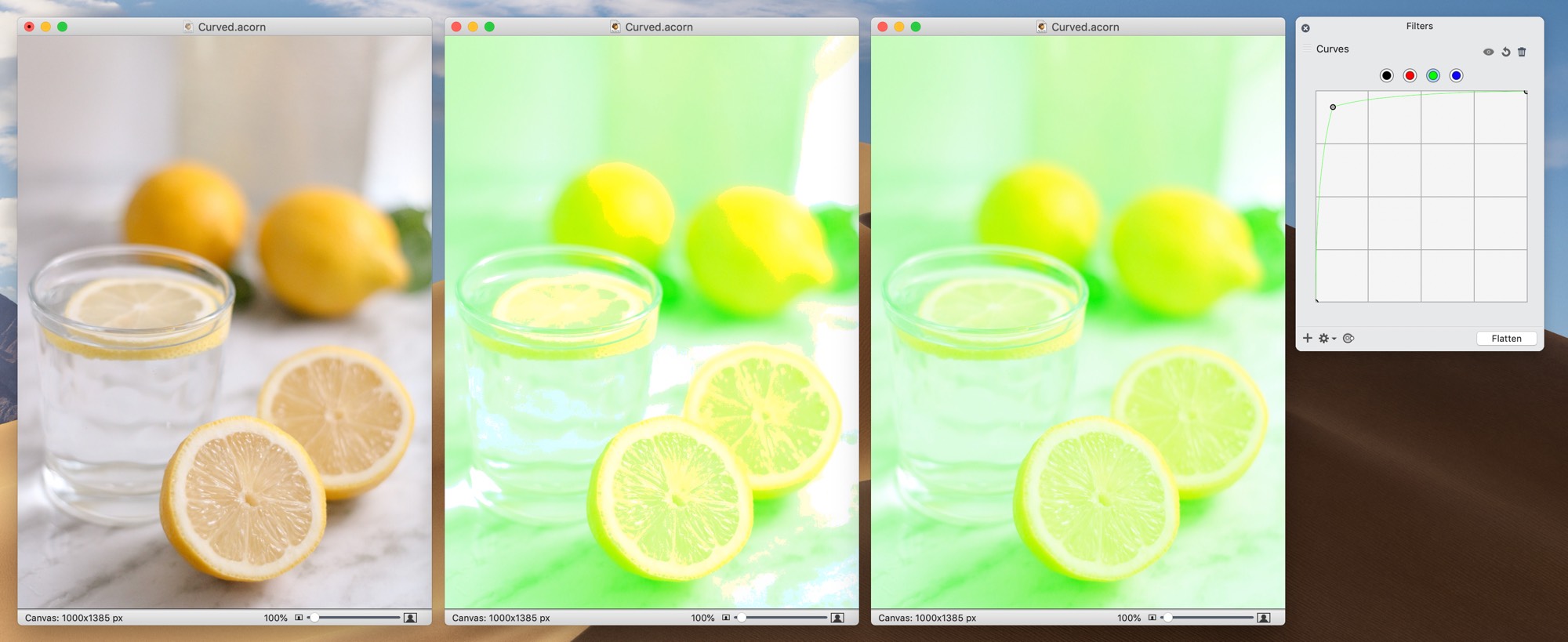
Blown out curves.
(click to embiggen)

The left window in this screenshot is the original image. The middle image is what is shipping in Acorn 6.3 and earlier. And finally we have the fixed version (aka, Acorn 6.3.1, which hasn't left my Mac yet). You can see the whites and the yellows not mixing very well when compared to the fixed version. And finally the filter window on the right is what the green channel was set to, so you can see how much I was pushing it.

It's always delightful when things come together like this.

09 Jan 19:08

George Dyson thinks that the digital revolution...

George Dyson thinks that the digital revolution isn’t over, but has turned into something else:

Their models are no longer models. The search engine is no longer a model of human knowledge, it is human knowledge. What began as a mapping of human meaning now defines human meaning, and has begun to control, rather than simply catalog or index, human thought.

09 Jan 19:08

A small travel plan for the year

by Liz

One of my plans for this year is to ride BART to every stop. I’ve always wanted to do this but have not felt energetic enough to do it! I’ll plan out my excursions beforehand, marking cafes with wifi and nice lunch spots near the stations if they exist. Then I can haul myself out there for an afternoon and work from a cafe, getting to know the entire Bay Area more intimately & scouting for future excursions!

BART map

It would be nice to do this with the ferry, too.

I’ll get VERY ridiculously excited about going to Antioch, or Union City! And I’ll report back with the results of my travels!

Do you examine places on maps and mark down spots you’d like to visit? I had a great virtual tour of Sicily’s north coast near Messina (Villa Terrafranca, Bauso, and Serro) where some of my ancestors lived, walking along the village streets and the waterfront in Street View.

Whenever I’m going to a new part of town just within San Francisco I have a look on the map as well, to mark anything that might be interesting and study the accessible MUNI stops & best routes to go there and back.

Like Des Esseintes’ journey sometimes this map-journey is all I get. The real journey never happens and I am reasonably content with the imaginary one! If it does, then the imaginary journey deepens the enjoyment of the real journey. I learned something about this from how, when I was a little kid in Detroit in the 70s, my dad would write away to parks and chambers of commerce, get back a lot of maps and brochures, and we’d learn stuff about the history and geology of a place before we went.

Along with this knowledge is a sort of errand geography, so that I have buckets of errands to be done and if I’m going to a particular place I’ll know “And while I’m there I should do everything that needs doing in a hardware store since there’s one right next to the BART stop”. Very handy when you don’t drive (much) and have limited energy.

09 Jan 19:08

2019-01-05 Daybook

Record Numbers of Americans Want to Leave the U.S. | I’ve discussed it with my family....
09 Jan 19:07

Recommended on Medium: Flickr Exports in Jekyll

The deadline for deletions of photos from free Flickr accounts is early February(1), so I’ve requested the backup of my account(2).

The two “Account Data” files are 13MB and 5MB each, and are filled with photo_#########.json files – one for each photo.

The photo and video zip files vary in size from ~300MB to ~1GB. I figure that’s about ~23GB of photos, total.

My intent is to self-host these photos. Ideally the photos themselves will be have “permanent” addresses on IPFS — but I’ll still want to display them, and ideally with the original Flickr metadata. This will involve an IPFS to web gateway so I can just include the images directly. The folks from Textile already have a bunch of IPFS tools specifically for photos that I’ll be looking into(3). Plus Cloudflare is running an IPFS gateway that may come in useful.

Seeing as the metadata has individual JSON files, I figured I’d take advantage of the Jekyll _data folder feature: any JSON files placed in that special folder are transformed into a special site.data.path.to.file variable.

I made a folder _data/flickr and can put the photo JSON files in there, and then loop through site.data.flickr to access them all.

For now, I’m just going to experiment with dropping a couple of JSON files in there, and manually uploading the related original photos to the Jekyll site as well. From my old Nokia N80 (and Shozu(4)!) the files are ~1.6MB, and from my Canon S5, ~5MB.

You can view the Flickr page to see the output. Not very exciting, but I’ll pull some more photos, perhaps some with lots of comments, and see where I get to.

Among many other issues around dealing with ~14 years of photos, Jekyll doesn’t (natively) support paginating data files. This obviously isn’t a final solution in any way.

For now, I’m backing up the Flickr zip archives in my Google Drive account, and will be writing more about what I see as an ideal path to getting these photos permanently into Web3, plus a Web2 front end.

Get in touch if you’re interested in this as well!

Here’s the very simple code for my Flickr page:

{% for photo_hash in site.data.flickr %}
{% comment %}
<!--
* Loops through all the photos_nnnnnn.json files in the _data/flickr folder
* Each is turned into an object "photo"
* The image original is hardcoded to be in the images/flickr folder
* BUG: Geo seems to be very off?
* BUG: license is "null" -- but on Flickr it's clearly CC
* TO DO:
** Tags
** Comments
** Groups
** Albums
-->
{% endcomment %}
{% assign photo = photo_hash[1] %}

{% if photo.privacy == "public" %}
<div class="{{ include.type | default: "list" }}__item">
<article class="archive__item" itemscope itemtype="http://schema.org/CreativeWork">
<h2>{{ photo.name }}</h2>
<img src="/images/flickr/{{ photo.original | split: '/' | last }}" style="padding-top: 20px" />
<p class="archive__item-title" itemprop="description">
{{ photo.description | remove: "<p>" | remove: "</p>" }}{% if photo.geo %} @&nbsp;<span class="place"><a href="https://www.openstreetmap.org/search?query=#map=14/{{ photo.geo.latitude | divided_by: 1000000.00 }}/{{ photo.geo.longitude | divided_by: 1000000.00 }}">OpenStreetMap</a></span>{% endif %}
</p>
<p class="page__date"><strong><i class="fas fa-fw fa-calendar-alt" aria-hidden="true"></i>Photo Taken: </strong> <time datetime="{{ photo.date_taken | date_to_xmlschema }}">{{ photo.date_taken | date: "%B %d, %Y" }}</time></p>
</article>
</div>
{% endif %}
{% endfor %}

And here’s an example photo JSON file. The original photo page this metadata is related to is still on Flickr here. Yes, that is a ton of EXIF data!

{
"id": "2634391576",
"name": "Killarney Lake",
"description": "\n - Camera phone upload powered by <a href=\"http://www.shozu.com/?utm_source=upload&amp;utm_medium=graphic&amp;utm_campaign=upload_graphic/\" target=\"_newwindow\">ShoZu</a>",
"count_views": "53",
"count_faves": "0",
"count_comments": "0",
"date_taken": "2008-07-01 13:04:18",
"count_tags": "1",
"count_notes": "0",
"date_imported": "2008-07-03 09:48:30",
"photopage": "https://www.flickr.com/photos/boris/2634391576/",
"original": "http://farm4.staticflickr.com/3008/2634391576_6ab6f1017f_o.jpg",
"license": null,
"geo": {
"latitude": "49696401",
"longitude": "-123159753",
"accuracy": "15"
},
"exif": {
"IFD0:Orientation": {
"full": "IFD0:Orientation",
"label": "Orientation",
"value": "Horizontal (normal)",
"raw_value": "Horizontal (normal)"
},
"IFD0:XResolution": {
"full": "IFD0:XResolution",
"label": "X-Resolution",
"value": "300 dpi",
"raw_value": "300"
},
"IFD0:YResolution": {
"full": "IFD0:YResolution",
"label": "Y-Resolution",
"value": "300 dpi",
"raw_value": "300"
},
"IFD0:YCbCrPositioning": {
"full": "IFD0:YCbCrPositioning",
"label": "YCbCr Positioning",
"value": "Centered",
"raw_value": "Centered"
},
"ExifIFD:ExposureTime": {
"full": "ExifIFD:ExposureTime",
"label": "Exposure",
"value": "0.005 sec (1/200)",
"raw_value": "1/200"
},
"ExifIFD:FNumber": {
"full": "ExifIFD:FNumber",
"label": "Aperture",
"value": "f/3.5",
"raw_value": "3.5"
},
"ExifIFD:ISO": {
"full": "ExifIFD:ISO",
"label": "ISO Speed",
"value": "20",
"raw_value": "20"
},
"ExifIFD:DateTimeOriginal": {
"full": "ExifIFD:DateTimeOriginal",
"label": "Date and Time (Original)",
"value": "2008:07:01 13:04:18",
"raw_value": "2008:07:01 13:04:18"
},
"ExifIFD:CreateDate": {
"full": "ExifIFD:CreateDate",
"label": "Date and Time (Digitized)",
"value": "2008:07:01 13:04:18",
"raw_value": "2008:07:01 13:04:18"
},
"ExifIFD:LightSource": {
"full": "ExifIFD:LightSource",
"label": "Light Source",
"value": "Unknown",
"raw_value": "Unknown"
},
"ExifIFD:Flash": {
"full": "ExifIFD:Flash",
"label": "Flash",
"value": "No Flash",
"raw_value": "No Flash"
},
"ExifIFD:FocalLength": {
"full": "ExifIFD:FocalLength",
"label": "Focal Length",
"value": "4.7 mm",
"raw_value": "4.7 mm"
},
"ExifIFD:ColorSpace": {
"full": "ExifIFD:ColorSpace",
"label": "Color Space",
"value": "sRGB",
"raw_value": "sRGB"
},
"ExifIFD:CustomRendered": {
"full": "ExifIFD:CustomRendered",
"label": "Custom Rendered",
"value": "Normal",
"raw_value": "Normal"
},
"ExifIFD:ExposureMode": {
"full": "ExifIFD:ExposureMode",
"label": "Exposure Mode",
"value": "Auto",
"raw_value": "Auto"
},
"ExifIFD:WhiteBalance": {
"full": "ExifIFD:WhiteBalance",
"label": "White Balance",
"value": "Auto",
"raw_value": "Auto"
},
"ExifIFD:DigitalZoomRatio": {
"full": "ExifIFD:DigitalZoomRatio",
"label": "Digital Zoom Ratio",
"value": "1",
"raw_value": "1"
},
"ExifIFD:SceneCaptureType": {
"full": "ExifIFD:SceneCaptureType",
"label": "Scene Capture Type",
"value": "Standard",
"raw_value": "Standard"
},
"ExifIFD:GainControl": {
"full": "ExifIFD:GainControl",
"label": "Gain Control",
"value": "None",
"raw_value": "None"
},
"IFD1:Compression": {
"full": "IFD1:Compression",
"label": "Compression",
"value": "JPEG (old-style)",
"raw_value": "JPEG (old-style)"
}
},
"groups": [

],
"albums": [

],
"tags": [
{
"tag": "ShoZu",
"user": "https://www.flickr.com/photos/boris/",
"date_create": "2008-07-03 09:48:30"
}
],
"people": [

],
"notes": [

],
"privacy": "public",
"comment_permissions": "any flickr member",
"tagging_permissions": "people you follow",
"safety": "safe",
"comments": [

]
}
  1. There are a number of important Flickr dates. Theoretically, I will have all my photos over the 1,000 limit deleted. Except those that are CC-licensed, and since I’ve always licensed them all CC, maybe they will never be deleted? Early February is going to be an interesting ride! 
  2. I’m not mad or upset at SmugMug, the new owners of Flickr. My last uploads to Flickr were from 2 years ago, and I’ve been experimenting with other solutions since 2012, as evidenced by my write up of The Flickr Question.
  3. I tweeted at the folks from Textile, who pointed me at their custom metadata. I’ll be dropping into their Slack to talk more about this. 
  4. Shozu was an auto photo uploader for early smartphones that Roland and I and many other Nokia phone geeks used. 

From my blog: https://blog.bmannconsulting.com/flickr-exports-jekyll/

09 Jan 19:07

Twitter Favorites: [codeknitter] @geerlingguy :) this is a nice checklist of similar things to look at that I found while looking for a drupal hash… https://t.co/HwbHUVGUFO

Erin @codeknitter
@geerlingguy :) this is a nice checklist of similar things to look at that I found while looking for a drupal hash… twitter.com/i/web/status/1…
09 Jan 19:07

Tryon River Bridge

by peter@rukavina.net (Peter Rukavina)

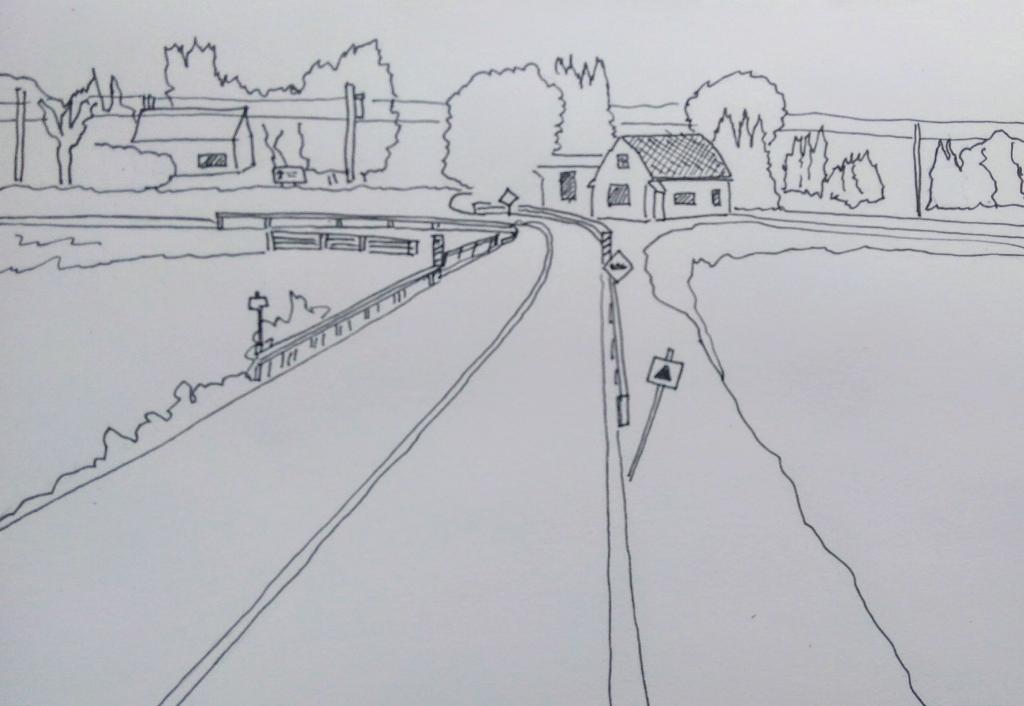
It was warmer than it’s been all week today, which made for a nice 90 minutes of sketching beside the Tryon River while Oliver was in Crapaud with Jennifer Brown.

, , ,
09 Jan 19:02

Curves and Deep Color in Acorn

I've got curves on the mind for some reason. And my mind was thinking- hey the curves code you've got fills everything into 256 buckets for each color channel (which acts as the LUT (Look Up Table)), and that's not going to work great for deep color images, is it?

So I dug up a 64 bit image I use for testing and ran it through the curves filter and sure enough, it looked like it had been converted to a 32 bit image. Not good at all.

So, what can I do to fix this? Well, there are a couple of options:

1: Make the LUT big enough to match the number of colors that could possibly fit into each channel. This would mean I would have to create a different sized LUT for each 32/64/128 bit image. That means more code. It also means more work for the CPU to do to fill up all those buckets as well as calculate the values based on the curve paths.

2: Change the code so that it doesn't take a LUT, but rather the vector data for the curves and then calculate the color changes on the fly based off that data, but on the GPU. This sounds like an awesome problem to solve, but I'm not sure it would be worth the time spent.

Honestly, I didn't want to do either of those solutions, but I was pretty resigned to implementing method #1. But I kept on thinking about it and went climbing for a bit and came back with another idea.

3: Keep the existing code, but use bilinear interpolation when accessing values from the LUT to figure out the color shifts. This is an extremely easy change and is probably about 98% as good as the previous two options. And it's certainly going to be way better than the current situation.

So I made that change, noticed nothing different, and then realized I was calling floor() in the filter kernel, completely the interpolation I was trying to use. So I got to delete code, and it made things better.

Here are the results. Old on the left, new on the right. Click on the image to make it bigger, because you're not going to see any differences at the size it's currently at.

Deep color curves.

You'll see a lot more banding on the left image than you do on the right image. And this image is actually a 24 bit PNG, where on my Mac it's a 64 bit PNG running through a wide gamut monitor. The differences are much more drastic here, and there's no perceivable banding at all for the fixed one.

What's next for curves? I'm not sure, maybe I'm done for the moment? I'd like to throw the alpha channel in there as well, but outside of a few interesting cases, it probably wouldn't be worth it.

Both these changes, and the changes I mentioned in my previous post are now availabe on Acorn's latest builds page.

09 Jan 19:02

Abstract machines and the compilers that love/hate them

by graydon
Observations noted in From Krivine’s machine to the Caml implementations (Leroy, 2005):

In every area where abstract machines help, there are arguably better alternatives:

• Exposing reduction order: CPS transformation, structured operational semantics, reduction contexts.
• Closures and environments: explicit substitutions.
• Efficient execution: optimizing compilation to real machine code.
• Intermediate languages: RTL, SSA, CPS, A-normal forms, etc.
• Code distribution: ANDF (?).

Abstract machines do many things well but none very well.

This we will illustrate in the case of efficient execution of Caml.

[...]

In retrospect, the journey could have been shorter by not going through abstract machines at all.

But maybe it would never have taken place without the "detour" through abstract machines.

Observations noted in The Verified CakeML Compiler Backend (extended version, Tan et al., 2018):

The previous compiler compiled from source to a single IL, then to stack-machine-based bytecode and finally to x86-64. The bytecode was designed so that each operation mapped to a fixed sequence of x86 instructions, and it was also designed to make verification of the GC as easy as possible. Unfortunately, the ease of verification also meant that the compiler had poor performance – we found the bytecode IL too low level for functional programming optimisations (multi-argument functions, lambda lifting, etc.) and too high level for backend optimisations. For example, it naively followed the semantics and allocated a closure on each additional argument to a function, pattern matches were not compiled efficiently (even for exhaustive, non-nested patterns), and the bytecode compiler only used registers as temporary storage within single bytecode instructions. The new version addresses all of these problems and splits each improvement into its own phase and IL in order to keep the verification of different parts as separate and as understandable as possible.

(emphases mine)

This entry was originally posted at https://graydon2.dreamwidth.org/264181.html. Please comment there using OpenID.
09 Jan 19:02

anti-oedipussy: It may seem odd to want to tackle capitalism with a theory that stresses ephemeral...

anti-oedipussy: It may seem odd to want to tackle capitalism with a theory that stresses ephemeral...
09 Jan 19:01

NB-IoT From Theory To Practice

by Martin

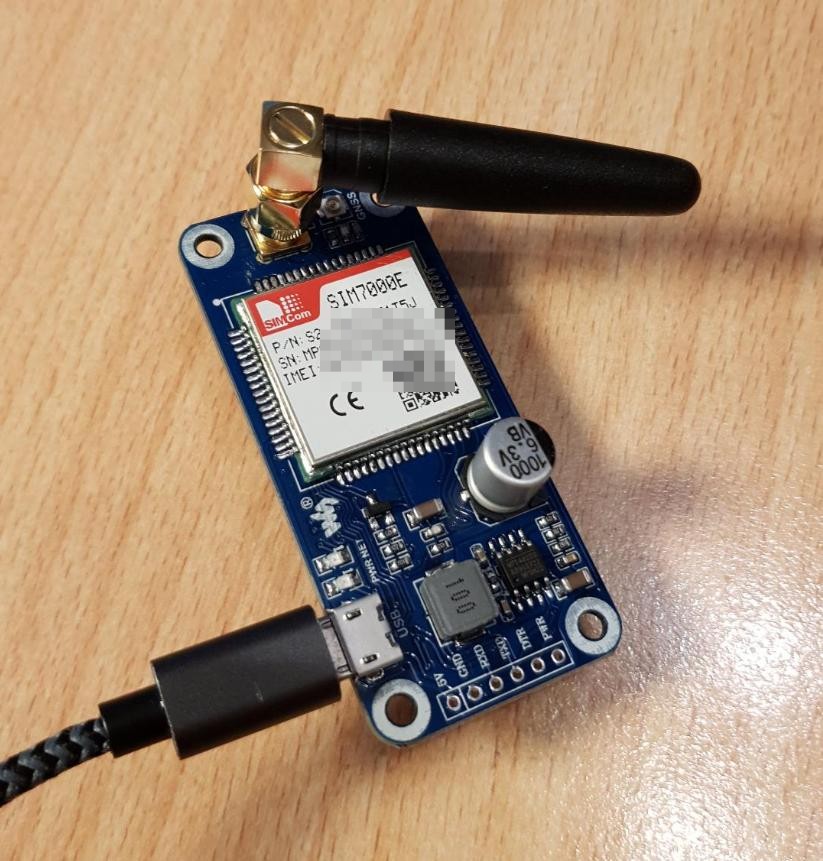
Waveshare/Simcom NB-IoT Module

Back in 2016 and 2017 I had quite a number of articles on NB-IoT, the Narrow Band Internet of Things technology that can run alongside LTE to connect things to the Internet over the cellular network. From being very power efficient to run over years on batteries to increased in-house coverage, the standard contains a lot of bells and whistles to address a wide variety of use cases. While I believe that ‘connecting things’ is the next big thing after mobilizing the Internet, it’s been very slow in the making, at least when it comes to cellular connectivity. I would have been quite keen to experiment with NB-IoT but up to now I didn’t come across devices and SIM cards that could be bought that would support it. Until a few days ago that was when I discovered an NB-IoT module for the Raspberry Pi on Amazon so it was finally time to go from theory to practice on the technology.

How To Get A Module and A SIM?

I started to get my hopes up to finally try the technology in practice when I came across this Waveshare NB-IoT and CAT-M1 device based on a Simtech 7000E module that would connect to a Raspberry Pi. At around €40 euros a piece it was cheap enough to give it a go. But wait, a module is no good without a SIM and subscription and getting one is anything but straight forward from a mass market point of view at this point in time. Perhaps that is part of the problem why the technology is so slow to start?

NB-IoT has been deployed by quite a number of network operators in different countries so your luck with a subscription may vary. For Germany you could try here, for Ireland, Italy, Czech Republic, Germany, Australia, Spain, England and the Netherlands you might want to have a look at a combination of Arduino module and SIM card based module here.

Getting the Module to Connect To The Network

So once I had a module and a SIM card with NB-IoT subscription I had to hope I lived in a place where the technology is already deployed. And yet another challenge was to get the module up and running, as NB-IoT connectivity is a bit different from the ordinary cellular stuff people are used to. The technology is called Narrow Band IoT for a reason! Despite being based on the IP protocol, the technology is not made to transfer a lot of data. Quite the contrary, the technology has been optimized for devices that just transfer a few bytes a day. So the Simtech module used by the device I bought and also other NB-IoT modules I came across offer special AT commands to establish TCP or UDP connections to servers on the Internet to exchange data. You can find the details in Waveshare’s/Simcom’s AT manual here. I case you haven’t grown up with modems in the 1990s you might have no idea what I’m talking about here. But fortunately, Wikipedia is here to help.

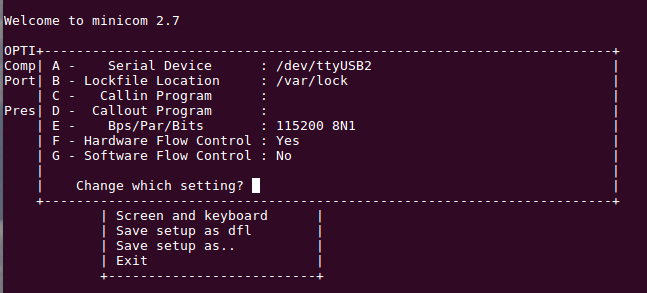
Serial port setting in Minicom

In the case of my Waveshare module, I discovered that it doesn’t only talk to Raspberry Pis via the standard Raspberry Pi connector but also over a serial port emulation over USB directly with PCs. Power and connectivity run over the same cable, no need for a Raspberry Pi for the basics. In case of Ubuntu 16.04, the operating system detects five serial interfaces that serve various purposes. For my purpose of getting a feel for the technology, ttyUSB2 was the right place to start by installing the Minicom terminal emulation program. Again, if analog modems were your thing through the 1980s and 90s you feel right at home! If not, it must look super arcane and strange. In my case I had to run Minicom as root and put /dev/ttyUSB2 into the communication settings menu (CTRL-A – Z – o) and enter the port settings there. There doesn’t seem to be a command line setting for this.

Once done, the Simcom module should print its name and version information text after it receives ‘ati’ + ENTER (ati stands for AT Info). With ‘ate’ (AT Echo), the module returns the characters you type in which is quite helpful to see what is typed from now on. The next thing to find out was to which network and radio technology the device had connected to. For the Simcom based Waveshare module, ‘at+cpsi?’ does the trick. In my case I got the following resonse at first:

at+cpsi?
+CPSI: GSM,Online,262-02,0x972d,1660,58 EGSM 900,-56,0,51-51

That’s not quite where I wanted to be for two reasons. First, I was on the Vodafone Germany network (Mobile Country Code (MCC) 262, Mobile Network Code (MNC) 02) which is neither the network I wanted to be in, nor the right network technology. Therefore the next thing to do was a network search with the ‘at+cops=?’ command which presented me with the following (formatted nicely for clarity):

at+cops=?
+COPS: (2,"262 02","262 02","26202",0),
       (1,"262 03","262 03","26203",0),
       (1,"262 01","262 01","26201",0),
       (1,"262 01","262 01","26201",9),
       (1,"262 02","262 02","26202",9),,(0,1,2,3,4),(0,1,2)

Apart from the MCC+MNC code (262 = Germany, 01 = T-Mobile, 02=Vodafone), the last number is of particular interest, 0 stands for GSM, 9 for NB-IoT. So what I wanted to do is to get on the 262 01 (T-Mobile) NB-IoT network. So first I had to change the network as follows:

at+cops=1,2,"26201"

It takes the module a bit to change the network but after it responded with ‘OK’, another ‘at+cpsi?’ command revealed that the module had changed the network but was still on GSM rather than on NB-IoT. The following command encourages the module to go to the NB-IoT network:

at+cnmp=38

By now you must have figured out that I had to read the AT-command manual of the module quite intensively. Running the ‘at+cpsi?’ command again revealed that I was finally on the right network and that the module was attached:

+CPSI: LTE NB-IOT,Online,262-01,0xE2A4,26569998,308,EUTRAN-BAND8,3740,0,0,-5,-77,-71,13

There is quite a bit of network information in that line, I leave it to the interested reader to figure out the details with Simcom’s AT-command manual.

So far so good, I was on the network now, but how do I transfer data now!? Again, it took me quite a bit to figure out how to use the right AT commands for this and if you are still with me at this point in the article, I’m sure you’ll enjoy part 2 that I’ll publish soon that will go into the details of that.

09 Jan 19:01

A Code of Conduct for Social Media Use

by Eric Karjaluoto

TL;DR: Set personal rules for how you behave on social networks to make your experience more fruitful. A year ago, I stopped using social media. I had many reasons for doing so. In retrospect, the main one was how it made me feel—and act. Stimuli overwhelmed me, I was judgemental, and I became overreactive. I […]

The post A Code of Conduct for Social Media Use appeared first on Eric Karjaluoto.

05 Jan 04:23

iPads can’t restore iCloud backups from iPhones on iOS 12.1.2

by Jonathan Lamont

If you got a new iPad over the holidays, you might have noticed you couldn’t restore an iPhone backup to it.

The issue popped up following the release of iOS 12.1.2. Essentially, Apple rushed out the update to iPhone users but didn’t release a corresponding update for the iPad.

Because of this, users can’t restore an updated iPhone backup to an iPad.

This isn’t a bug either: iCloud backups are working as intended. For a backup to work, the device you’re restoring it to can’t be on an older version of iOS. In other words, an iOS 12 backup wouldn’t restore on an iOS 11 device.

Since Apple didn’t roll out an iOS 12.1.2 update for iPads, you can’t restore backups from iPhones running that version of iOS.

Typically users don’t encounter this issue because the iOS setup screen will install any new software updates before restoring a backup. In this case, however, the iPad cannot install the required update.

Unfortunately, there’s no clear fix either. Users will either have to wait until the next iOS update — version 12.1.2 which should come to both iPhone and iPad later this month.

Alternatively, you could opt to install an earlier iPhone backup or start the iPad fresh. The latter option isn’t that bad either, as you can still get some iCloud data, like photos, without doing the backup.

This seems like a significant oversight from Apple, which usually pays close attention to small details like this. It should be noted, however, that Apple pushed iOS 12.1.2 in an attempt to avoid an iPhone ban in China.

Source: TechRadar Via: 9to5Mac

The post iPads can’t restore iCloud backups from iPhones on iOS 12.1.2 appeared first on MobileSyrup.

05 Jan 04:23

This, in a nutshell, is the choice facing the likes of Javid, Gove & Hunt: do they reflect the 'will of the people' (🤨) or sacrifice their convictions on the altar of 125,000 mostly retired Conservative members? (It is, alas, a rhetorical question.) twitter.com/SamCoatesTimes…

by mrjamesob
mkalus shared this story from mrjamesob on Twitter.

This, in a nutshell, is the choice facing the likes of Javid, Gove & Hunt: do they reflect the 'will of the people' (🤨) or sacrifice their convictions on the altar of 125,000 mostly retired Conservative members?
(It is, alas, a rhetorical question.) twitter.com/SamCoatesTimes…

10. Senior Tories are very worried about the @ProfTimBale Tory membership polling

Tory members are in a different place the country as whole on “no deal” -

63% of TORY MEMBERS say they would be delighted/pleased/relieved by no deal

18% of ALL VOTERS say the same


Posted by SamCoatesTimes on Friday, January 4th, 2019 7:55am


55 likes, 51 retweets

Posted by mrjamesob on Friday, January 4th, 2019 8:44am


196 likes, 84 retweets
05 Jan 04:21

Twitter Favorites: [AnakanaSchofiel] Do NOT listen to Marie Kondo or Konmari in relation to books. Fill your apartment & world with them. I don’t give a… https://t.co/R8PzvVBt1q

Anakana Schofield @AnakanaSchofiel
Do NOT listen to Marie Kondo or Konmari in relation to books. Fill your apartment & world with them. I don’t give a… twitter.com/i/web/status/1…
05 Jan 04:21

NewsBlur Blurblog: Where Did PR do Well? A Look at the Kinds of Ridings that Supported PR

sillygwailo shared this story from Somewhere Left of Ottawa.

The result of the electoral reform referendum in BC was a disappointment to advocates for proportional representation (PR).  With 61% of voters voting for first past the post, the referendum produced a clear mandate to stick with the current electoral system.  This support was not only large, but it was spread across the province.  In my previous post, I note that first past the post had broad support everywhere except for the centre/east-side of Vancouver and Victoria.  In this post I look at some of the factors that led ridings to vote for PR.  Predictably, ridings that supported the NDP or Greens were more supportive, but there were also a substantial number of NDP ridings that voted for first past the post.  Ridings with a greater population density were also more likely to vote for PR, though not by very much.  Interestingly more ethnically diverse ridings were more likely to vote for first past the post and there was no strong relationship between the support for second and third place candidates and support for PR.

To look at some of the factors that influenced the outcome of the referendum I compared the success of PR to both 2017 election results and demographic data for different ridings.*  This is not ideal as a measure of whether PR did better with some voters than others.  Survey data looking at individual vote choice would be better, but to my knowledge, survey data for the referendum is limited.  In this post I walk through a number of individual variables that could predict referendum outcomes and then look at them together to compare the impacts of the different variables against each other.  I look at support for the NDP and Greens in the previous election, the percentage of voters in a riding that speak a non-official language (unfortunately BC stats does not have immigration or visible minority population data for different ridings), population density, and support for second and third place candidates.

NDP Vote Share

Because the referendum campaign was so partisan (with the NDP and Greens supporting PR and the Liberals approaching it) one would expect support for the NDP and Greens within ridings to match support for PR.  This turns out to be the case.  The upward sloping line in the graph below shows that the more likely a riding was to support the NDP in 2017, the more support in the riding there tended to be for PR.  The “x’s show each riding’s support for PR and for the NDP.  The fact that all but two of the ridings that voted in favour of PR were also ridings where the NDP won at least 40% of the vote highlights the extent to which support for the NDP tended to match support for PR.

NDP Support and Support for PR

At the same time, the graph shows a large number of outlier ridings where NDP support did not translate in to support for PR.  These ridings are shown by the “x”s below the trend line on the right side of the graph.  Further, the correlation between NDP support and support for PR was not strong enough to lead to majority support for proportional representation in most ridings in which the NDP did well.  While the trend line is upward sloping, it also shows a trend in which ridings need at least 60% support for the NDP for them to be expected to see majority support (marked by the red line in the graph) for PR.  Indeed, of the ridings in which the NDP won at least 40% of the vote in the last election, only 14 (32% of all ridings in which the NDP won more than 40%) saw majority support for PR.  The NDP were able to translate some of their support in 2017 into support for electoral reform, but not nearly enough to give it a chance of passing.

Green Vote Share

There is a stronger relationship between support for the Green party and support for PE.  This is expected.  The Green party would benefit the most from electoral reform and therefore had the strongest incentive to mobilize their supporters in favour of it.  Green voters also had a strong interest in supporting PR so that they could increase their party’s representation in the legislature.  The graph below shows this relationship, and that any riding where the Greens saw at least 30% of the vote saw either majority support for PR or close to majority support.

Green Support and Support for PR

Unfortunately for advocates of electoral reform, there simply are not enough ridings in which the Greens got a large share of the vote for the correlation between Green support and support for PR to make much of a difference in the referendum.  There were only 7 ridings in 2017 where the Greens got close to or more than 30% of the vote.  Winning majority support (or close to majority support) in these ridings was not enough to substantially affect the referendum result.

Minority Languages

Advocates for PR made the argument that electoral reform would benefit immigrant and ethnic minorities.  I am skeptical of this argument.  Geographic concentration under first past the post should make it easier for immigrants and minorities to get elected in diverse ridings and force parties to be responsive to their concerns.  Nonetheless, it is still worth looking at whether advocates’ argument gained traction with minorities.  Ideally, I would be able to measure this by looking at whether ridings with larger numbers of immigrants or visible minorities voted for proportional representation, but unfortunately BC Stats does not have data for the number of immigrants or visible minorities in particular ridings.  As a result, I use the percentage of individuals who report a mother tongue other than English, French, or an indigenous language as a proxy for the number of immigrants and minorities in a given riding.

The graph below shows no relationship between how ethnically diverse a riding is and support for PR.  The trend line is slightly downward sloping.  This indicates, if anything, a negative relationship (though the shallow slope of the line suggests one should not read too much into this negative relationship).  Later in this piece, I will show that when one controls for party support, density, and a number of other factors, this negative relationship gets stronger.  There is no evidence here that advocates for electoral reform were able to convince immigrants and ethnic minorities to support PR.  If anything, ridings with more immigrants and ethnic minorities were more likely to support first past the post.

Language and Support for PR

Population Density

There was a substantial amount of concern expressed during the referendum about what would happen to local representation under PR.  The different systems in the referendum were designed to provide some degree of local representation, but this was easier to do in more densely populated parts of the provinces.  Any proportional system would require combining some ridings together.  This is less of a problem in densely populated urban areas where ridings are quite small, but is a problem in rural areas with ridings already cover a large area.  Thus, one would expect that smaller, more densely populated ridings, would be more likely to support PR.

The graph below shows that this is indeed the case.  While there is a substantial degree of variation and a large number of outliers, the general trend suggests that the more densely populated a riding is, the more voters in the riding backed electoral reform.  Like with support for the NDP though, support in even the more densely populated ridings tended to be below 50%.  This suggests that advocates of proportional representation needed to do a better job of winning over the easier voters to convince, those for whom enlarged ridings and less fine-grained local representation would have been less of a concern.

Support for PR and Pop Density

Votes for Losing Candidates

One of the major concerns often noted with first past the post is the potential for voters to end up “wasting” votes.  Votes that do not go to one of the top two candidates in a riding have no impact on who wins the riding.  Further, voters that vote for a candidate that finishes second may feel unrepresented in the legislature because their vote did not go towards the election of an MLA.  The number of people who feel this way will not be equal across ridings.  In ridings where a candidate wins with a large vote share most voters may feel satisfied with their representative and therefore with the electoral system that led that representative to be elected.  In ridings where a large number of voters voted for a losing candidate a large number of voters may be unsatisfied with the electoral system that led to election of a candidate they did not like.

The graph below shows that proportional representation did not tend to receive more support in ridings with more voters that supported a candidate that finished second or third.  There is a positive trend line, but it is largely driven by three ridings in which few voters voted for a losing candidate and few voters supported proportional representation.  If one looks at ridings where 40%-60% of voters voted for a second or third place candidate one sees a range of levels of support for proportional representation.  This, coupled with a lack of statistical significance in the tests that combine different variables shown later in this post, suggest that PR did not do particularly well in ridings where large numbers of voters supported losing candidates.  Advocates of PR often argue that such systems are better than first past the post systems because they ensure every vote goes towards electing a representative.  The results from the referendum suggests that these arguments failed to gain traction in the ridings where they would have been most relevant,

Support for 2nd and 3rd Parties and PR

Combined Analysis

It is worth looking at the impacts of these different variables in relation to each other.  To do this I run four multivariate regression analyses that include a couple of variations of the variables discussed above.  To get at whether combined NDP/Green support affected support for proportional representation I ran two models that look at combined support instead of support for each party.  To look at whether support for a third-place candidate had a stronger impact than support for a losing candidate I ran a test that looked only at support for the third-place candidate.  The results for all of these models are shown in the table below.  Ultimately, I found that the model using the variables discussed above, coupled with a measure for the margin of victory of the winning candidate, best explained variation in support for PR across ridings and so used that model as a basis for comparison.  This is listed in the table as model 4.

Screen Shot 2018-12-24 at 9.33.16 AM

The table shows that support for the Green party had the strongest impact on whether a riding voted for electoral reform.  For every percentage point of support the Green party won in a riding the riding’s support for proportional representation increased by an average of 0.97 percentage points.  Support for the NDP had the next strongest impact on support for PR, with a percentage point increase in support for the NDP increasing support for PR by 0.73 percentage points.  Finally, density had a small, but statistically significant, impact on support for PR.  For every 100 people per km2 increase in density in a riding support for PR increased by 0.16 percentage points.  Ethnic diversity decreased support for proportional representation.  For every one percentage point increase in the number of people in the riding that speak a non-official language as their mother tongue support for PR dropped by 0.23 percentage points.  When support for the NDP and Greens are controlled for, votes for losing parties actually has a negative impact on support for PR, with ridings with a larger number of voters for second and third place candidates seeing lower support for proportional representation.  This result is only statistically significant at the 90% confidence level in the final model, so I do not have much confidence in it.

The graph below shows the predicted impacts of the four most important variables for different values of each variable.  The dotted lines show the margins of error for the impact of each variable for a 95% confidence level.  The strongest impacts are for the two partisan variables with the Green party having a stronger impact on support than the NDP (though the differences between the two parties is within the margin of error for a 95% confidence level).  In contrast to the support for the NDP and Greens, the impact of population density is quite small.  Finally, the impact of minority language speakers on a riding is substantial but also smaller than that for support for parties.

Marginal Effects on Support for PR

Conclusion

An analysis of where PR won a substantial number of votes suggests that partisanship played an important role in the referendum.  Ridings with more Green and NDP supporters generally saw higher levels of support for proportional representation.  At the same time, the NDP did not convert their supporters into PR supporters at a high enough rate to lead to a pro-proportional representation vote in the referendum.  The analysis also shows that, while population density did play some role in determining support for PR, that advocates could have done more to win over voters in high density ridings where local representation would have been less of an impediment to support for electoral reform.  These results further show evidence that two arguments that advocates for electoral reform made failed to get traction.  Most notably the less well supported claim that immigrants and ethnic minorities benefit from PR failed to lead more diverse ridings to vote for PR.  Second, the argument that PR ensures more people elect a representative they prefer, while true, failed to get lead ridings with larger numbers of people that voted for a losing candidate to vote for PR.  When examining what worked and what did not in their campaign, advocates for electoral reform should pay careful attention to a number of these areas where they could have made more gains or where their arguments failed to gain traction.

*Demographic data comes from BC stats.


04 Jan 21:51

Cozying up with WSL

Thanks to a mysterious failure in my MacBook Pro while traveling for the holidays, I’ve been using a Windows 10 machine full time for almost two weeks. At work, I use Windows for email and Office365 apps, so it’s not terra incognita. It’s the first time in a long time, however, that I can’t just reach over for my Mac and use the setup I’m used to for working with code.

This has meant that I’ve gotten a chance to spend a lot more time with the Windows Subsystem for Linux. I was pretty excited by this when it was announced two years ago, even tho it was very much a first release, and it’s gotten so much better since then.

There are still some gotchas when using it with Windows GUI apps — such as when you want to use Visual Studio Code. It took me a while, for example, to sort out that I really wanted to put my source code at /mnt/c/source (aka C:\source) so that it was in an easy place to get to in both systems. And that while I wanted to use the Linux version of development tools like npm and ruby, I should use the Windows installation of git so that it can use the Windows Credential Store to cache passwords in.

Once settled in, it’s a pretty nice place to be. It’s, dare I say it, a workable Linux on the desktop. Not that it’s the Linux on the desktop that many of us wanted twenty years ago. But pretty good.

04 Jan 21:50

Here’s what to expect from CES 2019

by Patrick O'Rourke
CES logo

Given that CES is the electronics industry’s annual showcase for the coming year, it comes as no surprise that the show is absolutely massive.

The five-day event showcases the year’s upcoming tech products from both large and small companies, with colossal South Korean tech giants like Samsung and LG competing for attention alongside comparatively tiny Canadian upstarts like Ecobee and Nanoleaf.

Over the past few years, the show’s focus has shifted dramatically from smartphones and gadgets to automotive, smart home products and, of course, drones. Despite the change, the core of CES remains the same: fascinating, sometimes completely useless tech products that debut on a global stage for the first time.

Rather than delving into which specific companies have plans to show off products at CES 2019, this story takes a broader look at the big themes of this year’s show with an emphasis on the core categories that MobileSyrup usually covers.

This year’s conference runs from Tuesday, January 8th, 2019 to Friday, January 11th, 2019 in Las Vegas.

AR glasses galore

North's Focals augmented reality glasses

Though augmented reality (AR) and virtual reality (VR) aren’t going anywhere, the now-established product categories will likely take a back seat to the newer tech at CES 2019.

HTC is holding a keynote dedicated to its Vive headset, though it’s unclear what the company has planned for the high-end headset given that it only revealed the HTC Vive Pro last year. We’ll also likely see many standalone headsets similar to the Facebook-owned Oculus Go from various smaller manufacturers.

On the AR side of the spectrum, augmented reality glasses from lesser-known manufacturers like Waterloo, Ontario-based North’s Focals will be present on the show floor.

On the hunt for a 5G vaping smartphone

Though this subheading is a joke, 5G is set to be a huge theme at this year’s CES — just like it was at Mobile World Congress (MWC) 2018 in Barcelona, Spain.

Most of the news surrounding 5G will be focused on which large American carriers like AT&T, Verizon, T-Mobile and Sprint are working on in the space given that they have committed to rolling out the next generation of wireless technology over the course of 2019.

As it relates to Canada, Canadian telecom giants don’t really have a presence at CES. As a result, it’s unlikely that the 5G news set to come out of the show will directly relate to the Great White North.

That said, chip makers like Intel and Qualcomm in particular will have a lot to discuss regarding 5G’s role in the mobile space. We’ll also likely see various concepts regarding how 5G’s additional speed will affect a wide variety of industries, similar to what we saw at last year’s MWC.

It’s an EV automotive world

NIssan Leaf Logo

With Apple CarPlay and Android Auto firmly established as most automakers go-to in-car infotainment platforms, the automotive industry will likely look to other areas when it comes to innovation.

Many have predicted that electric vehicles (EVs) will be present in abundance at this year’s CES, along with various forms of augmented reality heads-up displays and, of course, self-driving cars, automotive technology we’ve seen in the past at the Consumer Electronics Show.

Specifically, Audi, Mercedes-Benz and Hyundai are expected to show off new EVs at CES 2019.

Let’s put Wi-Fi in everything

Wi-Fi-enabled smart home products, whether they’re Alexa- or Google Assistant-compatible, have been a running theme at CES for years now and that trend doesn’t show signs of slowing down.

Everything from Wi-Fi-enabled microwaves and door locks to fridges and stoves will be shown off at CES 2019.

Just like in past years, the two companies behind the industry’s most popular voice-activated assistants, Amazon and Google, will once again have a significant presence on the show floor.

Say hello to foldable smartphones

While this particular product category is the most relevant to what we cover at MobileSyrup, it looks like smartphones will have an even more reduced presence at CES 2019 than in years past.

We’ll hear a lot about 5G, though again, not much of the news surrounding LTE’s successor will relate to the Canadian market, especially when it comes to 5G-compatible smartphones.

We’ll likely see foldable smartphone concepts once again hinted at by large manufacturers like Samsung and LG, as well as from smaller Chinese handset manufacturers.

Given MWC’s focus on smartphones, Samsung will likely wait until Barcelona before showing off the oft-rumoured and basically already revealed foldable Galaxy Flex device.

Still, while it could be a long shot, Samsung might show off the Galaxy Flex at CES and save MWC for the inevitable Galaxy S10 lineup.

Everything else

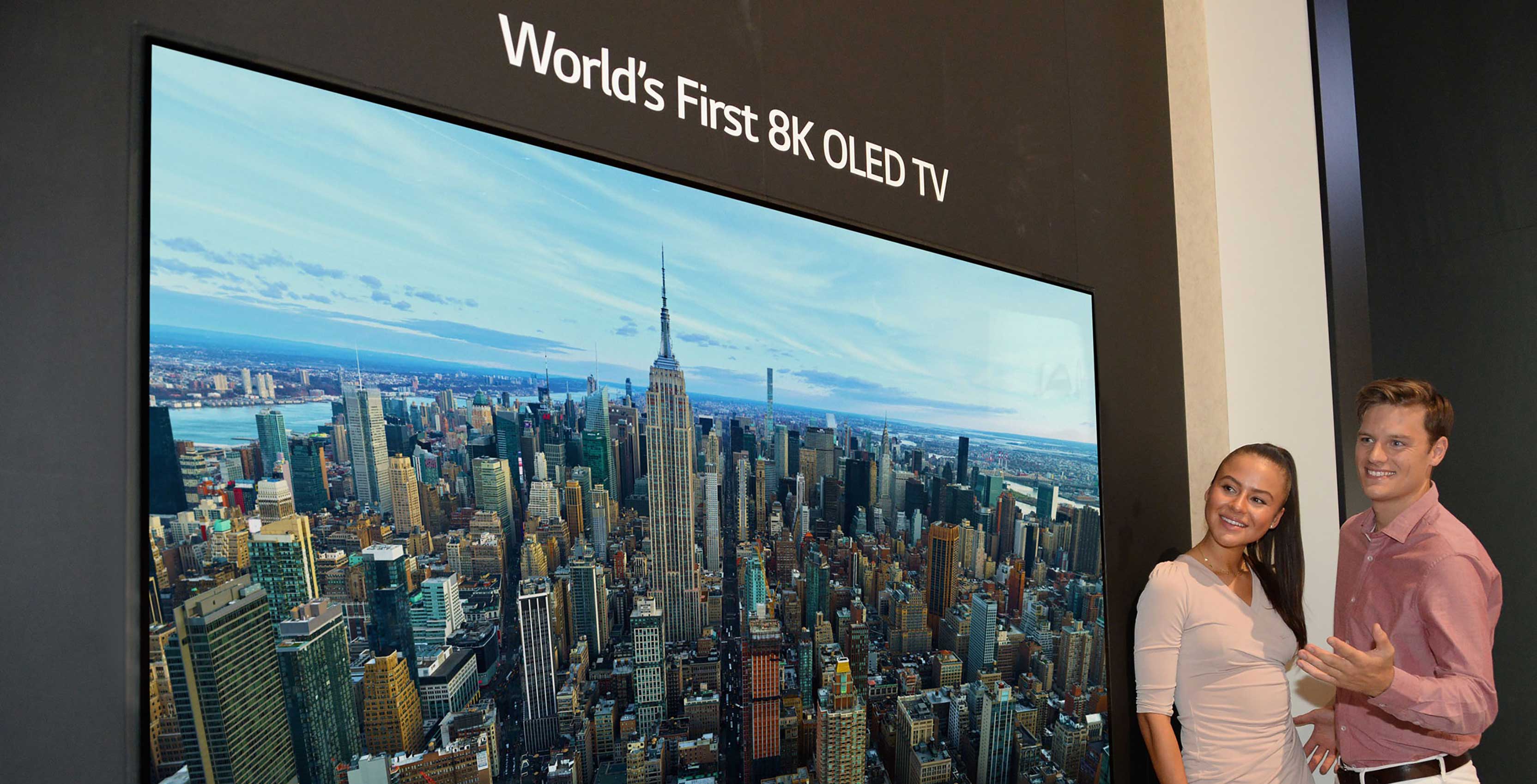
LG 8K OLED TV

CES is still very much a television-focused conference despite the shift to automotive in recent years. With 4K and HDR relatively established at this point, the industry will likely move towards the next big, not very exciting thing: 8K.

Will there be content that supports 8K given that 4K content isn’t even that common yet? Probably not.

However, that won’t stop television manufacturers from showing off pixel-packed 8K televisions.

It’s possible experimental modular televisions, similar to the impressive 146-inch modular ‘The Wall’ microLED TV Samsung showed off last year, could make an appearance once again, too.

It’s also likely that we’ll see a shift to HDMI 2.1, a new port format that’s necessary to transmit the amount of data required for 8K video.

Sticking with TVs, we’ll almost certainly see Alexa and Google Assistant integrated directly into major manufacturer’s televisions, building off a trend that started at CES in 2018.

Bendable displays, both in the smartphone and television space, will be shown off again as well. Whether or not any of these products will be released remains unclear given that we’ve seen foldable screens at CES for many years at this point.

Finally, PCs featuring Intel’s latest processors and Nvidia’s latest high-end GPUs will be everywhere, along with laptops equipped with tiny bezels and 4K displays.

In true ‘gam3r’ fashion, Razer will also probably show off something crazy, like 2017’s three-screened Project Valerie, a concept design that was stolen from the CES show floor.

I’ll be on the ground at this year’s CES for the first time bringing you all the news relevant to Canadians directly from the show floor. 

Source: TweakTown, The Verge

The post Here’s what to expect from CES 2019 appeared first on MobileSyrup.

04 Jan 21:49

More Than Ten Free Hosted Jupyter Notebook Environments You Can Try Right Now

Tony Hirst, OUseful Info, Jan 04, 2019
Icon

This is a quick item from Tony Hirst that does exactly as the title promises. Jupyter Notebooks is an example of an online resource that integrates a real programming environment with text, producing an example of the sort of next generation learning resource we can look forward to. See also: Initial Notes… Jupyter Notebook To OU-XML.

Web: [Direct Link] [This Post]
04 Jan 21:49

Old Alexandria Ocasio-Cortez dance video goes viral as supporters mock shaming attempt

Joel Shannon, USA Today, Jan 04, 2019
Icon

I've said this before but it bears repeating: the problem is not what there is about you on the internet, the problem is in what people do with it. Case in point: there is utterly nothing wrong with making a video of you and some friends dancing on a rooftop. That's what Alexandria Ocasio-Cortez did. The resulting video is what the Chronicle, citing Lawrence Lessig, calls "'read/write culture,' in which everyday people felt empowered to generate their own creative product." And it's a wonderful example of that. But for one commentator, it was raw material for a lumpy-headed attempt to shame Ocasio-Cortez. Now is this an argument for never posting such content online in the first place? Of course not. It's an argument for asking, "how weird is it that there's some guy out there who thinks dancing is shameful? Why would anyonme take them seriously?"

Web: [Direct Link] [This Post]
04 Jan 21:49

Say goodbye to the information age: it’s all about reputation now

Gloria Origgi, Aeon, Jan 04, 2019
Icon

I don't agree with the main point of this post, but rthe reasons are complex. Here's the main point: "rom the ‘information age’, we are moving towards the ‘reputation age’, in which information will have value only if it is already filtered, evaluated and commented upon by others. Seen in this light, reputation has become a central pillar of collective intelligence today. It is the gatekeeper to knowledge, and the keys to the gate are held by others." Now this isn't wrong, exactly, but the use of the word 'reputation' suggests that it's the others' reputation (standing in the community? track record? number of followers?) that will make them a 'gatekeeper'. But no - this is just a return to the way we used to do it. It's not reputation that makes someone a gatekeeper, it's connection, and connections come and go not based on anything like reputation, but in the continuing value you - as an individual - see in continuing to maintain that connection.

Web: [Direct Link] [This Post]
04 Jan 21:49

The death of consensus, not the death of truth

Xiao Mina, Nieman Lab, Jan 04, 2019
Icon

Michael Caulfield asks "Why Reputation" in reaction to this piece by Xiao Mina. Mina writes, " Rather than trust in sources of authority (institutions in power as such), people today are more likely to put their trust in networks of affiliation (those in your circle, however you define that)," which seems right to me. But this is different from reputation. More broadly, as Mina says, the need here is to see ask trust in institutions is low, rather than doubling down on institutions. "What journalism needs most is to move from a defensive crouch and into a more adaptive one. We need a vision for a new journalism, and a clear path to supporting and sustaining it in a world where consensus can no longer be taken for granted." So too for us all.

Web: [Direct Link] [This Post]
04 Jan 21:08

Something weird is happening at vowe's magic flying circus

by Volker Weber

4e711e71eb92c7a39cfb713e0b1211a2

There hasn't been a year since I first deployed my first two Sonos players that I wore headphones as much as I did in 2018. I have reduced my Sonos setup from 8 zones to 5 and I am ready to go to 4 and possibly 3.

There is of course a reason behind that. I am jumping from Apple Music to Apple Podcasts, to YouTube, to Netflix. And I am doing this mostly on iPhone and iPad Pro. The sound comes either out of the device itself -- the iPad Pro is really good -- or the headphones.

Yesterday I removed myself from a Sonos beta, for the first time ever. We are not moving in the same direction and I have nobody I could talk to about this.

Speaking of headphones, the Beats Studio³ have been my favorite sound gear ever since I got them. And boy, would I be interested in the Surface Headphones, if they ever make it to Germany.

04 Jan 21:08

More Than Ten Free Hosted Jupyter Notebook Environments You Can Try Right Now

by Tony Hirst

Looking for a free, online Jupyter notebook server? Here are some you can try right now…

Generic Environments

Research Publishing / Environments

DataSci / ML Environments

Training / Education Environments

There are also a couple of temporary notebook servers provided by the Jupyter core development team:

If you’re looking for some consultancy support / help in getting a notebook server environment up and running, the folk at Hub Hero may be able to help…

Afterword

My old, old post on Seven Ways of Running IPython / Jupyter Notebooks is getting rather long in the tooth — I really should cast it as a WordPress page rather than post and keep it up to date — and it doesn’t seem to get much traffic anymore, so this post is set to serve as a quick round up of several services I’m aware of that offer a free plan for hosted Jupyter notebooks and a crappy post title that may or may not generate traffic…

If you’re aware of any more, please let me know… This post won’t be actively maintained but I will try to do the odd bit of gardening around it as and when I come across additional services and/or aware of services shutting down, closing their free plans, etc etc… If you come across more services, please add them via the comments (ideally with a brief description of what they offer) and I’ll plant them in the page each time I pass by… If you want to comment on any of the services listed, eg with services they offer, the extent of the free plan, or how quickly pricing kicks in, please feel free to do that too…

I’ll also try to annotate entries with brief descriptions of what’s available as and when I get a chance…

04 Jan 20:44

Friday File: Drivers Complain Raised Crosswalk Slows Vehicles

by Sandy James Planner
mkalus shared this story from Price Tags.

Boston_PeterFurthBoston_PeterFurth

Vancouver has been creating raised crosswalks for  twenty years. These are generally located near schools and are walkable speed humps that are at the same grade as the sidewalk on either side of the street. The raised crosswalk serve to  elevate the pedestrian, and slow vehicular traffic which should be travelling the posted school speed limit anyway. You have probably seen the raised crosswalks located outside the Vancouver Airport.

The first temporary raised crosswalk in Vancouver was installed by Neighbourhood Transportation Engineer Jim Hall on the east side of Emily Carr Elementary School near Oak Street and King Edward Avenue. The first permanent raised crosswalk (and here is the Council report written by Engineering Traffic Manager Winston Chou) is on east 22nd Avenue at Commercial Street, adjacent to Lord Selkirk Elementary.

The raised crosswalks clearly have a function of slowing traffic and allowing pedestrians to be more visible crossing a road. But take a look at this news report from Longmeadow Massachusetts where drivers are complaining that they are damaging their cars going over the raised crosswalk.  This crosswalk is located right beside a school, has  vivid green signs to alert drivers to slow down, and was built to slow cars to 35 miles per hour (roughly 52 kilometers per hour).

The town had installed the raised crosswalk with a Complete Streets grant with the goal to make it safer for pedestrians, who have no sidewalk on either side of this road. Town Manager of Longmeadow Stephen Crane stated “Every car that slows down to the right speed doesn’t bottom out. Cars that are being inattentive or going too fast may feel that raised crosswalk and may in fact hit the asphalt with the bottom of their car.”.

And is that not the whole point, to ensure that vehicles are travelling the posted speed limit, and yield to pedestrians in the crosswalk? Even the local news in the YouTube link below presents only half of the picture, that of the aggrieved drivers speeding over the raised crosswalk. There are no interviews of people or children using the crosswalk, or any video of what the pedestrian experiences crossing at this location. And that needs to change to have streets that are for all users, not just motorists.

The town manager gets it. He’s talking about a radar speed sign at the location to alert drivers how fast they are travelling. Speed enforcement, a change in road design, and getting tough on driver behaviour makes streets  safer for vulnerable road users, prevents injuries, and saves lives.


Image: NACTO.org

04 Jan 20:43

What is Digital Literacy?

by Stephen Downes
Short response to a questionnaire.

1. What is Digital Literacy

Digital literacy is a type of literacy, specifically, the type of literacy that arises in the digital context. By 'the digital context' we mean the multimedia and inter-networked context enabled by digital technology.

What's significant is how it advances beyond traditional literacy, which is essentially the ability to read and write well. By 'well' in this context we mean rather more that rote ability, but rather, to be able to find meaning, to be able to evaluate critically, to be able to communicate with intent, and similar capacities.

In the digital world we look at these abilities as applying to more than just text. The initial result is that people have defined a whole set of literacies, such as visual literacy, mathematical literacy, social literacy, emotional literacy, or which digital literacy is only one type. But these literacies also challenge the idea that literacy is itself a semiotic concept, that is, it challenges the idea that literacy is (merely) about symbols, meanings and representation.

For my part, I think that 'literacy', understood in this wider context, applies to what we might call pre-symbolic, or sub-symbolic, concepts. That is, the normal ideas of meaning, representation and truth are one small part of of literacy, rather than definitive of it.

What I have done over the years is identify a set of six 'critical literacies' that capture pre-symbolic literacy. These are core skills that enable a person to be 'literate' in whatever domain - language, mathematics, video, whatever. These include pattern recognition, semantics, context-awareness, use or application, explanation and inference, and change.

So Digital Literacy, properly so called, would involve being able to apply these skills to digital media and digital technology - from being able to identify patters, rule-sets and principles, to being able to represent meaning, value and truth, to being able to understand and work with technological change, and the rest.

2. What impact does digital literacy have on your personal, professional, and spiritual* life? (*However you interpret this.)

The basis for the definition of critical literacies (and therefore, digital literacy) I outlined above comes from my understanding that I am essentially an embodied neural network that experiences and interacts with the world.

So in an important sense, there isn't really a distinction between 'what makes me literate' and 'who I am'. In another paper, I argue that "consciousness is experience", and the literacies I describe are various aspects of my consciousness.

Developing myself both personally and professionally means engagement in environments that stimulate a wide range of experiences that will create and foster the development of my neural network (ie., the development of myself) with more refined and effective literacies - that is, making myself a better and more nuanced perceiver.

One might think of it as tuning my capacities to my environment, the way you might tune an instrument, so that it captures and expresses itself harmoniously with everything around it. So (for example) I can see patterns others don't see, express myself in interesting ways, be able to predict events, etc. This allows me to assist others who do not have these particular capacities (because they have given themselves different experiences and different abilities).

3. Who are you? (context matters)

My name is Stephen Downes, I work as a researcher for the National Research Council of Canada, and I work in that area where philosophy, education, media and technology intersect with each other. I will be 60 years old this year, and have been fortunate enough to do this work for that last 25 years.

I grew up in a small town in eastern Ontario (which is where I now live), worked hard (as a dishwasher, janitor, 7-Eleven clerk, security guard, etc), studied philosophy (BA, MA, almost a PhD), taught college and university classes, taught myself computing technology, edited a newspaper, produced another, and have lived (to the best of my ability) an idealistic and progressive life.


04 Jan 20:42

Dell’s XPS 13 continues to be one of the best Windows laptops available

by Jonathan Lamont
Dell XPS 13 2018

Sometimes, when you use something you really enjoy, you just have to tell people about it. That’s how I feel about Dell’s 2018 XPS 13 laptop and it’s largely why I’m writing these words now.

MobileSyrup, unfortunately, didn’t get a chance to review the XPS 13 when it came out earlier this year. However, I got to use one when putting together our holiday gift guide this year. While I knew the XPS 13 series was great, I was blown away by just how impressive this year’s model turned out to be.

As a longtime Windows users, I’ve always had a hard time finding the perfect laptop. I want power, but I don’t want a huge machine. I want a great screen, but I also want long battery life.

The XPS 13 is one of the few Windows laptops I’ve used that checks all those boxes. It’s super thin, lightweight, sports a brilliant 4K display and delivers all the power you could need.

This isn’t going to be a traditional review considering how long the XPS 13 has been around. Instead, I’m going to share a few brief thoughts about my time with the laptop and why I think it justifies its hefty price tag.

New chassis, new colour

Dell XPS 13 in new Gold and White colour

On the outside, the most significant difference between the 2017 XPS 13 model and the 2018 model I used is colour. The 2018 model’s gold-and-white variant stuns, but if you’re not one for light colour schemes, you can also get the laptop in traditional silver-and-black.

The device’s exterior is made of gold-coloured aluminum that I found had a slight rose tint to it. On the inside, the XPS 13 sports a white finish that looks woven. While some might love the weave, I didn’t care much for it. Ultimately, it felt great under my palms while using the laptop, so it didn’t matter much how it looked.

Aside from the new colour, Dell shrunk the chassis a tad, making it thinner and lighter. The XPS 13 clocks in at 11.6mm at its thickest point and weighs 1.21kg (2.68 pounds).

While not a drastic change over previous models, the laptop’s thin profile did lead Dell to ditch USB-A ports and an full-size SD card reader. Instead, you’ll find three USB-C ports, a 3.5mm headphone jack and a microSD card reader.

While some may feel the loss of USB-A, I came from the Microsoft Surface Pro 6 which only had one USB-A slot. As such, the XPS 13’s three USB-C ports felt positively freeing. Further, the micro SD slot didn’t make up for the missing SD slot, but I appreciated having the option.

Open the oyster, find the pearl

Opening the traditional clamshell-style XPS 13 reveals the best part about the laptop. The brilliant 13.3-inch 4K display is a marvel, and the way it almost extends to the edge of the computer’s frame makes for a particularly futuristic look.

The bezel below the display houses the laptop’s webcam and the sensors needed to make Windows Hello facial recognition work.

I also didn’t mind the XPS 13’s bottom placement of the webcam. Granted, I don’t typically video call with my computer and I can see why the low placement might cause issues for some users.

My only gripe with the webcam’s placement is that I sometimes had to tilt up the display to get Windows Hello to recognize me.

On that note, the screen hinge on the XPS 13 isn’t quite as malleable as I’d like. Maybe I’m too used to the Surface Pro 6 hinge, but I found it frustrating when I needed the screen to go back further than the XPS could.

As far as Windows Hello goes, it has never worked better — when the camera was positioned properly, of course.

Overall, the XPS 13 recognized me faster than Microsoft’s Surface Pro 6 and it made unlocking the laptop a joy. The rare times Windows Hello did fail, a quick touch on the fingerprint sensor integrated in the laptop’s power button unlocked the computer almost instantly.

If the screen is the XPS 13’s pearl, the keyboard and trackpad are the lacklustre necessities that surround it.

To be clear, the keyboard and trackpad are not bad by any means — both are capable and quite usable. They’re just not the best, and when the rest of the laptop is so good, these two parts stand out.

I found the keyboard to be a little on the mushy side. It lacked the satisfying tactile click of keyboards like those in Microsoft’s Surface Laptop 2.

I’ve yet to find a typing experience as satisfying as that of the Surface line, but the XPS keyboard was still better than most laptop keyboards I’ve used.

As for the trackpad, it’s functional but unfortunately small. Granted, there’s not much room to include a bigger one, but it would’ve been nice all the same.

Internals round out the experience

Dell XPS 13 bottom

While a thin chassis, new colour and great screen all serve as solid arguments in favour of the XPS 13, the device’s internals really sell the laptop.

The unit I used came kitted out with 16GB of RAM and an 8th gen Intel Core i7 8550U processor. The i7 clocks in at a 1.8GHz base and ramps up to a 4.0GHz turbo boost. In layman’s terms, the XPS 13 is fast.

The laptop handled everything I threw at it, including heavy browsing, Photoshop and more. Performance was buttery smooth and I rarely experienced any hiccups or performance struggles.

It could even handle gaming, thanks to eGPU support via the device’s USB-C ports. I wasn’t able to test this myself, but with the right set-up, the XPS 13 could easily serve as both a workhorse and gaming machine.

It’s worth noting that the XPS 13 ran on the warm side for me. It was never unbearably hot, but the laptop did ramp up its fans from time to time. While not particularly loud, they were noticeable.

Ultimately, the XPS 13 was a joy to use. From the moment you open up the laptop until you shut it down, it works flawlessly. Plus, it looks good while doing so.

If you’re in the market for the best Windows laptop you can get, the XPS 13 is the one. It’s got everything you could need in a sleek package. It might be on the pricey side, but thanks to some recent sales, you can get the XPS 13 for as low as $1,329.99 from Dell.

The post Dell’s XPS 13 continues to be one of the best Windows laptops available appeared first on MobileSyrup.

04 Jan 20:42

Jean-Claude Juncker: „We shouldn’t agree with the populists, but confront them instead”

mkalus shared this story .

Ausland

WELT AM SONNTAG: Mr President, you once said that Europe was the love of your life. A great love can sometimes be a cause of despair, can it not?

Jean-Claude Juncker: I said that during the European election campaign in 2014. I travelled across all the EU countries and I fell in love anew with this continent. When flying from one country to another, on an almost hourly basis, you discover European landscapes and their endearing charms all over again. There is no other continent like ours, where over a distance of just 150 kilometres you can travel through three different landscapes. In Europe you encounter a broad range of people over a relatively short distance, and you hear a wide range of languages and dialects. I was particularly touched by the dialects. What richness!

WELT AM SONNTAG: But do you also occasionally despair of Europe?

Juncker: There is no reason to despair of Europe. But of course one may have one's doubts. I have every confidence that the European Union has a future. You only need to visit a war cemetery to see what the alternative to European integration is. What does make me very angry, however, is the fact that the decision-making processes in the EU are sometimes too slow. And there is something else I find worrying: I used to have the feeling that the continent was continuously growing closer together. Over the past ten years, however, I have increasingly gained the impression that people in Europe are growing apart. We have to ensure that these rifts do not become too deep.

WELT AM SONNTAG: Your term of office is slowly coming to an end. Are you already in the mood of taking stock?

Juncker (laughs): It would be too early for that. But there is one thing I can say with absolute certainty: when I leave office on 1 November 2019, Europe will not break down.

WELT AM SONNTAG: There are a number of battles still to be fought before then. In the dispute with Donald Trump over car tariffs you scored an unexpected victory and secured concessions from the US President, whereas many European leaders such as Chancellor Merkel and President Macron had previously failed miserably. How did you do that?

Juncker: I would simply say that the chemistry between us was right. And above all, I was able to convince him because I was speaking on behalf of 500 million Europeans, and because I had looked at the White House's figures beforehand. In this trade dispute, I realised that I would not win him over with European figures. I had learned from my experience at the G7 summit in Taormina, where the US President constantly called my figures into question. Of course our figures were correct, but I got through to him in the Oval Office because he thought I was still arguing on the basis of our statistics. At the decisive moment, I was able to say: 'These are your figures, Mister President.'

WELT AM SONNTAG: Do you trust Trump and his assurances?

Juncker: I trust him for as long as he keeps his word. And if he no longer keeps it, then I will no longer feel bound by my word either.

WELT AM SONNTAG: The European elections will be taking place in May. Will the dispute about the right way to deal with migration overshadow the election campaign?

Juncker: That is something I would deeply regret. Migration is of course an important issue, but it is certainly not our biggest problem. It seems that when it comes to migration we have lost our ability to see things in perspective. King Abdullah II of Jordan was recently on a visit here. He shook his head and asked me if we were really serious. Refugees account for 25% of the Jordanian population. In absolute figures, fewer refugees have come to Europe, and yet there are those who see our continent on the verge of downfall because of them. That is quite simply an exaggeration. At the same time, however, we should recognise that the integration of refugees is a major challenge for many local authorities. I would caution against labelling as stupid those people who are concerned at the prospect of having to tackle these huge tasks.

WELT AM SONNTAG: But how is this balancing act – i.e. taking concerns seriously while at the same time not allowing the subject to be talked up out of all proportion – to be accomplished?

Juncker: Responsible politicians have to find the courage to address this divisive subject. And they need to have the patience to explain to people that taking in refugees is not an unsurmountable problem. If we achieved more orderly cooperation in Europe, the dimension of the challenges would be even smaller than at present. This can be seen in the case of the highly controversial Turkey deal, which has made a major contribution towards reducing the number of refugees coming to Europe. The agreement costs money, but it is money well invested.

WELT AM SONNTAG: But which head of a European government addresses the subject with that kind of clarity?

Juncker: I have been somewhat surprised by a number of recent events. For over two years, all EU heads of state or government have been calling for better protection of Europe's external borders. The European Commission has taken this call seriously and drawn up a proposal to strengthen the protection of our external borders by increasing the number of EU border guards to 10 000 by the end of 2020. But now, all of a sudden, reservations are being expressed on many sides about a perceived impact on national sovereignty. Everything is moving too fast, we are told, and the figures cited are said to be too high. This is blatant hypocrisy! First they ask the European Commission to do something, then we make a proposal, and now it is precisely those who have so far loudly criticised the insufficient protection of the EU's external border who do not want to make a commitment. Europe cannot operate like that. We have to act quickly to ensure that we are prepared and that the EU's external borders are really under control. The Member States concerned should put their reservations aside and swiftly adopt the proposal for protecting the EU's external border.

WELT AM SONNTAG:  What would be your advice to the election campaigners in Europe on keeping the populists in their place?

Juncker: I think it is a big mistake for a growing number of people in the traditional 'party families' to imitate the populists without due consideration. Those who run after the populists will only be seen from behind. We must not imply that the populists are right. We have to show them up for what they are by making it abundantly clear that they are just loud and do not have any specific proposals to offer on solving the challenges of our time.

WELT AM SONNTAG: Who do you have in mind?

Juncker: I am not seeking to name and shame anyone here.

WELT AM SONNTAG: You allow the Hungarian Prime Minister Viktor Orban, who is in the same political group as yourself, to get away with his tirades against Europe, although Hungary clearly benefits from the EU. Why?

Juncker: I am constantly arguing with him. I tabled a motion for the exclusion of Viktor Orban's Fidesz Party from the European People's Party (EPP). In my opinion, the Christian Democratic values on which the EPP is based are no longer compatible with the politics of Fidesz. My motion was rejected.

WELT AM SONNTAG: The populists thrive by bad-mouthing Europe. What can you counter that with?

Juncker: The truth.

WELT AM SONNTAG: What do you mean by that?

Juncker: We have notched up successes and we all need to talk about them more loudly. The last European Commission launched 100 legislative initiatives each year, whereas we have launched only 20 to 25 because I want to focus Europe on the essentials. We have withdrawn more than 130 proposals and slimmed down 160 laws. This year alone, three free trade agreements have been concluded. The European economy has been growing steadily for two years, 12 million new jobs have been created since I took up office, and budget deficits have decreased considerably. The Juncker Plan has generated investments worth 371 billion euro. This represents a joint effort by all Europeans in which the EU can take pride.

WELT AM SONNTAG: In southern Europe in particular, however, many people are demanding that the EU become more social. Would a European unemployment insurance scheme, for example, be a good idea?

Juncker: Even though I am very much in favour of a European unemployment insurance, this must not be a 'carte blanche' for countries that do not carry out reforms and find themselves in difficulties as a result. In our proposal for the medium-term financial planning, the Commission put forward two instruments: 25 billion euro for a reform support programme and 30 billion euro for a stabilisation function, a shock-absorption mechanism to cope with asymmetrical, external shocks – this can also include a re-insurance for national unemployment insurance schemes. This instrument could help to mitigate sudden economic crises in a particular country caused by external developments, and thus provide re-insurance at European level for national insurance systems. It is not right that a particular EU country has to reduce unemployment benefits because of rising jobless numbers in a crisis that is not of its making. It is important not to respond to crises with the wrong type of spending cuts, lowering investments, education spending and unemployment benefits.

Welt am Sonntag: Are you worried about a possible outside interference during the European election campaign – in the form of hacker attacks or targeted disinformation, such as we have seen in the US?

Juncker: I am indeed worried that there could be unlawful attempts to influence the European elections. We are not well enough prepared for that in Europe. At the European Commission we have recently stepped up our in-house staff capabilities in order to tackle misinformation more effectively. But of course that is not yet enough. All Member States must join forces. Europe must be united in combating the trolls and hacker groups from China or Russia.

Welt am Sonntag: The European elections are no longer on the agenda for London. The United Kingdom is set to leave the EU on 29 March 2019. Will that happen?

Juncker: I am working on the assumption that it will leave, because that is what the people of the United Kingdom have decided.

Welt am Sonntag: Do you see any chance of a second referendum?

Juncker: That is for the British to decide.

Welt am Sonntag: What should the future relationship look like after the UK's withdrawal, particularly having regard to Northern Ireland?

Juncker: It is not us who are leaving the United Kingdom - it is the United Kingdom that is leaving the European Union. I find it entirely unreasonable for parts of the British public to believe that it is for the EU alone to propose a solution for all future British problems. My appeal is this: get your act together and then tell us what it is you want. Our proposed solutions have been on the table for months.

Welt am Sonntag: The Parliament in Westminster is due to vote on the withdrawal agreement on 15 January. Do you expect the agreement to be approved?

Juncker: If the House of Commons backs the withdrawal agreement in mid-January, then we should begin preparations for the future relationship between the United Kingdom and the European Union the very next day and not wait until after the official withdrawal date of 29 March. I have the impression that the majority of British MPs deeply distrust both the EU and Mrs May. It is being insinuated that our aim is to keep the United Kingdom in the EU by all possible means. That is not our intention. All we want is clarity about our future relations. And we respect the result of the referendum.

Welt am Sonntag: Romania will take over the presidency of the Council of the EU in January and will thus share responsibility for negotiating with London. Does that worry you?

Juncker: Romania is technically well-prepared for the six-month presidency of the Council of the EU starting in January - thanks also to the active support of the European Commission. I believe, however, that the government in Bucharest has not yet fully understood what it means to take chair over the EU Member States. For prudent negotiations, you also need a readiness to listen to others and the firm will to put your own wishes aside. I have some doubts there. What is more, Romania's internal situation is such that the country cannot act as a compact unit in Europe. There needs to be a united front at home to foster unity in Europe as well during the presidency.

Welt am Sonntag: Is this disunity a danger for Europe?

Juncker: I see a risk, but the whole thing does not necessarily have to end dangerously.

Welt am Sonntag: Who would you like to see as your successor?

Juncker: No comment.

Welt am Sonntag: We thought the answer would come like a pistol shot: Manfred Weber, the EPP Spitzenkandidat.

Juncker: I never shoot. And especially not too quickly.

Welt am Sonntag: What will you do after your term of office comes to an end in the autumn?

Juncker: I became a minister at the age of 27. Apart from a period of a few months, I have held a political office ever since. Much of my private life has taken a back seat, and I will dedicate more time to redressing the balance.

04 Jan 20:42

Lord Leighton's Short Peerage

by peter@rukavina.net (Peter Rukavina)

From William Denton I followed a link to this recording of a Royal Academy talk by David Cannadine on Churchill and art.

In the introduction to the talk, Christopher Le Brun, President of the Royal Academy, mentions Lord Leighton:

And I immediately thought of my predecessor, Lord Leighton; that’s a slightly sad story, because he is the possessor of the shortest hereditary peerage in history: he was raised to the peerage on the 25th of January, I think 1896, and he died the very next day, so there’s not much material there, but there’s certainly plenty of material when it comes to Churchill. 

Being a lapsed student, and a dilettante with regard to the arts, I’d never heard of Frederic Lord Leighton, but I was prompted to learn more.

Perhaps Le Brun was being sarcastic when he said “there’s not much material there,” as the more I learn about Lord Leighton, the more I am fascinated. While I will leave you to pursue your own curiosity in this regard, this catalogue from an exhibition of his works, held the year after he died, is a good place to start. My favourite part of the catalogue, what with me being me, is this note from the introduction:

No sticks, umbrellas or parasols are allowed to be taken into the Galleries. They must. be given up to the attendants at the Cloak Room in the Entrance Hall. The other attendants are strictly forbidden to take charge of anything.

You might also start with this 1996 article from The Independent that makes a compelling case for Lord Leighton having had an unrecognized son.

(And also, if some kind student of the British peerage would care to shed light, I’d love to understand more about what being “raised to the peerage” means, why Layton was a Lord in the first place, and why Leighton isn’t known as Baron Leighton today).