Shared posts

24 Jan 19:14

Using Twitter as a lens for some thoughts on launching products

by Doug Belshaw

This week, several people have asked me whether I’m ‘nervous’ about the first test of MoodleNet, a new open social media platform for educators, focussed on professional development and open content. We’ve invited 100 people (50 English testers, 50 Spanish) to have a look and give us some feedback over a three-week period starting from next Tuesday.

To answer their question: no, I’m not. That’s not because of arrogance or misplaced optimism, it’s because of something that Baltasar Gracián talks about in The Pocket Oracle and Art of Prudence, a book I read from every morning:

Don’t arouse excessive expectations from the start. Everything initially highly praised is commonly discredited when it subsequently fails to live up to expectation. Reality can never match our expectations, because it’s easy to imagine perfection, and very difficult to achieve it. Imagination weds desire and then conceives things far greater than they actually are… Good beginnings serve to arouse curiosity, not to guarantee the outcome. Things turn out better when the reality exceeds our initial idea and is greater than we anticipated. (Baltasar Gracián)

I think we could sum that up with ‘managing expectations’. It’s kind of the opposite of Silicon Valley hype, and useful when you’re developing a product for the long-term.

Talking of Silicon Valley, let’s have a quick look at what Twitter looked like when it launched (start at 09:05):

They were testing a value proposition, something like: “Do people want to tell the world what they’re up to in text-message sized updates?”

The answer, of course, turned out to be in the affirmative. But it took a while. I joined Twitter in February 2007, a few months after it launched. I loved it and, as I was teaching at the time, ran Twitter workshops for my colleagues. Most of them appreciated my enthusiasm, but didn’t think it would catch on.

Twitter took about five years to go mainstream. Here’s a potted history of that time period from the Buffer blog:

  • July 2006: ‘Twttr’ is available to the public
  • October 2006: Sign up for Twitter without your phone number
  • May 2007: You can block others and Twitter gets a mobile site
  • May 2007: Twitter gets an @replies column
  • August 2007: Twitter Profile Search goes live
  • September 2007: Tracking Twitter alias #Hashtags goes live
  • September 2008: Twitter gets Trending Topics
  • March 2009: Twitter introduces “Suggested Users”
  • October 2009: Twitter launches Twitter Lists
  • November 2009: Twitter unveils the new native RT function
  • March 2010: You can now add your location to your Tweets
  • April 2010: Twitter launches “Promoted Tweets”
  • September 2010: Twitter introduces the “New Twitter”
  • June 2011: Twitter launches its own link shortening service

So let’s just stand back and look at this for a moment. The functionality that we would say was pretty core to Twitter took a good while to roll out. Another interesting fact, not really highlighted in the Buffer post, is that many of these involved Twitter responding to what users were doing or had invented.

For example, people were using ‘RT’ to manually retweet posts way before November 2009. Meanwhile, hashtags were an invention of Chris Messina, and initially rejected by Twitter as too nerdy. Users who like what you’re trying to achieve will help you reach that goal.

Before Twitter became a publicly-traded company in 2013 it was much more focused on the ecosystem it was creating. One of the best things about early Twitter was that there was a huge range of clients you could use to access the service. In fact, the ‘pull-to-refresh‘ functionality that’s in almost every mobile app these days was invented by a third-party Twitter client.

Returning to MoodleNet, the reason it’s taken a year to get to this point is because of all of the preparation we’ve done, and all of the other kinds of testing we’ve done up to this point. So this is just the next step in a long journey.

Our value proposition is: “Do educators want to join communities to curate collections of resources?” The answer might be negative. In that case, we’ll go back to the drawing board. My hunch, though, borne out through tens of hours of conversation and experimentation, is that there’s something in this, and it’s worth pursuing.

All in all, I’m excited about this next step and looking forward to getting user feedback on the fantastic work my team have done.


Image: sketch of early Twitter taken from a 2018 tweet 

24 Jan 19:14

Mommy, What’s a Funkadelic?

by Liz

Reading George Clinton’s book Brothas Be, Yo Like George, Ain’t That Funkin’ Kinda Hard On You?: A Memoir & it’s so entertaining. Of course Clinton can tell a great story, just a fantastic writer. I’m listening to Funkadelic as I read.

I spent the afternoon working from Noisebridge & then stayed a little to work on my game. Wrestling with the rules for rideable vehicles and elevators that are also vehicles (ironically, FIXING AN ELEVATOR in a game partially set in Noisebridge where I can only get in when the elevator is fixed, which it was, which I hoped would be good mojo for my game-elevator conumdrum) Wandered around answering the door, taking pictures of the walls, of signs, finding old things in new places and new things several layers deep, admiring the projects and wondering what everyone is into these days. It got so I could tell looking someone over whether they were there for the whiteboarding practice workshop group (fresher faced, in sweaters), Noisebridge regulars of one sort (scruffy with bikes and several duffle bages – to the consoles and beanbags!) or another (sinking deep into their laptops, muttering about Electron) or some intersection, and also I clocked (silently but to my entire satisfaction) the European hacker tourists (As if fresh off the mothership, straight out of CCC). The giant laser cutter hummed in its lair, there is most definitely a tiled, fire-shielded welding corner, the NGALAC hulked in its corner by the window, a crapton of nice looking musical equipment set up by what used to be the kitchen and a Virtual Reality tent of some sort in the back classroom. Everyone was nice. It even smelled ok.

I have a cold and worked kinda long hours and feel a bit… muted…. head splitting … so tired. So that’s all I have to say for now. Hope I feel better for Friday as I want to go to the Internet Archive celebration of free culture, the Grand Re-opening of the Public Domain.

24 Jan 19:14

Creating An Unrefusable Offer

by Richard Millington

Another concept from our Psychology of Community course.

At the top of many communities sits a banner. This banner makes an offer.

Often this offer is mundane and forgettable (i.e. “connect with others”, “share your expertise”, or “join the conversation”)

You can do these things elsewhere. It’s not indispensable.

The real purpose of the banner is to make what we call an unrefusable offer.

It has to pack so much value into a few short words that people would be nuts to reject it.

It has to suggest what makes your community indispensable (i.e. what value does it offer that members can’t get anywhere else?).

It has to clearly imply what the community is, what it’s about, what actions are needed, and why people should perform these actions.

Socialmedia.org has a fantastic offer: “Conversations you can’t have anywhere else”

In six words they’ve defined the privacy, uniqueness, and the actions required. The best offers, as we saw yesterday, target people at the emotional level, not just the need for information.

What emotions will people feel in the community which they can’t feel anywhere else? What kind of mental associations will they form?

Your words can imply a wide range of different emotions.

  • Confidence – “Equip yourself with a private network to [x]”
  • Frustration – “Solve your problems in minutes, not days”
  • Fear – “Avoid making common mistakes, follow our members’ roadmaps”
  • Confidence – “Swap tips with the people who have done it”
  • Safety – “Have conversations you can’t have anywhere else”
  • Proud – “Get help to create the best [x] you can”
  • Superiority – “Collaborate with the top experts in the field”
  • Proud – “Help contribute to the best collection of [x] resources on the web”

My advice is to make your offer bold, wildly different from anyone else out there, and touch upon the deepest desires of your audience.

Of course, once you’ve made an offer you have to deliver on it. Every touchpoint your members have has to match the offer you made. And your offer might well change as you grow. The offer you make to a few dozen members when you’re getting started will probably be different from the offer you make to a few hundred members.

The ‘Unrefusable Offer” defines the mental association members make with your community which will have the biggest influence on whether they participate or not.

Don’t waste it on something mundane or easily imitable.

p.s. You have until Monday to sign up for our Psychology of Community course.

24 Jan 19:14

Sprich mit uns :: The Magic Flying Circus

by Volker Weber

65ad5f67f3daa748a34e938714b8ec54

Ein paar Wochen habe ich mit ginlo getestet, dann kurz mit Signal, jetzt ein paar Tage mit Microsoft Kaizala. Und mir gefällt das. Ich habe gerne einen Chat-Kanal, der einfach da ist.

Warum Kaizala? ginlo würde taugen, aber die sind noch nicht fertig genug. Aktuell geschlossener Alpha-Test für Friends & Family. Signal taugt nicht, weil Signal zu viele Informationen preisgibt, z.B. Eure Telefonnummer, dafür aber nicht automatisch Euren Namen. Deshalb bleibt der Kanal auf Kaizala offen, aktuell mit mehr als 80 200 Teilnehmern.

Ihr seid herzlich eingeladen, mitzumachen. Das ist hier eine nette Truppe, die freundlich miteinander umgeht. So soll das auch im Magic Flying Circus sein. Bitte registriert Euch mit vollem Namen. Was Ihr ins Profil schreibt, ist Euch überlassen. Bei mir gibt es ein Bild, meine Telefonnummer, meinen Ort und meine Email-Adresse. Also alles Dinge, die hier auch schon stehen. Mindestens ein Bild fände ich schön, weil man sich so besser kennenlernt.

Ich bin der Admin des Kanals und schmeiße Trolle raus. Ihr könnt Euch auch 1:1 anschreiben und lästige Menschen kann man einfach blocken. Ich denke, das gibt jedem auch einen Mehrwert. Neulich haben wir ja hier unter Kommentatoren ein iPhone 6S verdealt. Da musste ich noch in Signal vermitteln. In Kaizala wäre das einfacher gegangen.

Kaizala läut auf Android und iPhone, dazu gibt es eine Fernsteuerung wie bei WhatsApp über den Browser. Der Funktionsumfang ist fast deckungsgleich mit WhatsApp, nur ohne Facebook-Schnüffelei. Microsoft will nicht den Kunden verkaufen sondern das Produkt. Privat kostenlos, für Unternehmen hier noch nicht zu haben. Aber das kommt noch.

Bei der Installation wird man nach dem Geburtsdatum gefragt. Das ist nur so ein Pseudocheck, ob Ihr auch alt genug seid. Da kann man ohne Konsequenzen auch lügen. Bei Facebook bin ich ja auch schon 104 Jahre alt. :-)

Das hier ist Eure Einladung >

PS: Wenn Android meint, die URL sei kaputt, bitte einmal das Handy neu starten. Danach geht es.

24 Jan 19:14

Android Updates im Januar

by Volker Weber

147df2adf943ab3aa534c36fe96b7278

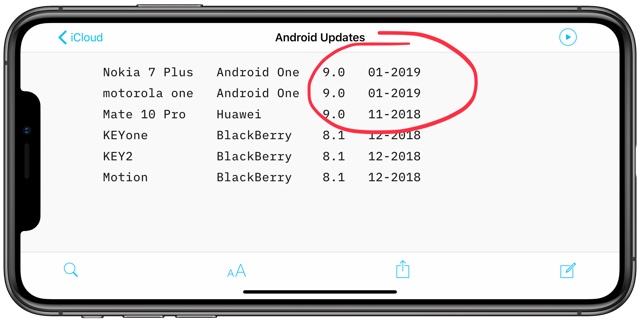
Nokia macht weiter alles richtig. Moto one zieht mit. Android One ist die richtige Idee. Und Huawei hat die falsche mit ihrem EMUI.

24 Jan 19:14

Waterloo-based North starts shipping Focals AR glasses to customers

by Patrick O'Rourke

Waterloo, Ontario-based North has started shipping its Focals augmented reality (AR) glasses to customers, says the company.

North’s custom-made AR glasses, which are fit specifically for each customer, are manufactured at North’s Waterloo facility. North says Focals can be picked up at either the company’s Toronto or Brooklyn showroom. During the pick-up process final fit adjustments are made, says North.

The company has plans to open more mobile pop-up shops in cities “across North America” starting in April. It’s unclear what specific cities North plans to open these pop-up shops in.

“Last year we approached the smart glasses category with an entirely new concept: smart glasses that look awesome. It’s been incredible to see how this approach has resonated with our customers, and I’ve personally loved watching everyone share their experiences at our Showrooms,” said Stephen Lake, CEO and co-founder of North.

“Today is a big day for us as we put the first Focals in the hands of customers. I can’t wait to bring that experience to even more people through our new Mobile Pop-Ups.”

I spent a brief amount of time testing out North’s Focals at CES 2019 in Las Vega, Nevada and walked away impressed with the AR glasses. That said, I still question if the notification-focused AR glasses will find an audience.

North currently offers two Focals optician locations: one in Brooklyn, New York and one in Toronto, Ontario. The glasses are priced at $999 USD (roughly $1,322 CAD).

The post Waterloo-based North starts shipping Focals AR glasses to customers appeared first on MobileSyrup.

24 Jan 19:13

Vivo APEX 2019 Is a 5G Concept Phone Featuring Glass Design, 12GB RAM, and Full-Display Fingerprint Scanner

by Rajesh Pandey
24 hours after Meizu unveiled the world’s first hole-less smartphone without any physical port, speaker grille, and SIM card slot, Vivo has gone ahead and unveiled the APEX 2019 on similar lines. The APEX 2019 features a Snapdragon 855 chipset, 5G connectivity, and lacks any cutouts for SIM slot, physical buttons and ports, and speaker grille. Continue reading →
24 Jan 19:13

Unclear Asks are Killing your Team

by James Socol

We've all been in a meeting, wondering what the goal was, and why we were invited. Some of us have even gotten up, said something, and left. The truly bold may have suggested ending the entire meeting and reconvening with a plan.

We've also all gotten an email addressed to six or seven people, assumed someone would handle it, and moved on.

I've seen a few people circulating this medium post that blames asynchronous communication like email for wasting time. But the problem is not asynchronous communication, the problem is unclear responsibilities. And it manifests in all sorts of ways beyond email.

There are two facets of this: vague requests and diffuse responsibility.

Vague Requests

To start with the given example, an email to five people on a design team:

Hey there! Wanted to get some quick feedback on this presentation; esp. slide 7. See attached.Thanks so much!

Of these five people, no one knows what the author wants them to do.

  • What is "quick feedback"? Is this 30% feedback where the whole structure up for revision, or 90% feedback where they want a proofreader?
  • When do they need this?
  • Of the five people, how should they divide this? Should the lead designer look at the content while the junior designer punches up the visuals? Do all five need to look at everything?
  • Is this a collaboration, a sign-off, or an FYI?
  • What's the right way to provide feedback? Is it to edit the deck and send it back, provide notes? (NB: using attachments instead of collaborative tools is killing you, too.)

The suggested solution is to lean toward synchronous meetings, in a case like this, preferring to ask one person for a few minutes of sync time. But that's a bandaid over the problem. Synchronous meetings won't save you from deciding and communicating what you need.

Diffuse Responsibility

Asking something of too many people is the same thing as asking no one.

I've seen this happen over and over:

  • Unmanaged mailing lists for inbound communication. Who should answer? What happens if two people answer at the same time, or differently? If there's an action to be taken, who gets assigned to it? (If it's a full-time job to answer these, as in a customer service team, the list is probably managed as a queue and routed to different members somehow.)
  • Undirected requests for code review. Who are the appropriate reviewers? When will they get to it? (Often this means a pull request or patch sits around until someone begs on Slack/IRC, at which point a dogpile of review happens, some of which take too long to be meaningful.)
  • Meetings with a lot of invitees. Why is each person in the room? Can or should I delegate this, and get a summary? What are the agenda and goals?
  • Emails with too many people copied. As in the original example. This one is pernicious because it often comes from upset stakeholders who think someone will answer them, or who are trying to escalate an issue but aren't using the "proper" channel for some reason—e.g. they don't know or don't trust it.

Again, you need to decide and communicate what you need.

Each of these scenarios can be addressed in different ways. The mailing list (I've been on a security@ mailing list with this issue) may need some kind of rotation or schedule. Code reviews should be assigned—not to too many people, each assigned reviewer should need to do the review or ask someone to replace them (GitHub's "suggested reviewer" and "requested reviewer" tools can help with this). Meetings absolutely need agendas. RACI matrices are incredibly powerful tools for making reasons for including people clear.

Panic emails are tricky if they originate outside your team, though you can still communicate expectations and areas of ownership internally that can help.

Asynchronous Communication is Critical

It is worth your time to learn to do asynchronous communication well.

Increasingly, the nature of work is distributed. While sometimes this means across state lines and time zones, it may simply mean the ability to be productive from home with a flexible schedule sometimes. This is an important inclusion issue. If you want to hire senior team members—particularly women who are often disproportionately responsible for childcare—who are more likely to have family obligations than younger people, an hour-long doctor's appointment or parent-teacher conference shouldn't be the difference between a productive day and a wasted one.

Interrupting flow also costs disproportionate amounts of productivity. This is one of the chief complaints about Slack and why I impress on my teams that anyone should feel OK muting and quitting it for a while to get uninterrupted work done.

And if you need a few minutes of someone's time, synchronously or not, there's no reason to demure on the details. "Ping" doesn't get you anything but a "pong," while "hey, who's the right person to talk to about event details?" can get you an answer. Not only does excluding details make people anxious, it prevents them from preparing, even if it's just "ok putting on my feedback hat." Sending an email that says "hey can we chat for 15 minutes about some structural issues I'm having with this presentation?" let's the recipient know what they'll be doing, and compared to "hey can we chat for 15 minutes?" is far less terrifying.

The original post recommends using short, synchronous conversations, but these are effective only insomuch as they are forcing factors to actually do the work. It also recommends, well, doing the work: "Bring clarity to asynchronous asks", "Give every (t)ask a time limit", "Put structure around collaborative editing tools".

If you ask five people to get in a room or video call for 5 minutes (which will take 20) with no clearer question than "hey look at this plz," you'll get no better result. If you clarify your ask, you can still put it in an email.

24 Jan 19:12

Writing, washing dishes, flow, and pleasure

by Josh Bernoff

I have a confession to make. I really enjoy doing the dishes. (And yes, this has something to do with writing advice.) At my house, it is my wife’s job to cook and my job to do the dishes. This is good, because she is an excellent cook and I am terrible. She could do … Continued

The post Writing, washing dishes, flow, and pleasure appeared first on without bullshit.

24 Jan 04:46

Apple's Content Distribution Strategy

by Neil Cybart

This past November, Amazon sent shockwaves across a number of industries by announcing Apple Music would be available on Echo devices. Earlier this month, Samsung announced Apple was bringing iTunes content to Samsung TVs. Apple also expanded AirPlay 2 support to include a wide range of high-end television sets. These announcements don’t represent some type of cultural shift away from hardware for Apple. Instead, the moves are part of Apple’s strategy to leverage its user base in an effort to establish one of the more formidable content distribution arms in existence.

Content Distribution

Apple has long held an interest in being the one to deliver content to its growing base of users and devices rather than leave content distribution to someone else. Apple’s content distribution arm delivers a variety of genres, listed below, to hundreds of millions of users and more than a billion devices.

  • Music

  • TV Shows / Movies

  • Apps

  • Podcasts

  • News

  • Magazines

  • Books

Apple has seen varying degrees of success when it comes to distributing content. With iTunes, Apple took advantage of the Mac’s low market share by getting the music industry to test a radical idea at the time: selling digital music online. iTunes ended up playing a big role in moving the music industry from albums to singles.

After years of strong growth, App Store revenue was approximately $45B in 2018. Apple has been a leader in the podcast space from the beginning. Written content distribution has proven to be trickier for Apple although the company has recently seen strong momentum when it comes to offering curated news to users in the U.S., Australia, and the U.K.

What Has Changed?

The landscape facing Apple’s content distribution arm is undergoing significant transformation.

Online streaming has taken over the music industry. The iTunes era of paid downloads is over as the idea of owning music is quickly becoming a thing of the past. Renting has become the preferred method of consuming music. The shifting landscape played a major role in Apple’s decision to buy Beats back in 2014.

According to the Recording Industry Association of America (RIAA), streaming now accounts for an astounding 75% of the U.S. music industry’s revenue. Digital downloads account for just 12%, slightly ahead of the 10% attributed to physical sales. In the U.S., approximately 50M people are paying a monthly subscription to consume as much music as they want. Globally, the total number of paid music subscriptions exceeds 200M. Apple Music has approximately 60M paying subscribers.

Turning to video, direct-to-consumer distribution has turned the industry on its head. Instead of the big cable bundle imploding, new, lower-cost video bundles such as Netflix and Hulu have exploded in popularity. These revised content bundles have the content people want to see, in addition to the distribution method that people want to use. More than 200M people pay a monthly subscription to consume video through these newer bundles. This number will continue to increase as notable names, including Disney, are about to enter the direct-to-consumer space.

One of the more interesting implications found with this new digital content landscape is how scale has been redefined. Success is no longer measured in the tens of millions of users like it was in the iTunes era. Instead, scale is measured in the hundreds of millions of users.

Spotify is the largest paid music streaming service while Netflix is the largest video streaming service. Amazon has seen the most success in the area of bundling access to content. Meanwhile, YouTube remains the behemoth in the ad-supported realm. Localized offerings in a number of emerging markets have also been able to capitalize on music and video streaming to develop compelling solutions, although few have seen success beyond their home territory.

The Strategy

Considering how Apple has approximately a billion users in its ecosystem, the company would appear to have enough customers to sustain a thriving content distribution arm. Such a strategy would involve Apple keeping its content distribution services exclusive to Apple hardware. However, upon closer examination, there is one complicating factor in such a strategy.

According to Tim Cook, there are 1.4 billion Apple devices in the wild. Given the number of Apple users, Cook’s disclosure means that at least 60% of Apple’s user base own just one Apple device. For hundreds of millions of people, the iPhone is likely that Apple device. This changes the dynamic facing Apple’s content distribution strategy.

Apple users are not monolithic when it comes to gadget buying. Instead of exclusively using Apple hardware, a majority of Apple users also own devices from other platforms such as Samsung Smart TVs and Amazon Echo speakers. Apple’s design-led culture and product development process ensure that there will always be product categories, such as TV sets and low-end stationary speakers, that Apple chooses not to play in or compete with.

With that in mind, Apple’s content strategy is as follows:

  1. Develop content distribution platforms.

  2. Give content distribution platforms the best chance of success by leveraging the user base and allowing certain content genres to be consumed on non-Apple hardware.

  3. Provide first-party hardware solutions targeting users who are looking for the best all-around Apple experience.

In summary, Apple’s user base provides the company optionality when it comes to distributing content. By not keeping some of its digital content distribution services exclusive to its own hardware, Apple reduces the risk of its users turning elsewhere for content.

Odds are good that a decent portion of Echo speaker owners also use iPhones. Given how the predominant use case found with stationary speakers is listening to music, these users may have been tempted to try Spotify or Amazon Music. By bringing Apple Music to Echo devices, Apple is able to leverage its existing customer relationships in order to improve Apple Music adoption. The same principle applies to letting Apple users send content played on an iPhone, iPad, or Mac to non-Apple speakers or television sets via AirPlay 2.

Another assumption underpinning Apple’s content strategy is that a portion of the Apple user base will gravitate towards premium content consumption experiences. Apple has the opportunity to sell these first-party solutions, such as Apple TV and HomePod, to users willing to pay for the best all-around Apple experience.

Misconceptions

There has been much confusion in the press as to Apple’s content distribution strategy.

  1. Apple is said to be deemphasizing hardware in order to grow services revenue.

  2. Apple’s decision to bring Apple Music to Echo has been compared to bringing iTunes to Zune music players.

  3. Apple is said to be no longer fully behind products like Apple TV and HomePod.

The preceding theories are off the mark.

A strategy characterized by Apple prioritizing services over hardware would revolve around Apple selling a $29 Apple TV dongle or a $29 HomePod mini speaker. Apple hardware’s function and value proposition would be altered to promote non-hardware Apple products. Neither device is likely to materialize as Apple isn’t prioritizing services over hardware. Instead, Apple is selling an Apple TV box priced at a 20% premium to a 32-inch TCL TV with Roku built-in. One HomePod goes for the same price as 12 Amazon Echo Dots or Google Home Minis.

When it comes to comparing Apple’s current strategy with that of iPod / iTunes, Apple didn’t have an ecosystem containing a billion users and 1.4 billion devices in the early-to-mid 2000s. Making iTunes available on other MP3 players, like Microsoft’s Zune, would have done little to improve iTunes or Apple’s broader ecosystem. The opposite is true today. Making certain content distribution platforms available on non-Apple hardware can help improve the service in question, which ends up adding value back to Apple hardware. In addition, Apple now has the ecosystem to not only target premium accessories to a segment of the user base, but also appeal to other users by bringing certain content distribution platforms to non-Apple hardware. A similar situation did not exist in the 2000s.

Speaking of premium accessories, Apple TV and HomePod are misunderstood products. The products are high-end accessories tasked with offering Apple users the best all-around experiences for consuming video content and listening to music, respectively. Making Apple Music or video available on other platforms does not change that dynamic. HomePod doesn’t have a weaker value proposition because Apple Music is available on a $29 Echo Dot. Apple TV is not kneecapped because AirPlay 2 support is available on a Sony TV set.

Motivation

Apple sees a massive opportunity in content distribution. There is a glaring weak point found in music and video streaming: brutal economics. Both Spotify and Netflix have business models in search of sustainability.

Spotify’s most likely path to sustainability boils down to amassing so many listeners that the balance of power begins to tilt towards Spotify and away from content providers. Either Spotify has to pay less for music, or the company will make a big move into original content.

Meanwhile, Netflix’s business model is based on a feedback loop that is consuming increasing amounts of cash. The move into original content is not proving to be a financial panacea either. Netflix clearly needs significant subscription price hikes over time, and the only way to guarantee those price hikes will stick is to continue ramping up content spending in order to sustain engagement.

Given Apple’s business model, the company doesn’t have to worry about such sustainability issues. Instead of releasing low-margin hardware that boils down to being nothing more than service conduits, Apple can use third-party hardware as Trojan horses for its own content distribution arm. This can be accomplished either by partnering with a company like Amazon to have Apple Music available on Echo devices or by expanding AirPlay 2 support to include a wide range of speakers and TV sets. AirPlay is a brilliant way of ensuring that an Apple product remains at the center of people’s lives.

Dedicated music and video streaming players will have to eventually prioritize profit and revenue. However, Apple has the luxury of not having profit be the motivating factor behind its content distribution arm. Instead, Apple is going for power. A few calculations prove this point. With Apple Music, 100M users paying an average of $7 per month would bring in $8B of revenue per year. Assuming 75% of that revenue goes back to music rights holders, Apple’s gross profit would be approximately $2B per year, or just 2% of Apple’s overall gross profit. Video streaming economics may end up being even less attractive from a cash flow perspective. Instead, Apple would be looking more at improving each service by grabbing scale and gaining influence and power in Hollywood.

Goals

Here are some of Apple’s specific goals for its content distribution arm:

Apple Music

  1. Grab enough users to position Apple Music as a legitimate alternative to Spotify and Amazon Music. From Apple’s perspective, scale in music distribution has gone from being a liability during the iTunes era to being the key to success with Apple Music. The decision to bring Apple Music to Echo speakers is a clear attempt to limit Amazon Music and Spotify adoption, especially among Apple users.

  2. Work more closely with the labels. By positioning Apple Music as an alternative to Spotify for the music labels, Apple is in a position to gain back the incredible amount of power it once had with the iTunes empire.

  3. Capitalize on the changing way music is consumed by investing in better A&R capabilities. Playlists are gaining power in the realm of talent discovery. Capitalizing on improved ways to find new talent stands to improve Apple Music playlists and Apple’s relationships with music rights holders.

Apple Video

  1. Convince third-party content creators to embrace the TV app. The key metric to watch in video streaming will be engagement. Accordingly, to have people spend an increasing amount of time in the TV app, Apple will look to establish a platform from which users can access various video bundles. This strategy resembles more of Amazon’s video playbook instead of Netflix’s. The idea underpinning this strategy is that video streaming won’t be a winner-take-all market, or even a winner-takes-most market.

  2. Use original content to elevate the TV app. Since one form of differentiation in video streaming is great storytelling, Apple has been focused on developing its own slate of original programming. One thing Apple can do to stand out from Amazon is make its initial slate of original programming free for TV app users. The idea behind such a move is to get people using the TV app, which will then increase the odds of people singing up and paying for third-party video bundles through the TV app.

Bundling. There is an opportunity for Apple to bundle various content genres into one monthly payment. Music and video make the most sense for a bundle although news and magazines are doable as well.

Experiences. Apple is one of the few companies to have a diverse content distribution arm in addition to more than a billion customers and devices. This gives the company a unique advantage when it comes to fostering customer relationships. In addition, Apple can offer premium experiences to those in the Apple ecosystem by having its content distribution arm work seamlessly with entirely new hardware form factors.

Challenges

Apple faces various challenges in its pursuit of establishing one of the more formidable content distribution arms in existence. The most difficult task is found with video streaming. There is about to be a brutal war in video streaming as a handful of companies with deep pockets begin to compete with Netflix. We haven’t yet seen genuine competition in the paid video streaming space. In a scenario where there are only one or two all-powerful streaming services, Apple will find itself at a bigger disadvantage. On the flip side, greater competition could prove to be a benefit to Apple if it means other streaming services will want to work with the company and its TV app.

With music, Apple appears to be going back to basics and fighting for every user whether it’s through bundling deals with mobile carriers or keeping existing users as users. It appears to be working. Apple is proving to be a formidable challenger to Spotify despite many having already declared Spotify to be untouchable years ago. In addition, by maintaining good relationships with a handful of labels, Apple has access to tens of millions of songs. The entire dynamic is easier for Apple to manage.

In terms of written content, Apple is in a good position when it comes to relying on human curation to surface content. However, there are questions regarding scalability and just how effective Apple can be in convincing publishers to get behind such efforts.

Big Picture

It is not too late for Apple to compete effectively in music and video streaming. Meanwhile, the turmoil found in distributing and consuming written content through traditional social media vehicles is still in the early innings. This will give Apple its best chance of finally cracking written content distribution.

Despite slowing unit sales, the iPhone continues to fuel growth in the user base. Meanwhile, wearables are boosting the number of Apple devices in the installed base. Not only are these positive developments when it comes to strengthening the Apple ecosystem, but they also increase the number of people in a position to rely on Apple for content.

With a pair of smart glasses not quite ready to be unveiled, now is the time for Apple to dedicate precious time and resources to strengthening its content distribution arm.

Receive my analysis and perspective on Apple throughout the week via exclusive daily updates (2-3 stories per day, 10-12 stories per week). Available to Above Avalon members. To sign up and for more information on membership, visit the membership page.

24 Jan 04:46

Honda teases new EV prototype car based on Urban EV concept

by Brad Bennett

Honda’s newest EV prototype is a super cute car that looks like it might be a hatchback.

So far Honda has only shared a single image of the car, but we know that it’s based on the futuristic-looking Urban EV concept that was shown off at the 2017 Frankfurt motor show.

When Honda announced the Urban EV in 2017, it said that the car was aimed at the European market. So it’s unlikely that it will come to Canada when it is released.

In my opinion, the prototype image that’s being shared around doesn’t look as cool as the original Urban Concept EV. It looks slimmer and appears to have lost its sporty stance and simplicity that made it stand out at the Frankfurt show.

CNET reports that the car will be available to buy sometime later in the year, but it likely won’t make its way to North America.

Honda is going to share more information at the 2019 Geneva International Motor Show in March of 2019, according to Motor Authority. 

Source: CNET, Motor Authority

The post Honda teases new EV prototype car based on Urban EV concept appeared first on MobileSyrup.

24 Jan 04:45

Twitter Favorites: [jen_keesmaat] Good data on the myth of the childless city. We undertook due diligence in Toronto and discovered a mini-baby boom… https://t.co/zaQutAoZQH

Jennifer Keesmaat @jen_keesmaat
Good data on the myth of the childless city. We undertook due diligence in Toronto and discovered a mini-baby boom… twitter.com/i/web/status/1…
24 Jan 04:44

Wayward Crows

by peter@rukavina.net (Peter Rukavina)

There’s a bug in Charlottetown’s crow population operating system that’s caused hundreds of birds to congregate in our back yard. It’s very weird. See also The Crow Agenda.

24 Jan 04:43

Chrome will prevent any ad blockers that aren't AdBlock Plus

by jwz
mkalus shared this story from jwz:
I left Chrome behind two years ago. It’s now either Safari or Firefox. Not really missing it (though some of the plugins were nice).

Which, coincidentally, allows advertisers to buy immunity from your desire to block them:

A new version of Chrome that will be released later this year will break a number of ad blockers according to a new bug report submitted Tuesday by Raymond Hill, the maintainer of the popular ad blocking service uBlock Origin. [...]

Instead, ad blockers will have to rely on an API called "declarativeNetRequest" which requires them to specify which types of network requests from ads they should block in advance, rather than allowing the dynamic blocking capabilities found in uBlock. The difference is like if you were charged with protecting a house, but could only pick a few of doors to protect in advance and hope your adversary chose those doors, rather than being able to move through the house and choose which doors to protect based on the ones an adversary was actually attacking.

This API was styled on the way that AdBlocker Plus blocks ads, which is far less robust than uBlock Origin. (Not to mention that AdBlock Plus also allows companies to pay to have their ads whitelisted, regardless of user preferences).

24 Jan 04:43

Uber and Lyft are Increasing Traffic Deaths – Streetsblog USA

mkalus shared this story from Streetsblog USA.

Uber and Lyft are not just increasing congestion and hurting transit, they are literally killing us.

A new study [PDF] from the Booth School at the University of Chicago estimates Uber and Lyft have increased traffic deaths by 2-3 percent nationally. That’s as many as 1,100 additional deaths a year — a small, but significant contribution to the increase in traffic deaths in the U.S. since 2011, the authors say.

Uber and Lyft have tried to market themselves as green companies that can help solve urban transportation problems, but the evidence keeps piling up that they are making many problems worse.

This new study backs up previous findings that Uber and Lyft have cannibalized transit trips and increased driving. The study found that cities with high adoption of Uber and Lyft had 3 percent more total miles driven daily on average than cities with low adoption. The effect was even bigger in larger cities and cities that had high rates of transit ridership. And more miles mean more deaths.

“”We need to think of the wholistic costs and benefits,” lead author John Barrios told Streetsblog. “We can’t just focus on the benefits and ignore the costs.”

The costs are significant: Cities with high Uber and Lyft usage had more pedestrian deaths, more traffic deaths at night, more traffic deaths on weekends and more traffic deaths overall than the trend would have predicted, compared to other cities. Even drunk driving deaths were essentially unchanged by the presence of Uber and Lyft, Barrios and his team found.

On total car ownership, more bad news. Cities with high Uber and Lyft activity actually had 3 percent higher new vehicle registrations (see this for New York City’s experience). Uber and Lyft might discourage car ownership among some higher-income riders, but app-based taxis seem to induce more car buying among lower-income people that work as drivers, Barrios found.

As Streetsblog reported, Uber and Lyft increase congestion partly because drivers spend 40 to 60 percent  of their time circling without passengers, also known as “deadheading.” Barrios and his team said, Uber and Lyft’s policies make the problem worse.

“Rideshare companies often subsidize drivers to stay on the road even when utilization is low, to ensure that supply is quickly available,” they wrote.

In addition, drivers for Uber and Lyft receive little training and are relatively inexperienced compared to the taxi drivers they replaced. And the companies perform little quality control compared to other commercial drivers.

Edna Umeh, a school crossing guard, was killed in November in suburban Atlanta when she was struck at 51 miles per hour — about twice the speed limit — by a Uber driver. The driver, Lamonte Whitaker, said he had fallen asleep at the wheel.

Uber has been slow to impose limits on drowsy driving that apply to other commercial drivers. Just this year, it imposed a rule that drivers must take a six-hour break after driving for 12 hours straight, a much weaker standard than the federal government requires for most commercial drivers.

A spokesperson for Lyft called the study “deeply flawed” in a statement. “Numerous studies have shown that rideshare has reduced DUIs, provided safe transportation in areas underserved by other options, and dramatically improved mobility in cities.”

But Barrios said the other studies that showed Uber and Lyft reduce DUIs did not properly control for the fact that DUIs had already begun to decline before ride-hailing apps were introduced.

23 Jan 20:56

Pixelmator Pro Updated with New Layers Features

by John Voorhees

Today the Pixelmator team released a layers-focused update to Pixelmator Pro, their Mac image editor.

The update allows users to add any of seven colored tags to a layer to help identify them. The feature also supports Adobe PSD color tags on import and export.

To make navigating projects with lots of layers easier, users can now filter layers based on several criteria including the new color tags, images, shapes, text, RAW, and groups. At the bottom of the layers sidebar, there is also a search field for locating layers by name.

Pixelmator Pro 1.3 supports clipping masks too. The feature allows users to apply the contents of one layer to the shape of another layer or group of layers. Clipping masks can be created from text, shapes, groups of layers, or nested shapes.

Finally, you can also adjust a layer’s opacity and blending mode using the controls at the bottom of the layers sidebar. Adjustments made are previewed live in the app’s main window.

Pixelmator Pro is available on the Mac App Store.


Support MacStories Directly

Club MacStories offers exclusive access to extra MacStories content, delivered every week; it's also a way to support us directly.

Club MacStories will help you discover the best apps for your devices and get the most out of your iPhone, iPad, and Mac. Plus, it's made in Italy.

Join Now
23 Jan 20:55

“Just because it’s bonkers doesn’t mean it’s a bad idea.”

by Andrea

Have you ever heard of The Biggest Little Railway in the World? It was

“a temporary 71 mile (114 km) 1.25 inches (32 mm) O-gauge model railway from Fort William to the City of Inverness, the two largest settlements in the Scottish Highlands. It has been described as a crackpot project to run a model train the length of the Great Glen Way by an army of madcap enthusiasts, geeks, and engineers in the best spirit of eccentric Britishness.”

56 volunteers built it over the course of 12 days and also drove the engine called Silver Lady along it. The track included a temporary bridge across the Caledonian Canal, a huge trestle bridge and a spiral loop near the end that enabled the train to climb five metres over a very short distance.

The model train achieved what the real railway didn’t: It ran from Fort Williams to Inverness.

There is a five-part Channel 4 TV series about this incredible project that you can watch in its entirety here:

Futility Closet: Thinking Big. (5 x 45min)

I watched it over the past few days and enjoyed it thoroughly even though I’m neither a train nor model train enthusiast.

23 Jan 20:43

Meizu Zero lacks a charging port, speaker holes and SIM card slot

by Dean Daley

Meizu, a Chinese smartphone manufacturer, has unveiled its latest device, the Meizu Zero. The Zero is the first ever smartphone to completely lack any ports and buttons. As a result, it doesn’t have a headphone jack, speaker holes, volume rocker and SIM card slot. It’s even missing a charging port.

Meizu replaced the speaker grill and earpiece with its ‘mSound 2.0’ technology that allows sound to resonate from the display. Moreover, instead of a traditional volume rocker and power button, the phone sports virtual side buttons with advanced haptic feedback.

Additionally, the Meizu Zero features 18W wireless charging, eSIM technology and wireless USB connectivity. The handset also sports an in-display fingerprint scanner.

That said, it seems Meizu couldn’t figure outa way to make the Zero completely seamless. The handset has two pinholes on the bottom. One is a microphone, while the other is for hard resets.

The Meizu Zero also has an IP68 water and dust-resistance rating. The ceramic unibody design features a dual camera setup on the rear with 20-megapixel and 12-megapixel sensors. On the front, the phone features a single 20-megapixel sensor.

The Zero also has a 5.99-inch QHD OLED screen with S9-like bottom and top bezels and a Snapdragon 845 processor.

Meizu hasn’t announced all of the handset’s tech specifications nor has it mentioned the phone’s pricing. Meizu doesn’t officially sell its smartphones in Canada, however, so don’t expect Candian availability.

Vivo will announce its hole-less, port-less device tomorrow, January 24th.

Source: Meizu, Via: Engadget 

The post Meizu Zero lacks a charging port, speaker holes and SIM card slot appeared first on MobileSyrup.

23 Jan 20:43

Shaw is Canada’s second-fastest ISP according to latest Speedtest.net numbers

by Sameer Chhabra
An image showing the results of a Speedtest

Calgary-based regional service provider Shaw reportedly doubled its broadband internet speeds overnight, improving Canada’s global Speedtest rank from 16th place in November 2018 to seventh place in December 2018.

According to a January 23rd, 2019 Speedtest.net blog post, Shaw’s improved internet speeds increased the country’s average download speed from 91.05Mbps to 108.75Mbps almost overnight.

Shaw’s improved broadband internet also moved the internet service provider (ISP) from third-place to second-place nationally.

According to Speedtest.net’s December 2018 numbers, Toronto-based Rogers still offers the fastest broadband internet download speeds in Canada, averaging 146.08Mbps in December 2018.

Shaw provided subscribers with average download speeds of 136.71Mbps, improving from the 82.78Mbps download speeds it offered in November 2018.

Shaw’s improved performance meant that Montreal-based Bell moved from second-place to third-place, offering subscribers average download speeds of 103.33Mbps.

Vancouver-based ISP Telus — which only offers broadband internet in Alberta and British Columbia — is the country’s fourth-fastest service provider, offering average download speeds of 69.59Mbps.

Quebec-based Videotron maintained its fifth-place position, with average download speeds of 59.30Mbps.

Speedtest.net reported that Calgary residents have access to the fastest download speeds in the country, thanks to Shaw averaging speeds of 143.66Mbps.

Winnipeggers enjoyed the second-fastest download speeds in December 2018, thanks to Shaw’s 138.20Mbps average in the city.

Prior to December 2018, Rogers subscribers in London, Ontario boasted the fastest internet download speeds in Canada. However, Speedtest.net reported that Londoners with Rogers averaged downloads of 121.18Mbps.

Source: Speedtest.net

The post Shaw is Canada’s second-fastest ISP according to latest Speedtest.net numbers appeared first on MobileSyrup.

23 Jan 19:43

Anna Machin writes in Aeon about why only human...

Anna Machin writes in Aeon about why only humans have involved and empathetic fathers.

…given the parsimonious nature of evolution, human fatherhood – with its complex anatomical, neural, physiological and behavioural changes – would not have emerged unless the investment that fathers make in their children is vital for the survival of our species.

Rough and tumble play between dads and kids serves a purpose, it turns out. Now, I just have to make sure to be in good enough shape as I get old to keep it up with my son.

23 Jan 19:43

How to Start a Membership Club for your Loyal Customers

by Samantha Lloyd

When you operate a business, whether a small shop or a large franchise, you know how important your customers are to your success. You do your best to ensure your customer satisfaction is always high and that they’re having positive experiences in your locations. Even when customers are happy with their experience, 60-80% may not return to you. A loyalty-membership-rewards-perks club (or whatever you want to call it!) is a great way to combat this statistic and keep customers coming back to you. You can offer freebies, promotions, and discounts to members. No matter which angle you decide to pursue for your loyalty program, it will help you with return conversion rates – and return customers are prone to spending 67% more than new customers. Your current customers are definitely worth the investment into a rewards club.

.

Every type of company can benefit from a rewards membership club for their customers!

Food Services

Whatever type of food or beverages you offer, you know that your customers tend to stick to what they know and like and that they’ll come back for more. Offering a simple club app, card, or stamp-able coupon that tracks purchases as they work their way towards a free anything (coffee, sandwich, pastry item) is a great way to reward your customers that frequent your shops the most.

Retail Stores

Whether you’re a small business or a large corporation, there are ways to provide sample size products to your customers for free.. Reach out to companies related to your brand (local artisans, too!) and see if they would be willing to provide free or inexpensive samples of their products. Offer these products to your rewards club member customers as a way to incentivize sign ups. This not only introduces your customers to new products but could give you an idea of the type of items customers are looking for so you can stock your shelves accordingly.

Small Business

When you’re a small business, you can often feel like you give enough away for free or at heavy discounts to simply drag customers away from the big guys. A rewards program does not have to run you dry. Use the rewards program as a way to upgrade or give access to additional products. For example, your customer could have the ability to buy certain products that aren’t offered to non-members and can be a way to incentivize people to join your club. If you sell makeup, offer a monthly lipstick colour that only your rewards program members can buy.

How to Drive Sign Ups to your Membership Club

Club membership rewards are all about getting your customer base to want to be a part of your business’s program. In brick-and-mortar or ecommerce, you need to drive sign ups. There are a few ways to pique interest and monitor the success of these.

Grab sign ups in-person. At the register, ask people to sign up for the membership rewards and have something available to incentivize them right there.
Encourage sign ups via email. In your email campaigns, share the limited access or the special offers that membership club customers receive.
Put your perks on a microsite. Build a microsite all about your perks program. Hover offers the .CLUB domain name, which would be perfect for your microsite! If a microsite isn’t necessary for this endeavour, simply create a landing page dedicated to your brand’s loyalty program that you can link out to in advertisements.
Share about the perks on social. Whether your customers are posting about their freebies or you want to brag about the membership offerings, share it on social. Make sure to have a custom hashtag like #yourbrandsclubperks.
See what works. If people are clicking through on your email, liking your social posts, and visiting the microsite, yet they’re not signing up for your program, it’s time to do some better research. If you haven’t already (and you definitely should have!) ask your customers about what perks matter most to them and what they would like to receive from your brand.

Incentivizing loyalty is a great way to maintain your customer base. If your customer knows they’ll work their way up to a free breakfast sandwich if they visit your coffee shop on the way to the office, as opposed to your many competitors, then they will be more keen to choose you. Get your customers involved in your membership club and give them the perks they deserve!

Did you like the idea of grabbing your brand a .CLUB domain name for your loyalty program landing page? Then you’ll love this offer! The .CLUB domain name is on sale for September 2019. Get yours for 65% off – only $4.99 (USD + applicable taxes).

23 Jan 19:43

James O'Brien On Dyson Moving To A Country Which Has EU Trade Deal

by Original Jedi Watching
mkalus shared this story from Original Jedi Watching's YouTube Videos.

From: Original Jedi Watching
Duration: 01:40

James O'Brien On Dyson Moving To A Country Which Has EU Trade Deal. James O'Brien insists there is no upside to Brexit backer James Dyson moving his company to a country which has a free-trade agreement with the European Union. The manufacturer, based known for their vacuum cleaners, has decided to register his business in Singapore, despite his previous claims that Brexit would be good for business in the UK. Back in 2017, James spoke of why he felt you shouldn't trust James Dyson on Brexit. And speaking after Sir James moved his business, the presenter said: "By all means, pretend that the fact that at the moment only two senior personnel are moving there, pretend that somehow undermines the fact that the bloke who said Brexit would be good for British business has moved his business out of Britain. "There's no getting past that. I'm so sorry, don't shoot the messenger. "He said Brexit would be brilliant for British business and as Brexit looms, he's moved his business out of Britain. There's no upside to that. It was supposed to be better afterwards than it was before and he is not going to be here. "Dyson as a commercial entity is going to be registered and based in a country that has a free-trade agreement with the European Union that James Dyson told you we should leave in order to boost British business. "There's nothing there that allows for retrospective engineering. There just isn't." Uk Politics World News GE2018 Brexit G20 OJW Donations Welcome. https://www.paypal.com/cgi-bin/webscr?cmd=_s-xclick&hosted_button_id=DPK4PYVL8ZSZN

23 Jan 19:43

RT @JimMFelton: Actions, meet consequences. pic.twitter.com/hLUjYRqx5s

by JimMFelton
mkalus shared this story from iandunt on Twitter.

Actions, meet consequences. pic.twitter.com/hLUjYRqx5s


Posted by JimMFelton on Wednesday, January 23rd, 2019 1:08pm
Retweeted by IanDunt on Wednesday, January 23rd, 2019 3:26pm


767 likes, 280 retweets
23 Jan 19:42

Randonneuring 101

by noreply@blogger.com (VeloOrange)
By Scott

Randoneuring is a great way to get out and see new places and meet new people. We thought with the rando season either underway (you folks in So Cal are lucky in that regard) or about to commence, a brief primer on what is randonneuring would be appropriate.

We'll start out by saying that the best resource for randonneuring (if you are reading this in the USA) is RUSA. They are governing body for randonneuring in the US and have links to all the clubs who run rides around the US.  If you're outside the US, a quick google search will land you the name and contact details for the organizing group in your area.

So, now that we have that out of the way, what is randonneuring? I'd go with an organized ride of a distance equal to or greater then 200 km (125 miles) along a set route with a series of check points (controls) along the way. Time limits exist for the rides. A 200 km ride has a limit of 13 1/2 hours to complete it, which works out to an average speed of 15 km/h. As the distance goes up, the time limit does as well.

Rides start with Populaires - typically a 100 km (62 mile) event with one or two check points/controls to introduce cyclists to the principles of randonneuring.
Brevets are the traditional distances of 200 km, 300, 400, 600 for a series. Complete all four rides in one season and you get a lovely medal from France. Brevets also include longer events of 1000 km and 1200 km's all the way up to mega distance events like the Around Hokkido event in Japan that is 2400 km long! (If you want to know how to pronounce a word in the randonneur lexicon, just pretend to be Inspector Clouseau from the Pink Panther movies)

(Part way through the Inaugural Cascade 1200 in WA state in 2005)

Every fourth year is the grand daddy/momma of randonneuring events, Paris-Brest-Paris. PBP is a 1200 km event that attracts entrants from all over the world. At one point, PBP was professional road race, but transitioned in the 60's to a randonneur event. Lots of randonneurs plan their year(s) out in order to take part in this great event. I've never managed to get to France for PBP due to a variety of factors, but I certainly know lots of riders who have entered and all come away with a great deal of respect for the distance and an affinity for the French people who line the route during the event to cheer them on even in the middle of the night.

Randonneuring also has a team event called the Fleche (arrow in French). Teams of riders - at least 3, but no more then 5 bicycles - ride a route of their own choosing over a 24 hour period, with all the different teams arriving in the same end location, typically for a breakfast together. The ability to create your own route and the communal finish spot is one of the aspects of the Fleche that makes it very popular amongst riders.

The key with randonneuring events is that they are not races. There is no prize for the first finisher and everyone gets the same medal or pin celebrating the completion of that distance. The BC Randonneurs that I rode with for many years had new pins every year that celebrated various aspects of cycling or the Province. So there is a camaraderie between riders on brevets that would not exist in a racing situation. All the riders are the in same boat when it comes to the weather and the terrain and lots of riders work with other riders to overcome the issues of day and complete the event.


One of the tenents of randonneuring is self reliance. Riders are on their own to deal with punctures or issues with their bikes. A solid, reliable bike is valued by many over a fragile, ultra light weight bike. Also, riders must at some point during rides like the 300, 400, or 600 km events deal with riding in the dark. There is lighting and reflective requirements set down by RUSA and other governing bodies, but riders must come up with their own way to see the road as well as the route sheet that they navigate by.
(Scott's old rando bike during the Endless Mountains 1240 in PA in 2009)

So if this sort of event appeals to you, get in touch with RUSA or your local group and try out randonneuring this year. Has anyone already made plans for attending PBP this year? Let us know in the comments and come August we'll be dot watching the event and cheering you on.


23 Jan 19:41

The Great Google Hangouts Shutdown begins October 2019

Ron Amadeo, Ars Technica, Jan 23, 2019
Icon

In an announcement yesterday Google laid out the timeframe for shutting down Google Hangouts. To be clear, what's being shut down is the chat system. "Hangouts—which Google has recently retconned to 'Hangouts Classic'—is Google's most popular messaging app of all time. Ars Technica reports, "Hangouts Classic (the popular one) is shutting down. Today, Google announced the shutdown begins October 2019, when the company says it will 'start retiring' Hangouts Classic for GSuite customers. When, precisely, the shutdown happens for consumers is still up in the air." Meanwhile, according to the announcement, "Later this year, we'll transition classic Hangouts users on G Suite domains to Chat and Meet. As a first step, some changes are coming on April 16, 2019."

Web: [Direct Link] [This Post]
23 Jan 19:41

Those Mid Block Crossings~Did “Jaywalkers” Have it Right?

by Sandy James Planner
mkalus shared this story from Price Tags.

pedestrians-crossing-refugepedestrians-crossing-refuge

Let’s take a fresh look at that old fish tale about pedestrians not crossing a street midblock. Think about it~why are we insisting that pedestrians cross at corners? Is that not specifically to treat pedestrians and other vulnerable road users just like vehicular traffic and force them to behave as such, waiting their turn at an intersection?

There is a sad reality on  our fatality statistics in Metro Vancouver and basically anywhere on pedestrian crashes. You will find that the majority of fatalities are pedestrians over fifty years of age, mostly men, that are crossing at intersections WITH the  walk light. And how are pedestrians getting injured and  dying? It appears that the majority of crashes seem to occur with drivers  turning left through the intersection when the pedestrian has right of way.

This article by ggwash.org is worth revisiting~author Ben Ross who wrote Dead End: Suburban Sprawl and the Rebirth of American Urbanism asks why we insist that pedestrians cross at intersections, suggesting that “careful jaywalking” saves lives. Ross observes that while there are “no definitive studies”,  statistical evidence collected from New York’s Vision Zero program can show the way.

That city, where residents routinely ignore signals when they cross streets, can be thought of as a natural experiment. The majority of pedestrian deaths, and a far larger majority of non-fatal crashes, occur while crossing the street legally in a crosswalk.”

The reason of course is that drivers hit pedestrians when they are turning their vehicles, and the constantly changing traffic lights “maximize” chances of crashes.

Other researchers, working in places with less foot traffic and fewer striped crosswalks than New York, got results that point in a similar direction. They found that pedestrians crossing big highways are more likely to be struck at marked crosswalks than at unmarked ones. On smaller roads, they found little advantage either way.”

The term “jaywalking” referring to mid-block pedestrian crossings was developed in the 1920’s to free up the street for rapidly moving vehicles. Pesky pedestrians were relegated to intersections that were controlled by engineering traffic standards, with the concept that traffic engineers were better judges of pedestrian safety than the pedestrians themselves.The American  Federal Highway Administration (FHA) striped highway pavements with the assumption that pedestrians are safer crossing at intersections with traffic lights and all kinds of turning movements versus mid block two-way vehicular traffic.

Almost a century has now passed, and our traffic laws are still not geared to safety. As this article by Nate Vander Broek points out a midblock crossing is safer, more visible and direct for pedestrians to cross without having to walk to an intersection.

In the early 1990’s the US Transportation Research Board estimated that nearly 27 percent of all pedestrian accidents were caused by the “midblock dash”. Installing correct midblock pedestrian crossings would mitigate that impact, and the FHA estimates that these crossings are workable at speeds of 30 mph (50 km/h). Mid-block crossings can also be hard to use for visually impaired people, and do require education for drivers to be alert for them.

Is it time to revisit the mid-block pedestrian crossing?

atlanta_joshmelloatlanta_joshmello

Images: Michigancompletestreets.com, NACTO.org


23 Jan 19:40

Ontarians can now drive and own Level 3 autonomous vehicles

by Brad Bennett

Ontario will now allows companies to sell self-driving cars that feature Level 3 autonomous driving capabilities.

Transportation Minister Jeff Yurek announced the change at the University of Waterloo on Tuesday.

The updated regulations will allow for the testing and sales of Level 3 autonomous vehicles. Notably, in its press release, the province says Level 3 autonomous vehicles must be sold in the province before individuals can legally drive them here.

Level 3 autonomy means that the car has ‘conditional automation.’ That is, the vehicle acts like a co-pilot and can manage most safety-critical driving functions, but a driver needs to be ready at all times. Basically, a level three autonomous vehicle is capable of completing tasks like overtaking other vehicles on the highway and transferring onto an off-ramp.

Most self-driving systems, including GM’s Super Cruise and Nissan’s ProPiot Assist, are classified as Level 2 autonomous systems, meaning they can keep a car inside of a lane and control its speed but not much else.

Currently, there aren’t any Level 3 autonomous vehicles that Canadian consumers can buy. However, Audi has said that its upcoming A8 sedan will be one of the first cars to feature the technology. Additionally, Tesla recently added some Level 3-like features via its ‘Navigate on Autopilot’ software update.

The province says it will continue to allow road tests of self-driving vehicles and connected truck platoons as long as there’s a licensed driver behind the wheel at all times.

Source: The Government of Ontario

The post Ontarians can now drive and own Level 3 autonomous vehicles appeared first on MobileSyrup.

23 Jan 19:40

Instagram to reportedly generate $14 billion in revenue for Facebook in 2019

by Bradly Shankar
Instagram app icon

Instagram is expected to generate $14 billion in revenue this year and play a key role in driving Facebook’s growth, according to Jefferies analysts.

“We believe that Instagram is a material driver for growth in ’19 and can grow 60%+ supporting core FB which could decelerate below 20%+ growth for the first time,” the analysts told their clients.

“Instagram continues to drive growth and we think could add an incremental $5B in ’19 to revenue, to north of $14 billion.”

Instagram currently has more than one billion users, which makes it a particularly important asset to Facebook. With this userbase, the analysts said Instagram will continue to improve advertising efforts to benefit “pricing, users and impressions.”

Facebook shares took repeated hits in 2018 as the social media giant was rocked by the long-running privacy scandal with Cambridge Analytica centred around the data breach of around 87 million users. Dozens of other apps have been found to automatically collect data on behalf of Facebook as well.

Via: Business Insider

The post Instagram to reportedly generate $14 billion in revenue for Facebook in 2019 appeared first on MobileSyrup.

23 Jan 19:40

Second-generation AirPods to feature ‘health monitoring features:’ report

by Igor Bonifacic
AirPods

The next-generation of Apple’s AirPods wireless headphones will feature “health monitoring features,” according to Taiwan’s DigiTimes.

The website doesn’t expand on what said health monitoring features will look like.

However, given recent comments from Tim Cook where the executive said Apple plans to launch new health-related services, adding health-focused features to one of the company’s more popular products seems like an obvious move. I should also mention that it was only after Apple leaned into the health-related features of the Apple Watch that the wearable clicked for a lot of people.

According to DigiTimes, Apple will release the second-generation AirPods sometime in the first half of 2019.

As MacRumorsnotes, DigiTimes doesn’t cite any sources when sharing a release date, which suggests the website is likely referring to earlier reports, including one that came from Apple analyst Ming-Chi Kuo. That said, other evidence, including a recent regulatory listing from the Bluetooth Special Interest Group, suggests the new AirPods are on their way to release.

Speaking of Kuo. According to the analyst, Apple is also concurrently working on a third-generation pair of AirPods. Set to come sometime in 2020, the third-generation AirPods reportedly feature a new water-resistant design that will protect the accessory from “splashes of water and rain.”

Source: DigiTimes Via: MacRumors

The post Second-generation AirPods to feature ‘health monitoring features:’ report appeared first on MobileSyrup.

23 Jan 19:40

Galaxy S10 Live images reveal ‘Samsung Blockchain KeyStore’

by Dean Daley

Live images of the unannounced Samsung Galaxy S10 have appeared online.

Concept designer Ben Geskin — who says they received the images from ‘@GregPfister89‘– tweeted out pictures of the Galaxy S10 opened to the device’s ‘Samsung Blockchain KeyStore.’

According to the images, the Samsung Blockchain KeyStore “is a secure and convenient place for your cryptocurrency.” It looks like users will be able to access the page from the ‘Security’ menu in the ‘Settings’ app.

The Blockchain KeyStore appears to be a more secure part of the smartphone that Samsung has designed for those who use cryptocurrency.

We can identify this device as the Samsung Galaxy S10 by its punch-hole camera cutout in the top right corner of the screen. The curved display is also a hint. The S10+ will have an oval-shaped punch-hole, while the rumoured Galaxy S10E will feature a flat display, according to previous leaks.

Samsung will officially show off the Galaxy S10 series at its Unpacked Event on February 20th.

Additional rumours indicate the phone will sport an in-display fingerprint scanner, 6GB of RAM and a Snapdragon 855 processor in Canada and the U.S.

The post Galaxy S10 Live images reveal ‘Samsung Blockchain KeyStore’ appeared first on MobileSyrup.