Shared posts

23 Jan 20:56

The Coral Project is Moving to Vox Media

by Mozilla

Since 2015, the Mozilla Foundation has incubated The Coral Project to support journalism and improve online dialog around the world through privacy-centered, open source software. Originally founded as a two-year collaboration between Mozilla, The New York Times and the Washington Post, it became entirely a Mozilla project in 2017.

Over the past 3.5 years, The Coral Project has developed two software tools, a series of guides and best practices, and grown a community of journalism technologists around the world advancing privacy and better online conversation.

Coral’s first tool, Ask, has been used by journalists in several countries, including the Spotlight team at the Boston Globe, whose series on racism used Ask on seven different occasions, and was a finalist for the Pulitzer Prize in Local Reporting.

The Coral Project’s main tool, the Talk platform, now powers the comments for nearly 50 newsrooms in 11 countries, including The Wall Street Journal, the Washington Post, The Intercept, and the Globe and Mail. The Coral Project has also collaborated with academics and technologists, running events and working with researchers to reduce online harassment and raise the quality of conversation on the decentralized web.

After 3.5 years at Mozilla, the time is right for Coral software to move further into the journalism space, and grow with the support of an organization grounded in that industry. And so, in January, the entire Coral Project team will join Vox Media, a leading media company with deep ties in online community engagement.

Under Vox Media’s stewardship, The Coral Project will receive the backing of a large company with an unrivaled collection of journalists as well as experience in the area of Software as a Service. This combination will help specifically to grow the adoption of Coral’s commenting platform Talk, while continuing as an open source project that respects user privacy.

The Coral Project has built a community of journalists and technologists who care deeply about improving the quality of online conversation. Mozilla will continue to support and highlight the work of this community as champions of a healthy, humane internet that is accessible to all.

We are excited for the new phase of The Coral Project at Vox Media, and hope you will join us in celebrating its success so far, and in supporting our shared vision for a better internet.

The post The Coral Project is Moving to Vox Media appeared first on The Mozilla Blog.

23 Jan 20:56

How Brand Advertising Became Synonymous With Bullshit

by noreply@blogger.com (BOB HOFFMAN)

It has become a generally accepted truth in the marketing industry that we are too focused on short term results and not focused enough on brand building. Field and Binet have done excellent work to demonstrate this. Everyone from Byron Sharp to Martin Sorrell have commented on it.

Despite our recognition of this issue, we continue down the destructive path of short-termism.

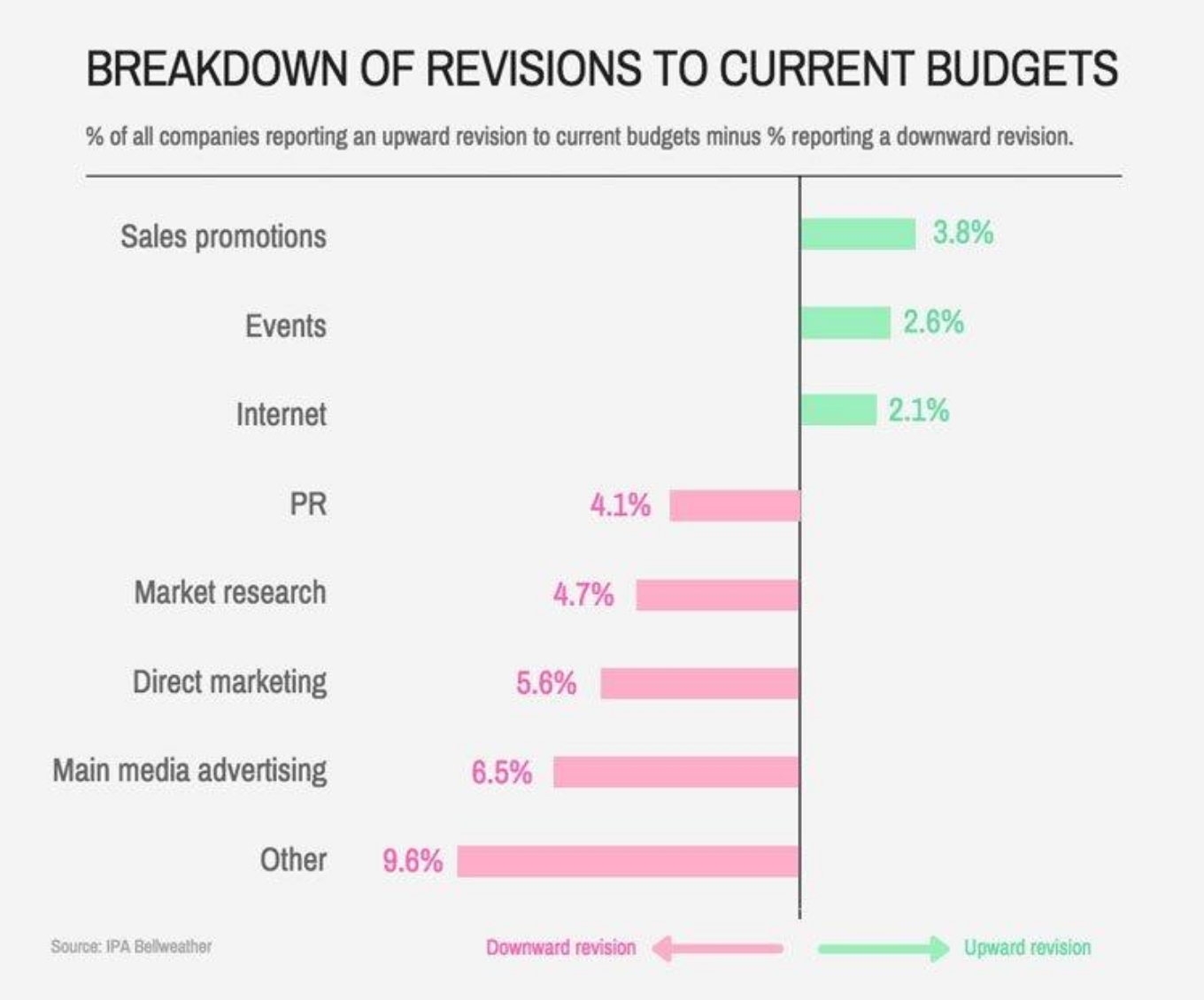
A recent post on LinkedIn by Prof. Marc Ritson bemoaned this. Ritson included a graph in his post showing that short-termism is not just continuing, it's accelerating.

"Its incredibly depressing to see that this trend of short termism is not just going to continue, it’s getting worse,"
said Prof. Ritson.

If we know that continued investment in short-term tactics at the expense of long-term brand building is counter-productive, why do we continue to do it? Some of the reasons are obvious:
  • Short-term activities show instant results: And there's nothing marketers like better than instant results.
  • Brand building efforts yield soft measures: Even if you're doing a great job of brand building, how do you demonstrate it? Indications of brand strength are not the measures that impress CFOs or Boards. They want sales, and they want 'em now.
  • The web: Online advertising has become the dominant form of advertising and it has been used almost exclusively as a short-term (direct response) medium. As Tom Goodwin says, "Why has there never been a brand built with digital advertising? There are many answers, the main one is that we've never tried to."
  • The brief life of a CMO: When your shelf life is measured in months, there is little incentive for you to think in years.
But there is another reason for our discomfort with so-called brand building activities - and no one likes to talk about it. In some circles "brand advertising" has become synonymous with bullshit. And, sadly, in some circles it is bullshit.

We have frittered away substantial credibility by allowing anything that doesn't have a cogent sales message to be called brand advertising. Much of what we call brand advertising has become squishy and free of strategic discipline. We've become flabby and self-indulgent.

Brand advertising has come to mean pretty much anything we can put a logo on. There is almost no frivolous marketing activity that can't be excused as "branding." Put your logo on a pair of socks? Branding.

In reality, there are two kinds of things we call "brand" ads -- those that are specific to a product and actually help sell something, and those that are someone's hobby horse with a logo pasted on at the end. The unfortunate part is that our dreadful vocabulary defines them both as the same thing -- "brand" advertising. They are not.

Pretty pictures and a nice track is not enough. Pounding your chest for world peace is not enough. Buying a pop tune and having people jump around is not enough. Successful brand building is difficult work and requires advertising that says something.

The ads that best build brands are those that have a clear and specific message about a product and deliver it in a memorable way.

Just because your ad is image heavy and free of a sales message doesn't mean you're building a brand. Not selling is not enough.

23 Jan 20:56

Netflix Flexes

by Ben Thompson

Bird Box, the Netflix original film, started streaming on December 21 while I was on vacation.1 That perhaps explains why the majority of my exposure to the Netflix Original came via NBA Twitter — and most of that exposure had absolutely nothing to do with the film, at least not directly.

For example, the Memphis Grizzlies had a Bird Box-inspired contest for courtside seats:

The Minnesota Timberwolves promoted an upcoming game with the Los Angeles (née Minneapolis) Lakers:

I personally quite enjoyed this tweet from the Atlanta Hawks, which came in the middle of a 144-112 shellacking by my Milwaukee Bucks:

Speaking of the Bucks, I couldn’t resist getting in on the meme either:

The most meaningful Bird Box tweet, though, was from Netflix:

That was quite the flex, and Netflix was only getting started.

The Bird Box Flex

There is an argument that Bird Box viewership numbers — which, as of Netflix’s earnings report last week, are up to 80 million Netflix member households — are not particularly meaningful. Sure, taking the wildly conservative assumption that one household=one viewer would mean that 80 million viewers was the equivalent of a box office haul of over $700 million2; increasing that to two viewers per household would imply an equivalent box office haul that would rank in the top 10 of all time.

The problem, of course, is that none of those 80 million households actually paid explicitly for Bird Box: they got the movie for “free” with their Netflix subscription, and it seems like a stretch to think that most of them would have paid box office prices that are roughly as expensive as a month of the streaming service, to see the movie on purpose.

This critique is both true and misses the point — three points, actually. First, it is not as if Netflix is counting on box office receipts: to point out that the company isn’t earning $700 million or $1.4 billion or whatever is even more of a moot point than the number of people that watched Bird Box. Secondly, and relatedly, Netflix is counting on subscription revenue. To that end, producing a piece of content that 58% of its subscriber base viewed in a single month is by definition a triumph (and yes, worth ~$700 million). Third, and most importantly, the success of Bird Box drives the virtuous cycle that Netflix has as an aggregator in multiple ways.

Netflix the Aggregator

Start with the most important side for an Aggregator — the demand side. Bird Box and other successful content does triple duty for Netflix:

  • For current customers, Bird Box provides two hours of entertainment and a pass into popular culture. It is a cost of goods expense.
  • For prospective customers, Bird Box makes Netflix more attractive for the same price. Or, to look at it another way, it lowers Netflix’s customer acquisition cost. It is a marketing expense.
  • For marginal customers, Bird Box is a reason to stay on the platform. It lowers Netflix’s customer retention cost. It is an operating expense.

The latter two points are critical pieces of what makes an Aggregator an Aggregator; from Defining Aggregators:

Once an aggregator has gained some number of end users, suppliers will come onto the aggregator’s platform on the aggregator’s terms, effectively commoditizing and modularizing themselves. Those additional suppliers then make the aggregator more attractive to more users, which in turn draws more suppliers, in a virtuous cycle.

This means that for aggregators, customer acquisition costs decrease over time; marginal customers are attracted to the platform by virtue of the increasing number of suppliers. This further means that aggregators enjoy winner-take-all effects: since the value of an aggregator to end users is continually increasing it is exceedingly difficult for competitors to take away users or win new ones.

This is in contrast to non-aggregator and non-platform companies that face increasing customer acquisition costs as their user base grows. That is because initial customers are often a perfect product-market fit; however, as that fit decreases, the surplus value from the product decreases as well and quickly turns negative. Generally speaking, any business that creates its customer value in-house is not an aggregator because eventually its customer acquisition costs will limit its growth potential.

The question, then, is why do suppliers come onto Netflix’s platform?

The first reason is that Netflix pays the most. From a supplier perspective that is certainly straightforward, but the question as to why Netflix can pay the most is an interesting one. There are multiple reasons:

  • First, Netflix is selling content to the entire world. That means its customer base is larger than other content buyers, giving Netflix greater buying power
  • Second, because of the demand-side dynamics I just described, Netflix is not simply selling to today’s subscribers, but the subscribers it anticipates attracting over the next several years, giving Netflix greater buying power again.
  • Third, because Netflix is not monetizing any particular piece of content in isolation, but rather as part of an overall subscription offering, it can more easily absorb failures on one hand (its customers have other shows to watch), and capture excess value on the other (because the lifetime value of customers is far greater than a single movie ticket). This means that Netflix’s risk, relative to traditional distributors, is significantly biased towards the upside, justifying higher prices.

Secondly, Netflix has long appealed to the other motivations a supplier might have, particularly creative control. What the success of Bird Box shows, though, is that Netflix is uniquely capable of driving an audience as well. Sure, the company spent money on marketing Bird Box, but the reality is that Bird Box was popular because it was on Netflix. That is what drove views, and what drove Bird Box into the popular consciousness, and while all suppliers like getting paid, artists in particular like to be seen.

And so we have a virtuous cycle: Netflix’s control of demand draws suppliers, which increases demand, and so it goes.

The Pricing Flex

Between the Bird Box announcement and Netflix’s earnings (where the company announced similar stellar viewership numbers for a number of other shows) came one more piece of news: Netflix is raising the price on U.S. subscribers by $2/month; new subscribers will pay the new price immediately, while existing subscribers will be phased in over the next several months. CEO Reed Hastings said on the company’s earnings interview:3

With respect to the price changes…you’ll see that impact over the course of the year, and what that means is that will obviously impact the rate of net addition growth in the first half of the year. But commensurately, you also see ASP domestically improve over the course of the year and that’s what we think will drive an acceleration in revenue growth over the course of 2019. And that’s what also we believe drive operating margin higher sequentially over the course of the year to enable us to hit that 13% target for the full year.

One of the obvious challenges for Netflix, particularly in the United States, is saturation. The company has 60 million subscribers in the U.S., which as of 2017 had 126 million households; given widespread account sharing, the company’s penetration is almost certainly well over 50%. There is still room for growth — around 100 million households have traditional multichannel video programming (i.e. the cable bundle) — but by definition households without Netflix are either exceptionally hard to reach (which is why Netflix has partnered with MVPDs to sell the service) or exceptionally frugal. Raising the price will certainly further inhibit the latter with their presumably high price elasticity.

At the same time, Netflix is clearly confident that the price elasticity of its existing customers is very low: the company does not appear to expect any undue churn, which is reasonable given that previous price increases went off without a hitch. More broadly, it speaks to the importance of understanding how it is that Bird Box and other Netflix original content affects demand:

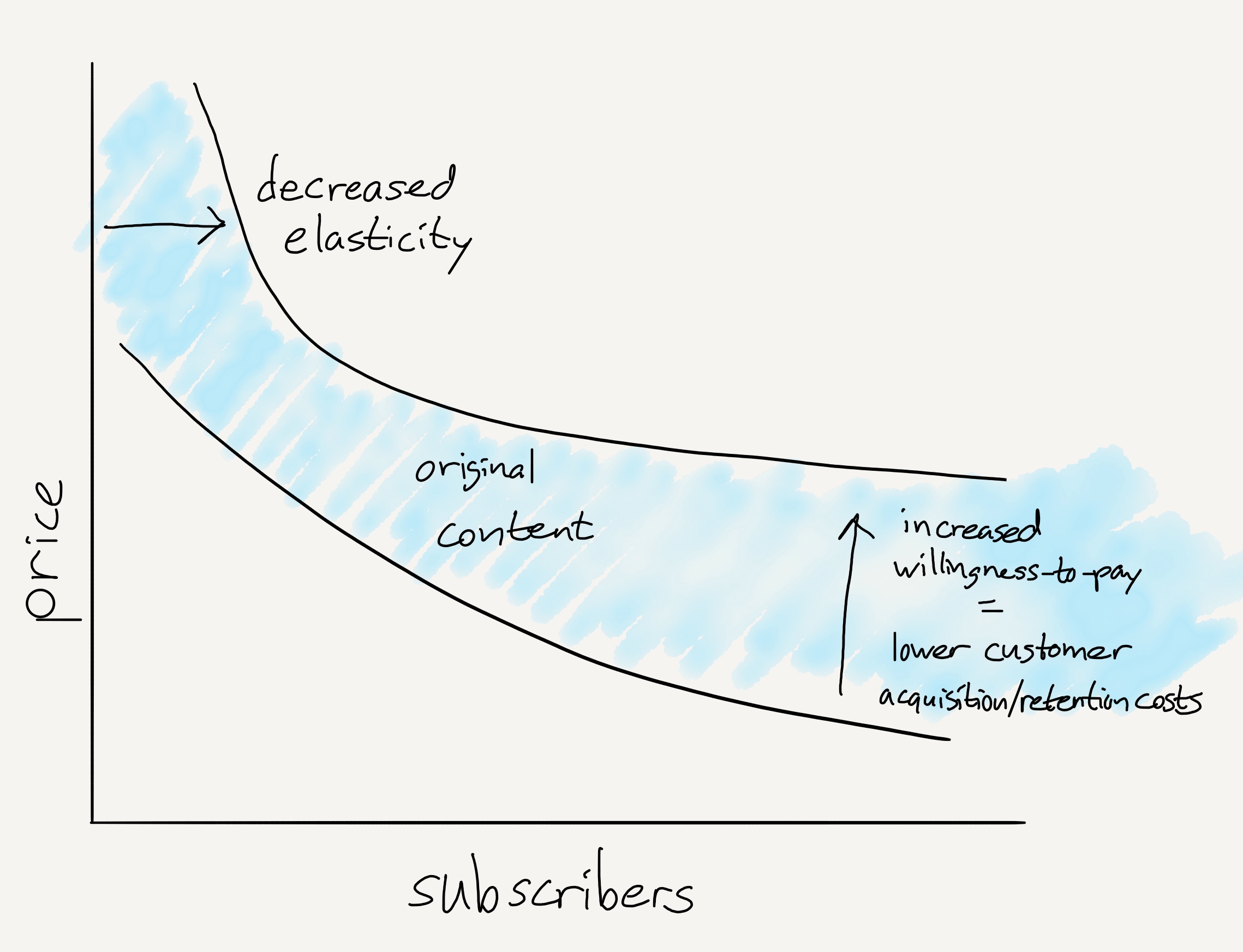
The impact of Netflix's original content

This is a graphical representation of the point I made above: existing customers are less price elastic, and marginal customers are more likely to stick around or sign up. Critically, this is a win for every part of the value chain: subscribers get more value, Netflix gets more revenue, and there is more money for suppliers.

The Streaming Value Chain

Much of this is obvious, at least at this point, but it is particularly noteworthy in the context of Netflix’s competitors. The traditional MVPD value chain, for example, has four participants: suppliers, networks, distributors (cable, satellite, or virtual), and end users. This made sense when the chief constraints were time and the need to actually run a cable into the back of an end user’s television, but it is a significant handicap in a world where there is no time constraint and where distribution is over the Internet.

Consider the recent announcement from NBC; from CNBC:

Comcast’s NBCUniversal plans to debut a free, ad-supported streaming service to anyone that subscribes to a traditional pay-TV service, including competitors such as Charter, AT&T, Cox and Dish, in the first quarter of 2020, the company announced Monday. For those that don’t subscribe to a pay-TV service, the streaming product, which will include 1,500 hours of NBC TV shows, such as SNL and Parks and Recreation, and hundreds of hours of Universal movies, will cost somewhere around $12 a month, a person familiar with the company’s plans told CNBC. The service will be run by Bonnie Hammer, the company announced Monday.

This sounds suspiciously like TV Everywhere, the plan to allow MVPD subscribers to log into dedicated apps with their cable account. The problem is that the MVPD value chain ensured that TV Everywhere would be a complete mess:

  • Instead of there being one app, consumers had to download an app per network
  • Not all networks supported TV Everywhere, or did so inconsistently
  • Not all cable networks supported TV Everywhere, or did so inconsistently

In short, TV Everywhere was an attempt to apply a value chain that was created around cable television to a fundamentally new paradigm, which introduced massive amounts of misalignment and inefficiency, most of which was borne by the end user. And oh, by the way, the old business model of advertising as well.

The MVPD value chain

Contrast that to Netflix which has created a value chain perfectly attuned to the streaming paradigm.

Netflix's value chain

Netflix’s integration of production and distribution also dramatically increases its flexibility and addressable markets when it comes to both supply and demand. On the demand side, as noted above, Netflix can reach users both all over the world as well as into the future. Just as importantly, on the supply side Netflix can accommodate all kinds of content on all kinds of deal terms. Hastings said on the earnings call:

Our main goal is to make the best content. And we’ve said in previous quarters that that is a combination of several different business models depending on who owns the IP. So, what we’re going to do is make the best show and not be stuck on the business model, because the consumer really doesn’t understand that or we even want to spend any time thinking about it.

So by way of example, last year, we had 140 different shows around the world that premiered on a network somewhere and on Netflix everywhere else in the world. Next year, it’s more to closer to 180. And these are combination of co-producing with local producers in other countries; it shows that then air on a network in that country and then premier on Netflix. But when I say co-production, I mean, we come in at the script stage, we come in at the first money stage, we’re involved creatively with the production of that show.

Netflix has shows it owns completely, shows it own first-run rights to, hybrid shows like Hastings described, second-run shows — it runs the gamut. Critically, while some models are more profitable than others, all make the service more attractive to Netflix’s customers.

This will be a particular challenge for a company like Disney: the company is staking a good portion of its future on its own streaming service driven by its own IP, but has not suggested a willingness to scale supply like Netflix has. That, by definition, will limit the company’s upside when it comes to consumer reach and also long-term pricing power.

The Competition Flex

These two points are related: tighter integration in the middle of the value chain means more flexibility and modularity on the edges. Netflix knows this, which is why the company didn’t even bother labeling Comcast or Disney its competitors. From the company’s letter to investors (emphasis mine):

In the US, we earn around 10% of television screen time and less than that of mobile screen time. In other countries, we earn a lower percentage of screen time due to lower penetration of our service. We earn consumer screen time, both mobile and television, away from a very broad set of competitors. We compete with (and lose to) ​Fortnite​ more than HBO

Our growth is based on how good our experience is, compared to all the other screen time experiences from which consumers choose. Our focus is not on Disney+, Amazon or others, but on how we can improve our experience for our members.

This is perhaps the biggest flex of all: Netflix is so confident in its position it is effectively stating that if customers choose to watch TV, they will choose Netflix. The company knows its model is that much better.

I wrote a follow-up to this article in this Daily Update.

  1. Bird Box premiered at the AFI Fest on November 12, 2018, and had a very limited theatrical release on December 14
  2. Based on an average 2018 ticket price of $9.14
  3. As an aside, Netflix’s “Earnings Interview”, in which one analyst is allowed to ask questions (as opposed to Q&A from a number of analysts), seems like an unnecessary attempt to control the narrative from a company that, as this optimistic analysis suggests, doesn’t seem to have anything to hide
23 Jan 20:56

Voice is here - online learning has been traditionally 'nil by mouth' but not now....

Donald Clark, Donald Clark Plan B, Jan 22, 2019
Icon

The good bit of this post is the emphasis on voice in online learning. However, it's framed in an odd way. "Almost all online learning involves just clicking," says Donald Clark. This isn't true of any of the online learning I've either given or taken. Is there any online learning with no video, no assignments, nothing but clicking? He also says, "in real life, we don’t click, we speak and listen. Most actual teaching and training uses voice."  First of all, computers are real life. Second, I've had a lot of 'real' learning that's far less interactive than online - especially courses based almost entirely on (paper-based) reading. Again - there's no denying the efficacy of voice. That's why I give talks, create podcasts, give interviews.

Web: [Direct Link] [This Post]
23 Jan 20:56

The Planetary Health Diet

by Ken Ohrn

Among people in Metro Vancouver paying attention to climate change and its mitigation, what we eat is a rising issue.

Here’s a look at the source document of a major paper on the topic.

More shopping here for food

The Lancet and Science Daily

Urging major changes to our planetary food system, the authors of this study in the Lancet say in their preamble:

Civilisation is in crisis. We can no longer feed our population a healthy diet while balancing planetary resources. For the first time in 200 000 years of human history, we are severely out of synchronisation with the planet and nature. This crisis is accelerating, stretching Earth to its limits, and threatening human and other species’ sustained existence. The publication now of Food in the Anthropocene: the EAT– Lancet Commission on healthy diets from sustainable food systems 1 could be neither more timely nor more urgent.

And in a summary article in Science Daily:

“The food we eat and how we produce it determines the health of people and the planet, and we are currently getting this seriously wrong,” says one of the commission authors Professor Tim Lang, City, University of London, UK. “We need a significant overhaul, changing the global food system on a scale not seen before in ways appropriate to each country’s circumstances. While this is unchartered policy territory and these problems are not easily fixed, this goal is within reach and there are opportunities to adapt international, local and business policies . . . “.

“The world’s diets must change dramatically. More than 800 million people have insufficient food, while many more consume an unhealthy diet that contributes to premature death and disease,” says co-lead Commissioner Dr Walter Willett, Harvard University, USA. “To be healthy, diets must have an appropriate calorie intake and consist of a variety of plant-based foods, low amounts of animal-based foods, unsaturated rather than saturated fats, and few refined grains, highly processed foods, and added sugars.

Tamara Lucas, Richard Horton. The 21st-century great food transformation. The Lancet, 2019; DOI: 10.1016/S0140-6736(18)33179-9

Well — “uncharted policy territory“.    This is in the running for understatement of the year in 2019.

And while I’m at it, I wonder where most people get their information about food.  As in what to eat, and why I’m eating it, and what’s the bigger picture?

23 Jan 20:55

The Old Fee Market is Broken, Long Live the New Fee Market

by Soumya Basu and David Easley and Maureen O'Hara and Emin Gün Sirer
What the wrong fee mechanism does to your coin.

Almost all cryptocurrencies today require their users to attach fees to their transactions [1]. The miners then collate transactions paying the highest fees into the blockchain, and derive an income stream. This mechanism is superficially appealing, and has led some to push hard for a blockchain vision, dubbed the "fee market," driven almost entirely by such fees.

Much of the BTC/BCH split stemmed from a difference of vision around this central point, where BTC developers wanted to steer Bitcoin away from a reliance on block rewards and towards higher transaction fees. In contrast, BCH developers reacted strongly to high fees and wanted to keep the economics of miner compensation centered primarily around block rewards. Both sides make good points: block rewards are not sustainable, because the number of coins outstanding is fixed and therefore the rewards must diminish over time. At the same time, high fees lead to terrible user experiences, where some users paid as much as $55 to send transactions, while others complained bitterly of stuck transactions.

In this post, we describe why the predominant fee paradigm used in cryptocurrencies is broken. We describe the reasons why the so-called "fee market" will not lead to a stable, predictable user experience.

In addition, we provide an alternative way to charge fees that yields a sensible fee market that has more stable, and therefore more predictable, pricing. This novel mechanism also provides lower variance, and therefore higher predictability of returns, for miners.

An analysis of how our mechanism would behave in Bitcoin shows that it could have saved users over $272 million dollars over December 2017, and could have reduced the variance of miners' fee revenues by a factor of 7.4.

Problem with the Current Fee Mechanism

Under the current fee paradigm, a user wishing to submit a transaction must figure out an appropriate fee. This turns out to be a very difficult task.

This seems straightforward, but there are problems.

Fees and Cognitive Load

The first problem is the cognitive load on the user: it is difficult to decide exactly how much to bid, whether to go over or under. Surely, if the value of the transaction to the user is X, then her bids will be capped at the utility of the transaction to that user (say, X mBTC). But between 0 and X, there are many options, and picking the right one depends on a lot of other factors. Exactly how important is this transaction to me right now? How full is the mempool? What are the competing bids? Given that there will be, in expectation, another 10 minutes of transactions streaming in to the miners before the next block is discovered, how low a fee can she get away with while still getting her transaction included in the blockchain? These are clearly difficult questions. Doing the right thing involves watching the chain closely and monitoring the transaction until it is included, an act that detracts from the hassle-free use of one's money. One may be tempted to just go through a middleman, such as an exchange, to handle it all, which creates centralization and simply recreates the current banking system except with unregulated exchanges as centralized custodians. This has, historically, led to a stream of exit scams and other SFYL-events [2].

Broken Attempts

But the real problem is much more fundamental, and it stems from the fact that the fee mechanism in Bitcoin and other currencies is implemented as a pay-what-you-bid, or multi-unit first-price, auction. This fee behavior will lead to "sticky" and unnecessarily high fees, followed by sudden fee collapses, just as we have seen over the course of the last few years.

To see why, imagine a universe where everyone is using a simple historical fee estimator. Specifically, imagine a fee estimator that looks back on historical transactions and suggests a fee based on what happened on average in the past. If transactions were paying an average of 100 satoshis per byte in the recent past, then a user will simply attach a fee of 100 or more satoshis per byte.

This approach is completely broken. During times of congestion, the fees to get included will naturally go up, as they should. If the transactions momentarily arrive faster than blocks are found, the fees attached will go up. But they will remain high even after the congestion has ended. If, for instance, the rate of arrival for transactions is exactly equal to the rate at which blocks clear them, the system should be able to support 0-fees. And yet this approach will force the users to pay fees as if they were operating at the height of congestion. The fee structure that arises during congestion is ensconced in the system even though the conditions have changed, an artifact of bad mechanism design.

One can imagine other fee estimation heuristics, such as underbidding on purpose to explore if one can get away with paying less, that would yield better results. But it all is up to the vagaries of other people's choices of fee estimators that would determine the prices. A smart user who notices that the fee estimators are broken would have little recourse except to pay the prevailing fees. The system would provide no mechanism by which optimal choices are made. And of course, the mavericks who do try to explore paying lower fees, just to see if the entire ensemble of users could move to a lower price point, will have to deal with stuck transactions and transaction delays.

Blockchains are not the only place where similar auction mechanisms have led to poor user experiences. When ad placement in search engines was based on first price auctions, researchers observed similar patterns. Advertisers would compete with each other in order to get a better placement, driving the fees sky high. This would be followed by many participants quitting the game, which would cause a precipitous drop, only to restart the unstable cycle all over again.

A Better Fee Market

In a new paper, we propose a new mechanism to charge for transactions. This mechanism is only a slight code change away from the old mechanism, but it has the potential to yield a much more stable fee market, a much better user experience as well as a big savings in fees, and a more predictable revenue stream for miners.

Our proposed mechanism is fairly simple: transactions specify a fee, just like before, and miners place transactions in a block, just like before. Except, instead of charging each transaction the fee it bid, we charge each transaction the lowest fee charged to any transaction in that block. Any surplus fees a transaction offered are returned to that user, to a designated address they specify. Hence, a transaction in effect says "I am willing to pay up to $30 for this transaction," but is charged only $5 if the lowest fee transaction in that block paid $5. The remaining $25 are returned to the user.

Our proposed mechanism brings insights from multi-unit second price auctions to the world of cryptocurrenices where currently multi-unit first price auctions are the norm. Whereas before, fee selection was a stressful and difficult task, with our mechanism, users can simply attach to their transaction the true maximum value they would be happy to pay. This is because they are not going to be charged that value: instead, they are charged whatever the minimum was to get into that block. In essence, the lowest paying transaction establishes just how little it took to get into that block, and everyone within that block is charged the same amount per byte. This is not only equitable and fair, but it takes away pressure to play games with fee selection. As an additional bonus, the benefit from playing such games decreases as the blockchain gets more popular, further disincentivizing strategic fee selection. Note also that it picks the highest-paying transactions, just like first-price auctions, though it charges them strictly less than what they would be willing to bear.

Our proposal couples this idea with three other mechanisms to provide a comprehensive solution that prevents malicious behavior by miners. First, if a miner fails to fill a block, they cannot charge any fees. So a miner cannot take a high-paying transaction, ignore the rest of the mempool, and collect the entirety of the fee paid by that transaction while refusing to fill a block. They are, of course, free to fill the rest of the block with their own synthetic transactions, but they will have to pay out of their own pockets for those (and the next point addresses why the miner cannot just pay those additional fees directly to himself). Second, a miner is rewarded the average fee collected from the last B blocks, not just the fees from block they themselves mined. This ensures that miners also have little incentive to act strategically. Instead their best interests are aligned with maximizing the number of high-value transactions cleared per second. Finally, we propose that every block reserves some space, around 20%, which are exempt from this mechanism. This enables a miner to include transactions of high importance to themselves, such as those used for pool rewards, without affecting the fee mechanism and without being penalized. This addresses the miners' needs and provides a simple migration path from the current state of affairs.

Our mechanism brings order to the chaotic fee market of today. During the dramatic Bitcoin price increase in December 2017, we estimate that users would have saved over $272 million in transaction fees and miners would have a much more predictable fee revenue, reducing their daily fee variance an average of 7.4 times. These gains are not surprising -- our mechanism enables transaction fees to correspond to the true demand that users have for block space. This will make the fee markets more predictable. As a result, users can just bid their true value and know that they are not going to be overpaying for block space. Thus, this removes a painful strategic element to simply using cryptocurrencies today.

If you are designing new cryptocurrencies or are an active user of existing currencies, we highly encourage you to push for this fee mechanism instead of unstable first-price auctions.


Footnotes

[1] Cryptocurrencies that provide fee-free transactions for all are horribly and trivially broken, as they are open to simple, flooding-based denial-of-service attacks.
[2] SFYL: Sorry For Your Loss.

Related

Ron Lavi, Or Sattath, and Aviv Zohar have proposed a similar protocol to ours, however they differ in a few fundamental ways. Similar to our proposal, they propose a protocol in which the winning miner places transactions into a block and charges all transactions the lowest fee proposed by any transaction placed in that block. Lavi, Sattah and Zohar assume a single monopolistic miner, and strive to maximize revenue from fees at a cost of lower social welfare. In contrast, our work explicitly targets maximizing social welfare, and operates under a model with many miners. In their system, the monopolistic miner is incentivized to leave transactions offering positive fees out of the block even if there is space in the block as including them reduces the uniform price he can charge. This, of course, maximizes miner revenue, but we believe that the first criterion for a viable protocol must be to use the blockchain efficiently, as otherwise users are discouraged from participation. Their non-manipulation result is stronger than the one we obtain from our mechanism since we only obtain declining gain from manipulation as the system grows, but it comes at a cost of lower social welfare and desirable metrics such as transaction throughput and latency. Finally, in both our protocol and the protocol proposed by Lavi, Sattah and Zohar, users’ incentive to behave strategically vanishes as the number of users grows.

Vitalik Buterin has proposed an alternative approach based on miners estimating, and dynamically adjusting, a single fee that is charged uniformly to all transactions within a block, coupled with dynamically varying the block size to accommodate demand. This approach differs from ours in a few key ways. First, it does not aim to maximize social welfare, and instead adopts heuristics to modify two independent variables, fees and block size. The former goal, adopted by our work, will maximize transactions cleared subject to any desired block size constraint, determined by any desirable mechanism. Since block size is a primary determinant of security and centralization, we believe it is prudent to decouple its management from the fee mechanism. Second, it assumes that the demand curve is known to the protocol, though it makes no assumptions about its behavior. If the demand curve could be inferred accurately such that all transactions whose utility exceeds the block fee can always be accommodated, then Buterin's proposal would have no incentive issues. However, inferring demand curves is difficult in adversarial, Byzantine environments, which is why auction mechanisms are used. Finally, this approach has not been proven to be resistant to manipulation by users and miners. If it is not resistant to manipulation, then this mechanism will suffer from the same problem as the current first price mechanism, where users have to solve the fee selection problem all over again.

23 Jan 20:55

And the winners of Your Best Shot 2018 are…

by Leticia Roncero

In just one month, over 8,000 amazing photos (!!!) were submitted to the Your Best Shot 2018 group. Through our process, we narrowed it down to five winners, photographers whose photos emanate originality, creativity, and technical skill. We’re pleased to announce the winners of Your Best Shot 2018 and know you’ll be just as impressed as we are.

Drumroll, please!

“Father and daughter” by Dan Perez

Father and daughter

How this moment was captured: “Photograph of my wife and her ailing father in a nursing home in Puerto Rico. I was standing outside the room just watching when I decided to get my camera and snap a few photographs of them together. Unbeknownst to us all, this trip to visit her father in Puerto Rico would be her last. She passed away due to complications from the removal of a brain tumor three months later. This photo truly illustrates the kind of caring person she was. Her father lives on with a broken heart—she will never be forgotten.”

The photographer: Dan Perez is a self-taught, multiple award-winning documentary filmmaker, photographer and overall nice guy. He was raised in NYC and now calls South Florida home. His films have screened at film festivals in 15 different countries and his photography work has been recognized and awarded by the Photographic Society of America and selected in several international photography competitions and exhibitions. Dan specializes in documentary, photojournalism, live music, and travel photography.

Website: http://www.danperezphotography.com

Social:
Flickr: https://www.flickr.com/photos/danperezfilms/
Facebook: https://www.facebook.com/DanPerezFilms
Twitter: https://twitter.com/danperezfilms
Vimeo: https://vimeo.com/danperezfilms
Instagram: https://www.instagram.com/danperezfilms/

“Walking the Line(s)” by Paul Brouns

Walking the Line(s)

How this moment was captured: “Somewhere in Amsterdam, I noticed these horizontal coloured lines near the entrance area of a building. Instantly recognising this to be an ideal subject, I decided to wait for someone to walk by the wall, in order to get an extra point of reference. In the end, a small dog appeared to be just what I needed to match the composition perfectly.”

The photographer: Paul Brouns is an artist and graphic designer, living near Amsterdam in Holland. Rhythm, color, and geometry are recurring themes in his photographic work and architecture has proven to be an ideal subject for this. He’s attracted to abstract, rhythmic expressions of buildings and tries to visualise that as purely as possible. He believes that no matter how the work is made (direct photography or advanced image editing), what counts is the creation of a feast of dancing shadows, sunlit reflections or color combinations that enchant and inspire the viewer.

Social:
Flickr: https://www.flickr.com/photos/brouns/
Facebook: https://www.facebook.com/paulbrouns
Instagram: https://www.instagram.com/paulbrouns/
Twitter: https://twitter.com/paulbrouns
LinkedIn: https://www.linkedin.com/in/paulbrouns/

“Swan Lake” by Volker Woll

Swan Lake

How this moment was captured: “‘The swan in South Tyrol, Italy’ [‘Swan Lake’] is one of my favorite images because it started out as a fail. Originally, I wanted to photograph a different location, but learned the day before that the road was closed and I couldn’t get there. So I spent the rest of the day scouting the area and finally found this lake called Lago di Dobbiaco that seemed to have potential for a sunrise shoot the next day. This morning, all the pieces fell into place for me: the low hanging clouds, the bit of color from the rising sun, the mist over the lake and the reflection on the calm water…Believe me when I say, I had to talk that swan into posing for me…Thanks again, Swan. It’s these (rare) moments that make up for all the other more common moments when the pieces did not fall into place.”

The photographer: When he’s not out travelling and taking photos (which is the majority of the time) Volker Woll is living in southern Germany working on software. Funny enough, he met other IT people on those many sunrise shoots (like in “Swan Lake”), so he thinks that landscape photography and software development are just two different shades of nerdy.

Social:
Flickr: https://www.flickr.com/photos/69361287@N04/
Instagram: https://www.instagram.com/chickenandricetales/

“Lonely alleys of Venice” by ines_maria

...lonelyalleysofvenice...

How this moment was captured: “I arrived by train to Venice in the very early morning—it was freezing cold. I strolled through the streets, the lights were still on in some homes and businesses. After turning into a side alley, peace and an eerie silence spread—it was just the kind of moment I always hope for: in this case, the feeling of loneliness, the dark abandoned silence. Suddenly, quietly, and slowly, these men appeared and disappeared. I knew this was the story I’d been longing to capture.”

The photographer: Ines Maria lives in Vienna and works as an art director at an advertising agency. As a self-taught photographer, her love and passion, as you can imagine, is photography. She believes humans contrasted with our artificial environment (streets and architecture) is a beautiful expression of photography.

Social:
500px: https://500px.com/ines_maria

“Natasza” by Krzysiek Śliwaq

Natasza

How this moment was captured: “Natasza’s portrait is an example of one of my visions that I have somewhere inside—a simple, classic, close portrait with a bunch of natural emotions enriched by my own patterns of post-processing. Here, I used a dark mood and black and white tones to enhance the perception of her beautiful face, big eyes, and cute freckles. Ambient light made natural and delicate reflections in her eyes and mild skin facture. I tried to catch natural hands setting in the frame as well to make the portrait complete.”

The photographer: Krzysiek Śliwaq was born in 1984 in Poland. He is a solution designer and an enterprise architect in the IT sector working for an international company. He’s a happy husband and a fulfilled father of two remarkable children, who in his free time, takes portraits of young people and sometimes conducts original portrait photography master classes. In his pictures, he’s looking for the real and non-obvious emotions and mood. Krzysiek believes his works are largely a fusion of classic portrait, fashion portrait and fine-art combined with the real charm and authenticity of a child, and with a pinch of dark and intense mood. He enjoys dealing with the two extremes—rawness, naturalness in the message and widely considered in a portrait photography—fine-art. The 80s and 90s, when he was growing up, certainly had a huge impact on his art perception, and he still considers himself to be a big fan of music and cinematography from those times.

Social:
Facebook: https://www.facebook.com/plumsphotography
Instagram: https://www.instagram.com/the_man_with_a_hip/

We’re looking forward to a year filled with adventure and growth in the Flickr community, and we can’t wait to see your best shots of 2019.

Cheers,
The Flickr Team

23 Jan 20:54

Pixelmator Pro gets another major update

by admin

Pixelmator Pro 1.3 Prism has just been released, bringing a range of handy new features that make creating advanced illustrations and designs easier than ever — layer color tags, filtering and search, clipping masks, quick opacity and blending controls, and more.

This is the third major update since Pixelmator Pro was released just over a year ago. In fact, Pixelmator Pro 1.1 Monsoon came out on May 31st, so this is actually the third major update in just 7 and a half months! And yes, it might sound a little cliche, but it’s pretty crazy to see how far Pixelmator Pro has come in such a short time.

In this update, we focused on improving the Layers sidebar to make it easier to work in documents with lots of different layers. We also added clipping masks — an often-requested, incredibly useful feature for designers of all kinds. Let’s break down the major additions one by one.

Layer tagging, filtering, and search

In Pixelmator Pro 1.3 Prism, you can now apply colored layer tags to layers, search the layer list, and filter it out according to layer type and layer tag. These new features make it much easier to get around the layer list in compositions with lots of objects and they look pretty darn great to boot. We’ve created a few quick tips to help you get started with using them, so be sure to check them out!

Clipping masks

Clipping masks let you create perfect masks from existing layers in your Pixelmator Pro documents with just a click. This is a really handy feature for anyone working on all kinds of designs and illustrations. It might seem a little surprising but this feature actually took by far the longest to develop and test. And there aren’t all that many image editing apps out there (other than Photoshop) that have proper clipping masks — the reason why is precisely because it’s nowhere near as simple as it looks. But we’re really happy with the job we’ve done and, in Pixelmator Pro, you can effortlessly create clipping masks from any layer in your image. That includes group layers and nested shapes! Plus, you can also use any of the nondestructive effects on both the mask layer and the fill layer, so everything is super flexible.

Quick opacity and blending controls

If you’ve spent even a little bit of time browsing Pixelmator Pro reviews on the App Store, you’ll probably have seen at least a couple 1-star reviews saying there’s no way to adjust layer opacity or blending mode in Pixelmator Pro. There is. It’s been there since day 1. But, clearly, finding those controls was tricky so we’ve added them to the Layers sidebar. And, naturally, the live blending mode preview works there as well!

More!

In terms of other changes in the update, one of the more significant ones is that adjustments, effects, and layer styles will no longer be flattened when you paint, erase, retouch, reshape, or change the pixel content of a layer in any way. It’s the kind of change new users might not even notice, but we know some of you guys really wanted this feature, as did we, so we’re really happy it’s here. We’ve also got a few interface improvements related to this change that are in the works. We’re also really looking forward to shipping those.

Naturally, this update is free for all of you who have already purchased Pixelmator Pro, so head on down to the Mac App Store, get updating, and let us know what you think!

23 Jan 20:43

Those Mid Block Crossings~Did “Jaywalkers” Have it Right?

by Sandy James Planner

pedestrians-crossing-refuge

pedestrians-crossing-refuge

Let’s take a fresh look at that old fish tale about pedestrians not crossing a street midblock. Think about it~why are we insisting that pedestrians cross at corners? Is that not specifically to treat pedestrians and other vulnerable road users just like vehicular traffic and force them to behave as such, waiting their turn at an intersection?

There is a sad reality on  our fatality statistics in Metro Vancouver and basically anywhere on pedestrian crashes. You will find that the majority of fatalities are pedestrians over fifty years of age, mostly men, that are crossing at intersections WITH the  walk light. And how are pedestrians getting injured and  dying? It appears that the majority of crashes seem to occur with drivers  turning left through the intersection when the pedestrian has right of way.

This article by ggwash.org is worth revisiting~author Ben Ross who wrote Dead End: Suburban Sprawl and the Rebirth of American Urbanism asks why we insist that pedestrians cross at intersections, suggesting that “careful jaywalking” saves lives. Ross observes that while there are “no definitive studies”,  statistical evidence collected from New York’s Vision Zero program can show the way.

That city, where residents routinely ignore signals when they cross streets, can be thought of as a natural experiment. The majority of pedestrian deaths, and a far larger majority of non-fatal crashes, occur while crossing the street legally in a crosswalk.”

The reason of course is that drivers hit pedestrians when they are turning their vehicles, and the constantly changing traffic lights “maximize” chances of crashes.

Other researchers, working in places with less foot traffic and fewer striped crosswalks than New York, got results that point in a similar direction. They found that pedestrians crossing big highways are more likely to be struck at marked crosswalks than at unmarked ones. On smaller roads, they found little advantage either way.”

The term “jaywalking” referring to mid-block pedestrian crossings was developed in the 1920’s to free up the street for rapidly moving vehicles. Pesky pedestrians were relegated to intersections that were controlled by engineering traffic standards, with the concept that traffic engineers were better judges of pedestrian safety than the pedestrians themselves.The American  Federal Highway Administration (FHA) striped highway pavements with the assumption that pedestrians are safer crossing at intersections with traffic lights and all kinds of turning movements versus mid block two-way vehicular traffic.

Almost a century has now passed, and our traffic laws are still not geared to safety. As this article by Nate Vander Broek points out a midblock crossing is safer, more visible and direct for pedestrians to cross without having to walk to an intersection.

In the early 1990’s the US Transportation Research Board estimated that nearly 27 percent of all pedestrian accidents were caused by the “midblock dash”. Installing correct midblock pedestrian crossings would mitigate that impact, and the FHA estimates that these crossings are workable at speeds of 30 mph (50 km/h). Mid-block crossings can also be hard to use for visually impaired people, and do require education for drivers to be alert for them.

Is it time to revisit the mid-block pedestrian crossing?

atlanta_joshmello

atlanta_joshmello

Images: Michigancompletestreets.com, NACTO.org


23 Jan 20:43

Thanks to rapid, 3D imaging, anyone can tour the fly brain

Robert Sanders, Berkeley News, Jan 22, 2019
Icon

This 3D view of a fly's brain shows even a simple insect's neural network can be large and complex. The accompanying video points to different areas of the brain that do different things, but it's important to keep in mind that they entire structure is densely interconnected. The images are the result of new scanning technology, which is described in this article. " Expansion microscopy (ExM) involves fixing tissue and then expanding it like a balloon while keeping the relative positions of internal structures unchanged." Via Gerald Ardito.

Web: [Direct Link] [This Post]
23 Jan 20:43

Teachers and technology: time to get serious

Neil Selwyn, Impact, Jan 22, 2019
Icon

According to this article, "The most useful education technology knowledge does not come from globe-trotting ‘gurus’, keynote speakers and product evangelists. Instead, the best technology advice can often come from simply trying things out for yourself and/or speaking with colleagues working in similar situations and circumstances." This is both true and not true. It's true in the sense that nobody understands local needs and conditions better than the people working with them. On the other hand, the speakers and gurus are often longtime experts in the field. Not always, of course. But they often know about stuff you and your colleagues have never heard about and are not going to learn about just from local experience. Via Aaron Davis.

Web: [Direct Link] [This Post]
23 Jan 20:43

Apple Announces ‘Shot on iPhone’ Photography Challenge

by John Voorhees

For longer than I can remember now, Apple has plucked photos taken by iPhone users from the vast sea of images posted online and featured them on billboards, in print advertising, and online. Today, the company announced that through February 7th, it’s running a Shot on iPhone Challenge. Apple says that:

A panel of judges will review worldwide submissions and select 10 winning photos, to be announced in February. The winning photos will be featured on billboards in select cities, Apple retail stores and online.

Apple’s announcement also introduces the contest’s 11 judges, 6 of whom are from Apple and 5 of whom are outsiders with backgrounds in photography. The Apple team includes Phil Schiller, members of his marketing team, and others who work on Apple’s photo software. The rest of the judges include former White House photographer Pete Souza, travel photographer Austin Mann, who we recently interviewed for Club MacStories, Annet de Graaf, a travel photographer and author of iPhone photography books, Luisa Dörr who shot TIME magazine’s special Firsts issue entirely on an iPhone, and Chen Man, a visual artist and creator of photography-based social apps.

If you’d like to submit your iPhone photos, here’s what to do:

Post your best photo taken on iPhone to Instagram or Twitter with the #ShotOniPhone hashtag to participate in the the Shot on iPhone Challenge. Weibo users can participate as well using #ShotOniPhone#. In the image caption, note which model was used. Alternatively, you can also submit the photo in its highest resolution to shotoniphone@apple.com with the file format ‘firstname_lastname_iphonemodel.’ Photos can be straight from the camera, edited through Apple’s editing tools in the Photos app or with third-party software. Submissions for photos begins at 12:01 a.m. PST on January 22 and ends at 11:59 p.m. PST on February 7. You must be 18 years of age or older to participate, and this challenge is not open to Apple employees or their immediate families.

I’ve always enjoyed Apple’s Shot on iPhone ad campaigns. It will be fun to see which shots its judges pick from what I can only imagine will be a huge number of submissions.


Support MacStories Directly

Club MacStories offers exclusive access to extra MacStories content, delivered every week; it's also a way to support us directly.

Club MacStories will help you discover the best apps for your devices and get the most out of your iPhone, iPad, and Mac. Plus, it's made in Italy.

Join Now
23 Jan 20:43

My word for 2019: NO

by Raul Pacheco-Vega

I have the hardest time saying NO. While I am an incredibly busy person, I am also someone who works super fast. As a result, I tend to overestimate how many things I can do, and end up saying YES to things I should have said NO. No longer. This year, for the very first time in a very long time, I was able to say “NO” to peer reviews. Remember, I’m a journal editor. Saying “NO” to peer reviews makes me feel really bad because I depend on others’ willingness to say YES.

No

Creative Commons: Duncan C on Flickr.

BUT…

I’ve said YES enough. I’ve supported dozens of journals (both those on whose editorial board I am and those who are random). Sometimes I feel that I am asked to do more service because I don’t say NO. But this year, I’ve said NO to meetings, NO to peer reviews, NO to additional writing commitments, NO to conferences (yes, when did you hear me say NO to giving talks or presenting papers at conferences?), NO to anything that could potentially derail me from my objective (which is to finish 3 papers that I have on R&R).

No

So if you are receiving a NO from me right now, remember – I still love you, but I have other commitments and it’s time for me to say YES to myself.

Ironically, in 2018 (my worst year to date) I did not do a Word of The Year exercise. In 2016 it was FOCUS and in 2017, CONQUER.

23 Jan 20:43

Context.io Deprecation Blog Post #4: Context.io Alternatives

by Context.IO

With the coming shutdown of Context.io, we’d like to share come alternative API services that our users might consider switching to. We have great relationships with the companies below, so let us know if we can put you in touch with either of them.

Nylas

Contact: support@nylas.com

Nylas is now offering a special deal for all Context.io customers that choose to switch to the Nylas API: If you sign up by 03/31/19, Nylas will give you the equivalent of one year of free service over the course of a two-year initial contract (terms and conditions apply).

You can book a meeting with Nylas’ platform specialists or contact them at support@nylas.com to learn more.

Nylas provides an email API with powerful features that your customers will love, such as:

  • Connect to any email provider. The Nylas API connects your application to Gmail, IMAP, Office 365 or Microsoft Exchange, AOL, Yahoo and all the rest with one simple integration.
  • Sync calendar and contacts data in addition to email. Get full CRUD features for the entire inbox (email, calendar, and contacts).
  • Robust email tracking and analytics with insights into open rates, link clicks, and replies. Rest easy with enterprise grade security and privacy. Nylas is SOC-2 certified, Privacy Shield Certified, and GDPR compliant. You can read more on their security page.
  • Guaranteed up-time. Nylas guarantees availability of their API with an SLA of 99.9%.

Edison

Contact: siftapisupport@edison.tech

Edison Software, Inc. offers an easy way for developers to work with email data and build innovative email products. Through the use of the Edison API (aka “Sift”), developers can easily integrate email into any application, connect to an inbox from any mail provider, and receive webhooks for various email events. In addition, developers can also leverage Edison’s proprietary parsing technology stack to identify and extract information from commercial transaction emails (such as purchases, flights, hotels etc.).

The connection to the API is offered in two modes:

  • In “Managed Email Connections” method, developers use the Sift API to maintain long-lived connection to users’ inboxes and Sift API automatically processes connected email accounts and use webhooks to deliver the email events and extractions found.
  • In “Discovery” method, developers submit individual emails for extraction purposes and Edison API returns a response with the extraction from the email.

Detailed documentation about the Sift API can be found at https://developer.edison.tech/docs/. The Sift API is constantly improving and new functionality gets added frequently. If your particular use case does not seem to be supported, please contact Edison at siftapisupport@edison.tech

Context.io service will cease on March 31, 2019 at 11:59pm CST. Please reach out to us with any questions you might have.


Context.io Deprecation Blog Post #4: Context.io Alternatives was originally published in Context.IO on Medium, where people are continuing the conversation by highlighting and responding to this story.

23 Jan 19:51

Mark All as Read

One of my favorite parts of the latest The Important Thing podcast is where Rands explains that, in his RSS reader, he just marks-all-as-read at will.

For the kinds of RSS readers that track read/unread status, this is the right approach. If something’s truly important, it will come to you another way. And there are so many other ways that important things will reach you than in, say, 2005.

I write an RSS reader and I do this myself. (I often read just what’s new today, and then mark everything older as read.)

It’s totally a-okay. Your RSS reader is not your task master.

23 Jan 19:51

Elby Announces New Business Structure, Name, and Ownership

by Jeff Yoshida

Elby Announces New Business Structure, Name, and Ownership

Elby has reorganized under a new investment group and secured a strategic partnership with newly restructured BionX’s ebike powertrain business in order to continue expanding Elby’s distribution, develop new products, and deliver support to customers and retailers.

Toronto, Ontario, 10 January 2019— Elby, the leader in the pedal-assisted ebike market, announces new investment and ownership after launching with the founder of Magna International. Elby has become Elby Mobility following significant private investment and options with Business Development Bank of Canada’s Green Tech Fund, an incubator for sustainable tech and commercial research.

Additionally, Elby has expanded their partnership with the new owners of BionX International, the popular manufacturer of OEM and aftermarket ebike drivetrains. Their new ownership and subsequent reorganization opened up an opportunity for Elby to not only continue to equip their current S1 model generation with BionX’s category-leading, next generation D-Series motor, but provides access to required inventory, technical support staff, service capacity, and intellectual property in order to provide Elby users with the premium customer experience and post-sales support.

Additionally, Elby has, despite tariffs, inflationary pressure, and increased prices throughout the ebike industry, held their flagship S1 model to its original price of $2,999.99 USD/$3,299.99 CDN. Trade uncertainty continues to plague multiple business categories and Elby is pleased to offer stability and competitive pricing during this time.

“Our mission is to inspire a new era of mobility by delivering the best personal transportation experience,” says Scott Macwilliam, Managing Director at Elby Global. “As a result, we will enhance daily life and the communities in which we work and live.” Macwilliam continues “With our new leadership, resources, and exciting partnerships, the rapidly growing ebike market can be confident that Elby will continue to provide our premium and award-winning ebikes to the market. Our automotive heritage and ‘designed from the ground up’ philosophy will continue to be our R&D mantra, including exciting new technologies in development”

Beyond delivering to consumers, Elby is also working with commercial, corporate, and government agency partners including hotels, resorts, residential urban developers, corporate campuses, and government transportation agencies. By making e-mobility available to these partners, Elby can help them meet the demands of their customers, employees, and constituents for sustainable, cost-effective mobility solutions.

Elby continues to grow rapidly as a standalone company, delivering their award-winning S1 step-through ebike model to an expanding international network of retailers, direct trail and delivery to home online sales via elbybike.com, through Velofix franchise partners, and as commercial fleet solutions and programs.

###

About Elby Mobility

Founded in 2016, Elby Mobility is pioneering a revolution in the way we move through our communities and cities. The first Elby ebike model, the Elby S1, debuted in late 2016 as a premium, one-size-fits-most pedal-assist bicycle. Backed by a powerful and class range leading 500-watt BionX motor, the S1 moves confidently over 80 miles on a single charge at speeds up to 20 mph. Elby ebikes are designed to address the needs of modern riders with diverse interests and abilities, paving the way for people of all sizes and interests to use a bicycle for both transportation and fitness.

Elby is currently sold direct to consumers via elbybike.com, Amazon, through Velofix mobile bike shops, and through a growing network of independent retailers globally. Free, personal and at-home test rides are available in most markets. Join the thousands who already follow Elby on Twitter, Instagram, and Facebook at @elbybike.


Download PDF version

23 Jan 19:50

A Primer In Understanding Community Member Psychology

by Richard Millington

Next week we’re launching both our Strategic Community Management and Psychology of Community courses (you can sign up for either or both).

In this post, I want to share a basic primer in member psychology and how it affects your day to day work.

The very essence of our work is understanding what really motivates members.

There are things members say they want such as:

  • Answers to questions.
  • Ability to quickly find information.
  • Connect with others in a similar position
  • etc..

We can call these things the ‘surface’ needs.

They’re the things that pop up in member interviews, surveys etc…

Then there are the things members are really motivated by:

  • Feeling confident to solve a problem by themselves.
  • Reducing the fear that something might go wrong.
  • Being part of a special group/not being left out.
  • Having a unique impact/not being ignored.
  • Being respected and appreciated
  • etc…

Let’s call these our deeper desires. They’re based on the emotions we feel.

If you want to boost engagement, improve member satisfaction, increase loyalty, or achieve almost any of your goals you usually need to satisfy these deeper desires – not just their surface needs.

A community which delivers the maximum value to members is one which makes members feel better about themselves (which, unsurprisingly, becomes a place where members want to spend more time).

If you (or your team) blitzed through 30 responses to open questions today, you’re probably only providing customer support. A community manager would see this as 30 missed opportunities to satisfy these deeper desires.

But we need a useful framework to do this.


A Simple Member Motivation Framework

We’ve tried many frameworks over the past decade (Maslow, habit theory, etc..) and only found one consistently useful (and predictive of success) across all communities.

You can see this below:

[click for full image]

We explain this at a deeper level during the course, however, the key takeaway here is you can align every possible touchpoint your members have to make them feel more competent, more autonomous, and better connected to one another.

Go through your last five responses in the community, did you provide an answer or did you make members feel better about themselves?

Were you providing customer support or were you satisfying the deeper desires members have?

Yahoo was well known for doing this terribly:

Not only is the answer unhelpful, but it also makes the member feel dumber. Do you think anyone who gets a response wants to participate in the community again? Use more Yahoo products? Or do anything to support the company?

Most of the people we might consider natural community have trained themselves to excel in a few very basic things. This might include acknowledging the frustration, personalizing their responses, giving members a sense of control in how they want the problem solved etc…

Once you know what the deeper desires are, you can design a system and set of standards which permeate through every response, every hiring decision, every item of content you create, how you design the technology etc…


Creating A More Valuable Community

And it’s here that you can build a community which delivers so much more than just answers to questions.

Getting answers is good, but it’s just a tiny slither of the value your members can and should get from your community.

Next week we’re launching our Psychology of Community course to help you identify the deeper desires of your members and infuse this throughout your entire community experience.

I hope to see you there.

23 Jan 19:50

Jag Diary 8: Road Trip!

Today I drove the new I-Pace 290.3 mostly highway kilometers. In the best online I-Pace community, the top topic, with 1,115 posts as I write, is I-Pace range. Because when you come to electric cars, range anxiety is a thing. Today’s road-trip report will cover the general highway experience but, since it’s the hot topic, will zero in on range. Spoiler: You can almost always go 300km without trying too hard.

Here’s the trip.

290.3 km of travel

It was a three-leg trip, from Seattle’s downtown to one of its western neighborhoods, then to SeaTac airport, then home to Vancouver; only the last (longest) leg is illustrated. This picture is from the JLR “Incontrol” app, which runs on your mobile and is also a Web site.

What it feels like

The I-Pace is a dream on the big highway. To be fair, this is largely due to it being a well-built modern car with modern features.

  1. I think I already mentioned the seats are fabulous, but it’s worth saying again: really great.

  2. The weather was lousy, between 5°C and 8°C pretty well the whole way, alternating between drizzle and lashing rain. The climate control is actually not as vanishingly perfect as our old 2003 Audi’s, as in sometimes you notice the fans are blowing a little harder than you’d like on your torso or thighs; easy to correct though.

  3. The automatic setting on the wipers did the job, shifting from extra-slow intermittent in the drizzle to bangin’ ’em hard in a tractor-trailer’s wake in a downpour.

  4. The assisted-cruise-control is a treat. You set a maximum cruising speed and when there’s someone in front of you (i.e. almost all the time) it follows them automatically; the default follow distance gives you exactly the two-second gap recommended in safety tips.

    By the way, I am not remotely interested in any “self-driving” capability that falls short of “Tim can open up his laptop and do a code review.” Seriously, what’s the point?

    But I think the assisted-cruise makes the highways globally safer at a level related to the number of people using it.

    I read at least one reviewer who said the Jag’s assisted-cruise implementation wasn’t up there with the best. I can believe it; when a slowpoke pulls out in front of you, the Jag deploys the heavy regen and it can be kind of shocking. And when you get out from behind someone who’s going a whole lot slower than you’ve set the cruise, the Jag decides it’s on a drag-strip.

  5. On the subject of raw power: I drove conservatively, assuming that this lurid-blue lightning bolt would be a cop magnet. But there were a few occasions when I booted it, for example when asshats tried to dart into my two-second gap, and on one occasion when I realized that I was about to be seriously in the way of three cars trying to merge from an on-ramp I hadn’t noticed, and there was no room to move over. Well, tee-hee-hee, there are very few cars in the world that can rocket-launch forward from a starting speed well over 100km/h the way this does.

  6. The car’s whisper-quiet around town (so nice) but when you’re doing 70+mph on rough asphalt in a driving rainstorm, it’s not dramatically quieter than a decent modern fossil car; the tires and all the air and water hitting the car can get in the way if you’re playing soft music.

Bottom line: I’ve driven this route too many times, in a variety of automobiles, my own and rented. The I-Pace got me home feeling a really a lot less stressed and wasted than anything else I’ve done the trip in.

Now, about range

The wisest thing I’ve seen on the subject is on the ipaceforums.co.uk site in a post by DougTheMac. It’s worth reading in full, but here are a couple of excerpts. This point, on how to think about range, is crucial:

I think there’s a big difference between the required behaviour on a longer-than-usual trip and a very-long-trip. The difference is because on a road trip, you are reluctant to let the SoC get below maybe 20% in case the charger you are relying on isn’t available and you have to divert. Also, on a road trip, you probably only want to recharge up to 80% because the last 20% is very slow. So, the distance between recharging stops on a very long trip is perhaps 60% of the actual achievable range.

But if you start from home with a full charge and pre-conditioned, and your destination at the end of the day is either home again or a destination with 100% certainty of an overnight charge, then you can use 95%+ of the battery capacity with reasonable confidence.

Explanatory note on “conditioning”. You can tell the car what time you plan to depart, and on schedule it’ll get the cabin all pre-heated for you, and if it’s plugged in, also boost the battery to the correct operating temperature. This is said to increase range, but I have no idea how much.

Here are his conclusions (for those of us in metric-land, his breakpoints of 100M, 150M, and 190M are around, respectively, 160km, 240km, and 300km):

  • Trip distance <100M: Charge to 80% (! q.v.), pre-condition, drive to have fun.

  • Trip distance <150M: Charge to 100%, pre-condition, drive to have fun.

  • Trip distance <190M: Charge to 100%, pre-condition, drive a bit more gently, monitor, but expect to get to destination without a charge en route, albeit perhaps down to <5% on arrival.

  • Trip distance 190-310M: Plan for a single en-route charge, ideally from c20% SoC (to give the safety margin required in case the planned charger is unavailable) but only up to the SoC required to get to the final destination with a minimal SoC (5%?). A single 20%-80% charge should add 120M (80%-20%=60%x200M), hence 190+120=310M with 5% on arrival at the “safe” destination. But if you only need an extra 50M, you only put in the required amount to just get you to your safe destination.

Like I said at the top: You can go 300km, assuming you’re sure of having a place to charge when you get there. The road to Seattle is 230km with lots of hills, and there are long stretches where the speed limit is 70mph and everyone cruises at 80. So while a chilly day like today isn’t the North American worst case — that would be something like Canada’s Rogers Pass in midwinter — it’s worse than average.

I used the car’s “comfort mode” both ways; it’s got an “eco mode” which could probably have done better. On the trip down I still had 90km of advertised range when I pulled up to a charger in the basement of an Amazon building, which suggests a total of 320km. Today I went 290.3km at an average speed of 87km/h and had 8% charge when I got home. The car said it had 26km of range left; do the math.

Recharge

After I unloaded, I headed over to the handy neighborhood fast-charger, where by “fast” I mean 50kW. This is about as close to a “full charge” as the Jag is ever likely to get: 78.174 kWh in 2 hours.

Conclusion

Modern battery-electric cars are just fine for medium-long road trips.

23 Jan 19:47

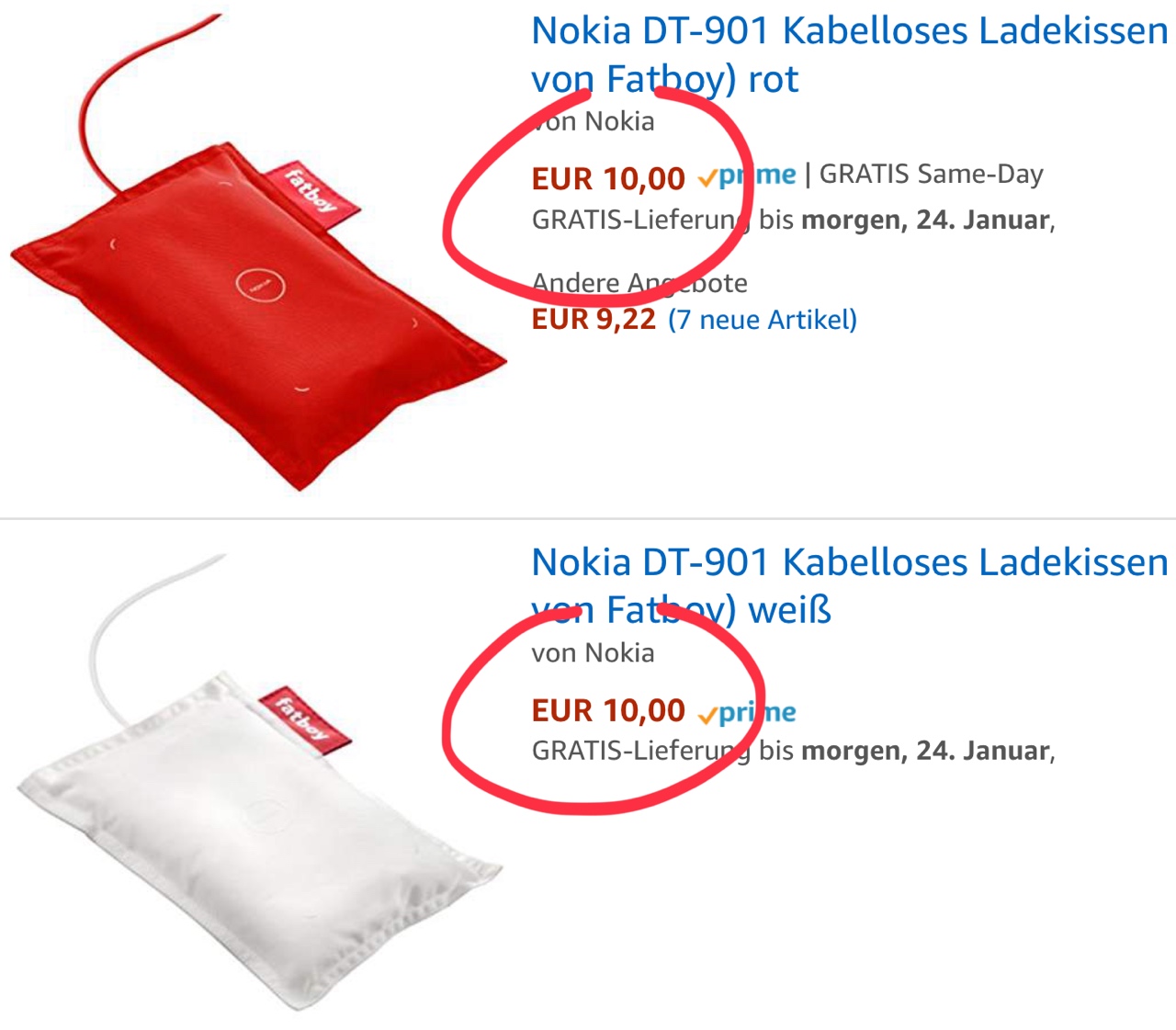
Fatboy Induktivlader für 10 Euro

by Volker Weber

232e6cdef201f8f5bb592e2276d13b70

Es gibt offensichtlich immer noch Restbestände. 10 Euro ist ein Schnäppchenpreis für diesen sehr hübschen drahtlosen Lader inklusive Steckernetzteil. Funktioniert mit iPhone 8, X und neuer. Natürlich auch mit den ganzen Androids mit Qi.

Keine Ahnung, wieviele die haben. "Nehmense reichlich".

More >

23 Jan 19:46

LiterallyLibby: Uber to the rescue!

by peter@rukavina.net (Peter Rukavina)

Libby Osgood writes from El Paso where she’s supporting those just released from Immigration and Customs Enforcement:

That’s not what shocked me. The nurse agreed we needed the papers also asked if they had their chargers. I was surprised that she would be so involved with their phones, but then the mama lifted her jeans to reveal a tracking device bolted to her ankle. It seems Maco learned this same harsh reality when one of the teenage boys asked if they had to tell security about their device. Fighting back tears, she nodded her “yes”. These ankle bracelets need the battery changed/charged every 3 hours, effectively anchoring the people to a wall plug until they go to court. How they handle the 2-day greyhound trip, I can only wonder.

23 Jan 19:46

How to prioritize your ideas and feature requests?

by Bogomil Shopov

I spent my last 10-15 years working on different stages of the product life-cycle and the experience I acquired helped me to build something that I am about to share with everyone.

Problem

One of the challenges in running a startup is that you have lots of ideas on how to grow, but you don’t know which plan to execute first and which one has a better chance to succeed because you love them all.


Solution

Neeoo - A prioritization Matrix that works

I have combined a few approaches in a powerful prioritization matrix with instructions on how to use it for ANY business.

  • Easy to use – you need just 15 min to get started
  • Flexible – it adapts to your business model
  • Unique – you could prioritize marketing experiment or features, especially if you don’t have data to support your theory.

Take it

I want to share that with you, for free. If you are ready to accelerate your growth, click here to join my ProductHunt upcoming campaign or send me an e-mail to bogomil at talkweb.eu

The post How to prioritize your ideas and feature requests? appeared first on Bogomil Shopov.

23 Jan 19:46

Berlin's Yellow

by peter@rukavina.net (Peter Rukavina)

This season I’m deeply invested in two television shows Counterpart and Berlin Station.

That they are both set in Berlin, and that they both feature the actor James Cromwell, to say nothing that Counterpart requires intense concentration to keep track of (without giving too much away, there are two Berlins involved), means that I’m forever getting characters and situations confused. But I persevere, as both are compelling television.

While Counterpart has a grey palette appropriate to its dystopian nature, Berlin Station is full of the colour of the city, and no colour is more dominant than yellow, as you can see in the opening credits, which start with the approach of a yellow U-Bahn train and go on to feature more yello trains, buses, street art, sunsets and sunrises:

The Berlin Typography blog, as it happens, has a feature, The Colours of Berlin: Yellow, posted today, that furthers the case for yellow being Berlin’s colour.

23 Jan 19:44

Vox Media is acquiring The Coral Project

Sara Fischer, Axios, Jan 23, 2019
Icon

The Coral Project is "provides newsrooms with tools and technology to better manage their commenting sections." It's used by numerous newsrooms, including the Wall Street Journal, the Washington Post, New York Magazine, Australia's Fairfax Media, and others. This is not the first of Mozilla's open source projects to be spun-off. Last August its Backpack product was transferred to Badgr (itself the end result of a spin-off project involving Concentric Sky). According to the report, Vox will continue to operate Corel as an open source project. We'll check back in ten years and see if that's still the case.

Web: [Direct Link] [This Post]
23 Jan 19:44

"The process of thingification (turning a useful idea into the latest thing and thereby rendering it..."

“The process of thingification (turning a useful idea into the latest thing and thereby...
23 Jan 19:43

The Meizu Zero is ‘The World’s First Holeless Phone’

by Evan Selleck
Phones will always rely on gimmicks to try and get attention, and sometimes those ideas are simply natural steps forward. Continue reading →
23 Jan 19:43

The scalable fabric behind our growing data center network

by Vishal Sakpal

Dropbox needs its underlying network infrastructure to be reliable, high-performing, cost-effective, and truly scalable. In previous posts we described how the edge network was designed to improve user performance, and how the supporting multi-terabit backbone network spans continents to interconnect edge PoPs and multiple data centers.

In this post we describe how we evolved the Dropbox data center network from the legacy chassis based four-post architecture to a scalable multi-tier, quad-plane fabric. Also, we successfully deployed our first fabric at our newest data center in California earlier this year!

Dropbox network physical footprint

Figure 1: Location of Dropbox global points of presence (PoPs)

We currently have global network presence and multiple data centers in California, Texas and Virginia. From a redundancy perspective, the North American continent is carved into regions—East, Central, and West—thereby having a distributed data center approach and improving resiliency in events of failure.

Legacy four-post architecture

Figure 2: Four-post cluster architecture (CC = cluster connector, CR= cluster router)

A cluster is comprised of ‘n’ rack switches and four supporting CR devices in a tier, and each CR device is a chassis based system. The cluster router (CR) tier handles inter-rack traffic within the cluster and traffic entering or leaving the cluster. Typically, a data center is comprised of more than one cluster, and interconnection between clusters is done via the cluster connector (CC) tier, itself comprised of four CC devices (see figure #2). The cluster connector (CC) tier handles inter-cluster traffic within the datacenter and is the entry/exit point for all traffic at a datacenter. We used 100G connectivity across all the links seen in the above figure.

From a protocol perspective, we run eBGP between the cluster connector (CC) and cluster router (CR) tiers using private autonomous system numbers (ASN) numbers. In contrast, between a rack and cluster router (CR) we use iBGP and route-reflectors to propagate routing information within the cluster. Additionally, devices within the CC and CR tiers are fully meshed using ISIS as the IGP and peering via iBGP using loopback interfaces.

Scaling limitations and growth

As we kept adding megawatts of data center space to support growth, we quickly realized that the older four-post architecture wouldn’t be able to scale to meet our future needs. The port density on the chassis based units directly translated to the number of racks a cluster could support, making network infrastructure a limiting factor. Adding new clusters to an existing data center or upgrading cluster-uplink capacity meant having unused ports on the upstream aggregating CC-tier. Also, troubleshooting a traffic-related issue within a system using multiple line cards and supporting fabric modules could quickly become complex and time consuming.

Keeping in mind the challenges with the older design, we wanted to ensure our next generation design solved them while remaining future-proof.

Below are design considerations we focussed upon while engineering the fabric:

  • Achieving a rack count greater than that offered by the legacy design
  • Ability to scale horizontally while adding capacity on demand
  • Non-blocking fabric with increased redundancy
  • Chassis-free design
  • Utilizing an identical ASIC at every tier
  • All fabric links/interconnects utilize 100G connectivity
  • Multiple ECMP options at every layer

Quad-plane, 3-tier fabric:

  • 16 racks per pod
  • 16 pods per fabric
  • 64 spine switches
  • 4 pod switches per pod
Figure 3: 256 rack fabric

As seen above in figure #3, the spine connectors (SC) and spine switches (SSW) are the building blocks of the fabric, and the pod switches (PSW) can be added incrementally on-demand, allowing the design to be elegantly scaled horizontally. Each device above, including the rack switch, is using an identical ASIC that offers 3.2 Tbps of switching capacity (32 ports of 100G), with super-low latency, and has a single rack-unit footprint, while leveraging merchant silicon.

Our latest deployment includes 16 pods, however this can be further scaled to support 31 pods thereby accommodating close to 500 racks. The number of pods in the fabric is dictated by the number of ports reserved on each spine switch (SSW) device.

Based on our traffic patterns, we initially reserved fewer ports for upstream connectivity responsible for traffic entering and leaving the fabric. While accommodating for future growth, we can always increase the upstream capacity and appropriately scale the number of pods in the fabric.

Cabling and optics

As seen in figure #4 below, the new design resulted in a few thousand interconnections across the building blocks of the fabric itself, not accounting for the rack uplinks! Based on our physical layout these distances were within the operating limits of a QSFP-100G-SR4 optic. Hence, we deployed QSPF-100G-SR4 in a combination with MPO connectors over multimode fiber (MMF). The longest cable in the physical layout was roughly 140 feet, which spanned from the main distribution frame (MDF) to our farthest cabinet location (again within the operating limits of a QSFP-100G-SR4 optic).

Figure 4: Zooming in on the fabric with few thousand interconnects

Physical design and layout

Figure 5: MDF row representation

In addition to logical network failure domains, we decided to separate the planes across the two main distribution frame (MDF) rows, in our case MDF ‘A’ and MDF ‘B’ to add physical diversity.

Simultaneously, this allowed us to increase our failure domain when dealing with electrical anomalies as each MDF row is supported by redundant electrical power distribution panels. Furthermore, each MDF row has diverse network pathways to each cabinet position.

Figure 6: Physical representation of a small section of the fabric

Why quad-plane?

Figure 7: Quad-Plane design

Our idea of a “plane” reflects an independent failure domain. Based on our needs, each rack switch connecting to the fabric is offered 4X100G of uplink capacity, hence the term ‘quad-plane’. At any given time, we should be able to lose an entire plane’s worth of capacity and still remain healthy, this would mean losing one spine connector (SC), 16 spine switches (SSW) and 16 pod switches (PSW) identically colored.

Non-blocking and oversubscription

Non-blocking means that the number of inputs equals the number of outputs. It wasn’t a pre-requisite, but we preferred to utilize the fabric to its fullest potential starting on day one, and hence we constructed a non-blocking network with a 1:1 oversubscription ratio between any two racks within the fabric. This also helped us steer away from any potential speed mismatch related issues and simplified cabling by not needing to split a 100G port.

Colors and routing within the fabric

Every device and interconnect within the fabric is uniquely colored. Each color signifies a unique plane. A plane within the fabric is responsible for 25% of overall rack throughput. This further explains why no two different color devices are connected. Once a packet traverses a uniquely colored link or device, it will only further traverse identically colored links or devices. This applies to all traffic whether intra-fabric i.e rack-to-rack traffic or traffic exiting the fabric destined to networks external to the fabric, this is further illustrated in figure #8 and figure #9 respectively.

Intra-fabric packet traversal:

Figure 8: Intra-fabric, inter-pod packet traversal

Networks external to fabric:

Figure 9: Traffic destined to networks external to the fabric

We built the fabric entirely on BGP, specifically running eBGP between any two devices. As compared to using iBGP and route-reflectors in the legacy design, eBGP helped us keep things simple and offers deeper visibility into a routing-prefix while leveraging AS-Path information.

As in our older designs, the fabric is also a pure Layer 3 network down to the rack switch, offering support for IPv4 and IPv6. The fabric relies on equal-cost multi-path routing (ECMP) & per-flow hashing resulting in equal distribution of flows equally across available links.

Failure domain analysis

Pod switch (PSW):

Figure10: A POD Switch failure
  • Traffic profile: Handles both east↔west and north↔south flows
  • If a PSW fails, all the rack switches in the pod lose upstream capacity by 25%, basically a failure domain of 75%
  • This provides better fault isolation and reduces the impact to only a single pod, compared to the existing four-post design where all racks would lose upstream capacity by 25%

Spine switch (SSW):

Figure 11: A Spine Switch failure
  • Traffic profile: Handles both east↔west and north↔south flows
  • A spine switch (SSW) connects to 16 pod switches (PSW) and four spine connectors (SC). Losing a node out of 16 devices in a plane results in a failure domain of 93.75% which is really low as compared to a node failure in the four-post design wherein all racks in the cluster would lose upstream capacity by 25%

Spine connector (SC):

Figure 12: A Spine Connector Failure
  • Traffic profile: Handles only north↔south flows
  • A spine connector tier is comprised of four devices. Failure of a single device results in 25% loss of north↔south capacity resulting in a failure domain of 75%
  • However, this failure only impacts flows entering/leaving the fabric. East↔west flows remain un-impacted!

Future scaling

The existing fabric design can scale close to 500 racks while operating in a non-blocking fashion. Making use of an ASIC that offers higher port density, say 64X100G, the existing fabric design can be scaled to support 4x the rack capacity, again non-blocking! As merchant silicon continues to evolve and produce denser chips, having much denser fabrics is very well a possibility.

To accommodate relatively higher rack counts, a fabric may span multiple physical suites and outgrow the maximum supported distance on a QSFP-100G-SR4 optic which would require the need to explore potential transceivers: Parallel single mode 4-channel (PSM4) or coarse wavelength division multiplexing four-lane (CWDM4) or any future specifications to achieve connectivity across a fabric spanning physically separated facilities.

We’re hiring!

The Network Engineering team is hiring talented Network Engineers with a desire to build and solve problems at scale across Backbone, Datacenter, Edge, Optical, and much more. You’ll be a part of a small team that has a huge impact on the world. We’re also hiring for a wide variety of engineering positions in San Francisco, New York, Seattle, Tel Aviv, and other offices around the world

Acknowledgements

Implementing the new design would not have been possible without tightly-coupled collaborative efforts across the organization involving network engineering, network reliability engineering, cluster operations, supply chain, datacenter operations, finance, and technical program managers. A huge shoutout to all involved in making this effort a success!

23 Jan 19:40

Google hires 14-year Apple veteran to help bring Fuchsia to market

by Jonathan Lamont
Fuchsia logo

Google has brought on a long-time Apple engineer to work on its secretive Fuchsia OS project.

Bill Stevenson worked at Apple for 14 years. He started in 2004 as a product release engineer for OS X. In that role, he diagnosed framework issues and worked with third-party developers.

In 2008, Stevenson moved to senior engineering program manager for OS X. In that role, he served as a program manager and technical lead for AirPlay, Find My Mac, iCloud for Mac and AirDrop from 10.6 Snow Leopard to 10.9 Mavericks.

Finally, Stevenson became a senior manager for Mac and Windows program management in 2012 and has worked on every major release from Lion to Mojave, leading teams responsible for build, release and technical program management.

According to a LinkedIn post from Stevenson, he’ll join Google in February to help bring “a new operating system called Fuchsia to market.”

Bill Stevenson LinkedIn post

Given his experience, its no surprise Google would want someone like Stevenson working on Fuchsia. Stevenson’s experience involves working with hardware groups and third-party developers, which could be crucial in building an app ecosystem for the new OS.

Additionally, Stevenson could bring some new perspective to the Fuchsia team, as most of the Fuchsia staff are Google employees that previously worked on Android.

Source: 9to5Google

The post Google hires 14-year Apple veteran to help bring Fuchsia to market appeared first on MobileSyrup.

23 Jan 19:40

Google planning changes to Chrome that break ad-blockers ‘for privacy’

by Jonathan Lamont
Chrome on Windows 10

Last year, Google outlined plans to make Chrome extensions safer by introducing changes to the ‘manifest version’ in Chromium.

Google suggested these changes would improve security, privacy and performance. Importantly, the search giant also suggested the changes would enhance user control. However, as the first of the proposed changes came to light, it became clear these changes might not be in consumer’s best interest.

The changes proposed by Google engineers would break content-blocking extensions like ad-blockers in all browsers based on the open-source Chromium project. That means browsers like Opera and soon Microsoft Edge. It also means the world’s most popular browser: Chrome.

Essentially, Google is looking to change the manifest version in Chromium. Currently, Chromium utilizes Manifest v2, which determines which APIs extensions can and cannot use. In other words, the manifest controls how extensions can interact with the browser.

Google introduced Manifest v2 in 2012, so it’s arguably past time for a modernized manifest that’s more in-line with the current web. As such, Google engineers are developing Manifest v3 and have shared a draft document outlining changes planned for the manifest.

You have to break a few APIs to make a new manifest

Manifest v3 includes several new APIs and significant changes to existing APIs that could potentially break many things, including content blocking extensions.

As spotted by The Register, Raymond Hill, the developer behind content blocking extensions uBlock Origin and uMatrix, posted a lengthy response to the proposed changes in a Chromium Bugs thread for Manifest v3.

Hill says the changes won’t benefit users, despite what Google says.

“Extensions act on behalf of users, they add capabilities to a *user agent*, [sic] and deprecating the blocking ability of the webRequest API will essentially decrease the level of user agency in Chromium, to the benefit of web sites [sic] which obviously would be happy to have the last word in what resources their pages can fetch/execute/render,” Hill wrote.

Currently, content blockers can leverage the ‘webRequest’ API to intercept network requests and block, modify or redirect them. In other words, content blockers can peak into requests sent from your browser to the webpage during loading. With relation to content blocking, this can be a powerful tool for spotting things and preventing them from being loaded.

However, the API can also cause delays in loading pages, as Chrome has to wait for the extensions to check every request. Further, that kind of access could pose a privacy threat to users if they install a malicious extension.

The new API severely limits what content blockers can do

Manifest v3 proposes changing the webRequest API so it can only read network requests and not modify them. Further, it would introduce a new API called ‘declarativeNetRequest’ that would allow Chrome to decide how to handle network requests. According to Google’s API documentation, declarativeNetRequest would reduce bottlenecks in page loading and provide users with more privacy as the API can’t “read the network requests made on the user’s behalf.”

However, Hill notes in his response to the changes that the new API is significantly more limited. While it would still allow content blocking extensions, only basic solutions like Adblock Plus (ABP) and similar content filters would work with declarativeNetRequest.

This means more advanced content blockers that offer users increased control over what gets blocked won’t work. It also means Hill’s uBlock Origin and uMatrix extensions won’t work.

Hill told The Register in an email that he understands the need for the API and that he supports it.

“However, I don’t understand why the blocking ability of the webRequest API — which has existed for over seven years — would be removed (as the design document proposes),” Hill wrote. “I don’t see what is to be gained from doing this.”

What is gained, what is lost

The important thing to remember is who is making the change.

Google is one of the biggest online ad companies in the world. This change puts Google back in control of network requests, and ultimately the content that makes it to users.

Further, Google and other online advertisers reportedly pay ABP to whitelist their ads, which explains why it comes out of this largely unscathed.

Finally, concerning the privacy argument Google is making: the new API takes away a user’s ability to define their privacy and gives that power to Google. And while that may be okay in most scenarios, what about when a third-party extension is more trustworthy than Google? Some users may prefer to have a third-party filter their network requests instead — even if it means reduced performance.

Given the stage of Manifest v3’s development, Google may yet address developers’ concerns. It’s still in the process of designing these changes, and everything is subject to change. The question is if it will change.

Source: Chromium Bugs Via: The Register, Android Police

The post Google planning changes to Chrome that break ad-blockers ‘for privacy’ appeared first on MobileSyrup.

23 Jan 19:40

Former senior Telus exec, Koodo developer joins eSight

by Shruti Shekar

Kevin Banderk, a former Telus senior executive and the developer of the carrier’s flanker brand Koodo, has been appointed as the chief commercial officer for eSight, a glasses company for the visually impaired.

According to a January 23rd press release, Banderk is set to oversee the sales and marketing team from eSight’s Toronto office. The company is a leader in developing clinically-validated, electronic glasses that enable people with vision loss to independently see clearly.

According to Banderk’s LinkedIn profile, he began the new role this month. Prior to this he was with Telus for more than 15 years and held several senior roles.

From October 2004 to May 2006, he was the director of strategic planning and execution, and from May 2006 to June 2007 he was the director of mobility product marketing. In 2007 he began developing Koodo and helped launch the brand in 2008. Banderk was the company till 2014 and later became the head of Public Mobile, Telus’ low-cost flanker brand.

He was the vice-president of mobility and marketing and the head of Telus consumer mobility from June 2014 to December 2017 before leaving the company to become an independent consultant.

“I’m excited to join a Canadian startup that has always been driven by positive change, and I look forward to helping eSight make a genuine difference in the lives of visually impaired people worldwide,” Banderk said in the release.

Image credit: LinkedIn

Source: eSight

The post Former senior Telus exec, Koodo developer joins eSight appeared first on MobileSyrup.

23 Jan 19:40

Premier Ford’s daughter was caught promoting illegal cannabis products on Instagram

by Shruti Shekar

Conservative Ontario Premier Doug Ford’s daughter Kyla Ford has been promoting black market cannabis oils on her Instagram account.

The professional bodybuilder was seen in a post posing with the Bodhi Naturals product, claiming the CBD had great health benefits, according to a January 22nd, 2019 HuffPost Canada article.

“So many amazing health benefits of taking hemp infused CBD oil,” read the post, which is now taken down. “One of my favourite supplements that I take right now…and something I highly recommend for everyone!!”

Ford’s Instagram profile was briefly removed on Tuesday night after HuffPost Canada emailed questions on January 22nd. Her profile later went back live.

The post has now been deleted including the videos of Ford using the oil. The posts also provided a discount code for the products.

HuffPost Canada reported that Ford’s picture was also taken down from Bodhi Naturals’ website shortly after the story was published.

According to the company’s website, it offers tiny bottles of capsules or liquid drops that say have anywhere between 10mg and 1,000mg of CBD.

CBD, or cannabidiol, is cannabis-compound that doesn’t result in the high commonly associated with smoking cannabis. The oil is said to help cure anxiety, stress, movement disorders and pain.

According to the HuffPost Canada article, not all CBD is legal, adding that just because you can’t get high that doesn’t necessarily make it legal.

In Canada’s Cannabis Act, any part of the cannabis plant — including CBD — is considered cannabis. Marijuana products can only be sold by authorized retailers.

“It should be noted that absent such an exemption, under the Cannabis Control Act 2017, no person other than the Ontario Cannabis Store, or a person authorized under the Cannabis Licence Act, 2018, shall sell or distribute cannabis in Ontario,” said Philip Klassen, a spokesman for the province’s Ministry of the Attorney General, in an interview with HuffPost Canada.

This means it’s rather shady Ford is advertising a CBD oil illegally because Bodhi Naturals is not listed an authorized seller of cannabis products by Health Canadas.

Image credit: HuffPost Canada

Source: HuffPost Canada

The post Premier Ford’s daughter was caught promoting illegal cannabis products on Instagram appeared first on MobileSyrup.