The big generational changes in digital are often underpinned by the arrival of new input technologies.
Punch cards gave way to keyboards as computers moved from dedicated rooms to desks. The mouse arrived and computing broadened from business to personal usage. Touchscreens expanded digital to an unprecedented number of people through smartphones.
What next? Voice, perhaps?
Voice is getting good. If you want to see just how accurate it has become, try downloading Google’s new Live Transcribe app. There’s something mesmerising about the experience of watching your words appear in real-time with startling accuracy (not to mention the benefits this will bring to those with hearing impairments).
Things have gone a step further in the labs. A recent experiment (reported in detail in the Nature journal) converted brain activity into computer-generated speech. How would you feel about hearing your thoughts read aloud?
However, for all the hype around new, voice-centric devices from the likes of Amazon, Apple and Google, what if the next generational shift was different? What if this time the next generation of digital experiences resulted not from a single new input mechanism but rather from melding multiple input mechanisms into a seamless flow?
What would it feel like to finesse the strokes of your Apple Pencil by talking to your iPad as you sketched? What if your car could subtly brighten the cabin when temperature sensors and the touch-sensitive steering wheel detected the interior was becoming too cosy and stupefying?
Improvements in the way short-range and wide-area networks weave together are already enabling new capabilities. A simple example may be found in how wearing a smartwatch can automatically unlock the PC on your desk. It is an effortless and useful interface experience, but underpinned by a complex fabric of multiple sensors and inputs.
There is unifying factor when you look back at the history of successful new input mechanisms: they all deliver a greater sense of agency for the user.
Whether a single new technology or a combination of existing input methods, they succeed when they give the user a new feeling of control over the digital environment. In doing so, they facilitate novel experiences.
As we look ahead to the next big generational change, we may want to focus our attention not on its embodiment in a single new class of device but rather on what’s happening in the relationships between those devices.
First up is a chart showing the evolution of the rally over the course of the first day.
This chart mixes metaphors a little…
The graphics relate directly to the driver identified by the row. The numbers are rebased relative to a particular driver (Lappi, in this case).
The first column, the stepped line chart, tracks overall position over the stages, the vertical bar chart next to it identifying the gap to the overall leader at the end of each stage (that is, how far behind the overall leader each driver is at the end of each stage). The green dot highlights that the driver was in overall lead of the rally at the end of that stage.
The SS_N_overall numbers are represent rebased overall times. So we see that at the end of SS2, MIK was 9s ahead of LAP overall, and LAP was 13.1 seconds ahead of LOE. The stagePosition stepped line shows how the driver specified by each row fared on each stage. The second vertical bar chart shows the time that driver lost compared to the stage winner; again, a green dot highlights a nominal first position, in this case stage wins. The SS_N numbers are once again rebased times, this time showing how much time the rebased driver gained (green) or lost (red) compared to the driver named on that row.
I still need to add a few channels into the stage report. The ones I have for WRC are still the basic ones without any inline charts, but the tables are a bit more normalised and I’d need to sit down and think through what I need to pull from where to best generate the appropriate rows and from them the charts…
Here’s a reminder of what a rebased single stage chart looks like: The first column is road position, the second the overall gap at the end of the previous stage. The first numeric columns are how far the rebased driver was ahead (green) or behind (red) each other driver at each split. The Overall* column is the gap at the end of the stage (I should rename this and drop the Overall* or maybe replace as Final; then overall position and overall rally time delta (i.e. the column that take on the role of Previous column in the next stage). The DN columns are the time gained/lost going between split points. This often highlights any particularly good or bad parts of the stage. For example, in the above example, rebased on Lappi, the first split was dreadful but then he was fastest going between splits 1 and 2, and fared well 2-3 and 3-4.
Here’s a syllogism for you: A book will boost your reputation. It’s easy to self-publish a book. Therefore, a self-published book will boost your reputation. Not so fast. The problem is, most self-published books reveal themselves to be crappy and do more harm than good. Self-publishing is faster than working with a traditional publisher and … Continued
In the news industry, any day can be a big news day. For those of us who manage news websites, big news means large audiences and stress to our systems. At The New York Times, we work constantly to make sure our website and apps are ready to handle the influx of readers who come to us by the hundreds of thousands when news breaks. But sometimes we experience a confluence of factors that create unique traffic events and bring new challenges to our systems.
This happened in September 2018 when our Opinion desk published an op-ed written anonymously by someone in the Trump Administration. The piece quickly went viral, putting a burden on our systems that affected load times and required us to disable some components on our site.
With the impending midterm elections and the guaranteed spike in site traffic — the 2016 election drove traffic to more than 10 times our normal daily peak — we took what we learned from the op-ed traffic spike and rallied to fix some of the issues that came up.
Elections are a big deal at The Times. Our readers rely on us to share the latest, most accurate results in real time, and our newsroom colleagues expect our website to function reliably. In the Technology department, we’re responsible for delivering this content, and we have to ensure that the site performs to the expectations of the newsroom and our readers, no matter the demand.
A lot changed between the 2016 election and the run-up to the 2018 midterms. With the increased national attention on politics, The Times’s digital news subscriber base had almost doubled. This meant we were facing a guaranteed increase in audience numbers that would tax our systems.
This would have been daunting in normal circumstances, but we had just changed how our website was served. In 2017, we moved from hosting our site from on-premises data centers to a distributed cloud based architecture. In this new structure, each team is responsible for their own infrastructure and their own incident management. Our challenge was to figure out how to coordinate incidents across teams in this decentralized structure.
With seven weeks until the midterms, we sprang into action.
Operation Election Readiness
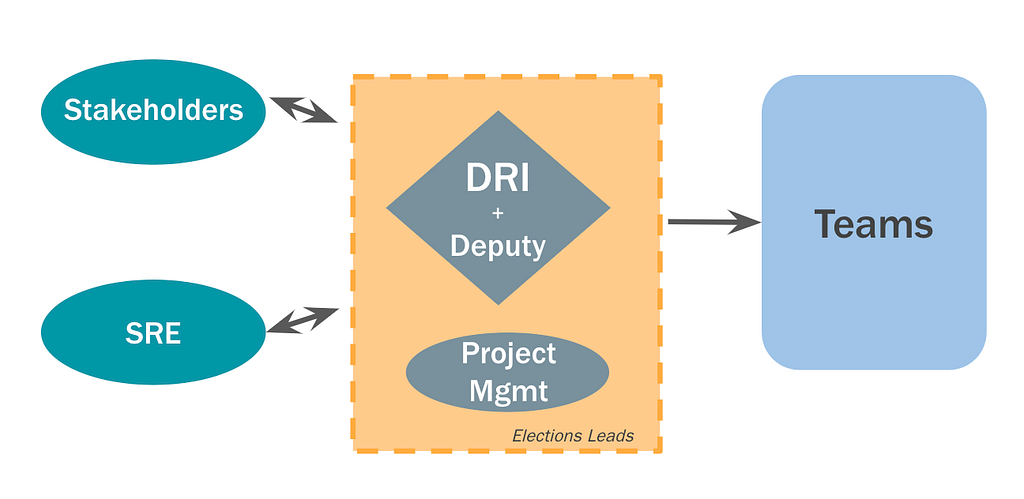
Our mission was to organize a cross-team effort to ensure that election news and interactive content is stable, performant, always up-to-date and displayed as the newsroom intends for our readers. We assembled over 20 teams that have a hand in ensuring our election coverage is reliably served across all of our platforms. With so many teams to manage, we created an election leadership team that was led by a Directly Responsible Individual (DRI), a deputy DRI and two program managers.
The election leadership team worked as the intermediary between our Site Reliability Engineering team (SRE), company stakeholders and the engineering teams.
The Election Leadership team worked as the intermediary between stakeholders, the Site Reliability Engineering team and other engineering teams.
Getting so many teams on the same page is no small feat. Some teams’ systems were more prepared than others, so our first step was to evaluate each system’s readiness level. We then led each team through a series of workstreams:
Architecture Reviews
This was the first step and it covered the reliability, monitoring and failure scenarios of each system or application. Once that initial review was complete, we had a better idea of where the teams stood and we were able to assign tasks for them to work on. Because we had a clear picture of each team’s domain, we were able to group teams with known dependencies, and we scheduled meetings to dig into their architecture needs.
Production Stress Testing
We develop our software and systems to be as scalable and resilient as possible, but without testing, it’s impossible to know how they’ll perform when hit with the type of traffic we get on election nights. So part of our standard development process at The Times is to run load tests on our applications to see how they perform. This helps validate our cloud environment architecture decisions.
Because we expected an unprecedented amount of election night traffic for the 2018 midterms, we decided to stress test our systems, as well. Stress testing is designed to find weak spots in systems. Perhaps more importantly, it shows how our teams respond when things break.
We conducted two rounds of stress testing. To achieve optimal results and replicate an election night load as closely as possible, we made the decision to run tests against The Times’s live production environment. This meant that we had to guard against the possibility that a major news event could happen in the middle of our test, so we coordinated timing and developed a process with our newsroom to “pull the plug” if needed. Much like fire drills prepare people in the event of an emergency, we treated these tests as a rehearsal for election night.
Learning Reviews
To help promote a culture that embraces learning, our SRE team introduced blameless post-mortems, which we call learning reviews. After each of the production stress test, we held a review to capture what went well and address how we needed to improve. These findings guided not only technical tasks, but also informed how we could better communicate across teams.
Timelines are a key part of our learning reviews. As these learning reviews were pre-planned, we captured a timeline of our stress tests in real-time, documenting timestamps, events and the teams involved. By providing an accurate, objective and detailed recording of the tests, the timelines were helpful guides for both of our learning reviews.
After the stress tests and learning reviews, our election leadership team scored each application by its team’s preparedness, communication and technical readiness for the expected elections traffic. This proved useful in escalating concerns and issues, and it helped build confidence among management and individual teams.
Illustration by Wren McDonald
Incident Management Training
Because The Times hosted its own servers for years, we had a centralized Systems team that triaged and responded to incidents. After our migration to a cloud-based infrastructure, individual teams became responsible for managing their own incidents.
It’s important that teams know how to best respond to an incident and can communicate with each other efficiently, especially when incidents span more than one team. To improve our practices, we had everyone go through a training program created by our SRE team. The training covered best practices for incident management, cross-team coordination and communications. People who are versed in these skills are best suited to be an Incident Commander — someone who coordinates the response, actions and communications during an incident.
Coordination for Election Traffic
With a project of this size and complexity, coordination was key. We had active on-call shift coverage and documentation for how to degrade core systems gracefully. This was done to ensure that if a system or dependent system was failing, engineers had a playbook to quickly fix the issue while ensuring the best possible experience for our readers. As an extra precaution, we assigned Incident Commanders to a second on-call rotation.
Having all teams in the same room during this time wasn’t feasible — there were just too many people — so we grouped teams by technology stack and each group worked from a conference room (another lesson learned from our production stress tests). The different groups stayed connected by being on the same video chat and messaging platforms — with protocols in place to minimize noise, such as limiting discussions on the video chat to incident responses only. We also documented our incident management process with our vendors, many of whom were on site to support us.
What we learned
The 2018 elections drove record traffic numbers for a midterm election at The Times. The work we did to get our teams aligned and our systems in good shape meant that we were able to scale, even with some services getting 40 times the normal traffic. Incidents did occur but with limited downtime and impact to our readers.
Consult broadly, but have clear accountability
To take on a project of this size in such a short time span, we had to focus on organizational structure. Assigning a DRI proved to be tremendously effective. When navigating difficult decisions across so many teams under tight deadlines, having one person make tough calls saved time; the deputy DRI made decisions if the DRI was unavailable. This structure was widely communicated and was easy to digest, which meant that teams were better aligned.
Input from the SRE team helped define the work to be done. Because they worked closely with teams on tasks like prepping for the production stress test, it allowed the election leads to focus on other aspects of the project, like working with stakeholder.
In future projects, we’d like to explore having more functions represented in the leadership team. We’d seek to supplement our engineering and project management leads with a colleague from both product and the newsroom to broaden our leads’ perspectives. The more stakeholder voices involved in the planning process will pay dividends in the end result.
Things will break, so set realistic expectations
Whether it’s a special event, like an election, or a normal news day, teams need to be prepared to perform reliably when things break. We know that it’s unreasonable to think that a website of our size will be up and functioning 100 percent of the time. Using the table of nines as our guide, we designed a metric for site reliability that acts as our measure of acceptable downtime.
Through discussions with our product management and newsroom colleagues, we developed a product degradation strategy, which detailed the apps and features that could be shut down in case of failure and our backup plans. This ensured that everyone was on the same page about what would happen if a system failed and engineers could take immediate action knowing they had product approval for expected scenarios.
Accepting that failure happens is why we emphasized incident management training. Running teams through drills leading up to the midterms meant that we could limit the impact of an outage during peak traffic periods.
There were incidents on election night. Fortunately, these were handled swiftly and we have conducted learning reviews so we can be even more prepared for the next time big news breaks.
Kriton Dolias is a Technical Program Manager for the Publishing Pipeline at The New York Times. Follow him on LinkedIn.
Vinessa Wan is the Principal Program Manager for Delivery Engineering at The New York Times. Follow her on LinkedIn and Twitter.
“We’re too young to have a vote, so the government doesn’t care about us. We’re too young to buy loads of stuff, so the companies don’t care about us. But we’re the ones that are going to have to deal with Climate Change.”
To all those who struck school to protest the lack of action on Climate Change, I salute you.
The farce of consent as currently deployed is probably doing more harm as it gives the misimpression of meaningful control that we are guiltily ceding because we are too ignorant to do otherwise and are impatient for, or need, the proffered service. There is a strong sense that consent is still fundamental to respecting people’s privacy. In some cases, yes, consent is essential. But what we have today is not really consent.
So long as a data collector can overcome sampling bias with a relatively small proportion of the consenting population, this minority will determine the range of what can be inferred for the majority and it will discourage firms from investing their resources in procedures that help garner the will- ing consent of more than the bare minimum number of people. In other words, once a critical threshold has been reached, data collectors can rely on more easily observable information to situate all individuals according to these patterns, rendering irrelevant whether or not those individuals have consented to allowing access to the critical information in question. Withholding consent will make no difference to how they are treated!
Is consent management even possible? Is a
large company that seeks consent from
an individual similar to a Freedom
Monster?
And what's going on with Judge Judy and skin care
products?There are thousands of skin care scams on Facebook
and other places on the internet that falsely state
that their product is endorsed by celebrities. These
scams all advertise a free sample of their product
if you pay $4.95 for the shipping. Along the way,
you have to agree to the terms and conditions....The
terms and conditions are only viewable through a
link you have to click, which most of these people
never do.
Or Martin Lewis and fake bitcoin
ads?
He launched a lawsuit in April 2018, claiming
scammers are using his trusted reputation to ensnare
people into bitcoin and Cloud Trader "get-rich-quick
schemes" on Facebook.
The problem is that ad media that have more data,
and are better at facilitating targeting, are
also better for deceptive advertisers. Somehow an
ad-supported medium needs consent for just enough
data to make the ads saleable, no more. As soon as
excess consent enters the system, the incentive to
produce ad-supported news and cultural works goes
down, and the returns to scamming goes up.
From there, Tim began to Google more and more about it, and what started off as curiosity, eventually turned into a passion. The documentary “Ball of Light,” on Vimeo, was his first major source of inspiration.
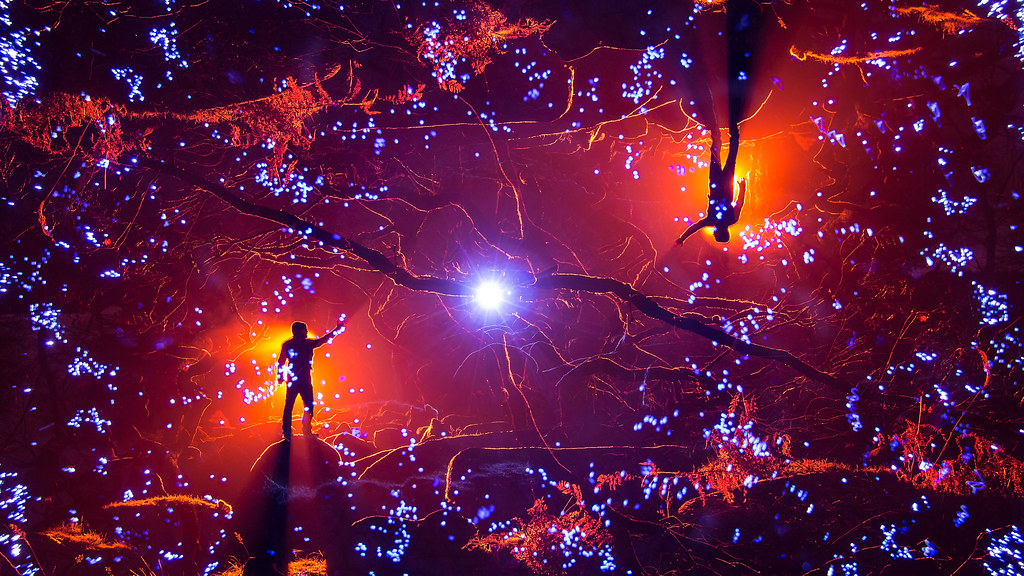
Tim has done about four 365 projects in the past six years, shooting daily. “Light painting is, for me, the ultimate form of creativity. If you can visualize something in your imagination there will be a way to achieve this with your camera,” he said. But being an experienced photographer didn’t save Tim from having his 500px account deleted for “posting non-photographing content.” A few weeks ago, the photo-sharing site mistakenly classified his images as “illustrations,” and suspended his (now reinstated) profile without notice. The incident had a positive outcome though. Tim says the media attention gained from the incident has brought light painting to a wider audience. “It’s also a huge compliment from a personal perspective, as I always strive to produce believable work, so I guess I’m doing something right.”
Flickr’s light painting community was another big source of learning for Tim during his earlier days in photography, particularly the shots and conversations in the Light Junkies and Optical Nirvana groups. “I’d sit for hours trying to dissect each shot to get my head around how each effect had been achieved. This is what drove me to improve and keep pushing the boundaries of what is possible during that long exposure.”
What’s amazing about his photos is that the majority of his work is done totally in-camera. “I use many techniques and tools to achieve my images, first and foremost is camera rotation. After seeing work by TCB, Dan Whitaker, LED Eddie, and Mart Barras, I wondered how they had twisted reality in such a way. Camera rotation was the answer. You place your camera on a rig which allows you to rotate the camera around the axis of the lens.”
Tim uses other techniques, such as refractography or lens and tripod swapping, to achieve that unusual, surreal effect. “More recently Hugo Baptista very kindly shared a number of 3D cross section videos which are really fun to use. He takes a 3D image and cuts it into cross sections on his computer. He then converts this into a kind of 3D scan that plays on a loop. I play these on my phone whilst rotating or panning my camera, and the original 3D image comes back to life.”
Tim, who recently became a brand ambassador for Light Painting Brushes, says one of the fun aspects of light painting is the fact that the artist gets to create their own tools, using LED lights, acrylics, holographic cards, and any other tool that reflects or emits light. For beginners, he recommends starting with a few basics: a tripod to keep things steady, a camera capable of bulb mode, a wired or wireless trigger, a bright torch, dark clothing so as to not appear in the frame, and a dark location to allow for long exposures. But, the most important thing, he says, is “to have a good imagination.”
If you’re into light painting, be sure to follow Tim Gamble. Flickr is where he got started as a photographer. “I love Flickr due to it being the place I found a wider community of like-minded people from around the globe. It also introduced me to my favorite shooting buddy, Chris Thompson, from just over the Pennines in Sheffield. Without his ideas, skills, patience and kind-heartedness most of my favorite light painting images would not exist, and that is all down to a chance meeting on this wonderful platform.”
You may also want to follow the Light Painting Community Flickr group, a place where both experienced and beginner light painters can post their photos and share ideas.
Dundas St E looking west at Curzon St February 15, 2019. Photo credit: Michael Holloway, Ward 14 Bikes
You're Invited to the East End Bike Lane Dig Out
Meet this Saturday, February 16 at 1 p.m. at the SW corner of Dundas and Jones
Do you want the city of Toronto to do a better job clearing snow out the bike lane?
Come join other community members in front of the Jones Branch of the Toronto Public Library at 1 p.m. this Saturday, February 16, 2019 - that's tomorrow! - for a "dig out" of one of the city's most popular east end bike lanes.
Led by cycling advocacy groups 32 Spokes (Ward 19) and Ward 14 Bikes,concerned citizens will gather at Dundas Street East and Jones Avenue with shovels in hand to clear a section of the Dundas East bike lanes to the city mandated standard.The symbolic act is a way of telling Toronto politicians that City of Toronto winter maintenance operations are failing to meet the bike lane clearing standards laid out under policy directives approved by City Council in 2014. (See this Toronto City Council, Agenda Item History item: http://app.toronto.ca/tmmis/viewAgendaItemHistory.do?item=2014.PW31.1 for more information).
“While we applaud the City’s attempts to better clear bike lanes after snowfalls, a standard that helps keep people safe is still not being met,” says 32 Spokes advocacy group member and Dig Out organizer Kathleen Mackey. "After this recent snowfall for example, half the width of the Dundas bike lanes is being used for snow storage. When there is curb side parking beside a bike lane, the City ploughs leave windrows piled next to parked cars. When drivers exit those parking spots they drag the windrow of snow back across the bike lane so that it becomes unusable, sometimes for entire blocks."
Kathleen adds, “Dundas Street East is a very popular route for people riding bikes all year round. Many people rely on bike lanes for safer passage but when they’re in poor condition, many choose not to ride out of fear for their safety."
"We want to see better clearing from the City to help make winter biking an easier and safe choice for everyone.”
I got on the bus just before a very old lady with a walker and a fancy hat, as the driver let the ramp down first and it makes more sense to park my chair before her walker, kind of shrugging and smiling a little and she nodded and smiled back. I am so relieved she isn’t annoyed. She is very beautiful, her skin drawn very fine over her high cheekbones. On the bus she asked me some questions about my chair. How much… What was the cause… She would like one maybe but feels she needs the exercise. She has a nice accent, faintly British sounding but African or Caribbean, I can’t tell. I talked about my free tai chi class at the senior center. Another lady got on with a very large wide walker and could not get past. “Mira….” she said, grabbing the first lady’s walker to fold it. “No, you can’t…” The walker was not foldable because the basket underneath was full of stuff including Michele Obama’s book. No, no, I’ll go back here (I slowly trundle further back on the luckily uncrowded bus) and turn around, then there’s room. The first lady didn’t want to scoot down a seat. So the one with the large walker was now able to go around and sit next to her. “What does that mean, Cowwwwwmoooca?” “….?” Comooooooca over there on that sign? I peer around the front of the bus. “Cumaica. I ummmm I don’t think that’s a spanish word it’s probably from some indian language like the name of a place. Maybe it’s Mayan? Or like, sounds more like an um, Taino or Arawak sort of language? I don’t know” THe spanish speaking lady nods when I sum this up as “una palabra de los indios?”. Well you can find out. Tell me what it means. “Ok… ok yeah I can look it up right now. (thumbing my phone) I love the internet. OK uhhh it’s definitely gonna be a place name. Yes! It’s a place in Nicaragua.” But what does it MEAN. I don’t know…. I’d have to dig a little more. Another lady gets on the bus, sparkly eyed, about my age, in a cute scarf. “Oh! You! You are so pretty. You look so familiar. You look beautiful, just like my mother!” “Well what a nice compliment. I like that. Thank you!” “Yes, you could be from my village. It is not really a village but it was. In Ethiopia. Where are your people from?” “I can’t really, we don’t really know a lot but actually I’m researching my geneology and making my family tree. ” “Well you can get the DNA” says the Ethiopian lady. “Yes I’ve been thinking about doing it. I’m going to do it. Did you know you can go to the place, in the East Bay they have a big place, the Mormons, and look up a lot of that history. I don’t know why the Mormons have it but they do.” I chime in. “It’s because they think everyone in their records goes to their heaven.” “They really think that?” “I guess so.” “Well…. huh. ” We all laugh at this.
The Spanish speaking lady with the big walker has to get off the bus. We prepare to do our do-si-do dance in reverse but the bus driver is angry. She is grabbing the Ethiopian lady’s walker but she’s holding onto it tight. “No! You don’t have to do that. She is going to move back there and then she is going around. ” MA’AM…. MA’AM… YOU HAVE TO LISTEN TO ME says the grim bus driver lady. MA’AM YOU HAVE TO LISTEN. We are all arguing with the bus driver and trying to explain we have it under control. The bus driver wrestles the walker away from our dignified friend. “She took it. She didn’t have to do that. Well!” We all look at each other. The lady with the large walker gets off, ducking her head in apology at stirring up a problem. The bus driver gets back onto the bus with the walker. “YOU HAVE TO LISTEN TO ME” she scolds. “YOU SEE HOW EASY THAT WAS? YOU SEE HOW EASY THAT COULD HAVE BEEN? YOU ALMOST GOT THAT LADY FALLING OVER. YOU CAN”T BE TRIPPING THAT OTHER LADY.” “That isn’t how it was, you see, we were going to move back and let her get off.” she said firmly. I spoke up as well and said, that’s how she got on, we just moved for her and it was fine! But, we shrugged and let the driver keep talking. She finally went back to take the wheel. Behind the partition out of her sight, I stick out my tongue like a child, playing to my sympathetic audience so we can get a laugh out of our sadness. “What are you going to do. The truth is the truth.” says our queen. “She has a hard job. But she could have had more respect,” I say. We all laugh kind of like we just did at the Mormons’ database of heaven.
“My mother would like you.” our friend resumed. “The place where my village, not really a village, it is a PROVINCE, well, it was good, and the people were so friendly and good. Well, now, you could not even buy a house, a place just the size of this, this front of the bus, just so little, is 300 thousand dollars! You can’t live there.” “Well…. Someone sure got rich off of that,” I say. “They did, and you know who got rich from it…. ” No… who? “The ones who came to power. They got rich.” We all are thinking on that as the lady my age who looks like the 90 year old Ethiopian lady’s mom gets off the bus waving to us. “I am going to the doctor. The new one isn’t as good, because, they aren’t by the ferry building, so I don’t get as nice of a lunch.” We discuss the pleasures of the Ferry building and then I have to go. Sometimes the ephemeral nature of these bus friendships gets to me. I think that I will have a good old age someday. There will be moments of indignity but also we will have solidarity and a good time.
Die Scheffin hat einen stressigen Job. Nicht etwa, weil sie ihn nicht beherrscht, sondern weil sie in einem komplizierten Unternehmen arbeitet. Und wo viele Teile in einander greifen, kommt es auf den Durchblick an. Das heißt vor allem: Daten, Daten, Daten. Ich habe ein 19"-Rack, die Scheffin hat(te) Hunderte. Wenn Du da keine detaillierte Historie von so simplen Dingen wie Stromverbrauch und Temperaturverlauf hast, bist Du verloren. Von höherwertigen Daten ganz zu schweigen.
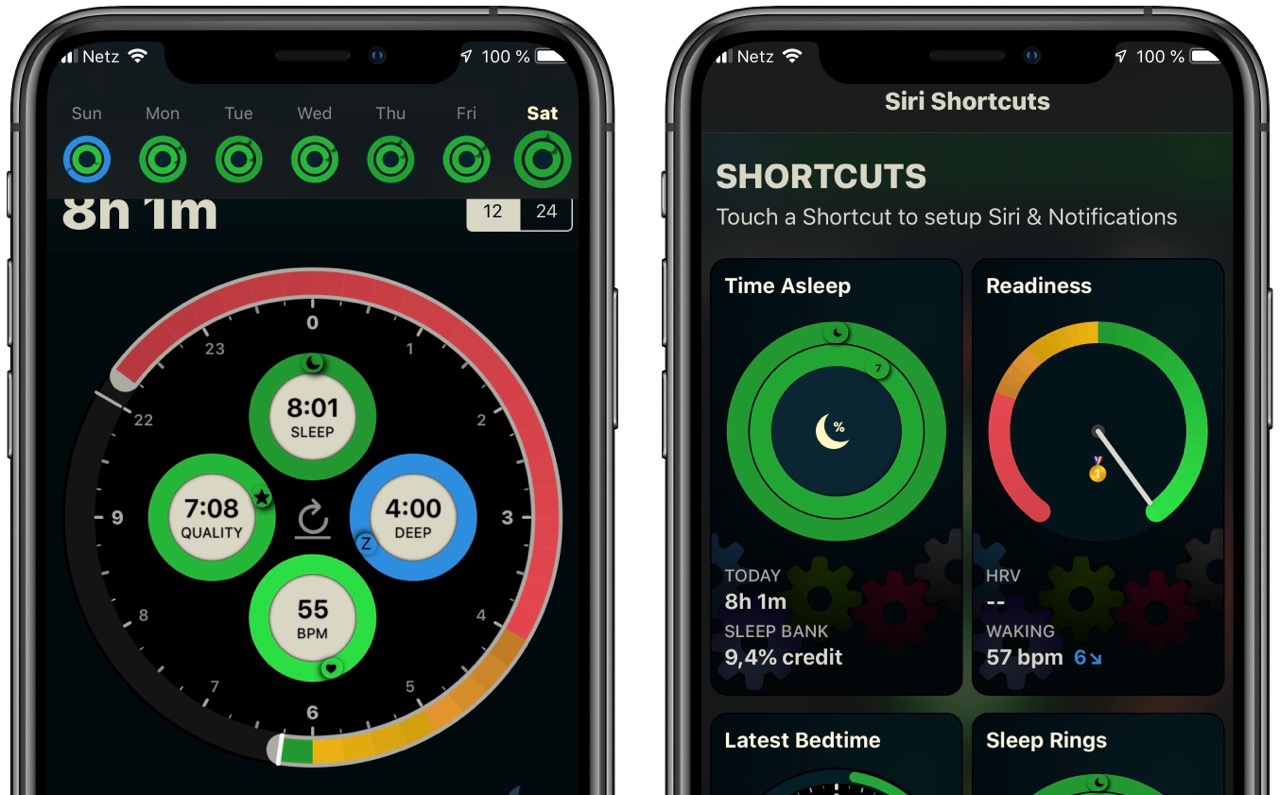
Diese Affinität für Daten hat dafür gesorgt, dass sie sich schon früh der Quantified-Self-Bewegung anschloß. Sie trug z.B. seit Jahren ein Misfit Ray, einen kleinen Tracker, der rund um die Uhr aufzeichnet. Drei kleine Knopfzellen halten Monate. Bewegung hat sie genug, es kommt ihr auf den Schlaf an.
Dieses Jahr wollte ich sie nun vom Misfit Ray auf eine Apple Watch umstellen. Kein leichtes Unterfangen, weil die Uhr ihre geliebte mechanische Uhr ersetzen muss. Zunächst habe ich es mit meiner Watch 3 vom letzten Jahr angetestet. Nach positiver Rückmeldung hat sie nun ein kleines Modell der Watch 4. Und findet das jetzt gar nicht mehr so riesig. ;-) Die Uhr ist mit ihrem privaten iPhone verbunden.
Ringe schließen war für sie einfach. Wenn sie nicht genug Bewegung hat, läuft sie einfach Treppen, typischerweise 30 Stockwerke rauf und wieder runter. Aber für das ihr wichtige Schlaftracking musste erst eine Lösung her. Die Apple Watch macht das nicht von Haus aus. Ich habe ihr deshalb AutoSleep gekauft und sie ist begeistert.
An der besten Strategie zum Laden der Uhr arbeiten wir noch. Aktuell haben wir drei Lader platziert: einen im Bad, einen auf dem udoq in der Küche und zur Sicherheit noch einen auf ihrem Schreibtisch. Das Laden bei der morgendlichen und abendlichen Badroutine reicht nur sehr knapp.
Sehr weitsichtig hat sich die Datenspeicherung in Apple Health erwiesen. Auch wenn sie das Gerät gewechselt hat, sind ihre Vitaldaten doch vollständig erhalten. Für ein kleines bisschen Enttäuschung hat nur der Wechsel der Uhr letzte Woche gesorgt. Obwohl sie eigentlich alle Ringe geschlossen hatte, riss die Kette ab. Dafür hat sie jetzt ein viele bessere Schlafüberwachung. So wie mir die Ringe dabei helfen, in Bewegung zu bleiben, sorgt AutoSleep dafür, dass sie auf ihren Schlaf und damit auf den Stress-Abbau achtet.
Stories about AI gone bigoted are easy to find: Microsoft’s Neo-Nazi “Tay” bot, her still racist sister “Zo”, Google’s autocomplete function that assumed men occupy high status jobs, and Facebook’s job-related targeted advertising which assumed the same.
A key factor in AI bias is that the technology is trained on faulty databases. Databases are made up of existing content. Existing content comes from people interacting in society. Society has historic, entrenched, and persistent patterns of privilege and disadvantage across demographic markers. Databases reflect these structural societal patterns and thus, replicate discriminatory assumptions. For example, Rashida Richardson, Jason Schultz, and Kate Crawford put out a paper this week showing how policing jurisdictions with a history of racist and unprofessional practices generate “dirty data” and thus produce dubious databases from which policing algorithms are derived. The point is that database construction is a social and political task, not just a technical one. Without concerted effort and attention, databases will be biased by default.
Ari Schlesinger, Kenton P. O’Hara, and Alex S. Taylor present an interesting suggestion/question about database construction. They are interested in chatbots in particular, but their point easily expands to other forms of AI. They note that the standard practice is to manage AI databases through the construction of a “blacklist”. A blacklist is a list of words that will be filtered from the AI training. Blacklists generally include racist, sexist, homophobic, and other forms of offensive language. The authors point out, however, that this approach is less than ideal for two reasons. First, it can eliminate innocuous terms and phrases in the name of caution. This doesn’t just limit the AI, but can also erase forms of identity and experience. The authors give the example of “Paki”. This is a derogatory racist term. However, filtering this string of letters also filters out the word Pakistan, which is an entire country/nationality that gets deleted from the lexicon. Second, language is dynamic and meanings change. Blacklists are relatively static and thus quickly dated and ineffective.
The authors suggest instead that databases are constructed proactively through modeling. Rather than tell databases what not to say (or read/hear/calculate etc.), we ought to manufacture models of desirable content (e.g., people talking about race in a race conscious way). I think there’s an interesting point here, and an interesting question about preventative versus proactive approaches to AI and bias. Likely, the approach has to come from both directions–omit that which is explicitly offensive and teach in ways that are socially conscious. How to achieve this balance remains an open question both technically and socially. My guess is that constructing social models of equity will be the most complex part of the puzzle.
Herewith notes from the white-hot center of the Internet software profession. Maybe the reality these reflect prevails across
other technology territories, but I wouldn’t know. In no particular order:
Videoconferencing
Generally it sucks. There’s Skype ’n’ TeamViewer ’n’ Zoom ’n’ Webex ’n’ our own
Chime ’n’ GoToMeeting ’n’ join.me and they all suck in their own unlovable idiosyncratic
ways. The visual glitches I can tolerate, but the audio problems make me want to scream; dropouts, static, echoes, the noise of
hands softly leafing through a document drowning out any non-booming voice.
In my decades-long career, I’ve used one videoconferencing system that was reliable and almost always Just Worked. It was by
Polycom, but then the infrastructure people said “super old school” and replaced it with something modern that often doesn’t. I
suspect darkly that the technology is passable but a bean-counter somewhere has refused to buy enough bandwidth to make it sing?
Blecch.
Screens
The amount of screen real-estate per geek grows monotonically. Dual-27" screens plus your laptop’s own screen are table
stakes, and I’m seeing the occasional massive 50"-plus 4K screen. I asked one guy
“How can you use all that space?” He said “I can’t of course, all the stuff I’m actively working on is in the middle third,
bottom half. But having everything else within visible reach is such a win.” OK then.
I have to admit that I’m becoming increasingly conscious that the pixels on my
curved 34" Dell U3415Ware in fact visible,
and the contrast between that and my Retina laptop screens is a perceptible irritant. #FirstWorldProblem.
Desks
The proportion that are motorized is higher every quarter. I’d find it hard to live without mine. The mix of people standing
and sitting makes the otherwise-dreary rows of software-engineer desks a little easier on the eye, which welcomes disorderly human
distributions.
Office space
Since I mentioned it: All the high-tech companies I’ve worked for have resolutely ignored the research I hear about that seems to
say putting expensive engineers out on the floor with no separating walls leads to grievous productivity losses. Isn’t this biz
supposed to be data-driven?
If you can get past that (I can’t) there are grounds for good cheer. Here in Vancouver we draw from the very considerable
Canadian talent pool, but our immigration law lets us hire major distributed-systems talent from almost anywhere in the
world.
The resulting mix actually makes me feel optimistic about humanity; the AWS Service groups that
surround me offer visible in-the-flesh proof that there’s plenty of software talent in any ethnic, linguistic, or geographic slice
across the membership of Homo sapiens.
I’m amused that when chance lands two engineers on a problem who happen to share a native
tongue, they immediately drop out of English and into Polish or some south-central Han dialect or whatever it is Nigerian
geeks speak to each other. There’s this one group near me that has three guys named Muhammad; one them is called by his actual name, then
there’s “Mo” and “Momo”. It seems to work, and by the way Momo seems to be the leading expert on AWS Region Build Automation, which
is a big freaking hairy deal around here. Protip to the industry: If you’re not recruiting out of West Africa, you’re missing out on
major engineering talent.
Darkness
I’m talking about screens. What with the advent of Mojave, light text on a dark background has officially re-entered the GUI
mainstream. But more or less all the younger engineers had already switched their IDEs over to light-on-dark. My
white-background IntelliJ and Goland screens mark me as a dinosaur.
I’ve cared deeply about typography and presentation for a long
time and the issues here are interesting. I freely acknowledge that my preference for dark-on-light is probably an artifact of my
having tuned my brain, in my youth, to ink-on-paper. Since screens are, at the end of the day, light-displaying devices, there’s an
argument that the natural on-screen design language for typography and information display is light-on-dark. I wonder if there’s
quantitative research in the space?
Speaking of IDEs
I guess the big story is the decline of Eclipse from “more or less everybody’s default” to “there are still people using it”. VS
Code has momentum
but IntelliJ has a plenty of loyalists, and then the front-end tribe are often in Atom and Sublime. I’m happy to report that
neither Vim nor Emacs have gone away. But recently our license server was having problems and I couldn’t use Goland and found the Emacs
go-mode story pretty weak.
Speaking of languages
It’s no secret that the Internet still runs, more than anything else, on Java. Could be worse, I remember when it all ran on PHP
and Perl. And I don’t want to diss Java too much. The tooling story is exceptional, and once your JVM gets properly warmed
up, there’s nothing that runs usefully faster. And these days, for new stuff you should spell Java “Kotlin”. Especially since if
you let those young pups who won’t get off my lawn use Java, they’ll emit all this Java 8+ stream/lambda stuff that is easy to make
indecipherable.
What’s happening out on the front-end frontier, the Cambrian explosion of JS-based technologies, makes me happy that I mostly
don’t go there.
On the back end where I live, we’ve got Go and Rust creeping in big-time. I’m no longer surprised when I pull up some package
buried deep in our serverless infrastructure and it turns out to be in Go. Well, and for serverless code too, if only because of the
fast startup.
If you live in the world of ML or data science, you’re using Python; you don’t have a choice and it’s not
terrible.
Then Rust, for when you get close to the metal. There was an internal new-languages thread where someone said “If you can’t
tolerate GC, use Rust. Otherwise use Go.” Sounds reasonable.
A few zealots are saying everything new should be in Rust because otherwise you’re being
wilfullly unsafe. But I like having the runtime manage memory for me, whenever I can get away with it.
Inside the software
REST is still a really good way to piece pieces of the software world together. Of course, what with the rise of HTTP/2 and QUIC,
what the programmer thinks of as RESTful requests are something quite other, out on the wire. This feels about like us
thinking we’re using x86 instructions on our silicon even though what the circuits are doing is really totally different.
To the extent that interfaces aren’t REST, they’re mostly event streams of one kind or another. Where by “Event” I mean “JSON
blob”; by and large good enough. This is the area I’m working on this year, lots of opportunities for improvement.
The good news: Each generation of devs that comes along is a little more test-infected than its predecessors. I still run
across islands of ignorance where they think it’s OK to ship code now and do the unit tests later (as if that ever happens), but
less and less each year.
Which computers?
Still more Macs than anything else, although there’s an undeniable Windows renaissance. Having said that, even the smart people
with the coolest Surface devices are often bitching about problems with things called “drivers” — what
are those for, anyhow? — and lockups, and saying “Sorry, just a moment while I get my computer going”.
If I were a little less aged and cynical, I’d be boiling over with anger at Apple’s inexcusable stewardship of the Mac franchise;
Gruber’s “D” grade is maybe even generous. This is a
product that used to feature instant wake-up (gone), MagSafe (gone), lots of useful I/O ports including SD card readers (gone), a
good built-in photo editor (gone), and the world’s best keyboards (gone). It absolutely shocks me that a company can get away with
making its product successively
worse and then worse again, year after year. Among other things it speaks to how good the core design of MacOS is.
But maybe 2020 is the year of Linux on the desktop?
In a press release, Amazon explained why it backed out of its plan to open a new headquarters in New York City:
For Amazon, the commitment to build a new headquarters requires positive, collaborative relationships with state and local elected officials who will be supportive over the long-term. While polls show that 70% of New Yorkers support our plans and investment, a number of state and local politicians have made it clear that they oppose our presence and will not work with us to build the type of relationships that are required to go forward with the project we and many others envisioned in Long Island City.
The hmm for me is why not New Jersey? Given the enormous economic and political overhead of operating in New York, I’m wondering why Amazon didn’t consider New Jersey first. Or if it’s thinking about it now.
New Jersey is cheaper and (so I gather) friendlier, at least tax-wise. It also has the country’s largest port (one that used to be in New York, bristling Manhattan’s shoreline with piers and wharves, making look like a giant paramecium) and is a massive warehousing and freight forwarding hub. In fact Amazon already has a bunch of facilities there (perhaps including its own little port on Arthur Kill). I believe there are also many more places to build on the New Jersey side. (The photo above, shot on approach to Newark Airport, looks at New York across some of those build-able areas.)
And maybe that’s the plan anyway, without the fanfare.
So I try to see both sides of an issue such as this. What’s constructive and what’s destructive in urban planning are always hard to pull apart.
For an example close to home, I often wonder if it’s good that Fort Lee is now almost nothing but high-rises? This is the town my grandfather helped build (he was the head carpenter for D.W. Griffith when Fort Lee was the first Hollywood), where my father grew up climbing the Palisades for fun, and where he later put his skills to work as cable rigger, helping build the George Washington Bridge. The Victorian house Grandpa built for his family on Hoyt Avenue, and where my family lived when I was born, stood about as close to a giant new glass box called The Modern as I am from the kitchen in the apartment I’m writing this, a few blocks away from The Bridge on the other side of the Hudson. It’s paved now, by a road called Bruce Reynolds Boulevard. Remember Bridgegate? That happened right where our family home stood, in a pleasant neighborhood of which nothing remains.
Was the disappearance of that ‘hood a bad thing? Not by now, long after the neighborhood was erased and nearly everyone who lived has died or has long since moved on. Thousands more live there now than ever did when it was a grid of nice homes on quiet, tree-lined streets.
All urban developments are omelettes made of broken eggs. If you’re an egg, you’ve got reason to complain. If you’re a cook, you’d better make a damn fine omelette.
Bianca Wylie@biancawylie
I see Amazon apologists lining up, so here's the simple thing about both Amazon and Sidewalk Labs, just to pre-empt… twitter.com/i/web/status/1…
Taylor Lorenz@TaylorLorenz
Twitter is a terrible place to host complex discussions (or really any type of discussion). And that interview just… twitter.com/i/web/status/1…
Apple has launched a new ‘NBA Collection‘ of Beats Studio3 Wireless Headphones.
As part of the collection, the Beats Studio3 headphones are available in six new colours, including ‘Raptors White.’
Each of the new finishes incorporates the logo and colours of the six NBA teams included in the collection. The Raptors White headphones, for instance, feature red and gold accents as well as the team’s logo.
Like every pair of Beats Studio3 headphones, the new models feature Apple’s W1 chip, up to 22 hours of battery life and users can take calls, skip songs and control playback volume using Siri.
The headphones cost $399.95 CAD.
Other NBA Collection headphones include ‘Lakers Purple,’ ’76ers Blue,’ ‘Celtics Black,’ ‘Rockets Red,’ and ‘Warriors Royal.’
Facebook is taking another step in combatting the spread of misinformation, as the social media platform is looking into removing anti-vaccination information from recommendations.
Anti-vaccine information, which is supposed to discourage parents from vaccinating their children, has been spread in posts, and has particularly gained traction in Facebook ‘groups.’
According to Facebook’s statement, the company is “exploring additional measures to best combat the problem” which could include “reducing or removing this type of content from recommendations, including Groups You Should Join, and demoting it in search results, while also ensuring that higher quality and more authoritative information is available.”
Facebook has been finding it particularly difficult with the spread of misinformation on its platforms.
Last November, politicians criticized Facebook CEO Mark Zuckerberg for not attending a hearing about fake news and Facebook’s involvement with elections meddling.
Then last month, WhatsApp, a Facebook-owned messaging service, has limited message forwarding to stop fake news spreading to a mass amount of people.
BlackBerry QNX today received a $40 million investment, announced by Prime Minister Justin Trudeau, to help develop safe and secure software systems for connected and autonomous vehicles.
The Globe and Mail first reported on Thursday, that the government was set to make the announcement, noting the investment will go toward a $300 million-plus investment by Blackberry.
The federal government’s $40 million contribution is being made through the Strategic Innovation Fund, a program designed to draw in and support business investments, by encouraging research and development that will help with the commercialization of new technologies in Canada.
“The race for a top spot in the new economy has already begun, and if we want to see Canadians take the lead, we need to have their backs,” said Trudeau. “This investment will create 800 good, middle-class jobs for Canadians, make our cars safer and more secure, and further position Canada as a global hub for innovation.”
Along with 800 new jobs created over the next ten years, Blackberry QNX will maintain nearly 300 more. BlackBerry is set to invest $310.5 million in the project, as well as commit $5 million to cybersecurity to collaborate with government, universities, and private sector firms.
“BlackBerry is trusted by automakers and Tier 1s around the world to protect hardware, software, applications, and end-to-end systems from cyberattacks,” said Navdeep Bains, Minister of Innovation, Science and Economic Development. “Thanks to the Canadian government’s commitment we’re now in an even stronger position to deliver on the demand for BlackBerry’s safe and secure QNX software. Together we will spur innovation, create great jobs, educate the workforce of tomorrow, and solidify Canada as a world leader in automotive technology.”
BlackBerry first announced plans to create an autonomous vehicle research centre in Ottawa in late 2016. Last December, BlackBerry QNX launched a certificate security system to help the development of smart cities and autonomous vehicles, which provides the mechanism for vehicles and infrastructure (such as traffic lights), to exchange information in a trustworthy and private manner using digital certificates.
With this funding, BlackBerry QNX aims to develop new automated control systems, upgrade and secure communications in vehicles, and improve vehicle safety by expanding its advanced driver-assistance system. BlackBerry QNX will also develop and use concept cars as labs for technology and software development.
This story was written by Isabelle Kirkwood and was originally published on BetaKit.
From Samsung to LG, here’s a breakdown of almost every smartphone leak from the last few days.
The leaks below encompass news ranging from February 1oth to the 16th, 2019.
Samsung
This week, GSMArena posted the official specification sheet for the Samsung S10e, S10 and S10+, revealing details about the camera, processor, display and battery.
MobileSyrup has also posted a complete overview of what to expect for the upcoming handset. So for your S10 related leaks, click here.
Google
A Geekbench post revealed a handset called the Pixel 4 ‘Sargo’. This phone, however, only has 2GB of RAM (1,833MB to be exact) as well as a single-core score of 744 and a multi-core score of 3,201.
For more on the Pixel 4 ‘Sargo’ benchmark, click here.
A Google patent reveals that the company is investigating modularity. The patent has modular components such as a replaceable display, battery and camera unit.
Google 2019’s hardware lineup was recently leaked. The source indicates the search company is looking into revealing a new premium Pixel 4 handset, a new entry-level Pixel, a newGoogle Home, a new Nest devices as well as its first Pixel-branded smartwatch.
Rumours suggest that Sony will launch more than one handset at Mobile World Congress 2019. Among them is the Xperia 10, previously thought to be called the Xperia XA3. Leaks suggest this handset has a very tall 21:9 aspect ratio. This rumour also suggests the phone will have a plus version called the Xperia 10 Plus.
EXCLUSIVE! Sony has changed the the name of Xperia XA3 and XA3 Plus to Xperia 10 and 10 Plus! So the renders leaked @rquandt are of the new series called Xperia 10! It makes sense that the series has been changed because the design is pretty different. You like it? #Xperia10pic.twitter.com/ZdtGc5J2VQ
For more on the Sony Xperia 10 and 10 Plus, click here.
Another rumour about the Xperia 10 suggests the phone will feature a 3,500mah battery, 5.9-inch display and a 2,560 x 1,080. Additionally, the leak indicates the device sports a 4GB of RAM, 64GB of storage, a Snapdragon 660 chipset.
For more on the details on the Xperia 10, click here.
Every week, MobileSyrup recounts some of the most notable movies and TV shows to have recently hit Canadian streaming platforms.
Typically, this column will focus on content from Amazon Prime Video Canada, Crave and Netflix Canada, although other streaming services may be mentioned when relevant. Any content that is Canadian-made, involves Canadian cast or crew or is filmed in Canada will also be highlighted.
Amazon Prime Video Canada
Lorena
This four-part docuseries from executive producer Jordan Peele (GetOut) takes a look at Lorena Bobbitt, a woman who sliced off her husband’s penis in 1993 following years of abuse. The documentary dives deeper into how Bobbitt and her husband quickly became the source of a massive sensationalized tabloid news story in America.
Amazon Prime Video Canada release date: February 15th, 2019
The full list of movies and shows hitting Amazon Prime Video Canada in February can be found here.
Crave
Boost
Written and directed by Darren Curtis, this Canadian drama focuses on two close-knit teenaged immigrants named Hakeem (Nabil Rajo) and A-Mac (Jahmil French) who are struggling to get by in Montreal. Things take a turn for the worse once the pair gets caught up with the mob after a car they stole gets involved in a fatal accident.
Boost was filmed in Montreal and also stars Ntare Guma Mbaho Mwine, Fanny Mallette and Patrick Goyette.
Canadian theatrical release date: April 7th, 2017 Crave release date: February 15th, 2019
The New Romantic
Written and directed by Carly Stone, this Canadian romantic-comedy film follows a journalism student named Blake (The End of the F***ing World’s Jessica Barden) who’s dealing with a lack of romance in her life and impending graduation. To help with both problems, she agrees to become a sugar baby for a wealthy older man in the hope that she can write about her experiences and win a $50,000 prize in a journalism competition.
The New Romantic was filmed in Sudbury, Ontario and also stars Hayley Law, Brett Dier, Avan Jogia, Timm Sharp and Camila Mendes.
Canadian theatrical release date: October 19th, 2018 Crave release date: February 14th, 2019
The full list of movies and shows hitting Crave in February can be found here.
Netflix Canada
Dating Around
Netflix’s Dating Around brings a unique twist to reality dating shows by focusing on one real-life single as he navigates five blind dates. The goal is to find one match worthy of a second date.
Netflix Canada release date: February 14th, 2019
The Dragon Prince
Netflix’s acclaimed fantasy-adventure animated series returns for a second season and continues the story of two human princes and an elven assassin who fight to bring peace to their warring lands. It’s worth noting that the show’s creators say the animation — which was handled once again by Vancouver-based Bardel Entertainment — has been made smoother this time around following some criticism over the first season’s presentation.
Netflix Canada release date: February 15th, 2019
Ken Jeong: You Complete Me, Ho
In his first-ever stand-up special, comedian, actor and real-life physician Ken Jeong pays tribute to his wife, Ho, and talks about how The Hangover films saved his life. The special was directed by Jon M. Chu, who Jeong previously worked with on 2018 smash hit Crazy Rich Asians.
Netflix Canada release date: February 15th, 2019
The Umbrella Academy
Netflix might be moving away from its long-running deal with Marvel, but that doesn’t mean it’s out of the superhero show business. In fact, the streaming giant has just put out The Umbrella Academy, a new superhero team-up series based on My Chemical Romance lead vocalist Gerard Way’s comic book of the same name. The show follows estranged siblings with extraordinary powers who are reunited by their father’s death and later work together to stop a looming threat to humanity.
It’s worth noting that The Umbrella Academy has significant ties to Canada. To start, the series was developed for Netflix by Edmonton’s Steve Blackman. Further, the show stars Halifax’s Ellen Page (Juno, Inception) and Colm Feore (House of Cards, Canada’s Bon Cop, Bad Cop), who was born in America but grew up and resides in Ontario. Finally, The Umbrella Academy was filmed in Toronto.
The series also stars Tom Hopper, Robert Sheehan, Mary J. Blige and Kate Walsh.
Netflix Canada release date: February 15th, 2019
The full list of movies and shows hitting Netflix Canada in February can be found here.
Are you planning to tune into any of these movies or shows? What other programming are you planning to stream soon, especially since it’s the Family Day long weekend in parts of Canada? Sound off in the comments.
Apple rolled out a new advertisement that shows off the iPhone XR, XS and XS Max depth control ability in a funny exchange between moms.
The short ad sees one mom showing a picture of her son to another mom. She notices a second kid blurred out in the background, prompting her to ask “Did you bokeh my child?”
The first mother tries to save face by removing the bokeh effect with the depth control slider, showcasing the feature in a rather humorous context.
As enjoyable as the ad was to watch, it doesn’t tell the whole story about bokeh on the iPhone.
Bokeh typically refers to the blur effect that distinguishes the subject of a photo from other elements — such as a person from the background. This is also known as depth of field.
Phone cameras usually can’t do this to the same extent as traditional cameras due to the size of the lens and sensor. However, advancements in software and computational photography — and on some phones, the use of a second camera — allow devices to mimic the bokeh effect.
So, that’s why you can adjust the bokeh on your iPhone. You’re essentially adjusting the effect as applied by software in the camera app.
We're used to turning light bulbs on and off. The advent of LEDs and software has given us an opportunity to rethink the givens of light and lighting in our daily lives. We can now paint surfaces with lights and manage ambience.
So why would you let junior staff be responsible for them?
A single antagonistic comment, a perceived lack of respect, an inconsiderate request, taking too long to reply to questions or simply failing to maintain a strong relationship can wipe out millions of dollars in community value.
I’m continually staggered by how many community professionals are hired on the basis of a short job interview and then given responsibility for one of the company’s most lucrative assets.
Three simple tips here.
Don’t hire junior people to do what’s clearly a senior person’s job.
Review any recruit’s contributions to a past community carefully. Do they engage with empathy, understanding, and tackle different challenges well?
Include MVPs on the hiring loop. Get feedback on who they would like to see as their point person in the community process.
Changing community staff members can be as delicate (and expensive) a process as changing community platforms.
If you’re moving on from (or moving into) a community role, get opinions from your top members in the process.
Got my certificate, hard hat, vest, gloves, and ID card signifying that I have gone through Neighborhood Emergency Response Team training. Tonight was fun – it was all exercises like doing a search & rescue and triage, setting off a fire extinguisher (in the street, on a gasoline fire in a big metal box) and rescuing a CPR doll trapped under a pile of debris by shoring up a plank and levering it off her.
I also did a bunch of stuff for Firefox 66 beta 8 and then went shopping with a friend in the late afternoon, had a blast taking her to my favorite mens consignment shop then to a thrift shop on Market where there was a VERY drunk blonde lady (size 4) trying on pants while my friend was trying on shirts in the dressing room next door and I was just chilling out on a bench. Blond lady would come out and strut around and shake her butt in my face “These pants are totallly sexy they’re a yes! don’t you think!” I would agree and she would go “HOTTTTTT” and I’d go “yes, totally HOTTTTTTTT with TTTTTTTTTT on it” And then alternately admire or mildly disparage the fit of the button down shirts on my friend. Then at one glorious point the drunk femmy lady came out in a punky jacket, rejected it, but intersected with my friend and was like NO… YOU need this… this would look GREAT on you. And it did! High fives all around. She kept coming out of her little cubbyhole only in underwear to see what my friend had on next.
Very entertaining! I was really feeling like a fabulous fairy godless-being and very knowledgeable about pocket squares and so on. Super reminded of this, the best thread: https://twitter.com/trans_tho/status/999924229624639488
Jeder kennt die Situation. Man steht an der Ladenkasse und die Schlange wird einfach nicht kürzer. Das größte Argument gegen das “langsame” Bargeld war stets: “Zahlen Sie doch mit Karte. Das ist die Zukunft!” Nach [...]



 The first column is road position, the second the overall gap at the end of the previous stage. The first numeric columns are how far the rebased driver was ahead (green) or behind (red) each other driver at each split. The Overall* column is the gap at the end of the stage (I should rename this and drop the Overall* or maybe replace as Final; then overall position and overall rally time delta (i.e. the column that take on the role of Previous column in the next stage). The DN columns are the time gained/lost going between split points. This often highlights any particularly good or bad parts of the stage. For example, in the above example, rebased on Lappi, the first split was dreadful but then he was fastest going between splits 1 and 2, and fared well 2-3 and 3-4.









 Jeder kennt die Situation. Man steht an der Ladenkasse und die Schlange wird einfach nicht kürzer. Das größte Argument gegen das “langsame” Bargeld war stets: “Zahlen Sie doch mit Karte. Das ist die Zukunft!” Nach
