Rolandt
Shared posts
The struggle is real
Language used for the wall

For The Upshot, Kevin Quealy continues on his path looking at the words used by Donald Trump. This time Quealy examines descriptions of the wall and who will pay for it, pre- and post-inauguration.
Tags: Kevin Quealy, Upshot, wall
NASA's Opportunity Rover Mission on Mars Comes to End

I want to mark the end of the Opportunity mission on Mars. For the last 18 years I have watched it with a sense of personal attachment. You see, my name is on Mars, and specifically, the Opportunity rover. I was a part of the SpaceKids program where if you wrote in to support the Opportunity mission, they would add your name to a CD-ROM that went to space with the rover. The original website is long gone, but here's the Wayback Machine listing and the actual certificate. "The records, discoveries and sheer tenacity of this intrepid little rover is testament to the ingenuity, dedication, and perseverance of the people who built and guided her."
Web: [Direct Link] [This Post]City Council & the 800 Block of Robson Street Closure~Which Came First?


Vancouver Sun’s Dan Fumano talks about an interesting perception with the work of the current Vancouver City Council. Dan was referring to the council report on the “court house block” of 800 block of Robson Street and the potential decision to approve over five million dollars to create a permanent plaza at this location. You can read the report to Council on this here.
This has been a long talked about initiative and even the architect for the Robson Square court house Arthur Erickson had discussed the closure of this portion of street in the 1970’s. It is not a new idea and it is not something that the previous Vision party dominated city council dreamed up. But somehow in the last decade there is a sea change in the way that Vancouverites perceive that work initiated by the City is the “vision” of the ruling party, and not the result of careful reasoned work undertaken over the years by city staff, who also embark upon extensive public processes to review and comment upon potential plans and projects.
The last Vision party dominated Council contributed to the perception of council as project mavericks by having Council members talk about projects instead of having experienced City staff explain elements of the projects they would have painstaking detail and knowledge of.
While this may have been a well-meaning strategy to give Councillors more media time, it also contributed to a growing distance between policy and the staff people who were actually working on and charged with implementing the policy. The street closure of the court-house block is a prime example of something that was done to connect the street for pedestrians and cyclists, and was a policy direction, not a political council initiative.
I have previously written before about the “Americanization of City Hall” where the previous Vision Council majority abruptly fired the well-respected city manager Judy Rogers in favour of a political hire that would follow their mandate, Dr. Penny Ballem. That firing signalled the City of Vancouver becoming more like a city in the United States where city managers come and go with each administration.
But even a new city manager hired politically must still deal with established city policy and bring forward to council any proposed amendments to the initiatives proposed and approved by previous city councils. As Dan Fumano observes, the pedestrianization of the Granville Bridge and the extension of the subway along Broadway are not creations of the previous Vision council, but were outstanding work objectives from city staff acting upon previously approved city policy.
Back to the closure of the Robson Square block of 800 Robson Street. You can see a video of broadcaster Jack Webster touring through the Robson Square park in 1978 when the court house’s public spaces were first opened to the public. Mr. Webster mentions that the old court house was sold to the City “for a dollar” and still needed renovation to become a gallery. But in the images you can also see how the street functions as a mall connecting space between the old and the new court houses, and how it lends itself to be rethought as a public space for people not for vehicles. The architect’s intent was that the entire three block area including the 800 block Robson Street portion be closed to traffic. That was architect Arthur Erickson’s vision four decades ago, and a direction that has been explored by city staff over the years.

Arthur Erickson with model of Museum of Anthropology
Images: Glacier Media & Vancouver Sun
Free Shipping
We are increasingly surrounded by boxes. A new online purchase arrives on the doorsteps of one-third of American consumers each week. The volume of packages express-shipped by Amazon (more than 5 billion deliveries in 2017) shares an order of magnitude with the earth’s population (approximately 7.4 billion people). Look around your immediate surroundings and you might see the curved logo from one of the company’s boxes smiling at you now.
This tide of packages is unlikely to recede. Technology giants with multibillion-dollar research budgets are working to further embed our everyday lives within an ecosystem of accumulation, assuring that those packages will keep coming. Amazon engineers, hoping to use robots to address the “last mile problem” of transporting packages between warehouses and individual consumers, have contemplated such solutions as parachuting boxes from drones. A company called Starship has already begun testing small sidewalk-traveling delivery robots in some urban areas. But robots won’t just be on the road or in the sky. As boxes pile up beyond the anticipated capacities of apartment-building mail rooms, a few high-end properties are now experimenting with robotic systems to shuttle incoming deliveries to residents or store an owner’s existing possessions. Amazon has imagined a system that sends a robot out from each house to meet a delivery truck. Industry predictions suggest that robots could eventually be able to grasp and move objects within a household — one potential example, a towel-folding robot, has already been exhibited as a prototype. By the time that delivery robots begin arriving at your home, your residence might already be operating as an automated warehouse in its own right.
The express arrival of any object missing from your life with a minimum of effort could make it increasingly possible to live as though you already own everything
Automated vehicles for freight have not yet garnered the scrutiny that those for human passengers have, but their influence on everyday life could be just as dramatic. Given that robots can move through space in uniquely nonhuman ways, they wouldn’t necessarily be subject to boundaries between private and public spaces that constrain delivery people, allowing them to move goods in and out of homes in a constant flow. Amazon already has its “smart” lock system allow human carriers to enter a home briefly to drop off packages, and Wal-Mart is testing a similar system that lets its workers deliver groceries to a home’s refrigerator. But fully automated robots could travel deeper into homes without compromising privacy. You wouldn’t need to get dressed to greet a robot, if you noticed its arrival at all. It might unobtrusively enter and leave through an opening the size of a pet door.
Capitalist markets have long compelled consumers to buy as isolated households and fill their homes with new cycles of disposable goods. But emergent online shopping behavior suggests a latent consumer desire to circulate goods out of as well as into homes. E-commerce initially grew on the promise of easy returns of merchandise purchased sight-unseen, and it has become common to order multiple items at once under the assumption that some will be returned. Mainstream classified ad and auction websites are nearly as old as those selling new goods, and new improvised alternatives to the traditional garage sale are still emerging; some eBay sellers offer “mystery boxes” to get rid of unwanted goods, and websites and apps for reselling clothing are also growing rapidly. Facebook recently introduced a dedicated Marketplace platform to accommodate the 450 million users who had unofficially repurposed the site to sell and exchange items on their own. The TV revival of decluttering guru Marie Kondo, too, points to a widespread desire to reduce hoarding and continually re-evaluate which goods we consider essential.
The tendency for more boxes to enter our homes than to leave, then, may be caused in part by technical constraints rather than an endless desire to accumulate more stuff. Returning items remains relatively cumbersome, and a delivery can’t be undone with the same single button-push that brought it there. The additional labor involved creates a noticeable disincentive: 55 percent of online shoppers in an NPR survey reported keeping an unwanted purchase because of the inconveniences involved in returning it. Current “smart” door locks allow delivery workers to deposit packages directly inside homes, but their software does not yet facilitate picking up returns.
If the arrival of automated delivery robots could lower the effort to sell or return goods to the minimal amount it now takes to buy them, users might exchange products through a new kind of logistical network that would make the process of acquiring and trading physical objects as frictionless as that of downloading and deleting digital files. Users might trade products among themselves through new kinds of logistical networks — a kind of peer-to-peer sharing for physical objects.
Just as Airbnb was launched with the initial promise (if not always the lasting result) of transforming underutilized apartments and homes into decentralized competition for hotel rooms, a robot delivery system could turn every home effectively into a warehouse of objects offered for rent or sale. Items robotically transferred from one home to another might not need to pass through any central distribution facility; the system could potentially resemble a torrenting network, only one that was not reliant on “pirated” materials. The ability to request the express arrival of any object missing from your life with a minimum of effort could make it increasingly possible to live as though you already own everything. That is to say, ownership might become an irrelevant consideration in comparison to the availability of abundant options for short-term consumption like those already offered by media streaming services. Once the home becomes seamlessly integrated as an appendage of fulfillment infrastructure, the activity of making shopping decisions might recede from our consciousness altogether.
The inside of the home has already long been commercialized. The advent of Alexa-like devices to monitor interior spaces for shopping impulses merely extends an ongoing trend. As Jonathan Crary argued in 24/7: Late Capitalism and the Ends of Sleep, television commercials introduced an unprecedented extension of consumer culture into the life of the home. Domestic space began to transition from a sanctuary for private, personal thought into another location for consuming shared public culture. Some of Levittown’s prototypical suburban homes in the mid-20th century came with television screens already built into their interior walls, through which residents could see ads that would remind them of the impending obsolescence of the stuff they already possessed.
Delivery robots in the 21st century may allow mass consumption to be replaced with mass distribution
Today, different sorts of shopping interfaces are embedding themselves into personal space. Amazon Dash, a one-click purchasing button for reordering a particular brand of product, seeks to bypass consumer decision-making and even to pre-empt influence from advertising; instead it solidifies brand allegiance as nonconscious, a part of a home’s physical fabric. Some machines, too, are being designed to automatically reorder their own supplies — detergent refills for washing machines, or ink cartridges for printers. Consumer behavior itself can now feel more automated: a user placing an order by pressing an embedded button or using a listening device such as an Amazon Echo must already know what he or she wants to buy, recalling existing memories of familiar brands with limited opportunities to compare current prices (or check their prices at all, as Ian Bogost noted about usage of the Amazon Dash button in an Atlantic column), or evaluate competing alternatives. Such automation of consumer behavior might diminish the centrality of branded goods to our sense of identity; brand loyalty mandated by a Dash button carries less weight than it might have when it was formed through an emotional connection.
Other forms of retail may now be encountering a comparable existential crisis to the one which digital access previously brought to the music and movie industries. A “retail apocalypse,” which is still unfolding, has decimated the malls that once served as public social spaces: 2017’s record number of store closures (approximately 7,795 were announced) was followed by another record of 145 million square feet of retail space being abandoned last year. Buying online reshapes shopping’s physical and spatial demands; it simplifies shopping into an act of flicking through screens, scrolling, and pressing buttons with no more immediate consequences than would be experienced while playing a mobile game. Minor physical annoyances that might have once subtly discouraged excess spending — such as the burden of carrying multiple items through stores — have been replaced with an interface that feels the same regardless of the quantities you buy.
Consumption may now be taking on a different role within our broader culture. The same young people who no longer hang out at malls may lose their desire to shop for objects altogether. Younger consumers are now presumed to be more interested in spending on experiences rather than things (at least according to the findings of one widely quoted Eventbrite-funded survey) and to be more interested in “access” to objects over owning them (a trend particularly associated with reduced homeownership rates). While a 2017 analysis by Deloitte found that decreased consumer spending was more likely to be correlated with rising health-care costs rather than consumers’ “rushing to experience,” the enduring popularity of the hypothesis may be related to its apparent explanatory power — how well it seems to address anxieties about how our society and economy are evolving. An editorial last year by libertarian economist Tyler Cowen, for instance, expressed concerns that subscription-based alternatives to ownership could undermine “traditional American concepts of capitalism and private property.”
While U.S. society may be losing sight of such romantic aspirations as, in Cowen’s words, “the great American teenage dream … to own your own car,” other methods of property distribution have been portrayed as offering their own desirable incentives. App-driven experiments in the so-called sharing economy already offer subscription-based access to everything from clothing to furniture to cars. Zipcar co-founder Robin Chase described her company’s model to NPR as meaning “that I can choose a car exactly for that particular trip. I can take a BMW when I’m seeing clients. I can drive my Toyota Element [sic] when I want to go on that surfing trip.” In an idealized “sharing economy,” a user’s identity would become more fluid. The commitment once involved in establishing one particular persona through specific expensive purchases could be replaced by a menu of freely interchangeable surface-level impressions, like those of an internet user posting comments under multiple different avatars. Digital purchases, too, are becoming easier to make on a whim, making it trivial to digress from an existing taste palette.
Those systems now being developed to further streamline online shopping could also become the infrastructure supporting a post-possession existence. The more fully shipping logistics can be automated, the more delivery boxes can become like digital files. Automated circulation of objects with robots could make accessing them similar to downloads, completing a logic already suggested by our current shopping interfaces’ aspiration to become effortless.
Just as factory-floor robots during the second half of the 20th century undermined the logic of robust manufacturing wages fueling mass consumerism, delivery robots in the 21st century may reduce consumer demand from the other direction, allowing mass consumption to be replaced with mass distribution. This would render present-day cultural distinctions between “new” and “used” objects a matter of the same indifference now perceived toward sleeping in hotel beds or eating off restaurant cutlery. Some of the environmental footprint involved in moving those objects around could be partly offset if their movement kept them from being discarded or prevented replacements from needing to be produced in the first place. Every new product released into the market would compete on more comparable footing against the long tail of the remaining supply of every object that had been produced before.
Life within a world of constantly circulating goods could make their physical presence more closely resemble the persistence of the refreshing screen
Once robotic distribution renders identical instances of the same mass-produced design broadly interchangeable, one would no longer need to maintain the same specific possessions over time. Every mechanically reproducible object would effectively be multiplied again as multiple users coordinated their use of it during different time periods. While startups such as Omni and Tulerie are already experimenting with offering peer-to-peer lending of physical objects delivered through courier services or the mail, automated distribution methods that reduce the labor needed to ship them could render such rentals more affordable while making the act of renting itself feel less unusual and more commonplace.
Each use of an object might involve a micro-transaction, while the remaining owners of objects might earn passive income every time they were loaned out to others. A robot would bring some version of the desired object when it was needed, regardless of whether it was the same one. If that process happened seamlessly enough, each household would experience its access as being functionally equivalent to ownership, though in practice it would be the result of a constant process of buying, selling, and renting of objects as needed.
New avenues of delivery could be coordinated through algorithmic curation to manage the efficient distribution of objects and shape the tastes of their recipients. Amazon already sells a connected camera, the Echo Look, which offers users fashion advice about their photographed outfits, while streaming services, as Drew Austin has argued, may already be encouraging generic sets of tastes and preferences. Where everyone is catered to algorithmically, trends would lose their value as a social signal. An inoffensive baseline level of taste and cultural capital (such as might be illustrated by Kyle Chayka’s description of a generic upscale global aesthetic condition called “AirSpace”) might become easier for everyone to approximate, more likely to become a mandatory expectation while meaning less as a result.
Established habits of brand loyalty that once indirectly helped automate consumer decision-making might become less relevant once shopping becomes literally automatic. The panoply of generic brands and products available through Amazon’s standard shopping interface already points to this. Brands that remain relevant would likely be good at maintaining and updating their circulating products rather than inventing them.
Homes would no longer need cabinets or closets or washers; dirty goods would flow out of the home after being used, and clean ones would flow in as they were needed. Items which you weren’t immediately handling could vanish and appear from your shelves like content refreshing on a screen. “Shopping” could become as frictionless as organizing the objects you already own or liking their pixelated representations on social media. Objects would travel in and out of our homes buying and selling themselves without us paying attention, a constant background hum of automated commercial activity as we eat and sleep and work.
We might still remain attached to a few personally important objects in the same way that some people still buy hard copies of vinyl records in addition to streaming their music. In some cases robotic distribution might make it easier to retrieve more old, unique objects than might be found in current standardized production. But more mundane categories of products could occupy less permanent positions in our households, their commodified exchangeability transformed into an endless robotic dance across a geographic map.
Our experiences with the objects we own would be perceived differently. The industrial designer Richard Sapper once evoked a child’s teddy bear as a metaphor for the personal attachment we may feel towards certain favorite possessions, but the children who played with Beanie Babies interacted with both a soft, cute toy and the idea of its collectability on a market. Licensed merchandising similarly extended childhood relationships with consumerism beyond the range of the screens on which their connected media franchises first appeared. Future generations that grow up amid a network of constant, automated consumption will likewise modify their behaviors in response to it.
If the development of such a network followed the path of the internet’s historical emergence, anticipatory utopian overtones might eventually yield to corporate centralization. Within your own living space, robots might bring into tempting proximity objects that you haven’t yet paid to use, like those now sold within hotel room refrigerators — an approximation of pop-up ads in space. The ability to automatically exchange items within the home might accelerate the logic behind the internet of things, by which objects become no longer ownable but are sold as a renewable service. As the ongoing value of an object would be less about personal attachment than its history of use by other people, objects specifically engineered to endure higher rates of shared usage might become less affordable to purchase as an individual consumer. In the worst-case scenario a few large companies might seem to own almost everything, with everybody becoming their dependents.
Aaron Perzanowski and Jason Schultz, writing in The End of Ownership, outlined the external control that corporations are already beginning to exert over media products, as when Amazon recalled digital copies of George Orwell’s 1984 from Kindles over a licensing issue. Consumers might experience those forms of external manipulation more positively, however, if it kept their possessions current, flexible to organize, and increasingly personalized. Instances where a company suddenly made some circulating goods unavailable for its own reasons wouldn’t feel much different from a decision to cease new production, or from the moment when an online platform unilaterally redesigns an interface millions depend on. After some initial outcry those types of controversies usually muffle into acquiescence.
The automation of physical space may take away the consistent reassurances which our belongings have traditionally given us, just as many of our hours may seem to have already been “lost” while staring at illuminated rectangles. Life within a world of constantly circulating goods could make their physical presence more closely resemble the persistence of the refreshing screen. But that change may only make the kinds of hands-on experiences which we tend to already seek and share on social media seem even more reassuring. The experience of watching a plant grow or a candle burn down with the passage of time might leave a more vivid memory than we can now possibly imagine, if our things themselves begin to seem less real in a world where they no longer collect any dust.
My valentine to Zoom video conferencing
Some tools are so helpful, useful, and dependable that you rapidly find you cannot live without them. In my work, video meetings have now become essential. And Zoom is the best way to do them. If you read this space regularly you know that I am by nature a skeptical hardass with the contrarian instinct … Continued
The post My valentine to Zoom video conferencing appeared first on without bullshit.
✚ Visualization Critique: Giving, Interpreting, and Rejecting

Figure out the useful bits and get rid of everything else. Read More
“I love you.” How many?
It’s Valentine’s Day! You know, that day that wants us to celebrate romantic love. A great day to look back at an article by Mona Chalabi that she wrote in 2015, during her time at FiveThirtyEight: “I Love You, You Love Me, We’ve Probably Never Said That To More Than Three”. In it, she visualizes the following data:
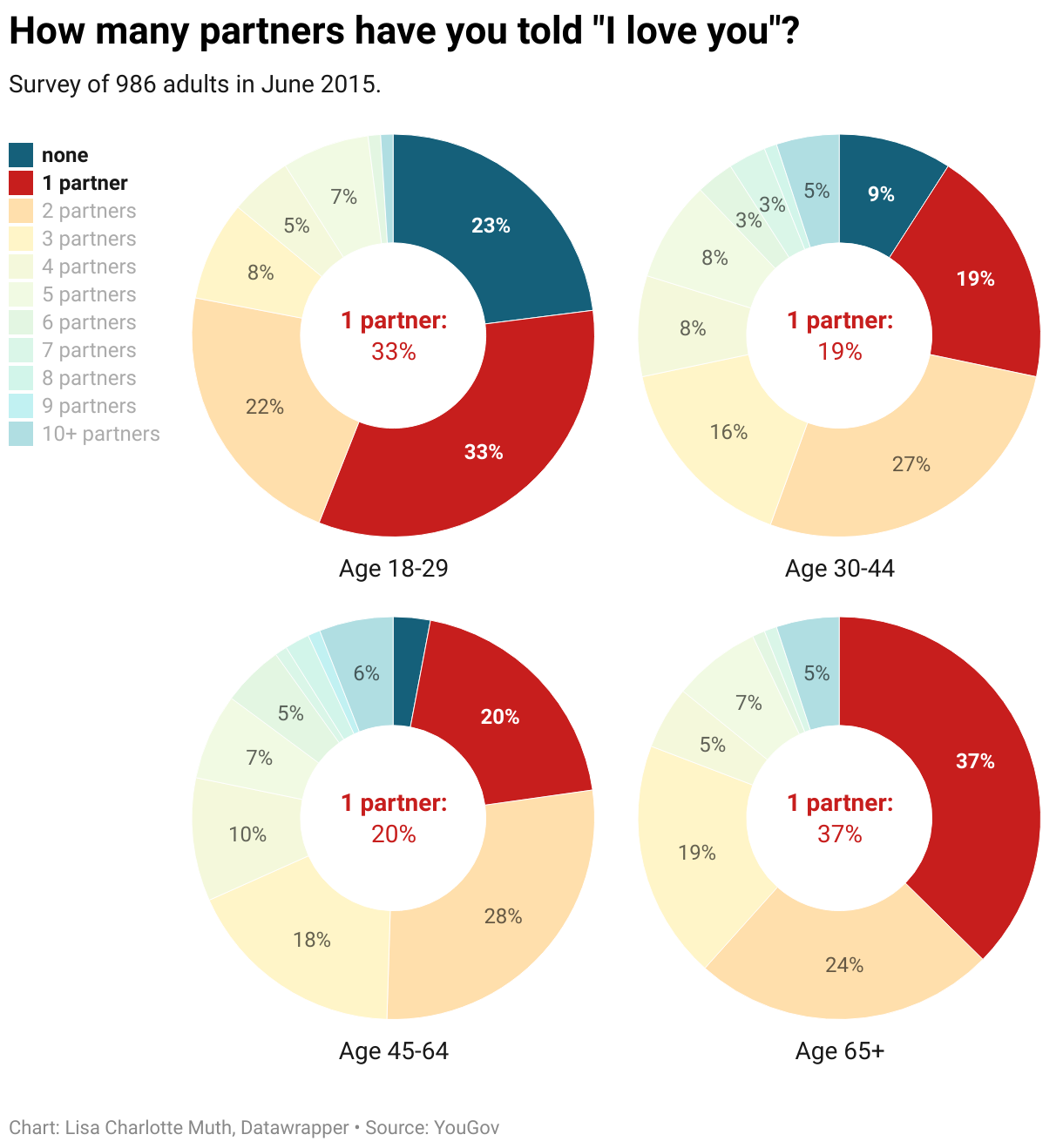
Mona doesn’t use donut charts to do show the data, but a split bar chart. (Do visit the original article to see it!) I remember staring at it for a long time. I liked the histogram feel, a lot. But I wondered how the data would look like in a chart type that makes me see which share of the surveyed people in a certain age group had said “I love you” to someone (instead of reading it). So I created some very colorful donut charts.
Chart Choices
The chart above uses 11 different pie slices. Which is crazy! We learned to not do that in pie & donut charts. (I myself urged you to avoid it!) In the chart above, I tried to make it work, anyway:
With the help of saturated vs light colors (and our highlight feature), I created two visual “subgroups” in each age group. (At least this was the idea. You’re very welcome to tell me that I failed and/or suggest a better idea!) The first subgroup consists of the two slices, people who have said"I love you" to none and to one partner. And the second subgroup shows the rest of the people. We can easily compare the first and the second group – and we can still compare the none-sayers in each age group with each other, or the ones who said “I love you” to more than 10 partners.
I hope you all have (had) a great day! If you don’t know Mona’s work yet, make sure to follow her on Twitter or Instagram. Her style is crazy and her work important and it would make me happy if I could introduce one or two of you to it. I’ll see you next week!
What is TikTok?

For the record from this BBC video: "TikTok is a social video app that allows users to share short videos. The app which features stickers, filters and augmented reality was the world's fourth most downloaded app in 2018 beating Instagram and Snapchat." A compelling feature is that you can sample other people's audio. Also in the same sort of genre: Coub.
Web: [Direct Link] [This Post]This New Olympus Offering is More Like It
I've been highly critical of the E-M1X introduced late last month. It's just not the direction that m4/3 should be going. Today, however, Olympus showed us that they still remember what their advantage is by introducing the …
Fujifilm's New Offerings

Fujifilm today announced the well-leaked X-T30 camera, an update to the junior model in their lineup. The X-T30 is to the X-T3 as the X-T20 was to the X-T2. In other words, most of the features and electronics of the senior model, but in a a body that is less robust and a less expensive to build.
…
Canon's New Entry Full Frame Mirrorless Camera
Canon today introduced the RP, a 26.2mp entry model for their R full frame mirrorless camera lineup.

This is a small, light, and modestly-featured camera. Smaller than the current top-end Rebel DSLR. There are not a lot of buttons and controls (and no track pad), but they're very traditional Canon UI, including the two vertical dials. …
The Strange Canon Mismatch
Consider this:
1. Lowest end full frame body (features, performance, and price)
2. Highest end full frame lenses
What the heck is Canon doing?
The Canon RP is clearly an entry camera positioned to be affordable. …
Love Letters to Blix Electric Bikes
This Valentine's Day, we asked Blix riders to share "love stories" about their experiences riding their Blix Bikes. Whether it is their love of feeling like a kid again, the ability to tackle hills, or regaining mobility, Blix riders were excited to share why they love their Blix ebikes. Share your love of biking and ride together today as well as every day after!
Our first love story is from Sally M. about her Sol e-cruiser. She can't get enough of exploring her town! She shares, “I absolutely love my new ebike! Very well made, easy to ride and so much fun zooming along!”
Traveling from point A to point B quickly is also why Julio S. loves his Blix. Specifically, his favorite thing about his Vika+ is the "pedal assist" because "the ride is amazing."
Similarly, Martha K has found a new love of biking with her Sol. The pedal assist on her Blix has allowed her to keep riding into her late 60's. Before her Blix, she "had not ridden a bike for 7 years." Martha explained that she "wanted to ride again but knew [her] knees would not tolerate hills." However, her Blix electric bike "has solved the problem and [she can] “fly” up the hills!!"

Regaining mobility is also why Janice H. has fallen in love with her Blix. She rides a foldable Vika Travel. Janice says, “with my bike my travel is easier, I've had surgery on my left foot and couldn't get around on my own." However, with her Blix she "can go everywhere!"
Likewise, Bryan J. loves the utility and efficiency of traveling on his Blix . As he shares, “I bought my partner and myself Blix Aveny High-Step bikes for Christmas and we LOVE them." More often Bryan is "leaving [his] car in the garage more, and taking to the streets on [his] bike to handle a variety of errands.” He finds the "utility for day-to-day errands is incredibly liberating."
SFU Bell Lecture: Vancouverism in a World of Cities
The Third Annual Bell Urban Forum
Vancouverism in a World of Cities
 Nearly twenty years ago, ‘Vancouverism’ began to circulate as an internationally-recognized label for a distinctive set of practices of building, representing, and marketing the virtues of urban life. From planning, development, and architecture to cinema, transnational social movements, and increasingly cosmopolitan currents of migration, the Vancouver city-region has become a reference point for new configurations of density, diversity, and new relations between humans and the natural world.
At the same time, Vancouver has become the second or third most expensive housing market on the planet, and it’s all built on the unceded indigenous lands and communities that long predate British North America and Canada. Vancouver provides a unique vantage point from which to view the transformations of space and time — of past, present, and future — in an urban world.
Where have concepts of Vancouverism traveled? How have the images and narratives of Vancouverism evolved? How have these trends co-evolved with changes in the material lived realities of society and nature in the Vancouver region?
Presenters and Panelists:
Juliet Carpenter, Senior Research Fellow, Oxford Brookes University, and Marie Skłodowska-Curie Global Fellow at the School of Community and Regional Planning, University of British Columbia; co-author, “Vancouver: Critical Reflections on the Development Experience of a Peripheral Global City.”
Meg Holden, Professor of Urban Studies and Geography, Director of Urban Studies, Simon Fraser University; author, Pragmatic Justifications for the Sustainable City: Acting in the Common Place.
Tom Hutton, Professor, Centre for Human Settlements and School of Community and Regional Planning, University of British Columbia; author, Cities and the Cultural Economy.
Sherry McKay, Professor of Architecture (Emeritus), School of Architecture and Landscape Architecture, University of British Columbia, co-author, “Building Human Agency: A Timely Manifesto.”
Katharyne Mitchell, Professor of Sociology, Dean of Social Sciences, University of California, Santa Cruz; author, Crossing the Neoliberal Line: Pacific Rim Migration and the Metropolis.
Geraldine Pratt, Canada Research Chair in Transnationalism and Precarious Labour, University of British Columbia, coauthor, Film and Urban Space: Critical Possibilities.
John Punter, Professor of Urban Design, Cardiff University; author, The Vancouver Achievement: Urban Planning and Design.
Andy Yan, Director, City Program, Simon Fraser University; recipient of Planning Institute of British Columbia Award, Leadership in Advocacy and Innovation.
Elvin Wyly, Professor of Geography and Chair of Urban Studies Coordinating Committee, University of British Columbia.
Thursday, March 7
7-9 pm (doors open at 6:30)
SFU Harbour Centre, Room 1900
Registrations: $5 general admission. Students are admitted for free with valid student ID.
| Reserve your spot on Eventbrite |
Patterns
Lost Lagoon after a few days of freezing weather.
So what do the ice patterns tell us? Where the underwater currents flow, producing a frozen map of streams and ponds? Temperature gradients? Or something else – if we have eyes to see.

Twitter Favorites: [bmann] @mat4nier @arachnocapital2 tonkatsu broth is surprisingly easy to make. You just need two days and willingness to h… https://t.co/NNFii0QbsC

@mat4nier @arachnocapital2 tonkatsu broth is surprisingly easy to make. You just need two days and willingness to h… twitter.com/i/web/status/1…
Why Does Mozilla Maintain Our Own Root Certificate Store?
Mozilla maintains a database containing a set of “root” certificates that we use as “trust anchors”. This database, commonly referred to as a “root store”, allows us to determine which Certificate Authorities (CAs) can issue SSL/TLS certificates that are trusted by Firefox, and email certificates that are trusted by Thunderbird. Properly maintaining a root store is a significant undertaking – it requires constant effort to evaluate new trust anchors, monitor existing ones, and react to incidents that threaten our users. Despite the effort involved, Mozilla is committed to maintaining our own root store because doing so is vital to the security of our products and the web in general. It gives us the ability to set policies, determine which CAs meet them, and to take action when a CA fails to do so.
A major advantage to controlling our own root store is that we can do so in a way that reflects our values. We manage our CA Certificate Program in the open, and by encouraging public participation we give individuals a voice in these trust decisions. Our root inclusion process is one example. We process lots of data and perform significant due diligence, then publish our findings and hold a public discussion before accepting each new root. Managing our own root store also allows us to have a public incident reporting process that emphasizes disclosure and learning from experts in the field. Our mailing list includes participants from many CAs, CA auditors, and other root store operators and is the most widely recognized forum for open, public discussion of policy issues.
The value delivered by our root program extends far beyond Mozilla. Everyone who relies on publicly-trusted certificates benefits from our work, regardless of their choice of browser. And because our root store, which is part of the NSS cryptographic library, is open source, it has become a de-facto standard for many Linux distributions and other products that need a root store but don’t have the resources to curate their own. Providing one root store that many different products can rely on, regardless of platform, reduces compatibility problems that would result from each product having a unique set of root certificates.
Finally, operating a root store allows Mozilla to lead and influence the entire web Public Key Infrastructure (PKI) ecosystem. We created the Common Certificate Authority Database (CCADB) to help us manage our own program, and have since opened it up to other root store operators, resulting in better information and less redundant work for all involved. With full membership in the CA/Browser Forum, we collaborate with other root store operators, CAs, and auditors to create standards that continue to increase the trustworthiness of CAs and the SSL/TLS certificates they issue. Our most recent effort was aimed at improving the standards for validating IP Addresses.
The primary alternative to running our own root store is to rely on the one that is built in to most operating systems (OSs). However, relying on our own root store allows us to provide a consistent experience across OS platforms because we can guarantee that the exact same set of trust anchors is available to Firefox. In addition, OS vendors often serve customers in government and industry in addition to their end users, putting them in a position to sometimes make root store decisions that Mozilla would not consider to be in the best interest of individuals.
Sometimes we experience problems that wouldn’t have occurred if Firefox relied on the OS root store. Companies often want to add their own private trust anchors to systems that they control, and it is easier for them if they can modify the OS root store and assume that all applications will rely on it. The same is true for products that intercept traffic on a computer. For example, many antivirus programs unfortunately include a web filtering feature that intercepts HTTPS requests by adding a special trust anchor to the OS root store. This will trigger security errors in Firefox unless the vendor supports Firefox by turning on the setting we provide to address these situations.
Principle 4 of the Mozilla Manifesto states that “Individuals’ security and privacy on the internet are fundamental and must not be treated as optional.” The costs of maintaining a CA Certificate Program and root store are significant, but there are fundamental benefits for our users and the larger internet community that undoubtedly make doing it ourselves the right choice for Mozilla.
The post Why Does Mozilla Maintain Our Own Root Certificate Store? appeared first on Mozilla Security Blog.
Telus grows wireless subscribers to 9.2 million, reports strong results in Q4 2018

Vancouver-based national carrier Telus reported a strong Q4 2018, ending the year with 9.2 million wireless subscribers, a 3.6 percent increase from 8.9 million subscribers that was reported in Q4 2017.
In the three months that ended on December 31st, 2018, Telus’ total net income was $368 million, a 4 percent increase from the $354 million that was reported in the same period a year ago. This past quarter, the company reported $3.76 billion in operating revenues, an increase of 6.3 percent over the same period a year ago.
“This growth was driven by higher wireless network revenue and wireline data services revenue growth, as well as higher wireless equipment revenue,” Telus said in its earnings report, which was released on February 14th.
In Q4 2018, Telus said there were 112,000 wireless postpaid net additions, a decrease by 9,000 from the same period a year ago.
“[This was] driven by lower gross additions due to the non-recurrence of an attractive holiday rate plan offer, which stimulated significant customer traffic in the prior year,” Telus said.
As expected by Scotiabank’s telecom analyst Jeff Fan, Telus reported a decrease in average billing per user (ABPU) by 0.7 percent. Telus reported an ABPU of $66.80 this past quarter, and noted this was due to “lower chargeable data usage and competitive pressures on base rate plan pricing, offset growth from customers selecting plans with larger data buckets, the introduction of our Platinum rate plans and more higher-value smartphones in the sales mix of gross additions and retention units.
The Q4 2018 results also noted that the company had prepaid net losses of 6,000, which was an improvement by 17,000 over the same period a year ago.
This was due to “higher gross additions from successful promotions and lower churn.”
Also as analysts predicted, Telus reported a decline in churn rate, or the rate at which customers leave a company to go to its competitor.
Telus reported a postpaid churn rate of 0.91 percent, that declined by eight basis points over the same period a year ago.
Telus said this decline comes from “our focus on customers first initiatives, retention programs and our leading network quality and in the prior period, incremental deactivations from heightened competitive and promotional activity.”
In this case, Telus is the only company of the Big Three (Telus, Rogers, Bell), that has reported a churn rate below one percent. It’s also the fifth year that Telus has been able to maintain a low churn rate.
In Q4 2017, Telus reported its postpaid churn rate increased by 1 basis point to 0.99 percent.
In comparison, in its Q4 2018 results, Rogers reported a postpaid churn rate of 1.23 percent, which dropped from 1.48 percent. In its Q4 2018 results, Bell reported a 1.26 percent churn rate, which dropped from 1.35 percent.
“This continued performance is bolstered by the unwavering dedication of our Telus team to execute on our longstanding strategy, despite a highly competitive environment,” Telus’ CEO Darren Entwistle said in the report. “Moreover, our team’s unparalleled commitment to providing exceptional customer experiences contributed materially to Telus achieving our fifth consecutive year of industry-leading wireless churn below one percent.”
Source: Telus
The post Telus grows wireless subscribers to 9.2 million, reports strong results in Q4 2018 appeared first on MobileSyrup.
CBC to stream 2019 World Para Nordic Skiing Championships

The Canadian Paralympic Committee (CPC) and CBC/Radio-Canada are partnering to ensure Canadians can watch the nation’s best Para Nordic skiers race on home turf this month.
The 2019 World Para Nordic Skiing Championships take place from February 16th to 24th in Prince George, B.C. The events will be available as live streams via the free CBC Gem app, CPC Facebook page, Radio-Canada Sports app and radio-canada.ca/sports.
Additionally, the world championships will be the first event of the Paralympic Super Series offered with both English and French streams.
20-time Paralympic medallist in swimming, Benoît Huot, will be in Prince George conducting interviews and bringing viewers behind-the-scenes content in both languages. Viewers can find these extras through CPC social media channels.
CBC Gem is available as a free download for both iOS and Android. While users can watch select channels and streams for free on Gem, there’s also a $4.99 subscription that unlocks ad-free TV and full episodes of CBC series like Schitt’s Creek.
Source: CPC
The post CBC to stream 2019 World Para Nordic Skiing Championships appeared first on MobileSyrup.
Telus says banning Huawei will have ‘incremental’ costs and affect timing of 5G deployment

Telus says banning Huawei could have a “material, non-recurring, incremental increase” in the cost of deploying 5G and could “potentially” affect the timing of the deployment.
In its Q4 2018 earnings report that was released on February 14th, Telus explicitly writes that it would be a risk to investors if Canada bans the Chinese telecommunications giant.
The federal government is currently reviewing the case for Huawei and national security and is also reviewing 5G in Canada. No ban has been made yet.
Canada and China have had a frosty relationship since December when Vancouver authorities arrested Huawei CFO Meng Wanzhou. She currently faces extradition.
The U.S. has charged her, Huawei and its subsidiary Skycom with 13 counts of bank and wire fraud.
“We are continuing to work with the government as it conducts this cybersecurity review and we have yet to select a vendor for our 5G network,” Telus wrote in its results. “Given the range of potential outcomes of the cybersecurity review, the impact on Canadian wireless service providers cannot currently be predicted.”
In its Q4 2018 results, Montreal-based national carrier Bell said it would still able to deploy 5G in a timely manner. It also said that it has yet to select a 5G vendor yet.
Both companies have invested millions into expanding their respective 5G networks. If Huawei were to get banned in Canada, it’s estimated it would cost them approximately $1 billion.
“In the case of a ban, there is a risk that the Canadian telecom market would undergo a structural change, as a reduction to an only two global supplier environment could permanently affect the cost structure of 5G equipment for all operators,” Telus reported.
In the last 10 years, Telus said that its partnership with Huawei has “allowed us to utilize the most advanced technology in a cost-effective manner in our advanced 3G and 4G networks without any security incidents.”
“In building out 3G and 4G national networks we have collaborated closely with the Government of Canada for many years to ensure robust protections across all equipment used.
“This has included complying with a series of security protocols that effectively ban Chinese equipment from our core networks and limit such equipment to the less sensitive radio and antenna portions,” Telus said.
During an interview with MobileSyrup, Innovation, Science and Economic Minister Navdeep Bains said that whatever the outcome of the reviews are, the government would support the carriers.
He added that his department has had an open door policy and that the carriers have been in constant conversation with him, as well as with Public Safety Minister Ralph Goodale.
Goodale in the past has said the government is “examining the security issues as well as the technical issues with a great deal of care. We’ve made it abundantly clear that we will not compromise national security.”
But because of fear of cybersecurity attacks, the U.S. banned the company from providing 5G equipment in August 2018. Following the U.S., Australia and New Zealand, have also banned the company.
The three countries are members of the Five Eyes intelligence-sharing alliance.
The alliance is made up of a group of countries that share information and intelligence with regards to terrorism, security and espionage. The group consists of the United States, United Kingdom, Canada, Australia and New Zealand.
According to a draft of China’s national intelligence law that was released in 2017, all Chinese companies “shall support, cooperate with and collaborate in national intelligence work, and maintain the secrecy of national intelligence work they are aware of.”
It is important to note that Prime Minister Justin Trudeau met with Telus CEO Darren Entwistle on February 11th.
“My thanks to @TELUS CEO Darren Entwistle for the meeting in Vancouver today. We focused on encouraging innovation in Canada, bringing better connectivity to families in rural and remote areas, and ways to work together to create more jobs for Canadians,” Trudeau said in a tweet.
Source: Telus
The post Telus says banning Huawei will have ‘incremental’ costs and affect timing of 5G deployment appeared first on MobileSyrup.
Telus says it wants to use 600MHz spectrum for early 5G deployments

With the upcoming 600MHz spectrum auction in March, Telus says it may use any spectrum it acquires to trial early deployment of 5G connectivity in rural communities.
“It might let us do something preemptive, leveraging 600 MHz propagation characteristics in non-urban areas to bring 5G maybe initially to these rural areas,” Telus CEO Darren Entwistle said during the company’s recent Q4 2018 earnings conference call.
The Vancouver-based national carrier released its earnings results for the final quarter of its fiscal 2018 year on February 14th.
Entwistle added that the carrier plans to be “big movers when we get the spectrum to deploy.” Experts, however, say the network technology is more likely to be used for powering smart homes, smart cities, autonomous vehicles and maybe even fixed internet connections.
During the call, Entwistle said the company will maintain a 75 percent PureFibre footprint and “beyond that we would leverage 5G technology.”
In 2017, Telus planned to invest $4.7 billion in new communications infrastructure across British Columbia through 2020. The funds were earmarked to help with the deployment of the company’s gigabit-enabled PureFibre network to thousands of additional homes and businesses located in rural and urban communities.
Asked if this ratio could change for Telus, Entwistle said that it depends on where the telecom deploys PureFibre and how much 5G would be needed to leverage and improve the service.
“If you’re buried in Alberta, you take a different ratio between [PureFibre and 5G],” Entwistle. “Is the community going to participate in the economics of bringing PureFibre into their area? Are they willing to make a commitment to certain penetration rates that makes the economics doable on the fibre front?”
But Entwistle made it clear that Canada still doesn’t have the necessary spectrum to fully deploy 5G.
5G operates over traditional and new cell radio frequency bands that include the low- (sub-1GHz such as 700MHz), mid- (1.6GHz, around 3.5-3.8GHz), and millimetre-wave (mmWave, such as 28GHz) ranges.
Innovation, Science and Economic Development Minister Navdeep Bains announced that auctions to enable 5G deployment will happen in 2020 and 2021.
The post Telus says it wants to use 600MHz spectrum for early 5G deployments appeared first on MobileSyrup.
Volkswagen’s ‘Electrify Canada’ announces plan to build 32 EV charging stations across Canada

Electrify Canada, a new partnership between Volkswagen Group Canada and Electrify America, plans to build an electric vehicle charging network across Canada.
This project is an offshoot of Electrify America, which itself is a subsidiary of the Volkswagen Automotive Group. Like its counterpart here in Canada, Electrify America is building an EV charging network across the U.S.
Electrify Canada stations will offer both CHAdeMO and CCS charging ports. The ports will provide DC charging speeds of 50, 150 or 350 kW, enabling them to support a wide range of modern electric vehicles. Each station will also be capable of texting car owners with the status of their vehicle’s charge.
At the moment, the organization plans to build 32 stations in southern Britsh Columbia, Ontario and Quebec. Construction is set to start in Q2 2019.
This marks the second major EV charging announcement in one week. On Wednesday, Petro-Canada announced plans to build a Canada-wide charging network along the Trans-Canada Highway.
Source: Electrify Canada
The post Volkswagen’s ‘Electrify Canada’ announces plan to build 32 EV charging stations across Canada appeared first on MobileSyrup.
Mercedes-Benz reveals the EQC SUV, its first electric vehicle

Mercedes-Benz showed off its first attempt at an electric vehicle (EV), the EQC SUV, at the 2019 Canadian International Auto Show.
The EQC SUV is the first car in the EQ line-up, as the German automotive manufacturer plans to enter the market of EVs.

The SUV crossover pushes out 402hp, making it more than capable compared with others in its field, such as the 2019 Range Rover Evoque, which only has 237 hp.
“With its impressive combination of quality, safety, comfort, design and technology, the EQC offers everything drivers have come to expect from Mercedes-Benz – now with an electric powertrain,” said President and CEO of Mercedes-Benz Canada Brian Fulton.
The electric vehicle uses Mercedes me connect, an app that provides drivers information about charging stations, car connection services (such as vehicle tracking and live traffic information) and assistance with any Mercedes vehicle.
The automaker plans to release the EQC SUV in Canada later this year.
Mercedes will judge whether you’re ‘EQ Ready’
Mercedes also released an app called EQ Ready that tests whether a driver will benefit from switching over to electric cars. The app tracks the distance you drive, the temperature and terrain you interact with, and how your driving behaviour impacts an electric vehicle were you to buy one.
Using all this data, Mercedes can evaluate whether a driver can fully benefit from an electric vehicle.
“With the EQ Ready app, Canadians can easily see whether day-to-day electric mobility makes sense for them based on their driving patterns and the charging infrastructure along their regular routes,” said Fulton.
EQ Ready is available for Android or iOS devices.
Source: Mercedes-Benz
The post Mercedes-Benz reveals the EQC SUV, its first electric vehicle appeared first on MobileSyrup.
Rumoured IQOO foldable smartphone leaks online

Vivo sub-brand IQOO is reportedly working on a foldable phone.
A tech blogger has revealed renders of the foldable device on Chinese social media website Weibo. The images showcase the handset with a cityscape wallpaper.
From the image, it appears the phone folds like a book. Folding out the display creates a tablet.
The blogger didn’t include any details about the phone.
It’s unclear when IQOO will unveil the foldable handset. Huawei and Samsung will unveil their foldable devices within the next couple of weeks.
Source: PocketNow
The post Rumoured IQOO foldable smartphone leaks online appeared first on MobileSyrup.
The new 2020 Kia Soul EV revamps both performance and looks

Kia has displayed its 2020 Soul EV at the 2019 Canadian International Auto Show, sporting a new motor and design.
The new Soul EV, along with its gasoline-engine counterpart, revamps its exterior, making it sleeker in comparison to the boxed and timid design of the past.

Besides the upgraded looks, the car received a performance boost, with a 64 kWh battery that reaches an estimated range of 385km.
To put that into perspective, the Soul EV edges out the Nissan Leaf Plus, which has a range of up to 363km.
The Soul EV also has modern safety features, which includes a blind-spot collision warning, driver attention warning, forward collision warning and avoidance, and lane changing assist.
The Kia Soul is due to release in spring 2019.
In the meantime, here are the EVs you can check out at the Auto Show this weekend.
Source: Kia
The post The new 2020 Kia Soul EV revamps both performance and looks appeared first on MobileSyrup.
Volkswagen Canada CEO on its new modular platform and I.D. vehicles

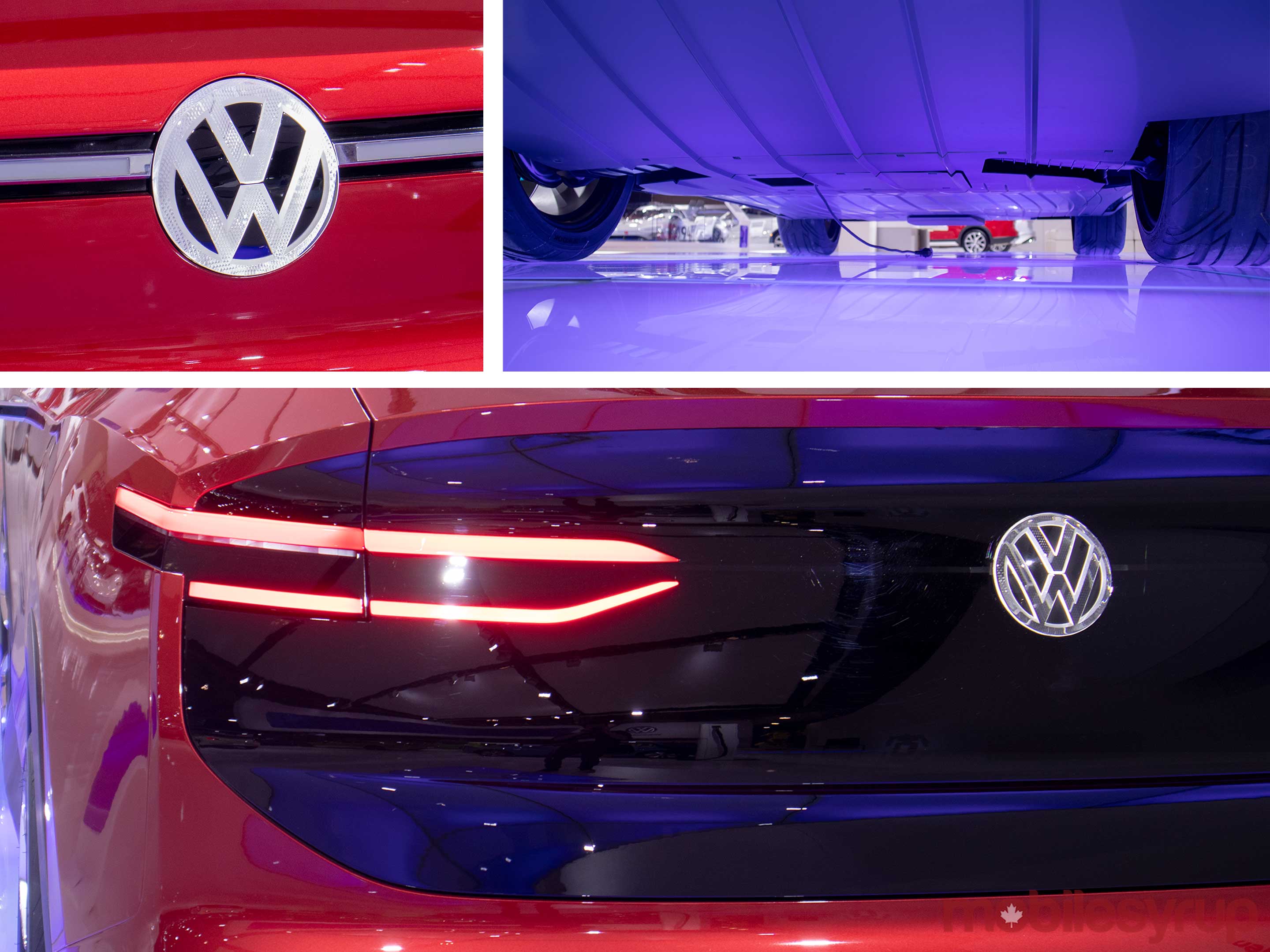
Volkswagen (VW) showed a glimpse at its future at the 2019 Canadian Auto Show with its new I.D. Crossover concept electric vehicle.
The I.D. Crossover concept is incredibly important for the legacy automaker since it’s staking a lot on the new modular MEB electric vehicle (EV) platform. MEB is an acronym for the German words “Modularer Elektrobaukasten” since the platform, at its heart, is designed to make the vehicle’s core modular.
The platform is a set of design rules and parts that the company is using to standardize the core of its vehicles. “Instead of having a platform for each different vehicle, we can use one platform that different cars are being built on, and that helps, obviously, to offset costs,” said Volkswagen Group Canada’s president and CEO Daniel Weissland in an interview with MobileSyrup.
Things like batteries, charging plugs, the drivetrain and power electronics will be the same across multiple vehicles to come out of the Volkswagen Automotive Group. This includes brands like Audi, Bentley, Porsche, and more.

The platform even allows Volkswagen to make its vehicles smaller on the outside and larger on the inside, according to Weissland.
The first MEB-based production car to hit the consumer market is Audi’s upcoming E-Tron. The first Volkswagen MEB vehicle Canadians will see is a crossover that should look similar to the I.D. Crossover concept on display at the Auto Show. “The real version will come to the Canadian market in the next two years as a real car,” said Weissland.

There are more I.D. vehicles in development, like a hatchback that’s for the European market. Since Canadian buyers tend to want crossovers with lots of storage and high seats, Canada is getting a crossover I.D.
Volkswagen might not even keep this platform to itsself; Weissland said the company is open to working with other automakers to collaborate on and share the platform.
When asked about how legacy automakers should feel about newer all-electric vehicle manufacturers like Tesla, and, to a lesser extent, companies like Rivian, Weissland said, “you need to give Tesla all the credit. It disrupted the industry. They were the first ones who moved into full electric and probably seven or eight years ago where everybody thought, ‘okay, oh my God, Tesla is not gonna last long,’ and I think it’s a significant player in certain segments and certain parts of the country.”
When asked about the smaller manufacturers, Wiessland had less faith in their staying power.
The Volkswagen Auto Group alone invested $50 billion into its electric future, which is something Wiessland sees as an advantage for the company.
“It says magnitudes. No other manufacturers are doing this, so that means we are all in, we’re fully committed to what we call the Roadmap-E.”
The post Volkswagen Canada CEO on its new modular platform and I.D. vehicles appeared first on MobileSyrup.
The edifice of nonsense comes tumbling down
| mkalus shared this story . |
The government has been defeated by MPs on propositions that they themselves backed two weeks ago. The whole edifice of blather and nonsense is coming tumbling down.
It's commonly accepted that there's no majority in the Commons for any given response to Brexit. But today it went a step further. It was inadequacy squared. It is clear now that there is not even a majority for the imaginary things MPs had only recently given a majority to. The whole British political system is imploding in on itself.
It might seem like reasonless chaos, but there is a moral message to what is happening here. You cannot govern on the basis of gibberish. You cannot make gurgled yearnings the basis for your negotiating posture. Because the lack of meaning in those original propositions means that they do not work as functional foundations of policy.
This is what the farce looks like when it's untangled. May was defeated on her Brexit deal last month. It did not win the support of the opposition parties or her own MPs. They were concerned about the backstop, which would prevent a hard border on the island of Ireland.
There were then a series of amendments on what to do next. One of them was the Brady amendment. This substituted the backstop for "alternative arrangements", which it did not specify, on how to avoid a border. Even though this detonated her own deal, May whipped her MPs to support it.
The Brady amendment passed and the prime minister was able to claim, seemingly with a straight face, that she now had a mandate from the Commons to go to Brussels to negotiate some sort of magical solution to Ireland. She was unable to say what the solution was. She held meetings in which she tried to get people to accept ideas which she could not describe.
But MPs also voted on another series of other amendments that night. These would have provided a mechanism to stop no-deal, by extending Article 50. They rejected all of them, but then supported one by Caroline Spelman which ruled out no-deal in the abstract. So MPs were saying they backed the principle of something while rejecting any of the powers which would allow them to secure it. Nevertheless, even that modicum of reason appears to have now destroyed the government all over again.
It was a pitiful, ridiculous night, one in which parliament threw its weight behind fantasies without having the courage to support realities. But compared to this evening it looked like a towering moment of statecraft.
Today, the prime minister put forward a motion which said that the House "welcomes" her statement from earlier this week - one which said she was still trying to negotiate these fantastical "alternative arrangements" for Ireland. But then it also stated, and here was the kicker, that it "reiterates its support for the approach to leaving the EU expressed by this House on 29 January 2019" when it backed the Brady and Spelman amendments.
The Brexit jihadists in the ERG didn't like that, because it included the amendment ruling out no-deal. And the opposition parties didn't like it, because it included the Brady amendment on alternative arrangements. The House was divided against itself. It was in such a mangled and contorted state that it could not form sustainable majorities on anything. It literally could not even agree on the things that it supported two weeks ago. If it was a person you would have it sectioned.
The government has based its negotiating position on amendments which are on the one hand meaningless and on the other hand powerless, and now it is surprised when they do not form the basis for a stable platform of parliamentary support.
It was a shameful moment, one which was conducted without any honour or dignity whatsoever. Even for this government, which is quite plainly the worst of our lifetime, it was a despairing spectacle. The prime minister did not even attend the Commons for the result. She sat elsewhere, probably watching on a TV in an office somewhere, her political career departing her physical body.
"Is there some way you can encourage her to return to the despatch box and tell us what her plan actually is?" Labour leader Jeremy Corbyn asked John Bercow. The Speaker could not. Instead he peered at Brexit secretary Stephen Barclay and offered him the chance to respond.
The secretary of state sat unmoving in his seat. He is a man no-one had heard of, given arguably the most important ministerial appointment in post-war British history on the basis that he might not have the imagination to resign when he realised what it entailed. And now, when great moments come, he is unsurprisingly incapable of living up to them. He simply sat there. A government without a position, led by an absent prime minister, and a quivering, unmoving secretary of state.
"Or if the government chief whip wants to do so?" Bercow tried. No, he didn't want to get up either. The government was gone. It had vanished along, with its imaginary mandate.
There is really no government. It exists only on a formal level. As a functioning entity, it has ceased to exist. Its deal was demolished. Its negotiating mandate, which never had any content anyway, was rejected. It is a wisp of smoke, a lingering smell from somebody dreadful who already left the room.
Now, finally, MPs have to take back control. The fact that this even needs saying, that it did not happen weeks ago, should be a source of eternal shame to this parliament. But even if they did not have the spine then, they must discover it now.
This is where myth-making and fairytales get you: precisely nowhere. We need a concrete, meaningful plan to stave off disaster, with a firm and realistic timetable. That begins with a mechanism - not a principle, a mechanism - for extending Article 50. If they don't secure that soon, we're all going the way of the government.
Ian Dunt is editor of Politics.co.uk and the author of Brexit: What The Hell Happens Now?
The opinions in politics.co.uk's Comment and Analysis section are those of the author and are no reflection of the views of the website or its owners.
Auch Elektroautos müssen sich an Lärmschutz-Tempolimits halten
mkalus
shared this story
from  heise online News. heise online News.
|
Ein Verkehrsschild mit Tempolimit und dem Zusatzzeichen "Lärmschutz" gilt für alle Teilnehmer, also auch Elektroautos. Das geht aus nun bekannt gewordenen Entscheidungen zweier Gerichte hervor.
Auch Elektroautos werden lauter
Das OLG Zweibrücken entschied im November 2018 (1 OWi 2 Ss Bs 75/18, 1 OWi 2 SsBs 75/18), auch bei einem Elektrofahrzeug stiegen "mit zunehmender Geschwindigkeit Art und Umfang der Fahrgeräusche sowie der durch das Abrollen der Räder bewirkten Fahrzeugvibrationen". Auch sei für den Fahrer die gefahrene Geschwindigkeit anhand der schneller vorbeiziehenden Umgebung erkennbar.
Ein Autofahrer hatte mit seinem Elektrogefährt die wegen Lärmschutzes zugelassene Höchstgeschwindigkeit von 100 km/h um 74 km/h überschritten und war dabei erwischt worden. Gegen den Bußgeldbescheid legte er Widerspruch ein. Bei der Begründung des Tatvorsatzes habe nicht berücksichtigt werden müssen, dass die antriebsbedingten Fahrgeräusche und Vibrationen bei einem Elektrofahrzeug deutlich geringer seien als bei einem PKW mit Verbrennungsmotor, meinte das OLG Zweibrücken.
Verkehrsregeln müssen klar und deutlich sein
Das Kammergericht Berlin setzte in seiner Entscheidung Mitte Dezember 2018 einen anderen Schwerpunkt.. Die Wirksamkeit von Verkehrsregelungen müsse klar, einfach und deutlich sein. "Sie von empirischen Erhebungen abhängig zu machen, würde den Normappell schwächen und die Verkehrssicherheit gefährden", schrieb das Berliner Gericht.
Wenn der Betroffene schneller fahren dürfen möchte als andere Verkehrsteilnehmer, müsse er dies dadurch erreichen, dass dem Zusatzzeichen "Lärmschutz" ein weiteres hinzugefügt wird, das Elektrofahrzeuge vom Streckenverbot ausnimmt. Ein solches Verwaltungsverfahren wäre auch der Ort, an dem die Gefährlichkeit des Mitzieheffekts erörtert werden könnte – und ebenso die Behauptung, ein Elektrofahrzeug fahre unabhängig von der Geschwindigkeit stets "geräuschlos".
(anw)
“More than 5,000 migrant children in January”
NPR: Inside The Largest And Most Controversial Shelter For Migrant Children In The U.S.
“”We see a very different picture,” says Leecia Welch, senior director of legal advocacy and child welfare at the National Center for Youth Law. “We see extremely traumatized children, some of whom sit across from us and can’t stop crying over what they’re experiencing.”
She continues, “We hear stories of children who are told from the first day of their orientation that under no circumstances can they touch another child in the facility, even their own sibling, even friends who they’re saying goodbye to after many months of shared intense experience. They can’t hug them goodbye. If they do, they’re told they will be written up and it could affect their immigration case.”
Welch concludes, “We see a very different picture than the reporters see.””
Link via MetaFilter.