Shared posts

19 Feb 16:30

Some Disconnected Thoughts About Star Trek: Discovery

by David Banks

I’ve written about Star Trek a few times (here and here). I think I still agree with most of what’s written there. PJ Patella-Rey also wrote about Star Trek on the blog here. My favorite commentary on Discovery, which I’ll do my best not to simply repeat is by Lyta Gold which you can read at Current Affairs. What follows are some vaguely connected thoughts I’ve had about Discovery‘s relationship to the rest of the canon after having just gotten caught up with the series.

1.

While watching Discovery I’m haunted by the idea that I am incapable of liking any new Star Trek offering because my love of Trek is fueled by nostalgia and not a reverence for its politics or innovative storytelling. Or, more accurately, nostalgia and reverence work together so that the moments of pre-9/11 Trek (is there really any other more distinctive delineation? More on that soon.) that are just too corny or clumsy to enjoy on their own merits can be ignored and the good parts can really shine. With the nostalgia missing I can’t enjoy any of it. I think this is what the writers worry about and try to invoke a nostalgia for the present with completely unnecessary Spock-centric plot points. When media producers make us feel like there are childhood memories out there we haven’t seen yet —that is all fan service really is— it either works through, paradoxically, original storytelling or it just falls flat. Much of Discovery‘s references to the original series falls flat, I think.

2

For a few years Britney Gil and I would host weekly Star Trek watch parties at our house and I would curate three or four shows into social themes, most of which are preserved on my web site. As I watch Discovery I try to place each episode within themes I’ve already identified but usually come up empty-handed. Only part of this is because these episodes have more of an arch and are less serialized but that’s only part of it. While each individual episode of pre-9/11 trek were Mondrian-esque depictions of a single moral theme —this week Odo deals with the longing for a people, please see Arendt’s The Human Condition for more details— Discovery paints de Kooning-style season archs. Still a limited pallet but the themes are allowed to mix more, overlap, and emerge. I went to trek for the Mondrian rationalism but perhaps de Kooning is more appropriate for the times. More stylistically contemporary and better equipped to deal with the issues we want to see portrayed in TV.

3

It is not enough to say today’s Star Trek is just different without saying what is gained and lost. Trek changed completely after 9/11. Pre-9/11 Trek started in the braggadocio of mid-century American ascendancy and, after negotiating the malaise of the 70s and early 80s with a series of movies about aging wherein the Kirk-Spock-McCoy triumvirate is simultaneously American hegemony and the aging audience, leaned heavily into a liberal end-of-history optimism. Picard was the standard bearer for the optimism of a perfected humanity and Sisko and Janeway were left to stress-test that vision amidst threats to (Deep Space Nine) or total separation from (Voyager) all of the institutions and cultural practices that make the perfection possible. In so doing we found that Earth-as-socialist-paradise isn’t something you arrive at but something you’re constantly making. In that way it is very de Kooning but we only ever got glimpses of it at Sisko’s restaurant or stories from the Voyager crew who had to constantly articulate what the hell humanity even was to people who’d never heard of us before.

Post 9/11 however, utopia feels naive at best and low key fascist at its worst. So much order and safety has to come from a wide-spread and slow abandonment of personal freedoms. And so, instead of dwelling in all of the minute problems of utopia and all of the beautiful contradictions we can discover about ourselves when everything basic to survival is taken care of, Trek becomes about the seemingly inevitable moments when it all comes crashing down. It is defending, through the thin blue (red, and gold) line that we every get to keep a peace that is now revealed to be fragile. Enterprise, having been the closest to 9/11 was so painfully on-the-nose about it all that it not only had a literally Earth-shattering problem to deal with, but that it spent its four short seasons in a “temporal cold war” which was nothing less than competing factions trying to rewrite history. Discovery, let alone J.J. Abrams’ three movies and Enterprise feels less like Trek not because they lack optimism, but because these post-9/11 shows require optimism at all. Good Trek, pre-9/11 Trek was, at base, all about not even needing optimism because of course everything would work out: humanity was part of a galactic federation of peace and exploration.

4

One big thing that the nostalgic veil of pre-9/11 Trek obscures from our vision is just how much of Reagan America creeped into each episode. Remember that the very first episode is literally humanity on trial for being savage. Picard’s defense is not that humanity is not inherently savage (a point that would be scientifically true and would not accept the Hobbesian frame that holds together most reactionary politics) but that it learned and became better through struggle and learning from mistakes and atrocities alike. All the way up to Voyager, in the episode Death Wish Janeway is literally adjudicating between individuality and the state’s prerogative to maintain order, finding in favor of the former. In both of these examples humanity is dealing with Q which, always show up when the writers want to get to questions of human nature as quickly and effortlessly as possible.

Discovery has yet to have a Q episode, both literally and in the sense that it is not willing to comment on humanity as such, opting instead to make references to the moral obligations of Starfleet. I cringe each time the Discovery crew say something to the tune of “We are Starfleet and that’s why we won’t abandon you / want to know what that thing is / are ready to sacrifice ourselves for everyone else.” At first I thought it was because those monologues just sound corny but while that’s true I think the real reason is this: in previous series the characters would invoke humanity not Starfleet. Perhaps removing the Earth-centric chauvinism implied by humanity is a good idea stylistically —prefiguring a truly universally inclusive language— but in that case they should be invoking the Federation and the civilian governmental form, not Starfleet. When Starfleet is mentioned in pre-9/11 Trek it’s usually derisively, talking about how hard the academy is, how useless they are in protecting the colonies that gave rise to the Maquis, or how disconnected they are from the rest of Federation life.

5

Aesthetically, Discovery has its moments, mostly for the better. Costume and set design are beautiful. I find the ship, and I recognize that this is purely subjective, absolutely hideous. It is disproportionate in every way, which also makes it look different from every angle in a way that makes it difficult to fall in love with. I would, however, say more or less the same thing for the Enterprise-D and Deep Space Nine. Starfleet ship design, in my opinion, peaked in the 2370s with the Intrepid, Sovereign, and Akira-class ships. Don’t @ me about this.

19 Feb 16:29

“He just can’t help himself.”

by Andrea

The New Yorker: A Weak and Rambling President Declares a Fake National Emergency. By John Cassidy.

“Trump’s description of the situation at the border is almost entirely fictitious, of course, but in one sense it is real. It’s a central element of the political narrative he has constructed for his white-nationalist base over the past three and a half years, and, as he helpfully sought to explain, it’s one he can’t easily back away from at this stage. “I ran on a very simple slogan: ‘Make America Great Again,’ ” he said. “If you’re going to have drugs pouring across the border, if you’re going to have human traffickers pouring across the border in areas where we have no protection, in areas where we don’t have a barrier, then it’s very hard to make America great again.”

In this carefully concocted narrative, the wall isn’t a mere stretch of concrete or steel fencing stretching along the border; it’s a symbol of national sovereignty and regeneration. But, if it’s so important, why didn’t Trump get it built during his first two years in office, when the Republicans controlled both houses of Congress? Trump’s failure to get his own party to support what was arguably his signature campaign pledge demonstrates that he is fundamentally a weak and isolated President. But, of course, he can’t admit that publicly, either. Instead, he said, “It would have been great to have done it earlier. But I was a little new to the job, a little new to the profession. And we had a little disappointment for the first year and a half. People that should have stepped up did not step up. But we’re stepping up now.” Take that, Paul Ryan!”

Link via MetaFilter.

19 Feb 16:21

Google may drop Android’s dedicated back button with Android Q

by Igor Bonifacic
Android Q

Google is testing new tweaks to Android’s gesture-based navigation interface that could see the company drop the operating system’s dedicated back button from Android Q, according to XDA Developers.

The website found the tweak in the leaked build of Android Q it obtained earlier in the year.

For those who aren’t familiar with Android’s gesture-based navigation, with Android P Google introduced a new two-button navigation interface to replace its old three-button system. The company added a new pill-shaped icon to replace Android’s old ‘Home’ button and removed the ‘Overview’ multi-tasking button. A lot of Android P’s stock gestures involve interacting with the pill. For instance, a quick swipe of the icon to the right switches between the two most recent apps, while tapping and holding the pill while moving it left and right allows users to navigate between all their currently open apps.

None of the current gestures replicate the back button in Android P. If users want to go back, they tap the back button, which makes the entire gesture interface a somewhat confusing mix of old and new.

However, in the experimental interface XDA was able to enable, swiping the pill left allows the user to use Android’s back functionality.

Moreover, the experimental interface features a new, smoother animation when taking advantage of the quick multitasking gesture. Visit XDA Developers to see the gestures in action.

Should the company decide to go through with the changes, XDA speculates Google won’t implement these new gestures until Android Q Developer Preview 2. It’s also possible Google could decide not to go through with any changes, though that seems unlikely.

Source: XDA Developers

The post Google may drop Android’s dedicated back button with Android Q appeared first on MobileSyrup.

18 Feb 18:02

Parting out the Novara winter bike

by jnyyz

I realize that it is really late in the season to be doing this, but I’m parting out my former winter bike. It is a Novara hybrid with 26″ wheels, and it has Schwalbe studded tires, and Alfine 8 speed gearing. I’ve blogged about this bike in the past.

The studded tires are Schwalbe Winter Marathons. They have three winters on them, but plenty of wear left. $40 for the pair.

The wheels and tires, with the 8 speed IGH and the tires, and the Alfine chain tensioner are $100.

The complete bike is $125. The bike is in fair shape, the hub shifts fine, but the rear brake needs work. Also, I am not including the shifter for the rear hub. You will have to add a 8 spd Shimano trigger shifter. Here is a picture of the worst of the rust on the frame.

Yes that is a Chris King Headset.

18 Feb 18:02

More TMI recovery stories

by Joe Gregorio

This is another story from my recovery that might be TMI for some people. Read with caution, or skip.

So while describing my initial hospitalization I mentioned an open question:

What exactly my anus is supposed to be doing for those three months is a question I forget to ask.

And now I know from the questions and comments I’ve received that many of you are curious too.

The answer turns out to be “nothing much” for most of the time, with occassional bouts of Phantom Limb sensation.

Now the “phantom limb” in this case is my large intestines, which are no longer hooked up to my rectum. The sensation they are missing is the pressure that comes when stool builds up in the colon, which in turn triggers the sensations of “needing to go”.

So one or two times a day I get the sensation of “needing to go”. I logically know that’s an impossibility, but apparently my rectum is not swayed by logic, so I had to look for alternative methods of getting the sensation to go away. It turns out there is one way to get it to go away and that’s to go and sit on the toilet as if I were having a bowl-movement. And I realize, as I sit here, on the toilet, not having a bowl-movement, that what I’m really doing in playing “make pretend” for my rectum. And it works!

I wonder if my rectum will be as grateful as my kids are for all the time I spent playing “make pretend” with them?

18 Feb 18:02

En vrac du dimanche

by Tristan
18 Feb 18:02

First Things First

by Stowe Boyd

Value of the Obvious | Facebook Workplace Trust | Gig Worker Revolt

Beacon NY — 2019–02–14 — I called this First Things First because it’s a thread across the various links today. You’ll see.

:::

I’ve been under the weather, so a bit thin today.

:::

If you’re getting this you probably signed up at workfutures.org (or one of its predecessors) or stoweboyd.com. If someone forwarded this to you, sign up here.

Consider becoming a paid sponsor to support our work, and to receive in-depth investigative reporting and discounts to other events, reports, and activities.

Links

The Surprising Value of Obvious Insights | Adam Grant is a national treasure. In this essay he discusses the disarming quality of ‘confirming what people already believe can help organizations overcome barriers to change’.

“When Google sent an email nudging managers to take simple onboarding steps — talking with people about their roles and responsibilities, for instance, and scheduling regular check-ins — their new hires got up to speed a month faster.
I was wrong to place such a high premium on the unexpected. Findings don’t have to be earth-shattering to be useful. In fact, I’ve come to believe that in many workplaces, obvious insights are the most powerful forces for change.
[…]
I’ve learned that obvious insights are valuable in overcoming three obstacles to change. The first barrier is resistance to new data. For me, the most annoying sentence in all of organizational life might be “But that’s not what my experience has shown.” Yes, that’s why I conducted a randomized, controlled experiment with longitudinal data: I wanted to learn rigorously from lots of people’s experiences, not just yours, so that we could figure out whether you were an outlier.
Come in with a contrarian data point, and managers who have parked their careers in their lot of intuition and experience find it threatening. The visceral response is skepticism followed by denial. Waltz in with a piece of compelling evidence that people already believe is true — like Microsoft’s findings that it’s bad for employee satisfaction and engagement when managers are slow to respond to email and multitask during meetings — and you get immediate buy-in.
The second barrier is resistance to change. My runner-up for the most irritating sentence in workplaces worldwide is “But that’s the way we’ve always done it.” How did that stance work out for Kodak and BlackBerry?
[…]
The third barrier is the organizational uniqueness bias. Honorable mention for the most exasperating sentence belongs to “That will never work here.”

Go read it.

Oh, and this piece by Grant led me to the great That’s Interesting! by Murray Davis that I wrote about yesterday.

:::

Does Workplace have a Facebook problem? | Matthew Finnegan explores the concerns about Facebook Workplace — the competitor to Slack, Microsoft Teams, and other work messaging tools — given the controversies around the company’s consumer platform, most notably the Cambridge Analytica revelations, where Facebook’s user data was reused for political purposes.

“It’s not clear yet how high-profile troubles on the social media side of things might spill over to the company’s collaboration suite. But they’re likely leading to greater scrutiny by at least some customers, analysts said.
“Facebook’s privacy and data issues have cast a long shadow over the Workplace business, which is trying to move further into the sunlight,” said Wayne Kurtzman, a research director at IDC.
“Enterprises have to weigh user trust, corporate trust, and ease of use in the platform, knowing the platform itself may keep some users from adopting it. Meanwhile, other enterprises have made the jump quite successfully.”

Finnegan talks with a broad range of customers and returning to IDC’s Kurtzman about what Facebook might do to decrease concerns of corporate users. They’ll have to get that straightened out to catch up to the market leaders.

:::

Revolt of the gig workers: How delivery rage reached a tipping point | Carolyn Said captures the state of the gig economy’s pay and work practices, like Instacart’s using tip money to make base pay for drivers — a policy now reversed — and the New York City minimum wage for ride hailing drivers.

“We’re at a moment of reckoning for tech companies,” said Alex Rosenblat, a technology ethnographer at New York’s Data & Society Research Institute and author of “Uberland: How Algorithms Are Rewriting the Rules of Work.” “There’s a techlash, a broader understanding that tech companies have to be held accountable as political institutions rather than neutral forces for good.”

Yes, there’s a techlash, because these companies are not putting the interests of the workers first.

Quote of the Day

“Putting people first has not become the norm in the business world and treating employees as chattel is perversely spreading worldwide like a cancer.”

| David Sloan Wilson, Business Schools Have It Backwards. Companies Survive Longer When They Put Employees First. — Evonomics, which I cite in Untelling the Dominant Economic Story.

Trust me, you should go read that.

Originally published at workfutures.org.

18 Feb 18:01

Yalp – Android Without the Play Store

by Martin

When I migrated from my Samsung S5 to an S9 smartphone last year I also made the significant step to run LineageOS without any Google Apps or frameworks on top. This has improved my privacy even further as the device does not talk to Google at all anymore now (*). The only major downside is that without the Google Play app, access to the standard app store is not possible per default. But there’s a fix for this!

You might argue that all that is needed and that should be installed anyway is available in the Fdroid store as everything from there is open source and they even compile everything themselves. And while I fully agree with that there is one app or two that I have to make an exception for. In my particular case that is the app of ‘Deutsche Bahn’ for local and national train connections, ticket sales and check-in.

There are several ways to install apps from the official Play store without the app such as for example downloading the app to the PC and from there to the device. However, the simplest method I have found so far is the YALP app in the Fdroid store. Yalp, which is ‘Play’ spelled backwards by the way, can access, download and install apps from Google’s Play store directly on the device. In other words its a direct replacement for the Play store app. By default it uses an anonymous ID to connect to the store which I like a lot because it helps privacy. This doesn’t work for apps one has paid for, however. For this case, however, its also possible to use the account credentials that have previously been used to pay for the app.

Not all apps from the Play store will run on a plain Android setup without any Google frameworks installed. The ‘Bahn’ app will complain that it can’t access Google maps, for example. Luckily, there’s a setting in the app to disable this particular feature which makes me think that whoever wrote this app made it ‘non-Google’ friendly. Thank you very much!

(*) This is only 99.9% true. In practice the device sends a plain unencrypted http ‘ping’ to a Google server whenever connecting to Wifi to see if Internet connectivity is present. The http request is plain text however and contains no identifying information.

18 Feb 18:01

Above Avalon Podcast Episode 141: Viral AirPods

by Neil Cybart

There’s a remarkable story found with AirPods. Nearly two years after launch, AirPods began to go viral at the end of November 2018. In December, search interest was up 500%. This is unprecedented for an Apple product. In episode 141, we take a deep dive into the AirPods phenomenon and how the product became part of culture. Additional topics include AirPods unit sales, the size of the AirPods user base, the keys to success in wearables, and thinking of wearables as battles for real estate on our wrists, ears, eyes, and body.

To listen to episode 141, go here

The complete Above Avalon podcast episode archive is available here

18 Feb 18:01

Bye Bye HQ2

by Stowe Boyd

A Punch In The Face |4-Day Workweek, Again | Work/Life Imbalance | Better Meetings | Adam Grant on Email

Beacon NY — 2019–02–18 — The headline news over the weekend — leaving aside national emergency declarations — was the abandoning of Amazon’s HQ2 plans for NYC.

I collected a few pieces if you are interested, by Patricia Cohen, Richard Florida, Henry Grabar, and a multipart post that includes thoughts from Emily Badger, David McCabe, and me.

My two cents:

“Here’s my view: why think about this locally? At a national level, Amazon is still going to hire umptyump people: some in NYC, some in DC, the else elsewhere. Jobs are going to be created, and perhaps in a better, more distributed way that plunking a huge HQ2 in Queens. NYC, in case you haven’t noticed, is already straining from massive infrastructure problems, like the subways, public housing, traffic congestion, and so on. Amazon HQ2 was not going to help with that, especially since the city and state were going to have to forgo all sorts of taxes. It would have likely worsened things.
I have no tolerance for the tech booster claiming that this is horrible, that NYC is turning its back on the future, yada yada yada. It’s bullshit. If anything, this is a foretaste of the future. A future not predisposed to roll out a red carpet to world-beater multinationals who demand incentives to do what they would do anyway.
Just as important, it’s a punch in the face for Cuomo and De Blasio, whose smoke-filled room approach short circuited what could have been a long-overdue public discussion about what is best for the city in the 21st century, a future that is not just for the tech overlords and the wannabe Presidents-in-waiting.”

I particularly liked Grabar’s line:

“The burden now lies on businesses and politicians to show why new jobs are good for people who won’t be hired for them.”

I also draw your attention to a tweet storm by Nobel laureate in Economics Paul Krugman, who says that nobody knows if the deal failure is a good or a bad thing.

I also had a short Twitter discussion with Emily Boylan who until November was heading up NY State’s Economic Development arm for Cuomo.

:::

Some of the undertow around HQ2 — jobs, inequality in our society, and how giant corporations are involved — is also reflected in the continuing Echos from Davos, particularly around reskilling of the workforce and who’s going to pay for it.

:::

If you’re getting this you probably signed up at workfutures.org (or one of its predecessors) or stoweboyd.com. If someone forwarded this to you, sign up here.

Consider becoming a paid sponsor to support our work, and to receive in-depth investigative reporting and discounts to other events, reports, and activities.

sponsor message from Boundaryless SRL

Platform Design 2-Day Masterclass New York City 18–19 March led by Simone Cicero

Look to the bottom of the newsletter for more information.

Links

How to have a four-day work week that’s productive | The four-day work week trend is building steam. Cassie Werber talked with Andrew Barnes of Perpetual Guardian, a financial services firm in New Zealand about his experience in trialing and then transitioning permanently to a four-day workweek for the 240-person company. His best advice:

“Barnes says there are a few simple steps to follow to achieve a successful transition, and the cardinal rule is this: Focus on productivity, not wellbeing, when explaining the policy. A four-day week could make employees happier. But, even if that’s proven to be true — and even if it’s accompanied by evidence that a four-day week can improve or at least not hurt revenue — CEOs are always going to worry about how the bottom line will be affected.”

He also admitted he didn’t know the answers:

“Barnes says he didn’t try to tell his teams how to work more productively in a contracted week: He asked them to tell him how they’d do it. If they could make a good case, he’d “gift” them a day off every week.
“We have no idea how to do this,” Barnes says he told his teams, with the result that they began to engage fully with the question. “We sat down with each team and we said, ‘Right, let’s agree what is the base of productivity that you’re delivering now,‘” he says. “And then the deal was, provided you delivered on the productivity goals, you would be gifted a day off a week.”

That has worked, with ‘78% of staff felt able to manage work and other commitments after the trial, compared to 54% before’. And with that, ‘productivity increased by about 20% during the trial, while revenue remained steady’.

The biggest stumbling block was… middle management, as Barnes relates:

“Barnes says the people who were most resistant were middle management. They’ve also been the people most deeply changed.
“If you’ve got a leadership team, the challenge that leaders have is that they then say: “I’ve been conditioned all my life that working longer equals working harder. And I am responsible for output,” Barnes says. “And so the people that are most skeptical about this are actually middle management, because they’re the people who are going to have to deliver on the policy.” Perpetual Guardian’s four-day week trial ended up exposing weak points in leadership, and improved staff engagement to the extent that middle managers found they could delegate more easily, Barnes says. “It actually opened their eyes to being a leader rather than a manager.”

A great read.

:::

Why you should stop trying to achieve work-life balance | I hate the message of this piece by Tracy Brower , especially this:

“WORK-LIFE BALANCE DOESN’T ALLOW US TO THINK BIG ENOUGH
I think that everyone deserves more than just balance. Balance is a limiting concept, and if we set the bar too low, we won’t demand enough of ourselves, our leaders, and our companies.”

Ah, no. Striving for a balance between work and everything else is a baseline for sanity, not something holding us back from greater fulfillment. Unless you’ve joined the cult of total work.

:::

The Science of Better Meetings | Steven Rogelberg collates research about just how terrible meetings are, and how to fix that:

“In a survey last year by Salary.com, “too many meetings” was the top time-waster at the office, cited by 47% of 3,164 workers. The scheduling platform Doodle estimates that 700 million hours will be lost in U.S. workplaces this year to unnecessary or wasteful meetings.
[…]
My own research team has been working on these issues for 15 years, including interviews and surveys of some 10,000 employees across many organizations. We’ve found that improving just one meeting a day yields tremendous benefits not only for the organization but for the person responsible. Here are some ways to counteract the most common ways that meetings fail.”

First of all, those leading the meetings may suck at it (remember the Dunning-Kruger effect):

“My team’s research, published in 2011 in the journal Group Dynamics, shows that one person usually leaves a meeting feeling good about it: the leader. In a 1998 Verizon survey of more than 1,300 company managers, 79% of them reported that the meetings they initiated were extremely or very productive, but only 56% said the same about meetings initiated by others.”

Keep them small, with just the essential stakeholders:

“A 2010 study conducted by consultants Bain & Company found that for each additional person over seven members in a decision-making group, decision effectiveness is reduced by approximately 10%. A 2011 study of 97 work teams by three Canadian researchers found more counterproductive behavior and interpersonal aggression in larger groups.”

Don’t take an hour, and use a count-down clock to avoid a domino effect on schedules by running late:

“Try a 48-minute rule in place of an hour, for example, to create focused, efficient discussion. A regular fast “huddle” or a stand-up meeting (used by companies such as Apple , Zappos and Capital One) has similar effects. A 1999 study in the Journal of Applied Psychology found that sit-down meetings last 35% longer than those held standing up, with no gains in effectiveness.”

Devise a pre-mortem for the meeting rather than an agenda. Agendas do not guarantee meeting success:

“Envision how the meeting could go wrong and devise a strategy to prevent it.”

And of course, have fewer meetings in the first place.

:::

No, You Can’t Ignore Email. It’s Rude. | Adam Grant says, in general, we have to respond to email, but there are many cases where we don’t. And we are always allowed to say no to requests for our time:

“We can all learn from the writer E.B. White, who, in response to a 1956 letter asking him to join a committee, responded with two short sentences. The first: a thank-you for the invitation. The second: “I must decline, for secret reasons.”

Quote of the Day

“Ignorance more frequently begets confidence than does knowledge.”

| Charles Darwin, The Descent of Man

sponsor message from Boundaryless SRL

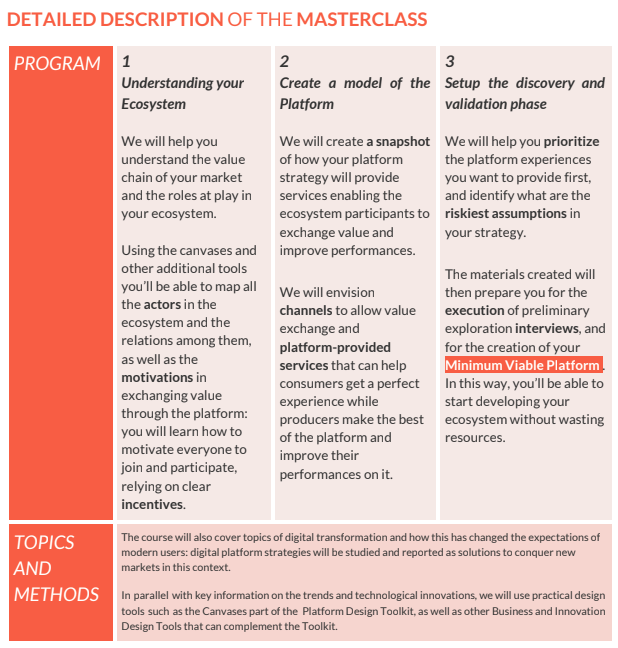
Platform Design 2-Day Masterclass New York City 18–19 March led by Simone Cicero

A moment of training and strategic thinking at the same time: two days in which you will learn — either independently or in a team — to use the Platform Design Toolkit, the most comprehensive set of tools for the design and prototyping platform strategies, used by thousands of practitioners around the world.

You’ll be able to apply it directly to your product, a process, or to the whole organization, a new service, a startup idea or to explore a market that you care about.

After building your strategic vision, we will help you prepare an implementation plan to validate your platform idea and test it through a lean prototyping approach that will avoid mistakes and waste of energy and money.

We will help you to get straight to a Minimum Viable Platform that will validate the appeal for your reference ecosystem, and we will prepare you to grow after. These two days will:

  • save you from bad investments and wasted expenses
  • take you from zero to a clear execution plan for the coming months.

Click to register, or for more information.

Stowe’s endorsement:

I recently experienced a presentation by Simone Cicero about the strategy and economics of platform organizations, and he is the real deal. If you or your organization is interested in getting up to speed on the economics of platform ecosystems, this is an essential investment.

Originally published at workfutures.org.

18 Feb 18:00

Five-word movie review: “Superman Returns”

by sheppy

Underrated, smart “Superman II” followup.

18 Feb 18:00

What are concurrency and parallelism?

by Eric Normand

What are concurrency and parallelism? What’s the difference? Concurrency is functional programming’s killer app. As we write more and more distributed systems on the web and on mobile, the sharing of resources becomes a major source of complexity in our software. We must learn to share these resources safely and efficiently. That’s what concurrency is all about.

Transcript

Eric Normand: What do we mean when we use the terms parallel and concurrent? What’s the difference, and how are they related? Hi. My name is Eric Normand. These are my thoughts on functional programming. In the recent episode, I talked about race conditions and the conditions under which you would get a race condition.

You have two threads or two timelines that are sharing a resource. It’s that sharing of the resource that makes something…It could be problematic. You could have a race condition, or it could be a thing about concurrency. Concurrency is all about sharing resources.

Resources could be anything. They could be a global variable. It could be a database. It could be a network connection. It could be the screen that you’re printing out in your terminal. All these things are shared resources among different threads.

Concurrency is all about efficiently and safely sharing those resources. That’s what it’s about. You could also say your CPU is a resource. You can have a task-scheduler that allows you to share that one CPU among different processes. That’s one way to look at it, but it’s all about sharing these resources.

Parallelism is about increasing the number of things that are sharing the resources. That’s increasing the number of threads. That’s increasing the number of nodes in a distributed system. This is making something more parallel. Now notice it’s very hard to make things parallel if they’re not sharing safely and efficiently.

They are intertwined. This idea of concurrency, how we share things and parallelism, which is how many things are sharing the thing. How many things? You could look at it in another way, which is if it’s a CPU. This is why the CPU one is a little hard because it’s the thing being shared, and it’s the thing that things are running on.

You could look at it like you are increasing the number of CPUs. That increases the number of threads that actually can run at the same time and not have to switch out to run because you can start actually having multitasking. You’re increasing the number of things that are shared but also the number of things that are running at the same time.

It’s a big corner case when you’re sharing the CPU because that’s also what you’re running on. The main point is that concurrency is about sharing resources safely and efficiently. Safely, meaning without bad race conditions, race conditions that could lead to the wrong result. Parallelism is about, once you have that, being able to increase the number of things that are sharing.

Different concurrency mechanisms exist. Most of them have parallels in the real world. A simple example is if you want to share a bathroom with people. You have six people living in the house. There’s one bathroom. How do you share that safely and efficiently? Well, you could put a lock on the door. That keeps other people out while one person is using it. That’s the safety.

It’s still private. It’s pretty efficient because you can tell the door is unlocked. You could go in and just use the bathroom. Then you unlock it on the way out. It’s pretty clear what the rules are. Imagine if you had something like 12, or 18, or 25 people in that house. Maybe a lock is not going to work anymore.

Maybe you’re going to start seeing, for instance, someone who’s had to go to the bathroom for two hours, and they just keep missing their turn. You’re probably going to want something more robust to ensure that everyone can share that. It’s not just the fastest people who can get to the bathroom.

Another mechanism we use all the time is a queue, lining up. You want to order food at the restaurant you get in line. They’re processed in order, the order you get in the line. That means that everyone has a fair chance. That resource, the person who’s taking orders, is going to be calling people up one at a time. It’s fair. We intuit that it’s a fair system.

This is a concurrency mechanism that’s used all the time. Another one is something like a schedule. Instead of getting in line, you could put your name on a list. I know restaurants are doing this now in my city where you go up, and you put your name on a list. When the table is available, they’ll text you. It’s asynchronous. That means I can go take a walk while my table is being used.

Then, once it’s free, I’m notified. Then I can go back. I don’t have to just wait in line. It’s a little bit more efficient. It probably lets you handle more people, I imagine. Especially since if it’s going to be two hours before I can sit down, I’ll probably go home and come back later when it’s closer to the time that they’re estimating.

These are all concurrency mechanisms that you can find in a computer. In the first case, there’s a thing called a lock in programming. It’s also called mutual exclusion or a semaphore. It’s a way of making sure that only one thread is accessing that block of code at the same time. There’s queues.

There’s multiple implementations of queues where you put a value in the queue that signals the work that you want done. Then when the CPU is available to do that work, it will pull the next thing off of the queue and just process them one at a time. There’s schedules or call-backs, things like that, like you have with the texting when my table is ready.

These concurrency primitives are really important. I have to say I’m not the only one who believes this, but concurrent programming, distributed systems programming, parallel programming is really the killer app for functional programming. People were talking about having hundreds, thousands of cores on our machines. We’d have to start programming those. That didn’t really happen.

What did happen was we’re now programming distributed systems all the time, so your cell phone has an app. That app is talking to the server. The server is talking to the database, talking to three third-party APIs. It’s all distributed. Not every pieces are distributed, but most of them are distributed.

Functional programming does really well with this because you can have distributed concurrency constructs. I won’t go into those right now. That’s why I bring up concurrency and parallelism because that’s really what functional programming does best. It uses immutable values, which are able to be shared between different threads with no problems, no race conditions.

If they’re immutable, it means they never change, which means any copy I have you can share the same copy because it’s never going to change. What’s the problem? We can both read it. My thread can read it. Your thread can read it, and it’s totally safe. Problem comes when you can modify it.

Then you start to get into, “Well, if you’re modifying it while I’m reading it, what’s going to happen?” that kind of thing. That’s parallelism and concurrency. That’s pretty much all I have to say on it.

If you want to get in touch with me, if you have a question, or you want to disagree with me, or give me some praise, or tell me I’m wrong, you can email me at eric@lispcast.com. You can also find me on Twitter, I’m @ericnormand with a D. Also, you could find me on LinkedIn and connect there. Don’t forget to hit subscribe. I’ll see you later. Bye.

The post What are concurrency and parallelism? appeared first on LispCast.

18 Feb 18:00

Coding day and a lucky find

by Liz

I wrote some truly horrible code today which I’m embarrassed will see daylight, but at least it works now. Getting the trains to report the time till arrival accurately posed some weird problems. There is surely a less clunky way to write it. BUT IT WORKS and I never want to think about it again. (Until I do, then will refactor mightly.)

Briefly went out in the sun and cold to do an errand and feed yatima’s cats. On the way home there was some pretty nice free furniture out on the curb. I have been meaning to replace the kids’ desk with a nicer one (which means a bunch of measuring and a time consuming errand and a conumdrum of getting a desk delivered). Their old desk is a very janky thing that is not quite a desk. Maybe it was a side table? It has a shelf underneath that stops you from putting your legs properly under the desk. And I had to repair one side of it with duct tape. But it was free and was on the sidewalk a block away.

And!!!! Now!!!! Another free desk just across the street from our house, a much better one, solid, sturdy, with one small drawer, very desky, just the right size (bigger) and painted a pleasant, not too childish, bright blue. It is in good shape but not so nice that you would need to worry about messing it up. As you may guess I got Danny to carry it with his mighty muscles across the street and then we both shoved it up the stairs. It looks super nice now. As usual, I forgot to take a “before” pic.

My feeling of triumph! The desk is good! I have arranged it beautifully in the room! I hope the kids will be impressed with me but of course mostly I just hope they like it and use it.

Danny has been livestreaming on Code Therapy a bunch today talking with someone named lambda malformation and some other …. probably Lisp nerds…. It’s soothing and he doesn’t seem to mind if I suddenly start cursing my screen or talking to the cat in the middle of his livestream.

My game is getting a little more fun and playable. I’m filling out 24th St. Mission station and its surroundings and I’ve started on 16th. Some of the puzzles are now in place. Next I might add conversations or more complex behavior with the NPCs (currently a tamale lady (not THE tamale lady), a flower seller, a street preacher, and a raccoon.

blue desk in a little room

18 Feb 18:00

Conquering Caffeinated Amazon Athena with the metis Trio of Packages

by hrbrmstr

I must preface this post with the posit that if you’re doing anything interactive() with Amazon Athena you should seriously consider just using their free ODBC drivers as it’s the easiest way to wire them up to R DBI- and tidyverse-wise. I’ve said as much in previous posts. Drop a note in the comments if you don’t know the incantations for repackaging the provided Linux ODBC drivers to work on your flavor of Linux.

However

There are times—say, when you’re trying to stand up an R service in your kubernetes cluster which bridges data in Athena to analyses & visualizations in R—when ODBC drivers can be more of a hindrance than help and JDBC is the path of least resistance.

Sure, there’s the in-CRAN AWR.Athena package but it’s a fairly constrained and low-feature RJDBC shim which gets the basic job done but not much more.

Enter:

a trio of packages which aims to make it super-straightforward to wire up R to Amazon Athena when ODBC is not available.

Why Three Packages?

For starters, there are CRAN hopes for the metis-trio and one key component of that is separating out the JARs into one package (metis.jars) and actual functionality into others (metis and metis.tidy). We’ll see how the CRAN attempt goes since the JAR package weighs in at sufficient weight to warrant a NOTE. The packaging of the driver reduces the need for you to pre-load the JAR (locally or into, say, a Docker image) or perform a package-initiated download-dance like AWR.Athena does (which I still don’t understand why that hasn’t kicked it out of CRAN the way it does it but ¯\_(ツ)_/¯).

metis.jars also has three helper functions which do some (basic) fun things:

library(metis.jars)

simba_driver_version()
## [1] "02.00.06.1008"

athena_supported_types()
##  [1] "BOOLEAN"   "TINYINT"   "SMALLINT"  "INT"       "INTEGER"  
##  [6] "BIGINT"    "REAL"      "FLOAT"     "DOUBLE"    "DECIMAL"  
## [11] "DATE"      "TIMESTAMP" "BINARY"    "VARBINARY" "CHAR"     
## [16] "VARCHAR"   "STRING"    "ARRAY"     "MAP"       "ROW"      
## [21] "STRUCT"   

metis_jar_path()
## [1] "/Library/Frameworks/R.framework/Versions/3.5/Resources/library/metis.jars/java/AthenaJDBC42_2.0.6.jar"

The first uses the rJava interface to directly query the version (since Amazon seems to update the Simba JAR twice a year). By separating out the JAR into a separate package, updates can be made to the other two sibling packages more frequently without crushing CRAN’s disk space. metis.jars is also versioned to the included JAR so configuration management will be easier for folks.

The reason for the second type-lister function is that there’s hope Amazon will add support for all Presto data types, especially IPADDRESS. It, again, performs JDBC driver introspection to collect the supported types.

Finally, the third function abstracts the JAR location from the metis package or even your own interface package should you choose to depend on it.

OK, But Why Not Just Two?

The metis package is a more functional RJDBC superclass of a DBI wrapper than AWR.Athena. One thing it does that its CRAN cousin cannot is handle BIGINTs properly:

library(metis)

dbConnect(
  metis::Athena(),
  Schema = "sampledb",
  AwsCredentialsProviderClass = "com.simba.athena.amazonaws.auth.PropertiesFileCredentialsProvider",
  AwsCredentialsProviderArguments = path.expand("~/.aws/athenaCredentials.props")
) -> con

dbGetQuery(con, "
SELECT
  CAST('chr' AS CHAR(4)) achar,
  CAST('varchr' AS VARCHAR) avarchr,
  CAST(SUBSTR(timestamp, 1, 10) AS DATE) AS tsday,
  CAST(100.1 AS DOUBLE) AS justadbl,
  CAST(127 AS TINYINT) AS asmallint,
  CAST(100 AS INTEGER) AS justanint,
  CAST(100000000000000000 AS BIGINT) AS abigint,
  CAST(('GET' = 'GET') AS BOOLEAN) AS is_get,
  ARRAY[1, 2, 3] AS arr1,
  ARRAY['1', '2, 3', '4'] AS arr2,
  MAP(ARRAY['foo', 'bar'], ARRAY[1, 2]) AS mp,
  CAST(ROW(1, 2.0) AS ROW(x BIGINT, y DOUBLE)) AS rw,
  CAST('{\"a\":1}' AS JSON) js
FROM elb_logs
LIMIT 1
") %>% 
  dplyr::glimpse()
## Observations: 1
## Variables: 13
## $ achar     <chr> "chr "
## $ avarchr   <chr> "varchr"
## $ tsday     <date> 2014-09-29
## $ justadbl  <dbl> 100.1
## $ asmallint <int> 127
## $ justanint <int> 100
## $ abigint   <S3: integer64> 100000000000000000
## $ is_get    <lgl> TRUE
## $ arr1      <chr> "1, 2, 3"
## $ arr2      <chr> "1, 2, 3, 4"
## $ mp        <chr> "{bar=2, foo=1}"
## $ rw        <chr> "{x=1, y=2.0}"
## $ js        <chr> "\"{\\\"a\\\":1}\""

PrestoAthena arrays and maps and rows and JSON come across as characters from the Athena driver and they’re formatted so badly that there’s little hope of full R support for list columns for them. But, you do get real, big integers with metis along with full support for all other current Athena types.

R folk who may be users of the old, standalone metis package need to be aware of some things.

First, dbConnect() has breaking changes. The snake_case names that still exist in the higher-level athena_jdbc() function are gone. In exchange for this pain, you now have full naming-parity with all the Athena JDBC connection properties and can more easily use alternate credential providers which metis‘ cousin totally cannot do for you which is illustrated in the example above and in the package README.

The metis package also makes it easier to see documentation for all available Athena connection properties since it has a vignette with a descriptive table of all of them (rendered here).

There is also nascent support for the “streaming API” (TLDR: faster result set downloads) but that won’t be fully tested until some AWS policy tweaks happen this week.

Gotcha. But, Why Not Just Two?

As awesome as it is (including base Docker image support) the tidyverse is not without overhead in terms of compilation time and dependencies, both of which are especially painful on Linux systems and some Docker environments. You can absolutely get by with some well-crafted SQL and JDBC and the thinner the image the easier it is to deploy and scale.

But! The tidyverse is so helpful that ensuring smooth support for Athena is critical. On its own, metis wires up to dplyr/dbplyr fine, but by providing (in metis.tidy) some enhanced db_data_type() support (primarily for BIGINT) and some extra 💙 in sql_translate_env() )for those of us who continue to mindlessly use R-only verbs like grep() or as.POSIXct() in non-R contexts) we can level-up interactive() use and tidyverse-infused service use:

library(metis.tidy)
library(dbplyr)
library(dplyr)

metis::dbConnect(
  metis::Athena(),
  Schema = "sampledb",
  AwsCredentialsProviderClass = "com.simba.athena.amazonaws.auth.PropertiesFileCredentialsProvider",
  AwsCredentialsProviderArguments = path.expand("~/.aws/athenaCredentials.props")
) -> con

elb_logs <- tbl(con, "elb_logs")

filter(elb_logs, grepl("20", elbresponsecode)) %>%
  mutate(
    tsday = as.Date(substring(timestamp, 1L, 10L)),
    host = url_extract_host(url),
    proto_version = regexp_extract(protocol, "([[:digit:]\\.]+)"),
  ) %>%
  select(tsday, host, receivedbytes, requestprocessingtime, proto_version) %>%
  head(1) %>%
  glimpse()
## Observations: ??
## Variables: 5
## Database: AthenaConnection
## $ tsday                 <date> 2014-09-29
## $ host                  <chr> "www.abcxyz.com"
## $ receivedbytes         <S3: integer64> 0
## $ requestprocessingtime <dbl> 9.5e-05
## $ proto_version         <chr> "1.1"

FIN

A fairly big impetus for this radical refactoring was the need to use the Athena JDBC interface in R at $DAYJOB in a serverless context. So, if I/we needed it, others may as well. All three packages have tests (that work with my personal Athena setup which is easily replicated since it’s just the default schema & table you get when you enable Athena), pass CRAN checks and will be live in a real production environment by the time you read this.

Note that I do have CRAN plans for these three amigos, but all three packages will need to go in at the same time and I need to get tests into- and prove tests are live in Travis before submitting. Now’s the time for feature requests, problem reports or issues. Until SourceHut’s (sr.ht) API is finished, said contributions are best left to GitLab (preferably) or GitHub (if you must continue to fill the coffers of giant multional companies that undermine your freedom).

POSTSCRIPT

One other reason for re-visiting metis was this R-crashing rJava issue that is really a Simba Athena implementation issue (OS signals in a JDBC driver, rly?)

This Rprofile entry:

options(
  "java.parameters" = c(getOption("java.parameters", default = NULL), "-Xrs")
)

has been a solid workaround until rJava is updated. Note that metis.jars warns about this on load if it detects your setup is at risk.

18 Feb 18:00

A Message To All Community Members

by Richard Millington

I’d add something like this to the community newcomer journey:

Reputation is the output of the perceived value of a member’s total contributions to the group.

The best way to improve your reputation isn’t to game the system, make an excessive number of contributions, or add lots of friends in the hope they add you back.

We’ll clamp down on that quickly and you’ll soon find yourself lumped with a reputation you will struggle to maintain.

The best way to improve your reputation in this community is to consistently make better contributions to the group.

You can do this by being more honest, open, and truthful about your experience.

You can do this by sharing your expertise with the group.

You can do this by being helpful, finding answers for others, and taking on support roles in the community.

This community is a fantastic place to begin building your reputation in the field, but do it with integrity, do it sustainably, and do it by giving to the community, not taking from it.

18 Feb 17:59

Gasteinertal with a fresh layer of snow. There...


Gasteinertal with a fresh layer of snow.

There’s something magical about waking up, looking out the window, and seeing the land covered with fresh snow. I love it.

18 Feb 17:59

IKEA should make up a word, in that funny IKEA ...

IKEA should make up a word, in that funny IKEA product name way, for that feeling when you’re several hours into a visit having debated twenty-three different options with your partner about stuff for your home; and you’re not even to the marketplace yet where you can buy pots and pans.

And let’s not forget the variant of the feeling where you go to IKEA all by yourself in an effort to avoid it, and yet it still strikes.

18 Feb 17:52

Recommended on Medium: Sidewalk Toronto: Rhetoric, Narrative, and Deceit

A Tour Through Some of Sidewalk Labs’ Recent Crisis Communications

This is going to be messy but I’m going fast to point out some things I hope others can help identify as tactics. This is to document the way that Sidewalk Labs is using communications to control and contain the growing wildfire that is their media footprint. This is more of a list than any kind of organized piece because speed — if you see some to add please send me a tweet.

The Sidewalk Labs PR machine is on a full-court press to try and get people talking about lumber, TIF, LRTs and the rest of it. That is the number one job for them. Work to normalize this behaviour. It gives permission to companies to act like they have acted here. No.

From: Sidewalk Labs CEO responds to criticism around tax and transit plans by Tara Deschamps, Toronto Star

Exhibit A:

DD: “Doctoroff acknowledged the concepts were facing criticism, but said that sort of response is “predictable” for any new ideas. “It isn’t fully baked and people just naturally are afraid of new things,” he said.

The problem some residents have with this project is that the process is anti-democratic. Lacking transparency, that’s not new. Lacking accountability from government, also not new. Is this deflection? Trying to point the finger at a problem that is not the problem at all?

Whatever this thing is called where you try and paint opponents as something they are not (anti-progress/luddites/conservative/boring/stodgy) whatever. This is a smart tactical move because it scares politicians that want to be seen as cool/modern/hip/fun/tech-friendly — whatever.

Oh and also also also — it is an effort to evoke empathy/sympathy for the innovator. Woe is me for trying to do the new and right things and hey eggs breaking/omelette yadda yadda but we’re putting on the brave face and we are going to push through. We know what’s good for you, and one day, you (even you mad ones) you will thank us. *head pat*

He shared a version of this in a McKinsey piece (because of course):

DD: “More importantly, political leaders need the courage to overcome the natural resistance that comes with any changes.”

If this doesn’t speak directly as a dare to a John Tory style mayor I mean I don’t know.

Exhibit B:

DD: “The best thing we can do is sit down with them and explain and we will be thoughtful and patient and listen to people’s concerns and hopefully reach a place where we have a mutually acceptable way of moving forward that doesn’t have to be what we suggested.”

Toronto. You just don’t *understand* what we’re doing, if you did — you’d be with it. So we are going to be nice and patient with you and keep trying to explain it to you until you *get it*. It’s a lot of extra work for us but we’re here for it.

And more dialogue. The man is saying, with a straight face I have to imagine, that while the leaked documents prove that they have been evading and dodging the question about their business plans for who knows how long. And saying all levels of government are into them.

From: Amazon, NYC’s HQ2 breakup could have been avoided: Sidewalk CEO Jon Erlichman and Amber Kanwar, BNN/Bloomberg

DD: “I think that both sides probably could have listened a bit better to each other, and ultimately could have come to what hopefully would have been an amicable solution that didn’t result the way it did,” and

DD: “That interaction — often contentious interaction — with the public and government officials actually makes plans better if you’re prepared to listen,” he said. “We’ve been listening a lot. Some of it has been tough to listen to sometimes, but we’ve never cut and ran.”

There is no greater demonstration of not listening than what Sidewalk Labs has been doing. They were asked countless times, again and again and again, what is the business model for your company? From the very beginning. And they refused to answer. If they would have come out with the plans that were leaked at the beginning the last fifteen months could have been used to talk about them. Instead they did the exact opposite of listen — they turned the volume up on what they wanted to say and how they did that. And that “we’ve never cut and run bit at the end” — go for it! Run! Why the saviour thing — the constant sense of ingratiating sentiment that Toronto should have for being picked for this thing.

Beyond this, there is a community questions doc of hundreds of unanswered questions. For a company with 11 million USD committed to stakeholder engagement they are making an active choice NOT to engage with community, not to answer the questions, not to have the hard conversations. So whatever this thing is here where they say that’s what they do/will do — yeah no.

Dan Doctoroff hasn’t been on a public stage at a public meeting since the first town hall in 2017. He’s been running his VIP closed advisory meetings though.

Moving along, back to this one.

From: Sidewalk Labs CEO responds to criticism around tax and transit plans by Tara Deschamps, Toronto Star

Exhibit C:

DD: “ Sidewalk Labs’s chief executive officer says it’s too “premature” to abandon any ideas it unveiled Thursday for a high-tech Toronto community it hopes to build, despite the concepts being met with fierce criticism.”

You, Dan Doctoroff, are not in charge of when the people of this city decide they have had enough. It’s not up to you to call public sentiment premature. Many of us, after 15 months, have seen plenty to know that this is not a good faith dealing.

Exhibit D:

“Daniel Doctoroff indicated his Alphabet-backed company was open to tweaking ideas…”

How else would this work, exactly. You just dictate things?

Exhibit E:

DD: “Doctoroff said. “We have adjusted significantly and we will continue to do that.”

You can’t adjust significantly when no one knows what you are doing. Also, if this is about the data trust, then this is a comedy show and a half. Was their starting position ever really “we’re going to own all of your data?”. This is bananas.

This and the leaked documents are examples of some kind of negotiating tactic where you start with a thing so patently absurd that the negotiation down feels satisfactory because it is no longer the worst possible thing ever thought of. This isn’t comms though, this is something else. Anyways.

Exhibit F:

DD: “Doctoroff said infrastructure Sidewalk is considering funding “would otherwise be infinanceable” and added “if we are prepared to do that when no one else is, we need to get paid back.”

(this reminded me of complexifier). Moving along — by Dan Doctoroff’s pronouncement it is Sidewalk Labs or nothing can happen. This is a powerful move. I mean, it’s not true. But it’s a strong gesture, rhetorically.

Bonus Meta Exhibit:

From: Alphabet’s Sidewalk Labs was secretly considering big plans for Toronto neighbourhood, Fatima Syed, National Observer

Ok, so to be fair to Sidewalk Labs, this was never meant to be public, we’re only seeing it because it was leaked. But this is information being used to sell Alphabet on the deal — the good old opinion poll. This has raised interesting ethical questions from me, because while I get the value of printing these poll numbers, they also inadvertently confer some kind of legitimacy on them. From the piece:

Sidewalk Labs put forward two questions to an unstated sample size to gauge public support. The first asked: “As you may have heard Waterfront Toronto, a government agency, has agreed to partner with Sidewalk Labs, an urban innovation company, to create a new district on the Eastern Waterfront. Do you support or oppose this project?”

In April 2018, 52 per cent of those sampled said they supported the project; 33 per cent responded “don’t know;” and, 15 per cent were opposed.

Six months later the numbers had barely moved: 53 per cent supported; 33 per cent said “don’t know;” and 14 per cent opposed.

How in the world would anyone know what this project is about from that question? Can you imagine? Then check out the follow-up:

“This project would create a new mixed-use neighbourhood and a new HQ for Google Canada on Toronto’s Easter Waterfront. The project will combine forward-thinking urban design and new technology that will create a people-centred neighbourhood that would…

A) Improve quality of life and develop innovations to address the challenges facing Toronto.

(68 per cent supported this idea; 11 per cent said “don’t know;” and 21 per cent opposed)

B) Create thousands of new jobs and billions in new economic investment in the city.

(74 per cent supported this; 11 per cent said “don’t know;” 15 per cent opposed)

Improve quality of life? WHAT? They are laying claim to that how? and the way B is taken out of context of all the things that would happen anyway?

I know polling is a special nightmare but the idea that polling is being used when the kind of information that got leaked is what any poll would need to include is …. yeah.

Ok, there is more to the comms stuff to talk about. Like Dan Doctoroff’s pre-emptive Medium post — effort at message control — (which David Murakami Wood did a great little thread on here) as well as the flurry of hires that were announced, including a former Toronto City Councillor (as in, she stopped being a politician last November), the day the news broke but that’s all for another day. A final note, the political rhetoric is also important to watch from the elected officials. As Michèle Champagne pointed out, this language about inevitable privatization is just that — rhetoric, and suggested a read of Archis Vol 34: City in a Box

More soon! Next up — a quick note on the approvals process and why this project needs to be shut down, not given months upon months to normalize bad behaviour from all parties involved.

pardon?
18 Feb 17:51

Twitter Favorites: [shawnmicallef] When I am mayor there will be a public registry for motorists who block streetcars while parking in highly subsidized real estate.

Shawn Micallef @shawnmicallef
When I am mayor there will be a public registry for motorists who block streetcars while parking in highly subsidized real estate.
18 Feb 17:51

Twitter Favorites: [dhh] “I’ve come around to physical books... to keeping the best of them. Not for other people, but for myself. I’ve real… https://t.co/l3rczsb6XK

DHH @dhh
“I’ve come around to physical books... to keeping the best of them. Not for other people, but for myself. I’ve real… twitter.com/i/web/status/1…
18 Feb 17:50

Twitter Favorites: [shawnmicallef] Always such electricity on Family Day eve. Can never get to sleep!

Shawn Micallef @shawnmicallef
Always such electricity on Family Day eve. Can never get to sleep!
18 Feb 17:50

Apple to release 16-inch MacBook Pro, 31.6-inch 6K monitor and more in 2019: report

by Igor Bonifacic
Apple's 2018 MacBook Pro

On Sunday, noted Apple analyst Ming-Chi Kuo released a new, far-reaching investor note, obtained by MacRumors, detailing the company’s 2019 hardware lineup.

If Kuo is to be believed, and he has a solid track record when it comes to the Cupertino-based tech giant, Apple plans to release a new 16-inch MacBook Pro model, new 31.6-inch monitor and updates to its iPhone and iPad lineups.

Given the breadth of the report, I’ve broken it down by product categories so readers can jump to the item that most interests them.

New year, same iPhones

Echoing recent reports from The Wall Street Journal and Bloomberg, Kuo says that Apple will launch three new iPhone models in 2019. Like the company’s current trio of smartphones, two of the phones will feature OLED display panels measuring in at 6.5 and 5.8-inches, respectively, while a third LCD model will feature a 6.1-inch screen.

Kuo also notes — again echoing another recent report — that all three models will include Lightning ports, instead of USB-C connectivity. He adds that the phones will feature a new frosted glass case, bilateral wireless charging (i.e., the reverse wireless charging that’s available in the Mate 20 Pro), ultra-wideband support, improved Face ID authentication, bigger batteries and a triple camera array.

The analyst doesn’t state which of the three models will feature three main cameras. However, if past reports are any indication, Apple will likely make the feature exclusive to the 6.5-inch ‘Max’ model.

The iPad mini finally gets an update

Kuo says Apple will release two new iPads in 2019, including a new iPad mini with updated CPU. He also says Apple will update the current 9.7-inch iPad to feature a 10.2-inch display, which suggests the company will shrink the display bezels of its entry-level tablet. The company will also refresh its existing iPad Pro models with new processors.

As does the MacPro

The most exciting aspect of Kuo’s note is the mention of an “all-new” 16 to 16.5-inch MacBook Pro model. Unfortunately, other than the fact the computer will feature a new design, Kuo provides no other tantalizing details.

As MacRumors notes, a 16-inch model would be the largest screen Apple has offered on a MacBook Pro since it discontinued the 17-inch MacBook Pro back in 2012.

The release of a new MacBook Pro design would be unusual; Apple only just refreshed the MacBook Pro’s design in 2016. That said, the new MacBook Pro hasn’t had the best reception due to its butterfly switch keyboard mechanism, which has proved, at best, to be unreliable.

He says Apple will also start offering the 13-inch model with 32GB of RAM. Currently, the 13-inch model maxes out at 16GB of RAM.

Kuo adds that he expects Apple to update the Mac Pro. According to the analyst, the company’s new high-end computer will feature a modular design, with “easy to upgrade components.” I should note that Apple has already said it will update the Mac Pro this year.

Apple also plans to return to the pro display market with a new first-party 31.6-inch 6K monitor. Kuo says the monitor features a “Mini LED-like backlight” technology that makes for a display with “outstanding picture quality.”

Everything else

Once again echoing a couple of other recent reports, Kuo writes Apple will release a second-generation pair of its Bluetooth AirPods and its AirPower inductive charging mat in the first half of 2019.

With the Apple Watch, meanwhile, Apple will once again offer a ceramic case option. Kuo says the company plans to enable the Series 4’s ECG feature in countries outside of the U.S., which could be good news for Canadian Apple Watch owners.

Lastly, Kuo says Apple will refresh the iPod Touch with a new processor.

There you have it, that’s everything Kuo mentions in his note. If there’s a future product you’re excited about, let us know in the comment section.

Source: MacRumors (1), (2), (3), (4), (5)

The post Apple to release 16-inch MacBook Pro, 31.6-inch 6K monitor and more in 2019: report appeared first on MobileSyrup.

18 Feb 17:50

Netflix cancels Marvel’s ‘The Punisher,’ ‘Jessica Jones’

by Bradly Shankar
The Punisher

Marvel’s The Punisher and Marvel’s Jessica Jones have both been cancelled, Netflix has announced.

The Punisher‘s second season debuted on Netflix on January 18th, while Jessica Jones‘ second season began streaming in March 2018. The third season of Jessica Jones is still set to premiere sometime in 2019.

With The Punisher and Jessica Jones cancelled, Netflix has now officially ended every one of its Marvel TV shows. The streaming service cancelled The Punisher and Jessica Jones sister series Iron Fist and Luke Cage in October and Daredevil in NovemberThe Punisher is a spin-off of the latter series, with the titular character (portrayed by Jon Bernthal) making his debut in the second season of Daredevil in March 2016.

In a statement, head of Marvel Television Jeph Loeb attributed the cancellation to Netflix rather than Marvel. “On behalf of everyone at Marvel Television, we couldn’t be more proud or more grateful to our audience. Our Network partner may have decided they no longer want to continue telling the tales of these great characters… but you know Marvel better than that,” Loeb wrote.

There was hope that The Punisher would continue due to the fact that it wasn’t part of the original content deal that Marvel and Netflix signed in November 2013. Under that agreement, Marvel and Netflix would produce shows based on Daredevil, Jessica Jones, Luke Cage and Iron Fist before bringing all four heroes together in a team-up Defenders series. The Punisher spin-off was eventually announced in April 2016.

Netflix has been cancelling these Marvel shows at the same time that Disney is beginning to pull all of its content from the service. Instead, the entertainment giant plans to offer its lineup of Marvel, Star Wars and Walt Disney Studios programming through its own Disney+ streaming service, which is set to launch in the U.S. this fall.

However, Disney says there’s a “possibility” it could revive the canceled Marvel Netflix shows on Disney+. Further, U.S. streaming service Hulu — which Disney is set to hold a majority stake once it has acquired 21st Century Fox —  has also expressed interest in bringing back these Marvel Netflix shows. It remains to be seen if these shows would make their way to Canada, though, given that these services are U.S.-only for now.

Source: Marvel

The post Netflix cancels Marvel’s ‘The Punisher,’ ‘Jessica Jones’ appeared first on MobileSyrup.

18 Feb 17:49

Interview with Stephanie Hicks

Editor’s note: For a while we ran an interview series for statisticians and data scientists, but things have gotten a little hectic around here so we’ve dropped the ball! But we are re-introducing the series, starting with Stephanie Hicks. If you have recommendations of a (junior) person in academics or industry you would like to see promoted, reach out to Jeff (@jtleek) on Twitter!

Stephanie Hicks received her PhD in statistics in 2013 at Rice University and has already made major contributions to the analysis of single cell sequencing data and the theory and practice of teaching data science.

SS: Do you consider yourself a statistician, biostatistician, data scientist or something else?

SH: Fantastic question! I’m a statistician by training, and I work in a department of biostatistics, so I would be remiss if I didn’t answer a statistician. However my interests are at the intersection of statistics, data science, genomics and education. Broadly, my research interests are to leverage statistical methods and computational algorithms to effectively derive knowledge from data. I’m also very interested in identifying better ways to teach students how to do that. I work a lot with genomics data, but I also analyze data from many other areas. You might think of this as data science, so I could easily imagine someone classifying myself as an ‘academic data scientist’ if such a thing exists?

SS: How did you end up at Johns Hopkins (i.e. your history)?

SH: I received my B.S. in Mathematics in 2007 rom LSU and my M.A. and Ph.D. in 2013 from the Department of Statistics at Rice University under the direction of Marek Kimmel and Sharon Plon (@splon). I completed my postdoctoral training with Rafael Irizarry (@rafalab) in the Department of Data Sciences at Dana-Farber Cancer Institute and Department of Biostatistics at Harvard T.H. Chan School of Public Health. While I was a postdoc, I had the opportunity to meet many students from the Johns Hopkins Biostatistics Department at the Women in Statistics Conference in Cary, North Carolina in 2014. The following year, I attended the ROpenSci Unconference and teamed up with Roger Peng, Hilary Parker and David Robinson to work on the explainr and catsplainr R packages. Given this department been a pioneer in developing statistical methods for the analysis of genomics data and in data science education, I couldn’t think of a better department to join.

SS: What are the problems that most excite you right now?

SH: Within the world of genomics, I’m most excited about open challenges and problems in what’s often referred to as “single-cell genomics”. There is a great potential for using this data that measure features or traits (such as measuring what genes are expressed) in individual cells to help find better diagnoses, prognoses and treatments for many diseases. There are not only open statistical challenges to this data, but also computational challenges. For example, datasets being generated are frequently so large that they cannot even be read into memory. Therefore, one of my projects is to make unsupervised learning methods, such as k-means, scalable to millions of observations (or cells) by combining on-disk data representations (such as HDF5 files) and performing computations on small, random batches of observations so they can be stored in memory and analyzed in a scalable manner.

SS: Are you working on any non-research data science projects you are excited about? What are they?

SH: So many! Let’s see, I just focus on one, but happy to talk about more.

If you close your eyes and say the word ’teacher’, ’doctor or nurse’, ‘pilot’, ‘chef’: these are all jobs that most people, including children, can easily visualize and conceptualize. I have two young children who easily get inspired from the books that we read. Last year, I went to look for children’s book featuring women in statistics or data science and couldn’t find any. To address this, I’m working with a team of awesome individuals to create a children’s book featuring women in statistics and data science. My goal with this book is to allow for young children to visualize and conceptualize what it means to be a statistician or data scientist. And even more importantly, highlight women to have been trailblazers in these fields, so little girls reading this book may one day be inspired to learn more about statistics and data science and may even choose this career.

SS: What do you see as the most exciting ways to incorporate data science into academia?

Within the world of data science, I’m super interested in finding new ways to teach students how to analyze data in a format that is efficient, effective and scalable. There is a ton of exciting curriculum development happening across the world, and I hope to contribute to that as well. For example, I’m interested in teaching students how to analyze data using the case-study based approach that was pioneered by Deb Nolan and Terry Speed in 1999. My postdoc advisor and I wrote a guide for teaching data science courses based on our teaching experiences. This fall, Roger Peng and I used this approach to teach an Introduction to Data Science course offered in our department at Hopkins (https://jhu-advdatasci.github.io/2018/).

SS: You started R ladies Baltimore, what is it about that community that inspired you to create the Baltimore branch?

R-Ladies is an amazing global organization that has a goal of achieving proportionate representation by encouraging, inspiring, and empowering people of genders currently underrepresented in the R community. It was started by Gabriela de Queiroz in San Francisco in October 2012 who wanted to give back to her local community after going to several meetups and learning a lot for free, but saw disparity in gender diversity. Since then R-Ladies has grown to 138 chapters in 44 countries and 39000 members. It is also now funded by the R-Consortium.

As an active user and developer of R packages, I know first hand how intimidating it can be to get started using R as both a new user and a gender minority in the R community. I started R-Ladies Baltimore (https://rladies-baltimore.github.io) to create a community in Baltimore for underrepresented minorities to grow their knowledge, experience and skills in R, to confidently ask questions, to learn and support each other, and to contribute new R code and packages for their own projects. We have meetups every two months and try to think creatively about how we can inspire our attendees to learn and use R. One of my favorite meetups was in the fall where we met to make holiday card designs in R (https://rladies-baltimore.github.io/post/making-holiday-cards-in-r-2018/).

18 Feb 17:43

"Congress’s delegation to presidents of vast, essentially unconstrained power to declare national..."

“Congress’s delegation to presidents of vast, essentially unconstrained power to declare...
18 Feb 17:42

RT @internetofshit: humanity is doomed twitter.com/GK3/status/109…

by internetofshit
mkalus shared this story from ottocrat on Twitter.

i just had to download a software update for my shoes which are now getting a charge on their USB-C wireless charging mat

we’re living in the future!!! 🤯 pic.twitter.com/dXnkNZlnoK


Posted by GK3 on Sunday, February 17th, 2019 6:19pm


668 likes, 260 retweets

Posted by internetofshit on Monday, February 18th, 2019 7:37am
Retweeted by ottocrat on Monday, February 18th, 2019 8:52am


4770 likes, 1260 retweets
18 Feb 17:37

Samsung Galaxy S10+ spotted in the wild ahead of launch event

by Jonathan Lamont
Rolandt

jj

Just days before Samsung’s launch event for its 2019 flagships, the Samsung Galaxy S10, S10+ and S10e, one of the phones was spotted in the wild.

While we already have an excellent idea what the Galaxy S10+ looks like thanks to many previous leaks, this picture further confirms the look of the device.

The photo shows someone holding the S10+. It’s hard to tell what’s behind the phone, but it looks like it could be a kitchen or perhaps and office.

As for the phone itself, we can clearly see the display cutout housing the dual front-facing cameras. Further, in typical Samsung flagship fashion, the sides of the display appear to curve, giving the appearance of small side bezels.

The impressively thin top bezel houses the earpiece, but the photo doesn’t reveal anything else.


Along the bottom of the phone, we can see a bit of the metal band that wraps around the edge. In particular, the photo shows two antenna bands on the bottom of the device.

Finally, the photo shows the device’s power button on the right side, volume rocker on the left and below that, what is likely the return of the Bixby button.

While this photo gives us more information about the look of the device, we also know a lot about the specs and other details thanks to a variety of leaks. To learn more about what we’re expecting from the Galaxy S10, S10+ and S10e, click here.

Source: SlashLeaks

The post Samsung Galaxy S10+ spotted in the wild ahead of launch event appeared first on MobileSyrup.

18 Feb 17:37

Analyst predicts Apple’s video streaming service will cost $15 USD per month

by Igor Bonifacic
Apple TV 4Th Gen

In a new note to investors obtained by Business Insider, Jefferies analyst Tim O’Shea predicts Apple will charge consumers $15 USD per month (approximately $19.86 CAD at the time of writing) for access to its upcoming video streaming platform.

To put that number in perspective, in the U.S. Netflix prices its three streaming tiers at $9, $13 and $16 USD per month, respectively. Meanwhile, in Canada, the company charges $16.99 per month for access to its premium tier, which is to say if and when Apple’s new streaming platform were to come here, the company could adopt a regional pricing strategy that echoes the price of Netflix.

Moreover, whatever the price of entry O’Shea says he believes Apple will face an uphill battle convincing even dyed-in-the-wool iOS users to subscribe. To date, the company has spent a small fraction of the money Netflix invests in original content, and Apple’s insistence on a rumoured 30 percent revenue split is causing friction with major production houses like HBO.

“There are only a handful of players that make content that matters,” O’Shea writes. “If you lose one or two of them, it makes your service much less attractive.”

Those issues could be exacerbated in Canada if regional rights holders are unwilling to license their content to Apple.

Another interesting point brought up by O’Shea is that even if the platform were to become a runaway success, it would do little to offset declining iPhone sales.

In a best-case scenario in which Apple was able to accumulate 250 million subscribers by 2023, the service would only account for approximately five percent of the company’s revenue that year. Netflix, for perspective, has 139 million subscribers after 12 years in the streaming business.

A recent report from Bloomberg suggests Apple will announce the video platform, as well as its news subscription service, on March 25th. Bloomberg says it expects Apple will launch the former sometime this summer.

Source: Business Insider Via: 9to5Mac

The post Analyst predicts Apple’s video streaming service will cost $15 USD per month appeared first on MobileSyrup.

18 Feb 17:37

Ontario MPP wants to bring ‘Right to Repair’ movement to Canada

by Shruti Shekar

Ontario Liberal Member of Provincial Parliament (MPP) Michael Coteau sat in his constituency office in Don Valley East, Toronto with a frustrated look on his face. He was looking at a badly damaged Samsung S8, which was on the table in front of him.

“My daughter dropped my phone, the phone in front of you right now, that I am no longer using as a phone. It sits in a cradle and powers that monitor,” Coteau pointed to his computer desk where a monitor sat. “I’m using it just as a CPU rather than a phone, but you can see it’s a Samsung. It’s an S8, and it’s cracked.” Coteau is using Samsung’s DeX smartphone desktop platform.

There were sunburst cracks all over the phone and it was badly scratched. It made you wonder how his daughter was able to damage a phone in that way.

The former cabinet minister under then-Liberal premier Kathleen Wynn, said breaking his phone coincidentally happened at the same time he was creating his private member’s bill, the right to repair. The bill is set to be introduced in the Ontario legislature sometime later this week.

‘Right to Repair’ movement an inspiration

About four months ago, Coteau saw a CBC article on a similar idea coming out of the U.S. called the ‘Right to Repair Movement” championed by The Repair Association. According to the association’s website, its efforts are based on the 2012 Automotive Right to Repair Law that passed in Massachusetts in 2012. The movement didn’t start until 2016.

“The concept is simple. The digital electronics within automobiles are the same parts used in thousands of other devices, suffer the same types of failures, are controlled by the same types of firmware, and are repaired using the same information, parts, and tools. Since repair is the same, the rules for repair should also be the same,” the website reads.

Things didn’t really click for Coteau until he went to try and get his S8 fixed.

“They said $330 plus tax. Almost $400 to fix a past generation phone. The S9 is out, and the S10 is coming out soon,” Coteau said. “Then I checked party suppliers and against the price, it was pretty high. So it was cheaper for me to go to my local carrier and get a new phone.”

Coteau said he didn’t understand the rationale behind that.

“I couldn’t reuse the phone, which I have no problem with, it’s a great phone, it suits my needs. But I thought, what a waste. The fact that in most cases that phone would just become garbage,” Coteau said with a baffled look on his face.

There are several aspects to Coteau’s private member’s bill. But what he really wants to make clear is that the bill would give consumers protection, and the right to repair their phone with the necessary tools.

That would mean companies would be forced to release their manuals of how to set up products, as well as diagnostic tools designed for consumers to be able to repair their phones on their own. They would do it in a way that it wouldn’t harm their intellectual property, Coteau said.

It would also mean companies would have to make products available for consumers, and that too at a reasonable cost.

“They can make a profit, but they shouldn’t be gauging people to an extent where it’s cheaper to buy a brand new phone than it is to repair the phone,” he said.

Companies would make these parts available to third-party vendors who provide that service as well, Coteau said.

More importantly, Coteau explained how this would reduce the damage and cost it would have on our environment.

“There’s going to be a point where our phones and the technology around us will become something we use long term versus this disposable society we’ve become when it comes to our TVs, phones, our computers.

“Not only does it have an environmental impact when [companies] extract those minerals, but a lot of those products end up in countries in their stockpiles. There’s a lot of waste there; there is an environmental cost,” he said.

Apple vehemently opposes ‘Right to Repair’ movement

But Coteau is up against big companies like Apple.

Kyle Wiens, co-founder of iFixit, a company that fixes phones in the U.S., said to the CBC in October that Apple has vehemently opposed the movement since it started in 2016 in the U.S.

“Apple doesn’t like the Right to Repair movement very much,” he said. “Apple’s perspective is that they want to complete control over the device from the moment that you buy it, all the way through to the end of life.”

Coteau gets that though. He said that he was willing to work with big tech giants like Apple.

“I would work with any company…to look for a way to better protect consumers,” he said.

But companies like Apple want to make money, and part of their profit comes from customers wanting to repair products and eventually just buying new ones.

“There’s a difference between wanting to own your intellectual property and being a good company that will repair products, and there’s a difference between doing that and putting people at a disadvantage for monetary gain,” Coteau said.

Coteau added that he spoke with Wiens and other lobbyists in the U.S. trying to make the right to repair a reality in Ontario.

At the time Wiens said to the CBC he wanted one jurisdiction to pass the right.

“If Ontario decided, ‘We’re going to pass the Right to Repair legislation,’ that could actually pass Right to Repair for the world, because manufacturers aren’t going to provide products differently to people in one jurisdiction. They want to simplify their operations,” Wiens said.

Coteau spoke with NDP, Conservatives on the bill

Coteau said he also asked a Conservative MPP and an NDP MPP to test the waters out. He did not want to say their names without asking their permission first.

Coteau said he asked the two MPPs to see if they were interested in co-sponsoring the bill.

“At this point, I’m just going to go forward with it by myself. I just didn’t get feedback from one, and the other one it was just lukewarm.

“In fairness to them, maybe it’s not a priority at this time because there are so many other priorities in the Ontario legislature,” he said.

Coteau inserted that he right now it’s been an educational campaign, making people understand the rights they deserve and soon bringing the bill in front of the legislature.

“People don’t realize the transformation that is about to take place in society,” he said. “The right to repair speaks to that change and the ability to control our products so we can repair it and so it can last longer and we can make changes and adapt it if necessary.”

The post Ontario MPP wants to bring ‘Right to Repair’ movement to Canada appeared first on MobileSyrup.

18 Feb 17:34

The Web Through a 30 Year Old Lens

by Ton Zijlstra

A team of people, including Jeremy Keith whose writings are part of my daily RSS infodiet, have been doing some awesome web archeology. Over the course of 5 days at CERN, they recreated the browser experience as it was 30 years ago with the (fully text based) WorldWideWeb application for the NeXT computer

Hypertext’s root, the CERN page in 1989

This is the type of pages I visited before inline images were possible.
The cool bit is it allows you to see your own site as it would have looked 30 years ago. (Go to Document, then Open from full document reference and fill in your url) My site looks pretty well, which is not surprising as it is very text centered anyway.

Hypertexting this blog like it’s 1989

Maybe somewhat less obvious, but of key importance to me in the context of my own information strategies and workflows, as well as in the dynamics of the current IndieWeb efforts is that this is not just a way to view a site, but you can also edit the page directly in the same window. (See the sentence in all capitals in the image below.)

Read and write, the original premise of the WWW

Hypertext wasn’t meant as viewing-only, but as an interactive way of linking together documents you were actively working on. Closest come current wiki’s. But for instance I also use Tinderbox, a hypertext mindmapping, outlining and writing tool for Mac, that incorporates this principle of linked documents and other elements that can be changed as you go along. This seamless flow between reading and writing is something I feel we need very much for effective information strategies. It is present in the Mother of all Demos, it is present in the current thinking of Aaron Parecki about his Social Reader, and it is a key element in this 30 year old browser.