Shared posts

05 Apr 20:52

Russians In Venezuela: What We Know So Far

by Giancarlo Fiorella
mkalus shared this story from bellingcat.

On March 23, 2019, Twitter lit up with a series of images showing two Russian aircraft at the Simón Bolívar International airport just north of Caracas, Venezuela. The images also showed a group of individuals in uniform disembarking from one aircraft, and cargo being unloaded from the other.

Maria Zakharova, the spokeswoman for the Russian Foreign Ministry, later said that the individuals were “specialists” who had arrived in the country as part of a bilateral “military-technical cooperation agreement” between Moscow and Caracas, and that they would stay in the country “for as long as the government of Venezuela needs them.”

Given the political tension in Venezuela, the arrival of Russian personnel reverberated through both local and international media

On January 23 of this year, Juan Guaidó, the head of the National Assembly, claimed the title of interim president after the legislature found president Nicolás Maduro to have “usurped” the position following a highly contentious election last year. Since then, Maduro has been facing calls to step down as president of Venezuela, and to allow free and fair elections to take place in order that he be replaced.

Guaidó’s January 23 declaration also had the effect of splitting the international community into two camps. While the United States, much of the Lima Group, and several European countries have recognized Guaidó as Venezuela’s legitimate president, Russia, China and Cuba have sided with the status quo under Maduro.

Within this context, the arrival of Russian personnel on March 23 is a sign of Moscow’s continuing support for Maduro during a critical stage in his presidency.

The Facts

On March 23, two Russian aircraft landed at the Simón Bolívar international airport in Maiquetia, located north of Caracas. The aircraft were:

Both flights were tracked on their journeys to Venezuela by Twitter user @YorukIsi. Both aircraft headed from Syria to Senegal, with the Il-62 having arrived in Syria from Moscow on March 22. Once in Senegal, @YorukIsik correctly predicted that the planes would continue towards Venezuela based on similar trips made by Russian aircraft in the past.

A summary of each aircraft’s flight to Venezuela follows below.

From left to right: The Il-62 departs from Syria heading across across the Mediterranean Sea starting at approximately 8:23 PM UTC on March 22; enters Senegalese airspace shortly before 4:35 AM UTC on March 23; and flies just south of the island of Barbados heading towards Venezuela at approximately 1:10 PM UTC on March 23 (Images courtesy of Flightradar24)


From left to right: The An-124 departs from Syria heading west across the Mediterranean Sea starting at approximately 8:37 PM UTC on March 22; enters Senegalese airspace at approximately 5:15 AM UTC on March 23; flies just south of the island of Barbados heading to Venezuela at approximately 3:57 PM UTC on March 23 (Images courtesy of Flightradar24)

Images of the two airplanes after their landing:

The Il-62 landed at the Simón Bolívar International airport before the An-124. The video below shows the An-124 arriving at the airport; at the end of the clip, the Il-62 is visible, already stationary on the ramp:

When they were photographed, the two aircraft were located in a section of the airport (blue box below) near the presidential hangar, which is used to receive foreign dignitaries (for a detailed geolocation of the aircraft, see this article by DFRLab):

The Simón Bolívar international airport. The area where the two aircraft were photographed is highlighted by the blue box. Note the red carpet on the right side of the image indicating the location of the presidential hangar (Images courtesy of Google Earth/DigitalGlobe)

Based on the open source information available, the Il-62 brought to Venezuela at least two dozen individuals, with media reports claiming that approximately 100 of them arrived.

The An-124 unloaded its cargo unto trucks that were waiting on the airport ramp:

The S-300VM

In a Twitter thread, @SerbinPont connected the arrival of Russian personnel with imagery released by @ImageSatIntl (iSi). According to iSi, an image dated March 20 shows S-300VM anti-aircraft missile system activity at the Capitán Manuel Ríos Airbase in Guárico state:

iSi also detected the S-300VM system at the airbase back in February of this year:

@SerbinPont proposed a theory that the arrival of Russian personnel might be connected to the operation of the S-300VM, and pointed out that from the airbase the system can cover Venezuelan population centers, including Caracas and Valencia, as well as other military installations.

Maduro’s predecessor, Hugo Chavez, purchased an unspecified number of S-300VM systems from Russia in 2009, reportedly as part of an agreement that involved a loan of $2 billion from Moscow. The S-300VM made its first public appearance in Venezuela during a military parade in Caracas on April 19, 2013. More recently, the S-300VM participated in a military parade in the capital on July 5, 2018.

At this time, there is no open source information available that conclusively points to a connection between the arrival of Russian personnel and the operation of the S-300VM in Venezuela.

Previous Connections

A check of Flightradar24 shows that the Il-62 (RA-86496) and the An-124 (RA-82035) have been to Venezuela before.

The Il-62 was in the country briefly on March 2 and 3 of this year. The airplane was also in Venezuela on December 10, 2018, accompanying two Tu-160 strategic bombers and the An-124 (RA-82035). The four aircraft were welcomed at the Simón Bolívar International Airport by the head of the Venezuelan military, and were in the country only briefly.

Here is a tweet from the official Venezuelan Army Twitter account showing the bombers, the Venezuelan delegation that welcomed them, and their Russian counterparts:

The four aircraft appear in the satellite image below on their December 10, 2018 visit to Venezuela:

The two Tu-160, the An-124, and the Il-62 were photographed at the Simón Bolívar International Airport during that visit:

Analysis

The presence of Russian “military-technical” personnel in Venezuela for an indefinite period of time makes Venezuela a possible geopolitical flashpoint, as it runs contrary to the local interests of the United States.

The White House has responded to the arrival of Russian personnel tersely. On March 25, Secretary of State Mike Pompeo had a telephone conversation with Russian Foreign Minister Sergey Lavrov during which he reportedly told him that the United States would not “stand idly by as Russia exacerbates tensions in Venezuela.” On March 27, U.S. President Donald Trump said that “Russia has to get out” of Venezuela, while VP Mike Pence called the arrival of the personnel an “unwelcome provocation”.

Most recently, the White House issued a statement on March 29 calling the deployment of “Russian military personnel and equipment” in Venezuela “a direct threat to international peace and security in the region.”

Russia has meanwhile defended its move, saying that it adheres to “bilateral and international legal frameworks” for cooperation. On March 29, the Rostec Russian state-owned company announced that it had opened a training center for helicopter pilots in Venezuela. There is no open source evidence available to help verify whether the arrival of the Russian personnel on March 23 and the opening of the training center are related.

The arrival of Russian personnel is the clearest sign yet that the Russian government is willing to continue to lend support to beleaguered President Maduro. While Russia has been an important financial resource for the Maduro government in the past, this new visit, conducted in such a visible manner, is also likely a signal to the international community that Moscow is still on Maduro’s side.

The post Russians In Venezuela: What We Know So Far appeared first on bellingcat.

05 Apr 20:51

Teach People About The Topic, Not About The Platform

by Richard Millington

Don’t teach newcomers how to use the platform, teach them about the topic.

Typically around 70% of your newcomers are new to the topic too.

Learning how a platform works is boring, learning about the topic (which brought them to the community) is far more interesting.

I recommend inviting all newcomers to watch a recorded webinar offering a 101 beginners guide to the topic.

You can include an overview of the topics, lessons from top members (what do they wish they knew when they started?), a list of useful resources, and some practical tips for getting started.

At the end, include a few tips for using the community too.

Don’t bore newcomers with tedious platform information, surprise and inspire them with unexpected expertise in the topic. A 101 webinar is the perfect way to do it.

05 Apr 20:51

Full Kondo

by jakeadelstein

05 Apr 20:51

Apple as the new Disney

by Benedict Evans
  • We expected a TV event and got a subscription event - news & magazines, games, a credit card and Oprah. There are plenty of product questions one could ask (especially on TV, where we still don’t know the scale of the ambition - is Apple taking on Netflix and spending $10bn+, or spending $1bn for ‘marketing’?) But mostly this feels like solid incremental execution: product managers doing product management

  • The obvious view: these subscription services are about cutting churn and driving incremental revenue - $10-$20-$30 per user for hundreds of millions of iPhones, plus more reasons (especially the Card) why it’s harder to switch from iPhone to Android.

  • More interesting: Apple’s evolving brand promise. The old Apple promise was that you don't have to worry if the tech works. The new promise is you don't have to worry if the tech is scamming you. Everything Apple showed was about curation, safety and trust. No tracking, no scammy ads, no loot boxes, no weird credit card charges. And Oprah.


There are about 5.5bn adults on earth; 5bn now have a mobile phone, 3.5-4bn have a smartphone, and 800m of those smartphones are iPhones. We connected the Earth, and Apple did pretty well out of that. The trouble is that once you connect all the people, there are, well, no more people, and growth becomes a challenge. So smartphone sales are flat-to-down year on year, Chinese smartphones sales are down and iPhone sales do not have as much growth ahead as they had in the past. Boring. What next?

There are two conversations for Apple here. The first is that, just as when the iPod was The Thing and people wondered what was next, Apple has Projects. For example, some sort of car project has been very widely reported, and so have explorations around glasses or AR. None of these seem likely to ship tomorrow.

But the other conversation is around building on the platforms that we already have. Apple has been talking about services and subscription as a meaningful part of the business for a long time, but the event last week was a much more substantial piece of positioning, and in particular it was a clear articulation of a set of brand and product ideas that Apple wants to move into.

Everyone expected the event to be about TV, but the day actually turned out to be about launching a bunch of new things, with a subscription magazine and news service, a subscription games service and a credit card all on stage, as well as finally previewing that long-anticipated TV service.

  • Adding magazines (with some newspapers, especially the WSJ) to the News product, for $10/month, looks a little like Spotify: if your title is strong enough to get people to pay a unique subscription and give you customer ownership (in music - if you can get people to buy all your CDs), then you might want to avoid it, but for a lot of titles (that do not in fact have a strong enough position for this to be a good strategy) this is new distribution, discovery and revenue. 

  • The 'Arcade' games product gives a flat rate subscription (price TBC) with no in-app purchases or ads, for a regulate flow of curated, creative and family-friendly indie games. 

  • The Card (provisioned by Goldman Sachs) extends Apple Pay with their own credit option, giving simple cash back instead of "opaque" points, no extra charges or penalties and a bunch of user-friendly security, management and spending information features. 

  • And then there’s TV, of which more later.

I think there are three ways to look all of at these products.

  1. Steady and pretty predicable iterations of the News/Games/Apple Pay product, with nothing groundbreaking but solving simplicity/access/discovery problems for users. This is product managers doing product management.

  2. All of these products tend to reduce churn - they make it more likely that your next phone is another iPhone (especially the credit card) and of course add incremental revenue to the service line (maybe up to $50/month per user if you add it all up, and some of Apple’s 800m iPhone users will do this).

  3. Brand.

Brand is actually the important part, I think - rather more than the Services narrative. These products fit into what feels like a new and emerging brand promise for Apple: the Disney (in a good way) of tech. Trusted, secure, private, no ads, no scams, no tricks you have to watch for (scammy in-app purchases in games, scammy/weird credit card charges) - it's all curated. Apple has talked about privacy for a while, and sometimes curation, but these products make that much more tangible. The old Apple promise was that you don't have to worry if the tech works. The new promise is you don't have to worry if the tech is scamming you. 

I think you could link this into a broader narrative about the evolution of tech: as we have moved to higher and higher abstraction layers (command line to windows & mouse to multitouch, and local software to cloud), some stuff disappears in the lower layers, but new problems appear in the upper layers. We don’t run defragmentation  tools or worry about configuring hardware or files getting corrupted, and, on an iPhone or Chromebook, you don’t have to worry about viruses infecting your computer. But the malware moves with the times - now it’s adware, scamware, ad tracking, credit card fraud and maybe addictive games and phishing.  And so now, just as Apple tried to solve defragging or plug and play, now it tries to solve some of these - it tries to solve new problems in your computing experience.

That brand promise leads to the big question: what is Apple doing in subscription TV? Well, it's another churn-reducer with incremental revenue. But what is the proposition? Apple spent half an hour waving famous Hollywood people on stage without ever giving specifics of the actual offer (due later this year), which felt very frustrating to tech journalists and analysts. We don't know the price (but can guess - $10-15, probably) and we don't know the ambition. How many shows? Is Apple going to spend $1bn or $10bn? Netflix is spending well over $10bn this year. I often describe TV as working like orbital mechanics - all that really matters is how much fuel you burn, so how much is Apple going to commit? (I would guess the lack of specificity in the event was because the event was really aimed much more at a Hollywood industry audience, but 🤷🏻‍♂️.)

But stepping back, the real proposition, again, was about trust and about values - about the kind of TV we can expect Apple to commission. Hence the reports that Tim Cook has been saying some of the scripts are ‘too mean’. They opened with Steven Spielberg and ended with Oprah. No Tarantino, no ads, no Game of Thrones massacres. Disney for tech.

So, on one level, this was a bunch of solid execution on new churn-reducing/revenue-driving incremental products. But I think it's more useful to look at Apple more broadly thinking about the nature of the services that people use on smartphones, and how it can bring an Apple set of attitudes to how those are built.

05 Apr 20:50

ASME 2019: Day 0

by jnyyz

Some updated photos from the Zephyr build:

updated render

The front and rear fairings:

Last minute tweaks

The traditional “before” picture (photo by Jack)

Hitting the road to East Lansing only 3 hours behind schedule. Wish us luck.

05 Apr 20:50

Google wird zunehmend nerviger

by Volker Weber

34b5259839e9607ab3a1fb61ef113d32

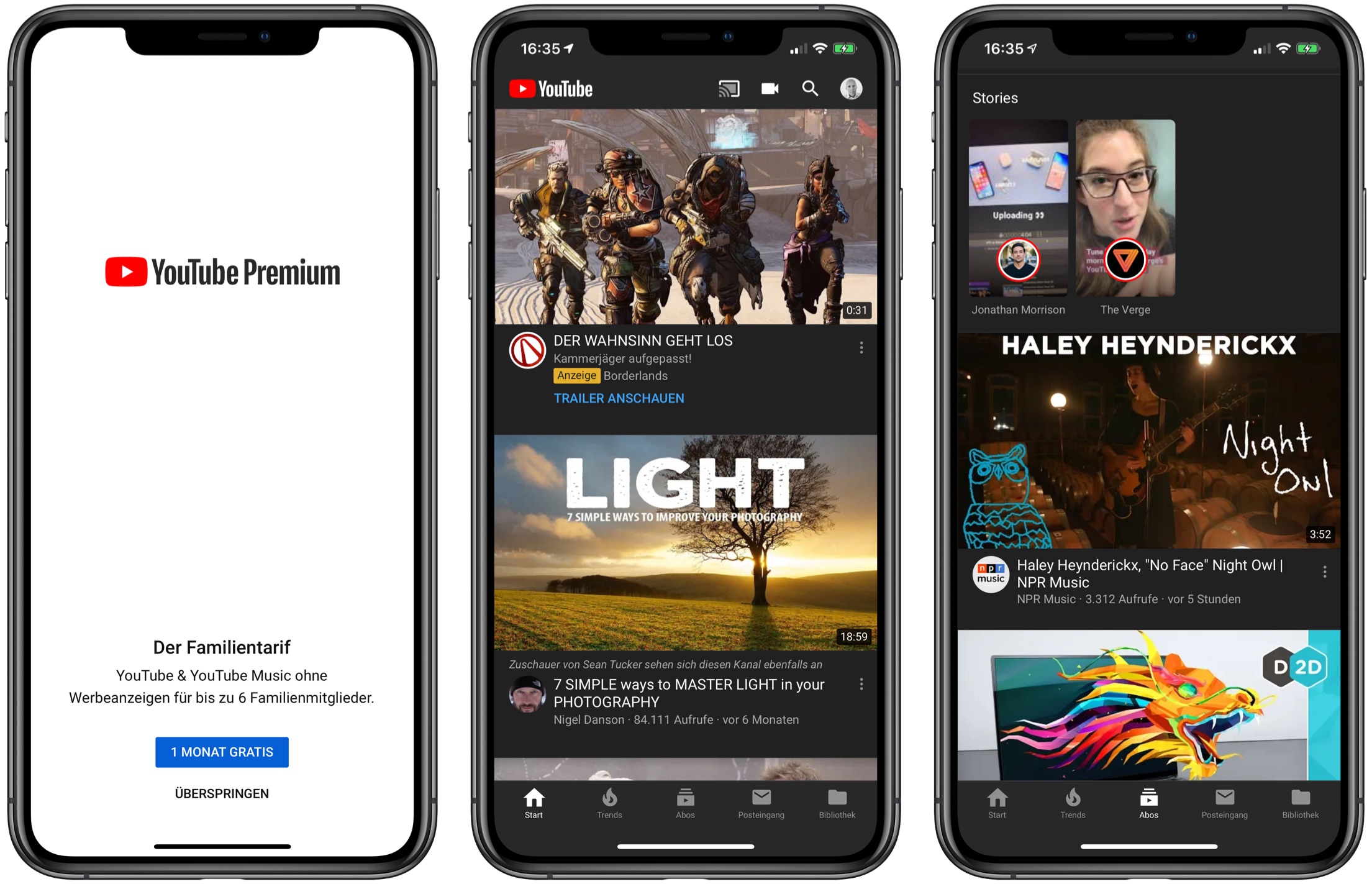
Wenn man Android nutzt, dann hat man sowieso schon den ganzen Google-Kram an Bord und merkt viel weniger, wie invasiv das Google-Auftreten mittlerweile ist. Aber wenn man nicht in Chrome lebt, dann fällt einem auf, das man ständig genervt wird, doch nun endlich den Google Browser zu installieren. Zur Erinnerung: In Chrome muss man sich anmelden, damit Google auch immer schön weiß, wo man ist. Bei iOS ist das besonders schön zu besichtigen. Jede Google App versucht, einem alle anderen anzudrehen. Nur ein Benutzer, der rundum Google-versorgt ist, ist auch ein guter Google-Nutzer. Oh, Du hast einen Link geklickt? Willst Du den wirklich in Safari öffnen oder nicht doch lieber Chrome installieren?

Und in den Apps geht es gerade so weiter. YouTube versucht immer wieder, doch mal das Premiumpaket anzudrehen. Kostenlos und unverbindlich. Lehnt man ab, kommt der Nervkeks garantiert wieder. Und dann, auf der nächsten Seite erst mal Werbung, dann irgendwas, um das "Engagement" hochzutreiben, dann "Stories", erfunden bei Snapchat und mittlerweile Facebook-Territorium. Ein Video willst Du anschauen? Oh, hier nimm diese Werbung.

Aber Google liefert doch so tolle Suchergebnisse. Ja, nach der Werbung. Das merkt man, wenn man mit Pi-hole die Goggle-Adservices geblockt hat, und das, was Goggle da immer so lecker als erstes platziert, gar nicht anklicken kann.

Konsequenz bei mir: Weniger Google. Wenn man nicht auf Android angewiesen ist, dann geht das ganz einfach.

05 Apr 05:02

Backward-Compatibility FIDO U2F support shipping soon in Firefox

by J.C. Jones

Web Authentication (WebAuthn), a recent web standard blending public-key cryptography into website logins, is our best technical response to credential phishing. That’s why we’ve championed it as a technology. The FIDO U2F API is the spiritual ancestor of WebAuthn; to-date, it’s still much more commonly used. Firefox has had experimental support for the Javascript FIDO U2F API since version 57, as it was used to validate our Web Authentication implementation that then shipped in Firefox 60. Both technologies can help secure the logins of millions of users already in possession of FIDO U2F USB tokens.

We encourage the adoption of Web Authentication rather than the FIDO U2F API. However, some large web properties are encountering difficulty migrating: WebAuthn works with security credentials produced by the FIDO U2F API. However, WebAuthn-produced credentials cannot be used with the FIDO U2F API. For the entities affected, this could lead to poor user experiences and inhibit overall adoption of this critical technology.

To smooth out this migration, after discussion on the mozilla.dev.platform mailing list, we have decided to enable our support for the FIDO U2F API by default for all Firefox users. It’s enabled now in Firefox Nightly 68, and we plan for it to be uplifted into Firefox Beta 67 in the coming week.

Enabling FIDO U2F API in Firefox

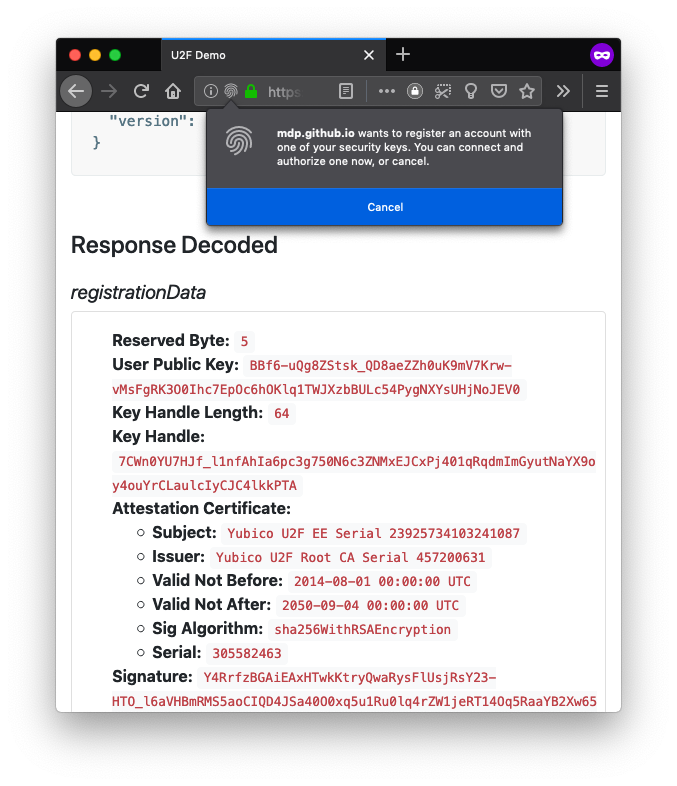
A FIDO U2F API demo website being activated

Firefox’s implementation of the FIDO U2F API accommodates only the common cases of the specification; for details, see the mailing list discussion. For those who are interested in using FIDO U2F API before they update to version 68, Firefox power users have successfully utilized the FIDO U2F API by enabling the “security.webauth.u2fpreference in about:config since Quantum shipped in 2017.

Currently, the places where Firefox’s implementation is incomplete are expected to remain so.  With the increase of using biometric mechanisms such as face recognition or fingerprints in devices, we are focusing our support on WebAuthn. It provides a sophisticated level of authentication and cryptography that will protect Firefox users.

The future of anti-phishing is Web Authentication

It’s important that the Web move to Web Authentication rather than building new capabilities with the deprecated, legacy FIDO U2F API. Now a published Recommendation at the W3C, Web Authentication has support for many more use cases than the legacy technology, and a much more robustly-examined browser security story.

Ultimately, it’s most important that Firefox users be able to protect their accounts with the strongest protections possible. We believe the strongest  to be Web Authentication, as it has improved usability via platform authenticators, capabilities for “passwordless” logins, and more advanced security keys and tokens.

The post Backward-Compatibility FIDO U2F support shipping soon in Firefox appeared first on Mozilla Security Blog.

05 Apr 05:01

Where public radio rocks

by Doc Searls

Where does public radio rock—or even rule? And why?

To start answering those questions, I looked through Nielsen‘s radio station ratings, which are on the Radio Online site. I dug down through all the surveyed markets, from #1 (New York NY) through #269 (Las Cruces-Deming NM), and pulled out the top 31 markets for public radio (where the share was over 6.0 — all numbers are % of all listening within a geographic market):

  1. Santa Barbara CA (where KCLU is #1), 23.4
  2. Burlington VT (where WVPS is #1), 17.2
  3. Montpelier-Barre-Waterbury VT (where WVPS is #1), 17.0
  4. Asheville NC (where WCQS/WYQS is #2 with 11.8 and WNCW is #3 with 4.0)
  5. Ann Arbor, MI (where WUOM is #1 and WEMU is tied at #2), 15.1
  6. Cape Cod MA (where WCAI is #2), 14.6
  7. Portland OR (where KOPB is tied at #2), 12.6
  8. Denver-Boulder CO (where KCFR is #1), 12.3
  9. Austin TX (where KUT is #1), 11.3
  10. Eugene-Springfield (where KLCC is #2), 11.3
  11. Washington, DC (where WAMU is #2 and sometimes #1), 11.3
  12. San Francisco CA (where KQED has been #1 through the all the posted surveys), 11.0
  13. Seattle-Takoma WA (where KUOW has been #1 through the all the posted surveys), 10.9
  14. Raleigh-Durham NC (where WUNC is #4), 10.6
  15. Portland ME (where WMEA is #1), 10.5
  16. San Jose CA (where KQED is #3), 9.9
  17. Concord (Lakes Regions) NH (where WEVO is #1) 9.3
  18. Boston MA (where WBUR is #7), 8.9
  19. San Luis Obispo CA (where KCBX is #2), 8.9
  20. Columbia MO (where KBIA is #4), 8.6
  21. Tallahassee FL (where WFSU is #3), 8.6
  22. Washington DC (where WAMU is #2 and sometimes #1), 8.6
  23. Sarasota-Bradenton FL (where WUSF is #2 and WSMR is #3) 8.2
  24. Monterey CA (where KAZU was #2), 7.7
  25. Gainesville-Ocala FL (where WUFT is #4), 7.3
  26. New Haven CT (where WSHU is #6), 7.3
  27. Lafayette IN (where WBAA-AM is #1 and WBAA-FM is #3), 7.0
  28. Traverse City-Petoskey-Cadillac MI  (where WICA is #7), 6.7
  29. Hartford-New Britain CT (where WNPR is #9), 6.5
  30. Oxnard-Ventura CA (where KCLU is #4), 6.3
  31. Grand Junction CO (where KPRN is #5), 6.1

(Note: Totals above are of noncommercial stations with typical public radio formats: NPR-type news and programming, plus classical, jazz and alternative music. I didn’t include noncommercial religious stations†).

Of course I’m pleased to find my town, Santa Barbara, on top. Here’s how Nielsen breaks out station ratings within that 23.4 share number.

  1. KCLU-FM 7.8. This is KCLU’s 110-watt translator on 102.3, not the home station on 88.3 in Thousand Oaks, which barely gets into town. (Note that this signal is directional, meaning weaker in all directions other than straight into town. This number is remarkable for a translator. For more on that, see the map below.)
  2. KCLU-AM 2.6. This signal has the same audio as KCLU-FM, so the two together are 9.4, which makes KCLU #1, edging KTYD, the landmark local rock station, which gets a 9.2.
  3. KUSC 5.2. Though reported as KUSC, this is actually KDB/93.7, which carries the audio of KUSC from Los Angeles.
  4. KCRW 3.9. This is surely KDRW, which mostly identifies as KCRW, since most of the time KDRW carries the audio of KCRW, from Santa Monica/Los Angeles.
  5. KDRW 1.3. This is a case of one station reported two different ways. Together they total 5.2.
  6. KCBX 1.3. This is KSBX, a 50-watt repeater of KCBX from San Luis Obispo, which has no signal at all in town (being blocked by the 4000-foot Santa Ynez Mountain range).
  7. KPCC 1.3. This is the 10-watt translator of KPCC from Pasadena/Los Angeles. KPCC’s home signal doesn’t reach here.

So: why Santa Barbara? Here’s what I think:

  1. Demographics. Santa Barbara is an upscale university town with a bonus population of active older folks who are intellectually and culturally engaged. NPR, for example, tends to do well with that combination of crowds.
  2. Lots of signals. There is now a surfeit of public radio signals in Santa Barbara.The list above is unusually large for a town this size, and doesn’t include stations that serve the market but didn’t make the ratings, such as KPFK (Los Angeles most powerful FM station, which also has a local 10-watt translator) and UCSB’s college radio station, KZSB).
  3. Geographic isolation. Santa Barbara is far enough from big market signals to make them weak or absent. (Some do get in, and even show a bit in the ratings.) I think the same kind of thing can also be said for many of the other smaller markets where public radio does well.
  4. News coverage. There are three two steady sources of local news in Santa Barbara: local/regional TV (notably KEYT/3), local print (both online and off), and public radio—especially KCLU, which has won three Murrow Awards and six AP awards in the last two years. Of its news director, Lance Orozco, KCLU says, “Lance has won more than 200 journalism awards for KCLU, including more than 90 Golden Mikes, 20-plus regional Edward R. Murrow awards, a national Edward R. Murrow Award (an honor which came to David Letterman’s attention on “The Late Show.”), and a national Society Of Professional Journalists Award He has been AP’s small market reporter of the year in the western U.S. nine times.”
  5. Disasters. Santa Barbara has a long and almost steady record of wildfires, the largest of which was the Thomas Fire in December 2017, followed by massive debris flows during a storm in January 2018. Public Radio and other local media became indispensable during that time. I suspect it has stayed that way in a time when national news has become more partisan and less anchored to facts “on the ground,” as they say.

Montecito debris flow Montecito debris flow, January 2018. From KEYT/3.

I also think some other factors are in play here—factors with meaning that go far beyond Santa Barbara:

  1. Local and regional news lives on in public radio while it has been dying off on the commercial side. Old-fashioned “full service” local radio has been in retreat across the country. Stations categorized as “news” or “news/talk” in the ratings (and within the industry) are now mostly conduits for political talk. True full-time pure news stations thrive only in the largest markets, where the news operations can afford the reporters. Specifically those are New York (WCBS and WINS), Philadelphia (KYW), Washington (WTOP), Chicago (WBBM), Los Angeles (KNX) and San Francisco (KCBS). That’s it. (In fact one of L.A.’s two news stations, KFWB, dropped the format in 2014.)
  2. Public radio may be the only part of shared culture, other than sports, where the media center still holds. This too owes to being anchored in local culture, and reporting on local news, which by necessity tends to be less partisan than national news has become.
  3. Listener abandonment of over-the-air radio, especially for music. Music and talk listening has been shifting for years from over-the-air to streaming services, satellite radio and podcasts, leaving public radio with a higher percentage of listening to over-the-air broadcasts.
  4. Embrasure of streaming, satellite radio, podcasting, smart speakers and other new technologies. Public broadcasting has long been ahead of the technical curve, and in the last decade has done an excellent job of maximizing what can still be done with legacy over-the-air broadcasting (for example, buying up signals with low market value—as KCLU did with its AM in Santa Barbara—and planting translators and repeater stations all over the place), while also pioneering on the digital front. Noncommercial and religious broadcasters have both been highly resourceful and ahead of the curve on The Great Digital Shift.
  5. Turning localism into a big competitive advantage. Something that has long been a weakness of public radio, especially NPR—its fealty to stations, refusing to subordinate the network to those—is turning into an advantage, as local programming matters more and more. Even in the midst of The Great Digital Shift, we remain physical beings who live in the natural world, vote in local elections, drive in local traffic, care about local teams, deal with local emergencies, and depend on each other’s helping hands when and where it matters most. Public radio is especially compatible with all that. (Note: this was the subject of my TEDx talk in Santa Barbara last September.)
  6. Re-defining regionalities. What makes a region a region, or a market a market? I think public radio is playing a role in defining both, especially as commercially-supported news becomes more partisan and less well funded by advertising. Again, my case in point is KCLU, which started as a little Thousand Oaks/Ventura station, then became a South Coast station by adding two Santa Barbara signals. Now, by adding another full-size signal in Santa Maria (KCLM/89.7), plus a translator in San Luis Obispo, KCLU is almost as much a Central Coast station, at least in terms of geographic coverage. Still, I’m not sure that’s what they have in mind. They identify now as “NPR for the California Coast,” yet their vision is still “to inform, educate and promote dialogue among the citizens of Ventura and Santa Barbara counties on local, regional, national and global issues.” No mention of San Luis Obispo County; so I’m not sure how well that’s working yet.  KCBX, from San Luis Obispo, also didn’t become any less a Central Coast station when it added its South Coast signal in Santa Barbara. KCLU does talk up the Central Coast as much as it can, so maybe a shift is in the works. It’s worth nothing that Santa Barbara–Santa Maria-San Luis Obispo is a Nielsen Designated Market Area (or DMA). Ventura and Thousand Oaks are part of the Los Angeles DMA. These are determined by what local TV stations are most watched. So, while it’s an open question what defines local and regional identity, it’s clear to me that public radio is playing a serious role in that process.

I may add to those points as I take in reader feedback and think more on all of it. Meanwhile, I want to look a bit more closely to what has happened to public radio in Santa Barbara over the eighteen years since I arrived there. This is geeky stuff, so if you’re into that, keep reading…

When I moved to Santa Barbara in 2001, public radio was long on classical music and short on news and talk. The two classical stations were USC’s KQSC/88.7 with 12,000 watts and KDB/93.7 with 12,500 watts (that’s a lot), both on Gibraltar peak, overlooking town. KQSC was a repeater for KUSC in Los Angeles. On the talk (NPR, etc.) side, KCLU/88.3 had a 4-watt translator operating on 102.3 from Gibraltar Peak, overlooking town. It actually sounded pretty good if you were within sight of the transmitter, and may already have been a strong ratings contender. (I recall a Nielsen survey a few years ago that put it at #1 then.)

To put this little translator’s size in perspective, the biggest station in town is KRUZ/103.3 KVYB/103.3, grandfathered with 105,000 watts, radiating from Broadcast Peak, which is over 4000 feet high. Here’s a pair of maps that shows the difference:

KVYB vs. KCLU

KCLU’s home signal from Thousand Oaks was weak and distant. So was KCRU/88.1, the Oxnard repeater for Santa Monica-based KCRW/89.9. KCRW also had a 10-watt translator on 106.9 serving Goleta (the next town west of Santa Barbara). Pacifica’s L.A. based KPFK/90.7 had a 10-watt translator on 98.7. UCSB had KCSB/91.9, its own non-NPR college station, radiating with 620 watts from Broadcast Peak, also on the Goleta side of town. There was also a local non-political full-service commercial news/talk station at the time: KEYT/1250am (now KZER), featuring a good morning show hosted by John Palminteri.

Since then, all this happened:

  1. In 2002, KSBX/89.5 came on the air from Gibraltar Peak. It’s a 50-watt repeater for KCBX/90.1, the public radio voice of San Luis Obispo. On the same channel, KPBS from San Diego also pounds into town on warm days.
  2. In 2003, KEYT was sold, John Palminteri spread his reporting talents across lots of other stations (including KCLU) and local news/talk was gone until…
  3. In 2005, the Santa Barbara News-Press, owned by Wendy P. McCaw, got its own local AM station, now called KZSB/1290, which has been a local old-fashioned commercial ‘full service” news station ever since. The main personality there is “Baron” Ron Herron, who has been a local radio personality for many decades.
  4. In 2008, KCLU bought a local station on the AM band. That’s now KCLU-AM/1340. Though only 650 watts, it does cover the populated South Coast pretty well.
  5. In 2014, a bunch of things happened at once:
    1. Public radio, which had never been a native thing in Santa Barbara, suddenly got saturated (as Matt Welsh put it in The Independent). Specifically…
    2. KPCC/89.3 in Pasadena/Los Angeles came on with a 10-watt Gibraltar Peak translator on 89.9. It covers the town well.
    3. Santa Monica Community College, which owns KCRW, bought KQSC from USC, and made it KDRW, which has a local studio and does some local coverage, though most of the time it’s a repeater for KCRW. A big one, too.
    4. The University of Southern California bought KDB and moved KUSC’s classical program over there from what had been KQSC (and is now KDRW).
    5. KCLU replaced its non-directional 4-watt signal on 102.3 with a new directional one that maxes at 115 watts toward downtown, but radiates as little as 5 watts in other directions. This is the signal that produces the small signal footprint in the maps above. And kills in the ratings.
    6. Along the way, local journalism flourished online as well. The Independent, a weekly, has remained a strong local institution. Edhat (founded and led by the late and still much-missed Peter Sklar) was born and became an exemplary “placeblog.” Bill MacFadyen’s Noozhawk also became a local news institution. And the News-Press didn’t die.

    If I had more time, I’d put all that stuff in a graphic.

    †Explanations, qualifications and cautions

    Shares, Nielsen explains, are “quarter hour rating (AQH) share of persons, ages 12+, Monday through Sunday in the Metro Survey Area. A share is the percentage of those listening to radio in the MSA who are listening to a particular radio station. Average Quarter-Hour Persons (AQH Persons) is the average number of persons listening to a particular station for at least five minutes during a 15-minute period. [AQH Persons to a Station / AQH Persons to All Stations] x 100 = Share (%)”

    The latest rating period differs by market. In big markets, surveys are monthly. The most recent for those are February 2019. Some are quarterly, or twice annually (Spring and Fall). The most recent of those are Fall 2018 in some cases (e.g. Hudson Valley, measured quarterly, and Santa Barbara, measured Spring and Fall), and Winter 2019 in other cases (e.g. Louisville, measured quarterly).

    Noncommercial stations are not listed for all markets, and not every time in all of those where they are surveyed. For example, the listings for Santa Barbara noncommercial stations say “N/A” for the three survey periods prior to the latest one (Fall 2018), while the current listings for Monterey-Salinas (Winter 2019) list noncommercial stations as “N/A” while showing them in Fall 2018. So for Monterey-Salinas, I used the Fall 2018 listing. (The 7.7 there was just one station: KAZU, which was also #2 overall.)

    In all markets there is lots of listening to radio stations not listed in the surveys. For example, all the listed shares for New York stations totaled 88.4, while Tampa-St. Petersburg stations totaled only 24.1. That means 11.8 of New York and 75.9% of Tampa-St. Pete listening is to stations not listed in the ratings. I am sure in many markets noncommercial listening is part of that dark matter, but there’s no way to tell.

    In some cases, the only stations appearing in a survey are those of one or two owners. The Grand Junction survey lists only seven stations, five owned by Townsquare Media and two by Public Broadcasting of Colorado. The total of those is only 28.7. The Monroe Louisiana survey lists only six stations, all owned by Holladay Broadcasting. Those total 50.6, which means half of the listening in that market is to unlisted stations, and (presumably), ones not owned by Holladay Broadcasting.

    Some stations’ online streams do make survey listings in some markets. I don’t know whether Nielsen counts listeners physically located outside a market, or how Nielsen deals with smart speakers. I do know that Nielsen cares about streaming, though, because their home page says so.

    Okay, I’ve already said too much, and I have much more I could say. But this post has been sitting half-written in my browser since I started digging online one sleepless night in early March, so I’ll call it done enough and put it up.

05 Apr 05:00

Beats kündigt Powerbeats Pro Wireless Ohrhörer mit Apple H1-Chip an

by Carsten Thomas
Beats kündigt mit den Powerbeats Pro Wireless Kopfhörer an, die für einen mobilen Lebensstil ausgelegt sind.Die Powerbeats Pro haben ein vollständig drahtloses Design und sind für einen mobilen Lebensstil konzipiert. Sie haben ein Ohrhaken-Design, das über dem Außenohr liegt und Silikon-Ohrstöpsel für einen festen Sitz. Das Design ist wasser- und [...]
05 Apr 05:00

Messenger: Microsoft Kaizala jetzt weltweit in Office 365 enthalten

mkalus shared this story from heise online News.

Kaizala heißt in der indischen Sprache Harathi einfach "was war los". Die Ähnlichkeit mit WhatsApp ist also nicht zufällig. Aktuell kann man die App für Android und iOS einfach herunterladen und loslegen. Für PC und Mac gibt es eine Web-Applikation als Preview.

<img alt="Volker Weber" src="https://heise.cloudimg.io/width/999/q50.png-lossy-50.webp-lossy-50.foil1/_www-heise-de_/imgs/18/2/6/3/8/4/9/5/D7115CE4-6088-40C2-8BFF-740A5EE4B3EF-b92d3d90d8a01873.jpeg" srcset="https://heise.cloudimg.io/width/1998/q30.png-lossy-30.webp-lossy-30.foil1/_www-heise-de_/imgs/18/2/6/3/8/4/9/5/D7115CE4-6088-40C2-8BFF-740A5EE4B3EF-b92d3d90d8a01873.jpeg 2x" style="width:100%;">

Kaizala geht über einfache Chatnachrichten hinaus

(Bild: Volker Weber )

Ab heute ist Kaizala Pro weltweit Bestandteil von Office 365, im wesentlichen in den gleichen Lizenztypen, die auch Teams enthalten. Eine Integration in Teams stellt Microsoft für 2020 in Aussicht. Kaizala ist eines der erfolgreichsten Garage-Projekte von Microsoft.

In Schwellenländern war Kaizala Pro bereits seit einiger Zeit als Lizenzprodukt erhältlich. Der Service wird regional in Azure-Rechenzentren gehostet und integriert sich in Azure Active Directory. Das Kaizala API erlaubt die Integration in Workflows mit SharePoint, Flow, Excel oder Power BI. Neben einfachen Chat-Nachrichten kann man in Kaizala-Gruppen auch strukturierte Nachrichten verschicken, etwa Arbeitsaufträge, Befragungen oder Abstimmungen. Kaizala Pro, nicht das freie Produkt Kaizala, soll dabei Anforderungen von GDPR, ISO 27001, SOC1 und HIPAA erfüllen.

Kaizala hat sich dort bewährt, wo Mitarbeiter vorwiegend mobil, aber ohne Laptop tätig sind. Microsoft nennt einige Referenzkunden, darunter Philippine Airlines. Da sich jedermann für Kaizala allein mit seinem Mobiltelefon registrieren kann, ist eine Kommunikation auch über Unternehmensgrenzen möglich. (vowe)

05 Apr 05:00

RT @georgeeaton: The EU’s consistent solidarity with Ireland has taught the UK a harsh lesson: the EU can enhance national sovereignty as w…

by georgeeaton
mkalus shared this story from iandunt on Twitter.

The EU’s consistent solidarity with Ireland has taught the UK a harsh lesson: the EU can enhance national sovereignty as well as diminish it. twitter.com/skynews/status…

Angela Merkel spoke with people who described the impact of the Irish border on their lives.

"I know too what it means once borders vanish."

More news here: po.st/LpoJs3 pic.twitter.com/Dw8VXZ4UVZ


Posted by SkyNews on Thursday, April 4th, 2019 4:58pm


694 likes, 263 retweets

Posted by georgeeaton on Thursday, April 4th, 2019 6:10pm
Retweeted by IanDunt on Thursday, April 4th, 2019 7:15pm


2331 likes, 683 retweets
04 Apr 22:32

Springer Nature publishes its first machine-generated book

Springer Nature, Apr 04, 2019
Icon

It seems reasonable that an AI could author this sort of book. The prototype "provides a compelling machine-generated overview about the latest research on lithium-ion batteries, automatically compiled by an algorithm." Scientific papers have a fairly rigid structure, and so it should be reasonable straightforward to create a literature summary. More tricky would be identifying relevance of individual results and placing them into a wider context. No word on whether the unattributed marketing article was also AI-produced.

Web: [Direct Link] [This Post]
04 Apr 18:07

Vancouver's busiest bike routes have the trickiest gap to navigate, say cycling advocates

mkalus shared this story :
The Province really should amend the MVA and generally prohibit right turns on red. There really is no good reason for it outside of trying to cater to car drivers. At intersections with heavy traffic give an advanced or delayed right turning light to allow cars to turn without pedestrians or cyclists in the firing line. The current system though is totally broken and I regularly see cars ignoring it. Same with “no right turn” gets regularly ignored (as mentioned). Barriers also get regularly ignored / run over (see Pacific & Cambie). I sure hope ICBC isn’t paying for the body damage.

Spring marks the start of commuting season for the city's fair-weather cyclists and advocates are warning newer commuters about some of the trickiest sections along Vancouver's busiest bike routes.

Statistics from the Insurance Corporation of B.C. (ICBC) list the number of crashes involving cyclists, by intersection, throughout the province.

First on the list is the  on-ramp at the north end of the Burrard Bridge leading from Pacific Street.

The data was gathered from 2013-2017 and the City of Vancouver has since rebuilt the intersection with the aim of reducing accidents.

"Burrard [and] Pacific was the highest-collision location in the city.... Very significant changes to that intersection have really made a big difference in terms of reduced collisions," said Lon LaClaire, director of transportation for the city.  

LaClaire says statistics showing that the improvements have increased safety aren't immediately available.

HUB Cycling vice-president Jeff Leigh says the advocacy group has been talking to the city about addressing the gap between bike lanes on Dunsmuir and Hornby streets in downtown Vancouver and the popular Burrard Street bike lane. (Gian-Paolo Mendoza/CBC)

The intersection with the second-highest number of crashes is at Dunsmuir and Hornby streets in downtown Vancouver. It's an area where two protected bike lanes meet and another where LaClaire said recent changes have been made.

"In that particular location, the right turn [by cars] is banned ... we were getting low compliance with that right turn ban and that right turn was creating a lot of the collision types," said LaClaire.

The city's solution was to extend a median protecting the bike lane into the intersection to discourage cars from making turns, but it's routinely clipped by cars doing just that.

"It's really just sending a strong signal to the motorist which is more than just ... the sign which prohibits the right turn," LaClaire said.

An extended median at Hornby and Dunsmuir streets in downtown Vancouver discourages drivers from making illegal right turns, but is occasionally hit by motorists. (Gian-Paolo Mendoza/CBC)

Navigating gaps

However Jeff Leigh, a cycling advocate with the non-profit HUB Cycling, said the area still has a major issue.

"The factor here is that the Dunsmuir bike lane ends at this intersection  — there's no protected bike lane heading west of Hornby [to Burrard Street],"   said Leigh. 

Instead, Leigh explained, there is a painted bike lane only on one side of Dunsmuir leading to the busy Burrard bike path. Cyclists trying to get from Burrard to the Dunsmuir bike lane attempt to get around the gap by either walking their bikes, riding on the sidewalk or riding illegally in the wrong direction up the painted bike lane to where the protected lane begins on the other side of Hornby Street.

"We've highlighted this to the city and one of the main things we need is a protected bike lane extended through to Burrard," he said. 

"It's a hot spot because there's so many turning movements happening."

City making improvements

LaClaire said the city takes several factors into account when looking at which bike lanes need safety upgrades, including data from ICBC and local hospitals.

"Most cities around the world ... don't have a partnership like we have with the hospitals," he said.

"That's important because the majority for collisions for cycling don't involve an ICBC claim. They might be dealing with uneven road surface or poor lighting or some other factor that is contributing to that collision."

04 Apr 18:07

BBEdit Returns to the Mac App Store After 4+ Year Absence

by Ryan Christoffel

Beginning today, BBEdit 12 is available for download through the Mac App Store. BBEdit was previously listed for purchase through the Mac App Store, but famously left the store in October 2014. Last year, however, Apple announced on-stage at WWDC that BBEdit would be returning to the new Mac App Store in the near future, and that day has finally arrived. From the developers' press release:

“We are delighted to be offering BBEdit in the Mac App Store again,” said Rich Siegel, founder and CEO of Bare Bones Software, Inc. “Since the release of macOS Mojave, the Mac App Store provides a beautiful new look; unique editorial content; and an emphasis on human curation, while offering a trusted and secure source for macOS software. In addition, the new Mac App Store makes it possible for us to offer our customers the option of a subscription-based pricing model.”

BBEdit 12, the latest version of the popular writing app for macOS, features more than three hundred new features and refinements since the app was last available on the Mac App Store. It also introduces a new pricing model: unlike direct purchases from Bare Bones Software, where an app license can (still) be purchased for a one-time $49.99 cost, on the Mac App Store BBEdit is available only as a subscription.

For those who wish to get BBEdit from the Mac App Store, the app is a free download, and you can use it in full up to 30 days at no cost, after which a subscription will be required to unlock its web authoring tools and a variety of other pro features; basic editing functionality will continue to work without a subscription, however.

Subscriptions are available at $3.99/month or $39.99/year. One advantage of the subscription option is that it will always provide access to the latest version of the app, whereas purchasing the app directly from Bare Bones will earn you the current version of the app only – if you want major new versions as they're released, you'll need to purchase upgrade licenses.

When Apple unveiled the new Mac App Store last year, it promised that not only would the app itself be modernized, but the store would be ripe with major app additions as well. Following Microsoft Office and Panic's Transmit, BBEdit's arrival today helps make good on that promise. This time last year some of the Mac's best, most popular software wasn't available in the Mac App Store; it's good to see that begin to change.


Support MacStories Directly

Club MacStories offers exclusive access to extra MacStories content, delivered every week; it's also a way to support us directly.

Club MacStories will help you discover the best apps for your devices and get the most out of your iPhone, iPad, and Mac. Plus, it's made in Italy.

Join Now
04 Apr 18:06

SFU City Conversations: When Facts Fail – Apr 18

by Gordon Price

Municipal Policy in the Disinformation Age

Biased, misleading, and incorrect information has long influenced public policy development to varying degrees, but in our current age of disinformation, we’re witnessing a rise in “alternative facts” and the public delegitimization of experts. The misinformed and the “wilfully ignorant” often dominate the conversation, drowning out both expert analysis and constructive community input, proving detrimental to the people these policies attempt to help.

Are we trending toward a future where facts are less essential to the formation of public policy than exaggerations, falsehoods, and outrage? How has policy formation and analysis been disrupted in the disinformation age, and what can we do about it? Should public policy formation change to reflect our new realities? What does this mean on a local level?


Thursday, April 18

12:30 – 1:30 PM

Room 320, SFU Morris J. Wosk Centre for Dialogue, 580 W. Hastings Street 

Free Event | Registration is Required

REGISTER NOW
04 Apr 18:06

Apple rumoured to still be working on an iPhone SE 2

by Patrick O'Rourke
iPhone SE

New rumours indicate Apple could be working on an upgrade to one of its most beloved smartphones, the iPhone SE.

This new, upgraded version of the phone, possibly called the iPhone SE 2, would adopt a similar tiny display size, coming in at just 5.42-inches, according to a new report from DigiTimes.

To be clear, this screen size would be larger than the 4-inch screen featured in the iPhone SE, but still smaller than the current 5.8-inch iPhone XS.

The report goes on to say that all three of Apple’s 2020 iPhones will feature OLED displays. Additionally, the rumour indicates that the other two larger devices include screens that come in at 6.06-inches and 6.67-inches, while Apple’s 2019 iPhone XS comes in at 5.8-inches and the iPhone XS Max features a 6.5-inch display.

Though those who are fond of smaller phones are likely pleased to hear that the iPhone SE could be getting a successor, it’s possible that even at 5.42-inches, the smartphone’s display could be too large for some users.

Details beyond the rumoured iPhone SE 2’s display size remain scarce as it stands right now. For example, it’s unclear if the smartphone will feature a display notch and Apple’s Face ID technology.

The original iPhone SE was basically an iPhone 5/iPhone 5S with an upgraded A9 processor, the same chip featured in the iPhone 6S and iPhone 6S plus. At the time, the SE benchmarked exceptionally well given its small display size and the lack of a retina resolution.

We’ll likely learn more about Apple’s plans for the iPhone SE at the tech giant’s annual September hardware event.

Source: DigiTimes

The post Apple rumoured to still be working on an iPhone SE 2 appeared first on MobileSyrup.

04 Apr 18:06

Tesla’s total deliveries are down and it’s paying a price for it

by Brad Bennett

Tesla’s first quarter 2019 investors report states that the company delivered 31 percent fewer vehicles compared to Q4 2018. 

While it’s delivery numbers are down compared to the previous quarter’s 90,966 deliveries, it still managed to deliver 110 percent more than Q1 2018.

Throughout Q1 2019 the company produced 77,100 vehicles, 62,950 we’re the Model 3. The Model S and X made up the remaining 14,150. Deliveries, on the other hand, were slightly below that with a total of roughly 63,000 vehicles. Of these, 50,900 were Model 3s, and 12,100 were the higher-end Model S and X.

Tesla blames this low growth in deliveries because at times it was delivering five times more vehicles to Europe and China, which resulted in some unexpected problems.

The company said that a large portion of its Q1 2019 delivers will have to be shifted to Q2. Even though it hit lower than expected targets, the company says it has “sufficient cash on hand.”

As a result of this lower than expected quarter, Tesla shares dropped 11 percent when the markets opened, according to Bloomberg. As a result, Elon Musk’s net worth also dropped by about 1.1 billion USD, as per Bloomberg’s report.

Source: Tesla, Bloomberg

The post Tesla’s total deliveries are down and it’s paying a price for it appeared first on MobileSyrup.

04 Apr 18:05

Amazon plans to launch thousands of satellites to provide internet to tens of millions of people

by Bradly Shankar

Amazon has announced plans to launch 3,236 low Earth orbit satellites to provide internet to millions of people around the world.

The existence of the initiative — which is dubbed Project Kuiper — was first discovered in regulatory filings by GeekWire, which Amazon later confirmed.

“Project Kuiper is a new initiative to launch a constellation of low Earth orbit satellites that will provide low-latency, high-speed broadband connectivity to unserved and underserved communities around the world,” an Amazon spokesperson told GeekWire.

“This is a long-term project that envisions serving tens of millions of people who lack basic access to broadband internet. We look forward to partnering on this initiative with companies that share this common vision.”

Amazon didn’t reveal any other details about Project Kuiper, so it remains to be seen when the satellite network will be up and running, how much the whole endeavour will cost or which companies Amazon will partner with.

Project Kuiper is the latest in a growing line of space ambitions from Amazon CEO Jeff Bezos. In November, Amazon unveiled plans to grow its massive cloud business through a network of satellite facilities on Earth.

At the same time, Bezos’ space venture Blue Origin is preparing to launch satellites from Canadian operator Telesat and is even looking to send tourists to space.

Source: GeekWire Via: CNBC

The post Amazon plans to launch thousands of satellites to provide internet to tens of millions of people appeared first on MobileSyrup.

04 Apr 14:30

Lösungen für das MacBook-Keyboard

by Volker Weber

7cd0d83d0ac34805d8fc6fa39104b649

Ich kann mir nicht vorstellen, dass Apple einen Schritt zurück von Butterfly zu Scissor macht. Mit der dritten Generation haben sie ja schon durch eine Membran unter den Tasten versucht, den Staub aus dem Keyboard zu halten. Die Membran hat allerdings Löcher und was da einmal drin ist, will auch nicht mehr raus.

Dabei hat Apple bereits eine Tastatur mit einer Abdeckung über den Tasten, nämlich das Smart Keyboard Folio des iPad Pro. Und das ist im Augenblick meine Lieblingstastatur.

fed22f137b846748a08bb92f61da29ba

Und dann gibt es eine weitere zukunftsweisende Möglichkeit, die Tastatur einfach als Display zu bauen. Lenovo ist da mit dem Yoga Book C930 schon einiges weiter gekommen. Apple hat was im Baukasten, was sich da vielleicht einbauen lässt: Force Touch.

Ich bin sicher, dass Apple schon an einer Ablösung baut. Schließlich arbeiten die eigenen Mitarbeiter überwiegend mit MacBooks und Apple sollte die Probleme besser kennen als sie bisher zugeben.

04 Apr 14:29

The social value of anonymity on campus: a study of the decline of Yik Yak

Sian Bayne, et.al., Learning Media and Methodology, Apr 04, 2019
Icon

This is a study of YikYak in education. "Yik Yak was a social media application which was designed according to the three principles of anonymity, hyper-locality and community moderation, and focused specifically on user appeal on university campuses." The potential for problems was clear. "There were several well-publicised incidents of hate and victimisation over the period of the life of Yik Yak." But did the value make up for that? "Yik Yak was not for the most part a toxic environment." And when in 2016 YikYak curtained anonymity its popularity plummited. The authors suggest that  unreachability holds significant social value for students" and that there is a need for "thinking in a more nuanced way about the social media ecologies of students and re-framing them in terms of what Haber has called ‘the complex desire for diverse temporalities of interaction – different speeds of communication at varying levels of intimacy and exposure’."

Web: [Direct Link] [This Post]
04 Apr 14:29

Teslas Autopilot-Update: Auto wechselt selbstständig die Spur

by Carsten Thomas
Neues Tesla Autopilot Update: Autos können selbstständig Spuren wechseln.Tesla hat ein Update für seine Autopilot-Software herausgebracht. Die Navigation auf dem Autopiloten ist ein relativ neues Feature der Version 9 der Tesla Autopilot Fahrerassistenz-Software, die im Oktober letzten Jahres eingeführt wurde. Die Funktionalität ermöglicht [...]
04 Apr 14:29

Facebook pulling its apps from Windows Phone starting April 30, including Messenger and Instagram

by Ian Hardy

The number of Windows Phone users is low and Facebook, similar to many others, announced it will discontinue several Windows Phone apps.

Facebook confirmed that its ‘family of apps’ for Windows Phone, which include the Facebook app, Messenger, and Instagram, will ‘no longer be available.’ The company noted the start date for pulling its app will begin on April 30th, 2019.

Those surviving Windows Phone users who want to use Facebook’s app can still do so but will have to use your mobile browser.

In 2016, Microsoft announced it was ending its Windows Phone initiatives, declaring it was no longer a ‘focus.’ Late last year, the company stopped issuing security and software updates and shifted to hone in on iOS and Android users by making its repertoire of apps available to all.

Source: Engadget

The post Facebook pulling its apps from Windows Phone starting April 30, including Messenger and Instagram appeared first on MobileSyrup.

04 Apr 14:25

Apple cuts HomePod price to $399 in Canada

by Patrick O'Rourke
HomePod

Apple has slashed the price of the HomePod in Canada by $50 CAD, bringing the price down from $450 to $399.

It seems like this price cut is a permanent price shift rather than a temporary one. This is the most significant discount the HomePod has been given since its Canadian launch back in June of 2018.

While the HomePod is a great sounding smart speaker, it remains one of the most expensive ones out there, especially when compared to the Google Home, Amazon Echo or even the Sonos One. Siri also isn’t as capable of a smart home assistant when compared to Google Assistant and the Amazon Echo.

The HomePod’s price cut seems to be worldwide across the various regions the smart speaker is available in, including the U.K. and the United States.

It’s also worth noting that even after a $50 discount the HomePod remains very pricey, particularly in Canada. Apple doesn’t have a low-cost device like the Home Mini or Echo Dot that could easily get Siri and Apple’s HomeKit into more homes.

For more of my thoughts regarding Apple’s HomePod, check out my review.

The post Apple cuts HomePod price to $399 in Canada appeared first on MobileSyrup.

04 Apr 14:25

"Elterntaxis sind eine Gefahr für Kinder"

mkalus shared this story from SPIEGEL ONLINE - Schlagzeilen.


Zur Person

  • Polizei Hamburg

    Ulf Schröder, 56, ist Leiter der Verkehrsdirektionen bei der Polizei Hamburg. In dieser Position leitet er auch die Einsätze der Hamburger Verkehrspolizisten. Schröder ist selbst Vater dreier Kinder - die den Schulweg ab der ersten Klasse allein zurücklegten.

SPIEGEL ONLINE: Herr Schröder, momentan kontrolliert die Hamburger Polizei Elterntaxis an insgesamt zehn Schulen der Stadt. Wollen Sie die Taxis verbieten?

Schröder: Nein, das dürfen und wollen wir auch gar nicht. In Hamburg ist es aber inzwischen so, dass ein Drittel der Kinder mit dem Auto zur Schule gebracht wird, eine eher beunruhigende Entwicklung. Wir wollen mit unserer Aktion die Eltern über die Gefahren aufklären, die das mit sich bringt, und die selbstständige und sichere Teilnahme der Kinder am Straßenverkehr fördern.

SPIEGEL ONLINE: Aber die Eltern argumentieren doch häufig mit der größeren Sicherheit für ihre Kinder. Was sollen das denn für Gefahren sein?

Schröder: Anfang der Woche war ich an einer Schule im Hamburger Stadtteil Lurup, da konnte man das sehr gut beobachten. Die Schule liegt an einer schmalen Straße, am Morgen parken die Eltern mit ihren Fahrzeugen dort die Fahrbahn voll. Das führte zu einem Verkehrschaos, bei welchem die Kinder zwischen den parkenden Autos hervor auf die Straße liefen. Die sogenannten Elterntaxis werden damit eine Gefahr für die Kinder.

SPIEGEL ONLINE: Die Eltern gefährden also ihre Kinder, statt sie zu schützen?

Schröder: Im Einzelfall schon. Die Gleichung "Mit dem Auto zur Schule gleich sicher zur Schule" geht auf keinen Fall auf, das zeigt auch die Verkehrsunfallstatistik. Immer mehr Kinder verunglücken, während sie zum Beispiel als Beifahrer im Auto sitzen. Gleichzeitig sinken die Unfallzahlen für diejenigen, die sich aktiv im Straßenverkehr bewegen - also etwa zu Fuß zur Schule gehen.

SPIEGEL ONLINE: Überzeugt dieses Argument auch die Eltern?

Schröder: Viele zeigen Verständnis, man muss aber davon ausgehen, dass Einsicht manchmal nur vorgetäuscht wird. Unser wichtigstes Argument ist es aber, dass Kinder nirgendwo besser als auf dem Schulweg lernen, sich selbstständig und sicher im Straßenverkehr zu bewegen. Das geht nur, wenn sie sich aktiv am Straßenverkehr beteiligen.

SPIEGEL ONLINE: Wie reagieren die Eltern, wenn Sie sie an der Schule ansprechen?

Schröder: Die meisten bleiben freundlich. Häufig hören wir die Erklärung: Ja, eigentlich geht mein Kind ja zu Fuß zur Schule. Aber gerade heute ist meine Frau krank geworden, da habe ich unseren Sohn auf dem Weg zur Arbeit mit dem Auto mitgenommen. In seltenen Fällen sind Eltern auch mal aufgebracht und fragen, ob wir ihnen das Autofahren verbieten wollen - was selbstverständlich nicht der Fall ist.

SPIEGEL ONLINE: Haben Sie auch die Möglichkeit, mit härteren Maßnahmen durchzugreifen?

Schröder: Sogenannte Elterntaxis sind schon seit Jahren ein Problem, und es wird eher schlimmer, das bestätigt auch die Schulbehörde. Die Bequemlichkeit vieler Menschen nimmt zu. Wenn wir feststellen, dass es trotz unserer Appelle weiterhin zum Verkehrsverstößen vor bestimmten Schulen kommt, die die Sicherheit der Kinder beeinträchtigen, können wir natürlich Ordnungswidrigkeiten verhängen. Das haben wir in der Vergangenheit auch schon getan.

SPIEGEL ONLINE: Was halten Sie von dem Vorschlag, Elternparkplätze in der Nähe der Schulen einzurichten?

Schröder: Das entspräche nicht unserem Ziel, dass die Kinder zu Fuß gehen und dadurch lernen, sich sicher im Straßenverkehr zu bewegen.

SPIEGEL ONLINE: Gibt es auch gute Gründe dafür, das Kind zur Schule zu fahren?

Schröder: Klar, wenn der Weg tatsächlich weit ist. Und jedem kann es passieren, dass man mal verschläft. Aber auch dann empfehlen wir, das Kind ein paar hundert Meter von der Schule entfernt aussteigen zu lassen.

SPIEGEL ONLINE: Ab wann sollte ein Kind allein zur Schule gehen?

Schröder: Theoretisch ist schon ein Erstklässler dazu in der Lage. Das hängt aber natürlich von vielen Faktoren ab. Hier in Hamburg haben wir das Privileg, dass jedes Kind in der Schule mit einem Polizeiverkehrslehrer lernt, sich richtig im Straßenverkehr zu verhalten. Wenn die Eltern dann auch noch gemeinsam mit dem Kind den besten und sichersten Schulweg aussuchen und ihn immer wieder üben, sind die Kinder schnell fit. Eine Begleitung bis zum Schultor brauchen die wenigsten länger als für ein paar Wochen.

04 Apr 06:53

Twitter Favorites: [SnarkySteff] Foods I can’t wait to eat in Canada: Ginger beef Nachos Tacos Thai green curry Penang curry Poutine Eggs Benedict… https://t.co/EH0gpRFdUm

Steffani Cameron, the Full Nomad @SnarkySteff
Foods I can’t wait to eat in Canada: Ginger beef Nachos Tacos Thai green curry Penang curry Poutine Eggs Benedict… twitter.com/i/web/status/1…
04 Apr 06:50

Two Types Of Community Trust

by Richard Millington

Online communities have different trust requirements compared with your local community.

These can be defined as cognitive and affective trust.

Cognitive Trust

Cognitive trust is the belief that other members are reliable, dependable, and skillful (or competent) at what they do. This specifically means:

  • Confidence in the skills of other members with relevance to the topic.
  • Confidence in the knowledge of other members about the subject.
  • Believing other members have specialised capabilities to add to the conversation
  • Believing other participants are well qualified on topics being discussed.
  • Other members are capable of performing tasks in regard to the topic
  • Other members seem successful in activities they undertake.

If you want to help members feel better connected, you need to help create the belief that members are informed, smart, and eager to improve themselves. This means creating opportunities for members to shine (questions, challenges, and special projects) while reporting on the success of those whom do.

This is also why it’s easier to feel closely connected with members at your level than people beneath it.

Affective Trust

Affective trust is caring and being concerned for the wellbeing of other members. This means:

  • Members are very concerned about the ability of the group to get along.
  • Members would not knowingly disrupt the conversation.
  • Members are concerned about what is important to others.
  • Members will do everything within their capacity to help each other.
  • Members try hard to be fair in dealing with one another.
  • Members behave in a consistent manner.

You achieve this via your moderation approach. If you and your team respond with high empathy standards, refuse to tolerate snarky and ungrateful members, and build a culture of mutual support, everyone in the community wins. But this comes at the cost of moderation (both resources and removing a lot of members who aren’t a good fit for this kind of community you’re trying to create).

It’s not easy to build a public community which attracts smart members who are eager to get along. However, if you’re selective about who you recruit, create opportunities for members to shine and reward those whom do, you can retain smart people. If you can sustain high moderation standards, you can have them get along too.

04 Apr 06:47

Here’s a Great Deal on Our All-Time Favorite Instant Pot

by Alex Roth
Here’s a Great Deal on Our All-Time Favorite Instant Pot
Photo: Michael Hession

The Instant Pot Duo 6-Quart is normally $90, but Amazon currently has it on sale for $70. The only time we’ve seen this medium-size Instant Pot go for a lower price has been during Black Friday, so now is a golden opportunity to grab this versatile pressure cooker.

This Instant Pot is the top pick in our guide to the best electric pressure cooker. In our guide, senior staff writer Lesley Stockton writes, “The Instant Pot Duo 6-Quart is our all-time favorite electric pressure cooker. It’s super simple to use and turns out delicious meals faster than conventional cooking methods—you can cook black beans from scratch in 20 minutes. You can also use this pot as a slow cooker and a rice cooker and it sautés foods better than the competition. We like that the Duo’s stainless steel pot is more durable than the nonstick inserts that come with other cookers.”

The Instant Pot Duo comes in 3-, 6-, and 8-quart sizes, but it’s this 6-quart model we call out as “the most useful size for home cooks” in our guide. And although the Duo is our main pick, we also recommend the Instant Pot Ultra 6-Quart as an upgrade pick for cooks who want precise temperature control among other features. For a full list of the differences, check out the chart below, or our breakdown of everything there is to know about the Instant Pot.

Model Price (6-quart) Pressure-cooking levels Temperature control (non–pressure cook) Available sizes Cooking programs Pressure-cook time Altitude adjust Keep-warm time
Lux series $80 High only Three temp options (less, normal, more) for sauté and slow cook 3-, 6-, 8-quart Up to 12 4 hours No Up to 10 hours (one temp)
Duo series (our pick) $100 Low and high Three temp options (less, normal, more) for sauté and slow cook 3-, 6-, 8-quart Up to 14 4 hours No ~100 hours (three temps on 3-quart model only)
Duo Plus series $130 Low and high Three temp options (less, normal, more) for sauté and slow cook 3-, 6-, 8-quart Up to 15 6 hours No ~100 hours (three temps)
Ultra series (upgrade pick) $150 Low and high Three temp options (less, normal, more) for sauté; custom control for slow cook, warm, and yogurt 3-, 6-, 8-quart Up to 16 6 hours Yes ~100 hours (three temps)

We’ve also put together a collection of links to Instant Pot recipes and other resources. If you prefer cookbooks, we recommend Cooking Under Pressure, and I personally recommend Indian Instant Pot Cookbook: Traditional Indian Dishes Made Easy and Fast and The Essential Instant Pot Cookbook: Fresh and Foolproof Recipes for Your Electric Pressure Cooker (the former is much cheaper in hardcover, for whatever reason).

04 Apr 06:46

I Got Soul and Vision

by peter@rukavina.net (Peter Rukavina)

Hertz’s “take any car you want” lottery served me well this time, presenting a shiny red Kia Soul front and centre as we entered the lot. It is a zippy car, pleasantly roomy, with friendly controls.

Photo of Kia Soul, from the balcony at Yankee Publishing

Tonight was a recapitulation of last night: I was back at Pearl for supper, this time with a different crew, all women, all Almanac-affiliated. A delightful bunch. I had oysters again (all Malpeques this time). And chili-grilled salmon again. Same play; different cast.

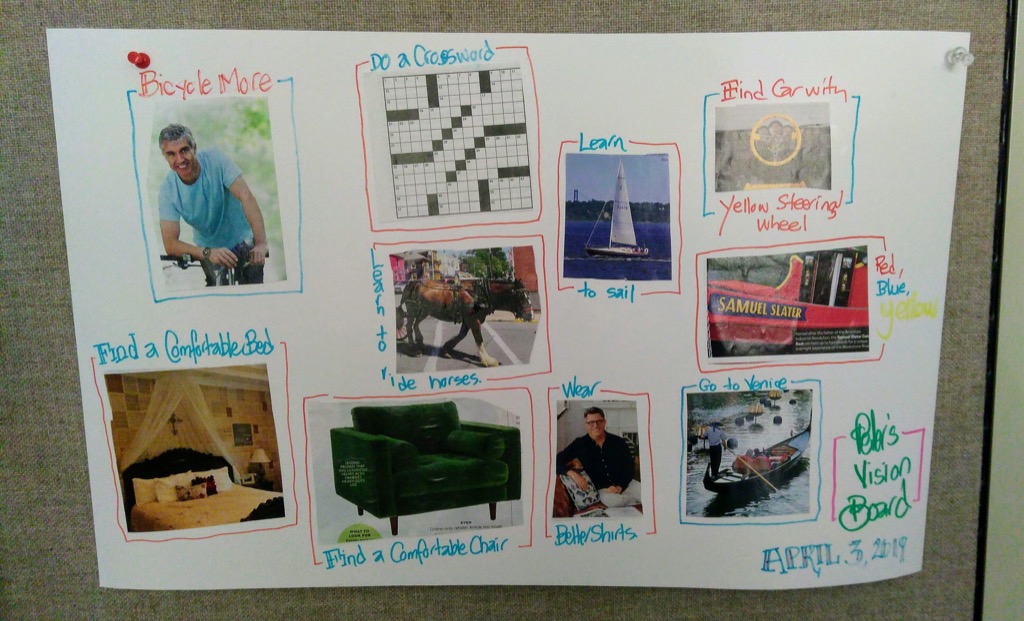
Earlier in the day I managed to almost miss the lunchtime vision board exercise at HQ, arriving only in the final minutes. So I didn’t have a lot of time to execute.

But I conjured some good vision; especially about the shirts and the yellow steering wheel.

And this despite my source material being limited to the AAA travel magazine and an issue of Country Woman.

My Vision Board

04 Apr 06:45

All-you-can-Eat Ice Cream Parlors and Heroin

by peter@rukavina.net (Peter Rukavina)

In my mid-twenties I was lucky enough to find myself immersed in a midwifery milieu, party to daily conversations about umbilical cords and breast latching and hospital transport. It was as good an introduction to the mechanics of birth as I can imagine one can get, and it served me well during Oliver’s adventurous one.

From my midwife friends, I learned about how we are born.

Now, thirty years later and with my compañera in palliative care, I’m learning a lot about how we die (or, fortunately and happily right now, how she doesn’t).

After an unexpected stay in hospital in the summer of 2016, Catherine enrolled in Prince Edward Island’s Palliative Home Care Program.

To that point in my life “palliative care” was, in my mind, a euphemism for “will be dead by Wednesday.”

“She’s gone to the palliative care,” someone would say, in hushed tones; and everyone in the room would take a short breath in, and nod in sad agreement.

I was happy to learn that this is not what palliative care is at all: three years later, Catherine is very much alive, and the palliative care program has been a tremendously positive help to her and to me and Oliver.

This passage, from Advice for Future Corpses (and Those Who Love Them), is a succinct explanation of what palliative care is and isn’t:

Palliative care is the specialty focused on comfort and quality of life in people with chronic and terminal illness, even while you seek a cure, even if you have come to terms with dying. (The cartoonist Roz Chast proposes “extreme palliative care,” which she thinks could include all-you-can-eat ice cream parlors and heroin.) I wear my bias on my sleeve. I believe in palliative care for anyone with a serious illness, and I know that palliative care can provide the support needed for a good death. Yet palliative care receives a laughably tiny fraction of the money spent on medical care.

One of the good physicians with whom I work keeps a cartoon on her office door. The doctor is talking to the patient, gowned and barefoot, sitting on the exam table: “You’ve got six months. But with aggressive treatment, we can help make that seem much longer.” No system is perfect, but a good palliative care program can make an enormous difference in a person’s life and death. The care given is interdisciplinary, which means that alongside the doctor and nurse may be social workers, chaplains, and physical, occupational, and speech therapists. Palliative care is concerned with everything that affects the quality of a person’s life, which might include treating the headache and going to the emergency room with a sprained ankle. This is all offered while you cope with cancer or heart disease or whatever brought you there. It may include help with bathing, visits to the eye doctor and the dentist, equipment like hearing aids and orthopedic shoes and walkers, recreational and respite programs, and visits to specialists.

Palliative care has a broad scope. Programs can be specific—for people in treatment for cancer—or general, for anyone with a chronic illness. A person in liver failure may benefit greatly from it while waiting for the transplant that will cure the liver failure. Cancer patients getting chemotherapy do better in treatment with palliative care because the team can help with symptoms. A program may offer acupuncture, help solve financial issues, sort out family dynamics, and design an exercise program—all while the person is trying to get better. My immense textbook calls this “active total care.” You can have palliative care while you’re trying to live, and you can have palliative care until the last hour of your life.

Our experience of Prince Edward Island’s program has been almost universally positive, and the integrated network of nurses and paramedics and the services they offer Catherine have kept her out of hospital more than once, have provided her with advice and insight that she wouldn’t otherwise have, and have reduced the cost of her medications. It’s a remarkable program that we feel blessed is available.

04 Apr 06:44

Art, Science, and the Role of Data in Education

David Wiley, iterating toward openness, Apr 04, 2019
Icon

The best line in this post is this: "each year in the US, we turn out thousands of students who have learned the rules Bach used to write four part chorales... but even though we train thousands of students, year after year, we haven’t seen another Bach." Of course, part of the reason for this is the same as the reason we can make most students above-average: the second person who is equal to Bach, even if equally talented, can't be Bach. And of course the United States has produced acres of brilliant musical talent over the years, as original and creative as Bach, but of course, not Bach. The pedantry aside, I agree with Wiley's overall point, that any discipline is a mixture of art and science. And so, "the choice between a research-informed, data-driven classroom and a classroom centered on relationships of care and support is a choice we don’t have to make."

Web: [Direct Link] [This Post]