
Berlin Germany

In a follow-up to his tweet from Wednesday, serial leaker Evan Blass has shared a new render of Google’s upcoming Pixel 3a smartphone.
This time around, we see the phone “in purple.” The shading is obviously subtle. Notably, however, this new variant features a yellow power button, which has led some to speculate it’s likely part of a marketing tie-in with Marvel’s new Avengers: Endgame movie. Thanos, the main antagonist of Endgame, has become iconic with his purple skin and gold Infinity Gauntlet. Google used Endgame-themed visual language to tease its May 7th announcement of the Pixel 3a and 3a XL.
In purple. pic.twitter.com/hgcC1V7zxK
— Evan Blass (@evleaks) April 26, 2019
Let us know what you think about the colour.
Source: Evan Blass (Twitter)
The post Pixel 3a leaks in Thanos-like purple colour appeared first on MobileSyrup.
“She had him like a toenail stuck in a shag carpet.” Is this a bad metaphor? what makes a metaphor work — or not work? This question occurred to me as I perused a set of “bad analogies” that were purportedly from high school students — but most of which were actually the results of … Continued
The post Why are bad metaphors bad? appeared first on without bullshit.
mkalus
shared this story
from  Ulysses Blog. Ulysses Blog.
|

Are you a purist who accepts words and nothing but words in your writing app? Then you can stop reading here.
But who is, really? If you’re a blogger, you’re probably a medium to heavy embedder of images. (Visualize a travel blog without photos. So sad.) When writing manuals, you may want to add illustrations; as an author of nonfiction books, you could use infographics to get your points across. If you’re a novelist, you probably won’t embed images into your manuscript, but you may want to attach photos or drawings to envision the setting and the characters of your story. Ulysses has a function for that, too.
In our new, fully-fledged image tutorial we’ve collected everything there is to know about the use of images in Ulysses. You’ll learn
Rolandtj

This blog post summarizes Mozilla's 2019 Internet Health Report (82 page PDF - note that the report contains many links, but they don't seem to be working in the PDF version, so you'll have to navigate the maze-like HTML presentation to follow them). The report is a "compilation of research and stories (that) explains what’s key to a healthier internet." It's written magazine-style and appears to be as polemic as it does research. It does eventually reach some conclusions, but even these are infused with advocacy. For example, "It seems that if we leave it up to the nine big companies that dominate the field of AI alone, we raise the spectre of a corporate controlled world of surveillance and conformity." Now I happen to agree with this sentiment - but I would not present it as part of an 'Internet Health Report'. I agree less with some of the other policy positions advocated. I'm glad Mozilla takes a stand, but I wish it had been more evidence-based and less rhetorical.
Web: [Direct Link] [This Post]
James Holzhauer is the new hotness on Jeopardy! with Daily Double hunting, big wagers, lightning clicks, and all-around trivia skills. For FiveThirtyEight, Oliver Roeder looks at how Holzhauer dominates:
Holzhauer has played this game like no one has ever played it before — large bets coupled with expert navigation of the game board. He has now played 14 games with his total winnings sitting above $1,000,000 and counting, and he is well on his way to surpassing the $2,520,700 won by the most famous “Jeopardy!” record-holder of all, Ken Jennings. One difference? It took Jennings 74 straight victorious shows to bring in that haul, and if he maintains his current pace, Holzhauer is on track to break that record in as few as 34.
So not only is he hunting for Daily Doubles (because we know where they usually are), but he builds a pot first so that he’ll have more to wager. And then, when the time comes, he has no problem putting the money on the line.
Tags: FiveThirtyEight, Jeopardy
Dissertation assist around the world wide web is only a number of mouse clicks off! Request help whenever you have obtained the loudness of the project that has to be done until you begin to your hard dissertation-writing and accomplished that you lack either the time or skills to receive this. You select is ideal to compose your mission when you purchase dissertations in our corporation.
Our best dissertation writers certainly will write for you and may supply assistance to you in picking writing a good thesis
a motif that is perfect a work out. It’s really worth your dissertation to be covered by every penny when you’re stuck if you’re pushed for ideas plus the time. A dissertation is similar to a lengthy essay that must be written in arrangement or a structure.
Our writers have superior amount of eligibility years of knowledge, and also knowledge about their respective demands that all and every customer could have. Matter of course which you need to be sure that the company that you select can supply custom dissertation support together with strong guarantees. Together with additional dissertation writing help companies, you are going to discover description
adequate grade however at our dissertation assistance you’ll uncover the authors who’ll give you precisely the complete writing products and providers you are trying to find.
Thus we increase the standard of our expert services. For most learners schedule is apparently overly overwhelming, so which is the reason they come across an alternative in the surface of our services. However, our services are cheap and also supply the superior dissertation for many college students.
There are numerous activities for a dissertation. At any time you find the needs of your dissertation, you will realise it’s academic mission at the uk and the toughest. Even a dissertation reflects your writing knowledge, makes you even acquainted with your subject that helps to boost your grades.
Oahu is the fantasy of each student to receive enrolled in top universities of the Earth nonetheless it isn’t straightforward to be students. Dissertation has turned into the very daunting endeavor that scholar could face. It is indeed vital for students to know its chance and the complicates of this dissertations upon the grades.
Your https://www.insead.edu/news/2016-rctlab-ceg-ilo
levels should not be influenced by these considerations or contain the threat of collapse. No panic you’re ready to rely on us! Inspect the list of the causes, that can help you to really make the choice that is most suitable.
The actual men and women highly praise our essay help site. In some instances, you might not have a research topic to write about, and a few of the services find a appropriate topic within the line of your academics. If you estimate your time at the very start, you will observe our professional writers don’t scribble excellent works in a day or two.
As a portion of this procedure, the author and also the pupil ought to be in communication, which enables the student to become more present together with these assignment’s evolution. Obtaining applicable literature This division becomes catchy because usually students desire to incorporate an inordinate volume of information. Frequently, they think that creating help is very expensive.
So, you may be confident your term paper service is going to be shipped with a pro. There really are a few facts that can enable any student that is well-meaning to create a paper. We’ve got a set of experts in search paper-writing who have all the required wisdom and knowledge to finish an customized document for you personally.
The reason may be the caliber we offer for our clientele. If you are prepared to use our services, then order and purchase your dissertation on-line today from Bestdissertations.com. Because of such policies, which include things including many others employee access among security, you are able to be certain that no body will protect almost any bit of this advice you present around the site.
One of the tools we have to support programming activities in our Moodle VLE is a CodeRunner backed interactive question type.
From the blurb, CodeRunner is “a free open-source question-type plug-in for Moodle that can run program code submitted by students in answer to a wide range of programming questions in many different languages”.
Of interest to me on the courses I’m involved with are support for Python3, SQL (or at least, the dialect supported by SQLite), and R, which looks like it has hacky support via a command line call to R from a Python3 question type…
The question set up includes an execution environment selection, but I’m not sure how easy it is to define bespoke ones (e.g. a Python 3 environment with particular packages preinstalled):

The R support looks like it’s not offered natively, but seems to be hacked together via a system call from the Python environment:

(I guess that means we could also hack a way to running code against an arbitrary Jupyter kernel?)
A slot is provided for a valid example answer, but it doesn’t look like there’s a way I can interactively edit and test that code (a simple terminal onto the underlying execution environment would be really handy. (The jupytergraffiti Jupyter notebook extension has some interesting ideas about inline terminals and workflows around a similar sort of use case, in which the contents of a code cell are saved into a Python file that is then executed from a terminal.)

I can save the code and have it validated automatically, but that’s not really interactive. (Also, I’m not sure about the semantics of ‘Validate on save’? Does that mean it runs the code against the defined tests?)
The test definitions also look like they don’t let me interactively test them? It’s also not clear where I’m expected to pick up the Expected output from. I’m guessing this is used as an exact match string, so, erm, I really need it to be right? That cell really should be automatically populated by running the test case against a correct answer? Human hands should have nothing to do with it…

I’ve not got far enough into yet to know if I can call on arbitrary packages that need installing on top of the base environment (I suspect I can’t?).
It looks like there is an opportunity to provide files that are available at run time…

so I guess if I upload a Python package zip file there I might be able to install from it?

Hmm… nearly…. so it looks like we could hack a way round package requirements by tweaking settings… but are things like time limits defined globally? Or at least, at a level above the question type level? (What if I have a question for which I know any legitimate answer will take a longish time to execute?)
I also haven’t figured out how to properly inspect the test environment:

Co-opting a question preview as an error displaying terminal seems really ineffective? (There has to be a better way, surely?)
Developing sample answers / tests in my own environment means I need to make sure my environment is exactly the same as the one used by CodeRunner and then copying exact match expected answers is fraught with danger?
Keeping student environments (where students might try out sample code before submitting it) and test environments in sync could also be a real issue. Our TM351 VM environment has maybe 30 or 40 custom packages installed, in various known versions, (although there’s nothing to stop students updating them), which may change year on year. Trying to use the default CodeRunner Python3 environment is not likely to work for anything other than trivial questions that don’t use the packages that form the core part of the teaching.
One of the things it would be useful for us to test is chart generation, but it’s not obvious that that would work within the CodeRunner context. (We could get students to generate a py/matplotlib or R/ggplot2 chart (that is, chart object) and then try to introspect on that as part of the tests, I suppose, but the defined tests would be at a state level students are never exposed to? Or we could maybe try to take a hash of an image file against a correct answer image file hash?
Code execution itself seems to be handled via something called Jobe (Job Engine), “a server that supports running of small compile-and-run jobs in a variety of programming languages … developed as a remote sandbox for use by CodeRunner”. This looks to largely be a solo project, although I note some commits from the OU, which is good to see. One of the things I’ve been repeatedly told is we can’t trust solo code projects for our own production use cases (too risky / too unsustainable), so, erm….
(At this point, I should declare I lobbied early on for us to look at using CodeRunner, I think round about the time we were first looking at Jupyter notebooks (or IPython notebooks, as they were then). By the time it arrived, our course needs had moved on as we developed the course’s computational environment, and if anything, nbgrader was looking a better bet: CodeRunner didn’t seem flexible enough on the back end, or as an environment for naturally (i.e. quickly and easily) developing and testing questions. I think there are various other test regimes out there that demonstrated for use in an academic quiz/test/automated assessment context, and I need to do a quick overview of them all to see what they offer…)
It does look like you’re largely stuck with the provided environments though, which is less than useful, particularly when considered across a range of courses at different levels, each with a different focus, each with its own environmental context needs.
Once again, I wonder if anyone has looked at using a Jupyter powered backend, rather than Jobe, which would give access to all the Jupyter kernels, as well as custom environments? This could make CodeRunner a bit more useable for us, and would allow bespoke course/presentation code environments to be more easily defined.
In a piece in this morning’s Guardian, Charlie Hancock writes, in part, about what a meltdown is like:
This is what it’s like. To be autistic is to live in a world where everything is too loud, too smelly and too bright, populated by people who say one thing and get angry when you fail to realise that they really meant something different. At the same time, your brain is struggling to keep track of and process the stimuli constantly bombarding it. Your brain and body then shut down and go into overdrive at the same time. Adrenaline courses through your veins. You are swallowed in a cloud of panic and cannot help but scream and sometimes lash out at others or even yourself.
But then, almost as soon as the meltdown erupts, it is over, and you are left with a mixture of exhaustion and intense shame. It can take days for the burnout to dissipate, but the shame is far longer lasting. It can colour the way that people see you and treat you.

“Accuracy, quality and speed, in that order.” That’s the topic for the #notifications Slack channel at The New York Times. This is the channel where we pen push alerts: those notifications that are sent straight to your phone and signal everything from urgent breaking news to long-form feature pieces.
We do not take the notification permissions our readers grant us lightly. Every push alert is carefully crafted to be accurate, of high quality and timely. We ensure this with a series of sign-offs and approvals that every alert must go through before it’s sent.
Typically, the process looks like this: an alert owner (the person in charge of guiding an alert through the whole vetting process) works with a desk editor to pitch alert language for a piece that was just (or is soon to be) published. At least two people are assigned to read the alert; they are responsible for ensuring the language of the alert embodies the sentiment of the piece.
The alert owner is also responsible for specifying the audience that should get the alert. For breaking news, everyone receives an alert, but sometimes we just push an alert to readers in a specific state or region, or on a particular platform, like Apple News. The owner also assigns someone to send the alert once all approvals have been made.
Traditionally, the pitch would be made in the #notifications channel and the language would be edited in the channel or in a thread off of the original message. The people assigned to approve the alert would indicate their fact-checking and approval via emoji replies, or by writing out that they had approved along with their initials to signify sign-off. Usually this goes smoothly, but it can quickly become confusing if there’s a lot of back and forth on the language or when there are multiple alerts being pitched at the same time.
During last year’s Maker Week, our annual innovation week, we thought about creating a Slack bot to assist the newsroom with this workflow. In just about a week, I had built an interactive Slack bot to codify this workflow and it has since been put to good use by the newsroom. Here’s how it works.
To pitch an alert, an alert owner initiates the bot via the /alert Slack slash command, where a dialog allows the owner to enter as much or as little information about the alert as needed.
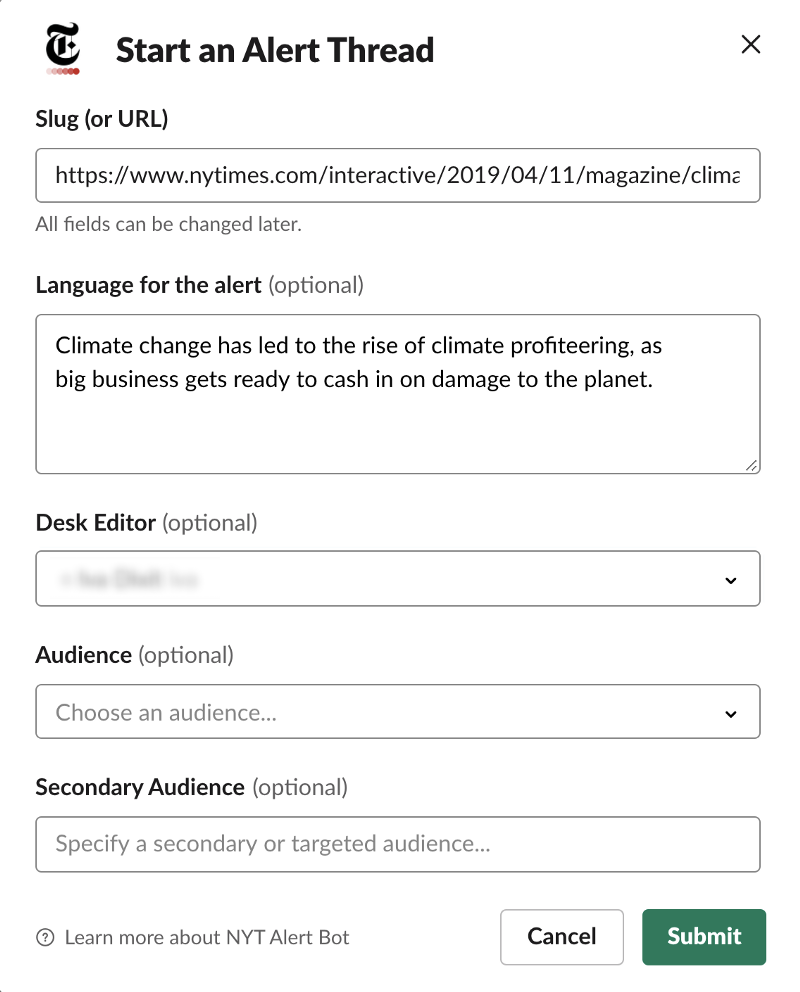
Once this dialog is submitted, the bot creates a new message in the channel with all the details of the alert. This message is kept up to date with any edits or approvals of the latest state of the alert.
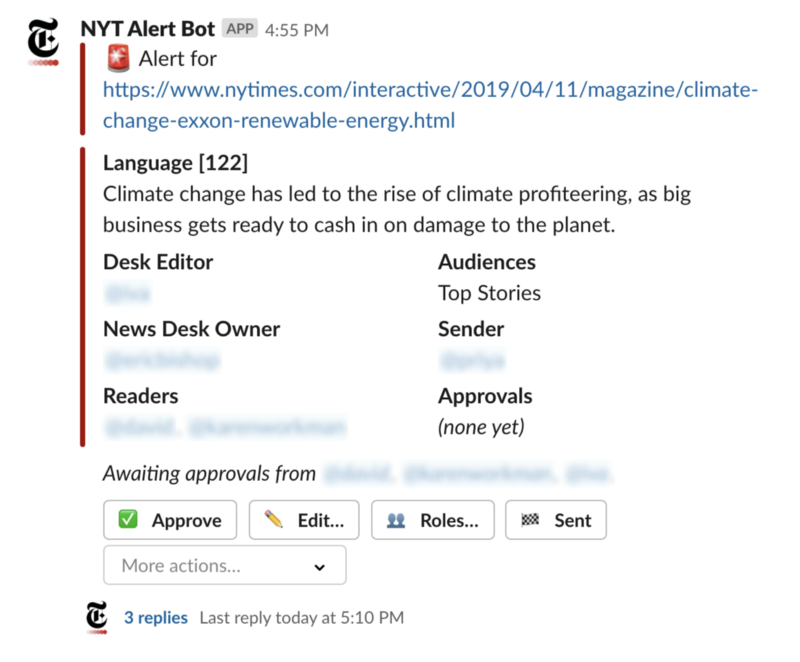
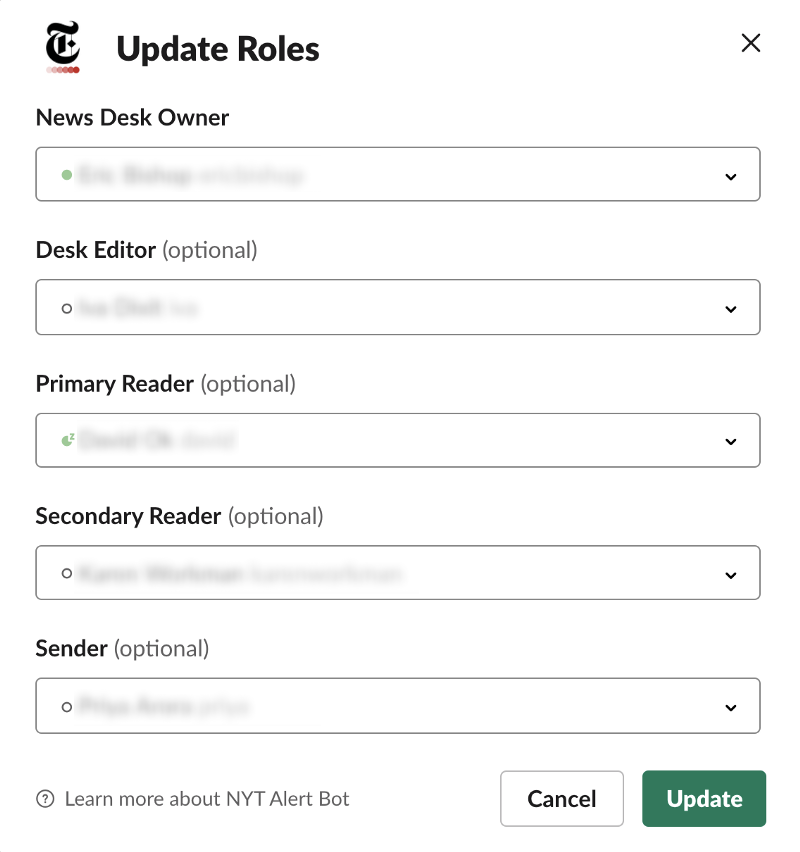
Action buttons on this message allow anyone to make edits to the alert. Reader and sender roles can be assigned by clicking the “Roles” button.
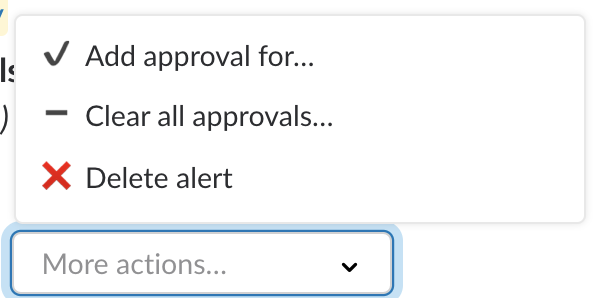
Readers can signal their approval by clicking the “Approve” button. Or, if approval has already been given verbally, this can be indicated by anyone via the “More actions” menu.
Along the way, any edits or approvals are signaled by the bot via a thread reply to the original message. This acts as a sort of change log while also indicating what the next step in the workflow is.
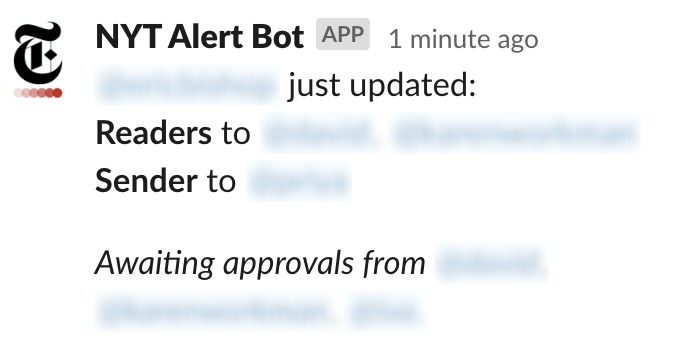
Once all approvals have been made, the alert is ready to send!
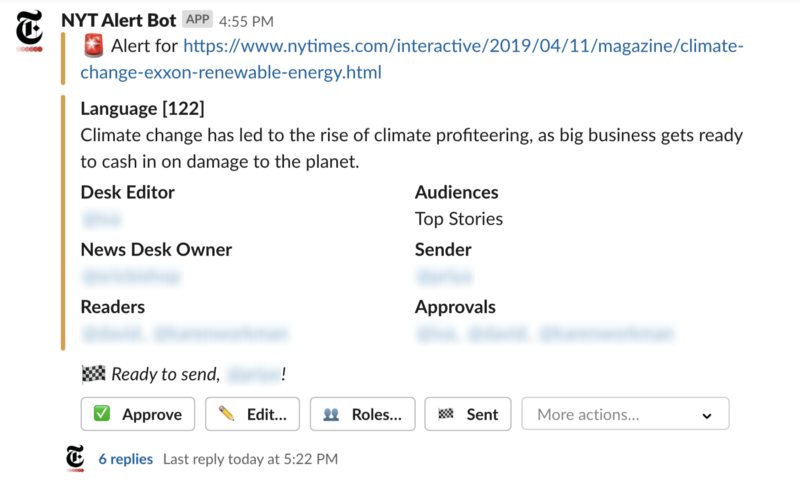
After it’s sent, the sender can mark the alert as such. The original message will turn green and collapse in the thread so it does not clutter the main channel.

The bot is built in NodeJS using the @slack/client and @slack/interactive-messages npm modules. The bot is a relatively simple Express server deployed to Google App Engine that listens for any commands from the Slack service.
The Slack API is surprisingly robust, allowing for fairly comprehensive support for things such as direct messaging people, setting up reminders, acting on emoji reactions and other features that we may take advantage of in the future.
One of the key architectural decisions in making this bot was to keep it entirely stateless. That is, the bot is not backed by any database or persistence layer on the backend. When a user clicks on one of the action buttons, Slack provides the original_message as part of the action payload. This object is parsed in order to recreate the state of the alert in memory before applying the desired action for the user.
For example, when a user clicks the approve button, the following object is sent to the server:
{
  type: 'interactive_message',
// the selected action
actions: [
{
name: 'approve',
type: 'button',
value: 'approve'
}
],
callback_id: 'a_s',
  // the original message the action was attached to
  original_message: { ... },
  ...
}
We loop through the list of users in the approvals list of the original_message and if the user is not already in this list, we add them (to a msg object) and then make a web.chat.update() call to update the original message with the new approval.
web.chat.update({
  ...msg,
  channel,
  ts,
  token: SLACK_BOT_ACCESS_TOKEN,
  as_user: true
})
We then also post a thread reply to update everyone on what just changed.
.then(() => {
  // Post in thread about approval update
  web.chat.postMessage({
    channel,
    thread_ts: ts,
    token: SLACK_BOT_ACCESS_TOKEN,
    as_user: true,
    text: added
    ? `✔️ <@${payload.user.name}> approved.\n\n${statusText}`
    : `➖ <@${payload.user.name}> unapproved.\n\n${statusText}`
  })
})Currently the bot is purely informational. That is, it just assists the newsroom with the alert authoring workflow; it does not integrate with our Content Management System (CMS) to pull in any information about the article’s slug, nor does it send the alert. We’ll continue to iterate on this bot to ensure it’s first effectively solving the problem of editing and approving alerts, and then may consider building in further capabilities such as CMS integration.
If your company relies on Slack for part of their workflow, consider if augmenting with a bot would help streamline that process. Getting started is easier than you might think and can help multiply the effectiveness of Slack as a tool for your organization. In fact, building a Slack bot can be a lot of fun and if anything, could prove to be a great learning experience.
I personally didn’t expect the bot to actually be used by the newsroom, but am so glad to see that the #notifications channel topic now reads: “Accuracy, quality and speed, in that order. /alert to trigger alert bot.”
How Building a Slack Bot Helped Us Send News Notifications was originally published in Times Open on Medium, where people are continuing the conversation by highlighting and responding to this story.

Every month I collect the new tools, resources, and datasets. Here they are for April. Read More
Forward, a startup launched by former executives from Google and Uber in 2017, touts itself as the future of health care. But the future the company is creating is one where health is an exclusive, premium-priced good rather than a human right or a general social aim. For $199 per month (and access to a wide array of your personal information), it offers “primary care membership focused on prevention,” using digital monitoring technologies to try to forestall disease with data. Through knowing oneself, the marketing suggests, one can prevent future catastrophe. But Forward adds something new to now-familiar pitch for health-data gadgets like period trackers and diet-and-exercise logging bracelets. For the monthly fee, a person can experience the aura of health in person in the company’s bespoke offices, buying peace of mind to be delivered in the future.
During a standard visit, a variety of connected “smart” devices are used to “gather comprehensive data wirelessly for you and your doctor.” If its promotional material is any indication, going to a Forward location is less like visiting a doctor’s office and more like dropping into a minimalist, high-end boutique. The clinical space depicted on its website is accented with high-end flat screens and technological gadgetry that doesn’t immediately disclose its medical purpose. The company promises a 3-D full-body scan for new clients, though what that machine can detect remains undefined. The entire presentation is medicine as mystery and as luxury.
Data-driven health services promise transcendence through data collection. But health data is also becoming a means of stratification
Following appointments, patient data is aggregated and self-knowledge is served on demand to customers on the company’s glossy platforms. In an article for Quartz, Michael J. Cohen compared its clinical strategy to that of an app: sleek on the user-interface end, with “software and data” powering “the new operating system of health care” on the back end. The New Yorker noted the company’s aspiration to be “the Apple Store of doctor’s offices,” and compared Forward to a gym, as did Business Insider.
As with a high-end gym, Forward’s monthly membership fee and the possibility of casually stopping by for routine tune-ups is designed to bring peace of mind. While gyms, yoga studios, spinning facilities, and other fitness spaces now offer raw juices, custom fragrances, and specially designed socks as talismans for the pursuit of elevated states of wellness, Forward and other data-driven health services promise transcendence through data collection. But the luxe ambiance makes it obvious how access to health data is also becoming a means of stratification. For those with cash to burn each month, health data collection can be timed to fit one’s schedule and the resulting information can be readily accessed through the device in your pocket. But for those without such services, access to one’s own health records remains difficult, with incompatible formats, paper records, and physician recalcitrance to share information keeping them in the dark.
In the real world where people frequently fall ill, doctor-patient encounters are crunched into shorter and shorter time frames and preventive health-care services are becoming scarcer in rural areas in the U.S. Finding a doctor who can provide adequate basic health care is increasingly a privilege of the rich and urban. Forward offers its urban customers — it was launched in California and recently expanded to New York City — an intensification of that privilege: not only the knowledge that one is looked after by a medical professional but also reams of exclusive data about the self.
The public fanfare over services like Forward makes explicit how medical treatment in the U.S. is increasingly positioned as a luxury for the wealthy. At the same time, the rest of us are led to believe that it is not money or affordable care that really matters but self-knowledge. Devices like the Apple Watch and the FitBit are proxies for the attentive, face-to-face health care that all people actually need. But in the utopian realm of digital health, personalized on-demand health data is framed as both sufficient and aspirational. Like the latest iPhone, health is becoming an exclusive novelty item, enticing to early adopters with cash to spare.
At the beginning of this century, health data was positioned as key to improving outcomes for all people worldwide, an unquestionable social good for everyone. New techniques — often digital — for collecting, sharing, and accessing quantitative data from blood tests; historical symptom data revealed by patients to their doctors; and records of drug prescriptions were supposed to make it easier for everyone to live longer and better. The more health information that was available to individuals, the more people would live life by the numbers, taking preventive steps to stay a step ahead of serious illness. Early diagnosis of everything from cancer to diabetes would make it easier to treat complex diseases; proactive individuals equipped with up-to-the-minute sleep and weight data could adjust their routines to optimize everything from attention to heart health.
More data — about the self and about future potential patients — had come to be seen as key to producing more health, as though “health” were an absolute quantity that could be counted and increased. In his 2012 book Drugs for Life, anthropologist Joseph Dumit described how the prevalence of these ideas turned health data into a valuable asset for pharmaceutical companies, which ensure future profits by anticipating demand for the drugs based on population-level data. Data-driven market research, Dumit observed, became an equally valuable site of knowledge production as the laboratory and the clinic, allowing companies predict and prepare for future health trends.
Data appears straightforward. It doesn’t depend on the people who generate it, with their messy lives filled with competing priorities
The incursion of Silicon Valley investors and professionals into health care has since intensified the health data obsession. Armed with the faith that knowledge always leads rational individuals to take appropriate action, the health-technology and digital-health fields blossomed, spawning new services (like DNA testing service 23andMe), platforms (like period-tracking app Clue), devices (including exercise trackers like FitBit), and now clinics like Forward, centered on collecting and organizing health data and slickly reporting it to doctors and individuals.
As these fields have grown, they have contributed to the impression that data alone is sufficient for medical care. Compared with the intricacies of human biology and relationships, data appears straightforward. It doesn’t depend on the people who generate it, with their messy lives filled with competing priorities. While a patient’s prevention regimes and adherence to active treatments can be upset by everything from a new job to distrust of a particular medical professional, data is easy to make and distribute. As an executive of a health-tech or digital-tech company, it’s easy to know how much of it you have and to assign each unit a corresponding price as you amass more. And it is easy to convince yourself that assigning it financial value makes it more medically valuable.
The procedural and economic advantages of data processing reinforces the conviction that data is the key to health. As medical practice is reconfigured around easily digitized packets of information that can be traded and sold, nuance in doctor-patient interactions and the integrity of health research are threatened. With data as the goal, the value of people and their needs and rights recede from view.
The growing number of ethically questionable transfers of health data between for-profit companies and to law enforcement is evidence of this. For example, the recent disclosure of an agreement between direct-to-consumer genetic testing company 23andMe and pharmaceutical giant GSK demonstrates that companies with private health data might change how they use that data in the future. Further, many observers complained that it was unfair that the company was making money after customers had paid to use the service, with none of those additional profits flowing back to the people whose data helped to generate them. And while DNA ancestry data might be helpful in catching the occasional criminal (like the Golden State Killer), critiques of such sharing have raised questions about what law-enforcement access to ancestry data will mean for the privacy of future generations, distant relatives of suspected criminals, and racialized groups.
The myopic emphasis on data collection distracts us from observing how access to health care is being further stratified by social class: Rich urbanites can sign up for concierge health data services like Forward. Middle-class people get FitBits for Christmas. The working class and the poor, meanwhile, must treat access to attentive, culturally sensitive doctors as a distant dream.
Rather than alleviate risks in a cost-efficient manner, the rush to build new data-driven business models is producing different ones. Many health technology companies try to strike a bargain with their customers: In return for agreeing to have their data shared with a variety of unnamed third parties, the customer gets access to doctors or genetic data, or calming meditation experiences, or alerts to prepare for menstruation as well as a wealth of data about their personal health. If health data is capital, this is a new form of profit sharing.
Potential users need to consider whether the promise of more health knowledge today is truly worth a potential lifetime of precarity and discrimination
But it is unlikely that any particular health tech company will last long. Despite a few out-of-the-park successes, the sector overall has struggled to realize returns for investors. One can imagine a company like Forward looking for new ways to monetize its trove of customer information during difficult times, following in 23andMe’s footsteps and selling information to a pharmaceutical company. Or perhaps it will sell to a tech company, which are starting their own efforts devoted to health (making the landscape even harder for small-scale ventures) or one of its tech-affiliated investors. If the company follows the example of its peers in tech, that additional revenue would not flow back to users as reduced fees or improved service; it would benefit investors and executives.
The use of monitoring devices to generate health data should also be a cause for concern. U.S. lawmakers are only just starting to debate “internet of things” security legislation and federal regulators are just beginning to draft rules for the protection of digital patient data. The ways that apps and medical devices like 3-D scanners, “smart” thermometers, and even heart implants communicate with each other are notoriously insecure. As yet, there is no meaningful carrot or stick to entice device makers to ensure the security of their devices in isolation, let alone in complex networks of exchange. Data may be traveling even further than device and service terms disclose.
Many medical tech companies’ terms of service claim that information will be de-identified before being shared with third parties, but researchers have demonstrated that re-identifying digital health data is not all that hard, and could expose a person’s financial, demographic, or location data as well as exposing their health status, opening them up to potential identity theft. In the U.S., where health insurers and life insurers are allowed to discriminate based on health and disability status, re-identification of health data could easily lead to a lifetime of denied access and extreme financial vulnerability.
What is at stake throughout the health technology sector are structural questions about who the health data economy will benefit. In the long term, customers and patients who give up their data for free or a relatively low cost might be the product, not the beneficiary — just like in other online social networks. The sector’s norms of exchanging data with third parties from drug companies to advertisers piggybacks on the now widely suspect data-for-cash business model of many tech platforms. Potential users thus need to consider whether the promise of more health knowledge today is truly worth a potential lifetime of precarity and discrimination in any of the many scenarios in which their data travels in unanticipated ways.
For the rich, this may not be a concern because any ill effects can be minimized with wealth. But for everyone else — for whom desirable devices might help to fill gaps in basic health care or cope with chronic illnesses of poverty — evading law enforcement, suing the nefarious actors who stole your data, and amending the record with potential employers could be difficult, if not ruinous.
While more data seems like a commonsense solution to a rickety health system, it further divides the haves from the have-nots, distracting consumers and decisionmakers with glossy interfaces. The health data economy is an economy of risk, and like any risky business, the gig will be up before long.
| mkalus shared this story . |
Dozens of people who have been camping at Vancouver's Oppenheimer Park for months were told pack up and leave the site on Wednesday, as city crews said the park needed to be cleared for maintenance work.
At least 50 people have been staying at the park, in the city's Downtown Eastside, consistently since the winter. The tent community was dismantled Wednesday afternoon, leaving only a dozen tents left standing on the outskirts of the grassy field.
A fence went up around the turfed area and city staff said the area will stay closed temporarily for fertilizing, seeding and irrigation, but that shelters elsewhere in the park will be left alone. A statement said the fence will come down in mid-June.
The Carnegie Community Action Project started tracking the number of people living in the park in January. The group said the number jumped from about 30 to 50 over a month.


After putting in more than 55 hours researching superzoom cameras over four years, and spending several days shooting with a handful of contenders side by side, we’ve determined that the Panasonic Lumix DC-FZ80 is the best superzoom camera for most people. Among the current crop of superzoom cameras, none have all the features you’d ideally want in one camera, but the FZ80’s well-thought-out touchscreen interface and faster autofocus make it one of the best options you can currently get.
Now that Google’s Streetview has been in operation for a decade, and conveniently provides its available archive with each image, it’s possible to do what Guest suggests in the post below:
You could take a similar pic – but in reverse and with a future transition – of the former Granville 7 Theatre on Granville Steet.
i.e. bustling pic of the movie crowds in the 1990s, boarded up with chain link fence and homeless camped out for the past few years after the theatre closed, and in a few more years (hopefully) bustling again as a Cineplex Rec Room.
Here’s the result so far:
2007:


2011:

2018:

The current street scene, at least in these shots, is not as dramatic as it can be, when there are rough shelters under the canopies. Whereas the difference in New York from the 1980s to now – in this case, the Brooklyn neighbourhood of Bushwick – is unmissable. Almost inconceivable.


As it happens, New York City has a vintage equivalent of Streetview: tax assessment photos from three decades, as reported in the Times:
One trove of evidence comes from the city, which in the 1930s, 1940s and 1980s took photos of every building in New York in an effort to make tax assessments fairer and more accurate.
James Barron previously wrote about the photos from the 1930s and 1940s, and he recently discussed the ones from the 1980s. Consider them very early versions of Google Street View.
So, for aficionados of NYC, there goes your day.
As for the changes in Bushwick, it’s a mid-Brooklyn neighbourhood caught up in the gentrification wave moving west to east. See here: ‘Bushwick gentrification.’

But as Dan Ross might ask, is anyone in Bushwick really nostalgic for a return of what came before? The burned out 1980s.
For many years, Microsoft has published a security baseline configuration: a set of system policies that are a reasonable default for a typical organization. This configuration may be sufficient for some companies, and it represents a good starting point for those corporations that need something stricter. While most of the settings have been unproblematic, one particular decision has long drawn the ire of end-users and helpdesks alike: a 60-day password expiration policy that forces a password change every two months. That reality is no longer: the latest draft for the baseline configuration for Windows 10 version 1903 and Windows Server version 1903 drops this tedious requirement.
I wonder how many years it will take for Enterprise IT to catch up.
Building on the success of Firefox Quantum, we have a renewed focus on better enabling people to take control of their internet-connected lives as their trusted personal agent — through continued evolution of the browser and web platform — and with new products and services that provide enhanced security, privacy and user agency across connected life.
To accelerate this work, we’re announcing some changes to our senior leadership team:
Dave Camp has been appointed SVP Firefox. In this new role, Dave will be responsible for overall Firefox product and web platform development.
As a long time Mozillian, Dave joined Mozilla in 2006 to work on Gecko, building networking and security features and was a contributor to the release of Firefox 3. After a short stint at a startup he rejoined Mozilla in 2011 as part of the Firefox Developer Tools team. Dave has since served in a variety of senior leadership roles within the Firefox product organization, most recently leading the Firefox engineering team through the launch of Firefox Quantum.
Under Dave’s leadership the new Firefox organization will pull together all product management, engineering, technology and operations in support of our Firefox products, services and web platform. As part of this change, we are also announcing the promotion of Marissa (Reese) Wood to VP Firefox Product Management, and Joe Hildebrand to VP Firefox Engineering. Both Joe and Reese have been key drivers of the continued development of our core browser across platforms, and the expansion of the Firefox portfolio of products and services globally.
In addition, we are increasing our investment and focus in emerging markets, building on the early success of products like Firefox Lite which we launched in India earlier this year, we are also formally establishing an emerging markets team based in Taipei:
Stan Leong appointed as VP and General Manager, Emerging Markets. In this new role, Stan will be responsible for our product development and go-to-market strategy for the region. Stan joins us from DCX Technology where he was Global Head of Emerging Product Engineering. He has a great combination of start-up and large company experience having spent years at Hewlett Packard, and he has worked extensively in the Asian markets.
As part of this, Mark Mayo, who has served as our Chief Product Officer (CPO), will move into a new role focused on strategic product development initiatives with an initial emphasis on accelerating our emerging markets strategy. We will be conducting an executive search for a CPO to lead the ongoing development and evolution of our global product portfolio.
I’m confident that with these changes, we are well positioned to continue the evolution of the browser and web platform and introduce new products and services that provide enhanced security, privacy and user agency across connected life.
The post Firefox and Emerging Markets Leadership appeared first on The Mozilla Blog.

Workbench is a free and open source data journalism platform "that enables all stages of data journalism: getting data (including scraping), then cleaning, analyzing, visualizing, and sharing it. All of this is possible without code, yet everything you do in Workbench is automatically documented and reproducible." Note: " Workbench is not just about getting work done, but learning as well. Last month we released our first interactive course, Introduction to Data Journalism. It’s a twelve-part course which goes from the very basics (minimum and maximum, averages) to sophisticated techniques (formulas, joins) including walkthroughs of a number of real-world stories we collected in newsrooms." This is the future of OER. Note well.
Web: [Direct Link] [This Post]Hi! It’s Defne again. Here’s another Weekly Chart by me. If you missed the one from last week, check it out!
Airbnb is popular. So is Berlin! But the city has a rather complicated relationship with one of the most popular and touristic portals for finding a proper place to stay in a city: In 2016, Airbnb-rentals were banned, then the ban was canceled but strict rules remained.[1]
Inspired by this discussion (especially by typically long German words such as “Zweckentfremdungsverbot”), I thought it could be worth checking the current situation in Berlin: What is the most expensive district on Airbnb in Berlin?
I thought the story would be more interesting than what I found out. But there are no surprises, dear readers: The central regions are more expensive than the rest of the city and tourists want to stay at the center.
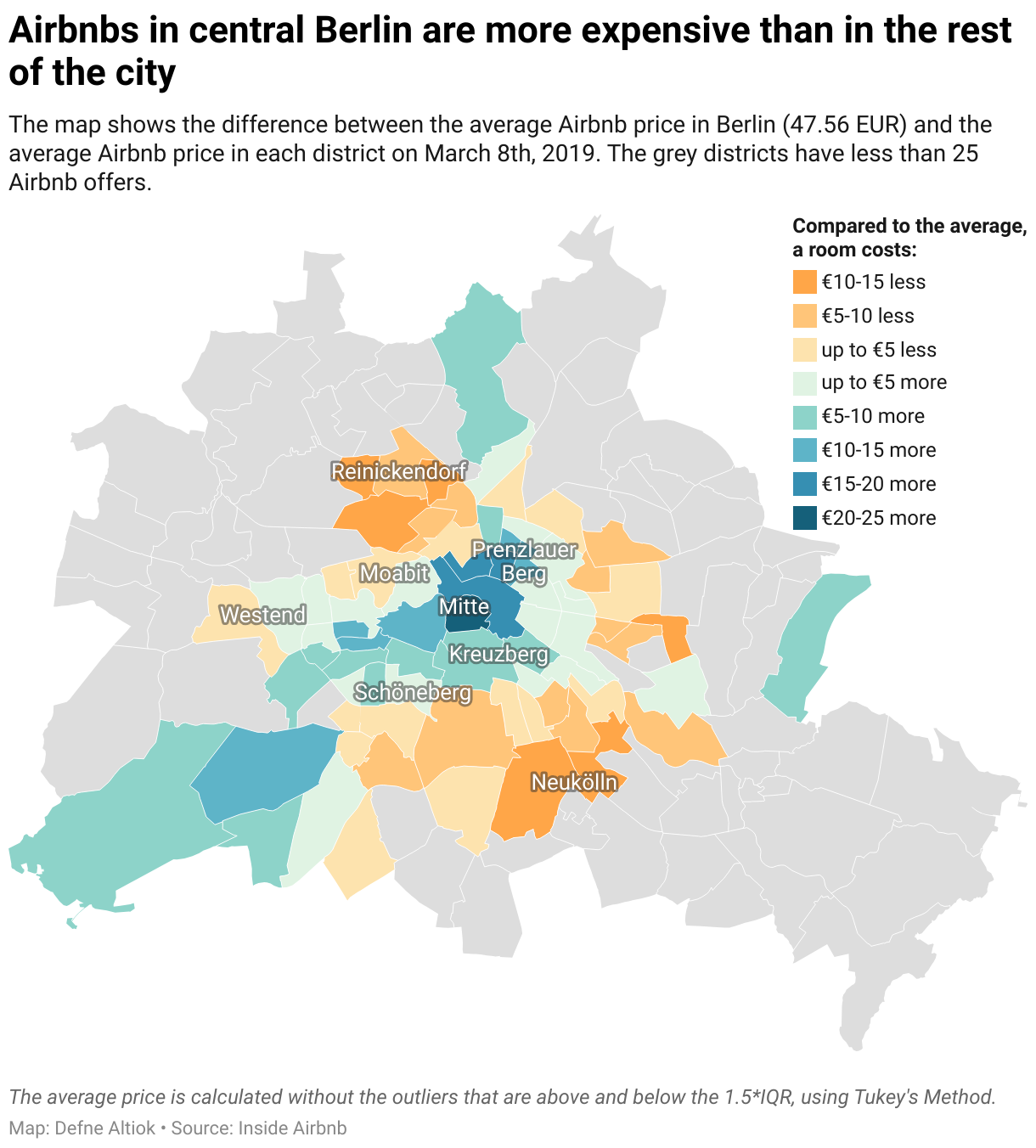
The districts at the peripheries of the city are greyed out on this map. This doesn’t mean I didn’t have any data about them. I had! But these districts had 25 or less Airbnbs – and it felt wrong to compare the average price of e.g. 4 Airbnbs with the average price of more than 800 (like in Alexanderplatz).
Think of Amazon reviews. You wouldn’t trust just two or even ten reviews. You know that the more people reviewed, the more you can trust the average rating. It’s the same with the price averages: The more data points we average, the more reliable it gets.
So I decided to get rid of the Amazon reviews districts with less than 25 Airbnbs. But I don’t want to withhold these districts from you entirely. I guess, somehow (Hi Lisa!), I was convinced that scatterplots are usually great and quite useful to show correlations. So I made one! Here’s a scatterplot with the hidden districts:
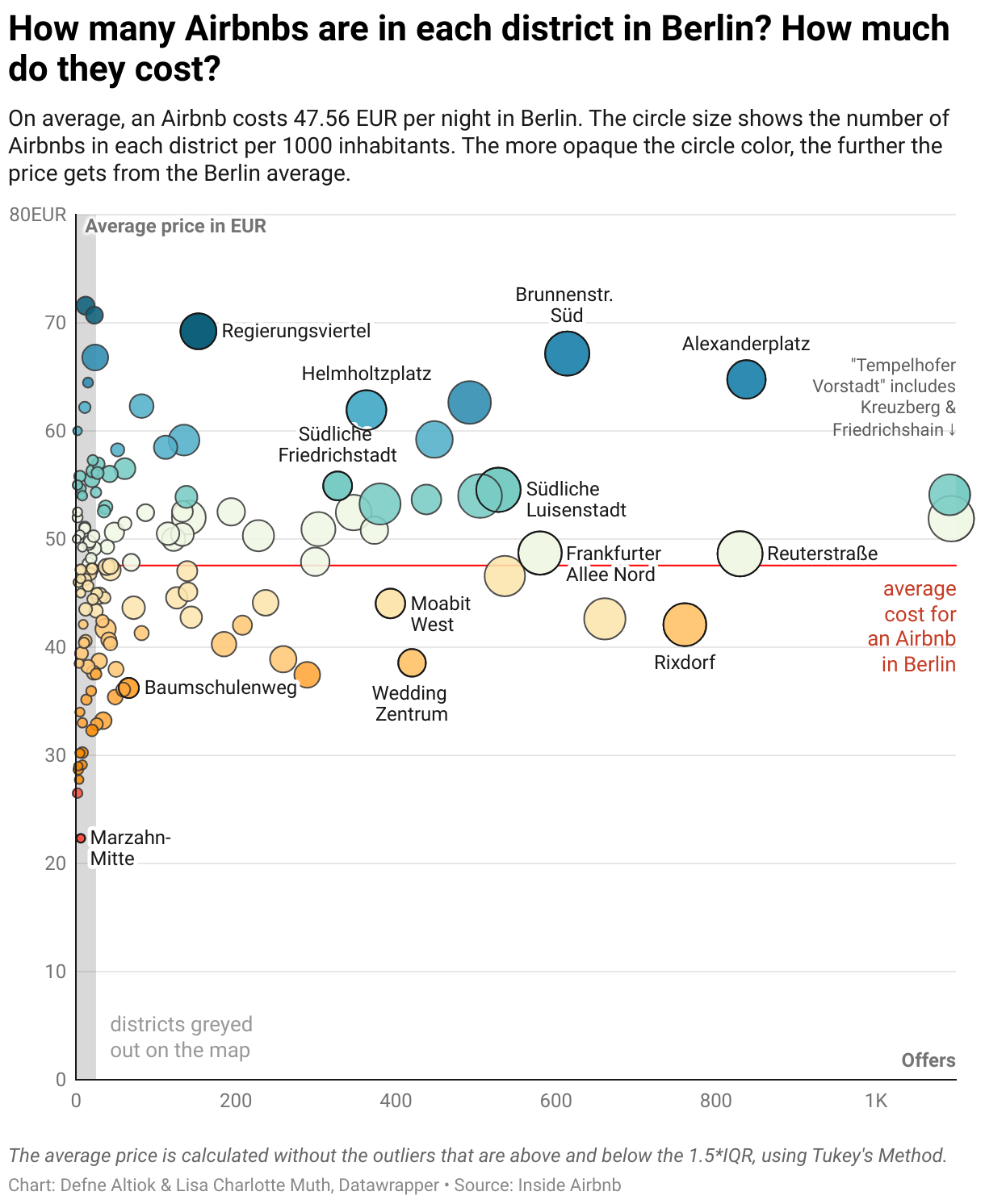
The area below the line shows the region with Airbnbs that cost, on average, less than the average price. As the famous Berlin slogan goes, they are “poor but sexy”. Neukölln and Wedding are still hanging in there!
This was my last article at Weekly Chart and Lisa will take over next week again (maybe)! If you have any questions or feedback, you can find me on Twitter at @AltiokDefne or via email (defne.altiok@dw.com).
Picture Jane in her office. She gets an email from Bob every month with the latest WidgetX numbers. With that email in front of her, she double-clicks a script (or chooses one from a scripts menu), which:
This used to take hours, and it was prone to errors. Now it takes a minute or less — and it’s error-free.
What’s going on here? It’s AppleScript, sure — but, under the hood, it’s Apple events.
Apple events (lowercase “e” is correct) arguably saved Apple in the ’90s. Desktop publishing was huge and very Mac-centric, and that was in part because the various tools were automatable. When you can automate, you can save time and money.
This was before Mac OS X: there was no UNIX automation. No shell scripts, no pipes, no Terminal.
Instead, there was AppleScript and UserLand Frontier and an underlying bit of technology called Apple events. And apps like QuarkXPress which were scriptable.
You might say that Steve Jobs — or the iMac or the iPod or NeXT technology — saved Apple. But it’s very possible that Apple, without automation, might not have lasted long enough to get to Steve Jobs.
Roughly put — they’re a way of calling a function, with parameters, in an app and getting back a result.
There are a few key things to know:
Mac developers will often use Apple events without even realizing it. For instance, there are methods in NSWorkspace that hide underlying Apple events: opening a URL in the browser, or opening a Finder window rooted at a given folder.
These work because the browser and the Finder respond to specific Apple events, and NSWorkspace knows how to send them.
Another key thing to know: this was early ’90s technology. It survived the transition to Mac OS X because people relied on automation — particularly, as I mentioned, for desktop publishing, but for other purposes too — and, without that automation, they would have left the Mac.
When I say “relied on,” I mean that there were companies whose profits relied, at least in part, on being able to automate away hundreds of hours of manual tasks.
And there are plenty of people today who rely on Apple events to get their work done. It’s quite common.
The Mac, the “computer for the rest of us” — for those of us who didn’t want to deal with a DOS prompt and arcane stuff — always promised to be easy for novice users. The UI was consistent, which helped a ton. Designers were encouraged to make commonly-used features the most visible and easiest to use.
And that’s great — but the absolute genius was combining that with power-user features by way of progressive disclosure.
This meant that more power was there, but it wasn’t required in order to use the app well. But, once you needed it, you could find it. And that extra power was as well-designed as the rest of the app, so you could get the most bang for your click.
But what do you do about features that shouldn’t actually be baked into the app? What about the power to do what Jane does?
That’s where automation — Apple events — comes in. It doesn’t get in the way of the UI, but if you can find your way to Script Editor (or a similar app: there are others), you can learn how to write any feature or workflow you can dream of (as long as it’s technically possible).
Part of the genius of this is that you’re scripting the apps you already use. You’re scripting these great GUI apps that you know and love. No command line, no piping/launching/closing. Just pulling information from apps and telling them to do things.
I have heard — I don’t know if it’s true — that some people at Apple wanted to ditch Apple events (and AppleScript) in the transition to Mac OS X. It was already a several-year-old technology, and I can see how people thought it might not fit in with OS X.
But the technology was preserved, as I mentioned earlier, because people and companies needed it. So it’s old stuff, but it’s stuck around for very good reasons.
But here’s where the Mac gets even better: OS X is UNIX, and now we can mix-and-match traditional Mac scripting with Python and Ruby and shell scripts and all the power of UNIX tools. (Note: you can call an AppleScript script from a shell script, and vice versa.)
I didn’t mention it, but Jane, in the example at the top, is using AWK to extract the numbers from Bob’s email text.
An outside observer might think Mac users just use pretty — and pretty simple — apps, and that’s the whole story. But that completely misses the power and genius of Macs.
I can’t think of another platform with the sheer level of automation power that OS X (now macOS) has.
What happens to Jane if Mail is a Marzipan app that doesn’t respond to Apple events?


The University of Waterloo will contribute its expertise in quantum algorithms and quantum complexity theory to IBM’s Q Network, according to a release on Thursday.
The Q Network is a collection of research institutions who will work with IBM to solve challenges facing the development of quantum computing.
Theoretically, quantum computers can be used to solve complex problems faster than traditional computers, like the potential cracking of today’s encrypted communication.
“Developing practical quantum applications that drive business and scientific breakthroughs requires a diverse ecosystem,” said Dr. Anthony Annunziata, IBM Q Network Global Lead at IBM Research. “Partnering with these world-leading academic and research institutions is key as we work to educate, empower, and get the next generation of students ‘quantum ready’ to advance the field.”
The University of Waterloo will join other institutions like Duke, Harvard and the University of Colorado Boulder and contribute research to the project.
Source: IBM
The post University of Waterloo joining IBM to solve quantum computing appeared first on MobileSyrup.
mkalus
shared this story
from  Uploads from Michael Kalus. Uploads from Michael Kalus.
|
Michael Kalus posted a photo:

Processed with VSCO with fn16 preset

| mkalus shared this story . |

I like Suarez’s writing and was quite excited to get this book and... well. I pretty much read it in a day.
There are a lot of chuckles early in the book as Suarez def. does create copy cats of real life characters (Musk, Bezos etc.) and from there extrapolates out as to where things could go with a mission to the stars (asteroids).
To be fair, he does take some liberties with it. The idea that things would be kept as secret for as long as they are in the book I find a bit unrealistic, especially later when things go “off script”, but the story is engaging. The science, as far as I can determine, is solid and the characters are believable if a bit archetypal.
Overall a good read, and if you wonder how we could ever go about mining the solar system, I think the book is a good start.

If you use Slack for work — who doesn’t these days? — you know that signing in can sometimes be frustrating.
Thankfully, Slack is about to make things easier on Android. The company recently updated its titular business communications platform with support for Android’s Smart Lock for Passwords feature.
For the unfamiliar, Smart Lock for Passwords primarily uses your Google account as a vault to save your passwords. Android will then automatically sign you into supported apps if you saved the credentials to Google.
Slack joins other favourite apps, like Netflix, Eventbrite and the New York Times by adding support for Smart Lock. The new feature comes as part of version 19.4.2.0.
Next time you log into Slack, you’ll get a pop-up with all your Google accounts. Just select the one associated with your Slack room, and if your password is saved, you’ll log in automatically.

If you don’t keep your passwords saved with Google, you can still sign in the regular ways: through Slack’s manual sign-in process or a ‘Magic Link’ the company emails you.
It’s also worth noting that if you have two-factor authentication (2FA) enabled on any Slack rooms, you’ll need to enter those codes to sign in, regardless.
Source: Android Police
The post Slack makes signing in on Android easier with support for Smart Lock appeared first on MobileSyrup.

Rogers has launched a new promotion where Canadian consumers can score a free pair of first-generation AirPods (valued at $220).
To take advantage of the offer, you must purchase a 64GB or 128GB iPhone XR for $0 with Upfront Edge on a 2-year Ultra tab Share Everything plan.
The offer is only available for an unspecified “limited time” or while supplies last. Additionally, the promotion is only available through the carrier’s retail stores, not online.
As an added perk, Rogers is including up to 4GB of bonus data on select plans when consumers take advantage of this offer.
The iPhone XR features a 6.1-inch Liquid Retina LCD display with a 1792 x 828 pixel resolution, Apple’s A12 Bionic processor and Face ID, although it does not include 3D Touch like the iPhone XS and XS Max. The iPhone XR is available in White, Coral, Yellow, Blue, Black, and Product Red.
Source: Rogers
The post Rogers offers free AirPods with iPhone XR purchase appeared first on MobileSyrup.

According to Macrumors, users of Apple’s AppStore have reported getting stuck in an endless loop bug when attempting to add or update an application on their device.
When picking a new app to download or update, a prompt saying “Apple Media Services Terms and Conditions have changed” appears, asking users to read and accept the new terms.
Picking the accept option loads the App’s store page once more prompting users again with the same message of needing to read and accept new terms.
Is this happening to you? Some users say that hitting cancel makes the issue go away, but that means they would not be able to access the app.
Source: Macrumors
The post App Store users are stuck in an endless loop bug when trying to update apps appeared first on MobileSyrup.

I don't have the time or energy to rebut this, but here is David Wiley with the commercial model of open, once again: " Rather than investing our time and energy trying to one up each other creating even more grossly overexaggerated negative metaphors for publishers, we should spend some time and energy making concrete, tactical suggestions about how they can make the transition to open successfully.... Unless you’ve spent time really listening to publishers and trying to understand what they’re trying to do, your head and heart are probably full of misconceptions and stereotypes about them." I guess the University of California really should have tried to understand things from Elsevier's point of view.
Web: [Direct Link] [This Post]
Tesla is raising prices on its Full Self-Driving (FSD) feature ahead of its rumoured release this year.
According to a tweet from Tesla CEO Elon Musk, the cost of FSD will go up by $1,000 USD (about $1,349 CAD) after May 1st, 2019.
Currently, when you buy a Tesla vehicle, you’ll get Autopilot included, which enables the vehicle to steer, accelerate and brake automatically within its lane.
There’s also an option to purchase FSD capability, which includes ‘Navigate on Autopilot’ for highway driving, ‘Autopark’ for parking and ‘Summon,’ which lets your Tesla find you in a parking lot. If you add it at time of purchase, you’ll pay $6,600 CAD. Alternatively, you can add it after delivery for $9,200.
While the FSD package does include some features now, Musk has said automatic driving on city streets and the ability to recognize traffic lights and stop signs will come by the end of the year, enabling full SAE Level 5 autonomy — the highest level of autonomy there is.
We will delay $1k full self-driving option price increase until May 10 for those unable to order by May 1
— Elon Musk (@elonmusk) April 25, 2019
Further, Musk said that customers who can’t order by May 1st would have until May 10th to order before the price increase hits them. Specifically, this affects customers like those in the U.K., who won’t get a Model 3 order page until May 1st or 2nd, according to Musk.
In other words, Canadians have until May 1st to get the FSD package before the price change comes in. Based on the U.S. price increase, Canadians will likely end up paying $7,950 CAD for FSD at time of purchase, or $10,550 after delivery.
We’ve reached out to Tesla Canada for more details about the upcoming price increase and will update this article accordingly.
Source: Twitter
The post Tesla is raising the price of its Full Self-Driving feature on May 1, 2019 appeared first on MobileSyrup.