 Despite all the hype surrounding its camera and the impressive Night Sight mode, Google still has not managed to sell a lot of Pixel 3 units. Alphabet’s CFO Ruth Porat in an earnings call said that due to industry-wide pressure on high-end phones, Google sold fewer Pixels last quarter compared to a year ago.
Continue reading →
Despite all the hype surrounding its camera and the impressive Night Sight mode, Google still has not managed to sell a lot of Pixel 3 units. Alphabet’s CFO Ruth Porat in an earnings call said that due to industry-wide pressure on high-end phones, Google sold fewer Pixels last quarter compared to a year ago.
Continue reading →
Rolandt
Shared posts
05 May 09:39
Despite all the hype surrounding its camera and the impressive Night Sight mode, Google still has not managed to sell a lot of Pixel 3 units. Alphabet’s CFO Ruth Porat in an earnings call said that due to industry-wide pressure on high-end phones, Google sold fewer Pixels last quarter compared to a year ago.
Continue reading →
Google Admits Pixel 3 Sales Have Been Poor
by Rajesh Pandey
Despite all the hype surrounding its camera and the impressive Night Sight mode, Google still has not managed to sell a lot of Pixel 3 units. Alphabet’s CFO Ruth Porat in an earnings call said that due to industry-wide pressure on high-end phones, Google sold fewer Pixels last quarter compared to a year ago.
Continue reading →
05 May 09:36
Microsoft, Slack, Zoom, and the SaaS Opportunity
by Ben Thompson
It is difficult to discuss enterprise software without at least mentioning Microsoft, and there is no better time than now: last week the company (briefly) became the third U.S. company, after Apple and Amazon, to achieve a market capitalization of over $1 trillion, and is currently the most valuable publicly-listed company in the world.
It is a remarkable turnaround, and, thanks to the fact that I started Stratechery just months before the exit of former CEO Steve Ballmer, it is one that I have been able to document stage-by-stage. The critical breakthrough was three-fold, and, as is so often the case, the three breakthroughs were really about the same existential question — whither Windows:
- First, Microsoft’s leadership accepted that its nature was that of a horizontal company, not a highly differentiated vertical one built around Windows.
- Second, Microsoft embraced a world where Windows was one client amongst many, and targeted its services to iPhone, Android, Linux, and Mac.
- Third, and most importantly, Satya Nadella brilliantly navigated The End of Windows internally, freeing Microsoft employees to build products that customers actually wanted, not that Microsoft needed.
The most important factor that made all of this possible, though, is that for all of the disruption that the enterprise market has faced thanks to the rise of Software-as-a-Service (Saas), Microsoft was remarkably well-placed to take advantage of this new paradigm, if only they could get out of their own way.
At least in part.
The SaaS Business Model
There are three parts of any new paradigm in technology: doing current use cases better, coming up with a new business model, and creating entirely new use cases. Microsoft, to Ballmer’s credit, was actually very early to the new business model aspect of SaaS.
Previously, enterprise software was sold on a license basis: companies bought software on a per-seat basis (or per-server or per-core basis in the case of back-end software), and when new versions of the software came out, they would potentially update — or not. Or not wasn’t great for anyone: companies would be running on out-of-date software, and vendors would not make new revenue.
What Microsoft figured out is that it made far more sense for both Microsoft and their customers to pay on a subscription basis: companies would pay a set price on a monthly or annual basis, and receive access to the latest-and-greatest software. This wasn’t a complete panacea — updating software was still a significant undertaking — but at least the incentive to avoid upgrades was removed.
There were also subtle advantages from a balance sheet perspective: now companies were paying for software in a rough approximation to their usage over time — an operational expense — as opposed to a fixed-cost basis. This improved their return-on-invested-capital (ROIC) measurements, if nothing else. And, for Microsoft, revenue became much more predictable.
SaaS and Current Use Cases
A more profound implication of SaaS, though — and to be clear, I mean software accessed over the Internet, not datacenter software paid for on a subscription basis — is how it makes current use cases more efficient for existing enterprise customers on one hand, and accessible for completely new customers on the other.
Start with enterprise customers: the reality for many industries is that their needs are variable. Sometimes they need more seats for a particular piece of software, and sometimes they need less; this is particularly pronounced in the case of Infrastructure-as-a-Service (IaaS), where computing needs may change seasonally. The brilliance of paying on a subscription basis is that a company can buy exactly what it needs, when it needs it, and no more. Microsoft, again in credit to Ballmer, was moving this way with Office 365: seats could be provisioned on a monthly basis, with no major upfront expenditure required.
That lack of upfront expenditure, though, also expanded the market: buying an
Exchange seat on Office 365 means hiring Microsoft to run your email server, something that previously needed to be done internally. Now all kinds of small-and-medium sized companies could use enterprise level software without needing their own IT departments.
Microsoft’s SaaS Challenge
This was also a challenge for Microsoft, to be sure: “hiring” SaaS providers meant it was easier to find providers that actually cared about modern use cases, particularly mobile. I wrote about this in 2015 in Redmond and Reality, in the context of cloud storage:
Once you remove the burden of support and maintenance — that’s handled by the service provider — it suddenly doesn’t necessarily make sense to buy from only one vendor simply because they are integrated. There is more freedom to evaluate a particular product on different characteristics, like, say, how easy it is to use, or how well it supports mobile. And it’s here that Microsoft products, particularly the hated SharePoint, were found to be lacking.
This is where Nadella made the biggest difference. It was notable, from a symbolic perspective, if nothing else, that his first public event was unveiling Office for iPad:
This is the power CEOs have. They cannot do all the work, and they cannot impact industry trends beyond their control. But they can choose whether or not to accept reality, and in so doing, impact the worldview of all those they lead. This is why it matters that the first public event Satya Nadella appeared at was Office for iPad. This is why it matters that Microsoft released it even though the Windows Touch version wasn’t finished. This is why it matters that Microsoft gave up the pretense of Windows Phone license payments that were already effectively zero and simply made it free.
This is the only possible route for a SaaS provider: the entire point is to host all of the infrastructure in one place, which means the greatest possible gains come from increasing the addressable market, which further means serving all devices, not simply the ones owned by one’s company. That, though, is the burden of incumbency: what is obviously right from the outside is often counter to what is obviously right when it comes to company cash flows and especially company culture.
Zoom and Being Better
Redmond and Reality was about file-sharing software, but the broader idea — that SaaS changes the plane of competition from ease-of-integration to ease-of-use — is perhaps best exemplified by the rise of Zoom. It turns out that video-conferencing software is an exceptionally difficult technical problem, and Zoom has done a better job than anyone in solving those technical challenges. It is simply better than the alternatives.
Even so, if said video-conferencing software had to be delivered via an on-premises software installation, it is doubtful that Zoom would be as successful as it has been: just as important is that signing up for Zoom requires nothing more than an email address; a paid plan takes only a credit card. This reduction in friction means that quality matters more than it ever did previously, which is why Zoom is such a success.
The challenge for incumbents, including Microsoft and also other competitors like Citrix, Cisco, etc., is that years of building their business on leveraging their existing relationships with enterprises left them vulnerable to a company like Zoom singularly focused on delivering a superior product, at least once a SaaS architecture made distribution so much easier. Make no mistake, enterprise software still requires a sales force, but it is far easier to start with customers that have already discovered and tried the product on their own than it is to sell something without any sort of pre-existing relationship.
Slack and New Use Cases
There remains, though, one final implication of a new paradigm, and this one is the most profound: completely new use cases. This was something Slack sought to highlight in their S-1, which was made public last week.
First, the company argued that Slack transforms internal communications:
The most helpful explanation of Slack is often that it replaces the use of email inside the organization. Like email (or the Internet or electricity), Slack has very general and broad applicability. It is not aimed at any one specific purpose, but nearly anything that people do together at work.
Unlike email, however, most of this activity happens in team-based channels, rather than in individual inboxes. Channels offer a persistent record of the conversations, data, documents, and application workflows relevant to a project or a topic. Membership of a channel can change over time as people join or leave a project or organization, and users benefit from the accumulated historical information in a way an employee never could when starting with an empty email inbox. Depending on the size of the organization, this might provide tens, hundreds or even thousands of times more access to information than is available to individuals working in environments where email is the primary means of communication.
Secondly, Slack argues that it changes what it means to integrate software:
Also unlike email, Slack was designed from the ground up to integrate with external software systems. Slack provides an easy way for users to share and aggregate information from other software, take action on notifications, and advance workflows in a multitude of third-party applications, over 1,500 of which are listed in the Slack App Directory. Further, Slack’s platform capabilities extend beyond integrations with third-party applications and allow for easy integrations with an organization’s internally-developed software. During the three months ended January 31, 2019, our more than 10 million daily active users included more than 500,000 registered developers. Developers have collectively created more than 450,000 third-party applications or custom integrations that were used in a typical week during the three months ended January 31, 2019. Additionally, we are currently developing low-code solutions to create integrations and workflows entirely in Slack, suitable for all users and based on a simple, non-technical user interface.
There is a two-part challenge when it comes to introducing a completely new way to work: first, you have to convince companies that the new way to work is better, and second, you have to actually help them implement it. It is here that the Internet’s impact on enterprise software is the most profound:
- First, the Internet is inherently viral, thanks to the fact that information can be transmitted with zero marginal cost. In the case of Slack, telling others about its benefits required little more than a post on social media, and over time, an invitation to a Slack team.
- Second, and related to the prior point, it is actually cost-effective for Slack to provide a free product: there is no need for a customer installation, simply a few entries in a database.
- Third, implementation is a matter of paying — and that’s it. There are no qualms about using scarce IT resources, simply a question about costs, and this decision is usually based on an originally-free implementation.
This gets at why I believe Slack is the poster child for the impact of the Internet on the enterprise software market: Zoom is in some respects a more impressive business, but its use-case was a pre-existing one. Slack, on the other hand, introduced an entirely new way to work, and based on its S-1, did so in a way that will produce a very profitable company over time (Slack is losing money, but at a far lower rate than it is growing revenue; this is a company that has leverage on its costs and will be very profitable in the future).
What Microsoft is Missing
Make no mistake: the Microsoft optimism that is driving a (near) trillion dollar valuation is justified. Azure is the biggest reason, of course, but Office 365 benefits from all of the dynamics I described above: as I noted last week, its market is increasing both in terms of current customers, new users at companies it already serves, and upselling all of those users to new functionality.
At the same time, the reason to use Microsoft is very much grounded in the past: Office documents are familiar, and Exchange remains the standard for enterprise email. The advantage of going with Microsoft is that everything works mostly as it has previously. That, though, raises an existential question that Nadella’s Microsoft has yet to answer: why would a new company, without any attachment to Microsoft-based workflows, choose Office 365?
Note that this is a separate question as to whether Teams, Office 365’s answers to Slack, is viable: distribution still matters in enterprise software, and Teams has valuable strengths that derive from its integration with Microsoft’s other products.
At the same time, even the bullish case for Teams is that it captures a segment of Microsoft’s existing userbase:
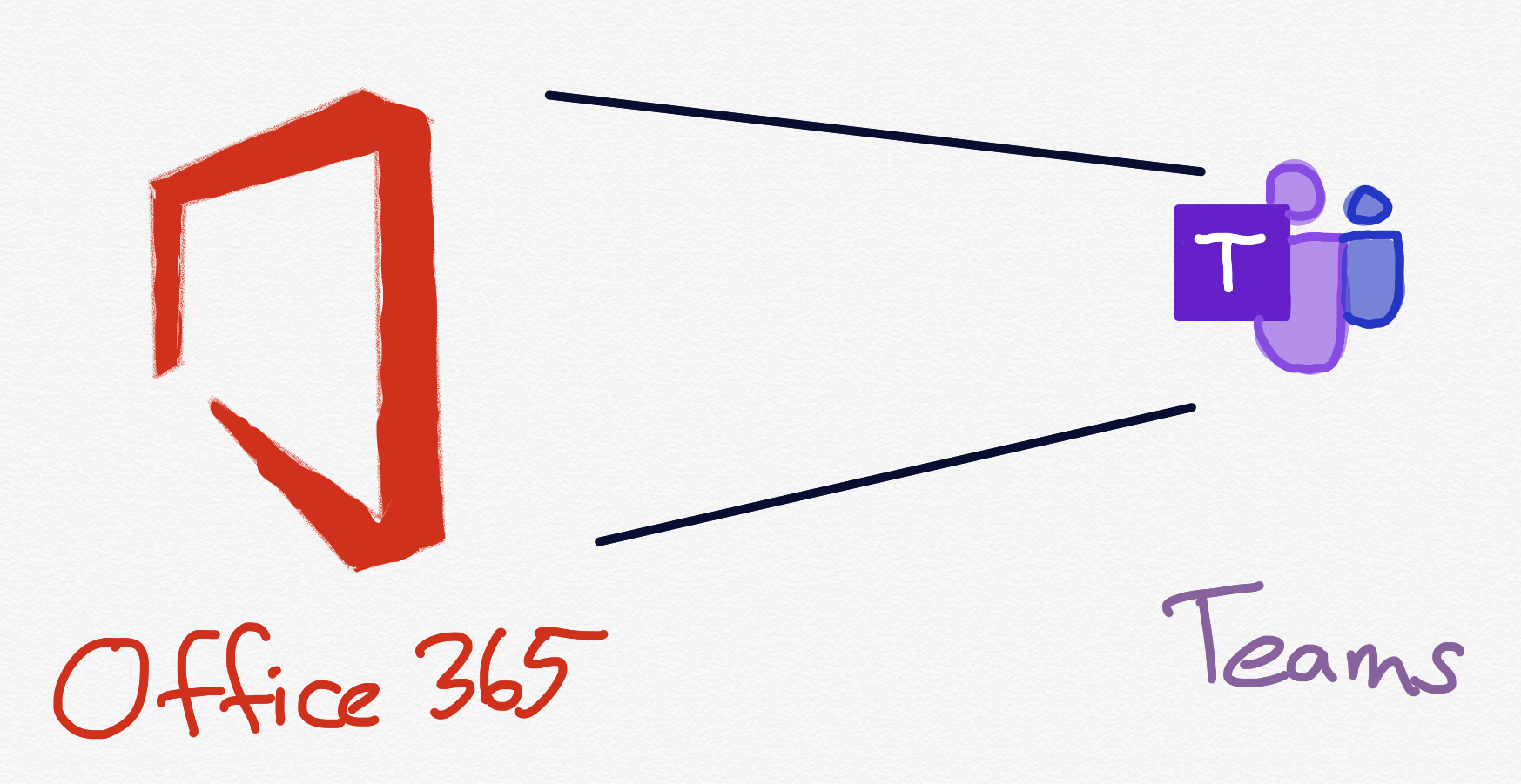
This is precisely what you would expect from a product leveraging an existing use case and an existing customer relationship. Contrast this first to Zoom, which addresses an existing use case with the need to acquire new customer relationships: Zoom had a challenge building their initial customer base, but from that base they have growth opportunities both in terms of new use cases and also deepening their engagement with their customers.
Slack’s opportunity is even more striking: by virtue of starting with both new customers and a new use case, the opportunity to absorb both existing use cases (always easier than creating new ones) and also deepening utility with existing customers is significant. That is how you get IPO graphs that look like this:
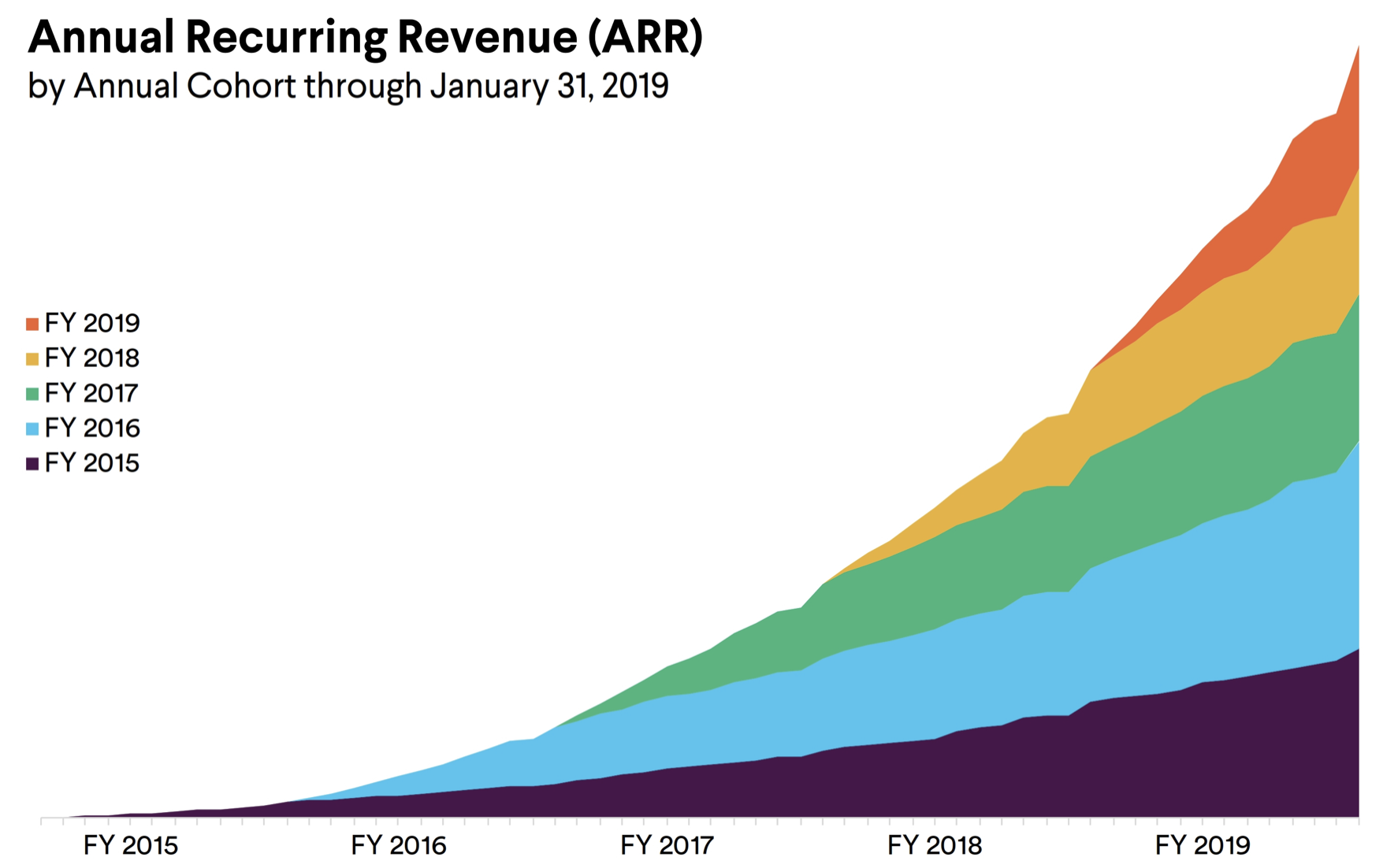
Slack is not only growing users, it is also growing its monetization of those users over time, and it is fair to expect both to continue. This is exactly what Microsoft is lacking: at best the company is transitioning existing Microsoft users to a SaaS model, and keeping them away from companies like Zoom or Slack. That, though, is not a recipe for growth in the very long run.
The Enterprise Growth Framework
You can chart these three products on those two vectors — the pre-existence of a customer relationship, and the pre-existence of a customer use case:
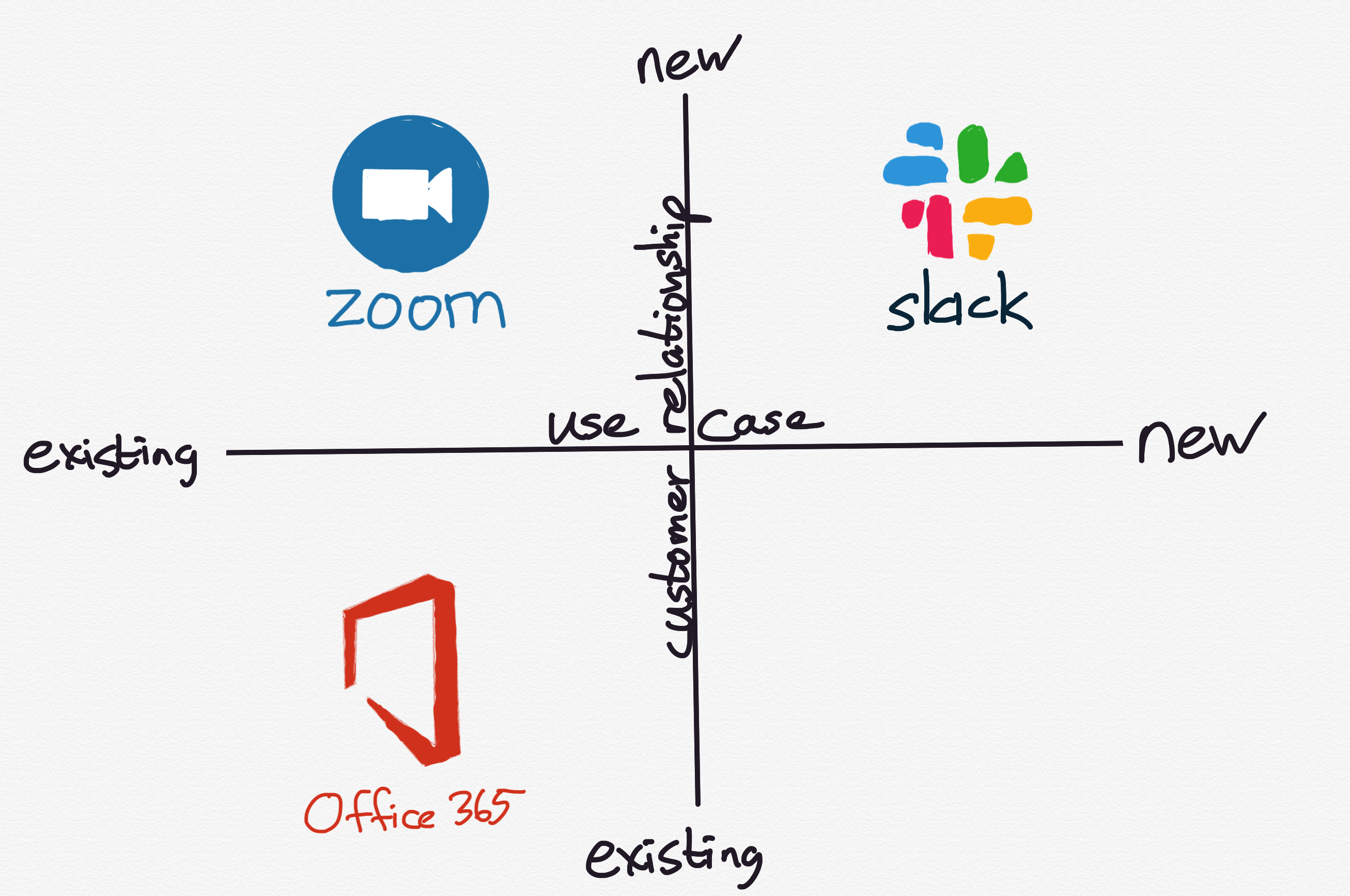
This is where Nadella’s Microsoft has fallen short. The company has done well to leverage its pre-existing strengths into more valuable relationships with its existing customers and a viable option for new ones, and, as I noted above, has indeed moved into new use cases; Teams clearly goes in the lower-right part of the above graph:
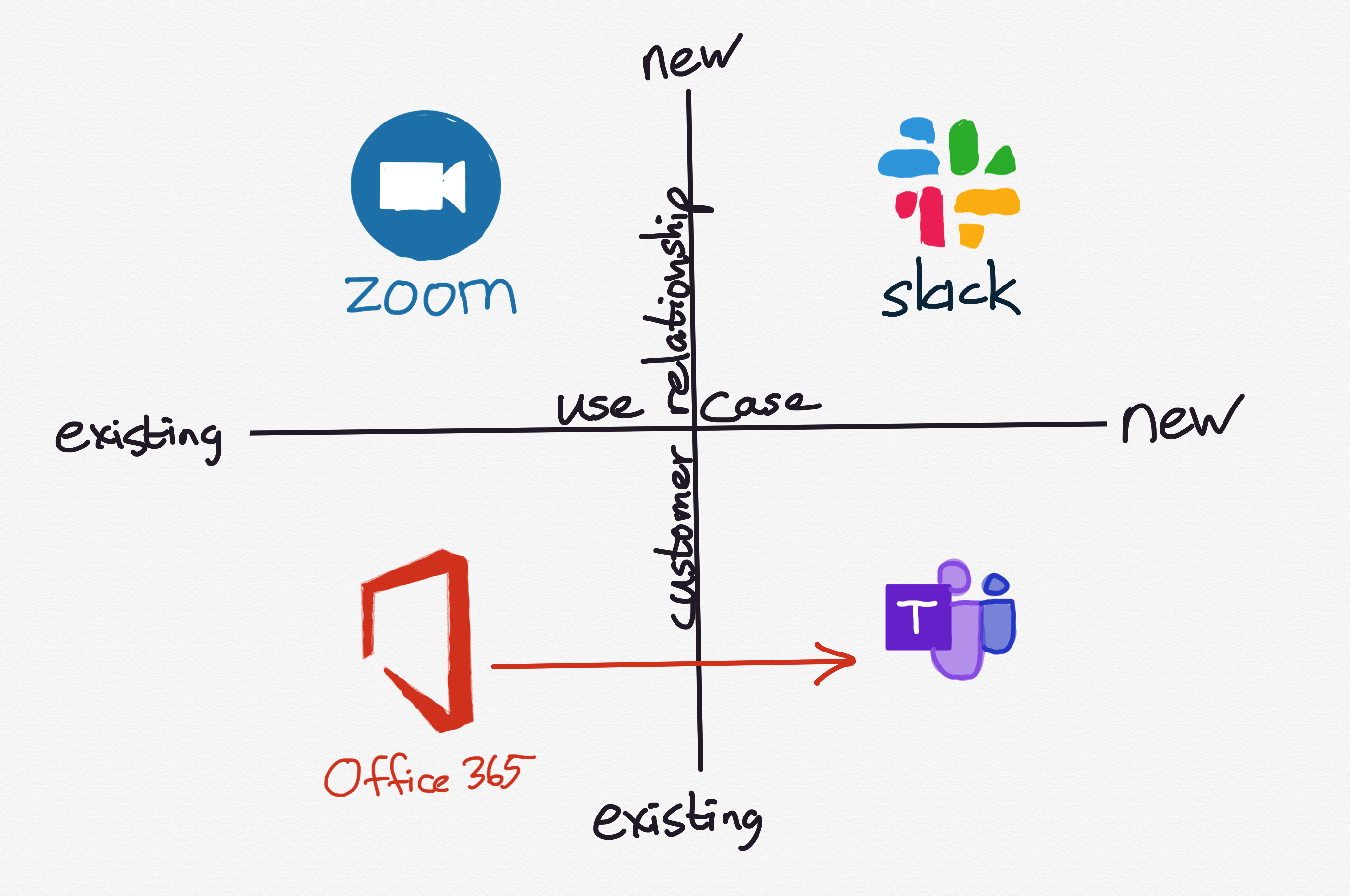
The problem is that to the extent Teams is successful it is because it is exploiting Microsoft’s existing customer base, not necessarily winning customers who would have never considered Microsoft in the first place. There is not nearly enough industry-leading technology (as is the case with Zoom) or innovation in new use cases (as was the case with Slack) to engender confidence that the company can grow beyond its existing customer relationships in the very long run. This is why companies like Zoom and especially Slack are so valuable: they create new customers who are primed for growth; Microsoft, meanwhile, is mostly keeping its existing customers in-house.
This, then, is Nadella’s new challenge: the company could have acquired Slack early in Nadella’s tenure, and considered Zoom, but waited too long on both. Microsoft has figured out how to leverage its existing userbase: how to increase it remains an open question.
05 May 09:33

Ama-Zine Prompts
by Bryan Mathers
Amy Burvall and myself thoroughly enjoyed delivering a hands-on Zine-making workshop at OER19 in Galway earlier this month. It was so good to be back in the motherland. But the trouble with a workshop of this nature is that most people are a little uncomfortable when faced with a blank piece of paper. So, in our Zine-storming session pre-workshop, Amy listed out some prompts to help folks jump right in… (p.s. if you’re an educator, check out Amy’s Intention book!).
The post Ama-Zine Prompts appeared first on Visual Thinkery.
05 May 09:33
Tradeoff solved: Jupyter Notebook OR version control. Jupytext brings you the best of both worlds
u/kite_and_code,
Reddit,
Apr 30, 2019

This is a reference ready-made for my talk tomorrow. It describes a convergence of Jupyter Notebooks and version control. "Jupytext saves two (synced) versions of your notebook. A .ipynb file and a .py file. (Other formats are possible as well.) You check the .py file into your git repo and track your changes but you work in the Jupyter notebook and make your changes there." Follow the link to Jupytext - there's a ton of documentation on the GitHub site. That is all.
Web: [Direct Link] [This Post]
05 May 09:31
[ridgeline] End of an Era
by Craig Mod
On the last day of Heisei I went on a little walk.
I woke up at Motomiya, one of the best inn experiences I’ve had during my thus-far fifteen days of Nakasendo walking. You must stay there if you find yourself in Magome. Motomiya bills itself as a “guesthouse” but exceeded in cleanliness and kindness and warmth any of the onsens or ryokans or hotels I had stayed at previously.
05 May 05:53
Deconstruction of a Failure
Something I regularly tell my daughter, who can tend towards perfectionism, is that we all fail. Over the last few years, I’ve seen more and more talks and articles about embracing failure. The key is, of course, to learn from the failure.
I’ve written a bit before about what I learned from leading the MozReview project, Mozilla’s experiment with a new approach to code review that lasted from about 2014 to 2018.
05 May 05:53
$2.4 Million in Prizes for Schools Teaching Ethics Alongside Computer Science
by Mozilla
Omidyar Network, Mozilla, Schmidt Futures, and Craig Newmark Philanthropies are announcing the Stage I winners of our Responsible Computer Science Challenge
Today, we are announcing the first winners of the Responsible Computer Science Challenge. We’re awarding $2.4 million to 17 initiatives that integrate ethics into undergraduate computer science courses.
The winners’ proposed curricula are novel: They include in-class role-playing games to explore the impact of technology on society. They embed philosophy experts and social scientists in computer science classes. They feature “red teams” that probe students’ projects for possible negative societal impacts. And they have computer science students partner with local nonprofits and government agencies.
The winners will receive awards of up to $150,000, and they span the following categories: public university, private university, liberal arts college, community college, and Jesuit university. Stage 1 winners are located across 13 states, with computer science programs ranging in size from 87 students to 3,650 students.
The Responsible Computer Science Challenge is an ambitious initiative by Omidyar Network, Mozilla, Schmidt Futures, and Craig Newmark Philanthropies. It aims to integrate ethics and responsibility into undergraduate computer science curricula and pedagogy at U.S. colleges and universities.
Says Kathy Pham, computer scientist and Mozilla Fellow co-leading the Challenge: “Today’s computer scientists write code with the potential to affect billions of people’s privacy, security, equality, and well-being. Technology today can influence what journalism we read and what political discussions we engage with; whether or not we qualify for a mortgage or insurance policy; how results about us come up in an online search; whether we are released on bail or have to stay; and so much more.”
Pham continues: “These 17 winners recognize that power, and take crucial steps to integrate ethics and responsibility into core courses like algorithms, compilers, computer architecture, neural networks, and data structures. Furthermore, they will release their materials and methodology in the open, allowing other individuals and institutions to adapt and use them in their own environment, broadening the reach of the work. By deeply integrating ethics into computer science curricula and sharing the content openly, we can create more responsible technology from the start.”
Says Yoav Schlesinger, principal at Omidyar Network’s Tech and Society Lab co-leading the Challenge: “Revamping training for the next generation of technologists is critical to changing the way tech is built now and into the future. We are impressed with the quality of submissions and even more pleased to see such outstanding proposals awarded funding as part of Stage I of the Responsible Computer Science Challenge. With these financial resources, we are confident that winners will go on to develop exciting, innovative coursework that will not only be implemented at their home institutions, but also scaled to additional colleges and universities across the country.”
Challenge winners are announced in two stages: Stage I (today), for concepts that deeply integrate ethics into existing undergraduate computer science courses, either through syllabi changes or teaching methodology adjustments. Stage I winners receive up to $150,000 each to develop and pilot their ideas. Stage II (summer 2020) supports the spread and scale of the most promising approaches developed in Stage I. In total, the Challenge will award up to $3.5 million in prizes.
The winners announced today were selected by a panel of 19 independent judges from universities, community organizations, and the tech industry. Judges deliberated over the course of three weeks.
<The Winners>
(School | Location | Principal Investigator)
Allegheny College | Meadville, PA | Oliver Bonham-Carter
While studying fields like artificial intelligence and data analytics, students will investigate potential ethical and societal challenges. For example: They might interrogate how medical data is analyzed, used, or secured. Lessons will include relevant readings, hands-on activities, and talks from experts in the field.
Bemidji State University | Bemidji, MN | Marty J. Wolf, Colleen Greer
The university will lead workshops that guide faculty at other institutions in developing and implementing responsible computer science teaching modules. The workshops will convene not just computer science faculty, but also social science and humanities faculty.
Bowdoin College | Brunswick, ME | Stacy Doore
Computer science students will participate in “ethical narratives laboratories,” where they experiment with and test the impact of technology on society. These laboratories will include transformative engagement with real and fictional narratives including case studies, science fiction readings, films, shows, and personal interviews.
Columbia University | New York, NY | Augustin Chaintreau
This approach integrates ethics directly into the computer science curriculum, rather than making it a stand-alone course. Students will consult and engage with an “ethical companion” that supplements a typical course textbook, allowing ethics to be addressed immediately alongside key concepts. The companion provides examples, case studies, and problem sets that connect ethics with topics like computer vision and algorithm design.
Georgetown University | Washington, DC | Nitin Vaidya
Georgetown’s computer science department will collaborate with the school’s Ethics Lab to create interactive experiences that illuminate how ethics and computer science interact. The goal is to introduce a series of active-learning engagements across a semester-long arc into selected courses in the computer science curriculum.
Georgia Institute of Technology | Atlanta, GA | Ellen Zegura
This approach embeds social responsibility into the computer science curriculum, starting with the introductory courses. Students will engage in role-playing games (RPGs) to examine how a new technology might impact the public. For example: How facial recognition or self-driving cars might affect a community.
Harvard University | Cambridge, MA | Barbara Grosz
Harvard will expand the open-access resources of its Embedded EthiCS program which pairs computer science faculty with philosophy PhD students to develop ethical reasoning modules that are incorporated into courses throughout the computer science curriculum. Computer science postdocs will augment module development through design of activities relevant to students’ future technology careers.
Miami Dade College | Miami, FL | Antonio Delgado
The college will integrate social impact projects and collaborations with local nonprofits and government agencies into the computer science curriculum. Computer science syllabi will also be updated to include ethics exercises and assignments.
Northeastern University | Boston, MA | Christo Wilson
This initiative will embed an ethics component into the university’s computer science, cybersecurity, and data science programs. The ethics component will include lectures, discussion prompts, case studies, exercises, and more. Students will also have access to a philosophy faculty advisor with expertise in information and data ethics.
Santa Clara University | Santa Clara, CA | Sukanya Manna, Shiva Houshmand, Subramaniam Vincent
This initiative will help CS students develop a deliberative ethical analysis framework that complements their technical learning. It will develop software engineering ethics, cybersecurity ethics, and data ethics modules, with integration of case studies and projects. These modules will also be adapted into free MOOC materials, so other institutions worldwide can benefit from the curriculum.
University of California, Berkeley | Berkeley, CA | James Demmel, Cathryn Carson
This initiative integrates a “Human Contexts and Ethics Toolkit” into the computer science/data science curriculum. The toolkit helps students discover when and how their work intersects with social power structures. For example: bias in data collection, privacy impacts, and algorithmic decision making.
University at Buffalo | Buffalo, NY | Atri Rudra
In this initiative, freshmen studying computer science will discuss ethics in the first-year seminar “How the internet works.” Sophomores will study responsible algorithmic development for real-world problems. Juniors will study the ethical implications of machine learning. And seniors will incorporate ethical thinking into their capstone course.
University of California, Davis | Davis, CA | Annamaria (Nina) Amenta, Gerardo Con Díaz, and Xin Liu
Computer science students will be exposed to social science and humanities while pursuing their major, culminating in a “conscientious” senior project. The project will entail developing technology while assessing its impact on inclusion, privacy, and other factors, and there will be opportunities for projects with local nonprofits or government agencies.
University of Colorado, Boulder | Boulder, CO | Casey Fiesler
This initiative integrates an ethics component into introductory programming classes, and features an “ethics fellows program” that embeds students with an interest in ethics into upper division computer science and technical classes.
University of Maryland, Baltimore County | Baltimore, MD | Helena Mentis
This initiative uses three avenues to integrate ethics into the computer science curriculum: peer discussions on how technologies might affect different populations; negative implications evaluations, i.e. “red teams” that probe the potential negative societal impacts of students’ projects; and a training program to equip teaching assistants with ethics and equality literacy.
University of Utah | Salt Lake City, UT | Suresh Venkatasubramanian, Sorelle A. Friedler (Haverford College), Seny Kamara (Brown University)
Computer science students will be encouraged to apply problem solving and critical thinking not just to design algorithms, but also the social issues that their algorithms intersect with. For example: When studying bitcoin mining algorithms, students will focus on energy usage and environmental impact. The curriculum will be developed with the help of domain experts who have expertise in sustainability, surveillance, criminal justice, and other issue areas.
Washington University | St. Louis, MO | Ron Cytron
Computer science students will participate in “studio sessions,” or group discussions that unpack how their technical education and skills intersect with issues like individual privacy, data security, and biased algorithms.
The Responsible Computer Science Challenge is part of Mozilla’s mission to empower the people and projects on the front lines of internet health work. Learn more about Mozilla Awards.
Launched in October 2018, the Responsible Computer Science Challenge, incubated at Omidyar Network’s Tech and Society Solutions Lab, is part of Omidyar Network’s growing efforts to mitigate the unintended consequences of technology on our social fabric, and ensure products are responsibly designed and brought to market.
The post $2.4 Million in Prizes for Schools Teaching Ethics Alongside Computer Science appeared first on The Mozilla Blog.
05 May 05:53
"And driving 45 minutes home just to update the games really isn't an option..."
by peter@rukavina.net (Peter Rukavina)
A lovely story about planning for edge cases by Anne Gibson; in part:
Internet in homes is pretty ubiquitous, especially among those who can afforda Nintendo Switch or a Playstation 4 in the first place, so the chances that the person buying the game doesn’t have access is pretty darned low…
…unless you’re in the hospital for a cystic fibrosis tune-up, and only one of the two household Nintendo Switches has copies of Super Mario Party or Mario Kart 8 that are up to date. And the hospital’s guest internet, which is perfectly useful for downloading email and surfing the web, has decided it won’t let you connect to the Nintendo game servers. And driving 45 minutes home just to update the games really isn’t an option.
The original version of Almanac.com had a “hole” in the top-left corner, just like the print version does; if you clicked the home you got to read The Hole Story.
I like it when technology is created to do unexpected things.
(Oh, and if you want to learn more about the hole, watch this video).
05 May 05:53
The Daily Edit – Condé Nast Traveler: Bill Phelps
by Heidi Volpe






Condé Nast Traveler
Photo Director: Caroline Metcalf
Photographer: Bill Phelps
Heidi: What type of direction did you get from the magazine?
Bill: “It was the perfect assignment for a few reasons. First, it was in a city I had been longing to visit, I love Italy, and this was truly special.
My editor simply told me – “go to Palermo, and come back.” I think one of the best things a photo editor can do on an assignment like this is to show trust in the photographers they hire. They were drawn to the photographers work for a reason, and letting them do their natural best is key. It frees up the experience to really be open to the unexpected, which is exactly what happened here for me.
Had you been to Italy before?
Yes. I was reminded of a shoot I had done in Tuscany a few years before where I was working with Alduino Ventimiglia, a descendent of Frederick the 2nd of Sicily.
He is the man responsible for saving a breed of Sicilian war-horse, the Persano stallion. One evening we were speaking of Sicily, and he asked me “what do you think of when you
think of Sicily” “mystery,” I said. “exactly” he said. I’m not sure if a photographer can be assigned to “shoot” mystery, it is something you must experience when you’re not looking. Palermo, like other Italian cities I have been to -Napoli, or Tropea for example, has many layers of mystery. It has a kind of shiny and forward busy side, as well as a deeply poetic dark side. The connection between the two is the “vena cava” of sorts, I was excited to see what the city was willing to show me.
Who did you travel with?
My Italian producer from Rome was available to accompany me.
What was the first thing you did upon landing?
Upon landing from Rome, we were immediately in search of local delicacies. The fish, the sea urchin, the infusions and digestifs. The weather was building, it was hot, and there was a beautiful pressure in the air. We found a small, beautiful place, with a sidewalk terrace covered by a canvas canopy. The food was simple and perfect, the light from the encroaching storm was telling and moody, I loved it. Near the closing
of our meal, the sky opened up and flooded the streets, reflecting the “bruised” sky and shifting clouds, we remained at our table outside beneath the canvas roof, sipping a beautiful, herbaceous liquor made from laurel leaves. The first two shots of the printed story were taken after the storm – the two upper left images. Upon leaving, I noticed in the corner of one of the windows, a tiny sticker reading “Member of the Moto Guzzi owners club.” I asked about the location of the club, thinking it might offer a possible view into a stylish corner of the city, I also own a vintage Moto Guzzi, so I was personally intrigued.



Did you have a shot list?
We had no shot list, the mystery unfolded in front of us, as we moved from moment to moment, person to person, meal to meal. Our first hotel was hidden in a backstreet, and inspired some exploration. Having given up on the motorcycle club, but still keen to find some Italian machines, I noticed a flash of red through a door barely open. We stopped, and had a look. It turned out to be an old bike shop run by its original owner, vintage Italian exotica, like the Binelli race bike also pictured. It turned out that the bike shop had been a theater for puppetry, still adorned with handprint murals, and backdrops. I asked about the tradition of Marionettes, and puppet theater, they happily lead me to the master, also pictured below.


As a photographer, my work is to make memories, storytelling is key. This trip in particular was loaded with
experience, a testament to the trust of my editor Caroline Metcalf. If I had been chasing down a shot list, none of this might have happened.
How did you find your subjects?
Our first night there, I was shooting shadows in a back alley, the sun had just gone down. I heard something which sounded like a metal knife on glass, clinking in a window above me. I looked up and saw a woman chipping wax off of some antique candle sticks. She asked me if I was looking for something, I said I was looking for shadows. I noticed the fresco covered ceiling behind her, and asked if she lived there. She said yes, and it was a studio as well. I told her it looked beautiful, and that we were shooting for a magazine. She asked if we wanted to come up for a drink, of course we said yes. She turned out to be a furniture designer, and was having people over for dinner. We helped her in the kitchen, set the table, and were there for the evening, it was amazing, and we are still in touch. I mentioned I was interested to find some characters to shoot, and I wanted to breathe in some style. She gave it some thought, and connected me to a friend the very next day. We met at the studio a day later, went through her closet, and dressed her
friend Lucrezia in clothes I found in her closet. Lucrezia turned out to be a photographer, director, performer, we too are still in contact, the layers continue.



How many days were you there?
I believe we were there for 4 days? maybe 5?
Did you submit those grids of images or did they edit those for you?
They got so many pictures out of it, they had to spread it out using grids, a good problem to have.
I do play with diptychs in my own edits, and feel it helps create contrast graphically, but it also helps to tell a story and create a narrative.
Did you turn in both black and white and color?
I mixed black and white and color, they pretty much went with what I sent.
The post The Daily Edit – Condé Nast Traveler: Bill Phelps appeared first on A Photo Editor.
------------------------
Visit our sponsor Photo Folio, providing websites to professional photographers for over 10 years. Featuring the only customizable template in the world.
------------------------
05 May 05:53
Firefox 67 Beta 16 Testday, May 3rd
by Camelia Badau
Hello Mozillians,
We are happy to let you know that Friday, May 3rd, we are organizing Firefox 67 Beta 16 Testday. We’ll be focusing our testing on: Track Changes M2 and WebExtensions compatibility & support.
Check out the detailed instructions via this etherpad.
No previous testing experience is required, so feel free to join us on #qa IRC channel where our moderators will offer you guidance and answer your questions.
Join us and help us make Firefox better!
See you on Friday! 
05 May 05:53


The New Librem One Services
by David Seaward

Tired of your digital life being exploited online?
Hi. We’d like to present Librem One.
Purism isn’t only about designing and producing secure hardware and software, and we have just added a neat bundle of services to our offer:
Encrypted chat – simple end-to-end encrypted chat, VoIP, and video calling.
Encrypted mail – easy to use, end-to-end encrypted email.
Encrypted VPN – toggle your connection to a secure VPN tunnel.
Public social – safe and privacy-respecting social media account.
Sign up now and get services that respect you
Our bundled, all-in-one services are ethical, respectful of your digital rights and concerned about your privacy – something we guess has been on your mind lately – or maybe for quite some time now. It’s in everyone’s mind, these days: we love the convenience of digital, internet-based services, but we worry about what we read and watch in the news. We love communicating, but communication between peers and family is meant to be private. It’s meant to be safe, and yet we are being harvested. We put our loved ones at risk by emailing them, by tagging their name. Interacting with the ones you love is not meant to serve other’s interests or to exploit you in any way.
At Purism, we are a Social Purpose Company. We don’t exploit you (and, by our own philosophy and contract, we can’t exploit you). We don’t offer advertising services to third parties. We don’t track users. We don’t look at, sell, or share anything – we offer a simple subscription model.
Librem One is a subscription service, using open standards and free software, and it is available for $7.99/mo, or $71.91/yr for the four services. Librem One does offer a basic tier, with encrypted chat and public social, for a pick-your-price from free to $5.99/mo. Librem One bundles popular, convenient services into a single, easy-to-use account – with more services are to be added over time.
Librem One. Pure, ethical services for people with principles.
Librem One is a growing bundle of ethical services. By creating a network service that advances social good, societal freedom, personal privacy and the best security, Purism is changing the world for the better. If you’d like to know more or support us, we have an ongoing crowdfunding campaign.
The post The New Librem One Services appeared first on Purism.
05 May 05:53
Money, then everything else
by df897FDRIORhjflkgfd
A lot of times we pay attention to things in our business that aren’t true markers of anything meaningful. Worse, we can let these false markers guide decisions in our work.
05 May 01:44

Success doesn’t fit the narrative
by Gordon Price
Did you miss this story?

Mike Howell in the Courier seems to be the only one* who extensively covered the data dump from the City’s 2018 Panel Survey: an annual look at transport share and distance by Vancouver residents. This is the sixth one, and it helps track progress towards our 2040 goals.
How we doing?
Amazingly well, actually. As Mike details:
Vancouver has seen the biggest increase in people choosing to walk, cycle or use transit to get around the city than it has in five previous years of tracking such data. …
The data from the survey showed a four per cent decrease in auto trips (three per cent for a driver, one per cent for a passenger) compared to results of the 2017 survey.
In addition, participants indicated they drove fewer kilometres—2.9 per cent—than the previous year. LaClaire noted the decrease translates to savings in fuel, a reduction in greenhouse gas emissions and obvious health benefits.
There are lots of supporting data, many charts, colourful maps – click and go crazy. You’ll be one of the few.
But if you want to go find Mike’s column, good luck. I had no luck scanning the Courier‘s website. There’s a reprint in Business in Vancouver – but check out the comments at the bottom. There aren’t any.
Now why is this? Here’s a story with inherent controversy – at least if they had put ‘bike lanes’ in the headline. When measured against trends in other cities, Vancouver is doing so well that it confounds the experts. Results seem to defy some common beliefs – certainly the premise that you can’t get people out of their cars, that money on active transport is disproportionate if not wasteful, that ‘social engineering’ is futile and the City is operating more on wishful thinking than practical engineering, with little to show for it except more congestion.
If you disagree with my observations, go to town, join in on the conversations and debates that are occurring all over social and mainstream media.
Oh wait, there aren’t any. This story, and all the supporting data, seems to have sunk without a trace, if it even made any ripples to begin with.
My theory: too much consistent good news, with too many facts. A lot of us don’t like, or trust, too much success. So we ignore it. Don’t include it in the narrative. Leave it unspoken. And then go on with our own narratives that match up with our own perceptions, without having to reevaluate our prejudices too much.
I’m including myself. Because I don’t want ‘success’ to make us complacent, to detract from the omissions, to take the pressure off the unconvinced. And I really don’t like clicking on nonsupporting data.
I wasn’t going to run this story initially, presuming that Price Tags’ readers already knew about these results, took them for granted, or wanted to focus on the contentious.
Mistake. We can’t figure out what’s going on unless we look at the figures too.
*UPDATE: I wrote that before listening to the latest Cambie Report, during which Patrick Meehan reports and comments on TransLink’s annual bus performance review (starts at 32:40). Similar kind of story: way too much incomprehensible good news. The three-year overall transit increase, region-wide, is 18.5 percent – “which,” as Patrick says, “is mind-boggling.” The trio then moves on to the downsides and worst-performing routes. That’s the way it works, even among the transit advocates. ‘Success’ cannot be put in the same sentence without being accompanied by ‘but.’
05 May 01:44
The Free Transit Illusion
by Stephen Rees
One of the reasons that I blog much less these days, is that I got bored with myself. Every time I sat down to write it seemed that what I was writing, I had written before. Even when I was writing that it was repetitive, I kept on. Yet the illusions that beset us continue to be repeated. As if those notions had not already been disproven, repeatedly.
It is a truism, but it takes more energy to refute a falsehood than to repeat. Conservatives rely on this. Almost everything they assert turns out to be untrue. Yet the policies they endorse continue to operate despite their obvious failures. Wealth has never trickled down. Holding down wages has not created more jobs. Making drugs illegal has not reduced their use at all. Increasing spending on the military has not made us safer. Prisons do nothing to reduce crime. Corporal punishment is not effective at improving children’s behaviour.
The left also endorses fatuous policies, ones shown time and again to be ineffective. Mostly deciding to adopt the policies of previous, conservative governments. The BC NDP is doing now exactly what the BC Liberals endorse: Site C, highway widening, cutting down old growth forests, expanding LNG.
Just as we know what we should be doing – reducing ghg emissions being the most important – what we actually do barely scratches the surface and mostly we continue with business as usual.
There is a problem of poverty. Just as providing homes turns out to be the only effective solution to homelessness, so providing money is the only way to relieve poverty. The first thing new Premier Ford did was cancel the Guaranteed Income pilot project – just in case it proved that point once again.
Here we have once again fallen into to happy illusion that in order to deal with poverty – and the fact that some people have a hard time paying their transit fares – we should make transit free. The latest developments here have been an endorsement by Victoria City Council – and now by Kai Nagata of Dogwood who uses Jason Kenney’s swearing in as a hook for a piece about what to do when Kenney “turns off the taps”. Kenney, now sworn in, says he won’t – yet.
It is not surprising that in support of this proposal a number of easily disprovable assertions are made
“Zero-fare public transport is the norm in many cities across Europe. ”
Actually very few cities – Dunkirk (France), Tallinn (Estonia) and apparently two dozen other French urban areas – though only Aubagne is named and analyzed. Luxembourg is going to try it nationally, though it is a very small country and has made its own economy successful by being a well known haven for tax evasion.
There is a list at https://freepublictransport.info/city/ but it is not reliable. Calgary, for example, is shown on that list, but its own webpage provides a list of fares – free only applies to a downtown section, not the whole system, and pets. Frankly, I am not about to spend any more time checking the veracity of ALL of the rest of the assertions but Winnipeg isn’t a free system either. Bizarrely England is listed as fare free – that may just be a formatting error or a reference to the Old Age concession of a free bus pass. This is of limited value since it does not apply to other modes – trains – and in the deregulated market where local government has been deliberately starved of funds there is little to no socially essential service outside of the dense urban area. The country bus is largely a fond memory. The lack of revenue for the operators (little to no subsidy from local government, no income from pass users) means there is no incentive to increase service.
By the way, Seattle used to have a free fare zone downtown, but dropped it. It is one of the few transit systems in the US that reported increased use last year.
There is a wikipedia article (see below) but it lacks references (though the bit I quote has a source).
The notion that appeals to Dogwood is the mistaken belief that free fares will get people out of their cars and onto transit, and that this will reduce congestion and thus fuel consumption. Nagata simply asserts this belief. The evidence does not support it. The inescapable rule is that traffic expands and contracts to fill the space available. Congestion exists because there is more demand that can be accomodated. Congestion tends to be worst at peak periods – journeys to and from work or education – and on some routes on public holidays – the road to the ferries from Tsawwassen on the Easter weekend being a most recent case. Generally people adapt to predictable congestion but just as a few will try car sharing, or leaving really early, others will drive when it seems “not so bad”. And there is a sort of equilibrium. Like most human compromises one which leaves everybody equally dissatisfied. We know that adding lanes to freeways just increases the amount of traffic, just as removing a freeway usually reduces congestion. The only thing that we know works is to price road use – when it is free it is over consumed – and provide more and better transit service that, as far as possible, uses its own right of way to avoid the congestion. You have to do both. Oddly, pricing roads, even though successful, is much less tried than free transit fares, which mostly isn’t.
From Wikipedia
Several large U.S. municipalities have attempted zero-fare systems, but many of these implementations have been judged unsuccessful by policy makers. A 2002 National Center for Transportation Research report suggests that, while transit ridership does tend to increase, there are also some disadvantages:[7]
- An increase in vandalism, resulting in increased costs for security and vehicle-maintenance
- In large transit systems, significant revenue shortfalls unless additional funding was provided
- An increase in driver complaints and staff turnover, although farebox-related arguments were eliminated
- Slower service overall (not collecting fares has the effect of speeding boarding, but increased crowding tends to swamp out this effect unless additional vehicles are added)
- Declines in schedule adherence
This U.S. report suggests that, while ridership does increase overall, the goal of enticing drivers to take transit instead of driving is not necessarily met: because fare-free systems tend to attract a certain number of “problem riders”, zero-fare systems may have the unintended effect of convincing some ‘premium’ riders to go back to driving their cars. It should be kept in mind that this was a study that only looked at U.S. cities, and the author’s conclusions may be less applicable in other countries that have better social safety nets and less crime than the large U.S. cities studied.[7]
[7] Perone, Jennifer S. (October 2002). “Advantages and Disadvantages of Fare-Free Transit Policy” (PDF). NCTR Report Number: NCTR-473-133, BC137-38. Retrieved 1 November 2012.
So if free transit does not attract drivers, who does it attract? Here it will be the homeless – kicked out of shelters during the day and looking for somewhere warm and dry. And for people to panhandle. The transit police will not be able to cope as without the need for proof of payment, removal will be at best temporary – even if they do manage to persuade the most offensive to leave. It will be gangs of kids. It will be people with nothing better to do than go for a ride somewhere – anywhere. Yes free transit increases the number of people on transit – just not the ones that you wanted to leave their cars behind.
The other reason that people do not leave their cars for transit is simply the inconvenience and relative slowness of transit (all those bus stops) compared to driving. Even for relatively short trips in denser parts of the region, car is still the preferred mode. It is not until there is a clear transit advantage for some trips do people switch in significant numbers. Clearly the expansion of the SkyTrain has worked well. In the parts of the region where additional road space is next to impossible, car trips are being curtailed. Where there is a better alternative, it does get used. More people are also choosing to walk or ride a bicycle – and the option to not own a car, but use ones that are available (Modo, car2go et al) – reduces the need to own a car, and thus try to maximise the return on capital investment. (“It’s sitting in the driveway, I might as well get some use out of it.”) The recent record boost in transit use, and the growing mode share for bikes and walking in Vancouver has nothing to do with transit fares, but everything to do with comparative advantage. And protected bike lanes – not white lines or sharrows.
Nagata also makes the fundamental error of assuming that governments (federal and provincial) will fund free transit. So far, the only thing that they have been willing to do is fund capital projects – preferably expansions – and usually with ribbon cutting opportunities and naming rights (The Canada Line for instance). What has always been lacking is adequate funding for operations and maintenance. Canada, on the whole, has done a much better job than the US. The shameful condition of the New York subway being one of the most glaring examples. Government also likes to play at innovation – which has given rise to several expensive, and usually short lived, experiments like the Whistler hydrogen buses. Instead of doing the essential dull, repetitive non-newsworthy state of good repair and high reliability transit cannot do without. Much of the innovations have not actually been necessary, but one thing that did come out of the imposed electronic fare collection system was essential data on how the system is used. In earlier times, Greater Vancouver saw a complete neglect of data collection as a result of foolish cost cutting. At least some of the newer and improved services now being provided is from a better understanding of when and where people are travelling – despite the lack of tap off on buses. Again, a free fare system loses all that information.
05 May 01:43
Tired of scrambling to get your job done?
The new parent's guide to surviving a programming job
Working as a programmer will keep you busy; parenting a baby is a massive amount of work. Doing both at once isn’t easy!
While it does get better with time, there are ways you can make it calmer, simpler, and easier in the short term. Based on my experience as a new parent and programmer, in the rest of this article I’ll cover:
- Mitigating sleep deprivation.
- Dealing with limited work hours.
- Other random tips.
Sleep deprivation is terrible
Sleep deprivation is awful. It makes you less focused, more irritable and cranky, and in many ways it’s similar to being drunk. When done deliberately sleep deprivation is literally a form of torture.
If you’re lucky your child will start sleeping through the night after a few months, but (from personal experience) not everyone is so lucky. So here are some ways to deal with lack of sleep.
Be kind
The irritability that results from sleep deprivation is going to impact all of your relationships—with your spouse/partner, your friends, and your coworkers. Keep in mind that you are going to get annoyed more easily, and try to compensate.
Remind yourself that the reason you’re so annoyed by the code you’re reviewing is probably nothing to do with your coworker’s skill, and everything to do with being woken up at 1AM, 3AM, and finally at 5AM.
Compensate for cognitive impairment
Besides being irritable, you are also cognitively impaired—you’re less smart than you usually are. You can compensate for this in a variety of ways:
- Spend more planning up front than you usually would; you’re more likely to forget about important details otherwise.
- Avoid writing complex code, since you’ll have an even harder time than usual keeping it in your head. Figuring out a simpler solution may take longer, but it’s worth it.
- Keep a “lab notebook”: write down what you’re planning on doing next, what you’ve already done, and status notes. This will help mitigate the memory problems from lack of sleep. It will also help you deal better with interruptions, and to get going at the start of the work day when you’ve already been “awake” for 7 hours and you can’t remember what or why you’re at the office.
Your time is limited
Even if you used to work longer hours (and you really shouldn’t have), you really shouldn’t be working long hours as a new parent. That means:
- Learning should be done not at home but on the job, which in any case is the best place to learn new skills.
- You need to learn how to say no to your boss, and how to set boundaries in general.
- Learn to prioritize. Only the truly most important things should be done first. Everything else will be done next—and if you don’t reach it, that’s OK, it was less important. “But this is almost as important!” Nope, not happening. “It would be really nice…” No.
Other advice
Pumping milk at the office: Pumping milk multiple times a day at the office can be time consuming. If your baby is healthy, I’m told you can pump once in the morning, stick the equipment in the fridge without cleaning it, and then pump a second time later in day. This saves you one cleaning cycle at the office.
(I am not a medical professional, ask your pediatrician first before doing this.)
Working at home: Some babies, I’m told, will just lie there happily babbling to themselves while you work. If you have the other kind of baby, the kind that screams continuously if they’re not held, you might be able to get a little work done at home by putting them in a baby carrier and using a standing desk.
A shorter workweek: Even if you’re not working long hours, a full-time 40-hours-a-week job may still be too much as a new parent. You can often negotiate a shorter workweek at your existing job fairly easily.
What really matters to you?
However efficient you are, having a child is going to take up a whole lot of time. And that means you’re going to have to make some choices about priorities: what things really matter you? Where do you really want to spend your time?
It’s a personal choice—I am glad I got to work part-time and take care of my kid the rest of the time, but I would hate to take care of a baby full-time. Your preferences may well be different.
But whatever you decide, just remember you need to choose: you can’t do everything.
Tired of scrambling to get your job done?
If you were productive enough, you could take the afternoon off, confident you’d produced high value work. Not to mention having an easier time finding a new job when you need one.
Learn the secret skills of productive programmers.
05 May 01:42
Exploring wasm2cil performance
(What is wasm2cil? See my previous blog entry.)
I've been trying to do some measurements to get a rough idea of performance for assemblies produced by wasm2cil.
A VERY rough idea. Take these numbers with a grain of salt.
Brotli compression
For a rather CPU-intensive test, the following Brotli library:
https://github.com/dropbox/rust-brotli
... makes a nice test case because it compiles to wasm32-unknown-wasi with no problems:
erics-mac-mini:rust-brotli eric$ cargo +nightly build --release --target=wasm32-unknown-wasi
I made a small code change to write out the elapsed time after compressing something.
My test case is measure the time required to compress sqlite3.c (the source code for SQLite in a single 7.4 MB "amalgamation" file).
First, I ran the original Rust version natively:
erics-mac-mini:rust-brotli eric$ cargo run --release --bin brotli -- -c sqlite3.c s1
    Finished release [optimized] target(s) in 0.19s
     Running `target/release/brotli -c sqlite3.c s1`
elapsed: 17
Second, I ran brotli.wasm through wasmtime:
erics-mac-mini:wasm2cil eric$ wasmtime --dir=. brotli.wasm -- -c sqlite3.c s1
elapsed: 81
Finally, I ran brotli.wasm through my own wasm2cil:
erics-mac-mini:tool eric$ dotnet run -- run ../brotli.wasm -- -c ../sqlite3.c s1
elapsed: 37
Summarized results:
| Implementation | Elapsed Time (sec) |
|---|---|
| native | 17 |
| wasmtime | 81 |
| wasm2cil | 37 |
So the wasm2cil version takes over twice as long as the native code. Hopefully I can narrow that gap with more focused work on performance.
It's a little surprising that wasmtime came in so much slower. Or maybe it's not. The comparison here has a little bit of apples-to-oranges going on.
First of all, WebAssembly memory accesses are supposed to be range-checked, and wasm2cil isn't currently doing that, while wasmtime probably is.
Second, we're probably seeing a basic difference in maturity between Cranelift JIT (which is fairly young) and .NET Core 2.2.
Third, I could be using wasmtime incorrectly, although I did try the --optimize flag, and it didn't help.
Finally, this is just one benchmark. In the next one, wasmtime does very well indeed.
SQLite
To do some measurements with SQLite, I wrote a little C program that uses the sqlite3 API to construct a table and query a subset of the rows. Specifically, given parameters (count), (first) and (last), it inserts (count) rows, where each row is two columns, the loop index, and the loop index squared. After the inserts are done, it does a SELECT sum() on the squares column using (first) and (last) as the range of rows.
In other words, the test program uses SQLite to calculate something basically equivalent to this:
int total = 0;
for (int i=0; i<count; i++)
{
    if ((i >= first) && (i <= last))
    {
        total += i * i;
    }
}
The main() for this test case allows the count, first and last parameters to be specified on the command line, as well as the name of the sqlite database file. So I did three runs:
1,000 rows; sum the square from 200 through 400
10,000 rows; sum the square from 2,000 through 4,000
100,000 rows; sum the square from 20,000 through 40,000
Here are those runs for the native code:
erics-mac-mini:reference eric$ ./a.out z1 1000 200 400
filename=z1  count=1000  first=200  last=400
elapsed: 472 ms
rc: 18766700

erics-mac-mini:reference eric$ ./a.out z2 10000 2000 4000
filename=z2  count=10000  first=2000  last=4000
elapsed: 4618 ms
rc: 1496797816

erics-mac-mini:reference eric$ ./a.out z3 100000 20000 40000
filename=z3  count=100000  first=20000  last=40000
elapsed: 46668 ms
rc: 1738801584
And for wasmtime:
erics-mac-mini:sqlite3 eric$ wasmtime --dir=. sqlite3.wasm -- w1 1000 200 400
filename=w1  count=1000  first=200  last=400
elapsed: 534 ms
rc: 18766700

erics-mac-mini:sqlite3 eric$ wasmtime --dir=. sqlite3.wasm -- w2 10000 2000 4000
filename=w2  count=10000  first=2000  last=4000
elapsed: 5292 ms
rc: 1496797816

erics-mac-mini:sqlite3 eric$ wasmtime --dir=. sqlite3.wasm -- w3 100000 20000 40000
filename=w3  count=100000  first=20000  last=40000
elapsed: 53024 ms
rc: 1738801584
And for wasm2cil:
erics-mac-mini:tool eric$ dotnet run -- run ../sqlite3/sqlite3.wasm -- c1 1000 200 400
filename=c1  count=1000  first=200  last=400
elapsed: 1860 ms
rc: 18766700

erics-mac-mini:tool eric$ dotnet run -- run ../sqlite3/sqlite3.wasm -- c2 10000 2000 4000
filename=c2  count=10000  first=2000  last=4000
elapsed: 5411 ms
rc: 1496797816

erics-mac-mini:tool eric$ dotnet run -- run ../sqlite3/sqlite3.wasm -- c3 100000 20000 40000
filename=c3  count=100000  first=20000  last=40000
elapsed: 42700 ms
rc: 1738801584
The printed sum result is the same in each case, and the resulting sqlite database files are byte-for-byte identical within each run.
To summarize the results, as elapsed time for each run, in milliseconds:
| Implementation | 1,000 rows | 10,000 rows | 100,000 rows |
|---|---|---|---|
| native | 472 | 4,618 | 46,668 |
| wasmtime | 534 | 5,292 | 53,024 |
| wasm2cil | 1,860 | 5,411 | 42,700 |
Weird.
The results for wasmtime are consistently about 13% higher than native, which is pretty impressive I think.
But the results for wasm2cil are all over the place:
At 1,000 rows, a LOT slower, 394 % of native
At 10,000 rows, a little slower, 117 % of native
At 100,000 rows, a little FASTER, 91 % of native
It seems bizarre for wasm2cil to be faster than the native code for ANY test, so for now I'm going to assume this is a defect in my approach. I did repeat the runs and got similar results each time. So this is an interesting mystery.
Bottom line
There is no bottom line. Not yet.
Well actually, I consider it good news that these test runs work (without crashing or incorrect results), and that timing comparisons are decent (in the same order of magnitude as native).
Beyond that level of precision, I consider this data interesting as long as I'm not drawing big-picture conclusions from it. These results raise more questions than they answer. Mostly I can use the information to guide my efforts to improve wasm2cil.
05 May 01:22
Apple ist wieder mal doomed
by Volker Weber

Doom & Gloom, man könnte meinen, das Schiff ginge unter:
Apple: Umsatz und Gewinn geschrumpft, iPhone-Umsatz schwächelt
Was daran stimmt: In China tut sich Apple schwer, iPhones zu verkaufen. Und das Mac-Geschäft ist rückläufig. Sollte es auch, bis Apple endlich das Butterfly-Keyboard repariert oder einen Mac Pro bringt.
Ansonsten aber eitel Sonnenschein. iPad plus 21%, Wearables, Home and Accessories plus 30% und Services plus 16% - und warten wir mal, was News+ und TV+ dazu beitragen werden. Ein Drittel des Gewinns kommt mittlerweile aus der Service-Sparte. iPad, Apple Watch und AirPods sind fantastische Produkte, die es in dieser Qualität sonst nirgends gibt.
05 May 01:22
Scientific Writing = Thinking in Words (my reading notes)
by Raul Pacheco-Vega
This is another book that helps those of us who are in STEM fields or publish within the STEM (science, technology, engineering, mathematics) areas write more clearly.

This book by David Lindsay, “Scientific Writing = Thinking in Words” is one of the best I’ve read as far as providing detail-oriented guidelines on how to write well in the STEM disciplines, and its advice applies broadly.
My biggest complaint with Lindsay's book isn't the content (his writing is agile and provides excellent feedback for scientific writing) pic.twitter.com/2DI7iTGWbD
— Dr Raul Pacheco-Vega (@raulpacheco) May 3, 2018
Lindsay is an excellent writer, and his recommendations on creating and executing solid presentations is much welcome, because a lot of what STEM scholars do is also present at conferences, and that component of academic life is not always emphasized in books on writing.
— Dr Raul Pacheco-Vega (@raulpacheco) May 3, 2018
In short, very much worth reading if you’re looking to improve your writing as an academic.
If you liked this blog post, perhaps you’d want to check my reading notes of other books on various topics, including scholarly writing, or my page on reading notes of books geared towards doctoral candidates undertaking their dissertation research. Disclaimer: I purchase all my books with my own hard earned money, and I receive absolutely no cash from promoting, reading or reviewing these books. My intention is simply to help others in academia, particularly graduate students and scholars at the margins.
05 May 01:21
The Coding Manual for Qualitative Researchers (my reading notes)
by Raul Pacheco-Vega
As a qualitative researcher who mentors students in conducting research using these methods in a primarily quantitative institution, it’s hard to do both mentoring theses and teaching them skills if you don’t teach the methods courses (which I couldn’t do even if I wanted to).
Therefore, with all the pain in my heart I have to send my students to do independent reading on methods if they choose a technique that is qualitative and in which they were not trained (remember I mentor students from other campuses and universities too). Obviously, I share with them my knowledge base for specific readings and books they ought to check out, and I guide them throughout the process.
One of the books I’ve liked the most throughout my career, (and I learned qualitative methods in graduate school!) is Johnny Saldaña’s “The Coding Manual for Qualitative Researchers“. This book is, in my opinion, canonical for anyone trying to learn how to code written material and undertake qualitative analysis.
Saldaña (yes, of Miles and Huberman and Saldaña fame) offers an in depth overview of coding methods including paper-based and computer-assisted. pic.twitter.com/Z6BGqDfohS
— Dr Raul Pacheco-Vega (@raulpacheco) December 20, 2018
As qualitative methods are primarily indicative, we rely on coding to discern patterns. Bear in mind that both Saldaña and I use rather positivist approaches to qualitative methods. This is in line with my use of other techniques that are quantitative and spatial. pic.twitter.com/sTUHXUW32P
— Dr Raul Pacheco-Vega (@raulpacheco) December 20, 2018
As I have repeatedly said, I learned the memo technique from my qualitative methods classes and now I use it at all points. Saldaña’s book is amazing and I just wish it were cheaper and more sturdy because I will not loan this book to anyone even to make a photocopy (it breaks) pic.twitter.com/Bn4GZk4i0Z
— Dr Raul Pacheco-Vega (@raulpacheco) December 20, 2018
Overall, I believe reading Saldaña’s book coupled with the Ryan and Barnard 2000 classic article should be a good introduction to how to undertake coding for qualitative researchers.
If you liked this blog post, perhaps you’d want to check my reading notes of other books on various topics, including scholarly writing, or my page on reading notes of books geared towards doctoral candidates undertaking their dissertation research. Disclaimer: I purchase all my books with my own hard earned money, and I receive absolutely no cash from promoting, reading or reviewing these books. My intention is simply to help others in academia, particularly graduate students and scholars at the margins.
05 May 00:55
The productivity pit: how Slack is ruining work
by Volker Weber
Job software like Teams, Slack, and Workplace were supposed to make us more productive. They havent.
Maybe someday we will find out that Enterprise Social Networks were a terrible idea as well.
30 Apr 02:53
Gender Representation in PEI Party Caucuses, 1993 to 2019
by peter@rukavina.net (Peter Rukavina)
I’ve lived on Prince Edward Island for 26 years and elections have been part of my experience since the beginning: the fateful 1993 election, where Catherine Callbeck’s Liberals won all but one seat, was held 15 days after I landed here.
Other than that 1993 result, where Pat Mella made up 100% of the PC Party caucus, the representation of women in PEI party caucuses has ranged from 0% (the Liberals in 2000 and the Greens in 2015) to a high of 26% (the Liberals in 2007).
In last week’s election there are two stories about gender representation in party caucuses.
First, the representation of women in the Liberal caucus went down to 0%, and in PC caucus down to 8%.
Second, the representation of women in the Green caucus went from 0% (or from 50%, if you include Hannah Bell’s by-election victory in 2017) to 63%.
The headline of last week’s CBC story, P.E.I. election brings slight jump for women in the legislature, doesn’t reflect the enormity of either.

30 Apr 02:53
TWSBI GO Fountain Pen
by peter@rukavina.net (Peter Rukavina)
My favourite new fountain pen this year is the TWSBI GO that I purchased at Oblation Papers & Press in Portland, Oregon in March:

The GO is an inexpensive pen–it cost me less than $20–with a striking design and a novel ink-filling mechanism: a spring-loaded pump, the instructions for the use of which are delightful:

And it really is that easy: unscrew, stick the nib in your inkwell with the plunger depressed, let go, and it’s filled with ink. It makes filling the Pilot Metropolitan, with its squeeze-the-rubber-bladder filling system, seem positively antediluvian.
TWSBI is a Taiwanese pen manufacturer with a name that has an interesting backstory:
TWSBI’s name stands for the phrase “Hall of Three Cultures” or “San Wen Tong” in Chinese. The character “Wen” translates into language and culture. The phrase “San Wen Tong” also brings to mind the Hall of the Three Rare Treasures created by Emperor Qianlong as a memorial to three great masterpieces of Chinese calligraphy. The initials of the phrase “San Wen Tong” was reversed and thus turned into “TWS”. The last letters “Bi” was added with its literal meaning of “writing instruments”. Thus combining the two segments, creating TWSBI.
You cannot, alas, buy TWSBI pens locally right now, but you can get them from Wonder Pens in Toronto.
30 Apr 01:37
Slower Streets, Vancouver City Council & Doing the Right Thing
by Sandy James Planner
Rolandtj
mkalus
shared this story
from  Price Tags. Price Tags.
|


Last week I wrote about City of Vancouver Councillor Pete Fry’s motion asking that Council support a resolution to the Union of British Columbia Municipalities to lobby the Province to amend the Motor Vehicle Act “to a default speed limit of 30 kilometers per hour for local streets with municipalities enabled to increase speed limits on local streets in a case-by-case basis by by-laws and posted signage.” Local streets refer to streets within a neighbourhood and not to streets that are arterials or residential collector streets with a yellow line down the center.
Councillor Fry has also requested that staff identify an area of Vancouver to pilot a 30 km/h speed limit, report back on the strategy, and implement the slower speed in that neighbourhood area to ascertain the effectiveness of the policy. That demonstration project within a neighbourhood would give citizens a litmus test of what changes when streets slow, and how pedestrians, seniors, rollers and cyclists might use the street space differently.
This is all well and good, and certainly follows practice internationally where the adoption of slower speeds on streets not only contributes to reduced fatalities and serious injuries. but also creates a new sense of livability, where stick hockey games can happen in the street, neighbours can stroll, and community conversations can occur. In Canada one-quarter of all Canadians will be seniors by 2030, and keeping seniors fit, engaged and active fits into slower streets that encourage walkability. In a place like Vancouver where there is pressure to create more rental housing and forgo some of the amenities that developers are normally asked for, slowing neighbourhood streets provides a low-cost way to enhance public environments. It is simply the right thing to do, and adds an element of safety on dark wintry rainy months.
So it was a surprise when Councillor Fry’s motion was being discussed at Council that a few NPA councillors clearly did not understand that slower neighbourhood streets are not just about fatalities and serious injuries, but are about making a commitment to a quality of neighbourhood street life in a densifying city.
Given the fact that Council had just heard a presentation on resilient cities and had a motion to have 2/3 of all trips in Vancouver by active transportation or transit by 2030 it just made sense to slow neighbourhood streets. Instead these councillors positionally stated that serious accidents and fatalities did not happen on neighbourhood streets, the kind of conditioned protective response to motordom that has shaped the 20th century.
As Wanyee Li in The Star noted both Edmonton and Calgary are reviewing lowering speed to 30 km/h. Toronto reduced speed in downtown neighbourhood streets to 30 km/h in 2015. Councillor Fry’s motion is elegant in that by asking the Province to grant municipalities “the power to establish speed limits for a certain category of streets or entire neighbourhoods” it does away with the need to sign each street.
This change to 30 km/h has been proposed before by the City of New Westminster and Councillor Patrick Johnstone a few years back to the Union of British Columbia Municipalities. But perhaps the time has come to be more serious about creating slower streets and more cohesive neighbourhoods.
Adrienne Tanner in the Globe and Mail writes: “Vancouver should follow the lead of other cities and embrace the slow-driving movement. In fact, why not take Mr. Fry’s motion a step further? Let’s dispense with the pilot project and drop the speeds on all residential streets. Even better, the province could take the initiative and save everyone the trouble of pushing for something that so obviously should be done.”

Image: Global News
29 Apr 22:41

A weekend in Mexico? Why the rise of long-haul short trips is so disastrous | Travel
mkalus
shared this story
from  The Guardian. The Guardian.
|
As someone who once took a work-related day trip to San Francisco it is a little hypocritical of me to criticise others for taking long-haul flights for vanishingly brief holidays. But for all sorts of reasons it really is a terrible idea.
The trend has been highlighted in Thomas Cook’s Holiday Report 2019, released this week, which notes “an increasing number of trips for less than seven days to long-haul destinations, with Mexico, San Francisco and other cities in the States rocketing in popularity.”
“We call them bite-size breaks,” says a Thomas Cook spokeswoman. “We’ve seen a big increase in people jetting off to long-haul destinations for a shorter amount of time. They’re trying to get their money’s worth out of their annual leave quota but also satisfy their desire for global travel.”
Flying has become cheaper; there are lots of good deals if you only carry hand baggage and check in online; the strength of the euro is encouraging us to look beyond the EU; and younger, unencumbered travellers think nothing of sitting in a plane for 10 hours and then embarking on a sleep-free 72 hours in Cancun or Cape Town. Farewell to the leisurely two-week package holiday – until you have children, at least.
Environmentally, the trend is a disaster, whatever the airlines say about greener aircraft and the rise of biofuels making flying less destructive. “That’s like saying we’ve thrown away plastic straws and now the world’s saved,” says Georgina Wilson-Powell, a travel specialist who edits the online sustainability magazine Pebble. “We need to encourage slow travel and local travel rather than jetting halfway across the world for three days. That’s just not eco-friendly.”
Wilson-Powell says flying is a touchstone in the war raging over climate change. “One of the most impactful things you can do if you want to live a more sustainable life is not fly,” she says. “Flying across the world for two or three days at a time doesn’t fit in to that.” She suggests that if you are flying long haul you should try to carbon offset – Emma Thompson’s get-out for her recent flight from Los Angeles was to join the Extinction Rebellion protest in London.
There is also the question of what weekend breakers get from taking a bite-sized chunk of a complex culture, and what they are putting in to the place they visit. “We encourage travellers to spend their money with people who really deserve it,” says Wilson-Powell. “Local tour groups, local accommodation, conservation projects, so your money is going back into the local economy. If you’re there for two or three days, that’s probably not happening. You’ll be spending most of your time on the plane.”
She says the rise in short breaks to long-haul destinations is driven by “a quest for the new”. “Social media fuels a lot of it. There are hotspots around the world that people want to get their photos taken in.” These are less bite-sized holidays than Instagram holidays. We came, we saw, we snapped. But what else is snapping?
… we can’t turn away from climate change. For The Guardian, reporting on the environment is a priority. We give climate, nature and pollution stories the prominence they deserve, stories which often go unreported by others in the mainstream media. At this critical time for our species and our planet, we are determined to inform readers about threats, consequences and solutions based on scientific facts, not political prejudice or business interests. But we need your support to grow our coverage, to travel to the remote frontlines of change and to cover vital conferences that affect us all.
More people are reading and supporting our independent, investigative reporting than ever before. And unlike many news organisations, we have chosen an approach that allows us to keep our journalism accessible to all, regardless of where they live or what they can afford.
The Guardian is editorially independent, meaning we set our own agenda. Our journalism is free from commercial bias and not influenced by billionaire owners, politicians or shareholders. No one edits our editor. No one steers our opinion. This is important as it enables us to give a voice to those less heard, challenge the powerful and hold them to account. It’s what makes us different to so many others in the media, at a time when factual, honest reporting is critical.
Every contribution we receive from readers like you, big or small, goes directly into funding our journalism. This support enables us to keep working as we do – but we must maintain and build on it for every year to come. Support The Guardian from as little as CA$1 – and it only takes a minute. Thank you.
29 Apr 22:41

Freedom Mobile could be the first to offer 5G unlimited data plans: analyst
by Shruti Shekar
IDC’s research vice-president of communications thinks Shaw’s Freedom Mobile will be the first to offer unlimited 5G data plans.
According to IT World Canada, Lawrence Surtees said he doesn’t see the Big Three rolling out unlimited plans.
“Freedom only has maybe four percent market share. So how are you going to from four percent to 25 percent?” He asked in an interview with the publication. “And I thought we’ll find the one radical thing we haven’t had anybody do yet…a [truly] unlimited data plan. There’s no way Telus or Rogers would be first to do that. There’s like a status quo between the three similar positions, and they want to hold on to what they’ve got.”
“But Freedom, only things they could do to realize that strategy would be it and they have a compelling reason. When they get 5G frequencies and also be in a position to have more ubiquitous national coverage, which they lack right now.”
Canada doesn’t have any 5G networks yet because it doesn’t have the necessary spectrum needed. The federal government has announced spectrum for 5G bands is set for 2020 and 2021.
5G operates over traditional and new cell radio frequency bands that include the low- (sub-1GHz such as 700MHz), mid- (1.6GHz, around 3.5-3.8GHz), and millimetre-wave (mmWave, such as 28GHz) ranges.
More recently though, Canada concluded the 600 MHz spectrum auction, a spectrum that is low-frequency and is able to penetrate through buildings and provide long distance coverage.
Freedom acquired 11 bands for nearly $492 million CAD.
Surtees thinks that when the 5G network rollout happens, Freedom has “nothing to lose and everything to gain,” and thinks that it will be a chance for the company to launch unlimited wireless data.
Source: IT World Canada
The post Freedom Mobile could be the first to offer 5G unlimited data plans: analyst appeared first on MobileSyrup.
29 Apr 22:41

Apple drops fourth iOS 12.3 public beta
by Patrick O'Rourke
After releasing the fourth public beta to developers earlier today, Apple has pushed out the public beta version of iOS 12.3.
This fourth iOS 12.3 beta comes after the launch of iOS 12.2 earlier this month. The update brings with it Apple’s revamped TV App, changes to the wallet app and general stability updates.
If you’ve already signed up for the public beta on your iPhone, navigate to ‘Settings,’ then ‘General’ and finally, ‘Software Update,’ in order to prompt your phone to download the new version of the beta.
The post Apple drops fourth iOS 12.3 public beta appeared first on MobileSyrup.
29 Apr 22:37
The Path to Nothing
by Eugene Wallingford
Dick Gabriel writes, in Lessons From The Science of Nothing At All:
Nevertheless, the spreadsheet was something never seen before. A chart indicating the 64 greatest events in accounting and business history contains VisiCalc.
This reminds me of a line from The Tao of Pooh:
Take the path to Nothing, and go Nowhere until you reach it.
A lot of research is like this, but even more so in computer science, where the things we produce are generally made out of nothing. Often, like VisiCalc, they aren't really like anything we've ever seen or used before either.
29 Apr 22:37


Samsung’s space-saving Space Monitor is now available in Canada
by Jonathan Lamont
Samsung’s excellent Space Monitor, first shown off at CES 2019, is making its way to Canada.
The South Korean manufacturer designed the Space Monitor to save desktop space in work environments. The monitor relies on a clever hinge and clamp system, allowing it to attach to the edge of a desk and fold up and down with ease.
By using a clamp to hold onto the edge of a desk, Samsung says it’s monitor increases usable desk space by 40 percent.
The hinge, however, really sets the monitor apart. Samsung designed the hinge to sit inside the monitor’s body, allowing the Space Monitor to rest flush against the wall. Users can also pull it forward, swinging the monitor down to rest on the table if they need.
Further, the arm of the hinge has a recessed channel to hold your cables — a boon for cable organizers everywhere.
The screen itself is sharp as well. It features a 27-inch WQHD 2,560 x 1,440-pixel resolution, 16:9 panel aspect ratio with a 3000:1 contrast ratio and 4m/s response time. Further, it has a 144Hz refresh rate. There’s also a 32-inch option UHD 3,840 x 2,160-pixel resolution version with a 2500:1 contrast ratio.
Samsung’s 27-inch monitor will retail for $599.99, and the 32-inch will retail for $699.99. While they are available in Canada, both are currently out of stock on Samsung’s online store.
The post Samsung’s space-saving Space Monitor is now available in Canada appeared first on MobileSyrup.
29 Apr 22:37

Smart cars are being phased out of Canada
by Brad Bennett
German automotive brand Daimler AG has decided to stop selling Smart cars in the U.S. and Canada.
The company is going to continue and sell its 2019 models, but after that, no new models will hit Canada, according to TechCrunch.
The automaker is still going to manufacture and sell the tiny electric cars in China, says the report.
That doesn’t mean that Daimler isn’t continuing a push into the electric vehicle (EV) market. Its Mercedes-Benz brand is continuing to forge ahead and make EVs like the upcoming EQC SUV in 2020.
Still, the Smart car was a pretty iconic brand, so it’s sad to see it drive off.
Source: TechCrunch
The post Smart cars are being phased out of Canada appeared first on MobileSyrup.
29 Apr 22:36
"Hierarchy is an organization with its face toward the CEO and its ass toward the customer."
“Hierarchy is an organization with its face toward the CEO and its ass toward the...