Shared posts

29 Apr 20:53

Design as Participation

Kevin Slavin, Journal of Design and Science, Apr 29, 2019
Icon

I hadn't seen this until today (an occupational hazard). It was just cited by Joi Ito, but is important enough to include here anyway, and to get it's own post. Here's the key phrase: "you are not stuck in traffic, you are traffic." The message is that the people using a system or a network contribute to the design of that system or network, and therefore that designers should plan for this participation. He cites my new hero, Cedric Price: "Price was designing not for the uses he wished to see, but for all the uses he couldn’t imagine.... As opposed to the 'user' of a building who is interacting with a smart thermostat, the participants in a building are engaged with one another." Or as I like to say, we built a trillion-dollar communication system, and people use it to send cat pictures, and that's the beauty of it.

Web: [Direct Link] [This Post]
29 Apr 20:53

First Principles of Instruction Summary

Thomas, My Brain is Open, Apr 29, 2019
Icon

I'm really enjoying this series of post summarizing W. David Merrill's First Principles of Instruction. The series, which began in March, is up to part 8 now, with an installment on conceptual knowledge. The presentation is what really makes this series shine. The writing is crisp and clear, the pacing and white space make it easy to read, and there's a good use of diagrams and slides. I also appreciate the background introduced where it's needed.

Web: [Direct Link] [This Post]
29 Apr 20:53

Urbanears Pampas :: Headsets don't have to be black

by Volker Weber

ec3f2e1c05fff5c943f3317c96a4cd46

Urbanears makes some stylish, inexpensive headsets. So far they have all been on-ear or in-ear. Pampas is is their first over-ear headset and I get to play with it, before it even hits the market.

Urbanears is a Zound Industries brand, the company which also makes Marshall Headphones. Completely different brand, but there are technical similarities.

83cab8bdfce1e49da19d5dfea21f2334

Pampas is very similar in features to the Marshall Monitor, which I like a lot. Pampas moves to USB-C from the Monitor's MicroUSB, but they both are controlled via a tiny knob. Move it right for the next track, left for the previous track, up and down for volume up and down.

There is a braided USB-A to USB-C cable in the box, but no case, not even a bag. Setup is dead simple. Just press the knob for three seconds to turn it on or off, and keep pressing it longer from the off state to get into pairing. Pampas connects to one device only at a time, and it does not have voice prompts.

The left can has a 3.5mm socket, where you can plug in a second headset if you want to listen with a friend. Urbanears calls it Zoundplug and it is available on all their headsets. Their is no audio cable in the box and the user guide does not mention it, but you can plug a cable into the Zoundplug and an airline seat or a computer to use Pampas as a corded headset. I tried that with the a provided with an older Urbanears headset and the Marshall Monitor cable. Of course it worked, since this is just another incarnation of the same technology.

c659fd6ff09e624e1f4e31f5e433d5cc

Pampas folds, but since it is rather large, only one side at a time. You cannot fold both cans inward at the same time. Although it is large, it does not feel as comically large as the Surface Headphones, probably because the cans are not round but oval.

3bb47de03339a6582c67783097a707e5

The headset is firm. I cannot remove it with head-banging. At the same time it also is quite bendy, so it adjusts to large heads, even to the box it came in.

Pampas should have been out two weeks ago for 149 € list, which is reasonable but not cheap. Street prices will be lower in no time. Almond Beige, Field Green and Charcoal Black are the color choices and I will let you know when it hits the market.

29 Apr 20:53

Motorola’s foldable display RAZR smartphone leaks in new renders

by Igor Bonifacic
Motorola RAZR foldable

New images of Motorola’s upcoming RAZR foldable display smartphone have made their way online.

A Slashleaks uploaded the renders to the website after finding them on China’s Weibo social media network. We’ve seen the new foldable RAZR through patents, but, if authentic, this first time renders of the phone have leaked online. Included in the leak is an image of the nifty packaging in which Motorola will allegedly ship the RAZR.

Moto RAZR

The Wall Street Journal recently reported Lenovo, Motorola’s parent company, would sell the RAZR for $1,500 USD (approximately $2020 CAD). The device will reportedly be exclusive to U.S. carrier Verizon.

It’s unclear when Motorola and Lenovo will launch the RAZR. However, when Moto confirmed it was working on a foldable display smartphone, it said it would release the device “[no] later than everybody else in the market.”

Presumably, companies like Motorola and Huawei, firms which have said they’re working on a foldable smartphone but have yet to release one, are being cautious after the Galaxy Fold’s recent troubles.

Source: SlashLeaks Via: The Verge

The post Motorola’s foldable display RAZR smartphone leaks in new renders appeared first on MobileSyrup.

29 Apr 20:52

When to Choose Rechargeable Batteries Over Disposable

by Ganda Suthivarakom
When to Choose Rechargeable Batteries Over Disposable

A version of this post was sent to our weekly newsletter mailing list. If you’d like to receive this in your inbox, subscribe here.

Last year I went to change the batteries on my label maker only to find the back encrusted with whitish discharge from leaky alkaline batteries. I have a big stash of rechargeable batteries—would that have saved my label maker from corrosion?

Probably. I talked to our staff writer Sarah Witman, who recently updated our guide to rechargeable-battery chargers. Sarah told me that rechargeables are made of generally more corrosion-proof materials than disposables are. The latest ones are made with low-self-discharge nickel–metal hydride (LSD NiMH) and they tend not to leak the way that alkaline batteries do. They can still corrode but they don’t tend to do it as often.

And you don’t lose much by switching. Our favorite AA rechargeable batteries, the Energizer Recharge Universal, have two or more times the capacity of a cheapie disposable. And they have excellent shelf life—maybe not quite as long as disposables, but in our testing we found that they can last for years when stored in a cool, dry place. Sarah said, “Rechargeable batteries are almost always the better choice.”

If you’re trying to decide when to use alkaline over rechargeable, Sarah said, “Things with a low power draw—like some wall clocks, cameras, or flashlights—work better with alkalines because they release power consistently right up until they die, whereas a rechargeable battery’s voltage will get gradually lower and lower over time and cause problems. Also, most smoke-alarm brands tell you not to use rechargeable batteries, and the US Fire Administration says a smoke alarm should be powered by either a disposable 9V battery or a built-in battery that’s designed to last up to 10 years. We say in our guide to the best smoke alarms that you should always check the manufacturer’s instructions to find out what kind of batteries you should be using, and how often to swap them out.”

When you find a device with corroded batteries, here’s Sarah’s advice: “Remove the batteries from your device and recycle them (if you don’t know how to safely dispose of batteries in your area, Earth911 is a great resource). Then you should clean out the battery compartment with a tablespoon of boric acid diluted in a gallon of water, or else a solution of equal parts vinegar (or lemon juice) and water.”

New this week

The Best Men’s Razors (for Any Face)
Updated April 22

The Best Lap Desk
Updated April 22

Tame Your Desk Clutter With This One Simple Trick
Published April 22

Apple Watch Bands We Like
Updated April 23

The Best Credit Cards for TSA PreCheck and Global Entry
Published April 23

The Best Turntable
Updated April 24

The Best Car Phone Mount
Updated April 24

Don’t Buy a 5G Phone Yet
Published April 24

The Best Wireless Charging Phone Mounts for Cars
Updated April 25

Citi Double Cash Card Review: The Best Set-It-and-Forget-It Cash-Back Card
Published April 25

I Booked a $1,000 Hotel Room With 25,000 Credit Card Points. Should I Charge My Boyfriend for His Share?
Published April 25

The Best Rechargeable Battery Charger (for AA and AAA Batteries)
Updated April 26

The Best Small Saucepan
Updated April 26

Wirecutter’s 5 Most Popular Picks in April 2019
Published April 26

Things we’ve been enjoying lately

Some good listening, watching, and reading you may like

Why Aren’t There More Restaurant Critics Who Look Like Me? [Eater]

From the article: “I’ve often thought about how being a black woman impacts my dining experience, and wished that more critics understood it.”

Suggested by Kaitlyn Wells, staff writer and Black@NYT co-chair

The Real Stars of the Internet [The New York Times]

From the article: “Star ratings, meant to serve as a shorthand for written reviews, now require significant context to be comprehensible.ˮ

Suggested by Tracy Vence, lead editor

Listen: The Phoebus Cartel [NPR: Throughline]

“A fascinating look into what compels us to buy the same things over and over, whether because the products are designed to break, or we’re simply conditioned to desire the latest thing … even if we don’t need it.”

—Lauren Dragan, senior staff writer

29 Apr 20:51

Slower Streets, Vancouver City Council & Doing the Right Thing

by Sandy James Planner

IMG_6813IMG_6813

Last week I wrote about City of Vancouver Councillor Pete Fry’s motion asking that Council support a resolution to the Union of British Columbia Municipalities to lobby the Province to amend the Motor Vehicle Act “to a default speed limit of 30 kilometers per hour for local streets with municipalities enabled to increase speed limits on local streets in a case-by-case basis by by-laws and posted signage.” Local streets refer to streets within a neighbourhood and not to streets that are arterials or residential collector streets with a yellow line down the center.

Councillor Fry has also requested that staff identify an area of Vancouver to pilot a 30 km/h speed limit, report back on the strategy, and implement the slower speed in that neighbourhood area to ascertain the effectiveness of the policy. That demonstration project within a neighbourhood would give citizens a litmus test of what changes when streets slow, and how pedestrians, seniors, rollers and cyclists might use the street space differently.

This is all well and good, and certainly follows practice internationally where the adoption of slower speeds on streets not only contributes to reduced fatalities and serious injuries. but also creates a new sense of livability, where stick hockey games can happen in the street, neighbours can stroll, and community conversations can occur. In Canada one-quarter of all Canadians will be seniors by 2030, and keeping seniors fit, engaged and active fits into slower streets that encourage walkability. In a place like Vancouver where there is pressure to create more rental housing and forgo some of the amenities that developers are normally asked for, slowing neighbourhood streets provides a low-cost way to enhance public environments. It is simply the right thing to do, and adds an element of safety on dark wintry rainy months.

So it was a surprise when Councillor Fry’s motion was being discussed at Council that a few NPA councillors clearly did not understand that slower neighbourhood streets are not just about fatalities and serious injuries, but  are about making a commitment to a quality of neighbourhood street life in a densifying city.

Given the fact that Council had just heard a presentation on resilient cities and had a motion to have 2/3 of all trips in Vancouver by active transportation or transit by 2030 it just made sense to slow neighbourhood streets. Instead these councillors positionally stated that serious accidents and fatalities did not happen on neighbourhood streets, the kind of conditioned protective response to motordom that has shaped the 20th century.

As Wanyee Li in The Star noted both Edmonton and Calgary are reviewing lowering speed to 30 km/h. Toronto reduced speed in downtown neighbourhood streets to 30 km/h in 2015. Councillor Fry’s motion is elegant in that by  asking the Province to grant municipalities “the power to establish speed limits for a certain category of streets or entire neighbourhoods” it does away with the need to sign each street.

This change to 30 km/h has been proposed before by the City of New Westminster and Councillor Patrick Johnstone a few years back to the Union of British Columbia Municipalities. But perhaps the time has come to be more serious about creating slower streets and more cohesive neighbourhoods.

 Adrienne Tanner in the Globe and Mail writes: “Vancouver should follow the lead of other cities and embrace the slow-driving movement. In fact, why not take Mr. Fry’s motion a step further? Let’s dispense with the pilot project and drop the speeds on all residential streets. Even better, the province could take the initiative and save everyone the trouble of pushing for something that so obviously should be done.”

airdrie-speed-limit

airdrie-speed-limit

Image: Global News 

29 Apr 20:50

The New Mobility – and Scooter Virgins

by Gordon Price

TransLink is hosting regional conversations on Transport 2050, the latest version of its strategic plan.  Last week at a packed Robson Square theatre, it began with “The Future of Mobility” – lots of thought nuggets from TL’s strategic planner, Andrew McCurran and a panel of those in what we used to call alternative transport (not any longer) – ride-hailing, car-sharing, bike-sharing, electric mobility, and scooters!

.

Here are a few tasty items:

Say good-bye to the ‘bike lane’;  hail the ‘mobility lane.’  Since it’s illegal for electric scooters to use the sidewalk (yeah, right) and it’s obvious already that electrification is leading to new kinds of vehicles faster than self-powered two-wheelers, they will all use the bike lanes or demand their own right-of-way.  Expect conflict.

(By the way, in cities with both bike- and scooter-share, the latter outperforms the former.)

Will there be space available on a reconfigured road as the number of traditional vehicles (you know, cars) diminishes?  Assuming, of course, that the number of cars really does drop.  Data from the use of Uber and Lyft in American cities indicates just the opposite: more cars and more congestion.

It’s all about the parking, especially curb space.  As car-sharing increases, should it get a larger proportion of street parking?  With more and more home delivery, same question for loading zones.

With electrification of cars, commuters will be looking less for parking and more for charging outlets so they can plug in for the day.

For electric bikes and scooters, they’ll be looking for ‘electric corrals’ – docking stations with plug-ins.

It’s also all about equity.  If transit use (and service) diminish as more people who can afford it switch to ride-hailing (which, again, is the pattern in American cities) and cities introduce congestion and road-pricing policies, do low-income people get hosed?

It may be that equity issues will be more easily addressed.  For one thing, there will be more choices at various price points.  And some cities are demanding equity arrangements from the new mobility companies as a condition of service.  Many already have such provisions.

As the self-owned vehicle becomes less and less the norm, will it be politically easier to impose congestion charges (New York already has one for Uber, etc.) – as well as requiring equity arrangements?

British Columbia and Metro Vancouver have been cautious in allowing new mobility – especially ride-hailing and electric scooters.  This may serve us well.  As Andrew noted, we’re not going to be first adopters; we will be lesson learners.

TransLink expects to see a drop in use as ride-hailing is allowed.  But they’re not worried; new mobility options may help us get to that ‘happy place’ if we focus on integration and multi-mode trip planning.  Polymodal transport!

So why is transit use growing so dramatically in Metro Vancouver.  (Another astonishing year just reported: 7 percent increase – a continuation of growth unlike anywhere in North America, where many cities are seeing a drop in use.)  Andrew has a number of factors:

  • consistent investment in transit and better service
  • the consequences of good land-use planning, where growth is concentrated along the Frequent Transit Network
  • employment growth
  • high gas prices
  • Lack of ride-hailing
  • alternatives to the single-occupancy vehicle.

Another highlight: my first use of an electric scooter on the Robson Square rink:

photo by Terence Chu

A scooter virgin no longer.

29 Apr 20:49

GitHub is meant to track code

by Nathan Yau

Jen Luker noted, “As amazing as @github is, it is a tool designed to track code, not people. I’m sharing my annotated GitHub history to show you what it can’t tell you about a developer.”

Data as footprints? Footprints can tell you where someone went, but you have to evaluate surroundings to figure out what he or she did along the way. And there’s a lot that can happen between when the footprints set and when you find them.

Tags: annotation, context, GitHub

29 Apr 20:48

Show me the email addresses in this file that aren't in this other file...

by peter@rukavina.net (Peter Rukavina)

I have two text files, each containing a list of email addresses.

The first file, invited.txt, has 82 email address of people who responded positively to my initial call for interest in the Crafting {:} a Life unconference back in February.

The second file, registered.txt, has 50 email addresses of people who’ve registered for the unconference.

I know that there are some people who responded to the initial call who haven’t registered, and I want to double-check with them to see if they’re planning to come (some of them likely thought that initial call for interest was registering).

How to get the list of email addresses in the first file that aren’t in the second file?

It turns out to be pretty easy from the Mac command line:

grep -i -v -f registered.txt invited.txt

The grep command is used to search inside files for things.

  • The -i flag says “ignore the case of the letters”. This way peter@rukavina.net and Peter@Rukavina.net will appear to be the same, which is what we want.
  • The -v flags kind of turns grep on its head, so that rather than searching for lines that match, we tell it to search for lines that don’t match.
  • The -f registered.txt says “take the lines from this file as the what you’re looking for,” except in this case, because of the -v, it’s the what we’re not looking for.
  • The invited.txt is the file we want to search.

Put that all together and what you get is “show me every email address in invited.txt that doesn’t appear in registered.txt.”

Or, in other words, “tell me who I invited who hasn’t registered.”

29 Apr 20:48

European Commission Adopts Creative Commons By Attribution

by Ton Zijlstra

At the end of March the European Commission (EC) has announced it is adopting the Creative Commons By Attribution license as its standard license.

The CC-BY license will be used for videos and photos, studies published in peer-reviewed journals, data and visualisations on the EU open data portal and documents published on EU websites.

Re-use of EC material has been possible since 2006 (and rephrased in 2011), but in practice it wasn’t always clear to potential re-users what was allowed and what wasn’t.
While re-use and attribution is part of the EC’s copyright notice, it is likely re-users are discouraged by the copyright claim above it, and missing the permissions underneath it:


Current default copyright notice on EC websites, to be exchanged for a CC-BY license

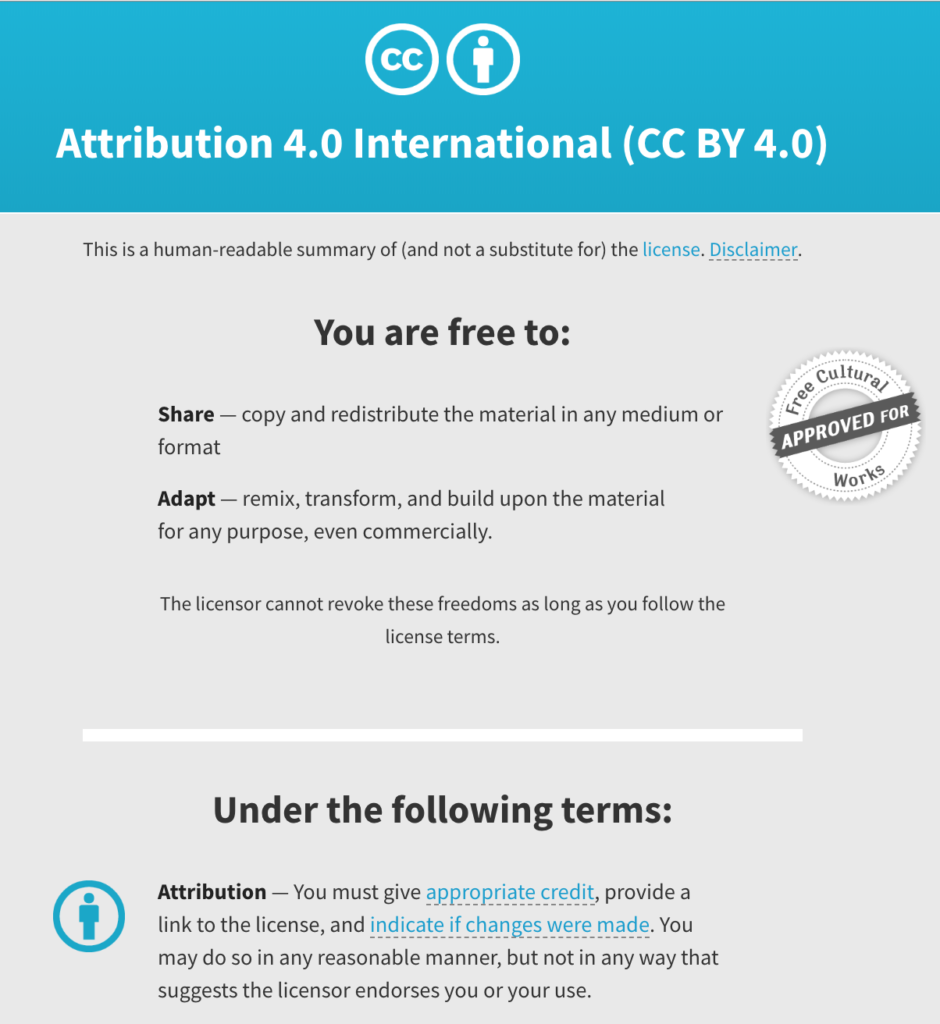
In contrast adding the Creative Commons By Attribution license sends a clear message about permissions that are granted up-front without the need for a re-user to seek consent: any re-use is permitted, including commercial re-use, provided the EC is attributed as its source, and provided re-use forms or alterations don’t suggest they are endorsed by or coming from the EC.


The clarity that a Creative Commons license provides

(full disclosure: I am a board member of Open Nederland, the Dutch Creative Commons chapter)

29 Apr 20:48

Where the ‘As If’ Monsters Come From

by Ton Zijlstra

Our little one (who turns 3 in a month) is playing monsters these weeks, where she walks growling through the house swaying her arms, where she runs shrieking through the living room, or tells us to take one of those roles. Today in day care she played being chased by monsters with a friend from a few houses over. I asked her at dinner what those monsters would do if they caught her. “Eat us!” Then I asked her where the monsters come from. “They come out of my head. They’re ‘as if’.”

She’s right of course. Most of all our monsters are like that.

29 Apr 20:48

Innisfil, Ontario resident becomes first Canadian ever to pay property taxes with bitcoin

by Shruti Shekar

The first resident of Innisfil, Ontario paid their property taxes using cryptocurrency via an app and it took less than five minutes.

Sitting at the Coinberry headquarters in Toronto, Evan Hill searched ‘Innisfil pay taxes,’ selected ‘Pay with Bitcoin,’ and after plugging in details and getting the town’s specific bitcoin address, he was redirected to the Coinberry app.

Hill, who is an entrepreneur and a resident of Toronto, bought property in Innisfil in 2017 with the hopes of relocating there permanently eventually.

He noted that on the town’s website, he entered his ‘roll number,’ address and name and clicked pay. A roll number is a unique number that every resident in Innisfil has, which can be used to pay taxes; the number is similar to a social insurance number.

Andrei Poliakov, the founder of Coinberry, a financial training and advisory company platform that can be used to manage cryptocurrency, said any other platform can be used to pay property taxes. He noted though that the town uses Coinberry’s platform to manage its cryptocurrency.

“You can use any platform and pay from that platform. You would withdraw to the address that belongs to Innisfil in this case,” he explained.

He added that each person gets a different address code when they choose to pay with crypto.

Innisfil and Coinberry signed a one-year pilot partnership on March 28th, making it the first town in all of Canada to accept cryptocurrency as a form of property tax payment. It’s important to note that residents will see the new payment option, which will be added to existing forms of payment.

The municipality that is located about an hour north of Toronto and near Barrie, has been known for adopting innovative technology.

The town’s Mayor Lynn Dollin told MobileSyrup in March that the aim for Innisfil is to attract more people to invest their time and business into the town, rather than have people leave.

Hill, who is the owner of an up and coming website called Daddius specific to helping fathers, said the town had attracted his family because of how progressive it was. Daddious has not fully launched yet but has a growing community on Facebook and aims to help men learn the intricacies of being a father.

“We’ve been consistently looking outside of Toronto to see if there’s a place that has the things we are looking for like a good community centre, good schools, libraries, but not be too crowded and a place where real estate prices are good,” Hill said.

“I realized Innisfil is an opportunity and I think it’s going to grow massively,” he said.

The town currently has a population of about 37,000 and its town is the size of Mississauga, Ontario.

In May 2017, the town launched its pilot project with Uber to transform the ridesharing app into its de facto public transportation option. When the project launched it saved the town $73,500 CAD.

The post Innisfil, Ontario resident becomes first Canadian ever to pay property taxes with bitcoin appeared first on MobileSyrup.

29 Apr 20:48

RT @guyverhofstadt: Nigel Farage has been an elected MEP since 1999, but now says he comes out of "semi – retirement". As I already warned…

by guyverhofstadt
mkalus shared this story from mrjamesob on Twitter.

Nigel Farage has been an elected MEP since 1999, but now says he comes out of "semi – retirement". As I already warned in 2012, the biggest waste of EU resources is Nigel Farage's salary. Why would anyone re-elect him to this role? pic.twitter.com/fwsAEu8kzr


Posted by guyverhofstadt on Monday, April 29th, 2019 2:25pm
Retweeted by mrjamesob on Monday, April 29th, 2019 2:57pm


6609 likes, 2535 retweets
29 Apr 20:47

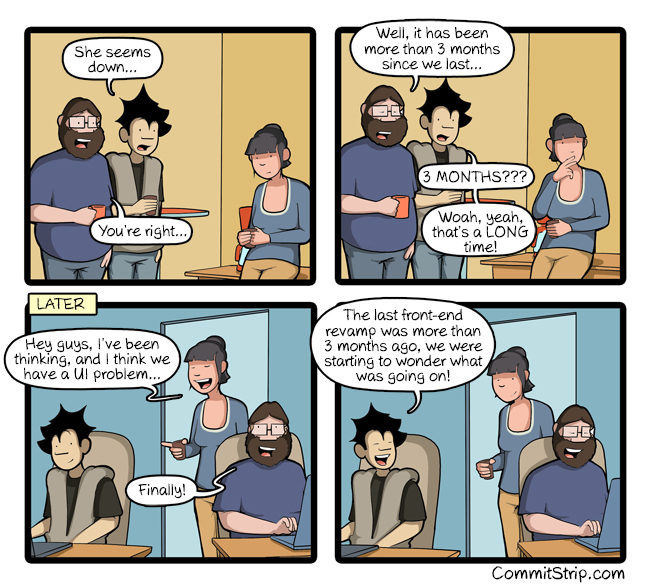
Front-End Traditions

by CommitStrip
mkalus shared this story from CommitStrip.

29 Apr 20:47

Ein Film der Bundeswehr aus dem Jahr 2000 über das Alltagsleben in der DDR

by Ronny
mkalus shared this story from Das Kraftfuttermischwerk.

Im Jahr 2000 veröffentlichte das Bundesministerium der Verteidigung einen Film, der die Sicht des Ministerium auf die schon länger vergangene DDR vermitteln sollte. Vermutlich geschah das im Rahmen der Ausbildung in der Bundeswehr. Wie das halt immer so ist in der Geschichte sind die Blicke darauf eher individuell bis subjektiv. Den ganzen Film gibt es hier auf YouTube, ich hab hier mal den Part, der sich primär mit den Preisen des alltäglichen Lebens befasst und lass das mal ganz bewusst ganz wertfrei hier.


(Direktlink)

29 Apr 20:47

Boeing boss rejects accusations about 737 Max jets that crashed | Business

mkalus shared this story from The Guardian.

The boss of Boeing has denied accusations that its two 737 Max aircraft involved in fatal crashes lacked an optional safety feature, which might have alerted the pilots to technical malfunctions that partly caused the accidents.

“We don’t make safety features optional,” Dennis Muilenburg, Boeing’s chairman and chief executive, said at the company’s annual meeting in Chicago on Monday. “Every one of our airplanes includes all of the safety features necessary for safe flight.”

A preliminary investigation into the Ethiopian Airlines 737 Max crash last month found it was triggered by a faulty “angle of attack” sensor, which monitors the inflight position of the plane. The erroneous readings from the sensor in turn activated the aircraft’s maneuvering characteristics augmentation system (MCAS), an auto-pilot program that encourages the plane’s nose to dip down.

The crash killed 157 passengers and crew, months after another 737 Max operated by Lion Air crashed off the coast of Indonesia in similar circumstances with the loss of 189 lives.

It was revealed over the weekend that Boeing had removed warnings about pitch sensor malfunction from the standard 737 Max (MCAS) safety package. The Wall Street Journal reported that the warning system, which was present in previous 737 models, was only operative on 737 Max jets if the operator airlines had paid for a package of additional safety features.

“In this case again, as in most accidents, there are a chain of events that occurred. It is not correct to attribute that to any single item,” Muilenburg said. “We know that there are some improvements that we can make to MCAS and we will make those improvements.”

He told shareholders that software updates being carried out would make the grounded 737 Max fleet “one of the safest airplanes ever to fly”, adding: “Yet, we know we can always be better. We have a responsibility to design, build and support the safest airplanes in the sky. The recent accidents have only intensified our dedication to it.”

Protesters, including some relatives of crash victims, carried placards outside the meeting calling on Muilenburg to be prosecuted for corporate manslaughter. They also carried large photographs of some of those who died in the crashes.

Friends and family of Samya Stumo, one of the victims in the Ethiopian crash, held placards reading: “Prosecute Boeing and Executives for Manslaughter.”

Among the other placards were signs reading “Boeing’s arrogance kills”, “Prosecute Boeing & execs for manslaughter” and “Boeing is making a killing from killing”.

Muilenburg dismissed calls for him to resign, saying: “My clear intent is to continue to lead.” In his first media appearance since the the international grounding of the 737 Max, he said he was confident that
Boeing would regain the trust of regulators and passengers. “We know we have work to do to earn and re-earn that trust,” he said.

At the start of the meeting, Muilenburg called on attendees to observe a moment’s silence to honour the victims of the crashes, and said the accidents continued “to weigh heavily on us”.

More than third of shareholders voted for a motion to strip Muilenburg to of the Boeing chairmanship. The investor advisory firm Institutional Shareholder Services had advised its clients to vote for the motion, and for an independent chairman to be appointed to help the company rebuild its reputation.

It was also revealed on Monday that four Boeing employees had called the Federal Aviation Administration to raise serious concerns about the 737 Max. The calls began coming in within hours of Ethiopian investigators releasing a preliminary report on the crash. The calls from current and former Boeing employees allege possible issues related to the angle of attack (AOA) sensor and the MCAS anti-stall system that relies on data from the sensor, according to CNN.

29 Apr 20:46

Adding scrolling screenshots to Android is ‘infeasible’ according to Google

by Jonathan Lamont
OnePlus screenshot pic

If you’ve ever wanted to take a screenshot of a long conversation, you’ve likely found yourself wanting a scrolling screenshot mechanic. Many Android manufacturers add these to their devices, but if you’re holding out for Google to support scrolling screenshots natively, don’t hold your breath.

According to two Google Issue Tracker threads uncovered by Android Police, Google says adding scrollable screenshots is “infeasible.”

Considering other manufacturers have done it, that’s clearly not the case.

Samsung, for example, will show a pop-up after you take a screenshot allowing users to scroll down and take another. The software then stitches the pictures together.

OnePlus also has a scrolling screenshot option, which automatically scrolls the screen for you. When you’re done, tap to stop scrolling and capture the image.

Despite manufacturers having solutions, Google seems to think it can’t natively add the feature to Android. 9to5Google suggests it could be because of how stock Android handles screenshots. There’s no pop-up like on other phones. Instead, phones running stock, or near stock Android — like the Pixel phones — relegate screenshots to the notification tray. With that in mind, it could be challenging to make a scrolling screenshot work, but certainly not impossible.

Ultimately, it’s disappointing that Google shot down the idea so entirely. I didn’t expect the feature to come with Android Q, but now it seems like we won’t get it at all.

For those who don’t have an Android phone with some form of scrolling screenshot tool, you can always download apps like LongShot to help take extended screenshots.

Source: Google Issue Tracker, 2 Via: Android Police, 9to5Google

The post Adding scrolling screenshots to Android is ‘infeasible’ according to Google appeared first on MobileSyrup.

29 Apr 20:46

Flickr Photowalk in Lisbon, Portugal

by Leticia Roncero
Urban Color - (HDR Lisbon, Portugal)

Flickr’s COO Ben MacAskill and the team at Creative Commons are excited to cohost a joint photowalk on Thursday May 9, 2019 in the beautiful city of Lisbon, Portugal from 3:30 to 5:30 PM.

Join us at the Chafariz das Janelas Verdes for a fun afternoon of meeting new people, taking photos, and walking around the city.

We look forward to welcoming you to this free Photowalk, whether you are a local photographer, a visitor, someone visiting for the Creative Commons Summit or indeed anyone looking for a fun social opportunity to walk around and photograph the beautiful city of Lisbon.

Find more details on the Facebook event page here.

To learn more about Creative Commons and Flickr’s longstanding commitment to the Creative Commons community, please see our latest update on protecting all CC-licensed images on Flickr, and our recent interview with CEO Ryan Merkley.

29 Apr 05:33

These Weeks in Firefox: Issue 58

by mconley

Highlights

  • New and wonderful DevTools goodies:
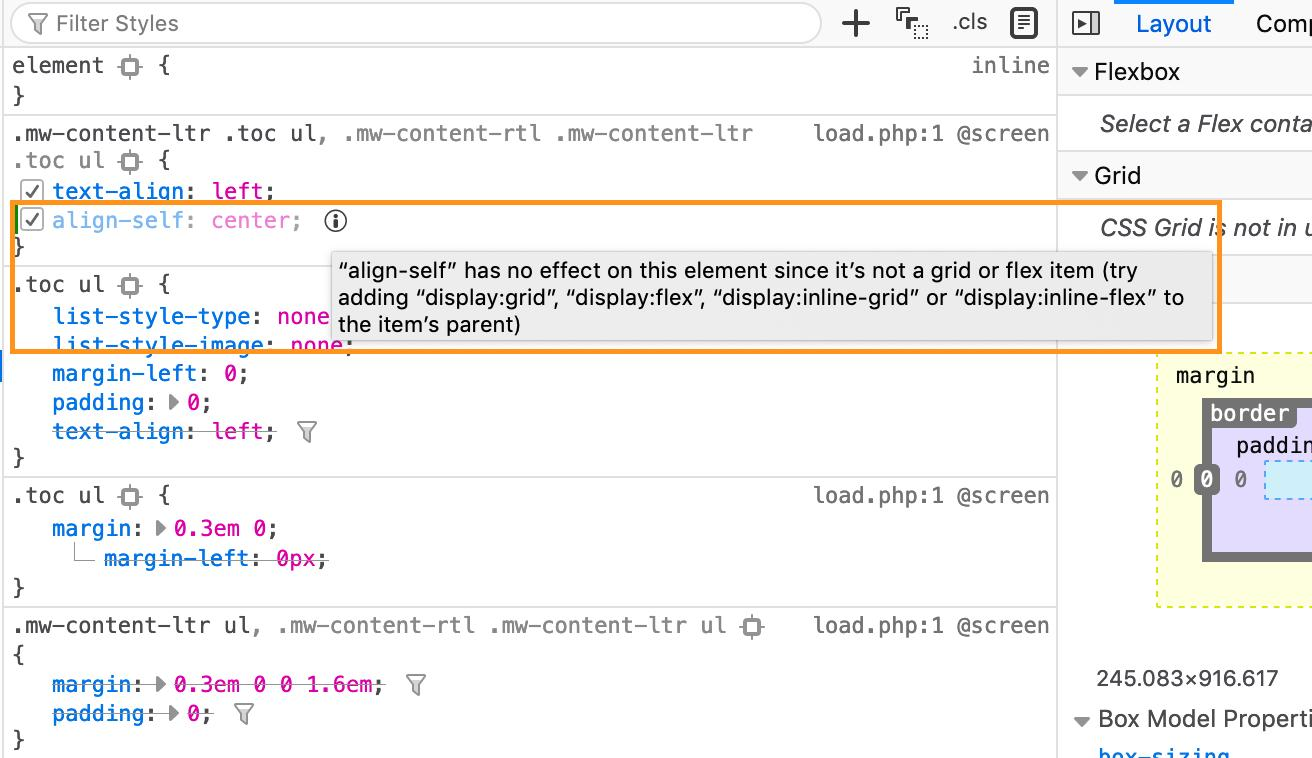
    • New CSS debugging feature coming up soon (likely with Firefox 69): Inactive CSS. This will be tremendously helpful to know when certain CSS declarations don’t have the desired effect and why (join the fun on twitter, check out the bug, demo GIF).
      • The CSS rules pane is showing a helpful infobox explaining why a CSS rule is not being applied.

        The Firefox DevTools will make it much easier to find out why certain styles aren’t being applied!

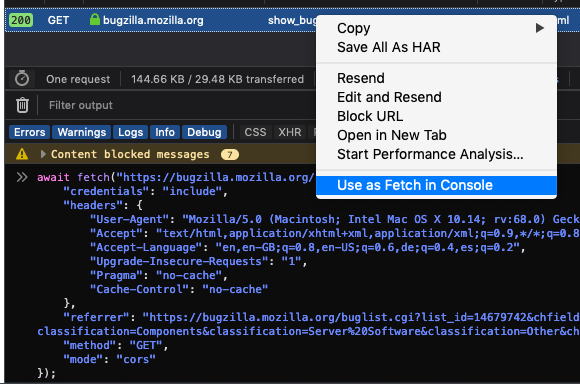
    • Edit an existing request and running some JS on the response is powerful. Requests can now be formatted in fetch format (in addition to cURL). The created fetch command can also be used directly in the Console. (Bug 1540054, Mrigank Krishan 🌟)
      • The Network Monitor tool shows a request that has a context menu option to re-create that request as a window.fetch command. That command has been automatically put into the console input.

        We’re totally making fetch happen here.

  • User Initiated Picture-in-Picture has been enabled by default on Nightly on Windows
      • A YouTube video with the Picture-in-Picture toggle being displayed over top of it.

        Clicking on the little blue toggle on the right will pop the video out into its own always-on-top player window.

    • See some bugs? Please file them against this metabug
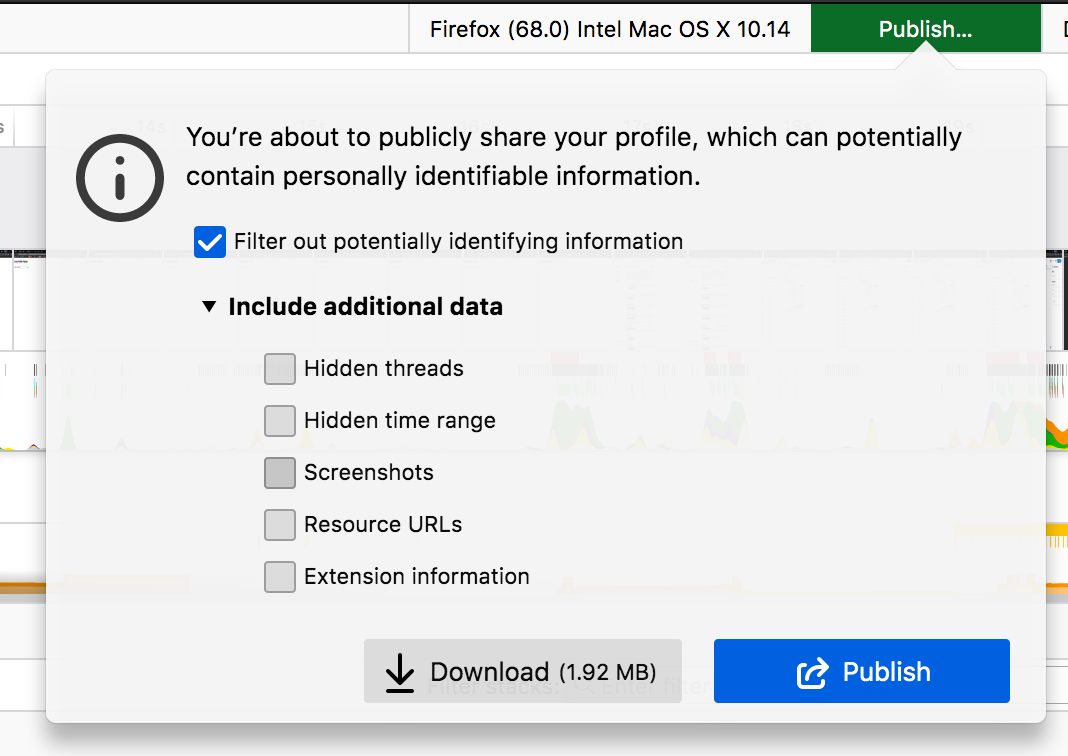
  • Worried about personal information leaking when posting performance profiles from the Gecko Profiler add-on? Now it’s much easier to select exactly what information you share:
      • The new profile publish panel with different data to include/filter out from profile (e.g. hidden threads, hidden time range, screenshots resource URLs and extensions)

        Worried about what’s in those performance profiles you’ve been submitting? Worry no longer!

  • We are now showing an icon in the identity block when a permission prompt got automatically denied by the browser (e.g. because it was lacking user interaction).
  • Cryptomining and Fingerprinting protections have been enabled in Nightly by default in both Standard and Strict content blocking modes.
    • Please file breakage against either of these two bugs

Friends of the Firefox team

Resolved bugs (excluding employees)

Fixed more than one bug

  • Arpit Bharti [:arpit73]
  • Damien
  • Florens Verschelde :fvsch
  • Gary Chen [:xeonchen]
  • jaril
  • Kestrel
  • Nidhi Kumari
  • Oriol Brufau [:Oriol]
  • Richard Marti (:Paenglab)
  • Syeda Asra Arshia Qadri [:aqadri]
  • Tim Nguyen :ntim

New contributors (🌟 = first patch)

Project Updates

Activity Stream

Add-ons / Web Extensions

Developer Tools

  • Adopting Prettier on the DevTools codebase (as a pilot before potentially applying it to more of m-c). This way, we’d have auto-formatting like on C++ code! RFC conversation is here.
  • Continued Rock-solid & Fast Debugging™ work and polishing features landed in 67 and 68 (Worker Debugging, Logpoints, Column Breakpoints)
  • Paused indicator and reason in Debugger is more visible! (Issue 8163, derek-li)
    • The DevTools Debugger is being more obvious that execution is paused, and also is explaining why it's paused (in this case, it's saying "Paused while stepping").

      According to the Debugger, execution is paused because we’re stepping through the code, line-by-line.

  • The Debugger team is showing their GitHub contributors what it’s like to contribute to mozilla-central via Phabricator and Bugzilla directly. Transitioned roughly 12 GitHubbers – really excited about this number!
  • Print emulation landed in Inspector – timely before Earth Day to save the trees 🌲!
  • Reducing some noise, the Browser Console will provide the option to hide content messages (behind devtools.browserconsole.filterContentMessages). Bug 1260877.
  • We’re also adding a way to list all of the elements impacted by a CSS warning in the console. When one of those CSS parser warnings occur inside a rule, the console will find this rule’s selector and let users log the matching elements (bug, demo GIF).
  • Wield more filter power in the Console with the support of regular expressions (bug 1441079, Hemakshi Sachdev [:hemakshis] 🎉)
  • “Race Cache With Network” status is shown for resources in the Network panel (Bug 1358038, Heng Yeow :tanhengyeow)
  • Continued improvements to Responsive Design Mode
  • The new Remote Debugging page is ON (about:debugging). WebIDE and the connect page is slotted for removal. All Debug Targets can be inspected with about:devtools-toolbox.
    • The old Connect page and WebIDE DevTool are riding off into the sunset.

    • Latest features: unplugged USB devices remain in the sidebar as “Unplugged” (bug, screenshot), remote debugging toolboxes show nicer headers with icons depending on what your remote target is (bug, example), and the same tab is reused when you connect again to the same target (bug).
  • Specific resources can be blocked in the network monitor – contributed by the renowned :jryans (bug 1151368) – and the first step to having a fully-fledged resource blocking feature
    • The Network Monitor is showing a network request that was blocked, and a context menu entry to unblock the request.

      Stop, block and roll!

Fission

Performance

Performance tools

  • Big deploy last week!
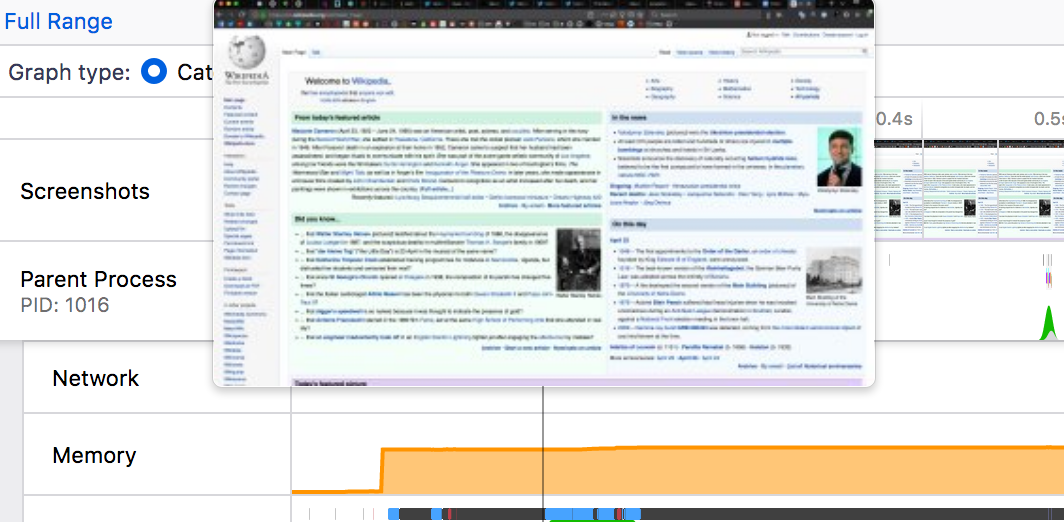
  • We show larger screenshots while hovering the screenshots track now.
    • The Firefox Profiler is showing a larger thumbnail when hovering the "Screenshot" timeline track

      Now it’s easier to see what was happening on screen when Firefox was being slow in a profile.

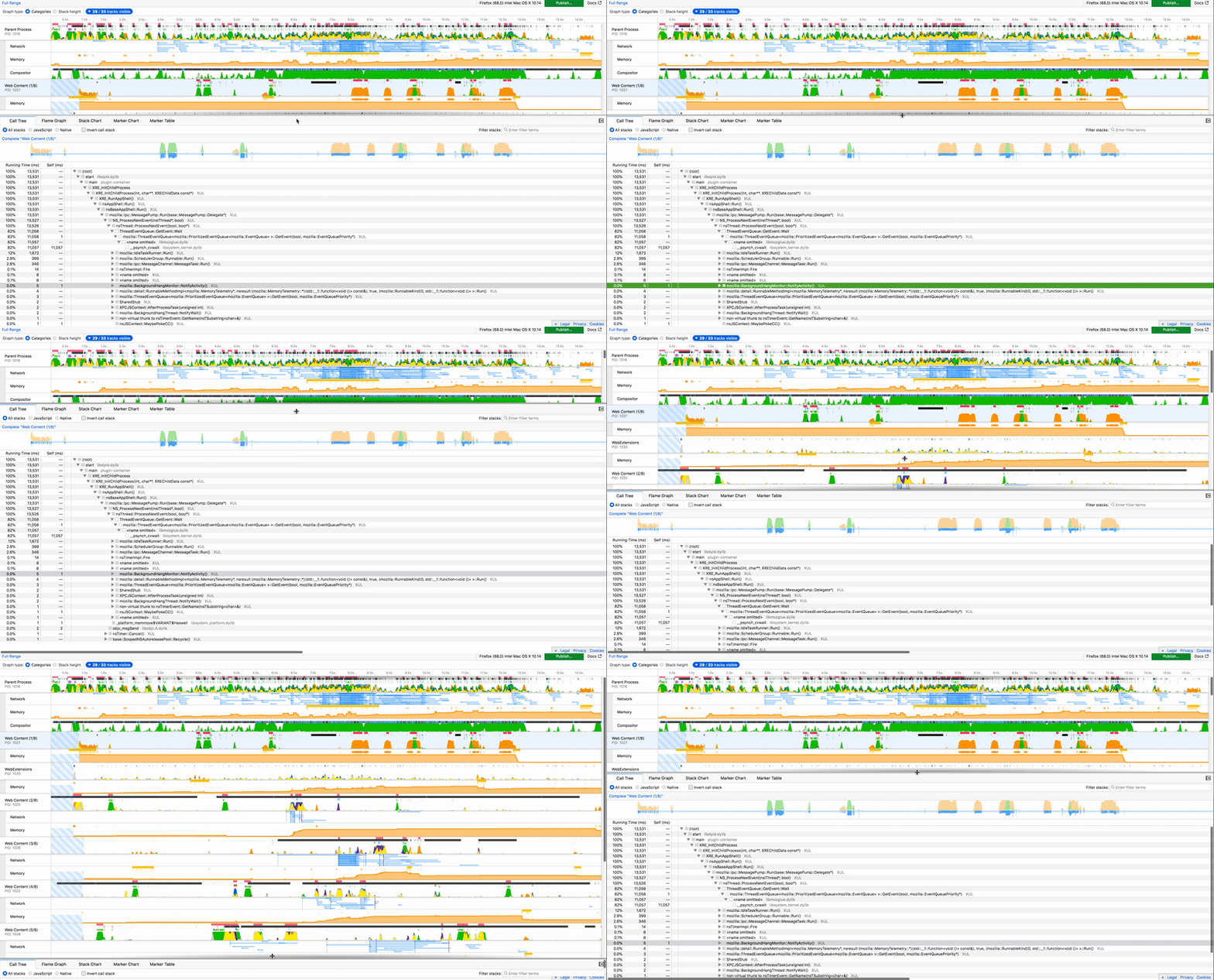
  • Landed splitter for the timeline and detail view.
    • The Call Tree section of the Profiler is being resized via the splitter between the Timeline and the Detail view.

      Ahhh, breathing room.

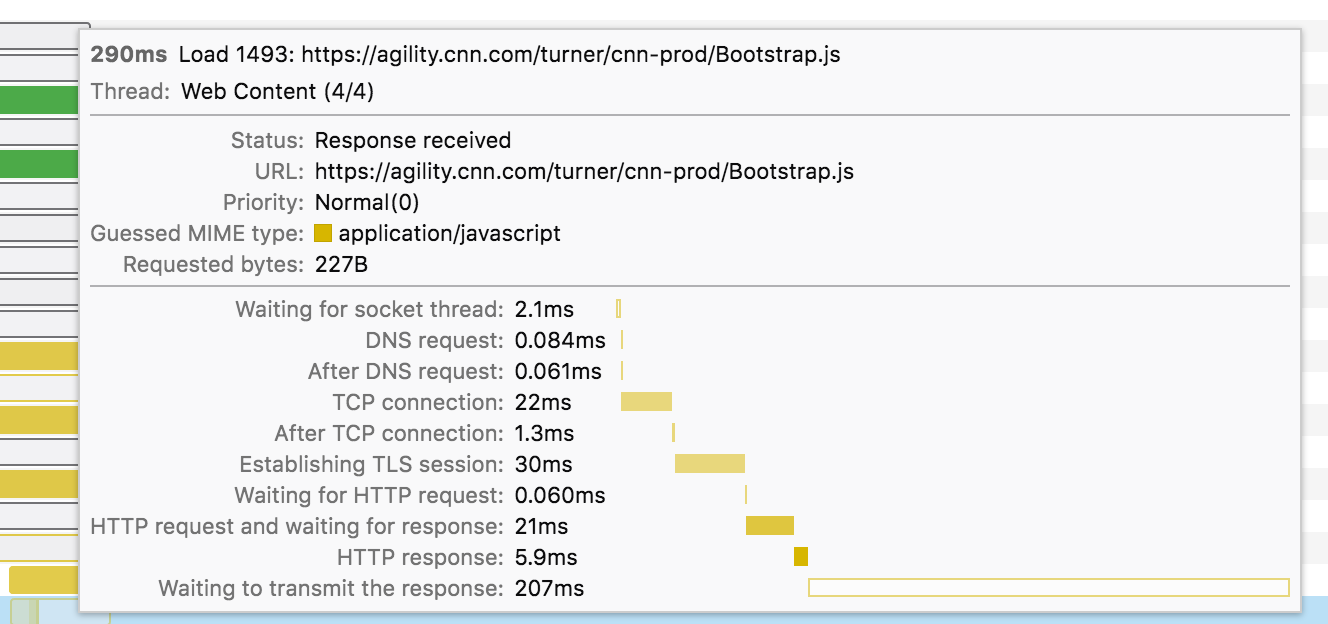
  • Landed some network panel & tooltip improvements
    • More accessible colors
    • More accurate timing information
    • Graphs for different phases in tooltips
    • MIME types in tooltips
      • A tooltip for a network request is showing timing information and the MIME type for the request.

        The more information we have about a slow Firefox, the easier it is to make Firefox faster.

Picture-in-Picture

Policy Engine

Privacy/Security

  • Prathiksha has started her internship working on streamlining the way we do message passing between about: pages and privileged code, and particularly on about:certerror.
  • Firefox Monitor now enabled by default in Nightly, pending bug 1544875.

Search and Navigation

Search
Quantum Bar

Continuing on fixing regressions in QuantumBar, including improvements for RTL, less visual flicker and lots more.

29 Apr 05:30

Marking up your photos on iOS

by Volker Weber

ea2f74cc04a5e7e913ce6e189324b0da

I use this feature in the iOS Photos app quite often. It's very well hidden under a nondescript button so you may have missed it.

29 Apr 05:30

Pork & Beans [Flickr]

by vanderwal

vanderwal posted a photo:

Pork & Beans

I'm at Pork & Beans! 4sq.com/2fcw1G8

29 Apr 05:30

New Nikon Z Pricing (thru June)

Update: Starting May 20 NikonUSA added a free FTZ adapter to the following savings (effectively lowering the prices I note below by US$150 more).

NikonUSA today announced instant savings on the Z series cameras:

29 Apr 05:30

New Canon Mirrorless Pricing

Canon is also in the dealmaking mood. Here's what's happening in the Canon mirrorless world. First full frame:

  • EOS R — US$300 instant savings brings the price to the old Nikon/Sony 24mp price of US$2000, and includes the EF-EOS R adapter for free. …
29 Apr 05:30

NetNewsWire Technotes Added

I’m writing some documents about NetNewsWire’s code and architecture. In part because I believe this is a good practice for any software project — but even more because I want NetNewsWire to be completely knowable by anybody who’s interested.

It’s one thing to have an open source app, and quite another to have one that anybody — even, or especially, new programmers — can read about and come to understand.

I don’t claim that every decision I’ve made is brilliant. In fact, some are just okay, and some might be bad. That’s fine! But it’s a real, working app, and I like the idea of having explanations of how it works and why it works that way.

I’ll be posting links on this blog as I write them. Note that the tech notes are part of the repo, and they appear in the workspace tree, so everybody who checks out the code has a local copy always at hand.

Two new ones today:

Accounts — notes about the accounts system. (The “On My Mac” thing is an account; later you’ll be able to add accounts for Feedbin and other systems.)

How NetNewsWire Avoids Parsing Feeds — talks about using Conditional GET and other methods to avoid parsing feeds.

PS My favorite, though written quite a while ago, is the Coding Guidelines.

29 Apr 05:28

Twitter Favorites: [JodiesJumpsuit] Experiments in wearing big hair, big sunglasses, shiny pants and leopard print shoes https://t.co/yu1hz5xbun

unknown trouble @JodiesJumpsuit
Experiments in wearing big hair, big sunglasses, shiny pants and leopard print shoes pic.twitter.com/yu1hz5xbun
29 Apr 05:28

Twitter Favorites: [Planta] In the 1980s, Wayson Choy was able to buy a house after winning the lotto. I asked him once if he still buys ticket… https://t.co/AlPwhbkf42

Joseph Planta @Planta
In the 1980s, Wayson Choy was able to buy a house after winning the lotto. I asked him once if he still buys ticket… twitter.com/i/web/status/1…
29 Apr 05:27

Oliver at the Podium

by peter@rukavina.net (Peter Rukavina)

This afternoon Oliver and I went to a volunteer social at Green Party HQ. There was pizza and sushi and punch and lots of talk about the election campaign and its results and what comes next.

Midway through the event everyone gathered in the kitchen and Cynthia King and Jordan Bober, campaign co-managers, and leader Peter Bevan-Baker, made some introductory remarks and thank yous, and then Cynthia opened the floor to anyone who wanted to share a volunteering story.

The volunteering stories were fascinating: a cook’s tour through the process of moving from non-involved non-partisan to someone working morning, noon and night to get one of their neighbours elected to the legislature.

As the session drew to a close, Cynthia made one final call for stories, and Oliver confidently strode up to the microphone and told the story of his volunteering–button making, canvassing with Karla, etc. He mentioned Josh Underhay’s death. And he talked about how happy he was to live in one Green district and go to school in another.

Oliver speaking at the Green Party volunteer celebration

Needless to say, I had tears well up in my eyes. I was so proud of him.

29 Apr 05:27

The Smart Already Know They Are Lucky

by Eugene Wallingford

Writes Matthew Butterick:

As someone who had a good run in the tech world, I buy the theory that the main reason successful tech founders start another company is to find out if they were smart or merely lucky the first time. Of course, the smart already know they were also lucky, so further evidence is unnecessary. It's only the lucky who want proof they were smart.

From a previous update to The Billionaire's Typewriter, recently updated again. I'm not sure this is the main reason that most successful tech founders start another company -- I suspect that many are simply ambitious and driven -- but I do believe that most successful people are lucky many times over, and that the self-aware among them know it.

29 Apr 05:26

Coquitlam, B.C., man develops app to counter high gas prices

mkalus shared this story .

A Coquitlam man has developed a calculator to help drivers determine if it's worth driving to the U.S. to buy gas instead of buying in B.C.

Gilson Tsang made the app available for Android smartphones on the Google Play app store on April 25. It's called Worth the Drive.

He says he made the program because he was tired of paying for what he calls "overpriced" Vancouver gas.

"This is such a big deal right now," he said about people trying to find a deal on gas prices.

To find out if it's worth making the effort to cross the border for gas, users input the length and distance of their drive to the U.S. destination, their vehicle's fuel efficiency, the price of gas in both countries, the amount of fuel to be bought and the exchange rate.

A screen grab from Gilson Tsang's Worth the Drive gas app, which compares variables such as driving distance, fuel economy and the exchange rate. (Doug Kerr/CBC)

He says the app has shown that it's worth the savings to drive from Whistler to the U.S. to buy gas.

Every two and half weeks Tsang drives south from Coquitlam with two extra fuel canisters and buys 110 litres of fuel.

With the app he says he saves about $50 every time he crosses the border to buy gas.

Gilson Tsang developed his app Worth the Drive to help people calculate if it's cheaper to drive to buy gas in the U.S. or stay in B.C. (Doug Kerr/CBC)

He said some people think they are burning too much fuel to drive across the border to fill up. But Tsang said the app consistently shows that even though it may cost between $5 and $10 to get over the border and back, it's worth it for a $50 savings in filling up.

"You're gaining $40 profit," he said.

Tsang said he wants to support local businesses in B.C. but the price difference between fuel in Canada and the U.S. is too big to ignore.

He is also calling on the the province to do more to help drivers with high gas prices in B.C.

29 Apr 05:25

Why do programmers put up with so much pain?

by Eric Normand

If you’re using a less popular language, it may seem like there is a ton of pain there. But there’s pain everywhere. Every stack has its own problems. The key is you need to pick the pain you want to live with.

Transcript

Eric Normand: Why do programmers put up with so much pain? By the end of this episode, I hope to explore this idea a little bit more. This won’t be one where I have some definitive answer, some definition. This is more just me pontificating. My name is Eric Normand and I help people thrive with functional programming.

I’m bringing this up because a kind listener who’s new to programming, certainly new to functional programming, he was watching a talk about the pain of using Haskell for a business. Now, every language has some pain, but this one was particular to the Haskell language because he was interested in Haskell.

He was asking me why someone would go with Haskell as opposed to going up with one of the more established languages when they’re building a business. Then he mentioned a few languages, like why not go with Java and Spring? Why not use ASP.NET?

I thought this was an interesting idea to explore. Let’s go over some facts.

Fact number one is programmers put up with a lot of pain. They really do. There’s quite a lot of pain in every stack. In every language, there is pain. There’s no getting around that.

Even if it is I have to read a book this thick and be certified in Spring to be able to do it, or I have to be like a pioneer [laughs] and figure out how to get this stuff working, which is available in Spring, but I need to get it to work in Haskell.

All of that is pain and programmers deal with that. It’s everywhere. That’s fact number two. Programmers deal with it and it’s everywhere. The resolution to this question, I’m not going to say it’s an answer, but the resolution is it’s about picking your pain.

Just as a personal example, I have used a little bit of Spring. In my experience, a lot of it was figuring out which XML file to edit, editing it; that was what you did most of the time for solving problems. That was painful to me.

It was painful that I just wanted to do something very simple like something that I thought I should be able to do with just an if statement. I just want to either do this in this case or do that every other case, just a very simple thing. Of course that required setting up a new plugin and that required adding a line to an XML file and then configuring that with more XML.

It’s not that it’s XML, it’s that there’s so many XML files. You just had to know all these things about where things go. When to me this was a simple change and, because I’m not that experienced in Spring, it seemed like it should just be an if statement.

That is one of the reasons why I like Clojure because it’s all code and I can just put an if statement where I think it needs to go.

However, I do deal with other pain. A lot of people ask me how, in Clojure, I deal with the pain of using immutable data structures everywhere. Now to me, I’m used to it. I’ve chosen that pain, but it is a pain, compared…For some algorithms, it is much easier to just do a mutable, just throw things in a map, hash map, a mutable hash map.

Why have I chosen that pain instead of some other pains? As a functional programmer, I like that it’s immutable because at any point, I know that my functional code is thread-safe and that I can hold on to references to things and they’re not going to change, and because that is a pain having things changed underneath you.

What I’m trying to get at here is it’s all pain. It’s all pain. You have to use your own judgment, and your own taste, and just really knowing yourself to decide which pains are worth it.

In the case of the Haskell programmer giving this talk that prompted this question from a listener, I think that Haskell programmers really like the purity of the language, they like the strong — meaning powerful — type system. They are willing to put up with a lot of the pioneering aspects of the programming, that there’s much less tooling.

The libraries are not as prolific and full-featured as you would find in, say, the Java ecosystem, and there’s just not as much help around. It’s just the truth. I’m talking about in absolute terms or in relative terms. Relative to Java, there’s just less help. There are fewer books, for instance.

That attracts people. They feel like they’re going to get…They’re going to outweigh the costs from the benefits of the type system. The type system will pay for all the other costs.

I worked at a company that was doing Haskell on the back end. Their philosophy, the CTO’s philosophy who chose Haskell, this was the pain trade off he was making. He remembers working in Ruby and Rails and not knowing what types he could expect anywhere.

He would, as an example, print out an array at a random point in the program and expect to find user records in it. He found lots of different things. He found user records. He found user IDs. He found nils. He found random stuff in it.

He felt like there was…because this array was mutable and it had been passed around to all these different parts of the program, there was very little way to know how all those different things got into that array. That was a pain that he experienced, that this was causing bugs and there was very little way to diagnose the problem.

And so, something like Haskell, which has immutable lists, so you can’t…Even if you pass it around to different parts of the code, they’re not going to be able to mess with it and it has strong type lists. You can’t just add anything to it.

He felt with those two things, that would solve the problem and that that problem was worse than the, “How do I get this installed on my machine? How do I run it as a server? How do I deal with finding libraries for certain things we need?” All of those things were sort of, “I could solve this one time, and it will be done” problems.

Whereas this, “What am I going to find in my random data structure?” problem was an ongoing problem that was not solvable, once and for all, in the Ruby language. That was the trade-off he made. He traded off the pain of…Ruby was a sizable community at that point, had lots of libraries. It’s very convenient to create a Web app in it. He traded that for knowing what was going to be in his arrays.

I’ll just recap. There’s not much to talk about in this one. I just wanted to bring up this. That’s an opinion that I have that it’s all a trade offs.

Fact, programmers put up with a lot of pain. If you go to a conference on in any language, it’s all about the pain. Some are more enterprise-y so it’s like, “Who do I pay a million dollars to to solve this pain?” [laughs] Some of them are more like, “Well, we wanted to do this thing, but it’s really hard in this language and here’s how we solved it.” That’s just the way it is.

We put up with a lot. It’s everywhere.

My opinion is it’s just about picking your pain. You look at your problem, like, what are we trying to solve here? What are the hard things? You pick a language that aligns with that decently well. You look at, if you can, what are the things that we’re going to face, that are hard, if we choose this language? And you decide whether they’re worth it. That’s it. That’s all you can do.

All right. If you liked this opinion piece, you should subscribe because I do more like it and there’s more where I just talk about more factual stuff, go deep into functional programming concepts, share some tips and tricks on how to do functional programming better. I’d love to hear your pains, like what are the pains that you…?

Here’s the question. What do you want to never do without?

We’ve all got something that we’ve fought hard for and now I’ve got it, I don’t want to do without it. For me, in Clojure, it’s interactive programming. I cannot go back to any other system that doesn’t have interactive programming. I really like interactive programming.

I also like immutable data structures and stuff, but my number one thing is interactive programming. I think Clojure does it the best. If you’re into Haskell, you might say it’s types. I want category theory level types. It could be something like that.

Let me know. You can email me at eric@lispcast.com. If you do email me, I might talk about it on the podcast. Let me know if you don’t want me to. You can get in touch with me on Twitter. I’m @ericnormand with a D or you can find me on LinkedIn and search for me there.

Awesome. Take care. See you in the next episode.

The post Why do programmers put up with so much pain? appeared first on LispCast.