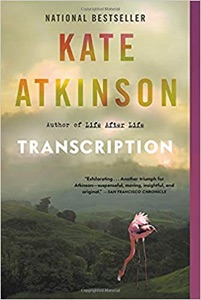
Charming and evocative story of a young typist who finds work during the war with MI5. After the war, she’s sent away and hooks up with BBC Schools, and one day inn the 1950s she stumbles across a former colleague in the park. A difficult book to discuss without giving away crucially withheld information, but if you like Atkinson you will enjoy this book.
Rolandt
Shared posts
26 May 01:24
 Roland Tanglao 猪肉面 @rtanglao
@sillygwailo memory leaks are proof that all layers of software are written by fallible human beings with hard to w… twitter.com/i/web/status/1…
Twitter Favorites: [rtanglao] @sillygwailo memory leaks are proof that all layers of software are written by fallible human beings with hard to w… https://t.co/pWW50x56AV
@sillygwailo memory leaks are proof that all layers of software are written by fallible human beings with hard to w… twitter.com/i/web/status/1…
26 May 01:24
One for the weekly hacks. I use 33mail since 20...
by Ton Zijlstra
One for the weekly hacks. I use 33mail since 2014 to create on the fly e-mail addresses. That’s very useful, as I use a different address for each webshop, list etc. If one of them sells my info or sees it stolen, and I start receiving spam, I know where it originates from.
33mail is attached to a domain I have. The way 33mail works is it forwards everything to a single e-mail address, and each mail has a code so I can hit reply and send as if from each of those addresses as well. That single mail address is then set-up to forward to my main inbox. Here’s my 2014 description of my 33mail set-up.
In the past few days I noticed I didn’t receive anything from 33mail, in particular when I tried to sign into micro.blog I didn’t receive the login-link.
The 33mail dashboard showed no issues. Turns out the forwarding from my 33mail single mail address to my main inbox somehow fails. I’ve now set it up as a regular IMAP mailbox, so I can access it directly. Also nicely clears up my main inbox.
26 May 01:23
From my inbox
by Volker Weber

Eine schöne Überraschung von meiner Wunschliste. Ich habe strengste Anweisung, niemanden zu verpetzen, aber ich freue mich ganz doll. Dankeschön!
26 May 01:23
satis wrote:
I really have trouble with the idea of swallowing $90 for Mac + iOS
>outliner apps, especially when the iOS one is in such woeful shape (and
>$10 more than it would have cost a few days ago if one had bought the
>previous version, with free upgrade).
I just noticed that prices went up (this year?). Essentials for Mac and iOS are now $19.99 each, and the Pro version is $99.99 on the Mac (insane) and $49.99 on iOS, with no bundle pricing. (I know that Apple doesn't permit bundling, but Ulysses is able to get away with it by including full iOS access if you subscribe to the Mac app, either in the Mac App Store, or as part of the SetApp.com subscription suite.) I own OO Pro for the Mac, and was thinking of getting OO Essentials for iOS, which used to be $9.99, but the price increase stopped me. And if Omni has upgrades any time soon for the Mac app I probably won't upgrade.
It appears that Omni has decided, with little competition at the high end and with outline apps being a small market niche, that they'll milk the app's pricing while keeping it essentially in maintenance mode. Very disappointing.
I recently came across the following review of OO from an author who also uses Scrivener and Ulysses, and the review looked to see if he could integrate OO into his workflow so he could use it with Ulysses instead of using the integrated outlining in Scrivener.
https://chrisrosser.net/posts/2018/08/11/review-omnioutliner/
What surprised me most was how apparently useful the outlining mode is in Scrivener. And the conclusion to the review was that OmniOutliner (under the *old* price) was too much for what it offered.
I found this very interesting. I also own Scrivener, but have used it only a couple of times for some longer-form writing, but I may look into its outlining capabilities now.
OmniOutliner 3 for iOS - satis
satis wrote:
I really have trouble with the idea of swallowing $90 for Mac + iOS
>outliner apps, especially when the iOS one is in such woeful shape (and
>$10 more than it would have cost a few days ago if one had bought the
>previous version, with free upgrade).
I just noticed that prices went up (this year?). Essentials for Mac and iOS are now $19.99 each, and the Pro version is $99.99 on the Mac (insane) and $49.99 on iOS, with no bundle pricing. (I know that Apple doesn't permit bundling, but Ulysses is able to get away with it by including full iOS access if you subscribe to the Mac app, either in the Mac App Store, or as part of the SetApp.com subscription suite.) I own OO Pro for the Mac, and was thinking of getting OO Essentials for iOS, which used to be $9.99, but the price increase stopped me. And if Omni has upgrades any time soon for the Mac app I probably won't upgrade.
It appears that Omni has decided, with little competition at the high end and with outline apps being a small market niche, that they'll milk the app's pricing while keeping it essentially in maintenance mode. Very disappointing.
I recently came across the following review of OO from an author who also uses Scrivener and Ulysses, and the review looked to see if he could integrate OO into his workflow so he could use it with Ulysses instead of using the integrated outlining in Scrivener.
https://chrisrosser.net/posts/2018/08/11/review-omnioutliner/
What surprised me most was how apparently useful the outlining mode is in Scrivener. And the conclusion to the review was that OmniOutliner (under the *old* price) was too much for what it offered.
I found this very interesting. I also own Scrivener, but have used it only a couple of times for some longer-form writing, but I may look into its outlining capabilities now.
26 May 01:20
Finding Success
by Julie Moronuki and Chris Martin
Finding Success
Our first completed book is now available as a PDF or epub from Leanpub. You can read more about that there or on the home page. We wanted to tell you a little about where it came from and how it relates to the rest of our work.
As we started writing the book we originally announced, we realized that we have a lot that we want to say about Haskell. We found that the sheer scope of what we were originally trying to accomplish was pulling us in a lot of directions, and that there was some tension between the goals of wanting a desk reference or handbook style and presenting explanations in a linear way, where they could build off each other. We wanted both linear courses and a reference style guide to things like language extensions and libraries. Additionally, we wanted a guide to the topics in logic and mathematics that routinely come up in public Haskell forums.
Public discussion within the Haskell community tends to be about topics experienced Haskellers find engaging and fun, leaving the impression on newcomers that if you haven’t read the work of Gottlob Frege in the original German, then you don’t really belong here – or, at least, you can’t expect to understand a lot of the discussion. That obscures the fact that many of the topics under discussion are not necessary to be a productive Haskell programmer, whether as a hobbyist or professional. Some of the pedagogical materials available now for Haskell are of very good quality, but for various reasons, many of them leave gaps, and often those gaps are practical things; it’s helpful to see how concepts are used to solve the kinds of real problems that programmers routinely do have to solve, and a lot of the educational materials (not all, of course) out there right lack now these kinds of extended, practical examples.
One of our main goals has always been to make Haskell (and eventually Nix) as accessible to anyone who wants to learn it as, say, Ruby or Python tend to be. As well, we want to create a community where newcomers, hobbyists, and everyone else feels welcome and able to participate in the public discussions. We realized that this set of goals is – well, they’re going to take some serious time and commitment to achieve. We felt we needed to be able to write full time, or close to it, if we were to succeed.
We started Type Classes with these goals in mind. That site has been operational for nearly a year now, and it’s permitted us to spend most of our work time on writing about Haskell (and sometimes Nix). It’s allowed us to develop both structured, linear courses and also reference pages. Another gap we’re starting to fill is showing how concepts in one language may translate to Haskell, in order to ease the transition for Python, Java, and JavaScript programmers, for example. It’s given us the time and structure to work towards all of our goals; doing them on the site is more flexible and permits more experimentation and interlinking than books do.
As we’ve developed content for that platform, it made sense to offer some parts of it as discrete content. The subscription model that allows access to all the content we produce isn’t the right fit for everyone, after all. Also, many people prefer to read paper books than take an online, serialized course. Thus, we’ve been developing the site content into standalone books in some cases. The reference pages are the content for the reference book we’ve mentioned, tentatively titled The Joy of Haskell Desk Reference, while the courses are being edited into short monographs.
The series of monographs begins with the first course that we published on Type Classes; there, it is known as The Validation course because
- it focuses on a program to validate passwords and user names and
- it introduces the
Validationtype and thevalidationpackage.
In doing so, it illustrates the relationship of types and typeclasses in the Haskell type system, introduces what monads are and also applicatives, and gives a clear picture of the differences between those two classes. The things we think are important about this book include:
- It starts off by talking about conditional expressions (
if-then-else) and their types, because those expressions are accessible to most readers.
- Starting from Chapter 3, we work with a single program, successively refactoring it and building it up, so that most of the book is a working, extended example.
- There are exercises at the end of each chapter (except Chapter 10), and we provide solutions and discussion of the solutions. Some of the exercises are challenging and some introduce new things that the main text doesn’t cover, such as using the
Texttype instead of theStringtype. - It encourages the reader to gain some facility with using GHCi, the interactive REPL provided with GHC.
- It starts from the humble conditional expression but by the end, it’s covering topics that are definitely intermediate (or even advanced) Haskell, but, because it maintains its focus on a single program, you can compare the more advanced refactored versions to what you’ve done previously.
- We’ve given it some helpful appendices as well, so you have a concise API reference and a reference to the GHCi commands that we use in the book. Also, it’s been thoroughly indexed, to make referring back to concepts or to earlier iterations of the code easy.
And now this basic structure forms the model for other courses on Type Classes, and thus for future monographs. The next monograph, on web servers, has been written and is currently in editing. It begins with a discussion about sockets and the HTTP protocol and works through parsing, the differences among the string types in Haskell, and how to use a streaming library called pipes.
Another one, from the Type Classes course called Functortown, will be a complete exploration of all the functors – Functor, Bifunctor, Applicative, Monad, Contravariant, and Profunctor, with some things about Traversable and Monoid appearing along the way. Each segment of that course begins with a motivating, practical example – why do we need this function, and then why do we want this to be a typeclass? It also covers details such as property testing your instances to ensure they are law abiding, what features of certain types mean they are not a Functor, and so forth.
Meanwhile, we continue to work on reference materials for the Desk Reference, and they appear on the site first and then we edit them into a suitable style for what will be the standalone book. We hope to have an initial version of that out this year. It will be similar to a pocket reference book, intended more for looking something up quickly than for linear reading, and will cover important vocabulary, GHC language extensions and other pragmas, GHCi commands (including some of the lesser known ones and how to use them) and some critical libraries, among other topics.
The Type Classes site does host some content that will likely never make it into a book; not everything can be distilled in that way. A Type Classes membership allows members to access everything we write, as we write it, while also ensuring we are able to continue the work we’re doing.
Over time, in line with our goals of easing access and promoting inclusivity in the Haskell and Nix communities, we will also be offering more free resources on the Type Classes site. Our Transitions content is already free, along with tutorials about using the fltkhs package to make native GUI apps, posts about contravariance and profunctors, and more. We hope it will be recognized that having two people write full-time to not only produce but also maintain, as the ecosystem changes, all this writing means that we can’t release it all for free; it’s an enormous amount of work, and relies on expertise in teaching, writing, and programming that we’ve gained over many years. That said, we do have a couple of large(ish) projects in the works this year that will be freely, publicly available. Additionally, we release open-source libraries from time to time, taken from the work we’ve done building the Type Classes site (almost entirely written in Haskell and Nix).
As we enter our second year of business, we have a lot planned and a lot of exciting work to do. We hope that we can help bring the joy of Haskell to everyone who wants it.
24 May 20:54
Sony Reports Growth and Contraction
Sony still seems reluctant to share unit volume information with investors, but in their ongoing presentations to the financial community centered around the completion of their fiscal year, they've been sharing more information than before.
…
24 May 20:54

The Guardian view on Theresa May: a poisonous legacy | Editorial | Opinion
mkalus
shared this story
from  The Guardian. The Guardian.
|
She was doomed by her failure to face honestly the real choices of Brexit, and to make her party face them too
Prime ministers do not get to dictate their legacies from a lectern outside No 10, and there was some pathos in Theresa May’s attempt today to list accomplishments in government to offset her colossal failure to take Britain out of the European Union. That she oversaw a reduction in the use of disposable plastics is laudable, but it is not how history will remember her time in office. But Mrs May never saw Brexit as her sole purpose in Downing Street. Her inability to grasp from the outset how all-consuming and difficult the project would be played a large part in her downfall.
She was poorly advised by ideologues who thought a hard Brexit could be achieved at minimal cost, but that is no excuse. She chose to take the bad advice when it chimed with her own prejudices and rejected wiser counsel. She entered negotiations in Brussels ill-prepared and was schooled in brutal realities of economics and diplomacy. That was humiliating enough, but her failure to pass those lessons on to a national audience was unforgivable. If she did understand the cruel calculus of Brexit trade-offs, she did not confront her party with the truth. Nor did she use the amplifying power of her pulpit to shape public understanding of the issues. She preferred vacuity and dishonesty – “Brexit means Brexit”; “No deal is better than a bad deal”. She decommissioned the truth, afraid it might be used as a weapon against her.
The country now faces a Conservative leadership contest fought in a fact-free arena. The candidates must appeal to their parliamentary colleagues and then to a membership numbering little more than 120,000. That electorate is not by any measure representative of the country, being older, whiter and richer than the average citizen. A majority of card-carrying Conservatives are also happy to proceed with a no-deal Brexit, perhaps because they are financially insulated from its appalling consequences or because they do not believe the dangers are real.
They will demand reckless pledges before handing the keys to No 10 over to the next prime minister. That could be Boris Johnson, the bookmakers’ favourite, or someone who outmanoeuvres the former foreign secretary by co-opting some of his bogus arguments. The Tory leadership contest will equip any victor with commitments that militate against a solution to the Brexit crisis – a promise to renegotiate the withdrawal agreement, for example. That will not happen. The EU is not going to retreat from its current position at the behest of a radical Eurosceptic British leader animated by ideological hostility to the European project.
Unless Mrs May, by some remarkable twist of circumstance, gets her Brexit deal through parliament in the coming weeks, her successor will quickly confront a familiar menu of options: Brexit via the deal that exists, Brexit with no deal, or abandoning Brexit altogether. That new prime minister will also confront the same parliamentary arithmetic that obstructed Mrs May’s efforts to achieve consensus. The new leader will have no mandate from the country and no majority in the Commons. The likelihood of an early general election or another referendum has therefore risen, even if the exact route is still unclear.
In her valedictory address today, Mrs May spoke of compromise as a noble pursuit, and she was right. Polarisation and radicalisation are making Britain ungovernable. But unifying the country around any one version of Brexit is not technically possible. It is an ambition Mrs May arrived at late, by which point she had no political capital left to spend. Leaving the EU is not a vague, malleable objective. It comes down to precise legal choices. Mrs May made her choices and parliament rejected them. Her successor will face equivalent choices in a hostile climate where continental goodwill and domestic public patience are spent. It was once within her power to reframe the debate around goals that were more achievable, but she refused that challenge. So she passes on an insoluble problem to a successor who can only win the job by promising to do the impossible. It is a miserable and poisonous legacy.
... but The Guardian is here to help guide you through whatever lies ahead. More people are reading and supporting our independent, investigative reporting than ever before. And unlike many news organisations, we have chosen an approach that allows us to keep our journalism accessible to all, regardless of where they live or what they can afford.
The Guardian is editorially independent, meaning we set our own agenda. Our journalism is free from commercial bias and not influenced by billionaire owners, politicians or shareholders. No one edits our editor. No one steers our opinion. This is important as it enables us to give a voice to those less heard, challenge the powerful and hold them to account. It’s what makes us different to so many others in the media, at a time when factual, honest reporting is critical.
Every contribution we receive from readers like you, big or small, goes directly into funding our journalism. This support enables us to keep working as we do – but we must maintain and build on it for every year to come. Support The Guardian from as little as CA$1 – and it only takes a minute. Thank you.
24 May 20:54
This prime minister was destroyed by Brexit. And the next one will be too.
| mkalus shared this story . |
Her options narrowed to zero. One by one, every course of action fell away until Theresa May looked like the most solitary and pointless figure on earth, with no allies, no course of action, and no purpose to doing anything in the first place.
Why even stay prime minister? The withdrawal bill was not going to get through, that much was obvious. Her initial dreams of insisting her administration would be about more than Brexit were long forgotten. She would never even be able to claim that she had at least delivered it. There was simply no reason to carry on.
She'd lost everything: Her Cabinet, her parliamentary party, her grassroots. Last night, Andrea Leadsom resigned - the 36th minister in a three year administration. It had a curious kind of symmetry to it: the last corpse May trod over to get into Downing Street was the final one out when her own time came to an end.
It is now clear that May will soon be gone, maybe tomorrow, maybe next week. She'll have a chance to resign. If she doesn't, the 1922 committee will probably move against her.
Brexit broke this prime minister, just like it broke the last one. But it won't end there. It'll break the next one too. And it'll keep on breaking them, until we admit what it is.
It is a beast. That's the honest truth of it. You can ignore it. You can write pieces about how we should all pretend the beast is not in the room and come back together as a country. You can urge people to look at how the beast has attractive ears, if you look at them in the right light, and try not to notice the claws or the great big slavering canines. You can stubbornly insist that people voted for the beast and refuse to pay attention to how it is ominously peering down at you. It doesn't matter. The beast remains a beast and eventually it'll eat you alive.
The truth about Brexit - the plain and simple truth of it, which no-one can make go away - is that it can only be done to a long timetable and with a lot of pain. It is fiendishly complicated. It requires the full capacity of the British political system for about five to seven years. The sacrifices it demands would probably never be accepted by parliament. And if you managed to get over all those obstacles, your only accomplishment would be to make the country poorer and weaker than it was before.
A true Brexiter, someone who was really committed to doing this, would not be lying and misleading, like May, or out on the street promoting their own pure ideological certainty, like Nigel Farage. They would be honest about the timeframe and the trade offs.
If the border is to remain open in Ireland as it is now, we need to accept the backstop and then a very close regulatory relationship. If you want free movement to end, you are cutting off services access to the continent, which is extremely harmful for an economy like the UK's. If you give up your role in Europe, you lose the ability to shape global regulations and will eventually have to get in line with rules you had no hand in forming. These are simple facts and no amount of gibberish about 'max-fac' or 'hybrid solutions' or 'alternative arrangements' has made them go away.
Maybe that's all worth it. But if so it needs someone who is prepared to say it - to level with voters about what is happening. Over the last three years we have seen a masterclass in the consequences of not doing so. Crazed secrecy, logical contortions, transparent parliamentary tricks, and the use of deception as a primary function of the operation of government.
The next Tory leader will find themselves in precisely this place, but much sooner. During the campaign, they will probably have to commit to renegotiations, which will not happen, and then no-deal. At that point, there are three potential outcomes.
The first, and most likely, is that they will decide not to do it. They will get the same top-level briefings May received on the short-term economic shock and the long term economic damage, on the security implications, on the likelihood of the eventual break-up of the UK. And there is a good chance, if they are rational, that at that point they will balk, just as she did.
If they balk, they will have to accept the existing divorce deal, with the backstop. Then we'll be back where we are now. The inane cries of betrayal and frustrated destiny will destroy them, as they did her.
The second is that they do not balk, but that parliament stops them. There are problems here. Without the European Union Withdrawal Act, there is no obvious way to take control of the parliamentary agenda again. But it is highly likely that John Bercow will provide one to stop a decision of this severity being inflicted on the country without parliamentary approval, probably through making neutral motions amendable. And then we'll be flung back into the same constitutional impasse we were in this winter. And all the inane cries of Remainer parliaments and a conspiracy in the establishment will return.
The third is that they succeed and execute no-deal. Then there will be short term chaos - massive traffic jams at the border, essential equipment and medical substances not getting in, an aggressive decline in sterling - followed by long-term stagnation and national decline. Suddenly all the people cheering on a no-deal prime minister will vanish. The one-third of the public who back it will forget they ever did so the moment they find the supermarket shelves empty. People only support extreme political ideas if they are confident they will not experience their consequences. Once they are actually inconvenienced, they will look for someone to blame. No-deal will destroy whoever is in charge at the time.
That's the outlook. Every outcome leads to doom. Brexit is a beast. It will trundle over political careers like they were ants beneath its talons.
There are only two options for the next Tory leader: Either cancel Brexit, which they will not do, or be honest with people about what it entails, which they will not do either. So the same thing will happen again, to someone else, in a slightly different way. And it'll keep on happening, until there is someone brave enough to say the thing that is so glaringly obvious: This is all a terrible mistake.
Ian Dunt is editor of Politics.co.uk and the author of Brexit: What The Hell Happens Now?
The opinions in Politics.co.uk's Comment and Analysis section are those of the author and are no reflection of the views of the website or its owners.
24 May 20:52
Introducing the Librem Tunnel
by David Seaward
Hello, it’s so nice to have you back. What will you be having today?
Since you’re here, let us tell you about the new Librem Tunnel, the encrypted tunnel based on industry-grade technology.
You probably know by now that the Librem Tunnel is part of Librem One, a suite of privacy-protecting, no-tracking apps and services created by our team at Purism, which also includes Librem Mail, Librem Chat and Librem Social.
Librem Tunnel offers an encrypted, no-logging, virtual private network tunnel, making sure all your network traffic is secure and your privacy fully protected. This means you can safely and conveniently use any public hotspot and not have to worry about how private your connection really is, using standards-based OpenVPN with any compatible client. You are not the product in Librem Tunnel: you will not be tracked, we do not sell your data, and we don’t advertise.

Imagine you’re at a coffee shop, at a work seminar or on campus. Or maybe you work remotely, or you’re traveling, or your kids want to go to the park and the nice little cafe you’re having ice cream at happens to, conveniently, have free WiFi. You know you need to use HTTPS to get the little green lock, but you can’t be expected to review the network security of every WiFi access point you use. Do you really want the cafe owner to know the names of the web sites you visit, what IP addresses you interact with, what protocols you use? Why not use a secure tunnel you can trust?
You may be wondering why we are more trustworthy than an arbitrary access point. Well, we guarantee that we don’t ever monitor or log your connection. We also recommend HTTPS Everywhere to make sure you’re using HTTPS whenever possible. And for even more, extra safety, use Tor Browser.
You’re probably thinking: well, why not just use Tor Browser, without the tunnel? The answer is, because it would only secure your web connection, and your device makes other connections too. Additionally, if you make an unencrypted connection over Tor, you are again relying on an arbitrary endpoint. Trust us instead.
Want to stop your coffee shop recognizing your device every time you come in? We’ll cover that in a separate guide soon.
And here are a couple of bonus tips for PureOS users interested in defense-in-depth at the connection layer:
- You’ll probably be happy to know that HTTPS Everywhere is included by default in PureBrowser.
- Finally, we have instructions for installing Tor Browser, for that extra layer of protection.
These tips are broadly applicable to other systems too, we hope they help. That’s all for now, we’ll be back soon with a short introduction to Librem Social, so stay tuned!
Purism offers high-quality privacy, security, and freedom-focused computers, phones, and software. Our platform is meant to empower everyone. We believe people should have secure devices and services that protect them rather than exploit them, and we provide everything you need in a convenient product bundle.
We like to give back. Librem Tunnel is built with free software, created by security and privacy experts. Learn more about how Purism contributes to its community.
The post Introducing the Librem Tunnel appeared first on Purism.
24 May 20:52
Life on the Road with Folding Ebikes
by Blix PR
With Memorial Day weekend approaching and the "semi-official" start of summer travel, what better to celebrate then learning how folding ebikes can take road trips to the next level! Whether traveling by car or RV, the Blix folding electric bike model is an easy travel companion. Below we discuss the benefits of folding ebikes on road trips and check out how some of our full-time RVer affiliates use the Blix Vika+ during their travels.
Best Bike for Road Trips:
Road trips can be super fun, especially when staying at a campsite or RVing cross-country. Sometimes, however, it can feel like a chore to get back in the car to explore a new town, check out the coast, or even run errands. That is one benefit of bringing a folding ebike along for the journey! Folding ebikes offer an alternative method of exploring and adventuring when on a road trip because riders can enjoy longer bike rides without fear of exhaustion. Additionally, compact folding ebikes can be easily stored in the trunk of a car or in an RV.
Instead of spending more time in a car or struggling to find parking for the RV, you can quickly unfold the ebike and go! Not only will more time be spent outdoors, travelers can save tremendously on gas expenditures. This extra money could be spent on a nice dinner, souvenirs, or saved for the next trip.
Blix Vika+:
The Blix Vika+ is a great folding ebike option. Depending on the size of car trunk or RV, choosing a folding ebike that is convenient and easy to store is important.The Vika+ has a 48V battery, 500W motor, 5 levels of pedal assist and a throttle. You can ride for miles, reach 20 mph, and conquer any hill with ease. The Vika+ comes in chic colors such as racing green and cream. It also has smart mounting points which means you can add Blix baskets, racks, and bags!
Life on the Road with a Blix:
For firsthand experience of life on the road with a Blix folding ebike, you can check out how RVLove, Slow Car Fast Home, and Mavis the Airstream use their Blix Vika+ ebikes during their RV travels.
Mavis the Airstream says "These foldable electric bikes are a game changer for us as we travel!"
RVLOVE is also a big fan of the Vika+ stating, "The Vika+ folds up very compact to store in our car or our RV. It allows Julie to keep up with Marc on long rides and even leave him in the dust, especially on hills."
Even if you don't plan on road tripping for ever, the folding ebikes will add to any adventure!

Learn how SlowCarFastHome explored the West Coast on a Vika+ here
Follow Us:
24 May 14:49
Jane Siberry at Harmony House
by peter@rukavina.net (Peter Rukavina)
I’ve been a Jane Siberry fan for as long as it’s been possible to be so, and it’s not an exaggeration to say that no musician has been more influential in my life over the course of the last 35 years.
And yet, after seeing her play live at Ontario Place, and then again at Victoria Hall in Cobourg, both in the late 1980s, I hadn’t had a chance to see her perform for the last three decades.
But last night she played Harmony House in Hunter River and I had a seat in the front row.
It was a unique evening.
I’d imagined myself to be the only Jane Siberry fan on Prince Edward Island: from the size and ferocity of the audience, this is clearly not the case. To my surprise, there were many who I’d consider part of my not-too-distant-extended-community in the house last night, people I’d never considered I might have this in common with. It was a good reminder that commonality is often hidden behind closed doors.

And it was a weird concert: a kind of aural patchwork quilt of sounds and stories that appeared, initially, to be too random and too slapdash but that, over the course of the evening, shimmered into something larger. It was really quite delightful to witness and be a part of.
At the end of the evening Jane offered up three of her paintings for sale–”I can’t take these on the plane with me”–and the one you see between her guitar and her feet, right in my eyeline, was the one that caught my eye (when it’s not rendered in black and white it’s all manner of orange, green, red and blue). So I waited until the crowds had cleared, offered her all the money in my wallet, and we had a deal.

A good night.
24 May 14:48
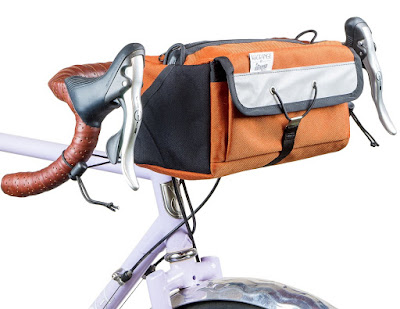



Rackless Mini-Rando Bags Are Your New Go-To For All Day Riding
by noreply@blogger.com (VeloOrange)
by Igor

Our new Mini-Rando will be your favorite go-to for all day, fun, mixed-terrain rides. It's the perfect size for easy access to your compact camera, cell phone, keys, wallet, snacks, and light jacket.


The main body of the bag uses a plastic liner for rigidity, and the zippered top is soft for easier cramming, overstuffing, and retrieval of awkwardly shaped items.

The "trouser" pockets on either side of the bag make for quick access and storage of energy gels as well as their respective carcasses.

Attaching the Mini-Rando to your drop handlebars is a cinch. Use the pair of webbing and cam-locks to secure the bag to your tops, and use the length of paracord and cord-locks to the drops. You can rotate the position of the cord-locks so that it feels good in the drops.

While the Mini-Rando is designed to work best on drop bars, we have discovered several other applications that also rock:
- Loop and secure the bag to a Wald 137 Basket for added capacity for things you may need to access frequently.
- The upper support bar on the Klunkers makes for the perfect lashing position.
- For three-piece bars like the Crazy Bars, you can use the upper loops to secure the bag to the forward extensions.
- Off bike bike, using the included shoulder strap makes for a very fashionable and easy to use day-bag for walking and hiking excursions.
- Size: 10 x 5.5 x 5.5 inches (25.4 x 14 x 14cm)
- Capable of storing 6-7 seltzers
- Weight: 300g
Entirely designed and manufactured in the USA as part of a collaborative effort between Velo Orange and Road Runner Bags of Los Angeles.
24 May 14:47
Resignation speech: what Theresa May said and what she meant | Politics
mkalus
shared this story
from  The Guardian. The Guardian.
|
Back in 2016, we gave the British people a choice. Against all predictions, the British people voted to leave the European Union. I feel as certain today as I did three years ago that in a democracy, if you give people a choice you have a duty to implement what they decide.
This is a familiar line from Theresa May, whose lineage can be traced right back to the “Brexit means Brexit” catchphrase of her first few months in office. But she does genuinely believe not only that the result of the Brexit referendum must be implemented – but that failing to do so is dangerous for Britain’s democracy.
I believe it was right to persevere, even when the odds against success seemed high. But it is now clear to me that it is in the best interests of the country for a new prime minister to lead that effort.
This is a sideswipe at the colleagues who have been trying to bring her down for months, and were driven to fresh spasms of fury when she entered talks with Jeremy Corbyn, in a bid to win Labour support for a modified version of her Brexit deal.
Her efforts ultimately failed – but she’s saying she stands by the decision to keep on trying, right up until the end.
It is, and will always remain, a matter of deep regret to me that I have not been able to deliver Brexit.
May knows that whatever she hoped would be her achievements, her three-year tenure in Downing Street is likely to be remembered chiefly for her failure to achieve the central task her government was set by the electorate.
She’s signalling here that she knows this failure is a burden she will carry for the rest of her life.
It will be for my successor to seek a way forward that honours the result of the referendum. To succeed, he or she will have to find consensus in parliament where I have not. Such a consensus can only be reached if those on all sides of the debate are willing to compromise.
This is the “good luck with that, Boris” passage. May has ultimately been brought down by those in her own party seeking a cleaner break with the European Union, which they believe the obligations contained in the Irish backstop will prevent.
But whoever succeeds her will have to govern with the support of a hung parliament, unless and until they call a general election. So a harder Brexit, let alone no deal, is highly unlikely to command a majority in parliament.
May is pointing out here that whoever is behind the big black door in Downing Street, the structural challenges of delivering Brexit remain – and they may become more, not less difficult, if her successor is more dogmatic.
Security. Freedom. Opportunity. Those values have guided me throughout my career. But the unique privilege of this office is to use this platform to give a voice to the voiceless, to fight the burning injustices that still scar our society.
This was followed by a list of the achievements May most prizes, and was an attempt to impose some coherence on a premiership defined almost exclusively by Brexit.
But two of the things she mentioned, the public inquiry into the Grenfell Tower disaster, and the race disparity audit, are efforts to investigate why things have gone badly wrong, in a Britain her party has run for almost nine years.
Another, ending the postcode lottery in mental health, appears more of an aspiration than a success.
I will shortly leave the job that it has been the honour of my life to hold – the second female prime minister but certainly not the last. I do so with no ill-will, but with enormous and enduring gratitude to have had the opportunity to serve the country I love.
This was the moment May’s usually steely demeanour collapsed, her voice cracking with emotion as she uttered those last few words.
She may have been more low-key about it than the flamboyant Boris Johnson, but she has long been a deeply ambitious and self-confident politician, who believed she was the right person for Britain’s top job – and now it’s over.
24 May 14:46

Google Duo gets eight-person group calling and Data Saving Mode
by Jonathan Lamont
Google’s excellent Duo video calling platform — and the better half of failed chat app Allo — is set to get a lot better if you’ve got lots of people to call at once.
Google is globally rolling out group calling to Duo on both iOS and Android. Duo’s group calling supports a reasonable eight simultaneous callers. Further, Google boasts that all of Duo’s calls are end-to-end encrypted.
To compare, Apple’s FaceTime allows for 32 members in a group call, while WhatsApp offers four. Skype and Facebook Messenger both offer 50-member group calls, but Messenger will only show six video feeds at a time.
Duo also forms the basis for video calling on Google’s smart displays, but group calling is reportedly exclusive to mobile at launch. While the Nest Hub Max is currently the only Google smart display with a camera for video calling — and it’s not yet in Canada — the mobile exclusivity also affects the Duo web client. In other words, if you want to group call in Duo, you’ll need to use a mobile device to do it.
Finally, Google is also adding a Data Saving Mode to Duo, but it will be restricted to select regions, including Indonesia, India and Brazil. If you turn on Data Saving Mode in settings, both you and the person you’re calling will use less data in the video call.
Google says Data Saving Mode will roll out to more markets in the coming months.
The post Google Duo gets eight-person group calling and Data Saving Mode appeared first on MobileSyrup.
24 May 14:22
11 Tips for Traveling Light On Your Long-Distance Cycling Tour
by Guest Author
 Our 11 tips for traveling light on your long-distance cycling tour will help you to successfully prepare for your bike tour. You may be intimidated by the thought of a long-distance bike tour because of all the things you would need to carry. However, fear no more. Our tips will get you focused and make sure you are traveling light.
The post 11 Tips for Traveling Light On Your Long-Distance Cycling Tour appeared first on Average Joe Cyclist.
24 May 14:21


4 Ways To Grow A New Community If You Don’t Have A Large Audience To Begin With
by Richard Millington
It’s a lot easier to launch a new community if you have a lot of customers or thousands of names on your mailing list.
If you don’t, you’ve got a few approaches you can take:
Option 1: Grow an Existing Audience, Then Launch
Most common for founder-created communities is to build a large number of existing contacts in the 3 to 6 months before launching the community. Get them to engage in events, through other groups, and steadily grow from there. Most of the communities you see followed this approach (albeit unintentionally).
Option 2: Pay for Advertising
If you don’t have an existing audience, you can pay for advertising.
Social ads can work well here. Each new member will cost about $5 – $10. Invest a few thousand dollars and you will get 300 to 600 registered members.
Assume you can keep 10% of them engaged, and you have your 30 to 60 founding members to get started. Keep investing a few thousand a month and you will start to see steady growth.
It’s not cheap for many, but it can work out cheaper than spending months building your own audience (your time costs money too). It can also be a lot quicker.
Option 3: Start A Tiny Group and Grow Steadily
Create a group on Facebook, Twitter (hashtag) or another channel that people already use and use built-in network effects to attract members. You can test different concepts and ideas, then grow steadily. Only launch your community on these groups. Once you have some engagement you want to move across to something you control. Remember at any time these platforms can seize control of your platform, reduce your reach, or remove it entirely without warning.
Option 4: Create Something With Viral Power
My favourite (and least used) option. Create a community so remarkable and different that people can’t help but talk about it. Do what Kaggle did for data scientists and Figure1 for doctors. A simple forum probably won’t cut it. Target 1% of your prospective audience who are ridiculously excited or challenged by an aspect of the topic. Then overwhelmingly cater towards it.
Feel free to have crazy rules that no-one else would dare to use. Perhaps ban unverified opinions, force members to mentor at least one other, or perhaps ban questions entirely and force people to share what they’re up to in some other medium. There are endless possibilities.
Select whichever approach makes the best sense to you.
Of course, if you want to grow really fast…select all four.
24 May 14:21
May Android Updates :: Samsung wins again
by Volker Weber
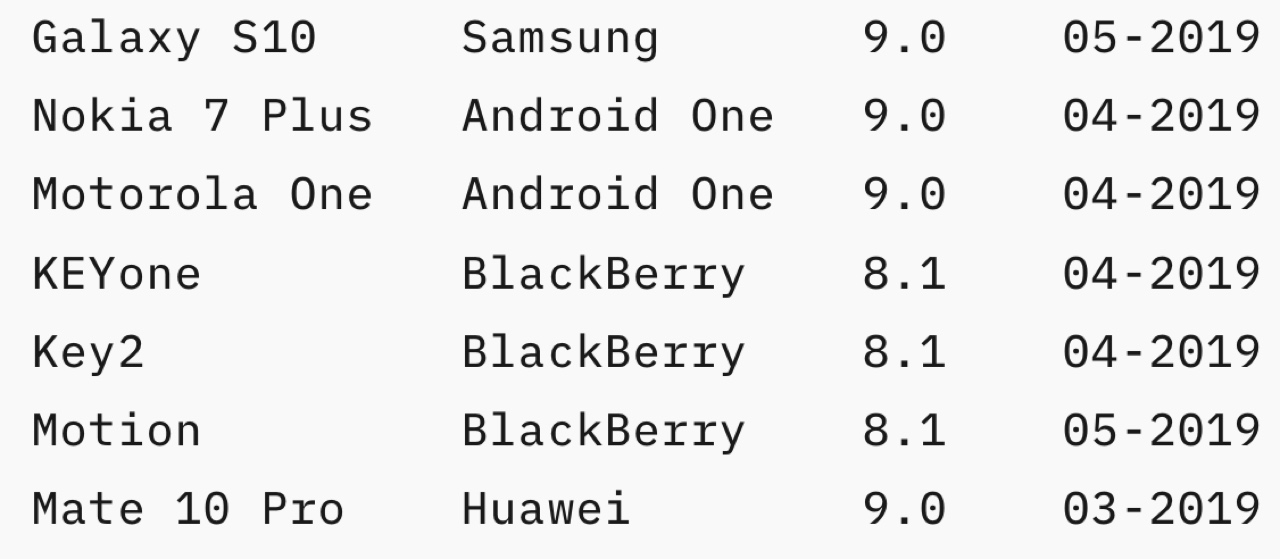
Same pattern as previous months: Samsung is faster than AndroidOne. Huawei trails.
24 May 14:21
satellite für Android ist fertig
by Volker Weber

Düsseldorf, 24. Mai 2019 satellite für Android ist nach sieben Monaten Entwicklungszeit ab sofort erhältlich. Die kostenlose App bietet alle Funktionen, um satellite dauerhaft als alternative Mobilfunklösung nutzen zu können. Das bald erscheinende Add-On satellite Plus kostet 4,99/Monat. Es bietet unbegrenzte Telefonieminuten und kommt pünktlich zur Urlaubszeit.
24 May 14:20
 Adrianna Tan @skinnylatte
And also that I cook seafood now and think of all the loony Teochew uncles and aunties I had who I thought were mad… twitter.com/i/web/status/1…
Twitter Favorites: [skinnylatte] And also that I cook seafood now and think of all the loony Teochew uncles and aunties I had who I thought were mad… https://t.co/LTFgcZTFHP
And also that I cook seafood now and think of all the loony Teochew uncles and aunties I had who I thought were mad… twitter.com/i/web/status/1…
24 May 14:17


Focals smartglasses get Google Fit and screen time update
by Dean Daley
A recent Focals’ update enables the smartglasses to sync with Google Fit.
Users will now be able to see their weekly progress and their daily activity.
To sync your smartglasses with Google Fit, download the app from Google Play or the iOS App Store. Afterward, select ‘Abilities’ on your Focals app and sign onto Google Fit. Then navigate to the ‘Health’ view to see your progress.
Android users can also keep track of their screen time and how long they wear their Focals throughout the day with digital health. To see your screen time, check out the reports also on the ‘Health’ view.
Recently, North updated the wearable with a personal teleprompter.
Source: North
The post Focals smartglasses get Google Fit and screen time update appeared first on MobileSyrup.
Rolandt likes this
24 May 14:17

Elon Musk says Tesla is on track to hit record-high car deliveries
by Bradly Shankar
Tesla CEO Elon Musk says the company is close to reaching its target production numbers for its Model 3 electric vehicle.
In an email sent to Tesla employees, Musk noted that the company has received over 50,000 new vehicle orders during this quarter. Because of that, the company has achieved 900 Model 3 deliveries per day, just 10 percent under its target of 1,000 Model 3 units per day.
By hitting 7,000 Model 3 deliveries per week, Musk said the company can exceed the 90,700 deliveries made in Q4 2018 and make Q2 2019 the “highest deliveries/sales quarter in Tesla history.”
Overall, Musk said Tesla has a “good chance” of hitting this milestone if employees come together to “rally hard.”
The email led Tesla stock to turn positive for the first time in seven days.
Via: CNBC
The post Elon Musk says Tesla is on track to hit record-high car deliveries appeared first on MobileSyrup.
24 May 14:16

Apple key production partner Pegatron may move some production out of China in June
by Jinqiao Wu
As the trade war between China and the United States escalates, Pegatron, one of Apple’s biggest production partners, may move its production of some Apple products to Indonesia in June, according to multiple sources.
An Indonesian-language report from Detikinet claims Pegatron invested $300 million USD (about $403 million CAD) at an unnamed Indonesian factory in Batam, Indonesia.
The investment coincides with the recently formed partnership between Pegatron and PT Sat Nusapersada, an Indonesian manufacturing company getting subcontracted assembly duty. Pegatron’s latest move confirms an earlier report by AppleInsider that the company planned to relocate at least some of its manufacturing work outside China.
Abidin Hasibuan, CEO of PT Sat Nusapersada, said the products the company manufactures are from a U.S. brand, and they are for the U.S. market. Hasibuan, however, he did not disclose the name of the brand.
Detikinet also says Pegatron picked Indonesia over Vietnam for better labor efficiency.
As tensions between the U.S. and China continues to balloon, a new wave of hefty tariffs will likely diminish Apple’s earnings significantly, says Goldman Sachs, since most of the company’s products are manufactured in China.
Pegatron is not unique in its decision to move production outside the heat zone. Foxconn, another Apple’s key assembly partner, confirmed it will mass-produce iPhones, such as the three years old iPhone 6s, in India.
Source: Detikinet via: Apple Insider
The post Apple key production partner Pegatron may move some production out of China in June appeared first on MobileSyrup.
24 May 14:16

Snapchat employees abused tool to access user data: report
by Aisha Malik
Numerous employees at Snapchat mistreated their privileged access to spy on users through the use of dedicated tools that allow them to access user information, according to a recent report from Motherboard.
This news comes after two former employees told Vice‘s tech publication that numerous employees used their power to view Snapchat users’ data a few years ago.
They had tools that would allow them to view location information, saved Snaps, phone numbers and email addresses.
SnapLion is one of the tools that allowed the employees to access user data. It was initially used to obtain data on users if there was a legal request from law enforcement, according to the former employees.
Motherboard obtained an email that shows a Snapchat employee using SnapLion to obtain an email address linked to a user’s account, in a case that wasn’t related to law enforcement.
A former employee told Motherboard that SnapLion gives its users “the keys to the kingdom.”
Snapchat was previously fined in 2014 for not disclosing that it stored and transmitted geolocation data.
A Snapchat spokesperson told Motherboard in an email that, “Unauthorized access of any kind is a clear violation of the company’s standards of business conduct and, if detected, results in immediate termination.”
A current employee told Motherboard that the company has made efforts towards protecting user privacy.
Source: Motherboard
The post Snapchat employees abused tool to access user data: report appeared first on MobileSyrup.
24 May 14:16

Huawei’s founder says his family uses Apple products while travelling abroad
by Shruti Shekar
Huawei’s founder Ren Zhengfei confessed that his family uses iPhones and purchases Apple computers when travelling abroad.
Speaking to a group of Chinese reporters on May 21st at Huawei’s headquarter in Shenzhen, China, Ren expressed that Apple should be served as a role model for Huawei in the development their software ecosystem where every device is closely connected.
“Many of my family members have told me the advantage of the Apple ecosystem,” Ren said in Guancha, a Chinese publication. “Richard Yu [chair of Huawei’s consumer division] was very unhappy that I am promoted for another company.”
During the press conference with Chinese media, Ren stated that Huawei will always excuse itself from politics. He defended the U.S. companies that halted businesses with Huawei and expressed appreciation by Google and IBM’s assistance in the past few years.
“Let’s speak out more in favour of U.S. firms. If you are going to attack someone, then aim at the U.S. politicians,” Ren said.
“I’m pragmatic. One can’t be deemed patriotic simply for using Huawei products, or the other way round. Huawei is a commercial business. If you like [the product] then use it. Do not politicise it,” Ren said. He also noted that Huawei’s advertisement in China never contained anything that pictured Huawei as “national pride”.
The ongoing nationalist and anti-U.S. sentiment in China could play to Huawei’s favour and hurt Apple’s sales in the country. Chinese customers are calling everyone to “switch to Huawei” as a sign of support for China during the ongoing trade feud with the United States.
U.S. President Donald Trump signed a recent executive order, he placed several companies on an ‘Entity List,’ including China-based smartphone manufacturer Huawei and 70 affiliates.
That list also includes telecommunications equipment provider ZTE. The order doesn’t specifically call out Huawei but it “invoke[s] the International Emergency Economic Powers Act,” a law that grants the president the authority to regulate any commerce that could pose a national security threat to the U.S. In this case, Huawei and the other companies added to the Entity List.
Source: Guancha.cn
The post Huawei’s founder says his family uses Apple products while travelling abroad appeared first on MobileSyrup.
24 May 14:16

Microsoft drops Huawei laptops from its online store in Canada
by Qian Bao
Huawei’s laptops, the MateBook X Pro and MateBook 13, are no longer available for purchase on Microsoft Store Online in Canada and the United States.
Searching Huawei on Microsoft Store will return no hardware results and the existing link for MateBook X Pro will now show an error message.
Microsoft declined to comment to MobileSyrup.
The company has also not confirmed whether it will continue to push Windows 10 updates to Huawei computers.
Huawei has not yet responded to this situation and its website is still displaying the link to the Microsoft Store Online.
Microsoft appeared to join Google, Intel and Qualcomm in distancing itself from Huawei after the recent ban by the U.S. government. Under the new restrictions, Microsoft can no longer supply Huawei with the Windows operating system. This could have serious implications on the sale of Huawei computers worldwide since Windows is the default operating system installed on these machines.
If you are planning to buy Huawei computers, MateBook X Pro is still available for purchase on the Canadian site of Walmart and Staples.
Source: CNN Business
The post Microsoft drops Huawei laptops from its online store in Canada appeared first on MobileSyrup.
24 May 14:15
... der Welt weiß zu machen, Rad fahren und zu Fuß gehen passten nicht zusammen.
Diesen Satz hat Modacity auf Englisch auf Twitter gepostet. (The greatest trick the auto industry ever pulled was convincing the world walking and cycling can’t coexist.) Die beiden erzählen in dem Post, dass sie seit sie in eine Fahrradstadt (Delft) umgezogen sind, mehr zu Fuß gehen als jemals vorher in ihrem Leben, weil die Straßen nicht von Autos verstopft sind. Da macht man gerne Spaziergänge. Aber stimmt der Satz? Aber was erzählt uns die Autoindustrie eigentlich über uns?
Ist euch schon mal aufgefallen, dass in unseren Fernsehfilmen in ungefähr der Hälfte aller Seznen Autos vorkommen? Kommissare fahren zur Leiche und finden immer gleich einen Parkplatz am Straßenrand, Autotüren knallen. Autotypen werden prominent, wenn Kommissare sie fahren. In einer Berg-Romanze stehen an jedem Waldweg zwei Autos, die Protagonist/innen steigen in ein Auto, das praktisch an den Tischen der Alp steht, und fahren los ins Grüne. Ein Zelt steht an einem Bach, daneben das Auto. Road-Movies funktionieren nur mit Auto. (Ein Cycle-Movie habe ich noch nicht gesehen). Das Auto ist immer da. Real und in unsere Bilderwelt. Tatsächlich können wir in einer Stadt (aber auch in Dörfern und Nestern) nicht aus dem Fenster gucken (oder zumindest nicht vor die Haustür treten), ohne ein Auto oder viele Autos zu sehen. Wir hören sie in der Stadt ununterbrochen, mal als nächtliches Rauschen, mal einzeln mit offenen Auspuffklappen und hochtourig Fehlzündungen produzierend. Keine Stille und kein Vogelgezwitscher existiert ohne das gelegentliche oder häufige Aufbrummen eines Motors oder das Knallen von Autotüren. Soviel zur absoluten Dominaz des Autos in unseren Augen, Ohren, Köpfen und Straßen.
Wir existieren nicht ohne Auto, das ist die Botschaft.
Und noch eine Botschaft gibt es: Der Fußgänger ist zumindest in unseren Filmen (fast) immer ein Autofahrer. Er steigt irgendwann in ein Auto ein (nur selten in eine Straßenbahn oder einen Zug). Dagegen ist der Radfahrer fast nie ein Autofahrer. Er ist in Filmen ein Sonderfall. Im Alltag auch. Für die Autoindustrie ist er deshalb nicht von Interesse, sondern ein Feind.
 Für den Fußverkehr ist der Radverkehr meist ein Feind.
Fußgänger/innen und ihre Verbände schimpfen auf Radfahrer. Sie seien rücksichstlos, sie führen immer auf Gehwegen, man traue sich nicht, Fahrradstraßen zu überqueren. Und Radler monieren Fußgänger, die ihnen mit Blick aufs Handy vors Rad laufen. Radfahren und zu Fuß gehen sind gewissermaßen zwei gegenüber dem Autoverkehr schwache Mobiliätsformen, die sich nicht mögen.
Für die Autoindustrie und ihre Lobbyisten gibt es nur den Autoverkehr und den Fußverkehr, die eine friedliche Koexistenz eingegangen sind, vollständig zu gunsten des Wegerechts des Autos. Der Autoverkehr wird nur kurz angehalten, damit der Fußverkehr mal queren kann, ansonsten schleicht der sich am Rand der Autostraßen entlang. Das passt. Das wird von Fußgänger/innen kaum infrage gestellt. Der Radfahrer ist in diesem Bund das Dritte, der Böse, der beide stört, die Autofahrer und die Fußgänger. Beide, Autofahrende und Fußgänger/innen samt ihren Verbänden können gemeinsam gegen Radahrende wettern, ihr verhalten skandalisieren und sie zur Gefahr erklären. Das klappt bestens.
So hat uns die Autoindustrie oder die jahrzehnte lang implementierte Dominanz des Autos in allen Lebensbereichen in unseren Köpfen uns weiß gemacht, dass Radfahrend und zu Fuß Gehen nicht zusammenpasen, dass Radler und Fußgänger sich nicht vertragen können. Das Radler die Rücksichtslosen sind und Fußgänger die Gehetzten, dass man das Radfahren beschränken muss.
In einer Stadt aber, die das Fahrrad hoch hält, den Autoverkehr beschränkt und dem Fahrrad bequeme Wege anbietet, scheint sich diese Gegnerschaft aufzulösen. Wo es schön ist, weil dort kaum oder gar keine Autos fahren, da geht man auch gern zu Fuß. Da nimmt man für kürzere Strecken (so bis 3 km, schätze ich) auch mal nicht das Fahrrad, sondern spaziert. Das ist interessant, finde ich.
Der Hass auf Radfahrende sinkt, wenn nicht mehr überall Autos fahren.
Vermutlich können wir uns in Stuttgart alle Flanniermeilen sparen, solange wir nicht auch den Autoverkehr reduzieren, der an ihnen entlang braust, und statt dessen wesentlich mehr Radverkehr durch die Stadt lenken. Dann fahren auf den Fahrbahnen die Radler und die Fußgänger/innen haben ihre Gehwege für sich und genießen die Ruhe.
Der größte Trick der Autoindustrie war es ...
by noreply@blogger.com (Christine Lehmann)
mkalus
shared this story
from  Radfahren in Stuttgart. Radfahren in Stuttgart.
|
 |
| Basisbild: Wikipedia |

Diesen Satz hat Modacity auf Englisch auf Twitter gepostet. (The greatest trick the auto industry ever pulled was convincing the world walking and cycling can’t coexist.) Die beiden erzählen in dem Post, dass sie seit sie in eine Fahrradstadt (Delft) umgezogen sind, mehr zu Fuß gehen als jemals vorher in ihrem Leben, weil die Straßen nicht von Autos verstopft sind. Da macht man gerne Spaziergänge. Aber stimmt der Satz? Aber was erzählt uns die Autoindustrie eigentlich über uns?
Ist euch schon mal aufgefallen, dass in unseren Fernsehfilmen in ungefähr der Hälfte aller Seznen Autos vorkommen? Kommissare fahren zur Leiche und finden immer gleich einen Parkplatz am Straßenrand, Autotüren knallen. Autotypen werden prominent, wenn Kommissare sie fahren. In einer Berg-Romanze stehen an jedem Waldweg zwei Autos, die Protagonist/innen steigen in ein Auto, das praktisch an den Tischen der Alp steht, und fahren los ins Grüne. Ein Zelt steht an einem Bach, daneben das Auto. Road-Movies funktionieren nur mit Auto. (Ein Cycle-Movie habe ich noch nicht gesehen). Das Auto ist immer da. Real und in unsere Bilderwelt. Tatsächlich können wir in einer Stadt (aber auch in Dörfern und Nestern) nicht aus dem Fenster gucken (oder zumindest nicht vor die Haustür treten), ohne ein Auto oder viele Autos zu sehen. Wir hören sie in der Stadt ununterbrochen, mal als nächtliches Rauschen, mal einzeln mit offenen Auspuffklappen und hochtourig Fehlzündungen produzierend. Keine Stille und kein Vogelgezwitscher existiert ohne das gelegentliche oder häufige Aufbrummen eines Motors oder das Knallen von Autotüren. Soviel zur absoluten Dominaz des Autos in unseren Augen, Ohren, Köpfen und Straßen.
Wir existieren nicht ohne Auto, das ist die Botschaft.
Und noch eine Botschaft gibt es: Der Fußgänger ist zumindest in unseren Filmen (fast) immer ein Autofahrer. Er steigt irgendwann in ein Auto ein (nur selten in eine Straßenbahn oder einen Zug). Dagegen ist der Radfahrer fast nie ein Autofahrer. Er ist in Filmen ein Sonderfall. Im Alltag auch. Für die Autoindustrie ist er deshalb nicht von Interesse, sondern ein Feind.
 Für den Fußverkehr ist der Radverkehr meist ein Feind.
 Fußgänger/innen und ihre Verbände schimpfen auf Radfahrer. Sie seien rücksichstlos, sie führen immer auf Gehwegen, man traue sich nicht, Fahrradstraßen zu überqueren. Und Radler monieren Fußgänger, die ihnen mit Blick aufs Handy vors Rad laufen. Radfahren und zu Fuß gehen sind gewissermaßen zwei gegenüber dem Autoverkehr schwache Mobiliätsformen, die sich nicht mögen.
Für die Autoindustrie und ihre Lobbyisten gibt es nur den Autoverkehr und den Fußverkehr, die eine friedliche Koexistenz eingegangen sind, vollständig zu gunsten des Wegerechts des Autos. Der Autoverkehr wird nur kurz angehalten, damit der Fußverkehr mal queren kann, ansonsten schleicht der sich am Rand der Autostraßen entlang. Das passt. Das wird von Fußgänger/innen kaum infrage gestellt. Der Radfahrer ist in diesem Bund das Dritte, der Böse, der beide stört, die Autofahrer und die Fußgänger. Beide, Autofahrende und Fußgänger/innen samt ihren Verbänden können gemeinsam gegen Radahrende wettern, ihr verhalten skandalisieren und sie zur Gefahr erklären. Das klappt bestens.
 | |
| Für Autos die Fahrbahn, der Rest: Chaos |
In einer Stadt aber, die das Fahrrad hoch hält, den Autoverkehr beschränkt und dem Fahrrad bequeme Wege anbietet, scheint sich diese Gegnerschaft aufzulösen. Wo es schön ist, weil dort kaum oder gar keine Autos fahren, da geht man auch gern zu Fuß. Da nimmt man für kürzere Strecken (so bis 3 km, schätze ich) auch mal nicht das Fahrrad, sondern spaziert. Das ist interessant, finde ich.
Der Hass auf Radfahrende sinkt, wenn nicht mehr überall Autos fahren.
Vermutlich können wir uns in Stuttgart alle Flanniermeilen sparen, solange wir nicht auch den Autoverkehr reduzieren, der an ihnen entlang braust, und statt dessen wesentlich mehr Radverkehr durch die Stadt lenken. Dann fahren auf den Fahrbahnen die Radler und die Fußgänger/innen haben ihre Gehwege für sich und genießen die Ruhe.
24 May 14:15
Announcing the Playdate® handheld video game system.
by Cabel
mkalus
shared this story
from  Panic Blog. Panic Blog.
|
After more than 20 years of making quality apps you love for Mac and iOS, Panic was ready to try something new…
…and that something was hardware.
Today, after more than four years of work by a small and talented team within Panic, we are extremely excited to introduce Playdate, a brand new handheld gaming system, arriving in early 2020.
Playdate is both very familiar, and totally new. It’s yellow, and fits perfectly in a pocket. It has a black-and-white screen with high reflectivity, a crystal-clear image, and no backlight. And of course, it has Wi-Fi, Bluetooth, USB-C, and a headphone jack. But it also has a crank. Yes, a crank: a cute, rotating analog controller that flips out from the side. It’s literally revolutionary.
It also includes a full season of original games, at no extra charge, delivered each week to the system — games in all sorts of genres that are all hopefully surprises.
Yes, this is all real.
Now before you ask, and you will ask, don’t worry, yes we’re still developing Mac and iOS software. In fact, we’ll be releasing a preview of the next major version of Coda later this year. Stay tuned!
But if you enjoy games, if you like beautiful things, or if you just enjoy having fun, you might enjoy Playdate. Hopefully it’s unexpected, but also totally Panic. We really think it’ll brighten your life.
24 May 14:15
The benefits of walking and how to get the most out of it
| mkalus shared this story . |
There'll always be new fitness and workout trends to throw ourselves into (and debate the merits and efficiencies of), but it still might be worth learning how to walk before we run — or spin or box or circuit train — for lifelong health.
A recent study from Northwestern University analyzed the daily habits and exercise of more than 1,500 older adults, all with osteoarthritis symptoms, like stiffness, aching and pain, but no disability. The researchers found that participants in the study who walked briskly for at least one hour per week reduced their risk of daily-living disability (like being unable to clothe themselves) by almost 45 per cent and their risk of mobility disability (like walking too slowly to safely cross the street) by 85 per cent. With nearly five million Canadians currently suffering from osteoarthritis (projected to be one in four Canadians by 2035), these studies offer a good reminder of the importance of walking for exercise, health and mobility. We talked to two experts about why we should all start walking more and how to get the most of out it.
The hidden benefits of walking
It's easy to dismiss walking as just what we do to get around, but it's a full-body movement that doesn't get the credit it deserves. "Walking is the most natural exercise there is," says Charlotte Montgomery, a personal trainer and owner of Speed Walk Toronto. She points to the improvement of daily living, posture, balance, flexibility and core and muscular strength as some of the physical benefits.
Regular walking has also been shown to fight genetic weight gain, curb cravings, ease joint pain and strengthen your immunity. A 2015 study found that going from a sedentary lifestyle to taking 10,000 steps per day could lower your risk of mortality by 46 per cent. And regular aerobic exercise can calm the mind by reducing stress hormone levels.
The best part is that walking offers all these benefits in a scalable and low maintenance way. "Walking is a non-intimidating activity that everyone can do," says Toronto-based personal trainer Barb Gormley. "It requires no special equipment or skill and can be done anywhere."
What "counts" as walking?
It doesn't have to be all or nothing — any chance to walk is a good one. There are different types of walking, from fitness-focused speed walking and adventurous hiking to strolling around the neighborhood and general walking required for everyday tasks. "Smartwatches consider any kind of stepping as walking," Gormley says, and that the intensity or speed doesn't matter when compared to not walking at all. But to encourage yourself to make it part of your daily routine, she says: "Use a phone app or smartwatch to track your daily steps and challenge yourself to walk a few more steps each day".
Step-tracking technology, like the Fitbit, uses a 3-axis monitor that determines what a step is, based on your own personal movements, and tracks it separately from other markers — so you don't have to reach a certain speed or distance to start counting your steps. If you don't have fitness wearables, there are countless walking and fitness tracking apps that can motivate and monitor your steps in simple and fun ways. There's even a hidden pedometer already on your iPhone. And if you're not technologically inclined, you can always use estimates of your usual routes to get a general idea, whatever it takes to get those steps in.
Common walking mistakes
Regardless of intensity or duration, walking is great, but walking with proper form is better, as improper technique can cause difficulties over time. Erin Billowits, personal trainer and owner of Vintage Fitness, highlights the most common walking mistakes. Slapping feet, or walking with a flat food as opposed to stepping heel-to-toe can cause undue stress leading to shin splints. Less confident walkers who are worried about falling may shuffle their feet without picking them up off the ground, but that can actually increase your risk of stumbling and tripping. Another common mistake is not using your arms, which are a natural part of the walking motion and can help to propel you. If you're walking slowly, you can have your arms straight and swinging at your sides, but for a quicker pace, you can bend your elbows and keep your arms closer to your body, in a pumping motion. Lastly, walking with poor posture, such as a forward or drooping "turtle" head can strain your head, neck and upper shoulders, something all the more common now with our constant smartphone use. Standing tall and looking forward with a braced core (the ab muscles that flex when you cough), while stepping in a deliberate and measured heel-to-toe manner is the best way to ensure your walking is as safe as it is successful.
Walking as your main exercise
Due to its ease on the body and consistent pace, "older adults are prime candidates for walking", says Billowits. "It causes less impact on joints and doesn't spike the heart rate like jogging and outdoor sports such as tennis." Montgomery believes two prime candidates for walking are: "Someone who has not been physically active but wants to start working out or someone who may have been a runner and can no longer run due to an injury. Both would greatly benefit from walking."
Walking as part of a larger regimen
A walking program can also work well in conjunction with other training. Billowits advises that walking, "should be complemented with strength training and flexibility exercise programs." She suggests a routine of chair squats, calf raises and calf stretches to prime the key walking muscles, as well as a series of dynamic stretches to maintain a full range of mobility. "For walking to have the best fitness results," says Montgomery, "it should be incorporated into a workout allowing for both aerobic training that builds cardiovascular endurance and anaerobic training, which is intense training done in short bursts followed by a recovery period, that builds both cardiovascular endurance as well as muscle mass and strength." Montgomery offers a speed walking workout as an example: walking at a higher intensity for 20 to 60 seconds, slowing down or stopping for a rest period, then repeating over several intervals. But, if you want to skip the planning and get started, "the best way to begin is to just start walking," says Gormley, then "gradually increase the time, distance and/or steps you take."
Upping the intensity
If regular walking no longer feels like a challenge, there are plenty of ways to increase the difficulty to keep it engaging for your mind and body. Montgomery suggests incorporating higher-intensity drills, like fast walking for the distance of two lamp posts, then recovering for the same distance, and continuing this format for several minutes. You could also try timing your walk between two points in a park and repeating the distance a few times to maintain or beat your original time.
"Don't do the same distance, the same way, every day," says Billowits. "Change your route, do some faster walking intervals, bring a resistance band with you. Stop at a park bench and strength train in the middle of your walk." She also suggests setting daily targets, then regularly increasing it as you grow comfortable with that goal (eg. taking 50 more steps per week). Another intensity booster is Nordic walking. "Nordic walking uses specialized poles that propel you forward," says Gormley. "It involves your arms, shoulders and core muscles, which are typically relaxed during standard walking," she explains, leading to increased muscle activation overall and a higher calorie burn. The simplest upgrade is to adjust your walking routine to involve stairs, hills or different terrain, increasing the intensity while hitting the same muscle groups from different angles.
"Never try to increase the intensity of walking by wearing ankle weights or carrying dumbbells," says Gormley. "The sudden shock of the extra weight puts you at risk for strains and injuries to your joints."
If you're eager to add more walking into your everyday lifestyle Gormley suggests the usual: "Walk to do errands instead of driving, turn a sit-down meeting into a walking meeting, or catch up with a friend with a walk instead sitting with a coffee or a beer." Incremental changes to your daily routine can subtly create a great baseline for when you do begin dedicated workouts.
If you'd like to jump right into a more fitness-focused walking workout, Montgomery suggests this 60-minute speed walking program:
- 5–10 minutes of warm-up walking at a brisk pace
- 5 minutes of warm-up stretching
- 25–30 minutes of high-intensity walking drills
- 5–10 minutes of strength exercises (e.g. lunges, pushups)
- 5-minute cool down walk
- 5–10 minutes of post-workout stretching
Are you ready to get moving? How do you work walking into your life? Go for a stroll and let us know in the comments below.