Shared posts

24 May 14:59

What bikes do I use for commuting in 2019?

by jnyyz

Yesterday I logged the 2000th ride on my regular commuter, and so I thought it would be an opportune time to update a post from 2011 that described the four bikes that I use most regularly.

First up: my Rock Lobster Alfie, which is still my regular commuter. I’ve logged just over 2000 rides and about 14,600 km on it.

Rock Lobster Alfie

Since 2001, I’ve added a front rack and dynamo lighting.

My most recent tweak is the high viz Ortlieb pannier. I’ve been quite happy with it, and it is my first totally waterproof pannier as well.

The second most used bike is my long tail cargo bike: a Bike Friday Haul a Day. This replaces the Xtracycle that I had for quite a while.

Haul a Day with Xtracycle

I got the Haul a Day back in 2015, and since then I’ve tweaked it quite a bit. The most recent mod was adding dynamo lighting.

For my winter beater, I finally retired the Novara and got a Louis Garneau Cityzen Sub Zero, a model that came with studded tires, and they only sold it for a year.

Louis Garneau Sub Zero

Most important mods: 1) a KMC S10 stainless steel chain, 2) dynamo lightning, and 3) better than original studded tires (Schwalbe Winter Marathons)

The fourth regular rider is a folding bike. I replaced the PBW with a Tikit, and then after much thinking about it, I replaced my Tikit with a Brompton.

I’ve been very happy with it.

So, in summary, since 2011, I’ve kept the same four types of bikes, but I have replaced three out of the original four. The more things change, the more they stay the same…..

24 May 14:58

Recommended on Medium: Fresh Off The Boat

When I first moved to America nine months ago, I was perplexed by a never-ending list of things. They were not the ‘big’ ones, like having to learn a scary new language. We already spoke English. We’d seen enough movies. Our accents, we were told, were non-existent! You sound Californian!!! You have no accent! (Didn’t that mean we had a Californian accent?) But the little things started to add up.

Nowhere was this clearer than when my wife and I stood in a Bed Bath & Beyond, overwhelmed by nearly everything. Not because we were from developing countries (we were not) and all of this was shiny and new and amazing, but because we just didn’t get it. First, we gawked at the escalator that was purpose-built for one’s shopping cart to ride up at the same time as you, the person, riding the other escalators. Then, we found ourselves in surrounded by bed-linen, utterly and completely lost.

“What are comforters? What are duvet covers? What is a quilt? What is a flat sheet? Do people in this country really need so many pillows?”

I ran to the nearest human who was not my wife, saying, “Hey I need to buy a bolster, you know the type you cuddle between your body, and I have no idea what it’s called in this country.” He scratched his head, then his beard, before finally saying, “well I’m from the UK and I just moved here…”

I still don’t understand bed-linen in this country. Across our studio (I very nearly said ‘flat’), we are treated to full-glass windows into our neighbors’ bedrooms. Every last one of them has a bed that looks like a hotel bed; like it would take twenty minutes to peel the multiple layers of ribbons, throws, miscellaneous sheets, and other types of softness, before one could have a good night’s sleep. I felt anxious looking at them. I felt more anxious thinking about having to make up such a bed.

Voicemail is another American practice that strikes fear in my heart. Perhaps it’s because I have never lived in a society where voicemail was actively used (and I have lived in many countries), or maybe it’s due to my general levels of social anxiety relating to being on the autism spectrum, but hearing a chirpy person say “hey leave me a voicemail” makes me want to hang up, even if I originally had something to say.

I came to America after four years in Indonesia. My conversations in Indonesia inevitably ended with “hey, add me on LINE, Telegram, WhatsApp, Facebook Messenger, Instagram, what else do you use?” This was true when I hung out mostly with rural housewives for work; this was also true when female teenagers would come up to me to ask me for my Instagram account because “I want to know a woman who has tattoos”. This was true of every motorcycle taxi driver I met, who sent me “what’s your closest landmark” in Indonesian short form internet slang to multiple apps and also SMS, in just four or five letters small caps no spaces, even though the pickup location was always on the damned app.

In America, there are just three texting camps. Blue, green, and don’t-text. Leave me a voicemail… nope, no, never.

You have no accent, has both been a blessing and a curse. It’s certainly perplexing, for everyone around me, when I forget which words are British and which words are American.

It’s hard for me to say “restroom”, when “toilet” has sufficed in every other context I’ve lived in. Concepts that exist for me in one English don’t seem to exist here. Prepaid-anything, like in phones, are ‘pay as you gos’, which seem so inefficient. A Clipper card is to be reloaded, or have value added to it, not recharged or topped up. Telling someone you don’t know know how to drive, have never driven in your life, is like telling them you’re from a different galaxy (I was indeed, from a galaxy with good public infrastructure).

Mostly, I’m so fresh off the boat I don’t even know that it’s an insult. I’m so far-removed from the pains of the Asian-American community: their pains are not my pains, I have not been a minority for long enough; and nope, I have absolutely no qualms bringing my own chilli sauce to restaurants because I cannot abide sriracha. Team spicy forever, no sour.

I’m still figuring out what it means to be here. Mostly, I like that nobody ever asks where I’m from, because everybody is from somewhere else.

Until I tell them I still don’t know how to drive.

Then they exclaim, “you’re from Manhattan!”

24 May 14:57

It’s yellow. It fits in your pocket. It’s got a...

It’s yellow. It fits in your pocket. It’s got a crank.

Oh my gosh, Panic, what have you done now?

24 May 14:56

Putting the Soul in Console

by Anil Dash
Putting the Soul in Console

Playdate, the upcoming indie handheld gaming console from venerable software publisher Panic, is really important. But if you don't know the history of where the little company behind this little device comes from, it might be hard to understand why this isn't just another random gadget like you might see on a crowdfunding site.


An Indie Scene

About 20 years ago, there was a bit of a reckoning about what the web was going to be. The dot com era of startups were in full bloom (the crash didn't come until 2000, with 9/11 cementing the collapse of the first web bubble) but those of us who loved the internet could sense some of the joy and creativity seeping out of it as the money men took over.

A little less obvious was the reckoning going on amongst "software people". We were still making programs then, or software — applications wouldn't get shortened to "apps" until the iPhone took off almost a decade later. But there was a culture that almost saw making software as a craft. And a number of new web-savvy companies sprung up at the forefront of that movement, all of them decidedly not interested in just riding the dot com wave that was about to crash. I was a fan of them all, watching from afar as they seemed to set the standards for what was "cool" in tech — and all of them did it from outside of Silicon Valley.

Basically, in tech there was something akin to an independent music scene that one might see in a mid-sized town. Except it was geographically dispersed rather than being in one city, and it was about creating technology instead of creating songs.

In Chicago, there was 37 Signals. Brash, bold, opinionated, and trendsetting in design, the company evolved over time into today's Basecamp, still one of the most popular project management tools. (And they spun out lots of interesting tech and tools along the way.) In New York City, we had Fog Creek Software. It, too, had opinionated and charismatic leaders talking pointedly about The Right Way to make software, and it changed immensely over the years, spinning out efforts like Trello and Stack Overflow, before finally evolving into Glitch, where I work now.

And then, in Portland, there was Panic. They began with the venerable and utilitarian FTP app, Transmit, but released a wide variety of tools for developers, before transforming themselves in recent years into a broader, more ambitious software publisher that put out mainstream hits like Firewatch. But where these other standard-bearer companies were brash and in-your-face, Panic was always a little, well... goofy. Friendly, to be sure. And smart as hell. But there was a sense of exploration and fun and play to everything Panic did.

And today, we got to see one of the most exciting announcements in the two-decade history of the company: Playdate. You can read up on all the details elsewhere, but suffice to say, this little game machine looks like one of the most fun and joyful new efforts that any company has done recently, and that a tiny indie software company in Oregon has the ambition to even attempt such a thing makes it only more endearing.

Perhaps the best way of explaining why Panic is so important to so many of us is to watch Panic co-founder Cabel Sasser's wonderful, heartfelt talk at the XOXO Festival back in 2013. (It even teases the existence of Firewatch, long before it became a smash hit!)

Cabel Sasser, Panic

Cabel's closing exhortation to "don't waste this, keep everyone guessing, and make me proud" hit me hard in the room at that moment, and stuck with me to this day. Because Panic has done exactly that.


Date of Arrival

I'd been given a hint a while ago that something like this was coming, but the final execution is even more delightful than I'd imagined it might be. (That crank!) More importantly, it's captured the imagination of so many, and seems like the kind of thing that could inspire a new generation of creative people to think, "Hey, maybe good tech is something we can make ourselves." I've seen it happen on Glitch, and now I see it happening around Playdate after just a few hours.

That idea, that maybe things like our gaming devices or the websites we visit should be created by people we know and like, instead of giant faceless companies, seems more essential than ever. We would never settle for replacing all of our made-with-love, locally-grown, mom's recipe home cooking with factory-farmed fast food, even if sometimes convenience demands we consume the latter. And we shouldn't compromise any less on making sure that some of the time we spend playing games with each other, and delighting in the promise of technology, comes from people who've been diligently working for years to make well-sourced, organically grown, made-with-love technology.

I don't know if Playdate will succeed in the market. I don't know what kind of risk it represents for Panic as a company. But I know that people see this cute little device, and are reminded that they used to get excited when they saw cool new technology, instead of wondering how it would warp their reality, or steal their information. Here's hoping for a return to tech that's fun, that's thoughtful, and that's created with a little bit of soul.

Putting the Soul in Console

24 May 14:54

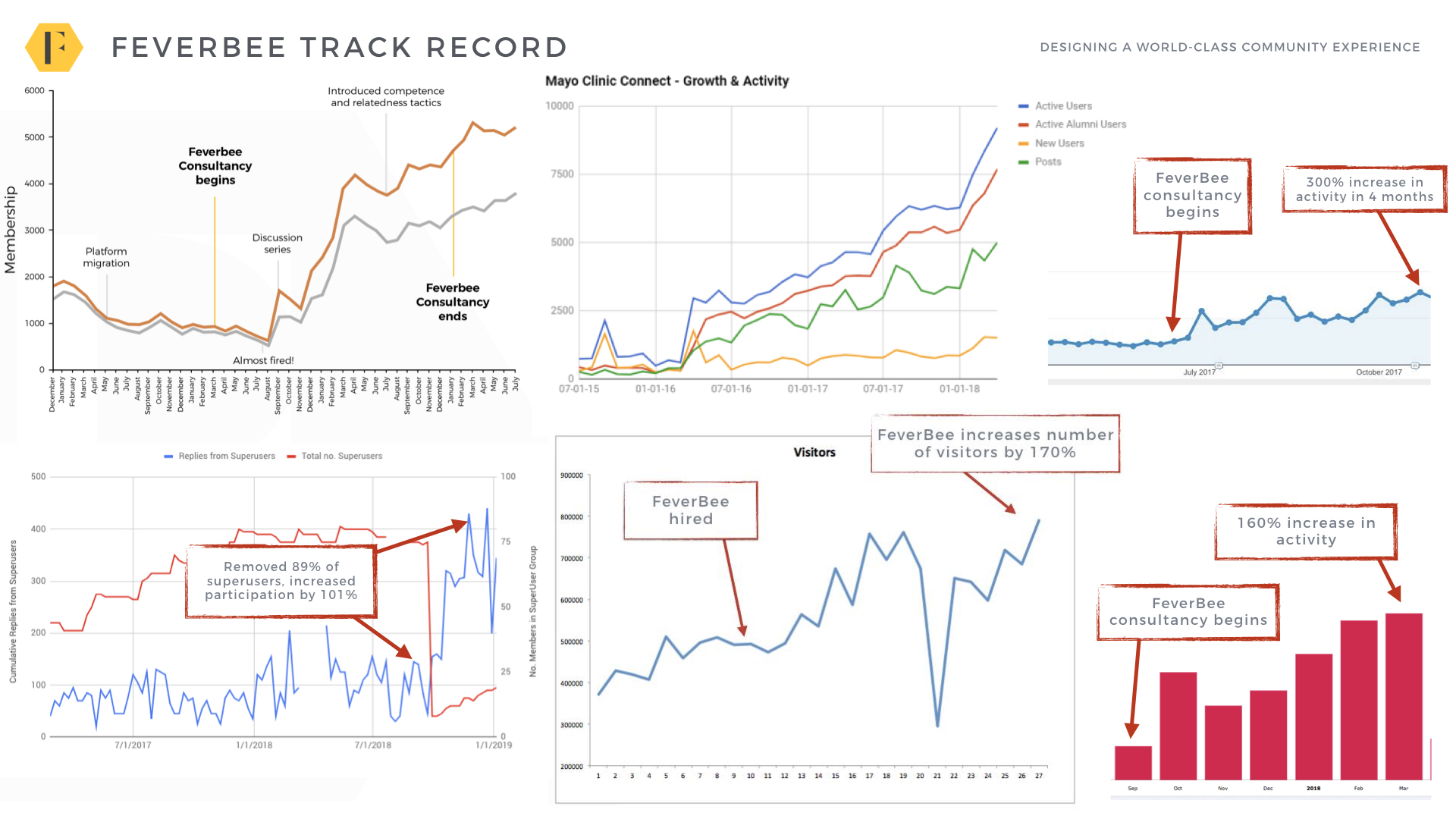
Getting Help Is A Bargain

by Richard Millington

I have a list of organizations who turned down our consultancy proposal for being ‘too expensive’.

…and then sunk an additional $250k to $1m+ into their community (staff + platform costs) without managing to make it work.

That’s a lot of time and money to waste.

Many of these communities today have no organic growth at all – the community manager just pushes out new content and discussions hoping something will miraculously happen and the community will spring to life.

The miracle is never going to come, it’s just more time and money down the drain.

Whether from us or from someone else, get some help. It’s tremendously painful to watch brands repeat the same, easily avoidable, mistakes and condemn potentially incredible communities in the process.

If your community isn’t as successful as you want it to be, get another perspective. Get someone to challenge you, push you, and give you a wide-angle lens detailing what other organizations like yours have done to succeed.

Get someone who can explain other ways to figure out what your members want, build support etc…Get someone who can explain how to restructure your community, better design it, and ensure it’s making the best use of your staff/technology investments.

No, this might not come ‘cheap’, but when you’re spending $250k+ on your community a year you probably don’t want cheap – you want results. If getting consultancy support turns the community around (as we’ve done, consistently), it’s a bargain.

24 May 14:54

No Limits

by Volker Weber

It does not have to be cars. There are other heroes to inspire.

24 May 14:54

Yancey Strickler :: The Internet is Becoming a Dark Forest

by Volker Weber
Imagine a dark forest at night. It’s deathly quiet. Nothing moves. Nothing stirs. This could lead one to assume that the forest is devoid of life. But of course, it’s not. The dark forest is full of life. It’s quiet because night is when the predators come out. To survive, the animals stay silent.

More >

24 May 14:54

Track Changes has a Status Hierarchy (and we all know the rules)

by jennydavis

 Today I worked on three separate collaborations: feedback on a thesis draft, a paper revision with colleagues at other universities, and a grant proposal with mostly senior scholars. Each collaboration represents my integration with distinct project teams, on which my status varies. And along with my relative status, so too varies my relationship with the Track Changes editing tool.

When giving feedback on my student’s thesis, I wrote over existing text with reckless abandon. I also left comments, moved paragraphs, and deleted at will. When working on my paper collaboration, I also edited freely, though was more likely to include comments justifying major alterations. When working on the research grant, for a project team on which I am the most junior member, I knew not to change any of the text directly. Instead, I made suggestions using the Comment function, sometimes with alternative text, always phrased and punctuated as a question.

These experiences are, of course, not just tied to me nor to the specific tasks I undertook today. They are part of a larger and complex rule structure that has emerged with collaborative editing tools. Without anyone saying anything, the rules generally go like this: those higher on the status hierarchy maintain control over the document. Those lower on the status hierarchy do not. Even though Track Changes positions everything as a suggestion (i.e., collaborators can accept or reject any change), there is something gutsy about striking someone’s words and replacing them with your own, and something far meeker about a text-bubble in the margins.

Track Changes (and other collaboration tools) do not enforce status structures. They do, however, reflect and enact them. Who you are affects which functions are socially available, even as the entire suite of functions remain technically available. Users infuse these tools with existing social arrangements and keep these arrangements intact. The rules are not explicit. Nobody told me not to mess with the grant proposal text, just as nobody sanctioned my commanding approach to the student’s thesis, or the “clean” (Track Changes all accepted) manuscript copy I eventually sent to my co-authors. Rather, these rules are implicit. They are tacit. And yet, they are palpable. Missteps and transgressions could result in passive aggressive friction in the mildest case, and severed working relationships in the more extreme.

Just like all technologies, Track Changes is of the culture from which it stems. Status hierarchies in the social system reemerge in the technical artifact and the social relations facilitated through it. Stories of Track Changes norm breaching would illustrate this point with particular clarity. I’m struck, however, by not having on hand a single personal example of such a breach. Everyone I work with seems, somehow, to just know what to do.

Jenny Davis is on Twitter @Jenny_L_Davis

24 May 14:53

Go Vote in the European Elections!

by Ton Zijlstra

This week the EU Parliamentary elections take place. The Netherlands goes to the polls today, and I will cast my vote after I return from work.

Not sure what party to vote for? Use the interactive comparison of all EU party manifestos to zoom in on the party or parties that support your positions.

Not sure who to vote for? From your preferred party list, pick a woman, specifically one around the expected number of seats your preferred party will achieve. That provides the highest probability the EU Parliament will get closer to having about both 50% men and women.

2019vote.eu screenshot

24 May 14:53

Spring

by peter@rukavina.net (Peter Rukavina)

After seeming weeks of ceaseless rain, we woke up to sunshine this morning.

And the trees reacted by bursting out buds.

I don’t believe the winter-spring transition has ever been as clear cut as this: yesterday the sky was dark and the trees were midwintery; this morning there is life everywhere you look.

24 May 14:53

What is a functor?

by Eric Normand

Functors are an operation that has a structure preserving property. But what is that? Are these things practical? Does it have anything to do with the real world? Of course! To be useful, it must derive from real-world things we see all around us. This one is an assembly line. How? That’s what this episode is all about.

Transcript

Eric Normand: What is a functor? By the end of this episode, I hope that you have a good understanding of this very useful idea and how it relates to the real world.

My name is Eric Normand and I help people thrive with Functional Programming.

Functor is an interesting idea. It’s a concept from category theory. It is used often in languages like Pascal and Scala where the communities do a lot of category theory stuff in their programs.

Let’s go over what it is. Like some of the other algebraic ideas that we’ve gone over like associativity, monoid, communitivity, those kinds of things, this functor is about operations over a certain type that the operation has a structure-preserving property. We’re going to go over what structure preserving means.

You’ll often find that the operation is called map or F-map.

In Scala, the idea of functor is translated into mappable, I believe. It’s a mappable interface, a mappable…What do they call them? Case class or something like that. I’m not a Scala person so don’t take my word for that.

A good example that you’re probably familiar with is mapping over a list. That is a functor. Map over a list is a functor. Now, what is that? What does that mean? Let’s use a metaphor. It’s a metaphor. It’s not a metaphor, but let’s call it metaphor for right now.

Imagine that you are the manager of a factory. In this factory, you have an assembly line. Just to make it concrete, you’re making toy cars. In the car manufacturing process, there are steps that you have to follow in a certain order. You can lay out your assembly line to do those steps.

When you’re doing factory management, you want to optimize the time it takes to make a car because the more cars you can make in a day, the cheaper they will be. You can service more customers.

You can start to play around with things. You see that there’s a worker here on the one part of the assembly line, and they are adding the body of the car. There’s a chassis, they add the body. Then they pass that to a person who adds the wheels.

Then they pass it to the next person. Maybe they pass it by hand, or there’s a conveyor belt or something. Regardless, person A adds the body, then person B adds the wheels. Now, you could say, “Let’s do an experiment. What if the same person adds the body and then the wheels?” You eliminate a person. You get rid of one person by combining these two jobs into one.

Now, the question is, you’re doing this experiment to see if it’s faster, if it’s more efficient. It might be. It might not be.

It’s a good assumption, but you’re assuming that the car will still be made correctly. That this person who is adding a body and then the wheels is doing the same work as two people where the first person adds the body and the second person adds the wheels.

It’s the same work. You’re going to get the same car at the end. That is the structure-preserving property. That somebody doing two jobs in a row themselves is the same as two people doing the first job and the second job, respectively. That’s all the structure-preserving property is.

Now, let’s translate this into mapping over a list. Let’s say you have a list of strings. You have two operations to do on these strings. The first is you have to trim the white space off the front and the back, so basically calling that trim. Then the second operation is to uppercase them, very straightforward.

You can write what we might call a pipeline. You take the list of strings then you map trim over that, and then you map uppercase over that. The string values will flow through two different operations. One is trim. The next one, uppercase.

I could say that’s inefficient because you’re making this intermediate list. The first map is making a totally new list, or array, or whatever it is in your language. It’s making a totally new list, and then that list is just thrown away right away after it gets passed to the second map. You’ve made some waste.

Because of the structure-preserving property, you can do this — you can say, “Well, we’re only going to do one map. We’re going to make a new function for the map.” You pass enough function to map. This function is going to do both trim and uppercase.

It’s going to take that as the string. It’s going to trim it, and then uppercase it, and then return it. You only run map one time. We also believe, just intuitively, that this is going to give us the same answer at the end with less waste. This is the structure preservation property.

More formally, I could say that map of F on map of G of some list is the same as map of F composed with G over the list. It’s that function composition. We’ll talk about that in another episode. That’s basically what we do. We made a new function that does both operations. That’s structure preservation right there. That’s it. That’s all it is.

You could also extend it and say there’s the idea that if I map the identity over the identity function over a list, then I get that same list out. That’s an important property. Basically what you’re saying is I have some neutral operation that does nothing to it. It shouldn’t change anything. This as a metaphor, I like to look at this like in a factory.

I can put my car or my partially built car on a conveyor belt. That conveyor belt does nothing to the car except move it. It does not change the car in any way. That is like a neutral step. I can add conveyor belts between any two workers as much as I want. As long as those conveyor belts don’t damage the car or change the car in some way, I can just put conveyor belts between things.

That is part of the structure preservation. I said that it’s kind of like a metaphor. It’s not really a metaphor. This is the structure preservation property that just exists naturally in an assembly line.

That’s why it works. That’s one of the reasons why assembly lines are so powerful. You get the same car out at the end, and you can manipulate how the work gets done. How small tasks you’re making.

I can give small tasks to all these people on the assembly line, or I can give bigger tasks to each person on the assembly line. As long as the tasks happens in the same order, I get the same answer. That’s pretty cool.

This is what functional programmers find cool about the structure preservation property and functors.

Let’s look at some other functors that you might not think of. We’ve got lists. Lists are functors because you can map, so map over list is functors. Now you might have, in your language, an idea of a maybe value or an optional value. That is also a functor. Even if you don’t have the idea, you might have something very much like it.

I know in JavaScript, in Python, in Clojure, we’ve got this value that represents no value, so nil, or null, or nothing, or none. It has different names. You could squint and say, “Well, all values in these languages are actually optional.” They could be null, right? It’s well known that you get null-pointer exceptions and stuff if you don’t treat it like it’s optional, if you don’t check.

You can write an operation that’s like map. It’s going to have this structure preservation property that takes the value. It does the check, is it null? If it is, it just returns null. If it’s not, it calls a function on it. That’s passed in.

Some function F, that gets called on it. It’s going to have the same property, the same property that if I have a value and I map F on it. That’s a special map. It’s like a maybe map. It’s going to call maybe-map with F on this value, and then I call maybe-map with G on that value. It’s the same as composing them with a single maybe-map.

That’s another common functor that you might have. Any collection could be a functor. In Clojure, we generally don’t treat things like that. Like a set, we have map over a set, but it treats it like a sequence. It picks some order to traverse the set in and maps over it that way. Then it returns a sequence.

But you could have a map that’s just for sets, that takes a set and returns a set. Now you got to make sure that whatever you do, preserve that structure-preserving property. One way you could lose the structure-preserving property is sets have this interesting thing that they get rid of duplicates.

If you have a bunch of strings and you trim them, you might lose some strings. The count will go down because now you have duplicates because you trimmed them. They’re now equal. What does that do? That might lose that property, that structure preservation, but maybe not. It really depends on the operations and the values that you’ve got in those sets.

That’s functor. It’s an operation over a type. Usually, it’s called a map. That’s why in Scala, it’s called mappable. Map over a list is a functor. This property, like most category theory properties, it does show up in the real world. This is what math is. It’s descriptions of the real world.

Sometimes they get really abstract, but they all derive from things we experience in the world. That thing that is very common is factory work with an assembly line has this property of preserving the structure of the car, or let’s say the structure of the work is preserved.

Even if you split the tasks up into smaller bits or you combine them together, you still have the same car being made in this assembly line.

That’s all I have. If you would like to see video, audio, or text versions of this episode, you can go to lispcast.com/podcast. You can subscribe there. You can listen to other episodes.

You can find ways to contact me if you want to ask a question because I love answering questions on the podcast. I’d love to hear what do you think about this. If you’re into this, give me feedback about the topics you want to listen to, the kinds of formats you want. It’s all there.

I’ll see you later. Or you’ll see me, or one of those. You’ll hear me. Whatever, see you later.

The post What is a functor? appeared first on LispCast.

24 May 14:50

Rest in peace, Binyavanga Wainaina

by Ethan

Binyavanga Wainaina died last night in a hospital in Nairobi at the age of 48. We lost him far, far too soon, but Bin spent his brief time on earth remarkably well, and packed more insight and discovery into his time than many people who survive twice as long.


Binyavanga Wainaina, photographed by Victor Dlamini for The JRB.

Like many people, I learned of Binyavanga’s work first from his remarkable and cutting essay, “How to Write About Africa”, a compendium of clichés that infect a great deal of writing about Africa, especially writing by well-meaning, liberal white westerners like myself. We met in person at TED Africa in Arusha in June, 2007, where he gave a funny and rollicking speech that touched on the rapid changes Kenya was going through, and the need for an African literary scene not centered around London or New York. (TED recently released his talk from the archives – it’s a wonderful picture of his thinking and his passions at the time.)

He and I found ourselves on the conference circuit together – searching around today, I found a video of us on a panel at PICNIC in the Netherlands in 2008. We got to know each other better that fall, when he came to Williams College – about ten miles from where I live – and was a scholar in residence for a year, and we met a few times for coffee and chats about politics. Looking back on his writing at that time, I can see his thinking move from the politics of the moment in Kenya to larger issues of the legacy of colonialism, the emergence of new pan-African identities, and the ways in which his own biography illustrated those themes. Writing in the Guardian, Helon Habila describes his autobiography, One Day I Will Write About This Place, as “subtle”, a coming of age story that helps explain how he became the brilliant and incisive commentator he was as a grown man.

What Helon and other readers didn’t know was that Bin had left a key part out of that autobiography: his identity as a gay man. In 2014, he came out in a “missing chapter” from that book, a letter to his late mother titled “I am a homosexual, mum”. In it, he explains that it took him until he was 39 to self-identify as gay, and until he was 43 to come out publicly. His coming out was a deeply brave act, as homosexuality is not recognized under Kenyan law, sexual acts between men are a felony, and there are no legal protections against discrimination for gay citizens. Over the last few years, he’s been an extremely visible LGBT activist, using the combination of his ever-sharp wit and his increasing fabulousness to bring the issue of LGBT equality to new levels of prominence and visibility in Kenya. It’s a terrible irony of his death that the Kenyan high court is about to issue a ruling that may recognize rights for LGBT Kenyans.

I sent Bin congratulations after his coming out, but the next exchanges I had with him were around his health, which took a sharp turn for the worse in 2015, with a series of strokes. Friends helped raise money for him to seek treatment in India, and he recovered well enough to tour and speak. Unfortunately, it was another stroke that felled him last night.

I am reaching the age where I am starting to lose peers. Not lots of them yet, thank god, but enough that I have noticed a pattern. I search my email and look at what we talked about and when. With Binyavanga, it’s logistics: where might we meet up and when? There’s a long exchange about Kenyan musicians Just a Band and helping find them gigs at US colleges, thoughts on what US schools are good places to spend a semester as a writer.

Today I realized that I am looking not just for memories, but for reassurance that I didn’t leave a last email unanswered. And while I’m glad that my last exchange with Binyavanga was one where he asked a question and I answered, I’m angry at myself that I hadn’t reached out in the last couple of years to ask him a question: how he was, what he was doing and thinking, his thoughts on the high court case.

Binyavanga was an inspiration as a thoughtful, brave, colorful, provocative, passionate and wise man. His transformation into a fuller, happier version of himself as he became an avatar of queer Africa was remarkable to watch, and an inspiration to think about what transformations I want to make in my own life as a mostly het, cis-gendered, middle-aged white dude. I regret that I didn’t have a last chance to talk with Binyavanga, waiting as he rolled a cigarette, collected his thoughts and declaimed his truths.

Rest in peace.

Daily Active Kenya has a fine collection of photos and quotes from Binyavanga.

24 May 14:49

Measuring Myself with Exist.io

by peter@rukavina.net (Peter Rukavina)

Earlier in the year, in response to a post I wrote about salted capers, Jeremy Cherfas left a helpful comment.

Jeremy had found his way here, across the ocean from his home across the sea, via Ton’s link to my post about editing OpenStreetMap.

In the process of figuring out who this Jeremy was, and why he knew about capers, I came across his Annual Report for 2018, which he started with:

Monthly reports have been going more than a year now, even if I have missed a few, including last December. What to add for an annual report? I think this has to be a different kind of beast, more like a GTD high-level view. But there’s still room for some low-level stuff, down at the bottom, thanks to Exist.

I followed that link to Exist and found, on the other end, a delightful Australian project that enables one to aggregate personal analytics and, in theory, to gain insights:

By combining data from services you already use, we can help you understand what makes you more happy, productive, and active.

Bring your activity from your phone or fitness tracker, and add other services like your calendar for greater context on what you’re up to.

Both as a researcher and someone increasingly prone to seeking insight, this was a good tree for me to bark up, and I immediately started a trial, converting to a paid subscription after the 30 day free window. I’ve been using Exist every day since, and I’m just now, after 4 months, starting to see the faint glimmer of useful insights on the horizon.

Here’s a taste of what I track in Exist.

The Android phone in my pocket is running Google Fit, which counts the steps I walk each day.

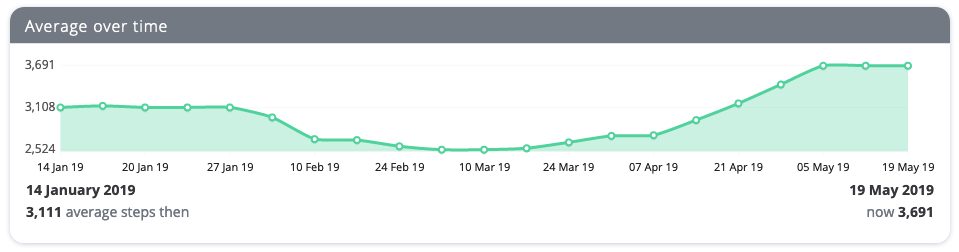
I can see my steps per day, averaged by the week (the harshest part of winter was not good for my activity level):

Chart showing my daily steps walked from January to May 2019

I can see which days of the week I’m most active (there’s a clear pattern here, with my activity level falling over the course of the work week, and then picking up on the weekend):

Chart showing my average steps by day of the week.

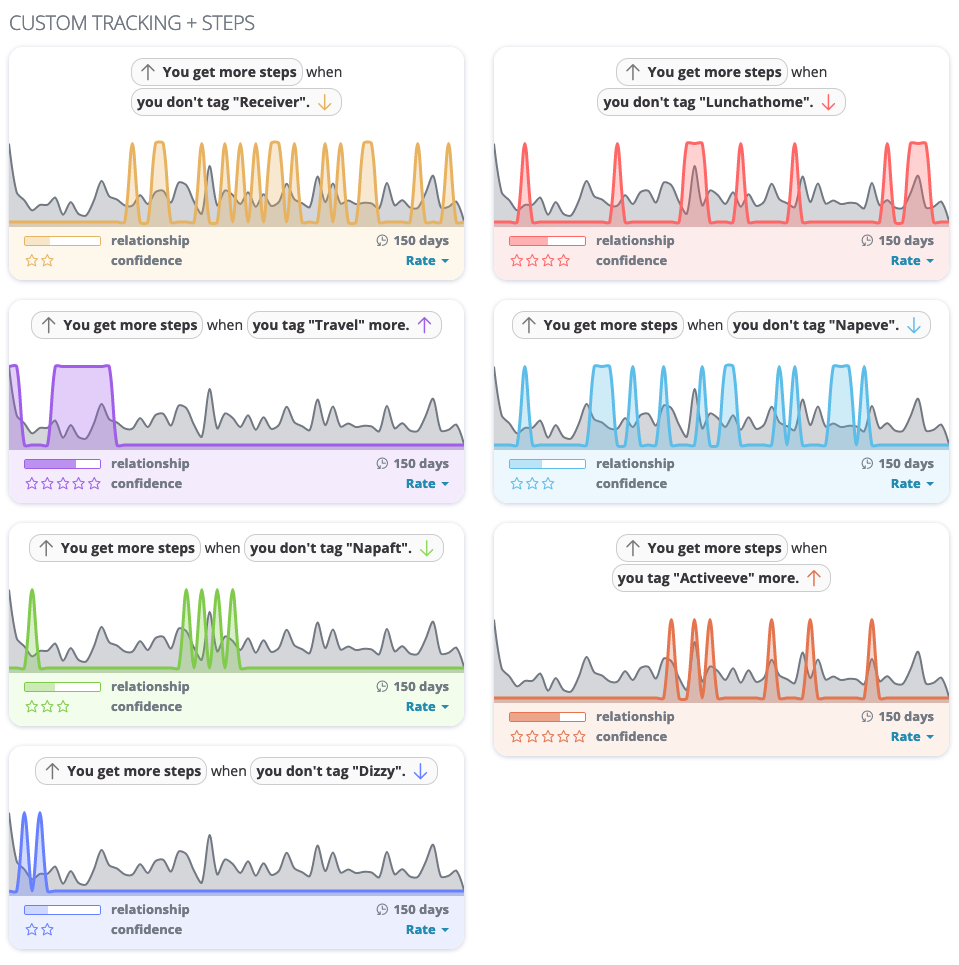
And I’m given a set of correlations between steps and various other things that I’m tracking. For example, I use Exist’s “custom tracking” feature to mark days with various tags of my own choosing. I use “Receiver” on days I visit Receiver Coffee, for example, “Lunchathome” for days when I eat lunch at home, and “Napeve” for days when I have a nap in the evening:

Charts showing correlations between steps I walk and other things I track.

These charts tell me things like “I walk more when I travel” (common sense) and “I walk more when I don’t have a nap in the afternoon or a nap in the evening” (good to know).

Because I don’t wear a fitness or sleep tracker, but wanted to track my sleep, I used the Exist API to code up a tiny web app to allow me to manually enter my bedtime and wake time each day.

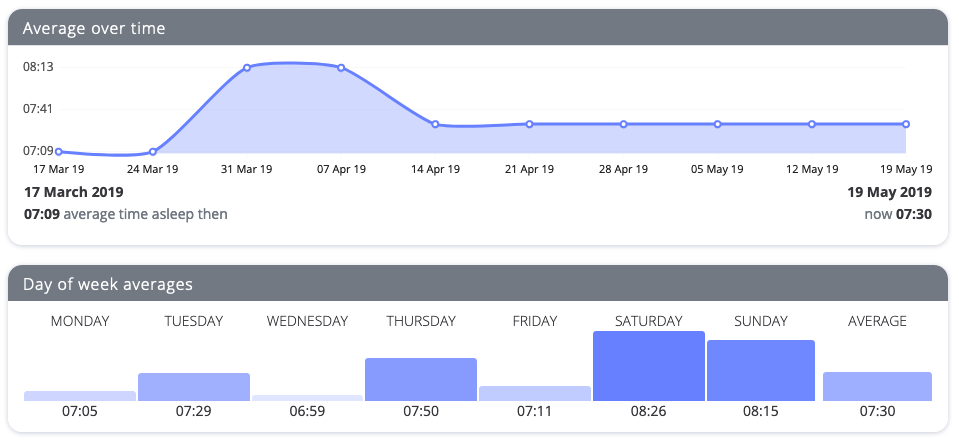
Chart showing my sleep time from March to May 2019

I’ve been tracking my sleep for two months now. The bump in late March and early April was due to vacation and work travel where, apparently, I get about an hour more sleep a night (I didn’t know that).

The bottom chart confirms that I sleep an extra hour on the weekend, that I get an average of 7:30 a night, and that I sleep a little more on Thursdays (for reasons unknown).

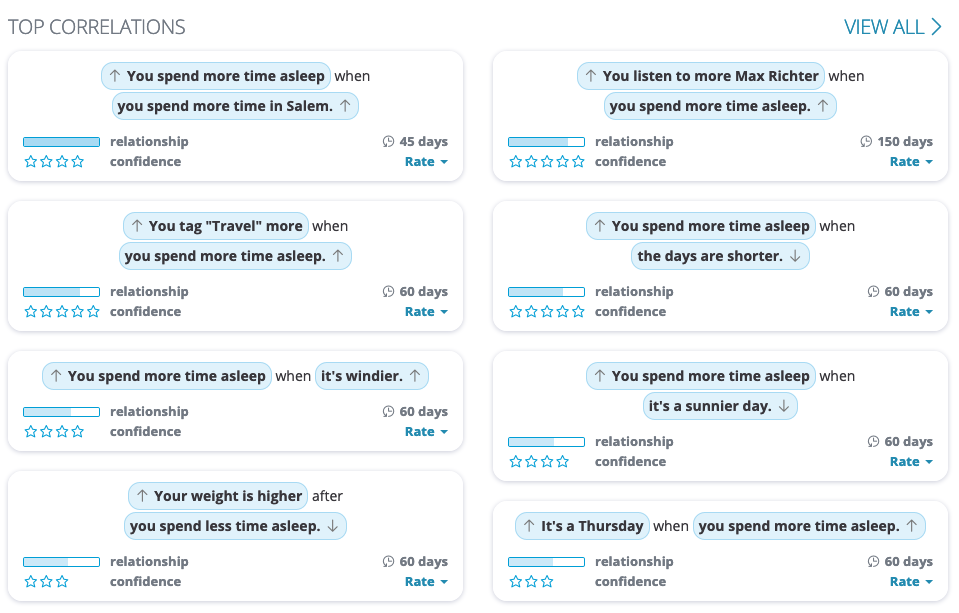
The sleep correlations that are surfaced are a combination of the not-very-useful (I may spend more time asleep when I’m in Salem, but I was only there for a single night), the curious (why do I sleep more when it’s sunnier?) to the delightful (the Max Richter album I have downloaded on Spotify is his eight and a half hour Sleep, “a piece that is meant to be listened to at night”; obviously it works).

Correlations between my sleep and other things I'm tracking.

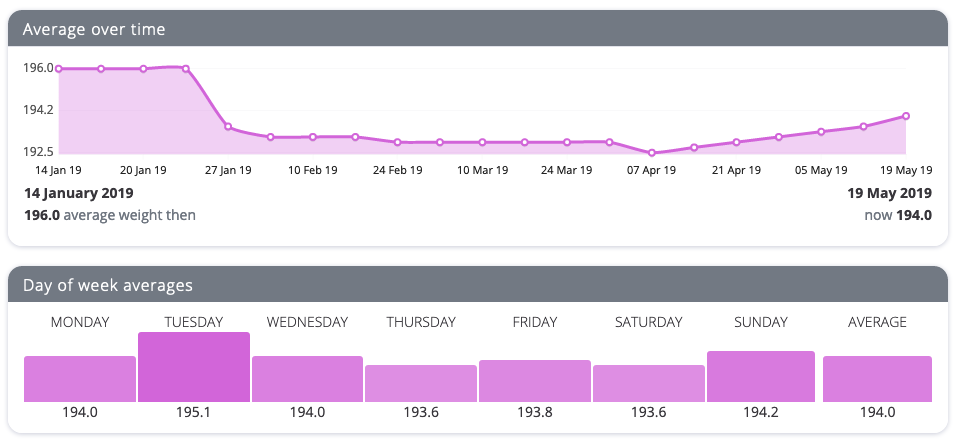
I bought a Withings wifi-enabled scale in January when it was on sale, and I’ve been measuring my weight at the same time every morning, about 30 minutes after I get up.

Chart showing my body weight from January to May 2019

I think the readings in early January were an aberration caused by my entering a best guess for my starting weight into the Withings app, so it’s really only the week of January 27 onward for which I trust the data.

There’s not much to be gleaned from Exist’s attempts to correlate my body weight to other things, perhaps because it’s remained relatively consistent. It does tell me “your weight is higher after you’re not listening to music,” and “your weight is higher after you don’t tag Travel,” which are intriguing. Body weight, I think, is something best analyzed over a longer window than a season, so I’ll keep at it; certainly the ease of the wifi scale makes it dead simple to do so.

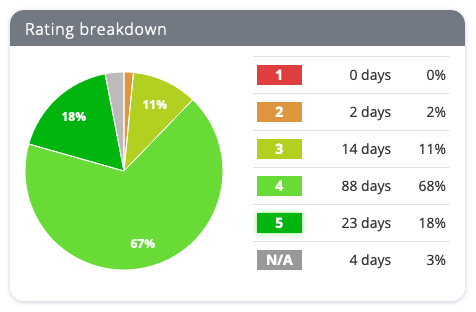
Another thing Exist is well setup to allow me to track manually is my mood. It’s a relatively blunt instrument, with only 5 gradations. And I’m not sure I’d ever dare to tag a day with a rating of “1,” as that would admit the depths of complete despair. But after 131 days of tracking my mood, I find myself surprised by the results:

Pie chart showing my mood tracking, on a scale of 1 to 5, from January to May. 1 is 0 days, 2 is 2 days, 3 is 14 days, 4 is 88 days, 5 is 23 days.

I’d been under the impression, perhaps because I’ve had a good run of mood, that I’d tracked almost every day as a 4, but, I learned from this chart, that only happens 68% of the time; 18% of the time I have a “perfect” day, and 13% of the time I rate my mood a 2 or a 3.

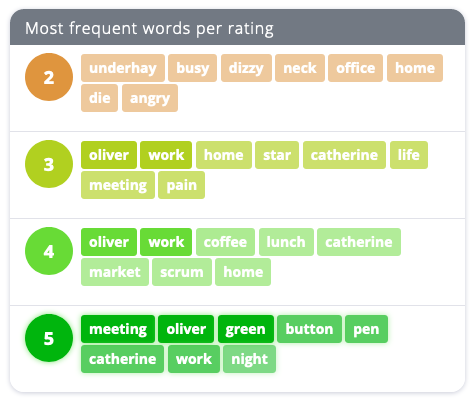
Along with entering a numeric mood rating, Exist also prompts me for some words or phrases to explain my mood; I found the aggregation of this really interesting:

Chart showing the words I enter when I'm tracking my mood.

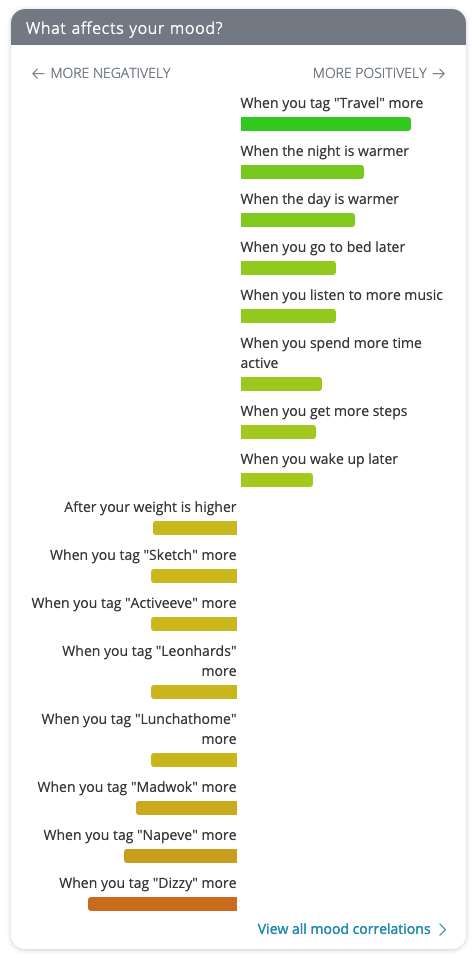
The closest that Exist comes to out-and-out recommendations for lifestyle changes is the “What affects your mood?” chart.

Following its advice I should travel more, to warmer places, stay up late, listen to music, stay active and sleep in, and I should avoid sketching, going to Leonhard’s for coffee, eating lunch at home, eating at Mad Wok, having a nap in the evening, and being dizzy.

Chart showing what affects my mood.

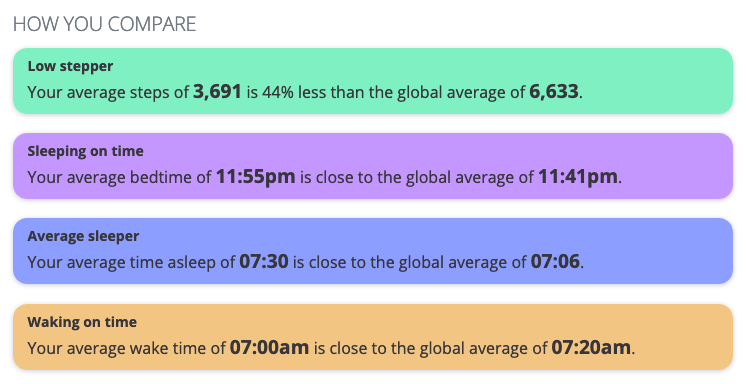
While Exist is primarily tailored to allowing me to compare me to myself, it does occasionally venture into letting me know how I compare to the global average for all Exist users:

How I compare to the global averages for Exist users

So I’m more sedentary than others (warning sign), but I go to bed and get up around the same time as everyone else, and sleep just a tiny bit more than average.

Beyond the joy of measuring, I enjoy using Exist because of the small team behind it, their sense of design, their openness to openness, their blog, and their quick turnaround for addressing support questions.

If you want to try Exist yourself, follow this link to get an extra month tacked onto your free trial, and to earn me a $2 credit against my subscription.

24 May 14:48

Writing Outliner turns into WordOutliner (beta) - Anthony

Update. ...and turns into DocxManager. It is named as the second writingoutliner re-birth. Actually it seems the third, given the title of this old post.

News here, but no download available yet, just a new website:
http://writingoutliner.com/writing-software/blog/docxmanager-the-second-rebirth-of-writing-outliner/
24 May 14:48

Counting and illustrating Game of Thrones deaths

by Nathan Yau

Shelly Tan, for The Washington Post, has been counting on-screen deaths in Game of Thrones over the past few years. As the season ended, Tan described her process in an entertaining Twitter thread:

I kept thinking about how her process transfers to counting all things. You know, like the decennial Census. The hand-wavy process always seems so straightforward. It’s like, sure, it’ll take a while, but the challenge is just time. But then you get into it, and there’s all these small bumps along the way that make everything more complicated. And then you’re like, great, well, I’ve already come this far. Better keep on counting.

Tags: counting, Game of Thrones

24 May 14:48

To Keep Track of Reddit Discussions Around New York Times Content, We Built a Slack Bot

by JP Robinson

To Keep Track of Reddit Conversations Around New York Times Articles, We Built a Slack Bot

Illustration by Michael DeForge

Last fall, my colleague James Robinson (no relation) sent me a direct message on Slack. “Hey old friend. Are you free for a quick question?” he wrote, “I’m looking to rebuild an old project and would love your perspective.” In a previous newsroom analytics role at The New York Times, James had built a suite of incredibly interesting tools that happened to run on a finely-tuned Windows PC under his desk in the newsroom. He wanted to talk about rewriting one of those tools and putting it on a server.

The project was a tool that checked Reddit for conversations around Times content and alerted the newsroom via a Slack channel. Once our writers and editors knew that a story was being discussed, they could get real-time feedback from the Reddit community and even join the conversation. It is a useful tool and James, now the director of international analytics on the newly-created Audience team at The Times, wanted it rebuilt.

Since the process was running locally, it stopped reporting in late 2015 when James changed teams. When I looked at the code, I realized I was not going to be able to reuse anything because it was written in Perl. My plan was to rely on many of Google’s managed services, which don’t support Perl.

James had a nice suite of analytics libraries, they just happen to be written in Perl.

I decided to rebuild this system during The Times’s quarterly Maker Day using all of the new tooling we have available to us at The Times. To prepare, I started to formulate how everything would fit together. For infrastructure that required minimum maintenance, I decided to use the Google App Engine standard environment and a basic scheduled cron to kick off a process every couple of minutes. From there, the rest of the system would look something like this:

Architecture of the Reddit Slack service.
  1. App Engine cron job will hit our service to kick off the process.
  2. The service will grab the top 300 nytimes.com links shared to reddit via their JSON endpoint.
  3. The service will use Google Cloud Datastore to store comment counts to determine what to alert and what has already been alerted.
  4. The service will use NYT’s internal GraphQL Sangria server to fetch additional metadata about the nytimes.com article.
  5. The service will post an update to a Slack channel with the real headline, the title of the Reddit post, the subreddit the post occurred in and how many comments currently exist.

I wanted to spend most of Maker Day hacking, so I made sure I had everything I needed ahead of time. This included access to James’ Google Cloud project in order to deploy the service but also access credentials for our GraphQL service. We use HashiCorp Vault to share secrets, like API credentials and database passwords, so once my request was made, someone from our GraphQL team just needed to hand me a vault unwrap command. With that command, I was able to securely get the secrets and put them into my own project’s Vault store. At start-up, the application would fetch the credentials via gcp-vault.

Once Maker Day arrived, I was ready to hit the ground running. I quickly created a basic endpoint that could scan Reddit for the most commented Times articles. From there, I saved basic information to Cloud Datastore with minimal effort as no schema or set up was required. To fetch article metadata, I needed to build a GraphQL query. With the help of our GraphQL team and their handy interface for exploring our schema, I was able to build a query to fetch only the information needed to post to Slack. Finally, to make sure the Slack messages were easy to read and aesthetically pleasing, I reused code from an old Times project of mine, Newshound.

Example posts from the new Reddit Slack service

By the end of the day, I was able to hook the service into Drone with our drone-gae plugin and the entire system was ready to automatically deploy on any commit to the master branch. We have plans to add more, but the system is a better state than its prior days on that Windows PC under James’ desk.


To Keep Track of Reddit Discussions Around New York Times Content, We Built a Slack Bot was originally published in Times Open on Medium, where people are continuing the conversation by highlighting and responding to this story.

24 May 14:46

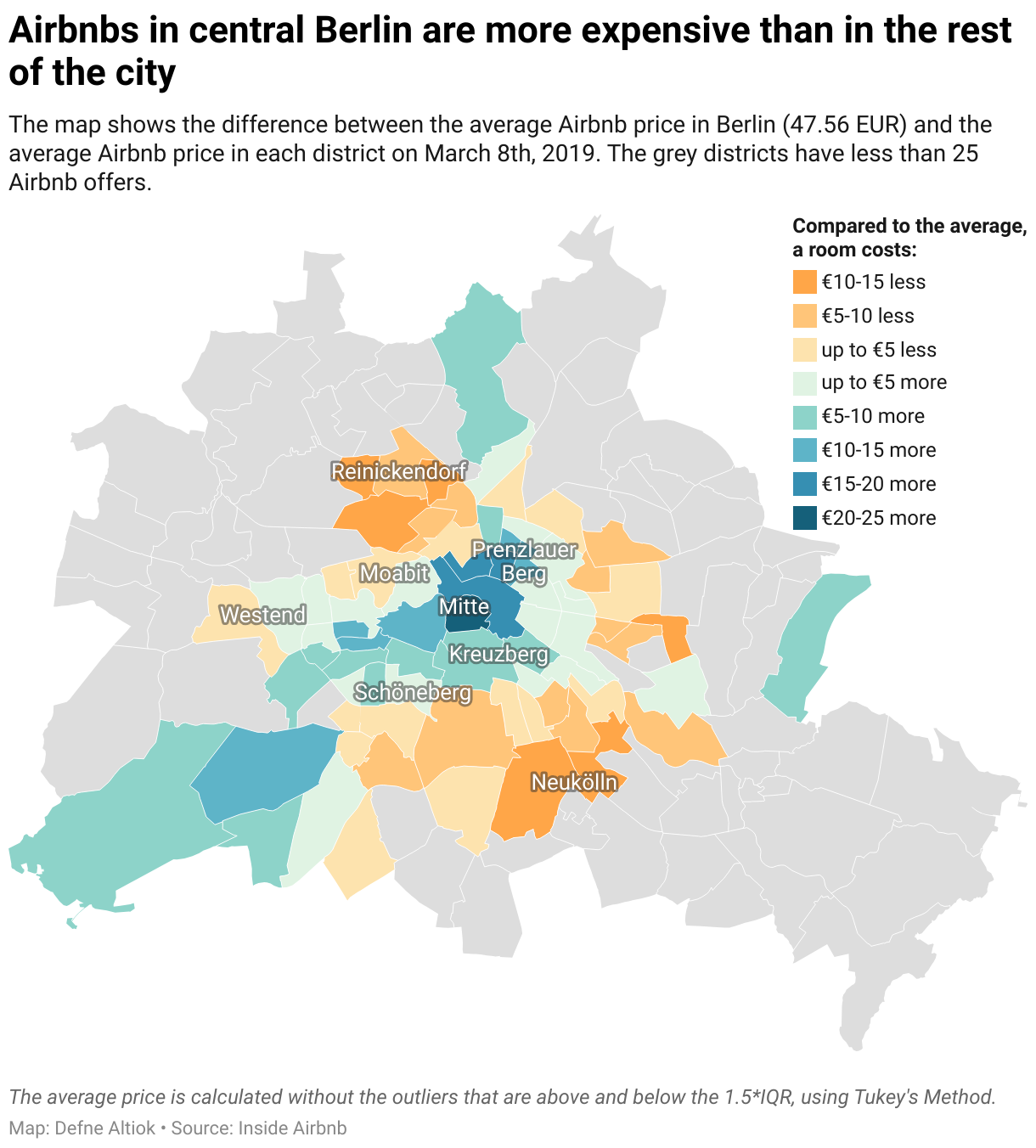
Berlin on Airbnb: What are the most and least expensive districts?

Hi! It’s Defne again. Here’s another Weekly Chart by me. If you missed the one from last week, check it out!

Airbnb is popular. So is Berlin! But the city has a rather complicated relationship with one of the most popular and touristic portals for finding a proper place to stay in a city: In 2016, Airbnb-rentals were banned, then the ban was canceled but strict rules remained.[1]

Inspired by this discussion (especially by typically long German words such as “Zweckentfremdungsverbot”), I thought it could be worth checking the current situation in Berlin: What is the most expensive district on Airbnb in Berlin?

I thought the story would be more interesting than what I found out. But there are no surprises, dear readers: The central regions are more expensive than the rest of the city and tourists want to stay at the center.

The districts at the peripheries of the city are greyed out on this map. This doesn’t mean I didn’t have any data about them. I had! But these districts had 25 or less Airbnbs – and it felt wrong to compare the average price of e.g. 4 Airbnbs with the average price of more than 800 (like in Alexanderplatz).

Think of Amazon reviews. You wouldn’t trust just two or even ten reviews. You know that the more people reviewed, the more you can trust the average rating. It’s the same with the price averages: The more data points we average, the more reliable it gets.

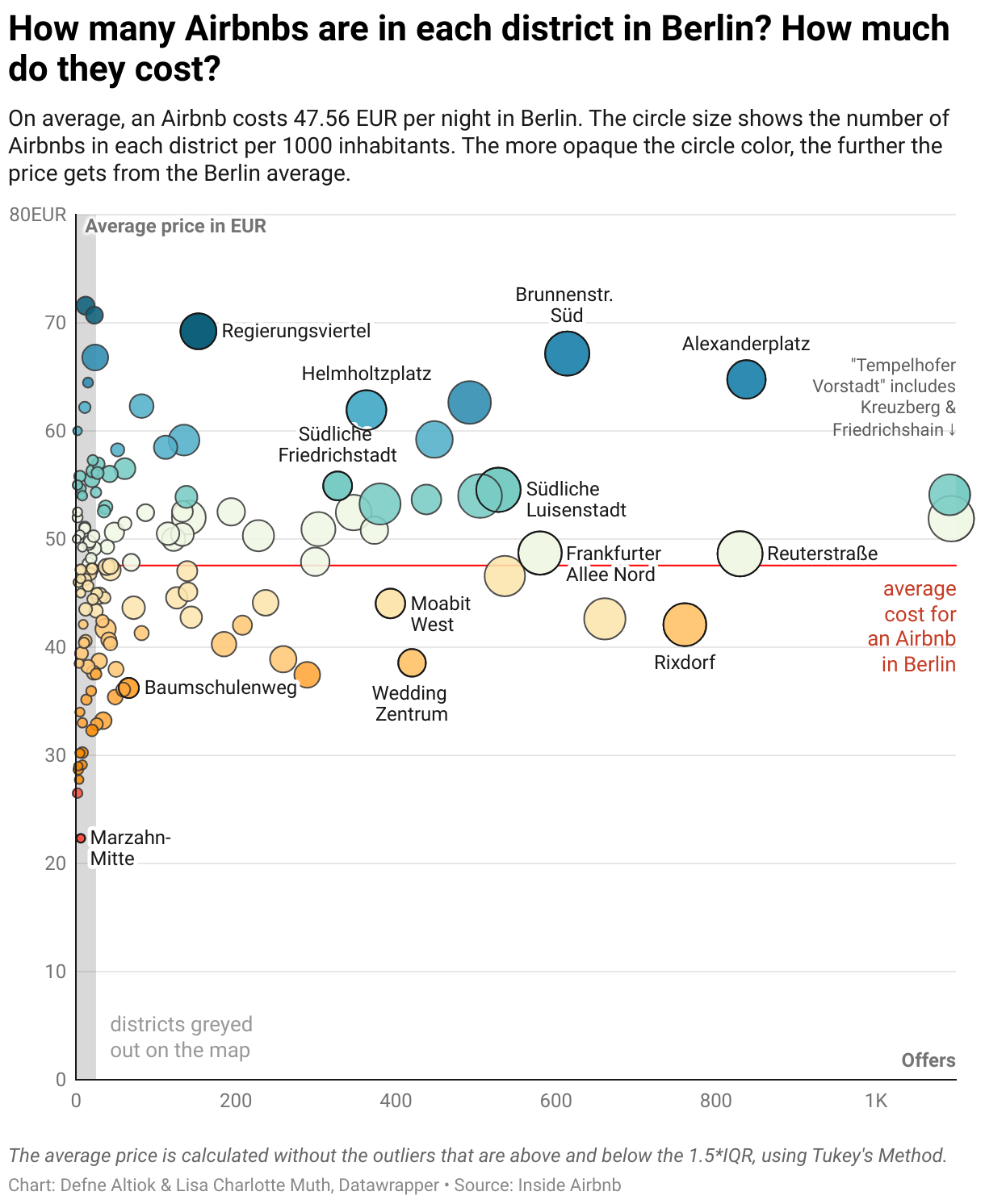
So I decided to get rid of the Amazon reviews districts with less than 25 Airbnbs. But I don’t want to withhold these districts from you entirely. I guess, somehow (Hi Lisa!), I was convinced that scatterplots are usually great and quite useful to show correlations. So I made one! Here’s a scatterplot with the hidden districts:

The area below the line shows the region with Airbnbs that cost, on average, less than the average price. As the famous Berlin slogan goes, they are “poor but sexy”. Neukölln and Wedding are still hanging in there!


This was my last article at Weekly Chart and Lisa will take over next week again (maybe)! If you have any questions or feedback, you can find me on Twitter at @AltiokDefne or via email (defne.altiok@dw.com).


  1. Here is a detailed piece with lots of beautiful graphics from 2015 explaining how it started.

24 May 14:45

Three jobs of a callout line

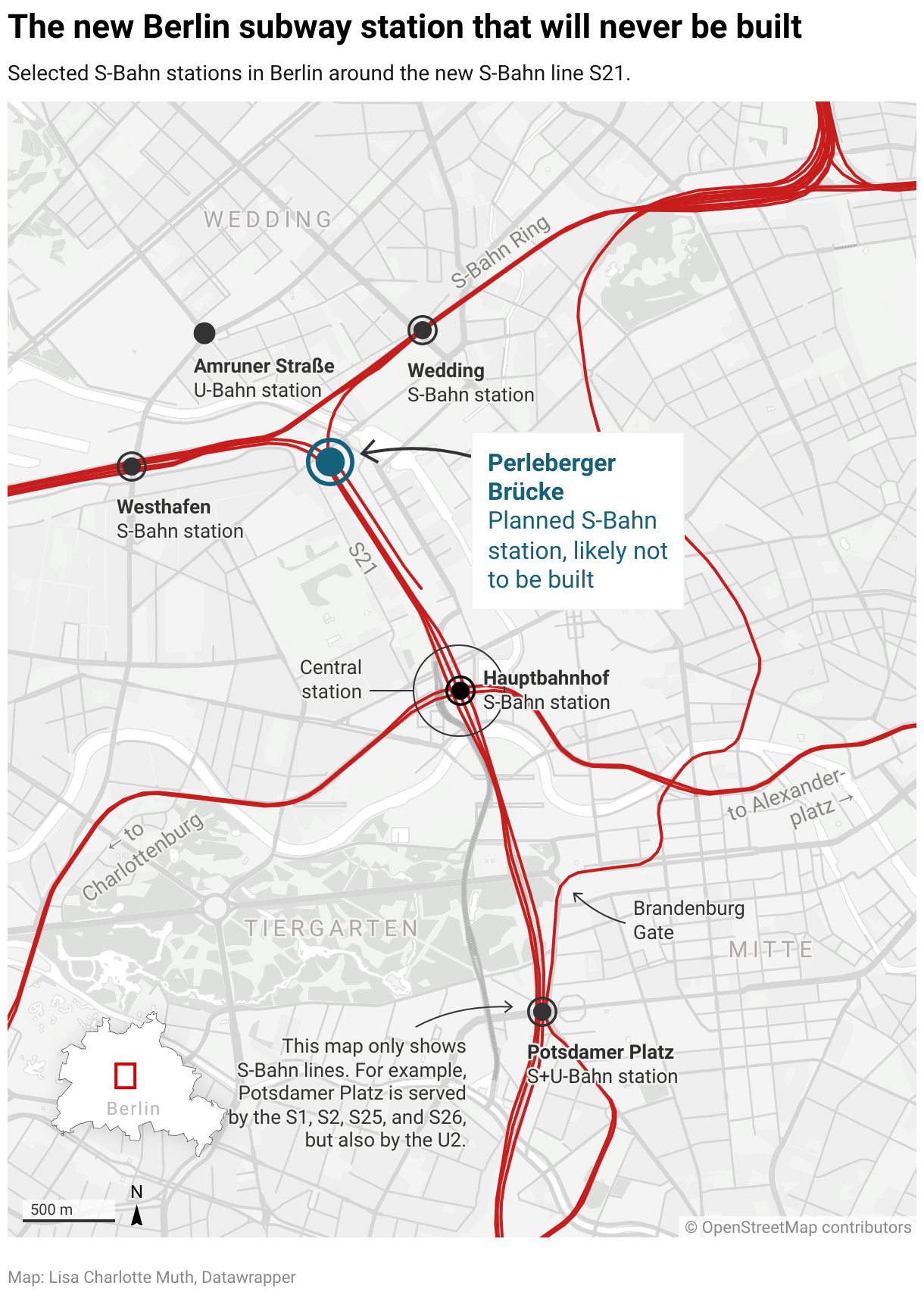
After Defne’s awesome monster Weekly Charts in the last 14 days (here’s number 1, here’s number 2), this weeks’ Weekly Chart keeps it small. Today we launched callout lines for our locator maps (they are lines connecting marker and label), and I wrote a few words about how to create them and when – so I will simply refer you to this announcement blog post and explain the importance of our new feature with this map:

There’s a lot going on in this map. Our new callout lines have three jobs here:

  • The one at the top (“Perleberger Brücke”) separates the signal from the noise. All subway stations on this map are labeled directly. But we don’t have a lot of space to label “Perleberger Brücke” directly, especially if we want to give extra information. Separating the label from the labeled element gives us more space for the label.
  • The one in the middle (“Brandenburg Gate”) doesn’t use a taken design element (the circle) while still pointing to a location precisely. Circles have one job on this map: They communicate “I am a subway station”. So we can’t use a simple circle marker to show a tourism trap one of the most impressive sights of Berlin, the Brandenburg Gate. A callout line solves that problem.
  • The one at the bottom (“This map only shows…”) does the job of a tooltip, while not being hidden. I like tooltips – but they have a hard time getting read. Bringing the information directly on the map increases its chances.

You can find a similar description of use cases for callout lines on our announcement blog post. Let us know what you think! And I’ll see you next week.

24 May 14:45

Sparklines: Comparable or not?

When I was a child, my brother found a Super Nintendo next to some garbage bin. It came with four games. And it was fully functional. My brother and I joked that some parent probably had decided that gaming might be not the best use of time for their kids. So now we got to spend our time with it. And boy – it was fun! I remember lots of hot summer days laying in front of a very old TV, trying to break my own record of Yoshi’s Island levels.

The Super Nintendo was the only console I’ve ever owned. But when I think back to it, I smile – and I’m sure consoles put a lot of smiles on a lot of faces.

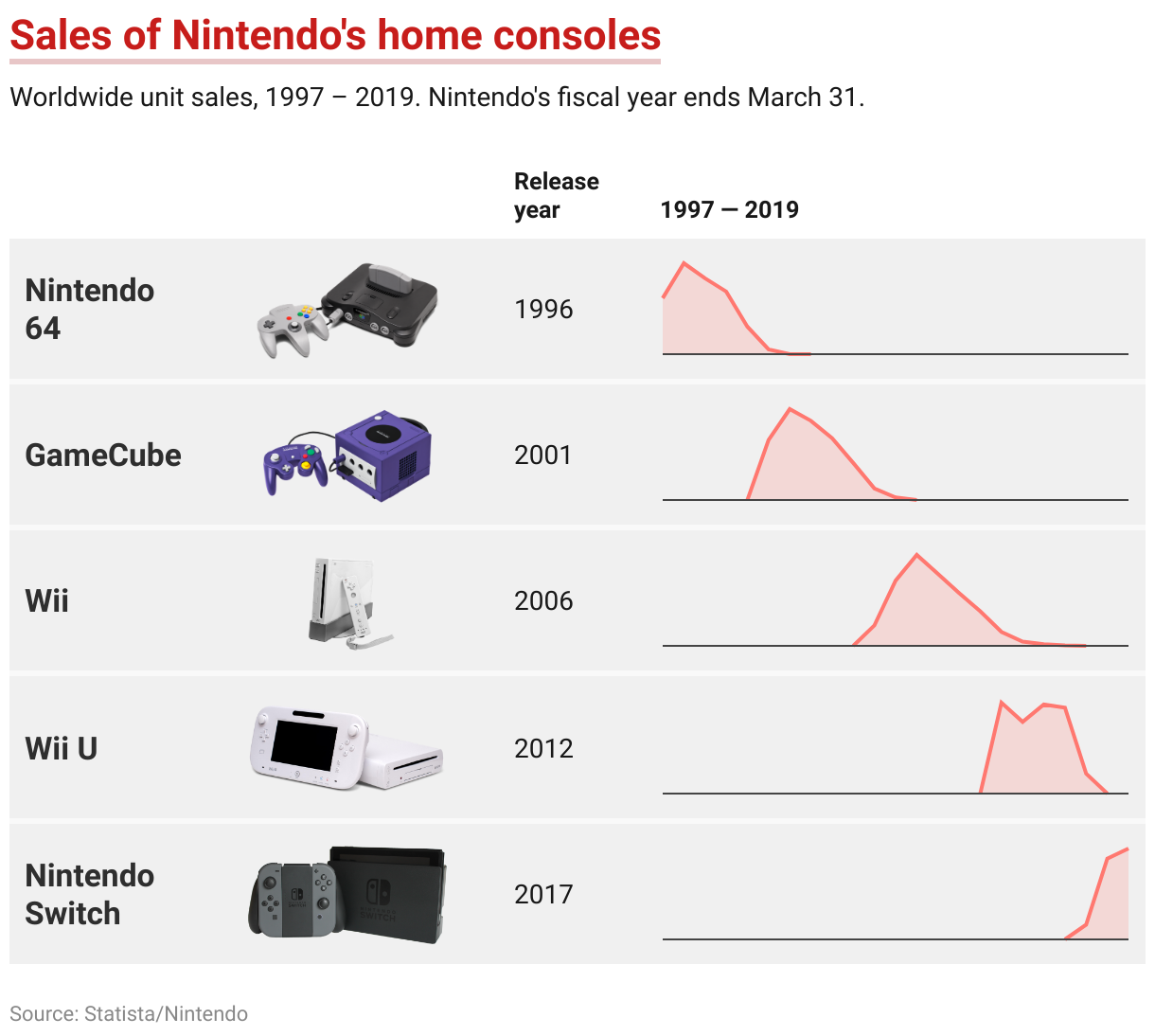
This week, I once again used our fresh table tool – and this time with sparklines; these tiny line charts in the last column. Thanks to them, we can see that the Wii was the most successful console of the five consoles shown here. In fact, the Wii was one of only three consoles that were sold more than 100 million times. The other two ones were the PlayStation and the PlayStation 2.

Chart choices

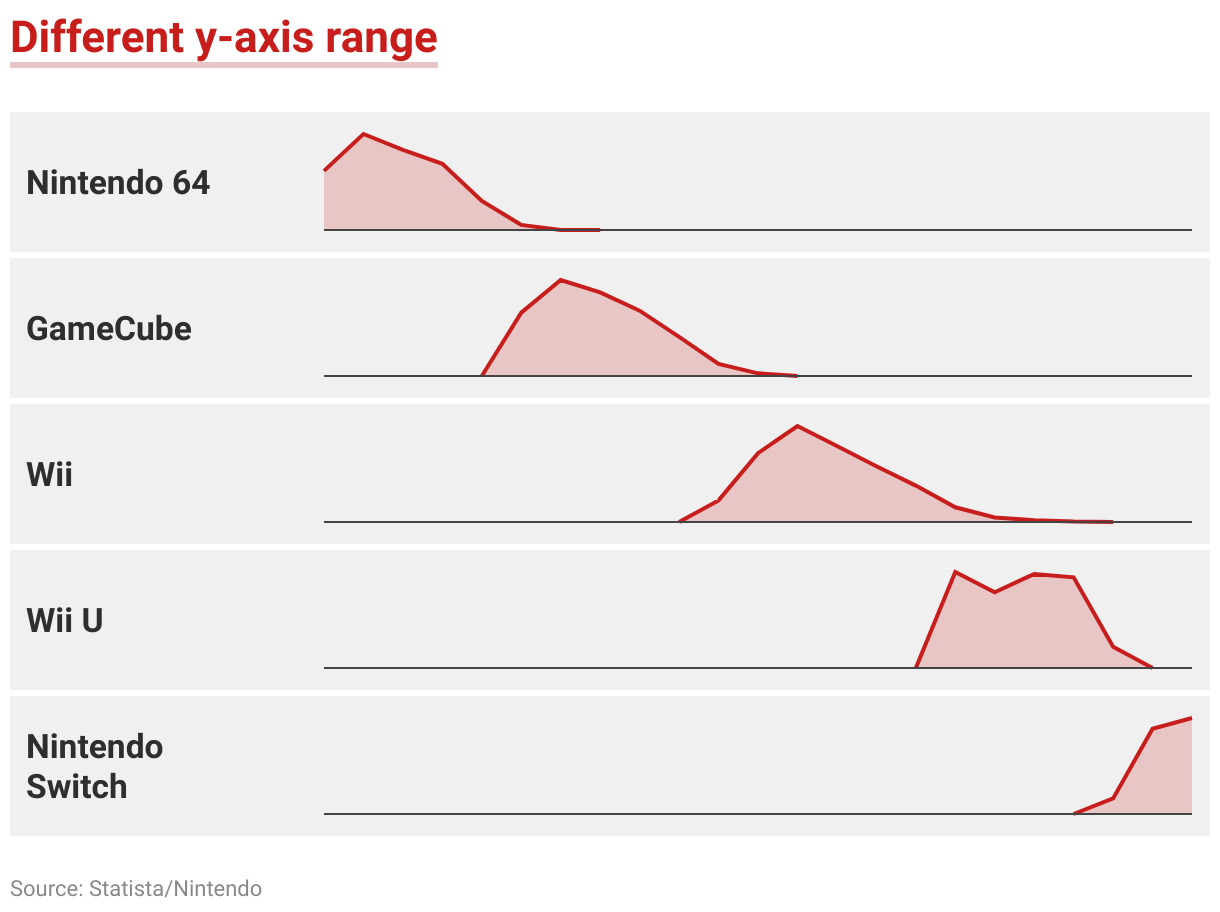
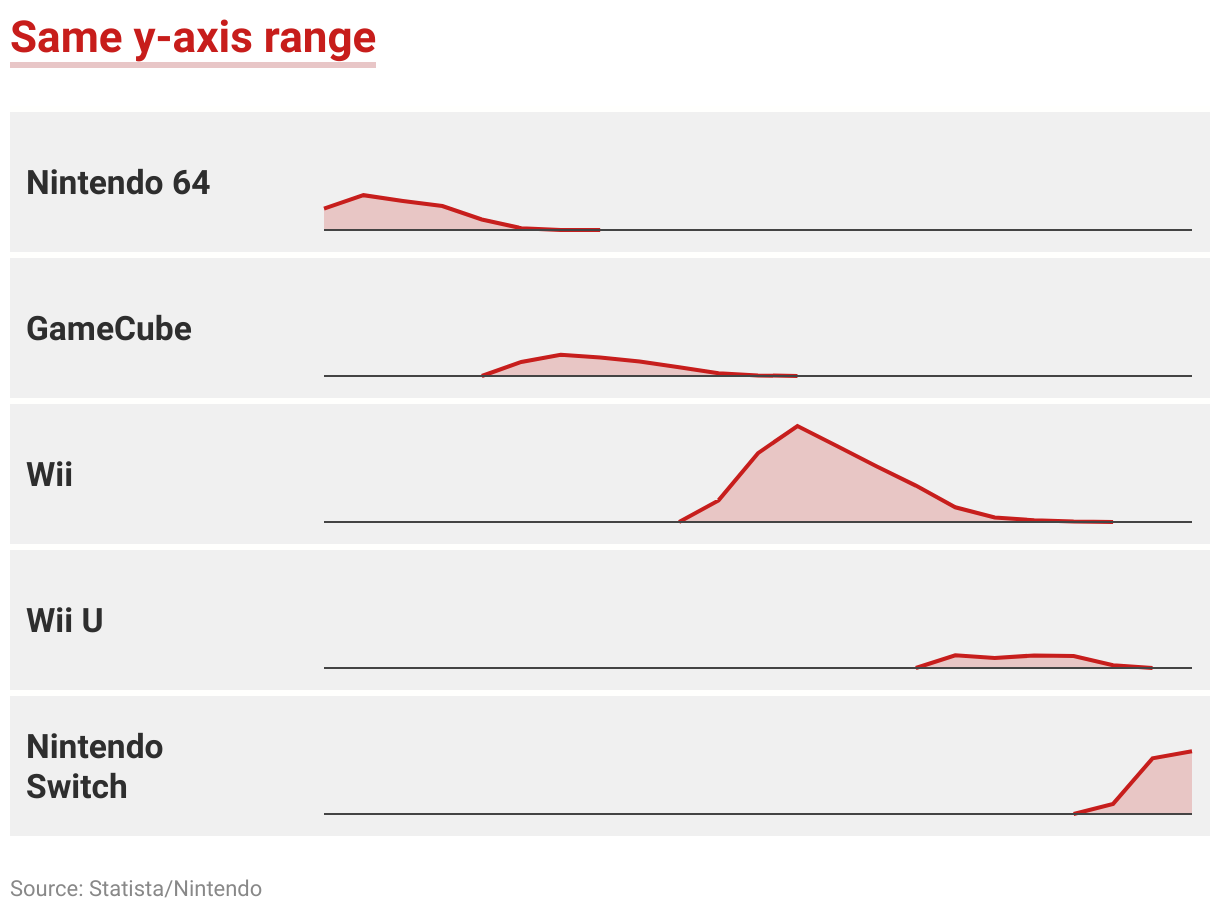
Sparklines are curious things. They’re supposed to show a trend, and a trend only. They’re supposed to show when something (like stocks) increase and decrease, where the peaks and the valleys are. But sparklines are not supposed to be comparable with each other.

So when you’re seeing two sparklines with the same height, the ebbs and flows of the first one could play out between 0 and 10 (e.g. US-Dollar), while the other sparkline’s peak is at 10,000.

But that’s odd, no? Doesn’t that invite people to make totally false assumptions? The answer is: Yes. Likely so. But sparklines need to get comfortable in a tiny space anyway – if you set the same y-axis range for two sparklines with different dimensions, you’ll end up with a visually flat line for one of them. Which goes against the whole idea of using sparklines to show trends.

But there are ways to increase the chances that your readers don’t misread the visualization. If you create sparklines with different y-axis ranges, label the first and last value (that’s a default in our table tool). And if your y-axis numbers are similar anyway, choose the same y-axis range; as I did in the table above.


I’ll be on vacation for the next two weeks – which means that you’ll be able to hear some other voices! Our developers Simon and Fabian agreed to write the next two Weekly Charts, and I hope you’re as curious as I am to see what they’ll end up talking about. Until next week!

24 May 14:43

✚ Setting Visualization Expectations to Avoid Audience Confusion (The Process #41)

by Nathan Yau

People misinterpret charts all of the time, because they go in with the wrong expectations before they even fully interpret what a chart is about. Read More

24 May 14:42

Tips to Keep Video Production Afloat: Dipping Your Toe Into the Open Water

Laura Killam, Jason Toal, Jeff Tranchemontagne, Jon Fulton, Sidney Shapiro, May 23, 2019
Icon

From CNIE, this is a website accompanying a practical session on video in learning: "how video can be used to solve problems in education; challenges the audience has faced in their own use of video; time-saving strategies for video production" Be sure to explore other areas of this website (I missed them at first) in the upper-right menu, including recommended software and tips.

Web: [Direct Link] [This Post]
24 May 14:42

10 Yers of the Lerning Innovtion Conference

Alexander Petsch, Daniel Stoller-Schai, May 23, 2019
Icon

This is an eBook (158 page PDF) containing interviews with speakers from the last ten years of the Learning Innovation  Conference (mainly in German, partially in English - there's an interview with me in English starting p.35).

Web: [Direct Link] [This Post]
24 May 14:33

The Best Bike Basket

by Eve O'Neill
The Best Bike Basket

If you want to carry small amounts of stuff on your bike, a front basket can come in handy. (If you need to tote more than 10 pounds, though, we suggest getting a rear rack.) After considering 15 baskets and testing four of them on a string of everyday errands—going to the pharmacy, dropping off packages, and getting takeout—we recommend the Wald 135 Front Basket for most recreational cyclists.

24 May 14:17

Rogers business customers can now add an Apple Watch to their plan

by Jonathan Lamont

Rogers Business customers looking to add a cellular Apple Watch to their account can now do so.

As of May 23rd, Rogers enabled support for both Series 3 and Series 4 Apple Watches on business accounts. If you already have an eligible Apple Watch, read on to learn how to set it up.

If you don’t have an Apple Watch, you can get one from Rogers. You can get the Series 4 for $0 down on Easy Pay, and pay $28.29 per month for 24 months. For a Series 3 watch, you’ll pay $22.04 per month for 24 months. If you don’t want a term, you’ll pay $679 or $529 respectively.

Once you’ve acquired your watch, if you’re a small business customer, log into the Business Self-Serve Standard portal and select an account. Then, navigate to the Services tab, select the cellphone number you want to enable. Click the Apple Watch link, click ‘Enable’ and accept the terms and conditions.

For enterprise customers, you’ll need to log into Business Self-Serve Premium, select Account Maintenance and search for the mobile number you want to enable. Then, click Products and Services under the Self-Serve transactions menu. Finally, click Enable on the add-on page next to the ‘Smartwatch Additional Line’ section. Accept the terms and conditions.

From this point on, the steps are the same for both small business and enterprise customers.

First, open the Watch app on your iPhone, tap Cellular and then tap Set Up Cellular to start. Then, enter your authorization code.

Add your smartwatch to your business plan, or get a new plan for your wearable for $10 per month.

You’ll also need to add a 9-1-1 emergency address.

Finally, review and submit your order to finalize the connection.

To learn more about Apple Watch and business accounts, head over to Rogers’ website.

The post Rogers business customers can now add an Apple Watch to their plan appeared first on MobileSyrup.

24 May 14:17

Nokia execs suggest carriers need to pick 5G vendors soon, explain Huawei interoperability

by Shruti Shekar

Nokia Canada’s senior executives suggest telecom carriers should finalize their 5G vendors by the latter part of the third quarter or in the fourth quarter of this year to be competitively ready when the spectrum is available.

During a roundtable discussion with reporters at the Hilton Hotel in downtown Toronto, Ric Herald, Nokia Canada’s president, said if the 3.5GHz spectrum auction is scheduled to happen next year and is ready by the end of next year then carriers “would have to start deciding in the late third, fourth quarter this year.”

So it would take about six months to prepare, Herald said.

“You’ve got to get the equipment then ship it, then you’ve got to install it, you have to test it and configure it, so I would say yes [it would take six months],” he said.

“And depending on the size, are they going to start out with a small deployment that takes less time? Are they going to carve out the market? It really depends on what their strategy is. Is it urban, rural? Right now they’re not discussing these things, they’re just trying to figure out who [they] want to use.”

Currently, Rogers is the only carrier that has made a decision, choosing Ericsson to be its 5G vendor. Bell and Telus have not decided who its 5G vendor will be, despite working with Huawei for deploying 3G and 4G LTE networks.

Public Safety Minister Ralph Goodale is conducting a review of 5G and the future of the network in Canada. Part of that review will include whether or not Huawei will be banned in the country.

Reports suggest that a decision could happen after the election, but nothing has been confirmed.

Nokia says it can help with interoperability problem, but it’s up to customers

Huawei’s equipment is not interoperable, meaning another vendor’s equipment won’t be able to function if it is used on Huawei’s existing infrastructure. In Telus’ case, where 100 percent of its infrastructure is Huawei, this could cost millions to rip up and reconstruct in the case of a Huawei ban.

Telus told MobileSyrup that Huawei’s equipment is not interoperable because Huawei customizes its parts for its clients, which will result in deploying spectrum more effectively to deliver a better network.

But Herald and Nokia’s North American chief technology officer Mike Murphy said that this is just a technicality and it is possible to make the equipment interoperable.

When asked if Nokia would help Telus should Huawei get banned, Herald said: “Any customer that approaches us, we will have a solution for.”

But ultimately it is the customer’s decision, he said.

Murphy explained that there are many cases in the world where a provider decided to pick a different 5G vendor, “so you essentially mix and match, you can do that technically.”

“It’s more of a business question, whether [Huawei] will play ball to do it,” Murphy said, adding that it is also based on the “customer encouraging it and requesting it.”

Herald did note that Nokia is constantly in touch with Telus but did not go into detail of what conversations are about.

Nokia’s success isn’t just being the sole 5G vendor

Herald said that success to Nokia Canada is “being in all of our customers with some percentage of their business across all of our product lines.”

He added that he wouldn’t just look at radio network equipment as the only way to find success.

“For me, success would be to grow, right now we are in all the accounts, so my measure of success is to grow more,” he said, adding on the 5G front, Nokia Canada would definitely want to be a part of every customer’s 5G network.

Herald said that whether or not Nokia is selected as a 5G vendor depends on how well it sells its products’ capabilities.

But for the carriers it will be a transition from LTE to 5G, he said.

“They will still be tied to LTE, but they will have to make some transitions in their network to build 5G and that offers an opportunity for us,” he said. “So my view is because I’m not there today doesn’t mean I won’t be there tomorrow.”

The post Nokia execs suggest carriers need to pick 5G vendors soon, explain Huawei interoperability appeared first on MobileSyrup.

24 May 14:17

Shuttered Canadian Tesla shuttle service Wroute selling its fleet

by Brad Bennett

Southern Ontario-based company Wroute shuttered its doors on May 3rd and now it’s selling its fleet of 10 Tesla Model X vehicles. 

You can nab one of these 2017 Model X P100D models for $117,000 CAD. Since it’s a 2017 model, its range should be about 452km.

Each of the ten vehicles has this trim package:

  • All-Wheel Drive
  • Pearl White Multi-Coat Paint
  • 20” Silver Slipstream Wheels
  • White Premium (interior)
  • Dark Ash Wood Décor
  • Dark Headliner
  • Enhanced Autopilot
  • Premium Upgrades Package
  • Smart Air Suspension
  • Seven Seat Interior (folding rear row)
  • Windshield Sunshade

The company says that the original price for each vehicle was $148,600 and the fleet has between 8,000km to 30,000km.

On top of selling its fleet, the company has a handful of accessories up for sale, too:

  • 4 lightly used winter tires mounted on rims: $2,500
  • Set of TuxMats floor protection: $320
  • Thule hitch-mounted double bike rack (heavy duty e-bike capable) (MSRP $900): $700
  • Window punch / seatbelt cutter: $15
  • Travel first aid kit, Ontario paper road map, and vehicle emergency kit: $10 + $5 + $90
  • Roadside LED flares (3), Halotron fire extinguisher, and reflective vest: $35 + $150 + $15
  • 2 x 3.78L All-Season -40C Windshield Washer Fluid: $5
  • All Accessories Above (total $3,845): $3,000 (save 22%)

Source: Wroute

The post Shuttered Canadian Tesla shuttle service Wroute selling its fleet appeared first on MobileSyrup.

24 May 14:17

Taiwanese chip maker TSMC says U.S. ban doesn’t affect its shipments to Huawei

by Jinqiao Wu

On May 22nd, British chip designer ARM, following the footsteps of many U.S. tech giants, severed its ties with Huawei, leaving the Shenzhen-based company’s future ARM processor development plans in limbo.

However, it seems that the Huawei can now catch a breath as its chip manufacturing partner TSMC will continue doing business with the embattled Chinese company.

According to Reuters, TSMC spokeswoman Elizabeth Sun has confirmed that the company’s shipments to Huawei will not be affected by the ban.

TSMC is the largest contract chip manufacturer globally, taking manufacturing orders from the likes of AMD, Qualcomm, Apple, Huawei, and MediaTek.

Although ARM has officially ceased its business with Huawei, Huawei can still design products based on ARM design and technology previously licenced to the company. For the time being, Huawei can continue to rely on TSMC to produce the Kirin 980 chipset for the Mate 20 and P30 series. Furthermore, the rumoured successor to the 980, the Kirin 985, is reportedly unaffected because Huawei finalized the design long before the ban.

However, aside from the grim reality that Huawei will not get access to next-generation ARM designs after Kirin 985, the existence of all current Kirin processors hinges on TSMC’s decision not to pull out.

If TSMC did reverse course, Huawei would have very few options if it wanted to remain competitive globally.

Source: Reuters

The post Taiwanese chip maker TSMC says U.S. ban doesn’t affect its shipments to Huawei appeared first on MobileSyrup.

24 May 14:17

No more SD cards or SD card slots: SD Association kicks Huawei out

by Bradly Shankar

Soon after being placed on the Entity list, bad news for Huawei just keeps piling up and starting to go in interesting directions.

Starting May 23rd, Huawei can no longer make SD cards or even put a microSD card slot into its devices. The SD Association, based in San Ramon, California, quietly removed Huawei from its laundry list of consortium members, according to Gizchina.

However, it is unclear how the drastic change will affect the expandable storage functionality of Huawei’s consumer products. For the past few years, we haven’t seen a single microSD card slot appear on a Huawei phone. Currently, Huawei sells four card readers that accepts microSD cards on its official store called VMALL. However, they also accept Huawei’s Nano Memory Card format.

Debuted with Mate 20 Pro in late 2018, the new Nano Memory card is much smaller than the pedestrian microSD card and fits underneath a SIM card tray. Huawei has been pushing this format for a while and wants other manufacturers to make it as well.

Retrospectively speaking, the timing of the company’s decision to embrace the Nano Memory card is perfect and invites speculation that Huawei was expecting a technology ban. Nevertheless, the industry’s lukewarm reaction to the new format suggests that it is a hard sell and may end up just like Sony’s ill-fated Memory Stick.

Via: Gizchina

The post No more SD cards or SD card slots: SD Association kicks Huawei out appeared first on MobileSyrup.

24 May 14:17

This gaming handheld features a crank and looks like Pikachu

by Bradly Shankar
Playdate gaming handheld

With smartphone gaming becoming so dominant, you likely wouldn’t expect to see a new gaming handheld anytime soon, outside of a potential Nintendo Switch model.

However, Portland, Oregon-based video game company Panic is defying expectations with Playdate, a pocket-sized handheld gaming system coming in early 2020.

To start, the device sports a yellow finish and black-and-white screen with no backlight. Additionally, the Playdate features Wi-Fi, Bluetooth, USB-C and a headphone jack.

The most notable element of the design, though, is the system’s crank, which serves as a rotating analogue controller that can be used as an additional control scheme in certain games.

With the yellow design and the positioning of the crank, the Playdate looks quite a bit like Pokémon mascot Pikachu.

In terms of actual games, Panic says Playdate will feature a “full season” of 12 exclusive games that will be rolled out over-the-air across a 12-week period. For the most part, Panic says it wants these games to be a “surprise,” so it isn’t revealing the full lineup at the moment.

That said, the company has revealed that one of these titles will be Crankin’s Time Travel Adventure, a new title from Katamari Damacy creator Keita Takahashi. The player will have to use Playdate’s crank to manipulate time to avoid incoming obstacles.

Panic says the system uses its own Playdate OS, a full-featured SDK supporting C and Lua development, a Mac-based simulator and debugger, and more.

The system will retail for $149 USD (about $200 CAD). Pre-orders are slated to go up in late 2019.

Those interested in Playdate can sign up for Panic’s mailing list for updates here.

Source: Panic

The post This gaming handheld features a crank and looks like Pikachu appeared first on MobileSyrup.

24 May 14:17

Benchmark suggests AMD’s upcoming Ryzen CPUs will perform 30 percent better

by Jonathan Lamont

If you follow computer news at all, you likely know that AMD’s newest Ryzen CPUs offer similar or better performance than Intel Core processors, and for a lower cost.

However, a new report suggests AMD’s next generation of chips will be even faster. According to gaming YouTube channel AdoredTV, a benchmark of a Zen 2-based 3rd gen Ryzen processor surfaced, boasting a nearly 30 percent increase in performance.

The AMD CPU in question has 16 cores and a clock speed of 4.2GHz. It obtained a score of 4,278 points in the Cinebench R15 benchmark, matching or beating every other desktop CPU except for AMD’s Threadripper WX chips, which have 24 cores and 32 threads. The new Ryzen chip also bested the Intel Core i9-9980XE, which has 18 cores.

To put that in perspective, the Core i9 costs $2,049.99 in Canada, while the mystery AMD processor is rumoured to cost between $600 and $1,000 USD (or $808.98 to $1,348.30 CAD).

As exciting as that is, it’s important to take this benchmark result with a grain of salt.

For one, AMD’s current 16-core CPU — the Threadripper 2950X — posted a Cinebench score of 3,208. In other words, this new CPU is adding more than 1,000 points, or about 30 percent more performance. Further, it’s doing so with no additional cores. It is worth noting that the 2950X has a 3.5GHz base clock and a 4.4GHz boost. It’s not clear if the mystery CPU’s 4.2GHz speed is a base or boost clock.

Even AMD’s own numbers don’t back up the report. At CES 2019 in January, AMD revealed the performance of an 8-core, 16-thread Zen 2 CPU. It performed about 14 percent better than the current 8-core, 16-thread Ryzen 7 2700X — nowhere near the 30 percent increase in this report.

Heat is also a significant factor here. Considering the size of the chip and the number of cores, the heat output would be reasonably large. Since Cinebench isn’t a long benchmark, especially with more than ten cores, it’s possible it didn’t stress the CPU enough to cause any throttling. Alternatively, the mystery CPU could be overclocked, meaning it isn’t representative of the real performance.

Faster memory and a 7nm process could contribute to the increased performance

On the flip side, there are also arguments to support the crazy benchmark result. For one, AMD’s new CPUs will reportedly support faster memory speeds, potentially as high as 5,000MHz, which could contribute to performance improvements.

There’s also the 7nm process. AMD’s CES reveal also touted the power consumption improvements of its chips, with the 3rd gen Ryzen system drawing 133W. Compared to the Intel Core i9-9900K, which drew 180W, that’s quite an improvement. The process could also explain why the mystery CPU in the AdoredTV leak offered such high performance.

Regardless, AMD is expected to show off its new CPUs at Computex in Taipei next week. We’ll likely learn more about the latest CPUs, and just how fast they really are.

Image credit: AMD

Source: AdoredTV Via: Forbes

The post Benchmark suggests AMD’s upcoming Ryzen CPUs will perform 30 percent better appeared first on MobileSyrup.