Shared posts

26 Jun 04:11

Tourism as Cultural Strip-Mining

by peter@rukavina.net (Peter Rukavina)

Maciej Cegłowski writing in 2016 from Antarctica:

The usual dynamic between locals and tourists is backwards in the Ross Sea. Everywhere else in the world, tourists are the ones ruining everything, showing up in hordes, drinking hard, contributing nothing but money to whatever place they’ve chosen to culturally strip-mine for their entertainment. The locals have to struggle to reclaim the quiet life that attracted the tourists in the first place, and their connection to home is eroded by having to role play for a changing cast of strangers. Regrettable t-shirts are printed and sold. A Señor Frog’s opens. It’s grim.

Here, though, the tourists are the ones keeping it real. McMurdo is a scar on the landscape, the least natural place in Antarctica, and most of the people working here are seasonal transients. They come down for a sense of adventure, clean grease traps for six months in a windowless building, and go back to where they came from. The only natives in Antarctica are penguins, and you can spend years at the American base without seeing one of them.

26 Jun 04:11

"Facebook isn't a mind-control ray"

by peter@rukavina.net (Peter Rukavina)

Cory Doctorow writing about Facebook in 2018:

Facebook isn’t a mind-control ray. It’s a tool for finding people who possess uncommon, hard-to-locate traits, whether that’s “person thinking of buying a new refrigerator,” “person with the same rare disease as you,” or “person who might participate in a genocidal pogrom,” and then pitching them on a nice side-by-side or some tiki torches, while showing them social proof of the desirability of their course of action, in the form of other people (or bots) that are doing the same thing, so they feel like they’re part of a crowd.

26 Jun 04:10

Hey! This isn't what I signed up for!

Apostolos K., Multilitteratus Incognitus, Jun 25, 2019
Icon

I often read articles saying professors should be required to take classes in digital pedagogy and similar subjects, so they'll be better teachers. Typically, though, this isn't what someone who spent (say) an academic career studying physics wants to do. As one professor wrote (quoted in this article), "I got into academia because I love creating and sharing knowledge. As I sit here working through my day, I can't help but wonder how I turned into a website administrator and customer service agent." Any reasonable reform to higher education, I think, is going to be one that enables professors to focus on their discipline (and which allows the rest of us to follow along).

Web: [Direct Link] [This Post]
26 Jun 04:10

Answer Sheet: A Report that Detailed up to $1 Billion in Wasted Federal Funds on Bad Charter Schools May Have Underestimated the Problem

Valerie Strauss, Carol C. Burris, National Education Policy Center, Jun 25, 2019
Icon

One of the problems with privatized public services is that you have to set up a separate agency to watch over the private services, because otherwise they take advantage of the system for their own gain. This is true whether it's construction, education, or urban planning. So it's no real surprise to read of this report that documents, as the article says, "waste and fraud" in the charter school system. For example, "In Michigan, we found 63 charter schools, nearly all of which received grants of $100,000 or more, that never opened." And for example, "Cases of self-dealing between federal grant recipient charter school CEOs and their companies (and sometimes churches) are not infrequent among Charter Schools Program grant recipients." When private enterprise enters public service, we should not be fooled by false economies offered in the sales pitch, and we should be ready for the inevitable drift from public service to private interest. Originally from the Washington Post.

Web: [Direct Link] [This Post]
26 Jun 04:10

6 Great Features in Windows 10’s New Game Bar

Chris Hoffman, How-To Geek, Jun 25, 2019
Icon

I know it's just a think for gaming, but under the hood the Windows Game Bar has a lot more potential, as explained in this article. "While this tool is focused on gameplay, it also makes an excellent desktop screen recorder. Open the game bar, click the record button, and it will record whatever application is on your screen—complete with microphone input, which you can toggle on or off from the panel." You can also chat on Xbox Live - something that would be great if it weren't limited to Xbox. So pretty much any Windows 10 user is a couple of clicks away from being able to produce their own live learning content.

Web: [Direct Link] [This Post]
26 Jun 04:09

On the horrible human rights abuses perpetrated by the USA

by Liz

Just a note that it is completely horrifying that the US government continues amping up its focus on concentration camps, detention centers, etc.

AND also, no one at all should be in prison or jail as it currently exists and this is just one more manifestation of an unsustainable multigenerational injustice of the growth of the carceral state, or prison industrial complex, or both. Abolish prisons and abolish ICE. This is the greatest horror of our time and country and it has been so for all my life. Ethically I should probably focus whatever of my energies aren’t going towards my job in open source software, into fighting the carceral state. Must think about how to do this and look for good organizations to join & support. Donating to bail people out is one thing, for immediate relief of a few people, but it needs huge legal, cultural, structural changes to stop what’s happening and try to undo the incalculable harm…

kthanxbai, Just had to get that off my chest.

The post On the horrible human rights abuses perpetrated by the USA appeared first on Composite.

26 Jun 04:09

Outlines on the Medium - jaslar

I look forward to your thoughts. I think you're right that many of us are moving to cloud-based apps, just because that's where the net is going generally, and we have multiple platforms. Maybe we need another environmental scan or two.
26 Jun 04:09

Apple Is Opening a 2k Person Engineering Office in Seattle

The Seattle Times: Apple says it plans to turn Seattle into ‘key engineering hub’ with 2,000 new workers:

Apple plans to add 2,000 software and hardware jobs in Seattle within the next five years, starting with 200 additional jobs this year, company officials said Monday at a news conference with Mayor Jenny Durkan.

The company is leasing all the office space at 333 Dexter Ave. N., a complex of two 12-story buildings nearing completion at Dexter Avenue and Thomas Street, one block west of the core Amazon campus in South Lake Union.

The office space could accommodate more than 3,000 employees.

This is pretty huge. I've been telling everyone at Apple who would listen that an engineering office is needed in Seattle. There are a ton of great programmers up here who don't want to leave because they own a hosue, love the weather, or want to stay away from the insanity that is Silicon Valley. We're overflowing with talent.

Hopefully it's not just Siri and Maps positions, but jobs that work on apps or frameworks too.

Would I be tempted to work for Apple at this point? Probably not. I'm still happy doing my own thing. But I know plenty of people who would seriously consider it.

26 Jun 04:06

Android Pie Go update lands on Nokia 1

by Jinqiao Wu

The entry-level Nokia 1 will start to receive Android 9 Pie Go edition on June 25th, says Juho Sarvikas, CPO of HMD Global.

Armed with a MediaTek MT6737M, 8GB storage and 1GB of RAM, the Nokia 1 currently is equipped with Android 8.1 Oreo Go.

In general, Android Go is a trimmed-down Android operating system that works better on entry-level phones. It occupies less storage space is not as memory-hungry as the full Android OS.

Google apps also get their Android Go counterparts tailored for lower-end hardware and mobile plans with fewer data.

Android Go is Google’s second attempt to crack developing markets after the Android One failed to do so.

Now, Android Go occupies the bottom of the pyramid while the new Android One program helps phone makers to develop stock Android smartphones from mid-range to higher-end.

Source: Twitter

The post Android Pie Go update lands on Nokia 1 appeared first on MobileSyrup.

26 Jun 04:06

Tesla’s electric semi truck spotted in northern California

by Brad Bennett
Tesla Semi-Truck

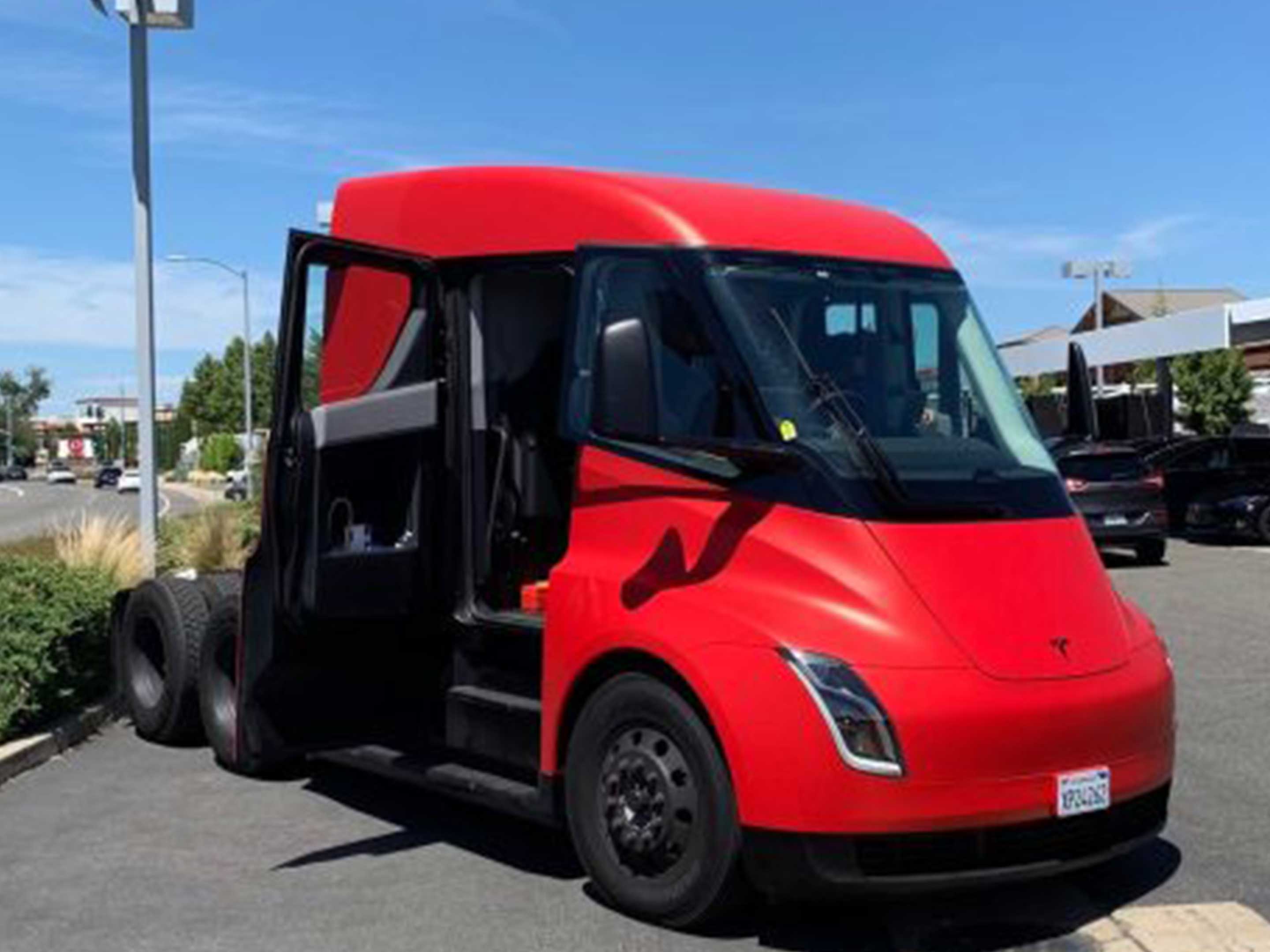
A Tesla owner in Northern California was able to get a good tour of a bright red Tesla Semi, giving us more details about the upcoming vehicle.

The photographer, Jerome Mends-Cole, the owner of SacTesla, saw the prototype version of the Semi at Tesla’s store in Rocklin, California.

One of the newest reveals was the Semi’s front trunk, or frunk. According to Electrek, the vehicle is about the same size as the frunk on the current Model 3 and S.

While the photographer wasn’t able to get inside of the truck, he did talk to the engineers testing it, reports Electrek. 

He went on to say that Tesla seemed confident the truck is going to beat the original ranges it was announced with.

When the Elon Musk first showed off the truck, he stated the base model would feature a 482km range and the ‘Founder Series’ would include a 804km range.

Image credit: Electrek

Source: Electrek

The post Tesla’s electric semi truck spotted in northern California appeared first on MobileSyrup.

26 Jun 04:06

Microsoft’s next Surface Pro could get a Snapdragon processor variant

by Patrick O'Rourke
Surface Pro 6

Microsoft’s next iteration of the Surface Pro, which is tipped to release in 2020, could get an ARM processor variant. This would be the first ARM-powered Surface since 2013’s Surface 2.

According to Windows Central and Petri, ‘Excalibur,’ the internal codename for a version of the Surface Pro, is rumoured to be powered by Qualcomm’s new 8cx processor ARM processor. To be clear, Microsoft will also sell an Intel processor version of the new Surface Pro, according to the report.

Given the first ARM-powered Windows devices to hit the market last year were Ultrabooks, it’s not surprising Microsoft is also planning to release a Surface Pro featuring the same processor chip technology.

Microsoft is rumoured to be working on several new Surface devices set to be released at some point in 2020, including a new Surface Laptop, Surface Book, and an already mentioned Surface Pro.

Windows Central is reporting this year’s changes to the Surface line mostly consist of hardware improvements. That said, it looks like Microsoft is finally ditching the Surface Connect port in favour of USB-C, which is a great move on the tech giant’s part.

Rumours are also circulating regarding Microsoft working on a dual-screen 2-in-1 Surface device that is capable of running Android apps codenamed ‘Centaurus.’ 

Source: Windows Central, Petri 

The post Microsoft’s next Surface Pro could get a Snapdragon processor variant appeared first on MobileSyrup.

26 Jun 04:06

Hans Zimmer creating sounds for future BMW electric cars

by Bradly Shankar
Hans Zimmer BMW

German automotive maker BMW has tapped Oscar- and Grammy Award-winning composer Hans Zimmer to create sounds for future electric vehicles.

The Lion King composer is working with BMW sound designer Renzo Vitale on the sound of the BMW Vision M NEXT concept, which is set to launch soon, as well as future BMW electric vehicles.

According to BMW, the growing range of electric vehicles has created a “gap in the emotionality of the driving experience” in the driver’s seat. Specifically, BMW notes that electric vehicles are known for driving silently, which it says “may lead to an alienation between driver and vehicle.”

With that in mind, BMW is looking to enhance the overall vehicle experience using sounds that were created by a celebrated composer like Zimmer.

“I have always been a BMW enthusiast. As a kid I used to recognise my mother coming home by the sound of her BMW,” said Zimmer in a statement. “I am thrilled to get the chance to design the sound of future electric BMW’s and create emotion for the future electric driving experience.”

It’s currently unclear if Zimmer plans to incorporate his infamous “BRAAAAM” sound from Inception into BMW’s vehicles.

Via: Elektrek

The post Hans Zimmer creating sounds for future BMW electric cars appeared first on MobileSyrup.

25 Jun 17:31

The New Generation of Tech and Stronger Privacy Laws

by Todd Weaver

Read all about how Todd Weaver and Brendan Eich reject Big Tech’s efforts to weaken California’s privacy law.

In a nutshell, what you can read in The Mercury News is how every Big Tech company seems to care about privacy now—while quietly attempting to dismantle the California Consumer Privacy Act before it even goes into effect. Why? California’s new privacy law requires large companies to respect basic information rights: what is collected, sold, traded or shared.

Sharing intimate information and manipulating users’ choices and actions are serious mistakes.

Our colleagues in Big Tech worry about privacy violations too… and that’s why so many of them don’t allow their own children to use the products and services they sell.

Regulate us. Seriously.

We don’t believe in building things we wouldn’t let our own kids use, and that’s why we want to strengthen California’s consumer privacy law. Our industry knows how to innovate and adapt, we thrive in the startup mindset of tackling new challenges, we know how to conquer what seems impossible. Regulation that helps civilians is critical; regulation that creates a barrier to entry for competition and protects technology giants is not.

We know how to imagine, dream, innovate, and implement.

We want to make sure our customers, their families and our families–everyone’s privacy rights–are protected. It is imperative. Because strong privacy laws are good for everyone.

Read the full article in The Mercury News post–written by our CEO, Todd Weaver, and Brave CEO, Brendan Eich.

The post The New Generation of Tech and Stronger Privacy Laws appeared first on Purism.

25 Jun 17:30

The Zoom earnings call and the future of video communication

by Josh Bernoff

Zoom used its own video product to conduct its first post-IPO earnings call earlier in June. This is the future of communication. As a former analyst, I can tell you what earnings calls used to be. There was a press release. Then there was a conference call, or possibly a Webinar. In any case, everything … Continued

The post The Zoom earnings call and the future of video communication appeared first on without bullshit.

25 Jun 17:30

Bad Signs

by Gordon Price

Providing straightforward information to the public about small changes should be, well, straightforward.  It’s not.

Example: a temporary parking change on Nelson Street.


So, let’s go to back of meter.  (Click on post to see rest of images.)


Okay, let’s go look for curbside signs:


Nothing where you’d expect the temporary signage to be.  So back to the meter …

… where the temporary sign blocks one of the digits from the number needed to pay electronically.

It’s a small irritant (unless you get a ticket), but it’s these things that shape people’s perceptions about the competence of government.  We focus on the screw-ups and discount the ones that work.  Like these:


25 Jun 17:29

Good News and More Good News~British Columbia’s New Active Transportation Guide

by Sandy James Planner
Photo by Snapwire on Pexels.com

This week the Province of British Columbia released their new Active Transportation Design Guide with the intent of creating consistent design for active transportation facilities across the Province. The Guide also provides expectations in  design guidance for any applications for grant programs to build active transportation infrastructure.

This Guide aims to double active transportation trips and also intends to adopt “Vision Zero” which has been implemented in Europe successfully to minimize death or serious injury related to vehicular crashes. The British Columbia Motor Vehicle Act is also going to be revamped to encompass ALL the different users of the roads, and also acknowledge the importance of active transportation. This will include a retooling of current driver education to include the legal rights of all road users.

The day to day use of “all human powered modes of transportation, focusing primarily on walking, cycling and rolling”  is finally going to be addressed.  This is an important step in that the new guide embraces novel ways of moving including segways, e-scooters, electric biycles and hoverboards. It is also looking at snow based activities like skiing and skating and water based like kayaking and canoeing as well as horseback riding.

The guide emphasizes holistic connections, so that people can walk or bike and easily change modes to bus, train or ferry transportation.

One of the goals is to make active transportation a viable option going to school, work or play. Active transportation is more sustainable for the environment relieves vehicular congestion and increases the health status of participants. There are few policies that can reduce pollution, reduce the chance of serious injury and death AND improve personal health~but strongly promoting and  building active transportation infrastructure can do all three.

You can review the new Active Transportation Design Guide here.

The official announcement of the new Guide was made by Claire Trevena  Minister of Transportation and Infrastructure.. You can look at the YouTube video of the announcement below, which also includes the important  tie-in with physical and mental health, sustainability and reducing pollution.


25 Jun 17:29

"Bad food is made without pride, by cooks who have no pride, and no love."

“Bad food is made without pride, by cooks who have no pride, and no love.” - | Anthony...
25 Jun 17:29

Liked Raspberry Pi on Raspberry Pi | Mythic Be...

by Ton Zijlstra
Liked Raspberry Pi on Raspberry Pi | Mythic Beasts
Every page from the blog after Sat 22nd June has been generated on a Raspberry Pi 4.....it’s a cluster of brand new hardware, with a pre-release operating system and a single point of failure. We very strongly advise our customers not to use this for a mission critical super high profile website under-going the most significant production launch in their history. That really isn’t a very good idea. We once advised Eben that Raspberry Pi probably wouldn’t sell very many computers. He didn’t listen to us then either.

The launch of Raspberry Pi 4 is significant in its own right, especially as its improved specs make it a cheap server (60 Euros). Cheap servers play a role in a whole host of distributed applications, like running your own cloud, calendar, smart home appliances, internet of things hub, machine learning efforts, and federated social media. I look forward to getting my hands on a Pi4.

To show off its specs, the Raspberry Pi 4 launch website, attracting tens of millions of visitors over a few days, is being run on a cluster of 18 Raspberry Pi 4’s. (found via Jason Cosper, @boogah@mastodon.social)

25 Jun 17:29

Fewer Things and Less Waste

by Alison Mazurek
I went home and washed my converse after this photo. Eep! But my beloved reusable coffee cup at work with my lunch in a reusable and stackable container (Bowl  Link Here ).

I went home and washed my converse after this photo. Eep! But my beloved reusable coffee cup at work with my lunch in a reusable and stackable container (Bowl Link Here).

We’ve been making changes slowly to be more conscious about our plastic use and our waste. It’s been a slow and deliberate process of changing habits and acquiring more sustainable alternatives to one-use plastics . I never wanted to share about it here because there are others who do so much more than us. There are many experts in low and zero waste but then I saw something the other day that’s been floating around the internet that said, “we don’t need a handful of people doing zero waste perfectly, we need millions of people doing it imperfectly” (Anne-Marie Bonneau - Zero Waste Chef). So with that ethos echoing in my head I thought I would share our efforts to eliminate single-use plastics from our life and cut down on our waste.

While we aren’t perfect at zero waste, we do have some good habits and make some extra efforts to consume less plastics and carefully and correctly dispose of our garbage and recycling. I believe that living in our small space brought this to our attention as we only have two small garbage cans in our entire space and one recycling bin. This means we need to take out our garbage and recycling frequently and if they are piling up quickly it is hard to ignore. We have been looking at what we buy and how we use things to see if we can cut back further on our environmental footprint. I recently spoke with Elsbeth of Practical(ly) Zero Waste Podcast and left inspired to do even better. You can listen to the episode here, I really enjoyed our chat but I’m too nervous to listen to my voice!

I’m sure none of these ideas will be new to you but I'm listing them anyway because what if they are something you’ve haven’t adopted but easily could.

Bring Your Own Cup

It wasn’t until I found the perfect coffee cup for me that I finally created the habit of bringing my own coffee cup with me. My drink of choice is a cappuccino so this 8oz cup is perfect for me. I throw it in my bag anytime I think i might get a coffee. I even pack it for trips as it doesn’t take up much space and I know I will be ordering coffees while travelling. The unexpected benefit is that my coffee stays warm for a few hours so I can drink it slowly.

We also drink water from the tap and don’t buy liquids that come in plastic as much as possible. We are lucky to live somewhere with accessible fresh drinking water and I know this isn’t the case for everyone.

Bring your own bag

Just a quick habit shift of always making sure I have a folded up bag in my purse has made a big difference in the amount of plastic bags I use. A standard size Baggu is my preferred bag and I have been getting better at always having one on hand. We also store extra reusable bags in a shoe cubby in our entry closet and make sure to bring a bunch when grocery shopping.

We have just started using produce bags. Often when choosing produce we opt out of the plastic bag and just have lots of loose fruit and vegetables in our cart. But lately we have been wishing for more organization so we picked up some canvas sacks from a local art supply shop. I’m thinking now that mesh bags would be better for visibility in the fridge so I have my eyes on these.

Choose Foods with Less Packaging

Our current food budget doesn’t allow us to shop at no waste grocery stores but we have noticed bulk food having quicker turnover and more sanitary dispensers at our local grocer. We have been making efforts to choose groceries not only based on nutritional information but also packaging. Ugh, it sometimes feels like we can’t make any easy decisions nowadays doesn’t it?! But it’s worth it - I know it’s going to be worth it. Choosing the eggs by the cardboard flat rather than the styrofoam container, is worth it. Ordering takeout from the restaurant that uses paper and cardboard packaging rather than plastic, is worth it.

Alternative Food Wraps

We noticed the amount of plastic wrap we were using and switched to beeswax wraps which has been an easy adjustment. We go through food quickly so I haven’t found things like cheese dry out. We have two sets and that seems to be enough for us currently. We use them to wrap up cut vegetables, top bowls with leftovers and wrap cheese.

Some things we have found still need plastic like keeping our bread fresh. We often buy bread from our local bakery but Trevor has taken to reusing the same plastic bag and bringing the old bag with him when he buys the new loaf. It is definitely important to mention that much of the annoying labour of recycling and reducing waste in our family is initially led by Trevor and I eventually follow in his path. I often remark how easy the change is after I was resistant to the change at first.

Switch to Fabric Napkins and Towels

We have been using fabric napkins and towels in place of paper towels and napkins for a couple of years now. Yes, it means more laundry but it feels worth it. Our napkins are from Ikea from the sale bin and I can’t remember where our tea towels are from but they’ve held up really well and while there are still times I wish I had a roll of paper towel, it’s now become a habit and one we can feel good about.

Understand Your Local Recycling

Recycling can be complicated, so we try to educate ourselves on what is allowed in our bins and what requires a special drop off. We looked into local spots that accept electronics and batteries. Additionally we have been trying to separate our soft plastics for local drop off (something we can be more diligent with). Our local London Drugs has recycling drop offs that we take advantage of. I would encourage you to research which shops in your area provide this kind of free service.

Use What You Have

It’s important to remember that using things you already own is always the most sustainable choice. It can often feel like you need to throw out everything you own and start fresh to be perfectly zero waste but the best thing you can do is use what you already own, over and over again. Friends of ours are very resourceful with reusing jars and plastic containers with proper labelling. We use jars to store spices and dry goods as well but never as many or as beautifully as they do.

So nothing earth shattering here, but hopefully if we all share a bit how we are trying to do better, consume less and be responsible with our waste, we can start turning back some of the damage we’ve already done to our earth. And an added benefit of choosing less packaging, less plastic and more quality re-usable items is that our small space feels less overwhelmed with things and we are producing less garbage and recycling.

(Some links in this post are affiliate links. Shopping through them helps support this blog. Thanks for your support!)


25 Jun 17:29

Machine boss

by Nathan Yau

For The New York Times, Kevin Roose on the possibility of machines becoming your boss:

The goal of automation has always been efficiency, but in this new kind of workplace, A.I. sees humanity itself as the thing to be optimized. Amazon uses complex algorithms to track worker productivity in its fulfillment centers, and can automatically generate the paperwork to fire workers who don’t meet their targets, as The Verge uncovered this year. (Amazon has disputed that it fires workers without human input, saying that managers can intervene in the process.) IBM has used Watson, its A.I. platform, during employee reviews to predict future performance and claims it has a 96 percent accuracy rate.

Splendid.

Tags: artificial intelligence, ethics, management

25 Jun 15:32

Facebook, Libra, and the Long Game

by Ben Thompson

When I get things wrong — and I was very much wrong about Facebook’s blockchain plans — the reason is usually a predictable one: confirmation bias. That is, I already have an idea of what a company’s motivations are, and then view news through that lens, failing to think critically about what parts of that news might actually disconfirm my assumptions.

So it was last month when the Wall Street Journal reported that Facebook was building a cryptocurrency-based payment system. I wrote in a Daily Update:

Start with the obvious: this isn’t a Bitcoin competitor. And why would it be? The entire point of Bitcoin is to be distributed; Facebook’s power come from its centralization. Indeed, this is probably the single most important prism through which to examine whatever it is that Facebook does in the space: the company is not going betray its dominant position, but rather seek to strengthen it. That is why I am not too concerned about not knowing the implementation details: take it as a given that whatever role users have to play in this network, Facebook will have final control.

I stand by the first part of that excerpt: for all of the positive attributes Facebook is highlighting about Project Libra — which Facebook, in conjunction with the newly formed Libra Association, announced last week — it is unreasonable to expect that Facebook would invest significant resources in something that would weaken its position. What I got wrong was presuming that meant overt Facebook control. Frustratingly, it was an error that should have both been obvious in my original analysis and also clear in the broader view of the Internet I have explained through Aggregation Theory.

What is Libra

Libra is being presented as a cryptocurrency based on a blockchain: transactions are recorded on a shared ledger and verified by “miners” independently solving cryptographic problems and arriving at a consensus that the transaction is legitimate and should be added to the ledger permanently.

In practice, it is much more complicated: while a limited set of “validators” — aka miners — share a history of transactions in (individual) blocks that are chained together (i.e. a blockchain), what Libra actually exposes is the current state of the ledger. In practice this means that adding new transactions can be much quicker and more efficient — more akin to adding a line to a spreadsheet than rebuilding the entire spreadsheet from scratch.

In other words, there is a trade-off between trust and efficiency: whereas anyone can “rebuild the spreadsheet” in the case of a cryptocurrency like Bitcoin, where the blockchain is fully exposed, normal users have to trust Libra’s validators.1 On the other hand, Bitcoin, thanks to the overhead of communicating and verifying every transaction, can only manage around 7 transactions a second; Libra is promising 1,000 transactions per second.

The Validators

Who, then, are the validators? Well, Facebook is one, but only one: currently there are 28 “Founding Members”, including merchants, venture capitalists, and payment networks, that meet two of the following three criteria:

  • More than $1 billion USD in market value or more than $500 million USD in customer cash flow
  • Reach more than 20 million people a year
  • Recognition as a top-100 industry leader by a third-party association such as Fortune or S&P

These “Founding Members” are required to make a minimum investment of $10 million and provide computing power to the network. In addition, there are separate requirements for non-profit organizations and academic institutions that rely on a mixture of budget, track record, and rankings; a minimum investment may not be necessary. Libra intends to have 100 Founding Members by the time it launches next year.

Here is the important thing to understand about the Libra Association: while its members — who again, are the validators — do control the Libra protocol, Facebook does not control the validators. Which, by extension, means that Facebook will not control Libra.

Libra Versus a Facebook Coin

To understand the distinction, consider an alternative route that Facebook could have taken: a so-called “Facebook Coin”. In that case Facebook would have had total control over the protocol, and to be sure, this would have distinct advantages for Facebook specifically and the usability of a “Facebook Coin” generally:

  • Efficiency and scalability would be maximized because Facebook could coordinate perfectly with itself
  • Development would be significantly accelerated because Facebook would not have to achieve consensus
  • Facebook would have perfect knowledge of all transactions on the system because it would control all entry points

This is the Trust-Efficiency tradeoff taken to the opposite extreme from Bitcoin:

A theoretical Facebook Coin would be the opposite of Bitcoin

With Bitcoin, there is no need to trust anyone — you can verify the entire blockchain yourself — but at the cost of efficiency of transactions. A Facebook Coin, on the other hand, would require complete trust of Facebook, but transactions would be far more efficient as a result.

The most obvious example of this is WeChat Pay: WeChat handles the transactions, stores the money, and is the sole source of authority about who owns what, and thanks to the ubiquity of WeChat and the efficiency of this model, WeChat Pay (along with Alipay) has become the default payment mechanism in China.

Unsurprisingly, WeChat doesn’t use any sort of blockchain-based technology. Why would it? The entire point of a blockchain is to distribute a ledger across multiple parties, which is fundamentally less efficient than simply storing the entire ledger in a single database managed by one party.

Trust Versus Efficiency

This gets at the error in analysis I referenced above: because I was anchored on the idea of Facebook capturing transaction data, I missed that when the Wall Street Journal reported last month that Facebook was using some sort of blockchain technology (leaving aside the quibble on the definition noted above) it was an obvious signal that whatever Facebook was announcing would not be completely controlled by Facebook, because if the goal were Facebook control of a Facebook Coin then a blockchain would be a silly way to implement it.
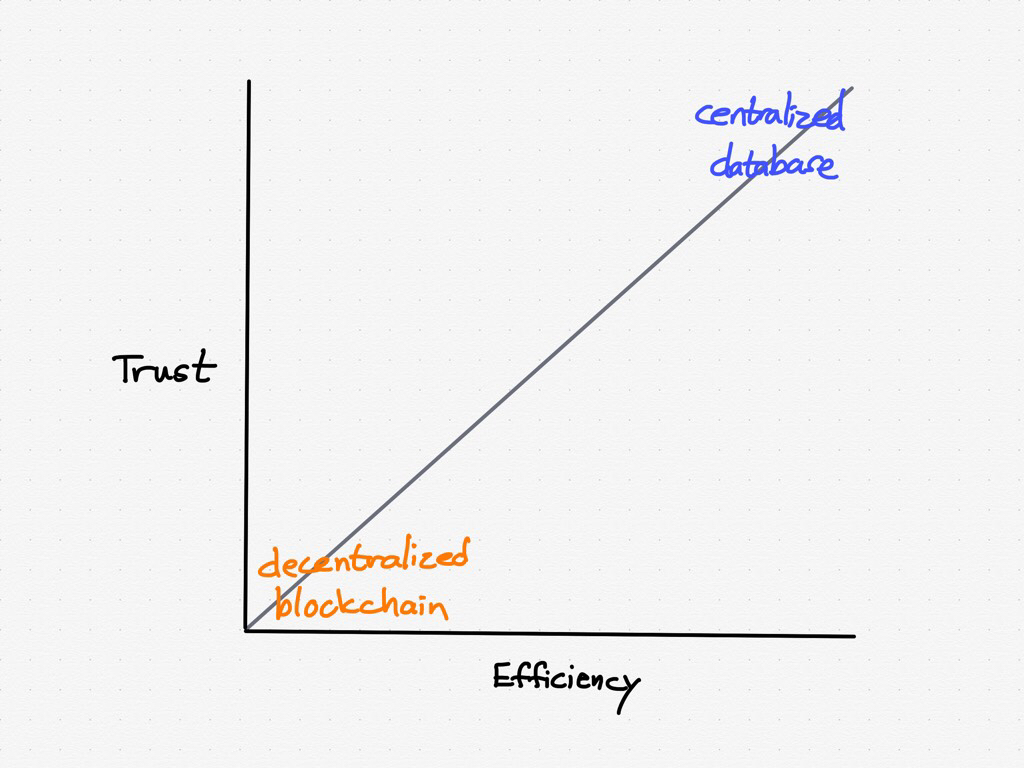
A decentralized blockchain versus a centralized database

The best way to understand Libra, then, is as a sort of distributed ledger that is a compromise between a fully public blockchain and an internal database:
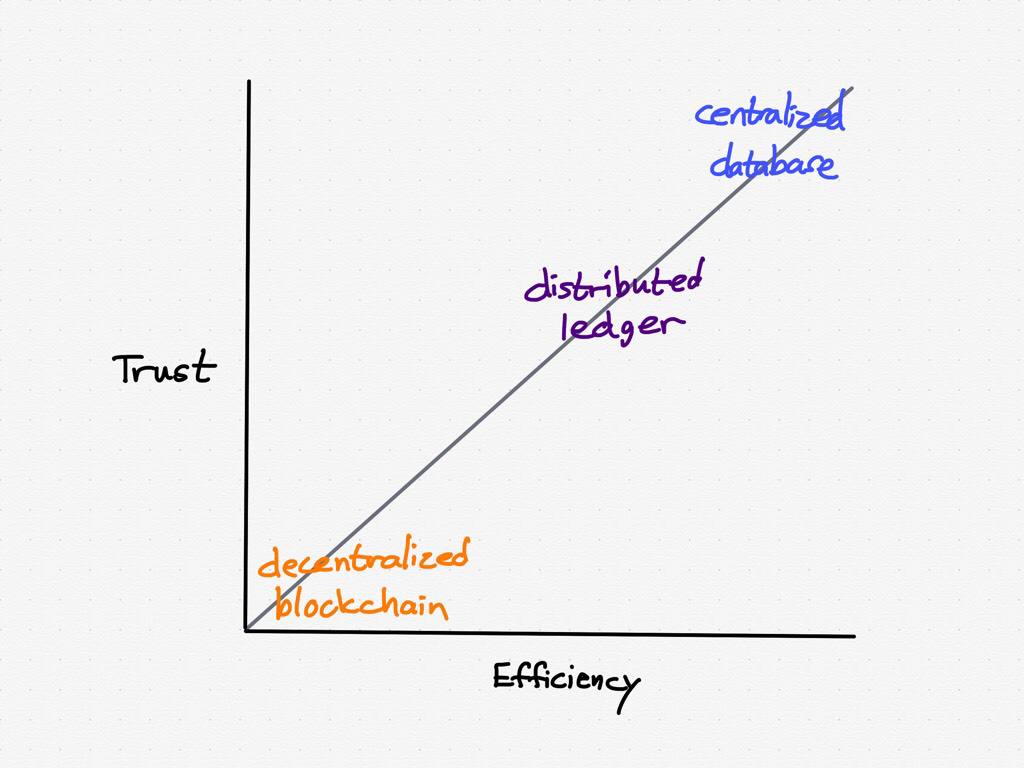
A distributed ledger as a compromise between a decentralized blockchain and a centralized database

This means that the overall system is much more efficient than Bitcoin, while the necessary level of trust is spread out to multiple entities, not one single company:
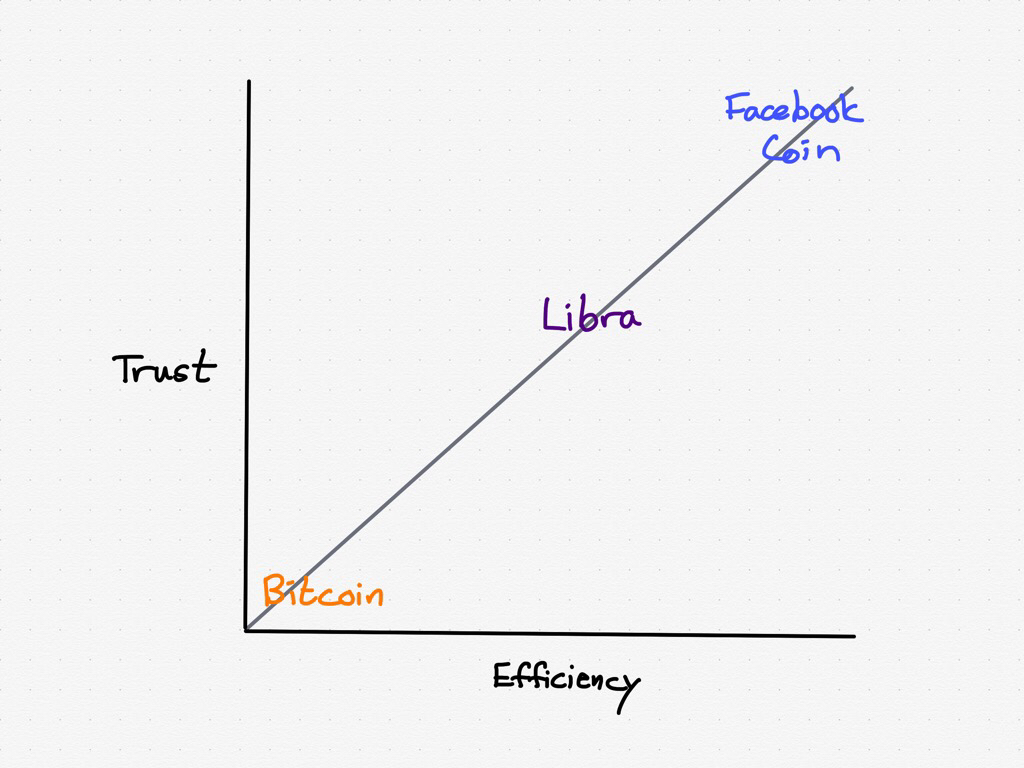
Bitcoin versus Libra versus a theoretical Facebook coin

The trade-off is that Libra is not fully permissionless, although the Libra White Paper does say that is the long-term goal:

To ensure that Libra is truly open and always operates in the best interest of its users, our ambition is for the Libra network to become permissionless. The challenge is that as of today we do not believe that there is a proven solution that can deliver the scale, stability, and security needed to support billions of people and transactions across the globe through a permissionless network. One of the association’s directives will be to work with the community to research and implement this transition, which will begin within five years of the public launch of the Libra Blockchain and ecosystem.

Time will tell if this is possible: if you flip the “trust” axis in the above graphs the current state of affairs looks like this:
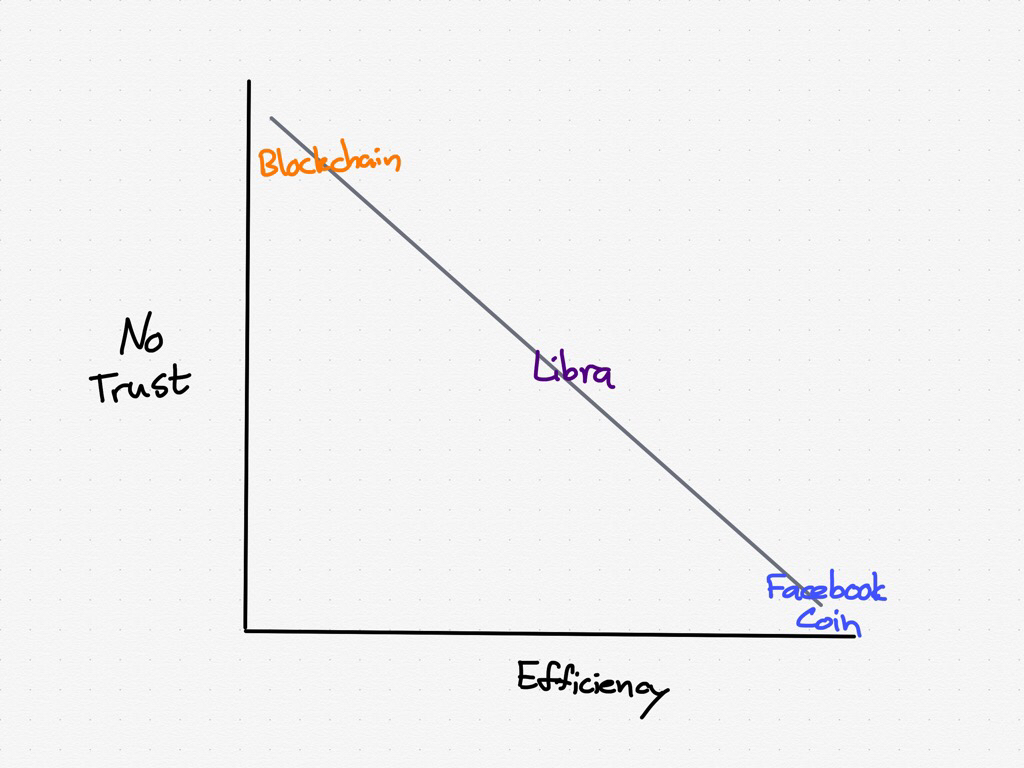
Is there an efficiency frontier when it comes to no-trust and efficiency?

It may very well prove to be the case that there is a sort of efficient frontier when it comes to “no-trust” versus “efficiency”: that is, any decrease in necessary trust requires a corresponding decrease in efficiency. From my perspective the safest assumption about Libra’s future is that efficiency will be the ultimate priority, which means that the more that Libra is used the more difficult it will be to ever transition to a permission-less model.

The Credit Card Challenge

Still, even if Libra remains controlled by an ever-expanding-but-still-limited set of validators, that is likely to be a far easier “sale” than a Facebook Coin controlled by a single company. Leaving aside the fact Facebook is not exactly swimming in trust these days when it comes to users, why would any other large company want to adopt a currency with a single point of corporate control?

Keep in mind the situation in the United States and other developed countries is much different than China: credit cards have their flaws, particularly in terms of fees, but they are widely accepted by merchants and widely used by consumers. China, on the other hand, mostly leapfrogged credit cards entirely; this meant that WeChat Pay’s (and Alipay’s) competition was cash: in that case the relative advantages of WeChat Pay relative to cash (which are massive) could overcome any concerns around centralized control.

A theoretical Facebook Coin’s relative advantage to credit cards, on the other hand, would be massively smaller, which means obstacles to widespread adoption — like trusting Facebook exclusively — would likely be insurmountable:
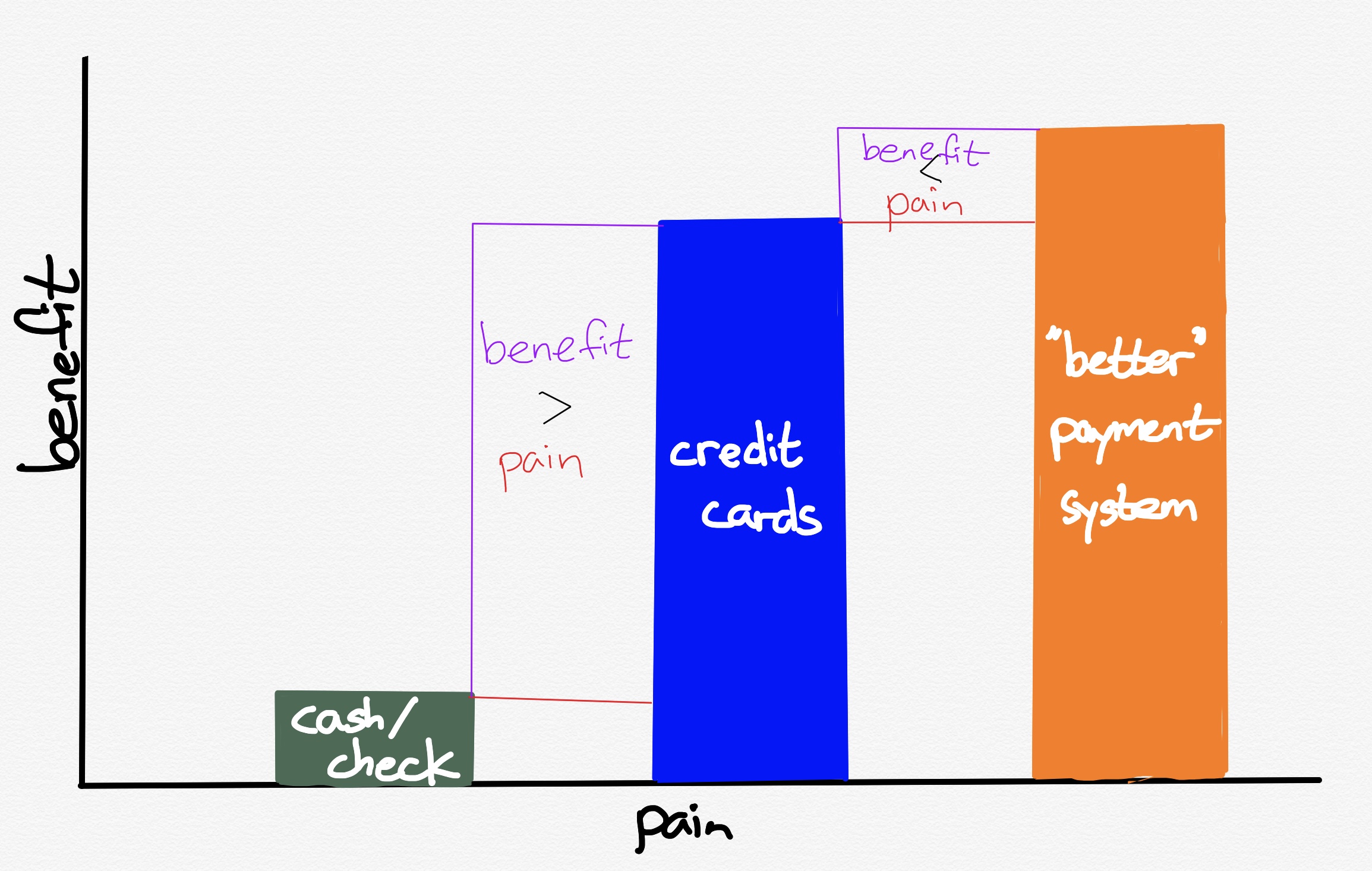
How new payment systems are — or are not — adopted

Thus the federation of trust inherent in Libra, despite the loss of efficiency that entails: by not being in control, and by actively including corporations like Spotify and Uber that will provide places to use Libra outside of Facebook, and payment networks like Visa and PayPal that will facilitate such usage, Facebook is increasing the chances that Libra will actually be used instead of credit cards.

Aggregation and the Long Game

I do think it is overly cynical to completely dismiss the advertised benefits of Libra: remittances, for example, have been the go-to example of how cryptocurrencies can have societal benefit for a long time for a very good reason — the current system exacts major fees from the population that can least afford to bear them. And, while I just spent an entire section on credit cards, the reality is that credit card penetration is much lower amongst the poor in developed countries and in developing countries generally: a digital currency ultimately premised on owning a smartphone has the potential to significantly expand markets to the benefits of both consumers and service providers.

To put it another way, Libra has the potential to significantly decrease friction when it comes to the movement of money; of course this potential is hardly limited to Libra — the reduction in friction is one of the selling points of digital currencies generally — but by virtue of being supported by Facebook, particularly the Calibra wallet that will be both a standalone app and also built into Facebook Messenger and WhatsApp, accessing Libra will likely be much simpler than accessing other cryptocurrencies. When it comes to decreasing friction, simplifying the user experience matters just as much as eliminating intermediary institutions.

There is also another component of trust beyond caring about who is verifying transactions: confidence that the value of Libra will be stable. This is the reason why Libra will have a fully-funded reserve denominated in a basket of currencies. This does not foreclose Libra becoming a fully standalone currency in the long run, but for now both users and merchants will be able to trust that the value of Libra will be sufficiently stable to use it for transactions.

If all of these bets pay off — that users and merchants will trust a consortium more than Facebook; that Libra will be cheaper and easier to use, more accessible, and more flexible than credit cards; and that Libra itself will be a reliable store of value — then that decrease in friction will be realized at scale.

And this is when this bet would pay off for Facebook (and the second point I missed in my earlier analysis): the implication that digital currencies will do for money what the Internet did for information is that the very long-term trend will be towards centralization around Aggregators. When there is no friction, control shifts from gatekeepers controlling supply to Aggregators controlling demand. To that end, by pioneering Libra, building what will almost certainly be the first wallet for the currency, and bringing to bear its unmatched network for facilitating payments, Facebook is betting it will offer the best experience for digital currency flows, giving it power not by controlling Libra but rather by controlling the most users of Libra.

Will It Work?

Libra’s success, if it comes, will likely proceed in stages, with different challenges and competitors at each stage:

  • Initially the most obvious use case for Facebook’s Calibra wallet application will be peer-to-peer payments, which means the competitor will be applications like PayPal’s Venmo. Here Facebook’s biggest advantage will be leveraging its network and messaging applications.
  • The second use case will be using Libra to transact with merchants, who stand to benefit both from reduced fees relative to credit cards as well as larger addressable markets (i.e. potential users who don’t have credit cards). Note that none of Libra’s Founding Members are banks, which impose the largest percentage of credit card fees; Visa and Mastercard, on the other hand, are, like PayPal, happy to sit on top of Libra.
  • The largest leap will come last: Libra as a genuine currency, not simply a medium for transaction. This will be a function of volume in the previous two use cases, and is understandably concerning to governments all over the world. This, though, is another advantage of Facebook giving up direct control of Libra: while regulators will be able to limit wallets like Calibra (which will fully abide by Know-Your-Customer and Anti-Money-Laundering regulations), Libra — particularly if it achieves a fully permission-less-model — would be much more difficult to control.

It is easy to see how Facebook, given its size, would thrive in that final state, for the reasons I detailed above. Just as Google long boasted that the more people use the Internet the more revenue Google generates, it stands to reason that the more people use digital money the more it would benefit dominant digital companies like Facebook, whether that be through advertising, transactions, or simply making networks that much more valuable.

That, though, is also a reason to be skeptical: the idea of Google making more money by people using the Internet more was once viewed as a happy alignment of incentives that justified Google’s services being free; today the centralization — and thus money-making potential — that follows a reduction in friction is much better understood, and there is much more concern about just how much power these Aggregators have.

This is particularly the case with Facebook: despite all of the company’s efforts to design a system that does not entail trusting Facebook exclusively — again, this is not a Facebook Coin — Libra is already widely known as a Facebook initiative. Unless the consumer benefits are truly extraordinary, that may be enough to prevent Libra from ever gaining escape velocity. This applies even more to the Calibra wallet: Facebook promises not to mix transaction data with profile data, but that entails, well, trust that Facebook may have already lost.

Still, that doesn’t mean digital currencies will never make it: I do think that Libra gets closer to a workable balance between trust and efficiency than Bitcoin, at least when it comes to being usable for transactions and not simply a store of value; the question is who can actually get such a currency off the ground. Certainly Facebook’s audacity and ambition should not be underestimated, and the company’s network is the biggest reason to believe Libra will work; Facebook’s brand is the biggest reason to believe it will not.

  1. To clarify, this roadmap on the Libra developers blog includes plans to allow anyone to “rebuild the spreadsheet”:

    Validator APIs to support full nodes (nodes that have a full replica of the blockchain but do not participate in consensus). This feature allows for the creation of replicas that can support scaling access to the blockchain and the auditing of the correct execution of transactions.

    However, only validators can actually validate transactions (unlike Bitcoin where anyone can be a miner/validator)

25 Jun 15:01

What Members Want To See When They Suggest An Idea

by Richard Millington

Quick Note – I’ll be in Amsterdam July 22-23, I’d love to meet community pros in the area.

* * * * *
It’s not too tricky.

When a member submits an idea they want:

  1. To know the entire process of how an idea becomes implemented in the product, what milestones they have to reach to be considered.
  2. To see it immediately appear in the community without approval.
  3. To see it promoted to other members.
  4. Quick, constructive, feedback from other members.
  5. To gain endorsements from key community members.
  6. To interact with staff members about the idea.
  7. To see where their idea is in the process at all times and be notified of changes.
  8. To see how close they are to reaching the next phase of the process.
  9. To get an update on whether the idea was accepted/rejected (with reasons).
  10. To be thanked for submitting ideas which aren’t accepted.
  11. To be shown gratitude if an idea advanced to the product stage.
  12. To be considered a key influencer who can sponsor future ideas.

This isn’t an exhaustive list, but if you can get even halfway there you’re doing better than most.

p.s. Just because an idea/feedback isn’t submitted through a specific ideation platform doesn’t mean the process doesn’t apply.

25 Jun 14:58

[ridgeline] Ascetic Pants

by Craig Mod
Walkers, movers, shakers — First, some technical newsletter housekeeping. Something very strange just came to my attention: You are not allowed to include Amazon affiliate links in emails. Say what? But, there it is, in the Amazon Affiliate Terms of Service. Affiliate link on a webpage? No problem. But if that webpage with the affiliate link is sent via email to someone? Violation! Amazon affiliate links account for a small but non-trivial amount of my yearly income.
25 Jun 14:58

Capstone: a tablet for thinking - MadaboutDana

I loved their example from Milanote.
25 Jun 14:58

Amazon Prime Day is happening in Canada on July 15th for 48-hours

by Ian Hardy

Amazon Prime Day is happening once again and will see the plethora of deals begin July 15th at midnight PST for 2-days.

Amazon Canada notes, ‘first time ever,’ this year will offer Prime Member a straight 48 hours of over ‘one million deals, limited-time offers, never-before-seen entertainment, and exclusive launches online.’

Similar to last year, which crashed Amazon’s servers, the massive online retailer and its partners are offering deep discounts on the latest tech in accessories, smartphones, smart home, entertainment and TVs.

As an example, Amazon Canada has already discounted the new Echo Input from $44.99 to $19.99.

Amazon Prime is just CDN$ 7.99/month (plus any applicable taxes), or $79 per year. If you’re not a Prime Member, Amazon Canada is offering a 30-day free trial here. Quebec residents, instead of a free trial, receive an initial 2-month membership for $7.99.

Amazon Prime access to same-day shipping or 2-day shipping, Prime Video, Prime Video Channels, Prime Music, free unlimited photo storage with Amazon Photos, Prime Reading, Twitch Prime.

Jeff Wilke, Amazon CEO Worldwide Consumer, said, “Our vision is that Prime Day should be the absolute best time to be a member – when you can enjoy shopping, savings, entertainment and some of the best deals Prime members have ever seen.”

Source: Amazon Canada

The post Amazon Prime Day is happening in Canada on July 15th for 48-hours appeared first on MobileSyrup.

25 Jun 14:57

The Conservative Party is about to foist a charlatan on our country and 99.7% of us are being given no say whatsoever. New posters going up across the UK today. (Billboard location: Christchurch, Dorset) pic.twitter.com/heRkdIh6QA

by ByDonkeys
mkalus shared this story from ByDonkeys on Twitter:
What makes this so funny, not being in Britain, is that these are the same people who bleat about “unelecected Bureaucrats in Brussels”.

The Conservative Party is about to foist a charlatan on our country and 99.7% of us are being given no say whatsoever.
New posters going up across the UK today.
(Billboard location: Christchurch, Dorset) pic.twitter.com/heRkdIh6QA


Posted by ByDonkeys on Tuesday, June 25th, 2019 6:12am


16956 likes, 6439 retweets
25 Jun 14:57

Google plans to add better palm rejection to the Pixel’s Ambient display

by Igor Bonifacic
Pixel 3 XL

Google plans to enhance the Pixel’s always-on ‘Ambient display’ functionality to feature improved palm rejection.

The company shared its plans in response to a request on the Android Public Issue Tracker. Following a promise to pass on the feature request to the company’s product and engineering teams, a Google employee said the search giant plans to implement the enhancement in “later releases.”

At the moment, Pixel owners have two options when it comes to their phone’s always-on display functionality.

If you launch the phone’s Settings menu and navigate to ‘Display’ > ‘Advanced’ > ‘Ambient display,’ it’s possible to configure the ambient display functionality to only activate when you tilt your phone or double tap its display. However, the issue with the Pixel’s ambient display functionality is that, even when these two options are enabled, it’s far too easy to activate the main display by accident, and, in the process, burn through limited battery life, which is why Pixel owners want better palm rejection.

It’s not clear when Google plans to implement this feature. It’s possible we could see better palm rejection make its way to the Pixel before the official release of Android Q, or more likely, in a later release sometime this year.

Source: Google Via: 9to5Google

The post Google plans to add better palm rejection to the Pixel’s Ambient display appeared first on MobileSyrup.

25 Jun 06:29

Porting Datasette to ASGI, and Turtles all the way down

This evening I finally closed a Datasette issue that I opened more than 13 months ago: #272: Port Datasette to ASGI. A few notes on why this is such an important step for the project.

ASGI is the Asynchronous Server Gateway Interface standard. It’s been evolving steadily over the past few years under the guidance of Andrew Godwin. It’s intended as an asynchronous replacement for the venerable WSGI.

Turtles all the way down

Ten years ago at EuroDjangoCon 2009 in Prague I gave a talk entitled Django Heresies. After discussing some of the design decisions in Django that I didn’t think had aged well, I spent the last part of the talk talking about Turtles all the way down. I wrote that idea up here on my blog (see also these slides).

The key idea was that Django would be more interesting if the core Django contract - a function that takes a request and returns a response - was extended to more places in the framework. The top level site, the reusable applications, middleware and URL routing could all share that same contract. Everything could be composed from the same raw building blocks.

I’m excited about ASGI because it absolutely fits the turtles all the way down model.

The ASGI contract is an asynchronous function that takes three arguments:

async def application(scope, receive, send):
    ...

scope is a serializable dictionary providing the context for the current connection. receive is an awaitable which can be used to recieve incoming messages. send is an awaitable that can be used to send replies.

It’s a pretty low-level set of primitives (and less obvious than a simple request/response) - and that’s because ASGI is about more than just the standard HTTP request/response cycle. This contract works for HTTP, WebSockets and potentially any other protocol that needs to asynchronously send and receive data.

It’s an extremely elegant piece of protocol design, informed by Andrew’s experience with Django Channels, SOA protocols (we are co-workers at Eventbrite where we’ve both been heavily involved in Eventbrite’s SOA mechanism) and Andrew’s extensive conversations with other maintainers in the Python web community.

The ASGI protocol really is turtles all the way down - it’s a simple, well defined contract which can be composed together to implement all kinds of interesting web architectural patterns.

My asgi-cors library was my first attempt at building an ASGI turtle. The implementation is a simple Python decorator which, when applied to another ASGI callable, adds HTTP CORS headers based on the parameters you pass to the decorator. The library has zero installation dependencies (it has test dependencies on pytest and friends) and can be used on any HTTP ASGI project.

Building asgi-cors completely sold me on ASGI as the turtle pattern I had been desiring for over a decade!

Datasette plugins and ASGI

Which brings me to Datasette.

One of the most promising components of Datasette is its plugin mechanism. Based on pluggy (extracted from pytest), Datasette Plugins allow new features to be added to Datasette without needing to change the underlying code. This means new features can be built, packaged and shipped entirely independently of the core project. A list of currently available plugins can be found here.

WordPress is very solid blogging engine. Add in the plugin ecosystem around it and it can be used to build literally any CMS you can possibly imagine.

My dream for Datasette is to apply the same model: I want a strong core for publishing and exploring data that’s enhanced by plugins to solve a huge array of data analysis, visualization and API-backed problems.

Datasette has a range of plugin hooks already, but I’ve so far held back on implementing the most useful class of hooks: hooks that allow developers to add entirely new URL routes exposing completely custom functionality.

The reason I held back is that I wanted to be confident that the contract I was offering was something I would continue to support moving forward. A plugin system isn’t much good if the core implementation keeps on changing in backwards-incompatible ways.

ASGI is the exact contract I’ve been waiting for. It’s not quite ready yet, but you can follow #520: prepare_asgi plugin hook (thoughts and suggestions welcome!) to be the first to hear about this hook when it lands. I’m planning to use it to make my asgi-cors library available as a plugin, after which I’m excited to start exploring the idea of bringing authentication plugins to Datasette (and to the wider ASGI world in general).

I’m hoping that many Datasette ASGI plugins will exist in a form that allows them to be used by other ASGI applications as well.

I also plan to use ASGI to make components of Datasette itself available to other ASGI applications. If you just want a single instance of Datasette’s table view to be embedded somewhere in your URL configuration you should be able to do that by routing traffic directly to the ASGI-compatible view class.

I’m really excited about exploring the intersection of ASGI turtles-all-the-way-down and pluggy’s powerful mechanism for gluing components together. Both WSGI and Django’s reusable apps have attempted to create a reusable ecosystem in the past, to limited levels of success. Let’s see if ASGI can finally make the turtle dream come true.

Further reading

Hello ASGI by Tom Christie is the best introduction to ASGI I’ve seen. Tom is the author of the Uvicorn ASGI server (used by Datasette as-of this evening) and Starlette, a delightfully well-designd ASGI web framework. I’ve learned an enormous amount about ASGI by reading Tom’s code. Tom also gave a talk about ASGI at DjangoCon Europe a few months ago.

If you haven’t read A Django Async Roadmap by Andrew Godwin last year you should absolutely catch up. More than just talking about ASGI, Andrew sketches out a detailed and actionable plan for bringing asyncio to Django core. Andrew landeded the first Django core ASGI code based on the plan just a few days ago.

If you're interested in the details of Datasette's ASGI implementation, I posted detailed commentary on issue #272 over the past thirteen months as I researched and finalized my approach. I added further commentary to the associated pull request, which gathers together the 34 commits it took to ship the feature (squashed into a single commit to master).

25 Jun 06:21

Chrome OS 75 beta integrates third-party cloud storage in revised Files app

by Jinqiao Wu

Chrome OS 75 will treat cloud storage and network attached storage (NAS) apps as more or less like mounted drives or locations, says About Chromebooks.

First discovered by a Reddit user and later reaffirmed by Chrome Story and Android Police, the revised Files app in Chrome OS 75 beta now integrates Microsoft OneDrive, Google Drive, Box and Synology DS File(NAS) after the user installs the official apps from those services.

About Chromebooks also says Dropbox’s Android app does not support the new feature because it doesn’t fully implement the DocumentsProvider API. The good news is that DropBox Support confirmed the software team is looking into it.

To let the new software feature show up, users need to go to chrome://flags and enable ARC DocumentsProvider integration and perform a system restart.

Android Police believes that Chrome OS 75 should hit the stable channel any time now.

Source: About Chromebooks

The post Chrome OS 75 beta integrates third-party cloud storage in revised Files app appeared first on MobileSyrup.

25 Jun 06:18

Harbour Air Seaplanes is building the world's first electric commercial airplane. pic.twitter.com/876yJZuAHC

by Seeker
mkalus shared this story from Seeker on Twitter.

Harbour Air Seaplanes is building the world's first electric commercial airplane. pic.twitter.com/876yJZuAHC


Posted by Seeker on Monday, June 24th, 2019 7:00pm


13 likes, 8 retweets