Shared posts

05 Jul 21:32

The Oru Bay ST Kayak -- First Impressions

by Michael Kalus

The First Adventure — Actually buying one

The Oru Bay ST Kayak -- First Impressions

You would think in this day and age buying something is easy. I mean, we live in a consumerist society where I can get pretty much anything at a moments, or at least a few hours, notice.

And yet, my attempt in actually buying the Bay ST lasted almost a month.

I checked Oru’s website and they listed a local retailer not far from me. Great I thought, let’s support the local business. I went there, talked with the sales person who was very nice and who told me they have to order it in, but they’ll be doing that first thing next week (it was Thursday) and would take about a week to come in. Nice. Didn’t ask for a downpayment etc. So heck, why not?

A week came and went, I hadn’t heard back so I followed up. She told me she cannot get a response out of Oru but she’ll keep trying.

She called me a few days later telling me she was still trying to get someone there to either return her call or email, no luck so far though.

At the end of week three I went by once more and we agreed that I should try ordering directly from Oru as she was not able to get anything out of them. So online I went, put in my order and…..

Nothing happened. For an entire week all I had was “thanks, we got your order and we’re processing it”. So a week later I opened a ticket, asking them how long it usually takes them to ship. Two to four days was the answer but clearly we’re now at day seven and nothing had happened. The support person assured me that it would ship that day and I should get an email with the tracking number.

Well, no. No email, no updates on their website either. So I followed up once more the next day and this time I did not get a reply.

The following Tuesday, now a week and a half since I placed the order, I suddenly did get an email from UPS that a package was coming my way, two actually and they would be here the next day.

So on that end, Oru seems to have realized they fucked that one up and then paid for overnight shipping.

The adventure wasn’t over there yet. Next came my local UPS driver who claimed he’d attempted delivery, which he didn’t. No note, no door ring and he only did it on the larger of the two packages (the kayak itself). Apparently he was heading to one of the UPS Access Points. It’s up the street from me, so I could have lived with that. But I know from past experiences they do not take large boxes and I really did not fancy waiting another two days before I could drive out to Richmond to pick it up. So I called UPS and, to their credit. They got it resolved.

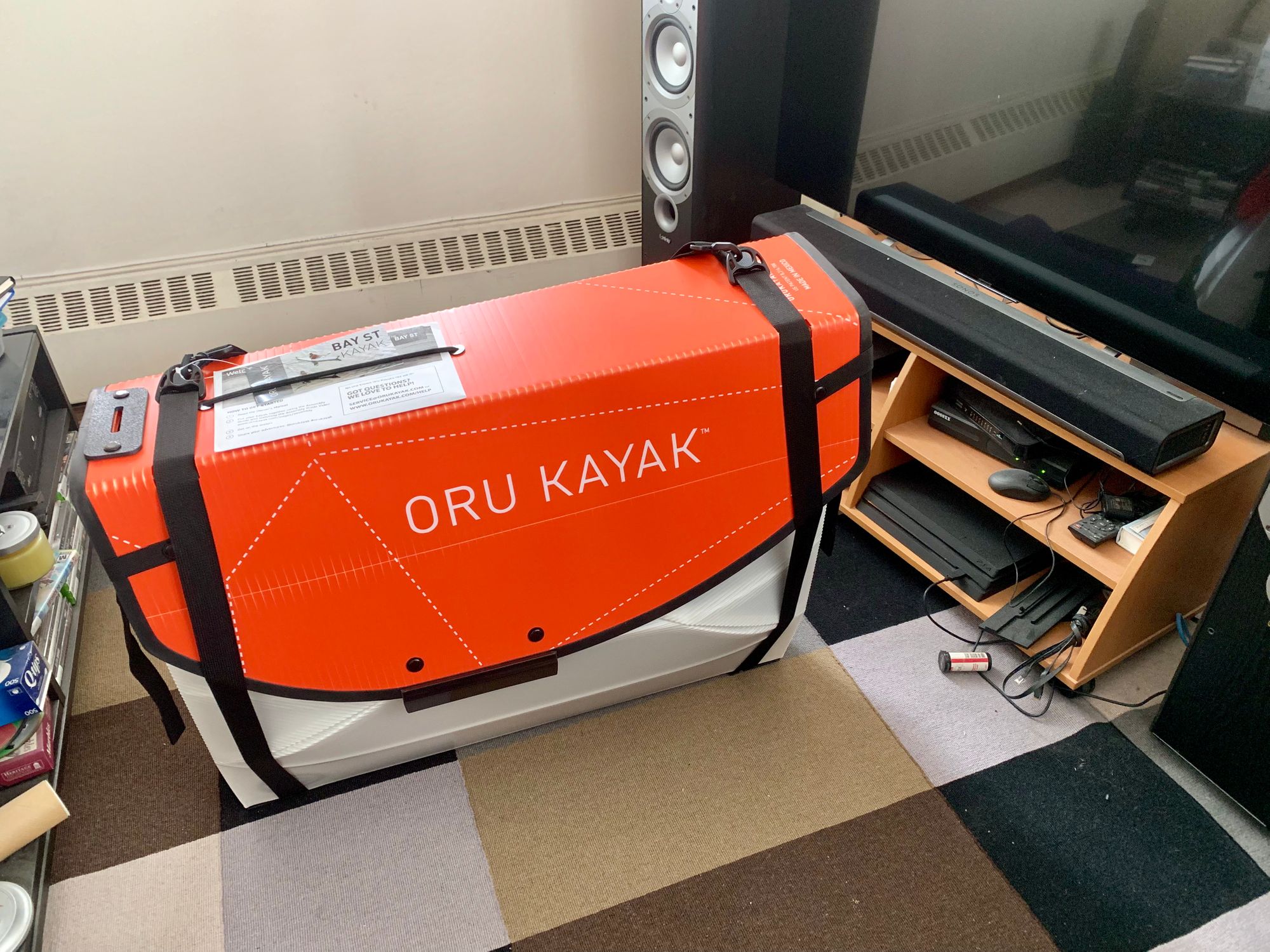
The driver finally showed up at 2:30 in the afternoon, almost three hours after the promised delivery, with the Kayak:
The Oru Bay ST Kayak -- First Impressions

A month after I first tried to order it, I finally had the kayak, the paddles and the backpack. This really should not have been that hard.

First Assembly

Oru has a really nice video on their website showing how to put together and take apart / fold up the Bay ST:

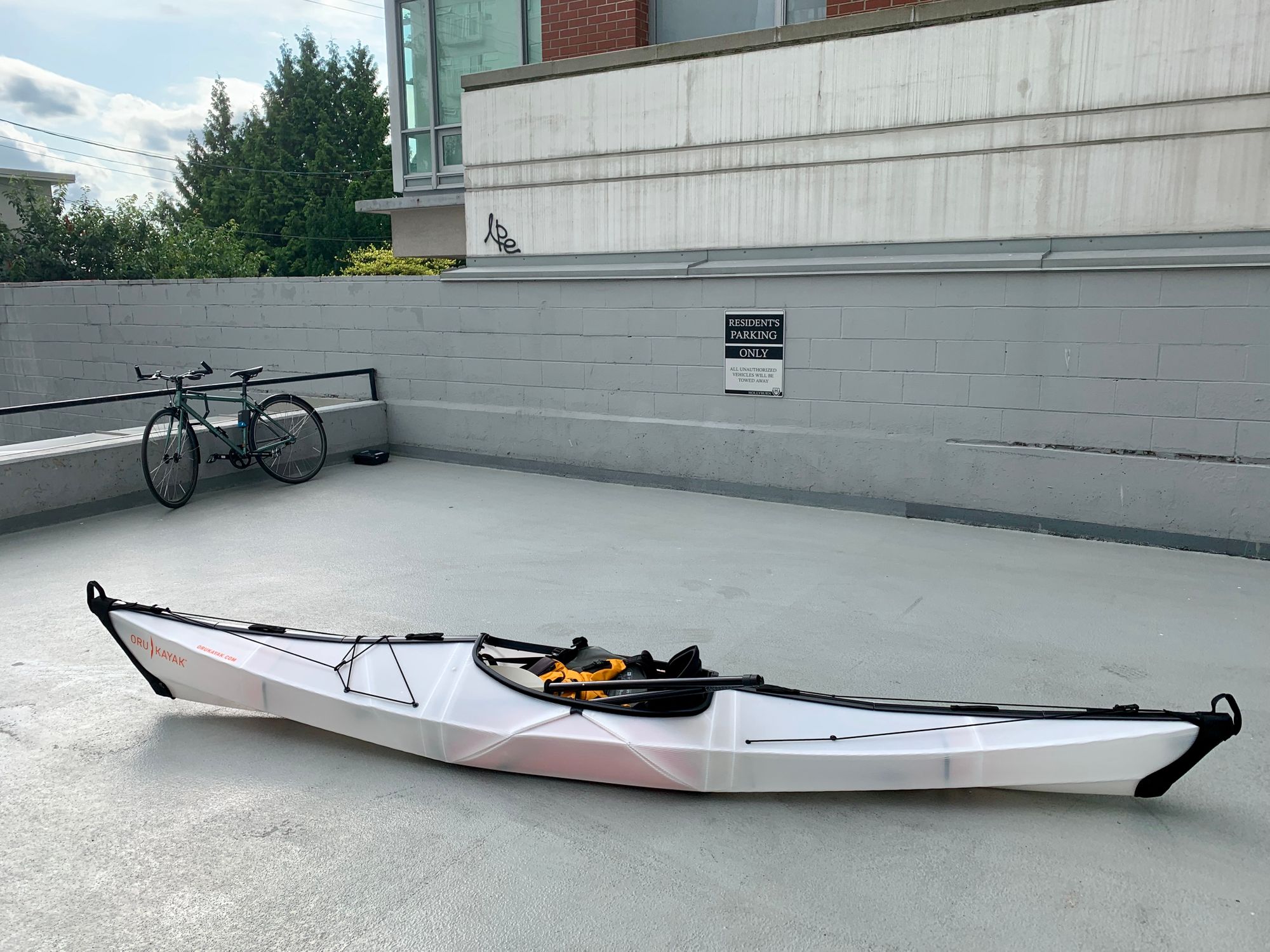
Let’s just say I wasn’t quite that quick the first time around. It took me around 15 minutes to put it together the first time. The main problem simply was understanding the sequence correctly and there was a bit of stiffness within the folds, but it wasn’t overly frustrating, just a bit of a head scratching.

The claim is you can do it in about five minutes, I can see that being the case with a little bit of practice.
The Oru Bay ST Kayak -- First Impressions

Taking it out for the first time

Admission: I have never taken a Kayak out onto the ocean / salt water. Only on calm little lakes. So there was a bit of nervousness with how this would go.

I quickly realized a few things about the Oru:

  1. It’s a very nimble Kayak
  2. I really should have adjusted the foot rest before I first tried it.
  3. One should really anchor down the backrest.

Having said all that, the Bay ST feels remarkably effortless. It took me a few ins and outs to get the foot rest (mostly) correctly adjusted but once that was the case the kayak felt responsive and I can see making good speed with it.

The Oru Bay ST Kayak -- First Impressions

I did not go far on the first outing, mostly because it was an attempt to try and get a feel for it. But as far as first impressions go: Can’t wait to get back out.

Folding it up again

Ah, the other challenge. As with the putting together part it should take around five minutes to put it all away. Again, it took me closer to 15 minutes, mostly because I am a bit of an idiot and, again, because the fold was a bit stiffer than I expected (which meant I didn’t force as I should have, hey, I have broken things I was assured I would not be able to break).

Eventually though it was all packed up and ready to go. Like with the setting it up part, I can see this going faster in the future.

I have not yet tried the backpack, but it’s just really a large bag you drop the kayak in. I bought it because I can see this being nicer for storage and there are a few smaller lakes I am aware of that hiking into is a possibility.

The Oru Bay ST Kayak -- First Impressions

Adventure Awaits

I will post an update in a few weeks after I had a chance to try it out more and get a better feel for it, but first impressions, with the exception of actually getting one, are very positive.

05 Jul 18:02

Google’s Project Zero unveils fixed iMessage vulnerability

by Jonathan Lamont
iMessage on iOS

Google’s Project Zero, a team of security analysts employed by the search giant, has unveiled a flaw with Apple’s iMessage platform that caused crashes on both macOS and iOS.

Project Zero often uncovers security vulnerabilities from other companies and gives them 90 days to fix them before revealing the vulnerability to the public, which is standard for security issues.

In the case of the iMessage vulnerability, Project Zero first discovered and revealed the flaw to Apple in April.

The vulnerability involved sending a “malformed message” containing a text key which caused an exception. In macOS, that exception would cause ‘soagent’ to crash and restart.

On iOS, the flaw was more severe, as the exception would affect Springboard, which powers the device’s home screen. The message would cause Springboard to crash and constantly restart, making the iPhone unusable.

To make matters worse, the behaviour would persist through a full reboot, essentially bricking the device. According to the Project Zero issue tracker page for the flaw, the only way to fix an iPhone that received one of these messages would be to wipe it, put it in recovery mode and update it through iTunes or remove the SIM card and move out of Wi-Fi range, then wipe phone from the Settings menu.

Thankfully, Apple fixed this flaw in May with the release of iOS 12.3, so as long as your iPhone is up to date, you shouldn’t have to worry about the issue.

This isn’t the first time Project Zero has found a flaw in an Apple OS. Back in March, Google disclosed a severe vulnerability in the macOS kernel before Apple released a patch.

Source: Project Zero issue tracker Via: 9to5Google, ZDNet

The post Google’s Project Zero unveils fixed iMessage vulnerability appeared first on MobileSyrup.

04 Jul 22:39

The surprisingly complex math behind startup equity and taxes

by Kristina Chodorow

Taxes for employees at startups are weird and can vastly change the amount you make.  To illustrate why, let’s take a simple example.

Suppose we have a group of early employees at a startup, we’ll call them the Unicorn Inc. Mafia.  They’re all fresh out of college and managed to get through it without any debt, so they each have a net worth of $0. They all join the same day and are given the same equity package: $10k in stock options with a strike prices of $1 (so, 10,000 common stock). We’ll take four members of the mafia, each with a different strategy.

Name Description Net worth
Alice Exercise very early, before price changes $0
Bob Exercise somewhat early $0
Carol Wait until liquid to exercise, wait until long-term capital gains apply $0
David Wait until liquid to exercise, sell immediately $0

From here on out, keep in mind that this could be the end of the story. The company could always fold, leaving everyone with zero or, if they’ve exercised, a negative net worth.

However, suppose the company is doing well and lets the employees know that they’re going out to raise a $40M round.  Alice exercises her options before the round happens.  This means that she has to pay for them, so she’s in the hole $10k.  Now if anything goes wrong, she’s out $10,000.

Once the company raises the round, the stock is worth $5/share.  Unfortunately, Bob’s significant other got a job across the country, so he has to find a new job. He feels like the company is going places, though, so he wants to collect his equity before he goes. He exercises his options. Because he is buying his stock for $1 and it is now worth $5, the IRS says that he just “made” $4. So he has to pay normal income taxes on that $40,000. To keep things simple, let’s say everyone’s tax rate is 25%. So now he’s paid $10k for the stock and $10k for taxes:

Name Description Exercise Income taxes Net worth
Alice Exercise very early, before price changes ($10,000) 0 ($10,000)
Bob Exercise somewhat early ($10,000) 25%*$40,000 -> ($10,000) ($20,000)
Carol Wait until liquid to exercise, wait until long-term capital gains apply $0 $0 $0
David Wait until liquid to exercise, sell immediately $0 $0 $0

So Bob’s out $20k if the company goes under (ouch!).

However, luckily for Alice & Bob, over the next several years, the company continues to grow and raise money. Finally, the company goes public for $100/share. Wow! Once the lockup period expires, everyone eventually sells (somehow it’s still exactly at the IPO price) and makes $1M. Our final shakeout looks like:

Name Description Exercise Income taxes Short-term capital gains Long-term capital gains Sell price Net worth
Alice Exercise very early, before price changes ($10,000) 0 0 0 $1,000,000 $990,000
Bob Exercise somewhat early ($10,000) 25%*$40,000 -> ($10,000) 0 20%*$990,000 -> ($198,000) $1,000,000 $782,000
Carol Wait until liquid to exercise, wait until long-term capital gains apply ($10,000) 25%*$990,000 -> ($247,500) 0 20%*$990,000 -> ($198,000) $1,000,000 $544,500
David Wait until liquid to exercise, sell immediately ($10,000) 25%*$990,000 -> ($247,500) 25%*$990,000 -> ($247,500) 0 $1,000,000 $495,000

There are, uh, a couple of different outcomes. Alice obviously has an accountant in the family: she avoided paying any taxes at all! How is this possible? First, she exercised his options before the price changed, so she didn’t have to pay any taxes on exercise. Then she held them long enough to qualify for long-term capital gains. However, she didn’t even have to pay those! It turns out that, if you own stock in a startup before it has $50M in assets, long-term capital gains up to $10M are tax-free (Google “QSBS” for details). However, Alice is also taking on more risk for longer than anyone else: most startups don’t have outcomes like this and she’d have just been out $10,000 if they had gone out of business.

Obviously there are a ton of simplifying assumptions (stock prices never change! Everyone has the same tax rate, which happens to be one that make numbers easy!). However, I wish someone had told me about all this ~10 years ago, so putting this out there in the hopes that it’ll help someone else.

04 Jul 22:38

Flexwork Pays

by Stowe Boyd

An incentive as powerful as higher pay?

Continue reading on Medium »

04 Jul 21:21

The Oru Bay ST Kayak -- First Impressions

by Michael Kalus
mkalus shared this story from Michael Kalus.ca.

The First Adventure — Actually buying one

The Oru Bay ST Kayak -- First Impressions

You would think in this day and age buying something is easy. I mean, we liver in a consumerist society where I can get pretty much anything at a moments, or at least a few hours, notice.

And yet, my attempt in actually buying the Bay ST lasted almost a month.

I checked Oru’s website and they listed a local retailer not far from me. Great I thought, let’s support the local business. I went there, talked with the sales person who was very nice and who told me they have to order it in, but they’ll be doing that first thing next week (it was Thursday) and would take about a week to come on. Nice. Didn’t ask for a downpayment etc. So heck, why no.

A week came and went, I hadn’t heard back so I followed up. She told me she cannot get a response out of Oru but she’ll keep trying.

She called me a few days later telling me she was still trying to get someone there to either return her call or email.

At the end of week three I went by once more and we agreed that I should try ordering directly from them as she was not able to get anything out of them. So online I went, put in my order and…..

Nothing happened. For an entire week all I had was “thanks, we got your order and we’re processing it”. So a week later I opened a ticket, asking them how long it usually takes them to ship. Two to four days was the answer but clearly we’re now at day seven and nothing had happened. The support person confirmed to me though that it would ship today and I should get an email with the tracking number.

Well, no. No email, no updates on their website either. So I followed up once more and did not get a reply.

The following Tuesday, now a week and a half since I placed the order, I suddenly did get an email from UPS that a package was coming my way, two actually and they would be here the next day.

So on that end, Oru seems to have realized they fucked that one up and then paid for overnight shipping.

But, dear reader, the adventure wasn’t over there yet. Next came my local UPS driver who claimed he’d attempted delivery, which he didn’t. No note, no door ring and he only did it on the larger of the two packages (the Kayak itself). Apparently he was heading to one of the UPS Access Points. It’s up the street from me, so I could have lived with that. But I know from past experiences they do not take large boxes and I really did not fancy waiting another two days before I could drive out to Richmond to pick it up. So I called UPS and, to their credit. They got it resolved.

The driver finally showed up at 2:30 in the afternoon, almost three hours after the promised delivery, with the Kayak:

The Oru Bay ST Kayak -- First Impressions

A month after I first tried to order it, I finally had the kayak, the paddles and the backpack. This really should not have been that hard.

First Assembly

Oru has a really nice video on their website showing how to put together and take apart / fold up the Bay ST:

Let’s just say I wasn’t quite that quick the first time around. It took me around 15 minutes to put it together the first time. The main problem simply was understanding the sequence correctly and there was a bit of stiffness within the folds, but it wasn’t overly frustrating, just a bit of a head scratching.

The claim is you can do it in about five minutes, I can see that being the case with a little bit of practice.

The Oru Bay ST Kayak -- First Impressions

Taking it out for the first time

Admission: I have never taken a Kayak out onto the ocean / salt water. Only on calm little lakes. So there was a bit of nervousness with how this would go.

I quickly realized a few things about the Oru:

  1. It’s a very nimble Kayak
  2. I really should have adjusted the foot rest before I first tried it.
  3. One should really anchor down the backrest.

Having said all that, the Bay ST feels remarkably effortless. It took me a few ins and outs to get the foot rest (mostly) correctly adjusted but once that was the case the kayak felt responsive and I can see making good speed with it.

The Oru Bay ST Kayak -- First Impressions

I did not go far on the first outing, mostly because it was an attempt to try and get a feel for it. But as far as first impressions go: Can’t wait to get back out.

Folding it up again

Ah, the other challenge. As with the putting together part it should take around five minutes to put it all away. Again, it took me closer to 15 minutes, mostly because I am a bit of an idiot and, again, because the fold was a bit stiffer than I expected (which meant I didn’t force as I should have).

Eventually though it was all packed up and ready to go. Like with the setting it up part, I can see this going faster in the future.

I have not yet tried the backpack, but it’s just really a large bag you drop the kayak in. I bought it because I can see this being nicer for storage and there are a few smaller lakes I am aware of that hiking into is a possibility.

The Oru Bay ST Kayak -- First Impressions

Adventure Awaits

I will post an update in a few weeks after I had a chance to try it out more and get a better feel for it, but first impressions, with the exception of actually getting one, are very positive.


04 Jul 20:56

Can I buy a phone that doesn’t use anything from Google or Apple? | Technology

mkalus shared this story from The Guardian.

I have concerns about the likes of Google and Apple slurping up as much info as they can about me from my phone. I’ve tried looking online for alternatives and found mentions of things like /e/, Lineage, Sailfish OS etc, but they assume a level of tech knowledge far above what I have as a layman. So, are there any phones that are 100% free from Google and Apple software and hardware? How easy are such phones to obtain? Steve

Very easy. You can pick up a Nokia 105 (2017 edition) for about £15 or a dual-sim Nokia 106 (2018 edition) for about £16. These are only 2G phones but they have built-in FM radios, they can send texts, they are great for making phone calls and they are not based on Google or Apple technologies. A 3G or 4G phone would cost a bit more …

Of course, you may also want to do smartphone-type things such as email and web browsing. In that case, buy a GPD Pocket 2, GPD MicroPC, One Mix Yoga, One Mix 1S, One Mix 2S or similar just-about-pocketable computer running Microsoft Windows 10 on a 7in screen. (GeekBuying stocks several models and is taking reservations on the One Mix 1S.) Mini-laptops may look expensive but they are cheaper than high-end smartphones.

This answers your question but it is obviously not the solution you are looking for …

The problem is that most people – including me – want to use Googly things on their phones. Gmail is the dominant email service, YouTube is the dominant short video provider, Google Search and Google Maps are very useful and Google Chrome is the most widely used web browser. There may be viable and sometimes preferable alternatives but you have to make an effort to use them. Most people don’t want to make the effort.

Indeed, it looks as though the next generation of candy-bar phones will also include Google. Nokia’s latest 4G feature-phone, the Nokia 8110 “banana phone”, runs the KaiOS operating system, in which Google has invested $22 million. The Alcatel Go Flip 2, JioPhone and Orange Sanza are alternative KaiOS phones available in North America, India and Africa respectively. (Kai is named from the Chinese word for open, not the undead protagonist in the Lexx science fiction series.)

KaiOS includes WhatsApp – its main selling point – plus a web browser, Facebook, YouTube, Google Maps and Google Assistant. It’s claimed to be the second most popular operating system in India and could manage that in Africa. Some KaiOS phones cost less than $20.

KaiOS started as a fork of B2G (Boot to Gecko), which was an open source continuation of Firefox OS, which Mozilla stopped developing at the end of 2015. Gonk, the operating system underneath Gecko (which is Firefox’s web-rendering engine) is a small Linux kernel derived from Google’s AOSP, the Android Open Source Project.

In other words, the OS most likely to become a global alternative to Apple’s iOS and Google Android isn’t – and isn’t likely to be – 100% free from Google software. Even if it is not KaiOS, any future OS might use parts of AOSP because it is easier than developing everything from scratch. It could also pre-package access to some Google properties, even if they are just web apps, because most people want to use them.

A string of failures …

The fact that we have, essentially, a duopoly in the smartphone business is not for want of trying. Microsoft entered the market with a version of Windows running on ARM-based smartphones and it even made Windows available free on small-screen devices. The people who owned Windows phones seemed to love them and in 24 countries it overtook Apple’s iPhone in market share. However, the lack of apps was a major stumbling block and Microsoft abandoned its challenge, having lost billions of dollars in the attempt.

You can still buy Windows phones but most date from 2015-16 and will soon be out of support. I didn’t recommend buying them when they came out so I really wouldn’t recommend one now.

Canonical also had a go at the smartphone market with its Linux-based Ubuntu Touch. It failed. In this case, the development was taken over by the UBports Community, which developed a port for the OnePlus One smartphone in 2015. There are now a few others but I don’t expect Ubuntu Touch phones to appear in your local high street.

South Korea’s two smartphone manufacturers, Samsung and LG, would also love to have an independent operating system but success is unlikely. Samsung tried with Tizen, which was supported by the Linux Foundation. The Samsung Z series was launched in India and didn’t do well enough but Tizen is used in Samsung Gear smartwatches. LG could have a go with Palm’s Linux-based webOS, which it acquired from HP in 2013. WebOS first appeared on Palm Pre smartphones in 2009 but LG has mainly used it in smart TV sets.

Sailfish started with another failed Linux project, Nokia and Intel’s MeeGo. The latest version uses a graphical shell from Jolla, the Finnish company that appears to be its major backer. Sailfish can be ported to more alternative smartphones than Ubuntu Touch but I can’t see any current phones with Sailfish pre-installed. The same is true for both /e/ (formerly Eelo), which is a sort of de-Googled Android, and LineageOS, which is a reborn CyanogenMod.

You main hope is Purism’s forthcoming Librem 5, which seems to be exactly what you want. Whether it can buck the trend remains to be seen.

In general, the problem with Linux on smartphones looks much like its problem on PCs. Many and various groups enjoy developing new versions of the operating system, which are all more or less doomed from birth. None of them have the skills, the interests or the money to create viable platforms that include the hardware, apps, services, packaging, marketing, advertising, distribution and support on the sort of scale needed to sustain a real product. Without those, they are unlikely to attract much interest beyond hobbyists and enthusiasts.

Future success?

Things may change thanks mainly to the current American president. Trump sent China and the rest of the world a wakeup call by trying to exclude Huawei – the world’s second-largest smartphone manufacturer and the leader in 5G – from using American technology. Huawei was already developing its own Android app-compatible operating system, currently known as Hongmen OS, as an alternative. The potential loss of up to $30bn in sales per year suggests there will be no shortage of money or manpower for its future development.

Indeed, China has a powerful incentive to replace all the American technology it uses with home-grown alternatives. This may take decades but in the long run, it will hurt Google, Intel, Qualcomm and numerous other US companies. The genie is out of the bottle and the Americans will never be able to put it back.

Hongmen, aka Ark OS, may not have a lot of appeal in Europe but it could do well in Asian countries that already do more trade with China than with the US.

Meanwhile, the EU’s latest antitrust case against Google should allow phone manufacturers to offer alternative browsers and search engines. It should also enable Android smartphone suppliers to sell phones with alternative versions of Android in Europe, which Google did not allow them to do before. A major player such as Samsung or Huawei could therefore test the market with a Google-free Android phone. In which case, you can vote with your wallet.

Remember the apps!

Whatever happens with Apple and Google, people buy smartphones to run apps and most apps appear to be compromising your privacy. In 2017 a study from the University of California at Berkeley found that around 70% of apps shared your data with third-party services (PDF).

A recent Washington Post story based on Disconnect.me technology found trackers were rife in the journalist’s iPhone apps. Google, of course, banned Disconnect Mobile from its Play store way back in 2014. In a blogpost, the company wrote: “Google refuses to explain their decision, other than to say that our app won’t be allowed if it interferes with any ads; even ads that contain malware and steal your identity.”

The app economy, like the web economy, is ultimately based on surveillance. That isn’t likely to change unless the EU does something about it. And so far, despite the GDPR and three antitrust cases against Google, the EU has left smartphone tracking revenues unharmed.

Have you got a question? Email it to Ask.Jack@theguardian.com

This article contains affiliate links, which means we may earn a small commission if a reader clicks through and makes a purchase. All our journalism is independent and is in no way influenced by any advertiser or commercial initiative. By clicking on an affiliate link, you accept that third-party cookies will be set. More information.

04 Jul 20:55

One Last Electric Ride

by peter@rukavina.net (Peter Rukavina)

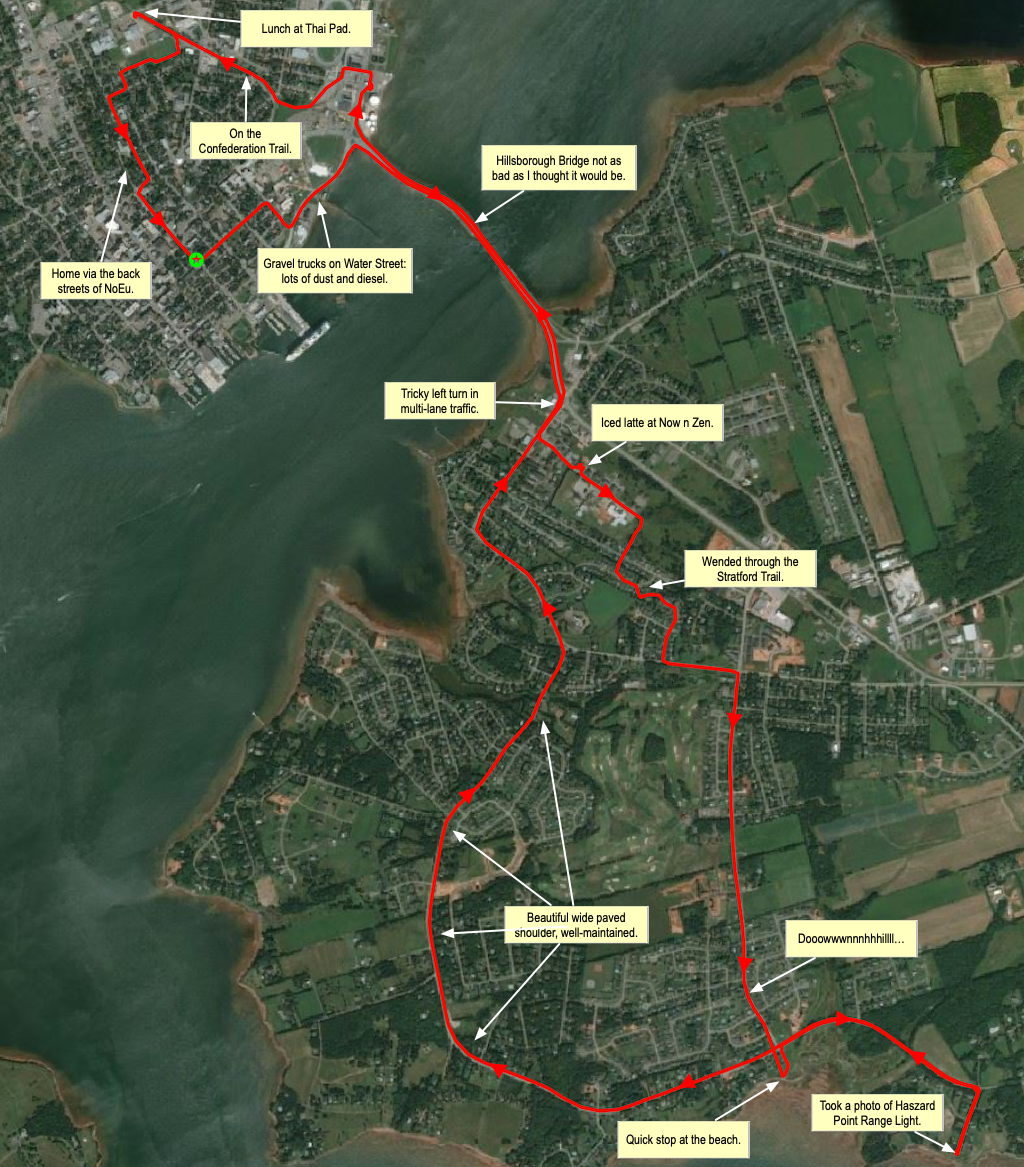
I squeezed every last drop out of my electric bicycle rental this morning before returning it, heading over the bridge to Stratford, down to the shore, back to town, out for lunch, and then home. 21 km from door to door. A beautiful, sunny day for a bicycle ride.

An annotated satellite map of my bike ride to Stratford, showing my route in red and highlighting significant features.

04 Jul 20:54

Tesla has a new autonomous emergency braking method

by Jinqiao Wu

On July 4th, Tesla showed its improved automatic emergency braking (AEB) safety feature.

Through two short clips, Tesla claims the vehicle would stop when it detects a pedestrian or a cyclist crossing into its path.

The American EV giant officially introduced AEB in 2017 for cars equipped with Autopilot 2.0 or the later Autopilot 2.5 hardware suite. Back then, the braking feature capped its functional speed range at a maximum of 144.8 KM, according to Electrek.

Even though there is no word on the release schedule, Tesla will likely to drop the new AEB feature in an update package once it completes the necessary validation process.

That said, Tesla is not the only one offering a pro-active collision avoidance system. Many traditional car manufacturers are catching up.

Based on a 2019 report from the nonprofit organization Insurance Institute for Highway Safety, 20 automakers pledged to make the AEB standard equipment in their product portfolios in a few years. In 2018, around 30 percent of vehicles from those manufacturers came with AEB as standard. Now, IIHS is looking at 50 percent.

Based on the sales figures of both years, Toyota stands out with an averaged 90 percent AEB adoption rate. Nissan has 78 percent, while Honda is at 61 percent. In contrast, Ford, Mitsubishi and Porsche are sitting at around 10%.

IIHS believes the growing adoption of AEB in the car industry could prevent 28,000 crashes and 12,000 injuries by 2025.

Source: Tesla, Electrek

The post Tesla has a new autonomous emergency braking method appeared first on MobileSyrup.

04 Jul 20:49

“Though 72 hours is the longest a minor can be legally confined in such a facility, some had been there almost a month”

by Andrea

The Atlantic: What a Pediatrician Saw Inside a Border Patrol Warehouse. “Dolly Lucio Sevier evaluated dozens of sick children at a facility in South Texas. She found evidence of infection, malnutrition, and psychological trauma.”

“But when Sevier asked the 38 children she examined that day about sanitation, they all said they weren’t allowed to wash their hands or brush their teeth. This was “tantamount to intentionally causing the spread of disease,” she later wrote in a medical declaration about the visit, the document that the lawyers filed in federal court and also shared with me. (Asked for comment on this story, a Customs and Border Protection official wrote in an email that the agency aims to “provide the best care possible to those in our custody, especially children.” The agency’s “short-term holding facilities were not designed to hold vulnerable populations,” the official added, “and we urgently need additional humanitarian funding to manage this crisis.”)

As agents brought in the children she requested, Sevier said, the smell of sweat and soiled clothing filled the room. They had not been allowed to bathe or change since crossing the Rio Grande and turning themselves over to officials. Sevier found that about two-thirds of the kids she examined had symptoms of respiratory infection. The guards wore surgical masks, but the detainees breathed the air unfiltered. As the children filed in, Sevier said she found evidence of sleep deprivation, dehydration, and malnutrition too.”

Link via MetaFilter.

04 Jul 18:03

No Algorithms Follow-Up

(This is a follow-up post to No Algorithms.)

Joshua Emmons made the point I was trying to make, but more explicitly:

Tweet 1:

Brent is making a subtle point here:
1. Algorithms weigh signal.
2. In the domain of engagement, outrage and anger mask all other signals.
3. These signals are fatiguing. As Outrage: 5 is normalized, Outrage: 10 is now required to move the needle.

Tweet 2:

1. and 2. mean it’s not the algorithm’s fault. There’s no way to write an engagement algorithm that doesn’t select for outrage and anger. But 3. means anything that incorporates such an algorithm actually makes us worse people.

This is key: it’s not the motivation — selling ads — that turns algorithms bad. (But, yes, selling ads makes a company pretty keen on these types of algorithms.)

This may not be true of music, movies, and other things, but when it comes to news, outrage and anger swamp everything else.

It’s also not an issue of UI. If there’s any way, implicit or explicit or both, of signaling engagement, it will tend toward rewarding outrage and anger. And this gets even worse, not better, if you add data from what your friends and peers like.

Trust

Maybe, though, I could do better. I kind of think not, because I think the problem is a bug in human nature. But let’s say I believed I could do better.

Should I?

For one thing: how much better does it have to be? I think an algorithm that radicalizes far fewer people than it might otherwise is not a good call. Better is still harmful.

So here’s the thing I keep coming back to: I think of NetNewsWire as almost a kind of ideal public utility. As such, it should be completely trustworthy — you should never wonder if it’s leading you down some path or other you didn’t intend or foresee.

There are plenty of other apps in the world — every app is part of an ecosystem — and this one doesn’t have to solve what I think may be an unsolvable problem. I’ll leave that to other people.

Instead, it should be one place for news that you can absolutely trust. Articles come in, and NetNewsWire sorts by time, and that’s it. That’s solid.

04 Jul 18:00

Getting Home From Stars for Life

by peter@rukavina.net (Peter Rukavina)

When he finished high school in mid-June, Oliver transitioned to the day program at Stars for Life, an organization I believe in deeply, and from which he will derive great benefit.

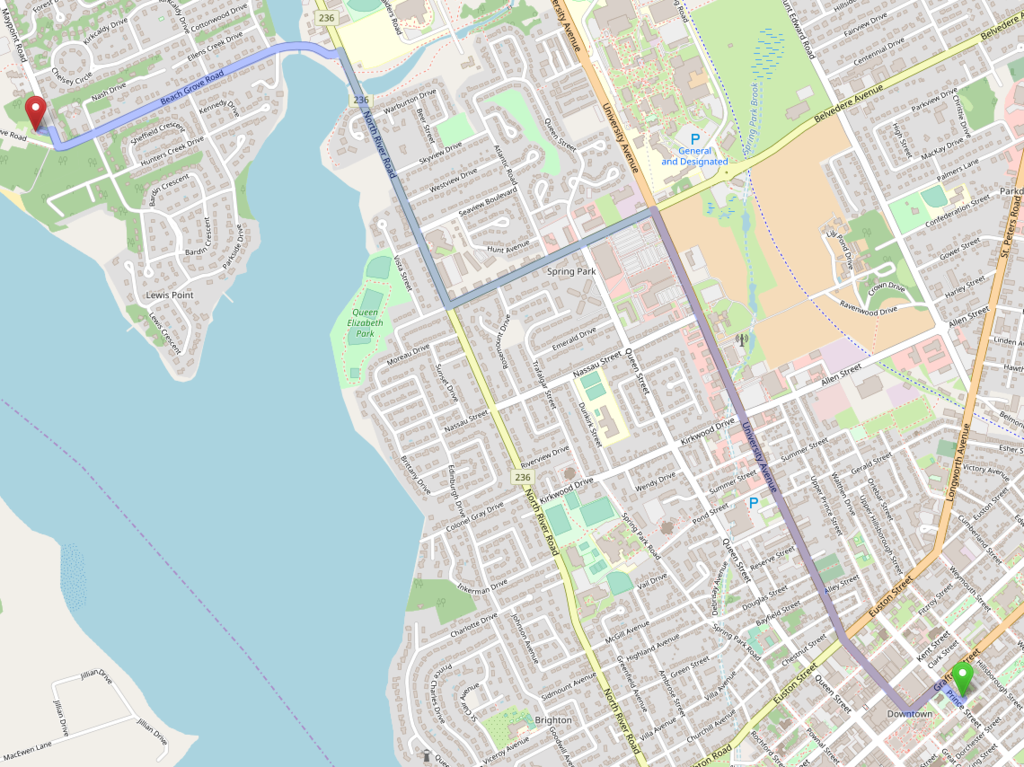
The primary logistical challenge of this is that Stars for Life is located 5.5 km from our house, and I need to get Oliver there every morning and pick him up every afternoon.

Map showing route from our hour to Stars for Life.

Given that we own a car, and that I can drive, our fallback position is that I’ll simply drive him to and from.

But as we only have 12 years to become carbon neutral, it’s time to start the planning for alternatives to that, and so I’ve started out by focusing on alternative methods for the trip home.

Baseline

Heretofore I’ve driven both ways. Traffic there is usually pretty light; traffic back is slowed when encountering the mass of public servants leaving the office at 4:00 p.m., which creates some jams, but only in the Charlottetown sense of the word.

Generally I’d leave home at 3:45 p.m., arriving at Stars for life at 4:00 p.m. and arriving back home about 4:25 p.m.

  • Total Time: 40 minutes
  • Driving Distance: 11 km

Experiment One: Bus, Walk, Bus

Yesterday was the first experiment: Oliver was coming home early, and I needed to pick him up at 1:00 p.m.

I caught the 12:45 p.m. Route № 3 bus from Confederation Centre and arrived at Stars for Life exactly at 1:00 p.m.

Oliver and Ethan the Dog and I then walked down Beach Grove Road to North River Road, across North River Road to pick up the Hermitage Creek Trail, and walked along the trail to the back yard of the PEI Union of Public Sector Employees where we emerged onto University Avenue. We walked down University Avenue to the UPEI bus stop where we caught the 1:54 p.m. Route № 1 bus downtown, arriving at 2:00 p.m.

Statistics

  • Bus Fares: $6.00
  • Bus Distance: 8.6 km
  • Walking Distance: 2.8 km
  • Total Time: 75 minutes

Pros

  • Convenient bus connection, almost door-to-door on the way there, only a short wait on the way back.
  • Mostly pleasant walk along the Hermitage Creek Trail.

Cons

  • The Hermitage Creek trail has some muddy/soggy spots, and could use some maintenance.
  • Connection between the Hermitage Creek Trail and University Avenue is more “cut through a field” than an official trail.
  • Adds 35 minutes, compared to driving, to the pick up run.

Experiment Two: Bike, Bus

One of the things I was curious about is whether having an electric pedal-assist bicycle would make it more possible for me to build cycling into the trip somehow.

Oliver doesn’t have a bicycle yet, so I can only cycle to Stars for Life for the pickup, and need a way of getting the bike back home.

For today’s experiment I rented an Evox City520 electric bike from MacQueen’s for 24 hours. It wasn’t cheap, at $86 taxes-in, but it was cheaper than buying an ebike, and I plan to amortize the rental by taking it for a longer spin tonight.

I left home on foot at 3:00 p.m. heading toward Outer Limit Sports where I’d originally intended to rent the bike; along the way I phoned them to confirm they had something in stock and learned that a 24 hour rental is considered two days in their calculations, and so I’d end up spending $150 for the experiment.

So I rerouted to MacQueen’s, which has a more sensible policy, arriving at 3:20 p.m. I was in and out of MacQueen’s in 10 minutes and it took me 13 minutes to ride the 2.8 km to Stars for Life (maxing out at 30 km/h coasting down the North River Road hill down to Ellen’s Creek).

It was here that things went slightly off the rails, as the buses stopping at Stars for Life–Route № 2 going clockwise and Route № 3 going counter-clockwise–only run once an hour, and when I arrived at 3:45 p.m. the next Route № 3 bus downtown wasn’t for 45 minutes.

So we caught the 3:58 p.m. Route № 2 bus.

Getting on the bus involved a complicated ballet of son, dog, bike, and me. I tied Ethan to a stop sign while I mounted the bike on the cowcatcher and then retrieved him and Oliver and I got on, paid our fare, and sat down. It wasn’t elegant, but it worked, aided by a very patient bus driver.

We had a chance to quicken the journey when we got to the Charlottetown Mall at 4:15 p.m.–we could have transferred to Route № 1– but I wasn’t eager to repeat the ballet, so we stayed on Route № 2 for a complete clockwise-tour of Charlottetown, seeing parts of the city I didn’t know existed.

We arrived at the Grafton-Polyclinic stop at 4:45 p.m. where I repeated the ballet in reverse and we walked the block to home.

Statistics

  • Bus Fares: $4.00
  • Bus Distance: 13.6 km
  • Bicycle Rental: $86.00
  • Cycling Distance: 2.8 km
  • Total Time: 105 minutes

Pros

  • The electric bicycle was fun to ride, and made short work of the hills: it felt like nothing at all to climb the 5% grade up Beach Grove Road from Ellen’s Creek.
  • Despite the complexity of our party, we pulled off the ballet of mounting the bus without problems.

Cons

  • The electric bicycle rental was expensive (although the purchase cost would be amortized across many trips in a more permanent scheme).
  • The bike was heavy–54 pounds–and unwieldy, and so it was a lot harder to get on and off the cowcatcher than my regular bicycle.
  • Although the cowcatcher held onto the bike well, despite the pothole-ridden streets and speed bumps, I had a background fear that it would fall off and I’d be out the cost of an expensive bicycle.
  • The long bus journey home (which could be mitigated by a change in schedule that would allow a more direct return home on Route № 3).

What’s Next

There are lots more options to experiment with, including Oliver cycling (we need to figure out a trailer or basket for Ethan to make this work), repeating today’s experiment with my regular non-electric bicycle, or taking the bus there and walking all the way home.

Stay tuned; I’ll update this post as we forge on.

04 Jul 17:58

Why Maine embraces immigration

by Jon Udell

An excellent choice for 4th-of-July podcast listening would be Maine, Africa on Radio Open Source. The intro:

We went to Portland, Maine, this week to meet newcomers from Central Africa, Angolans and Congolese asking for U.S. asylum. Fox News hit the panic button two weeks ago: their line was that Maine is being overrun, inundated by African migrants. On a long day in Portland, however, we found nobody sounding scared.

I’ve noticed the strong African influence in Portland when visiting, and wondered: “Why is that?” The answer is that Maine’s population is stable but aging. Immigrants are needed, and the state welcomes them.

A couple of moments in this podcast stopped me in my tracks.

With mayor Ethan Strimling:

“You know what, we don’t consider you somebody else’s problem, we consider you our opportunity.”

And with a woman interviewed on the street:

Chris Lydon: “How did Portland get to be so welcoming?”

Interviewee: “We’re Americans.”

Not everyone’s on board. There’s an anti-immigrant minority, but it is a minority. Most of the people in Portland, it seems, look backward to their own immigrant roots and forward to a future that embraces an influx of world cultures.

On this Independence Day I choose to believe that a national majority feels the same way, and will prevail.

04 Jul 17:58

My 31 km Electric Bicycle Ride

by peter@rukavina.net (Peter Rukavina)

I put the rented Evox City520 electric bicycle through its paces tonight, riding out of Charlottetown on the Confederation Trail to Charlottetown Airport, and then out the Brackley Path that runs parallel to the Brackley Point Road, rejoining the trail and riding east as far as York.

Cows in York, from the Confederation Trail

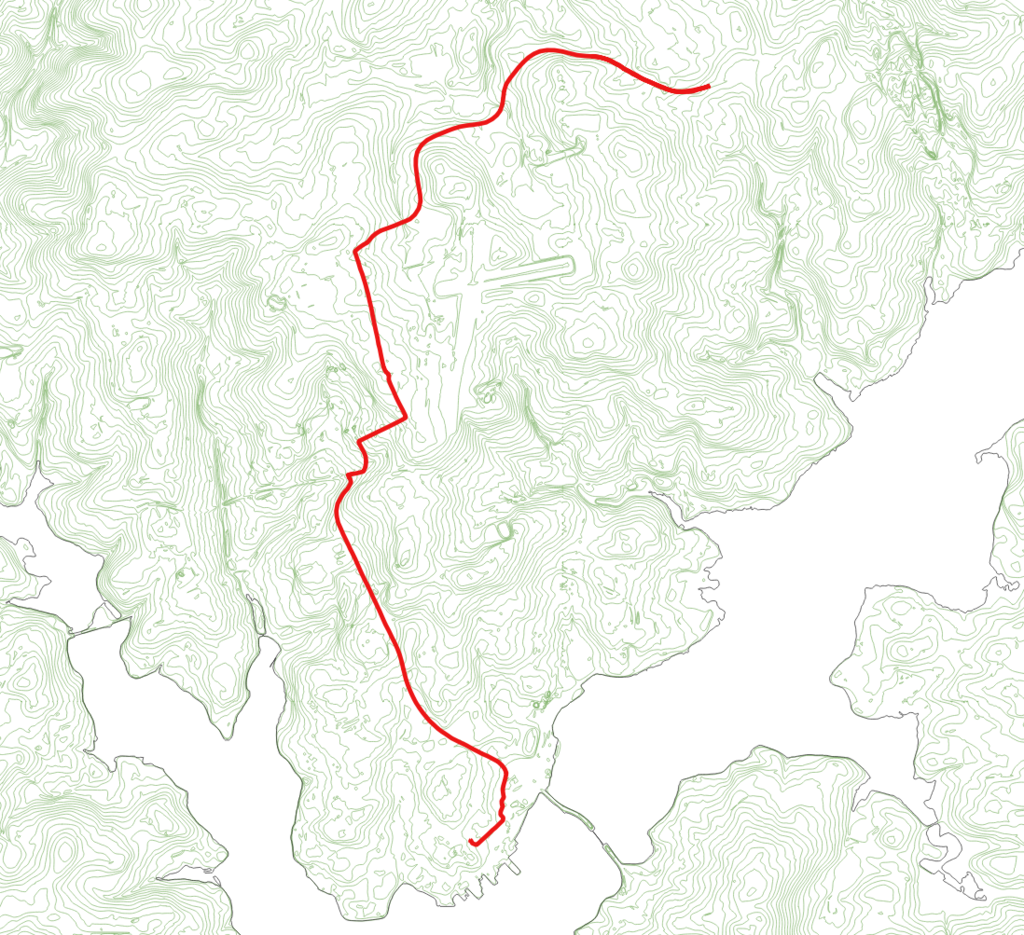
The trip was 15.8 km in each direction, 31.6 km there and back. Here’s a picture of my ride, recorded as a GPX file by OsmAnd and displayed over PEI 2 meter contours.

LIDAR map showing my bike route

This is farther than I’ve ever ridden a bicycle before, and the distance was only possible (at least given my current fitness level and strength of character) because of the electric pedal assist, which I used continuously.

The Evox has 6 levels of pedal assist and an 8 speed gear system; heading downhill, with full pedal assist and in the highest gear, I was doing almost 30 km/h. My average speed, over the entire trip, was about 20 km/h.

One of the reasons I suspect I’m not a good candidate for an electric bicycle is that the heady allure of pedal assist level six, with its effortlessness and breezy speeds, is simply too great to allow me to derive a significant enough amount of fitness from the endeavour.

I got nowhere to go, really, and so I think I’d be better off sticking to the grinding effort of my trusty non-electric Palomar, sticking closer to home, and leaving batteries out of it; I think I’d end up a better person.

Which brings up another issue, the feeling of being an asshole that one experiences when you blithely pass the non-electric-riders on the trail, expending half the effort and traveling at twice the speed as they are. I’ve always had a feeling of solidarity with fellow trail riders when I’m riding unassisted, and it’s not uncommon to give a nod of the helmet or a wave of the hand when passing in the other direction; flying by on my electric jet-bike I felt like people in first class must feel when we coach passengers mope by. It wasn’t a warm feeling.

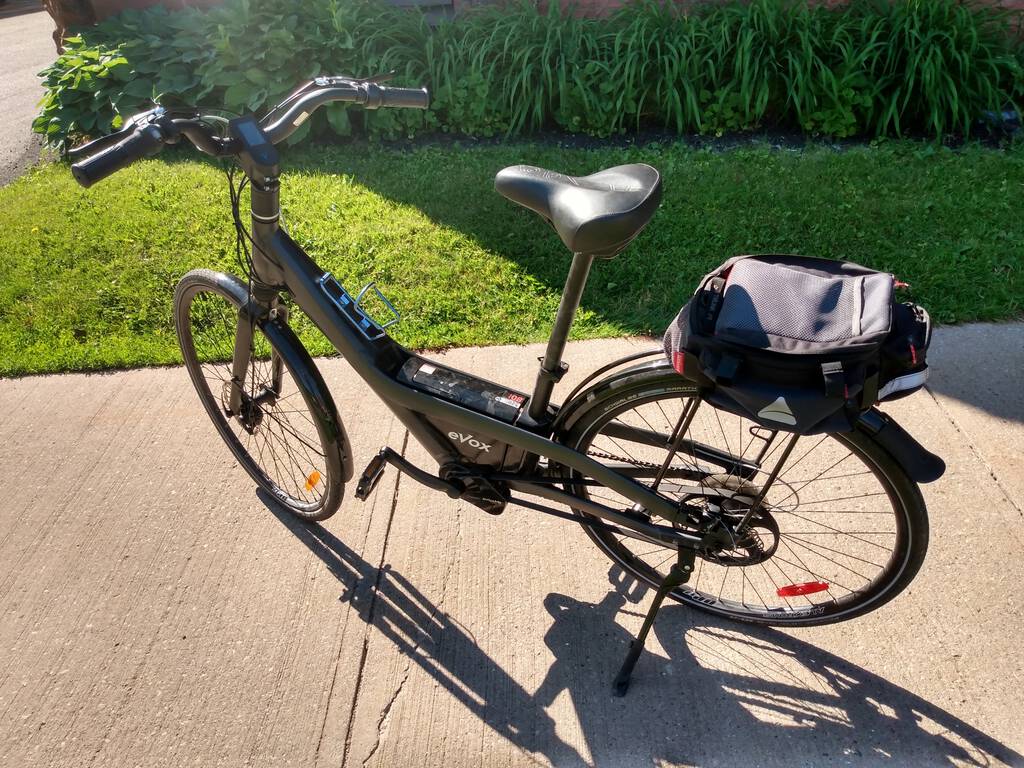
All that said, the Evoc City520 is a nice piece of kit. It’s easy to get on and off, has a low centre of gravity, and is comfortable to ride. As I mentioned earlier, it’s heavy as hell, and was a challenge to wrangle in the front door of the house to charge this evening (I think the battery is removable, but I don’t have the key to unlock it, so I had to bring the whole thing inside for the night).

Evox City 520 Bicycle

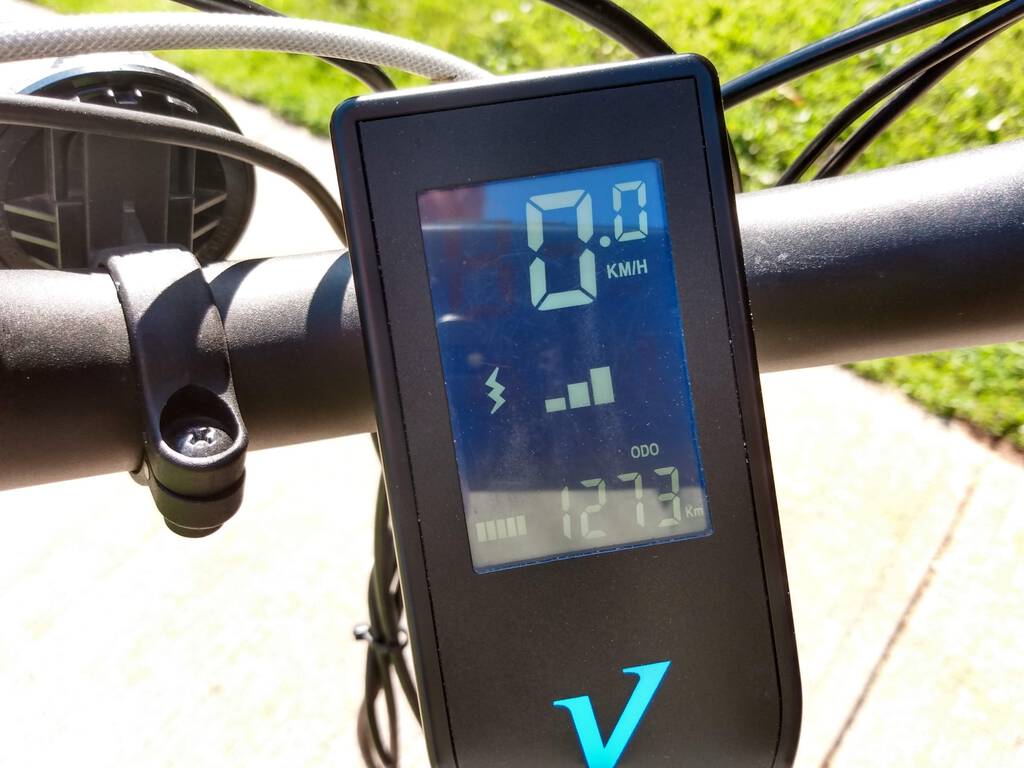
The pedal assist system is control by a simple three button toggle and a centre-mounted display:

Evox Display

The display shows speed, pedal assist level, battery level, and an odometer. I like the fact that it is integrated into the handlebar post (in the centre of the “cockpit,” as bike nerds like to say), rather than zip-tied to the handlebars like a lot of other ebike-controllers are.

Perhaps the best takeaway from this evening’s ride was the reminder of how lucky we are to have the Confederation Trail in our midst: 30 minutes from downtown Charlottetown (15 minutes on an ebike!) and you can be in the middle of the countryside, by yourself, hearing nothing but birds and tractors.

Confederation Trail east of Charlottetown toward York

I’ll do some more tooling around on the Evox tomorrow before returning it to MacQueen’s, but I think I’ve got the ebike bug out of my system for now.

04 Jul 17:55

Rhuby Sour

by peter@rukavina.net (Peter Rukavina)
04 Jul 17:55

Kara and Nate Fly to New York

by peter@rukavina.net (Peter Rukavina)

I found my way to the YouTube channel of Kara and Nate by way of their journey on the Trans-Siberian in 2017.

Despite their increasing popularity, and thus their increasing “today’s episode is brought to you by Audible,” they’ve kept my attention as they continue their relentless life of travel.

Their latest episode, Birthday Party in Cathay Pacific First Class, is perhaps the perfect exploration of the absurdity and delight of permanent life on the road (their happenstance hookup with a trio of jetsetters is totally the kind of thing that happens to Catherine when she travels).

Ignore the promos and enjoy the unadulterated love of constant motion.

(Postscript: after arriving back in Vietnam, Kara and Nate got in a taxi to their hotel, and their taxi was involved in a collision).

04 Jul 17:54

No-One Remembers Popular Activity A Year Later

by Richard Millington

In early 2018, we began working with a client who was keen to build their community by leveraging their VIP relationships.

A major VIP, they felt, would build “buzz” around the community and be the spark the community needed to ‘kick to life’. We were sceptical. We analyzed the discussions in the community and determined members had countless product questions. So instead we roped in the top members and created a detailed product guide filled with the best advice from the best members.

We launched it just before the big VIP event (and it received almost no promotion).

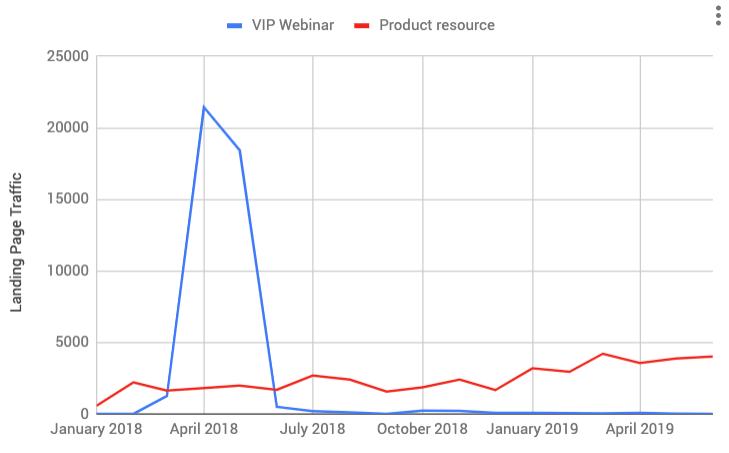
The VIP event was a success by most measures. It generated a huge amount of traffic. But compare the data for the community just 1.6 years later. Which content do you feel is best for the community?

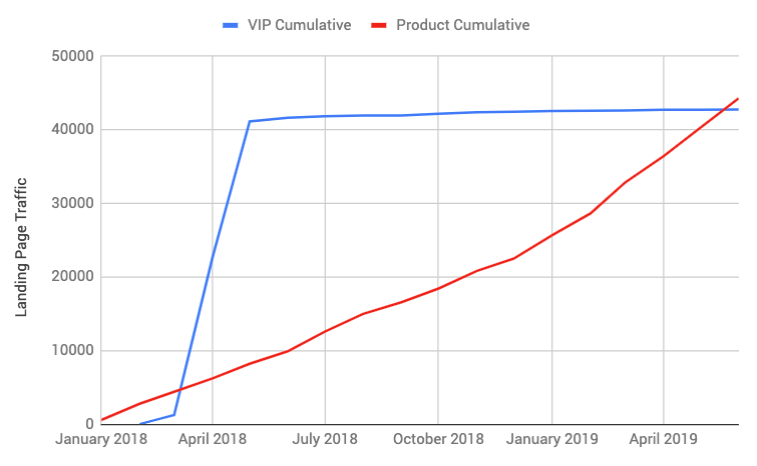
The VIP event certainly hits the spike far in excess of the product resource, but its popularity dies just as fast. The product resource, however, still reliably brings in (and presumably helps members) 1.6 years later. 

(In early 2019 we worked with members to initiate a 2019 update).

Perhaps a clearer understanding comes in looking at the cumulative traffic.

However, there’s no reason to stop at a single resource. You can create 10…or 50 (one every few months) and reliability increase traffic to the community while delivering more value to members.

You rarely want a spike, you want to create activity/content/discussions which reliably increase a clear metric in the community.

Given the choice between creating something that might be immediately popular or something which has long-term utility, go with utility. You might not see the benefits immediately, but the value will steadily build up over time.

04 Jul 17:54

Perfekt für den Alltag: Neues Pendler-E-Bike mit 52-Volt-Batterie

by Carsten Thomas
Juiced Bikes hat sein Flaggschiff, das Pendler-E-Bike mit einer 52-Volt-, 13-Ah-Batterie und einem 750-Watt-Nabenantriebsmotor, verstärkt, um ein schnelles Fahrrad mit einer Reichweite von 80 bis 160 Kilometern für einen Preis von 1.799 US-Dollar anzubieten.Juiced Bikes hat sein Flaggschiff, das Pendler-E-Bike mit einer 52-Volt-, 13-Ah-Batterie und einem 750-Watt-Nabenantriebsmotor, verstärkt, um ein schnelles Fahrrad mit einer Reichweite von 80 bis 160 Kilometern für einen Preis von 1.799 US-Dollar anzubieten. Im [...]
04 Jul 17:53

Fun and inspiring board meeting of Open Nederla...

by Ton Zijlstra

Fun and inspiring board meeting of Open Nederland this morning in Amsterdam.

04 Jul 17:53

A new system called BrainNet lets three people play a Tetris-like game using a brain-to-brain interface

Sarah McQuate-Washington, Futurity, Jul 04, 2019
Icon

You won't be seeing this as an app any time soon, but this development shows where the future of computer interfaces is headed (and in my eyes, also sheds some light on the nature of human consciousness). “Once the Sender makes a decision about whether to rotate the block, they send ‘Yes’ or ‘No’ to the Receiver’s brain by concentrating on the corresponding light... (For the receivers) we essentially ‘trick’ the neurons in the back of the brain to spread around the message that they have received signals from the eyes." Of course, I see a great future for systems like this for communication... with pets.

Web: [Direct Link] [This Post]
04 Jul 17:53

False Creek North (2)

by ChangingCity

We looked at a view across False Creek a few years ago. That view – of the BC Place stadium and Cambie Bridge has already changed quite a bit. This one is more stable, as much of this stretch of Yaletown is built out (although there are some more distant towers that will fill in the background in a year or two). We first photographed this shot eight years ago, and we could have posted it at any time after that, as almost nothing changed over the next six years. Last year the tall tower on the left appeared, which led us to re-shoot.

Based on the buildings that are visible on the left (and the ones that are missing), we think our before image was probably taken around 1978. The new seawall around False Creek South is completed, but the landscaping had not been planted, so there’s no tree visible on the left. The BC Electric Building is prominent centre left, and the tall (28 storey) tower to the left of that is The Century Plaza Hotel, designed by Peter Cole and completed in 1972, and to the left again, The Heritage, an early West End tower completed in 1970 and designed by Eng and Wright. It was built before the strata act, so is a 99 year leasehold building. It’s pretty much the only building visible in 1978 that’s still visible from this point today, so it was the only aid to lining up the images.

To the right is the cluster of Downtown towers; the tallest white tower on the left of the cluster is The Royal Centre, from 1973, and the tall dark tower is the TD Tower on the Pacific Centre, built in 1972. The smaller cousin of the TD Tower, completed in 1974, can be seen on the right, with the Scotiabank Tower (from 1975) to the right again. Furthest to the right, and looking small because it actually on the Burrard Inlet waterfront on the other side of the peninsula, 200 Granville, is a tower designed by Francis Donaldson and completed in 1972 for Project 200 (the 1960s scheme that would have seen the waterfront transformed and Gastown obliterated).

Today almost all the towers that hide Downtown are part of Concord Pacific Place, designed over 30 years by a variety of Vancouver-based architects. The most obvious background tower is the Wall Centre condo and hotel, now re-clad dark as the developer (but not the architect or the City of Vancouver) always intended. The recently completed tall tower on the left is another Wall building, this one designed by Dialog and offered as rentals rather than condos.

0883

04 Jul 17:52

Wenige Autos, viele Freunde

by noreply@blogger.com (Christine Lehmann)
mkalus shared this story from Radfahren in Stuttgart.

Eine Untersuchung in den USA zeigt: In Straßen mit weniger Autoverkehr kennen sich die Nachbarn und haben Anwohner insgesamt mehr soziale Kontakte. In Straßen, durch die sich der Autoverkehr schiebt, leben die Leute einsamer. 

Anschauen kann man sich die Thesen der Untersuchung in diesem Video. Es ist leider auf Englisch. Es beruht auf den Untersuchungen, die Donald Appleyard schon Anfang der 80er Jahre in San Francisco gemacht hat. Das Buch dazu heißt: "Livable Streets", "Lebenswerte Straßen" (Barkeley, Los Angeles, 1981) Und hier die zentralen Thesen mit den zentralen Grafiken aus dem Buch und Film.
>>Weiterlesen
04 Jul 17:52

fatchance: July 4, 2019. The American flag flying upside down...


fatchance:

July 4, 2019.

The American flag flying upside down is a symbol of distress, an SOS call.

04 Jul 17:52

williswillkillus: Fascinated by the colorful arrangements of...


williswillkillus:

Fascinated by the colorful arrangements of flowers and fruits strapped to the bikes of street vendors in Vietnam, photographer Loes Heerink began climbing onto different bridges around Hanoi to capture these pops of color on the streets.

04 Jul 17:52

"Life can only be understood backwards, but it must be lived forwards."

“Life can only be understood backwards, but it must be lived forwards.” - | David...
04 Jul 17:48

Cassettes enter the wireless age with NIMM Lab’s new IT’S OK cassette player

by Igor Bonifacic

If Spotify and other music streaming services just aren’t doing it for you anymore, why not go back to cassette tapes?

That’s the pitch of NIMM Lab, which just launched its latest Kickstarter: the IT’S OK cassette player. The company’s new portable music player isn’t just any kind of cassette player, however. Instead, it’s the “world’s first Bluetooth cassette player,” which means you can use your fancy AirPods or Sony WH1000XM3s to enjoy some organic tape hiss.

There’s also an analog headphone jack if you want as authentic of a listening experience as possible.

The IT’S OK cassette player is available to pre-order today at $63 USD. It’s available in three different colours: ‘Sakura pink,’ ‘Cloud white’ and ‘Evening blue.’ The case is also transparent so that everyone on public transit can see the cool album you’re listening to currently.

It’s easy to scoff at this entire endeavour, but the fact of the matter is that cassette tapes are making something of a minor comeback.

In 2018, tape sales in the U.S. grew by 23 percent, with American music listeners buying some 219,000 tapes compared to 178,000 in 2017. You can thank Marvel’s Guardians of the Galaxy for cassette’s recent resurgence. For the past four years in a row, the movie’s soundtrack, Awesome Mix Vol. 1, has been the best selling cassette in the U.S.

Source: Kickstarter Via: Engadget

The post Cassettes enter the wireless age with NIMM Lab’s new IT’S OK cassette player appeared first on MobileSyrup.

04 Jul 17:48

Google to move Night Sight to main UI of Pixel Camera app

by Igor Bonifacic

The newest release of Google’s Camera app will make Night Sight, the Pixel’s low-light capture mode, easier to access, according to 9to5Google.

The website was able to obtain a leaked version of the fifth Android Q beta, which includes the newest release of the Google Camera app, version 6.3.

In the current release of the Google Camera app, Pixel owners access Night Sight by navigating to the ‘More’ tab located to the right of the main capture modes. Alternatively, it’s possible to access Night Sight if the phone detects that the user is attempting to take a photo of a dark scene, in which case a prompt will appear, allowing you to quickly switch to the mode.

In 6.3, by contrast, Night Sight takes the place of the Panorama mode, making it two swipes away. Obviously, this makes one of the Pixel camera’s best features more accessible — and, just as importantly more visible to new users.

As part of 6.3, Google has also removed the option for users to manually select white balance between several different presets. Presumably, Google’s goal here was to further simplify its camera app at the expense of some utility.

9to5Google speculates it’s possible Google could release 6.3 alongside Android Q or push it earlier via the Play Store.

Source: 9to5Google

The post Google to move Night Sight to main UI of Pixel Camera app appeared first on MobileSyrup.

04 Jul 17:48

Telus is continuing to offer its U.S. $15 per month add-on

by Dean Daley

Recently Telus announced its unlimited data ‘Peace of Mind‘ plans that reduce speeds after users hit their high-speed data cap.

While these plans are great, readers have commented that the Vancouver-based company has gotten rid of its long-distance add-ons.

However, that’s incorrect. Telus is continuing to offer a $15 per month U.S. calling add-on allowing users to speak to family and friends in the U.S. with no long distance charges.

The company is also offering the World 1000 add-on allowing customers to pay $25 per month for 1,000 minutes and unlimited international SMS. This add-on features 55 countries from around the world, including Italy, China, Japan, Poland, France and Germany.

Telus also offers other international long distance add-ons starting at $5 per month, and there’s always the pay-per-use option as well.

Calls to area codes: 712-432, 605-562, 605-475, 712-775, and 559-726 are not included in the U.S. long-distance add-ons.

The post Telus is continuing to offer its U.S. $15 per month add-on appeared first on MobileSyrup.

04 Jul 17:48

Apple to use new scissor switch in future MacBooks: analyst

by Patrick O'Rourke

It looks like Apple could have plans to finally ditch its controversial Butterfly keyboard mechanism in future MacBook keyboards, starting with the MacBook Air (2019) set to be released later this year.

The report comes courtesy of often reliable Apple analyst Ming-Chi Kuo, who states that the new keyboard mechanism will utilize scissor switches, allowing for increased key travel and improved durability when compared to the current Butterfly keyboard.

“There have been successful developments in the new scissor keyboard. The new keyboard could improve the typing experience by offering longer key travel and durability by adopting glass fiber to reinforce the keys’ structure,” writes Kuo in a recent note, according to MacRumors.

Kuo says that while the scissor switch keyboard is also coming to Apple’s MacBook Pro, the mechanism won’t be featured in the laptop line until 2020. It’s worth noting that Kuo doesn’t mention Apple’s often-rumoured 16-inch MacBook Pro in his latest note.

Apple’s Butterfly keyboards have been controversial since they were first released back in 2014. While some users aren’t fond of the minimal key travel they offer, the keyboards are also prone to failure due to debris getting stuck in the Butterfly mechanism and bent or damaged ‘dome switches,’ according to a recent iFixit teardown.

Apple was eventually forced to launch a worldwide service program that offers free repairs on 2015 and later MacBook and 2016 and 2017 MacBook Pro keyboards.

Apple’s third-generation Butterfly keyboard features a thin silicone barrier behind each key that is designed to prevent dust from getting in keys. This redesign, unfortunately, didn’t solve issues with the keyboard, leading the company to release a 4th-generation Butterfly keyboard in its recent MacBook Pro (2019) hardware refresh. It’s unclear if this latest revision solves the laptop’s keyboard issues, but if Apple has plans to change the mechanism totally, likely, the problem has not been solved.

I’ve experienced issues with my MacBook Pro (2017) 2nd-generation Butterfly keyboard, with the ‘N’ key intermittently not working and the ‘T’ key often producing double letters. When I took the laptop in for repairs at an Apple Store, the company replaced the keyboard in roughly two days.

The diagnostic process was also pretty painless, with the Apple Genious asking very few questions after I mentioned “experiencing keyboard problems.” While I can’t confirm what generation of keyboard is currently in my MacBook, it feels like the 3rd-generation Butterfly mechanism.

Give how controversial the Butterfly mechanism has been even if you don’t consider the reliability issues, the fact that Apple might have plans to completely overhaul its MacBook keyboard is definitely a step in the right direction.

Source: MacRumors

The post Apple to use new scissor switch in future MacBooks: analyst appeared first on MobileSyrup.

04 Jul 17:47

Samsung Galaxy Watch Active 2 to feature ECG and ‘Fall Detection’

by Dean Daley
Samsung Galaxy Watch Active2

Recently leaks about the Samsung Galaxy Watch Active 2 have surfaced the internet, however, a new report suggests that the watch will borrow two key leaks from the Apple Watch Series 4.

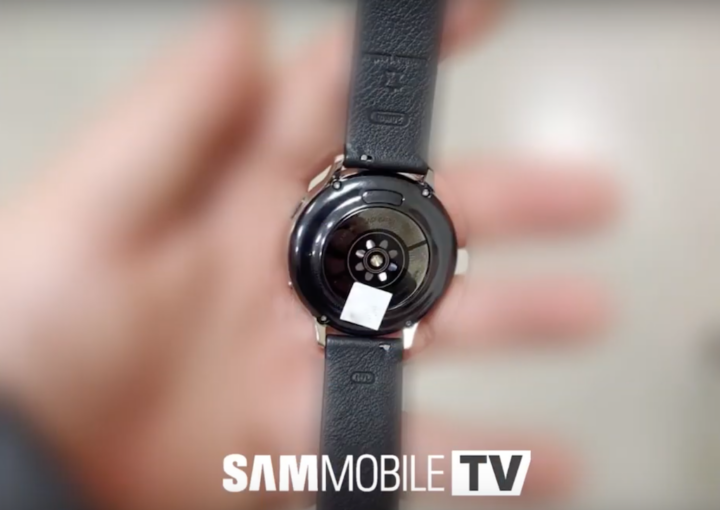
A leak from SamMobile indicates that the smartwatch will sport an electrocardiogram (ECG) that can check for an irregular heartbeat or symptoms that can indicate a heart issue. Additionally, the watch will provide users with atrial fibrillation notifications while it checks the user’s heart rhythm.

Additionally, the Watch Active 2, may also have ‘Fall Detection’ allowing users to use a single tap option after a hard fall to contact emergency services.

It’s currently unclear when Samsung would launch the Galaxy Watch Active 2. With the Note 10 on the horizon, it’s possible that the South Korean company may launch the watch on the same day. However, with Samsung only launching the Watch Active in February that seems unlikely.

Source: SamMobile

The post Samsung Galaxy Watch Active 2 to feature ECG and ‘Fall Detection’ appeared first on MobileSyrup.

04 Jul 17:47

Apple puts up privacy-focused billboards in downtown Toronto

by Patrick O'Rourke
Apple Privacy

Apple has put up two privacy-focused billboards in Toronto that bear a striking similarity to the ads the tech giant erected during CES 2019.

The first billboard, which is actually handpainted, is located on the corner of King and Spadina in Toronto (pictured above). It reads ‘Privacy is King,’ which in itself is the joke given that the ad is located on King Street.

The other billboard, situated across the street from Alphabet-owned Sidewalk Labs along downtown Toronto’s waterfront, says, “we’re in the business of staying out of yours.” This expertly placed billboard likely wasn’t an accident on Apple’s part given the privacy concerns surrounding the city’s Quayside development.

The project aims to use a wide variety of sensors to measure residents’ movements to learn how to design better streets, transportation and even buildings.

The main controversy surrounding the project is who has access and control to this data.

Given the recent controversy surrounding Facebook and the Cambridge Analytica scandal, Google with its now-defunct Google+ service and voice-activated assistants like Alexa and Google Assistant in general, it’s not surprising that Apple is pushing its focus on privacy as a key differentiating factor.

Apple CEO Tim Cook has repeatedly spoken out about tech giants that utilize user data in various ways, as well as called for more regulation surrounding privacy. The company also recently took steps to improve privacy in its devices, including iOS 13’s ‘Sign-in with Apple.’

The post Apple puts up privacy-focused billboards in downtown Toronto appeared first on MobileSyrup.