Shared posts

04 Jul 21:29

Arweave

by Tom MacWright

Shortly after I published IPFS, Again, I started hearing from people about arweave. According to Michael Arrington, founder of TechCrunch, the project is ‘quietly crushing it’. I decided to give it a shot.

Loom

Storage first

IPFS & dat are big projects that try to reimplement and replace many different technologies. They have addressing systems, sophisticated network layers, and swappable storage models.

What they don’t have, at least until the advent of Filecoin, is a standard way to replicate traditional web hosting by paying money to other people, so they will store and distribute your files. There are independent efforts, like hashbase for dat and Pinata for IPFS, but these are not standardized or decentralized. You pay the friendly proprietors to host your data, and they host it on some computers somewhere, much like traditional web hosting.

Arweave, on the other hand, chose to solve the ‘pay for storage’ problem first. You send some ‘crypto-money’ to the network, and market incentives go into effect, and eventually your data is part of the ‘permaweb’ – theoretically, forever.

This is a very important component. Without it, you have a decentralized website that shuts down every time you close your laptop.

A ‘blockweave’

dat and IPFS are not blockchains.

Arweave is essentially a blockchain: it’s a twist on a blockchain called a ‘blockweave’. There’s a ‘lightpaper’. And an ICO. And a worrying number of ‘investors’ in its fanbase.

Which brings us to an ethics issue: a majority of the people who boosted arweave to me were also investors in the project. Michael Arrington, for instance, is the leader of Arrington XRP Capital, which was one of the major investors in arweave’s ICO. Those who can remember back to 2009 will note that conflicts of interest have been a theme for him.

I am not an investor in arweave. I also have a deep and oft-confirmed skepticism of everything having to do with ‘crypto’ and blockchains. They have, with very few exceptions, contributed nothing to the world and wasted time, money, and energy.

So my skepticism of the crypto industry is that the central technologies they hype simply do not work. If I come along one that does work, I’ll happily acknowledge that and gain back a tiny bit of respect for the crypto industry. And that’s roughly what I found with arweave. It’s early-stage and is extremely limited in capability and functionality. But there’s no denying that it does work, and the experience of using it is pretty decent.

So, let’s dive in.

First run

From arweave.org, you click ‘Deploy a page now’, and then on the remarkably-similar page, you click the identically-styled button that says ‘Get free tokens’. As mentioned earlier, their central value proposition is that you can pay the system to store your files. So at least for now, they give you free ‘crypto-money’ to play with. This puts you into a funnel that starts with… continuing with Google.

Now, this gave me pause. They’re asking for a Google login to thwart Sybil attack, in which someone registers a lot of user accounts and gains control of the network or at least lots of free tokens. I’m not nearly as paranoid or anti-establishment as many blockchain fans, but having to ‘log in with Google’ is something that I avoid. It also chipped away at the ‘decentralized’ marketing.

You can avoid this step and earn those tokens instead, but it’s hard and it’s pretty obvious that the arweave project does not expect you to go that route.

So you Continue with Google and get an email with a link to a download page for your key file. This flow worked perfectly the first time I tried it, and broke the second time with a server 500. Probably just a bug. Anyway, once you’ve got your free tokens, it’s on to deploying an app. I install the CLI:

~ npm install -g arweave-deploy

That was a really fast install. Too fast. Zero dependencies? Let’s see what’s in it. Okay, so it’s a webpacked bundle of one 3.6MB file. Hunting down what’s in it leads me to one of the big ahas: this is definitely a two-tier system.

arweave-deploy is just an HTTP client. It talks to arweave.net and sends files and pays for storage. That’s why it’s small. Unlike IPFS and dat, when you install ‘arweave’, you aren’t necessarily becoming a full participant: instead you’re a customer. arweave-deploy just communicates with arweave.net: it doesn’t include any of the juicy details involved in decentralization. You can also run a ‘full node’ but you probably won’t – the setup and requirements of a full node are way higher. Anyway, let’s continue deploying:

~ arweave deploy hi.html
Enter your encryption passphrase to decrypt KvUSJG9Sin-025b-qDbsz9JbuvK9Xr_JvKX5ffrZgzM

File

Path: hi.html
Size: 3.00 Bytes

Transaction

ID: Pebyh0JG-rbkxtRSlCrJ1jR2lICJSOrtBoLlqj97VMk
Price: 0.000214319698 AR

Tags:

 - Content-Type:text/html
 - User-Agent:ArweaveDeploy/1.3.1

Wallet

Address: KvUSJG9Sin-025b-qDbsz9JbuvK9Xr_JvKX5ffrZgzM
Current balance: 0.000000000000 AR
Balance after uploading: -0.000214319698 AR

Insufficient balance: balance 0.000000000000 AR, fee: 0.000214319698 AR

Running deploy reminds me I need a key. I run arweave key-create and that works.

~ arweave deploy hi.html
Enter your encryption passphrase to decrypt CUbHCJfFTk-F8A641PyKt-HkhtcOIAyjcTc0BozXYv8

This CLI experience is pretty good: I’m not encountering cryptic errors and there’s a clear information hierarchy.

Your file is deploying! 🚀
Once your file is mined into a block it'll be available on the following URL

https://arweave.net/0aGlc2HrFroO6eT4jrlvdMcvHVEv7CTAXTuXixrE7XQ

You can check it's status using 'arweave status 0aGlc2HrFroO6eT4jrlvdMcvHVEv7CTAXTuXixrE7XQ'

Quick note that the grammar error in that message – it’s instead of its – was fixed between starting this post and publishing. That’s attention to detail.

Now I check the status of that upload:

~ arweave status 0aGlc2HrFroO6eT4jrlvdMcvHVEv7CTAXTuXixrE7XQ
Trasaction ID: 0aGlc2HrFroO6eT4jrlvdMcvHVEv7CTAXTuXixrE7XQ
Status: 202 Pending ⛏

A few minutes later, and the file is hosted! https://arweave.net/0aGlc2HrFroO6eT4jrlvdMcvHVEv7CTAXTuXixrE7XQ exists. Note that I really do mean a few minutes later. I tried later on with a stopwatch to figure out how long. It took 3 minutes and 20 seconds for a 4 kilobyte HTML file to be added.

So, to review, getting set up with the arweave CLI was actually pretty decent. When I didn’t follow the instructions, like when I tried to deploy a file before I had any ‘crypto-money’, the error messages produced were informative. There’s some jargon, like how a file is ‘mined into a block’, but it doesn’t overwhelm the basics, like that that file will be available at a URL.

The limits

Unlike other blockchains, it has created truly scalable infrastructure, as it will be able to reach up to 5000 tp/s, and store data at a fraction of the cost of competitors. - on Crunchbase.

Arweave talks a pretty big game in its investor marketing. I went down the rabbit hole of trying to see: is arweave competitive with Amazon S3, the gold standard for cheap cloud file storage? This led to an entertaining exploration of arweave cost structure on Observable, which suggested that 64MB of storage would cost $160,000.

Arweave cost curve

While that’s technically true, it won’t actually matter, because you can’t upload files larger than 3MB to arweave. There’s a limit. So you never pay more than about 18 cents for an upload. There are more limits:

  1. No files bigger than 3 megabytes
  2. Only text/* mime types
  3. You can only upload one file at a time

These are pretty harsh limits, and are obviously a hard blocker for hosting this site on arweave.

The theory is that arweave’s efficiency is higher for smaller chunks, which is fair. How efficient is it? Just for kicks, if you take arweave’s current pricing and extrapolate up to the cost per gigabyte, it works out to $61, which is the cost of storing that gigabyte on Amazon S3 for 221 years.

And if we’re measuring speed, note that deploying a 4KB file took me over 3 minutes.

Arweave might be scalable and inexpensive compared to blockchains, but that’s only because they are ludicrously bad: Bitcoin handles 4.6 transactions per second, compared to VISA’s 24,000. Compared to cloud storage or other technology norms, arweave is off by a factor of 10 or more.

Let’s be clear: if you’re going to claim that a technology “could save you millions in bandwidth,” like IPFS did, or that it’s a “fraction of the cost of traditional centralised providers,” like arweave does, these statements have to be potentially true in at least one way. You have to measure it out and project the numbers for some deployment in some scenario to make sure that the project can at least approximate the result you are advertising. Otherwise these statements are just empty, dishonest spin about something that could be but won’t.

There’s a technology in planning – ‘Fast-Write’ – which would eliminate the 3MB cap and make writes… faster. And there are plans to support more than one transaction per wallet per block, which would also create a speedup. But neither are close to being finished.

Summing up

Arweave is a real product that you can use, and, within its strict limits, it works. By focusing less on decentralization and more on usability and storage, it’s faster to get started with than IPFS or dat, but it’s also just a vastly different project. The documentation is less sprawling and more focused, and the usability of the provided tools is pretty good.

Whether arweave’s principles can scale, whether the economics will continue to work when a majority of the data in the network was paid for years ago and is now stale, whether ‘miners’ will prefer to participate in IPFS/FileCoin or arweave, whether the costs and speeds will ever approximate commonplace cloud storage – I don’t know.
04 Jul 21:28

Checking the status for 5200 websites

by John Stewart

OU Create

The University of Oklahoma offers all of its students, staff, and faculty their own web domains through the OU Create program. Anyone who wants to can sign up for a free subdomain (something like yourname.oucreate.com) or pay $12/year for a top-level domain (something like yourname.com). We provide 5GB of storage, tech support, and workshops to help people get started.

Once someone has registered for OU Create, they can use the Installatron tool that is built into the system to launch a one-click install of WordPress, Drupal, Omeka, and about 150 other web-apps. Right now our Installatron logs show a little more than 5200 active installations of WordPress, accounting for more than 80% of all the active registered domains. This does not include the inactive installations of people who have deleted their accounts or left the university and taken their websites with them.

I’ve been curious for a while as to the status of all of these sites. How many of these installations are actively being used? How many were used for a course at some point but have not been updated for a while? How many installations were set up but never really used? Are there any sites that are glitching, and do the users know about those glitches.

Checking Statuses

As an administrator, I can use the Installatron logs to see the URLs for all of the WordPress installations on a server. We have 5 servers, so I wrote a python script that will quickly pull that information from each server and compile it into one big list.

Next I wrote another python script (the link goes to GitHub gist and the code is also written below) that ingested that list of URLs, went to each URL, and returned the “HTTP status code” for the site. A status code of 200 means that the site loaded as expected. A status code of 301, meant that the URL redirected me to another page that then loaded. A status code of 400, 401, or 404 meant there was some sort of error loading the page. There were also pages where the system couldn’t find anything, so I told my script to record these as “no connection.”

import urllib3
import os
import csv

rows = []
http=urllib3.PoolManager()
#load the csv list of URLs to check
with open('urls.csv', 'r') as input:
    csv_reader = csv.reader(input)
    for blog in csv_reader:
        #check blogs in list for status
        try:
            #this get response will only retry a url 3 times, does not preload the site data, and records the status but does not load a redirect
            resp = http.request('GET', blog[0], retries=3, preload_content=False, redirect=False)
            line = [blog[0], resp.status]
            rows.append(line)
            resp.release_conn()
        #if there's a domain not found error, it will be caught by this except
        except:
            line = [blog[0], "no connection"]
            rows.append(line)

with open('urlStatus.csv', 'w') as output:
    csv_writer = csv.writer(output)
csv_writer.writerows(rows)

When I tested the script on a list of 50 URLs, it worked, but it took several minutes. When I tried to run it on all 5000+ URLs, it ran for over two hours with no end in site. Ultimately, I split the list up into five smaller lists, and ran the script simultaneously on each of the five lists. It worked, but I left it running overnight, so I’m not entirely sure how long it took. This morning I compiled the five output .csv files.

The end result was that 3800 sites loaded with no problem. An additional 1100 sites redirected once, and then loaded. I think many of these were simply making a minor edit to my URL by adding a “/” to the end, pushing me from something like mysite.oucreate.com/blog to mysite.oucreate.com/blog/.

Of the 23 sites that had 400 status errors, 9 were actually redirects, that the my system didn’t recognize for some reason. The other 14 have issues, and I’ll follow up with their owners to help them either fix the sites or delete them if they’re no longer using them.

The remaining 282 sites returned “no connection.” Many of these are smaller sites that were once installed as subdomains and subdirectories of main sites, but are no longer in use. Others are sites URLs that have expired. I’m going to follow up with the owners of these expired sites. Where they were intentionally allowed to expire, I can delete them from our system. Where they expired unintentionally and haven’t been noticed yet, we can see about re-registering them.

Once I get to a good place with these sites that returned 400 and 500, I’m going to run a third script to see how many of the sites that are working properly are in active use. If the site only has the Hello World blog post that comes with the software and the default theme, I will reach out to the owners to see if they want any help getting set up or want me to delete an unused account. After I get through all of these WordPress sites, I’ll go back to Installatron and run similar checks on the rest of the OU Create domains.

04 Jul 21:28

The current state of smart speakers

by Volker Weber

f416b0cba4fa8bfa0d4274a5281f611c

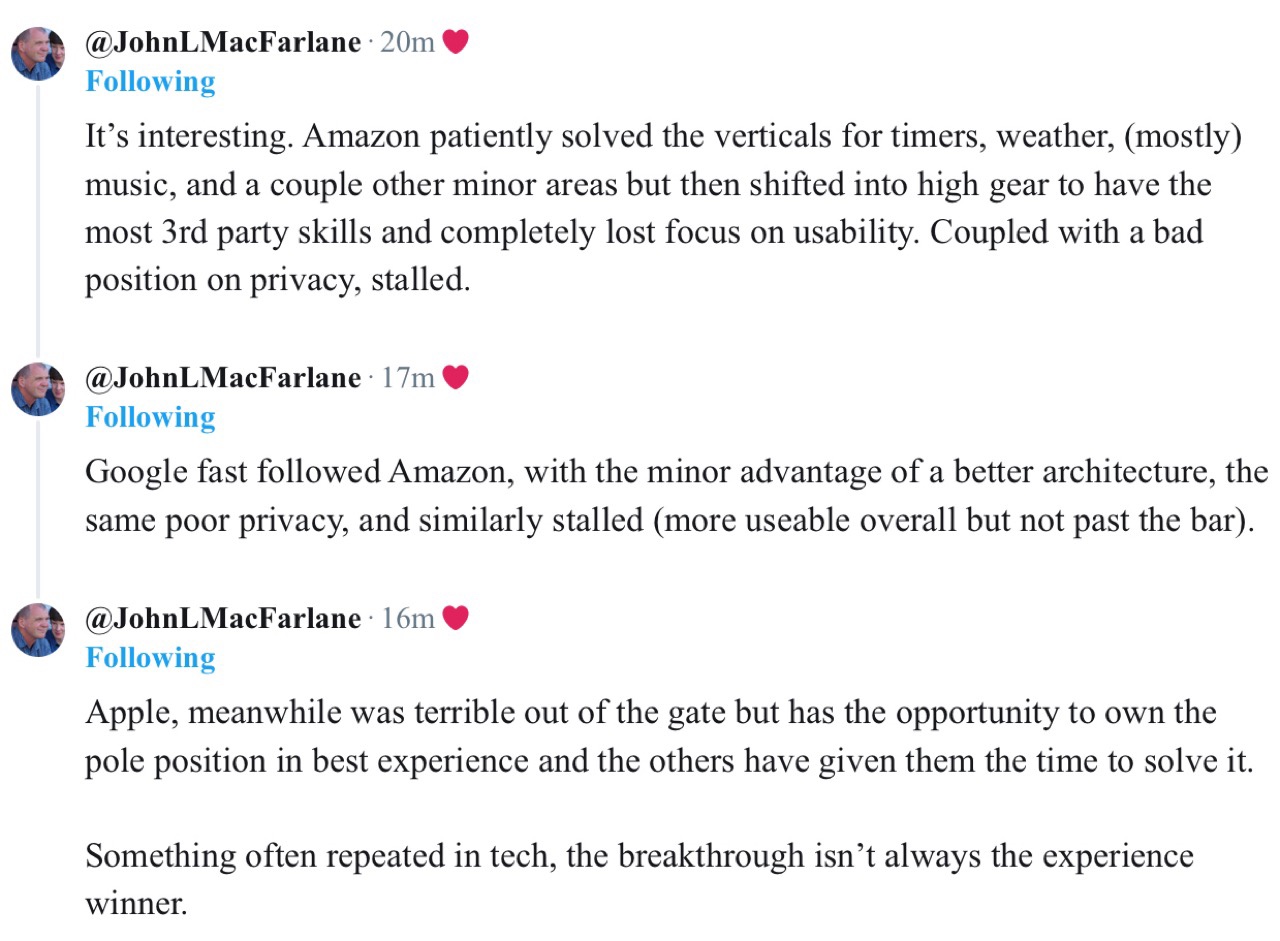
Very good analysis of the current state of voice control in a thread that Walt Mosberg started. It reflects my own use. John is a co-founder and former CEO of Sonos.

Alexa is mostly a kitchen timer and displays a couple of our favorite photos as a photo frame on Echo Show. Google Assistant is disabled on all devices.

We are using Siri more than ever. It is also shifting my speaker use from Sonos to HomePod. I hardly ever touch the Sonos controller anymore. Play:5 and PlayBase have become an AirPlay target that cannot be controlled via Siri.

Voice just isn't very compelling yet.

04 Jul 21:27

"They have such nice accents!"

by peter@rukavina.net (Peter Rukavina)

Tourist season has begun in earnest and with it comes the bane of all pedestrian Charlottetowners, the four-abreast sidewalk-taker-uppers. Here’s an attempt to illustrate one small slice of this today, as I hurried to catch the bus uptown (do they think we can’t hear them?).

Read from bottom to top (that’s a bug in the design!).

Comic

04 Jul 21:27

It sounds to me like Superhuman e-mail service ...

by Ton Zijlstra

It sounds to me like Superhuman e-mail service is in permanent breach of the GDPR by collecting the reading behaviour and geolocation of every recipient of an email from one of their users. So that user can get a ‘message read’ signal, except it shows the user every time you opened a mail and your geolocation at that moment. Without the recipient’s knowledge, and thus without explicit consent, which is definitely needed for something like geotracking.

Also: switch off loading remote images in your e-mail client, so tracking pixels and other image based beacons won’t automatically load upon opening your mail.

04 Jul 21:27

When a Gaggle becomes a Phalanx

by Gordon Price


Warning: the geese at English Bay are militarized – notably when it comes to claiming beachfront territory from the seagulls.  The video reveals the orderly assembly of the troops, the commanding officers at the rear, the steady forward march and the sudden charge.  God help us all if they get weaponized.

Download here: IMG_3740


View attached file (68.3 MB, video/quicktime)
04 Jul 21:27

The Coming Disruption of the Electric Scooter

by Gordon Price

When it comes to the inevitable disruption that will be caused by the proliferation of electric bikes, scooters and every possible hybrid, we are so not ready.  It’s the one big thing I learned from last month’s trip to Tel Aviv, and saw this:

Scooters (and electric bikes) are everywhere in Tel Aviv – by the thousands.  Like an invasive species, it took only two years for them to fill a mobility niche, and there’s likely no possible way to exterminate them now.

Though there is the occasional sighting in Vancouver, so far the private scooter-share companies – notably Lime and Bird – have been prevented from taking root.  Like Uber, the Province has kept them at bay by making their use functionally illegal.  Here’s the situation as described in the new Active Transportation Design Guide:

Legality of E-Scooters and Other Small, One Person Electric Vehicles

At the time of writing, e-scooters (and similar small, one-person electric vehicles such as hoverboards, motorized skateboards, and self balancing electric unicycles) are not permitted on public roadways or sidewalks in B.C.

The B.C. MVA defines these vehicle types as motor vehicles, but they do not meet provincial equipment safety standards for on-street use. E-scooters and similar vehicle types may only be operated where the B.C. MVA does not apply, such as on private property that does not have public vehicle access, and on trails or pathways (if allowed by municipal bylaw).

Many of the laws that ban e-scooters were developed under different mobility contexts. As demand for these technologies and others grow, the policies may need to be updated.

Um, ‘may’?   Scooters, in particular, are gaining global popularity.  They’re cheap, compact, flexible, zero-emission, noiseless, practical, fun and hip.

There is no way to stop people from buying them.  And if the law says there’s no legal way to use them, then the law will be seen as irrelevant unless rigorously and punitively enforced. And why would we do that when this is exactly the kind of transportation we want to encourage in a ‘climate emergency.’

There will be more to come on the particular circumstances in Tel Aviv.  But we need to prepare ourselves now for the impact of this new mobility.  May I suggest we send the necessary authorities to Tel Aviv for a couple of weeks with instructions that, during that time, they cannot use a car.


04 Jul 21:26

No Algorithms

I’ve been asked a few times about using algorithms in NetNewsWire to bring articles you wouldn’t otherwise have seen — from outside your feeds list — to your attention.

I’ve also been asked a similar question about using algorithms to bring articles — from inside your feeds list — to the top based on the likelihood that they’ll interest you.

I’m not going to do either.

Why

These kinds of algorithms optimize for engagement, and the quickest path to engagement is via the drugs outrage and anger — which require, and generate, bigger and bigger hits.

This is what Twitter and Facebook are about — but it’s not right for NetNewsWire. The app puts you in control. You choose the sites and blogs you want to read, and the app reliably shows you their articles sorted by time. That’s it.

My hypothesis: these algorithms — driven by the all-consuming need for engagement in order to sell ads — are part of what’s destroying western liberal democracy, and my app will not contribute to that.

04 Jul 21:26

Old Bloggers and New

I like to read what people write about RSS readers.

One of the themes goes something like this: “I used to use an RSS reader, then I stopped, years ago. I decided to try it again — so I imported my old list of subscriptions. Over half the feeds were gone or no longer updating! Pour one out for RSS.”

Here’s the thing: blogging is like any other human activity — some people stop and other people start. It’s natural.

And: nobody ever said your favorite bloggers would continue forever. It’s okay to miss your old favorites! I miss mine.

But here are a few examples of current blogs that I like that you might like:

There are plenty more.

04 Jul 21:24

Twitter Favorites: [Sean_YYZ] If you're looking for a fun, relaxing bike trip, you might want to consider a ride through Niagara Falls and Buffal… https://t.co/CPw8R3xFjO

Sean Marshall @Sean_YYZ
If you're looking for a fun, relaxing bike trip, you might want to consider a ride through Niagara Falls and Buffal… twitter.com/i/web/status/1…
04 Jul 20:54

Retrofitting Popeye for the Web

by Reverend

When I was stateside last month Tim was talking to me about a couple of his arcade game projects—he is always working on something cool. The one I won’t talk about here is pretty wild, it basically allows you to hack into the video and audio signals of an old gold arcade cabinet and stream it out online while someone is playing (reclaim Arcade meets Reclaim Video). But I’ll let Tim explain that in detail given it is something special. Just the other day he got online high scores working for one of our newest cabinets, namely Popeye. These high score save kits built for specific cabinets allow you to save high scores after restarting the cabinet (a feature not available to many of the earlier machines) as well as enable free play on certain cabinets that may not have that option. What’s more, for certain games like Popeye that have a free play option that does not use “attract mode” (when the screens shuffle to prevent burn-in) a save kit allows you to override those settings. The following video  from the folks at Canadian Arcade explains this quite well and even takes you through the installation of a save kit on Popeye:

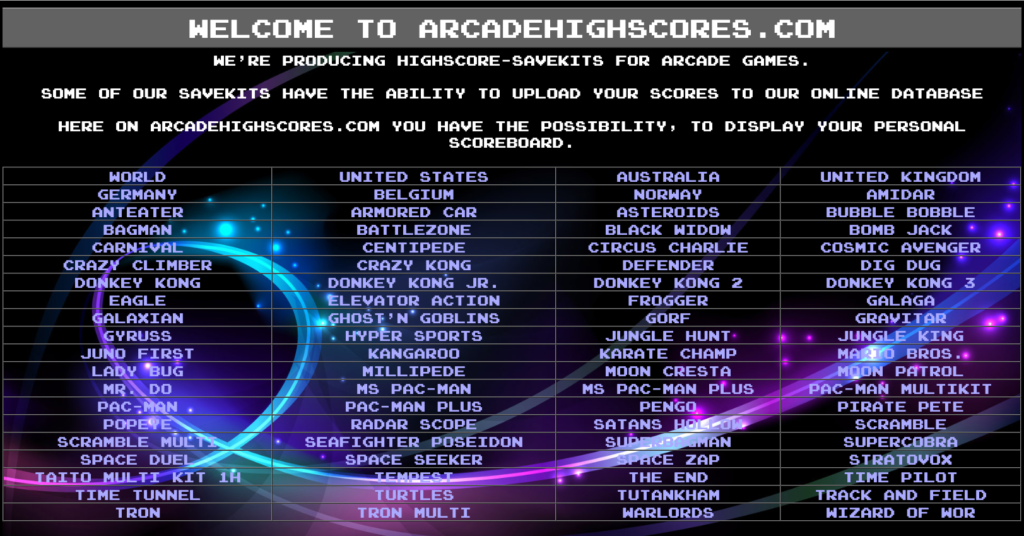
Now, you can actually buy a save kit that also allows you to collect and push the high score data collected to the arcadehighscores.com website

Arcadehighscores

So, not only are we able to enable free play on Popeye now, but we can also push the high scores to a Reclaim Arcade website that tracks not only top scores, but the most recent scores as well:

And looking at the site it looks like 9 other arcade cabinets we have currently (namely Pac-man, Tron, Asteroids, Defender, Kangaroo, Galaxian, Galaga, Track and Field, and Centipede) could also have high scores saved to this website. I love the retro-culture around arcade machines that re-imagine them for the web, this is some niche-ass retrofitting which makes it that much more awesome.

04 Jul 20:53

Replied to Old Bloggers and New by brentsimmons...

by Ton Zijlstra
Replied to Old Bloggers and New by brentsimmonsbrentsimmons
.... blogging is like any other human activity — some people stop and other people start. It’s natural......nobody ever said your favorite bloggers would continue forever. It’s okay to miss your old favorites! I miss mine. But here are a few examples of current blogs that I like that you might like

Do you publish a list somewhere of what you are currently reading through RSS, Brent? Like others, I’ve started publishing my list of RSS feeds as a pathway for discovery.

04 Jul 20:53

A Thousand Tiny Broken Promises

by Richard Millington

“We’ll probably get round to working on that later”

“I’ll get back to you on this shortly”

“We might be able to do that”

“We have this planned for a few months’ time”

You might not take any of the above literally, but your members do. When you don’t come through, don’t provide the update, or don’t make the change, you lose your credibility.

A promise based upon a probability is still a promise that you have a reasonable understanding of the probability (or possibility) the event/action will happen.

Don’t make a promise you’re unlikely to keep to avoid disappointing members. It’s usually better to just say “no, sorry, this can’t/won’t happen yet because…”.

Members might not like the response, but at least they have clarity.

Don’t fudge your answers, be clear and specific.

Besides, it’s far better to say “no” now and delight members later than say “possibly” now and disappoint members later.

04 Jul 20:53

Tracking Pixels in Superhuman

by Stowe Boyd

Superhuman may have crossed the line into surveillance land.

https://medium.com/media/3845c91ed1bd52a1b0f8238ae559f2b8/href

I read a post today by Mike Davidson, in which he asserts that Superhuman, the new email wunderapp from Rahul Vohra (formerly of Rapportive) is using tracking pixels that cannot be disabled:

Superhuman calls this feature “Read Receipts” and turns it on by default for its customers, without the consent of its recipients. You’ve heard the term “Read Receipts” before, so you have most likely been conditioned to believe it’s a simple “Read/Unread” status that people can opt out of. With Superhuman, it is not.

In a tweet, Davidson stated,

Superhuman is a surveillance tool that intentionally violates privacy by notifying senders every time their emails have been viewed by recipients. I would never trust this company. Only way to make sure your own privacy isn’t violated is to disable images in your own email app.

Until this is all settled, I will wait on the sidelines.

04 Jul 20:51

Third Culture Apps

At the start of 2019, I quit a stable job at a studio I've been associated with since I was 15, having been extremely fortunate and privileged to spend the last few years leading a team of talented humans. I was 33, and wanted a new challenge. Third Culture Apps was founded. Six months later, I'm proud to have released its first two apps on Google Play: Appy Weather and ruff. Check them out.

04 Jul 20:51

Hossein Derakhshan onderschrijft met dit artike...

by Ton Zijlstra

Hossein Derakhshan onderschrijft met dit artikel in The Guardian de missie van PublicSpaces, Frank! Hij trekt het bovendien in Europees verband. Lijkt me terecht, juist ook omdat privacy, omgang met gegevens en de geopolitieke kant van data/social media een Europese aangelegenheid is, geen primair Nederlandse. @hod3r is denk ik een goede bron ook voor het diepere denkwerk achter de positionering van PublicSpaces. Heb je er nog ingangen, ben je er nog actief? Marco wel zie ik op de site.

04 Jul 20:51

.dk

by peter@rukavina.net (Peter Rukavina)

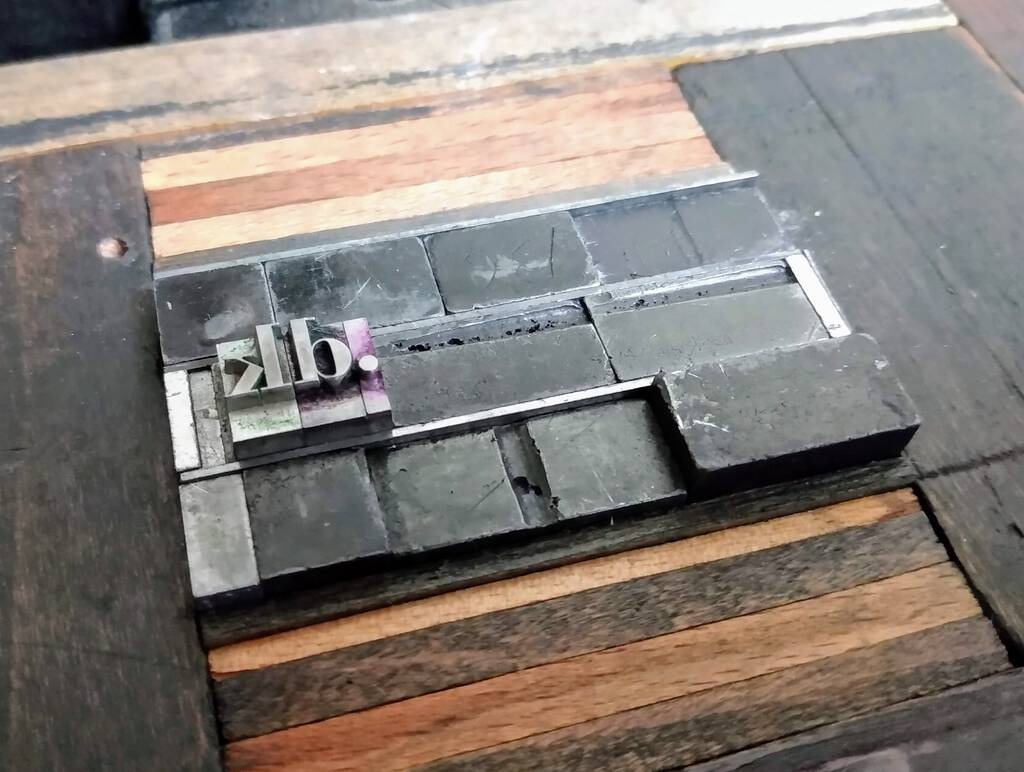
Sneak peak of a two-colour job I just finished printing. I printed the black yesterday, the grey today. And found–as I did the first time I printed grey–that the recipe for grey is “white plus half of an infinitesimal smidge of black.” Drying today. Mailing tomorrow.

Dot D K

04 Jul 20:49

GoodNotes Transitioning Mac App to Catalyst

by Ryan Christoffel

Today on its blog GoodNotes shared that the upcoming macOS version of GoodNotes 5 would be based on the iPad app using Catalyst:

Earlier this year, we launched our all-new iOS app GoodNotes 5. It has been rewritten from scratch with a much more stable and flexible internal architecture, paving the way for the future of GoodNotes. Rewriting the iOS app also meant that we had to rewrite the MacOS companion because the new GoodNotes 5 was no longer compatible with the outdated existing Mac app. A lot of people were disappointed that we didn’t launch a Mac app together with the iOS version because they still had to stick with GoodNotes 4 if a Mac version was crucial to their workflow. Thanks to the hard work of our Mac team, we released an early-access version shortly after the iOS launch. This beta version is available for everyone who signs up for access. We shipped updates with new features and improvements on a regular basis and were almost ready to launch it publicly when Apple officially announced the start of “Project Catalyst” during their annual developer’s conference in June. It’s a framework that allows developers to bring their iPad apps to the Mac, with a relatively low effort. It still requires a lot of work to create a great Mac app but at least developers don’t have to rewrite significant portions of the code, as it was the case previously.

We believe that it is a great opportunity for us to unify the GoodNotes experience between iOS, iPadOS, and MacOS and will launch the new GoodNotes for Mac using Apple’s new framework.

GoodNotes is a noteworthy Catalyst app not just because it’s a very popular iPad app, but because it already has an existing Mac app. Catalyst makes the most sense for iPad apps that don’t currently have Mac counterparts, but GoodNotes’ plans demonstrate the advantages offered to other apps too. By adopting Catalyst and moving toward a more unified codebase, GoodNotes ensure that users on the Mac will never be left behind again, because new features can be developed and shipped on both iOS and macOS with little added effort.

Our John Voorhees, in his recent Catalyst story, listed GoodNotes as an example of a Mac app that’s fallen behind its iOS version feature-wise, so it’s great to find out that will change in the near future. The only real drawback, as noted in GoodNotes’ post, is that Catalyst apps will require macOS Catalina to run, so users on older versions of macOS won’t be able to download the new GoodNotes 5 for Mac.

→ Source: medium.goodnotes.com

04 Jul 20:49

1Password + TFA + Android

by peter@rukavina.net (Peter Rukavina)

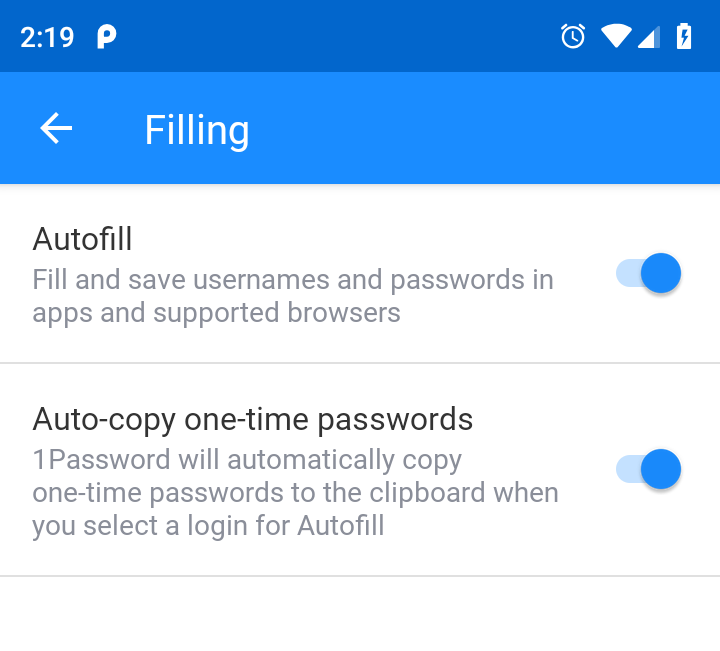
I’d missed this somehow: there’s now a setting in 1Password’s Android app under Filling labelled “Auto-copy one-time passwords” that does exactly that (just as the Mac version has done for a long time):

Screen shot of 1Password showing Filling settings

If you’re using two-factor authentication (and you should be: if you’re not, look it up and figure it out, or ask someone to explain it to you), using 1Password to generate your one-time passwords is light years ahead of using a standalone app like Google Authenticator, and this feature makes it double amazing.

04 Jul 20:49

Fallacies (SEP)

Hans Hansen, Stanford Encyclopedia of Philosophy, Jul 03, 2019
Icon

As the author of Stephen's Guide to the Logical Fallacies (firmly in the Copi tradition and very much in need of a new edition) I have had a long-standing interest in fallacies. I define a fallacy simply as 'a common error of reasoning' and eschew the much deeper debate over this definition that appears to be very much the preoccupation of this SEP article. I think we'll find that for each legitimate sort of reasoning there will be a set of accompanying fallacies. It's useful to know about fallacies because they provide a bridge into knowing how to reason well. Image: THE.

Web: [Direct Link] [This Post]
04 Jul 20:49

Theories of Meaning

Stanford Encyclopedia of Philosophy, Jul 03, 2019
Icon

Another newly revised article in the Stanford Encyclopedia of Philosophy. This article is relevant because so many educators use phrases like 'making meaning' without really having a deeper understanding of what they could be saying with that phrase. As someone with a background in these theories (and yes, I deserve your sympathy) it has always perplexed me that this could be what it is that educators think students are doing when they are learning. Students are at best creating (if they create anything) an interpretation of some model or representation when they learn, and not meaning itself. But all this is an artifice anyways; meaning is something societies create, and people just learn how to use the words one way or another.

Web: [Direct Link] [This Post]
04 Jul 18:03

Choose Boring Technology

Choose Boring Technology

The definitive write-up of Dan McKinley's presentation on why you should mostly use "boring" technology rather than going after the latest shiniest stack components. There's so much accumulated wisdom in here. I particularly like how Dan owns up to having introduced Scala and MongoDB at Etsy before eventually helping remove them and go back to something less exciting and far more predictable. Also neat: the site is generated using Dan's better-keynote-export tool which helps turn Keynote presentations into a flat web page with notes and images.

Via Hacker News

04 Jul 18:03

PugSQL

PugSQL

Interesting new twist on a definitely-not-an-ORM library for Python. With PugSQL you define SQL queries in files, give them names and then load them into a module which allows you to execute them as Python methods with keyword arguments. You can mark statements as only returning a single row (or a single scalar value) with a comment at the top of their file.

04 Jul 18:03

Multiple machines, multiple OSs, narrowing apps? - Dr Andus

Daly de Gagne wrote:
>With regard to the individual sections, are these all in the same note,
>or in subnotes?

I keep everything in the same note. One advantage of that is that should I move (export) my notes into another system, all the information pertaining to the same note would be kept together.
04 Jul 17:50

Android co-founder cheated wife out of millions, documents reveal: report

by Shruti Shekar
Essential founder Andy Rubin

Andy Rubin, co-founder of Android, is accused of “cheating his wife out of millions,” according to court documents.

The documents, which have not been proven in court, claim that Rubin forced his wife to sign a prenuptial agreement weeks before she was going to give birth to their child, according to BuzzFeed News. The documents also noted that negotiations on terms were still happening three days prior to their wedding, resulting in his wife from being “cut out” of having any share of Rubin’s wealth. This lawsuit seeks to annul the prenuptial agreement.

The same documents contain details about allegations that were laid in October, as reported by the New York Times.

Those allegations relate to Rubin financially supporting mistresses, who were “loaned” to other men, in what Rubin called “an ownership relationship.” One of the mistresses was “complicit with Rubin in running what appeared to be a sex ring.”

The document also alleges that Rubin redirected joint funds in order to make personal payments to these women. It also added that Rubin had stopped depositing his paychecks from Google into the joint account and once he left the company in 2014 amid sexual misconduct allegations, he would deposit his severance paychecks into a personal account.

A central claim of the complaint is that the lawyer representing Rubin’s wife failed to reveal that he had represented Rubin in a previous divorce. As a result, Rubin was able to allegedly exclude large portions of his wealth from the prenuptial agreement.

The plaintiffs argue that because there was a conflict of interest and “the broader irregularities” it should render the agreement invalid.

Source: BuzzFeed News Via: The Verge

The post Android co-founder cheated wife out of millions, documents reveal: report appeared first on MobileSyrup.

04 Jul 17:50

Canadians can now buy Public Mobile SIM cards from Amazon

by Dean Daley
public mobile

Public Mobile has announced that Canadians can now purchase its SIM cards from Amazon.ca.

Buying a SIM card from Amazon comes with the benefit of being able to track your order, and also includes multiple payment and refund solutions.

Prime members will also get free shipping, and those without Prime will get free shipping with Amazon’s minimum purchase amount.

You can grab a new SIM card here. For those who have an issue with Amazon, you can always purchase a SIM from Public Mobile’s website.

Source: Public Mobile Community 

The post Canadians can now buy Public Mobile SIM cards from Amazon appeared first on MobileSyrup.

04 Jul 17:49

Firefox 68 for Android brings support for physical security keys and more

by Jinqiao Wu

While Mozilla develops a revamped version of Firefox on Android dubbed Fenix, it continues to support the current iteration with security updates and some new features.

The latest Firefox 68 for Android now works with the Web Authentication API, according to Android Police.

With the security API, version 68 allows compatible services and websites to accept a physical security key as an alternative identity-verifying method.

Google Chrome and desktop Firefox client have supported this security feature for quite some time, but now Firefox for Android is finally on the same page.

Other than that, it’s a list of bug fixes and performance improvements:

  • Added ‘about:compat,’ where website-specific workarounds are listed and may be toggled. These workarounds are meant as temporary fixes for various forms of website breakage for Firefox, while the website fixes them in due time. With about:compat, it is now easy to see all of the workarounds that are active in
  • Firefox, and easy for website developers to disable a given workaround for testing purposes.
  • Improved web page painting performance by avoiding redundant calculations during paint
  • Compatibility fixes for the upcoming Android Q release
  • Support W3C Web Authentication API for passwordless-logins to compatible websites
  • Unified existing locales (bn-BD, bn-IN) under a single Bengali (bn) localization
  • Removed unmaintained languages: Assamese (as), English – South Africa (en-ZA), Maithili (mai), Odia (or)

Android Police also pointed out that version 68 is the last major update for the current Firefox build. Mozilla will only provide bug fixes for the old client until the next-gen Firefox browser goes live.

It’s worth noting that the new Firefox Fenix recently came to the Play Store in preview. Users can now test out the new browser, which features a new design and is much faster than the older version.

Source: Android Police

The post Firefox 68 for Android brings support for physical security keys and more appeared first on MobileSyrup.

04 Jul 17:49

CTRL Labs acquires North’s patents for Myo armband technology

by Isabelle Kirkwood

New York-based CTRL Labs, which is working on a device that can translate electrical muscle impulses into digital signals, has acquired the patents for Kitchener-Waterloo-based North‘s armband technology. The price of the IP acquisition was not disclosed.

The Myo armband, created by North, named Thalmic Labs at the time, used electromyography (EMG) sensors to measure and record electrical impulses given off by muscles. By digesting these pulses, the armband can control a device based on the gesture, which, in turn, made the armband an “extension” of a user’s actions. The Myo armband enabled workers in industries such as construction, field service, and healthcare to interact with smart glasses using subtle hand and finger gestures while on the go.

“We’re excited to acquire assets that drive our mission and to integrate the Myo IP pool with our developer offering,” Josh Duyan, chief strategy officer of CTRL-labs, told BetaKit. “We look forward to building on these inventions and supporting the developer community that got started with the Myo band. This is an important step toward the future of universal control and our unwavering commitment to novel neural interface technology.”

CTRL Labs issued a statement on its Twitter account, addressed to Myo developers.

“You may have read in today’s news or in an email front North that we’ve acquired the Myo IP,” the statement read. “We did this for you. We’re excited by the potential in your work. We’ll bring these inventions back to life in CTRL-kit, our hardware and SDK+API, so you can imagine new possibilities.”

Myo tracked 10,000 orders in the first few hours of sale and received 5.5 million views on its launch video. But despite its popularity, Thalmic Labs pulled sales of the product in October, before launching its smart focal glasses. The company received $24 million from the federal government in December through the Strategic Investment Fund to help the company scale its new product.

In April, the company laid off a reported 150 of its employees, about one-third of its staff, soon after it began shipping its smart glasses and opened physical showrooms in Toronto and Brooklyn, New York. North also soon dropped the price of Focals by almost 40 percent, from $1330 CAD to $799 CAD. The government also suspended its $24 million Strategic Innovation Fund investment in light of the massive layoff.

CTRL Labs is currently developing non-invasive neural interface technology, to create a direct communication pathway between an enhanced or wired brain and an external device. Its CTRL-kit is a wireless, non-invasive EMG device that translates neural signals into control. Using the CTRL-kit SDK and API, developers can begin integrating neural control into their applications. According to TechCrunch’s reporting, CTRL-labs executive Josh Duyan said that the connection with North came about due to mutual investor Spark Capital, who participated in the company’s $14 million CAD ($11 million USD) round in June 2016.

One of its co-founders is Thomas Reardon, who was the CEO and co-founder of Avogadro, which was acquired by Openwave, where Reardon served as CTO. He was also the creator of the Internet Explorer project at Microsoft. CTRL’s investors include Fuel Capital, Matrix Partners, and Founders Fund, among others. This year, it raised $36 million CAD ($28 million USD) from GV, Google’s venture capital arm, and Amazon’s Alexa Fund, bringing its total funding raised to $87 million.

“We’re incredibly proud of Myo, all the people that helped us bring it to life, and those who built amazing applications on top of it. It was bittersweet to sunset the product late last year alongside the launch of Focals,” Stephen Lake, co-founder and CEO of North, told BetaKit. “I’m glad to see the IP go to a great new home with CTRL-labs. We’re excited to see the work live on in a new form.”

This article was originally published on BetaKit.

The post CTRL Labs acquires North’s patents for Myo armband technology appeared first on MobileSyrup.

04 Jul 17:49

Moment Pro Camera app for iPhone gets slow shutter mode for long exposure shots

by Patrick O'Rourke
Moment Camera app

Moment’s Pro Camera iOS app is getting a new long exposure feature that allows for more creative iPhone photography.

The new feature saves long exposures as ‘Live Photos,’ and includes the option to save images as either stills or short videos.

The app’s new slow shutter mode can also be used manually or with pre-set exposure times. Depending on your exposure, you can even add slight motion or light trails to images.

The new feature is similar to setting a standard DSLR to a longer exposure when snapping photos under low-light conditions, allowing users to open the shutter and then close it when they’re finished. This is great for low-light photography, or if you want to add motion blur to an image.

Moment says it uses image stacking and blending to ensure the image is exposed correctly, regardless of what shutter speed you’re shooting on.

While probably not the type of shots everyone is interested in taking, these new Pro Camera features help make Apple’s iPhone camera far more versatile than it is with the limited stock camera app.

Moment’s Pro Camera app is priced at $8.49 CAD in the iOS App Store.

Via: 9to5Mac

The post Moment Pro Camera app for iPhone gets slow shutter mode for long exposure shots appeared first on MobileSyrup.

04 Jul 17:49

Google is working on a ‘heavy ad’ blocker for Chrome

by Jonathan Lamont

Google may be changing how Chrome handles and blocks ads again.

According to an in-development Chromium commit, a code change submitted to an online collaboration tool for developers called the Chromium Gerrit, Chrome’s built-in ad blocker may target ‘heavy ads.’

Essentially, it looks like the Chrome team is developing a blocker that can target specific ads that use too many network or CPU resources.

The commit defines this as “ads that are in the .1% of bandwidth usage, .1% of CPU usage per minute, and .1% of overall CPU time.”

Further, the new heavy ad blocker will display a notice where it removes ads, which includes a ‘Details’ button users can click to learn more.

At this point, there isn’t much more information on Chrome’s heavy ad blocker. Since it’s still in development and could see significant revisions, and Google could cancel it before it ever makes it into a Chrome release.

This is the latest change Google has tried with how Chrome handles ads. The current built-in ad blocker simply blocks all the ads for websites that Google says don’t follow its Better Ads Standards. Further, Google is planning changes to how ad blocking extensions work in Chrome, much to the chagrin of users and browsers based on Chromium.

Ultimately, Google has gotten itself in a bit of a mess with ads. Hopefully this new system can strike a balance between removing harmful ads that hog resources and slow down browsers without removing all ads entirely. Like it or not, advertisements are necessary to fund many things on the internet.

Source: Chromium Gerrit Via: 9to5Google

The post Google is working on a ‘heavy ad’ blocker for Chrome appeared first on MobileSyrup.