Rolandt
Shared posts
Falsehoods CS Students (Still) Believe Upon Graduating
Yashica Mat 124G :: Three Photos

11.02.19 – One of my great blog / photo sins of the last year is that I have not posted most of the photos I have taken. The three photos above from last November 2018 taken with a vintage Yashica Mat 124G loaded with Cinestill 800T film are a good example. I posted a few... Read more »
Happy Now?

image from Succo at pixabay CC0
You’ve probably seen the 2004 talk where “happiness guru” Dan Gilbert says that people who have won the lottery and people who have had limbs amputated are equally happy with their lives a year after these respective events. No matter how good things seem to be, soon enough we seem less happy with our situation; and no matter how bad things get, in time we adjust to it and make peace with it and are seemingly just as happy as the people who have everything they’ve ever dreamed of.
What’s going on here? Dan describes it as the human brain’s capacity for “manufacturing” (rationalizing) happiness and envisioning different futures, a survival adaptation strategy.
My life is damned near perfect. I took a short trip today to pick up some odds and ends, nothing urgent, on a lovely sunny windless November morning. I got everything on my list, without a problem. Afterwards I sunbathed, clothes-free, while doing a crossword puzzle, on my deck. My health and fitness are exceptional for someone my age, or even for someone twenty years younger. I am comfortably retired. I live in one of the most beautiful places on Earth. I have no real enemies that I know of. I have meaningful relationships, full of love and friendship. I seem to have discovered, mostly by accident, qualities and skills people respect and admire. My relentlessly curious and imaginative mind has unlimited opportunities and outlets from which to learn, to discover, to perceive, to play, to make sense of things, and to conceive of how things might be even better, or much worse. In every sense I am astonishingly blessed.
If I believed we were possessed of free will and choice and self-control, I would say that I should be endlessly, ecstatically happy. I have essentially no wants and no needs. Just about every day I can wake up, when I want to, and do just about anything I could want to do.
But except when I really think about it and really pay attention, my sense is that I’m not especially happy. What’s wrong with me? I’ve tried to pursue practices about living well, learned from some very brilliant and wise people, that seem to work brilliantly. But I often forget, and slip back into that disengaged, slightly dissatisfied state. The cognitive dissonance of my life (anxious, when I know there is nothing to be anxious about; infuriated, when I know everyone’s doing their best; self-reproachful, when I know I have no free will, choice or agency over what this strange body I only seem to inhabit does) keeps me constantly off-balance, stuck too much in my head.
I can push myself to get out into the forest (a two-minute walk), to really look and pay attention, to slow down and smile and make eye contact with people, and when I do I usually get into a state of awe, wonder, and bliss. If I’m on a tropical beach, it happens effortlessly. But for some reason I’m not driven to do this — call it laziness or spiritual torpor or whatever, if any effort is involved I tend to shrug and put it off, and just read or play indoors by myself. Maybe it’s the same procrastination that makes it so hard for me to exercise even though I immediately feel and look so much better after I’ve done it.
Truly wild creatures, I think, are not happy or unhappy, because they have no expectations or sense of a gap between what is and what could or should or might be. And while they have excellent memories, my sense is that those memories are not ‘personal’ — they’re about useful things rather than how they felt or what they thought. Why? Because their brains are otherwise occupied with the intuitive processing of sensory data, rather than thinking about and reacting to things they have no control over. Perceiving rather than conceiving. They of course feel pain and pleasure, but my sense is they are not judgemental about it. They live their lives, I think, full of wonder — that is as long as they’re free. Freedom, it seems to me, is their instinctive passion, and the loss of it is their instinctive fear. That’s my reading from seeing both wild and semi-domesticated creatures trapped in confined spaces (where their anguish is obvious) versus being in physical pain (where it’s clearly not comfortable, but seemingly accepted and endured). So different from ourselves!
My sense is that wild creatures are this way because they don’t rationalize their situation, judge it, or see any value in imagining it otherwise. So by our standards they are never “happy”, but rather are, so long as they are free, wondrous, which I suspect is a healthier, more connected and more ‘alive’ way to be.
What if we humans were not possessed of (or by) a rationalizing, reactive, judgemental, personalizing self? We would be, I think, free of chronic fear, sadness, anger and shame, and live in the same kind of timeless, infinite, un-separate wonder that free wild creatures live in — except perhaps in rare moments of existential threat, when instinct would momentarily trigger the fight/flight/freeze response and we would be, until the danger passed, possessed for a few instants by the ancient capacity for preservation of the illusory separate self. No wonder wild creatures shake this awful ‘self-awareness’ off so profoundly once the threat has ended!
But this isn’t quite right either. Humans are not actually possessed by selves — the bodies, the characters that we selves presume to inhabit are actually oblivious to our selves, which are only self-constructed illusions, conjured-up models, figments of reality. Although we ‘selves’ believe that the feelings and thoughts and stress-related illnesses of these characters’ bodies and brains are reflections of our (selves’) distress, they are actually entirely unconnected.
For example, while it is true that I (my ‘self’) was triggered and severely stressed by some terrible personal news that immediately preceded this body’s incapacitating bout of ulcerative colitis 13 years ago, and while it would be perfectly reasonable (for any ‘self’) to conclude that one caused the other, they are actually not, I think, causally connected — the correspondence I drew between them is just ‘my’ making sense of the incident.
So, going further back in my medical history, my serious bouts of depression (which ended about 15 years ago) were likely partly genetic, partly situational, and partly maladaptive responses to the circumstances that the character named Dave encountered and reacted to in the only way it could in the face of the pressure cooker of modern civilization culture. It has often been suggested, and for quite a while I considered it possible, that the real cause was the horrifying experience of early school years, after an idyllic and naive pre-school life, when I discovered that many people are deliberately mean, cruel, unfair, irrational, and dishonest. It’s the kind of thing a ‘self’ will grab onto to make sense of something that otherwise didn’t seem to make any. Now I don’t think those anti-socializing childhood experiences really had much at all to do with my depression, which seems to have almost completely vanished over the past two decades, although my colitis and some other seriously ‘depressing’ things all happened during the early 2000s.
There are likewise other explanations for my horrific colitis outbreak. As a teenager and young adult I consumed massive doses of oral tetracycline (a strong antibiotic) for about a decade as the treatment-of-the-day for serious acne, which surely ravaged my gut flora, possibly for life and likely made my intestines into a kind of time-bomb. The outbreak came at the end of a decades-long period of chronic environmental and situational stresses of the kind which this body has always seemed to have had trouble adapting to.
So if there had never been a ‘me’ — had this apparent Dave character never been afflicted with a self (and there is much evidence that a ‘self’ is completely unnecessary to a character’s effective functioning) — I’m guessing that nothing in the apparent life of this character would have been, or turned out, any differently. Given its biological and enculturated conditioning, and the circumstances of each moment, this character did and felt the only things it could possibly have, and ‘I’ had nothing to do with it.
That means that this Dave character has never been happy or unhappy, at least in the sense that ‘I’ understand these feelings, though I continue to erroneously project these feelings into the body and character I presume to inhabit.
The apparent human race self-domesticated (and gave up its cherished freedom, wildness, sense of wonder and unconditional love) as its numbers rose and as it was dislocated by recurring prehistoric climate change, but this was not because of any illness or other effect created by selves, but rather because self-domestication seemed a good adaptation at the time. Just as when wild creatures become parents, they sacrifice these same cherished values temporarily to care for their offspring; this conditioned behaviour is conditioned for because it seems to confer evolutionary advantage. Our selves had absolutely nothing to do with our species’ self-domestication or its tragic and ghastly consequences (civilization culture’s massive destructiveness and endless strife, the total loss of freedom, wildness, and connection to and sense of wonder about everything-that-is).
But, unlike these creatures we presume to inhabit, our selves have major issues with humanity’s self-domestication and its consequences. Our selves intuitively sense and “remember” the total freedom and wildness and sense of wonder and unconditional love that has seemingly been “lost”, and they “seek” endlessly and agonizingly to find it again. That endless and hopeless seeking lies at the root of our (selves’) chronic unhappiness, anxiety, dissatisfaction, rage, shame and grief.
But that is our (selves’) unhappiness, not theirs. So when Dan Gilbert talks about manufactured happiness and unhappiness, he is not talking about human characters’ happiness and unhappiness, but about our selves’ happiness and unhappiness. If I’m correct in my thinking here, no actual (apparent) creature, human or not, domesticated or not, is ever happy or unhappy. Happiness and unhappiness, unlike wonder and connection and pleasure and pain, are the exclusive domain of the illusory separate self, and as such, they are myths — they don’t exist.
That of course is completely unhelpful to the selves trying to find happiness and avoid unhappiness. But they can never be found, because what is doing the looking (the self) is an illusion, and to the characters the illusory seekers presume to inhabit and speak for, nothing has ever been lost.
So this morning, it was this apparent Dave character that did errands and crosswords and sunbathed, and spent the rest of the day in various forms of play, including writing this. And procrastinated on doing some other things.
‘I’ had no part in any of it. ‘I’ did nothing except vainly claim ownership of, and try to make sense of, what was done. ‘I’ have never done anything.
If you don’t like this article, take it up with the Dave character. I’m just stuck here, in what I thought was the Dave character’s brain and body (brain, mostly) trying, hopelessly, as always, to figure a way out, or perhaps back.
I’m not especially happy, or unhappy, about that.
The dreaded Catalina (OSX users...sorry) But anyone can read, of course - Patrick Rentsch
I am a happy owner of a Fujitsu ScanSnap S1500M. Now I found this info on their website (https://www.fujitsu.com/global/support/products/computing/peripheral/scanners/scansnap/faq/s1500-catalina.html):
>ScanSnap S1500/S1500M Compatibility Status With macOS 10.15 Catalina:
>The ScanSnap software (*) is not available on macOS 10.15 Catalina. To keep using your ScanSnap, use it on the current version of macOS. When you >update your macOS, please consider purchasing a ScanSnap that is currently available.
>Details
>The ScanSnap software (*) is not available on the macOS as it does not support any 32-bit applications.(No further updates will be provided to the ScanSnap software.)
>If you will use macOS 10.13 or earlier, you can keep using ScanSnap S1500/S1500M on the OS.
>When you use macOS 10.14 or later, please consider purchasing a ScanSnap that is currently available.
These things make me angry ...
Top Canadian mobile stories from the past week

Every week we bring you the latest in Canadian mobile news. Listed below is a quick overview of the top stories from the past seven days.
- Second Gen Fire TV Cube Review: ‘Alexa, control my TV’
- Uber Freight launches in Ontario and Quebec
- Bell adds 204,067 total wireless subscribers, a boost of 14.8 percent in Q3 2019
- LG G8X ThinQ Dual Screen Review: Double the screens, double the weight
- Bell’s outgoing CEO Cope can’t say which 5G will benefit more, wireless or wireline
- Edmonton approves digital action plan to bring 5G into the city
- CRTC review of mobile wireless market pushed to February 2020
- Canadians will be able to stream HBO Max content on Crave
- Uber Eats delivery partners in Toronto can now deliver orders by foot
- Drone Delivery Canada to establish new delivery hub at Edmonton airport
- Amazon Canada launches Amazon Business and Business Prime
- Vancouver leads the way for virtual reality ahead of VR/AR global summit
- Ontario Science Centre discloses that it faced a data breach
- Android trick gets RCS messages working on carriers in Canada
- Apple announces $329 AirPods Pro with noise-cancelling, water-resistance
- You can now use the CIBC app to report a lost or stolen card
The post Top Canadian mobile stories from the past week appeared first on MobileSyrup.
Ten Simple Rules That Are Missing
I’m a big fan of PLOS’s Ten Simple Rules and Quick Tips papers. I’ve contributed to a few, but there are many more I’d like to read. If you can write any of these, I think many people would be grateful readers.
Ten Simple Rules For…
- …Making a Workplace Inclusive
- …Holding Senior Staff Accountable
- …Being Secure Online
- …Grading Student Work Fairly (because we all have unconscious bias)
- …Explaining Research to Concerned Citizens
- …Creating a Lab Website That Doesn’t Suck
- …Figuring Out How Much to Charge for Consulting
- …Negotiating a Consulting Contract
- …Working with Local Government
Researchers say fears of election interference on social media were exaggerated

Researchers have concluded that concerns about election meddling during the recent federal election were exaggerated, as reported by CBC News.
They have stated that there was more talk about foreign trolls during the election campaign than there was actual evidence of their actions.
Three research firms that were responsible for detecting online influence during the campaign reported that they did not find much to worry about.
“We didn’t see high levels of effective disinformation campaigns. We didn’t see evidence of effective bot networks in any of the major platforms. Yet we saw a lot of coverage of these things, Derek Ruths, a professor of computer science at McGill University in Montreal, told CBC News.
The researchers have said that the threat of foreign influence was overhyped, as most of the news stories that reported on misinformation had overstated the results and presented them as being conclusive.
“Fears of foreign and domestic interference were overblown,” Philip Mai, co-director of the Social Media Lab at Ryerson University, told CBC News.
Additionally, researchers who monitored Twitter stated that only one percent of the tweets under the hashtag #cdnpoli were likely bots.
Source: CBC News
The post Researchers say fears of election interference on social media were exaggerated appeared first on MobileSyrup.
Some Thoughts On The Advent of Word Processing
I can still remember that as a teenager in the 1980s I used a typewriter for school and to document things. This was the time before I got my first home computer and printer after which I don’t think I used the typewriter much if at all anymore and did all of my ‘word processing’ on my C64 and attached needle printer. I can hardly imagine how it must have been before that time when people wrote books and other long documents without this truly revolutionizing functionality.
But when did this all start? After all, when I started to use word processing on a home computer, it was already a mass market application. So I started to investigate a bit.
An article in Slate from back in 2013 on the first book that was actually written with a text processing system started me on this train of thought. The article states that Len Deighton was the first author to use an IBM text processing system for ‘Bomber’, a WWII novel. That was in 1968, so well ahead of the home computer revolution that only started 8 years later. What also becomes clear in the article is that the IBM MT/ST system he used was not a computer at all but an electro-mechanical device. So text processing, or word processing, as it would be called a bit later, didn’t start out in the computing domain, which was at that time still mostly focused on non-interactive mathematical and accounting tasks (i.e. batch processing). Instead, it evolved from the mechanical and electro-mechanical typewriter.
However, it is not that some people in computing did not recognize the potential of computers to be used as text processors. As early as 1961, the ‘hackers’ at MIT wrote the “Expensive Typewriter” program for the PDP-1, a bulky $100.000 machine, perhaps as a proof of concept. The PDP-1 was one of the first ‘interactive’ computers, i.e. the human ‘operator’ could give commands and get responses on a teletype. There was no ‘screen’ yet, so text editing was not done the way how we understand it today, i.e. on a screen with a cursor that can be freely moved to any part of the text that can scroll up and down as required. But the documentation of the ‘Expensive Typewriter’ has been preserved and is available in the archive of the Computing History Museum which gives one a pretty good idea of how it has worked.
Two major things had to come together to make word processing for people at home or in the office work with a computer: The price of the machine had to come down significantly, the invention of the ‘glass-tty’, i.e. the monitor, and its size had to come down significantly. The cost reduced version of the PDP-8 that became available in 1968 that was available for around $10.000 did the former, but from what I can tell, most machines were not used with an interactive CRT-monitor and keyboard that would have allowed interactive editing. Others experimented with interactive ‘What You See is What You Get’ graphical editors in 1974 at Xerox Parc by inventing the ‘Bravo‘ editor for the Alto. But the machine was for experimental purposes only and too expensive for mass production.
So those doing word processing used dedicated machines all the way to the end of the 1970s, that were at, first, extensions of typewriters and then specialized computing hardware from Wang and others. And then the personal computer changed everything at the end of the 1970s. Jerry Pournelle is credited with writing the first science fiction novel on a personal computer and he made his first word processing experiences at home with an Altair 8800 in 1976 with ‘Electric Pencil‘. Years later, he recounted the event on his blog. Also, he talks about the topic in this television interview in 1979. So 1976 is likely to be the year that some people started to use word processing on relatively inexpensive personal computing platforms they could afford for home and office use.
Things developed pretty quickly after that. In 1978, Wordstar saw the light of day for the CP/M operating system which quickly replaced bulky and expensive dedicated word processing equipment. And around 5 years later, personal computing equipment became cheap enough for word processing to become a mass market phenomenon. This is where my own story of using a word processing program begins. I am not entirely sure but I think the first word processor I used was GeoWrite and the Graphic Environment Operating System (GEOS) on a C64 once I had enough money at the time to buy a floppy disk drive that replaced the datasette and a printer to actually output my documents. 10 years, from novelty to mass market!
And here are some extra links to sources on the topic:
Some personal news. twitter.com/nlitchfield/st…
mkalus
shared this story
from  DmitryOpines on Twitter. DmitryOpines on Twitter.
|
Some personal news. twitter.com/nlitchfield/st…
What a delight it is to discover that my local Brexit Party candidate is an Australian citizen, born in the United States, has been here since 2018 and who has never lived in the town.
210 likes, 74 retweets


178 likes, 23 retweets
About face
 We know more than we can tell.
That one-liner from Michael Polanyi has been waiting half a century for a proper controversy, which it now has with facial recognition. Here’s how he explains it in The Tacit Dimension:
This fact seems obvious enough; but it is not easy to say exactly what it means. Take an example. We know a person’s face, and can recognize it among a thousand others, indeed among a million. Yet we usually cannot tell how we recognize a face we know. So most of this knowledge cannot be put into words.
Polanyi calls that kind of knowledge tacit. The kind we can put into words he calls explicit.
For an example of both at work, consider how, generally, we don’t know how we will end the sentences we begin, or how we began the sentences we are ending—and how the same is true of what we hear or read from other people whose sentences we find meaningful. The explicit survives only as fragments, but the meaning of what was said persists in tacit form.
Likewise, if we are asked to recall and repeat, verbatim, a paragraph of words we have just said or heard, we will find it difficult or impossible to do so, even if we have no trouble saying exactly what was meant. This is because tacit knowing, whether kept to one’s self or told to others, survives the natural human tendency to forget particulars after a few seconds, even when we very clearly understand what we have just said or heard.
Tacit knowledge and short term memory are both features of human knowing and communication, not bugs. Even for people with extreme gifts of memorization (e.g. actors who can learn a whole script in one pass, or mathematicians who can learn pi to 4000 decimals), what matters more than the words or the numbers are their meaning. And that meaning is both more and other than what can be said. It is deeply tacit.
On the other hand—the digital hand—computer knowledge is only explicit, meaning a computer can know only what it can tell. At both knowing and telling, a computer can be far more complete and detailed than a human could ever be. And the more a computer knows, the better it can tell. (To be clear, a computer doesn’t know a damn thing. But it does remember—meaning it retrieves—what’s in its databases, and it does process what it retrieves. At all those activities it is inhumanly capable.)
So, the more a computer learns of explicit facial details, the better it can infer conclusions about that face, including ethnicity, age, emotion, wellness (or lack of it) and much else. Given a base of data about individual faces, and of names associated with those faces, a computer programmed to be adept at facial recognition can also connect faces to names, and say “This is (whomever).”
For all those reasons, computers doing facial recognition are proving useful for countless purposes: unlocking phones, finding missing persons and criminals, aiding investigations, shortening queues at passport portals, reducing fraud (for example at casinos), confirming age (saying somebody is too old or not old enough), finding lost pets (which also have faces). The list is long and getting longer.
Yet many (or perhaps all) of those purposes are at odds with the sense of personal privacy that derives from the tacit ways we know faces, our reliance on short term memory, and our natural anonymity (literally, namelessness) among strangers. All of those are graces of civilized life in the physical world, and they are threatened by the increasingly widespread use—and uses—of facial recognition by governments, businesses, schools and each other.
Louis Brandeis and Samuel Warren visited the same problem more than a century ago, when they became alarmed at the implications of recording and reporting technologies that were far more primitive than the kind we have today. In response to those technologies, they wrote a landmark Harvard Law Review paper titled The Right to Privacy, which has served as a pole star of good sense ever since. Here’s an excerpt:
Recent inventions and business methods call attention to the next step which must be taken for the protection of the person, and for securing to the individual what Judge Cooley calls the right “to be let alone” 10 Instantaneous photographs and newspaper enterprise have invaded the sacred precincts of private and domestic life ; and numerous mechanical devices threaten to make good the prediction that “what is whispered in the closet shall be proclaimed from the house-tops.” For years there has been a feeling that the law must afford some remedy for the unauthorized circulation of portraits of private persons ;11 and the evil of invasion of privacy by the newspapers, long keenly felt, has been but recently discussed by an able writer.12 The alleged facts of a somewhat notorious case brought before an inferior tribunal in New York a few months ago, 13 directly involved the consideration of the right of circulating portraits ; and the question whether our law will recognize and protect the right to privacy in this and in other respects must soon come before out courts for consideration.
They also say the “right of the individual to be let alone…is like the right not be assaulted or beaten, the right not be imprisoned, the right not to be maliciously prosecuted, the right not to be defamed.”
To that list today we might also add, “the right not to be reduced to bits” or “the right not to be tracked like an animal.”
But it’s hard to argue for those rights in the digital world, where computers can see, hear, draw and paint exact portraits of everything: every photo we take, every word we write, every spreadsheet we assemble, every database accumulating in our hard drives—plus those of every institution we interact with, and countless ones we don’t (or do without knowing the interaction is there).
Facial recognition by computers is a genie that is not going back in the bottle. And there is no limit to wishes the facial recognition genie can grant the organizations that want to use it, which is why pretty much everything is being done with it. A few examples:
- Facebook’s Deep Face sells facial recognition for many purposes to corporate customers. Examples from that link: “Face Detection & Landmarks…Facial Analysis & Attributes…Facial Expressions & Emotion… Verification, Similarity & Search.” This is non-trivial stuff. Writes Ben Goertzel, “Facebook has now pretty convincingly solved face recognition, via a simple convolutional neural net, dramatically scaled.”
- FaceApp can make a face look older, younger, whatever. It can even swap genders.
- The FBI’s Next Generation Identification (NGI), involves (says Wikipedia) eleven companies and the National Center for State Courts (NCSC).
- Snap has a patent for reading emotions in faces.
- The MORIS™ Multi-Biometric Identification System is “a portable handheld device and identification database system that can scan, recognize and identify individuals based on iris, facial and fingerprint recognition,” and is typically used law enforcement organizations.
- Casinos in Canada are using facial recognition to “help addicts bar themselves from gaming facilities.” It’s opt-in: “The technology relies on a method of “self-exclusion,” whereby compulsive gamblers volunteer in advance to have their photos banked in the system’s database, in case they ever get the urge to try their luck at a casino again. If that person returns in the future and the facial-recognition software detects them, security will be dispatched to ask the gambler to leave.”
- Cruise ships are boarding passengers faster using facial recognition by computers.
- Australia proposes scanning faces to see if viewers are old enough to look at porn.
And facial recognition systems are getting better and better at what they do. A November 2018 NIST report on a massive study of facial recognition systems begins,
This report documents performance of face recognition algorithms submitted for evaluation on image datasets maintained at NIST. The algorithms implement one-to-many identification of faces appearing in two-dimensional images.
The primary dataset is comprised of 26.6 million reasonably well-controlled live portrait photos of 12.3 million individuals. Three smaller datasets containing more unconstrained photos are also used: 3.2 million webcam images; 2.5 million photojournalism and amateur photographer photos; and 90 thousand faces cropped from surveillance-style video clips. The report will be useful for comparison of face recognition algorithms, and assessment of absolute capability. The report details recognition accuracy for 127 algorithms from 45 developers, associating performance with participant names. The algorithms are prototypes, submitted in February and June 2018 by research and development laboratories of commercial face recognition suppliers and one university…
The major result of the evaluation is that massive gains in accuracy have been achieved in the last five years (2013-2018) and these far exceed improvements made in the prior period (2010-2013). While the industry gains are broad — at least 28 developers’ algorithms now outperform the most accurate algorithm from late 2013 — there remains a wide range of capabilities. With good quality portrait photos, the most accurate algorithms will find matching entries, when present, in galleries containing 12 million individuals, with error rates below 0.2%
Privacy freaks (me included) would like everyone to be creeped out by this. Yet many people are cool with it to some degree, and perhaps not just because they’re acquiescing to the inevitable.
For example, in Barcelona, CaixaBank is rolling out facial recognition at its ATMs, claiming that 70% of surveyed customers are ready to use it as an alternative to keying in a PIN, and that “66% of respondents highlighted the sense of security that comes with facial recognition.” That the bank’s facial recognition system “has the capability of capturing up to 16,000 definable points when the user’s face is presented at the screen” is presumably of little or no concern. Nor, also presumably, is the risk of what might get done with facial data if the bank gets hacked, or changes its privacy policy, or if it gets sold and the new owner can’t resist selling or sharing facial data with others who want it, or if government bodies require it.
A predictable pattern for every new technology is that what can be done will be done—until we see how it goes wrong and try to stop doing that. This has been true of every technology from stone tools to nuclear power and beyond. Unlike many other new technologies, however, it is not hard to imagine ways facial recognition by computers can go wrong, especially when it already has.
Two examples:
- In June, U.S. Customs and Border Protection, which relies on facial recognition and other biometrics, revealed that photos of people were compromised by a cyberattack on a federal subcontractor.
- In August, researchers at vpnMentor reported a massive data leak in BioStar 2, a widely used “Web-based biometric security smart lock platform” that uses facial recognition and fingerprinting technology to identify users, was compromised. Notes the report, “Once stolen, fingerprint and facial recognition information cannot be retrieved. An individual will potentially be affected for the rest of their lives.” vpnMentor also had a hard time getting thrugh to company officials, so they could fix the leak.
As organizations should know (but in many cases have trouble learning), the highest risks of data exposure and damage are to—
- the largest data sets,
- the most complex organizations and relationships, and
- the largest variety of existing and imaginable ways that security can be breached
And let’s not discount the scary potentials at the (not very) far ends of technological progress and bad intent. Killer microdrones targeted at faces, anyone?
So it is not surprising that some large companies doing facial recognition go out of their way to keep personal data out of their systems. For example, by making facial recognition work for the company’s customers, but not for the company itself.
Such is the case with Apple’s late model iPhones, which feature FaceID: a personal facial recognition system that lets a person unlock their phone with a glance. Says Apple, “Face ID data doesn’t leave your device and is never backed up to iCloud or anywhere else.”
But special cases such as that one haven’t stopped push-back against all facial recognition. Some examples—
- The Public Voice: “We the undersigned call for a moratorium on the use of facial recognition technology that enables mass surveillance.”
- Fight for the Future: BanFacialRecognition. Self-explanatory, and with lots of organizational signatories.
- New York Times: “San Francisco, long at the heart of the technology revolution, took a stand against potential abuse on Tuesday by banning the use of facial recognition software by the police and other agencies. The action, which came in an 8-to-1 vote by the Board of Supervisors, makes San Francisco the first major American city to block a tool that many police forces are turning to in the search for both small-time criminal suspects and perpetrators of mass carnage.”
- Also in the Times, Evan Sellinger and Woodrow Hartzhog write, “Stopping this technology from being procured — and its attendant databases from being created — is necessary for protecting civil rights and privacy. But limiting government procurement won’t be enough. We must ban facial recognition in both public and private sectors, before we grow so dependent on it that we accept its inevitable harms as necessary for “progress.” Perhaps over time appropriate policies can be enacted that justify lifting a ban. But we doubt it.”
- Cory Doctorow‘s Why we should ban facial recognition technology everywhere is an “amen” to the Selinger & Hartzhog piece.
- BanFacialRecognition.com lists 37 participating organizations, including EPIC (Electronic Privacy Information Center), Daily Kos, Fight for the Future, MoveOn.org, National Lawyers Guild, Greenpeace and Tor.
- MIT Technology Revew says bans are spreading in in the U.S.: “San Francisco and Oakland, California, and Somerville, Massachusetts, have outlawed certain uses of facial recognition technology, with Portland, Oregon, potentially soon to follow. That’s just the beginning, according to Mutale Nkonde, a Harvard fellow and AI policy advisor. That trend will soon spread to states, and there will eventually be a federal ban on some uses of the technology, she said at MIT Technology Review’s EmTech conference.”
Irony alert: the black banner atop that last story says, “We use cookies to offer you a better browsing experience, analyze site traffic, personalize content, and serve targeted advertisements.” Notes the Times‘ Charlie Warzel, “Devoted readers of the Privacy Project will remember mobile advertising IDs as an easy way to de-anonymize extremely personal information, such as location data.” Well, advertising IDs are among the many trackers that both MIT Technology Review and The New York Times inject in readers’ browsers with every visit. (Bonus link.)
My own position on all this is provisional, because I’m still learning and there’s a lot to take in. But here goes:
The only entities that should be able to recognize people’s faces are other people. And maybe their pets. But not machines.
However, given the unlkelihood that the facial recognition genie will ever go back in its bottle, I’ll suggest a few rules for entities using computers to do facial recognition. All these are provisional as well:
- People should have their own forms of facial recognition, for example to unlock phones or to sort through old photos. But, the data they gather should not be shared with the company providing the facial recognition software (unless it’s just of their own face, and then only for the safest possible diagnostic or service improvement purposes).
- Facial recognition used to detect changing facial characteristics (such as emotions, age or wellness) should be required to forget what they see, right after the job is done, and not use the data gathered for any purpose other than diagnostics or performance improvement.
- For persons having their faces recognized, sharing data for diagnostic or performance improvement purposes should be opt-in, with data anonymized and made as auditable as possible, by individuals and/or their intermediaries.
- For enterprises with systems that know individuals’ (customers’ or consumers’) faces, don’t use those faces to track or find those individuals elsewhere in the online or offline worlds—again, unless those individuals have opted in to the practice.
I suspect that Polanyi would agree with those.
But my heart is with Walt Whitman, whose Song of Myself argued against the dehumanizing nature of mechanization at the dawn of the industrial age. Wrote Walt,
Encompass worlds but never try to encompass me.
I crowd your noisiest talk by looking toward you.Writing and talk do not prove me.I carry the plenum of proof and everything else in my face.
With the hush of my lips I confound the topmost skeptic…Do I contradict myself?
Very well then. I contradict myself.
I am large. I contain multitudes.The spotted hawk swoops by and accuses me.
He complains of my gab and my loitering.I too am not a bit tamed. I too am untranslatable.
I sound my barbaric yawp over the roofs of the world.
The barbaric yawps by human hawks say five words, very explicitly:
Get out of my face.
And they yawp those words in spite of the sad fact that obeying them may prove impossible.
[Later bonus links…]
- Your face is now your boarding pass, and that’s a problem. (Washington Post)
Facebook Is Still Failing at Ad Transparency (No Matter What They Claim)
Yesterday, Jack Dorsey made a bold statement: Twitter will cease all political advertising on the platform. “Internet political ads present entirely new challenges to civic discourse: machine learning-based optimization of messaging and micro-targeting, unchecked misleading information, and deep fakes. All at increasing velocity, sophistication, and overwhelming scale,” he tweeted.
Later that day, Sheryl Sandberg responded: Facebook doesn’t have to cease political advertising… because the platform is “focused and leading on transparency.” Sandberg cited Facebook’s ad archive efforts, which ostensibly allow researchers to study the provenance and impact of political ads.
To be clear: Facebook is still falling short on its transparency commitments. Further, even perfect transparency wouldn’t change the fact that Facebook is accepting payment to promote dangerous and untrue ads.
Some brief history: Because of the importance of transparency in the political ad arena, Mozilla has been closely analyzing Facebook’s ad archive for over a year, and assessing its ability to provide researchers and others with meaningful information.
In February, Mozilla and 37 civil society organizations urged Facebook to provide better transparency into political advertising on their platform. Then, in March, Mozilla and leading disinformation researchers laid out exactly what an effective ad transparency archive should look like.
But when Facebook finally released its ad transparency API in March, it was woefully ineffective. It met just two of experts’ five minimum guidelines. Further, a Mozilla researcher uncovered a long list of bugs and shortcomings that rendered the API nearly useless.
The New York Times agreed: “Ad Tool Facebook Built to Fight Disinformation Doesn’t Work as Advertised,” reads a July headline. The article continues: “The social network’s new ad library is so flawed, researchers say, that it is effectively useless as a way to track political messaging.”
Since that time, Mozilla has confirmed that Facebook has made small changes in the API’s functionality — but we still judge the tool to be fundamentally flawed for its intended purpose of providing transparency and a data source for rigorous research.
Rather than deceptively promoting their failed API, Facebook must heed researchers’ advice and commit to truly transparent political advertising. If they can’t get that right, maybe they shouldn’t be running political ads at all for the time being.
The post Facebook Is Still Failing at Ad Transparency (No Matter What They Claim) appeared first on The Mozilla Blog.
Amateurs
One thing I’m weirdly proud of is my position as an amateur programmer.
When I point that out, people say, “Well, but…” — and I know where they’re going, that after 25 years of professional experience I’m not what you think of when you think of “amateur.”
And yet, it’s still true. It’s just that I’ve come out the other side, and now I get to work on exactly what I want to, the way I want to, without any thoughts of trying to make money at it.
I can take risks! I can work with anybody who shows up! It’s a pure thrill. It’s like writing single-malt apps.
And I would wish for more people to find themselves in this position — eventually, anyway — because I want to see what they would make.
PS The Dictionary app on my Mac says of the origin of the word “amateur”:
late 18th century: from French, from Italian amatore, from Latin amator ‘lover’, from amare ‘to love’.
Spot-on.
Arbutus Station
Translink has released its first “preliminary conceptual design” of what the proposed station on the Broadway Subway is going to look like. They put it on the BC Ministry of Transport flickr stream which makes it easy to display here.

“Arbutus Station looking northwest
Artist’s rendering of preliminary conceptual Broadway Subway Project station design. Final streetscape and potential development will be subject to the City of Vancouver’s Broadway Plan. Learn more: engage.gov.bc.ca/broadwaysubway/stations/ “

My bet would be that there will be some additional use of the “air rights” above the station. Either with a building – equivalent to what happened at King Edward on the Canada Line. Or perhaps it will stay like this and square footage will be added to something in the vicinity.
This is what the same corner of Broadway and Arbutus looks like now
https://www.flickr.com/photos/stephen_rees/45184182172/

Validating Delegated Credentials for TLS in Firefox
At Mozilla we are well aware of how fragile the Web Public Key Infrastructure (PKI) can be. From fraudulent Certification Authorities (CAs) to implementation errors that leak private keys, users, often unknowingly, are put in a position where their ability to establish trust on the Web is compromised. Therefore, in keeping with our mission to create a Web where individuals are empowered, independent and safe, we welcome ideas that are aimed at making the Web PKI more robust. With initiatives like our Common CA Database (CCADB), CRLite prototyping, and our involvement in the CA/Browser Forum, we’re committed to this objective, and this is why we embraced the opportunity to partner with Cloudflare to test Delegated Credentials for TLS in Firefox, which is currently undergoing standardization at the IETF.
As CAs are responsible for the creation of digital certificates, they dictate the lifetime of an issued certificate, as well as its usage parameters. Traditionally, end-entity certificates are long-lived, exhibiting lifetimes of more than one year. For server operators making use of Content Delivery Networks (CDNs) such as Cloudflare, this can be problematic because of the potential trust placed in CDNs regarding sensitive private key material. Of course, Cloudflare has architectural solutions for such key material but these add unwanted latency to connections and present with operational difficulties. To limit exposure, a short-lived certificate would be preferable for this setting. However, constant communication with an external CA to obtain short-lived certificates could result in poor performance or even worse, lack of access to a service entirely.
The Delegated Credentials mechanism decentralizes the problem by allowing a TLS server to issue short-lived authentication credentials (with a validity period of no longer than 7 days) that are cryptographically bound to a CA-issued certificate. These short-lived credentials then serve as the authentication keys in a regular TLS 1.3 connection between a Firefox client and a CDN edge server situated in a low-trust zone (where the risk of compromise might be higher than usual and perhaps go undetected). This way, performance isn’t hindered and the compromise window is limited. For further technical details see this excellent blog post by Cloudflare on the subject.
See How The Experiment Works
We will soon test Delegated Credentials in Firefox Nightly via an experimental addon, called TLS Delegated Credentials Experiment. In this experiment, the addon will make a single request to a Cloudflare-managed host which supports Delegated Credentials. The Delegated Credentials feature is disabled in Firefox by default, but depending on the experiment conditions the addon will toggle it for the duration of this request. The connection result, including whether Delegated Credentials was enabled or not, gets reported via telemetry to allow for comparative study. Out of this we’re hoping to gain better insights into how effective and stable Delegated Credentials are in the real world, and more importantly, of any negative impact to user experience (for example, increased connection failure rates or slower TLS handshake times). The study is expected to start in mid-November and run for two weeks.
For specific details on the telemetry and how measurements will take place, see bug 1564179.
See The Results In Firefox
You can open a Firefox Nightly or Beta window and navigate to about:telemetry. From here, in the top-right is a Search box, where you can search for “delegated” to find all telemetry entries from our experiment. If Delegated Credentials have been used and telemetry is enabled, you can expect to see the count of Delegated Credentials-enabled handshakes as well as the time-to-completion of each. Additionally, if the addon has run the test, you can see the test result under the “Keyed Scalars” section.
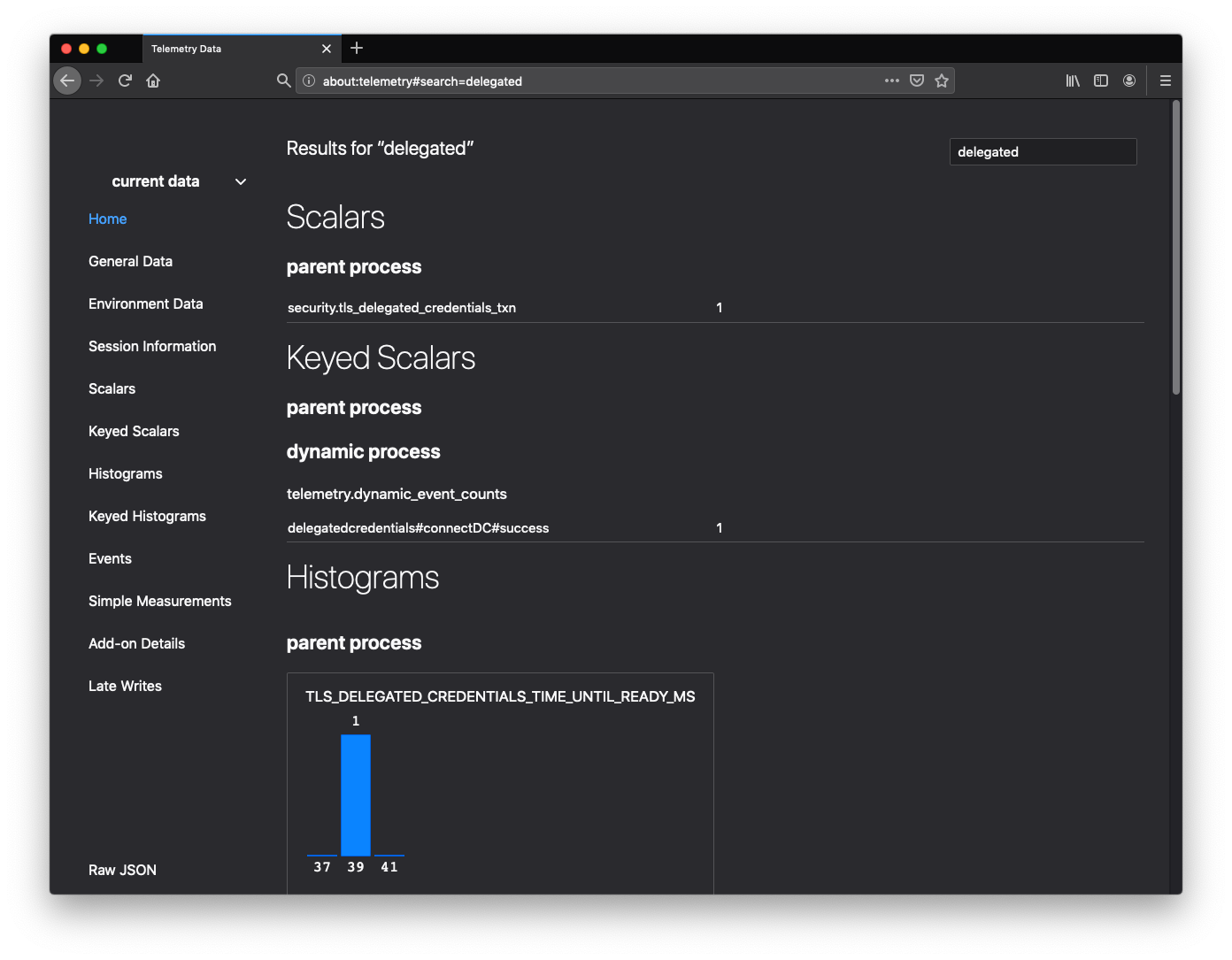
Delegated Credentials telemetry in Nightly 72
You can also read more about telemetry, studies, and Mozilla’s privacy policy by navigating to about:preferences#privacy.
See It In Action
If you’d like to enable Delegated Credentials for your own testing or use, this can be done by:
- In a Firefox Nightly or Beta window, navigate to about:config.
- Search for the “security.tls.enable_delegated_credentials” preference – the preference list will update as you type, and “delegated” is itself enough to find the correct preference.
- Click the Toggle button to set the value to true.
- Navigate to https://dc.crypto.mozilla.org/
- If needed, toggling the value back to false will disable Delegated Credentials.
Note that currently, use of Delegated Credentials doesn’t appear anywhere in the Firefox UI. This will change as we evolve the implementation.
We would sincerely like to thank Christopher Patton, fellow Mozillian Wayne Thayer, and the Cloudflare team, particularly Nick Sullivan and Watson Ladd for helping us to get to this point with the Delegated Credentials feature. The Mozilla team will keep you informed on the development of this feature for use in Firefox, and we look forward to sharing our results in a future blog post.
The post Validating Delegated Credentials for TLS in Firefox appeared first on Mozilla Security Blog.
The OA Interviews: K. VijayRaghavan, Principal Scientific Adviser, Government of India

The introduction to this interview with K. VijayRaghavan is longer than the actual interview, but in this case it's words well spent, as Richard Poynder discusses why India won't be joining Plan S (which aims to entrench open access scientific publication). "India is still moving towards a national open access policy, but wants to develop its own approach rather than join cOAlition S." Why? Well, this is suggestive: " most believe that the practical outcome of the initiative will be a near-universal pay-to-publish environment in which the main beneficiaries will be the publishing oligopoly, not the research community." Yes, that would be a bad outcome. And in this light, India's actions are unsurprising.
Web: [Direct Link] [This Post]Google Buys Fitbit for $2.1-Billion, Made by Google Wearable Device on the Cards
 Google has made yet another big-ticket purchase by buying the fitness giant Fitbit. Google has just announced that it has bought Fitbit for $2.1 billion. It seems like the company wants to gain traction in the fitness segment as it did with the Pixel in the premium smartphone segment. Just yesterday a report by Reuters had claimed that Google was in talks to buy the fitness tracker company.
Continue reading →
Google has made yet another big-ticket purchase by buying the fitness giant Fitbit. Google has just announced that it has bought Fitbit for $2.1 billion. It seems like the company wants to gain traction in the fitness segment as it did with the Pixel in the premium smartphone segment. Just yesterday a report by Reuters had claimed that Google was in talks to buy the fitness tracker company.
Continue reading →
From Lost to Belonging

People really liked this keynote, and I can see why, but it doesn't really resonate with me. The core message is "How we move forward has to be through collaboration. Find others working on similar projects, look across institutional structures and across borders." But I think what I'm up to with open education is still different from what other people are up to. "Our IOWA (ie., our one and only goal), as a community, is to ensure our students are successful in their learning through accessible education." Which means, "customization, inclusion, diversity, accessibility, all are under the umbrella of equity, and isn't that we are trying to do here? Create an equitable environment for our students to be successful?"
To me, there's far too much us doing something for them in all of this. Education - including open education - has never fully embraced the idea that people's lives are their own to lead, and that they want, and should have, the right and the freedom to define their own objectives their own values and their own beliefs. We get told - a lot - what we should believe and what we should be working toward. But my objective, as a developer, educator and supporter of open learning isn't to 'ensure success' or 'create an equitable environment'. It isn't to build big institutions or grand collaborations across borders. It isn't limited to students. It's mostly to get out of the way, and then, as needed, to offer tools resources, encouragement and support as each person pursues their own good in the own way.
Web: [Direct Link] [This Post]Twitter Favorites: [NewUrbanism] Today is the day @Bladerunner was set. What did the movie get right about #cities in 2019? https://t.co/LBY6ZZixUJ #BladeRunner2019

Today is the day @bladerunner was set. What did the movie get right about #cities in 2019? newsweek.com/blade-runner-d… #BladeRunner2019
Twitter Favorites: [joshtpm] Whenever I see Boris Johnson and his shambling gregariousness I wish he weren't actually a douchebag. But these hopes are in vain of course.

Whenever I see Boris Johnson and his shambling gregariousness I wish he weren't actually a douchebag. But these hopes are in vain of course.
Twitter Favorites: [mbalazo] I hope Rage Against The Machine have a new song where they're mad about all the different streaming services.

I hope Rage Against The Machine have a new song where they're mad about all the different streaming services.
"Water is the new oil. Data is the new plutonium. Climate is the new Armageddon."
Autonomous homicide
This is the last horror story I’ll post, for a while — as some of you have suggested, it’s back to my day job of helping nonfiction writers and analyzing media. This story was disturbing enough that the sponsor rejected it, so I never published it on Twitter. There is graphic content here. If you … Continued
The post Autonomous homicide appeared first on without bullshit.
Why you should use `python -m pip`
Why you should use `python -m pip`
Brett Cannon explains why he prefers "python -m pip install..." to "pip install..." - it ensures you always know exactly which Python interpreter environment you are installing packages for. He also makes the case for always installing into a virtual environment, created using "python -m venv".
Via @brettsky
Borrowing Mike's Soul for 24 Hours
After my brief test drive of a Kia Soul Electric on Tuesday, I wanted to give Catherine and Oliver a chance to experience the car and see how it worked for them as passengers.
I asked personable owner of Pure EV Mike Kenny whether I might borrow the Soul for an afternoon and his reply was “you know there’s such a thing as overnight test drives, right?”
I did not. But I immediately signed up for one.
Mike met me at the Charlottetown Mall bus shelter yesterday afternoon, ran me back to the dealership on Sherwood Road, and then handed over the keys to his Soul for 24 hours.
I drove home to fetch Catherine and Oliver, and we headed off on a field trip to the north shore–Mike’s suggestion, as there’s a free Park Canada-operated level 2 EV charger at Dalvay.
And we found it exactly as described:

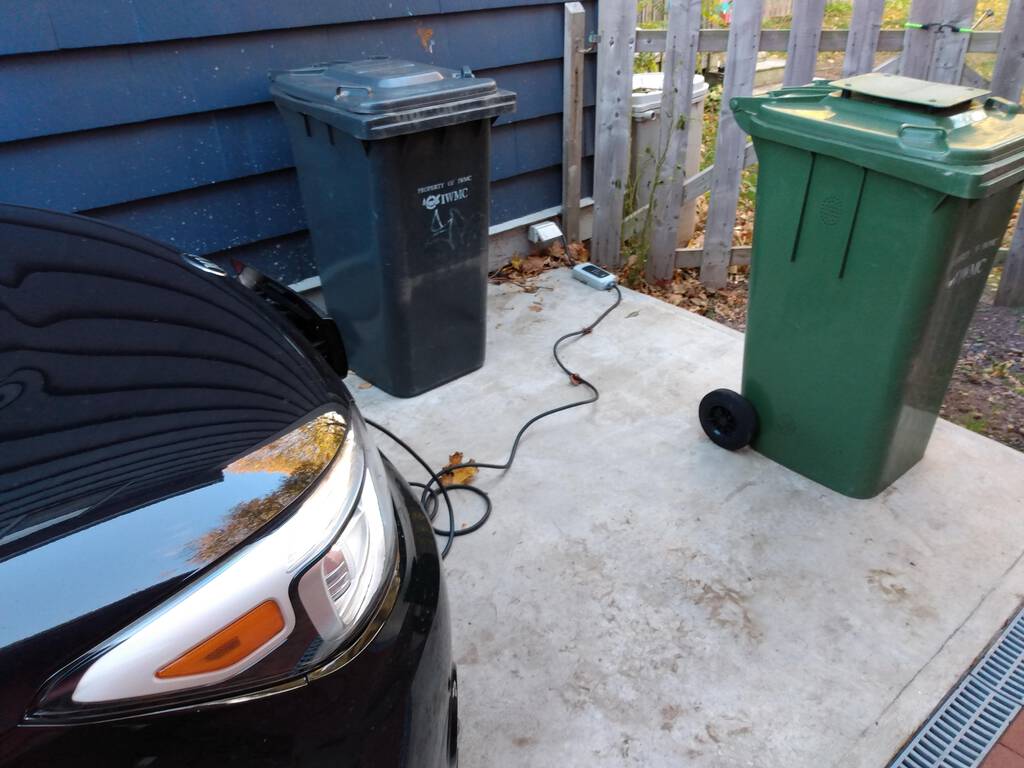
Technically we didn’t need to charge at this point, but we wanted the full experience, so we topped ourselves up to 75% and got a chance to figure out how the charger works (in this case I found an odd grey sphere attached to the end of the plug that needed to be removed and set aside during the charge).
Once the car was sated, we continued along the Gulf Shore Parkway, experiencing the full force of the very high winds the Island was struck with yesterday, and seeing firsthand what an amazing job marram grass does at keeping the dunes from blowing away.
On the way back down the Brackley Point Road into town we decided to go out to supper at a place where we could charge the car.
We initially headed to Canadian Tire, thinking the new DC charger there might be in operation, but we found only wires sticking out of the ground waiting to be attached to a charger.
Next we headed to the provincially-operated charger on Gordon Drive, but found it occupied by a provincially-owned Chevy Bolt.
In the end, we found our way to the basement of the Delta Prince Edward, where there are two Tesla destination chargers and a single level 2 Sun Country Highway one.
We plugged ourselves in, had a nice supper upstairs at the Water’s Edge, and, when we returned an hour later, found our charge level had increased from 35% to 55% (meaning we all lost our Price is Right-style guess as to what it would be: I guessed 74%, Catherine guessed 83%, and Oliver guessed 90%).
We finished the evening’s test drive by driving home and plugging the Soul into our regular outside outlet for the night; when I put the car to bed, its display told me it would be fully charged 11 hours and 10 minutes later.
Because we’re monitoring our minute-by-minute electricity usage at home, we’re in a unique position to be able to visualize the charging: here’s a chart showing our electricity consumption last night. The consumption goes up at 8:00 p.m. when I plugged the car in, and dips back down at about 7:15 a.m. Which is pretty close to the estimated 11 hours and 10 minutes the car came up with as an estimate when I started the charge.
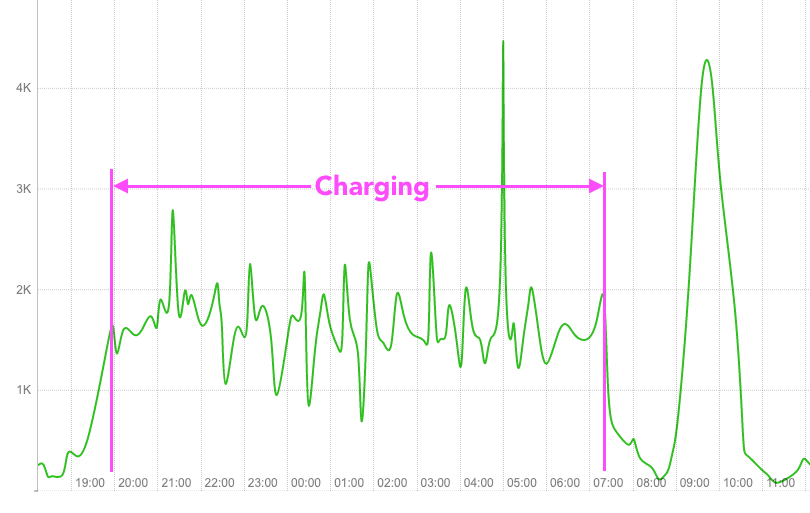
The following uptick in consumption after 9:00 a.m. is due to me placing the wet clothes from the washer into the dryer, which gives you some sense as to the relative draw of the car vs. the dryer.
By my back-of-the-envelope calculation, it cost us less than $3.00 to charge the car from 55% to 100%.
This morning, when I came out to the car to see how things had gone, I found it 100% charged and reporting a 155 km range:
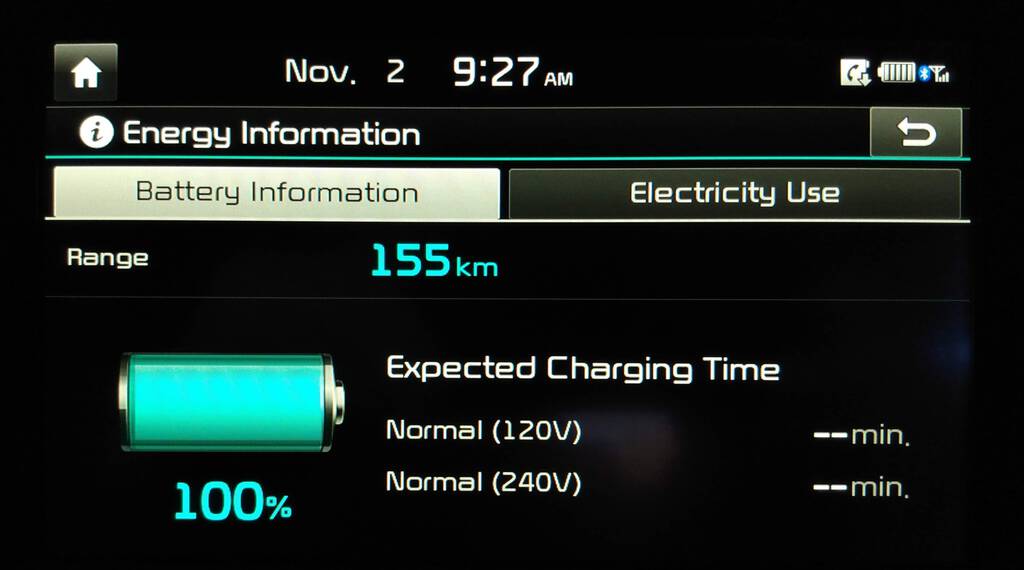
The navigation system in the Soul showed this visualization of the range:
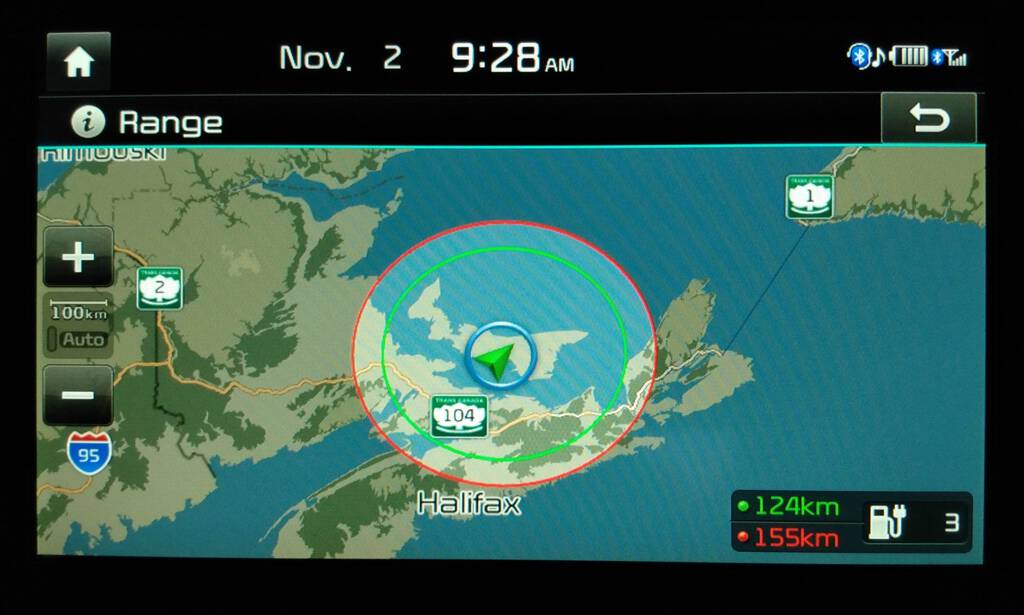
The car’s navigation system manual describes everything inside the green circle as reachable, everything inside the red circle as risky, and everything outside the red circle as unreachable. Which has a kind of Chronicles of Narnia vibe to it.
It’s 141 km from my house to Shediac, NB (where there’s a phalanx of chargers), so into risky territory. But it’s only an almost-too-convenient-to-be-true 122 km to the chargers at the Big Stop in Aulac.
Imagining a trip by Kia Soul EV from our house to Halifax, then, seems like it would be possible:
Weather would have an effect here–it was mild yesterday, and so our range would be much better than in the dark, cold, dead of winter.
I dropped the Soul back to Mike at Pure EV this afternoon after lunch and found a kind of EV jam session happening, with a large crew from Iris making various test drives and purchases. Once the decks were cleared, Mike kindly dropped me back home in a Tesla Model S (which is also for sale, if you’re feeling ambitious).
@AllieRenison Maybe if we as a society didn't elevate billionaire eccentric sociopaths to the level of gods just for being billionaire eccentrics, kids wouldn't dream of becoming them?
|
mkalus
shared this story
from DmitryOpines on Twitter.
|
@AllieRenison Maybe if we as a society didn't elevate billionaire eccentric sociopaths to the level of gods just for being billionaire eccentrics, kids wouldn't dream of becoming them?
130 likes, 7 retweets
Ancaster to Brantford by rail trail
There is a rail trail from Hamilton to Brantford, and today I decided to explore the portion from Ancaster to Brantford. Earlier this year, I rode on the rail trail from Brantford to Port Dover, and I’ve ridden to Hamilton from Toronto several times. Today’s ride filled in the gap between Ancaster and Brantford.
I elected to head out of Ancaster on Jerseyville Road. There were a few more rollers than I expected.

Just after you pass the hamlet of Jerseyville, you will see the rail trail off to the left.


Open skies.

Fallen leaves.

About 3 km in from Jerseyville Road, there is this bike repair stand.

There are distance markers along the trail. They measure the distance from the beginning of the trail near Ancaster. Jerseyville Rd was just before the 19 km mark.

It would have been great to have the other side of these signs measure the distance from Brantford, but this was not true.

Passing under the 403. There is a short section of paved trail here, albeit in pretty rough shape. Nevertheless, it helps when going down this dip, and coming back up the other side.

Welcome to Brantford.

This gate marks a section of eroded trail, but it was nothing serious.

The rail reaches the intersection of Locks and Beach at about the 31 km marker.

The intersection of Beach Rd and Locks, facing towards town. At this point, you turn left, and Locks crosses a bridge and becomes Mohawk.

On the other side, the multiuse trail continues along the road for a while.

Then it veers off and becomes a proper off road trail again.

This is the intersection with Greenwich St. Although it is tempting to continue straight, you are better off turning right and riding along Greenwich.

At the intersection with Mohawk, continue slightly to the left on Cayuga.

After several blocks, turn right on Foster.

At the end of Foster, you can go on a trail whose entrance is just to the left of the pick up truck.

The path will take you to a larger trail along the Grand River, and you should head to the right.

Passing under Veterans Memorial Pkwy.

Fairly soon, you will come to a pedestrian/bike bridge going left across the river.

Turn right at the other end of the bridge.

Here you can see the underpass so that you can cross Colborne St.

The path then ends here but you can continue for a few km along Ballentyne Dr, and it will take you to the start of the TH&B rail trail to Port Dover.

Here is a map of the portion of the route through Brantford.

Since the forecast was for light rain, I took the opportunity to test out some rain gear. I was wearing the shorts portion of a pair of convertible rain pants over my wool knickers. Before heading back to Ancaster I decided to also put on a pair of lime green shoe covers.

From the splash pattern I can tell that I need a mudflap on my front fender.

At Jerseyville Rd, I decided to continue along the rail path, rather than going back the way I came.

The signage at road crossings is more fancy on this section of trail.

A little rain never hurt anyone.

At the finish: dirt on the bike, and my shoes and socks.


I left the rail trail on Mineral Springs Rd, and then took Sulphur Springs back up to Ancaster. If you look at the altitude profile, you will see that from the blue circle onwards, the rail trail was actually sloping down, and that is why I had to climb back up to town.

In retrospect, the better route from Ancaster would have been to descend Sulphur Springs, and then to make the height back up gradually on the rail trail. I’ll do this the next time.

iPhone owners report iOS 13.2 is aggressively killing off apps running in the background

According to multiple reports across Twitter, Apple’s community support forums and Reddit, iOS 13.2 is aggressively closing apps running in the background on iPhones.
Further, MacRumors, one of the first publications to report on the issue, states that several of its community members are complaining about poor RAM management with iOS 13.1 and iPadOS 13.2
Major new bugs introduced in iOS 13.2:
– background downloads often hang forever and never run
– apps get killed in the background so aggressively that iOS effectively doesn’t offer multitasking anymore
…continuing the iOS 13 pattern of breaking long-held basic functionality.
— Marco Arment (@marcoarment) October 31, 2019
I thought it was just a beta thing, but iOS’ memory management has taken a big step back — as in, back to the pre-multitasking days of quitting and launching apps instead of switching between them.
— Nick Heer (@nickheer) October 29, 2019
Same. I was writing an email, swiped to Safari and then went back and the entire thing was gone
— Austin Evans (@austinnotduncan) October 23, 2019
For what it’s worth, I’ve haven’t encountered issues with background apps closing or lag with my iPhone 11 Pro Max. There’s a possibility the problem could only be affecting older iPhones running iOS 13.2 that feature less RAM.
Apps closing in the background could result in users losing progress if they happen to be in the middle of a task. For example, if you were writing an email in Gmail, but multitask to YouTube to watch a few videos, the former app could be automatically be killed by iOS 13.2, causing your work to vanish.
In some ways, Apple seems to be facing an uphill battle with iOS 13. While iOS 12 was relatively stable following a series of issues with iOS 11, the tech giant has rapidly released bug fixes for iOS 13 since its initial release back in late September. It seems the focus on new features rather than stability has backfired for the tech giant.
iOS 13.2, which was launched earlier this week, brought ‘Deep Fusion’ photography to Apple’s iPhone 11 series.
It’s likely that given how widespread this issue seems to be, Apple will release a fix for iOS 13.2’s multitasking issues soon.
Via: MacRumors
The post iPhone owners report iOS 13.2 is aggressively killing off apps running in the background appeared first on MobileSyrup.
Submission to the Rules, Regulations, Private Bills and Privileges Committee
The lovingly-named Rules, Regulations, Private Bills and Privileges Committee of the Legislative Assembly of PEI had a call for public comment on issues under its purview that closed last week. While my comments did not touch specifically on the issues being actively concerned by the committee, I thought them worthwhile of submission, as it is unlikely the these are issues members themselves would see as issues, being on “the other side of the rail” as they are. Here is what I submitted:
My concerns relate to how the experience of observing sittings of the Legislative Assembly and of Committees can be improved for citizens:
1. The security experience of attending a regular sitting has, understandably, been tightened in recent decades, and I do not dispute the need for this. However the unintended side-effect has been that citizens feel less welcome in our legislature. I believe this could be mitigated if the “front face” of the Legislative Assembly in this regard was improved.
The Commissionaires who currently manage this process are focused on the security aspects of admitting or denying entry; I would suggest that there is a role for a staff person, who would not be a security official, who could act as a greeter or welcomer and guide citizens through the security process and into the gallery, answering questions and working to ensure comfort along the way and throughout the sitting. Think of this role, perhaps most usefully, as the “maître d’” of the assembly.
2. The seating in the gallery, while perhaps historically appropriate, is very uncomfortable, and further reinforces this “we’re allowing you in here but don’t feel too welcome” feeling of visiting the legislature. Adding cushions to the church-pew-like seating would be a great service to citizens.
3. Those sitting on the government side of the public gallery have no way of knowing what time it is, as the clock is out of their view; this is exacerbated because cell phones are not allowed in the gallery, and many don’t wear a watch these days but rather rely on their phone to tell the time. Installing a clearly-viewable clock with a view from the gallery would mitigate this.
4. Citizens are not allowed to bring water into the gallery. It’s not clear why this is the case, but it would aid greatly, especially for long meetings and sittings, if those sitting in the gallery were either allowed to bring in water, or provided with access to it.
5. It would aid in the understanding of citizens if simplified copies of the Orders of the Day, or of committee agendas, were provided upon entrance to the gallery.
I’m happy to report that my feedback has already born fruit: when I attended this morning’s meeting of the Special Committee on Climate Change, there were copies of the agenda waiting in the public gallery.
I was, however, still not allowed access to drinking water. In time.
About face

OK. No. I just can't go along with this. From Doc Searls: "The only entities that should be able to recognize people’s faces are other people. And maybe their pets. But not machines." Why can't I go along with this? Because it's basically a call to end artificial intelligence. Let's go back to the beginning: Searls starts off with a compelling account from Polanyi's Personal Knowldge about his oft-cited definition of 'tacit knowledge'. Now two things are true. First, 'tacit' is the opposite of 'explicit', in the sense that the former is ineffible - that is, it can't be put into words. And second, tacit knowledge is like recognizing a person's face. Such knowledge is, in essence, connective knowledge - it's the sort of knowledge a neural network would have, both human and AI. That's why it's so hard to explain how an AI reaches the conclusions it does - the knowledge is tacit, formed by connections, not words. But Searl wants to ban this. Which - to me - makes no sense.
Web: [Direct Link] [This Post]Newfoundland and Labrador working to install level 3 fast-charging stations for EVs

The Province of Newfoundland and Labrador is looking to install 14 electric vehicle fast chargers along the Trans-Canada on the island of Newfoundland.
According to Electric Autonomy Canada, there are only a handful of level 2 chargers in the province and they’re all at private businesses. To remedy this Newfoundland and Labrador Hydro is looking for locations to install 14 fast chargers and it will handle the electricity costs.
You can download the full plan outline on the hydro company’s release here, but mainly the company is looking for islanders on the rock to offer places for the hydro company to install its stations.
There are a few special requirements needed to host a charging site. First up it needs to be in one of a handful of select municipalities near the Trans-Canada highway.
The selected locations are as follows:
- Greater St. John’s Area
- Holyrood
- Whitbourne
- Goobies
- Port Blandford
- Glovertown
- Gander
- Bishop’s Falls
- Badger
- South Brook
- Deer Lake
- Corner Brook
- Stephenville Crossing
- Port Aux Basques/Doyles
To be suitable, the hydro company says it must include two full-size parking spaces along with enough land to house the charging station. The infrastructure is slated to take up a four by 10-metre space.
There are 18 other requirements for a station. They can be found on pages five and six of the document but some of the main issues involve sufficient lighting, cost, nearness to the highway, 24/7 public access, space for future expansion and proximity to a hydro line.
The last thing to mention is that this entire project is contingent on Newfoundland and Labrador Hydro receiving funding, although it never indicates where this funding might come from. MobileSyrup has reached out to find more funding information.
Source: Newfoundland and Labrador Hydro Via: Electric Autonomy Canada
The post Newfoundland and Labrador working to install level 3 fast-charging stations for EVs appeared first on MobileSyrup.