A good start: "The immediate goal of this project is to provide a Micropub endpoint that can be hosted on a service like Heroku, configured via files stored on a GitHub repo, and save posts back to that repo for publishing with a static site generator such as Eleventy, Hugo or Jekyll. The software is fully documented and tested." Can't wait to try it out. :)
Web: [Direct Link] [This Post]Rolandt
Shared posts
Don’t Take Your Members’ Side Against Your Employers
Consider this story published in The Guardian a few weeks ago.
Screenshots from a private staff community were used to support a national story to attack the company.
A private community isn’t really private at all – it’s just exclusive.
A disgruntled member, cunning hacker, or a curious relative with access to any member’s phone can quickly put messages into the spotlight.
Which is why you never say anything in a private group which would be embarrassing in the public sphere.
Last year, we worked with one community manager who agreed with member statements in an MVP group that their CEO is a clueless idiot.
This might seem like a shortcut to bond with your members, but it does irreparable harm.
Not only can anyone privy to the conversation cause real damage to your career, but it doesn’t help your company or your community efforts if members think your company is being badly led.
The moment you take your members’ side against your employers you have a big problem.
Any private group you join should have a specific purpose and you should enforce that purpose.
Don’t allow discussions privately which you wouldn’t allow publicly (and definitely don’t join in).
If members have complaints, engage with them to resolve them.
If they engage in discussions outside of the groups’ purpose, ask them to take it elsewhere.
Comics RSS
If you use an RSS reader, and like reading comics, then this is the site for you! Preview comic strips, and if you like them, then add the RSS feed to your reader.
Calvin & Hobbes is my all-time favorite.
Twitter Favorites: [agotoronto] Tonight’s talk between Zadie Smith and @EleanorWachtel will be on @cbcradio’s Writers and Company on November 17! https://t.co/HJTg6bd726
Tonight’s talk between Zadie Smith and @EleanorWachtel will be on @cbcradio’s Writers and Company on November 17! pic.twitter.com/HJTg6bd726
Twitter Favorites: [RMNarrative] Never forget your roots, Nationals, never forget where you came from: https://t.co/4jBMoqAF8J
Never forget your roots, Nationals, never forget where you came from: pic.twitter.com/4jBMoqAF8J
Twitter Favorites: [ByJasonFoster] I know it's not the same, but on the 25th anniversary of the great 1994 Expos, Montreal gets a glimpse of what it would've been like.
I know it's not the same, but on the 25th anniversary of the great 1994 Expos, Montreal gets a glimpse of what it would've been like.
“Women I meet every week assure me that they are never going to feel perfectly safe again”
Slate: Why I Haven’t Gone Back to SCOTUS Since Kavanaugh. “Some things are worth not getting over.” By Dahlia Lithwick.
“It is not my job to decide if Brett Kavanaugh is guilty. It’s impossible for me to do so with incomplete information, and with no process for testing competing facts. But it’s certainly not my job to exonerate him because it’s good for his career, or for mine, or for the future of an independent judiciary. Picking up an oar to help America get over its sins without allowing for truth, apology, or reconciliation has not generally been good for the pursuit of justice. Our attempts to get over CIA torture policies or the Iraq war or anything else don’t bring us closer to truth and reconciliation. They just make it feel better—until they do not. And we have all spent far too much of the past three years trying to tell ourselves that everything is OK when it most certainly is not normal, not OK, and not worth getting over.
[…]
Sometimes I tell myself that my new beat is justice, as opposed to the Supreme Court. And my new beat now seems to make it impossible to cover the old one.”
Link via MetaFilter.
Mobility Lanes in North Van City
Councillor Tony Vallente sends in this post from the City of North Vancouver, in anticipation of the new RapidBus service to Moodyville and through CNV. Click title for helpful illustration

As previously suggested in Dan Ross’s post More than Enough in Moodyville, a multi-year transformation is underway in the North Vancouver. The arrival of the Marine Drive RapidBus delayed from Spring 2019 to early 2020 is very much underway.
A complete street is taking place on East 3rd Avenue in the City of North Vancouver, with space allocated for walking on sidewalks, a Mobility Lane, a dedicated bus lane (currently used as parking, all hail Shoup!), and a lane for cars.

A Mobility Lane is CNV lingo for a space that serves bikes, electric mobility devices, e-scooters, and probably other stuff we do not know will exist in the near future. (Councillors McIlroy and I passed a motion in July asking staff to prioritize segments of the City’s AAA cycling network as Mobility Lanes.)
The City of North Vancouver has been very diligent about attaining adequate space along the East 3rd corridor for years and that vision is now coming to fruition as the new Moodyville will be well served by RapidBus and also have space for alternate modes.
If the change in Moodyville to complete streets seems insufficient, look at Chesterfield at 3rd Street where a new development included a segment of off road. This is the new standard for bike routes in the City. As more people use them with an increasingly diverse number of transportation devices, we can expect the outcry for a more complete transportation network to grow.
Transportation options in North Vancouver are beginning to be plentiful.
The dreaded Catalina (OSX users...sorry) But anyone can read, of course - Jeffery Smith
Vancouver Impressions: Cascadian Guest Post

In September, Michael Anderson, senior researcher with Sightline Institute (Cascadia’s sustainability think tank), and Kiel Johnson, founder and operator of Portland’s Go By Bike (North America’s largest bike valet) visited Vancouver as part of a two-family touring holiday.
Anderson and Johnson rented a van to get to Vancouver because, well, kids and stuff. Plus, it was much cheaper and faster than the train. Whatever to do about that?
Gord invited the duo to write about their trip, and they did — in dialogue form.
Says Anderson: “I think we could have gone on for pages about things we saw and thought about the city, but Kiel rightly suggested keeping it pretty narrow.”
First impressions about Vancouver? How is Portland doing for cycling? What were the disappointments?
(Canadian spellings added for clarity.)
Michael Andersen: Hey Kiel, thanks for joining this text chat about our visit to Vancouver this fall. Gordon invited us to write something up for Price Tags and we hope this’ll be an interesting way to share a couple outsiders’ quick reactions to the city. We know each other through Portland bike stuff — I used to write for the news site BikePortland.org, you started the Portland bike valet that serves our big research university and is probably the single most popular bike-trip destination in North America. So bike stuff is what we’ll focus on here.
Kiel Johnson: I remember in 2009 telling my parents that I wanted to live in Portland because it was going to be the biggest bicycling city in North America. The next year, Portland passed a bike master plan calling for 25 percent of all trips by bike by 2030 and we had a mayor with a vision of making Portland the capital for sustainable urbanism. This past week, the headline in Portland is that bicycling, which has remained flat for the past 12 years, seems to be on a decline. Portland’s largest transportation project right now is $500 million to widen a freeway in the city centre. Visiting Vancouver made me wonder if I had picked the wrong city.
Michael: Yeah, I’d previously visited Vancouver in 2010 and 2013 and the pace of change on bike infrastructure, at least in the central-ish city, is like nowhere else I’ve seen in the US or Canada. I got to see a lot of cities when I was a staff writer for the U.S. bike advocacy organization PeopleForBikes. Many cities are investing and getting results, but none have invested in a top-quality network like Vancouver has, and none have posted consistent ridership growth like it has, either.


Kiel: At least once a week Portland’s former mayor Bud Clark cycles by the bike valet. He was a two term mayor from 1985 to 1992 who before being mayor was the owner of a bar. I recently watched his farewell address and was struck by how committed he was to continue participating in city life and also how much of the good urban things we have were because of him. The past four of Portland’s mayors have only been around for one term and never gained enough political capital to do anything big. This is in contrast to Vancouver’s last mayor, who seems like he was able to accomplish quite a lot. I wonder if that has to do with how our different city governments are set up or just luck.
Michael: I don’t know much about Gregor Robertson’s motivation or background, but it seems like the way this sort of thing works in general is that one city does something that works, and (if conditions are right) leaders in other cities notice. I think one reason Portland got famous for bike stuff is that it sort of came out of nowhere — Clark had been elected to lead a fading industrial city with very little biking and a stagnant population. In 1985, everyone would have called Portland “Rust Belt” if it had been a couple thousand miles east. Whatever else happens in Vancouver or Portland, I hope Vancouver becomes a powerful example for other North American cities. We have climate advantages in the Northwest, but changes like these are within the financial reach of any city. It just requires prioritization, year after year.
Kiel: On our trip, the one thing we kept dreaming about was a high speed rail connecting Portland/Seattle/Vancouver and how that would help merge the three cities. That by having faster transportation between our cities we can better share those ideas with each other. Mayors and city leaders would take better notice of those good urban ideas and citizens would demand more. Maybe a high speed rail line would speed up some of the transfers of good ideas? The entire time I was in Vancouver I was making my mental list in my head of people I wanted to show how well the city is working. Just today I was arguing with a neighbour about neighbourhood greenways (that’s what Portland calls side streets with bike priority) and said you gotta go to Vancouver — they work really well. In a recent public forum I was at, someone compared a car diverter to the border wall between Israel and Palestine. I wonder if they had been able to see how they work in Vancouver they would have had the same idea. If it was an easy beautiful relaxing 4 hour train ride it would be a lot easier to experience.
Michael: OK, enough kissing up. This was your first visit to Vancouver. What were you disappointed by?
Kiel: Got to expand the colour palette. A lot of grey conservative boring buildings. Some diversity in architecture would have been welcomed. I’ve been really enjoying the new Dumbbell building in Portland. What about you?

Michael: We took a Skytrain trip to Metrotown in Burnaby, which I’ve been hearing about for years as a model for suburban infill. And I mean, it’s already unlike any other suburban rail station area on the continent. But Kingsway still looks like this. I don’t know what I was expecting, but there’s only so much you can do to purge the poison of auto-oriented development once it’s infected an area. Towers of rich people living in this one little patch of Burnaby because, unlike other parts of Burnaby, it gives them a chance to dart quickly into a human-oriented city, take advantage of its economic and environmental gifts, then dart quickly away. It’s such a tragedy that we spent so many decades casting motordom in stone.
Kiel: It is a really hard stone to crack. But I think by visiting each other more, we all get better tools to crack it.
President Jimmy Carter and Leader of Nigeria Olusegun Obasanjo looking like their about to drop the hottest mixtape (1977) pic.twitter.com/KVA05Cq92S
|
mkalus
shared this story
from |
President Jimmy Carter and Leader of Nigeria Olusegun Obasanjo looking like their about to drop the hottest mixtape (1977) pic.twitter.com/KVA05Cq92S
512 likes, 104 retweets
Librem 5 September 2019 Software Update
Here’s what happened to the Librem 5 software in September. This doesn’t cover every single improvement or fix that was made, just a selection of them. You can follow the development of the software in our GitLab instance.
Applications
Developers and designers on the Librem 5 team have been working to bring the user experience closer to the design goals, with lots of help from developers and designers elsewhere in the community.
Messaging
Chatty is still receiving new features, like support for file uploads to XMPP chats.
There has also been a certain amount of polishing and fine-tuning the user interface, with improvements to the conversation view.
Chatty now starts in the background to ensure that incoming messages can be received even when the application itself is not shown.
Settings
An incredible amount of work has been put into making the Settings application work well in portrait mode. The large number of dialogs and pages, combined with the combinations of options that can be chosen, make it a challenging application to work on.
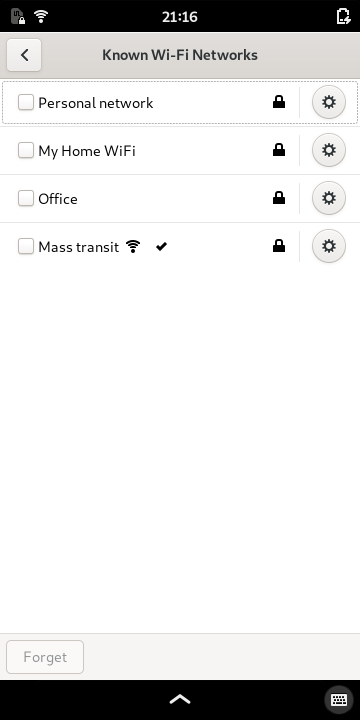
Network dialogs can expose a lot of settings, making it difficult to present them nicely on smaller screens. Despite that, the known networks dialogs have been updated to work well on the phone.

Other dialogs, such as Notifications needed some work to make them adapt to the Librem 5’s display.
Behind the scenes, a few improve the application for general GNOME users as well as users of the phone.
Software
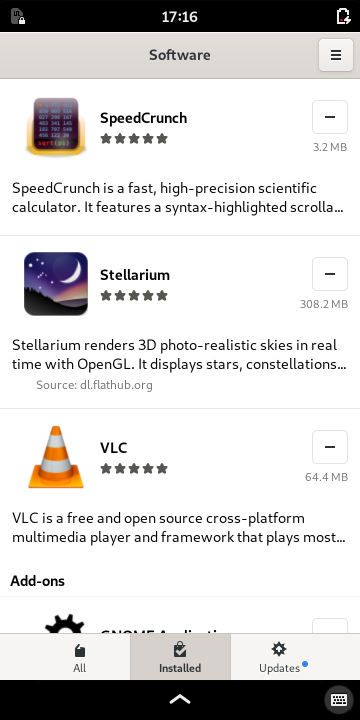
GNOME Software has been adapted for use on the phone and can be used to install new applications, as well as to update the system software.

Calls
One of the notable new features in Calls is that incoming calls can now be accepted when the screen is locked.
Improvements in emergency call support that are being made upstream in ModemManager aim to provide better provision of emergency calls in a range of situations – such as when the SIM is locked or not present.
Thank you for the entries to the ringtone competition, which are now included in the default system image.
Other Applications
In addition to working on high priority tasks, our developers have taken the initiative to get a few more applications working seamlessly on the phone. The Podcasts app is one of these, getting minor fixes to work on the Librem 5.
Libhandy
The adaptive widget library continues to get more features and improvements, culminating in developer.puri.sm.
Libhandy is now also packaged for PureOS.
Shell and Compositor
The shell now shows all available applications, not just favorites which still appear at the top of the app drawer. A search bar makes it easier than before to locate applications.

The general experience of using the shell has also been improved thanks to a flurry of changes which make easier to find the app you are looking for. We’d like to thank Zander Brown for the many contributions to this release.
Alongside new features like these, rendering performance has been increased through tweaking low-level drawing, such as blending.
Notifications from applications are now supported. This was introduced to support Chatty, and was further improved by Zander Brown. As a result, many applications that use notifications are now noisier than before, making the notification settings useful.
The translations for the shell itself have been updated despite problems with the Zanata service that we have been using (see the Community section below). This occurred in merges over the course of the month.
Thanks to a submitted upstream), Clutter-GTK applications should now work on the phone. There are quite a few popular applications that use Clutter-GTK, so having it work is important to users.
SDL applications received similar attention to ensure that they use the Wayland backend rather than fall back on X11 support.
The order of layers can be merge request ensured that the virtual keyboard doesn’t get hidden behind layers that expect text input.
When the user shuts down the phone, the screen now shows visual feedback to the user.
Key bindings for the shell are now read in the same way as GNOME shell, using the same schema. This makes configuring and using the shell easier when using an attached keyboard.
Virtual Keyboard
Squeekboard, the virtual keyboard, has seen active development over the last month, being refactored and rewritten in parts.
The way keyboards are styled got some changes.
Multitouch input is now supported and the keyboard handles multi-key rollover, it should now keep up with users who type quickly.

A number of forum members have contributed keyboard layouts for more languages and started a forum discussion on the best practices for language and keyboard contribution and discovery.
Kernel
We start with an overview of Purism’s contributions to Linux 5.3 that covers much of the current work on supporting the phone in the latest stable release of the kernel.
Alongside this, efforts continue to mainline support for the accelerometer and other peripherals.
Community
In response to demand from members of the list of applications in development for the phone.
For a while we have been using the Zanata translation server to manage translations of the shell and other components. Unfortunately, there were some issues with the service earlier in the summer.
Media
Photos and videos of the Librem 5 in different stages of production have been appearing on a video of an early production phone in use.
Documentation
Progress on the developer documentation has slowed down as the immediate focus shifts to user documentation. Guides for user manual.
Work is ongoing to produce a quick start guide for the phone in a printable format.
More to Come
We’re trying to increase the rate of progress reports as we move into the last quarter of 2019. Unfortunately, things slipped a little when we got to the end of summer, so the reports get longer to write and have to contain more things, and so on. In any case, we’ll try to get an October update out by the end of the month.
Thanks for reading!
The post Librem 5 September 2019 Software Update appeared first on Purism.
You Choose: Follow-Up
It came to my attention after writing my blog post about how we choose the web we want that the pessimism is about not being able to make a living from blogging.
Here’s my followup: I don’t care. Bite me.
Memory Reclaim in the Windows Subsystem for Linux 2
We’ve added a new Windows Subsystem for Linux (WSL) feature in Windows Insider Preview Build 19013: Memory Reclamation for WSL 2! Previously, when the memory needs of the WSL2 Virtual Machine (VM) would grow, either from your workflow or by the Linux kernel, the overall memory allocated to the VM would also grow by allocating more memory from the host. But, once the workflow is done, that memory which is no longer needed by the workflow would not get released back to the host. Now with memory reclamation in WSL 2, when the memory in Linux is no longer needed it can be reported back to the host where it will be freed and your WSL 2 VM will shrink in memory size.
You can learn all about this new feature by checking out the quick video below or reading on in this blog post.
Hands on with memory reclamation
When a Linux process releases in-use memory, that memory will then be returned to the Windows host. Let’s break this down with an example.
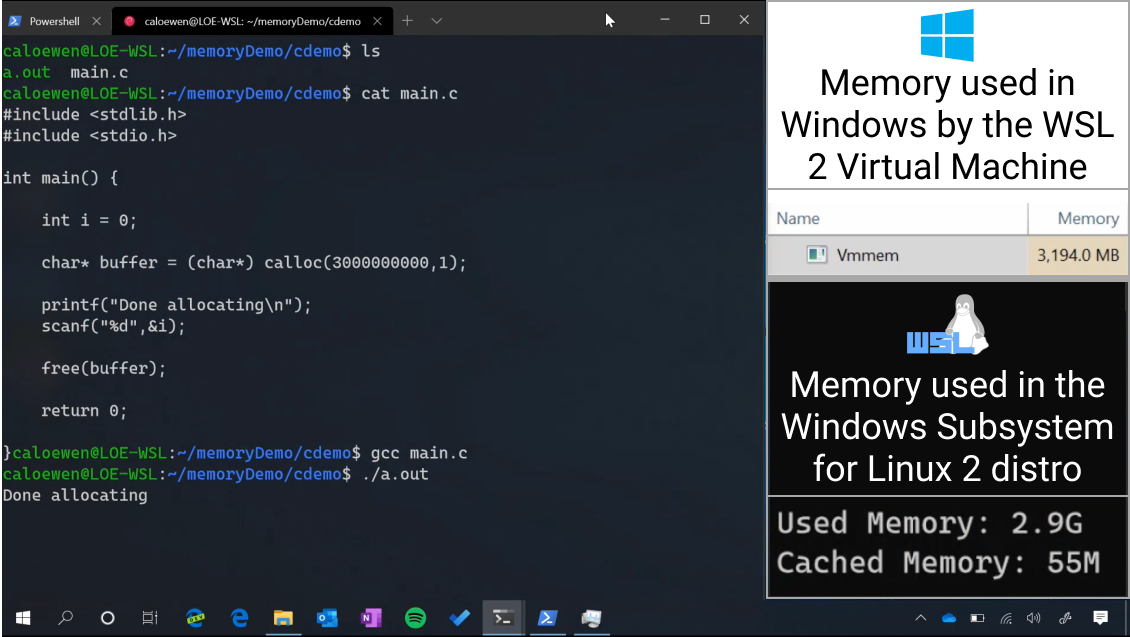
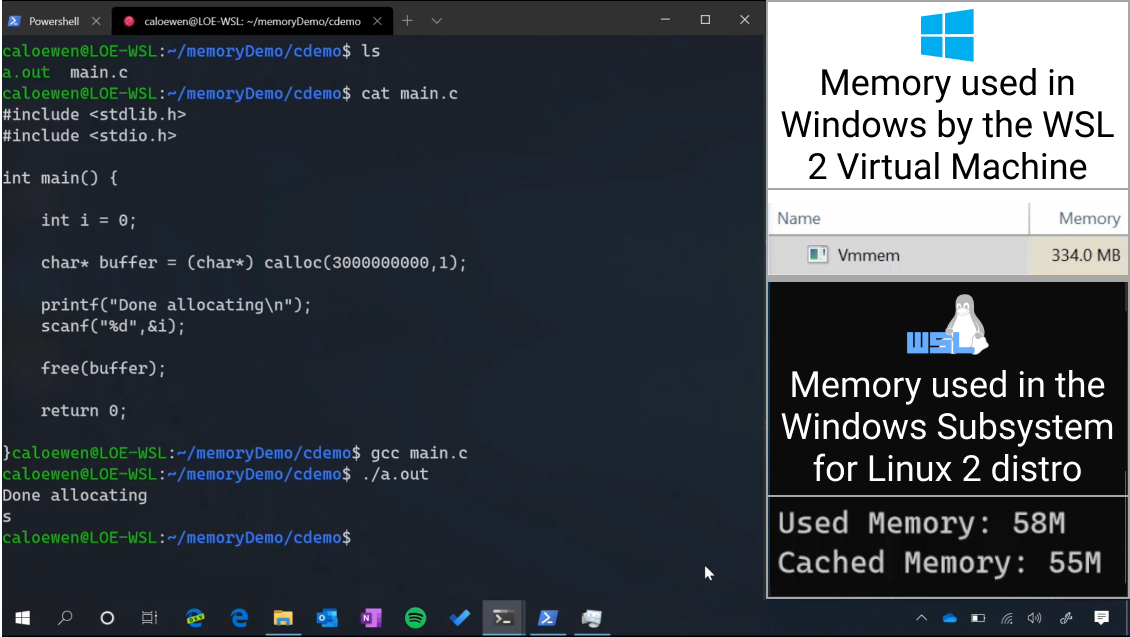
We’ll run a simple C application which will use a large amount of memory. Here’s the source code:
#include <stdlib.h>
#include <stdio.h>
int main() {
int i = 0;
char* buffer = (char*) calloc(3000000000,1);
printf("Done allocating\n");
scanf("%d",&i);
free(buffer);
return 0;
}
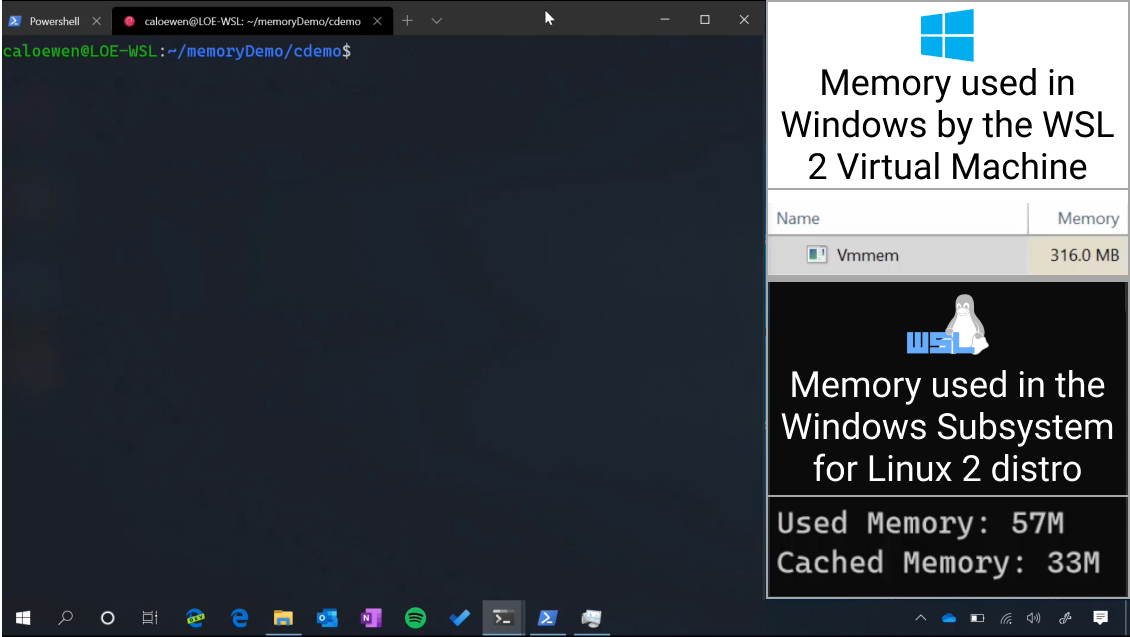
Before we run the app, we are using a small amount of memory in both Windows and Linux. We’re measuring the memory used in Windows by watching the memory use of the ‘Vmmem’ process which is responsible for the virtual machine that powers WSL2. In Linux, we used the free -h command to output the amount of used and cached memory.

Once we run the app, memory use in our Linux distro grows and so does our WSL 2 VM’s memory in Windows.

Then we free the in-use memory, and the ‘vmmem’ process which powers your WSL 2 VM shrinks back down in size, meaning that freed memory is now back on your Windows host, and ready to be used in other applications!

The other half of the story: cached memory
User processes are not the only things that use memory in the Linux VM. The Linux kernel also uses many caches including a page cache, which caches file contents to improve file system performance. Let’s look at a more real-world example to see how this comes into play.
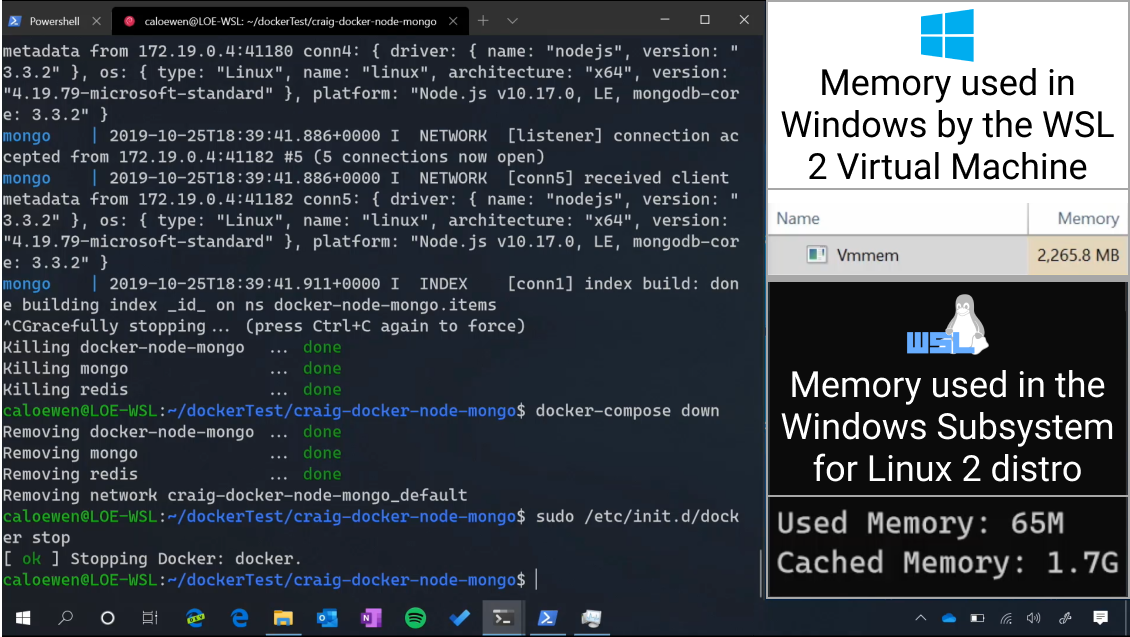
We’ll run a sample container app that starts up some databases and a NodeJS server using docker-compose. You can find the source code here: craigloewen-msft/docker-node-mongo (thank you Github user: bradtraversy for creating the original project!)
After we build the images and run the containers, our memory usage is sitting at 2 GB in Windows, even though our in-use memory in Linux is just at 50MB.

This is because we accessed a lot of different files, and now our page cache is at 1.7GB in size. We do not free the page cache until the Linux kernel frees it. This is a design decision to ensure you experience the performance improvements of the page cache. If you wish to drop the contents manually you can run echo 1 > /proc/sys/vm/drop_caches as the root user to do so. Once that memory is freed, then it will also be returned to Windows and your WSL2 VM will shrink in size. In this example, when I close my terminal Windows running the WSL distro the page cache is freed naturally by the Linux kernel.
How it works
This feature is powered by a Linux kernel patch that allows small contiguous blocks of memory to be returned to the host machine when they are no longer needed in the Linux guest. We updated the Linux kernel in WSL2 to include this patch, and modified Hyper-V to support this page reporting feature. In order to return as much memory to the host as possible, we periodically compact memory to ensure free memory is available in contiguous blocks. This only runs when your CPU is idle. You can see when this happens by looking for the ‘WSL2: Performing memory compaction’ message inside of the output of the dmesg command. If you’re a power user you can configure this behavior by editing values in .wslconfig. Please check the WSL 19013 release notes to see these options. Alternatively if you’d like to run this Linux command manually you can run the command echo 1 > /proc/sys/vm/compact_memory as the root user.
Feedback
If you have any questions, or want to stay up to date with news you can find a list of WSL team members that are active on Twitter here. If you run into any technical problems please file an issue on our Github repo: Microsoft/WSL. We’ll be looking forwards to hearing what you think of the new feature!
Further Resources:
Sample commits in the WSL 2 Linux Kernel to enable page reporting: #1 and #2.
The post Memory Reclaim in the Windows Subsystem for Linux 2 appeared first on Windows Command Line.
First Do No Harm
Maya Gans and I are pleased to announce that TidyBlocks has adopted the Hippocratic License, a new open source license that allows people to use software freely with one condition:
The Software may not be used by individuals, corporations, governments, or other groups for systems or activities that actively and knowingly endanger, harm, or otherwise threaten the physical, mental, economic, or general well-being of individuals or groups in violation of the United Nations Universal Declaration of Human Rights (https://www.un.org/en/universal-declaration-human-rights/).
We are grateful for Coraline Ada Ehmke and others for creating this license.

Twitter to ban all political advertising, starting in November

Twitter has announced that it will ban all political advertising starting November 22nd.
In a Twitter thread, company CEO Jack Dorsey noted this is a platform-wide, global ban.
We’ve made the decision to stop all political advertising on Twitter globally. We believe political message reach should be earned, not bought. Why? A few reasons…
— jack
(@jack) October 30, 2019
According to Dorsey, the ban will include candidate and issue ads, although some ads will be exempt, such as those promoting voter registration.
Later in the thread, Dorsey noted that this decision “isn’t about free expression,” and is instead about stopping candidates from simply throwing money around to gain followers. “Paying to increase the reach of political speech has significant ramifications that today’s democratic infrastructure may not be prepared to handle,” said Dorsey.
The new political ad policy will be released to the public in full on November 15th, according to Dorsey.
Twitter’s approach to political ads is in stark contrast to fellow social media giant Facebook’s. Earlier this week, the social network doubled down on allowing political ads to be run from all kinds of parties.
“We shouldn’t become the gatekeeper of truth on candidate ads,” Nell McCarthy, Facebook’s director of policy management, wrote in an op-ed in USA Today.
The post Twitter to ban all political advertising, starting in November appeared first on MobileSyrup.
The Toxic Bubble of Technical Debt Threatening America
ETAs: Follow-Up
Some people took my post No ETAs as if I were arguing against doing software estimates of any kind, ever.
I didn’t actually mean that. If your boss, project manager, or person you’re contracting with asks for an estimate, do your best to come up with something accurate. If you’re writing enterprise software, you may even be contractually bound to provide estimates for when features will ship.
There are ways to get pretty good at this. Pay attention to history and avoid wishful thinking. Don’t assume perfect productivity. Allow for the unexpected, because there’s always something.
What I’m talking about is the case where you’re writing a consumer-facing app — something that would get published on an app store, for instance — and customers or potential customers ask about an ETA for a given feature. Don’t do it! (For the reasons stated in the article.)
A Few Ideas from Economist Peter Bernstein
I found all kinds of wisdom in this interview with economist Peter Bernstein. It was originally published in 2004 and the updated online a couple of years ago. A lot of the wisdom sounds familiar, as most general wisdom does, but occasionally Bernstein offers a twist. For instance, I like this passage:
I make no excuses or apologies for changing my mind. The world around me changes, for one thing, but also I am continuously learning. I have never finished my education and probably never will.... I'm always telling myself, "I must sit down and explain why I said this, and why I was wrong."
People often speak the virtue of changing our minds, but Bernstein goes further: he feels a need to explain both the reason he thought what he did and the reason he was wrong. That sort of post-mortem can be immensely helpful to the rest of us as we try to learn, and the humility of explaining the error keeps us all better grounded.
I found quotable passages on almost every page. One quoted Leibniz, which I paraphrased as:
von Leibniz told Bernoulli that nature works in patterns, but "only for the most part". The other part -- the unpredictable part -- tends to be where the action is.
Poking around the fringes of a model that is pretty good or a pattern of thought that only occasionally fails us often brings surprising opportunities for advancement.
Many of Bernstein's ideas were framed specifically as about investing, of course, such as:
The riskiest moment is when you're right. That's when you're in the most trouble, because you tend to overstay the good decisions.
and:
Diversification is not only a survival strategy but also an aggressive strategy, because the next windfall might come from a surprising place.
These ideas are powerful outside the financial world, too, though. Investing too much importance in a productive research area can be risky because it becomes easy to stay there too long after the world starts to move away. Diversifying our programming language skills and toolsets might look like a conservative strategy that limits rapid advance in a research niche right now, but it also equips us to adapt more quickly when the next big idea happens somewhere we don't expect.
Anyway, the interview is a good long-but-quick read. There's plenty more to consider, in particular his application of Pascal's wager to general decision making. Give it a read if it sounds interesting.
Google won’t release Motion Sense API to devs ‘right now,’ may do so soon
Google may reportedly open up the Pixel 4’s much-maligned Motion Sense controls to third-party developers through an API.
In a statement provided to Android Police, the search giant said it had no plans to do so, but that it would let the publication know if that changes. That leaves things open to the possibility, but those hoping third-party developers could connect services and improve Motion Sense will be disappointed.
Google added Motion Sense to the Pixel 4 and 4 XL to power some contextual awareness features for the phone. It relies on the Soli radar chip embedded in the phone’s gratuitous top bezel.
Motion Sense allows for ‘passive’ interactions where the Pixel 4 recognizes the presence of the user. For example, when you reach for the phone to pick it up, Motion Sense detects the user’s hand and wakes the screen. Face unlock begins looking for the user to authenticate them. It makes the process of unlocking the Pixel 4 incredibly quick.
Further, Motion Sense will lower the volume of alarms and timers when users reach for the device.
Google also enabled some ‘active’ interactions, which involve users performing gestures to control the device. For example, users can perform a swipe gesture to control media playback, dismiss alarms or silence incoming calls.
Finally, Motion Sense appeared in two limited demos: Pokemon Wave Hello and Headed South. The former has users wave at Pokemon, and can be set as a live wallpaper. The latter comes from Ustwo, the developer behind Monument Valley, and is a game the incorporates Motion Sense controls in a way that feels completely tacked on.
Considering Motion Sense works with apps like Spotify and Headed South, it seems Google is open to third-parties using the tech in a limited capacity.
It’s also worth noting that, as mentioned in MobileSyrup’s Pixel 4 review, Google views the current Motion Sense gestures as ‘Phase 1.’ It has plans for Phase 2 and Phase 3 gestures that will come later, once users have a chance to learn and adapt to the Phase 1 options.
Source: Android Police
The post Google won’t release Motion Sense API to devs ‘right now,’ may do so soon appeared first on MobileSyrup.
1Blocker for Mac Introduces New Features and a Subscription-Based Business Model
I wish I didn’t feel like I needed an ad blocker, but so much of the Internet is junked up with intrusive, distracting advertising, that it’s virtually impossible to use some websites. I don’t have an issue with most advertising, but there’s a line that is crossed too often and ruins the reading experience of many sites. Where that line is varies subjectively by person, but that’s precisely why having a flexible ad blocker like 1Blocker is crucial.
The other reason to use 1Blocker is that content blockers like it manage more than just ads. Comments, share buttons, and social media badges are only a few of the many annoyances found on sites these days. Add to those, things like trackers and bitcoin mining code, and even if you don’t block a single ad, there is still plenty to block.
1Blocker has been one of my favorite utilities since it was introduced with iOS 9 and content blockers were new to iOS. The iOS version was followed by a Mac version the next year. 2018 saw the release of 1Blocker X on iOS, which split blocking rules into multiple categories to get around rule limits imposed by the OS. With the latest update to 1Blocker’s Mac app, that same functionality has been brought to the Mac along with a redesign of the app’s UI and a new subscription-based business model.

1Blocker has an all-new UI on the Mac.
1Blocker for Mac has a brand new two-pane design. The left pane provides access to sets of blocking rules that can be toggled on and off. Across the top of the pane is a segmented control that divides the app’s rule sets into General, Regional, and Custom categories. The right pane, which can be hidden using the button at the bottom of the left-hand pane, is a detail view that lists each of the rules in the selected set.1 The top section of the detail view also includes a search field and stats that report the total number of block and hide rules in the category plus the total number of rules you have enabled and disabled for that category.
The General category includes a total of six sets of rules that are divided into Block Ads, Block Trackers, Block Annoyances, Block Widgets, Block Comments, and Block Adult Sites. Regional rules have German and Russian-specific blockers, and Custom rules allow for user-defined whitelisting, site and cookie blocking, page element hiding, and forcing https connections using the ‘New Rule’ button at the bottom of the window.

Adding a new rule.
Each category of rules can be turned off as a group from the left pane or individually in the detail view, where you’ll find over 110,000 rules spread across all categories. The search field in the detail view is a good way to find a specific rule quickly among the many thousands as long as you know what you’re looking for.
One thing that would be nice to see added to 1Blocker is a keyboard modifier that would allow users to turn groups of rules on or off. This would be useful for search results that return multiple rules that you want to enable or disable as a group.

1Blocker’s Safari extensions.
The other main component of 1Blocker is a series of Safari extensions that mirror the categories in the main app. Just like the iOS version of the app, 1Blocker installs multiple extensions to get around rule limits imposed by macOS.

1Blocker provides per-site customization from Safari’s toolbar.
Individual website settings are managed from a 1Blocker button that’s installed in Safari’s toolbar. From here, you can whitelist any site you visit. By default, whitelisting disables all rules for a site. However, there’s a ‘Disable All Categories’ toggle that can be turned off and used to turn certain categories back on selectively.
You’ll notice there’s a Hide Element option in the toolbar button’s options too, but it’s not enabled currently. When you click on the option, there’s a note that the developers are working on reenabling the feature, which will hopefully happen soon.
There’s also an option to force the use of a secure https connection if that option is turned on in the main app, and stats about what is blocked on each site you visit. The number of blocked and hidden elements can be displayed as a badge on the toolbar icon too, but I’ve left that disabled. If you’re curious what the extension blocks, you can click on the ‘Blocked Resources’ section of its menu and review the details, which is a feature enabled by a new API introduced at WWDC this year.

1Blocker shows you exactly what it’s blocking from the toolbar.
One thing users should keep in mind is that the extension and app toggles for activating and deactivating rules don’t sync. That means if you have a set of extension rules activated in Safari but they are turned off in the main app, Safari won’t have access to those rules and won’t block them. The solution that the developers suggest is to leave all of the Safari extensions activated and manage rule activation from the main app. That’s not ideal, but it’s also not particularly difficult to do.
The final big change to 1Blocker is to its business model. The app is now free on all platforms for a limited set of features with a subscription that unlocks all features across the Mac and iOS/iPadOS versions of the app. There’s also a ‘lifetime’ option for people who would prefer to pay once instead of subscribing.
The free version includes the ability to enable one category of rules, whitelisting, which syncs across the Mac, iOS, and iPadOS using iCloud, and the ability to see what the app is blocking from 1Blocker’s Safari toolbar button on the Mac. The rest of the features, including enabling as many categories of rules as you’d like, cloud-based rule updates twice per week, and the ability to create custom rules is available as a free 2-week trial for new customers. Free users will still get rule updates, but only when a new version of 1Blocker is released on one of Apple’s App Stores.
Existing customers who bought 1Blocker on the Mac or iOS will have access to all of the new features on every platform and get a one-year free trial to cloud-based rule updates.
New users can subscribe for $2.99 per month or $14.99 annually, although for the first 48 hours after the launch, the annual plan is on sale for $9.99. There’s also a one-time payment option for new users that costs $38.99 discounted to $32.99 for the first 48 hours after launch. After a free year of cloud-based rule updates, existing users can continue to receive updates for $1.99 per month or $4.99 annually. There’s a one-time payment option for existing users too, which costs $12.99.
I’ve always preferred 1Blocker to other content blockers that I’ve tried on iOS, but the Mac version never received the same attention as the iOS version, and in the past year or so, updates to both have been primarily focused on bug fixes and rule updates. I hope that 1Blocker’s new subscription model provides sufficient ongoing revenue for the team behind it to develop both apps more actively going forward, and in theory, it should.
I love that the Mac app has the features I’ve enjoyed on 1Blocker X for some time now. The reason I’ve stuck with 1Blocker since its introduction is the flexibility it provides. I can block tracking, comments, and other annoyances on all sites and reserve ad blocking to just those sites where they’re the most annoying.
There are more ways to customize 1Blocker than I need myself, but that’s the strength of the app. No matter what your web browsing habits are and which types of web content bother you, 1Blocker can accommodate them, which is why I’ll continue to use it across all of my devices.
1Blocker is available as a free download on the Mac App Store and should be available as a free download on the iOS App Store soon.
- One strange bug I ran into while testing 1Blocker, which I’m told will be fixed in the app’s first update, is that adjusting the height of the app’s window when it’s in compact mode causes it to fly to the left edge of the screen. ↩︎
Support MacStories Directly
Club MacStories offers exclusive access to extra MacStories content, delivered every week; it’s also a way to support us directly.
Club MacStories will help you discover the best apps for your devices and get the most out of your iPhone, iPad, and Mac. Plus, it’s made in Italy.
Join NowThe coming election
As I’ve argued before, an election is currently the only realistic, and very possibly the last, chance of reversing Brexit, though doing so will, in Ian Dunt’s words, be “the most uphill, fraught, emotional, gruelling political battle many remainers will ever have faced”. It is certainly not the most rational route to do so – or, for that matter, to deliver Brexit. That would be a referendum, which unlike an election would focus solely on the question at hand: whether to proceed on the basis of Johnson’s deal or to abandon Brexit, and, unlike a ‘first past the post’ vote, would do so on the basis of a majority of the population.
But it has been clear for a while now that there is simply no majority in parliament for holding such a referendum. Perhaps there could, or should, have been at some point – for example via a Government of National Unity, or a Kyle-Wilson style amendment to a Meaningful Vote – but all attempts to do so have foundered. This means that ever since the Withdrawal Amendment Bill (WAB) passed its second reading the writing has been on the wall for remain. With perseverance, a perhaps amended version of that would have eventually passed into law and Brexit would be a done deal.
Some remainers have been shocked and angered by the LibDem and SNP decision to push for an election, but from a remain perspective this was unquestionably the right tactic. By contrast, Corbyn made a tactical error in having to be dragged, not kicking and screaming so much as umming and aahing, to support it. Handled differently, the election could have been presented as something forced on Johnson rather than, as has happened, achieved by him.
Johnson’s foolish gamble
That, however, will soon be forgotten and is a minor error compared with the much greater one that Johnson – or more likely Cummings - has made. For if the writing was on the wall for remain after the WAB passed second reading it was surely a colossal mistake for him not to push on, agree a revised timetable, get his deal passed and then hold an election having ‘delivered’ Brexit after which he could drop any amendments that had been made.
Perhaps future historians will uncover the reason. I suspect the truth is that it was another example of Cummings’ overweening but counter-productive machismo. The only explanation that has been put forward is that the alliance that got the second reading passed was deemed too fragile to stay the course. It would have been tight, but I doubt that’s true. With nifty footwork Brexit was there for the taking and Johnson dropped it (just as the ERG Spartans did when they refused to back May’s deal).
We’ll never know whether that is true now. And, of course, the verdict of historians will depend on the outcome of this election. If he wins outright, especially if substantially, then Johnson will be feted as a master strategist. History is, as they say, written by the victors. For the time being, as Professor Glen O’Hara of Oxford Brookes University argues, the tactic is a huge gamble. It is already the conventional wisdom that, despite the Conservatives lead in the opinion polls, the result is highly unpredictable.
How single-minded will remainers be?
One key determinant of the outcome will be the extent to which remainers will make remain their sole priority to the extent of voting tactically for whoever is the most conducive candidate in their constituency (this is also likely to make national opinion polls misleading). Even without a formal Remain Alliance, nowadays it is much easier for individuals to do this via various websites. But such committed remainers will have to be determined enough to cast their votes in ways they may find deeply repellent.
In particular, especially in England, some Labour remainers are going to have to vote LibDem despite their memory of the Coalition government’s Austerity policies. Some LibDem and Conservative remainers are going to have to vote Labour, despite its hopeless dithering and ambiguity about Brexit over these last three years, and despite what they may think of Corbyn and Labour in other respects.
For, to be clear, the only realistic route to remain is via a Labour government, cajoled and supported by other parties, holding another referendum which remain might then win (if we get to that point, the remain campaign is going to have to get its act together, and quickly). But this is only scenario one of the six main scenarios for the election result, as sketched by Joe Owen of the Institute for Government, and not by any means the most likely.
What will the Brexit Party do?
The other key determinant is what the Brexit Party do. At the time of writing that is not clear. Johnson’s Achilles Heel is that repeated, high-profile, central pledge to have left the EU come what may on 31 October. If Farage runs a full-on campaign against the Tories for having ‘betrayed Brexit’ then he is going to hurt the Tories, and hurt them badly, losing them seats without gaining many, if any, himself. That will be good for remain, so logic would suggest that Farage does not do so (but logic may play little part, especially given Farage’s egotistical character and the fanatical nature of his supporters).
By contrast, any kind of pact, either nationally or locally, between the Tories and the Brexit Party will therefore make Brexit more likely, and, as for remainers, this may well be the last chance for them to get what they want. Yet even if a pact is made, the Brexit Part’s denunciation of Johnson’s deal as not being ‘clean’ (i.e. no-deal) Brexit must already have had some impact. At all events, some Brexit Party voters just will not come over to the Tories under any circumstances.
In the years I have been writing this blog I’ve spent quite a bit of time lurking on pro-Brexit social media sites and there is a clear hard core who, if there is no Brexit Party candidate to vote for, will abstain (or, maybe, vote UKIP or some other fringe nationalist party) rather than vote Tory. That includes some who ‘lent their vote to Theresa May’ but swear they will never do so again. It is unclear that the number of such diehards is high enough to be really significant, but that number can only have been swelled by the shift in their outlook over the last three years to regarding any Brexit deal as a betrayal.
Johnson’s limitations
There is also the question of how Johnson himself will stand up to the scrutiny of a general election. I am not convinced that he is the campaigning maestro that he, and many Tories, believe him to be. For one thing, to the extent that he will trade on the ‘people versus the Establishment’ motif, polling suggests that he is not that widely regarded as being of the people rather than the Establishment. It’s true that he was an asset to Vote Leave, but that allowed him to campaign in a very loose style – waving Cornish pasties around, and so on. If he made a gaffe, it wasn’t fatal, not least as the campaign didn’t even expect to succeed.
Campaigning to be Prime Minister is a very different matter, including as it may unpredictable encounters with the public, probing interviews with tough inquisitors and, perhaps, a televised leadership debate. Plus, with Johnson, there’s the omnipresent possibility of some gargantuan personal scandal emerging. It is telling that during the Tory leadership campaign his minders were at pains to keep him in the background. There was a reason for that – they knew his capacity to implode. For very different reasons, he may prove no more effective on the stump than did Theresa May.
This Brexit election must finally focus on Brexit
Thinking back to that 2017 election, a danger for the present campaign is – paradoxical as it may seem – that Brexit may not figure as prominently as it should, given how important the result is for it. During the 2017 campaign I discussed how there was actually remarkably little discussion of the details of Brexit itself. That could happen again.
Both main parties will be very keen to push their other policy agendas – quite ludicrously, since Brexit will massively affect the capacity to deliver these. They will be aided in that by much of the media. As Peter Ungphakhorn argues in his recent blog post, the media are often more comfortable with the narrow politics of Brexit rather than its technical detail. Relatedly, Simon Wren-Lewis, on his blog, identifies the media predilection for scoops and insider-briefings at the expense of forensic analysis. An election campaign lends itself to the comfort zone of such reporting rather than, say, detailed scrutiny of what Johnson’s deal would actually mean if it came to pass, as well the many things it will leave unresolved.
If so, that will be deeply unfortunate to the point of being unforgiveable. The coming election could well cement the historic strategic decision which, ultimately, Brexit entails. It would be shameful if, now that there is the concrete version of Brexit that did not exist in either 2016 or 2017, this decision were not exposed to full and detailed examination. We are, finally, at the point we should have been before the whole process started: with a definition of what Brexit means in practice, to be compared with remaining in the EU. It is absolutely incumbent upon every journalist, every politician, every commentator - and even the lowly Brexit Blogger - to focus on that question.

Game of Thrones’ upcoming prequel is called ‘House of Dragons’

While Jane Goldman’s prequel to Game of Thrones has crashed and burned, another series set in George R. R. Martin’s universe is rising from the ashes.
HBO has ordered another prequel called House of Dragons that takes place 300 years before the main series. The TV show will follow the family of Targaryen and is based on R. R. Martin’s book Fire & Blood. So far HBO has ordered 10 episodes of the prequel.
HBO has yet to reveal when House of Dragons stream on HBO Max.
HBO Max is the company’s upcoming streaming service that will compete with Netflix, Disney+, Prime Video and other video streaming platforms.
Bell recently confirmed HBO Max’s original content is coming to its Crave streaming platform.
Source: Deadline
The post Game of Thrones’ upcoming prequel is called ‘House of Dragons’ appeared first on MobileSyrup.
It’s going to get very wet. from Rising Seas Will Erase...


It’s going to get very wet.
from Rising Seas Will Erase More Cities by 2050, New Research Shows | Denise Lu and Christopher Flavelle:
Rising seas could affect three times more people by 2050 than previously thought, according to new research, threatening to all but erase some of the world’s great coastal cities.
The authors of a paper published Tuesday developed a more accurate way of calculating land elevation based on satellite readings, a standard way of estimating the effects of sea level rise over large areas, and found that the previous numbers were far too optimistic. The new research shows that some 150 million people are now living on land that will be below the high-tide line by midcentury.
Halloween International Day of Danger and Death for Pedestrians

Last year I wrote about the University of British Columbia study that identified Halloween night as having a 43 per cent higher risk of pedestrian deaths than any other night close to that date. Using available traffic data from the United States, the researchers looked at 608 pedestrian deaths that occurred on 42 previous Halloween nights, and found similar findings to that of a study done 20 years ago.
The graphs below show the spike in deaths of children occuring on Halloween. The second graph is more shocking, showing that 25 percent of those deaths occurred around 6:00 p.m.(at dusk) with the other 75 percent being evenly distributed between 5:00 and 8:00 p.m.


As the Vancouver Sun wrote, even though vehicles are equipped with better safety systems and lights, “car-pedestrian accidents kill four more people on average on Halloween than on other days…Kids aged 4 to 8 faced the highest risks…”
I have previously written about the University of Iowa study that found that children between the ages of 6 and 14 years of age were not able to judge the speed, distance, and safe crossing time in moving traffic. The study found they could not recognize gaps in traffic, and that skill was not fully developed until the child was around 14 years of age. Even a 12 year old crossing experienced a “fail” two percent of the time in the study.
Couple that with the current SUV obsession. SUVs (sports utility vehicles) are responsible for a 46 percent increase in pedestrian deaths and serious injury. Because of their high front ends, pedestrians are twice as likely to die if they are hit by one. Drivers of SUVs are also 11 percent more likely to be killed driving one, as the size and bulk encourages more reckless driving behaviour.
This time of year is also the danger zone for pedestrians of all ages, with the Insurance Corporation of British Columbia (ICBC) observing that November, December, and January are months when vehicles crash into pedestrians, with dusk being the worst time. Even more sobering 75 per cent of pedestrians are being crashed into at intersections, with 57 per cent of those crashes happening when the pedestrian actually was legally crossing and had the right of way.
How can you make Halloween safer for kids? Advice includes using reflective patches on costumes, carrying a flashlight or glow stick to be more visible, ensuring masks don’t obstruct vision, and ensuring everyone looks both ways before crossing the street.
And for motorists? Slow down, change your driver behaviour, and remember it’s the kids’ night. The UBC study recommended making Halloween a car free night in neighbourhoods which actually could solve the problem.
Here’s hoping for a safe night for everyone.

Image: Photographyblogger.net
A Map for Our Minds
From Ian Robertson:
A big map of the Fraser River Watershed laid out on the Seawall by Cambie Bridge.

A unique perspective on how the different areas of BC are connected.
Shaping Vancouver 2019: Conversation #3 – Is Heritage Relevant?
Competing meanings have been attached to heritage. Some feel heritage has broadened too far while others feel strongly that heritage needs to continually re-examine its concepts. This comes at a time when there is increasing questioning of the usefulness of heritage due to its traditional focus on preservation. In this third installment of Shaping Vancouver, we will examine the disruption taking place in heritage and the challenges it faces in remaining relevant.
• There is a growing interest in heritage as a living system of relationships between people and place;
• There is an understood need for greater attention to cultural diversity and how different cultural groups value heritage (e.g. First Nations, women, LGBTQ);
• Classical heritage concepts around building preservation alone do not address contemporary societal needs and issues; resolution of these needs requires broader and more interdisciplinary approaches
Locally, the heritage field in general is just starting to consider these broader ideas.
These panelists to share their insights about their local places:
Angie Bain– Researcher with the Union of BC Indian Chiefs, Director with Heritage BC
Paul Gravett– Executive Director, Heritage BC
Aneesha Grewal- Vice-Chair Punjabi Market Regeneration Collective
Robert Lemon– Architect, Former Senior Heritage Planner for the City of Vancouver
Tuesday, November 5
7-9 PM
Free, donations appreciated
SFU Goldcorp Centre for the Arts (SFU Woodwards): 149 West Hastings Street
Apple’s scissor keyboard MacBook Pro won’t launch until mid-2020: report

It looks like we may have to wait a little longer for a scissor switch keyboard to make its way to Apple’s MacBooks.
Apple reportedly has plans to launch a MacBook Pro with a scissor switch keyboard in mid-2020, according to a new report from often-reliable Apple analyst Min-Chi Kuo, as first reported by MacRumors.
This means laptops with the new keyboard could be announced at WWDC this coming June. It’s unclear if the first MacBook Pro to feature the scissor switch will be the rumoured 16-inch MacBook Pro or part of a more significant redesign to all of the laptops in Apple’s lineup.
The last Apple laptop to feature a scissor switch was the 2015 MacBook Pro. All Apple laptops, including the now-dead MacBook, the MacBook Air and the MacBook Pro feature the tech giant’s beleaguered, low key-travel Butterfly mechanism.
9to5Mac also recently uncovered an image in macOS Catalina 10.15.1 that might have given us another glimpse at the 16-inch MacBook Pro, showing off a keyboard that looks similar to the current one, only with a separated power and Touch ID key.
The image has since been removed from the public release of macOS Catalina 10.15.1, according to 9to5Mac. The new laptop is also expected to feature minimized bezels, as was previously indicated by another icon uncovered in a previous macOS beta.
It’s likely if Apple plans to reveal its new 16-inch MacBook Pro at some point soon, we’ll find out more about the laptop in the coming days.
The post Apple’s scissor keyboard MacBook Pro won’t launch until mid-2020: report appeared first on MobileSyrup.
The Secret Commonwealth
Lyra is in her twenties, a postgraduate student at Oxford, and she and her daemon are not speaking to each other. That is to say: Lyra and her soul (spirit? Genius?) have fallen out. It’s a profound and thrilling premise, and Pullman explores it wonderfully.
Once again, I find myself reading Pullman’s exciting and engaging urban fantasy, always notable for the thoughtfulness of its characters even when they are children, and once again I realize that he’s doing something much larger and more serious than I’d thought. There’s lots here: a bravura attack on aspects of postmodernism, a thoughtful response to Karl Ove Knausgaard. There’s even a hypertext fiction vignette!


(@jack)