Shared posts

08 Nov 15:25

USB Speed – Cheat Sheet

by Martin

Over the years, USB had been upgraded and upgraded and upgraded and it’s easy to loose sight of how fast in theory and in practice a particular version of the USB standard could be. So here’s a quick cheat sheet with the theoretical maximum speed of different USB versions:

USB 2: 480 Mbit/s, ca. 0.5 Gbit/s, 60 Mbyte/s, in practice around 40 Mbyte/s with a hard drive.

USB 3.0: 5 Gbit/s, 400 Mbyte/s to applications, I’ve seen 180 Mbyte/s to a hard drive so far. This was the first USB standard that had sockets that were blue inside to distinguish it from the much slower USB 2, that had sockets that were black or yellow inside.

USB 3.1, Gen 2: 10 Gbit/s (Note: USB3.1 Gen 1 is limited to 5 GBit/s)

USB 3.2: 10 and 20 Gibt/s depending on the number of wires used for the data transfer.

USB 4.0: 40 Gibt/s depending on the number of wires used. So not every USB 4 capable device will support that speed.

More details on Wikipedia.

08 Nov 15:24

iOS 13 wasn't done :: And it still is not

by Volker Weber

iOS 13 release calendar:

13.0.0 19-SEP-2019
13.1.0 24-SEP-2019
13.1.1 27-SEP-2019
13.1.2 30-SEP-2019
13.1.3 15-OCT-2019
13.2.0 28-OCT-2019
13.2.1 30-OCT-2019
13.2.2 07-NOV-2019

That is eight releases in 48 days, averaging one release every single week, which is faster than any previous beta test.

Apple needs to change their process.

08 Nov 15:21

On (Not) Working With Open Source Software Packages

by Tony Hirst

An aside observation on working with open source software packages (which I benefit from on a daily basis. The following is not intended as a particular criticism, it’s me reflecting on things I think I’ve spotted and which may help me contribute back more effectively.)

There are probably lots of ways of slicing and dicing how folk engage with open source projects, but I’m going to cut it this way:

  • maintainer;
  • contributor;
  • interested user.

The maintainer owns the repo and has the ultimate say; a contributor is someone who provides pull requests (PRs) and as such, tries to contribute code in; an interested user is someone who uses the package and knows the repo exists…

The maintainer is ultimately responsible for whether PRs are accepted.

I generally class myself as an interested user; if I find a problem, I try to raise a sensible issue; I also probably abuse issues by chipping in feature requests or asking support questions that may be better asked on Stack Overflow or within a project’s chat community or forums if it has them. (The problem with the latter is that sometimes they can be hard to find, sometimes they require sign on / auth; if I submit an issue to them, it’s also yet another place I need to keep track of to look for replies.)

On occasion, I do come up with code fragements that I share back into issues; on rare occasions, I make PRs.

The reasons I don’t step up more to “contributor” level are severalfold:

  • my code sucks;
  • I have a style problem…
    • I don’t use linters, though this is something I need to address;
    • I don’t really know how to run a linter properly over a codebase;
  • I don’t know how to:
    a) write tests;
    b) write tests properly;
    c) run tests over a codebase.
  • I don’t read documentation as thoroughly as perhaps I should…

Essentially, my software engineering skills suck. And yes, I know this is something I could / should work on, but I am really habituated to my own bad practice, stream-of-consciousness coding style…

One of the things I have noticed about stepping up is that is can be hard to step-up all the way, particularly in projects where the software engineering standards of the maintainer are enforced by the maintainer, and the contributors‘ contributions (for whatever reason: lack of time; lack of knowledge; lack of skills) don’t meet those standards.

What this means is that PRs that work for the contributor but don’t meet the standards of the maintainer, and the PR just sits, unaccepted, for months or years.

For the interested user, if they want the functionality of the PR, they may then be forced into using the fork created by the contributor.

However, a downside of this is that the PR may have been created by the contributor to fix an immediate does, does the job they need at the time, they use it, and move on, but as a goodwill gesture chip the PR in.

In such a case, the contributor may not have a long time commitment to the package (they may just have needed for a one off) so the overhead of building in tests that integrate well with the current test suite may be an additioanl overhead. (You could argue that they should have written tests anyway, but if it was a one off they may have been coding fast and using a “does it work”: metric as an implicit test on just the situation they needed to code to work in. Which raises another issue: a contributor may need code to work in a special case, but the maintainer needs it to work in the general case.)

For the contributor who just wanted to get something working, ensuring that the code style meets the maintainer’s standards is another overhead.

The commitment of the contributor to the project (and by that, I also mean their commitment in the sense of using the package regularly rather than as a one off, or perhaps more subtly, their commitment to using the package regularly and their PR regularly) perhaps has an impact on whether they value the PR actually making it into master. If they are likley to use the feature regularly, it’s in their interest to see it get into the main codebase. If they use it as a one off, or only regularly, their original PR may suffice. A downside of this is that over time, the code in the PR may well start to lag behind that of code in master. Which can cause a problem for a user who wants to use the latest master features and the niche feature (implemented off a now deprecated master) in the PR.

For the contributor, they may also not want to have to continue to maintain their contribution, and the maintainer may well have the same feeling: they’re happy to include the code but don’t necessarily want to have to maintain it, or even build on it (one good reason for writing packages that support plugin mechanisms, maybe? Extensions are maintained outside the core project and plugged in as required.)

By the by, a couple of examples that illustrate this if I return to this idea and try to pick it apart a bit further and test it against actual projects (I’m not intending to be critical about either the packages or the project participants; I use both these packages and value them highly; they just flag up issues I notice as a user):

  • integrating OpenSheetMusic (a javascript music score viewer that is ideal for rendering sheet music in Jupyter notebooks) into music21; an issue resulted in code that made it as far as a PR that was rejected, iterated on, but still fails a couple of minor checks…
  • hiding the display of a code cell in documentation generated by nbsphinx. There are several related issues (for example, this one, which refers to a couple of others) and two PRs, one of which has been sitting there for three years…

Now it may be that in the above case, the issues are both niche and relate to enabling or opening up ways of using the original packages that go beyond the original project’s mission, and the PRs are perhaps ways of the contributor co-opting the package to do something it wasn’t originally intended to do.

For example, the OpenSheetMusic display PR is really powerful for users wanting to use music21 in a Jupyter notebook, but this may be an environment that the current package community doesn’t use. Whilst the PR may make the package more likely to be used by notebook users and grow the community, it’s not core to the current community. (TBH, I haven’t really looked at how the music21 package has been used: a) at all, b) in the notebook community, for the last year or so. The lack of OpenSheetMusic support has been one reason why I drifted away from looking at music packages…)

In the case of nbsphinx which was perhaps developed as a documentation production tool, and as such benefits code always being displayed, the ability to hide input cells makes it really useful as a tool for publishing pages where the code is used to generate assets that are displayed in the page, but the means of production of those assets does not need to be shown. For example, a page that embeds a map generated from code: the intention is to publish the map, not show the code what demonstrates how to produce the map. (Note: hiding input can work in three ways: a) the input is completely removed from the published doc; b) the input is in the doc, but commented out, so it is not displayed in the rendered form; c) the code is hidden in the rendered form but can also be revealed.)

In both the above cases, I wonder whether the PR going outside the current community’s needs provides one of the reasons why the PRs don’t get integrated? For example, the PR might open the package to a community that doesn’t currently use the package, by enabling a necessary feature required by that new community. The original community may see the new use as “out-of-scope”, but under this lens we might ask: is there a question of territoriality in play? (“This package is not for that…”)

08 Nov 15:21

MobileSyrup is giving away a Switch Lite courtesy of Nintendo of Canada

by MobileSyrup
Switch Lite

Are you hoping to do a little portable gaming this coming holiday season? Well, MobileSyrup and Nintendo of Canada have your back.

We’re teaming up with Nintendo to give away a yellow Switch Lite — the gaming giant’s recently released dedicated handheld console — to one lucky MobileSyrup reader.

To enter, all you need to do is make sure you’re following @MobileSyrup on Twitter and let us know either via the social media platform with the #Syrupswitchmemories, or below in the comment section, what your favourite memory with a Nintendo handheld is to enter.

Whether it’s a long car ride on a family vacation with the original Game Boy, or killing time between classes in University with a Nintendo DS, we want to hear from you.

The contest runs from November 8th, 2019 until November 22nd, 2019. The winner will be notified on November 23rd.

For more on the Switch Lite, check out our review of the handheld.

The post MobileSyrup is giving away a Switch Lite courtesy of Nintendo of Canada appeared first on MobileSyrup.

08 Nov 03:36

pinboard-to-sqlite

pinboard-to-sqlite

Jacob Kaplan-Moss just released the second Dogsheep tool that wasn't written by me (after goodreads-to-sqlite by Tobias Kunze) - this one imports your Pinterest bookmarks. The repo includes a really clean minimal example of how to use GitHub actions to run tests and release packages to PyPI.

Via @jacobian

08 Nov 03:34

The Grand Bargain in Burnaby

by Gordon Price

This aerial over Burnaby was taken last Thursday, flying out of YVR.

From Collingwood Village to Royal Oak, from Gilmore to SFU, this is how Burnaby stung its apartment districts along Skytrain.

It’s a half century of shaping development according to the Grand Bargain.

Back in the 1950s and 60s, planners and councils struck a compact with their citizens – the blue-collar workers who had achieved the Canadian Dream: a single-family house in a subdivision.  The deal: City Hall won’t rezone a blade of grass in your single-family zones.  But we will pile the density up in highrises, lots of them, clustered around where we expect rapid transit to come.

This is what that looks like. A Cordillera of Highsrises and a prairie of low-scale suburbia. Little in between.  Massive change for one, almost none for the other, and spot rezonings thereafter.

More here in The Grand Bargain, Illustrated.

08 Nov 03:33

Google upgrades its AI teaching tool for easier model training

by Bradly Shankar
Teachable Machine

Google has updated its Teachable Machine program to offer greater model training tools.

Previously, the Teachable Machine offered general lessons about AI, but now, the 2.0 version lets you use your machine learning model in apps, websites and more.

Models can be uploaded for online use or saved for native use on the device. Further, AI models can now be trained based on sound and poses, on top of the regular image data.

The tool is free and keeps data locally, so it won’t be stored elsewhere. Users can access Teachable Machine 2.0 here.

Source: Google

The post Google upgrades its AI teaching tool for easier model training appeared first on MobileSyrup.

08 Nov 03:32

For the entire 20 years of inessential.com, I’v...

For the entire 20 years of inessential.com, I’ve been in the same house, at the same desk, with even the same keyboard.

07 Nov 23:03

Mi Watch :: Oh dear

by Volker Weber

Annotation 2019-11-07 101905
Photo Xiaomi

Xiaomi has gone back to its roots as a purveyor of shameless Apple ripoffs, and hot off the photocopier is the Xiaomi Mi Watch, a new wearable that is decidedly Cupertino-inspired. The Mi Watch is an Apple Watch clone, but the design is pretty much the only thing that's cloned here. You won't get a good SoC, a good operating system, good battery life, good haptics, or a good app ecosystem. From a distance, though, some people might mistake the Mi Watch for an Apple Watch, and maybe that's enough.

The Mi Watch is a Wear OS device powered by Qualcomm's Snapdragon Wear 3100, a combination that makes any wearable device pretty much dead on arrival. Qualcomm has been neglecting the smartwatch market since basically its inception and has never produced a serious competitor to the chips Samsung and Apple regularly put out.

And that's the end of that. Do not ever buy a Wear OS watch.

More >

07 Nov 23:02

✚ Cleaning and Formatting Data, What I Use (The Process #64)

by Nathan Yau

There are many tools to clean up your data, and they can be helpful with the right dataset and situation. I tend to stick to a small handful. Here's what works for me. Read More

07 Nov 23:02

Blix Tips for Movember

by Sabrina Hockett

November (aka Movember) is men's health awareness month, specifically for prostate cancer and mental health. While it is important to practice healthy lifestyle choices all year long, this November, take the extra step to change your routine and help a loved one such as your brother, father, husband, partner, or best friend do the same to improve their health! And please, support the mustaches!


 Blix Tips for Men's Health:

  1. Ditch the car, cycle to work: This is an easy way to add exercise into a busy lifestyle by changing how you commute to work for a month. Besides feeling great and possibly losing a few pounds, riding to work is fun and can help you de-stress after work. Blix ebikes are great options if you have a long or hilly commute! 
  2. Choose healthy snacks to bring with you: Riding to and from work can make you a little extra hungry. Choosing to bring fruit, nuts, and wholegrain crackers will satisfy your hunger and keep you away from bad fats and processed snacks.
  3. Turn date night into an adventure: Skip the Netflix show and head out for an evening stroll to dinner, ice skating, or move date night to the day and your options for outdoor activities are endless!
  4. Bike Brew Tour: Grab the boys and head out to your favorite brewery. Instead of driving, grab the bikes and pedal on over. You'll want that beer even more. Enjoy responsibly!
  5. Take that meeting for a walk: If you feel stuck at work all day, ask your next meeting if they would want to walk to lunch or for coffee. If you add a walk and bike to work, your heart health will improve drastically.
  6. Pick the kids up on a cargo bike or ride with them to school: school drop-off and pickup is a pain in a car. Make it fun and healthy with a cargo bike like the Packa or your own ebike and follow along with the kiddos.

Why ride an ebike this Movember?

One of the greatest things about an ebike is that it doesn't matter if you haven't ridden a bike in years or ride everyday. You choose how much effort and assist you want while riding. Whether you are starting your exercise journey, looking to use alternative transportation, or physically can't ride a traditional bike, ebikes are perfect. For men looking to change their commute, check out the Aveny! If you have kids or lots of cargo, check out the Packa! Ready to switch up how you RV or live in the city? The Vika+  is for you. All you retirees looking to cruise, the Sol  is your match. Regardless of what type of bike you ride, whether it is traditional or an ebike, finding ways to get active will help keep you healthy and reduce the risk of disease and cancer. This November, find one way to switch up your routine and we promise you that living healthy will no longer feel like a chore, rather you will love how many opportunities for adventure it brings.


Check out the Blix Fall Riding Guide!

Follow Us:

Blix Owner's Group

Instagram

07 Nov 23:02

Happy 20th to This Blog!

Today is my blog’s 20th birthday!

It started like this: at the time I was working at UserLand Software on a blogging app called Manila, and this was my own personal Manila blog. It’s gone through a few other engines since then. (These days it’s rendered — as a static site — by some Ruby scripts.)

* * *

It‘s tempting to think that The Thing of my career has been NetNewsWire. And that’s kinda true. But the thing I’ve done the longest, love the most, and am most proud of is this blog.

* * *

The original tagline was “You don’t need to be here.”

The name inessential sounds like a low self-esteem thing. It’s not. It was named for the idea that literature is inessential. Without it, people would still go on fucking and fighting and grocery shopping.

In other words, the name comes from huge and unwarranted self-esteem, as if my blog would be the first to be literature. Sheesh! Now I laugh at myself. What arrogance!

I hope I’ve matured, at least a little, since then. But I keep the name, because nowadays that’s just its name.

* * *

Old proverb: “The best time to start a blog is 20 years ago. The second-best time is today.” :)

07 Nov 19:33

Winter rhythm 2019-2020

by Lilia

Every year as the warmth diminishes our family rhythms change. More of the learning becomes structured by external classes and groups, local and online. Compared to the previous years (2016-2018, 2018/19) there are two big changes.

  • Over the years we had a lot of good experiences with online group learning programs, so there are now more of those in the schedule. So far all of those are in Russian, but I am looking for opportunities to add some in English or Dutch.
  • Another difference is letting go “the homeschooling Thursday” that was part of our schedule in the last 5 years. There is no more critical mass of families prepared to invest in regular meetings, so it didn’t make sense to reserve a day in the schedule for that. The empty slot got immediately occupied by the musical, which provides a local community for creative expression.

With online programs, we look primarily for a group exploration guided by an inspiring knowledgeable adult. This is also true for the local clubs, but here we are more limited by what is on offer. So far, most of the local structural activities are around sports and music/theatre. Those reflect the interests of the kids but also help to address those things that are less covered naturally by personalities and interest of adults in our family (more on the family bias). When there is a choice we look for those clubs that provide a space for social events and real-world interactions next to practising particular skills. For example, Capella Enschede Junior where all three kids sing performs regularly with adult choirs and at societally-relevant events, such as remembrance ceremonies for the WWII events.

Next to that, there are shorter rounds of educational events that we fit in as it works with the interests and schedules. In this way, we went to four workshops on local history (Tastbare Historie in Palthehuis, Oldenzaal) combined with a historical city tour, when we had a free afternoon slot since Alexander couldn’t go to judo with his wrist fracture. Now it is Bewegende colleges series one Sunday per month. MuseumJeugdUniversiteit was in the to-do list for quite a while, but it is the first time when interests/timing/locations actually worked.

So far the weekly schedule of external activities looks so:

  • Monday
    • History of life – a mix of biology, physics and chemistry (online in a group in Russian), Alexander and Anna
    • Swimming, Emily
    • Synchronized swimming, Anna
  • Tuesday
    • History of civilisations – a mix of history, geography and economics (online in a group in Russian), Alexander and Anna
    • yoga – it is actually my group, but since the summer Anna joins every week and Emily occasionally
    • choir, all kids at their own level
  • Wednesday
    • math (online in a group), Alexander
    • programming (online individual coaching, Russian/English), Alexander
    • judo, girls
    • flute, girls
    • swimming, Alexander
  • Thursday
    • the musical, all kids in two different groups
  • Friday
    • Alexander’s programming was here until the winter clock change that made it too early and ended up in rescheduling 🙂
    • judo, Alexander


The post Winter rhythm 2019-2020 appeared first on Mathemagenic.

07 Nov 19:33

Twitter Favorites: [theomnishow] April Ramm, Support Human, joins the show to talk about triaging email and doing phone support — and to talk about… https://t.co/20ijRBQ6or

The Omni Show @theomnishow
April Ramm, Support Human, joins the show to talk about triaging email and doing phone support — and to talk about… twitter.com/i/web/status/1…
07 Nov 19:32

Twitter Favorites: [lavie_encode] @gmail Ok any ETA on release?

Nicole Archambault 👩🏽‍💻👩🏽‍🏫 @lavie_encode
@gmail Ok any ETA on release?
07 Nov 19:32

Twitter Favorites: [SnarkySteff] Mmmmmmm. Butternut squash and apple soup. And a proper Montreal-style bagel. https://t.co/awxBM4LnJN

Steffani Cameron, Repatriated Canadian @SnarkySteff
Mmmmmmm. Butternut squash and apple soup. And a proper Montreal-style bagel. pic.twitter.com/awxBM4LnJN
07 Nov 19:32

View of Antarctica from Berlin

This is Hans, a software engineer at Datawrapper and the person who works a lot on the locator map feature. For this week’s edition of the Weekly Chart, I had some fun with two specific locator map features.

When working on the locator maps tool, I often find myself playing with a map by rotating and tilting it, which can give a new perspective on a place. You might know the famous New Yorker magazine cover View of the World from 9th Avenue by the cartoonist Saul Steinberg. His map is also tilted to an extreme degree, making it possible to see from 9th Avenue in New York City to China, Japan, and Russia:

berlin viewThis image is small and low-res, so that you know which cover we’re talking about, but Datawrapper doesn’t get sued for copyright infringement.

So I thought I will try to recreate it, with a locator map for my town – Berlin:

Maps are always an abstract representation of the real world. No map represents our world perfectly. It is simply impossible to capture the complexity and there will always be biases.

The example above is obviously an exaggeration 😉

In case you’ve wondered why the font looks different from what you’re used to in our Weekly Charts: This map uses a custom style. You can learn more about them here.


That’s it from me. If you want to see how I made this map (and how many degrees this map is tilted), hover over the map and click on “Edit this chart” in the top right. We’ll see you next week!

07 Nov 19:32

Sephora dataset is a collection of makeup reviews that mention crying

by Nathan Yau

Interested in reviews on the Sephora website for waterproof makeup, Connie Ye figured she might as well scrape all of the reviews and filter for the ones that mention crying:

I ended up scraping about ~5k reviews, and 105 of them mentioned crying, sobbing or tears, giving a ratio of about 1/50. This is of course a biased number because the products the reviews are for are meant to withstand water, but I was still surprised to find so many. I was also surprised by how confessional and emotional people were willing to be in their reviews; I saw stories about breakups, death of loved ones, weddings, fights and more. However, despite the tragedy underlying many of the stories, the tone was often strangely positive, providing exuberant praise for the product that allowed them to maintain their makeup throughout the tragedy.

I have no idea what I would do with this dataset, but I feel like someone can figure out a worthwhile use.

You can also browse through the reviews using Ye’s straightforward viewer.

Tags: crying, Sephora

07 Nov 19:32

Berliner Initiative schenkt Donald Trump ein Stück der Berliner Mauer

by Ronny
mkalus shared this story from Das Kraftfuttermischwerk.

(Foto: NeptuulCC BY-SA 3.0)

Anlässlich des 30. Jubiläums des Mauerfalls schenkt die Initiative Offene Gesellschaft Donald Trump 2,7 Tonnen der Berliner Mauer. „Auf dem Mauerstück befinde sich ein Text von Menschen aus Berlin an Trump, der an die Bedeutung der Freiheit erinnere und zur Überwindung von Mauern auffordere.“

Könnte der schwerste Brief sein, der das Weiße Haus je erreicht hat. Ob er dort gelesen und verstanden wird, bleibt vorerst offen.

07 Nov 19:32

Trabant Deluxe, 1982

by Ronny
mkalus shared this story from Das Kraftfuttermischwerk.

Besonderes Highlight damals: Die neue Kraftstoffanzeige, die nach dem bekannten Geberprinzip arbeitet.

„Im Verkehrsmagazin von 1982 klärt der Berliner Trabi-Werkstattchef Schulze über die Verbesserungen am neuen Trabant-Modell auf.“


(Direktlink)

07 Nov 19:31

The myth of “writing time”

by Josh Bernoff

The advice is all over writing advice sites: If you’re having trouble getting your book going, set aside a specific time (like 6 to 7 a.m.) every day to write. This is bad advice, at least for nonfiction writers. You cannot write unless you have something to say. “Writing time” presumes that what you need … Continued

The post The myth of “writing time” appeared first on without bullshit.

07 Nov 19:31

Republishing OpenLearn Materials In Markdown – Next Steps Taken…

by Tony Hirst

Following on from yesterday’s post, I made a little more progress today trying to sort out a workflow.

First up I had a look at my binder-base-boxes to see if I could automate the building of those using repo2docker. It seems I can and there is an example build at binder-examples/continuous-build as referenced from the repo2docker docs: Using repo2docker as part of your Continuous Integration.

I needed to make a slight tweak to the CircleCI config to allow pushing containers built in repo branches to Dockerhub, but it was easy enough to spot where (removing the lines that limited builds to only run in master). There’s also a slight complication in that my choice of Github repo name has a - in it, and said symbol is disallowed in DockerHub repo names; so rather than just lazily use the repo orgname when pushing the image, I had to set another org name (without the -) as an env var in my CircleCI project profile that the script could pull on (support for this is built in to the script). I also added a tweak to the container naming to use the branch name as the container image tag. There’s an example box here: binder-base-boxes:chemistry, though I haven’t tried to use it as part of a CircleCI build yet… (I guess need to check it includes CircleCi required packages…) The associated DockerHub repo is here.

So that’s one dangling jigsaw piece…

I also created a template repo for publishing Github pages sites using nbsphinx under CircleCi. This should have all you need to get going dumping a load of .md files into a repo and then automatically publishing it under CircleCI to Github Pages. (Actually, I probably need to add a few docs to the README…) There’s an example repo here — markdown version of OpenLearn course: The molecular world and site here: The molecular world – OpenLearm Reimagined.

Next on the to do list:

  • automatically generate a simple index.rst file;
  • sort out image dereferencing for nested directories (path to a common image dir);
  • put together a reusable script or CLI tool that can download and generate a set of markdown documents from the OU-XML source of an OpenLearn module given an OpenLearn course URL and generate the md, with derefenced image links from it.

What this would then do is make it easy for anyone to convert an OpenLearn course that has a source OU-XML document to an equivalent markdown source site that can be automatically republished as an HTML site and that they can edit directly in the markdown source on Github.

The other major workflow issue I need to sort out is how best to manage “Binder” environments required to execute documents via Jupytext as part of the nbsphinx publishing step. (The chemistry base box takes quite a long time to build, for example, so if it’s used to build pages as part of an nbsphinx workflow it would be good to be able to pull a cached build in CircleCI (I really need to get my head round CircleCI cacheing) or use a prebuilt Docker image.)

There’s also thinking needs doing about the differences between a publishing step where a notebook is executed and that generates eg some HTML/JS that can be embedded and work standalone as an interactive on Github Pages vs. interactive widgets that need a Jupyter server on the back end to work. I’ve already spotted at least one opportunity for recasting an ipywidgets decorated function that generates views over different 3D molecules to a simple “pure” JS display that works without the need for the py function on the backend. Related to this I need to explore ThebeLab and nbinteract support in nbsphinx. If anyone has demos, please share… :-)

07 Nov 19:31

The Art of the Personal Project: Doug McGoldrick

by Suzanne Sease

The Art of the Personal Project is a crucial element to let potential buyers see how you think creatively on your own.  I am drawn to personal projects that have an interesting vision or that show something I have never seen before.  In this thread, I’ll include a link to each personal project with the artist statement so you can see more of the project. Please note: This thread is not affiliated with any company; I’m just featuring projects that I find.  Please DO NOT send me your work.  I do not take submissions.

Today’s featured artist:  Doug McGoldrick

Dinner with Mom-mom

Like many people who make a living in photography most of my work involves carefully planned images, that are being made to achieve a set goal for a client. Given my choice though I love to just go into a situation and capture what’s happening in front of me and telling a story, sometimes long stories and sometimes short stories. For this project it was a short story spending a single day with my Grandmother (Mom-mom) as she prepared a large family meal for our family, in these images she is in her early 90’s and it is one of the last large family meals she would prepare for my family before she passed. Mom-mom had quite a life, she spent her childhood in an orphanage in Philadelphia after her mother passed away shortly after arriving in the United states from Italy. After leaving the orphanage in her teens with her older sister she worked as a hair stylist and then sold tickets on the boardwalk in Wildwood New Jersey until her late 80’s, never slowing down while raising her two children. Being Italian cooking was constant in her life, bringing food from the old country to new generations of family. This meal fed 4 generations of family, passing that food culture forward. Mom-mom cooked simple meals of red sauce and pasta with few ingredients but mixed to perfection. I’m incredibly grateful I was able to capture this day when I could and only wish I had more time to spend with Mom-mo. All the recipes for the dinner I have posted on my website, dougphoto.com

To see more of this project, click here.

APE contributor Suzanne Sease currently works as a consultant for photographers and illustrators around the world. She has been involved in the photography and illustration industry since the mid 80s.  After establishing the art buying department at The Martin Agency, then working for Kaplan-Thaler, Capital One, Best Buy and numerous smaller agencies and companies, she decided to be a consultant in 1999. She has a new Twitter feed with helpful marketing information because she believes that marketing should be driven by brand and not by specialty.  Follow her at @SuzanneSeaseInstagram

Success is more than a matter of your talent. It’s also a matter of doing a better job presenting it.  And that is what I do with decades of agency and in-house experience.


The post The Art of the Personal Project: Doug McGoldrick appeared first on A Photo Editor.

------------------------

Visit our sponsor Photo Folio, providing websites to professional photographers for over 10 years. Featuring the only customizable template in the world.

------------------------

07 Nov 19:31

Peak Design Everyday Backpack :: Stuff that works

by Volker Weber

0b364b884b4e727c4f339def67d3cb78

Gestern habe ich einen wunderbaren Tausch gemacht: Oliver hatte einen Rucksack, mit dem er als Fototasche unzufrieden war, ich dagegen eine wunderbare Fototasche, die ich nicht mehr brauchte. Beide waren in gutem Zustand, sehr hochwertig und wir waren uns schnell einig. Nun habe ich also den Rucksack, den ich mir schon lange wünschte und ich genauso begeistert, wie ich mir das vorgestellt habe.

Der Everyday Rucksack ist abgeleitet aus dem Everyday Messenger Bag, dessen zentrales Merkmal dieser Verschluss aus Metall ist. Beim Messenger ist das die einzige Öffnung, beim Rucksack dagegen spielt er nur eine zweite Geige. Der Witz an dessen Konstruktion ist, dass man ihn auf beiden Seiten komplett öffnen kann. Damit kommt man auch an Sachen dran, die weiter unten im Rucksack sind, ohne herumzukramen. Drei Aufteiler lassen sich mit Velcro an Vor- und Rückwand befestigen und dazu noch knicken. Ihr müsst Euch das auf dem Video ganz unten anschauen. Peak Design hat diese Gestaltung gewählt, damit man viele Objektive und Kameras unterbringen kann. Das benötige ich gar nicht, weil ich alles mit dem iPhone fotografiere. Aber ich will zum Beispiel Kleidung von Arbeitsmitteln trennen, und deshalb sieht meine Einteilung so aus:

8f1d4e8de89c4282b3c3b1386df981ba

Rundum gibt es jede Menge kleine Fächer zum Organisieren, die ich gar nicht alle aufzählen will. Wichtig ist mir aber, dass man von oben an seinen Rechner kommt, ohne den Rucksack zu öffnen. Damit kann nichts herausfallen und man ist schnell durch die Taschenkontrolle am Flughafen. Hinter diesem Reisverschluss sind gleich drei Fächer: Laptop, Tablet, Reisedokumente.

cda24a82867c63b01f7ace56ea8cd8bb

Ich wusste nicht so recht, welche Größe dieses Rucksacks ich haben will. Aber nachdem sich mir nun der mit 20 Litern präsentiert hat, weiß ich besser, wofür man die verschiedenen Größen braucht:

Farben sind Geschmacksache. Mir persönlich gefällt Charcoal am besten.

07 Nov 19:31

Crisis Mode

by Stefan Higgins

In The Shock Doctrine, Naomi Klein famously demonstrated the power of world-altering crises like 9/11 and Hurricane Katrina to “shock” people into a kind of stupor that prevented them from pushing back against the “godlike” power of corporations to impose social austerity, deregulate economies, and pursue revanchist development. These crises were generally distributed by television news. According to the film and media scholar Mary Anne Doane, writing in “Information, Crisis, Catastrophe,” live television is tuned to the “explosiveness of the present,” meaning it organizes itself around apparently important events, blurring the line between seemingly banal information and real, traumatic catastrophe.

If television, which broadcasts to more or less general audiences, is tuned to catastrophic events that are large in scale and widespread, social media platforms disseminate crises at a different scale. Not only do they direct general information to mass audiences; they also target information to individuals based on data and algorithmic sorting processes. News events are relevant — but so is everything from viral videos and posts, to fights or spats between individuals and groups, to photographs that update your status and comments that update your opinion. Data is drawn from individuals living their lives down to the day, hour, and even minute.

Our “addiction” to social media platforms is not just about feedback loops that “hack” into our dopamine system

Social media, at least according to its founders, began as an almost utopian site for engagement with networks of friends and acquaintances. But now platforms like Facebook and Twitter have become feel-bad sites of crisis, full of content that stokes feelings of impotence and despair in the face of widespread corruption. So many stories about scams large and small have been circulating that cultural critic Jia Tolentino went as far as calling the summer of 2018 “grifter season,” and the Guardian, in this article, designated 2019 “the year of the scam.” More pressingly, many are dealing with ongoing financial precarity, and we see stories reminding us to worry about technological automation rendering us redundant. The future of life itself stands in the shadow of environmental catastrophe.

It can feel as if these very real crises have begun to cross-pollinate, metastasizing into some meta-crisis that is not only everywhere at once but impossible to isolate. Social media play a key role in that confusion. Indeed, the dominant feeling for social media users today might be one of anxiety. Troubling material is unceasingly circulated and shared by social media users, especially on feed-based platforms like Twitter and Facebook that blur the line between “news” and “social” media. And yet we still use them — even if they are being supplemented by other kinds of platforms that emphasize “stories” and images instead of feeds, links, and text.

That the internet can be an unhappy, anxious place is hardly a secret. There are no shortage of warnings about the dangers of “tech addiction,” and the connections between social media use and anxiety about one’s self-worth. But our so-called “addiction” to social media platforms is not just about feedback loops that “hack” into our dopamine system. Social media platforms use our ambivalence about attention and our own agency to their own benefit at the same time as they seem to cater to us.

It might seem like these platforms should have reason to avoid or downplay items that generate negative feelings, and that our ongoing engagement would be better secured by the rush of the good feelings we were supposed to have in the allegedly warm and fuzzy world of social media. But that is not the case, and the platforms know it. Instead, they mobilize our negative feelings to give us the impression of agency.

Crises, like sparkplugs, spur us into action: gathering information, waiting for updates, searching for opinions. This process keeps us forever suspended, forever updating, and forever in “crisis mode.” When platforms show us things that make us feel bad and anxious, it is not because they are working defectively but because they are working correctly.


The links between attention, discomfort, and platform capitalism may seem obvious. One could suggest that our behavior is manipulated in the same way that a smoker’s is: Just as their day is structured around cigarette breaks, a user’s day is structured around going online. This is effectively the argument that behavioral scientist Nir Eyal makes in Hooked: How to Build Habit Forming Products (2013), which has become something of a manifesto for advertisers and tech companies alike. Eyal argues that people can be hooked on products and digital spaces by associating them with internal emotional triggers, like loneliness or a fear of missing out. For Eyal, what distinguishes his “hook model” from other feedback loops is the “ability to create a craving” structured around the dopamine rewards a user apparently feels when using social media. The corollary of this craving and reward system is the claim that it establishes a predictable form of desire that — when it isn’t fulfilled — triggers feelings like “I am the only lonely user of social media,” thereby establishing a drive for reward in the form of platform interactions.

This straightforward model treats the negative feelings we associate with reports of crises, scams, and manipulation not as threats to user well-being, imperiling their satisfaction with a product (not to mention their health more generally), but as drivers of ongoing engagement. This advice has worked so well for platforms that Eyal has recently written a sequel aimed at teaching users how to break the habits he taught companies how to inculcate.

But Eyal’s model relies on the assumption that users are either blind to the hook model of social media or that, like addicts, they will continue to log on even if they understand the consequences. Certainly, there is truth to the suggestion that our distaste for social media plays as big a role in capturing our attention as our appreciation or taste for anything we discover through them. But these triggers don’t work behind our backs; they work precisely because our attachment to uncomfortable, negative feelings is complex and ambivalent. And this ambivalence can sustain a kind of complicity. We become entangled with the crises that circulate, unsure of our own role in them and driven by a confused desire to experience some form of emotional release.

Platforms mobilize our negative feelings to give us the impression of agency

To get more information about us (and thus more informational capital), platforms need more of our attention. Rather than manipulate our unconscious, platforms engage our sense of agency directly. They give us the impression of control through an unending series of updating decisions: checking notifications, liking, retweeting, and upvoting, engaging in “conversation” with others, or simply refreshing our newsfeeds.

These decisions are often discussed in the abstract by people like Eyal and UX designers as “dark patterns” that manipulate us into doing things we didn’t mean to do, at the expense of our own free will. But it is not the case that users of social media platforms are paralyzed and inactive. Instead, the user (via their engagement with platform infrastructure) becomes dependent on code for action. At the same time, this infrastructure conveys the false impression that code depends on the user for action. Although many critiques of technology and social media claim that “compulsive” platforms nullify our sense of agency and alienate us from an idealized “real life,” it may be more accurate to say they flatter us into thinking that we are in control.

Social media platforms like Facebook and Twitter, then, repay our ongoing attention through a refracted sense of agency. By having the option to like, retweet, or comment, to refresh my newsfeed or to tweet out myself, it seems like I am the only one in control of my Twitter. The content I see is structured for me by algorithms based on my usage patterns, making me the implicit focus of my feed, regardless of what the tweets I see are about. My attention habits are being foregrounded for me by the platform, as if they overrode any other logic for information consumption. But Twitter as a whole is not a personalized vacuum — it is a social media. The affective experiences of any individual user have their sources and consequences in the behavior of other users. This tension between individual agency and social structuration underlies the crises that beset us on these platforms. We are situated in an environment where we are provoked to respond and experience immediate results, even as our response only obscurely affects the experiences of other users, in ways we cannot dictate. Platforms thus instantiate an experience of agency that is simultaneous with an experience of a lack of agency.

This ambiguous condition mirrors the affects that cultural and literary theorist Sianne Ngai calls “ugly feelings” in her 2005 book of the same name. Historically, scholars have tended to interpret unambiguous feelings like anger, fear, and happiness as the primary drivers of our actions, but for Ngai it’s the ugly feelings — ambivalent emotions like envy, irritation, and anxiety — that are “perversely functional.” Ngai argues that ambiguous and ugly feelings are non-cathartic, because they “foreground a failure of emotional release.” This failure prompts a kind of “suspended action”: exactly the kind of obstructed agency we often feel at the mercy of endlessly updating platforms and algorithms. To feel irritation is to feel a kind of ongoing, weak anger that does not come with the emotional release of an outburst of fury, since we may not know what, exactly, we are irritated about. The suspended and even disorienting feelings of irritation or anxiety drive an unceasing desire to act in some way to overcome the confusion these feelings cause.

Because ugly feelings are confusing, and because that confusion motivates a desire in us to “feel better,” negative emotions are actually productive of action — a productivity perfectly suited to information-gathering, capital-accumulating platform corporations. Ngai argues that “insecurity about one’s place during periodic innovation, fear of losing recently gained privileges, and anxiety over being ‘left behind’ translate into flexibility, adaptability, and a readiness to reconfigure oneself.” This perverse functionality is manifest in a “desire to overcome” obstruction, impassivity, and suspension. So we say to ourselves, “With one more ‘refresh’ this algorithm may recommend me something decent.” Perhaps, on Instagram, I have seen pictures of yet another influencer on vacation at the top of my feed. I am irritated because I had logged on while at work in the hope of seeing friends posting “stories” about their day. Maybe I feel envy that someone else is on vacation, irritation at their privilege, or anxiety about my own salary. Regardless, rather than closing Instagram, I attempt to overcome those unpleasant feelings by refreshing my feed. In this instance, I have functionally overcome suspension; the only problem is that what arrives is another, newer feeling of suspension. On platforms, every update, regardless of content, mainly serves the purpose of necessitating further updates.

Negative emotions are productive — perfectly suited to information-gathering, capital-accumulating platform corporations

Just as algorithms are concerned only with their own reproduction — that is, the update — ugly feelings “operate” in the same way. Anxiety, irritation, and envy have a remarkable inability to be resolved. Ugly feelings mirror the platforms that enable them. In the grip of endless updates, every advent of the “new” can seem to offer the possibility of overcoming ugly feelings at the same time as each update simultaneously re-creates them.

Anxiety, envy, and irritation are thus tailor-made for feed-based social media platforms. Our desire to overcome them powers a feedback loop that continually presents new crises with every refresh. Social media platforms therefore become a kind of pharmakon — not only the poison, but the remedy, suspending us in a cycle of perpetual ambivalence. It becomes perversely gratifying to use social media as a coping mechanism for the very anxiety it instantiated. As we experience negative emotions or feel unsure about our agency, the protocols of constant updates sustain an uncanny feeling of interest. Even if I know my agency is subordinate to a social media platform, my ability to update its feed nevertheless feels like the best opportunity to reclaim control. Nothing holds our attention better than our own discomfort.


If crises on television produced feelings of helplessness from the barrage of information, on social media platforms crises revolve around the update. Like our machines, we are creatures of habit. But every so often, ruptures happen, and habits and routines are broken, and something changes. In her 2016 book Updating to Remain the Same: Habitual New Media, Wendy Hui Kyong Chun identifies these as “crises.” “In a networked world, there are two operational modes: habitual programmed repetition (machinic and human) and critical exception.” Crises are these critical exceptions.

Crises capture our ongoing attention because they are, well, interesting. In Our Aesthetic Categories, Ngai defines the feeling of “interest” as a “not quite” emotion well-suited to the information-saturated conditions of platform capitalism. As she notes, interest is marked by ambiguity (we don’t have to know why we are interested in an object to be interested in it) and does not necessarily come with a positive or negative valence — it is only different from what is ordinary. Because of how the update-oriented systems of personalized social media feeds are populated, everything tends to appear as acutely different and highly “interesting” without being entirely unfamiliar.

To be interested in something is, according to Ngai, a feeling of “not-yet-knowing” that compels the interested party to return to that thing for another look. Perhaps a political YouTuber has just posted an inflammatory video that has garnered attention. I may not yet know whether I want to watch it, watch how others are watching it, or log off out of disinterest or exasperation. But regardless of my eventual actions, I experience my initial interest as agency, albeit one that operates by extending its indecisiveness and opening itself up to more updates. This is a confused agency that manifests as our ongoing, anodyne attention. As a result, nothing is ever complete, no task ever finished, no crisis ever overcome.

Chun offers this formula for the platform model of crisis: “Habit + Crisis = Update.” Crises cut through the mundane (with “interesting” material) to produce the possibility of real-time empowerment and engagement that television was unable to offer. Paired together, habit and crisis make their own routine: the update. Every notification that pops up on my phone or feeds functions as both update and crisis warranting further updates. It is not just that they create a sense of urgency. The habit of checking itself becomes urgent. This is a trap that sustains attention and engagement by blurring the user’s agency with the agency of code. The updating rhythm of the feeds appear to us as the temporality of our habit, and our habitual engagement in turn provides the data that can sustain the timely algorithmic provision of relevant information.

In this way, the continuous reality of human experiences is broken up into an overwhelming succession of updates that never end — a scrolling wheel that continues into infinity. It is not surprising, then, that our sense of social media is one of disenchantment, that our feelings become negative, and that we continue to habitually use social media in spite of these realizations.

Paired together, habit and crisis make their own routine: the update

Viewing social media use through the lens of habit, crisis, and update offers an alternative to Eyal’s behavioral framing. The reason for our habitual use is not the quasi-biological assertion that we are “addicted,” nor is it because of a steady flow of positivity that tech executives and marketers, with increasing futility, seem determined to hold onto. Instead, our habitual social media use is grounded in ugly feelings. These negative feelings give us a feeling of control in the midst of a barrage of updates by spurring in us a desire to find cathartic solutions to perpetual problems. Feelings like anxiety and irritation give us the impression of control over impotence and despair, while envy, even though it originates from wanting something we do not have, seems like a control over our desires. Put together, our acknowledgement of and responses to these emotions gives us the impression that we are evading the kind of behavioral manipulation Eyal describes. Ugly feelings appear to provide the opportunity for control over our experiences, as a way to wrest the possibility of emotional release away from the autonomous algorithm and back onto ourselves.


Platform infrastructure, as it extends in time and in space, seems to go on forever. No one can index the forever. We may want to use platforms to engage with “newsworthy” events or to stay away from the news; we may want to blindly update ourselves or to critically engage with the constant stream of information; we may want to share “fake news” or to combat it. Unfortunately, we’re all subject to the same platform infrastructures. We are, in different ways, attempting to index the forever. It really can seem as if we live in “cursed times,” or that everything is a scam. But this is no curse, no higher power or malevolent user hoodwinking us all. This is social media working according to plan.

It is as if the sailor in the midst of a storm imagined there was only one wave in the sea, and as they passed each wave’s crest, they were incredulous at the sight of another wave moving toward them. Even if the sailor eventually realizes that there are many waves in the sea, they can’t overcome the last wave’s crest until they make landfall. Similarly, the endless scrolling capacity of algorithmically powered feeds makes it functionally impossible to achieve the “perfect” resolution of our anxious curiosity while simultaneously projecting the fantasy that it could be possible, if only the user continued to struggle to overcome suspension and impassivity.

In recent years, scholars like Siva Vaidhyanathan have called for Facebook and other tech giants to be regulated as one way to overcome our manipulation. But that might be a band-aid for an already massive wound. As it stands, the only way to overcome obstructed agency and impassivity may be to disengage from a platform and make landfall.

07 Nov 19:31

First snow on ground (in downtown Toronto) 2019

by jnyyz

A bit earlier than last year, but it’ll probably be gone by this evening. Just by coincidence I picked today to haul a pair of used studded tires in for a colleague.

At least the roads are completely clear downtown, and as of this morning, they haven’t put down the dreaded salt or brine. I understand that further north, they have been salting.

07 Nov 19:30

Two former Twitter employees charged with spying on accounts for Saudi Arabia

by Shruti Shekar
Twitter

Charges have been laid on two former Twitter employees for spying on user accounts and passing information to the Saudi Arabian government, The Washington Post reports.

The U.S. Justice Department announced the charges after one of the employees were arrested and charged with spying on three accounts for the government, according to the article. Another former employee was charged with accessing data on more than 6,000 Twitter accounts.

A third person, who acted as an intermediary, was also charged, the article noted. The three men have been linked to a charity operated by Crown Prince Mohammed bin Salman, who U.S. officials have tied to author Jamal Khashoggi’s killing. Khashoggi was a murdered journalist and critic of the Saudi government. The article states that the three men were trying to get data on “prominent critics of the government.”

A spokesperson from Twitter said the company “limits access to sensitive account information to a limited group of trained and vetted employees.”

“We understand the incredible risks faced by many who use Twitter to share their perspectives with the world and to hold those in power accountable,” the spokesperson said. “We have tools in place to protect their privacy and their ability to do their vital work. We’re committed to protecting those who use our service to advocate for equality, individual freedoms, and human rights.”

Source: The Washington Post Via: The Verge

The post Two former Twitter employees charged with spying on accounts for Saudi Arabia appeared first on MobileSyrup.

07 Nov 19:30

Samsung Galaxy S11e to feature up to 4,000mAh battery

by Dean Daley

Samsung’s Galaxy S11 series isn’t going to come out until next year, but diligent leakers are already exposing more details about the upcoming series of devices.

GalaxyClub discovered a listing for what the publication believes is the Samsung Galaxy S11e, based on its ‘SM-G980’ model number that’s similar to the S10e’s ‘SM-G970’ identifier.

With its voltage and wattage in mind, it’s believed the battery will have a size of anywhere from 3,730mAh to a 4,000mAh, according to the Netherlands-based publication.

A battery of that size would be quite useful for features like a brighter display, a higher refresh rate and a bigger screen. This would also be a significant upgrade over the S10e’s 3,100mAh power source.

Samsung’s S11 series will likely launch in February of 2020.

Image credit: GalaxyClub

Source: GalaxyClub

The post Samsung Galaxy S11e to feature up to 4,000mAh battery appeared first on MobileSyrup.

07 Nov 19:30

Bill Gates says Windows Mobile would have been more popular than Android without antitrust issues

by Patrick O'Rourke
Windows Phone

Bill Gates says that Windows Mobile would have surpassed Google’s Android operating system if Microsoft didn’t get embroiled in a United States Justice Department antitrust investigation.

“There’s no doubt that the antitrust lawsuit was bad for Microsoft, and we would have been more focused on creating the phone operating system and so instead of using Android today you would be using Windows Mobile,” said Gates during The New York Times’ DealBook Conference. “If it hadn’t been for the antitrust case… we were so close, I was just too distracted. I screwed that up because of the distraction.”

Though Windows Mobile was forward-thinking in several ways, including its tile-like home screen, Microsoft ultimately failed to get the operating system off the ground. This was in part because third-party app developers were slow to bring their apps to Microsoft’s mobile operating system.

Gates went on to say that Microsoft also missed the opportunity to launch Windows Mobile on a key Motorola smartphone, though it’s unclear what device he’s referring to.

“We were just three months too late on a release Motorola would have used on a phone, so yes it’s a winner takes all game,” said Gates. “Now nobody here has ever heard of Windows Mobile, but oh well. That’s a few hundred billion here or there.”

Earlier this year, Gates called losing the mobile battery to Android his “greatest mistake ever,” estimating that it resulted in a $400 billion USD ($426 billion CAD) hit to the company.

Google purchased Android for $50 million USD (about $65.9 million CAD) back in 2005.

Source: CNBC Via: The Verge 

The post Bill Gates says Windows Mobile would have been more popular than Android without antitrust issues appeared first on MobileSyrup.

07 Nov 19:29

Apple’s iOS 13.2.2 update fixes issue causing background apps to close

by Patrick O'Rourke

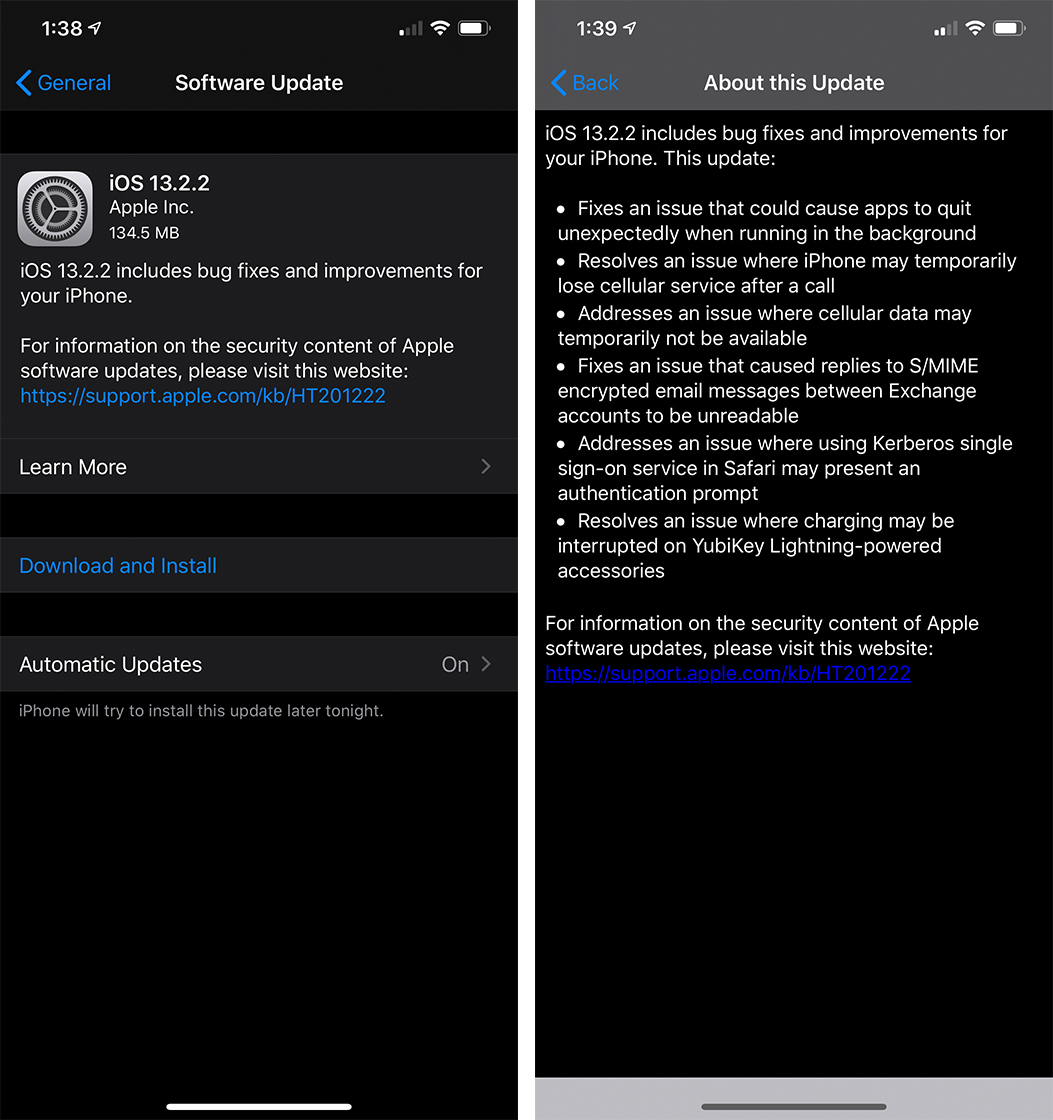
Apple has released iOS 13.2.2 and iPadOS 13.2.2.

This update comes shortly after iOS 13.2 dropped last week, which included the iPhone 11’s ‘Deep Fusion’ computational photography feature.

Apple’s update notes indicate that iOS 13.3.3 fixes an issue that caused apps to quit unexpectedly in the background, resolves a problem that resulted in the smartphone to losing reception after a call and solves a variety of other minor issues with the operating system.

iOS 13.2.2

In order to download the update, navigate to ‘Settings,’ then ‘General,’ and finally, Software Update. The update measures in at 134.5mb for the iPhone 11 Pro Max.

While iOS 13’s release has been far from completely stable, it’s great to see Apple addressing significant problems with the operating system at a rapid pace.

The post Apple’s iOS 13.2.2 update fixes issue causing background apps to close appeared first on MobileSyrup.