Shared posts

08 Nov 03:56

DNV Council – For The Birds?

by Barry Rueger

This week the municipal council of the District of North Vancouver voted to prohibit the keeping of pigeons in the District.  Or, more specifically, they voted to prohibit the keeping of pigeons by one resident.

Even that wouldn’t have particularly bothered me, except that the homeowner in question, Kulwant Dulay, happens to live next to the sole person complaining to the District about his pigeons – District council member Betty Forbes.

CBC reports that Dulay says he’s lived in the District of North Vancouver for 25 years and, for most of them, he’s kept homing pigeons on his property in a coop in the backyard, without ruffling any feathers.  Only when he moved in next to Forbes three years ago did this become a problem.

The biggest concern with this story has to be the way that the District and Forbes very explicitly didn’t name her as the complainant, or discuss why a new bylaw was needed to deal with her complaint.  It seems that only when CBC filed an FOI request did the truth emerge. There’s now a suggestion that Forbes was in clear conflict of interest.

Perhaps ironically, the previous council actually brought in rules that allow people to keep chickens in their back yards.

Postscript: Justin McElroy has a great Twitter thread recounting this saga. Including this gem in the comments:

08 Nov 03:55

Making It Up On Volume

by noreply@blogger.com (BOB HOFFMAN)

There's a very old business gag about losing money on every sale but making it up on volume.

While the premise of losing on every transaction but making up for it with lots of transactions may be ridiculous, in our confused world of marketing it has become a foundational principle.

Essentially what most brands are doing when they flood the web with idiotic social media posts and self-serving nonsense masquerading as "content" is hoping that their lack of ability to derive a cogent, commanding concept for their brand can be disguised and tarted up with a torrent of moronic bullshit.

They even teach this nonsense in marketing programs with concepts like "always-on" marketing, and denigrate the essence of marketing effectiveness by claiming that "the big idea" is dead.

Of course, when you don't have the talent to create something worthwhile the next best strategy is to declare it dead.

McDonald's former CMO claimed that in 2016 they would create 5,000 pieces of online content. That's one piece of shit content every 24 minutes of the work year. Since starting a Twitter feed, McDonald's have posted over half a million tweets.

Nothing very useful, but making it up on volume.


08 Nov 03:37

Heartbreaker

by Rui Carmo

It is a poignant sign of the times that Microsoft is already shipping quality desktop-grade ARM hardware (even though it is pricey and limited in software compatibility) whereas Apple can’t yet ship something with a decent keyboard and a finished version of Catalina (or iOS, for that matter).

That said, regardless of how much this advances the status quo, I would definitively pick the Surface 7 instead as a go-anywhere development machine. The road to ARM is paved with good intentions, but it’s going to take us a long while to make a full switch (and I’m betting AMD will have something to say in that regard as well).

Also of note, and as a sort of quick follow-up to my last blog post: @dhh spent a week using Windows, and it makes for an insightful read. I agree with most of what he wrote, but then again I’ve always hedged my bets and am used to tackle the dull grind of transitioning (daily) between platforms.


07 Nov 23:07

Hey, @jack, here’s how tweet editing should work

by Josh Bernoff

Twitter’s VP of Research and Design Dantley Davis tweeted a list of new features coming to Twitter. Here’s the list: Where’s tweet editing on this list? These are minor tweaks that will mostly affect heavy users and celebrities. Everyone who has ever made an error while tweeting — that is, everyone who uses Twitter — … Continued

The post Hey, @jack, here’s how tweet editing should work appeared first on without bullshit.

07 Nov 23:07

Why Canadians Should Use .CA for their Businesses

by Samantha Lloyd

You may have seen the .CA Domain Squad around recently, and if you haven’t – beware! They’re on the lookout for Canadians who aren’t using a .CA domain name. When you don’t use a .CA domain name for your local Canadian business, you’re basically telling the world that you don’t care about hockey, saying sorry, and maple syrup, which we all know greatly offends the .CA Domain Squad! 


Why Canadians Should Have a .CA Domain

Okay, you get the picture! The .CA Domain Squad take their domain name seriously. There are a few benefits to owning a Country Code Top-Level Domain (ccTLD), aside from ensuring the Squad doesn’t come after you. 😉

.ca domain squad
.CA Domain Squad doesn’t take kindly to strangers!
  1. .CA is exclusive to Canadians, meaning you need to have a presence in Canada to actually qualify for one of these domain names. It establishes trust amongst Canadian customers when they see your brand on a .CA domain, as well. 77% of Canadians say they prefer supporting Canadian businesses and 64% agree that Canadian businesses should have a .CA.
  2. Your original domain choice is taken and that is always an awful feeling. A good solution when searching for a domain name is to explore other options beyond your typical go-tos. Give a ccTLD a try. The .CA domain name has 2.8 million domains under management and despite that large number there is a ton of room for new businesses to come in and get their ideal domain name. No need to hyphenate, go with extra-long domain names, or rename your company altogether.
  3. Your branding will look great in .CA. When you don that new company swag shirt or pass out your notebook-and-pen combo at events, you want a simple and memorable domain to grace your swag. A short domain is always preferable in this instance. Improve your brand marketing with a memorable domain name. A short .CA domain looks great on packaging too.
  4. .CA is made for Canadians selling their products or services to Canadian customers. ccTLDs tend to be given preference when local searches are performed (such as “apple picking near me”). 83% of Canadian internet users prefer shopping on a site with a .CA domain name. .CA lets customers know that you’re headquartered in Canada, that their prices and shipping are in Canadian dollars, and that you service Canadians!
  5. Investing in .CA is good for business as your .CA purchase gives back through CIRA’s Community Investment Program. CIRA is the Canadian Internet Registry Association and it manages the .CA domain name. Their Community Investment Program has distributed $6.7 million (so far!) in 151 innovative project funds.
  6. Show off your Canadian pride and attract partnerships with other Canadian businesses. Being a Canadian company can be a competitive advantage for many reasons, so why not show it off?
  7. Hover is proudly Canadian We let customers know through local search that we are part of the Toronto and Canadian tech ecosystem and have been since the early days of the Internet. Join us in showing off that Canadian pride!

Already own a domain? .CA can provide brand protection!

What could be better than being protected by the .CA Domain Squad?! If you already have an established brand on another domain extension, you can choose to own the .CA domain name for brand protection. Forwarding your .CA domain name to your go-to URL (and vice versa) provides the flexibility you need in managing multiple domains while also securing your company or personal name on a Canadian extension.

.ca domain squad
.CA Domain Squad is looking for you!

There are many reasons to own a .CA domain name for your Canadian business. If you spot the .CA Domain Squad in your city, tag us in pictures on our Twitter.

07 Nov 23:07

Apple Reveals Major Update to Its Privacy Webpage

by John Voorhees

Privacy and everything it entails is not easy to explain. Under the hood, it’s driven by complex mathematics and code. However, in practice, app privacy starts with how apps are designed. Some are designed to collect information about you, and others aren’t. With Apple’s update to its privacy page today, the company has created a site that explains how privacy drives the design of its apps in clear, concise language. However, for anyone who wants to understand the nitty-gritty details, Apple has also published white papers and linked to other materials that provide a closer look at the issues that the main page addresses.

Apple’s Privacy webpage starts with a declaration of the company’s position on privacy:

Privacy is a fundamental human right. At Apple, it’s also one of our core values. Your devices are important to so many parts of your life. What you share from those experiences, and who you share it with, should be up to you. We design Apple products to protect your privacy and give you control over your information. It’s not always easy. But that’s the kind of innovation we believe in.

What follows is an app-by-app explanation of how each is designed to give users control over what they share and limit what Apple collects. Safari, Maps, Photos, Messages, Siri, News, Wallet, Health, Sign On with Apple, and the App Store are all covered with playful animations and a short explanation of what they do to protect your privacy.

Additional information about each app, their underlying technologies, plus iCloud, CarPlay, Home, education and children’s privacy, and other features follow under the Features tab. Included among the more detailed materials are white papers that go even deeper on Safari, Location Services, differential privacy, iOS security, and Face ID security. There is also a tech brief on Photos and links to additional materials about Ask Siri, Siri Suggestions, Apple Pay, ResearchKit and CareKit, Apple News, Apple Music, the Apple TV app, Apple Arcade, iCloud, Screen Time, Family Sharing, security in education, Apple’s student privacy pledge, and your data and privacy page. That’s a lot of information, but it’s presented in a thoughtful, compelling way that lets you go deeper if you want without being confusing or difficult to navigate.

The final new tab is called Control. Some of these tips and guides were available before, but the page has been updated with new practical suggestions on how you can make your Apple devices more secure. The page covers passcodes, Touch ID and Face ID, two-factor authentication, Find My, the alerts that explain the information third-party apps request, using your data and privacy page, advertising, analytics, and more. It’s an excellent place for users looking for ways to take command of the security of their devices.

I know that a lot of MacStories readers care strongly about their privacy and the security of their devices, and many are aware of at least some of what’s covered on Apple’s privacy page. However, it’s still worth a visit because privacy and security are part of so much of what Apple does now, that I expect there are at least a few tidbits on this new page that will be new to everyone. It’s also a great page to share with family members and friends who may not be as aware of the privacy issues related to their devices.


Support MacStories Directly

Club MacStories offers exclusive access to extra MacStories content, delivered every week; it’s also a way to support us directly.

Club MacStories will help you discover the best apps for your devices and get the most out of your iPhone, iPad, and Mac. Plus, it’s made in Italy.

Join Now
07 Nov 23:06

The Librem 13 reviewed by Unbox Therapy

by Purism

Simple. Clean. The most secure experience you can have.

Just over a week ago Unbox Therapy reviewed our Librem 13 v4 on their YouTube channel and the video has been watched over 2.3 million times. Thank you to Willy from the Unbox Therapy team for getting a Librem 13 in front of Lewis, he did an excellent job talking about and demoing our privacy and security focused hardware and software.

He loved the ease and convenience of our hardware kill switches and how they could be used to seamlessly toggle the WiFi/Bluetooth and the Camera and mic on and off without restarting the system – in Lewis’s own words, “That’s pretty cool, you have to admit that!”


Get your Librem Laptop

We are very proud of our kill switches, they are the most secure way to disable components of a laptop that can be used to spy on you — as they physically disconnect the circuitry, like removing the light socket from the wall.

Lewis agrees, “The switch is obviously the best implementation”, no need for tape over your camera and mic.

Lewis was impressed by the number of ports on the Librem 13: 2 USB 3.0, 1 USB type C, headphone port, HDMI port, SD card slot and the 2 hardware kill switches all in aluminum chassis weighing only 3lbs (1.4kg).

On the software side Lewis liked how the entire PureOS onboarding process helps you be more secure – especially setting a disk encryption password to protect the whole system and your data. He liked that we got plugins and security rules “baked-in” to the browser by default, enforcing HTTPS everywhere and disabling many advertising and web trackers. Overall Lewis was impressed with the look-and-feel of a modern GNOME GNU/Linux system, finding it easy to multi-task, search for and open files and apps.

The PureBoot Bundle

If you are looking for the most secure and privacy respecting laptop, then look no further than our PureBoot Bundle – A v4 Librem 13 or 15 paired with a paired Librem Key for the ultimate hardware and software tamper detection. Find out more about how we made it possible to detect tampering with the Librem Key and our Chief Security Officer’s best practices to stay safe and secure.


Browse the Purism Shop

Photos courtesy of Unbox Therapy 1, 2.

The post The Librem 13 reviewed by Unbox Therapy appeared first on Purism.

07 Nov 23:06

A delightful book beckons

by Liz

In the park near our house on top of the hill, there’s a house that must belong to a teacher or school librarian, because there is always a cardboard box or two full of kids’ paperback books there, sometimes boring but sometimes the best sort of old, weird book. I had a stressful week at work and am feeling fed up so decided to dive into this gem from the free box.

It’s called The Saucepan Journey, it’s by Edith Unnerstad, first published in 1949, and is translated from Swedish. The book opens by describing the seven children in the family, and how they don’t have room in their tiny apartment for them all to sleep, having to put three chairs together and put an ironing board on top, or for the smaller ones, sleeping in a bureau drawer (as I hear I did as a baby!) There is a housing crisis (because of it being just post-war?) and no one will rent to them anyway because they have too many children and not enough money.

Their mother used to be a traveling (and maybe not very successful) young Shakespearean actress and their dad is a travelling button-seller but really, a brilliant inventor. He’s invented a 3 part whistling saucepan called “Pip”. A grumpy uncle dies and leaves them his brewery horses and two large wagons.

Their mom, a sprightly and inventive person herself, comes up with the idea that they’ll leave their cramped apartment, build bunk beds in one of the wagons, fit up the back of the wagon with a little kitchen, and travel the country selling Pip (in all three sizes).

Without even going further than that it’s clear this is going to be an amazing book. I am almost in tears at how awesome it is, and nothing has even happened yet! The Swedishness and the being 70 years old and it being relatively normal to have horses in the middle of cities adds to the fabulosity.

The parents are nice – fun – adaptable – And the children all seem to appreciate each other’s capabilities and quirks.

Why are some books so cozy, and enticing, and you can fall asleep thinking about how you’d fit up your little caravan behind your brewery horses, either with your seven (!) children or as one of them, enterprisingly selling patent saucepans? I can feel the stress just draining out of me. Even better — there are two sequels.

07 Nov 23:03

You’re Being Ignored

by Richard Millington

Ever noticed members seem surprised by a change you’ve announced several times already?

That’s because they read far less of your content than you imagine.

They clicked through the emails and on-site announcements.

A handy rule of thumb is to assume about 20% of your members read 20% of the content you send to them.

So target the members who care and reduce your message down to the core points.

The longer and more frequent your messages are, the fewer people will read them.

07 Nov 23:03

The 3 am Edit

by Ms. Jen
Wed. 11.06.19 – After writing yesterday’s blog post, I was quite happy with the whole post and went off to bed. I woke up at 3am after a bad dream with an upset tummy and quite worried. So, I did two things: 1) Took some Tums. Now that Zantac has been pulled off the market,... Read more »
07 Nov 19:32

Today in Hoffman Lenses:

by jwz
07 Nov 19:28

For All-Star Kids Sports Photos, Ditch Your Smartphone

by Ben Keough
For All-Star Kids Sports Photos, Ditch Your Smartphone

We get it: You just spent $1,000 on the latest and greatest smartphone with an allegedly world-beating camera, so why should you have to splash out yet again for another camera just to capture your kids’ sporting events? Unfortunately, although iPhones, Galaxys, and Pixels are great for everyday video and snapshots, they simply don’t have the reach, resolution, or autofocus capabilities necessary for high-speed action, especially at a distance. If you want to capture the thrill of victory and (hopefully less often) the agony of defeat in shots that’ll last a lifetime, you need the right gear. Here’s what to look for.

07 Nov 03:19

Automate the Boring Stuff with Python: Working with PDF and Word Documents

Automate the Boring Stuff with Python: Working with PDF and Word Documents

I stumbled across this while trying to extract some data from a PDF file (the kind of file with actual text in it as opposed to dodgy scanned images) and it worked perfectly: PyPDF2.PdfFileReader(open("file.pdf", "rb")).getPage(0).extractText()

07 Nov 03:18

Twitter Launching Topics Feature Soon

by Ryan Christoffel
Source: The Verge

Source: The Verge

Casey Newton reports for The Verge on a new Twitter feature coming soon:

Recently, a friend told me he wanted to spend more time using Twitter, but he didn’t quite know how. His primary interest is comedy, he told me, and he hoped to find a way to see comedians’ best jokes on Twitter as they were posted. But when he followed comedians, he mostly saw a lot of self-promotion — tour dates, late-night appearances, and that sort of thing. No matter your personal interests, there are countless good and relevant tweets on Twitter. But where are they?

Topics, a new feature from Twitter that is starting to roll out this week, represents a significant effort to answer that question. You will be able to follow more than 300 “topics” across sports, entertainment, and gaming, just as you are currently able to follow individual accounts. In return, you’ll see tweets from accounts that you don’t follow that have credibility on these subjects.

Topics represent a major new addition to the Twitter timeline, easily one of the most significant changes the service has ever introduced. Though topics have the potential to improve a person’s timeline, they could also have the opposite effect if not done well. Based on this report, it sounds like Twitter’s team has all the right checks in place to ensure tweets from topics are things you’ll actually care about. Here’s Newton on how the process works:

First, Twitter scans incoming tweets for keywords like “WWE,” “pro wrestling,” and so on. (It can’t search for those terms in images and videos, at least not yet.) Second, Twitter searches to see if the tweet is from someone who normally tweets about that topic as a measure of credibility. Finally, Twitter looks at engagement: how many other people who care about this topic liked, retweeted, or replied to a tweet? The more people are interacting with the tweet, the more likely it is to make the cut.

I’m eager to try following a few topics to see whether they have a positive or negative impact on my timeline. I think the feature will be a clear win for users who are new to Twitter, and don’t already have a well-curated collection of follows; for those who have used the service for years, though, it may not be as appealing. And there’s no word on whether topics you follow will appear in your timeline in third-party clients like Tweetbot and Twitterrific.

We won’t have to wait long to find out: topics are starting to roll out this week with a full global launch next Wednesday, November 13th.

→ Source: theverge.com

07 Nov 03:17

2019 Philly Bike Expo Roundup

by noreply@blogger.com (VeloOrange)
by Igor

Another amazing Philly Bike Expo is in the books! It was stellar to catch up with old friends, meet new ones, talk about our new and upcoming products, and generally nerd-out on bikes and bits. As tradition (2018, 2017, and 2016) dictates, here's our 2019 round up of bikes that caught our attention!

I'm going to start this off with a bang. This Pedalino stole the show this year. It won People's Choice and stole my heart. The frame is stainless steel and features tons and tons of custom machine work and anodized titanium ornamentation to create one super unique Gravel Grinder.


The fully custom, modular dropouts are absolutely stunning and take an otherwise standard piece to a level I've not seen before.


This Item4 is a collaboration between Bishop Bikes (located just North of us in Baltimore), Metal Guru, and Cutlass Velo (also in B-More). The Item4 platform is designed to be a semi-custom, all-rounder with performance and versatility in mind. It's your road, gravel, and randonneur all-in-one neat and lightweight package, and boy does it rip.


This Royal H roadie is a very cool blending of old and new. Cutouts and contrasting job abound. 


Love it or hate it, this Stronglight headset was definitely a conversation starter!


Cutouts e-v-e-r-ywhere. Even when you think you've seen them all.


I always love a good themed bike. This Beardman plus touring bike was fun, a tad spooky, and clever.


Get it? Tombstone?


A super simple and lightweight city bike from Zukas.


With a terrifically clean rear lamp. I believe it is elevated to gain some vertically clearance above the fender. It also looks amazing.


The wild paintjobs attracted me to the Weis Manufacturing booth, and the seatstays on their Hammer series kept me around. 


Made from aluminum alloy, the Hammer Road is designed for maximum power transfer. It looks fast.


You don't often see full-custom full-squish mountain bikes, so it's always a treat when you get to see one up close. This raw one from Moth Attack was super clean and will definitely be a blast through the rooty trails we have here. 


Breismeister always come through with the most fun paintjobs and unique, intricate framework.


Again, a big thank you to all who came by the booth, said hi, shared stories, and grabbed a seltzer. We're glad you could make it out. See you next time!
07 Nov 03:15

Data shelf life

by Nathan Yau

Stephen M. Stigler argues that data have a limited shelf life. The abstract:

Data, unlike some wines, do not improve with age. The contrary view, that data are immortal, a view that may underlie the often-observed tendency to recycle old examples in texts and presentations, is illustrated with three classical examples and rebutted by further examination. Some general lessons for data science are noted, as well as some history of statistical worries about the effect of data selection on induction and related themes in recent histories of science.

In a nutshell, while data itself doesn’t change, everything around it — the people who collected the data, the things that the data is about, and where the data came from — changes over time.

Tags: history, old data

07 Nov 03:15

Starting at A: New Mobility in Germany

by Gordon Price

Ian Robertson notes: “Sounds exactly like the Transit Service Provider you’ve written about.”

Augsburg has the first German city to introduce a mobility flat rate. For a fixed monthly fee starting at €79, residents of the city will be able to gain full access to a range of mobility services.

Alongside public transport services, Augsburg has been offering car sharing and rental bikes. This municipal utility now combines the offers and centralises them in a nationwide unique flat rate. …

The scheme is the outcome of a year-long test phase conducted by Augsburg Stadtwerke. The city has long been endeavouring to attract more people to use public transport, including plans to make all trams and buses within the ‘City Zone’ free to use from 2020 onwards.

Ian is right: Augsburg has become a TSP, providing “Mobility as a Service” (Maas) as part of the New Mobility.  All kinds of names for more or less the same thing.

It’s important to note that TransLink is taking the initial step as well:

We are excited to say we are partnering with with Evo Car ShareModo Co-operative, and Mobi by Shaw Go bike share to help make multimodal travel easier, more convenient and more seamless for residents in Metro Vancouver.

It’s a trial program at the moment – specifically the  Shared Mobility Pilot Program.   But it’s important than the public agency is taking the lead, because it’s only a matter of time before the big private sector players maker their moves.  (Is that Amazon I see?)


07 Nov 03:15

Safe to fail requires safety, not just failure

by Chris Corrigan

I travel around many different kinds of organizations. Many of them preach the mantra that goes something like “it’s okay to fail here. Please take risks and try new things!” Unfortunately, when I look around I can’t see much infrastructure in place that allows the work context to be safe enough to fail.

An organization needs to build learning and experimentation into its operations, especially if it is required to respond to changing conditions, improvements in services, or new ideas. And so the idea that “we want people to take risks” is promoted, often alongside an exhortation to do so prudently but really with no further direction than that.

Anyone who has worked in a large organization will know that risk-taking is perilous. There are many ways to be punished for doing something wrong, and the worst punishments are the invisible ones: shaming, exclusion, a tattered reputation, eroded trust, political maneuvering that takes you away from access to power and influence. Not to mention the material punishments of reduced budgets, demotions, poor performance reviews, and limited permission to try new things in the future.

Failure in context

Before going any further, let’s talk about what I mean by failure. Using Cynefin, we can focus on the difference between failure in complicated contexts and failure complex contexts. When we have a complicated failure in a stable and linear and predictable system, the answer is to fix it right away. Ensure you have the right experts on tap, do a good analysis of the situation and apply a solution.

In complex adaptive systems, failure is context-dependent. Here failure is an inevitable part of learning and doing new things. Because complex problems demand us to create emergent solutions, we are likely to get somewhere when we can try many different things and see what works and what doesn’t. Dave Snowden calls this “safe-to-fail” and it means taking a small bet, based on a hunch that what you are doing is coherent with the nature of the system and where you want to go, and acting to see what happens. If it fails, you stop it, and if it works, you support it.

I think I once heard Dave say something like “probes in a system should fail 8 out of 10 times or you aren’t trying to find emergent practice.” That is certainly a rubric I find helpful. This means that in developing new things, you should expect to fail 80% of the time and to do that requires that you put into place a system for supporting failure and learning.

Stuck on a cliff

Imagine you are free rock climbing – no ropes or belyaing – and there is a handhold you are reaching for that requires you to do something you’ve never done before. Your partner says “you’ll never learn to solve this problem if you don’t try something. Don’t be afraid to fail.” Far from being imbued with confidence, you are likely to be frozen with fear, seeing all the ways that things could go wrong. Better to just stick to what you know, and don’t try the move.

If however, you are in this same scenario, but you are roped up and belayed by someone you trust, you can feel safe to try the move knowing that if you fail, you will be caught and you will have a chance to try a different strategy. As you develop mastery in the move, you can use it more and more in your rock climbing life, and you may loosen the safety constraints as you develop more capability

Implications for facilitation and leadership

Safety is about creating good constraints so that your people can take risks and know they will be safe if they get it wrong. The job of leaders is to set the constraints for action in such a way that a safe space is available for work. This can take the form of limited time, money, the scope of action, or other things so that folks know what they can and cannot do. Within that space, leaders need to trust people to do their learning and create feedback loops that share the results of experiments with the bigger system. If you can have people all working separately on the same problem – working in parallel as we would say in Cognitive Edge-speak – then you increase the chances of lots more failures and also of finding lots of different ways to do things. This is called “distributed cognition” in complex facilitation and keeping people from influencing each other increases the creative possibilities within constraints.

The next level of this practice is to honestly incentivize failure. Give a reward to a person or a team that has the best report of their failure, the one that helps us all to learn more. You could easily do this in an innovation meeting by having different groups work on a problem in a fixed amount of time. Watch for the group that fails to get anywhere by the end of the time and ask them to share WHY they failed. Their experience will be a cautionary tale to the whole system.

Almost every organization I work with says that they embrace learning, tolerate failure, and want their employees to take more risks. When I ask to see how they do this, it’s rare to find organizations that have a formal process for doing so. Without that in place, employees will always respond to these kinds of platitudes with a little fear and trembling, and in general, take fewer risks if it clashes with their stated deliverables.

07 Nov 02:04

The oldest traffic light in Charlottetown?

by peter@rukavina.net (Peter Rukavina)

You may remember this humble pedestrian signal, at the corner of Prince and Kent in downtown Charlottetown, from my post 11 years ago wherein I complained that the “DONT WALK” light was burned out. It took an email to the mayor to get it fixed.

I suspect, given its design, its WALK-DONT WALK signals, and its general condition, that this may be the oldest traffic signal in the city. Certainly the signals on this corner are ones I’ve reported technical problems about dozens of times over the years.

I’m happy to report that work has begun on the project to replace the city’s older traffic signals, including this one. Soon Prince and Kent should have thoroughly modern, reliable, pictographic pedestrian signals.

A photo of the pedestrian signal at Prince and Kent

Close up of the DONT WALK

07 Nov 02:03

Subscription Friction

Tim Bray, Ongoing, Nov 06, 2019
Icon

Tim Bray's main point here is that the practice of charging subscriptions for every single web resource won't scale. After all, how many $5 subscriptions can we sustain before this becomes an issue? Ten? Twenty? How many $15 subscriptions? He suggests this: " a standardized little popup saying 'Ten cents to read this', with several options: Yes or no on this piece, and Always-yes or Always-no for this publication." Which is (ahem) what I proposed fifteen years ago. With pictures. Bray cites Ted Nelson in Literary Machines in 1981, but I imagine he didn't provide code.

Web: [Direct Link] [This Post]
07 Nov 01:52

They Might Never Tell You It’s Broken

Maxime Chevalier-Boisvert:

The problem, it turned out, was that MacOS had more strict requirements for keeping the stack pointer aligned. This wasn’t difficult to fix. The more important lesson, that I didn’t understand until that point, is that you can’t count on the people trying your project to quickly and reliably signal bugs to you. Most of the time, if it doesn’t work, they won’t report the problem. There are a few reasons why this might be.

07 Nov 01:51

Firefox exploit lets scammers freeze browser, show users scary message

by Jonathan Lamont
Firefox iOS app

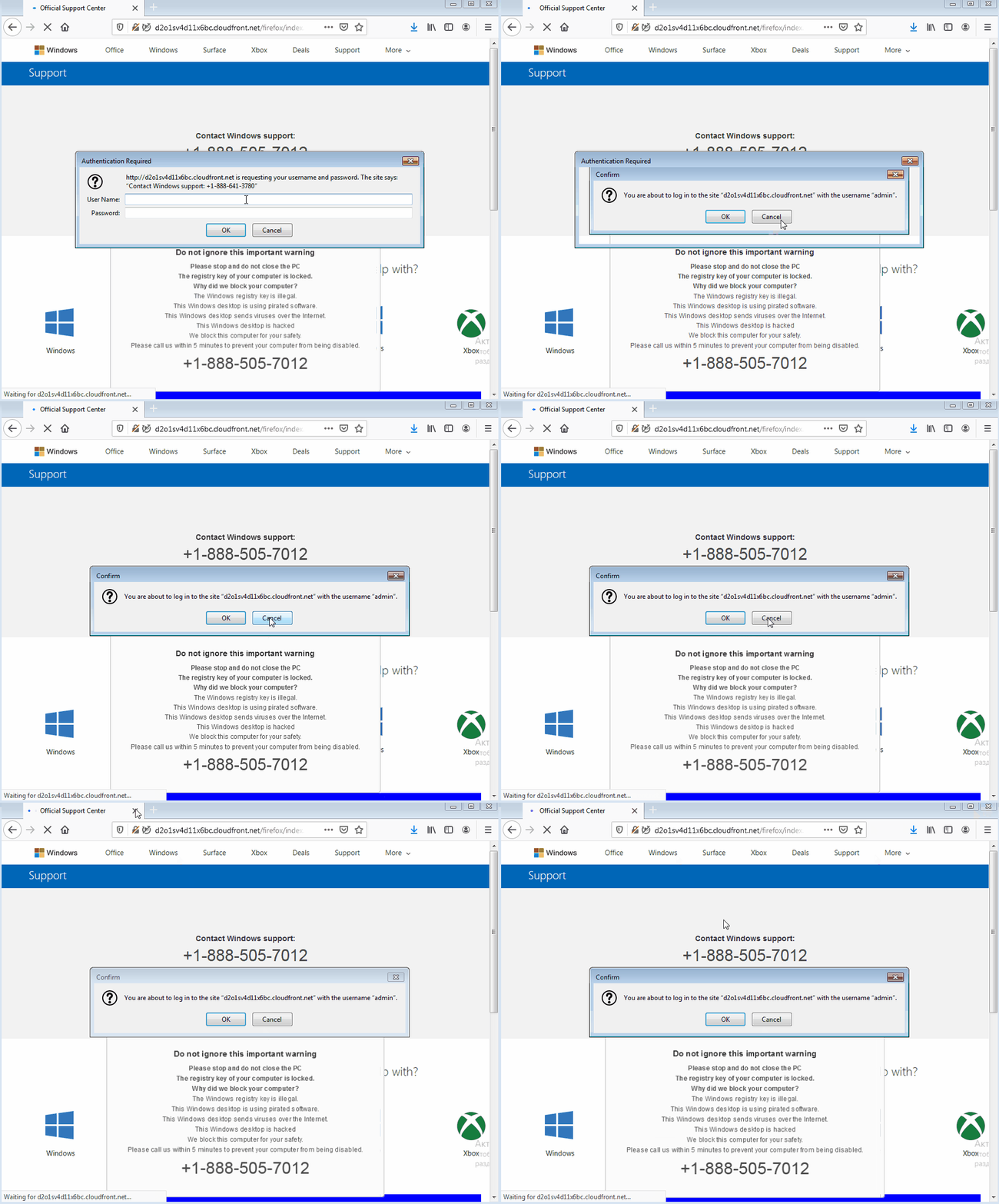
Scammers are taking advantage of a flaw in the most recent version of Firefox — release 70 — that can lock up the browser while displaying a frightening message.

According to an Ars Technica report, the exploit allows malicious sites to freeze the browser completely. Users can’t exit tabs or close the browser through normal means. When the lock-down happens, the browser displays a message warning users that they’re using a pirated version of Windows. The full message is as follows:

“Please stop and do not close the PC… The registry key of your computer is locked. Why did we block your computer? The Windows registry key is illegal. The Windows desktop is using pirated software. The Window desktop sends viruses over the Internet. This Windows desktop is hacked. We block this computer for your safety.”

The exploit requires no interaction from users and happens upon visiting a site. Further, it warns users to call a toll-free number within the next five minutes, or their computer will be disabled.

The attack works on both Windows and Mac versions of Firefox. If you’re hit with the exploit, the only way around it is to force close the browser through either Windows Task Manager or the ‘Force Close’ function in macOS.

When Firefox doesn’t shut down properly, it attempts to restore the open tabs next time you open it. This can catch users in an endless loop unless they have disabled the restore tabs option. Alternatively, they can open Firefox and quickly close the offending tab before it loads, or temporarily disconnect from the internet when relaunching the browser.

A fix is in the works

Jérôme Segura, head of threat intelligence at Malwarebytes, told Ars that several sites have taken advantage of the flaw using code specifically designed to exploit it.

Segura filed a report on the Bugzilla forum, Mozilla’s bug tracking site. Since then, the company behind Firefox said it was working on a fix. Further, Mozilla told Ars in a statement that users should expect the fix “to land in the next couple of releases (either in Firefox 71 or 72).”

Segura’s bug report included a GIF showing the malicious attack in action.

Unfortunately, these kinds of attacks aren’t new, and they’re not exclusive to Firefox. Google Chrome also had these kinds of exploits, which take advantage of authentication pop-ups, to lock browsers and display scary messages.

Segura told Ars that he’s aware of a separate, similar Firefox exploit that hasn’t been fixed some two years after its discovery. However, he noted that he hadn’t seen it actively used in recent attacks.

For most users, it can be frightening when a browser locks up, especially when it displays a deceptive message like the one in this attack. The best thing to do in these circumstances is to remain calm and not react suddenly to what’s happening. It’s also probably wise to not contact phone numbers or emails included in pop-ups, as they can be part of the scam. Typically, these scams want to frighten users into handing over valuable information or money.

Ultimately, if you encounter one of these situations, the best thing to do is quit the browser. On Windows, you can use the Task Manager (accessible through ‘Control’ + ‘Alt’ + ‘Delete’) or by hitting ‘Alt’ + ‘F4’ on the keyboard to close the program. On Mac, ‘Command’ + ‘Q’ or clicking the name of the program in the top left corner and selecting ‘Force Quit’ should work as well.

Source: Bugzilla Via: Ars Technica

The post Firefox exploit lets scammers freeze browser, show users scary message appeared first on MobileSyrup.

07 Nov 01:50

BlackBerry, University of Waterloo renew partnership to drive innovation

by Aisha Malik
BlackBerry header

BlackBerry and the University of Waterloo have announced that they plan to renew their partnership to drive the innovation economy forward.

The two organizations say they will work together to develop a plan for joint innovation and create a lab that will attempt to accelerate research and form products that can be marketed.

They will work together on the university’s campus to allow students and faculty work alongside BlackBerry. This will be done in the form of workshops and development sessions.

“We are thrilled to reinvigorate our relationship which promises to strengthen the entire Canadian technology and cybersecurity industry,” said Charles Eagan, the chief technology officer at BlackBerry, in a press release.

The partnership aims to transition technologies more efficiently to the market and offer new opportunities to train the next generation of technology and cybersecurity experts.

Source: BlackBerry

The post BlackBerry, University of Waterloo renew partnership to drive innovation appeared first on MobileSyrup.

07 Nov 01:50

Apple’s iPad continues to show growth despite declining tablet market

by Jonathan Lamont

Apple’s iPad continues to be a strong contender in the tablet market, according to data released by Strategy Analytics.

The report details market share across all global manufacturers. Strategy Analytics estimates that Apple’s market share grew four percent in Q3 2019 compared to the same period last year. The report says that works out to about 10.1 million shipments, compared to 9.7 million in 2018.

Along with Apple, Amazon and Lenovo both showed increased sales, despite the overall tablet market shrinking four percent.

Amazon posted some staggering growth numbers, jumping from 2.2 million shipments in 2018 to 5.3 million in 2019 — a 141 percent increase year-over-year. Lenovo saw about eight percent growth.

Samsung and Huawei were also in the top five of the tablet market, but their shares decreased by five and 18 percent, respectively.

As for Apple, its new, cheaper iPad option — which has a 10.2-inch display and is compatible with the company’s Smart Keyboard — likely helped with growth. However, Apple’s shipments rose by four percent while revenue rose by eight percent, according to its quarterly financial earnings. This probably indicates Apple is seeing higher shipments of its more expensive iPad Pro models.

Considering the company didn’t update the nearly year-old iPad Pro in 2019, the growth is impressive.

Apple is expected to refresh the iPad Pro in early 2020 with a new rear camera module.

Source: Strategy Analytics Via: 9to5Mac

The post Apple’s iPad continues to show growth despite declining tablet market appeared first on MobileSyrup.

07 Nov 01:50

AirPods Pro Review: The best wireless earbuds with noise-cancelling

by Patrick O'Rourke
AirPods Pro on leaves

What surprised me the most about Apple’s AirPods Pro is how comfortable the noise-cancelling headphones are in my ears.

I’ve tried several brands, but in-ear headphones have always felt like an insect burrowing into my ear canal. I’ve been told I’m not using the correct-sized tips despite having tried various sizes, or that the uncomfortable pressure sensation I experience is normal.

While I’ve spent time with in-ear earbuds like Samsung’s Galaxy Buds and Sony’s superb WF-1000XM3s, I’ve always found that I wasn’t able to keep either pair in my ears for long before they became unbearable.

Apple’s new AirPods Pro solve this issue. Even after wearing the new earbuds for roughly five hours straight, they remained comfortable.

AirPods Pro with charging case

There are other improvements over the 2nd-generation AirPods as well, including impressive active noise-cancelling and better sound quality. Regardless of if I was listening to music and podcasts, or watching videos, Apple’s new premium earbuds always sounded crisp and featured a surprising amount of bass — especially for earbuds.

The AirPods Pro aren’t without issues, though. For one, they’re pricey, coming in at an expensive $329, and they don’t sound significantly better than competing wireless earbuds.

The main question surrounding Apple’s AirPods Pro is how they compare to the soon-to-be-released competition, including Microsoft’s upcoming Surface Buds, Google’s Pixel Buds and even Amazon’s Echo Buds.

It’s worth noting that while I expect all of the above wireless earbuds to launch here eventually, specific Canadian release dates have not yet been revealed for any of them.

Impressive active noise-cancelling

AirPods Pro in front of leaves

A critical factor to keep in mind with Apple’s AirPods Pro is the wireless earbuds’ active noise-cancelling.

Unlike standard noise-cancelling that attempts to block out unwanted sounds, the AirPods Pro are continually adapting to the specific environment around them. The earbuds feature an outward-facing microphone that detects surrounding sound to counter it with equal anti-noise.

An inward-facing microphone then listens to the inside of your ear, eliminating additional sound. This entire process occurs up to 200 times per second, according to Apple.

In practice, the results are more impressive than I expected. With a proper seal (more on this later), the outside world is nearly completely gone, with only crisp, clear audio remaining. This is in contrast to Apple’s standard AirPods or other wireless earbuds that don’t feature any form of noise-cancellation. If you’ve ever tried using AirPods or Samsung’s Galaxy Buds on an airplane, you’ll know what I’m talking about.

AirPods Pro and Sony WF-1000XM3

When directly comparing active noise-cancellation between the AirPods Pro and Sony’s WF-1000XM3s, I found both earbuds performed similarily, but I’d give the advantage to Apple’s AirPods. They adapt quickly to the noise around them and block out slightly more sound, especially when in a noisy environment like the MobileSyrup office. The difference is marginal, though.

That said, the quality of noise-cancelling with in-ear doesn’t compare to the way the feature works in over-ear headphones. The inherent nature of in-ear earbuds means at least some unwanted noise will get into the headphones. Apple-owned Beats’ new Solo Pro 3 over-ear headphones feature adaptive noise-cancelling that seems very similar to what the AirPods Pro offer, while Powerbeats Pro don’t include the feature at all.

“If you’ve ever tried using AirPods or Samsung’s Galaxy Buds on an airplane, you’ll know what I’m talking about”

The AirPods Pro block out a fair amount of noise though, which resulted in situations where I felt a little uncomfortable walking in downtown Toronto during rush hour. These situations are where ‘Transparency Mode’ comes into play. This sound pass-through feature utilizes the Pro’s microphones and a system of vents in the earbuds to pass sound from the outside world that would otherwise be blocked by the silicone tips.

I found myself using ‘Transparency Mode’ often when walking around outside so I was more aware of my surroundings.

Unparalleled comfort

AirPods Pro in ear

Apple’s AirPods Pro are the only in-ear wireless Bluetooth earbuds I have ever used that don’t immediately feel uncomfortable.

There are a variety of factors at play that make this happen. First, rather than several tips, Apple has stuck to ‘Large,’ ‘Medium,’ and ‘Small’ tips. While both Small and Medium felt comfortable and offered an adequate seal, I ended up going with the latter option because it made the AirPods Pro sit more snugly in my ears when walking or running.

Apple says it used 3D ear scans from thousands of people to model the fit of the earbuds, allowing the company to know exactly where the AirPods Pro should and shouldn’t touch the wearer’s ears.

While this might sound like exaggerated marketing on Apple’s part, you can feel the attention to detail when you’re wearing the earbuds.

The tip extending down from the speaker has also been shortened with the AirPods Pro, making the earbuds fit more snugly and conform to the side of your ear. This is an issue I had with Sony’s WF-1000XM3 earbuds. Regardless of how I put them in my ears, they always felt bulky and awkward because they’re so large.
AirPods Pro Bluetooth settings

The AirPods Pro tips are unfortunately rather difficult to remove. The in-box instructions say to pull on the tip, and it’ll pop off. While true, you need to really tug at them. I found sliding my fingernail in the small slot located inside the tip, and then pulling up, made them pop off easier.

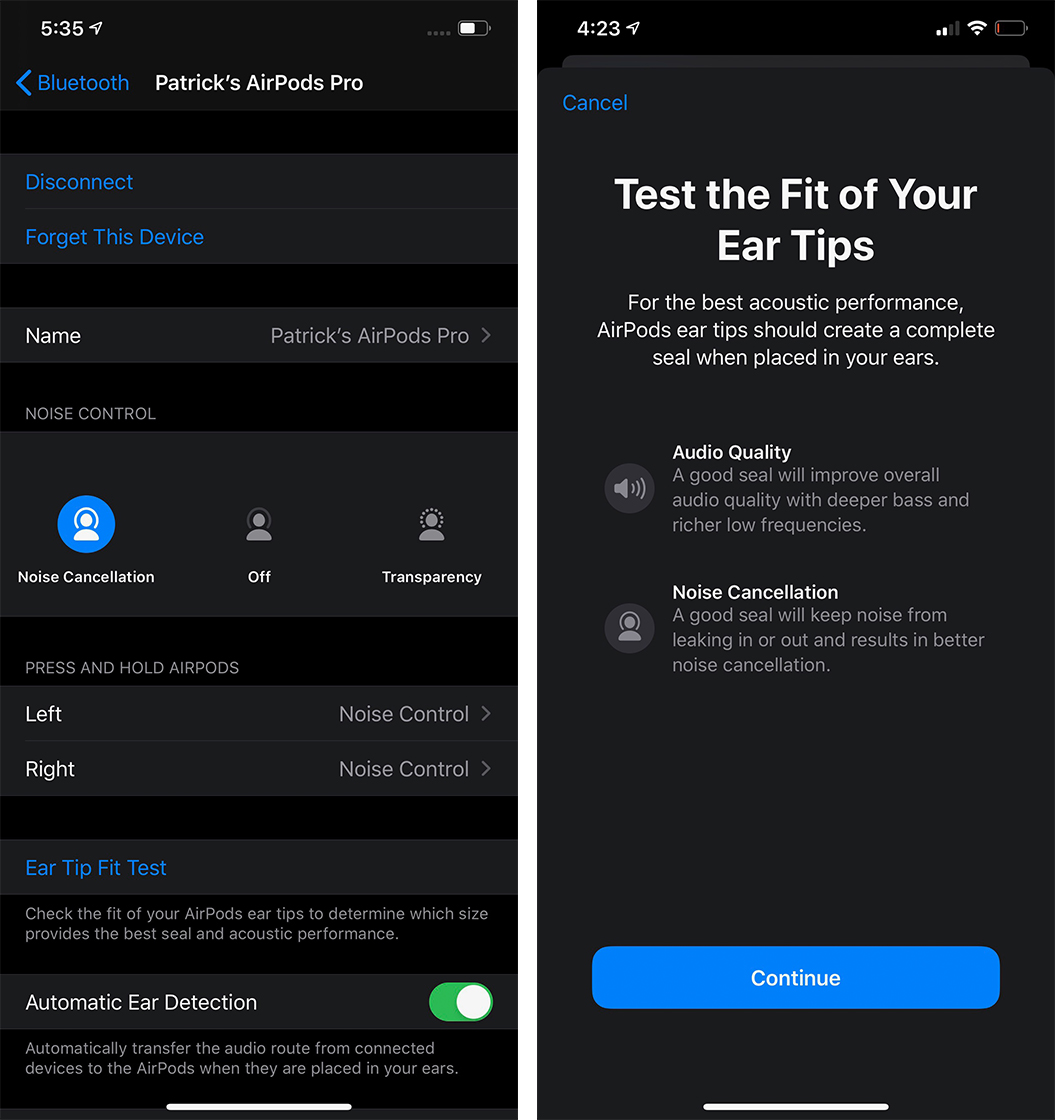
There’s also a useful feature accessed through the earbuds’ Bluetooth settings called ‘Ear Tip Fit Test’ that allows you to know for sure that you’re using the correct tips. While a short song plays, algorithms work with the inward-facing microphone in each AirPod to measure the tip seal.

While a minor feature, it’s nice to have that extra peace of mind knowing you’ve selected the best tips for your ear shape. That said, the test indicated that I could use either the small or medium tips, which didn’t exactly give me a definitive answer.

Another comfort feature I hope more manufacturers start including in wireless earbuds is the vent in the AirPods Pro that equalizes the pressure inside and outside the wearer’s ear. The sensation I often experience with other in-ear earbuds that feels like my ear is plugged isn’t something I’ve encountered with Apple’s new earbuds. This also makes it easier to wear the earbuds for longer periods of time.

Improved sound quality

AirPods Pro angled in-ear

Similar to noise-cancelling, one crucial thing to keep in mind is that the sound quality you’re going to get from in-ear earbuds will never quite stand up to what over-ear headphones offer.

With that out of the way, it’s important to note that while Apple’s AirPods Pro are an improvement in sound quality over the 2nd-gen AirPods, some might not notice the difference, especially if you don’t have noise-cancelling enabled.

Whether I was listening to guitar-driven music like Selkirk, Manitoba-born Goody Grace’s ‘Scumbag (ft. Blink-182),’ Saves The Day’s recent reissue of ‘Through Being Cool’ or the Menzingers’ ‘America (You’re Freaking Me Out),’ mids and highs remained clear and featured notable dynamic range.

“…the difference in sound quality between Apple’s AirPods Pro and Sony’s WF-1000XM3 earbuds is negligible”

I’d even go so far as to say that I noticed vocals or guitar riffs I otherwise haven’t heard before in songs. On the other hand, more bass-driven tracks like Lil Peep’s ‘Belgium,’ 21 Savage’s ‘Immortal],’ or even something like Turnstile’s ‘Real Thing,’ feature the deepest bass I have ever experienced from a pair of earbuds.

When pitting the AirPods Pro directly against Sony’s WF-1000XM3 earbuds, I’d again give Apple’s earbuds the win. Sound quality is very similar, with the WF-1000XM3 sometimes handling the highs of a song better than Apple’s earbuds, but the impressive bass featured in the AirPods Pro overshadows this.

Again, though, similar to noise-cancellation, the difference in sound quality between Apple’s AirPods Pro and Sony’s WF-1000XM3 earbuds is negligible.

Control issues

AirPods Pro on railing

One of my main issues with the AirPods Pro is how difficult they are to control. The same speech-detecting sensor and motion accelerometer found in the 2nd-gen AirPods is back. This means that the ‘Hey Siri’ commands work just as great as they did with the 2nd-gen AirPods. Further, the AirPods Pro know when they’re in your ears, just like the earbuds’ predecessors.

Physically controlling the headphones is a little different this time, unfortunately. There’s now a force sensor located in the tip of the left and right bud. To switch between active noise cancellation and Transparency Mode, you press and hold the stem. Tapping plays, pauses or answers a call, double-tapping skips forward and three-presses skips back.

While this all might sound simple, I found the touch controls to be unreliable. However, over the past few days, they slowly became more dependable as I built up my muscle memory. Unfortunately, the actual act of pressing the headphone stem is still nowhere near as consistent as just tapping the standard AirPods. To be fair, I also experienced similar issues with the WF-1000XM3s physical controls.

One AirPod Pro earbud

Call quality seems identical to the standard AirPods in my tests, which means that generally, Apple’s new earbuds are great for taking calls unless it happens to be windy outside.

To my horror, I’ve accidentally put both the 1st-gen and 2nd-gen AirPods through the washing machine (without their charging case) at least twice over the last few years. Thankfully they were fine, but with the AirPods Pro, Apple has added IPX4 sweat and water resistance to the wireless earbuds. Anyone who plans to use the AirPods Pro while exercising will appreciate this feature.

Everything else

One of the main draws of Apple’s AirPods has always been their reliable Bluetooth connection, as well as how easily they connect to the iPhone. These features are back with Apple’s H1 chip, the same silicon featured in the 2nd-gen AirPods.

While the instant connecting experience is nearly identical to the 2nd-gen buds, I did find that the AirPods Pro feature a more reliable Bluetooth connection. With the 2nd-gen AirPods, sometimes when I’m walking around downtown Toronto, I’ve experienced bouts where music stutters or my connection briefly drops. In the little over a week I’ve been using the AirPods Pro, this hasn’t happened once.

Of course, this magic is gone when you use the AirPods Pro with an Android device and, disappointingly, often even when connecting them to my MacBook Pro. Sometimes, the earbuds would automatically connect after being paired with my MacBook Pro, but this didn’t happen consistently. You’re then forced to navigate to your device’s Bluetooth settings to connect them manually.

This brings me to battery life, another drawback with the AirPods Pro. While the earbuds offer up to five hours of listening time with Active Noise Cancellation and Transparency Mode turned off, this defeats the purpose of owning the earbuds in the first place.

AirPods Pro vs 2nd-gen AirPods

In my experience, the AirPods Pro typically last four hours, which is roughly the same as what the 2nd-gen version of Apple’s earbuds feature. Given the expensive price tag attached to the AirPods Pro, as well as the fact that the company is positioning them as premium earbuds and a significant upgrade over the 2nd-gen AirPods, I expected more of an improvement in battery life.

The Pro’s more stout charging case offers 24 hours of charging time, with a five-minute charge resulting in roughly an hour of battery life. The AirPods Pro charging case is identical to the 1st- and 2nd-gen AirPod case, only with a more rectangular shape. I did find it slightly more challenging to tell which slot each earbud needed to slide into, given the different shape of the AirPods Pro.

Other new AirPods Pro features have also arrived courtesy of iOS 13, including ‘Audio Sharing,’ which allows content to stream to two sets of AirPods connected to one device, and the ability to set Siri to announce Messages. Both of these features are also available with Apple’s other AirPods.

The post AirPods Pro Review: The best wireless earbuds with noise-cancelling appeared first on MobileSyrup.

07 Nov 01:50

Smart Summoned self-driving Tesla caught on wrong side of road in B.C.

by Brad Bennett

The Insurance Corporation of British Columbia (ICBC) has stated that a driver using Tesla’s ‘Smart Summon’ feature in a Richmond, B.C. parking lot was doing so illegally.

The white Tesla Model 3 was caught navigating to its owner in a Richmond shopping centre parking lot with no one behind the wheel and driving on the wrong side of the road earlier this week. The video caught headlines, and now, the ICBC — a Crown corporation — has issued a statement claiming that driverless cars are not permitted on B.C. roads.

The ICBC even went as far as to say that the vehicle insurance may have refused to provide coverage if the self-driving Tesla was to get into an accident.

Rules like these may vary by province. For instance, in B.C., parking lots are “hybrid composed of private property and a highway as defined in the Motor Vehicle Act (MVA),” according to Drive Smart BC. Yet in Ontario, “the rules of the road don’t apply on private property, according to a story published by The Globe and Mail last year.

So take note and find out the rules of the parking lots where you live and to be safe, contact your insurance providers to find out if you’re covered when your car is driving itself.

Source: Vancouver is Awesome, Drive Smart B.C., Globe and Mail

The post Smart Summoned self-driving Tesla caught on wrong side of road in B.C. appeared first on MobileSyrup.

07 Nov 01:49

Vancouver council unanimously votes to expropriate 2 DTES hotels for $1 each

mkalus shared this story .

What is a shuttered downtown fixer-upper worth these days?

According to Vancouver city council, $1.

In a unanimous vote on Wednesday, council approved expropriating two Downtown Eastside buildings — the Balmoral and Regent hotels — for $1 each

The two buildings once housed around 280 low income residents but have sat empty since the city shut them down in 2017 and 2018 due to unsafe and unsanitary conditions.

Mayor Kennedy Stewart said negotiations with the buildings' owners — the Sahota family, who have been in bylaw and legal battles with the city for many years — proved unfruitful, requiring the expropriation vote. 

"Council has been working for a long time in good faith with the owners of those properties to try to get them upgraded, and that wasn't happening," said Stewart. 

"Look, the Downtown Eastside is a community in crisis. And I think expropriating these hotels will help aid that crisis."

Several councillors said they were moved by speeches from the public, many of whom had dramatic stories about the poor conditions of the hotels, along with allegations of neglect by the owners. 

"There's a human responsibility we get to fulfil today. It is a moral and it is an ethical decision," said councillor Sarah Kirby-Yung.

"Nobody should have to live in those conditions. We need to provide some dignity."

City staff said it was a landmark decision.

"[Expropriation] is used quite frequently for lineal process. rapid transit projects, road alignments," said Andrew Newman, the city's associate director of real estate services. 

"But for the purposes of this expropriation, which is providing housing accommodation, we're not aware of any incidences, certainly in Vancouver, where this has occurred."

Bad faith negotiations?

But the lawyer representing the Sahota family argues it's the City of Vancouver that has been failing to work in good faith to resolve the situation. 

"The owners have been stuck in limbo," said Evan Cooke.

He said the Sahotas wanted to negotiate with the city, have offered to sell the building to the city and have received offers of up to $25 million for the properties but have been unable to move because of the expropriation claim. 

"There's been no attempt to negotiate with these owners on the basis of the actual market data."

City staff told council the offer was based on the fact that either renovating or demolishing the buildings would cost more than the approximately $3.2 million each one is currently assessed for. 

Cooke argues the offer is politically motivated. 

"There have been historical frustrations within the city with the maintenance and standards at these two buildings ... which is perhaps understandable," he said.

"But it's actually not relevant to the question of the scope of the city's legal authority or whether it has the right to pay less than market value of the properties." 

What happens next? 

Prior to the vote, Cooke said the Sahotas would file a court challenge and injunction against the expropriation if the city moved ahead.

But Jeff Frame, a B.C. lawyer specializing in expropriation law, said it would face an uphill battle because of the broad powers cities have to expropriate property. 

"There's really not much an owner can do to challenge an expropriation. People have tried before but it's almost never succeeded," he said.

However, under the Expropriation Act, the owners will have one year to bring a claim for greater compensation — and Frame believes the Sahotas will have a more successful case there. 

"It just strikes me as kind of a slap in the face of an owner," he said. 

"The cost of cleaning up a contaminated property ... is certainly not new and it's understandable. It's just the idea that a property could be in such bad shape in Vancouver to reduce it to zero is, I think, a pretty tough sell to almost anyone."

07 Nov 01:49

At this rate, the @Conservatives are going to look back on Theresa May's campaign in 2017 as a golden age of political communication. This is what people are reduced to when they mortgage their consciences to Boris Johnson. twitter.com/Jason_Keen/sta…

by redhistorian
mkalus shared this story from redhistorian on Twitter.

At this rate, the @Conservatives are going to look back on Theresa May's campaign in 2017 as a golden age of political communication. This is what people are reduced to when they mortgage their consciences to Boris Johnson. twitter.com/Jason_Keen/sta…

“I don’t know”

Business Minister @nadhimzahawi’s answer when asked to accept that @jeremycorbyn wouldn’t have wealthy people shot (unlike Stalin)....

#andrewneilshow
pic.twitter.com/8FAVqwEVcA


308 likes, 188 retweets


74 likes, 21 retweets
07 Nov 01:48

Massive White Supremacist Message Board Leak: How to Access and Interpret the Data

by Bellingcat Investigation Team
mkalus shared this story from bellingcat.

Today, the entire SQL database from Iron March, a now-defunct neo-Nazi / white supremacist message board, was posted onto the Internet Archive by the user “antifa-data“. You can access this data dump on the Internet Archive, and via a torrent file found here, or through this Magnet link.

This leak contained the entirety of the site’s information, including user names, registered emails, IP addresses of users, all of the forum’s public posts, and even the private messages between members. This message board was linked with the violent neo-Nazi group Atomwaffen Division, and has been widely studied by anti-extremist groups and researchers, such as the Southern Poverty Law Center (SPLC). The SPLC has also scraped all of the public posts from the site — well over 150,000 of them — and has been researching them over the last two years.

How to access the files

There are two ways to read and access the leak. The first is through the SQL database within the torrent, which can be accessed through an SQL database viewer (for example, MySQL Workbench or DB Browser for SQLite). However, this is quite arduous for the average user.

It is much easier to read through the exported spreadsheets that are included within the torrent file. The most important spreadsheets for analysis, and the most important columns within them, are:

core_members (All users)

  • Column A indicates the member ID, which is reflected across other spreadsheets as well.
  • Column B indicates the username within the site.
  • Column D indicates the registration email used by the user.
  • Column E indicates the time that the user signed up, converted into Unix time. You can convert the timestamp into normal time here; for example, the first user sign-up was at 1315842419, or 12 September 2011 at 3:46pm (UTC).
  • Column F indicates the IP address at registration; however, this could be spoofed if the user deployed a VPN or proxy connection.
  • Columns M-O indicate the date of birth provided by the user.

core_message_posts (All private messages)

  • Column A indicates the unique message ID — every single message sent on the forum has its own ID.
  • Column B indicates the message topic (thread) — each conversation between users has its own thread, and will not always be sequential to message ID, depending on how fast the users were writing back to one another.
  • Column C indicates the time of the message, converted into Unix time. You can convert the timestamp into normal time here.
  • Column D indicates the message content. Note that there is sometimes a blank space before the message begins, making it (falsely) appear blank in a preview on Excel.
  • Column F indicates the member ID, which can be cross-referenced with Column A in core_members.
  • Column G indicates the IP address used by the user who sent the message. This can be cross-referenced with Column F in core_members.

Cross-referencing private messages (core_message_posts) and the users sending them (core_members) is quite easy, in just cross-referencing usernames and member ID numbers. Click this image, created by Jake Godin, to see how to easily cross-reference these data sets.

core_message_topics (Titles of all private messages)

  • Column A indicates the topic (thread) ID number, which can be cross-referenced with Column B in core_message_posts.
  • Column B indicates the time that the message was sent, in Unix time. You can convert the timestamp into normal time here.
  • Column C indicates the title of the private message thread.
  • Column E indicates the member ID of the person who first sent the message, which can be cross-referenced with Column A in core_members.
  • Column I indicates the member ID of the recipient of the thread, which can be cross-referenced with Column A in core_members.

core_search_index (All forum posts)

  • Column F indicates the post content.
  • Column H indicates the member ID of the poster, which can be cross-referenced with Column A in core_members.
  • Column J indicates the post time, converted into Unix time. You can convert the timestamp into normal time here.

Potential research leads

In a cursory survey of the data, there are a number of investigative paths for identifying active users of this forum for violent white supremacists. In particular, there are a number of users who identified themselves as active serving members of the military in Western countries, especially the United States.

We have started to compile potential leads for these users, which can be accessed here. We encourage journalists and investigators to follow up on some of these, and other, leads that can be found in these data sets. Additionally, users can suggestion additions or revisions to the existing data set.

The post Massive White Supremacist Message Board Leak: How to Access and Interpret the Data appeared first on bellingcat.

06 Nov 02:47

Deep wells

by Chris Corrigan

I’ve been enjoying Haruki Murakami’s early novels lately. Here is a paragraph from “Pinball, 1973.”

“On any given day, something can come along and steal our hearts. It may be any old thing; a rosebud, a lost cap, a favourite sweater from childhood, an old Gene Pitney record. A miscellany of trivia with no home to all their own. Lingering for two or three days, that something soon disappears, returning to the darkness. There are wells, deep wells, dug in our hearts. Birds fly over them.”

–Haruki Murakami, Pinball, 1973