Google says it was all above board - after all, the program was mentioned in an earnings call earlier this year -but they still didn't tell people their data was being collected, nor did they anonymize the data (quite the opposite, in fact). Google responded that "it’s standard industry practice for a health care provider to share highly sensitive health records with tech workers under an agreement like the kind it signed." Well, maybe it shouldn't be. And we have to ask, when Google does other things - like this Freddie Mercury singing competition - what other data is it collecting? When it buys FitBit, what does does it do with the data? And, of course, what about the deals its making with school boards? Sure, maybe it's all legit - but running it as a secret program sure doesn't convey that impression.
“What are you looking at?” asked the 3yr old (3 and a half, she would correct me).
“My website”, which I explained as a place where I write little stories.
“I want a website too”
So much like I did for myself for the first time in 1993, I opened up a textpad and we started writing. First she wanted to claim the page as her own, with saying her name and saying it is her site. Then she wanted to type something random, and adding the names of me and E, and uncle H. She typed all the letters of our names that I for the most part pointed out to her on the keyboard. As a last step she asked me to show the Elsa and Anna pictures (which I normally do with Google’s image search), so she could pick one for her page. After each step we loaded the file in the browser to look at it. And the final result living on my local webserver is:
This is a RSS only posting for regular readers. Not secret, just unlisted. Comments / webmention / pingback all ok. Read more about RSS Club
Google pushed out a silent Chrome update that left thousands of businesses with broken browsers, stumping and angering IT admins.
According to The Verge, Google pushed out a silent, experimental change to the stable channel of Chrome earlier this week. Unfortunately, the experiment caused the browser to display blank white screens when opening new tabs for users accessing Chrome through virtual machine environments like Citrix. The blank pages essentially blocked access to Chrome and left it totally unresponsive.
Further, IT admins were confused by the issue, as typically businesses manage and control Chrome updates.
As complaints swirled, Google revealed the launch of its experimental change. The Chrome team flipped the switch on a flag — a hidden Chrome setting used to modify browser behaviour — which enabled the new ‘WebContents Occlusion‘ feature. It suspends Chrome tabs when you move other apps on top of them to reduce resource usage when the browser isn’t in use.
Google software engineer David Bienvenu posted to a Chromium bug thread about the issue, noting that the experiment was in beta for about five months.
“It was turned on for stable (e.g., m77, m78) via an experiment that was pushed to released Chrome Tuesday morning. Prior to that, it had been on for about one percent of M77 and M78 users for a month with no reports of issues, unfortunately,” wrote Bienvenu.
Google rolled back the Chrome change late Thursday night following complaints from several businesses with thousands of users affects. Bienvenu noted in the bug thread that he’ll “try to figure out how to deal with Citrix.”
IT admins want Google to notify them about changes
However, IT admins are still upset over the issue. Many took to the bug thread to complain, writing that Google needs to offer some kind of opt-out option as well as announce when it makes changes like this. Many of the admins had spent upwards of two days trying to fix the problem when the issue wasn’t something they could even change.
One IT admin told The Verge that it’s “a shady thing that Google can update Chrome silently without announcing anything and can impact 100,000+ people on a whim.”
Whether for corporate users or consumers, silent updates can be a problem, especially when something breaks. If people don’t know there was an update, it can difficult to troubleshoot issues the update can cause.
In Ulysses 18, we built in the option to save Ulysses files in external folders (on iOS only Dropbox). That means, you can now make use of Ulysses’ complete feature set when working with these folders: from embedded images to annotations, attachments, writing goals and features – you name it!
That’s why you can now also employ Dropbox to sync your groups and sheets between several desktop and mobile devices – without any functional compromises! So, if you – for whatever reason – can’t or don’t want to rely on iCloud for synchronization, Dropbox is now a reasonable alternative. Learn everything you need to know to set it up in our detailed tutorial.
Apple has removed all vaping related apps from its iOS App Store.
The tech giant confirmed in a statement to Axios that its stringent App Store guidelines now ban software that encourages or helps people to vape.
That said, if you already have a vaping app installed on your device, you’ll be able to continue using it and will be able to download it again, according to Axios.
“Experts ranging from the CDC to the American Heart Association have attributed a variety of lung injuries and fatalities to e-cigarette and vaping products, going so far as to call the spread of these devices a public health crisis and a youth epidemic,” said an Apple spokesperson in a statement to Axios. “We agree, and we’ve updated our App Store Review Guidelines to reflect that apps encouraging or facilitating the use of these products are not permitted.”
Apple’s ban on vaping apps follows widespread reports of vaping-related illnesses across the U.S. and Canada. The Ministry of Health has confirmed eight possible vaping-related health cases in Canada. In the United States, there have been more than 2,100 cases of vaping related health problems as of November 13th, according to the CDC.
Apps designed to control cannabis-related vape products, such as the Pax Labs’ Pax 3 app, have also been banned from the iOS App Store.
Google has no comment regarding potential plans to ban vaping related products in the Play Store.
Update 11/15/2019 3:35pm: The story has been updated with comment from Google.
Good catching up with you after too long Boris. Excited to hear about Fission. Later on was wondering how IPFS as starting point plays out with highly dynamic material (e.g. real time data sets), versus dat for such data sets. Pleasing to note our thinking since our joined session at BarCamp Brussels in 2006 has evolved along similar lines in the current timeframe, except you more on the tech side of things, and me on the change management side of it.
It's hard not to be suspicious of an article as fawning as this one, but it's also really good reading, might actually just be an honest impression, and provides a valuable insight into an online program management (OPM) company, Noodle Partners, that takes on an anti-OPM stance. The article mostly recounts "a small Academic Roundtable that the company hosted this summer at their Manhattan headquarters... their leadership team was able to actively participate in the conversations as colleagues (rather than as a vendor)." Maybe these are valuable, but I'll believe they're not marketing hen they start including vocal critics like Audrey Watters. See also this keynote from founder and CEO John Katzman.
The feature allows users to send images, videos and audio files from their mobile device to either a Chromecast or an Android TV. It may even work with some Cast-enabled smart displays, but we haven’t been able to test that yet.
If your mobile device and your Cast-enabled screen are on the same Wi-Fi network, the ‘Cast icon’ should appear along the top of the app. Although it will only appear if you’re browsing files that can be cast.
If it’s an audio file a now playing screen will appear so you can control the playback.
Stellt sich raus: Wenn man das Testing an Freiwillige crowdsourced, sind die Teilnehmer nicht aus dem Enterprise-Bereich. So segelte der Code ohne Probleme durch Monate des Testens.
Und jetzt merken plötzlich alle, wie sehr sie sich von Chrome abhängig gemacht haben.
"This has had a huge impact for all our Call Center agents and not being able to chat with our members," someone with a Costco email address said in a bug report. "We spent the last day and a half trying to figure this out."
"Our organization with multiple large retail brands had 1000 call center agents and many IT people affected for 2 days. This had a very large financial impact," said another user.
"Like many others, this has had significant impact on our organization with our entire Operations (over 500 employees) working in a RDS environment with Google Chrome as the primary browser," said another system administrator.
"4000 impacted in my environment. Working on trying to fix it for 12 hours," said another.
"Medium sized call center for a local medical office lost a day and a half of work for 40-60 employees," added another.
Auf der anderen Seite muss man sagen, dass bei Chrome erstaunlich wenig schiefgeht. Wenn man das mal mit den ganzen verkackten Windows-Patches vergleicht, ist Chrome geradezu ein Anker der Stabilität und Verlässlichkeit.
A Google Chrome experiment has gone horribly wrong this week and ended up crashing browsers on thousands, if not more, enterprise networks for nearly two days.
The issue first appeared on Wednesday, November 13. It didn't impact all Chrome users, but only Chrome browsers running on Windows Server "terminal server" setups -- a very common setup in enterprise networks
Complaints flooded Google
According to hundreds of reports, users said that Chrome tabs were going blank, all of a sudden, in what's called a "White Screen of Death" (WSOD) error.
The issue was no joke. System administrators at many companies reported that hundreds and thousands of employees couldn't use Chrome to access the internet, as the active browser tab kept going blank while working.
In tightly controlled enterprise environments, many employees didn't have the option to change browsers and were left unable to do their jobs. Similarly, system administrators couldn't just replace Chrome with another browser right away.
"This has had a huge impact for all our Call Center agents and not being able to chat with our members," someone with a Costco email address said in a bug report. "We spent the last day and a half trying to figure this out."
"Our organization with multiple large retail brands had 1000 call center agents and many IT people affected for 2 days. This had a very large financial impact," said another user.
"Like many others, this has had significant impact on our organization with our entire Operations (over 500 employees) working in a RDS environment with Google Chrome as the primary browser," said another system administrator.
"4000 impacted in my environment. Working on trying to fix it for 12 hours," said another.
"Medium sized call center for a local medical office lost a day and a half of work for 40-60 employees," added another.
"Same issue experienced, hundreds of users impacted - hours spent attempting to isolate the cause," said another user.
Hundreds of complaints poured in via Google's support forum, Chrome bug tracker, and Reddit [1, 2]. One impacted sysadmin told ZDNet that they initially mistook the Chrome blank tabs as a sign of malware and reacted accordingly, starting network-wide security audits.
Google ships a fix
However, with time, the root cause of the bug was eventually found, and traced back to a feature called "WebContents Occlusion."
According to Google Chrome design document, this is an experimental feature that suspends Chrome tabs when users move other app windows on top of Chrome, treating the active Chrome tab as a background tab.
The feature, meant to improve Chrome's resource usage when not in active use, had been under testing in Chrome Canary and Chrome Beta releases all year.
However, this week, Google decided to test it in the main Stable release, so it could get more feedback on how it behaved.
That it behaved badly is an understatement.
"The experiment/flag has been on in beta for ~5 months," said David Bienvenu, a Google Chrome engineer. "It was turned on for stable (e.g., M77, M78) via an experiment that was pushed to released Chrome Tuesday morning."
"Prior to that, it had been on for about 1% of M77 and M78 users for a month with no reports of issues, unfortunately," he added.
However, when rolled out to a broader audience -- such as Windows users on terminal server setups -- an unexpected bug occurred that instead of suspending Chrome tabs when users switched to another app, it unloaded the tab entirely, leaving a blank page behind.
Users could refresh the Chrome tab to access their sites again, but in some cases, this also meant they lost previous work.
The Chrome team said they pushed a new Chrome configuration file to all Chrome users and disabled the experiment.
Chrome engineers operate a system called Finch that lets them push updated Chrome settings to active installs, such as enabling or disabling experimental flags.
If the fix has not reached all impacted users, and they still have problems, they can disable the following two experimental flags by hand:
An alternative method to fixing this is to start Google Chrome with the following command-line argument: --disable-backgrounding-occluded-windows
Fix prompts more criticism
However, fixing the problem actually made system administrators even angrier. Many didn't know that Chrome engineers could run experiments on their tightly-controlled Chrome installations, let alone that Google engineers could just ship changes to everyone's browsers without any prior approval.
"Do you see the impact you created for thousands of us without any warning or explanation? We are not your test subjects," said an angry sysadmin. "We are running professional services for multi million dollar programs. Do you understand how many hours of resources were wasted by your 'experiment'?"
"How many tens of thousands of dollars has this oops cost everyone? This is starting to look like a pretty massive mistake on Googles part," added another disgruntled sysadmin.
"We take great care in rolling our changes out in a very controlled manner to avoid this type of scenario and we spent the better part of yesterday trying to determine if an internal change had occurred in our environment without our knowledge. We did not realize this type of event could occur on Chrome unbeknownst to us. We are already discussing alternative options, none of them are great, but this is untenable," said another, hinting at a browser change across their organization.
Although it lasted just two days, this entire incident is panning out to be one of the Chrome team's biggest bungles. Many impacted users demanded an official apology from Google, and by the looks of the financial impact it may have caused some companies, they are entitled to it.
While Apple made several subtle changes to its MacBook design with its new 16-inch MacBook Pro, the most significant shift is ditching the beleaguered Butterfly mechanism in favour of a standard scissor switch keyboard.
iFixit’s recent teardown of Apple’s new laptop confirms the company’s claims that the design of its new scissor switch is similar to its current iMac and iMac Pro Magic Keyboard. In fact, iFixit goes so far as to say that the switches in the new 16-inch MacBook Pro are nearly identical to those featured in Apple’s 2015 Magic Keyboard.
The switches also are even interchangeable with the standard Magic Keyboard for the iMac and iMac Pro.
This fundamental shift in Apple’s laptop design marks the end of its low key-travel Butterfly keyboards that have been featured in its laptops for several years now. It’s likely only a matter of time until the new Magic Keyboard is featured in all of Apple’s MacBooks.
Apple attempted to revamp the Butterfly mechanism multiple times to better block debris and offer improved durability but was never able to solve the keyboard’s reliability issues entirely. The company was eventually forced to launch an extended warranty program for its first, second and even third-generation Butterfly keyboard.
iFixit says that the new keys have 0.5mm more travel than the butterfly keyboard, along with 0.2mm greater thickness. The clips that attach to the new keyboard’s keycaps are also reinforced and easier to replace when compared to the Butterfly keyboard.
Along with a new keyboard, Apple’s new laptop also features reduced bezels, improved sound quality and the return of a physical ‘Escape’ key.
Google has been in the process of creating a new .new top level domain with the intent that such URLs will take you directly to a specific content creation tool. However, instead of allowing users to pick their own content creation tools (which is the way it should work) Google is going through a process of selecting winners. Thus, for example, docs.new will open in Google Docs, story.new opens the editor on Medium (which is a very bad choice), and sell.new goes to eBay. No word on where things like blog.new and course.new will go - but I have no doubt some people will be disappointed no matter how Google awards these domains.
Just for fun I made a single web page that links to all of these - though many of them won't load yet, some won't load ever in an iframe, and (in Firefox) a number are blocked by content security policies. But wouldn't it be nice to have a page like this that captures the URL of whatever you created and allows you to send it wherever you want (I wanted this for LPSS but nobody was interested in content creation)? Or to save what you created to your own (cloud or local) repository? Why can't we have something like this? See also, Wired, the Verge, enGadget, Quartz, CNet.
The salvation of any Island family with needle-averse children in recent years has been the “flu mist,” an alternate form of the yearly influenza vaccine that gets squirted into the nose rather than needled into the arm.
For Oliver the coming of the mist was transformative; flu vaccine time was still an anxious time of the year, mostly because being in a hall filled with other people about to get a needle is like sitting in the waiting room of a particularly brutal airport. But the anxiety was manageable, and thus not a source of seasonal dread.
So much so that we secured permission from Dr. Heather Morrison, Chief Public Health Officer, to allow Oliver to continue to receive the mist into adulthood.
After confirming with Dr. Morrison that the mist was out, we decided to follow her advice to look into receiving the flu shot from our family doctor, a setting where we could be more in control of the environment, and where Oliver would be more comfortable.
Fortunately we have a family doctor, and our family doctor has an exceptionally talented nurse, Cheryl, who Oliver’s known for many years, and with whom he has a good relationship.
So we made an appointment for this morning.
I chatted with Cheryl on the phone before we came into the office to establish a shared understanding of the challenge ahead.
And then casually mentioned to Oliver, after breakfast, that we had an appointment with Cheryl to get the flu shot (reminding him of her excellent bedside manner, and problem-free blood draw this summer).
And we headed into the office for 10:00 a.m.
About 10 minutes before giving Oliver the shot, Cheryl came out into the waiting room and applied some numbing cream to the injection site; once Oliver’s arm had a chance to numb up, we went into an exam room, Oliver hopped up on the exam table, and he got his flu shot.
No fuss, no muss.
Well, some preemptive muss. And a lot of hang-wringing and worry on my part and Catherine’s.
But Oliver rose to the occasion. Cheryl rose to the occasion. And Oliver’s been vaccinated.
Great Minds Discuss Ideas; Average Minds Discuss Events; Small Minds Discuss People
This quote is often attributed to Eleanor Roosevelt, but it’s been suggested it was a less pretentious edit of Charles Stewart’s 1901 autobiography:
Men and women range themselves into three classes or orders of intelligence; you can tell the lowest class by their habit of always talking about persons; the next by the fact that their habit is always to converse about things; the highest by their preference for the discussion of ideas.
Let’s break each one of these down, starting by talking about people, or in other words, gossip. I recently had a friend inadvertently share a story about another person, which was quickly gossiped, and has created drama amongst several social networks. This was a powerful reminder to both of us, that most of our social network doesn’t gossip, or talk about people, and the drama that can unfold when one does.
If you do insist on talking about people, or gossiping, my friend Scott N pointed me to the Buddhist Rights Speech philosophy (part of the Noble Eightfold Path), which I enjoy as a reference when I want to bring up another person in conversation:
It is timely
It is true
It is spoken affectionately, and of good will
It has a benefit to being shared
If the answer isn’t a clear and obvious yes to all four of these, hold on to the thought and work through each of these four, or just drop it and move on to more beneficial conversation.
There is a short term benefit to gossip, you get an immediate boost of dopamine as both the sharer and the receiver. The sharer will also experience a release of oxytocin, and potentially even a release of serotonin. As these are the three chemicals that make up happiness, it’s no doubt that it’s physically and emotionally rewarding to gossip. It also improves bonding amongst those who seek out these chemicals, which are typically people who in my experience, lack self discipline.
Why they are referred to as small minds, is because scientifically there’s not enough stimulation in this process to create new neural pathways.
It is my experience that the smallest minds not only gossip, but they talk negatively about others. It takes a little self awareness and observation to notice that talking negative about others, or against the Buddhist Rights Speech mentioned above, hurts the originator more than anyone else, and that anyone doing so is not calm nor contented, and usually less successful than the person they are gossiping about. A gossiper would be better served improving themselves.
When you want to start to move into more objective conversation, you will start to talk about things, such as events. This is referenced in the quote as the level of conversation of an average mind. You will get some of the above chemicals as mentioned above, but less usually, but you’re also introducing a level of thought. The challenge is the thought is likely not much new information, but mostly information that is already known or experienced, so not many neurons are used.
What is likely obvious at this stage in the story is that when you start to express curiosity, or questioning, your brain activity is creating new neural pathways over time as you walk through this new learning. This means you’re actually becoming smarter — and in my experience people automatically think you’re really smart — which it doesn’t mean you are, but it is my recommendation there is no better position to be insatiably curious and perpetually improving your critical thinking skills.
If you’re wondering how you might do this, try to take a contrarian position on something you’re emotionally attached to. If you’re strongly a liberal, try to understand and take the honest position of a conservative. If you’re an atheist, argue how Islam is the correct religion.
It is my observation, or hypothesis, that those who identify as critical thinkers are less settled and less happy, so with everything, there’s a trade off.
The intent of this article isn’t to place a right or wrong on any of the three areas of conversations you usually find yourself in, but to think about which of the three you usually talk about — people, things/events, or ideas, and then to question how that is serving you.
While drafting this article, I came across a poem but I can’t find the original author so I’ll reference a medium post with it and share it here:
I once asked a very successful woman to share her secret with me. She smiled and said to me… “I started succeeding when I started leaving small fights for small fighters. I stopped fighting those who gossiped about me… I stopped fighting with my in laws… I stopped fighting for attention… I stopped fighting to meet peoples expectation of me… I stopped fighting for my rights with inconsiderate people.. I stopped fighting to please everyone… I stopped fighting to prove they were wrong about me… I left such fights for those who have nothing else to fight… And I started fighting for my vision, my dreams, my ideas and my destiny. The day I gave up on small fights is the day I started becoming successful & so much more content.” Some fights are not worth your time … Choose what you fight for wisely.
“I really think this is a real gift to the city,” said Stewart. “Everything we can do to make this project be successful is at the top of my list.”
Be careful. If Senakw, the Squamish Burrard Bridge project, is a gift to the city, other proponents will come bearing gifts for similar considerations.
From Expo 86 to the 2010 Olympics, the City has seen almost a dozen megaprojects appear on the skyline – developer-driven, comprehensively designed and built, beginning with Concord Pacific in the late eighties. All through the nineties, megaprojects sprouted – from Coal Harbour to Collingwood Village to Fraser Lands.
They all had to meet standards for complete communities, based originally on what we had learned when the City created the South Shore of False Creek, followed by Granville Island. If a developer came to the City with a megaproject proposal, they came with a plan that met the council-approved megaproject standards.
The City extracted huge wealth from the value it created through those zoning approvals. Lots of parkland and seawall extensions, in addition to the basic infrastructure – pipes, cables and roads. As well: social amenities and necessities – schools, community centres, child care as a priority; housing percents for families with children, for social equity. There were design standards: for cycling, for sustainability, for the arts. And more. That’s what we meant by ‘complete communities’ – and you can go walk around in the results.
Developers paid for all this through direct provision of the benefits, like a child-care centre, or through ‘contributions’ – those CACs you hear about without quite understanding how they work.
In the case of Senakw, it could be the other way around.
Ginger Gosnell-Myers (Vancouver’s first aboriginal relations manager) said Senakw will give future Vancouverites the chance to live in the city and it’s up to the city to respond to concerns about infrastructure and capacity.
Stewart say he is up to the challenge, including working with the park board, the school board and the province to ensure community services are available when the neighbourhood’s new residents arrive.
At 10- to 12,000 residents, there is no way Senakw could meet some of the established standards. Concord Pacific had to provide 2.75 acres of park for every thousand residents. Senakw would need more than twice the area of its entire 11-acre site. While it’s not yet clear what Senakw will provide, it isn’t obligated. Nor is it yet clear (or even negotiated), but the City looks like it’s committing itself to providing significant amenities and necessities – accepting density and paying for impacts.
So if the development itself – the thousands of market rental apartments – is the gift, then why would the City not be open to receiving more gifts from other developers. Yes, Senakw is unique given its status as a reserve, so developers wouldn’t expect the same deal. They’d just expect the amenity bar to be lowered.
How the relationship develops and negotiations occur is what reconciliation is seriously about – a relationship based on mutual interests levered for maximum value. One of the values of the City is the building of complete communities. Squamish would point to their own history for examples. It shouldn’t be hard to come to a consensus.
Squamish has an interest in a successful development in every respect. The city has to demonstrate respect. Together, they’re negotiating our collective interests.
This is the reality of reconciliation. It’s not about gifts, or reparations. It’s about building the latest version of a complete community, together.
At Github Universe, Github announced the GitHub Security Lab, an initiative to help secure open source software alongside the community and an initial set of partners including Mozilla. As part of this announcement, Github is providing free access to CodeQL, a security research tool which makes it easier to identify flaws in open source software. Mozilla has used these tools privately for the past two years, and have been very impressed and hopeful about how these tools will improve software security. Mozilla recognizes the need to scale security to work automatically, and tighten the feedback loop in the development <-> security auditing/engineering process.
One of the ways we’re supporting this initiative at Mozilla is through renewed investment in automation and static analysis. We think the broader Mozilla community can participate, and we want to encourage it. Today, we’re announcing a new area of our bug bounty program to encourage the community to use the CodeQL tools. We are exploring the use of CodeQL tools and will award a bounty – above and beyond our existing bounties – for static analysis work that identifies present or historical flaws in Firefox.
The highlights of the bounty are:
We will accept static analysis queries written in CodeQL or as clang-based checkers (clang analyzer, clang plugin using the AST API or clang-tidy).
Each previously unknown security vulnerability your query matches will be eligible for a bug bounty per the normal policy.
The query itself will also be eligible for a bounty, the amount dependent upon the quality of the submission.
Queries that match historical issues but do not find new vulnerabilities are eligible. This means you can look through our historical advisories to find examples of issues you can write queries for.
Mozilla and Github’s Bug Bounties are compatible not exclusive so if you meet the requirements of both, you are eligible to receive bounties from both. (More details below.)
When fixing any security bug, retrospective is an important part of the remediation process which should provide answers to the following questions: Was this the only instance of this issue? Is this flaw representative of a wider systemic weakness that needs to be addressed? And most importantly: can we prevent an issue like this from ever occurring again? Variant analysis, driven manually, is usually the way to answer the first two questions. And static analysis, integrated in the development process, is one of the best ways to answer the third.
Besides our existing clang analyzer checks, we’ve made use of CodeQL over the past two years to do variant analysis. This tool allows identifying bugs both in the context of targeted, zero-false-positive queries, and more expansive results where the manual analysis starts from a more complete and less noise-filled point than simple string matching. To see examples of where we’ve successfully used CodeQL, we have a meta tracking bug that illustrates the types of bugs we’ve identified.
We hope that security researchers will try out CodeQL too, and share both their findings and their experience with us. And of course regardless of how you find a vulnerability, you’re always welcome to submit bugs using the regular bug bounty program. So if you have custom static analysis tools, fuzzers, or just the mainstay of grep and coffee – you’re always invited.
We currently have a number of custom-written checks in our source tree. So the easiest way to write and run your query is to build Firefox, add ‘ac_add_options –enable-clang-plugin’ to your mozconfig, add your check, and then ‘./mach build’ again.
To learn how to add your check, you can review this recent bug that added a couple of new checks – it shows how to add a new plugin to Checks.inc, ChecksIncludes.inc, and additionally how to add tests. This particular plugin also adds a couple of attributes that can be used in the codebase, which your plugin may or may not need. Note that depending on how you view the diffs, it may appear that the author modified existing files, but actually they copied an existing file, then modified the copy.
Future of CodeQL and clang within our Bug Bounty program
We retain the ability to be flexible. We’re planning to evaluate the effectiveness of the program when we reach $75,000 in rewards or after a year. After all, this is something new for us and for the bug bounty community. We—and Github—welcome your communication and feedback on the plan, especially candid feedback. If you’ve developed a query that you consider more valuable than what you think we’d reward – we would love to hear that. (If you’re keeping the query, hopefully you’re submitting the bugs to us so we can see that we are not meeting researcher expectations on reward.) And if you spent hours trying to write a query but couldn’t get over the learning curve – tell us and show us what problems you encountered!
We’re excited to see what the community can do with CodeQL and clang; and how we can work together to improve on our ability to deliver a browser that answers to no one but you.
This is a somewhat worrying development: the entire .org registry of domain names has been sold to a private equity investor. That basically spells out just one way forward, extraction and rent-seeking. As this step immediately follows from ICANN lifting price increase caps in place earlier this year (against the advise of US competition authorities it appears), and the buyer is a newly established entity it seems to have but that purpose.
“Price hikes in 3, 2, 1, ….” seems to be the consensus.
As this site’s domain is part of the .org TLD (when I registered it in the spring of 2003, it was the one non-country TLD ‘zylstra’ was available for), I briefly looked into my options, to defend against price gouging. My domain name renews on May 3rd 2020, in just under 6 months time. I should be able to renew the domain 60 days before it expires, so by early March, in 4 months. Then I will be able to renew for a 5 year period at once. Which, if it precedes a price hike, means I get to buy myself a few years extra before needing to make a decision.
On a more fundamental level, I am surprised that maintaining a TLD domain name registry is entirely left to market forces by ICANN like that. For instance the Dutch national TLD registry is maintained by a non-profit foundation. Whoever runs a TLD registry has a monopoly by default and the costs of leaving for existing domain holders is very substantial. Combining that, monopoly and lock-in, with private investors whose first commandment is not maintaining the general public service that a domains registry (not: registrar) constitutes is worrisome. E.g. this site has been on this domain name for 16.5 years. This domain name is for all intents and purposes my online unique identifier, and I definitely use it as such. Now, for me personally, moving the entire thing isn’t extremely bothersome in itself. It would sadly cause a major chunk of link-rot, but moving it to e.g. zylstra.eu which I also have can be done without much consequence for myself should the costs of zylstra.org rise uncomfortably. It would however also mean moving my de-facto online identity, which is likely to cause confusion in my networks. That identity confusion, and brand damage will be of an entirely different level if you’re a very established NGO, brand or non-profit on a .org domain. E.g. the World Bank, WordPress or Wikipedia, which coincidentally spells WWW, also hosted on .org. Then leaving is much harder, and you’ll likely go with whatever pricing model gets introduced. If only for after a move someone else will pick your old high-recognition domain up for spoofing and phishing most likely, so you’ll stay put whatever the cost.
It smells like something that should be of interest to competition authorities everywhere.
Ethos Capital, led by former ABRY Partners Managing Partner, buys .Org registry. I thought this might happen. And now it has. Fresh off ICANN’s blunder letting Public Interest Registry set whatever price it wants for .org domain names, Internet Society (ISOC) has sold the .org registry Public Interest Registry (PIR) to private equity company Ethos …
Mon. 11.11.19 – One of the best parts about the dark time of the year, particularly in November, is the blue quality of light in late dusk. I turned from taking photos of the London Skyline, as seen from the Embankment bridge over the Thames, to see this Southeastern train departing from Charing Cross station... Read more »
Greg
Stern is Chair of the 4As. Unfortunately for Stern, his chairmanship has coincided with the
most unsettling, corrupt, and damaging era in the history of the ad
industry.
In recent years, we have assiduously cataloged the problems the ad industry is facing (here's a good place to start.)
Earlier
this week, Stern wrote a piece for Campaign in which he tried to frame the confused and weakened state of the agency business as a hopeful jumping-off point
for "positive change." That remains to be seen.
In
the course of doing so, Stern took some ill-advised and unnecessary cheap shots at people who have done nothing but radiate credit on our industry.
Stern's
article is framed as his reaction to presentations and comments he has
heard recently at industry conferences. He starts out by saying that the
"overriding messages have spanned from hopeful to dire." Fair enough.I attend lots of conferences, too, and I hear the same baloney.
Next
he gives us his "real talk" outlook: Yeah, it's tough out there but
this is no time for negativity. OK, if we were in his shoes we'd do the same.
Then we get the obligatory parade of clichés
about "transformation," "disruption," and "collaboration." Once
again, fair enough. In his position, I'd throw a coin in the jargon
jukebox, too.
But
then things go very wrong. Instead of honestly asserting that there are reasons to be concerned about the
direction of the agency business -- which is shocking news to absolutely no
one -- he looks for scapegoats.
He starts by planting the seed that conference organizers sometimes have unwholesome ulterior motives...
"a conference sponsor’s agenda will often come through, whether implicitly or overtly."
He follows it up one paragraph later with...
"I recently attended a small, private conference in San Francisco, where the tone wasn’t even cautiously optimistic."
This
is patently false. I spoke at that conference. It included some of the
most upbeat and inspirational speakers you could hope for. It including
Margaret Johnson, Chief Creative Office and Partner at Goodby, Silverstein &
Partners, Sarah Mehler, CEO of Left Field Labs, and Mark Figliulo, founder of
FIG.
These are three amazing, talented, and cheerful people who made me,
and I'm sure everyone else in the room, proud to be in the
ad business. I don't know what presentations Stern was watching, but the assertions that the nature of these presentations "wasn't even cautiously optimistic" is beyond explanation.
The
conference in question is nothing short of excellent. It has been so for 10 years in which time it has displayed the type of integrity that some of our advertising "leaders" could learn from. The implication that it was influenced by some treacherous "sponsor's agenda" is, there's no other way to say this, simply truth challenged.
Another of Stern's cheap shots made me sick. Stern characterized one of the talks as follows... "one industry big thinker phoned in a presentation (literally)"
I'm
not going to abuse anyone's privacy by naming names, but the speaker in
question is a very brilliant person who's had a stellar career in
advertising. He made a phenomenal presentation despite terrible hardships. He could not come to the conference because of a heartbreaking illness to one of his children. Instead he
did his presentation over the phone from London. I just hope for Stern's sake that
he never has to "phone in" a presentation for a similar reason.
Stern owes an apology to the organizers of the conference for implying that there was some kind of sinister "sponsor's agenda" lurking in the background. There most certainly was not.
He also owes an apology to the speakers mentioned above for the nasty and condescending characterizations of their excellent and inspiring talks as "not being even cautiously optimistic."
***
But of course, since I was on the agenda, it wasn't all lollipops and roses. Stern says...
"The
Ad Contrarian delivered his usual rant, only somewhat paraphrased as
'no one in digital advertising has any idea what the hell they’re
doing.'
While I will gladly stipulate that no one in digital advertising knows what the hell they’re doing, this is a grossly inaccurate characterization of my talk.
In
fact the lead organizer of the event, one of the most highly respected
advertising lawyers in the industry, wrote to me after the event to
say...
"Several
of my colleagues who dropped in....told me you were the best, most
entertaining, and important speaker we’ve had at the firm in anyone’s
memory."
But,
as we all know, you can never trust a lawyer. So judge for yourself. I am posting my entire talkhere. Read it and see if the distinguished 4As Chair's characterization of my talk is fair.
Make
no mistake, I was highly highly critical of the industry and I could
see how it would make Stern squirm. But if he wanted to counter my
argument he had a perfect platform to do so in his article in Campaign. Instead he
opted for an ad hominem cheapshot.
It's hardly fair to lay all the troubles of the ad
industry at Stern's feet. I
have no idea what the chair of the 4As is supposed to do other than go
around mumbling platitudes about transformation, disruption and
collaboration. I understand why Stern wrote what he wrote. He's
in the wrong place at the wrong time and he's had a tough go.
However, mean-spirited, self-serving commentary should remain the purview of blogweasels like me. It doesn't reflect well on the chair of the 4As.
Tues. 11.12.19 – Happy November Full Moon for those of you who can see it. Late yesterday evening, I took the Nikon out to the Embankment bridge to photograph the Full Moon rising over The Shard and the Thames. Due to large clouds hugging the first 10-15 degrees up from the horizon, I was out... Read more »
The biggest change is that I finally don’t feel like it’s constantly fighting me. Its design doesn’t feel spiteful. It’s a computer that doesn’t seem to hate being a computer. I’m not afraid to use it in the world, and I’m not avoiding using it because it’s unpleasant. The butterfly keyboard was the opposite, it never got better, I never got used to it, and good riddance to it.
In NetNewsWire, we have a concrete Feed type that’s what you expect: it describes an actual web-based feed.
But there are other things that are feed-like in some important ways. Smart feeds, script feeds (in the future), search results, and folders.
They have some things in common: an icon, the ability to fetch articles, the ability to provide an unread count, etc. These common abilities each have a separate protocol: UnreadCountProvider, for instance.
But this is so common that we should have a single protocol that bundles these up into one.
The problem is — what should we call it?
* * *
Maybe the right for that single protocol is Feed. If so, then what should we call the concrete type for web-based feeds?
* * *
In the original design for NetNewsWire, five years ago, Feed was going to be a protocol. Then I started working in Swift, found that I wanted to use Set<Feed> and couldn’t, so I made it a concrete type.
I love Swift, but this limitation keeps coming up for me. I use both protocols and sets a lot, because they’re often the best choice, but in Swift they just don’t play together well.
* * *
Update a couple hours later, at 1 pm: We’re going with a protocol named Feed and the concrete type name WebFeed for, well, web feeds. This means a bunch of renaming in the app, but I think the result will be worth it.
Remember that it’s an open source app. The marketing team is not counting on a specific deadline. Our goals are 1) app quality, and 2) making it easy for people to work on the app (which really supports the first goal).
How The New York Times designed a planning tool as part of their CMS to help streamline newsroom workflow.
The New York Times print paper is sometimes referred to as ‘The Daily Miracle’ for the astounding amount of coordination and labor it takes to produce. The miracle isn’t confined to the printed paper, however. It includes the numerous people who work on a single story, readying it for publication. It involves the planning of publication dates and promotion strategies for the more than 200 original pieces of journalism that are published daily — only some of which end up in the printed paper. It’s the production of our homepage and our apps, and the curation of our presence on social media.
The amount of coordination across all of these fronts is nothing short of miraculous, but with so many moving parts, collaboration and cross-desk transparency can be difficult.
Over the years, editors developed their own methods for documentation and often created complicated planning flows that involved an ever-evolving combination of platforms and tools. In addition to being chaotic, this sometimes resulted in duplicated administrative work, data inconsistencies and siloed knowledge; sometimes it meant great stories weren’t properly promoted. We needed a solution that would improve our newsroom workflow.
Before we started, we had two main questions:
How can we create a system that makes coordination across dozens of desks, each with their own needs and workflows, simple and flexible?
How can we help platform and off-platform editors program content on our home page and social media accounts?
Our initial answer: we didn’t know!
But we did know we needed a tool that made print and digital production transparent, where all types of editors could easily find the articles they’re working on and collaborate. We also knew we needed a unified system for editors to plan and publish their daily report, because better tools and simpler planning workflows lead to a better experience for readers.
After evaluating third-party solutions and comparative products used by competitors, we didn’t find a silver bullet that would work for our newsroom workflow. So project leads Johna Paolino and Kellen Henry worked with Tessa Taylor, Dylan Nelson and me on the engineering side and we experimented.
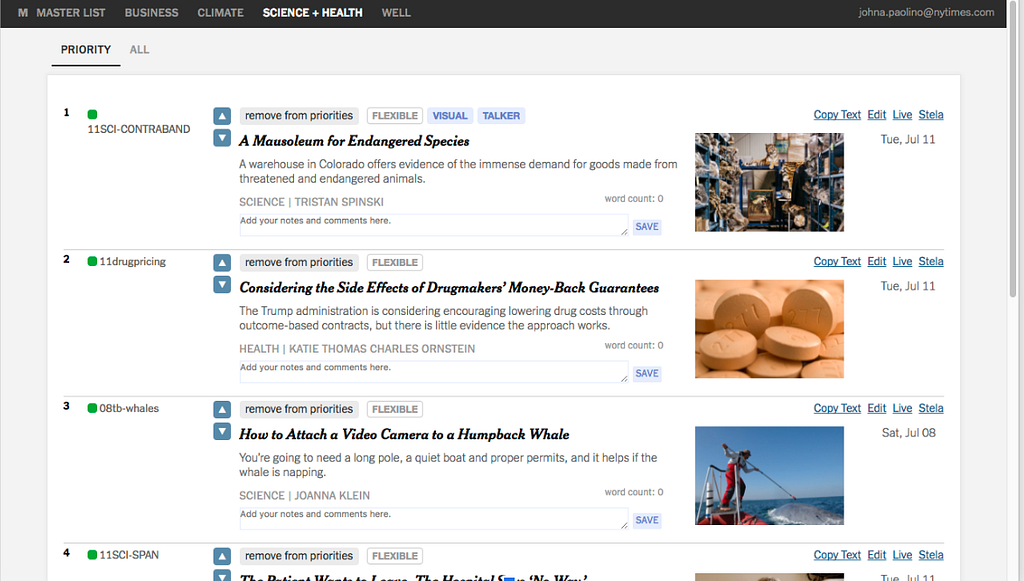
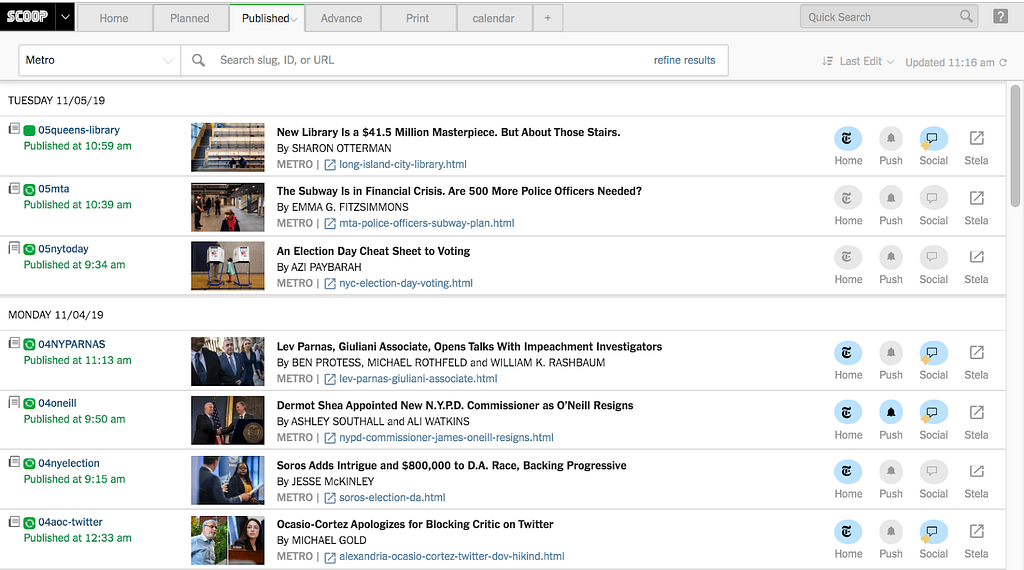
Working with editors from the Business, Climate and Science desks, as well as editors in charge of platform and off-platform programming, we designed and built a prototype of a planning tool. The prototype featured a single view with all relevant planning data across desks, which allowed editors to make decisions in context. It also had status indicators that showed whether a step, like promotion on Facebook, had been completed.
We called it Project M, as a nod to the goal of putting management back into our content management system.
Participating desks used our prototype to see upcoming stories and communicate story priority to home page producers.
For two weeks, participating desk editors used our prototype to plan their report. This short experiment taught us about critical moments in the production process and points of high friction in the current system. It confirmed some ideas, like the need for a search result design that had a “show don’t tell” attitude towards story status and a way to capture a story’s priority. It gave us confidence in our direction.
One Planning Tool to Rule Them All
Using insights gained from the prototype, we built a planning tool, called Story Dashboard, that now lives permanently in our CMS. The dashboard pulls data from our core publishing system — the same system journalists use to write and publish stories. Editors can search for specific stories or stories relevant to their desks by using filters and keywords; Searches can also be shared with other people in the newsroom. The dashboard provides custom views based on user preferences, which editors can enhance with saved searches. This helps the newsroom find, organize and evaluate the status of stories, so editors can make decisions about their reports.
Show, don’t tell
We built a user interface that clearly shows the status of each asset, such as whether a headline has been written or if all necessary photos have been inserted. We found this to be more impactful and effective for communicating status than a tag marking the asset as done.
Assets are displayed with metadata that indicates their status. (This screenshot contains testing data.)
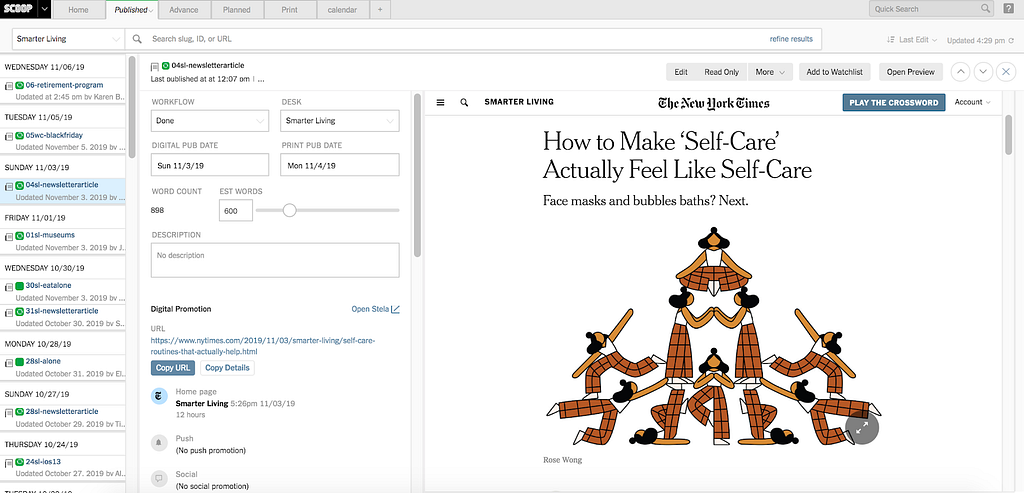
Clicking into a result gives more detailed planning and promotion information, as well as a live preview of the story.
In the detail view, editors can see and edit planning information, and they can see what the asset will look like online, even if it isn’t published yet.
Dates With Clearer Purpose
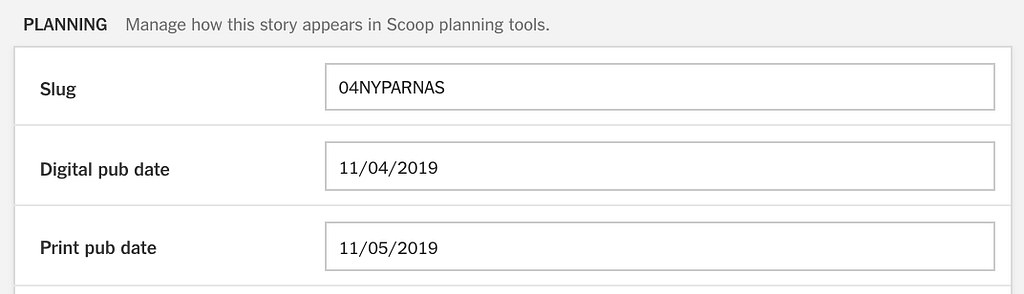
In a publishing ecosystem where a single article might be published several different times across multiple distribution platforms, a single publication date isn’t useful. To address this, we built separate digital and print publication date indicators. Editors can search for articles that fit whichever date type is most relevant to their work.
A small but critical distinction: stories are often published in the paper one day after being published online, so we needed a way to distinguish between those dates in our planning tool.
Special Tabs
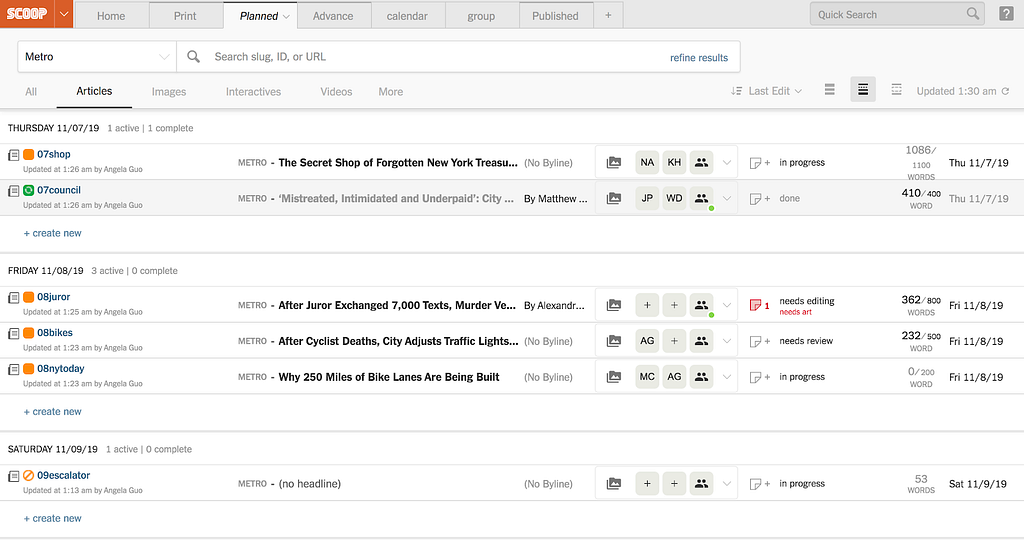
Because search functionality isn’t the best fit for every use case, we created a couple of specialized workspaces. We built a Planned workspace that shows all upcoming stories, grouped by publication date, for an editor’s assigned desk. At a glance, desk editors can see what work remains to be done for stories that are scheduled for publication on a particular date and they can plan for what’s coming up; To change an article’s publication date, an editor simply needs to drag and drop the story onto another date. Editors can optionally look at the stories that have already been completed.
The planned tab shows upcoming stories on your desk, grouped by date. (This screenshot contains testing data.)
Social promotion
Another key lesson we learned from Project M was that editors needed to see distribution feedback. It’s important for desk editors and social platform editors to be able to see whether a story has been promoted on a specific platform. Prior to the launch of Story Dashboard, this step required a lot of in-person communication, which could be challenging if numerous people were working on a story or if someone wanted to quickly get this information for all stories across a single desk.
The Published tab is a specialized workspace for viewing your desk’s published article. Icons on the right provide distribution feedback on stories, which we show grouped by date in reverse chronological order.
Piloting and Iterating
We partnered with the Metro and Styles desks, and helped them move their planning flows entirely into Story Dashboard. Onboarding the first desks fully to our system further clarified what we got right and what we still needed to build.
A Calendar View
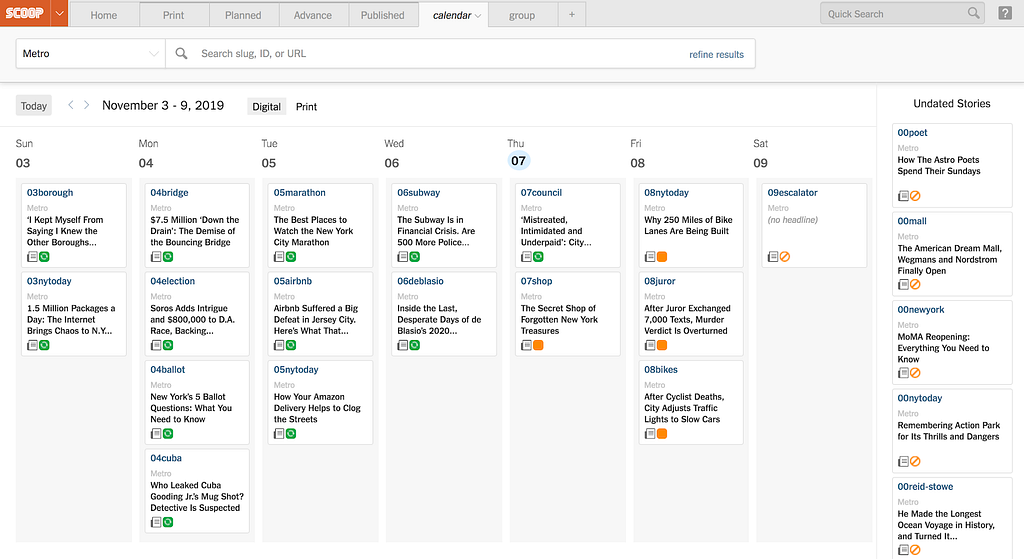
We enriched the planning capabilities of the dashboard by building a calendar view that gives editors a visual understanding of their week ahead. Editors can easily plan their short-term and long-term report in context and share plans with colleagues.
Calendar view provides a more intuitive interface for planning stories by date. (This screenshot contains testing data.)
Tentative Stories
Editors told us that they needed a place to capture in-progress ideas for stories. There was no place to do this in our tools, which lead to fractured brainstorming and lost ideas. We built a workflow called Tentative into Story Dashboard to capture those ideas that are influx or might not run.
Tentative ideas get a distinct visual treatment to distinguish them from actual stories. (This screenshot contains testing data.)
Newsroom planning is extremely complicated: it requires collaboration, transparency and a shared understanding of status. By consolidating all of our newsroom’s planning needs into one tool from disparate and unlinked systems enables everyone to have full context when making decisions. The easier this work is, the more our editors can focus on editorial decisions instead of wrangling administrative tasks, which makes The Times better for readers.
As digital production continues to evolve, so will the planning and promotion requirements of our newsroom. When workflows change, we’ll continue to build tools that help editors do their work efficiently and produce our daily print and digital miracle.
Angela Guo is currently the tech lead of the Workflow team at The New York Times.
The Workflow team is: Nathan Ashby-Kuhlman, Matthew Tanzer, Will Dunning, Jill Kacere, Matthew Clawson, Donna Rickles, Artur Charaev, Michael He, Lauren Peterson and Aaron Lee. Thanks as well to former project leads Tessa Taylor, Matt Berkowitz and Caroline Cox-Orrell, and especially to Johna Paolino and Kellen Henry who created the vision for this project and without whom this team would not exist.
Illustration by Jackie Ferrentino.
It’s All Part of the Plan was originally published in NYT Open on Medium, where people are continuing the conversation by highlighting and responding to this story.
Three months ago I counted the feeds in my feedreader. Repopulating my feedreader is something I started doing after getting back to blogging more intensively, and realising my old list of feeds had lost its purpose. As my list of feeds is also my blogroll, it’s an export of my feedreader, I thought to update that export, and count the number of feeds.
At last count (August 8th) it was 219 feeds.
folder
# of feeds
A12
10
B50
18
C150
22
D500
19
E999
150
And these are the numbers for November 14th, three months since (disregarding the feeds I track from sources I publish in myself):
folder
# of feeds
change
gender balance*
A12
11
+1
4 vs 6, or 40%
B50
21
+3
3 vs 16, or 16%
C150
29
+7
7 vs 22, or 24%
D500
27
+8
7 vs 19, or 37%
E999
205
+55
64 vs 140, or 31%
(* the sum of both numbers is sometimes not equal to the number of feeds, where I have multiple feeds per author. I’ve looked at people here, not feeds. Where I’m not certain who’s the author, I’ve assumed it’s a man.)
74 feeds added since early August. It reflects some additions due to IndieWebCamp Amsterdam that I organised in September, some serendipitous finds while browsing, and more actively looking at what other people I follow link to.
This is a RSS only posting for regular readers. Not secret, just unlisted. Comments / webmention / pingback all ok. Read more about RSS Club
We’ve just completed our 17th annual Art of Hosting here on Bowen Island. For 17 years I have welcomed nearly 1000 people to our home place through more than 50 workshops we have conducted here. I always appreciate seeing the island through the eyes of our visitors. And so, coming fresh off of that experience, I responded today on our community facebook page to a question posed by a long time Islander, Rob Wall: What is “The Bowen Way.”
This was my answer.
It changes over time and with waves of people who come and go. As a person who has been here for 18 years, I’ve been here long enough to see our culture goes through at least one major wave. Of course, I have no idea what it was like before I moved here or how I and others changed it when we came in the early 2000s. Whatever The Bowen Way is, it is both good and bad, positive and negative, visible and invisible. Every small community has its way, and over time, all ways change.
A long time ago I committed to living here for the rest of my life, and that means paying attention to the changes and embracing what is good and helpful, and rejecting what isn’t. And as waves of new people have arrived (more than 30% of our population has turned over in the past five years, and we have lost many elders who have died or cashed out and moved away) new ways emerge. For those of us that have been here for a long time, sometimes those new ways are as confounding as the old ways are to newcomers. As long as I have lived here there have been these kinds of funny tensions and confusions between old-timers and newcomers. If we can have a sense of humour about ourselves, and remember that really nothing makes sense, then it eases the tensions between folks that believe that THEIR way of seeing things is the right way. We’re all guilty at some point of becoming a bit precious about our views of the world.
I have learned that if I can’t embrace change, then I am liable to be encased in suffering as my projections of how things “should be” fall away to be replaced by stuff I don’t understand. I am so grateful for the many “new” people that have arrived here since I have, who have added immeasurably to this place, and also grateful to the “oldtimers” who keep the traditions I love alive and remind me what is uniquely beautiful about our community.
Bowen Island will never perfectly be the place you think it is or want it to be. It will always delight and disappoint you. Like any long term relations, you will fall in and out of love with it, and your view of it will change over time. Stuff you thought was essential to the place will fade away and be replaced with new cool things that you never dreamed of.
The character of a place is always in flux and change, like the seasons and weather, like the cycles of the forests and sea around ourselves, like the people we know and the ones we haven’t met yet. That is is the real Bowen Way, lives that come and go in waves, all linked into a complex mix of friendships, animosities, and surprises, on 20 square miles of rock surrounded by the Salish Sea.
Deutsche Welle: Masern-Impfpflicht für Kitas und Schulen. “Kein Zugang ohne Impfpass: Ab März 2020 müssen Eltern nachweisen, dass ihre Kinder gegen Masern geschützt sind, so hat es der Bundestag beschlossen. Lange war über die Impfpflicht gestritten worden.”
“In Deutschland sollen Kinder rund um den 1. Geburtstag zum ersten Mal und mit etwas Abstand ein zweites Mal gegen Masern geimpft werden. Die Ständige Impfkommission (STIKO) beim RKI erarbeitet die Empfehlungen für alle Schutzimpfungen. In Deutschland gab es bisher keine Impfpflicht, man setzte auf Freiwilligkeit. Nicht ohne Erfolg: Untersuchungen zeigten, dass von den Schulanfängern 97 Prozent die erste Impfung gegen Masern haben, 93 Prozent auch die zweite, betont Glasmacher.
Um Masern-frei zu werden, wie es die Weltgesundheitsorganisation (WHO) fordert, müssten 95 Prozent der Gesamtbevölkerung immun sein – durch Impfung oder durchgemachte Erkrankung. Bis 1970, als die Impfung eingeführt wurde, erkrankten fast alle. “Es gab in den Sechziger Jahren deutlich mehr als einhundert Todesfälle durch Masern pro Jahr”, sagt die RKI-Sprecherin.”
Note: this the third and final draft of the machine colocation rack costs sheet and service terms. Prices have not changed since the last revision. The service is now live.
Rack space, as described below, is immediately and henceforth available exclusively to my L1 and L2 WoT (presently visible here.) If you, reader, are not in this roster, or not interested in purchasing rack service from me, you may safely skip this article.
Section 1: Offerings.
Pricing:
Pricing is to be made as simple as possible: a subscriber will be charged the following monthly fee:
T = (C + I + L) × (1 + M) - D
...where C is the colo cost; I is the cost of a subscriber's IP addresses; L -- the lease cost of leased irons, if any; M is the margin; and, lastly, D is the subscriber's discount, if applicable (when purchasing service in quarterly or yearly terms.) All of these parameters will be explained below.
Let's begin with Te -- the baseline cost of operation. From the upstream vendor, currently I have a service package consisting of a 22U cabinet, permitted to draw up to 1200 Watt of mains current. This is bought at a monthly rate of 295 $ (here and below in U.S. $).
A monthly overhead budget of 50 $ will be included in the operating cost. This will cover "small change" expenses (e.g. petrol for my visits to the site; cabling; periodic replacements of fans in leased machines; and similar.)
The total monthly expense of the shared physical resources Te is thereby: 345 $.
Pu, the proportion of shared physical resource expense a subscriber is to be charged for, is defined as the maximum of the quantities below :
Ps(% of Available Physical Space Occupied)
Pw(% of Available Wattage Consumed)
In order to understand the terms Ps and Pw, the reader must be made familiar with the current physical plan of the rack:
Slot #
Contents
Watt Reserv.
1
Ethernet Patch Panel (Upstream Connection)
0
2
Shelf ("racked non-rackables" on-request; spares)
0
3
Switch (Primary)
10
4
Switch (Secondary)
10
5
Reserved for 48-RK Plant
10 (Wattage of Sub-Switch)
6
Reserved for 48-RK Plant
10 (Wattage of Sub-Switch)
7
1U Reserved General-Purpose
250
8
Available to Subscribers
9
Available to Subscribers
10
Available to Subscribers
11
Available to Subscribers
12
Available to Subscribers
13
Available to Subscribers
14
Available to Subscribers
15
Available to Subscribers
16
Available to Subscribers
17
Available to Subscribers
18
Available to Subscribers
19
Available to Subscribers
20
Available to Subscribers
21
Available to Subscribers
22
Mains Supply Distributor Unit
0
From the above, it can be seen that I have reserved 8 U of physical space and 290 Watt of mains current supply capacity (for infrastructure expansion and electrical demand peaks, respectively.)
Ergo, there are currently: 22 - 8 == 14 U of physical space and 1200 - 290 == 910 Watt of mains current made available to subscribers. This is a conservative limit, as indicated above.)
And so it follows that, for any subscriber:
Ps(% of Available Physical Space Occupied) = U-Height of Your Machine / 14
... e.g. for a 1U server, Ps ~= 0.07143; for a 2U: ~0.1429, and so forth.
And very similarly for energy consumption:
Pw(% of Available Wattage Consumed) = Watts Drawn by Your Machine / 910
... e.g., for a 100 Watt server, Pw ~= 0.1099; for a device which draws 5 Watt, will be 0.0054945.
Consequently, a subscriber's colo costC = Pu × Te will be equal to: the greater of Ps and Pw, multiplied by Te. This represents the cost of the proportion of upstream-supplied resources used by the subscriber.
This pricing scheme ensures that a fully-occupied -- whether space or energy-wise -- rack, is properly paid for, and that each subscriber is billed in direct proportion to resource utilization.
IP Cost I = (# IPs) * (Cost of IP)
In order to be of use, servers require Internet connectivity.
Initially subscribers will share the current 100Mb/s pipe. However, provisions for rationing are in place, and arrangements can be made to purchase a dedicated portion of this pipe. I reserve the right to ask "bandwidth hogs", if such appear, to request a dedicated portion. It will be priced exactly as physical space and energy are priced below -- i.e. in direct proportion to the percent of the total capacity reserved by the subscriber.
Note: I expect to upgrade the installation to a 1Gb/s pipe and 42U tower when the revenue permits this upgrade.
IP Addresses are leased from the carrier in traditional "slash" parcels, rather than individually: e.g. currently we have a /29 for a monthly charge of 25 $; a /28 will cost 50 $, and so forth.
For simplicity, the cost of IPs for subscribers will be billed as 3.15 $ per IP requested. Every subscriber must lease at least one IP.
Lease Cost: L = Value / Amort
A subscriber is not required to lease anything, aside from at least 1 IP address. If you are sending in iron for pure colocation service, the L term of the price equation will equal zero.
However, 12 standard machine types are available for lease; and arrangements can be made to request the construction and lease of custom iron.
The monthly Lease Cost, L = Value / Amort consists of the Lease Value of the iron in question, divided by its Amortization Period in months. The latter is currently specified as 36 months for 'Dulap'-type machines (see below) and 12 months for 'RK'-type machines. This pricing scheme permits the regular physical replacement of worn-out irons, or the purchase of replacement components, as circumstances demand.
BOMs (Bills of Materials) will be provided for all current and future irons offered for lease. However the identities of component suppliers will be disclosed at my option and not otherwise. Potential subscribers who think they can get substantially better prices elsewhere, are encouraged to assemble their machines with their own hands, and to colocate rather than lease.
The following irons are presently offered for lease:
Product Code
Description
Lease Value (USD)
Amortization Period (Months)
D128_0D
'Dulap' 128GB RAM, Customer-Sent Disks
534.00
36
D128_2D
'Dulap' 128GB RAM, 2 x 1TB Samsung SSD
824.00
36
D128_4D
'Dulap' 128GB RAM, 4 x 1TB Samsung SSD
1114.00
36
D256_0D
'Dulap' 256GB RAM, Customer-Sent Disks
732.00
36
D256_2D
'Dulap' 256GB RAM, 2 x 1TB Samsung SSD
1022.00
36
D256_4D
'Dulap' 256GB RAM, 4 x 1TB Samsung SSD
1312.00
36
D512_0D
'Dulap' 512GB RAM, Customer-Sent Disks
1128.00
36
D512_2D
'Dulap' 512GB RAM, 2 x 1TB Samsung SSD
1418.00
36
D512_4D
'Dulap' 512GB RAM, 4 x 1TB Samsung SSD
1708.00
36
RK128
Rockchip ROC-RK3328-CC, 128GB SSD
99.00
12
RK256
Rockchip ROC-RK3328-CC, 256GB SSD
126.00
12
RK1TB
Rockchip ROC-RK3328-CC, 1TB (external) SSD
238.00
12
Note: certain configurations may require up to an additional 7 days for component purchases. I will keep certain components in stock at my option.
The BOMs for the above irons are precisely as follows:
'Dulap' (1U 32-Core AMD Opteron); configurable RAM and Storage :
A 'Dulap'-type machine will consist, in all cases unless otherwise specified, of: a 'Supermicro' 1U H8DGU-FAMD with a pair of power supplies for redundancy, 2AMD 'Opteron' 6380 16 Core 2.5GHZ processors, a LSI 9265-8I RAID Controller, and 4 3.5" to 2.5" SATA trays.
Note: The 'Remote Management' chips found in these boxes will be at all times disabled, as they are a security risk. Under no circumstances will an Ethernet connection be made to a 'remote management' jack in any machine hosted in my rack.
The "skeleton" (chassis, PS, mobo) of this machine is valued at 99.00 $. Each CPU: 88.00 $ (usually available in pairs, and in any case a maximum of 2 may be installed). The RAID card: 50.00 $. Disk trays and SATA harnesses, 11.00 $ per disk slot. RAM for this machine (in all cases ECC) is valued at 198.00 $ per 128GB, and may be installed in increments of 128GB. (For optimum operation, the total RAM is to be 128, 256, or 512 (max) GB.)
All disks, other than when customer-supplied, for 'Dulaps' and 'RK1TB', will be 1TBSamsung 860 EVO SSDs, and valued at 145.00 $ each for the purpose of leases. Note: the market price of such disks fluctuates.
Note: if a subscriber wishes to guarantee that "virginal" disks are installed in a newly-leased machine, he must purchase his disks up front; otherwise disks with "non-zero odometer" may be installed. Subscribers are encouraged to make use of their RAID cards to set up resilient systems.
If, on the other hand, a subscriber wishes his disks to be destroyed at any point in the duration, or after the termination of, his lease, he must then also purchase his disks. At all times the purchase price of a disk will be the one given in the BOM at the time of the the initiation of his subscription. Disks that the user wishes to take physical possession of after the termination of service, will be mailed to an address given by the subscriber, and the latter is responsible for postage expense.
A 'Dulap' occupies in all cases 1 U of physical space, and is rated to consume an average of 250 Watt of mains current, and each SSD adds 4 Watt to this figure.
All Dulap machines will be installed with my 'Dulap-Gentoo' operating system unless otherwise agreed upon.
A 'RK'-type machine will consist, in all cases unless otherwise specified, of: a ROC-RK3328-CC board, equipped with (non-upgradable) 2GB of RAM, and a 4-core non-upgradable 1.4GHz ARM64 CPU. They are mounted in a purpose-built fixator which occupies 2 U of physical space and can house up to 48 such machines.
The RK BOM is as follows. The machine itself is valued at 40.00 $. The (vendor-supplied) heatsink : 10.00 $. The (custom) fixator mounts : 18.00 $. Screws, cabling, and the SD card which holds the boot kernel : 5.00 $. This makes for a base value of 73 $.
However, the machine is of no use without disks. The following selection of storage devices is offered:
Samsung MUF-128BE4/AM 128GB (USB 3.1) -- 26.00 $. Samsung MUF-256BE4/AM 256GB (USB 3.1) -- 53.00 $. And, finally, the Samsung 860 EVO 1TB -- 145.00 $ (and requires a 20.00 $ USB3 converter snake, and a second 1/48th U of physical space, as well as 4 additional watts of electrical supply.) All of these variants are reflected in the above Irons table.
All RK machines will be installed with my 'RK-Gentoo' operating system unless otherwise agreed upon.
The Margin: M
The margin is presently set at 45 percent.
The Discount: D
A bulk discount is obtained when a subscriber arranges to lease in quarterly or yearly intervals; this value is presently set at 5 percent.
Special Offers :
Contact me in #asciilifeform on Freenode to discuss demos, discounts and other special arrangements.
All subscription and service requests will be conducted via encrypted text (today -- via GPG; in the future, via a civilized replacement, at the individual subscriber's option.) Subscribers are responsible for placing the ciphertexts where I can see them; and for signing their own messages, so that I can verify their origin; and for verifying the signatures on my responses to determine that they originate from me. Unsigned requests will not be acted upon or answered. All service-related communications from a current subscriber (as well as requests for initiating a subscription) must be encrypted to my public key. All responses will be encrypted to the subscriber's public key.
Subscriber Privacy:
Identities of subscribers will not be revealed publicly (Note, however, that my L1/L2 WoT from which eligible subscribers are drawn, is visible to all.) Subscribers are of course free to publicly reveal themselves, and, if they wish, to review/criticize the service.
I make use of custom and unobtrusive seals to monitor for evidence of unsanctioned access to the contents of the rack. Colocation subscribers are encouraged to install their own seals on their irons. A quarterly photo-inspection of customer seals, on request, is included in the price of colocation service.
Billing:
Service for a new subscription will be provided within one business day after payment is processed. Please do not pay until you have selected your iron, and have been informed that the required iron is available and ready for service.
Colocation subscribers are responsible for the cost of postage, customs, etc. I will provide a mailing address on request.
All billing without exception will be carried out in BTC at an exchange rate to be mutually agreed upon by the subscriber and I at the time of billing. If the subscriber is paying via a traditional BTC transaction (as opposed to Trinque's deedbot service), an adequate TX fee must be included in the transaction. Those using deedbot are responsible for paying Trinque's processing fees, keeping their account in order, etc.
If either the subscriber or I lose access to deedbot, payment must be made in traditional BTC to an address that I will generate, sign, and encrypt to the subscriber's WoT public key. Such a payment will be considered valid after 6 confirmations (i.e. BTC blocks appearing on top of the block in which the payment TX appeared.) Payments made via deedbot are valid immediately.
Users may subscribe in quarterly or yearly parcels, to lock in price; the discount for either option will be 5 % (of the total T.)
Changes of Price:
All prices are subject to change. To lock in a price, please make a quarterly or yearly arrangement.
IP Addresses and Spam:
Be warned: A release of an IP address for any reason other than the termination of a subscription, will incur a 50 $ cleanup charge. This will happen if, for instance, the tenant commits a "coarse error of pilotage" and his IP finds its way into a public "spam database" or whatever similar "wall of shame" of a kind that may impede normal operation of the entire orchestra.
Note also that the my upstream carrier, like most other carriers, forbids spam. Subscribers who repeatedly provoke conflict with the upstream carrier (by e.g. spamming) will be banished without refund. And those who deliberately cause problems for other subscribers (I will not bother to enumerate all of the possible ways, it could fill an entire encyclopaedia) will also be negrated.
Subscribers are also advised that this rack is located in USA -- and therefore it is not a good choice of location in which to publicly host "l337 w4r3z", or whatever other easily-recognizable material Officially banned by officious busybodies.
Backups:
Subscribers are responsible for their own backups. No backup service is is included in the subscription unless special arrangements have been agreed upon with the particular subscriber.
Maintenance:
Colocation subscribers are encouraged to send in a stock of spare parts (disks, PS, fans) for their irons. Spare parts may also be purchased on request (contact me); in this case, the margin will apply.
Lease subscribers will receive required disk, PS, fan, etc. swaps, as part of their subscription. However, the subscriber is responsible for monitoring his machine's status and requesting e.g. disk swap when required; I do not have access to the internal status monitors of any customer-operated machine. This is by design: no "remote management" backdoors of any kind are in use at my ISP.
I reserve the right to perform scheduled maintenance resulting in up to 1 hour per year of down-time per subscriber. Subscribers will be notified no less than 1 week in advance of a scheduled maintenance session.
"Remote Hands":
A subscriber may request up to 2 hours of "remote hands" service (mains current reset, OS installation assistance, etc.) per year as part of his subscription. The charge for "hands" service in excess of this quota will cost the BTC equivalent of 100 $ / hr., to be paid immediately after the completion of the service call.
"Hands" service requested in connection with repair of malfunctioning leased iron, or disk swaps in either colocated or leased iron, will not count towards this quota.
Service Interruptions:
In the event of an unscheduled service interruption for reasons other than coarse error of pilotage on the part of the subscriber (See IPs and Spam above) subscribers will receive a pro-rated refund for all down-time. The individual subscriber is responsible for requesting any such refund.
Loss of Colocated Iron:
The hosting facility housing this rack is guarded 24/7, and access to the machines requires two keys, a password, and two layers of "biometric" ritual. Additionally, the grounds are equipped with a Halon 1301 fire suppression system. However it is impossible to offer a total guarantee against natural and man-made calamities. The owner of a colocated machine lost to fire, flood, theft, or vandalism, will be reimbursed the BTC equivalent of no more than 1000 $ unless otherwise agreed at the time of subscription. The tenant of a leased machine similarly lost will be reimbursed strictly for down-time.
Termination of Service:
If a subscription is terminated for any reason, the subscriber is responsible for all postage and customs expenses pertaining to recovering any colocated hardware. Arrangements for the recovery of data will also be made, for subscribers in good standing (see Spam and Billing) at the time of termination.
“When a judge walks into the room, and everybody stands up, you’re not standing up to that guy, you’re standing up to the robe that he’s wearing and the role that he’s going to play. What makes him worthy of that role is his integrity, as a representative of the principles of that role, and not some group of prejudices of his own. So what you’re standing up to is a mythological character. I imagine some kings and queens are the most stupid, absurd, banal people you could run into, probably interested only in horses and women, you know. But you’re not responding to them as personalities, you’re responding to them in their mythological roles. When someone becomes a judge, or President of the United States, the man is no longer that man, he’s the representative of an eternal office; he has to sacrifice his personal desires and even life possibilities to the role that he now signifies.”
When I think of Netflix's originals taking the leap to that level of professional craftsmanship that put them in that tier considered "premium video," for however long that term endures, the show that leaps to mind is The Crown, one of my favorite of their homegrown series. House of Cards came earlier, and landing that Fincher production with that cast was a massive coup, but The Crown, with its focus on the English monarchy, carries that air of gentrified prestige that seems apt in a discussion of what qualifies as professional film and television.
The Crown is comfort food for those who prize a level of tightly structured scripts, lavish production design that likely broke out a line item for brocade, precise diction from the school of classical acting that could wouldn’t feel out of place on the stage at the Old Vic, upper lips as stiff as the creases in the tailored English suits on display, long glances freighted with import...in other words, all the trappings of aristocratic melodrama. The portentous theme song by Hans Zimmer is one that, like the theme to Game of Thrones, I won't skip, just so I can wrap it around me like a gravity blanket in anticipation for the theatrics to come. The entire affect of the show dances on that fine line between spectacle and farce; rarely has a program treated a group of people who do so little with such gravitas.
Why do we treat the Royal Family with such reverence? Because ceremony demands it. Sometimes status is a closed circle, and if you trace it you end up where you started. The very act of walking in that circle, though, closes it. The Royal Family has whatever power the people grant them.
The very existence of The Crown, the white velvet gloves with which the show handles its subject, enacts, in televisual form, the act of veneration upon which the Royal Family depends for its status. The show bends the knee, and so do we.
No episode better reflects the way in which our construction of royalty and celebrity rhyme than season 1, episode 5 of The Crown, titled "Smoke and Mirrors." This episode is about the covenant between the famous and those who grant them that fame. It's figuratively, and sometimes literally, smoke and mirrors which turn a plain English woman into a queen. In an age where the internet has once again reshaped the distribution topology of moving images, and given that the Crown returns for its third season this Sunday, it seemed the right time to do a walkthrough of this, an episodes of TV I’ve seen many times and which never ceases to move me.
Episode SPOILERS ahead, obviously, though this is one of those programs where spoilers don't mean much. The journey of watching this show is the experience. I encourage you to grab your remote, fire up Netflix, and follow along. Honestly, if you haven't watched episodes 1 through 4 of season one, it's still fine, but if you want, binge those and then follow along here. I haven’t done an episode walkthrough on my blog before, and honestly this would be better as a video essay, but good luck with that given all the legal hurdles. As it is, Netflix makes it so difficult to grab screenshots of their content that I could only grab so many before losing patience, but I'll drop in some relevant shots from time to time to help you follow along (Netflix, make it easier to grab and share screenshots of your stuff, your whole competitive advantage is economies of scale, you want to overwhelm the competition with your digital footprint in the cultural conversation).
***
The episode begins with a flashback to May 11, 1937. Young Elizabeth is summoned, by her father, on the cusp of becoming King George VI, played by the always magisterial Jared Harris. He'd like her to play the role of Archbishop as he prepares for his own coronation. As she reads over the script of the coronation oath, her father explains the significance of the words. She stumbles over a word she doesn't recognize.
Her father pronounces it for her. "Inviolably. It means, to make a promise you can never break. A very sacred promise indeed." He is instilling in her a sense of the heavy obligations transferred in this ceremony, ones which form the foundation of the power of the throne.
They're interrupted by Private Secretary Tommy Lascelles telling George it's time to go try on the crown. George asks for a bit more time with Elizabeth. "We haven't even reached the anointing!"
George turns to his daughter.
"You have to anoint me, otherwise I can't be King. Do you understand? When the holy oil touches me, I am transformed. Brought into direct contact with the divine. <cue the track “The Anointing” by Rupert Gregson-Williams> Forever changed. Bound to god. It is the most important part of the entire ceremony."
George refers both to the ceremony by which he becomes King but also the power of film itself. We as the audience anoint movie stars, musicians, and athletes, and by our adulation, they are forever changed. Fame and status are a covenant between gods and their disciples, just as brands exist in the covenant between companies and their customers.
Elizabeth follow her father to the fitting for the crown.
As George lifts the crown over, he notes, "Goodness, it's very heavy indeed."
"Five pounds," says the attendant.
"Not to mention the symbolic weight, hmm?" replies George. Heavy is the head that wears the crown, in every sense.
He looks at himself in the mirror, then turns to look at his daughter, who gazes back.
He returns her gaze.
Match cut to the present day, where 25 year old Elizabeth places the crown on her head (she is played to perfection by Claire Foy, whose massive shoes Olivia Colman will have to fill in season three). The now grown Elizabeth is standing in the exact spot where she once stood and watched her father don the crown, such that her eyeline matches that of her father's in the past.
They cut back to George in the past one last time, giving a wry smile to his daughter across 17 years. Soon she will shared the burden of the titular crown.
"It's not as easy as it looks," says Elizabeth, trying to balance the crown on her head.
"That's exactly what the King said," replies the very same attendant who had been at that shared moment in the past, bridging another generation of royalty.
"I remember," says Elizabeth.
It's the type of meticulously composed shot sequence typical of the series, and this scene always gives me all the feels upon rewatch.
That evening, Elizabeth approaches her husband Philip (played with smarmy charisma by Matt Smith; seriously, this entire cast knocks it out of the park) as they dress in their finest for the ballet. She announces that she'd like him to take over as chairman of her coronation committee.
"I want to make a public declaration of my trust in you," she says to her husband. Everything they do has symbolic value, and she understands the importance of her every act in the eyes of the public.
"There's no need to matronize me," he retorts, using the feminist form of the more common "patronize." An ongoing storyline the first two seasons is Philip's discomfort with standing behind his more powerful wife. Behind every great woman is a jealous man yearning for a return of the patriarchy?
At the ballet, Philip, having mulled it over, gives in. However, he has a request. "Total control or nothing at all. Those are my terms."
"All right. But don't go mad," says Elizabeth.
"What does that mean?" he asks.
"It means just don't go mad. It's a coronation. A service that goes back a thousand years. Some things can't be changed," she says.
The immutability and consistency of tradition and ritual reflects but also reinforces power. As Stewart Brand once wrote of government buildings, there's a reason they are constructed of marble and stone, often in the style of ancient Greek or Roman architecture. The unchanging nature of the building is meant to convey the durability of the institution.
"Yes, yes, all right," says Philip, but his sentiments will soon change.
Now we cut to Paris, where the ingenious construction of this episode begins to reveal itself. Not only is this episode about the very act of television and its ability as a medium to grant power, but the writer embeds a commentary on the coronation within the episode itself. Or commentator, to be precise, and his name is Edward, Duke of Windsor, or David. He was forced to abdicate the throne in 1936 for marrying Wallis Simpson, an American woman twice divorced, and his eviction still stings. Throughout this episode, David Windsor serves as a proxy for how non-royalty view the coronation. Asked by the royal family to not attend the ceremony given what they perceive as his shameful abdication, he will be forced to watch from a viewing party he hosts from his home of exile in Paris.
David and his wife Wallis sit for a magazine profile, posing in a variety of foppish outfits. They may not be tip top royalty anymore, but they're not paupers. Still, as status is relative, and he since he once reached the footstep to the throne, he struggles to find contentment in his current lot in life. The episode traces the very specific nature of his jealousy and resentment, but the general contour of his longing matches that of status-seekers everywhere.
David and Wallis lead the reporter to a private attic room where he keeps mementos of his past glory.
"Goodness. Bagpipes, too," says the reporter, glancing at all the memorabilia filling the room.
"Yes, I play," says David.
"When he gets homesick," adds his wife.
"And all these photographs of you as King," asks the reporter. "There are none with the crown. Why is that?"
"I never made it that far. I never had a coronation." This isn't fear of missing out; he just plain missed out.
Back in England, Elizabeth announces to her staff that she has decided her husband will be chairman of her coronation committee. Her Private Secretary Tommy says that's impossible as it's the job of the Duke of Norfolk, the chief butler of England. "Running the coronation, that's what the Norfolks do," says Tommy. That's why we call it tradition, girlie.
Elizabeth cuts the debate short. "The chairmanship with full autonomy is what he wants. Therefore it is what I want. Norfolk can be vice-chair." You want zee duck? You cannot have zee duck. You can have zee chicken.
David returns to London to visit his ailing mother Mary, and while there Private Secretary Tommy and the Archbishop deliver the bad news: the Duke of Windsor and his wife aren't welcome at the coronation. David goes on an extended diatribe, calling the Archbishop "Auld Lang Swine," and he quips, in a letter to his wife, that his mother, who passes away while he is England, had blood that ran as "icy cold when she was alive as it does now she's dead." No one bitch slaps as poetically as the English.
In the same letter, as we see a shot of David talking to Elizabeth, we hear him refer to the incoming Queen as "Shirley Temple" and his other family members as "desiccated hyenas." This club was dead anyway, says the guy turned away at the door, through his tears.
At Mary's funeral service, Philip notes to Elizabeth that this ceremony is exactly like her father's funeral service. Tradition is so rigid in English corridors of power that nothing changes. He vows her coronation will be different, to reflect her, a young woman, and the "fast-changing, modern world."
At his first coronation committee meeting, Philip presents his thoughts.
"The eyes of the world will be on us. Britain will be on show, and we must put our best foot forward. In such circumstances, the temptation is to roll out the red carpet and follow the precedent set by the grand and successful coronations of the past. But looking to the past for our inspiration would be a mistake in my view."
Philip recognizes that when it comes to the power of his wife’s throne, ritual and reality are in many ways inseparable, and the only way to alter the nature of her power is to adapt the ceremonies that construct it.
He continues. "Make it less ostentatious, more egalitarian, show more respect and sensitivity to the real world. We have a new sovereign, young, and a woman. Let us give her a coronation that is befitting of the wind of change that she represents, modern and forward-looking at a moment in time where exciting technological developments are making things possible we never dreamt of which brings me to my next point..."
And what, pray tell, is that technology? Television. Of course, we are watching him talk about this on a television series streamed through an application called Netflix that is itself an adaptation of television itself, and you’re reading about my discussion of this episode through the internet. Also, later David Windsor will describe the coronation ceremony to an audience viewing the coronation on a television at his house in Paris. This episode is thematic Inception and I am here for it, every bit.
The committee is horrified by Philip’s plan. At Westminster Abbey, where preparations are underway, one committee member examines a television camera with apprehension and disgust and asks Philip, "No close-ups, huh? Zoom lenses?" In the aristocracy’s classical conception of power, physical distance is how status gaps are both constructed and measured. Normal people aren't allowed in to see the coronation because they are meant to feel every bit of the expanse between them and the throne.
Coronation committee members gaze through a TV camera at Westminster Abbey during preparations for the ceremony. Meanwhile we look at them through the gaze of a camera that was pointed at them on set.
But film is its own medium, with its own peculiar powers, and one of those is its ability to alter our spatial reality. When the close-up was invented in film, it unlocked a unique advantage of cinema over theater, the ability to bring us closer to a person than we'd be even in real life. If you were to put your face up against someone so that their face filled your field-of-view as much as a film close-up, you'd be arrested for assaulting their personal space. But in film, we can be simultaneously abstracted from the characters on screen yet halfway up their nostrils.
The craft of acting changed with the advent of the close-up. No longer was it necessary to act in so broad a style ("Why I oughta smack you in the kisser!" overacts the old black and white film cowboy). Now, the most subtle of facial expressions, the tiniest crease of one's brow, could register several feet high on the silver screen.
But more than that, the close-up, in closing distances, offered an alternative to spatially remote constructions of power in favor of a new relationship between star and audience, that of emotional intimacy. The Crown is emblematic of this quality of the film and television medium, spending its long story arc humanizing the Queen of England, transforming her from a remote caricature into a three-dimensional human with a rich and legible inner life. Prior to seeing The Crown, my regard for the Royal Family was, at best, dismissive. They still are. However, my feelings towards the fictional character Elizabeth from The Crown, the one played by Claire Foy, is one of deep sympathy. It's not that film can't do shock and awe but that other mediums struggle to match the moving picture for emotional intimacy.
In a way, the hidebound coronation committee is right to be concerned over Philip’s plan. Television as a medium did reconfigure the modern world, and it continues to hold the power to topple established power structures. Winston Churchill (John Lithgow) brings the concerns of the committee to Elizabeth.
"What is the purpose of the Crown? What is the purpose of the monarchy? Does the crown bend to the will of the people to be audited and accountable? Or should it remain above temporal matters?"
When the dominant medium of an age shifts, the nature of power shifts with it. Churchill is asking Elizabeth, but also asking himself, whether the advent of television means the two of them must change the means by which they relate to the people they govern.
Ultimately, he leaves the decision in her hands. She visits Philip at the Abbey where they debate his proposed changes.
She confronts him, "Trade unionists and businessmen? In the Abbey?"
"If you want to stay on the throne, yes," he replies.
"In a trimmed-down televised coronation?"
"If you want to avoid a revolution, yes. You forget, I have seen first-hand what it is like for a royal family to be overthrown because they were out of step with the people. I left Greece in an orange crate. My father would have been killed. My grandfather was. I'm just trying to protect you."
"From whom? The British people? You have no idea who they are or what they want." She continues, "If the people are hungry, they want something that lifts them up."
"And how do you propose lifting them if they cannot see it?" he fires back.
"The people look to the monarchy for something bigger than themselves. An inspiration. A higher ideal. If you put it in their homes, allow them to watch it with their dinner on their laps..."
"It will democratize it, make them feel hat they share in it. Understand it." Rewatching this episode today, I can’t help but think of AOC live streaming on Instagram Stories from Washington DC, explaining arcane Congressional procedures in the newest of mediums.
Elizabeth sees the determination in Philip's face, and she caves. She agrees to televising the coronation.
But then she turns the tables on him. He's not the only one who understands the significance of the coronation ceremony and she has a change in mind as well. She has heard of one of his proposed changes to the ceremony that she is not budging on.
"But on one condition," she explains. "That you kneel." Eat your heart out Danaerys, you weren't the first TV queen to ask her man to bend the knee.
Now it's Philip's turn to protest.
"I merely asked the question whether in this day and age it was right that the Queen's consort, her husband, should kneel to her rather than stand beside her," he explains.
"You won't be kneeling to me," she replies.
"It will feel like a eunuch, an amoeba, is kneeling before his wife."
"You'll be kneeling before God and the Crown as we all do."
"I don't see you kneeling before anyone," snaps Philip.
"I'm not kneeling because I'm already flattened under the weight of this thing."
The duel of words continues. Philip accuses her of becoming entitled and power-hungry. She says he's acting weak and insecure.
"I want to be married to my wife," he says, trying another tack.
"I am both and a strong man would be able to kneel to both." Oh snap.
"I will not kneel before my wife."
"Your wife is not asking you to."
"But my Queen commands me?"
"Yes."
Oh you gonna bend that knee Philip. Nothing but respect for my Queen.
On the day of the coronation, David Windsor is back at home in Paris, providing a running commentary on the ceremony to the audience gathered in front of the television at his viewing party in Paris. He mocks the uncomfortable Gold Coach carrying the Queen to Westminster Abbey, but we see him seated in the front row of his gathering, leaning in to catch every detail of the ceremony he yearns to attend.
David Windsor and his wife Wallis Simpson seated front and center at their coronation viewing party at their home in Paris.
At Westminster Abbey, the television producer constructs the telecast, choosing from a series of camera angles projected on a bank of televisions in the production area. This is the new choreography of power, the assembly of moving images. We see the procession on small black and white television screens, first in the home of David Windsor, then in video village where the television producer is calling out shot. The ceremony seems inconsequential, almost squalid, seen on such poor monitors, but the power of the medium lies in the millions of people watching it for the first time in homes around England and across the globe.
David Windsor’s television set. Probably lavish for its time, but I’m guessing some of his guests complained about not being able to see anything like we all complained about that super dark battle scene in Game of Thrones that final season.
The new masters of the grand narrative, deciding what series of moving images would define the coronation for millions of viewers
David Windsor fields questions at his party, describing each stage of a coronation ceremony he knows by heart.
The golden canopy being carried over Elizabeth so prying eyes won’t see the anointing.
Then, just as Elizabeth prepares to be anointed, the television broadcast cuts away to a static shot.
Viewers at home weren’t allowed to view the anointing, instead hearing just the audio running over this static shot.
"Where'd she go?" asks a guest at the party.
"And now we come to the anointing," explains David. "The single most holy, most solemn, most sacred moment of the entire service."
"So how come we don't get to see it?" asks that same guest.
"Because we are mortals," replies David.
“So let's set the world on fire…we can burn brighter…than the suuuuuuuun”
But at that moment, the TV show The Crown cuts to a shot from the interior of Westminster Abbey, the camera dollies in towards Elizabeth under the golden canopy held over her head. We, the viewers of The Crown, do get to see the anointing. A TV camera will take us there. Because we are modern TV viewers, and we are not mortals, we are now gods. The actual broadcast, in 1953 (still available on YouTube), preserved the sacred nature of the anointing, shielding it from mortal eyes. The Crown, a television show in the 21st century, has a different goal.
The Archbishop begins the oath. "Will you maintain and preserve..." He pauses, tripping on on his memory. He did not stumble during the actual coronation, but showrunner Peter Morgan adds this moment in order to tie the episode back to the opening of the episode when a young Elizabeth rehearsed the ceremony with her father. It's a bit of dramatic license that pays for itself with the emotional round-trip.
Elizabeth realizes the Archbishop's predicament and steps in to complete the Oath for him. "Inviolably?" she says. Her father taught her the meaning of the word when they rehearsed the oath some 17 years prior, and in reciting it once again, she has now finally internalized the weight of the office, as her father did before her. She bonds across time with her deceased father, one more time.
"I will," she proceeds, completing the oath.
Next we see product-commercial-grade closeups of the holy oil, backlit as if it were the nectar of the gods, and effectively it is. Water into wine, wine into blood.
The Archbishop anoints her hands, her breast, and finally her head with the oil.
Morgan leaves the next part of the oath unchanged, and why not? The words are majestic even today.
"As Kings, priests, and prophets were anointed, and as Solomon was anointed King by Zadok the priest and Nathan the prophet, so be thou anointed, blessed, and consecrated Queen over the peoples whom the Lord they God hath given thee to rule and govern, in the name of the Father, and of the Son, and of the Holy Ghost. Amen."
But also, we, as viewers, in this moment, and all the episodes before and after, anoint Claire Foy, actress, with our full adoration. She is our Queen Elizabeth in this television series. It's the same covenant we make with Robert Downey Jr. when we anoint him our Iron Man, or Chris Evans our Captain America, or Mark Hamill our Luke Skywalker. The Archbishop anoints Elizabeth Queen with oil and oaths and incantations, while the entire cast and crew of The Crown transform Claire Foy into the fictional Queen Elizabeth through the act of filmmaking, transmitted to us through the medium of television, so that we the audience may crown her.
In Paris, David Windsor soaks in the moment. He is our guide to the alchemic power of the coronation, but also to that of television. He stands in for the people of England, and television audiences everywhere.
"Oils and oaths. Orbs and scepters. Symbol upon symbol. An unfathomable web of arcane mystery and liturgy. Blurring so many lines no clergyman or historian or lawyer could ever untangle any of it." He stops just short of tossing in the title of the episode, "smoke and mirrors."
"It's crazy," says that same talkative house guest. "Smoke and mirrors" are commonly used as a term of derision. As viewers of this episode, we're watching a bunch of actors in makeup play-acting. Crazy indeed.
But Windsor understands the mythic power of the ritual, and we, in our emotional absorption in this moment, feel the power of the medium of television. Whereas earlier Windsor mocked his family, dismissed the Queen, and punctured the pomp with sarcastic quips, now he can't help but be spellbound by the symbolic force of it all. In a beautiful shot, we see his face, full of yearning, reflected in his TV screen, his niece, now his Queen, on screen.
Almost King, now gazing at his niece, now his Queen, through a TV screen.
David corrects his guest. "On the contrary. it's perfectly sane. Who wants transparency when you can have magic. Who wants prose when you can have poetry? Pull away the veil and what are you left with? An ordinary young woman of modest ability and little imagination. But wrap her up like this anoint her with oil, and hey, presto, what do you have? "
He pauses.
"A goddess."
I sometimes watch videos of YouTube vloggers greeting throngs of young fans at conferences around the world. Like that guest at David Windsor's viewing party, many see this and dismiss it as crazy. To do so is to misunderstand the nature of adulation and how a new generation of celebrity use new mediums like YouTube to their full effect, to create their own covenants with their own band of pilgrims.
Back at Westminster Abbey, one step remains. Philip, time to bend the knee bitch! With great reluctance, he shuffles to the throne, removes his crown, and drops to one knee before his wife, and his Queen.
Bend the knee old chap
The expressions Matt Smith and Claire Foy trade tell us all we need to follow the inner struggle in their hearts, and again, we register all these micro-expressions through the magic of the close-up, the liturgy of film. Shot, reverse shot, shot, reverse shot. A wordless conversation of images.
The episode concludes back in Paris, with David Windsor. As the sun sets, he pulls out his bagpipes and plays in his yard. As his wife noted earlier in the episode, he plays when he's homesick (there is barely a single line in this episode that doesn't come back to pay off like Chekhov's gun, the script is that tightly wound). The camera pulls back and up into the sky behind him, framing a beautiful lens flare the color of holy oil, as if Elizabeth's royal presence is shining down on him from above England itself.
We end on a shot from the other direction, a medium shot of Windsor from head-on. HIs eyes are filled with tears.
The majority of digital interfaces will eventually break free of rectangular frames. The prison walls are coming down. We’re not there yet, at least not for most people, but soon. Soon enough that those desiring a stake in this future should be planning for it.
This article is about connecting a few dots, some of them quite disparate, to hint at the eventual picture which might emerge.
The technologies which will enable this are diverse. On the one hand, ever smaller projectors pared with motion sensing will allow interfaces to materialise on new surfaces, objects and even seemingly out of thin air.
Interactive Light, an experimental project by argodesign, provides a good way to envisage this. It is also a valuable, early contribution to the community of lessons they learned about the nuances which could define good experience in this field.
On the other hand, advances in microphones, speakers, headphones and audio processing are challenging the notion of visual primacy which has dominated digital interface design from the beginning. Necessary first steps, such as wireless headphones and equipping smart speakers with microphones good enough to cut through background noise, are well underway with the adoption of products like Apple’s AirPods and the improvement of Google’s Nest Home speakers. Accordingly, the number of digital interactions which take place entirely through the medium of sound is growing and each of those interactions is becoming more meaningful in what it can achieve.
An example which shows the scale of ambition in this area is Bose’s AR platform. It packages Bose’s noise cancelling technology and motion detection into products like sunglasses and headphones to enable audio-centric, multi-sensory experiences. For instance, responding to in-ear point of interest suggestions with a simple nod or a shake of your head.
We should also pay attention to near-to-eye products, like Snap’s latest Spectacles and the persistent rumours of Apple’s digital eyewear, most recently predicted for launch in 2023. There’s a reason why so many technology companies, from established giants like Apple and Microsoft to startups like Snap and Magic Leap, are collectively investing billions in this area. It is likely to be the first way in which large numbers of people experience visual interfaces outside the traditional rectangular screen. Simply, the closer you bring the electronics to the eye, the easier it is to control the quality of the experience. At least in theory. Significant challenges remain to solve some basic issues of comfort, usability and miniaturisation, but it is still likely to happen sooner than airborne interfaces capable of manifesting in our physical environments.
Of course, there’s a big, unanswered question here. Why is any of this good for people? Simply because we can doesn’t mean we should. However, I think there are clues all around us as to why it might be useful and they’re bound up with some of the bigger existential questions of our time.
Humans have shown themselves to be very fond of rectangles. Books are rectangles. Most of our buildings are governed by rectangular form. The tiles on our walls, the shape of our furniture and the way we package our products are all constrained by this regular, four-sided shape. But has it worked for us? Where else in all of nature’s diversity, evolved over billions of years, do we find rectangles occurring?
If as a species we are finally questioning the extent to which the human approach – particularly the industrial age – has been at odds with the world’s natural balance, might we also consider that digital interactions which better reflect the whimsical, multi-sensory and incomprehensibly beautiful diversity of natural phenomena are an opportunity for better designed experiences? We’ve lived through the age of skeuomorphism in digital interface design, with its attendant desk drawers and notepads, but perhaps the next epoch will be characterised by principles of biomimicry?
This to me is the fundamental underpinning of any desire to liberate interfaces from rectangular screens. The great irony of locking our digital world into these limited spaces is that we ourselves have become captives of these rectangular prisons. Given the amount of time we spend visiting these compounds, walled in by the dimensions of iPads and smartphones and TVs, could it not be argued that we too are living the life of inmates?
I should stress this is not an argument against digital progress itself. I am enthusiastic about the potential for digital to deliver many more benefits than it already has, and in many more areas of life. Yet we are reaching the limits of how this pervasive potential can be achieved while it continues to be mediated through glowing rectangles which demand our attention and dictate the terms of engagement through their prescriptive form.
It should also be an opportunity to question some of the basic premises which attend the term ‘interface’. Earlier this year, Dolce and Gabanna opened a boutique in Rome where the walls are digitally decorated – filled with virtual murals which shape people’s experience of the space. This is an interface, of sorts. It extends the definition into a territory which overlaps with ambience and decoration. Performative architecture is by no means a new concept (Michael Trudgeon wrote about it for MEX twelve years ago in this piece entitled ‘Push button ambience, performative architecture and mobile communication‘), but the recent developments in projection and motion sensing are bringing it closer to realisation.
Once interfaces are no longer synonymous with flat canvases limited by an X and Y axis, we can also start to review the governing metaphors and visual conventions of the WIMP (windows, icons, menus and pointers) world view which has influenced everything from the early PCs onwards.
Automotive component supplier Continental and lightfield display start-up Leia are collaborating to bring floating, depth-based interfaces to vehicle interiors. It is a bold ambition in concept, but it is interesting to note how the announcement also remained tethered to the past. It talked of floating stop signs – icons, essentially – albeit ones which hover in the air, in a way that feels anchored to the conventions of a previous generation.
Designers of the future will need to question the relevance of such static symbols. Might not natural metaphors, like mist descending or a soundscape with softly rising tones of warning, be a more appropriate way to manifest the concept of an approaching stop sign or dead end? The capability will certainly be there to materialise such things, but who will encourage the ambition and creativity of designers to leave behind the conventions of an older world of rectangular screens?
For me, the starting point is to look beyond rectangles, pages, windows and canvases. Instead, I’m trying to embrace a conceptual model in which digital experiences exist all around us as floating orbs. They are inherently multi-dimensional and inclusive of multiple sensory elements. They may change in size and form. They may merge to create larger overall experiences or separate into smaller, more distinct ones. They possess gravitational properties which might at times bring them closer to the orbit of our attention and at other moments let them drift further away. There will be times when we interact with orbs as external observers, holding them at conceptual arm’s length, and others when we step inside them for a more immersive experience.
I wrote more about orbs in an August 2016 article, ‘Canvas to orb: an inflexion point in digital experience design‘. Revisiting the theme today I can see the new dots which have emerged in the intervening three years aligning on a path leading to a quickening of these developments. If you’re thinking about this area or have been working on things which relate to it, do please drop me a line. I’d love to compare notes.



 Ulysses Blog.




 Fefes Blog.
 Latest topics for ZDNet in Google.
 mrjamesob on Twitter.